EP1477484A1 - Oxonol dye compound, optical information recording medium using the same, and optical information - Google Patents
Oxonol dye compound, optical information recording medium using the same, and optical information Download PDFInfo
- Publication number
- EP1477484A1 EP1477484A1 EP04007653A EP04007653A EP1477484A1 EP 1477484 A1 EP1477484 A1 EP 1477484A1 EP 04007653 A EP04007653 A EP 04007653A EP 04007653 A EP04007653 A EP 04007653A EP 1477484 A1 EP1477484 A1 EP 1477484A1
- Authority
- EP
- European Patent Office
- Prior art keywords
- optical information
- information recording
- group
- recording
- dye compound
- Prior art date
- Legal status (The legal status is an assumption and is not a legal conclusion. Google has not performed a legal analysis and makes no representation as to the accuracy of the status listed.)
- Withdrawn
Links
- 150000001875 compounds Chemical class 0.000 title claims abstract description 97
- 230000003287 optical effect Effects 0.000 title claims abstract description 48
- 238000000034 method Methods 0.000 claims abstract description 22
- 239000000758 substrate Substances 0.000 claims description 52
- 238000000576 coating method Methods 0.000 claims description 27
- 239000011248 coating agent Substances 0.000 claims description 24
- 125000004435 hydrogen atom Chemical group [H]* 0.000 claims description 7
- 230000001678 irradiating effect Effects 0.000 claims description 7
- 125000001997 phenyl group Chemical group [H]C1=C([H])C([H])=C(*)C([H])=C1[H] 0.000 claims description 5
- 230000008569 process Effects 0.000 claims description 4
- NBUKAOOFKZFCGD-UHFFFAOYSA-N 2,2,3,3-tetrafluoropropan-1-ol Chemical compound OCC(F)(F)C(F)F NBUKAOOFKZFCGD-UHFFFAOYSA-N 0.000 claims description 3
- 230000002194 synthesizing effect Effects 0.000 claims 3
- 239000010410 layer Substances 0.000 description 90
- 239000000975 dye Substances 0.000 description 74
- 125000004432 carbon atom Chemical group C* 0.000 description 53
- OKKJLVBELUTLKV-UHFFFAOYSA-N Methanol Chemical compound OC OKKJLVBELUTLKV-UHFFFAOYSA-N 0.000 description 48
- XEKOWRVHYACXOJ-UHFFFAOYSA-N Ethyl acetate Chemical compound CCOC(C)=O XEKOWRVHYACXOJ-UHFFFAOYSA-N 0.000 description 39
- IAZDPXIOMUYVGZ-WFGJKAKNSA-N Dimethyl sulfoxide Chemical compound [2H]C([2H])([2H])S(=O)C([2H])([2H])[2H] IAZDPXIOMUYVGZ-WFGJKAKNSA-N 0.000 description 36
- ZMXDDKWLCZADIW-UHFFFAOYSA-N N,N-Dimethylformamide Chemical compound CN(C)C=O ZMXDDKWLCZADIW-UHFFFAOYSA-N 0.000 description 33
- 239000000243 solution Substances 0.000 description 31
- 230000015572 biosynthetic process Effects 0.000 description 27
- 238000003786 synthesis reaction Methods 0.000 description 25
- 238000003756 stirring Methods 0.000 description 23
- 238000005160 1H NMR spectroscopy Methods 0.000 description 21
- -1 i-amyl Chemical group 0.000 description 19
- 239000011241 protective layer Substances 0.000 description 19
- ZMANZCXQSJIPKH-UHFFFAOYSA-N Triethylamine Chemical compound CCN(CC)CC ZMANZCXQSJIPKH-UHFFFAOYSA-N 0.000 description 15
- 239000000463 material Substances 0.000 description 15
- VLKZOEOYAKHREP-UHFFFAOYSA-N n-Hexane Chemical compound CCCCCC VLKZOEOYAKHREP-UHFFFAOYSA-N 0.000 description 15
- 125000000217 alkyl group Chemical group 0.000 description 14
- 125000003118 aryl group Chemical group 0.000 description 14
- 238000001914 filtration Methods 0.000 description 14
- 239000000047 product Substances 0.000 description 14
- 125000003710 aryl alkyl group Chemical group 0.000 description 13
- 125000000623 heterocyclic group Chemical group 0.000 description 13
- 229920005989 resin Polymers 0.000 description 13
- 239000011347 resin Substances 0.000 description 13
- 125000001424 substituent group Chemical group 0.000 description 13
- 239000000853 adhesive Substances 0.000 description 11
- 230000001070 adhesive effect Effects 0.000 description 11
- 239000013078 crystal Substances 0.000 description 10
- 125000001434 methanylylidene group Chemical group [H]C#[*] 0.000 description 10
- XLYOFNOQVPJJNP-UHFFFAOYSA-N water Substances O XLYOFNOQVPJJNP-UHFFFAOYSA-N 0.000 description 10
- WFDIJRYMOXRFFG-UHFFFAOYSA-N Acetic anhydride Chemical compound CC(=O)OC(C)=O WFDIJRYMOXRFFG-UHFFFAOYSA-N 0.000 description 9
- 230000000052 comparative effect Effects 0.000 description 9
- 238000000605 extraction Methods 0.000 description 8
- 238000006243 chemical reaction Methods 0.000 description 7
- 239000002904 solvent Substances 0.000 description 7
- HTRYWXJIGDXDLF-UHFFFAOYSA-L 1-(2,4-dinitrophenyl)-4-[1-(2,4-dinitrophenyl)pyridin-1-ium-4-yl]pyridin-1-ium;dichloride Chemical compound [Cl-].[Cl-].[O-][N+](=O)C1=CC([N+](=O)[O-])=CC=C1[N+]1=CC=C(C=2C=C[N+](=CC=2)C=2C(=CC(=CC=2)[N+]([O-])=O)[N+]([O-])=O)C=C1 HTRYWXJIGDXDLF-UHFFFAOYSA-L 0.000 description 6
- 125000002252 acyl group Chemical group 0.000 description 6
- 125000002887 hydroxy group Chemical group [H]O* 0.000 description 6
- 230000001681 protective effect Effects 0.000 description 6
- 238000009877 rendering Methods 0.000 description 6
- WKBOTKDWSSQWDR-UHFFFAOYSA-N Bromine atom Chemical group [Br] WKBOTKDWSSQWDR-UHFFFAOYSA-N 0.000 description 5
- 125000004104 aryloxy group Chemical group 0.000 description 5
- 239000011230 binding agent Substances 0.000 description 5
- 229910052801 chlorine Inorganic materials 0.000 description 5
- 229910052751 metal Inorganic materials 0.000 description 5
- 239000002184 metal Substances 0.000 description 5
- 238000007650 screen-printing Methods 0.000 description 5
- 229910052709 silver Inorganic materials 0.000 description 5
- VEXZGXHMUGYJMC-UHFFFAOYSA-N Hydrochloric acid Chemical compound Cl VEXZGXHMUGYJMC-UHFFFAOYSA-N 0.000 description 4
- OFOBLEOULBTSOW-UHFFFAOYSA-N Malonic acid Chemical compound OC(=O)CC(O)=O OFOBLEOULBTSOW-UHFFFAOYSA-N 0.000 description 4
- QAOWNCQODCNURD-UHFFFAOYSA-N Sulfuric acid Chemical compound OS(O)(=O)=O QAOWNCQODCNURD-UHFFFAOYSA-N 0.000 description 4
- HEDRZPFGACZZDS-MICDWDOJSA-N Trichloro(2H)methane Chemical compound [2H]C(Cl)(Cl)Cl HEDRZPFGACZZDS-MICDWDOJSA-N 0.000 description 4
- 125000003368 amide group Chemical group 0.000 description 4
- 125000001309 chloro group Chemical group Cl* 0.000 description 4
- JHIVVAPYMSGYDF-UHFFFAOYSA-N cyclohexanone Chemical compound O=C1CCCCC1 JHIVVAPYMSGYDF-UHFFFAOYSA-N 0.000 description 4
- 239000004417 polycarbonate Substances 0.000 description 4
- 229920000515 polycarbonate Polymers 0.000 description 4
- 239000004065 semiconductor Substances 0.000 description 4
- HPALAKNZSZLMCH-UHFFFAOYSA-M sodium;chloride;hydrate Chemical class O.[Na+].[Cl-] HPALAKNZSZLMCH-UHFFFAOYSA-M 0.000 description 4
- 238000004528 spin coating Methods 0.000 description 4
- 238000003860 storage Methods 0.000 description 4
- ZWEHNKRNPOVVGH-UHFFFAOYSA-N 2-Butanone Chemical compound CCC(C)=O ZWEHNKRNPOVVGH-UHFFFAOYSA-N 0.000 description 3
- MCSXGCZMEPXKIW-UHFFFAOYSA-N 3-hydroxy-4-[(4-methyl-2-nitrophenyl)diazenyl]-N-(3-nitrophenyl)naphthalene-2-carboxamide Chemical compound Cc1ccc(N=Nc2c(O)c(cc3ccccc23)C(=O)Nc2cccc(c2)[N+]([O-])=O)c(c1)[N+]([O-])=O MCSXGCZMEPXKIW-UHFFFAOYSA-N 0.000 description 3
- 229940126062 Compound A Drugs 0.000 description 3
- YMWUJEATGCHHMB-UHFFFAOYSA-N Dichloromethane Chemical compound ClCCl YMWUJEATGCHHMB-UHFFFAOYSA-N 0.000 description 3
- LFQSCWFLJHTTHZ-UHFFFAOYSA-N Ethanol Chemical compound CCO LFQSCWFLJHTTHZ-UHFFFAOYSA-N 0.000 description 3
- NLDMNSXOCDLTTB-UHFFFAOYSA-N Heterophylliin A Natural products O1C2COC(=O)C3=CC(O)=C(O)C(O)=C3C3=C(O)C(O)=C(O)C=C3C(=O)OC2C(OC(=O)C=2C=C(O)C(O)=C(O)C=2)C(O)C1OC(=O)C1=CC(O)=C(O)C(O)=C1 NLDMNSXOCDLTTB-UHFFFAOYSA-N 0.000 description 3
- 125000001797 benzyl group Chemical group [H]C1=C([H])C([H])=C(C([H])=C1[H])C([H])([H])* 0.000 description 3
- 229920001577 copolymer Polymers 0.000 description 3
- 238000001723 curing Methods 0.000 description 3
- 238000005562 fading Methods 0.000 description 3
- FVIZARNDLVOMSU-UHFFFAOYSA-N ginsenoside K Natural products C1CC(C2(CCC3C(C)(C)C(O)CCC3(C)C2CC2O)C)(C)C2C1C(C)(CCC=C(C)C)OC1OC(CO)C(O)C(O)C1O FVIZARNDLVOMSU-UHFFFAOYSA-N 0.000 description 3
- 229910052737 gold Inorganic materials 0.000 description 3
- 239000010931 gold Substances 0.000 description 3
- 239000001046 green dye Substances 0.000 description 3
- 239000003112 inhibitor Substances 0.000 description 3
- 125000001624 naphthyl group Chemical group 0.000 description 3
- 229920003229 poly(methyl methacrylate) Polymers 0.000 description 3
- 239000004926 polymethyl methacrylate Substances 0.000 description 3
- 229920000915 polyvinyl chloride Polymers 0.000 description 3
- 239000004800 polyvinyl chloride Substances 0.000 description 3
- LVTJOONKWUXEFR-FZRMHRINSA-N protoneodioscin Natural products O(C[C@@H](CC[C@]1(O)[C@H](C)[C@@H]2[C@]3(C)[C@H]([C@H]4[C@@H]([C@]5(C)C(=CC4)C[C@@H](O[C@@H]4[C@H](O[C@H]6[C@@H](O)[C@@H](O)[C@@H](O)[C@H](C)O6)[C@@H](O)[C@H](O[C@H]6[C@@H](O)[C@@H](O)[C@@H](O)[C@H](C)O6)[C@H](CO)O4)CC5)CC3)C[C@@H]2O1)C)[C@H]1[C@H](O)[C@H](O)[C@H](O)[C@@H](CO)O1 LVTJOONKWUXEFR-FZRMHRINSA-N 0.000 description 3
- 239000001044 red dye Substances 0.000 description 3
- 150000003839 salts Chemical class 0.000 description 3
- 239000004332 silver Substances 0.000 description 3
- 229920001187 thermosetting polymer Polymers 0.000 description 3
- 125000000094 2-phenylethyl group Chemical group [H]C1=C([H])C([H])=C(C([H])=C1[H])C([H])([H])C([H])([H])* 0.000 description 2
- 239000004925 Acrylic resin Substances 0.000 description 2
- 229920000178 Acrylic resin Polymers 0.000 description 2
- OKTJSMMVPCPJKN-UHFFFAOYSA-N Carbon Chemical group [C] OKTJSMMVPCPJKN-UHFFFAOYSA-N 0.000 description 2
- HEDRZPFGACZZDS-UHFFFAOYSA-N Chloroform Chemical compound ClC(Cl)Cl HEDRZPFGACZZDS-UHFFFAOYSA-N 0.000 description 2
- RTZKZFJDLAIYFH-UHFFFAOYSA-N Diethyl ether Chemical compound CCOCC RTZKZFJDLAIYFH-UHFFFAOYSA-N 0.000 description 2
- MYMOFIZGZYHOMD-UHFFFAOYSA-N Dioxygen Chemical compound O=O MYMOFIZGZYHOMD-UHFFFAOYSA-N 0.000 description 2
- YCKRFDGAMUMZLT-UHFFFAOYSA-N Fluorine atom Chemical compound [F] YCKRFDGAMUMZLT-UHFFFAOYSA-N 0.000 description 2
- KFZMGEQAYNKOFK-UHFFFAOYSA-N Isopropanol Chemical compound CC(C)O KFZMGEQAYNKOFK-UHFFFAOYSA-N 0.000 description 2
- LRHPLDYGYMQRHN-UHFFFAOYSA-N N-Butanol Chemical compound CCCCO LRHPLDYGYMQRHN-UHFFFAOYSA-N 0.000 description 2
- 239000004698 Polyethylene Substances 0.000 description 2
- 239000004743 Polypropylene Substances 0.000 description 2
- 239000004372 Polyvinyl alcohol Substances 0.000 description 2
- VYPSYNLAJGMNEJ-UHFFFAOYSA-N Silicium dioxide Chemical compound O=[Si]=O VYPSYNLAJGMNEJ-UHFFFAOYSA-N 0.000 description 2
- WYURNTSHIVDZCO-UHFFFAOYSA-N Tetrahydrofuran Chemical compound C1CCOC1 WYURNTSHIVDZCO-UHFFFAOYSA-N 0.000 description 2
- 238000003848 UV Light-Curing Methods 0.000 description 2
- 239000006096 absorbing agent Substances 0.000 description 2
- 239000000654 additive Substances 0.000 description 2
- 229910052782 aluminium Inorganic materials 0.000 description 2
- 125000003277 amino group Chemical group 0.000 description 2
- 125000004397 aminosulfonyl group Chemical group NS(=O)(=O)* 0.000 description 2
- 239000003963 antioxidant agent Substances 0.000 description 2
- 125000003785 benzimidazolyl group Chemical group N1=C(NC2=C1C=CC=C2)* 0.000 description 2
- 125000001164 benzothiazolyl group Chemical group S1C(=NC2=C1C=CC=C2)* 0.000 description 2
- 125000004541 benzoxazolyl group Chemical group O1C(=NC2=C1C=CC=C2)* 0.000 description 2
- 125000003236 benzoyl group Chemical group [H]C1=C([H])C([H])=C(C([H])=C1[H])C(*)=O 0.000 description 2
- 239000001045 blue dye Substances 0.000 description 2
- 125000003917 carbamoyl group Chemical group [H]N([H])C(*)=O 0.000 description 2
- 125000003178 carboxy group Chemical group [H]OC(*)=O 0.000 description 2
- 229910052804 chromium Inorganic materials 0.000 description 2
- JNGZXGGOCLZBFB-IVCQMTBJSA-N compound E Chemical compound N([C@@H](C)C(=O)N[C@@H]1C(N(C)C2=CC=CC=C2C(C=2C=CC=CC=2)=N1)=O)C(=O)CC1=CC(F)=CC(F)=C1 JNGZXGGOCLZBFB-IVCQMTBJSA-N 0.000 description 2
- 229910052802 copper Inorganic materials 0.000 description 2
- LBJNMUFDOHXDFG-UHFFFAOYSA-N copper;hydrate Chemical compound O.[Cu].[Cu] LBJNMUFDOHXDFG-UHFFFAOYSA-N 0.000 description 2
- 125000000113 cyclohexyl group Chemical group [H]C1([H])C([H])([H])C([H])([H])C([H])(*)C([H])([H])C1([H])[H] 0.000 description 2
- 125000001559 cyclopropyl group Chemical group [H]C1([H])C([H])([H])C1([H])* 0.000 description 2
- SWXVUIWOUIDPGS-UHFFFAOYSA-N diacetone alcohol Chemical compound CC(=O)CC(C)(C)O SWXVUIWOUIDPGS-UHFFFAOYSA-N 0.000 description 2
- 238000003618 dip coating Methods 0.000 description 2
- 238000001035 drying Methods 0.000 description 2
- 229920001971 elastomer Polymers 0.000 description 2
- 230000002708 enhancing effect Effects 0.000 description 2
- 239000003822 epoxy resin Substances 0.000 description 2
- LZCLXQDLBQLTDK-UHFFFAOYSA-N ethyl 2-hydroxypropanoate Chemical compound CCOC(=O)C(C)O LZCLXQDLBQLTDK-UHFFFAOYSA-N 0.000 description 2
- 125000001495 ethyl group Chemical group [H]C([H])([H])C([H])([H])* 0.000 description 2
- 238000011156 evaluation Methods 0.000 description 2
- 238000001125 extrusion Methods 0.000 description 2
- 229910052731 fluorine Inorganic materials 0.000 description 2
- 239000011737 fluorine Substances 0.000 description 2
- LNEPOXFFQSENCJ-UHFFFAOYSA-N haloperidol Chemical compound C1CC(O)(C=2C=CC(Cl)=CC=2)CCN1CCCC(=O)C1=CC=C(F)C=C1 LNEPOXFFQSENCJ-UHFFFAOYSA-N 0.000 description 2
- 230000020169 heat generation Effects 0.000 description 2
- 230000001965 increasing effect Effects 0.000 description 2
- 239000003999 initiator Substances 0.000 description 2
- 238000001746 injection moulding Methods 0.000 description 2
- 239000002932 luster Substances 0.000 description 2
- 238000004519 manufacturing process Methods 0.000 description 2
- 229910001507 metal halide Inorganic materials 0.000 description 2
- 150000005309 metal halides Chemical class 0.000 description 2
- 125000002496 methyl group Chemical group [H]C([H])([H])* 0.000 description 2
- VUCMMJBDNXZQDJ-UHFFFAOYSA-N n-(5-phenyliminopenta-1,3-dienyl)aniline;hydrochloride Chemical compound Cl.C=1C=CC=CC=1NC=CC=CC=NC1=CC=CC=C1 VUCMMJBDNXZQDJ-UHFFFAOYSA-N 0.000 description 2
- 229910052759 nickel Inorganic materials 0.000 description 2
- 230000010355 oscillation Effects 0.000 description 2
- 239000007800 oxidant agent Substances 0.000 description 2
- 125000005936 piperidyl group Chemical group 0.000 description 2
- 229910052697 platinum Inorganic materials 0.000 description 2
- 229920000647 polyepoxide Polymers 0.000 description 2
- 229920000728 polyester Polymers 0.000 description 2
- 229920000573 polyethylene Polymers 0.000 description 2
- 229920000098 polyolefin Polymers 0.000 description 2
- 229920002451 polyvinyl alcohol Polymers 0.000 description 2
- BDERNNFJNOPAEC-UHFFFAOYSA-N propan-1-ol Chemical compound CCCO BDERNNFJNOPAEC-UHFFFAOYSA-N 0.000 description 2
- 125000001436 propyl group Chemical group [H]C([*])([H])C([H])([H])C([H])([H])[H] 0.000 description 2
- 125000005495 pyridazyl group Chemical group 0.000 description 2
- 125000004076 pyridyl group Chemical group 0.000 description 2
- 125000000714 pyrimidinyl group Chemical group 0.000 description 2
- 230000035945 sensitivity Effects 0.000 description 2
- 238000005507 spraying Methods 0.000 description 2
- 238000004544 sputter deposition Methods 0.000 description 2
- 229910001220 stainless steel Inorganic materials 0.000 description 2
- 239000010935 stainless steel Substances 0.000 description 2
- 239000000126 substance Substances 0.000 description 2
- KZNICNPSHKQLFF-UHFFFAOYSA-N succinimide Chemical compound O=C1CCC(=O)N1 KZNICNPSHKQLFF-UHFFFAOYSA-N 0.000 description 2
- 125000000020 sulfo group Chemical group O=S(=O)([*])O[H] 0.000 description 2
- 229920005992 thermoplastic resin Polymers 0.000 description 2
- XOLBLPGZBRYERU-UHFFFAOYSA-N tin dioxide Chemical compound O=[Sn]=O XOLBLPGZBRYERU-UHFFFAOYSA-N 0.000 description 2
- 238000007740 vapor deposition Methods 0.000 description 2
- RBKHNGHPZZZJCI-UHFFFAOYSA-N (4-aminophenyl)-phenylmethanone Chemical compound C1=CC(N)=CC=C1C(=O)C1=CC=CC=C1 RBKHNGHPZZZJCI-UHFFFAOYSA-N 0.000 description 1
- WSLDOOZREJYCGB-UHFFFAOYSA-N 1,2-Dichloroethane Chemical compound ClCCCl WSLDOOZREJYCGB-UHFFFAOYSA-N 0.000 description 1
- RYHBNJHYFVUHQT-UHFFFAOYSA-N 1,4-Dioxane Chemical compound C1COCCO1 RYHBNJHYFVUHQT-UHFFFAOYSA-N 0.000 description 1
- ARXJGSRGQADJSQ-UHFFFAOYSA-N 1-methoxypropan-2-ol Chemical compound COCC(C)O ARXJGSRGQADJSQ-UHFFFAOYSA-N 0.000 description 1
- YQTCQNIPQMJNTI-UHFFFAOYSA-N 2,2-dimethylpropan-1-one Chemical group CC(C)(C)[C]=O YQTCQNIPQMJNTI-UHFFFAOYSA-N 0.000 description 1
- SMZOUWXMTYCWNB-UHFFFAOYSA-N 2-(2-methoxy-5-methylphenyl)ethanamine Chemical compound COC1=CC=C(C)C=C1CCN SMZOUWXMTYCWNB-UHFFFAOYSA-N 0.000 description 1
- XNWFRZJHXBZDAG-UHFFFAOYSA-N 2-METHOXYETHANOL Chemical compound COCCO XNWFRZJHXBZDAG-UHFFFAOYSA-N 0.000 description 1
- NIXOWILDQLNWCW-UHFFFAOYSA-N 2-Propenoic acid Natural products OC(=O)C=C NIXOWILDQLNWCW-UHFFFAOYSA-N 0.000 description 1
- IGIDZGNPFWGICD-UHFFFAOYSA-N 2-amino-4-phenylphenol Chemical compound C1=C(O)C(N)=CC(C=2C=CC=CC=2)=C1 IGIDZGNPFWGICD-UHFFFAOYSA-N 0.000 description 1
- ZNQVEEAIQZEUHB-UHFFFAOYSA-N 2-ethoxyethanol Chemical compound CCOCCO ZNQVEEAIQZEUHB-UHFFFAOYSA-N 0.000 description 1
- SVONRAPFKPVNKG-UHFFFAOYSA-N 2-ethoxyethyl acetate Chemical compound CCOCCOC(C)=O SVONRAPFKPVNKG-UHFFFAOYSA-N 0.000 description 1
- MUZDXNQOSGWMJJ-UHFFFAOYSA-N 2-methylprop-2-enoic acid;prop-2-enoic acid Chemical compound OC(=O)C=C.CC(=C)C(O)=O MUZDXNQOSGWMJJ-UHFFFAOYSA-N 0.000 description 1
- TWBPWBPGNQWFSJ-UHFFFAOYSA-N 2-phenylaniline Chemical group NC1=CC=CC=C1C1=CC=CC=C1 TWBPWBPGNQWFSJ-UHFFFAOYSA-N 0.000 description 1
- PYSRRFNXTXNWCD-UHFFFAOYSA-N 3-(2-phenylethenyl)furan-2,5-dione Chemical compound O=C1OC(=O)C(C=CC=2C=CC=CC=2)=C1 PYSRRFNXTXNWCD-UHFFFAOYSA-N 0.000 description 1
- MWVTWFVJZLCBMC-UHFFFAOYSA-N 4,4'-bipyridine Chemical class C1=NC=CC(C=2C=CN=CC=2)=C1 MWVTWFVJZLCBMC-UHFFFAOYSA-N 0.000 description 1
- ACTPUQAHTZXJSC-UHFFFAOYSA-N 4-amino-3-phenylphenol Chemical compound NC1=CC=C(O)C=C1C1=CC=CC=C1 ACTPUQAHTZXJSC-UHFFFAOYSA-N 0.000 description 1
- KGEXISHTCZHGFT-UHFFFAOYSA-N 4-azaniumyl-2,6-dichlorophenolate Chemical compound NC1=CC(Cl)=C(O)C(Cl)=C1 KGEXISHTCZHGFT-UHFFFAOYSA-N 0.000 description 1
- ZCYVEMRRCGMTRW-UHFFFAOYSA-N 7553-56-2 Chemical compound [I] ZCYVEMRRCGMTRW-UHFFFAOYSA-N 0.000 description 1
- LPEKGGXMPWTOCB-UHFFFAOYSA-N 8beta-(2,3-epoxy-2-methylbutyryloxy)-14-acetoxytithifolin Natural products COC(=O)C(C)O LPEKGGXMPWTOCB-UHFFFAOYSA-N 0.000 description 1
- RSWGJHLUYNHPMX-UHFFFAOYSA-N Abietic-Saeure Natural products C12CCC(C(C)C)=CC2=CCC2C1(C)CCCC2(C)C(O)=O RSWGJHLUYNHPMX-UHFFFAOYSA-N 0.000 description 1
- DKPFZGUDAPQIHT-UHFFFAOYSA-N Butyl acetate Natural products CCCCOC(C)=O DKPFZGUDAPQIHT-UHFFFAOYSA-N 0.000 description 1
- BFAVQCQGVYTVSC-UHFFFAOYSA-N C1C2(CC3C4)C3C4CC12 Chemical compound C1C2(CC3C4)C3C4CC12 BFAVQCQGVYTVSC-UHFFFAOYSA-N 0.000 description 1
- 0 CC(C1*C1)(C(C(OCO1)=O)C1=O)C1=C(O)OC2(C(C3)CCCC33C2C3)OC1=* Chemical compound CC(C1*C1)(C(C(OCO1)=O)C1=O)C1=C(O)OC2(C(C3)CCCC33C2C3)OC1=* 0.000 description 1
- 239000004709 Chlorinated polyethylene Substances 0.000 description 1
- ZAMOUSCENKQFHK-UHFFFAOYSA-N Chlorine atom Chemical compound [Cl] ZAMOUSCENKQFHK-UHFFFAOYSA-N 0.000 description 1
- XDTMQSROBMDMFD-UHFFFAOYSA-N Cyclohexane Chemical compound C1CCCCC1 XDTMQSROBMDMFD-UHFFFAOYSA-N 0.000 description 1
- 229920002307 Dextran Polymers 0.000 description 1
- 108010010803 Gelatin Proteins 0.000 description 1
- 239000013032 Hydrocarbon resin Substances 0.000 description 1
- PEEHTFAAVSWFBL-UHFFFAOYSA-N Maleimide Chemical compound O=C1NC(=O)C=C1 PEEHTFAAVSWFBL-UHFFFAOYSA-N 0.000 description 1
- NTIZESTWPVYFNL-UHFFFAOYSA-N Methyl isobutyl ketone Chemical compound CC(C)CC(C)=O NTIZESTWPVYFNL-UHFFFAOYSA-N 0.000 description 1
- UIHCLUNTQKBZGK-UHFFFAOYSA-N Methyl isobutyl ketone Natural products CCC(C)C(C)=O UIHCLUNTQKBZGK-UHFFFAOYSA-N 0.000 description 1
- CNCOEDDPFOAUMB-UHFFFAOYSA-N N-Methylolacrylamide Chemical compound OCNC(=O)C=C CNCOEDDPFOAUMB-UHFFFAOYSA-N 0.000 description 1
- 239000000020 Nitrocellulose Substances 0.000 description 1
- 229920002319 Poly(methyl acrylate) Polymers 0.000 description 1
- 239000004642 Polyimide Substances 0.000 description 1
- 229920002367 Polyisobutene Polymers 0.000 description 1
- 239000004793 Polystyrene Substances 0.000 description 1
- 229920001328 Polyvinylidene chloride Polymers 0.000 description 1
- KHPCPRHQVVSZAH-HUOMCSJISA-N Rosin Natural products O(C/C=C/c1ccccc1)[C@H]1[C@H](O)[C@@H](O)[C@@H](O)[C@@H](CO)O1 KHPCPRHQVVSZAH-HUOMCSJISA-N 0.000 description 1
- 229910052581 Si3N4 Inorganic materials 0.000 description 1
- 239000006087 Silane Coupling Agent Substances 0.000 description 1
- 229920000147 Styrene maleic anhydride Polymers 0.000 description 1
- BZHJMEDXRYGGRV-UHFFFAOYSA-N Vinyl chloride Chemical compound ClC=C BZHJMEDXRYGGRV-UHFFFAOYSA-N 0.000 description 1
- 229920002433 Vinyl chloride-vinyl acetate copolymer Polymers 0.000 description 1
- 125000002777 acetyl group Chemical group [H]C([H])([H])C(*)=O 0.000 description 1
- 239000002253 acid Substances 0.000 description 1
- 230000002378 acidificating effect Effects 0.000 description 1
- 125000005396 acrylic acid ester group Chemical group 0.000 description 1
- IYKFYARMMIESOX-SPJNRGJMSA-N adamantanone Chemical compound C([C@H](C1)C2)[C@H]3C[C@@H]1C(=O)[C@@H]2C3 IYKFYARMMIESOX-SPJNRGJMSA-N 0.000 description 1
- 239000002390 adhesive tape Substances 0.000 description 1
- 230000032683 aging Effects 0.000 description 1
- 150000001298 alcohols Chemical class 0.000 description 1
- 125000003545 alkoxy group Chemical group 0.000 description 1
- 125000004453 alkoxycarbonyl group Chemical group 0.000 description 1
- 239000000956 alloy Substances 0.000 description 1
- 229910045601 alloy Inorganic materials 0.000 description 1
- 150000001408 amides Chemical class 0.000 description 1
- 239000002216 antistatic agent Substances 0.000 description 1
- 230000008901 benefit Effects 0.000 description 1
- 125000005605 benzo group Chemical group 0.000 description 1
- 229910052797 bismuth Inorganic materials 0.000 description 1
- GDTBXPJZTBHREO-UHFFFAOYSA-N bromine Substances BrBr GDTBXPJZTBHREO-UHFFFAOYSA-N 0.000 description 1
- 229910052794 bromium Inorganic materials 0.000 description 1
- 229940043232 butyl acetate Drugs 0.000 description 1
- 125000000484 butyl group Chemical group [H]C([*])([H])C([H])([H])C([H])([H])C([H])([H])[H] 0.000 description 1
- 229910052793 cadmium Inorganic materials 0.000 description 1
- 125000001951 carbamoylamino group Chemical group C(N)(=O)N* 0.000 description 1
- 125000002057 carboxymethyl group Chemical group [H]OC(=O)C([H])([H])[*] 0.000 description 1
- 238000010538 cationic polymerization reaction Methods 0.000 description 1
- 239000001913 cellulose Substances 0.000 description 1
- 229920002678 cellulose Polymers 0.000 description 1
- 150000008280 chlorinated hydrocarbons Chemical class 0.000 description 1
- 239000000460 chlorine Substances 0.000 description 1
- 125000003016 chromanyl group Chemical group O1C(CCC2=CC=CC=C12)* 0.000 description 1
- 229910052681 coesite Inorganic materials 0.000 description 1
- 239000007859 condensation product Substances 0.000 description 1
- 229910052906 cristobalite Inorganic materials 0.000 description 1
- 125000004093 cyano group Chemical group *C#N 0.000 description 1
- 125000001995 cyclobutyl group Chemical group [H]C1([H])C([H])([H])C([H])(*)C1([H])[H] 0.000 description 1
- 125000000582 cycloheptyl group Chemical group [H]C1([H])C([H])([H])C([H])([H])C([H])([H])C([H])(*)C([H])([H])C1([H])[H] 0.000 description 1
- 125000000640 cyclooctyl group Chemical group [H]C1([H])C([H])([H])C([H])([H])C([H])([H])C([H])(*)C([H])([H])C([H])([H])C1([H])[H] 0.000 description 1
- 125000001511 cyclopentyl group Chemical group [H]C1([H])C([H])([H])C([H])([H])C([H])(*)C1([H])[H] 0.000 description 1
- 230000003247 decreasing effect Effects 0.000 description 1
- 230000006866 deterioration Effects 0.000 description 1
- 238000011161 development Methods 0.000 description 1
- 230000018109 developmental process Effects 0.000 description 1
- 150000005690 diesters Chemical class 0.000 description 1
- 238000002845 discoloration Methods 0.000 description 1
- ODQWQRRAPPTVAG-GZTJUZNOSA-N doxepin Chemical compound C1OC2=CC=CC=C2C(=C/CCN(C)C)/C2=CC=CC=C21 ODQWQRRAPPTVAG-GZTJUZNOSA-N 0.000 description 1
- 230000000694 effects Effects 0.000 description 1
- 150000002148 esters Chemical class 0.000 description 1
- 150000002170 ethers Chemical class 0.000 description 1
- 125000003754 ethoxycarbonyl group Chemical group C(=O)(OCC)* 0.000 description 1
- 229940116333 ethyl lactate Drugs 0.000 description 1
- LYCAIKOWRPUZTN-UHFFFAOYSA-N ethylene glycol Natural products OCCO LYCAIKOWRPUZTN-UHFFFAOYSA-N 0.000 description 1
- 238000007765 extrusion coating Methods 0.000 description 1
- 125000002541 furyl group Chemical group 0.000 description 1
- 229910052733 gallium Inorganic materials 0.000 description 1
- 239000008273 gelatin Substances 0.000 description 1
- 229920000159 gelatin Polymers 0.000 description 1
- 235000019322 gelatine Nutrition 0.000 description 1
- 235000011852 gelatine desserts Nutrition 0.000 description 1
- 229910052732 germanium Inorganic materials 0.000 description 1
- ZTQSADJAYQOCDD-UHFFFAOYSA-N ginsenoside-Rd2 Natural products C1CC(C2(CCC3C(C)(C)C(OC4C(C(O)C(O)C(CO)O4)O)CCC3(C)C2CC2O)C)(C)C2C1C(C)(CCC=C(C)C)OC(C(C(O)C1O)O)OC1COC1OCC(O)C(O)C1O ZTQSADJAYQOCDD-UHFFFAOYSA-N 0.000 description 1
- 239000011521 glass Substances 0.000 description 1
- PCHJSUWPFVWCPO-UHFFFAOYSA-N gold Chemical compound [Au] PCHJSUWPFVWCPO-UHFFFAOYSA-N 0.000 description 1
- 229910052735 hafnium Inorganic materials 0.000 description 1
- 125000005843 halogen group Chemical group 0.000 description 1
- 238000010438 heat treatment Methods 0.000 description 1
- FUZZWVXGSFPDMH-UHFFFAOYSA-N hexanoic acid Chemical compound CCCCCC(O)=O FUZZWVXGSFPDMH-UHFFFAOYSA-N 0.000 description 1
- 239000012943 hotmelt Substances 0.000 description 1
- 229930195733 hydrocarbon Natural products 0.000 description 1
- 229920006270 hydrocarbon resin Polymers 0.000 description 1
- 150000002430 hydrocarbons Chemical class 0.000 description 1
- WGCNASOHLSPBMP-UHFFFAOYSA-N hydroxyacetaldehyde Natural products OCC=O WGCNASOHLSPBMP-UHFFFAOYSA-N 0.000 description 1
- 229920002681 hypalon Polymers 0.000 description 1
- 125000002883 imidazolyl group Chemical group 0.000 description 1
- 229910052738 indium Inorganic materials 0.000 description 1
- 229910010272 inorganic material Inorganic materials 0.000 description 1
- 239000011147 inorganic material Substances 0.000 description 1
- 229910052740 iodine Inorganic materials 0.000 description 1
- 239000011630 iodine Substances 0.000 description 1
- 238000007733 ion plating Methods 0.000 description 1
- 229910052741 iridium Inorganic materials 0.000 description 1
- 229910052742 iron Inorganic materials 0.000 description 1
- 125000000959 isobutyl group Chemical group [H]C([H])([H])C([H])(C([H])([H])[H])C([H])([H])* 0.000 description 1
- 125000001786 isothiazolyl group Chemical group 0.000 description 1
- 150000002576 ketones Chemical class 0.000 description 1
- 238000010030 laminating Methods 0.000 description 1
- 230000007774 longterm Effects 0.000 description 1
- 239000000314 lubricant Substances 0.000 description 1
- 229910001635 magnesium fluoride Inorganic materials 0.000 description 1
- 229910052748 manganese Inorganic materials 0.000 description 1
- 150000002739 metals Chemical class 0.000 description 1
- 229920003145 methacrylic acid copolymer Polymers 0.000 description 1
- OKKJLVBELUTLKV-VMNATFBRSA-N methanol-d1 Chemical compound [2H]OC OKKJLVBELUTLKV-VMNATFBRSA-N 0.000 description 1
- 125000001160 methoxycarbonyl group Chemical group [H]C([H])([H])OC(*)=O 0.000 description 1
- 229940057867 methyl lactate Drugs 0.000 description 1
- 125000004170 methylsulfonyl group Chemical group [H]C([H])([H])S(*)(=O)=O 0.000 description 1
- 239000011259 mixed solution Substances 0.000 description 1
- 239000000203 mixture Substances 0.000 description 1
- 238000012986 modification Methods 0.000 description 1
- 230000004048 modification Effects 0.000 description 1
- 239000003607 modifier Substances 0.000 description 1
- 229910052750 molybdenum Inorganic materials 0.000 description 1
- 239000000178 monomer Substances 0.000 description 1
- HAUYNXLUELAHAQ-UHFFFAOYSA-N n-(3-aminophenyl)-2-methylpropanamide Chemical compound CC(C)C(=O)NC1=CC=CC(N)=C1 HAUYNXLUELAHAQ-UHFFFAOYSA-N 0.000 description 1
- AQABLFRJMIQCBA-UHFFFAOYSA-N n-(7-phenyliminohepta-1,3-dienyl)aniline;hydrochloride Chemical compound Cl.C=1C=CC=CC=1NC=CC=CCCC=NC1=CC=CC=C1 AQABLFRJMIQCBA-UHFFFAOYSA-N 0.000 description 1
- 229910052758 niobium Inorganic materials 0.000 description 1
- 125000000449 nitro group Chemical group [O-][N+](*)=O 0.000 description 1
- 229920001220 nitrocellulos Polymers 0.000 description 1
- 125000004433 nitrogen atom Chemical group N* 0.000 description 1
- 239000011368 organic material Substances 0.000 description 1
- 229920000620 organic polymer Polymers 0.000 description 1
- 125000002971 oxazolyl group Chemical group 0.000 description 1
- 125000004430 oxygen atom Chemical group O* 0.000 description 1
- 229910052763 palladium Inorganic materials 0.000 description 1
- 125000001147 pentyl group Chemical group C(CCCC)* 0.000 description 1
- 229920001568 phenolic resin Polymers 0.000 description 1
- 125000000951 phenoxy group Chemical group [H]C1=C([H])C([H])=C(O*)C([H])=C1[H] 0.000 description 1
- XKJCHHZQLQNZHY-UHFFFAOYSA-N phthalimide Chemical compound C1=CC=C2C(=O)NC(=O)C2=C1 XKJCHHZQLQNZHY-UHFFFAOYSA-N 0.000 description 1
- 229920003023 plastic Polymers 0.000 description 1
- 239000004033 plastic Substances 0.000 description 1
- 239000004014 plasticizer Substances 0.000 description 1
- 229920001200 poly(ethylene-vinyl acetate) Polymers 0.000 description 1
- 229920002037 poly(vinyl butyral) polymer Polymers 0.000 description 1
- 229920005668 polycarbonate resin Polymers 0.000 description 1
- 239000004431 polycarbonate resin Substances 0.000 description 1
- 229920001721 polyimide Polymers 0.000 description 1
- 229920000642 polymer Polymers 0.000 description 1
- 229920001155 polypropylene Polymers 0.000 description 1
- 229920000379 polypropylene carbonate Polymers 0.000 description 1
- 229920002223 polystyrene Polymers 0.000 description 1
- 239000005033 polyvinylidene chloride Substances 0.000 description 1
- 125000000168 pyrrolyl group Chemical group 0.000 description 1
- 230000009467 reduction Effects 0.000 description 1
- 238000010992 reflux Methods 0.000 description 1
- 229910052702 rhenium Inorganic materials 0.000 description 1
- 229910052703 rhodium Inorganic materials 0.000 description 1
- 238000007363 ring formation reaction Methods 0.000 description 1
- 229910052707 ruthenium Inorganic materials 0.000 description 1
- 229920006395 saturated elastomer Polymers 0.000 description 1
- 229910052710 silicon Inorganic materials 0.000 description 1
- 239000000377 silicon dioxide Substances 0.000 description 1
- LIVNPJMFVYWSIS-UHFFFAOYSA-N silicon monoxide Inorganic materials [Si-]#[O+] LIVNPJMFVYWSIS-UHFFFAOYSA-N 0.000 description 1
- 229910052682 stishovite Inorganic materials 0.000 description 1
- 125000000547 substituted alkyl group Chemical group 0.000 description 1
- 229960002317 succinimide Drugs 0.000 description 1
- 125000000475 sulfinyl group Chemical group [*:2]S([*:1])=O 0.000 description 1
- 125000005420 sulfonamido group Chemical group S(=O)(=O)(N*)* 0.000 description 1
- 125000000472 sulfonyl group Chemical group *S(*)(=O)=O 0.000 description 1
- 125000004434 sulfur atom Chemical group 0.000 description 1
- 238000001308 synthesis method Methods 0.000 description 1
- 229920005613 synthetic organic polymer Polymers 0.000 description 1
- 229910052715 tantalum Inorganic materials 0.000 description 1
- 125000000999 tert-butyl group Chemical group [H]C([H])([H])C(*)(C([H])([H])[H])C([H])([H])[H] 0.000 description 1
- 238000012360 testing method Methods 0.000 description 1
- YLQBMQCUIZJEEH-UHFFFAOYSA-N tetrahydrofuran Natural products C=1C=COC=1 YLQBMQCUIZJEEH-UHFFFAOYSA-N 0.000 description 1
- 125000000335 thiazolyl group Chemical group 0.000 description 1
- 125000001544 thienyl group Chemical group 0.000 description 1
- 229910052719 titanium Inorganic materials 0.000 description 1
- KHPCPRHQVVSZAH-UHFFFAOYSA-N trans-cinnamyl beta-D-glucopyranoside Natural products OC1C(O)C(O)C(CO)OC1OCC=CC1=CC=CC=C1 KHPCPRHQVVSZAH-UHFFFAOYSA-N 0.000 description 1
- 125000001425 triazolyl group Chemical group 0.000 description 1
- 229910052905 tridymite Inorganic materials 0.000 description 1
- 150000005691 triesters Chemical class 0.000 description 1
- 229910052721 tungsten Inorganic materials 0.000 description 1
- 229910052720 vanadium Inorganic materials 0.000 description 1
- 125000000391 vinyl group Chemical group [H]C([*])=C([H])[H] 0.000 description 1
- 229920002554 vinyl polymer Polymers 0.000 description 1
- 229910052727 yttrium Inorganic materials 0.000 description 1
- 229910052725 zinc Inorganic materials 0.000 description 1
- 229910052726 zirconium Inorganic materials 0.000 description 1
Classifications
-
- C—CHEMISTRY; METALLURGY
- C07—ORGANIC CHEMISTRY
- C07D—HETEROCYCLIC COMPOUNDS
- C07D213/00—Heterocyclic compounds containing six-membered rings, not condensed with other rings, with one nitrogen atom as the only ring hetero atom and three or more double bonds between ring members or between ring members and non-ring members
- C07D213/02—Heterocyclic compounds containing six-membered rings, not condensed with other rings, with one nitrogen atom as the only ring hetero atom and three or more double bonds between ring members or between ring members and non-ring members having three double bonds between ring members or between ring members and non-ring members
- C07D213/04—Heterocyclic compounds containing six-membered rings, not condensed with other rings, with one nitrogen atom as the only ring hetero atom and three or more double bonds between ring members or between ring members and non-ring members having three double bonds between ring members or between ring members and non-ring members having no bond between the ring nitrogen atom and a non-ring member or having only hydrogen or carbon atoms directly attached to the ring nitrogen atom
- C07D213/06—Heterocyclic compounds containing six-membered rings, not condensed with other rings, with one nitrogen atom as the only ring hetero atom and three or more double bonds between ring members or between ring members and non-ring members having three double bonds between ring members or between ring members and non-ring members having no bond between the ring nitrogen atom and a non-ring member or having only hydrogen or carbon atoms directly attached to the ring nitrogen atom containing only hydrogen and carbon atoms in addition to the ring nitrogen atom
- C07D213/22—Heterocyclic compounds containing six-membered rings, not condensed with other rings, with one nitrogen atom as the only ring hetero atom and three or more double bonds between ring members or between ring members and non-ring members having three double bonds between ring members or between ring members and non-ring members having no bond between the ring nitrogen atom and a non-ring member or having only hydrogen or carbon atoms directly attached to the ring nitrogen atom containing only hydrogen and carbon atoms in addition to the ring nitrogen atom containing two or more pyridine rings directly linked together, e.g. bipyridyl
-
- C—CHEMISTRY; METALLURGY
- C07—ORGANIC CHEMISTRY
- C07D—HETEROCYCLIC COMPOUNDS
- C07D319/00—Heterocyclic compounds containing six-membered rings having two oxygen atoms as the only ring hetero atoms
- C07D319/04—1,3-Dioxanes; Hydrogenated 1,3-dioxanes
- C07D319/06—1,3-Dioxanes; Hydrogenated 1,3-dioxanes not condensed with other rings
-
- C—CHEMISTRY; METALLURGY
- C09—DYES; PAINTS; POLISHES; NATURAL RESINS; ADHESIVES; COMPOSITIONS NOT OTHERWISE PROVIDED FOR; APPLICATIONS OF MATERIALS NOT OTHERWISE PROVIDED FOR
- C09B—ORGANIC DYES OR CLOSELY-RELATED COMPOUNDS FOR PRODUCING DYES, e.g. PIGMENTS; MORDANTS; LAKES
- C09B69/00—Dyes not provided for by a single group of this subclass
- C09B69/02—Dyestuff salts, e.g. salts of acid dyes with basic dyes
- C09B69/04—Dyestuff salts, e.g. salts of acid dyes with basic dyes of anionic dyes with nitrogen containing compounds
-
- G—PHYSICS
- G11—INFORMATION STORAGE
- G11B—INFORMATION STORAGE BASED ON RELATIVE MOVEMENT BETWEEN RECORD CARRIER AND TRANSDUCER
- G11B7/00—Recording or reproducing by optical means, e.g. recording using a thermal beam of optical radiation by modifying optical properties or the physical structure, reproducing using an optical beam at lower power by sensing optical properties; Record carriers therefor
- G11B7/24—Record carriers characterised by shape, structure or physical properties, or by the selection of the material
- G11B7/241—Record carriers characterised by shape, structure or physical properties, or by the selection of the material characterised by the selection of the material
- G11B7/242—Record carriers characterised by shape, structure or physical properties, or by the selection of the material characterised by the selection of the material of recording layers
- G11B7/244—Record carriers characterised by shape, structure or physical properties, or by the selection of the material characterised by the selection of the material of recording layers comprising organic materials only
-
- G—PHYSICS
- G11—INFORMATION STORAGE
- G11B—INFORMATION STORAGE BASED ON RELATIVE MOVEMENT BETWEEN RECORD CARRIER AND TRANSDUCER
- G11B7/00—Recording or reproducing by optical means, e.g. recording using a thermal beam of optical radiation by modifying optical properties or the physical structure, reproducing using an optical beam at lower power by sensing optical properties; Record carriers therefor
- G11B7/24—Record carriers characterised by shape, structure or physical properties, or by the selection of the material
- G11B7/241—Record carriers characterised by shape, structure or physical properties, or by the selection of the material characterised by the selection of the material
- G11B7/242—Record carriers characterised by shape, structure or physical properties, or by the selection of the material characterised by the selection of the material of recording layers
- G11B7/244—Record carriers characterised by shape, structure or physical properties, or by the selection of the material characterised by the selection of the material of recording layers comprising organic materials only
- G11B7/246—Record carriers characterised by shape, structure or physical properties, or by the selection of the material characterised by the selection of the material of recording layers comprising organic materials only containing dyes
- G11B7/247—Record carriers characterised by shape, structure or physical properties, or by the selection of the material characterised by the selection of the material of recording layers comprising organic materials only containing dyes methine or polymethine dyes
- G11B7/2478—Record carriers characterised by shape, structure or physical properties, or by the selection of the material characterised by the selection of the material of recording layers comprising organic materials only containing dyes methine or polymethine dyes oxonol
-
- G—PHYSICS
- G11—INFORMATION STORAGE
- G11B—INFORMATION STORAGE BASED ON RELATIVE MOVEMENT BETWEEN RECORD CARRIER AND TRANSDUCER
- G11B7/00—Recording or reproducing by optical means, e.g. recording using a thermal beam of optical radiation by modifying optical properties or the physical structure, reproducing using an optical beam at lower power by sensing optical properties; Record carriers therefor
- G11B7/24—Record carriers characterised by shape, structure or physical properties, or by the selection of the material
- G11B7/241—Record carriers characterised by shape, structure or physical properties, or by the selection of the material characterised by the selection of the material
- G11B7/252—Record carriers characterised by shape, structure or physical properties, or by the selection of the material characterised by the selection of the material of layers other than recording layers
- G11B7/253—Record carriers characterised by shape, structure or physical properties, or by the selection of the material characterised by the selection of the material of layers other than recording layers of substrates
- G11B7/2533—Record carriers characterised by shape, structure or physical properties, or by the selection of the material characterised by the selection of the material of layers other than recording layers of substrates comprising resins
- G11B7/2534—Record carriers characterised by shape, structure or physical properties, or by the selection of the material characterised by the selection of the material of layers other than recording layers of substrates comprising resins polycarbonates [PC]
-
- G—PHYSICS
- G11—INFORMATION STORAGE
- G11B—INFORMATION STORAGE BASED ON RELATIVE MOVEMENT BETWEEN RECORD CARRIER AND TRANSDUCER
- G11B7/00—Recording or reproducing by optical means, e.g. recording using a thermal beam of optical radiation by modifying optical properties or the physical structure, reproducing using an optical beam at lower power by sensing optical properties; Record carriers therefor
- G11B7/24—Record carriers characterised by shape, structure or physical properties, or by the selection of the material
- G11B7/241—Record carriers characterised by shape, structure or physical properties, or by the selection of the material characterised by the selection of the material
- G11B7/252—Record carriers characterised by shape, structure or physical properties, or by the selection of the material characterised by the selection of the material of layers other than recording layers
- G11B7/254—Record carriers characterised by shape, structure or physical properties, or by the selection of the material characterised by the selection of the material of layers other than recording layers of protective topcoat layers
- G11B7/2542—Record carriers characterised by shape, structure or physical properties, or by the selection of the material characterised by the selection of the material of layers other than recording layers of protective topcoat layers consisting essentially of organic resins
-
- G—PHYSICS
- G11—INFORMATION STORAGE
- G11B—INFORMATION STORAGE BASED ON RELATIVE MOVEMENT BETWEEN RECORD CARRIER AND TRANSDUCER
- G11B7/00—Recording or reproducing by optical means, e.g. recording using a thermal beam of optical radiation by modifying optical properties or the physical structure, reproducing using an optical beam at lower power by sensing optical properties; Record carriers therefor
- G11B7/24—Record carriers characterised by shape, structure or physical properties, or by the selection of the material
- G11B7/241—Record carriers characterised by shape, structure or physical properties, or by the selection of the material characterised by the selection of the material
- G11B7/252—Record carriers characterised by shape, structure or physical properties, or by the selection of the material characterised by the selection of the material of layers other than recording layers
- G11B7/258—Record carriers characterised by shape, structure or physical properties, or by the selection of the material characterised by the selection of the material of layers other than recording layers of reflective layers
- G11B7/259—Record carriers characterised by shape, structure or physical properties, or by the selection of the material characterised by the selection of the material of layers other than recording layers of reflective layers based on silver
Definitions
- the present invention relates to a novel oxonol dye compound, an optical information recording medium using the oxonol dye compound, and a method for recording optical information. More particularly, the invention relates to an optical information recording medium such as CD-R or DVD-R, which is suitable for recording information using a near infrared laser beam or a visible laser beam, and a method for recording information using the optical information recording medium.
- an optical information recording medium such as CD-R or DVD-R, which is suitable for recording information using a near infrared laser beam or a visible laser beam
- Information recording media which can record information only once with laser beams have hitherto been known.
- These information recording media are also called write once-type CDs (so-called CD-Rs), and have the advantage that the CDs can be provided in small amounts at reasonable prices and promptly, compared with the production of the conventional CDs.
- CD-R type information recording media have the typical structure that a transparent disk-shaped substrate is laminated with a recording layer comprising an organic dye, a light reflective layer comprising a metal such as gold or silver, and a resin protective layer in this order.
- Information is recorded on the optical disk by irradiating a near infrared laser beam (usually, a laser beam having a wavelength of about 780 nm) to locally deform the recording layer by heat generation.
- a near infrared laser beam usually, a laser beam having a wavelength of about 780 nm
- reading (reproduction) of the information is usually carried out by irradiating a laser beam having the same wavelength as the laser beam for recording to detect the difference in reflectance between a deformed site (recorded area) of the recording layer by heat generation and a non-deformed site (non-recorded area).
- This optical disk is produced so as to provide the structure that two disks each comprising a transparent disk-shaped substrate, having a diameter of 120 mm or 80 mm on which pre-grooves are formed at a track pitch of 0.7 ⁇ m to 0.8 ⁇ m which is narrower than 1.6 ⁇ m of the CD-R, having provided thereon a recording layer comprising a dye, and usually further a light reflective layer and a protective layer on the recording layer, or the disk and a disk-shaped protective substrate having a dimension approximately similar to that of the disk are adhered to each other using an adhesive, with rendering the recording layer(s) inside relative to the substrate(s).
- the DVD-R recording and reproduction are carried out by irradiation of a visible laser beam (usually, a laser beam having a wavelength ranging from 600 nm to 700 nm), and it is said that higher density recording than that of the CD-R is possible.
- a visible laser beam usually, a laser beam having a wavelength ranging from 600 nm to 700 nm
- the DVD-R type information recording media can record information in an amount several times that of the CD-R type media. It is therefore desired that the probability of occurrence of errors in high-speed recording is small, particularly because of the necessity to rapidly process a large amount of information, not to mention that the DVD-R type media have high recording sensitivity. Further, the recording layers comprising the dyes are generally low in aging stability to heat or light, so that the development of recording layers which can maintain high performance to heat or light for a long period of time is desired.
- Japanese Patent Laid-Open No. 2000-52658 (corresponding to US 6,225,024 B1) discloses an optical information recording medium comprising a substrate having provided thereon a recording layer comprising an oxonol dye in which an acidic nucleus has a meldrum acid structure. It is described that the use of the oxonol dye allows stable recording and reproduction characteristics to be maintained for a long period of time.
- the present inventors have applied the oxonol dye described in Japanese Patent Laid-Open No. 2000-52658 to DVD-R type optical information recording media and studied their performance.
- the studies have proved that the DVD-R type optical information recording media containing the oxonol dye in recording layers are sufficiently satisfactory in recording and reproduction characteristics, but are liable to develop reproduction failure after the long-term storage thereof under the circumstances of high temperature and humidity, and insufficient in resistance against heat and humidity.
- an object of the invention is to provide an optical information recording medium having high recording characteristics and such high stability (particularly, high stability also under the circumstances of high temperature and humidity) that the recording characteristics can be sufficiently maintained for a long period of time.
- Another object of the invention is to provide a novel oxonol dye compound which can be used in such an optical information recording medium.
- R 1 , R 2 , R 3 and R 4 each independently represents an hydrogen atom, an alkyl group, an aryl group, an aralkyl group or a heterocyclic group
- L 1 , L 2 and L 3 each independently represents a methine group which may have a substituent group
- m represents an integer of 0 to 3
- R 5 and R 6 each represents an alkyl group having 4 to 8 carbon atoms, an aryl group having 6 to 12 carbon atoms, an aralkyl group having 7 to 12 carbon atoms, a chlorine atom, a bromine atom, a hydroxyl group, an acyl group having 7 to 12 carbon atoms, an aryloxy group having 6 to 12 carbon atoms or an amido group having 4 to 8 carbon atoms
- p and q each represents an integer of 1 to 3
- R 1 and R 2 , and/or R 3 and R 4 may combine
- R 1 , R 2 , R 3 and R 4 each independently represents a hydrogen atom, an alkyl group, an aryl group, an aralkyl group or a heterocyclic group.
- the alkyl group is an alkyl group having 1 to 20 carbon atoms (e.g., methyl, ethyl, propyl, i-butyl, t-butyl, i-amyl, cyclopropyl, cyclohexyl), and may have a substituent group described below (extruding an alkyl group).
- substituent group SUB examples include an alkyl group having 1 to 20 carbon atoms (e.g., methyl, ethyl, propyl, carboxymethyl, ethoxycarbonylmethyl), an aralkyl group having 7 to 20 carbon atoms (e.g., benzyl, phenethyl), an alkoxyl group having 1 to 8 carbon atoms (e.g., methoxy, ethoxy), an aryl group having 6 to 20 carbon atoms (e.g., phenyl, naphthyl), an aryloxy group having 6 to 20 carbon atoms (e.g., phenoxy, naphthoxy), a heterocyclic group (e.g., pyridyl, pyrimidyl, pyridazyl, benzimidazolyl, benzothiazolyl, benzoxazolyl, 2-pyrrolidinone-1-
- alkyl group having 1 to 20 carbon atoms e.
- the aryl group represented by R 1 , R 2 , R 3 and R 4 includes an aryl group having 6 to 20 carbon atoms (e.g., phenyl, naphthyl), and may have the above-defined substituent group SUB.
- the aralkyl group represented by R 1 , R 2 , R 3 and R 4 includes an aralkyl group having 7 to 20 carbon atoms (e.g., benzyl, phenethyl), and may have substituent group SUB.
- the heterocyclic group represented by R 1 , R 2 , R 3 and R 4 is a 5- or 6-membered saturated or unsaturated heterocyclic group comprising carbon atoms, nitrogen atoms, oxygen atoms or sulfur atoms, which include, for example, pyridyl, pyrimidyl, pyridazyl, piperidyl, triazyl, pyrrolyl, imidazolyl, triazolyl, furanyl, thiophenyl, thiazolyl, oxazolyl, isothiazolyl and isooxazolyl.
- the heterocyclic group may be a group obtained by the benzo cyclocondensation of them (e.g., quionlyl, benzimidazolyl, benzothiazolyl, benzoxazolyl), and may have, for example, substituent group SUB on the heterocycle.
- R 1 , R 2 , R 3 and R 4 preferred are a hydrogen atom, an alkyl group having 1 to 8 carbon atoms, an aryl group having 6 to 10 carbon atoms, an aralkyl group having 7 to 10 carbon atoms and a heterocyclic group having 4 to 10 carbon atoms.
- R 1 and R 2 , or R 3 and R 4 each represents an alkyl group, they may combine with each other to form a carbon ring (e.g., cyclopropyl, cyclobutyl, cyclopentyl, cyclohexyl, 2-methylcyclohexyl, cycloheptyl, cyclooctyl, adamantly) or a heterocycle (e.g., piperidyl, chromanyl, morpholyl), preferably a carbon ring having 3 to 10 carbon atoms or a heterocycle having 2 to 10 carbon atoms.
- a carbon ring e.g., cyclopropyl, cyclobutyl, cyclopentyl, cyclohexyl, 2-methylcyclohexyl, cycloheptyl, cyclooctyl, adamantly
- a heterocycle e.g., piperidyl, chromanyl,
- L 1 , L 2 and L 3 each independently represents an unsubstituted or substituted methine group.
- the substituent groups include substituent group SUB described above.
- Preferred examples of L 1 , L 2 and L 3 include an unsubstituted methine group, a methine group substituted by an alkyl group having 1 to 5 carbon atoms, a methine group substituted by an aralkyl group having 7 to 10 carbon atoms, a methine group substituted by an aryl group having 6 to 10 carbon atoms, a methine group substituted by an unsubstituted or substituted heterocycle, and a , halogen-substituted methine group.
- m represents 0, 1, 2 or 3, and preferred is 1, 2 or 3. When m is 2 or more, plural L 2 and L 3 groups may be the same or different.
- R 5 and R 6 each represents an unsubstituted or substituted alkyl group having 4 to 8 carbon atoms (e.g., butyl, pentyl), an aryl group having 6 to 12 carbon atoms (e.g., phenyl, naphthyl), an aralkyl group having 7 to 12 carbon atoms (e.g., benzyl), a chlorine atom, a bromine atom, a hydroxyl group, an acyl group having 7 to 12 carbon atoms (e.g., benzoyl), an aryloxy group having 6 to 12 carbon atoms (e.g., phenoxy) or an amido group having 4 to 8 carbon atoms.
- R 5 and R 6 each represents an unsubstituted or substituted alkyl group having 4 to 8 carbon atoms (e.g., butyl, pentyl), an aryl group having 6 to 12 carbon atoms (e.g., phenyl, naph
- the substituent groups include substituent group SUB described above.
- R 5 and R 6 particularly preferred are an aryl group having 6 to 12 carbon atoms, a hydroxyl group and an acyl group having 7 to 12 carbon atoms (e.g., benzoyl).
- p and q each represents an integer of 1 to 3.
- plural R 5 and R 6 groups may be the same or different.
- oxonol dye compounds represented by general formula (I) are enumerated below, but the dye compounds of the invention are not limited thereto.
- Dye compound I (12.9 g, 0.030 mol) was dissolved in methanol (150 ml), and then, compound B (8.5 g, 0.015 mol) was added thereto. After stirring at room temperature for 5 hours, the resulting solution was subjected to filtration, and the filtered product was washed with methanol (100 ml) to obtain 17.0 g of powdered green dye compound (I-8). This corresponds to 84% of the theoretical yield.
- Dye compound I (12.9 g, 0.030 mol) was dissolved in methanol (400 ml), and then, compound C (8.5 g, 0.015 mol) was added thereto. After stirring at room temperature for 5 hours, the resulting solution was subjected to filtration, and the filtered product was washed with methanol (100 ml) to obtain 19.3 g of powdered green dye compound (I-15). This corresponds to 95% of the theoretical yield.
- Dye compound L (0.32 g, 0.6 mmol) was dissolved in methanol (10 ml), and then, compound A (0.16 g, 0.3 mmol) was added thereto. After stirring at room temperature for 3 hours, the resulting solution was subjected to filtration, and the filtered product was washed with methanol to obtain 0.33 g of dye compound (I-52) having a golden luster. This corresponds to 72% of the theoretical yield.
- Dye compound L (0.53 g, 1.0 mmol) was dissolved in methanol (10 ml) containing concentrated hydrochloric acid (1 ml), and then, compound D (0.33 g, 0.6 mmol) was added thereto. After stirring at room temperature for 3 hours, the resulting solution was subjected to filtration, and the filtered product was washed with methanol to obtain 0.35 g of green crystals of dye compound (I-72). This corresponds to 45% of the theoretical yield.
- Dye compound L (10.7 g, 0.0 20 mol) was dissolved in methanol (100 ml), and then, compound E (6.6 g, 0.012 mol) was added thereto. After stirring at room temperature for 2 hours, the resulting solution was subjected to filtration, and the filtered product was washed with methanol to obtain 12.2 g of green crystals of dye compound (I-78). This corresponds to 79% of the theoretical yield.
- Dye compound M (0.44 g, 0.8 mmol) was dissolved in methanol (100 ml), and then, compound F (0.24 g, 0.4 mmol ) was added thereto. After stirring at room temperature for 2 hours, the resulting solution was subjected to filtration; and the filtered product was washed with methanol to obtain 0.37 g of dye compound (I-87) having a golden luster. This corresponds to 57% of the theoretical yield.
- Dye compound K (0.92 g, 2.0 mmol) was dissolved in methanol (100 ml), and then, compound F (0.71 g, 1.2 mmol) was added thereto. After stirring at room temperature for 4 hours, the resulting solution was subjected to filtration, and the filtered product was washed with methanol to obtain 1.1 g of green crystals of dye compound (I-104). This corresponds to 77% of the theoretical yield.
- the optical information recording medium of the invention comprises a substrate having provided thereon a recording layer containing at least on oxonol dye compound represented by general formula (I).
- the oxonol dye compound for use in the invention can be appropriately selected depending on the wavelength of light used for recording and reproduction. For example, when recording is carried out with a semiconductor laser beam having a center wavelength of 780 nm which is used for the CD-R recording, dye compounds in which m is 3 in general formula (I) can be used, and when recording is carried out with a laser beam having a wavelength ranging from 630 nm to 660 nm which is used for the DVD-R recording, dye compounds in which m is 2 can be used. Further, when recording is carried out with a laser beam having a wavelength 550 nm or less, dye compounds in which m is 0 or 1 (preferably 0) can be used.
- the dye compounds according to the invention may be used either singly or as a combination of two or more of them for obtaining desired wavelength characteristics. Further, the compounds represented by general formula (I) may be used in combination with compounds other than these compounds.
- the recording layers can contain various fading inhibitors for further improving the light resistance of the recording layers.
- the fading inhibitors include organic oxidizing agents and singlet oxygen quenchers.
- organic oxidizing agents used as the fading inhibitors there are preferably used compounds described in Japanese Patent Laid-Open No. 151861/1998.
- the singlet oxygen quenchers include metal complexes, diimmonium salts and aminium salts represented by general formula (III), (IV) or (V) described in Japanese Patent Laid-Open No. 224793/1991.
- the structure of the information recording media of the invention will be illustrated.
- the optical information recording medium of the invention there is no particular limitation on the optical information recording medium of the invention, as long as it has the substrate having provided thereon the recording layer containing at least one compound represented by general formula (I).
- the recording layer containing at least one compound represented by general formula (I) a light reflective layer and a protective layer are provided in this order on a transparent disk-shaped substrate having a thickness of 1.2 ⁇ 0.2 mm on which pre-grooves are formed at a track pitch of 1.4 ⁇ m to 1.8 ⁇ m.
- the optical information recording medium of the invention when the optical information recording medium of the invention is applied as the DVD-R type medium, the following embodiments are preferred:
- a reflective layer is provided on the recording layer.
- a protective layer may be provided on the'reflective layer.
- the information recording media of the invention can be produced basically employing the materials used in the production of the CD-R type information recording media with the exception that substrates are used on which pre-grooves are formed at a narrower track pitch than those of the CD-R type media for attaining a higher recording density. That is to say, the DVD-R type information recording medium can be produced by preparing two laminates in each of which the recording layer, the light reflective layer, and further optionally the protective layer are formed on the substrate in this order, and adhering these two laminates to each other, or by adhering the laminate to the disk-shaped protective substrate having a size approximately similar to that of the substrate of the laminate, each using an adhesive with rendering the recording layer(s) inside relative to the substrate(s).
- the information recording media of the invention can be produced, for example, by the following methods.
- the substrates can be arbitrarily selected from various materials used as the substrates of the conventional information recording media.
- the materials for the substrates include, for example, glass; polycarbonates; acrylic resins such as polymethyl methacrylate; vinyl chloride resins such as polyvinyl chloride and vinyl chloride copolymers; epoxy resins; amorphous polyolefins; and polyesters. They may be used in combination as so desired. These materials can be used in the film form or in the rigid substrate form.
- polycarbonates are preferred in terms of moisture resistance, dimensional stability and cost.
- Undercoat layers may be provided on surfaces of the substrates on which the recording layers are formed, for improving smoothness, enhancing adhesion and preventing deterioration of the recording layers.
- Materials for the undercoat layers include, for example, polymers such as polymethyl methacrylate, acrylic acid-methacrylic acid copolymers, styrene-maleic anhydride copolymers, polyvinyl alcohol, N-methylolacrylamide, styrene-vinyltoluene copolymers, chlorosulfonated polyethylene, nitrocellulose, polyvinyl chloride, chlorinated polyolefins, polyesters, polyimides, vinyl acetate-vinyl chloride copolymers, ethylene-vinyl acetate copolymers, polyethylene, polypropylene and polycarbonates; and surface modifiers such as silane coupling agents.
- the undercoat layers can be formed by dissolving or dispersing the above-mentioned materials in appropriate solvents to prepare coating solutions, and applying the resulting coating solutions to the surfaces of the substrates by coating methods such as spin coating, dip coating and extrusion coating.
- the thickness of the undercoat layers is generally within the range of 0.005 ⁇ m to 20 ⁇ m, and preferably within the range of 0.01 ⁇ m to 10 ⁇ m.
- Grooves for tracking or unevenness (pre-grooves) for expressing information such as address signals are usually formed on the substrates (or undercoat layers). It is preferred that these pre-grooves are directly formed on the substrates at the above-mentioned track pitch in injection molding or extrusion molding of the resin materials such as polycarbonates.
- the pre-grooves may be formed by providing a pre-groove layer.
- a material for the pre-groove layer there can be used a mixture of at least one monomer (or oligomer) selected from a monoester, a diester, a triester and a tetraester of acrylic acid, and a photopolymerization initiator.
- the pre-groove layer is formed, for example, by applying a mixed solution of at least one of the above-mentioned acrylic acid esters and the photopolymerization initiator onto a mother die (stamper) precisely fabricated, further placing the substrate on the resulting coated layer, then irradiating the coated layer with ultraviolet rays through the substrate or the mother die, thereby hardening the coated layer to fixedly adhere the coated layer to the substrate, and thereafter separating the substrate from the mother die.
- the thickness of the pre-groove layer is generally within the range of 0.05 ⁇ m to 100 ⁇ m, and preferably within the range of 0.1 ⁇ m to 50 ⁇ m.
- the depth of the pre-grooves preferably ranges from 300 to 2000 ⁇ , and the half-width thereof preferably ranges from 0.2 ⁇ m to 0.9 ⁇ m.
- the use of the pre-grooves having a depth ranging from 1500 to 2000 ⁇ can improve the sensitivity without a substantial reduction in reflectance, which is particularly advantageous to the CD-R type recording media.
- the recording layers comprising the dye compounds represented by the above-mentioned formula according to the invention are provided on the surfaces of the substrates (or undercoating layers) on which the pre-grooves are formed.
- the recording layers can be formed by dissolving the dyes according to the invention, and further optionally the quenchers and binders in solvents to prepare coating solutions, and then, applying the coating solutions onto the surfaces of the substrates to form coating films, followed by drying.
- Solvents for the coating solutions for the formation of the dye recording layers include esters such as methyl lactate, ethyl lactate, butyl acetate and cellosolve acetate; ketones such as methyl ethyl ketone, cyclohexanone and methyl isobutyl ketone; chlorinated hydrocarbons such as dichloromethane, 1,2-di-chloroethane and chloroform; amides such as dimethylformamide; hydrocarbons such as cyclohexane; ethers such as tetrahydrofuran, ethyl ether and dioxane; alcohols such as ethanol, n-propanol, isopropanol, n-butano
- solvents can be used alone or as a combination of two or more of them, considering the solubility of the dyes to be used.
- additives such as antioxidants, UV absorbers, plasticizers and lubricants may further added to the coating solutions, depending on their purpose.
- binders include natural organic polymers such as gelatin, cellulose derivatives, dextran, rosin and rubber; and synthetic organic polymers such as hydrocarbon resins such as polyethylene, polypropylene, polystyrene and polyisobutylene; vinyl resins such as polyvinyl chloride, polyvinylidene chloride and vinyl chloride-vinyl acetate copolymers; acrylic resins such as polymethyl acrylate and polymethyl methacrylate; polyvinyl alcohol; chlorinated polyethylene; epoxy resins; butyral resins; rubber derivatives; and initial condensation products of thermosetting resins such as phenol-formaldehyde resins.
- natural organic polymers such as gelatin, cellulose derivatives, dextran, rosin and rubber
- synthetic organic polymers such as hydrocarbon resins such as polyethylene, polypropylene, polystyrene and polyisobutylene
- vinyl resins such as polyvinyl chloride, polyvinylidene chloride and vinyl chloride-vin
- the binder When the binder is used as the material for the recording layer in combination with the dye, generally, a 0.01-fold to 50-fold excess of binder (by weight ratio), preferably, a 0.1-fold to 5-fold excess of binder (by weight ratio), in relation to the amount of dye, is used.
- concentration of the coating solutions thus prepared is generally within the range of 0.01% to 10% by weight, and preferably within the range of 0.1% to 5% by weight.
- Coating methods include spraying, spin coating, dip coating, roll coating, blade coating, doctor roll coating and screen printing.
- the recording layers may be either monolayers or multilayers.
- the thickness of the recording layers is generally within the range of 20 nm to 500 nm, and preferably within the range of 50 nm to 300 nm.
- Light reflective materials are materials having high reflectance to the laser beams, and examples thereof include metals such as Mg, Se, Y, Ti, Zr, Hf, V, Nb, Ta, Cr, Mo, W, Mn, Re, Fe, Co, Ni, Ru, Rh, Pd, Ir, Pt, Cu, Ag, Au, Zn, Cd, Al, Ga, In, Si, Ge, Te, Pb, Po, Sn and Bi, semi-metals and stainless steel. Of these, preferred are Cr, Ni, Pt, Cu, Ag, Au, Al and stainless steel. They may be used either alone or as a combination of two or more of them.
- the reflective layers can be formed on the recording layers, for example, by vapor deposition, sputtering or ion plating of the above-mentioned reflective materials.
- the thickness of the reflective layers is generally within the range of 10 nm to 300 nm, and preferably within the range of 50 nm to 200 nm.
- the protective layers may be provided for protecting the recording layers physically and chemically.
- the protective layers may also be provided on the side where no recording layers are provided, for enhancing scratch resistance and moisture resistance.
- materials used in the protective layers include inorganic materials such as SiO, SiO 2 , MgF 2 , SnO 2 and Si 3 N 4 , and organic materials such as thermoplastic resins, thermosetting resins and UV-curing resins.
- the protective layers can be formed, for example, by laminating the reflective layers and/or the substrates with films obtained by extrusion of plastics through adhesives. Alternatively, they may be provided by methods such as vacuum vapor deposition, sputtering and coating.
- the protective layers can also be formed by dissolving these resins in appropriate solvents to prepare coating solutions, and then, applying the resulting coating solutions, followed by drying.
- the resins can be applied as such, or dissolved in appropriate solvents to prepare coating solutions, which are applied, followed by irradiation of UV light to cure the resins, thereby forming the protective layers.
- Various additives such as antistatic agents, antioxidants and UV absorbers may be added to these coating solutions depending on their purpose.
- the thickness of the protective layers is generally within the range of 0.1 ⁇ m to 100 ⁇ m.
- the laminates comprising the substrates having provided thereon the recording layers, the light reflective layers and the protective layers can be produced.
- the DVD-R type information recording medium having two recording layers can be produced by adhering the two laminates produced as described above to each other, with rendering the respective recording layer inside relative to the respective substrate.
- Methods for adhering the laminates include a method using a slow-acting ultraviolet curing adhesive, a hot melt method and a method of adhering the laminates with an adhesive tape. From the viewpoints of damages to the recording layers and cost, the method using the slow-acting ultraviolet curing adhesive is preferred.
- the adhesive a solventless adhesive is preferably used. Coating methods of the adhesives include spraying, spin control coating, roll coating and screen printing.
- the DVD-R type information recording medium having a recording layer only on one side can be produced by adhering the laminate to the disk-shaped protective substrate having a size approximately similar to that of the substrate of the laminate with the adhesive, with rendering the recording layer inside relative to the substrate.
- the information recording method of the invention is conducted using the above-mentioned information recording medium, for example, in the following manner.
- the information recording medium is irradiated from the substrate side thereof with light for recording such as a semiconductor laser beam, while rotating the medium at a constant linear speed (1.2 m/second to 14 m/second for the CD format) or at a constant angular speed. It is considered that this light irradiation results in the formation of voids in the interface of the recording layer and the reflective layer (the voids are formed, accompanying the deformation of the recording layer or the reflective layer, or the deformation of both layers), or in the building-up deformation of the substrate, or in changes in the index of refraction due to the discoloration of the recording layer or changes in the association state, which causes recording of information.
- light for recording such as a semiconductor laser beam
- the recording light there is used a laser beam in the visible light region, that is to say, in the case of the CD-R type recording medium, a semiconductor laser beam having a center oscillation wavelength of 780 nm.
- a laser beam having an oscillation wavelength ranging from 600 nm to 700 nm (preferably from 620 nm to 680 nm, and more preferably fro 630 nm to 660 nm) is generally used.
- the information recorded as described above can be reproduced by irradiating the information recording media from the substrate side thereof with a semiconductor laser beam having the same wavelength as the laser beam used in recording, while rotating the media at the same constant linear speed as described above, and detecting the reflective light thereof.
- a polycarbonate resin was formed into a 0.6-mm thick, 120-mm diameter substrate having spiral pre-grooves (depth: 150 nm, width: 290 nm, track pitch: 0.74 ⁇ m) by use of an injection molding machine (manufactured by Sumitomo Heavy Industries, Ltd.
- Oxonol dye compound (I-8) was dissolved in 100 ml of 2,2,3,3-tetrafluoropropanol to prepare a coating solution (dye concentration: 1.5% by weight). This coating solution was applied by spin coating onto a surface of the substrate on which the spiral pre-grooves were formed to form a dye layer. At this time, the thickness of the dye layer was 80 nm.
- silver was sputtered on the dye layer to form a reflective layer having a thickness of about 150 nm.
- an ultraviolet curing resin (Daicure Clear SD-318, manufactured by Dainippon Ink & Chemicals, Inc.) was applied onto the reflective layer by spin coating, and irradiated with ultraviolet rays by use of a metal halide lamp to form a protective layer having a thickness of about 7 ⁇ m, thus obtaining a 0.6-mm thick disk A.
- silver was sputtered on the above-mentioned substrate without coating with the dye coating solution, and the protective layer was formed thereon to form a 0.6-mm thick disk B having no dye recording layer.
- the disk A and the disk B were adhered to each other to form one disk in the following manner.
- a slow-acting cationic polymerization type adhesive (SK 7000, manufactured by Sony Chemicals Corp.) was applied onto the protective layers of the disk A and the disk B by screen printing.
- the mesh size of a screen printing plate used at this time was 300 meshes.
- the disk A and the disk B were adhered to each other, facing the respective protective layers inside, and pressed from both sides. After standing for about 5 minutes, the adhesive was completely cured to complete one disk having a thickness of 1.2 mm.
- DVD-R type disks of Examples 2 to 8 and Comparative Examples 1 to 4 were obtained in the same manner as in Example 1, with the exception that the above-mentioned compound (I-8) was replaced with compounds shown in Table 1.
- a signal was recorded on each of the DVD-R type optical disks of Examples and Comparative Examples with a DDU 1000 evaluating device (manufactured by Balstec Co.) using a laser beam having a wavelength of 655 nm (pick up to Na 0.6), a constant line speed of 3.49 m/s, a modulation frequency of 4 MHz and an optimum recording power within the range of 6 mW to 14 mW. Then, using a laser beam having the same wavelength as the recording laser beam, the signal was reproduced at a laser power of 0.5 mW, and the modulation degree of 14T and the jitter were measured.
- Table 1 reveal that the DVD-R type optical disks in which each recording layer contains at least one compound represented by general formula (I) according to the invention (Examples 1 to 8) indicate high modulation degree and give low jitter, which shows that excellent recording and reproduction characteristics are obtained. Further, compared with the disks for comparison (Comparative Examples 1 to 4), the disks of the invention maintain good recording and reproduction characteristics even after execution of the heat and humidity resistance test, which shows that the disks of the invention are excellent in heat and humidity resistance.
- the write once-type optical information recording media excellent in recording and reproduction characteristics and keeping quality, in which recording and reproduction of information can be performed by laser beam irradiation. Further, there are provided the optical information recording methods using the optical information recording media, giving excellent recording and reproduction characteristics and keeping quality.
Landscapes
- Chemical & Material Sciences (AREA)
- Organic Chemistry (AREA)
- Optical Record Carriers And Manufacture Thereof (AREA)
- Thermal Transfer Or Thermal Recording In General (AREA)
- Optical Recording Or Reproduction (AREA)
Abstract
The present invention provides an oxonol dye
compound represented by the following general formula (I):
Description
- The present invention relates to a novel oxonol dye compound, an optical information recording medium using the oxonol dye compound, and a method for recording optical information. More particularly, the invention relates to an optical information recording medium such as CD-R or DVD-R, which is suitable for recording information using a near infrared laser beam or a visible laser beam, and a method for recording information using the optical information recording medium.
- Information recording media (optical disks) which can record information only once with laser beams have hitherto been known. These information recording media are also called write once-type CDs (so-called CD-Rs), and have the advantage that the CDs can be provided in small amounts at reasonable prices and promptly, compared with the production of the conventional CDs. With the recent spread of personal computers, demand for such CDs have increased. The CD-R type information recording media have the typical structure that a transparent disk-shaped substrate is laminated with a recording layer comprising an organic dye, a light reflective layer comprising a metal such as gold or silver, and a resin protective layer in this order. Information is recorded on the optical disk by irradiating a near infrared laser beam (usually, a laser beam having a wavelength of about 780 nm) to locally deform the recording layer by heat generation. On the other hand, reading (reproduction) of the information is usually carried out by irradiating a laser beam having the same wavelength as the laser beam for recording to detect the difference in reflectance between a deformed site (recorded area) of the recording layer by heat generation and a non-deformed site (non-recorded area).
- In recent years, information recording media higher in recording density have been desired. For increasing the recording density, it is effective to decrease the diameter of a laser beam irradiated. Further, it has been theoretically known that a laser beam having a shorter wavelength is effective for an increase in density, because the diameter of the laser beam can be decreased. Accordingly, optical disks for carrying out recording and reproduction using laser beams having wavelengths shorter than 780 nm which has hitherto been used have been developed. For example, an optical disk called a write once-type digital versatile disk (so-called DVD-R) has been proposed. This optical disk is produced so as to provide the structure that two disks each comprising a transparent disk-shaped substrate, having a diameter of 120 mm or 80 mm on which pre-grooves are formed at a track pitch of 0.7 µm to 0.8 µm which is narrower than 1.6 µm of the CD-R, having provided thereon a recording layer comprising a dye, and usually further a light reflective layer and a protective layer on the recording layer, or the disk and a disk-shaped protective substrate having a dimension approximately similar to that of the disk are adhered to each other using an adhesive, with rendering the recording layer(s) inside relative to the substrate(s). In the DVD-R, recording and reproduction are carried out by irradiation of a visible laser beam (usually, a laser beam having a wavelength ranging from 600 nm to 700 nm), and it is said that higher density recording than that of the CD-R is possible.
- The DVD-R type information recording media can record information in an amount several times that of the CD-R type media. It is therefore desired that the probability of occurrence of errors in high-speed recording is small, particularly because of the necessity to rapidly process a large amount of information, not to mention that the DVD-R type media have high recording sensitivity. Further, the recording layers comprising the dyes are generally low in aging stability to heat or light, so that the development of recording layers which can maintain high performance to heat or light for a long period of time is desired.
- Japanese Patent Laid-Open No. 2000-52658 (corresponding to US 6,225,024 B1) discloses an optical information recording medium comprising a substrate having provided thereon a recording layer comprising an oxonol dye in which an acidic nucleus has a meldrum acid structure. It is described that the use of the oxonol dye allows stable recording and reproduction characteristics to be maintained for a long period of time.
- The present inventors have applied the oxonol dye described in Japanese Patent Laid-Open No. 2000-52658 to DVD-R type optical information recording media and studied their performance. The studies have proved that the DVD-R type optical information recording media containing the oxonol dye in recording layers are sufficiently satisfactory in recording and reproduction characteristics, but are liable to develop reproduction failure after the long-term storage thereof under the circumstances of high temperature and humidity, and insufficient in resistance against heat and humidity.
- Accordingly, an object of the invention is to provide an optical information recording medium having high recording characteristics and such high stability (particularly, high stability also under the circumstances of high temperature and humidity) that the recording characteristics can be sufficiently maintained for a long period of time.
- Another object of the invention is to provide a novel oxonol dye compound which can be used in such an optical information recording medium.
- Other objects and effects of the invention will become apparent from the following description.
- The above-described objects of the present invention have been achieved by providing the followings:
- (1) An oxonol dye compound represented by the
following general formula (I):
wherein R1, R2, R3 and R4 each independently represents an hydrogen atom, an alkyl group, an aryl group, an aralkyl group or a heterocyclic group; L1, L2 and L3 each independently represents a methine group which may have a substituent group; m represents an integer of 0 to 3; R5 and R6 each represents an alkyl group having 4 to 8 carbon atoms, an aryl group having 6 to 12 carbon atoms, an aralkyl group having 7 to 12 carbon atoms, a chlorine atom, a bromine atom, a hydroxyl group, an acyl group having 7 to 12 carbon atoms, an aryloxy group having 6 to 12 carbon atoms or an amido group having 4 to 8 carbon atoms; p and q each represents an integer of 1 to 3; R1 and R2, and R3 and R4 may combine with each other to form a ring; when m is 2 or more, plural -L2=L3- groups may be the same or different; and when p and q are integers of 2 or more, plural R5 and R6 groups may be the same or different, respectively;

- (2) An optical information recording medium comprising a substrate having thereon a recording layer capable of recording information by irradiation of a laser beam, wherein the recording layer contains an oxonol dye compound represented by general formula (I);
- (3) The optical information recording medium according to the above (2), further comprising at least one of a reflective layer comprising a metal and a protective layer, provided on the recording layer.
- (4) An optical information recording method comprising irradiating an optical information recording medium with a laser beam having a wavelength of 630 nm to 660 nm to record information thereon, wherein the optical information recording medium is according to the above (2) or (3).
-
- The oxonol dye compounds, the optical information recording media and the optical information recording methods of the invention are described in detail below.
- First, the oxonol dye compounds represented by the following general formula (I) are described.wherein R1, R2, R3 and R4 each independently represents an hydrogen atom, an alkyl group, an aryl group, an aralkyl group or a heterocyclic group; L1, L2 and L3 each independently represents a methine group which may have a substituent group; m represents an integer of 0 to 3; R5 and R6 each represents an alkyl group having 4 to 8 carbon atoms, an aryl group having 6 to 12 carbon atoms, an aralkyl group having 7 to 12 carbon atoms, a chlorine atom, a bromine atom, a hydroxyl group, an acyl group having 7 to 12 carbon atoms, an aryloxy group having 6 to 12 carbon atoms or an amido group having 4 to 8 carbon atoms; p and q each represents an integer of 1 to 3; R1 and R2, and/or R3 and R4 may combine with each other to form a ring; when m is 2 or more, plural -L2=L3- groups may be the same or different; and when p and q are integers of 2 or more, plural R5 and R6 groups may be the same or different, respectively.

- In general formula (I), R1, R2, R3 and R4 each independently represents a hydrogen atom, an alkyl group, an aryl group, an aralkyl group or a heterocyclic group.
- The alkyl group is an alkyl group having 1 to 20 carbon atoms (e.g., methyl, ethyl, propyl, i-butyl, t-butyl, i-amyl, cyclopropyl, cyclohexyl), and may have a substituent group described below (extruding an alkyl group). Examples of the substituent groups (hereinafter referred to as "substituent group SUB") include an alkyl group having 1 to 20 carbon atoms (e.g., methyl, ethyl, propyl, carboxymethyl, ethoxycarbonylmethyl), an aralkyl group having 7 to 20 carbon atoms (e.g., benzyl, phenethyl), an alkoxyl group having 1 to 8 carbon atoms (e.g., methoxy, ethoxy), an aryl group having 6 to 20 carbon atoms (e.g., phenyl, naphthyl), an aryloxy group having 6 to 20 carbon atoms (e.g., phenoxy, naphthoxy), a heterocyclic group (e.g., pyridyl, pyrimidyl, pyridazyl, benzimidazolyl, benzothiazolyl, benzoxazolyl, 2-pyrrolidinone-1-yl, 2-piperidone-1-yl, 2,4-dioxyimidazolidine-3-yl, 2,4-dioxyoxazolidine-3-yl, succinimide, phthalimide, maleimide), a halogen atom (e.g., fluorine, chlorine, bromine, iodine), a carboxyl group, an alkoxycarbonyl group having 2 to 10 carbon atoms (e.g., methoxycarbonyl, ethoxycarbonyl), a cyano group, an acyl group having 2 to 10 carbon atoms (e.g., acetyl, pivaloyl), a carbamoyl group having 1 to 10 carbon atoms (e.g., carbamoyl, methylcarbamoyl, morpholinocarbamoyl), an amino group, a substituted amino group having 1 to 20 carbon atoms (e.g., dimethylamino, diethylamino, bis(methylsulfonylethyl)amino, N-ethyl-N'-sulfoethylamino), a sulfo group, a hydroxyl group, a nitro group, a sulfonamido group having 1 to 10 carbon atoms (e.g., methanesulfonamido), a ureido group having 1 to 10 carbon atoms (e.g., ureido, methylureido), a sulfonyl group having 1 to 10 carbon atoms (e.g., methanesulfonyl, ethanesulfonyl), a sulfinyl group having 1 to 10 carbon atoms (e.g., methanesulfinyl) and a sulfamoyl group having 0 to 10 carbon atoms (e.g., sulfamoyl, methanesulfamoyl). The carboxyl group and the sulfo group may be in the salt state.
- The aryl group represented by R1, R2, R3 and R4 includes an aryl group having 6 to 20 carbon atoms (e.g., phenyl, naphthyl), and may have the above-defined substituent group SUB. The aralkyl group represented by R1, R2, R3 and R4 includes an aralkyl group having 7 to 20 carbon atoms (e.g., benzyl, phenethyl), and may have substituent group SUB. The heterocyclic group represented by R1, R2, R3 and R4 is a 5- or 6-membered saturated or unsaturated heterocyclic group comprising carbon atoms, nitrogen atoms, oxygen atoms or sulfur atoms, which include, for example, pyridyl, pyrimidyl, pyridazyl, piperidyl, triazyl, pyrrolyl, imidazolyl, triazolyl, furanyl, thiophenyl, thiazolyl, oxazolyl, isothiazolyl and isooxazolyl. The heterocyclic group may be a group obtained by the benzo cyclocondensation of them (e.g., quionlyl, benzimidazolyl, benzothiazolyl, benzoxazolyl), and may have, for example, substituent group SUB on the heterocycle.
- As R1, R2, R3 and R4, preferred are a hydrogen atom, an alkyl group having 1 to 8 carbon atoms, an aryl group having 6 to 10 carbon atoms, an aralkyl group having 7 to 10 carbon atoms and a heterocyclic group having 4 to 10 carbon atoms. When R1 and R2, or R3 and R4 each represents an alkyl group, they may combine with each other to form a carbon ring (e.g., cyclopropyl, cyclobutyl, cyclopentyl, cyclohexyl, 2-methylcyclohexyl, cycloheptyl, cyclooctyl, adamantly) or a heterocycle (e.g., piperidyl, chromanyl, morpholyl), preferably a carbon ring having 3 to 10 carbon atoms or a heterocycle having 2 to 10 carbon atoms. In general formula (I), when R1 and R2 and/or R3 and R4 combine with each other to form a ring structure, excellent storage durability against heat and humidity is obtained.
- L1, L2 and L3 each independently represents an unsubstituted or substituted methine group. The substituent groups include substituent group SUB described above. Preferred examples of L1, L2 and L3 include an unsubstituted methine group, a methine group substituted by an alkyl group having 1 to 5 carbon atoms, a methine group substituted by an aralkyl group having 7 to 10 carbon atoms, a methine group substituted by an aryl group having 6 to 10 carbon atoms, a methine group substituted by an unsubstituted or substituted heterocycle, and a , halogen-substituted methine group. m represents 0, 1, 2 or 3, and preferred is 1, 2 or 3. When m is 2 or more, plural L2 and L3 groups may be the same or different.
- R5 and R6 each represents an unsubstituted or substituted alkyl group having 4 to 8 carbon atoms (e.g., butyl, pentyl), an aryl group having 6 to 12 carbon atoms (e.g., phenyl, naphthyl), an aralkyl group having 7 to 12 carbon atoms (e.g., benzyl), a chlorine atom, a bromine atom, a hydroxyl group, an acyl group having 7 to 12 carbon atoms (e.g., benzoyl), an aryloxy group having 6 to 12 carbon atoms (e.g., phenoxy) or an amido group having 4 to 8 carbon atoms. The substituent groups include substituent group SUB described above. As R5 and R6, particularly preferred are an aryl group having 6 to 12 carbon atoms, a hydroxyl group and an acyl group having 7 to 12 carbon atoms (e.g., benzoyl). p and q each represents an integer of 1 to 3. When p and q are each an integer of 2 or more, plural R5 and R6 groups may be the same or different.
- Specific examples of the oxonol dye compounds represented by general formula (I) are enumerated below, but the dye compounds of the invention are not limited thereto.


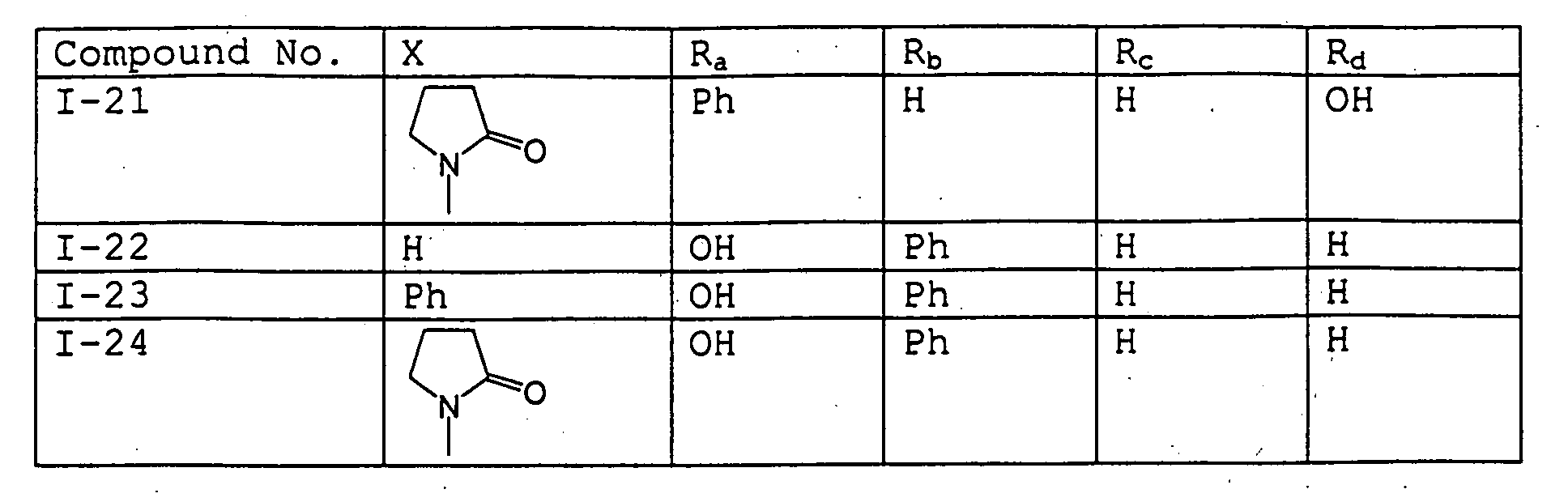

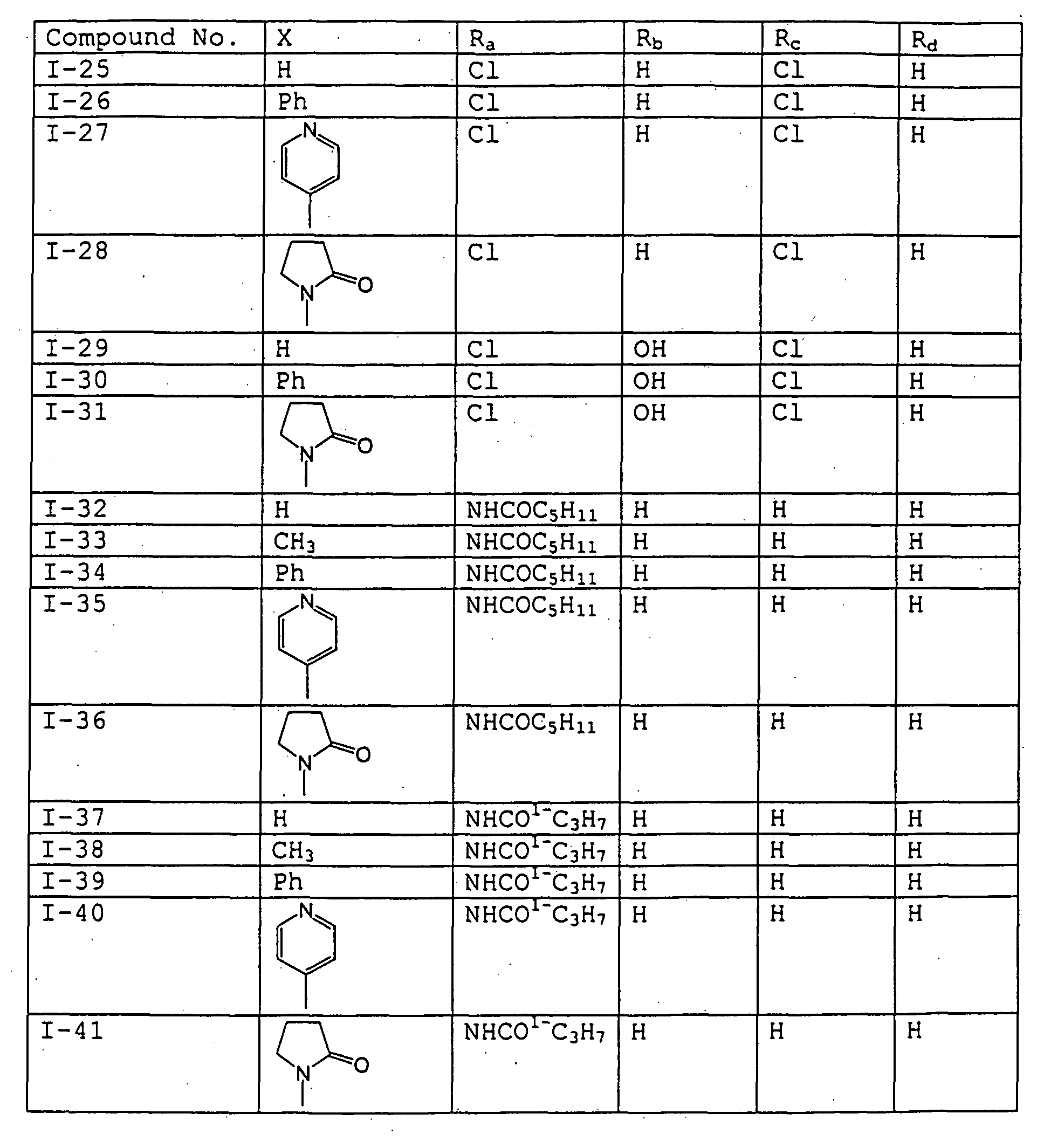

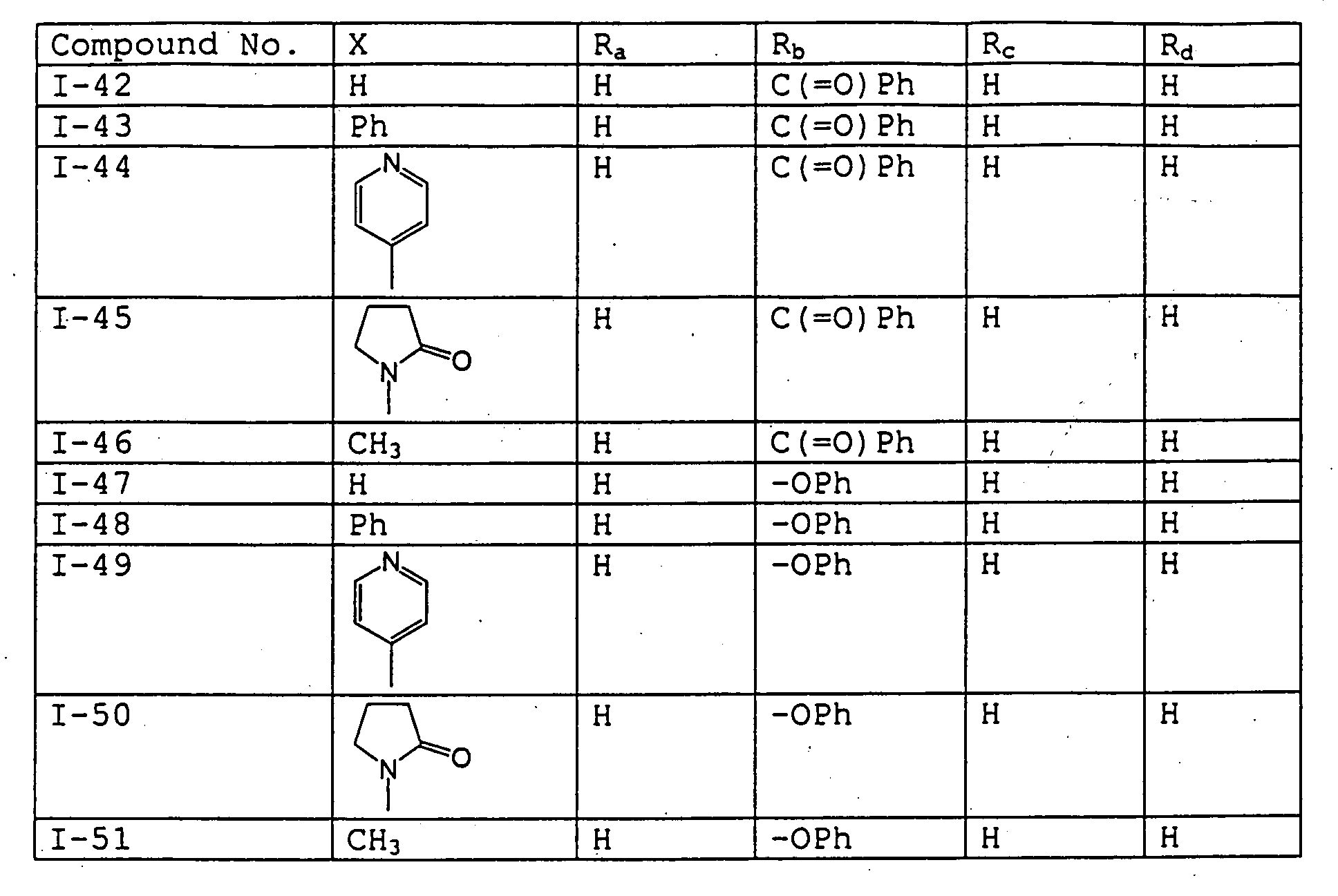



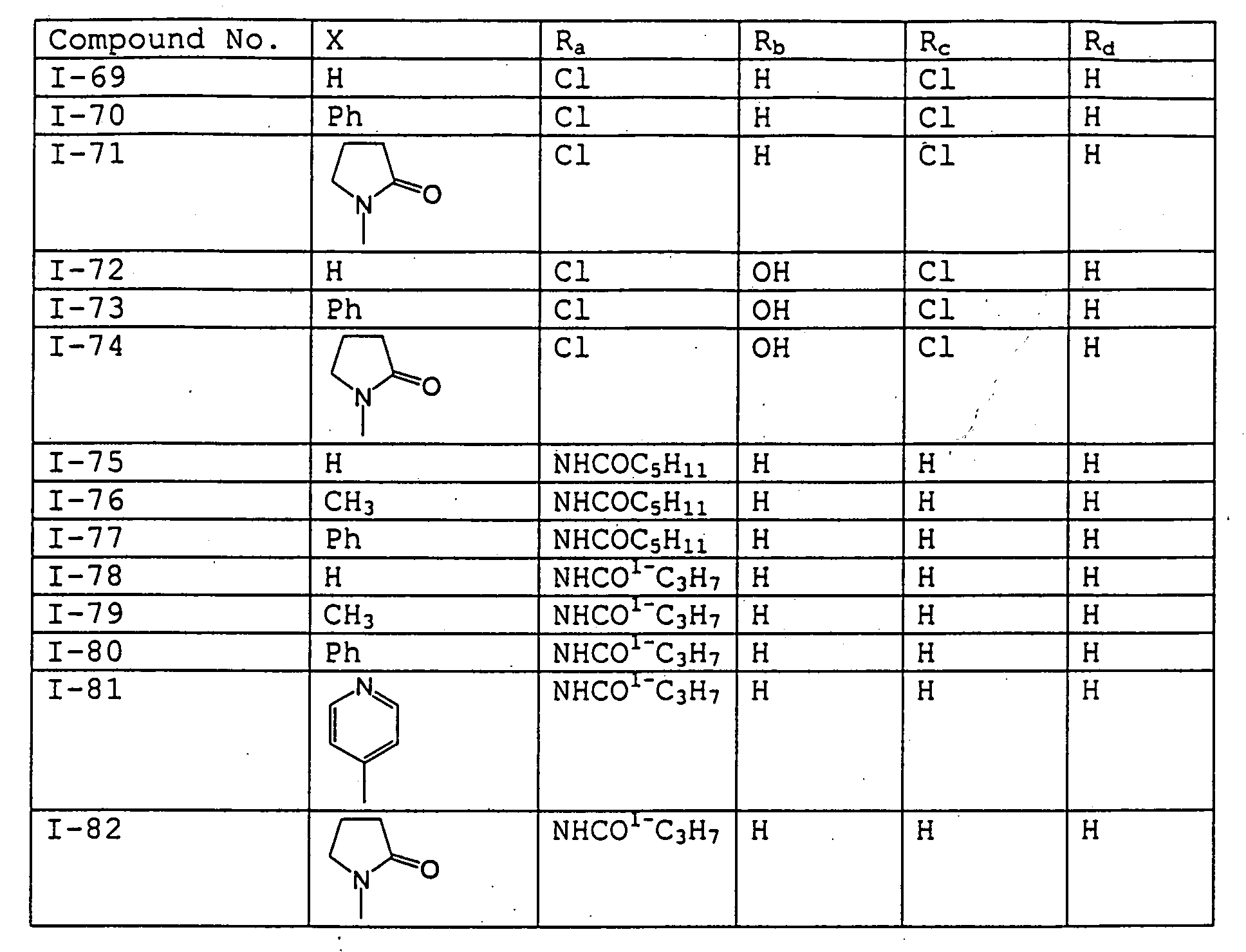



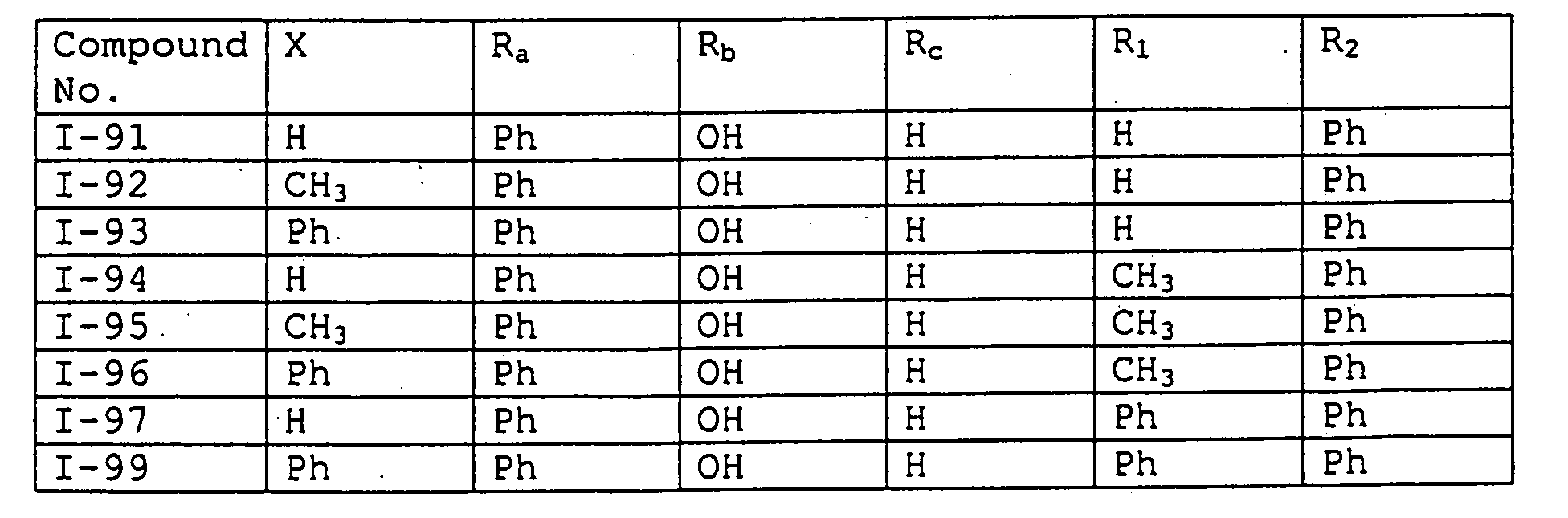

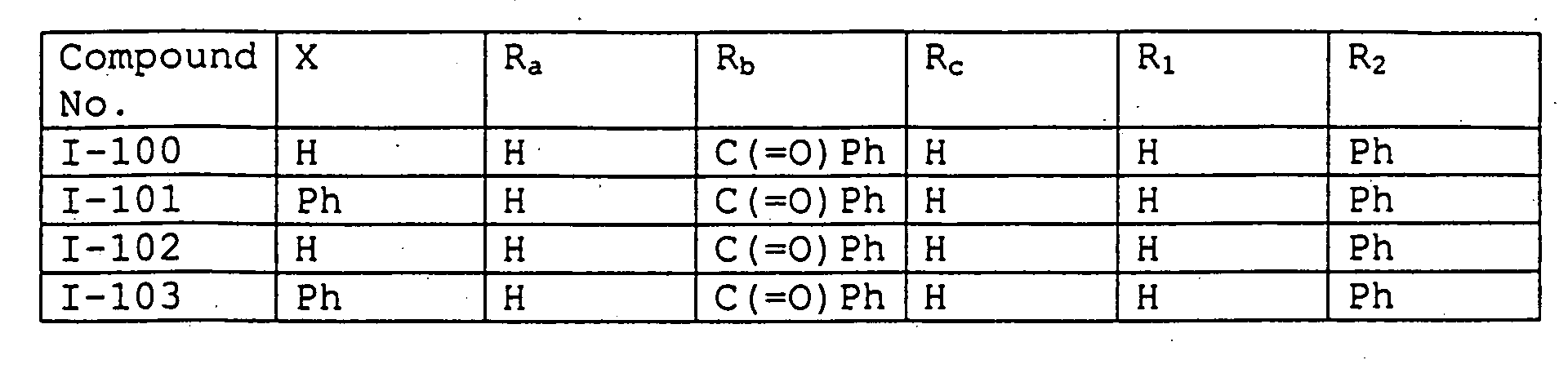


- These compounds can be synthesized by methods based on synthesis methods described in Japanese Patent Laid-Open No. 2000-52658.
- Synthesis examples of the oxonol dye compounds represented by general formula (I) will be described below.
- First, synthesis examples of 4,4'-bipyridinium compounds are shown below.


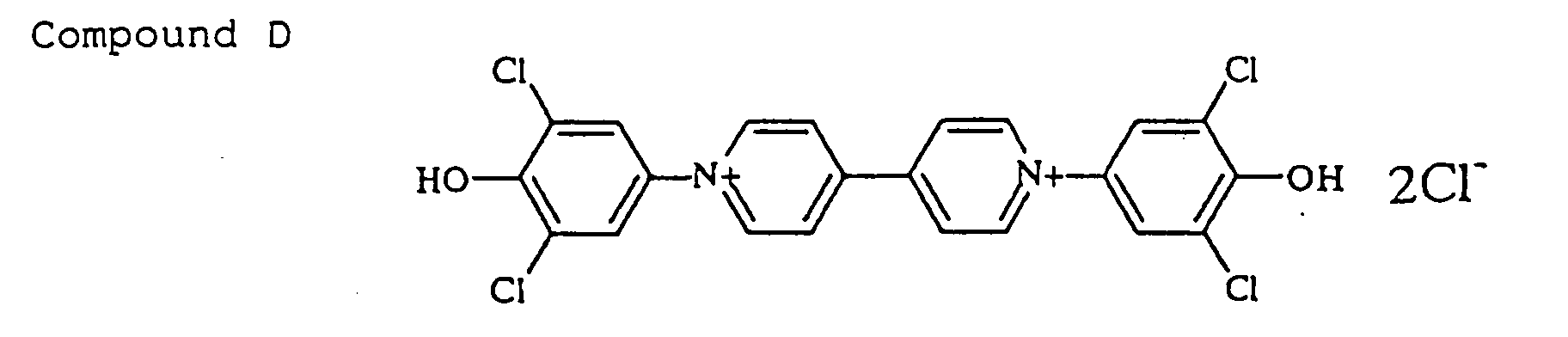
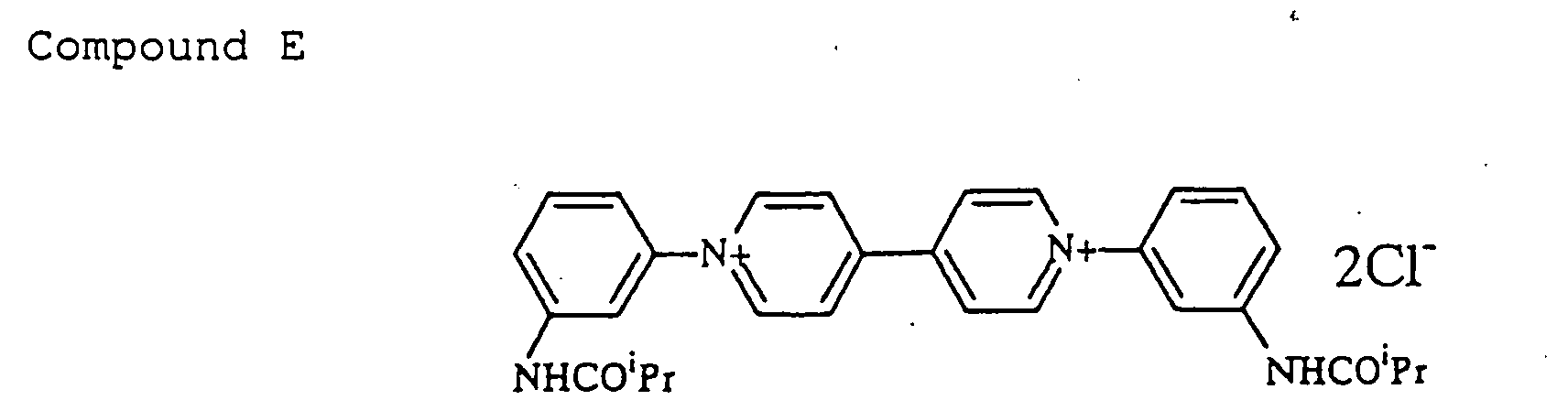

- (1,1'-Bis(2,4-dinitrophenyl)-4,4'-bipyridinium dichloride (2.8 g, 5 mmol) and 2-aminobiphenyl (2.9 g, 0.017 mol) were dissolved in DMF (80 ml), followed by stirring at 95°C for 5 hours. After filtration of the reaction solution, the filtered product was washed with DMF (50 ml) to obtain 0.3 g of powdered yellow compound A. This corresponds to 11% of the theoretical yield.
- 1H-NMR (DMSO-d6): 9.6 (d, 4H), 8.9 (d, 4H), 7.7-8.0 (m, 8H), 7.2-7.3 (m, 10H)
- (1,1'-Bis(2,4-dinitrophenyl)-4,4'-bipyridinium dichloride (2.8 g, 5 mmol) and 4-amino-5-phenylphenol (3.2 g, 0.017 mol) were dissolved in DMF (80 ml), followed by stirring at 95°C for 6 hours. After filtration of the reaction solution, the filtered product was washed with DMF (50 ml) to obtain 3.0 g of powdered brown compound B.
- 1H-NMR (DMSO-d6): 8.7-10.3 (broad, 8H), 7.6 (d, 3H), 7.3-7.5 (m, 5H)
- (1,1'-Bis(2,4-dinitrophenyl)-4,4'-bipyridinium dichloride (16.1 g, 0.028 mol) and 2-amino-4-phenylphenol (12.8 g, 0.069 mol) were dissolved in DMF (100 ml), followed by stirring at 95°C for 6 hours. After filtration of the reaction solution, the filtered product was washed with DMF (50 ml) to obtain 15.5 g of powdered orange compound C. This corresponds to 98% of the theoretical yield.
- 1H-NMR (DMSO-d6): 9.6 (d, 4H), 9.1 (d, 4H), 8.1 (s, 2H), 7.9 (d, 2H), 7.7 (d, 4H), 7.3-7.5 (m, 8H)
- (1,1'-Bis(2,4-dinitrophenyl)-4,4'-bipyridinium dichloride (2.2 g, 4 mmol) and 4-amino-2,6-dichlorophenol (2.1 g, 0.012 mol) were dissolved in DMF (60 ml), followed by stirring at 95°C for 6 hours. After filtration of the reaction solution, the filtered product was washed with DMF (50 ml) to obtain 1.5 g of powdered orange compound D. This corresponds to 68% of the theoretical yield.
- 1H-NMR (DMSO-d6): 9.6 (d, 4H), 9.1 (d, 4H), 8.1 (s, 4H)
- (1,1'-Bis(2,4-dinitrophenyl)-4,4'-bipyridinium dichloride (2.8 g, 5 mmol) and 3-isobutanoylaminoaniline (3.1 g, 0.017 mol) were dissolved in DMF (60 ml), followed by stirring at 95°C for 6 hours. The reaction solution was added to ethyl acetate (500 ml), and stirred for 2 hours. Then, the reaction solution was subjected to filtration, and the filtered product was washed with ethyl acetate (50 ml) to obtain 2.7 g of powdered yellow compound E. This corresponds to 99% of the theoretical yield.
- 1H-NMR (DMSO-d6): 11.0 (s, 2H), 9.7 (d, 4H), 9.1 (d, 4H), 8.5 (s, 2H), 7.9 (m, 2H), 7.5-7.7 (m, 4H), 2.8 (m, 2H), 1.2 (d, 12H)
- (1,1'-Bis(2,4-dinitrophenyl)-4,4'-bipyridinium dichloride (7.8 g, 0.014 mol) and 4-aminobenzophenone (6.6 g, 0.043 mol) were dissolved in DMF (100 ml), followed by stirring at 95°C for 6 hours. Then, the reaction solution was subjected to filtration, and the filtered product washed with DMF (50 ml) to obtain 4.7 g of powdered white compound F. This corresponds to 57% of the theoretical yield.
- 1H-NMR (MeOD): 8.8-9.8 (broad, 8H), 8.1 (broad, 8H), 7.8 (d, 4H), 7.7 (dd, 2H), 7.5 (dd, 4)
- Then, synthesis examples of the oxonol dye compounds are shown below.

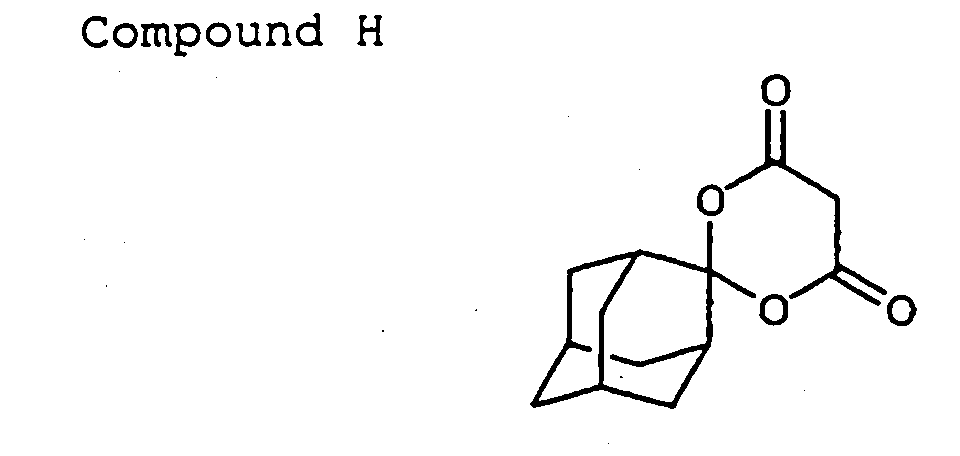
- Malonic acid (41.6 g, 0.40 mol) and cyclohexanone (43.2 g, 0.44 mol) were dissolved in acetic anhydride (48 ml), and then, sulfuric acid (1.2 ml) was added dropwise thereto. After stirring at room temperature for 8 hours, water (800 ml) and hexane (600 ml) were in turn poured into the resulting solution, followed by stirring at room temperature for 1 hour. The resulting crystals were filtered and washed with water (100 ml) and hexane (100 ml) to obtain 50 g of powdered white compound G. This corresponds to 68% of the theoretical yield.
- 1H-NMR (CDCl3) : 3.6 (s, 2H), 1.9 (m, 4H), 1.6-1.8 (m, 4H), 1.5 (m, 2H)
- Malonic acid (10.4 g, 0.10 mol) and adamantanone (16.5 g, 0.11 mol) were dissolved in acetic anhydride (13 ml), and then, sulfuric acid (0.2 ml) was added dropwise thereto. After stirring at room temperature for 8 hours, water (400 ml) and hexane (200 ml) were in turn poured into the resulting solution, followed by stirring at room temperature for 1 hour. The resulting crystals were filtered and washed with water (100 ml) and hexane (100 ml) to obtain 22 g of powdered white compound H. This corresponds to 93% of the theoretical yield.
- 1H-NMR (CDCl3): 3.6 (s, 2H), 2.0-2.3 (m, 6H), 1.6-2.0 (m, 8H)


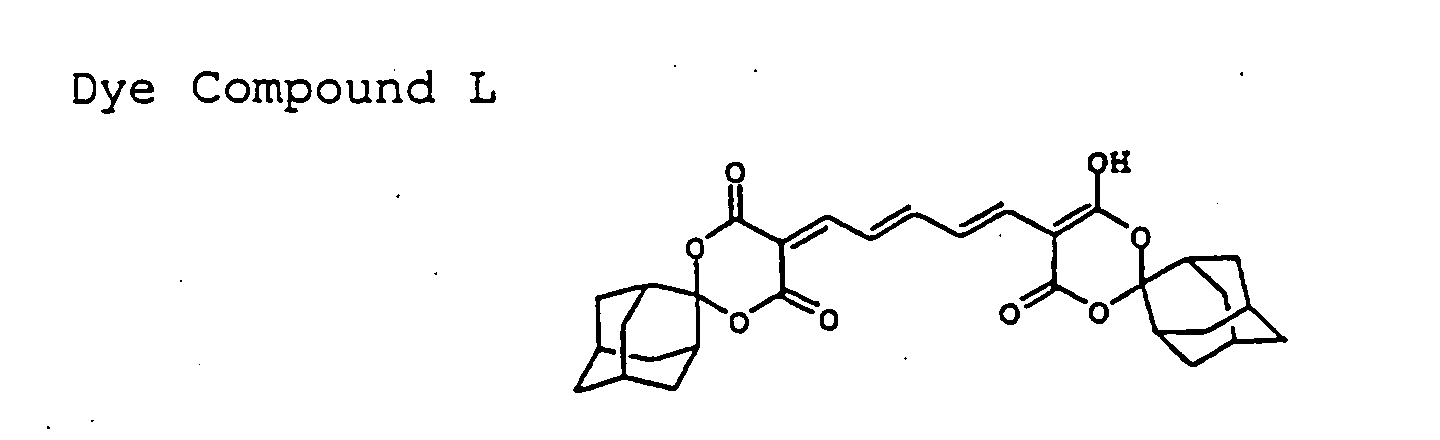

- Compound G (32 g, 0.17 mol) and N,N'-1,3-pentadiene-1-yl-5-ylidenedianiline hydrochloride (21 g, 0.074 mol) were dissolved in DMF (150 ml), and then, triethylamine (36 ml) was added dropwise thereto. After stirring at room temperature for 6 hours, extraction was conducted with saturated brine (400 ml) and ethyl acetate (400 ml). Crystals precipitated in the extraction process were filtered and washed with water (100 ml) and ethyl acetate (100 ml) to obtain 31 g of powdered deep red dye compound I. This corresponds to 97% of the theoretical yield.
- 1H-NMR (DMSO-d6): 7.8 (d, 2H), 7.5 (dd, 1H), 7.1 (d, 2H), 1. 9 (m, 8H), 1.5 (m, 8H), 1.4 (m, 4H)
- Compound G (39 g, 0.21 mol) and compound N described below (34 g, 0.10 mol) were dissolved in ethyl acetate (200 ml), and then, triethylamine (47 ml) was added dropwise thereto. After heating reflux for 3 hours, ethyl acetate (100 ml), hexane (100 ml), water (200 ml) and concentrated hydrochloric acid (28 ml) were added, followed by stirring at room temperature for 2 hours. Crystals precipitated were filtered and washed with water (100 ml) and ethyl acetate (100 ml) to obtain 68 g of powdered deep blue dye compound J.
- 1H-NMR (DMSO-d6): 7.5 (m, 6H), 7.0-7.2 (m, 3H), 1.9 (m, 8H), 1.5 (m, 8H), 1.4 (m, 4H)

- Compound G (7.4 g, 0.040 mol) and N,N'-heptadiene-1-yl-7-ylidenedianiline hydrochloride (5.5 g, 0.020 mol) were dissolved in DMF (50 ml), and then, triethylamine (5.6 ml) and acetic anhydride (3.8 ml) were added dropwise thereto. After stirring at room temperature for 1 hour, extraction was conducted with saturated brine (400 ml) and ethyl acetate (400 ml). Crystals precipitated in the extraction process were filtered and washed with water (100 ml) and ethyl acetate (100 ml) to obtain 1.4 g of powdered blue dye compound K. This corresponds to 15%.of the theoretical yield.
- 1H-NMR (DMSO-d6): 7.6 (d, 2H), 7.1-7.4 (m, 4H), 6.3 (dd, 1H), 1.8 (m, 8H), 1.5 (m, 8H), 1.4 (m, 4H)
- Compound H (5.2.g, 0.022 mol) and N,N'-1,3-pentadiene-1-yl-5-ylidenedianiline hydrochloride (2.8 g, 0.010 mol) were dissolved in DMF (30 ml), and then, triethylamine (4.5 ml) was added dropwise thereto. After stirring at room temperature for 5 hours, extraction was conducted with saturated brine (400 ml) and ethyl acetate (400 ml). Crystals precipitated in the extraction process were filtered and washed with water (100 ml) and ethyl acetate (100 ml) to obtain 4.5 g of powdered deep red dye compound L. This corresponds to 84% of the theoretical yield.
- 1H-NMR (DMSO-d6): 7.6 (d, 2H), 7.5 (dd, 1H), 7.1 (dd, 2H), 2.1 (s, 4H), 1.9 (m, 8H), 1.8 (s, 4H), 1.6 (m, 12H)
- Compound H (23.6 g, 0.10 mol) and compound O described below (17.1 g, 0.050 mol) were dissolved in DMF (100 ml), and then, triethylamine (21 ml) was added dropwise thereto. After stirring at room temperature for 5 hours, extraction was conducted with saturated brine (400 ml) and ethyl acetate (400 ml). Crystals precipitated in the extraction process were filtered and washed with water (100 ml) and ethyl acetate (100 ml) to obtain 23.4 g of powdered deep red dye compound M. This corresponds to 85% of the theoretical yield.
- 1H-NMR (DMSO-d6): 7.8 (d, 2H), 7.7 (d, 2H), 2.1 (s, 7H), 1.9 (m, 8H), 1.8 (s, 4H), 1.6 (m, 12H)
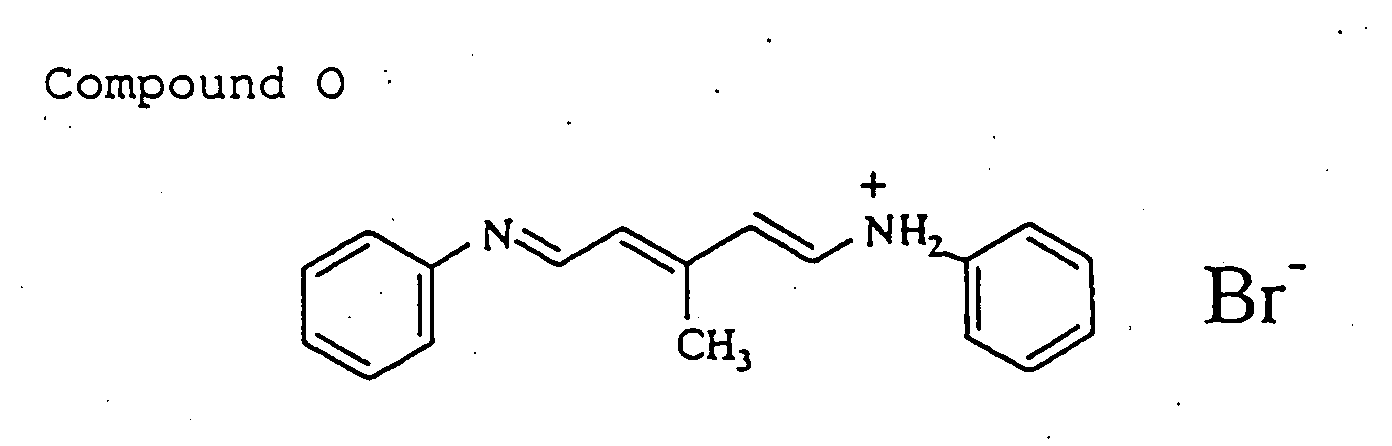
- Dye compound I (12.9 g, 0.030 mol) was dissolved in methanol (150 ml), and then, compound B (8.5 g, 0.015 mol) was added thereto. After stirring at room temperature for 5 hours, the resulting solution was subjected to filtration, and the filtered product was washed with methanol (100 ml) to obtain 17.0 g of powdered green dye compound (I-8). This corresponds to 84% of the theoretical yield.
- 1H-NMR (DMSO-d6): 10.7 (s, 2H), 9.7 (d, 4H), 9.0 (d, 4H), 7.0-8.0 (m, 26H), 1.9 (m, 16H), 1.5 (m, 16H), 1.4 (m, 8H)
- Dye compound J (8.5 g, 0.017 mol) was dissolved in methanol (150 ml), and then, compound B (4.7 g, 8.3 mmol) was added thereto. After stirring at room temperature for 5 hours, the resulting solution was subjected to filtration, and the filtered product was washed with methanol (100 ml) to obtain 10.1 g of powdered green dye compound (I-10). This corresponds to 79% of the theoretical yield.
- 1H-NMR (DMSO-d6): 10.7 (s, 2H), 9.7 (d, 4H), 9.0 (d, 4H), 7.7-7.9 (m, 6H), 7.1-7.6 (m, 26H), 1.9 (m, 16H), 1.5 (m, 16H), 1.4 (m, 8H)
- Dye compound I (12.9 g, 0.030 mol) was dissolved in methanol (400 ml), and then, compound C (8.5 g, 0.015 mol) was added thereto. After stirring at room temperature for 5 hours, the resulting solution was subjected to filtration, and the filtered product was washed with methanol (100 ml) to obtain 19.3 g of powdered green dye compound (I-15). This corresponds to 95% of the theoretical yield.
- 1H-NMR (DMSO-d6): 9.7 (d, 4H), 9.0 (d, 4H), 8.0 (s, 2H), 7.7-7.9 (d, 2H), 7.5-7.7 (m, 8H), 7.3-7.5 (m, 10H), 7.1 (dd, 4H), 1.9 (m, 16H), 1.5 (m, 16H), 1.4 (m, 8H)
- Dye compound L (0.32 g, 0.6 mmol) was dissolved in methanol (10 ml), and then, compound A (0.16 g, 0.3 mmol) was added thereto. After stirring at room temperature for 3 hours, the resulting solution was subjected to filtration, and the filtered product was washed with methanol to obtain 0.33 g of dye compound (I-52) having a golden luster. This corresponds to 72% of the theoretical yield.
- 1H-NMR (DMSO-d6): 9.6 (d, 4H), 8.9 (d, 4H), 7.1-7.9 (m, 28H), 2.1 (s, 8H), 1.9 (m, 16H), 1.8 (s, 8H), 1.6 (m, 24H)
- Dye compound L (0.53 g, 1.0 mmol) was dissolved in methanol (10 ml) containing concentrated hydrochloric acid (1 ml), and then, compound D (0.33 g, 0.6 mmol) was added thereto. After stirring at room temperature for 3 hours, the resulting solution was subjected to filtration, and the filtered product was washed with methanol to obtain 0.35 g of green crystals of dye compound (I-72). This corresponds to 45% of the theoretical yield.
- 1H-NMR (DMSO-d6): 11.4 (s, 2H), 9.7 (d, 4H), 9.1 (d, 4H), 8.1 (s, 4H), 7.6 (d, 4H), 7.5 (dd, 2H), 7.1 (dd, 4H), 2.1 (s, 8H), 1.9 (m, 16H), 1.8 (s, 8H), 1.6 (m, 24H)
- Dye compound L (10.7 g, 0.0 20 mol) was dissolved in methanol (100 ml), and then, compound E (6.6 g, 0.012 mol) was added thereto. After stirring at room temperature for 2 hours, the resulting solution was subjected to filtration, and the filtered product was washed with methanol to obtain 12.2 g of green crystals of dye compound (I-78). This corresponds to 79% of the theoretical yield.
- 1H-NMR (DMSO-d6): 10.4 (s, 2H), 9.7 (d, 4H), 9.1 (d, 4H), 8.5 (s, 2H), 7.6-7.8 (m, 10H), 7.6 (dd, 2H), 7.1 (dd, 4H), 2.7 (tt, 2H), 2.1 (s, 8H), 1.9 (m, 16H), 1.8 (s, 8H), 1.6 (m, 24H), 1.2 (d, 12H)
- Dye compound M (0.44 g, 0.8 mmol) was dissolved in methanol (100 ml), and then, compound F (0.24 g, 0.4 mmol ) was added thereto. After stirring at room temperature for 2 hours, the resulting solution was subjected to filtration; and the filtered product was washed with methanol to obtain 0.37 g of dye compound (I-87) having a golden luster. This corresponds to 57% of the theoretical yield.
- 1H-NMR (DMSO-d6): 9.8 (d, 4H), 9.2 (d, 4H), 8.1 (m, 8H), 7.9 (d, 4H), 7.7-7.8 (m, 6H), 7.6 (dd, 4H), 7.2 (d, 4H), 2.1 (s, 14H), 1.9 (m, 16H), 1.8 (s, 8H), 1.6 (m, 24H)
- Dye compound K (0.92 g, 2.0 mmol) was dissolved in methanol (100 ml), and then, compound F (0.71 g, 1.2 mmol) was added thereto. After stirring at room temperature for 4 hours, the resulting solution was subjected to filtration, and the filtered product was washed with methanol to obtain 1.1 g of green crystals of dye compound (I-104). This corresponds to 77% of the theoretical yield.
- 1H-NMR (DMSO-d6): 9.8 (d, 4H), 9.2 (d, 4H), 8.1 (m, 8H), 7.8-7.9 (m, 6H), 7.7 (dd, 4H), 7.5 (d, 4H), 7.0-7.3 (m, 8H), 6.2 (dd, 2H), 1.9 (m, 16H), 1.5 (m, 16H), 1.4 (m, 8H)
- Then, the optical information recording media of the invention will be described. The optical information recording medium of the invention comprises a substrate having provided thereon a recording layer containing at least on oxonol dye compound represented by general formula (I). The oxonol dye compound for use in the invention can be appropriately selected depending on the wavelength of light used for recording and reproduction. For example, when recording is carried out with a semiconductor laser beam having a center wavelength of 780 nm which is used for the CD-R recording, dye compounds in which m is 3 in general formula (I) can be used, and when recording is carried out with a laser beam having a wavelength ranging from 630 nm to 660 nm which is used for the DVD-R recording, dye compounds in which m is 2 can be used. Further, when recording is carried out with a laser beam having a wavelength 550 nm or less, dye compounds in which m is 0 or 1 (preferably 0) can be used.
- The dye compounds according to the invention may be used either singly or as a combination of two or more of them for obtaining desired wavelength characteristics. Further, the compounds represented by general formula (I) may be used in combination with compounds other than these compounds.
- The recording layers can contain various fading inhibitors for further improving the light resistance of the recording layers. The fading inhibitors include organic oxidizing agents and singlet oxygen quenchers. As the organic oxidizing agents used as the fading inhibitors, there are preferably used compounds described in Japanese Patent Laid-Open No. 151861/1998. The singlet oxygen quenchers include metal complexes, diimmonium salts and aminium salts represented by general formula (III), (IV) or (V) described in Japanese Patent Laid-Open No. 224793/1991.
- Then, the structure of the information recording media of the invention will be illustrated. As described above, there is no particular limitation on the optical information recording medium of the invention, as long as it has the substrate having provided thereon the recording layer containing at least one compound represented by general formula (I). However, when the optical information recording medium of the invention is applied as the CD-R type medium, it is preferred that the recording layer containing at least one compound represented by general formula (I), a light reflective layer and a protective layer are provided in this order on a transparent disk-shaped substrate having a thickness of 1.2 ± 0.2 mm on which pre-grooves are formed at a track pitch of 1.4 µm to 1.8 µm. Further, when the optical information recording medium of the invention is applied as the DVD-R type medium, the following embodiments are preferred:
- (1) An information recording medium having a thickness of 1.2 ± 0.2 mm comprising two laminates each comprising a transparent disk-shaped substrate having provided thereon the recording layer containing at least one compound represented by general formula (I) of the invention, each substrate having a diameter of 120 ± 0.3 mm or 80 ± 3 mm and a thickness of 0.6 ± 0.1 mm, pre-grooves being formed on the substrate at a track pitch of 0.6 µm to 0.9 µm, the recording layer being provided on the side where the pre-grooves are formed, the laminates being adhered to each other, with rendering the respective recording layer inside relative to the respective substrate; and
- (2) An information recording medium having a thickness of 1.2 ± 0.2 mm comprising: a laminate comprising a transparent disk-shaped substrate having provided thereon the recording layer containing at least one compound represented by general formula (I) of the invention; and a disk-shaped protective plate having a size similar to that of the disk-shaped substrate, the substrate having a diameter of 120 ± 0.3 mm or 80 ± 3 mm and a thickness of 0.6 ± 0.1 mm, pre-grooves being formed on the substrate at a track pitch of 0.6 µm to 0.9 µm, the recording layer being provided on the side where the pre-grooves are formed, the laminate being adhered to the protective plate, with rendering the recording layer inside relative to the substrate.
-
- Also in the above-mentioned embodiments, it is preferred that a reflective layer is provided on the recording layer. Further, a protective layer may be provided on the'reflective layer.
- Methods for producing the information recording media of the invention will be described below.
- For the DVD-R type recording media, the information recording media of the invention can be produced basically employing the materials used in the production of the CD-R type information recording media with the exception that substrates are used on which pre-grooves are formed at a narrower track pitch than those of the CD-R type media for attaining a higher recording density. That is to say, the DVD-R type information recording medium can be produced by preparing two laminates in each of which the recording layer, the light reflective layer, and further optionally the protective layer are formed on the substrate in this order, and adhering these two laminates to each other, or by adhering the laminate to the disk-shaped protective substrate having a size approximately similar to that of the substrate of the laminate, each using an adhesive with rendering the recording layer(s) inside relative to the substrate(s).
- The information recording media of the invention can be produced, for example, by the following methods. The substrates (including the protective substrates) can be arbitrarily selected from various materials used as the substrates of the conventional information recording media. The materials for the substrates include, for example, glass; polycarbonates; acrylic resins such as polymethyl methacrylate; vinyl chloride resins such as polyvinyl chloride and vinyl chloride copolymers; epoxy resins; amorphous polyolefins; and polyesters. They may be used in combination as so desired. These materials can be used in the film form or in the rigid substrate form. Of the above-mentioned materials, polycarbonates are preferred in terms of moisture resistance, dimensional stability and cost.
- Undercoat layers may be provided on surfaces of the substrates on which the recording layers are formed, for improving smoothness, enhancing adhesion and preventing deterioration of the recording layers. Materials for the undercoat layers include, for example, polymers such as polymethyl methacrylate, acrylic acid-methacrylic acid copolymers, styrene-maleic anhydride copolymers, polyvinyl alcohol, N-methylolacrylamide, styrene-vinyltoluene copolymers, chlorosulfonated polyethylene, nitrocellulose, polyvinyl chloride, chlorinated polyolefins, polyesters, polyimides, vinyl acetate-vinyl chloride copolymers, ethylene-vinyl acetate copolymers, polyethylene, polypropylene and polycarbonates; and surface modifiers such as silane coupling agents. The undercoat layers can be formed by dissolving or dispersing the above-mentioned materials in appropriate solvents to prepare coating solutions, and applying the resulting coating solutions to the surfaces of the substrates by coating methods such as spin coating, dip coating and extrusion coating. The thickness of the undercoat layers is generally within the range of 0.005 µm to 20 µm, and preferably within the range of 0.01 µm to 10 µm.
- Grooves for tracking or unevenness (pre-grooves) for expressing information such as address signals are usually formed on the substrates (or undercoat layers). It is preferred that these pre-grooves are directly formed on the substrates at the above-mentioned track pitch in injection molding or extrusion molding of the resin materials such as polycarbonates. The pre-grooves may be formed by providing a pre-groove layer. As a material for the pre-groove layer, there can be used a mixture of at least one monomer (or oligomer) selected from a monoester, a diester, a triester and a tetraester of acrylic acid, and a photopolymerization initiator. The pre-groove layer is formed, for example, by applying a mixed solution of at least one of the above-mentioned acrylic acid esters and the photopolymerization initiator onto a mother die (stamper) precisely fabricated, further placing the substrate on the resulting coated layer, then irradiating the coated layer with ultraviolet rays through the substrate or the mother die, thereby hardening the coated layer to fixedly adhere the coated layer to the substrate, and thereafter separating the substrate from the mother die. The thickness of the pre-groove layer is generally within the range of 0.05 µm to 100 µm, and preferably within the range of 0.1 µm to 50 µm.
- The depth of the pre-grooves preferably ranges from 300 to 2000 Å, and the half-width thereof preferably ranges from 0.2 µm to 0.9 µm. The use of the pre-grooves having a depth ranging from 1500 to 2000 Å can improve the sensitivity without a substantial reduction in reflectance, which is particularly advantageous to the CD-R type recording media.
- The recording layers comprising the dye compounds represented by the above-mentioned formula according to the invention are provided on the surfaces of the substrates (or undercoating layers) on which the pre-grooves are formed.
- The recording layers can be formed by dissolving the dyes according to the invention, and further optionally the quenchers and binders in solvents to prepare coating solutions, and then, applying the coating solutions onto the surfaces of the substrates to form coating films, followed by drying. Solvents for the coating solutions for the formation of the dye recording layers include esters such as methyl lactate, ethyl lactate, butyl acetate and cellosolve acetate; ketones such as methyl ethyl ketone, cyclohexanone and methyl isobutyl ketone; chlorinated hydrocarbons such as dichloromethane, 1,2-di-chloroethane and chloroform; amides such as dimethylformamide; hydrocarbons such as cyclohexane; ethers such as tetrahydrofuran, ethyl ether and dioxane; alcohols such as ethanol, n-propanol, isopropanol, n-butanol and diacetone alcohol; fluorine solvents such as 2,2,3,3-tetrafluoropropanol; and glycol ethers such as ethylene glycol monomethyl ether, ethylene glycol monoethyl ether and propylene glycol monomethyl ether. The above-mentioned solvents can be used alone or as a combination of two or more of them, considering the solubility of the dyes to be used. Various additives such as antioxidants, UV absorbers, plasticizers and lubricants may further added to the coating solutions, depending on their purpose.
- Examples of binders include natural organic polymers such as gelatin, cellulose derivatives, dextran, rosin and rubber; and synthetic organic polymers such as hydrocarbon resins such as polyethylene, polypropylene, polystyrene and polyisobutylene; vinyl resins such as polyvinyl chloride, polyvinylidene chloride and vinyl chloride-vinyl acetate copolymers; acrylic resins such as polymethyl acrylate and polymethyl methacrylate; polyvinyl alcohol; chlorinated polyethylene; epoxy resins; butyral resins; rubber derivatives; and initial condensation products of thermosetting resins such as phenol-formaldehyde resins. When the binder is used as the material for the recording layer in combination with the dye, generally, a 0.01-fold to 50-fold excess of binder (by weight ratio), preferably, a 0.1-fold to 5-fold excess of binder (by weight ratio), in relation to the amount of dye, is used. The concentration of the coating solutions thus prepared is generally within the range of 0.01% to 10% by weight, and preferably within the range of 0.1% to 5% by weight.
- Coating methods include spraying, spin coating, dip coating, roll coating, blade coating, doctor roll coating and screen printing. The recording layers may be either monolayers or multilayers. The thickness of the recording layers is generally within the range of 20 nm to 500 nm, and preferably within the range of 50 nm to 300 nm.
- The reflective layers are provided on the recording layers for improving the reflectance in the reproduction of information. Light reflective materials, materials for the reflective layers, are materials having high reflectance to the laser beams, and examples thereof include metals such as Mg, Se, Y, Ti, Zr, Hf, V, Nb, Ta, Cr, Mo, W, Mn, Re, Fe, Co, Ni, Ru, Rh, Pd, Ir, Pt, Cu, Ag, Au, Zn, Cd, Al, Ga, In, Si, Ge, Te, Pb, Po, Sn and Bi, semi-metals and stainless steel. Of these, preferred are Cr, Ni, Pt, Cu, Ag, Au, Al and stainless steel. They may be used either alone or as a combination of two or more of them. Further, they may also be used as alloys. The reflective layers can be formed on the recording layers, for example, by vapor deposition, sputtering or ion plating of the above-mentioned reflective materials. The thickness of the reflective layers is generally within the range of 10 nm to 300 nm, and preferably within the range of 50 nm to 200 nm.
- On the reflective layers, the protective layers may be provided for protecting the recording layers physically and chemically. The protective layers may also be provided on the side where no recording layers are provided, for enhancing scratch resistance and moisture resistance. Examples of materials used in the protective layers include inorganic materials such as SiO, SiO2, MgF2, SnO2 and Si3N4, and organic materials such as thermoplastic resins, thermosetting resins and UV-curing resins. The protective layers can be formed, for example, by laminating the reflective layers and/or the substrates with films obtained by extrusion of plastics through adhesives. Alternatively, they may be provided by methods such as vacuum vapor deposition, sputtering and coating. In the case of the thermoplastic resins or the thermosetting resins, the protective layers can also be formed by dissolving these resins in appropriate solvents to prepare coating solutions, and then, applying the resulting coating solutions, followed by drying. In the case of the UV-curing resins, the resins can be applied as such, or dissolved in appropriate solvents to prepare coating solutions, which are applied, followed by irradiation of UV light to cure the resins, thereby forming the protective layers. Various additives such as antistatic agents, antioxidants and UV absorbers may be added to these coating solutions depending on their purpose. The thickness of the protective layers is generally within the range of 0.1 µm to 100 µm.
- According to the above-mentioned processes, the laminates comprising the substrates having provided thereon the recording layers, the light reflective layers and the protective layers can be produced. The DVD-R type information recording medium having two recording layers can be produced by adhering the two laminates produced as described above to each other, with rendering the respective recording layer inside relative to the respective substrate. Methods for adhering the laminates include a method using a slow-acting ultraviolet curing adhesive, a hot melt method and a method of adhering the laminates with an adhesive tape. From the viewpoints of damages to the recording layers and cost, the method using the slow-acting ultraviolet curing adhesive is preferred. As the adhesive, a solventless adhesive is preferably used. Coating methods of the adhesives include spraying, spin control coating, roll coating and screen printing. Of these, screen printing is preferred. Further, the DVD-R type information recording medium having a recording layer only on one side can be produced by adhering the laminate to the disk-shaped protective substrate having a size approximately similar to that of the substrate of the laminate with the adhesive, with rendering the recording layer inside relative to the substrate.
- The information recording method of the invention is conducted using the above-mentioned information recording medium, for example, in the following manner.
- First, the information recording medium is irradiated from the substrate side thereof with light for recording such as a semiconductor laser beam, while rotating the medium at a constant linear speed (1.2 m/second to 14 m/second for the CD format) or at a constant angular speed. It is considered that this light irradiation results in the formation of voids in the interface of the recording layer and the reflective layer (the voids are formed, accompanying the deformation of the recording layer or the reflective layer, or the deformation of both layers), or in the building-up deformation of the substrate, or in changes in the index of refraction due to the discoloration of the recording layer or changes in the association state, which causes recording of information. As the recording light, there is used a laser beam in the visible light region, that is to say, in the case of the CD-R type recording medium, a semiconductor laser beam having a center oscillation wavelength of 780 nm. In the case of the DVD-R type recording medium, a laser beam having an oscillation wavelength ranging from 600 nm to 700 nm (preferably from 620 nm to 680 nm, and more preferably fro 630 nm to 660 nm) is generally used. The information recorded as described above can be reproduced by irradiating the information recording media from the substrate side thereof with a semiconductor laser beam having the same wavelength as the laser beam used in recording, while rotating the media at the same constant linear speed as described above, and detecting the reflective light thereof.
- The present invention will be illustrated in greater detail with reference to the following Examples, but the invention should not be construed as being limited thereto.
- A polycarbonate resin was formed into a 0.6-mm thick, 120-mm diameter substrate having spiral pre-grooves (depth: 150 nm, width: 290 nm, track pitch: 0.74 µm) by use of an injection molding machine (manufactured by Sumitomo Heavy Industries, Ltd. Oxonol dye compound (I-8) was dissolved in 100 ml of 2,2,3,3-tetrafluoropropanol to prepare a coating solution (dye concentration: 1.5% by weight). This coating solution was applied by spin coating onto a surface of the substrate on which the spiral pre-grooves were formed to form a dye layer. At this time, the thickness of the dye layer was 80 nm. Subsequently, silver was sputtered on the dye layer to form a reflective layer having a thickness of about 150 nm. Then, an ultraviolet curing resin (Daicure Clear SD-318, manufactured by Dainippon Ink & Chemicals, Inc.) was applied onto the reflective layer by spin coating, and irradiated with ultraviolet rays by use of a metal halide lamp to form a protective layer having a thickness of about 7 µm, thus obtaining a 0.6-mm thick disk A. On the other hand, silver was sputtered on the above-mentioned substrate without coating with the dye coating solution, and the protective layer was formed thereon to form a 0.6-mm thick disk B having no dye recording layer. The disk A and the disk B were adhered to each other to form one disk in the following manner. First, a slow-acting cationic polymerization type adhesive (SK 7000, manufactured by Sony Chemicals Corp.) was applied onto the protective layers of the disk A and the disk B by screen printing. The mesh size of a screen printing plate used at this time was 300 meshes. Then, immediately after irradiation with ultraviolet rays by use of a metal halide lamp, the disk A and the disk B were adhered to each other, facing the respective protective layers inside, and pressed from both sides. After standing for about 5 minutes, the adhesive was completely cured to complete one disk having a thickness of 1.2 mm.
- DVD-R type disks of Examples 2 to 8 and Comparative Examples 1 to 4 were obtained in the same manner as in Example 1, with the exception that the above-mentioned compound (I-8) was replaced with compounds shown in Table 1.
- A signal was recorded on each of the DVD-R type optical disks of Examples and Comparative Examples with a DDU 1000 evaluating device (manufactured by Balstec Co.) using a laser beam having a wavelength of 655 nm (pick up to Na 0.6), a constant line speed of 3.49 m/s, a modulation frequency of 4 MHz and an optimum recording power within the range of 6 mW to 14 mW. Then, using a laser beam having the same wavelength as the recording laser beam, the signal was reproduced at a laser power of 0.5 mW, and the modulation degree of 14T and the jitter were measured.
- Each sample recorded as described above were stored for 24 hours under circumstances of a high temperature of 80°C and a high humidity of 85%, and the modulation degree and the jitter were measured in the same manner as described above.
- Evaluation results obtained are shown in Table 1.
Compound Used in Recording Layer Recording Reproduction Characteristics (before storage) Recording Reproduction Characteristics (after storage at 80°C, 85%) 14T Jitter 14T Jitter Example 1 (I-8) 70 6.9 67 7.4 Example 2 (I-10) 71 7.4 69 7.5 Example 3 (I-15) 68 7.8 62 8.5 Example 4 (I-52) 65 8.2 55 9.9 Example 5 (I-72) 67 8.2 61 8.9 Example 6 (I-80) 74 7.6 68 9.4 Example 7 (I-87) 74 7.6 68 9.1 Example 8 (I-94) 59 7.2 55 8.0 Comparative Example 1 Dye (1) for Comparison 70 10.5 42 Impossible to measure Comparative Example 2 Dye (2) for Comparison 59 9.2 40 Impossible to measure Comparative Example 3 Dye (3) for Comparison 71 7.4 50 14.7 Comparative Example 4 Dye (4) for Comparison 70 7.1 52 13.5 - Dye (1) for Comparison: Specific example (32) described in Japanese Patent Laid-Open No. 2000-52658
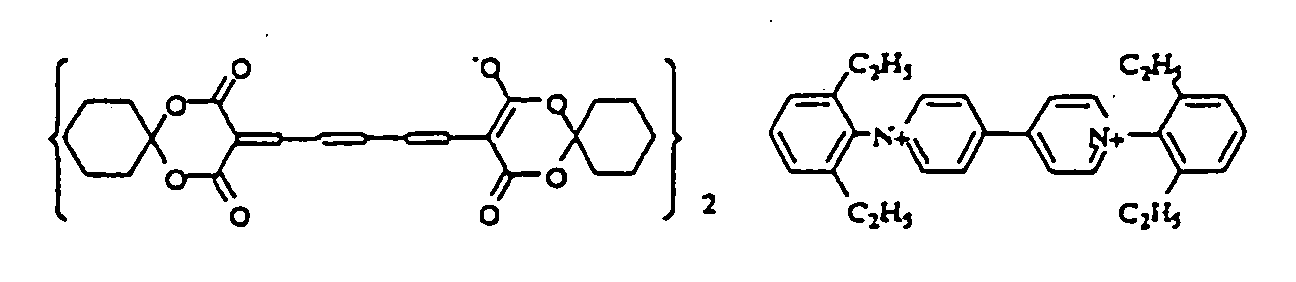
- Dye (2) for Comparison: Specific example (79) described in Japanese Patent Laid-Open No. 2000-52658

- Dye (3) for Comparison: Specific example (106) described in Japanese Patent Laid-Open No. 2000-52658

- Dye (4) for Comparison: Specific example (107) described in Japanese Patent Laid-Open No. 2000-52658

- The results shown in Table 1 reveal that the DVD-R type optical disks in which each recording layer contains at least one compound represented by general formula (I) according to the invention (Examples 1 to 8) indicate high modulation degree and give low jitter, which shows that excellent recording and reproduction characteristics are obtained. Further, compared with the disks for comparison (Comparative Examples 1 to 4), the disks of the invention maintain good recording and reproduction characteristics even after execution of the heat and humidity resistance test, which shows that the disks of the invention are excellent in heat and humidity resistance.
- According to the invention, there are provided the write once-type optical information recording media excellent in recording and reproduction characteristics and keeping quality, in which recording and reproduction of information can be performed by laser beam irradiation. Further, there are provided the optical information recording methods using the optical information recording media, giving excellent recording and reproduction characteristics and keeping quality.
- While the invention has been described in detail and with reference to specific examples thereof, it will be apparent to one skilled in the art that various changes and modifications can be made therein without departing from the spirit and scope thereof.
- Preferred embodiments are:
- 1. An oxonol dye compound represented by the
following general formula (I):
wherein R1, R2, R3 and R4 each independently represents an hydrogen atom, an alkyl group, an aryl group, an aralkyl group or a heterocyclic group; L1, L2 and L3 each independently represents a methine group which may have a substituent group; m represents an integer of 0 to 3; R5 and R6 each represents an alkyl group having 4 to 8 carbon atoms, an aryl group having 6 to 12 carbon atoms, an aralkyl group having 7 to 12 carbon atoms, a chlorine atom, a bromine atom, a hydroxyl group, an acyl group having 7 to 12 carbon atoms, an aryloxy group having 6 to 12 carbon atoms or an amido group having 4 to 8 carbon atoms; p and q each represents an integer of 1 to 3; R1 and R2, and R3 and R4 may combine with each other to form a ring; when m is 2 or more, plural -L2=L3- groups may be the same or different; and when p and q are integers of 2 or more, plural R5 and R6 groups may be the same or different, respectively.

- 2. An optical information recording medium comprising a substrate having thereon a recording layer capable of recording information by irradiation of a laser beam, wherein said recording layer contains an oxonol dye compound represented by general formula (I) according to claim 1.
- 3. The optical information recording medium according to claim 2, further comprising at least one of a reflective layer and a protective layer.
- 4. An optical information recording method comprising irradiating an optical information recording medium with a laser beam having a wavelength of 630 nm to 660 nm to record information thereon, wherein the optical information recording medium is according to claim 2 or 3.
-
Claims (8)
- A dye compound represented by the following general formula (I):wherein X represents a hydrogen atom or a phenyl group.

- An optical information recording medium comprising the dye compound according to claim 1.
- A process for synthesizing the dye compound according to claim 1, which comprises the steps of:wherein X represents a hydrogen atom or a phenyl group; and synthesizing the dye compound represented by general formula (I) from the compound represented by general formula (II).synthesizing a dye compound represented by general formula (II) shown below from compound G shown below:

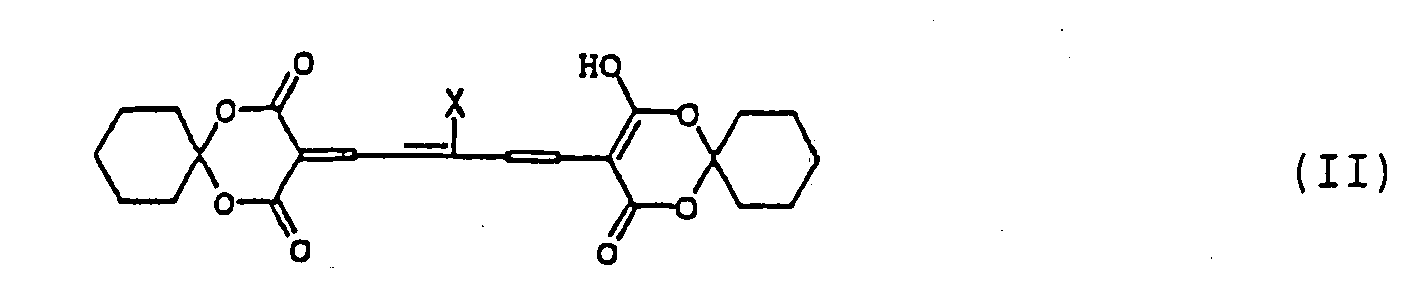
- An optical information recording medium comprising a dye compound synthesized by the process according to claim 3.
- A coating solution comprising 2,2,3,3-tetrafluoropropanol and the dye compound according to claim 1 dissolved therein.
- An optical information recording medium obtained by applying the coating according to claim 5 onto a transparent substrate.
- Use of the optical information recording medium according to claim 2 for information recording or reading with a laser beam having wavelength of from 600 to 700 nm.
- A method for optical information recording or reading comprising irradiating an optical information recording medium with a laser beam having wavelength of from 600 to 700 nm to record or read information thereon,
wherein the optical information recording medium is according to claim 2.
Applications Claiming Priority (3)
| Application Number | Priority Date | Filing Date | Title |
|---|---|---|---|
| JP2001052293A JP2002249674A (en) | 2001-02-27 | 2001-02-27 | Oxonol pigment compound, and optical information recording medium using the same, and optical information recording method |
| JP2001052293 | 2001-02-27 | ||
| EP02004422A EP1253148A3 (en) | 2001-02-27 | 2002-02-26 | Oxonol dye compound, optical information recording medium using the same, and optical information |
Related Parent Applications (1)
| Application Number | Title | Priority Date | Filing Date |
|---|---|---|---|
| EP02004422A Division EP1253148A3 (en) | 2001-02-27 | 2002-02-26 | Oxonol dye compound, optical information recording medium using the same, and optical information |
Publications (1)
| Publication Number | Publication Date |
|---|---|
| EP1477484A1 true EP1477484A1 (en) | 2004-11-17 |
Family
ID=18912947
Family Applications (2)
| Application Number | Title | Priority Date | Filing Date |
|---|---|---|---|
| EP02004422A Withdrawn EP1253148A3 (en) | 2001-02-27 | 2002-02-26 | Oxonol dye compound, optical information recording medium using the same, and optical information |
| EP04007653A Withdrawn EP1477484A1 (en) | 2001-02-27 | 2002-02-26 | Oxonol dye compound, optical information recording medium using the same, and optical information |
Family Applications Before (1)
| Application Number | Title | Priority Date | Filing Date |
|---|---|---|---|
| EP02004422A Withdrawn EP1253148A3 (en) | 2001-02-27 | 2002-02-26 | Oxonol dye compound, optical information recording medium using the same, and optical information |
Country Status (2)
| Country | Link |
|---|---|
| EP (2) | EP1253148A3 (en) |
| JP (1) | JP2002249674A (en) |
Families Citing this family (13)
| Publication number | Priority date | Publication date | Assignee | Title |
|---|---|---|---|---|
| TWI301973B (en) * | 2003-12-08 | 2008-10-11 | Fujifilm Corp | Optical-information recording method |
| JP4516784B2 (en) * | 2004-05-24 | 2010-08-04 | 富士フイルム株式会社 | Novel oxonol dye compound and optical information recording medium |
| KR100896001B1 (en) * | 2004-06-04 | 2009-05-07 | 후지필름 가부시키가이샤 | Method for preparing 1,3-dioxane-4,6-dione compound |
| JP2005343837A (en) | 2004-06-04 | 2005-12-15 | Fuji Photo Film Co Ltd | Method for producing 1,3-dioxolane-4,6-dione compound |
| JP4764617B2 (en) * | 2004-06-17 | 2011-09-07 | 富士フイルム株式会社 | Process for producing oxonol compound |
| WO2006001460A1 (en) * | 2004-06-23 | 2006-01-05 | Fujifilm Corporation | Novel oxonol dye compound and optical information recording medium |
| JP2006052355A (en) * | 2004-08-16 | 2006-02-23 | Fuji Photo Film Co Ltd | Method for producing oxonol compound |
| TW200639848A (en) * | 2005-02-01 | 2006-11-16 | Fuji Photo Film Co Ltd | Optical information recording medium and manufacturing method thereof |
| JP2006260728A (en) * | 2005-03-18 | 2006-09-28 | Fuji Photo Film Co Ltd | Optical disk |
| TWI334232B (en) | 2005-10-13 | 2010-12-01 | Tube Smith Technology Co Ltd | Blue-laser-adsorbing material |
| WO2007055273A1 (en) | 2005-11-11 | 2007-05-18 | Fujifilm Corporation | Cation compound, dye compound and use thereof, and optical information recording medium |
| JP2007237480A (en) * | 2006-03-06 | 2007-09-20 | Fujifilm Corp | Optical information recording medium and information recording method |
| WO2014053408A1 (en) | 2012-10-02 | 2014-04-10 | Bayer Materialscience Ag | Method for selecting photoinitiator systems |
Citations (4)
| Publication number | Priority date | Publication date | Assignee | Title |
|---|---|---|---|---|
| EP0962923A1 (en) * | 1998-06-04 | 1999-12-08 | Fuji Photo Film Co., Ltd. | Information recording medium and novel oxonol compound |
| JP2001232943A (en) * | 2000-02-24 | 2001-08-28 | Fuji Photo Film Co Ltd | Method for manufacturing optical data recording medium, coloring matter solution, and optical data recording medium |
| EP1180766A2 (en) * | 2000-08-18 | 2002-02-20 | Fuji Photo Film Co., Ltd. | Optical information storage medium comprising two dyes in one recording layer |
| EP1239467A1 (en) * | 2001-02-21 | 2002-09-11 | Fuji Photo Film Co., Ltd. | Optical information-recording medium and optical information-recording method |
-
2001
- 2001-02-27 JP JP2001052293A patent/JP2002249674A/en active Pending
-
2002
- 2002-02-26 EP EP02004422A patent/EP1253148A3/en not_active Withdrawn
- 2002-02-26 EP EP04007653A patent/EP1477484A1/en not_active Withdrawn
Patent Citations (4)
| Publication number | Priority date | Publication date | Assignee | Title |
|---|---|---|---|---|
| EP0962923A1 (en) * | 1998-06-04 | 1999-12-08 | Fuji Photo Film Co., Ltd. | Information recording medium and novel oxonol compound |
| JP2001232943A (en) * | 2000-02-24 | 2001-08-28 | Fuji Photo Film Co Ltd | Method for manufacturing optical data recording medium, coloring matter solution, and optical data recording medium |
| EP1180766A2 (en) * | 2000-08-18 | 2002-02-20 | Fuji Photo Film Co., Ltd. | Optical information storage medium comprising two dyes in one recording layer |
| EP1239467A1 (en) * | 2001-02-21 | 2002-09-11 | Fuji Photo Film Co., Ltd. | Optical information-recording medium and optical information-recording method |
Non-Patent Citations (1)
| Title |
|---|
| DATABASE WPI Section Ch Week 200217, Derwent World Patents Index; Class E23, AN 2002-125614, XP002212152 * |
Also Published As
| Publication number | Publication date |
|---|---|
| EP1253148A3 (en) | 2002-11-13 |
| JP2002249674A (en) | 2002-09-06 |
| EP1253148A2 (en) | 2002-10-30 |
Similar Documents
| Publication | Publication Date | Title |
|---|---|---|
| EP0962923B1 (en) | Information recording medium and novel oxonol compound | |
| JP4137771B2 (en) | Optical information recording medium and novel oxonol compound | |
| EP1477484A1 (en) | Oxonol dye compound, optical information recording medium using the same, and optical information | |
| JP4082872B2 (en) | Optical information recording medium and optical information recording method | |
| JP3807872B2 (en) | Information recording medium and novel oxonol compound | |
| JP2001146074A (en) | Optical information recording medium and method for recording information | |
| JP2002172864A (en) | 2,2'-crosslinking biphenyl compound, optical information recording medium and method for recording | |
| WO2006137580A1 (en) | Optical information-recording medium | |
| JP3705520B2 (en) | Optical information recording medium | |
| US7348125B2 (en) | Optical information recording medium and novel immonium compound | |
| US20040043326A1 (en) | Information recording medium and oxonol compound | |
| JP3636877B2 (en) | Information recording medium and oxonol compound | |
| JP3707760B2 (en) | Information recording medium and information recording method | |
| JP3573600B2 (en) | Optical information recording medium | |
| JP3703609B2 (en) | Optical information recording medium | |
| EP1035540B1 (en) | Optical information-recording medium and method for recording information | |
| WO2007055273A1 (en) | Cation compound, dye compound and use thereof, and optical information recording medium | |
| JP2001260536A (en) | Optical information recording medium, information recording method and coloring matter compound | |
| JP4516784B2 (en) | Novel oxonol dye compound and optical information recording medium | |
| US20090029092A1 (en) | Optical information recording medium | |
| JP2006297923A (en) | Optical information recording medium | |
| JP2000265076A (en) | Cyanine colorant | |
| JPH11321108A (en) | Information recording medium and novel oxonol compound | |
| JP3896402B2 (en) | Optical information recording medium manufacturing method and optical information recording medium | |
| JP2007326783A (en) | Oxonol compound and optical information recording medium |
Legal Events
| Date | Code | Title | Description |
|---|---|---|---|
| PUAI | Public reference made under article 153(3) epc to a published international application that has entered the european phase |
Free format text: ORIGINAL CODE: 0009012 |
|
| 17P | Request for examination filed |
Effective date: 20040330 |
|
| AC | Divisional application: reference to earlier application |
Ref document number: 1253148 Country of ref document: EP Kind code of ref document: P |
|
| AK | Designated contracting states |
Kind code of ref document: A1 Designated state(s): DE FR GB |
|
| AKX | Designation fees paid |
Designated state(s): DE FR GB |
|
| STAA | Information on the status of an ep patent application or granted ep patent |
Free format text: STATUS: THE APPLICATION HAS BEEN WITHDRAWN |
|
| 18W | Application withdrawn |
Effective date: 20070116 |