EP1477483A1 - Vitamin d3 derivatives and remedies using the same - Google Patents
Vitamin d3 derivatives and remedies using the same Download PDFInfo
- Publication number
- EP1477483A1 EP1477483A1 EP03705314A EP03705314A EP1477483A1 EP 1477483 A1 EP1477483 A1 EP 1477483A1 EP 03705314 A EP03705314 A EP 03705314A EP 03705314 A EP03705314 A EP 03705314A EP 1477483 A1 EP1477483 A1 EP 1477483A1
- Authority
- EP
- European Patent Office
- Prior art keywords
- compound
- configuration
- solution
- vitamin
- mixture
- Prior art date
- Legal status (The legal status is an assumption and is not a legal conclusion. Google has not performed a legal analysis and makes no representation as to the accuracy of the status listed.)
- Withdrawn
Links
- 0 CC(*C(CC1=C)OC1=O)[C@@](CC1)[C@@](C)(CCC2)[C@@]1C2=CC=C(CC(C(*)C1O)O)C1=C Chemical compound CC(*C(CC1=C)OC1=O)[C@@](CC1)[C@@](C)(CCC2)[C@@]1C2=CC=C(CC(C(*)C1O)O)C1=C 0.000 description 9
- IQOYMXHZWKDAPP-WJGRNOPOSA-N C[C@@H]([C@@H](CC1)[C@@](C)(CCC2)[C@@H]1/C2=C/C=C(/C[C@H](C[C@@H]1O)O)\C1=C)/C=C/C=C/C(CC(CO)=C)OC Chemical compound C[C@@H]([C@@H](CC1)[C@@](C)(CCC2)[C@@H]1/C2=C/C=C(/C[C@H](C[C@@H]1O)O)\C1=C)/C=C/C=C/C(CC(CO)=C)OC IQOYMXHZWKDAPP-WJGRNOPOSA-N 0.000 description 1
Classifications
-
- C—CHEMISTRY; METALLURGY
- C07—ORGANIC CHEMISTRY
- C07D—HETEROCYCLIC COMPOUNDS
- C07D307/00—Heterocyclic compounds containing five-membered rings having one oxygen atom as the only ring hetero atom
- C07D307/02—Heterocyclic compounds containing five-membered rings having one oxygen atom as the only ring hetero atom not condensed with other rings
- C07D307/34—Heterocyclic compounds containing five-membered rings having one oxygen atom as the only ring hetero atom not condensed with other rings having two or three double bonds between ring members or between ring members and non-ring members
- C07D307/56—Heterocyclic compounds containing five-membered rings having one oxygen atom as the only ring hetero atom not condensed with other rings having two or three double bonds between ring members or between ring members and non-ring members with hetero atoms or with carbon atoms having three bonds to hetero atoms with at the most one bond to halogen, e.g. ester or nitrile radicals, directly attached to ring carbon atoms
- C07D307/58—One oxygen atom, e.g. butenolide
-
- A—HUMAN NECESSITIES
- A61—MEDICAL OR VETERINARY SCIENCE; HYGIENE
- A61K—PREPARATIONS FOR MEDICAL, DENTAL OR TOILETRY PURPOSES
- A61K31/00—Medicinal preparations containing organic active ingredients
- A61K31/59—Compounds containing 9, 10- seco- cyclopenta[a]hydrophenanthrene ring systems
- A61K31/593—9,10-Secocholestane derivatives, e.g. cholecalciferol, i.e. vitamin D3
-
- A—HUMAN NECESSITIES
- A61—MEDICAL OR VETERINARY SCIENCE; HYGIENE
- A61P—SPECIFIC THERAPEUTIC ACTIVITY OF CHEMICAL COMPOUNDS OR MEDICINAL PREPARATIONS
- A61P11/00—Drugs for disorders of the respiratory system
-
- A—HUMAN NECESSITIES
- A61—MEDICAL OR VETERINARY SCIENCE; HYGIENE
- A61P—SPECIFIC THERAPEUTIC ACTIVITY OF CHEMICAL COMPOUNDS OR MEDICINAL PREPARATIONS
- A61P17/00—Drugs for dermatological disorders
-
- A—HUMAN NECESSITIES
- A61—MEDICAL OR VETERINARY SCIENCE; HYGIENE
- A61P—SPECIFIC THERAPEUTIC ACTIVITY OF CHEMICAL COMPOUNDS OR MEDICINAL PREPARATIONS
- A61P17/00—Drugs for dermatological disorders
- A61P17/02—Drugs for dermatological disorders for treating wounds, ulcers, burns, scars, keloids, or the like
-
- A—HUMAN NECESSITIES
- A61—MEDICAL OR VETERINARY SCIENCE; HYGIENE
- A61P—SPECIFIC THERAPEUTIC ACTIVITY OF CHEMICAL COMPOUNDS OR MEDICINAL PREPARATIONS
- A61P17/00—Drugs for dermatological disorders
- A61P17/06—Antipsoriatics
-
- A—HUMAN NECESSITIES
- A61—MEDICAL OR VETERINARY SCIENCE; HYGIENE
- A61P—SPECIFIC THERAPEUTIC ACTIVITY OF CHEMICAL COMPOUNDS OR MEDICINAL PREPARATIONS
- A61P17/00—Drugs for dermatological disorders
- A61P17/10—Anti-acne agents
-
- A—HUMAN NECESSITIES
- A61—MEDICAL OR VETERINARY SCIENCE; HYGIENE
- A61P—SPECIFIC THERAPEUTIC ACTIVITY OF CHEMICAL COMPOUNDS OR MEDICINAL PREPARATIONS
- A61P17/00—Drugs for dermatological disorders
- A61P17/14—Drugs for dermatological disorders for baldness or alopecia
-
- A—HUMAN NECESSITIES
- A61—MEDICAL OR VETERINARY SCIENCE; HYGIENE
- A61P—SPECIFIC THERAPEUTIC ACTIVITY OF CHEMICAL COMPOUNDS OR MEDICINAL PREPARATIONS
- A61P19/00—Drugs for skeletal disorders
- A61P19/08—Drugs for skeletal disorders for bone diseases, e.g. rachitism, Paget's disease
-
- A—HUMAN NECESSITIES
- A61—MEDICAL OR VETERINARY SCIENCE; HYGIENE
- A61P—SPECIFIC THERAPEUTIC ACTIVITY OF CHEMICAL COMPOUNDS OR MEDICINAL PREPARATIONS
- A61P19/00—Drugs for skeletal disorders
- A61P19/08—Drugs for skeletal disorders for bone diseases, e.g. rachitism, Paget's disease
- A61P19/10—Drugs for skeletal disorders for bone diseases, e.g. rachitism, Paget's disease for osteoporosis
-
- A—HUMAN NECESSITIES
- A61—MEDICAL OR VETERINARY SCIENCE; HYGIENE
- A61P—SPECIFIC THERAPEUTIC ACTIVITY OF CHEMICAL COMPOUNDS OR MEDICINAL PREPARATIONS
- A61P29/00—Non-central analgesic, antipyretic or antiinflammatory agents, e.g. antirheumatic agents; Non-steroidal antiinflammatory drugs [NSAID]
-
- A—HUMAN NECESSITIES
- A61—MEDICAL OR VETERINARY SCIENCE; HYGIENE
- A61P—SPECIFIC THERAPEUTIC ACTIVITY OF CHEMICAL COMPOUNDS OR MEDICINAL PREPARATIONS
- A61P3/00—Drugs for disorders of the metabolism
- A61P3/02—Nutrients, e.g. vitamins, minerals
-
- A—HUMAN NECESSITIES
- A61—MEDICAL OR VETERINARY SCIENCE; HYGIENE
- A61P—SPECIFIC THERAPEUTIC ACTIVITY OF CHEMICAL COMPOUNDS OR MEDICINAL PREPARATIONS
- A61P3/00—Drugs for disorders of the metabolism
- A61P3/08—Drugs for disorders of the metabolism for glucose homeostasis
- A61P3/10—Drugs for disorders of the metabolism for glucose homeostasis for hyperglycaemia, e.g. antidiabetics
-
- A—HUMAN NECESSITIES
- A61—MEDICAL OR VETERINARY SCIENCE; HYGIENE
- A61P—SPECIFIC THERAPEUTIC ACTIVITY OF CHEMICAL COMPOUNDS OR MEDICINAL PREPARATIONS
- A61P3/00—Drugs for disorders of the metabolism
- A61P3/12—Drugs for disorders of the metabolism for electrolyte homeostasis
- A61P3/14—Drugs for disorders of the metabolism for electrolyte homeostasis for calcium homeostasis
-
- A—HUMAN NECESSITIES
- A61—MEDICAL OR VETERINARY SCIENCE; HYGIENE
- A61P—SPECIFIC THERAPEUTIC ACTIVITY OF CHEMICAL COMPOUNDS OR MEDICINAL PREPARATIONS
- A61P35/00—Antineoplastic agents
-
- A—HUMAN NECESSITIES
- A61—MEDICAL OR VETERINARY SCIENCE; HYGIENE
- A61P—SPECIFIC THERAPEUTIC ACTIVITY OF CHEMICAL COMPOUNDS OR MEDICINAL PREPARATIONS
- A61P43/00—Drugs for specific purposes, not provided for in groups A61P1/00-A61P41/00
-
- A—HUMAN NECESSITIES
- A61—MEDICAL OR VETERINARY SCIENCE; HYGIENE
- A61P—SPECIFIC THERAPEUTIC ACTIVITY OF CHEMICAL COMPOUNDS OR MEDICINAL PREPARATIONS
- A61P5/00—Drugs for disorders of the endocrine system
- A61P5/18—Drugs for disorders of the endocrine system of the parathyroid hormones
-
- A—HUMAN NECESSITIES
- A61—MEDICAL OR VETERINARY SCIENCE; HYGIENE
- A61P—SPECIFIC THERAPEUTIC ACTIVITY OF CHEMICAL COMPOUNDS OR MEDICINAL PREPARATIONS
- A61P9/00—Drugs for disorders of the cardiovascular system
- A61P9/12—Antihypertensives
Definitions
- the present invention relates to vitamin D 3 derivatives useful as pharmaceutical products or pharmaceutically permissible solvates thereof, treating agents using same and pharmaceutical compositions containing same. More particularly, the invention relates to 1 ⁇ -hydroxyvitamin D 3 derivatives or pharmaceutically permissible solvates thereof, treating agents containing same as an active ingredient and effective for osteoporosis, malignant tumor, psoriasis, hyperparathyroidism, an inflammatory respiratory disease, rheumatoid arthritis, growth onset type diabetes mellitus, hypertension, alopecia, acne, dermatitis, hypercalcemia or Paget's disease of bone, and pharmaceutical compositions containing same.
- Active vitamin D 3 derivatives have variegated actions such as calcium absorption-stimulating activity in the small intestine, bone turnover-controlling activity, immunoregulatory activity, cytostatic activity and cell differentiation inducting activity.
- Applications of these derivatives to treating agents using these actions for various diseases, for example, osteoporosis, malignant tumor, psoriasis, hyperparathyroidism, an inflammatory respiratory disease, rheumatoid arthritis, growth onset type diabetes mellitus, hypertension, alopecia, acne, dermatitis, etc. are being studied, and they are actually applied to such treating agents.
- the present conditions of the study of a treating agent for hyperparathyroidism are as follows. It is known that various diseases are caused by the disorders in the abnormal production quantity of parathyroid hormone (hereafter, PTH) in vivo. Examples of the diseases include primary and secondary hyperparathyroidism caused by abnormal hyper-production of PTH.
- PTH parathyroid hormone
- Primary hyperparathyroidism is a systemic disease caused by PTH hypersecretion from one or more parathyroids, and it is known that about 90 % of the patients suffers from parathyroid adenoma.
- Secondary hyperparathyroidism is a disease which develops in a patient with chronic renal failure owing to conditions in which parathyroids grown as a result of metabolic disturbance of active vitamin D, calcium and phosphorus exhibit resistance against 1 ⁇ , 25-dihydroxyvitamin D 3 of physiological concentration, and the hyperplasia of parathyroids further progresses to secrete PTH excessively. Bone resorption is accentuated by excess PTH, and resultingly, ostealgia and arthralgia are observed in a number of cases. Further, symptoms at other sites than bone such as ectopic calcification of the soft tissue and the arterial wall caused by hypercalcemia and hyperphosphatemia are observed.
- a compound having pharmacological activity like 1 ⁇ , 25-dihydroxyvitamin D 3 as a treating agent for secondary hyperparathyroidism.
- 1 ⁇ , 25-dihydroxyvitamin D 3 itself and 1 ⁇ -dihydroxyvitamin D 3 are known, and they exhibit high efficacy.
- the sensitivity to 1 ⁇ , 25-dihydroxyvitamin D 3 is lowered to make it difficult to suppress hypersecretion of PTH by the administration of normal amount of the drug (vitamin D resistance).
- vitamin D resistance normal amount of the drug
- this pulse therapy of active vitamin D is apt to cause hypercalcemia due to the administration of a large quantity of a 1 ⁇ , 25-dihydroxyvitamin D 3 drug, and hence a 1 ⁇ -hydroxyvitamin D 2 drug (WO96/31215 specification), a 19-nor-1 ⁇ , 25-dihydroxyvitamin D 2 drug (WO97/02826 specification), or a 22-oxa-1 ⁇ , 25-dihydroxyvitamin D 3 drug (JP-A 3-7231 (JP-A means Japanese unexamined patent publication)), which has weaker calcium metabolic activity than the 1 ⁇ , 25-dihydroxyvitamin D 3 drug, is presently administered as a treating agent for treating vitamin D-resistant secondary hyperparathyroidism.
- a 1 ⁇ -hydroxyvitamin D 2 drug WO96/31215 specification
- 19-nor-1 ⁇ , 25-dihydroxyvitamin D 2 drug WO97/02826 specification
- 22-oxa-1 ⁇ , 25-dihydroxyvitamin D 3 drug JP-A 3-7231
- hypercalcemia develops by the sthenia of vitamin D production due to diseases such as tumors or hyperparathyroidism. Since it is known that the blood calcium concentration is increased by the action of active vitamin D 3 , a compound which is antagonistic against the action of active vitamin D 3 , that is, a vitamin D 3 antagonist, is considered to be effective for treating hypercalcemia.
- the vitamin D 3 antagonist is effective also as a treating agent for Paget's disease of bone.
- Paget's disease of bone is a disease of unknown etiology in which bone resorption is abnormally accelerated in the pelvis, the thighbone, the skull, etc., and consequently, symptoms such as bone deformation and ostealgia develop.
- Treating agents presently used for Paget's disease of bone are bisphosphonate drugs and calcitonin drugs, which are also used as osteoporosis treating agents. But, the former has poor compliance since the necessary administration dose is 4 to 5 times the administration dose for an osteoporosis patient, and the later has a disadvantageous point that sufficient suppression of bone resorption is not exhibited.
- these drugs are symptomatolytic agents resting on the basis of the bone resorption suppressing activity of the agents and can not completely cure the disease. It has recently been made clear that precursor cells of osteoclast collected from a patient of Paget's disease of bone have 1 ⁇ , 25-dihydroxyvitamin D 3 receptors, and the sensitivity of the precursor cells to 1 ⁇ , 25-dihydroxyvitamin D 3 is stronger by about 10 to 100 times that of the precursor cells of osteoclast in a normal person (J. Bone Miner. Res., 15 , 228-236 (2000)).
- the blood concentration of 1 ⁇ , 25-dihydroxyvitamin D 3 in a patient of Paget's disease of bone being same as in a normal person, the sthenia of bone resorption by endogenous 1 ⁇ , 25-dihydroxyvitamin D 3 is supposed to play an important role to the onset of Paget's disease of bone. Consequently, a compound which suppresses the action of 1 ⁇ , 25-dihydroxyvitamin D 3 on the precursor cells of osteoclast, that is, a compound like a vitamin D antagonist, can suppress the bone resorption activity accelerated in a patient of Paget's disease of bone more completely, and it can be expected that the compound has therapeutic effect superior to a presently used bone resorption-suppressing agent.
- JP-A 11-116551 and the specification of WO98/50353 have disclosed compounds having a methyl group as a 2-position substituent of vitamin D 3 .
- the D-ring side chain of vitamin D 3 is a 1 ⁇ , 25-dihydroxyvitamin D 3 -type (6-hydroxy-6-methylheptan-2-yl), and they are different from the compounds of the present invention which have an ⁇ -methylenelactone structure.
- the compounds described in the above-mentioned JP-A 11-116551 and specification of WO98/50353 have PTH production-suppressing activity and vitamin D 3 antagonist activity, or not.
- Another object of the present invention is to provide methods for treating osteoporosis, malignant tumor, psoriasis, hyperparathyroidism, an inflammatory respiratory disease, rheumatoid arthritis, growth onset type diabetes mellitus, hypertension, alopecia, acne, dermatitis, hypercalcemia, Paget's disease of bone or the like by administering these vitamin D 3 derivatives or pharmaceutically permissively solvates thereof.
- Still another object of the present invention is to provide pharmaceutical compositions containing these vitamin D 3 derivatives or pharmaceutically permissible solvates thereof as active ingredients.
- the steric configuration may be either (S)-configuration or (R)-configuration as far as it is not particularly specified.
- the geometrical configuration may be either (E)-configuration or (Z)-configuration as far as it is not particularly specified. Further, mixtures of an arbitrary ratio of these isomers are also included in the present invention.
- objects of the present invention can be achieved by administering vitamin D 3 derivatives expressed by the above formula (1) or pharmaceutically permissible solvates thereof in therapeutically effective amounts as active ingredients to patients of osteoporosis, malignant tumor, psoriasis, hyperparathyroidism, an inflammatory respiratory disease, rheumatoid arthritis, growth onset type diabetes mellitus, hypertension, alopecia, acne, dermatitis, hypercalcemia or Paget's disease of bone.
- compositions comprising a vitamin D 3 derivative expressed by the above formula (1) or a pharmaceutically permissible solvate thereof, and a pharmaceutically permissible support.
- R is a hydrogen atom or a methyl group.
- the steric configuration when an asymmetric carbon is contained in the structure of a compound, the steric configuration may be either (S)-configuration or (R)-configuration as far as it is not particularly specified. Especially, derivatives having (S)-configuration at the 1-position and (R)-configuration at the 3-position, and derivatives having (S)-configuration at the 1-position and (S)-configuration at the 3-position are preferable, and derivatives having (S)-configuration at the 1-position and (R)-configuration at the 3-position are most preferable. Further, when a methyl group exists at the 2-position, the steric configuration of the 2-position is preferably (S)-configuration.
- the geometric configuration when a double bond is contained, the geometric configuration may be either (E)-configuration or (Z)-configuration.
- mixtures of an arbitrary ratio of these isomers are also included in the present invention.
- a vitamin D 3 derivative of the present invention may be converted into a pharmaceutically permissible solvate at need.
- the solvent include water, methanol, ethanol, propyl alcohol, isopropyl alcohol, butanol, t-butanol, acetonitrile, acetone, methyl ethyl ketone, chloroform, ethyl acetate, diethyl ether, t-butyl methyl ether, benzene, toluene, DMF, DMSO, etc.
- water, methanol, ethanol, propyl alcohol, isopropyl alcohol, acetonitrile, acetone, methyl ethyl ketone and ethyl acetate may be cited as preferable examples.
- the compounds shown in Table 1 may be cited as preferable concrete examples of a vitamin D 3 derivative expressed by the formula (1) of the present invention.
- the steric configuration may be either (S)-configuration or (R)-configuration as far as it is not particularly specified.
- the geometrical configuration may be either (E)-configuration or (Z)-configuration as far as it is not particularly specified. Further, mixtures of an arbitrary ratio of these isomers are also included in the present invention.
- the derivatives having (S)-configuration in the steric configuration at the 1-position and (R)-configuration at the 3-position are excluded.
- a vitamin D 3 derivative expressed by the above formula (1) can be manufactured, for example, as shown below. That is, an aldehyde compound expressed by the following formula (2) is converted into a lactone compound expressed by the following formula (3), and this compound is subjected to a coupling reaction with an ene-yne compound expressed by the following formula (4) in the presence of a palladium catalyst and successively to the deprotection of the protective group of the hydroxyl group (Scheme 1). [In the formulae (2) and (3), A is defied same as in the above formula (1) and Y is a bromine atom or an iodine atom.
- R is defined same as in the above formula (1); and PG expresses a protective group of the hydroxyl group, which includes acetyl group, a tetrahydro-4H-pyran-2-yl group, a tri(alkyl/aryl)silyl group such as a trimethylsilyl group, a triethylsilyl group, a t-butyldimethylsilyl group (TBS) or a t-butyldiphenylsilyl group, or the like].
- a protective group of the hydroxyl group which includes acetyl group, a tetrahydro-4H-pyran-2-yl group, a tri(alkyl/aryl)silyl group such as a trimethylsilyl group, a triethylsilyl group, a t-butyldimethylsilyl group (TBS) or a t-butyldiphenylsilyl group, or the like].
- compounds in which the steric configuration of the carbon atom marked with * is (S)-configuration [in the case where A is a single bond, the steric configuration is (R)-configuration] in formula (2) can be obtained, for example, by the method shown in the below-mentioned scheme 5 by using an intermediate aldehyde obtained in scheme 2.
- the ene-yne compounds (4) used here can be obtained according to a literature-described method.
- R of a hydrogen atom the method is described in J. Am. Chem. Soc, 114 , 9836-9845 (1992) and Tetrahedron Lett., 35 , 8119-8122 (1994) by Trost et al.; and in the case of R of a methyl group, in J. Med. Chem., 43 , 4247-4265 (2000) by Konno et al.
- the conversion of a compound expressed by formula (2) to the compound expressed by formula (3) can be conducted, for example, by allowing the compound expressed by formula (2) to react with a bromomethylacrylate in the presence of zinc and treating the obtained hydroxy ester compound with tetra-n-butylammonium fluoride (TBAF), or by subjecting the ester compound to hydrolysis with a base and successively treating the product with diluted hydrochloric acid.
- TBAF tetra-n-butylammonium fluoride
- a coupling reaction of a compound expressed by formula (3) with a compound expressed by formula (4) can be carried out, for example, by a method described in J. Am. Chem. Soc., 114 , 9836-9845 (1992) by Trost et al.
- the deprotection reaction of the protective group of the hydroxyl group on the obtained coupling product can be carried out according to a known method (for example, see Protective Groups in Organic Synthesis Third Edition, John Willey & Sons, Inc. 1999, Greene et al.). Further specifically, when the protective group is an acetyl group, the reaction can be carried out by a common alkali hydrolysis reaction, or a treatment with potassium cyanide, ammonia-methanol or the like.
- the reaction can be carried out under acidic conditions, for example, by using hydrochloric acid, acetic acid, trifluoroacetic acid or the like, or pyridinium p-toluenesulfonate (PPTS) or the like.
- acidic conditions for example, by using hydrochloric acid, acetic acid, trifluoroacetic acid or the like, or pyridinium p-toluenesulfonate (PPTS) or the like.
- the protective group is a tri(alkyl/aryl)silyl group such as a trimethylsilyl group, a triethylsilyl group, a t-butyldimethylsilyl group, a t-butyldiphenylsilyl group or the like
- the reaction can be carried out according to a known method (for example, Tetrahedron, 20 , 4609-4619 (1987) by Caverley), and as the deprotecting agent, for example, TBAF, PPTS, p-toluenesulfonic acid, hydrogen fluoride, camphorsulfonic acid, hydrochloric acid, sulfuric acid, an agent comprising a combination of a tetrafluoroborate alkali metal salt and sulfuric acid, or the like can be used.
- an organic solvent to be used in the reaction examples include a halogen-containing solvent such as methylene chloride, chloroform or carbon tetrachloride, a hydrocarbon solvent such as hexane or toluene, an ether solvent such as tetrahydrofuran or dioxane, a water-soluble solvent such as N,N-dimethylformamide or acetonitrile, a mixed solvent of them, etc.
- the solvent may be selected in consideration of the solubility and the reactivity of the compound.
- the reaction temperature generally ranges from -20°C to the boiling point of the solvent.
- the reaction time depends on the dehydrating agent, deprotecting agent, reaction solvent and reaction temperature used, and it is commonly preferable that the reaction is continued until the starting material disappears when determined by using an analytical means such as thin layer chromatography.
- a vitamin D 3 derivative expressed by the above formula (1) in which R is a hydrogen atom can be conducted, for example, as shown in the below-mentioned scheme 6: Compound (10) is produced from Compound (5) obtained from vitamin D 2 by combining a photoisomerization reaction and a conversion reaction of the 20-position aldehyde; and the protective groups of the hydroxyl group of Compound (10) are deprotected. ref. 2) Tetrahedron, 1987 , 20 , 4609.
- A is defied same as in the above formula (1); and PG expresses a protective group of a hydroxyl group, which includes an acetyl group, a tetrahydro-4H-pyran-2-yl group, a tri(alkyl/aryl)silyl group such as a trimethylsilyl group, a triethylsilyl group, a t-butyldimethylsilyl group or a t-butyldiphenylsilyl group, or the like].
- a protective group of a hydroxyl group which includes an acetyl group, a tetrahydro-4H-pyran-2-yl group, a tri(alkyl/aryl)silyl group such as a trimethylsilyl group, a triethylsilyl group, a t-butyldimethylsilyl group or a t-butyldiphenylsilyl group, or the like.
- the compounds expressed by the above-mentioned formulae (5) or (6) can be obtained from vitamin D 2 by the method described in Tetrahedron, 20 , 4609-4619 (1987).
- a vitamin D 3 derivative obtained through the above-mentioned processes can be converted into a pharmaceutically permissible solvate shown above at need.
- the present invention provides treating agents containing a vitamin D 3 derivative shown by the above formula (1) or a pharmaceutically permissible solvate thereof for osteoporosis, malignant tumor, psoriasis, hyperparathyroidism, an inflammatory respiratory disease, rheumatoid arthritis, growth onset type diabetes mellitus, hypertension, alopecia, acne, dermatitis, hypercalcemia or Paget's disease of bone.
- hyperparathyroidism and Paget's disease of bone are preferably cited as objective diseases of the present invention.
- the treating agent of the present invention can be administered orally, or parentally such as intravenously, subcutaneously, intramuscularly, percutaneously, intranasally, intrarectally or the like, or by inhalation.
- Dosage forms for oral administration include tablets, pills, powders, granules, liquids, suspensions, syrups, capsules, etc.
- the tablets are formulated according to a conventional process by using additives consisting of an excipient such as lactose, starch, calcium carbonate, crystalline cellulose or silicic acid; a binder such as carboxymethylcellulose, methylcellulose, calcium phosphate or polyvinylpyrrolidone; a disintegrator such as sodium alginate, sodium hydrogencarbonate, sodium laurylsulfate or stearic acid monoglyceride; a humectant such as glycerin; an absorbent such as kaolin or colloidal silica; a lubricant such as talc or granular boric acid; etc.
- an excipient such as lactose, starch, calcium carbonate, crystalline cellulose or silicic acid
- a binder such as carboxymethylcellulose, methylcellulose, calcium phosphate or polyvinylpyrrolidone
- a disintegrator such as sodium alginate, sodium hydrogencarbonate, sodium laurylsulfate or ste
- the pills, powders and granules are prepared by conventional processes also using additives similar to those mentioned above.
- Liquid preparations such as the liquids, suspensions and syrups can be formulated also according to conventional processes.
- a glycerol ester such as tricaprylin, triacetin or an iodized poppy oil fatty acid ester
- water an alcohol such as ethanol
- an oily base such as liquid paraffin, coconut oil, soybean oil, sesame oil or corn oil is used.
- the capsules are formulated by filling a pharmaceutical composition such as powder, granule or liquid in gelatin capsules, or the like.
- Dosage forms for intravenous, subcutaneous and intramuscular administration include injections in a form of a sterilized aqueous or non-aqueous solution, or the like.
- aqueous solution for example, a physiological saline solution or the like is used as a solvent.
- non-aqueous solution for example, propylene glycol, polyethylene glycol, a vegetable oil such as olive oil, an organic ester which is acceptable for injection such as ethyl oleate or an iodized poppy oil fatty acid ester, or the like is used as a solvent.
- an isotonizing agent a disinfectant, a humectant, an emulsifier, a dispersant, a stabilizer, etc.
- the preparation may be sterilized by applying an adequate treatment such as filtration through a bacterium-retaining filter, blending of a germicide or irradiation.
- an aseptic solid preparation is produced, and it is used for injection by dissolving in sterilized water or a sterilized solvent for injection just prior to use.
- a compound of the present invention may be used in the form of a clathrate compound prepared by using ⁇ , ⁇ or ⁇ -cyclodextrin, a methylated cyclodextrin, or the like. The compound may be administered also in an injection of a lipoid form.
- Dosage forms for percutaneous administration include ointments, creams, lotions, solutions, etc.
- Examples of the base of an ointment include a fatty oil such as castor oil, olive oil, sesame oil or safflower oil; lanolin; white, yellow or hydrophilic vaseline; wax; a higher alcohol such as oleyl alcohol, isostearyl alcohol, octyldodecanol or hexyldecanol; a glycol such as glycerin, diglycerin, ethylene glycol, propylene glycol, sorbitol or 1,3-butanediol; etc.
- a fatty oil such as castor oil, olive oil, sesame oil or safflower oil
- lanolin white, yellow or hydrophilic vaseline
- wax a higher alcohol such as oleyl alcohol, isostearyl alcohol, octyldodecanol or hexyldecano
- solubilizing agent for a compound of the present invention ethanol, dimethyl sulfoxide, polyethylene glycol, etc.
- a preservative such as a paraoxybenzoic acid ester, sodium benzoate, salicylic acid, sorbic acid or boric acid; an antioxidant such as butylhydroxyanisole or dibutylhydroxytoluene; etc.
- an absorption promoter such as diisopropyl adipate, diethyl sebacate, ethyl caproate or ethyl laurate may be compounded.
- a compound of the present invention may be used in the form of a clathrate compound prepared by using ⁇ , ⁇ or ⁇ -cyclodextrin, a methylated cyclodextrin, etc.
- An ointment can be prepared by a conventional process.
- O/W-type dosage forms are preferable for stabilizing compounds of the present invention.
- the above-mentioned fatty oil, higher alcohol, glycol or the like may be used as the base of a cream, and an emulsifier such as diethylene glycol, propylene glycol, sorbitan mono fatty acid ester, polysorbate 80 or sodium laurylsulfate may be used.
- an emulsifier such as diethylene glycol, propylene glycol, sorbitan mono fatty acid ester, polysorbate 80 or sodium laurylsulfate may be used.
- the above-mentioned preservative, antioxidant or the like may be added, as necessary.
- a compound of the present invention can be used in the form of a clathrate compound prepared by using a cyclodextrin or a methylcyclodextrin.
- a cream can be prepared according to a conventional process.
- Examples of the lotions include a suspension-type lotion, an emulsion-type lotion and a solution-type lotion.
- the suspension-type lotion is prepared by using a suspending agent such as sodium alginate, traganth or sodium carboxymethylcellulose, and optionally by adding an antioxidant, a preservative, etc.
- the emulsion-type lotion is prepared according to a conventional process by using an emulsifier such as sorbitan mono fatty acid ester, polysorbate 80 or sodium laurylsulfate.
- As the solution-type lotion a compound of the present invention is dissolved in an alcohol such as ethanol, optionally adding an antioxidant, a preservative or the like.
- Pastas, poultices, aerosols, etc. may be cited besides the above-mentioned dosage forms.
- These pharmaceutical preparations can be prepared according to conventional processes.
- compositions for intranasal administration are supplied in the form of a liquid or powdery composition.
- a base of the liquid preparation water, saline, a phosphate buffer solution, an acetate buffer solution, or the like is used, and the liquid preparation may contain further a surfactant, an antioxidant, a stabilizer, a preservative and/or a thickener.
- a base for the powdery preparation a water-absorbent base is preferable.
- water-absorbent base examples include polyacrylate salts such as sodium polyacrylate, potassium polyacrylate and ammonium polyacrylate; cellulose lower-alkyl ethers such as methylcellulose, hydroxyethylcellulose, hydroxypropyl-cellulose and sodium carboxymethylcellulose; and polyethylene glycol, polyvinyl pyrrolidone, amylose, pullulan, etc., which are easily soluble in water.
- polyacrylate salts such as sodium polyacrylate, potassium polyacrylate and ammonium polyacrylate
- cellulose lower-alkyl ethers such as methylcellulose, hydroxyethylcellulose, hydroxypropyl-cellulose and sodium carboxymethylcellulose
- polyethylene glycol, polyvinyl pyrrolidone, amylose, pullulan, etc. which are easily soluble in water.
- cellulose compounds such as crystalline cellulose, ⁇ -cellulose and cross-linked sodium carboxymethylcellulose
- starch compounds such as hydroxypropyl starch, carboxymethyl starch, cross-linked starches, amylose, amylopectin and pectin
- proteins such as gelatin, casein and sodium caseinate
- gums such as gum arabic, tragacanth gum and glucomannan
- polyvinylpolypyrrolidone cross-linked polyacrylic acid and salts thereof, cross-linked polyvinyl alcohols, etc., which are scarcely soluble in water.
- the powdery preparation may be further compounded with an antioxidant, a coloring agent, a preservative, a disinfectant, an antiseptic, etc.
- suppositories such as gelatin soft capsule are used.
- a powdery or liquid composition prepared by using an active ingredient of a vitamin D 3 derivative of the present invention alone or in combination with an adequate biocompatible vehicle can be administered to disease sites using an applicator such as a spraying device, a nebulizer or an atomizer.
- an active ingredient may be administered to disease sites by suspending the active ingredient in a spraying agent for aerosol such as flon.
- a pharmaceutically effective dose of an active ingredient of the present invention depends on an administration route, the age and sex of the patient, and the conditions of the disease, but it is ordinarily about 0.001-10000 ⁇ g per day, and administration frequency is ordinarily from 1-3 times per day to 1-3 times per week.
- the pharmaceutical preparation is preferably prepared so as to meet these conditions.
- a treating agent of the present invention can be administered in combination with a conventional medicine.
- Effectiveness of a vitamin D 3 derivative expressed by the above formula (1) of the present invention as a treating agent for osteoporosis, malignant tumor, psoriasis, hyperparathyroidism, an inflammatory respiratory disease, rheumatoid arthritis, growth onset type diabetes mellitus, hypertension, alopecia, acne, dermatitis, hypercalcemia or Paget's disease of bone was expressed by the parameter consisting of the binding capacity of the compound of the present invention to a 1 ⁇ , 25-dihydroxyvitamin D 3 receptor (VDR), and this was concretely shown in an example mentioned below. That is, it has become clear that the compound of the present invention binds to VDR with extremely high affinity. The pharmacological activity of the vitamin D 3 derivatives is exerted through VDR. Therefore compounds having high binding capacity to VDR are useful as treating agents for the above-mentioned diseases.
- VDR 1 ⁇ , 25-dihydroxyvitamin D 3 receptor
- vitamin D 3 derivative expressed by the above formula (1) of the present invention for treating hypercalcemia and Paget's disease of bone was exhibited with a parameter consisting of differentiation-inducing effect determined by using HL-60 cell, and this was concretely shown in an example mentioned below. That is, the compound of the present invention suppresses specifically the differentiation of HL-60 cell which has been induced by 1 ⁇ , 25-dihydroxyvitamin D 3 , and this has revealed that the compound of the present invention acts as a vitamin D 3 antagonist. Since hypercalcemia and Paget's disease of bone are induced as a result of the sthenia in the activity of active vitamin D 3 , the vitamin D 3 antagonist is useful as a treating agent for these diseases.
- Compound (A) of the lower polarity body and Compound (A) of the higher polarity body are diastereoisomers based on the asymmetric carbon to which the hydroxyl group formed by the present reaction is bonded.
- the obtained lactone body was dissolved in a mixed solution of acetonitrile (1.5 ml) and methylene chloride (1.5 ml), 5 mg of LiBF 4 (52 ⁇ mol) was added to the solution, and the solution was ice-cooled.
- To the solution was added 31 ⁇ l (1 N, 31 ⁇ mol) of an acetonitrile solution of sulfuric acid solution, and the mixture was stirred for 45 min under ice cooling.
- the reaction mixture was extracted with ethyl acetate after the addition of a saturated sodium hydrogencarbonate aqueous solution. The organic layer was washed with brine, dried and concentrated.
- the obtained lactone body was dissolved in a mixed solvent of acetonitrile (2 ml) and methylene chloride (2 ml), and to the solution was added 16 mg (170 ⁇ mol) of LiBF 4 , and the solution was ice-cooled. To the solution was added 102 ⁇ l (1N, 120 ⁇ mol) of an acetonitrile solution of sulfuric acid, and the mixture was stirred for 45 min under ice cooling. The reaction mixture was extracted with ethyl acetate after the addition of a saturated sodium hydrogencarbonate aqueous solution. The organic layer was washed with brine, dried and concentrated.
- the reaction mixture was extracted with ethyl acetate after the addition of a saturated ammonium chloride aqueous solution.
- the organic layer was washed with brine, dried and concentrated to obtain a crude Wittig adduct (1.29 g).
- the obtained crude Wittig adduct was dissolved in 10 ml of anhydrous methylene chloride under a nitrogen atmosphere, and the solution was cooled to -70°C.
- a toluene solution (2.97 ml, 1.01 M, 3.0 mmol) of DIBAL was added dropwise to the above solution, and the mixture was stirred for 2 hr at this temperature.
- the obtained lactone body was dissolved in a mixed solvent of acetonitrile (2 ml) and methylene chloride (2 ml), to the solution was added LiBF 4 (15 mg, 164 ⁇ mol), and the mixture was ice-cooled.
- An acetonitrile solution (100 ⁇ l, 1 N, 100 ⁇ mol) of sulfuric acid was added to the solution, and the mixture was stirred for 45 min under ice cooling.
- the reaction mixture was extracted with ethyl acetate after the addition of a saturated sodium hydrogencarbonate aqueous solution. The organic layer was washed with brine, dried and concentrated.
- the obtained lactone body was dissolved in a mixed solvent of acetonitrile (2 ml) and methylene chloride ( 2 ml), to the solution was added LiBF 4 (17 mg, 0.18 mmol), and the solution was ice-cooled.
- LiBF 4 17.18 mmol
- the reaction mixture was extracted with ethyl acetate after the addition of a saturated sodium hydrogencarbonate aqueous solution. The organic layer was washed with brine, dried and concentrated.
- Pd 2 (dba) 3 ⁇ CHCl 3 (8.1 mg, 7.8 ⁇ mol) and triphenylphosphine (21 mg, 78 ⁇ mol) were dissolved in anhydrous toluene (0.5 ml) under a nitrogen atmosphere, and the solution was stirred for 15 min at room temperature.
- the reaction mixture was extracted with ethyl acetate after the addition of a saturated sodium hydrogencarbonate aqueous solution.
- the organic layer was washed with brine, dried and concentrated.
- Pd 2 (dba) 3 ⁇ CHCl 3 (8.1 mg, 7.8 ⁇ mol) and triphenylphosphine (21 mg, 78 ⁇ mol) were dissolved in anhydrous toluene (0.5 ml) under a nitrogen atmosphere, and the solution was stirred for 15 min at room temperature.
- Pd 2 (dba) 3 ⁇ CHCl 3 (8.1 mg, 7.8 ⁇ mol) and triphenylphosphine (21 mg, 78 ⁇ mol) were dissolved in anhydrous toluene (0.5 ml) under a nitrogen atmosphere, and the solution was stirred for 15 min at room temperature.
- Pd 2 (dba) 3 ⁇ CHCl 3 (8.1 mg, 7.8 ⁇ mol) and triphenylphosphine (21 mg, 78 ⁇ mol) were dissolved in anhydrous toluene (0.5 ml) under a nitrogen atmosphere, and the solution was stirred for 15 min at room temperature.
- the obtained crude body of a side-chain cyclization compound was dissolved in a mixed solvent of acetonitrile (1 ml) and methylene chloride (1 ml), to the solution was added lithium tetrafluoroborate (25 mg, 270 ⁇ mol), and the solution was ice-cooled.
- lithium tetrafluoroborate 25 mg, 270 ⁇ mol
- To this solution was added an acetonitrile solution (162 ⁇ l, 1 N, 162 ⁇ mol) of sulfuric acid, and the mixture was stirred for 30 min under ice cooling.
- the reaction mixture was extracted with ethyl acetate after the addition of a saturated sodium hydrogencarbonate aqueous solution. The organic layer was washed with brine, dried and concentrated. The residue was purified by Sep-pak Plus Silica Cartridge manufactured by Waters Co.
- VDR 25-dihydroxyvitamin D 3 receptor
- This receptor binding assay was performed as described by Ishizuka, et al. (Steroids, 37 , 33-34 (1982)). That is, an ethanol solution (10 ⁇ l) of [26, 27-methyl- 3 H] 1 ⁇ , 25-dihydroxyvitamin D 3 (15,000 dpm, 180 Ci/mmol) and an ethanol solution (40 ⁇ l) of a compound of the present invention were charged to a 12 ⁇ 75 mm polypropylene tube.
- One ml of a 40% polyethylene glycol 6000 solution was added to the tube, mixed vigorously, and then centrifuged (2,260 ⁇ g) for 60 min at 4°C.
- the bottom of the tube containing the pellet was cut off into a scintillation solution vial, 10 ml of dioxane-based scintillation fluid was added, and then radioactivity was measured by a liquid scintillation counter.
- Table 2 shows that compounds of the present invention have very strong binding affinities to VDR. Consequently, the compounds of the present invention can be expected to have high vitamin D3-like pharmacological activities, and it is suggested that they are effective as treating agents for various diseases, for example, osteoporosis, malignant tumor, psoriasis, hyperparathyroidism, an inflammatory respiratory disease, rheumatoid arthritis, growth onset type diabetes mellitus, hypertension, alopecia, acne, dermatitis, hypercalcemia, Paget's disease of bone, etc.
- diseases for example, osteoporosis, malignant tumor, psoriasis, hyperparathyroidism, an inflammatory respiratory disease, rheumatoid arthritis, growth onset type diabetes mellitus, hypertension, alopecia, acne, dermatitis, hypercalcemia, Paget's disease of bone, etc.
- Table 3 shows that compounds of the present invention suppress cell differentiation induction caused by 1 ⁇ ,25-dihydroxyvitamin D 3 . That is, the compounds of the present invention act as antagonists against 1 ⁇ ,25-dihydroxyvitamin D 3 . Consequently, it was suggested that the compounds of the present invention are effective as a treating agent for hypercalcemia and Paget's disease of bone, which are caused by the accentuation of activity of an active type vitamin D 3 .
Landscapes
- Health & Medical Sciences (AREA)
- Chemical & Material Sciences (AREA)
- Organic Chemistry (AREA)
- Veterinary Medicine (AREA)
- Medicinal Chemistry (AREA)
- Pharmacology & Pharmacy (AREA)
- Life Sciences & Earth Sciences (AREA)
- Animal Behavior & Ethology (AREA)
- General Health & Medical Sciences (AREA)
- Public Health (AREA)
- Chemical Kinetics & Catalysis (AREA)
- General Chemical & Material Sciences (AREA)
- Nuclear Medicine, Radiotherapy & Molecular Imaging (AREA)
- Engineering & Computer Science (AREA)
- Bioinformatics & Cheminformatics (AREA)
- Diabetes (AREA)
- Rheumatology (AREA)
- Dermatology (AREA)
- Physical Education & Sports Medicine (AREA)
- Orthopedic Medicine & Surgery (AREA)
- Hematology (AREA)
- Obesity (AREA)
- Endocrinology (AREA)
- Emergency Medicine (AREA)
- Pain & Pain Management (AREA)
- Heart & Thoracic Surgery (AREA)
- Pulmonology (AREA)
- Cardiology (AREA)
- Nutrition Science (AREA)
- Epidemiology (AREA)
- Pharmaceuticals Containing Other Organic And Inorganic Compounds (AREA)
- Acyclic And Carbocyclic Compounds In Medicinal Compositions (AREA)
Abstract
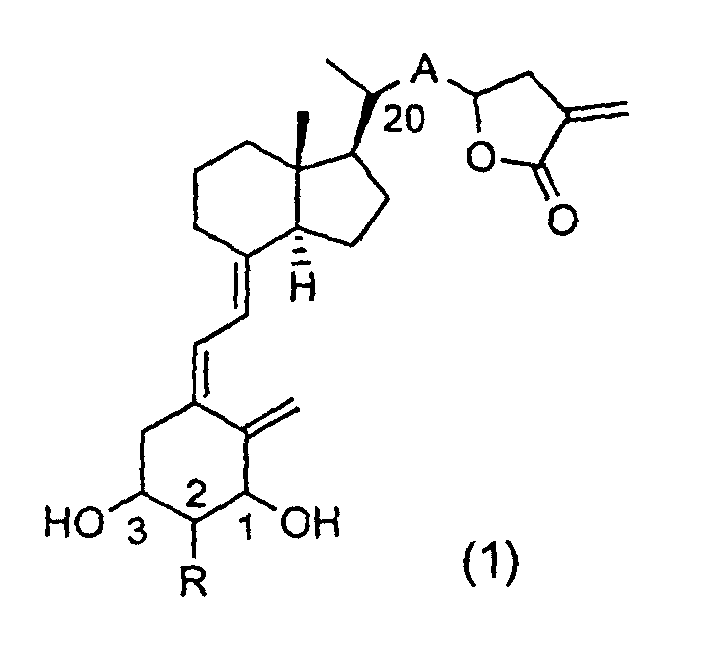
A vitamin D3 derivative expressed by the following general formula
(1)
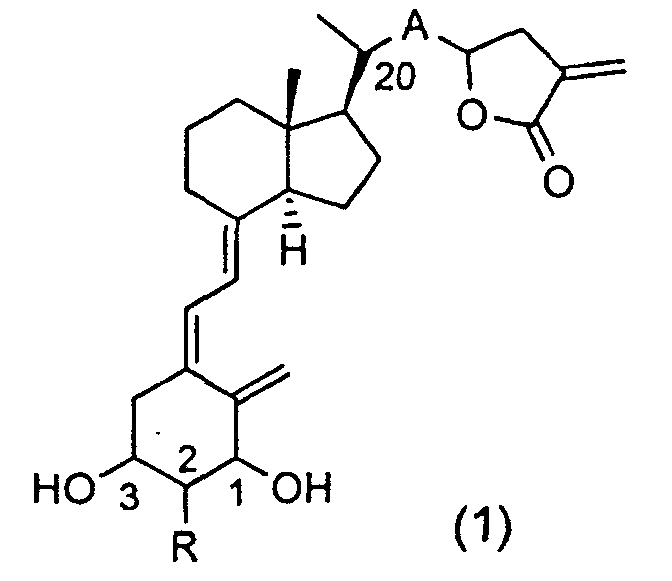 [wherein, R is a hydrogen atom or a methyl group, and A is a single bond,
-CH2-, -CH=CH-, -CH2-CH=CH-, -CH=CH-CH=CH-, -C=C- or -CH2-C≡C-;
and a compound in which R is an hydrogen atom, A is -CH2-, the steric
configuration at the 1-position is (S)-configuration, and the steric
configuration at the 3-position is (R)-configuration is excluded] or a
pharmaceutically permissible solvate thereof.
[wherein, R is a hydrogen atom or a methyl group, and A is a single bond,
-CH2-, -CH=CH-, -CH2-CH=CH-, -CH=CH-CH=CH-, -C=C- or -CH2-C≡C-;
and a compound in which R is an hydrogen atom, A is -CH2-, the steric
configuration at the 1-position is (S)-configuration, and the steric
configuration at the 3-position is (R)-configuration is excluded] or a
pharmaceutically permissible solvate thereof.
The compound can be an effective ingredient of a treating agent for
osteoporosis, malignant tumor, psoriasis, hyperparathyroidism, an
inflammatory respiratory disease, rheumatoid arthritis, growth onset type
diabetes mellitus, hypertension, alopecia, acne, dermatitis, hypercalcemia or
Paget's disease of bone.
Description
The present invention relates to vitamin D3 derivatives useful as
pharmaceutical products or pharmaceutically permissible solvates thereof,
treating agents using same and pharmaceutical compositions containing
same. More particularly, the invention relates to 1α-hydroxyvitamin D3
derivatives or pharmaceutically permissible solvates thereof, treating
agents containing same as an active ingredient and effective for osteoporosis,
malignant tumor, psoriasis, hyperparathyroidism, an inflammatory
respiratory disease, rheumatoid arthritis, growth onset type diabetes
mellitus, hypertension, alopecia, acne, dermatitis, hypercalcemia or Paget's
disease of bone, and pharmaceutical compositions containing same.
Active vitamin D3 derivatives have variegated actions such as
calcium absorption-stimulating activity in the small intestine, bone
turnover-controlling activity, immunoregulatory activity, cytostatic activity
and cell differentiation inducting activity. Applications of these derivatives
to treating agents using these actions for various diseases, for example,
osteoporosis, malignant tumor, psoriasis, hyperparathyroidism, an
inflammatory respiratory disease, rheumatoid arthritis, growth onset type
diabetes mellitus, hypertension, alopecia, acne, dermatitis, etc. are being
studied, and they are actually applied to such treating agents.
Out of these treating agents, the present conditions of the study of a
treating agent for hyperparathyroidism are as follows. It is known that
various diseases are caused by the disorders in the abnormal production
quantity of parathyroid hormone (hereafter, PTH) in vivo. Examples of the
diseases include primary and secondary hyperparathyroidism caused by
abnormal hyper-production of PTH. Primary hyperparathyroidism is a
systemic disease caused by PTH hypersecretion from one or more
parathyroids, and it is known that about 90 % of the patients suffers from
parathyroid adenoma. Secondary hyperparathyroidism is a disease
which develops in a patient with chronic renal failure owing to conditions in
which parathyroids grown as a result of metabolic disturbance of active
vitamin D, calcium and phosphorus exhibit resistance against 1α,
25-dihydroxyvitamin D3 of physiological concentration, and the hyperplasia
of parathyroids further progresses to secrete PTH excessively. Bone
resorption is accentuated by excess PTH, and resultingly, ostealgia and
arthralgia are observed in a number of cases. Further, symptoms at other
sites than bone such as ectopic calcification of the soft tissue and the
arterial wall caused by hypercalcemia and hyperphosphatemia are observed.
Various kinds of mechanisms of occurrence are proposed for secondary
hyperparathyroidism, and especially important one is inhibition of
1α-hydroxylase activity on vitamin D due to renal function degeneracy.
When the activity of the enzyme is inhibited, the serum concentration of 1α,
25-dihydroxyvitamin D3 is lowered, failure of calcium absorption from the
small intestine and hyperphosphatemia due to the lowering of phosphorus
excretion from the kidneys occur, and as the result, the state of
hypocalcemia develops. It is considered that when this state continues,
PTH secretion is actuated, and secondary hyperparathyroidism progresses.
Accordingly, it is desirable to administer a compound having
pharmacological activity like 1α, 25-dihydroxyvitamin D3 as a treating agent
for secondary hyperparathyroidism. As such compounds, 1α,
25-dihydroxyvitamin D3 itself and 1α-dihydroxyvitamin D3 are known, and
they exhibit high efficacy. However, in a patient to which such a drug has
been administered for a long period, the sensitivity to 1α,
25-dihydroxyvitamin D3 is lowered to make it difficult to suppress
hypersecretion of PTH by the administration of normal amount of the drug
(vitamin D resistance). Against this problem, Slatopolsky et al. succeeded
in suppressing PTH excretion from parathyroids by intermittent
intravenous administration of large amount of 1α, 25-dihydroxyvitamin D3,
so called a pulse therapy (J. Clin. Invest., 74, 2136-2143 (1984)). However,
this pulse therapy of active vitamin D is apt to cause hypercalcemia due to
the administration of a large quantity of a 1α, 25-dihydroxyvitamin D3 drug,
and hence a 1α-hydroxyvitamin D2 drug (WO96/31215 specification), a
19-nor-1α, 25-dihydroxyvitamin D2 drug (WO97/02826 specification), or a
22-oxa-1α, 25-dihydroxyvitamin D3 drug (JP-A 3-7231 (JP-A means
Japanese unexamined patent publication)), which has weaker calcium
metabolic activity than the 1α, 25-dihydroxyvitamin D3 drug, is presently
administered as a treating agent for treating vitamin D-resistant secondary
hyperparathyroidism. However, although the calcium metabolic activities
of these vitamin D3 derivatives are weaker than 1α, 25-dihydroxyvitamin D3,
they still have calcium metabolic activity. As a result, the suppressive
activity of PTH production is not sufficiently separated from calcium
metabolic activity, and hypercalcemia develops often as adverse effect
(Nephrol. Dial. Transport, 11, 121-129 (1996)). Therefore, the therapies
using these drugs are not satisfactory from view point of the occurrence of
adverse effect. Consequently, a drug which strongly suppresses PTH
excretion without causing hypercalcemia, if any, has expectation of more
effective therapeutic effect.
On the other hand, hypercalcemia develops by the sthenia of
vitamin D production due to diseases such as tumors or
hyperparathyroidism. Since it is known that the blood calcium
concentration is increased by the action of active vitamin D3, a compound
which is antagonistic against the action of active vitamin D3, that is, a
vitamin D3 antagonist, is considered to be effective for treating
hypercalcemia.
Further, it is thought that the vitamin D3 antagonist is effective also
as a treating agent for Paget's disease of bone. Paget's disease of bone is a
disease of unknown etiology in which bone resorption is abnormally
accelerated in the pelvis, the thighbone, the skull, etc., and consequently,
symptoms such as bone deformation and ostealgia develop. Treating
agents presently used for Paget's disease of bone are bisphosphonate drugs
and calcitonin drugs, which are also used as osteoporosis treating agents.
But, the former has poor compliance since the necessary administration
dose is 4 to 5 times the administration dose for an osteoporosis patient, and
the later has a disadvantageous point that sufficient suppression of bone
resorption is not exhibited. Further, these drugs are symptomatolytic
agents resting on the basis of the bone resorption suppressing activity of the
agents and can not completely cure the disease. It has recently been made
clear that precursor cells of osteoclast collected from a patient of Paget's
disease of bone have 1α, 25-dihydroxyvitamin D3 receptors, and the
sensitivity of the precursor cells to 1α, 25-dihydroxyvitamin D3 is stronger
by about 10 to 100 times that of the precursor cells of osteoclast in a normal
person (J. Bone Miner. Res., 15, 228-236 (2000)). Further, the blood
concentration of 1α, 25-dihydroxyvitamin D3 in a patient of Paget's disease
of bone being same as in a normal person, the sthenia of bone resorption by
endogenous 1α, 25-dihydroxyvitamin D3 is supposed to play an important
role to the onset of Paget's disease of bone. Consequently, a compound
which suppresses the action of 1α, 25-dihydroxyvitamin D3 on the precursor
cells of osteoclast, that is, a compound like a vitamin D antagonist, can
suppress the bone resorption activity accelerated in a patient of Paget's
disease of bone more completely, and it can be expected that the compound
has therapeutic effect superior to a presently used bone
resorption-suppressing agent.
Further, although the specification of WO95/33716 and the
specification of WO00/24712 have disclosed compounds having an
α-methylenelactone structure as a D-ring side chain of vitamin D3, these
compounds are excluded from the compounds of the present invention, and
as for the compounds described in these specifications, there is no
description nor suggestion regarding whether they have PTH
production-suppressing activity and vitamin D3 antagonist activity, or not.
Furthermore, JP-A 11-116551 and the specification of WO98/50353
have disclosed compounds having a methyl group as a 2-position substituent
of vitamin D3. However, in these compounds, the D-ring side chain of
vitamin D3 is a 1α, 25-dihydroxyvitamin D3-type (6-hydroxy-6-methylheptan-2-yl),
and they are different from the compounds of the
present invention which have an α-methylenelactone structure. There are
no description nor suggestion whether the compounds described in the
above-mentioned JP-A 11-116551 and specification of WO98/50353 have
PTH production-suppressing activity and vitamin D3 antagonist activity, or
not.
It is an object of the present invention to provide new vitamin D3
derivatives effective as a treating agent for osteoporosis, malignant tumor,
psoriasis, hyperparathyroidism, an inflammatory respiratory disease,
rheumatoid arthritis, growth onset type diabetes mellitus, hypertension,
alopecia, acne, dermatitis, hypercalcemia, Paget's disease of bone or the like,
or pharmaceutically permissible hydrates thereof.
Another object of the present invention is to provide methods for
treating osteoporosis, malignant tumor, psoriasis, hyperparathyroidism, an
inflammatory respiratory disease, rheumatoid arthritis, growth onset type
diabetes mellitus, hypertension, alopecia, acne, dermatitis, hypercalcemia,
Paget's disease of bone or the like by administering these vitamin D3
derivatives or pharmaceutically permissively solvates thereof.
Still another object of the present invention is to provide
pharmaceutical compositions containing these vitamin D3 derivatives or
pharmaceutically permissible solvates thereof as active ingredients.
These objects of the present invention can be achieved by vitamin D3
derivatives expressed by the following general formula (1),
 [wherein, R is a hydrogen atom or a methyl group, and A is a single bond,
-CH2-, -CH=CH-, -CH2-CH=CH-, -CH=CH-CH=CH-, -C=C- or -CH2-C≡C-;
and a compound in which R is a hydrogen atom, A is -CH2-, the steric
configuration at the 1-position is (S)-configuration, and the steric
configuration at the 3-position is (R)-configuration is excluded] or
pharmaceutically permissible solvates thereof.
[wherein, R is a hydrogen atom or a methyl group, and A is a single bond,
-CH2-, -CH=CH-, -CH2-CH=CH-, -CH=CH-CH=CH-, -C=C- or -CH2-C≡C-;
and a compound in which R is a hydrogen atom, A is -CH2-, the steric
configuration at the 1-position is (S)-configuration, and the steric
configuration at the 3-position is (R)-configuration is excluded] or
pharmaceutically permissible solvates thereof.
When an asymmetric carbon is contained in a structure of a
compound in the above formula (1), the steric configuration may be either
(S)-configuration or (R)-configuration as far as it is not particularly specified.
When the above formula (1) has a double bond, the geometrical
configuration may be either (E)-configuration or (Z)-configuration as far as it
is not particularly specified. Further, mixtures of an arbitrary ratio of
these isomers are also included in the present invention.
Further, objects of the present invention can be achieved by
administering vitamin D3 derivatives expressed by the above formula (1) or
pharmaceutically permissible solvates thereof in therapeutically effective
amounts as active ingredients to patients of osteoporosis, malignant tumor,
psoriasis, hyperparathyroidism, an inflammatory respiratory disease,
rheumatoid arthritis, growth onset type diabetes mellitus, hypertension,
alopecia, acne, dermatitis, hypercalcemia or Paget's disease of bone.
Furthermore, objects of the present invention are achieved by
pharmaceutical compositions comprising a vitamin D3 derivative expressed
by the above formula (1) or a pharmaceutically permissible solvate thereof,
and a pharmaceutically permissible support.
In the above formula (1), R is a hydrogen atom or a methyl group.
In the above formula (1), A is a single bond, -CH2-, -CH=CH-,
-CH2-CH=CH-, -CH=CH-CH=CH-, -C=C- or -CH2-C≡C-; and -CH2-,
- CH=CH-, -CH=CH-CH=CH-, -C≡C- or -CH2-C≡C- is preferable; and -CH2- or
-CH=CH- is particularly preferable.
In the above formula (1), when an asymmetric carbon is contained
in the structure of a compound, the steric configuration may be either
(S)-configuration or (R)-configuration as far as it is not particularly specified.
Especially, derivatives having (S)-configuration at the 1-position and
(R)-configuration at the 3-position, and derivatives having (S)-configuration
at the 1-position and (S)-configuration at the 3-position are preferable, and
derivatives having (S)-configuration at the 1-position and (R)-configuration
at the 3-position are most preferable. Further, when a methyl group exists
at the 2-position, the steric configuration of the 2-position is preferably
(S)-configuration.
In the above formula (1), when a double bond is contained, the
geometric configuration may be either (E)-configuration or (Z)-configuration.
Further, mixtures of an arbitrary ratio of these isomers are also
included in the present invention.
A vitamin D3 derivative of the present invention may be converted
into a pharmaceutically permissible solvate at need. Examples of the
solvent include water, methanol, ethanol, propyl alcohol, isopropyl alcohol,
butanol, t-butanol, acetonitrile, acetone, methyl ethyl ketone, chloroform,
ethyl acetate, diethyl ether, t-butyl methyl ether, benzene, toluene, DMF,
DMSO, etc. Especially, water, methanol, ethanol, propyl alcohol, isopropyl
alcohol, acetonitrile, acetone, methyl ethyl ketone and ethyl acetate may be
cited as preferable examples.
The compounds shown in Table 1 may be cited as preferable
concrete examples of a vitamin D3 derivative expressed by the formula (1) of
the present invention. When an asymmetric carbon is contained in the
structure of a compound in the table, the steric configuration may be either
(S)-configuration or (R)-configuration as far as it is not particularly specified.
When a double bond is contained in a compound of the above formula (1),
the geometrical configuration may be either (E)-configuration or
(Z)-configuration as far as it is not particularly specified. Further,
mixtures of an arbitrary ratio of these isomers are also included in the
present invention.
| Compound No. | A | R |
| 11 | Single bond | hydrogen atom |
| 21 (note) | -CH2- | hydrogen atom |
| 22 | -CH2- | methyl group |
| 31 | -CH=CH- | hydrogen atom |
| 32 | -CH=CH- | methyl group |
| 41 | -CH2-CH=CH- | hydrogen atom |
| 51 | -CH=CH-CH=CH- | hydrogen atom |
| 61 | -C≡C- | hydrogen atom |
| 71 | -CH2-C≡C- | hydrogen atom |
| (note) The derivatives having (S)-configuration in the steric configuration at the 1-position and (R)-configuration at the 3-position are excluded. |
A vitamin D3 derivative expressed by the above formula (1) can be
manufactured, for example, as shown below. That is, an aldehyde
compound expressed by the following formula (2) is converted into a lactone
compound expressed by the following formula (3), and this compound is
subjected to a coupling reaction with an ene-yne compound expressed by the
following formula (4) in the presence of a palladium catalyst and
successively to the deprotection of the protective group of the hydroxyl group
(Scheme 1).
 [In the formulae (2) and (3), A is defied same as in the above formula (1) and
Y is a bromine atom or an iodine atom. In the above formula (4), R is
defined same as in the above formula (1); and PG expresses a protective
group of the hydroxyl group, which includes acetyl group, a
tetrahydro-4H-pyran-2-yl group, a tri(alkyl/aryl)silyl group such as a
trimethylsilyl group, a triethylsilyl group, a t-butyldimethylsilyl group
(TBS) or a t-butyldiphenylsilyl group, or the like].
[In the formulae (2) and (3), A is defied same as in the above formula (1) and
Y is a bromine atom or an iodine atom. In the above formula (4), R is
defined same as in the above formula (1); and PG expresses a protective
group of the hydroxyl group, which includes acetyl group, a
tetrahydro-4H-pyran-2-yl group, a tri(alkyl/aryl)silyl group such as a
trimethylsilyl group, a triethylsilyl group, a t-butyldimethylsilyl group
(TBS) or a t-butyldiphenylsilyl group, or the like].
An aldehyde compound (2) used here in which the steric
configuration of the carbon atom marked with * is (R)-configuration [in the
case where A is a single bond, the steric configuration is (S)-configuration]
can be obtained as shown below. That is, compounds in which A is a single
bond, -CH=CH-, -C≡C- or -CH=CH-CH=CH-, A is -CH2- or -CH2-CH=CH-,
and A is -CH2-C≡C- can be obtained by combining known methods as shown
in the below-mentioned scheme 2, scheme 3 and scheme 4, respectively.
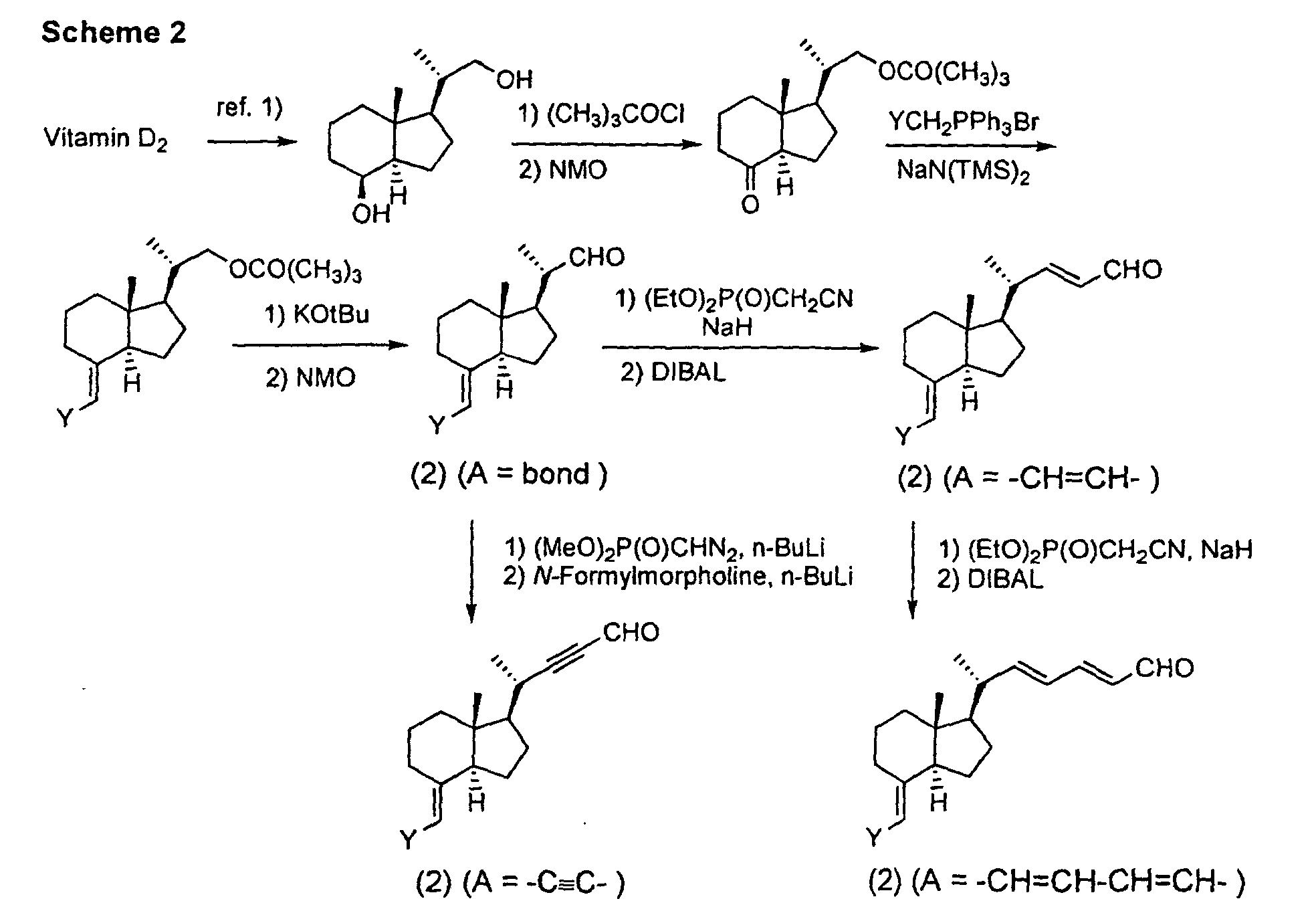 ref. 1) J. Org. Chem., 1986, 51, 1264.


Further, compounds in which the steric configuration of the carbon
atom marked with * is (S)-configuration [in the case where A is a single
bond, the steric configuration is (R)-configuration] in formula (2), can be
obtained, for example, by the method shown in the below-mentioned scheme
5 by using an intermediate aldehyde obtained in scheme 2.

The ene-yne compounds (4) used here can be obtained according to a
literature-described method. For example, in the case of R of a hydrogen
atom, the method is described in J. Am. Chem. Soc, 114, 9836-9845 (1992)
and Tetrahedron Lett., 35, 8119-8122 (1994) by Trost et al.; and in the case
of R of a methyl group, in J. Med. Chem., 43, 4247-4265 (2000) by Konno et
al.
The conversion of a compound expressed by formula (2) to the
compound expressed by formula (3) can be conducted, for example, by
allowing the compound expressed by formula (2) to react with a
bromomethylacrylate in the presence of zinc and treating the obtained
hydroxy ester compound with tetra-n-butylammonium fluoride (TBAF), or
by subjecting the ester compound to hydrolysis with a base and successively
treating the product with diluted hydrochloric acid.
A coupling reaction of a compound expressed by formula (3) with a
compound expressed by formula (4) can be carried out, for example, by a
method described in J. Am. Chem. Soc., 114, 9836-9845 (1992) by Trost et al.
The deprotection reaction of the protective group of the hydroxyl
group on the obtained coupling product can be carried out according to a
known method (for example, see Protective Groups in Organic Synthesis
Third Edition, John Willey & Sons, Inc. 1999, Greene et al.). Further
specifically, when the protective group is an acetyl group, the reaction can
be carried out by a common alkali hydrolysis reaction, or a treatment with
potassium cyanide, ammonia-methanol or the like. When the protective
group is a methoxymethyl group or a tetrahydro-4H-pyran-2-yl group, the
reaction can be carried out under acidic conditions, for example, by using
hydrochloric acid, acetic acid, trifluoroacetic acid or the like, or pyridinium
p-toluenesulfonate (PPTS) or the like. When the protective group is a
tri(alkyl/aryl)silyl group such as a trimethylsilyl group, a triethylsilyl group,
a t-butyldimethylsilyl group, a t-butyldiphenylsilyl group or the like, the
reaction can be carried out according to a known method (for example,
Tetrahedron, 20, 4609-4619 (1987) by Caverley), and as the deprotecting
agent, for example, TBAF, PPTS, p-toluenesulfonic acid, hydrogen fluoride,
camphorsulfonic acid, hydrochloric acid, sulfuric acid, an agent comprising a
combination of a tetrafluoroborate alkali metal salt and sulfuric acid, or the
like can be used. Examples of an organic solvent to be used in the reaction
include a halogen-containing solvent such as methylene chloride, chloroform
or carbon tetrachloride, a hydrocarbon solvent such as hexane or toluene, an
ether solvent such as tetrahydrofuran or dioxane, a water-soluble solvent
such as N,N-dimethylformamide or acetonitrile, a mixed solvent of them, etc.
The solvent may be selected in consideration of the solubility and the
reactivity of the compound. The reaction temperature generally ranges
from -20°C to the boiling point of the solvent. The reaction time depends
on the dehydrating agent, deprotecting agent, reaction solvent and reaction
temperature used, and it is commonly preferable that the reaction is
continued until the starting material disappears when determined by using
an analytical means such as thin layer chromatography.
The manufacturing of a vitamin D3 derivative expressed by the
above formula (1) in which R is a hydrogen atom can be conducted, for
example, as shown in the below-mentioned scheme 6: Compound (10) is
produced from Compound (5) obtained from vitamin D2 by combining a
photoisomerization reaction and a conversion reaction of the 20-position
aldehyde; and the protective groups of the hydroxyl group of Compound (10)
are deprotected.
 ref. 2) Tetrahedron, 1987, 20, 4609.
[In the formulae (5) to (10), A is defied same as in the above formula (1); and PG expresses a protective group of a hydroxyl group, which includes an acetyl group, a tetrahydro-4H-pyran-2-yl group, a tri(alkyl/aryl)silyl group such as a trimethylsilyl group, a triethylsilyl group, a t-butyldimethylsilyl group or a t-butyldiphenylsilyl group, or the like].
[In the formulae (5) to (10), A is defied same as in the above formula (1); and PG expresses a protective group of a hydroxyl group, which includes an acetyl group, a tetrahydro-4H-pyran-2-yl group, a tri(alkyl/aryl)silyl group such as a trimethylsilyl group, a triethylsilyl group, a t-butyldimethylsilyl group or a t-butyldiphenylsilyl group, or the like].
The compounds expressed by the above-mentioned formulae (5) or
(6) can be obtained from vitamin D2 by the method described in Tetrahedron,
20, 4609-4619 (1987).
The conversion from the above formula (7) to the above formula (8),
and that from the above formula (9) to the above formula (10) can be
achieved through photoisomerization by the same method as the conversion
from the above formula (5) to the above formula (6).
The conversion from the above formula (6) to the above formula (8)
can be carried out as shown below. That is, a compound whose A in the
above formula (8) is -CH=CH-, -C≡C- or -CH=CH-CH=CH-, and a compound
whose A in the above formula (8) is -CH2-, -CH2-CH=CH-, or -CH2-C≡C- can
be obtained by combining known methods as shown in the following scheme
7 and scheme 8, respectively.


The conversion from the above formula (5) to the above formula (7)
can be conducted in a same manner as the conversion from the above
formula (6) to the above formula (8) shown above.
The conversions from the above formula (7) to the above formula (9),
from the above formula (8) to the above formula (10) and from the above
formula (10) to the above formula (1) can be conducted in the same manner
as shown in the above-mentioned scheme 1.
A vitamin D3 derivative obtained through the above-mentioned
processes can be converted into a pharmaceutically permissible solvate
shown above at need.
Further, the present invention provides treating agents containing a
vitamin D3 derivative shown by the above formula (1) or a pharmaceutically
permissible solvate thereof for osteoporosis, malignant tumor, psoriasis,
hyperparathyroidism, an inflammatory respiratory disease, rheumatoid
arthritis, growth onset type diabetes mellitus, hypertension, alopecia, acne,
dermatitis, hypercalcemia or Paget's disease of bone. Out of these diseases,
hyperparathyroidism and Paget's disease of bone are preferably cited as
objective diseases of the present invention.
The treating agent of the present invention can be administered
orally, or parentally such as intravenously, subcutaneously, intramuscularly,
percutaneously, intranasally, intrarectally or the like, or by inhalation.
Dosage forms for oral administration include tablets, pills, powders,
granules, liquids, suspensions, syrups, capsules, etc.
The tablets are formulated according to a conventional process by
using additives consisting of an excipient such as lactose, starch, calcium
carbonate, crystalline cellulose or silicic acid; a binder such as
carboxymethylcellulose, methylcellulose, calcium phosphate or
polyvinylpyrrolidone; a disintegrator such as sodium alginate, sodium
hydrogencarbonate, sodium laurylsulfate or stearic acid monoglyceride; a
humectant such as glycerin; an absorbent such as kaolin or colloidal silica; a
lubricant such as talc or granular boric acid; etc.
The pills, powders and granules are prepared by conventional
processes also using additives similar to those mentioned above.
Liquid preparations such as the liquids, suspensions and syrups can
be formulated also according to conventional processes. As a support, for
example, a glycerol ester such as tricaprylin, triacetin or an iodized poppy
oil fatty acid ester; water; an alcohol such as ethanol; or an oily base such as
liquid paraffin, coconut oil, soybean oil, sesame oil or corn oil is used.
The capsules are formulated by filling a pharmaceutical composition
such as powder, granule or liquid in gelatin capsules, or the like.
Dosage forms for intravenous, subcutaneous and intramuscular
administration include injections in a form of a sterilized aqueous or
non-aqueous solution, or the like. In an aqueous solution, for example, a
physiological saline solution or the like is used as a solvent. In a
non-aqueous solution, for example, propylene glycol, polyethylene glycol, a
vegetable oil such as olive oil, an organic ester which is acceptable for
injection such as ethyl oleate or an iodized poppy oil fatty acid ester, or the
like is used as a solvent. To the pharmaceutical preparations for injection
are optionally added an isotonizing agent, a disinfectant, a humectant, an
emulsifier, a dispersant, a stabilizer, etc., and the preparation may be
sterilized by applying an adequate treatment such as filtration through a
bacterium-retaining filter, blending of a germicide or irradiation. Also, an
aseptic solid preparation is produced, and it is used for injection by
dissolving in sterilized water or a sterilized solvent for injection just prior to
use. Further, a compound of the present invention may be used in the form
of a clathrate compound prepared by using α, β or γ-cyclodextrin, a
methylated cyclodextrin, or the like. The compound may be administered
also in an injection of a lipoid form.
Dosage forms for percutaneous administration include ointments,
creams, lotions, solutions, etc. Examples of the base of an ointment include
a fatty oil such as castor oil, olive oil, sesame oil or safflower oil; lanolin;
white, yellow or hydrophilic vaseline; wax; a higher alcohol such as oleyl
alcohol, isostearyl alcohol, octyldodecanol or hexyldecanol; a glycol such as
glycerin, diglycerin, ethylene glycol, propylene glycol, sorbitol or
1,3-butanediol; etc. Further, as a solubilizing agent for a compound of the
present invention, ethanol, dimethyl sulfoxide, polyethylene glycol, etc., may
be compounded. Optionally, a preservative such as a paraoxybenzoic acid
ester, sodium benzoate, salicylic acid, sorbic acid or boric acid; an
antioxidant such as butylhydroxyanisole or dibutylhydroxytoluene; etc., may
be added. Further, in order to stimulate percutaneous absorption, an
absorption promoter such as diisopropyl adipate, diethyl sebacate, ethyl
caproate or ethyl laurate may be compounded. Also, for stabilization, a
compound of the present invention may be used in the form of a clathrate
compound prepared by using α, β or γ-cyclodextrin, a methylated
cyclodextrin, etc.
An ointment can be prepared by a conventional process. In the
creams, O/W-type dosage forms are preferable for stabilizing compounds of
the present invention. Further, the above-mentioned fatty oil, higher
alcohol, glycol or the like may be used as the base of a cream, and an
emulsifier such as diethylene glycol, propylene glycol, sorbitan mono fatty
acid ester, polysorbate 80 or sodium laurylsulfate may be used. Further,
the above-mentioned preservative, antioxidant or the like may be added, as
necessary. Furthermore, similarly to the case of ointment, a compound of
the present invention can be used in the form of a clathrate compound
prepared by using a cyclodextrin or a methylcyclodextrin. A cream can be
prepared according to a conventional process.
Examples of the lotions include a suspension-type lotion, an
emulsion-type lotion and a solution-type lotion. The suspension-type lotion
is prepared by using a suspending agent such as sodium alginate, traganth
or sodium carboxymethylcellulose, and optionally by adding an antioxidant,
a preservative, etc. The emulsion-type lotion is prepared according to a
conventional process by using an emulsifier such as sorbitan mono fatty acid
ester, polysorbate 80 or sodium laurylsulfate. As the solution-type lotion, a
compound of the present invention is dissolved in an alcohol such as ethanol,
optionally adding an antioxidant, a preservative or the like.
Pastas, poultices, aerosols, etc., may be cited besides the
above-mentioned dosage forms. These pharmaceutical preparations can be
prepared according to conventional processes.
Pharmaceutical preparations for intranasal administration are
supplied in the form of a liquid or powdery composition. As the base of the
liquid preparation, water, saline, a phosphate buffer solution, an acetate
buffer solution, or the like is used, and the liquid preparation may contain
further a surfactant, an antioxidant, a stabilizer, a preservative and/or a
thickener. As the base for the powdery preparation, a water-absorbent
base is preferable. Examples of the water-absorbent base include
polyacrylate salts such as sodium polyacrylate, potassium polyacrylate and
ammonium polyacrylate; cellulose lower-alkyl ethers such as
methylcellulose, hydroxyethylcellulose, hydroxypropyl-cellulose and sodium
carboxymethylcellulose; and polyethylene glycol, polyvinyl pyrrolidone,
amylose, pullulan, etc., which are easily soluble in water. Further, they
include cellulose compounds such as crystalline cellulose, α-cellulose and
cross-linked sodium carboxymethylcellulose; starch compounds such as
hydroxypropyl starch, carboxymethyl starch, cross-linked starches, amylose,
amylopectin and pectin; proteins such as gelatin, casein and sodium
caseinate; gums such as gum arabic, tragacanth gum and glucomannan; and
polyvinylpolypyrrolidone, cross-linked polyacrylic acid and salts thereof,
cross-linked polyvinyl alcohols, etc., which are scarcely soluble in water.
These compounds may be used in a mixture thereof. The powdery
preparation may be further compounded with an antioxidant, a coloring
agent, a preservative, a disinfectant, an antiseptic, etc. These liquid and
powdery preparations can be administered, for example, by using a spraying
device, etc.
For intrarectal administration, ordinary suppositories such as
gelatin soft capsule are used.
Further, for inhalation, a powdery or liquid composition prepared by
using an active ingredient of a vitamin D3 derivative of the present
invention alone or in combination with an adequate biocompatible vehicle
can be administered to disease sites using an applicator such as a spraying
device, a nebulizer or an atomizer. Alternatively, an active ingredient may
be administered to disease sites by suspending the active ingredient in a
spraying agent for aerosol such as flon.
A pharmaceutically effective dose of an active ingredient of the
present invention depends on an administration route, the age and sex of
the patient, and the conditions of the disease, but it is ordinarily about
0.001-10000 µg per day, and administration frequency is ordinarily from 1-3
times per day to 1-3 times per week. The pharmaceutical preparation is
preferably prepared so as to meet these conditions.
Further, a treating agent of the present invention can be
administered in combination with a conventional medicine.
Effectiveness of a vitamin D3 derivative expressed by the above
formula (1) of the present invention as a treating agent for osteoporosis,
malignant tumor, psoriasis, hyperparathyroidism, an inflammatory
respiratory disease, rheumatoid arthritis, growth onset type diabetes
mellitus, hypertension, alopecia, acne, dermatitis, hypercalcemia or Paget's
disease of bone was expressed by the parameter consisting of the binding
capacity of the compound of the present invention to a 1α,
25-dihydroxyvitamin D3 receptor (VDR), and this was concretely shown in
an example mentioned below. That is, it has become clear that the
compound of the present invention binds to VDR with extremely high
affinity. The pharmacological activity of the vitamin D3 derivatives is
exerted through VDR. Therefore compounds having high binding capacity
to VDR are useful as treating agents for the above-mentioned diseases.
Further, usefulness of a vitamin D3 derivative expressed by the
above formula (1) of the present invention for treating hypercalcemia and
Paget's disease of bone was exhibited with a parameter consisting of
differentiation-inducing effect determined by using HL-60 cell, and this was
concretely shown in an example mentioned below. That is, the compound
of the present invention suppresses specifically the differentiation of HL-60
cell which has been induced by 1α, 25-dihydroxyvitamin D3, and this has
revealed that the compound of the present invention acts as a vitamin D3
antagonist. Since hypercalcemia and Paget's disease of bone are induced
as a result of the sthenia in the activity of active vitamin D3, the vitamin D3
antagonist is useful as a treating agent for these diseases.
The present invention will be explained further in detail henceforth
with examples, while the present invention is not restricted by the examples.
The compound numbers in every example correspond to the compound
numbers shown in Table 1. A compound whose compound number has an
alphabet shows a stereoisomer of the compound having the corresponding
bare compound number.

(1) Eighty-six mg (0.15 mmol) of Compound (6) (PG=TBS), which
can be obtained by a known method (Tetrahedron, 20, 4609-4619, (1987))
was dissolved in dehydrated THF (3 ml), and the solution was ice-cooled.
To the solution were added 15 mg (0.23 mmol) of zinc (powder) and 43 mg
(0.23 mmol) of ethyl 2-(bromomethyl)acrylate, lastly 0.2 ml of a saturated
ammonium chloride aqueous solution was added, and the mixture was
stirred for 10 min under ice cooling and for 1.5 hr at room temperature.
The reaction mixture was extracted with ethyl acetate after the addition of a
saturated ammonium chloride aqueous solution. The organic layer was
washed with brine, dried and concentrated. The residue was purified by
silica gel column chromatography (hexane : ethyl acetate=20:1-15:1) and
preparative TLC (hexane : ethyl acetate=4:1) to obtain Compound (A) of the
lower polarity body (12 mg, 12% yield) and Compound (A) of the higher
polarity body (31 mg, 30% yield). They were colorless oil. Compound (A)
of the lower polarity body and Compound (A) of the higher polarity body are
diastereoisomers based on the asymmetric carbon to which the hydroxyl
group formed by the present reaction is bonded.
Compound (A) of the lower polarity body:
1H NMR (CDCl3) δ : 0.06 (s, 12 H), 0.56 (s, 3 H), 0.88 (s, 18 H), 0.98 (d, J=6.8 Hz, 3 H), 1.25-2.55 (m, 21 H), 2.81-2.85 (m, 1 H), 3.76-3.80 (m, 1 H), 4.11-4.27 (m, 4 H), 4.35-4.37 (m, 1 H), 4.86 (br., 1 H), 5.18 (s, 1 H), 5.65-5.88 (m, 1 H), 6.03 (d, J=11.2 Hz, 1 H), 6.22-6.26 (m, 2 H).
MS m/z 687.5 (M+1)+.
Compound (A) of the higher polarity body:
1H NMR (CDCl3) δ : 0.06 (s, 12 H), 0.54 (s, 3 H), 0.88 (s, 18 H), 0.97 (d, J=6.8 Hz, 3 H), 1.23-2.54 (m, 21 H), 2.81-2.85 (m, 1 H), 3.81-3.84 (m, 1 H), 4.11-4.27 (m, 4 H), 4.37 (br., 1 H), 4.86 (d, J=2.1 Hz, 1 H), 5.17 (d, J=1.7 Hz, 1 H), 5.65 (s, 1 H), 6.02 (d, J=11.5 Hz, 1 H), 6.23-6.26 (m, 2 H).
MS m/z 687.5 (M+1)+
Compound (A) of the lower polarity body:
1H NMR (CDCl3) δ : 0.06 (s, 12 H), 0.56 (s, 3 H), 0.88 (s, 18 H), 0.98 (d, J=6.8 Hz, 3 H), 1.25-2.55 (m, 21 H), 2.81-2.85 (m, 1 H), 3.76-3.80 (m, 1 H), 4.11-4.27 (m, 4 H), 4.35-4.37 (m, 1 H), 4.86 (br., 1 H), 5.18 (s, 1 H), 5.65-5.88 (m, 1 H), 6.03 (d, J=11.2 Hz, 1 H), 6.22-6.26 (m, 2 H).
MS m/z 687.5 (M+1)+.
Compound (A) of the higher polarity body:
1H NMR (CDCl3) δ : 0.06 (s, 12 H), 0.54 (s, 3 H), 0.88 (s, 18 H), 0.97 (d, J=6.8 Hz, 3 H), 1.23-2.54 (m, 21 H), 2.81-2.85 (m, 1 H), 3.81-3.84 (m, 1 H), 4.11-4.27 (m, 4 H), 4.37 (br., 1 H), 4.86 (d, J=2.1 Hz, 1 H), 5.17 (d, J=1.7 Hz, 1 H), 5.65 (s, 1 H), 6.02 (d, J=11.5 Hz, 1 H), 6.23-6.26 (m, 2 H).
MS m/z 687.5 (M+1)+
(2-1) Compound (A) (12 mg, 17.5 µmol) of the lower polarity body
obtained in the above process was dissolved in anhydrous THF (2 ml), and
the solution was ice-cooled. To the solution was added 26 µl (1N, 26 µmol)
of a THF solution of TBAF, and the mixture was stirred for 1 hr under ice
cooling. Further, 26 µl (1N, 26 µmol) of a THF solution of TBAF was added,
and the mixture was stirred for 1 hr. The reaction mixture was extracted
with ethyl acetate after the addition of water. The organic layer was
washed with brine, dried and concentrated to obtain a lactone ring body.
The lactone ring body:
1H NMR (CDCl3) δ : 0.06 (s, 12 H), 0.58 (s, 3 H), 0.88 (s, 18 H), 0.89-2.42 (m, 20 H), 2.77-2.87 (m, 2 H), 4.19 (br., 1 H), 4.37 (br., 1 H), 4.64-4.65 (m, 1 H), 4.85 (s, 1 H), 5.18 (s, 1 H), 5.61 (s, 1 H), 6.03 (d, J=11.1 Hz, 1 H), 6.22-6.56 (m, 2 H).
MS m/z 641.5 (M+1)+.
The lactone ring body:
1H NMR (CDCl3) δ : 0.06 (s, 12 H), 0.58 (s, 3 H), 0.88 (s, 18 H), 0.89-2.42 (m, 20 H), 2.77-2.87 (m, 2 H), 4.19 (br., 1 H), 4.37 (br., 1 H), 4.64-4.65 (m, 1 H), 4.85 (s, 1 H), 5.18 (s, 1 H), 5.61 (s, 1 H), 6.03 (d, J=11.1 Hz, 1 H), 6.22-6.56 (m, 2 H).
MS m/z 641.5 (M+1)+.
The obtained lactone body was dissolved in a mixed solution of
acetonitrile (1.5 ml) and methylene chloride (1.5 ml), 5 mg of LiBF4 (52
µmol) was added to the solution, and the solution was ice-cooled. To the
solution was added 31 µl (1 N, 31 µmol) of an acetonitrile solution of sulfuric
acid solution, and the mixture was stirred for 45 min under ice cooling.
The reaction mixture was extracted with ethyl acetate after the addition of a
saturated sodium hydrogencarbonate aqueous solution. The organic layer
was washed with brine, dried and concentrated. The residue was purified
by HPLC (reversed phase, elution: A; 95% H2O/CH3CN, B; 95% MeOH/H2O,
B=76%) to obtain the objective Compound No. 11a (2.5 mg, 35% yield) of
white solid in purity of 99.1%.
Compound No. 11a:
1H NMR (CDCl3) δ : 0.60 (s, 3 H), 0.88 (d, J=6.6 Hz, 3 H), 1.23-2.14 (m, 16 H), 2.32 (dd, J=6.3 and 13.0 Hz, 1 H), 2.58-2.62 (m, 1 H), 2.75-2.86 (m, 3 H), 4.24 (br., 1 H), 4.43 (br., 1 H), 4.64 (dt, J=4.0 and 7.1 Hz, 1H), 5.00 (s, 1 H), 5.33 (d, J=1.5 Hz, 1 H), 5.61 (t, J=2.6 Hz, 1 H), 6.03 (d, J=11.2 Hz, 1 H), 6.22 (t, J=2.6 Hz, 1 H), 6.37 (d, J=11.4 Hz, 1 H).
MS m/z 413.2 (M+1)+.
Compound No. 11a:
1H NMR (CDCl3) δ : 0.60 (s, 3 H), 0.88 (d, J=6.6 Hz, 3 H), 1.23-2.14 (m, 16 H), 2.32 (dd, J=6.3 and 13.0 Hz, 1 H), 2.58-2.62 (m, 1 H), 2.75-2.86 (m, 3 H), 4.24 (br., 1 H), 4.43 (br., 1 H), 4.64 (dt, J=4.0 and 7.1 Hz, 1H), 5.00 (s, 1 H), 5.33 (d, J=1.5 Hz, 1 H), 5.61 (t, J=2.6 Hz, 1 H), 6.03 (d, J=11.2 Hz, 1 H), 6.22 (t, J=2.6 Hz, 1 H), 6.37 (d, J=11.4 Hz, 1 H).
MS m/z 413.2 (M+1)+.
(2-2) Compound (A) of the higher polarity (39 mg, 56.8 µmol)
obtained above was dissolved in 3 ml of anhydrous THF, and the solution
was ice-cooled. To the solution was added 170 µl (1 N, 170 µmol) of a THF
solution of TBAF, the mixture was stirred for 1 hr under ice cooling, and
further for 1 hr after 170 µl (1 N, 170 µmol) of a THF solution of TBAF
was added. The reaction mixture was extracted with ethyl acetate after
the addition of water, and the organic layer was washed with brine, dried
and concentrated to obtain a lactone ring body.
The lactone ring body:
1H NMR (CDCl3) δ : 0.06 (s, 12 H), 0.54 (s, 3 H), 0.88 (s, 18 H), 0.89-3.02 (m, 22 H), 4.19 (br., 1 H), 4.38 (br., 1 H), 4.7 3(t, J=7.1 Hz, 1 H), 4.86 (d, J=2.1 Hz, 1 H), 5.18 (d, J=1.3 Hz, 1 H), 5.62 (s, 1 H),6.02 (d, J=11.2 Hz, 1 H), 6.22-6.56 (m, 2 H).
MS m/z 641.5 (M+1)+.
The lactone ring body:
1H NMR (CDCl3) δ : 0.06 (s, 12 H), 0.54 (s, 3 H), 0.88 (s, 18 H), 0.89-3.02 (m, 22 H), 4.19 (br., 1 H), 4.38 (br., 1 H), 4.7 3(t, J=7.1 Hz, 1 H), 4.86 (d, J=2.1 Hz, 1 H), 5.18 (d, J=1.3 Hz, 1 H), 5.62 (s, 1 H),6.02 (d, J=11.2 Hz, 1 H), 6.22-6.56 (m, 2 H).
MS m/z 641.5 (M+1)+.
The obtained lactone body was dissolved in a mixed solvent of
acetonitrile (2 ml) and methylene chloride (2 ml), and to the solution was
added 16 mg (170 µmol) of LiBF4, and the solution was ice-cooled. To the
solution was added 102 µl (1N, 120 µmol) of an acetonitrile solution of
sulfuric acid, and the mixture was stirred for 45 min under ice cooling. The
reaction mixture was extracted with ethyl acetate after the addition of a
saturated sodium hydrogencarbonate aqueous solution. The organic layer
was washed with brine, dried and concentrated. The residue was purified
by HPLC (reversed phase, elution: A; 95% H2O/CH3CN, B; 95% MeOH/H2O,
B=76%) to obtain the objective Compound No. 11b (12.3 mg, 53% yield) of
white solid in purity of 99.0%.
Compound No. 11b:
1H NMR (CDCl3) δ : 0.06 (s, 3 H), 0.91 (d, J=6.6 Hz, 3 H), 1.32-1.83 (m, 11 H), 1.93-2.09 (m, 5 H), 2.31 (dd, J=6.8 and 13.4 Hz, 1 H), 2.57-2.75 (m, 2 H), 2.80-2.86 (m, 1 H), 2.92-3.02 (m, 1 H), 4.22 (br., 1 H), 4.43 (br., 1 H), 4.69-4.74 (m, 1 H), 5.00 (s, 1 H), 5.33 (s, 1 H), 5.62 (t, J=2.5 Hz, 1 H), 6.02 (d, J=11.4 Hz, 1 H), 6.22 (t, J=3.0 Hz, 1 H), 6.38 (d, J=11.2 Hz, 1 H).
MS m/z 413.2 (M+1)+.
Compound No. 11b:
1H NMR (CDCl3) δ : 0.06 (s, 3 H), 0.91 (d, J=6.6 Hz, 3 H), 1.32-1.83 (m, 11 H), 1.93-2.09 (m, 5 H), 2.31 (dd, J=6.8 and 13.4 Hz, 1 H), 2.57-2.75 (m, 2 H), 2.80-2.86 (m, 1 H), 2.92-3.02 (m, 1 H), 4.22 (br., 1 H), 4.43 (br., 1 H), 4.69-4.74 (m, 1 H), 5.00 (s, 1 H), 5.33 (s, 1 H), 5.62 (t, J=2.5 Hz, 1 H), 6.02 (d, J=11.4 Hz, 1 H), 6.22 (t, J=3.0 Hz, 1 H), 6.38 (d, J=11.2 Hz, 1 H).
MS m/z 413.2 (M+1)+.
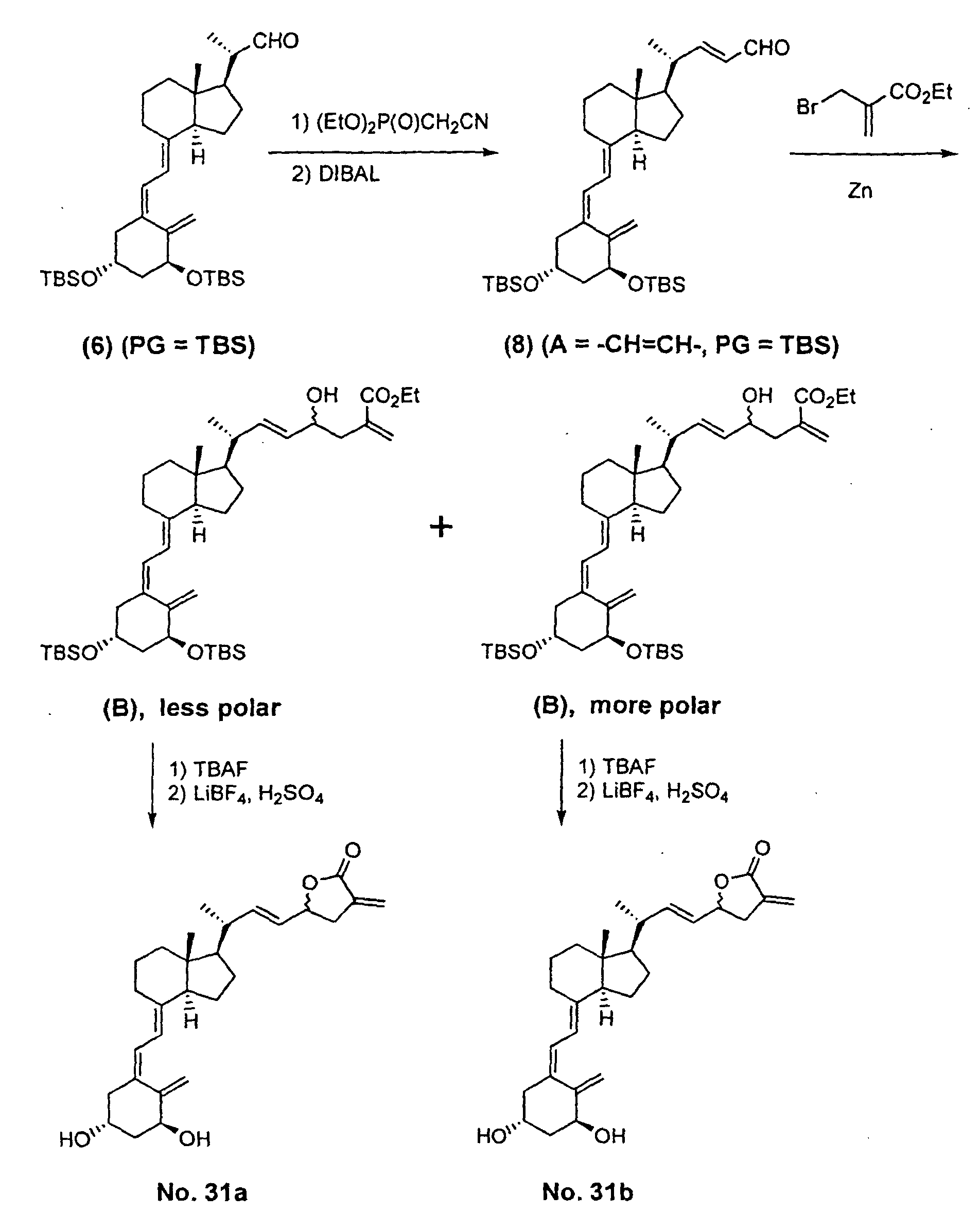
(1) Under nitrogen atmosphere, 88 mg (2.2 mmol) of sodium hydride
was dissolved in 15 ml of anhydrous THF, and the solution was ice-cooled.
To the solution was added 425 mg (2.4 mmol) of diethyl
cyanomethylphosphonate, and the mixture was stirred for 40 min under ice
cooling. To the solution, an anhydrous THF (5 ml) solution of 1.15 g (2.0
mmol) of Compound (6) (PG=TBS), which had been manufactured through a
known method (Tetrahedron, 20, 4609-4619, (1987)), was added dropwise
over 5 min, and successively the mixture was stirred for 40 min under ice
cooling. The reaction mixture was extracted with ethyl acetate after the
addition of a saturated ammonium chloride aqueous solution. The organic
layer was washed with brine, dried and concentrated to obtain a crude
Wittig adduct (1.29 g). The obtained crude Wittig adduct was dissolved in
10 ml of anhydrous methylene chloride under a nitrogen atmosphere, and
the solution was cooled to -70°C. A toluene solution (2.97 ml, 1.01 M, 3.0
mmol) of DIBAL was added dropwise to the above solution, and the mixture
was stirred for 2 hr at this temperature. To the reaction mixture were
added water (10 ml) and a saturated sodium sulfate aqueous solution (10
ml), the mixture was stirred for 10 min at room temperature, and the
reaction mixture was extracted with twice with methylene chloride after the
addition of 1 N hydrochloric acid. The organic layer was washed with a
saturated sodium hydrogencarbonate aqueous solution and then with brine,
dried and concentrated. The residue was purified by silica gel column
chromatography (hexane : ethyl acetate=80:1 to 20:1) to obtain the objective
product (8) (A=-CH=CH- and PG=TBS) (598 mg, 50% yield) of a white foamy
product.
Compound (8) (A=-CH=CH- and PG=TBS):
1H NMR (CDCl3) δ : 0.06 (s, 6 H), 0.06 (s, 6 H), 0.59 (s, 3 H), 0.88 (s, 18 H), 1.14-1.86 (m, 14 H), 1.97-2.01 (m, 2 H), 2.18-2.26 (m, 1 H), 2.42-2.47 (m, 2 H), 2.82-2.86 (m, 1 H), 4.17 (m, 1 H), 4.36 (m, 1 H), 4.85 (d, J=2.3 Hz, 1 H), 5.18 (d, J=2.5 Hz, 1 H), 6.00-6.10 (m, 2 H), 6.23 (d, J=10.9 Hz, 1 H), 6.72 (dd, J=8.7 and 15.5 Hz, 1 H), 9.49 (d, J=7.9 Hz, 1 H).
MS m/z 599.5 (M+1)+.
Compound (8) (A=-CH=CH- and PG=TBS):
1H NMR (CDCl3) δ : 0.06 (s, 6 H), 0.06 (s, 6 H), 0.59 (s, 3 H), 0.88 (s, 18 H), 1.14-1.86 (m, 14 H), 1.97-2.01 (m, 2 H), 2.18-2.26 (m, 1 H), 2.42-2.47 (m, 2 H), 2.82-2.86 (m, 1 H), 4.17 (m, 1 H), 4.36 (m, 1 H), 4.85 (d, J=2.3 Hz, 1 H), 5.18 (d, J=2.5 Hz, 1 H), 6.00-6.10 (m, 2 H), 6.23 (d, J=10.9 Hz, 1 H), 6.72 (dd, J=8.7 and 15.5 Hz, 1 H), 9.49 (d, J=7.9 Hz, 1 H).
MS m/z 599.5 (M+1)+.
(2) Compound (8) (A=-CH=CH- and PG=TBS) (93 mg, 0.155 mmol)
obtained above was dissolved in an anhydrous THF solution (3 ml), and the
solution was ice-cooled. To the solution were added zinc powder (15 mg,
0.23 mmol) and ethyl 2-(bromomethyl)acrylate (45 mg, 0.23 mmol), and
lastly 0.2 ml of a saturated ammonium chloride aqueous solution, and the
mixture was stirred for 5 min under ice cooling and for 1 hr at room
temperature. The reaction mixture was extracted with ethyl acetate after
the addition of a saturated ammonium chloride aqueous solution. The
organic layer was washed with brine, dried and concentrated, and the
residue was purified by silica gel column chromatography (hexane : ethyl
acetate=40:1-15:1) and preparative TLC (hexane : ethyl acetate=3:1) to
obtain Compound (B) of the lower polarity body (39 mg, 35% yield) and
Compound (B) of the higher polarity body (42 mg, 38% yield). They were
colorless oil. Compound (B) of the lower polarity body and Compound (B) of
the higher polarity body are diastereoisomers based on the asymmetric
carbon to which the hydroxyl group formed by the present reaction is
bonded.
Compound (B) of the lower polarity body:
1H NMR (CDCl3) δ : 0.06 (s, 12 H), 0.54 (s, 3 H), 0.88 (s, 18 H), 1.02 (d, J=6.6 Hz, 3 H), 1.23-2.25 (m, 19 H), 2.43-2.60 (m, 3 H), 2.82 (d, J=10.0 Hz, 1 H), 4.11-4.26 (m, 4 H), 4.37 (br., 1 H), 4.86 (d, J=2.3 Hz, 1 H), 5.18 (d, J=1.5 Hz, 1 H), 5.39 (dd, J=6.3 and 15.3 Hz, 1 H), 5.53 (dd, J=8.1 and 15.3 Hz, 1 H), 5.64 (d, J=1.3 Hz, 1 H), 6.01 (d, J=11.2 Hz, 1 H), 6.23 (d, J=10.7 Hz, 1 H), 6.25 (s, 1 H).
MS m/z 713.5 (M+1)+.
Compound (B) of the higher polarity body:
1H NMR (CDCl3) δ : 0.06 (s, 12 H), 0.54 (s, 3 H), 0.88 (s, 18 H), 1.03 (d, J=6.6 Hz, 3 H), 1.23-2.25 (m, 19 H), 2.43-2.62 (m, 3 H), 2.82 (d, J=9.9 Hz, 1 H), 4.11-4.26 (m, 4 H), 4.36 (br., 1 H), 4.86 (d, J=2.5 Hz, 1 H), 5.18 (d, J=1.5 Hz, 1 H), 5.38 (dd, J=6.6 and 15.3 Hz, 1 H), 5.51 (dd, J=8.2 and 15.3 Hz, 1 H), 5.65 (s, 1 H), 6.01 (d, J=11.2 Hz, 1 H), 6.23 (d, J=11.4 Hz, 1 H), 6.25 (s, 1 H).
MS m/z 713.5 (M+1)+.
Compound (B) of the lower polarity body:
1H NMR (CDCl3) δ : 0.06 (s, 12 H), 0.54 (s, 3 H), 0.88 (s, 18 H), 1.02 (d, J=6.6 Hz, 3 H), 1.23-2.25 (m, 19 H), 2.43-2.60 (m, 3 H), 2.82 (d, J=10.0 Hz, 1 H), 4.11-4.26 (m, 4 H), 4.37 (br., 1 H), 4.86 (d, J=2.3 Hz, 1 H), 5.18 (d, J=1.5 Hz, 1 H), 5.39 (dd, J=6.3 and 15.3 Hz, 1 H), 5.53 (dd, J=8.1 and 15.3 Hz, 1 H), 5.64 (d, J=1.3 Hz, 1 H), 6.01 (d, J=11.2 Hz, 1 H), 6.23 (d, J=10.7 Hz, 1 H), 6.25 (s, 1 H).
MS m/z 713.5 (M+1)+.
Compound (B) of the higher polarity body:
1H NMR (CDCl3) δ : 0.06 (s, 12 H), 0.54 (s, 3 H), 0.88 (s, 18 H), 1.03 (d, J=6.6 Hz, 3 H), 1.23-2.25 (m, 19 H), 2.43-2.62 (m, 3 H), 2.82 (d, J=9.9 Hz, 1 H), 4.11-4.26 (m, 4 H), 4.36 (br., 1 H), 4.86 (d, J=2.5 Hz, 1 H), 5.18 (d, J=1.5 Hz, 1 H), 5.38 (dd, J=6.6 and 15.3 Hz, 1 H), 5.51 (dd, J=8.2 and 15.3 Hz, 1 H), 5.65 (s, 1 H), 6.01 (d, J=11.2 Hz, 1 H), 6.23 (d, J=11.4 Hz, 1 H), 6.25 (s, 1 H).
MS m/z 713.5 (M+1)+.
(3-1) Compound (B) (39 mg, 54.7 µmol) of the lower polarity body
obtained above was dissolved in 3 ml of an anhydrous THF, and the solution
was ice-cooled. To the solution was added a THF solution (55 µl, 1 N, 55
µmol) of TBAF, the mixture was stirred for 30 min under ice cooling, and
further the mixture was stirred for 30 min under ice cooling after the
addition of a THF solution (55 µl, 1 N, 55 µmol) of TBAF. The reaction
mixture was extracted with ethyl acetate after the addition of water. The
organic layer was washed with brine, dried and concentrated to obtain a
lactone ring body.
Lactone ring body:
1H NMR (CDCl3) δ : 0.06 (s, 12 H), 0.55 (s, 3 H), 0.88 (s, 18 H), 0.92-3.39 (m, 22 H), 4.19 (br., 1 H), 4.38 (br., 1H), 4.85-4.92 (m, 2 H), 5.18 (s, 1H), 5.41 (dd, J=7.3 and 15.2 Hz, 1 H), 5.63 (s, 1 H), 5.68 (dd, J=8.6 and 15.5 Hz, 1 H), 6.01 (d, J=11.2 Hz, 1 H), 6.21-6.25 (m, 2 H).
MS m/z 667.5 (M+1)+.
Lactone ring body:
1H NMR (CDCl3) δ : 0.06 (s, 12 H), 0.55 (s, 3 H), 0.88 (s, 18 H), 0.92-3.39 (m, 22 H), 4.19 (br., 1 H), 4.38 (br., 1H), 4.85-4.92 (m, 2 H), 5.18 (s, 1H), 5.41 (dd, J=7.3 and 15.2 Hz, 1 H), 5.63 (s, 1 H), 5.68 (dd, J=8.6 and 15.5 Hz, 1 H), 6.01 (d, J=11.2 Hz, 1 H), 6.21-6.25 (m, 2 H).
MS m/z 667.5 (M+1)+.
The obtained lactone body was dissolved in a mixed solvent of
acetonitrile (2 ml) and methylene chloride (2 ml), to the solution was added
LiBF4 (15 mg, 164 µmol), and the mixture was ice-cooled. An acetonitrile
solution (100 µl, 1 N, 100 µmol) of sulfuric acid was added to the solution,
and the mixture was stirred for 45 min under ice cooling. The reaction
mixture was extracted with ethyl acetate after the addition of a saturated
sodium hydrogencarbonate aqueous solution. The organic layer was
washed with brine, dried and concentrated. The residue was purified by
HPLC (reversed phase, elution: A; 95% H2O/CH3CN, B; 95% MeOH/H2O,
B=81%) to obtain the objective Compound No. 31a (10.2 mg, 43% yield) of
white solid in purity of 98.7%.
Compound No. 31a:
1H NMR (CDCl3) δ : 0.56 (s, 3 H), 1.04 (d, J=6.6 Hz, 3 H), 1.26-2.17 (m, 16 H), 2.31 (dd, J=6.8 and 13.2 Hz, 1 H), 2.58-2.72 (m, 2 H), 2.80-2.85 (m, 1 H), 3.11 (ddt, J=2.5, 7.8 and 17.0 Hz, 1 H), 4.23 (br., 1 H), 4.43 (br., 1 H), 4.88 (q, J=6.8 Hz, 1 H), 5.00 (s, 1 H), 5.33 (s, 1 H), 5.41 (dd, J=7.3 and 15.3 Hz, 1 H), 5.63 (t, J=2.3 Hz, 1 H), 5.68 (dd, J=8.9 and 15.5 Hz, 1 H), 6.01 (d, J=11.2 Hz, 1 H), 6.23 (t, J=2.8 Hz, 1 H), 6.37 (d, J=11.4 Hz, 1 H).
MS m/z 439.2 (M+1)+.
Compound No. 31a:
1H NMR (CDCl3) δ : 0.56 (s, 3 H), 1.04 (d, J=6.6 Hz, 3 H), 1.26-2.17 (m, 16 H), 2.31 (dd, J=6.8 and 13.2 Hz, 1 H), 2.58-2.72 (m, 2 H), 2.80-2.85 (m, 1 H), 3.11 (ddt, J=2.5, 7.8 and 17.0 Hz, 1 H), 4.23 (br., 1 H), 4.43 (br., 1 H), 4.88 (q, J=6.8 Hz, 1 H), 5.00 (s, 1 H), 5.33 (s, 1 H), 5.41 (dd, J=7.3 and 15.3 Hz, 1 H), 5.63 (t, J=2.3 Hz, 1 H), 5.68 (dd, J=8.9 and 15.5 Hz, 1 H), 6.01 (d, J=11.2 Hz, 1 H), 6.23 (t, J=2.8 Hz, 1 H), 6.37 (d, J=11.4 Hz, 1 H).
MS m/z 439.2 (M+1)+.
(3-2) Compound (B) (42 mg, 58.9 µmol) of the higher polarity body
obtained above was dissolved in 3 ml of an anhydrous THF, and the solution
was ice-cooled. To the solution was added a THF solution (59 µl, 1 N, 59
µmol) of TBAF, and the mixture was stirred for 30 min under ice cooling.
Subsequently, a THF solution (59 µl, 1 N, 59 µmol) of TBAF was further
added, and the mixture was stirred for 30 min under ice cooling. The
reaction mixture was extracted with ethyl acetate after the addition of
water. The organic layer was washed with brine, dried and concentrated to
obtain a lactone ring body.
The lactone ring body:
1H NMR (CDCl3) δ : 0.06 (s, 12 H), 0.55 (s, 3 H), 0.88 (s, 18 H), 0.91-3.39 (m, 22 H), 4.19 (br., 1 H), 4.37 (br., 1 H), 4.85-4.92 (m, 2 H), 5.18 (s, 1 H), 5.41 (dd, J=7.3 and 15.3 Hz, 1 H), 5.61-5.63 (m, 1 H), 5.67 (dd, J=8.3 and 15.3 Hz, 1 H), 6.01 (d, J=11.4 Hz, 1 H), 6.21-6.25 (m, 2 H).
MS m/z 667.5 (M+1)+.
The lactone ring body:
1H NMR (CDCl3) δ : 0.06 (s, 12 H), 0.55 (s, 3 H), 0.88 (s, 18 H), 0.91-3.39 (m, 22 H), 4.19 (br., 1 H), 4.37 (br., 1 H), 4.85-4.92 (m, 2 H), 5.18 (s, 1 H), 5.41 (dd, J=7.3 and 15.3 Hz, 1 H), 5.61-5.63 (m, 1 H), 5.67 (dd, J=8.3 and 15.3 Hz, 1 H), 6.01 (d, J=11.4 Hz, 1 H), 6.21-6.25 (m, 2 H).
MS m/z 667.5 (M+1)+.
The obtained lactone body was dissolved in a mixed solvent of
acetonitrile (2 ml) and methylene chloride ( 2 ml), to the solution was added
LiBF4 (17 mg, 0.18 mmol), and the solution was ice-cooled. To the solution
was added an acetonitrile solution (106 µl, 1 N, 106 µmol) of sulfuric acid,
and the mixture was stirred for 45 min under ice cooling. The reaction
mixture was extracted with ethyl acetate after the addition of a saturated
sodium hydrogencarbonate aqueous solution. The organic layer was
washed with brine, dried and concentrated. The residue was purified by
HPLC (reversed phase, elution: A; 95% H2O/CH3CN, B; 95% MeOH/H2O,
B=81%) to obtain the objective Compound No. 31b (9.6 mg, 37% yield) of
colorless film in purity of 99.3%.
Compound No. 31b:
1H NMR (CDCl3) δ : 0.56 (s, 3 H), 1.06 (d, J=6.8 Hz, 3 H), 1.21-2.14 (m, 16 H), 2.32 (dd, J=6.3 and 13.7 Hz, 1 H), 2.58-2.72 (m, 2 H), 2.80-2.86 (m, 1 H), 3.11 (ddt, J=2.5, 7.8 and 17.0 Hz, 1 H), 4.23 (br., 1 H), 4.43 (br., 1 H), 4.89 (q, J=6.8 Hz, 1 H), 5.00 (s, 1 H), 5.33 (s, 1 H), 5.41 (dd, J=7.3 and 15.3 Hz, 1 H), 5.63 (t, J=2.5 Hz, 1 H), 5.68 (dd, J=8.5 and 15.0 Hz, 1 H), 6.01 (d, J=11.5 Hz, 1 H), 6.23 (t, J=2.8 Hz, 1 H), 6.37 (d, J=11.2 Hz, 1 H).
MS m/z 439.2 (M+1)+.
Compound No. 31b:
1H NMR (CDCl3) δ : 0.56 (s, 3 H), 1.06 (d, J=6.8 Hz, 3 H), 1.21-2.14 (m, 16 H), 2.32 (dd, J=6.3 and 13.7 Hz, 1 H), 2.58-2.72 (m, 2 H), 2.80-2.86 (m, 1 H), 3.11 (ddt, J=2.5, 7.8 and 17.0 Hz, 1 H), 4.23 (br., 1 H), 4.43 (br., 1 H), 4.89 (q, J=6.8 Hz, 1 H), 5.00 (s, 1 H), 5.33 (s, 1 H), 5.41 (dd, J=7.3 and 15.3 Hz, 1 H), 5.63 (t, J=2.5 Hz, 1 H), 5.68 (dd, J=8.5 and 15.0 Hz, 1 H), 6.01 (d, J=11.5 Hz, 1 H), 6.23 (t, J=2.8 Hz, 1 H), 6.37 (d, J=11.2 Hz, 1 H).
MS m/z 439.2 (M+1)+.

(1) To an anhydrous THF solution (1 ml) of sodium hydride (10 mg,
0.24 mmol) was added diethyl cyanomethylphosphonate (38 µl, 0.36 mmol),
and the mixture was stirred for 15 min at 0°C. To the solution was added
dropwise an anhydrous THF solution (2 ml) of Compound (8) (A=-CH=CH-,
PG=TBS) (95 mg, 0.159 mmol) obtained in Example 2 (1), and the mixture
was stirred for 10 min at 0°C. The reaction was quenched with a saturated
ammonium chloride aqueous solution, and the mixture was extracted with
ethyl acetate. The organic layer was washed with water and then brine,
dried over anhydrous magnesium sulfate and concentrated. To the
methylene chloride solution (1 ml) of the residue was added dropwise 0.31
ml of a toluene solution of DIBAL at -78°C over 1 hr, 0.47 ml of a toluene
solution of DIBAL was further added, and the mixture was stirred for 10
min. The temperature was gradually raised (-78°C →-30°C) over the time
from the first addition of DIBAL to the completion of the reaction. The
reaction was quenched with an aqueous solution of citric acid, and the
mixture was extracted with ethyl acetate. The organic layer was washed
with water and then brine, dried over anhydrous magnesium sulfate, and
concentrated. The residue was purified by column chromatography
(hexane : ethyl acetate=60:1 to 20:1) to obtain Compound (8)
(A=-CH=CH-CH=CH-, PG=TBS, 24(E)) (50 mg, 50% yield) and Compound
(8) (A=-CH=CH-CH=CH-, PG=TBS, 24(Z)) (13 mg, 13% yield).
Compound (8) (A=-CH=CH-CH=CH-, PG=TBS, 24(E)):
1H NMR (CDCl3) δ : 0.03 (s, 6 H), 0.05 (s, 6 H), 0.57 (s, 3 H), 0.88 (s, 18 H), 1.11 (d, J=6.6 Hz, 3 H), 1.23-2.02 (m, 13 H), 2.18-2.35 (m, 2 H), 2.42-2.47 (m, 1 H), 2.80-2.87 (m, 1 H), 4.15-4.23 (m, 1 H), 4.85 (d, J=2.2 Hz, 1 H), 5,17 (s, 1 H), 6.02 (d, J=11.0 Hz, 1 H), 6.07 (dd, J=8.1 and 15.2 Hz, 1 H), 6.14 (dd, J=8.8 and 14.9 Hz, 1 H), 6.23 (d, J=11.0 Hz, 1 H), 6.26 (dd, J=10.5 and 14.9 Hz, 1 H), 7.07 (dd, J=10.5 and 15.2 Hz, 1 H), 9.53 (d, J=8.1 Hz, 1 H).
MS m/z 625 (M+1)+.
Compound (8) (A=-CH=CH-CH=CH-, PG=TBS, 24(Z)):
1H NMR (CDCl3) δ : 0.055 (s, 6 H), 0.063 (s, 6 H), 0.58 (s, 3 H), 0.88 (s, 18 H), 1.12 (d, J=6.6 Hz, 3 H), 1.30-2.10 (m, 13 H), 2.22 (dd, J=7.3 and 12.9 Hz, 1 H), 2.26-2.36 (m, 1 H), 2.42-2.48 (m, 1 H), 2.81-2.87 (m, 1 H), 4.18-4.24 (m, 1 H), 4.33-4.42 (m, 1H), 4.86 (s, 1 H), 5.18 (s, 1 H), 5.79 (dd, J=8.1 and 10.0 Hz, 1 H), 5.95-6.08 (m, 2 H), 6.23 (d, J=11.2 Hz, 1 H), 6.85-7.02 (m, 2 H), 10.1 (d, J=8.1 Hz, 1 H).
MS m/z 625 (M+1)+.
Compound (8) (A=-CH=CH-CH=CH-, PG=TBS, 24(E)):
1H NMR (CDCl3) δ : 0.03 (s, 6 H), 0.05 (s, 6 H), 0.57 (s, 3 H), 0.88 (s, 18 H), 1.11 (d, J=6.6 Hz, 3 H), 1.23-2.02 (m, 13 H), 2.18-2.35 (m, 2 H), 2.42-2.47 (m, 1 H), 2.80-2.87 (m, 1 H), 4.15-4.23 (m, 1 H), 4.85 (d, J=2.2 Hz, 1 H), 5,17 (s, 1 H), 6.02 (d, J=11.0 Hz, 1 H), 6.07 (dd, J=8.1 and 15.2 Hz, 1 H), 6.14 (dd, J=8.8 and 14.9 Hz, 1 H), 6.23 (d, J=11.0 Hz, 1 H), 6.26 (dd, J=10.5 and 14.9 Hz, 1 H), 7.07 (dd, J=10.5 and 15.2 Hz, 1 H), 9.53 (d, J=8.1 Hz, 1 H).
MS m/z 625 (M+1)+.
Compound (8) (A=-CH=CH-CH=CH-, PG=TBS, 24(Z)):
1H NMR (CDCl3) δ : 0.055 (s, 6 H), 0.063 (s, 6 H), 0.58 (s, 3 H), 0.88 (s, 18 H), 1.12 (d, J=6.6 Hz, 3 H), 1.30-2.10 (m, 13 H), 2.22 (dd, J=7.3 and 12.9 Hz, 1 H), 2.26-2.36 (m, 1 H), 2.42-2.48 (m, 1 H), 2.81-2.87 (m, 1 H), 4.18-4.24 (m, 1 H), 4.33-4.42 (m, 1H), 4.86 (s, 1 H), 5.18 (s, 1 H), 5.79 (dd, J=8.1 and 10.0 Hz, 1 H), 5.95-6.08 (m, 2 H), 6.23 (d, J=11.2 Hz, 1 H), 6.85-7.02 (m, 2 H), 10.1 (d, J=8.1 Hz, 1 H).
MS m/z 625 (M+1)+.
(2) To an anhydrous THF solution (2 ml) of the above-obtained
Compound (8) (A=-CH=CH-CH=CH-, PG=TBS, 24(E)) (48 mg, 76.8 µmol)
were added zinc (powder) (8 mg, 0.12 mmol), methyl
2-(bromomethyl)acrylate (13.8 µl, 0.12 mmol) and a saturated ammonium
chloride aqueous solution (0.7 ml) at 0°C, and the mixture was stirred for 30
min at room temperature. The reaction was quenched with water, and the
mixture was extracted with ethyl acetate. The organic layer was washed
with water and then with brine, dried over anhydrous magnesium sulfate,
and concentrated. The residue was purified by column chromatography
(5%→20% ethyl acetate in hexane) to obtain Compound (C) (60 mg, 107%
yield).
Compound (C):
1H NMR (CDCl3) δ : 0.055 (s, 3 H), 0.059 (s, 3 H), 0.062 (s, 6 H), 0.55 (s, 3 H), 0.88 (s, 18 H), 1.04 (d, J=6.6 Hz, 3 H), 1.23-2.17 (m, 15 H), 2.18-2.24 (m, 1 H), 2.42-2.52 (m, 2 H), 2.60-2.65 (m, 1 H), 2.78-2.86 (m, 1 H), 3.74 (s, 3 H), 4.19-4.22 (m, 1 H), 4.28-4.34 (m, 1 H), 4.34-4.39 (m, 1 H), 4.86 (d, J=2.2 Hz, 1 H), 5.17 (s, 1 H), 5.53-5.62 (m, 1 H), 5.67 (d, J=1.2 Hz, 1 H), 5.90-6.03 (m, 2 H), 6.15-6.25 (m, 2 H), 6.26 (d, J=1.2 Hz, 1 H).
MS m/z 747 (M+23)+.
Compound (C):
1H NMR (CDCl3) δ : 0.055 (s, 3 H), 0.059 (s, 3 H), 0.062 (s, 6 H), 0.55 (s, 3 H), 0.88 (s, 18 H), 1.04 (d, J=6.6 Hz, 3 H), 1.23-2.17 (m, 15 H), 2.18-2.24 (m, 1 H), 2.42-2.52 (m, 2 H), 2.60-2.65 (m, 1 H), 2.78-2.86 (m, 1 H), 3.74 (s, 3 H), 4.19-4.22 (m, 1 H), 4.28-4.34 (m, 1 H), 4.34-4.39 (m, 1 H), 4.86 (d, J=2.2 Hz, 1 H), 5.17 (s, 1 H), 5.53-5.62 (m, 1 H), 5.67 (d, J=1.2 Hz, 1 H), 5.90-6.03 (m, 2 H), 6.15-6.25 (m, 2 H), 6.26 (d, J=1.2 Hz, 1 H).
MS m/z 747 (M+23)+.
(3) To an anhydrous THF solution (2 ml) of the above obtained
Compound (C) (46 mg, 63.4 µmol) was added a THF solution (63 µl, 1 N, 63
µmol) of TBAF at 0°C, and the mixture was stirred for 15 min at 0°C. The
reaction was quenched with brine, and the mixture was extracted with ethyl
acetate. The organic layer was washed with water and then with brine,
dried over anhydrous magnesium sulfate, and concentrated. To a
toluene-acetonitrile (1:1) solution (2 ml) of the residue were added LiBF4 (24
mg, 256 µmol) and an acetonitrile solution (254 µl, 1N, 254 µmol) of sulfuric
acid at 0°C, and the mixture was stirred for 15 min at 0°C. The reaction
was quenched with water, and the mixture was extracted with ethyl acetate.
The organic layer was washed with a saturated sodium hydrogencarbonate
aqueous solution and then with brine, dried over anhydrous magnesium
sulfate, and concentrated. The residue was purified by preparative TLC
(hexane : ethyl acetate=1:2) and HPLC (reversed phase, elution: A; 95%
H2O/CH3CN, B; 95% MeOH/H2O, B=83%) to obtain the objective Compound
No. 51a (the lower polarity body) (3.5 mg, 3.5% yield) in purity of 99% and
Compound No. 51b (the higher polarity body) (6.3 mg, 6.3% yield) in purity
of 99%. Compound No. 51a (the lower polarity body) and Compound No.
51b (the higher polarity body) are diastereoisomers based on the asymmetric
point on the lactone ring of the side-chain.
Compound No. 51a (the lower polarity body):
1H NMR (CDCl3) δ : 0.56 (s, 3 H), 1.05 (d, J=6.3 Hz, 3 H), 1.10-2.05 (m, 15 H), 2.07-2.22 (m, 1 H), 2.31 (dd, J=6.3 and 13.4 Hz, 1 H), 2.60 (dd, J=2.9 and 13.2 Hz, 1 H), 2.70 (dtt, J=2.7, 6.4 and 17.1 Hz, 1 H), 2.83 (dd, J=3.4 and 12.2 Hz, 1 H), 3.13 (ddt, J=2.7, 7.8 and 17.1 Hz, 1 H), 4.18-4.33 (br., 1 H), 4.38-4.53 (br., 1 H), 4.93-5.03 (m, 2 H), 5.33 (s, 1 H), 5.55 (dd, J=7.1 and 15.1 Hz, 1 H), 5.62 (m, 2 H), 5.90-6.05 (m, 2 H), 6.20-6.32 (m, 2 H), 6.37 (d, J=11.2 Hz, 1 H).
MS m/z 465(M+1)+.
Compound No. 51b (the higher polarity body):
1H NMR (CDCl3) δ : 0.56 (s, 3 H), 1.05 (d, J=6.6 Hz, 3 H), 1.10-2.05 (m, 15 H), 2.10-2.20 (m, 1 H), 2.31 (dd, J=6.6 and 13.4, Hz, 1 H), 2.60 (dd, J=3.4 and 13.7 Hz, 1 H), 2.72 (dtt, J=2.9, 6.4 and 13.9 Hz, 1 H), 2.83 (dd, J=3.6 and 12.2 Hz, 1 H), 3.13 (ddt, J=2.5, 7.8 and 17.1 Hz, 1 H), 4.18-4.30 (br., 1 H), 4.38-4.50 (br., 1 H), 4.90-5.05 (m, 2 H), 5.33 (s, 1 H), 5.55 (dd, J=7.1 and 15.1 Hz, 1 H), 5.62-5.72 (m, 2 H), 5.90-6.05 (m, 2 H), 6.20-6.32 (m, 2 H), 6.37 (d, J=11.2 Hz, 1 H).
MS m/z 465(M+1)+.
Compound No. 51a (the lower polarity body):
1H NMR (CDCl3) δ : 0.56 (s, 3 H), 1.05 (d, J=6.3 Hz, 3 H), 1.10-2.05 (m, 15 H), 2.07-2.22 (m, 1 H), 2.31 (dd, J=6.3 and 13.4 Hz, 1 H), 2.60 (dd, J=2.9 and 13.2 Hz, 1 H), 2.70 (dtt, J=2.7, 6.4 and 17.1 Hz, 1 H), 2.83 (dd, J=3.4 and 12.2 Hz, 1 H), 3.13 (ddt, J=2.7, 7.8 and 17.1 Hz, 1 H), 4.18-4.33 (br., 1 H), 4.38-4.53 (br., 1 H), 4.93-5.03 (m, 2 H), 5.33 (s, 1 H), 5.55 (dd, J=7.1 and 15.1 Hz, 1 H), 5.62 (m, 2 H), 5.90-6.05 (m, 2 H), 6.20-6.32 (m, 2 H), 6.37 (d, J=11.2 Hz, 1 H).
MS m/z 465(M+1)+.
Compound No. 51b (the higher polarity body):
1H NMR (CDCl3) δ : 0.56 (s, 3 H), 1.05 (d, J=6.6 Hz, 3 H), 1.10-2.05 (m, 15 H), 2.10-2.20 (m, 1 H), 2.31 (dd, J=6.6 and 13.4, Hz, 1 H), 2.60 (dd, J=3.4 and 13.7 Hz, 1 H), 2.72 (dtt, J=2.9, 6.4 and 13.9 Hz, 1 H), 2.83 (dd, J=3.6 and 12.2 Hz, 1 H), 3.13 (ddt, J=2.5, 7.8 and 17.1 Hz, 1 H), 4.18-4.30 (br., 1 H), 4.38-4.50 (br., 1 H), 4.90-5.05 (m, 2 H), 5.33 (s, 1 H), 5.55 (dd, J=7.1 and 15.1 Hz, 1 H), 5.62-5.72 (m, 2 H), 5.90-6.05 (m, 2 H), 6.20-6.32 (m, 2 H), 6.37 (d, J=11.2 Hz, 1 H).
MS m/z 465(M+1)+.
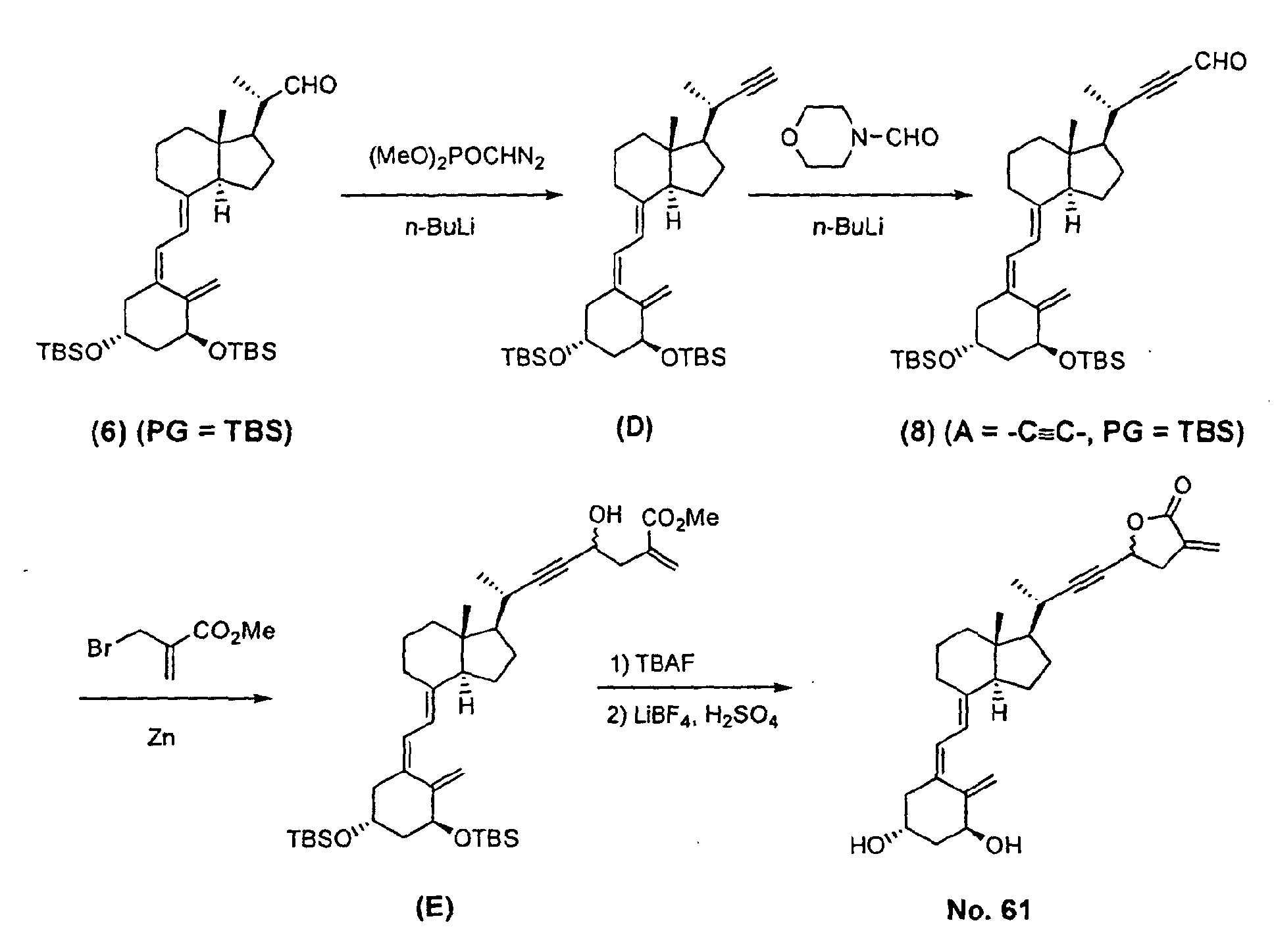
(1) To an anhydrous THF solution (0.5 ml) of n-BuLi (0.396 ml, 1.6
M in hexane, 0.634 mmol) was added dropwise dimethyl
diazomethylphosphonate (89 mg, 0.594 mmol) at -78°C, and the mixture
was stirred for 10 min at this temperature. To the solution was added
dropwise at -78°C an anhydrous THF solution (2.5 ml) of 227 mg (0.396
mmol) of Compound (6) (PG=TBS), which had been produced by a known
method (Tetrahedron, 20, 4609-4619 (1987)), and the mixture was stirred
for 2 hr at this temperature and for 64 hr at -20°C. The reaction was
quenched with water, and the mixture was extracted with dichloromethane.
The organic layer was washed with brine, dried over anhydrous sodium
sulfate. The residue was purified by preparative TLC to obtain Compound
(D) (116 mg, 52% yield).
Compound (D):
1H NMR (CDCl3) δ : 0.06 (s, 6 H), 0.07 (s, 6 H), 0.56 (s, 3 H), 0.87 (s, 9 H), 0.88 (s, 9 H), 1.23 (d, J=6.8 Hz, 3 H), 1.16-2.08 (m, 13 H), 2.02 (d, J=2.4 Hz, 1 H), 2.21 (dd, J=7.1 and 13.2 Hz, 1 H), 2.40-2.55 (m, 2 H), 2.83 (dd, J=3.7 and 12.2 Hz, 1 H), 4.14-4.24 (m, 1 H), 4.37 (dd, J=3.9 and 6.6 Hz, 1 H), 4.86 (d, J=2.0 Hz, 1 H), 5.18 (d, J=1.2 Hz, 1 H), 6.03 (d, J=11.2 Hz, 1 H), 6.23 (d, J=11.2 Hz, 1 H).
MS m/z 569(M+1)+.
Compound (D):
1H NMR (CDCl3) δ : 0.06 (s, 6 H), 0.07 (s, 6 H), 0.56 (s, 3 H), 0.87 (s, 9 H), 0.88 (s, 9 H), 1.23 (d, J=6.8 Hz, 3 H), 1.16-2.08 (m, 13 H), 2.02 (d, J=2.4 Hz, 1 H), 2.21 (dd, J=7.1 and 13.2 Hz, 1 H), 2.40-2.55 (m, 2 H), 2.83 (dd, J=3.7 and 12.2 Hz, 1 H), 4.14-4.24 (m, 1 H), 4.37 (dd, J=3.9 and 6.6 Hz, 1 H), 4.86 (d, J=2.0 Hz, 1 H), 5.18 (d, J=1.2 Hz, 1 H), 6.03 (d, J=11.2 Hz, 1 H), 6.23 (d, J=11.2 Hz, 1 H).
MS m/z 569(M+1)+.
(2) To an anhydrous hexane solution (0.5 ml) of the above obtained
Compound (D) (33 mg, 58 µmol) was added dropwise n-BuLi (40 µl, 1.6 M in
hexane, 64 µmol) at -78°C, and the mixture was stirred for 10 min at -78°C.
Successively, N-formylmorpholine (7 µl, 70 µmol) was added dropwise, and
the mixture was stirred for 1 hr at 0°C. The reaction was quenched with a
saturated ammonium chloride aqueous solution, and the mixture was
extracted with diethyl ether. The organic layer was dried over anhydrous
sodium sulfate and concentrated. The residue was purified by preparative
TLC to obtain Compound (8) (A=-C≡C-, PG=TBS) (30 mg, 87% yield).
Compound (8):
1H NMR (CDCl3) δ : 0.059 (s, 3 H), 0.062 (s, 6 H), 0.07 (s, 3 H), 0.57 (s, 3 H), 0.87 (s, 9 H), 0.88 (s, 9 H), 1.29 (d, J=6.8 Hz, 3 H), 1.25-2.10 (m, 13 H), 2.22 (dd, J=6.8 and 12.7 Hz, 1 H), 2.44 (dd, J=3.7 and 12.7 Hz, 1 H), 2.65-2.75 (m, 1 H), 2.80-2.87 (m, 1 H), 4.15-4.24 (m, 1 H), 4.38 (dd, J=4.1 and 6.8 Hz, 1 H), 4.86 (d, J=2.0 Hz, 1 H), 5.19 (d, J=1.2 Hz, 1 H), 6.02 (d, J=11.2 Hz, 1 H), 6.22 (d, J=11.2 Hz, 1 H), 9.18 (d, J=0.73 Hz, 1 H).
MS m/z 597(M+1)+.
Compound (8):
1H NMR (CDCl3) δ : 0.059 (s, 3 H), 0.062 (s, 6 H), 0.07 (s, 3 H), 0.57 (s, 3 H), 0.87 (s, 9 H), 0.88 (s, 9 H), 1.29 (d, J=6.8 Hz, 3 H), 1.25-2.10 (m, 13 H), 2.22 (dd, J=6.8 and 12.7 Hz, 1 H), 2.44 (dd, J=3.7 and 12.7 Hz, 1 H), 2.65-2.75 (m, 1 H), 2.80-2.87 (m, 1 H), 4.15-4.24 (m, 1 H), 4.38 (dd, J=4.1 and 6.8 Hz, 1 H), 4.86 (d, J=2.0 Hz, 1 H), 5.19 (d, J=1.2 Hz, 1 H), 6.02 (d, J=11.2 Hz, 1 H), 6.22 (d, J=11.2 Hz, 1 H), 9.18 (d, J=0.73 Hz, 1 H).
MS m/z 597(M+1)+.
(3) To an anhydrous THF solution (1 ml) of the above-obtained
Compound (8) (A=-C≡C-, PG=TBS) (89 mg, 0.149 mmol) were added zinc
(powder) (15 mg, 0.22 mmol), methyl 2-(bromomethyl)acrylate (27 µl, 0.22
mmol) and a saturated ammonium chloride aqueous solution (1.4 ml), and
the mixture was stirred for 15 min at room temperature. The reaction was
quenched with water, and the reaction mixture was extracted with ethyl
acetate. The organic layer was washed with water and brine, dried over
anhydrous magnesium sulfate, and concentrated. The residue was purified
by preparative TLC (hexane : ethyl acetate=4:1) to obtain Compound (E) (99
mg, 95% yield).
Compound (E):
1H NMR (CDCl3) δ : 0.058 (s, 3 H), 0.062 (s, 6 H), 0.07 (s, 3 H), 0.54 (s, 3 H), 0.87 (s, 9 H), 0.88 (s, 9 H), 1.18 (d, J=6.8 Hz, 3 H), 1.20-2.05 (m, 13 H), 2.21 (dd, J=7.3 and 13.2 Hz, 1 H), 2.29 (dd, J=2.4 and 5.9 Hz, 1 H), 2.40-2.55 (m, 2 H), 2.69 (d, J=6.3 Hz, 2 H), 2.79-2.87 (m, 1 H), 3.77 (s, 3 H), 4.13-4.23 (m, 1 H), 4.37 (dd, J=4.4 and 7.1 Hz, 1 H), 4.52-4.60 (m, 1 H), 4.86 (d, J=2.0 Hz, 1 H), 5.19 (d, J=1.7 Hz, 1 H), 5.73 (d, J=1.2 Hz, 1 H), 6.02 (d, J=11.2 Hz, 1 H), 6.22 (d, J=11.2 Hz, 1 H), 6.29 (d, J=1.2 Hz, 1 H).
MS m/z 697(M+1)+.
Compound (E):
1H NMR (CDCl3) δ : 0.058 (s, 3 H), 0.062 (s, 6 H), 0.07 (s, 3 H), 0.54 (s, 3 H), 0.87 (s, 9 H), 0.88 (s, 9 H), 1.18 (d, J=6.8 Hz, 3 H), 1.20-2.05 (m, 13 H), 2.21 (dd, J=7.3 and 13.2 Hz, 1 H), 2.29 (dd, J=2.4 and 5.9 Hz, 1 H), 2.40-2.55 (m, 2 H), 2.69 (d, J=6.3 Hz, 2 H), 2.79-2.87 (m, 1 H), 3.77 (s, 3 H), 4.13-4.23 (m, 1 H), 4.37 (dd, J=4.4 and 7.1 Hz, 1 H), 4.52-4.60 (m, 1 H), 4.86 (d, J=2.0 Hz, 1 H), 5.19 (d, J=1.7 Hz, 1 H), 5.73 (d, J=1.2 Hz, 1 H), 6.02 (d, J=11.2 Hz, 1 H), 6.22 (d, J=11.2 Hz, 1 H), 6.29 (d, J=1.2 Hz, 1 H).
MS m/z 697(M+1)+.
(4) To an anhydrous THF solution (1.5 ml) of the above-obtained
Compound (E) (89 mg, 0.128 mmol) was added a THF solution (128 µl, 1 N,
0.128 mmol) of TBAF at 0°C, and the mixture was stirred for 100 min at 0°C.
The reaction was quenched with brine, and the mixture was extracted with
ethyl acetate. The organic layer was washed with water and brine, dried
over anhydrous magnesium sulfate, and concentrated. To a
toluene-acetonitrile (1:1) solution (2 ml) of the residue were added LiBF4 (48
mg, 0.512 mmol) and an acetonitrile solution (512 µl, 1N, 0.512 mmol) of
sulfuric acid at 0°C, and the mixture was stirred for 15 min at 0°C. The
reaction was quenched with water, and the mixture was extracted with
ethyl acetate. The organic layer was washed with a saturated sodium
hydrogencarbonate aqueous solution and brine, dried over magnesium
sulfate, and concentrated. The residue was purified by preparative TLC
(hexane : ethyl acetate=1:3) and HPLC (reversed phase, elution: A; 95%
H2O/CH3CN, B; 95% CH3CN-MeOH (5:3)/H2O, B=75%) to obtain the
objective Compound No. 61 (6.2 mg, 25% yield) in purity of 95%.
Compound No. 61:
1H NMR (CDCl3) δ : 0.52 (s, 3 H), 1.20 (d, J=7.1 Hz, 3 H), 1.00-2.05 (m, 15 H), 2.31 (dd, J=6.3 and 13.4 Hz, 1 H), 2.45-2.58 (m, 1 H), 2.60 (dd, J=3.7 and 13.4 Hz, 1 H), 2.83 (dd, J=4.1 and 12.2 Hz, 1 H), 1.92 (ddt, J=2.9, 5.9 and 16.8 Hz, 1 H), 3.21 (ddt, J=2.4, 8.3 and 16.8 Hz, 1 H), 4.18-4.28 (m, 1 H), 4.40-4.48 (m, 1 H), 4.99-5.00 (m, 1 H), 5.08-5.18 (m, 1 H), 5.33-5.34 (m, 1 H), 5.63-5.70 (m, 1 H), 6.02 (d, J=11.2 Hz, 1 H), 6.24-6.29 (m, 1 H), 6.37 (d, J=11.2 Hz, 1 H).
MS m/z 437(M+1)+.
Compound No. 61:
1H NMR (CDCl3) δ : 0.52 (s, 3 H), 1.20 (d, J=7.1 Hz, 3 H), 1.00-2.05 (m, 15 H), 2.31 (dd, J=6.3 and 13.4 Hz, 1 H), 2.45-2.58 (m, 1 H), 2.60 (dd, J=3.7 and 13.4 Hz, 1 H), 2.83 (dd, J=4.1 and 12.2 Hz, 1 H), 1.92 (ddt, J=2.9, 5.9 and 16.8 Hz, 1 H), 3.21 (ddt, J=2.4, 8.3 and 16.8 Hz, 1 H), 4.18-4.28 (m, 1 H), 4.40-4.48 (m, 1 H), 4.99-5.00 (m, 1 H), 5.08-5.18 (m, 1 H), 5.33-5.34 (m, 1 H), 5.63-5.70 (m, 1 H), 6.02 (d, J=11.2 Hz, 1 H), 6.24-6.29 (m, 1 H), 6.37 (d, J=11.2 Hz, 1 H).
MS m/z 437(M+1)+.

(1) To a 1,4-dioxane solution (3 ml) of propargyl aldehyde diethyl
acetal (81 µl, 0.56 mmol) was added dropwise n-BuLi (0.35 ml, 1.6 M in
hexane, 0.56 mmol) at 5°C, and the mixture was stirred for 10 min at 5°C
and for 20 min at room temperature. To this solution was added a dioxane
solution (3 ml) of Compound (F) (102 mg, 0.14 mmol) obtained from
Compound (6) (PG=TBS) in the same way as described in Example 10, and
the mixture was heated and refluxed for 14 hr. The reaction was quenched
with a saturated sodium hydrogencarbonate solution, and the mixture was
extracted with ethyl acetate. The organic layer was washed with water
and brine, dried over anhydrous magnesium sulfate, and concentrated.
The residue was purified by preparative TLC (hexane : ethyl acetate=9:1) to
obtain Compound (G) (60 mg, 63% yield).
Compound (G):
1H NMR (CDCl3) δ : 0.057 (s, 6 H), 0.062 (s, 6 H), 0.53 (s, 3 H), 0.88 (s, 18 H), 1.09 (d, J=6.6 Hz, 3 H), 1.12-2.12 (m, 21 H), 2.21 (dd, J=7.3 and 14.1 Hz, 1 H), 2.28-2.38 (m, 1 H), 2.44 (dd, J=3.7 and 13.2 Hz, 1 H), 2.82 (d, J=3.7 and 12.9 Hz, 1 H), 3.53-3.63 (m, 2 H), 3.70-3.80 (m, 2 H), 4.15-4.23 (m, 1 H), 4.34-4.38 (dd, J=3.6 and 6.6 Hz, 1 H), 4.86 (d, J=2.2 Hz, 1 H), 5.18 (d, J=1.5 Hz, 1 H), 5.27 (s, 1 H), 6.02 (d, J=11.2 Hz, 1 H), 6.23 (d, J=11.2 Hz, 1 H).
MS m/z 685(M+1)+.
Compound (G):
1H NMR (CDCl3) δ : 0.057 (s, 6 H), 0.062 (s, 6 H), 0.53 (s, 3 H), 0.88 (s, 18 H), 1.09 (d, J=6.6 Hz, 3 H), 1.12-2.12 (m, 21 H), 2.21 (dd, J=7.3 and 14.1 Hz, 1 H), 2.28-2.38 (m, 1 H), 2.44 (dd, J=3.7 and 13.2 Hz, 1 H), 2.82 (d, J=3.7 and 12.9 Hz, 1 H), 3.53-3.63 (m, 2 H), 3.70-3.80 (m, 2 H), 4.15-4.23 (m, 1 H), 4.34-4.38 (dd, J=3.6 and 6.6 Hz, 1 H), 4.86 (d, J=2.2 Hz, 1 H), 5.18 (d, J=1.5 Hz, 1 H), 5.27 (s, 1 H), 6.02 (d, J=11.2 Hz, 1 H), 6.23 (d, J=11.2 Hz, 1 H).
MS m/z 685(M+1)+.
(2) To a THF-H2O (1:1) solution (2 ml) of the above-obtained
Compound (G) (18 mg, 26.3 µmol) was added formic acid, and the mixture
was stirred for 3 days at 40°C. The reaction was quenched with a saturated
sodium hydrogencarbonate aqueous solution, and the mixture was extracted
with ethyl acetate. The organic layer was washed with brine, dried over
anhydrous magnesium sulfate and concentrated. To a DMF solution of the
residue were added imidazole (11 mg, 0.16 mmol) and TBSCl (112 mg, 79
µmol), and the mixture was stirred for 3 hr at room temperature. The
reaction mixture was extracted with ethyl acetate, and the organic layer
was washed with brine, dried over anhydrous magnesium sulfate and
concentrated. The residue was purified by preparative TLC (hexane : ethyl
acetate=10:1) to obtain Compound (8) (A=-CH2-C≡C-, PG=TBS) (4.7 mg,
29% yield).
Compound (8) (A=-CH2-C≡C-, PG=TBS):
1H NMR (CDCl3) δ : 0.059 (s, 6 H), 0.065 (s, 6 H), 0.55 (s, 3 H), 0.88 (s, 18 H), 1.12 (d, J=6.6 Hz, 3 H), 1.20-2.05 (m, 14 H), 2.22 (dd, J=7.3 and 12.9 Hz, 1 H), 2.29 (dd, J=7.6 and 12.4 Hz, 1 H), 2.43-2.53 (m, 2 H), 2.83 (dd, J=4.4 and 12.4 Hz, 1 H), 4.16-4.23 (m, 1 H), 4.37 (dd, J=3.7 and 6.8 Hz, 1 H), 4.86 (d, J=2.2 Hz, 1 H), 5.18 (d, J=1.5 Hz, 1 H), 6.02 (d, J=11.2 Hz, 1 H), 6.23 (d, J=11.2 Hz, 1 H), 9.20 (s, 1 H).
MS m/z 611(M+1)+.
Compound (8) (A=-CH2-C≡C-, PG=TBS):
1H NMR (CDCl3) δ : 0.059 (s, 6 H), 0.065 (s, 6 H), 0.55 (s, 3 H), 0.88 (s, 18 H), 1.12 (d, J=6.6 Hz, 3 H), 1.20-2.05 (m, 14 H), 2.22 (dd, J=7.3 and 12.9 Hz, 1 H), 2.29 (dd, J=7.6 and 12.4 Hz, 1 H), 2.43-2.53 (m, 2 H), 2.83 (dd, J=4.4 and 12.4 Hz, 1 H), 4.16-4.23 (m, 1 H), 4.37 (dd, J=3.7 and 6.8 Hz, 1 H), 4.86 (d, J=2.2 Hz, 1 H), 5.18 (d, J=1.5 Hz, 1 H), 6.02 (d, J=11.2 Hz, 1 H), 6.23 (d, J=11.2 Hz, 1 H), 9.20 (s, 1 H).
MS m/z 611(M+1)+.
(3) To an anhydrous THF solution of the above-obtained
Compound (8) (A=-CH2-C≡C-, PG=TBS) (40 mg, 65.5 µmol) were added zinc
(powder) (6.4 mg, 98 µmol), methyl 2-(bromomethyl)acrylate (12 µl, 98 µmol)
and a saturated ammonium chloride aqueous solution (0.6 ml) at 0°C, and
the mixture was stirred for 30 min at 0°C. The reaction was quenched with
water, and the mixture was extracted with ethyl acetate. The organic layer
was washed with water and brine, dried over anhydrous magnesium sulfate
and concentrated. The residue was purified by preparative TLC (hexane :
ethyl acetate=3:1) to obtain Compound (H) (25 mg, 54% yield).
Compound H:
1H NMR (CDCl3) δ : 0.057 (s, 6 H), 0.063 (s, 6 H), 0.53 (s, 3 H), 0.88 (s, 18 H), 1.05 (d, J=6.3 Hz, 3 H), 1.20-2.50 (m, 19 H), 2.70-2.75 (m, 1 H), 2.78-2.87 (m, 1 H), 3.78 (s, 3H), 4.15-4.22 (m, 1 H), 4.34-4.40 (m, 1 H), 4.55-4.62 (m, 1 H), 4.86 (d, J=2.2 Hz, 1 H), 5.16-5.19 (m, 1 H), 5.75 (d, J=1.2 Hz, 1 H), 6.02 (d, J=11.7 Hz, 1 H), 6.23 (s, J=11.7 Hz, 1 H), 6.30 (d, J=1.2 Hz, 1 H).
MS m/z 711(M+1)+
Compound H:
1H NMR (CDCl3) δ : 0.057 (s, 6 H), 0.063 (s, 6 H), 0.53 (s, 3 H), 0.88 (s, 18 H), 1.05 (d, J=6.3 Hz, 3 H), 1.20-2.50 (m, 19 H), 2.70-2.75 (m, 1 H), 2.78-2.87 (m, 1 H), 3.78 (s, 3H), 4.15-4.22 (m, 1 H), 4.34-4.40 (m, 1 H), 4.55-4.62 (m, 1 H), 4.86 (d, J=2.2 Hz, 1 H), 5.16-5.19 (m, 1 H), 5.75 (d, J=1.2 Hz, 1 H), 6.02 (d, J=11.7 Hz, 1 H), 6.23 (s, J=11.7 Hz, 1 H), 6.30 (d, J=1.2 Hz, 1 H).
MS m/z 711(M+1)+
(4) To an anhydrous THF solution of the above-obtained
Compound (H) (30 mg, 43 µmol) was added a THF solution (43 µl, 1 N, 43
µmol) of TBAF at 0°C, and the mixture was stirred for 30 min at 0°C. The
reaction was quenched with brine, and the mixture was extracted with ethyl
acetate, The organic layer was washed with water and brine, dried over
anhydrous magnesium sulfate, and concentrated. To a toluene-acetonitrile
(1:1) solution (1 ml) of the residue were added LiBF4 (16 mg, 0.170 mmol)
and an acetonitrile solution (170 µl, 1 N, 0.170 mmol) of sulfuric acid at 0°C,
and the mixture was stirred for 10 min at 0°C. The reaction was quenched
with water, and the mixture was extracted with ethyl acetate. The organic
layer was washed with a saturated sodium hydrogencarbonate aqueous
solution and brine, dried over magnesium sulfate, and concentrated. The
residue was purified by HPLC (reversed phase, elution: A; 95% H2O/CH3CN,
B; 95% CH3CN/H2O, B=60%) to obtain the objective Compound No. 71 (7.3
mg, 38% yield) in purity of 94%.
Compound No. 71:
1H NMR (CDCl3) δ : 0.55 (s, 3 H), 1.06 (d, J=6.3 Hz, 3 H), 1.09-2.10 (m, 16 H), 2.28-2.54 (m, 2 H), 2.60 (dd, J=2.9 and 13.4 Hz, 1 H), 2.82 (dd, J=4.1 and 12.7 Hz, 1 H), 2.96 (dtt, J=2.7, 5.6 and 16.8 Hz, 1 H), 3.24 (ddt, J=2.4, 8.3 and 16.8 Hz, 1 H), 3.68-3.77 (m, 1 H), 4.18-4.28 (m, 1 H), 4.40-4.48 (m, 1 H), 5.00 (s, 1 H), 5.12-5.20 (m, 1 H), 5.33 (s, 1 H), 5.65-5.70 (m, 1 H), 6.02 (d, J=11.2 Hz, 1 H), 6.25-6.30 (m, 1 H), 6.38 (d, J=11.2 Hz, 1 H).
MS m/z 451(M+1)+.
Compound No. 71:
1H NMR (CDCl3) δ : 0.55 (s, 3 H), 1.06 (d, J=6.3 Hz, 3 H), 1.09-2.10 (m, 16 H), 2.28-2.54 (m, 2 H), 2.60 (dd, J=2.9 and 13.4 Hz, 1 H), 2.82 (dd, J=4.1 and 12.7 Hz, 1 H), 2.96 (dtt, J=2.7, 5.6 and 16.8 Hz, 1 H), 3.24 (ddt, J=2.4, 8.3 and 16.8 Hz, 1 H), 3.68-3.77 (m, 1 H), 4.18-4.28 (m, 1 H), 4.40-4.48 (m, 1 H), 5.00 (s, 1 H), 5.12-5.20 (m, 1 H), 5.33 (s, 1 H), 5.65-5.70 (m, 1 H), 6.02 (d, J=11.2 Hz, 1 H), 6.25-6.30 (m, 1 H), 6.38 (d, J=11.2 Hz, 1 H).
MS m/z 451(M+1)+.
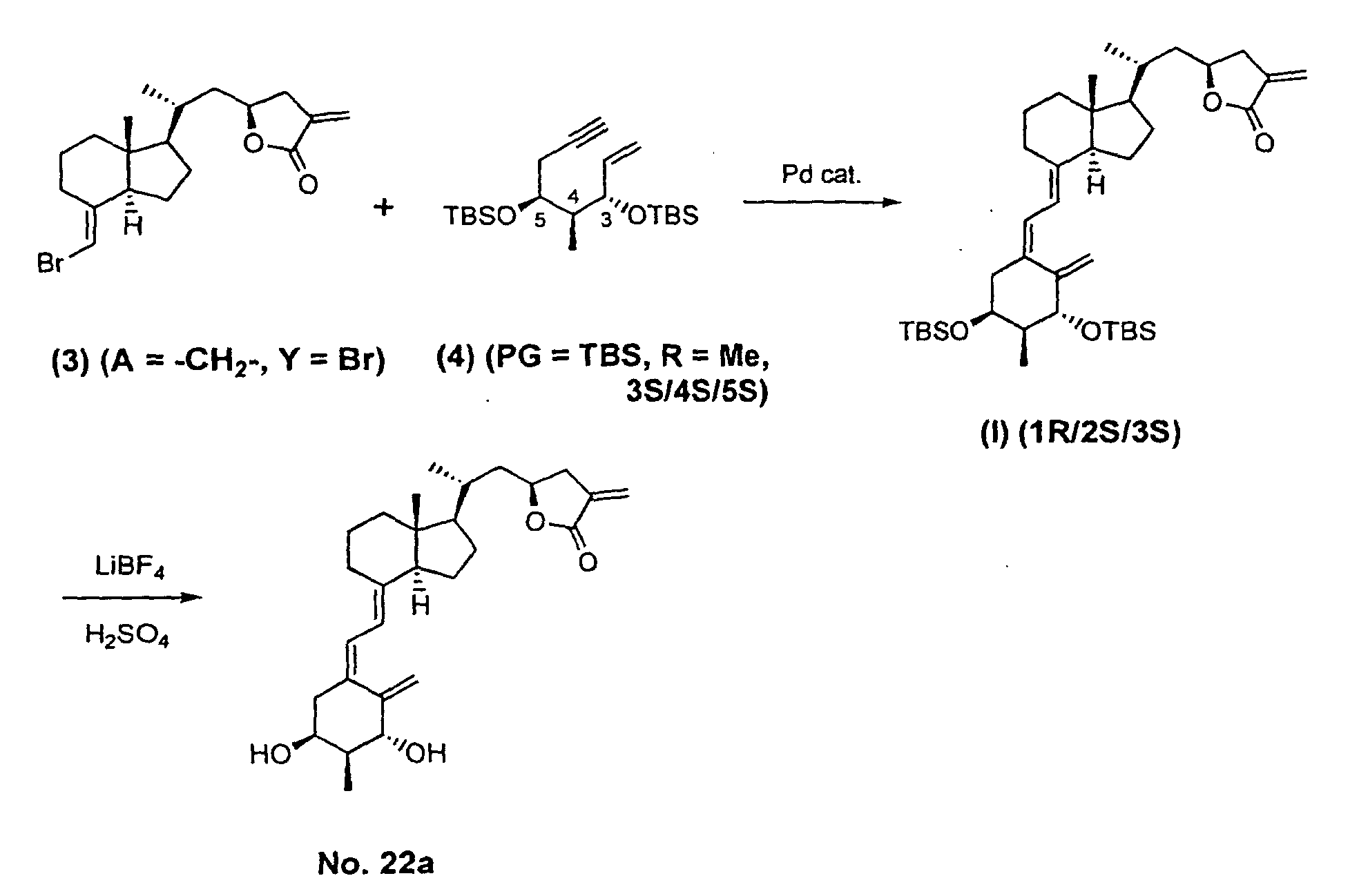
Pd2(dba)3 ·CHCl3 (8.1 mg, 7.8 µmol) and triphenylphosphine (21 mg,
78 µmol) were dissolved in anhydrous toluene (0.5 ml) under a nitrogen
atmosphere, and the solution was stirred for 15 min at room temperature.
To the solution was added an anhydrous toluene solution (0.5 ml) of
Compound (3) (A=-CH2-, Y=Br) (29 mg, 78 µmol), which had been
manufactured by a method described in the specification of WO95/33716,
and Compound (4) (PG=TBS, R=Me, 3S/4S/5S), an ene-yne compound, (29
mg, 7.8 µmol), which had been manufactured by a method described in J.
Med. Chem., 43, 4247-4265 (2000), and successively anhydrous
triethylamine (1.0 ml) was added. The mixture was heated and stirred for
8 hr at 100°C. The reaction mixture was extracted with ethyl acetate after
the addition of a saturated potassium sulfite aqueous solution. The organic
layer was washed with brine, dried and concentrated. The residue was
purified by silica gel column chromatography (hexane : ethyl acetate=40:1 to
20:1) to obtain Compound (I) (1R/2S/3S) (19 mg, a pale yellow oil).
Compound (I) (1R/2S/3S):
MS m/z 669.5 (M+1)+.
Compound (I) (1R/2S/3S):
MS m/z 669.5 (M+1)+.
The obtained Compound (I) (1R/2S/3S) (19 mg, 28 µmol) was
dissolved in a mixed solvent of acetonitrile (1 ml) and methylene chloride (1
ml), LiBF4 (8 mg, 85 µmol) was added to the solution, and the solution was
ice-cooled. To the solution was added an acetonitrile solution (51 µl, 1 N,
51 µmol) of sulfuric acid, and the mixture was stirred for 40 min under ice
cooling. Subsequently, an acetonitrile solution (51 µl, 1 N, 51 µmol) of
sulfuric acid was further added every 30 min three times in total, and the
mixture was stirred for 2.5 hr in total under ice cooling. The reaction
mixture was extracted with ethyl acetate after the addition of a saturated
sodium hydrogencarbonate aqueous solution. The organic layer was
washed with brine, dried and concentrated. The residue was purified by a
silica gel column cartridge (manufactured by Waters Co., Sep-pak Plus
Silica Cartridge, Hexane : ethyl acetate=3:1→hexane : ethyl acetate=1:1→
hexane : ethyl acetate : methanol=3:3:1) and HPLC (reversed phase, elution:
A; 95% H2O/CH3CN, B; 95% MeOH/H2O, B=80%) to obtain the objective
Compound No. 22a (1.9 mg, 5.5% yield) in purity of 99.2%.
Compound No. 22a:
1H NMR (CDCl3) δ : 0.55 (s, 3 H), 1.03 (d, J=6.3 Hz, 3 H), 1.13 (d, J=6.8 Hz, 3 H), 1.1-1.8 (m, 13 H), 1.84-2.02 (m, 4 H), 2.42 (dd, J=5.9 and 13.9 Hz, 1 H), 2.51-2.57 (m, 2 H), 2.82-2.85 (m, 1 H), 3.02-3.08 (m, 1 H), 4.06 (br., 2 H), 4.59 (quint, J=6.8 Hz, 1 H), 5.01 (s, 1 H), 5.35 (s, 1 H), 5.62 (t, J=2.4 Hz, 1 H), 6.01 (d, J=11.2 Hz, 1 H), 6.23 (t, J=2.7 Hz, 1 H), 6.35 (d, J=11.2 Hz, 1 H).
MS m/z 441.2 (M+1)+.
Compound No. 22a:
1H NMR (CDCl3) δ : 0.55 (s, 3 H), 1.03 (d, J=6.3 Hz, 3 H), 1.13 (d, J=6.8 Hz, 3 H), 1.1-1.8 (m, 13 H), 1.84-2.02 (m, 4 H), 2.42 (dd, J=5.9 and 13.9 Hz, 1 H), 2.51-2.57 (m, 2 H), 2.82-2.85 (m, 1 H), 3.02-3.08 (m, 1 H), 4.06 (br., 2 H), 4.59 (quint, J=6.8 Hz, 1 H), 5.01 (s, 1 H), 5.35 (s, 1 H), 5.62 (t, J=2.4 Hz, 1 H), 6.01 (d, J=11.2 Hz, 1 H), 6.23 (t, J=2.7 Hz, 1 H), 6.35 (d, J=11.2 Hz, 1 H).
MS m/z 441.2 (M+1)+.

Pd2(dba)3·CHCl3 (8.1 mg, 7.8 µmol) and triphenylphosphine (21 mg,
78 µmol) were dissolved in anhydrous toluene (0.5 ml) under a nitrogen
atmosphere, and the solution was stirred for 15 min at room temperature.
To the solution was added an anhydrous toluene solution (0.5 ml) of
Compound (3) (A=-CH2-, Y=Br) (29 mg, 78 µmol), which had been
manufactured by a method described in the specification of WO95/33716,
and Compound (4) (PG=TBS, R=Me, 3R/4S/5S), an ene-yne compound, (29
mg, 7.8 µmol), which had been manufactured by a method described in J.
Med. Chem., 43, 4247-4265 (2000), and successively anhydrous
triethylamine (1.0 ml) was added. The solution was heated and stirred for
6 hr at 100°C. The reaction mixture was extracted with ethyl acetate after
the addition of a saturated potassium sulfite aqueous solution. The organic
layer was washed with brine, dried and concentrated. The residue was
purified by silica gel column chromatography (hexane : ethyl acetate=40:1 to
20:1) to obtain Compound (I) (1S/2S/3S) (36 mg, a pale yellow oil).
Compound (I) (1S/2S/3S):
MS m/z 669.5 (M+1)+.
Compound (I) (1S/2S/3S):
MS m/z 669.5 (M+1)+.
The obtained Compound (I) (1S/2S/3S) (36 mg, 54 µmol) was
dissolved in a mixed solvent of acetonitrile (1 ml) and methylene chloride (1
ml), LiBF4 (15 mg, 161 µmol) was added to the solution, and the solution
was ice-cooled. To the solution was added an acetonitrile solution (97 µl, 1
N, 97 µmol) of sulfuric acid, and the mixture was stirred for 40 min under
ice cooling. The reaction mixture was extracted with ethyl acetate after the
addition of a saturated sodium hydrogencarbonate aqueous solution. The
organic layer was washed with brine, dried and concentrated. The residue
was purified by a silica gel column cartridge (manufactured by Waters Co.,
Sep-pak Plus Silica Cartridge, Hexane : ethyl acetate=3:1→hexane : ethyl
acetate=1:1→hexane : ethyl acetate : methanol=3:3:1) and HPLC (reversed
phase, elution: A; 95% H2O/CH3CN, B; 95% MeOH/H2O, B=80%) to obtain
the objective Compound No. 22b (3.2 mg, 9.3% yield, colorless film) in purity
of 100%.
Compound No. 22b:
1H NMR (CDCl3) δ : 0.55 (s, 3 H), 1.03 (d, J=6.3 Hz, 3 H), 1.22 (d, J=7.3 Hz, 3 H), 1.1-1.8 (m, 11 H), 1.92-2.05 (m, 4 H), 2.17 (br., 1 H), 2.49-2.60 (m, 3 H), 2.79-2.88 (m, 2 H), 3.02-3.09 (m, 1 H), 3.92 (br., 1 H), 4.17 (br., 1 H), 4.59 (quint, J=6.8 Hz, 1 H), 4.98 (s, 1 H), 5.23 (s, 1 H), 5.62 (s, 1 H), 6.03 (d, J=11.2 Hz, 1 H), 6.23 (s, 1 H), 6.47 (d, J=11.5 Hz, 1 H).
MS m/z 441.2 (M+1)+.
Compound No. 22b:
1H NMR (CDCl3) δ : 0.55 (s, 3 H), 1.03 (d, J=6.3 Hz, 3 H), 1.22 (d, J=7.3 Hz, 3 H), 1.1-1.8 (m, 11 H), 1.92-2.05 (m, 4 H), 2.17 (br., 1 H), 2.49-2.60 (m, 3 H), 2.79-2.88 (m, 2 H), 3.02-3.09 (m, 1 H), 3.92 (br., 1 H), 4.17 (br., 1 H), 4.59 (quint, J=6.8 Hz, 1 H), 4.98 (s, 1 H), 5.23 (s, 1 H), 5.62 (s, 1 H), 6.03 (d, J=11.2 Hz, 1 H), 6.23 (s, 1 H), 6.47 (d, J=11.5 Hz, 1 H).
MS m/z 441.2 (M+1)+.

Pd2(dba)3·CHCl3 (8.1 mg, 7.8 µmol) and triphenylphosphine (21 mg,
78 µmol) were dissolved in anhydrous toluene (0.5 ml) under a nitrogen
atmosphere, and the solution was stirred for 15 min at room temperature.
To the solution was added an anhydrous toluene solution (0.5 ml) of
Compound (3) (A=-CH2-, Y=Br) (29 mg, 78 µmol), which had been
manufactured by a method described in the specification of WO95/33716,
and Compound (4) (PG=TBS, R=Me, 3S/4S/5R) (29 mg, 7.8 µmol), an
ene-yne compound, which had been manufactured by a method described in
J. Med. Chem., 43, 4247-4265 (2000), and successively anhydrous
triethylamine (1.0 ml) was added. The solution was heated and stirred for
9 hr at 100°C. The reaction mixture was extracted with ethyl acetate after
the addition of a saturated potassium sulfite aqueous solution. The organic
layer was washed with brine, dried and concentrated. The residue was
purified by silica gel column chromatography (hexane : ethyl acetate=40:1 to
20:1) to obtain Compound (I) (1R/2S/3R) (20 mg, a pale yellow oil).
Compound (I) (1R/2S/3R):
MS m/z 669.5 (M+1)+.
Compound (I) (1R/2S/3R):
MS m/z 669.5 (M+1)+.
The obtained Compound (I) (1R/2S/3R) (20 mg, 30 µmol) was
dissolved in a mixed solvent of acetonitrile (1 ml) and methylene chloride (1
ml), LiBF4 (8.4 mg, 90 µmol) was added to the solution, and the solution was
ice-cooled. To the solution was added an acetonitrile solution (54 µl, 1 N,
54 µmol) of sulfuric acid, and the mixture was stirred for 50 min under ice
cooling. The reaction mixture was extracted with ethyl acetate after the
addition of a saturated sodium hydrogencarbonate aqueous solution. The
organic layer was washed with brine, dried and concentrated. The residue
was purified by a silica gel column cartridge (manufactured by Waters Co.,
Sep-pak Plus Silica Cartridge, Hexane : ethyl acetate=3:1→hexane : ethyl
acetate=1:1→hexane : ethyl acetate : methanol=3:3:1) and HPLC (reversed
phase, elution: A; 95% H2O/CH3CN, B; 95% MeOH/H2O, B=78%) to obtain
the objective Compound No. 22c (1.0 mg, 2.9% yield) in purity of 99%.
Compound No. 22c:
1H NMR (CDCl3) δ : 0.57 (s, 3 H), 1.03 (d, J=7.1 Hz, 3 H), 1.04 (d, J=6.3 Hz, 3 H), 1.1-1.7 (m, 11 H), 1.88-2.12 (m, 4 H), 2.29 (br., 1 H), 2.36 (dd, J=5.4 and 13.9 Hz, 1 H), 2.51-2.57 (m, 1 H), 2.64-2.68 (m, 1 H), 2.75 (br., 1 H), 2.83-2.86 (m, 1 H), 3.02-3.08 (m, 1 H), 3.72 (br., 1 H), 3.96 (br., 1 H), 4.59 (quint, J=7.1 Hz, 1 H), 5.06 (s, 1 H), 5.30 (s, 1 H), 5.62 (s, 1 H), 6.05 (d, J=11.5 Hz, 1 H), 6.23 (s, 1 H), 6.42 (d, J=11.2 Hz, 1 H).
MS m/z 441.2 (M+1)+.
Compound No. 22c:
1H NMR (CDCl3) δ : 0.57 (s, 3 H), 1.03 (d, J=7.1 Hz, 3 H), 1.04 (d, J=6.3 Hz, 3 H), 1.1-1.7 (m, 11 H), 1.88-2.12 (m, 4 H), 2.29 (br., 1 H), 2.36 (dd, J=5.4 and 13.9 Hz, 1 H), 2.51-2.57 (m, 1 H), 2.64-2.68 (m, 1 H), 2.75 (br., 1 H), 2.83-2.86 (m, 1 H), 3.02-3.08 (m, 1 H), 3.72 (br., 1 H), 3.96 (br., 1 H), 4.59 (quint, J=7.1 Hz, 1 H), 5.06 (s, 1 H), 5.30 (s, 1 H), 5.62 (s, 1 H), 6.05 (d, J=11.5 Hz, 1 H), 6.23 (s, 1 H), 6.42 (d, J=11.2 Hz, 1 H).
MS m/z 441.2 (M+1)+.

Pd2(dba)3 ·CHCl3 (8.1 mg, 7.8 µmol) and triphenylphosphine (21 mg,
78 µmol) were dissolved in anhydrous toluene (0.5 ml) under a nitrogen
atmosphere, and the solution was stirred for 15 min at room temperature.
To the solution was added an anhydrous toluene solution (0.5 ml) of
Compound (3) (A=-CH2-, Y=Br) (29 mg, 78 µmol), which had been
manufactured by a method described in the specification of WO95/33716,
and Compound (4) (PG=TBS, R=Me, 3R/4S/5R) (29 mg, 7.8 µmol), an
ene-yne compound, which had been manufactured by a method described in
J. Med. Chem., 43, 4247-4265 (2000), and successively anhydrous
triethylamine (1.0 ml) was added. The solution was heated and stirred for
9 hr at 100°C. The reaction mixture was extracted with ethyl acetate after
the addition of a saturated potassium sulfite aqueous solution. The organic
layer was washed with brine, dried and concentrated. The residue was
purified by silica gel column chromatography (hexane : ethyl acetate=40:1 to
20:1) to obtain Compound (I) (1S/2S/3R) (23 mg, a pale yellow oil).
Compound (I) (1S/2S/3R):
MS m/z 669.5 (M+1)+.
Compound (I) (1S/2S/3R):
MS m/z 669.5 (M+1)+.
The obtained Compound (I) (1S/2S/3R) (23 mg, 34 µmol) was
dissolved in a mixed solvent of acetonitrile (1 ml) and methylene chloride (1
ml), LiBF4 (10 mg, 103 µmol) was added to the solution, and the mixture
was ice cooled. To the solution was added an acetonitrile solution (62 µl, 1
N, 62 µmol) of sulfuric acid, and the mixture was stirred for 50 min under
ice cooling. Since the reaction had not been completed at this point, an
acetonitrile solution (62 µl, 1 N, 62 µmol) of sulfuric acid was further added,
and the mixture was stirred for 40 min under ice cooling and for 20 min at
room temperature. Since the reaction had not been completed again at this
point, an acetonitrile solution (62 µl, 1 N, 62 µmol) of sulfuric acid was
further added, and the mixture was stirred for 40 min at room temperature.
The reaction mixture was extracted with ethyl acetate after the addition of a
saturated sodium hydrogencarbonate aqueous solution. The organic layer
was washed with brine, dried and concentrated. The residue was purified
by a silica gel column cartridge (manufactured by Waters Co., Sep-pak Plus
Silica Cartridge, Hexane : ethyl acetate=3:1→hexane : ethyl acetate=1:1→
hexane : ethyl acetate : methanol=3:3:1) and HPLC (reversed phase, elution:
A; 95% H2O/CH3CN, B; 95% MeOH/H2O, B=78%) to obtain the objective
Compound No. 22d (1.4 mg, 4.1% yield, colorless film) in purity of 99%.
Compound No. 22d:
1H NMR (CDCl3) δ : 0.55 (s, 3 H), 1.03 (d, J=6.3 Hz, 3 H), 1.08 (d, J=6.8 Hz, 3 H), 1.1-1.8 (m, 13 H), 1.90-2.04 (m, 4H), 2.24 (dd, J=7.8 and 13.4 Hz, 1 H), 2.51-2.57 (m, 1 H), 2.67 (dd, J=4.1 and 13.4 Hz, 1H), 2.82-2.85 (m, 1 H), 3.02-3.08 (m, 1 H), 3.85 (br., 1 H), 4.31 (s, 1 H), 4.59 (quint, J=6.8 Hz, 1 H), 5.01 (s, 1 H), 5.28 (s, 1 H), 5.62 (s, 1 H), 6.01 (d, J=11.2 Hz, 1 H), 6.22 (s, 1 H), 6.39 (d, J=11.0 Hz, 1 H).
MS m/z 441.2 (M+1)+.
Compound No. 22d:
1H NMR (CDCl3) δ : 0.55 (s, 3 H), 1.03 (d, J=6.3 Hz, 3 H), 1.08 (d, J=6.8 Hz, 3 H), 1.1-1.8 (m, 13 H), 1.90-2.04 (m, 4H), 2.24 (dd, J=7.8 and 13.4 Hz, 1 H), 2.51-2.57 (m, 1 H), 2.67 (dd, J=4.1 and 13.4 Hz, 1H), 2.82-2.85 (m, 1 H), 3.02-3.08 (m, 1 H), 3.85 (br., 1 H), 4.31 (s, 1 H), 4.59 (quint, J=6.8 Hz, 1 H), 5.01 (s, 1 H), 5.28 (s, 1 H), 5.62 (s, 1 H), 6.01 (d, J=11.2 Hz, 1 H), 6.22 (s, 1 H), 6.39 (d, J=11.0 Hz, 1 H).
MS m/z 441.2 (M+1)+.

Compound (8) (A=-CH2-CH=CH-, PG=TBS):
1H NMR (CDCl3) δ : 0.06 (s, 12 H), 0.56 (s, 3H), 0.88 (s, 18 H), 0.98 (d, J=6.4 Hz, 3 H), 1.25-2.05 (m, 11 H), 2.17-2.25 (m, 3 H), 2.42-2.48 (m, 2 H), 2.7-2.8 (m, 1 H), 4.19 (br., 1 H), 4.37 (br., 1 H), 4.87 (d, J=2.5 Hz, 1 H), 5.18 (s, 1 H), 6.02 (d, J=11.2 Hz, 1 H), 6.11-6.17 (m, 1 H), 6.24 (d, J=10.9 Hz, 1 H), 6.8-6.9 (m, 1 H), 9.52 (d, J=7.9 Hz, 1 H).
MS m/z 613.3 (M+1)+.
Compound (L):
1H NMR (CDCl3) δ : 0.06 (s, 12 H), 0.53 (s, 3 H), 0.88 (s, 18 H), 1.23-2.25 (m, 20 H), 2.43-2.62 (m, 3 H), 2.82 (d, J=10.4 Hz, 1 H), 3.77 (s, 3 H), 4.08-4.37 (m, 3 H), 4.87 (d, J=2.3 Hz, 1 H), 5.18 (s, 1 H), 5.44-5.49 (m, 1 H), 5.61-5.67 (m, 2 H), 6.02 (d, J=11.2 Hz, 1 H), 6.22-6.25 (m, 2 H).
MS m/z 713.5 (M+1)+, 695.5 (M-H2O+1)+.
The crude body of a side-chain cyclization compound:
1H NMR (CDCl3) δ : 0.06 (s, 12 H), 0.53 (s, 3 H), 0.88 (s, 18 H), 0.89-3.15 (m, 24 H), 4.19 (br., 1 H), 4.37 (br., 1 H), 4.86-4.96 (m, 2 H), 5.17 (s, 1 H), 5.48 (dd, J=7.1 and 15.3 Hz, 1 H), 5.63 (t, J=2.3 Hz, 1 H), 5.76-5.79 (m, 1 H), 6.02 (d, J=11.4 Hz, 1 H), 6.22-6.26 (m, 2 H).
MS m/z 681.5 (M+1)+.
The obtained crude body of a side-chain cyclization compound was
dissolved in a mixed solvent of acetonitrile (1 ml) and methylene chloride (1
ml), to the solution was added lithium tetrafluoroborate (25 mg, 270
µmol), and the solution was ice-cooled. To this solution was added an
acetonitrile solution (162 µl, 1 N, 162 µmol) of sulfuric acid, and the mixture
was stirred for 30 min under ice cooling. The reaction mixture was
extracted with ethyl acetate after the addition of a saturated sodium
hydrogencarbonate aqueous solution. The organic layer was washed with
brine, dried and concentrated. The residue was purified by Sep-pak Plus
Silica Cartridge manufactured by Waters Co. [the sample was dissolved in
methylene chloride (2 ml), the sample solution was charged on the column,
this was eluted with hexane : ethyl acetate=3:1 (10 ml) and successively
with hexane : ethyl acetate: methanol=3:3:1 (10 ml), the hexane : ethyl
acetate: methanol=3:3:1 fraction was collected, and this fraction was
concentrated] to obtain a crude body of Compound No. 41 (38 mg). This
crude compound was purified by HPLC (reversed phase, elution: A; 95%
H2O/CH3CN, B; 95% MeOH/H2O, B=81%) to obtain the objective Compound
No. 41 (18.5 mg, 46% yield).
Compound No. 41:
1H NMR (CDCl3) δ : 0.55 (s, 3 H), 0.918 & 0.924 (d, J=6.6 Hz, 3 H), 1.28-2.07 (m, 15 H), 2.16 (br., 1 H), 2.32 (dd, J=6.8 and 13.7 Hz, 1 H), 2.57-2.73 (m, 2 H), 2.80-2.85 (m, 1 H), 3.08-3.18 (m, 1 H), 4.23 (br., 1 H), 4.44 (br., 1 H), 4.93 (quint, J=7.1 Hz, 1 H), 5.00 (s, 1 H), 5.33 (s, 1 H), 5.48 (dd, J=7.3 and 15.0 Hz, 1 H), 5.64 (t, J=2.5 Hz, 1 H), 5.73-5.84 (m, 1 H), 6.02 (d, J=11.1 Hz, 1 H), 6.24 (t, J=2.8 Hz, 1 H), 6.38 (d, J=11.4 Hz, 1 H).
MS m/z 453.3 (M+1)+.
Compound No. 41:
1H NMR (CDCl3) δ : 0.55 (s, 3 H), 0.918 & 0.924 (d, J=6.6 Hz, 3 H), 1.28-2.07 (m, 15 H), 2.16 (br., 1 H), 2.32 (dd, J=6.8 and 13.7 Hz, 1 H), 2.57-2.73 (m, 2 H), 2.80-2.85 (m, 1 H), 3.08-3.18 (m, 1 H), 4.23 (br., 1 H), 4.44 (br., 1 H), 4.93 (quint, J=7.1 Hz, 1 H), 5.00 (s, 1 H), 5.33 (s, 1 H), 5.48 (dd, J=7.3 and 15.0 Hz, 1 H), 5.64 (t, J=2.5 Hz, 1 H), 5.73-5.84 (m, 1 H), 6.02 (d, J=11.1 Hz, 1 H), 6.24 (t, J=2.8 Hz, 1 H), 6.38 (d, J=11.4 Hz, 1 H).
MS m/z 453.3 (M+1)+.

Compound (2) (A=-CH=CH-, Y=Br):
1H NMR (CDCl3) δ: 0.62 (s, 3 H), 1.16 (d, J=6.8 Hz, 3 H), 1.23-1.86 (m, 9 H), 1.98-2.04 (m, 2 H), 2.39-2.48 (m, 1 H), 2.88-2.96 (m, 1 H), 5.67 (d, J=1.8 Hz, 1 H), 6.06 (dd, J=7.8 and 15.7 Hz, 1 H), 6.71 (dd, J=8.7 and 15.5 Hz, 1 H), 9.49 (d, J=7.8 Hz, 1 H).
MS m/z 328.2 (M+1)+.
Compound (M):
1H NMR (CDCl3) δ: 0.57 (s, 3 H), 1.02, 1.04 (d, J=6.8 and 6.6 Hz, 3 H), 1.23-1.75 (m, 9 H), 1.95-2.04 (m, 4 H), 2.48, 2.58 (dd, J=7.4 and 14.0 and 4.6 and 14.0 Hz, 2 H), 2.85-2.89 (m, 1 H), 3.77 (s, 3 H), 4.19-4.26 (m, 1 H), 5.35-5.57 (m, 2 H), 5.65 (d, J=4.3 Hz, 2 H), 6.25 (s, 1 H).
MS m/z 392.9 (M-H2O+1)+.
Compound (3) (A=-CH=CH-, Y=Br):
1H NMR (CDCl3) δ: 0.578, 0.582 (s, 3 H), 1.04-1.07 (m, 3 H), 1.24-1.71 (m, 9 H), 1.96-1.99 (m, 2 H), 2.05-2.14 (m, 1 H), 2.65-2.70 (m, 1 H), 2.86-2.90 (m, 1 H), 3.08-3.15 (m, 1 H), 4.89 (dd, J=6.6, 14.9 Hz, 1 H), 5.43 (dd, J=6.6 and 14.6 Hz, 1 H), 5.63-5.70 (m, 3 H), 6.24 (d, J=2.2 Hz, 1 H).
MS m/z 379.0 (M+1)+.
Compound (N):
MS m/z 681.5 (M+1)+.
Compound No. 32a (the lower polarity body):
1H NMR (CDCl3) δ: 0.55 (s, 3 H), 1.04 (d, J=6.6 Hz, 3 H), 1.08 (d, J=6.9 Hz, 3 H), 1.1-1.8 (m, 9 H), 1.8-2.0 (m, 3 H), 2.1-2.3 (m, 2 H), 2.62-2.71 (m, 2 H), 2.80-2.85 (m, 1 H), 3.06-3.15 (m, 1 H), 3.85 (br., 1 H), 4.31 (br., 1 H), 4.88 (q, J=7.3 Hz, 1 H), 5.00 (d, J=2.1 Hz, 1 H), 5.28 (s, 1 H), 5.41 (dd, J=7.3 and 15.3 Hz, 1 H), 5.63 (t, J=2.6 Hz, 1 H), 5.68 (dd, J=8.6 and 15.3 Hz, 1 H), 6.00 (d, J=11.2 Hz, 1 H), 6.23 (t, J=2.8 Hz, 1 H), 6.38 (d, J=10.9 Hz, 1 H).
MS m/z 453.3 (M+1)+.
Compound No. 32b (the higher polarity body):
1H NMR (CDCl3) δ: 0.55 (s, 3 H), 1.05 (d, J=7.3 Hz, 3 H), 1.08 (d, J=7.3 Hz, 3 H), 1.1-1.8 (m, 9 H), 1.8-2.1 (m, 3 H), 2.11-2.28 (m, 2 H), 2.65-2.69 (m, 2 H), 2.70-2.86 (m, 1 H), 3.07-3.16 (m, 1 H), 3.85 (br., 1 H), 4.31 (br., 1 H), 4.88 (q, J=7.1 Hz, 1 H), 5.00 (s, 1 H), 5.28 (s, 1 H), 5.41 (dd, J=8.7 and 15.8 Hz, 1 H), 5.63 (s, 1 H), 5.68 (dd, J=8.7 and 15.0 Hz, 1 H), 6.00 (d, J=11.7 Hz, 1 H), 6.23 (s, 1 H), 6.39 (d, J=11.4 Hz, 1 H).
MS m/z 453.4 (M+1)+.
This receptor binding assay was performed as described by Ishizuka,
et al. (Steroids, 37, 33-34 (1982)). That is, an ethanol solution (10 µl) of [26,
27-methyl-3H] 1α, 25-dihydroxyvitamin D3 (15,000 dpm, 180 Ci/mmol) and
an ethanol solution (40 µl) of a compound of the present invention were
charged to a 12 × 75 mm polypropylene tube. Chick intestinal mucosal cell
1α, 25-dihydroxyvitamin D3 receptor protein (0.2 mg) and gelatin (1 mg)
were dissolved in 1 ml of phosphate buffer (pH 7.4), the solution was added
to the tube, and the mixture was allowed to react for 1 hr at 25°C. One ml
of a 40% polyethylene glycol 6000 solution was added to the tube, mixed
vigorously, and then centrifuged (2,260 × g) for 60 min at 4°C. The bottom
of the tube containing the pellet was cut off into a scintillation solution vial,
10 ml of dioxane-based scintillation fluid was added, and then radioactivity
was measured by a liquid scintillation counter. Regarding compounds of
the present invention, the concentration at which the binding of [26,
27-methyl-3H] 1α, 25-dihydroxyvitamin D3 to the receptor was inhibited by
50% was determined from measured values. The concentration was
expressed in terms of relative strength calculated by taking the
50%-inhibition concentration of 1α, 25-dihydroxyvitamin D3 as 1. The
results are shown in Table 2.
| Binding affinities of compounds of the present invention to chick intestinal mucosal cell 1α, 25-dihydroxyvitamin D3 receptor | |
| VDR affinity (1α, 25-dihydroxyvitamin D3=1) | Compound No. |
| 1 to 1/5 | 31b, 32b, 41, 51b |
| 1/5 to 1/10 | 22d, 32a, 51a, 61, 71 |
| 1/10 to 1/30 | 22b, 31a |
Table 2 shows that compounds of the present invention have very
strong binding affinities to VDR. Consequently, the compounds of the
present invention can be expected to have high vitamin D3-like
pharmacological activities, and it is suggested that they are effective as
treating agents for various diseases, for example, osteoporosis, malignant
tumor, psoriasis, hyperparathyroidism, an inflammatory respiratory disease,
rheumatoid arthritis, growth onset type diabetes mellitus, hypertension,
alopecia, acne, dermatitis, hypercalcemia, Paget's disease of bone, etc.
| NBT reduction activity induction effect in HL-60 cell (suppression effect of compounds of the present invention on cell differentiation induction by 1α,25-dihydroxyvitamin D3) | |
| IC50 (nM) | Compound No. |
| <50 | 22b,22d,31b,32a |
| 50 to 150 | 11a, 31a, 32b, 51b |
| 150 to 300 | 51a, 61 |
Table 3 shows that compounds of the present invention suppress cell
differentiation induction caused by 1α,25-dihydroxyvitamin D3. That is,
the compounds of the present invention act as antagonists against
1α,25-dihydroxyvitamin D3. Consequently, it was suggested that the
compounds of the present invention are effective as a treating agent for
hypercalcemia and Paget's disease of bone, which are caused by the
accentuation of activity of an active type vitamin D3.
Claims (15)
- Vitamin D3 derivative expressed by the following general formula (1)[wherein, R is a hydrogen atom or a methyl group, and A is a single bond, -CH2-, -CH=CH-, -CH2-CH=CH-, -CH=CH-CH=CH-, -C≡C- or -CH2-C≡C-; and a compound in which R is an hydrogen atom, A is -CH2-, the steric configuration at the 1-position is (S)-configuration, and the steric configuration at the 3-position is (R)-configuration is excluded] or a pharmaceutically permissible solvate thereof.
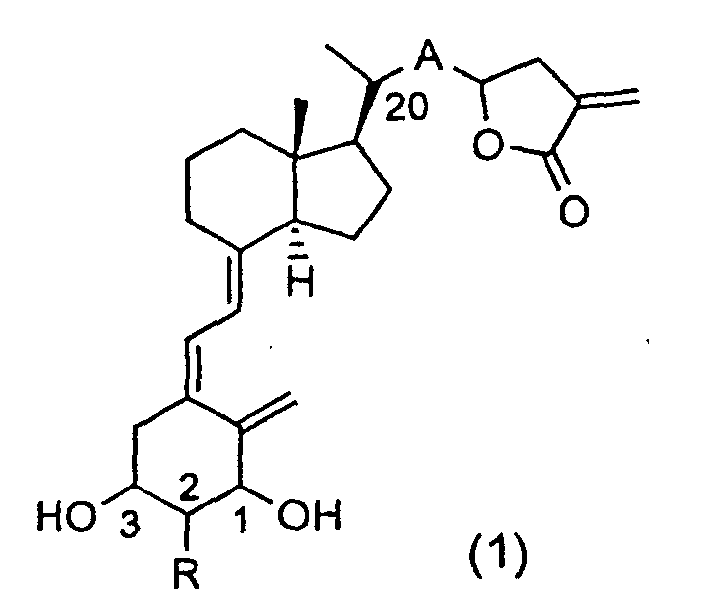
- The vitamin D3 derivative or its pharmaceutically permissible solvate thereof according to Claim 1, wherein the steric configuration of the 1-position is (S)-configuration, and that of the 3-position is (R)-configuration in the above formula (1).
- The vitamin D3 derivative or its pharmaceutically permissible solvate thereof according to Claim 1 or 2, wherein R is a methyl group in the above formula (1).
- The vitamin D3 derivative or its pharmaceutically permissible solvate thereof according to Claim 3, wherein the steric configuration of the 2-position is (S)-configuration in the above formula (1).
- The vitamin D3 derivative or its pharmaceutically permissible solvate thereof according to Claim 1 or 2, wherein R is a hydrogen atom in the above formula (1).
- The vitamin D3 derivative or its pharmaceutically permissible solvate thereof according to any one of the Claims 1 to 5, wherein A is -CH2- or -CH=CH- in the above formula (1).
- The vitamin D3 derivative or its pharmaceutically permissible solvate thereof according to Claim 1, wherein the steric configuration of the 1-position is (S)-configuration, the steric configuration of the 3-position is (Reconfiguration, the steric configuration at the 20-position is (R)-conftguration, R is a hydrogen atom, and A is -CH=CH- in the above formula (1).
- The vitamin D3 derivative or its pharmaceutically permissible solvate thereof according to Claim 1, wherein the steric configuration of the 1-position is (S)-configuration, the steric configuration of the 2-position is (S)-configuration, the steric configuration at the 3-position is (R)-configuration, the steric configuration at the 20-position is (R)-configuration, R is a methyl group, and A is -CH=CH- in the above formula (1).
- The vitamin D3 derivative or its pharmaceutically permissible solvate thereof according to Claim 1, wherein the steric configuration of the 1-position is (S)-configuration, the steric configuration of the 2-position is (S)-configuration, the steric configuration at the 3-position is (R)-configuration, the steric configuration at the 20-position is (R)-configuration, R is a methyl group, and A is -CH2- in the above formula (1).
- The vitamin D3 derivative or its pharmaceutically permissible solvate thereof according to Claim 1, wherein the steric configuration of the 1-position is (S)-configuration, the steric configuration of the 2-position is (S)-configuration, the steric configuration at the 3-position is (S)-configuration, the steric configuration at the 20-position is (R)-configuration, R is a methyl group, and A is -CH2- in the above formula (1).
- A treating agent for a disease selected from the group consisting of osteoporosis, malignant tumor, psoriasis, hyperparathyroidism, an inflammatory respiratory disease, rheumatoid arthritis, growth onset type diabetes mellitus, hypertension, alopecia, acne, dermatitis, hypercalcemia and Paget's disease of bone, containing a vitamin D3 derivative or its pharmaceutically permissible solvate thereof according to any one of claims 1 to 10 in an effective amount for treatment.
- The treating agent according to Claim 11, wherein the disease is hyperparathyroidism or Paget's disease of bone.
- The treating agent according to Claim 11, wherein the disease is hyperparathyroidism.
- The treating agent according to Claim 11, wherein the disease is Paget's disease of bone.
- A pharmaceutical composition comprising a vitamin D3 derivative or its pharmaceutically permissible solvate thereof according to any one of claims 1 to 10, and a pharmaceutically permissible support.
Applications Claiming Priority (3)
| Application Number | Priority Date | Filing Date | Title |
|---|---|---|---|
| JP2002043042 | 2002-02-20 | ||
| JP2002043042 | 2002-02-20 | ||
| PCT/JP2003/001775 WO2003070716A1 (en) | 2002-02-20 | 2003-02-19 | Vitamin d3 derivatives and remedies using the same |
Publications (2)
| Publication Number | Publication Date |
|---|---|
| EP1477483A1 true EP1477483A1 (en) | 2004-11-17 |
| EP1477483A4 EP1477483A4 (en) | 2006-12-06 |
Family
ID=27750515
Family Applications (1)
| Application Number | Title | Priority Date | Filing Date |
|---|---|---|---|
| EP03705314A Withdrawn EP1477483A4 (en) | 2002-02-20 | 2003-02-19 | Vitamin d3 derivatives and remedies using the same |
Country Status (9)
| Country | Link |
|---|---|
| US (1) | US20050101575A1 (en) |
| EP (1) | EP1477483A4 (en) |
| JP (1) | JPWO2003070716A1 (en) |
| KR (1) | KR20040096589A (en) |
| CN (1) | CN1636003A (en) |
| AU (1) | AU2003211496A1 (en) |
| CA (1) | CA2476679A1 (en) |
| TW (1) | TW200303206A (en) |
| WO (1) | WO2003070716A1 (en) |
Cited By (1)
| Publication number | Priority date | Publication date | Assignee | Title |
|---|---|---|---|---|
| US11305016B2 (en) | 2009-08-14 | 2022-04-19 | Berg Llc | Vitamin D3 and analogs thereof for treating alopecia |
Families Citing this family (2)
| Publication number | Priority date | Publication date | Assignee | Title |
|---|---|---|---|---|
| CN1771239B (en) * | 2003-01-30 | 2010-06-09 | 帝人制药株式会社 | Vitamin D3 Lactone Derivatives |
| JPWO2010053165A1 (en) | 2008-11-04 | 2012-04-05 | 帝人ファーマ株式会社 | Vitamin D3 lactam derivative |
Family Cites Families (6)
| Publication number | Priority date | Publication date | Assignee | Title |
|---|---|---|---|---|
| ATE201397T1 (en) * | 1994-06-07 | 2001-06-15 | Teijin Ltd | VITAMIN D3 DERIVATIVES AND A METHOD FOR THE PRODUCTION THEREOF |
| DE19710054A1 (en) * | 1997-03-12 | 1998-09-17 | Merck Patent Gmbh | Pharmaceutical preparation |
| JPH1135470A (en) * | 1997-07-23 | 1999-02-09 | Teijin Ltd | Parathyroid hormone production promoter containing vitamin D3 derivative |
| WO2000024712A1 (en) * | 1998-10-23 | 2000-05-04 | Teijin Limited | Vitamin d3 derivatives and remedies for inflammatory respiratory diseases containing the same |
| JP2002069003A (en) * | 2000-08-23 | 2002-03-08 | Teijin Ltd | Bone resorption inhibitor containing vitamin D derivative |
| CA2420759A1 (en) * | 2000-08-30 | 2003-02-27 | Daishiro Miura | Parathyroid hormone production inhibitors containing vitamin d3 derivatives |
-
2003
- 2003-02-19 AU AU2003211496A patent/AU2003211496A1/en not_active Abandoned
- 2003-02-19 EP EP03705314A patent/EP1477483A4/en not_active Withdrawn
- 2003-02-19 CA CA002476679A patent/CA2476679A1/en not_active Abandoned
- 2003-02-19 JP JP2003569623A patent/JPWO2003070716A1/en not_active Withdrawn
- 2003-02-19 WO PCT/JP2003/001775 patent/WO2003070716A1/en not_active Ceased
- 2003-02-19 US US10/503,388 patent/US20050101575A1/en not_active Abandoned
- 2003-02-19 TW TW092103436A patent/TW200303206A/en unknown
- 2003-02-19 CN CNA038043246A patent/CN1636003A/en active Pending
- 2003-02-19 KR KR10-2004-7012945A patent/KR20040096589A/en not_active Withdrawn
Cited By (1)
| Publication number | Priority date | Publication date | Assignee | Title |
|---|---|---|---|---|
| US11305016B2 (en) | 2009-08-14 | 2022-04-19 | Berg Llc | Vitamin D3 and analogs thereof for treating alopecia |
Also Published As
| Publication number | Publication date |
|---|---|
| AU2003211496A1 (en) | 2003-09-09 |
| EP1477483A4 (en) | 2006-12-06 |
| WO2003070716A1 (en) | 2003-08-28 |
| US20050101575A1 (en) | 2005-05-12 |
| JPWO2003070716A1 (en) | 2005-06-09 |
| CA2476679A1 (en) | 2003-08-28 |
| TW200303206A (en) | 2003-09-01 |
| KR20040096589A (en) | 2004-11-16 |
| CN1636003A (en) | 2005-07-06 |
Similar Documents
| Publication | Publication Date | Title |
|---|---|---|
| US6531460B1 (en) | Vitamin D, derivatives and remedies for inflammatory respiratory diseases containing the same | |
| US4804502A (en) | Vitamin D compounds | |
| US6048895A (en) | Aromatic C16-C20 substituted tetrahydro prostaglandins useful as FP agonists | |
| AU707942B2 (en) | New vitamin D derivatives with substituents at C-25, process for their production, intermediate products and use for the production of pharmaceutical agents | |
| DE3117087A1 (en) | "AMINOCYCLOPENTANAL ACID ACIDS AND ESTERS AND THEIR PRODUCTION AND PHARMACEUTICAL PREPARATIONS" | |
| HU222775B1 (en) | Vitamin D analogues, process for their preparation and pharmaceutical compositions containing them | |
| JP3992297B2 (en) | Vitamin D3 derivative and therapeutic agent for inflammatory respiratory diseases using the same | |
| JP2005529183A (en) | 24-sulfoximine vitamin D3 compound | |
| FI109686B (en) | Process for the preparation of new vitamin D analogues | |
| DE3541933A1 (en) | CHOLECALCIFEROL DERIVATIVES | |
| US20050101575A1 (en) | Vitamin d3 derivatives and remedies using the same | |
| US6043385A (en) | Vitamin D derivatives | |
| RU2558362C2 (en) | 23-in-vitamin d3 derivative | |
| MX2007011919A (en) | 2-methylene-19-nor-(23s)-25-dehydro-1??-hydroxyvitamin d3-26,23-lactone and 2-methylene-19-nor-(23r)-25-dehydro-1??- hydroxyvitamin d3-26,23-lactone. | |
| JP4361528B2 (en) | Vitamin D3 lactone derivative | |
| KR20010109357A (en) | Vitamin D analogues and their pharmaceutical use | |
| JP2005500402A (en) | 24-sulfur substituted analogs of 1α, 25-dihydroxyvitamin D3 | |
| US4378370A (en) | Certain 5-cyano-16-fluoro-prostacyclins and their use as pharmaceuticals | |
| EP0471856A1 (en) | 15-deoxyprostaglandin derivative | |
| JP2006045109A (en) | Osteoporosis-treating agent using vitamin d3 lactone derivative | |
| JPWO2000038692A1 (en) | Cystic fibrosis treatment using vitamin D3 derivatives | |
| JP2004175763A (en) | 6,7-substituted-19-nor-vitamin D3 derivatives | |
| JPWO2000024712A1 (en) | Vitamin D3 derivative and therapeutic agent for inflammatory respiratory diseases using the same |
Legal Events
| Date | Code | Title | Description |
|---|---|---|---|
| PUAI | Public reference made under article 153(3) epc to a published international application that has entered the european phase |
Free format text: ORIGINAL CODE: 0009012 |
|
| 17P | Request for examination filed |
Effective date: 20040714 |
|
| AK | Designated contracting states |
Kind code of ref document: A1 Designated state(s): AT BE BG CH CY CZ DE DK EE ES FI FR GB GR HU IE IT LI LU MC NL PT SE SI SK TR |
|
| AX | Request for extension of the european patent |
Extension state: AL LT LV MK RO |
|
| A4 | Supplementary search report drawn up and despatched |
Effective date: 20061103 |
|
| STAA | Information on the status of an ep patent application or granted ep patent |
Free format text: STATUS: THE APPLICATION HAS BEEN WITHDRAWN |
|
| 18W | Application withdrawn |
Effective date: 20070220 |