EP1477465A1 - Substrate with film containing functional particles - Google Patents
Substrate with film containing functional particles Download PDFInfo
- Publication number
- EP1477465A1 EP1477465A1 EP04291168A EP04291168A EP1477465A1 EP 1477465 A1 EP1477465 A1 EP 1477465A1 EP 04291168 A EP04291168 A EP 04291168A EP 04291168 A EP04291168 A EP 04291168A EP 1477465 A1 EP1477465 A1 EP 1477465A1
- Authority
- EP
- European Patent Office
- Prior art keywords
- film
- substrate
- liquid composition
- functional particles
- alkali metal
- Prior art date
- Legal status (The legal status is an assumption and is not a legal conclusion. Google has not performed a legal analysis and makes no representation as to the accuracy of the status listed.)
- Withdrawn
Links
- 239000002245 particle Substances 0.000 title claims abstract description 65
- 239000000758 substrate Substances 0.000 title claims abstract description 35
- VYPSYNLAJGMNEJ-UHFFFAOYSA-N Silicium dioxide Chemical compound O=[Si]=O VYPSYNLAJGMNEJ-UHFFFAOYSA-N 0.000 claims abstract description 84
- 229910000272 alkali metal oxide Inorganic materials 0.000 claims abstract description 39
- 239000000377 silicon dioxide Substances 0.000 claims abstract description 28
- 229910052681 coesite Inorganic materials 0.000 claims abstract description 26
- 229910052906 cristobalite Inorganic materials 0.000 claims abstract description 26
- 229910052682 stishovite Inorganic materials 0.000 claims abstract description 26
- 229910052905 tridymite Inorganic materials 0.000 claims abstract description 26
- 239000011159 matrix material Substances 0.000 claims abstract description 11
- 229910052814 silicon oxide Inorganic materials 0.000 claims abstract description 10
- 229910052708 sodium Inorganic materials 0.000 claims abstract description 7
- 239000011734 sodium Substances 0.000 claims abstract description 7
- DGAQECJNVWCQMB-PUAWFVPOSA-M Ilexoside XXIX Chemical compound C[C@@H]1CC[C@@]2(CC[C@@]3(C(=CC[C@H]4[C@]3(CC[C@@H]5[C@@]4(CC[C@@H](C5(C)C)OS(=O)(=O)[O-])C)C)[C@@H]2[C@]1(C)O)C)C(=O)O[C@H]6[C@@H]([C@H]([C@@H]([C@H](O6)CO)O)O)O.[Na+] DGAQECJNVWCQMB-PUAWFVPOSA-M 0.000 claims abstract description 6
- 229910052744 lithium Inorganic materials 0.000 claims abstract description 6
- 229910052700 potassium Inorganic materials 0.000 claims abstract description 6
- WHXSMMKQMYFTQS-UHFFFAOYSA-N Lithium Chemical compound [Li] WHXSMMKQMYFTQS-UHFFFAOYSA-N 0.000 claims abstract description 5
- ZLMJMSJWJFRBEC-UHFFFAOYSA-N Potassium Chemical compound [K] ZLMJMSJWJFRBEC-UHFFFAOYSA-N 0.000 claims abstract description 5
- 239000011591 potassium Substances 0.000 claims abstract description 5
- 239000007788 liquid Substances 0.000 claims description 56
- 239000000203 mixture Substances 0.000 claims description 55
- 239000011521 glass Substances 0.000 claims description 39
- 229910052910 alkali metal silicate Inorganic materials 0.000 claims description 8
- JEIPFZHSYJVQDO-UHFFFAOYSA-N iron(III) oxide Inorganic materials O=[Fe]O[Fe]=O JEIPFZHSYJVQDO-UHFFFAOYSA-N 0.000 claims description 7
- 229910052783 alkali metal Inorganic materials 0.000 claims description 5
- 238000005452 bending Methods 0.000 claims description 3
- 229910052710 silicon Inorganic materials 0.000 claims description 3
- 239000010703 silicon Substances 0.000 claims description 3
- 238000005496 tempering Methods 0.000 claims description 3
- 238000012545 processing Methods 0.000 claims description 2
- NTHWMYGWWRZVTN-UHFFFAOYSA-N sodium silicate Chemical compound [Na+].[Na+].[O-][Si]([O-])=O NTHWMYGWWRZVTN-UHFFFAOYSA-N 0.000 description 19
- 239000008119 colloidal silica Substances 0.000 description 15
- 235000019353 potassium silicate Nutrition 0.000 description 15
- XLOMVQKBTHCTTD-UHFFFAOYSA-N Zinc monoxide Chemical compound [Zn]=O XLOMVQKBTHCTTD-UHFFFAOYSA-N 0.000 description 14
- 239000006185 dispersion Substances 0.000 description 12
- 239000007787 solid Substances 0.000 description 10
- 239000000243 solution Substances 0.000 description 10
- 239000004115 Sodium Silicate Substances 0.000 description 8
- 230000003287 optical effect Effects 0.000 description 8
- 229910052911 sodium silicate Inorganic materials 0.000 description 8
- KKCBUQHMOMHUOY-UHFFFAOYSA-N Na2O Inorganic materials [O-2].[Na+].[Na+] KKCBUQHMOMHUOY-UHFFFAOYSA-N 0.000 description 7
- 230000000052 comparative effect Effects 0.000 description 7
- 239000002270 dispersing agent Substances 0.000 description 7
- 239000011787 zinc oxide Substances 0.000 description 7
- 239000000126 substance Substances 0.000 description 6
- 239000005361 soda-lime glass Substances 0.000 description 5
- 239000004111 Potassium silicate Substances 0.000 description 4
- 238000005299 abrasion Methods 0.000 description 4
- 239000003513 alkali Substances 0.000 description 4
- 238000001035 drying Methods 0.000 description 4
- 238000000034 method Methods 0.000 description 4
- 229910052913 potassium silicate Inorganic materials 0.000 description 4
- NNHHDJVEYQHLHG-UHFFFAOYSA-N potassium silicate Chemical compound [K+].[K+].[O-][Si]([O-])=O NNHHDJVEYQHLHG-UHFFFAOYSA-N 0.000 description 4
- 238000012360 testing method Methods 0.000 description 4
- XLYOFNOQVPJJNP-UHFFFAOYSA-N water Substances O XLYOFNOQVPJJNP-UHFFFAOYSA-N 0.000 description 4
- 229910001868 water Inorganic materials 0.000 description 4
- FUJCRWPEOMXPAD-UHFFFAOYSA-N Li2O Inorganic materials [Li+].[Li+].[O-2] FUJCRWPEOMXPAD-UHFFFAOYSA-N 0.000 description 3
- BPQQTUXANYXVAA-UHFFFAOYSA-N Orthosilicate Chemical compound [O-][Si]([O-])([O-])[O-] BPQQTUXANYXVAA-UHFFFAOYSA-N 0.000 description 3
- HEMHJVSKTPXQMS-UHFFFAOYSA-M Sodium hydroxide Chemical compound [OH-].[Na+] HEMHJVSKTPXQMS-UHFFFAOYSA-M 0.000 description 3
- 239000002253 acid Substances 0.000 description 3
- 150000001340 alkali metals Chemical class 0.000 description 3
- XUCJHNOBJLKZNU-UHFFFAOYSA-M dilithium;hydroxide Chemical compound [Li+].[Li+].[OH-] XUCJHNOBJLKZNU-UHFFFAOYSA-M 0.000 description 3
- 230000002349 favourable effect Effects 0.000 description 3
- 238000010438 heat treatment Methods 0.000 description 3
- PAZHGORSDKKUPI-UHFFFAOYSA-N lithium metasilicate Chemical compound [Li+].[Li+].[O-][Si]([O-])=O PAZHGORSDKKUPI-UHFFFAOYSA-N 0.000 description 3
- 229910052912 lithium silicate Inorganic materials 0.000 description 3
- 239000004094 surface-active agent Substances 0.000 description 3
- XUIMIQQOPSSXEZ-UHFFFAOYSA-N Silicon Chemical compound [Si] XUIMIQQOPSSXEZ-UHFFFAOYSA-N 0.000 description 2
- QAOWNCQODCNURD-UHFFFAOYSA-N Sulfuric acid Chemical compound OS(O)(=O)=O QAOWNCQODCNURD-UHFFFAOYSA-N 0.000 description 2
- 239000003086 colorant Substances 0.000 description 2
- 238000004040 coloring Methods 0.000 description 2
- 230000001010 compromised effect Effects 0.000 description 2
- 238000005187 foaming Methods 0.000 description 2
- 239000011347 resin Substances 0.000 description 2
- 229920005989 resin Polymers 0.000 description 2
- 238000004528 spin coating Methods 0.000 description 2
- 229910001887 tin oxide Inorganic materials 0.000 description 2
- 238000002834 transmittance Methods 0.000 description 2
- 229910002012 Aerosil® Inorganic materials 0.000 description 1
- 238000004458 analytical method Methods 0.000 description 1
- 239000007864 aqueous solution Substances 0.000 description 1
- 238000000149 argon plasma sintering Methods 0.000 description 1
- 239000002585 base Substances 0.000 description 1
- 239000011230 binding agent Substances 0.000 description 1
- 230000015572 biosynthetic process Effects 0.000 description 1
- 239000011248 coating agent Substances 0.000 description 1
- 238000000576 coating method Methods 0.000 description 1
- -1 compound tin oxides Chemical class 0.000 description 1
- 230000003247 decreasing effect Effects 0.000 description 1
- 230000000694 effects Effects 0.000 description 1
- 238000011156 evaluation Methods 0.000 description 1
- 239000005357 flat glass Substances 0.000 description 1
- 239000006260 foam Substances 0.000 description 1
- 238000007654 immersion Methods 0.000 description 1
- 229910003437 indium oxide Inorganic materials 0.000 description 1
- PJXISJQVUVHSOJ-UHFFFAOYSA-N indium(iii) oxide Chemical compound [O-2].[O-2].[O-2].[In+3].[In+3] PJXISJQVUVHSOJ-UHFFFAOYSA-N 0.000 description 1
- 239000001023 inorganic pigment Substances 0.000 description 1
- 238000011835 investigation Methods 0.000 description 1
- NLYAJNPCOHFWQQ-UHFFFAOYSA-N kaolin Chemical compound O.O.O=[Al]O[Si](=O)O[Si](=O)O[Al]=O NLYAJNPCOHFWQQ-UHFFFAOYSA-N 0.000 description 1
- 230000031700 light absorption Effects 0.000 description 1
- 238000004519 manufacturing process Methods 0.000 description 1
- 239000000463 material Substances 0.000 description 1
- 229910052751 metal Inorganic materials 0.000 description 1
- 239000002184 metal Substances 0.000 description 1
- 239000003973 paint Substances 0.000 description 1
- 239000000049 pigment Substances 0.000 description 1
- 239000011148 porous material Substances 0.000 description 1
- 239000000843 powder Substances 0.000 description 1
- 239000011164 primary particle Substances 0.000 description 1
- 238000007493 shaping process Methods 0.000 description 1
- XOLBLPGZBRYERU-UHFFFAOYSA-N tin dioxide Chemical compound O=[Sn]=O XOLBLPGZBRYERU-UHFFFAOYSA-N 0.000 description 1
- 229910000314 transition metal oxide Inorganic materials 0.000 description 1
Images
Classifications
-
- C—CHEMISTRY; METALLURGY
- C03—GLASS; MINERAL OR SLAG WOOL
- C03C—CHEMICAL COMPOSITION OF GLASSES, GLAZES OR VITREOUS ENAMELS; SURFACE TREATMENT OF GLASS; SURFACE TREATMENT OF FIBRES OR FILAMENTS MADE FROM GLASS, MINERALS OR SLAGS; JOINING GLASS TO GLASS OR OTHER MATERIALS
- C03C17/00—Surface treatment of glass, not in the form of fibres or filaments, by coating
- C03C17/006—Surface treatment of glass, not in the form of fibres or filaments, by coating with materials of composite character
- C03C17/007—Surface treatment of glass, not in the form of fibres or filaments, by coating with materials of composite character containing a dispersed phase, e.g. particles, fibres or flakes, in a continuous phase
-
- C—CHEMISTRY; METALLURGY
- C03—GLASS; MINERAL OR SLAG WOOL
- C03C—CHEMICAL COMPOSITION OF GLASSES, GLAZES OR VITREOUS ENAMELS; SURFACE TREATMENT OF GLASS; SURFACE TREATMENT OF FIBRES OR FILAMENTS MADE FROM GLASS, MINERALS OR SLAGS; JOINING GLASS TO GLASS OR OTHER MATERIALS
- C03C2217/00—Coatings on glass
- C03C2217/40—Coatings comprising at least one inhomogeneous layer
- C03C2217/43—Coatings comprising at least one inhomogeneous layer consisting of a dispersed phase in a continuous phase
- C03C2217/44—Coatings comprising at least one inhomogeneous layer consisting of a dispersed phase in a continuous phase characterized by the composition of the continuous phase
- C03C2217/45—Inorganic continuous phases
-
- C—CHEMISTRY; METALLURGY
- C03—GLASS; MINERAL OR SLAG WOOL
- C03C—CHEMICAL COMPOSITION OF GLASSES, GLAZES OR VITREOUS ENAMELS; SURFACE TREATMENT OF GLASS; SURFACE TREATMENT OF FIBRES OR FILAMENTS MADE FROM GLASS, MINERALS OR SLAGS; JOINING GLASS TO GLASS OR OTHER MATERIALS
- C03C2217/00—Coatings on glass
- C03C2217/40—Coatings comprising at least one inhomogeneous layer
- C03C2217/43—Coatings comprising at least one inhomogeneous layer consisting of a dispersed phase in a continuous phase
- C03C2217/46—Coatings comprising at least one inhomogeneous layer consisting of a dispersed phase in a continuous phase characterized by the dispersed phase
- C03C2217/47—Coatings comprising at least one inhomogeneous layer consisting of a dispersed phase in a continuous phase characterized by the dispersed phase consisting of a specific material
- C03C2217/475—Inorganic materials
-
- C—CHEMISTRY; METALLURGY
- C03—GLASS; MINERAL OR SLAG WOOL
- C03C—CHEMICAL COMPOSITION OF GLASSES, GLAZES OR VITREOUS ENAMELS; SURFACE TREATMENT OF GLASS; SURFACE TREATMENT OF FIBRES OR FILAMENTS MADE FROM GLASS, MINERALS OR SLAGS; JOINING GLASS TO GLASS OR OTHER MATERIALS
- C03C2217/00—Coatings on glass
- C03C2217/40—Coatings comprising at least one inhomogeneous layer
- C03C2217/43—Coatings comprising at least one inhomogeneous layer consisting of a dispersed phase in a continuous phase
- C03C2217/46—Coatings comprising at least one inhomogeneous layer consisting of a dispersed phase in a continuous phase characterized by the dispersed phase
- C03C2217/47—Coatings comprising at least one inhomogeneous layer consisting of a dispersed phase in a continuous phase characterized by the dispersed phase consisting of a specific material
- C03C2217/475—Inorganic materials
- C03C2217/476—Tin oxide or doped tin oxide
-
- Y—GENERAL TAGGING OF NEW TECHNOLOGICAL DEVELOPMENTS; GENERAL TAGGING OF CROSS-SECTIONAL TECHNOLOGIES SPANNING OVER SEVERAL SECTIONS OF THE IPC; TECHNICAL SUBJECTS COVERED BY FORMER USPC CROSS-REFERENCE ART COLLECTIONS [XRACs] AND DIGESTS
- Y10—TECHNICAL SUBJECTS COVERED BY FORMER USPC
- Y10T—TECHNICAL SUBJECTS COVERED BY FORMER US CLASSIFICATION
- Y10T428/00—Stock material or miscellaneous articles
- Y10T428/25—Web or sheet containing structurally defined element or component and including a second component containing structurally defined particles
- Y10T428/256—Heavy metal or aluminum or compound thereof
- Y10T428/257—Iron oxide or aluminum oxide
Definitions
- the present invention relates to substrates provided with a film to which functional particles have been added in order to achieve a function such as heat-shielding.
- JP 2002-29782A discloses a transparent coloring agent for glass, in which sodium silicate, lithium silicate, water, a surface active agent, and an inorganic pigment (functional particles) have been mixed in order to form a glassy film to which functional particles have been added.
- JP 2000-109722A discloses an aqueous paint composition, to which no functional particles are added, but that includes colloidal silica and a water-soluble silicate serving as a binder. According to JP 2000-109722 A, a solid component weight ratio of the colloidal silica and the water-soluble silicate in the range of 50 : 50 to 99 : 1 is suitable in order to increase the water resistance of the film.
- the film in a substrate with a film, includes a matrix including an alkali metal oxide and a silicon oxide, and functional particles dispersed in the matrix.
- the alkali metal oxide includes sodium and at least one selected from lithium and potassium.
- a mole ratio R 2 O/SiO 2 of the alkali metal oxide to the silicon oxide included in the film is in a range of 17/100 to 22/100.
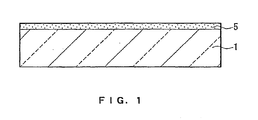
- Fig. 1 is a sectional view showing an example of a glass sheet with glassy film according to the present invention.
- What contributes to the high transparency of the substrate with film according to the present invention is at least that, when the R 2 O/SiO 2 ratio is in the above-noted range, the dispersibility of the functional particles in the matrix increases, or in other words, the functional particles tend not to coagulate.
- the R 2 O/SiO 2 ratio is outside the above-noted range, then the functional particles are difficult to disperse, resulting in the following problems.
- the present invention it becomes possible to obtain a substrate with film whose transparency is not compromised when kept at room temperature to 300°C, as commonly applied in the drying step, and even when heated to more than 400°C, or to 550°C to 700°C in order to bend and/or temper the glass sheet.
- Transparency can be evaluated from the haze ratio.
- a substrate with film can be obtained whose haze ratio is less than 1%, preferably less than 0.6%, even after heating to the above-mentioned temperatures.
- the film has a certain thickness.
- the R 2 O/SiO 2 ratio of the above-noted range is also suitable in view of making the film thicker.
- a glassy film with high transparency can be formed, even when the thickness of the film exceeds 300 nm, or even if it is greater than 500 nm.
- a thick film is disadvantageous with regard to maintaining transparency, but by applying the present invention, it is possible to attain a substrate with glassy film, in which the haze ratio is less than 1%, even when the thickness of the glassy film becomes as thick as noted above.
- the alkali metal oxide includes sodium and at least one of lithium and potassium. This improves the moisture resistance and the chemical durability (acid resistance and alkali resistance) of the film.
- the film preferably includes silicon oxide particles as a part of the silicon oxide.
- the ratio (P/M) of the mass of the functional particles (P) to the mass of the matrix (M) should be selected as appropriate with regard to the type of the functional particles and the thickness of the film, but preferably it is 1/99 to 50/50, and even more preferably it is 20/80 to 50/50. If this ratio is too low, then the functionality of the functional particles cannot be attained sufficiently, and if it is too high, then sufficient dispersion of the functional particles becomes difficult, and the strength of the film is lowered.
- the average particle diameter of the functional particles is not greater than 100 nm, and for example in the range of 10 to 70 nm.
- the primary particle diameter is employed. If the particle diameter is too large, light scattering centers will be formed, and the transparency may be decreased. If, on the other hand, the particle diameter is too low, then it is difficult to maintain the stability of the liquid in which the particles are dispersed. To maintain its stability, it is advantageous to add a dispersing agent, but if too much dispersing agent is used, then the solidity of the film is compromised.
- suitable particles should be chosen that display the desired functionality, such as heat-shielding (shielding of infrared light), UV light shielding, coloring, and so on.
- the functional particles include compound tin oxides such as ITO (tin-doped indium oxide), ATO (antimony-doped tin oxide), and transition metal oxides such as ZnO and Fe 2 O 3 . More specifically, it is preferable that the functional particles include at least one selected from ITO, ATO, ZnO and Fe 2 O 3 .
- ITO and ATO have heat-shielding property. It is further possibility to attain heat-shielding capability with ZnO that has been doped with Ga or the like. ZnO further has UV light absorbing property.
- Fe 2 O 3 has the ability to absorb certain visible wavelength regions, and may serve as a coloring agent.
- a liquid composition including a silicate containing an alkali metal more specifically any alkali metal silicate, for example water glass
- water glass is a dense aqueous solution of alkali silicate, and generally contains sodium as the alkali metal.
- Typical water glass can be expressed as Na 2 O ⁇ nSiO 2 , (wherein n is a positive number, for example in the range of 2 to 4).
- at least one selected from potassium silicate and lithium silicate should be added to the liquid composition together with water glass.
- the alkali metal silicate of water glass or the like is a source for both an alkali metal oxide and silicon oxide, but a silicon source, such as colloidal silica or aerosil, preferably colloidal silica may be added to the liquid composition, in order to lower the R 2 O/SiO 2 ratio in the glassy film to the above-noted range.
- a silicon source such as colloidal silica or aerosil, preferably colloidal silica may be added to the liquid composition, in order to lower the R 2 O/SiO 2 ratio in the glassy film to the above-noted range.
- a liquid composition that includes an alkali metal silicate and functional particles, and in which, for solid components and liquid components, the R 2 O/SiO 2 mole ratio is within a range of 17/100 to 22/100, when silicon is taken in terms of SiO 2 and alkali metal elements are taken in terms of R 2 O.
- the alkali metal silicate includes Na and at least selected from K and Li.
- the liquid composition includes colloidal silica.
- the silicon oxide particles supplied from the colloidal silica are dissolved gradually from the surface by the alkali components in the liquid composition, but not all should be dissolved and they may remain in form of particles.
- the liquid composition further may include a dispersing agent.
- a dispersing agent included in the liquid composition in which a dispersing agent is included and the R 2 O/SiO 2 ratio is in the above-noted range, the dispersibility of the functional particles is more favorable.
- a surface active agent may cause coloring of the film. It is preferable that the organic components included in the liquid composition account for less than 1 mass%.
- a method for manufacturing a substrate with glass film includes a step of preparing the liquid composition, and a step of applying this liquid composition onto a substrate.
- the applied liquid composition is turned into a glassy film by going through a drying step at which it is heated to the above-noted temperature, and if necessary may be heated to the above-noted temperature at which shaping of the glass sheet becomes possible.
- the substrate is a glass sheet, and the glass sheet has been subjected to at least one type of processing selected from the group consisting of bending and tempering.
- a glass sheet is provided with the functionality stemming from the functional particles, a special resin film in which functional particles are dispersed was added.
- a glass sheet with excellent transparency and provided with the functionality due to functional particles can be obtained without adding a resin film.
- Fig. 1 is a sectional view showing an example of a substrate with glassy film according to the present invention.
- a glassy film 5 in which functional particles are dispersed is formed on a substrate 1.
- aqueous dispersion of ITO particles that provide a heat-shielding property (with 50 nm average particle diameter, by Sumitomo Metal Mining Co., Ltd.) were weighed, and mixed with the total amount of the liquid composition A, thus obtaining a liquid composition B.
- this dispersion of ITO particles included 20 mass% ITO particles and a nonionic-based dispersing agent that was suitable for uniform dispersion of the ITO particles.
- the film thickness of the resulting film was 500 nm.
- Example 1 12.0 g of the aqueous dispersion of ITO particles used for Example 1 were weighed and mixed with the total amount of the liquid composition A, thus obtaining a liquid composition C. Using this liquid composition C, a glass sheet with glassy film was obtained in the same manner as in Example 1. The thickness of the resulting film was 500 nm.
- the ratio of the zinc oxide to the total solid portion was 29 mass%.
- this glass sheet with glassy film was heated in a baking furnace until the surface temperature of the glass sheet reached 650°C.
- the resulting film thickness was 700 nm.
- this glass sheet with glassy film Measuring the acid resistance and the alkali (base) resistance of this glass sheet with glassy film, it was found that changes in brightness could be measured neither on the side of the film nor on the side without the film (glass side). Thus, this glass sheet with glassy film had a high chemical durability. Upon subjecting the glass sheet with glassy film to a taber abrasion test, no change in the optical transmissivity before and after the test could be observed. This glassy film thus had high hardness and excellent abrasion resistance.
- red iron oxide Fe 2 O 3
- the dispersion of red ocher particles includes 20 mass% red ocher particles and a nonionic-based dispersing agent that was suitable for uniform dispersion of the red ocher particles.
- this glass sheet with glassy film was heated in a baking furnace until the surface temperature of the glass sheet reached 650°C.
- the resulting film thickness was 500 nm.
- liquid composition I 1.5 g of the liquid composition H and 0.5 g of an aqueous dispersion of ITO particles as used in Example 1 were mixed, thus obtaining a liquid composition I.
- the liquid composition I was applied with a spin coater to the surface of a rinsed soda-lime glass sheet serving as a substrate (100 x 100 x 3.4 mm), dried at room temperature, and further dried for 10 min at 250°C, thus forming a glassy film (heat-shielding film).
- the spin-coating conditions were 16.6 revolutions per second for 10 sec.
- this glass sheet with glassy film was heated in a baking furnace until the surface temperature of the glass sheet reached 650°C.
- the resulting film thickness was 500 nm.
- the haze ratio of this glass sheet with glassy film was 10%, and transparency was not attained.
- a sodium silicate solution water glass No. 3
- colloidal silica PC500
- 1.5 g of the liquid composition J and 0.5 g of an aqueous dispersion of ITO particles as used in Example 1 were mixed, thus obtaining a liquid composition K.
- the haze ratio of this glass sheet with glassy film was 15%, and transparency was not attained.
- the resulting film was foamed.
- the haze ratio of this glass sheet with glassy film was 20%.
- the colloidal silica was dissolved in the liquid compositions, and at least a portion was present in the form of particles.
- the silica particles were supplied together with the functional particles from the liquid composition to the glassy film.
- a substrate with a film can be provided, in which functional particles are favorably dispersed, and in which transparency is maintained even when heated.
Landscapes
- Chemical & Material Sciences (AREA)
- Dispersion Chemistry (AREA)
- Composite Materials (AREA)
- Life Sciences & Earth Sciences (AREA)
- Engineering & Computer Science (AREA)
- Chemical Kinetics & Catalysis (AREA)
- General Chemical & Material Sciences (AREA)
- Geochemistry & Mineralogy (AREA)
- Materials Engineering (AREA)
- Organic Chemistry (AREA)
- Surface Treatment Of Glass (AREA)
Abstract
The invention provides a substrate (1) with a film (5), in which
functional particles are dispersed, and whose transparency is maintained
even when heated. The film (5) includes a matrix including an alkali metal
oxide and a silicon oxide, and functional particles dispersed in the matrix is
formed on a substrate. The alkali metal oxide includes at least sodium, and
lithium and/or potassium. A mole ratio R2O/SiO2 of the alkali metal oxide to
the silicon oxide included in the film is in a range of 17/100 to 22/100. The
haze ratio of this substrate with a film stays low even when heated.
Description
The present invention relates to substrates provided with a film to
which functional particles have been added in order to achieve a function
such as heat-shielding.
JP 2002-29782A discloses a transparent coloring agent for glass, in
which sodium silicate, lithium silicate, water, a surface active agent, and an
inorganic pigment (functional particles) have been mixed in order to form a
glassy film to which functional particles have been added. JP 2000-109722A
discloses an aqueous paint composition, to which no functional particles are
added, but that includes colloidal silica and a water-soluble silicate serving as
a binder. According to JP 2000-109722 A, a solid component weight ratio of
the colloidal silica and the water-soluble silicate in the range of 50 : 50 to 99 :
1 is suitable in order to increase the water resistance of the film.
However, according to further investigations by the inventors, when a
conventional substrate with glassy film to which functional particles have
been added is heated, the transparency of the substrate with glassy film is
severely damaged. In particular if a transparent substrate such as a glass
sheet is used as the substrate, then the transparency is an important
characteristic of the product. And heating of the substrate becomes
unavoidable when bending and/or tempering for use as window glass for
vehicles.
It is thus an object of the present invention to provide a substrate
with a film that maintains transparency and a glassy appearance when
heated.
In accordance with the present invention, in a substrate with a film,
the film includes a matrix including an alkali metal oxide and a silicon oxide,
and functional particles dispersed in the matrix. The alkali metal oxide
includes sodium and at least one selected from lithium and potassium. And
a mole ratio R2O/SiO2 of the alkali metal oxide to the silicon oxide included in
the film is in a range of 17/100 to 22/100.
Fig. 1 is a sectional view showing an example of a glass sheet with
glassy film according to the present invention.
The inventors found that when the ratio (mole ratio) R2O/SiO2 in the
matrix is restricted to the limited range of 17/100 to 22/100, then the
transparency of the film is easily maintained, even when functional particles
are dispersed in it. What contributes to the high transparency of the
substrate with film according to the present invention is at least that, when
the R2O/SiO2 ratio is in the above-noted range, the dispersibility of the
functional particles in the matrix increases, or in other words, the functional
particles tend not to coagulate. When the R2O/SiO2 ratio is outside the
above-noted range, then the functional particles are difficult to disperse,
resulting in the following problems.
When the R2O/SiO2 ratio is too high, the film foams and cracks are
formed. As disclosed in JP 2002-29782 A, when the Si component is supplied
only from alkali metal silicate, the R2O/SiO2 ratio will exceed the above-noted
ratio. On the other hand, when the R2O/SiO2 ratio is too low, shrinkage of
the film in the drying process during the formation of the film becomes large,
cracks are formed, and the film tends to become porous. If colloidal silica is
added to the extent disclosed in JP 2000-109722 A, the R2O/SiO2 ratio
becomes lower than the above-noted range. By setting the R2O/SiO2 ratio to
the above-noted range, it becomes possible to increase the dispersibility of the
functional particles while avoiding the effect of foaming and porosity.
According to the present invention, it becomes possible to obtain a
substrate with film whose transparency is not compromised when kept at
room temperature to 300°C, as commonly applied in the drying step, and
even when heated to more than 400°C, or to 550°C to 700°C in order to bend
and/or temper the glass sheet.
Transparency can be evaluated from the haze ratio. According to the
present invention, a substrate with film can be obtained whose haze ratio is
less than 1%, preferably less than 0.6%, even after heating to the
above-mentioned temperatures.
In order to disperse a predetermined amount of functional particles
for attaining a predetermined functionality, it may be required that the film
has a certain thickness. In order to suppress foaming and pores, the
R2O/SiO2 ratio of the above-noted range is also suitable in view of making the
film thicker. According to the present invention, a glassy film with high
transparency can be formed, even when the thickness of the film exceeds 300
nm, or even if it is greater than 500 nm. A thick film is disadvantageous
with regard to maintaining transparency, but by applying the present
invention, it is possible to attain a substrate with glassy film, in which the
haze ratio is less than 1%, even when the thickness of the glassy film becomes
as thick as noted above.
In the film of the present invention, the alkali metal oxide includes
sodium and at least one of lithium and potassium. This improves the
moisture resistance and the chemical durability (acid resistance and alkali
resistance) of the film. Furthermore, the film preferably includes silicon
oxide particles as a part of the silicon oxide.
The ratio (P/M) of the mass of the functional particles (P) to the mass
of the matrix (M) should be selected as appropriate with regard to the type of
the functional particles and the thickness of the film, but preferably it is 1/99
to 50/50, and even more preferably it is 20/80 to 50/50. If this ratio is too low,
then the functionality of the functional particles cannot be attained
sufficiently, and if it is too high, then sufficient dispersion of the functional
particles becomes difficult, and the strength of the film is lowered.
There is no particular restriction regarding the average particle
diameter of the functional particles, but it is preferable that it is not greater
than 100 nm, and for example in the range of 10 to 70 nm. For the particle
diameter, the primary particle diameter is employed. If the particle
diameter is too large, light scattering centers will be formed, and the
transparency may be decreased. If, on the other hand, the particle diameter
is too low, then it is difficult to maintain the stability of the liquid in which
the particles are dispersed. To maintain its stability, it is advantageous to
add a dispersing agent, but if too much dispersing agent is used, then the
solidity of the film is compromised.
There is no limit to the type of functional particles. As functional
particles, suitable particles should be chosen that display the desired
functionality, such as heat-shielding (shielding of infrared light), UV light
shielding, coloring, and so on. Preferable examples of the functional
particles include compound tin oxides such as ITO (tin-doped indium oxide),
ATO (antimony-doped tin oxide), and transition metal oxides such as ZnO
and Fe2O3. More specifically, it is preferable that the functional particles
include at least one selected from ITO, ATO, ZnO and Fe2O3. ITO and ATO
have heat-shielding property. It is further possibility to attain
heat-shielding capability with ZnO that has been doped with Ga or the like.
ZnO further has UV light absorbing property. Fe2O3 has the ability to
absorb certain visible wavelength regions, and may serve as a coloring agent.
There is no restriction to the method for forming the film of the
present invention, but it is preferable that a liquid composition including a
silicate containing an alkali metal, more specifically any alkali metal silicate,
for example water glass, is used to form the glassy film. Water glass is a
dense aqueous solution of alkali silicate, and generally contains sodium as
the alkali metal. Typical water glass can be expressed as Na2O·nSiO2,
(wherein n is a positive number, for example in the range of 2 to 4). In order
to let the film contain two or more kinds of alkali metal, at least one selected
from potassium silicate and lithium silicate should be added to the liquid
composition together with water glass.
The alkali metal silicate of water glass or the like is a source for both
an alkali metal oxide and silicon oxide, but a silicon source, such as colloidal
silica or aerosil, preferably colloidal silica may be added to the liquid
composition, in order to lower the R2O/SiO2 ratio in the glassy film to the
above-noted range.
According to another aspect of the present invention, a liquid
composition is provided that includes an alkali metal silicate and functional
particles, and in which, for solid components and liquid components, the
R2O/SiO2 mole ratio is within a range of 17/100 to 22/100, when silicon is
taken in terms of SiO2 and alkali metal elements are taken in terms of R2O.
The alkali metal silicate includes Na and at least selected from K and Li.
It is preferable that the liquid composition includes colloidal silica.
The silicon oxide particles supplied from the colloidal silica are dissolved
gradually from the surface by the alkali components in the liquid composition,
but not all should be dissolved and they may remain in form of particles.
The liquid composition further may include a dispersing agent. With
a liquid composition in which a dispersing agent is included and the R2O/SiO2
ratio is in the above-noted range, the dispersibility of the functional particles
is more favorable. In a liquid composition in which the functional particles
are dispersed uniformly, it is not necessary to add a surface active agent.
Surface active agents may cause coloring of the film. It is preferable that
the organic components included in the liquid composition account for less
than 1 mass%.
According to yet another aspect of the present invention, a method for
manufacturing a substrate with glass film is provided. This method
includes a step of preparing the liquid composition, and a step of applying
this liquid composition onto a substrate. The applied liquid composition is
turned into a glassy film by going through a drying step at which it is heated
to the above-noted temperature, and if necessary may be heated to the
above-noted temperature at which shaping of the glass sheet becomes
possible.
In a preferable embodiment of the substrate with film, the substrate
is a glass sheet, and the glass sheet has been subjected to at least one type of
processing selected from the group consisting of bending and tempering.
Conventionally, if a glass sheet is provided with the functionality stemming
from the functional particles, a special resin film in which functional particles
are dispersed was added. However, by applying the present invention, a
glass sheet with excellent transparency and provided with the functionality
due to functional particles can be obtained without adding a resin film.
Fig. 1 is a sectional view showing an example of a substrate with
glassy film according to the present invention. A glassy film 5 in which
functional particles are dispersed is formed on a substrate 1.
The following is an explanation of methods for evaluating the
characteristics of a glass sheet with glassy film fabricated in accordance with
the following working examples and comparative examples.
- Transparency: The transparency was determined by measuring the haze ratio using a hazemeter (turbidity meter, HGM-2DP by Suga Test Instruments Co., Ltd.).
- Optical Characteristics: The optical characteristics were measured with a spectrophotometer (UV-3000PC by Shimadzu Corp.) and were determined by the transmissivity at a wavelength of 1500 nm (T1500), the transmissivity at a wavelength of 850 nm (T850), as well as a visible light transmittance (Ya) and a solar energy transmittance (Tg) calculated according to Japanese Industrial Standard R3106. The transmitted color tone was expressed by the color difference formula according to Lab color space (Hunter's color difference formula).
- Film Thickness: The film thickness of the glassy film was measured using a surface profiler (Alpha-Step 200 by Tencor Instruments).
- Acid Resistance and Alkali Resistance: The glass sheet with glassy film was immersed for 24 hours in a 0.1 N sulfuric acid and 0.1 N sodium hydroxide, and changes in the brightness of the glass surface and the film surface were measured before and after the immersion with a spectroscopic colorimeter (SE-2000 by Nippon Denshoku Industries Co., Ltd.).
- Film Hardness: Using a taber abrasion tester (Taber Industries 5150 Abraser), the glass sheet with glassy film was rotated for 1000 abrasion cycles under a load of 500 g, and changes in the optical transmissivity were measured before and after the testing.
4.5 g of a sodium silicate solution (water glass No. 3 by Kishida
Chemical Co., Ltd.), 2.5 g of a lithium silicate solution (LSS35 by Nissan
Chemical Industries, Ltd.), and 5.0 g of colloidal silica (KE-W10, with 110 nm
particle diameter, by Nippon Shokubai Co., Ltd.), were weighed and stirred
for 24 hours at 30°C, thus obtaining a liquid composition A. The mole ratio
of the solid components and the dissolved components of the liquid
composition A in terms of oxide was R2O/SiO2 = 22/100, with R2O = Na2O +
Li2O = 16+6. It should be noted that the colloidal silica includes 15 mass%
silica.
Next, 4.0 g of an aqueous dispersion of ITO particles that provide a
heat-shielding property (with 50 nm average particle diameter, by Sumitomo
Metal Mining Co., Ltd.) were weighed, and mixed with the total amount of
the liquid composition A, thus obtaining a liquid composition B. It should be
noted that this dispersion of ITO particles included 20 mass% ITO particles
and a nonionic-based dispersing agent that was suitable for uniform
dispersion of the ITO particles.
About 0.2 mL of the liquid composition B were dripped onto a rinsed
soda-lime glass sheet serving as a substrate (100 × 100 × 3.4 mm, Ya = 83%,
Tg = 63%, T1500 = 59%, T850 = 47%, and haze ratio = 0%), spread with a bar
coater, dried at room temperature, and dried by heating for 10 min in a
drying furnace at 250°C, thus forming the glassy film (heat-shielding film).
The film thickness of the resulting film was 500 nm.
As the result of evaluating the optical characteristics of the resulting
glass sheet with glassy film, it was found that Ya = 72%, Tg = 55%, T1500 =
25%, T850 = 46%, and haze ratio = 0.7%. This glass sheet with glassy film
had a haze ratio of less than 1%, and satisfied Ya ≥ 70%, and thus maintained
a high transparency and a high transmissivity of visible light. On the other
hand, it fulfilled Tg ≤ 60% and T1500 ≤ 25%, and thus displayed a high
heat-shielding property. Moreover, for light with a wavelength of 850 nm,
which is used for automobile billing systems, T850 ≥ 30% was maintained.
12.0 g of the aqueous dispersion of ITO particles used for Example 1
were weighed and mixed with the total amount of the liquid composition A,
thus obtaining a liquid composition C. Using this liquid composition C, a
glass sheet with glassy film was obtained in the same manner as in Example
1. The thickness of the resulting film was 500 nm.
After evaluating the optical characteristics of the resulting glass
sheet with glassy film, it was found that Ya = 72%, Tg = 45%, T1500 = 23%, T850
= 46%, and haze ratio = 1.1%. This glass sheet with glassy film had a haze
ratio that is slightly higher than in Example 1, but Tg≤ 50%, so that it had a
higher heat-shielding capability.
9.0 g of a sodium silicate solution (water glass No. 3), 8 g of a
potassium silicate solution (Snowtex K by Nissan Chemical Industries, Ltd.),
and 9 g of colloidal silica (KE-W10), were weighed and stirred for 24 hours at
30°C, thus obtaining a liquid composition D. The mole ratio of the solid
components and the dissolved components of the liquid composition D in
terms of oxide was R2O/SiO2 = 21/100, with R2O = Na2O + Li2O = 14+7.
3 g of the liquid composition D were mixed with 6g of pure water and
2.5 g of an aqueous dispersion of zinc oxide particles (content ofZnO = 15
mass%, with a ZnO average particle diameter of 30 nm, including a
dispersing agent, by C.I. Kasei Co., Ltd.) displaying UV light absorption
capability, thus obtaining a liquid composition E. The ratio of the zinc oxide
to the total solid portion was 29 mass%.
The liquid composition E was applied by flow coating to the surface of
a rinsed UV-absorbing green glass sheet serving as a substrate (100 x 100 × 4
mm, Ya = 75%, Tuv (ISO) = 9.8%, and Hunter's color values: a=-6.9 and b=3.3),
and dried 10 min at 250°C, thus forming a glassy film (UV light absorbing
film).
Moreover, this glass sheet with glassy film was heated in a baking
furnace until the surface temperature of the glass sheet reached 650°C. The
resulting film thickness was 700 nm.
As the result of evaluating the optical characteristics of the resulting
glass sheet with glassy film, it was found that Ya = 73%, Tuv (ISO) = 4.8%, a =
- 7.5 and b = 3.7). The resulting glass sheet with glassy film was not warped
and had a favorable appearance.
Measuring the acid resistance and the alkali (base) resistance of this
glass sheet with glassy film, it was found that changes in brightness could be
measured neither on the side of the film nor on the side without the film
(glass side). Thus, this glass sheet with glassy film had a high chemical
durability. Upon subjecting the glass sheet with glassy film to a taber
abrasion test, no change in the optical transmissivity before and after the test
could be observed. This glassy film thus had high hardness and excellent
abrasion resistance.
2.7 g of a sodium silicate solution (water glass No. 3), 0.7 g of a
potassium silicate solution, and 3.9 g of colloidal silica (KE-W10) were
weighed and stirred for 24 hours at 30°C, thus obtaining a liquid composition
F. The mole ratio of the solid components and the dissolved components of
the liquid composition F in terms of oxide was R2O/SiO2 = 19/100, with R2O =
Na2O + Li2O = 17+2.
7.2 g of an aqueous dispersion of red ocher (red iron oxide; Fe2O3)
particles serving as a pigment material were weighed, and mixed with the
total amount of the liquid composition F, thus obtaining a liquid composition
G. It should be noted that the dispersion of red ocher particles (with 60 nm
average particle diameter) includes 20 mass% red ocher particles and a
nonionic-based dispersing agent that was suitable for uniform dispersion of
the red ocher particles.
The liquid composition G was applied with a spin coater to the
surface of a rinsed soda-lime glass sheet serving as a substrate (100 × 100 ×
3.4 mm), dried at room temperature, and further dried for 10 min at 250°C,
thus forming a glassy film (colored film). It should be noted that the
spin-coating conditions were 16.6 revolutions per second (=10,000 rpm) for 10
sec.
Moreover, this glass sheet with glassy film was heated in a baking
furnace until the surface temperature of the glass sheet reached 650°C. The
resulting film thickness was 500 nm.
After evaluating the optical characteristics of the obtained glass sheet
with glassy film, it was found that Ya = 70%, Tuv (ISO) = 7%, a = -2.1 and b =
21.9, and haze ratio = 1.3. The resulting glass sheet with glassy film was
not warped and had a favorable appearance.
0.5 g of a sodium silicate solution (water glass No. 3), and 1.0 g of
colloidal silica (PC500 by Nissan Chemical Industries, Ltd., with 20 mass%
silica) were weighed and stirred for 24 hours at 30°C, thus obtaining a liquid
composition H. The mole ratio of the solid components and the dissolved
components of the liquid composition H in terms of oxide was Na2O/SiO2 =
15/100.
1.5 g of the liquid composition H and 0.5 g of an aqueous dispersion of
ITO particles as used in Example 1 were mixed, thus obtaining a liquid
composition I.
The liquid composition I was applied with a spin coater to the surface
of a rinsed soda-lime glass sheet serving as a substrate (100 x 100 x 3.4 mm),
dried at room temperature, and further dried for 10 min at 250°C, thus
forming a glassy film (heat-shielding film). The spin-coating conditions were
16.6 revolutions per second for 10 sec.
Moreover, this glass sheet with glassy film was heated in a baking
furnace until the surface temperature of the glass sheet reached 650°C. The
resulting film thickness was 500 nm.
The haze ratio of this glass sheet with glassy film was 10%, and
transparency was not attained.
0.6 g of a sodium silicate solution (water glass No. 3), and 2.0 g of
colloidal silica (PC500) were weighed and stirred for 24 hours at 30°C, thus
obtaining a liquid composition J. The mole ratio of the solid components and
the dissolved components of the liquid composition J in terms of oxide was
Na2O/SiO2 = 10/100. 1.5 g of the liquid composition J and 0.5 g of an
aqueous dispersion of ITO particles as used in Example 1 were mixed, thus
obtaining a liquid composition K.
Using this liquid composition K, a glassy film was formed on a
soda-lime glass sheet (100 × 100 × 3.4 mm) in the same manner as in
Comparative Example 1. The thickness of the resulting film was 600 nm.
The haze ratio of this glass sheet with glassy film was 15%, and
transparency was not attained.
3.1 g of a sodium silicate solution (water glass No. 3), 1.0 g sodium
silicate powder (by Katayama Chemical Industries Co., Ltd.), 0.7 g of a
potassium silicate solution, 3.3 g of colloidal silica (KE-W10) and 1 g of water
were weighed and stirred for 24 hours at 30°C, thus obtaining a liquid
composition L. Expressed as the mole ratio of the solid components and the
dissolved components of the liquid composition L, the solid component (mole
ratio) in the matrix liquid composition was R2O/SiO2 = 32/100, with R2O =
Na2O + K2O = 29+3.
Mixing 1 g of the liquid composition L and 0.5 of an aqueous
dispersion of red ocher oxide (Fe2O3) as used in Example 4, a liquid
composition M was obtained.
Using this liquid composition M, a glassy film was formed on a
soda-lime glass sheet (100 × 100 × 3.4 mm) in the same manner as in
Comparative Example 1. The thickness of the resulting film was 600 nm.
The resulting film was foamed. The haze ratio of this glass sheet
with glassy film was 20%.
In the foregoing examples and comparative examples, not all of the
colloidal silica was dissolved in the liquid compositions, and at least a portion
was present in the form of particles. Thus, the silica particles were supplied
together with the functional particles from the liquid composition to the
glassy film.
Moreover, upon subjecting the glassy films to an ultimate analysis
with an energy dispersive X-ray detector, it was found that the R2O/SiO2 ratio
in the glassy films matched the R2O/SiO2 ratio in the liquid compositions.
With the present invention, a substrate with a film can be provided,
in which functional particles are favorably dispersed, and in which
transparency is maintained even when heated.
Claims (9)
- A substrate (1) provided with a film (5),
wherein the film (5) comprises a matrix including an alkali metal oxide and a silicon oxide, and functional particles dispersed in the matrix;
wherein the alkali metal oxide comprises sodium and at least one selected from the group consisting of lithium and potassium; and
wherein a mole ratio R2O/SiO2 of the alkali metal oxide to the silicon oxide included in the film is in a range of 17/100 to 22/100. - The substrate (1) provided with a film (5) as claimed in claim 1,
wherein a ratio of the mass of the functional particles to the mass of the matrix is 1/99 to 50/50. - The substrate (1) provided with a film (5) as claimed in claim 1 or claim 2, wherein an average particle diameter of the functional particles is 100 nm or less.
- The substrate (1) provided with a film (5) as claimed in any one of claims 1 to 3, wherein the functional particles include at least one selected from the group consisting of ITO, ATO, ZnO and Fe2O3.
- The substrate (1) provided with a film (5) as claimed in any one of claims 1 to 4, wherein the substrate is a glass sheet, and the glass sheet has been subjected to at least one type of processing selected from the group consisting of bending and tempering.
- The substrate (1) provided with a film (5) as claimed in any one of claims 1 to 7, wherein the haze ratio is 1% or less.
- The substrate (1) provided with a film (5) as claimed in any one of claims 1 to 6, wherein a thickness of the film is greater than 300 nm.
- A liquid composition comprising an alkali metal silicate and functional particles, wherein the alkali metal silicate comprises sodium and at least one selected from the group consisting of lithium and potassium, and
wherein, when silicon is taken in terms of SiO2 and alkali metal elements are taken in terms of R2O, a mole ratio R2O/SiO2 in the liquid composition is in a range of 17/100 to 22/100. - The liquid composition as claimed in claim 8, wherein the organic components in the liquid composition account for less than 1 mass%.
Applications Claiming Priority (2)
| Application Number | Priority Date | Filing Date | Title |
|---|---|---|---|
| JP2003136059 | 2003-05-14 | ||
| JP2003136059A JP2004338987A (en) | 2003-05-14 | 2003-05-14 | Base body with vitreous film |
Publications (1)
| Publication Number | Publication Date |
|---|---|
| EP1477465A1 true EP1477465A1 (en) | 2004-11-17 |
Family
ID=33028368
Family Applications (1)
| Application Number | Title | Priority Date | Filing Date |
|---|---|---|---|
| EP04291168A Withdrawn EP1477465A1 (en) | 2003-05-14 | 2004-05-06 | Substrate with film containing functional particles |
Country Status (3)
| Country | Link |
|---|---|
| US (1) | US20050003210A1 (en) |
| EP (1) | EP1477465A1 (en) |
| JP (1) | JP2004338987A (en) |
Cited By (3)
| Publication number | Priority date | Publication date | Assignee | Title |
|---|---|---|---|---|
| EP1975133A4 (en) * | 2006-01-17 | 2009-12-30 | Nippon Sheet Glass Co Ltd | Window glass for vehicle and process for producing the same |
| US7704604B2 (en) | 2004-09-15 | 2010-04-27 | Air Products And Chemicals, Inc. | Silicate coating and method of coating by acoustic excitation |
| US8367187B2 (en) | 2005-12-28 | 2013-02-05 | Nippon Sheet Glass Company, Limited | Vehicle window pane and manufacturing method therefor |
Families Citing this family (6)
| Publication number | Priority date | Publication date | Assignee | Title |
|---|---|---|---|---|
| EP1870386A4 (en) * | 2005-04-15 | 2009-01-28 | Asahi Glass Co Ltd | GLASS PLATE WITH INFRARED SHIELD LAYER AND METHOD FOR MANUFACTURING THE SAME |
| KR101470293B1 (en) * | 2013-07-17 | 2014-12-08 | 코닝정밀소재 주식회사 | Method of fabricating light extraction substrate for oled |
| JP6584959B2 (en) * | 2014-01-17 | 2019-10-02 | 日本板硝子株式会社 | WINDOW GLASS AND MANUFACTURING METHOD THEREOF |
| CN104310789A (en) * | 2014-09-28 | 2015-01-28 | 中国建材国际工程集团有限公司 | Preparation method of zinc oxide-based transparent conducting film glass |
| FR3083226B1 (en) * | 2018-06-29 | 2020-06-26 | Saint-Gobain Glass France | PROCESS FOR THE MANUFACTURE OF A LAMINATED GLAZING AVOIDING THE STICKING OF THE ENAMEL ON THE GLASS |
| CN116444173A (en) * | 2022-06-28 | 2023-07-18 | 法国圣戈班玻璃公司 | Glass stack, method for its manufacture and window assembly comprising said glass stack |
Citations (6)
| Publication number | Priority date | Publication date | Assignee | Title |
|---|---|---|---|---|
| JPH0570178A (en) * | 1991-09-11 | 1993-03-23 | Asahi Glass Co Ltd | Heat ray reflective film and manufacturing method thereof |
| JP2000109722A (en) * | 1998-10-05 | 2000-04-18 | Nippon Paint Co Ltd | Inorganic aqueous coating composition and method for forming inorganic coating film using the same |
| JP2002146228A (en) * | 2000-11-10 | 2002-05-22 | Sumitomo Metal Mining Co Ltd | Method for treating indium tin oxide fine particles for forming solar shading film and solar shading film |
| WO2003045866A1 (en) * | 2001-11-30 | 2003-06-05 | Nippon Sheet Glass Company, Limited | Glass substrate with colored film, particle-containing solution for forming colored film and method for producing glass substrate with colored film |
| US20030157317A1 (en) * | 2000-06-20 | 2003-08-21 | Takeo Ito | Transparent film-coated substrate, coating liquid for transparent film formation, and display device |
| WO2004046057A1 (en) * | 2002-11-21 | 2004-06-03 | Nippon Sheet Glass Company, Limited | Thermal shielding plate and method for manufacture thereof, and fluid composition for use therein |
Family Cites Families (4)
| Publication number | Priority date | Publication date | Assignee | Title |
|---|---|---|---|---|
| US3808077A (en) * | 1971-09-16 | 1974-04-30 | Ppg Industries Inc | Method for laminating plastic to glass employing glass mold |
| US3869271A (en) * | 1973-07-26 | 1975-03-04 | Ppg Industries Inc | Shaping glass sheets |
| JP3154645B2 (en) * | 1995-01-23 | 2001-04-09 | セントラル硝子株式会社 | Automotive laminated glass |
| DE10063739B4 (en) * | 2000-12-21 | 2009-04-02 | Ferro Gmbh | Substrates with self-cleaning surface, process for their preparation and their use |
-
2003
- 2003-05-14 JP JP2003136059A patent/JP2004338987A/en not_active Withdrawn
-
2004
- 2004-05-06 US US10/841,680 patent/US20050003210A1/en not_active Abandoned
- 2004-05-06 EP EP04291168A patent/EP1477465A1/en not_active Withdrawn
Patent Citations (6)
| Publication number | Priority date | Publication date | Assignee | Title |
|---|---|---|---|---|
| JPH0570178A (en) * | 1991-09-11 | 1993-03-23 | Asahi Glass Co Ltd | Heat ray reflective film and manufacturing method thereof |
| JP2000109722A (en) * | 1998-10-05 | 2000-04-18 | Nippon Paint Co Ltd | Inorganic aqueous coating composition and method for forming inorganic coating film using the same |
| US20030157317A1 (en) * | 2000-06-20 | 2003-08-21 | Takeo Ito | Transparent film-coated substrate, coating liquid for transparent film formation, and display device |
| JP2002146228A (en) * | 2000-11-10 | 2002-05-22 | Sumitomo Metal Mining Co Ltd | Method for treating indium tin oxide fine particles for forming solar shading film and solar shading film |
| WO2003045866A1 (en) * | 2001-11-30 | 2003-06-05 | Nippon Sheet Glass Company, Limited | Glass substrate with colored film, particle-containing solution for forming colored film and method for producing glass substrate with colored film |
| WO2004046057A1 (en) * | 2002-11-21 | 2004-06-03 | Nippon Sheet Glass Company, Limited | Thermal shielding plate and method for manufacture thereof, and fluid composition for use therein |
Non-Patent Citations (6)
| Title |
|---|
| DATABASE WPI Section Ch Week 200262, Derwent World Patents Index; Class E32, AN 2002-579283, XP002295816 * |
| DATABASE WPI Section Ch Week 200341, Derwent World Patents Index; Class L01, AN 2003-442069, XP002295817 * |
| DATABASE WPI Section Ch Week 200442, Derwent World Patents Index; Class G02, AN 2004-449724, XP002295818 * |
| PATENT ABSTRACTS OF JAPAN vol. 0173, no. 88 (C - 1086) 21 July 1993 (1993-07-21) * |
| PATENT ABSTRACTS OF JAPAN vol. 1996, no. 06 28 June 1996 (1996-06-28) * |
| PATENT ABSTRACTS OF JAPAN vol. 2000, no. 07 29 September 2000 (2000-09-29) * |
Cited By (4)
| Publication number | Priority date | Publication date | Assignee | Title |
|---|---|---|---|---|
| US7704604B2 (en) | 2004-09-15 | 2010-04-27 | Air Products And Chemicals, Inc. | Silicate coating and method of coating by acoustic excitation |
| US8367187B2 (en) | 2005-12-28 | 2013-02-05 | Nippon Sheet Glass Company, Limited | Vehicle window pane and manufacturing method therefor |
| EP1975133A4 (en) * | 2006-01-17 | 2009-12-30 | Nippon Sheet Glass Co Ltd | Window glass for vehicle and process for producing the same |
| US8445096B2 (en) | 2006-01-17 | 2013-05-21 | Nippon Sheet Glass Company, Limited | Vehicle window glass and manufacturing method therefor |
Also Published As
| Publication number | Publication date |
|---|---|
| JP2004338987A (en) | 2004-12-02 |
| US20050003210A1 (en) | 2005-01-06 |
Similar Documents
| Publication | Publication Date | Title |
|---|---|---|
| KR101698230B1 (en) | Method of producing reinforced antireflection glass | |
| JP2001254072A (en) | Preparation process of anti-fogging composition, anti- fogging coating agent and anti-fogging coated film- forming base material | |
| JPH05339033A (en) | Manufacture of uv shielding glass and window glass for automobile and window glass for building | |
| US20050003210A1 (en) | Substrate with film | |
| JP2001523748A (en) | Water-based paint containing glass particles | |
| Morimoto et al. | Wet chemical functional coatings for automotive glasses and cathode ray tubes | |
| EP3782963A1 (en) | Glass material for enamel, enamel product, and method for producing enamel product | |
| JP2002519300A (en) | Supply of organic paint on glass | |
| WO2003045866A1 (en) | Glass substrate with colored film, particle-containing solution for forming colored film and method for producing glass substrate with colored film | |
| EP4183754A1 (en) | Glass substrate with silica film | |
| CZ40497A3 (en) | Printing firing paste for printing on glass surfaces and process for producing thereof | |
| JPH0930836A (en) | Glass with light-shielding film and manufacturing method thereof | |
| KR102281843B1 (en) | Nano-inorganic compositions and methods for Manufacturing the same | |
| JP2004338985A (en) | Substrate with heat ray shielding film, and its production method | |
| JP3912938B2 (en) | Colored film formation method | |
| EP0967182B1 (en) | Light-transmitting color film, method for producing the same, and coating solution for forming the color film | |
| EP3002263B1 (en) | Scratch and abrasion resistant uv blocking glass coating | |
| JPWO2004046057A1 (en) | Thermal shielding plate, method for producing the same, and liquid composition used therefor | |
| JP2000109742A (en) | Inorganic colorant composition and method for coloring inorganic substrate | |
| JP2001294446A (en) | Surface coating agent and method for producing surface-coated colored glass | |
| US6399229B1 (en) | Light-transmitting color film, method for producing the same, and coating solution for forming the color film | |
| EP1125902A1 (en) | Coating solution for forming colored film on glass substrate, glass plate with such colored film, and process for producing such glass plate | |
| WO2019039495A1 (en) | Composite coating material and glass | |
| JP2003026999A (en) | Colored film-forming coating fluid | |
| JP2001507057A (en) | Water-based paint containing glass particles |
Legal Events
| Date | Code | Title | Description |
|---|---|---|---|
| PUAI | Public reference made under article 153(3) epc to a published international application that has entered the european phase |
Free format text: ORIGINAL CODE: 0009012 |
|
| AK | Designated contracting states |
Kind code of ref document: A1 Designated state(s): AT BE BG CH CY CZ DE DK EE ES FI FR GB GR HU IE IT LI LU MC NL PL PT RO SE SI SK TR |
|
| AX | Request for extension of the european patent |
Extension state: AL HR LT LV MK |
|
| AKX | Designation fees paid | ||
| REG | Reference to a national code |
Ref country code: DE Ref legal event code: 8566 |
|
| STAA | Information on the status of an ep patent application or granted ep patent |
Free format text: STATUS: THE APPLICATION IS DEEMED TO BE WITHDRAWN |
|
| 18D | Application deemed to be withdrawn |
Effective date: 20050518 |