EP1475416A1 - Ink for ink-jet recording and ink-jet recording method - Google Patents
Ink for ink-jet recording and ink-jet recording method Download PDFInfo
- Publication number
- EP1475416A1 EP1475416A1 EP03703313A EP03703313A EP1475416A1 EP 1475416 A1 EP1475416 A1 EP 1475416A1 EP 03703313 A EP03703313 A EP 03703313A EP 03703313 A EP03703313 A EP 03703313A EP 1475416 A1 EP1475416 A1 EP 1475416A1
- Authority
- EP
- European Patent Office
- Prior art keywords
- group
- dye
- ink
- heterocyclic
- substituted
- Prior art date
- Legal status (The legal status is an assumption and is not a legal conclusion. Google has not performed a legal analysis and makes no representation as to the accuracy of the status listed.)
- Withdrawn
Links
Classifications
-
- C—CHEMISTRY; METALLURGY
- C09—DYES; PAINTS; POLISHES; NATURAL RESINS; ADHESIVES; COMPOSITIONS NOT OTHERWISE PROVIDED FOR; APPLICATIONS OF MATERIALS NOT OTHERWISE PROVIDED FOR
- C09D—COATING COMPOSITIONS, e.g. PAINTS, VARNISHES OR LACQUERS; FILLING PASTES; CHEMICAL PAINT OR INK REMOVERS; INKS; CORRECTING FLUIDS; WOODSTAINS; PASTES OR SOLIDS FOR COLOURING OR PRINTING; USE OF MATERIALS THEREFOR
- C09D11/00—Inks
- C09D11/30—Inkjet printing inks
- C09D11/32—Inkjet printing inks characterised by colouring agents
-
- C—CHEMISTRY; METALLURGY
- C09—DYES; PAINTS; POLISHES; NATURAL RESINS; ADHESIVES; COMPOSITIONS NOT OTHERWISE PROVIDED FOR; APPLICATIONS OF MATERIALS NOT OTHERWISE PROVIDED FOR
- C09D—COATING COMPOSITIONS, e.g. PAINTS, VARNISHES OR LACQUERS; FILLING PASTES; CHEMICAL PAINT OR INK REMOVERS; INKS; CORRECTING FLUIDS; WOODSTAINS; PASTES OR SOLIDS FOR COLOURING OR PRINTING; USE OF MATERIALS THEREFOR
- C09D11/00—Inks
- C09D11/30—Inkjet printing inks
- C09D11/32—Inkjet printing inks characterised by colouring agents
- C09D11/328—Inkjet printing inks characterised by colouring agents characterised by dyes
-
- B—PERFORMING OPERATIONS; TRANSPORTING
- B41—PRINTING; LINING MACHINES; TYPEWRITERS; STAMPS
- B41M—PRINTING, DUPLICATING, MARKING, OR COPYING PROCESSES; COLOUR PRINTING
- B41M5/00—Duplicating or marking methods; Sheet materials for use therein
- B41M5/50—Recording sheets characterised by the coating used to improve ink, dye or pigment receptivity, e.g. for ink-jet or thermal dye transfer recording
- B41M5/52—Macromolecular coatings
- B41M5/5218—Macromolecular coatings characterised by inorganic additives, e.g. pigments, clays
-
- B—PERFORMING OPERATIONS; TRANSPORTING
- B41—PRINTING; LINING MACHINES; TYPEWRITERS; STAMPS
- B41M—PRINTING, DUPLICATING, MARKING, OR COPYING PROCESSES; COLOUR PRINTING
- B41M5/00—Duplicating or marking methods; Sheet materials for use therein
- B41M5/50—Recording sheets characterised by the coating used to improve ink, dye or pigment receptivity, e.g. for ink-jet or thermal dye transfer recording
- B41M5/52—Macromolecular coatings
- B41M5/5236—Macromolecular coatings characterised by the use of natural gums, of proteins, e.g. gelatins, or of macromolecular carbohydrates, e.g. cellulose
-
- B—PERFORMING OPERATIONS; TRANSPORTING
- B41—PRINTING; LINING MACHINES; TYPEWRITERS; STAMPS
- B41M—PRINTING, DUPLICATING, MARKING, OR COPYING PROCESSES; COLOUR PRINTING
- B41M5/00—Duplicating or marking methods; Sheet materials for use therein
- B41M5/50—Recording sheets characterised by the coating used to improve ink, dye or pigment receptivity, e.g. for ink-jet or thermal dye transfer recording
- B41M5/52—Macromolecular coatings
- B41M5/5254—Macromolecular coatings characterised by the use of polymers obtained by reactions only involving carbon-to-carbon unsaturated bonds, e.g. vinyl polymers
Definitions
- the present invention relates to an inkjet recording ink and a recording method using the ink, more specifically, the present invention relates to an inkjet recording magenta ink ensuring excellent preservability of recorded image, less color bleeding of drawn image and excellent ink ejection stability.
- an inkjet printer is widely used for printing letters or drawing an image on paper, film, cloth or the like not only at offices but also at homes.
- the inkjet recording method includes a system of jetting out a liquid droplet by applying a pressure from a piezoelectric element, a system of jetting out a liquid droplet by generating a bubble in the ink under heat, a system of using an ultrasonic wave, and a system of jetting out a liquid droplet by suction using an electrostatic force.
- the inkjet recording ink used therefor includes an aqueous ink, an oily ink and a solid (fusion-type) ink.
- an aqueous ink is relatively superior to oily ink or solid (fusion-type) ink in view of possibility of satisfying all of production, handleability, odor, safety and the like and therefore, is predominating as the inkjet recording ink at present.
- the coloring material used in such an inkjet recording ink is required to have high solubility in a solvent (ink medium), enable high-density recording, provide good color hue, exhibit excellent fastness to light, heat, air, water and chemicals, ensure good fixing to an image-receiving material and less bleeding, give an ink having excellent storability, have high purity and no toxicity, and be available at a low cost.
- a coloring material satisfying all of the requirements described above is not yet found out at present.
- Patent Document 1 As for the dye capable of improving the fastness, azo dyes derived from an aromatic amine and a 5-membered heterocyclic amine have been proposed in Patent Document 1. However, these dyes have a problem of bad color reproducibility due to undesirable color hue present in the yellow and cyan regions. Patent Documents 2 and 3 are disclosing an inkjet recording ink with an attempt to enhance the light fastness. However, in use as a water-soluble ink, the coloring materials used in these patent publications are insufficient in the solubility in water. Also, when used as a water-soluble ink for inkjet recording, there arises a problem in the fastness to humidity and heat.
- Patent Document 4 In order to solve these problems, compounds and ink compositions described in Patent Document 4 have been proposed. Furthermore, an inkjet recording ink using a pyrazolylaniline azo dye for improving the color hue and light fastness is described (Patent Document 5). However, these inkjet recording inks are still insufficient in the fastness of image output.
- An object of the present invention is to solve the problems of inkjet recording ink described above in the item of Background Art, more specifically, to provide an inkjet recording ink ensuring 1) excellent weather resistance (image preservability), 2) less blurring of image drawn and 3) high ejection stability.
- the object of the present invention can be attained by the inkjet recording ink or ink set described in the following (1) to (15). These inkjet recording ink and ink set are used for inkjet recording according to the method described in (16) to (20) below. In particular, the effect of the present invention is remarkably brought out when the image recording is performed on the image-receiving layer of the image recording material described in (19) or (20).
- the present invention which is an ink using an aqueous medium, is based on the finding that in an ink having a main absorption region of 500 to 580 nm, namely, an ink generally called a magenta ink, and in an ink having a main absorption region of 580 to 680 nm, namely, an ink generally called a cyan ink, when at least two coloring materials are used in each ink by dissolving or dispersing them, the image preservability, the color bleeding of image drawn and the ejection stability all are improved to a level unachievable by, for example, increasing the amount of only one coloring material and the object of the present invention can be attained.
- Those at least two coloring materials are coloring materials used in an aqueous medium and as long as the coloring materials are sharing the main absorption region of 500 to 580 nm or of 580 to 600 nm in the medium, the effect of the present invention can be brought out.
- the objective effect can be obtained (in the present invention, if arises no misunderstanding, the term "ink” is used including the ink set having such a meaning). That is, the effect of the present invention is considered to come out when the recorded image is constituted by the above-described two or more coloring materials.
- At least one of those two coloring materials preferably has an oxidation potential nobler than 0.7 V (vs SCE).
- vs SCE oxidation potential nobler than 0.7 V
- One of two coloring materials may be a pigment or sparingly soluble dye which is insoluble in an aqueous ink medium and added to the composition by emulsion-dispersion.
- the coloring material having a main absorption region of 500 to 580 nm and the coloring material having a main absorption region of 580 to 680 nm, which are particularly preferred in the present invention, are an azo dye with the nitrogen atom of the azo group being directly bonded by a heterocyclic group having a specific structure, and a phthalocyanine dye having a specific substituent structure, respectively.
- coloring material is used when collectively indicating a dye and a pigment.
- magenta ink In order to satisfy the objective properties required of the inkjet recording ink of the present invention, that is, excellent weather resistance, ensured color hue, high ejection stability and no defect in view of water resistance and image quality, as for the magenta ink, an ink having properties specified in (1) to (9) above is used for the image recording. Accordingly, these properties of the magenta dye are described below.
- magenta ink used for the inkjet recording ink of the present invention a magenta dye selected from azo dyes is dissolved or dispersed in an aqueous medium and the dye is fundamentally characterized in that the absorption maximum in the aqueous medium is present in the spectral region of 500 to 580 nm and the oxidation potential is nobler than 0.7 V (vs SCE).
- the heterocyclic rings A and B may have the same structure.
- the heterocyclic rings A and B each is a 5- or 6-membered heterocyclic ring selected from pyrazole, imidazole, triazole, oxazole, thiazole, selenazole, pyridone, pyrazine, pyrimidine and pyridine. These are specifically described, for example, in Japanese Patent Application Nos. 2000-15853 and 2001-15614, JP-A-2002-309116 and Japanese Patent Application No. 2001-195014.
- the second preferred structural feature of the azo dye is that an aromatic nitrogen-containing 6-membered heterocyclic ring is bonded as a coupling component directly to at least one side of the azo group. Specific examples thereof are described in 2001-110457.
- the third preferred structural feature is that the auxochrome has an aromatic ring amino group or heterocyclic amino group structure, specifically, an anilino group or a heterylamino group.
- the fourth preferred structural feature is that the dye has a steric structure. This is specifically described in Japanese Patent Application No. 2002-12015.
- the dye of formula (1) is described in more detail.
- A represents a 5-membered heterocyclic group.
- the heteroatom of the heterocyclic ring include N, O and S.
- A is preferably a nitrogen-containing 5-membered heterocyclic ring and the heterocyclic ring may be condensed with an aliphatic ring, an aromatic ring or another heterocyclic ring.
- Preferred examples of the heterocyclic ring represented by A include a pyrazole ring, an imidazole ring, a thiazole ring, an isothiazole ring, a thiadiazole ring, a benzothiazole ring, a benzoxazole ring and a benzisothiazole ring.
- Each heterocyclic group may further have a substituent.
- a pyrazole ring an imidazole ring, an isothiazole ring, a thiadiazole ring and a benzothiazole ring represented by the following formulae (a) to (f) : wherein R 7 to R 20 each represents the same substituent as G, R 1 and R 2 in formula (1).
- formulae (a) to (f) preferred are a pyrazole ring and an isothiazole ring represented by formulae (a) and (b), and most preferred is a pyrazole ring represented by formula (a).
- R 5 and R 6 each independently represents a hydrogen atom or a substituent, the substituent is an aliphatic group, an aromatic group, a heterocyclic group, an acyl group, an alkoxycarbonyl group, an aryloxycarbonyl group, a carbamoyl group, an alkylsulfonyl group, an arylsulfonyl group or a sulfamoyl group, and the hydrogen atom of each substituent may be substituted.
- R 5 and R 6 each is preferably a hydrogen atom, an aliphatic group, an aromatic group, a heterocyclic group, an acyl group, an alkylsulfonyl group or an arylsulfonyl group, more preferably a hydrogen atom, an aromatic group, a heterocyclic group, an acyl group, an alkylsulfonyl group or an arylsulfonyl group, and most preferably a hydrogen atom, an aryl group or a heterocyclic group, and the hydrogen atom of each substituent may be substituted, but R 5 and R 6 are not a hydrogen atom at the same time.
- G, R 1 and R 2 each independently represents a hydrogen atom or a substituent, the substituent is a halogen atom, an aliphatic group, an aromatic group, a heterocyclic group, a cyano group, a carboxyl group, a carbamoyl group, an alkoxycarbonyl group, an aryloxycarbonyl group, a heterocyclic oxycarbonyl group, an acyl group, a hydroxy group, an alkoxy group, an aryloxy group, a heterocyclic oxy group, a silyloxy group, an acyloxy group, a carbamoyloxy group, an alkoxycarbonyloxy group, an aryloxycarbonyloxy group, an amino group, an acylamino group, a ureido group, a sulfamoylamino group, an alkoxycarbonylamino group, an aryloxycarbonylamino group, an alkylsulfonylamin
- G is preferably a hydrogen atom, a halogen atom, an aliphatic group, an aromatic group, a hydroxy group, an alkoxy group, an aryloxy group, an acyloxy group, a heterocyclic oxy group, an amino group, an acylamino group, a ureido group, a sulfamoylamino group, an alkoxycarbonylamino group, an aryloxycarbonylamino group, an alkylthio group, an arylthio group or a heterocyclic thio group, more preferably a hydrogen atom, a halogen atom, an alkyl group, a hydroxy group, an alkoxy group, an aryloxy group, an acyloxy group, an amino group or an acylamino group, and most preferably a hydrogen atom, an amino group (preferably an anilino group) or an acylamino group, and the hydrogen atom of each substituent may be substituted.
- R 1 and R 2 each is preferably a hydrogen atom, an alkyl group, a halogen atom, an alkoxycarbonyl group, a carboxyl group, a carbamoyl group, a hydroxy group, an alkoxy group or a cyano group, and the hydrogen atom of each substituent may be substituted.
- R 1 and R 5 , or R 5 and R 6 may combine to form a 5- or 6-membered ring.
- substituent R 1 , R 2 , R 5 , R 6 or G When A has a substituent or when the substituent R 1 , R 2 , R 5 , R 6 or G further has a substituent, examples of the substituent include the substituents described above for G, R 1 and R 2 .
- the dye of the present invention is a water-soluble dye
- the dye preferably further has an ionic hydrophilic group as a substituent on any position of A, R 1 , R 2 , R 5 , R 6 and G.
- the ionic hydrophilic group as a substituent include a sulfo group, a carboxyl group, a phosphono group and a quaternary ammonium group.
- the carboxyl group, the phosphono group and the sulfo group each may be in a salt state and examples of the counter ion for forming the salt include ammonium ion, alkali metal ions (e.g., lithium ion, sodium ion, potassium ion) and organic cations (e.g., tetramethylammonium ion, tetramethylguanidium ion, tetramethylphosphonium).
- alkali metal ions e.g., lithium ion, sodium ion, potassium ion
- organic cations e.g., tetramethylammonium ion, tetramethylguanidium ion, tetramethylphosphonium.
- the halogen atom includes a fluorine atom, a chlorine atom and a bromine atom.
- the aliphatic group means an alkyl group, a substituted alkyl group, an alkenyl group, a substituted alkenyl group, an alkynyl group, a substituted alkynyl group, an aralkyl group and a substituted aralkyl group.
- the "substituted" used for a "substituted alkyl group” and the like in the present invention means that the hydrogen atom present in an "alkyl group” or the like is substituted, for example, by a substituent described above for G, R 1 and R 2 .
- the aliphatic group may be branched or may form a ring.
- the number of carbon atoms in the aliphatic group is preferably from 1 to 20, more preferably from 1 to 16.
- the aryl moiety in the aralkyl group and in the substituted aralkyl group is preferably a phenyl group or a naphthyl group, more preferably a phenyl group.
- Examples of the aliphatic group include a methyl group, an ethyl group, a butyl group, an isopropyl group, a tert-butyl group, a hydroxyethyl group, a methoxyethyl group, a cyanoethyl group, a trifluoromethyl group, a 3-sulfopropyl group, a 4-sulfobutyl group, a cyclohexyl group, a benzyl group, a 2-phenethyl group, a vinyl group and an allyl group.
- the aromatic group means an aryl group and a substituted aryl group.
- the aryl group is preferably a phenyl group or a naphthyl group, more preferably a phenyl group.
- the number of carbon atoms in the aromatic group is preferably from 6 to 20, more preferably from 6 to 16.
- aromatic group examples include a phenyl group, a p-tolyl group, a p-methoxyphenyl group, an o-chlorophenyl group and an m-(3-sulfopropylamino)phenyl group.
- the heterocyclic group includes a substituted heterocyclic group.
- the heterocyclic ring may be condensed with an aliphatic ring, an aromatic ring or another heterocyclic ring.
- the heterocyclic group is preferably a 5- or 6-membered heterocyclic group.
- the substituent of the substituted heterocyclic group include an aliphatic group, a halogen atom, an alkylsulfonyl group, an arylsulfonyl group, an acyl group, an acylamino group, a sulfamoyl group, a carbamoyl group and an ionic hydrophilic group.
- heterocyclic group examples include a 2-pyridyl group, a 2-thienyl group, a 2-thiazolyl group, a 2-benzothiazolyl group, a 2-benzoxazolyl group and a 2-furyl group.
- the carbamoyl group includes a substituted carbamoyl group.
- the substituent therefor include an alkyl group.
- Examples of the carbamoyl group include a methylcarbamoyl group and a dimethylcarbamoyl group.
- the alkoxycarbonyl group includes a substituted alkoxycarbonyl group.
- the alkoxycarbonyl group is preferably an alkoxycarbonyl group having from 2 to 20 carbon atoms.
- Examples of the substituent of the substituted alkoxycarbonyl group include an ionic hydrophilic group.
- Examples of the alkoxycarbonyl group include a methoxycarbonyl group and an ethoxycarbonyl group.
- the aryloxycarbonyl group includes a substituted aryloxycarbonyl group.
- the aryloxycarbonyl group is preferably an aryloxycarbonyl group having from 7 to 20 carbon atoms.
- Examples of the substituent of the substituted aryloxycarbonyl group include an ionic hydrophilic group.
- Examples of the aryloxycarbonyl group include a phenoxycarbonyl group.
- the heterocyclic oxycarbonyl group includes a substituted heterocyclic oxycarbonyl group.
- the heterocyclic ring include the heterocyclic rings described above for the heterocyclic group.
- the heterocyclic oxycarbonyl group is preferably a heterocyclic oxycarbonyl group having from 2 to 20 carbon atoms.
- the substituent of the substituted heterocyclic oxycarbonyl group include an ionic hydrophilic group.
- Examples of the heterocyclic oxycarbonyl group include a 2-pyridyloxycarbonyl group.
- the acyl group includes a substituted acyl group.
- the acyl group is preferably an acyl group having from 1 to 20 carbon atoms.
- Examples of the substituent of the substituted acyl group include an ionic hydrophilic group.
- Examples of the acyl group include an acetyl group and a benzoyl group.
- the alkoxy group includes a substituted alkoxy group.
- the alkoxy group is preferably an alkoxy group having from 1 to 20 carbon atoms.
- Examples of the substituent of the substituted alkoxy group include an alkoxy group, a hydroxyl group and an ionic hydrophilic group.
- Examples of the alkoxy group include a methoxy group, an ethoxy group, an isopropoxy group, a methoxyethoxy group, a hydroxyethoxy group and a 3-carboxypropoxy group.
- the aryloxy group includes a substituted aryloxy group.
- the aryloxy group is preferably an aryloxy group having from 6 to 20 carbon atoms.
- Examples of the substituent of the substituted aryloxy group include an alkoxy group and an ionic hydrophilic group.
- Examples of the aryloxy group include a phenoxy group, a p-methoxyphenoxy group and an o-methoxyphenoxy group.
- the heterocyclic oxy group includes a substituted heterocyclic oxy group.
- the heterocyclic ring include the heterocyclic rings described above for the heterocyclic group.
- the heterocyclic oxy group is preferably a heterocyclic oxy group having from 2 to 20 carbon atoms.
- the substituent of the substituted heterocyclic oxy group include an alkyl group, an alkoxy group and an ionic hydrophilic group.
- Examples of the heterocyclic oxy group include a 3-pyridyloxy group and a 3-thienyloxy group.
- the silyloxy group is preferably a silyloxy group substituted by an aliphatic or aromatic group having from 1 to 20 carbon atoms.
- Examples of the silyloxy group include a trimethylsilyloxy group and a diphenylmethylsilyloxy group.
- the acyloxy group includes a substituted acyloxy group.
- the acyloxy group is preferably an acyloxy group having from 1 to 20 carbon atoms.
- Examples of the substituent of the substituted acyloxy group include an ionic hydrophilic group.
- Examples of the acyloxy group include an acetoxy group and a benzoyloxy group.
- the carbamoyloxy group includes a substituted carbamoyloxy group.
- the substituent therefor include an alkyl group.
- Examples of the carbamoyloxy group include an N-methylcarbamoyloxy group.
- the alkoxycarbonyloxy group includes a substituted alkoxycarbonyloxy group.
- the alkoxycarbonyloxy group is preferably an alkoxycarbonyloxy group having from 2 to 20 carbon atoms.
- Examples of the alkoxycarbonyloxy group include a methoxycarbonyloxy group and an isopropoxycarbonyloxy group.
- the aryloxycarbonyloxy group includes a substituted aryloxycarbonyloxy group.
- the aryloxycarbonyloxy group is preferably an aryloxycarbonyloxy group having from 7 to 20 carbon atoms. Examples of the aryloxycarbonyloxy group include a phenoxycarbonyloxy group.
- the amino group includes a substituted amino group.
- the substituent therefor include an alkyl group, an aryl group and a heterocyclic group, and the alkyl group, the aryl group and the heterocyclic group each may further have a substituent.
- the alkylamino group includes a substituted alkylamino group.
- the alkylamino group is preferably an alkylamino group having from 1 to 20 carbon atoms.
- Examples of the substituent of the substituted alkylamino group include an ionic hydrophilic group.
- the alkylamino group include a methylamino group and a diethylamino group.
- the arylamino group includes a substituted arylamino group.
- the arylamino group is preferably an arylamino group having from 6 to 20 carbon atoms.
- Examples of the substituent of the substituted arylamino group include a halogen atom and an ionic hydrophilic group.
- Examples of the arylamino group include a phenylamino group and a 2-chlorophenylamino group.
- the heterocyclic amino group includes a substituted heterocyclic amino group.
- the heterocyclic ring include the heterocyclic rings described above for the heterocyclic group.
- the heterocyclic amino group is preferably a heterocyclic amino group having from 2 to 20 carbon atoms.
- the substituent of the substituted heterocyclic amino group include an alkyl group, a halogen atom and an ionic hydrophilic group.
- the acylamino group includes a substituted acylamino group.
- the acylamino group is preferably an acylamino group having from 2 to 20 carbon atoms.
- Examples of the substituent of the substituted acylamino group include an ionic hydrophilic group.
- Examples of the acylamino group include an acetylamino group, a propionylamino group, a benzoylamino group, an N-phenylacetylamino group and a 3,5-disulfobenzoylamino group.
- the ureido group includes a substituted ureido group.
- the ureido group is preferably a ureido group having from 1 to 20 carbon atoms.
- substituent of the substituted ureido group include an alkyl group and an aryl group.
- examples of the ureido group include a 3-methylureido group, a 3,3-dimethylureido group and a 3-phenylureido group.
- the sulfamoylamino group includes a substituted sulfamoylamino group.
- substituent therefor include an alkyl group.
- sulfamoylamino group include an N,N-dipropylsulfamoylamino group.
- the alkoxycarbonylamino group includes a substituted alkoxycarbonylamino group.
- the alkoxycarbonylamino group is preferably an alkoxycarbonylamino group having from 2 to 20 carbon atoms.
- Examples of the substituent of the substituted alkoxycarbonylamino group include an ionic hydrophilic group.
- Examples of the alkoxycarbonylamino group include an ethoxycarbonylamino group.
- the aryloxycarbonylamino group includes a substituted aryloxycarbonylamino group.
- the aryloxycarbonylamino group is preferably an aryloxycarbonylamino group having from 7 to 20 carbon atoms.
- Examples of the substituent of the substituted aryloxycarbonylamino group include an ionic hydrophilic group.
- Examples of the aryloxycarbonylamino group include a phenoxycarbonylamino group.
- the alkylsulfonylamino group and the arylsulfonylamino group include a substituted alkylsulfonylamino group and a substituted arylsulfonylamino group, respectively.
- the alkylsulfonylamino group and the arylsulfonylamino group are preferably an alkylsulfonylamino group having from 1 to 20 carbon atoms and an arylsulfonylamino group having from 1 to 20 carbon atoms, respectively.
- Examples of the substituent of the substituted alkylsulfonylamino group and substituted arylsulfonylamino group include an ionic hydrophilic group.
- alkylsulfonylamino group and arylsulfonylamino group examples include a methylsufonylamino group, an N-phenyl-methylsulfonylamino group, a phenylsulfonylamino group and a 3-carboxyphenylsulfonylamino group.
- the heterocyclic sulfonylamino group includes a substituted heterocyclic sulfonylamino group.
- the heterocyclic ring include the heterocyclic rings described above for the heterocyclic group.
- the heterocyclic sulfonylamino group is preferably a heterocyclic sulfonylamino group having from 1 to 12 carbon atoms.
- the substituent of the substituted heterocyclic sulfonylamino group include an ionic hydrophilic group.
- Examples of the heterocyclic sulfonylamino group include a 2-thienylsulfonylamino group and a 3-pyridylsulfonylamino group.
- the alkylthio group, the arylthio group and the heterocyclic thio group include a substituted alkylthio group, a substituted arylthio group and a substituted heterocyclic thio group, respectively.
- Examples of the heterocyclic ring include the heterocyclic rings described above for the heterocyclic group.
- the alkylthio group, the arylthio group and the heterocyclic thio group are preferably an alkylthio group having from 1 to 20 carbon atoms, an arylthio group having from 1 to 20 carbon atoms and a heterocyclic thio group having from 1 to 20 carbon atoms, respectively.
- Examples of the substituent of the substituted alkylthio group, substituted arylthio group and substituted heterocyclic thio group include an ionic hydrophilic group.
- Examples of the alkylthio group, arylthio group and heterocyclic thio group include a methylthio group, a phenylthio group and a 2-pyridylthio group.
- the alkylsulfonyl group and the arylsulfonyl group include a substituted alkylsulfonyl group and a substituted arylsulfonyl group, respectively.
- Examples of the alkylsulfonyl group and arylsulfonyl group include a methylsulfonyl group and a phenylsulfonyl group.
- the heterocyclic sulfonyl group includes a substituted heterocyclic sulfonyl group.
- the heterocyclic ring include the heterocyclic rings described above for the heterocyclic group.
- the heterocyclic sulfonyl group is preferably a heterocyclic sulfonyl group having from 1 to 20 carbon atoms.
- the substituent of the substituted heterocyclic sulfonyl group include an ionic hydrophilic group.
- Examples of the heterocyclic sulfonyl group include a 2-thienylsulfonyl group and a 3-pyridylsulfonyl group.
- the alkylsulfinyl group and the arylsulfinyl group include a substituted alkylsulfinyl group and a substituted arylsulfinyl group, respectively.
- Examples of the alkylsulfinyl group and arylsulfinyl group include a methylsulfinyl group and a phenylsulfinyl group.
- the heterocyclic sulfinyl group includes a substituted heterocyclic sulfinyl group.
- the heterocyclic ring include the heterocyclic rings described above for the heterocyclic group.
- the heterocyclic sulfinyl group is preferably a heterocyclic sulfinyl group having from 1 to 20 carbon atoms.
- the substituent of the substituted heterocyclic sulfinyl group include an ionic hydrophilic group.
- Examples of the heterocyclic sulfinyl group include a 4-pyridylsulfinyl group.
- the sulfamoyl group includes a substituted sulfamoyl group.
- substituent therefor include an alkyl group.
- examples of the sulfamoyl group include a dimethylsulfamoyl group and a di-(2-hydroxyethyl)sulfamoyl group.
- R 1 , R 2 , R 5 and R 6 have the same meanings as in formula (1).
- R 3 and R 4 each independently represents a hydrogen atom or a substituent and the substituent is an aliphatic group, an aromatic group, a heterocyclic group, an acyl group, an alkoxycarbonyl group, an aryloxycarbonyl group, a carbamoyl group, an alkylsulfonyl group, an arylsulfonyl group or a sulfamoyl group.
- R 3 and R 4 each is preferably a hydrogen atom, an aromatic group, a heterocyclic group, an acyl group, an alkylsulfonyl group or an arylsulfonyl group, more preferably a hydrogen atom, an aromatic group or a heterocyclic group.
- Z 1 represents an electron-withdrawing group having a Hammett's substituent constant ⁇ p value of 0.20 or more.
- Z 1 is preferably an electron-withdrawing group having a ⁇ p value of 0.30 or more, more preferably 0.45 or more, still more preferably 0.60 to more, but the ⁇ p value preferably does not exceed 1.0.
- Specific preferred examples of this substituent include electron-withdrawing substituents described later.
- an acyl group having from 2 to 20 carbon atoms preferred are an alkyloxycarbonyl group having from 2 to 20 carbon atoms, a nitro group, a cyano group, an alkylsulfonyl group having from 1 to 20 carbon atoms, an arylsulfonyl group having from 6 to 20 carbon atoms, a carbamoyl group having from 1 to 20 carbon atoms and a halogenated alkyl group having from 1 to 20 carbon atoms, more preferred are a cyano group, an alkylsulfonyl group having from 1 to 20 carbon atoms and an arylsulfonyl group having from 6 to 20 carbon atoms, and most preferred is a cyano group.
- Z 2 represents a hydrogen atom or a substituent and the substituent is an aliphatic group, an aromatic group or a heterocyclic group.
- Z 2 is preferably an aliphatic group, more preferably an alkyl group having from 1 to 6 carbon atoms.
- Q represents a hydrogen atom or a substituent and the substituent is an aliphatic group, an aromatic group or a heterocyclic group.
- Q is preferably a group comprising a nonmetallic atom group necessary for forming a 5-, 6-, 7-or 8-membered ring.
- the 5-, 6-, 7- or 8-membered ring may be substituted, may be a saturated ring or may have an unsaturated bond.
- Q is more preferably an aromatic group or a heterocyclic group.
- Preferred examples of the nonmetallic atom include a nitrogen atom, an oxygen atom, a sulfur atom and a carbon atom.
- the ring structure include a benzene ring, a cyclopentane ring, a cyclohexane ring, a cycloheptane ring, a cyclooctane ring, a cyclohexene ring, a pyridine ring, a pyrimidine ring, a pyrazine ring, a pyridazine ring, a triazine ring, an imidazole ring, a benzimidazole ring, an oxazole ring, a benzoxazole ring, a thiazole ring, a benzothiazole ring, an oxane ring, a sulfolane ring and a thiane ring.
- each substituent described in regard to formula (1a) may be substituted.
- substituents described in regard to formula (1) include the substituents described in regard to formula (1), the groups described as examples for G, R 1 and R 2 , and ionic hydrophilic groups.
- the Hammett's substituent constant ⁇ p value used in the present invention is described.
- the Hammett's rule is an empirical rule advocated by L.P. Hammett in 1935 so as to quantitatively discuss the effect of substituent on the reaction or equilibrium of benzene derivatives and its propriety is widely admitted at present.
- the substituent constant determined by the Hammett's rule includes a ⁇ p value and a ⁇ m value and these values can be found in a large number of general publications but these are described in detail, for example, in J.A. Dean (compiler), Lange's Handbook of Chemistry , 12th ed., McGraw-Hill (1979), and Kagakuno Ryoiki (Chemistry Region), special number, No. 122, pp.
- each substituent is limited or described by using the Hammett's substituent constant ⁇ p but this does not mean that the substituent is limited only to those having a known value which can be found in the above-described publications.
- the substituent includes substituents of which ⁇ p value is not known in publications but when measured based on the Hammett's rule, falls within the range specified.
- formula (1a) of the present invention includes those which are not a benzene derivative, the ⁇ p value is used as a measure for showing the electron effect of the substituent irrespective of the substitution site. In the present invention, the ⁇ p value is used in such a meaning.
- Examples of the electron-withdrawing group having a Hammett's substituent constant ⁇ p value of 0.60 or more include a cyano group, a nitro group, an alkylsulfonyl group (e.g., methylsulfonyl) and an arylsulfonyl group (e.g., phenylsulfonyl).
- Examples of the electron-withdrawing group having a Hammett's ⁇ p value of 0.45 or more include, in addition to those described above, an acyl group (e.g., acetyl), an alkoxycarbonyl group (e.g., dodecyloxycarbonyl), an aryloxycarbonyl group (e.g., m-chlorophenoxycarbonyl), an alkylsulfinyl group (e.g., n-propylsulfinyl), an arylsulfinyl group (e.g., phenylsulfinyl), a sulfamoyl group (e.g., N-ethylsulfamoyl, N,N-dimethylsulfamoyl) and a halogenated alkyl group (e.g., trifluoromethyl).
- an acyl group e.g., acetyl
- Examples of the electron-withdrawing group having a Hammett's substituent constant ⁇ p value of 0.30 or more include, in addition to those described above, an acyloxy group (e.g., acetoxy), a carbamoyl group (e.g., N-ethylcarbamoyl, N,N-dibutylcarbamoyl), a halogenated alkoxy group (e.g., trifluoromethyloxy), a halogenated aryloxy group (e.g., pentafluorophenyloxy), a sulfonyloxy group (e.g., methylsulfonyloxy), a halogenated alkylthio group (e.g., difluoromethylthio), an aryl group substituted by two or more electron-withdrawing groups having a ⁇ p value of 0.15 or more (e.g., 2,4-dinitrophenyl, pentachloropheny
- electron-withdrawing group having a ⁇ p value of 0.20 or more include, in addition to those described above, a halogen atom.
- R 5 and R 6 each is preferably a hydrogen atom, an alkyl group, an aryl group, a heterocyclic group, a sulfonyl group or an acyl group, more preferably a hydrogen atom, an aryl group, a heterocyclic group or a sulfonyl group, and most preferably a hydrogen atom, an aryl group or a heterocyclic group.
- R 5 and R 6 are not a hydrogen atom at the same time.
- G is preferably a hydrogen atom, a halogen atom, an alkyl group, a hydroxyl group, an amino group or an acylamino group, more preferably a hydrogen atom, a halogen atom, an amino group or an acylamino group, and most preferably a hydrogen atom, an amino group or an acylamino group.
- A is preferably a pyrazole ring, an imidazole ring, an isothiazole ring, a thiadiazole ring or a benzothiazole ring, more preferably a pyrazole ring or an isothiazole ring, and most preferably a pyrazole ring.
- a compound where at least one of various substituents is the preferred group is preferred, a compound where a larger number of various substituents are the preferred groups is more preferred, and a compound where all substituents are the preferred groups is most preferred.
- azo dye represented by formula (1) Specific examples of the azo dye represented by formula (1) are shown below as Compounds a-1 to a-46, b-1 to b-8, c-1 to c-5, d-1 to d-5, e-1 to e-5, f-1 and f-2, but the azo dye for use in the present invention is not limited to these examples.
- the inkjet recording magenta ink of the present invention has a main absorption region of 500 to 580 nm and is preferably obtained by dissolving or dispersing at least one of the above-described azo dyes in an aqueous medium.
- the azo dye is preferably contained in an amount of 0.2 to 20 mass%, more preferably from 0.5 to 15 mass%, and the solubility in water at 20°C (or dispersion degree in a stable state) is preferably 5 mass% or more, more preferably 10 mass% or more.
- the dye of formula (1) for use in the present invention is substantially water-soluble or water-dispersible, more specifically, the solubility of the coloring material in water at 20°C is preferably 2 mass% or more, more preferably 5 mass% or more.
- one ink is produced as a light-type thin ink and another is produced as a thick ink, but in the present invention, the inks may be produced as different type inks in this way or may be produced as inks having almost the same concentration.
- the dye contained in each ink may be a single dye or a mixture of dyes, but in either case, at least one ink preferably contains at least one dye represented by formula (1) in the form of being dissolved or dispersed in an aqueous medium and the concentration of the dye is from 0.2 to 20 mass%, more preferably from 0.5 to 15 mass%.
- the coloring material combined with the dye represented by formula (1) may be either a dye or a pigment and may be in the form of being dissolved in an aqueous medium or in the form that a pigment insoluble in the aqueous medium is present in the dispersed state.
- the solubility (at 25°C) in water is 0.1 g/100 g or less in many cases.
- examples of the component include an emulsion dispersion, a polymer dye, a dye supported on or dispersed in a polymer, and a pigment. Among these, a pigment is preferred.
- the dye ink may contain a water-insoluble pigment in the dispersed state or the pigment ink may contain a water-soluble dye.
- the total concentration thereof is from 0.2 to 20 mass%, preferably from 0.5 to 15 mass%.
- the magenta dye having an azo group for use in the present invention has an oxidation potential, in an aqueous medium for ink, nobler than 0.7 V vs SCE, preferably nobler than 0.8 V vs SCE, more preferably nobler than 1.0 V vs SCE.
- the dye of formula (1) expresses a noble potential. This is specifically described in Japanese Patent Application No. 2001-254878.
- the oxidation potential value (Eox) can be easily measured by one skilled in the art and the method therefor is described, for example, in P. Delahay, New Instrumental Methods in Electrochemistry, Interscience Publishers (1954), A.J. Bard et al., Electrochemical Methods , John Wiley & Sons (1980), and Akira Fujishima et al., Denkikagaku Sokutei Ho (Electrochemical Measuring Method) , Gihodo Shuppan Sha (1984).
- the oxidation potential can be measured by various measuring methods such as direct current polarography which is a method of measuring the oxidation potential in an aqueous solution or water-mixed solvent system having dissolved therein the dye based on SCE (standard saturated calomel electrode) as the reference electrode and in which a graphite electrode and a platinum electrode are used as the working electrode and the counter electrode, respectively; polarography in which a dropping mercury electrode is used; cyclic voltammetry method (CV); rotating ring-disk electrode method; and comb electrode method.
- the oxidation potential is measured as follows.
- a test sample is dissolved to a concentration of 1 ⁇ 10 -4 to 1 ⁇ 10 -6 mol ⁇ dm -3 in a solvent such as dimethylformamide or acetonitrile containing a supporting electrolyte such as sodium perchlorate or tetrapropylammonium perchlorate and the oxidation potential is measured as a value to SCE (standard saturated calomel electrode) by using the above-described method.
- a supporting electrolyte and solvent used can be appropriately selected according to the oxidation potential or solubility of the test sample.
- the oxidation potential value sometimes deviates on the order of several tens of millivolt due to the effect of, for example, liquid junction potential or liquid resistance of sample solution, but the reproducibility of measured potential value can be guaranteed by the calibration using a standard sample (for example, hydroquinone) and the same measured value can be obtained by any of those potential measuring methods.
- a standard sample for example, hydroquinone
- the coloring material of the cyan ink which is combined with the magenta ink for forming a full color image is described below.
- the coloring materials contained in the inkjet recording cyan ink for use in the present invention are coloring materials sharing the main absorption region of 580 to 680 nm. At least one of the constituent coloring materials is preferably a phthalocyanine dye represented by formula (I).
- the phthalocyanine dye is a dye having fastness but this dye is known to be inferior in the fastness to ozone gas when used as a dye for inkjet recording. In the phthalocyanine dye represented by formula (I), this defect is overcome by its chemical structure.
- an electron-withdrawing group is introduced into the phthalocyanine skeleton so as to reduce the reactivity with ozone which is an electrophilic agent.
- the oxidation potential of this dye is nobler than 0.7 V (vs SCE) in many cases.
- a nobler oxidation potential is more preferred and the oxidation potential is more preferably nobler than 1.0 V (vs SCE) and most preferably nobler than 1.2 V (vs SCE).
- the oxidation potential (sometimes also referred to as "Eox") value indicates the transferability of an electron from the sample to the electrode and as the value is larger (the oxidation potential is nobler), the electron is less transferable from the sample to the electrode, in other words, the oxidation less occurs.
- the oxidation potential becomes nobler when an electron-withdrawing group is introduced, and becomes baser when an electron-donating group is introduced.
- the oxidation potential is preferably rendered nobler by introducing an electron-withdrawing group into the phthalocyanine skeleton so as to reduce the reactivity with ozone which is an electrophilic agent.
- the oxidation potential can be rendered nobler by introducing a substituent having a large ⁇ p value, such as sulfinyl group, sulfonyl group and sulfamoyl group.
- the phthalocyanine dye represented by formula (I) is preferably used.
- the oxidation potential of the phthalocyanine dye is measured by commonly employed methods described above.
- X 1 , X 2 , X 3 and X 4 each independently represents -SO-Z, -SO 2 -Z, -SO 2 NR 1 R 2 , a sulfo group, -CONR 1 R 2 or -CO 2 R 1 .
- substituents preferred are -SO-Z, -SO 2 -Z, -SO 2 NR 1 R 2 and -CONR 1 R 2 , more preferred are -SO 2 -Z and -SO 2 NR 1 R 2 , and most preferred is -SO 2 -Z.
- a plurality of substituents X 1 , X 2 , X 3 or X 4 may be the same or different and each independently represents any one of the above-described groups.
- X 1 , X 2 , X 3 and X 4 may be completely the same substituents, may be substituents of the same kind but partially different as in the case, for example, where X 1 , X 2 , X 3 and X 4 all are -SO 2 -Z and Zs are different from each other, or may contain substituents different from each other, for example, -SO 2 -Z and -SO 2 NR 1 R 2 .
- Each Z independently represents a substituted or unsubstituted alkyl group, a substituted or unsubstituted cycloalkyl group, a substituted or unsubstituted alkenyl group, a substituted or unsubstituted aralkyl group, a substituted or unsubstituted aryl group, or a substituted or unsubstituted heterocyclic group, preferably a substituted or unsubstituted alkyl group, a substituted or unsubstituted aryl group or a substituted or unsubstituted heterocyclic group, and most preferably a substituted alkyl group, a substituted aryl group or a substituted heterocyclic group.
- R 1 and R 2 each independently represents a hydrogen atom, a substituted or unsubstituted alkyl group, a substituted or unsubstituted cycloalkyl group, a substituted or unsubstituted alkenyl group, a substituted or unsubstituted aralkyl group, a substituted or unsubstituted aryl group, or a substituted or unsubstituted heterocyclic group, preferably a hydrogen atom, a substituted or unsubstituted alkyl group, a substituted or unsubstituted aryl group, or a substituted or unsubstituted heterocyclic group, more preferably a hydrogen atom, a substituted alkyl group, a substituted aryl group or a substituted heterocyclic group.
- R 1 and R 2 both are a hydrogen atom.
- the substituted or unsubstituted alkyl group represented by R 1 , R 2 and Z is preferably an alkyl group having from 1 to 30 carbon atoms, more preferably a branched alkyl group because the solubility of dye and the stability of ink are improved, still more preferably an alkyl group having an asymmetric carbon (use in the racemic form).
- the substituent include those described later as the substituent when Z, R 1 , R 2 , Y 1 , Y 2 , Y 3 and Y 4 can further have a substituent.
- a hydroxyl group, an ether group, an ester group, a cyano group, an amido group and a sulfonamido group are preferred because the aggregating property and fastness of dye are enhanced.
- the alkyl group may be substituted by a halogen atom or an ionic hydrophilic group.
- the number of carbon atoms in the alkyl group does not contain carbon atoms of substituents and this applies to other groups.
- the substituted or unsubstituted cycloalkyl group represented by R 1 , R 2 and Z is preferably a cycloalkyl group having from 5 to 30 carbon atoms, more preferably a cycloalkyl group having an asymmetric carbon (use in the racemic form) because the solubility of dye and the stability of ink are improved.
- substituents include those described later as the substituent when Z, R 1 , R 2 , Y 1 , Y 2 , Y 3 and Y 4 can further have a substituent.
- a hydroxyl group, an ether group, an ester group, a cyano group, an amido group and a sulfonamido group are preferred because the aggregating property and fastness of dye are enhanced.
- the cycloalkyl group may be substituted by a halogen atom or an ionic hydrophilic group.
- the substituted or unsubstituted alkenyl group represented by R 1 , R 2 and Z is preferably an alkenyl group having from 2 to 30 carbon atoms, more preferably a branched alkenyl group because the solubility of dye and the stability of ink are improved, still more preferably an alkenyl group having an asymmetric carbon (use in the racemic form).
- the substituent include those described later as the substituent when Z, R 1 , R 2 , Y 1 , Y 2 , Y 3 and Y 4 can further have a substituent.
- a hydroxyl group, an ether group, an ester group, a cyano group, an amido group and a sulfonamido group are preferred because the aggregating property and fastness of dye are enhanced.
- the alkenyl group may be substituted by a halogen atom or an ionic hydrophilic group.
- the substituted or unsubstituted aralkyl group represented by R 1 , R 2 and Z is preferably an aralkyl group having from 7 to 30 carbon atoms, more preferably a branched aralkyl group because the solubility of dye and the stability of ink are improved, still more preferably an aralkyl group having an asymmetric carbon (use in the racemic form).
- substituents include those described later as the substituent when Z, R 1 , R 2 , Y 1 , Y 2 , Y 3 and Y 4 can further have a substituent.
- a hydroxyl group, an ether group, an ester group, a cyano group, an amido group and a sulfonamido group are preferred because the aggregating property and fastness of dye are enhanced.
- the aralkyl group may be substituted by a halogen atom or an ionic hydrophilic group.
- the substituted or unsubstituted aryl group represented by R 1 , R 2 and Z is preferably an aryl group having from 6 to 30 carbon atoms.
- substituents include those described later as the substituent when Z, R 1 , R 2 , Y 1 , Y 2 , Y 3 and Y 4 can further have a substituent.
- an electron-withdrawing group is preferred because the dye can have a noble oxidation potential and can be improved in the fastness.
- Examples of the electron-withdrawing group include those having a positive Hammett's substituent constant ⁇ p value.
- a halogen atom preferred are a heterocyclic group, a cyano group, a carboxyl group, an acylamino group, a sulfonamido group, a sulfamoyl group, a carbamoyl group, a sulfonyl group, an imido group, an acyl group, a sulfo group and a quaternary ammonium group.
- a cyano group preferred are preferred are a carboxyl group, a sulfamoyl group, a carbamoyl group, a sulfonyl group, an imido group, an acyl group, a sulfo group and a quaternary ammonium group.
- the heterocyclic group represented by R 1 , R 2 and Z is preferably a 5- or 6-membered ring and the ring may be further condensed. Also, the heterocyclic group may be an aromatic heterocyclic group or a non-aromatic heterocyclic group. Examples of the heterocyclic group represented by R 1 , R 2 and Z are shown below in the form of a heterocyclic ring by omitting the substitution site.
- the substitution site is not limited and, for example, in the case of pyridine, the 2-position, 3-position and 4-position can be substituted.
- Examples include pyridine, pyrazine, pyrimidine, pyridazine, triazine, quinoline, isoquinoline, quinazoline, cinnoline, phthalazine, quinoxaline, pyrrole, indole, furan, benzofuran, thiophene, benzothiophene, pyrazole, imidazole, benzimidazole, triazole, oxazole, benzoxazole, thiazole, benzothiazole, isothiazole, benzisothiazole, thiadiazole, isoxazole, benzisoxazole, pyrrolidine, piperidine, piperazine, imidazolidine and thiazoline.
- an aromatic heterocyclic group is preferred.
- Preferred examples thereof include, shown in the same manner as above, pyridine, pyrazine, pyrimidine, pyridazine, triazine, pyrazole, imidazole, benzimidazole, triazole, thiazole, benzothiazole, isothiazole, benzisothiazole and thiadiazole.
- These groups each may have a substituent and examples of the substituent include those described later as the substituent when Z, R 1 , R 2 , Y 1 , Y 2 , Y 3 and Y 4 can further have a substituent.
- Preferred substituents are the same as the substituents of the above-described aryl group and more preferred substituents are the same as the more preferred substituents of the above-described aryl group.
- Y 1 , Y 2 , Y 3 and Y 4 each independently represents a hydrogen atom, a halogen atom, an alkyl group, a cycloalkyl group, an alkenyl group, an aralkyl group, an aryl group, a heterocyclic group, a cyano group, a hydroxyl group, a nitro group, an amino group, an alkylamino group, an alkoxy group, an aryloxy group, an acylamino group, an arylamino group, a ureido group, a sulfamoylamino group, an alkylthio group, an arylthio group, an alkoxycarbonylamino group, a sulfonamido group, a carbamoyl group, a sulfamoyl group, a sulfonyl group, an alkoxycarbonyl group, a heterocyclic oxy group, an azo
- Y 1 , Y 2 , Y 3 and Y 4 each is preferably a hydrogen atom, a halogen atom, an alkyl group, an aryl group, a cyano group, an alkoxy group, an amido group, a ureido group, a sulfonamido group, a carbamoyl group, a sulfamoyl group, an alkoxycarbonyl group, a carboxyl group or a sulfo group, more preferably a hydrogen atom, a halogen atom, a cyano group, a carboxyl group or a sulfo group, and most preferably a hydrogen atom.
- R 1 , R 2 , Y 1 , Y 2 , Y 3 and Y 4 each is a group which can further have a substituent, the group may further have a substituent described below.
- substituents examples include a linear or branched alkyl group having from 1 to 12 carbon atoms, a linear or branched aralkyl group having from 7 to 18 carbon atoms, a linear or branched alkenyl group having from 2 to 12 carbon atoms, a linear or branched alkynyl group having from 2 to 12 carbon atoms, a linear or branched cycloalkyl group having from 3 to 12 carbon atoms, a linear or branched cycloalkenyl group having from 3 to 12 carbon atoms (these groups each is preferably a group having a branched chain because the solubility of dye and the stability of ink are improved, more preferably a group having an asymmetric carbon; specific examples of the groups include methyl, ethyl, propyl, isopropyl, sec-butyl, tert-butyl, 2-ethylhexyl, 2-methylsulfonylethyl, 3-phenoxypropy
- the dye preferably contains an ionic hydrophilic group.
- the ionic hydrophilic group include a sulfo group, a carboxyl group, a phosphono group and a quaternary ammonium group.
- the carboxyl group, the phosphono group and the sulfo group each may be in a salt state and examples of the counter ion for forming the salt include ammonium ion, alkali metal ions (e.g., lithium ion, sodium ion, potassium ion) and organic cations (e.g., tetramethylammonium ion, tetramethylguanidium ion, tetramethylphosphonium).
- alkali metal salts are preferred and a lithium salt is more preferred because the solubility of dye and the stability of ink are enhanced.
- the phthalocyanine dye preferably contains at least two ionic hydrophilic groups, more preferably at least two sulfo groups and/or carboxyl groups, within one molecule.
- a 1 to a 4 and b 1 to b 4 represent the number of substituents X 1 to X 4 and Y 1 to Y 4 , respectively.
- a 1 to a 4 each independently represents an integer of 0 to 4 but all are not 0 at the same time.
- b 1 to b 4 each independently represents an integer of 0 to 4.
- a 1 , a 2 , a 3 , a 4 , b 1 , b 2 , b 3 or b 4 represents an integer of 2 or more
- a plurality of X 1 s, X 2 s, X 3 s, X 4 s, Y 1 s, Y 2 s, Y 3 s or Y 4 s are present and these may be the same or different.
- a combination that a 1 represents 1 or 2 and b 1 represents 3 or 2 is preferred, and a combination that a 1 represents 1 and b 1 represents 3 is most preferred.
- M represents a hydrogen atom, a metal element or an oxide, hydroxide or halide thereof.
- M is preferably a hydrogen atom, a metal element such as Li, Na, K, Mg, Ti, Zr, V, Nb, Ta, Cr, Mo, W, Mn, Fe, Co, Ni, Ru, Rh, Pd, Os, Ir, Pt, Cu, Ag, Au, Zn, Cd, Hg, Al, Ga, In, Si, Ge, Sn, Pb, Sb and Bi, an oxide such as VO and GeO, a hydroxide such as Si(OH) 2 , Cr (OH) 2 and Sn(OH) 2 , or a halide such as AlCl, SiCl 2 , VCl, VCl 2 , VOCl, FeCl, GaCl and ZrCl, more preferably Cu, Ni, Zn or Al, and most preferably Cu.
- a metal element such as Li, Na, K, Mg, Ti, Zr, V, Nb, Ta, Cr, Mo, W, Mn, Fe, Co, Ni, Ru, Rh, P
- Pc phthalocyanine ring
- Pc-M-L-M-Pc dimer
- L divalent linking group
- the divalent linking group represented by L is preferably an oxy group -O-, a thio group -S-, a carbonyl group -CO-, a sulfonyl group -SO 2 -, an imino group -NH-, a methylene group -CH 2 - or a group formed by combining two or more of these groups.
- a compound where at least one of various substituents is the preferred group is preferred, a compound where a larger number of various substituents are the preferred groups is more preferred, and a compound where all substituents are the preferred groups is most preferred.
- a phthalocyanine dye having a structure represented by formula (II) is preferred.
- the phthalocyanine dye represented by formula (II) of the present invention is described in detail below.
- X 11 to X 14 and Y 11 to Y 18 have the same meanings as X 1 to X 4 and Y 1 to Y 4 in formula (I), respectively, and preferred examples are also the same.
- M has the same meaning as M in formula (I) and preferred examples are also the same.
- X 11 , X 12 , X 13 and X 14 may be completely the same substituents, may be substituents of the same kind but partially different as in the case, for example, where X 11 , X 12 , X 13 and X 14 all are -SO 2 -Z and Zs are different from each other, or may contain substituents different from each other, for example, -SO 2 -Z and -SO 2 NR 1 R 2 .
- X 11 to X 14 each independently represents preferably -SO-Z, -SO 2 -Z, -SO 2 NR 1 R 2 or -CONR 1 R 2 , more preferably -SO 2 -Z or -SO 2 NR 1 R 2 , and most preferably -SO 2 -Z.
- Each Z independently represents preferably a substituted or unsubstituted alkyl group, a substituted or unsubstituted aryl group or a substituted or unsubstituted heterocyclic group, and most preferably a substituted alkyl group, a substituted aryl group or a substituted heterocyclic group.
- an asymmetric carbon is present in the substituent (use in the racemic form) is preferred because the solubility of dye and the stability of ink are enhanced.
- R 1 and R 2 each independently represents preferably a hydrogen atom, a substituted or unsubstituted alkyl group, a substituted or unsubstituted aryl group or a substituted or unsubstituted heterocyclic group, more preferably a hydrogen atom, a substituted alkyl group, a substituted aryl group or a substituted heterocyclic group.
- R 1 and R 2 both are a hydrogen atom.
- the case where an asymmetric carbon is present in the substituent is preferred because the solubility of dye and the stability of ink are enhanced.
- Y 11 to Y 18 each independently represents preferably a hydrogen atom, a halogen atom, an alkyl group, an aryl group, a cyano group, an alkoxy group, an amido group, a ureido group, a sulfonamido group, a carbamoyl group, a sulfamoyl group, an alkoxycarbonyl group, a carboxyl group or a sulfo group, more preferably a hydrogen atom, a halogen atom, a cyano group, a carboxyl group or a sulfo group, and most preferably a hydrogen atom.
- a 11 to a 14 each independently represents preferably 1 or 2 and it is more preferred that all are 1.
- M represents a hydrogen atom, a metal element or an oxide, hydroxide or halide thereof, preferably Cu, Ni, Zn or Al, and most preferably Cu.
- the dye preferably contains an ionic hydrophilic group.
- the ionic hydrophilic group include a sulfo group, a carboxyl group, a phosphono group and a quaternary ammonium group.
- the carboxyl group, the phosphono group and the sulfo group each may be in a salt state and examples of the counter ion for forming the salt include ammonium ion, alkali metal ions (e.g., lithium ion, sodium ion, potassium ion) and organic cations (e.g., tetramethylammonium ion, tetramethylguanidium ion, tetramethylphosphonium).
- alkali metal salts are preferred and a lithium salt is more preferred because the solubility of dye and the stability of ink are enhanced.
- the phthalocyanine dye preferably contains at least two ionic hydrophilic groups, more preferably at least two sulfo groups and/or carboxyl groups, within one molecule.
- At least one electron-withdrawing group such as sulfinyl group, sulfonyl group and sulfamoyl group is preferably introduced into respective four benzene rings of phthalocyanine such that the total of ⁇ p values of the substituents in the entire phthalocyanine skeleton becomes 1.6 or more.
- the Hammett's substituent constant ⁇ p value is briefly described here.
- the Hammett's rule is an empirical rule advocated by L.P. Hammett in 1935 so as to quantitatively discuss the effect of substituent on the reaction or equilibrium of benzene derivatives and its propriety is widely admitted at present.
- the substituent constant determined by the Hammett's rule includes a ⁇ p value and a ⁇ m value and these values can be found in a large number of general publications but these are described in detail, for example, in J.A. Dean (compiler), Lange's Handbook of Chemistry , 12th ed., McGraw-Hill (1979), and Kagakuno Ryoiki (Chemistry Region) , special number, No. 122, pp. 96-103, Nankodo (1979).
- the phthalocyanine-base dye analogue mixtures represented by formulae (I) and (II) are defined by classifying these into the following three types based on the substitution site.
- phthalocyanine dye derivatives differing in the structure (particularly in the substitution site) are described by using these ⁇ -position substitution type, ⁇ -position substitution type and ⁇ , ⁇ -position mixed substitution type.
- the phthalocyanine derivative for use in the present invention can be synthesized by combining the methods described or cited, for example, in Shirai and Kobayashi, Phthalocyanine -Kagaku to Kino- (Phthalocyanine -Chemistry and Function-), pp. 1-62, IPC, and C.C. Leznoff and A.B.P. Lever, Phthalocyanines - Properties and Applications , pp. 1-54, VCH, or methods analogous thereto.
- the phthalocyanine compound represented by formula (I) of the present invention can be synthesized, for example, through sulfonation, sulfonyl chloridation or amidation reaction of an unsubstituted phthalocyanine compound as described in International Publications 00/17275, 00/08103, 00/08101 and 98/41853 and JP-A-10-36471.
- sulfonation may take place at any site of the phthalocyanine nucleus and the number of sites sulfonated is difficult to control.
- the positions and number of sulfo groups introduced into the product cannot be specified and a mixture of those differing in the number of substituents or in the substitution site inevitably results.
- the compound of the present invention is synthesized starting from such a product, the compound of the present invention is obtained as an ⁇ , ⁇ -position mixed substitution type mixture containing several kinds of compounds differing in the number of substituents or in the substitution site because the number of sulfamoyl groups substituted on the heterocyclic ring or their substitution sites cannot be specified.
- the phthalocyanine compound represented by formula (II) for use in the present invention can be synthesized, for example, by reacting a phthalonitrile derivative (Compound P) shown below and/or a diiminoisoindoline derivative (Compound Q) shown below with a metal derivative represented by formula (III) or can be derived from a tetrasulfophthalocyanine compound obtained by reacting a 4-sulfophthalonitrile derivative (Compound R) shown below with a metal derivative represented by formula (III).
- X p corresponds to X 11 , X 12 , X 13 or X 14 in formula (II) and Y q and Y q , each corresponds to Y 11 , Y 12 , Y 13 , Y 14 , Y 15 , Y 16 , Y 17 or Y 18 in formula (II).
- M' represents cation.
- M' examples include alkali metal ions such as Li, Na and K, and organic cations such as triethylammonium ion and pyridinium ion.
- this synthesis method a specific number of desired substituents can be introduced. Particularly, in the case of introducing a large number of electron-withdrawing groups so as to render the oxidation potential nobler as in the present invention, this synthesis method is very excellent as compared with the above-described method for synthesizing the phthalocyanine compound of formula (I).
- the thus-obtained phthalocyanine compound represented by formulae (II) is usually a mixture of compounds represented by the following formulae (a)-1 to (a)-4 which are isomers with respect to the substitution site of each X p , namely, a ⁇ -position substitution type.
- the oxidation potential is nobler than 1.0 V (vs SCE).
- vs SCE 1.0 V
- the ⁇ -position substitution type is apparently more excellent in the color hue, light fastness, ozone gas resistance and the like than the ⁇ , ⁇ -position mixed substitution type.
- the phthalocyanine dye represented by formula (I) can be synthesized according to the patent publications described above. Furthermore, the phthalocyanine dye represented by formula (II) can be synthesized by the methods described in JP-A-2001-226275, JP-A-2001-96610, JP-A-2001-47013 and JP-A-2001-193638 in addition to the above-described synthesis method. The starting material, dye intermediate and synthesis route are not limited to those described in these patent publications.
- the inkjet recording ink having a main absorption region of 580 to 680 nm for use in the present invention is preferably obtained by dissolving or dispersing at least one phthalocyanine dye described above in an aqueous medium and in this case, the phthalocyanine dye is preferably contained in an amount of 0.2 to 20 mass%, more preferably from 0.5 to 15 mass%.
- the ink of the present invention is preferably constituted to have at least one of the following characteristic features 1) to 4) so as to prevent the image from blurring under high-humidity conditions:
- the dye for the inkjet recording ink having a main absorption region of 580 to 680 nm is preferably a substantially water-soluble or water-dispersible dye. More specifically, the solubility of the coloring material in water at 20°C is preferably 2 mass% or more, more preferably 5 mass% or more. In the case of the phthalocyanine dyes represented by formula (I) for use in the present invention, the solubility of coloring material in water at 20°C is preferably 2 mass% or more.
- the dye contained in each ink may be a single dye or a mixture of dyes.
- the ink containing the dye represented by formula (I) of the present invention preferably contains the dye represented by formula (I) in an amount of at least 10 mass% or more.
- one ink is produced as a light-type thin ink and another is produced as a thick ink, but in the present invention, the inks may be produced as different type inks in this way or may be produced as inks having almost the same concentration.
- magenta ink having a main spectral absorption region of 500 to 580 nm and the cyan ink having a main spectral adsorption region of 580 to 680 nm for use in the present invention in addition to the above-described specific dye of formula (1) or (I) preferred in the present invention, other dyes can be added for the purpose of, for example, adjusting the color tone.
- dyes known in this field such as triarylmethane dye, anthraquinone dye, anthrapyridone dye, azomethine dye, azo dye, cyanine dye, merocyanine dye and oxonol dye can be used individually or in combination.
- inks such as yellow ink and black ink are used in combination with the magenta and cyan inks of the present invention and in these inks, respective coloring matters are used.
- coloring matter which can be used in the same ink or in the ink combined include the followings.
- yellow dye examples include aryl- or heteryl-azo dyes having a phenol, a naphthol, an aniline, a pyrazolone, a pyridone or an open chain-type active methylene compound as the coupling component; azomethine dyes having an open chain-type active methylene compound as the coupling component; methine dyes such as benzylidene dye and monomethine oxonol dye; and quinone-base dyes such as naphthoquinone dye and anthraquinone dye.
- Other examples of the dye species include quinophthalone dye, nitro ⁇ nitroso dye, acridine dye and acridinone dye.
- these dyes may be a dye which provides a yellow color for the first time when a part of the chromophore is dissociated.
- the counter cation may be an inorganic cation such as alkali metal and ammonium, an organic cation such as pyridinium and quaternary ammonium salt, or a polymer cation having such a cation in the partial structure.
- magenta dye examples include aryl- or heteryl-azo dyes having a phenol, a naphthol or an aniline as the coupling component; azomethine dyes having a pyrazolone or a pyrazolotriazole as the coupling component; methine dyes such as arylidene dye, styryl dye, merocyanine dye and oxonol dye; carbonium dyes such as diphenylmethane dye, triphenylmethane dye and xanthene dye; quinone-base dyes such as naphthoquinone, anthraquinone and anthrapyridone; and condensed polycyclic dyes such as dioxazine dye.
- these dyes may be a dye which provides a magenta color for the first time when a part of the chromophore is dissociated.
- the counter cation may be an inorganic cation such as alkali metal and ammonium, an organic cation such as pyridinium and quaternary ammonium salt, or a polymer cation having such a cation in the partial structure.
- cyan dye examples include azomethine dyes such as indoaniline dye and indophenol dye; polymethine dyes such as cyanine dye, oxonol dye and merocyanine dye; carbonium dyes such as diphenylmethane dye, triphenylmethane dye and xanthene dye; phthalocyanine dyes; anthraquinone dyes; aryl- or heteryl-azo dyes having a phenol, a naphthol or an aniline as the coupling component; and indigo ⁇ thioindigo dyes.
- These dyes may be a dye which provides a cyan color for the first time when a part of the chromophore is dissociated.
- the counter cation may be an inorganic cation such as alkali metal and ammonium, an organic cation such as pyridinium and quaternary ammonium salt, or a polymer cation having such a cation in the partial structure.
- a black dye such as polyazo dye can also be used.
- water-soluble dye examples include a direct dye, an acid dye, a food color, a basic dye and a reactive dye. Preferred examples thereof include C.I. Direct Red 2, 4, 9, 23, 26, 31, 39, 62, 63, 72, 75, 76, 79, 80, 81, 83, 84, 89, 92, 95, 111, 173, 184, 207, 211, 212, 214, 218, 21, 223, 224, 225, 226, 227, 232, 233, 240, 241, 242, 243 and 247; C.I. Direct Violet 7, 9, 47, 48, 51, 66, 90, 93, 94, 95, 98, 100 and 101; C.I.
- Acid Violet 5 34, 43, 47, 48, 90, 103 and 126; C.I. Acid Yellow 17, 19, 23, 25, 39, 40, 42, 44, 49, 50, 61, 64, 76, 79, 110, 127, 135, 143, 151, 159, 169, 174, 190, 195, 196, 197, 199, 218, 219, 222 and 227; C.I.
- the ink composition of the present invention for adjusting the color tone so as to obtain a full color image, other coloring materials can be used together with the above-described dye.
- the other coloring material which can be used together include the following pigments.
- pigments and known pigments described in various publications can be used.
- Examples of the publication include Color Index, compiled by The Society of Dyers and Colourists, Kaitei Shin Han Ganryo Binran (Revised New Handbook of Pigments ), compiled by Nippon Ganryo Gijutsu Kyokai (1989), Saishin Ganryo Oyo Gijutsu (Newest Pigment Application Technology) , CMC Shuppan (1986), Insatsu Ink Gijutsu (Printing Ink Technique) , CMC Shuppan (1984), and W. Herbst and K. Hunger, Industrial Organic Pigments, VCH Verlagsgesellschaft (1993).
- the pigment include organic pigments such as azo pigments (e.g., azo lake pigment, insoluble azo pigment, condensed azo pigment, chelate azo pigment), polycyclic pigments (e.g., phthalocyanine-base pigment, anthraquinone-base pigment, perylene-base or perynone-base pigment, indigo-base pigment, quinacridone-base pigment, dioxazine-base pigment, isoindolinone-base pigment, quinophthalone-base pigment, diketopyrrolopyrrole-base pigment), dyeing lake pigments (lake pigments of acidic or basic dye) and azine pigments, and inorganic pigments such as C.I.
- organic pigments such as azo pigments (e.g., azo lake pigment, insoluble azo pigment, condensed azo pigment, chelate azo pigment), polycyclic pigments (e.g., phthalocyanine-base pigment, anthraquinone-base pigment,
- Pigment Yellow 34, 37, 42 and 53 which are a yellow pigment
- C.I. Pigment Red 101 and 108 which are a red-type pigment
- C.I. Pigment Blue 27, 29 and 17:1 which are a blue-type pigment
- C.I. Pigment Black 7 and magnetite which are a black-type pigment
- C.I. Pigment White 4, 6, 18 and 21 which are a white-type pigment.
- the pigment having a color tone preferred for the formation of an image includes the followings.
- phthalocyanine pigments anthraquinone-type indanthrone pigments (for example, C.I. Pigment Blue 60) and dyeing lake pigment-type triarylcarbonium pigments are preferred, and phthalocyanine pigments are most preferred (preferred examples thereof include copper phthalocyanine such as C.I. Pigment Blue 15:1, 15:2, 15:3, 15:4 and 15:6, monochloro or low chlorinated copper phthalocyanine, aluminum phthalocyanine such as pigments described in European Patent 860475, nonmetallic phthalocyanine such as C.I. Pigment Blue 16, and phthalocyanine with the center metal being Zn, Ni or Ti, and among these, C.I. Pigment Blue 15:3 and 15:4 and aluminum phthalocyanine are more preferred).
- red to violet pigment As the red to violet pigment, azo pigments (preferred examples thereof include C.I. Pigment Red 3, 5, 11, 22, 38, 48:1, 48:2, 48:3, 48:4, 49:1, 52:1, 53:1, 57:1, 63:2, 144, 146 and 184, and among these, C.I. Pigment Red 57:1, 146 and 184 are more preferred), quinacridone-base pigments (preferred examples thereof include C.I. Pigment Red 122, 192, 202, 207 and 209 and C.I. Pigment Violet 19 and 42, and among these, C.I. Pigment Red 122 is more preferred), dyeing lake pigment-type triarylcarbonium pigments (preferred examples thereof include xanthene-base C.I.
- Pigment Red 81:1 and C.I. Pigment Violet 1, 2, 3, 27 and 39 dioxazine-base pigments (for example, C.I. Pigment Violet 23 and 37), diketopyrrolopyrrole-base pigments (for example, C.I. Pigment Red 254), perylene pigments (for example, C.I. Pigment Violet 29), anthraquinone-base pigments (for example, C.I. Pigment Violet 5:1, 31 and 33) and thioindigo-base pigments (for example, C.I. Pigment Red 38 and 88) are preferred.
- dioxazine-base pigments for example, C.I. Pigment Violet 23 and 37
- diketopyrrolopyrrole-base pigments for example, C.I. Pigment Red 254
- perylene pigments for example, C.I. Pigment Violet 29
- anthraquinone-base pigments for example, C.I. Pigment Violet 5:1, 31 and 33
- azo pigments include monoazo pigment-type C.I. Pigment Yellow 1, 3, 74 and 98, disazo pigment-type C.I. Pigment Yellow 12, 13, 14, 16, 17 and 83, synthetic azo-type C.I. Pigment 93, 94, 95, 128 and 155, and benzimidazolone-type C.I. Pigment Yellow 120, 151, 154, 156 and 180, and among these, those not using a benzidine-base compound as a raw material are more preferred), isoindoline ⁇ isoindolinone-base pigments (preferred examples thereof include C.I. Pigment Yellow 109, 110, 137 and 139), quinophthalone pigments (preferred examples thereof include C.I. Pigment Yellow 138) and flavanthrone pigments (for example, C.I. Pigment Yellow 24) are preferred.
- black pigment inorganic pigments (preferred examples thereof include carbon black and magnetite) and aniline black are preferred.
- an orange pigment for example, C.I. Pigment Orange 13 and 16
- a green pigment for example, C.I. Pigment Green 7
- the above-described pigment which can be used in the present invention may be used as it is or may be subjected to a surface treatment.
- a surface treatment a method of coating the surface with resin or wax, a method of attaching a surfactant, and a method of binding a reactive substance (for example, a radical generated from a silane coupling agent, an epoxy compound, polyisocyanate or a diazonium salt) to the pigment surface may be used and these are described in the following publications and patents:
- self-dispersible pigments prepared by allowing a diazonium salt to act on carbon black described in U.S. patents of (4) and capsulated pigments prepared by the method described in Japanese patent publications of (5) are effective, because dispersion stability can be obtained without using an excess dispersant in the ink.
- the pigment may be dispersed by further using a dispersant.
- a dispersant Various known dispersants can be used according to the pigment used, for example, a surfactant-type low molecular dispersant or a polymer-type dispersant can be used. Examples of the dispersant include those described in JP-A-3-69949 and European Patent 549486.
- a pigment derivative called synergist may also be added so as to accelerate the adsorption of dispersant to the pigment.
- the particle size of the pigment which can be used in the present invention is, after dispersion, preferably from 0.01 to 10 ⁇ m, more preferably from 0.05 to 1 ⁇ m.
- dispersing the pigment known dispersion techniques used for the production of ink or toner can be used.
- the dispersing machine include vertical or horizontal agitator mill, attritor, colloid mill, ball mill, three-roll mill, pearl mill, super-mill, impeller, disperser, KD mill, dynatron and pressure kneader. These are described in detail in Saishin Ganryo Oyo Gijutsu (Newest Pigment Application Technology) , CMC Shuppan (1986).
- the inkjet recording ink of the present invention may contain a surfactant.
- a surfactant By containing a surfactant, the liquid properties of ink are controlled and this can provide excellent effects such as enhancement of ejection stability of ink, improvement of water resistance of image, and prevention of bleeding of printed ink.
- the surfactant examples include anionic surfactants such as sodium dodecylsulfate, sodium dodecyloxysulfonate and sodium alkylbenzenesulfonate, cationic surfactants such as cetylpyridinium chloride, trimethylcetylammonium chloride and tetrabutylammonium chloride, and nonionic surfactants such as polyoxyethylene nonylphenyl ether, polyoxyethylene naphthyl ether and polyoxyethylene octylphenyl ether. Among these, nonionic surfactants are preferred.
- the surfactant content in the ink is from 0.001 to 15 mass%, preferably from 0.005 to 10 mass%, more preferably from 0.01 to 5 mass%.
- the inkjet recording ink of the present invention can be prepared by dissolving and/or dispersing the above-described phthalocyanine dye and the surfactant in an aqueous medium.
- aqueous medium as used in the present invention means water or a mixture of water and a small amount of water-miscible organic solvent, where additives such as wetting agent, stabilizer and antiseptic are added, if desired.
- water-miscible organic solvent examples include alcohols (e.g., methanol, ethanol, propanol, isopropanol, butanol, isobutanol, sec-butanol, tert-butanol, pentanol, hexanol, cyclohexanol, benzyl alcohol), polyhydric alcohols (e.g., ethylene glycol, diethylene glycol, triethylene glycol, polyethylene glycol, propylene glycol, dipropylene glycol, polypropylene glycol, butylene glycol, hexanediol, pentanediol, glycerin, hexanetriol, thiodiglycol), glycol derivatives (e.g., ethylene glycol monomethyl ether, ethylene glycol monoethyl ether, ethylene glycol monobutyl ether, diethylene glycol monomethyl ether, diethylene glycol monomethyl ether, diethylene glycol mono
- the ink can be prepared by dissolving the oil-soluble dye in a high boiling point organic solvent and emulsion-dispersing it in an aqueous medium.
- the high boiling point organic solvent for use in the present invention has a boiling point of 150°C or more, preferably 170°C or more.
- the high boiling point organic solvent examples include phthalic acid esters (e.g., dibutyl phthalate, dioctyl phthalate, dicyclohexyl phthalate, di-2-ethylhexyl phthalate, decyl phthalate, bis(2,4-di-tert-amylphenyl) isophthalate, bis(1,1-diethylpropyl) phthalate), esters of phosphoric acid or phosphone (e.g., diphenyl phosphate, triphenyl phosphate, tricresyl phosphate, 2-ethylhexyldiphenyl phosphate, dioctylbutyl phosphate, tricyclohexyl phosphate, tri-2-ethylhexyl phosphate, tridodecyl phosphate, di-2-ethylhexylphenyl phosphate), benzoic acid esters (e.g., 2-
- These high boiling point organic solvents may be used individually or as a mixture of several kinds [for example, tricresyl phosphate and dibutyl phthalate, trioctyl phosphate and di(2-ethylhexyl) sebacate, or dibutyl phthalate and poly(N-tert-butylacrylamide)].
- the high boiling point organic solvent is used in an amount of, in terms of mass ratio to the oil-soluble dye, from 0.01 to 3.0 times, preferably from 0.01 to 1.0 times.
- the oil-soluble dye or high boiling point organic solvent is used by emulsion-dispersing it in an aqueous medium.
- a low boiling point organic solvent may be used at the emulsion-dispersion in view of emulsifiability.
- the low boiling point organic solvent is an organic solvent having a boiling point of about 30 to 150°C under atmospheric pressure.
- esters e.g., ethyl acetate, butyl acetate, ethyl propionate, ⁇ -ethoxyethyl acetate, methylcellosolve acetate
- alcohols e.g., isopropyl alcohol, n-butyl alcohol, secondary butyl alcohol
- ketones e.g., methyl isobutyl ketone, methyl ethyl ketone, cyclohexanone
- amides e.g., dimethylformamide, N-methylpyrrolidone
- ethers e.g., tetrahydrofuran, dioxane
- an oil phase obtained by dissolving the dye in a high boiling organic solvent or depending on the case, in a mixed solvent of a high boiling organic solvent and a low boiling organic solvent is dispersed in an aqueous phase mainly comprising water to form fine oil droplets of the oil phase.
- additives described later such as surfactant, wetting agent, dye stabilizer, emulsification stabilizer, antiseptic and fungicide, can be added, if desired.
- phase inversion emulsification method of adding dropwise an aqueous phase in an oil phase can also be preferably used.
- various surfactants can be used.
- Preferred examples thereof include anionic surfactants such as fatty acid salt, alkylsulfuric ester salt, alkylbenzenesulfonate, alkylnaphthalenesulfonate, dialkylsulfosuccinate, alkylphosphoric ester salt, naphthalenesulfonic acid formalin condensate and polyoxyethylene alkylsulfuric ester salt, and nonionic surfactants such as polyoxyethylene alkyl ether, polyoxyethylene alkylallyl ether, polyoxyethylene fatty acid ester, sorbitan fatty acid ester, polyoxyethylene sorbitan fatty acid ester, polyoxyethylene alkylamine, glycerin fatty acid ester and oxyethylene oxypropylene block copolymer.
- anionic surfactants such as fatty acid salt, alkylsulfuric ester salt, alkylbenzenesulfonate, alkylnaphthalen
- SURFYNOLS produced by Air Products & Chemicals
- SURFYNOLS which are an acetylene-base polyoxyethylene oxide surfactant
- amine oxide-type amphoteric surfactants such as N,N-dimethyl-N-alkylamine oxide are preferred.
- surfactants described in JP-A-59-157636 (pages (37) to (38)) and Research Disclosure , No. 308119 (1989) can also be used.
- a water-soluble polymer may be added in combination with the surfactant.
- Preferred examples of the water-soluble polymer include polyvinyl alcohol, polyvinylpyrrolidone, polyethylene oxide, polyacrylic acid, polyacrylamide and copolymers thereof.
- natural water-soluble polymers such as polysaccharides, casein and gelatin are also preferably used.
- a polymer which does not substantially dissolve in an aqueous medium such as polyvinyl, polyurethane, polyester, polyamide, polyurea and polycarbonate obtained by the polymerization of acrylic acid esters, methacrylic acid esters, vinyl esters, acrylamides, methacrylamides, olefins, styrenes, vinyl ethers or acrylonitriles, can also be used in combination.
- This polymer preferably contains -SO 2- or -COO - .
- the polymer is preferably used in an amount of 20 mass% or less, more preferably 10 mass% or less, based on the high boiling point organic solvent.
- the control of particle size is important. In order to elevate the color purity or density of an image formed by the inkjet recording, it is essential to reduce the average particle size.
- the average particle size is, in terms of the volume average particle size, preferably 1 ⁇ m or less, more preferably from 5 to 100 nm.
- the volume average particle size and particle size distribution of the dispersed particles can be easily measured by a known method such as static light scattering method, dynamic light scattering method, centrifugal precipitation method and the method described in Jikken Kagaku Koza (Lecture of Experimental Chemistry) , 4th ed., pp. 417-418.
- the ink is diluted with distilled water to have a particle concentration of 0.1 to 1 mass%, then, the particle size can be easily measured by a commercially available volume average particle size measuring apparatus (for example, Microtrac UPA (manufactured by Nikkiso K.K.)).
- the dynamic light scattering method utilizing the laser Doppler effect is particularly preferred because even a small particle size can be measured.
- the volume average particle size is an average particle size weighted with the particle volume and is obtained by multiplying the diameter of individual particles in the gathering of particles by the volume of the particle and dividing the sum total of the obtained values by the total volume of the particles.
- the volume average particle size is described in Soichi Muroi, Kobunshi Latex no Kagaku (Chemistry of Polymer Latex) , page 119, Kobunshi Kanko Kai.
- the presence of coarse particles greatly affects the printing performance. More specifically, the coarse particle clogs the nozzle of head or even if the nozzle is not clogged, forms a soil to bring about ejection failure or ejection slippage of ink and this seriously affects the printing performance. In order to prevent these troubles, it is important to reduce the number of particles having a particle size of 5 ⁇ m or more to 10 or less and the number of particles having a particle size of 1 ⁇ m or more to 1,000 or less, in 1 ⁇ l of ink prepared.
- centrifugal separation or microfiltration For removing these coarse particles, a known method such as centrifugal separation or microfiltration can be used. This separation step may be performed immediately after the emulsion-dispersion or may be performed immediately before filling the ink in an ink cartridge after various additives such as wetting agent and surfactant are added to the emulsified dispersion.
- a mechanically emulsifying apparatus is effective for reducing the average particle size and eliminating coarse particles.
- emulsifying apparatus known apparatuses such as simple stirrer, impeller stirring system, in-line stirring system, mill system (e.g., colloid mill) and ultrasonic system can be used, but a high-pressure homogenizer is particularly preferred.
- the mechanism of the high-pressure homogenizer is described in detail in U.S. Patent 4,533,254 and JP-A-6-47264.
- Examples of the commercially available apparatus include Gaulin Homogenizer (manufactured by A.P.V Gaulin Inc.), Microfluidizer (manufactured by Microfluidex Inc.) and Altimizer (produced by Sugino Machine).
- the high-pressure homogenizer with a mechanism of pulverizing particles in an ultrahigh pressure jet stream recently described in U.S. Patent 5,720,551 is particularly effective for the emulsion-dispersion of the present invention.
- Examples of the emulsifying apparatus using this ultrahigh pressure jet stream include DeBEE2000 (manufactured by BEE International Ltd.).
- the pressure is 50 MPa or more, preferably 60 MPa or more, more preferably 180 MPa or more.
- a method of using two or more emulsifying apparatuses for example, by performing the emulsification in a stirring emulsifier and then passing the emulsified product through a high-pressure homogenizer is particularly preferred.
- a method of once performing the emulsion-dispersion by such an emulsifying apparatus and after adding additives such as wetting agent and surfactant, again passing the dispersion through a high-pressure homogenizer during filling of the ink into a cartridge is also preferred.
- the low boiling point solvent is preferably removed in view of stability of the emulsified product, safety and hygiene.
- various known methods can be used according to the kind of the solvent, such as evaporation, vacuum evaporation and ultrafiltration. This removal of the low boiling point organic solvent is preferably performed as soon as possible immediately after the emulsification.
- additives such as drying inhibitor for preventing clogging due to drying of ink at the ejection port, penetration accelerator for more successfully penetrating the ink into paper, ultraviolet absorbent, antioxidant, viscosity adjusting agent, surface tension adjusting agent, dispersant, dispersion stabilizer, fungicide, rust inhibitor, pH adjusting agent, defoaming agent and chelating agent, may be appropriately selected and used in an appropriate amount.
- the drying inhibitor for use in the present invention is preferably a water-soluble organic solvent having a vapor pressure lower than water.
- specific examples thereof include polyhydric alcohols as represented by ethylene glycol, propylene glycol, diethylene glycol, polyethylene glycol, thiodiglycol, dithiodiglycol, 2-methyl-1,3-propanediol, 1,2,6-hexanetriol, acetylene glycol derivative, glycerin and trimethylolpropane; lower alkyl ethers of polyhydric alcohol, such as ethylene glycol monomethyl(or ethyl) ether, diethylene glycol monomethyl(or ethyl) ether and triethylene glycol monoethyl(or butyl) ether; heterocyclic rings such as 2-pyrrolidone, N-methyl-2-pyrrolidone, 1,3-dimethyl-2-imidazolidinone and N-ethylmorpholine; sulfur-containing compounds such as sulfolane,
- Examples of the penetration accelerator which can be used in the present invention include alcohols such as ethanol, isopropanol, butanol, di(tri)ethylene glycol monobutyl ether and 1,2-hexanediol, sodium laurylsulfate, sodium oleate and nonionic surfactants.
- a sufficiently high effect can be obtained by adding from 10 to 30 mass% of the penetration accelerator in the ink.
- the penetration accelerator is preferably used in an amount of causing no blurring of printed letter or no print through.
- Examples of the ultraviolet absorbent which can be used in the present invention for improving the preservability of image include benzotriazole-base compounds described in JP-A-58-185677, JP-A-61-190537, JP-A-2-782, JP-A-5-197075 and JP-A-9-34057, benzophenone-base compounds described in JP-A-46-2784, JP-A-5-194483 and U.S.
- Patent 3,214,463, cinnamic acid-base compounds described in JP-B-48-30492 (the term "JP-B” as used herein means an "examined Japanese patent publication")
- JP-B-56-21141 and JP-A-10-88106 triazine-base compounds described in JP-A-4-298503, JP-A-8-53427, JP-A-8-239368, JP-A-10-182621 and JP-T-8-501291, compounds described in Research Disclosure No. 24239, and compounds of absorbing ultraviolet light and emitting fluorescent light, so-called fluorescent brightening agents, as represented by stilbene-base compounds and benzoxazole-base compounds.
- antioxidant which is used in the present invention for improving the preservability of image
- organic or metal complex-base discoloration inhibitors can be used.
- organic discoloration inhibitor include hydroquinones, alkoxyphenols, dialkoxyphenols, phenols, anilines, amines, indanes, chromans, alkoxyanilines and heterocyclic rings.
- metal complex include nickel complex and zinc complex. More specifically, compounds described in patents cited in Research Disclosure , Nos.
- Examples of the fungicide for use in the present invention include sodium dehydroacetate, sodium benzoate, sodium pyridinethione-1-oxide, ethyl p-hydroxybenzoate, 1,2-benzisothiazolin-3-one and salts thereof.
- the fungicide is preferably used in an amount of 0.02 to 5.00 mass%.
- the fungicide is described in detail, for example, in Bokin Bobai Zai Jiten (Dictionary of Microbicide and Fungicide) , compiled by Nippon Bokin Bobai Gakkai Jiten Henshu Iinkai.
- the rust inhibitor examples include acidic sulfite, sodium thiosulfate, ammonium thioglycolate, diisopropylammonium nitrite, pentaerythritol tetranitrate, dicyclohexylammonium nitrite and benzotriazole.
- the rust inhibitor is preferably used in an amount of 0.02 to 5.00 mass%.
- the pH adjusting agent for use in the present invention can be suitably used for adjusting the pH and imparting dispersion stability.
- the pH of the ink is preferably adjusted to 8 to 11 at 25°C. If the pH is less than 8, the solubility of dye decreases to readily cause clogging of a nozzle, whereas if it exceeds 11, the water resistance tends to deteriorate.
- Examples of the pH adjusting agent include organic bases and inorganic alkalis for giving a basic pH, and organic acids and inorganic acids for giving an acidic pH.
- Examples of the organic base include triethanolamine, diethanolamine, N-methyldiethanolamine and dimethylethanolamine.
- the inorganic alkali include alkali metal hydroxides (e.g., sodium hydroxide, lithium hydroxide, potassium hydroxide), alkali metal carbonates (e.g., sodium carbonate, sodium hydrogencarbonate) and ammonium.
- Examples of the organic acid include an acetic acid, a propionic acid, a trifluoroacetic acid and an alkylsulfonic acid.
- Examples of the inorganic acid include a hydrochloric acid, a sulfuric acid and a phosphoric acid.
- a nonionic, cationic or anionic surfactant is used as the surface tension adjusting agent.
- anionic surfactants such as fatty acid salt, alkylsulfuric ester salt, alkylbenzenesulfonate, alkylnaphthalenesulfonate, dialkylsulfosuccinate, alkylphosphoric ester salt, naphthalenesulfonic acid formalin condensate and polyoxyethylenealkylsulfuric ester salt
- nonionic surfactants such as polyoxyethylene alkyl ether, polyoxyethylene alkylallyl ether, polyoxyethylene fatty acid ester, sorbitan fatty acid ester, polyoxyethylene sorbitan fatty acid ester, polyoxyethylene alkylamine, glycerin fatty acid ester and oxyethylene oxypropylene block copolymer.
- SURFYNOLS produced by Air Products & Chemicals
- SURFYNOLS which are an acetylene-base polyoxyethylene oxide surfactant
- amine oxide-type amphoteric surfactants such as N,N-dimethyl-N-alkylamine oxide are preferred.
- surfactants described in JP-A-59-157636 (pages (37) to (38)) and Research Disclosure , No. 308119 (1989) can also be used.
- the surface tension of the ink of the present invention is, with or without use of such a surface tension adjusting agent, preferably from 20 to 60 mN/m, more preferably from 25 to 45 mN/m.
- the ink of the present invention preferably has a viscosity of 30 mPa ⁇ s or less.
- the viscosity is more preferably adjusted to 20 mPa ⁇ s or less.
- a viscosity adjusting agent is sometimes used.
- the viscosity adjusting agent include water-soluble polymers such as celluloses and polyvinyl alcohol, and nonionic surfactants.
- the viscosity adjusting agent is described in detail in Nendo Chosei Gijutsu (Viscosity Adjusting Technology) , Chap.
- various cationic, anionic or nonionic surfactants described above may be used as a dispersant or a dispersion stabilizer, and fluorine- or silicone-base compounds or chelating agents as represented by EDTA may be used as a defoaming agent.
- the dye is preferably first dissolved in water and thereafter, various solvents and additives are added, dissolved and mixed to provide a uniform ink solution.
- stirring For dissolving the dye and the like, various methods such as stirring, ultrasonic irradiation and shaking can be used. Among these, stirring is preferred. In performing the stirring, various systems known in this field can be used, such as flow stirring and stirring utilizing the shearing force by means of a reversal agitator or a dissolver. Also, a stirring method utilizing the shearing force with the bottom surface of a vessel, such as magnetic stirrer, can be advantageously used.
- the recording paper and recording film for use in the image recording method of the present invention are described below.
- the support which can be used for the recording paper or film is produced, for example, from a chemical pulp such as LBKP and NBKP, a mechanical pulp such as GP, PGW, RMP, TMP, CTMP, CMP and CGP, or a waste paper pulp such as DIP, by mixing, if desired, conventionally known additives such as pigment, binder, sizing agent, fixing agent, cation agent and paper strength increasing agent, and then sheeting the mixture by using various devices such as Fourdrinier paper machine and cylinder paper machine.
- synthetic paper or plastic film sheet may be used as the support.
- the thickness of the support is preferably from 10 to 250 ⁇ m and the basis weight is preferably from 10 to 250 g/m 2 .
- An image-receiving layer and a backcoat layer may be provided on the support as it is to produce an image-receiving material, or after providing a size press or an anchor coat layer by using starch, polyvinyl alcohol or the like, an image-receiving layer and a backcoat layer may be provided to produce an image-receiving material.
- the support may be further subjected to a flattening treatment by a calendering device such as machine calender, TG calender and soft calender.
- the support is preferably paper or plastic film of which both surfaces are laminated with polyolefin (for example, polyethylene, polystyrene, polyethylene terephthalate, polybutene or a copolymer thereof).
- polyolefin for example, polyethylene, polystyrene, polyethylene terephthalate, polybutene or a copolymer thereof.
- a white pigment for example, titanium oxide or zinc oxide
- a tinting dye for example, cobalt blue, ultramarine or neodymium oxide
- the image-receiving layer provided on the support contains a porous material and an aqueous binder.
- the image-receiving layer preferably contains a pigment and the pigment is preferably a white pigment.
- the white pigment include inorganic white pigments such as calcium carbonate, kaolin, talc, clay, diatomaceous earth, synthetic amorphous silica, aluminum silicate, magnesium silicate, calcium silicate, aluminum hydroxide, alumina, lithopone, zeolite, barium sulfate, calcium sulfate, titanium dioxide, zinc sulfide and zinc carbonate, and organic pigments such as styrene-base pigment, acryl-base pigment, urea resin and melamine resin.
- porous inorganic white pigments are preferred, and synthetic amorphous silica and the like having a large pore area are more preferred.
- the synthetic amorphous silica may be either a silicic acid anhydride obtained by a dry production process or a silicic acid hydrate obtained by a wet production process. These pigments may be used in combination of two or more thereof.
- aqueous binder contained in the image-receiving layer examples include water-soluble polymers such as polyvinyl alcohol, silanol-modified polyvinyl alcohol, starch, cationized starch, casein, gelatin, carboxymethyl cellulose, hydroxyethyl cellulose, polyvinylpyrrolidone, polyalkylene oxide and polyalkylene oxide derivative, and water-dispersible polymers such as styrene butadiene latex and acryl emulsion.
- These aqueous binders can be used individually or in combination of two or more thereof.
- polyvinyl alcohol and silanol-modified polyvinyl alcohol are preferred in the present invention in view of adhesion to the pigment and peeling resistance of the image-receiving layer.
- the image-receiving layer may contain a mordant, a water-proofing agent, a light fastness enhancer, a surfactant, a hardening agent and other additives in addition to the pigment and aqueous binder.
- the mordant added to the image-receiving layer is preferably immobilized and for this purpose, a polymer mordant is preferably used.
- the polymer mordant is described in JP-A-48-28325, JP-A-54-74430, JP-A-54-124726, JP-A-55-22766, JP-A-55-142339, JP-A-60-23850, JP-A-60-23851, JP-A-60-23852, JP-A-60-23853, JP-A-60-57836, JP-A-60-60643, JP-A-60-118834, JP-A-60-122940, JP-A-60-122941, JP-A-60-122942, JP-A-60-235134, JP-A-1-161236 and U.S.
- An image-receiving material containing the polymer mordant described in JP-A-1-161236 (pages 212 to 215) is particularly preferred.
- the polymer mordant described in this patent publication is used, an image having excellent image quality can be obtained and at the same time, the light fastness of the image is improved.
- the water-proofing agent is effective for obtaining a water-resistant image.
- the water-proofing agent is preferably a cationic resin.
- the cationic resin include polyamidopolyamine epichlorohydrin, polyethyleneimine, polyaminesulfone, poly-dimethyldiallylammonium chloride, cationic polyacrylamide and colloidal silica.
- polyamidopolyamine epichlorohydrin is preferred.
- the content of the cationic resin is preferably from 1 to 15 mass%, more preferably from 3 to 10 mass%, based on the entire solid content of the ink-receiving layer.
- Examples of the light fastness enhancer include zinc sulfate, zinc oxide, hindered amine-base antioxidant and benzotriazole-base ultraviolet absorbent such as benzophenone. Among these, zinc sulfate is preferred.
- the surfactant functions as a coating aid, a releasability improver, a slipperiness improver or an antistatic agent. This surfactant is described in JP-A-62-173463 and JP-A-62-183457.
- an organofluoro compound may be used.
- the organofluoro compound is preferably hydrophobic.
- examples of the organofluoro compound include fluorine-containing surfactants, oily fluorine-base compounds (for example, fluorine oil) and solid fluorine compound resins (for example, ethylene tetrafluoride resin).
- the organofluoro compound is described in JP-B-57-9053 (columns 8 to 17), JP-A-61-20994 and JP-A-62-135826.
- the materials described in JP-A-1-161236 can be used.
- the additive added to the image-receiving layer include a pigment dispersant, a thickener, a defoaming agent, a dye, a fluorescent brightening agent, an antiseptic, a pH adjusting agent, a matting agent and a hardening agent.
- the image-receiving layer may be composed of one layer or two layers.
- a backcoat layer may also be provided.
- the component which can be added to this layer include a white pigment, an aqueous binder and other components.
- white pigment contained in the backcoat layer examples include white inorganic pigments such as precipitated calcium carbonate, heavy calcium carbonate, kaolin, talc, calcium sulfate, barium sulfate, titanium dioxide, zinc oxide, zinc sulfide, zinc carbonate, satin white, aluminum silicate, diatomaceous earth, calcium silicate, magnesium silicate, synthetic amorphous silica, colloidal silica, colloidal alumina, pseudo-boehmite, aluminum hydroxide, alumina, lithopone, zeolite, hydrolyzed halloysite, magnesium carbonate and magnesium hydroxide, and organic pigments such as styrene-base plastic pigment, acryl-base plastic pigment, polyethylene, microcapsule, urea resin and melamine resin.
- white inorganic pigments such as precipitated calcium carbonate, heavy calcium carbonate, kaolin, talc, calcium sulfate, barium sulfate, titanium dioxide, zinc oxide, zinc sulfide,
- aqueous binder contained in the backcoat layer examples include water-soluble polymers such as styrene/maleate copolymer, styrene/acrylate copolymer, polyvinyl alcohol, silanol-modified polyvinyl alcohol, starch, cationized starch, casein, gelatin, carboxymethyl cellulose, hydroxyethyl cellulose and polyvinylpyrrolidone, and water-dispersible polymers such as styrene butadiene latex and acryl emulsion.
- Other examples of the component contained in the backcoat layer include a defoaming agent, a foam inhibitor, a dye, a fluorescent brightening agent, an antiseptic and a water-proofing agent.
- a polymer fine particle dispersion may be added in a constituent layer (including the back layer) of the inkjet recording paper or film.
- the polymer fine particle dispersion is used for the purpose of improving film properties, for example, stabilizing the dimension and preventing the curling, adhesion or film cracking.
- the polymer fine particle dispersion is described in JP-A-62-245258, JP-A-62-1316648 and JP-A-62-110066.
- a polymer fine particle dispersion having a low glass transition temperature (40°C or less) is added to a layer containing a mordant, the layer can be prevented from cracking or curling.
- the curling can be prevented also by adding a polymer fine particle dispersion having a high glass transition temperature to the back layer.
- the present invention is not limited in the inkjet recording system and used for a known system, for example, an electric charge control system of jetting out the ink by utilizing the electrostatic induction force, a drop-on-demand system (pressure pulse system) utilizing an oscillation pressure of a piezoelectric element, an acoustic inkjet system of converting electric signals into acoustic beams, irradiating the beams on the ink and jetting out the ink by utilizing the radiation pressure, and a thermal inkjet (bubble jet) system of heating the ink to form a bubble and utilizing the pressure generated.
- a drop-on-demand system pressure pulse system
- acoustic inkjet system of converting electric signals into acoustic beams, irradiating the beams on the ink and jetting out the ink by utilizing the radiation pressure
- a thermal inkjet (bubble jet) system of heating the ink to form a bubble and utilizing the pressure generated.
- the inkjet recording system includes a system of ejecting a large number of small-volume ink droplets of a so-called photo ink having a low concentration, a system of improving the image quality by using a plurality of inks having substantially the same color hue but differing in the concentration, and a system using a colorless transparent ink.
- the inkjet recording ink of the present invention can also be used for uses other than the inkjet recording, such as a material for display image, an image-forming material for interior decoration, and an image-forming material for outdoor decoration.
- the material for display image indicates various materials such as poster, wallpaper, ornamental goods (e.g., ornament, doll), handbill for commercial advertisement, wrapping paper, wrapping material, paper bag, vinyl bag, package material, billboard, image drawn on or attached to the side face of traffic (e.g., automobile, bus, electric car), and clothing with a logo.
- the dye of the present invention as a material for forming a display image, the image includes not only a strict image but also all patterns by a dye, which can be perceived by a human, such as abstract design, letter and geometrical pattern.
- the material for interior decoration indicates various materials such as wallpaper, ornamental goods (e.g., ornament, doll), luminaire member, furniture member and design member of floor or ceiling.
- ornamental goods e.g., ornament, doll
- luminaire member e.g., furniture member
- design member of floor or ceiling e.g., carpet, upholstery, upholstery, upholstery, and design member of floor or ceiling.
- the image includes not only a strict image but also all patterns by a dye, which can be perceived by a human, such as abstract design, letter and geometrical pattern.
- the material for outdoor decoration indicates various materials such as wall material, roofing material, billboard, gardening material, outdoor ornamental goods (e.g., ornament, doll) and outdoor luminaire member.
- the image includes not only a strict image but also all patterns by a dye, which can be perceived by a human, such as abstract design, letter and geometrical pattern.
- examples of the medium on which the pattern is formed include various materials such as paper, fiber, cloth (including non-woven fabric), plastic, metal and ceramic.
- examples of the dyeing form include mordanting, printing and fixing of a coloring material in the form of a reactive dye having introduced thereinto a reactive group. Among these, preferred is dyeing by mordanting.
- LM-101 Light magenta ink solution
- magenta ink solution was prepared by increasing Magenta Dye (a-36) to 23 g in the formulation above.
- Magenta Dye (a-36) of the present invention 23 g/liter Urea 37 g/liter (Liquid Components) Diethylene glycol (DEG) 140 g/liter Glycerin (GR) 120 g/liter Triethylene glycol monobutyl ether (TGB) 120 g/liter Triethanolamine (TEA) 6.9 g/liter Surfynol STG (SW) 10 g/liter
- Light magenta inks and magenta inks each having thoroughly the same composition as the ink (LM-101) or (M-101) except for changing the kind of dye as shown in Table A below were produced.
- Light Magenta Dye Magenta Dye No. 1 (Comparative Example) a-36 a-36 No. 2 (Comparative Example) D-1 D-1 No. 3 (Comparative Example) D-2 D-2 No. 4 (Invention) a-36 D-1 No. 5 (Invention) a-36 D-2 No. 6 (Invention) a-36 5 g a-36 15 g a-15 2.5 g a-15 8 g No.
- cartridges were set in the printer and after confirming the ejection of ink from all nozzles, the image was output on 20 sheets of A4-size paper and rated based on the following criteria:
- magenta solid image printed sample was prepared and subjected to the following evaluations.
- the image density Ci immediately after printing was measured by X-Rite 310 and after the image was irradiated with xenon light (85,000 lx) for 10 days by using a weather meter manufactured by Atlas, the image density Cf was again measured. Then, the dye residual ratio (Cf/Ci*100) was determined and evaluated. The dye residual ratio was evaluated at three points having a reflection density of 1, 1.5 and 2. The sample was rated A when the dye residual ratio was 70% or more at any density, rated B when less than 70% at two points, and rated C when less than 70% at all points.
- the density was measured by X-Rite 310 before and after the sample was stored for 10 days under the conditions of 80°C and 15% RH, and the dye residual ratio was determined and evaluated.
- the dye residual ratio was evaluated at three points having a reflection density of 1, 1.5 and 2.
- the sample was rated A when the dye residual ratio was 90% or more at any density, rated B when less than 90% at two points, and rated C when less than 90% at all points.
- the photo gloss paper having formed thereon the image was left standing for 7 days in a box set to an ozone gas concentration of 0.5 ppm and the image density before and after standing in the ozone gas atmosphere was measured by a reflection densitometer (X-Rite 310TR) and evaluated in terms of the coloring matter residual ratio. The reflection density was measured at three points of 1, 1.5 and 2.0.
- the ozone gas concentration in the box was set by using an ozone gas monitor (Model OZG-EM-01) manufactured by APPLICS.
- the sample was rated on a three-stage scale, namely, rated A when the coloring matter residual ratio was 80% or more at any density, rated B when less than 80% at one or two point(s), and rated C when less than 70% at all points.
- a printing pattern where four magenta square patterns each in a size of 3 cm ⁇ 3 cm were arrayed to form a two-line and two-column table shape with a 1-mm white clearance between respective square patterns was prepared and after this image sample was stored under conditions of 25°C and 90% RH for 72 hours, the bleeding of magenta dye in the white clearance was observed.
- the sample was rated A when the increase of magenta density in the white clearance based on the density immediately after printing was less than 0.01 as measured by a magenta filter of Status A, rated B when from 0.01 to 0.05, and rated C when more than 0.05.
- LM-102 Light magenta ink solution
- magenta ink solution was prepared by increasing Magenta Dye (a-36) to 23 g in the formulation above.
- Magenta Dye (a-36) (Solid Contents) Magenta Dye (a-36) of the present invention 23 g/liter Urea 37 g/liter (Liquid Components) Diethylene glycol (DEG) 150 g/liter Glycerin (GR) 120 g/liter Triethylene glycol monobutyl ether (TGB) 120 g/liter Triethanolamine (TEA) 6.9 g/liter Surfynol STG (SW) 10 g/liter
- the transparency of image in the high-density area was evaluated as a property related to blurring. That is, the samples were classified into A to C ranks by the evaluation with an eye (A: good, B: normal, C: bad).
- LC-101 Light cyan ink solution
- Cyan Dye (154) of the present invention 17.5 g/liter Proxel 3.5 g/liter (Liquid Components) Diethylene glycol 150 g/liter Glycerin 130 g/liter Triethylene glycol monobutyl ether 130 g/liter Triethanolamine 6.9 g/liter Surfynol STG (SW: nonionic surfactant) 10 g/liter
- Cyan Ink Solution (C-101) was prepared by increasing Cyan Dye (154) to 68 g in the formulation above.
- Cyan Dye (154) of the present invention 68 g/liter Proxel 3.5 g/liter (Liquid Components) Diethylene glycol 150 g/liter Glycerin 130 g/liter Triethylene glycol monobutyl ether 130 g/liter Triethanolamine 6.9 g/liter Surfynol STG 10 g/liter
- the blurring of image was evaluated by the letter grade which is an image property reflecting the blurring of image. More specifically, letters “ " and " " were printed in 14-point size and 50 characters were printed for each letter. The linear portion of each character was observed through a microscope and rated according to the following criteria.
- Light cyan inks and cyan inks each having thoroughly the same composition as the light cyan ink (LC-101) or cyan ink (C-101) of Example 3 except for changing the kind of dye as shown below were produced.
- Light Magenta Dye Magenta Dye No. 1 (Comparative Example) a-36 a-36 No. 2 (Comparative Example) D-1 D-1 No. 3 (Comparative Example) D-2 D-2 No. 4 (Invention) a-36 D-1 No. 5 (Invention) a-36 D-2 No. 6 (Invention) a-36 5 g a-36 15 g a-15 2.5 g a-15 8 g No.
- the ink (or ink set) of the present invention using two coloring materials sharing the main absorption region, an inkjet recorded image excellent in weather resistance (image preservability) and having less blurring of image drawn can be obtained and moreover, inkjet recording with high ejection stability can be performed.
Landscapes
- Chemical & Material Sciences (AREA)
- Life Sciences & Earth Sciences (AREA)
- Engineering & Computer Science (AREA)
- Materials Engineering (AREA)
- Wood Science & Technology (AREA)
- Organic Chemistry (AREA)
- Inks, Pencil-Leads, Or Crayons (AREA)
- Ink Jet Recording Methods And Recording Media Thereof (AREA)
- Ink Jet (AREA)
Abstract
An object of the present invention is to provide an
inkjet recording ink ensuring 1) excellent weather
resistance (image preservability), 2) less blurring of
image drawn and 3) high ejection stability.
This object of the present invention can be attained
by an inkjet recording ink, which may comprise multiple
aqueous mediums, comprising an aqueous medium having
dissolved or dispersed therein at least two coloring
materials sharing one spectral absorption region selected
from a region of 500 to 580 nm and a region of 580 to 680
nm as the main absorption region in the aqueous medium.
Description
The present invention relates to an inkjet recording
ink and a recording method using the ink, more specifically,
the present invention relates to an inkjet recording
magenta ink ensuring excellent preservability of recorded
image, less color bleeding of drawn image and excellent ink
ejection stability.
Accompanying recent popularization of computers, an
inkjet printer is widely used for printing letters or
drawing an image on paper, film, cloth or the like not only
at offices but also at homes.
The inkjet recording method includes a system of
jetting out a liquid droplet by applying a pressure from a
piezoelectric element, a system of jetting out a liquid
droplet by generating a bubble in the ink under heat, a
system of using an ultrasonic wave, and a system of jetting
out a liquid droplet by suction using an electrostatic
force. The inkjet recording ink used therefor includes an
aqueous ink, an oily ink and a solid (fusion-type) ink.
Among these inks, an aqueous ink is relatively
superior to oily ink or solid (fusion-type) ink in view of
possibility of satisfying all of production, handleability,
odor, safety and the like and therefore, is predominating
as the inkjet recording ink at present.
The coloring material used in such an inkjet
recording ink is required to have high solubility in a
solvent (ink medium), enable high-density recording,
provide good color hue, exhibit excellent fastness to light,
heat, air, water and chemicals, ensure good fixing to an
image-receiving material and less bleeding, give an ink
having excellent storability, have high purity and no
toxicity, and be available at a low cost. However,
although various dyes and pigments for use in inkjet
recording have been already proposed and are actually used,
a coloring material satisfying all of the requirements
described above is not yet found out at present.
Conventionally well-known dyes and pigments such as
coloring material having a color index (C.I.) number can
hardly satisfy all of those various properties required of
the inkjet recording ink.
As for the dye capable of improving the fastness, azo
dyes derived from an aromatic amine and a 5-membered
heterocyclic amine have been proposed in Patent Document 1.
However, these dyes have a problem of bad color
reproducibility due to undesirable color hue present in the
yellow and cyan regions. Patent Documents 2 and 3 are
disclosing an inkjet recording ink with an attempt to
enhance the light fastness. However, in use as a water-soluble
ink, the coloring materials used in these patent
publications are insufficient in the solubility in water.
Also, when used as a water-soluble ink for inkjet recording,
there arises a problem in the fastness to humidity and heat.
In order to solve these problems, compounds and ink
compositions described in Patent Document 4 have been
proposed. Furthermore, an inkjet recording ink using a
pyrazolylaniline azo dye for improving the color hue and
light fastness is described (Patent Document 5). However,
these inkjet recording inks are still insufficient in the
fastness of image output.
In addition to the image preservability, more
reduction in the blurring of image is recently demanded
accompanying requirement for a highly refined inkjet image.
In preparing an ink, when only water is used, the
penetrability into a medium is bad and the image is not
fixed in many cases. Also, the liquid properties necessary
for hitting as an ink are often not satisfied. For solving
these problems, a technique of using a water-miscible high
boiling point organic solvent as auxiliary solvent and
using a nonionic surfactant is commonly employed in this
field. However, the formulation of preparing an ink
containing an auxiliary solvent and a surfactant for this
purpose has a problem that blurring of the image drawn
increases particularly under high-humidity conditions.
Out of those various properties required of the
inkjet recording ink, it is not yet attained to
sufficiently satisfy both excellent image preservability
against light, heat and high humidity and less blurring of
image drawn, and realization thereof is demanded on the
market.
The above-described documents as the background art
are as follows.
JP-A-55-161856 (the term "JP-A" as used herein means an "unexamined published Japanese patent application")
JP-T-11-504958 (the term "JP-T" as used herein means a "published Japanese translation of a PCT patent application")
Japanese Patent Application No. 2000-80733
An object of the present invention is to solve the
problems of inkjet recording ink described above in the
item of Background Art, more specifically, to provide an
inkjet recording ink ensuring 1) excellent weather
resistance (image preservability), 2) less blurring of
image drawn and 3) high ejection stability.
The object of the present invention can be attained
by the inkjet recording ink or ink set described in the
following (1) to (15). These inkjet recording ink and ink
set are used for inkjet recording according to the method
described in (16) to (20) below. In particular, the effect
of the present invention is remarkably brought out when the
image recording is performed on the image-receiving layer
of the image recording material described in (19) or (20).
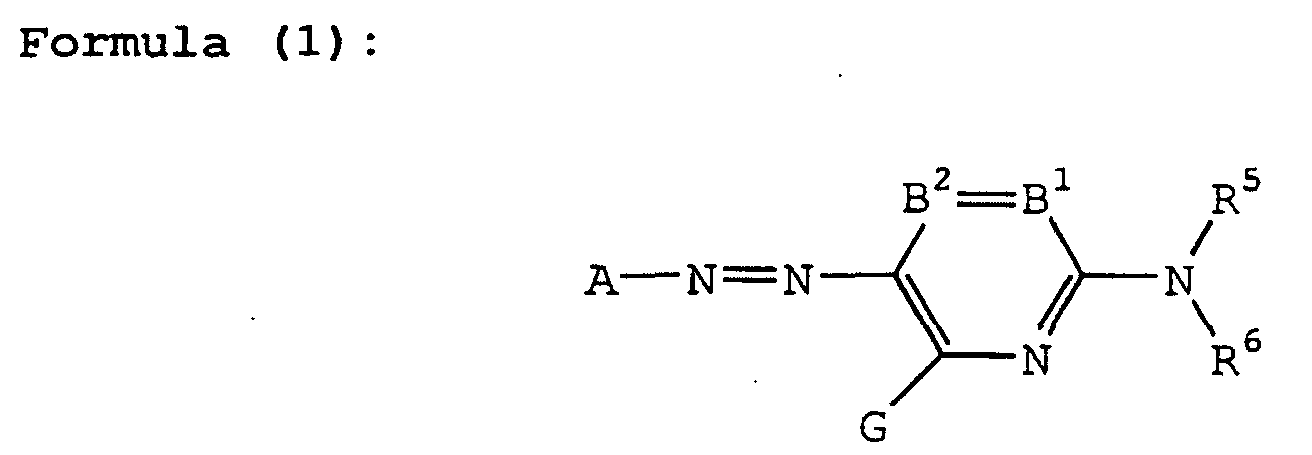
B1 and B2 each represents =CR1- or -CR2= or either one of B1 and B2 represents a nitrogen atom and the other represents =CR1- or -CR2=;
R5 and R6 each independently represents a hydrogen atom or a substituent, the substituent is an aliphatic group, an aromatic group, a heterocyclic group, an acyl group, an alkoxycarbonyl group, an aryloxycarbonyl group, a carbamoyl group, an alkylsulfonyl group, an arylsulfonyl group or a sulfamoyl group, and the hydrogen atom of each substituent may be substituted;
G, R1 and R2 each independently represents a hydrogen atom or a substituent, the substituent is a halogen atom, an aliphatic group, an aromatic group, a heterocyclic group, a cyano group, a carboxyl group, a carbamoyl group, an alkoxycarbonyl group, an aryloxycarbonyl group, a heterocyclic oxycarbonyl group, an acyl group, a hydroxy group, an alkoxy group, an aryloxy group, a heterocyclic oxy group, a silyloxy group, an acyloxy group, a carbamoyloxy group, an alkoxycarbonyloxy group, an aryloxycarbonyloxy group, an amino group, an acylamino group, a ureido group, a sulfamoylamino group, an alkoxycarbonylamino group, an aryloxycarbonylamino group, an alkylsulfonylamino group, an arylsulfonylamino group, a heterocyclic sulfonylamino group, a nitro group, an alkylthio group, an arylthio group, a heterocyclic thio group, an alkylsulfonyl group, an arylsulfonyl group, a heterocyclic sulfonyl group, an alkylsulfinyl group, an arylsulfinyl group, a heterocyclic sulfinyl group, a sulfamoyl group or a sulfo group, and the hydrogen atom of each substituent may be substituted; and
R1 and R5, or R5 and R6 may combine to form a 5- or 6-membered ring.
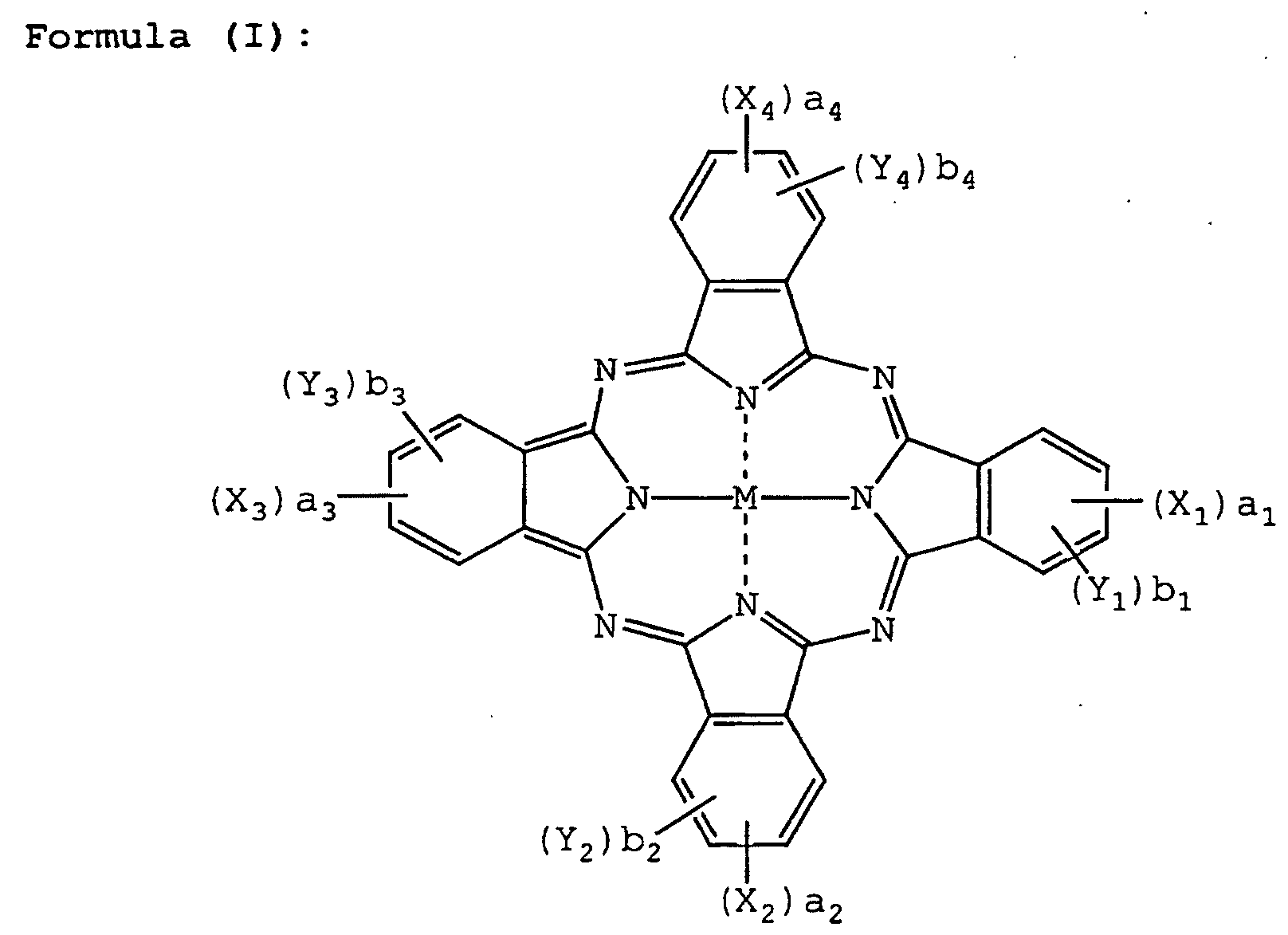
Y1, Y2, Y3 and Y4 each independently represents a monovalent substituent,
provided that when a plurality of X1s, X2s, X3s, X4s, Y1s, Y2s, Y3s or Y4s are present, these may be the same or different,
a1 to a4 and b1 to b4 represent the number of substituents X1 to X4 and Y1 to Y4, respectively, a1 to a4 each independently represents an integer of 0 to 4 but all are not 0 at the same time, b1 to b4 each independently represents an integer of 0 to 4, and
M represents a hydrogen atom, a metal atom or an oxide, hydroxide or halide thereof.

a11 to a14 each independently represents an integer of 1 or 2.
In other words, the present invention, which is an
ink using an aqueous medium, is based on the finding that
in an ink having a main absorption region of 500 to 580 nm,
namely, an ink generally called a magenta ink, and in an
ink having a main absorption region of 580 to 680 nm,
namely, an ink generally called a cyan ink, when at least
two coloring materials are used in each ink by dissolving
or dispersing them, the image preservability, the color
bleeding of image drawn and the ejection stability all are
improved to a level unachievable by, for example,
increasing the amount of only one coloring material and the
object of the present invention can be attained.
Those at least two coloring materials are coloring
materials used in an aqueous medium and as long as the
coloring materials are sharing the main absorption region
of 500 to 580 nm or of 580 to 600 nm in the medium, the
effect of the present invention can be brought out.
Moreover, not only in the case of an ink where at least two
coloring materials are dissolved or dispersed in a single
aqueous medium but also in the case of an ink set where two
coloring materials are separately dissolved or dispersed in
multiple aqueous mediums, the objective effect can be
obtained (in the present invention, if arises no misunderstanding,
the term "ink" is used including the ink set
having such a meaning). That is, the effect of the present
invention is considered to come out when the recorded image
is constituted by the above-described two or more coloring
materials.
In order to bring out excellent image preservability,
at least one of those two coloring materials preferably has
an oxidation potential nobler than 0.7 V (vs SCE). When at
least one coloring material having such a high oxidation
potential is present, the image obtained by combining it
with another coloring material having the same main
absorption region can have fastness and the image
preservability is enhanced.
One of two coloring materials may be a pigment or
sparingly soluble dye which is insoluble in an aqueous ink
medium and added to the composition by emulsion-dispersion.
The coloring material having a main absorption region
of 500 to 580 nm and the coloring material having a main
absorption region of 580 to 680 nm, which are particularly
preferred in the present invention, are an azo dye with the
nitrogen atom of the azo group being directly bonded by a
heterocyclic group having a specific structure, and a
phthalocyanine dye having a specific substituent structure,
respectively.
Specific embodiments of the present invention are
described in detail below.
In the present invention, the term "coloring
material" is used when collectively indicating a dye and a
pigment.
In order to satisfy the objective properties required
of the inkjet recording ink of the present invention, that
is, excellent weather resistance, ensured color hue, high
ejection stability and no defect in view of water
resistance and image quality, as for the magenta ink, an
ink having properties specified in (1) to (9) above is used
for the image recording. Accordingly, these properties of
the magenta dye are described below.
In the magenta ink used for the inkjet recording ink
of the present invention, a magenta dye selected from azo
dyes is dissolved or dispersed in an aqueous medium and the
dye is fundamentally characterized in that the absorption
maximum in the aqueous medium is present in the spectral
region of 500 to 580 nm and the oxidation potential is
nobler than 0.7 V (vs SCE).
The first preferred structural feature of this azo
dye is that the dye has a chromophore represented by the
formula: (heterocyclic ring A)-N=N-(heterocyclic ring B).
In this case, the heterocyclic rings A and B may have the
same structure. Specifically, the heterocyclic rings A and
B each is a 5- or 6-membered heterocyclic ring selected
from pyrazole, imidazole, triazole, oxazole, thiazole,
selenazole, pyridone, pyrazine, pyrimidine and pyridine.
These are specifically described, for example, in Japanese
Patent Application Nos. 2000-15853 and 2001-15614, JP-A-2002-309116
and Japanese Patent Application No. 2001-195014.
The second preferred structural feature of the azo
dye is that an aromatic nitrogen-containing 6-membered
heterocyclic ring is bonded as a coupling component
directly to at least one side of the azo group. Specific
examples thereof are described in 2001-110457.
The third preferred structural feature is that the
auxochrome has an aromatic ring amino group or heterocyclic
amino group structure, specifically, an anilino group or a
heterylamino group.
The fourth preferred structural feature is that the
dye has a steric structure. This is specifically described
in Japanese Patent Application No. 2002-12015.
Among these preferred structural features of the azo
dye, the dye most preferred for achieving the object of the
present invention is a dye represented by the following
formula (1) :
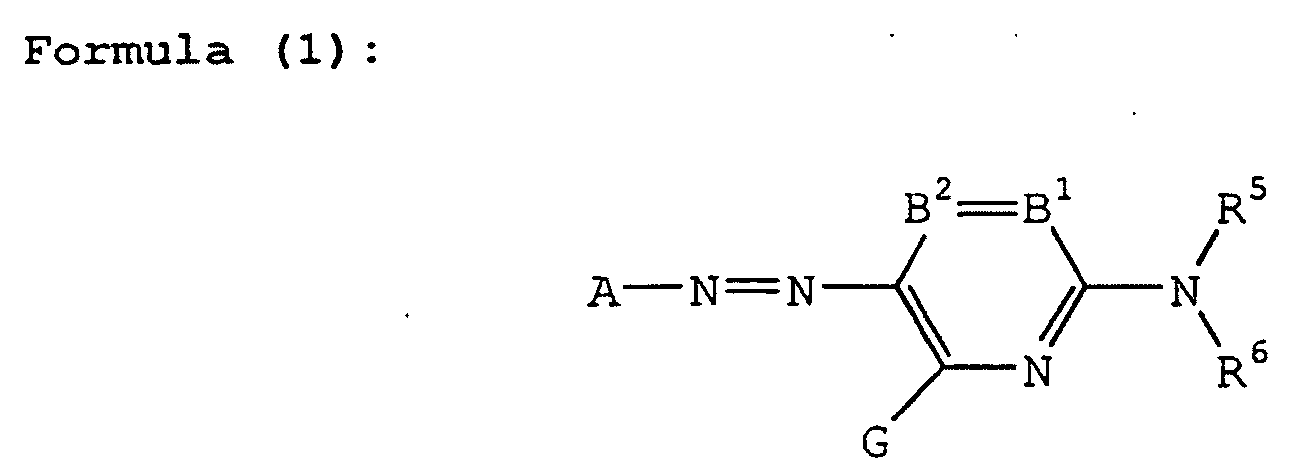 wherein A represents a 5-membered heterocyclic group;
B1 and B2 each represents =CR1- or -CR2= or either one of B1 and B2 represents a nitrogen atom and the other represents =CR1- or -CR2=;
R5 and R6 each independently represents a hydrogen atom or a substituent, the substituent is an aliphatic group, an aromatic group, a heterocyclic group, an acyl group, an alkoxycarbonyl group, an aryloxycarbonyl group, a carbamoyl group, an alkylsulfonyl group, an arylsulfonyl group or a sulfamoyl group, and the hydrogen atom of each substituent may be substituted;
G, R1 and R2 each independently represents a hydrogen atom or a substituent, the substituent is a halogen atom, an aliphatic group, an aromatic group, a heterocyclic group, a cyano group, a carboxyl group, a carbamoyl group, an alkoxycarbonyl group, an aryloxycarbonyl group, a heterocyclic oxycarbonyl group, an acyl group, a hydroxy group, an alkoxy group, an aryloxy group, a heterocyclic oxy group, a silyloxy group, an acyloxy group, a carbamoyloxy group, an alkoxycarbonyloxy group, an aryloxycarbonyloxy group, an amino group, an acylamino group, a ureido group, a sulfamoylamino group, an alkoxycarbonylamino group, an aryloxycarbonylamino group, an alkylsulfonylamino group, an arylsulfonylamino group, a heterocyclic sulfonylamino group, a nitro group, an alkylthio group, an arylthio group, a heterocyclic thio group, an alkylsulfonyl group, an arylsulfonyl group, a heterocyclic sulfonyl group, an alkylsulfinyl group, an arylsulfinyl group, a heterocyclic sulfinyl group, a sulfamoyl group or a sulfo group, and the hydrogen atom of each substituent may be substituted; and
R1 and R5, or R5 and R6 may combine to form a 5- or 6-membered ring.
B1 and B2 each represents =CR1- or -CR2= or either one of B1 and B2 represents a nitrogen atom and the other represents =CR1- or -CR2=;
R5 and R6 each independently represents a hydrogen atom or a substituent, the substituent is an aliphatic group, an aromatic group, a heterocyclic group, an acyl group, an alkoxycarbonyl group, an aryloxycarbonyl group, a carbamoyl group, an alkylsulfonyl group, an arylsulfonyl group or a sulfamoyl group, and the hydrogen atom of each substituent may be substituted;
G, R1 and R2 each independently represents a hydrogen atom or a substituent, the substituent is a halogen atom, an aliphatic group, an aromatic group, a heterocyclic group, a cyano group, a carboxyl group, a carbamoyl group, an alkoxycarbonyl group, an aryloxycarbonyl group, a heterocyclic oxycarbonyl group, an acyl group, a hydroxy group, an alkoxy group, an aryloxy group, a heterocyclic oxy group, a silyloxy group, an acyloxy group, a carbamoyloxy group, an alkoxycarbonyloxy group, an aryloxycarbonyloxy group, an amino group, an acylamino group, a ureido group, a sulfamoylamino group, an alkoxycarbonylamino group, an aryloxycarbonylamino group, an alkylsulfonylamino group, an arylsulfonylamino group, a heterocyclic sulfonylamino group, a nitro group, an alkylthio group, an arylthio group, a heterocyclic thio group, an alkylsulfonyl group, an arylsulfonyl group, a heterocyclic sulfonyl group, an alkylsulfinyl group, an arylsulfinyl group, a heterocyclic sulfinyl group, a sulfamoyl group or a sulfo group, and the hydrogen atom of each substituent may be substituted; and
R1 and R5, or R5 and R6 may combine to form a 5- or 6-membered ring.
The dye of formula (1) is described in more detail.
In formula (1), A represents a 5-membered heterocyclic
group. Examples of the heteroatom of the
heterocyclic ring include N, O and S. A is preferably a
nitrogen-containing 5-membered heterocyclic ring and the
heterocyclic ring may be condensed with an aliphatic ring,
an aromatic ring or another heterocyclic ring. Preferred
examples of the heterocyclic ring represented by A include
a pyrazole ring, an imidazole ring, a thiazole ring, an
isothiazole ring, a thiadiazole ring, a benzothiazole ring,
a benzoxazole ring and a benzisothiazole ring. Each
heterocyclic group may further have a substituent. Among
these rings, more preferred are a pyrazole ring, an
imidazole ring, an isothiazole ring, a thiadiazole ring and
a benzothiazole ring represented by the following formulae
(a) to (f) :
 wherein R7 to R20 each represents the same substituent as G,
R1 and R2 in formula (1).
wherein R7 to R20 each represents the same substituent as G,
R1 and R2 in formula (1).
Among formulae (a) to (f), preferred are a pyrazole
ring and an isothiazole ring represented by formulae (a)
and (b), and most preferred is a pyrazole ring represented
by formula (a).
In formula (1), B1 and B2 each represents =CR1-
or -CR2= or either one of B1 and B2 represents a nitrogen
atom and the other represents =CR1- or -CR2=. B1 and B2
each preferably represents =CR1- or -CR2=.
R5 and R6 each independently represents a hydrogen
atom or a substituent, the substituent is an aliphatic
group, an aromatic group, a heterocyclic group, an acyl
group, an alkoxycarbonyl group, an aryloxycarbonyl group, a
carbamoyl group, an alkylsulfonyl group, an arylsulfonyl
group or a sulfamoyl group, and the hydrogen atom of each
substituent may be substituted.
R5 and R6 each is preferably a hydrogen atom, an
aliphatic group, an aromatic group, a heterocyclic group,
an acyl group, an alkylsulfonyl group or an arylsulfonyl
group, more preferably a hydrogen atom, an aromatic group,
a heterocyclic group, an acyl group, an alkylsulfonyl group
or an arylsulfonyl group, and most preferably a hydrogen
atom, an aryl group or a heterocyclic group, and the
hydrogen atom of each substituent may be substituted, but
R5 and R6 are not a hydrogen atom at the same time.
G, R1 and R2 each independently represents a hydrogen
atom or a substituent, the substituent is a halogen atom,
an aliphatic group, an aromatic group, a heterocyclic group,
a cyano group, a carboxyl group, a carbamoyl group, an
alkoxycarbonyl group, an aryloxycarbonyl group, a
heterocyclic oxycarbonyl group, an acyl group, a hydroxy
group, an alkoxy group, an aryloxy group, a heterocyclic
oxy group, a silyloxy group, an acyloxy group, a
carbamoyloxy group, an alkoxycarbonyloxy group, an
aryloxycarbonyloxy group, an amino group, an acylamino
group, a ureido group, a sulfamoylamino group, an
alkoxycarbonylamino group, an aryloxycarbonylamino group,
an alkylsulfonylamino group, an arylsulfonylamino group, a
heterocyclic sulfonylamino group, a nitro group, an
alkylthio group, an arylthio group, a heterocyclic thio
group, an alkylsulfonyl group, an arylsulfonyl group, a
heterocyclic sulfonyl group, an alkylsulfinyl group, an
arylsulfinyl group, a heterocyclic sulfinyl group, a
sulfamoyl group or a sulfo group, and the hydrogen atom of
each substituent may be substituted.
G is preferably a hydrogen atom, a halogen atom, an
aliphatic group, an aromatic group, a hydroxy group, an
alkoxy group, an aryloxy group, an acyloxy group, a
heterocyclic oxy group, an amino group, an acylamino group,
a ureido group, a sulfamoylamino group, an alkoxycarbonylamino
group, an aryloxycarbonylamino group, an
alkylthio group, an arylthio group or a heterocyclic thio
group, more preferably a hydrogen atom, a halogen atom, an
alkyl group, a hydroxy group, an alkoxy group, an aryloxy
group, an acyloxy group, an amino group or an acylamino
group, and most preferably a hydrogen atom, an amino group
(preferably an anilino group) or an acylamino group, and
the hydrogen atom of each substituent may be substituted.
R1 and R2 each is preferably a hydrogen atom, an
alkyl group, a halogen atom, an alkoxycarbonyl group, a
carboxyl group, a carbamoyl group, a hydroxy group, an
alkoxy group or a cyano group, and the hydrogen atom of
each substituent may be substituted.
R1 and R5, or R5 and R6 may combine to form a 5- or 6-membered
ring.
When A has a substituent or when the substituent R1,
R2, R5, R6 or G further has a substituent, examples of the
substituent include the substituents described above for G,
R1 and R2.
In the case where the dye of the present invention is
a water-soluble dye; the dye preferably further has an
ionic hydrophilic group as a substituent on any position of
A, R1, R2, R5, R6 and G. Examples of the ionic hydrophilic
group as a substituent include a sulfo group, a carboxyl
group, a phosphono group and a quaternary ammonium group.
Among these ionic hydrophilic groups, preferred are a
carboxyl group, a phosphono group and a sulfo group, more
preferred are a carboxyl group and a sulfo group. The
carboxyl group, the phosphono group and the sulfo group
each may be in a salt state and examples of the counter ion
for forming the salt include ammonium ion, alkali metal
ions (e.g., lithium ion, sodium ion, potassium ion) and
organic cations (e.g., tetramethylammonium ion, tetramethylguanidium
ion, tetramethylphosphonium).
The terms (substituents) used in the present
invention are described below. These terms each is common
among different symbols in formula (1) and also in formula
(1a) shown later.
The halogen atom includes a fluorine atom, a chlorine
atom and a bromine atom.
The aliphatic group means an alkyl group, a
substituted alkyl group, an alkenyl group, a substituted
alkenyl group, an alkynyl group, a substituted alkynyl
group, an aralkyl group and a substituted aralkyl group.
The "substituted" used for a "substituted alkyl group" and
the like in the present invention means that the hydrogen
atom present in an "alkyl group" or the like is substituted,
for example, by a substituent described above for G, R1 and
R2.
The aliphatic group may be branched or may form a
ring. The number of carbon atoms in the aliphatic group is
preferably from 1 to 20, more preferably from 1 to 16. The
aryl moiety in the aralkyl group and in the substituted
aralkyl group is preferably a phenyl group or a naphthyl
group, more preferably a phenyl group. Examples of the
aliphatic group include a methyl group, an ethyl group, a
butyl group, an isopropyl group, a tert-butyl group, a
hydroxyethyl group, a methoxyethyl group, a cyanoethyl
group, a trifluoromethyl group, a 3-sulfopropyl group, a 4-sulfobutyl
group, a cyclohexyl group, a benzyl group, a 2-phenethyl
group, a vinyl group and an allyl group.
The aromatic group means an aryl group and a
substituted aryl group. The aryl group is preferably a
phenyl group or a naphthyl group, more preferably a phenyl
group. The number of carbon atoms in the aromatic group is
preferably from 6 to 20, more preferably from 6 to 16.
Examples of the aromatic group include a phenyl group,
a p-tolyl group, a p-methoxyphenyl group, an o-chlorophenyl
group and an m-(3-sulfopropylamino)phenyl group.
The heterocyclic group includes a substituted
heterocyclic group. In the heterocyclic group, the
heterocyclic ring may be condensed with an aliphatic ring,
an aromatic ring or another heterocyclic ring. The
heterocyclic group is preferably a 5- or 6-membered heterocyclic
group. Examples of the substituent of the
substituted heterocyclic group include an aliphatic group,
a halogen atom, an alkylsulfonyl group, an arylsulfonyl
group, an acyl group, an acylamino group, a sulfamoyl group,
a carbamoyl group and an ionic hydrophilic group. Examples
of the heterocyclic group include a 2-pyridyl group, a 2-thienyl
group, a 2-thiazolyl group, a 2-benzothiazolyl
group, a 2-benzoxazolyl group and a 2-furyl group.
The carbamoyl group includes a substituted carbamoyl
group. Examples of the substituent therefor include an
alkyl group. Examples of the carbamoyl group include a
methylcarbamoyl group and a dimethylcarbamoyl group.
The alkoxycarbonyl group includes a substituted
alkoxycarbonyl group. The alkoxycarbonyl group is
preferably an alkoxycarbonyl group having from 2 to 20
carbon atoms. Examples of the substituent of the
substituted alkoxycarbonyl group include an ionic
hydrophilic group. Examples of the alkoxycarbonyl group
include a methoxycarbonyl group and an ethoxycarbonyl group.
The aryloxycarbonyl group includes a substituted
aryloxycarbonyl group. The aryloxycarbonyl group is
preferably an aryloxycarbonyl group having from 7 to 20
carbon atoms. Examples of the substituent of the
substituted aryloxycarbonyl group include an ionic
hydrophilic group. Examples of the aryloxycarbonyl group
include a phenoxycarbonyl group.
The heterocyclic oxycarbonyl group includes a
substituted heterocyclic oxycarbonyl group. Examples of
the heterocyclic ring include the heterocyclic rings
described above for the heterocyclic group. The
heterocyclic oxycarbonyl group is preferably a heterocyclic
oxycarbonyl group having from 2 to 20 carbon atoms.
Examples of the substituent of the substituted heterocyclic
oxycarbonyl group include an ionic hydrophilic group.
Examples of the heterocyclic oxycarbonyl group include a 2-pyridyloxycarbonyl
group.
The acyl group includes a substituted acyl group.
The acyl group is preferably an acyl group having from 1 to
20 carbon atoms. Examples of the substituent of the
substituted acyl group include an ionic hydrophilic group.
Examples of the acyl group include an acetyl group and a
benzoyl group.
The alkoxy group includes a substituted alkoxy group.
The alkoxy group is preferably an alkoxy group having from
1 to 20 carbon atoms. Examples of the substituent of the
substituted alkoxy group include an alkoxy group, a
hydroxyl group and an ionic hydrophilic group. Examples of
the alkoxy group include a methoxy group, an ethoxy group,
an isopropoxy group, a methoxyethoxy group, a hydroxyethoxy
group and a 3-carboxypropoxy group.
The aryloxy group includes a substituted aryloxy
group. The aryloxy group is preferably an aryloxy group
having from 6 to 20 carbon atoms. Examples of the
substituent of the substituted aryloxy group include an
alkoxy group and an ionic hydrophilic group. Examples of
the aryloxy group include a phenoxy group, a p-methoxyphenoxy
group and an o-methoxyphenoxy group.
The heterocyclic oxy group includes a substituted
heterocyclic oxy group. Examples of the heterocyclic ring
include the heterocyclic rings described above for the
heterocyclic group. The heterocyclic oxy group is
preferably a heterocyclic oxy group having from 2 to 20
carbon atoms. Examples of the substituent of the
substituted heterocyclic oxy group include an alkyl group,
an alkoxy group and an ionic hydrophilic group. Examples
of the heterocyclic oxy group include a 3-pyridyloxy group
and a 3-thienyloxy group.
The silyloxy group is preferably a silyloxy group
substituted by an aliphatic or aromatic group having from 1
to 20 carbon atoms. Examples of the silyloxy group include
a trimethylsilyloxy group and a diphenylmethylsilyloxy
group.
The acyloxy group includes a substituted acyloxy
group. The acyloxy group is preferably an acyloxy group
having from 1 to 20 carbon atoms. Examples of the
substituent of the substituted acyloxy group include an
ionic hydrophilic group. Examples of the acyloxy group
include an acetoxy group and a benzoyloxy group.
The carbamoyloxy group includes a substituted
carbamoyloxy group. Examples of the substituent therefor
include an alkyl group. Examples of the carbamoyloxy group
include an N-methylcarbamoyloxy group.
The alkoxycarbonyloxy group includes a substituted
alkoxycarbonyloxy group. The alkoxycarbonyloxy group is
preferably an alkoxycarbonyloxy group having from 2 to 20
carbon atoms. Examples of the alkoxycarbonyloxy group
include a methoxycarbonyloxy group and an isopropoxycarbonyloxy
group.
The aryloxycarbonyloxy group includes a substituted
aryloxycarbonyloxy group. The aryloxycarbonyloxy group is
preferably an aryloxycarbonyloxy group having from 7 to 20
carbon atoms. Examples of the aryloxycarbonyloxy group
include a phenoxycarbonyloxy group.
The amino group includes a substituted amino group.
Examples of the substituent therefor include an alkyl group,
an aryl group and a heterocyclic group, and the alkyl group,
the aryl group and the heterocyclic group each may further
have a substituent. The alkylamino group includes a
substituted alkylamino group. The alkylamino group is
preferably an alkylamino group having from 1 to 20 carbon
atoms. Examples of the substituent of the substituted
alkylamino group include an ionic hydrophilic group.
Examples of the alkylamino group include a methylamino
group and a diethylamino group.
The arylamino group includes a substituted arylamino
group. The arylamino group is preferably an arylamino
group having from 6 to 20 carbon atoms. Examples of the
substituent of the substituted arylamino group include a
halogen atom and an ionic hydrophilic group. Examples of
the arylamino group include a phenylamino group and a 2-chlorophenylamino
group.
The heterocyclic amino group includes a substituted
heterocyclic amino group. Examples of the heterocyclic
ring include the heterocyclic rings described above for the
heterocyclic group. The heterocyclic amino group is
preferably a heterocyclic amino group having from 2 to 20
carbon atoms. Examples of the substituent of the
substituted heterocyclic amino group include an alkyl group,
a halogen atom and an ionic hydrophilic group.
The acylamino group includes a substituted acylamino
group. The acylamino group is preferably an acylamino
group having from 2 to 20 carbon atoms. Examples of the
substituent of the substituted acylamino group include an
ionic hydrophilic group. Examples of the acylamino group
include an acetylamino group, a propionylamino group, a
benzoylamino group, an N-phenylacetylamino group and a 3,5-disulfobenzoylamino
group.
The ureido group includes a substituted ureido group.
The ureido group is preferably a ureido group having from 1
to 20 carbon atoms. Examples of the substituent of the
substituted ureido group include an alkyl group and an aryl
group. Examples of the ureido group include a 3-methylureido
group, a 3,3-dimethylureido group and a 3-phenylureido
group.
The sulfamoylamino group includes a substituted
sulfamoylamino group. Examples of the substituent therefor
include an alkyl group. Examples of the sulfamoylamino
group include an N,N-dipropylsulfamoylamino group.
The alkoxycarbonylamino group includes a substituted
alkoxycarbonylamino group. The alkoxycarbonylamino group
is preferably an alkoxycarbonylamino group having from 2 to
20 carbon atoms. Examples of the substituent of the
substituted alkoxycarbonylamino group include an ionic
hydrophilic group. Examples of the alkoxycarbonylamino
group include an ethoxycarbonylamino group.
The aryloxycarbonylamino group includes a substituted
aryloxycarbonylamino group. The aryloxycarbonylamino group
is preferably an aryloxycarbonylamino group having from 7
to 20 carbon atoms. Examples of the substituent of the
substituted aryloxycarbonylamino group include an ionic
hydrophilic group. Examples of the aryloxycarbonylamino
group include a phenoxycarbonylamino group.
The alkylsulfonylamino group and the arylsulfonylamino
group include a substituted alkylsulfonylamino group
and a substituted arylsulfonylamino group, respectively.
The alkylsulfonylamino group and the arylsulfonylamino
group are preferably an alkylsulfonylamino group having
from 1 to 20 carbon atoms and an arylsulfonylamino group
having from 1 to 20 carbon atoms, respectively. Examples
of the substituent of the substituted alkylsulfonylamino
group and substituted arylsulfonylamino group include an
ionic hydrophilic group. Examples of the alkylsulfonylamino
group and arylsulfonylamino group include a
methylsufonylamino group, an N-phenyl-methylsulfonylamino
group, a phenylsulfonylamino group and a 3-carboxyphenylsulfonylamino
group.
The heterocyclic sulfonylamino group includes a
substituted heterocyclic sulfonylamino group. Examples of
the heterocyclic ring include the heterocyclic rings
described above for the heterocyclic group. The
heterocyclic sulfonylamino group is preferably a
heterocyclic sulfonylamino group having from 1 to 12 carbon
atoms. Examples of the substituent of the substituted
heterocyclic sulfonylamino group include an ionic
hydrophilic group. Examples of the heterocyclic sulfonylamino
group include a 2-thienylsulfonylamino group and a 3-pyridylsulfonylamino
group.
The alkylthio group, the arylthio group and the
heterocyclic thio group include a substituted alkylthio
group, a substituted arylthio group and a substituted
heterocyclic thio group, respectively. Examples of the
heterocyclic ring include the heterocyclic rings described
above for the heterocyclic group. The alkylthio group, the
arylthio group and the heterocyclic thio group are
preferably an alkylthio group having from 1 to 20 carbon
atoms, an arylthio group having from 1 to 20 carbon atoms
and a heterocyclic thio group having from 1 to 20 carbon
atoms, respectively. Examples of the substituent of the
substituted alkylthio group, substituted arylthio group and
substituted heterocyclic thio group include an ionic
hydrophilic group. Examples of the alkylthio group,
arylthio group and heterocyclic thio group include a
methylthio group, a phenylthio group and a 2-pyridylthio
group.
The alkylsulfonyl group and the arylsulfonyl group
include a substituted alkylsulfonyl group and a substituted
arylsulfonyl group, respectively. Examples of the
alkylsulfonyl group and arylsulfonyl group include a
methylsulfonyl group and a phenylsulfonyl group.
The heterocyclic sulfonyl group includes a
substituted heterocyclic sulfonyl group. Examples of the
heterocyclic ring include the heterocyclic rings described
above for the heterocyclic group. The heterocyclic
sulfonyl group is preferably a heterocyclic sulfonyl group
having from 1 to 20 carbon atoms. Examples of the
substituent of the substituted heterocyclic sulfonyl group
include an ionic hydrophilic group. Examples of the
heterocyclic sulfonyl group include a 2-thienylsulfonyl
group and a 3-pyridylsulfonyl group.
The alkylsulfinyl group and the arylsulfinyl group
include a substituted alkylsulfinyl group and a substituted
arylsulfinyl group, respectively. Examples of the
alkylsulfinyl group and arylsulfinyl group include a
methylsulfinyl group and a phenylsulfinyl group.
The heterocyclic sulfinyl group includes a
substituted heterocyclic sulfinyl group. Examples of the
heterocyclic ring include the heterocyclic rings described
above for the heterocyclic group. The heterocyclic
sulfinyl group is preferably a heterocyclic sulfinyl group
having from 1 to 20 carbon atoms. Examples of the
substituent of the substituted heterocyclic sulfinyl group
include an ionic hydrophilic group. Examples of the
heterocyclic sulfinyl group include a 4-pyridylsulfinyl
group.
The sulfamoyl group includes a substituted sulfamoyl
group. Examples of the substituent therefor include an
alkyl group. Examples of the sulfamoyl group include a
dimethylsulfamoyl group and a di-(2-hydroxyethyl)sulfamoyl
group.
Among the dyes represented by formula (1),
particularly preferred is a structure represented by the
following formula (1a) :

In formula (1a), R1, R2, R5 and R6 have the same
meanings as in formula (1).
R3 and R4 each independently represents a hydrogen
atom or a substituent and the substituent is an aliphatic
group, an aromatic group, a heterocyclic group, an acyl
group, an alkoxycarbonyl group, an aryloxycarbonyl group, a
carbamoyl group, an alkylsulfonyl group, an arylsulfonyl
group or a sulfamoyl group. R3 and R4 each is preferably a
hydrogen atom, an aromatic group, a heterocyclic group, an
acyl group, an alkylsulfonyl group or an arylsulfonyl group,
more preferably a hydrogen atom, an aromatic group or a
heterocyclic group.
Z1 represents an electron-withdrawing group having a
Hammett's substituent constant σp value of 0.20 or more.
Z1 is preferably an electron-withdrawing group having a σp
value of 0.30 or more, more preferably 0.45 or more, still
more preferably 0.60 to more, but the σp value preferably
does not exceed 1.0. Specific preferred examples of this
substituent include electron-withdrawing substituents
described later. Among those, preferred are an acyl group
having from 2 to 20 carbon atoms, an alkyloxycarbonyl group
having from 2 to 20 carbon atoms, a nitro group, a cyano
group, an alkylsulfonyl group having from 1 to 20 carbon
atoms, an arylsulfonyl group having from 6 to 20 carbon
atoms, a carbamoyl group having from 1 to 20 carbon atoms
and a halogenated alkyl group having from 1 to 20 carbon
atoms, more preferred are a cyano group, an alkylsulfonyl
group having from 1 to 20 carbon atoms and an arylsulfonyl
group having from 6 to 20 carbon atoms, and most preferred
is a cyano group.
Z2 represents a hydrogen atom or a substituent and
the substituent is an aliphatic group, an aromatic group or
a heterocyclic group. Z2 is preferably an aliphatic group,
more preferably an alkyl group having from 1 to 6 carbon
atoms.
Q represents a hydrogen atom or a substituent and the
substituent is an aliphatic group, an aromatic group or a
heterocyclic group. Q is preferably a group comprising a
nonmetallic atom group necessary for forming a 5-, 6-, 7-or
8-membered ring. The 5-, 6-, 7- or 8-membered ring may
be substituted, may be a saturated ring or may have an
unsaturated bond. Q is more preferably an aromatic group
or a heterocyclic group. Preferred examples of the
nonmetallic atom include a nitrogen atom, an oxygen atom, a
sulfur atom and a carbon atom. Specific examples of the
ring structure include a benzene ring, a cyclopentane ring,
a cyclohexane ring, a cycloheptane ring, a cyclooctane ring,
a cyclohexene ring, a pyridine ring, a pyrimidine ring, a
pyrazine ring, a pyridazine ring, a triazine ring, an
imidazole ring, a benzimidazole ring, an oxazole ring, a
benzoxazole ring, a thiazole ring, a benzothiazole ring, an
oxane ring, a sulfolane ring and a thiane ring.
The hydrogen atom of each substituent described in
regard to formula (1a) may be substituted. Examples of the
substituent include the substituents described in regard to
formula (1), the groups described as examples for G, R1 and
R2, and ionic hydrophilic groups.
Here, the Hammett's substituent constant σp value
used in the present invention is described. The Hammett's
rule is an empirical rule advocated by L.P. Hammett in 1935
so as to quantitatively discuss the effect of substituent
on the reaction or equilibrium of benzene derivatives and
its propriety is widely admitted at present. The
substituent constant determined by the Hammett's rule
includes a σp value and a σm value and these values can be
found in a large number of general publications but these
are described in detail, for example, in J.A. Dean
(compiler), Lange's Handbook of Chemistry, 12th ed.,
McGraw-Hill (1979), and Kagakuno Ryoiki (Chemistry Region),
special number, No. 122, pp. 96-103, Nankodo (1979). In
the present invention, each substituent is limited or
described by using the Hammett's substituent constant σp
but this does not mean that the substituent is limited only
to those having a known value which can be found in the
above-described publications. Needless to say, the
substituent includes substituents of which σp value is not
known in publications but when measured based on the
Hammett's rule, falls within the range specified.
Furthermore, although formula (1a) of the present invention
includes those which are not a benzene derivative, the σp
value is used as a measure for showing the electron effect
of the substituent irrespective of the substitution site.
In the present invention, the σp value is used in such a
meaning.
Examples of the electron-withdrawing group having a
Hammett's substituent constant σp value of 0.60 or more
include a cyano group, a nitro group, an alkylsulfonyl
group (e.g., methylsulfonyl) and an arylsulfonyl group
(e.g., phenylsulfonyl).
Examples of the electron-withdrawing group having a
Hammett's σp value of 0.45 or more include, in addition to
those described above, an acyl group (e.g., acetyl), an
alkoxycarbonyl group (e.g., dodecyloxycarbonyl), an
aryloxycarbonyl group (e.g., m-chlorophenoxycarbonyl), an
alkylsulfinyl group (e.g., n-propylsulfinyl), an arylsulfinyl
group (e.g., phenylsulfinyl), a sulfamoyl group
(e.g., N-ethylsulfamoyl, N,N-dimethylsulfamoyl) and a
halogenated alkyl group (e.g., trifluoromethyl).
Examples of the electron-withdrawing group having a
Hammett's substituent constant σp value of 0.30 or more
include, in addition to those described above, an acyloxy
group (e.g., acetoxy), a carbamoyl group (e.g., N-ethylcarbamoyl,
N,N-dibutylcarbamoyl), a halogenated alkoxy
group (e.g., trifluoromethyloxy), a halogenated aryloxy
group (e.g., pentafluorophenyloxy), a sulfonyloxy group
(e.g., methylsulfonyloxy), a halogenated alkylthio group
(e.g., difluoromethylthio), an aryl group substituted by
two or more electron-withdrawing groups having a σp value
of 0.15 or more (e.g., 2,4-dinitrophenyl, pentachlorophenyl)
and a heterocyclic ring (e.g., 2-benzoxazolyl, 2-benzothiazolyl,
1-phenyl-2-benzimidazolyl).
Specific examples of the electron-withdrawing group
having a σp value of 0.20 or more include, in addition to
those described above, a halogen atom.
The preferred combination of substituents in the azo
dye represented by formula (1) is described below. R5 and
R6 each is preferably a hydrogen atom, an alkyl group, an
aryl group, a heterocyclic group, a sulfonyl group or an
acyl group, more preferably a hydrogen atom, an aryl group,
a heterocyclic group or a sulfonyl group, and most
preferably a hydrogen atom, an aryl group or a heterocyclic
group. However, R5 and R6 are not a hydrogen atom at the
same time.
G is preferably a hydrogen atom, a halogen atom, an
alkyl group, a hydroxyl group, an amino group or an
acylamino group, more preferably a hydrogen atom, a halogen
atom, an amino group or an acylamino group, and most
preferably a hydrogen atom, an amino group or an acylamino
group.
A is preferably a pyrazole ring, an imidazole ring,
an isothiazole ring, a thiadiazole ring or a benzothiazole
ring, more preferably a pyrazole ring or an isothiazole
ring, and most preferably a pyrazole ring.
B1 and B2 each is =CR1- or -CR2=, and R1 and R2 each is
preferably a hydrogen atom, an alkyl group, a halogen atom,
a cyano group, a carbamoyl group, a carboxyl group, a
hydroxyl group, an alkoxy group or an alkoxycarbonyl group,
more preferably a hydrogen atom, an alkyl group, a carboxyl
group, a cyano group or a carbamoyl group.
As for the preferred combination of substituents in
the compound represented by formula (1), a compound where
at least one of various substituents is the preferred group
is preferred, a compound where a larger number of various
substituents are the preferred groups is more preferred,
and a compound where all substituents are the preferred
groups is most preferred.
Specific examples of the azo dye represented by
formula (1) are shown below as Compounds a-1 to a-46, b-1
to b-8, c-1 to c-5, d-1 to d-5, e-1 to e-5, f-1 and f-2,
but the azo dye for use in the present invention is not
limited to these examples.

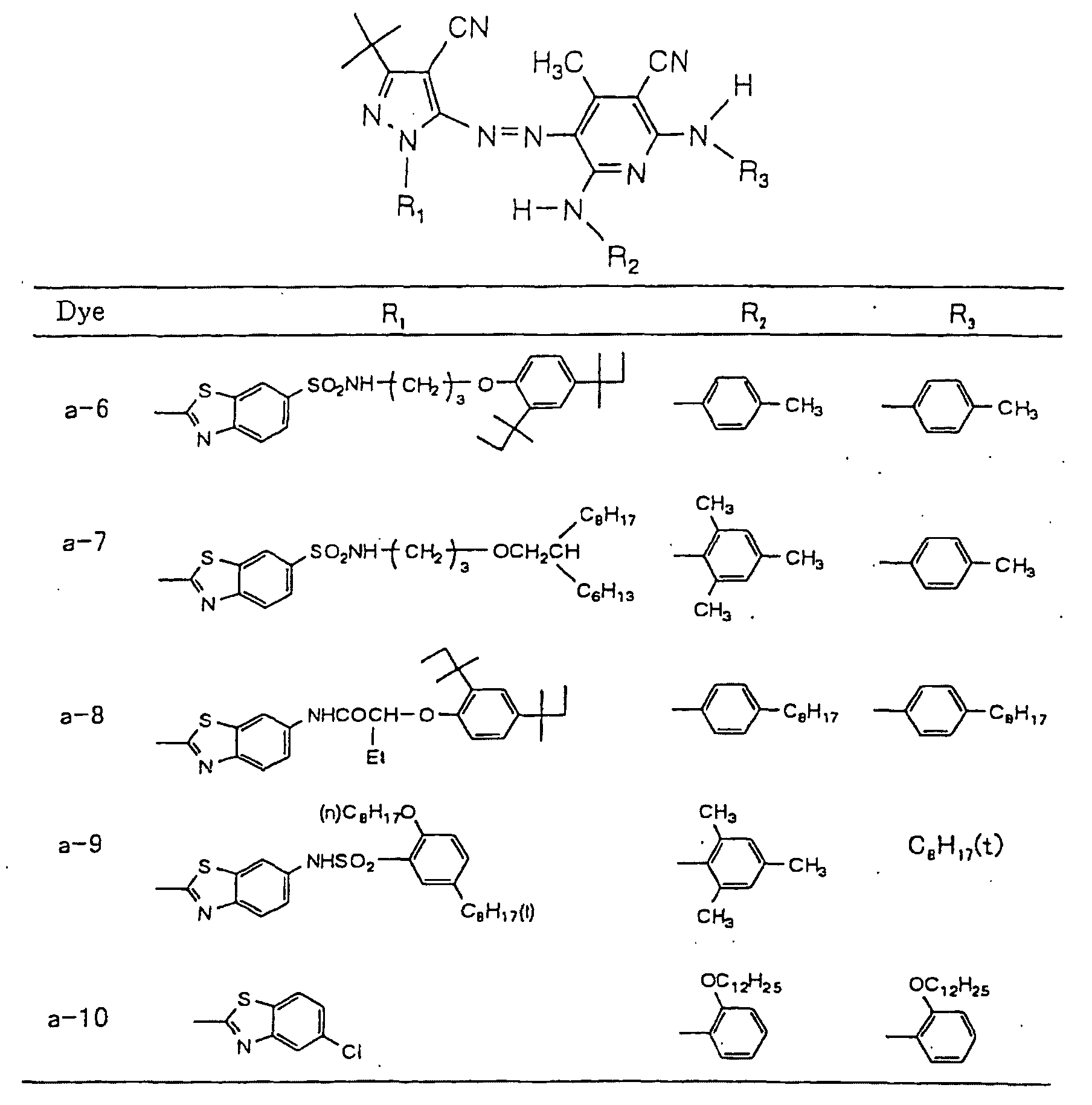


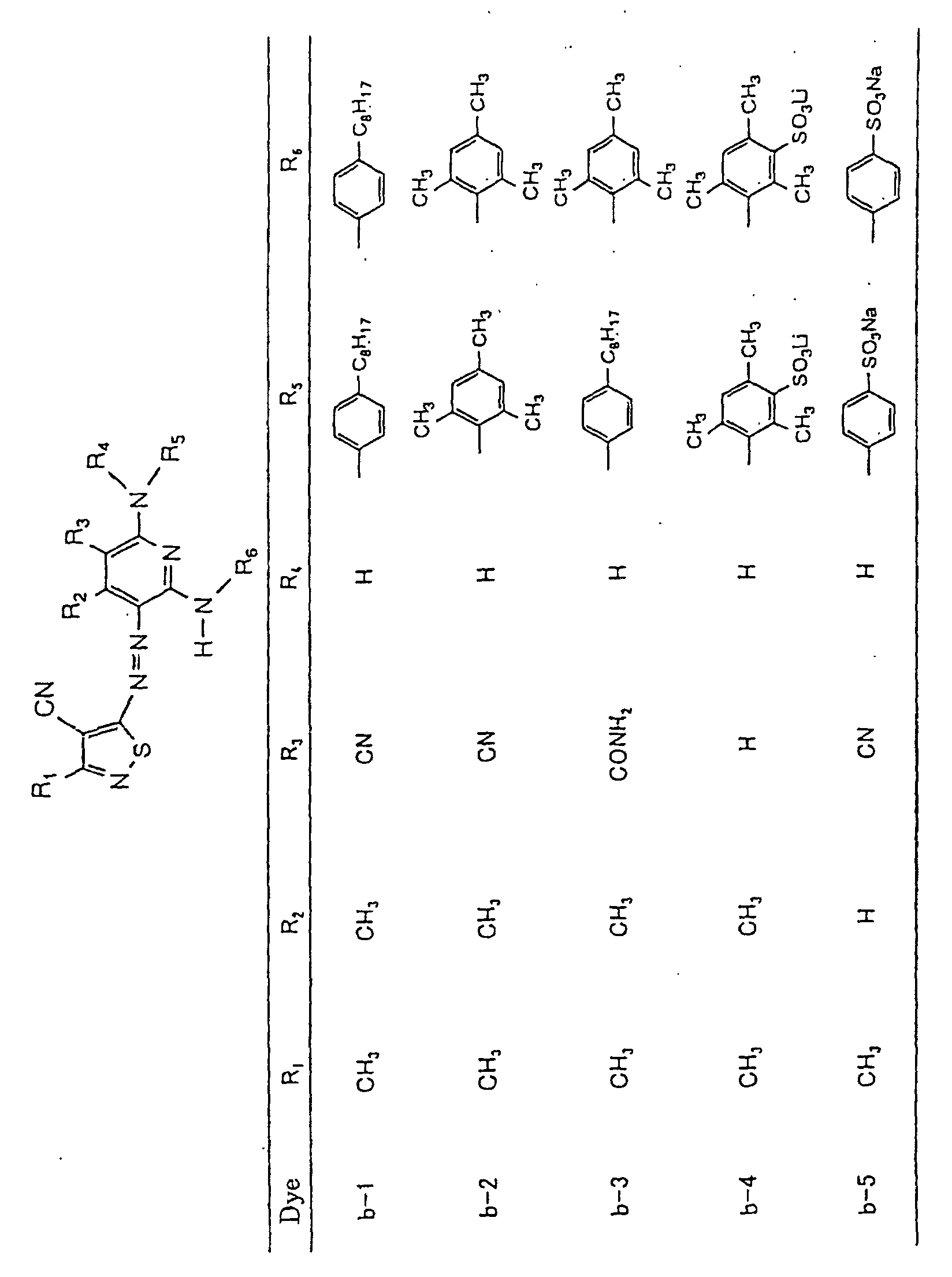
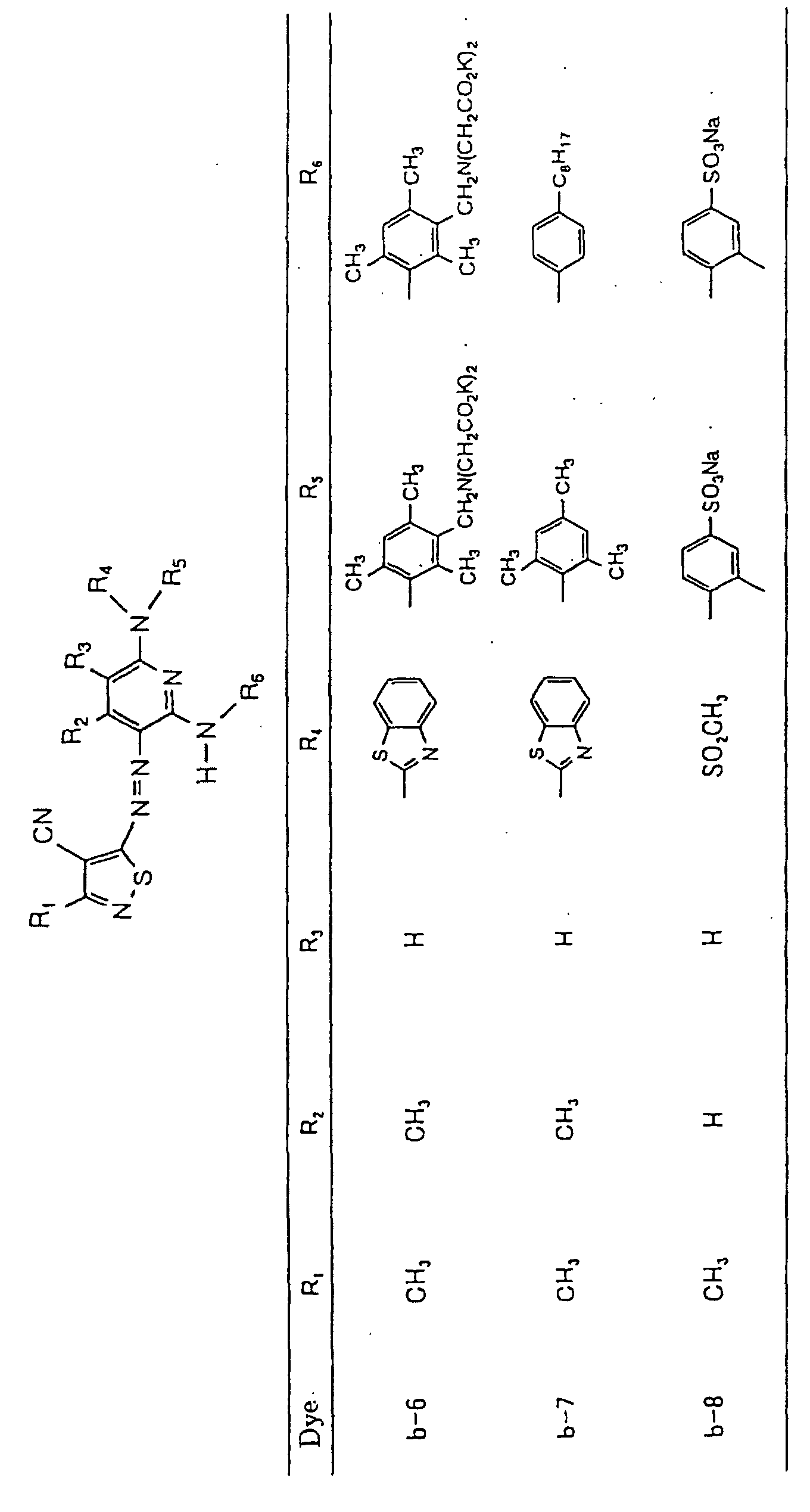


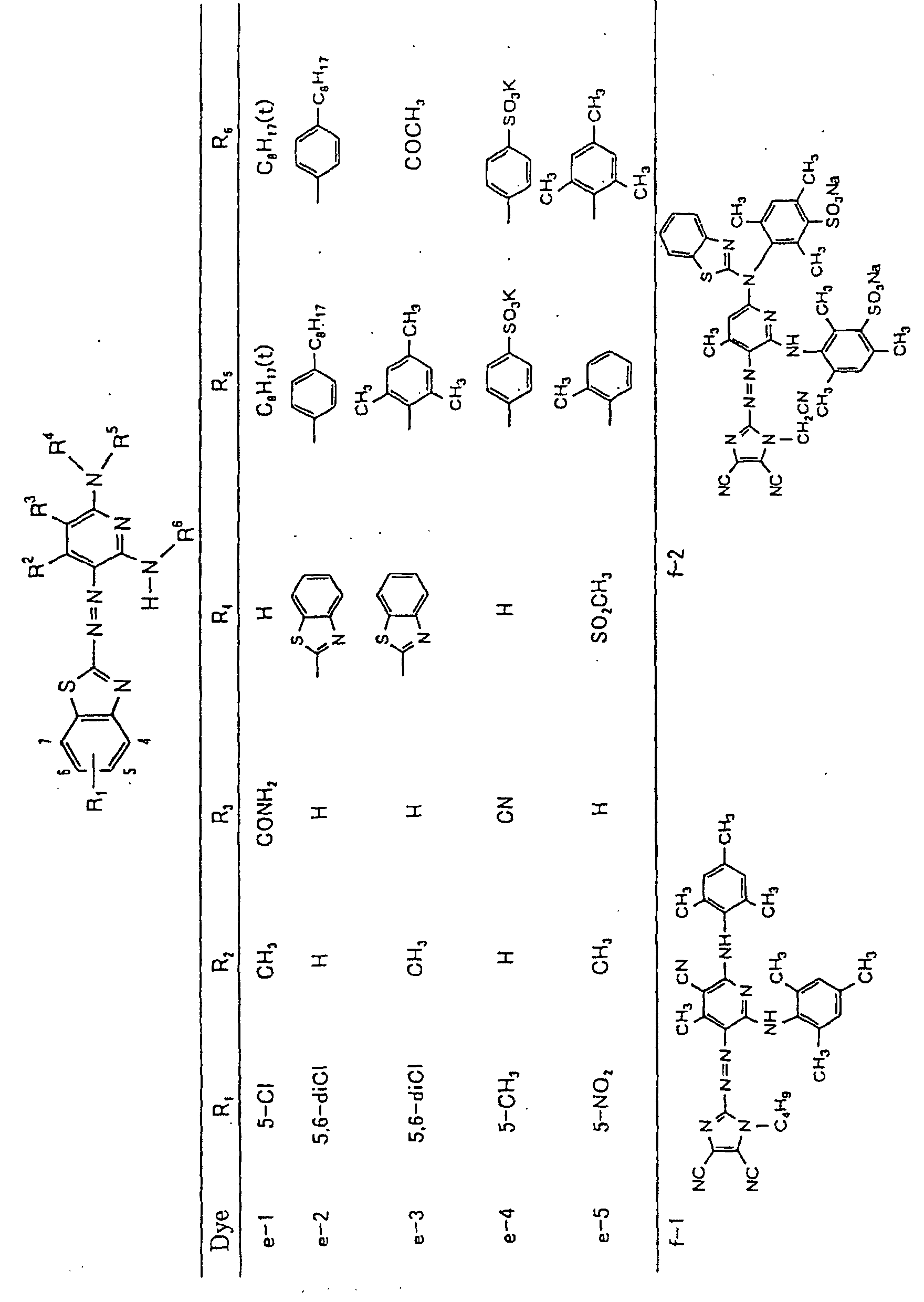
The inkjet recording magenta ink of the present
invention has a main absorption region of 500 to 580 nm and
is preferably obtained by dissolving or dispersing at least
one of the above-described azo dyes in an aqueous medium.
In this case, the azo dye is preferably contained in an
amount of 0.2 to 20 mass%, more preferably from 0.5 to 15
mass%, and the solubility in water at 20°C (or dispersion
degree in a stable state) is preferably 5 mass% or more,
more preferably 10 mass% or more.
The dye of formula (1) for use in the present
invention is substantially water-soluble or water-dispersible,
more specifically, the solubility of the
coloring material in water at 20°C is preferably 2 mass% or
more, more preferably 5 mass% or more.
In preparing a set comprising two or more inks
sharing the main absorption region, generally, one ink is
produced as a light-type thin ink and another is produced
as a thick ink, but in the present invention, the inks may
be produced as different type inks in this way or may be
produced as inks having almost the same concentration.
In the case of two or more inks sharing the main
absorption region are used in combination as a set, the dye
contained in each ink may be a single dye or a mixture of
dyes, but in either case, at least one ink preferably
contains at least one dye represented by formula (1) in the
form of being dissolved or dispersed in an aqueous medium
and the concentration of the dye is from 0.2 to 20 mass%,
more preferably from 0.5 to 15 mass%.
On the other hand, the coloring material combined
with the dye represented by formula (1) may be either a dye
or a pigment and may be in the form of being dissolved in
an aqueous medium or in the form that a pigment insoluble
in the aqueous medium is present in the dispersed state.
In the case of a pigment, the solubility (at 25°C) in water
is 0.1 g/100 g or less in many cases. As for the ink where
the component is dispersed, examples of the component
include an emulsion dispersion, a polymer dye, a dye
supported on or dispersed in a polymer, and a pigment.
Among these, a pigment is preferred.
Also, the dye ink may contain a water-insoluble
pigment in the dispersed state or the pigment ink may
contain a water-soluble dye.
When a dye represented by formula (1) and a different
dye or a pigment are present in combination in one ink, the
total concentration thereof is from 0.2 to 20 mass%,
preferably from 0.5 to 15 mass%.
The magenta dye having an azo group for use in the
present invention has an oxidation potential, in an aqueous
medium for ink, nobler than 0.7 V vs SCE, preferably nobler
than 0.8 V vs SCE, more preferably nobler than 1.0 V vs SCE.
The potential can be elevated by selecting the preferred
structural features described above, more specifically, by
selecting a dye structure of a type having a chromophore
represented by (heterocyclic ring A)-N=N-(heterocyclic ring
B), selecting an azo dye in which an aromatic nitrogen-containing
6-membered heterocyclic ring is bonded as a
coupling component directly to at least one side of the azo
group, and selecting an azo dye having an aromatic ring
amino group- or heterocyclic amino group-containing
structure as an auxochrome, and furthermore by removing α
hydrogen of the azo dye. In particular, the dye of formula
(1) expresses a noble potential. This is specifically
described in Japanese Patent Application No. 2001-254878.
The oxidation potential value (Eox) can be easily
measured by one skilled in the art and the method therefor
is described, for example, in P. Delahay, New Instrumental
Methods in Electrochemistry, Interscience Publishers (1954),
A.J. Bard et al., Electrochemical Methods, John Wiley &
Sons (1980), and Akira Fujishima et al., Denkikagaku
Sokutei Ho (Electrochemical Measuring Method), Gihodo
Shuppan Sha (1984).
More specifically, the oxidation potential can be
measured by various measuring methods such as direct
current polarography which is a method of measuring the
oxidation potential in an aqueous solution or water-mixed
solvent system having dissolved therein the dye based on
SCE (standard saturated calomel electrode) as the reference
electrode and in which a graphite electrode and a platinum
electrode are used as the working electrode and the counter
electrode, respectively; polarography in which a dropping
mercury electrode is used; cyclic voltammetry method (CV);
rotating ring-disk electrode method; and comb electrode
method. The oxidation potential is measured as follows. A
test sample is dissolved to a concentration of 1×10⁻⁴ to
1×10⁻⁶ mol·dm-3 in a solvent such as dimethylformamide or
acetonitrile containing a supporting electrolyte such as
sodium perchlorate or tetrapropylammonium perchlorate and
the oxidation potential is measured as a value to SCE
(standard saturated calomel electrode) by using the above-described
method. The supporting electrolyte and solvent
used can be appropriately selected according to the
oxidation potential or solubility of the test sample. The
supporting electrolyte and solvent which can be used are
described in Akira Fujishima et al., Denkikagaku Sokutei Ho
(Electrochemical Measuring Method), pp. 101-118, Gihodo
Shuppan Sha (1984).
The oxidation potential value sometimes deviates on
the order of several tens of millivolt due to the effect of,
for example, liquid junction potential or liquid resistance
of sample solution, but the reproducibility of measured
potential value can be guaranteed by the calibration using
a standard sample (for example, hydroquinone) and the same
measured value can be obtained by any of those potential
measuring methods.
The coloring material of the cyan ink which is
combined with the magenta ink for forming a full color
image is described below. The coloring materials contained
in the inkjet recording cyan ink for use in the present
invention are coloring materials sharing the main
absorption region of 580 to 680 nm. At least one of the
constituent coloring materials is preferably a
phthalocyanine dye represented by formula (I).
The phthalocyanine dye is a dye having fastness but
this dye is known to be inferior in the fastness to ozone
gas when used as a dye for inkjet recording. In the
phthalocyanine dye represented by formula (I), this defect
is overcome by its chemical structure.
In the phthalocyanine dye represented by formula (I),
an electron-withdrawing group is introduced into the
phthalocyanine skeleton so as to reduce the reactivity with
ozone which is an electrophilic agent. The oxidation
potential of this dye is nobler than 0.7 V (vs SCE) in many
cases. A nobler oxidation potential is more preferred and
the oxidation potential is more preferably nobler than 1.0
V (vs SCE) and most preferably nobler than 1.2 V (vs SCE).
The oxidation potential (sometimes also referred to
as "Eox") value indicates the transferability of an
electron from the sample to the electrode and as the value
is larger (the oxidation potential is nobler), the electron
is less transferable from the sample to the electrode, in
other words, the oxidation less occurs. As for the
relationship with the structure of compound, the oxidation
potential becomes nobler when an electron-withdrawing group
is introduced, and becomes baser when an electron-donating
group is introduced. In the present invention, the
oxidation potential is preferably rendered nobler by
introducing an electron-withdrawing group into the
phthalocyanine skeleton so as to reduce the reactivity with
ozone which is an electrophilic agent. When the Hammett's
substituent constant σp value as a measure for the
electron-withdrawing property or electron-donating property
of substituent is used, the oxidation potential can be
rendered nobler by introducing a substituent having a large
σp value, such as sulfinyl group, sulfonyl group and
sulfamoyl group.
Also for the purpose of such potential control, the
phthalocyanine dye represented by formula (I) is preferably
used.
The oxidation potential of the phthalocyanine dye is
measured by commonly employed methods described above.
In formula (I), X1, X2, X3 and X4 each independently
represents -SO-Z, -SO2-Z, -SO2NR1R2, a sulfo group, -CONR1R2
or -CO2R1. Among these substituents, preferred are -SO-Z,
-SO2-Z, -SO2NR1R2 and -CONR1R2, more preferred are -SO2-Z
and -SO2NR1R2, and most preferred is -SO2-Z. In the case
where a1 to a4 showing the number of substituents each
represents a number of 2 or more, a plurality of
substituents X1, X2, X3 or X4 may be the same or different
and each independently represents any one of the above-described
groups. X1, X2, X3 and X4 may be completely the
same substituents, may be substituents of the same kind but
partially different as in the case, for example, where X1,
X2, X3 and X4 all are -SO2-Z and Zs are different from each
other, or may contain substituents different from each
other, for example, -SO2-Z and -SO2NR1R2.
Each Z independently represents a substituted or
unsubstituted alkyl group, a substituted or unsubstituted
cycloalkyl group, a substituted or unsubstituted alkenyl
group, a substituted or unsubstituted aralkyl group, a
substituted or unsubstituted aryl group, or a substituted
or unsubstituted heterocyclic group, preferably a
substituted or unsubstituted alkyl group, a substituted or
unsubstituted aryl group or a substituted or unsubstituted
heterocyclic group, and most preferably a substituted alkyl
group, a substituted aryl group or a substituted
heterocyclic group.
R1 and R2 each independently represents a hydrogen
atom, a substituted or unsubstituted alkyl group, a
substituted or unsubstituted cycloalkyl group, a
substituted or unsubstituted alkenyl group, a substituted
or unsubstituted aralkyl group, a substituted or
unsubstituted aryl group, or a substituted or unsubstituted
heterocyclic group, preferably a hydrogen atom, a
substituted or unsubstituted alkyl group, a substituted or
unsubstituted aryl group, or a substituted or unsubstituted
heterocyclic group, more preferably a hydrogen atom, a
substituted alkyl group, a substituted aryl group or a
substituted heterocyclic group. However, it is not
preferred that R1 and R2 both are a hydrogen atom.
The substituted or unsubstituted alkyl group
represented by R1, R2 and Z is preferably an alkyl group
having from 1 to 30 carbon atoms, more preferably a
branched alkyl group because the solubility of dye and the
stability of ink are improved, still more preferably an
alkyl group having an asymmetric carbon (use in the racemic
form). Examples of the substituent include those described
later as the substituent when Z, R1, R2, Y1, Y2, Y3 and Y4
can further have a substituent. In particular, a hydroxyl
group, an ether group, an ester group, a cyano group, an
amido group and a sulfonamido group are preferred because
the aggregating property and fastness of dye are enhanced.
Other than these, the alkyl group may be substituted by a
halogen atom or an ionic hydrophilic group. Incidentally,
the number of carbon atoms in the alkyl group does not
contain carbon atoms of substituents and this applies to
other groups.
The substituted or unsubstituted cycloalkyl group
represented by R1, R2 and Z is preferably a cycloalkyl
group having from 5 to 30 carbon atoms, more preferably a
cycloalkyl group having an asymmetric carbon (use in the
racemic form) because the solubility of dye and the
stability of ink are improved. Examples of the substituent
include those described later as the substituent when Z, R1,
R2, Y1, Y2, Y3 and Y4 can further have a substituent. In
particular, a hydroxyl group, an ether group, an ester
group, a cyano group, an amido group and a sulfonamido
group are preferred because the aggregating property and
fastness of dye are enhanced. Other than these, the
cycloalkyl group may be substituted by a halogen atom or an
ionic hydrophilic group.
The substituted or unsubstituted alkenyl group
represented by R1, R2 and Z is preferably an alkenyl group
having from 2 to 30 carbon atoms, more preferably a
branched alkenyl group because the solubility of dye and
the stability of ink are improved, still more preferably an
alkenyl group having an asymmetric carbon (use in the
racemic form). Examples of the substituent include those
described later as the substituent when Z, R1, R2, Y1, Y2,
Y3 and Y4 can further have a substituent. In particular, a
hydroxyl group, an ether group, an ester group, a cyano
group, an amido group and a sulfonamido group are preferred
because the aggregating property and fastness of dye are
enhanced. Other than these, the alkenyl group may be
substituted by a halogen atom or an ionic hydrophilic group.
The substituted or unsubstituted aralkyl group
represented by R1, R2 and Z is preferably an aralkyl group
having from 7 to 30 carbon atoms, more preferably a
branched aralkyl group because the solubility of dye and
the stability of ink are improved, still more preferably an
aralkyl group having an asymmetric carbon (use in the
racemic form). Examples of the substituent include those
described later as the substituent when Z, R1, R2, Y1, Y2,
Y3 and Y4 can further have a substituent. In particular, a
hydroxyl group, an ether group, an ester group, a cyano
group, an amido group and a sulfonamido group are preferred
because the aggregating property and fastness of dye are
enhanced. Other than these, the aralkyl group may be
substituted by a halogen atom or an ionic hydrophilic group.
The substituted or unsubstituted aryl group
represented by R1, R2 and Z is preferably an aryl group
having from 6 to 30 carbon atoms. Examples of the
substituent include those described later as the
substituent when Z, R1, R2, Y1, Y2, Y3 and Y4 can further
have a substituent. In particular, an electron-withdrawing
group is preferred because the dye can have a noble
oxidation potential and can be improved in the fastness.
Examples of the electron-withdrawing group include those
having a positive Hammett's substituent constant σp value.
Among these, preferred are a halogen atom, a heterocyclic
group, a cyano group, a carboxyl group, an acylamino group,
a sulfonamido group, a sulfamoyl group, a carbamoyl group,
a sulfonyl group, an imido group, an acyl group, a sulfo
group and a quaternary ammonium group, more preferred are a
cyano group, a carboxyl group, a sulfamoyl group, a
carbamoyl group, a sulfonyl group, an imido group, an acyl
group, a sulfo group and a quaternary ammonium group.
The heterocyclic group represented by R1, R2 and Z is
preferably a 5- or 6-membered ring and the ring may be
further condensed. Also, the heterocyclic group may be an
aromatic heterocyclic group or a non-aromatic heterocyclic
group. Examples of the heterocyclic group represented by
R1, R2 and Z are shown below in the form of a heterocyclic
ring by omitting the substitution site. The substitution
site is not limited and, for example, in the case of
pyridine, the 2-position, 3-position and 4-position can be
substituted. Examples include pyridine, pyrazine,
pyrimidine, pyridazine, triazine, quinoline, isoquinoline,
quinazoline, cinnoline, phthalazine, quinoxaline, pyrrole,
indole, furan, benzofuran, thiophene, benzothiophene,
pyrazole, imidazole, benzimidazole, triazole, oxazole,
benzoxazole, thiazole, benzothiazole, isothiazole,
benzisothiazole, thiadiazole, isoxazole, benzisoxazole,
pyrrolidine, piperidine, piperazine, imidazolidine and
thiazoline. In particular, an aromatic heterocyclic group
is preferred. Preferred examples thereof include, shown in
the same manner as above, pyridine, pyrazine, pyrimidine,
pyridazine, triazine, pyrazole, imidazole, benzimidazole,
triazole, thiazole, benzothiazole, isothiazole, benzisothiazole
and thiadiazole. These groups each may have a
substituent and examples of the substituent include those
described later as the substituent when Z, R1, R2, Y1, Y2,
Y3 and Y4 can further have a substituent. Preferred
substituents are the same as the substituents of the above-described
aryl group and more preferred substituents are
the same as the more preferred substituents of the above-described
aryl group.
Y1, Y2, Y3 and Y4 each independently represents a
hydrogen atom, a halogen atom, an alkyl group, a cycloalkyl
group, an alkenyl group, an aralkyl group, an aryl group, a
heterocyclic group, a cyano group, a hydroxyl group, a
nitro group, an amino group, an alkylamino group, an alkoxy
group, an aryloxy group, an acylamino group, an arylamino
group, a ureido group, a sulfamoylamino group, an alkylthio
group, an arylthio group, an alkoxycarbonylamino group, a
sulfonamido group, a carbamoyl group, a sulfamoyl group, a
sulfonyl group, an alkoxycarbonyl group, a heterocyclic oxy
group, an azo group, an acyloxy group, a carbamoyloxy group,
a silyloxy group, an aryloxycarbonyl group, an
aryloxycarbonylamino group, an imido group, a heterocyclic
thio group, a phosphoryl group, an acyl group, a carboxyl
group or a sulfo group. These groups each may further have
a substituent.
Y1, Y2, Y3 and Y4 each is preferably a hydrogen atom,
a halogen atom, an alkyl group, an aryl group, a cyano
group, an alkoxy group, an amido group, a ureido group, a
sulfonamido group, a carbamoyl group, a sulfamoyl group, an
alkoxycarbonyl group, a carboxyl group or a sulfo group,
more preferably a hydrogen atom, a halogen atom, a cyano
group, a carboxyl group or a sulfo group, and most
preferably a hydrogen atom.
When Z, R1, R2, Y1, Y2, Y3 and Y4 each is a group which
can further have a substituent, the group may further have
a substituent described below.
Examples of the substituent include a linear or
branched alkyl group having from 1 to 12 carbon atoms, a
linear or branched aralkyl group having from 7 to 18 carbon
atoms, a linear or branched alkenyl group having from 2 to
12 carbon atoms, a linear or branched alkynyl group having
from 2 to 12 carbon atoms, a linear or branched cycloalkyl
group having from 3 to 12 carbon atoms, a linear or
branched cycloalkenyl group having from 3 to 12 carbon
atoms (these groups each is preferably a group having a
branched chain because the solubility of dye and the
stability of ink are improved, more preferably a group
having an asymmetric carbon; specific examples of the
groups include methyl, ethyl, propyl, isopropyl, sec-butyl,
tert-butyl, 2-ethylhexyl, 2-methylsulfonylethyl, 3-phenoxypropyl,
trifluoromethyl and cyclopentyl), a halogen
atom (e.g., chlorine, bromine), an aryl group (e.g., phenyl,
4-tert-butylphenyl, 2,4-di-tert-amylphenyl), a heterocyclic
group (e.g., imidazolyl, pyrazolyl, triazolyl, 2-furyl, 2-thienyl,
2-pyrimidinyl, 2-benzothiazolyl), a cyano group, a
hydroxyl group, a nitro group, a carboxy group, an amino
group, an alkyloxy group (e.g., methoxy, ethoxy, 2-methoxyethoxy,
2-methanesulfonylethoxy), an aryloxy group
(e.g., phenoxy, 2-methylphenoxy, 4-tert-butylphenoxy, 3-nitrophenoxy,
3-tert-butyloxycarbamoylphenoxy, 3-methoxycarbamoyl),
an acylamino group (e.g., acetamido,
benzamido, 4-(3-tert-butyl-4-hydroxyphenoxy)butanamido), an
alkylamino group (e.g., methylamino, butylamino,
diethylamino, methylbutylamino), an anilino group (e.g.,
phenylamino, 2-chloroanilino), a ureido group (e.g.,
phenylureido, methylureido, N,N-dibutylureido), a
sulfamoylamino group (e.g., N,N-dipropylsulfamoylamino), an
alkylthio group (e.g., methylthio, octylthio, 2-phenoxyethylthio),
an arylthio group (e.g., phenylthio, 2-butoxy-5-tert-octylphenylthio,
2-carboxyphenylthio), an
alkyloxycarbonylamino group (e.g., methoxycarbonylamino), a
sulfonamido group (e.g., methanesulfonamido, benzenesulfonamido,
p-toluenesulfonamido), a carbamoyl group (e.g.,
N-ethylcarbamoyl, N,N-dibutylcarbamoyl), a sulfamoyl group
(e.g., N-ethylsulfamoyl, N,N-dipropylsulfamoyl, N-phenylsulfamoyl),
a sulfonyl group (e.g., methanesulfonyl,
octanesulfonyl, benzenesulfonyl, toluenesulfonyl), an
alkyloxycarbonyl group (e.g., methoxycarbonyl, butyloxycarbonyl),
a heterocyclic oxy group (e.g., 1-phenyltetrazol-5-oxy,
2-tetrahydropyranyloxy), an azo group
(e.g., phenylazo, 4-methoxyphenylazo, 4-pivaloylaminophenylazo,
2-hydroxy-4-propanoylphenylazo), an acyloxy
group (e.g., acetoxy), a carbamoyloxy group (e.g., N-methylcarbamoyloxy,
N-phenylcarbamoyloxy), a silyloxy group
(e.g., trimethylsilyloxy, dibutylmethylsilyloxy), an
aryloxycarbonylamino group (e.g., phenoxycarbonylamino), an
imido group (e.g., N-succinimido, N-phthalimido) , a
heterocyclic thio group (e.g., 2-benzothiazolylthio, 2,4-di-phenoxy-1,3,5-triazole-6-thio,
2-pyridylthio), a
sulfinyl group (e.g., 3-phenoxypropylsulfinyl), a
phosphonyl group (e.g., phenoxyphosphonyl, octyloxyphosphonyl,
phenylphosphonyl), an aryloxycarbonyl group
(e.g., phenoxycarbonyl), an acyl group (e.g., acetyl, 3-phenylpropanoyl,
benzoyl), and an ionic hydrophilic group
(e.g., carboxyl, sulfo, phosphono, quaternary ammonium).
In the case where the phthalocyanine dye represented
by formula (I) is water-soluble, the dye preferably
contains an ionic hydrophilic group. Examples of the ionic
hydrophilic group include a sulfo group, a carboxyl group,
a phosphono group and a quaternary ammonium group. Among
these ionic hydrophilic groups, preferred are a carboxyl
group, a phosphono group and a sulfo group, more preferred
are a carboxyl group and a sulfo group. The carboxyl group,
the phosphono group and the sulfo group each may be in a
salt state and examples of the counter ion for forming the
salt include ammonium ion, alkali metal ions (e.g., lithium
ion, sodium ion, potassium ion) and organic cations (e.g.,
tetramethylammonium ion, tetramethylguanidium ion, tetramethylphosphonium).
Among these counter ions, alkali metal
salts are preferred and a lithium salt is more preferred
because the solubility of dye and the stability of ink are
enhanced.
As for the number of ionic hydrophilic groups, the
phthalocyanine dye preferably contains at least two ionic
hydrophilic groups, more preferably at least two sulfo
groups and/or carboxyl groups, within one molecule.
a1 to a4 and b1 to b4 represent the number of
substituents X1 to X4 and Y1 to Y4, respectively. a1 to a4
each independently represents an integer of 0 to 4 but all
are not 0 at the same time. b1 to b4 each independently
represents an integer of 0 to 4. When a1, a2, a3, a4, b1, b2,
b3 or b4 represents an integer of 2 or more, a plurality of
X1s, X2s, X3s, X4s, Y1s, Y2s, Y3s or Y4s are present and
these may be the same or different.
a1 and b1 satisfy the relationship of a1+b1=4. In
particular, a combination that a1 represents 1 or 2 and b1
represents 3 or 2 is preferred, and a combination that a1
represents 1 and b1 represents 3 is most preferred.
The same relationship as that between a1 and b1 is
present in each of the pairs a2 and b2, a3 and b3, and a4
and b4, and the preferred combination is also the same.
M represents a hydrogen atom, a metal element or an
oxide, hydroxide or halide thereof.
M is preferably a hydrogen atom, a metal element such
as Li, Na, K, Mg, Ti, Zr, V, Nb, Ta, Cr, Mo, W, Mn, Fe, Co,
Ni, Ru, Rh, Pd, Os, Ir, Pt, Cu, Ag, Au, Zn, Cd, Hg, Al, Ga,
In, Si, Ge, Sn, Pb, Sb and Bi, an oxide such as VO and GeO,
a hydroxide such as Si(OH)2, Cr (OH) 2 and Sn(OH)2, or a
halide such as AlCl, SiCl2, VCl, VCl2, VOCl, FeCl, GaCl and
ZrCl, more preferably Cu, Ni, Zn or Al, and most preferably
Cu.
Also, Pc (phthalocyanine ring) may form a dimer (for
example, Pc-M-L-M-Pc) or a trimer through L (divalent
linking group). At this time, Ms may be the same or
different.
The divalent linking group represented by L is
preferably an oxy group -O-, a thio group -S-, a carbonyl
group -CO-, a sulfonyl group -SO2-, an imino group -NH-, a
methylene group -CH2- or a group formed by combining two or
more of these groups.
As for the preferred combination of substituents in
the compound represented by formula (I), a compound where
at least one of various substituents is the preferred group
is preferred, a compound where a larger number of various
substituents are the preferred groups is more preferred,
and a compound where all substituents are the preferred
groups is most preferred.
Among the phthalocyanine dyes represented by formula
(I), a phthalocyanine dye having a structure represented by
formula (II) is preferred. The phthalocyanine dye
represented by formula (II) of the present invention is
described in detail below.
In formula (II) , X11 to X14 and Y11 to Y18 have the
same meanings as X1 to X4 and Y1 to Y4 in formula (I),
respectively, and preferred examples are also the same. M
has the same meaning as M in formula (I) and preferred
examples are also the same.
In formula (II) , a11 to a14 each independently
represents an integer of 1 or 2 and preferably satisfy
4≤a11+a12+a13+a14≤6, and a11=a12=a13=a14=1 is more preferred.
X11, X12, X13 and X14 may be completely the same
substituents, may be substituents of the same kind but
partially different as in the case, for example, where X11,
X12, X13 and X14 all are -SO2-Z and Zs are different from
each other, or may contain substituents different from each
other, for example, -SO2-Z and -SO2NR1R2.
In the phthalocyanine dye represented by formula (II),
the following combinations of substituents are particularly
preferred.
X11 to X14 each independently represents
preferably -SO-Z, -SO2-Z, -SO2NR1R2 or -CONR1R2, more
preferably -SO2-Z or -SO2NR1R2, and most preferably -SO2-Z.
Each Z independently represents preferably a
substituted or unsubstituted alkyl group, a substituted or
unsubstituted aryl group or a substituted or unsubstituted
heterocyclic group, and most preferably a substituted alkyl
group, a substituted aryl group or a substituted
heterocyclic group. In particular, the case where an
asymmetric carbon is present in the substituent (use in the
racemic form) is preferred because the solubility of dye
and the stability of ink are enhanced. Also, the case
where a hydroxyl group, an ether group, an ester group, a
cyano group, an amido group or a sulfonamido group is
present in the substituent is preferred because the
aggregating property and fastness are improved.
R1 and R2 each independently represents preferably a
hydrogen atom, a substituted or unsubstituted alkyl group,
a substituted or unsubstituted aryl group or a substituted
or unsubstituted heterocyclic group, more preferably a
hydrogen atom, a substituted alkyl group, a substituted
aryl group or a substituted heterocyclic group. However,
it is not preferred that R1 and R2 both are a hydrogen atom.
In particular, the case where an asymmetric carbon is
present in the substituent (use in the racemic form) is
preferred because the solubility of dye and the stability
of ink are enhanced. Also, the case where a hydroxyl group,
an ether group, an ester group, a cyano group, an amido
group or a sulfonamido group is present in the substituent
is preferred because the aggregating property and fastness
are improved.
Y11 to Y18 each independently represents preferably a
hydrogen atom, a halogen atom, an alkyl group, an aryl
group, a cyano group, an alkoxy group, an amido group, a
ureido group, a sulfonamido group, a carbamoyl group, a
sulfamoyl group, an alkoxycarbonyl group, a carboxyl group
or a sulfo group, more preferably a hydrogen atom, a
halogen atom, a cyano group, a carboxyl group or a sulfo
group, and most preferably a hydrogen atom.
a11 to a14 each independently represents preferably 1
or 2 and it is more preferred that all are 1.
M represents a hydrogen atom, a metal element or an
oxide, hydroxide or halide thereof, preferably Cu, Ni, Zn
or Al, and most preferably Cu.
In the case where the phthalocyanine dye represented
by formula (II) is water-soluble, the dye preferably
contains an ionic hydrophilic group. Examples of the ionic
hydrophilic group include a sulfo group, a carboxyl group,
a phosphono group and a quaternary ammonium group. Among
these ionic hydrophilic groups, preferred are a carboxyl
group, a phosphono group and a sulfo group, more preferred
are a carboxyl group and a sulfo group. The carboxyl group,
the phosphono group and the sulfo group each may be in a
salt state and examples of the counter ion for forming the
salt include ammonium ion, alkali metal ions (e.g., lithium
ion, sodium ion, potassium ion) and organic cations (e.g.,
tetramethylammonium ion, tetramethylguanidium ion, tetramethylphosphonium).
Among these counter ions, alkali metal
salts are preferred and a lithium salt is more preferred
because the solubility of dye and the stability of ink are
enhanced.
As for the number of ionic hydrophilic groups, the
phthalocyanine dye preferably contains at least two ionic
hydrophilic groups, more preferably at least two sulfo
groups and/or carboxyl groups, within one molecule.
As for the preferred combination of substituents in
the compound represented by formula (II), a compound where
at least one of various substituents is the preferred group
is preferred, a compound where a larger number of various
substituents are the preferred groups is more preferred,
and a compound where all substituents are the preferred
groups is most preferred.
As for the chemical structure of the phthalocyanine
dye of the present invention, at least one electron-withdrawing
group such as sulfinyl group, sulfonyl group
and sulfamoyl group is preferably introduced into
respective four benzene rings of phthalocyanine such that
the total of σp values of the substituents in the entire
phthalocyanine skeleton becomes 1.6 or more.
The Hammett's substituent constant σp value is
briefly described here. The Hammett's rule is an empirical
rule advocated by L.P. Hammett in 1935 so as to
quantitatively discuss the effect of substituent on the
reaction or equilibrium of benzene derivatives and its
propriety is widely admitted at present. The substituent
constant determined by the Hammett's rule includes a σp
value and a σm value and these values can be found in a
large number of general publications but these are
described in detail, for example, in J.A. Dean (compiler),
Lange's Handbook of Chemistry, 12th ed., McGraw-Hill (1979),
and Kagakuno Ryoiki (Chemistry Region), special number, No.
122, pp. 96-103, Nankodo (1979).
Inevitably in view of the synthesis method, the
phthalocyanine derivative represented by formula (I) is
generally a mixture of analogues differing in the site
where the substituents Xn (n=1 to 4) and Ym (m=1 to 4) are
introduced and in the number of the substituents introduced.
Accordingly, these analogue mixtures are statistically
averaged and represented by a formula in many cases. In
the present invention, it has been found that when these
analogue mixtures are classified into the following three
types, a specific mixture is particularly preferred. The
phthalocyanine-base dye analogue mixtures represented by
formulae (I) and (II) are defined by classifying these into
the following three types based on the substitution site.
In the present invention, phthalocyanine dye
derivatives differing in the structure (particularly in the
substitution site) are described by using these β-position
substitution type, α-position substitution type and α,β-position
mixed substitution type.
The phthalocyanine derivative for use in the present
invention can be synthesized by combining the methods
described or cited, for example, in Shirai and Kobayashi,
Phthalocyanine -Kagaku to Kino- (Phthalocyanine -Chemistry
and Function-), pp. 1-62, IPC, and C.C. Leznoff and A.B.P.
Lever, Phthalocyanines - Properties and Applications,
pp. 1-54, VCH, or methods analogous thereto.
The phthalocyanine compound represented by formula
(I) of the present invention can be synthesized, for
example, through sulfonation, sulfonyl chloridation or
amidation reaction of an unsubstituted phthalocyanine
compound as described in International Publications
00/17275, 00/08103, 00/08101 and 98/41853 and JP-A-10-36471.
In this case, sulfonation may take place at any site of the
phthalocyanine nucleus and the number of sites sulfonated
is difficult to control. Accordingly, when a sulfo group
is introduced under such reaction conditions, the positions
and number of sulfo groups introduced into the product
cannot be specified and a mixture of those differing in the
number of substituents or in the substitution site
inevitably results. If the compound of the present
invention is synthesized starting from such a product, the
compound of the present invention is obtained as an α,β-position
mixed substitution type mixture containing several
kinds of compounds differing in the number of substituents
or in the substitution site because the number of sulfamoyl
groups substituted on the heterocyclic ring or their
substitution sites cannot be specified.
As described above, for example, when many electron-withdrawing
groups such as sulfamoyl group are introduced
into the phthalocyanine nucleus, the oxidation potential
becomes nobler and the ozone resistance is increased.
However, according to the above-described synthesis method,
a phthalocyanine dye where the number of electron-withdrawing
groups introduced is small, namely, the
oxidation potential is baser, is inevitably mingled.
Therefore, in order to improve the ozone resistance, it is
preferred to use a synthesis method where the production of
a compound having a baser oxidation potential is suppressed.
The phthalocyanine compound represented by formula
(II) for use in the present invention can be synthesized,
for example, by reacting a phthalonitrile derivative
(Compound P) shown below and/or a diiminoisoindoline
derivative (Compound Q) shown below with a metal derivative
represented by formula (III) or can be derived from a
tetrasulfophthalocyanine compound obtained by reacting a 4-sulfophthalonitrile
derivative (Compound R) shown below
with a metal derivative represented by formula (III).
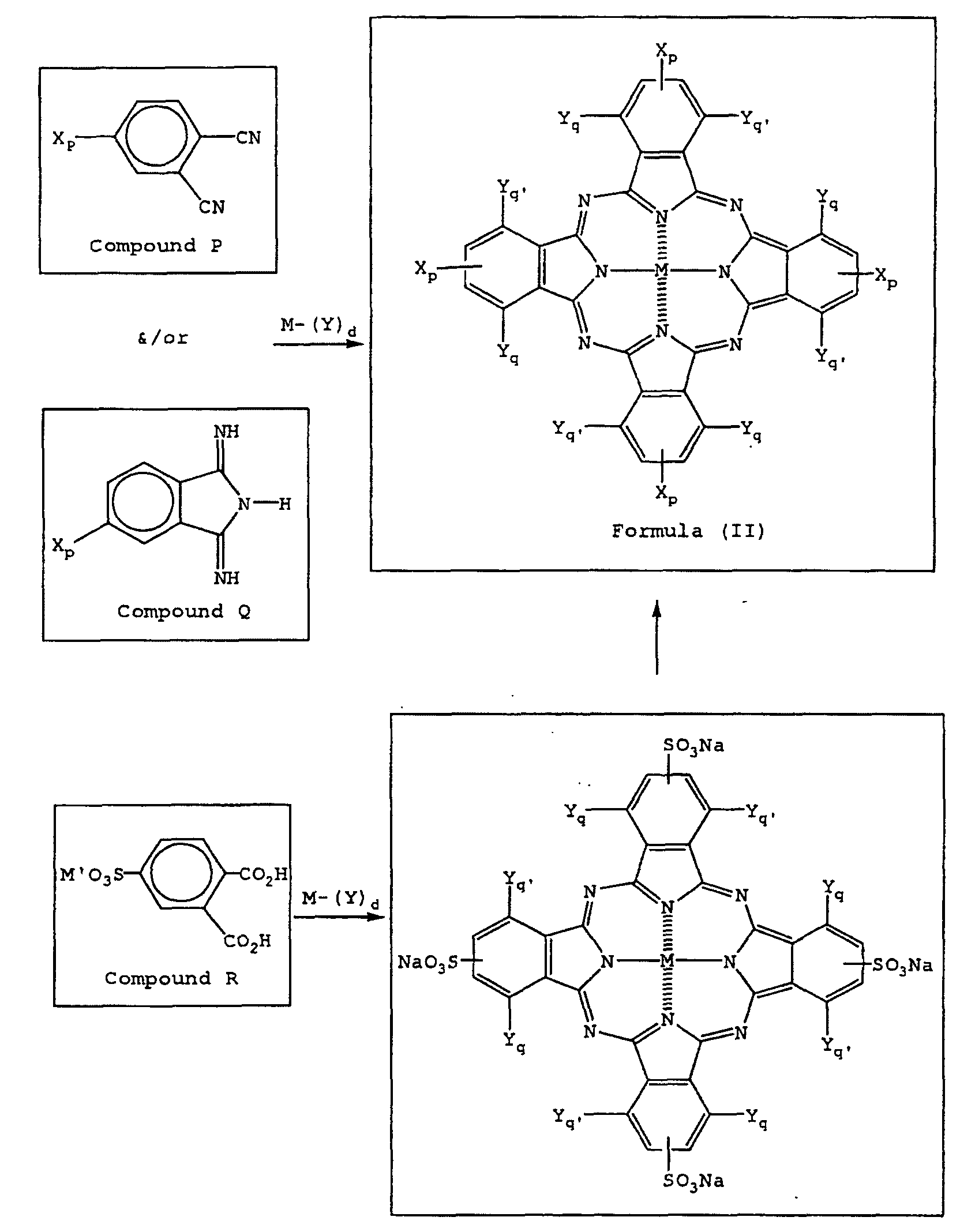
In the formulae above, Xp corresponds to X11, X12, X13
or X14 in formula (II) and Yq and Yq, each corresponds to Y11,
Y12, Y13, Y14, Y15, Y16, Y17 or Y18 in formula (II). In
Compound R, M' represents cation.
Examples of the cation represented by M' include
alkali metal ions such as Li, Na and K, and organic cations
such as triethylammonium ion and pyridinium ion.
Formula (III):
M-(Y)d
wherein M has the same meaning as M in formulae (I) and
(II), Y represents a monovalent or divalent ligand such as
halogen atom, acetate anion, acetylacetonate and oxygen,
and d represents an integer of 1 to 4.
M-(Y)d
That is, according to this synthesis method, a
specific number of desired substituents can be introduced.
Particularly, in the case of introducing a large number of
electron-withdrawing groups so as to render the oxidation
potential nobler as in the present invention, this
synthesis method is very excellent as compared with the
above-described method for synthesizing the phthalocyanine
compound of formula (I).
The thus-obtained phthalocyanine compound represented
by formulae (II) is usually a mixture of compounds
represented by the following formulae (a)-1 to (a)-4 which
are isomers with respect to the substitution site of each
Xp, namely, a β-position substitution type.
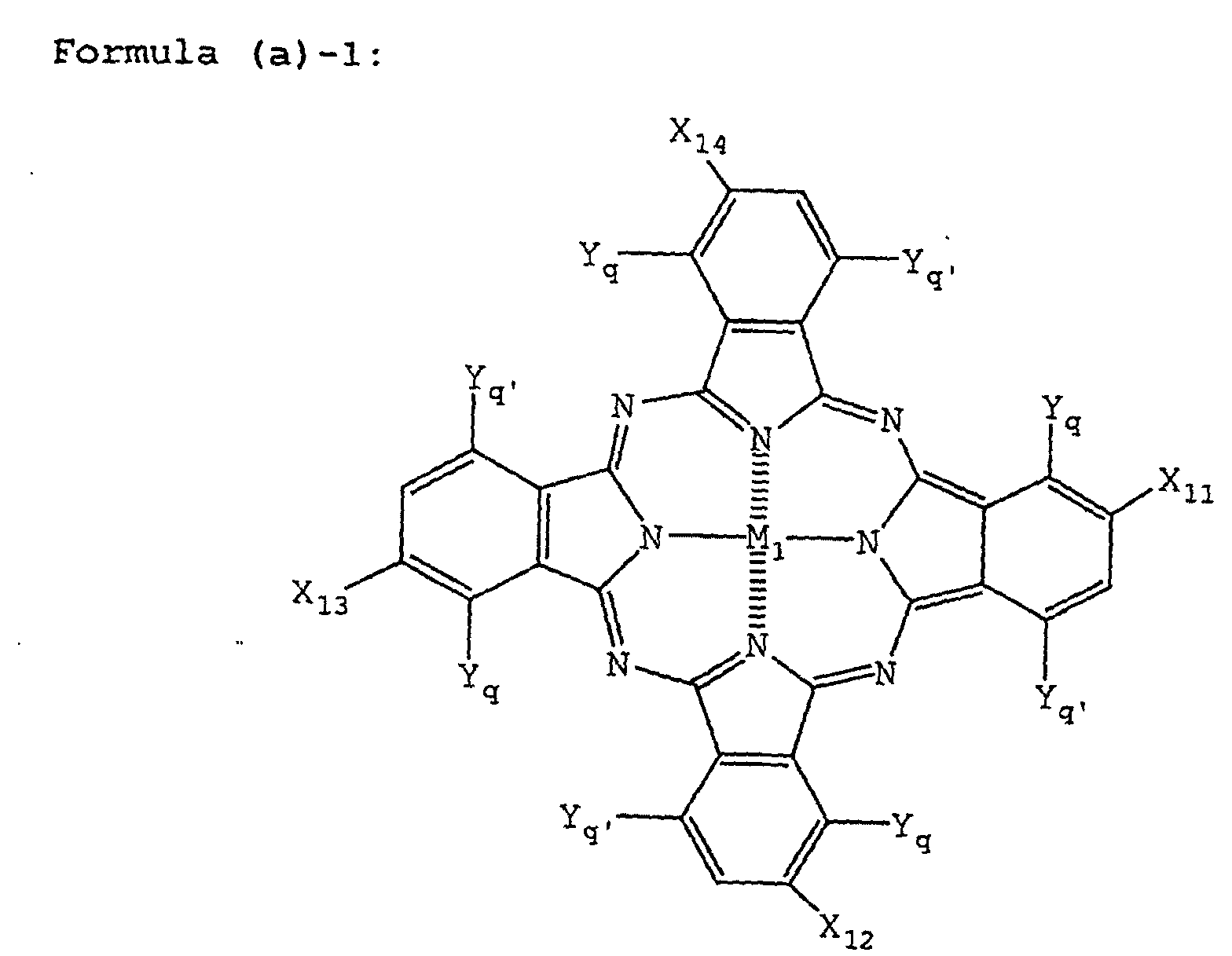
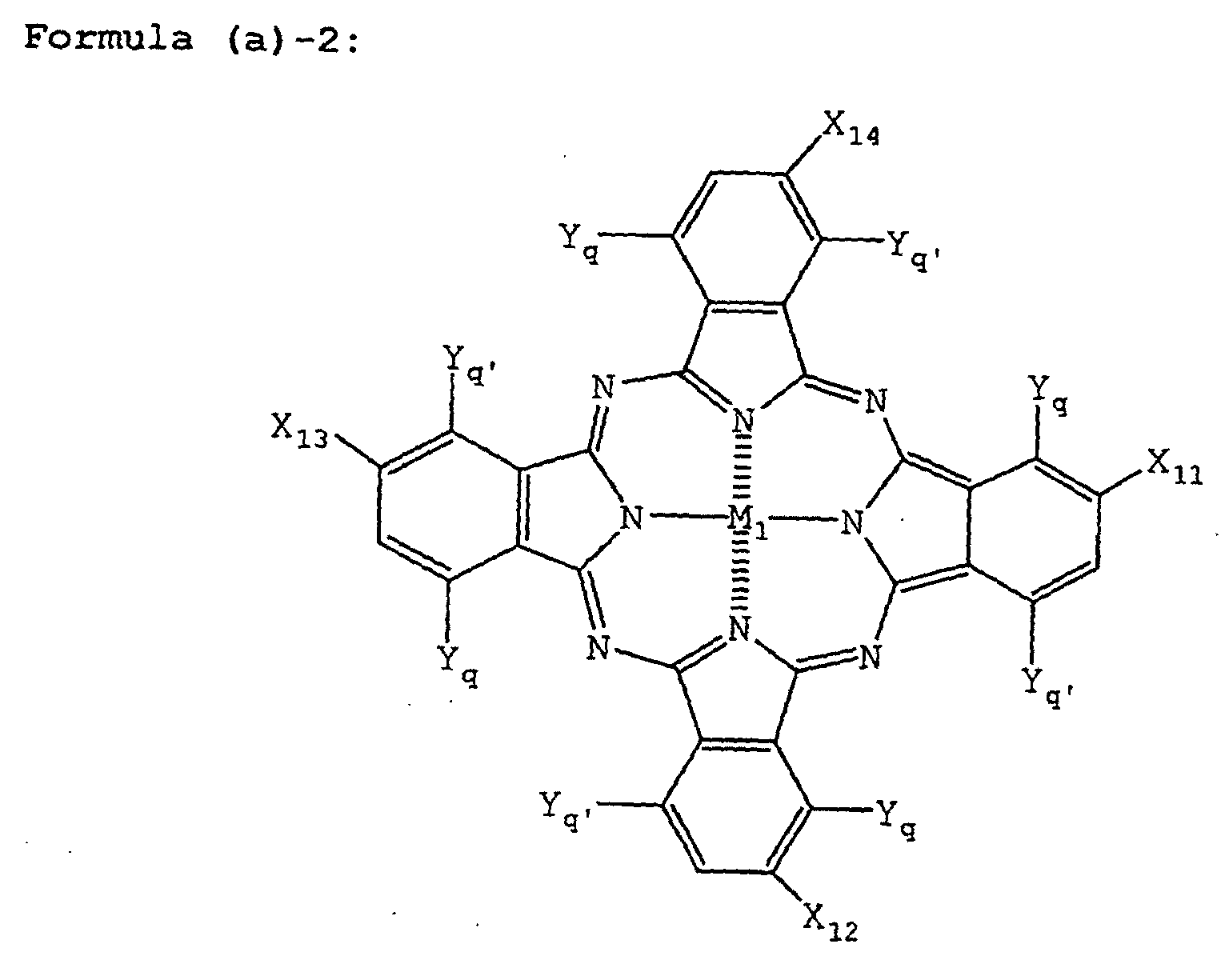

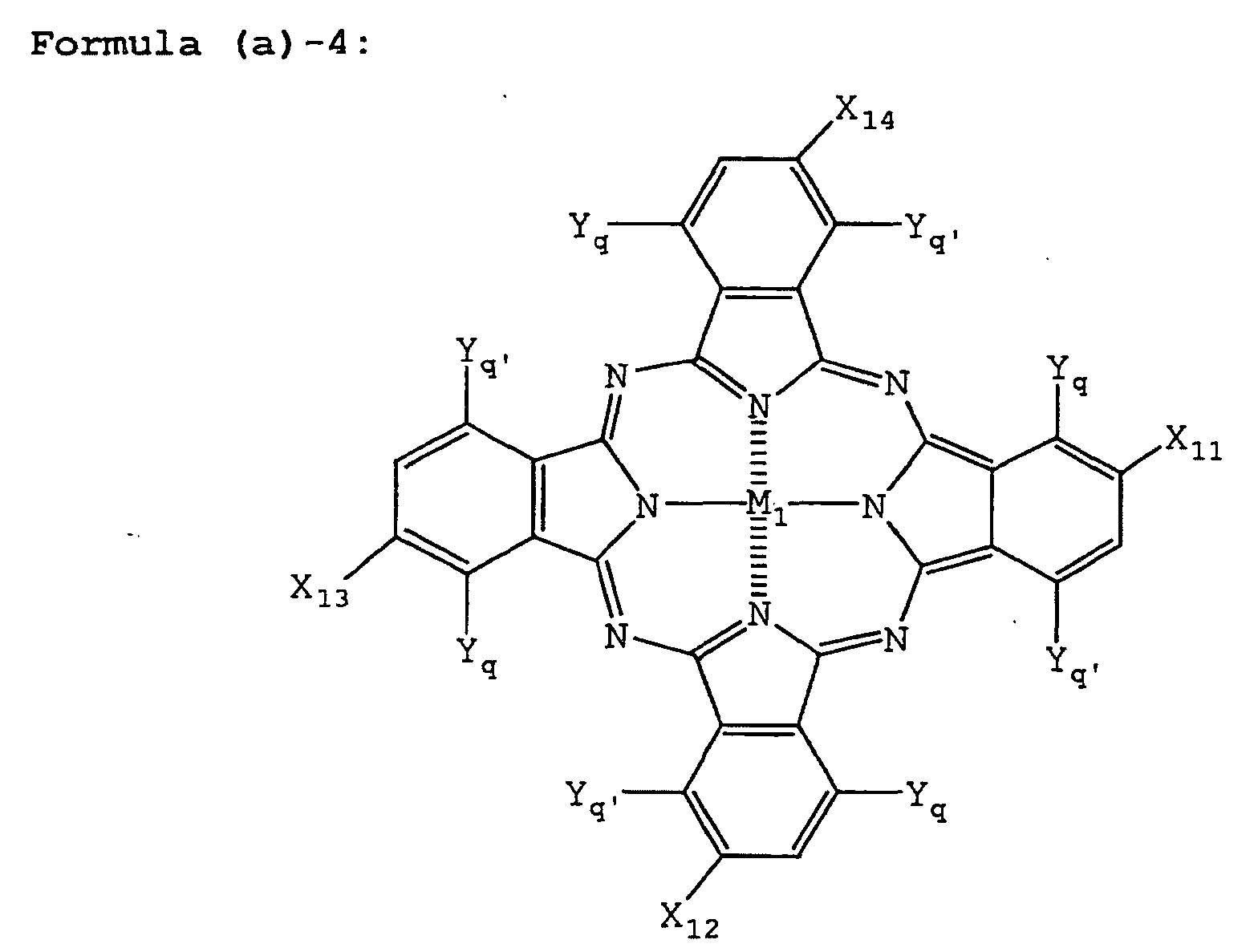
In the synthesis method above, when all Xps are the
same, a β-position substitution type phthalocyanine dye
where X11, X12, X13 and X14 are completely the same
substituents can be obtained. On the other hand, when Xps
are different, a dye having substituents of the same kind
but partially different from each other or a dye having
substituents different from each other can be synthesized.
Among the dyes of formula (II), these dyes having electron-withdrawing
substituents different from each other are
preferred because the solubility and aggregating property
of dye and the aging stability of ink can be controlled.
In the present invention, it has been found very
important for the improvement of fastness that in any
substitution type, the oxidation potential is nobler than
1.0 V (vs SCE). The great effect thereof cannot be
expected at all from the above-described known techniques.
Furthermore, although the reason is not particularly known,
there is a tendency that the β-position substitution type
is apparently more excellent in the color hue, light
fastness, ozone gas resistance and the like than the α,β-position
mixed substitution type.
Specific examples (Compounds I-1 to I-12 and 101 to
190) of the phthalocyanine dyes represented by formulae (I)
and (II) are set forth below, but the phthalocyanine dye
for use in the present invention is not limited to the
following examples.


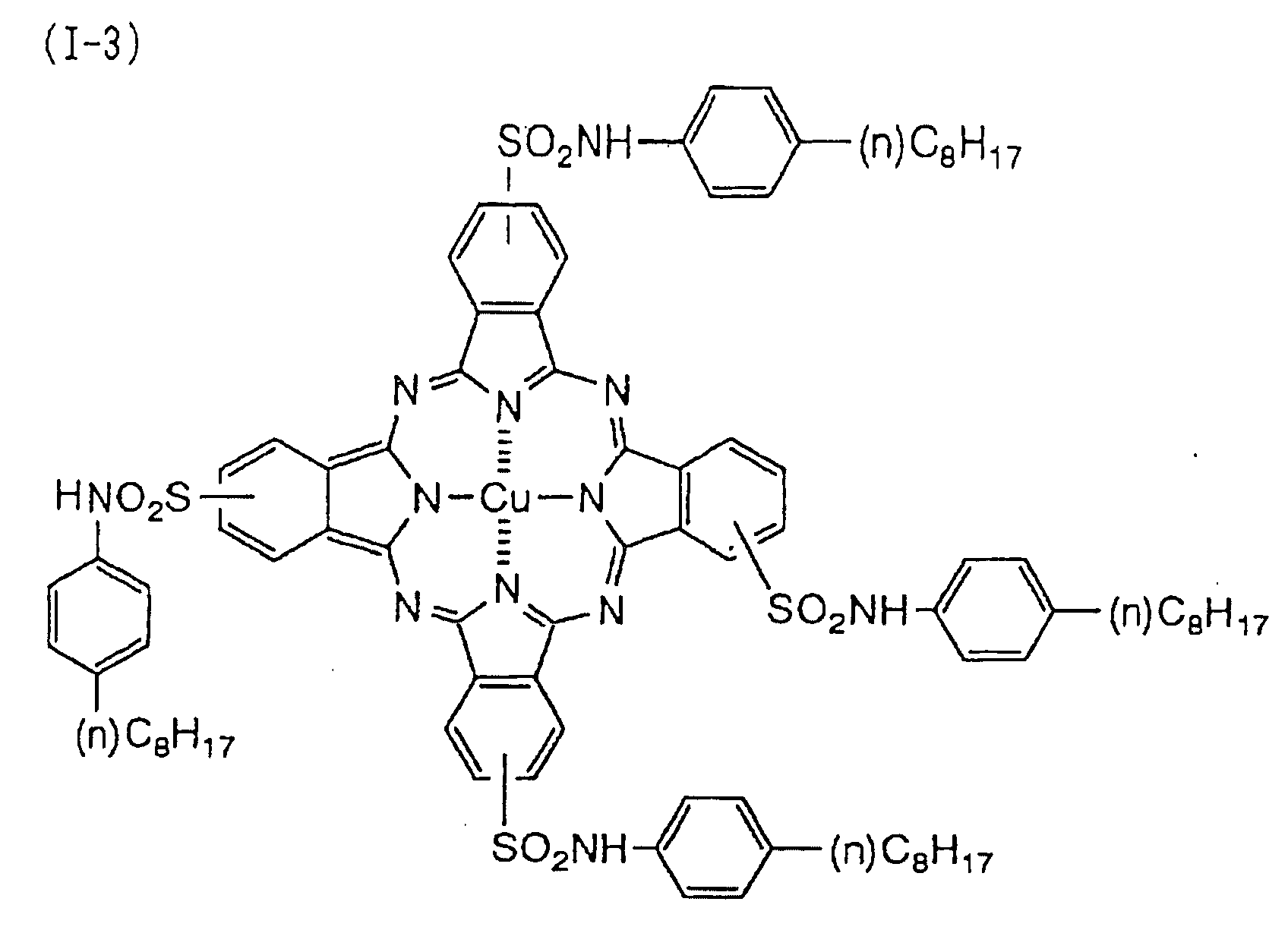


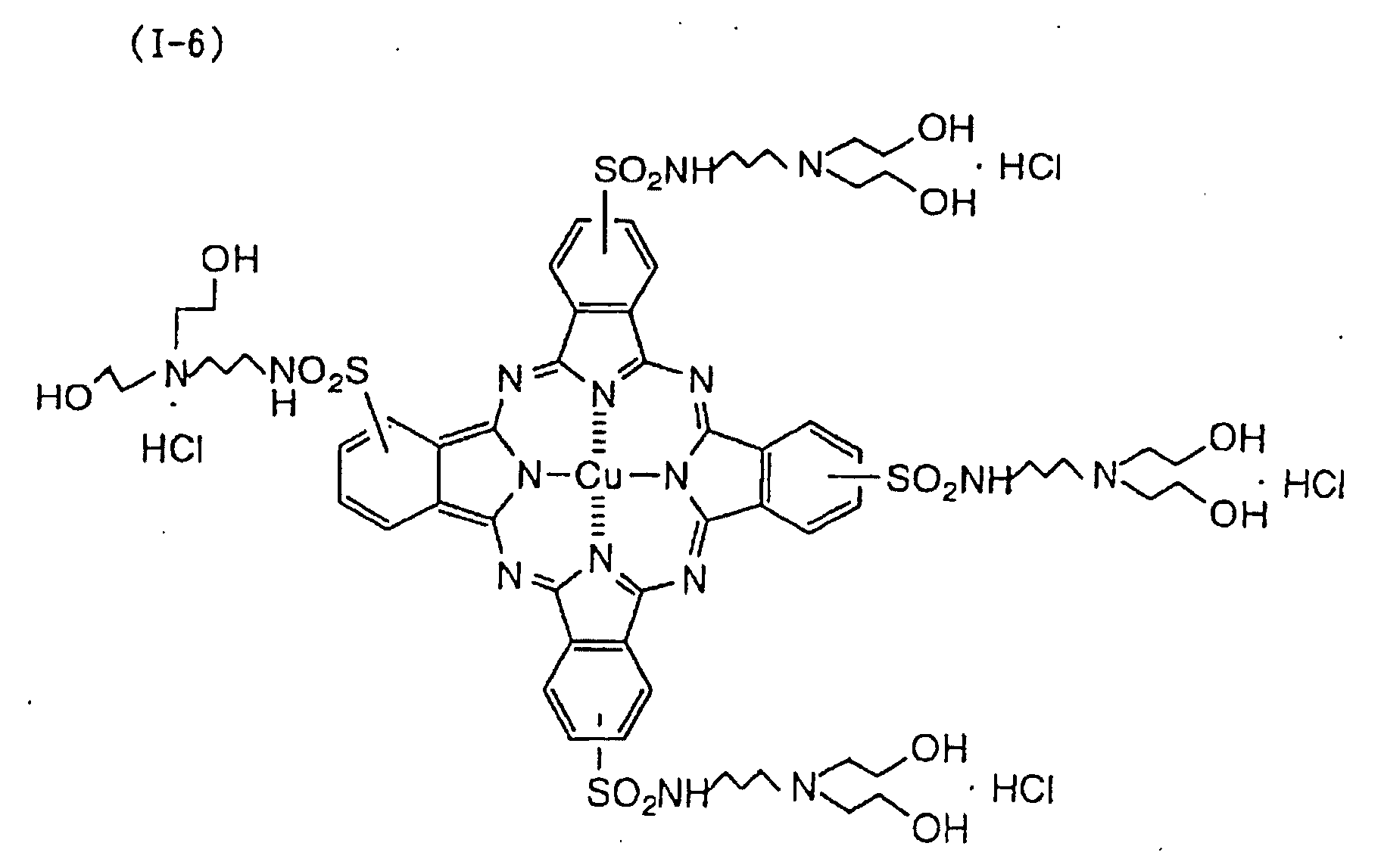


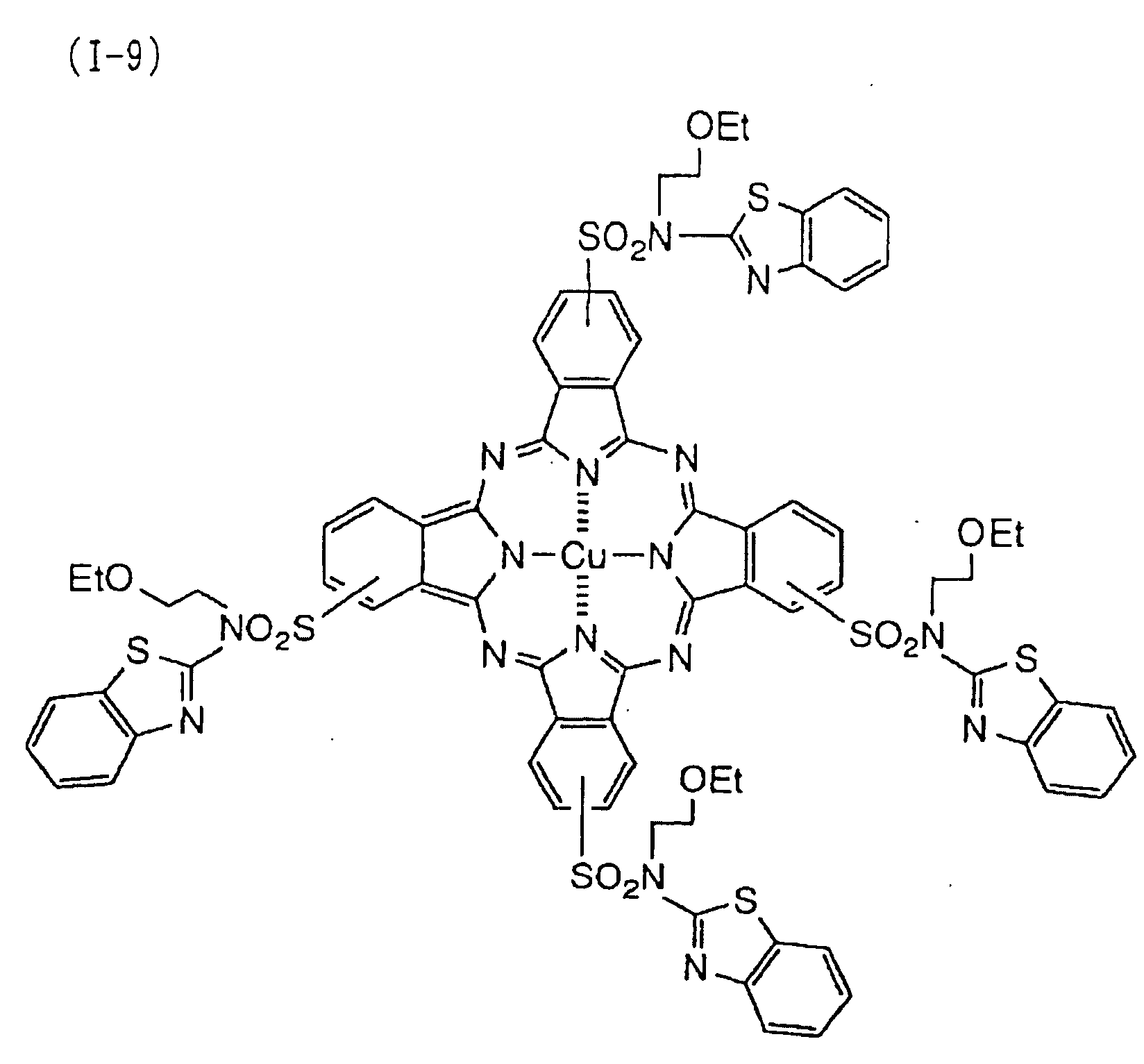
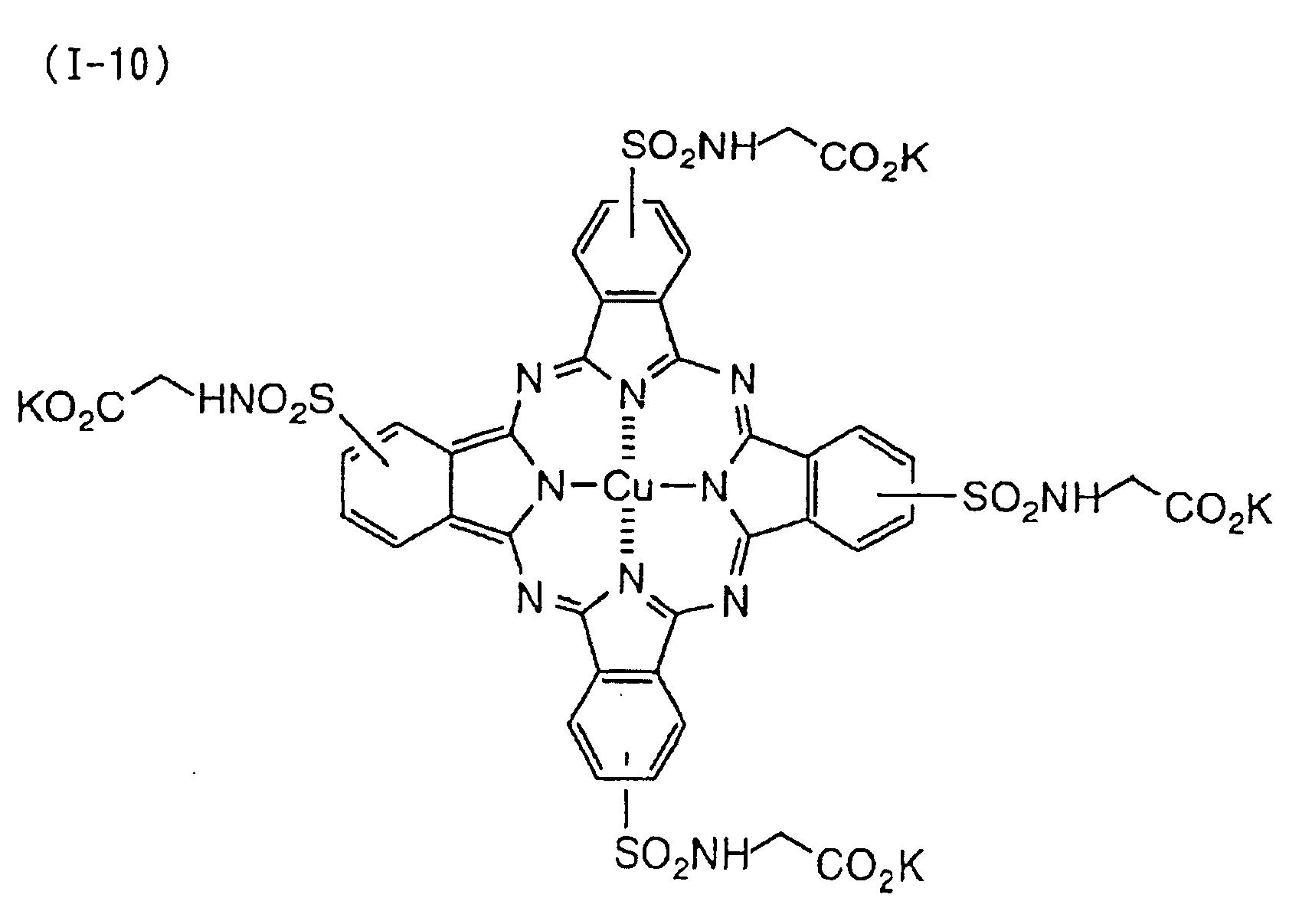
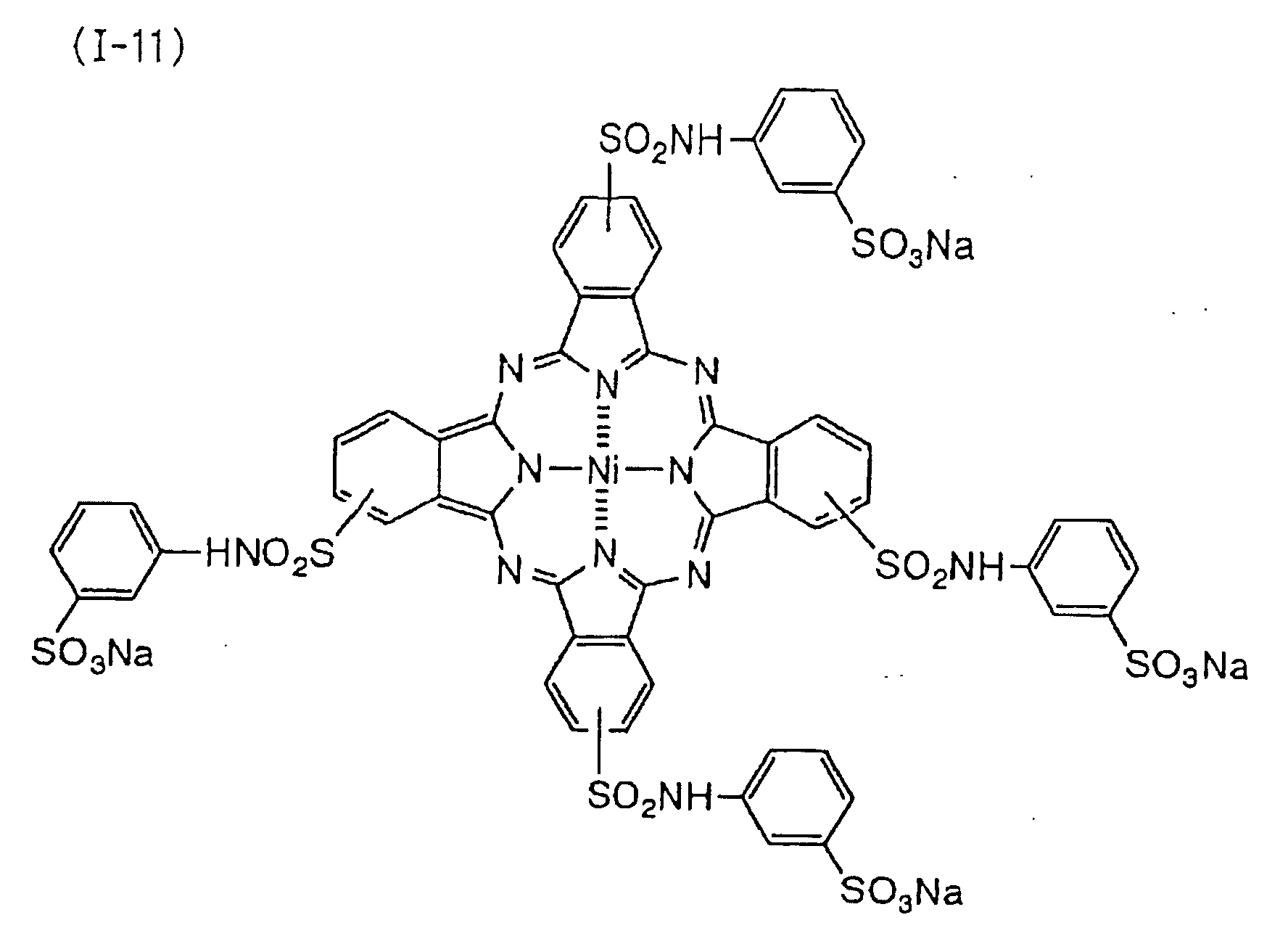
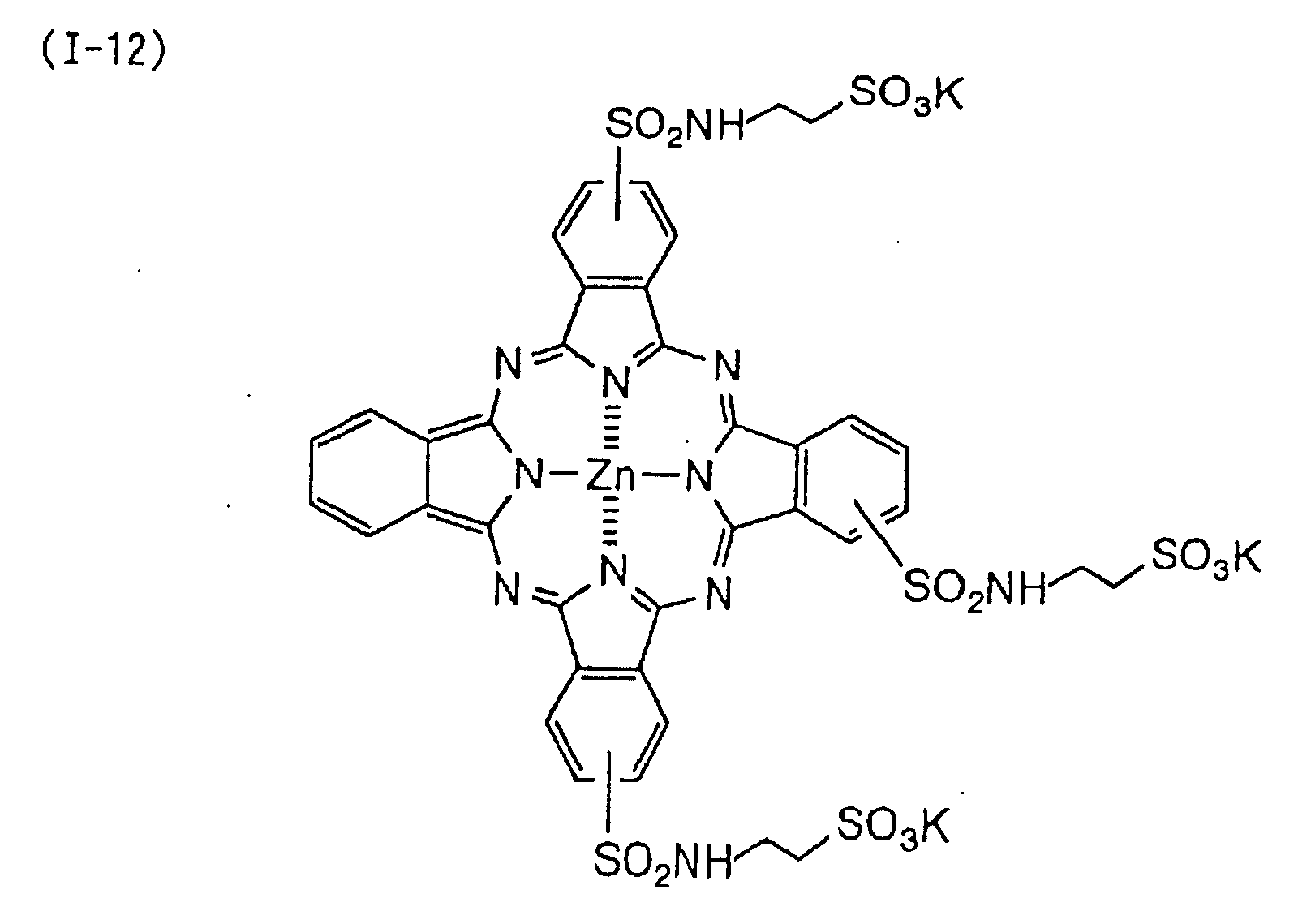
In the following Tables, specific examples of each
pair of (X1, X2), (Y11, Y12), (Y13, Y14), (Y15, Y16) and (Y17,
Y18) are independently in an irregular order.
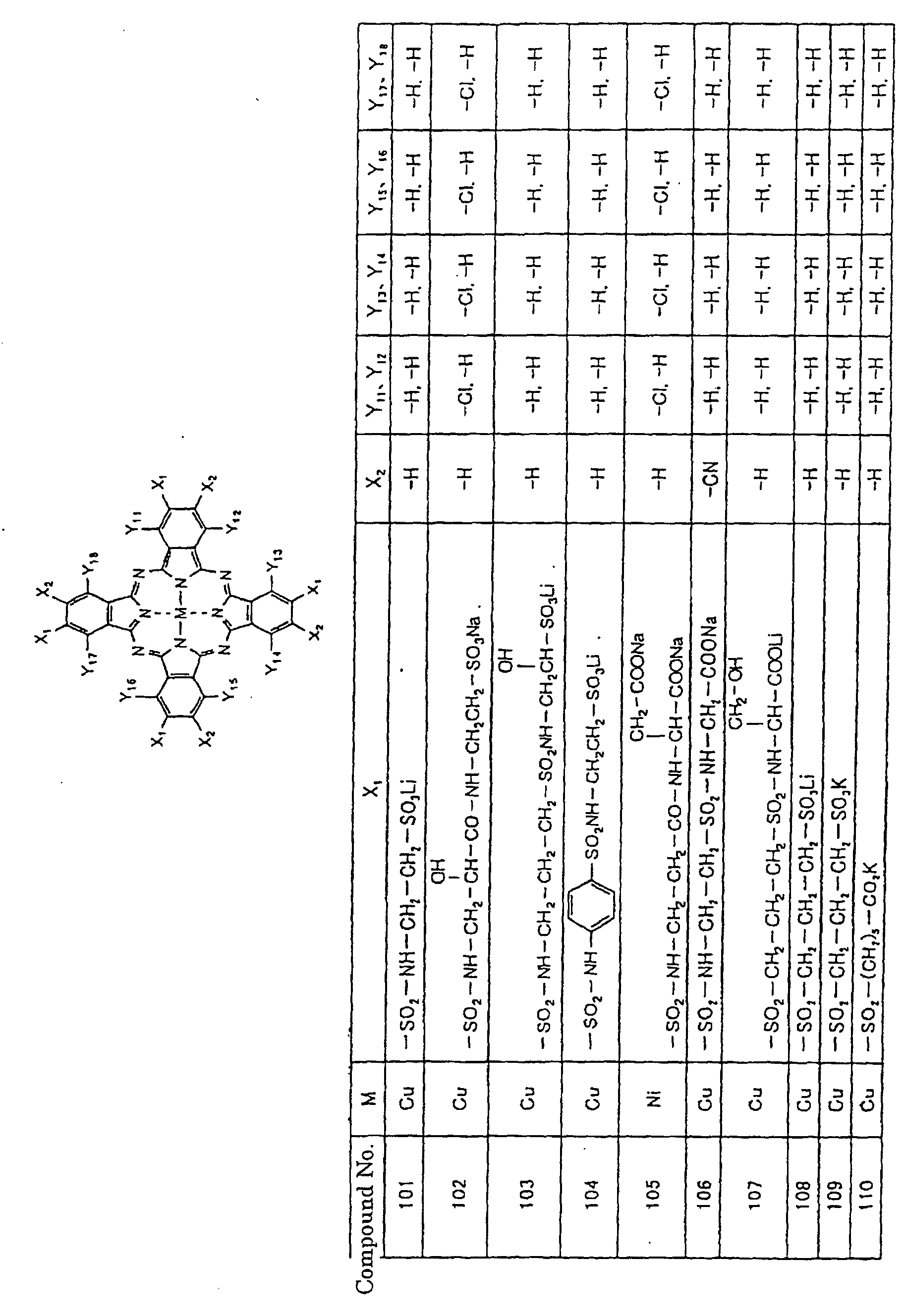

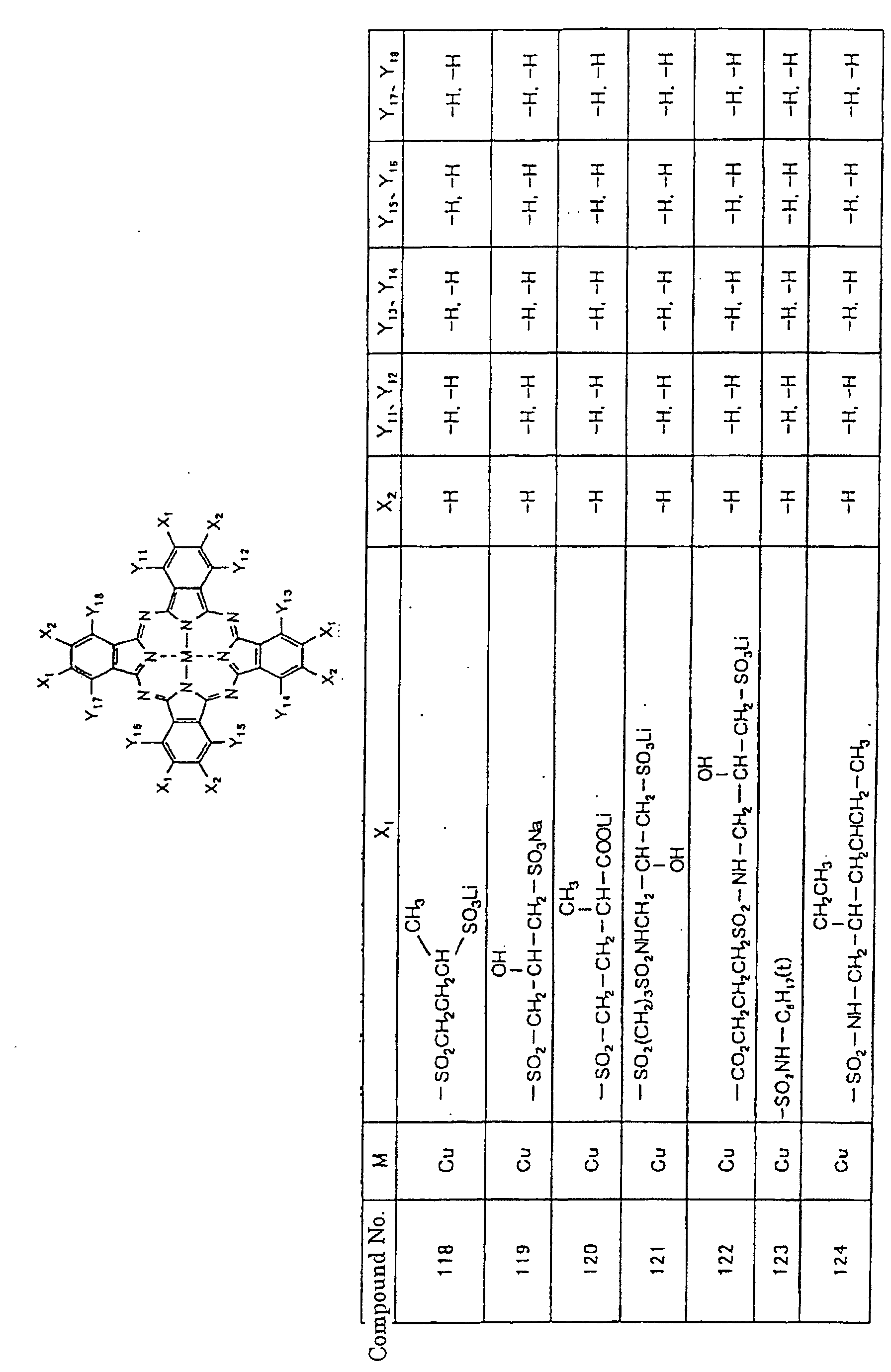

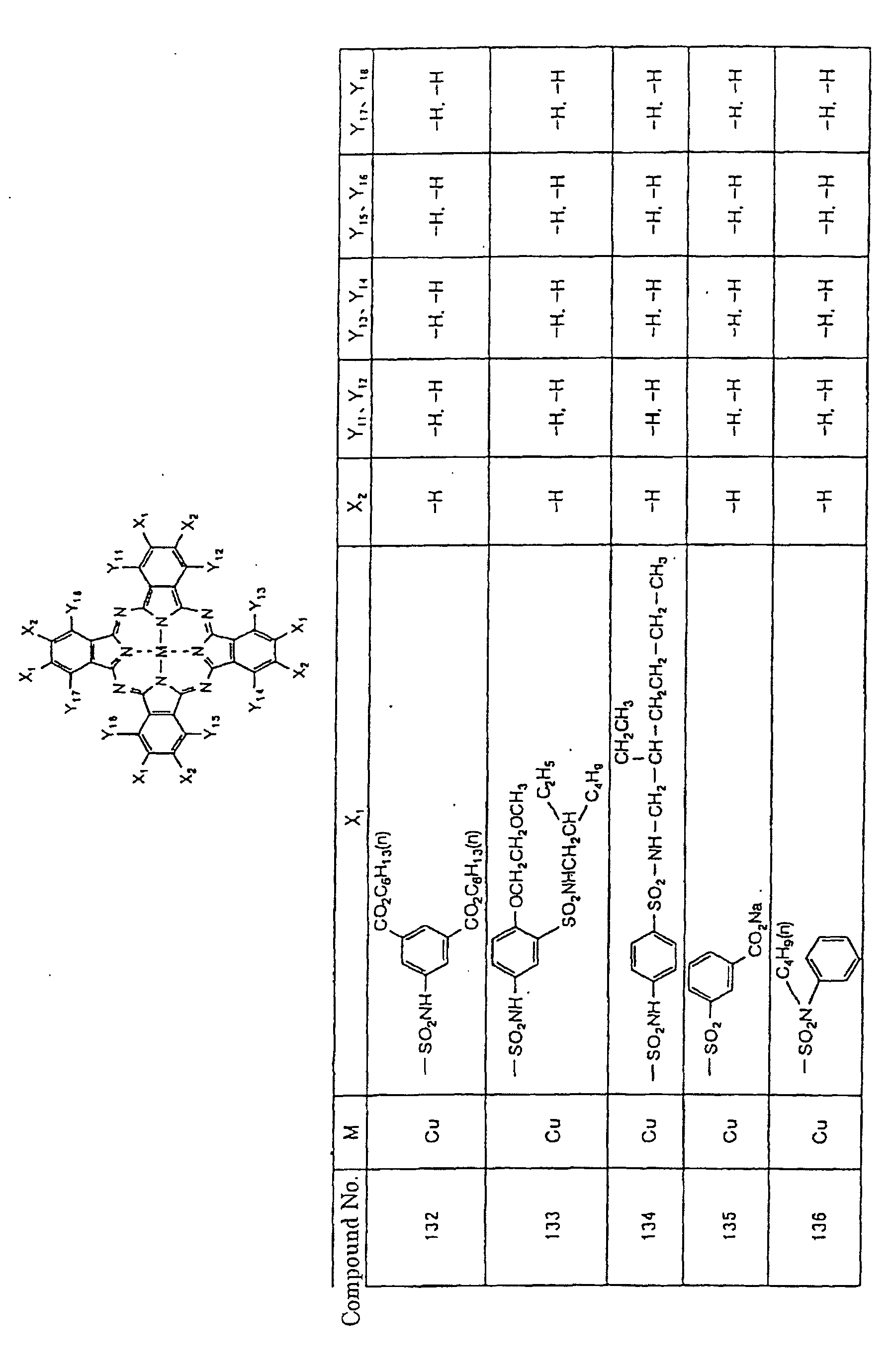

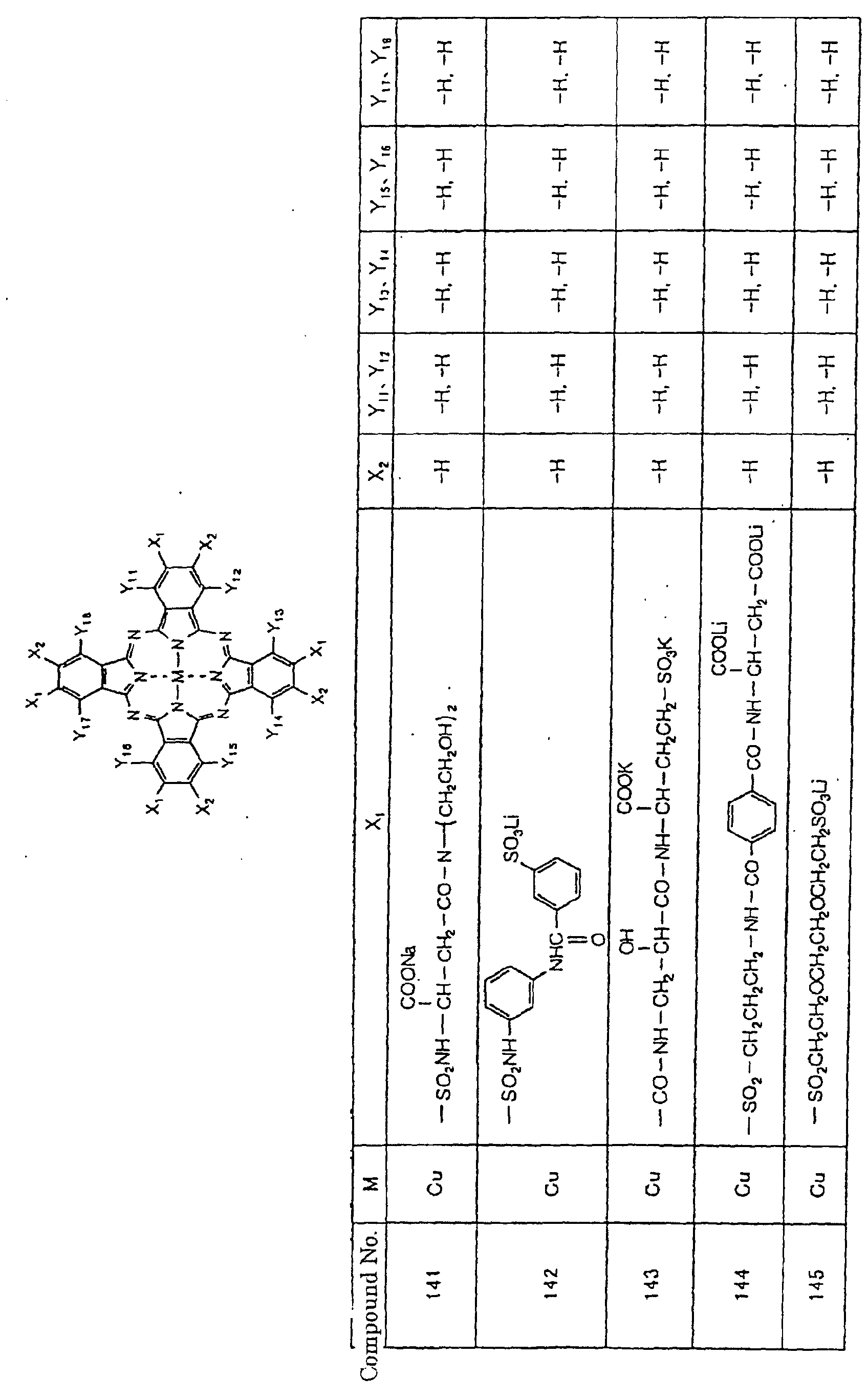
In the following Tables, introduction sites of
respective substituents (R1) and (R2) are in an irregular
order within the β-position substitution type.


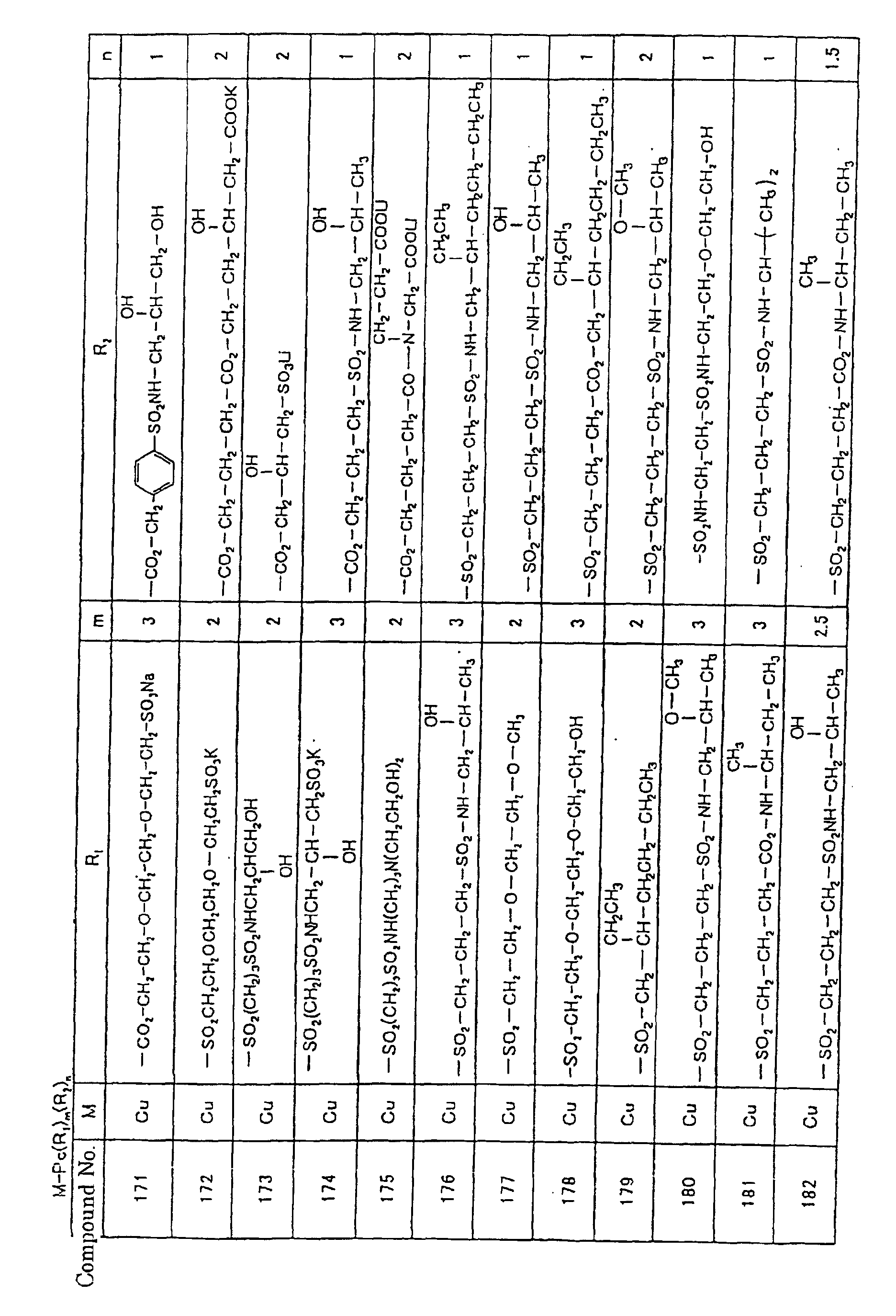

The structure of the phthalocyanine compound
represented by M-Pc(Xp1)m(Xp2)n in Compound Nos. 146 to 190
is shown below:
 (wherein each Xp1 is independently Xp1 or Xp2).
The phthalocyanine dye represented by formula (I) can
be synthesized according to the patent publications
described above. Furthermore, the phthalocyanine dye
represented by formula (II) can be synthesized by the
methods described in JP-A-2001-226275, JP-A-2001-96610, JP-A-2001-47013
and JP-A-2001-193638 in addition to the above-described
synthesis method. The starting material, dye
intermediate and synthesis route are not limited to those
described in these patent publications.
The inkjet recording ink having a main absorption
region of 580 to 680 nm for use in the present invention is
preferably obtained by dissolving or dispersing at least
one phthalocyanine dye described above in an aqueous medium
and in this case, the phthalocyanine dye is preferably
contained in an amount of 0.2 to 20 mass%, more preferably
from 0.5 to 15 mass%.
The ink of the present invention is preferably
constituted to have at least one of the following
characteristic features 1) to 4) so as to prevent the image
from blurring under high-humidity conditions:
In the present invention, the dye for the inkjet
recording ink having a main absorption region of 580 to 680
nm is preferably a substantially water-soluble or water-dispersible
dye. More specifically, the solubility of the
coloring material in water at 20°C is preferably 2 mass% or
more, more preferably 5 mass% or more. In the case of the
phthalocyanine dyes represented by formula (I) for use in
the present invention, the solubility of coloring material
in water at 20°C is preferably 2 mass% or more.
When two or more inks are used in combination as a
set, the dye contained in each ink may be a single dye or a
mixture of dyes. In the case of a mixture of dyes, the ink
containing the dye represented by formula (I) of the
present invention preferably contains the dye represented
by formula (I) in an amount of at least 10 mass% or more.
In preparing an ink set comprising two or more inks,
generally, one ink is produced as a light-type thin ink and
another is produced as a thick ink, but in the present
invention, the inks may be produced as different type inks
in this way or may be produced as inks having almost the
same concentration.
In the magenta ink having a main spectral absorption
region of 500 to 580 nm and the cyan ink having a main
spectral adsorption region of 580 to 680 nm for use in the
present invention, in addition to the above-described
specific dye of formula (1) or (I) preferred in the present
invention, other dyes can be added for the purpose of, for
example, adjusting the color tone. As for the dye which
can be used together in addition to the dye represented by
formula (1) or (I), dyes known in this field such as
triarylmethane dye, anthraquinone dye, anthrapyridone dye,
azomethine dye, azo dye, cyanine dye, merocyanine dye and
oxonol dye can be used individually or in combination.
Also, for constituting an ink set for full color
printing, other inks such as yellow ink and black ink are
used in combination with the magenta and cyan inks of the
present invention and in these inks, respective coloring
matters are used.
Examples of the coloring matter which can be used in
the same ink or in the ink combined include the followings.
Examples of the yellow dye include aryl- or heteryl-azo
dyes having a phenol, a naphthol, an aniline, a
pyrazolone, a pyridone or an open chain-type active
methylene compound as the coupling component; azomethine
dyes having an open chain-type active methylene compound as
the coupling component; methine dyes such as benzylidene
dye and monomethine oxonol dye; and quinone-base dyes such
as naphthoquinone dye and anthraquinone dye. Other
examples of the dye species include quinophthalone dye,
nitro·nitroso dye, acridine dye and acridinone dye. These
dyes may be a dye which provides a yellow color for the
first time when a part of the chromophore is dissociated.
In this case, the counter cation may be an inorganic cation
such as alkali metal and ammonium, an organic cation such
as pyridinium and quaternary ammonium salt, or a polymer
cation having such a cation in the partial structure.
Examples of the magenta dye include aryl- or heteryl-azo
dyes having a phenol, a naphthol or an aniline as the
coupling component; azomethine dyes having a pyrazolone or
a pyrazolotriazole as the coupling component; methine dyes
such as arylidene dye, styryl dye, merocyanine dye and
oxonol dye; carbonium dyes such as diphenylmethane dye,
triphenylmethane dye and xanthene dye; quinone-base dyes
such as naphthoquinone, anthraquinone and anthrapyridone;
and condensed polycyclic dyes such as dioxazine dye. These
dyes may be a dye which provides a magenta color for the
first time when a part of the chromophore is dissociated.
In this case, the counter cation may be an inorganic cation
such as alkali metal and ammonium, an organic cation such
as pyridinium and quaternary ammonium salt, or a polymer
cation having such a cation in the partial structure.
Examples of the cyan dye include azomethine dyes such
as indoaniline dye and indophenol dye; polymethine dyes
such as cyanine dye, oxonol dye and merocyanine dye;
carbonium dyes such as diphenylmethane dye,
triphenylmethane dye and xanthene dye; phthalocyanine dyes;
anthraquinone dyes; aryl- or heteryl-azo dyes having a
phenol, a naphthol or an aniline as the coupling component;
and indigo·thioindigo dyes. These dyes may be a dye which
provides a cyan color for the first time when a part of the
chromophore is dissociated. In this case, the counter
cation may be an inorganic cation such as alkali metal and
ammonium, an organic cation such as pyridinium and
quaternary ammonium salt, or a polymer cation having such a
cation in the partial structure.
A black dye such as polyazo dye can also be used.
Examples of the water-soluble dye include a direct
dye, an acid dye, a food color, a basic dye and a reactive
dye. Preferred examples thereof include C.I. Direct Red 2,
4, 9, 23, 26, 31, 39, 62, 63, 72, 75, 76, 79, 80, 81, 83,
84, 89, 92, 95, 111, 173, 184, 207, 211, 212, 214, 218, 21,
223, 224, 225, 226, 227, 232, 233, 240, 241, 242, 243 and
247; C.I. Direct Violet 7, 9, 47, 48, 51, 66, 90, 93, 94,
95, 98, 100 and 101; C.I. direct Yellow 8, 9, 11, 12, 27,
28, 29, 33, 35, 39, 41, 44, 50, 53, 58, 59, 68, 86, 87, 93,
95, 96, 98, 100, 106, 108, 109, 110, 130, 132, 142, 144,
161 and 163; C.I. Direct Blue 1, 10, 15, 22, 25, 55, 67, 68,
71, 76, 77, 78, 80, 84, 86, 87, 90, 98, 106, 108, 109, 151,
156, 158, 159, 160, 168, 189, 192, 193, 194, 199, 200, 201,
202, 203, 207, 211, 213, 214, 218, 225, 229, 236, 237, 244,
248, 249, 251, 252, 264, 270, 280, 288, 289 and 291; C.I.
Direct Black 9, 17, 19, 22, 32, 51, 56, 62, 69, 77, 80, 91,
94, 97, 108, 112, 113, 114, 117, 118, 121, 122, 125, 132,
146, 154, 166, 168, 173 and 199; C.I. Acid Red 35, 42, 52,
57, 62, 80, 82, 111, 114, 118, 119, 127, 128, 131, 143, 151,
154, 158, 249, 254, 257, 261, 263, 266, 289, 299, 301, 305,
336, 337, 361, 396 and 397; C.I. Acid Violet 5, 34, 43, 47,
48, 90, 103 and 126; C.I. Acid Yellow 17, 19, 23, 25, 39,
40, 42, 44, 49, 50, 61, 64, 76, 79, 110, 127, 135, 143, 151,
159, 169, 174, 190, 195, 196, 197, 199, 218, 219, 222 and
227; C.I. Acid Blue 9, 25, 40, 41, 62, 72, 76, 78, 80, 82,
92, 106, 112, 113, 120, 127:1, 129, 138, 143, 175, 181, 205,
207, 220, 221, 230, 232, 247, 258, 260, 264, 271, 277, 278,
279, 280, 288, 290 and 326; C.I. Acid Black 7, 24, 29, 48,
52:1 and 172; C.I. Reactive Red 3, 13, 17, 19, 21, 22, 23,
24, 29, 35, 37, 40, 41, 43, 45, 49 and 55; C.I. Reactive
Violet 1, 3, 4, 5, 6, 7, 8, 9, 16, 17, 22, 23, 24, 26, 27,
33 and 34; C.I. Reactive Yellow 2, 3, 13, 14, 15, 17, 18,
23, 24, 25, 26, 27, 29, 35, 37, 41 and 42; C.I. Reactive
Blue 2, 3, 5, 8, 10, 13, 14, 15, 17, 18, 19, 21, 25, 26, 27,
28, 29 and 38; C.I. Reactive Black 4, 5, 8, 14, 21, 23, 26,
31, 32 and 34; C.I. Basic Red 12, 13, 14, 15, 18, 22, 23,
24, 25, 27, 29, 35, 36, 38, 39, 45 and 46; C.I. Basic
Violet 1, 2, 3, 7, 10, 15, 16, 20, 21, 25, 27, 28, 35, 37,
39, 40 and 48; C.I. Basic Yellow 1, 2, 4, 11, 13, 14, 15,
19, 21, 23, 24, 25, 28, 29, 32, 36, 39 and 40; C.I. Basic
Blue 1, 3, 5, 7, 9, 22, 26, 41, 45, 46, 47, 54, 57, 60, 62,
65, 66, 69 and 71; and C.I. Basic Black 8.
In the ink composition of the present invention, for
adjusting the color tone so as to obtain a full color image,
other coloring materials can be used together with the
above-described dye. Examples of the other coloring
material which can be used together include the following
pigments.
As the pigment for use in the present invention,
commercially available pigments and known pigments
described in various publications can be used. Examples of
the publication include Color Index, compiled by The
Society of Dyers and Colourists, Kaitei Shin Han Ganryo
Binran (Revised New Handbook of Pigments), compiled by
Nippon Ganryo Gijutsu Kyokai (1989), Saishin Ganryo Oyo
Gijutsu (Newest Pigment Application Technology), CMC
Shuppan (1986), Insatsu Ink Gijutsu (Printing Ink
Technique), CMC Shuppan (1984), and W. Herbst and K. Hunger,
Industrial Organic Pigments, VCH Verlagsgesellschaft (1993).
Specific examples of the pigment include organic pigments
such as azo pigments (e.g., azo lake pigment, insoluble azo
pigment, condensed azo pigment, chelate azo pigment),
polycyclic pigments (e.g., phthalocyanine-base pigment,
anthraquinone-base pigment, perylene-base or perynone-base
pigment, indigo-base pigment, quinacridone-base pigment,
dioxazine-base pigment, isoindolinone-base pigment,
quinophthalone-base pigment, diketopyrrolopyrrole-base
pigment), dyeing lake pigments (lake pigments of acidic or
basic dye) and azine pigments, and inorganic pigments such
as C.I. Pigment Yellow 34, 37, 42 and 53 which are a yellow
pigment, C.I. Pigment Red 101 and 108 which are a red-type
pigment, C.I. Pigment Blue 27, 29 and 17:1 which are a
blue-type pigment, C.I. Pigment Black 7 and magnetite which
are a black-type pigment, and C.I. Pigment White 4, 6, 18
and 21 which are a white-type pigment.
The pigment having a color tone preferred for the
formation of an image includes the followings. As the blue
to cyan pigment, phthalocyanine pigments, anthraquinone-type
indanthrone pigments (for example, C.I. Pigment Blue
60) and dyeing lake pigment-type triarylcarbonium pigments
are preferred, and phthalocyanine pigments are most
preferred (preferred examples thereof include copper
phthalocyanine such as C.I. Pigment Blue 15:1, 15:2, 15:3,
15:4 and 15:6, monochloro or low chlorinated copper
phthalocyanine, aluminum phthalocyanine such as pigments
described in European Patent 860475, nonmetallic
phthalocyanine such as C.I. Pigment Blue 16, and
phthalocyanine with the center metal being Zn, Ni or Ti,
and among these, C.I. Pigment Blue 15:3 and 15:4 and
aluminum phthalocyanine are more preferred).
As the red to violet pigment, azo pigments (preferred
examples thereof include C.I. Pigment Red 3, 5, 11, 22, 38,
48:1, 48:2, 48:3, 48:4, 49:1, 52:1, 53:1, 57:1, 63:2, 144,
146 and 184, and among these, C.I. Pigment Red 57:1, 146
and 184 are more preferred), quinacridone-base pigments
(preferred examples thereof include C.I. Pigment Red 122,
192, 202, 207 and 209 and C.I. Pigment Violet 19 and 42,
and among these, C.I. Pigment Red 122 is more preferred),
dyeing lake pigment-type triarylcarbonium pigments
(preferred examples thereof include xanthene-base C.I.
Pigment Red 81:1 and C.I. Pigment Violet 1, 2, 3, 27 and
39), dioxazine-base pigments (for example, C.I. Pigment
Violet 23 and 37), diketopyrrolopyrrole-base pigments (for
example, C.I. Pigment Red 254), perylene pigments (for
example, C.I. Pigment Violet 29), anthraquinone-base
pigments (for example, C.I. Pigment Violet 5:1, 31 and 33)
and thioindigo-base pigments (for example, C.I. Pigment Red
38 and 88) are preferred.
As the yellow pigment, azo pigments (preferred
examples thereof include monoazo pigment-type C.I. Pigment
Yellow 1, 3, 74 and 98, disazo pigment-type C.I. Pigment
Yellow 12, 13, 14, 16, 17 and 83, synthetic azo-type C.I.
Pigment 93, 94, 95, 128 and 155, and benzimidazolone-type
C.I. Pigment Yellow 120, 151, 154, 156 and 180, and among
these, those not using a benzidine-base compound as a raw
material are more preferred), isoindoline·isoindolinone-base
pigments (preferred examples thereof include C.I.
Pigment Yellow 109, 110, 137 and 139), quinophthalone
pigments (preferred examples thereof include C.I. Pigment
Yellow 138) and flavanthrone pigments (for example, C.I.
Pigment Yellow 24) are preferred.
As the black pigment, inorganic pigments (preferred
examples thereof include carbon black and magnetite) and
aniline black are preferred.
Other than these, an orange pigment (for example, C.I.
Pigment Orange 13 and 16) and a green pigment (for example,
C.I. Pigment Green 7) may be used.
The above-described pigment which can be used in the
present invention may be used as it is or may be subjected
to a surface treatment. For the surface treatment, a
method of coating the surface with resin or wax, a method
of attaching a surfactant, and a method of binding a
reactive substance (for example, a radical generated from a
silane coupling agent, an epoxy compound, polyisocyanate or
a diazonium salt) to the pigment surface may be used and
these are described in the following publications and
patents:
Particularly, self-dispersible pigments prepared by
allowing a diazonium salt to act on carbon black described
in U.S. patents of (4) and capsulated pigments prepared by
the method described in Japanese patent publications of (5)
are effective, because dispersion stability can be obtained
without using an excess dispersant in the ink.
In the present invention, the pigment may be
dispersed by further using a dispersant. Various known
dispersants can be used according to the pigment used, for
example, a surfactant-type low molecular dispersant or a
polymer-type dispersant can be used. Examples of the
dispersant include those described in JP-A-3-69949 and
European Patent 549486. In using the dispersant, a pigment
derivative called synergist may also be added so as to
accelerate the adsorption of dispersant to the pigment.
The particle size of the pigment which can be used in
the present invention is, after dispersion, preferably from
0.01 to 10 µm, more preferably from 0.05 to 1 µm.
As for the method of dispersing the pigment, known
dispersion techniques used for the production of ink or
toner can be used. Examples of the dispersing machine
include vertical or horizontal agitator mill, attritor,
colloid mill, ball mill, three-roll mill, pearl mill,
super-mill, impeller, disperser, KD mill, dynatron and
pressure kneader. These are described in detail in Saishin
Ganryo Oyo Gijutsu (Newest Pigment Application Technology),
CMC Shuppan (1986).
Other components which can be contained in the inkjet
recording ink composition of the present invention are
described below.
The inkjet recording ink of the present invention may
contain a surfactant. By containing a surfactant, the
liquid properties of ink are controlled and this can
provide excellent effects such as enhancement of ejection
stability of ink, improvement of water resistance of image,
and prevention of bleeding of printed ink.
Examples of the surfactant include anionic
surfactants such as sodium dodecylsulfate, sodium
dodecyloxysulfonate and sodium alkylbenzenesulfonate,
cationic surfactants such as cetylpyridinium chloride,
trimethylcetylammonium chloride and tetrabutylammonium
chloride, and nonionic surfactants such as polyoxyethylene
nonylphenyl ether, polyoxyethylene naphthyl ether and
polyoxyethylene octylphenyl ether. Among these, nonionic
surfactants are preferred.
The surfactant content in the ink is from 0.001 to 15
mass%, preferably from 0.005 to 10 mass%, more preferably
from 0.01 to 5 mass%.
The inkjet recording ink of the present invention can
be prepared by dissolving and/or dispersing the above-described
phthalocyanine dye and the surfactant in an
aqueous medium. The term "aqueous medium" as used in the
present invention means water or a mixture of water and a
small amount of water-miscible organic solvent, where
additives such as wetting agent, stabilizer and antiseptic
are added, if desired.
Examples of the water-miscible organic solvent which
can be used in the present invention include alcohols (e.g.,
methanol, ethanol, propanol, isopropanol, butanol,
isobutanol, sec-butanol, tert-butanol, pentanol, hexanol,
cyclohexanol, benzyl alcohol), polyhydric alcohols (e.g.,
ethylene glycol, diethylene glycol, triethylene glycol,
polyethylene glycol, propylene glycol, dipropylene glycol,
polypropylene glycol, butylene glycol, hexanediol,
pentanediol, glycerin, hexanetriol, thiodiglycol), glycol
derivatives (e.g., ethylene glycol monomethyl ether,
ethylene glycol monoethyl ether, ethylene glycol monobutyl
ether, diethylene glycol monomethyl ether, diethylene
glycol monobutyl ether, propylene glycol monomethyl ether,
propylene glycol monobutyl ether, dipropylene glycol
monomethyl ether, triethylene glycol monomethyl ether,
ethylene glycol diacetate, ethylene glycol monomethyl ether
acetate, triethylene glycol monomethyl ether, triethylene
glycol monoethyl ether, ethylene glycol monophenyl ether),
amines (e.g., ethanolamine, diethanolamine, triethanolamine,
N-methyldiethanolamine, N-ethyldiethanolamine, morpholine,
N-ethylmorpholine, ethylenediamine, diethylenetriamine,
triethylenetetramine, polyethyleneimine, tetramethylpropylenediamine)
and other polar solvents (e.g., formamide,
N,N-dimethylformamide, N,N-dimethylacetamide, dimethylsulfoxide,
sulfolane, 2-pyrrolidone, N-methyl-2-pyrrolidone,
N-vinyl-2-pyrrolidone, 2-oxazolidone, 1,3-dimethyl-2-imidazolidinone,
acetonitrile, acetone). These water-miscible
organic solvents can be used in combination of two
or more thereof.
In the case where the phthalocyanine dye or other dye
which can be used in the present invention is an oil-soluble
dye, the ink can be prepared by dissolving the oil-soluble
dye in a high boiling point organic solvent and
emulsion-dispersing it in an aqueous medium.
The high boiling point organic solvent for use in the
present invention has a boiling point of 150°C or more,
preferably 170°C or more.
Examples of the high boiling point organic solvent
include phthalic acid esters (e.g., dibutyl phthalate,
dioctyl phthalate, dicyclohexyl phthalate, di-2-ethylhexyl
phthalate, decyl phthalate, bis(2,4-di-tert-amylphenyl)
isophthalate, bis(1,1-diethylpropyl) phthalate), esters of
phosphoric acid or phosphone (e.g., diphenyl phosphate,
triphenyl phosphate, tricresyl phosphate, 2-ethylhexyldiphenyl
phosphate, dioctylbutyl phosphate,
tricyclohexyl phosphate, tri-2-ethylhexyl phosphate,
tridodecyl phosphate, di-2-ethylhexylphenyl phosphate),
benzoic acid esters (e.g., 2-ethylhexyl benzoate, 2,4-dichlorobenzoate,
dodecyl benzoate, 2-ethylhexyl-p-hydroxybenzoate),
amides (e.g., N,N-diethyldodecanamide,
N,N-diethyllaurylamide), alcohols or phenols (e.g.,
isostearyl alcohol, 2,4-di-tert-amylphenol), aliphatic
esters (e.g., dibutoxyethyl succinate, di-2-ethylhexyl
succinate, 2-hexyldecyl tetradecanoate, tributyl citrate,
diethyl azelate, isostearyl lactate, trioctyl citrate),
aniline derivatives (e.g., N,N-dibutyl-2-butoxy-5-tert-octylaniline),
chlorinated paraffins (e.g., paraffins
having a chlorine content of 10 to 80%), trimesic acid
esters (e.g., tributyl trimesate), dodecylbenzene,
diisopropylnaphthalene, phenols (e.g., 2,4-di-tert-amylphenol,
4-dodecyloxyphenol, 4-dodecyloxycarbonylphenol, 4-(4-dodecyloxyphenylsulfonyl)phenol),
carboxylic acids (e.g.,
2-(2,4-di-tert-amylphenoxy)butyric acid, 2-ethoxyoctane-decanoic
acid) and alkylphosphoric acids (e.g., di-(2-ethylhexyl)phosphoric
acid and diphenylphosphoric acid).
The high boiling point organic solvent can be used in an
amount of, in terms of mass ratio to the oil-soluble dye,
from 0.01 to 3 times, preferably from 0.01 to 1.0 times.
These high boiling point organic solvents may be used
individually or as a mixture of several kinds [for example,
tricresyl phosphate and dibutyl phthalate, trioctyl
phosphate and di(2-ethylhexyl) sebacate, or dibutyl
phthalate and poly(N-tert-butylacrylamide)].
Examples of the high boiling point organic solvent
for use in the present invention, other than the above-described
compounds, and/or the synthesis method of these
high boiling point organic solvents are described in U.S.
Patents 2,322,027, 2,533,514, 2,772,163, 2,835,579,
3,594,171, 3,676,137, 3,689,271, 3,700,454, 3,748,141,
3,764,336, 3,765,897, 3,912,515, 3,936,303, 4,004,928,
4,080,209, 4,127,413, 4,193,802, 4,207,393, 4,220,711,
4,239,851, 4,278,757, 4,353,979, 4,363,873, 4,430,421,
4,430,422, 4,464,464, 4,483,918, 4,540,657, 4,684,606,
4,728,599, 4,745,049, 4,935,321 and 5,013,639, EP-A-276319,
EP-A-286253, EP-A-289820, EP-A-309158, EP-A-309159, EP-A-309160,
EP-A-509311, EP-A-510576, East German Patents
147,009, 157,147, 159,573 and 225,240A, British Patent
2091124A, JP-A-48-47335, JP-A-50-26530, JP-A-51-25133, JP-A-51-26036,
JP-A-51-27921, JP-A-51-27922, JP-A-51-149028,
JP-A-52-46816, JP-A-53-1520, JP-A-53-1521, JP-A-53-15127,
JP-A-53-146622, JP-A-54-91325, JP-A-54-106228, JP-A-54-118246,
JP-A-55-59464, JP-A-56-64333, JP-A-56-81836, JP-A-59-204041,
JP-A-61-84641, JP-A-62-118345, JP-A-62-247364,
JP-A-63-167357, JP-A-63-214744, JP-A-63-301941, JP-A-64-9452,
JP-A-64-9454, JP-A-64-68745, JP-A-1-101543, JP-A-1-102454,
JP-A-2-792, JP-A-2-4239, JP-A-2-43541, JP-A-4-29237,
JP-A-4-30165, JP-A-4-232946 and JP-A-4-346338.
The high boiling point organic solvent is used in an
amount of, in terms of mass ratio to the oil-soluble dye,
from 0.01 to 3.0 times, preferably from 0.01 to 1.0 times.
In the present invention, the oil-soluble dye or high
boiling point organic solvent is used by emulsion-dispersing
it in an aqueous medium. Depending on the case,
a low boiling point organic solvent may be used at the
emulsion-dispersion in view of emulsifiability. The low
boiling point organic solvent is an organic solvent having
a boiling point of about 30 to 150°C under atmospheric
pressure. Preferred examples thereof include, but are not
limited to, esters (e.g., ethyl acetate, butyl acetate,
ethyl propionate, β-ethoxyethyl acetate, methylcellosolve
acetate), alcohols (e.g., isopropyl alcohol, n-butyl
alcohol, secondary butyl alcohol), ketones (e.g., methyl
isobutyl ketone, methyl ethyl ketone, cyclohexanone),
amides (e.g., dimethylformamide, N-methylpyrrolidone) and
ethers (e.g., tetrahydrofuran, dioxane).
In the emulsion-dispersion, an oil phase obtained by
dissolving the dye in a high boiling organic solvent or
depending on the case, in a mixed solvent of a high boiling
organic solvent and a low boiling organic solvent is
dispersed in an aqueous phase mainly comprising water to
form fine oil droplets of the oil phase. At this time, in
either one or both of the aqueous phase and the oil phase,
additives described later, such as surfactant, wetting
agent, dye stabilizer, emulsification stabilizer,
antiseptic and fungicide, can be added, if desired.
In the general emulsification method, an oil phase is
added to an aqueous phase, but a so-called phase inversion
emulsification method of adding dropwise an aqueous phase
in an oil phase can also be preferably used.
In performing the emulsion-dispersion of the present
invention, various surfactants can be used. Preferred
examples thereof include anionic surfactants such as fatty
acid salt, alkylsulfuric ester salt, alkylbenzenesulfonate,
alkylnaphthalenesulfonate, dialkylsulfosuccinate, alkylphosphoric
ester salt, naphthalenesulfonic acid formalin
condensate and polyoxyethylene alkylsulfuric ester salt,
and nonionic surfactants such as polyoxyethylene alkyl
ether, polyoxyethylene alkylallyl ether, polyoxyethylene
fatty acid ester, sorbitan fatty acid ester,
polyoxyethylene sorbitan fatty acid ester, polyoxyethylene
alkylamine, glycerin fatty acid ester and oxyethylene
oxypropylene block copolymer. Also, SURFYNOLS (produced by
Air Products & Chemicals), which are an acetylene-base
polyoxyethylene oxide surfactant, are preferably used.
Furthermore, amine oxide-type amphoteric surfactants such
as N,N-dimethyl-N-alkylamine oxide are preferred. In
addition, surfactants described in JP-A-59-157636 (pages
(37) to (38)) and Research Disclosure, No. 308119 (1989)
can also be used.
For the purpose of stabilizing the dispersion
immediately after emulsification, a water-soluble polymer
may be added in combination with the surfactant. Preferred
examples of the water-soluble polymer include polyvinyl
alcohol, polyvinylpyrrolidone, polyethylene oxide,
polyacrylic acid, polyacrylamide and copolymers thereof.
Other than these, natural water-soluble polymers such as
polysaccharides, casein and gelatin are also preferably
used. Furthermore, for the stabilization of dye dispersion,
a polymer which does not substantially dissolve in an
aqueous medium, such as polyvinyl, polyurethane, polyester,
polyamide, polyurea and polycarbonate obtained by the
polymerization of acrylic acid esters, methacrylic acid
esters, vinyl esters, acrylamides, methacrylamides, olefins,
styrenes, vinyl ethers or acrylonitriles, can also be used
in combination. This polymer preferably contains -SO2-
or -COO-. In the case of using this polymer which does not
substantially dissolve in an aqueous medium, the polymer is
preferably used in an amount of 20 mass% or less, more
preferably 10 mass% or less, based on the high boiling
point organic solvent.
In preparing an aqueous ink by dispersing the oil-soluble
dye or high boiling point organic solvent according
to emulsion-dispersion, the control of particle size is
important. In order to elevate the color purity or density
of an image formed by the inkjet recording, it is essential
to reduce the average particle size. The average particle
size is, in terms of the volume average particle size,
preferably 1 µm or less, more preferably from 5 to 100 nm.
The volume average particle size and particle size
distribution of the dispersed particles can be easily
measured by a known method such as static light scattering
method, dynamic light scattering method, centrifugal
precipitation method and the method described in Jikken
Kagaku Koza (Lecture of Experimental Chemistry), 4th ed.,
pp. 417-418. For example, the ink is diluted with
distilled water to have a particle concentration of 0.1 to
1 mass%, then, the particle size can be easily measured by
a commercially available volume average particle size
measuring apparatus (for example, Microtrac UPA
(manufactured by Nikkiso K.K.)). The dynamic light
scattering method utilizing the laser Doppler effect is
particularly preferred because even a small particle size
can be measured.
The volume average particle size is an average
particle size weighted with the particle volume and is
obtained by multiplying the diameter of individual
particles in the gathering of particles by the volume of
the particle and dividing the sum total of the obtained
values by the total volume of the particles. The volume
average particle size is described in Soichi Muroi,
Kobunshi Latex no Kagaku (Chemistry of Polymer Latex), page
119, Kobunshi Kanko Kai.
Also, it is revealed that the presence of coarse
particles greatly affects the printing performance. More
specifically, the coarse particle clogs the nozzle of head
or even if the nozzle is not clogged, forms a soil to bring
about ejection failure or ejection slippage of ink and this
seriously affects the printing performance. In order to
prevent these troubles, it is important to reduce the
number of particles having a particle size of 5 µm or more
to 10 or less and the number of particles having a particle
size of 1 µm or more to 1,000 or less, in 1 µl of ink
prepared.
For removing these coarse particles, a known method
such as centrifugal separation or microfiltration can be
used. This separation step may be performed immediately
after the emulsion-dispersion or may be performed
immediately before filling the ink in an ink cartridge
after various additives such as wetting agent and
surfactant are added to the emulsified dispersion.
A mechanically emulsifying apparatus is effective for
reducing the average particle size and eliminating coarse
particles.
As for the emulsifying apparatus, known apparatuses
such as simple stirrer, impeller stirring system, in-line
stirring system, mill system (e.g., colloid mill) and
ultrasonic system can be used, but a high-pressure
homogenizer is particularly preferred.
The mechanism of the high-pressure homogenizer is
described in detail in U.S. Patent 4,533,254 and JP-A-6-47264.
Examples of the commercially available apparatus
include Gaulin Homogenizer (manufactured by A.P.V Gaulin
Inc.), Microfluidizer (manufactured by Microfluidex Inc.)
and Altimizer (produced by Sugino Machine).
The high-pressure homogenizer with a mechanism of
pulverizing particles in an ultrahigh pressure jet stream
recently described in U.S. Patent 5,720,551 is particularly
effective for the emulsion-dispersion of the present
invention. Examples of the emulsifying apparatus using
this ultrahigh pressure jet stream include DeBEE2000
(manufactured by BEE International Ltd.).
In performing the emulsification by a high-pressure
emulsion-dispersing apparatus, the pressure is 50 MPa or
more, preferably 60 MPa or more, more preferably 180 MPa or
more.
A method of using two or more emulsifying apparatuses,
for example, by performing the emulsification in a stirring
emulsifier and then passing the emulsified product through
a high-pressure homogenizer is particularly preferred. In
addition, a method of once performing the emulsion-dispersion
by such an emulsifying apparatus and after
adding additives such as wetting agent and surfactant,
again passing the dispersion through a high-pressure
homogenizer during filling of the ink into a cartridge is
also preferred.
In the case of containing a low boiling point organic
solvent in addition to the high boiling point organic
solvent, the low boiling point solvent is preferably
removed in view of stability of the emulsified product,
safety and hygiene. For removing the low boiling point
solvent, various known methods can be used according to the
kind of the solvent, such as evaporation, vacuum
evaporation and ultrafiltration. This removal of the low
boiling point organic solvent is preferably performed as
soon as possible immediately after the emulsification.
In the inkjet recording ink of the present invention,
additives such as drying inhibitor for preventing clogging
due to drying of ink at the ejection port, penetration
accelerator for more successfully penetrating the ink into
paper, ultraviolet absorbent, antioxidant, viscosity
adjusting agent, surface tension adjusting agent,
dispersant, dispersion stabilizer, fungicide, rust
inhibitor, pH adjusting agent, defoaming agent and
chelating agent, may be appropriately selected and used in
an appropriate amount.
The drying inhibitor for use in the present invention
is preferably a water-soluble organic solvent having a
vapor pressure lower than water. Specific examples thereof
include polyhydric alcohols as represented by ethylene
glycol, propylene glycol, diethylene glycol, polyethylene
glycol, thiodiglycol, dithiodiglycol, 2-methyl-1,3-propanediol,
1,2,6-hexanetriol, acetylene glycol derivative,
glycerin and trimethylolpropane; lower alkyl ethers of
polyhydric alcohol, such as ethylene glycol monomethyl(or
ethyl) ether, diethylene glycol monomethyl(or ethyl) ether
and triethylene glycol monoethyl(or butyl) ether;
heterocyclic rings such as 2-pyrrolidone, N-methyl-2-pyrrolidone,
1,3-dimethyl-2-imidazolidinone and N-ethylmorpholine;
sulfur-containing compounds such as
sulfolane, dimethylsulfoxide and 3-sulfolene;
polyfunctional compounds such as diacetone alcohol and
diethanolamine; and urea derivatives. Among these,
polyhydric alcohols such as glycerin and diethylene glycol
are preferred. These drying inhibitors may be used
individually or in combination of two or more thereof. In
the ink, the drying inhibitor is preferably contained in an
amount of 10 to 50 mass%.
Examples of the penetration accelerator which can be
used in the present invention include alcohols such as
ethanol, isopropanol, butanol, di(tri)ethylene glycol
monobutyl ether and 1,2-hexanediol, sodium laurylsulfate,
sodium oleate and nonionic surfactants. A sufficiently
high effect can be obtained by adding from 10 to 30 mass%
of the penetration accelerator in the ink. The penetration
accelerator is preferably used in an amount of causing no
blurring of printed letter or no print through.
Examples of the ultraviolet absorbent which can be
used in the present invention for improving the preservability
of image include benzotriazole-base compounds
described in JP-A-58-185677, JP-A-61-190537, JP-A-2-782,
JP-A-5-197075 and JP-A-9-34057, benzophenone-base compounds
described in JP-A-46-2784, JP-A-5-194483 and U.S. Patent
3,214,463, cinnamic acid-base compounds described in JP-B-48-30492
(the term "JP-B" as used herein means an "examined
Japanese patent publication"), JP-B-56-21141 and JP-A-10-88106,
triazine-base compounds described in JP-A-4-298503,
JP-A-8-53427, JP-A-8-239368, JP-A-10-182621 and JP-T-8-501291,
compounds described in Research Disclosure No.
24239, and compounds of absorbing ultraviolet light and
emitting fluorescent light, so-called fluorescent
brightening agents, as represented by stilbene-base
compounds and benzoxazole-base compounds.
As for the antioxidant which is used in the present
invention for improving the preservability of image,
various organic or metal complex-base discoloration
inhibitors can be used. Examples of the organic
discoloration inhibitor include hydroquinones, alkoxyphenols,
dialkoxyphenols, phenols, anilines, amines,
indanes, chromans, alkoxyanilines and heterocyclic rings.
Examples of the metal complex include nickel complex and
zinc complex. More specifically, compounds described in
patents cited in Research Disclosure, Nos. 17643 (Items
VII-I to VII-J), 15162, 18716 (page 650, left column),
36544 (page 527), 307105 (page 872) and 15162, and
compounds included in formulae of representative compounds
and in exemplary compounds described in JP-A-62-215272
(pages 127 to 137) can be used.
Examples of the fungicide for use in the present
invention include sodium dehydroacetate, sodium benzoate,
sodium pyridinethione-1-oxide, ethyl p-hydroxybenzoate,
1,2-benzisothiazolin-3-one and salts thereof. In the ink,
the fungicide is preferably used in an amount of 0.02 to
5.00 mass%.
The fungicide is described in detail, for example, in
Bokin Bobai Zai Jiten (Dictionary of Microbicide and
Fungicide), compiled by Nippon Bokin Bobai Gakkai Jiten
Henshu Iinkai.
Examples of the rust inhibitor include acidic sulfite,
sodium thiosulfate, ammonium thioglycolate, diisopropylammonium
nitrite, pentaerythritol tetranitrate,
dicyclohexylammonium nitrite and benzotriazole. In the ink,
the rust inhibitor is preferably used in an amount of 0.02
to 5.00 mass%.
The pH adjusting agent for use in the present
invention can be suitably used for adjusting the pH and
imparting dispersion stability. The pH of the ink is
preferably adjusted to 8 to 11 at 25°C. If the pH is less
than 8, the solubility of dye decreases to readily cause
clogging of a nozzle, whereas if it exceeds 11, the water
resistance tends to deteriorate. Examples of the pH
adjusting agent include organic bases and inorganic alkalis
for giving a basic pH, and organic acids and inorganic
acids for giving an acidic pH.
Examples of the organic base include triethanolamine,
diethanolamine, N-methyldiethanolamine and dimethylethanolamine.
Examples of the inorganic alkali include alkali
metal hydroxides (e.g., sodium hydroxide, lithium hydroxide,
potassium hydroxide), alkali metal carbonates (e.g., sodium
carbonate, sodium hydrogencarbonate) and ammonium.
Examples of the organic acid include an acetic acid, a
propionic acid, a trifluoroacetic acid and an alkylsulfonic
acid. Examples of the inorganic acid include a
hydrochloric acid, a sulfuric acid and a phosphoric acid.
In the present invention, apart from the above-described
surfactants, a nonionic, cationic or anionic
surfactant is used as the surface tension adjusting agent.
Examples thereof include anionic surfactants such as fatty
acid salt, alkylsulfuric ester salt, alkylbenzenesulfonate,
alkylnaphthalenesulfonate, dialkylsulfosuccinate, alkylphosphoric
ester salt, naphthalenesulfonic acid formalin
condensate and polyoxyethylenealkylsulfuric ester salt, and
nonionic surfactants such as polyoxyethylene alkyl ether,
polyoxyethylene alkylallyl ether, polyoxyethylene fatty
acid ester, sorbitan fatty acid ester, polyoxyethylene
sorbitan fatty acid ester, polyoxyethylene alkylamine,
glycerin fatty acid ester and oxyethylene oxypropylene
block copolymer. Also, SURFYNOLS (produced by Air Products
& Chemicals), which are an acetylene-base polyoxyethylene
oxide surfactant, are preferably used. Furthermore, amine
oxide-type amphoteric surfactants such as N,N-dimethyl-N-alkylamine
oxide are preferred. In addition, surfactants
described in JP-A-59-157636 (pages (37) to (38)) and
Research Disclosure, No. 308119 (1989) can also be used.
The surface tension of the ink of the present
invention is, with or without use of such a surface tension
adjusting agent, preferably from 20 to 60 mN/m, more
preferably from 25 to 45 mN/m.
The ink of the present invention preferably has a
viscosity of 30 mPa·s or less. The viscosity is more
preferably adjusted to 20 mPa·s or less. For the purpose
of adjusting the viscosity, a viscosity adjusting agent is
sometimes used. Examples of the viscosity adjusting agent
include water-soluble polymers such as celluloses and
polyvinyl alcohol, and nonionic surfactants. The viscosity
adjusting agent is described in detail in Nendo Chosei
Gijutsu (Viscosity Adjusting Technology), Chap. 9, Gijutsu
Joho Kyokai (1999), and Inkjet Printer Yo Chemicals (98
Zoho) -Zairyo no Kaihatsu Doko·Tenbo Chosa- (Chemicals for
Inkjet Printer (Enlarged Edition of 98) -Survey on
Development Tendency·Prospect of Materials-), pp. 162-174,
CMC (1997).
In the present invention, if desired, various
cationic, anionic or nonionic surfactants described above
may be used as a dispersant or a dispersion stabilizer, and
fluorine- or silicone-base compounds or chelating agents as
represented by EDTA may be used as a defoaming agent.
In preparing the ink solution of the present
invention, in the case of a water-soluble ink, the dye is
preferably first dissolved in water and thereafter, various
solvents and additives are added, dissolved and mixed to
provide a uniform ink solution.
For dissolving the dye and the like, various methods
such as stirring, ultrasonic irradiation and shaking can be
used. Among these, stirring is preferred. In performing
the stirring, various systems known in this field can be
used, such as flow stirring and stirring utilizing the
shearing force by means of a reversal agitator or a
dissolver. Also, a stirring method utilizing the shearing
force with the bottom surface of a vessel, such as magnetic
stirrer, can be advantageously used.
The recording paper and recording film for use in the
image recording method of the present invention are
described below. The support which can be used for the
recording paper or film is produced, for example, from a
chemical pulp such as LBKP and NBKP, a mechanical pulp such
as GP, PGW, RMP, TMP, CTMP, CMP and CGP, or a waste paper
pulp such as DIP, by mixing, if desired, conventionally
known additives such as pigment, binder, sizing agent,
fixing agent, cation agent and paper strength increasing
agent, and then sheeting the mixture by using various
devices such as Fourdrinier paper machine and cylinder
paper machine. Other than these supports, synthetic paper
or plastic film sheet may be used as the support. The
thickness of the support is preferably from 10 to 250 µm
and the basis weight is preferably from 10 to 250 g/m2.
An image-receiving layer and a backcoat layer may be
provided on the support as it is to produce an image-receiving
material, or after providing a size press or an
anchor coat layer by using starch, polyvinyl alcohol or the
like, an image-receiving layer and a backcoat layer may be
provided to produce an image-receiving material. The
support may be further subjected to a flattening treatment
by a calendering device such as machine calender, TG
calender and soft calender.
In the present invention, the support is preferably
paper or plastic film of which both surfaces are laminated
with polyolefin (for example, polyethylene, polystyrene,
polyethylene terephthalate, polybutene or a copolymer
thereof). In the polyolefin, a white pigment (for example,
titanium oxide or zinc oxide) or a tinting dye (for example,
cobalt blue, ultramarine or neodymium oxide) is preferably
added.
The image-receiving layer provided on the support
contains a porous material and an aqueous binder. Also,
the image-receiving layer preferably contains a pigment and
the pigment is preferably a white pigment. Examples of the
white pigment include inorganic white pigments such as
calcium carbonate, kaolin, talc, clay, diatomaceous earth,
synthetic amorphous silica, aluminum silicate, magnesium
silicate, calcium silicate, aluminum hydroxide, alumina,
lithopone, zeolite, barium sulfate, calcium sulfate,
titanium dioxide, zinc sulfide and zinc carbonate, and
organic pigments such as styrene-base pigment, acryl-base
pigment, urea resin and melamine resin. Among these,
porous inorganic white pigments are preferred, and
synthetic amorphous silica and the like having a large pore
area are more preferred. The synthetic amorphous silica
may be either a silicic acid anhydride obtained by a dry
production process or a silicic acid hydrate obtained by a
wet production process. These pigments may be used in
combination of two or more thereof.
Examples of the aqueous binder contained in the
image-receiving layer include water-soluble polymers such
as polyvinyl alcohol, silanol-modified polyvinyl alcohol,
starch, cationized starch, casein, gelatin, carboxymethyl
cellulose, hydroxyethyl cellulose, polyvinylpyrrolidone,
polyalkylene oxide and polyalkylene oxide derivative, and
water-dispersible polymers such as styrene butadiene latex
and acryl emulsion. These aqueous binders can be used
individually or in combination of two or more thereof.
Among these, polyvinyl alcohol and silanol-modified
polyvinyl alcohol are preferred in the present invention in
view of adhesion to the pigment and peeling resistance of
the image-receiving layer.
The image-receiving layer may contain a mordant, a
water-proofing agent, a light fastness enhancer, a
surfactant, a hardening agent and other additives in
addition to the pigment and aqueous binder.
The mordant added to the image-receiving layer is
preferably immobilized and for this purpose, a polymer
mordant is preferably used.
The polymer mordant is described in JP-A-48-28325,
JP-A-54-74430, JP-A-54-124726, JP-A-55-22766, JP-A-55-142339,
JP-A-60-23850, JP-A-60-23851, JP-A-60-23852, JP-A-60-23853,
JP-A-60-57836, JP-A-60-60643, JP-A-60-118834, JP-A-60-122940,
JP-A-60-122941, JP-A-60-122942, JP-A-60-235134,
JP-A-1-161236 and U.S. Patents 2,484,430, 2,548,564,
3,148,061, 3,309,690, 4,115,124, 4,124,386, 4,193,800,
4,273,853, 4,282,305 and 4,450,224. An image-receiving
material containing the polymer mordant described in JP-A-1-161236
(pages 212 to 215) is particularly preferred.
When the polymer mordant described in this patent
publication is used, an image having excellent image
quality can be obtained and at the same time, the light
fastness of the image is improved.
The water-proofing agent is effective for obtaining a
water-resistant image. The water-proofing agent is
preferably a cationic resin. Examples of the cationic
resin include polyamidopolyamine epichlorohydrin,
polyethyleneimine, polyaminesulfone, poly-dimethyldiallylammonium
chloride, cationic polyacrylamide and colloidal
silica. Among these cationic resins, polyamidopolyamine
epichlorohydrin is preferred. The content of the cationic
resin is preferably from 1 to 15 mass%, more preferably
from 3 to 10 mass%, based on the entire solid content of
the ink-receiving layer.
Examples of the light fastness enhancer include zinc
sulfate, zinc oxide, hindered amine-base antioxidant and
benzotriazole-base ultraviolet absorbent such as
benzophenone. Among these, zinc sulfate is preferred.
The surfactant functions as a coating aid, a releasability
improver, a slipperiness improver or an antistatic
agent. This surfactant is described in JP-A-62-173463 and
JP-A-62-183457.
Instead of the surfactant, an organofluoro compound
may be used. The organofluoro compound is preferably
hydrophobic. Examples of the organofluoro compound include
fluorine-containing surfactants, oily fluorine-base
compounds (for example, fluorine oil) and solid fluorine
compound resins (for example, ethylene tetrafluoride resin).
The organofluoro compound is described in JP-B-57-9053
(columns 8 to 17), JP-A-61-20994 and JP-A-62-135826.
As the hardening agent, for example, the materials
described in JP-A-1-161236 (page 222) can be used.
Other examples of the additive added to the image-receiving
layer include a pigment dispersant, a thickener,
a defoaming agent, a dye, a fluorescent brightening agent,
an antiseptic, a pH adjusting agent, a matting agent and a
hardening agent. The image-receiving layer may be composed
of one layer or two layers.
In the recording paper or film, a backcoat layer may
also be provided. Examples of the component which can be
added to this layer include a white pigment, an aqueous
binder and other components.
Examples of the white pigment contained in the
backcoat layer include white inorganic pigments such as
precipitated calcium carbonate, heavy calcium carbonate,
kaolin, talc, calcium sulfate, barium sulfate, titanium
dioxide, zinc oxide, zinc sulfide, zinc carbonate, satin
white, aluminum silicate, diatomaceous earth, calcium
silicate, magnesium silicate, synthetic amorphous silica,
colloidal silica, colloidal alumina, pseudo-boehmite,
aluminum hydroxide, alumina, lithopone, zeolite, hydrolyzed
halloysite, magnesium carbonate and magnesium hydroxide,
and organic pigments such as styrene-base plastic pigment,
acryl-base plastic pigment, polyethylene, microcapsule,
urea resin and melamine resin.
Examples of the aqueous binder contained in the
backcoat layer include water-soluble polymers such as
styrene/maleate copolymer, styrene/acrylate copolymer,
polyvinyl alcohol, silanol-modified polyvinyl alcohol,
starch, cationized starch, casein, gelatin, carboxymethyl
cellulose, hydroxyethyl cellulose and polyvinylpyrrolidone,
and water-dispersible polymers such as styrene butadiene
latex and acryl emulsion. Other examples of the component
contained in the backcoat layer include a defoaming agent,
a foam inhibitor, a dye, a fluorescent brightening agent,
an antiseptic and a water-proofing agent.
In a constituent layer (including the back layer) of
the inkjet recording paper or film, a polymer fine particle
dispersion may be added. The polymer fine particle
dispersion is used for the purpose of improving film
properties, for example, stabilizing the dimension and
preventing the curling, adhesion or film cracking. The
polymer fine particle dispersion is described in JP-A-62-245258,
JP-A-62-1316648 and JP-A-62-110066. When a polymer
fine particle dispersion having a low glass transition
temperature (40°C or less) is added to a layer containing a
mordant, the layer can be prevented from cracking or
curling. The curling can be prevented also by adding a
polymer fine particle dispersion having a high glass
transition temperature to the back layer.
The present invention is not limited in the inkjet
recording system and used for a known system, for example,
an electric charge control system of jetting out the ink by
utilizing the electrostatic induction force, a drop-on-demand
system (pressure pulse system) utilizing an
oscillation pressure of a piezoelectric element, an
acoustic inkjet system of converting electric signals into
acoustic beams, irradiating the beams on the ink and
jetting out the ink by utilizing the radiation pressure,
and a thermal inkjet (bubble jet) system of heating the ink
to form a bubble and utilizing the pressure generated.
The inkjet recording system includes a system of
ejecting a large number of small-volume ink droplets of a
so-called photo ink having a low concentration, a system of
improving the image quality by using a plurality of inks
having substantially the same color hue but differing in
the concentration, and a system using a colorless
transparent ink.
The inkjet recording ink of the present invention can
also be used for uses other than the inkjet recording, such
as a material for display image, an image-forming material
for interior decoration, and an image-forming material for
outdoor decoration.
The material for display image indicates various
materials such as poster, wallpaper, ornamental goods (e.g.,
ornament, doll), handbill for commercial advertisement,
wrapping paper, wrapping material, paper bag, vinyl bag,
package material, billboard, image drawn on or attached to
the side face of traffic (e.g., automobile, bus, electric
car), and clothing with a logo. In the case of using the
dye of the present invention as a material for forming a
display image, the image includes not only a strict image
but also all patterns by a dye, which can be perceived by a
human, such as abstract design, letter and geometrical
pattern.
The material for interior decoration indicates
various materials such as wallpaper, ornamental goods (e.g.,
ornament, doll), luminaire member, furniture member and
design member of floor or ceiling. In the case of using
the dye of the present invention as a material for forming
an image, the image includes not only a strict image but
also all patterns by a dye, which can be perceived by a
human, such as abstract design, letter and geometrical
pattern.
The material for outdoor decoration indicates various
materials such as wall material, roofing material,
billboard, gardening material, outdoor ornamental goods
(e.g., ornament, doll) and outdoor luminaire member. In
the case of using the dye of the present invention as a
material for forming an image, the image includes not only
a strict image but also all patterns by a dye, which can be
perceived by a human, such as abstract design, letter and
geometrical pattern.
In these uses, examples of the medium on which the
pattern is formed include various materials such as paper,
fiber, cloth (including non-woven fabric), plastic, metal
and ceramic. Examples of the dyeing form include
mordanting, printing and fixing of a coloring material in
the form of a reactive dye having introduced thereinto a
reactive group. Among these, preferred is dyeing by
mordanting.
The present invention is described below by referring
to Examples, but the present invention is not limited
thereto.
Deionized water was added to the following components
to make 1 liter and the resulting solution was stirred for
1 hour under heating at 30 to 40°C and then filtered under
reduced pressure through a microfilter having an average
pore size of 0.25 µm to prepare a light magenta ink
solution (LM-101).
| [Formulation of Light Magenta Ink (LM-101)] | |
| (Solid Contents) | |
| Magenta Dye (a-36) of the present invention | 7.5 g/liter |
| Urea | 37 g/liter |
| (Liquid Components) | |
| Diethylene glycol (DEG) | 140 g/liter |
| Glycerin (GR) | 120 g/liter |
| Triethylene glycol monobutyl ether (TGB) | 120 g/liter |
| Triethanolamine (TEA) | 6.9 g/liter |
| Surfynol STG (SW) | 10 g/liter |
Also, a magenta ink solution (M-101) was prepared by
increasing Magenta Dye (a-36) to 23 g in the formulation
above.
| [Formulation of Magenta Ink (M-101)] | |
| (Solid Contents) | |
| Magenta Dye (a-36) of the present invention | 23 g/liter |
| Urea | 37 g/liter |
| (Liquid Components) | |
| Diethylene glycol (DEG) | 140 g/liter |
| Glycerin (GR) | 120 g/liter |
| Triethylene glycol monobutyl ether (TGB) | 120 g/liter |
| Triethanolamine (TEA) | 6.9 g/liter |
| Surfynol STG (SW) | 10 g/liter |
Light magenta inks and magenta inks each having
thoroughly the same composition as the ink (LM-101) or (M-101)
except for changing the kind of dye as shown in Table
A below were produced.


| Light Magenta Dye | Magenta Dye | |||
| No. 1 (Comparative Example) | a-36 | a-36 | ||
| No. 2 (Comparative Example) | D-1 | D-1 | ||
| No. 3 (Comparative Example) | D-2 | D-2 | ||
| No. 4 (Invention) | a-36 | D-1 | ||
| No. 5 (Invention) | a-36 | D-2 | ||
| No. 6 (Invention) | a-36 | 5 g | a-36 | 15 g |
| a-15 | 2.5 g | a-15 | 8 g | |
| No. 7 (Invention) | a-36 | 2.5 g | a-36 | 8 g |
| a-15 | 5 g | a-15 | 15 g | |
| No. 8 (Invention) | a-36 | 5 g | a-36 | 15 g |
| D-1 | 4 g | D-1 | 12 g | |
| No. 9 (Invention) | a-36 | 5 g | a-36 | 15 g |
| D-2 | 5 g | D-1 | 15 g | |
| No. 10 (Invention) | a-36 | a-15 |
These inks each was filled in the magenta ink-light
magenta ink cartridge of Inkjet Printer PM-950C
(manufactured by Seiko Epson Corporation) and by using the
inks of PM-950C for other colors, images differing in the
density were printed. The image-receiving sheet where the
image was printed was inkjet paper Photo Gloss Paper EX
produced by Fuji Photo Film Co., Ltd. The image obtained
was evaluated on the ejection property of ink and image
fastness.
As for the ejection stability, cartridges were set in
the printer and after confirming the ejection of ink from
all nozzles, the image was output on 20 sheets of A4-size
paper and rated based on the following criteria:
This test was performed immediately after the filling
of ink (ejection property A) and after the ink cartridge
was stored for 2 weeks under the conditions of 40°C and 80%
RH (ejection property B).
As for the image preservability, a magenta solid
image printed sample was prepared and subjected to the
following evaluations.
The image density Ci immediately after printing was
measured by X-Rite 310 and after the image was irradiated
with xenon light (85,000 lx) for 10 days by using a weather
meter manufactured by Atlas, the image density Cf was again
measured. Then, the dye residual ratio (Cf/Ci*100) was
determined and evaluated. The dye residual ratio was
evaluated at three points having a reflection density of 1,
1.5 and 2. The sample was rated A when the dye residual
ratio was 70% or more at any density, rated B when less
than 70% at two points, and rated C when less than 70% at
all points.
The density was measured by X-Rite 310 before and
after the sample was stored for 10 days under the
conditions of 80°C and 15% RH, and the dye residual ratio
was determined and evaluated. The dye residual ratio was
evaluated at three points having a reflection density of 1,
1.5 and 2. The sample was rated A when the dye residual
ratio was 90% or more at any density, rated B when less
than 90% at two points, and rated C when less than 90% at
all points.
The photo gloss paper having formed thereon the image
was left standing for 7 days in a box set to an ozone gas
concentration of 0.5 ppm and the image density before and
after standing in the ozone gas atmosphere was measured by
a reflection densitometer (X-Rite 310TR) and evaluated in
terms of the coloring matter residual ratio. The
reflection density was measured at three points of 1, 1.5
and 2.0. The ozone gas concentration in the box was set by
using an ozone gas monitor (Model OZG-EM-01) manufactured
by APPLICS.
The sample was rated on a three-stage scale, namely,
rated A when the coloring matter residual ratio was 80% or
more at any density, rated B when less than 80% at one or
two point(s), and rated C when less than 70% at all points.
As for the blurring of the image under high-humidity
conditions, a printing pattern where four magenta square
patterns each in a size of 3 cm × 3 cm were arrayed to form
a two-line and two-column table shape with a 1-mm white
clearance between respective square patterns was prepared
and after this image sample was stored under conditions of
25°C and 90% RH for 72 hours, the bleeding of magenta dye
in the white clearance was observed. The sample was rated
A when the increase of magenta density in the white
clearance based on the density immediately after printing
was less than 0.01 as measured by a magenta filter of
Status A, rated B when from 0.01 to 0.05, and rated C when
more than 0.05.
The results obtained are shown in Table B below.
| Ejection Property | Light Fastness | Heat Fastness | O3 Resistance | Blurring | |
| Genuine ink of EPSON (PM-950C) | A | C | B | C | B |
| No. 1 (Comparative Example) | A | A | A | A | C |
| No. 2 (Comparative Example) | A | B | A | C | C |
| No. 3 (Comparative Example) | A | B | A | C | C |
| No. 4 (Invention) | A | A | A | A | A |
| No. 5 (Invention) | A | A | A | A | A |
| No. 6 (Invention) | A | A | A | A | A |
| No. 7 (Invention) | A | A | A | A | A |
| No. 8 (Invention) | A | A | A | A | A |
| No. 9 (Invention) | A | A | A | A | A |
| No. 10 (Invention) | A | A | A | A | A |
As seen from the results in Table B, the systems
using the ink set of the present invention were satisfied
in ejection stability and in fastness and blurring of image
and excellent as compared with Comparative Examples. These
results clearly verify the effects of the present invention.
Deionized water was added to the following components
to make 1 liter and the resulting solution was stirred for
1 hour under heating at 30 to 40°C and then filtered under
reduced pressure through a microfilter having an average
pore size of 0.25 µm to prepare a light magenta ink
solution (LM-102).
| [Formulation of Light Magenta Ink (LM-102)] | |
| (Solid Contents) | |
| Magenta Dye (a-36) of the present invention | 7.5 g/liter |
| Urea | 37 g/liter |
| (Liquid Components) | |
| Diethylene glycol (DEG) | 150 g/liter |
| Glycerin (GR) | 120 g/liter |
| Triethylene glycol monobutyl ether (TGB) | 120 g/liter |
| Triethanolamine (TEA) | 6.9 g/liter |
| Surfynol STG (SW) | 10 g/liter |
Also, a magenta ink solution (M-102) was prepared by
increasing Magenta Dye (a-36) to 23 g in the formulation
above.
| [Formulation of Magenta Ink (M-102)] | |
| (Solid Contents) | |
| Magenta Dye (a-36) of the present invention | 23 g/liter |
| Urea | 37 g/liter |
| (Liquid Components) | |
| Diethylene glycol (DEG) | 150 g/liter |
| Glycerin (GR) | 120 g/liter |
| Triethylene glycol monobutyl ether (TGB) | 120 g/liter |
| Triethanolamine (TEA) | 6.9 g/liter |
| Surfynol STG (SW) | 10 g/liter |
Levels changed in the ink composition of the light
magenta ink (LM-102) or magenta ink (M-102) as shown in
Table C were produced.
| Light Magenta Ink | Magenta Ink | |
| No. 1 (Comparative Example) | LM-101 | M-101 |
| No. 2 (Comparative Example) | light magenta ink of PM-5000C | magenta ink of PM-5000C |
| No. 3 (Comparative Example) | light magenta ink of PM-950C | magenta ink of PM-950C |
| No. 4 (Invention) | LM-101 | magenta ink of PM-950C |
| No. 5 (Invention) | light magenta ink of PM-5000C | M-101 |
| No. 6 (Invention) | LM-101 | magenta ink of PM-5000C |
| PM-5000C is a pigment ink and PM-950C is a water-soluble dye ink. |
These inks each was filled in the magenta ink or
light magenta ink cartridge of Inkjet Printer PM-950C
(manufactured by Seiko Epson Corporation) and by using the
inks of PM-950C for other colors, each color image
differing in the density was printed. The image-receiving
sheet where the image was printed was inkjet paper Photo
Gloss Paper EX produced by Fuji Photo Film Co., Ltd. The
image obtained was evaluated on the ejection property of
ink and image fastness.
The test was performed by the method described in
Example 1.
The test was performed by the method described in
Example 1.
In the evaluation of blurring of image, the
transparency of image in the high-density area was
evaluated as a property related to blurring. That is, the
samples were classified into A to C ranks by the evaluation
with an eye (A: good, B: normal, C: bad).
The results obtained are shown in Table D below.
| Ejection Property | Light Fastness | Heat Fastness | O3 Resistance | Transparency | |
| No. 1 (Comparative Example) | A | B | A | A | A |
| No. 2 (Comparative Example) | A | A | A | A | C |
| No. 3 (Comparative Example) | A | C | A | C | A |
| No. 4 (Invention) | A | B | A | B | A |
| No. 5 (Invention) | A | A | A | A | A |
| No. 6 (Invention) | A | A | A | A | B |
As seen from the results in Table D, the systems
using the ink set of the present invention, where two inks
were divided into light magenta ink and magenta ink, were
satisfied in ejection stability and surpassed Comparative
Examples in view of fastness and transparency of image
(more specifically, Sample No. 4 of the invention was
excellent in light fastness and transparency as compared
with corresponding Sample No. 3 of Comparative Example,
Sample Nos. 5 and 6 of the invention were excellent in
transparency as compared with corresponding Sample No. 2 of
Comparative Example, and Sample No. 6 was excellent in
light fastness as compared with Sample No. 1 which is
another objective of comparison and despite slightly
inferior transparency, rated superior overall). It is also
seen that the transparency was more excellent when a
pigment ink was used as the light magenta ink. These
results clearly verify the effects of the present invention.
Deionized water was added to the following components
to make 1 liter and the resulting solution was stirred for
1 hour under heating at 30 to 40°C and then filtered under
reduced pressure through a microfilter having an average
pore size of 0.25 µm to prepare a light cyan ink solution
(LC-101).
| [Formulation of Light Cyan Ink (LC-101)] | |
| (Solid Contents) | |
| Cyan Dye (154) of the present invention | 17.5 g/liter |
| Proxel | 3.5 g/liter |
| (Liquid Components) | |
| Diethylene glycol | 150 g/liter |
| Glycerin | 130 g/liter |
| Triethylene glycol monobutyl ether | 130 g/liter |
| Triethanolamine | 6.9 g/liter |
| Surfynol STG (SW: nonionic surfactant) | 10 g/liter |
Also, Cyan Ink Solution (C-101) was prepared by
increasing Cyan Dye (154) to 68 g in the formulation above.
| [Formulation of Cyan Ink (C-101)] | |
| (Solid Contents) | |
| Cyan Dye (154) of the present invention | 68 g/liter |
| Proxel | 3.5 g/liter |
| (Liquid Components) | |
| Diethylene glycol | 150 g/liter |
| Glycerin | 130 g/liter |
| Triethylene glycol monobutyl ether | 130 g/liter |
| Triethanolamine | 6.9 g/liter |
| Surfynol STG | 10 g/liter |
Levels changed in the ink composition of the light
cyan ink (LC-101) or cyan ink (C-101) as shown below were
produced.
| Light Cyan Ink | Cyan Ink | |
| No. 1 (Comparative Example) | LC-101 | C-101 |
| No. 2 (Comparative Example) | light cyan ink of PM-5000C | cyan ink of PM-5000C |
| No. 3 (Comparative Example) | light cyan ink of PM-950C | cyan ink of PM-950C |
| No. 4 (Invention) | LC-101 | cyan ink of PM-950C |
| No. 5 (Invention) | light cyan ink of PM-5000C | C-101 |
| No. 6 (Invention) | LC-101 | cyan ink of PM-5000C |
| PM-5000C is a pigment ink and PM-950C is a water-soluble dye ink. |
These inks each was filled in the cyan ink-light cyan
ink cartridge of Inkjet Printer PM-950C (manufactured by
Seiko Epson Corporation) and by using the inks of PM-950C
for other colors, a cyan monochromatic image was printed.
The image-receiving sheet where the image was printed was
inkjet paper Photo Gloss Paper EX produced by Fuji Photo
Film Co., Ltd. The image obtained was evaluated on the
ejection property and image fastness.
The test was performed by the method described in
Example 1.
The test was performed by the method described in
Example 1.
The blurring of image was evaluated by the letter
grade which is an image property reflecting the blurring of
image. More specifically, letters " " and "
 " were
printed in 14-point size and 50 characters were printed for
each letter. The linear portion of each character was
observed through a microscope and rated according to the
following criteria.
" were
printed in 14-point size and 50 characters were printed for
each letter. The linear portion of each character was
observed through a microscope and rated according to the
following criteria.
The transparency of image, which is another property
reflecting the blurring of image, was also evaluated. The
evaluation was performed by the method described in Example
2.
The results obtained are shown in Table F below.
| Ejection Property | Light Fastness | Heat Fastness | O3 Resistance | Transparency | |
| No. 1 (Comparative Example) | A | B | A | A | A |
| No. 2 (Comparative Example) | A | A | A | A | C |
| No. 3 (Comparative Example) | A | C | A | C | A |
| No. 4 (Invention) | A | B | A | B | A |
| No. 5 (Invention) | A | A | A | A | A |
| No. 6 (Invention) | A | A | A | A | B |
As seen from the results in Table F, the systems
using the ink set of the present invention were satisfied
in ejection stability and superior to Comparative Examples
in view of image preservability and blurring of image
(letter grade and transparency) (more specifically, Sample
No. 4 of the invention was excellent in light fastness and
transparency as compared with corresponding Sample No. 3 of
Comparative Example, Sample Nos. 5 and 6 of the invention
were excellent in transparency as compared with
corresponding Sample No. 2 of Comparative Example, and
Sample No. 6 was excellent in light fastness as compared
with Sample No. 1 which is another objective of comparison
and despite slightly inferior transparency, rated superior
overall). It is also seen that the transparency was more
excellent when a pigment ink was used as the light cyan ink.
These results clearly verify the effects of the present
invention.
Light cyan inks and cyan inks each having thoroughly
the same composition as the light cyan ink (LC-101) or cyan
ink (C-101) of Example 3 except for changing the kind of
dye as shown below were produced.
| Light Magenta Dye | Magenta Dye | |||
| No. 1 (Comparative Example) | a-36 | a-36 | ||
| No. 2 (Comparative Example) | D-1 | D-1 | ||
| No. 3 (Comparative Example) | D-2 | D-2 | ||
| No. 4 (Invention) | a-36 | D-1 | ||
| No. 5 (Invention) | a-36 | D-2 | ||
| No. 6 (Invention) | a-36 | 5 g | a-36 | 15 g |
| a-15 | 2.5 g | a-15 | 8 g | |
| No. 7 (Invention) | a-36 | 2.5 g | a-36 | 8 g |
| a-15 | 5 g | a-15 | 15 g | |
| No. 8 (Invention) | a-36 | 5 g | a-36 | 15 g |
| D-1 | 4 g | D-1 | 12 g | |
| No. 9 (Invention) | a-36 | 5 g | a-36 | 15 g |
| D-2 | 5 g | D-1 | 15 g | |
| No. 10 (Invention) | a-36 | a-15 |
These inks each was filled in the cyan ink-light cyan
ink cartridge of Inkjet Printer PM-950C (manufactured by
Seiko Epson Corporation) and by using the inks of PM-950C
for other colors, a cyan monochromatic image was printed.
The image-receiving sheet where the image was printed was
inkjet paper Photo Gloss Paper EX produced by Fuji Photo
Film Co., Ltd. The image obtained was evaluated on the
ejection property and image fastness.
The test was performed by the method described in
Example 1.
The test was performed by the method described in
Example 1.
The test was performed by the method described in
Example 1.
The results obtained are shown in Table H below.
| Ejection Property | Light Fastness | Heat Fastness | O3 Resistance | Blurring | |
| Genuine ink of EPSON (PM-950C) | A | C | B | C | B |
| No. 1 (Comparative Example) | A | A | A | A | C |
| No. 2 (Comparative Example) | A | B | A | C | C |
| No. 3 (Comparative Example) | A | B | A | C | C |
| No. 4 (Invention) | A | A | A | A | A |
| No. 5 (Invention) | A | A | A | A | A |
| No. 6 (Invention) | A | A | A | A | A |
| No. 7 (Invention) | A | A | A | A | A |
| No. 8 (Invention) | A | A | A | A | A |
| No. 9 (Invention) | A | A | A | A | A |
As seen from the results in Table H, the systems
using the ink set of the present invention were satisfied
in ejection stability, image preservability (e.g.,
fastness) and blurring of image and superior to Comparative
Examples. These results clearly verify the effects of the
present invention.
As described in the foregoing pages, by the ink (or
ink set) of the present invention using two coloring
materials sharing the main absorption region, an inkjet
recorded image excellent in weather resistance (image
preservability) and having less blurring of image drawn can
be obtained and moreover, inkjet recording with high
ejection stability can be performed.
Claims (20)
- An inkjet recording ink, which may comprise multiple aqueous mediums, comprising an aqueous medium having dissolved or dispersed therein at least two coloring materials sharing one spectral absorption region selected from a region of 500 to 580 nm and a region of 580 to 680 nm as a main absorption region in the aqueous medium.
- The inkjet recording ink as claimed in claim 1, wherein at least two coloring materials sharing one spectral absorption region selected from a region of 500 to 580 nm and a region of 580 to 680 nm as a main absorption region in the aqueous medium are dissolved or dispersed in a single aqueous medium.
- The inkjet recording ink as claimed in claim 1, wherein at least two coloring materials sharing one spectral absorption region selected from a region of 500 to 580 nm and a region of 580 to 680 nm as a main absorption region in the aqueous medium are separately dissolved or dispersed in multiple aqueous mediums.
- The inkjet recording ink as claimed in any one of claims 1 to 3, wherein one of said at least two coloring materials is a pigment insoluble in water and dispersed in the aqueous medium.
- The inkjet recording ink as claimed in any one of claims 1 to 4, wherein the main absorption region shared by at least two coloring materials in the aqueous medium is the region of 500 to 580 nm.
- The inkjet recording ink as claimed in claim 5, wherein at least one of coloring materials sharing the region of 500 to 580 nm as a main absorption region is an azo dye having a chromophore represented by the formula: (heterocyclic ring A)-N=N-(heterocyclic ring B), provided that the heterocyclic ring A and the heterocyclic B may have same structure.
- The inkjet recording ink as claimed in claim 6, wherein the azo dye having a chromophore represented by the formula: (heterocyclic ring A)-N=N-(heterocyclic ring B), is a coloring material having an oxidation potential nobler than 0.7 V (vs SCE).
- The inkjet recording ink as claimed in any one of claims 4 to 7, wherein said azo dye is a dye represented by the following formula (1):wherein A represents a 5-membered heterocyclic group;
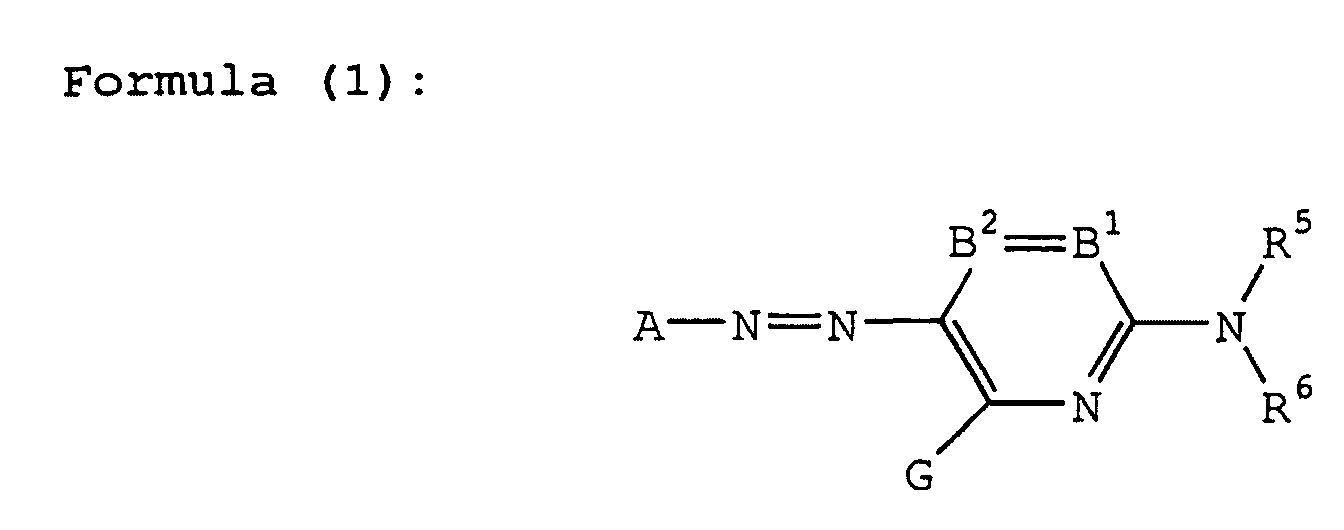
B1 and B2 each represents =CR1- or -CR2= or either one of B1 and B2 represents a nitrogen atom and other represents =CR1- or -CR2=;
R5 and R6 each independently represents a hydrogen atom or a substituent, said substituent is an aliphatic group, an aromatic group, a heterocyclic group, an acyl group, an alkoxycarbonyl group, an aryloxycarbonyl group, a carbamoyl group, an alkylsulfonyl group, an arylsulfonyl group or a sulfamoyl group, and hydrogen atom of each substituent may be substituted;
G, R1 and R2 each independently represents a hydrogen atom or a substituent, said substituent is a halogen atom, an aliphatic group, an aromatic group, a heterocyclic group, a cyano group, a carboxyl group, a carbamoyl group, an alkoxycarbonyl group, an aryloxycarbonyl group, a heterocyclic oxycarbonyl group, an acyl group, a hydroxy group, an alkoxy group, an aryloxy group, a heterocyclic oxy group, a silyloxy group, an acyloxy group, a carbamoyloxy group, an alkoxycarbonyloxy group, an aryloxycarbonyloxy group, an amino group, an acylamino group, a ureido group, a sulfamoylamino group, an alkoxycarbonylamino group, an aryloxycarbonylamino group, an alkylsulfonylamino group, an arylsulfonylamino group, a heterocyclic sulfonylamino group, a nitro group, an alkylthio group, an arylthio group, a heterocyclic thio group, an alkylsulfonyl group, an arylsulfonyl group, a heterocyclic sulfonyl group, an alkylsulfinyl group, an arylsulfinyl group, a heterocyclic sulfinyl group, a sulfamoyl group or a sulfo group, and hydrogen atom of each substituent may be substituted; and
R1 and R5, or R5 and R6 may combine to form a 5- or 6-membered ring. - The inkjet recording ink as claimed in claim 8, wherein said at least two coloring materials sharing the main absorption region both are the dye represented by formula (1).
- The inkjet recording ink as claimed in any one of claims 1 to 4, wherein the main absorption region shared by at least two coloring materials in the aqueous medium is the region of 580 to 680 nm.
- The inkjet recording ink as claimed in claim 10,
wherein at least one of coloring materials sharing the region of 580 to 680 nm as a main absorption region is a dye represented by the following formula (I):wherein X1, X2, X3 and X4 each independently represents - SO-Z, -SO2-Z, -SO2NR1R2, a sulfo group, -CONR1R2 or -CO2R1 , in which Z represents a substituted or unsubstituted alkyl group, a substituted or unsubstituted cycloalkyl group, a substituted or unsubstituted alkenyl group, a substituted or unsubstituted aralkyl group, a substituted or unsubstituted aryl group, or a substituted or unsubstituted heterocyclic group, and R1 and R2 each independently represents a hydrogen atom, a substituted or unsubstituted alkyl group, a substituted or unsubstituted cycloalkyl group, a substituted or unsubstituted alkenyl group, a substituted or unsubstituted aralkyl group, a substituted or unsubstituted aryl group, or a substituted or unsubstituted heterocyclic group, provided that when a plurality of Zs are present, these may be same or different,
Y1, Y2, Y3 and Y4 each independently represents a monovalent substituent,
provided that when a plurality of X1s, X2s, X3s, X4s, Y1s, Y2s, Y3s or Y4s are present, these may be same or different,
a1 to a4 and b1 to b4 represent a number of substituents X1 to X4 and Y1 to Y4, respectively, a1 to a4 each independently represents an integer of 0 to 4 but all are not 0 at a same time, b1 to b4 each independently represents an integer of 0 to 4, and
M represents a hydrogen atom, a metal atom or an oxide, hydroxide or halide thereof. - The inkjet recording ink as claimed in claim 11, wherein the dye represented by formula (I) is a dye represented by the following formula (II):wherein X11 to X14, Y11 to Y18 and M have same meanings as X1 to X4, Y1 to Y4 and M in formula (I), respectively, and

a11 to a14 each independently represents an integer of 1 or 2. - The inkjet recording ink as claimed in any one of claims 10 to 12, wherein at least one dye represented by formula (I) and at least one dye having a structure different from said dye are dissolved or dispersed in an aqueous medium.
- The inkjet recording ink as claimed in any one of claims 10 to 13, wherein at least two dyes represented by formula (I) are dissolved or dispersed in an aqueous medium.
- The inkjet recording ink as claimed in any one of claims 11 to 14, wherein the dye represented by formula (I) is a coloring material having an oxidation potential nobler than 0.7 V (vs SCE).
- An inkjet recording method comprising using the ink claimed in any one of claims 1 to 15.
- The inkjet recording method as claimed in claim 16, which uses an ink set comprising multiple aqueous mediums having separately dissolved or dispersed therein at least two coloring materials sharing one spectral absorption region selected from a region of 500 to 580 nm and a region of 580 to 680 nm as a main absorption region in the aqueous medium, wherein an inkjet recording ink comprising an aqueous medium having dissolved or dispersed therein at least one dye represented by formula (I) and an inkjet recording ink comprising an aqueous medium having dissolved or dispersed therein at least one coloring material differing in a structure from said dye and sharing the main absorption region with said dye are used as a combined set.
- The inkjet recording method as claimed in claim 16, which uses an ink comprising an aqueous medium having dissolved or dispersed therein at least two coloring materials sharing one spectral absorption region selected from a region of 500 to 580 nm and a region of 580 to 680 nm as a main absorption region in the aqueous medium, wherein in the inkjet recording ink used, at least one dye represented by formula (1) and at least one dye differing in the structure from said dye and sharing the main absorption region with said dye are dissolved or dispersed in the same aqueous medium.
- The inkjet recording method as claimed in any one of claims 16 to 18, wherein an image is recorded by ejecting ink droplets according to recording signals on an image-receiving material comprising a support having thereon an image-receiving layer containing an inorganic white pigment particle.
- The inkjet recording method as claimed in claim 19, wherein the image-receiving layer comprises an inorganic white pigment particle and at least one aqueous binder selected from polyvinyl alcohol, silanol-modified polyvinyl alcohol, starch, cationized starch, gelatin, carboxyalkyl cellulose, casein and polyvinylpyrrolidone.
Applications Claiming Priority (9)
| Application Number | Priority Date | Filing Date | Title |
|---|---|---|---|
| JP2002035595 | 2002-02-13 | ||
| JP2002035596 | 2002-02-13 | ||
| JP2002035595 | 2002-02-13 | ||
| JP2002035597 | 2002-02-13 | ||
| JP2002035597 | 2002-02-13 | ||
| JP2002035686 | 2002-02-13 | ||
| JP2002035686 | 2002-02-13 | ||
| JP2002035596 | 2002-02-13 | ||
| PCT/JP2003/001394 WO2003068872A1 (en) | 2002-02-13 | 2003-02-10 | Ink for ink-jet recording and ink-jet recording method |
Publications (2)
| Publication Number | Publication Date |
|---|---|
| EP1475416A1 true EP1475416A1 (en) | 2004-11-10 |
| EP1475416A4 EP1475416A4 (en) | 2005-08-03 |
Family
ID=27739278
Family Applications (1)
| Application Number | Title | Priority Date | Filing Date |
|---|---|---|---|
| EP03703313A Withdrawn EP1475416A4 (en) | 2002-02-13 | 2003-02-10 | Ink for ink-jet recording and ink-jet recording method |
Country Status (5)
| Country | Link |
|---|---|
| US (1) | US7175268B2 (en) |
| EP (1) | EP1475416A4 (en) |
| JP (1) | JP5144873B2 (en) |
| CN (1) | CN1326957C (en) |
| WO (1) | WO2003068872A1 (en) |
Cited By (2)
| Publication number | Priority date | Publication date | Assignee | Title |
|---|---|---|---|---|
| EP2108406A1 (en) * | 2008-04-11 | 2009-10-14 | DyStar Textilfarben GmbH & Co. Deutschland KG | Anionic dyes and hair dye compositions containing them |
| EP1979425A4 (en) * | 2006-01-20 | 2011-07-06 | Fujifilm Corp | Ink, inkjet ink, inkjet recording ink set, inkjet recording method and method for improving weather resistance of color image material |
Families Citing this family (5)
| Publication number | Priority date | Publication date | Assignee | Title |
|---|---|---|---|---|
| WO2003082994A1 (en) * | 2002-03-28 | 2003-10-09 | Fuji Photo Film Co., Ltd. | Ink set for ink-jet recording and ink-jet recording method |
| KR101093031B1 (en) * | 2003-10-23 | 2011-12-13 | 후지필름 가부시키가이샤 | Magenta ink and ink set for inkjet recording |
| US7753510B2 (en) * | 2006-10-11 | 2010-07-13 | Xerox Corporation | Solid ink composition with post-melt mixing |
| WO2016053299A1 (en) | 2014-09-30 | 2016-04-07 | Hewlett-Packard Development Company, L.P. | Aqueous ink composition |
| WO2021145887A1 (en) | 2020-01-17 | 2021-07-22 | Hewlett-Packard Development Company, L.P. | Methods for printing on a substrate and related aspects |
Family Cites Families (34)
| Publication number | Priority date | Publication date | Assignee | Title |
|---|---|---|---|---|
| US3287470A (en) * | 1962-07-10 | 1966-11-22 | Geigy Ag J R | Metal phthalocyanine dyestuffs |
| CH617714A5 (en) * | 1974-12-06 | 1980-06-13 | Ciba Geigy Ag | |
| US4282144A (en) * | 1979-06-01 | 1981-08-04 | Eastman Kodak Company | Azo dyes derived from 5-membered heterocyclic amines and aromatic amine couplers containing sulfo groups, or salts thereof |
| JP2618363B2 (en) * | 1988-11-08 | 1997-06-11 | キヤノン株式会社 | Inkjet recording method |
| JPH06172690A (en) * | 1992-12-07 | 1994-06-21 | Seiko Epson Corp | Inkjet recording ink |
| DE4237545A1 (en) * | 1992-11-06 | 1994-05-11 | Bayer Ag | Copper phthalocyanine liquid formation |
| JPH07188595A (en) * | 1993-12-27 | 1995-07-25 | Mitsubishi Chem Corp | Inkjet conductive ink |
| DE69517783T2 (en) * | 1994-04-25 | 2000-11-02 | Seiko Epson Corp., Tokio/Tokyo | AQUEOUS INK COMPOSITION AND METHOD FOR RECORDING THEREFOR |
| TW293835B (en) * | 1994-08-29 | 1996-12-21 | Ciba Geigy Ag | |
| WO1996034916A2 (en) * | 1995-05-01 | 1996-11-07 | Zeneca Limited | Ink composition |
| JPH09170181A (en) | 1995-12-20 | 1997-06-30 | Taoka Chem Co Ltd | Formation of color image |
| JP3475249B2 (en) * | 1996-07-25 | 2003-12-08 | 株式会社リコー | Recording liquid and recording method using the same |
| GB9803232D0 (en) * | 1998-02-17 | 1998-04-08 | Zeneca Ltd | Compound composition and use |
| WO1999067334A1 (en) * | 1998-06-23 | 1999-12-29 | Avecia Limited | Phthalocyanine compounds and their use |
| JP2000129179A (en) * | 1998-10-23 | 2000-05-09 | Seiko Epson Corp | Ink and inkjet recording method using such ink |
| JP2000239584A (en) * | 1999-02-23 | 2000-09-05 | Mitsui Chemicals Inc | Ink for ink jet recording |
| JP3503522B2 (en) * | 1999-04-08 | 2004-03-08 | セイコーエプソン株式会社 | Ink and inkjet recording method |
| US6482256B1 (en) * | 1999-04-28 | 2002-11-19 | Seiko Epson Corporation | Ink sets |
| US6582502B2 (en) * | 2000-01-25 | 2003-06-24 | Fuji Photo Film Co., Ltd. | Dye, ink for ink jet recording, and ink jet recording method |
| JP3558212B2 (en) * | 2000-04-07 | 2004-08-25 | セイコーエプソン株式会社 | Ink set |
| JP2002121414A (en) * | 2000-07-17 | 2002-04-23 | Fuji Photo Film Co Ltd | Coloring composition, ink for ink-jet recording and method of ink-jet recording |
| JP3922889B2 (en) | 2001-03-26 | 2007-05-30 | 富士フイルム株式会社 | Ozone resistance improvement method using phthalocyanine dye |
| ATE405614T1 (en) | 2001-01-31 | 2008-09-15 | Fujifilm Corp | PHTHALOCYANINE COMPOUND, INK, INK JET PRINTING INK, INK JET PRINTING METHOD AND METHOD FOR IMPROVING THE OZONE GAS RESISTANCE OF COLORED IMAGE MATERIAL |
| KR100601774B1 (en) | 2001-04-09 | 2006-07-19 | 후지 샤신 필름 가부시기가이샤 | Coloring composition for image formation and method for improving ozone resistance of color image |
| JP4397551B2 (en) * | 2001-08-24 | 2010-01-13 | 富士フイルム株式会社 | Coloring composition, inkjet ink composition, inkjet recording method, and method for improving ozone gas fastness |
| AU2002243036A1 (en) | 2001-04-09 | 2002-10-28 | Fuji Photo Film Co., Ltd. | Azo compounds and process of producing the same and novel intermediate compounds used in the process of producing azo compounds |
| JP2002309137A (en) | 2001-04-12 | 2002-10-23 | Fuji Photo Film Co Ltd | Ink composition for ink jet recording |
| TWI299744B (en) | 2001-06-22 | 2008-08-11 | Fuji Corp | Phthalocyanine compound, ink, ink for ink-jet recording, ink-jet recording method and method for improving resistance of color-imaging material to ozone gas |
| JP2003049099A (en) * | 2001-08-06 | 2003-02-21 | Fuji Photo Film Co Ltd | Ink composition for ink-jet, method for ink jet recording, composition for color toner and composition for color filter |
| US6878196B2 (en) * | 2002-01-15 | 2005-04-12 | Fuji Photo Film Co., Ltd. | Ink, ink jet recording method and azo compound |
| EP1468051B1 (en) | 2002-01-22 | 2009-05-13 | FUJIFILM Corporation | Phthalocyanine dye mixture and ink containing the same |
| WO2003082994A1 (en) * | 2002-03-28 | 2003-10-09 | Fuji Photo Film Co., Ltd. | Ink set for ink-jet recording and ink-jet recording method |
| DE10216681A1 (en) | 2002-04-16 | 2003-11-06 | Clariant Gmbh | Process for the preparation of viable organic pigments |
| US6923855B2 (en) | 2002-08-06 | 2005-08-02 | Fuji Photo Film Co., Ltd. | Ink, ink-jet-recording method and bis-azo compound |
-
2003
- 2003-02-10 CN CNB038039540A patent/CN1326957C/en not_active Expired - Fee Related
- 2003-02-10 JP JP2003567989A patent/JP5144873B2/en not_active Expired - Fee Related
- 2003-02-10 WO PCT/JP2003/001394 patent/WO2003068872A1/en not_active Ceased
- 2003-02-10 EP EP03703313A patent/EP1475416A4/en not_active Withdrawn
- 2003-02-10 US US10/504,084 patent/US7175268B2/en not_active Expired - Fee Related
Cited By (4)
| Publication number | Priority date | Publication date | Assignee | Title |
|---|---|---|---|---|
| EP1979425A4 (en) * | 2006-01-20 | 2011-07-06 | Fujifilm Corp | Ink, inkjet ink, inkjet recording ink set, inkjet recording method and method for improving weather resistance of color image material |
| US8070867B2 (en) | 2006-01-20 | 2011-12-06 | Fujifilm Corporation | Ink, inkjet ink, inkjet recording ink set, inkjet recording method and method for improving weather resistance of color image material |
| EP2108406A1 (en) * | 2008-04-11 | 2009-10-14 | DyStar Textilfarben GmbH & Co. Deutschland KG | Anionic dyes and hair dye compositions containing them |
| WO2009124872A3 (en) * | 2008-04-11 | 2009-12-17 | Dystar Textilfarben Gmbh & Co. Deutschland Kg | Anionic dyes and hair dye compositions containing them |
Also Published As
| Publication number | Publication date |
|---|---|
| JP5144873B2 (en) | 2013-02-13 |
| US7175268B2 (en) | 2007-02-13 |
| CN1633481A (en) | 2005-06-29 |
| CN1326957C (en) | 2007-07-18 |
| US20060077240A1 (en) | 2006-04-13 |
| WO2003068872A1 (en) | 2003-08-21 |
| JPWO2003068872A1 (en) | 2005-06-02 |
| EP1475416A4 (en) | 2005-08-03 |
Similar Documents
| Publication | Publication Date | Title |
|---|---|---|
| EP1473336B1 (en) | Ink and ink sets for ink jet printing and method of ink jet printing | |
| EP1473332B1 (en) | Ink composition and method of ink-jet recording | |
| US7083666B2 (en) | Inkjet ink, production method of inkjet ink, inkjet ink set and inkjet recording method | |
| US7077894B2 (en) | Inkjet ink set and inkjet recording method | |
| EP1391487A2 (en) | Ink set, ink cartridge, ink jet printer and recording method | |
| US7303272B2 (en) | Black ink for inkjet recording and inkjet recording method | |
| EP1420051B1 (en) | Inkjet black ink | |
| US7252707B2 (en) | Inkjet recording ink set | |
| US20040187736A1 (en) | Ink set and inkjet recording method | |
| US7249834B2 (en) | Inkjet recording ink and inkjet recording method | |
| US7267715B2 (en) | Ink and ink set | |
| EP1350819A1 (en) | Inkjet recording ink and inkjet recording method | |
| EP1473335A1 (en) | Ink-jet recording ink and method of ink-jet recording | |
| US20040187735A1 (en) | Inkjet ink and inkjet ink set | |
| US7198362B2 (en) | Ink set for ink-jet recording and ink-jet recording method | |
| EP1473333B1 (en) | Ink-jet recording ink and method of ink-jet recording | |
| US7175268B2 (en) | Inkjet recording ink and inkjet recording method | |
| US6874882B2 (en) | Ink set for inkjet recording and inkjet recording method | |
| EP1403335A1 (en) | Inkjet recording ink | |
| US7052123B2 (en) | Ink jet image recording method and apparatus using the method |
Legal Events
| Date | Code | Title | Description |
|---|---|---|---|
| PUAI | Public reference made under article 153(3) epc to a published international application that has entered the european phase |
Free format text: ORIGINAL CODE: 0009012 |
|
| 17P | Request for examination filed |
Effective date: 20040811 |
|
| AK | Designated contracting states |
Kind code of ref document: A1 Designated state(s): AT BE BG CH CY CZ DE DK EE ES FI FR GB GR HU IE IT LI LU MC NL PT SE SI SK TR |
|
| A4 | Supplementary search report drawn up and despatched |
Effective date: 20050622 |
|
| 17Q | First examination report despatched |
Effective date: 20051024 |
|
| RAP1 | Party data changed (applicant data changed or rights of an application transferred) |
Owner name: FUJIFILM CORPORATION |
|
| STAA | Information on the status of an ep patent application or granted ep patent |
Free format text: STATUS: THE APPLICATION IS DEEMED TO BE WITHDRAWN |
|
| 18D | Application deemed to be withdrawn |
Effective date: 20070220 |