EP1474994A1 - A method for producing chewing gum products, and compressed chewing gum tablets - Google Patents
A method for producing chewing gum products, and compressed chewing gum tablets Download PDFInfo
- Publication number
- EP1474994A1 EP1474994A1 EP03388032A EP03388032A EP1474994A1 EP 1474994 A1 EP1474994 A1 EP 1474994A1 EP 03388032 A EP03388032 A EP 03388032A EP 03388032 A EP03388032 A EP 03388032A EP 1474994 A1 EP1474994 A1 EP 1474994A1
- Authority
- EP
- European Patent Office
- Prior art keywords
- granules
- gum
- gum composition
- tablets
- chewing gum
- Prior art date
- Legal status (The legal status is an assumption and is not a legal conclusion. Google has not performed a legal analysis and makes no representation as to the accuracy of the status listed.)
- Granted
Links
- 235000015218 chewing gum Nutrition 0.000 title claims abstract description 47
- 229940112822 chewing gum Drugs 0.000 title claims abstract description 47
- 238000004519 manufacturing process Methods 0.000 title claims abstract description 9
- 239000008187 granular material Substances 0.000 claims abstract description 154
- 239000000203 mixture Substances 0.000 claims abstract description 122
- 239000007788 liquid Substances 0.000 claims abstract description 32
- 238000000034 method Methods 0.000 claims abstract description 30
- 238000005520 cutting process Methods 0.000 claims abstract description 15
- 239000000796 flavoring agent Substances 0.000 claims description 46
- 235000003599 food sweetener Nutrition 0.000 claims description 36
- 239000003765 sweetening agent Substances 0.000 claims description 36
- 235000019634 flavors Nutrition 0.000 claims description 31
- 239000004615 ingredient Substances 0.000 claims description 30
- XLYOFNOQVPJJNP-UHFFFAOYSA-N water Substances O XLYOFNOQVPJJNP-UHFFFAOYSA-N 0.000 claims description 20
- 239000000843 powder Substances 0.000 claims description 18
- 238000000576 coating method Methods 0.000 claims description 16
- 238000009475 tablet pressing Methods 0.000 claims description 16
- 235000013355 food flavoring agent Nutrition 0.000 claims description 15
- 239000011248 coating agent Substances 0.000 claims description 14
- 238000002156 mixing Methods 0.000 claims description 9
- 239000001993 wax Substances 0.000 claims description 9
- 235000013615 non-nutritive sweetener Nutrition 0.000 claims description 8
- 239000000600 sorbitol Substances 0.000 claims description 8
- FBPFZTCFMRRESA-FSIIMWSLSA-N D-Glucitol Natural products OC[C@H](O)[C@H](O)[C@@H](O)[C@H](O)CO FBPFZTCFMRRESA-FSIIMWSLSA-N 0.000 claims description 7
- FBPFZTCFMRRESA-JGWLITMVSA-N D-glucitol Chemical compound OC[C@H](O)[C@@H](O)[C@H](O)[C@H](O)CO FBPFZTCFMRRESA-JGWLITMVSA-N 0.000 claims description 7
- 238000010410 dusting Methods 0.000 claims description 7
- 239000000945 filler Substances 0.000 claims description 7
- HQKMJHAJHXVSDF-UHFFFAOYSA-L magnesium stearate Chemical compound [Mg+2].CCCCCCCCCCCCCCCCCC([O-])=O.CCCCCCCCCCCCCCCCCC([O-])=O HQKMJHAJHXVSDF-UHFFFAOYSA-L 0.000 claims description 6
- 235000015097 nutrients Nutrition 0.000 claims description 5
- 238000012546 transfer Methods 0.000 claims description 5
- 239000004150 EU approved colour Substances 0.000 claims description 4
- 150000001875 compounds Chemical class 0.000 claims description 4
- 239000003814 drug Substances 0.000 claims description 4
- 229940006093 opthalmologic coloring agent diagnostic Drugs 0.000 claims description 4
- 229920002261 Corn starch Polymers 0.000 claims description 3
- 229920006243 acrylic copolymer Polymers 0.000 claims description 3
- 229920003086 cellulose ether Polymers 0.000 claims description 3
- 239000008120 corn starch Substances 0.000 claims description 3
- 229940099112 cornstarch Drugs 0.000 claims description 3
- 235000019359 magnesium stearate Nutrition 0.000 claims description 3
- 229920000058 polyacrylate Polymers 0.000 claims description 3
- 229920005862 polyol Polymers 0.000 claims description 3
- 150000003077 polyols Chemical class 0.000 claims description 3
- 239000003086 colorant Substances 0.000 claims description 2
- 239000003826 tablet Substances 0.000 description 41
- 239000002585 base Substances 0.000 description 37
- 238000001816 cooling Methods 0.000 description 14
- 239000008188 pellet Substances 0.000 description 12
- 230000032258 transport Effects 0.000 description 9
- PEDCQBHIVMGVHV-UHFFFAOYSA-N Glycerine Chemical compound OCC(O)CO PEDCQBHIVMGVHV-UHFFFAOYSA-N 0.000 description 8
- 239000000110 cooling liquid Substances 0.000 description 8
- RSWGJHLUYNHPMX-UHFFFAOYSA-N Abietic-Saeure Natural products C12CCC(C(C)C)=CC2=CCC2C1(C)CCCC2(C)C(O)=O RSWGJHLUYNHPMX-UHFFFAOYSA-N 0.000 description 7
- 108010011485 Aspartame Proteins 0.000 description 7
- NOOLISFMXDJSKH-UHFFFAOYSA-N DL-menthol Natural products CC(C)C1CCC(C)CC1O NOOLISFMXDJSKH-UHFFFAOYSA-N 0.000 description 7
- KHPCPRHQVVSZAH-HUOMCSJISA-N Rosin Natural products O(C/C=C/c1ccccc1)[C@H]1[C@H](O)[C@@H](O)[C@@H](O)[C@@H](CO)O1 KHPCPRHQVVSZAH-HUOMCSJISA-N 0.000 description 7
- 238000010438 heat treatment Methods 0.000 description 7
- 229940041616 menthol Drugs 0.000 description 7
- -1 polyethylene Polymers 0.000 description 7
- 235000010356 sorbitol Nutrition 0.000 description 7
- KHPCPRHQVVSZAH-UHFFFAOYSA-N trans-cinnamyl beta-D-glucopyranoside Natural products OC1C(O)C(O)C(CO)OC1OCC=CC1=CC=CC=C1 KHPCPRHQVVSZAH-UHFFFAOYSA-N 0.000 description 7
- 239000000605 aspartame Substances 0.000 description 6
- 235000010357 aspartame Nutrition 0.000 description 6
- IAOZJIPTCAWIRG-QWRGUYRKSA-N aspartame Chemical compound OC(=O)C[C@H](N)C(=O)N[C@H](C(=O)OC)CC1=CC=CC=C1 IAOZJIPTCAWIRG-QWRGUYRKSA-N 0.000 description 6
- 229960003438 aspartame Drugs 0.000 description 6
- 239000003921 oil Substances 0.000 description 6
- NOOLISFMXDJSKH-UTLUCORTSA-N (+)-Neomenthol Chemical compound CC(C)[C@@H]1CC[C@@H](C)C[C@@H]1O NOOLISFMXDJSKH-UTLUCORTSA-N 0.000 description 5
- WBZFUFAFFUEMEI-UHFFFAOYSA-M Acesulfame k Chemical compound [K+].CC1=CC(=O)[N-]S(=O)(=O)O1 WBZFUFAFFUEMEI-UHFFFAOYSA-M 0.000 description 5
- 239000000619 acesulfame-K Substances 0.000 description 5
- 239000013078 crystal Substances 0.000 description 5
- 238000001125 extrusion Methods 0.000 description 5
- 230000008569 process Effects 0.000 description 5
- 239000000654 additive Substances 0.000 description 4
- 239000003795 chemical substances by application Substances 0.000 description 4
- 229920001971 elastomer Polymers 0.000 description 4
- 239000002245 particle Substances 0.000 description 4
- WXZMFSXDPGVJKK-UHFFFAOYSA-N pentaerythritol Chemical class OCC(CO)(CO)CO WXZMFSXDPGVJKK-UHFFFAOYSA-N 0.000 description 4
- 239000007787 solid Substances 0.000 description 4
- 230000000996 additive effect Effects 0.000 description 3
- 229920001577 copolymer Polymers 0.000 description 3
- 238000009826 distribution Methods 0.000 description 3
- 239000000806 elastomer Substances 0.000 description 3
- 239000003995 emulsifying agent Substances 0.000 description 3
- 239000000686 essence Substances 0.000 description 3
- 239000003925 fat Substances 0.000 description 3
- 235000011187 glycerol Nutrition 0.000 description 3
- 150000002314 glycerols Chemical class 0.000 description 3
- HPIGCVXMBGOWTF-UHFFFAOYSA-N isomaltol Natural products CC(=O)C=1OC=CC=1O HPIGCVXMBGOWTF-UHFFFAOYSA-N 0.000 description 3
- 239000000463 material Substances 0.000 description 3
- 229920000642 polymer Polymers 0.000 description 3
- 238000003825 pressing Methods 0.000 description 3
- 150000003839 salts Chemical class 0.000 description 3
- 239000000126 substance Substances 0.000 description 3
- 239000002023 wood Substances 0.000 description 3
- NOOLISFMXDJSKH-KXUCPTDWSA-N (-)-Menthol Chemical compound CC(C)[C@@H]1CC[C@@H](C)C[C@H]1O NOOLISFMXDJSKH-KXUCPTDWSA-N 0.000 description 2
- VBICKXHEKHSIBG-UHFFFAOYSA-N 1-monostearoylglycerol Chemical compound CCCCCCCCCCCCCCCCCC(=O)OCC(O)CO VBICKXHEKHSIBG-UHFFFAOYSA-N 0.000 description 2
- VTYYLEPIZMXCLO-UHFFFAOYSA-L Calcium carbonate Chemical compound [Ca+2].[O-]C([O-])=O VTYYLEPIZMXCLO-UHFFFAOYSA-L 0.000 description 2
- SRBFZHDQGSBBOR-IOVATXLUSA-N D-xylopyranose Chemical compound O[C@@H]1COC(O)[C@H](O)[C@H]1O SRBFZHDQGSBBOR-IOVATXLUSA-N 0.000 description 2
- RFSUNEUAIZKAJO-ARQDHWQXSA-N Fructose Chemical compound OC[C@H]1O[C@](O)(CO)[C@@H](O)[C@@H]1O RFSUNEUAIZKAJO-ARQDHWQXSA-N 0.000 description 2
- WQZGKKKJIJFFOK-GASJEMHNSA-N Glucose Natural products OC[C@H]1OC(O)[C@H](O)[C@@H](O)[C@@H]1O WQZGKKKJIJFFOK-GASJEMHNSA-N 0.000 description 2
- 235000006679 Mentha X verticillata Nutrition 0.000 description 2
- 235000002899 Mentha suaveolens Nutrition 0.000 description 2
- 235000001636 Mentha x rotundifolia Nutrition 0.000 description 2
- DLRVVLDZNNYCBX-UHFFFAOYSA-N Polydextrose Polymers OC1C(O)C(O)C(CO)OC1OCC1C(O)C(O)C(O)C(O)O1 DLRVVLDZNNYCBX-UHFFFAOYSA-N 0.000 description 2
- 235000010358 acesulfame potassium Nutrition 0.000 description 2
- 230000008901 benefit Effects 0.000 description 2
- WQZGKKKJIJFFOK-VFUOTHLCSA-N beta-D-glucose Chemical compound OC[C@H]1O[C@@H](O)[C@H](O)[C@@H](O)[C@@H]1O WQZGKKKJIJFFOK-VFUOTHLCSA-N 0.000 description 2
- 230000001055 chewing effect Effects 0.000 description 2
- 230000001427 coherent effect Effects 0.000 description 2
- 238000013461 design Methods 0.000 description 2
- 235000012438 extruded product Nutrition 0.000 description 2
- 229960002737 fructose Drugs 0.000 description 2
- 229960001031 glucose Drugs 0.000 description 2
- 239000000314 lubricant Substances 0.000 description 2
- 235000010449 maltitol Nutrition 0.000 description 2
- 239000000845 maltitol Substances 0.000 description 2
- 230000018984 mastication Effects 0.000 description 2
- 238000010077 mastication Methods 0.000 description 2
- 125000002496 methyl group Chemical group [H]C([H])([H])* 0.000 description 2
- 239000004200 microcrystalline wax Substances 0.000 description 2
- 235000019808 microcrystalline wax Nutrition 0.000 description 2
- 239000012188 paraffin wax Substances 0.000 description 2
- 235000019809 paraffin wax Nutrition 0.000 description 2
- 235000019271 petrolatum Nutrition 0.000 description 2
- 239000012169 petroleum derived wax Substances 0.000 description 2
- 235000019381 petroleum wax Nutrition 0.000 description 2
- 239000008177 pharmaceutical agent Substances 0.000 description 2
- 229920002689 polyvinyl acetate Polymers 0.000 description 2
- 239000011118 polyvinyl acetate Substances 0.000 description 2
- 230000002035 prolonged effect Effects 0.000 description 2
- 229920005989 resin Polymers 0.000 description 2
- 239000011347 resin Substances 0.000 description 2
- 210000003296 saliva Anatomy 0.000 description 2
- 239000002904 solvent Substances 0.000 description 2
- 229920003051 synthetic elastomer Polymers 0.000 description 2
- 229920003002 synthetic resin Polymers 0.000 description 2
- 239000000057 synthetic resin Substances 0.000 description 2
- 235000013311 vegetables Nutrition 0.000 description 2
- HDTRYLNUVZCQOY-UHFFFAOYSA-N α-D-glucopyranosyl-α-D-glucopyranoside Natural products OC1C(O)C(O)C(CO)OC1OC1C(O)C(O)C(O)C(CO)O1 HDTRYLNUVZCQOY-UHFFFAOYSA-N 0.000 description 1
- WTARULDDTDQWMU-IUCAKERBSA-N (-)-β-pinene Chemical compound C1[C@@H]2C(C)(C)[C@H]1CCC2=C WTARULDDTDQWMU-IUCAKERBSA-N 0.000 description 1
- DSEKYWAQQVUQTP-XEWMWGOFSA-N (2r,4r,4as,6as,6as,6br,8ar,12ar,14as,14bs)-2-hydroxy-4,4a,6a,6b,8a,11,11,14a-octamethyl-2,4,5,6,6a,7,8,9,10,12,12a,13,14,14b-tetradecahydro-1h-picen-3-one Chemical compound C([C@H]1[C@]2(C)CC[C@@]34C)C(C)(C)CC[C@]1(C)CC[C@]2(C)[C@H]4CC[C@@]1(C)[C@H]3C[C@@H](O)C(=O)[C@@H]1C DSEKYWAQQVUQTP-XEWMWGOFSA-N 0.000 description 1
- NUFKRGBSZPCGQB-FLBSXDLDSA-N (3s)-3-amino-4-oxo-4-[[(2r)-1-oxo-1-[(2,2,4,4-tetramethylthietan-3-yl)amino]propan-2-yl]amino]butanoic acid;pentahydrate Chemical compound O.O.O.O.O.OC(=O)C[C@H](N)C(=O)N[C@H](C)C(=O)NC1C(C)(C)SC1(C)C.OC(=O)C[C@H](N)C(=O)N[C@H](C)C(=O)NC1C(C)(C)SC1(C)C NUFKRGBSZPCGQB-FLBSXDLDSA-N 0.000 description 1
- SERLAGPUMNYUCK-DCUALPFSSA-N 1-O-alpha-D-glucopyranosyl-D-mannitol Chemical compound OC[C@@H](O)[C@@H](O)[C@H](O)[C@H](O)CO[C@H]1O[C@H](CO)[C@@H](O)[C@H](O)[C@H]1O SERLAGPUMNYUCK-DCUALPFSSA-N 0.000 description 1
- DURPTKYDGMDSBL-UHFFFAOYSA-N 1-butoxybutane Chemical compound CCCCOCCCC DURPTKYDGMDSBL-UHFFFAOYSA-N 0.000 description 1
- IIZPXYDJLKNOIY-JXPKJXOSSA-N 1-palmitoyl-2-arachidonoyl-sn-glycero-3-phosphocholine Chemical compound CCCCCCCCCCCCCCCC(=O)OC[C@H](COP([O-])(=O)OCC[N+](C)(C)C)OC(=O)CCC\C=C/C\C=C/C\C=C/C\C=C/CCCCC IIZPXYDJLKNOIY-JXPKJXOSSA-N 0.000 description 1
- OWEGMIWEEQEYGQ-UHFFFAOYSA-N 100676-05-9 Natural products OC1C(O)C(O)C(CO)OC1OCC1C(O)C(O)C(O)C(OC2C(OC(O)C(O)C2O)CO)O1 OWEGMIWEEQEYGQ-UHFFFAOYSA-N 0.000 description 1
- AGAGXPLQURPGFQ-UHFFFAOYSA-N 3-cyclohexa-2,4-dien-1-yl-1-phenylprop-2-en-1-one Chemical class C=1C=CC=CC=1C(=O)C=CC1CC=CC=C1 AGAGXPLQURPGFQ-UHFFFAOYSA-N 0.000 description 1
- 239000004377 Alitame Substances 0.000 description 1
- 229920001412 Chicle Polymers 0.000 description 1
- FBPFZTCFMRRESA-KVTDHHQDSA-N D-Mannitol Chemical compound OC[C@@H](O)[C@@H](O)[C@H](O)[C@H](O)CO FBPFZTCFMRRESA-KVTDHHQDSA-N 0.000 description 1
- HMFHBZSHGGEWLO-SOOFDHNKSA-N D-ribofuranose Chemical compound OC[C@H]1OC(O)[C@H](O)[C@@H]1O HMFHBZSHGGEWLO-SOOFDHNKSA-N 0.000 description 1
- LKDRXBCSQODPBY-OEXCPVAWSA-N D-tagatose Chemical compound OCC1(O)OC[C@@H](O)[C@H](O)[C@@H]1O LKDRXBCSQODPBY-OEXCPVAWSA-N 0.000 description 1
- 239000004375 Dextrin Substances 0.000 description 1
- 229920001353 Dextrin Polymers 0.000 description 1
- 239000001692 EU approved anti-caking agent Substances 0.000 description 1
- 102000004190 Enzymes Human genes 0.000 description 1
- 108090000790 Enzymes Proteins 0.000 description 1
- LFQSCWFLJHTTHZ-UHFFFAOYSA-N Ethanol Chemical compound CCO LFQSCWFLJHTTHZ-UHFFFAOYSA-N 0.000 description 1
- 239000001512 FEMA 4601 Substances 0.000 description 1
- 229930091371 Fructose Natural products 0.000 description 1
- 239000005715 Fructose Substances 0.000 description 1
- 239000000899 Gutta-Percha Substances 0.000 description 1
- 101000801619 Homo sapiens Long-chain-fatty-acid-CoA ligase ACSBG1 Proteins 0.000 description 1
- 229920001908 Hydrogenated starch hydrolysate Polymers 0.000 description 1
- 239000004166 Lanolin Substances 0.000 description 1
- 102100033564 Long-chain-fatty-acid-CoA ligase ACSBG1 Human genes 0.000 description 1
- 239000005913 Maltodextrin Substances 0.000 description 1
- 229920002774 Maltodextrin Polymers 0.000 description 1
- GUBGYTABKSRVRQ-PICCSMPSSA-N Maltose Natural products O[C@@H]1[C@@H](O)[C@H](O)[C@@H](CO)O[C@@H]1O[C@@H]1[C@@H](CO)OC(O)[C@H](O)[C@H]1O GUBGYTABKSRVRQ-PICCSMPSSA-N 0.000 description 1
- 240000001794 Manilkara zapota Species 0.000 description 1
- 235000011339 Manilkara zapota Nutrition 0.000 description 1
- 229930195725 Mannitol Natural products 0.000 description 1
- 108050004114 Monellin Proteins 0.000 description 1
- QECVIPBZOPUTRD-UHFFFAOYSA-N N=S(=O)=O Chemical class N=S(=O)=O QECVIPBZOPUTRD-UHFFFAOYSA-N 0.000 description 1
- 239000004384 Neotame Substances 0.000 description 1
- 240000000342 Palaquium gutta Species 0.000 description 1
- 229920001100 Polydextrose Polymers 0.000 description 1
- 239000004698 Polyethylene Substances 0.000 description 1
- 229920002367 Polyisobutene Polymers 0.000 description 1
- HELXLJCILKEWJH-SEAGSNCFSA-N Rebaudioside A Natural products O=C(O[C@H]1[C@@H](O)[C@@H](O)[C@H](O)[C@@H](CO)O1)[C@@]1(C)[C@@H]2[C@](C)([C@H]3[C@@]4(CC(=C)[C@@](O[C@H]5[C@H](O[C@H]6[C@H](O)[C@@H](O)[C@H](O)[C@@H](CO)O6)[C@@H](O[C@H]6[C@H](O)[C@@H](O)[C@H](O)[C@@H](CO)O6)[C@H](O)[C@@H](CO)O5)(C4)CC3)CC2)CCC1 HELXLJCILKEWJH-SEAGSNCFSA-N 0.000 description 1
- PYMYPHUHKUWMLA-LMVFSUKVSA-N Ribose Natural products OC[C@@H](O)[C@@H](O)[C@@H](O)C=O PYMYPHUHKUWMLA-LMVFSUKVSA-N 0.000 description 1
- 239000004902 Softening Agent Substances 0.000 description 1
- 235000021355 Stearic acid Nutrition 0.000 description 1
- UEDUENGHJMELGK-HYDKPPNVSA-N Stevioside Chemical compound O([C@@H]1[C@@H](O)[C@H](O)[C@@H](CO)O[C@H]1O[C@]12C(=C)C[C@@]3(C1)CC[C@@H]1[C@@](C)(CCC[C@]1([C@@H]3CC2)C)C(=O)O[C@H]1[C@@H]([C@@H](O)[C@H](O)[C@@H](CO)O1)O)[C@@H]1O[C@H](CO)[C@@H](O)[C@H](O)[C@H]1O UEDUENGHJMELGK-HYDKPPNVSA-N 0.000 description 1
- 239000004376 Sucralose Substances 0.000 description 1
- CZMRCDWAGMRECN-UGDNZRGBSA-N Sucrose Chemical compound O[C@H]1[C@H](O)[C@@H](CO)O[C@@]1(CO)O[C@@H]1[C@H](O)[C@@H](O)[C@H](O)[C@@H](CO)O1 CZMRCDWAGMRECN-UGDNZRGBSA-N 0.000 description 1
- 229930006000 Sucrose Natural products 0.000 description 1
- HDTRYLNUVZCQOY-WSWWMNSNSA-N Trehalose Natural products O[C@@H]1[C@@H](O)[C@@H](O)[C@@H](CO)O[C@@H]1O[C@@H]1[C@H](O)[C@@H](O)[C@@H](O)[C@@H](CO)O1 HDTRYLNUVZCQOY-WSWWMNSNSA-N 0.000 description 1
- QYKIQEUNHZKYBP-UHFFFAOYSA-N Vinyl ether Chemical class C=COC=C QYKIQEUNHZKYBP-UHFFFAOYSA-N 0.000 description 1
- TVXBFESIOXBWNM-UHFFFAOYSA-N Xylitol Natural products OCCC(O)C(O)C(O)CCO TVXBFESIOXBWNM-UHFFFAOYSA-N 0.000 description 1
- 230000009471 action Effects 0.000 description 1
- 239000004480 active ingredient Substances 0.000 description 1
- 238000005054 agglomeration Methods 0.000 description 1
- 230000002776 aggregation Effects 0.000 description 1
- 235000019409 alitame Nutrition 0.000 description 1
- 108010009985 alitame Proteins 0.000 description 1
- HDTRYLNUVZCQOY-LIZSDCNHSA-N alpha,alpha-trehalose Chemical compound O[C@@H]1[C@@H](O)[C@H](O)[C@@H](CO)O[C@@H]1O[C@@H]1[C@H](O)[C@@H](O)[C@H](O)[C@@H](CO)O1 HDTRYLNUVZCQOY-LIZSDCNHSA-N 0.000 description 1
- HMFHBZSHGGEWLO-UHFFFAOYSA-N alpha-D-Furanose-Ribose Natural products OCC1OC(O)C(O)C1O HMFHBZSHGGEWLO-UHFFFAOYSA-N 0.000 description 1
- WQZGKKKJIJFFOK-PHYPRBDBSA-N alpha-D-galactose Chemical compound OC[C@H]1O[C@H](O)[C@H](O)[C@@H](O)[C@H]1O WQZGKKKJIJFFOK-PHYPRBDBSA-N 0.000 description 1
- 229910052782 aluminium Inorganic materials 0.000 description 1
- WNROFYMDJYEPJX-UHFFFAOYSA-K aluminium hydroxide Chemical compound [OH-].[OH-].[OH-].[Al+3] WNROFYMDJYEPJX-UHFFFAOYSA-K 0.000 description 1
- PNEYBMLMFCGWSK-UHFFFAOYSA-N aluminium oxide Inorganic materials [O-2].[O-2].[O-2].[Al+3].[Al+3] PNEYBMLMFCGWSK-UHFFFAOYSA-N 0.000 description 1
- PYMYPHUHKUWMLA-UHFFFAOYSA-N arabinose Natural products OCC(O)C(O)C(O)C=O PYMYPHUHKUWMLA-UHFFFAOYSA-N 0.000 description 1
- 235000021028 berry Nutrition 0.000 description 1
- SRBFZHDQGSBBOR-UHFFFAOYSA-N beta-D-Pyranose-Lyxose Natural products OC1COC(O)C(O)C1O SRBFZHDQGSBBOR-UHFFFAOYSA-N 0.000 description 1
- GUBGYTABKSRVRQ-QUYVBRFLSA-N beta-maltose Chemical compound OC[C@H]1O[C@H](O[C@H]2[C@H](O)[C@@H](O)[C@H](O)O[C@@H]2CO)[C@H](O)[C@@H](O)[C@@H]1O GUBGYTABKSRVRQ-QUYVBRFLSA-N 0.000 description 1
- 235000010634 bubble gum Nutrition 0.000 description 1
- 239000004067 bulking agent Substances 0.000 description 1
- 229910000019 calcium carbonate Inorganic materials 0.000 description 1
- 239000004204 candelilla wax Substances 0.000 description 1
- 235000013868 candelilla wax Nutrition 0.000 description 1
- 229940073532 candelilla wax Drugs 0.000 description 1
- 239000004203 carnauba wax Substances 0.000 description 1
- 235000013869 carnauba wax Nutrition 0.000 description 1
- 239000012876 carrier material Substances 0.000 description 1
- 235000015111 chews Nutrition 0.000 description 1
- 238000004040 coloring Methods 0.000 description 1
- 239000007891 compressed tablet Substances 0.000 description 1
- 238000007906 compression Methods 0.000 description 1
- 230000006835 compression Effects 0.000 description 1
- 235000009508 confectionery Nutrition 0.000 description 1
- 239000000498 cooling water Substances 0.000 description 1
- 229940109275 cyclamate Drugs 0.000 description 1
- HCAJEUSONLESMK-UHFFFAOYSA-N cyclohexylsulfamic acid Chemical compound OS(=O)(=O)NC1CCCCC1 HCAJEUSONLESMK-UHFFFAOYSA-N 0.000 description 1
- 235000019425 dextrin Nutrition 0.000 description 1
- 239000008121 dextrose Substances 0.000 description 1
- 238000010586 diagram Methods 0.000 description 1
- 235000013399 edible fruits Nutrition 0.000 description 1
- HELXLJCILKEWJH-UHFFFAOYSA-N entered according to Sigma 01432 Natural products C1CC2C3(C)CCCC(C)(C(=O)OC4C(C(O)C(O)C(CO)O4)O)C3CCC2(C2)CC(=C)C21OC(C1OC2C(C(O)C(O)C(CO)O2)O)OC(CO)C(O)C1OC1OC(CO)C(O)C(O)C1O HELXLJCILKEWJH-UHFFFAOYSA-N 0.000 description 1
- 150000002148 esters Chemical class 0.000 description 1
- 230000008020 evaporation Effects 0.000 description 1
- 238000001704 evaporation Methods 0.000 description 1
- 238000002474 experimental method Methods 0.000 description 1
- 239000000284 extract Substances 0.000 description 1
- 239000013020 final formulation Substances 0.000 description 1
- 239000012530 fluid Substances 0.000 description 1
- 235000019264 food flavour enhancer Nutrition 0.000 description 1
- 229930182830 galactose Natural products 0.000 description 1
- 229960003082 galactose Drugs 0.000 description 1
- 239000008103 glucose Substances 0.000 description 1
- 239000001806 glycerol esters of wood rosin Substances 0.000 description 1
- 235000010985 glycerol esters of wood rosin Nutrition 0.000 description 1
- 125000003976 glyceryl group Chemical group [H]C([*])([H])C(O[H])([H])C(O[H])([H])[H] 0.000 description 1
- 229940075507 glyceryl monostearate Drugs 0.000 description 1
- 229930182470 glycoside Natural products 0.000 description 1
- 229920000588 gutta-percha Polymers 0.000 description 1
- IUJAMGNYPWYUPM-UHFFFAOYSA-N hentriacontane Chemical compound CCCCCCCCCCCCCCCCCCCCCCCCCCCCCCC IUJAMGNYPWYUPM-UHFFFAOYSA-N 0.000 description 1
- 239000003906 humectant Substances 0.000 description 1
- 238000010348 incorporation Methods 0.000 description 1
- 238000012432 intermediate storage Methods 0.000 description 1
- 229960004903 invert sugar Drugs 0.000 description 1
- 239000000905 isomalt Substances 0.000 description 1
- 235000010439 isomalt Nutrition 0.000 description 1
- BJHIKXHVCXFQLS-PQLUHFTBSA-N keto-D-tagatose Chemical compound OC[C@@H](O)[C@H](O)[C@H](O)C(=O)CO BJHIKXHVCXFQLS-PQLUHFTBSA-N 0.000 description 1
- 239000000832 lactitol Substances 0.000 description 1
- 235000010448 lactitol Nutrition 0.000 description 1
- VQHSOMBJVWLPSR-JVCRWLNRSA-N lactitol Chemical compound OC[C@H](O)[C@@H](O)[C@@H]([C@H](O)CO)O[C@@H]1O[C@H](CO)[C@H](O)[C@H](O)[C@H]1O VQHSOMBJVWLPSR-JVCRWLNRSA-N 0.000 description 1
- 229960003451 lactitol Drugs 0.000 description 1
- 235000019388 lanolin Nutrition 0.000 description 1
- 229940039717 lanolin Drugs 0.000 description 1
- 229920000126 latex Polymers 0.000 description 1
- 239000000787 lecithin Substances 0.000 description 1
- 235000010445 lecithin Nutrition 0.000 description 1
- 229940067606 lecithin Drugs 0.000 description 1
- 230000005923 long-lasting effect Effects 0.000 description 1
- ZLNQQNXFFQJAID-UHFFFAOYSA-L magnesium carbonate Chemical compound [Mg+2].[O-]C([O-])=O ZLNQQNXFFQJAID-UHFFFAOYSA-L 0.000 description 1
- 239000001095 magnesium carbonate Substances 0.000 description 1
- 229910000021 magnesium carbonate Inorganic materials 0.000 description 1
- VQHSOMBJVWLPSR-WUJBLJFYSA-N maltitol Chemical compound OC[C@H](O)[C@@H](O)[C@@H]([C@H](O)CO)O[C@H]1O[C@H](CO)[C@@H](O)[C@H](O)[C@H]1O VQHSOMBJVWLPSR-WUJBLJFYSA-N 0.000 description 1
- 229940035436 maltitol Drugs 0.000 description 1
- 229940035034 maltodextrin Drugs 0.000 description 1
- 239000000594 mannitol Substances 0.000 description 1
- 235000010355 mannitol Nutrition 0.000 description 1
- 239000011159 matrix material Substances 0.000 description 1
- 238000002844 melting Methods 0.000 description 1
- 230000008018 melting Effects 0.000 description 1
- HEBKCHPVOIAQTA-UHFFFAOYSA-N meso ribitol Natural products OCC(O)C(O)C(O)CO HEBKCHPVOIAQTA-UHFFFAOYSA-N 0.000 description 1
- 229910052751 metal Inorganic materials 0.000 description 1
- 239000002184 metal Substances 0.000 description 1
- 239000001788 mono and diglycerides of fatty acids Substances 0.000 description 1
- 229920003052 natural elastomer Polymers 0.000 description 1
- 239000000025 natural resin Substances 0.000 description 1
- 229920001194 natural rubber Polymers 0.000 description 1
- 235000019412 neotame Nutrition 0.000 description 1
- 108010070257 neotame Proteins 0.000 description 1
- HLIAVLHNDJUHFG-HOTGVXAUSA-N neotame Chemical compound CC(C)(C)CCN[C@@H](CC(O)=O)C(=O)N[C@H](C(=O)OC)CC1=CC=CC=C1 HLIAVLHNDJUHFG-HOTGVXAUSA-N 0.000 description 1
- QIQXTHQIDYTFRH-UHFFFAOYSA-N octadecanoic acid Chemical compound CCCCCCCCCCCCCCCCCC(O)=O QIQXTHQIDYTFRH-UHFFFAOYSA-N 0.000 description 1
- OQCDKBAXFALNLD-UHFFFAOYSA-N octadecanoic acid Natural products CCCCCCCC(C)CCCCCCCCC(O)=O OQCDKBAXFALNLD-UHFFFAOYSA-N 0.000 description 1
- 230000003647 oxidation Effects 0.000 description 1
- 238000007254 oxidation reaction Methods 0.000 description 1
- 238000012856 packing Methods 0.000 description 1
- 239000011236 particulate material Substances 0.000 description 1
- 239000004014 plasticizer Substances 0.000 description 1
- 235000013856 polydextrose Nutrition 0.000 description 1
- 239000001259 polydextrose Substances 0.000 description 1
- 229940035035 polydextrose Drugs 0.000 description 1
- 229920000573 polyethylene Polymers 0.000 description 1
- 150000003097 polyterpenes Chemical class 0.000 description 1
- 229920002635 polyurethane Polymers 0.000 description 1
- 239000004814 polyurethane Substances 0.000 description 1
- 229940114930 potassium stearate Drugs 0.000 description 1
- ANBFRLKBEIFNQU-UHFFFAOYSA-M potassium;octadecanoate Chemical compound [K+].CCCCCCCCCCCCCCCCCC([O-])=O ANBFRLKBEIFNQU-UHFFFAOYSA-M 0.000 description 1
- 230000003389 potentiating effect Effects 0.000 description 1
- 238000012545 processing Methods 0.000 description 1
- 230000001681 protective effect Effects 0.000 description 1
- 239000011241 protective layer Substances 0.000 description 1
- 108090000623 proteins and genes Proteins 0.000 description 1
- 102000004169 proteins and genes Human genes 0.000 description 1
- HELXLJCILKEWJH-NCGAPWICSA-N rebaudioside A Chemical compound O([C@H]1[C@H](O)[C@@H](CO)O[C@H]([C@@H]1O[C@H]1[C@@H]([C@@H](O)[C@H](O)[C@@H](CO)O1)O)O[C@]12C(=C)C[C@@]3(C1)CC[C@@H]1[C@@](C)(CCC[C@]1([C@@H]3CC2)C)C(=O)O[C@H]1[C@@H]([C@@H](O)[C@H](O)[C@@H](CO)O1)O)[C@@H]1O[C@H](CO)[C@@H](O)[C@H](O)[C@H]1O HELXLJCILKEWJH-NCGAPWICSA-N 0.000 description 1
- 235000019203 rebaudioside A Nutrition 0.000 description 1
- 238000004064 recycling Methods 0.000 description 1
- 239000005060 rubber Substances 0.000 description 1
- 235000019204 saccharin Nutrition 0.000 description 1
- CVHZOJJKTDOEJC-UHFFFAOYSA-N saccharin Chemical compound C1=CC=C2C(=O)NS(=O)(=O)C2=C1 CVHZOJJKTDOEJC-UHFFFAOYSA-N 0.000 description 1
- 229940081974 saccharin Drugs 0.000 description 1
- 239000000901 saccharin and its Na,K and Ca salt Substances 0.000 description 1
- 239000002002 slurry Substances 0.000 description 1
- RYYKJJJTJZKILX-UHFFFAOYSA-M sodium octadecanoate Chemical compound [Na+].CCCCCCCCCCCCCCCCCC([O-])=O RYYKJJJTJZKILX-UHFFFAOYSA-M 0.000 description 1
- 229940080350 sodium stearate Drugs 0.000 description 1
- 235000013599 spices Nutrition 0.000 description 1
- 239000007921 spray Substances 0.000 description 1
- 239000008117 stearic acid Substances 0.000 description 1
- 229960004274 stearic acid Drugs 0.000 description 1
- 229940013618 stevioside Drugs 0.000 description 1
- OHHNJQXIOPOJSC-UHFFFAOYSA-N stevioside Natural products CC1(CCCC2(C)C3(C)CCC4(CC3(CCC12C)CC4=C)OC5OC(CO)C(O)C(O)C5OC6OC(CO)C(O)C(O)C6O)C(=O)OC7OC(CO)C(O)C(O)C7O OHHNJQXIOPOJSC-UHFFFAOYSA-N 0.000 description 1
- 235000019202 steviosides Nutrition 0.000 description 1
- 238000003860 storage Methods 0.000 description 1
- 235000019408 sucralose Nutrition 0.000 description 1
- BAQAVOSOZGMPRM-QBMZZYIRSA-N sucralose Chemical compound O[C@@H]1[C@@H](O)[C@@H](Cl)[C@@H](CO)O[C@@H]1O[C@@]1(CCl)[C@@H](O)[C@H](O)[C@@H](CCl)O1 BAQAVOSOZGMPRM-QBMZZYIRSA-N 0.000 description 1
- 239000005720 sucrose Substances 0.000 description 1
- IIACRCGMVDHOTQ-UHFFFAOYSA-N sulfamic acid Chemical class NS(O)(=O)=O IIACRCGMVDHOTQ-UHFFFAOYSA-N 0.000 description 1
- 239000006188 syrup Substances 0.000 description 1
- 235000020357 syrup Nutrition 0.000 description 1
- 239000000454 talc Substances 0.000 description 1
- 229910052623 talc Inorganic materials 0.000 description 1
- 239000003784 tall oil Substances 0.000 description 1
- 150000003505 terpenes Chemical class 0.000 description 1
- 235000007586 terpenes Nutrition 0.000 description 1
- 239000000892 thaumatin Substances 0.000 description 1
- 235000010436 thaumatin Nutrition 0.000 description 1
- ILJSQTXMGCGYMG-UHFFFAOYSA-N triacetic acid Chemical compound CC(=O)CC(=O)CC(O)=O ILJSQTXMGCGYMG-UHFFFAOYSA-N 0.000 description 1
- 229920001567 vinyl ester resin Polymers 0.000 description 1
- 125000000391 vinyl group Chemical group [H]C([*])=C([H])[H] 0.000 description 1
- 229920002554 vinyl polymer Polymers 0.000 description 1
- 230000000007 visual effect Effects 0.000 description 1
- 239000000341 volatile oil Substances 0.000 description 1
- 239000000811 xylitol Substances 0.000 description 1
- 235000010447 xylitol Nutrition 0.000 description 1
- HEBKCHPVOIAQTA-SCDXWVJYSA-N xylitol Chemical compound OC[C@H](O)[C@@H](O)[C@H](O)CO HEBKCHPVOIAQTA-SCDXWVJYSA-N 0.000 description 1
- 229960002675 xylitol Drugs 0.000 description 1
- GRWFGVWFFZKLTI-UHFFFAOYSA-N α-pinene Chemical compound CC1=CCC2C(C)(C)C1C2 GRWFGVWFFZKLTI-UHFFFAOYSA-N 0.000 description 1
Images
Classifications
-
- A—HUMAN NECESSITIES
- A23—FOODS OR FOODSTUFFS; TREATMENT THEREOF, NOT COVERED BY OTHER CLASSES
- A23G—COCOA; COCOA PRODUCTS, e.g. CHOCOLATE; SUBSTITUTES FOR COCOA OR COCOA PRODUCTS; CONFECTIONERY; CHEWING GUM; ICE-CREAM; PREPARATION THEREOF
- A23G4/00—Chewing gum
-
- A—HUMAN NECESSITIES
- A23—FOODS OR FOODSTUFFS; TREATMENT THEREOF, NOT COVERED BY OTHER CLASSES
- A23G—COCOA; COCOA PRODUCTS, e.g. CHOCOLATE; SUBSTITUTES FOR COCOA OR COCOA PRODUCTS; CONFECTIONERY; CHEWING GUM; ICE-CREAM; PREPARATION THEREOF
- A23G3/00—Sweetmeats; Confectionery; Marzipan; Coated or filled products
- A23G3/0002—Processes of manufacture not relating to composition and compounding ingredients
-
- A—HUMAN NECESSITIES
- A23—FOODS OR FOODSTUFFS; TREATMENT THEREOF, NOT COVERED BY OTHER CLASSES
- A23G—COCOA; COCOA PRODUCTS, e.g. CHOCOLATE; SUBSTITUTES FOR COCOA OR COCOA PRODUCTS; CONFECTIONERY; CHEWING GUM; ICE-CREAM; PREPARATION THEREOF
- A23G3/00—Sweetmeats; Confectionery; Marzipan; Coated or filled products
- A23G3/0002—Processes of manufacture not relating to composition and compounding ingredients
- A23G3/0004—Processes specially adapted for manufacture or treatment of sweetmeats or confectionery
- A23G3/0019—Shaping of liquid, paste, powder; Manufacture of moulded articles, e.g. modelling, moulding, calendering
- A23G3/0025—Processes in which the material is shaped at least partially in a mould in the hollows of a surface, a drum, an endless band, or by a drop-by-drop casting or dispensing of the material on a surface, e.g. injection moulding, transfer moulding
- A23G3/004—Compression moulding of paste, e.g. in the form of a ball or rope or other preforms, or of a powder or granules
-
- A—HUMAN NECESSITIES
- A23—FOODS OR FOODSTUFFS; TREATMENT THEREOF, NOT COVERED BY OTHER CLASSES
- A23G—COCOA; COCOA PRODUCTS, e.g. CHOCOLATE; SUBSTITUTES FOR COCOA OR COCOA PRODUCTS; CONFECTIONERY; CHEWING GUM; ICE-CREAM; PREPARATION THEREOF
- A23G4/00—Chewing gum
- A23G4/02—Apparatus specially adapted for manufacture or treatment of chewing gum
-
- A—HUMAN NECESSITIES
- A23—FOODS OR FOODSTUFFS; TREATMENT THEREOF, NOT COVERED BY OTHER CLASSES
- A23G—COCOA; COCOA PRODUCTS, e.g. CHOCOLATE; SUBSTITUTES FOR COCOA OR COCOA PRODUCTS; CONFECTIONERY; CHEWING GUM; ICE-CREAM; PREPARATION THEREOF
- A23G4/00—Chewing gum
- A23G4/02—Apparatus specially adapted for manufacture or treatment of chewing gum
- A23G4/04—Apparatus specially adapted for manufacture or treatment of chewing gum for moulding or shaping
-
- A—HUMAN NECESSITIES
- A23—FOODS OR FOODSTUFFS; TREATMENT THEREOF, NOT COVERED BY OTHER CLASSES
- A23G—COCOA; COCOA PRODUCTS, e.g. CHOCOLATE; SUBSTITUTES FOR COCOA OR COCOA PRODUCTS; CONFECTIONERY; CHEWING GUM; ICE-CREAM; PREPARATION THEREOF
- A23G4/00—Chewing gum
- A23G4/18—Chewing gum characterised by shape, structure or physical form, e.g. aerated products
-
- A—HUMAN NECESSITIES
- A23—FOODS OR FOODSTUFFS; TREATMENT THEREOF, NOT COVERED BY OTHER CLASSES
- A23P—SHAPING OR WORKING OF FOODSTUFFS, NOT FULLY COVERED BY A SINGLE OTHER SUBCLASS
- A23P10/00—Shaping or working of foodstuffs characterised by the products
- A23P10/20—Agglomerating; Granulating; Tabletting
- A23P10/28—Tabletting; Making food bars by compression of a dry powdered mixture
-
- A—HUMAN NECESSITIES
- A23—FOODS OR FOODSTUFFS; TREATMENT THEREOF, NOT COVERED BY OTHER CLASSES
- A23P—SHAPING OR WORKING OF FOODSTUFFS, NOT FULLY COVERED BY A SINGLE OTHER SUBCLASS
- A23P30/00—Shaping or working of foodstuffs characterised by the process or apparatus
- A23P30/20—Extruding
Definitions
- the present invention relates to a method for producing chewing gum products, which method comprises at least the steps of feeding a gum composition including at least gum base into an extruder, pressurizing the gum composition in the extruder, extruding the gum composition through a die means, and cutting the extruded gum composition in a liquid filled chamber.
- US 4,117,645 disclose a chewing gum base formulated as a hot viscous blend, which is extruded in an extruder though a die plate after which the extruded product is cut into pellets in a liquid that also cools the extruded product.
- the liquid and the formed pellets are conveyed to bulk containers for transport to further processing, i.e. dewatering and mechanical mixing with other ingredients to produce chewing gum.
- WO 02/094032 describes a process and apparatus for producing gum pellets by extrusion through a die plate and cutting of pellets in a liquid-filled chamber.
- the ingredients comprising gum base, fillers, sweeteners, intense sweeteners and flavour are mixed beforehand to form a mixture,e.g. a bubble gum mixture.
- the mixture is feed to an extruder and extruded and pelletized.
- the liquid transports the pelletized product to a centrifugal dryer that separates the product from the liquid.
- the separated products are then dusted with an anti-agglomerating compound and coated or otherwise packaged for consumption.
- the produced pellets have individual weights of about 0.1 g or larger.
- the gum composition extruded through the die means contains gum base and is a high-tack composition with very poor flow properties.
- the individual pellet weight of 0.1 g is very low, but however acceptable for chewing gum products that are consumed many at the time.
- the pellets can have a rather high individual weight. The mixing involves heating and mixing into a homogenous, coherent mass, which after cooling is shaped into gum centres and coated to form the final chewing gum.
- An object of the present invention is to provide a method for producing chewing gum products having improved composition.
- the method of the present invention is accordingly characterized in that the cutting in the liquid filled chamber produces gum granules of weights per granule in the range of 0.0001 g to 0.05 g, and that the extruded and cut granules are conveyed in a further step to a tablet pressing apparatus and included in compressed chewing gum tablets.
- the low weight of the granules results in a very quick cooling of the granules in the liquid flowing through the liquid-filled chamber.
- the gum composition is at an elevated temperature suitable for the extrusion process. Due to the low weight of the granules their individual capacity for holding heat is limited and the cooling action from the liquid quickly lowers the temperature after granules are cut off into the liquid. Gum composition has quite low heat conductivity, but due to their low weight the granules are nevertheless cooled right to their centre in short time.
- the quick cooling acts to preserve possible fragile ingredients in the gum composition so that their qualities are better kept intact and conveyed into the granules included in the final gum product.
- This improved quality of the gum composition in the granules improves the general composition of the chewing gum product.
- the improved quality of the gum composition in the granules is maintained in the gum product because the granules are included in the product by simply being compressed into being a part of tablets, other parts of which can be bulk sweeteners and additional ingredients, and possibly a coating.
- the previously used combination of pellets with other ingredients by heating and mixing pellets and ingredients into a homogenous, coherent mass is thus avoided.
- the combination of various ingredients in the tabletting apparatus is gentle and well suited for fragile ingredients.
- the content of gum base in the granules results in granules having a good tackiness, and the small weight of the individual granule leads to use of many granules in the individual tablet and thus to a distribution in the tablet of granules of tacky gum composition.
- the tablet typically is composed of further ingredients, such as bulk sweeteners etc., in addition to the granules, the well distributed granules act to make the various ingredients unite into a common mass during the initial chews in the mouth.
- Tabletting is also well suited for addition of further active ingredients such as pharmaceutical agents, sweets or nutrients, if such are desired in the compressed gum tablets,and the small weight of the granules allows a fine distribution of the further ingredients within the tablets and thus a better composition and release.
- further active ingredients such as pharmaceutical agents, sweets or nutrients, if such are desired in the compressed gum tablets,and the small weight of the granules allows a fine distribution of the further ingredients within the tablets and thus a better composition and release.
- the cutting in the liquid filled chamber produces gum granules of weights per granule in the range of 0.0003 g to 0.03 g.
- the upper limit of 0.03 g allows more granules to be included in a tablet of a given weight and thus improves the distribution of the tacky granules within the tablet.
- the weight mentioned in the present context is an average weight of granules produced with the intention of obtaining granules of a specific intended weight.
- the weight per granule for at least a first fraction of the granules is in the range of 0.0003 g to 0.003 g, preferably less than 0.002 g.
- the weight per granule for at least a second traction of the granules is in the range of 0.002 to 0.02 g, preferably in the range from 0.002 g to 0.005 g.
- the granules in a first fraction have a first average weight, which is lower than the average weight of a second fraction of the extruded granules. This can be utilized to mix granules having different weight fractions to obtain even better properties of the compressed chewing gum tablets.
- Granule fractions of different average weights can be produced with two different setups, each producing a batch of granules of a particular average weight, followed by a blending of the fractions. It is also possible to design a die means with die openings of at least two different sizes to simultaneously obtain granules with different average diameters. Thus it is possible to obtain granules having different weights. More than two different average weights may be obtained, depending on the design of the die means in use. It is for instance possible to obtain granules with three, four or more different average weights although two different weights are preferred.
- the granules can be cut in a very large liquid-filled chamber, in which the granules are also cooled, but preferably the cooling is combined with transfer of the granules away from the chamber. This can be done e.g. by cooling the cut granules in water during transfer from the liquid filled chamber to a de-watering device.
- the transfer time from cutting to de-watering can be less than 6 s.
- the advantage of this is that water-soluble ingredients in the gum composition are not unnecessarily washed out of the granules.
- the total time of contact between granules and cooling water can be further limited to less than 4 s.
- the dusting or coating can be done with ingredients selected from the group comprising magnesium stearate, cornstarch, sugar compounds, polyols, cellulose ethers, acrylic polymers and copolymers, sweeteners, flavours, waxes, or colours.
- the dusting or coating is made with a sweetener like sorbitol. Sorbitol has been found to also function as an anti-agglomerating agent in addition to improving the taste of the final chewing gum product.
- the method comprises a further step of classifying the granules as to weight prior to conveyance to the tablet pressing apparatus. Too heavy granules are separated from the remaining granules.
- the granules are delivered to the tablet pressing apparatus they are preferably mixed with one or more ingredients selected from the group comprising flavours, bulk sweeteners, intense sweeteners, colouring agents, fillers, nutrients, pharmaceuticals, and tabletting aids. This mixing can improve the flowability of the mixed ingredients fed to the tablet pressing apparatus.
- the gum composition fed to the extruder is a gum base, and that it at least includes one or more flavouring agents when extruded through the die means.
- the flavours within the granules cause a prolonged release of taste during mastication.
- the gum composition can furthermore include one or more sweeteners, preferably intense sweeteners, when extruded through the die means.
- the sweeteners within the granules cause a prolonged release of sweetness during mastication.
- the gum composition can be pre-mixed with sweetener and/or flavour and optionally other ingredients before it is fed to the extruder. Alternatively, or additionally, sweetener and/or flavour may be mixed into the gum composition in the extruder.
- the present invention also relates to use of the method for production of compressed chewing gum tablets.
- the invention also relates to compressed chewing gum tablets obtained by the methods described above. Although very large tablets of 3 g or more can be made, or very small tablets of 0.4 g or less can be made, the tablets preferably have a weight in the range of 0.5 g to 2.5 g per tablet, preferably from 0.6 g to 1.5 g per tablet.
- composition of the tablets can be chosen with a view to obtain high integrity of the tablets in that the individual tablet includes at least 35 granules of a gum composition comprising at least 51 % Wt. of gum base. This minimum content of gum base in the granules provides a relatively high tackiness to the granules.
- An even higher degree of distributed tack in the compressed chewing gum tablets can be obtained by including at least 125 granules of gum composition in the individual tablet, and at the same time other desired properties of the tablets can be obtained by including one or more additional components, such as bulk sweetener powder, flavours, nutrients, pharmaceuticals, or fillers.
- gum base refers in general to a commercially available gum base suitable for production of chewing gum.
- Such gum bases normally comprise natural and/or synthetic resins and optionally other ingredients.
- composition may be a gum base as defined above, a gum base comprising one or more ingredients (e.g. sweetener, flavour, colouring agents, fillers etc.), or it may be a chewing gum composition as defined below.
- ingredients e.g. sweetener, flavour, colouring agents, fillers etc.
- a chewing gum composition is the final formulation, which constitutes at least a part of the compressed chewing gum tablets ready for sale to or use by the consumer.
- a chewing gum composition may comprise sweetener and/or flavour and optionally other ingredients like colouring agents, pharmaceutical agents, enzymes, humectants, flavour enhancers, anticaking agents etc.
- phrases “chewing gum product” or “compressed chewing gum tablets” denote a ready for use chewing gum, e.g. comprising compressed granules of chewing gum composition possibly mixed with sweeteners, flavour or other ingredients and optionally coated.
- gallate granules or “granules” as used herein refers to particulate material of gum composition having average diameters below about 3 mm, such below 2.5 mm.
- average weight is defined as the average weight of at least 200 granules produced to obtain the same intended weight (produced under practically identical conditions).
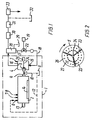
- a chewing gum granulating system generally denoted 1 comprises at least an extruder 2 and a granulating apparatus 3 having a chamber 4 with a die plate 5.
- the extruder 2 is equipped with a first inlet with a hopper 6 for feeding gum composition to the extruder 2.
- the extruder 2 is further equipped with additive feeding devices 7 and 8 connected to further inlets for feeding additives to the gum composition in the extruder 2.
- the additive feeding device 7 can e.g. be used for adding sweetener, and the additive feeding device 8 can e.g. be used for adding flavour.
- the extruder 2 delivers pressurized gum composition to the inlet side of die means in the form of a die plate 5, via a flow connection between an outlet on the extruder and an inlet of the granulating apparatus.
- the flow connection is provided with a valve 9, which in one position provides unrestricted passage from the extruder to the die plate, and in another position connect the extruder outlet with a drain pipe 10, which either leads to a receptacle 11 for discharged gum composition or to a recycling pipe 12 by which the gum composition can be recycled to hopper 6.
- the extruder 2 can be a single or double screw extruder provided with a drive motor 13, preferably an electric motor with settable speed, or a hydraulic motor.
- hopper 6 can then be supplied with pre-mixed gum composition of any desired type.
- the extruder has one or more heating devices 14 which can be included in the barrel of the extruder or can be associated with the screw.
- the heating device or devices can e.g. be of electrical heater type or heat exchanger type where the latter can be supplied with heating fluid such as hot water or hot oil.
- the die plate can also be provided with a heating device, which typically is of the type of internal channels in the plate, and a supply of hot heating liquid feeding the internal channels with the required amount of heat.
- the liquid-filled granulating chamber 4 has an inlet 15 for cooling liquid and an outlet 16 for a slurry of suspended granules and cooling liquid.
- the cooling liquid is supplied by a pump 17 via an inlet pipe 18, and the pump can be fed with fresh cooling liquid from a source 19 or it can be supplied with re-circulated cooling liquid from a de-watering unit 20 via a pipe 21.
- a control valve 22 regulates the degree of re-circulation.
- the system can also have an intercooler (not shown) for cooling re-circulated cooling liquid.
- Cutting means such as rotating knives 23, act on the outlet side of the die plate.
- the gum composition extruded through openings in the die plate is cut into granules by the cutting means.
- the cutting means can be reciprocating knives, but is preferably embodied as rotating knives 23 mounted at the end of a drive axle 24 which is driven by a motor 25, such as an electric motor or a hydraulic drive motor.
- the motor 25 preferably has settable speed.
- the die plate is exchangeable so that several different die plates with different configuration of the openings can be used in the same granulating apparatus.
- the actual die plate configuration is chosen according to the desired weight of granules. It is possible to use a die plate with a plurality of uniformly sized openings in order to produce a batch of gum granules with practically uniform weight (the first average weight). Another batch of granules with a different, second average weight can be produced by making another run using a different die plate configuration. It is, however, preferred to use a die plate provided with differently sized openings so that granules of different weights can be simultaneously produced in the same run. Gum compositions comprising more than 51 % Wt. gum base, e.g. 55 % Wt. gum base, or more than 71 % Wt., can also be extruded through the die plate with differently sized openings.
- Fig. 2 depicts an example of such a die plate 5 where an outer row of openings 26 are larger than an inner row of openings 27.
- the openings can be provided in any desired configuration of sizes and patterns, the pattern and sizes being selected so that the desired weights of granules are obtained.
- An outlet pipe 28 connects outlet 16 with a dryer device in the form of de-watering unit 20, in which the granules are separated from the cooling liquid.
- the dryer device can be of any commercially available type. Spent cooling liquid can be drained off to drain 29 or be re-circulated via pipe 21.
- the dryer can also be associated with a mixer 30 wherein the granules are mixed with e.g. anti-agglomerating agent, sweetener, flavour, tabletting aids etc. to form a mixture.
- the system can optionally include a classifying unit 31 with one or more sieves. The granules can be stored temporarily in a storage 32.
- Granules are either directly after de-watering and possible dusting or coating or after a possible intermediate storage and/or mixing with granules of different average weights or types fed to a tablet pressing machine 32 in which the granules are included in compressed gum tablets.
- the weight of granules are controlled by several factors such as opening sizes, the gum composition, gum temperature at and pressure drop across the die means. Also the rotating speed of the cutting knives and the number of knives can influence the resulting weight of the individual granules. Larger openings and higher temperatures and higher pressures tend to increase the weight by increasing the extrusion speed, and higher rotating speed and more knives tend to decrease the weight by cutting an extruded amount of gum composition into more granules.
- the relation between the diameters of the openings in the die device and the average weights of granules produced from a specific gum composition may be determined by the skilled person on basis of routine experiments.
- the gum base used in the method according to the invention may be any water-insoluble gum base well known in the art.
- suitable polymers for gum base include, natural and synthetic elastomers, resins and rubbers.
- suitable polymers include substances of vegetable origin such as rubber latex solids, chicle, gelutong, nispero, rosidinha, pendare, perillo, niger gutta, tunu, gutta percha, and crown gum.
- Synthetic elastomers such as butadiene-styrene copolymers, isobutyl-ene-isoprene copolymers, polyethylene, polyisobutylene, petroleum wax and polyvinylacetate and mixtures thereof are also useful in gum base.
- Gum base may also contain elastomer solvents to aid in softening the gum base.
- elastomer solvents may include methyl, glycerol or pentaerythritol esters of rosins; methyl, glycerol or pentaerythritol esters of modified rosins, such as hydrogenated, dimerized or polymerized rosins; mixtures thereof and the like.
- Examples of such materials include pentaerythritol esters of partially hydrogenated wood rosin, pentaerythritol esters of wood rosin, glycerol esters of partially dimerized rosin, glycerol esters of polymerized rosin, glycerol esters of tall oil rosin, glycerol esters of wood rosin or partially hydrogenated wood rosin, partially hydrogenated metal esters of rosin such as polymers of alpha.-pinene or .beta.-pinene, terpene resins including polyterpene, mixtures thereof and the like.
- plasticizers or softeners such as lanolin, stearic acid, sodium stearate, potassium stearate, glyceryl, triacetate, glycerine, natural waxes, petroleum waxes such as polyurethane waxes, paraffin waxes and microcrystalline waxes, may also be incorporated into a gum base to obtain a variety of desirable textures and consistency properties.
- hydrophilic-type detackifier that will absorb saliva and become slippery.
- the hydrophilic type detackifier should preferably be incompatible with the elastomer and solvent for the elastomer, and may include such materials as polyvinyl acetate, polyvinyl butyl ether, copolymers of vinyl esters and vinyl ethers, mixtures thereof and the like.
- the gum base may also include hard waxes that serve as lubricants.
- hard waxes include candelilla wax, paraffin wax, carnauba wax, ozokerite, oricuri, microcrystalline wax and the like.
- the gum base may also include a softening agent and/or lubricant that may comprise one or more hydrogenated vegetable or animal fats preferably having a high melting point above about 22°C.
- the gum base may also include an emulsifier to impart hydrophilic properties to the gum base.
- the emulsifier causes saliva to be absorbed into the gum base, thereby making the gum base slippery.
- examples of such emulsifiers may include glyceryl monostearate, phosphatides such as lecithin and sephalin, mixtures thereof and the like.
- the gum base may also include particles of chalk or the like as a bulking agent and/or texturizer.
- texturizing agents or inert fillers suitable for use in gum base include, calcium carbonate, aluminum hydroxide, alumina, magnesium carbonate, talc, aluminum silicates, mixtures thereof and the like.
- Such gum bases are well known in the art, and may be modified to provide a variety of consistency, texture and other properties to the chewing gum product.
- Bulk sweetener are well known sweeteners such as sucrose, dextrose, dextrins, maltose, trehalose, D-tagatose, dried invert sugar, ribose, fructose, levulose, galactose, glucose, maltodextrin, polydextrose, isomalt, sorbitol, sorbitol syrup, mannitol, xylitol, hexa-resorcinol, maltitol, isomaltol, erythriol, lactitol, xylose, tagatose and hydrogenated starch hydrolysates (maltitol syrup).
- sweeteners such as sucrose, dextrose, dextrins, maltose, trehalose, D-tagatose, dried invert sugar, ribose, fructose, levulose, galactose, glucose, maltodextrin, poly
- Intense or high potent sweeteners includes the dipeptides aspartame, neotame and alitame; N-sulfonylamides such as saccharin including the salts thereof and acesulfam including the salts thereof; sulfamates such as cyclamate including the salts thereof; chlorinated sugar derivatives such as sucralose; Terpenoid glycosides such as,Rebaudioside-A, Stevioside and Glyhyrrhizin; proteins such as thaumatin and monellin and Di-hydrochalcones.
- the gum composition to be extruded and granulated is typically substantially free of bulk sweetener. Bulk sweeteners are normally water soluble and may to some extent be dissolved from the gum composition granules in the liquid filled chamber.
- the flavouring agents suitable for use in the present invention can e.g. be a natural, natural-identical, or artificial flavouring substance, or a mixture thereof.
- the flavouring agent may be in solid state as a dry powder or flavour granules, or in liquid state as an essence or oil, or mixtures thereof.
- the dry flavours may include standard powder (i.e. a liquid flavouring agent mixed homogeneously with a powder carrier material), spray dried powder whereby the flavouring agent is coated by a protective layer (i.e. microencapsulated), freeze dried powder, or flavour granules.
- Flavour granules differ from the powders by substantially larger particle sizes (approximately 500-1500 ⁇ m) compared to powders (approximately 10-150 ⁇ m).
- these flavour granules may also comprise a colouring agent and thereby provide a visual effect in the product.
- seeds derived from berries and fruits may also be included as dry flavouring agents.
- the liquid flavouring agents may include essences also known as extracts which are concentrated flavouring agents produced either by reducing a liquid until it is a syrup or by dissolving a spice or flavouring oil in alcohol, and essential oils also known as flavouring oils which are highly concentrated essences.
- the solid and the liquid flavouring agents are encapsulated in a protective matrix protecting them from heat and moisture and thereby reducing the oxidation and evaporation of the liquid flavouring agent.
- a protective matrix protecting them from heat and moisture and thereby reducing the oxidation and evaporation of the liquid flavouring agent.
- the stability of the flavouring agent is markedly improved extending the shelf life of the product.
- flavouring agents suitable for use in the present invention include natural, natural-identical, and/or artificial flavouring substance, or mixtures thereof, in their solid and/or in their liquid state.
- flavouring agents may be combined in any sensorially acceptable blends.
- the differential pressure between the gum composition in the extruder and the gum composition in the liquid filled chamber i.e. the pressure drop across the die means is suitable above 10 bar, preferably above 18 bar, such as in the range of 25 to 90 bar.
- the temperature of the gum composition in the extruder is preferably in the range of 40 to 125°C, suitable in the range 50 to 115°C.
- the temperature of the die means is preferably in the range of 60 to 190°C, suitable in the range 80 to 180°C.
- the temperature of the liquid in the liquid filled chamber is conveniently in the range of 1 to 25°C.
- the optimum for the pressures and temperatures in the method according to the invention can, however, be determined by the skilled person as a matter of routine. The optimum values for specific gum compositions, varies of course, depending on the composition.
- the tablet pressing machine may be any conventional tablet pressing machine capable of pressing tablets comprising gum granules.
- the final tablets preferably have a weight in the range of 0.5 to 2.5 g, conveniently in the range of 0.6 to 1.5 g.
- a commercially available gum base based on synthetic resins (DANfree T firm 1, available from Gum-link A/S, Denmark) was used the gum base in the production of chewing gum products according to the invention.
- Gum base in the form of pellets was for a type A composition fed directly to the extruder, and for type B or type C the gum base was mixed with menthol flavour crystals (MENTHOL BP/USP, available from SHARP MENTHOL INDIA LIMITED, India) aspartame powder (Aspartame, available from ZHUN YONGXINRONG BIOCHEMICAL PRODUCTS CO., LDT, China), and acesulfame-K (Sunett, particle size A, available from Nutrinova GmbH, Germany) to form a gum composition as shown in Table 1.
- menthol flavour crystals MENTHOL BP/USP, available from SHARP MENTHOL INDIA LIMITED, India
- aspartame powder Aspartame, available from ZHUN YONGXINRONG BIOCHEMICAL PRODUCTS CO., LDT, China
- acesulfame-K Sunett, particle size A, available from Nutrinova GmbH, Germany
- mint oil (PD3-68H, type 1100102, available from A.M.TODD COMPANY, U.S.A) was added in an amount of approx. 4.22% Wt. and mixed to the gum composition in the extruder.
- the gum compositions were fed individually to an extruder (Leistrits ZSE/BL 360 kw 104, available from GALA GmbH, Germany). The resulting gum composition was extruded to a granulator comprising a die plate and liquid filled chamber (granulator A5 PAC 6, GALA GmbH, Germany) connected to a water system comprising a water supply for the granulator and centrifugal dryer (TWS 20, available from GALA GmbH, Germany).
- Gum composition Ingredient Type A Type B Type C Amounts % Wt. gum base 95.8 89.24 93.35 menthol flavour crystals 0 6.08 6.15 aspartame powder 0 0.23 0.25 acesulfame K 0 0.23 0.25 mint oil 4.2 4.22 0
- the type A gum composition of Table 1 was feed to the extruder with a feed rate of 250 kg/h and an extruder screw speed of 139 rpm.
- the temperature in the gum composition at the feed end of the extruder was 44°C and the temperature of the gum composition at the outlet of the extruder was 109°C.
- the gum composition was delivered by the extruder device to the inlet side of a die plate at a pressure of 36 bar.
- the composition was extruded through the die plate having a temperature of 120°C and 24 holes of a diameter of 1.0 mm.
- the extruded composition was cut to granules by a cutter with 8 blades mounted in star shape on a central axle rotating with a cutter speed of 1801 rpm.
- the granules were cooled and transported to the centrifugal dryer in water with a temperature of 17°C and a flow rate of 22 m 3 /h.
- the average cooling and transport time in water was approx. 2 seconds.
- the individual granules had an average weight of 0.002 g.
- the granules were tabletted as described below.
- the type A gum composition of Table 1 was fed to the extruder with a feed rate of 250 kg/h and delivered to the inlet side of the die plate at a temperature of 110°C and a pressure of 52 bar.
- the composition was extruded through a die plate having a temperature of 119°C and 24 holes of a diameter of 1.0 mm.
- the extruded composition was cut to granules by a cutter with 8 blades on a central axle rotating with a cutter speed of 2800 rpm.
- the granules were cooled and transported to the centrifugal dryer in water with a temperature of 18°C and a flow rate of 23 m 3 /h.
- the average cooling and transport time in water was approx. 2 seconds.
- the individual granules had an average weight of 0.008 g.
- the granules were tabletted as described below.
- the type A gum composition of Table 1 was fed to the extruder with a feed rate of 200 kg/h and delivered to the inlet side of the die plate at a temperature of 111°C and a pressure of 72 bar.
- the composition was extruded through a die plate having a temperature of 149°C and 120 holes of a diameter of 0.5 mm.
- the extruded composition was cut to granules by a cutter with 8 blades on a central axle rotating with a cutter speed of 2200 rpm.
- the granules were cooled and transported to the centrifugal dryer in water with a temperature of 19°C and a flow rate of 23 m 3 /h.
- the average cooling and transport time in water was approx. 2 seconds.
- the individual granules had an average weight of 0.0039 g.
- the granules were tabletted as described below.
- the type A gum composition of Table 1 was fed to the extruder with a feed rate of 250 kg/h and delivered to the inlet side of the die plate at a temperature of 109°C and a pressure of 71 bar.
- the composition was extruded through a die plate having a temperature of 177°C and 336 holes of a diameter of 0.36 mm.
- the extruded composition was cut to granules by a cutter with 8 blades on a central axle rotating with a cutter speed of 1999 rpm.
- the granules were cooled and transported to the centrifugal dryer in water with a temperature of 19°C and a flow rate of 22 m 3 /h.
- the average cooling and transport time in water was approx. 2 seconds.
- the individual granules had an average weight of 0.0009 g.
- the granules were tabletted as described below.
- the type A gum composition of Table 1 was fed to the extruder with a feed rate of 250 kg/h and delivered to the inlet side of the die plate at a temperature of 109°C and a pressure of 71 bar.
- the composition was extruded through a die plate having a temperature of 179°C and 336 holes of a diameter of 0.36 mm.
- the extruded composition was cut to granules by a cutter with 8 blades on a central axle rotating with a cutter speed of 2800 rpm.
- the granules were cooled and transported to the centrifugal dryer in water with a temperature of 19°C and a flow rate of 22 m 3 /h.
- the average cooling and transport time in water was approx. 2 seconds.
- the individual granules had an average weight of 0.0009 g.
- the granules were tabletted as described below.
- the type B gum composition of Table 1 was fed to the extruder with a feed rate of 200 kg/h and delivered to the inlet side of the die plate at a temperature of 109°C and a pressure of 51 bar.
- the composition was extruded through a die plate having a temperature of 157°C and 336 holes of a diameter of 0.36 mm.
- the extruded composition was cut to granules by a cutter with 8 blades on a central axle rotating with a cutter speed of 2800 rpm.
- the granules were cooled and transported to the centrifugal dryer in water with a temperature of 13°C and a flow rate of 21 m 3 /h.
- the average cooling and transport time in water was approx. 2 seconds.
- the individual granules had an average weight of 0.0008 g.
- the granules were tabletted as described below.
- the type C gum composition of Table 1 was fed to the extruder with a feed rate of 200 kg/h and delivered to the inlet side of the die plate at a temperature of 91°C and a pressure of 80 bar.
- the composition was extruded through a die plate having a temperature of 157°C and 336 holes of a diameter of 0.36 mm.
- the extruded composition was cut to granules by a cutter with 8 blades on a central axle rotating with a cutter speed of 2800 rpm.
- the granules were cooled and transported to the centrifugal dryer in water with a temperature of 11°C and a flow rate of 21 m 3 /h.
- the average cooling and transport time in water was approx. 2 seconds.
- the individual granules had an average weight of 0.0009 g.
- the granules were tabletted as described below.
- the gum composition granules from the above examples were individually mixed in a standard mixer with flavour (menthol flavour crystals) and sweeteners (intense sweeteners: aspartame powder and acesulfame K; bulk sweetener: sorbitol, available from CERESTAR Scandinavia A/S, Denmark) as shown in Table 2.
- sweeteners intense sweeteners: aspartame powder and acesulfame K; bulk sweetener: sorbitol, available from CERESTAR Scandinavia A/S, Denmark
- Mixture for pressed tablets Ingredient % Wt. gum composition granules 39.48 aspartame powder 0.13 acesulfame K powder 0.13 sorbitol powder 58.04 menthol flavour crystals 2.22
- the products were assessed to have excellent properties with regard to cohesion and texture during the initial phase of chewing. All of the assessed tablets demonstrated good properties with regard to duration of taste.
- the obtained tablets had a good tight texture and provided a very satisfactory cohesion during the initial phase of chewing.
- gum granules are of a single average weight or a mixture of a plurality of average weights it is preferred that the additional ingredients mixed with the granules (bulk sweetener, compression aids etc.) are substantially free from fats and waxes.
- the amount of possibly added fats and waxes is suitably kept below 10% Wt. of the final compressed chewing gum tablets.
- the gum granules they can be without flavour or sweetener, but preferably the gum composition in the granules include at least 1% Wt. of flavour or sweetener.
- sweetener and/or flavour in the granules assists in providing a long-lasting taste in the tablets made from compressed granules.
- the gum granules are useable without a coating it is for some embodiments preferred to coat the granules, such as with a coating comprising one or more coatings or ingredients selected from the groups comprising magnesium stearate, cornstarch, sugar compounds, polyols, cellulose ethers, acrylic polymers and copolymers, sugarless/sugarfree coatings, or waxes.
- the coating can be provided in any known manner within the art of coating chewing gum.
- the coating may serve to act as a tabletting aid or to protect the chewing gum composition core and retain moisture in the chewing gum during storing.
- the coating can also facilitate the filling of granules into tablet pressing forms. It is furthermore possible to coat the compressed chewing gum tablets, if so desired.
- Such a coating can be made of any suitable and known method.
Landscapes
- Engineering & Computer Science (AREA)
- Life Sciences & Earth Sciences (AREA)
- Chemical & Material Sciences (AREA)
- Food Science & Technology (AREA)
- Polymers & Plastics (AREA)
- Manufacturing & Machinery (AREA)
- Confectionery (AREA)
- Medicinal Preparation (AREA)
Abstract
Description
- The present invention relates to a method for producing chewing gum products, which method comprises at least the steps of feeding a gum composition including at least gum base into an extruder, pressurizing the gum composition in the extruder, extruding the gum composition through a die means, and cutting the extruded gum composition in a liquid filled chamber.
- US 4,117,645 disclose a chewing gum base formulated as a hot viscous blend, which is extruded in an extruder though a die plate after which the extruded product is cut into pellets in a liquid that also cools the extruded product. The liquid and the formed pellets are conveyed to bulk containers for transport to further processing, i.e. dewatering and mechanical mixing with other ingredients to produce chewing gum.
- A similar process is disclosed in WO 02/094032, which describes a process and apparatus for producing gum pellets by extrusion through a die plate and cutting of pellets in a liquid-filled chamber. The ingredients comprising gum base, fillers, sweeteners, intense sweeteners and flavour are mixed beforehand to form a mixture,e.g. a bubble gum mixture. The mixture is feed to an extruder and extruded and pelletized. The liquid transports the pelletized product to a centrifugal dryer that separates the product from the liquid. The separated products are then dusted with an anti-agglomerating compound and coated or otherwise packaged for consumption.
- In these prior art processes the produced pellets have individual weights of about 0.1 g or larger. The gum composition extruded through the die means contains gum base and is a high-tack composition with very poor flow properties. In case the pellets are dusted and coated for use as a miniature gum ball product, the individual pellet weight of 0.1 g is very low, but however acceptable for chewing gum products that are consumed many at the time. In the case of mechanical mixing of the pellets with other ingredients in order to produce chewing gum, the pellets can have a rather high individual weight. The mixing involves heating and mixing into a homogenous, coherent mass, which after cooling is shaped into gum centres and coated to form the final chewing gum.
- An object of the present invention is to provide a method for producing chewing gum products having improved composition.
- The method of the present invention is accordingly characterized in that the cutting in the liquid filled chamber produces gum granules of weights per granule in the range of 0.0001 g to 0.05 g, and that the extruded and cut granules are conveyed in a further step to a tablet pressing apparatus and included in compressed chewing gum tablets.
- The low weight of the granules results in a very quick cooling of the granules in the liquid flowing through the liquid-filled chamber. During extrusion through the die means the gum composition is at an elevated temperature suitable for the extrusion process. Due to the low weight of the granules their individual capacity for holding heat is limited and the cooling action from the liquid quickly lowers the temperature after granules are cut off into the liquid. Gum composition has quite low heat conductivity, but due to their low weight the granules are nevertheless cooled right to their centre in short time.
- The quick cooling acts to preserve possible fragile ingredients in the gum composition so that their qualities are better kept intact and conveyed into the granules included in the final gum product. This improved quality of the gum composition in the granules improves the general composition of the chewing gum product.
- By conveying the granules to a tablet pressing apparatus and including them in compressed chewing gum tablets there are obtained several further advantages contributing to improved composition of the chewing gum product.
- The improved quality of the gum composition in the granules is maintained in the gum product because the granules are included in the product by simply being compressed into being a part of tablets, other parts of which can be bulk sweeteners and additional ingredients, and possibly a coating. The previously used combination of pellets with other ingredients by heating and mixing pellets and ingredients into a homogenous, coherent mass is thus avoided. The combination of various ingredients in the tabletting apparatus is gentle and well suited for fragile ingredients.
- The content of gum base in the granules results in granules having a good tackiness, and the small weight of the individual granule leads to use of many granules in the individual tablet and thus to a distribution in the tablet of granules of tacky gum composition. Although the tablet typically is composed of further ingredients, such as bulk sweeteners etc., in addition to the granules, the well distributed granules act to make the various ingredients unite into a common mass during the initial chews in the mouth.
- Tabletting is also well suited for addition of further active ingredients such as pharmaceutical agents, sweets or nutrients, if such are desired in the compressed gum tablets,and the small weight of the granules allows a fine distribution of the further ingredients within the tablets and thus a better composition and release.
- Preferably the cutting in the liquid filled chamber produces gum granules of weights per granule in the range of 0.0003 g to 0.03 g. The upper limit of 0.03 g allows more granules to be included in a tablet of a given weight and thus improves the distribution of the tacky granules within the tablet.
- It is possible to make granules of different weights on purpose. For one and the same setup there will, however, also be some variation in the weights of the cut granules, depending on inevitable variations in gum composition, temperatures etc. at the die means. The weight mentioned in the present context is an average weight of granules produced with the intention of obtaining granules of a specific intended weight.
- In order to obtain a more dense packing of the granules in the tabletting apparatus, the weight per granule for at least a first fraction of the granules is in the range of 0.0003 g to 0.003 g, preferably less than 0.002 g.
- It is also possible to provide a less light fraction by producing the granules so that the weight per granule for at least a second traction of the granules is in the range of 0.002 to 0.02 g, preferably in the range from 0.002 g to 0.005 g.
- The granules in a first fraction have a first average weight, which is lower than the average weight of a second fraction of the extruded granules. This can be utilized to mix granules having different weight fractions to obtain even better properties of the compressed chewing gum tablets.
- Granule fractions of different average weights can be produced with two different setups, each producing a batch of granules of a particular average weight, followed by a blending of the fractions. It is also possible to design a die means with die openings of at least two different sizes to simultaneously obtain granules with different average diameters. Thus it is possible to obtain granules having different weights. More than two different average weights may be obtained, depending on the design of the die means in use. It is for instance possible to obtain granules with three, four or more different average weights although two different weights are preferred.
- The granules can be cut in a very large liquid-filled chamber, in which the granules are also cooled, but preferably the cooling is combined with transfer of the granules away from the chamber. This can be done e.g. by cooling the cut granules in water during transfer from the liquid filled chamber to a de-watering device. The transfer time from cutting to de-watering can be less than 6 s. The advantage of this is that water-soluble ingredients in the gum composition are not unnecessarily washed out of the granules. Optionally, the total time of contact between granules and cooling water can be further limited to less than 4 s.
- It is possible to convey gum granules to the tablet pressing apparatus without any intermediate treatment, but preferably the granules are dusted or coated in between de-watering and conveyance to the tablet pressing apparatus. The dusting can serve the traditional purpose of avoiding agglomeration of granules in the equipment leading to the tablet pressing apparatus.
- The dusting or coating can be done with ingredients selected from the group comprising magnesium stearate, cornstarch, sugar compounds, polyols, cellulose ethers, acrylic polymers and copolymers, sweeteners, flavours, waxes, or colours. Preferably the dusting or coating is made with a sweetener like sorbitol. Sorbitol has been found to also function as an anti-agglomerating agent in addition to improving the taste of the final chewing gum product.
- In order to control in detail the properties of the compressed chewing gum tablets it is preferred that the method comprises a further step of classifying the granules as to weight prior to conveyance to the tablet pressing apparatus. Too heavy granules are separated from the remaining granules.
- Before the granules are delivered to the tablet pressing apparatus they are preferably mixed with one or more ingredients selected from the group comprising flavours, bulk sweeteners, intense sweeteners, colouring agents, fillers, nutrients, pharmaceuticals, and tabletting aids. This mixing can improve the flowability of the mixed ingredients fed to the tablet pressing apparatus.
- It is preferred that the gum composition fed to the extruder is a gum base, and that it at least includes one or more flavouring agents when extruded through the die means. The flavours within the granules cause a prolonged release of taste during mastication.
- The gum composition can furthermore include one or more sweeteners, preferably intense sweeteners, when extruded through the die means. The sweeteners within the granules cause a prolonged release of sweetness during mastication. The gum composition can be pre-mixed with sweetener and/or flavour and optionally other ingredients before it is fed to the extruder. Alternatively, or additionally, sweetener and/or flavour may be mixed into the gum composition in the extruder.
- Moreover, the present invention also relates to use of the method for production of compressed chewing gum tablets.
- The invention also relates to compressed chewing gum tablets obtained by the methods described above. Although very large tablets of 3 g or more can be made, or very small tablets of 0.4 g or less can be made, the tablets preferably have a weight in the range of 0.5 g to 2.5 g per tablet, preferably from 0.6 g to 1.5 g per tablet.
- For tablets within these weight ranges the composition of the tablets can be chosen with a view to obtain high integrity of the tablets in that the individual tablet includes at least 35 granules of a gum composition comprising at least 51 % Wt. of gum base. This minimum content of gum base in the granules provides a relatively high tackiness to the granules.
- An even higher degree of distributed tack in the compressed chewing gum tablets can be obtained by including at least 125 granules of gum composition in the individual tablet, and at the same time other desired properties of the tablets can be obtained by including one or more additional components, such as bulk sweetener powder, flavours, nutrients, pharmaceuticals, or fillers.
- Non-limiting examples and embodiments of the method according to the invention are in the following described in further detail with reference to the highly schematic drawings, in which
- Fig. 1
- is a diagram illustrating a chewing gum granulating system, and
- Fig. 2
- illustrates in an end view a die plate with rotary knives for cutting extruded granules.
- As used herein the term "gum base" refers in general to a commercially available gum base suitable for production of chewing gum. Such gum bases normally comprise natural and/or synthetic resins and optionally other ingredients.
- The term "gum composition" as used herein may be a gum base as defined above, a gum base comprising one or more ingredients (e.g. sweetener, flavour, colouring agents, fillers etc.), or it may be a chewing gum composition as defined below.
- The term "chewing gum composition" is the final formulation, which constitutes at least a part of the compressed chewing gum tablets ready for sale to or use by the consumer. A chewing gum composition may comprise sweetener and/or flavour and optionally other ingredients like colouring agents, pharmaceutical agents, enzymes, humectants, flavour enhancers, anticaking agents etc.
- Furthermore "chewing gum product" or "compressed chewing gum tablets" denote a ready for use chewing gum, e.g. comprising compressed granules of chewing gum composition possibly mixed with sweeteners, flavour or other ingredients and optionally coated.
- The term "gum granules" or "granules" as used herein refers to particulate material of gum composition having average diameters below about 3 mm, such below 2.5 mm.
- The term "average weight" as used herein is defined as the average weight of at least 200 granules produced to obtain the same intended weight (produced under practically identical conditions).
- Unless otherwise indicated all percentages are weight % (denoted % Wt.).
- In Fig. 1 a chewing gum granulating system generally denoted 1 comprises at least an extruder 2 and a
granulating apparatus 3 having achamber 4 with adie plate 5. The extruder 2 is equipped with a first inlet with a hopper 6 for feeding gum composition to the extruder 2. In the illustrated embodiment the extruder 2 is further equipped with additive feeding devices 7 and 8 connected to further inlets for feeding additives to the gum composition in the extruder 2. The additive feeding device 7 can e.g. be used for adding sweetener, and the additive feeding device 8 can e.g. be used for adding flavour. - The extruder 2 delivers pressurized gum composition to the inlet side of die means in the form of a
die plate 5, via a flow connection between an outlet on the extruder and an inlet of the granulating apparatus. The flow connection is provided with avalve 9, which in one position provides unrestricted passage from the extruder to the die plate, and in another position connect the extruder outlet with adrain pipe 10, which either leads to a receptacle 11 for discharged gum composition or to arecycling pipe 12 by which the gum composition can be recycled to hopper 6. - The extruder 2 can be a single or double screw extruder provided with a
drive motor 13, preferably an electric motor with settable speed, or a hydraulic motor. In another embodiment of the extruder feeding devices 7, 8 have been omitted, and hopper 6 can then be supplied with pre-mixed gum composition of any desired type. The extruder has one ormore heating devices 14 which can be included in the barrel of the extruder or can be associated with the screw. The heating device or devices can e.g. be of electrical heater type or heat exchanger type where the latter can be supplied with heating fluid such as hot water or hot oil. The die plate can also be provided with a heating device, which typically is of the type of internal channels in the plate, and a supply of hot heating liquid feeding the internal channels with the required amount of heat. - The liquid-filled
granulating chamber 4 has an inlet 15 for cooling liquid and anoutlet 16 for a slurry of suspended granules and cooling liquid. The cooling liquid is supplied by a pump 17 via aninlet pipe 18, and the pump can be fed with fresh cooling liquid from asource 19 or it can be supplied with re-circulated cooling liquid from ade-watering unit 20 via apipe 21. Acontrol valve 22 regulates the degree of re-circulation. The system can also have an intercooler (not shown) for cooling re-circulated cooling liquid. - Cutting means, such as rotating
knives 23, act on the outlet side of the die plate. The gum composition extruded through openings in the die plate is cut into granules by the cutting means. The cutting means can be reciprocating knives, but is preferably embodied as rotatingknives 23 mounted at the end of adrive axle 24 which is driven by amotor 25, such as an electric motor or a hydraulic drive motor. Themotor 25 preferably has settable speed. - The die plate is exchangeable so that several different die plates with different configuration of the openings can be used in the same granulating apparatus. The actual die plate configuration is chosen according to the desired weight of granules. It is possible to use a die plate with a plurality of uniformly sized openings in order to produce a batch of gum granules with practically uniform weight (the first average weight). Another batch of granules with a different, second average weight can be produced by making another run using a different die plate configuration. It is, however, preferred to use a die plate provided with differently sized openings so that granules of different weights can be simultaneously produced in the same run. Gum compositions comprising more than 51 % Wt. gum base, e.g. 55 % Wt. gum base, or more than 71 % Wt., can also be extruded through the die plate with differently sized openings.
- Fig. 2 depicts an example of such a
die plate 5 where an outer row ofopenings 26 are larger than an inner row ofopenings 27. The openings can be provided in any desired configuration of sizes and patterns, the pattern and sizes being selected so that the desired weights of granules are obtained. - An outlet pipe 28 connects
outlet 16 with a dryer device in the form ofde-watering unit 20, in which the granules are separated from the cooling liquid. The dryer device can be of any commercially available type. Spent cooling liquid can be drained off to drain 29 or be re-circulated viapipe 21. The dryer can also be associated with amixer 30 wherein the granules are mixed with e.g. anti-agglomerating agent, sweetener, flavour, tabletting aids etc. to form a mixture. The system can optionally include a classifyingunit 31 with one or more sieves. The granules can be stored temporarily in astorage 32. Granules are either directly after de-watering and possible dusting or coating or after a possible intermediate storage and/or mixing with granules of different average weights or types fed to atablet pressing machine 32 in which the granules are included in compressed gum tablets. - The weight of granules are controlled by several factors such as opening sizes, the gum composition, gum temperature at and pressure drop across the die means. Also the rotating speed of the cutting knives and the number of knives can influence the resulting weight of the individual granules. Larger openings and higher temperatures and higher pressures tend to increase the weight by increasing the extrusion speed, and higher rotating speed and more knives tend to decrease the weight by cutting an extruded amount of gum composition into more granules. The relation between the diameters of the openings in the die device and the average weights of granules produced from a specific gum composition may be determined by the skilled person on basis of routine experiments.
- The gum base used in the method according to the invention may be any water-insoluble gum base well known in the art. Illustrative examples of suitable polymers for gum base include, natural and synthetic elastomers, resins and rubbers. For example, suitable polymers include substances of vegetable origin such as rubber latex solids, chicle, gelutong, nispero, rosidinha, pendare, perillo, niger gutta, tunu, gutta percha, and crown gum. Synthetic elastomers such as butadiene-styrene copolymers, isobutyl-ene-isoprene copolymers, polyethylene, polyisobutylene, petroleum wax and polyvinylacetate and mixtures thereof are also useful in gum base.
- Gum base may also contain elastomer solvents to aid in softening the gum base. Such materials may include methyl, glycerol or pentaerythritol esters of rosins; methyl, glycerol or pentaerythritol esters of modified rosins, such as hydrogenated, dimerized or polymerized rosins; mixtures thereof and the like. Examples of such materials include pentaerythritol esters of partially hydrogenated wood rosin, pentaerythritol esters of wood rosin, glycerol esters of partially dimerized rosin, glycerol esters of polymerized rosin, glycerol esters of tall oil rosin, glycerol esters of wood rosin or partially hydrogenated wood rosin, partially hydrogenated metal esters of rosin such as polymers of alpha.-pinene or .beta.-pinene, terpene resins including polyterpene, mixtures thereof and the like.
- A variety of traditional ingredients such as plasticizers or softeners, such as lanolin, stearic acid, sodium stearate, potassium stearate, glyceryl, triacetate, glycerine, natural waxes, petroleum waxes such as polyurethane waxes, paraffin waxes and microcrystalline waxes, may also be incorporated into a gum base to obtain a variety of desirable textures and consistency properties.
- Other conventional ingredients that may be present in a gum base include a hydrophilic-type detackifier that will absorb saliva and become slippery. The hydrophilic type detackifier should preferably be incompatible with the elastomer and solvent for the elastomer, and may include such materials as polyvinyl acetate, polyvinyl butyl ether, copolymers of vinyl esters and vinyl ethers, mixtures thereof and the like.
- The gum base may also include hard waxes that serve as lubricants. Examples of such hard waxes include candelilla wax, paraffin wax, carnauba wax, ozokerite, oricuri, microcrystalline wax and the like.
- The gum base may also include a softening agent and/or lubricant that may comprise one or more hydrogenated vegetable or animal fats preferably having a high melting point above about 22°C.
- The gum base may also include an emulsifier to impart hydrophilic properties to the gum base. The emulsifier causes saliva to be absorbed into the gum base, thereby making the gum base slippery. Examples of such emulsifiers may include glyceryl monostearate, phosphatides such as lecithin and sephalin, mixtures thereof and the like.
- The gum base may also include particles of chalk or the like as a bulking agent and/or texturizer. Examples of such texturizing agents or inert fillers suitable for use in gum base include, calcium carbonate, aluminum hydroxide, alumina, magnesium carbonate, talc, aluminum silicates, mixtures thereof and the like.
- Such gum bases are well known in the art, and may be modified to provide a variety of consistency, texture and other properties to the chewing gum product.
- With regard to sweeteners, a distinguishing between bulk sweetener and intense sweetener (high potency sweetener) is often relevant. Bulk sweetener are well known sweeteners such as sucrose, dextrose, dextrins, maltose, trehalose, D-tagatose, dried invert sugar, ribose, fructose, levulose, galactose, glucose, maltodextrin, polydextrose, isomalt, sorbitol, sorbitol syrup, mannitol, xylitol, hexa-resorcinol, maltitol, isomaltol, erythriol, lactitol, xylose, tagatose and hydrogenated starch hydrolysates (maltitol syrup). Intense or high potent sweeteners includes the dipeptides aspartame, neotame and alitame; N-sulfonylamides such as saccharin including the salts thereof and acesulfam including the salts thereof; sulfamates such as cyclamate including the salts thereof; chlorinated sugar derivatives such as sucralose; Terpenoid glycosides such as,Rebaudioside-A, Stevioside and Glyhyrrhizin; proteins such as thaumatin and monellin and Di-hydrochalcones. The gum composition to be extruded and granulated is typically substantially free of bulk sweetener. Bulk sweeteners are normally water soluble and may to some extent be dissolved from the gum composition granules in the liquid filled chamber.
- The flavouring agents suitable for use in the present invention can e.g. be a natural, natural-identical, or artificial flavouring substance, or a mixture thereof. At room temperature the flavouring agent may be in solid state as a dry powder or flavour granules, or in liquid state as an essence or oil, or mixtures thereof. The dry flavours may include standard powder (i.e. a liquid flavouring agent mixed homogeneously with a powder carrier material), spray dried powder whereby the flavouring agent is coated by a protective layer (i.e. microencapsulated), freeze dried powder, or flavour granules. Flavour granules differ from the powders by substantially larger particle sizes (approximately 500-1500 µm) compared to powders (approximately 10-150 µm). Optionally these flavour granules may also comprise a colouring agent and thereby provide a visual effect in the product. Furthermore, seeds derived from berries and fruits may also be included as dry flavouring agents.
- The liquid flavouring agents may include essences also known as extracts which are concentrated flavouring agents produced either by reducing a liquid until it is a syrup or by dissolving a spice or flavouring oil in alcohol, and essential oils also known as flavouring oils which are highly concentrated essences.
- Preferably, the solid and the liquid flavouring agents are encapsulated in a protective matrix protecting them from heat and moisture and thereby reducing the oxidation and evaporation of the liquid flavouring agent. As a result the stability of the flavouring agent is markedly improved extending the shelf life of the product. These encapsulating processes are well known to those skilled in the art.
- A variety of one or more flavouring agents may be used. Flavouring agents suitable for use in the present invention include natural, natural-identical, and/or artificial flavouring substance, or mixtures thereof, in their solid and/or in their liquid state.
- The person skilled in the art will recognize that natural and artificial flavouring agents may be combined in any sensorially acceptable blends.
- During extrusion of the gum composition the differential pressure between the gum composition in the extruder and the gum composition in the liquid filled chamber, i.e. the pressure drop across the die means is suitable above 10 bar, preferably above 18 bar, such as in the range of 25 to 90 bar. The temperature of the gum composition in the extruder is preferably in the range of 40 to 125°C, suitable in the range 50 to 115°C. The temperature of the die means is preferably in the range of 60 to 190°C, suitable in the range 80 to 180°C. The temperature of the liquid in the liquid filled chamber is conveniently in the range of 1 to 25°C. The optimum for the pressures and temperatures in the method according to the invention can, however, be determined by the skilled person as a matter of routine. The optimum values for specific gum compositions, varies of course, depending on the composition.
- The tablet pressing machine may be any conventional tablet pressing machine capable of pressing tablets comprising gum granules. The final tablets preferably have a weight in the range of 0.5 to 2.5 g, conveniently in the range of 0.6 to 1.5 g.
- A commercially available gum base based on synthetic resins (DANfree T firm 1, available from Gum-link A/S, Denmark) was used the gum base in the production of chewing gum products according to the invention.
- Gum base in the form of pellets was for a type A composition fed directly to the extruder, and for type B or type C the gum base was mixed with menthol flavour crystals (MENTHOL BP/USP, available from SHARP MENTHOL INDIA LIMITED, India) aspartame powder (Aspartame, available from ZHUN YONGXINRONG BIOCHEMICAL PRODUCTS CO., LDT, China), and acesulfame-K (Sunett, particle size A, available from Nutrinova GmbH, Germany) to form a gum composition as shown in Table 1. For the type A and type B compositions mint oil (PD3-68H, type 1100102, available from A.M.TODD COMPANY, U.S.A) was added in an amount of approx. 4.22% Wt. and mixed to the gum composition in the extruder.
- The gum compositions were fed individually to an extruder (Leistrits ZSE/BL 360 kw 104, available from GALA GmbH, Germany). The resulting gum composition was extruded to a granulator comprising a die plate and liquid filled chamber (granulator A5 PAC 6, GALA GmbH, Germany) connected to a water system comprising a water supply for the granulator and centrifugal dryer (
TWS 20, available from GALA GmbH, Germany).Gum composition Ingredient Type A Type B Type C Amounts % Wt. gum base 95.8 89.24 93.35 menthol flavour crystals 0 6.08 6.15 aspartame powder 0 0.23 0.25 acesulfame K 0 0.23 0.25 mint oil 4.2 4.22 0 - The type A gum composition of Table 1 was feed to the extruder with a feed rate of 250 kg/h and an extruder screw speed of 139 rpm. The temperature in the gum composition at the feed end of the extruder was 44°C and the temperature of the gum composition at the outlet of the extruder was 109°C. The gum composition was delivered by the extruder device to the inlet side of a die plate at a pressure of 36 bar. The composition was extruded through the die plate having a temperature of 120°C and 24 holes of a diameter of 1.0 mm. In the granulator chamber the extruded composition was cut to granules by a cutter with 8 blades mounted in star shape on a central axle rotating with a cutter speed of 1801 rpm. The granules were cooled and transported to the centrifugal dryer in water with a temperature of 17°C and a flow rate of 22 m3/h. The average cooling and transport time in water was approx. 2 seconds. The individual granules had an average weight of 0.002 g. The granules were tabletted as described below.
- The type A gum composition of Table 1 was fed to the extruder with a feed rate of 250 kg/h and delivered to the inlet side of the die plate at a temperature of 110°C and a pressure of 52 bar. The composition was extruded through a die plate having a temperature of 119°C and 24 holes of a diameter of 1.0 mm. In the granulator chamber the extruded composition was cut to granules by a cutter with 8 blades on a central axle rotating with a cutter speed of 2800 rpm. The granules were cooled and transported to the centrifugal dryer in water with a temperature of 18°C and a flow rate of 23 m3/h. The average cooling and transport time in water was approx. 2 seconds. The individual granules had an average weight of 0.008 g. The granules were tabletted as described below.
- The type A gum composition of Table 1 was fed to the extruder with a feed rate of 200 kg/h and delivered to the inlet side of the die plate at a temperature of 111°C and a pressure of 72 bar. The composition was extruded through a die plate having a temperature of 149°C and 120 holes of a diameter of 0.5 mm. In the granulator chamber the extruded composition was cut to granules by a cutter with 8 blades on a central axle rotating with a cutter speed of 2200 rpm. The granules were cooled and transported to the centrifugal dryer in water with a temperature of 19°C and a flow rate of 23 m3/h. The average cooling and transport time in water was approx. 2 seconds. The individual granules had an average weight of 0.0039 g. The granules were tabletted as described below.
- The type A gum composition of Table 1 was fed to the extruder with a feed rate of 250 kg/h and delivered to the inlet side of the die plate at a temperature of 109°C and a pressure of 71 bar. The composition was extruded through a die plate having a temperature of 177°C and 336 holes of a diameter of 0.36 mm. In the granulator chamber the extruded composition was cut to granules by a cutter with 8 blades on a central axle rotating with a cutter speed of 1999 rpm. The granules were cooled and transported to the centrifugal dryer in water with a temperature of 19°C and a flow rate of 22 m3/h. The average cooling and transport time in water was approx. 2 seconds. The individual granules had an average weight of 0.0009 g. The granules were tabletted as described below.
- The type A gum composition of Table 1 was fed to the extruder with a feed rate of 250 kg/h and delivered to the inlet side of the die plate at a temperature of 109°C and a pressure of 71 bar. The composition was extruded through a die plate having a temperature of 179°C and 336 holes of a diameter of 0.36 mm. In the granulator chamber the extruded composition was cut to granules by a cutter with 8 blades on a central axle rotating with a cutter speed of 2800 rpm. The granules were cooled and transported to the centrifugal dryer in water with a temperature of 19°C and a flow rate of 22 m3/h. The average cooling and transport time in water was approx. 2 seconds. The individual granules had an average weight of 0.0009 g. The granules were tabletted as described below.
- The type B gum composition of Table 1 was fed to the extruder with a feed rate of 200 kg/h and delivered to the inlet side of the die plate at a temperature of 109°C and a pressure of 51 bar. The composition was extruded through a die plate having a temperature of 157°C and 336 holes of a diameter of 0.36 mm. In the granulator chamber the extruded composition was cut to granules by a cutter with 8 blades on a central axle rotating with a cutter speed of 2800 rpm. The granules were cooled and transported to the centrifugal dryer in water with a temperature of 13°C and a flow rate of 21 m3/h. The average cooling and transport time in water was approx. 2 seconds. The individual granules had an average weight of 0.0008 g. The granules were tabletted as described below.
- The type C gum composition of Table 1 was fed to the extruder with a feed rate of 200 kg/h and delivered to the inlet side of the die plate at a temperature of 91°C and a pressure of 80 bar. The composition was extruded through a die plate having a temperature of 157°C and 336 holes of a diameter of 0.36 mm. In the granulator chamber the extruded composition was cut to granules by a cutter with 8 blades on a central axle rotating with a cutter speed of 2800 rpm. The granules were cooled and transported to the centrifugal dryer in water with a temperature of 11°C and a flow rate of 21 m3/h. The average cooling and transport time in water was approx. 2 seconds. The individual granules had an average weight of 0.0009 g. The granules were tabletted as described below.
- The gum composition granules from the above examples were individually mixed in a standard mixer with flavour (menthol flavour crystals) and sweeteners (intense sweeteners: aspartame powder and acesulfame K; bulk sweetener: sorbitol, available from CERESTAR Scandinavia A/S, Denmark) as shown in Table 2.
Mixture for pressed tablets Ingredient % Wt. gum composition granules 39.48 aspartame powder 0.13 acesulfame K powder 0.13 sorbitol powder 58.04 menthol flavour crystals 2.22 - Before pressing the mixtures passed a standard horizontal vibration sieve for removing any particles larger than 2.6 mm. The mixture was subsequently lead to a standard tablet pressing machine comprising dosing apparatus (P 3200 C, available from Fette GmbH, Germany) and pressed into compressed chewing gum tablets. The filling depth was 7.5 mm and the diameter 7.0 mm. The tablets were precompressed to 5.0 mm and then main compressed to 3.2 mm using a pressing pressure of 33.0 - 33.6 kN. There were 61 punches on the roter, and the rotor speed used was 11 rpm. The individual compressed tablets had a weight of approx. 1.5 g.
- The products were assessed to have excellent properties with regard to cohesion and texture during the initial phase of chewing. All of the assessed tablets demonstrated good properties with regard to duration of taste.
- Alternative mixtures of gum granules from examples with flavour and sweetener as shown in Table 3 were prepared.
Alternative mixture for pressed tablets Ingredient % Wt. gum granules, example 2 23.57 gum granules, example 3 15.91 aspartame powder 0.13 acesulfame K powder 0.13 sorbitol powder 58.04 menthol flavour crystals 2.22 - The alternative mixtures of gum granules were processed and pressed into tablets as described above.
- The obtained tablets had a good tight texture and provided a very satisfactory cohesion during the initial phase of chewing.
- Whether gum granules are of a single average weight or a mixture of a plurality of average weights it is preferred that the additional ingredients mixed with the granules (bulk sweetener, compression aids etc.) are substantially free from fats and waxes. The amount of possibly added fats and waxes is suitably kept below 10% Wt. of the final compressed chewing gum tablets. With respect to the gum granules they can be without flavour or sweetener, but preferably the gum composition in the granules include at least 1% Wt. of flavour or sweetener.
- The possible incorporation of sweetener and/or flavour in the granules assists in providing a long-lasting taste in the tablets made from compressed granules.
- Although the gum granules are useable without a coating it is for some embodiments preferred to coat the granules, such as with a coating comprising one or more coatings or ingredients selected from the groups comprising magnesium stearate, cornstarch, sugar compounds, polyols, cellulose ethers, acrylic polymers and copolymers, sugarless/sugarfree coatings, or waxes. The coating can be provided in any known manner within the art of coating chewing gum. The coating may serve to act as a tabletting aid or to protect the chewing gum composition core and retain moisture in the chewing gum during storing. The coating can also facilitate the filling of granules into tablet pressing forms. It is furthermore possible to coat the compressed chewing gum tablets, if so desired. Such a coating can be made of any suitable and known method.
Claims (20)
- A method for producing chewing gum products, which method comprises at least the steps of feeding a gum composition including at least gum base into an extruder, pressurizing the gum composition in the extruder, extruding the gum composition through a die plate, cutting the extruded gum composition in a liquid filled chamber, characterized in that the cutting in the liquid filled chamber produces gum granules of weights per granule in the range of 0.0001 g to 0.05 g, and that the extruded and cut granules are conveyed in a further step to a tablet pressing apparatus and included in compressed chewing gum tablets.
- A method according to claim 1, wherein said weight per granule is in the range of 0.0003 g to 0.03 g.
- A method according to claim 1 or 2, wherein the weight per granule for at least a first fraction of the granules is in the range of 0.0003 g to 0.003 g, preferably less than 0.002 g.
- A method according to any one of claims 1 to 3, wherein the weight per granule for at least a second fraction of the granules is in the range of 0.002 to 0.02 g, preferably in the range from 0.002 g to 0.005 g.
- A method according to claim 3 or 4, wherein the granules in a first fraction has a first average weight which is lower than the average weight of a second fraction of the extruded granules.
- A method according to any one of claims 1 to 5, wherein the gum composition in step c) is extruded though die openings in a die plate having openings of at least two different sizes to simultaneously obtain granules with different average weights.
- A method according to any one of claims 1 to 6, wherein the cut granules are cooled in water during transfer from the liquid filled chamber to a de-watering device, and that the transfer time from cutting to de-watering is less than 6 s, preferably less than 4 s.
- A method according to any one of claims 1 to 7, comprising the further step of dusting or coating the granules in between de-watering and conveyance to the tablet pressing apparatus.
- A method according to claim 8, wherein the dusting or coating is made with ingredients selected from the group comprising magnesium stearate, cornstarch, sugar compounds, polyols, cellulose ethers, acrylic polymers and copolymers, sweeteners, flavours, waxes, or colours, and preferably the dusting or coating is made with the sweetener sorbitol.
- A method according to any one of claims 1 to 9, comprising the further step of classifying the granules prior to conveyance to the tablet pressing apparatus.
- A method according to any one of claims 1 to 10 and comprising the further step of mixing the extruded granules with one or more ingredients selected from the group comprising flavours, bulk sweeteners, intense sweeteners, colouring agents, fillers, nutrients, pharmaceuticals, and tabletting aids.
- A method according to any one of claims 1 to 11, wherein the gum composition in step a) is gum base.
- A method according to any one of claims 1 to 12, wherein the gum composition includes one or more flavouring agents when extruded in step c).
- A method according to any one of claims 1 to 13, wherein the gum composition includes one or more sweeteners, preferably intense sweeteners, when extruded in step c).
- Use of a method according to any one of claims 1 to 14 in the production of compressed chewing gum tablets.
- Compressed chewing gum tablets obtained by a method according to any one of claims 1 to 15.
- Compressed chewing gum tablets according to claim 16, wherein the tablets have a weight in the range of 0.5 g to 2.5 g per tablet, preferably from 0.6 g to 1.5 g per tablet.
- Compressed chewing gum tablets according to claim 17, wherein the individual tablet includes at least 35 granules of a gum composition comprising at least 51 % Wt. of gum base.
- Compressed chewing gum tablets according to claim 18, wherein the gum composition of said granules comprises flavour and/or intense sweetener.
- Compressed chewing gum tablets according to any one of claims 16 to 19, wherein the individual tablet includes at least 125 granules of gum composition, and one or more additional components, such as bulk sweetener powder, flavours, nutrients, pharmaceuticals, or fillers.
Priority Applications (15)
| Application Number | Priority Date | Filing Date | Title |
|---|---|---|---|
| DK03388032T DK1474994T3 (en) | 2003-05-06 | 2003-05-06 | Method of making chewing gum products, and compressed chewing gum tablets |
| AT03388032T ATE428307T1 (en) | 2003-05-06 | 2003-05-06 | METHOD FOR PRODUCING CHEWING GUM PRODUCTS AND COMPRESSED CHEWING GUM TABLETS |
| ES08168041T ES2432446T3 (en) | 2003-05-06 | 2003-05-06 | Compressed chewing gum tablets comprising at least rubber granules |
| EP08168041.5A EP2022336B1 (en) | 2003-05-06 | 2003-05-06 | Compressed chewing gum tablets comprising at least gum granules |
| EP03388032A EP1474994B1 (en) | 2003-05-06 | 2003-05-06 | A method for producing chewing gum products, and compressed chewing gum tablets |
| EP08168115A EP2022337A1 (en) | 2003-05-06 | 2003-05-06 | A method for producing compressed chewing gum tablets |
| ES03388032T ES2323861T3 (en) | 2003-05-06 | 2003-05-06 | A PROCEDURE TO PRODUCE CHEMICAL RUBBER PRODUCTS, AND COMPRESSED GUM RUBBER PADS. |
| DE60327169T DE60327169D1 (en) | 2003-05-06 | 2003-05-06 | Method of making chewing gum products and compressed chewing gum tablets |
| DK08168041.5T DK2022336T3 (en) | 2003-05-06 | 2003-05-06 | Compressed gum tablets comprising at least rubber granules |
| US10/555,871 US7521074B2 (en) | 2003-05-06 | 2004-05-06 | Method for producing compressed chewing gum tablets |
| RU2005137861/13A RU2322077C2 (en) | 2003-05-06 | 2004-05-06 | Method for obtaining of product - chewing gum and compressed chewing gum tablets |
| KR1020057020905A KR101158888B1 (en) | 2003-05-06 | 2004-05-06 | A method for producing chewing gum products, and compressed chewing gum tablets |
| JP2006504374A JP4584243B2 (en) | 2003-05-06 | 2004-05-06 | Chewing gum product manufacturing method and compressed chewing gum tablet |
| PCT/DK2004/000318 WO2004098305A1 (en) | 2003-05-06 | 2004-05-06 | A method for producing chewing gum products, and compressed chewing gum tablets |
| US12/399,192 US20090169678A1 (en) | 2003-05-06 | 2009-03-06 | Method for producing chewing gum products, and compressed chewing gum tablets |
Applications Claiming Priority (1)
| Application Number | Priority Date | Filing Date | Title |
|---|---|---|---|
| EP03388032A EP1474994B1 (en) | 2003-05-06 | 2003-05-06 | A method for producing chewing gum products, and compressed chewing gum tablets |
Related Child Applications (2)
| Application Number | Title | Priority Date | Filing Date |
|---|---|---|---|
| EP08168115A Division EP2022337A1 (en) | 2003-05-06 | 2003-05-06 | A method for producing compressed chewing gum tablets |
| EP08168041.5A Division EP2022336B1 (en) | 2003-05-06 | 2003-05-06 | Compressed chewing gum tablets comprising at least gum granules |
Publications (2)
| Publication Number | Publication Date |
|---|---|
| EP1474994A1 true EP1474994A1 (en) | 2004-11-10 |
| EP1474994B1 EP1474994B1 (en) | 2009-04-15 |
Family
ID=32982000
Family Applications (3)
| Application Number | Title | Priority Date | Filing Date |
|---|---|---|---|
| EP03388032A Expired - Lifetime EP1474994B1 (en) | 2003-05-06 | 2003-05-06 | A method for producing chewing gum products, and compressed chewing gum tablets |
| EP08168115A Withdrawn EP2022337A1 (en) | 2003-05-06 | 2003-05-06 | A method for producing compressed chewing gum tablets |
| EP08168041.5A Expired - Lifetime EP2022336B1 (en) | 2003-05-06 | 2003-05-06 | Compressed chewing gum tablets comprising at least gum granules |
Family Applications After (2)
| Application Number | Title | Priority Date | Filing Date |
|---|---|---|---|
| EP08168115A Withdrawn EP2022337A1 (en) | 2003-05-06 | 2003-05-06 | A method for producing compressed chewing gum tablets |
| EP08168041.5A Expired - Lifetime EP2022336B1 (en) | 2003-05-06 | 2003-05-06 | Compressed chewing gum tablets comprising at least gum granules |
Country Status (10)
| Country | Link |
|---|---|
| US (2) | US7521074B2 (en) |
| EP (3) | EP1474994B1 (en) |
| JP (1) | JP4584243B2 (en) |
| KR (1) | KR101158888B1 (en) |
| AT (1) | ATE428307T1 (en) |
| DE (1) | DE60327169D1 (en) |
| DK (2) | DK1474994T3 (en) |
| ES (2) | ES2432446T3 (en) |
| RU (1) | RU2322077C2 (en) |
| WO (1) | WO2004098305A1 (en) |
Cited By (2)
| Publication number | Priority date | Publication date | Assignee | Title |
|---|---|---|---|---|
| WO2009007769A1 (en) * | 2007-07-06 | 2009-01-15 | Gumlink A/S | Multi-modular chewing gum tablet |
| WO2009138208A1 (en) * | 2008-05-15 | 2009-11-19 | Perfetti Van Melle S.P.A. | Process for manufacturing chewing gum having a coating layer, and the chewing gum obtainable by said process |
Families Citing this family (21)
| Publication number | Priority date | Publication date | Assignee | Title |
|---|---|---|---|---|
| US8574643B2 (en) | 2006-04-28 | 2013-11-05 | Intercontinental Great Brands Llc | Transparent confectionery product |
| MX2009004202A (en) * | 2006-10-20 | 2009-07-08 | Wrigley W M Jun Co | Apparatus and method of making center-filled confectionery product. |
| WO2009080022A1 (en) | 2007-12-20 | 2009-07-02 | Fertin Pharma A/S | Compressed chewing gum tablet |
| WO2009080021A1 (en) | 2007-12-20 | 2009-07-02 | Fertin Pharma A/S | Compressed chewing gum tablet |
| DK2229156T3 (en) | 2007-12-20 | 2017-02-06 | Fertin Pharma As | CHEW GUM TABLE AND PROCEDURE FOR DOSING PHARMACEUTICAL ACTIVE INGREDIENTS IN SUCH CHEW GUM TABLE |
| EP2282645B1 (en) | 2008-05-26 | 2015-04-15 | Fertin Pharma A/S | Flavor impregnation of a chewing gum core |
| EP2373179B1 (en) | 2008-12-19 | 2018-08-01 | Fertin Pharma A/S | Multi-part kit comprising a chewing gum and further a flavor containing formulation |
| FR2949296B1 (en) * | 2009-09-01 | 2011-11-18 | Roquette Freres | PROCESS FOR TOTAL OR PARTIAL REPLACEMENT OF TALC IN CHEWING-GUMS |
| US20110189360A1 (en) * | 2010-02-04 | 2011-08-04 | Pepsico, Inc. | Method to Increase Solubility Limit of Rebaudioside D in an Aqueous Solution |
| US20110256281A1 (en) * | 2010-04-20 | 2011-10-20 | Charles Johnson | Cheese fabricating machine and method |
| US8580294B2 (en) | 2010-10-19 | 2013-11-12 | International Partnership For Microbicides | Platinum-catalyzed intravaginal rings |
| EP2455286B1 (en) | 2010-11-22 | 2016-09-28 | Airbus Defence and Space SA | Lightning protection for composite aircraft structures |
| WO2012145611A2 (en) * | 2011-04-21 | 2012-10-26 | Kraft Foods Global Brands, Llc | Improved stability of peroxide in oral care compositions |
| EP2793849A1 (en) | 2011-12-22 | 2014-10-29 | Fertin Pharma A/S | Method of releasing nicotine from chewing gum |
| US20160021909A1 (en) * | 2013-03-15 | 2016-01-28 | Wm. Wrigley Jr. Company | Low density chewing gum and systems and processes for making such |
| US10137031B2 (en) | 2013-11-14 | 2018-11-27 | International Partnership For Microbicides, Inc. | Combination therapy intravaginal rings |
| PL4179877T3 (en) * | 2013-12-06 | 2025-03-03 | Perfetti Van Melle Benelux B.V. | System and method for cutting chewing gum |
| US10441535B2 (en) | 2014-12-29 | 2019-10-15 | NeuroGum, LLC | Nutraceutical confectionary composition containing caffeine and L-theanine |
| US20180103655A1 (en) * | 2016-10-18 | 2018-04-19 | Ferrara Candy Company | Hard Candy with Gummy Center and Systems and Methods for Making Same |
| LU100332B1 (en) * | 2017-07-06 | 2019-01-08 | Soremartec Sa | Process for producing a chewing-gum pellet |
| US20220087303A1 (en) * | 2020-09-18 | 2022-03-24 | Carlos Santamaria Perez | Extruder to nixtamalize maize fractions |
Citations (6)
| Publication number | Priority date | Publication date | Assignee | Title |
|---|---|---|---|---|
| US2290120A (en) * | 1940-09-14 | 1942-07-14 | Christopher F Thomas | Chewing gum product and method of preparing same |
| US4117645A (en) | 1977-08-19 | 1978-10-03 | L.A. Dreyfus Company | Method for handling and transporting thermoplastic materials |
| US4405647A (en) * | 1981-06-15 | 1983-09-20 | Wm. Wrigley Jr. Company | Method of compacting chewing gum base |
| EP0221850A2 (en) * | 1985-11-04 | 1987-05-13 | Warner-Lambert Company | Flavored tableted chewing gum |
| US4737366A (en) | 1984-12-27 | 1988-04-12 | Gerhard Gergely | Chewing gum and production method thereof |
| WO2002094032A1 (en) | 2001-05-22 | 2002-11-28 | Wm. Wrigley Jr. Company | Process and apparatus for producing miniature gum ball centers using an underwater pelletizer |
Family Cites Families (14)
| Publication number | Priority date | Publication date | Assignee | Title |
|---|---|---|---|---|
| US3262784A (en) * | 1963-12-02 | 1966-07-26 | Frank H Fleer Corp | Chewing gum product and method of making same |
| US4139589A (en) * | 1975-02-26 | 1979-02-13 | Monique Beringer | Process for the manufacture of a multi-zone tablet and tablet manufactured by this process |
| DE2710579A1 (en) * | 1977-03-11 | 1978-09-14 | Kaul Kg | PROCESS FOR THE PRODUCTION OF A QUILTABLE CHEWING GUM DIME |
| JPS609776B2 (en) * | 1981-03-31 | 1985-03-13 | 株式会社ロツテ | Chewing gum molding method by injection molding |
| CA1240875A (en) * | 1984-01-31 | 1988-08-23 | Subraman R. Cherukuri | Tableted chewing gum composition and method of preparation |
| US5154939A (en) * | 1989-04-19 | 1992-10-13 | Wm. Wrigley Jr. Company | Use of salt to improve extrusion encapsulation of chewing gum ingredients |
| US5045325A (en) * | 1990-09-26 | 1991-09-03 | Warner-Lambert Company | Continuous production of chewing gum using corotating twin screw extruder |
| JP2896241B2 (en) * | 1991-01-25 | 1999-05-31 | 鐘紡株式会社 | Combination confectionery |
| JP2558437B2 (en) * | 1994-07-26 | 1996-11-27 | コリス株式会社 | Tablet gum |
| JPH08154590A (en) * | 1994-12-07 | 1996-06-18 | Ezaki Glico Co Ltd | Chewing gum containing dried aromatic herb and its production |
| AU1529599A (en) | 1997-12-30 | 1999-07-19 | Warner-Lambert Company | Method for continuously producing chewing gum |
| JP2001086938A (en) * | 1999-09-22 | 2001-04-03 | Tomen Chemical Co Ltd | Modifying granule composition for chewing gum |
| US20030086999A1 (en) * | 2001-09-18 | 2003-05-08 | Norman Gary T. | Chewing gum formulation and method of making the same |
| ITMI20012752A1 (en) | 2001-12-21 | 2003-06-21 | Perfetti Van Melle Spa | CHEWING GUMS AND PROCESS FOR THEIR PREPARATION |
-
2003
- 2003-05-06 DK DK03388032T patent/DK1474994T3/en active
- 2003-05-06 AT AT03388032T patent/ATE428307T1/en not_active IP Right Cessation
- 2003-05-06 EP EP03388032A patent/EP1474994B1/en not_active Expired - Lifetime
- 2003-05-06 DE DE60327169T patent/DE60327169D1/en not_active Expired - Lifetime
- 2003-05-06 ES ES08168041T patent/ES2432446T3/en not_active Expired - Lifetime
- 2003-05-06 EP EP08168115A patent/EP2022337A1/en not_active Withdrawn
- 2003-05-06 ES ES03388032T patent/ES2323861T3/en not_active Expired - Lifetime
- 2003-05-06 DK DK08168041.5T patent/DK2022336T3/en active
- 2003-05-06 EP EP08168041.5A patent/EP2022336B1/en not_active Expired - Lifetime
-
2004
- 2004-05-06 RU RU2005137861/13A patent/RU2322077C2/en not_active IP Right Cessation
- 2004-05-06 US US10/555,871 patent/US7521074B2/en not_active Expired - Lifetime
- 2004-05-06 WO PCT/DK2004/000318 patent/WO2004098305A1/en not_active Ceased
- 2004-05-06 KR KR1020057020905A patent/KR101158888B1/en not_active Expired - Fee Related
- 2004-05-06 JP JP2006504374A patent/JP4584243B2/en not_active Expired - Fee Related
-
2009
- 2009-03-06 US US12/399,192 patent/US20090169678A1/en not_active Abandoned
Patent Citations (6)
| Publication number | Priority date | Publication date | Assignee | Title |
|---|---|---|---|---|
| US2290120A (en) * | 1940-09-14 | 1942-07-14 | Christopher F Thomas | Chewing gum product and method of preparing same |
| US4117645A (en) | 1977-08-19 | 1978-10-03 | L.A. Dreyfus Company | Method for handling and transporting thermoplastic materials |
| US4405647A (en) * | 1981-06-15 | 1983-09-20 | Wm. Wrigley Jr. Company | Method of compacting chewing gum base |
| US4737366A (en) | 1984-12-27 | 1988-04-12 | Gerhard Gergely | Chewing gum and production method thereof |
| EP0221850A2 (en) * | 1985-11-04 | 1987-05-13 | Warner-Lambert Company | Flavored tableted chewing gum |
| WO2002094032A1 (en) | 2001-05-22 | 2002-11-28 | Wm. Wrigley Jr. Company | Process and apparatus for producing miniature gum ball centers using an underwater pelletizer |
Cited By (5)
| Publication number | Priority date | Publication date | Assignee | Title |
|---|---|---|---|---|
| WO2009007769A1 (en) * | 2007-07-06 | 2009-01-15 | Gumlink A/S | Multi-modular chewing gum tablet |
| WO2009138208A1 (en) * | 2008-05-15 | 2009-11-19 | Perfetti Van Melle S.P.A. | Process for manufacturing chewing gum having a coating layer, and the chewing gum obtainable by said process |
| CN102026556A (en) * | 2008-05-15 | 2011-04-20 | 博费蒂·迈·麦勒有限公司 | Process for producing coated chewing gum and chewing gum obtainable by this process |
| RU2503245C2 (en) * | 2008-05-15 | 2014-01-10 | Перфетти Ван Мелле С.П.А. | Method for production of chewing gum with coating and chewing gum produced by said method |
| AU2009248408B2 (en) * | 2008-05-15 | 2014-03-13 | Perfetti Van Melle S.P.A. | Process for manufacturing chewing gum having a coating layer, and the chewing gum obtainable by said process |
Also Published As
| Publication number | Publication date |
|---|---|
| US20060257523A1 (en) | 2006-11-16 |
| EP2022336A1 (en) | 2009-02-11 |
| WO2004098305A1 (en) | 2004-11-18 |
| EP2022337A1 (en) | 2009-02-11 |
| RU2005137861A (en) | 2006-07-27 |
| ES2323861T3 (en) | 2009-07-27 |
| US20090169678A1 (en) | 2009-07-02 |
| US7521074B2 (en) | 2009-04-21 |
| DK1474994T3 (en) | 2009-08-03 |
| ATE428307T1 (en) | 2009-05-15 |
| KR101158888B1 (en) | 2012-06-25 |
| DE60327169D1 (en) | 2009-05-28 |
| JP2006524999A (en) | 2006-11-09 |
| EP1474994B1 (en) | 2009-04-15 |
| ES2432446T3 (en) | 2013-12-03 |
| EP2022336B1 (en) | 2013-06-19 |
| JP4584243B2 (en) | 2010-11-17 |
| DK2022336T3 (en) | 2013-08-26 |
| KR20060038365A (en) | 2006-05-03 |
| RU2322077C2 (en) | 2008-04-20 |
Similar Documents
| Publication | Publication Date | Title |
|---|---|---|
| US7232581B2 (en) | Method for producing chewing gum granules and compressed gum products, and a chewing gum granulating system | |
| US20090169678A1 (en) | Method for producing chewing gum products, and compressed chewing gum tablets | |
| CA3025559C (en) | Powdered composition comprising a complex between a cannabinoid and a basic ion exchange resin | |
| US8329235B2 (en) | Method for producing chewing gum granules, a gum composition extruder and granulating system, and a chewing gum products | |
| EP2020864B1 (en) | Compressed gum and process for the preparation thereof | |
| EP0492981B1 (en) | Flavor releasing structures for chewing gum | |
| EP1554935A1 (en) | Layered chewing gum tablet | |
| US20060039872A1 (en) | Layered chewing gum tablet | |
| CN1048148A (en) | Utilize the coated delayed release ingredients of waxing to prepare the method for chewing gum |
Legal Events
| Date | Code | Title | Description |
|---|---|---|---|
| PUAI | Public reference made under article 153(3) epc to a published international application that has entered the european phase |
Free format text: ORIGINAL CODE: 0009012 |
|
| AK | Designated contracting states |
Kind code of ref document: A1 Designated state(s): AT BE BG CH CY CZ DE DK EE ES FI FR GB GR HU IE IT LI LU MC NL PT RO SE SI SK TR |
|
| AX | Request for extension of the european patent |
Extension state: AL LT LV MK |
|
| 17P | Request for examination filed |
Effective date: 20050504 |
|
| AKX | Designation fees paid |
Designated state(s): AT BE BG CH CY CZ DE DK EE ES FI FR GB GR HU IE IT LI LU MC NL PT RO SE SI SK TR |
|
| 17Q | First examination report despatched |
Effective date: 20061115 |
|
| GRAP | Despatch of communication of intention to grant a patent |
Free format text: ORIGINAL CODE: EPIDOSNIGR1 |
|
| RIC1 | Information provided on ipc code assigned before grant |
Ipc: A23G 4/20 20060101ALI20081023BHEP Ipc: A23G 4/18 20060101AFI20081023BHEP |
|
| GRAS | Grant fee paid |
Free format text: ORIGINAL CODE: EPIDOSNIGR3 |
|
| GRAA | (expected) grant |
Free format text: ORIGINAL CODE: 0009210 |
|
| AK | Designated contracting states |
Kind code of ref document: B1 Designated state(s): AT BE BG CH CY CZ DE DK EE ES FI FR GB GR HU IE IT LI LU MC NL PT RO SE SI SK TR |
|
| REG | Reference to a national code |
Ref country code: CH Ref legal event code: EP Ref country code: GB Ref legal event code: FG4D |
|
| REG | Reference to a national code |
Ref country code: IE Ref legal event code: FG4D |
|
| REF | Corresponds to: |
Ref document number: 60327169 Country of ref document: DE Date of ref document: 20090528 Kind code of ref document: P |
|
| REG | Reference to a national code |
Ref country code: CH Ref legal event code: NV Representative=s name: TROESCH SCHEIDEGGER WERNER AG |
|
| REG | Reference to a national code |
Ref country code: ES Ref legal event code: FG2A Ref document number: 2323861 Country of ref document: ES Kind code of ref document: T3 |
|
| REG | Reference to a national code |
Ref country code: DK Ref legal event code: T3 |
|
| PG25 | Lapsed in a contracting state [announced via postgrant information from national office to epo] |
Ref country code: AT Free format text: LAPSE BECAUSE OF FAILURE TO SUBMIT A TRANSLATION OF THE DESCRIPTION OR TO PAY THE FEE WITHIN THE PRESCRIBED TIME-LIMIT Effective date: 20090415 Ref country code: PT Free format text: LAPSE BECAUSE OF FAILURE TO SUBMIT A TRANSLATION OF THE DESCRIPTION OR TO PAY THE FEE WITHIN THE PRESCRIBED TIME-LIMIT Effective date: 20090915 |
|
| PG25 | Lapsed in a contracting state [announced via postgrant information from national office to epo] |
Ref country code: SE Free format text: LAPSE BECAUSE OF FAILURE TO SUBMIT A TRANSLATION OF THE DESCRIPTION OR TO PAY THE FEE WITHIN THE PRESCRIBED TIME-LIMIT Effective date: 20090715 Ref country code: SI Free format text: LAPSE BECAUSE OF FAILURE TO SUBMIT A TRANSLATION OF THE DESCRIPTION OR TO PAY THE FEE WITHIN THE PRESCRIBED TIME-LIMIT Effective date: 20090415 |
|
| PG25 | Lapsed in a contracting state [announced via postgrant information from national office to epo] |
Ref country code: MC Free format text: LAPSE BECAUSE OF NON-PAYMENT OF DUE FEES Effective date: 20090531 |
|
| PG25 | Lapsed in a contracting state [announced via postgrant information from national office to epo] |
Ref country code: EE Free format text: LAPSE BECAUSE OF FAILURE TO SUBMIT A TRANSLATION OF THE DESCRIPTION OR TO PAY THE FEE WITHIN THE PRESCRIBED TIME-LIMIT Effective date: 20090415 Ref country code: RO Free format text: LAPSE BECAUSE OF FAILURE TO SUBMIT A TRANSLATION OF THE DESCRIPTION OR TO PAY THE FEE WITHIN THE PRESCRIBED TIME-LIMIT Effective date: 20090415 Ref country code: CZ Free format text: LAPSE BECAUSE OF FAILURE TO SUBMIT A TRANSLATION OF THE DESCRIPTION OR TO PAY THE FEE WITHIN THE PRESCRIBED TIME-LIMIT Effective date: 20090415 |
|
| PLBE | No opposition filed within time limit |
Free format text: ORIGINAL CODE: 0009261 |
|
| STAA | Information on the status of an ep patent application or granted ep patent |
Free format text: STATUS: NO OPPOSITION FILED WITHIN TIME LIMIT |
|
| PG25 | Lapsed in a contracting state [announced via postgrant information from national office to epo] |
Ref country code: SK Free format text: LAPSE BECAUSE OF FAILURE TO SUBMIT A TRANSLATION OF THE DESCRIPTION OR TO PAY THE FEE WITHIN THE PRESCRIBED TIME-LIMIT Effective date: 20090415 |
|
| 26N | No opposition filed |
Effective date: 20100118 |
|
| PG25 | Lapsed in a contracting state [announced via postgrant information from national office to epo] |
Ref country code: BG Free format text: LAPSE BECAUSE OF FAILURE TO SUBMIT A TRANSLATION OF THE DESCRIPTION OR TO PAY THE FEE WITHIN THE PRESCRIBED TIME-LIMIT Effective date: 20090715 |
|
| PG25 | Lapsed in a contracting state [announced via postgrant information from national office to epo] |
Ref country code: GR Free format text: LAPSE BECAUSE OF FAILURE TO SUBMIT A TRANSLATION OF THE DESCRIPTION OR TO PAY THE FEE WITHIN THE PRESCRIBED TIME-LIMIT Effective date: 20090716 |
|
| PG25 | Lapsed in a contracting state [announced via postgrant information from national office to epo] |
Ref country code: LU Free format text: LAPSE BECAUSE OF NON-PAYMENT OF DUE FEES Effective date: 20090506 |
|
| PG25 | Lapsed in a contracting state [announced via postgrant information from national office to epo] |
Ref country code: HU Free format text: LAPSE BECAUSE OF FAILURE TO SUBMIT A TRANSLATION OF THE DESCRIPTION OR TO PAY THE FEE WITHIN THE PRESCRIBED TIME-LIMIT Effective date: 20091016 |
|
| PG25 | Lapsed in a contracting state [announced via postgrant information from national office to epo] |
Ref country code: CY Free format text: LAPSE BECAUSE OF FAILURE TO SUBMIT A TRANSLATION OF THE DESCRIPTION OR TO PAY THE FEE WITHIN THE PRESCRIBED TIME-LIMIT Effective date: 20090415 |
|
| PGFP | Annual fee paid to national office [announced via postgrant information from national office to epo] |
Ref country code: IE Payment date: 20130513 Year of fee payment: 11 Ref country code: CH Payment date: 20130521 Year of fee payment: 11 |
|
| PGFP | Annual fee paid to national office [announced via postgrant information from national office to epo] |
Ref country code: BE Payment date: 20130517 Year of fee payment: 11 Ref country code: NL Payment date: 20130517 Year of fee payment: 11 Ref country code: FI Payment date: 20130517 Year of fee payment: 11 |
|
| REG | Reference to a national code |
Ref country code: NL Ref legal event code: V1 Effective date: 20141201 |
|
| REG | Reference to a national code |
Ref country code: CH Ref legal event code: PL |
|
| PG25 | Lapsed in a contracting state [announced via postgrant information from national office to epo] |
Ref country code: LI Free format text: LAPSE BECAUSE OF NON-PAYMENT OF DUE FEES Effective date: 20140531 Ref country code: CH Free format text: LAPSE BECAUSE OF NON-PAYMENT OF DUE FEES Effective date: 20140531 Ref country code: FI Free format text: LAPSE BECAUSE OF NON-PAYMENT OF DUE FEES Effective date: 20140506 |
|
| REG | Reference to a national code |
Ref country code: IE Ref legal event code: MM4A |
|
| PG25 | Lapsed in a contracting state [announced via postgrant information from national office to epo] |
Ref country code: NL Free format text: LAPSE BECAUSE OF NON-PAYMENT OF DUE FEES Effective date: 20141201 |
|
| PG25 | Lapsed in a contracting state [announced via postgrant information from national office to epo] |
Ref country code: IE Free format text: LAPSE BECAUSE OF NON-PAYMENT OF DUE FEES Effective date: 20140506 |
|
| REG | Reference to a national code |
Ref country code: FR Ref legal event code: PLFP Year of fee payment: 14 |
|
| REG | Reference to a national code |
Ref country code: ES Ref legal event code: PC2A Owner name: FERTIN PHARMA A/S Effective date: 20170227 |
|
| REG | Reference to a national code |
Ref country code: DE Ref legal event code: R082 Ref document number: 60327169 Country of ref document: DE Representative=s name: HOFFMANN - EITLE PATENT- UND RECHTSANWAELTE PA, DE Ref country code: DE Ref legal event code: R081 Ref document number: 60327169 Country of ref document: DE Owner name: FERTIN PHARMA A/S, DK Free format text: FORMER OWNER: GUMLINCK A/S, VEJLE, DK |
|
| REG | Reference to a national code |
Ref country code: FR Ref legal event code: PLFP Year of fee payment: 15 |
|
| REG | Reference to a national code |
Ref country code: GB Ref legal event code: 732E Free format text: REGISTERED BETWEEN 20170504 AND 20170510 |
|
| REG | Reference to a national code |
Ref country code: FR Ref legal event code: TP Owner name: FERTIN PHARMA A/S, DK Effective date: 20170626 |
|
| PG25 | Lapsed in a contracting state [announced via postgrant information from national office to epo] |
Ref country code: BE Free format text: LAPSE BECAUSE OF NON-PAYMENT OF DUE FEES Effective date: 20140531 |
|
| REG | Reference to a national code |
Ref country code: FR Ref legal event code: PLFP Year of fee payment: 16 |
|
| PGFP | Annual fee paid to national office [announced via postgrant information from national office to epo] |
Ref country code: IT Payment date: 20220523 Year of fee payment: 20 Ref country code: GB Payment date: 20220527 Year of fee payment: 20 Ref country code: FR Payment date: 20220525 Year of fee payment: 20 Ref country code: ES Payment date: 20220601 Year of fee payment: 20 Ref country code: DK Payment date: 20220531 Year of fee payment: 20 Ref country code: DE Payment date: 20220527 Year of fee payment: 20 |
|
| PGFP | Annual fee paid to national office [announced via postgrant information from national office to epo] |
Ref country code: TR Payment date: 20220421 Year of fee payment: 20 |
|
| REG | Reference to a national code |
Ref country code: DE Ref legal event code: R071 Ref document number: 60327169 Country of ref document: DE |
|
| REG | Reference to a national code |
Ref country code: DK Ref legal event code: EUP Expiry date: 20230506 |
|
| REG | Reference to a national code |
Ref country code: ES Ref legal event code: FD2A Effective date: 20230526 |
|
| REG | Reference to a national code |
Ref country code: GB Ref legal event code: PE20 Expiry date: 20230505 |
|
| PG25 | Lapsed in a contracting state [announced via postgrant information from national office to epo] |
Ref country code: ES Free format text: LAPSE BECAUSE OF EXPIRATION OF PROTECTION Effective date: 20230507 |
|
| PG25 | Lapsed in a contracting state [announced via postgrant information from national office to epo] |
Ref country code: GB Free format text: LAPSE BECAUSE OF EXPIRATION OF PROTECTION Effective date: 20230505 |