EP1474928B1 - Dispositif et methode de recodage d'un flux de donnees video - Google Patents
Dispositif et methode de recodage d'un flux de donnees video Download PDFInfo
- Publication number
- EP1474928B1 EP1474928B1 EP03715077A EP03715077A EP1474928B1 EP 1474928 B1 EP1474928 B1 EP 1474928B1 EP 03715077 A EP03715077 A EP 03715077A EP 03715077 A EP03715077 A EP 03715077A EP 1474928 B1 EP1474928 B1 EP 1474928B1
- Authority
- EP
- European Patent Office
- Prior art keywords
- image
- complexity
- images
- ratio
- mode
- Prior art date
- Legal status (The legal status is an assumption and is not a legal conclusion. Google has not performed a legal analysis and makes no representation as to the accuracy of the status listed.)
- Expired - Lifetime
Links
- 238000000034 method Methods 0.000 title claims description 7
- 238000013139 quantization Methods 0.000 claims description 25
- 230000006835 compression Effects 0.000 claims description 14
- 238000007906 compression Methods 0.000 claims description 14
- 230000001419 dependent effect Effects 0.000 claims 1
- 238000011156 evaluation Methods 0.000 abstract description 2
- 238000009499 grossing Methods 0.000 abstract 1
- 238000005259 measurement Methods 0.000 description 10
- 238000011002 quantification Methods 0.000 description 8
- 230000000977 initiatory effect Effects 0.000 description 6
- 230000002457 bidirectional effect Effects 0.000 description 5
- 238000000605 extraction Methods 0.000 description 5
- 239000000284 extract Substances 0.000 description 4
- 230000009466 transformation Effects 0.000 description 4
- 238000004364 calculation method Methods 0.000 description 2
- 230000001186 cumulative effect Effects 0.000 description 2
- 210000000056 organ Anatomy 0.000 description 2
- 238000004891 communication Methods 0.000 description 1
- 238000011161 development Methods 0.000 description 1
- 238000010586 diagram Methods 0.000 description 1
- 238000011084 recovery Methods 0.000 description 1
- 239000013598 vector Substances 0.000 description 1
Images
Classifications
-
- H—ELECTRICITY
- H04—ELECTRIC COMMUNICATION TECHNIQUE
- H04N—PICTORIAL COMMUNICATION, e.g. TELEVISION
- H04N19/00—Methods or arrangements for coding, decoding, compressing or decompressing digital video signals
- H04N19/40—Methods or arrangements for coding, decoding, compressing or decompressing digital video signals using video transcoding, i.e. partial or full decoding of a coded input stream followed by re-encoding of the decoded output stream
-
- H—ELECTRICITY
- H04—ELECTRIC COMMUNICATION TECHNIQUE
- H04N—PICTORIAL COMMUNICATION, e.g. TELEVISION
- H04N19/00—Methods or arrangements for coding, decoding, compressing or decompressing digital video signals
- H04N19/10—Methods or arrangements for coding, decoding, compressing or decompressing digital video signals using adaptive coding
- H04N19/102—Methods or arrangements for coding, decoding, compressing or decompressing digital video signals using adaptive coding characterised by the element, parameter or selection affected or controlled by the adaptive coding
- H04N19/103—Selection of coding mode or of prediction mode
- H04N19/105—Selection of the reference unit for prediction within a chosen coding or prediction mode, e.g. adaptive choice of position and number of pixels used for prediction
-
- H—ELECTRICITY
- H04—ELECTRIC COMMUNICATION TECHNIQUE
- H04N—PICTORIAL COMMUNICATION, e.g. TELEVISION
- H04N19/00—Methods or arrangements for coding, decoding, compressing or decompressing digital video signals
- H04N19/10—Methods or arrangements for coding, decoding, compressing or decompressing digital video signals using adaptive coding
- H04N19/102—Methods or arrangements for coding, decoding, compressing or decompressing digital video signals using adaptive coding characterised by the element, parameter or selection affected or controlled by the adaptive coding
- H04N19/124—Quantisation
- H04N19/126—Details of normalisation or weighting functions, e.g. normalisation matrices or variable uniform quantisers
-
- H—ELECTRICITY
- H04—ELECTRIC COMMUNICATION TECHNIQUE
- H04N—PICTORIAL COMMUNICATION, e.g. TELEVISION
- H04N19/00—Methods or arrangements for coding, decoding, compressing or decompressing digital video signals
- H04N19/10—Methods or arrangements for coding, decoding, compressing or decompressing digital video signals using adaptive coding
- H04N19/134—Methods or arrangements for coding, decoding, compressing or decompressing digital video signals using adaptive coding characterised by the element, parameter or criterion affecting or controlling the adaptive coding
- H04N19/136—Incoming video signal characteristics or properties
- H04N19/14—Coding unit complexity, e.g. amount of activity or edge presence estimation
-
- H—ELECTRICITY
- H04—ELECTRIC COMMUNICATION TECHNIQUE
- H04N—PICTORIAL COMMUNICATION, e.g. TELEVISION
- H04N19/00—Methods or arrangements for coding, decoding, compressing or decompressing digital video signals
- H04N19/10—Methods or arrangements for coding, decoding, compressing or decompressing digital video signals using adaptive coding
- H04N19/134—Methods or arrangements for coding, decoding, compressing or decompressing digital video signals using adaptive coding characterised by the element, parameter or criterion affecting or controlling the adaptive coding
- H04N19/146—Data rate or code amount at the encoder output
- H04N19/149—Data rate or code amount at the encoder output by estimating the code amount by means of a model, e.g. mathematical model or statistical model
-
- H—ELECTRICITY
- H04—ELECTRIC COMMUNICATION TECHNIQUE
- H04N—PICTORIAL COMMUNICATION, e.g. TELEVISION
- H04N19/00—Methods or arrangements for coding, decoding, compressing or decompressing digital video signals
- H04N19/10—Methods or arrangements for coding, decoding, compressing or decompressing digital video signals using adaptive coding
- H04N19/134—Methods or arrangements for coding, decoding, compressing or decompressing digital video signals using adaptive coding characterised by the element, parameter or criterion affecting or controlling the adaptive coding
- H04N19/146—Data rate or code amount at the encoder output
- H04N19/152—Data rate or code amount at the encoder output by measuring the fullness of the transmission buffer
-
- H—ELECTRICITY
- H04—ELECTRIC COMMUNICATION TECHNIQUE
- H04N—PICTORIAL COMMUNICATION, e.g. TELEVISION
- H04N19/00—Methods or arrangements for coding, decoding, compressing or decompressing digital video signals
- H04N19/10—Methods or arrangements for coding, decoding, compressing or decompressing digital video signals using adaptive coding
- H04N19/134—Methods or arrangements for coding, decoding, compressing or decompressing digital video signals using adaptive coding characterised by the element, parameter or criterion affecting or controlling the adaptive coding
- H04N19/157—Assigned coding mode, i.e. the coding mode being predefined or preselected to be further used for selection of another element or parameter
- H04N19/159—Prediction type, e.g. intra-frame, inter-frame or bidirectional frame prediction
-
- H—ELECTRICITY
- H04—ELECTRIC COMMUNICATION TECHNIQUE
- H04N—PICTORIAL COMMUNICATION, e.g. TELEVISION
- H04N19/00—Methods or arrangements for coding, decoding, compressing or decompressing digital video signals
- H04N19/10—Methods or arrangements for coding, decoding, compressing or decompressing digital video signals using adaptive coding
- H04N19/169—Methods or arrangements for coding, decoding, compressing or decompressing digital video signals using adaptive coding characterised by the coding unit, i.e. the structural portion or semantic portion of the video signal being the object or the subject of the adaptive coding
- H04N19/17—Methods or arrangements for coding, decoding, compressing or decompressing digital video signals using adaptive coding characterised by the coding unit, i.e. the structural portion or semantic portion of the video signal being the object or the subject of the adaptive coding the unit being an image region, e.g. an object
- H04N19/172—Methods or arrangements for coding, decoding, compressing or decompressing digital video signals using adaptive coding characterised by the coding unit, i.e. the structural portion or semantic portion of the video signal being the object or the subject of the adaptive coding the unit being an image region, e.g. an object the region being a picture, frame or field
-
- H—ELECTRICITY
- H04—ELECTRIC COMMUNICATION TECHNIQUE
- H04N—PICTORIAL COMMUNICATION, e.g. TELEVISION
- H04N19/00—Methods or arrangements for coding, decoding, compressing or decompressing digital video signals
- H04N19/10—Methods or arrangements for coding, decoding, compressing or decompressing digital video signals using adaptive coding
- H04N19/169—Methods or arrangements for coding, decoding, compressing or decompressing digital video signals using adaptive coding characterised by the coding unit, i.e. the structural portion or semantic portion of the video signal being the object or the subject of the adaptive coding
- H04N19/177—Methods or arrangements for coding, decoding, compressing or decompressing digital video signals using adaptive coding characterised by the coding unit, i.e. the structural portion or semantic portion of the video signal being the object or the subject of the adaptive coding the unit being a group of pictures [GOP]
-
- H—ELECTRICITY
- H04—ELECTRIC COMMUNICATION TECHNIQUE
- H04N—PICTORIAL COMMUNICATION, e.g. TELEVISION
- H04N19/00—Methods or arrangements for coding, decoding, compressing or decompressing digital video signals
- H04N19/60—Methods or arrangements for coding, decoding, compressing or decompressing digital video signals using transform coding
- H04N19/61—Methods or arrangements for coding, decoding, compressing or decompressing digital video signals using transform coding in combination with predictive coding
Definitions
- the invention relates to a device and a method for recoding a video data stream.
- Recoding is also mainly used in networks with significant flow constraints. Such recoding systems allow the flow of an incoming flow to be adapted to the requirements and network limitations.
- Flow control used in encoders or transcoders MPEG video is conducted via a control loop acting on the quantization step of the DCT coefficients (DCT acronym English of "Discrete Cosine Transform” meaning “transformed into cosine discrete ”) blocks of the image.
- DCT Digital Cosine Transform
- the quality and stability of this regulation depend to a large extent on the quality of predicting the complexities images to encode for the next group of images.
- the invention therefore proposes a device for recoding sequences images based on the evaluation of complexities before and after transcoding images to recode.
- Extraction of measurements before recoding can minimize the intelligence needed to obtain sufficient coding quality and the extraction of the measurements after recoding can make it possible to obtain a good operation of the flow control loop ensuring a good prediction quality of the complexities of the recoded images.
- the information from coding and recoding allows to understand the complexities of images and therefore to define the new recoding parameters for future images to encode.
- the invention can allow a cost reduction, possibly considerable, compared to devices using coders double pass.
- the device For each current image to be encoded, according to this embodiment preferred, the device stores the complexities of a number of images to be recoded and belonging to a specific reference period and uses the complexity of recoding a number of recoded images previously to determine the quantization step to be applied to the current image to be recoded.
- the means of recoding each image are based on the information associated with the initial encoding of the images belonging to the reference period.
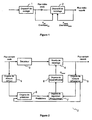
- FIG. 1 A system representing a sequence coding device 1 video images and a device 2 for recoding the same sequences is shown in Figure 1.
- the coding device 1 is a one-pass coder.
- the coding device 1 transmits a data stream, more particularly an audio / video stream, to the recoding device 2.
- Both encoding devices 1 and recoding 2 are in the embodiment given, interconnected via a communication network and therefore remote but can be locally interconnected in other modes of realization.
- the recoding device 2 also receives the complexity, X init , and the non-compressible cost, Overhead init , associated with each image of the incoming video stream and representative respectively of the complexity and the non-compressible cost of the initial coding performed by the coding device. 1 on the video stream.
- the recoding device 2 also uses the recoding information from the recoded outgoing stream.
- This recoding information is the recoding complexity, X recod , and the non-compressible cost of recoding, Overhead init .
- FIG. 2 represents an example of a block diagram of a device recoding according to the invention.
- the device comprises a decoder 3 connected to a loop of recoding 4 and a measuring device a priori 9.
- the decoder 3 and the measuring device a priori 9 receive as input a bit stream emitted by a encoding device 1 as shown in FIG. 1.
- the bit stream is composed of sequences representative of coded images. Images can be coded according to different modes and for example according to MPEG-2, MPEG-4 ASP (acronym for "Advanced Simple Profile") or MPEG-4 AVC (acronym for "Advanced Video Coding"). In a preferred embodiment detailed below, the images can be coded in three modes, intra, bidirectional or predictive according to standard MPEG-2.
- the decoder 3 outputs a video stream that enters the loop recoding 4.
- the recoding loop produces a recoded bitstream from the video stream produced by the decoder 3 and the Q recod quantization value provided by a re-quantizer 6.
- the recoding loop 4 is connected to a posterior measuring device 5. This device is responsible for measuring the complexity, X recod , and the non-compressible cost, Overhead recod , of the output stream of the recoding loop 4.
- the prior measurement device 9 receives images organized in sequence or not.
- the measuring device a priori 9 extracts the compressible cost, Enccost init , of each image.
- the prior measurement organ 9 extracts the complexity, X init , of each image.
- the complexity is expressed as the product of the compressible cost, Enccost init by the quantization step, Q init .
- the complexity is transmitted in the video stream and each image is associated with complexity.
- the complexity of each image is not transmitted with the flow and the measuring device a priori 9 calculates it in function of the bit stream.
- the measuring device a priori 9 also extracts the non-compressible cost still called syntax cost, Overhead init , of each image.
- the non-compressible cost is transmitted in the video stream and each image is associated with a non-compressible cost, Overhead init .
- the non-compressible cost of coding initial image is not transmitted with the flow and the measuring device priori calculates it according to the bit stream.
- the module 9 When the module 9 receives a number of images forming a reference period, in order to obtain better stability over time, it calculates for each reference period, its complexity, GlobalX init , and its non-compressible cost, GlobalOverhead init . Once all images are received, the recoding of each frame in the sequence begins.
- the cost of coding consists on the one hand of the compressible cost and on the other hand, the non-compressible cost generated by the syntax and cost of vectors.
- the cost compressible is due mainly to the coefficients of transformation into discrete cosine DCT.
- the cost compressible is due to the entire transformation approximating a transformation into DCT.
- the prior measurement device 9 provides the measures of initial complexity, X init , and initial non-compressible cost, Overhead init , of each incoming coded picture to a prediction unit 8.
- the coding used is of the type DCT, acronym for "discrete cosine transform” meaning transformation into discrete cosine.
- the compressible cost corresponds to the coefficients of the discrete cosine transform (DCT) coded according to a variable length code (VLC).
- the module 5 outputs to the modules 7 and 8, the non-compressible cost Overhead recod and quantization step Q recod .
- the prediction element 8 calculates for each image, the ratio (ratio overhead ) between the initial non-compressible cost of the image coded on the non-compressible cost of the recoded image and the ratio (Ratio x ) between the initial complexity of the image coded on the complexity of the recoded image.
- Ratio overhead overhead recod overhead init
- Ratio x X recod X init
- Module 8 updates, from the last reports thus stored, an averaged complexity ratio, SmoothedRatio x , and an averaged non-compressible cost ratio, SmoothedRatio overhead .
- the ratios Ratio x and Ratio overhead used are evaluated over a different period of the reference period. Indeed, the recoding values Overhead recod and X recod are not known when receiving the video sequence to be recoded since these are the recoding values that the recoding device will precisely calculate.
- the reports used for the calculation of the non-compressible cost ratios and the averaged complexity are based on the values computed previously and updated as the recoding progresses.
- each image to be recoded according to a mode is estimated according to the images previously recoded according to the same coding mode.
- the prediction unit 8 calculates an estimation of the cost of the image to be recoded, by calculating an estimate of the recoding complexity, X pred , and an estimate of the non-compressible cost of recoding, Overhead pred , for the current image and for the reference period in which it is located.
- overhead pred SmoothedRatio overhead [mod e ] ⁇ overhead init
- X pred SmoothedRatio x [mod e ] ⁇ X init
- the module 8 also calculates the incompressible cost (GlobalOverhead pred) and the complexity of re-encoding (GlobalX pred) of the reference period in which the current image is located.
- This body can thus, from these measurements, provide an estimate the relative weight of the image to be recoded in the image reference period.
- the image reference bit rate makes it possible to deduce a compression gain, applicable for the calculation of the recoding recoding step Q recod to be applied to each of the macro-blocks of the image to be recoded.
- the image level regulator 7 transmits the gain, GainC, to the requantification body 6.
- the recoding loop therefore uses the new quantization step Q recod in order to recode the new incoming image into the recoding loop.
- the length of a reference period is the length of a group of images called GOP, acronym for "Group Of Pictures”.
- the different coding modes are Intra (I), Bidirectional (B) or Predictor (P).
- granularity is sometimes finer than an image-like granularity and can be macroblock.
- each macroblock of the image is encoded with its own no quantization.
- the module 8 calculates the ratio of outgoing flows, MeanBpp recod , of the recoding loop 4 to the ratio of the incoming flows, MeanBpp init , in the recoding loop 4.
- Module 8 estimates the complexity and the non-compressible cost of each image to be recoded and the current GOP to which the image belongs to recode.
- the prediction element 8 calculates for each image, as indicated previously in the general embodiment, the ratio (ratio overhead ) between the initial non-compressible cost of the image coded on the non-compressible cost of the recoded image and the ratio (Ratio x ) between the initial complexity of the coded image and the complexity of the recoded image.
- Re dFactor overhead Ratio overhead ⁇ [ MINRatio overhead , 1]
- Re dFactor x Ratio x ⁇ [ MINRatio x , 1]
- MINRatio overhead (1 - Weight overhead [mod e ]) + Weight overhead [mod e ] ⁇ ratiorate
- MINRatio x (1 -weight x [mod e ]) + Weight x [mod e ] ⁇ ratiorate
- Weight overhead [mode] and Weight x [mode] are constants.
- the maximum bound chosen is "1" because the recoding can not create an increase in complexity.
- the complexity and coding cost ratios are a function of ratio of flows entering the recoding loop and outgoing flows from the recoding loop and also differ depending on the encoding mode.
- the module 8 calculates a non-compressible cost ratio averaged, and an average complexity ratio for each coding mode:
- the module 8 estimates the complexity, X pred , and the non-compressible recoding cost, Overhead pred , of the current image to be recoded as indicated in the general embodiment.
- GOPOverhead pred SmoothedRatio overhead [ I ] ⁇ IGOPOverhead init + SmoothedRatio overhead [ B ] ⁇ BGOPOverhead init + SmoothedRatio overhead [ P ] ⁇ PGOPOverhead init
- GOPX pred ZI ⁇ SmoothedRatio x [ I ] ⁇ IGOPX init + ZP ⁇ SmoothedRatio x [ P ] ⁇ PGOPX init + ZB ⁇ SmoothedRatio x [ B ] ⁇ BGOPX init
- GainC 100 ⁇ ( Enc cos t init - T arg and cos t ) Enc cos t init
- the different coding modes are always the Intra (I) mode, Bidirectional (B) or Predictive (P).
- the module 8 calculates the ratio of outgoing flows, MeanBpp recod , of the recoding loop 4 to the ratio of the incoming flows, MeanBpp init , in the recoding loop 4.
- Module 8 estimates the complexity and the non-compressible cost of each image to be recoded and the current GOP to which the image belongs to recode.
- the prediction element 8 calculates for each image, as indicated previously in the general embodiment, the ratio (ratio overhead ) between the initial non-compressible cost of the image coded on the non-compressible cost of the recoded image and the ratio (Ratio x ) between the initial complexity of the coded image and the complexity of the recoded image.
- Re dFactor overhead Ratio overhead ⁇ [ MINRatio overhead , 1]
- Re dFactor x Ratio x ⁇ [ MINRatio x , 1]
- MINRatio overhead (1 - Weight overhead [mod e ]) + Weight overhead [mod e ] ⁇ ratiorate
- MINRatio x (1- Weight x [mod e ]) + Weight x [mod e ] ⁇ ratiorate
- Weight overhoad [mode] and Weight x [mode] are constants.
- the complexity and coding cost ratios are a function of ratio of flows entering the recoding loop and outgoing flows from the recoding loop and also differ depending on the encoding mode.
- the module 8 calculates a non-compressible cost ratio averaged, and an average complexity ratio for each coding mode:
- the module 8 estimates the complexity, X pred , and the non-compressible recoding cost, Overhead pred , of the current image to be recoded as indicated in the general embodiment.
- GOPOverhead pred SmoothedRatio overhead [ I ] ⁇ IGOPOverhead init + SmoothedRatio overhead [ B ] ⁇ BGOPOverhead init + SmoothedRatio overhead [ P ] ⁇ PGOPOverhead init
- GOPX pred ZI ⁇ SmoothedRatio x [ I ] ⁇ IGOPX init + ZP ⁇ SmoothedRatio x [ P ] ⁇ PGOPX init + ZB ⁇ SmoothedRatio x [ B ] ⁇ BGOPX init
- This image reference cost is transmitted to the module 6 for re-quantization. According to this set cost, the module 6 will quantify the image to be recoded.
Landscapes
- Engineering & Computer Science (AREA)
- Signal Processing (AREA)
- Multimedia (AREA)
- Mathematical Analysis (AREA)
- Mathematical Optimization (AREA)
- Pure & Applied Mathematics (AREA)
- Physics & Mathematics (AREA)
- General Physics & Mathematics (AREA)
- Algebra (AREA)
- Compression Or Coding Systems Of Tv Signals (AREA)
- Television Signal Processing For Recording (AREA)
- Recording Measured Values (AREA)
- Closed-Circuit Television Systems (AREA)
Description
- des moyens d'extraire des informations associées au recodage des images, lesdites informations représentant au moins la complexité (Xrecod) de recodage de chaque image,
- des moyens d'extraire des informations, notamment de complexité de codage (Xinit), associées au codage initial des images,
- des moyens de calculer un rapport (Ratiox), dit rapport de complexité, des complexités (Xrecod) de recodage des images précédemment recodées selon ledit mode sur les complexités (Xinit) de codage initial de ces images,
- des moyens de mettre à jour un rapport de complexité moyenné (SmoothedRatiox [mode]) pour ledit mode en fonction du rapport de complexité (RatioX) et
- des moyens de recoder chaque image selon ledit mode en estimant la complexité (Xpred) de chaque image à recoder comme étant le produit de la complexité (Xinit) de codage initial de ladite image par le rapport de complexité moyenné pour ledit mode (SmoothedRatiox [mode]).
- dans le cas d'un transcodage au sein d'un même standard de compression, la complexité dépend du pas de quantification appliqué à l'image et donc du débit de codage de la séquence d'images.
- dans le cas d'un transcodage avec changement de standard de compression, la complexité dépend des caractéristiques propres à chaque algorithme de compression, ainsi que des paramètres précédents.
- la complexité de codage initial (Xinit) des images de la période de référence,
- le coût non compressible (GlobalOverheadinit) de codage initial des images de la période de référence,
- extraction des informations associées au recodage de certaines images, lesdites informations représentant au moins la complexité (Xrecod) de recodage de chaque image,
- extraction des informations, notamment de complexité de codage (Xinit), associées au codage initial de certaines images,
- calcul d'un rapport (Ratiox), dit rapport de complexité, des complexités (Xrecod) de recodage des images précédemment recodées selon ledit mode sur les complexités (Xinit) de codage initial de ces images,
- mise à jour d'un rapport de complexité moyenné (SmoothedRatiox [mode]) pour ledit mode en fonction du rapport de complexité (Ratiox) et
- recodage de chaque image selon ledit mode en estimant la complexité (Xpred) de chaque image à recoder comme étant le produit de la complexité (Xinit) de codage initial de ladite image par le rapport de complexité moyenné pour ledit mode (SmoothedRatiox [mode]).
- la figure 1 représente un mode de réalisation d'un système incluant un dispositif selon l'invention,
- la figure 2 représente un mode de réalisation d'un dispositif selon un mode de réalisation de l'invention.
- le coût non compressible Overheadrecod,
- le pas de quantification Qrecod.



- Drecod est le débit de consigne de recodage, exprimé en bit/s.
- Nbimages est le nombre d'images dans la période de référence.
- frame_rate est le nombre d'images par seconde.
- le coût compressible initial et le coût non compressible initial,
- le pas de quantification,
- le coût compressible initial, Enccostinit,
- le coût non compressible initial, Overheadinit,
- la complexité image initiale, Xinit,
- le cumul des coûts compressibles initiaux des images I,
- le cumul des coûts compressibles initiaux des images B,
- le cumul des coûts compressibles initiaux des images P,
- le cumul des coûts non compressibles initiaux des images I, IGOPOverheadinit.
- le cumul des coûts non compressibles initiaux des images B, BGOPoverheadinit.
- le cumul des coûts non compressibles initiaux des images P, PGOPoverheadinit.
- le cumul des complexités initiales des images I, IGOPXinit,
- le cumul des complexités initiales des images B, BGOPXinit,
- le cumul des complexités initiales des images P, PGOPXinit,
- le coût total initial du GOP, GOPcost.
- le coût compressible,
- le pas de quantification,
- la complexité macrobloc, comme étant le produit du coût compressible par le pas de quantification,
- Drecod est le débit de consigne de recodage, exprimé en bit/s.
- Nbimages est le nombre d'images dans la période de référence.
- frame_rate est le nombre d'images par seconde.
- GOPcost représente le coût total (compressible et non compressible) d'un GOP.
- Nbimages_GOP représente le nombre d'images dans le GOP.
- le coût compressible initial et le coût non compressible initial,
- le pas de quantification,
- le coût compressible initial, Enccostinit,
- le coût non compressible initial, Overheadinit,
- la complexité image initiale, Xinit,
- le cumul des coûts compressibles initiaux des images I,
- le cumul des coûts compressibles initiaux des images B,
- le cumul des coûts compressibles initiaux des images P,
- le cumul des coûts non compressibles initiaux des images I, IGOPOverheadinit.
- le cumul des coûts non compressibles initiaux des images B, BGOPoverheadinit.
- le cumul des coûts non compressibles initiaux des images P, PGOPoverheadinit.
- le cumul des complexités initiales des images I, IGOPXinit,
- le cumul des complexités initiales des images B, BGOPXinit,
- le cumul des complexités initiales des images P, PGOPXinit,
- le coût total initial du GOP, GOPcost.
- le coût compressible,
- le pas de quantification,
- la complexité macrobloc, comme étant le produit du coût compressible par le pas de quantification,
- Drecod est le débit de consigne de recodage, exprimé en bit/s.
- Nbimages est le nombre d'images dans la période de référence.
- frame_rate est le nombre d'images par seconde.
- GOPcost représente le coût total (compressible et non compressible) d'un GOP.
- Nbimages_GOP représente le nombre d'images dans le GOP.
Claims (10)
- Dispositif de recodage d'images selon un débit de consigne donné d'un flux vidéo comportant des séquences d'images initialement codées selon au moins un mode, comportant :caractérisé en ce qu'il comporte :des moyens d'extraire des informations associées au recodage des images, lesdites informations représentant au moins la complexité (Xrecod) de recodage de chaque image,des moyens d'extraire des informations, notamment de complexité de codage (Xinit), associées au codage initial des images,des moyens de calculer un rapport (Ratiox), dit rapport de complexité, des complexités (Xrecod) de recodage des images précédemment recodées selon ledit mode sur les complexités (Xinit) de codage initial de ces images,des moyens de mettre à jour un rapport de complexité moyenné (SmoothedRatiox [mode]) pour ledit mode en fonction du rapport de complexité (Ratiox) etdes moyens de recoder chaque image selon ledit mode en estimant la complexité (Xpred) de chaque image à recoder comme étant le produit de la complexité (Xinit) de codage initial de ladite image par le rapport de complexité moyenné pour ledit mode (SmoothedRatiox [mode]).
- Dispositif de recodage selon la revendication 1 caractérisé en ce qu'il comportedes moyens d'extraire le coût non compressible de codage initial (Overheadinit) de chaque image,des moyens d'extraire le coût non compressible de recodage (Overheadrecod) de chaque image recodée,des moyens de calculer un rapport (Ratiooverhead), dit rapport de coût non compressible, des coûts non compressibles (Overheadrecod) de recodage d'images précédemment recodées selon ledit mode sur les coûts non compressibles (Overheadinit) de codage initial de ces images,des moyens de mettre à jour un rapport de coût non compressible moyenné (SmoothedRatiooverhead [mode]) pour ledit mode en fonction du rapport de coût non compressible (Ratiooverhead) etles moyens de recoder chaque image selon ledit mode estimant le coût non compressible (Overheadpred) de chaque image à recoder comme étant le produit du coût non compressible de codage initial (Overheadinit) de ladite image par le rapport de coût non compressible moyenné pour ledit mode (SmoothedRatiooverhead).
- Dispositif selon l'une des revendications 1 à 2 caractérisé en ce qu'il comporte des moyens de mémoriser, pour plusieurs images consécutives définissant une période de référence, des informations associées au codage initial, lesdites informations étantla complexité de codage initial (GlobalXinit) des images de la période de référence,le coût non compressible (GlobalOverheadinit) de codage initial des images de la période de référence,
- Dispositif selon la revendication 3 caractérisé en ce que les moyens de recoder chaque image sont fonction des informations associées au codage initial des images appartenant à la période de référence.
- Dispositif selon l'une des revendications 3 à 4 caractérisé en ce qu'il comporte des moyens d'estimation du coût de recodage non compressible total (GlobalOverheadpred) de chaque période de référence.
- Dispositif selon l'une des revendications 3 à 5 caractérisé en ce qu'il comporte des moyens d'estimation de la complexité totale de recodage (GlobalXpred) de chaque période de référence.
- Dispositif selon la revendication 6 caractérisé en ce qu'il comporte des moyens de calcul d'un coût compressible de consigne (Targetcost) pour chaque image à recoder en fonction au moins de sa complexité de recodage estimée (Xpred) relative par rapport à la complexité totale (GlobalXpred) de recodage de la période de référence.
- Dispositif selon la revendication 7 caractérisé en ce qu'il comportedes moyens d'extraire le coût de codage initial (Enccostinit) de ladite image,des moyens de calcul d'un gain de compression (GainC) à appliquer sur chaque image à recoder en fonction du coût compressible de consigne (Targetcost) et du coût compressible de codage initial (Enccostinit) de ladite image.
- Dispositif selon la revendication 8 caractérisé en ce qu'il comporte des moyens de calcul de la quantification moyenne à appliquer sur chaque image à recoder (Qrecod) en fonction du gain de compression (GainC), du rapport de complexité moyenné pour le mode de codage de l'image à recoder (SmoothedRatiox [mode]), et de la quantification moyenne appliquée pour le codage initial de l'image à recoder (Qinit).
- Procédé de recodage d'images selon un débit de consigne donné d'un flux vidéo comportant des séquences d'images initialement codées selon au moins un mode, comportant les étapes de:caractérisé en ce qu'il comporte les étapes de:extraction des informations associées au recodage de certaines images, lesdites informations représentant au moins la complexité (Xrecod) de recodage de chaque image,extraction des informations, notamment de complexité de codage (Xinit), associées au codage initial de certaines images,calcul d'un rapport (Ratiox), dit rapport de complexité, des complexités (Xrecod) de recodage des images précédemment recodées selon ledit mode sur les complexités (Xinit) de codage initial de ces images,mise à jour d'un rapport de complexité moyenné (SmoothedRatiox [mode]) pour ledit mode en fonction du rapport de complexité (Ratiox) etrecodage de chaque image selon ledit mode en estimant la complexité (Xpred) de chaque image à recoder comme étant le produit de la complexité (Xinit) de codage initial de ladite image par le rapport de complexité moyenné pour ledit mode (SmoothedRatiox [mode]).
Applications Claiming Priority (3)
| Application Number | Priority Date | Filing Date | Title |
|---|---|---|---|
| FR0201744A FR2835995B1 (fr) | 2002-02-11 | 2002-02-11 | Dispositif et methode de recodage d'un flux de donnees video |
| FR0201744 | 2002-02-11 | ||
| PCT/FR2003/000409 WO2003069915A2 (fr) | 2002-02-11 | 2003-02-10 | Dispositif et methode de recodage d'un flux de donnees video |
Publications (2)
| Publication Number | Publication Date |
|---|---|
| EP1474928A2 EP1474928A2 (fr) | 2004-11-10 |
| EP1474928B1 true EP1474928B1 (fr) | 2005-06-08 |
Family
ID=27620144
Family Applications (1)
| Application Number | Title | Priority Date | Filing Date |
|---|---|---|---|
| EP03715077A Expired - Lifetime EP1474928B1 (fr) | 2002-02-11 | 2003-02-10 | Dispositif et methode de recodage d'un flux de donnees video |
Country Status (9)
| Country | Link |
|---|---|
| US (1) | US7907666B2 (fr) |
| EP (1) | EP1474928B1 (fr) |
| CN (1) | CN1311689C (fr) |
| AT (1) | ATE297635T1 (fr) |
| AU (1) | AU2003219272A1 (fr) |
| DE (1) | DE60300818T2 (fr) |
| ES (1) | ES2243897T3 (fr) |
| FR (1) | FR2835995B1 (fr) |
| WO (1) | WO2003069915A2 (fr) |
Families Citing this family (1)
| Publication number | Priority date | Publication date | Assignee | Title |
|---|---|---|---|---|
| US7263126B2 (en) * | 2003-09-15 | 2007-08-28 | Sharp Laboratories Of America, Inc. | System and method for transcoding with adaptive bit rate control |
Family Cites Families (7)
| Publication number | Priority date | Publication date | Assignee | Title |
|---|---|---|---|---|
| DE69607696T2 (de) * | 1995-02-15 | 2000-10-19 | Koninklijke Philips Electronics N.V., Eindhoven | Vorrichtung und verfahren zur transkodierung von videosignalen |
| EP0756800B1 (fr) * | 1995-02-22 | 2000-05-10 | Koninklijke Philips Electronics N.V. | Systeme de transmission simultanee d'une pluralite de programmes video sur une voie de transmission |
| US6100940A (en) * | 1998-01-21 | 2000-08-08 | Sarnoff Corporation | Apparatus and method for using side information to improve a coding system |
| US6167084A (en) * | 1998-08-27 | 2000-12-26 | Motorola, Inc. | Dynamic bit allocation for statistical multiplexing of compressed and uncompressed digital video signals |
| JP3871840B2 (ja) * | 1999-12-24 | 2007-01-24 | 日本電気株式会社 | 圧縮動画像再符号化装置 |
| US6731685B1 (en) * | 2000-09-20 | 2004-05-04 | General Instrument Corporation | Method and apparatus for determining a bit rate need parameter in a statistical multiplexer |
| US6950463B2 (en) * | 2001-06-13 | 2005-09-27 | Microsoft Corporation | Non-compensated transcoding of a video stream |
-
2002
- 2002-02-11 FR FR0201744A patent/FR2835995B1/fr not_active Expired - Fee Related
-
2003
- 2003-02-10 ES ES03715077T patent/ES2243897T3/es not_active Expired - Lifetime
- 2003-02-10 DE DE60300818T patent/DE60300818T2/de not_active Expired - Lifetime
- 2003-02-10 CN CNB038032090A patent/CN1311689C/zh not_active Expired - Fee Related
- 2003-02-10 US US10/504,105 patent/US7907666B2/en active Active
- 2003-02-10 WO PCT/FR2003/000409 patent/WO2003069915A2/fr not_active Ceased
- 2003-02-10 EP EP03715077A patent/EP1474928B1/fr not_active Expired - Lifetime
- 2003-02-10 AU AU2003219272A patent/AU2003219272A1/en not_active Abandoned
- 2003-02-10 AT AT03715077T patent/ATE297635T1/de not_active IP Right Cessation
Also Published As
| Publication number | Publication date |
|---|---|
| WO2003069915A3 (fr) | 2004-03-25 |
| AU2003219272A1 (en) | 2003-09-04 |
| CN1311689C (zh) | 2007-04-18 |
| US7907666B2 (en) | 2011-03-15 |
| FR2835995A1 (fr) | 2003-08-15 |
| DE60300818D1 (de) | 2005-07-14 |
| FR2835995B1 (fr) | 2004-05-14 |
| ES2243897T3 (es) | 2005-12-01 |
| ATE297635T1 (de) | 2005-06-15 |
| US20050254791A1 (en) | 2005-11-17 |
| EP1474928A2 (fr) | 2004-11-10 |
| DE60300818T2 (de) | 2006-03-16 |
| WO2003069915A2 (fr) | 2003-08-21 |
| AU2003219272A8 (en) | 2003-09-04 |
| CN1628464A (zh) | 2005-06-15 |
Similar Documents
| Publication | Publication Date | Title |
|---|---|---|
| EP2123040B1 (fr) | Commande de débit vidéo amélioré pour normes de codage vidéo | |
| US20210218997A1 (en) | Cascaded Prediction-Transform Approach for Mixed Machine-Human Targeted Video Coding | |
| US6925120B2 (en) | Transcoder for scalable multi-layer constant quality video bitstreams | |
| US8223836B2 (en) | Constant-quality rate control system and algorithm for regions of interest | |
| US8325622B2 (en) | Adaptive, scalable packet loss recovery | |
| US6522693B1 (en) | System and method for reencoding segments of buffer constrained video streams | |
| EP0798930B1 (fr) | Appareil de codage vidéo | |
| US11341688B2 (en) | Guiding decoder-side optimization of neural network filter | |
| FR2755817A1 (fr) | Appareil de regulation du volume binaire pour coder un signal video et procede pour celui-ci | |
| US20030053709A1 (en) | Coding and noise filtering an image sequence | |
| FR2904494A1 (fr) | Procede et dispositif de compression d'image, systeme de telecommunication comportant un tel dispositif et programme mettant en oeuvre un tel procede | |
| WO2014090950A1 (fr) | Procede d'adaptation dynamique du codage d'un flux audio et/ou video transmis a un dispositif | |
| FR2743246A1 (fr) | Procede et dispositif de compression de donnees numeriques | |
| EP3207702A1 (fr) | Decodeur, procede et systeme de decodage de flux multimedia | |
| EP2297968A1 (fr) | Procede et systeme permettant de proteger un flux video compresse contre les erreurs survenant lors d'une transmission | |
| FR2823049A1 (fr) | Procede et dispositif de controle de la qualite de donnees video | |
| FR2790899A1 (fr) | Dispositif et procede de regulation de debit dans un systeme de multiplexage statistique de flux d'images codees selon le codage mpeg 2 | |
| EP2368367B1 (fr) | Système et procédé interactif pour la transmission sur un réseau bas débit d'images clefs sélectionnées dans un flux video | |
| CN104125460A (zh) | 用于控制视频比特率的方法和设备 | |
| US7706441B2 (en) | Transcoding apparatus and method, and target bit allocation and picture complexity estimation apparatus and methods used for the same | |
| Lei et al. | Accurate bit allocation and rate control for DCT domain video transcoding | |
| FR2858741A1 (fr) | Dispositif et procede de compression d'images numeriques | |
| FR2851111A1 (fr) | Dispositif de codage d'un flux de donnees video | |
| Colonnese et al. | Joint source and sending rate modeling in adaptive video streaming | |
| KR20040007818A (ko) | 동영상 부호화를 위한 dct연산량 조절 방법 및 그 장치 |
Legal Events
| Date | Code | Title | Description |
|---|---|---|---|
| PUAI | Public reference made under article 153(3) epc to a published international application that has entered the european phase |
Free format text: ORIGINAL CODE: 0009012 |
|
| 17P | Request for examination filed |
Effective date: 20040701 |
|
| AK | Designated contracting states |
Kind code of ref document: A2 Designated state(s): AT BE BG CH CY CZ DE DK EE ES FI FR GB GR HU IE IT LI LU MC NL PT SE SI SK TR |
|
| AX | Request for extension of the european patent |
Extension state: AL LT LV MK RO |
|
| GRAP | Despatch of communication of intention to grant a patent |
Free format text: ORIGINAL CODE: EPIDOSNIGR1 |
|
| RIN1 | Information on inventor provided before grant (corrected) |
Inventor name: DUMENIL, PATRICK Inventor name: ALEXANDRE, PATRICE Inventor name: DUCLOUX, XAVIER |
|
| GRAS | Grant fee paid |
Free format text: ORIGINAL CODE: EPIDOSNIGR3 |
|
| GRAA | (expected) grant |
Free format text: ORIGINAL CODE: 0009210 |
|
| AK | Designated contracting states |
Kind code of ref document: B1 Designated state(s): AT BE BG CH CY CZ DE DK EE ES FI FR GB GR HU IE IT LI LU MC NL PT SE SI SK TR |
|
| PG25 | Lapsed in a contracting state [announced via postgrant information from national office to epo] |
Ref country code: CZ Free format text: LAPSE BECAUSE OF FAILURE TO SUBMIT A TRANSLATION OF THE DESCRIPTION OR TO PAY THE FEE WITHIN THE PRESCRIBED TIME-LIMIT Effective date: 20050608 Ref country code: NL Free format text: LAPSE BECAUSE OF FAILURE TO SUBMIT A TRANSLATION OF THE DESCRIPTION OR TO PAY THE FEE WITHIN THE PRESCRIBED TIME-LIMIT Effective date: 20050608 Ref country code: TR Free format text: LAPSE BECAUSE OF FAILURE TO SUBMIT A TRANSLATION OF THE DESCRIPTION OR TO PAY THE FEE WITHIN THE PRESCRIBED TIME-LIMIT Effective date: 20050608 Ref country code: AT Free format text: LAPSE BECAUSE OF FAILURE TO SUBMIT A TRANSLATION OF THE DESCRIPTION OR TO PAY THE FEE WITHIN THE PRESCRIBED TIME-LIMIT Effective date: 20050608 Ref country code: FI Free format text: LAPSE BECAUSE OF FAILURE TO SUBMIT A TRANSLATION OF THE DESCRIPTION OR TO PAY THE FEE WITHIN THE PRESCRIBED TIME-LIMIT Effective date: 20050608 Ref country code: EE Free format text: LAPSE BECAUSE OF FAILURE TO SUBMIT A TRANSLATION OF THE DESCRIPTION OR TO PAY THE FEE WITHIN THE PRESCRIBED TIME-LIMIT Effective date: 20050608 Ref country code: IE Free format text: LAPSE BECAUSE OF FAILURE TO SUBMIT A TRANSLATION OF THE DESCRIPTION OR TO PAY THE FEE WITHIN THE PRESCRIBED TIME-LIMIT Effective date: 20050608 Ref country code: SI Free format text: LAPSE BECAUSE OF FAILURE TO SUBMIT A TRANSLATION OF THE DESCRIPTION OR TO PAY THE FEE WITHIN THE PRESCRIBED TIME-LIMIT Effective date: 20050608 Ref country code: SK Free format text: LAPSE BECAUSE OF FAILURE TO SUBMIT A TRANSLATION OF THE DESCRIPTION OR TO PAY THE FEE WITHIN THE PRESCRIBED TIME-LIMIT Effective date: 20050608 |
|
| REG | Reference to a national code |
Ref country code: GB Ref legal event code: FG4D Free format text: NOT ENGLISH |
|
| REG | Reference to a national code |
Ref country code: CH Ref legal event code: EP |
|
| REF | Corresponds to: |
Ref document number: 60300818 Country of ref document: DE Date of ref document: 20050714 Kind code of ref document: P |
|
| REG | Reference to a national code |
Ref country code: IE Ref legal event code: FG4D Free format text: LANGUAGE OF EP DOCUMENT: FRENCH |
|
| GBT | Gb: translation of ep patent filed (gb section 77(6)(a)/1977) |
Effective date: 20050718 |
|
| PG25 | Lapsed in a contracting state [announced via postgrant information from national office to epo] |
Ref country code: GR Free format text: LAPSE BECAUSE OF FAILURE TO SUBMIT A TRANSLATION OF THE DESCRIPTION OR TO PAY THE FEE WITHIN THE PRESCRIBED TIME-LIMIT Effective date: 20050908 Ref country code: DK Free format text: LAPSE BECAUSE OF FAILURE TO SUBMIT A TRANSLATION OF THE DESCRIPTION OR TO PAY THE FEE WITHIN THE PRESCRIBED TIME-LIMIT Effective date: 20050908 Ref country code: BG Free format text: LAPSE BECAUSE OF FAILURE TO SUBMIT A TRANSLATION OF THE DESCRIPTION OR TO PAY THE FEE WITHIN THE PRESCRIBED TIME-LIMIT Effective date: 20050908 Ref country code: SE Free format text: LAPSE BECAUSE OF FAILURE TO SUBMIT A TRANSLATION OF THE DESCRIPTION OR TO PAY THE FEE WITHIN THE PRESCRIBED TIME-LIMIT Effective date: 20050908 |
|
| PG25 | Lapsed in a contracting state [announced via postgrant information from national office to epo] |
Ref country code: PT Free format text: LAPSE BECAUSE OF FAILURE TO SUBMIT A TRANSLATION OF THE DESCRIPTION OR TO PAY THE FEE WITHIN THE PRESCRIBED TIME-LIMIT Effective date: 20051114 |
|
| NLV1 | Nl: lapsed or annulled due to failure to fulfill the requirements of art. 29p and 29m of the patents act | ||
| REG | Reference to a national code |
Ref country code: ES Ref legal event code: FG2A Ref document number: 2243897 Country of ref document: ES Kind code of ref document: T3 |
|
| PG25 | Lapsed in a contracting state [announced via postgrant information from national office to epo] |
Ref country code: HU Free format text: LAPSE BECAUSE OF FAILURE TO SUBMIT A TRANSLATION OF THE DESCRIPTION OR TO PAY THE FEE WITHIN THE PRESCRIBED TIME-LIMIT Effective date: 20051209 |
|
| REG | Reference to a national code |
Ref country code: IE Ref legal event code: FD4D |
|
| PG25 | Lapsed in a contracting state [announced via postgrant information from national office to epo] |
Ref country code: MC Free format text: LAPSE BECAUSE OF NON-PAYMENT OF DUE FEES Effective date: 20060228 Ref country code: LU Free format text: LAPSE BECAUSE OF NON-PAYMENT OF DUE FEES Effective date: 20060228 Ref country code: BE Free format text: LAPSE BECAUSE OF NON-PAYMENT OF DUE FEES Effective date: 20060228 |
|
| PLBE | No opposition filed within time limit |
Free format text: ORIGINAL CODE: 0009261 |
|
| STAA | Information on the status of an ep patent application or granted ep patent |
Free format text: STATUS: NO OPPOSITION FILED WITHIN TIME LIMIT |
|
| 26N | No opposition filed |
Effective date: 20060309 |
|
| PG25 | Lapsed in a contracting state [announced via postgrant information from national office to epo] |
Ref country code: CH Free format text: LAPSE BECAUSE OF NON-PAYMENT OF DUE FEES Effective date: 20070228 Ref country code: LI Free format text: LAPSE BECAUSE OF NON-PAYMENT OF DUE FEES Effective date: 20070228 |
|
| REG | Reference to a national code |
Ref country code: CH Ref legal event code: PL |
|
| BERE | Be: lapsed |
Owner name: NEXTREAM FRANCE Effective date: 20060228 |
|
| PG25 | Lapsed in a contracting state [announced via postgrant information from national office to epo] |
Ref country code: CY Free format text: LAPSE BECAUSE OF FAILURE TO SUBMIT A TRANSLATION OF THE DESCRIPTION OR TO PAY THE FEE WITHIN THE PRESCRIBED TIME-LIMIT Effective date: 20050608 |
|
| PGFP | Annual fee paid to national office [announced via postgrant information from national office to epo] |
Ref country code: IT Payment date: 20120221 Year of fee payment: 10 |
|
| REG | Reference to a national code |
Ref country code: DE Ref legal event code: R082 Ref document number: 60300818 Country of ref document: DE Representative=s name: ROSSMANITH, MANFRED, DIPL.-PHYS. DR.RER.NAT., DE |
|
| REG | Reference to a national code |
Ref country code: FR Ref legal event code: PLFP Year of fee payment: 13 |
|
| REG | Reference to a national code |
Ref country code: DE Ref legal event code: R082 Ref document number: 60300818 Country of ref document: DE |
|
| PGFP | Annual fee paid to national office [announced via postgrant information from national office to epo] |
Ref country code: DE Payment date: 20150203 Year of fee payment: 13 Ref country code: ES Payment date: 20150127 Year of fee payment: 13 |
|
| PGFP | Annual fee paid to national office [announced via postgrant information from national office to epo] |
Ref country code: FR Payment date: 20150210 Year of fee payment: 13 Ref country code: GB Payment date: 20150204 Year of fee payment: 13 |
|
| PG25 | Lapsed in a contracting state [announced via postgrant information from national office to epo] |
Ref country code: IT Free format text: LAPSE BECAUSE OF NON-PAYMENT OF DUE FEES Effective date: 20140210 |
|
| REG | Reference to a national code |
Ref country code: DE Ref legal event code: R119 Ref document number: 60300818 Country of ref document: DE |
|
| GBPC | Gb: european patent ceased through non-payment of renewal fee |
Effective date: 20160210 |
|
| REG | Reference to a national code |
Ref country code: FR Ref legal event code: ST Effective date: 20161028 |
|
| PG25 | Lapsed in a contracting state [announced via postgrant information from national office to epo] |
Ref country code: GB Free format text: LAPSE BECAUSE OF NON-PAYMENT OF DUE FEES Effective date: 20160210 Ref country code: DE Free format text: LAPSE BECAUSE OF NON-PAYMENT OF DUE FEES Effective date: 20160901 Ref country code: FR Free format text: LAPSE BECAUSE OF NON-PAYMENT OF DUE FEES Effective date: 20160229 |
|
| PG25 | Lapsed in a contracting state [announced via postgrant information from national office to epo] |
Ref country code: ES Free format text: LAPSE BECAUSE OF NON-PAYMENT OF DUE FEES Effective date: 20160211 |