EP1474409B1 - Epoxidation process - Google Patents
Epoxidation process Download PDFInfo
- Publication number
- EP1474409B1 EP1474409B1 EP02806555A EP02806555A EP1474409B1 EP 1474409 B1 EP1474409 B1 EP 1474409B1 EP 02806555 A EP02806555 A EP 02806555A EP 02806555 A EP02806555 A EP 02806555A EP 1474409 B1 EP1474409 B1 EP 1474409B1
- Authority
- EP
- European Patent Office
- Prior art keywords
- epoxidation
- feed
- sodium
- materials
- bed
- Prior art date
- Legal status (The legal status is an assumption and is not a legal conclusion. Google has not performed a legal analysis and makes no representation as to the accuracy of the status listed.)
- Expired - Lifetime
Links
- 238000006735 epoxidation reaction Methods 0.000 title claims abstract description 34
- 238000000034 method Methods 0.000 title claims description 12
- 239000007787 solid Substances 0.000 claims abstract description 14
- 150000001336 alkenes Chemical class 0.000 claims abstract description 8
- JRZJOMJEPLMPRA-UHFFFAOYSA-N olefin Natural products CCCCCCCC=C JRZJOMJEPLMPRA-UHFFFAOYSA-N 0.000 claims abstract description 8
- 239000012260 resinous material Substances 0.000 claims description 15
- 239000003054 catalyst Substances 0.000 claims description 14
- 229910052751 metal Inorganic materials 0.000 claims description 11
- 239000002184 metal Substances 0.000 claims description 11
- 150000002432 hydroperoxides Chemical class 0.000 claims description 5
- 239000011491 glass wool Substances 0.000 claims description 3
- 239000011949 solid catalyst Substances 0.000 claims description 3
- 239000002657 fibrous material Substances 0.000 claims description 2
- IAYPIBMASNFSPL-UHFFFAOYSA-N Ethylene oxide Chemical compound C1CO1 IAYPIBMASNFSPL-UHFFFAOYSA-N 0.000 claims 1
- 229910001111 Fine metal Inorganic materials 0.000 claims 1
- DGAQECJNVWCQMB-PUAWFVPOSA-M Ilexoside XXIX Chemical compound C[C@@H]1CC[C@@]2(CC[C@@]3(C(=CC[C@H]4[C@]3(CC[C@@H]5[C@@]4(CC[C@@H](C5(C)C)OS(=O)(=O)[O-])C)C)[C@@H]2[C@]1(C)O)C)C(=O)O[C@H]6[C@@H]([C@H]([C@@H]([C@H](O6)CO)O)O)O.[Na+] DGAQECJNVWCQMB-PUAWFVPOSA-M 0.000 abstract description 23
- 229910052708 sodium Inorganic materials 0.000 abstract description 23
- 239000011734 sodium Substances 0.000 abstract description 23
- 239000000463 material Substances 0.000 abstract description 15
- MHAJPDPJQMAIIY-UHFFFAOYSA-N Hydrogen peroxide Chemical compound OO MHAJPDPJQMAIIY-UHFFFAOYSA-N 0.000 abstract description 7
- YNQLUTRBYVCPMQ-UHFFFAOYSA-N Ethylbenzene Chemical compound CCC1=CC=CC=C1 YNQLUTRBYVCPMQ-UHFFFAOYSA-N 0.000 description 10
- GQNOPVSQPBUJKQ-UHFFFAOYSA-N 1-hydroperoxyethylbenzene Chemical compound OOC(C)C1=CC=CC=C1 GQNOPVSQPBUJKQ-UHFFFAOYSA-N 0.000 description 7
- QQONPFPTGQHPMA-UHFFFAOYSA-N propylene Natural products CC=C QQONPFPTGQHPMA-UHFFFAOYSA-N 0.000 description 6
- 125000004805 propylene group Chemical group [H]C([H])([H])C([H])([*:1])C([H])([H])[*:2] 0.000 description 6
- 238000006243 chemical reaction Methods 0.000 description 5
- 239000012074 organic phase Substances 0.000 description 4
- 239000000376 reactant Substances 0.000 description 4
- 229910001220 stainless steel Inorganic materials 0.000 description 4
- 239000010935 stainless steel Substances 0.000 description 4
- GOOHAUXETOMSMM-UHFFFAOYSA-N Propylene oxide Chemical compound CC1CO1 GOOHAUXETOMSMM-UHFFFAOYSA-N 0.000 description 3
- HEMHJVSKTPXQMS-UHFFFAOYSA-M Sodium hydroxide Chemical compound [OH-].[Na+] HEMHJVSKTPXQMS-UHFFFAOYSA-M 0.000 description 3
- 230000002411 adverse Effects 0.000 description 3
- 239000003518 caustics Substances 0.000 description 3
- 230000009849 deactivation Effects 0.000 description 3
- 238000010908 decantation Methods 0.000 description 3
- 230000003647 oxidation Effects 0.000 description 3
- 238000007254 oxidation reaction Methods 0.000 description 3
- MYMOFIZGZYHOMD-UHFFFAOYSA-N Dioxygen Chemical compound O=O MYMOFIZGZYHOMD-UHFFFAOYSA-N 0.000 description 2
- VYPSYNLAJGMNEJ-UHFFFAOYSA-N Silicium dioxide Chemical compound O=[Si]=O VYPSYNLAJGMNEJ-UHFFFAOYSA-N 0.000 description 2
- 229910001882 dioxygen Inorganic materials 0.000 description 2
- 238000005516 engineering process Methods 0.000 description 2
- 239000000203 mixture Substances 0.000 description 2
- 150000002924 oxiranes Chemical class 0.000 description 2
- 238000012856 packing Methods 0.000 description 2
- 239000002245 particle Substances 0.000 description 2
- 239000012071 phase Substances 0.000 description 2
- 239000011148 porous material Substances 0.000 description 2
- 239000011347 resin Substances 0.000 description 2
- 229920005989 resin Polymers 0.000 description 2
- WXMKPNITSTVMEF-UHFFFAOYSA-M sodium benzoate Chemical compound [Na+].[O-]C(=O)C1=CC=CC=C1 WXMKPNITSTVMEF-UHFFFAOYSA-M 0.000 description 2
- 235000010234 sodium benzoate Nutrition 0.000 description 2
- 239000004299 sodium benzoate Substances 0.000 description 2
- 239000004215 Carbon black (E152) Substances 0.000 description 1
- 229910000831 Steel Inorganic materials 0.000 description 1
- 230000002378 acidificating effect Effects 0.000 description 1
- 230000001154 acute effect Effects 0.000 description 1
- 238000006555 catalytic reaction Methods 0.000 description 1
- 239000007795 chemical reaction product Substances 0.000 description 1
- 238000010276 construction Methods 0.000 description 1
- 230000008021 deposition Effects 0.000 description 1
- 238000001514 detection method Methods 0.000 description 1
- 230000000694 effects Effects 0.000 description 1
- 239000002638 heterogeneous catalyst Substances 0.000 description 1
- 229930195733 hydrocarbon Natural products 0.000 description 1
- 239000002198 insoluble material Substances 0.000 description 1
- 230000007257 malfunction Effects 0.000 description 1
- 238000004519 manufacturing process Methods 0.000 description 1
- 150000002739 metals Chemical class 0.000 description 1
- 238000012544 monitoring process Methods 0.000 description 1
- 230000007935 neutral effect Effects 0.000 description 1
- -1 olefin hydrocarbon Chemical class 0.000 description 1
- 239000011236 particulate material Substances 0.000 description 1
- 239000002244 precipitate Substances 0.000 description 1
- 239000000047 product Substances 0.000 description 1
- 230000000246 remedial effect Effects 0.000 description 1
- 239000012262 resinous product Substances 0.000 description 1
- 238000000926 separation method Methods 0.000 description 1
- 239000000377 silicon dioxide Substances 0.000 description 1
- 239000010959 steel Substances 0.000 description 1
- 238000005406 washing Methods 0.000 description 1
- XLYOFNOQVPJJNP-UHFFFAOYSA-N water Substances O XLYOFNOQVPJJNP-UHFFFAOYSA-N 0.000 description 1
- 210000002268 wool Anatomy 0.000 description 1
Images
Classifications
-
- C—CHEMISTRY; METALLURGY
- C07—ORGANIC CHEMISTRY
- C07D—HETEROCYCLIC COMPOUNDS
- C07D301/00—Preparation of oxiranes
- C07D301/02—Synthesis of the oxirane ring
- C07D301/03—Synthesis of the oxirane ring by oxidation of unsaturated compounds, or of mixtures of unsaturated and saturated compounds
- C07D301/19—Synthesis of the oxirane ring by oxidation of unsaturated compounds, or of mixtures of unsaturated and saturated compounds with organic hydroperoxides
-
- C—CHEMISTRY; METALLURGY
- C07—ORGANIC CHEMISTRY
- C07D—HETEROCYCLIC COMPOUNDS
- C07D301/00—Preparation of oxiranes
- C07D301/02—Synthesis of the oxirane ring
- C07D301/03—Synthesis of the oxirane ring by oxidation of unsaturated compounds, or of mixtures of unsaturated and saturated compounds
Definitions
- the present invention relates to the epoxidation of olefins such as propylene by reaction with an organic hydroperoxide using solid epoxidation catalyst and especially to a process wherein feed to the epoxidation has been treated with aqueous base, the improvement which comprises subjecting the epoxidation feed to a treatment prior to contact with the solid epoxidation catalyst to trap and remove insoluble materials which otherwise would adversely affect the epoxidation catalyst and reaction.
- oxirane compounds such as propylene oxide by catalytic reaction of an olefin such as propylene with an organic hydroperoxide such as ethylbenzene hydroperoxide.
- organic hydroperoxide such as ethylbenzene hydroperoxide
- an insoluble solid heterogeneous catalyst is used to catalyze the epoxidation reaction. See, for example, U.S. Patent 4,367,342. A patent illustrating procedures for carrying out this reaction is U.S. Patent 5,849,937.
- the organic hydroperoxide e.g. ethylbenzene hydroperoxide, is advantageously formed by molecular oxygen oxidation of ethylbenzene. See, for example, U.S. Patent 4,066,706.
- the problem is especially acute after the oxidate has been admixed with the olefin to be epoxidized.
- the solubility of resinous sodium containing materials is substantially lowered when the oxidate is mixed with olefin and the resulting insoluble resinous materials are prone to plug and deactivate the epoxidation catalyst bed unless first removed.
- the present invention provides protection against such catalyst bed plugging and deactivation.
- the hydroperoxide and olefin feed admixture to the epoxidation reaction zone, wherein is contained solid epoxidation catalyst is pretreated by passage through a screen or frit, or by passage through a bed of solid particles.
- a screen or frit or by passage through a bed of solid particles.
- insoluble sodium containing resinous materials are trapped and separated from the epoxidation feed before the feed enters the epoxidation zone.
- the screen or bed can be regenerated as by washing, or replaced.
- an ethylbenzene hydroperoxide stream from ethylbenzene oxidation which had been treated with aqueous sodium hydroxide, decanted and the organic phase water washed and decanted, passes via line 1 to contact zone 2.
- Propylene reactant passes via line 3 and is admixed with the ethylbenzene hydroperoxide stream before entry into contact zone 2.
- zone 2 is provided through which the epoxidation feed is passed.
- zone 2 is packed with neutral or slightly basic particulate material such as silica which is effective to entrap and remove the insoluble resinous sodium materials.
- zone 2 is provided with 1 or more fine mesh metal screens, illustratively of a 120 micron size or finer, which screens effectively entrap and remove the insoluble resinous materials from the reactor feed.
- zone 2 a packed bed comprised of one or more metal frits, which are sintered metal filters, and which are also effective in entrapping and removing the resinous solids from the feed to the epoxidation zone.
- Other coalescing packing solids comprised of fibrous materials such as glass wool or steel wool can also be used.
- the epoxidation feed now substantially free of contained insoluble resinous products passes from zone 2 via line 4 to epoxidation zone 5 wherein the ethylbenzene hydroperoxide and propylene contained therein contact a solid epoxidation catalyst and react to form propylene oxide.
- the reaction product mixture passes from zone 5 via line 6 and is worked up by known procedures to recover product propylene oxide.
- the present invention is especially useful during periods of upset during the epoxidation plant operation.
- the content of the sodium containing resinous materials can be maintained sufficiently low, i.e. less than 1 ppm as sodium in oxidate, as not to cause significant problems in the epoxidation zone.
- the sodium containing resinous solids can be removed before the feed contacts the solid catalyst in order to prevent deactivation and/or plugging of the catalyst bed.
- the catalyst bed is protected during periods when there is an excessive concentration of insoluble resins in the feed by entrapping and removing these materials in the manner herein described.
- the invention also provides timely warning of the malfunction of the caustic wash section, such that corrective measures can be taken before there are major operating problems.
- a commercial oxidate was prepared by the molecular oxygen oxidation of ethylbenzene to ethylbenzene hydroperoxide.
- the oxidate was washed with aqueous caustic and the organic phase was separated by decantation.
- the organic oxidate phase was comprised of about 35 wt % ethylbenzene hydroperoxide with the remainder essentially ethylbenzene.
- the sodium content was less than 1 ppm by weight as sodium based on oxidate.
- the hydroperoxide stream was admixed with propylene in amount of about 3.5 parts by weight propylene per part of hydroperoxide and the resulting admixture was passed through a 25 micron stainless steel screen at a rate of 123 gal/min/ft 2 of screen area, the screen area including both metal and the actual opening.
- Oxidate resulting from a period of plant upset was simulated by the addition of sodium benzoate in amount of about 5 ppm as sodium in oxidate.
- the simulated epoxidation feed used above was tested using 10 micron, 25 micron and 36 micron stainless steel screens.
- Metal Screen Feed rate (gal/min/ft 2 ) Time to reach 10 psi ⁇ P 10 micron 46 3.5 hr. 25 micron 46 4.8 hr. 36 micron 46 12.5 hr. 25 micron 46 4.8 hr. 25 micron 95 4 hr. 25 micron 123 3.3 hr.
- screens of 120 to 1100 mesh are useful; these have screen openings of about 5 to 120 microns.
- Stainless steel is the preferred material of construction; other metals may have an adverse decomposing effect on the hydroperoxide.
- metal frits having mean pore diameters of 7 to 90 microns or packed beds having mean pore diameters of 7 to 90 microns can be used.
- coalescing packings can also be employed including glass wool, metal meshes, and the like. Use of stainless steel screens is preferred since the screens are effective, relatively inexpensive and easily cleaned.
Landscapes
- Chemical & Material Sciences (AREA)
- Organic Chemistry (AREA)
- Epoxy Compounds (AREA)
- Low-Molecular Organic Synthesis Reactions Using Catalysts (AREA)
- Filtering Materials (AREA)
- Saccharide Compounds (AREA)
- Pharmaceuticals Containing Other Organic And Inorganic Compounds (AREA)
- Medicines Containing Antibodies Or Antigens For Use As Internal Diagnostic Agents (AREA)
Abstract
Description
- The present invention relates to the epoxidation of olefins such as propylene by reaction with an organic hydroperoxide using solid epoxidation catalyst and especially to a process wherein feed to the epoxidation has been treated with aqueous base, the improvement which comprises subjecting the epoxidation feed to a treatment prior to contact with the solid epoxidation catalyst to trap and remove insoluble materials which otherwise would adversely affect the epoxidation catalyst and reaction.
- It is well known to form oxirane compounds such as propylene oxide by catalytic reaction of an olefin such as propylene with an organic hydroperoxide such as ethylbenzene hydroperoxide. The basic patent describing this technology is U.S. Patent 3,351,635.
- In one variant of the technology an insoluble solid heterogeneous catalyst is used to catalyze the epoxidation reaction. See, for example, U.S. Patent 4,367,342. A patent illustrating procedures for carrying out this reaction is U.S. Patent 5,849,937.
- The organic hydroperoxide, e.g. ethylbenzene hydroperoxide, is advantageously formed by molecular oxygen oxidation of ethylbenzene. See, for example, U.S. Patent 4,066,706.
- It is advantageous, generally, to treat process streams such as the oxidate from the hydroperoxide forming step with basic materials in order to remove acidic components which otherwise would adversely affect the epoxidation. U.S. Patent 5,883,268 is illustrative. The treated streams are usually washed thereafter in order to remove basic sodium materials.
- A problem which arises, however, is that if the wash normally used to remove the sodium materials fails or if there is significant entrainment of sodium materials such as during a plant upset, these materials will enter the epoxidation reactor and plug and deactivate the catalyst bed. The problem is especially acute after the oxidate has been admixed with the olefin to be epoxidized. The solubility of resinous sodium containing materials is substantially lowered when the oxidate is mixed with olefin and the resulting insoluble resinous materials are prone to plug and deactivate the epoxidation catalyst bed unless first removed.
- The present invention provides protection against such catalyst bed plugging and deactivation.
- In accordance with the present invention, the hydroperoxide and olefin feed admixture to the epoxidation reaction zone, wherein is contained solid epoxidation catalyst, is pretreated by passage through a screen or frit, or by passage through a bed of solid particles. As a result of this pretreatment, insoluble sodium containing resinous materials are trapped and separated from the epoxidation feed before the feed enters the epoxidation zone. Periodically, the screen or bed can be regenerated as by washing, or replaced.
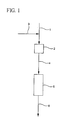
- The accompanying drawing illustrates the invention.
- In carrying out the invention, the reactants, known reaction conditions and catalysts previously employed in hydroperoxide and epoxide production can be employed. Reference is made to the patents cited above.
- Referring to the accompanying drawing as illustrative, an ethylbenzene hydroperoxide stream from ethylbenzene oxidation, which had been treated with aqueous sodium hydroxide, decanted and the organic phase water washed and decanted, passes via line 1 to contact
zone 2. Propylene reactant passes vialine 3 and is admixed with the ethylbenzene hydroperoxide stream before entry intocontact zone 2. - During the aqueous caustic treatment of the ethylbenzene oxidate and decantation, there are formed various higher molecular weight sodium containing resinous materials which are separated by decantation from organic phase; normally the sodium containing materials are present in the organic hydroperoxide phase in only very small amounts, e.g. less than 1 ppm. During periods of upset, however, increased amounts of the sodium containing resinous materials, e.g. up to 15 ppm, are contained in the organic phase and when the oxidate is admixed with the olefin epoxidation reactant, the solubility of these sodium containing resinous materials is substantially reduced with the result that such resinous materials precipitate as solids in the oxidate/olefin hydrocarbon mixture. If the feed to the epoxidation zone contains such precipitated resinous materials, the result is deactivation and plugging of the catalyst bed. The resins are extremely sticky and tend to coat the solid catalyst particles as well as the reactor surfaces, soon incapacitating the epoxidation reaction zone. In addition to deactivating the catalyst, the deposition of such resinous materials causes a rapid rise in the pressure drop through the reaction zone and eventual plugging. It is important for successful and continued operation that the resinous materials be removed from the reactant stream prior to entry into the epoxidation zone.
- Referring to the accompanying drawing,
zone 2 is provided through which the epoxidation feed is passed. Under normal circumstances where the content of sodium materials is very low, there are essentially no insoluble sodium materials in the epoxidation feed and the feed passes throughzone 2 without a substantial pressure drop increase. However, when the sodium material content increases to above about 3 ppm as sodium by weight based on oxidate, insolubles are formed and these are removed inzone 2. In one embodiment of the invention,zone 2 is packed with neutral or slightly basic particulate material such as silica which is effective to entrap and remove the insoluble resinous sodium materials. In a more preferred environment,zone 2 is provided with 1 or more fine mesh metal screens, illustratively of a 120 micron size or finer, which screens effectively entrap and remove the insoluble resinous materials from the reactor feed. Still another alternative is to provide in zone 2 a packed bed comprised of one or more metal frits, which are sintered metal filters, and which are also effective in entrapping and removing the resinous solids from the feed to the epoxidation zone. Other coalescing packing solids comprised of fibrous materials such as glass wool or steel wool can also be used. - The epoxidation feed now substantially free of contained insoluble resinous products passes from
zone 2 via line 4 toepoxidation zone 5 wherein the ethylbenzene hydroperoxide and propylene contained therein contact a solid epoxidation catalyst and react to form propylene oxide. The reaction product mixture passes fromzone 5 vialine 6 and is worked up by known procedures to recover product propylene oxide. - The present invention is especially useful during periods of upset during the epoxidation plant operation. Under normal conditions, the content of the sodium containing resinous materials can be maintained sufficiently low, i.e. less than 1 ppm as sodium in oxidate, as not to cause significant problems in the epoxidation zone. However, during periods of plant upset there tend to be excessive concentrations of the resinous solids in the feed passing to the epoxidation zone and it is especially important that during these periods the sodium containing resinous solids be removed before the feed contacts the solid catalyst in order to prevent deactivation and/or plugging of the catalyst bed. Through practice of the invention, the catalyst bed is protected during periods when there is an excessive concentration of insoluble resins in the feed by entrapping and removing these materials in the manner herein described. The invention also provides timely warning of the malfunction of the caustic wash section, such that corrective measures can be taken before there are major operating problems.
- The following are provided to illustrate the invention.
- A commercial oxidate was prepared by the molecular oxygen oxidation of ethylbenzene to ethylbenzene hydroperoxide. The oxidate was washed with aqueous caustic and the organic phase was separated by decantation. The organic oxidate phase was comprised of about 35 wt % ethylbenzene hydroperoxide with the remainder essentially ethylbenzene. The sodium content was less than 1 ppm by weight as sodium based on oxidate.
- The hydroperoxide stream was admixed with propylene in amount of about 3.5 parts by weight propylene per part of hydroperoxide and the resulting admixture was passed through a 25 micron stainless steel screen at a rate of 123 gal/min/ft2 of screen area, the screen area including both metal and the actual opening.
- During a two week run, the pressure drop upon passage through the screen gradually rose to about 2 psi and stabilized at that level.
- Oxidate resulting from a period of plant upset was simulated by the addition of sodium benzoate in amount of about 5 ppm as sodium in oxidate.
- When this feed was passed at the same rate through the same screen as above, in two hours the pressure drop had reached 5 psi and in five hours had reached 30 psi.
- The above comparison demonstrates the effectiveness of the screen in retaining the various sodium materials as evidenced by the rapid pressure drop increase.
- The simulated epoxidation feed containing sodium benzoate (5 ppm as sodium in oxidate) was tested with a 10 micron metal frit at a feed rate of 9 gal/min/ft2. Pressure drop rapidly increased reaching 20 psi in 1.25 hours which indicated successful insolubles separation.
- The simulated epoxidation feed used above was tested using 10 micron, 25 micron and 36 micron stainless steel screens. In the following table, the times elapsed at various feed rates to reach 10 psi pressure drop are given:
Metal Screen Feed rate (gal/min/ft2) Time to reach 10 psi ΔP 10 micron 46 3.5 hr. 25 micron 46 4.8 hr. 36 micron 46 12.5 hr. 25 micron 46 4.8 hr. 25 micron 95 4 hr. 25 micron 123 3.3 hr. - An additional advantage is that by conventional pressure drop monitoring means early plant upset detection can be achieved and remedial measures rapidly taken.
- Generally, screens of 120 to 1100 mesh (Tyler Standard) are useful; these have screen openings of about 5 to 120 microns. Stainless steel is the preferred material of construction; other metals may have an adverse decomposing effect on the hydroperoxide.
- Similarly, metal frits having mean pore diameters of 7 to 90 microns or packed beds having mean pore diameters of 7 to 90 microns can be used.
- Other coalescing packings can also be employed including glass wool, metal meshes, and the like. Use of stainless steel screens is preferred since the screens are effective, relatively inexpensive and easily cleaned.
Claims (7)
- In a process wherein an olefin and an organic hydroperoxide are admixed to form an admixture which is fed to an epoxidation zone and therein contacted with a solid epoxidation catalyst at conditions effective to form oxirane product, the feed admixture to the epoxidation zone containing insoluble resinous materials, the improvement which comprises separating the resinous materials before said admixture contacts the solid catalyst.
- The process of claim 1 wherein the insoluble resinous materials are separated by passing the feed admixture through a fine metal screen.
- The process of claim 2 wherein the metal screen has 5 to 120 micron openings.
- The process of claim 1 wherein the insoluble resinous materials are separated by passing the feed through a packed bed of coalescing solids.
- The process of claim 4 wherein said packed bed comprises one or more metal frits.
- The process of claim 4 wherein said packed bed is a bed of fibrous material.
- The process of claim 4 wherein said packed bed is a bed of glass wool.
Applications Claiming Priority (3)
| Application Number | Priority Date | Filing Date | Title |
|---|---|---|---|
| US10/055,776 US6512129B1 (en) | 2002-01-23 | 2002-01-23 | Epoxidation process |
| US55776 | 2002-01-23 | ||
| PCT/US2002/039881 WO2003062216A1 (en) | 2002-01-23 | 2002-12-12 | Epoxidation process |
Publications (2)
| Publication Number | Publication Date |
|---|---|
| EP1474409A1 EP1474409A1 (en) | 2004-11-10 |
| EP1474409B1 true EP1474409B1 (en) | 2005-04-20 |
Family
ID=22000076
Family Applications (1)
| Application Number | Title | Priority Date | Filing Date |
|---|---|---|---|
| EP02806555A Expired - Lifetime EP1474409B1 (en) | 2002-01-23 | 2002-12-12 | Epoxidation process |
Country Status (11)
| Country | Link |
|---|---|
| US (1) | US6512129B1 (en) |
| EP (1) | EP1474409B1 (en) |
| JP (1) | JP4394454B2 (en) |
| KR (1) | KR100923979B1 (en) |
| CN (1) | CN1274681C (en) |
| AT (1) | ATE293613T1 (en) |
| BR (1) | BR0215539B1 (en) |
| CA (1) | CA2473419A1 (en) |
| DE (1) | DE60203825T2 (en) |
| ES (1) | ES2237716T3 (en) |
| WO (1) | WO2003062216A1 (en) |
Families Citing this family (2)
| Publication number | Priority date | Publication date | Assignee | Title |
|---|---|---|---|---|
| US7863493B2 (en) | 2006-04-12 | 2011-01-04 | Shell Oil Company | Process for preparing an organic hydroperoxide, industrial set-up therefore and process wherein such organic hydroperoxide is used in the preparation of an alkylene oxide |
| CN104107728B (en) * | 2013-04-16 | 2017-04-19 | 中国石油化工股份有限公司 | Method for regenerating solid epoxidation catalyst |
Family Cites Families (9)
| Publication number | Priority date | Publication date | Assignee | Title |
|---|---|---|---|---|
| US3351635A (en) | 1966-03-14 | 1967-11-07 | Halcon International Inc | Epoxidation process |
| US4367342A (en) | 1969-04-02 | 1983-01-04 | Shell Oil Company | Olefin epoxidation |
| US4066706A (en) | 1975-04-21 | 1978-01-03 | Halcon International, Inc. | Preparation of ethylbenzene hydroperoxide |
| US5210354A (en) * | 1992-05-08 | 1993-05-11 | Arco Chemical Technology, L.P. | Propylene oxide-styrene monomer process |
| US5675055A (en) * | 1995-10-04 | 1997-10-07 | Arco Chemical Technology, L.P. | Acidification/extraction treatment of waste caustic stream |
| US5723637A (en) * | 1995-12-06 | 1998-03-03 | Sumitomo Chemical Company, Limited | Process for producing propylene oxide |
| US5883268A (en) | 1997-10-23 | 1999-03-16 | Arco Chemical Technology, L.P. | Process stream purification |
| US5849937A (en) | 1997-12-19 | 1998-12-15 | Arco Chemical Technology, L.P. | Epoxidation process using serially connected cascade of fixed bed reactors |
| JP3939655B2 (en) * | 2000-12-27 | 2007-07-04 | シエル・インターナシヨナル・リサーチ・マートスハツペイ・ベー・ヴエー | Process for preparing organic hydroperoxides with reduced pollutant content |
-
2002
- 2002-01-23 US US10/055,776 patent/US6512129B1/en not_active Expired - Lifetime
- 2002-12-12 EP EP02806555A patent/EP1474409B1/en not_active Expired - Lifetime
- 2002-12-12 JP JP2003562095A patent/JP4394454B2/en not_active Expired - Fee Related
- 2002-12-12 AT AT02806555T patent/ATE293613T1/en not_active IP Right Cessation
- 2002-12-12 CN CNB028273451A patent/CN1274681C/en not_active Expired - Fee Related
- 2002-12-12 WO PCT/US2002/039881 patent/WO2003062216A1/en not_active Ceased
- 2002-12-12 CA CA002473419A patent/CA2473419A1/en not_active Abandoned
- 2002-12-12 KR KR1020047011174A patent/KR100923979B1/en not_active Expired - Fee Related
- 2002-12-12 ES ES02806555T patent/ES2237716T3/en not_active Expired - Lifetime
- 2002-12-12 DE DE60203825T patent/DE60203825T2/en not_active Expired - Lifetime
- 2002-12-12 BR BRPI0215539-7A patent/BR0215539B1/en not_active IP Right Cessation
Also Published As
| Publication number | Publication date |
|---|---|
| DE60203825D1 (en) | 2005-05-25 |
| US6512129B1 (en) | 2003-01-28 |
| WO2003062216A1 (en) | 2003-07-31 |
| CN1274681C (en) | 2006-09-13 |
| JP4394454B2 (en) | 2010-01-06 |
| KR20040086278A (en) | 2004-10-08 |
| JP2005518415A (en) | 2005-06-23 |
| BR0215539B1 (en) | 2013-03-05 |
| BR0215539A (en) | 2004-12-21 |
| CA2473419A1 (en) | 2003-07-31 |
| DE60203825T2 (en) | 2006-02-23 |
| ES2237716T3 (en) | 2005-08-01 |
| EP1474409A1 (en) | 2004-11-10 |
| ATE293613T1 (en) | 2005-05-15 |
| KR100923979B1 (en) | 2009-10-28 |
| CN1615304A (en) | 2005-05-11 |
Similar Documents
| Publication | Publication Date | Title |
|---|---|---|
| US4200553A (en) | Process for producing cyclohexanone | |
| CZ45096A3 (en) | Regeneration process of support catalyst | |
| EP1266894B1 (en) | Process for producing propylene oxide | |
| US6512129B1 (en) | Epoxidation process | |
| JP3939655B2 (en) | Process for preparing organic hydroperoxides with reduced pollutant content | |
| JP2009511721A (en) | Ethylene oligomerization process and reactor system therefor for removing heavy molecular weight oligomers | |
| AU2002231722A1 (en) | Process for preparing organic hydroperoxide having a reduced amount of contaminants. | |
| US20030125574A1 (en) | Process for preparing organic hydroperoxides | |
| US20040210069A1 (en) | Process for preparing organic hydroperoxides | |
| JP2001270880A (en) | Method for producing propylene oxide | |
| CN112694455A (en) | System and method for removing aldehyde and ketone by hydrogenation | |
| US5770777A (en) | Method reducing UV absorption in ethylene glycols, water, and mixtures | |
| JP4018762B2 (en) | Method for separating molybdenum epoxidation catalyst content | |
| JP2001501589A (en) | Extraction of epoxidized molybdenum catalyst | |
| KR20010040709A (en) | Method for Regenerating Supported Catalysts covered with Gold Particles and used for Oxidising Unsaturated Hydrocarbons | |
| KR20070094657A (en) | Process for producing propylene oxide | |
| CN110003137B (en) | A kind of method for silane coupling agent modified material to remove impurities in HPPO process | |
| EP1727606A1 (en) | Process for preparing an alkylene oxide | |
| JP4951975B2 (en) | Propylene oxide production method | |
| JP3949457B2 (en) | Method for recovering 1,2-dichloroethane | |
| CN121378174A (en) | A method to prevent excessive pressure drop in an epoxidation reactor | |
| CN120040383A (en) | Method for treating propylene epoxidation reaction raw material and propylene epoxidation method | |
| JPH08117765A (en) | Oxidative decomposition method of formate | |
| JPS62739B2 (en) |
Legal Events
| Date | Code | Title | Description |
|---|---|---|---|
| PUAI | Public reference made under article 153(3) epc to a published international application that has entered the european phase |
Free format text: ORIGINAL CODE: 0009012 |
|
| GRAP | Despatch of communication of intention to grant a patent |
Free format text: ORIGINAL CODE: EPIDOSNIGR1 |
|
| 17P | Request for examination filed |
Effective date: 20040722 |
|
| AK | Designated contracting states |
Kind code of ref document: A1 Designated state(s): AT BE BG CH CY CZ DE DK EE ES FI FR GB GR IE IT LI LU MC NL PT SE SI SK TR |
|
| AX | Request for extension of the european patent |
Extension state: AL LT LV MK RO |
|
| GRAS | Grant fee paid |
Free format text: ORIGINAL CODE: EPIDOSNIGR3 |
|
| GRAA | (expected) grant |
Free format text: ORIGINAL CODE: 0009210 |
|
| AK | Designated contracting states |
Kind code of ref document: B1 Designated state(s): AT BE BG CH CY CZ DE DK EE ES FI FR GB GR IE IT LI LU MC NL PT SE SI SK TR |
|
| AX | Request for extension of the european patent |
Extension state: AL LT LV MK RO |
|
| PG25 | Lapsed in a contracting state [announced via postgrant information from national office to epo] |
Ref country code: IT Free format text: LAPSE BECAUSE OF FAILURE TO SUBMIT A TRANSLATION OF THE DESCRIPTION OR TO PAY THE FEE WITHIN THE PRESCRIBED TIME-LIMIT;WARNING: LAPSES OF ITALIAN PATENTS WITH EFFECTIVE DATE BEFORE 2007 MAY HAVE OCCURRED AT ANY TIME BEFORE 2007. THE CORRECT EFFECTIVE DATE MAY BE DIFFERENT FROM THE ONE RECORDED. Effective date: 20050420 Ref country code: SK Free format text: LAPSE BECAUSE OF FAILURE TO SUBMIT A TRANSLATION OF THE DESCRIPTION OR TO PAY THE FEE WITHIN THE PRESCRIBED TIME-LIMIT Effective date: 20050420 Ref country code: FI Free format text: LAPSE BECAUSE OF FAILURE TO SUBMIT A TRANSLATION OF THE DESCRIPTION OR TO PAY THE FEE WITHIN THE PRESCRIBED TIME-LIMIT Effective date: 20050420 Ref country code: LI Free format text: LAPSE BECAUSE OF FAILURE TO SUBMIT A TRANSLATION OF THE DESCRIPTION OR TO PAY THE FEE WITHIN THE PRESCRIBED TIME-LIMIT Effective date: 20050420 Ref country code: CZ Free format text: LAPSE BECAUSE OF FAILURE TO SUBMIT A TRANSLATION OF THE DESCRIPTION OR TO PAY THE FEE WITHIN THE PRESCRIBED TIME-LIMIT Effective date: 20050420 Ref country code: BE Free format text: LAPSE BECAUSE OF FAILURE TO SUBMIT A TRANSLATION OF THE DESCRIPTION OR TO PAY THE FEE WITHIN THE PRESCRIBED TIME-LIMIT Effective date: 20050420 Ref country code: EE Free format text: LAPSE BECAUSE OF FAILURE TO SUBMIT A TRANSLATION OF THE DESCRIPTION OR TO PAY THE FEE WITHIN THE PRESCRIBED TIME-LIMIT Effective date: 20050420 Ref country code: TR Free format text: LAPSE BECAUSE OF FAILURE TO SUBMIT A TRANSLATION OF THE DESCRIPTION OR TO PAY THE FEE WITHIN THE PRESCRIBED TIME-LIMIT Effective date: 20050420 Ref country code: SI Free format text: LAPSE BECAUSE OF FAILURE TO SUBMIT A TRANSLATION OF THE DESCRIPTION OR TO PAY THE FEE WITHIN THE PRESCRIBED TIME-LIMIT Effective date: 20050420 Ref country code: CH Free format text: LAPSE BECAUSE OF FAILURE TO SUBMIT A TRANSLATION OF THE DESCRIPTION OR TO PAY THE FEE WITHIN THE PRESCRIBED TIME-LIMIT Effective date: 20050420 Ref country code: AT Free format text: LAPSE BECAUSE OF FAILURE TO SUBMIT A TRANSLATION OF THE DESCRIPTION OR TO PAY THE FEE WITHIN THE PRESCRIBED TIME-LIMIT Effective date: 20050420 |
|
| REG | Reference to a national code |
Ref country code: GB Ref legal event code: FG4D |
|
| REG | Reference to a national code |
Ref country code: CH Ref legal event code: EP |
|
| REG | Reference to a national code |
Ref country code: IE Ref legal event code: FG4D |
|
| REF | Corresponds to: |
Ref document number: 60203825 Country of ref document: DE Date of ref document: 20050525 Kind code of ref document: P |
|
| PG25 | Lapsed in a contracting state [announced via postgrant information from national office to epo] |
Ref country code: DK Free format text: LAPSE BECAUSE OF FAILURE TO SUBMIT A TRANSLATION OF THE DESCRIPTION OR TO PAY THE FEE WITHIN THE PRESCRIBED TIME-LIMIT Effective date: 20050720 Ref country code: BG Free format text: LAPSE BECAUSE OF FAILURE TO SUBMIT A TRANSLATION OF THE DESCRIPTION OR TO PAY THE FEE WITHIN THE PRESCRIBED TIME-LIMIT Effective date: 20050720 Ref country code: GR Free format text: LAPSE BECAUSE OF FAILURE TO SUBMIT A TRANSLATION OF THE DESCRIPTION OR TO PAY THE FEE WITHIN THE PRESCRIBED TIME-LIMIT Effective date: 20050720 Ref country code: SE Free format text: LAPSE BECAUSE OF FAILURE TO SUBMIT A TRANSLATION OF THE DESCRIPTION OR TO PAY THE FEE WITHIN THE PRESCRIBED TIME-LIMIT Effective date: 20050720 |
|
| REG | Reference to a national code |
Ref country code: ES Ref legal event code: FG2A Ref document number: 2237716 Country of ref document: ES Kind code of ref document: T3 |
|
| PG25 | Lapsed in a contracting state [announced via postgrant information from national office to epo] |
Ref country code: PT Free format text: LAPSE BECAUSE OF FAILURE TO SUBMIT A TRANSLATION OF THE DESCRIPTION OR TO PAY THE FEE WITHIN THE PRESCRIBED TIME-LIMIT Effective date: 20050920 |
|
| REG | Reference to a national code |
Ref country code: CH Ref legal event code: PL |
|
| PG25 | Lapsed in a contracting state [announced via postgrant information from national office to epo] |
Ref country code: IE Free format text: LAPSE BECAUSE OF NON-PAYMENT OF DUE FEES Effective date: 20051212 Ref country code: CY Free format text: LAPSE BECAUSE OF FAILURE TO SUBMIT A TRANSLATION OF THE DESCRIPTION OR TO PAY THE FEE WITHIN THE PRESCRIBED TIME-LIMIT Effective date: 20051212 |
|
| PG25 | Lapsed in a contracting state [announced via postgrant information from national office to epo] |
Ref country code: LU Free format text: LAPSE BECAUSE OF NON-PAYMENT OF DUE FEES Effective date: 20051231 Ref country code: MC Free format text: LAPSE BECAUSE OF NON-PAYMENT OF DUE FEES Effective date: 20051231 |
|
| PLBE | No opposition filed within time limit |
Free format text: ORIGINAL CODE: 0009261 |
|
| STAA | Information on the status of an ep patent application or granted ep patent |
Free format text: STATUS: NO OPPOSITION FILED WITHIN TIME LIMIT |
|
| ET | Fr: translation filed | ||
| 26N | No opposition filed |
Effective date: 20060123 |
|
| REG | Reference to a national code |
Ref country code: IE Ref legal event code: MM4A |
|
| GBPC | Gb: european patent ceased through non-payment of renewal fee |
Effective date: 20061212 |
|
| PG25 | Lapsed in a contracting state [announced via postgrant information from national office to epo] |
Ref country code: GB Free format text: LAPSE BECAUSE OF NON-PAYMENT OF DUE FEES Effective date: 20061212 |
|
| PGFP | Annual fee paid to national office [announced via postgrant information from national office to epo] |
Ref country code: NL Payment date: 20141209 Year of fee payment: 13 |
|
| REG | Reference to a national code |
Ref country code: FR Ref legal event code: PLFP Year of fee payment: 14 |
|
| PGFP | Annual fee paid to national office [announced via postgrant information from national office to epo] |
Ref country code: FR Payment date: 20151124 Year of fee payment: 14 Ref country code: ES Payment date: 20151203 Year of fee payment: 14 |
|
| PGFP | Annual fee paid to national office [announced via postgrant information from national office to epo] |
Ref country code: DE Payment date: 20151230 Year of fee payment: 14 |
|
| REG | Reference to a national code |
Ref country code: NL Ref legal event code: MM Effective date: 20160101 |
|
| PG25 | Lapsed in a contracting state [announced via postgrant information from national office to epo] |
Ref country code: NL Free format text: LAPSE BECAUSE OF NON-PAYMENT OF DUE FEES Effective date: 20160101 |
|
| REG | Reference to a national code |
Ref country code: DE Ref legal event code: R119 Ref document number: 60203825 Country of ref document: DE |
|
| REG | Reference to a national code |
Ref country code: FR Ref legal event code: ST Effective date: 20170831 |
|
| PG25 | Lapsed in a contracting state [announced via postgrant information from national office to epo] |
Ref country code: FR Free format text: LAPSE BECAUSE OF NON-PAYMENT OF DUE FEES Effective date: 20170102 |
|
| PG25 | Lapsed in a contracting state [announced via postgrant information from national office to epo] |
Ref country code: DE Free format text: LAPSE BECAUSE OF NON-PAYMENT OF DUE FEES Effective date: 20170701 |
|
| PG25 | Lapsed in a contracting state [announced via postgrant information from national office to epo] |
Ref country code: ES Free format text: LAPSE BECAUSE OF NON-PAYMENT OF DUE FEES Effective date: 20161213 |
|
| REG | Reference to a national code |
Ref country code: ES Ref legal event code: FD2A Effective date: 20180626 |