EP1473955A1 - Contrôle de charge dans le sens montant pour les systèmes de communication sans fil avec contrôle de puissance - Google Patents
Contrôle de charge dans le sens montant pour les systèmes de communication sans fil avec contrôle de puissance Download PDFInfo
- Publication number
- EP1473955A1 EP1473955A1 EP04291063A EP04291063A EP1473955A1 EP 1473955 A1 EP1473955 A1 EP 1473955A1 EP 04291063 A EP04291063 A EP 04291063A EP 04291063 A EP04291063 A EP 04291063A EP 1473955 A1 EP1473955 A1 EP 1473955A1
- Authority
- EP
- European Patent Office
- Prior art keywords
- mobile
- threshold
- station
- mobiles
- interference
- Prior art date
- Legal status (The legal status is an assumption and is not a legal conclusion. Google has not performed a legal analysis and makes no representation as to the accuracy of the status listed.)
- Granted
Links
- 238000004891 communication Methods 0.000 title claims abstract description 18
- 238000000034 method Methods 0.000 claims abstract description 30
- 238000012545 processing Methods 0.000 claims abstract description 6
- 238000004364 calculation method Methods 0.000 claims description 40
- 230000014509 gene expression Effects 0.000 claims description 34
- 230000007246 mechanism Effects 0.000 claims description 32
- 230000003313 weakening effect Effects 0.000 claims description 11
- 238000004422 calculation algorithm Methods 0.000 description 18
- 230000006870 function Effects 0.000 description 14
- 230000008569 process Effects 0.000 description 12
- 238000011144 upstream manufacturing Methods 0.000 description 12
- 238000012360 testing method Methods 0.000 description 9
- 238000010586 diagram Methods 0.000 description 7
- 230000004907 flux Effects 0.000 description 7
- 230000008901 benefit Effects 0.000 description 4
- 230000010267 cellular communication Effects 0.000 description 4
- 238000006677 Appel reaction Methods 0.000 description 3
- 230000005540 biological transmission Effects 0.000 description 3
- 238000004088 simulation Methods 0.000 description 3
- 241000135309 Processus Species 0.000 description 2
- 241000897276 Termes Species 0.000 description 2
- 230000001413 cellular effect Effects 0.000 description 2
- 230000000630 rising effect Effects 0.000 description 2
- 230000003595 spectral effect Effects 0.000 description 2
- 101100084017 Arabidopsis thaliana PAP24 gene Proteins 0.000 description 1
- 102000047724 Member 2 Solute Carrier Family 12 Human genes 0.000 description 1
- 101150014596 PAP11 gene Proteins 0.000 description 1
- 108091006621 SLC12A1 Proteins 0.000 description 1
- 108091006620 SLC12A2 Proteins 0.000 description 1
- 230000008859 change Effects 0.000 description 1
- 230000007423 decrease Effects 0.000 description 1
- 238000011156 evaluation Methods 0.000 description 1
- 230000001869 rapid Effects 0.000 description 1
- 238000001228 spectrum Methods 0.000 description 1
- 230000007480 spreading Effects 0.000 description 1
Images



Classifications
-
- H—ELECTRICITY
- H04—ELECTRIC COMMUNICATION TECHNIQUE
- H04W—WIRELESS COMMUNICATION NETWORKS
- H04W28/00—Network traffic management; Network resource management
- H04W28/16—Central resource management; Negotiation of resources or communication parameters, e.g. negotiating bandwidth or QoS [Quality of Service]
-
- H—ELECTRICITY
- H04—ELECTRIC COMMUNICATION TECHNIQUE
- H04W—WIRELESS COMMUNICATION NETWORKS
- H04W52/00—Power management, e.g. Transmission Power Control [TPC] or power classes
- H04W52/04—Transmission power control [TPC]
- H04W52/30—Transmission power control [TPC] using constraints in the total amount of available transmission power
- H04W52/36—Transmission power control [TPC] using constraints in the total amount of available transmission power with a discrete range or set of values, e.g. step size, ramping or offsets
- H04W52/367—Power values between minimum and maximum limits, e.g. dynamic range
-
- H—ELECTRICITY
- H04—ELECTRIC COMMUNICATION TECHNIQUE
- H04W—WIRELESS COMMUNICATION NETWORKS
- H04W52/00—Power management, e.g. Transmission Power Control [TPC] or power classes
- H04W52/04—Transmission power control [TPC]
- H04W52/18—TPC being performed according to specific parameters
- H04W52/24—TPC being performed according to specific parameters using SIR [Signal to Interference Ratio] or other wireless path parameters
Definitions
- the invention relates to wireless cellular communication systems with power, like UMTS (for "Universal Mobile Terrestrial System”).
- UMTS for "Universal Mobile Terrestrial System”
- a cellular communications network is based on base stations capable of serve "mobile” user workstations. Every mobile needs a certain service which consists of data to be transmitted under certain conditions (speed, delay, etc.). A mobile which receives such a service is called “active mobile”.
- Load control aims in particular to guarantee the quality of service (QoS) for mobiles in real time, as well as for non-real-time mobiles (elastic flow).
- QoS quality of service
- the achieving effective charge control is crucial in wireless systems with power control.
- the present invention improves the situation.
- the invention relates to a control device for a wireless communication network, comprising a calculator of quantities linked to attenuations measured between mobiles and base stations, and / or at the threshold of the signal to interference and noise ratio, and a decision-making body regarding the processing of new mobile candidates, this body operating jointly with the computer according to a predefined mechanism,
- the working condition relates to the load summed due to the mobiles served by a considered station.
- the calculation function of charge includes, for a mobile, the summation of the inverse of the attenuations of the neighboring stations, the result being multiplied by an expression related to the ratio threshold signal on interference and noise, and by weakening at the server station.
- the device comprises a storage of a value during the charge summed, and the mechanism operates incrementally by calculating the load of a mobile candidate, and updating the summed charge, to determine if the mobile is admitted or no by comparing the summed charge with a threshold.
- the computer is provided with a function capable of evaluating a condition uplink balance report, compared to a threshold balance value.
- the mechanism used by the decision-making body first calls said evaluation function of the precondition, and rejects the candidate mobile if this condition is not satisfied.
- the prerequisite includes, for a mobile, the calculation of its maximum power, divided by an expression related to the threshold of the signal to interference and noise, and by weakening at the server station.
- the working condition has a value threshold, established in correspondence with said balance threshold value.
- the device of the invention advantageously comprises a second mechanism capable of cooperate with the computer to assess, for a given station, a non-congestion criterion, and a second decision-making body, capable of modifying mobile rates for stay within the scope of the congestion criterion.
- the second mechanism comprises, for each mobile, the calculation of its signal to interference and noise ratio threshold, then calculation of an expression linked to this signal to interference and noise ratio threshold, and then the function call load calculation with these values, then calculating the summed load due to mobiles served by a station considered, this summed load being compared to a threshold.
- the working condition of step b. relates to the summed charge due to mobiles served by a considered station.
- step b. includes storing a current value of the summed charge, and during a new iteration of the process for a candidate mobile, step a. includes of calculate the charge of the candidate mobile, step b. includes updating the load summed and compare the summed charge to a threshold to determine if the mobile is admitted or not in step c.
- step a. first includes evaluating a balance sheet prerequisite uplink, relative to a threshold value, and reject the candidate mobile if this condition is not satisfied.
- the prerequisite of step a. includes, for a mobile, the calculation of its maximum power, divided by an expression related to the report signal on interference and noise, and by weakening at the server station.
- the working condition of step b. has a value of threshold, established in correspondence with said balance threshold value.
- steps a. to c. understand to assess, for a given station, a non-congestion criterion, and step c. includes to modify mobile charges to stay within the scope of the congestion criterion.
- step a understands, for each mobile, to calculate its report threshold signal on interference and noise, then calculate an expression related to this ratio threshold signal on interference and noise, and calculate the charge of each mobile with this expression
- step b. includes calculating the summed load due to the mobiles served by a station considered and compare this summed load with a threshold.
- This description also includes an annex 1, in which the formulas, preceded by a definition of the notations which they use, and which can be included in this description.
- FIG. 1 illustrates an example of a cellular network with two stations denoted u and v.
- Each station u, v serves mobiles located in a certain geographical area called cell, Cu, Cv.
- cell Cu
- Cv a certain geographical area
- 5 mobiles generically designated by m u
- m u mobiles
- m v mobiles not shown, in cell Cv of station v.
- Figure 1 illustrates cells by disks but they can have any other form. Cells can have a certain intersection called "handover" area.
- Load control in cellular networks with power control aims to ensure that, for the mobile configurations encountered, there is a power allocation meeting certain requirements in terms of signal-to-interference-and-noise ratio (SINR for "signal-to-interference-and-noise-ratio") and, where applicable, power limitations.
- SINR signal-to-interference-and-noise ratio
- PAP criterion or the acronym “PAP” alone (taken from “Principle of Allocation of Power "or” Power Allocation Principle ”) designates a criterion used to determine the feasibility of power allocation, in the presence of a given configuration of mobiles.
- Two different criteria will be described, denoted UPAP, and EUPAP.
- XPAP notation indifferently designates such criteria.
- Figure 1 also illustrates an example of the configuration of the mobiles served by the station u ( m u indicates a mobile served by the station u). The figure illustrates the routes of the mobiles to their server station u on the one hand and to the other stations (such as v) on the other hand.
- a station is said to be close to a mobile if the mobile can measure the attenuation at this station.
- FIG. 1A shows three base stations S1, S2 and S3, each provided with a antenna, and, in particular, a calculation module (S10, S20, S30).
- the usual circuits of wireless telecommunications are not shown, for simplicity.
- a mobile M is at range of the three stations; it is assumed to be active with station S1.
- the stations S1 and S2 are under the control of a base station controller BSC1;. another controller of base stations BSC2 takes care of station S3, and one or more other stations, not represented.
- the controllers also have BSC10 and BSC20 computing capabilities, and their other usual functions, not shown.
- the three stations have for example the ranges defined by the cells in Figure 1.
- the charge control is then based on the comparison of this charge indicator with a threshold value, called the load threshold, for the upward direction.
- a threshold value called the load threshold
- test algorithms have the advantage of being safe, in the sense that no break occurs. will produce, at least until the moment of decision. However, their execution requires so much time that they are not usable in practice, especially in real systems.
- This effective band-based admission control algorithm only concerns the rising direction; it does not take into account either power limitations or noise; finally it is centralized, i.e. it is not possible to process each station independently of the other.
- the present invention deals with admission and congestion control in a way new, for the ascending direction, that is to say from a mobile to a station.
- the present invention has several aspects, which can be taken independently.
- the invention first proposes a decentralized PAP criterion for the upward direction, noted UPAP (from "Uplink Power Allocation Principle").
- UPAP from "Uplink Power Allocation Principle”
- This criterion can be used as a condition for feasibility of upstream power control, without consideration of limitation power.
- the invention proposes a noted criterion EUPAP (extended principle of decentralized power allocation for the upstream direction, i.e. "Extended Uplink Power Allocation Principle").
- the invention also proposes mechanisms or algorithms for admission control and decentralized congestion based on UPAP and EUPAP.
- the EUPAP criterion can then be expressed.
- ⁇ between 0 inclusive and 1 excluded, called the UBC threshold for the uplink budget condition, in short "threshold balance".
- the application of the invention in simulation can be done in a capacity computer adequate.
- the application of the invention in real systems can be done by providing a device control, at least partially implementing the proposed algorithms.
- This control device can be installed at the computer of a base station (called Node-B in UMTS) and / or at the level of the computer located in the base station (called RNC in UMTS). It can also, for example, be distributed among these two elements.
- block 100 or P1A calculates the xPAP load, here UPAP, for each mobile.
- Block 200 or P2A ensures the summation of mobile charges individually served by a given station (u), for the purpose of determining the condition of xPAP feasibility, here UPAP.
- xPAP (and other) loads are without dimension.
- operation 207 indicates that traffic can be served by the station u considered. Otherwise, operation 209 indicates that there is too much traffic at the station: for example, either it serves too many mobiles, or mobile phones, or some of them, are served with too high speeds.
- the UPAP process shown in Figure 2 is an example of implementing the invention to ensure the feasibility of power allocation in the upstream direction without power limitation.
- FIG. 2A is a view by concrete modules of the mechanism illustrated in FIG. 2. will see that it shows the similarities to the process in Figure 3.
- the PAP11 calculation module is capable of carrying out the inverse calculation planned for the operation 101, for a station v.
- the first PAP 10 calculation manager then passes control to a second manager calculator PAP 20, which can realize the P2A mechanism.
- Block 24 compares this sum to a threshold it receives on an entry 25. The goal is to determine whether one is in the situation of operation 207 or 209 of FIG. 2, that is to say whether or not the traffic can be served by the station u.
- the threshold is at an equal value or slightly less than 1, i.e. 1- k, in accordance with equation A.2.
- EUPAP For the sake of clarity, the calculations which are now to be carried out are called EUPAP. However, and this is one of the advantages of the invention, they are basically similar to those which have been described with reference to FIG. 2.
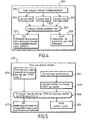
- the middle part P1B and the bottom part P2B of FIG. 3 are expressed by the same functions as those of FIG. 2, and moreover bear the same reference.
- the threshold intervening in step 205 is now the threshold ⁇ , also called UBC threshold, instead of the 1-k threshold in Figure 2.
- the threshold seuil is below the threshold 1-k. It may remain close to (1-k), by lower values, for a mobile close to the station; it decreases when the mobile moves away from the station. This is here, no geographic proximity, but electromagnetic proximity, taking into account possible obstacles weakening the propagation of the waves.
- the POB module in Figure 3 performs the calculations of equation A.4.
- P1B and P2B modules perform the calculations in equation A.5.
- the EUPAP process presented in Figure 3 is an example of the implementation of the invention to ensure, with high probability, the feasibility of allocating upstream power with power limitations.
- the abbreviation PAP indifferently designates the UPAP or EUPAP calculation (it corresponds to the xPAP of FIG. 2A).
- PAP checks 303. If each station satisfies the PAP condition (305), then the global power allocation is certainly feasible (or feasible with a high probability if it is EUPAP), as indicated in 307. Otherwise, the power allocation may be unfeasible, as indicated in 309.
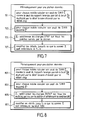
- Figure 5 illustrates an example of admission control in the uplink direction, without limitation of power, that is to say of the UPAP type.
- operation 403 consists in calculating or estimating the UPAP charge of this mobile, using the calculation function P1A of FIG. 2, or else, which is the same, modules 11, as well as 12 and 13 in Figure 2A (but only one times for modules 12 and 13, without making the loop on all mobiles).
- Operation 406 then consists in increasing the current value stored in 405 of the load UPAP of the new mobile, and to test if the result remains below 1-k. If yes, the mobile is admitted in 407, and the sum of the UPAP charges is updated in the memory 19. Otherwise, the mobile is rejected in 409, under the mode without power limitation.
- figure 5 can remain to be carried out under the control of the manager 10 of FIG. 2A, which operates as above, except that it inhibits the loop operating on the calculation functions 12 and 13, as already indicated.
- the invention also makes it possible, or apart (this aspect could be separated) to control the congestion in the upward direction.
- Figure 7 illustrates an upstream congestion control mechanism based on PAPU.
- This safety margin k can be considered to be linked to the mobility of users. More the mobility of users is reduced, the lower this margin is. It is zero if all users are fixed. It can be fixed in advance, for example according to a estimation, or statistics on this mobility, or dynamically determined, of time to time.
- Figure 8 illustrates an upstream congestion control algorithm, but this times with power limitation, i.e. based on EUPAP.
- steps 805 and 807 instead to take the threshold 1 - k, we take the UBC threshold noted ⁇ , as we have already seen about in Figure 3.
Landscapes
- Engineering & Computer Science (AREA)
- Computer Networks & Wireless Communication (AREA)
- Signal Processing (AREA)
- Quality & Reliability (AREA)
- Mobile Radio Communication Systems (AREA)
- Selective Calling Equipment (AREA)
- Transmitters (AREA)
- Cable Transmission Systems, Equalization Of Radio And Reduction Of Echo (AREA)
Abstract
Description
- un contrôle d'admission détermine si le système admet un nouveau mobile, ou non,
- un contrôle de congestion examine ce qui se passe pour les mobiles actifs, en fonction des services qu'ils demandent.
- une fonction de calcul de charge, pour chaque mobile, et
- une évaluation d'une condition de travail, représentant la faisabilité de la desserte de mobiles par une station.
- l'appel de la fonction capable d'évaluer la condition préalable de bilan de liaison montante, par rapport à une valeur de seuil-bilan, le mobile concerné étant rejeté si cette condition préalable n'est pas vérifiée,
- pour les mobiles non rejetés, l'appel de la fonction de calcul de charge avec les valeurs précitées, puis le calcul de la charge sommée due aux mobiles servis par une station considérée, cette charge sommée étant comparée à un seuil relié au seuil-bilan.
- sommer les inverses des affaiblissements des stations voisines,
- multiplier le résultat par une expression reliée au seuil du rapport signal sur interférence et bruit, et par l'affaiblissement à la station serveuse.
- d'évaluer la condition préalable de bilan de liaison montante, par rapport à une valeur de seuil-bilan, le mobile concerné étant rejeté si cette condition préalable n'est pas vérifiée,
- pour les mobiles non rejetés, de calculer les charges à partir des expressions calculées, la charge sommée due aux mobiles servis par une station considérée étant calculée et comparée à un seuil relié au seuil-bilan à l'étape b.
- la figure 1 illustre de façon schématique un réseau de communication cellulaire,
- la figure 1A illustre de façon schématique plus détaillée un réseau de communication cellulaire,
- la figure 2 illustre sous forme de diagramme de flux, un premier exemple de mécanisme mettant en oeuvre l'invention,
- la figure 2A illustre une structure informatique susceptible de mettre en oeuvre le premier mécanisme,
- la figure 3 illustre sous forme de diagramme de flux, un second exemple de mécanisme mettant en oeuvre l'invention,
- la figure 4 illustre sous forme de diagramme de flux, l'aspect décentralisé des mécanismes mettant en oeuvre l'invention,
- la figure 5 illustre sous forme de diagramme de flux, une variante du premier exemple de mécanisme mettant en oeuvre l'invention,
- la figure 6 illustre sous forme de diagramme de flux, une variante du second exemple de mécanisme mettant en oeuvre l'invention,
- la figure 7 illustre sous forme de diagramme de flux, un troisième exemple de mécanisme mettant en oeuvre l'invention, et
- la figure 8 illustre sous forme de diagramme de flux, un quatrième exemple de mécanisme mettant en oeuvre l'invention.
- une "station de base", que l'on pourra abréger en "station" ou "antenne", comporte une antenne-réseau, directionnelle ou omnidirectionnelle, et l'ensemble électronique associé à celle-ci.
- les expressions "poste d'utilisateur" ou "équipement d'utilisateur" ou "mobile" ou même "utilisateur" désignent tout appareil capable de communication sans fil, et éventuellement susceptible de mobilité.
- l'expression "sens montant" vise le cas où un mobile cherche à établir ou maintenir une communication avec la station ; l'expression "sens descendant" vise le cas où la station de base cherche à établir ou maintenir une communication vers le mobile.
- un "service" est ce dont a besoin un mobile, essentiellement en termes données à transmettre dans certaines conditions (débit, délai, notamment).
- un mobile "actif" est un mobile qui reçoit un tel service.
- un "service non-temps-réel" ("non-real-time" ou NRT) peut s'accommoder d'un débit assez variable ou "élastique".
- un "service en temps-réel" ("real-time" ou RT) ne peut s'accommoder d'un débit élastique; il nécessite un débit sensiblement prédéfini, ou, du moins, un débit minimum prédéfini.
- l'expression "avec limitation de puissance" vise le cas où les puissances d'émission des mobiles et de la station doivent rester inférieures ou égales à un seuil. Les systèmes réels tels qu'UMTS ont en principe une limitation de puissance;
- l'expression "sans limitation de puissance" vise le cas où les puissances d'émission des mobiles et de la station n'auraient aucune contrainte de seuil maximum à respecter.
- un ensemble donné de stations et de mobiles est appelé "configuration de mobiles" (et, implicitement, de stations, celles-ci restant fixes).
Ont également été proposés d'autres indicateurs comprenant notamment le SINR ("Signal to Interference and Noise Ration" ou rapport-signal-sur-interférence-et-bruit), et/ou des grandeurs de débit-bit ("bit rate") Dbit, ou équivalent.
- les indicateurs de charge utilisés par ces algorithmes dépendent des puissances des mobiles qui fluctuent dans le temps (par exemple en fonction de leurs déplacements). Ceci oblige l'opérateur à prendre une grande marge de sécurité pour le seuil de charge. D'autre part la charge additionnelle induite par un nouvel appel doit être approximativement estimée.
- de plus, les algorithmes directs connus n'assurent pas qu'une allocation de puissance existe. Par conséquent, dans les système réels, des coupures de communication peuvent se produire, y compris aussitôt après l'admission d'un nouveau mobile.
- par ailleurs, les algorithmes directs réalisent des itérations pour essayer de résoudre le problème de contrôle de puissance plusieurs fois, avant d'obtenir une solution faisable (le terme faisable signifie qu'il y a une solution). Cette méthode peut aboutir à éliminer plus de mobiles que cela n'est nécessaire. De plus, les algorithmes directs sont très lents lorsqu'ils doivent traiter à partir de rien une configuration donnée de stations de base et de mobiles (par exemple dans un outil de simulation).
- la condition A.1 est satisfaite, et
- la puissance émise par chaque mobile ne dépasse pas la limite donnée, comme exprimé dans la relation A.3. Cette limite correspond à la puissance maximale du mobile pouvant prendre en compte le gain et la perte d'antenne.
- une opération 101 qui consiste à additionner sur toutes les stations l'inverse de l'affaiblissement au mobile Lmu,v
- une opération 103 qui consiste à multiplier le résultat de l'opération 101 par le SINR modifié, ainsi que l'affaiblissement à la station serveuse Lmu,u-(en indice, "mu" correspond à "mu" dans les formules annexées). Le résultat est la charge UPAP du mobile (équipement utilisateur).
- en 201, pour chaque mobile servi par la station considérée, on accède à sa charge UPAP, au besoin convenablement mémorisée entre temps.
- l'étape 203 consiste alors à sommer cette charge UPAP pour tous les mobiles servis par la station u considérée. La somme ainsi obtenue est notée en abrégé Σ.
- l'étape 205 vérifie si la somme obtenue Σ est inférieure à un seuil.
- le basculement de l'interrupteur 25, qui va maintenant donner un seuil Θ à l'unité 24 (au lieu de 1-k), et
- la mise en oeuvre d'une fonction de calcul UBC, référencée 21 sur la figure 2A.
- l'opération 211 qui consiste à calculer la puissance maximale allouée au mobile, divisée par le SINR modifié et l'affaiblissement à la station serveuse, et
- le test 213 qui vérifie que le résultat est supérieur au bruit N divisé par 1- Θ, où Θ est le seuil d'UBC.
- Si le test est positif, le mobile peut vraisemblablement être servi par la station, comme indiqué en 215 ; si au contraire le test est négatif, le mobile ne peut en principe pas être servi par la station, comme indiqué en 217.
- l'opération 701 consiste pour chaque mobile, à calculer son seuil de rapport signal à interférence et bruit. Ce seuil est défini comme le seuil du rapport énergie par bit à bruit Eb/n0, multiplié par le débit binaire (bit rate) Dbit, et divisé par le débit-chip Dchip. Le débit-chip définit un débit rapporté à la période d'une porteuse ou sous-porteuse utilisée pour l'étalement spectral.
- l'opération 703 consiste, pour chaque mobile de la station considérée à calculer le seuil de SINR modifié qui lui est propre, conformément à la notation figurant en annexe.
- ensuite, l'opération 705 consiste à additionner les charges UPAP sur tous les mobiles servis par la station. Les charges UPAP sont re-calculées à chaque passage à l'opération 105, du moins pour ceux des mobiles qui ont bougé.
- ensuite, à l'étape 707, on diminue les débits jusqu'à ce que la somme résultante de l'opération 705 soit inférieure à 1 - k, où k est une marge de sécurité par rapport à 1.
- les processus d'admission de mobile et
- les processus de contrôle de congestion,
- u, v stations.
- m u un mobile servi par une station u.
- Lm,v affaiblissement entre le mobile m et la station v.
- N bruit externe.
-
ξ mu seuil du rapport-signal-sur-interférence-et-bruit (signal-to-interference-and-noise-ratio SINR) pour le mobile mu. -
ξ ' mu =ξ mu /(1 +ξ mu ) SINR modifié. - P m
v puissance émise par le mobile m v . - la puissance maximale du mobile m u .

- k marge de sécurité par rapport à 1.

Claims (20)
- Dispositif de contrôle pour réseau de communication sans fil,
comprenant un calculateur de grandeurs liées à des affaiblissements mesurés entre mobiles et stations de base, et/ou au seuil du rapport signal sur interférence et bruit,
et un organe de décision quant au traitement de nouveaux mobiles candidats, cet organe opérant conjointement avec le calculateur selon un mécanisme prédéfini,
caractérisé en ce que ledit mécanisme comprend:une fonction de calcul de charge, pour chaque mobile, etune évaluation d'une condition de travail, représentant la faisabilité de la desserte de mobiles par une station. - Dispositif selon la revendication 1, caractérisé en ce que la condition de travail porte sur la charge sommée due aux mobiles servis par une station considérée.
- Dispositif selon l'une des revendications 1 et 2, caractérisé en ce que la fonction de calcul de charge comporte, pour un mobile, la sommation des inverses des affaiblissements des stations voisines, le résultat étant multiplié par une expression reliée au seuil du rapport signal sur interférence et bruit, et par l'affaiblissement à la station serveuse.
- Dispositif selon l'une des revendications 1 à 3, caractérisé en ce qu'il comprend un stockage d'une valeur en cours de la charge sommée, et en ce que ledit mécanisme opère incrémentiellement en calculant la charge d'un mobile candidat, et en mettant à jour la charge sommée, pour déterminer si le mobile est admis ou non en comparant la charge sommée à un seuil.
- Dispositif selon l'une des revendications 1 à 4, caractérisé en ce que le calculateur est muni d'une fonction capable d'évaluer une condition préalable de bilan de liaison montante (UBC), par rapport à une valeur de seuil-bilan (UBC),
et en ce que le mécanisme utilisé par l'organe de décision appelle d'abord ladite fonction d'évaluation de la condition préalable, et rejette le mobile candidat si cette condition n'est pas vérifiée. - Dispositif selon la revendication 5, caractérisé en ce que la condition préalable comporte, pour un mobile, le calcul de sa puissance maximale, divisée par une expression reliée au seuil du rapport signal sur interférence et bruit, et par l'affaiblissement à la station serveuse.
- Dispositif selon l'une des revendications 5 et 6, caractérisé en ce que la condition de travail comporte une valeur de seuil, établie en correspondance de ladite valeur de seuil-bilan (UBC).
- Dispositif selon l'une des revendications précédentes, caractérisé en ce qu'il comprend un second mécanisme capable de coopérer avec le calculateur pour évaluer, pour une station donnée, un critère de non-congestion, et un second organe de décision, capable de modifier les débits-mobiles pour rester dans le champ du critère de congestion.
- Dispositif selon la revendication 8, caractérisé en ce que le second mécanisme comporte, pour chaque mobile, le calcul de son seuil de rapport signal sur interférence et bruit, puis le calcul d'une expression reliée à ce seuil de rapport signal sur interférence et bruit, et ensuite l'appel de la fonction de calcul de charge avec ces valeurs, puis le calcul de la charge sommée due aux mobiles servis par une station considérée, cette charge sommée étant comparée à un seuil.
- Dispositif selon la revendication 8, prise en combinaison avec la revendication 5, caractérisé en ce que le second mécanisme comporte, pour chaque mobile, le calcul de son seuil de rapport signal sur interférence et bruit, puis le calcul d'une expression reliée à ce seuil de rapport signal sur interférence et bruit, et ensuite:l'appel de la fonction capable d'évaluer la condition préalable de bilan de liaison montante (UBC), par rapport à une valeur de seuil-bilan (UBC), le mobile concerné étant rejeté si cette condition préalable n'est pas vérifiée.pour les mobiles non rejetés, l'appel de la fonction de calcul de charge avec les valeurs précitées, puis le calcul de la charge sommée due aux mobiles servis par une station considérée, cette charge sommée étant comparée à un seuil relié au seuil-bilan.
- Procédé de contrôle pour réseau de communication sans fil comprenant les étapes consistant àa. calculer une charge pour chaque mobile à partir des grandeurs liées à des affaiblissements mesurés entre mobiles et stations de base, et/ou au seuil du rapport signal sur interférence et bruit,b. à partir des charges calculées de l'étape a., évaluer une condition de travail, représentant la faisabilité de la desserte de mobiles par une station,c. décider du traitement de nouveaux mobiles candidats à partir de l'étape b.
- Procédé selon la revendication 11, caractérisé en ce que la condition de travail de l'étape b. porte sur la charge sommée due aux mobiles servis par une station considérée.
- Procédé selon l'une des revendications 11 et 12, caractérisé en ce que l'étape a. comprend, pour un mobile, desommer les inverses des affaiblissements des stations voisines,multiplier le résultat par une expression reliée au seuil du rapport signal sur interférence et bruit, et par l'affaiblissement à la station serveuse.
- Procédé selon l'une des revendications 11 à 13, caractérisé en ce que l'étape b. comprend de stocker une valeur en cours de la charge sommée, et lors d'un nouvelle itération du procédé pour un mobile candidat, l'étape a. comprend de calculer la charge du mobile candidat, l'étape b. comprend de mettre à jour la charge sommée et de comparer la charge sommée à un seuil pour déterminer si le mobile est admis ou non à l'étape c.
- Procédé selon l'une des revendications 11 à 14, caractérisé en ce que l'étape a. comprend d'abord d'évaluer une condition préalable de bilan de liaison montante (UBC), par rapport à une valeur de seuil-bilan (UBC), et de rejeter le mobile candidat si cette condition n'est pas vérifiée.
- Procédé selon la revendication 15, caractérisé en ce que la condition préalable de l'étape a. comporte, pour un mobile, le calcul de sa puissance maximale, divisée par une expression reliée au rapport signal sur interférence et bruit, et par l'affaiblissement à la station serveuse.
- Procédé selon l'une des revendications 15 et 16, caractérisé en ce que la condition de travail de l'étape b. comporte une valeur de seuil, établie en correspondance de ladite valeur de seuil-bilan (UBC).
- Procédé selon l'une des revendications précédentes, caractérisé en ce que les étape a. à c. comprennent d'évaluer, pour une station donnée, un critère de non-congestion, et en ce que l'étape c. comprend de modifier les débits-mobiles pour rester dans le champ du critère de congestion.
- Procédé selon la revendication 18, caractérisé en ce que l'étape a. comprend, pour chaque mobile, de calculer son seuil de rapport signal sur interférence et bruit, puis de calculer une expression reliée à ce seuil de rapport signal sur interférence et bruit, et de calculer la charge de chaque mobile avec cette expression, et en ce que l'étape b. comprend de calculer la charge sommée due aux mobiles servis par une station considérée et de comparer cette charge sommée à un seuil.
- Procédé selon la revendication 18, prise en combinaison avec la revendication 15, caractérisé en ce que l'étape a. comporte, pour chaque mobile, de calculer son seuil de rapport signal sur interférence et bruit, puis de calculer une expression reliée à ce seuil de rapport signal sur interférence et bruit, et ensuite:d'évaluer la condition préalable de bilan de liaison montante (UBC), par rapport à une valeur de seuil-bilan (UBC), le mobile concerné étant rejeté si cette condition préalable n'est pas vérifiée,pour les mobiles non rejetés, de calculer les charges à partir des expressions calculées, la charge sommée due aux mobiles servis par une station considérée étant calculée et comparée à un seuil relié au seuil-bilan à l'étape b.
Applications Claiming Priority (2)
| Application Number | Priority Date | Filing Date | Title |
|---|---|---|---|
| FR0305355 | 2003-04-30 | ||
| FR0305355A FR2854534B1 (fr) | 2003-04-30 | 2003-04-30 | Controle de charge dans le sens montant pour les systemes de communication sans fil avec controle de puissance |
Publications (2)
| Publication Number | Publication Date |
|---|---|
| EP1473955A1 true EP1473955A1 (fr) | 2004-11-03 |
| EP1473955B1 EP1473955B1 (fr) | 2009-11-11 |
Family
ID=32982345
Family Applications (1)
| Application Number | Title | Priority Date | Filing Date |
|---|---|---|---|
| EP04291063A Expired - Lifetime EP1473955B1 (fr) | 2003-04-30 | 2004-04-23 | Contrôle de charge dans le sens montant pour un système de communication sans fil avec contrôle de puissance |
Country Status (6)
| Country | Link |
|---|---|
| US (1) | US20040229630A1 (fr) |
| EP (1) | EP1473955B1 (fr) |
| CN (1) | CN1301021C (fr) |
| AT (1) | ATE448658T1 (fr) |
| DE (1) | DE602004023992D1 (fr) |
| FR (1) | FR2854534B1 (fr) |
Families Citing this family (4)
| Publication number | Priority date | Publication date | Assignee | Title |
|---|---|---|---|---|
| CN100455041C (zh) * | 2005-06-23 | 2009-01-21 | 华为技术有限公司 | 上行负载控制的方法 |
| US8914527B2 (en) * | 2009-06-30 | 2014-12-16 | Citrix Systems, Inc. | Methods and systems for load balancing using forecasting and overbooking techniques |
| EP2536224B1 (fr) * | 2011-06-16 | 2014-07-23 | NTT DoCoMo, Inc. | Procédé de programmation d'utilisateurs dans un environnement cellulaire, programmateur et réseau sans fil |
| US9928741B2 (en) * | 2015-02-04 | 2018-03-27 | Here Global B.V. | Traffic adjustment for variable network state |
Citations (3)
| Publication number | Priority date | Publication date | Assignee | Title |
|---|---|---|---|---|
| WO2000001189A1 (fr) * | 1998-06-26 | 2000-01-06 | Telefonaktiebolaget Lm Ericsson (Publ) | Controle d'admission d'appel dans des reseaux de communication sans fil |
| WO2001047146A1 (fr) * | 1999-12-20 | 2001-06-28 | Telefonaktiebolaget Lm Ericsson (Publ) | Controle de reseau de radiocommunications a travers la puissance d'emission de station mobile en liaison montante |
| WO2001065772A1 (fr) * | 2000-03-01 | 2001-09-07 | Inria Institut National De Recherche En Informatique Et En Automatique | Surveillance et simulation perfectionnees de systemes complexes, notamment de mecanismes et de controles de flux et de congestions dans des reseaux de communication |
Family Cites Families (7)
| Publication number | Priority date | Publication date | Assignee | Title |
|---|---|---|---|---|
| FI107505B (fi) * | 1999-02-16 | 2001-08-15 | Nokia Networks Oy | Pääsynvalvontamenetelmä |
| US6775233B1 (en) * | 1999-08-31 | 2004-08-10 | Lucent Technologies Inc. | Rate processor sharing method and apparatus for scheduling data transmissions in a CDMA wireless communication system |
| GB0003369D0 (en) * | 2000-02-14 | 2000-04-05 | Nokia Networks Oy | Radio resource management in a communication system |
| CN1164054C (zh) * | 2000-11-18 | 2004-08-25 | 中兴通讯股份有限公司 | 一种宽带码分多址系统上行负荷线性估计方法 |
| EP1352541B1 (fr) * | 2001-01-17 | 2006-06-21 | Siemens Aktiengesellschaft | Procede d'acces d'un poste d'abonne a un reseau de systeme radiomobile |
| US6983153B2 (en) * | 2001-06-07 | 2006-01-03 | Qualcomm Incorporated | Method and apparatus for congestion control in a wireless communication system |
| US7146175B2 (en) * | 2003-04-21 | 2006-12-05 | Telefonaktiebolaget Lm Ericsson (Publ) | Uplink load determination and signaling for admission and congestion control |
-
2003
- 2003-04-30 FR FR0305355A patent/FR2854534B1/fr not_active Expired - Fee Related
-
2004
- 2004-04-16 US US10/825,630 patent/US20040229630A1/en not_active Abandoned
- 2004-04-23 DE DE602004023992T patent/DE602004023992D1/de not_active Expired - Lifetime
- 2004-04-23 EP EP04291063A patent/EP1473955B1/fr not_active Expired - Lifetime
- 2004-04-23 AT AT04291063T patent/ATE448658T1/de not_active IP Right Cessation
- 2004-04-29 CN CNB2004100420305A patent/CN1301021C/zh not_active Expired - Fee Related
Patent Citations (3)
| Publication number | Priority date | Publication date | Assignee | Title |
|---|---|---|---|---|
| WO2000001189A1 (fr) * | 1998-06-26 | 2000-01-06 | Telefonaktiebolaget Lm Ericsson (Publ) | Controle d'admission d'appel dans des reseaux de communication sans fil |
| WO2001047146A1 (fr) * | 1999-12-20 | 2001-06-28 | Telefonaktiebolaget Lm Ericsson (Publ) | Controle de reseau de radiocommunications a travers la puissance d'emission de station mobile en liaison montante |
| WO2001065772A1 (fr) * | 2000-03-01 | 2001-09-07 | Inria Institut National De Recherche En Informatique Et En Automatique | Surveillance et simulation perfectionnees de systemes complexes, notamment de mecanismes et de controles de flux et de congestions dans des reseaux de communication |
Non-Patent Citations (2)
| Title |
|---|
| ANDERSIN M ET AL: "SOFT AND SAFE ADMISSION CONTROL IN CELLULAR NETWORKS", IEEE / ACM TRANSACTIONS ON NETWORKING, IEEE INC. NEW YORK, US, vol. 5, no. 2, 1 April 1997 (1997-04-01), pages 255 - 264, XP000692319, ISSN: 1063-6692 * |
| KNUTSSON J ET AL: "Downlink admission control strategies for CDMA systems in a Manhattan environment", VEHICULAR TECHNOLOGY CONFERENCE, 1998. VTC 98. 48TH IEEE OTTAWA, ONT., CANADA 18-21 MAY 1998, NEW YORK, NY, USA,IEEE, US, 18 May 1998 (1998-05-18), pages 1453 - 1457, XP010287985, ISBN: 0-7803-4320-4 * |
Also Published As
| Publication number | Publication date |
|---|---|
| US20040229630A1 (en) | 2004-11-18 |
| FR2854534B1 (fr) | 2005-09-30 |
| CN1301021C (zh) | 2007-02-14 |
| DE602004023992D1 (de) | 2009-12-24 |
| EP1473955B1 (fr) | 2009-11-11 |
| CN1551646A (zh) | 2004-12-01 |
| FR2854534A1 (fr) | 2004-11-05 |
| ATE448658T1 (de) | 2009-11-15 |
Similar Documents
| Publication | Publication Date | Title |
|---|---|---|
| EP1450573B1 (fr) | Procédé de contrôle d'un mode de compte rendu de mesures sur une interface radio et contrôleur de réseau radio pour la mise en oeuvre du procédé | |
| WO2003085856A1 (fr) | Procede de controle de ressources radio affectees a une communication entre un terminal mobile et une infrastructure cellulaire, et equipements pour la mise en oeuvre du procede | |
| EP1722585B1 (fr) | Procédé et système de planification de puissance des porteuses dans un réseau cellulaire de télécommunication | |
| EP3703463B1 (fr) | Méthode d'accès par liaison multiple à un réseau | |
| EP1860902A1 (fr) | Procédé d'optimisation de la capacité d'un réseau de téléphonie mobile pour la création de services dont le flux est majoritairement descendant | |
| EP1473954B1 (fr) | Dispositif et procédé de contrôle de charge avec contrôle de puissance | |
| EP1223782B1 (fr) | Procédé de gestion de ressources de traitement dans un système de radiocommunications mobiles | |
| EP1434454A1 (fr) | Procédé de dimensionnement de réseau de transport pour réseau d'accès radio d'un réseau de radiocommunications mobiles | |
| US9935994B2 (en) | Method and apparatus for capacity dimensioning in a communication network | |
| EP3503649B1 (fr) | Procede et dispositif pour calculer des parametres statistiques du canal de propagation | |
| US20070298811A1 (en) | System for predicting bandwidth capacity | |
| EP1473955B1 (fr) | Contrôle de charge dans le sens montant pour un système de communication sans fil avec contrôle de puissance | |
| EP3794895B1 (fr) | Allocation de ressources de transmission à des terminaux d2d dans un réseau d'accès cellulaire | |
| FR2842385A1 (fr) | Procede pour la mise en oeuvre d'un algorithme de controle d'admission dans un systeme de telecommunications | |
| Ishizaki et al. | Cross-layer design and analysis of wireless networks using the effective bandwidth function | |
| FR2851401A1 (fr) | Dispositif et methode de controle d'admission et de congestion de la configuration d'un reseau de communication sans fil | |
| EP2103055B1 (fr) | Procédé d'optimisation du partage d'une pluralité de ressources réseau entre une pluralité de flux applicatifs | |
| FR2826808A1 (fr) | Procede de gestion de ressources de traitement dans un systeme de radiocommunications mobiles | |
| WO2023275492A1 (fr) | Procede de communication entre une station de base et au moins un equipement de communication, station de base, equipement de communication et programme d'ordinateur correspondants | |
| EP2763340A1 (fr) | Méthode d'adaptation de liaison dirigée par un choix de régime d'interférence | |
| Koneva et al. | Efficient Network Delay Optimization Via Multi-Armed Bandit: A Reinforcement Learning Approach | |
| EP3723318B1 (fr) | Procédé et dispositif de contrôle d'un mode de transmission de données utilisé par un véhicule pour communiquer | |
| KR100572053B1 (ko) | 순방향링크/역방향 링크 트래픽의 통계적 특성분석을 통한화상전화 트래픽 구분방법과 그를 이용한 화상전화 QoS보장방법 | |
| EP1259018A2 (fr) | Procédé pour fixer des paramètres d'adaptation de débit spécifiques à chaque service dans un système de radiocommunications mobiles | |
| De Renesse et al. | Quality of service adaptation in mobile ad hoc networks |
Legal Events
| Date | Code | Title | Description |
|---|---|---|---|
| PUAI | Public reference made under article 153(3) epc to a published international application that has entered the european phase |
Free format text: ORIGINAL CODE: 0009012 |
|
| AK | Designated contracting states |
Kind code of ref document: A1 Designated state(s): AT BE BG CH CY CZ DE DK EE ES FI FR GB GR HU IE IT LI LU MC NL PL PT RO SE SI SK TR |
|
| AX | Request for extension of the european patent |
Extension state: AL HR LT LV MK |
|
| 17P | Request for examination filed |
Effective date: 20041218 |
|
| AKX | Designation fees paid |
Designated state(s): AT BE BG CH CY CZ DE DK EE ES FI FR GB GR HU IE IT LI LU MC NL PL PT RO SE SI SK TR |
|
| 17Q | First examination report despatched |
Effective date: 20050818 |
|
| GRAP | Despatch of communication of intention to grant a patent |
Free format text: ORIGINAL CODE: EPIDOSNIGR1 |
|
| RIC1 | Information provided on ipc code assigned before grant |
Ipc: H04W 28/16 20090101AFI20090209BHEP Ipc: H04W 52/36 20090101ALN20090209BHEP |
|
| GRAS | Grant fee paid |
Free format text: ORIGINAL CODE: EPIDOSNIGR3 |
|
| GRAA | (expected) grant |
Free format text: ORIGINAL CODE: 0009210 |
|
| RAP1 | Party data changed (applicant data changed or rights of an application transferred) |
Owner name: INRIA INSTITUT NATIONAL DE RECHERCHE EN INFORMATIQ |
|
| AK | Designated contracting states |
Kind code of ref document: B1 Designated state(s): AT BE BG CH CY CZ DE DK EE ES FI FR GB GR HU IE IT LI LU MC NL PL PT RO SE SI SK TR |
|
| REG | Reference to a national code |
Ref country code: GB Ref legal event code: FG4D Free format text: NOT ENGLISH |
|
| REG | Reference to a national code |
Ref country code: CH Ref legal event code: EP |
|
| REG | Reference to a national code |
Ref country code: IE Ref legal event code: FG4D |
|
| REF | Corresponds to: |
Ref document number: 602004023992 Country of ref document: DE Date of ref document: 20091224 Kind code of ref document: P |
|
| NLV1 | Nl: lapsed or annulled due to failure to fulfill the requirements of art. 29p and 29m of the patents act | ||
| PG25 | Lapsed in a contracting state [announced via postgrant information from national office to epo] |
Ref country code: SE Free format text: LAPSE BECAUSE OF FAILURE TO SUBMIT A TRANSLATION OF THE DESCRIPTION OR TO PAY THE FEE WITHIN THE PRESCRIBED TIME-LIMIT Effective date: 20091111 Ref country code: ES Free format text: LAPSE BECAUSE OF FAILURE TO SUBMIT A TRANSLATION OF THE DESCRIPTION OR TO PAY THE FEE WITHIN THE PRESCRIBED TIME-LIMIT Effective date: 20100222 Ref country code: PT Free format text: LAPSE BECAUSE OF FAILURE TO SUBMIT A TRANSLATION OF THE DESCRIPTION OR TO PAY THE FEE WITHIN THE PRESCRIBED TIME-LIMIT Effective date: 20100311 |
|
| PG25 | Lapsed in a contracting state [announced via postgrant information from national office to epo] |
Ref country code: SI Free format text: LAPSE BECAUSE OF FAILURE TO SUBMIT A TRANSLATION OF THE DESCRIPTION OR TO PAY THE FEE WITHIN THE PRESCRIBED TIME-LIMIT Effective date: 20091111 Ref country code: PL Free format text: LAPSE BECAUSE OF FAILURE TO SUBMIT A TRANSLATION OF THE DESCRIPTION OR TO PAY THE FEE WITHIN THE PRESCRIBED TIME-LIMIT Effective date: 20091111 Ref country code: CY Free format text: LAPSE BECAUSE OF FAILURE TO SUBMIT A TRANSLATION OF THE DESCRIPTION OR TO PAY THE FEE WITHIN THE PRESCRIBED TIME-LIMIT Effective date: 20091111 |
|
| REG | Reference to a national code |
Ref country code: IE Ref legal event code: FD4D |
|
| PG25 | Lapsed in a contracting state [announced via postgrant information from national office to epo] |
Ref country code: AT Free format text: LAPSE BECAUSE OF FAILURE TO SUBMIT A TRANSLATION OF THE DESCRIPTION OR TO PAY THE FEE WITHIN THE PRESCRIBED TIME-LIMIT Effective date: 20091111 |
|
| PG25 | Lapsed in a contracting state [announced via postgrant information from national office to epo] |
Ref country code: EE Free format text: LAPSE BECAUSE OF FAILURE TO SUBMIT A TRANSLATION OF THE DESCRIPTION OR TO PAY THE FEE WITHIN THE PRESCRIBED TIME-LIMIT Effective date: 20091111 Ref country code: DK Free format text: LAPSE BECAUSE OF FAILURE TO SUBMIT A TRANSLATION OF THE DESCRIPTION OR TO PAY THE FEE WITHIN THE PRESCRIBED TIME-LIMIT Effective date: 20091111 Ref country code: IE Free format text: LAPSE BECAUSE OF FAILURE TO SUBMIT A TRANSLATION OF THE DESCRIPTION OR TO PAY THE FEE WITHIN THE PRESCRIBED TIME-LIMIT Effective date: 20091111 Ref country code: RO Free format text: LAPSE BECAUSE OF FAILURE TO SUBMIT A TRANSLATION OF THE DESCRIPTION OR TO PAY THE FEE WITHIN THE PRESCRIBED TIME-LIMIT Effective date: 20091111 Ref country code: BG Free format text: LAPSE BECAUSE OF FAILURE TO SUBMIT A TRANSLATION OF THE DESCRIPTION OR TO PAY THE FEE WITHIN THE PRESCRIBED TIME-LIMIT Effective date: 20100211 |
|
| PG25 | Lapsed in a contracting state [announced via postgrant information from national office to epo] |
Ref country code: CZ Free format text: LAPSE BECAUSE OF FAILURE TO SUBMIT A TRANSLATION OF THE DESCRIPTION OR TO PAY THE FEE WITHIN THE PRESCRIBED TIME-LIMIT Effective date: 20091111 Ref country code: SK Free format text: LAPSE BECAUSE OF FAILURE TO SUBMIT A TRANSLATION OF THE DESCRIPTION OR TO PAY THE FEE WITHIN THE PRESCRIBED TIME-LIMIT Effective date: 20091111 |
|
| PGFP | Annual fee paid to national office [announced via postgrant information from national office to epo] |
Ref country code: IT Payment date: 20100427 Year of fee payment: 7 |
|
| PLBE | No opposition filed within time limit |
Free format text: ORIGINAL CODE: 0009261 |
|
| STAA | Information on the status of an ep patent application or granted ep patent |
Free format text: STATUS: NO OPPOSITION FILED WITHIN TIME LIMIT |
|
| 26N | No opposition filed |
Effective date: 20100812 |
|
| PG25 | Lapsed in a contracting state [announced via postgrant information from national office to epo] |
Ref country code: GR Free format text: LAPSE BECAUSE OF FAILURE TO SUBMIT A TRANSLATION OF THE DESCRIPTION OR TO PAY THE FEE WITHIN THE PRESCRIBED TIME-LIMIT Effective date: 20100212 |
|
| BERE | Be: lapsed |
Owner name: INRIA INSTITUT NATIONAL DE RECHERCHE EN INFORMATI Effective date: 20100430 |
|
| PG25 | Lapsed in a contracting state [announced via postgrant information from national office to epo] |
Ref country code: MC Free format text: LAPSE BECAUSE OF NON-PAYMENT OF DUE FEES Effective date: 20100430 |
|
| REG | Reference to a national code |
Ref country code: CH Ref legal event code: PL |
|
| PG25 | Lapsed in a contracting state [announced via postgrant information from national office to epo] |
Ref country code: FI Free format text: LAPSE BECAUSE OF NON-PAYMENT OF DUE FEES Effective date: 20100423 |
|
| PG25 | Lapsed in a contracting state [announced via postgrant information from national office to epo] |
Ref country code: CH Free format text: LAPSE BECAUSE OF NON-PAYMENT OF DUE FEES Effective date: 20100430 Ref country code: LI Free format text: LAPSE BECAUSE OF NON-PAYMENT OF DUE FEES Effective date: 20100430 |
|
| PG25 | Lapsed in a contracting state [announced via postgrant information from national office to epo] |
Ref country code: BE Free format text: LAPSE BECAUSE OF NON-PAYMENT OF DUE FEES Effective date: 20100430 |
|
| PG25 | Lapsed in a contracting state [announced via postgrant information from national office to epo] |
Ref country code: IT Free format text: LAPSE BECAUSE OF NON-PAYMENT OF DUE FEES Effective date: 20110423 |
|
| PG25 | Lapsed in a contracting state [announced via postgrant information from national office to epo] |
Ref country code: NL Free format text: LAPSE BECAUSE OF FAILURE TO SUBMIT A TRANSLATION OF THE DESCRIPTION OR TO PAY THE FEE WITHIN THE PRESCRIBED TIME-LIMIT Effective date: 20091111 Ref country code: HU Free format text: LAPSE BECAUSE OF FAILURE TO SUBMIT A TRANSLATION OF THE DESCRIPTION OR TO PAY THE FEE WITHIN THE PRESCRIBED TIME-LIMIT Effective date: 20100512 Ref country code: LU Free format text: LAPSE BECAUSE OF NON-PAYMENT OF DUE FEES Effective date: 20100423 |
|
| PG25 | Lapsed in a contracting state [announced via postgrant information from national office to epo] |
Ref country code: TR Free format text: LAPSE BECAUSE OF FAILURE TO SUBMIT A TRANSLATION OF THE DESCRIPTION OR TO PAY THE FEE WITHIN THE PRESCRIBED TIME-LIMIT Effective date: 20091111 |
|
| REG | Reference to a national code |
Ref country code: FR Ref legal event code: PLFP Year of fee payment: 13 |
|
| REG | Reference to a national code |
Ref country code: FR Ref legal event code: PLFP Year of fee payment: 14 |
|
| PGFP | Annual fee paid to national office [announced via postgrant information from national office to epo] |
Ref country code: FR Payment date: 20170426 Year of fee payment: 14 Ref country code: DE Payment date: 20170428 Year of fee payment: 14 Ref country code: GB Payment date: 20170428 Year of fee payment: 14 |
|
| REG | Reference to a national code |
Ref country code: DE Ref legal event code: R119 Ref document number: 602004023992 Country of ref document: DE |
|
| GBPC | Gb: european patent ceased through non-payment of renewal fee |
Effective date: 20180423 |
|
| PG25 | Lapsed in a contracting state [announced via postgrant information from national office to epo] |
Ref country code: DE Free format text: LAPSE BECAUSE OF NON-PAYMENT OF DUE FEES Effective date: 20181101 |
|
| PG25 | Lapsed in a contracting state [announced via postgrant information from national office to epo] |
Ref country code: GB Free format text: LAPSE BECAUSE OF NON-PAYMENT OF DUE FEES Effective date: 20180423 |
|
| PG25 | Lapsed in a contracting state [announced via postgrant information from national office to epo] |
Ref country code: FR Free format text: LAPSE BECAUSE OF NON-PAYMENT OF DUE FEES Effective date: 20180430 |