EP1473453A2 - Device for driving an injector in an internal combustion engine - Google Patents
Device for driving an injector in an internal combustion engine Download PDFInfo
- Publication number
- EP1473453A2 EP1473453A2 EP04017769A EP04017769A EP1473453A2 EP 1473453 A2 EP1473453 A2 EP 1473453A2 EP 04017769 A EP04017769 A EP 04017769A EP 04017769 A EP04017769 A EP 04017769A EP 1473453 A2 EP1473453 A2 EP 1473453A2
- Authority
- EP
- European Patent Office
- Prior art keywords
- injector
- terminal
- iinj
- transistor
- voltage
- Prior art date
- Legal status (The legal status is an assumption and is not a legal conclusion. Google has not performed a legal analysis and makes no representation as to the accuracy of the status listed.)
- Granted
Links
Images


Classifications
-
- F—MECHANICAL ENGINEERING; LIGHTING; HEATING; WEAPONS; BLASTING
- F02—COMBUSTION ENGINES; HOT-GAS OR COMBUSTION-PRODUCT ENGINE PLANTS
- F02D—CONTROLLING COMBUSTION ENGINES
- F02D41/00—Electrical control of supply of combustible mixture or its constituents
- F02D41/20—Output circuits, e.g. for controlling currents in command coils
-
- F—MECHANICAL ENGINEERING; LIGHTING; HEATING; WEAPONS; BLASTING
- F02—COMBUSTION ENGINES; HOT-GAS OR COMBUSTION-PRODUCT ENGINE PLANTS
- F02D—CONTROLLING COMBUSTION ENGINES
- F02D41/00—Electrical control of supply of combustible mixture or its constituents
- F02D41/20—Output circuits, e.g. for controlling currents in command coils
- F02D2041/2003—Output circuits, e.g. for controlling currents in command coils using means for creating a boost voltage, i.e. generation or use of a voltage higher than the battery voltage, e.g. to speed up injector opening
-
- F—MECHANICAL ENGINEERING; LIGHTING; HEATING; WEAPONS; BLASTING
- F02—COMBUSTION ENGINES; HOT-GAS OR COMBUSTION-PRODUCT ENGINE PLANTS
- F02D—CONTROLLING COMBUSTION ENGINES
- F02D41/00—Electrical control of supply of combustible mixture or its constituents
- F02D41/20—Output circuits, e.g. for controlling currents in command coils
- F02D2041/202—Output circuits, e.g. for controlling currents in command coils characterised by the control of the circuit
- F02D2041/2058—Output circuits, e.g. for controlling currents in command coils characterised by the control of the circuit using information of the actual current value
Definitions
- the present invention relates to a device for driving an injector in an internal combustion engine, and in particular for driving an injector of a direct petrol injection system, to which the following description will make explicit reference without, however, departing from its general nature.
- Petrol engines provided with direct fuel injection i.e. engines in which the petrol is injected directly into the cylinders by appropriate injectors, each of which is normally disposed in the port of a respective cylinder and is current-driven by a driving device, have recently been introduced into the market.
- Known driving devices are adapted to cause a current wave which is variable over time, which has an initial section substantially of a pulse type and having a relatively high current intensity, and a final section having a substantially constant and relatively low current intensity, to circulate via an injector control circuit.
- Known driving devices of the type described above are not able accurately to implement small injection times, i.e. having a very short final section (typical of the idling of the engine) because of the high energy stored in the inductive components of the control circuit of the injector during the above-mentioned initial section substantially of a pulse type and having a relatively high current intensity; this stored energy often prevents effective closure of the injector at the end of the final current section, and prolongs the opening of the injector for a certain time interval after the end of this final current section.
- DE-19746981-A1 discloses a method of driving a magnetic fuel injection valve for an internal combustion engine; the method involves discharging the charge stored in a storage device into the injection valve at the start of the drive process and increasing the charge by recharging between two injections.
- the injection process is divided into at least a first and a second partial injection process, and between two partial injections recharging is interrupted or stopped when certain conditions prevail.
- the object of the present invention is to provide a device for driving an injector in an internal combustion engine which is free from the drawbacks described above and which is, moreover, simple and economic to embody.
- the present invention therefore relates to a device for driving an injector in an internal combustion engine as claimed in claim 1.
- a device for the control of four injectors 2 of known type shown in Fig. 1 as INJECTOR1, INJECTOR2, INJECTOR3, INJECTOR 4
- an internal combustion engine 3 shown diagrammatically
- Each injector 2 is provided at the location of the port of a respective cylinder (not shown) of the engine 3 in order directly to inject a predetermined quantity of petrol into this cylinder.
- each injector 2 is current-driven and is provided with a control circuit 4 provided with a pair of terminals 5 and 6; in order to actuate an injector 2 it is necessary to cause an electric current of predetermined intensity to circulate through the respective control circuit 4.
- the control circuit 4 of each injector 2 comprises electrical components of inductive and of resistive type.
- the flow of petrol injected by each injector 2 during its opening phase is substantially constant and therefore the quantity of petrol injected by the injector 2 into the respective cylinder (not shown) is directly proportional to the opening time of this injector 2.
- the control device 1 is supplied by a battery 7 of the engine 3 and comprises a control unit 8, which is provided with a control member 9, a converter 10 supplied by the battery 7, a safety member 11 and a power stage 12.
- the control unit 9 dialogues with a control unit 13 (typically a microprocessor) of the engine 3 in order to receive the desired opening time value Tinj (directly proportional to the desired value of the quantity of fuel to be injected) and the injection start time from this control unit 13 for each injector 2 and for each engine cycle.
- the control member 9 controls the power stage 12 which actuates each injector 2 by causing a predetermined electric current Iinj (variable over time) to circulate through the respective control circuit 4 by applying a voltage Vinj (variable over time) to the heads of the corresponding terminals 5 and 6.
- the power stage 12 receives the control signals from the control member 9 and is supplied both directly from the battery 7 with a voltage Vbatt nominally equal to 12 Volt, and from the converter 10 with a voltage Vtank nominally equal to 80 Volt.
- the converter 10 is a d.c.-d.c. converter of known type which is able to raise the voltage Vbatt of the battery 7 to the voltage Vtank of 80V.
- the safety member 11 is able to dialogue with both the control member 9 and the power stage 12 so as to verify, using methods described below, the correct actuation of the injectors 2.
- the power stage 12 comprises, for each injector 2, a respective drive circuit 14 which is connected to the terminals 5 and 6 of the respective control circuit 4 and is controlled by the control member 9 in order to cause a predetermined electric current Iinj to circulate through this control circuit 4.
- Each drive circuit 14 comprises a transistor 15 controlled by the control member 9 and adapted to connect the terminal 5 of the respective control circuit 4 to an intermediate terminal 16 which is connected to the voltage Vbatt of the battery 7 via a non-return diode 17 and is connected to the voltage Vtank of the converter 10 via a transistor 18 controlled by the control member 9.
- Each drive circuit 14 further comprises a transistor 19 controlled by the control member 9 and adapted to connect the terminal 6 of the respective control circuit 4 to a common earth 20, and two recirculation diodes 20 and 22 connected respectively between the terminal 5 and the earth 20 and between the terminal 6 and the intermediate terminal 16.
- the transistors 15, 18, 19 are of MOS type.
- a shunt resistor 23 provided with a measurement terminal 24 is inserted between the transistor 19 and the earth 20; by measuring the voltage at the terminals of the resistor 23 (i.e. the voltage existing between the measurement terminal 24 and the earth 20) it is possible to measure the intensity of the current Iinj when the transistor 19 is conducting.
- the shunt resistor 23 is connected directly to the terminal 6 in order continuously to measure the intensity of the current Iinj.
- the shunt resistor 23 is connected upstream of the transistor 19 rather than downstream of the transistor 19 as shown in Fig. 2.
- an injection phase of an injector 2 is described below with particular reference to the time curve of the current Iinj circulating via the terminals 5 and 6 of the respective control circuit 4 and the time curve of the voltage Vinj at the heads of these terminals 5 and 6.
- the transistors 15, 18 and 19 are all deactivated, the control circuit 4 is isolated, the current Iinj has a zero value and the injector is closed.
- the transistors 15, 18 and 19 are simultaneously caused to conduct, then the terminal 5 is connected to the voltage Vtank via the transistors 15 and 18, the terminal 6 is connected to the earth 20 via the transistor 19 and the voltage Vinj is equal to Vtank.
- the current Iinj increases rapidly for a time T1 up to a peak value Ip and the injector 2 opens and starts to inject petrol.
- a current control (which uses the measurement of the current Iinj performed using the resistor 23) maintains the current Iinj within an amplitude range ⁇ Ip centred on a mean value Ipm for a time T2 by acting on the control of the transistor 19 which switches cyclically between a conducting state and a deactivated state.
- the terminal 5 is connected to the voltage Vtank via the transistors 15 and 18, the terminal 6 is connected to the earth 20 via the transistor 19, the voltage Vinj is equal to Vtank and the value of Iinj increases; whereas during the deactivated state of the transistor 19, the recirculation diode 22 starts to conduct and short-circuits the terminals 5 and 6 via the transistor 15, the voltage Vinj is zero and the value of Iinj decreases.
- the intensity of the current Iinj is measured only when the transistor 19 is conducting, since the measurement resistor 23 is disposed upstream of the transistor 19; however, the time constant of the control circuit 4 is known and constant, and therefore the control member 9 is able to calculate when the current Iinj reaches the lower limit (Ipm- ⁇ Ip/2) and the transistor 19 must be caused to conduct again.
- the control member 9 causes the transistors 15 and 19 to continue to conduct and deactivates the transistor 18, and therefore the terminal 5 is connected to the voltage Vbatt via the transistor 15 and the diode 17, the terminal 6 is connected to the earth 20 via the transistor 19 and the voltage Vinj is equal to vbatt.
- the current Iinj drops slowly for a predetermined time T3 to a value IpF; at this point the control member 9 simultaneously deactivates all three transistors 15, 18 and 19 and, as a result of the current Iinj that cannot be instantaneously cancelled out, the recirculation diode 21 and, in an inverse manner, the transistor 18 start to conduct, with the result that the terminal 5 is connected to the earth 20 via the recirculation diode 21, the terminal 6 is connected to the voltage Vtank via the recirculation diode 22 and the transistor 18, the voltage Vinj is equal to -Vtank and the current Iinj decreases rapidly.
- the transistor 18 starts to conduct in an inverse manner as a result of the characteristics of the MOS junction, which has a parasitic diode disposed in parallel with this junction and adapted to be biased in an inverse manner with respect to the junction.
- the control member 9 brings to and maintains the current Iinj substantially at a value Im causing the transistor 15 to continue to conduct and acting on the control of the transistor 19 which switches cyclically between a conducting state and a deactivated state.
- the transistor 19 is current-driven to maintain the current Iinj within an amplitude range ⁇ Im centred on Im for a time T5 according to the methods described above.
- all the transistors 15, 18 and 19 are deactivated and the current Iinj rapidly returns to zero according to the methods described above.
- the injector 2 closes and stops injecting petrol.
- the sum of the times T1, T2, T3, T4, T5 is equal to the total injection time Tinj, i.e. to the total time during which the injector 2 remains open.
- the control circuit 4 is traversed by a current wave which is variable over time and comprises an initial section (corresponding to the time intervals T1, T2 and T3) which is substantially of a pulse type and has a relatively high current intensity Iinj equal to the peak value Ip, an intermediate section (corresponding to the time interval T4) during which the current intensity Iinj is rapidly reduced to substantially zero values and a subsequent final section (corresponding to the time interval T5) which has a relatively low current intensity Iinj equal to a value Im.
- the initial section of the current wave Iinj comprises a first part (corresponding to the time interval T1), in which the intensity of the current Iinj increases rapidly to the value Ip, a second part (corresponding to the time interval T2), in which the intensity of the current Iinj is maintained substantially constant and equal to the value Ip, and a third part (corresponding to the time interval T3) in which the intensity of the current Iinj progressively diminishes.
- the initial section of pulse type is characterised by a rapid increase of the intensity of the current Iinj to high values and is necessary to ensure rapid opening of the injector 2; in order rapidly to open the injector 2 a high force (proportional to the square of the current intensity Iinj) is needed so that mechanical inertia and both static and dynamic friction can be rapidly overcome.
- a high force proportional to the square of the current intensity Iinj
- the injector 2 needs a relatively low force to remain open and therefore during the final phase the current Iinj is maintained at the relatively low value Im.
- the current is cancelled out for an extremely short period which is not sufficient to allow the injector 2 to close again as a result of the system's mechanical inertia; the current Iinj needs to be cancelled out to discharge the energy accumulated during the initial phase in the inductances of the control circuit 4.
- the injector 2 closes again exactly at the end of the time T5 and does not remain open for a longer time as a result of the energy stored in the inductances during the initial phase.
- the current Iinj is maintained substantially constant (less a tolerance equal to ⁇ Ip/2 and ⁇ Im/2) during the time intervals T2 and T5 using a "chopper" technique, i.e. by applying a positive voltage (Vtank or Vbatt) and a zero voltage cyclically to the heads of the control circuit 4 (i.e. between the terminals 5 and 6).
- Vtank or Vbatt a positive voltage
- Vbatt zero voltage
- the first part (corresponding to the time interval T1) of the above-mentioned initial section of the current wave Iinj comprises an initial portion (corresponding to the time interval T1a) in which the current Iinj is maintained substantially constant and equal to a contained value (generally lower, and in particular equal to approximately half of the value Im) using a "chopper" technique (known and described above), and a final portion (corresponding to the time interval T1b) in which the current Iinj is caused rapidly to rise to relatively high values (of the order of magnitude of double the value Ipm) by applying the voltage Vtank uninterruptedly to the heads of the control circuit 4 (i.e. between the terminals 5 and 6).
- the voltage Vbatt of the battery 7 is equal to 12V, while the voltage Vtank of the converter 10 has a nominal value preferably of between 60 and 90V; moreover, the actual value of the voltage Vtank of the converter 10 may decrease with respect to the initial nominal value during the driving of an injector 2 as a result of the load effect due to the respective control circuit 4.
- the control unit 13 requests a verification of the actual injection times Tinjeff of the injectors 2 from the safety member 11, so as to check whether each injector 2 is injecting exactly (less a certain tolerance obviously) the quantity of petrol calculated by the control unit 13 on the basis of commands received from a driver and on the basis of the operating conditions of the engine 3 into the respective cylinder (not shown).
- This check is extremely important as in direct petrol injection engines the torque generated depends directly on the quantity of petrol injected (and therefore on the actual injection time Tinjeff) and an incorrect driving of the injectors 2 may cause the engine 3 to generate a drive torque which is much higher than the drive torque desired by the driver which would obviously be hazardous for the driver.
- the control unit 13 sends a request to the safety member 11 together with the desired injection time values Tinj for each injector 2 in the subsequent engine cycle; the safety member then measures in sequence the actual injection times Tinjeff of all the injectors 2 and, once these measurements have been completed, compares each actual injection time value Tinjeff with the respective desired injection time value Tinj which has been calculated previously by the control unit 13.
- the control member 11 decides whether or not to generate an error signal.
- the error signal is generated if, for one injector 2 at least, the difference between the desired injection time value Tinj and the actual injection time value Tinjeff is outside a predetermined acceptability range.
- the error signal is generated on the basis of a combination of the results of the comparisons between the actual injection time values Tinjeff and the desired injection time values Tinj of all the injectors 2.
- the actual injection time Tinjeff of an injector 2 is calculated both by detecting the intensity of the current Iinj passing through the respective control circuit 4 and by detecting the control signal of the respective transistor 15 (as the main transistor of the relative drive circuit 14). According to a further embodiment, the actual injection time Tinjeff of an injector 2 is calculated either by detecting the intensity of the current Iinj passing through the respective control circuit 4 or by detecting the control signal of the respective transistor 15. According to a further embodiment, the actual injection time Tinjeff of an injector 2 is calculated both by detecting the intensity of the current Iinj passing through the respective control circuit 4 and by detecting the control signal of all the transistors 15, 18 and 19 of the relative drive circuit 14.
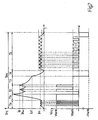
- Fig. 4 shows, for each injector 2, an example of the wave shape of the intensity of the current Iinj and of the control signal of the respective transistor 15 during a control cycle performed by the safety member 11.
- the control unit 13 sends the request to perform a control cycle to the safety member 11; at this point, the safety member 11 disregards the injection pulses already under way (INJECTOR1 and INJECTOR4) and measures the actual injection time Tinjeff for each injector 2 during the subsequent injection pulses.
- a drive circuit 14 is adapted to drive two injectors 2 (for instance, as shown in Fig. 5, INJECTOR1 and INJECTOR4) using two transistors 19 (shown in Fig. 5 by 19a and 19b and associated with INJECTOR1 and INJECTOR4 respectively), each of which connects a respective terminal 6 to the earth 20.
- two transistors 19 shown in Fig. 5 by 19a and 19b and associated with INJECTOR1 and INJECTOR4 respectively
- the operation of the drive circuit 14 of Fig. 5 is completely identical to the above-described operation of the drive circuit 14 of Fig.2; obviously, the transistor 19a is controlled to open the injector INJECTOR1, while the transistor 19b is controlled to open the injector INJECTOR4.
- the drive circuit 14 shown in Fig. 5 also makes it possible to carry out a secondary injection of the other injector (INJECTOR4); as is known, this secondary injection is adapted to regenerate a catalyst device (known and not shown) disposed on an exhaust (not shown) of the engine 3 by desulphurising this catalyst device by means of the temperature increase due to the combustion in the catalyst device of the petrol injected with the secondary injection.
- a catalyst device known and not shown
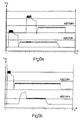
- the secondary injection of an injector is carried out simply by causing the relative transistor 19 (19b for INJECTOR4) to conduct; according to further embodiments, the secondary injection may be carried out by keeping the transistor 18 constantly deactivated (Fig. 6b) or by causing the transistor 18 to conduct (Fig. 6a).
- the difference between the two solutions lies in the fact that in one case (transistor 18 constantly deactivated), the current wave Iinj of the secondary injection has a gentler pulse (and therefore slower and less accurate opening) as it is generated by a voltage vinj equal to Vbatt and, in the other case (transistor 18 initially caused to conduct), the current wave Iinj of the secondary injection has a much steeper pulse as it is generated by a voltage Vinj equal to Vtank.
- the current Iinj of the main injection does not suffer variations of intensity with respect to the preceding regime as the transistor 19 is current controlled; when the transistor 18 is caused to conduct, the steepness of the rising edge of the current Iinj increases as a result of the increased driving voltage and the current control increases the rapidity of switching in order always to maintain the current Iinj within the range ⁇ Im, centred on Im.
- the above-described intermediate section of cancelling out of the current Iinj by deactivating the transistors 15, 18 and 19b can also be carried out for the secondary injection (INJECTOR4); in this case the current Iinj of the main injection (INJECTOR1) suffers a momentary, but not particularly high, downturn as the transistor 19a of the main injection (INJECTOR1) continues to conduct.
- the power stage 12 is formed as modules (not shown); in particular it comprises a first module provided with the transistors 15 and 18 and the diodes 17 and 20 and a second module provided with the transistor 19, the diode 21 and the resistor 23.
- a first and a second module are connected together, while in order to provide a drive circuit 14 of the type shown in Fig. 5 for the control of two injectors 2, a first and a pair of second modules are connected together.
Landscapes
- Engineering & Computer Science (AREA)
- Chemical & Material Sciences (AREA)
- Combustion & Propulsion (AREA)
- Mechanical Engineering (AREA)
- General Engineering & Computer Science (AREA)
- Electrical Control Of Air Or Fuel Supplied To Internal-Combustion Engine (AREA)
- Fuel-Injection Apparatus (AREA)
Abstract
Description
Claims (8)
- A device for driving an injector (2) in an internal combustion engine (3), the injector (2) comprising a control circuit (4) provided with a first and a second terminal (5; 6) and the device (1) comprising an actuator circuit (14) adapted to cause a current wave (Iinj) which is variable over time, which comprises an initial section (T1, T2, T3) having a relatively high current intensity (Iinj) and a subsequent final section (T5) having a relatively low current intensity (Iinj) to circulate through a control circuit (4) of the injector (2), the device being characterized in that the actuator circuit (14) comprises first transistor means (15, 18) for connecting the first terminal (5) to a voltage generator (7; 10), second transistor means (19) for connecting the second terminal (6) to an earth (20) of the voltage generator (7; 10) and recirculation diodes (21; 22) enabling the discharge of the inductances of the control circuit (4).
- A device as claimed in claim 1, in which the first transistor means (15) comprise a pair of transistors (15, 18) for selectively connecting the first terminal (5) to a first and a second voltage generator (7; 10), which are able to generate a first and a second voltage value different from one another.
- A device as claimed in claim 2, in which the first voltage generator (7) a battery generating the first voltage substantially equal to 12V; the second voltage generator (10) is a d.c-d.c. converter, which is attached to the battery (7) and generates the second voltage between 60 and 90V.
- A device as claimed in claim 2 or 3, in which a first recirculation diode (21) connects the first terminal (5) to the earth (20) and a second recirculation diode (22) connects the second terminal (6) to the voltage generator (7; 10).
- A device as claimed in one of claims 1 to 4, in which the transistors (15, 18, 19) are of MOS type.
- A device as claimed in one of claims 1 to 5, and adapted also to drive a further injector (2) comprising a respective control circuit (4) provided with a first and a second terminal (5; 6), the first terminal (5) of the further injector (2) being connected to the first terminal (5) of the injector (2) and the actuator circuit (4) comprising second transistor means (19b) for connecting the terminal (6) of the further injector (2) to the earth (20).
- A device as claimed in one of claims 1 to 6, in which the actuator circuit (14) is formed by connecting at least two modules, the first of which comprises the first transistor means (15; 18) and the second of which comprises the second transistor means (19).
- A device as claimed in one of claims 1 to 7, in which are provided control means for rapidly reducing the current intensity (Iinj) to substantially zero values during an intermediate section (T4) between the first and second sections (T1, T2, T3; T5).
Applications Claiming Priority (3)
| Application Number | Priority Date | Filing Date | Title |
|---|---|---|---|
| IT2000BO000489A ITBO20000489A1 (en) | 2000-08-04 | 2000-08-04 | METHOD AND DEVICE FOR PILOTING AN INJECTOR IN AN INTERNAL COMBUSTION ENGINE. |
| ITBO20000489 | 2000-08-04 | ||
| EP01118659A EP1179670B1 (en) | 2000-08-04 | 2001-08-02 | Method and device for driving an injector in an internal combustion engine |
Related Parent Applications (2)
| Application Number | Title | Priority Date | Filing Date |
|---|---|---|---|
| EP01118659A Division EP1179670B1 (en) | 2000-08-04 | 2001-08-02 | Method and device for driving an injector in an internal combustion engine |
| EP01118659.0 Division | 2001-08-02 |
Publications (3)
| Publication Number | Publication Date |
|---|---|
| EP1473453A2 true EP1473453A2 (en) | 2004-11-03 |
| EP1473453A3 EP1473453A3 (en) | 2004-11-10 |
| EP1473453B1 EP1473453B1 (en) | 2006-06-14 |
Family
ID=11438679
Family Applications (2)
| Application Number | Title | Priority Date | Filing Date |
|---|---|---|---|
| EP01118659A Expired - Lifetime EP1179670B1 (en) | 2000-08-04 | 2001-08-02 | Method and device for driving an injector in an internal combustion engine |
| EP04017769A Expired - Lifetime EP1473453B1 (en) | 2000-08-04 | 2001-08-02 | Device for driving an injector in an internal combustion engine |
Family Applications Before (1)
| Application Number | Title | Priority Date | Filing Date |
|---|---|---|---|
| EP01118659A Expired - Lifetime EP1179670B1 (en) | 2000-08-04 | 2001-08-02 | Method and device for driving an injector in an internal combustion engine |
Country Status (6)
| Country | Link |
|---|---|
| US (1) | US6584961B2 (en) |
| EP (2) | EP1179670B1 (en) |
| BR (1) | BR0104306A (en) |
| DE (2) | DE60109371T2 (en) |
| ES (2) | ES2264783T3 (en) |
| IT (1) | ITBO20000489A1 (en) |
Families Citing this family (20)
| Publication number | Priority date | Publication date | Assignee | Title |
|---|---|---|---|---|
| DE10234098A1 (en) * | 2002-07-26 | 2004-02-05 | Robert Bosch Gmbh | DC-DC converter regulation for the current supply to solenoid valves of a motor vehicle combustion engine, adjusting DC-DC converter so that it is able to handle heavy loading due to operation of multiple valves |
| US20050279780A1 (en) * | 2004-04-30 | 2005-12-22 | Howard Evans | Switch mode gun driver and method |
| JP4561321B2 (en) * | 2004-11-09 | 2010-10-13 | サンケン電気株式会社 | Solenoid drive |
| US7013876B1 (en) | 2005-03-31 | 2006-03-21 | Caterpillar Inc. | Fuel injector control system |
| DE102007003211A1 (en) * | 2007-01-22 | 2008-07-24 | Robert Bosch Gmbh | Device and method for controlling an electromagnetic valve |
| JP2008291778A (en) * | 2007-05-25 | 2008-12-04 | Denso Corp | Solenoid valve control device |
| DE102007060771A1 (en) * | 2007-12-17 | 2009-06-18 | Robert Bosch Gmbh | Method for operating an injection device |
| JP5053868B2 (en) | 2008-01-07 | 2012-10-24 | 日立オートモティブシステムズ株式会社 | Fuel injection control device |
| JP2010255444A (en) * | 2009-04-21 | 2010-11-11 | Hitachi Automotive Systems Ltd | Fuel injection control device and method for internal combustion engine |
| JP5023172B2 (en) | 2010-03-09 | 2012-09-12 | 日立オートモティブシステムズ株式会社 | Solenoid valve drive circuit |
| JP5470294B2 (en) | 2011-02-02 | 2014-04-16 | 日立オートモティブシステムズ株式会社 | Injector drive circuit |
| US9611797B2 (en) * | 2012-10-30 | 2017-04-04 | National Instruments Corporation | Direct injection flexible multiplexing scheme |
| JP5772788B2 (en) * | 2012-11-05 | 2015-09-02 | 株式会社デンソー | Fuel injection control device and fuel injection system |
| DE102013203130A1 (en) * | 2013-02-26 | 2014-08-28 | Robert Bosch Gmbh | Method for controlling an injection process of a magnet injector |
| DE102014002261A1 (en) * | 2014-02-20 | 2015-08-20 | Man Diesel & Turbo Se | Control unit of an internal combustion engine |
| JP6717176B2 (en) | 2016-12-07 | 2020-07-01 | 株式会社デンソー | Injection control device |
| FR3065089B1 (en) * | 2017-04-11 | 2019-06-28 | Schneider Electric Industries Sas | METHOD FOR CONTROLLING AN ELECTRIC CURRENT CUTTING APPARATUS, ELECTROMAGNETIC ACTUATOR COMPRISING A CIRCUIT FOR CARRYING OUT SAID METHOD, AND ELECTRIC CUTTING APPARATUS COMPRISING SUCH ACTUATOR |
| JP6844501B2 (en) | 2017-10-31 | 2021-03-17 | 株式会社デンソー | Fuel injection valve control device and fuel injection valve control method |
| CN113586303B (en) * | 2021-08-23 | 2022-07-19 | 一汽解放汽车有限公司 | Oil injection time determining system and vehicle |
| CN115986166B (en) * | 2023-01-04 | 2026-04-24 | 一汽解放汽车有限公司 | Hydrogen injection control method, apparatus, computer equipment and storage medium |
Family Cites Families (24)
| Publication number | Priority date | Publication date | Assignee | Title |
|---|---|---|---|---|
| JPS5675956A (en) * | 1979-11-27 | 1981-06-23 | Nippon Denso Co Ltd | Injector driving circuit |
| US4479161A (en) * | 1982-09-27 | 1984-10-23 | The Bendix Corporation | Switching type driver circuit for fuel injector |
| US4486703A (en) * | 1982-09-27 | 1984-12-04 | The Bendix Corporation | Boost voltage generator |
| US4631628A (en) * | 1983-06-08 | 1986-12-23 | Chrysler Motors Corporation | Electronic fuel injector driver circuit |
| US4604675A (en) * | 1985-07-16 | 1986-08-05 | Caterpillar Tractor Co. | Fuel injection solenoid driver circuit |
| US4764840A (en) * | 1986-09-26 | 1988-08-16 | Motorola, Inc. | Dual limit solenoid driver control circuit |
| IT1217171B (en) * | 1987-08-25 | 1990-03-14 | Marelli Autronica | CIRCUIT FOR THE DRIVING OF INDUCTIVE LOADS IN PARTICULAR FOR THE CONTROL OF THE ELECTROINJECTORS OF A DIESEL CYCLE INTERNAL COMBUSTION ENGINE |
| US4862866A (en) * | 1987-08-25 | 1989-09-05 | Marelli Autronica S.P.A. | Circuit for the piloting of inductive loads, particularly for operating the electro-injectors of a diesel-cycle internal combustion engine |
| IT1218673B (en) * | 1987-08-25 | 1990-04-19 | Marelli Autronica | CIRCUIT FOR THE CONTROL OF INDUCTIVE LOADS IN PARTICULAR FOR THE CONTROL OF THE ELECTROINJECTORS OF A DIESEL CYCLE ENGINE |
| US4905120A (en) * | 1988-10-20 | 1990-02-27 | Caterpillar Inc. | Driver circuit for solenoid operated fuel injectors |
| IT1223872B (en) * | 1988-10-27 | 1990-09-29 | Marelli Autronica | CIRCUIT FOR PILOTING AN INDUCTIVE LOAD IN PARTICULAR FOR THE CONTROL OF THE ELECTROINJECTORS OF A DIESEL CYCLE ENGINE |
| US5053911A (en) * | 1989-06-02 | 1991-10-01 | Motorola, Inc. | Solenoid closure detection |
| IT1251259B (en) * | 1991-12-23 | 1995-05-05 | Elasis Sistema Ricerca Fiat | CONTROL CIRCUIT OF PREVALENTLY INDUCTIVE LOADS, IN PARTICULAR ELECTROINJECTORS. |
| US5430601A (en) * | 1993-04-30 | 1995-07-04 | Chrysler Corporation | Electronic fuel injector driver circuit |
| US5381297A (en) * | 1993-06-18 | 1995-01-10 | Siemens Automotive L.P. | System and method for operating high speed solenoid actuated devices |
| DE4411789C2 (en) * | 1994-04-06 | 2003-12-11 | Bosch Gmbh Robert | Method and device for controlling the fuel metering in an internal combustion engine |
| US5469825A (en) * | 1994-09-19 | 1995-11-28 | Chrysler Corporation | Fuel injector failure detection circuit |
| WO1996027198A1 (en) * | 1995-03-02 | 1996-09-06 | Robert Bosch Gmbh | Device for controlling at least one electromagnetic consumer |
| US5812355A (en) * | 1995-09-25 | 1998-09-22 | Nordson Corporation | Electric gun driver |
| US5788154A (en) * | 1996-05-02 | 1998-08-04 | Caterpillar Inc. | Method of preventing cavitation in a fuel injector having a solenoid actuated control valve |
| GB9619786D0 (en) * | 1996-09-20 | 1996-11-06 | Lucas Ind Plc | Drive circuit |
| US5752482A (en) * | 1997-03-28 | 1998-05-19 | Cummins Engine Company, Inc. | System for integrally controlling current flow through number of inductive loads |
| DE19732854B4 (en) * | 1997-07-30 | 2006-04-20 | Mitsubishi Denki K.K. | Control device for controlling a fuel injection device of an internal combustion engine |
| DE19746981A1 (en) * | 1997-10-24 | 1999-04-29 | Bosch Gmbh Robert | Method of driving electromagnetic load, esp. a magnetic fuel injection valve for an internal combustion engine |
-
2000
- 2000-08-04 IT IT2000BO000489A patent/ITBO20000489A1/en unknown
-
2001
- 2001-08-02 EP EP01118659A patent/EP1179670B1/en not_active Expired - Lifetime
- 2001-08-02 DE DE60109371T patent/DE60109371T2/en not_active Expired - Lifetime
- 2001-08-02 ES ES04017769T patent/ES2264783T3/en not_active Expired - Lifetime
- 2001-08-02 ES ES01118659T patent/ES2238367T3/en not_active Expired - Lifetime
- 2001-08-02 EP EP04017769A patent/EP1473453B1/en not_active Expired - Lifetime
- 2001-08-02 DE DE60120795T patent/DE60120795T2/en not_active Expired - Lifetime
- 2001-08-03 US US09/922,397 patent/US6584961B2/en not_active Expired - Fee Related
- 2001-08-03 BR BR0104306-4A patent/BR0104306A/en not_active Application Discontinuation
Also Published As
| Publication number | Publication date |
|---|---|
| DE60109371T2 (en) | 2006-04-06 |
| EP1473453A3 (en) | 2004-11-10 |
| DE60120795D1 (en) | 2006-07-27 |
| ES2264783T3 (en) | 2007-01-16 |
| ITBO20000489A1 (en) | 2002-02-04 |
| US20020014223A1 (en) | 2002-02-07 |
| DE60109371D1 (en) | 2005-04-21 |
| ITBO20000489A0 (en) | 2000-08-04 |
| BR0104306A (en) | 2002-04-02 |
| DE60120795T2 (en) | 2007-05-24 |
| US6584961B2 (en) | 2003-07-01 |
| ES2238367T3 (en) | 2005-09-01 |
| EP1473453B1 (en) | 2006-06-14 |
| EP1179670A1 (en) | 2002-02-13 |
| EP1179670B1 (en) | 2005-03-16 |
Similar Documents
| Publication | Publication Date | Title |
|---|---|---|
| EP1473453B1 (en) | Device for driving an injector in an internal combustion engine | |
| JP4776651B2 (en) | Internal combustion engine control device | |
| US7789073B2 (en) | Fuel injection control apparatus | |
| US10197002B2 (en) | Fuel injection control device for internal combustion engine | |
| CN101230808B (en) | Internal combustion engine controller | |
| US6407593B1 (en) | Electromagnetic load control apparatus having variable drive-starting energy supply | |
| US9376982B2 (en) | Control apparatus for fuel injector | |
| JP2010255444A (en) | Fuel injection control device and method for internal combustion engine | |
| US5383086A (en) | System and method for triggering an inductive consumer | |
| EP1903201B1 (en) | Valve control strategy and controller | |
| US7124741B2 (en) | Method for controlling an injector with verification that plunger movement has occurred | |
| US8108126B2 (en) | Method of controlling fuel injection apparatus | |
| JP2019085925A (en) | Injection controller | |
| EP1179669B1 (en) | Method for the control of an injector in an internal combustion engine | |
| US11421620B2 (en) | Injection control device | |
| WO2019087899A1 (en) | Fuel injection valve control device and fuel injection valve control method | |
| JP2013137028A (en) | Device and method for fuel injection control of internal combustion engine | |
| JP2005201245A (en) | Control device of electric actuator detecting instant of completion of work and method for detecting instant of completion of electric actuator operation | |
| JP4089092B2 (en) | Injector control device | |
| JP2002295293A (en) | Fuel injection device | |
| US11326537B2 (en) | Injection control device | |
| JPH11200931A (en) | Solenoid valve drive |
Legal Events
| Date | Code | Title | Description |
|---|---|---|---|
| PUAI | Public reference made under article 153(3) epc to a published international application that has entered the european phase |
Free format text: ORIGINAL CODE: 0009012 |
|
| PUAL | Search report despatched |
Free format text: ORIGINAL CODE: 0009013 |
|
| AC | Divisional application: reference to earlier application |
Ref document number: 1179670 Country of ref document: EP Kind code of ref document: P |
|
| AK | Designated contracting states |
Kind code of ref document: A2 Designated state(s): DE ES FR GB SE |
|
| AK | Designated contracting states |
Kind code of ref document: A3 Designated state(s): DE ES FR GB SE |
|
| RIN1 | Information on inventor provided before grant (corrected) |
Inventor name: NEPOTE, ANDREA Inventor name: CARBONARO, PIERO Inventor name: CAGNONI, MICHELE Inventor name: POGGIO, LUCA Inventor name: MARCECA, PAOLO |
|
| 17P | Request for examination filed |
Effective date: 20050509 |
|
| 17Q | First examination report despatched |
Effective date: 20050607 |
|
| AKX | Designation fees paid |
Designated state(s): DE ES FR GB SE |
|
| GRAP | Despatch of communication of intention to grant a patent |
Free format text: ORIGINAL CODE: EPIDOSNIGR1 |
|
| GRAS | Grant fee paid |
Free format text: ORIGINAL CODE: EPIDOSNIGR3 |
|
| GRAA | (expected) grant |
Free format text: ORIGINAL CODE: 0009210 |
|
| RAP1 | Party data changed (applicant data changed or rights of an application transferred) |
Owner name: MAGNETI MARELLI POWERTRAIN S.P.A. |
|
| AC | Divisional application: reference to earlier application |
Ref document number: 1179670 Country of ref document: EP Kind code of ref document: P |
|
| AK | Designated contracting states |
Kind code of ref document: B1 Designated state(s): DE ES FR GB SE |
|
| REG | Reference to a national code |
Ref country code: GB Ref legal event code: FG4D |
|
| REF | Corresponds to: |
Ref document number: 60120795 Country of ref document: DE Date of ref document: 20060727 Kind code of ref document: P |
|
| REG | Reference to a national code |
Ref country code: SE Ref legal event code: TRGR |
|
| ET | Fr: translation filed | ||
| REG | Reference to a national code |
Ref country code: ES Ref legal event code: FG2A Ref document number: 2264783 Country of ref document: ES Kind code of ref document: T3 |
|
| PLBE | No opposition filed within time limit |
Free format text: ORIGINAL CODE: 0009261 |
|
| STAA | Information on the status of an ep patent application or granted ep patent |
Free format text: STATUS: NO OPPOSITION FILED WITHIN TIME LIMIT |
|
| 26N | No opposition filed |
Effective date: 20070315 |
|
| PGFP | Annual fee paid to national office [announced via postgrant information from national office to epo] |
Ref country code: ES Payment date: 20090811 Year of fee payment: 9 |
|
| PGFP | Annual fee paid to national office [announced via postgrant information from national office to epo] |
Ref country code: GB Payment date: 20090728 Year of fee payment: 9 Ref country code: SE Payment date: 20090727 Year of fee payment: 9 |
|
| EUG | Se: european patent has lapsed | ||
| GBPC | Gb: european patent ceased through non-payment of renewal fee |
Effective date: 20100802 |
|
| PG25 | Lapsed in a contracting state [announced via postgrant information from national office to epo] |
Ref country code: GB Free format text: LAPSE BECAUSE OF NON-PAYMENT OF DUE FEES Effective date: 20100802 |
|
| REG | Reference to a national code |
Ref country code: ES Ref legal event code: FD2A Effective date: 20111019 |
|
| PG25 | Lapsed in a contracting state [announced via postgrant information from national office to epo] |
Ref country code: ES Free format text: LAPSE BECAUSE OF NON-PAYMENT OF DUE FEES Effective date: 20100803 |
|
| PG25 | Lapsed in a contracting state [announced via postgrant information from national office to epo] |
Ref country code: SE Free format text: LAPSE BECAUSE OF NON-PAYMENT OF DUE FEES Effective date: 20100803 |
|
| PGFP | Annual fee paid to national office [announced via postgrant information from national office to epo] |
Ref country code: DE Payment date: 20140722 Year of fee payment: 14 |
|
| PGFP | Annual fee paid to national office [announced via postgrant information from national office to epo] |
Ref country code: FR Payment date: 20140822 Year of fee payment: 14 |
|
| REG | Reference to a national code |
Ref country code: DE Ref legal event code: R119 Ref document number: 60120795 Country of ref document: DE |
|
| REG | Reference to a national code |
Ref country code: FR Ref legal event code: ST Effective date: 20160429 |
|
| PG25 | Lapsed in a contracting state [announced via postgrant information from national office to epo] |
Ref country code: DE Free format text: LAPSE BECAUSE OF NON-PAYMENT OF DUE FEES Effective date: 20160301 |
|
| PG25 | Lapsed in a contracting state [announced via postgrant information from national office to epo] |
Ref country code: FR Free format text: LAPSE BECAUSE OF NON-PAYMENT OF DUE FEES Effective date: 20150831 |