EP1473375A1 - Steel wire excellent in descalability in mecanical descaling and method for production thereof - Google Patents
Steel wire excellent in descalability in mecanical descaling and method for production thereof Download PDFInfo
- Publication number
- EP1473375A1 EP1473375A1 EP03703170A EP03703170A EP1473375A1 EP 1473375 A1 EP1473375 A1 EP 1473375A1 EP 03703170 A EP03703170 A EP 03703170A EP 03703170 A EP03703170 A EP 03703170A EP 1473375 A1 EP1473375 A1 EP 1473375A1
- Authority
- EP
- European Patent Office
- Prior art keywords
- mass
- base metal
- scale
- wire rod
- metal portion
- Prior art date
- Legal status (The legal status is an assumption and is not a legal conclusion. Google has not performed a legal analysis and makes no representation as to the accuracy of the status listed.)
- Granted
Links
Images

Classifications
-
- C—CHEMISTRY; METALLURGY
- C22—METALLURGY; FERROUS OR NON-FERROUS ALLOYS; TREATMENT OF ALLOYS OR NON-FERROUS METALS
- C22C—ALLOYS
- C22C38/00—Ferrous alloys, e.g. steel alloys
- C22C38/02—Ferrous alloys, e.g. steel alloys containing silicon
-
- C—CHEMISTRY; METALLURGY
- C21—METALLURGY OF IRON
- C21D—MODIFYING THE PHYSICAL STRUCTURE OF FERROUS METALS; GENERAL DEVICES FOR HEAT TREATMENT OF FERROUS OR NON-FERROUS METALS OR ALLOYS; MAKING METAL MALLEABLE, e.g. BY DECARBURISATION OR TEMPERING
- C21D1/00—General methods or devices for heat treatment, e.g. annealing, hardening, quenching or tempering
- C21D1/18—Hardening; Quenching with or without subsequent tempering
- C21D1/19—Hardening; Quenching with or without subsequent tempering by interrupted quenching
-
- C—CHEMISTRY; METALLURGY
- C21—METALLURGY OF IRON
- C21D—MODIFYING THE PHYSICAL STRUCTURE OF FERROUS METALS; GENERAL DEVICES FOR HEAT TREATMENT OF FERROUS OR NON-FERROUS METALS OR ALLOYS; MAKING METAL MALLEABLE, e.g. BY DECARBURISATION OR TEMPERING
- C21D1/00—General methods or devices for heat treatment, e.g. annealing, hardening, quenching or tempering
- C21D1/74—Methods of treatment in inert gas, controlled atmosphere, vacuum or pulverulent material
- C21D1/76—Adjusting the composition of the atmosphere
-
- C—CHEMISTRY; METALLURGY
- C21—METALLURGY OF IRON
- C21D—MODIFYING THE PHYSICAL STRUCTURE OF FERROUS METALS; GENERAL DEVICES FOR HEAT TREATMENT OF FERROUS OR NON-FERROUS METALS OR ALLOYS; MAKING METAL MALLEABLE, e.g. BY DECARBURISATION OR TEMPERING
- C21D8/00—Modifying the physical properties of ferrous metals or ferrous alloys by deformation combined with, or followed by, heat treatment
- C21D8/06—Modifying the physical properties of ferrous metals or ferrous alloys by deformation combined with, or followed by, heat treatment during manufacturing of rods or wires
-
- Y—GENERAL TAGGING OF NEW TECHNOLOGICAL DEVELOPMENTS; GENERAL TAGGING OF CROSS-SECTIONAL TECHNOLOGIES SPANNING OVER SEVERAL SECTIONS OF THE IPC; TECHNICAL SUBJECTS COVERED BY FORMER USPC CROSS-REFERENCE ART COLLECTIONS [XRACs] AND DIGESTS
- Y10—TECHNICAL SUBJECTS COVERED BY FORMER USPC
- Y10T—TECHNICAL SUBJECTS COVERED BY FORMER US CLASSIFICATION
- Y10T428/00—Stock material or miscellaneous articles
- Y10T428/12—All metal or with adjacent metals
- Y10T428/12431—Foil or filament smaller than 6 mils
Definitions
- the present invention relates to the overall aspects of a steel wire rod requiring descaling. It relates to a steel wire rod serving as, for example, a wire rod for cold drawing, a wire rod for welding wire, or a material for a steel wire to be used for a wire rope, a rubber hose, a tire cord, or the like, and a manufacturing method thereof.
- a steel wire is generally manufactured through a step of wire drawing a steel wire rod manufactured by hot rolling to a required wire diameter. In the wire drawing, it is necessary to sufficiently remove the scale deposited on the surface of the wire rod at the stage prior to processing in order to ensure favorable drawability.
- the mechanical descaling is carried out not only through the process based on shot blast or air blasting, but also through the process in which the scale is peeled off by bending or twisting.
- the scale is peeled off during transfer of a wire rod, the base metal is exposed, so that rust may form. Accordingly, there is a demand for the formation of such a scale as to be less likely to be peeled off during transfer, and more likely to be peeled off upon mechanical descaling for a steel wire rod after hot rolling.
- the present invention has been completed. It is therefore an object of the present invention to provide a steel wire rod excellent in scale peelability for mechanical descaling (mechanical descalability), and a manufacturing method thereof.
- the present inventors have conducted a close study on a steel wire rod having an excellent mechanical descalability (hereinafter, may be abbreviated as a "MD property") regardless of the thickness of the scale. As a result, they have found that the peelability of the scale largely depends upon the concentration of Si in the scale layer interface portion in contact with the interface with the base metal portion of the steel wire rod. In consequence, they have completed the present invention.
- MD property mechanical descalability
- a steel wire rod of the present invention has: a base metal portion comprising a steel containing C in an amount of not more than 1.1 mass% and Si in an amount of 0.05 to 0.80 mass%; and a scale layer deposited on the surface of the base metal portion, characterized in that the Si average concentration in the interface portion of the scale with the base metal portion is not less than 2.0 times the Si content of the base metal portion.
- the steel wire rod of the present invention satisfies the requirements, thereby to be remarkably improved in mechanical descalability.
- the "Si concentrated area" in which the Si concentration is not less than 2.0 times the Si content of the base metal portion in the interface portion of the scale layer preferably occupies not less than 60 area%. This is because more favorable scale peelability can be obtained thereby.
- the Si content of the base metal portion is preferably not less than 0.1 mass% and not more than 0.6 mass%. This is for achieving more proper Si average concentration in the interface portion of the scale, and implementing further improvement of the mechanical descalability.
- the base metal portion preferably comprises C in an amount of not more than 1.1 mass%, Si in an amount of 0.05 to 0.80 mass%, and the balance being Fe and inevitable impurities. This is intended for the following purpose.
- the steel wire rod is allowed to exhibit stable mechanical descalability.
- the base metal portion may further comprises, other than the foregoing components, not less than one selected from the group consisting of Mn: 0.01 to 2.0 mass%, Cr: 0 to 2.0 mass%, Mo: 0 to 0.6 mass%, Cu: 0 to 2.0 mass%, Ni: 0 to 4.0 mass%, Ti: 0 to 0.1 mass%, Al: 0.001 to 0.10 mass%, N: 0 to 0.03 mass%, V: 0 to 0.40 mass%, Nb: 0 to 0.15 mass%, and B: 0 to 0.005 mass%.
- Mn 0.01 to 2.0 mass%
- Cr 0 to 2.0 mass%
- Mo 0 to 0.6 mass%
- Cu 0 to 2.0 mass%
- Ni: 0 to 4.0 mass% Ni: 0 to 4.0 mass%
- Ti 0 to 0.1 mass%
- Al 0.001 to 0.10 mass%
- N 0 to 0.03 mass%
- V 0 to 0.40 mass%
- Nb 0 to 0.15 mass%
- B 0
- the Si concentrated are in the interface portion of the scale layer preferably occupies not less than 60 area %, and the Si content of the base metal portion is preferably not less than 0.1 mass% and not more than 0.6 mass %.
- the steel wire rod of the present invention is characterized by being manufactured by:
- the first cooling rate is preferably not more than 45 °C/s. This is for still further accelerating the Si concentration in the interface portion of the scale, and ensuring favorable mechanical descalability.
- a method for manufacturing the steel wire rod in accordance with the present invention is characterized by including:
- the first cooling rate is preferably not more than 45 °C/s. This is for ensuring more excellent mechanical descalability.
- C is a main element for determining the mechanical properties of a steel. It is possible to appropriately set the C content according to the intended purpose. However, if the C content is excessive, the hot workability during manufacturing of a wire rod is deteriorated. Therefore, the upper limit is set at 1.1 % in consideration of the hot workability. Si: 0.05 to 0.80 %
- Si is an essential element for raising the Si concentration in the scale layer in the vicinity of the interface with the base metal portion. If the content is less than 0.05 %, the amount of Si to be incorporated into the scale layer interface portion becomes too small. On the other hand, excessive addition thereof results in the formation of a surface decarburized layer, or conversely results in the deterioration in MD property. For this reason, the lower limit is set at 0.05 %, and preferably 0.1 %, and the upper limit is set at 1. 0 %, preferably 0.80 %, and more preferably 0.6 %.
- the balance includes Fe and inevitable impurities.
- the components other than C and Si so that appropriate other components may be contained according to the required characteristics such as strength and corrosion resistance.
- the scale layer is formed on the surface of the steel wire rod after hot rolling.
- the Si concentration in the scale interface portion formed adjacent to the interface with the base metal portion is important.
- the Si concentration in the scale layer interface portion largely affects the characteristics of the interface between the scale layer and the base metal portion, and controls the peelability of the whole scale layer.
- the Si in the interface portion is present mostly in oxide form such as SiO 2 .
- the Si in the scale is supplied from the base metal portion upon scale formation, and hence segregates in the interface portion.
- the term "Si concentration" in the scale layer interface portion denotes the Si concentration in the scale concentrated toward the side in contact with the base metal portion (local Si amount) . Therefore, it is possible to determine the "Si concentration in the scale layer interface portion" based on the data obtainable from the surface of the scale on the interface side.
- the measurement of the Si concentration in the interface portion of the scale layer can be carried out in the following manner.
- the base metal portion of the steel wire rod is molten to collect the scale crust composed of the scale layer which covered the surface of the base metal portion.
- the inner surface of the scale crust is subjected to line analysis by means of an EPMA (Electron Probe Micro Analyzer).
- EPMA is capable of analysis of the composition of the sample surface, and hence suitable for the present invention, in accordance with which the Si concentration in the scale interface portion where Si segregates is defined. The specific measuring method will be explained in examples described later.
- a dissolving solution for dissolving the base metal portion in the measuring method for example, a bromine-sodium bromide-sodium dodecylbenzene sulfonate (SDBS)-methanol solution can be used (see, Current Advances in Materials and Processes-The Iron and Steel Institute of Japan, vol. 13, p1084 (2000)).
- SDBS bromine-sodium bromide-sodium dodecylbenzene sulfonate
- the scale layer increases in breaking strength upon causing a given or more distortion in the steel wire rod having the scale layer deposited thereon, so that the scale chip size to be broken by mechanical descaling increases.
- mechanical descaling such as a bending process or a twisting process.
- Si is given from the base metal portion so that the Si average concentration in the interface portion is not less than 2.0 times the Si content of the base metal steel composition. As a result, it is possible to obtain favorable peelability. Whereas, if the Si average concentration is less than 2.0 times, a remarkable effect cannot be observed.
- the Si content of the base metal portion denotes the first Si content of the steel (the Si content prior to the formation of the scale layer). This is for the following reason.
- the Si in the scale layer migrates from the base metal portion, and hence, theoretically, the Si content of the base metal portion after the scale layer formation should decrease. However, since the scale layer is sufficiently thinner than the base metal portion, the amount of the Si decreased is negligible.
- the scale layer so that the "Si concentrated area" (denoting the portion having a Si concentration of not less than 2.0 times relative to the Si content of the base metal portion steel composition) accounts for not less than 60 %, and more preferably not less than 80 % in areal proportion, it is possible to obtain more favorable scale peelability.
- a steel piece containing C in an amount of not more than 1.1 mass% and Si in an amount of 0.05 to 0.80 mass% is heated according to an ordinary method.
- the steel piece is hot rolled at an ending temperature of 1000 to 1100 °C.
- the hot rolled wire rod is cooled down to a coiling starting temperature of 800 to 950 °C at a first cooling rate of less than 50 °C/s, and coiled.
- the coiled wire rod is cooled down to the wire rod surface temperature of 700 °C in an oxygen supply atmosphere (an atmosphere capable of supplying an oxygen), for example, in an air, at a second cooling rate of not less than 3 °C/s and not more than the critical cooling rate defined by the following equation (1):
- Critical cooling rate of second cooling rate (°C/s) 22 + 11 ⁇ [Si] - 8.5 ⁇ log (D) (where [Si] denotes the Si content (mass%) of the steel, and D denotes the wire diameter (mm).)
- Cooling is carried out from 700 to 500 °C at a third cooling rate of not more than 2.5 °C/s.
- the cooling down to 500 °C or lower has no particular restriction, and either slow cooling or quenching may be adopted. Thereafter, in general, the cooled rod is used a "wire rod" as it is, and subjected to a wire drawing processing. Alternatively, prior thereto, it may also be subjected to another thermal processing, or the like.
- a scale forms and grows after the completion of hot rolling, and Si is supplied from the base metal portion of a wire rod into the scale, and concentrated mainly in the interface portion of the scale layer.
- the ending temperature of hot rolling is less than 1000 °C, the concentration of Si into the scale after the start of cooling is retarded. As a result, it is not possible to obtain a desired Si concentrated scale.
- the Si concentration into the scale is accelerated. However; the Si concentration in the scale becomes uneven, so that there occur portions from which the scales will not be peeled off by mechanical descaling. For this reason, the hot rolling ending temperature is set at 1000 to 1100 °C.
- the first cooling rate after completion of rolling i.e., the cooling rate from the hot rolling ending temperature to the coiling starting temperature of 950 to 800 °C is required to be set at less than 50 °C/s. If it is not less than 50 °C/s, it becomes difficult to ensure the time margin for the nucleus formation and growth of the scale. Even if the subsequent cooling conditions are controlled, the Si concentration becomes insufficient.
- the cooling rate is desirably set at not less than 30 °C/s, and more preferably not less than 35 °C/s in consideration of the productivity. Further, in order that the proportion of the Si concentrated area in the interface portion of the scale layer is not less than 60 % to ensure a scale structure with more favorable peelability, the cooling rate is preferably set at not more than 45 °C/s.
- the coiling starting temperature is set at 950 to 800 °C in the present invention because it also controls the initial growth of the scale nucleus formation as with the definition for the first cooling rate. If coiling is carried out from at more than 950 °C, uneven concentration of Si in the scale occurs, resulting in deterioration of the scale peelability. Whereas; with coiling from a temperature lower than 800 °C, the Si concentration in the scale becomes insufficient, also resulting in a deterioration of the scale peelability.
- the second cooling rate from the coiling starting temperature to 700 °C is required to be controlled in accordance with the rolled wire diameter and the Si content of the base metal portion. Specifically, it is set at not less than 3 °C/s and not more than the critical cooling rate of the equation (1). If the cooling rate from immediately after the start of coiling down to 700 °C is set at less than 3 °C/s, the scale layer increases in thickness more than necessary. Accordingly, although the scale peelability becomes very favorable, the scale is peeled off prior to coming to the mechanical descaling step. As a result, rust becomes likely to form at the peeled portion during storage or transfer of the wire rod coil.
- the critical cooling rate is the one determined from the data of examples described later.
- the third cooling rate from 700 °C to 500 °C is also important.
- a cooling rate of not more than 2.5 °C/s therefor it becomes possible to accelerate the Si concentration. As a result, it is possible to obtain a scale having a desired favorable peelability.
- Carbon steels having their respective C contents and Si contents described in Table 1 were produced in a converter. Each resulting steel ingot was broken and rolled to produce a billet (155 mm square). The billet was heated to about 1150 °C, followed by hot rolling. The rolling was completed at 1030 °C, resulting in wire rods having various diameters D (mm) as shown in the same table. Subsequently after completion of rolling, each resulting wire rod was cooled down to the coiling starting temperature of 840°C at a first cooling rate of 40 °C/s. Then, coiling was started, and cooling was carried out down to 700 °C at various second cooling rates. Further, cooling was carried out at the third cooling rate of 2.5 °C/s between 700 and 500 °C.
- the average concentration of Si in the interface portion of the scale layer deposited on each resulting wire rod was measured.
- the measurement was carried out as described previously in the following manner. Namely, the base metal portion of the wire rod was dissolved by the dissolving solution, so that the scale crust composed of the scale layer was separated therefrom. Then, the inner surface (the surface on the side of the interface with the base metal portion) of the scale crust was subjected to EPMA line analysis. The direction of measurement line was set along the circumference.
- the measuring conditions were as follows: the accelerating voltage was set at 15 kV; and the emission current, 1 ⁇ 10 -8 A.
- Si average concentration in the interface portion of the scale layer 400 points were measured at a measuring spacing of 100 nm between the scanning distance of 40 ⁇ m, and the Si average concentration of the 400 measuring points was determined as the Si average concentration in the interface portion of the scale layer. It is noted that (Si average concentration in the scale layer interface portion) / (Si content of the steel of the base metal portion) is referred to as the Si average concentration index.
- FIG. 1 shows a graph systematically plotting the relationship between the Si concentration index and the residual scale rate based on Table 1.
- FIG. 1 indicates that the inventive examples and the comparative examples are clearly different from each other in level of the residual scale rate at a Si concentration index of 2.0, and that favorable scale peelability can be obtained at not less than 2.0.
- FIG. 2 indicates that the inventive examples and the comparative examples are divided from each other into two parts with the straight line in the drawing as boundary.
- the straight line is expressed by the following equation (1).
- Table 1 the limit (upper limit) value of the second cooling rate calculated according to the equation (1) is also shown together.
- V + 8.5 * log(D) 11 ⁇ [Si] + 22
- Example A steels having various C contents and Si contents were used to be subjected to hot rolling, thereby manufacturing wire rods in each of which a scale layer was formed on the base metal portion.
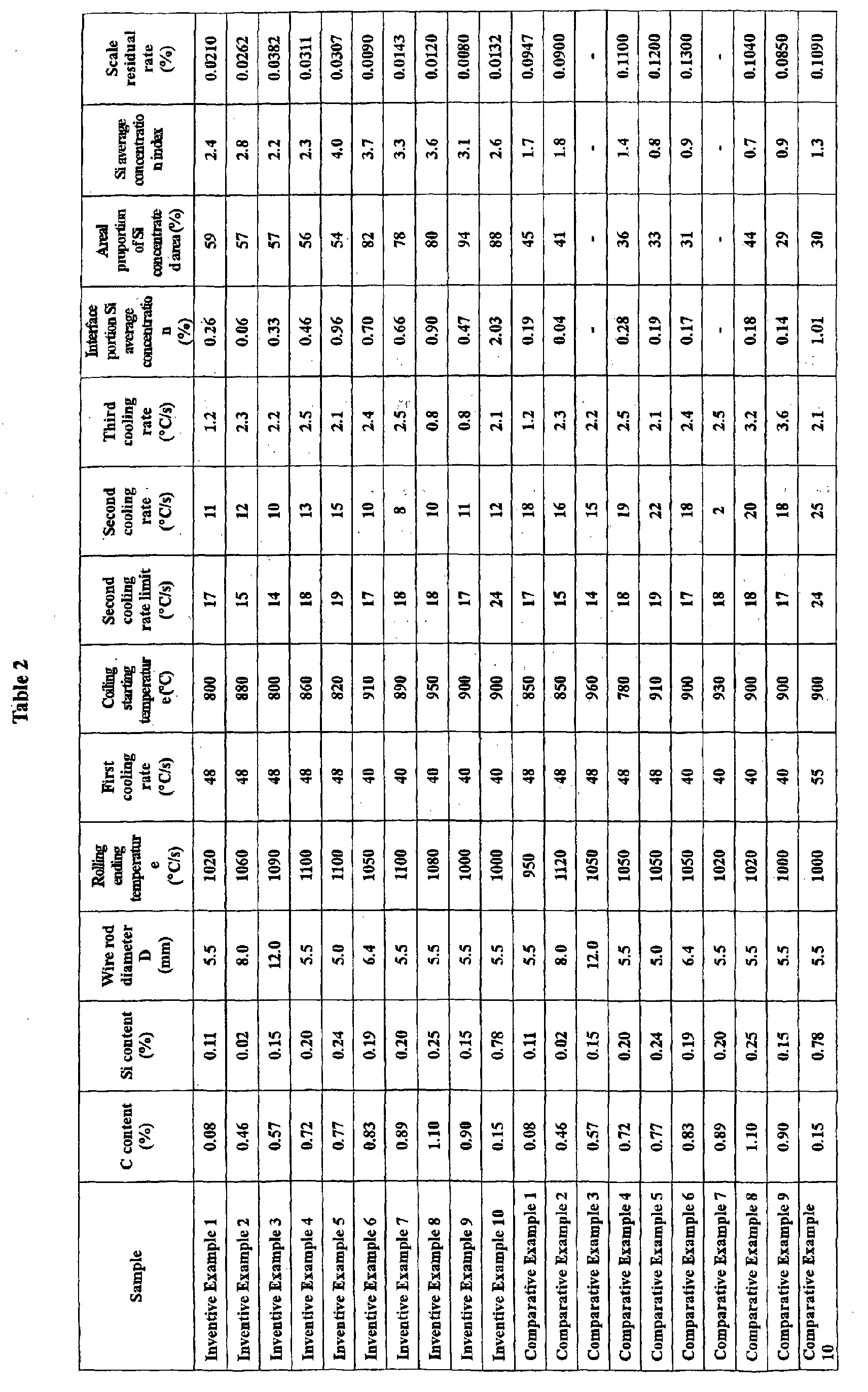
- the hot rolling ending temperatures and cooling conditions after hot rolling are shown together in Table 2.
- Each resulting wire rod was determined for the Si average concentration in the interface portion of the scale layer, the Si average concentration index, and the scale residual rate in the same manner as in Example A. Further, the areal proportion of the measuring points in which (measuring point Si concentration by line analysis) / (base metal portion Si content) was not less than 2.0 based on the Si content of steel of the base metal portion was determined as the areal proportion (%) of the Si concentrated area in the interface portion of the scale layer.
- Table 2 indicates as follows.
- the scale residual rate is about 0.1 %.
- the scale residual rate is not more than about 0.03 %, indicating that the scale is remarkably prevented from remaining, and that the sample of the inventive example is a wire rod having a scale layer excellent in scale peelability formed thereon.
- the sample in which the Si concentrated area occupies not less than 60 % the scale peelability is still more favorable.
- the Si concentration in the interface portion of the scale layer of a steel wire rod is increased to be not less than 2.0 times relative to the Si content of the base metal portion thereof. Therefore, it is possible to provide a steel wire rod having favorable scale peelability not depending upon the scale thickness and the scale composition, from which the scale layer will be peeled off almost without leaving the residue in a mechanical descaling step, while having a proper scale adhesion prior to the mechanical descaling step. Further, in accordance with a manufacturing method of the present invention, it is possible to manufacture the steel wire rod on an industrial scale with ease.
Landscapes
- Chemical & Material Sciences (AREA)
- Engineering & Computer Science (AREA)
- Organic Chemistry (AREA)
- Mechanical Engineering (AREA)
- Materials Engineering (AREA)
- Metallurgy (AREA)
- Thermal Sciences (AREA)
- Physics & Mathematics (AREA)
- Crystallography & Structural Chemistry (AREA)
- Manufacturing & Machinery (AREA)
- Heat Treatment Of Steel (AREA)
- Heat Treatment Of Strip Materials And Filament Materials (AREA)
- Metal Extraction Processes (AREA)
- Cleaning And De-Greasing Of Metallic Materials By Chemical Methods (AREA)
Abstract
Description
C: not more than 1.1 % (excluding 0 %)
Si: 0.05 to 0.80 %
Further, (4) Cooling is carried out from 700 to 500 °C at a third cooling rate of not more than 2.5 °C/s. The cooling down to 500 °C or lower has no particular restriction, and either slow cooling or quenching may be adopted. Thereafter, in general, the cooled rod is used a "wire rod" as it is, and subjected to a wire drawing processing. Alternatively, prior thereto, it may also be subjected to another thermal processing, or the like.

Claims (13)
- A steel wire rod excellent in mechanical descalability, comprising: a base metal portion comprising a steel containing C in an amount of not more than 1.1 mass% and Si in an amount of 0.05 to 0.80 mass%; and a scale layer deposited on the surface of the base metal portion, wherein the Si average concentration in the interface portion of the scale with the base metal portion is not less than 2.0 times the Si content of the base metal portion.
- The steel wire rod according to claim 1, wherein the Si concentrated area in which the Si concentration is not less than 2.0 times the Si content of the base metal portion in the interface portion of the scale layer occupies not less than 60 area %.
- The steel wire rod according to claim 1, wherein the Si content of the base metal portion is not less than 0.1 mass%.
- The steel wire rod according to claim 1, wherein the Si content of the base metal portion is not more than 0.6 mass %.
- A steel wire rod excellent in mechanical descalability, comprising: a base metal portion containing C in an amount of not more than 1.1 mass%, Si in an amount of 0.05 to 0.80 mass%, and the balance being Fe and inevitable impurities; and a scale layer deposited on the surface of the base metal portion, wherein the Si average concentration in the interface portion of the scale with the base metal portion is not less than 2.0 times the Si content of the base metal portion.
- The steel wire rod according to claim 5, further comprising, not less than one selected from the group consisting of Mn: 0.01 to 2.0 mass%, Cr: 0 to 2.0 mass%, Mo: 0 to 0.6 mass%, Cu: 0 to 2.0 mass%, Ni: 0 to 4.0 mass%, Ti: 0 to 0.1 mass%, Al: 0.001 to 0.10 mass%, N: 0 to 0.03 mass%, V: 0 to 0.40 mass%, Nb: 0 to 0.15 mass%, and B: 0 to 0.005 mass%.
- The steel wire rod according to claim 5, wherein the Si concentrated area in which the Si concentration is not less than 2.0 times the Si content of the base metal portion in the interface portion of the scale layer occupies not less than 60 area %.
- The steel wire rod according to claim 5, wherein the Si content of the base metal portion is not less than 0.1 mass%.
- The steel wire rod according to claim 5, wherein the Si content of the base metal portion is not more than 0. 6 mass %.
- A steel wire rod excellent in mechanical descalability, characterized by being manufactured by:hot rolling a steel containing C: not more than 1.1 mass% and Si: 0.05 to 0.80 mass% at a rolling ending temperature of 1000 to 1100 °C;after completion of the hot rolling step, cooling the steel down to a coiling starting temperature of 950 to 800 °C at a first cooling rate of less than 50 °C/s;cooling the steel in an oxygen supply atmosphere from the coiling starting temperature to 700 °C at a second cooling rate of not less than 3 °C/s and not more than the critical cooling rate defined by the following equation (1):further cooling the steel from 700 to 500 °C at a third cooling rate of not more than 2.5 °C/s.
- The steel wire rod according to claim 10, wherein the first cooling rate is not more than 45 °C/s.
- A method for manufacturing a steel wire rod excellent in mechanical descalability, comprising the steps of:hot rolling a steel containing C: not more than 1.1 mass% and Si: 0.05 to 0.80 mass% at a rolling ending temperature of 1000 to 1100 °C;after completion of the hot rolling step, cooling the steel down to a coiling starting temperature of 950 to 800 °C at a first cooling rate of less than 50 °C/s;cooling the steel in an oxygen supply atmosphere from the coiling starting temperature to 700 °C at a second cooling rate of not less than 3 °C/s and not more than the critical cooling rate defined by the following equation (1):further cooling the steel from 700 to 500 °C at a third cooling rate of not more than 2.5 °C/s.
- The method for manufacturing a steel wire rod according to claim 12, wherein the first cooling rate is not more than 45 °C/s.
Applications Claiming Priority (3)
| Application Number | Priority Date | Filing Date | Title |
|---|---|---|---|
| JP2002029156A JP4248790B2 (en) | 2002-02-06 | 2002-02-06 | Steel wire rod excellent in mechanical descaling property and manufacturing method thereof |
| JP2002029156 | 2002-02-06 | ||
| PCT/JP2003/001148 WO2003066923A1 (en) | 2002-02-06 | 2003-02-05 | Steel wire excellent in descalability in mecanical descaling and method for production thereof |
Publications (3)
| Publication Number | Publication Date |
|---|---|
| EP1473375A1 true EP1473375A1 (en) | 2004-11-03 |
| EP1473375A4 EP1473375A4 (en) | 2005-06-15 |
| EP1473375B1 EP1473375B1 (en) | 2007-09-12 |
Family
ID=27677880
Family Applications (1)
| Application Number | Title | Priority Date | Filing Date |
|---|---|---|---|
| EP03703170A Expired - Lifetime EP1473375B1 (en) | 2002-02-06 | 2003-02-05 | Steel wire excellent in descalability in mecanical descaling and method for production thereof |
Country Status (10)
| Country | Link |
|---|---|
| US (1) | US7037387B2 (en) |
| EP (1) | EP1473375B1 (en) |
| JP (1) | JP4248790B2 (en) |
| KR (1) | KR100544162B1 (en) |
| CN (1) | CN1225567C (en) |
| AT (1) | ATE373114T1 (en) |
| AU (1) | AU2003207212A1 (en) |
| BR (1) | BR0303066B1 (en) |
| DE (1) | DE60316256T2 (en) |
| WO (1) | WO2003066923A1 (en) |
Cited By (2)
| Publication number | Priority date | Publication date | Assignee | Title |
|---|---|---|---|---|
| EP1674588A1 (en) * | 2004-12-22 | 2006-06-28 | Kabushiki Kaisha Kobe Seiko Sho | High carbon steel wire material having excellent wire drawability and manufacturing process thereof |
| EP2660347B1 (en) * | 2010-12-27 | 2018-05-30 | Kabushiki Kaisha Kobe Seiko Sho (Kobe Steel, Ltd.) | Steel wire material and production method for same |
Families Citing this family (22)
| Publication number | Priority date | Publication date | Assignee | Title |
|---|---|---|---|---|
| JP4248790B2 (en) | 2002-02-06 | 2009-04-02 | 株式会社神戸製鋼所 | Steel wire rod excellent in mechanical descaling property and manufacturing method thereof |
| JP4088220B2 (en) * | 2002-09-26 | 2008-05-21 | 株式会社神戸製鋼所 | Hot-rolled wire rod with excellent wire drawing workability that can omit heat treatment before wire drawing |
| JP3983218B2 (en) * | 2003-10-23 | 2007-09-26 | 株式会社神戸製鋼所 | Ultra fine high carbon steel wire excellent in ductility and method for producing the same |
| JP2005206853A (en) | 2004-01-20 | 2005-08-04 | Kobe Steel Ltd | High carbon steel wire rod having excellent wire drawability, and production method therefor |
| JP4476846B2 (en) * | 2005-03-03 | 2010-06-09 | 株式会社神戸製鋼所 | High strength spring steel with excellent cold workability and quality stability |
| JP4369415B2 (en) * | 2005-11-18 | 2009-11-18 | 株式会社神戸製鋼所 | Spring steel wire rod with excellent pickling performance |
| KR100742821B1 (en) * | 2005-12-27 | 2007-07-25 | 주식회사 포스코 | Heat treatment omitted tire cord wire with excellent scale peelability and manufacturing method |
| JP4027956B2 (en) * | 2006-01-23 | 2007-12-26 | 株式会社神戸製鋼所 | High strength spring steel having excellent brittle fracture resistance and method for producing the same |
| JP5070931B2 (en) * | 2006-05-31 | 2012-11-14 | 住友金属工業株式会社 | Rolled wire rod and manufacturing method thereof |
| JP2007327084A (en) * | 2006-06-06 | 2007-12-20 | Kobe Steel Ltd | Wire rod excellent in wire drawing workability and manufacturing method thereof |
| JP2008069409A (en) * | 2006-09-14 | 2008-03-27 | Bridgestone Corp | High strength high carbon steel wire and method for producing the same |
| JP5241178B2 (en) * | 2007-09-05 | 2013-07-17 | 株式会社神戸製鋼所 | Wire rod excellent in wire drawing workability and manufacturing method thereof |
| JP5121360B2 (en) * | 2007-09-10 | 2013-01-16 | 株式会社神戸製鋼所 | Spring steel wire rod excellent in decarburization resistance and wire drawing workability, and method for producing the same |
| JP5297849B2 (en) * | 2009-03-23 | 2013-09-25 | 株式会社神戸製鋼所 | Method for producing high carbon steel wire rod excellent in wire drawability |
| DE102011009443B3 (en) * | 2011-01-26 | 2012-03-29 | Daimler Ag | Wire-shaped spray material |
| CN102601129B (en) * | 2012-03-01 | 2014-01-29 | 首钢总公司 | A control method for surface oxide scale of low-carbon cold heading steel hot-rolled wire rod |
| CN102851624B (en) * | 2012-09-29 | 2014-09-24 | 莱芜钢铁集团有限公司 | Ultrahigh-strength hot-rolled resin anchor rod reinforcement steel bar and production method thereof |
| KR101490579B1 (en) * | 2013-02-06 | 2015-02-05 | 주식회사 포스코 | Wire rod for weldind rod havign excellent descalabilty and method for manufacturing the same |
| JP6053031B2 (en) * | 2013-11-29 | 2016-12-27 | 株式会社神戸製鋼所 | High carbon steel wire rod excellent in the machinability on the rolling scale and its manufacturing method |
| JP7445116B2 (en) * | 2019-12-18 | 2024-03-07 | 日本製鉄株式会社 | thick steel plate |
| KR102424956B1 (en) * | 2020-11-27 | 2022-07-25 | 주식회사 포스코 | low-carbon boron steel wire with improved hardenability and softening resistance and method for manufacturing the same |
| KR20240097400A (en) * | 2022-12-20 | 2024-06-27 | 주식회사 포스코 | Wire rod for steel fiber, steel fiber for concrete reinforcement and manufacturing method thereof |
Family Cites Families (20)
| Publication number | Priority date | Publication date | Assignee | Title |
|---|---|---|---|---|
| US4375378A (en) * | 1979-12-07 | 1983-03-01 | Nippon Steel Corporation | Process for producing spheroidized wire rod |
| US4648914A (en) * | 1984-10-19 | 1987-03-10 | The Boc Group, Inc. | Process for annealing ferrous wire |
| EP0493807B1 (en) * | 1990-12-28 | 1996-01-31 | Kabushiki Kaisha Kobe Seiko Sho | Steel cord for reinforcement of rubber articles, made from steel wires with high strength and high toughness, and process for manufacturing the same |
| EP0693570B1 (en) * | 1993-04-06 | 2000-06-07 | Nippon Steel Corporation | Bainite rod wire or steel wire for wire drawing and process for producing the same |
| DE69423619T2 (en) * | 1993-05-25 | 2000-10-26 | Nippon Steel Corp., Tokio/Tokyo | HIGH-CARBON STEEL OR STEEL WIRE WITH EXCELLENT DRAWING PROPERTIES AND PRODUCTION METHODS |
| JP3360228B2 (en) * | 1994-01-20 | 2002-12-24 | 新日本製鐵株式会社 | Wire with excellent mechanical descaling |
| JP3434080B2 (en) | 1995-04-21 | 2003-08-04 | 新日本製鐵株式会社 | Wire for descaling |
| JP3434079B2 (en) * | 1995-04-21 | 2003-08-04 | 新日本製鐵株式会社 | Wire for descaling |
| JPH08295993A (en) * | 1995-04-21 | 1996-11-12 | Nippon Steel Corp | Descaling wire |
| US5776267A (en) | 1995-10-27 | 1998-07-07 | Kabushiki Kaisha Kobe Seiko Sho | Spring steel with excellent resistance to hydrogen embrittlement and fatigue |
| JP3548341B2 (en) * | 1996-06-24 | 2004-07-28 | 新日本製鐵株式会社 | Wire material with excellent descaling and drawability |
| JP3548355B2 (en) * | 1996-11-15 | 2004-07-28 | 新日本製鐵株式会社 | Wire rod for steel wire |
| JP3476321B2 (en) * | 1997-01-17 | 2003-12-10 | 新日本製鐵株式会社 | Wire rod for steel wire |
| JPH11172332A (en) * | 1997-12-15 | 1999-06-29 | Sumitomo Metal Ind Ltd | High carbon steel wire |
| JP3409055B2 (en) * | 1998-10-16 | 2003-05-19 | 浦項綜合製鐵株式会社 | Wire for high-strength steel wire with excellent drawability and method for producing high-strength steel wire |
| JP3435112B2 (en) | 1999-04-06 | 2003-08-11 | 株式会社神戸製鋼所 | High carbon steel wire excellent in longitudinal crack resistance, steel material for high carbon steel wire, and manufacturing method thereof |
| JP3737354B2 (en) | 2000-11-06 | 2006-01-18 | 株式会社神戸製鋼所 | Wire rod for wire drawing excellent in twisting characteristics and method for producing the same |
| US6783609B2 (en) | 2001-06-28 | 2004-08-31 | Kabushiki Kaisha Kobe Seiko Sho | High-carbon steel wire rod with superior drawability and method for production thereof |
| JP3954338B2 (en) | 2001-09-10 | 2007-08-08 | 株式会社神戸製鋼所 | High-strength steel wire excellent in strain aging embrittlement resistance and longitudinal crack resistance and method for producing the same |
| JP4248790B2 (en) | 2002-02-06 | 2009-04-02 | 株式会社神戸製鋼所 | Steel wire rod excellent in mechanical descaling property and manufacturing method thereof |
-
2002
- 2002-02-06 JP JP2002029156A patent/JP4248790B2/en not_active Expired - Fee Related
-
2003
- 2003-02-05 DE DE60316256T patent/DE60316256T2/en not_active Expired - Lifetime
- 2003-02-05 CN CNB038000938A patent/CN1225567C/en not_active Expired - Fee Related
- 2003-02-05 EP EP03703170A patent/EP1473375B1/en not_active Expired - Lifetime
- 2003-02-05 AU AU2003207212A patent/AU2003207212A1/en not_active Abandoned
- 2003-02-05 WO PCT/JP2003/001148 patent/WO2003066923A1/en not_active Ceased
- 2003-02-05 US US10/473,131 patent/US7037387B2/en not_active Expired - Lifetime
- 2003-02-05 KR KR1020037012188A patent/KR100544162B1/en not_active Expired - Fee Related
- 2003-02-05 BR BRPI0303066-0A patent/BR0303066B1/en not_active IP Right Cessation
- 2003-02-05 AT AT03703170T patent/ATE373114T1/en active
Cited By (4)
| Publication number | Priority date | Publication date | Assignee | Title |
|---|---|---|---|---|
| EP1674588A1 (en) * | 2004-12-22 | 2006-06-28 | Kabushiki Kaisha Kobe Seiko Sho | High carbon steel wire material having excellent wire drawability and manufacturing process thereof |
| CN100447276C (en) * | 2004-12-22 | 2008-12-31 | 株式会社神户制钢所 | High carbon steel wire material having excellent wire drawability and manufacturing process thereof |
| US8470105B2 (en) | 2004-12-22 | 2013-06-25 | Kobe Steele, Ltd. | Process for manufacturing a high carbon steel wire material having excellent wire drawability |
| EP2660347B1 (en) * | 2010-12-27 | 2018-05-30 | Kabushiki Kaisha Kobe Seiko Sho (Kobe Steel, Ltd.) | Steel wire material and production method for same |
Also Published As
| Publication number | Publication date |
|---|---|
| US20040129354A1 (en) | 2004-07-08 |
| KR100544162B1 (en) | 2006-01-23 |
| BR0303066B1 (en) | 2014-11-11 |
| CN1225567C (en) | 2005-11-02 |
| EP1473375B1 (en) | 2007-09-12 |
| AU2003207212A1 (en) | 2003-09-02 |
| WO2003066923A1 (en) | 2003-08-14 |
| JP2003226937A (en) | 2003-08-15 |
| EP1473375A4 (en) | 2005-06-15 |
| ATE373114T1 (en) | 2007-09-15 |
| BR0303066A (en) | 2004-03-09 |
| DE60316256T2 (en) | 2008-06-12 |
| DE60316256D1 (en) | 2007-10-25 |
| US7037387B2 (en) | 2006-05-02 |
| JP4248790B2 (en) | 2009-04-02 |
| CN1498283A (en) | 2004-05-19 |
| KR20030082997A (en) | 2003-10-23 |
Similar Documents
| Publication | Publication Date | Title |
|---|---|---|
| US7037387B2 (en) | Steel wire excellent in descalability in mechanical descaling and method for production thereof | |
| JP5179331B2 (en) | Hot rolled wire rod excellent in wire drawing workability and mechanical descaling property and manufacturing method thereof | |
| JP4958998B1 (en) | Steel wire rod and manufacturing method thereof | |
| KR101103233B1 (en) | Steel wire rod | |
| US8470105B2 (en) | Process for manufacturing a high carbon steel wire material having excellent wire drawability | |
| JP4980471B1 (en) | Steel wire rod and manufacturing method thereof | |
| JP7845623B2 (en) | Galvanized steel sheet with excellent fatigue strength of electrical resistance spot welded joints, and method for manufacturing the same. | |
| JP7845759B2 (en) | Galvanized steel sheet with excellent surface quality and spot weldability, and method for manufacturing the same. | |
| EP1921172B1 (en) | Method for production of steel material having excellent scale detachment property, and steel wire material having excellent scale detachment property | |
| JP4836121B2 (en) | Method for producing high carbon steel wire rod excellent in wire drawability | |
| JP5084206B2 (en) | Manufacturing method of steel wire with excellent drawability | |
| JP4117100B2 (en) | Steel wire rod capable of omitting descaling before wire drawing, and wire drawing method of steel wire rod | |
| WO2026058872A1 (en) | Steel sheet and enameled product | |
| TW202613335A (en) | Steel plates and enamel products | |
| JP2000178679A (en) | High workability high carbon steel sheet excellent in local ductility | |
| JPH06322442A (en) | Production of high carbon steel wire rod excellent in mechanical descaling property |
Legal Events
| Date | Code | Title | Description |
|---|---|---|---|
| PUAI | Public reference made under article 153(3) epc to a published international application that has entered the european phase |
Free format text: ORIGINAL CODE: 0009012 |
|
| 17P | Request for examination filed |
Effective date: 20031029 |
|
| AK | Designated contracting states |
Kind code of ref document: A1 Designated state(s): AT BE BG CH CY CZ DE DK EE ES FI FR GB GR HU IE IT LI LU MC NL PT SE SI SK TR |
|
| AX | Request for extension of the european patent |
Extension state: AL LT LV MK RO |
|
| A4 | Supplementary search report drawn up and despatched |
Effective date: 20050428 |
|
| GRAP | Despatch of communication of intention to grant a patent |
Free format text: ORIGINAL CODE: EPIDOSNIGR1 |
|
| GRAS | Grant fee paid |
Free format text: ORIGINAL CODE: EPIDOSNIGR3 |
|
| GRAA | (expected) grant |
Free format text: ORIGINAL CODE: 0009210 |
|
| AK | Designated contracting states |
Kind code of ref document: B1 Designated state(s): AT BE BG CH CY CZ DE DK EE ES FI FR GB GR HU IE IT LI LU MC NL PT SE SI SK TR |
|
| REG | Reference to a national code |
Ref country code: GB Ref legal event code: FG4D |
|
| REG | Reference to a national code |
Ref country code: CH Ref legal event code: EP |
|
| REF | Corresponds to: |
Ref document number: 60316256 Country of ref document: DE Date of ref document: 20071025 Kind code of ref document: P |
|
| REG | Reference to a national code |
Ref country code: IE Ref legal event code: FG4D |
|
| ET | Fr: translation filed | ||
| PG25 | Lapsed in a contracting state [announced via postgrant information from national office to epo] |
Ref country code: FI Free format text: LAPSE BECAUSE OF FAILURE TO SUBMIT A TRANSLATION OF THE DESCRIPTION OR TO PAY THE FEE WITHIN THE PRESCRIBED TIME-LIMIT Effective date: 20070912 |
|
| PG25 | Lapsed in a contracting state [announced via postgrant information from national office to epo] |
Ref country code: LI Free format text: LAPSE BECAUSE OF FAILURE TO SUBMIT A TRANSLATION OF THE DESCRIPTION OR TO PAY THE FEE WITHIN THE PRESCRIBED TIME-LIMIT Effective date: 20070912 Ref country code: CH Free format text: LAPSE BECAUSE OF FAILURE TO SUBMIT A TRANSLATION OF THE DESCRIPTION OR TO PAY THE FEE WITHIN THE PRESCRIBED TIME-LIMIT Effective date: 20070912 |
|
| NLV1 | Nl: lapsed or annulled due to failure to fulfill the requirements of art. 29p and 29m of the patents act | ||
| PG25 | Lapsed in a contracting state [announced via postgrant information from national office to epo] |
Ref country code: BE Free format text: LAPSE BECAUSE OF FAILURE TO SUBMIT A TRANSLATION OF THE DESCRIPTION OR TO PAY THE FEE WITHIN THE PRESCRIBED TIME-LIMIT Effective date: 20070912 |
|
| REG | Reference to a national code |
Ref country code: CH Ref legal event code: PL |
|
| PG25 | Lapsed in a contracting state [announced via postgrant information from national office to epo] |
Ref country code: NL Free format text: LAPSE BECAUSE OF FAILURE TO SUBMIT A TRANSLATION OF THE DESCRIPTION OR TO PAY THE FEE WITHIN THE PRESCRIBED TIME-LIMIT Effective date: 20070912 Ref country code: ES Free format text: LAPSE BECAUSE OF FAILURE TO SUBMIT A TRANSLATION OF THE DESCRIPTION OR TO PAY THE FEE WITHIN THE PRESCRIBED TIME-LIMIT Effective date: 20071223 Ref country code: GR Free format text: LAPSE BECAUSE OF FAILURE TO SUBMIT A TRANSLATION OF THE DESCRIPTION OR TO PAY THE FEE WITHIN THE PRESCRIBED TIME-LIMIT Effective date: 20071213 |
|
| PG25 | Lapsed in a contracting state [announced via postgrant information from national office to epo] |
Ref country code: PT Free format text: LAPSE BECAUSE OF FAILURE TO SUBMIT A TRANSLATION OF THE DESCRIPTION OR TO PAY THE FEE WITHIN THE PRESCRIBED TIME-LIMIT Effective date: 20080212 Ref country code: SK Free format text: LAPSE BECAUSE OF FAILURE TO SUBMIT A TRANSLATION OF THE DESCRIPTION OR TO PAY THE FEE WITHIN THE PRESCRIBED TIME-LIMIT Effective date: 20070912 Ref country code: CZ Free format text: LAPSE BECAUSE OF FAILURE TO SUBMIT A TRANSLATION OF THE DESCRIPTION OR TO PAY THE FEE WITHIN THE PRESCRIBED TIME-LIMIT Effective date: 20070912 |
|
| PG25 | Lapsed in a contracting state [announced via postgrant information from national office to epo] |
Ref country code: SE Free format text: LAPSE BECAUSE OF FAILURE TO SUBMIT A TRANSLATION OF THE DESCRIPTION OR TO PAY THE FEE WITHIN THE PRESCRIBED TIME-LIMIT Effective date: 20071212 |
|
| PLBE | No opposition filed within time limit |
Free format text: ORIGINAL CODE: 0009261 |
|
| STAA | Information on the status of an ep patent application or granted ep patent |
Free format text: STATUS: NO OPPOSITION FILED WITHIN TIME LIMIT |
|
| PG25 | Lapsed in a contracting state [announced via postgrant information from national office to epo] |
Ref country code: DK Free format text: LAPSE BECAUSE OF FAILURE TO SUBMIT A TRANSLATION OF THE DESCRIPTION OR TO PAY THE FEE WITHIN THE PRESCRIBED TIME-LIMIT Effective date: 20070912 |
|
| 26N | No opposition filed |
Effective date: 20080613 |
|
| PG25 | Lapsed in a contracting state [announced via postgrant information from national office to epo] |
Ref country code: MC Free format text: LAPSE BECAUSE OF NON-PAYMENT OF DUE FEES Effective date: 20080228 |
|
| PG25 | Lapsed in a contracting state [announced via postgrant information from national office to epo] |
Ref country code: IE Free format text: LAPSE BECAUSE OF NON-PAYMENT OF DUE FEES Effective date: 20080205 Ref country code: EE Free format text: LAPSE BECAUSE OF FAILURE TO SUBMIT A TRANSLATION OF THE DESCRIPTION OR TO PAY THE FEE WITHIN THE PRESCRIBED TIME-LIMIT Effective date: 20070912 |
|
| PG25 | Lapsed in a contracting state [announced via postgrant information from national office to epo] |
Ref country code: SI Free format text: LAPSE BECAUSE OF FAILURE TO SUBMIT A TRANSLATION OF THE DESCRIPTION OR TO PAY THE FEE WITHIN THE PRESCRIBED TIME-LIMIT Effective date: 20070912 |
|
| PG25 | Lapsed in a contracting state [announced via postgrant information from national office to epo] |
Ref country code: CY Free format text: LAPSE BECAUSE OF FAILURE TO SUBMIT A TRANSLATION OF THE DESCRIPTION OR TO PAY THE FEE WITHIN THE PRESCRIBED TIME-LIMIT Effective date: 20070912 |
|
| PG25 | Lapsed in a contracting state [announced via postgrant information from national office to epo] |
Ref country code: BG Free format text: LAPSE BECAUSE OF FAILURE TO SUBMIT A TRANSLATION OF THE DESCRIPTION OR TO PAY THE FEE WITHIN THE PRESCRIBED TIME-LIMIT Effective date: 20071212 |
|
| PG25 | Lapsed in a contracting state [announced via postgrant information from national office to epo] |
Ref country code: LU Free format text: LAPSE BECAUSE OF NON-PAYMENT OF DUE FEES Effective date: 20080205 Ref country code: HU Free format text: LAPSE BECAUSE OF FAILURE TO SUBMIT A TRANSLATION OF THE DESCRIPTION OR TO PAY THE FEE WITHIN THE PRESCRIBED TIME-LIMIT Effective date: 20080313 |
|
| PG25 | Lapsed in a contracting state [announced via postgrant information from national office to epo] |
Ref country code: TR Free format text: LAPSE BECAUSE OF FAILURE TO SUBMIT A TRANSLATION OF THE DESCRIPTION OR TO PAY THE FEE WITHIN THE PRESCRIBED TIME-LIMIT Effective date: 20070912 |
|
| PG25 | Lapsed in a contracting state [announced via postgrant information from national office to epo] |
Ref country code: IT Free format text: LAPSE BECAUSE OF NON-PAYMENT OF DUE FEES Effective date: 20080229 |
|
| REG | Reference to a national code |
Ref country code: FR Ref legal event code: PLFP Year of fee payment: 14 |
|
| REG | Reference to a national code |
Ref country code: FR Ref legal event code: PLFP Year of fee payment: 15 |
|
| REG | Reference to a national code |
Ref country code: FR Ref legal event code: PLFP Year of fee payment: 16 |
|
| PGFP | Annual fee paid to national office [announced via postgrant information from national office to epo] |
Ref country code: AT Payment date: 20200127 Year of fee payment: 18 Ref country code: DE Payment date: 20200121 Year of fee payment: 18 Ref country code: GB Payment date: 20200129 Year of fee payment: 18 |
|
| PGFP | Annual fee paid to national office [announced via postgrant information from national office to epo] |
Ref country code: FR Payment date: 20200113 Year of fee payment: 18 |
|
| REG | Reference to a national code |
Ref country code: DE Ref legal event code: R119 Ref document number: 60316256 Country of ref document: DE |
|
| REG | Reference to a national code |
Ref country code: AT Ref legal event code: MM01 Ref document number: 373114 Country of ref document: AT Kind code of ref document: T Effective date: 20210205 |
|
| GBPC | Gb: european patent ceased through non-payment of renewal fee |
Effective date: 20210205 |
|
| PG25 | Lapsed in a contracting state [announced via postgrant information from national office to epo] |
Ref country code: AT Free format text: LAPSE BECAUSE OF NON-PAYMENT OF DUE FEES Effective date: 20210205 |
|
| PG25 | Lapsed in a contracting state [announced via postgrant information from national office to epo] |
Ref country code: FR Free format text: LAPSE BECAUSE OF NON-PAYMENT OF DUE FEES Effective date: 20210228 Ref country code: GB Free format text: LAPSE BECAUSE OF NON-PAYMENT OF DUE FEES Effective date: 20210205 Ref country code: DE Free format text: LAPSE BECAUSE OF NON-PAYMENT OF DUE FEES Effective date: 20210901 |