EP1473215B1 - Lamp system for motorcycles - Google Patents
Lamp system for motorcycles Download PDFInfo
- Publication number
- EP1473215B1 EP1473215B1 EP02788647A EP02788647A EP1473215B1 EP 1473215 B1 EP1473215 B1 EP 1473215B1 EP 02788647 A EP02788647 A EP 02788647A EP 02788647 A EP02788647 A EP 02788647A EP 1473215 B1 EP1473215 B1 EP 1473215B1
- Authority
- EP
- European Patent Office
- Prior art keywords
- wheeler
- lamps
- lamp
- height
- headlight
- Prior art date
- Legal status (The legal status is an assumption and is not a legal conclusion. Google has not performed a legal analysis and makes no representation as to the accuracy of the status listed.)
- Expired - Lifetime
Links
- 238000002474 experimental method Methods 0.000 description 46
- 238000000034 method Methods 0.000 description 13
- 230000008447 perception Effects 0.000 description 8
- 238000004891 communication Methods 0.000 description 6
- 238000005516 engineering process Methods 0.000 description 6
- 230000000694 effects Effects 0.000 description 5
- 239000003086 colorant Substances 0.000 description 3
- 210000001364 upper extremity Anatomy 0.000 description 3
- 238000005259 measurement Methods 0.000 description 2
- 238000000691 measurement method Methods 0.000 description 2
- 230000003068 static effect Effects 0.000 description 2
- 238000013459 approach Methods 0.000 description 1
- 210000000887 face Anatomy 0.000 description 1
- 238000005286 illumination Methods 0.000 description 1
Images











Classifications
-
- B—PERFORMING OPERATIONS; TRANSPORTING
- B62—LAND VEHICLES FOR TRAVELLING OTHERWISE THAN ON RAILS
- B62J—CYCLE SADDLES OR SEATS; AUXILIARY DEVICES OR ACCESSORIES SPECIALLY ADAPTED TO CYCLES AND NOT OTHERWISE PROVIDED FOR, e.g. ARTICLE CARRIERS OR CYCLE PROTECTORS
- B62J6/00—Arrangement of optical signalling or lighting devices on cycles; Mounting or supporting thereof; Circuits therefor
- B62J6/04—Rear lights
- B62J6/045—Rear lights indicating braking
-
- B—PERFORMING OPERATIONS; TRANSPORTING
- B62—LAND VEHICLES FOR TRAVELLING OTHERWISE THAN ON RAILS
- B62J—CYCLE SADDLES OR SEATS; AUXILIARY DEVICES OR ACCESSORIES SPECIALLY ADAPTED TO CYCLES AND NOT OTHERWISE PROVIDED FOR, e.g. ARTICLE CARRIERS OR CYCLE PROTECTORS
- B62J6/00—Arrangement of optical signalling or lighting devices on cycles; Mounting or supporting thereof; Circuits therefor
- B62J6/02—Headlights
- B62J6/022—Headlights specially adapted for motorcycles or the like
-
- B—PERFORMING OPERATIONS; TRANSPORTING
- B62—LAND VEHICLES FOR TRAVELLING OTHERWISE THAN ON RAILS
- B62J—CYCLE SADDLES OR SEATS; AUXILIARY DEVICES OR ACCESSORIES SPECIALLY ADAPTED TO CYCLES AND NOT OTHERWISE PROVIDED FOR, e.g. ARTICLE CARRIERS OR CYCLE PROTECTORS
- B62J6/00—Arrangement of optical signalling or lighting devices on cycles; Mounting or supporting thereof; Circuits therefor
- B62J6/05—Direction indicators
- B62J6/055—Electrical means, e.g. lamps
Definitions
- This invention relates to a lamp system for a two-wheeled vehicle, and particularly to technology for increasing the visibility of a two-wheeler, and specifically to a lamp system for a two-wheeler for increasing the perception accuracy of the sense of the speed or sense of the distance of a two-wheeler.
- two-wheeled vehicles are smaller in apparent size compared to four-wheeled vehicles, judging their distance is difficult compared to four-wheeled vehicles. Particularly at night, the driver and the vehicle other than its lights are difficult to see, there are few clues for sensing distance, and improving the accuracy with which distance is perceived is difficult, and for example a two-wheeler which is close may be perceived to be far away.
- two-wheeled vehicles are smaller in apparent size compared to four-wheeled vehicles, judging their speed is difficult compared to four-wheeled vehicles. Particularly at night, the driver and the vehicle other than its lights are difficult to see, there are few clues for sensing speed, and improving the accuracy with which speed is perceived is difficult, and for example a two-wheeler approaching at a high speed may be perceived to be at a lower speed.
- a visibility lamp device of a two-wheeler has been disclosed according to the preamble of claim 1, (for example JP-A-2001-334976 ) which is a lamp device visible from the front to be switched on at daytime, wherein a pair of lamps which emit blue or green color type light are mounted above and below or to the left and right of each other, and the center distance between the two lamps is at least 50mm.
- JP 04 118329 A shows a front light 1 mounted near the front axle of a two wheel vehicle, but no other front or rear light.
- US-A-5 457 612 refers to rear lights of the bicycle only, which the first set of rear lights 20 mounted below the saddle, and a second set of rear lights 40 mounted on the rear stay near the axle of the rear wheel.
- DE 728 262 C , DE 713 939 C and US 4 741 598 only show rear lights near the rear wheel axle of a bicycle or motorcycle, similar to the lower rear light 40 of US-A-5 457 612 .
- JP06-39691 A shows a front light of a bicycle combined with an additional light device fastened at a spoke of the front wheel.
- This invention provides a lighting or lamp system of a two-wheeler having a plurality of lamps, in accordance with claim 1. At least one lamp of the lamp system of the two-wheeler is disposed on a straight line passing through the axle center of the front wheel and parallel with the ground surface, or below the straight line, and on a vertical line dropping to the ground surface from the rearmost part of the front wheel, or forward of the vertical line.
- lamps are disposed at the front, it becomes easier for others to perceive the speed and distance of the two-wheeler.
- Light from lamps can be directed in the direction of advance at all times, and by this means the directed light can be made to follow the front wheel, whose direction is changed by steering of the handlebars.
- lamps are mounted at the front because lamps are mounted at the front, light from lamps is directed in the direction of advance at all times, and by this means others can more easily be made aware of the intentions of the rider.
- lamps are mounted at the front, compared to a case wherein lamps are mounted on leg shields, the degree to which light from the lamps is blocked by the front wheel is reduced.
- lamps are disposed low and at the front, the area immediately in front of the two-wheeler is illuminated by the lamps and as a result it becomes easier to see obstructions immediately in front of the two-wheeler and the state of the road. And because lamps are disposed low and at the front, they can increase the apparent size of the two-wheeler. Also, because lamps are in low positions, even in thick fog they illuminate low areas where the fog is relatively thin, and as a result of this, visibility in thick fog is increased.
- the plurality of lamps include at least one headlight and a plurality of other lamps, and at least one of those other lamps is of the same color type as the headlight. Because a lamp is of the same color type as the headlight like this and the lamp of the same color type as the headlight is disposed low, it becomes easier for others to sense the distance of the two-wheeler. And because lamps disposed low of the same color type as the headlight are conspicuous, visibility increases. Also, because lamps of the same color type as the headlight are disposed low, it becomes easier for the rider to see the surrounding situation well.
- lamps of the same color type as the headlight are disposed at the front, it becomes easier for others to sense the distance and speed of the two-wheeler.
- Light from lamps of the same color type as the headlight can be directed in the direction of advance at all times, and by this means the directed light can be made to follow the front wheel, whose direction is changed by steering of the handlebars.
- lamps of the same color type as the headlight are mounted at the front, light from lamps of the same color type as the headlight is directed in the direction of advance at all times, and by this means others can be more easily made aware of the intentions of the rider.
- lamps of the same color type as the headlight are mounted at the front, compared to a case wherein lamps of the same color type as the headlight are mounted on leg shields, the degree to which light from the lamps of the same color type as the headlight is blocked by the front wheel is reduced.
- lamps of the same color type as the headlight are disposed low and at the front, the area immediately in front of the two-wheeler is illuminated by the lamps of the same color type as the headlight, and as a result it becomes easier to see obstructions immediately in front of the two-wheeler and the state of the road. And because lamps of the same color type as the headlight are disposed low and at the front, they can increase the apparent size of the two-wheeler. Also, because lamps of the same color type as the headlight are in low positions, even in thick fog they illuminate low areas where the fog is relatively thin, and as a result of this, visibility in thick fog is increased.
- the two-wheeler is more easily recognized as a single body, and others can sense its distance and speed more easily.
- the plurality of lamps include a headlight and a plurality of other lamps, and preferably, at least one of the other lamps is disposed above the height of the headlight. That is, because there is at least one other lamp above the height of the headlight of the two-wheeler, as a result of a height difference being provided between the upper and lower lamps, it becomes easier for others to sense the speed of the two-wheeler. And because lamps are provided above the height of the headlight, they are conspicuous, and consequently the visibility of the two-wheeler increases. Also, because light from lamps disposed like this illuminates the surroundings, it becomes easier for the rider to understand the surrounding situation.
- lamps are provided above the height of the headlight of the two-wheeler, the lamps disposed in a tall arrangement make the two-wheeler clearly look tall, and consequently it is easier for others to recognize the two-wheeler as such. And, this lamp system can increase the apparent size of the two-wheeler.
- the plurality of lamps of the invention include a headlight and a plurality of other lamps, and preferably at least one of those other lamps is disposed above the height of the headlight and is of the same color type as the headlight. That is, because there is at least one other lamp of the same color type as the headlight above the height of the headlight of the two-wheeler, as a result of a height difference being provided between the upper and lower lamps, it becomes easier for others to sense the speed of the two-wheeler. And because lamps of the same color type as the headlight are provided above the height of the headlight, they are conspicuous, and consequently the visibility of the two-wheeler increases. Also, because light from lamps of the same color type as the headlight disposed like this illuminates the surroundings, it becomes easier for the rider to understand the surrounding situation.
- lamps of the same color type as the headlight are provided above the height of the headlight of the two-wheeler, the height difference between the lamps of the same color type as the headlight and the line of sight of the driver of a truck with its seat in a high position compared to a two-wheeler is small, the visibility of the two-wheeler to truck drivers can be increased. Also, because the height difference between the lamps of the same color type as the headlight and the line of sight of the driver of a four-wheeled vehicle is small, the visibility of the two-wheeler to drivers of four-wheeled vehicles increases, and the two-wheeler is more easily seen in rear mirrors of four-wheeled vehicles.
- lamps of the same color type as the headlight are provided above the height of the headlight of the two-wheeler, the lamps disposed in a tall arrangement make the two-wheeler clearly look tall, and consequently it is easier for others to recognize the two-wheeler as such. And, these lamps of the same color type as the headlight can increase the apparent size of the two-wheeler.
- the two-wheeler is more easily recognized as a single body, and others can more easily sense its speed.
- the height difference between the highest lamp and the lowest lamp of the two-wheeler lamp system is preferably at least 50% of the overall height of the two-wheeler.
- the height difference between the highest lamp and the lowest lamp of the two-wheeler lamp system is made at least 50% of the overall height of the two-wheeler like this, it becomes easier for others to sense the speed of the two-wheeler.
- the disposed lamps are conspicuous, visibility improves.
- light from lamps disposed like this illuminates the surroundings, it becomes easier for the rider to understand the surrounding situation.
- the height difference between the highest lamp and the lowest lamp of the two-wheeler lamp system is at least 50% of the overall height of the two-wheeler, the height difference between the lamps and the line of sight of the driver of a truck with its seat in a high position compared to a two-wheeler is small, the visibility of the two-wheeler to truck drivers can be increased. Also, because the height difference between the lamps and the line of sight of the driver of a four-wheeled vehicle is small, the visibility of the two-wheeler to drivers of four-wheeled vehicles increases, and the two-wheeler is more easily seen in rear mirrors of four-wheeled vehicles.
- the lamps disposed in a tall arrangement make the two-wheeler clearly look tall, and consequently it is easier for others to recognize the two-wheeler as such. And, this lamp system can increase the apparent size of the two-wheeler.
- the invention provides a lamp system of a two-wheeler having a plurality of lamps in accordance with claim 5. At least one lamp of the lamp system of the two-wheeler is disposed on a straight line passing through the axle center of the rear wheel and parallel with the ground surface, or below the straight line, and on a vertical line dropping to the ground surface from the frontmost part of the rear wheel, or rearward of the vertical line. Accordingly, it is easier for others to sense the distance of the two-wheeler. And because lamps disposed low are conspicuous, the visibility of the two-wheeler increases. And because lamps are disposed low, the rider can understand the surrounding situation. And because lamps are disposed at the rear, it becomes easier for others to sense the inter-vehicle distance and relative speed.
- the overall length of the two-wheeler is easily sensed. And because lamps are disposed at the rear, the apparent size of the two-wheeler as seen from the rear can be increased. Also, because lamps are disposed at the rear and low, even in thick fog they illuminate low areas where the fog is relatively thin, and as a result of this, visibility in thick fog is increased.
- the plurality of lamps include a brake light and a plurality of other lamps, and at least one of the other lamps is disposed above the height of the brake light. That is, because there is at least one other lamp above the height of the brake light of the two-wheeler, as a result of a height difference being provided between the upper and lower lamps, it becomes easier for others to sense the speed of the two-wheeler. Because lamps are provided above the height of the brake light, they are conspicuous, and consequently the visibility of the two-wheeler increases. Also, because light from lamps disposed like this illuminates the surroundings, it becomes easier for the rider to understand the surrounding situation.
- lamps are provided above the height of the brake light of the two-wheeler, the height difference between the lamps and the line of sight of the driver of a truck with its seat in a high position compared to a two-wheeler is small, the visibility of the two-wheeler to truck drivers can be increased. Also, because the height difference between the lamps and the line of sight of the driver of a four-wheeled vehicle is small, the visibility of the two-wheeler to drivers of four-wheeled vehicles increases. Because lamps are provided above the height of the brake light of the two-wheeler, the lamps disposed in a tall arrangement make the two-wheeler clearly look tall, and consequently it is easier for others to recognize the two-wheeler as such. This lamp system can increase the apparent size of the two-wheeler.
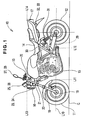
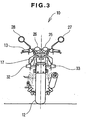
- Fig. 1 through Fig. 4 are views showing positions for disposing a lamp on a two-wheeler.
- the term used herein represents a lamp and a light reflector.
- a two-wheeler 10 has a front wheel 11, a rear wheel 12, handlebars 13, a seat 14, an engine 15, and a headlight 16 and a brake light 17, which are lamps.
- the front wheel 11 is mounted by its axle 19 being supported by a front fork 18.
- a steering stem (not shown) of the front fork 18 is supported steerably in a head pipe 21 provided at the front end of a frame 20.
- a handlebar base 22 is mounted on the top of the steering stem.
- the handlebars 13 are mounted on the handlebar base 22.
- the headlight 16 is mounted in front of the head pipe 21, direction indicators 23, 24 are mounted on either side of the headlight 16, and instruments 25, 26 such as a speedometer are mounted above the headlight 16.
- Mirrors 27, 28 are also mounted on the handlebars 13.
- the rear wheel 12 is mounted by its axle being supported by a rear swing arm 29.
- a rear cushion unit 31 is mounted between the rear swing arm 29 and a seat frame 30.
- the brake light 17 is mounted behind the seat 14, and direction indicators 32, 33 are mounted below the brake light 17 on either side of it.
- the straight line L10 shows the height from the ground surface G of the position of the axles of the front wheel 11 and the rear wheel 12
- the straight line L11 shows the position of the rearmost part of the front wheel
- the straight line L12 shows the position of the frontmost part of the rear wheel.
- the straight line L13 shows the height from the ground surface G of the top of the headlight 16
- the straight line L14 shows the height from the ground surface G of the top of the brake light 17.
- a lamp is disposed in the area lying below the straight line L10 and in front of the straight line L11.
- a two-wheeler 40 has a front wheel 41, a rear wheel 42, handlebars 43, a seat 44, an engine not shown in the figure, and a headlight 45 and a brake light 46, which are lamps.
- the front wheel 41 is mounted by its axle 48 being supported by a front fork 47.
- the headlight 45 is mounted on the front of a head pipe 49, and a mirror 50 is mounted on the handlebars 43.
- the rear wheel 42 is mounted by its axle 52 being supported on a rear swing arm 51.
- a rear cushion unit 54 is mounted between the rear swing arm 51 and a seat frame 53.
- the brake light 46 is mounted behind the seat 44.
- the straight line L15 shows the height from the ground surface G of the position of the front axle
- the straight line L16 shows the position of the rearmost part of the front wheel
- the straight line L17 shows the height from the ground surface G of the position of the rear axle
- the straight line L18 shows the position of the frontmost part of the rear wheel.
- the straight line L19 shows the height from the ground surface G of the top of the headlight
- the straight line L20 shows the height from the ground surface G of the top of the brake light.
- a lamp is disposed in the area lying below L17 and behind L18.
- Fig. 5 and Fig. 6 are a side view and a front view of a lamp or lighting system for a two-wheeler according to a first embodiment of the invention.
- at least one lamp of a two-wheeler lamp system is disposed on the straight line L10 or L15 passing through the axle center of the front wheel 11 or 41 and parallel with the ground surface G, or below the straight line L10 or L15, and on the vertical line L11 or L16 dropping to the ground surface from the rearmost part of the front wheel 11 or 41, or in front of the vertical line L11 or L16, and in Fig. 5 and Fig. 6 , besides a headlight 60 other lamps 61, 62 are mounted on the front fork 63 and disposed below the position of the axle of the front wheel 64 and in front of the position of the rearmost part of the front wheel 64.
- Fig. 7 shows a lamp system on a different kind of two-wheeler, in which a headlight 65 and lamps 66, 67 are provided as lamps.
- Fig. 8 is a schematic view of the front wheel of a two-wheeler.
- a lamp 68 is attached to the bottom part of the front fork 70 supporting the front wheel 69 and is disposed below the position of the axle of the front wheel 69 and in front of the position of the rearmost part of the front wheel 69.
- Fig. 9 is a schematic view of a front wheel part showing another example of a lamp system according to the first embodiment shown in Fig. 8 .
- a lamp 73 other than a headlight (not shown) is disposed on a side face or the front face of a front fender 72 of the front wheel 71.
- Fig. 10 is a schematic view of a front wheel part showing another example of a lamp system according to the first embodiment.
- a lamp 74 other than a headlight (not shown) is mounted at a height below the axle of the front wheel 76, using a stay 75 or the like.
- the color of the lamp is made the same color type as the headlight.
- FIG. 11 and Fig. 12 are side views showing a two-wheeler lamp system of a third embodiment of the invention.
- This third embodiment shows a lamp system at the rear wheel wherein, in Fig. 1 through Fig. 4 , at least one lamp of a two-wheeler lamp system is disposed on the straight line L10 or L17 passing through the axle center of the rear wheel 12 or 42 and parallel with the ground surface, or below the straight line L10 or L17, and on the vertical line L12 or L18 dropping to the ground surface from the frontmost part of the rear wheel 12 or 42, or behind the vertical line L12 or L18.
- a lamp 77 is mounted in a position at the axle
- a brake light 46 a lamp 78 is mounted below the axle 52 using a stay 79 or the like.
- Fig. 13 is a schematic view of an apparatus used for the experiment.
- the experiment apparatus 80 is made up of a large screen 81, a projector 82, a personal computer 83 and a reaction button 84.
- Computer graphics generated by the personal computer 83 can be projected onto the large screen 81 with the projector 82.
- the reaction button 84 is a button to be pushed by an observer 85 watching a moving picture projected onto the large screen 81, and is connected to the personal computer 83.
- the experiment was carried out as follows.
- a computer graphics picture on the large screen 81 was used to recreate a traffic environment and an ordinary two-wheeler approaching at a speed of 60Km/h on a road 80m from the observer, and a two-wheeler to which a measure according to the invention was applied approaching at 60Km/h at various distances.
- the ordinary two-wheeler (NORMAL) and the two-wheeler to which a measure according to the invention was applied (LOW) were shown traveling side by side for 0.5 seconds.
- This moving picture was observed from a distance of 2m from the large screen 81 with the position of the eyes 1.15m from the floor.
- the reaction button 84 the observer responds, as the result of the observation, with the two-wheeler which seemed the closer of the two two-wheelers.
- the psychological distance is the distance of the two-wheeler perceived by the observer watching the moving picture.
- the limit method referred to here is a type of psychophysical measurement method and for example refers to a method wherein two bodies at different distances are shown simultaneously, a case is shown wherein with the distance of one of the bodies having been fixed the distance of the other body is closer, and the two bodies are shown simultaneously with the distance of one of the bodies being changed in one direction, and a measurement is taken by an observer choosing the moving picture in which the two bodies are at the same distance.
- the two bodies were the ordinary two-wheeler and the two-wheeler to which a measure according to the invention was applied, and the distance of the ordinary two-wheeler was kept fixed while the distance of the two-wheeler to which a measure according to the invention was applied was changed. That is, the two-wheeler to which a measure according to the invention was applied was made to move gradually further away, from a distance clearly closer than the ordinary two-wheeler kept at a fixed distance, and their distances were compared. And the point at which the judgment of the observer changes from 'near' to 'far' was recorded. And then, conversely, it was made to approach from a position clearly further away, and the point at which the judgment of the observer changed was recorded again in the same way. This is repeated a number of times, and the average of the points of change was taken as an equivalent value and taken as a perceived distance.
- Fig. 14 is a front view (a) and a side view (b) showing the ordinary two-wheeler used in the experiment, which is fitted with no lamps other than a headlight 90 and a brake light 91 and direction indicators.
- Fig. 15 is a front view (a) and a side view (b) showing a two-wheeler with a lamp system according to the invention used in the experiment, wherein besides the headlight 90, which is of width 200mm and mounted in a position at height 700mm, and the brake light 91 on the ordinary two-wheeler, lamps 92, 93 of width 110mm at a position of height 210mm are mounted 390mm apart on the front fork 94 below the position of the axle of the front wheel 95 and forward of the position of the rearmost part 96 of the front wheel 95.
- the headlight 90 which is of width 200mm and mounted in a position at height 700mm
- lamps 92, 93 of width 110mm at a position of height 210mm are mounted 390mm apart on the front fork 94 below the position of the axle of the front wheel 95 and forward of the position of the rearmost part 96 of the front wheel 95.
- Fig. 16 is a front view (a) and a side view (b) of a two-wheeler with another lamp system according to the invention used in the experiment, wherein besides the headlight 90 of width 200mm mounted in a position at height 700mm and the brake light 91 on the ordinary two-wheeler, lamps 92, 93 of width 110mm at a position of height 300mm are mounted 390mm apart on the front fork 94 below the position of the axle of the front wheel 95 and forward of the position of the rearmost part 96 of the front wheel 95.
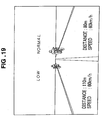
- Fig. 17 , Fig. 18 and Fig. 19 show three representative static images from the time of commencement of presentation of the moving pictures, among the moving pictures presented in this experiment.
- Fig. 17 is an image showing the ordinary two-wheeler (NORMAL) traveling at speed 60Km/h, distance 80m and the two-wheeler to which a measure according to the invention was applied (LOW) traveling at speed 60Km/h, distance 50m.
- NVMAL ordinary two-wheeler
- LOW the two-wheeler to which a measure according to the invention was applied
- Fig. 18 is an image showing the ordinary two-wheeler (NORMAL) traveling at speed 60Km/h, distance 80m and the two-wheeler to which a measure according to the invention was applied (LOW) traveling at speed 60Km/h, distance 80m.
- NVMAL ordinary two-wheeler
- LOW the two-wheeler to which a measure according to the invention was applied
- Fig. 19 is an image showing the ordinary two-wheeler (NORMAL) traveling at speed 60Km/h, distance 80m and the two-wheeler to which a measure according to the invention was applied (LOW) traveling at speed 60Km/h, distance 110m.
- NVMAL ordinary two-wheeler
- LOW the two-wheeler to which a measure according to the invention was applied
- Fig. 20 is a graph showing the respective perceived distances of the two-wheelers when multiple moving pictures represented by Figs. 17 , 18 and 19 were observed by multiple observers in the experiment.
- This graph shows results obtained with the two-wheeler to which a measure according to the invention was applied having the height of the low lamps shown in Fig. 15 at 210mm.
- the vertical axis shows perceived distance
- the bar graph (NORMAL) shows the perceived distance of the ordinary two-wheeler
- the bar graph (LOW) shows the perceived distance of the two-wheeler to which a measure according to the invention was applied.
- the straight line L shows 80m, which is the actual distance of the ordinary two-wheeler.
- the perceived distance with the ordinary two-wheeler is further, at 86m, than the real distance
- the perceived distance with the two-wheeler to which a measure according to the invention was applied is nearer, at 77m, than the real distance.
- Fig. 21 is a graph showing the results shown in Fig. 20 as a proportion with respect to the ordinary two-wheeler (NORMAL) of the perceived distance of the two-wheeler to which a measure according to the invention was applied (LOW).
- the vertical axis shows percentage, with the perceived distance of the ordinary two-wheeler taken as 100%. It can be seen that the two-wheeler of the invention seems 11% closer than the ordinary two-wheeler.
- 'same color type' is not particularly limited as long as there is no sense of incongruity compared to the color of the lamp constituting the reference, but preferably, when the angle of vision with respect to the lamp being observed is 4° or below, in the CIE1976 UCS chromaticity chart (XYZ color specification) (defined by JIS Z 8729), when the chromaticity point of the lamp color (F1) constituting the reference is F1(u 1 ',v 1 ') and the chromaticity point of the lamp color (F2) constituting the comparison is F2(u 2 ',v 2 '), the chromaticity difference ⁇ E between the chromaticity point F1 and the chromaticity point F2 is shown by expression (1).
- ⁇ E u 1 ⁇ ⁇ - u 2 ⁇ ⁇ 2 + v 1 ⁇ ⁇ - v 2 ⁇ ⁇ 2
- the chromaticity difference ⁇ E given by this expression (1) is not greater than 0.10, and does not depend on brightness difference. And, when the angle of vision is more than 4°, it is defined in the same way using the CIE 1976 UCS chromaticity chart (X 10 Y 10 Z 10 color specification) (defined in JIS Z 8729).
- Fig. 22 shows a CIE1976 UCS chromaticity chart (XYZ color specification) (extracted from JIS Z 8729), in which when the chromaticity point of the reference lamp color (F1) is F1(u 1 ',v 1 '), the area bounded by the dashed line is taken as the same color type.
- Fig. 23 shows a CIE1976 UCS chromaticity chart (X 10 Y 10 Z 10 color specification) (extracted from JIS Z 8729), in which when the chromaticity point of the reference lamp color (F1) is F1(u 1 ',v 1 '), the area bounded by the dashed line is taken as the same color type.
- Fig. 25 is a graph showing the respective perceived distances of the two-wheelers when multiple moving pictures of the kind represented by Figs. 17 , 18 and 19 with different lamp colors were observed by multiple observers in the experiment.
- This graph shows results obtained with the two-wheeler to which a measure according to the invention was applied having the height of the low lamps shown in Fig. 15 at 300mm.
- the height of the headlight is 700mm.
- the vertical axis shows perceived distance.
- the bar graph shows the perceived distance of the ordinary two-wheeler
- the bar graph (LOW white), the bar graph (LOW blue) and the bar graph (LOW green) show the perceived distance of a two-wheeler of the invention with the color of its lamp white and thus the same color type as the headlight, the perceived distance of a two-wheeler of the invention with the color of its lamp blue and thus a different color type from the headlight, and the perceived distance of a two-wheeler of the invention with the color of its lamp green and thus a different color type from the headlight.
- the straight line L shows 80m, which is the actual distance of the ordinary two-wheeler.
- the perceived distance with the ordinary two-wheeler is further, at 86m, than the real distance
- the perceived distance with the two-wheeler (LOW white) to which a measure according to the invention was applied having lamps of the same color type as the headlight is nearer, at 77m, than the real distance.
- Fig. 26 is a graph showing the results shown in Fig. 25 as a proportion with respect to the ordinary two-wheeler (NORMAL) of the perceived distances of the two-wheeler having lamps of the same color type as the headlight (LOW white), the two-wheeler (LOW blue) whose lamps are blue and thus of a different color type from the headlight, and the two-wheeler (LOW green) whose lamps are green and thus of a different color type from the headlight to which a measure according to the invention was applied.
- the vertical axis shows percentage, with the perceived distance of the ordinary two-wheeler taken as 100%. It can be seen that the two-wheeler of the invention having lamps of the same color as the headlight seems 11% closer than the ordinary two-wheeler.
- the two-wheeler becomes easier to recognize as a single body, and others can perceive its distance more easily.
- Fig. 27 and Fig. 28 are a side view and a front view showing a two-wheeler lamp system of a fourth embodiment of the invention.
- At least one lamp is positioned above the height of the headlight of the two-wheeler, and in Figs. 27 and 28 , besides a headlight 100, lamps 101, 102 are mounted on the front fork 103 and positioned below the position of the axle of the front wheel 104 and forward of the position of the rearmost part of the front wheel 104. And lamps 105, 106 are mounted above the position of the headlight 100 on pipes 108, 109 attached to the handlebars 107.
- Fig. 29 shows another example of a two-wheeler lamp system according to the fourth embodiment, in which a headlight 110 and lamps 111, 112 are mounted as lamps. Also, a lamp 114 is attached to the top of a front shield 113.
- Fig. 30 is a perspective view showing a further example of a two-wheeler lamp system according to the fourth embodiment.
- this lamp system besides a headlight 115 and a lamp 117 mounted on the front fork 116, lamps 120, 121 are mounted on the backs of mirrors 118, 119.
- the lamps are mounted on the top of a front shield and on mirrors, lamps can alternatively be mounted at the position of the instruments or on other parts, as long as they are higher than the headlight.
- the color of the lamps is made the same color type as the headlight.
- a front lamp arrangement in a two-wheeler lamp system was shown, similarly at the rear of a two-wheeler, in addition to the two-wheeler lamp system set forth in the third embodiment, as shown with broken lines in Fig. 27 , one or more lamps 114 can be mounted facing rearward at a height above that of the brake light 100a of the two-wheeler (sixth embodiment).
- the height difference between the highest lamp and the lowest lamp of the two-wheeler lamp system is at least 50% of the overall height of the two-wheeler (seventh embodiment).
- the experiment was carried out as follows.
- a computer graphics picture on the large screen 81 was first used to recreate a traffic environment and an ordinary two-wheeler approaching on a road 60m from the observer at 60Km/h.
- the moving picture of the traveling ordinary two-wheeler (NORMAL) was shown for 0.5 seconds, a 2.0 second blank was shown, and immediately after that a moving picture of a two-wheeler of the invention approaching at one of various speeds on a road 60m from the observer was shown for 0.5 seconds.
- NVMAL traveling ordinary two-wheeler
- These moving pictures were observed from a distance of 2m from the large screen 81 with the position of the eyes 1.15m from the floor.
- the observer responds, as the result of the observation, with the two-wheeler which seemed to be moving the faster of the two two-wheelers.
- psychological speed is the speed of the two-wheeler perceived by the observer watching the moving picture.
- the limit method referred to here is the same as that explained in the first embodiment and is a type of psychophysical measurement method and refers to a method wherein two bodies at different speeds are shown at a short interval, a case is shown wherein with the speed of one of the bodies having been fixed the speed of the other body is faster, and the two bodies are shown at short intervals with the speed of one of the bodies being gradually changed in one direction, and a measurement is taken by an observer choosing the moving picture in which the two bodies are at the same speed.
- the two bodies were the ordinary two-wheeler and the two-wheeler to which a measure according to the invention was applied, and the speed of the ordinary two-wheeler was kept fixed while the speed of the two-wheeler to which a measure according to the invention was applied was changed. That is, the two-wheeler to which a measure according to the invention was applied was gradually made slower from a moving picture clearly faster than the ordinary two-wheeler kept at a fixed speed, and their speeds were compared. The point at which the judgment of the observer changes from 'fast' to 'slow' is recorded. Then, conversely, the speed is increased, from a clearly slow moving picture, and the point at which the judgment of the observer changes is recorded again in the same way. This is repeated a number of times, and the average of the points of change is taken as an equivalent value and taken as a perceived speed.
- the ordinary two-wheeler used in the experiment was the one shown in Fig. 14 , which is fitted with no lamps other than a headlight 90 and a brake light 91 and direction indicators.
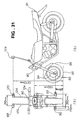
- Fig. 31 is a front view (a) and a side view (b) showing a representative two-wheeler with a lamp system according to the invention used in the experiment, on which besides the headlight 90 mounted in a position at height 700mm and the brake light 91 on the ordinary two-wheeler, lamps 92, 93 of width 110mm at a position of height 210mm are mounted 390mm apart on the front fork 94 below the position of the axle of the front wheel 95 and forward of the position of the rearmost part 96 of the front wheel 95. Also, lamps 122, 123 of width 110mm are mounted 310mm apart at a position of height 1370mm above the position of the headlight 90 on pipes 125, 126 attached to the handlebars 124.
- Fig. 32 includes a front view (a) and a side view (b) showing another representative two-wheeler with a lamp system according to the invention used in the experiment, on which besides the headlight 90 mounted in a position at height 700mm and the brake light 91 on the ordinary two-wheeler, lamps 92, 93 of width 110mm at a position of height 300mm are mounted 390mm apart on the front fork 94 below the position of the axle of the front wheel 95 and forward of the position of the rearmost part 96 of the front wheel 95. Also, lamps 122, 123 of width 110mm are mounted 310mm apart at a position of height 950mm, 1100mm, 1250mm or 1400mm above the position of the headlight 90 on pipes 125, 126 attached to the handlebars 124.
- Fig. 33 shows a static image from the time of commencement of presentation of the moving picture of the ordinary two-wheeler, among the moving pictures used in the experiment.
- Fig. 33 is an image showing an ordinary two-wheeler (NORMAL) traveling at 60Km/h at a distance of 60m.
- NVMAL ordinary two-wheeler
- Fig. 34 is a blank moving picture shown for 2.0 seconds.
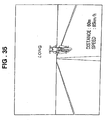
- Fig. 35 is an image showing a two-wheeler with a lamp system of the invention traveling at speed 85Km/h, distance 60m.
- Fig. 36 is an image showing a two-wheeler (LONG) with a lamp system of the invention traveling at speed 60Km/h, distance 60m.
- LONG two-wheeler
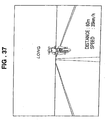
- Fig. 37 is an image showing a two-wheeler (LONG) with a lamp system of the invention traveling at speed 35Km/h, distance 60m.
- LONG two-wheeler
- Fig. 38(a) shows a system in which the upper lamp height is 1360mm
- Fig. 38(b) one in which the upper lamp height is 1150mm
- Fig. 38(c) one in which the upper lamp height is 940mm.
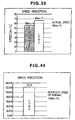
- Fig. 39 shows respective perceived speeds of the two-wheelers of when the experiment was carried out with multiple observers watching multiple moving pictures of the kind represented by Figs. 35 , 36 and 37 .
- the two-wheeler in the moving picture used in the experiment is one of which the upper lamp height is 1370mm, the lower lamp height is 210mm and the height difference between the lamps is 1160mm.
- the vertical axis shows perceived speed
- the bar graph (NORMAL) shows perceived speed of the ordinary two-wheeler
- the bar graph (LONG) shows perceived speed of a two-wheeler of the invention.
- the straight line L shows 60Km/h, which is the actual speed of the ordinary two-wheeler.
- the perceived speed with the ordinary two-wheeler is slower, at 55Km/h, than the real speed
- the perceived speed with the two-wheeler (LONG) of the invention is faster, at 66Km/h, than the real speed.
- Fig. 40 is a graph showing the results shown in Fig. 39 as a proportion with respect to the ordinary two-wheeler (NORMAL) of the perceived speed of the two-wheeler to which a measure according to the invention was applied (LONG).
- the vertical axis shows percentage, with the perceived speed of the ordinary two-wheeler taken as 100%. It can be seen that the two-wheeler of the invention seems 21% faster than the ordinary two-wheeler.
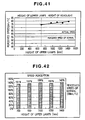
- Fig. 41 shows the speed perceived by the observer when watching a two-wheeler approaching from.a position 60m away at a speed of 60Km/h.
- a moving picture of a two-wheeler with the lamp system shown in Fig. 32 was used.
- the vertical axis shows perceived speed and the horizontal axis shows the height of the upper lamps.
- lower lamp height 300mm (lamp height difference 800mm) the speed perceived by the observer was about 77Km/h
- lower lamp height 300mm lamp height difference 950mm
- the speed perceived by the observer was about 77Km/h
- lower lamp height 300mm (lamp height difference 1100mm) the speed perceived by the observer was about 79Km/h, and thus in all cases the speed was perceived to be faster than the real speed of 60Km/h.
- Fig. 42 shows the results shown in Fig. 41 as a proportion with respect to the ordinary two-wheeler (NORMAL) of the perceived speed of the two-wheeler to which a measure according to the invention was applied (LONG).
- the vertical axis shows percentage, with the perceived speed of the ordinary two-wheeler taken as 100%, and the horizontal axis shows the height of the upper lamps.
- the two-wheeler to which a measure of the invention was applied (upper lamp height 700mm) seems 31% faster than the ordinary two-wheeler (NORMAL).
- the two-wheeler to which a measure of the invention was applied seems 37% faster than the ordinary two-wheeler (NORMAL).
- the two-wheeler to which a measure of the invention was applied seems 38% faster than the ordinary two-wheeler (NORMAL).
- the two-wheeler to which a measure of the invention was applied seems 37% faster than the ordinary two-wheeler (NORMAL).
- the two-wheeler to which a measure of the invention was applied seems 40% faster than the ordinary two-wheeler (NORMAL).
- the experiment was carried out as follows.
- a computer graphics picture on the large screen 81 was first used to recreate a traffic environment and an ordinary two-wheeler approaching on a road 60m from the observer at 60Km/h.
- the moving picture of the traveling ordinary two-wheeler (NORMAL) was shown for 0.5 seconds, a 2.0 second blank was shown, and immediately after that a moving picture of a two-wheeler of the invention having lamps of one of different colors approaching at one of various speeds on a road 60m from the observer was shown for 0.5 seconds.
- These moving pictures were observed from a distance of 2m from the large screen 81 with the position of the eyes 1.15m from the floor. Then, by pushing the reaction button, the observer responds, as the result of the observation, with the two-wheeler which seemed to be moving the faster of the two two-wheelers.
- Fig. 43 shows the speed perceived by the observer when watching a two-wheeler approaching from a position 60m away at a speed of 60Km/h.
- a moving picture of a two-wheeler with the lamp system shown in Fig. 32 was used.
- the vertical axis shows perceived speed and the horizontal axis shows the height of the upper lamps.
- lower lamp height 300mm (lamp height difference 800mm) the speed perceived by the observer was about 77Km/h
- lower lamp height 300mm lamp height difference 950mm
- the speed perceived by the observer was about 77Km/h
- lower lamp height 300mm (lamp height difference 1100mm) the speed perceived by the observer was about 79Km/h, and thus in all cases the speed was perceived to be faster than the real speed of 60Km/h.
- lower lamp height 300mm (lamp height difference 800mm) the speed perceived by the observer was about 64Km/h
- lower lamp height 300mm lamp height difference 950mm the speed perceived by the observer was about 68Km/h.
- lower lamp height 300mm (lamp height difference 1100mm) the speed perceived by the observer was about 65Km/h, and thus in all cases the speed was perceived as a speed close to the real speed of 60Km/h.
- lower lamp height 300mm (lamp height difference 800mm) the speed perceived by the observer was about 62Km/h
- lower lamp height 300mm lamp height difference 950mm
- the speed perceived by the observer was about 63Km/h
- lower lamp height 300mm (lamp height difference 1100mm) the speed perceived by the observer was about 68Km/h, and thus in all cases the speed was perceived as a speed close to the real speed of 60Km/h.
- Fig. 44 shows the results shown in Fig. 43 as a proportion with respect to the ordinary two-wheeler (NORMAL) of the perceived speed of the two-wheeler to which a measure according to the invention was applied (LONG).
- the vertical axis shows percentage, with the perceived speed of the ordinary two-wheeler taken as 100%, and the horizontal axis shows the height of the upper lamps.
- the two-wheeler is made easier to recognize as a single body, and others can perceive its speed more easily.
- lamps are provided near the axle center of the front wheel or near the axle center of the rear wheel, because these lamps are in a low position they are conspicuous, and it becomes easier for others to perceive the distance of the two-wheeler.
- the apparent size of the two-wheeler can be increased, and it becomes easier for others to perceive the speed of the two-wheeler.
Landscapes
- Engineering & Computer Science (AREA)
- Mechanical Engineering (AREA)
- Lighting Device Outwards From Vehicle And Optical Signal (AREA)
Abstract
Description
- This invention relates to a lamp system for a two-wheeled vehicle, and particularly to technology for increasing the visibility of a two-wheeler, and specifically to a lamp system for a two-wheeler for increasing the perception accuracy of the sense of the speed or sense of the distance of a two-wheeler.
- Because two-wheeled vehicles are smaller in apparent size compared to four-wheeled vehicles, judging their distance is difficult compared to four-wheeled vehicles. Particularly at night, the driver and the vehicle other than its lights are difficult to see, there are few clues for sensing distance, and improving the accuracy with which distance is perceived is difficult, and for example a two-wheeler which is close may be perceived to be far away.
- Also, because two-wheeled vehicles are smaller in apparent size compared to four-wheeled vehicles, judging their speed is difficult compared to four-wheeled vehicles. Particularly at night, the driver and the vehicle other than its lights are difficult to see, there are few clues for sensing speed, and improving the accuracy with which speed is perceived is difficult, and for example a two-wheeler approaching at a high speed may be perceived to be at a lower speed.
- To prevent these kinds of phenomena, technology has been proposed wherein wireless communication between the two-wheeler and other transport means are used, and information on present position and speed and so on is exchanged to increase the accuracy of perception of distance and speed.
- Technology for keeping visibility from other vehicles good without using communication means has been disclosed (for example
JP-A-6-227314 - Also, technology for increasing visibility from other vehicles without using wireless communication and for widening the area of illumination around the own vehicle has been disclosed (for example
JP-A-6-344826 - A visibility lamp device of a two-wheeler has been disclosed according to the preamble of
claim 1, (for exampleJP-A-2001-334976 - However, in the technology using communication means, its cost is high, and unless all two-wheeled vehicles and four-wheeled vehicles are equipped with communication means it is difficult to increase the accuracy of perception of distance and speed. In the technology using position lamps without using communication means, there is no disclosure relating to the optimal positioning of the position lamps. Also, there is no quantitative comparison of different lamp/reflector colors, and no optimum lamp/reflector color is disclosed.
- It is an object of the invention to solve the foregoing problems and provide a lamp/reflector disposition with which it is possible to increase the accuracy of perception of distance and speed by a simpler method.
-
JP 04 118329 A front light 1 mounted near the front axle of a two wheel vehicle, but no other front or rear light. -
US-A-5 457 612 refers to rear lights of the bicycle only, which the first set ofrear lights 20 mounted below the saddle, and a second set ofrear lights 40 mounted on the rear stay near the axle of the rear wheel. -
DE 728 262 C ,DE 713 939 C andUS 4 741 598 only show rear lights near the rear wheel axle of a bicycle or motorcycle, similar to the lowerrear light 40 ofUS-A-5 457 612 . -
JP06-39691 A - This invention provides a lighting or lamp system of a two-wheeler having a plurality of lamps, in accordance with
claim 1. At least one lamp of the lamp system of the two-wheeler is disposed on a straight line passing through the axle center of the front wheel and parallel with the ground surface, or below the straight line, and on a vertical line dropping to the ground surface from the rearmost part of the front wheel, or forward of the vertical line. - With this first lamp system of a two-wheeler, it becomes easier for others to perceive its distance. And because lamps disposed low are conspicuous, its visibility improves. And because lamps are disposed low, it becomes easy for the rider to understand the surrounding situation.
- In the invention, because lamps are disposed at the front, it becomes easier for others to perceive the speed and distance of the two-wheeler. Light from lamps can be directed in the direction of advance at all times, and by this means the directed light can be made to follow the front wheel, whose direction is changed by steering of the handlebars. Also, because lamps are mounted at the front, light from lamps is directed in the direction of advance at all times, and by this means others can more easily be made aware of the intentions of the rider. And because lamps are mounted at the front, compared to a case wherein lamps are mounted on leg shields, the degree to which light from the lamps is blocked by the front wheel is reduced.
- Also, in the invention, because lamps are disposed low and at the front, the area immediately in front of the two-wheeler is illuminated by the lamps and as a result it becomes easier to see obstructions immediately in front of the two-wheeler and the state of the road. And because lamps are disposed low and at the front, they can increase the apparent size of the two-wheeler. Also, because lamps are in low positions, even in thick fog they illuminate low areas where the fog is relatively thin, and as a result of this, visibility in thick fog is increased.
- In the invention, the plurality of lamps include at least one headlight and a plurality of other lamps, and at least one of those other lamps is of the same color type as the headlight. Because a lamp is of the same color type as the headlight like this and the lamp of the same color type as the headlight is disposed low, it becomes easier for others to sense the distance of the two-wheeler. And because lamps disposed low of the same color type as the headlight are conspicuous, visibility increases. Also, because lamps of the same color type as the headlight are disposed low, it becomes easier for the rider to see the surrounding situation well.
- And because lamps of the same color type as the headlight are disposed at the front, it becomes easier for others to sense the distance and speed of the two-wheeler. Light from lamps of the same color type as the headlight can be directed in the direction of advance at all times, and by this means the directed light can be made to follow the front wheel, whose direction is changed by steering of the handlebars. Also, because lamps of the same color type as the headlight are mounted at the front, light from lamps of the same color type as the headlight is directed in the direction of advance at all times, and by this means others can be more easily made aware of the intentions of the rider. And because lamps of the same color type as the headlight are mounted at the front, compared to a case wherein lamps of the same color type as the headlight are mounted on leg shields, the degree to which light from the lamps of the same color type as the headlight is blocked by the front wheel is reduced.
- Also, in the invention, because lamps of the same color type as the headlight are disposed low and at the front, the area immediately in front of the two-wheeler is illuminated by the lamps of the same color type as the headlight, and as a result it becomes easier to see obstructions immediately in front of the two-wheeler and the state of the road. And because lamps of the same color type as the headlight are disposed low and at the front, they can increase the apparent size of the two-wheeler. Also, because lamps of the same color type as the headlight are in low positions, even in thick fog they illuminate low areas where the fog is relatively thin, and as a result of this, visibility in thick fog is increased.
- As a result of lamps of the same color type as the headlight being provided, the two-wheeler is more easily recognized as a single body, and others can sense its distance and speed more easily.
- In the invention, preferably, the plurality of lamps include a headlight and a plurality of other lamps, and preferably, at least one of the other lamps is disposed above the height of the headlight. That is, because there is at least one other lamp above the height of the headlight of the two-wheeler, as a result of a height difference being provided between the upper and lower lamps, it becomes easier for others to sense the speed of the two-wheeler. And because lamps are provided above the height of the headlight, they are conspicuous, and consequently the visibility of the two-wheeler increases. Also, because light from lamps disposed like this illuminates the surroundings, it becomes easier for the rider to understand the surrounding situation.
- Since lamps are provided above the height of the headlight of the two-wheeler the height difference between the lamps and the line of sight of the driver of a truck with its seat in a high position compared to a two-wheeler is small, the visibility of the two-wheeler to truck drivers can be increased. Also, because the height difference between the lamps and the line of sight of the driver of a four-wheeled vehicle is small, the visibility of the two-wheeler to drivers of four-wheeled vehicles increases, and the two-wheeler is more easily seen in rear mirrors of four-wheeled vehicles. And because lamps are provided above the height of the headlight of the two-wheeler, the lamps disposed in a tall arrangement make the two-wheeler clearly look tall, and consequently it is easier for others to recognize the two-wheeler as such. And, this lamp system can increase the apparent size of the two-wheeler.
- The plurality of lamps of the invention include a headlight and a plurality of other lamps, and preferably at least one of those other lamps is disposed above the height of the headlight and is of the same color type as the headlight. That is, because there is at least one other lamp of the same color type as the headlight above the height of the headlight of the two-wheeler, as a result of a height difference being provided between the upper and lower lamps, it becomes easier for others to sense the speed of the two-wheeler. And because lamps of the same color type as the headlight are provided above the height of the headlight, they are conspicuous, and consequently the visibility of the two-wheeler increases. Also, because light from lamps of the same color type as the headlight disposed like this illuminates the surroundings, it becomes easier for the rider to understand the surrounding situation.
- Because lamps of the same color type as the headlight are provided above the height of the headlight of the two-wheeler, the height difference between the lamps of the same color type as the headlight and the line of sight of the driver of a truck with its seat in a high position compared to a two-wheeler is small, the visibility of the two-wheeler to truck drivers can be increased. Also, because the height difference between the lamps of the same color type as the headlight and the line of sight of the driver of a four-wheeled vehicle is small, the visibility of the two-wheeler to drivers of four-wheeled vehicles increases, and the two-wheeler is more easily seen in rear mirrors of four-wheeled vehicles. And because lamps of the same color type as the headlight are provided above the height of the headlight of the two-wheeler, the lamps disposed in a tall arrangement make the two-wheeler clearly look tall, and consequently it is easier for others to recognize the two-wheeler as such. And, these lamps of the same color type as the headlight can increase the apparent size of the two-wheeler.
- As a result of lamps of the same color type as the headlight being provided, the two-wheeler is more easily recognized as a single body, and others can more easily sense its speed.
- In the invention, the height difference between the highest lamp and the lowest lamp of the two-wheeler lamp system is preferably at least 50% of the overall height of the two-wheeler. When the height difference between the highest lamp and the lowest lamp of the two-wheeler lamp system is made at least 50% of the overall height of the two-wheeler like this, it becomes easier for others to sense the speed of the two-wheeler. And because the disposed lamps are conspicuous, visibility improves. And because light from lamps disposed like this illuminates the surroundings, it becomes easier for the rider to understand the surrounding situation.
- Since the height difference between the highest lamp and the lowest lamp of the two-wheeler lamp system is at least 50% of the overall height of the two-wheeler, the height difference between the lamps and the line of sight of the driver of a truck with its seat in a high position compared to a two-wheeler is small, the visibility of the two-wheeler to truck drivers can be increased. Also, because the height difference between the lamps and the line of sight of the driver of a four-wheeled vehicle is small, the visibility of the two-wheeler to drivers of four-wheeled vehicles increases, and the two-wheeler is more easily seen in rear mirrors of four-wheeled vehicles. And because the height difference between the highest lamp and the lowest lamp of the two-wheeler lamp system is at least 50% of the overall height of the two-wheeler, the lamps disposed in a tall arrangement make the two-wheeler clearly look tall, and consequently it is easier for others to recognize the two-wheeler as such. And, this lamp system can increase the apparent size of the two-wheeler.
- Also, the invention provides a lamp system of a two-wheeler having a plurality of lamps in accordance with claim 5. At least one lamp of the lamp system of the two-wheeler is disposed on a straight line passing through the axle center of the rear wheel and parallel with the ground surface, or below the straight line, and on a vertical line dropping to the ground surface from the frontmost part of the rear wheel, or rearward of the vertical line. Accordingly, it is easier for others to sense the distance of the two-wheeler. And because lamps disposed low are conspicuous, the visibility of the two-wheeler increases. And because lamps are disposed low, the rider can understand the surrounding situation. And because lamps are disposed at the rear, it becomes easier for others to sense the inter-vehicle distance and relative speed. Also, as a result of these being combined with lamps at the front of the two-wheeler, the overall length of the two-wheeler is easily sensed. And because lamps are disposed at the rear, the apparent size of the two-wheeler as seen from the rear can be increased. Also, because lamps are disposed at the rear and low, even in thick fog they illuminate low areas where the fog is relatively thin, and as a result of this, visibility in thick fog is increased.
- In the invention, preferably, the plurality of lamps include a brake light and a plurality of other lamps, and at least one of the other lamps is disposed above the height of the brake light. That is, because there is at least one other lamp above the height of the brake light of the two-wheeler, as a result of a height difference being provided between the upper and lower lamps, it becomes easier for others to sense the speed of the two-wheeler. Because lamps are provided above the height of the brake light, they are conspicuous, and consequently the visibility of the two-wheeler increases. Also, because light from lamps disposed like this illuminates the surroundings, it becomes easier for the rider to understand the surrounding situation.
- Because lamps are provided above the height of the brake light of the two-wheeler, the height difference between the lamps and the line of sight of the driver of a truck with its seat in a high position compared to a two-wheeler is small, the visibility of the two-wheeler to truck drivers can be increased. Also, because the height difference between the lamps and the line of sight of the driver of a four-wheeled vehicle is small, the visibility of the two-wheeler to drivers of four-wheeled vehicles increases. Because lamps are provided above the height of the brake light of the two-wheeler, the lamps disposed in a tall arrangement make the two-wheeler clearly look tall, and consequently it is easier for others to recognize the two-wheeler as such. This lamp system can increase the apparent size of the two-wheeler.
-
-
Fig. 1 is a view showing positions in which lamps are disposed on a two-wheeler, and is a side view of a two-wheeler with front and rear tires of the same size; -
Fig. 2 is a view showing positions in which lamps are disposed on a two-wheeler, and is a front view of a two-wheeler with front and rear tires of the same size; -
Fig. 3 is a view showing positions in which lamps are disposed on a two-wheeler, and is a rear view of a two-wheeler with front and rear tires of the same size; -
Fig. 4 is a view showing positions in which lamps are disposed on a two-wheeler, and is a side view of a two-wheeler with front and rear tires of different sizes; -
Fig. 5 is a side view showing a lamp system of a two-wheeler according to a first embodiment of the invention; -
Fig. 6 is a front view of a lamp system of a two-wheeler according to a first embodiment of the invention; -
Fig. 7 is a view showing lamp system of a two-wheeler of another kind; -
Fig. 8 is a schematic view of the front wheel part of a two-wheeler; -
Fig. 9 is a schematic view of a front wheel part showing another example of a lamp system according to the first embodiment; -
Fig. 10 is a schematic view of a front wheel part showing a further example of a lamp system according to the first embodiment; -
Fig. 11 is a side view showing a lamp system of a two-wheeler according to a third embodiment of the invention; -
Fig. 12 is a side view showing a lamp system of a two-wheeler according to the third embodiment of the invention; -
Fig. 13 is a schematic view showing an apparatus used for an experiment; -
Fig. 14 is a view showing an ordinary two-wheeler used in the experiment, (a) being a front view and (b) a side view; -
Fig. 15 is a view showing a two-wheeler having a lamp system of the invention used in the experiment, (a) being a front view and (b) a side view; -
Fig. 16 is a view showing another two-wheeler having a lamp system of the invention used in the experiment, (a) being a front view and (b) a side view; -
Fig. 17 is an image showing an ordinary two-wheeler traveling at 60Km/h anddistance 80m and a two-wheeler having a lamp system of the invention traveling at 60Km/h anddistance 50m; -
Fig. 18 is an image showing an ordinary two-wheeler traveling at 60Km/h anddistance 80m and a two-wheeler having a lamp system of the invention traveling at 60Km/h anddistance 80m; -
Fig. 19 is an image showing an ordinary two-wheeler traveling at 60Km/h anddistance 80m and a two-wheeler having a lamp system of the invention traveling at 60Km/h anddistance 110m; -
Fig. 20 is a graph showing perceived distances of the two-wheelers when the experiment was carried out by multiple observers observing multiple moving pictures; -
Fig. 21 is a graph showing the proportion with respect to an ordinary two-wheeler (NORMAL) of the perceived distance of a two-wheeler to which a measure of the invention was applied (LOW); -
Fig. 22 is a view showing a CIE1976 UCS chromaticity chart (XYZ color specification), illustrating a definition of same color type; -
Fig. 23 is a view showing a CIE1976 UCS chromaticity chart (X10Y10Z10 color specification), illustrating a definition of same color type; -
Fig. 24 is a view showing a CIE1976 UCS chromaticity chart (XYZ color specification), illustrating a color used in an experiment; -
Fig. 25 is a graph showing the perceived distances of respective two-wheelers when an experiment was carried out by multiple observers observing multiple moving pictures; -
Fig. 26 is a graph showing the proportions with respect to an ordinary two-wheeler (NORMAL) of the perceived distances of two-wheelers to which a measure of the invention was applied (LOW white), (LOW blue), (LOW green); -
Fig. 27 is a side view showing a lamp system of a two-wheeler according to a fourth embodiment of the invention; -
Fig. 28 is a front view showing a lamp system of a two-wheeler according to the fourth embodiment of the invention; -
Fig. 29 is a view showing another example of a lamp system of a two-wheeler according to the fourth embodiment of the invention; -
Fig. 30 is a perspective view of a two-wheeler showing another example of a lamp system of the fourth embodiment; -
Fig. 31 is views showing a representative two-wheeler having a lamp system of the invention used in an experiment, (a) being a front view and (b) a side view; -
Fig. 32 is views showing a representative two-wheeler having another lamp system of the invention used in an experiment, (a) being a front view and (b) a side view; -
Fig. 33 is an image showing an ordinary two-wheeler traveling at speed 60Km/h anddistance 60m; -
Fig. 34 is a blank moving picture shown for 2.0 seconds; -
Fig. 35 is an image showing a two-wheeler having a lamp system of the invention traveling at speed 85Km/h anddistance 60m; -
Fig. 36 is an image showing a two-wheeler having a lamp system of the invention traveling at speed 60Km/h anddistance 60m; -
Fig. 37 is an image showing a two-wheeler having a lamp system of the invention traveling at speed 35Km/h anddistance 60m; -
Fig. 38 shows two-wheeler with various lamp systems, (a) showing one in which an upper lamp height is 1360mm, (b) one in which an upper lamp height is 1150mm, and (c) one in which an upper lamp height is 940mm; -
Fig. 39 shows perceived speeds of two-wheelers of when an experiment was carried out by multiple observers observing multiple moving pictures; -
Fig. 40 is a graph showing the results shown inFig. 39 as the proportions with respect to an ordinary two-wheeler of the perceived speeds of two-wheelers to which a measure of the invention was applied; -
Fig. 41 is a graph showing the speed sensed by an observer when watching a two-wheeler approaching from aposition 60m away at 60Km/h; -
Fig. 42 is a graph showing the results shown inFig. 41 as the proportions with respect to an ordinary two-wheeler of the perceived speeds of two-wheelers to which a measure of the invention was applied; -
Fig. 43 is a graph showing the speed sensed by an observer when watching a two-wheeler approaching from aposition 60m away at 60Km/h; and -
Fig. 44 is a graph showing the results shown inFig. 43 as the proportions with respect to an ordinary two-wheeler of the perceived speeds of two-wheelers to which a measure of the invention was applied. - A number of embodiments of the invention will be described below in detail on the basis of the accompanying drawings, in which
Fig. 1 through Fig. 4 are views showing positions for disposing a lamp on a two-wheeler. The term used herein represents a lamp and a light reflector. - In
Fig. 1 through Fig. 3 , a two-wheeler 10 has afront wheel 11, arear wheel 12,handlebars 13, aseat 14, anengine 15, and aheadlight 16 and abrake light 17, which are lamps. Thefront wheel 11 is mounted by itsaxle 19 being supported by afront fork 18. A steering stem (not shown) of thefront fork 18 is supported steerably in ahead pipe 21 provided at the front end of aframe 20. Above the head pipe 21 ahandlebar base 22 is mounted on the top of the steering stem. Thehandlebars 13 are mounted on thehandlebar base 22. - The
headlight 16 is mounted in front of thehead pipe 21,direction indicators headlight 16, andinstruments headlight 16.Mirrors - The
rear wheel 12 is mounted by its axle being supported by arear swing arm 29. Arear cushion unit 31 is mounted between therear swing arm 29 and aseat frame 30. Thebrake light 17 is mounted behind theseat 14, anddirection indicators brake light 17 on either side of it. - In
Fig. 1 , the straight line L10 shows the height from the ground surface G of the position of the axles of thefront wheel 11 and therear wheel 12, the straight line L11 shows the position of the rearmost part of the front wheel, and the straight line L12 shows the position of the frontmost part of the rear wheel. The straight line L13 shows the height from the ground surface G of the top of theheadlight 16, and the straight line L14 shows the height from the ground surface G of the top of thebrake light 17. A lamp is disposed in the area lying below the straight line L10 and in front of the straight line L11. - In
Fig. 4 , a two-wheeler 40 has afront wheel 41, arear wheel 42,handlebars 43, aseat 44, an engine not shown in the figure, and aheadlight 45 and abrake light 46, which are lamps. - The
front wheel 41 is mounted by its axle 48 being supported by afront fork 47. Theheadlight 45 is mounted on the front of ahead pipe 49, and amirror 50 is mounted on the handlebars 43. - The
rear wheel 42 is mounted by itsaxle 52 being supported on a rear swing arm 51. Arear cushion unit 54 is mounted between the rear swing arm 51 and aseat frame 53. Thebrake light 46 is mounted behind theseat 44. - In
Fig. 4 , the straight line L15 shows the height from the ground surface G of the position of the front axle, the straight line L16 shows the position of the rearmost part of the front wheel, the straight line L17 shows the height from the ground surface G of the position of the rear axle, and the straight line L18 shows the position of the frontmost part of the rear wheel. The straight line L19 shows the height from the ground surface G of the top of the headlight, and the straight line L20 shows the height from the ground surface G of the top of the brake light. A lamp is disposed in the area lying below L17 and behind L18. -
Fig. 5 andFig. 6 are a side view and a front view of a lamp or lighting system for a two-wheeler according to a first embodiment of the invention. In the lamp system of this first embodiment, inFig. 1 through Fig. 4 , at least one lamp of a two-wheeler lamp system is disposed on the straight line L10 or L15 passing through the axle center of thefront wheel front wheel Fig. 5 andFig. 6 , besides aheadlight 60other lamps front fork 63 and disposed below the position of the axle of thefront wheel 64 and in front of the position of the rearmost part of thefront wheel 64. -
Fig. 7 shows a lamp system on a different kind of two-wheeler, in which aheadlight 65 andlamps Fig. 8 is a schematic view of the front wheel of a two-wheeler. Alamp 68 is attached to the bottom part of thefront fork 70 supporting thefront wheel 69 and is disposed below the position of the axle of thefront wheel 69 and in front of the position of the rearmost part of thefront wheel 69. -
Fig. 9 is a schematic view of a front wheel part showing another example of a lamp system according to the first embodiment shown inFig. 8 . In this lamp system, alamp 73 other than a headlight (not shown) is disposed on a side face or the front face of afront fender 72 of thefront wheel 71. -
Fig. 10 is a schematic view of a front wheel part showing another example of a lamp system according to the first embodiment. In this lamp system, alamp 74 other than a headlight (not shown) is mounted at a height below the axle of thefront wheel 76, using astay 75 or the like. As a second embodiment, in the two-wheeler lamp system of the first embodiment described above, the color of the lamp is made the same color type as the headlight. -
Fig. 11 andFig. 12 are side views showing a two-wheeler lamp system of a third embodiment of the invention. This third embodiment shows a lamp system at the rear wheel wherein, inFig. 1 through Fig. 4 , at least one lamp of a two-wheeler lamp system is disposed on the straight line L10 or L17 passing through the axle center of therear wheel rear wheel - In
Fig. 11 , in the two-wheeler shown inFig. 4 , besides a brake light 46 alamp 77 is mounted in a position at the axle, and inFig. 12 , besides a brake light 46 a lamp 78 is mounted below theaxle 52 using astay 79 or the like. - Next, the method and results of an experiment to show the effects on sense of distance perception accuracy of a lamp system in a two-wheeler of the first embodiment will be discussed.
-
Fig. 13 is a schematic view of an apparatus used for the experiment. Theexperiment apparatus 80 is made up of alarge screen 81, aprojector 82, apersonal computer 83 and areaction button 84. Computer graphics generated by thepersonal computer 83 can be projected onto thelarge screen 81 with theprojector 82. Thereaction button 84 is a button to be pushed by anobserver 85 watching a moving picture projected onto thelarge screen 81, and is connected to thepersonal computer 83. - The experiment was carried out as follows. A computer graphics picture on the
large screen 81 was used to recreate a traffic environment and an ordinary two-wheeler approaching at a speed of 60Km/h on aroad 80m from the observer, and a two-wheeler to which a measure according to the invention was applied approaching at 60Km/h at various distances. The ordinary two-wheeler (NORMAL) and the two-wheeler to which a measure according to the invention was applied (LOW) were shown traveling side by side for 0.5 seconds. This moving picture was observed from a distance of 2m from thelarge screen 81 with the position of the eyes 1.15m from the floor. Then, by pushing thereaction button 84, the observer responds, as the result of the observation, with the two-wheeler which seemed the closer of the two two-wheelers. - Moving pictures in which the state of travel of the ordinary two-wheeler was made the same in every moving picture and the speed of the two-wheeler to which a measure according to the invention was applied was made the same in every moving picture but its distance was varied were projected onto the large screen and the observer responded with the two-wheeler which seemed the closer using the reaction button. This experiment was carried out with multiple observers, and an equivalent value of psychological distance of when the distance from the observer of the two-wheeler to which a measure according to the invention was applied (LOW) was varied about that of the ordinary two-wheeler (NORMAL) was obtained by a limit method and this equivalent value was taken as a perceived distance.
- Here, the psychological distance is the distance of the two-wheeler perceived by the observer watching the moving picture. The limit method referred to here is a type of psychophysical measurement method and for example refers to a method wherein two bodies at different distances are shown simultaneously, a case is shown wherein with the distance of one of the bodies having been fixed the distance of the other body is closer, and the two bodies are shown simultaneously with the distance of one of the bodies being changed in one direction, and a measurement is taken by an observer choosing the moving picture in which the two bodies are at the same distance.
- In this experiment, the two bodies were the ordinary two-wheeler and the two-wheeler to which a measure according to the invention was applied, and the distance of the ordinary two-wheeler was kept fixed while the distance of the two-wheeler to which a measure according to the invention was applied was changed. That is, the two-wheeler to which a measure according to the invention was applied was made to move gradually further away, from a distance clearly closer than the ordinary two-wheeler kept at a fixed distance, and their distances were compared. And the point at which the judgment of the observer changes from 'near' to 'far' was recorded. And then, conversely, it was made to approach from a position clearly further away, and the point at which the judgment of the observer changed was recorded again in the same way. This is repeated a number of times, and the average of the points of change was taken as an equivalent value and taken as a perceived distance.
-
Fig. 14 is a front view (a) and a side view (b) showing the ordinary two-wheeler used in the experiment, which is fitted with no lamps other than aheadlight 90 and abrake light 91 and direction indicators. -
Fig. 15 is a front view (a) and a side view (b) showing a two-wheeler with a lamp system according to the invention used in the experiment, wherein besides theheadlight 90, which is of width 200mm and mounted in a position at height 700mm, and thebrake light 91 on the ordinary two-wheeler,lamps front fork 94 below the position of the axle of thefront wheel 95 and forward of the position of therearmost part 96 of thefront wheel 95. -
Fig. 16 is a front view (a) and a side view (b) of a two-wheeler with another lamp system according to the invention used in the experiment, wherein besides theheadlight 90 of width 200mm mounted in a position at height 700mm and thebrake light 91 on the ordinary two-wheeler,lamps front fork 94 below the position of the axle of thefront wheel 95 and forward of the position of therearmost part 96 of thefront wheel 95. -
Fig. 17 ,Fig. 18 andFig. 19 show three representative static images from the time of commencement of presentation of the moving pictures, among the moving pictures presented in this experiment. -
Fig. 17 is an image showing the ordinary two-wheeler (NORMAL) traveling at speed 60Km/h,distance 80m and the two-wheeler to which a measure according to the invention was applied (LOW) traveling at speed 60Km/h,distance 50m. -
Fig. 18 is an image showing the ordinary two-wheeler (NORMAL) traveling at speed 60Km/h,distance 80m and the two-wheeler to which a measure according to the invention was applied (LOW) traveling at speed 60Km/h,distance 80m. -
Fig. 19 is an image showing the ordinary two-wheeler (NORMAL) traveling at speed 60Km/h,distance 80m and the two-wheeler to which a measure according to the invention was applied (LOW) traveling at speed 60Km/h,distance 110m. -
Fig. 20 is a graph showing the respective perceived distances of the two-wheelers when multiple moving pictures represented byFigs. 17 ,18 and19 were observed by multiple observers in the experiment. This graph shows results obtained with the two-wheeler to which a measure according to the invention was applied having the height of the low lamps shown in Fig. 15 at 210mm. The vertical axis shows perceived distance, and the bar graph (NORMAL) shows the perceived distance of the ordinary two-wheeler and the bar graph (LOW) shows the perceived distance of the two-wheeler to which a measure according to the invention was applied. The straight line L shows 80m, which is the actual distance of the ordinary two-wheeler. - As can be seen from
Fig. 20 , whereas the perceived distance with the ordinary two-wheeler (NORMAL) is further, at 86m, than the real distance, the perceived distance with the two-wheeler to which a measure according to the invention was applied (LOW) is nearer, at 77m, than the real distance. -
Fig. 21 is a graph showing the results shown inFig. 20 as a proportion with respect to the ordinary two-wheeler (NORMAL) of the perceived distance of the two-wheeler to which a measure according to the invention was applied (LOW). The vertical axis shows percentage, with the perceived distance of the ordinary two-wheeler taken as 100%. It can be seen that the two-wheeler of the invention seems 11% closer than the ordinary two-wheeler. - The above experimental results can be interpreted to mean that because at least one lamp of a two-wheeler lamp system is disposed on the straight line passing through the axle center of the front wheel and parallel with the ground surface, or below the straight line, and on the vertical line dropping to the ground surface from the rearmost part of the front wheel, or forward of the vertical line, others can perceive its distance more easily. And this can be interpreted to be because since the lamps mounted low are conspicuous, visibility has increased. Also, it can be interpreted to be because as a result of the lamps being mounted low and forward, the apparent size of the two-wheeler has increased.
- Next, the method and results of an experiment to show the effects on sense of distance perception accuracy of making the color of the lamps the same color type as the headlight (second embodiment) and making them a different color type in the lamp system of the two-wheeler according to the first embodiment will be discussed. The apparatus used in the experiment is the same apparatus the apparatus shown in
Fig. 13 . Here, 'same color type' is not particularly limited as long as there is no sense of incongruity compared to the color of the lamp constituting the reference, but preferably, when the angle of vision with respect to the lamp being observed is 4° or below, in the CIE1976 UCS chromaticity chart (XYZ color specification) (defined by JIS Z 8729), when the chromaticity point of the lamp color (F1) constituting the reference is F1(u1',v1') and the chromaticity point of the lamp color (F2) constituting the comparison is F2(u2',v2'), the chromaticity difference ΔE between the chromaticity point F1 and the chromaticity point F2 is shown by expression (1).
- The chromaticity difference ΔE given by this expression (1) is not greater than 0.10, and does not depend on brightness difference. And, when the angle of vision is more than 4°, it is defined in the same way using the CIE 1976 UCS chromaticity chart (X10Y10Z10 color specification) (defined in JIS Z 8729).
-
Fig. 22 shows a CIE1976 UCS chromaticity chart (XYZ color specification) (extracted from JIS Z 8729), in which when the chromaticity point of the reference lamp color (F1) is F1(u1',v1'), the area bounded by the dashed line is taken as the same color type. -
Fig. 23 shows a CIE1976 UCS chromaticity chart (X10Y10Z10 color specification) (extracted from JIS Z 8729), in which when the chromaticity point of the reference lamp color (F1) is F1(u1',v1'), the area bounded by the dashed line is taken as the same color type. - In this experiment, for the headlight color (Fm) the color given by the chromaticity point Fm(um'=0.178, vm'=0.471) in
Fig. 24 was used, and for the lamp of the same color type a color in the area bounded by the dashed line was used. The color of the same type (Fw) actually used was the same color as (Fm). And, as a different color, a green (FG) and a blue (FB) were used, and as these the chromaticity points FG(uG'=0.137, vG'=0.576), FB(uB'=0.163, vB'=0.157) inFig. 24 were used. - The experiment was carried out as follows. A computer graphics picture on the
large screen 81 shown inFig. 13 was used to recreate a traffic environment and an ordinary two-wheeler approaching on aroad 80m from the observer at a speed of 60Km/h, and a two-wheeler to which a measure according to the invention was applied, and to which lamps of one of different color types have been mounted, approaching at 60Km/h at various distances. The ordinary two-wheeler (NORMAL) and the two-wheeler to which a measure according to the invention was applied (LOW) were shown traveling side by side for 0.5 seconds. This moving picture was observed from a distance of 2m from thelarge screen 81 with the position of the eyes 1.15m from the floor. Then, by pushing thereaction button 84, the observer responds, as the result of the observation, with the two-wheeler which seemed the closer of the two two-wheelers. - Moving pictures in which the state of travel of the ordinary two-wheeler was made the same in every picture and the speed of the two-wheeler to which a measure according to the invention was applied was made the same in every picture but its distance and lamp color were varied were shown on the large screen and the observer responded with the two-wheeler which seemed the closer using the reaction button. This experiment was carried out with multiple observers, and an equivalent value of psychological distance of when the distance from the observer of the two-wheeler to which a measure according to the invention was applied (LOW) was varied about that of the ordinary two-wheeler (NORMAL) was obtained by a limit method for each lamp color and this equivalent value was taken as a perceived distance for each lamp color.
-
Fig. 25 is a graph showing the respective perceived distances of the two-wheelers when multiple moving pictures of the kind represented byFigs. 17 ,18 and19 with different lamp colors were observed by multiple observers in the experiment. This graph shows results obtained with the two-wheeler to which a measure according to the invention was applied having the height of the low lamps shown in Fig. 15 at 300mm. The height of the headlight is 700mm. The vertical axis shows perceived distance. The bar graph (NORMAL) shows the perceived distance of the ordinary two-wheeler, and the bar graph (LOW white), the bar graph (LOW blue) and the bar graph (LOW green) show the perceived distance of a two-wheeler of the invention with the color of its lamp white and thus the same color type as the headlight, the perceived distance of a two-wheeler of the invention with the color of its lamp blue and thus a different color type from the headlight, and the perceived distance of a two-wheeler of the invention with the color of its lamp green and thus a different color type from the headlight. The straight line L shows 80m, which is the actual distance of the ordinary two-wheeler. - As can be seen from
Fig. 25 , whereas the perceived distance with the ordinary two-wheeler (NORMAL) is further, at 86m, than the real distance, the perceived distance with the two-wheeler (LOW white) to which a measure according to the invention was applied having lamps of the same color type as the headlight is nearer, at 77m, than the real distance. And with the two-wheeler (LOW blue) having lamps of a different color type from the headlight the perceived distance was 80m, and with the two-wheeler (LOW green) having lamps of a different color type from the headlight the perceived distance was 79m, from which it can be seen that the two-wheeler having lamps of the same color type as the headlight seems closer than the two-wheelers having lamps of different color types from the headlight. -
Fig. 26 is a graph showing the results shown inFig. 25 as a proportion with respect to the ordinary two-wheeler (NORMAL) of the perceived distances of the two-wheeler having lamps of the same color type as the headlight (LOW white), the two-wheeler (LOW blue) whose lamps are blue and thus of a different color type from the headlight, and the two-wheeler (LOW green) whose lamps are green and thus of a different color type from the headlight to which a measure according to the invention was applied. The vertical axis shows percentage, with the perceived distance of the ordinary two-wheeler taken as 100%. It can be seen that the two-wheeler of the invention having lamps of the same color as the headlight seems 11% closer than the ordinary two-wheeler. It can be seen that the two-wheeler whose lamps are blue and thus of a different color type from the headlight seems 7% closer than the ordinary two-wheeler, and the two-wheeler whose lamps are green and thus of a different color type from the headlight seems 8% closer than the ordinary two-wheeler. Thus, it can be seen that the two-wheeler having lamps of the same color type as its headlight seems the closest. - The above experimental results can be interpreted to mean that because at least one lamp of the same color type as the headlight of a two-wheeler lamp system is disposed on the straight line passing through the axle center of the front wheel and parallel with the ground surface, or below the straight line, and on the vertical line dropping to the ground surface from the rearmost part of the front wheel, or forward of the vertical line, and the lamp is thus mounted low, others can perceive its distance more easily. And this can be interpreted to be because since the lamps mounted low are conspicuous, visibility has increased. Also, it can be interpreted to be because as a result of the lamps being mounted low and forward, the apparent size of the two-wheeler has increased.
- As a result of lamps of the same color type as the headlight being provided, the two-wheeler becomes easier to recognize as a single body, and others can perceive its distance more easily.
-
Fig. 27 andFig. 28 are a side view and a front view showing a two-wheeler lamp system of a fourth embodiment of the invention. - In the lamp system in this fourth embodiment, in
Fig. 1 through Fig. 4 , in addition to the two-wheeler lamp system of the first embodiment, at least one lamp is positioned above the height of the headlight of the two-wheeler, and inFigs. 27 and28 , besides aheadlight 100,lamps front fork 103 and positioned below the position of the axle of thefront wheel 104 and forward of the position of the rearmost part of thefront wheel 104. Andlamps headlight 100 onpipes handlebars 107. -
Fig. 29 shows another example of a two-wheeler lamp system according to the fourth embodiment, in which aheadlight 110 andlamps lamp 114 is attached to the top of afront shield 113. -
Fig. 30 is a perspective view showing a further example of a two-wheeler lamp system according to the fourth embodiment. In this lamp system, besides aheadlight 115 and alamp 117 mounted on thefront fork 116,lamps mirrors - Whereas in each of
Fig. 27 through Fig. 30 a front lamp arrangement in a two-wheeler lamp system was shown, similarly at the rear of a two-wheeler, in addition to the two-wheeler lamp system set forth in the third embodiment, as shown with broken lines inFig. 27 , one ormore lamps 114 can be mounted facing rearward at a height above that of thebrake light 100a of the two-wheeler (sixth embodiment). - In the lamp systems described above, preferably, the height difference between the highest lamp and the lowest lamp of the two-wheeler lamp system is at least 50% of the overall height of the two-wheeler (seventh embodiment).
- Next, the method and results of an experiment to show the effects on sense of speed perception accuracy of a two-wheeler lamp system according to the fourth embodiment will be discussed. The apparatus used for the experiment was the same apparatus as that used in the experiment in the first embodiment shown in
Fig. 13 . - The experiment was carried out as follows. A computer graphics picture on the
large screen 81 was first used to recreate a traffic environment and an ordinary two-wheeler approaching on aroad 60m from the observer at 60Km/h. The moving picture of the traveling ordinary two-wheeler (NORMAL) was shown for 0.5 seconds, a 2.0 second blank was shown, and immediately after that a moving picture of a two-wheeler of the invention approaching at one of various speeds on aroad 60m from the observer was shown for 0.5 seconds. These moving pictures were observed from a distance of 2m from thelarge screen 81 with the position of the eyes 1.15m from the floor. Then, by pushing the reaction button, the observer responds, as the result of the observation, with the two-wheeler which seemed to be moving the faster of the two two-wheelers. - Moving pictures in which the state of travel of the ordinary two-wheeler was made the same in every moving picture and the distance of the two-wheeler to which a measure according to the invention was applied was made the same but its speed was varied were shown on the large screen and the observer responded with the two-wheeler which seemed the faster using the reaction button. This experiment was carried out with multiple observers, and an equivalent value of psychological speed of when the distance from the observer of the two-wheeler to which a measure according to the invention was applied (LONG) was varied about that of the ordinary two-wheeler (NORMAL) were obtained by a limit method and this equivalent value was taken as a perceived speed.
- Here, psychological speed is the speed of the two-wheeler perceived by the observer watching the moving picture. The limit method referred to here is the same as that explained in the first embodiment and is a type of psychophysical measurement method and refers to a method wherein two bodies at different speeds are shown at a short interval, a case is shown wherein with the speed of one of the bodies having been fixed the speed of the other body is faster, and the two bodies are shown at short intervals with the speed of one of the bodies being gradually changed in one direction, and a measurement is taken by an observer choosing the moving picture in which the two bodies are at the same speed.
- In this experiment, the two bodies were the ordinary two-wheeler and the two-wheeler to which a measure according to the invention was applied, and the speed of the ordinary two-wheeler was kept fixed while the speed of the two-wheeler to which a measure according to the invention was applied was changed. That is, the two-wheeler to which a measure according to the invention was applied was gradually made slower from a moving picture clearly faster than the ordinary two-wheeler kept at a fixed speed, and their speeds were compared. The point at which the judgment of the observer changes from 'fast' to 'slow' is recorded. Then, conversely, the speed is increased, from a clearly slow moving picture, and the point at which the judgment of the observer changes is recorded again in the same way. This is repeated a number of times, and the average of the points of change is taken as an equivalent value and taken as a perceived speed.
- The ordinary two-wheeler used in the experiment was the one shown in
Fig. 14 , which is fitted with no lamps other than aheadlight 90 and abrake light 91 and direction indicators. -
Fig. 31 is a front view (a) and a side view (b) showing a representative two-wheeler with a lamp system according to the invention used in the experiment, on which besides theheadlight 90 mounted in a position at height 700mm and thebrake light 91 on the ordinary two-wheeler,lamps front fork 94 below the position of the axle of thefront wheel 95 and forward of the position of therearmost part 96 of thefront wheel 95. Also,lamps headlight 90 onpipes handlebars 124. -
Fig. 32 includes a front view (a) and a side view (b) showing another representative two-wheeler with a lamp system according to the invention used in the experiment, on which besides theheadlight 90 mounted in a position at height 700mm and thebrake light 91 on the ordinary two-wheeler,lamps front fork 94 below the position of the axle of thefront wheel 95 and forward of the position of therearmost part 96 of thefront wheel 95. Also,lamps headlight 90 onpipes handlebars 124. -
Fig. 33 shows a static image from the time of commencement of presentation of the moving picture of the ordinary two-wheeler, among the moving pictures used in the experiment.Fig. 33 is an image showing an ordinary two-wheeler (NORMAL) traveling at 60Km/h at a distance of 60m. -
Fig. 34 is a blank moving picture shown for 2.0 seconds. -
Fig. 35 is an image showing a two-wheeler with a lamp system of the invention traveling at speed 85Km/h,distance 60m. -
Fig. 36 is an image showing a two-wheeler (LONG) with a lamp system of the invention traveling at speed 60Km/h,distance 60m. - And
Fig. 37 is an image showing a two-wheeler (LONG) with a lamp system of the invention traveling at speed 35Km/h,distance 60m. - This experiment was carried out for two-wheelers with different lamp systems of the kind shown in
Fig. 38 . InFig. 38, Fig. 38(a) shows a system in which the upper lamp height is 1360mm,Fig. 38(b) one in which the upper lamp height is 1150mm, andFig. 38(c) one in which the upper lamp height is 940mm. -
Fig. 39 shows respective perceived speeds of the two-wheelers of when the experiment was carried out with multiple observers watching multiple moving pictures of the kind represented byFigs. 35 ,36 and37 . The two-wheeler in the moving picture used in the experiment is one of which the upper lamp height is 1370mm, the lower lamp height is 210mm and the height difference between the lamps is 1160mm. The vertical axis shows perceived speed, the bar graph (NORMAL) shows perceived speed of the ordinary two-wheeler, and the bar graph (LONG) shows perceived speed of a two-wheeler of the invention. The straight line L shows 60Km/h, which is the actual speed of the ordinary two-wheeler. - As can be seen from
Fig. 39 , the perceived speed with the ordinary two-wheeler (NORMAL) is slower, at 55Km/h, than the real speed, and the perceived speed with the two-wheeler (LONG) of the invention is faster, at 66Km/h, than the real speed. -
Fig. 40 is a graph showing the results shown inFig. 39 as a proportion with respect to the ordinary two-wheeler (NORMAL) of the perceived speed of the two-wheeler to which a measure according to the invention was applied (LONG). The vertical axis shows percentage, with the perceived speed of the ordinary two-wheeler taken as 100%. It can be seen that the two-wheeler of the invention seems 21% faster than the ordinary two-wheeler. -
Fig. 41 shows the speed perceived by the observer when watching a two-wheeler approaching from.aposition 60m away at a speed of 60Km/h. In the experiment, a moving picture of a two-wheeler with the lamp system shown inFig. 32 was used. The vertical axis shows perceived speed and the horizontal axis shows the height of the upper lamps. - Whereas with the ordinary two-wheeler (NORMAL) the perceived speed was 56Km/h and slower than the real speed, with the two-wheelers to which a measure of the invention was applied (LONG), in the case of the two-wheeler having upper lamp height 700mm, lower lamp height 300mm (lamp height difference 400mm) the speed perceived by the observer was about 75Km/h, and in the case of the two-wheeler having upper lamp height 950mm, lower lamp height 300mm (lamp height difference 650mm) the speed perceived by the observer was about 77Km/h. In the case of the two-wheeler having upper lamp height 1100mm, lower lamp height 300mm (lamp height difference 800mm) the speed perceived by the observer was about 77Km/h, and in the case of the two-wheeler having upper lamp height 1250mm, lower lamp height 300mm (lamp height difference 950mm) the speed perceived by the observer was about 77Km/h. Also, in the case of the two-wheeler having upper lamp height 1400mm, lower lamp height 300mm (lamp height difference 1100mm) the speed perceived by the observer was about 79Km/h, and thus in all cases the speed was perceived to be faster than the real speed of 60Km/h.
-
Fig. 42 shows the results shown inFig. 41 as a proportion with respect to the ordinary two-wheeler (NORMAL) of the perceived speed of the two-wheeler to which a measure according to the invention was applied (LONG). The vertical axis shows percentage, with the perceived speed of the ordinary two-wheeler taken as 100%, and the horizontal axis shows the height of the upper lamps. As shown in the figure, the two-wheeler to which a measure of the invention was applied (upper lamp height 700mm) seems 31% faster than the ordinary two-wheeler (NORMAL). The two-wheeler to which a measure of the invention was applied (upper lamp height 950mm) seems 37% faster than the ordinary two-wheeler (NORMAL). The two-wheeler to which a measure of the invention was applied (upper lamp height 1100mm) seems 38% faster than the ordinary two-wheeler (NORMAL). The two-wheeler to which a measure of the invention was applied (upper lamp height 1250mm) seems 37% faster than the ordinary two-wheeler (NORMAL). And the two-wheeler to which a measure of the invention was applied (upper lamp height 1400mm) seems 40% faster than the ordinary two-wheeler (NORMAL). - These experimental results can be interpreted to mean that because there is at least one lamp above the height of the headlight of the two-wheeler, as a result of a height difference being provided between the upper and lower lamps, others can perceive the speed of the two-wheeler more easily. And, it can be interpreted that because lamps have been provided at a height above the headlight, they are conspicuous, and consequently visibility has increased. Also, it can be interpreted that as a result of lamps being provided at a height above the headlight of the two-wheeler, the lamps disposed in a tall arrangement make the two-wheeler clearly look tall, and consequently it is easier for others to recognize the two-wheeler as such. And, it can be interpreted that this lamp system has increased the apparent size of the two-wheeler.
- Next, the method and results of an experiment to show the effects on sense of distance perception accuracy of making the color of the lamps in a two-wheeler lamp system of the fourth embodiment the same color type as the headlight (fifth embodiment) and making them a different color type from the headlight will be discussed. The apparatus used in the experiment is the same apparatus as the apparatus shown in
Fig. 13 . - The experiment was carried out as follows. A computer graphics picture on the
large screen 81 was first used to recreate a traffic environment and an ordinary two-wheeler approaching on aroad 60m from the observer at 60Km/h. The moving picture of the traveling ordinary two-wheeler (NORMAL) was shown for 0.5 seconds, a 2.0 second blank was shown, and immediately after that a moving picture of a two-wheeler of the invention having lamps of one of different colors approaching at one of various speeds on aroad 60m from the observer was shown for 0.5 seconds. These moving pictures were observed from a distance of 2m from thelarge screen 81 with the position of the eyes 1.15m from the floor. Then, by pushing the reaction button, the observer responds, as the result of the observation, with the two-wheeler which seemed to be moving the faster of the two two-wheelers. - Moving pictures in which the state of travel of the ordinary two-wheeler was made the same in every moving picture and the distance of the two-wheeler to which a measure according to the invention was applied was made the same but its speed and lamp color were varied were projected onto the large screen and the observer responded with the two-wheeler which seemed the faster using the reaction button. This experiment was carried out with multiple observers, and an equivalent value of psychological speed of when the distance from the observer of the two-wheeler to which a measure according to the invention was applied (LONG) was varied about that of the ordinary two-wheeler (NORMAL) were obtained for each color by a limit method and this equivalent value in each case was taken as a perceived speed for the respective color.
-
Fig. 43 shows the speed perceived by the observer when watching a two-wheeler approaching from aposition 60m away at a speed of 60Km/h. In the experiment, a moving picture of a two-wheeler with the lamp system shown inFig. 32 was used. The vertical axis shows perceived speed and the horizontal axis shows the height of the upper lamps. - Whereas with the ordinary two-wheeler (NORMAL) the perceived speed was 56Km/h and slower than the real speed, with the two-wheelers to which a measure of the invention was applied (LONG), when the lamps were of the same color type, in the case of the two-wheeler having upper lamp height 700mm, lower lamp height 300mm (lamp height difference 400mm) the speed perceived by the observer was about 75Km/h, and in the case of the two-wheeler having upper lamp height 950mm, lower lamp height 300mm (lamp height difference 650mm) the speed perceived by the observer was about 77Km/h. In the case of the two-wheeler having upper lamp height 1100mm, lower lamp height 300mm (lamp height difference 800mm) the speed perceived by the observer was about 77Km/h, and in the case of the two-wheeler having upper lamp height 1250mm, lower lamp height 300mm (lamp height difference 950mm) the speed perceived by the observer was about 77Km/h. Also, in the case of the two-wheeler having upper lamp height 1400mm, lower lamp height 300mm (lamp height difference 1100mm) the speed perceived by the observer was about 79Km/h, and thus in all cases the speed was perceived to be faster than the real speed of 60Km/h.
- When the color of the lamps was green, which is a different color type from the headlight, in the case of the two-wheeler having upper lamp height 700mm, lower lamp height 300mm (lamp height difference 400mm) the speed perceived by the observer was about 59Km/h, and in the case of the two-wheeler having upper lamp height 950mm, lower lamp height 300mm (lamp height difference 650mm) the speed perceived by the observer was about 63Km/h. In the case of the two-wheeler having upper lamp height 1100mm, lower lamp height 300mm (lamp height difference 800mm) the speed perceived by the observer was about 64Km/h, and in the case of the two-wheeler having upper lamp height 1250mm, lower lamp height 300mm (lamp height difference 950mm) the speed perceived by the observer was about 68Km/h. Also, in the case of the two-wheeler having upper lamp height 1400mm, lower lamp height 300mm (lamp height difference 1100mm) the speed perceived by the observer was about 65Km/h, and thus in all cases the speed was perceived as a speed close to the real speed of 60Km/h.
- When the color of the lamps was blue, which is a different color type from the headlight, in the case of the two-wheeler having upper lamp height 700mm, lower lamp height 300mm (lamp height difference 400mm) the speed perceived by the observer was about 59Km/h, and in the case of the two-wheeler having upper lamp height 950mm, lower lamp height 300mm (lamp height difference 650mm) the speed perceived by the observer was about 62Km/h. In the case of the two-wheeler having upper lamp height 1100mm, lower lamp height 300mm (lamp height difference 800mm) the speed perceived by the observer was about 62Km/h, and in the case of the two-wheeler having upper lamp height 1250mm, lower lamp height 300mm (lamp height difference 950mm) the speed perceived by the observer was about 63Km/h. Also, in the case of the two-wheeler having upper lamp height 1400mm, lower lamp height 300mm (lamp height difference 1100mm) the speed perceived by the observer was about 68Km/h, and thus in all cases the speed was perceived as a speed close to the real speed of 60Km/h.
-
Fig. 44 shows the results shown inFig. 43 as a proportion with respect to the ordinary two-wheeler (NORMAL) of the perceived speed of the two-wheeler to which a measure according to the invention was applied (LONG). The vertical axis shows percentage, with the perceived speed of the ordinary two-wheeler taken as 100%, and the horizontal axis shows the height of the upper lamps. - As shown in the figure, with the same color type, the two-wheeler to which a measure of the invention was applied (upper lamp height 700mm) seems 31% faster than the ordinary two-wheeler (NORMAL). With the different color type blue, the speed seems 4% faster, and with the different color type green the speed seems 6% faster.
- With the same color type, the two-wheeler to which a measure of the invention was applied (upper lamp height 950mm) seems 37% faster than the ordinary two-wheeler (NORMAL). With the different color type blue, the speed seems 9% faster, and with the different color type green the speed seems 11% faster.
- With the same color type, the two-wheeler to which a measure of the invention was applied (upper lamp height 1100mm) seems 38% faster than the ordinary two-wheeler (NORMAL). With the different color type blue, the speed seems 10% faster, and with the different color type green the speed seems 14% faster.
- With the same color type, the two-wheeler to which a measure of the invention was applied (upper lamp height 1250mm) seems 37% faster than the ordinary two-wheeler (NORMAL). With the different color type blue, the speed seems 11% faster, and with the different color type green the speed seems 20% faster.
- With the same color type, the two-wheeler to which a measure of the invention was applied (upper lamp height 1400mm) seems 40% faster than the ordinary two-wheeler (NORMAL). With the different color type blue, the speed seems 20% faster, and with the different color type green the speed seems 16% faster. Thus it can be seen that the speed seems the fastest with the same color type.
- These experimental results can be interpreted to mean that because there is at least one lamp of the same color type as the headlight above the height of the headlight of the two-wheeler, as a result of a height difference being provided between the upper and lower lamps, others can perceive the speed of the two-wheeler more easily. It can be interpreted that because lamps have been provided at a height above the headlight, they are conspicuous, and consequently visibility has increased. Also, it can be interpreted that as a result of lamps being provided at a height above the headlight of the two-wheeler, the lamps disposed in a tall arrangement make the two-wheeler clearly look tall, and consequently it is easier for others to recognize the two-wheeler as such. And, it can be interpreted that this lamp system has increased the apparent size of the two-wheeler.
- As a result of lamps of the same color type as the headlight being provided, the two-wheeler is made easier to recognize as a single body, and others can perceive its speed more easily.
- Thus, if lamps are provided near the axle center of the front wheel or near the axle center of the rear wheel, because these lamps are in a low position they are conspicuous, and it becomes easier for others to perceive the distance of the two-wheeler.
- Also, if lamps are provided above the height of the headlight or the brake light, the apparent size of the two-wheeler can be increased, and it becomes easier for others to perceive the speed of the two-wheeler.
- By making these lamps the same color type as the headlight, the effect can be further improved.
- Overall it is possible to increase the visibility of a two-wheeler, and the invention is thus useful as a lamp system of a two-wheeler.
Claims (6)
- A lamp system of a two-wheeler having a plurality of lamps wherein the plurality of lamps includes a headlight (16, 45, 60, 65, 90, 100, 110, 115) mounted above the front wheel (11, 41, 64, 69, 71, 76, 95, 104, 116) on the front of a head pipe (49) and a plurality of other lamps,
characterized in that at least one (61, 62 , 66, 67 , 68, 73, 74, 93, 101, 102 , 111, 112 , 117) of the other lamps is disposed on a straight line(L10, L15) passing through the axle center (19, 48) of the front wheel and parallel with the ground surface (G), or below the straight line (L10, L15), and on a vertical line(L11, L16) dropping to the ground surface (G) from the rearmost part of the front wheel, or forward of the vertical line(L11, L16), and wherein the at least one of those other lamps is of the same color type as the headlight . - A lamp system of a two-wheeler according to claim 1,
characterized in that at least one (50, 105, 106, 114) of these other lamps is disposed above the height of the headlight. - A lamp system of a two-wheeler according to claim 1,
characterized in that at least one (50, 105, 106, 114) of these other lamps is disposed above the height of the headlight and is of the same color type as the headlight. - A lamp system of a two-wheeler according to claim 2 or 3,
characterized in that the height difference between the uppermost lamp (16, 45, 60, 65, 90, 100, 110, 115; 50, 105, 106, 114) and the lowermost lamp(61, 62 , 66, 67 , 68, 73, 74, 93, 101, 102 , 111, 112 , 117) of the lamp system is at least 50% of the overall height of the two-wheeler. - A lamp system of a two-wheeler having a plurality of lamps, wherein the plurality of lamps include a brake light (100a) mounted above the rear wheel behind the seat (14) and a plurality of other lamps,
characterized in that at least one (77, 78) of the other lamps is disposed on a straight line(L10, L15) passing through the axle center of the rear wheel (12, 42) and parallel with the ground surface (G), or below the straight line (L10, L15), and on a vertical line (L12, L18) dropping to the ground surface (G) from the frontmost part of the rear wheel(12, 42), or rearward of the vertical line(L12, L13), and at least one of those other lamps (114) is disposed above the height of the brake light (100a). - A lamp system of a two-wheeler according to claim 5,
characterized in that the height difference between the uppermost rear lamp (114) and the lowermost lamp (77, 78) of the lamp system is at least 50% of the overall height of the two-wheeler.
Applications Claiming Priority (5)
| Application Number | Priority Date | Filing Date | Title |
|---|---|---|---|
| JP2002027870 | 2002-02-05 | ||
| JP2002027870 | 2002-02-05 | ||
| JP2002298077A JP2003300488A (en) | 2002-02-05 | 2002-10-10 | Lighting arrangement of motorcycles |
| JP2002298077 | 2002-10-10 | ||
| PCT/JP2002/012300 WO2003066419A1 (en) | 2002-02-05 | 2002-11-26 | Lamp system for motorcycles |
Publications (3)
| Publication Number | Publication Date |
|---|---|
| EP1473215A1 EP1473215A1 (en) | 2004-11-03 |
| EP1473215A4 EP1473215A4 (en) | 2006-05-03 |
| EP1473215B1 true EP1473215B1 (en) | 2011-06-15 |
Family
ID=27736432
Family Applications (1)
| Application Number | Title | Priority Date | Filing Date |
|---|---|---|---|
| EP02788647A Expired - Lifetime EP1473215B1 (en) | 2002-02-05 | 2002-11-26 | Lamp system for motorcycles |
Country Status (6)
| Country | Link |
|---|---|
| EP (1) | EP1473215B1 (en) |
| JP (1) | JP2003300488A (en) |
| CN (1) | CN1270934C (en) |
| AU (1) | AU2002355027A1 (en) |
| BR (1) | BRPI0215580B1 (en) |
| WO (1) | WO2003066419A1 (en) |
Cited By (1)
| Publication number | Priority date | Publication date | Assignee | Title |
|---|---|---|---|---|
| US11951899B1 (en) | 2022-03-03 | 2024-04-09 | Stewart Laron Hill | Accessory lights for a two-wheeled vehicle |
Families Citing this family (11)
| Publication number | Priority date | Publication date | Assignee | Title |
|---|---|---|---|---|
| JP4771399B2 (en) * | 2005-02-23 | 2011-09-14 | 本田技研工業株式会社 | Vehicle recognition device |
| JP4548725B2 (en) * | 2005-03-22 | 2010-09-22 | 本田技研工業株式会社 | Recognized device for motorcycles |
| JP4430599B2 (en) * | 2005-09-26 | 2010-03-10 | 本田技研工業株式会社 | Vehicle lighting unit and automobile with improved perception accuracy |
| JP5147335B2 (en) * | 2007-08-31 | 2013-02-20 | 本田技研工業株式会社 | Motorcycle |
| JP4915528B2 (en) * | 2007-11-29 | 2012-04-11 | 本田技研工業株式会社 | Motorcycle light |
| JP5087802B2 (en) * | 2007-11-29 | 2012-12-05 | 本田技研工業株式会社 | Motorcycle |
| JP5264615B2 (en) * | 2009-01-29 | 2013-08-14 | 本田技研工業株式会社 | Vehicle lighting system |
| JP2013248991A (en) * | 2012-05-31 | 2013-12-12 | Yamaha Motor Co Ltd | Sub headlight unit of vehicle turning by lean attitude, screen unit and sub headlight system, and vehicle turning by lean attitude |
| JP2013248990A (en) * | 2012-05-31 | 2013-12-12 | Yamaha Motor Co Ltd | Sub headlight unit for vehicle turning by lean attitude, vehicle component part and sub headlight system and vehicle turning by lean attitude |
| JP7807417B2 (en) * | 2023-09-15 | 2026-01-27 | ヤマハ発動機株式会社 | Saddle-type vehicle |
| JP2026059929A (en) * | 2024-09-27 | 2026-04-08 | 本田技研工業株式会社 | Saddle-type vehicle |
Family Cites Families (15)
| Publication number | Priority date | Publication date | Assignee | Title |
|---|---|---|---|---|
| DE713939C (en) * | 1939-05-11 | 1941-11-18 | Adolf Unverzagt | Drive device for a flashing light generating rear lamp of bicycles and motorcycles |
| DE728262C (en) | 1939-09-05 | 1942-11-24 | Valerie Isabella V Graevenitz | Lighting equipment on bicycles |
| JPS5051580U (en) * | 1973-09-07 | 1975-05-19 | ||
| JPS50111883A (en) * | 1974-02-11 | 1975-09-02 | ||
| JPS5334688Y2 (en) * | 1975-09-30 | 1978-08-25 | ||
| JPS5334687Y2 (en) * | 1975-09-30 | 1978-08-25 | ||
| JPS57154539U (en) * | 1981-03-26 | 1982-09-28 | ||
| JPS57161589U (en) * | 1981-04-07 | 1982-10-09 | ||
| US4741598A (en) | 1985-06-07 | 1988-05-03 | Goedert Gerald L | Foam sponge torque transmitting assembly |
| JPH0223289U (en) * | 1988-08-01 | 1990-02-15 | ||
| JPH04118329A (en) * | 1990-09-07 | 1992-04-20 | Toshiba Lighting & Technol Corp | Headlamp device for motor-cycle |
| JPH0639691U (en) * | 1992-11-02 | 1994-05-27 | 清文 松木 | Safety lights on bicycle wheels |
| US5457612A (en) | 1993-09-30 | 1995-10-10 | Carter; Scot | Bicycle rear lighting system |
| JP2001180553A (en) * | 1999-12-27 | 2001-07-03 | Usc Corp | Safety light for vehicle |
| JP2001253379A (en) * | 2000-03-13 | 2001-09-18 | Reiji Wakao | Safety securement device |
-
2002
- 2002-10-10 JP JP2002298077A patent/JP2003300488A/en active Pending
- 2002-11-26 EP EP02788647A patent/EP1473215B1/en not_active Expired - Lifetime
- 2002-11-26 WO PCT/JP2002/012300 patent/WO2003066419A1/en not_active Ceased
- 2002-11-26 BR BRPI0215580A patent/BRPI0215580B1/en not_active IP Right Cessation
- 2002-11-26 CN CNB028161742A patent/CN1270934C/en not_active Expired - Fee Related
- 2002-11-26 AU AU2002355027A patent/AU2002355027A1/en not_active Abandoned
Cited By (1)
| Publication number | Priority date | Publication date | Assignee | Title |
|---|---|---|---|---|
| US11951899B1 (en) | 2022-03-03 | 2024-04-09 | Stewart Laron Hill | Accessory lights for a two-wheeled vehicle |
Also Published As
| Publication number | Publication date |
|---|---|
| CN1543411A (en) | 2004-11-03 |
| WO2003066419A1 (en) | 2003-08-14 |
| EP1473215A1 (en) | 2004-11-03 |
| BR0215580A (en) | 2004-12-21 |
| BRPI0215580B1 (en) | 2016-07-26 |
| CN1270934C (en) | 2006-08-23 |
| JP2003300488A (en) | 2003-10-21 |
| AU2002355027A1 (en) | 2003-09-02 |
| EP1473215A4 (en) | 2006-05-03 |
Similar Documents
| Publication | Publication Date | Title |
|---|---|---|
| JP7772737B2 (en) | Method of operating a wheeled powered vehicle assembly and wheeled powered vehicle assembly | |
| JP5564524B2 (en) | Sub headlight unit and sub headlight system for a vehicle turning in a lean position, and a vehicle turning in a lean position | |
| KR101760995B1 (en) | Driving support apparatus for vehicle | |
| EP3461672B1 (en) | Display apparatus, display control apparatus, and vehicle | |
| JP5615870B2 (en) | Sub headlight unit and sub headlight system for a vehicle turning in a lean position, and a vehicle turning in a lean position | |
| JP2013248988A (en) | Sub headlight unit and sub headlight system for use in vehicle that leans into turns, and vehicle that leans into turns | |
| EP2669161B1 (en) | Vehicle that leans into turns with sub headlight unit | |
| US20110181728A1 (en) | Electronic side view display system | |
| EP1473215A1 (en) | Lamp system for motorcycles | |
| EP2669114B1 (en) | Vehicle that leans into turns with sub headlight unit or sub headlight system, and method for controlling a sub headlight unit or a sub headlight system for use in vehicle that leans into turns | |
| JP6873070B2 (en) | Saddle-type vehicle lighting device layout structure | |
| EP3369619B1 (en) | Lighting apparatus arrangement for saddle riding vehicle, and saddle riding vehicle | |
| EP2669162B1 (en) | Sub headlight unit for use in vehicle that leans into turns | |
| JP4430599B2 (en) | Vehicle lighting unit and automobile with improved perception accuracy | |
| CA2686220C (en) | Vehicle lighting system | |
| EP2669163A1 (en) | Sub headlight unit and sub headlight system for use in vehicle that leans into turns, vehicle that leans into turns and method for controlling such sub headlight unit | |
| EP4647283A1 (en) | Control device and control method | |
| ES2365212T3 (en) | SYSTEM OF LAMPS FOR MOTORCYCLES. | |
| JP4412664B2 (en) | Vehicle recognition device | |
| US20250019023A1 (en) | Auxiliary lighting device for a two-wheeler and two-wheeler with the same | |
| JP2023093987A (en) | Control device and control method |
Legal Events
| Date | Code | Title | Description |
|---|---|---|---|
| PUAI | Public reference made under article 153(3) epc to a published international application that has entered the european phase |
Free format text: ORIGINAL CODE: 0009012 |
|
| 17P | Request for examination filed |
Effective date: 20040129 |
|
| AK | Designated contracting states |
Kind code of ref document: A1 Designated state(s): AT BE BG CH CY CZ DE DK EE ES FI FR GB GR IE IT LI LU MC NL PT SE SK TR |
|
| AX | Request for extension of the european patent |
Extension state: AL LT LV MK RO SI |
|
| A4 | Supplementary search report drawn up and despatched |
Effective date: 20060321 |
|
| 17Q | First examination report despatched |
Effective date: 20080915 |
|
| GRAP | Despatch of communication of intention to grant a patent |
Free format text: ORIGINAL CODE: EPIDOSNIGR1 |
|
| GRAS | Grant fee paid |
Free format text: ORIGINAL CODE: EPIDOSNIGR3 |
|
| GRAA | (expected) grant |
Free format text: ORIGINAL CODE: 0009210 |
|
| AK | Designated contracting states |
Kind code of ref document: B1 Designated state(s): DE ES FR GB IT |
|
| REG | Reference to a national code |
Ref country code: GB Ref legal event code: FG4D |
|
| REG | Reference to a national code |
Ref country code: DE Ref legal event code: R096 Ref document number: 60240301 Country of ref document: DE Effective date: 20110721 |
|
| REG | Reference to a national code |
Ref country code: ES Ref legal event code: FG2A Ref document number: 2365212 Country of ref document: ES Kind code of ref document: T3 Effective date: 20110926 |
|
| PGFP | Annual fee paid to national office [announced via postgrant information from national office to epo] |
Ref country code: ES Payment date: 20110916 Year of fee payment: 10 |
|
| PGFP | Annual fee paid to national office [announced via postgrant information from national office to epo] |
Ref country code: FR Payment date: 20111130 Year of fee payment: 10 |
|
| PLBE | No opposition filed within time limit |
Free format text: ORIGINAL CODE: 0009261 |
|
| STAA | Information on the status of an ep patent application or granted ep patent |
Free format text: STATUS: NO OPPOSITION FILED WITHIN TIME LIMIT |
|
| 26N | No opposition filed |
Effective date: 20120316 |
|
| REG | Reference to a national code |
Ref country code: DE Ref legal event code: R097 Ref document number: 60240301 Country of ref document: DE Effective date: 20120316 |
|
| PGFP | Annual fee paid to national office [announced via postgrant information from national office to epo] |
Ref country code: DE Payment date: 20121121 Year of fee payment: 11 |
|
| GBPC | Gb: european patent ceased through non-payment of renewal fee |
Effective date: 20121126 |
|
| REG | Reference to a national code |
Ref country code: FR Ref legal event code: ST Effective date: 20130731 |
|
| PG25 | Lapsed in a contracting state [announced via postgrant information from national office to epo] |
Ref country code: IT Free format text: LAPSE BECAUSE OF NON-PAYMENT OF DUE FEES Effective date: 20121126 |
|
| PG25 | Lapsed in a contracting state [announced via postgrant information from national office to epo] |
Ref country code: FR Free format text: LAPSE BECAUSE OF NON-PAYMENT OF DUE FEES Effective date: 20121130 Ref country code: GB Free format text: LAPSE BECAUSE OF NON-PAYMENT OF DUE FEES Effective date: 20121126 |
|
| REG | Reference to a national code |
Ref country code: ES Ref legal event code: FD2A Effective date: 20140527 |
|
| PG25 | Lapsed in a contracting state [announced via postgrant information from national office to epo] |
Ref country code: ES Free format text: LAPSE BECAUSE OF NON-PAYMENT OF DUE FEES Effective date: 20121127 |
|
| REG | Reference to a national code |
Ref country code: DE Ref legal event code: R119 Ref document number: 60240301 Country of ref document: DE Effective date: 20140603 |
|
| PG25 | Lapsed in a contracting state [announced via postgrant information from national office to epo] |
Ref country code: DE Free format text: LAPSE BECAUSE OF NON-PAYMENT OF DUE FEES Effective date: 20140603 |