EP1472584B1 - Secure data input dialogue using visual cryptography - Google Patents
Secure data input dialogue using visual cryptography Download PDFInfo
- Publication number
- EP1472584B1 EP1472584B1 EP02785858A EP02785858A EP1472584B1 EP 1472584 B1 EP1472584 B1 EP 1472584B1 EP 02785858 A EP02785858 A EP 02785858A EP 02785858 A EP02785858 A EP 02785858A EP 1472584 B1 EP1472584 B1 EP 1472584B1
- Authority
- EP
- European Patent Office
- Prior art keywords
- image
- display
- pattern
- pixel
- user
- Prior art date
- Legal status (The legal status is an assumption and is not a legal conclusion. Google has not performed a legal analysis and makes no representation as to the accuracy of the status listed.)
- Expired - Lifetime
Links
Images


Classifications
-
- G—PHYSICS
- G09—EDUCATION; CRYPTOGRAPHY; DISPLAY; ADVERTISING; SEALS
- G09C—CIPHERING OR DECIPHERING APPARATUS FOR CRYPTOGRAPHIC OR OTHER PURPOSES INVOLVING THE NEED FOR SECRECY
- G09C5/00—Ciphering apparatus or methods not provided for in the preceding groups, e.g. involving the concealment or deformation of graphic data such as designs, written or printed messages
-
- H—ELECTRICITY
- H04—ELECTRIC COMMUNICATION TECHNIQUE
- H04L—TRANSMISSION OF DIGITAL INFORMATION, e.g. TELEGRAPHIC COMMUNICATION
- H04L51/00—User-to-user messaging in packet-switching networks, transmitted according to store-and-forward or real-time protocols, e.g. e-mail
- H04L51/21—Monitoring or handling of messages
-
- G—PHYSICS
- G06—COMPUTING OR CALCULATING; COUNTING
- G06F—ELECTRIC DIGITAL DATA PROCESSING
- G06F3/00—Input arrangements for transferring data to be processed into a form capable of being handled by the computer; Output arrangements for transferring data from processing unit to output unit, e.g. interface arrangements
- G06F3/01—Input arrangements or combined input and output arrangements for interaction between user and computer
- G06F3/048—Interaction techniques based on graphical user interfaces [GUI]
- G06F3/0487—Interaction techniques based on graphical user interfaces [GUI] using specific features provided by the input device, e.g. functions controlled by the rotation of a mouse with dual sensing arrangements, or of the nature of the input device, e.g. tap gestures based on pressure sensed by a digitiser
- G06F3/0488—Interaction techniques based on graphical user interfaces [GUI] using specific features provided by the input device, e.g. functions controlled by the rotation of a mouse with dual sensing arrangements, or of the nature of the input device, e.g. tap gestures based on pressure sensed by a digitiser using a touch-screen or digitiser, e.g. input of commands through traced gestures
-
- G—PHYSICS
- G06—COMPUTING OR CALCULATING; COUNTING
- G06F—ELECTRIC DIGITAL DATA PROCESSING
- G06F3/00—Input arrangements for transferring data to be processed into a form capable of being handled by the computer; Output arrangements for transferring data from processing unit to output unit, e.g. interface arrangements
- G06F3/14—Digital output to display device ; Cooperation and interconnection of the display device with other functional units
-
- G—PHYSICS
- G07—CHECKING-DEVICES
- G07C—TIME OR ATTENDANCE REGISTERS; REGISTERING OR INDICATING THE WORKING OF MACHINES; GENERATING RANDOM NUMBERS; VOTING OR LOTTERY APPARATUS; ARRANGEMENTS, SYSTEMS OR APPARATUS FOR CHECKING NOT PROVIDED FOR ELSEWHERE
- G07C5/00—Registering or indicating the working of vehicles
-
- H—ELECTRICITY
- H04—ELECTRIC COMMUNICATION TECHNIQUE
- H04L—TRANSMISSION OF DIGITAL INFORMATION, e.g. TELEGRAPHIC COMMUNICATION
- H04L9/00—Cryptographic mechanisms or cryptographic arrangements for secret or secure communications; Network security protocols
- H04L9/06—Cryptographic mechanisms or cryptographic arrangements for secret or secure communications; Network security protocols the encryption apparatus using shift registers or memories for block-wise or stream coding, e.g. DES systems or RC4; Hash functions; Pseudorandom sequence generators
Definitions
- the invention relates to a method of secure reception of a message from a user, to a method of secure transmission of such a message, and to a client device.
- a basic property of visual cryptography is that image reconstruction (or decryption) is performed directly by the human eye (pattern recognition) and not by a device which might be compromised. This makes the use of visual cryptography to communicate secret information more secure.
- the use of transparencies is not very practical. For one thing, the patterns on the transparency used by the receiver are fixed, so that for each message a new transparency is necessary. If the same transparency is re-used, the security of the system is severely reduced. The security of this system is comparable to the security of a classic one-time pad.
- FR-A-2806230 discloses a device for decryption of confidential information.
- the encrypted information is displayed on a computer screen.
- a graphical key is received by a separate liquid crystal display device.
- the display device displaying the graphical key, is positioned between the computer screen and the user.
- CA-A-2214190 discloses an improved security data entry alphanumeric keypad.
- the keys on the keypad are reorganized after every use. Thus the location that is pressed on the keypad has no relationship to the actual letter and/or number that the user is selecting.
- a polarized lens, concave faceplate or key design over LED or LCD keys or display restricts the field of visibility to a very narrow band immediately in front of the user.
- This object is achieved according to the invention in a method comprising generating an image representing a plurality of input means each representing an input symbol that can be used in the message, encoding the image by, for each pixel in the image, choosing a first pattern if the pixel is of a first color and a portion of a key sequence represents a first value, or if the pixel is of a second color and the portion represents a second value, and choosing a second pattern if the pixel is of the second color and the portion represents the first value, or if the pixel is of the first color and the portion represents the second value, transmitting for each pixel the pertinent chosen pattern to a device operable by the user, receiving a set of coordinates from the device, translating the set of coordinates to a particular input means represented on the image, and constructing the message from the user as the input symbol represented by the particular input means.
- the first color is black
- the second color is white
- the first value is '0'
- the second value is '1'.
- the image is encoded using a particular form of visual cryptography, based on knowledge of a key sequence in the client device. Only the chosen patterns are transmitted to the client device. This way, only the client device with that particular key sequence can generate the pattern suitable for reconstructing the original image.
- the client device Upon reception of the patterns, the client device reconstructs the image, so that the user can see the input means as placed on the image. He can then operate these input means and select particular ones, e.g. by operating a cursor or other input device to select a particular spot on the first display. The coordinates are then transmitted back. The message can now be reconstructed by translating the received coordinates to the particular input means represented on the original image, and taking the input word(s) represented by those input means as the message.
- the message comprises an authentication code.
- the method according to the invention is particularly well suited for authenticating users. Authenticating often involves the transmission of a secret code from the user to a server over a potentially compromised channel, and using an input device that needs to be trusted not to record the secret code. Using the method according to the invention, the secret code is not transmitted over any channel at all, and a compromised input device cannot learn the secret code either.
- the placement of the input means on the image is chosen in a random fashion. It is possible that an attacker observes the user as he selects particular input means as represented in the image. Additionally, the sets of coordinates will be the same every time if the input means are always positioned in the same locations on the image. By randomizing the placement every time an image is generated, the observations made by the attacker are of no use, as he cannot re-use these observations to later impersonate the user.
- This object is achieved according to the invention in a method comprising receiving a pattern from a transmitting device, outputting on a first display a graphical representation of the pattern, outputting on a second display a graphical representation of a first pattern if a portion of a key sequence represents a first value, and outputting on the second display a graphical representation of a second pattern if said portion represents a second value, receiving input representing a set of coordinates from a user, and transmitting the set of coordinates to the transmitting device.
- an image representing a plurality of input means is encoded using a particular form of visual cryptography, and one set of the resulting patterns is sent to a client device.
- the received pattern is displayed on a first display. Observe that no processing or decrypting step is necessary in the device before any displaying takes place; the patterns are displayed as they are received.
- On a second display another pattern is displayed, which is generated based entirely on a key sequence. Reconstruction of the image is performed by superimposing the first and second displays in the correct alignment, so that the user can see the reconstructed image.
- the input means will appear, and the user can indicate the coordinates of the input means he wants to select, e.g. by operating a cursor or other input device to select a particular spot on the first display.
- the coordinates are then transmitted back to the transmitting device, so that in the transmitting device the message can be reconstructed by translating the received coordinates to the particular input means represented on the original image, and taking the input word(s) represented by those input means.
- the reconstructed image is a whole available in electronic form; only the user can see it.
- the input is received as pressure on a particular spot of the first display, the set of coordinates corresponding to the particular spot.
- a touch-screen is a very easy way of selecting input means on a display. Further, it is not necessary to display a cursor or other indication on the first or second display, which cursor might interfere with the display of the patterns.
- a client device comprising receiving means for receiving a pattern from a transmitting device, a memory for storing a key sequence, a first display for outputting a graphical representation of the pattern, a second display suitable to be overlaid upon the first display, the second display being arranged for outputting a graphical representation of a first pattern if a portion of the key sequence represents a first value, and for outputting a graphical representation of a second pattern if said portion represents a second value, input means configured to receive input representing a set of coordinates from a user, and transmitting means configured to transmit the set of coordinates to the transmitting device.
- the second display is embodied as a unit physically separate from the first display, and provided with the memory for storing the key sequence.
- the patterns and the key sequence are provided in digital (electronic) form, any such communication paths could potentially be abused by an attacker to obtain patterns and/or key sequence. This way, it is achieved that the user does not have to trust the security of the client device, but only this separate unit.
- the invention further relates to computer program products arranged for causing a processor to execute the methods according to the invention, and to a server.
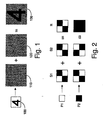
- Fig. 1 shows an original image 100, two shares 110, 120 and a reconstructed image 130.
- the shares 110, 120 were obtained by applying visual cryptography to the original image 100. Visual cryptography is explained in more detail with reference to Fig. 2 below.
- the shares 110, 120 By superimposing the shares 110, 120 the reconstructed image 130 appears. Note that the reconstruction is not perfect; the white parts of the original image 100 turn into a randomized black and white pattern in the reconstructed image 130.
- Fig. 2 illustrates the visual cryptography process as devised by Naor and Shamir in the above-referenced paper. The process is illustrated here for a single pixel, but of course every pixel in the source image is to be processed in this way.
- Every pixel of the original image 100 is mapped to a particular pattern, in this embodiment by splitting every pixel into four sub-pixels.
- To generate the first share S1 for this pixel two of the four pixels are chosen to be black (non-transparent) while the other two are chosen to be white (transparent).
- To generate the other share S2 of this pixel the four sub-pixels are copied if the corresponding pixel in the original image was white and they are inverted if the original pixel was black. For each pixel a new random choice of which two of the four pixels should be black (non-transparent) needs to be made.
- the number of sub-pixels into which the pixels are split can be chosen arbitrarily.
- the two shares S1 and S2 are to be superimposed, i.e. put on top of each other. This is shown in the last column (R) of Fig. 2. If the original pixel (P1) were black, then the superposition of the sub-pixels from shares S1 and S2 will result in four black sub-pixels. If the original pixel where white (P2), then the superposition of the sub-pixels from shares S1 and S2 will result in a black and white pattern in the reconstructed image 130, which often appears to be gray when seen from a distance. Also note that the resolution of the reconstructed image 130 is four times lower than the resolution of the original image 100, since every pixel has been translated to a pattern of 2x2 pixels. This makes the reconstructed image 130 four times as large as the original image 100.
- the probability that one set of sub-pixels corresponds to a white pixel in the original image 100 is equal to the probability that that set corresponds to a black pixel in the original image 100.
- Fig. 3 schematically shows a system according to the invention, comprising a server 300 and several clients 301, 302, 303.
- the clients 301-303 are embodied here as a laptop computer 301, a palmtop computer 302 and a mobile phone 303, they can in fact be realized as any kind of device, as long as the device is able to interactively communicate with the server 300 and is able to render graphical images on a display.
- the communication can take place over a wire, such as is the case with the laptop 301, or wirelessly like with the palmtop computer 302 and the mobile phone 303.
- a network such as the Internet or a phone network could interconnect the server 300 and any of the clients 301-303.
- the server 300 To realize secure communication between server 300 and clients 301-303, the server 300 generates an image 320 representing a plurality of input means 321, shown here as numerical keys labeled '1' through '9'.
- the input means 321 could also be checkboxes, selection lists, sliders or other elements typically used in user interfaces to facilitate user input.
- the user Having received the image on his client 301-303, the user can select one or more of the input means 321. The selection is then transmitted back to the server 300.
- the image 320 will be encoded using visual cryptography before transmission, as will become apparent below.
- a personal decryption device 310 is also shown in Fig. 3.
- This device 310 is personal to a user and should be guarded well, as it is to be used to decrypt visually encoded messages sent by the server 300 to any of the clients 301-303.
- Anyone who gains physical control over the decryption device 310 can read all visually encrypted messages intended for the user. The workings of this device 310 will become apparent below.
- the decryption device 310 comprises a display 311 and a storage area 312.
- the display 311 is preferably realized as a Liquid Crystal Display (LCD) screen.
- the storage area 312 comprises at least a key sequence to be used in decrypting visually encrypted images.
- the key sequence is preferably realized as a sequence of bits, e.g. '011010111010'.
- the length of the key sequence stored in the storage area 312 should be long enough to accommodate a large number of decryption operations.
- decrypting visually encrypted images one bit is necessary for every pixel of the original input image. So, if 100 ⁇ 100 pixel images are to be decrypted, 10,000 bits are necessary per image.
- the key bits used are preferably discarded or marked as used. This way every decryption operation involves the use of a unique subsection of the key sequence.
- the key sequence in the storage area 312 must be replaced. This can be realized by e.g. asking the owner of the decryption device 310 to replace his decryption device 310 with a new specimen, or to visit a secure location like a bank where it is loaded with a new key sequence.
- a cryptographic hash function or symmetric encryption scheme can be applied to the key sequence.
- the output of the hash function or encryption scheme is then used as the new key.
- a series of key sequences can be generated of any length, without having to store all of the key sequences in the personal decryption device 310.
- the attacker can also reconstruct all future key sequences.
- the decryption device 310 is preferably embodied as a unit physically separate, or at least separable, from the client device 301-303. No electrical, optical or other communication paths between the decryption device 310 and the client should exist. As the patterns and the key sequence are provided in digital (electronic) form, any such communication paths could potentially be abused by an attacker to obtain patterns and/or key sequence. Without such paths, a compromised client device cannot obtain information from the decryption device 310 in any way. This way, it is achieved that the user does not have to trust the security of the client 301.
- Fig. 4 shows a flowchart illustrating an embodiment of a method to securely receive a message from a user. Using this method, it is possible to securely allow a user to compose a message and to transmit said message using a client device, for the sake of example chosen as laptop 301, to the server 300.
- an image e.g. image 320
- Each input means represents an input word that can be used in the message that will be composed by the user.
- the user must compose the message by selecting keys or other input means rendered as an image on the display of the client device 301.
- Such keys could be visually rendered as keys representing different alphanumerical characters, or as buttons representing choices like 'Yes', 'No', 'More information' and so on.
- Other ways to visually represent input means are well known in the art.
- Selecting the input means is preferably done by selecting a particular set of coordinates on the display of the client device 301.
- the user inputs the set of coordinates as pressure on a particular spot of the display, the set of coordinates corresponding to the particular spot.
- other input means such as a mouse, a graphics tablet or even a keyboard can also be used.
- each pixel in the image is then processed in step 402.
- the pixel is examined in step 421 to determine its color.
- images generated in step 401 will be in black and white, although of course other colors, and even more than two colors, can also be used. However, in this embodiment it is assumed that the images comprise only two colors, namely black and white. If the color of the pixel is found to be white, the method proceeds to step 422. Otherwise, the method proceeds to step 425.
- the decryption device 310 holds a key sequence in storage area 312.
- the server 300 holds a copy of this key sequence.
- the server 300 knows in advance which user is operating the client device 301, and then can simply look up the appropriate key sequence.
- the server 300 may also want to use a particular key sequence without knowing in advance which user is operating the client device 301. This way it is ensured that only the person owning the personal decryption device with that particular key sequence can read the information contained in the message to be transmitted to the client device 301.
- Every bit in the key sequence is to be used only once. To this end, usually a pointer indicating the current position in the key sequence is maintained. This current position is referred to as the i th position. After using a bit from the key sequence, the pointer is increased by 1. If all the bits from the key sequence have been used, the key sequence must be replaced, or the above-mentioned hash function or symmetric encryption function should be applied to it to obtain a new key sequence. It is observed that the security of the system for a large part depends on the quality of the pseudo-random number generator used for generating key sequences.
- step 421 the i th bit of the key sequence is examined to determine whether it is '0' or '1'. If it is '0', then at step 423 the pattern P0 is chosen. If it is '1', then at step 424 the pattern P1 is chosen.
- the i th bit of the key sequence is also examined to determine whether it is '0' or '1'. If it is '0', then at step 426 the pattern P1 is chosen. If it is '1', then at step 427 the pattern P0 is chosen.
- each received pattern must be overlaid with either pattern P0, if the i th bit of the key sequence is '0', or pattern P1, if said bit is '1'. This will recover the original white or black pixel.
- the pertinent chosen patterns are transmitted to the client device 301. Such transmissions are straightforward to implement and will not be elaborated upon here. Note that it is not necessary to protect this transmission by e.g. encrypting the collection of chosen patterns before transmitting it. Because of the process used to choose these patterns, it is impossible for an eavesdropper to recover the image by using only the collection of chosen patterns.
- the client device 301 at some point transmits one or more sets of coordinates to the server 300, as result of the user operating the input means on the client device 301.
- the server 300 receives the sets of coordinates in step 404.
- the server 300 translates each set of coordinates to a particular input means represented on the image as composed in step 401. Since the server 300 composed this image, translating a set of coordinates to an input means in the server 300 is straightforward.
- step 406 to message composed by the user is constructed as the input words represented by the particular input means to which the sets of coordinates were translated in step 405. See e.g. the above-mentioned US-B-6209102 for more information.
- the message can of course contain any kind of information, preferably the message contains an authentication code such as a PIN code or a password.
- the server 300 can now check the PIN code or password to verify the credentials of the user, and grant access, perform one or more privileged operations or perform some other action for which these credentials are necessary.
- the server 300 could also signal another system upon a successful verification of the credentials.
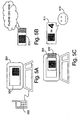
- Figs. 5A-C schematically illustrate the operation of the client device 301.
- the client device 301 has just received a collection of patterns from the server 300. These patterns were generated in accordance with the method as explained above with reference to Fig. 3, and hence correspond to an image representing a plurality of input means each representing an input word that can be used to compose a message.
- the client device 301 is in this embodiment connected to a network such as the Internet using a mobile phone 502, as is generally known in the art. Using a data connection established using the mobile phone 502, the client device 301 can transmit and receive data from the server 300.
- the device 301 receives a number of patterns from the server 300 and displays the patterns on display 501.
- the patterns will be collections of four pixels, with two of these pixels being black and two of them being white. Observe that no processing or decrypting step is necessary in the device 301 before any displaying takes place; the patterns are displayed as they are received. It may be advantageous to display the patterns in a corner of the display 501, as will become apparent below.
- the user in Fig. 5B Upon recognizing that a visually encrypted image has been sent to the client device 301, the user in Fig. 5B takes his personal decryption device 310 and activates it. This causes the decryption device 310 to output a graphical representation in dependence on the key sequence stored in storage area 312.
- the decryption device 310 must be programmed in advance with the dimensions of the image that was generated by the server 300.
- an input means that allows the user to enter these dimensions for each image separately can also be provided, but this makes the decryption device 310 more complex and more expensive.
- the decryption device 310 For each pixel in each row of the image generated by the server 300, the decryption device 310 outputs either the pattern P0, if the corresponding bit of the key sequence represents a '0', or the pattern P1, if the corresponding bit of the key sequence represents a '1'.
- the user 510 superimposes the personal decryption device 310 upon the patterns displayed on display 501.
- the edge of the display 501 can be provided with hooks or clamps in a corner, (not shown) using which the personal decryption device 310 can be fastened to a particular position on top of the display 501. This way, it is very easy for the user to properly superimpose the personal decryption device 301 upon the patterns on the display 501 if these patterns are displayed in the corresponding position on the display 501.
- both the decryption device 310 and the client device 301 effectively display one share of a visually encrypted image
- the user 510 can now observe the reconstructed image. Although the resolution of this image is four times below the resolution of the original image, and white pixels in the original image have been replaced by black and white patterns in the reconstructed image, the user can still recognize the information from the original image, as shown in balloon 511.
- the user can now operate the input means represented therein. Selecting the input means is done by selecting a particular set of coordinates on the display 501. Preferably, the user inputs the set of coordinates as pressure on a particular spot of the display 501, the set of coordinates corresponding to the particular spot.
- input means such as a mouse, a graphics tablet or even a keyboard can also be used.
- the user is advised to apply pressure to the display 311 of the decryption device 310.
- This pressure will be transferred to the display of the client 301, which when equipped with a touch-sensitive screen can register the spot to which pressure was applied, and translate this to a set of coordinates.
- the user can move a cursor on the display of the client 301 to a particular location on that display, and click a mouse button or press a key to confirm selection of an input means represented on the image.
- the display of the cursor on top of the patterns is disruptive for the correct display of the patterns, it has been found in practice that such disruption is acceptable.
- the cursor should, however, be large enough to be detectable even when distorted, as the patterns displayed on the personal decryption device 310 will distort the appearance of the cursor.
- a graphics tablet connected to device 301 can be used to control movement of a cursor on the display of device 301.
- the client device 301 Having received one or more sets of coordinates, the client device 301 transmits these sets of coordinates to the server 300. It is observed that eavesdropping software secretly installed on the client device 301 cannot learn any passwords or sensitive information entered in this fashion. At the most, such software would be able to learn the particular sets of coordinates entered in this particular session. These sets could then be used to impersonate the user in a future session.
- the server 300 should randomize the placement of the input means on the image generated in step 401. If the eavesdropping software then retransmits the sets of coordinates it learned, in order to impersonate the user in a subsequent session, the server 300 will not authenticate the user, as the sets of coordinates do not correspond to the correct password or other authentication code. In fact, these sets of coordinates need not even correspond to the location of input means on the image generated in the subsequent session.
- the invention can be used in any kind of device in which a secure composition and transmission of messages from a client to a server is necessary.
- Client devices can be embodied as personal computers, laptops, mobile phones, palmtop computers, automated teller machines, public Internet access terminals, or in fact any client device that is not completely trusted by its user to not contain any malicious software or hardware.
- any reference signs placed between parentheses shall not be construed as limiting the claim.
- the word “comprising” does not exclude the presence of elements or steps other than those listed in a claim.
- the word “a” or “an” preceding an element does not exclude the presence of a plurality of such elements.
- the invention can be implemented by means of hardware comprising several distinct elements, and by means of a suitably programmed computer.
- the device claim enumerating several means several of these means can be embodied by one and the same item of hardware.
Landscapes
- Engineering & Computer Science (AREA)
- Theoretical Computer Science (AREA)
- General Physics & Mathematics (AREA)
- Physics & Mathematics (AREA)
- General Engineering & Computer Science (AREA)
- Computer Networks & Wireless Communication (AREA)
- Signal Processing (AREA)
- Human Computer Interaction (AREA)
- Computer Security & Cryptography (AREA)
- Business, Economics & Management (AREA)
- Information Transfer Between Computers (AREA)
- Two-Way Televisions, Distribution Of Moving Picture Or The Like (AREA)
- Economics (AREA)
- Primary Health Care (AREA)
- Computer Hardware Design (AREA)
- Software Systems (AREA)
- Editing Of Facsimile Originals (AREA)
- Health & Medical Sciences (AREA)
- Image Processing (AREA)
- General Health & Medical Sciences (AREA)
- Human Resources & Organizations (AREA)
- Marketing (AREA)
- General Business, Economics & Management (AREA)
- Strategic Management (AREA)
- Tourism & Hospitality (AREA)
- User Interface Of Digital Computer (AREA)
- Digital Computer Display Output (AREA)
Abstract
Description
Claims (11)
- A method of secure reception of a message from a user, comprising generating (401) an image (320) representing a plurality of input means (321) each representing an input symbol that can be used in the message, encoding (402) the image by, for each pixel in the image (320),
choosing (423, 427) a first pattern (P0) if the pixel is of a first color and a portion of a key sequence represents a first value, or if the pixel is of a second color and the portion represents a second value, and
choosing (424, 426) a second pattern (P1) if the pixel is of the second color and the portion represents the first value, or if the pixel is of the first color and the portion represents the second value,
transmitting (403) for each pixel the pertinent chosen pattern to a device operable by the user, receiving (404) a set of coordinates from the device, translating (405) the set of coordinates to a particular input means represented on the image (320), and constructing (406) the message from the user as the input symbol represented by the particular input means. - The method of claim 1, in which the first color is black, the second color is white, the first value is '0' and the second value is '1'.
- The method of claim 1, in which the message comprises an authentication code.
- The method of claim 1, in which the placement of the input means on the image (320) is chosen in a random fashion.
- A method of secure transmission of a message, comprising receiving a pattern from a transmitting device (300), outputting on a first display (501) a graphical representation of the pattern, outputting on a second display (311) a graphical representation of a first pattern (P0) if a portion of a key sequence represents a first value, and outputting on the second display (311) a graphical representation of a second pattern (P1) if said portion represents a second value, receiving input representing a set of coordinates from a user, and transmitting the set of coordinates to the transmitting device (300).
- The method of claim 5, in which the input is received as pressure on a particular spot of the first display (501), the set of coordinates corresponding to the particular spot.
- A client device (301) allowing secure transmission of a message, comprising receiving means (502) for receiving a pattern from a transmitting device, a memory (312) for storing a key sequence, a first display (501) for outputting a graphical representation of the pattern, a second display (311) suitable to be overlaid upon the first display (501), the second display (311) being arranged for outputting a graphical representation of a first pattern (P0) if a portion of the key sequence represents a first value, and for outputting a graphical representation of a second pattern (P1) if said portion represents a second value, characterized by input means configured to receive input representing a set of coordinates from a user, and transmitting means (502) configured to transmit the set of coordinates to the transmitting device (300).
- The client device (301) of claim 7, in which the second display (311) is embodied as a unit (310) physically separate from the first display (501), and provided with the memory (312) for storing the key sequence.
- A computer program product arranged for causing a processor to execute the method of claim 1.
- A computer program product arranged for causing a processor to execute the method of claim 5.
- A server (300) for secure reception of a message from a user, comprising means for generating (401) an image (320) representing a plurality of input means (321) each representing an input symbol that can be used in the message,
means for encoding (402) the image by, for each pixel in the image (320),
choosing (423, 427) a first pattern (P0) if the pixel is of a first color and a portion of a key sequence represents a first value, or if the pixel is of a second color and the portion represents a second value, and
choosing (424, 426) a second pattern (P1) if the pixel is of the second color and the portion represents the first value, or if the pixel is of the first color and the portion represents the second value,
means for transmitting (403) for each pixel the pertinent chosen pattern to a device operable by the user,
means for receiving (404) a set of coordinates from the device, translating (405) the set of coordinates to a particular input means represented on the image (320), and means for constructing (406) the message from the user as the input symbol represented by the particular input means.
Priority Applications (1)
| Application Number | Priority Date | Filing Date | Title |
|---|---|---|---|
| EP02785858A EP1472584B1 (en) | 2002-01-17 | 2002-12-13 | Secure data input dialogue using visual cryptography |
Applications Claiming Priority (4)
| Application Number | Priority Date | Filing Date | Title |
|---|---|---|---|
| EP02075178 | 2002-01-17 | ||
| EP02075178 | 2002-01-17 | ||
| PCT/IB2002/005423 WO2003060674A1 (en) | 2002-01-17 | 2002-12-13 | Secure data input dialogue using visual cryptography |
| EP02785858A EP1472584B1 (en) | 2002-01-17 | 2002-12-13 | Secure data input dialogue using visual cryptography |
Publications (2)
| Publication Number | Publication Date |
|---|---|
| EP1472584A1 EP1472584A1 (en) | 2004-11-03 |
| EP1472584B1 true EP1472584B1 (en) | 2005-11-30 |
Family
ID=8185537
Family Applications (1)
| Application Number | Title | Priority Date | Filing Date |
|---|---|---|---|
| EP02785858A Expired - Lifetime EP1472584B1 (en) | 2002-01-17 | 2002-12-13 | Secure data input dialogue using visual cryptography |
Country Status (9)
| Country | Link |
|---|---|
| US (1) | US20050044395A1 (en) |
| EP (1) | EP1472584B1 (en) |
| JP (1) | JP2005515500A (en) |
| KR (1) | KR20040075359A (en) |
| CN (1) | CN1615464A (en) |
| AT (1) | ATE311627T1 (en) |
| AU (1) | AU2002351145A1 (en) |
| DE (1) | DE60207760T2 (en) |
| WO (1) | WO2003060674A1 (en) |
Cited By (9)
| Publication number | Priority date | Publication date | Assignee | Title |
|---|---|---|---|---|
| EP1943605A1 (en) * | 2005-11-04 | 2008-07-16 | Christian Hogl | Method and system for transmitting data from a first data processing device to a second data processing device |
| DE102007018802B3 (en) * | 2007-04-20 | 2008-08-28 | Universität Tübingen | Method for tap-proof transmission of character string from client to server through computer network, involves producing shadow image on screen through server according to visual cryptography process |
| DE102007052734A1 (en) | 2007-06-27 | 2009-01-02 | Universität Tübingen | Device and method for tapping and tamper-proof encryption for online accounts |
| DE102007043843A1 (en) | 2007-07-21 | 2009-01-22 | Borchert, Bernd, Dr. | Character string tap-proof transmitting method for e.g. on-line bank account, involves providing information with image to position client, and inputting reconstruction of character string by client using server |
| DE102008053219A1 (en) | 2008-02-05 | 2009-08-06 | Borchert, Bernd, Dr. | Character string e.g. transaction authentication number, transmission method for online bank accounts, involves transmitting information to server, and reconstructing character string, inputted by client, by server |
| DE102008056605A1 (en) | 2008-11-10 | 2010-05-12 | Borchert, Bernd, Dr. | Method for manipulation-secure transmission of e.g. password, from client to server via computer network, for online-banking, involves reconstructing code word, and declining execution of transaction by server |
| DE102008061233A1 (en) | 2008-12-09 | 2010-06-10 | Borchert, Bernd, Dr. | Method for tapping and phishing secure transfer of password and/or personal identification number from clients to server for on-line bank account, involves reconstructing row of images inputted by clients by server |
| DE102008062872A1 (en) | 2008-12-17 | 2010-06-24 | Universität Tübingen | Method for bi-directional transmission of click position information of smart card between server of bank and personal computer system of bank customer in online banking process, involves determining symbols associated to line surface |
| DE102009007277A1 (en) | 2009-02-03 | 2010-08-05 | Borchert, Bernd, Dr. | Method for manipulation-proof transmitting of character string from clients to server in bank via computer network for online accounts, involves transmitting inputted characters to server, and testing inputted characters by server |
Families Citing this family (34)
| Publication number | Priority date | Publication date | Assignee | Title |
|---|---|---|---|---|
| US7395089B1 (en) | 2001-06-11 | 2008-07-01 | Palm, Inc | Integrated personal digital assistant device |
| US6975304B1 (en) | 2001-06-11 | 2005-12-13 | Handspring, Inc. | Interface for processing of an alternate symbol in a computer device |
| GB0301299D0 (en) * | 2003-01-21 | 2003-02-19 | Williams Howard | Computer security device |
| US20060227969A1 (en) * | 2003-03-11 | 2006-10-12 | Koninklijke Philips Electronics N.V. | Visual cryptography system |
| FR2890268B1 (en) * | 2005-08-31 | 2008-04-25 | Emmanuel Berque | OPTICAL MASK REMOTE AUTHENTICATION METHOD |
| WO2007120360A2 (en) * | 2005-12-29 | 2007-10-25 | Blue Jungle | Information management system |
| US20070280474A1 (en) * | 2006-04-18 | 2007-12-06 | Heinz Karl E | Encryption Method |
| US20080045339A1 (en) * | 2006-08-14 | 2008-02-21 | Chang-Han Lin | Gaming system having award recognition |
| AU2006348113A1 (en) | 2006-09-07 | 2008-03-13 | Asia Capital Services Limited | Visual code transaction verification |
| US8167214B2 (en) | 2006-09-07 | 2012-05-01 | Matthew Walker | Method and device for visual code transaction verification |
| US8316442B2 (en) * | 2008-01-15 | 2012-11-20 | Microsoft Corporation | Preventing secure data from leaving the network perimeter |
| US8935336B2 (en) * | 2008-06-18 | 2015-01-13 | Cisco Technology, Inc. | Optimizing program requests over a wide area network |
| US8621210B2 (en) | 2008-06-26 | 2013-12-31 | Microsoft Corporation | Ad-hoc trust establishment using visual verification |
| KR101016642B1 (en) | 2008-11-27 | 2011-02-25 | 삼성전자주식회사 | Mobile System, Service System and Key Authentication Method for Key Management in Near Field Communication |
| CN101447071B (en) * | 2009-01-04 | 2010-09-15 | 清华大学 | Pattern visual encryption anti-counterfeiting method |
| US8397275B1 (en) * | 2009-02-05 | 2013-03-12 | Google Inc. | Time-varying sequenced image overlays for CAPTCHA |
| DE102009024893B4 (en) | 2009-06-15 | 2020-09-03 | Giesecke+Devrient Mobile Security Gmbh | Method for securely displaying display data |
| WO2010148448A1 (en) * | 2009-06-24 | 2010-12-29 | Asia Capital Services Limited | Method and system for generating a visual key |
| DE102009033919A1 (en) * | 2009-07-20 | 2011-01-27 | Giesecke & Devrient Gmbh | Secure display of user data on a telecommunication terminal |
| JP5413048B2 (en) * | 2009-08-19 | 2014-02-12 | 日本電気株式会社 | Personal authentication system, personal authentication method |
| JP5413106B2 (en) * | 2009-09-30 | 2014-02-12 | 大日本印刷株式会社 | Encryption information decryption method, display device, decryption information printing film |
| CN102096541B (en) * | 2009-12-10 | 2013-02-06 | 腾讯科技(深圳)有限公司 | Multimedia player interface operation control device and method |
| US9667612B2 (en) * | 2012-01-06 | 2017-05-30 | Capy, Inc. | CAPTCHA provision method and program |
| US9984225B2 (en) * | 2012-11-15 | 2018-05-29 | Excalibur Ip, Llc | Method and system for providing tokenless secure login by visual cryptography |
| US9418215B2 (en) | 2013-04-30 | 2016-08-16 | Microsoft Technology Licensing, Llc | Optical security enhancement device |
| US9514316B2 (en) * | 2013-04-30 | 2016-12-06 | Microsoft Technology Licensing, Llc | Optical security enhancement device |
| US9529465B2 (en) | 2013-12-02 | 2016-12-27 | At&T Intellectual Property I, L.P. | Secure interaction with input devices |
| BR102014007666B1 (en) * | 2014-03-28 | 2023-01-10 | Samsung Eletrônica Da Amazônia Ltda | METHOD FOR AUTHENTICING MOBILE TRANSACTIONS USING VIDEO ENCRYPTION AND METHOD FOR VIDEO ENCRYPTION |
| JP6301174B2 (en) * | 2014-03-31 | 2018-03-28 | 株式会社エヌ・ティ・ティ・データ | Password display system, method, and program |
| EP3219130A1 (en) * | 2014-11-14 | 2017-09-20 | Telefonaktiebolaget LM Ericsson (publ) | Visual cryptography and obfuscation using augmented reality |
| US9852280B2 (en) * | 2015-01-08 | 2017-12-26 | Blackberry Limited | Authentication for access to a device that has a primary display portion and a secondary display portion |
| RU2606556C2 (en) | 2015-02-20 | 2017-01-10 | Закрытое акционерное общество "Лаборатория Касперского" | Method of confidential data input |
| WO2017115174A1 (en) * | 2015-12-28 | 2017-07-06 | Mobeewave, Inc. | System for and method of authenticating a user on a device |
| US10853526B2 (en) * | 2018-09-10 | 2020-12-01 | Lenovo (Singapore) Pte. Ltd. | Dynamic screen filtering |
Family Cites Families (11)
| Publication number | Priority date | Publication date | Assignee | Title |
|---|---|---|---|---|
| JPH06105027A (en) * | 1991-07-22 | 1994-04-15 | Nec Home Electron Ltd | Facsimile terminal equipment |
| US5428349A (en) * | 1992-10-01 | 1995-06-27 | Baker; Daniel G. | Nondisclosing password entry system |
| US6095566A (en) * | 1996-03-14 | 2000-08-01 | Kabushiki Kaisha Toshiba | Image recorded product, image recording system, image reproducing system, and recording medium for use to superimpose-record/reproduce additional information |
| US5970146A (en) * | 1996-05-14 | 1999-10-19 | Dresser Industries, Inc. | Data encrypted touchscreen |
| CA2214190A1 (en) * | 1997-10-15 | 1999-04-15 | Michael Ernest Blom | Improved security data entry alphanumeric keypad |
| JPH11298470A (en) * | 1998-04-16 | 1999-10-29 | Hitachi Ltd | Key distribution method and system |
| US6209102B1 (en) * | 1999-02-12 | 2001-03-27 | Arcot Systems, Inc. | Method and apparatus for secure entry of access codes in a computer environment |
| DE60144222D1 (en) * | 2000-01-13 | 2011-04-28 | Digimarc Corp | AUTHENTICATIVE METADATA AND EMBEDDING OF METADATA IN WATERMARK OF MEDIA SIGNALS |
| FR2806230B1 (en) * | 2000-03-09 | 2002-05-24 | France Telecom | METHOD AND DEVICE FOR CONFIDENTIAL READING OF DATA |
| JP2001293984A (en) * | 2000-04-12 | 2001-10-23 | Toppan Printing Co Ltd | Recording medium using visual decryption type encryption |
| US7187806B2 (en) * | 2001-08-23 | 2007-03-06 | Hewlett-Packard Development Company, L.P. | System and method for embedding information within a printed image using block error diffusion halftoning |
-
2002
- 2002-12-13 CN CNA028271483A patent/CN1615464A/en active Pending
- 2002-12-13 EP EP02785858A patent/EP1472584B1/en not_active Expired - Lifetime
- 2002-12-13 US US10/501,421 patent/US20050044395A1/en not_active Abandoned
- 2002-12-13 AT AT02785858T patent/ATE311627T1/en not_active IP Right Cessation
- 2002-12-13 AU AU2002351145A patent/AU2002351145A1/en not_active Abandoned
- 2002-12-13 KR KR10-2004-7011129A patent/KR20040075359A/en not_active Withdrawn
- 2002-12-13 JP JP2003560704A patent/JP2005515500A/en active Pending
- 2002-12-13 WO PCT/IB2002/005423 patent/WO2003060674A1/en not_active Ceased
- 2002-12-13 DE DE60207760T patent/DE60207760T2/en not_active Expired - Fee Related
Cited By (11)
| Publication number | Priority date | Publication date | Assignee | Title |
|---|---|---|---|---|
| EP1943605A1 (en) * | 2005-11-04 | 2008-07-16 | Christian Hogl | Method and system for transmitting data from a first data processing device to a second data processing device |
| US8150034B2 (en) | 2005-11-04 | 2012-04-03 | Christian Hogl | Method and system for transmitting data from a first data processing device to a second data processing device |
| DE102007018802B3 (en) * | 2007-04-20 | 2008-08-28 | Universität Tübingen | Method for tap-proof transmission of character string from client to server through computer network, involves producing shadow image on screen through server according to visual cryptography process |
| WO2008128528A3 (en) * | 2007-04-20 | 2009-06-11 | Bernd Borchert | Anti-tapping and manipulation encoding for online accounts |
| DE102007052734A1 (en) | 2007-06-27 | 2009-01-02 | Universität Tübingen | Device and method for tapping and tamper-proof encryption for online accounts |
| DE102007043843A1 (en) | 2007-07-21 | 2009-01-22 | Borchert, Bernd, Dr. | Character string tap-proof transmitting method for e.g. on-line bank account, involves providing information with image to position client, and inputting reconstruction of character string by client using server |
| DE102008053219A1 (en) | 2008-02-05 | 2009-08-06 | Borchert, Bernd, Dr. | Character string e.g. transaction authentication number, transmission method for online bank accounts, involves transmitting information to server, and reconstructing character string, inputted by client, by server |
| DE102008056605A1 (en) | 2008-11-10 | 2010-05-12 | Borchert, Bernd, Dr. | Method for manipulation-secure transmission of e.g. password, from client to server via computer network, for online-banking, involves reconstructing code word, and declining execution of transaction by server |
| DE102008061233A1 (en) | 2008-12-09 | 2010-06-10 | Borchert, Bernd, Dr. | Method for tapping and phishing secure transfer of password and/or personal identification number from clients to server for on-line bank account, involves reconstructing row of images inputted by clients by server |
| DE102008062872A1 (en) | 2008-12-17 | 2010-06-24 | Universität Tübingen | Method for bi-directional transmission of click position information of smart card between server of bank and personal computer system of bank customer in online banking process, involves determining symbols associated to line surface |
| DE102009007277A1 (en) | 2009-02-03 | 2010-08-05 | Borchert, Bernd, Dr. | Method for manipulation-proof transmitting of character string from clients to server in bank via computer network for online accounts, involves transmitting inputted characters to server, and testing inputted characters by server |
Also Published As
| Publication number | Publication date |
|---|---|
| ATE311627T1 (en) | 2005-12-15 |
| US20050044395A1 (en) | 2005-02-24 |
| DE60207760T2 (en) | 2006-08-10 |
| WO2003060674A1 (en) | 2003-07-24 |
| JP2005515500A (en) | 2005-05-26 |
| CN1615464A (en) | 2005-05-11 |
| EP1472584A1 (en) | 2004-11-03 |
| AU2002351145A1 (en) | 2003-07-30 |
| DE60207760D1 (en) | 2006-01-05 |
| KR20040075359A (en) | 2004-08-27 |
Similar Documents
| Publication | Publication Date | Title |
|---|---|---|
| US20050044395A1 (en) | Secure data input dialogue using visual cryptography | |
| US20050117748A1 (en) | Secure visual message communication method and device | |
| EP3319069B1 (en) | Method for authenticating a user by means of a non-secure terminal | |
| US20060098841A1 (en) | Method and system for enabling remote message composition | |
| EP1509879B1 (en) | Tamper-resistant visual encryption method and device | |
| US20060026428A1 (en) | Key synchronization in an image cryptographic systems | |
| Tuyls et al. | Visual crypto displays enabling secure communications | |
| US20060008086A1 (en) | Image encryption method and visual decryption device | |
| EP3319000A1 (en) | Method for securing a transaction performed from a non-secure terminal | |
| EP3319067B1 (en) | Method for authenticating a user by means of a non-secure terminal | |
| EP3319001A1 (en) | Method for securely transmitting a secret data to a user of a terminal | |
| EP3594838A1 (en) | Method for recovering a secret key securely stored in a secure element | |
| WO2011052180A1 (en) | Encrypted message transmission device, program, encrypted message transmission method and authentication system | |
| EP3319068A1 (en) | Method for securely transmitting a secret data to a user of a terminal | |
| EP3319002B1 (en) | Method for securely performing a sensitive operation using a non-secure terminal | |
| EP3319269A1 (en) | Method for securely performing a sensitive operation using a non-secure terminal |
Legal Events
| Date | Code | Title | Description |
|---|---|---|---|
| PUAI | Public reference made under article 153(3) epc to a published international application that has entered the european phase |
Free format text: ORIGINAL CODE: 0009012 |
|
| 17P | Request for examination filed |
Effective date: 20040817 |
|
| AK | Designated contracting states |
Kind code of ref document: A1 Designated state(s): AT BE BG CH CY CZ DE DK EE ES FI FR GB GR IE IT LI LU MC NL PT SE SI SK TR |
|
| AX | Request for extension of the european patent |
Extension state: AL LT LV MK RO |
|
| 17Q | First examination report despatched |
Effective date: 20041227 |
|
| GRAP | Despatch of communication of intention to grant a patent |
Free format text: ORIGINAL CODE: EPIDOSNIGR1 |
|
| GRAS | Grant fee paid |
Free format text: ORIGINAL CODE: EPIDOSNIGR3 |
|
| GRAA | (expected) grant |
Free format text: ORIGINAL CODE: 0009210 |
|
| AK | Designated contracting states |
Kind code of ref document: B1 Designated state(s): AT BE BG CH CY CZ DE DK EE ES FI FR GB GR IE IT LI LU MC NL PT SE SI SK TR |
|
| PG25 | Lapsed in a contracting state [announced via postgrant information from national office to epo] |
Ref country code: IT Free format text: LAPSE BECAUSE OF FAILURE TO SUBMIT A TRANSLATION OF THE DESCRIPTION OR TO PAY THE FEE WITHIN THE PRESCRIBED TIME-LIMIT;WARNING: LAPSES OF ITALIAN PATENTS WITH EFFECTIVE DATE BEFORE 2007 MAY HAVE OCCURRED AT ANY TIME BEFORE 2007. THE CORRECT EFFECTIVE DATE MAY BE DIFFERENT FROM THE ONE RECORDED. Effective date: 20051130 Ref country code: CH Free format text: LAPSE BECAUSE OF FAILURE TO SUBMIT A TRANSLATION OF THE DESCRIPTION OR TO PAY THE FEE WITHIN THE PRESCRIBED TIME-LIMIT Effective date: 20051130 Ref country code: LI Free format text: LAPSE BECAUSE OF FAILURE TO SUBMIT A TRANSLATION OF THE DESCRIPTION OR TO PAY THE FEE WITHIN THE PRESCRIBED TIME-LIMIT Effective date: 20051130 Ref country code: CZ Free format text: LAPSE BECAUSE OF FAILURE TO SUBMIT A TRANSLATION OF THE DESCRIPTION OR TO PAY THE FEE WITHIN THE PRESCRIBED TIME-LIMIT Effective date: 20051130 Ref country code: EE Free format text: LAPSE BECAUSE OF FAILURE TO SUBMIT A TRANSLATION OF THE DESCRIPTION OR TO PAY THE FEE WITHIN THE PRESCRIBED TIME-LIMIT Effective date: 20051130 Ref country code: SI Free format text: LAPSE BECAUSE OF FAILURE TO SUBMIT A TRANSLATION OF THE DESCRIPTION OR TO PAY THE FEE WITHIN THE PRESCRIBED TIME-LIMIT Effective date: 20051130 Ref country code: NL Free format text: LAPSE BECAUSE OF FAILURE TO SUBMIT A TRANSLATION OF THE DESCRIPTION OR TO PAY THE FEE WITHIN THE PRESCRIBED TIME-LIMIT Effective date: 20051130 Ref country code: BE Free format text: LAPSE BECAUSE OF FAILURE TO SUBMIT A TRANSLATION OF THE DESCRIPTION OR TO PAY THE FEE WITHIN THE PRESCRIBED TIME-LIMIT Effective date: 20051130 Ref country code: AT Free format text: LAPSE BECAUSE OF FAILURE TO SUBMIT A TRANSLATION OF THE DESCRIPTION OR TO PAY THE FEE WITHIN THE PRESCRIBED TIME-LIMIT Effective date: 20051130 Ref country code: TR Free format text: LAPSE BECAUSE OF FAILURE TO SUBMIT A TRANSLATION OF THE DESCRIPTION OR TO PAY THE FEE WITHIN THE PRESCRIBED TIME-LIMIT Effective date: 20051130 Ref country code: FI Free format text: LAPSE BECAUSE OF FAILURE TO SUBMIT A TRANSLATION OF THE DESCRIPTION OR TO PAY THE FEE WITHIN THE PRESCRIBED TIME-LIMIT Effective date: 20051130 Ref country code: SK Free format text: LAPSE BECAUSE OF FAILURE TO SUBMIT A TRANSLATION OF THE DESCRIPTION OR TO PAY THE FEE WITHIN THE PRESCRIBED TIME-LIMIT Effective date: 20051130 |
|
| REG | Reference to a national code |
Ref country code: CH Ref legal event code: EP Ref country code: GB Ref legal event code: FG4D |
|
| PG25 | Lapsed in a contracting state [announced via postgrant information from national office to epo] |
Ref country code: CY Free format text: LAPSE BECAUSE OF FAILURE TO SUBMIT A TRANSLATION OF THE DESCRIPTION OR TO PAY THE FEE WITHIN THE PRESCRIBED TIME-LIMIT Effective date: 20051213 Ref country code: IE Free format text: LAPSE BECAUSE OF NON-PAYMENT OF DUE FEES Effective date: 20051213 |
|
| REG | Reference to a national code |
Ref country code: IE Ref legal event code: FG4D |
|
| PG25 | Lapsed in a contracting state [announced via postgrant information from national office to epo] |
Ref country code: MC Free format text: LAPSE BECAUSE OF NON-PAYMENT OF DUE FEES Effective date: 20051231 |
|
| REF | Corresponds to: |
Ref document number: 60207760 Country of ref document: DE Date of ref document: 20060105 Kind code of ref document: P |
|
| PG25 | Lapsed in a contracting state [announced via postgrant information from national office to epo] |
Ref country code: LU Free format text: LAPSE BECAUSE OF NON-PAYMENT OF DUE FEES Effective date: 20060130 |
|
| PG25 | Lapsed in a contracting state [announced via postgrant information from national office to epo] |
Ref country code: BG Free format text: LAPSE BECAUSE OF FAILURE TO SUBMIT A TRANSLATION OF THE DESCRIPTION OR TO PAY THE FEE WITHIN THE PRESCRIBED TIME-LIMIT Effective date: 20060228 Ref country code: SE Free format text: LAPSE BECAUSE OF FAILURE TO SUBMIT A TRANSLATION OF THE DESCRIPTION OR TO PAY THE FEE WITHIN THE PRESCRIBED TIME-LIMIT Effective date: 20060228 Ref country code: DK Free format text: LAPSE BECAUSE OF FAILURE TO SUBMIT A TRANSLATION OF THE DESCRIPTION OR TO PAY THE FEE WITHIN THE PRESCRIBED TIME-LIMIT Effective date: 20060228 Ref country code: GR Free format text: LAPSE BECAUSE OF FAILURE TO SUBMIT A TRANSLATION OF THE DESCRIPTION OR TO PAY THE FEE WITHIN THE PRESCRIBED TIME-LIMIT Effective date: 20060228 |
|
| PG25 | Lapsed in a contracting state [announced via postgrant information from national office to epo] |
Ref country code: ES Free format text: LAPSE BECAUSE OF FAILURE TO SUBMIT A TRANSLATION OF THE DESCRIPTION OR TO PAY THE FEE WITHIN THE PRESCRIBED TIME-LIMIT Effective date: 20060313 |
|
| PG25 | Lapsed in a contracting state [announced via postgrant information from national office to epo] |
Ref country code: PT Free format text: LAPSE BECAUSE OF FAILURE TO SUBMIT A TRANSLATION OF THE DESCRIPTION OR TO PAY THE FEE WITHIN THE PRESCRIBED TIME-LIMIT Effective date: 20060502 |
|
| NLV1 | Nl: lapsed or annulled due to failure to fulfill the requirements of art. 29p and 29m of the patents act | ||
| REG | Reference to a national code |
Ref country code: CH Ref legal event code: PL |
|
| ET | Fr: translation filed | ||
| REG | Reference to a national code |
Ref country code: IE Ref legal event code: MM4A |
|
| PLBE | No opposition filed within time limit |
Free format text: ORIGINAL CODE: 0009261 |
|
| STAA | Information on the status of an ep patent application or granted ep patent |
Free format text: STATUS: NO OPPOSITION FILED WITHIN TIME LIMIT |
|
| 26N | No opposition filed |
Effective date: 20060831 |
|
| PGFP | Annual fee paid to national office [announced via postgrant information from national office to epo] |
Ref country code: GB Payment date: 20061218 Year of fee payment: 5 |
|
| PGFP | Annual fee paid to national office [announced via postgrant information from national office to epo] |
Ref country code: DE Payment date: 20070208 Year of fee payment: 5 |
|
| PGFP | Annual fee paid to national office [announced via postgrant information from national office to epo] |
Ref country code: FR Payment date: 20061227 Year of fee payment: 5 |
|
| GBPC | Gb: european patent ceased through non-payment of renewal fee |
Effective date: 20071213 |
|
| PG25 | Lapsed in a contracting state [announced via postgrant information from national office to epo] |
Ref country code: DE Free format text: LAPSE BECAUSE OF NON-PAYMENT OF DUE FEES Effective date: 20080701 |
|
| REG | Reference to a national code |
Ref country code: FR Ref legal event code: ST Effective date: 20081020 |
|
| PG25 | Lapsed in a contracting state [announced via postgrant information from national office to epo] |
Ref country code: GB Free format text: LAPSE BECAUSE OF NON-PAYMENT OF DUE FEES Effective date: 20071213 |
|
| PG25 | Lapsed in a contracting state [announced via postgrant information from national office to epo] |
Ref country code: FR Free format text: LAPSE BECAUSE OF NON-PAYMENT OF DUE FEES Effective date: 20071231 |