EP1472306B1 - Polysiloxanes containing quaternary groups having nitrogen atoms - Google Patents
Polysiloxanes containing quaternary groups having nitrogen atoms Download PDFInfo
- Publication number
- EP1472306B1 EP1472306B1 EP03702551A EP03702551A EP1472306B1 EP 1472306 B1 EP1472306 B1 EP 1472306B1 EP 03702551 A EP03702551 A EP 03702551A EP 03702551 A EP03702551 A EP 03702551A EP 1472306 B1 EP1472306 B1 EP 1472306B1
- Authority
- EP
- European Patent Office
- Prior art keywords
- formula
- radicals
- radical
- units
- independently
- Prior art date
- Legal status (The legal status is an assumption and is not a legal conclusion. Google has not performed a legal analysis and makes no representation as to the accuracy of the status listed.)
- Expired - Lifetime
Links
- -1 Polysiloxanes Polymers 0.000 title claims description 71
- 125000004433 nitrogen atom Chemical group N* 0.000 title claims description 41
- 229920001296 polysiloxane Polymers 0.000 title description 33
- 239000006185 dispersion Substances 0.000 claims description 21
- 125000002496 methyl group Chemical group [H]C([H])([H])* 0.000 claims description 19
- 150000001450 anions Chemical class 0.000 claims description 18
- 125000004432 carbon atom Chemical group C* 0.000 claims description 17
- 239000002657 fibrous material Substances 0.000 claims description 12
- 229940077388 benzenesulfonate Drugs 0.000 claims description 7
- 239000001257 hydrogen Substances 0.000 claims description 5
- 229910052739 hydrogen Inorganic materials 0.000 claims description 5
- 239000000243 solution Substances 0.000 claims description 5
- UFHFLCQGNIYNRP-UHFFFAOYSA-N Hydrogen Chemical compound [H][H] UFHFLCQGNIYNRP-UHFFFAOYSA-N 0.000 claims description 4
- 239000007864 aqueous solution Substances 0.000 claims description 4
- 125000001495 ethyl group Chemical group [H]C([H])([H])C([H])([H])* 0.000 claims description 2
- 238000011067 equilibration Methods 0.000 description 11
- 238000006243 chemical reaction Methods 0.000 description 10
- 239000000203 mixture Substances 0.000 description 10
- QTBSBXVTEAMEQO-UHFFFAOYSA-N Acetic acid Chemical compound CC(O)=O QTBSBXVTEAMEQO-UHFFFAOYSA-N 0.000 description 9
- 125000004122 cyclic group Chemical group 0.000 description 8
- XLYOFNOQVPJJNP-UHFFFAOYSA-N water Substances O XLYOFNOQVPJJNP-UHFFFAOYSA-N 0.000 description 8
- OKKJLVBELUTLKV-UHFFFAOYSA-N Methanol Chemical compound OC OKKJLVBELUTLKV-UHFFFAOYSA-N 0.000 description 6
- DNIAPMSPPWPWGF-UHFFFAOYSA-N Propylene glycol Chemical compound CC(O)CO DNIAPMSPPWPWGF-UHFFFAOYSA-N 0.000 description 6
- 239000002270 dispersing agent Substances 0.000 description 6
- 239000000839 emulsion Substances 0.000 description 6
- 239000004744 fabric Substances 0.000 description 6
- 238000000034 method Methods 0.000 description 6
- 239000004530 micro-emulsion Substances 0.000 description 6
- MQWFLKHKWJMCEN-UHFFFAOYSA-N n'-[3-[dimethoxy(methyl)silyl]propyl]ethane-1,2-diamine Chemical compound CO[Si](C)(OC)CCCNCCN MQWFLKHKWJMCEN-UHFFFAOYSA-N 0.000 description 6
- 229920000642 polymer Polymers 0.000 description 6
- 229910052757 nitrogen Inorganic materials 0.000 description 5
- 238000002360 preparation method Methods 0.000 description 5
- 239000004753 textile Substances 0.000 description 5
- 229910003849 O-Si Inorganic materials 0.000 description 4
- 229910003872 O—Si Inorganic materials 0.000 description 4
- XUIMIQQOPSSXEZ-UHFFFAOYSA-N Silicon Chemical group [Si] XUIMIQQOPSSXEZ-UHFFFAOYSA-N 0.000 description 4
- SRSXLGNVWSONIS-UHFFFAOYSA-M benzenesulfonate Chemical compound [O-]S(=O)(=O)C1=CC=CC=C1 SRSXLGNVWSONIS-UHFFFAOYSA-M 0.000 description 4
- 229920005565 cyclic polymer Polymers 0.000 description 4
- 150000004756 silanes Chemical class 0.000 description 4
- 239000007858 starting material Substances 0.000 description 4
- 125000004429 atom Chemical group 0.000 description 3
- 239000002537 cosmetic Substances 0.000 description 3
- VUQUOGPMUUJORT-UHFFFAOYSA-N methyl 4-methylbenzenesulfonate Chemical compound COS(=O)(=O)C1=CC=C(C)C=C1 VUQUOGPMUUJORT-UHFFFAOYSA-N 0.000 description 3
- HMMGMWAXVFQUOA-UHFFFAOYSA-N octamethylcyclotetrasiloxane Chemical compound C[Si]1(C)O[Si](C)(C)O[Si](C)(C)O[Si](C)(C)O1 HMMGMWAXVFQUOA-UHFFFAOYSA-N 0.000 description 3
- 238000005956 quaternization reaction Methods 0.000 description 3
- 238000010992 reflux Methods 0.000 description 3
- 229910052710 silicon Inorganic materials 0.000 description 3
- 238000009988 textile finishing Methods 0.000 description 3
- 229920000742 Cotton Polymers 0.000 description 2
- 125000000217 alkyl group Chemical group 0.000 description 2
- 239000003054 catalyst Substances 0.000 description 2
- 239000003795 chemical substances by application Substances 0.000 description 2
- 235000014113 dietary fatty acids Nutrition 0.000 description 2
- 239000004205 dimethyl polysiloxane Substances 0.000 description 2
- 238000007046 ethoxylation reaction Methods 0.000 description 2
- 239000000194 fatty acid Substances 0.000 description 2
- 229930195729 fatty acid Natural products 0.000 description 2
- 150000004665 fatty acids Chemical class 0.000 description 2
- 125000004435 hydrogen atom Chemical group [H]* 0.000 description 2
- 125000004430 oxygen atom Chemical group O* 0.000 description 2
- 229920000435 poly(dimethylsiloxane) Polymers 0.000 description 2
- 239000010703 silicon Substances 0.000 description 2
- 238000003756 stirring Methods 0.000 description 2
- LBLYYCQCTBFVLH-UHFFFAOYSA-N 2-Methylbenzenesulfonic acid Chemical compound CC1=CC=CC=C1S(O)(=O)=O LBLYYCQCTBFVLH-UHFFFAOYSA-N 0.000 description 1
- MTJGVAJYTOXFJH-UHFFFAOYSA-N 3-aminonaphthalene-1,5-disulfonic acid Chemical compound C1=CC=C(S(O)(=O)=O)C2=CC(N)=CC(S(O)(=O)=O)=C21 MTJGVAJYTOXFJH-UHFFFAOYSA-N 0.000 description 1
- QTBSBXVTEAMEQO-UHFFFAOYSA-M Acetate Chemical compound CC([O-])=O QTBSBXVTEAMEQO-UHFFFAOYSA-M 0.000 description 1
- BDAGIHXWWSANSR-UHFFFAOYSA-M Formate Chemical compound [O-]C=O BDAGIHXWWSANSR-UHFFFAOYSA-M 0.000 description 1
- 229910019142 PO4 Inorganic materials 0.000 description 1
- 229910007161 Si(CH3)3 Inorganic materials 0.000 description 1
- BLRPTPMANUNPDV-UHFFFAOYSA-N Silane Chemical compound [SiH4] BLRPTPMANUNPDV-UHFFFAOYSA-N 0.000 description 1
- 229910002808 Si–O–Si Inorganic materials 0.000 description 1
- 230000002378 acidificating effect Effects 0.000 description 1
- 150000001298 alcohols Chemical class 0.000 description 1
- 125000005907 alkyl ester group Chemical group 0.000 description 1
- 239000002168 alkylating agent Substances 0.000 description 1
- 229940100198 alkylating agent Drugs 0.000 description 1
- 150000001412 amines Chemical class 0.000 description 1
- 150000003863 ammonium salts Chemical class 0.000 description 1
- SRSXLGNVWSONIS-UHFFFAOYSA-N benzenesulfonic acid Chemical compound OS(=O)(=O)C1=CC=CC=C1 SRSXLGNVWSONIS-UHFFFAOYSA-N 0.000 description 1
- 229940092714 benzenesulfonic acid Drugs 0.000 description 1
- 125000002091 cationic group Chemical group 0.000 description 1
- 239000001913 cellulose Substances 0.000 description 1
- 229920002678 cellulose Polymers 0.000 description 1
- 150000001875 compounds Chemical class 0.000 description 1
- SZXQTJUDPRGNJN-UHFFFAOYSA-N dipropylene glycol Chemical compound OCCCOCCCO SZXQTJUDPRGNJN-UHFFFAOYSA-N 0.000 description 1
- 150000002148 esters Chemical class 0.000 description 1
- 238000006266 etherification reaction Methods 0.000 description 1
- 150000002191 fatty alcohols Chemical class 0.000 description 1
- 239000000835 fiber Substances 0.000 description 1
- HTDJPCNNEPUOOQ-UHFFFAOYSA-N hexamethylcyclotrisiloxane Chemical compound C[Si]1(C)O[Si](C)(C)O[Si](C)(C)O1 HTDJPCNNEPUOOQ-UHFFFAOYSA-N 0.000 description 1
- 125000002887 hydroxy group Chemical group [H]O* 0.000 description 1
- 238000003780 insertion Methods 0.000 description 1
- 230000037431 insertion Effects 0.000 description 1
- 239000007788 liquid Substances 0.000 description 1
- IJGRMHOSHXDMSA-UHFFFAOYSA-N nitrogen Substances N#N IJGRMHOSHXDMSA-UHFFFAOYSA-N 0.000 description 1
- QJGQUHMNIGDVPM-UHFFFAOYSA-N nitrogen group Chemical group [N] QJGQUHMNIGDVPM-UHFFFAOYSA-N 0.000 description 1
- 125000005010 perfluoroalkyl group Chemical group 0.000 description 1
- 239000010452 phosphate Substances 0.000 description 1
- NBIIXXVUZAFLBC-UHFFFAOYSA-K phosphate Chemical compound [O-]P([O-])([O-])=O NBIIXXVUZAFLBC-UHFFFAOYSA-K 0.000 description 1
- 229910000077 silane Inorganic materials 0.000 description 1
- 239000003381 stabilizer Substances 0.000 description 1
- 239000000126 substance Substances 0.000 description 1
- 238000003786 synthesis reaction Methods 0.000 description 1
- 229920001059 synthetic polymer Polymers 0.000 description 1
- LBLYYCQCTBFVLH-UHFFFAOYSA-M toluenesulfonate group Chemical group C=1(C(=CC=CC1)S(=O)(=O)[O-])C LBLYYCQCTBFVLH-UHFFFAOYSA-M 0.000 description 1
- WTLBZVNBAKMVDP-UHFFFAOYSA-N tris(2-butoxyethyl) phosphate Chemical compound CCCCOCCOP(=O)(OCCOCCCC)OCCOCCCC WTLBZVNBAKMVDP-UHFFFAOYSA-N 0.000 description 1
- ZQTYRTSKQFQYPQ-UHFFFAOYSA-N trisiloxane Chemical compound [SiH3]O[SiH2]O[SiH3] ZQTYRTSKQFQYPQ-UHFFFAOYSA-N 0.000 description 1
- 239000001993 wax Substances 0.000 description 1
Classifications
-
- D—TEXTILES; PAPER
- D06—TREATMENT OF TEXTILES OR THE LIKE; LAUNDERING; FLEXIBLE MATERIALS NOT OTHERWISE PROVIDED FOR
- D06M—TREATMENT, NOT PROVIDED FOR ELSEWHERE IN CLASS D06, OF FIBRES, THREADS, YARNS, FABRICS, FEATHERS OR FIBROUS GOODS MADE FROM SUCH MATERIALS
- D06M15/00—Treating fibres, threads, yarns, fabrics, or fibrous goods made from such materials, with macromolecular compounds; Such treatment combined with mechanical treatment
- D06M15/19—Treating fibres, threads, yarns, fabrics, or fibrous goods made from such materials, with macromolecular compounds; Such treatment combined with mechanical treatment with synthetic macromolecular compounds
- D06M15/37—Macromolecular compounds obtained otherwise than by reactions only involving carbon-to-carbon unsaturated bonds
- D06M15/643—Macromolecular compounds obtained otherwise than by reactions only involving carbon-to-carbon unsaturated bonds containing silicon in the main chain
- D06M15/6436—Macromolecular compounds obtained otherwise than by reactions only involving carbon-to-carbon unsaturated bonds containing silicon in the main chain containing amino groups
-
- C—CHEMISTRY; METALLURGY
- C08—ORGANIC MACROMOLECULAR COMPOUNDS; THEIR PREPARATION OR CHEMICAL WORKING-UP; COMPOSITIONS BASED THEREON
- C08G—MACROMOLECULAR COMPOUNDS OBTAINED OTHERWISE THAN BY REACTIONS ONLY INVOLVING UNSATURATED CARBON-TO-CARBON BONDS
- C08G77/00—Macromolecular compounds obtained by reactions forming a linkage containing silicon with or without sulfur, nitrogen, oxygen or carbon in the main chain of the macromolecule
- C08G77/48—Macromolecular compounds obtained by reactions forming a linkage containing silicon with or without sulfur, nitrogen, oxygen or carbon in the main chain of the macromolecule in which at least two but not all the silicon atoms are connected by linkages other than oxygen atoms
- C08G77/54—Nitrogen-containing linkages
-
- D—TEXTILES; PAPER
- D06—TREATMENT OF TEXTILES OR THE LIKE; LAUNDERING; FLEXIBLE MATERIALS NOT OTHERWISE PROVIDED FOR
- D06M—TREATMENT, NOT PROVIDED FOR ELSEWHERE IN CLASS D06, OF FIBRES, THREADS, YARNS, FABRICS, FEATHERS OR FIBROUS GOODS MADE FROM SUCH MATERIALS
- D06M2200/00—Functionality of the treatment composition and/or properties imparted to the textile material
- D06M2200/50—Modified hand or grip properties; Softening compositions
Definitions
- the invention relates to polyorganosiloxanes which contain at least one unit having at least one quaternary nitrogen atom and at least one other nitrogen-containing radical. It further relates to the treatment of fiber materials with aqueous solutions or dispersions which comprise such polyorganosiloxanes.
- WO 99/32539 describes polysiloxanes in which one or more units are present which contain quaternary nitrogen atoms. These units are present either at the end of a polysiloxane chain or in side chains of the polysiloxane chain. Products which contain units having quaternary nitrogen atoms within the polysiloxane chain, i.e. products in which there are groups with Si atoms at both ends of the N ® -containing units, are not mentioned in this WO specification. At the end of the units containing quaternary nitrogen atoms there are no quaternary nitrogen atoms to which 3 alkyl radicals are bonded. In addition, the anions assigned to the quaternary nitrogen atoms are not anions which contain aromatic radicals.
- US 4 833 225 and US 4 533 714 describe polysiloxanes which contain, within the polysiloxane chain, units containing quaternary nitrogen atoms and the suitability of these polysiloxanes for cosmetic purposes.
- the products according to these two US specifications do not contain side chains containing nitrogen atoms.
- WO 01/41720 , WO 01/41721 , EP-A 17 121 and EP-A 282 720 describe polysiloxanes for cosmetic purposes.
- the polysiloxanes contain quaternary nitrogen atoms, but no side chains which contain nitrogen atoms bonded to silicon atoms.
- the anions assigned to the quaternary nitrogen atoms are not anions which contain aromatic radicals.
- EP-A 294 642 likewise describes polysiloxanes containing quaternary nitrogen atoms at the ends of the polysiloxane chain for cosmetic purposes.
- the polysiloxanes cited therein do not contain side chains containing nitrogen atoms.
- the object on which the present invention was based consisted in providing polyorganosiloxanes which do not have the disadvantage given above and which, in the form of aqueous dispersions or solutions, are excellently suitable for the treatment of fiber materials and which impart outstanding inner softness to these fiber materials, in particular textiles.
- the object has been achieved by a polyorganosiloxane which has, within the polysiloxane chain, one or more of each of the following structural units -Si(R 1 ) 2 -O-, and -Si(R 1 )(Z)-O-, where the structural units may be distributed arbitrarily over the polysiloxane chain, where the polyorganosiloxane is an open-chain polyorganosiloxane, which additionally contains, within the polysiloxane chain, units of the formula (A) and which contains units of the formula (R 1 )(Y) 2 Si-O- as end-groups, in which one of the radicals Z present is a radical of the formula (I) and all of the other radicals Z, independently of one another, are R 1 or a radical of the formula (I) where, in one or more of the radicals of the formula (I), one or more of the nitrogen atoms present may be in quaternized form, where all of the radicals R 1 , independently
- Polyorganosiloxanes according to the invention are preferably in the form of aqueous dispersions, but may also be in the form of an aqueous solution.
- very stable aqueous dispersions can be obtained by adding one or more dispersants. Suitable dispersants are surface-active compounds which are known to the person skilled in the art in the field of silicone emulsions.
- nonionogenic products such as fatty alcohol ethoxylates, fatty acid ethoxylates or ethoxylated fatty amines, or cation-active dispersants, such as, for example, quaternized ammonium salts.
- the amount of dispersant is, for example, in the range from 2 to 10% by weight, based on the overall dispersion.
- the dispersions can be prepared by generally known processes for the dispersion of polysiloxanes, where necessary with establishment of a desired pH. Depending on the type and amount of polysiloxane used and the dispersants used, particularly stable microemulsions may also result following dispersion.
- Polyorganosiloxanes according to the invention in the form of aqueous dispersions or solutions are suitable in an excellent manner for the treatment of fiber materials, in particular fabrics in the form of wovens or knits, in the course of textile finishing.
- the solutions or dispersions can, for this purpose, also comprise further products known from textile finishing, such as, for example, polymers containing perfluoroalkyl groups for achieving oil-repelling properties, fatty acid alkanolamides, waxes in dispersed form or further polyorganosiloxanes.
- the application of the aqueous solutions or dispersions to the fiber materials and the subsequent further processing can be carried out by generally known methods. Preferably, application is by means of a padding process.
- the fiber materials are preferably fabrics in the form of wovens or knits. They can consist of cellulose, in particular cotton, of synthetic polymers or mixtures of these fibers.
- the treatment with polyorganosiloxanes according to the invention imparts an excellent inner softness to fabrics.
- Polysiloxanes according to the invention may either be in the form of open-chain polymers or cyclic polymers.
- open-chain polymers the two end-groups of the polysiloxane chain are formed by units of the formula R 1 (Y) 2 Si-O-. Cyclic polymers are described in more detail below.
- Open-chain polyorganosiloxanes according to the invention contain, in the polysiloxane chain, one or more units of the formula -Si(R 1 ) 2 -O-.
- the average number of these units is 5 to 1000, in particular 10 to 700.
- the expression "average” arises since there is generally a mixture of molecules of different chain lengths in polymers, as a consequence of the preparation process.
- open-chain polyorganosiloxanes according to the invention must contain one or more units of the formula -Si(R 1 )(Z)-O-.
- the polysiloxanes contain two or more such units, although their average number is preferably less than the number of -Si(R 1 ) 2 -O- units and preferably is at least 2 if the number of -Si(R 1 ) 2 -O- units is greater than 10, and is at most 35% of the number of -Si(R 1 ) 2 -O- units if the number of -Si(R 1 ) 2 -O- units is greater than 30.
- the radicals Z bonded to one Si atom each are side chains of the polyorganosiloxane chain. At least one of the radicals Z must be a radical of the formula (I), or a radical of the formula (I) in which a further radical R is bonded to one or more of the nitrogen atoms present, where in this case none of the radicals R is hydrogen, meaning that this radical Z contains one or more quaternary nitrogen atoms. Preferably, one or more quaternary nitrogen atoms are present in at least one of all of the radicals Z present. However, quaternary nitrogen atoms may also be present in two or more or all of the radicals Z. It is also possible that none of the radicals Z present contains a quaternary nitrogen atom, although this is less preferred.
- At least one of all of the radicals Z present must be a radical of the formula (I) or a radical of the formula (I) in which one or more of the nitrogen atoms are in quaternary form.
- the other radicals Z present can likewise be a radical of the formula (I), optionally in quaternized form, in accordance with the above statements.
- Some or all of these other radicals Z can, however, also be a radical R 1 , preferably a methyl group.
- radicals R 3 are, independently of one another, a linear or branched alkylene radical having 2 to 6 carbon atoms, preferably CH 2
- the radicals R bonded to nitrogen atoms as in formula (I) are, independently of one another, each hydrogen or a linear or branched alkyl radical having 1 to 16 carbon atoms.
- the corresponding radicals Z represent radicals of the formulae or
- radicals R bonded to a quaternary nitrogen atom are each a linear or branched alkyl group having 1 to 16 carbon atoms.
- all of the radicals R in formula (I) which are not hydrogen are linear alkyl radicals, in particular methyl radicals.
- d is a number from 2 to 6, preferably 2 or 3, c is either 0, 1 or 2.
- polyorganosiloxanes according to the invention contain at least one radical Z of the formula or of the formula or of the formula in which all of the radicals R 4 , independently of one another, are an alkyl radical having 1 to 8 carbon atoms, preferably CH 3 .
- Cyclic polyorganosiloxanes according to the invention must contain, within the polysiloxane chain, at least one unit of the formula (A) a here is 1 or 2 and m is a number from 1 to 8, preferably 3, and n is a number from 2 to 8, preferably 6.
- all of the radicals R 2 are, independently of one another, an alkyl radical having 1 to 18 carbon atoms.
- Two or more units of the formula (A) may also be present within the chain. However, in this case they are not bonded directly to one another, but between each 2 units of the formula (A) there is at least one, preferably two or more, units of the formula -Si(R 1 ) 2 -O- and/or of the formula -Si(R 1 )(Z)-O-.
- cyclic polyorganosiloxanes according to the invention must always contain at least one unit of the formula (A)
- open-chain polysiloxanes may also contain one or more units of the formula (A), although this is not absolutely necessary.
- open-chain polysiloxanes according to the invention contain, within the polysiloxane chain, one or more units of the unit(s) of the formula (A), silicon-containing radicals which contain either one or more units of the formulae -Si(R 1 ) 2 -O- and/or -Si(R 1 )(Z)-O- are present on both ends of the formula (A), where the oxygen atom of each of these units is bonded to the unit of the formula (A), where the ends of these Si-containing radicals not bonded to formula (A), in the case of open-chain polyorganosiloxanes, simultaneously represent the end-groups of the polyorganosiloxane chain, i.e. have the structure given in more detail below (R 1 )(Y) 2 Si-O- or where these silicon-containing radicals have the structure -O-Si(R 1 )Y 2 , i.e. are themselves the end-groups of the chain.
- all of the radicals R 2 are, independently of one another, an alkyl radical having 1 to 18 carbon atoms. Preferably, at least 50% of the radicals R 2 are methyl groups. It is particularly preferred if all of the radicals R 2 are methyl groups.
- m is a number from 1 to 8, preferably 3, and n is a number from 2 to 8, preferably 6.
- the anions assigned to the quaternary nitrogen atoms of the formula (A) are chosen from benzenesulfonate anions and toluenesulfonate anions.
- the toluenesulfonate anion may here be the o-, m- or p-isomer or a mixture of these isomers.
- polyorganosiloxanes according to the invention can also contain two or more of the abovementioned anions.
- the anions present as counterions to radicals Z which contain quaternary nitrogen atoms are likewise chosen from the group of the abovementioned anions, as are the counterions to the radicals Y which have the structure of the formula (II).
- the units present in polyorganosiloxanes according to the invention -Si(R 1 ) 2 -O- and -Si(R 1 )(Z)-O- and the units of the formula (A), where present, may be distributed over the polysiloxane chain arbitrarily, but, as mentioned above, 2 units of (A) are not directly joined to one another.
- polyorganosiloxanes according to the invention may contain further units within the polysiloxane chain, e.g. units of the formula -Si(R')(X)-O-.
- X here is a radical of the formula
- R and R 3 have the meanings given above.
- R 5 and R 6 in any individual unit, one is H and the other is H or CH 3 .
- Both open-chain and also cyclic polyorganosiloxanes according to the invention can additionally contain one or more units of the formula (III) within the polysiloxane chain
- Such polysiloxanes are even more suitable than polysiloxanes which do not contain units of the formula (III) for certain applications.
- side chains which contain Si atoms are present in polysiloxanes according to the invention.
- R 1 , Y and Z here have the meanings explained in claim 1, although it is not necessary for at least one of the radicals Z present in the units of the formula (III) to be a radical of the formula (I).
- the end-groups of these side chains are Si(CH 3 ) 3 groups, i.e. in these side chains all of the radicals Y are preferably CH 3 .
- w is a number from 10 to 500, preferably from 10 to 150, and u has a value in the range from 0.01 w to 0.1 w.
- the two end-groups of the chain are formed by radicals of the formula (R 1 )(Y) 2 Si-O-.
- the two end-groups of the polyorganosiloxane chain are radicals of the formula R 1 -Si(CH 3 )(Y)-O-.
- Particularly preferred end-groups are radicals of the formula (CH 3 ) 2 Si(Y)-O-.
- Polymers according to the invention can have an open-chain structure, as given above. They then have units of said formula (R 1 )(Y) 2 Si-O- on both chain ends. They can, however, also be in cyclic form. These cyclic polymers must each have one or more of the units Si(R 1 ) 2 -O- Si(R')(Z)-O- and of the formula (A). These units can be distributed over the ring system arbitrarily, but no 2 units A are joined directly to one another, but between each 2 units of the formula (A) there is always a bridge which consists of one or more of the other units given above.
- cyclic polyorganosiloxanes preference is given to those which correspond to the following structure in which r is a number from 10 to 150 s is a number from 1 to 10 z is a number from 2 to 10 where thus the units A and -Si(R 1 ) 2 - at the two ends of said structural formula are directly bonded to one another.
- polyorganosiloxanes according to the invention are open-chain polymers which do not contain a unit of the formula (A) within the polysiloxane chain, then at least one of the radicals Y present must be a radical of the formula (II).
- At least 2 of the radicals Y which are bonded to different silicon atoms are each a radical of the formula (II).
- n in the two terminal units CH 2 each bonded to an oxygen atom is preferably the number 3.
- n in formula (A) is preferably 6.
- 70 to 100% of all of the radicals R 1 are CH 3 .
- formula (I), formula (II) and formula (A) preferably 70 to 100% of all of the radicals R or R 2 bonded to nitrogen are hydrogen atoms or methyl groups.
- Polyorganosiloxanes according to the invention can be prepared by the following process:
- the starting material used is a polyorganosiloxane which contains Si(R 1 ) 2 -O- units and optionally units of the formula (A) within the polysiloxane chain, but no units of the formula -Si(R 1 )(Z)-O-.
- Such polysiloxanes are available commercially (e.g. products K5259 and K5355, Goldschmidt, Germany) and can be prepared in accordance with the details of US 4 533 714 and US 4 833 225 .
- the units of the formula -Si(R 1 )(Z)-O- can be inserted into these polyorganosiloxanes in accordance with known equilibration processes, e.g. by reaction with silanes of the formula R 1 Si(OR 2 )(Z) in the presence of basic catalysts.
- silanes of the formula R 1 Si(OR 2 )(Z) preference is given to using those silanes of said formula in which Z is a radical of the formula (I) which does not contain quaternary nitrogen atoms. If, as is preferred, the intention is then to modify one or more of the radicals of the formula (I) such that at least one quaternary nitrogen atom is present in Z, then this quaternization can be carried out by means of known methods, e.g.
- R-Q alkylating agent of the formula R-Q, where R is a linear or branched alkyl radical having 1 to 16 carbon atoms and Q e is one of the abovementioned anions, i.e. a benzenesulfonate or toluenesulfonate anion.
- polysiloxane chain Analogously to the reactions mentioned, the insertion of further units into the polysiloxane chain is possible also by means of a corresponding equilibration reaction using corresponding monomeric silanes which contain these units.
- Polyorganosiloxanes according to the invention which additionally contain further units in the chain can also be obtained by using, as starting materials, polysiloxanes of the type mentioned above which already contain such units and which are subjected to an equilibration for the purpose of inserting a radical Z.
- open-chain polysiloxanes according to the invention which contain radicals Y which have the structure of formula (II) on one or both chain ends can likewise be carried out by an equilibration reaction of the type described above.
- the starting materials used are open-chain polysiloxanes which already have radicals of the formula (II) on one or both chain ends.
- Such polysiloxanes are available commercially (e.g. TEGOPREN 6924 from Goldschmidt, Germany) or can be prepared in accordance with the teachings of EP-A 17121 or EP-A 294 642 .
- alkyl esters of benzenesulfonic acid or toluenesulfonic acid are used for the quaternization of the nitrogen atoms at the chain ends so that polysiloxanes according to the invention obtained after equilibration contain benzenesulfonate or toluenesulfonate anions.
- Suitable cyclic oligosiloxanes are primarily hexamethylcyclotrisiloxane or octamethylcyclotetrasiloxane.
- Polyorganosiloxanes according to the invention are not only highly suitable as such for the treatment of textile fiber materials, but also in combination with other textile finishing products. For this purpose, mention may be made primarily of amino-functional polysiloxanes known from the prior art which do not contain units of the formula (A). Polysiloxanes according to the invention are highly compatible with these polysiloxanes. In addition, it has been found that polyorganosiloxanes which contain a unit (A), but not a unit -Si(R 1 )(Z)-O-, which thus are not covered by the present invention, have good compatibility with said amino-functional polyorganosiloxanes which do not contain a unit (A).
- the invention is illustrated below by working examples.
- the product K 5355 specified in the examples comprises about 25% by weight of dipropylene glycol and about 75% by weight of a polyorganosiloxane which contains, within the polysiloxane chain, both units of the formula -Si(CH 3 ) 2 -O- and also units of the formula (A), but no units of the formula -Si(CH 3 )(Z)-O-.
- the anions assigned to the cationic units (A) are acetate ions.
- the product can be obtained from Goldschmidt, Germany.
- Example 1 (in accordance with the invention):
- Example 1 was repeated with the following differences:
- 5.00 g of TEGOPREN 6924 0.50 g of H 2 O were initially introduced, heated to 125°C, and acetic acid was distilled off. Then, 75.27 g of octamethylcyclotetrasiloxane 5.25 g of DYNASYLAN 1411 and 1.42 g of H 2 O were added and stirred. Then, 0.65 g of aqueous KOH was added, heated to 120°C (reflux) and held at 120°C for 5 hours, during which water and methanol which forms in the reaction were partially distilled off.
Landscapes
- Chemical & Material Sciences (AREA)
- Chemical Kinetics & Catalysis (AREA)
- Engineering & Computer Science (AREA)
- Textile Engineering (AREA)
- Health & Medical Sciences (AREA)
- Medicinal Chemistry (AREA)
- Polymers & Plastics (AREA)
- Organic Chemistry (AREA)
- Silicon Polymers (AREA)
- Treatments For Attaching Organic Compounds To Fibrous Goods (AREA)
Description
- The invention relates to polyorganosiloxanes which contain at least one unit having at least one quaternary nitrogen atom and at least one other nitrogen-containing radical. It further relates to the treatment of fiber materials with aqueous solutions or dispersions which comprise such polyorganosiloxanes.
- It is known to treat fiber materials, in particular fabrics, with polyorganosiloxanes. Advantageous properties, such as, for example, a pleasantly soft feel, can thereby be imparted to the fiber materials. Polyorganosiloxanes which contain quaternary nitrogen atoms and their use for the treatment of fiber materials are likewise known, for example from
DE-A 196 52 524 . In the products described therein, quaternary nitrogen atoms are located exclusively in side chains of the polysiloxane chain. -
WO 99/32539
Products which contain units having quaternary nitrogen atoms within the polysiloxane chain, i.e. products in which there are groups with Si atoms at both ends of the N®-containing units, are not mentioned in this WO specification. At the end of the units containing quaternary nitrogen atoms there are no quaternary nitrogen atoms to which 3 alkyl radicals are bonded. In addition, the anions assigned to the quaternary nitrogen atoms are not anions which contain aromatic radicals.
It has been found that although it is possible to obtain aqueous dispersions of the polysiloxanes described inWO 99/32539 -
US 4 833 225 andUS 4 533 714 describe polysiloxanes which contain, within the polysiloxane chain, units containing quaternary nitrogen atoms and the suitability of these polysiloxanes for cosmetic purposes. The use for treatment of fiber materials, such as, for example, textiles, is not mentioned. The products according to these two US specifications do not contain side chains containing nitrogen atoms. -
WO 01/41720 WO 01/41721 EP-A 17 121 EP-A 282 720
EP-A 294 642 - It has been found that the products described in said specifications have disadvantages as well as advantages when used for the treatment of textiles, e.g. with regard to nonoptimally soft properties of textiles finished therewith, primarily with regard to nonoptimal inner softness.
- The object on which the present invention was based consisted in providing polyorganosiloxanes which do not have the disadvantage given above and which, in the form of aqueous dispersions or solutions, are excellently suitable for the treatment of fiber materials and which impart outstanding inner softness to these fiber materials, in particular textiles.
- The object has been achieved by a polyorganosiloxane which has, within the polysiloxane chain, one or more of each of the following structural units
-Si(R1)2-O-,
and
-Si(R1)(Z)-O-,
where the structural units may be distributed arbitrarily over the polysiloxane chain, where the polyorganosiloxane is an open-chain polyorganosiloxane, which additionally contains, within the polysiloxane chain, units of the formula (A)
(R1)(Y)2Si-O-
as end-groups,
in which one of the radicals Z present is a radical of the formula (I) and all of the other radicals Z, independently of one another, are R1 or a radical of the formula (I)
where all of the radicals R1, independently of one another, are -CH3 or -CH2CH3,
where all of the radicals R, independently of one another, are hydrogen or a linear or branched alkyl radical having 1 to 16 carbon atoms,
all of the radicals R2, independently of one another, are an alkyl radical having 1 to 18 carbon atoms,
all of the radicals R3, independently of one another, are a linear or branched alkylene radical having 2 to 6 carbon atoms,
a is 1 or 2,
m is a number from 1 to 8, preferably 3,
n is a number from 2 to 8, preferably 6,
c is 0, 1 or 2,
d is a number from 2 to 6,
where all of the radicals Y present, independently of one another, are an alkyl radical having 1 to 12 carbon atoms or are a radical of the formula (I) or a radical of the formula (I) in which one or more of the nitrogen atoms are in quaternized form, or where all of the radicals Y, independently of one another, are OH or OR2, or where all of the radicals Y, independently of one another, are a radical of the formula (II)
and where the polyorganosiloxane contains anions appertaining to the quaternary nitrogen atoms and these appertaining anions are chosen from benzenesulfonate anions and toluenesulfonate anions. - Polyorganosiloxanes according to the invention are preferably in the form of aqueous dispersions, but may also be in the form of an aqueous solution. The dispersions or solutions preferably comprise 5 to 60°= by weight of polyorganosiloxane according to the invention. Depending on the chemical nature of the polysiloxane, it is possible for it to be soluble or self-dispersible in water. In other cases, very stable aqueous dispersions can be obtained by adding one or more dispersants. Suitable dispersants are surface-active compounds which are known to the person skilled in the art in the field of silicone emulsions. In particular, mention may be made here of nonionogenic products, such as fatty alcohol ethoxylates, fatty acid ethoxylates or ethoxylated fatty amines, or cation-active dispersants, such as, for example, quaternized ammonium salts. The amount of dispersant is, for example, in the range from 2 to 10% by weight, based on the overall dispersion. The dispersions can be prepared by generally known processes for the dispersion of polysiloxanes, where necessary with establishment of a desired pH. Depending on the type and amount of polysiloxane used and the dispersants used, particularly stable microemulsions may also result following dispersion.
- Polyorganosiloxanes according to the invention in the form of aqueous dispersions or solutions are suitable in an excellent manner for the treatment of fiber materials, in particular fabrics in the form of wovens or knits, in the course of textile finishing. The solutions or dispersions can, for this purpose, also comprise further products known from textile finishing, such as, for example, polymers containing perfluoroalkyl groups for achieving oil-repelling properties, fatty acid alkanolamides, waxes in dispersed form or further polyorganosiloxanes. The application of the aqueous solutions or dispersions to the fiber materials and the subsequent further processing can be carried out by generally known methods. Preferably, application is by means of a padding process. The fiber materials are preferably fabrics in the form of wovens or knits. They can consist of cellulose, in particular cotton, of synthetic polymers or mixtures of these fibers. The treatment with polyorganosiloxanes according to the invention imparts an excellent inner softness to fabrics.
- Polysiloxanes according to the invention may either be in the form of open-chain polymers or cyclic polymers. In the case of open-chain polymers, the two end-groups of the polysiloxane chain are formed by units of the formula R1(Y)2Si-O-. Cyclic polymers are described in more detail below.
- Open-chain polyorganosiloxanes according to the invention contain, in the polysiloxane chain, one or more units of the formula
-Si(R1)2-O-.
- Preferably, the average number of these units is 5 to 1000, in particular 10 to 700. The expression "average" arises since there is generally a mixture of molecules of different chain lengths in polymers, as a consequence of the preparation process.
- In addition, open-chain polyorganosiloxanes according to the invention must contain one or more units of the formula
-Si(R1)(Z)-O-.
- Preferably, the polysiloxanes contain two or more such units, although their average number is preferably less than the number of -Si(R1)2-O- units and preferably is at least 2 if the number of -Si(R1)2-O- units is greater than 10,
and is at most 35% of the number of -Si(R1)2-O- units if the number of -Si(R1)2-O- units is greater than 30. - The radicals Z bonded to one Si atom each are side chains of the polyorganosiloxane chain. At least one of the radicals Z must be a radical of the formula (I),

- At least one of all of the radicals Z present must be a radical of the formula (I) or a radical of the formula (I) in which one or more of the nitrogen atoms are in quaternary form. The other radicals Z present can likewise be a radical of the formula (I), optionally in quaternized form, in accordance with the above statements. Some or all of these other radicals Z can, however, also be a radical R1, preferably a methyl group.
- The type of appertaining anions in the case of radicals Z containing quaternary nitrogen atoms is described below.
- In the abovementioned formula (I), all of the radicals R3 are, independently of one another, a linear or branched alkylene radical having 2 to 6 carbon atoms, preferablyCH2
 The radicals R bonded to nitrogen atoms as in formula (I) are, independently of one another, each hydrogen or a linear or branched alkyl radical having 1 to 16 carbon atoms. For the case where one or more nitrogen atoms are present in a radical of the formula (I) in quaternary form, the corresponding radicals Z represent radicals of the formulae


- In these cases, all of the radicals R bonded to a quaternary nitrogen atom are each a linear or branched alkyl group having 1 to 16 carbon atoms.
Preferably, all of the radicals R in formula (I) which are not hydrogen are linear alkyl radicals, in particular methyl radicals.
In formula (I), d is a number from 2 to 6, preferably 2 or 3, c is either 0, 1 or 2. - In a preferred embodiment, polyorganosiloxanes according to the invention contain at least one radical Z of the formula

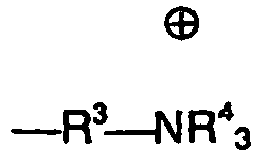

- Cyclic polyorganosiloxanes according to the invention must contain, within the polysiloxane chain, at least one unit of the formula (A)

In formula (A), all of the radicals R2 are, independently of one another, an alkyl radical having 1 to 18 carbon atoms. - Two or more units of the formula (A) may also be present within the chain. However, in this case they are not bonded directly to one another, but between each 2 units of the formula (A) there is at least one, preferably two or more, units of the formula
-Si(R1)2-O-
and/or of the formula
-Si(R1)(Z)-O-.
- While cyclic polyorganosiloxanes according to the invention must always contain at least one unit of the formula (A), open-chain polysiloxanes may also contain one or more units of the formula (A), although this is not absolutely necessary.
- If open-chain polysiloxanes according to the invention contain, within the polysiloxane chain, one or more units of the unit(s) of the formula (A), silicon-containing radicals which contain either one or more units of the formulae
-Si(R1)2-O-
and/or
-Si(R1)(Z)-O-
are present on both ends of the formula (A),
where the oxygen atom of each of these units is bonded to the unit of the formula (A), where the ends of these Si-containing radicals not bonded to formula (A), in the case of open-chain polyorganosiloxanes, simultaneously represent the end-groups of the polyorganosiloxane chain, i.e. have the structure given in more detail below
(R1)(Y)2Si-O-
or where these silicon-containing radicals have the structure -O-Si(R1)Y2, i.e. are themselves the end-groups of the chain. - In formula (A), all of the radicals R2 are, independently of one another, an alkyl radical having 1 to 18 carbon atoms. Preferably, at least 50% of the radicals R2 are methyl groups. It is particularly preferred if all of the radicals R2 are methyl groups.
In formula (A), m is a number from 1 to 8, preferably 3, and n is a number from 2 to 8, preferably 6.
The anions assigned to the quaternary nitrogen atoms of the formula (A) are chosen from benzenesulfonate anions and toluenesulfonate anions. The toluenesulfonate anion may here be the o-, m- or p-isomer or a mixture of these isomers. In place of a single anion, polyorganosiloxanes according to the invention can also contain two or more of the abovementioned anions. The anions present as counterions to radicals Z which contain quaternary nitrogen atoms are likewise chosen from the group of the abovementioned anions, as are the counterions to the radicals Y which have the structure of the formula (II). - The units present in polyorganosiloxanes according to the invention
-Si(R1)2-O-
and
-Si(R1)(Z)-O-
and the units of the formula (A), where present, may be distributed over the polysiloxane chain arbitrarily, but, as mentioned above, 2 units of (A) are not directly joined to one another. - In addition to the units given above and in claim 1, Si(R1)2-O-, Si(R1)(Z)-O- and optionally (A) in cyclic polymers, which must always be present within the polyorganosiloxane chain, it is possible for polyorganosiloxanes according to the invention to contain further units within the polysiloxane chain, e.g. units of the formula
-Si(R')(X)-O-.
X here is a radical of the formula
- Here R and R3 have the meanings given above. Of the radicals R5 and R6, in any individual unit, one is H and the other is H or CH3.
The value of e is in the range from, on average, 2 to 25, where in the normal case a mixture of molecules with varying values of e is present, as a result of the fact that radicals X are obtained by ethoxylation and/or propoxylation of radicals of the formula -R3-OH. Following ethoxylation/propoxylation, the end-groups of X are hydroxyl groups (R=H). Etherification with alcohols can give end-groups -OR in which R is an alkyl group, preferably -CH3. - Both open-chain and also cyclic polyorganosiloxanes according to the invention can additionally contain one or more units of the formula (III) within the polysiloxane chain

- Such polysiloxanes are even more suitable than polysiloxanes which do not contain units of the formula (III) for certain applications.
In this case, side chains which contain Si atoms are present in polysiloxanes according to the invention. - R1, Y and Z here have the meanings explained in claim 1, although it is not necessary for at least one of the radicals Z present in the units of the formula (III) to be a radical of the formula (I). Preferably, the end-groups of these side chains are Si(CH3)3 groups, i.e. in these side chains all of the radicals Y are preferably CH3.
- In formula (III), w is a number from 10 to 500, preferably from 10 to 150, and u has a value in the range from 0.01 w to 0.1 w.
- In polyorganosiloxanes according to the invention, where the polysiloxanes are open-chain, the two end-groups of the chain are formed by radicals of the formula
(R1)(Y)2Si-O-.
Here, all of the radicals Y are, independently of one another, an alkyl radical having 1 to 12 carbon atoms, a -OH, -OR2, a radical of the abovementioned formula (I), where optionally one or more nitrogen atoms of the formula (I) may be in quaternary form, or a radical of the formula (II)
In the given formulae which may represent Y, R, R2, R3, b, c and d have the meanings given above.
Preferably, the two end-groups of the polyorganosiloxane chain are radicals of the formula
R1-Si(CH3)(Y)-O-.
Particularly preferred end-groups are radicals of the formula
(CH3)2Si(Y)-O-.
- Polymers according to the invention can have an open-chain structure, as given above. They then have units of said formula (R1)(Y)2Si-O- on both chain ends. They can, however, also be in cyclic form. These cyclic polymers must each have one or more of the units Si(R1)2-O-
Si(R')(Z)-O-
and of the formula (A).
These units can be distributed over the ring system arbitrarily, but no 2 units A are joined directly to one another, but between each 2 units of the formula (A) there is always a bridge which consists of one or more of the other units given above. - Among the cyclic polyorganosiloxanes according to the invention, preference is given to those which correspond to the following structure

r is a number from 10 to 150
s is a number from 1 to 10
z is a number from 2 to 10
where thus the units A and -Si(R1)2- at the two ends of said structural formula are directly bonded to one another. - If polyorganosiloxanes according to the invention are open-chain polymers which do not contain a unit of the formula (A) within the polysiloxane chain, then at least one of the radicals Y present must be a radical of the formula (II).
- Preferably, in this case, at least 2 of the radicals Y which are bonded to different silicon atoms are each a radical of the formula (II).
- In formula (A), m in the two terminal unitsCH2
 each bonded to an oxygen atom is preferably the number 3. In the units
 CH2
CH2 each bonded to two nitrogen atoms, in formula (A), n is preferably 6.
- Preferably, 70 to 100% of all of the radicals R1 are CH3. In formula (I), formula (II) and formula (A), preferably 70 to 100% of all of the radicals R or R2 bonded to nitrogen are hydrogen atoms or methyl groups.
- Polyorganosiloxanes according to the invention can be prepared by the following process: The starting material used is a polyorganosiloxane which contains Si(R1)2-O- units and optionally units of the formula (A) within the polysiloxane chain, but no units of the formula -Si(R1)(Z)-O-. Such polysiloxanes are available commercially (e.g. products K5259 and K5355, Goldschmidt, Germany) and can be prepared in accordance with the details of
US 4 533 714 andUS 4 833 225 . The units of the formula -Si(R1)(Z)-O- can be inserted into these polyorganosiloxanes in accordance with known equilibration processes, e.g. by reaction with silanes of the formula
R1Si(OR2)(Z)
in the presence of basic catalysts. For this equilibration reaction, preference is given to using those silanes of said formula in which Z is a radical of the formula (I) which does not contain quaternary nitrogen atoms. If, as is preferred, the intention is then to modify one or more of the radicals of the formula (I) such that at least one quaternary nitrogen atom is present in Z, then this quaternization can be carried out by means of known methods, e.g. by reaction with an alkylating agent of the formula R-Q,
where R is a linear or branched alkyl radical having 1 to 16 carbon atoms and Qe is one of the abovementioned anions, i.e. a benzenesulfonate or toluenesulfonate anion. - If, as starting material for the preparation of polysiloxanes according to the invention, use is made of products which already contain one or more quaternized nitrogen atoms and anions other than benzenesulfonate or toluenesulfonate anions, then these anions must be replaced by benzenesulfonate or toluenesulfonate anions during the preparation of polysiloxanes according to the invention. In the case of acetate anions, this can be carried out, for example, by distilling off acetic acid in the acidic pH range in the presence of water before or after benzene- or toluenesulfonates have been added.
Analogously to the reactions mentioned, the insertion of further units into the polysiloxane chain is possible also by means of a corresponding equilibration reaction using corresponding monomeric silanes which contain these units.
Polyorganosiloxanes according to the invention which additionally contain further units in the chain can also be obtained by using, as starting materials, polysiloxanes of the type mentioned above which already contain such units and which are subjected to an equilibration for the purpose of inserting a radical Z. - The preparation of open-chain polysiloxanes according to the invention which contain radicals Y which have the structure of formula (II) on one or both chain ends can likewise be carried out by an equilibration reaction of the type described above. For this, as well as silanes of the formula
R1Si(OR)2Z,
the starting materials used are open-chain polysiloxanes which already have radicals of the formula (II) on one or both chain ends. Such polysiloxanes are available commercially (e.g. TEGOPREN 6924 from Goldschmidt, Germany) or can be prepared in accordance with the teachings ofEP-A 17121 EP-A 294 642 - The preparation of polysiloxanes according to the invention which additionally contain units of the formula -Si(R1)(X)-O- is possible, for example in the case where R1 = CH3, by additionally co-using, in the described equilibration reaction, a trisiloxane of the formula
HO-Si(CH3)2-O-Si(CH3)(X)-O-Si(CH3)2OH
or of the formula
(CH3)3Si-O-Si(CH3)(X)-O-Si(CH3)3.
Syntheses of this type are described inEP-A 578 144
If an open-chain or cyclic oligo- or polyorganosiloxane is additionally used in the equilibration, then a lengthening of the polysiloxane chain can be achieved as a result. Suitable cyclic oligosiloxanes here are primarily hexamethylcyclotrisiloxane or octamethylcyclotetrasiloxane. - Polyorganosiloxanes according to the invention are not only highly suitable as such for the treatment of textile fiber materials, but also in combination with other textile finishing products. For this purpose, mention may be made primarily of amino-functional polysiloxanes known from the prior art which do not contain units of the formula (A). Polysiloxanes according to the invention are highly compatible with these polysiloxanes.
In addition, it has been found that polyorganosiloxanes which contain a unit (A), but not a unit -Si(R1)(Z)-O-, which thus are not covered by the present invention, have good compatibility with said amino-functional polyorganosiloxanes which do not contain a unit (A). - The invention is illustrated below by working examples.
The product K 5355 specified in the examples comprises about 25% by weight of dipropylene glycol and about 75% by weight of a polyorganosiloxane which contains, within the polysiloxane chain, both units of the formula
-Si(CH3)2-O-
and also units of the formula (A), but no units of the formula
-Si(CH3)(Z)-O-.
The anions assigned to the cationic units (A) are acetate ions. The product can be obtained from Goldschmidt, Germany. -
- a) Equilibration
- 75.3 g of octamethylcyclotetrasiloxane (D4)
- 17.2 g of K 5355 (as described above)
- 5.3 g of DYNASYLAN 1411 (Brenntag, Germany)
- and 1.4 g of water
were combined. Then, 0.9 g of 45% strength aqueous KOH was added, the mixture was heated to 120°C (reflux) and held at 120°C for 3 hours, during which water, acetic acid and methanol formed in the reaction were partially distilled off.
DYNASYLAN 1411 is a silane of the formula
- b) Quatemization and dispersion in water
A mixture of
10.1 g of MARLIPAL O 13/80 (ethoxylated branched C13-alcohol)
0.9 g of tris(2-butoxyethyl)phosphate
3 g of propylene glycol
and 66 g of water
was prepared. The first-named product serves as a dispersant. The phosphate and propylene glycol serve as stabilizers.
At room temperature, 15 g of the product obtained according to the abovementioned step a) were added to the resulting mixture. With stirring, 3.7 g of methyl p-toluenesulfonate (quaternizing agent) were then added. The mixture was then heated to 60°C and stirred at this temperature for 4 hours. This gave a product which was clear at room temperature (= microemulsion No. 1), to which 0.5 g of Na formate was added to adjust the pH. - Example 1 was repeated with the following differences:
- In step a) (equilibration), the following amounts were used:
- 67.3 g of D4
- 25 g of K 5355
- 5.1 g of DYNASYLAN 1411
- 93 g of an unsubstituted polydimethylsiloxane with a viscosity of about 2000 mPa.s at 25°C,
5.2 g of DYNASYLAN 1411
and 1.5 g of water
were mixed together. 0.25 g of 45% strength aqueous KOH was then added, the mixture was heated to 120°C (reflux) and held at this temperature for 3 hours. A grey-colored, cloudy liquid resulted.
Using 15 g of the resulting product, a quatemization was carried out under the same conditions as in step b) of Example 1 with the difference that firstly only 50% of the total amount of methyl p-toluenesulfonate were added, then stirring was carried out for 1 hour at 60°C, then the second 50% of the ester were added and then the mixture was stirred for a further 3 hours at 60°C.
A clear emulsion (= comparison emulsion) was obtained. - The TEGOPREN 6924 (Goldschmidt, Germany) used in this example is a polydimethylsiloxane which has a unit of the formula Y(CH3)2Si- on each of the two chain ends, where Y is a radical of the formula (II) given above and in claim 1 where t = 0 and b = 1.
5.00 g of TEGOPREN 6924
0.50 g of H2O
were initially introduced, heated to 125°C, and acetic acid was distilled off.
Then,
75.27 g of octamethylcyclotetrasiloxane
5.25 g of DYNASYLAN 1411 and
1.42 g of H2O
were added and stirred. Then, 0.65 g of aqueous KOH was added, heated to 120°C (reflux) and held at 120°C for 5 hours, during which water and methanol which forms in the reaction were partially distilled off. - Then, the resulting product was dispersed and quaternized using methyl toluenesulfonate (quaternization of the nitrogen atoms present in the radicals Z which originate from DYNASYLAN), as given in Example 1. This gave a clear, stable dispersion.
- 1 sample of each of the microemulsions 1 and 2, the dispersion from Example 4 and the comparison emulsion was used to treat a knit consisting of 100% of cotton. Application of the emulsions was by means of padding, and then the samples were dried for 10 minutes at 110°C. The sample treated with microemulsion 1 exhibited a very marked inner softness (manual assessment via the feel), microemulsion 2 and dispersion according to Example 4 led to an inner softness which had a tendency to be somewhat poorer, whereas comparison emulsion 3 exhibited a markedly poorer inner softness.
A clear product (= microemulsion 2) was obtained.
Claims (4)
- A polyorganosiloxane which has, within the polysiloxane chain, one or more of each of the following structural units
-Si(R1)2-O-,
and
-Si(R1)(Z)-O-,
where the structural units may be distributed arbitrarily over the polysiloxane chain, where the polyorganosiloxane is an open-chain polyorganosiloxane, which additionally contains, within the polysiloxane chain, units of the formula (A)
(R1)(Y)2Si-O-
as end-groups,
in which one of the radicals Z present is a radical of the formula (I) and all of the other radicals Z, independently of one another, are R1 or a radical of the formula (I)
where all of the radicals R1, independently of one another, are -CH3 or -CH2CH3,
where all of the radicals R, independently of one another, are hydrogen or a linear or branched alkyl radical having 1 to 16 carbon atoms,
all of the radicals R2, independently of one another, are an alkyl radical having 1 to 18 carbon atoms,
all of the radicals R3, independently of one another, are a linear or branched alkylene radical having 2 to 6 carbon atoms,
a is 1 or 2,
m is a number from 1 to 8, preferably 3,
n is a number from 2 to 8, preferably 6,
c is 0, 1 or 2,
d is a number from 2 to 6,
where all of the radicals Y present, independently of one another, are an alkyl radical having 1 to 12 carbon atoms or are a radical of the formula (I) or a radical of the formula (I) in which one or more of the nitrogen atoms are in quaternized form, or where all of the radicals Y, independently of one another, are OH or OR2, or where all of the radicals Y, independently of one another, are a radical of the formula (II)
and where the polyorganosiloxane contains anions appertaining to the quaternary nitrogen atoms and these appertaining anions are chosen from benzenesulfonate anions and toluenesulfonate anions. - The polyorganosiloxane as claimed in claim 1, characterized in that it contains at least one radical Z of the formula


- An aqueous solution or dispersion which comprises a polyorganosiloxane as claimed in claim 1 or 2.
- The use of a solution or dispersion as claimed in claim 3 for the treatment of fiber materials.
Applications Claiming Priority (3)
| Application Number | Priority Date | Filing Date | Title |
|---|---|---|---|
| DE10204517 | 2002-02-05 | ||
| DE2002104517 DE10204517A1 (en) | 2002-02-05 | 2002-02-05 | Polysiloxanes with quaternary groups containing nitrogen atoms |
| PCT/EP2003/000866 WO2003066708A1 (en) | 2002-02-05 | 2003-01-29 | Polysiloxanes containing quaternary groups having nitrogen atoms |
Publications (2)
| Publication Number | Publication Date |
|---|---|
| EP1472306A1 EP1472306A1 (en) | 2004-11-03 |
| EP1472306B1 true EP1472306B1 (en) | 2013-03-13 |
Family
ID=7713663
Family Applications (1)
| Application Number | Title | Priority Date | Filing Date |
|---|---|---|---|
| EP03702551A Expired - Lifetime EP1472306B1 (en) | 2002-02-05 | 2003-01-29 | Polysiloxanes containing quaternary groups having nitrogen atoms |
Country Status (4)
| Country | Link |
|---|---|
| EP (1) | EP1472306B1 (en) |
| AU (1) | AU2003205696A1 (en) |
| DE (1) | DE10204517A1 (en) |
| WO (1) | WO2003066708A1 (en) |
Family Cites Families (4)
| Publication number | Priority date | Publication date | Assignee | Title |
|---|---|---|---|---|
| DE3802622A1 (en) * | 1988-01-29 | 1989-08-10 | Goldschmidt Ag Th | MEANS FOR CUTTING TEXTILE FIBER OR TEXTILE FIBER PRODUCTS |
| DE19652524C2 (en) * | 1996-12-17 | 2003-08-14 | Rudolf Gmbh & Co Kg Chem Fab | Emulsions containing organopolysiloxanes, their preparation and use in aqueous systems |
| AU5803998A (en) * | 1997-12-19 | 1999-07-12 | Procter & Gamble Company, The | Multi-cationic silicone polymers |
| EP1000959B1 (en) * | 1998-11-14 | 2003-04-16 | Goldschmidt AG | Polyetherquat functional polysiloxanes |
-
2002
- 2002-02-05 DE DE2002104517 patent/DE10204517A1/en not_active Withdrawn
-
2003
- 2003-01-29 EP EP03702551A patent/EP1472306B1/en not_active Expired - Lifetime
- 2003-01-29 WO PCT/EP2003/000866 patent/WO2003066708A1/en not_active Ceased
- 2003-01-29 AU AU2003205696A patent/AU2003205696A1/en not_active Abandoned
Also Published As
| Publication number | Publication date |
|---|---|
| WO2003066708A1 (en) | 2003-08-14 |
| DE10204517A1 (en) | 2003-08-07 |
| EP1472306A1 (en) | 2004-11-03 |
| AU2003205696A1 (en) | 2003-09-02 |
Similar Documents
| Publication | Publication Date | Title |
|---|---|---|
| US7834122B2 (en) | Polysiloxanes with quaternary ammonium groups, preparation thereof and use thereof as textile softeners | |
| JP3476214B2 (en) | Organosiloxanes with nitrogen-containing and ether-containing residues | |
| CA1337447C (en) | Treatment of fibrous materials | |
| JP5914248B2 (en) | Process for producing polysiloxanes having nitrogen-containing groups | |
| JP5553505B2 (en) | Polyamino and / or polyammonium / polysiloxane copolymer compound in which polyalkylene oxide units are arranged in a comb shape | |
| US7790801B2 (en) | Organo-functional silicone in emulsion systems and process for preparing same | |
| CA2035284C (en) | Method of treating fibrous materials | |
| US8742154B2 (en) | Block ABA silicone polyalkyleneoxicie copolymers, methods of preparation, and applications for employing the same | |
| JP7386176B2 (en) | Siloxanes for use in textile treatment and cleaning and care formulations | |
| EP0399706A2 (en) | Method of treating fibrous materials | |
| JP2865489B2 (en) | Organosilicon compounds | |
| JPH0853547A (en) | Amino-functional organopolysiloxane,its aqueous emulsion,itsproduction and finishing agent for organic fiber and fabric | |
| CN1938364A (en) | Polysiloxanes with multiple quaternary ammonium group | |
| TW591059B (en) | Polyorganosiloxane mixtures for treating fiber materials | |
| WO2003066708A1 (en) | Polysiloxanes containing quaternary groups having nitrogen atoms | |
| CN103215817B (en) | Organosilicone softening agent having block structure and preparation method | |
| EP1325188B1 (en) | Polysiloxanes with quaternary groups featuring nitrogen atoms | |
| EP1527139B1 (en) | Compositions which comprise polyorganosiloxanes with quaternary ammonium groups | |
| CN100384913C (en) | Amino-functional polysiloxane wax | |
| JPH04327273A (en) | fiber treatment agent |
Legal Events
| Date | Code | Title | Description |
|---|---|---|---|
| PUAI | Public reference made under article 153(3) epc to a published international application that has entered the european phase |
Free format text: ORIGINAL CODE: 0009012 |
|
| 17P | Request for examination filed |
Effective date: 20040622 |
|
| AK | Designated contracting states |
Kind code of ref document: A1 Designated state(s): AT BE BG CH CY CZ DE DK EE ES FI FR GB GR HU IE IT LI LU MC NL PT SE SI SK TR |
|
| AX | Request for extension of the european patent |
Extension state: AL LT LV MK RO |
|
| RIN1 | Information on inventor provided before grant (corrected) |
Inventor name: TSCHIDA, GUENTHER Inventor name: CHROBACZEK, HARALD Inventor name: LINDMAIR, GABRIELE |
|
| RAP1 | Party data changed (applicant data changed or rights of an application transferred) |
Owner name: HUNTSMAN TEXILE EFFECTS (GERMANY) GMBH |
|
| RAP1 | Party data changed (applicant data changed or rights of an application transferred) |
Owner name: HUNTSMAN TEXTILE EFFECTS (GERMANY) GMBH |
|
| 17Q | First examination report despatched |
Effective date: 20090407 |
|
| GRAP | Despatch of communication of intention to grant a patent |
Free format text: ORIGINAL CODE: EPIDOSNIGR1 |
|
| GRAS | Grant fee paid |
Free format text: ORIGINAL CODE: EPIDOSNIGR3 |
|
| GRAA | (expected) grant |
Free format text: ORIGINAL CODE: 0009210 |
|
| AK | Designated contracting states |
Kind code of ref document: B1 Designated state(s): AT BE BG CH CY CZ DE DK EE ES FI FR GB GR HU IE IT LI LU MC NL PT SE SI SK TR |
|
| REG | Reference to a national code |
Ref country code: GB Ref legal event code: FG4D |
|
| REG | Reference to a national code |
Ref country code: CH Ref legal event code: EP Ref country code: AT Ref legal event code: REF Ref document number: 600785 Country of ref document: AT Kind code of ref document: T Effective date: 20130315 |
|
| REG | Reference to a national code |
Ref country code: IE Ref legal event code: FG4D |
|
| REG | Reference to a national code |
Ref country code: DE Ref legal event code: R096 Ref document number: 60343497 Country of ref document: DE Effective date: 20130508 |
|
| PG25 | Lapsed in a contracting state [announced via postgrant information from national office to epo] |
Ref country code: ES Free format text: LAPSE BECAUSE OF FAILURE TO SUBMIT A TRANSLATION OF THE DESCRIPTION OR TO PAY THE FEE WITHIN THE PRESCRIBED TIME-LIMIT Effective date: 20130624 Ref country code: BG Free format text: LAPSE BECAUSE OF FAILURE TO SUBMIT A TRANSLATION OF THE DESCRIPTION OR TO PAY THE FEE WITHIN THE PRESCRIBED TIME-LIMIT Effective date: 20130613 Ref country code: SE Free format text: LAPSE BECAUSE OF FAILURE TO SUBMIT A TRANSLATION OF THE DESCRIPTION OR TO PAY THE FEE WITHIN THE PRESCRIBED TIME-LIMIT Effective date: 20130313 |
|
| REG | Reference to a national code |
Ref country code: AT Ref legal event code: MK05 Ref document number: 600785 Country of ref document: AT Kind code of ref document: T Effective date: 20130313 |
|
| REG | Reference to a national code |
Ref country code: NL Ref legal event code: VDEP Effective date: 20130313 |
|
| PG25 | Lapsed in a contracting state [announced via postgrant information from national office to epo] |
Ref country code: SI Free format text: LAPSE BECAUSE OF FAILURE TO SUBMIT A TRANSLATION OF THE DESCRIPTION OR TO PAY THE FEE WITHIN THE PRESCRIBED TIME-LIMIT Effective date: 20130313 Ref country code: FI Free format text: LAPSE BECAUSE OF FAILURE TO SUBMIT A TRANSLATION OF THE DESCRIPTION OR TO PAY THE FEE WITHIN THE PRESCRIBED TIME-LIMIT Effective date: 20130313 Ref country code: GR Free format text: LAPSE BECAUSE OF FAILURE TO SUBMIT A TRANSLATION OF THE DESCRIPTION OR TO PAY THE FEE WITHIN THE PRESCRIBED TIME-LIMIT Effective date: 20130614 |
|
| PG25 | Lapsed in a contracting state [announced via postgrant information from national office to epo] |
Ref country code: SK Free format text: LAPSE BECAUSE OF FAILURE TO SUBMIT A TRANSLATION OF THE DESCRIPTION OR TO PAY THE FEE WITHIN THE PRESCRIBED TIME-LIMIT Effective date: 20130313 Ref country code: AT Free format text: LAPSE BECAUSE OF FAILURE TO SUBMIT A TRANSLATION OF THE DESCRIPTION OR TO PAY THE FEE WITHIN THE PRESCRIBED TIME-LIMIT Effective date: 20130313 Ref country code: PT Free format text: LAPSE BECAUSE OF FAILURE TO SUBMIT A TRANSLATION OF THE DESCRIPTION OR TO PAY THE FEE WITHIN THE PRESCRIBED TIME-LIMIT Effective date: 20130715 Ref country code: EE Free format text: LAPSE BECAUSE OF FAILURE TO SUBMIT A TRANSLATION OF THE DESCRIPTION OR TO PAY THE FEE WITHIN THE PRESCRIBED TIME-LIMIT Effective date: 20130313 Ref country code: NL Free format text: LAPSE BECAUSE OF FAILURE TO SUBMIT A TRANSLATION OF THE DESCRIPTION OR TO PAY THE FEE WITHIN THE PRESCRIBED TIME-LIMIT Effective date: 20130313 Ref country code: CZ Free format text: LAPSE BECAUSE OF FAILURE TO SUBMIT A TRANSLATION OF THE DESCRIPTION OR TO PAY THE FEE WITHIN THE PRESCRIBED TIME-LIMIT Effective date: 20130313 |
|
| PG25 | Lapsed in a contracting state [announced via postgrant information from national office to epo] |
Ref country code: CY Free format text: LAPSE BECAUSE OF FAILURE TO SUBMIT A TRANSLATION OF THE DESCRIPTION OR TO PAY THE FEE WITHIN THE PRESCRIBED TIME-LIMIT Effective date: 20130313 |
|
| PLBE | No opposition filed within time limit |
Free format text: ORIGINAL CODE: 0009261 |
|
| STAA | Information on the status of an ep patent application or granted ep patent |
Free format text: STATUS: NO OPPOSITION FILED WITHIN TIME LIMIT |
|
| PG25 | Lapsed in a contracting state [announced via postgrant information from national office to epo] |
Ref country code: DK Free format text: LAPSE BECAUSE OF FAILURE TO SUBMIT A TRANSLATION OF THE DESCRIPTION OR TO PAY THE FEE WITHIN THE PRESCRIBED TIME-LIMIT Effective date: 20130313 |
|
| 26N | No opposition filed |
Effective date: 20131216 |
|
| PG25 | Lapsed in a contracting state [announced via postgrant information from national office to epo] |
Ref country code: IT Free format text: LAPSE BECAUSE OF FAILURE TO SUBMIT A TRANSLATION OF THE DESCRIPTION OR TO PAY THE FEE WITHIN THE PRESCRIBED TIME-LIMIT Effective date: 20130313 |
|
| REG | Reference to a national code |
Ref country code: DE Ref legal event code: R097 Ref document number: 60343497 Country of ref document: DE Effective date: 20131216 |
|
| PG25 | Lapsed in a contracting state [announced via postgrant information from national office to epo] |
Ref country code: MC Free format text: LAPSE BECAUSE OF FAILURE TO SUBMIT A TRANSLATION OF THE DESCRIPTION OR TO PAY THE FEE WITHIN THE PRESCRIBED TIME-LIMIT Effective date: 20130313 Ref country code: LU Free format text: LAPSE BECAUSE OF FAILURE TO SUBMIT A TRANSLATION OF THE DESCRIPTION OR TO PAY THE FEE WITHIN THE PRESCRIBED TIME-LIMIT Effective date: 20140129 |
|
| REG | Reference to a national code |
Ref country code: CH Ref legal event code: PL |
|
| PG25 | Lapsed in a contracting state [announced via postgrant information from national office to epo] |
Ref country code: CH Free format text: LAPSE BECAUSE OF NON-PAYMENT OF DUE FEES Effective date: 20140131 Ref country code: LI Free format text: LAPSE BECAUSE OF NON-PAYMENT OF DUE FEES Effective date: 20140131 |
|
| REG | Reference to a national code |
Ref country code: IE Ref legal event code: MM4A |
|
| PG25 | Lapsed in a contracting state [announced via postgrant information from national office to epo] |
Ref country code: IE Free format text: LAPSE BECAUSE OF NON-PAYMENT OF DUE FEES Effective date: 20140129 |
|
| PGFP | Annual fee paid to national office [announced via postgrant information from national office to epo] |
Ref country code: GB Payment date: 20141230 Year of fee payment: 13 |
|
| PGFP | Annual fee paid to national office [announced via postgrant information from national office to epo] |
Ref country code: FR Payment date: 20141226 Year of fee payment: 13 |
|
| PGFP | Annual fee paid to national office [announced via postgrant information from national office to epo] |
Ref country code: DE Payment date: 20150126 Year of fee payment: 13 |
|
| PGFP | Annual fee paid to national office [announced via postgrant information from national office to epo] |
Ref country code: TR Payment date: 20150112 Year of fee payment: 13 |
|
| PGFP | Annual fee paid to national office [announced via postgrant information from national office to epo] |
Ref country code: BE Payment date: 20150112 Year of fee payment: 13 |
|
| PG25 | Lapsed in a contracting state [announced via postgrant information from national office to epo] |
Ref country code: BE Free format text: LAPSE BECAUSE OF NON-PAYMENT OF DUE FEES Effective date: 20160131 |
|
| PG25 | Lapsed in a contracting state [announced via postgrant information from national office to epo] |
Ref country code: HU Free format text: LAPSE BECAUSE OF FAILURE TO SUBMIT A TRANSLATION OF THE DESCRIPTION OR TO PAY THE FEE WITHIN THE PRESCRIBED TIME-LIMIT; INVALID AB INITIO Effective date: 20030129 |
|
| REG | Reference to a national code |
Ref country code: DE Ref legal event code: R119 Ref document number: 60343497 Country of ref document: DE |
|
| GBPC | Gb: european patent ceased through non-payment of renewal fee |
Effective date: 20160129 |
|
| REG | Reference to a national code |
Ref country code: FR Ref legal event code: ST Effective date: 20160930 |
|
| PG25 | Lapsed in a contracting state [announced via postgrant information from national office to epo] |
Ref country code: DE Free format text: LAPSE BECAUSE OF NON-PAYMENT OF DUE FEES Effective date: 20160802 Ref country code: GB Free format text: LAPSE BECAUSE OF NON-PAYMENT OF DUE FEES Effective date: 20160129 |
|
| PG25 | Lapsed in a contracting state [announced via postgrant information from national office to epo] |
Ref country code: FR Free format text: LAPSE BECAUSE OF NON-PAYMENT OF DUE FEES Effective date: 20160201 |
|
| PG25 | Lapsed in a contracting state [announced via postgrant information from national office to epo] |
Ref country code: TR Free format text: LAPSE BECAUSE OF NON-PAYMENT OF DUE FEES Effective date: 20160129 |