EP1471764A2 - Call-admission controller and method of call-admission control - Google Patents
Call-admission controller and method of call-admission control Download PDFInfo
- Publication number
- EP1471764A2 EP1471764A2 EP04252355A EP04252355A EP1471764A2 EP 1471764 A2 EP1471764 A2 EP 1471764A2 EP 04252355 A EP04252355 A EP 04252355A EP 04252355 A EP04252355 A EP 04252355A EP 1471764 A2 EP1471764 A2 EP 1471764A2
- Authority
- EP
- European Patent Office
- Prior art keywords
- call
- low
- admission
- priority
- impact
- Prior art date
- Legal status (The legal status is an assumption and is not a legal conclusion. Google has not performed a legal analysis and makes no representation as to the accuracy of the status listed.)
- Granted
Links
Images


Classifications
-
- H—ELECTRICITY
- H04—ELECTRIC COMMUNICATION TECHNIQUE
- H04Q—SELECTING
- H04Q11/00—Selecting arrangements for multiplex systems
- H04Q11/04—Selecting arrangements for multiplex systems for time-division multiplexing
-
- H—ELECTRICITY
- H04—ELECTRIC COMMUNICATION TECHNIQUE
- H04Q—SELECTING
- H04Q2213/00—Indexing scheme relating to selecting arrangements in general and for multiplex systems
- H04Q2213/1325—Priority service
-
- H—ELECTRICITY
- H04—ELECTRIC COMMUNICATION TECHNIQUE
- H04Q—SELECTING
- H04Q2213/00—Indexing scheme relating to selecting arrangements in general and for multiplex systems
- H04Q2213/13256—Call screening
-
- H—ELECTRICITY
- H04—ELECTRIC COMMUNICATION TECHNIQUE
- H04Q—SELECTING
- H04Q2213/00—Indexing scheme relating to selecting arrangements in general and for multiplex systems
- H04Q2213/1337—Operator, emergency services
Definitions
- the present invention generally relates to a call-admission controller and a method of call-admission control, and particularly relates to a call-admission controller and a method of call-admission control in a communications system wherein resources are shared by calls of multiple priority classes.
- a circuit is allocated out of idle communication equipment resources, so that when the communication is completed, the allocated circuit is released so as to prepare for allocating the circuit for other communications.
- services provided by such a communications system as described above include voice calls, video telephone, facsimile communication, file downloading, file transfer and the like, which are available to users of fixed telephones, portable telephones and the like.
- the users enter into correspondingly different contracts, such as fixed charging and variable charging, with operators who provide the services as described above.
- calls handled within a communications system include normal calls as well as emergency calls such as "110" (for the police), "119” (for the fire and ambulance) and the like.
- emergency calls such as "110" (for the police), "119" (for the fire and ambulance) and the like.
- these different kinds of calls exist simultaneously in large numbers so that shared resources are utilized. Since these shared resources are finite, in a case that the shared resources are allocated in the order of occurrence of the calls, when an emergency call such as "110" and the like occurs, the admission request of the emergency call ends up getting rejected in a case that no idle shared resources exist. In other words, in order to respond to various requests for communications from the users, it is necessary to efficiently allocate the resources to calls of different kinds.
- a method of call-admission control is considered such that, when there are not many idle shared resources, a call with a large amount of requested resources is rejected, while a call with a small amount of requested resources is admitted.
- Patent Document 2 A technology disclosed as described in Patent Document 2, the technology proposed from these viewpoints, by providing individual call-admission threshold values depending upon the required resource amount per type of call, even in a case that many communications requests requiring a large amount of resources exist, enables maintaining a high resource usage rate.
- Patent Document 1
- Patent Document 2
- a call-admission controller which allocates, out of idle shared resources in a communications system, resources required for communication in multiple calls of different priorities includes an impact-judging unit configured to make a judgment of, when having detected a low-priority call, the impact of the low priority call on the communications system, and a low-priority call admission-determining unit configured to make, based on the impact of which the judgment is made, a determination of, whether to admit the low-priority call.
- the call-admission controller in an embodiment of the invention enables increasing the usage efficiency of the shared resources.
- a method of call-admission control which allocates, out of idle shared resources in a communications system, resources required for communication in multiple calls of different priorities includes the steps of judging, when having detected a low-priority call, the impact of the low-priority call on the communications system, determining, when judged that the impact is large, a low-priority call-admission threshold value so that the ease of allocation of the low-priority call is set to be lower than the ease of the allocation of a high-priority call, and determining, according to the determined call-admission threshold value, whether to admit the low-priority call.
- the method of call-admission control in an embodiment of the invention enables increasing the usage efficiency of the shared resources.
- FIG. 1 is a functional block diagram illustrating a configuration of a call-admission controller according to an embodiment of the present invention.
- this call-admission controller consists of communication equipment 10 which is shared for use by multiple communications users, a call-processing control section 20 which directs to a communication-equipment control section 40 an allocating, a releasing and the like of shared resources, a call-admission processing section 30 which reads out information from a memory 50 so as to determine whether to admit a call, a communication-equipment control section 40 which performs the allocating, the releasing and the like of the shared resources, manages the currently in-use shared resources amount and outputs the in-use resources amount and the usage rate to the memory 50 so as to be held, and the memory 50, these components of the call-admission controller being connected via a bus 60.
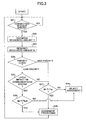
- FIG. 2 is a flowchart for describing an operation according to a first embodiment of the present invention.
- the call-admission processing section 30 checks for a connection request for a call, and, if there is a connection request for a call (Yes in Step S1), proceeds to Step S2, while, if there is no connection request for a call, waits for a connection request for a call.
- the communication-equipment control section 40 obtains currently in-use shared resources amount T (Step S2) and furthermore obtains requested resources amount M of the connection-requested call (Step S3).
- the communication-equipment control section 40 upon thus obtaining the in-use shared resources amount T and the requested resources amount M, places these sets of information in the memory 50.
- the call-admission processing section 30 in Step S4 determines the priority of a call requesting a connection so that, when the priority class is high-priority (high-priority in Step S4), the call-admission threshold value is set to a threshold value Thr, of the high-priority class, defined in advance. Subsequently, the shared resources amount T and the required resources amount M held in the memory 50 are read out so as to compute the total value such that, if the total value is less than Thr (Yes in Step S8), call-admission processing is performed (Step S10) while, if the total value as described above is not less than Thr (NO in Step S8), a process which rejects the call is performed (Step S9).
- Step S5 the impact on the communications system is estimated:
- the larger the measured number of the circuits requested the larger impact on the communications system becomes.
- the smaller the number of the circuits requested the smaller the impact on the communications system becomes.
- the call-admission processing section 30, upon completing the estimating of the impact on the communications system as described above, based on the estimated impact, calculates the indicator ⁇ indicating the ease of allocation of a low-priority call using a function defined in advance (Step S6).
- ⁇ assumes a value such that 0 ⁇ 1.
- Step S10 For either one of a low-priority call and a high-priority call, after undergoing admission processing in Step S10, the operation returns to the start (S1) of the loop process so that the same process as described above is repeated. Moreover, the performing of the call-admission processing in Step S10 causes the corresponding call to be set up at the call-processing control section 20 so that the communication may be started.
- a table correlating the impact, as described above, with ⁇ (Step S11) may be prepared in advance so as to obtain the desired ⁇ by referring to this table.
- connection requests for low-priority calls undergo admission-processing not evenly but depending upon the judged degree of impact on the communications system. For example, when the impact of a low-priority call on the communications system is small the ease of allocation of the low-priority call is raised, whereas when the impact is large the ease of allocation of the low-priority call is lowered.
- changing the admission-threshold value of a low-priority call depending on the degree of impact on the communications system enables efficient allocating of a low-priority call under the present usage conditions of the shared resources, effectively causing an increase in the usage efficiency of the shared resources.
- FIG. 3 is a flowchart for describing an operation according to a second embodiment of the present invention.
- Step S21 through S24 the same operations for the first embodiment as described above are performed in Steps S21 through S24. Therefore, hereafter, operations from Step S25 onward are described.
- the impact on the communications system in a case that the call is allocated is measured (Step S25) so that, if the impact does not exceed a threshold value defined in advance (No in Step 25), the call-admission threshold value is set to Thr of the high-priority class.
- the call-admission threshold value is set to Thr0 of the low-priority class.
- Step S25 when in Step S25 the impact on the communications system of the low-priority call is determined to be small (No in Step S25), whether the total value (M+T) of the shared resources amount T and the requested resources amount M is less than Thr is determined (Step S27), whereas when the impact on the communications system of the low-priority call as described above is determined to be large (Yes in Step S25), whether the value of (M+T) as described above is less than Thr0 is determined (Step S26).
- the call-admission processing section 30 when in Step S26 determines that (M+T) ⁇ Thr0 is fulfilled or in Step S27 determines that (M+T) ⁇ Thr is fulfilled (Yes in Step S26 or Yes in Step S27) performs admission processing of a low-priority call for which a connection request is made (Step S29), otherwise (No in Step S26 or No in Step S27) performs processing to reject the call as described above (Step S28).
- Step S29 determines that (M+T) ⁇ Thr0 is fulfilled
- Step S27 determines that (M+T) ⁇ Thr is fulfilled
- the admission-threshold value for a low-priority call may be set to be the same as that for a high-priority call, while when exceeding the lowest threshold value as described above, the admission-threshold value for the low-priority call that is calculated according to the arithmetic expression as previously described may be used.
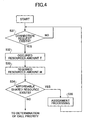
- FIG. 4 is a flowchart for describing an operation according to a third embodiment of the present invention.
- Step S34 onward operations from Step S34 onward are described.
- the call-admission processing section 30, with a connection request for a call first, estimates the remaining (idle) amount of shared resources, in a case of having admitted the call for which the connection request was made, from the in-use shared resources amount T and the requested resources amount M (Step S34), performs the above-described call-admission processing (Step S35) only when it is determined that there are affordable shared resources (Yes in Step S34), while when it is determined that there are no affordable shared resources (No in Step S34), proceeds to the process of determining the call priority as described above. This process of determining the priority as well as the subsequent processes are performed in the same manner as in the first or the second embodiments as described above.
- the process of determining the call priority is abbreviated so as to enable a simplifying of the process when there are shared resources affordable.
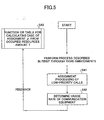
- FIG. 5 is a flowchart for describing an operation according to a fourth embodiment of the present invention.
- a call-admission processing section 30, after performing admission processing of a low-priority call (Step S41), measures the usage rate of the communication equipment (Step S42) so as to provide feedback which causes a change in the function or the table which calculates ⁇ as described above from the amount of change in the usage rate.
- the usage rate of the communication equipment is measurable by observing, for example, the number in use, or the usage rate, of circuits in the shared resources, the transmission power amount or the received interference amount of the communication equipment, the received interference amount in ongoing calls, the completion rate or the error rate of ongoing calls, the throughput, the delay time and the like.
- the level of usage rate by substituting, into an arithmetic expression defined in advance, the usage rate of the communication equipment after the admission-processing, and to perform a control operation which changes the function or shifts the referring location in the table in such a manner that ⁇ is set to be smaller, the higher the usage rate; while ⁇ is set to be larger, the lower the usage rate.
- the indicator ⁇ which indicates the ease of allocation of a low-priority call is properly updated depending upon the current usage condition of the communication equipment, enabling more precise control of the admission processing of the low-priority call.
Landscapes
- Engineering & Computer Science (AREA)
- Computer Networks & Wireless Communication (AREA)
- Telephonic Communication Services (AREA)
- Mobile Radio Communication Systems (AREA)
- Data Exchanges In Wide-Area Networks (AREA)
- Communication Control (AREA)
Abstract
Description
Claims (8)
- A call-admission controller which allocates, out of shared resources in a communications system, resources required for communication in a plurality of calls of different priorities, comprising:an impact-judging unit configured to make a judgment of, when having detected a low-priority call, an impact of said low priority call on the communications system; anda low-priority call admission-determining unit configured to make, based on said impact of which said judgment is made, a determination of whether to admit said low-priority call.
- The call-admission controller as claimed in claim 1,
wherein said low-priority call admission-determining unit further comprises:a call-admission threshold-value varying unit configured to cause a change in a call-admission threshold-value for the low-priority call depending on the degree of said impact. - The call-admission controller as claimed in claim 2,
wherein said call-admission threshold-value varying unit
sets, based on said impact, an indicator indicating the ease of allocation of the low-priority call, so as to cause, using the set indicator, a change in said call-admission threshold-value for the low-priority call. - The call-admission controller as claimed in claim 3,
further comprising:wherein said function sets the call-admission threshold-value for the low-priority call to be equivalent to the call-admission threshold-value for a high-priority call when said impact does not exceed a threshold value defined in advance, and sets the call-admission threshold-value for the low-priority call to be lower than the call-admission threshold-value for the high-priority call when said impact exceeds said threshold value defined in advance.a defining unit configured to define said indicator as a function determining the ease of the allocation of the low-priority call; - The call-admission controller as claimed in claim 1,
wherein said impact-judging unit
judges, from one or a plurality of the following factors, the number of circuits required for the low-priority call to perform the communication, the time up to completing the communication, the transmission data amount, the power required by communication equipment for performing the communication, the interference amount caused on other ongoing calls, the location of occurrence of said call, the travelling speed of a terminal causing said call, and the type of the terminal causing said call,
said impact of said low-priority call on the communications system. - The call-admission controller as claimed in claim 1,
wherein the judgment by the impact-judging unit of the impact of the low-priority call on the communications system, and
the determination by the low-priority call admission-determining unit of whether to admit said low-priority call are performed when there are not many idle shared resources. - The call-admission controller as claimed in claim 4, further comprising:a measuring unit configured to measure, when having detected a call requesting a connection, a change in the usage condition of communication equipment; anda changing unit which changes said function depending on the amount of said change in the usage condition.
- A method of call-admission control which allocates out of shared resources in a communications system resources required for communication in a plurality of calls of different priorities, comprising the steps of:judging, when having detected a low-priority call, an impact of said low-priority call on the communications system;determining, when judged that said impact is large, a low-priority call-admission threshold value so that the ease of allocation of said low-priority call is set to be lower than the ease of the allocation of a high-priority call; anddetermining, according to said determined call-admission threshold value, whether to admit said low-priority call.
Applications Claiming Priority (2)
| Application Number | Priority Date | Filing Date | Title |
|---|---|---|---|
| JP2003117410 | 2003-04-22 | ||
| JP2003117410A JP2004328157A (en) | 2003-04-22 | 2003-04-22 | Call admission control device and call admission control method |
Publications (3)
| Publication Number | Publication Date |
|---|---|
| EP1471764A2 true EP1471764A2 (en) | 2004-10-27 |
| EP1471764A3 EP1471764A3 (en) | 2005-06-08 |
| EP1471764B1 EP1471764B1 (en) | 2008-12-17 |
Family
ID=32959613
Family Applications (1)
| Application Number | Title | Priority Date | Filing Date |
|---|---|---|---|
| EP20040252355 Expired - Lifetime EP1471764B1 (en) | 2003-04-22 | 2004-04-21 | Call-admission controller and method of call-admission control |
Country Status (5)
| Country | Link |
|---|---|
| US (1) | US7388832B2 (en) |
| EP (1) | EP1471764B1 (en) |
| JP (1) | JP2004328157A (en) |
| CN (1) | CN100385964C (en) |
| DE (1) | DE602004018421D1 (en) |
Cited By (2)
| Publication number | Priority date | Publication date | Assignee | Title |
|---|---|---|---|---|
| EP1796413A1 (en) * | 2005-12-08 | 2007-06-13 | NTT DoCoMo, Inc. | Call admission control device and call admission control method in a wireless communication system |
| EP2203981A4 (en) * | 2007-09-27 | 2011-10-19 | Hewlett Packard Development Co | TELEPHONE CALL FILTERING BASED ON PRIORITIES |
Families Citing this family (18)
| Publication number | Priority date | Publication date | Assignee | Title |
|---|---|---|---|---|
| US6631269B1 (en) | 2002-05-23 | 2003-10-07 | Interdigital Technology Corporation | Signaling connection admission control in a wireless network |
| US7443792B2 (en) * | 2004-08-27 | 2008-10-28 | Cisco Technology, Inc. | Method and system for selecting connections to bump based on priority in a network |
| KR101244082B1 (en) * | 2004-09-06 | 2013-03-18 | 텔레폰악티에볼라겟엘엠에릭슨(펍) | Multiple access communications over diverse access technologies |
| US8379576B1 (en) * | 2004-12-03 | 2013-02-19 | Apple Inc. | Call admission control systems and methods for wireless networks |
| US9277455B2 (en) * | 2005-05-04 | 2016-03-01 | Alcatel Lucent | Flow-based call admission control for wireless communication systems |
| JP4627461B2 (en) * | 2005-07-14 | 2011-02-09 | 日本電信電話株式会社 | Communication service control system, method and program |
| JP4751265B2 (en) * | 2006-08-01 | 2011-08-17 | 株式会社日立製作所 | Resource management system and method |
| US8374622B2 (en) * | 2006-12-13 | 2013-02-12 | Hewlett-Packard Development Company, L.P. | Call admission control for Wi-Fi |
| US7852759B2 (en) * | 2007-02-05 | 2010-12-14 | Cisco Technology, Inc. | Finite state machine of traffic stream metrics for adaptation of load-based call admission control in wireless networks |
| WO2009093298A1 (en) * | 2008-01-21 | 2009-07-30 | Fujitsu Limited | Resource allocation control method and base station |
| US8417274B2 (en) * | 2008-08-19 | 2013-04-09 | Ntt Docomo, Inc. | Base station, radio communication system, and radio communication method |
| CN102224750B (en) | 2008-12-10 | 2014-08-27 | 日本电气株式会社 | Data communication system, radio base station and data communication method |
| EP2200230B1 (en) * | 2008-12-16 | 2014-03-12 | Alcatel Lucent | Method and device for performing traffic control in telecommunication networks |
| JP2010263513A (en) | 2009-05-11 | 2010-11-18 | Hitachi Ltd | Call admission priority control determination device and mobile radio communication system |
| US8233390B2 (en) * | 2010-02-22 | 2012-07-31 | Telefonaktiebolaget L M Ericsson (Publ) | Priority and source aware packet memory reservation and flow control in forwarding planes |
| JP5452406B2 (en) * | 2010-07-28 | 2014-03-26 | 株式会社日立製作所 | COMMUNICATION SYSTEM AND METHOD, COMMUNICATION DEVICE |
| EP2809105B1 (en) * | 2013-05-31 | 2017-03-01 | Telefonaktiebolaget LM Ericsson (publ) | Network based determination of whether to add a device to a system using CSMA |
| CN108076449B (en) * | 2017-12-08 | 2021-01-19 | 海能达通信股份有限公司 | Emergency call method, trunking communication system, base station and control device |
Family Cites Families (12)
| Publication number | Priority date | Publication date | Assignee | Title |
|---|---|---|---|---|
| JP2848913B2 (en) | 1990-04-05 | 1999-01-20 | 日本電信電話株式会社 | Blockage rate control processing method |
| JPH06164621A (en) | 1992-11-20 | 1994-06-10 | Kokusai Denshin Denwa Co Ltd <Kdd> | ATM call admission control system |
| JP2928452B2 (en) * | 1994-03-17 | 1999-08-03 | 富士通株式会社 | ATM switch and call receiving apparatus and method in ATM switch |
| US6771648B1 (en) * | 1999-03-31 | 2004-08-03 | Marconi Communications, Inc. | Method and apparatus for a dynamic call admission control algorithm |
| JP4293680B2 (en) * | 1999-07-02 | 2009-07-08 | 富士通株式会社 | Priority call connection method and apparatus in wireless communication system |
| JP2001197208A (en) | 2000-01-17 | 2001-07-19 | Ntt Docomo Inc | Call connection control device, terminal device, and call connection control method |
| JP3883406B2 (en) | 2000-10-02 | 2007-02-21 | 株式会社エヌ・ティ・ティ・ドコモ | COMMUNICATION SYSTEM, RESOURCE ALLOCATION METHOD, AND COMMUNICATION CONTROL DEVICE |
| CN1156180C (en) * | 2000-10-02 | 2004-06-30 | 株式会社Ntt都科摩 | Communication system and resources division method |
| WO2002032097A2 (en) * | 2000-10-13 | 2002-04-18 | Genista Corporation | System and method for perceptual qos-based call admission for voip, voipow, and cdma systems |
| CN1133292C (en) | 2000-12-29 | 2003-12-31 | 深圳市中兴通讯股份有限公司 | Upward acceptance controlling method in wideband CDMA system |
| JP3787496B2 (en) | 2001-01-26 | 2006-06-21 | 株式会社エヌ・ティ・ティ・ドコモ | Call admission control method, communication system, and base station apparatus |
| CN1266857C (en) * | 2001-07-02 | 2006-07-26 | 中兴通讯股份有限公司 | Downlink reception control method for WCDMA system |
-
2003
- 2003-04-22 JP JP2003117410A patent/JP2004328157A/en active Pending
-
2004
- 2004-04-21 US US10/828,266 patent/US7388832B2/en not_active Expired - Fee Related
- 2004-04-21 DE DE200460018421 patent/DE602004018421D1/en not_active Expired - Lifetime
- 2004-04-21 CN CNB2004100327734A patent/CN100385964C/en not_active Expired - Fee Related
- 2004-04-21 EP EP20040252355 patent/EP1471764B1/en not_active Expired - Lifetime
Cited By (4)
| Publication number | Priority date | Publication date | Assignee | Title |
|---|---|---|---|---|
| EP1796413A1 (en) * | 2005-12-08 | 2007-06-13 | NTT DoCoMo, Inc. | Call admission control device and call admission control method in a wireless communication system |
| US7899459B2 (en) | 2005-12-08 | 2011-03-01 | Ntt Docomo, Inc. | Call admission control device and call admission control method |
| EP2203981A4 (en) * | 2007-09-27 | 2011-10-19 | Hewlett Packard Development Co | TELEPHONE CALL FILTERING BASED ON PRIORITIES |
| US8805328B2 (en) | 2007-09-27 | 2014-08-12 | Qualcomm Incorporated | Priority-based phone call filtering |
Also Published As
| Publication number | Publication date |
|---|---|
| EP1471764A3 (en) | 2005-06-08 |
| CN1541002A (en) | 2004-10-27 |
| US7388832B2 (en) | 2008-06-17 |
| US20040213153A1 (en) | 2004-10-28 |
| EP1471764B1 (en) | 2008-12-17 |
| CN100385964C (en) | 2008-04-30 |
| DE602004018421D1 (en) | 2009-01-29 |
| JP2004328157A (en) | 2004-11-18 |
Similar Documents
| Publication | Publication Date | Title |
|---|---|---|
| US7388832B2 (en) | Call-admission controller and method of call-admission control | |
| CN114788317A (en) | Information processing method and device, communication equipment and storage medium | |
| JP2002223239A (en) | Call admission control method, communication system, and base station device | |
| US20090216891A1 (en) | Communication bandwidth control method for a broadcast communication system, a server and a user terminal used in a broadcast communication system, and a program | |
| CN110611891A (en) | Short message sending method and device | |
| US20130222519A1 (en) | Mobile device capable of multi-party video conferencing and control method thereof | |
| EP1370033B1 (en) | Call admission control method and communication system to which method is applied | |
| JPS594398A (en) | Method and device for preventing overload of central controller | |
| KR20150077555A (en) | A method and an apparatus controlling for terminal connection of a base station for efficient resource utilization in a Mobile Communication System with Carrier Aggregation | |
| US20060195593A1 (en) | Session processing system, server, communication terminal, session processing method, and program | |
| CN109587717A (en) | Connect control method, device, equipment and computer readable storage medium | |
| US20070041401A1 (en) | Priority control system and priority control method | |
| CN110602738B (en) | Network connection method, device and electronic device | |
| WO2008098458A1 (en) | Cell admission method and apparatus on network side | |
| US20070130290A1 (en) | Method and system for data transmission between a client and a server, wherein the client selects one out of several physical links | |
| JP2000209654A (en) | Wireless telephone equipment | |
| KR101719724B1 (en) | Resource management system and method, and method for deciding resource price by the same system | |
| CN109327865B (en) | Network sharing method and network sharing device | |
| CN113453145A (en) | Method for predicting air interface state and wireless coverage equipment | |
| CN115543598B (en) | Audio focus management method, device, electronic equipment and readable storage medium | |
| JP3803726B2 (en) | Radio resource management method in radio base station apparatus and radio resource management method in radio base station apparatus | |
| CN115776479A (en) | Method, device, equipment and storage medium for switching video call resolution | |
| CN110351706A (en) | Address card switching method and mobile terminal | |
| JP2002314578A (en) | Radio base station, radio communication system, user profile storage device. | |
| US20030086370A1 (en) | Voice data transmitting method and terminal for the method |
Legal Events
| Date | Code | Title | Description |
|---|---|---|---|
| PUAI | Public reference made under article 153(3) epc to a published international application that has entered the european phase |
Free format text: ORIGINAL CODE: 0009012 |
|
| 17P | Request for examination filed |
Effective date: 20040510 |
|
| AK | Designated contracting states |
Kind code of ref document: A2 Designated state(s): AT BE BG CH CY CZ DE DK EE ES FI FR GB GR HU IE IT LI LU MC NL PL PT RO SE SI SK TR |
|
| AX | Request for extension of the european patent |
Extension state: AL HR LT LV MK |
|
| PUAL | Search report despatched |
Free format text: ORIGINAL CODE: 0009013 |
|
| AK | Designated contracting states |
Kind code of ref document: A3 Designated state(s): AT BE BG CH CY CZ DE DK EE ES FI FR GB GR HU IE IT LI LU MC NL PL PT RO SE SI SK TR |
|
| AX | Request for extension of the european patent |
Extension state: AL HR LT LV MK |
|
| AKX | Designation fees paid |
Designated state(s): DE GB |
|
| 17Q | First examination report despatched |
Effective date: 20060313 |
|
| GRAP | Despatch of communication of intention to grant a patent |
Free format text: ORIGINAL CODE: EPIDOSNIGR1 |
|
| GRAS | Grant fee paid |
Free format text: ORIGINAL CODE: EPIDOSNIGR3 |
|
| RIN1 | Information on inventor provided before grant (corrected) |
Inventor name: ISHIKAWA, YOSHIHIRO, NTT DOCOMO INC. Inventor name: NAGATO, RIE, NTT DOCOMO INC. Inventor name: OBATA, KAZUNORI, NTT DOCOMO INC. Inventor name: ONOE, SEIZO, NTT DOCOMO INC. |
|
| GRAA | (expected) grant |
Free format text: ORIGINAL CODE: 0009210 |
|
| AK | Designated contracting states |
Kind code of ref document: B1 Designated state(s): DE GB |
|
| REG | Reference to a national code |
Ref country code: GB Ref legal event code: FG4D |
|
| REF | Corresponds to: |
Ref document number: 602004018421 Country of ref document: DE Date of ref document: 20090129 Kind code of ref document: P |
|
| PLBE | No opposition filed within time limit |
Free format text: ORIGINAL CODE: 0009261 |
|
| STAA | Information on the status of an ep patent application or granted ep patent |
Free format text: STATUS: NO OPPOSITION FILED WITHIN TIME LIMIT |
|
| 26N | No opposition filed |
Effective date: 20090918 |
|
| PGFP | Annual fee paid to national office [announced via postgrant information from national office to epo] |
Ref country code: GB Payment date: 20130417 Year of fee payment: 10 Ref country code: DE Payment date: 20130508 Year of fee payment: 10 |
|
| REG | Reference to a national code |
Ref country code: DE Ref legal event code: R119 Ref document number: 602004018421 Country of ref document: DE |
|
| GBPC | Gb: european patent ceased through non-payment of renewal fee |
Effective date: 20140421 |
|
| REG | Reference to a national code |
Ref country code: DE Ref legal event code: R119 Ref document number: 602004018421 Country of ref document: DE Effective date: 20141101 |
|
| PG25 | Lapsed in a contracting state [announced via postgrant information from national office to epo] |
Ref country code: GB Free format text: LAPSE BECAUSE OF NON-PAYMENT OF DUE FEES Effective date: 20140421 Ref country code: DE Free format text: LAPSE BECAUSE OF NON-PAYMENT OF DUE FEES Effective date: 20141101 |