EP1471592A2 - Electrochemical cell with polymeric electrolyte - Google Patents
Electrochemical cell with polymeric electrolyte Download PDFInfo
- Publication number
- EP1471592A2 EP1471592A2 EP04252182A EP04252182A EP1471592A2 EP 1471592 A2 EP1471592 A2 EP 1471592A2 EP 04252182 A EP04252182 A EP 04252182A EP 04252182 A EP04252182 A EP 04252182A EP 1471592 A2 EP1471592 A2 EP 1471592A2
- Authority
- EP
- European Patent Office
- Prior art keywords
- electrochemical cell
- electron
- electrolytic solution
- proton
- compound
- Prior art date
- Legal status (The legal status is an assumption and is not a legal conclusion. Google has not performed a legal analysis and makes no representation as to the accuracy of the status listed.)
- Withdrawn
Links
Images

Classifications
-
- H—ELECTRICITY
- H01—ELECTRIC ELEMENTS
- H01G—CAPACITORS; CAPACITORS, RECTIFIERS, DETECTORS, SWITCHING DEVICES, LIGHT-SENSITIVE OR TEMPERATURE-SENSITIVE DEVICES OF THE ELECTROLYTIC TYPE
- H01G11/00—Hybrid capacitors, i.e. capacitors having different positive and negative electrodes; Electric double-layer [EDL] capacitors; Processes for the manufacture thereof or of parts thereof
- H01G11/02—Hybrid capacitors, i.e. capacitors having different positive and negative electrodes; Electric double-layer [EDL] capacitors; Processes for the manufacture thereof or of parts thereof using combined reduction-oxidation reactions, e.g. redox arrangement or solion
-
- H—ELECTRICITY
- H01—ELECTRIC ELEMENTS
- H01M—PROCESSES OR MEANS, e.g. BATTERIES, FOR THE DIRECT CONVERSION OF CHEMICAL ENERGY INTO ELECTRICAL ENERGY
- H01M10/00—Secondary cells; Manufacture thereof
- H01M10/36—Accumulators not provided for in groups H01M10/05-H01M10/34
- H01M10/38—Construction or manufacture
-
- H—ELECTRICITY
- H01—ELECTRIC ELEMENTS
- H01G—CAPACITORS; CAPACITORS, RECTIFIERS, DETECTORS, SWITCHING DEVICES, LIGHT-SENSITIVE OR TEMPERATURE-SENSITIVE DEVICES OF THE ELECTROLYTIC TYPE
- H01G11/00—Hybrid capacitors, i.e. capacitors having different positive and negative electrodes; Electric double-layer [EDL] capacitors; Processes for the manufacture thereof or of parts thereof
- H01G11/54—Electrolytes
- H01G11/58—Liquid electrolytes
- H01G11/62—Liquid electrolytes characterised by the solute, e.g. salts, anions or cations therein
-
- H—ELECTRICITY
- H01—ELECTRIC ELEMENTS
- H01G—CAPACITORS; CAPACITORS, RECTIFIERS, DETECTORS, SWITCHING DEVICES, LIGHT-SENSITIVE OR TEMPERATURE-SENSITIVE DEVICES OF THE ELECTROLYTIC TYPE
- H01G11/00—Hybrid capacitors, i.e. capacitors having different positive and negative electrodes; Electric double-layer [EDL] capacitors; Processes for the manufacture thereof or of parts thereof
- H01G11/54—Electrolytes
- H01G11/58—Liquid electrolytes
- H01G11/64—Liquid electrolytes characterised by additives
-
- H—ELECTRICITY
- H01—ELECTRIC ELEMENTS
- H01G—CAPACITORS; CAPACITORS, RECTIFIERS, DETECTORS, SWITCHING DEVICES, LIGHT-SENSITIVE OR TEMPERATURE-SENSITIVE DEVICES OF THE ELECTROLYTIC TYPE
- H01G9/00—Electrolytic capacitors, rectifiers, detectors, switching devices, light-sensitive or temperature-sensitive devices; Processes of their manufacture
- H01G9/004—Details
- H01G9/022—Electrolytes; Absorbents
- H01G9/035—Liquid electrolytes, e.g. impregnating materials
-
- H—ELECTRICITY
- H01—ELECTRIC ELEMENTS
- H01G—CAPACITORS; CAPACITORS, RECTIFIERS, DETECTORS, SWITCHING DEVICES, LIGHT-SENSITIVE OR TEMPERATURE-SENSITIVE DEVICES OF THE ELECTROLYTIC TYPE
- H01G9/00—Electrolytic capacitors, rectifiers, detectors, switching devices, light-sensitive or temperature-sensitive devices; Processes of their manufacture
- H01G9/22—Devices using combined reduction and oxidation, e.g. redox arrangement or solion
-
- H—ELECTRICITY
- H01—ELECTRIC ELEMENTS
- H01M—PROCESSES OR MEANS, e.g. BATTERIES, FOR THE DIRECT CONVERSION OF CHEMICAL ENERGY INTO ELECTRICAL ENERGY
- H01M10/00—Secondary cells; Manufacture thereof
- H01M10/05—Accumulators with non-aqueous electrolyte
- H01M10/056—Accumulators with non-aqueous electrolyte characterised by the materials used as electrolytes, e.g. mixed inorganic/organic electrolytes
- H01M10/0564—Accumulators with non-aqueous electrolyte characterised by the materials used as electrolytes, e.g. mixed inorganic/organic electrolytes the electrolyte being constituted of organic materials only
- H01M10/0565—Polymeric materials, e.g. gel-type or solid-type
-
- H—ELECTRICITY
- H01—ELECTRIC ELEMENTS
- H01M—PROCESSES OR MEANS, e.g. BATTERIES, FOR THE DIRECT CONVERSION OF CHEMICAL ENERGY INTO ELECTRICAL ENERGY
- H01M4/00—Electrodes
- H01M4/02—Electrodes composed of, or comprising, active material
- H01M4/13—Electrodes for accumulators with non-aqueous electrolyte, e.g. for lithium-accumulators; Processes of manufacture thereof
- H01M4/137—Electrodes based on electro-active polymers
-
- H—ELECTRICITY
- H01—ELECTRIC ELEMENTS
- H01M—PROCESSES OR MEANS, e.g. BATTERIES, FOR THE DIRECT CONVERSION OF CHEMICAL ENERGY INTO ELECTRICAL ENERGY
- H01M4/00—Electrodes
- H01M4/02—Electrodes composed of, or comprising, active material
- H01M4/36—Selection of substances as active materials, active masses, active liquids
- H01M4/60—Selection of substances as active materials, active masses, active liquids of organic compounds
-
- H—ELECTRICITY
- H01—ELECTRIC ELEMENTS
- H01M—PROCESSES OR MEANS, e.g. BATTERIES, FOR THE DIRECT CONVERSION OF CHEMICAL ENERGY INTO ELECTRICAL ENERGY
- H01M4/00—Electrodes
- H01M4/02—Electrodes composed of, or comprising, active material
- H01M4/36—Selection of substances as active materials, active masses, active liquids
- H01M4/60—Selection of substances as active materials, active masses, active liquids of organic compounds
- H01M4/602—Polymers
- H01M4/606—Polymers containing aromatic main chain polymers
- H01M4/608—Polymers containing aromatic main chain polymers containing heterocyclic rings
-
- H—ELECTRICITY
- H01—ELECTRIC ELEMENTS
- H01M—PROCESSES OR MEANS, e.g. BATTERIES, FOR THE DIRECT CONVERSION OF CHEMICAL ENERGY INTO ELECTRICAL ENERGY
- H01M6/00—Primary cells; Manufacture thereof
- H01M6/14—Cells with non-aqueous electrolyte
- H01M6/18—Cells with non-aqueous electrolyte with solid electrolyte
- H01M6/181—Cells with non-aqueous electrolyte with solid electrolyte with polymeric electrolytes
-
- H—ELECTRICITY
- H01—ELECTRIC ELEMENTS
- H01M—PROCESSES OR MEANS, e.g. BATTERIES, FOR THE DIRECT CONVERSION OF CHEMICAL ENERGY INTO ELECTRICAL ENERGY
- H01M2300/00—Electrolytes
- H01M2300/0017—Non-aqueous electrolytes
- H01M2300/0065—Solid electrolytes
- H01M2300/0082—Organic polymers
-
- Y—GENERAL TAGGING OF NEW TECHNOLOGICAL DEVELOPMENTS; GENERAL TAGGING OF CROSS-SECTIONAL TECHNOLOGIES SPANNING OVER SEVERAL SECTIONS OF THE IPC; TECHNICAL SUBJECTS COVERED BY FORMER USPC CROSS-REFERENCE ART COLLECTIONS [XRACs] AND DIGESTS
- Y02—TECHNOLOGIES OR APPLICATIONS FOR MITIGATION OR ADAPTATION AGAINST CLIMATE CHANGE
- Y02E—REDUCTION OF GREENHOUSE GAS [GHG] EMISSIONS, RELATED TO ENERGY GENERATION, TRANSMISSION OR DISTRIBUTION
- Y02E60/00—Enabling technologies; Technologies with a potential or indirect contribution to GHG emissions mitigation
- Y02E60/10—Energy storage using batteries
-
- Y—GENERAL TAGGING OF NEW TECHNOLOGICAL DEVELOPMENTS; GENERAL TAGGING OF CROSS-SECTIONAL TECHNOLOGIES SPANNING OVER SEVERAL SECTIONS OF THE IPC; TECHNICAL SUBJECTS COVERED BY FORMER USPC CROSS-REFERENCE ART COLLECTIONS [XRACs] AND DIGESTS
- Y02—TECHNOLOGIES OR APPLICATIONS FOR MITIGATION OR ADAPTATION AGAINST CLIMATE CHANGE
- Y02E—REDUCTION OF GREENHOUSE GAS [GHG] EMISSIONS, RELATED TO ENERGY GENERATION, TRANSMISSION OR DISTRIBUTION
- Y02E60/00—Enabling technologies; Technologies with a potential or indirect contribution to GHG emissions mitigation
- Y02E60/13—Energy storage using capacitors
Definitions
- This invention relates to an electrochemical cell such as a secondary battery and an electric double-layer capacitor.
- electrochemical cells such as secondary batteries and electric double layer capacitors in which a proton-conducting polymer is, for example, used as an electrode active material.
- a conventional cell has a structure where a cathode layer 1 containing, e. g., a proton-conducting polymer as an electrode active material is formed on a cathodic current collector 4a while an anode layer 2 is formed on an anodic current collector 4b, and the cathode and the anode layers 1, 2 are combined via a separator 3 and where only protons act as a charge carrier. Also, the cell is impregnated with an aqueous or non-aqueous solution containing a proton-source as an electrolytic solution, and is sealed by a gasket 5.
- a cathode layer 1 containing, e. g., a proton-conducting polymer as an electrode active material is formed on a cathodic current collector 4a while an anode layer 2 is formed on an anodic current collector 4b, and the cathode and the anode layers 1, 2 are combined via a separator 3 and where only protons act as a charge carrier.
- the cathode and the anode layers 1, 2 are formed using electrode materials comprising an active material powder such as a doped or undoped proton-conducting polymer, a conduction auxiliary and a binder.
- an active material powder such as a doped or undoped proton-conducting polymer, a conduction auxiliary and a binder.
- Electrode layers can be formed by a method comprising the steps of placing the electrode materials in a mold with a predetermined size and molding it by a hot press to form a solid electrode layer, or a method comprising the steps of coating the slurry of the materials on the current collectors 4a, 4b by screen printing and drying it to form the coated electrode layers. Then, the cathode and the anode layers 1, 2 thus formed are mutually faced via a separator 3 to give a unit device 10 for a cell.
- Examples of a proton-conducting compound used as an electrode active material include ⁇ -conjugated polymers such as polyaniline, polythiophene, polypyrrole, polyacetylene, poly-p-phenylene, polyphenylene-vinylene, polyperinaphthalene, polyfuran, polyflurane, polythienylene, polypyridinediyl, polyisothianaphthene, polyquinoxaline, polypyridine, polypyrimidine, polyindole, polyaminoanthraquinone, polyimidazole and their derivatives; indole ⁇ -conjugated compounds such as an indole trimer compound; quinones such as benzoquinone, naphthoquinone and anthraquinone; quinone polymers such as polyanthraquinone, polynaphthoquinone and polybenzoquinone where a quinone oxygen can be converted into a hydroxyl group by conjug
- aqueous electrolytic solution such an aqueous electrolytic solution consisting of an aqueous acid solution and a non-aqueous electrolytic solution in an organic solvent as a medium.
- the former aqueous electrolytic solution is exclusively used because it can give a particularly high capacity cell.
- the acid used may be an organic or inorganic acid; for example, inorganic acids such as sulfuric acid, nitric acid, hydrochloric acid, phosphoric acid, tetrafluoroboric acid, hexafluorophosphoric acid and hexafluorosilicic acid and organic acids such as saturated monocarboxylic acids, aliphatic carboxylic acids, oxycarboxylic acids, p-toluenesulfonic acid, polyvinyl sulfonic acid and lauric acid.
- inorganic acids such as sulfuric acid, nitric acid, hydrochloric acid, phosphoric acid, tetrafluoroboric acid, hexafluorophosphoric acid and hexafluorosilicic acid
- organic acids such as saturated monocarboxylic acids, aliphatic carboxylic acids, oxycarboxylic acids, p-toluenesulfonic acid, polyvinyl sulfonic acid and lauric acid
- Patent Reference 1 Japanese Patent Application laid-open publication No. 2000-149981 (Patent Reference 1) has disclosed, as an additive for a lead storage battery, a polymer having an intramolecular hydroxy group such as polyvinyl alcohol, polyethylene glycol, polyvinylpyrrolidone, polyacrylic acid or its esters with a polymerization degree of 30 to 3000. It has been disclosed that either the polymer or particulate colloidal barium sulfate is added to an electrolytic solution or an electrode active material molding, to provide a lead storage battery with a significantly improved cycle life in comparison with a conventional battery.
- a polymer having an intramolecular hydroxy group such as polyvinyl alcohol, polyethylene glycol, polyvinylpyrrolidone, polyacrylic acid or its esters with a polymerization degree of 30 to 3000. It has been disclosed that either the polymer or particulate colloidal barium sulfate is added to an electrolytic solution or an electrode active material molding, to provide a lead storage battery with
- a cycle life is improved for the following reason.
- an organic polymer having a hydroxy group such as polyvinyl alcohol is positively charged due to coordination of a proton to the hydroxy group and is adsorbed to a lead electrode surface as an anode.
- lead-metal crystal growth is inhibited in the anode.
- Patent Reference 1 does not relate to an electrochemical cell shown in FIG. 1, but is for improving properties of a lead storage battery comprising lead metal or lead dioxide in the electrode.
- a polymer having an intramolecular hydroxy group is used as an additive to an aqueous electrolytic solution for the lead storage battery
- Patent Reference 2 Japanese Patent Application laid-open publication No. 62-268121 (Patent Reference 2) has disclosed an electrolytic solution for an electrolytic capacitor comprising a dicarboxylic acid or its salt and polyethylene glycol as an additive in ethylene glycol as a main solvent. It has described that the electrolytic solution can be used to prevent deterioration in capacitance properties in an electrolytic capacitor and to improve a spark-generating voltage.
- An electrochemical cell according to the prior art has a problem that an electrochemical cell comprising a proton-conducting compound as an electrode active material has a large interface resistance in an electrode active material /electrolytic solution interface, resulting in deterioration in high-speed charge/discharge properties and cycle-life properties.
- An objective of this invention is to provide an electrochemical cell exhibiting improved capacity, high-speed charge/discharge properties and cycle-life properties, in which an electrode active material/electrolytic solution interface has a reduced resistance.
- This invention provides an electrochemical cell exhibiting improved capacity, high-speed charge/discharge properties and cycle-life properties, in which an amphipathic polymeric compound having an unpaired electron on the principal chain of a polymer such as polyethylene glycol is added as an additive for an electrolytic solution to reduce a resistance in an electrolytic solution/electrode layer interface in charge transfer.
- an electrochemical cell comprising a cathode containing a proton-conducting compound as an electrode active material, an anode containing a proton-conducting compound as an electrode active material and an aqueous electrolytic solution containing a proton source as an electrolyte, wherein the electrolytic solution comprises a polymeric compound having an atom with an unpaired electron in its principal chain as an electron-transfer promoter.
- the electrochemical cell of this invention preferably comprises, as the electron-transfer promoter, a polymeric compound which in the principal chain, has oxygen or nitrogen as an atom with an unpaired electron.
- the electrochemical cell of this invention preferably comprises a polymeric compound having an alkylene oxide moiety in a repeating unit as the electron-transfer promoter.
- the electrochemical cell of this invention preferably comprises a compound selected from the group consisting of polyethylene glycol, polyglycerol and polyethyleneimine as the electron-transfer promoter.
- the polymeric compound preferably has an average molecular weight of 200 to 20,000.
- a content of the polymeric compound is preferably 0.01 to 30 % by weight (wt%) to the electrolytic solution.
- the electrochemical cell is preferably operable such that as a charge carrier, protons are exclusively involved in a redox reaction of the active materials associated with charge/discharge in both electrodes.
- adding an electron-transfer promoter such as polyethylene glycol to a cell system can improve an electron-transfer reaction in an electrolytic solution/electrode layer interface, to provide an electrochemical cell having improved capacity, high-speed charge/discharge properties and cycle properties.
- An electrochemical cell according to an embodiment of this invention has a basic structure (basic element) 10 shown in FIG. 1.
- a positive electrode layer 1 and a negative electrode layer 2 face to each other via a separator 3.
- the positive electrode layer 1 may contain a proton-conducting compound as a cathode active material, a conduction auxiliary and a binder
- the negative electrode layer 2 can contain a proton-conducting compound as an anode active material, a conduction auxiliary and a binder.
- the separator 3 may be, for example, a conventionally used polyolefin porous membrane or ion-exchange membrane with a thickness of 10 to 50 ⁇ m.
- the electrolytic solution may be an aqueous solution containing an electron-transfer promoter and a proton source.
- the above basic element may be prepared by the known process described above, except adding an electron-transfer promoter to an electrolytic solution.
- the electron-transfer promoter added to the electrolytic solution in the electrochemical cell of this invention is a polymeric compound having an atom with an unpaired electron in the principal chain.
- the polymeric compound is preferably a compound which in the principal chain, has oxygen or nitrogen as an atom with an unpaired electron; particularly preferably a polymeric compound having an alkylene oxide moiety in a repeating unit. Furthermore, the polymeric compound is preferably amphipathic.
- alkylene oxide moiety in the polymeric compound examples include methylene oxide (-CH 2 O-), ethylene oxide (-CH 2 CH 2 O-) and propylene oxide (-CH 2 CH 2 CH 2 O-), which may be substituted with a substituent such as hydroxy group (OH).
- a substituent such as hydroxy group (OH).
- One principal chain may have different type alkylene oxide moieties. Types or a combination of such alkylene oxide moieties may be appropriately selected depending on a molecular weight, as long as these moieties do not deteriorate affinity (solubility) of the polymeric compound therewith to an electrolytic solution.
- the polymeric compound having for example an average molecular weight of 200 to 2,000,000 may be used.
- the polymeric compound preferably has an average molecular weight of 200 to 200,000, more preferably 200 to 20,000. An excessively higher or lower molecular weight may lead to insufficiently effect of addition.
- a content of the polymeric compound in the electrolytic solution may be appropriately selected from the range of, for example, 0.005 to 35 wt%.
- the content of the polymeric compound is preferably 0.01 wt% or more, more preferably 0.05 wt% or more, while preferably 30 wt% or less, more preferably 10 wt% or less, further preferably 5 wt% or less. An excessively higher or lower content may lead to insufficiently effect of addition.
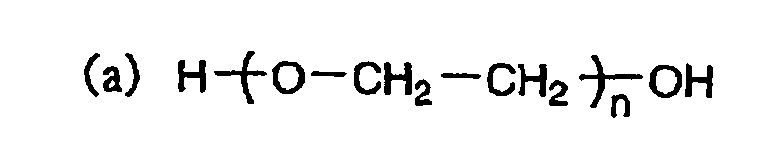
- the polymeric compound used in this invention may be polyethylene glycol (a), polyglycelol (b) or polyethyleneimine (c) represented by the following chemical formulas, preferably polyethylene glycol in the light of some factors such as effects of addition, availability and a price.
- n, x, and y independently represent an arbitrary integer.
- an electrolytic solution comprises a polymeric compound having an atom with an unpaired electron in the principal chain, resulting in improved affinity in an electrode layer/electrolytic solution interface. Therefore, an interface resistance in a solid/liquid interface can be reduced, charge transfer can be improved and thus electron transfer in the electrode layer/electrolytic solution interface can more smoothly proceed.
- an electrolytic solution comprises such a polymeric compound, a capacity, high-speed charge/discharge properties and cycle-life properties can be improved.
- an electrochemical cell which is operable such that as a charge carrier, protons are exclusively involved in a redox reaction associated with charge/discharge in both electrodes. More specifically, preferred is an electrochemical cell comprising an electrolytic solution containing a proton source, where a proton concentration in the electrolyte and an operating voltage are controlled to allow the cell to operate such that bonding/elimination of a proton in the electrode active material may be exclusively involved in electron transfer in a redox reaction in both electrodes associated with charge/discharge.
- the following reaction equation shows a reaction of indole trimer as one of proton-conducting compounds.
- the first step shows a doping reaction, where X - represents a dopant ion such as sulfonate and halide ions, which can dope a proton-conducting compound to endow the compound with electrochemical activity.
- the second step shows an electrochemical reaction (electrode reaction) involving bonding/elimination of a proton in a doped compound.
- bonding/elimination of a proton is exclusively involved in electron transfer in a redox reaction, so that only protons are transferred during charge/discharge.
- an electrode active material in this invention is a proton-conducting compound, which is an organic compound (including a polymer) capable of storing electrochemical energy by a reaction with ions of an electrolyte.
- Such a proton-conducting compound may be any of known compound conventionally used; for example, ⁇ -conjugated polymers such as polyaniline, polythiophene, polypyrrole, polyacetylene, poly-p-phenylene, polyphenylene-vinylene, polyperinaphthalene, polyfuran, polyflurane, polythienylene, polypyridinediyl, polyisothianaphthene, polyquinoxaline, polypyridine, polypyrimidine, polyindole, polyaminoanthraquinone, polyimidazole and their derivatives; indole ⁇ -conjugated compound such as an indole trimer compound; quinones such as benzoquinone, naphthoquinone and anthraquinone; quinone polymers such as polyanthraquinone, polynaphthoquinone and polybenzoquinone where a quinone oxygen can be converted into a
- a proton-conducting compound examples include ⁇ -conjugated compounds or polymers having a nitrogen atom, quinone compounds and quinone polymers.
- a proton source in the proton-source-containing (proton donating) electrolyte may be an inorganic or organic acid.
- an inorganic acid include sulfuric acid, nitric acid, hydrochloric acid, phosphoric acid, tetrafluoroboric acid, hexafluorophosphoric acid and hexafluorosilicic acid.
- an organic acid include saturated monocarboxylic acids, aliphatic carboxylic acids, oxycarboxylic acids, p-toluenesulfonic acid, polyvinylsulfonic acid and lauric acid.
- an aqueous acid-containing solution is preferable and an aqueous solution of sulfuric acid is more preferable.
- a proton concentration in an electrolytic solution containing a proton source is preferably 10 -3 mol/L or more, more preferably 10 -1 mol/L or more in the light of reactivity of the electrode materials while being preferably 18 mol/L or less, more preferably 7 mol/L or less in the light of prevention of deterioration in activity of the electrode materials and dissolution of the electrode materials.
- Examples of this invention will be more specifically described with reference to a secondary battery.
- the above basic configuration may be appropriately selected to be suitable as a capacitor.
- a positive electrode layer 1 was prepared by combining 72 wt% of 5-cyanoindole trimer represented by the following chemical formula as a cathode active material, 20 wt% of vapor-grown carbon as a conduction auxiliary and 8 wt% of polyvinylidene fluoride (average molecular weight: 1100) as a binder, stirring and mixing the mixture by a blender, and molding the mixture into a given size by a hot press.
- a negative electrode layer 2 was prepared by combining 75 wt% of polyphenylquinoxaline represented by the following chemical formula as an anode active material and 25 wt% of vapor-grown carbon as a conduction auxiliary, stirring and mixing the mixture by a blender and molding the mixture into a given size by a hot press.
- the positive and the negative electrode layers 1, 2 impregnated with an electrolytic solution were positioned such that they mutually faced via a separator 3.
- current collectors 4a, 4b were placed, respectively.
- the resulting laminate was sealed with a gasket 5 to provide an electrochemical cell shown in FIG. 1.
- the electrolytic solution used was prepared by adding 0.5 wt% of polyethylene glycol with an average molecular weight of 200 as an electron-transfer promoter to a 20 wt% aqueous solution of sulfuric acid.
- An electrochemical cell was prepared as described in Example 1, except that an electron-transfer promoter was not added to an electrolytic solution. Measurement results for its properties are shown in Table 1. The cycle-life number of the electrochemical cell was 5,000 cycles.
- Example 2 An electrochemical cell was prepared as described in Example 1, except that 0.5 wt% of polyethylene glycol with an average molecular weight of 4,000 was added as an electron-transfer promoter to an electrolytic solution. Measurement results for its properties are shown in Table 1. As seen from Table 1, the electrochemical cell in Example 2 exhibited improvement in a capacity and a cycle life by 7 % and 25 %, respectively, compared with Comparative Example 1.
- Example 3 An electrochemical cell was prepared as described in Example 1, except that 0.5 wt% of polyethylene glycol with an average molecular weight of 20,000 was added as an electron-transfer promoter to an electrolytic solution. Measurement results for its properties are shown in Table 1. As seen from Table 1, the electrochemical cell in Example 3 exhibited improvement in a capacity and a cycle life by 8 % and 20 %, respectively, compared with Comparative Example 1.
- Example 4 An electrochemical cell was prepared as described in Example 1, except that 0.1 wt% of polyethylene glycol with an average molecular weight of 4,000 was added as an electron-transfer promoter to an electrolytic solution. Measurement results for its properties are shown in Table 1. As seen from Table 1, the electrochemical cell in Example 4 exhibited improvement in a capacity and a cycle life by 13 % and 35 %, respectively, compared with Comparative Example 1.
- Example 5 An electrochemical cell was prepared as described in Example 1, except that 0.005 wt% of polyethylene glycol with an average molecular weight of 4,000 was added as an electron-transfer promoter to an electrolytic solution. Measurement results for its properties are shown in Table 1. As seen from Table 1, the electrochemical cell in Example 5 exhibited improvement in a capacity and a cycle life by 5 % and 2 %, respectively, compared with Comparative Example 1.
- Example 6 An electrochemical cell was prepared as described in Example 1, except that 35 wt% of polyethylene glycol with an average molecular weight of 4,000 was added as an electron-transfer promoter to an electrolytic solution. Measurement results for its properties are shown in Table 1. As seen from Table 1, the electrochemical cell in Example 6 exhibited improvement in a capacity and a cycle life by 1 % and 5 %, respectively, compared with Comparative Example 1.
- Example 7 An electrochemical cell was prepared as described in Example 1, except that 0.1 wt% of polyethylene glycol with an average molecular weight of 2,000,000 was added as an electron-transfer promoter to an electrolytic solution. Measurement results for its properties are shown in Table 1. As seen from Table 1, the electrochemical cell in Example 7 exhibited improvement in a capacity and a cycle life by 1 % and 1 %, respectively, compared with Comparative Example 1.
- Electron-transfer promoter Properties Compound Name Average molecular weight Content (wt%) Capacity Cycle life
- Example 1 Polyethylene glycol 200 0.5 107 123
- Example 2 Polyethylene glycol 4,000 0.5 107 125
- Example 3 Polyethylene glycol 20,000 0.5 108 120
- Example 4 Polyethylene glycol 4,000 0.1 113 135
- Example 5 Polyethylene glycol 4,000 0.005 105 102
- Example 6 Polyethylene glycol 4,000 35 101 105
- Example 7 Polyethylene glycol 2,000,000 0.1 101 101 Comparative Example 1 - - - 100 100
Landscapes
- Chemical & Material Sciences (AREA)
- Engineering & Computer Science (AREA)
- Chemical Kinetics & Catalysis (AREA)
- Electrochemistry (AREA)
- Power Engineering (AREA)
- General Chemical & Material Sciences (AREA)
- Microelectronics & Electronic Packaging (AREA)
- Manufacturing & Machinery (AREA)
- Physics & Mathematics (AREA)
- Condensed Matter Physics & Semiconductors (AREA)
- Dispersion Chemistry (AREA)
- General Physics & Mathematics (AREA)
- Inorganic Chemistry (AREA)
- Materials Engineering (AREA)
- Secondary Cells (AREA)
- Battery Electrode And Active Subsutance (AREA)
- Electric Double-Layer Capacitors Or The Like (AREA)
Abstract
Description


| Electron-transfer promoter | Properties | ||||
| Compound Name | Average molecular weight | Content (wt%) | Capacity | Cycle life | |
| Example 1 | Polyethylene glycol | 200 | 0.5 | 107 | 123 |
| Example 2 | Polyethylene glycol | 4,000 | 0.5 | 107 | 125 |
| Example 3 | Polyethylene glycol | 20,000 | 0.5 | 108 | 120 |
| Example 4 | Polyethylene glycol | 4,000 | 0.1 | 113 | 135 |
| Example 5 | Polyethylene glycol | 4,000 | 0.005 | 105 | 102 |
| Example 6 | Polyethylene glycol | 4,000 | 35 | 101 | 105 |
| Example 7 | Polyethylene glycol | 2,000,000 | 0.1 | 101 | 101 |
| Comparative Example 1 | - | - | - | 100 | 100 |
Claims (7)
- An electrochemical cell comprising a cathode containing a proton-conducting compound as an electrode active material, an anode containing a proton-conducting compound as an electrode active material and an aqueous electrolytic solution containing a proton source as an electrolyte, wherein the electrolytic solution comprises a polymeric compound having an atom with an unpaired electron in its principal chain as an electron-transfer promoter.
- The electrochemical cell as claimed in Claim 1 wherein the electron-transfer promoter is a polymeric compound which in the principal chain, has oxygen or nitrogen as an atom with an unpaired electron.
- The electrochemical cell as claimed in Claim 1 wherein the electron-transfer promoter is a polymeric compound having an alkylene oxide moiety in a repeating unit.
- The electrochemical cell as claimed in Claim 1 wherein the electron-transfer promoter is selected from the group consisting of polyethylene glycol, polyglycelol and polyethyleneimine.
- The electrochemical cell as claimed in any one of Claims 1 to 4 wherein the polymeric compound has an average molecular weight of 200 to 20,000.
- The electrochemical cell as claimed in any one of Claims 1 to 5 wherein a content of the polymeric compound is 0.01 to 30 wt% to the electrolytic solution.
- The electrochemical cell as claimed in any one of Claims 1 to 6 operable such that as a charge carrier, protons are exclusively involved in a redox reaction of the active materials associated with charge/discharge in both electrodes.
Applications Claiming Priority (2)
| Application Number | Priority Date | Filing Date | Title |
|---|---|---|---|
| JP2003117179 | 2003-04-22 | ||
| JP2003117179 | 2003-04-22 |
Publications (2)
| Publication Number | Publication Date |
|---|---|
| EP1471592A2 true EP1471592A2 (en) | 2004-10-27 |
| EP1471592A3 EP1471592A3 (en) | 2009-07-29 |
Family
ID=32959607
Family Applications (1)
| Application Number | Title | Priority Date | Filing Date |
|---|---|---|---|
| EP04252182A Withdrawn EP1471592A3 (en) | 2003-04-22 | 2004-04-14 | Electrochemical cell with polymeric electrolyte |
Country Status (5)
| Country | Link |
|---|---|
| US (1) | US20040214078A1 (en) |
| EP (1) | EP1471592A3 (en) |
| KR (1) | KR100540701B1 (en) |
| CN (1) | CN100336262C (en) |
| TW (1) | TWI246222B (en) |
Cited By (1)
| Publication number | Priority date | Publication date | Assignee | Title |
|---|---|---|---|---|
| EP2172953A1 (en) * | 2006-02-21 | 2010-04-07 | Shin-Etsu Polymer Co., Ltd. | Capacitor |
Families Citing this family (8)
| Publication number | Priority date | Publication date | Assignee | Title |
|---|---|---|---|---|
| WO2014164150A1 (en) * | 2013-03-11 | 2014-10-09 | Fluidic, Inc. | Integrable redox-active polymer batteries |
| WO2015106132A1 (en) | 2014-01-10 | 2015-07-16 | Arizona Board Of Regents On Behalf Of Arizona State University | Redox active polymer devices and methods of using and manufacturing the same |
| WO2015175553A1 (en) | 2014-05-13 | 2015-11-19 | Arizona Board Of Regents On Behalf Of Arizona State University | Electrochemical energy storage devices comprising self-compensating polymers |
| WO2015175556A1 (en) | 2014-05-13 | 2015-11-19 | Arizona Board Of Regents On Behalf Of Arizona State University | Redox active polymer devices and methods of using and manufacturing the same |
| US10269504B2 (en) * | 2014-07-10 | 2019-04-23 | The United States Of America As Represented By The Secretary Of The Army | Supercapacitor having holes formed in carbonaceous electrodes for increasing the frequency of operation |
| KR102635455B1 (en) | 2016-05-20 | 2024-02-13 | 교세라 에이브이엑스 컴포넌츠 코포레이션 | Ultracapacitor for use at high temperatures |
| US11830672B2 (en) | 2016-11-23 | 2023-11-28 | KYOCERA AVX Components Corporation | Ultracapacitor for use in a solder reflow process |
| CN110690060B (en) * | 2019-09-29 | 2020-11-20 | 北京科技大学 | An electrolyte for improving the working voltage of water-based electrochemical capacitors |
Family Cites Families (13)
| Publication number | Priority date | Publication date | Assignee | Title |
|---|---|---|---|---|
| US3776779A (en) * | 1972-04-28 | 1973-12-04 | Elpower Corp | Gelled battery electrolyte containing a polyglycol polymer and a process for locating same within a lead-acid cell |
| FR2485274A1 (en) * | 1980-03-31 | 1981-12-24 | France Etat | SOLID ELECTROLYTE BASED ON ION-CONDUCTION MACROMOLECULAR MATERIAL |
| JP2817923B2 (en) * | 1987-10-30 | 1998-10-30 | デヴァーズ・エムエス・カンパニー | Solid state battery |
| US4830939B1 (en) * | 1987-10-30 | 1996-10-08 | Mhb Joint Venture | Radiation cured solid electrolytes and electrochemical devices employing the same |
| JP3306630B2 (en) * | 1991-11-28 | 2002-07-24 | 富山薬品工業株式会社 | Electrolyte for driving aluminum electrolytic capacitors |
| AU1053995A (en) * | 1993-11-10 | 1995-05-29 | Valence Technology, Inc. | Capped compounds for solid polymeric electrolytes |
| WO1998037589A1 (en) * | 1997-02-21 | 1998-08-27 | Motorola Inc. | Polymeric electrolyte and electrochemical cell using same |
| JP2943792B1 (en) * | 1998-04-03 | 1999-08-30 | 日本電気株式会社 | Proton conductive polymer battery and method for producing the same |
| JP2000149981A (en) * | 1998-11-02 | 2000-05-30 | Jec Service Kk | Lead-acid battery, and additive therefor |
| JP2002015742A (en) * | 2000-06-30 | 2002-01-18 | Toshiba Corp | Fuel cell and proton conductive member for fuel cell |
| KR100429115B1 (en) * | 2000-09-29 | 2004-04-29 | 가부시끼가이샤 도시바 | Batteries with Anode Comprising Aluminum |
| JP3594895B2 (en) * | 2000-11-02 | 2004-12-02 | Necトーキン株式会社 | Proton conductive polymer secondary battery |
| JP4004769B2 (en) * | 2001-10-17 | 2007-11-07 | Necトーキン株式会社 | Electrolytic solution and electrochemical cell using the same |
-
2004
- 2004-04-10 KR KR1020040024688A patent/KR100540701B1/en not_active Expired - Fee Related
- 2004-04-14 EP EP04252182A patent/EP1471592A3/en not_active Withdrawn
- 2004-04-14 TW TW093110343A patent/TWI246222B/en not_active IP Right Cessation
- 2004-04-19 US US10/827,179 patent/US20040214078A1/en not_active Abandoned
- 2004-04-22 CN CNB2004100353211A patent/CN100336262C/en not_active Expired - Fee Related
Cited By (2)
| Publication number | Priority date | Publication date | Assignee | Title |
|---|---|---|---|---|
| EP2172953A1 (en) * | 2006-02-21 | 2010-04-07 | Shin-Etsu Polymer Co., Ltd. | Capacitor |
| US8339770B2 (en) | 2006-02-21 | 2012-12-25 | Shin-Etsu Polymer Co., Ltd. | Capacitor and method for producing thereof |
Also Published As
| Publication number | Publication date |
|---|---|
| US20040214078A1 (en) | 2004-10-28 |
| CN100336262C (en) | 2007-09-05 |
| KR20040093397A (en) | 2004-11-05 |
| TWI246222B (en) | 2005-12-21 |
| TW200505094A (en) | 2005-02-01 |
| KR100540701B1 (en) | 2006-01-11 |
| EP1471592A3 (en) | 2009-07-29 |
| CN1610165A (en) | 2005-04-27 |
Similar Documents
| Publication | Publication Date | Title |
|---|---|---|
| EP1309028B1 (en) | Electrolytic solution and electrochemical cell using the same | |
| US6509116B1 (en) | Secondary battery and capacitor using indole polymeric compound | |
| US7169509B2 (en) | Electrode and electrochemical cell therewith | |
| EP1478036A2 (en) | Electrochemical cell stack | |
| EP0579921B1 (en) | An ionic conductive polymer electrolyte | |
| JP3708426B2 (en) | Proton conducting polymer secondary battery | |
| EP1471592A2 (en) | Electrochemical cell with polymeric electrolyte | |
| KR100586823B1 (en) | Electrode for Electrochemical Cell and Electrochemical Cell therewith | |
| US7309544B2 (en) | Cell electrode and electrochemical cell therewith | |
| US20080286645A1 (en) | Electrochmical cell electrode and electrochemical cell | |
| EP0911894B1 (en) | Polymer secondary batteries | |
| US20080226985A1 (en) | Electrochemical cell | |
| JP2005100926A (en) | Electrochemical cell laminate | |
| JP4073025B2 (en) | Electrochemical cell | |
| JP2004342595A (en) | Electrode for electrochemical cell, and electrochemical cell using it | |
| HK1053850B (en) | Electrolytic solution and electrochemical cell using the same |
Legal Events
| Date | Code | Title | Description |
|---|---|---|---|
| PUAI | Public reference made under article 153(3) epc to a published international application that has entered the european phase |
Free format text: ORIGINAL CODE: 0009012 |
|
| AK | Designated contracting states |
Kind code of ref document: A2 Designated state(s): AT BE BG CH CY CZ DE DK EE ES FI FR GB GR HU IE IT LI LU MC NL PL PT RO SE SI SK TR |
|
| AX | Request for extension of the european patent |
Extension state: AL HR LT LV MK |
|
| PUAL | Search report despatched |
Free format text: ORIGINAL CODE: 0009013 |
|
| AK | Designated contracting states |
Kind code of ref document: A3 Designated state(s): AT BE BG CH CY CZ DE DK EE ES FI FR GB GR HU IE IT LI LU MC NL PL PT RO SE SI SK TR |
|
| AX | Request for extension of the european patent |
Extension state: AL HR LT LV MK |
|
| AKX | Designation fees paid | ||
| REG | Reference to a national code |
Ref country code: DE Ref legal event code: 8566 |
|
| STAA | Information on the status of an ep patent application or granted ep patent |
Free format text: STATUS: THE APPLICATION IS DEEMED TO BE WITHDRAWN |
|
| 18D | Application deemed to be withdrawn |
Effective date: 20100130 |