FIELD OF THE INVENTION
The present invention relates to an intermediate compounds useful for
the total synthesis of ecteinascidin 743 (hereinafter shortened to Et 743)
having high antineoplastic activity, the analogous structural compounds to
Et 743 and the method for synthesis of Et 743.
BACK GROUND OF THE INVENTION
Ecteinascidins is a group of marine alkaloid having antineoplasticity
which is isolated from the extracted products from marine tunicate habitat
of Caribbean sea by very small amount. Among the ecteinascidins, since Et
743 has a very strong antineoplastic activity, the investigation to put it into
practical use as a carcinostatic agent is limited, and the phase II clinical
tests are now carried out in ten several countries in Europe and America. It
is known that Et 743 has an effect to depress the proliferation of cancer cells
by 10 to 100 times more potent than(IC50=0.1-1nM) Toxol, Camptotesin,
Adriamycin or Mitomycin which are currently used carcinostatic agent.
From the back ground mentioned above, various investigations for
synthesis were carried out, however, the complete synthesis was only
reported by Prof. E.J. Corey of Harvard University in U.S.A. (J. Am. Chem.
Soc. 1996, 118, 9202-9203, reference document A).
In the process of synthesis of the total synthesis disclosed in Document
A (refer to page 9202), the feature of process is existing in the point that Et
743 is synthesized from the analogous compound to the compound
represented by general formula 1 of the present invention via intermediates
4 and 8. That is, according to said process, C4 site of ring B (regarding
indication of ring, and the sites of atoms composing 6-members ring, refer to
general formula 1) which composes 6-members ring is formed from the
intermediate 4 at the first step. And, since to the atom C4 composing B ring
of 6-membered ring H which lacks reactivity is bonded, it becomes necessary
to oxidation reaction to C4 site on B ring. This oxidation reaction is not
effective and is carried out by harsh condition, therefore, the production by
industrial scale is difficult and also the yield is not good. Further, since atom
N12 site of the synthesized intermediate is substituted by alkyl group which
lacks reactivity, in this case substituted by methyl group, it is not suited to
the synthesis for various compounds. Although the total synthesis was
reported, the supplying source of Et 743 is still depending on the natural
sample whose supplying amount is very sacacity, therefore, the
establishment of the method for a large scale production of Et 743 is desired
by accomplishing an effective synthesizing process.
Since, Et 743 is known as a medicine having high antineoplasticity,
and phthalascidin induced from the intermediate product at the synthesis of
Et 743 displays same activity to Et 743, the establishment of the effective
and mild method for synthesis of Et 743 and analogous compound thereof is
strongly desired.
Therefore, the subject of the present invention is basically to
accomplish the effective method for total synthesis of Et 743, further, to
provide not only Et 743 but also analogous compounds.
To dissolve the subject , the present invention tried the rstrosynthetic
analysis promises easy synthesis. And it will be possible to form B ring by
ring forming reaction at ortho position of phenol which composes A ring to
inner molecular aldehyde in a generated compound by 4-8 reaction. Further,
the inventors of the present invention considered that the generated
compound by 4-8 reaction will be possible to synthesize based on the
polycondensation reaction of general formula 4, and general formula 5 via a
compound of general formula 3, the total synthesis of Et 743, which is the
aimed compound, by way of the compounds represented by general formulae
5, 4, 3, 2 and 1 and the specific structure of general formulae 1 and 2. And
confirmation of the synthetic rout enable for providing the analogous
compound of Et 743.
DISCLOSURE OF THE INVENTION
The first one of the present invention is an intermediate compound for
total synthesis of ecteinascidins comprising, a compound represented by
general formula 1 having thioether group at C
4 site, and the substituent R
2
of N
12 site is trichloroethoxicarbonyl to which various substituents can be
introduced by mild condition, further having 10 members ring structure
which can be converted to a ring of other numbered members,
wherein, Y is O or NH, X
2, X
3 and X
4 are independently selected from the
group consisting of H or alkyl group of carbon number 4 or less, alkoxyalkyl
group, allyl group, or alkyl or arylsulfonyl group, R
1 and R
4 is H or alkyl
group of carbon number 4 or less, R
2 is alkoxycarbonyl group which can be
substituted by halogen, lower alkyl sulfonyl or aryl sulfonyl group and R
3 is
nitrile or OH.
The second one of the present invention is a method for synthesis of
the compound of general formula 1 having the processes displayed by the
reaction 5-1 which is transforming reaction of C
18 hydroxyl group to allyl
ether and C
22 acetyl group to hydroxyl group, the reaction 5-2 which is
introducing reaction of cysteine derivatives into C
22 acetyl group and the
reaction 5-3 which is C
4 thioetherification reaction and transforming
reaction of C
5 hydroxyl group to acetyl group, wherein Y is O, X
2 is Ac, X
3 is
H, R
1 is Me, R
2 is Troc, R
3 is CN, and X
4 and R
4 are same as to general
formula 1.
The third one of the present invention is an intermediate compound for
total synthesis of ecteinascidins having pentacyclic backbone of
ecteinascidins , a compound represented by general formula 2 having OH
group at C
4 and the substituent R
2 of N
12 is trichloroethoxicarbonyl (Troc) to
which various substituents can be introduced by mild condition,
wherein, Y is oxygen or NH, X
1 is hydroxyl group or protecting group of
amino group, X
2, X
3 and X
4 are independently selected from the group
consisting of H or alkyl group of carbon number 4 or less, alkoxyalkyl group,
allyl group, or alkyl or arylsulfonyl group, R
1 and R
4 are H or alkyl group of
carbon number 4 or less, R
2 is alkoxycarbonyl group which can be
substituted by halogen, lower alkyl sulfonyl or aryl sulfonyl group, and R
3 is
nitrile or OH,
Desirably, the third one of the present invention is the intermediate
compound for total synthesis of ecteinascidins represented by general
formula 2, wherein, Y is O, X1 is selected from silyl groups consisting of acyl
group of carbon number 4 or less, TBDPS, TIPS, TBS, TES and TMS, X2 and
X3 are allyloxy group, or alkoxy group of carbon number 4 or less or
alkoxyalkoxy group, R3 is CN and R4 is alkyl group of carbon number 4 or
less.
The fourth one of the present invention is a method for synthesis of the
compound of general formula 2 consisting of the processes displayed by the
reaction 4-1 which transforms C
5 mesily group to acetyl group, the reaction
4-2 which is the transforming reaction of N
12 t-butoxycarbonyl group to
trichloroethyl group, the reaction of 4-3 which is hydration reaction of C
3-4
double bond, the reaction 4-4 which is the transforming reaction of C
4
hydroxyl group to TBS group and transforming reaction of C
22 and C
5
acetyl group to hydroxyl group, the reaction 4-5 which is transforming
reaction of C
5 hydroxyl group to benzyl group, reaction 4-6 which is
reduction reaction of C
21 amide and ring closing reaction of oxazolidine, the
reaction 4-7 which is ring opening reaction of oxazolidine and transforming
reaction of C
22 hydroxyl group to acetyl group, the reaction 4-8 which is
oxidation reaction of C
2 hydroxyl group to aldehyde and the reaction 4-9
which is transforming reaction of C
5, C
18 benzyloxy groups to hydroxyl group
and ring forming reaction of B ring, wherein Y is O, X
2 is H, X
3 is H, R
3 is
CN, X
1 is Ac, X
4, R
1 and R
4 are same to the general formula 2.
The fifth one of the present invention is an intermediate compound for
the compound of general formula 2 represented by general formula 3
comprising the carbon locating at C
10 site at pentacyclic backbone of
ecteinascidins of general formula 2 is bonded with H.
In general formula 3, R
1, R
2 and R
4, X
1-X
4 are same as to these of general
formula 2.
Desirably, the fifth one of the present invention is the intermediate
compound for the compound represented by general formula 3, wherein Y is
O, X1 is selected from silyl groups consisting of acyl group of carbon number
4 or less, TBDPS, TIPS, TBS, TES and TMS, X2 and X3 are allyloxy group,
or alkoxy group of carbon number 4 or less or alkoxyalkoxy group, R3 is CN
and R4 is alkyl group of carbon number 4 or less.
The sixth one of the present invention is the method for synthesis of
the compound of general formula 3 consisting of the processes displayed by
the reaction 3-1 which is the Ugi's 4 components condensation reaction, the
reaction 3-2 which is the transforming reaction of C
22TBTPS group to acetyl
group, the reaction 3-3 which is C ring forming reation, the reaction 3-4
which is transforming reaction of C
5 hydroxyl group to mesyl group, the
reaction 3-5 which is reduction of C
11 amide and dehydration reaction of C
3-4
double bond and reaction 3-6 which is the construction of D ring by Heck
reaction, wherein Y is O, X
1 is Ac, X
2 is Ms and R
2 is Boc, X
3, X
4, R
1 and R
4
are same as to the general formula 2.
The seventh one of the present invention is the amine compound which
provide a segment to form a chemical structural site of A ring side of the
intermediate compound of general formula 3 represented by general formula
4 by Ugi reaction.
In general formula 4, R
4, X
2, Y and X
1 is same as to these of general formula
2.
Desirably, the seventh one of the present invention is the amine
compound, wherein Y is O, X1 is selected from the group of silyl groups
consisting of acyl group of carbon number 4 or less, TBDPS, TIPS, TBS,
TES and TMS.
The eighth one of the present invention is a method for synthesis of the
compound of general formula 4 consisting of the processes displayed by the
reaction 2-1 which is the transforming reaction from C
5 hydroxyl group to
methoxymethyl group, reaction 2-2 which is the introducing reaction of
hydroxyl group to C
22, reaction 2-3 which is the Mannich reaction, reaction
2-4 which is the transforming reaction of C
6 hydroxyl group to
trifloromethanesulfonyl group (Tf), reaction 2-5 which is the reducing
reaction of lactone, reaction 2-6 which is the transforming reaction of C
22
hydroxyl to TBDPS group, reaction 2-7 which is the methylation reaction of
C
6 Tfo group and reaction 2-8 which is the transforming reaction to amine,
wherein Y=O, X
1 is TBOPS, X
2 is MOM and R
4 is Me.
The ninth one of the present invention is the carboxylic acid compound
which provides a segment forming a chemical structural site of E ring side
of the intermediate compound of general formula 3 represented by general
formula 5 by Ugi reaction.
In general formula 5, R
1, R
2, X
3 and X
4 are same as to those of general
formula 1.
Desirably, the ninth one of the present invention is the carboxylic acid
compound wherein, X3 and X4 are independently selected from the group
consisting of H or alkyl group of carbon number 4 or less, alkoxyalkyl group,
allyl group, allyl group, alkyl or arylsulfonyl group, R2 is alkoxycarbonyl
group, lower alkylsulfonyl or arylsulfonyl group which can be substituted by
halogen.
The tenth one of the present invention, is the method for synthesis of
the compound of general formula 5 consisting of the processes displayed by
the reaction 1-1 which is the introducing reaction of formyl group to C
20, the
reaction 1-2 which is the transforming reaction of C
20 formyl group to
dimethylacetal, the reaction 1-3 which is the iodination reaction of C
19 and
acidic hydrolysis reaction, the reaction 1-4 which is the transforming
reaction of C
18 hydroxyl group to benzyl group, the reaction 1-5 which is
Honor-Emons reaction, reaction 1-6 which is the asymmetric reducing
reaction by Duphos-Rh synthetic catalyst and reaction 1-7 which is the
hydrolysis reaction of methylester, wherein R
2 is Boc, X
3 is Bn, X
4 is Me,
ring and R
1 is same as to it of general formula 2.
The present invention will be illustrated more in detail according to
the following description.
EXAMPLE
The present invention will be illustrated more in detail according to
the specified Examples, however, these Examples are aiming easily
understanding of the present invention and not intending to limit the scope
of the claim of the present invention.
Example 1
The synthesis of compound 2-8, wherein Y contained in general
formula 4 is O, X1 contained in general formula 4 is TBDPS, X2 contained in
general formula 4 is MOM and R4 contained in general formula 4 is Me.
The reaction process and the whole chemical formula of the generated
compounds in each reaction process are shown by following synthesis
process A.
Synthesis Process A;
Detail of synthetic process A;
(1) Synthesis of compound 2-1
NaH (40g, 1.0mol) was dispersed in 700ml of the mixed solution of THF and
DMF (5:2), THF solution (300ml) of 3,4-methylenedioxyphenol (138g,
1.0mol) was dropped at 0°C. After stirred at room temperature for 30
minutes, MOMCl (84.5g, 1.05mol) was dropped and stirred at room
temperature for 1 hour. Hexane and water were added to the reaction
solution and the organic layer was separated. After the water layer was
extracted by hexane, the organic layer was concentrated by vacuum. The
residue was dissolved in hexane, washed by brine, then dried by Na2SO4.
After concentrated by vacuum, the residue was distilled by vacuum (103°C
/0.35mmHg), and the compound 2-1 (177g, 0.97mol, 97%) was obtained as a
colorless oil. The physical property of compound 2-1 is shown in Table 1.
[Table 1]
Compound 2-1
IR (neat film) 1244, 1215, 1176, 1153, 1099, 1069, 1040, 1004, 940, 922, 842,
813 cm-1; 1H NMR (400 MHz, CDCl3) δ 6.71 (d, J=8.4Hz, 1H) 6.63 (s, 1H),
6.49 (d, J=8.4Hz, 1H), 5.90 (s, 2H), 5.08 (s, 2H), 3.46 (s, 3H); 13C NMR
( 100MHz, CDCl3), δ 152.5, 148.1, 142.5, 108.4, 108.0, 101.2, 99.7, 95.4,
55.8.
Synthesis of compound 2-2
After n-BuLi (3.02mol n-hexane solution, 11.0ml, 33.2mmol) was
dropped in THF (100ml) solution of compound 2-1 (5.44g, 29.9mmol) at 0°C,
the temperature was elevated to room temperature. The reaction solution
was cooled down to 0°C, B(OOMe)3 (4.10ml, 36.1mmol) was added, then
AcOH(3.4ml, 59mmol) and aqueous solution of 7%H2O2(26ml, 60mmol) were
added. The reaction solution was stirred for 4.5 hours at room temperature,
saturated aqueous solution of (NH4)2SO4 (100ml) and saturated aqueous
solution of Na2SO3 (100ml) were added, and an organic layer was dried with
MgSO4 then concentrated by vacuum. The residue was purified by silica gel
chromatography (70% EtOAc in n-haxane), and the compound 2-2 (5.42g
27.3mmol) was obtained as a colorless oil. The. physical property of
compound 2-2 is shown in Table 2.
[Table 2]
Compound 2-2
IR (neat film) 3439, 1652, 1493, 1292, 1245, 1157, 1044, 932, 791cm-1; 1H
NMR ( 400 MHz, CDCl3) δ 6.55 (d, J=8.4Hz, 1H), 6.45 (br, 1H), 6.32 (d,
J=8.4Hz, 1H), 5.94 (s, 2H), 5.09 (s, 2H), 3.50 (s, 3H); 13C NMR (100 MHz,
CDCl3) δ 144.3, 141.3, 134.4, 132.0, 109.2, 101.6, 99.1, 97.3, 60.4, 56.3
Synthesis of compound 2-3
As the method for synthesis of agent lactone (agent- 1) which is added in the
reaction 2-3, document, for example, ["Synthesis of Optically Active
Arylglycines; Stereoselective Mannich Reaction of Phenols with a New
Chiral template," S.Tohma, A. Endo, T. Kan, T. Fukuyama, Synlett,
1479-1499 (2001).] can be mentioned.
In CH2Cl2 (200ml) solution of the compound 2-2 (19.8g, 100mmol) and
agent-1 (20.3g, 100mmol), TFA (38ml, 0.49mol, 5equiv) was dropped by 1.5
hours at -10°C. After the reaction solution was stirred for 40minutes at
room temperature, Na2CO3 (40g, 0.38mol, 3.8equivalent) and H2O (200ml)
were added and extracted by CH2Cl2. The water layer was extracted by
CH2Cl2, then the organic layer was washed by brine, dried by Na2SO4 and
concentrated by CH2Cl2. The residue was purified by silica gel
chromatography (30% EtOAc in n-haxane), and the compound 2-3 (35.6g
89mmol, 89%) was obtained a colorless oil. The physical property of
compound 2-3 is shown in Table 3.
[Table 3]
Compound 2-3
[α]D 27 -75.2 ° ( c = 1.65, CHCl3) ; IR (neat film) 3327, 1724, 1506, 1457,
1299, 1151, 1118, 1082, 1049, 1101, 934 cm-1; 1H NMR (400 MHz, CDCl3) δ
7.29-7.37 (m, 5H), 6.51 (s, 1H) 5.93 (s, 1h), 5.91 (d, J=8.0 Hz, 1H), 5.05 (d,
J=8.0 Hz, 1H), 5.03 (s, 1H) 4.15 (s; 1H), 3.51 (s, 3H), 2.03 (br, 1H), 1.37 (s,
6H); 13C NMR (100 MHz, CDCl3) δ 169.0, 141.8, 141.4, 138.2, 134.8, 132.4,
128.4, 128.3, 128.3, 111.6, 110.0, 101.9, 86.7, 61.0, 57.1, 56.4, 26.6, 22.0 ;
Synthesis of compound 2-4
To the solution of the compound 2-3 (242mg, 0.603mmol) and pyridine
(0.15ml, 1.9mmol), Tf2O (0.13ml, 0.77mmol, 1.3 equivalent) was dropped at
0°C. After the reacted product was stirred for 5 minutes, the aqueous
solution of saturated NaHCO3 was added and extracted by EtOAc. The
organic layer was washed by the aqueous solution of 1N HCl and the
saturated aqueous solution of NaHCO3, then dried by MgSO4 and
concentrated by vacuum. The residue was purified by silica gel
chromatography (in 50% EtOAc n-hexane), and the compound 2-4 (290mg,
0.544mmol, 90%) was obtained as a colorless oil. The physical properties of
the compound 2-4 are shown in Table 4.
[Table 4]
Compound 2-4
[α]D 26-32.1 ° (c =2.59, CHCl3) ; IR (neat film) 3333, 1733, 1496, 1462, 1427,
1299, 1216, 1138, 1056, 999, 979, 936, 832 cm-1; 1H NMR ( 400 MHz, CDCl3)
δ 7.32-7.40 (m, 5H), 6.71 (s, 1H) 6.06 (s; 1H), 6.03 (s, 1H), 5.19 (d, J=5.8Hz,
1H), 5.14 ( d, J=5.8Hz, 1H), 5.09 (s, 1H) 4.23 (s, 1H), 3.49 (s, 3H), 2.01 (br,
1H), 1.40 (s, 6H); 13C NMR ( 100 MHz, CDCl3) δ 167.8, 144.9, 141.2, 140.2,
137.8, 128.3, 128.2, 128.1, 123.1, 120.2, 116.7, 108.0, 103.1, 95.9, 86.7, 61.3,
56.9, 56.3, 26.4, 21.8
Synthesis of compound 2-5
To the MeOH (50ml) solution of the compound 2-4 (4.70g, 8.8mmol), NaBH4
was added at 0°C and stirred for 30 minutes. To the reaction solution,
EtOAc (300ml) was added and washed by 1N HCl (100ml). The organic layer
was washed by saturated aqueous solution of NaHCO3, and after dried by
MgSO4, concentrated by vacuum. The residue was purified by silica gel
chromatography (in 60% EtOAc n-hexane), and the compound 2-5 (4.04g,
7.5mmol, 85%) was obtained as a colorless oil. The physical properties of the
compound 2-5 are shown in Table 5.
[Table 5]
Compound 2-5
[α]D 27 -102 °(c =1.67, CHCl3) ; IR (neat film) 3398, 1497, 1456, 1426, 1218,
1136, 1054, 937, 833 cm-1; 1H NMR (400 MHz, CDCl3) δ 7.25-7.33 (m, 5H),
6.63 (s, 1H) 5.94 (s, 1H), 5.93 (s, 1H), 5.11 (d, J=6.8Hz, 1H), 5.07 (d, J=6.8Hz,
1H), 3.65 (br, 1H), 3.52-3.64 (br, 2H), 3.50 (s, 3H), 3.39 (s, 1H), 2.71 (br, 1H),
1.11(s, 6H) ; 13C NMR ( 100 MHz, CDCl3) δ 144.8, 141.6, 139.9, 139.2, 128.7,
128.1, 127.5, 122.4, 120.9, 120.1, 116.9, 107.1, 102.9, 95.6, 72.7, 68.9, 64.9,
56.9, 56.3, 27.9, 23.8;
Synthesis of compound 2-6
To DMF solution of the compound 2-5 (1.00g, 1.86mmol) and imidazole
(0.63g, 9.3mmol), TBDPSCI (1.22ml, 4.7mmol) was added and stirred at
room temperature. To the reacted product, Et2O and water were added and
the organic layer was washed by brine, dried by Na2SO4 and concentrated
by vacuum. The residue was purified by silica gel chromatography (in 10%
EtOAc n-hexane), and the compound 2-6 (1.31g, 1.69mmol, 91%) was
obtained as a colorless oil. The physical properties of the compound 2-6 are
shown in Table 6.
[Table 6]
Compound 2-6
[α]D 27 -75.2 °(c =1.65, CHCl3) ; IR (neat film) 3445, 1469, 1428, 1363, 1263,
1109, 1062, 991, 944, 826cm-1; 1H NMR (400 MHz, CDCl3) δ 7.61 ( d, J=8.0
Hz, 2H), 7.56 (d, J=8.0 Hz, 2H), 7.23-7.42 (m, 11H), 6.62 (s, 1H), 5.83 (s, 2H),
5.10 (d, J=6.8Hz, 1H), 5.08 (d, J=6.8Hz, 1H), 3.77 (dd, J=6.0, 6.8Hz, 1H),
3.67 (m, 2H), 3.47 (s, 3H), 3.37 (s, 1H), 3.34 (br, 1H), 1.909 (s, 6H), 1.08 (s,
9H); 13C NMR (100 MHz, CDCl3) δ 144.7, 141.8, 139.8, 139.5, 135.6, 132.9,
129.7, 128.5, 128.1, 127.7, 127.6, 127.4, 122.5, 121.0, 120.1, 116.9, 107.7,
102.7, 95.8, 72.2, 68.6, 66.4, 56.8, 56.3, 27.4, 26.8, 24.2, 19.2;
Synthesis of compound 2- 7
To the THF (105ml) solution of the compound 2-6 (16.7g, 21.5mmol),
MeZnCl (2.0M in THF solution, 37.5ml, 75.1mmol) was added at 0°C. After
the temperature of the reaction solution was elevated to room temperature,
PdCl2 (dppf) (314mg, 0.43mmol) was added and refluxed by heating for 13.5
hours. EtOAc was added to the reaction solution, then washed by 1N HCl
aqueous solution, saturated aqueous solution of NaHCO3 and brine. The
organic layer was dried by Na2SO4 and concentrated by vacuum. The
residue was purified by silica gel chromatography (in 10% EtOAc n-hexane),
and the compound 2-7 (13.4g, 20.9mmol, 97%) was obtained as a white solid.
The physical properties of the compound 2-7 are shown in Table 7.
[Table 7]
Compound 2-7
[α]D 26-99.3° (c=0.81, CHCl3); IR (neat film) 3457, 2931, 1494, 1457, 1427,
1362, 1216, 1139, 1110, 1056, 1006, 936, 828cm-1; 1H NMR (400 MHz, CDCl3
δ 7.63 (d, J=6.8Hz, 2H), 7.56, (d, J=6.8Hz, 2H), 7.22-7.47 (m, 11H), 6.30 (s,
1H), 5.77 (s, 2H), 5.03 (d, J=5.6Hz, 1H), 5.01 (d, J=5.6Hz, 1H), 3.83 (dd,
J=10.8, 10.8, 1H), 3.61-3.66 (m, 2H), 3.44 (s, 3H), 3.38 (s, 1H), 2.08 (s, 3H),
1.09 (s, 9H), 1.06 (s, 6H); 13C NMR (100 MHz, CDCl3) δ 150.8, 146.6, 140.0,
139.7, 135.6, 135.6, 133.2, 133.1, 130.9, 130.4, 130.0, 129.7, 129.6, 128.5,
128.4, 128.0, 127.7, 127.6, 127.2, 117.7, 109.6, 107.0, 100.8, 95.6, 72.1, 68.5,
66.6, 57.7, 56.0, 27.3, 26.8, 24.0, 19.2, 8.8
Synthesis of compound 2-8
To the CH3CN (12ml) solution of the compound 2-7 (640mg, 1.0mmol),
Pb(OAc)4 (0.56g, 1.26mmol) was added slowly at 0°C. To the reaction
solution, saturated aqueous solution of NaHCO3 was added and extracted by
EtOAc. The organic layer was washed by brine, dried by Na2SO4,
concentrated by vacuum and crude product was obtained. The obtained
crude product was dissolved in EtOH (10ml), then hydrochloric acid salt of
hydroxyl amine (347mg, 5.6mmol) and sodium acetate (410mg, 5.0mmol)
were added at room temperature and stirred for 1.5hours. EtOAc was added
to the reaction solution, then filtrated by celite and concentrated by vacuum.
The residue was dissolved with EtOAc and washed by 1N HCl aqueous
solution, saturated aqueous solution of NaHCO3 and brine. After the organic
layer was dried by Na2SO4, concentrated by vacuum. The residue was
purified by silica gel chromatography (EtOAc), and the compound 2-8
(436mg, 0.88mmol, 89%) was obtained. The physical properties of the
compound 2-8 are shown in Table 8.
[Table 8]
Compound 2-8
[α]D 23-1.99° (c=1.30, CHCl3); IR (neat film) 1440, 1115, 1062, 991, 938,
826cm-1; 1H NMR (400 MHz, CDCl3) δ 7.61-7.65 (m, 4H), 7.35-7.45 (m, 6H),
6.57 (s, 1H), 5.81 (s, 2H), 5.09 (s, 2H), 4.16 (dd, J=6.8, 4.8Hz, 1H), 3.87 (dd,
J=10.0, 4.8Hz, 1H), 3.76 (dd, J=10.0, 6.8Hz, 1H), 3.48 (s, 3H), 2.14 (s, 3H),
1.08 (s, 9H); 13C NMR (100 MHz, CDCl3) δ 150.8, 146.1, 139.1, 135.5, 135.5,
133.4, 133.3, 129.5, 129.5, 127.5, 120.7, 109.1, 105.8, 100.7, 95.7, 68.1, 55.9,
53.4, 26.7, 19.1, 8.8
Example 2
Synthesis of the compound 1-7 contained in general formula 5
The process for synthetic reaction and the chemical structure of the
products obtained at each process are totally shown in following synthesis
process B.
Synthesis process B;
Detail of synthesis of the compound 1-7
Regarding the synthesis of bromide (starting material- 1), for example,
document of ("Synthetic Study on Ectenascidin 743 starting from D-glucose"
A. Entoh, T. Kan, and T. Fukuyama, Synlett, 1103-1105 (1999)] can be
mentioned.
Synthesis of compound 1-1
To the THF solution (900ml) of the starting material-1 (114g, 437mmol),
n-BuLi (2.46M in n-hexane solution, 270ml, 664mmol) was added at -78°C,
then DMF (170ml, 2.20mol) was added. The temperature of the reaction
solution was elevated to room temperature, and water was added to the
reaction solution, then concentrated by vacuum. Et2O was added to the
residue, and washed by saturated aqueous solution of NaHCO3 and brine.
After dried by MgSO4, concentrated by vacuum. The residue was purified by
silica gel chromatography (30% Et2O in n-hexane), and the compound 1-1
(73.0g, 347mmol, 79%) was obtained as a colorless oil. The physical
properties of the compound 1-1 are shown in Table 9.
[Table 9]
Compound 1-1
IR (neat film) 1699, 1585, 1488, 1451, 1382, 1299, 1235, 1155, 1133, 1099,
1051, 1003, 928, 863cm-1; 1H NMR (400 MHz, CDCl3) δ 9.83 (s, 1H), 7.49 (s,
1H), 7.36 (s, 1H), 5.25 (s, 2H), 3.90 (s, 3H), 3.51 (s,3H), 2.31 (s, 3H); 13C
NMR (100 MHz, CDCl3) δ 191.2, 153.5, 150.5, 132.8, 132.1, 126.9, 114.2,
95.0, 60.3, 56.3, 16.0
Synthesis of compound 1-2
To the MeOH solution (5.0ml) of the compound 1-1 (331mg, 1.57mmol) and
CH(OMe)3 (1.0ml, 9.14mol), CSA (20.2mg, 0.09mmol) was added and
refluxed by heating for 1 hour. K2CO3 (103mg, 0.75mmol) was added to the
reaction solution and concentrated by vacuum. The residue was dissolved in
Et2O and filtrated by a column of basic alumina. After concentrated by
vacuum, the compound 1-2 (381mg, 1.49mmol, 94%) was obtained as a
colorless oil. The obtained compound 1-2 was used to the next reaction
without refining. The physical properties of the compound 1-2 are shown in
Table 10.
[Table 10]
Compound 1-2
1H NMR (400 MHz, CDCl3) δ 7.05 (s, 1H), 6.93 (s, 1H), 5.27 (s, 1H), 5.25 (s,
2H), 3.89 (s, 3H), 3.59 (s, 3H), 3.34 (s, 3H), 2.32 (s, 3H)
Synthesis of compound 1-3
To the Et2O solution (4.0ml) of the compound 1-2 (381mg, 1.49mmol),
n-BuLi (2.46M in n-hexane solution, 0.95ml, 2.34mmol) was added at 0°C,
then the temperature was elevated to room temperature. After reduced the
temperature of the reaction solution to 0°C, Et2O (3.0ml) solution of I2
(648mg, 2.55ml) was added. After water and saturated aqueous solution of
NaHCO3 were added, extracted by EtOAc. The organic layer was washed by
brine, dried by MgSO4 and concentrated by vacuum. The residue was
dissolved by THF (5.0ml) and 12N HCl (2.0ml) aqueous solution was added
at room temperature. After stirred for 15minutes, neutralized by saturated
aqueous solution of NaHCO3 and extracted by EtOAc. The organic layer was
washed by saturated aqueous solution of brine, dried by MgSO4 and
concentrated. The residue was dissolved by CH2Cl2 and filtrated by silica gel
and concentrated by vacuum. The obtained solid was washed by n-hexane
and the compound 1-3 (314mg, 1.07mmol, 72%), and the compound 1-3 was
obtained as a colorless solid. The physical properties of the compound 1-3
are shown in Table 11.
[Table 11]
Compound 1-3
IR (neat film) 3389, 1670, 1583, 1464, 1412, 1299, 1247,1127, 997cm-1; 1H
NMR 400 MHz, CDCl3) δ 10.0 (s, 1H), 7.37 (s, 1H), 6.43 (bs, 1H), 3.89 (s,
3H), 2.32 (s, 3H); 13C NMR (100 MHz, CDCl3) δ 194.9, 149.9, 149.2, 131.3,
130.9, 125.3, 125.3, 60.8, 15.8;
The synthesis of compound 1-4
To the CH3CN (3.0ml) solution of the compound 1-3 (325mg, 1,11 mmol) and
K2CO3 (465mg, 3.37mmol) BuBr (140µl, 1.18mmol) were added at room
temperature and refluxed by heating for 40%. After CH2Cl2 were added to
the reaction solution, filtrated by Celite, then concentrated by vacuum. The
residue was purified by silica gel chromatography (50% CH2Cl2 in n-hexane),
and the compound 1-4 (415mg, 1.09mmol, 98%) was obtained as a colorless
oil. The physical properties of the compound 1-4 are shown in Table 12.
[Table 12]
Compound 1-4
IR (neat film) 1684, 1576, 1464, 1303, 1153, 1068, 1005cm-1; 1H NMR (400
MHz, CDCl3) δ 10.0 (s, 1H), 7.60 (d, 8.0 Hz, 2H), 7.59 (s, 1H), 7.30-7.45 (m,
3H), 5.01 (s, 2H), 3.93 (s, 3H), 2.30 (s, 3H); 13C NMR (100 MHz, CDCl3) δ
195.3,157.1, 151.3, 136.3, 133.3, 131.3, 128.7, 128.5, 128.4, 128.2, 98.2, 74.9,
60.6, 15.7;
The synthesis of compound 1-5
To the CH2Cl2 solution (100ml) of the compound 1-4 (8.30g, 21.7mmol) and
methyl-2-butoxycarbonylamino-dimethylsulfonoacetate (7.76g, 26.lmmol),
TMG (4.10ml, 32.7mmol) was added at room temperature and stirred for
24hours at room temperature. The reaction solution was washed by 10%
citric acid and saturated aqueous solution of NaHCO3, then the organic
layer was dried by MgSO4 and concentrated by vacuum. The residue was
purified by silica gel chromatography, and the compound 1-5 (11.2g,
20.2mmol, 1.93%) was obtained as a yellow crystal. The further refining was
carried out by re-crystallization (EtOAc/n-hexane). The physical properties
of the compound 1-5 are shown in Table 13.
[Table 13]
Compound 1-5
IR (neat film) 3336, 1717, 11457, 1367, 1249, 1160, 1065, 1003cm-1; 1H NMR
(400 MHz, CDCl3) δ 7.60 (d, J=6.8Hz, 2H), 7.36-7.60 (m, 3H), 7.24 (s, 1H),
7.20 (s, 1H), 5.00 (s,2H), 3.88 (s,3H), 3.86 (s, 3H), 2.23 (s, 3H); 13C NMR (100
MHz, CDCl3) δ 165.6, 152.4, 151.6, 136.8, 134.2, 132.5, 131.7, 128.7, 128.4,
128.2, 126.8, 125.4, 96.9, 80.9, 74.6, 60.5, 52.7, 28.0, 15.8
The synthesis of compound 1-6
The EtOAC solution (30ml) of frozen and degased compound 1-5 (5.04g,
9.10mmol) and Rh [(COD)-(
S,
S)-Et-DuPHOS]
+TfO- (99.0mg, 0.14mmol,
1.5mol%) was poured into a high pressure reactor and stirred for 22 hours
under hydrogen atmosphere of 500 atm at 50°C. The reaction solution was
concentrated by vacuum and the residue was purified by silica gel
chromatography (50% EtOAc in n-hexane), and the compound 1-6 (5.01g,
902mmol, 99%) was obtained as a light yellow crystal.
Wherein, (
S,
S)
-Et-DuPhos-catalyst Rh{[(COD)-(
S,
S)-Et-DuPHOS]
+TfO-} is
shown as follows.
The physical properties of the compound 1-6 are shown in Table 14.
[Table 14]
Compound 1-6
[α]D 27+7.4° (c=1.09, CHCl3); R (neat film) 3374, 1764, 1711, 1510, 12457,
1363, 1162, 1068, 1003cm-1; 1H NMR (400MHz, CDCl3) δ 7.60 (d, J=8.8Hz,
2H), 7.32-7.45 (m, 3H), 6.85 (s, 1H), 5.06 (d, J=8.8Hz, 1H), 4.99 (s, 1H), 4.62
(ddd, J=9.2, 8.8, 5.6Hz, 1H), 3.82 (s, 3H), 3.72 (s, 3H), 3.28 (dd, J=14.4,
5.6Hz, 1H), 3.09 (dd, J=14.4, 9.2Hz, 1H), 2.23 (s, 3H), 1.43 (s, 9H); 13C NMR
(100 MHz, CDCl3) δ 172.4, 154.9, 151.7, 150.4, 136.9, 135.4, 132.3, 128.6,
128.4, 128.1, 127.8, 97.0, 79.8, 74.5, 60.4, 53.8, 52.3, 42.7, 28.2, 15.6;
The synthesis of compound 1-7
LiOH (750mg, 17.9mmol, 2.0 equivalent) was added to the mixed solution of
compound 1-6 (5.01g, 9.02mmol) in MeOH (40ml), H2O (10ml) and THF
(10ml) at 0°C. Benzene was added to the reaction solution and concentrated
by vacuum. 10% of aqueous solution of citric acid was added to the residue
and extracted by EtOAc. Organic layer was washed by brine and dried by
MgSO4 and concentrated by vacuum. Thus the compound 1-7 (4.90g,
9.05mmol, 100%) was obtained as a white solid. The physical property of the
compound 1-7 is shown in Tale 15.
[Table 15]
Compound 1-7
[α]D 27-14.1° (c=5.00, CHCl3); IR (neat film) 3309, 2560, 1716, 1497, 1471,
1404, 1368, 1307, 1243, 1163, 1063, 1008, 907, 845, 804cm-1; 1H NMR (400
MHz, CDCl3) δ 7.61 (br, 2H), 7.36-7.44 (br, 3H), 6.90 (s, 1H), 5.00 (br, 2H),
4.63 (br, 1H), 3.83 (s, 3H), 3.43 (br, 1H), 2.94-3.20 ( br, 1H), 2.25 (s, 3H),
1.10-1.40 (br, 9H); 13C NMR (100 MHz, CDCl3) δ 176.2, 175.4, 156.7, 155.2,
151.4, 150.4, 150.3, 136.9, 135.8, 135.3, 132.3, 132.2, 128.7, 128.6, 128.4,
128.4, 128.1, 127.9, 97.1, 96.7, 81.1, 80.1, 77.2, 74.5, 60.4, 60.3, 54.1, 53.8,
53.7, 44.6, 42.3, 42.2, 42.2, 28.2, 27.9, 15.6.
Example 3
The processes for synthesis of the compound 3-6 contained in general
formula 3 and whole products in each process are shown in following
synthetic process C.
Synthetic Process C;
Detail of synthesis of C;
Synthesis of compound 3-1
To the MeOH solution (200ml) of compound 2-8 (9.63g, 19.5mmol),
compound 1-7 (10.57g, 19.5mmol) and p-methoxyphenylisocyanide (3.90g,
29.3mmol, 1.5 equivalent), acetoaldehyde (22ml, 0.39mol, 20 equivalent)
was added at room temperature and refluxed for 1 hour. After concentrated
by vacuum, residue was purified by silica gel chromatography (40% EtOAc,
n-hexane) and compound 3-1 (21.02g, 17.6mmol, 90%) was obtained as a
yellow solid. The physical properties of 3-1 are shown in Table 16.
[Table 16]
Compound 3-1
IR (neat film) 3315, 1699, 1687, 1511, 1463, 1428, 1367, 1245, 1159, 1112,
1062, 826cm-1; 1H NMR (400 MHz, CDCl3) δ 8.60-9.20 (m, 1H), 7.25-7.75
(m, 17H), 6.50-7.20 (m, 4H), 4.80-5.85 (m, 9H), 3.90-4.80 (m, 3H), 3.60-3.85
(m, 6H), 3.40-3.50 (m, 3H), 2.90-3.50 (m, 2H), 1.85-2.25 (m, 6H), 0.75-1.50
(m, 21H); 13C NMR (100 MHz, CDCl3) δ 173.4, 172.0, 171.3, 170.1, 168.7,
167.9, 156.2, 156.1, 155.9, 155.6, 155.3, 154.3, 151.5, 151.4, 151.3, 151.0,
150.9, 150.8, 150.5, 150.1, 150.0, 146.9, 146.5, 139.8, 139.7, 136.8, 136.7,
136.6, 136.5, 135.6, 135.5, 135.4, 135.3, 135.2, 132.6, 132.5, 132.4, 132.2,
132.1, 132.0, 131.6, 131.1, 131.0, 129.9, 129.7, 129.6, 129.3, 128.5, 128.4,
128.3, 128.2, 128.0, 127.9, 127.7, 127.5, 127.4, 127.3, 123.0, 121.7, 121.5,
120.5, 113.7, 113.5, 113.4, 113.3, 113.1, 110.9, 106.2, 106.0, 100.9, 100.6, 97.5,
96.7, 96.6, 96.2, 95.8, 95.5, 95.3, 80.6, 80.5, 80.3, 79.3, 79.0, 74.4, 74.3, 71.5,
70.4, 62.6, 62.5, 60.2, 60.1, 59.7, 57.2, 56.2, 56.1, 55.9, 55.1, 54.5, 54.4, 51.5,
51.3, 42.9, 41.8, 41.1, 41.1, 28.1, 28.0, 27.9, 27.8, 27.1, 27.0, 26.9, 26.4, 19.1,
19.0, 18.9, 17.8, 17.1, 15.4, 15.3, 15.2, 15.1, 14.9, 14.8, 8.8 8.7, 8.5;
Synthesis of compound 3-2
TBAF (1M THF solution, 20ml, 20,0mmol) was added to THF solution
(200ml) of compound 3-1 (21.02g, 17.6mmol) was added at room
temperature and stirred for 30 minutes. The mixed solvent of EtOH and
n-hexane (3:7) was added and concentrated by vacuum. The residue was
purified by silica gel chromatography (EtOAc) and yellow solid (14.90g,
15.6mmol, 89%) was obtained. DMPA (97mg, 0.79mmol) was added to the
mixed solution of acetic anhydride (30ml) of alcohol (14.90g, 15.6mmol) and
pyridine (60ml) and stirred for 30minutes at 50°C. After concentrated by
vacuum, residue was purified by silica gel chromatography (60%, EtOAc
n-hexane) and the compound 3-2 (14.54g, 14.6mmol, 93%) was obtained as
yellow solid. The physical properties of compound 3-2 are shown in Table 17.
[Table 17]
Compound 3-2
IR (neat film) 3318, 1743, 1700, 1511, 1436, 1368, 1304, 1245, 1170, 1112,
1060, 830cm-1; 1H NMR (400 MHz, CDCl3) δ 8.90-9.30 (m, 1H), 7.55 (d,
J=6.8Hz, 2H), 7.20-7.50 (m, 5H), 6.30-7.20 (m, 2H), 6.80 (d, J=6.8Hz, 2H),
5.84-5.88 (br, 2H), 5.60-5.80 (m, 2H), 5.20-5.45 (m, 2H), 5.00-5.20 (m, 2H),
4.93-4.97 (m, 2H), 4.70-4.90 (m, 1H), 4.40-4.70 (m, 1H), 3.65-3.80 (m, 6H),
3.35-3.50 (m, 3H), 2.90-3.35 M, 1H), 1.80-2.25 (m, 9H), 1.10-1.55 (m, 12H) ;
13C NMR (100 MHz, CDCl3) δ 173.6, 173.2, 172.7, 172.0, 170.1, 170.0,
169.7, 169.5, 169.5, 169.4, 168.2, 156.4, 156.1, 155.8, 155.2, 154.3, 151.5,
151.3, 151.2, 151.2, 151.1, 150.6, 150.3, 147.1, 146.8, 146.6, 140.0, 139.8,
139.3, 136.8, 136.7, 136.7, 136.5, 135.0, 134.9, 134.6, 132.5, 132.0, 131.1,
131.0, 128.8, 128.5, 128.4, 128.4, 128.3, 128.2, 128.1, 128.0, 127.9, 121.8,
121.8, 121.8, 121.6, 121.4, 121.2, 120.6, 113.9, 113.9, 113.8, 113.5, 113.1,
112.6, 112.1, 111.7, 111.3, 105.9, 105.7, 105.3, 101.1, 101.0, 100.7, 96.8, 96.5,
95.4, 95.1, 79.6, 79.1, 74.4, 70.6, 62.0, 60.3, 60.2, 57.3, 56.5, 56.2, 56.0, 55.8,
55.2, 50.6, 50.1, 43.5, 28.1, 28.0, 27.9, 27.8, 20.9, 20.7, 17.6, 15.3, 14.8, 8.8;
Synthesis of compound 3-3
To the CH2Cl2 (290ml) solution of compound 3-2 (14.5g, 14.5mmol) and
anisole (79ml, 0.73mol), TFA (58ml, 0.75mol) was added at 0°C, then stirred
at room temperature for 9 hours. 7% Na2SO4 aqueous solution was added to
the reaction solution and extracted by EtOAc. The organic layer was washed
by saturated aqueous solution of NaHCO3 and by brine, dried by MgSO4
and concentrated to 300ml, then heat refluxed for 1 hour. The solvent was
evaporated off by vacuum, and the residue was purified by column
chromatography (in 70% EtOAc m-hexane). Thus the compound 3-3 (19.7g,
27.0mmol, 87%) was obtained as a brownish powder. The physical property
of the compound 3-3 is shown in Table 18.
[Table 18]
Compound 3-3
minor isomer; IR (neat film) 3345, 1752, 1683, 1652, 1456, 1306, 1232, 1093,
1037, 1007cm-1; 1H NMR (400 MHz, CDCl3) δ 7.56 (d, J=8.2, 2H), 7.38-7.41
(m, 3H), 6.85 (s, 1H), 6.23 (s, 1H), 6.20 (br, 1H), 5.89 (s. 1H), 5.86 (s, 1H),
5.70 (dd, J=8.4, 7.2Hz, 1H), 4.95 (s, 2H), 4.69 (dd, J=11.0, 7.2Hz, 1H), 4.57
(dd, J=11.0, 8.4Hz, 1H), 4.29 (dd, J=9.3, 3.9Hz, 1H), 3.88 (q, J=7.1Hz, 1H),
3.80 (s, 3H), 3.46 (dd, J=13.7, 3.9Hz, 1H), 3.21 (dd, J=13.7, 9.3Hz, 1H), 2.21
(s, 3H), 2.09 (s; 3H), 2.05 (s, 3H), 1.45 (d, J=7.1Hz, 3H); 13C NMR (100 MHz,
CDCI3) δ 170.7, 168.7, 166.5, 151.8, 15.0, 151.0, 147.0, 139.0, 136.7, 134.5,
133.2, 128.6, 128.4, 128.2, 128.1, 111.8, 109.1, 106.3, 100.9, 97.3, 74.6, 62.7,
60.4, 57.0, 55.0, 44.9, 21.2, 20.8, 15.5, 8.7;
major isomer; IR (neat film) 3374, 1751, 1683, 1651, 1430, 1314, 1265, 1233,
1094, 1040, 1006cm-1; 1H NMR (400 MHz, CDCl3) δ (d, J=8.3Hz, 2H),
7.36-7.43 (m, 3H), 6.86 (s, 1H), 6.40 (s, 1H), 5.93 (2, 1H), 5.92 (s, 1H), 5.62
(dd, J=8.9, 5.8Hz, 1H), 5.50 (s, 1H), 5.15 (br, 1H), 5.03 (d, J=6.8Hz, 1H),
5.021 (d, J=6.8Hz, 1H), 4.76 (dd, J=11.7, 8.9Hz, 1H), 4.60 (dd, 11.7, 5.8Hz,
1H), 4.34 (dd, J=10.7, 3.9Hz, 1H), 4.18 (q, J=7.1Hz, 1H), 3.84 (s, 3H), 3.81
(dd, J=14.2, 3.9Hz, 1H), 2.84 (dd, J=14.2, 10.7Hz, 1H), 2.25 (s, 3H), 2.13 (s,
3H), 2.07 (s, 3H), 1.15 (d, J=7.1Hz, 1H); 13C MHz, CDCl3) δ 170.7, 170.3,
166.9, 152.2, 151.0, 150.8, 146.8, 138.9, 136.6, 134.1, 133.4, 128.6, 128.4,
128.3, 128.2, 112.5, 108.9, 106.5, 101.0, 96.2, 74.6, 62.0, 60.4, 54.9, 53.3, 52.5,
41.5, 20.8, 18.0, 15.6, 8.7;
Synthesis of compound 3-4
To the CH2Cl2 (100ml) solution of compound 3-3 (19.3g, 26.4mmol) and
trimethylamine (11.8ml, 84.6mmol), MsCl (2.60ml, 33.8mmol) was added at
0°C, then stirred for 1 hour. EtOAc (400ml) was added to the reaction
solution and washed by 1N HCl, saturated NaHCO3 aqueous solution and
brine, then dried by MgSO4. After concentrated by vacuum, the residue was
purified by silica gel chromatography (in 70% EtOAc m-hexane). Thus, the
mecyl body (19.4g, 24.0mmol, 91%) was obtained as a yellow solid.
To the CH3CN (15ml) solution of mecyl body (3.00g, 3.71mmol) and (Boc)2O
(1.36g, 6.22mmol) was added and stirred for 6.5 hours. EtOAc was added to
the reaction solution and washed with 0.5N HCl, saturated NaHCO3
aqueous solution and brine. The organic layer was dried by MgSO4,
concentrated by vacuum and the residue was purified by silica gel
chromatography (in 50% EtOAc n-hexane). Thus the compound 3-4 (3.27g,
3.60mmol, 97%) was obtained as a yellow solid. The physical property of the
compound 3-4 is shown in Table 19.
[Table 19]
Compound 3-4
major isomer; IR (neat film) 1775, 1733, 1670, 1455, 1429, 1368, 1308, 1285,
1244, 1172, 1148, 1066, 970, 937cm-1; 1H NMR (400 MHz, CDCl3) δ 7.58 (d,
J=6.8Hz, 2H), 7.33-7.41 (m, 3H), 6.87 (s, 1H), 6.82 (s, 1H), 5.97 (s, 1H), 5.96
(s, 1H), 5.56, (dd, J=8.0, 8.0Hz, 1H), 5.14 (dd, J=8.0, 4.8Hz, 1H), 4.9.5 (d,
J=10.0Hz, 1H), 4.91 (d, J=10.0Hz, 1H), 4.63 (dd, J=10.8, 8.0Hz, 1H), 4.56 (dd,
J=10.8, 8.0Hz, 1H), 3.98 (q, J=8.0, 1H), 3.78 (s, 3H), 3.53 (dd, J=14.8, 4.8Hz,
1H), 3.23 (dd, J=14.8, 8.0Hz, 1H), 3.16 (s, 3H), 2.20 (s, 3H), 2.19 (s, 3H), 2.03
(s, 3H), 1.45 (d, J=8.0Hz, 3H); 13C NMR (100 MHz, CDCl3) δ 170.5, 167.8,
166.0, 151.8, 150.9, 149.5, 147.3, 144.1, 142.5, 136.8, 134.9, 132.9, 128.7,
128.4, 128.4, 128.2, 115.3, 115.1, 113.1, 102.1, 97.5, 84.4, 74.6, 62.0, 60.4,
59.5, 56.5, 56.5, 53.5, 44.6, 38.0, 27.8, 20.8,20.8, 15.5, 9.9
Synthesis of compound 3-5
To the EtOH (100 ml) and CH2Cl2 (10ml) mixed solution of the
compound 3-4 (4.11g, 4.52mmol), H2SO4 (3.0ml, 9.0mmol in 3.0M EtOH
solution) and NaBH4 (867mg, 22.9mmol) were added at 0°C. After acetone
(10ml) was added, neutralized by saturated NaHCO3 aqueous solution,
added EtOAc and filtrated by Cellite. Then concentrated by vacuum, EtOH
was added to the residue and washed by saturated NaHCO3 aqueous
solution. The organic layer was dried by MgSO4, concentrated by vacuum
and aminal (4.19g) was obtained. The obtained aminal is dissolved in
toluene (40ml), CSA (1.07g, 4.61mmol) and quinoline (0.82ml, 7.0mmol) are
added and heat refluxed for 3 hours. EtOAc is added to the reaction solution
and washed by 1N HCl aqueous solution, saturated NaHCO3 aqueous
solution and brine aqueous solution. The organic layer is dried by MgSO4
concentrated by vacuum and the residue was purified by silica gel
chromatography (in 50% EtOAc n-hexane). Thus the compound 3-5 (3.54g,
3.97mmol, 88%) was obtained as a yellow solid. The physical property of the
compound 3-5 is shown in Table 20.
[Table 20]
Compound 3-5
[α]D 27+2.9° (c=2.97, CHCl3); IR (neat film) 1742, 1692, 1463, 1418, 1362,
1336, 1240, 1172, 1065, 1005, 962, 890, 805cm-1; 1H NMR (400 MHz, CDCl3)
δ 7.60 (d, J=6.8Hz, 2H), 7.36-7.44 (m, 3H), 6.87 (br, 1H), 6.69 (s, 1H), 6.21
(s, 1H), 6.01 (s, 1H), 5.96 (s, 1H), 4.97 (s, 2H), 4.93 (br, 1H), 4.85 (br, 2H),
3.80 (s, 3H), 3.19 (s, 3H), 2.91 (br, 2H), 2.22 (s, 3H), 2.20 (s, 3H), 2.04 (s, 3H),
1.32 (s, 9H); 13C NMR (100 MHz, CDCl3) δ 170.3, 151.5, 151.3, 151.1, 150.9,
150.1, 150.1, 150.1, 146.7, 143.1, 143.0, 142.2, 142.1, 136.7, 136.6, 135.8,
134.7, 134.7, 132.0, 131.5, 129.2, 129.1, 128.4, 128.2, 127.9, 127.9, 127.9,
127.7, 126.2, 121.3, 120.8, 115.4, 115.2, 114.0, 113.9, 101.7, 97.0, 96.5, 80.8,
80.7, 77.3, 77.2, 77.0, 76.7, 74.2, 62.4, 62.3, 60.1, 60.0, 57.2, 55.7, 39.1, 38.8,
37.4, 37.4, 27.8, 27.5, 20.4, 16.3, 15.2, 9.6;
Synthesis of compound 3-6
Pd2(dba)3 (325mg, 0.36mmol, 5mol%) was added to CH3CN (50ml)
solution of the compound 3-5 (6.27g, 7.02mmol), P(o-tol)3 (428mg, 1.41mmol,
0.2 equivalent) and triethylamine (4.0ml, 29mmol, 4.1 equivalent) and
refluxed by heating for 2 hours. After EtOAc was added to the reaction
solution and concentrated, EtOAc is added to the residue and washed by
10% citric acid, saturated NaHCO3 aqueous solution and brine. The organic
layer was dried by MgSO4 concentrated by vacuum and the residue was
purified by silica gel chromatography (in 50% EtOAc n-hexane). Thus the
compound 3-6 (4.44g, 5.81mmol, 83%) was obtained as a yellow solid. The
physical property of the compound 3-6 is shown in Table 21.
[Table 21]
Compound 3-6
[α]D 27+38.4° (c=1.85, CHCl3); IR (neat film) 1743, 1699, 1636, 1424, 1367,
1309, 1233, 1173, 1113, 1065, 861, 808cm-1; 1H NMR (400 MHz, CDCl3) δ
7.26-7.70 (m, 5H), 6.60-6.75 (br, 1H), 6.30-6.50 (br, 1H), 5.65-6.20 (br, 3H),
4.20-5.30 (br, 8H), 3.80 (s, 3H), 3.09 (s, 3H), 2.90-3.30 (br, 2H), 2.24 (s, 3H),
2.15 (s, 3H), 1.68 (s, 3H), 1.46 (s, 9H); 13C NMR (100 MHz, CDCl3) δ 170.4,
149.7, 148.8, 147.0, 142.9, 142.6, 137.6, 132.3, 128.5, 127.8, 125.7, 115.2,
115.2, 114.0, 113.2, 113.1, 113.0, 113.0, 112.9, 101.8, 96.3, 95.4, 81.1, 74.1,
73.3, 60.3, 60.2, 59.9, 54.0, 54.0, 52.6; 50.5, 37.5, 31.9, 28.3, 20.1, 15.7, 9.9
Example 4
Processes and all products in each process in synthesis of the compound 4-8
contained in general formula 2 are shown in following synthesis process D.
2N NaOH aqueous solution (0.5ml, lmmol) was added to MeOH solution
(1.5ml) of the compound 3-6 (120mg, 0.157mmo1) was added and refluxed by
heating for 2.5 hours. Et2O and water were added to the reaction solution
and acidificated by 1N HCl aqueous solution, then extracted by EtOAc. The
organic layer was washed by saturated NaHCO3 aqueous solution and brine
and concentrated by vacuum. To the residue, pyridine (0.26ml, 3.2mmol)
acetic acid anhydride (0.15ml, 1.6mmol) and DMPA (1mg, 0.008mmol) were
added at room temperature. After concentrated by vacuum, the residue was
purified by silica gel chromatography (in 30% EtOAc n-hexane). Thus the
compound 4-1 (106mg, 0.145mmo1, 93%) was obtained as a white solid. The
physical property of the compound 4-1 is shown in Table 22.
[Table 22]
Compound 4-1
[α]D 26+46.6° (c=1.27, CHCl3); IR (neat film) 1766, 1746, 1699, 1634, 1484,
1427, 1368, 1307, 1208, 1183, 1109, 1081, 937, 913, 862; 1H NMR (40 MHz,
CDCl3) δ 7.26,-7.42 (m, 5H), 6.64 (br, 1H), 6.13 (br, 1H), 5.70-5.95 (br, 3H),
4.15-5.30 (br, 8H), 3.73 (s, 3H), 2.90-3.20 (br, 2H), 2.19 (s, 3H), 2.17 (s, 3H),
1.89 (s, 3H), 1.51 (s, 3H), 1.39 (s, 9H); 13C NMR (100 MHz, CDCl3) δ 170.4,
169.2, 169.1, 149.8, 149.7, 149.7, 148.8, 146.8, 146.7, 144.3, 141.8, 140.4,
137.6, 137.6, 132.1, 132.1, 128.6, 128.5, 128.0, 128.0, 128.0, 127.9, 127.8,
127.7, 127.7, 127.7, 127.6, 127.5, 127.5, 127.5, 127.5, 125.7, 125.7, 125.7,
125.7, 115.3, 115.2, 115.2, 115.2, 115.2, 112.6, 112.2, 112.2, 112.2, 112.2,
101.6, 101.5, 81.0, 81.0, 81.0, 74.1, 74.1, 74.1, 73.6, 60.2, 59.6, 54.0, 52.8,
52.7, 52.7, 52.5, 52.5, 50.8, 50.8, 50.7, 50.7, 50.7, 32.0, 28.3, 20.6, 20.6, 20.0,
15.7, 9.3;
Synthesis of compound 4-2
To the CH2Cl2 (12ml) solution of the compound 4-1 (2.56g, 3.51mmo1), TFA
(3.0ml, 39mmol) was added at room temperature and stirred for 4 hours.
The reaction solution was poured into saturated NaHCO3 aqueous solution
and extracted by CH2Cl2. After organic layer was concentrated by vacuum,
the residue is dissolved in CH2Cl2 (12ml) and saturated NaHCO3 aqueous
solution (20ml) was added. To the reaction solution, TrocCl (0.47ml,
3.5mmol) was added and stirred for 10 minutes. The organic layer is dried
by MgSO4 and concentrated by vacuum. The residue was purified by silica
gel chromatography (in 40% EtOAc n-hexane). Thus the compound 4-2
(2.08g, 2.59mmol, 1.74%) is obtained as a white powder. The physical
property of the compound 4-2 is shown in Table 23.
[Table 23]
Compound 4-2
[α]D 26+39.5 39.5 (c=1.07, CHCl3); IR (neat film) 1763, 1724, 1684, 1636,
1486, 1429, 1368, 1353, 1298, 1222, 1209, 1184, 1124, 1078, 1031, 913, 863;
1H NMR (400 MHz, CDCl3) δ 7.31-7.50 (m 5H), 6.72 & 6.74 (s, 1H), 6.22 &
6.20 (s, 1H), 6.00 & 5.96 (s, 1H), 5.87 & 5.77 (s, 2H), 4.50-5.25 (m, 9H), 4.37
& 4.29 (s, 1H), 3.79 (s, 3H), 3.10-3.30 (m 2H), 2.25 (s, 3H), 2.24 (s, 3H), 1.95
(s, 3H), 1.55 (s, 3H); 13C NMR (100 MHz, CDCl3) δ 170.3, 169.2, 149.8,
144.3, 141.8, 137.4, 132.5, 128.5, 128.5, 127.9, 127.8, 127.6, 125.7, 124.8,
115.0, 112.5, 112.2, 101.5, 95.1, 75.0, 74.0, 73.8, 60.2, 53.9, 53.3, 52.5, 32.2,
31.8, 20.6, 19.9, 15.7, 9.2;
Synthesis of compound 4-3
To the MeOH (15.0ml) solution of the compound 4-2 (681mg, 0.847mmol)
dimethyloxilan (0.1M acetone solution, 15ml, 1.5mmol) was added at 0°C
and stirred for 2 hours. To the reaction solution, Na2SO4 (10g) was added
and stirred for 10minutes, then CSA (7.2mg, 0.03mmol) was added and the
temperature is elevated to room temperature. To the reaction solution,
pyridine (25µl, 0.31mmol) was added so as to neutralize, then filtrated and
concentrated by vacuum. The residue was purified by silica gel
chromatography (in 50% EtOAc n-hexane) and the methoxy compound was
obtained as a yellow powder.
THF solution (0.80ml) of methoxy compound was added into TFA solution
(4.0ml) of NaBH3CN (160mg, 2.54mmol) at 0°C and stirred for 40 minutes.
CHCl3 was added to the reaction solution and neutralized by saturated
NaHCO3 aqueous solution. The residue was passed through a column of
basic alumina by EtOAc, then concentrated by vacuum. The residue was
purified by silica gel chromatography (in 50% EtOAc n-hexane). Thus the
compound 4-3 (150mg, 0.182mmol, 7.4%) was obtained as a white powder.
The physical property of the compound 4-3 is shown in Table 24.
[Table 24]
Compound 4-3
[α]D 22+33.2 (c=1.23, CHCl3); IR (neat film) 3510, 1764, 1722, 1664, 1484,
1428, 1369, 1342, 1304, 1227, 1185, 1126, 1062, 938, 911cm-1; IR, NMR (400
MHz, CDCl3) δ 7.54 (d, J=6.8Hz, 2H), 7.38-7.48 (m, 3H), 6.83 & 6.80 (s,
1H), 6.36 & 6.33 (s, 1H), 5.78-5.87 (m, 3H), 5.40 (br, 1H), 5.26-5.30 (m, 1H),
5.11-5.16 (m 1H), 4.70-4.93 (m, 3H), 4.52 (br,1H), 4.44 (m, 1H), 3.91 & 3.87
(s, 3H), 3.55-3.65 (br, 2H), 3.00-3.30 (m, 3H), 2.29 & 2.28 (s, 3H), 2.22 (s, 3H),
1.95 (s, 3H); 13C NMR (100 MHz, CDCl3) δ 170.4, 170.3, 170.2, 169.8, 169.1,
152.0, 151.6, 149.4, 149.0, 148.5, 146.5, 146.4, 144.3, 144.2, 142.0, 142.0,
135.2, 135.2, 133.4, 133.2, 129.4, 129.2, 129.2, 129.1, 129.0, 129.0, 128.9,
127.3, 127.2, 122.3, 121.8, 113.7, 113.5, 113.1, 113.0, 101.7, 101.6, 95.2, 95.1,
77.2, 76.4, 75.2, 75.1, 62.7, 62.6, 6.5, 6.5, 59.5, 53.9, 53.2, 47.5, 46.9, 31.9,
31.6, 2.7, 2.6, 2.6, 15.7, 9.3;
Synthesis of compound 4-4
To the DMF solution (0.10ml) of the compound 4-3 (101mg, 0.123mmol) and
imidazole (21.3mg, 0.313mmol), TBSCI (28.0mg, 0.186mmol) was added at
room temperature and stirred for 2 hours. The reaction solution was
purified by silica gel chromatography (in 40% EtOAc n-hexane) and
silanylether (106mg, 0.127mmol, 92%) was obtained as an oil.
Silanylether (524mg, 0.560mmol) was dissolved in G/GHNO3 solution
(8.0ml) and stirred for 2.5 hours at 40°C. EtOAc is added to the reaction
solution and washed by 1N HCl aqueous solution, saturated NaHCO3
aqueous solution and brine. The organic layer was dried by Na2SO4 and
concentrated by vacuum. The residue is purified by silica gel
chromatography (in 50% EtOAc n-hexane). Thus the compound 4-4 (405mg,
0.475mmol, 85%) is obtained as a yellow powder. The physical property of
the compound 4-4 is shown in Table 25.
[Table 25]
Compound 4-4
[α]D 23-33.7° (c=1.48, CHCl3); IR (neat film) 3309, 1723, 1640, 1423, 1345,
1304, 1257, 1133, 1127, 1095, 838cm-1; 1H NMR (400 MHz, CDCl3) δ
7.35-7.54 (m 5H), 6.87 & 6.83 (s, 1H), 6.30 (br, 1H), 5.35-5.73 (m 5H),
5.17-5.28 (m, 1H), 5.06-5.16 (m, 1H), 4.98 & 4.90 (d, J=12.0Hz, 1H),
4.60-4.86 (m, 3H), 4.27-4.40 (m, 3H), 4.08 (br, 1H), 3.80 & 3.74 (s, 3H),
3.15-3.35 (m, 3H), 2.28 (s, 3H), 1.94 & 1.91 (s, 3H), 0.69 & 0.68 (s, 9H), -0.27
& -0.30 (s, 3H), -0.32 & -0.35 (s, 3H); 13C NMR (100 MHz, CDCl3) δ 151.9,
151.3,150.1, 149.4, 148.7, 146.0, 136.6, 136.4, 133.2, 132.8, 129.2, 129.1,
128.7, 128.7, 128.6, 128.5, 128.4, 128.4, 126.5, 126.3, 123.2, 116.1, 106.3,
106.2, 105.0, 100.2, 95.0, 75.5, 75.3, 75.1, 68.3, 67.3, 63.1, 62.9, 62.0, 60.2,
58.7, 58.7, 53.6, 53.0, 48.8, 47.9, 32.2, 25.5, 17.8, 17.8, 15.6, 15.6, 8.4, 8.4,
-5.9, -6.0, -6.1, -6.2
Synthesis of compound 4-5
To the CH3CN (6.0ml) solution of the compound 4-4 (404mg, 0.474mmol) and
K2CO3 (196mg, 1.42mmol) BnBr (73.0 µl, 0.615mmol) was added and
refluxed by heat for 1 hour. CHCl3 was added to the reaction solution and
filtrated by Celite, then concentrated by vacuum. The residue was purified
by silica gel chromatography (in 50% EtOAc n-hexane). Thus the compound
4-5 (409mg, 0.434mmol, 91%) was obtained as a yellow powder. The physical
property of the compound 4-5 is shown in Table 26.
[Table 26]
Compound 4-5
[α]D 23-37.4° (c=2.11, CHCl3); IR (neat film) 3749, 1717, 1419, 1340, 1253,
1111, 838cm-1; 1H NMR (400 MHz, CDCl3) δ 7.30-7.60 (m, 10H), 6.77 &
6.73 (s, 1H), 5.83 (s, 1H), 5.77 (br, 2H), 5.69 (s, 1H), 5.51 (br, 1H), 5.22 &
5.21 (d, J=10.0Hz, 1H), 5.14 (br, 1H), 5.00 & 4.88 (d, J=11.6Hz, 1H), 4.74 (d,
J=11.6Hz, 1H), 4.68 (d, J=10.0Hz, 1H), 4.59 (d, J=10.8Hz, 1H), 4.50 & 4.46
(d, J=11.6Hz, 1H), 4.37 & 4.25, (br, 1H), 4.30 & 4.29 (d, J=10.8Hz, 1H), 4.05
& 3.95 (br, 2H), 3.80 & 3.75 (s, 3H), 3.13-3.37 (m, 3H), 1.99 & 1.96 (s, 9H),
-0.27 & -0.32 (s, 3H), -0.33 & -0.36 (s, 3H); 13C NMR (100 MHz, CDCl3) δ
170.2, 152.1, 152.1, 150.0, 148.8, 146.2, 137.2, 137.1, 136.5, 133.1, 129.2,
128.7, 128.6, 128.6, 128.5, 128.5, 128.0, 127.9, 127.8, 126.4, 126.3, 123.3,
115.8, 108.1, 102.6, 100.6, 75.5, 75.3, 75.2, 70.8, 67.5, 66.7, 63.5, 62.3, 60.3,
60.3, 59.8, 53.4, 52.7, 47.9, 47.2, 32.0, 31.5, 25.5, 22.6, 17.8, 15.5, 14.1, 8.7,
-6.0, -6.3
Synthesis of compound 4-6
To the THF solution (2.0ml) of the compound 4-5 (224mg, 0.238mmol),
Red-Al (1.3M toluene solution, 0.25ml, 0.325mmol) was added at 0°C. 1N
HCl aqueous solution was added to the reaction solution and extracted by
ETOAc. The organic layer was washed by saturated NaHCO3 aqueous
solution and brine, dried by MgSO4 and concentrated by vacuum. The
residue was purified by silica gel chromatography (in 30% EtOAc n-hexane).
Thus the compound 4-6 (181mg, 0.195mmol, 82%) was obtained as a white
solid. The physical property of the compound 4-6 is shown in Table 26.
[Table 27]
Compound 4-6
[α]D22 -37.4° (c=1.19, CHCl3); IR (neat film) 1717,1435, 1263, 1118, 1024,
840 cm-1; 1H NMR (400 MHz, CDCl3) δ 7.58 (d, J=8.0Hz, 1H), 7.50 (d,
J=6.8Hz, 1H), 7.26-7.49 (m, 8H), 6.77 & 6.73 (s, 1H), 6.41 & 6.40 (s, 1H) 5.86
(s, 1H), 5.77 (s, 1H), 5.57 & 5.51 (s, 1H), 5.41 (br, 1H), 5.21 (dd, J=10.4,
10.4Hz, 1H), 4.93 (dd, J=7.2, 6.0Hz, 1H), 4.69-5.02 (m, 5H), 4.20-4.35 (m,
3H), 3.87 & 3.83 (s, 3H), 3.74 (m, 1H), 3.14-3.35 (m, 3H), 2.73 (dd, J=17.6,
6.0Hz, 1zh9, 2.21 (s, 3H), 2.09 (s, 3H), 0.71 & 0.69 (s, 9H), -0.21 & -0.26 (s,
3H), -0.27 & 0.31 (s, 3H); 13C NMR (100 MHz, CDCl3) δ 153.1, 153.5, 151.8,
149.5, 149.4, 148.1, 147.6, 146.5, 138.2, 137.4, 137.3, 131.4, 131.2, 130.2,
129.9, 128.6, 128.5, 128.4, 128.3, 128.0, 127.9, 127.7, 127.2, 127.2, 125.5,
125.0, 124.4, 120.7, 120.6, 107.9, 101.9, 101.7, 100.7, 100.6, 95.4, 92.1, 92.1,
75.5, 75.2, 75.0, 74.8, 70.3, 68.9, 68.3, 68.1, 66.7, 60.5, 60.3, 60.2, 60.1, 60.0,
59.9, 48.5, 48.1, 47.5, 46.7, 30.7, 30.5, 25.6, 17.8, 15.7, 15.7, 8.7, -5.9, -5.9,
-6.0, -6.0
Synthesis of compound 4-7
To the CH2Cl2 (5.0ml) solution of the compound 4-6 (2.95g, 0.318mmol) and
TMSCN (127µl, 0.952mmol, 3.0 equivalent), BF3·OEt2 (in 1.0M CH2Cl2
solution, 480µl, 0.48mmol) was added at 0°C. The reaction solution was
poured into saturated NaHCO3 aqueous solution, extracted by CH2Cl2, and
organic layer was dried by MgSO4 then concentrated by vacuum. The
residue was purified by silica gel chromatography (in 50% EtOAc n-hexane)
and nitrile compound (221mg, 0.232mmol) was obtained as a white solid. To
the reaction solution of nitrile compound (221mg, 0.232mmol), acetic
anhydride (1.0ml) and pyridine (2.0ml), DMPA (5.6mg, 0.05mmol) was
added and stirred for 1 hour at room temperature. After reaction solution is
concentrated by vacuum, residue is purified by silica gel chromatography (in
30% EtOAc n-hexane) and the compound 4-7 (213mg, 0.214mmol, 92%) was
obtained as a white solid. Physical properties of the Compound 4-7 are
shown in Table 28.
[Table 28]
Compound 4-7
[ α]D 23+49.9° (c=1.82, CHCl3); IR (neat film) 1720, 1430, 1251, 1122,
840cm-1; 1H NMR (400 MHz, CDCl3) δ 7.26-7.65 (m, 10H), 6.52, 6.49 (s,
1H), 6.10 (br, 1H), 5.67 (s, 1H), 5.50 & 5.35 (s; 1H), 5.37 (s, 1H), 4.55-5.30 (m,
8H), 5.50-5.55 (m, 3H), 3.89 & 3.83 (s, 3H), 3.65-3.80 8br, 1H), 3.40-3.55 (br,
2H), 2.85 & 2.80 (dd, J=17.6, 8.0Hz, 1H), 2.20-2.30 (br, 6H), 1.90-2.00 (br,3H),
1.53 & 1.65 (d, J=17.0Hz, 1H), 0.77 (br, 9H), -0.04 & 0.11 (s, 3H), -0.08 &
-0.14 (s, 3H); 13C NMR (100 MHz, CDCl3) δ 170.2, 170.1, 152.6, 152.2,
151.0, 150.8, 149.0, 148.9, 147.6, 147.0, 146.7, 139.7, 139.7, 137.6, 137.4,
137.2, 131.2, 130.9, 130.6, 128.6, 128.6, 128.5, 128.4, 128.1, 128.0, 127.8,
127.7, 127.1, 125.4, 124.9, 124.9, 124.8, 117.9, 1117.9, 117.8, 115.6, 115.6,
109.4, 109.3, 103.6, 103.5, 100.5, 95.2, 95.1, 75.6, 75.1, 74.8, 70.4, 70.2, 63.3,
63.1, 61.9, 61.2, 60.2, 59.3, 54.2, 54.0, 51.8, 51.6, 50.2, 49.3, 49.1, 48.7, 29.8,
29.7, 25.7, 20.8, 20.8, 18.1, 18.1, 15.5, 8.9, -5.7, -5.8, -6.0, -6.1;
Synthesis of compound 4-8
To the CH
3CN (2.0ml) solution of the compound 4-7 (200mg, 0.20mmol), HF
(48wt% aqueous solution, 1.0ml, 28mmol) was added and stirred for 3 hours.
The reaction solution is poured into saturated NaHCO
3 aqueous solution
and extracted by EtOAc. The organic layer was washed by brine and
concentrated by vacuum. The residue was purified by silica gel
chromatography (in 40% AcOEt n-hexane) and alcohol compound (180mg,
0.20mmol, 100%) was obtained as a white solid. To the CH
2Cl
2 (2.5ml)
solution of Dess-Martin reagent (103mg, 0.243mmol) was added at room
temperature and stirred for 30 minutes. Reaction was stopped by adding
2-propanol (20 µL), then Et
2O was added, filtrated by Celite and
concentrated by vacuum. The residue was dissolved in EtOAc and washed
by saturated NaHCO
3 aqueous solution and brine. The organic layer was
dried by MgSO
4 and concentrated by vacuum. The residue was purified by
silica gel chromatography (in 40% EtOAc n-hexane) and the compound 4-8
(165mg, 0.188mmol, 92%) was obtained as a white solid.
Dess-Martin reagent is shown by following chemical formula.
Physical properties of the Compound 4-7 are shown in Table 29.
[Table 29]
Compound 4-8
[α]D 24+23.2° (c=0.90, CHCl3); IR (neat film) 1732, 1607, 1584, 1488, 1382,
1315, 1238, 1122, 1035, 939, 906, 826cm-1; 1H NMR (400 MHz, CDCl3) δ
9.17 & 9.12 (d, 2.8H), 7.23-7.45 (m, 10H), 6.61 & 6.59 (s, 1H), 5.93 (br, 1H),
5.80 (br, 1H), 5.75 & 5.72 (br, 1H), 5.62 (br, 1H), 5.21 & 5.18 (d, J=10.8Hz,
1H), 4.65-5.00 (m, 8H), 4.27-4.52 (M, 3H), 3.78 & 3.71 (s, 3H), 3.68 (br, 1H),
3.13 & 3.08 (dd, J=17.6, 8.0Hz, 1H), 2.12 (br, 1H), 2.04-2.11 (br, 6H), 2.01 &
2.01 (s, 3H); 13C NMR (100 MHz, CDCl3) δ 196.9, 196.4, 170.2, 152.4, 152.1,
146.7, 139.8, 137.1, 137.1, 132.0, 130.5, 128.6, 128.5, 128.4, 128.0, 127.9,
127.9, 127.8, 127.2, 127.2, 127.0, 125.0, 124.9, 123.9, 113.5, 113.4, 110.4,
103.9, 100.9, 95.0, 75.3, 74.4, 70.5, 70.4, 68.9, 68.4, 62.3, 60.5, 56.8, 51.8,
51.7, 50.1, 49.1, 47.2, 30.0, 20.9, 15.8, 9.0
Synthesis of compound 4-8
THF (1.2ml) solution of the compound 4-8 (51.2mg, 0.058mmol) and 10%
Pd-C (51.1mg, 0.024mmol) was stirred for 18 hours at room temperature
under the 1 atmospheric pressure of hydrogen gas. The reaction solution
was filtrated by Cellite and concentrated by vacuum. The residue was
purified by silica gel chromatography (in 50% EtOAc n-hexane) and the
compound 4-9 (34.2mg, 0.049mmol, 84%) was obtained as a yellow film.
Physical properties of the Compound 4-7 are shown in Table 30.
[Table 30]
Compound 4-9
[α]D 24+23.1° (c=1.37, CHCl3); IR (neat film) 3749, 1722, 1623, 1587, 1501,
1435, 1380, 1317, 1265, 1232, 1127,1105, 1056, 1032, 1012, 965cm-1; 1H
NMR (400 MHz, CDCl3) δ 6.55 (s, 1H), 5.92 (s, 1H), 5.85 & 5.80 (s, 1H),
5.83 8s, 1H), 4.91 & 4.87 (d, J=8.0Hz, 1H), 4.87 & 4.85 8d, J=11.6Hz, 1H),
4.69 & 4.67 (d, J=11.6Hz, 1H), 4.48 (d, 10.4Hz, 1H), 4.46 (m, 1H), 4.19 (br,
1H), 4.07 (br, 1H), 3.77 & 3.76 (s, 3H), 3.66 (dd, J=10.8, 8.0Hz, 1H), 3.34 &
3.31 (dd, J=10.4, 2.8Hz, 1H), 3.25 (dd, J=17.6, 8.0Hz, 1H), 2.85 & 2.80 (d,
J=17.6Hz, 1H), 2.25 & 2.24 (s, 3H); 13C NMR (100 MHz, CDCl3) δ
170.3,153.1, 152.5, 149.3, 149.2, 145.9, 145.9, 144.0, 143.7, 142.5, 142.3,
135.4. 135.3, 131.6, 131.3, 130.1, 130.1, 123.1, 122.9, 117.0, 116.9, 115.9,
115.8, 110.0, 109.9, 108.0, 101.0, 95.3, 95.0, 75.3, 75.1, 68.9, 68.8, 64.1, 61.6,
61.5, 61.1, 61.0, 58.9, 58.8, 56.3, 49.6, 48.9, 47.1, 46.4, 30.5, 29.6, 20.2, 15.7,
15.7, 8.6
Example 5
Synthesis of compounds contained in general formula 1. Each process from
reaction 5-1 to reaction 5-3 and products from each process are shown in
synthetic process E.
Synthetic Process E;
Details of Synthetic Process E;
Synthesis of compound 5-1
To the CH2Cl2 (1.2ml) solution of the compound 4-9 (34.2mg, 0.049mmol)
and i-Pr2NEt (0.20ml, 1.2mmol), AllylBr (40µl, 0.47mmol) was added and
heat refluxed for 3 hours. CH2Cl2 was added to the reaction solution,
washed by 1N HCl aqueous solution, saturated NaHCO3 aqueous solution
and brine. The organic layer was dried by MgSO4 and concentrated by
vacuum. The residue was purified by silica gel chromatography (in 50%
EtOAc n-hexane) and allylether (32.3mg, 0.044mmol, 89%) was obtained.
To the MeOH (0.6ml) solution of the allylether (32.3mg, 0.044mmol), K2CO3
(70.8mg, 0.51mmol) was added and stirred for 30minutes at room
temperature. EtOAc was added to the reaction solution, and washed by 10%
citric acid, saturated NaHCO3 aqueous solution and brine. The organic layer
was washed by MgSO4 and concentrated by vacuum. The residue was
purified by silica gel chromatography (in 50% EtOAc n-hexane) and the
compound 5-1 (30.3mg, 0.044mmol, 99%) was obtained as a colorless film.
Physical properties of the Compound 5-1 are shown in Table 31.
[Table 31]
Compound 5-1
[α]D 26+43.8° (c=1.11, CHCl3); IR (neat film) 3298, 1720, 1486, 1434, 1378,
1336, 1315, 1267, 1229, 1125, 1058, 1032, 965, 827cm-1; 1H NMR (400 MHz,
CDCl3) δ 9.59 & 9.57 (s, 1H), 6.81 & 6.78 (s, 1H), 6.20 (m, 1H), 5.65-5.95
(m, 4H), 5.40-5.60 (m, 2H), 4.60-5.00 (m, 4H), 4.50 (m, 2H), 4.20-4.40 (m,
2H), 4.00 (m, 1H), 3.84 & 3.82 (s, 3H), 3.60 (m, 1H), 3.20-3.35 (m, 3H), 2.86
(d, J=17.6Hz, 1H), 2.24 & 2.23 (s, 3H), 2.06 & 2.04 (s, 3H); 13C NMR
(100MHz, CDCl3) δ 152.8, 152.2, 149.4, 149.3, 148.7, 147.4, 147.0, 145.8,
135.4, 135.3, 133.0, 132.7, 132.0, 130.5, 130.1, 126.5, 126.5, 123.8, 123.0,
121.7, 121.3, 115.7, 115.7, 110.2, 109.5, 109.4, 107.9, 100.9, 100.9, 95.1, 15.0,
77.2, 76.1, 75.6, 75.5, 75.2, 68.9, 68.7, 68.5, 65.5, 65.5, 62.0, 61.4, 60.6, 60.6,
59.3, 59.3, 58.3, 58.2, 49.8, 48.6, 47.4, 47.0, 30.7, 30.7, 30.6, 15.8;
Synthesis of compound 5-2
To the CH2Cl2 (1.60ml) solution of the compound 5-1 (51.0mg, 0.073mmol)
and S-acetyl-N-alloccystein (42.7mg, 0.173mmol), WSCD · HCl (37.2mg,
0.194mmol) and DMAP (1.9mg, 0.008mmol) were added at room
temperature. After stirred for 10 minutes, CH2Cl2 was added to the reaction
solution, and washed by 1N HCl aqueous solution, saturated NaHCO3
aqueous solution and brine. The organic layer was concentrated by vacuum,
and the residue was purified by silica gel chromatography (in 50% EtOAc
n-hexane) and ester (64.0mg, 0.070mmol, 94%) was obtained as a yellow
film.
To the CH3CN (0.80ml) solution of ester (29.5mg, 0.032mmol), hydrazine
solution (upper layer of 1:3 mixture (by volume) of hydrazine hydride and
CH3CN3, 35µl) was added and stirred for 1.5 minutes at room temperature.
CHCl3 was added to the reaction solution, washed by 1N HCl aqueous
solution, saturated NaHCO3 aqueous solution and brine and dried by
Na2SO4. Solution was evaporated off and the compound 5-2 (27.8mg,
0.031mmol, 98%) was obtained as a colorless film. Physical properties of the
Compound 5-2 are shown in Table 32.
[Table 32]
Compound 5-2
[α]D 24+22.8° (c=1.11, CHCl3); IR (neat film) 3297, 1718, 1507, 1436, 1375,
1338, 1298, 1263, 1125, 1102, 1059, 1032, 1013, 968, 939, 827cm-1; 1H NMR
(400 MHz, CDCl3) δ 9.50-9.65 (m, 1H), 7.26-7.40 (m, 5H), 6.72-6.83 (m, 1H),
6.23 (m, 1H), 6.12 & 6.09 (d, J=4.0Hz, 1H), 5.95 (s, 1H), 5.88 (m, 1H), 5.81, (s,
1H), 5.79 & 5.69 (s, 1H) 5.20-5.60 (m, 4H), 4.77-5.02 (m, 3H), 4.63-4.72 (m,
1H), 4.27-4.64 (m, 4H), 4.08-4.27 (m, 3H), 3.95-4.68 (m, 1H), 3.87 (s, 3H),
3.89 (s, 3H), 3.15-3.35 (m, 2H), 2.70-3.05 (m, 1H), 2.88 8d, J=17.6Hz, 1H),
2.50-2.70 (m, 2H), 2.27 & 2.25 .(s, 3H), 2.08 (s, 3H), 0.85-1.45 (m, 2H); 13C
NMR (100 MHz, CDCl3) δ 169.8, 169.5, 155.3, 152.8, 152.2, 149.6, 149.5,
148.6, 148.5, 147.5, 147.0, 145.9, 135.3, 132.7, 132.5, 132.4, 132.3, 132.0,
132.0, 131.0, 130.6, 126.7, 126.6, 123.9, 123.2, 121.7, 121.6, 121.1, 118.4,
118.2, 118.1, 115.6, 115.6, 110.0, 109.0, 109.2, 108.4, 108.2, 101.0, 95.2, 95.1,
76.2, 75.6, 75.6, 75.3, 68.9, 68.7, 68.6, 66.2, 66.1, 66.0, 65.1, 61.9, 61.4, 60.8,
60.7, 59.1, 58.8, 56.7, 55.2, 55.1, 54.8, 52.8, 49.7, 48.8, 47.1, 46.9, 46.8, 31.6,
30.5, 30.3, 30.1, 27.2, 26.8, 26.5, 22.6, 15.9, 15.8, 15.8, 14.2, 14.1, 8.6;
Synthesis of compound 5-3
To the trifluoroetanol solution of the compound 5-2 (24.6mg, 0.028mmol),
TFA (10% 2,2,2-trifluoroetanol, 0.15ml, 0.19mmol) was added at room
temperature and stirred for 3 hours. Benzene was added to the reaction
solution and concentrated by vacuum. The obtained residue was dissolved in
acetate anhydride (0.1ml) and pyridine (0.2ml), then DMAP (1.5mg,
0.012mmol) was added and stirred for 30minutes. The reaction solution was
concentrated by vacuum and the residue was purified in PTLC (30% EtOAc
n-hexane). The compound 5-3 (18.0mg, 0.020mmol, 71%) was obtained as a
colorless film. Physical properties of the Compound 5-3 are shown in Table
33.
[Table 33]
Compound 5-3
[α]D 23-22.2° (c=1.06, CHCl3); IR (neat film) 3402, 1759, 1721, 1510, 1431,
1372, 1332, 1309, 1265, 1236, 1193, 1125, 1101, 1-87, 1060, 1029, 1007, 983,
916, 826cm-1; 1H NMR (400 MHz, CDCl3) δ 6.79 & 6.78 (s, 1H), 6.18 (m,
1H), 6.10 (s, 1H), 6.01 & 5.99 (s, 1H), 5.94 (m, 1H), 5.45-5.68 (m, 2H),
5.22-5.35 (m, 3H), 4.97-5.15 (m, 3H), 4.65-4.90 (m, 3H), 4.42-4.63 (m, 5H),
4.33 (br, 1H), 4.15-4.27 (m, 4H), 3.81 & 3.87 (s, 3H), 3.43 (s, 1H), 3.12-3.29
(m, 2H), 2.30-2.38 (m, 2H), 2.29 & 2.28 (s, 3H), 2.26 & 2.25 (s, 3H), 2.03 (s,
3H); 13C NMR (100 MHz, CDCl3) δ 170.4, 168.6, 168.5, 155.3, 152.6, 152.2,
149.5, 148.8, 148.7, 146.0, 146.0, 141.0, 140.3, 140.3, 134.6, 134.5, 132.9,
132.7, 132.7, 132.6, 130.1, 129.6, 127.1, 126.5, 125.1, 125.0, 119.5, 119.4,
118.1, 116.2, 116.2, 116.2, 116.0, 115.9, 113.9, 112.7, 112.6, 102.1, 102.1, 95.2,
95.0, 75.3, 75.3, 73.4, 72.7, 65.9, 61.3, 61.3, 60.4, 60.4, 59.4, 59.4, 58.4, 58.2,
58.0, 57.7, 53.8, 49.0, 48.1, 47.9, 47.7, 41.2, 41.1, 32.9, 32.9, 28.1, 27.7, 20.5,
20.4, 15.8, 15.8, 9.6;
Reference Example 1
Processes and products at each process regarding the synthesis of
ecteinascidin 743 from the compound 5-3 is shown in following synthetic
process F.
Synthetic process F;
Detail of synthesis of F;
Synthesis of compound 6-1
To the Et2O (0.40ml) solution of the compound 5-3 (17.3mg, 0.0190mmol)
and zinc powder (96.1mg, 1.47mmol), AcOH (0.20ml) was added at room
temperature and stirred for 2.5 hours. Reaction solution was filtrate by
Celite and concentrated by vacuum. EtOH was added to the residue and
washed by saturated NaHCO3 and brine. The organic layer was
concentrated by vacuum and the residue was purified refined by PTLC (in
50% EtOAc n-hexane), thus amine (12.8mg, 0.0175mmol, 92%) was obtained
as a colorless film. To amine (5.6mg, 0.0076mmol), aqueous solution (30µl)
of formalin and MeOH (0.4ml) solution of NaBH3CN (12mg, 0.19mmol),
AcOH (0.10ml) was added and stirred at room temperature for 1 hour. After
concentrated by vacuum, the reaction solution was diluted by EtOAc and
washed by saturated NaHCO3 and brine. The organic layer was
concentrated by vacuum, and the residue was purified by PTLC (in 50%
EtOAct n-hexane), then the compound 6-1 (5.5mg, 0,0074mmol, 96%) was
obtained as a colorless film. Physical properties of the Compound 6-1 are
shown in Table 34.
[Table 34]
Compound 6-1
[α]D 23-25.6° (c=0.86, CHCl3); IR (neat film) 3401, 1759, 1724, 1507, 1446,
1372, 1331, 1235, 1194, 1145, 1106, 1088, 1067, 998, 915cm-1; 1H NMR (400
MHz, CDCl3) δ 6.78 (s, 1H), 6.08 (s, 1H), 6.08 (m, 1H), 5.99 (s, 1H9, 5.96
(m, 1H), 5.45 (d, J=17.6Hz, 1H), 5.31 (d, J=17.6Hz, 1H), 5.25 (d, J=10.8Hz,
2H), 5.02 ( d, J=12.0Hz, 1H), 4.80 (m, 2H), 4.40-4.55 (m, 3H), 4.27-4.40 (m,
2H), 4.24 (s, 1H), 4.19 (m, 1H), 4.16 (m, 2H), 3.79 (s, 3H), 3.35-3.45 (m 2H),
2.85-2.97 (m, 2H), 2.29 (s, 3H), 2.27 (s, 3H), 2.20-2.40 (m, 1H), 2.20 (s, 3H),
2.13 (d, J=16.4Hz, 1H), 2.03 (s, 3H); 13C NMR (100 MHz, CDCl3) δ 170.4,
168.6, 155.4, 150.8, 148.8, 145.7, 140.9, 140.3, 134.5, 132.8, 131.7, 129.9,
124.7, 124.6, 120.2, 118.0, 116.6, 113.5, 113.3, 102.0, 72.9, 65.8, 61.3, 60.4,
59.2, 59.1, 55.0, 54.5, 53.8, 41.6, 41.5, 32.8, 23.7, 20.4, 15.7, 9.6
Synthesis of compound 6-2
To the CH2Cl2 (0.70ml) solution of the compound 6-1 (8.6mg, 0.012mmol),
Pd(PPh3)Cl2 (3.2mg, 0.0045mmol) and AcOH (15 µl, 0.26mmol, 23
equivalent), n-Bu3SnH (30µl, 0.11mmol) was added at room temperature
for 20 minutes. The reaction solution was diluted by Et2O, and after
filtrated by Celite, concentrated by vacuum. The residue was refined by
silica gel chromatography (in 10% MeOH CH2Cl2) and amine (6.4mg,
0.010mmol, 89%) was obtained as a white film.
To the mixed solvent of DMF (0.15ml) and CH2Cl2 (0.15ml) of amine (3.7mg,
0.0059mmol), 4-formyl-N-metylpyridine (16.5mg, 0.057mmol, 10 equivalent)
was added and stirred at room temperature for 15 min. DBU (8.0µl
0.053mmol) was added to the reaction solution and stirred at room
temperature for 15min. The reaction solution was diluted by CH2Cl2
(0.30ml), then saturated citric acid aqueous solution (100µl) was added and
stirred for 40 minutes. Saturated NaHCO3 aqueous solution and Et2O were
added, then Et2O layer was concentrated by vacuum. The residue was
purified by PTLC (in 70% EtOAc n-hexane), and the compound 6-2 (2.0mg,
0.0032mmol, 54%) was obtained as a white film. Physical properties of the
Compound 6-2 are shown in Table 35.
[Table 35]
Compound 6-2
[α]D 22+153° (c=0.20, CHCl3); IR (neat film) 3447, 1763, 1723, 1622, 1589,
1500, 456, 373, 1270, 1236, 1194, 1160, 1145, 1108, 1087, 1063cm-1; 1H NMR
(400 MHz, CDCl3) δ 6.49 (s, 1H), 6.11 (s, 1H), 6.03 (s, 1H), 5.69 (s, 1H),
5.09 (d, J=11.6Hz, 1H), 4.66 (br, 1H), 4.39 (s, 1H), 4.24 (d, J=4.8Hz, 1H), 4.22
(d, J=11.6Hz,, 1H), 4.16 (d, J=2.8Hz, 1H), 3.76 (s, 3H), 3.54 (d, J=4.8Hz,
1H),3.43 (dd, J=9.6, 2.8Hz, 1H), 2.90 (dd, J=18.4, 9.6Hz, 1H), 2.84 (d,
J=13.6Hz, 1H), 2.70 (d, J=18.4Hz, 1H), 2.57 (d, J=13.6Hz, 1H), 2.33 (s, 3H9,
2.24 (s, 3H), 2.14 (s, 3H), 2.04 (s, 3H); 13C NMR (100 MHz, CDCl3) δ 186.7,
168.5, 160.5, 147.1, 146.4, 142.9, 141.6, 140.7, 130.4, 129.8121.7, 121.7,
120.0, 117.9, 117.1, 113.5, 113.3, 102.2, 61.7, 61.4, 60.3, 59.8, 58.9, 54.6, 43.2,
41.6, 36.8, 24.1, 20.4, 15.8, 9.7
Synthesis of compound 6-3
To the EtOH (0.25ml) solution of the compound 6-2 (2.0mg, 0.0026mmol)
and 3-hydroxy-4-methoxyphenylethylamine (12.4mg, 0.062mmol), NaOAc
(7.4mg, 0.090mmol) was added at room temperature and stirred for 5.5
hours. After concentrated by vacuum, the residue was purified by PTLC (5%
MeOH in CH2Cl2) and the compound 6-3 (2.4mg, 0.0031mmol, 96%) was
obtained as a white film. Physical properties of the Compound 6-3 are
shown in Table 36.
[Table 36]
Compound 6-3
[α]D 23-57.0° (c=0.24, CHCl3); IR (neat film) 3437, 2931, 1743, 1591, 1507,
1456, 1369, 1236, 1193, 1107, 1087, 1053, 1028cm-1; 1H NMR (400 MHz,
CDCl3) δ 6.60 (s, 1H), 6.48 (s, 1H), 6.45 (s, 1H), 6.05 (s, 1H), 5.98 (s, 1H),
5.73 (s,1H), 5.38 (br, 1H), 5.02 (d, J=11.6Hz, 1H), 4.57 (br, 1H), 4.33 (s,1H),
4.28 (d, J=5.2Hz, 1H), 4.19 (d, J=2.8Hz, 1H), 4.12 (dd, J=11.6, 2.8Hz, 1H),
3.79 (s, 3H), 3.63 (s, 3H), 3.51 (d, J=4.8Hz, 1H), 3.42 (m, 1H), 3.10 (ddd,
J=11.6, 10.8, 4.0Hz, 1H), 2.94 (m, 2H), 2.78 (m,1H), 2.62 (m, q1H), 2.47 (m,
1H), 2.35 (m, 1H), 2.32 (s, 3H), 2.27 (s, 3H), 2.20 (s, 3H), 2.09 (m, 1H), 2.04 (s,
3H); 13C NMR (100 MHz, CDCl3) δ 172.6, 168.1, 147.8, 145.3, 144.5, 144.3,
143.0, 141.3, 140.1, 130.8, 129.3, 129.1, 125.8, 121.2, 120.7, 118.2, 118.1,
114.1, 114.1, 113.4, 109.8, 101.9, 64.6, 61.1, 60.4, 60.0, 59.7, 59.5, 55.2, 54.7,
54.6, 42.2, 41.8, 41.6, 39.6, 28.8, 24.2, 20.5, 15.8, 9.7;
Synthesis of compound 6-4
To the CH2CN (0.3ml) and H2O (0.2m mixed solution of the compound 6-3
(2.4mg, 0.031mmol, 1.0 equivalent), AgNO3 (10.2mg, 0.060mmol) was added
and stirred at room temperature for 17hours. EtOAc was added to the
reaction solution, washed by saturated NaHCO3 aqueous solution and the
organic layer was dried by Na2SO4. Then concentrated by vacuum, and the
compound 6-4 was obtained as a yellow film. Physical properties of the
Compound 6-4 are shown in Table 37.
[Table 37]
Compound 6-4
[α]D 22-58.0° (c=0.15, CH2Cl2); IR (neat film) 3347, 2930, 1763, 1741, 1590,
1509, 1458, 1431, 1369, 1237, 1195, 1122, 1109, 1088, 1053, 1029, 1003, 958,
916cm-1; 1H NMR (400 MHz,) δ 6.61 (s, 1H), 6.47 (s, 1H), 6.45 (s, 1H), 6.02
(s, 1H), 5.94 (s, 1H), 5.69 8br, 1H), 5.39 (br, 1H), 5.13 (d, J=11.2Hz, 1H), 4.81
(s, 1H), 4.48 (d, J=3.3Hz, 1H), 4.48 (br, 1H), 4.16 (d, J=5.1Hz, 1H), 4.05 (dd,
J=11.2Hz, 1H), 3.79 (s, 3H), 3.62 (s, 3H), 3.57 8d, J=4.9Hz, 1H), 3.22 (br, 1H),
3.12 (ddd, J=10.0, 10.0, 4.0Hz, 1H), 2.82-2.97 (m, 2H), 2.81 (m, 1H), 2.60
(ddd, J=15.9, 10.0, 4.0Hz, 1H), 2.48 (ddd, J=15.9, 4.0, 3.4Hz, 1H), 2.37 (br,
1H), 2.32 (s, 3H), 2.27 (s, 3H), 2.20 (s, 3H), 2.19 (br, 1H), 2.03 (s, 3H); 13C
NMR (100 MHz, CDCl3) δ 172.6, 168.3, 147.7, 145.1, 144.4, 144.2, 142.9,
141.3, 140.5, 131.5, 129.2, 129.1, 121.8, 120.9, 117.9, 115.9, 114.0, 112.5,
109.8, 101.7, 82.1, 64.7, 61.3, 60.4, 57.8, 57.7, 56.0, 55.1, 54.9, 42.2, 42.1,
41.4, 39.7, 28.9, 24.1, 20.5, 15.8, 9.7;
Illustration list of abbreviations
- MOMO:
- methoxymethoxy
- TFA:
- trifluoroacetic acid
- TF :
- trifluoromethansulfonyl
Silyl groups
- TIPS:
- tri isopropylsilyl group
- TBS:
- t-butyldimethyl silyl group
- TBDPS:
- t-butyl diphenyl silyl group
- TES:
- triethylsilyl group
- TMS:
- trimethylsilyl group
- Dppf:
- diphenyl phosphiferrocene
- Ts
- p-toluenesulfonyl
- CSA :
- camphor sulfonic acid
- Bn :
- benzyl
- TMG:
- N, N, N, N-tetramethylguanidine
- PMP:
- paramethoxyphenyl
- TABF:
- tetrabutylammonium florid
- DMAP:
- dimethylaminopyridine
- Ms
- :methansulfonyl
- TEM
- :triethylamine
- Boc:
- tertiary buthoxycarbonyl
- Dba:
- trans,trans-dibenzylidene acetone
- Troc:
- trichloroethoxycarbonyl
- G/GHNO3:
- guanidineaqueous solution
- Red-AI:
- [(MeOCH2CH2)2 AlH2] Na
- Alloc:
- allyloxycarbonyl
- WSCDD.HCl:
- 1-(dimethylaminopropyl)-3-ethylcarbodiimide hydrochloric
acid salt
- DBU:
- diazabicyclo[5,4,0]undecene-7-en
INDUSTRIAL APPRICABILITY
As mentioned above, by utilizing the intermediates and reaction
processes of the present invention, various intermediates and analogues of
Et743 can be provided, further excellent effect that these compounds can be
effectively produced is provided.


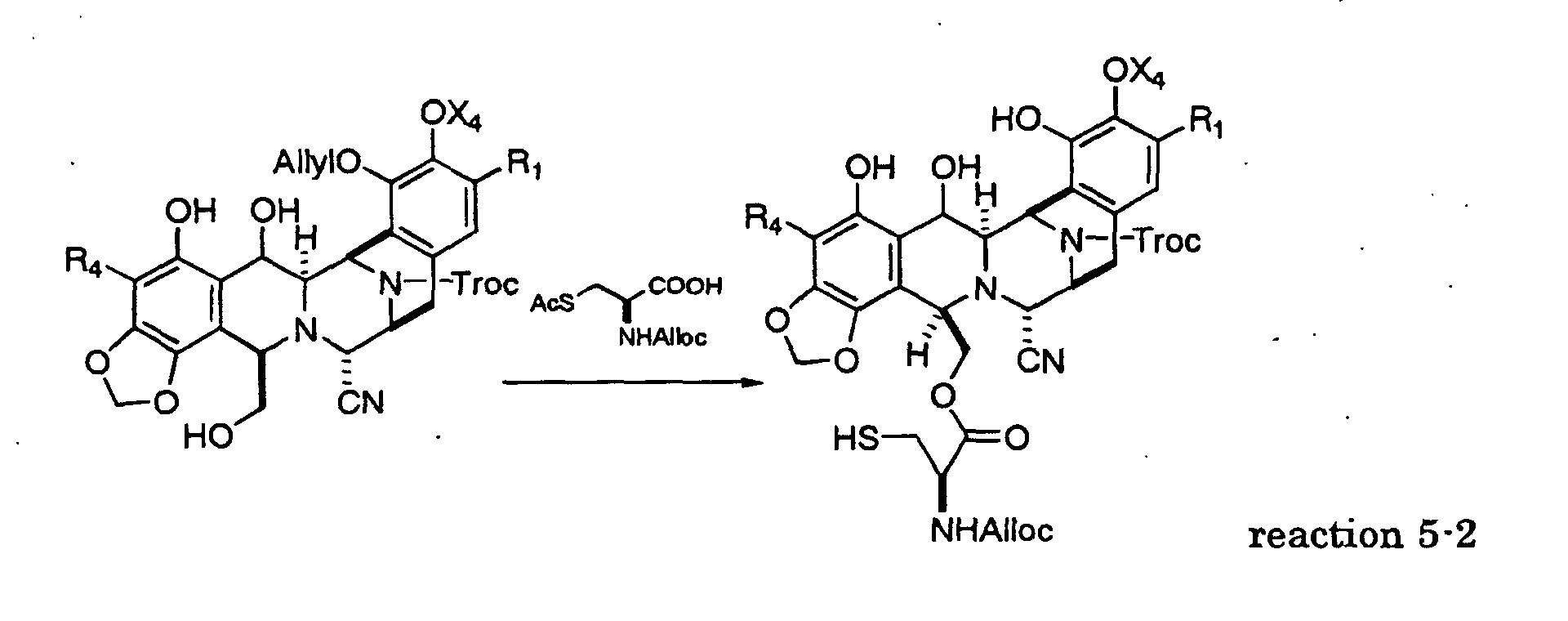
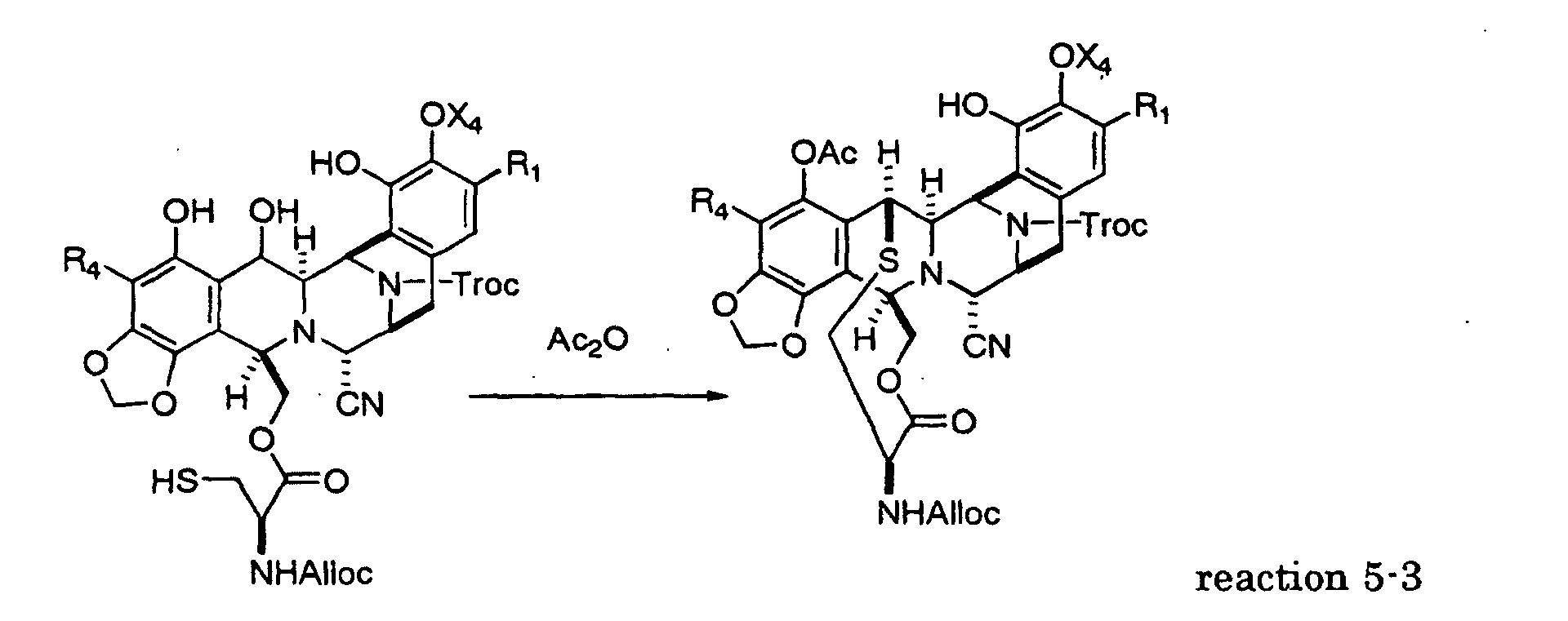
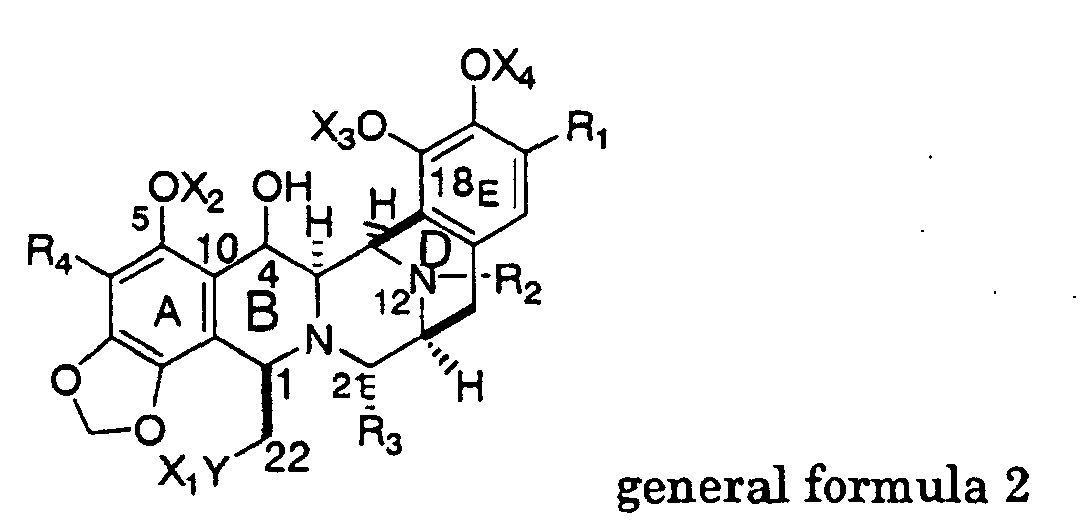
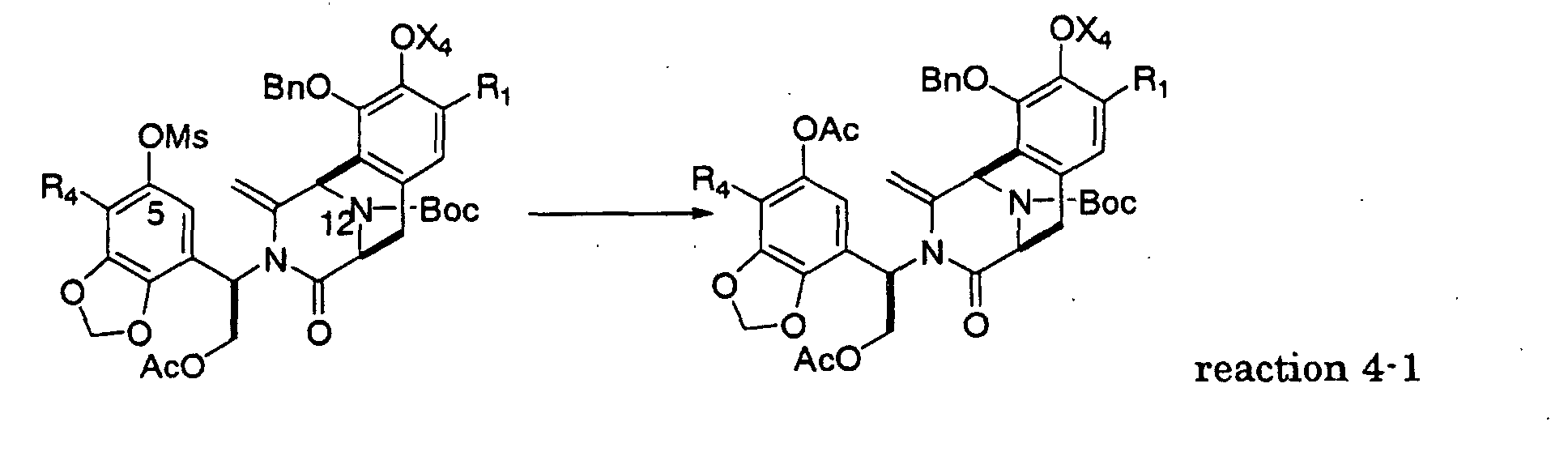

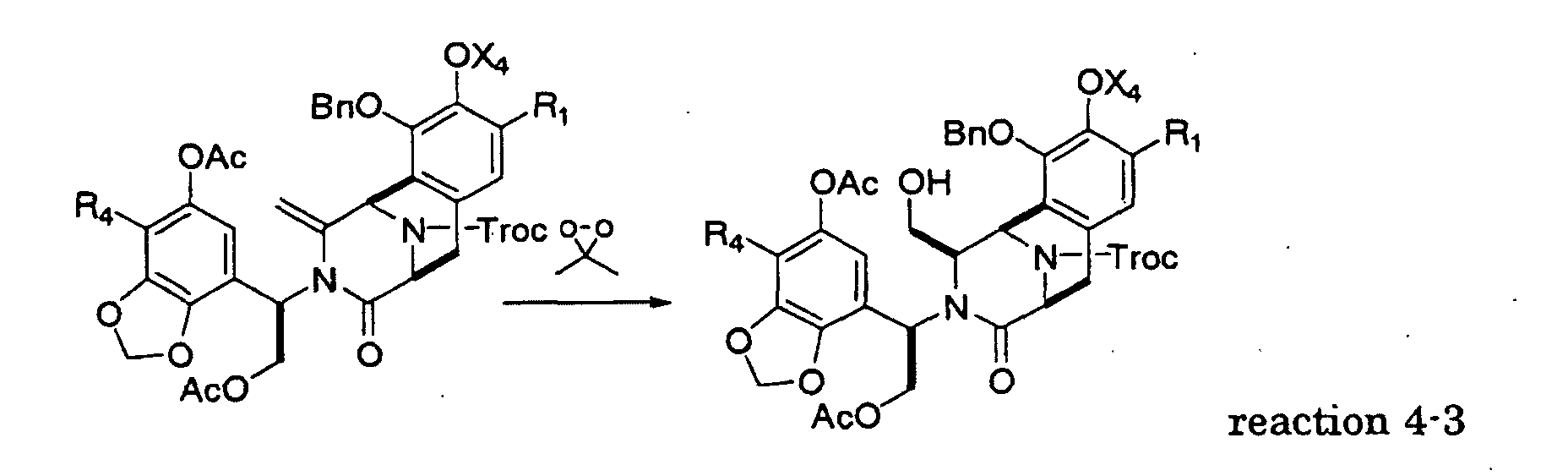
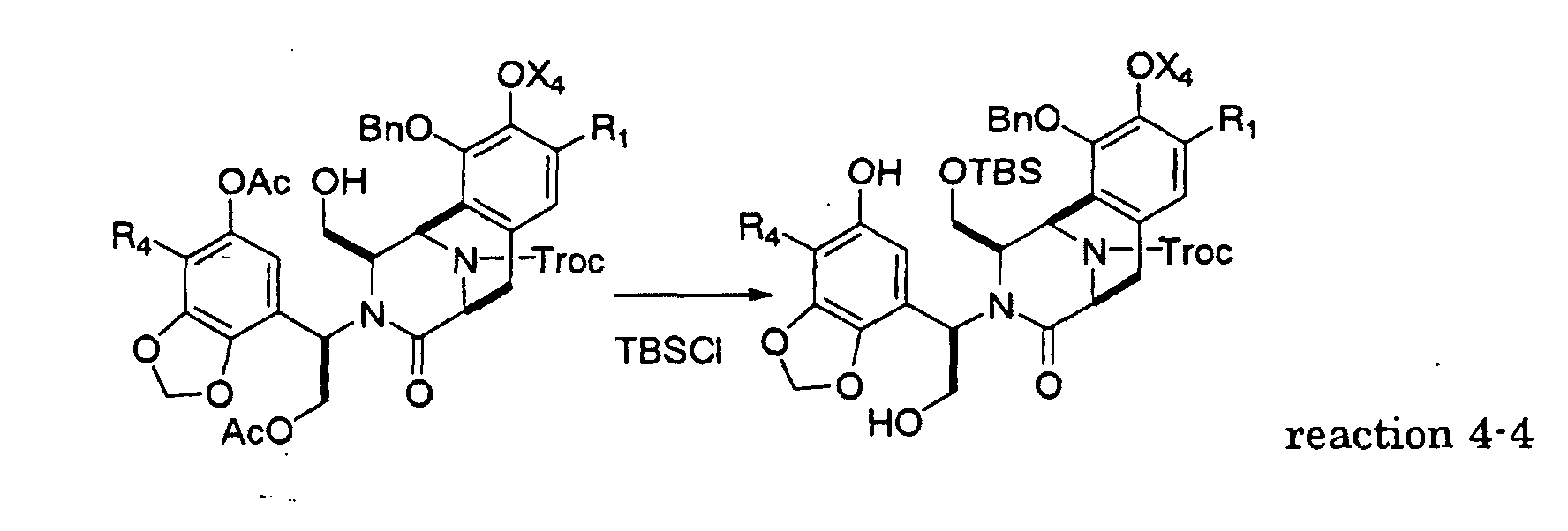


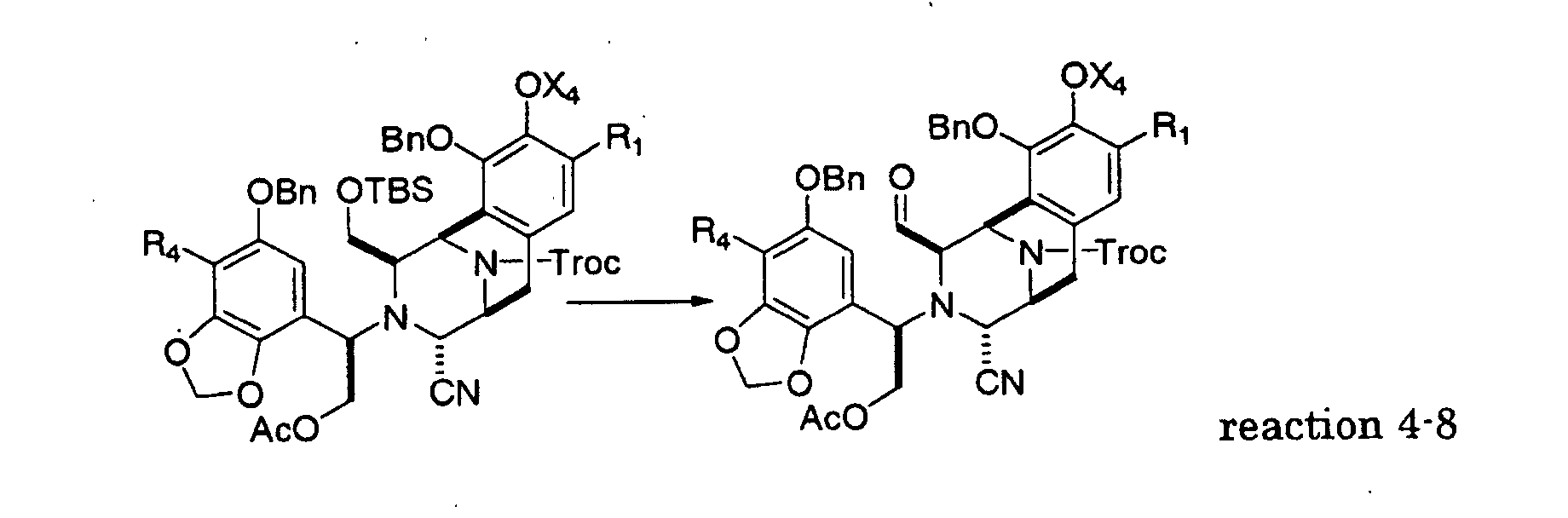


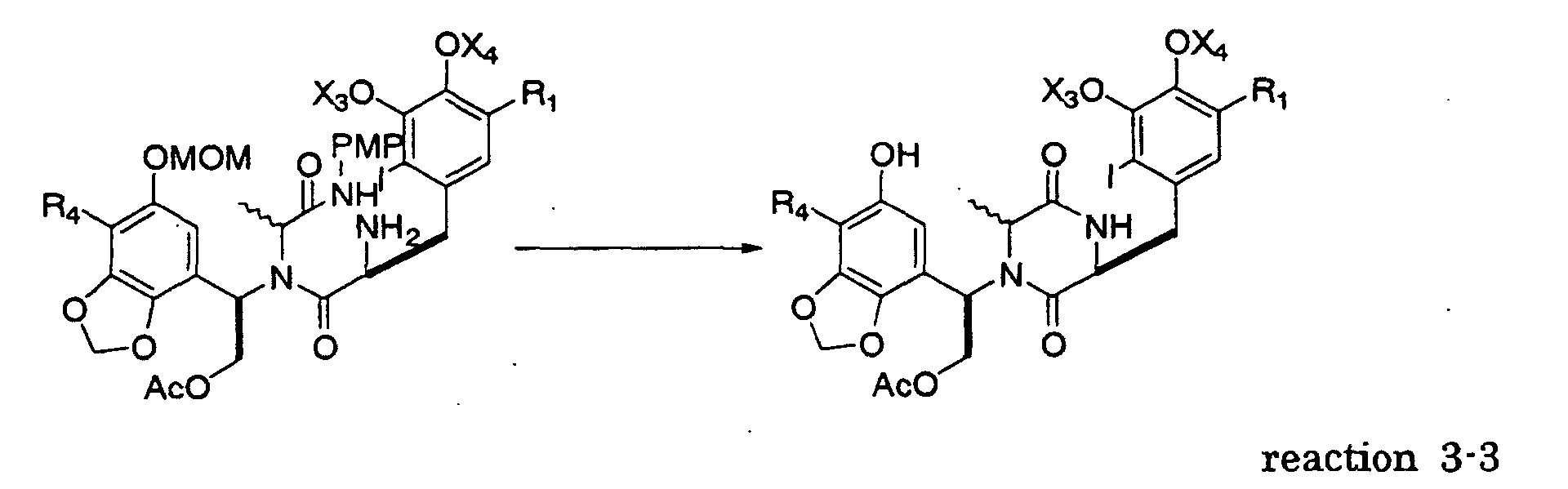


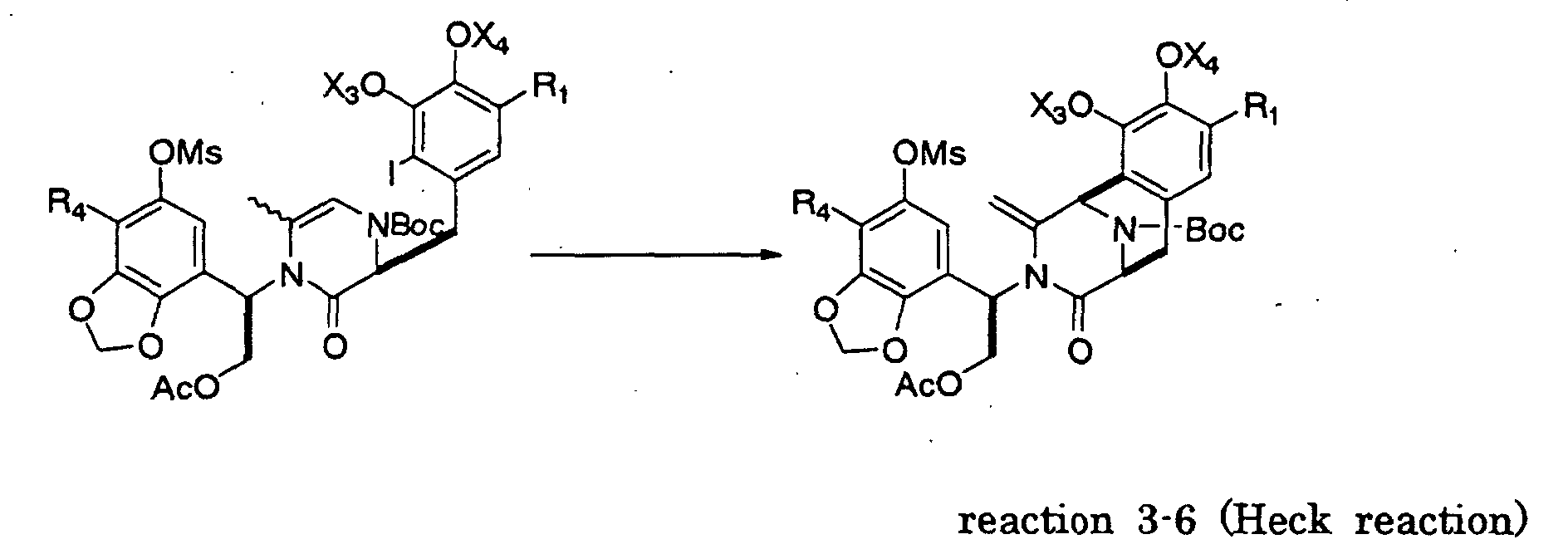


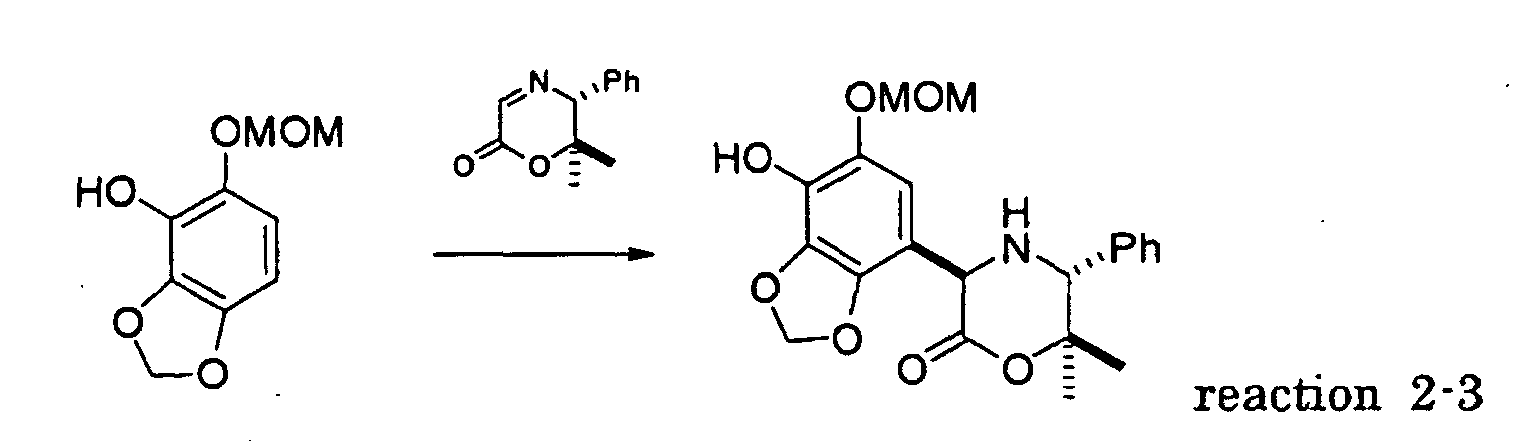

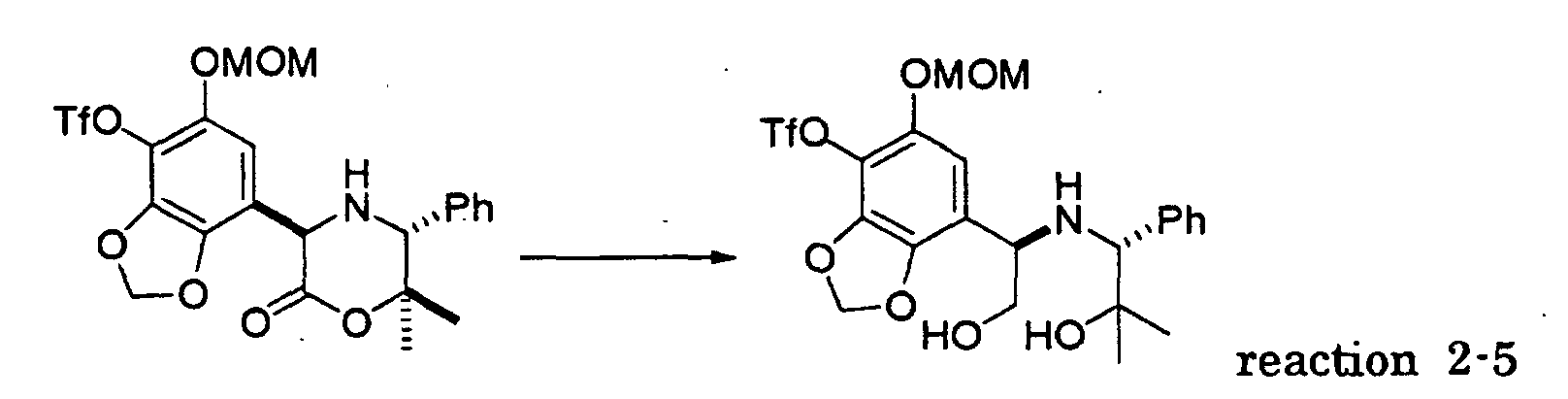
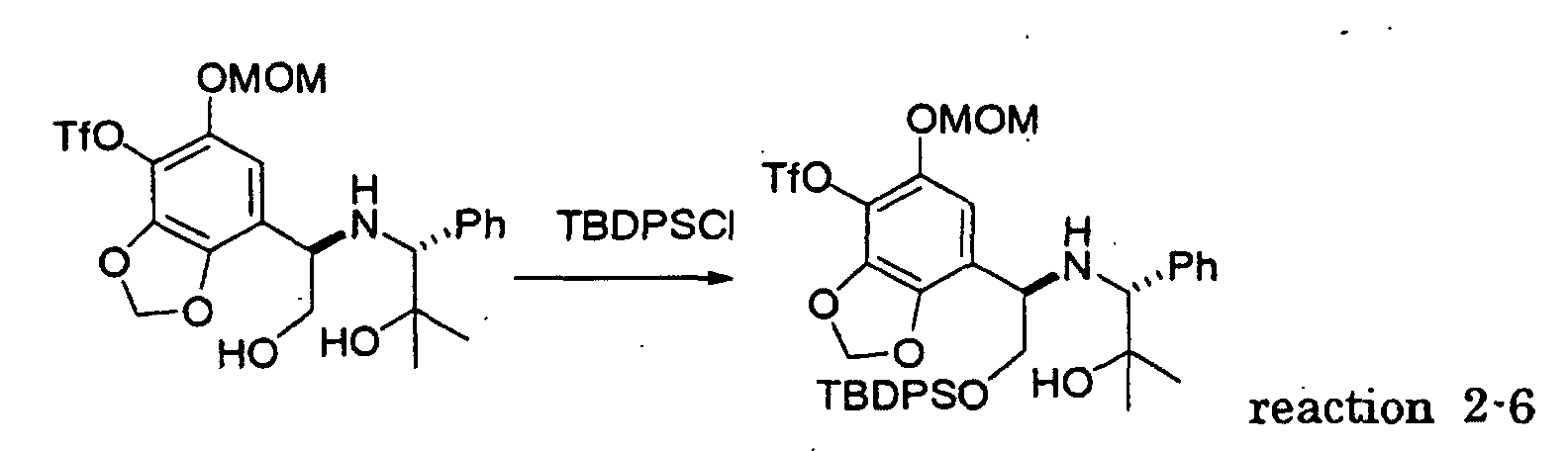
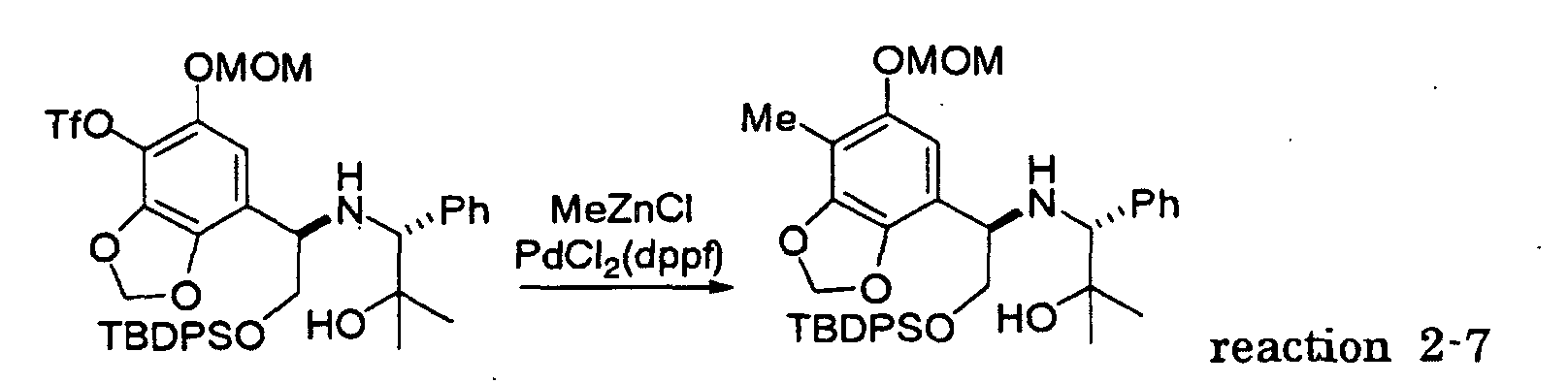


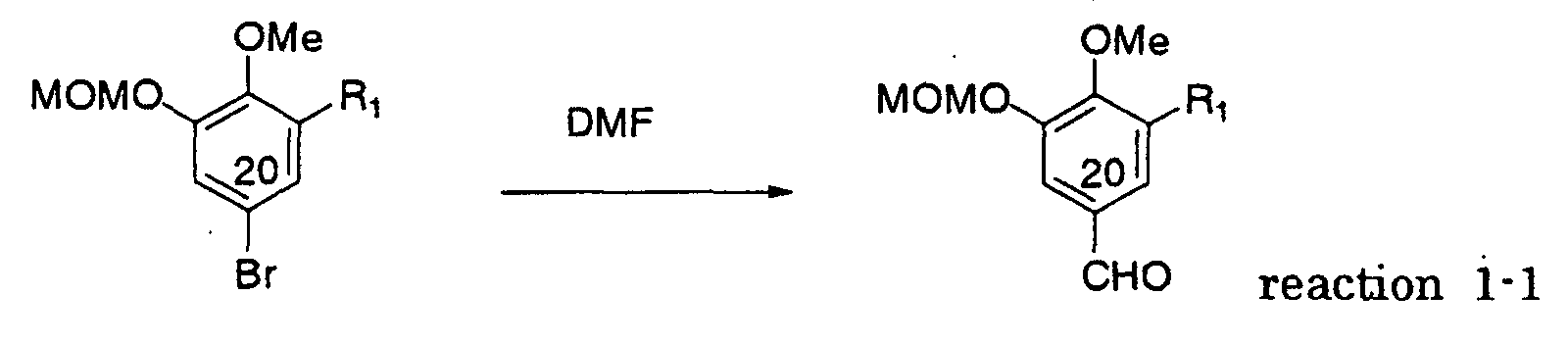

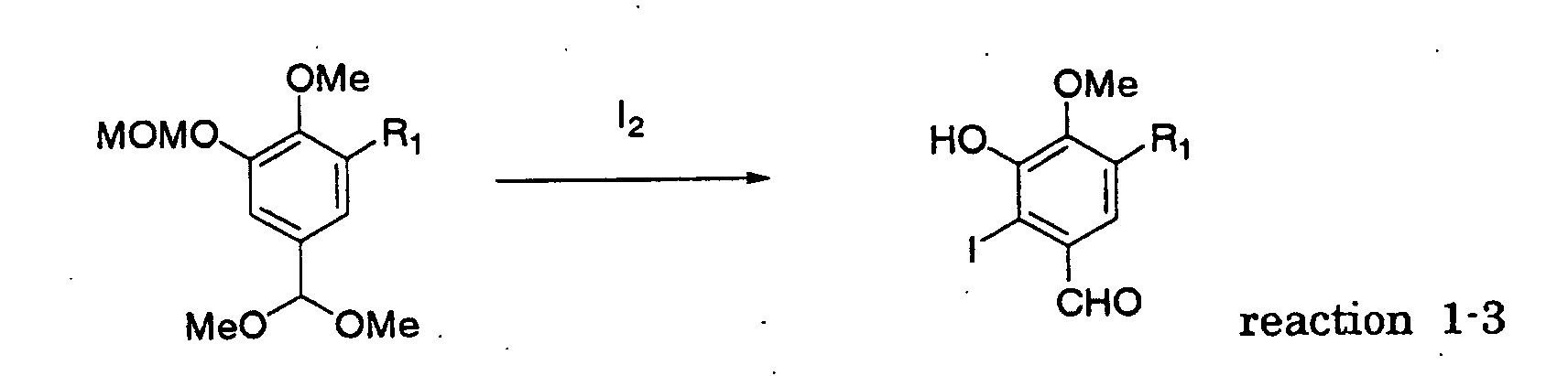


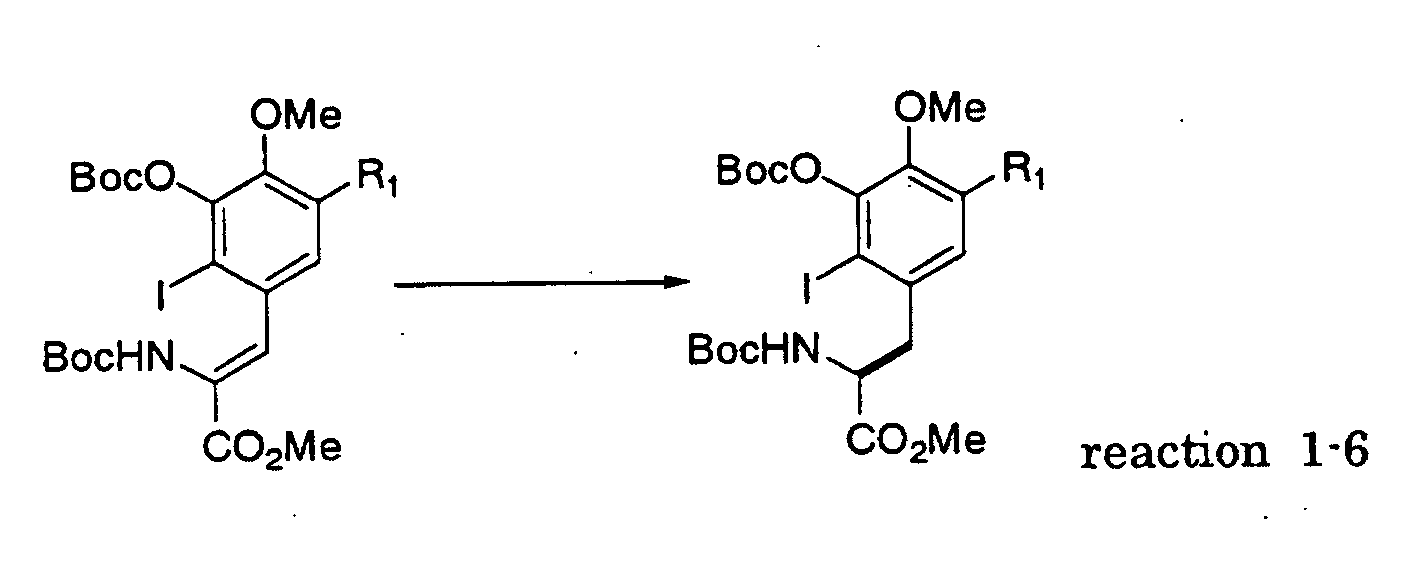
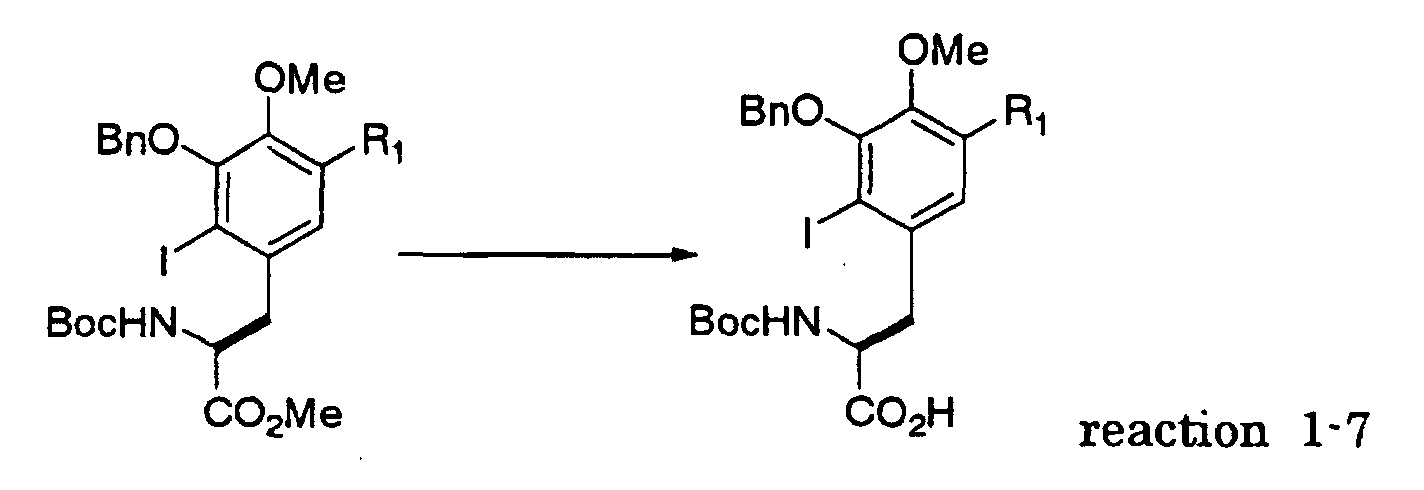


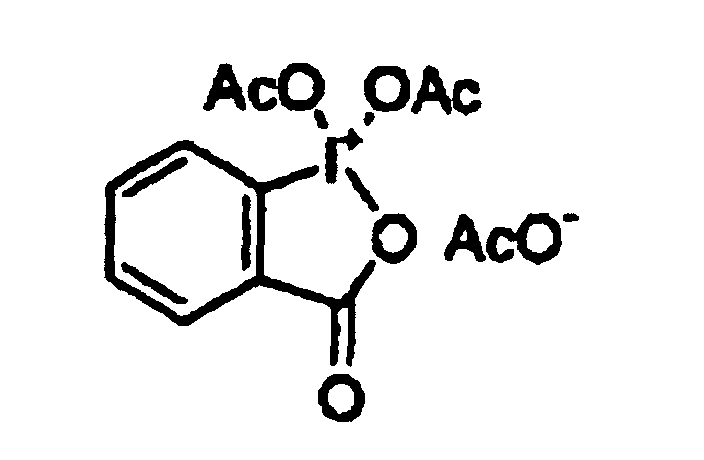
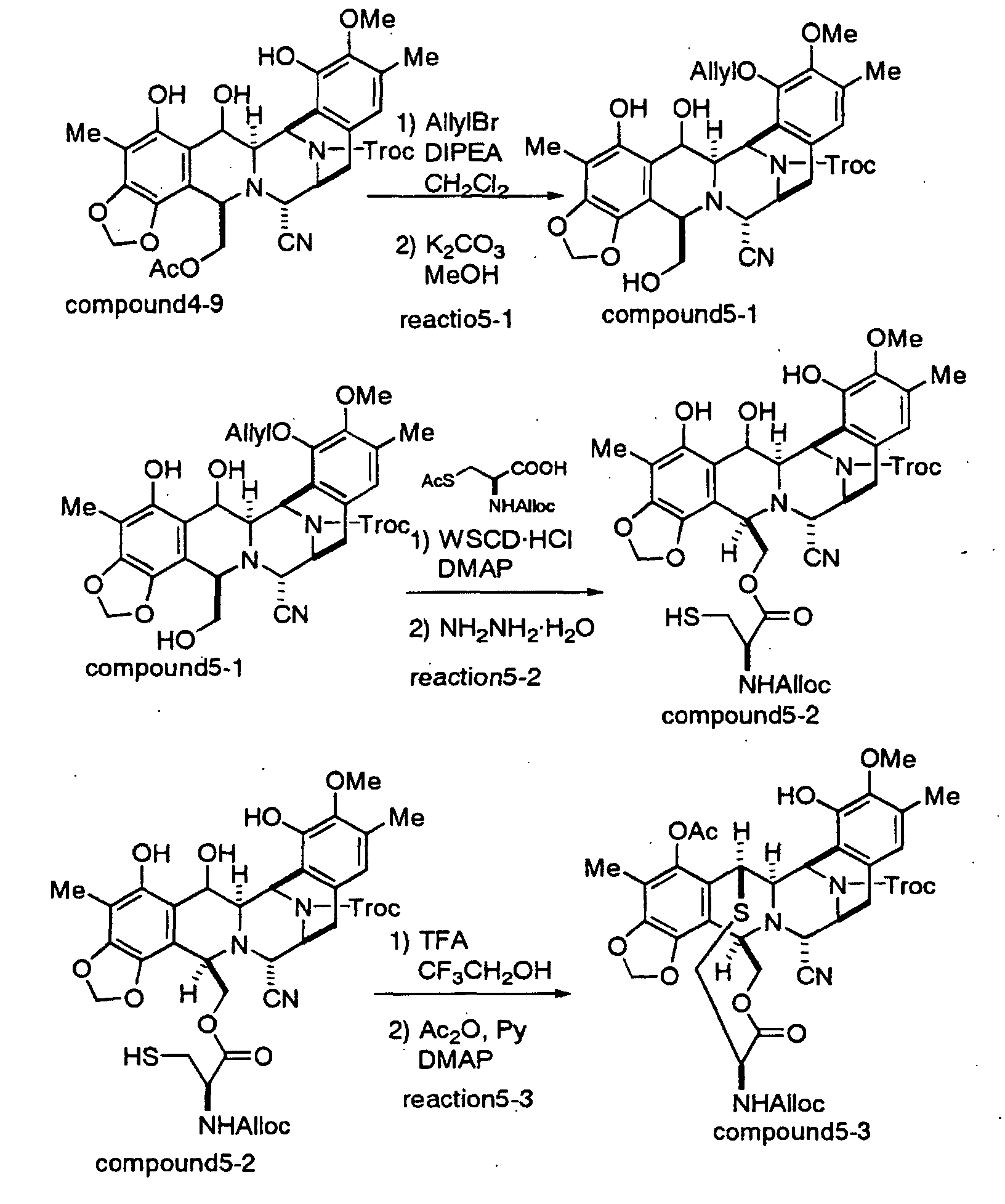
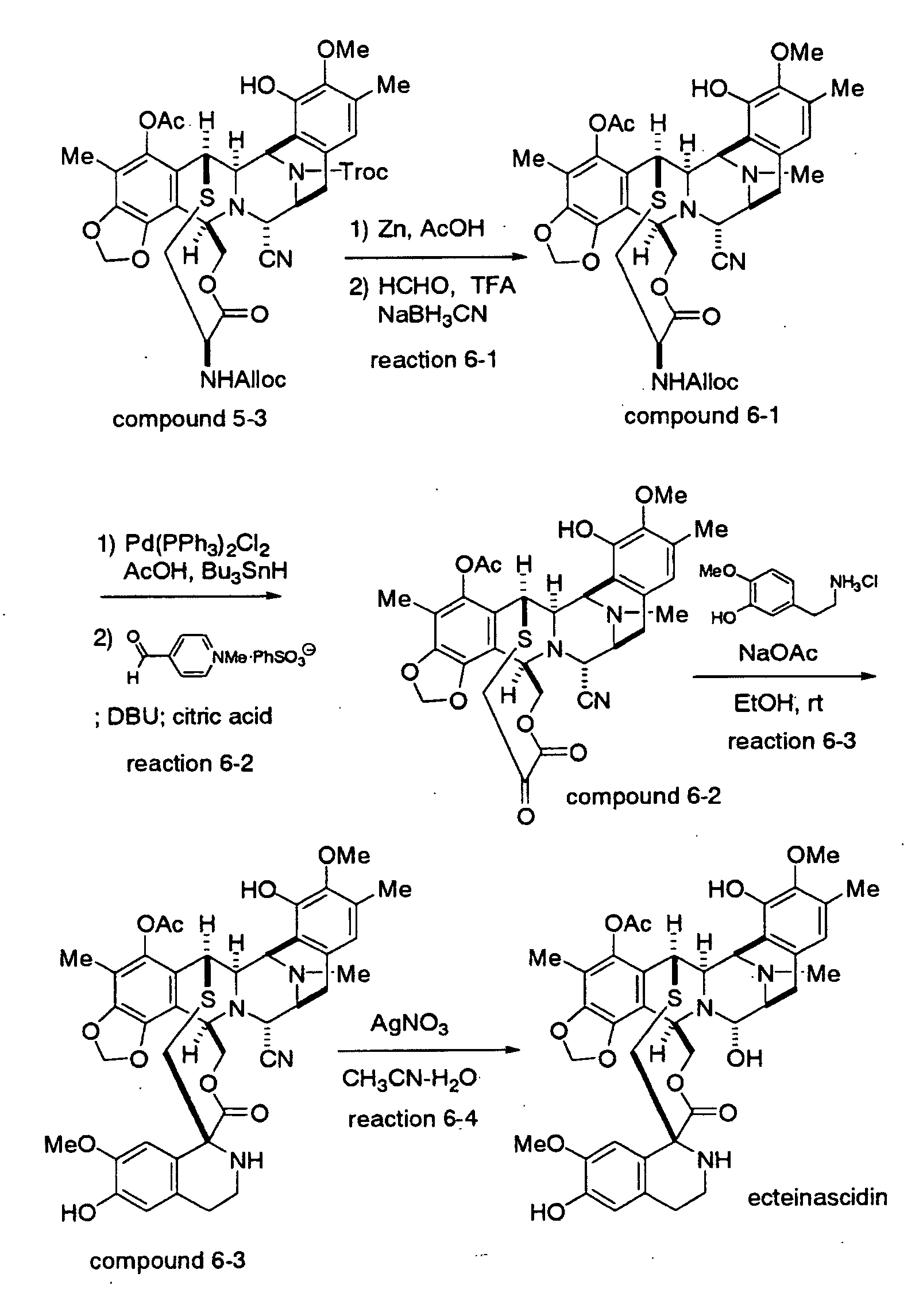


 wherein, the reaction 5-1 is transforming reaction of C18 hydroxyl group to allyl ether and C22 acetyl group to hydroxyl group, the reaction 5-2 is introducing reaction of cystein into C22 acetyl group and the reaction 5-3 is C4 thioetherification reaction and transforming reaction of C5 hydroxyl group to acetyl group,
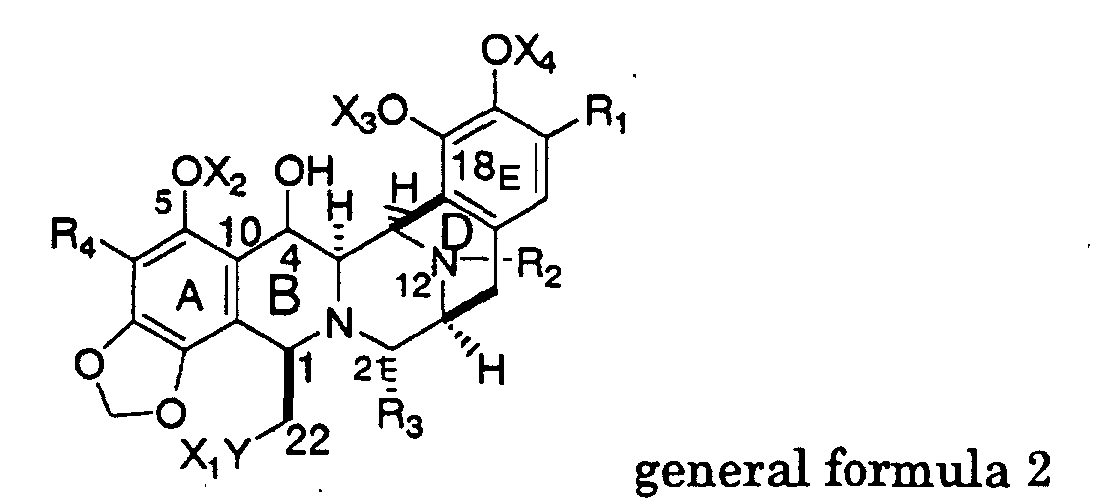

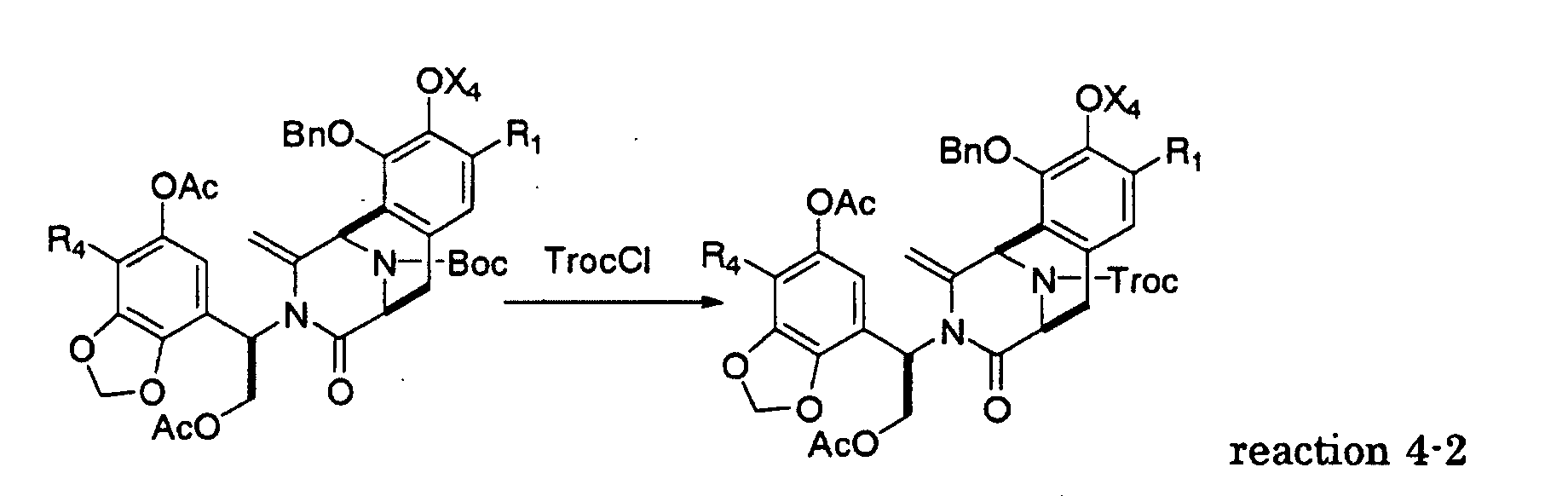
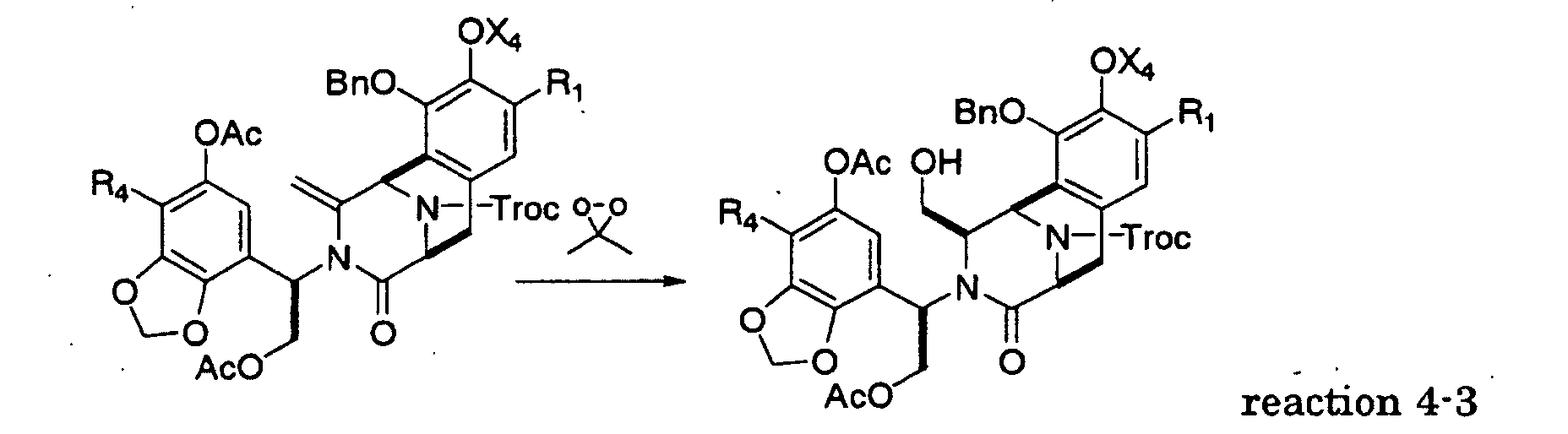


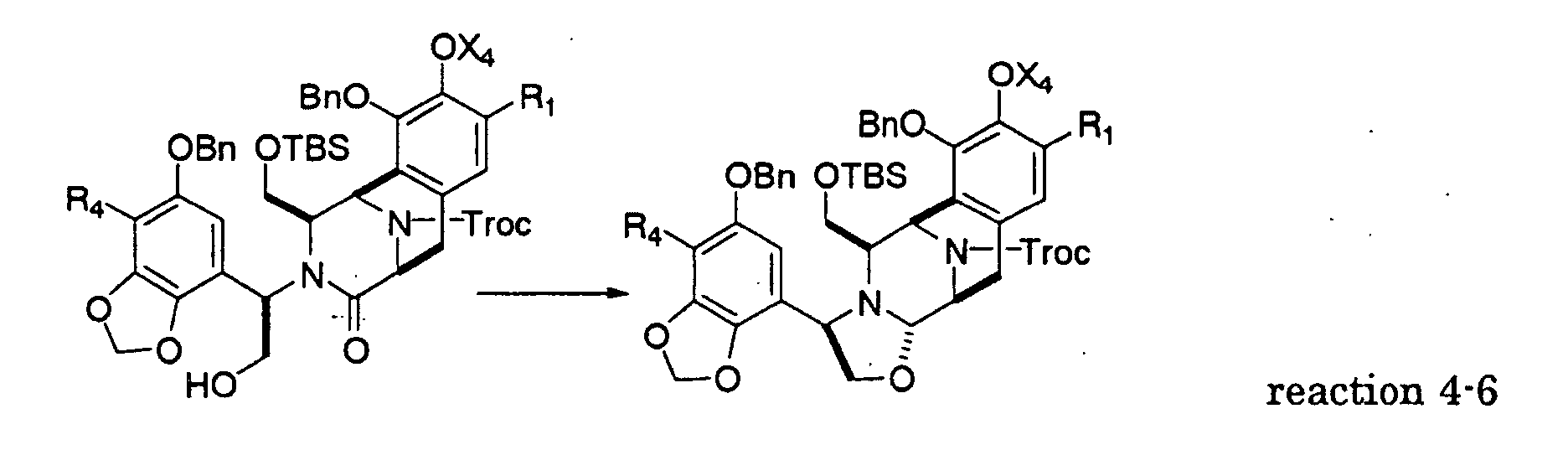

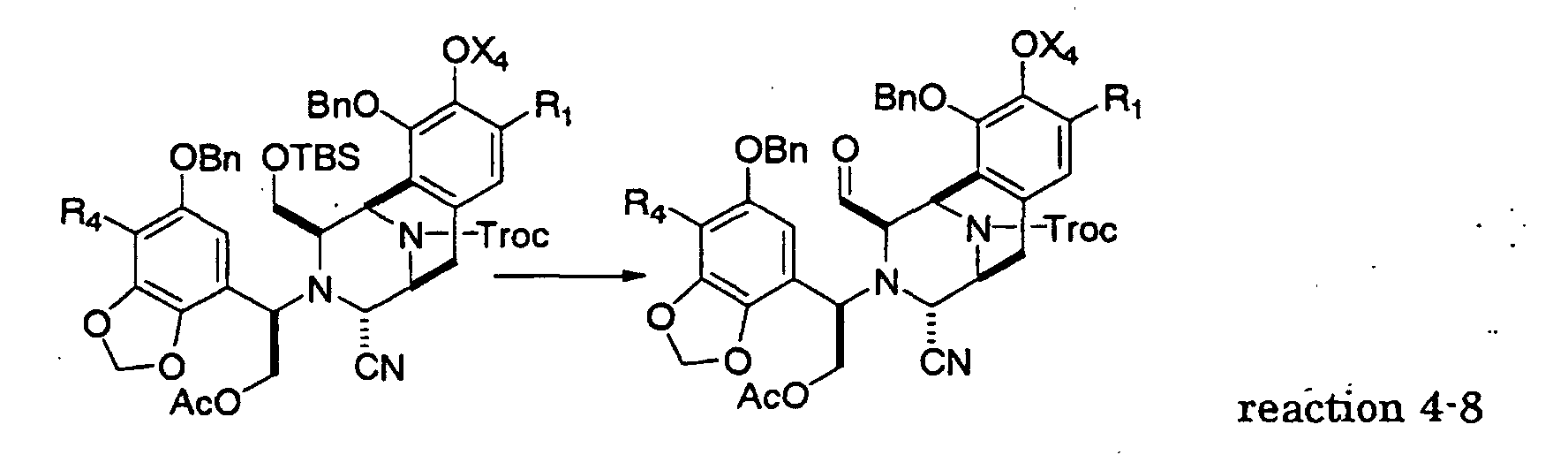 wherein the reaction 4-1 is transforming reaction of C5 mesiloxy group to acetyl group, the reaction 4-2 is transforming reaction of N12 butoxycarbonyl group to trichloroethyl group, the reaction 4-3 is hydration reaction of C3-4 double bond, the reaction 4-4 is transforming reaction of C4 hydroxyl group to TBS group and transforming reaction of C22 and C5 acetyl group to hydroxyl group, the reaction 4-5 is transforming reaction of C5 hydroxyl group to benzyl group, reaction 4-6 is reducing reaction of C21 amide and ring closing reaction of oxasolidin, the reaction 4-7 is ring opening reaction of oxasolidin and transforming reaction of C22 hydroxyl group to acetyl group, the reaction 4-8 is oxidation reaction of C2 hydroxyl group to aldehyde and the reaction 4-9 is transforming reaction of C5, C18 benzyloxy groups to hydroxyl group and ring forming reaction of B ring,

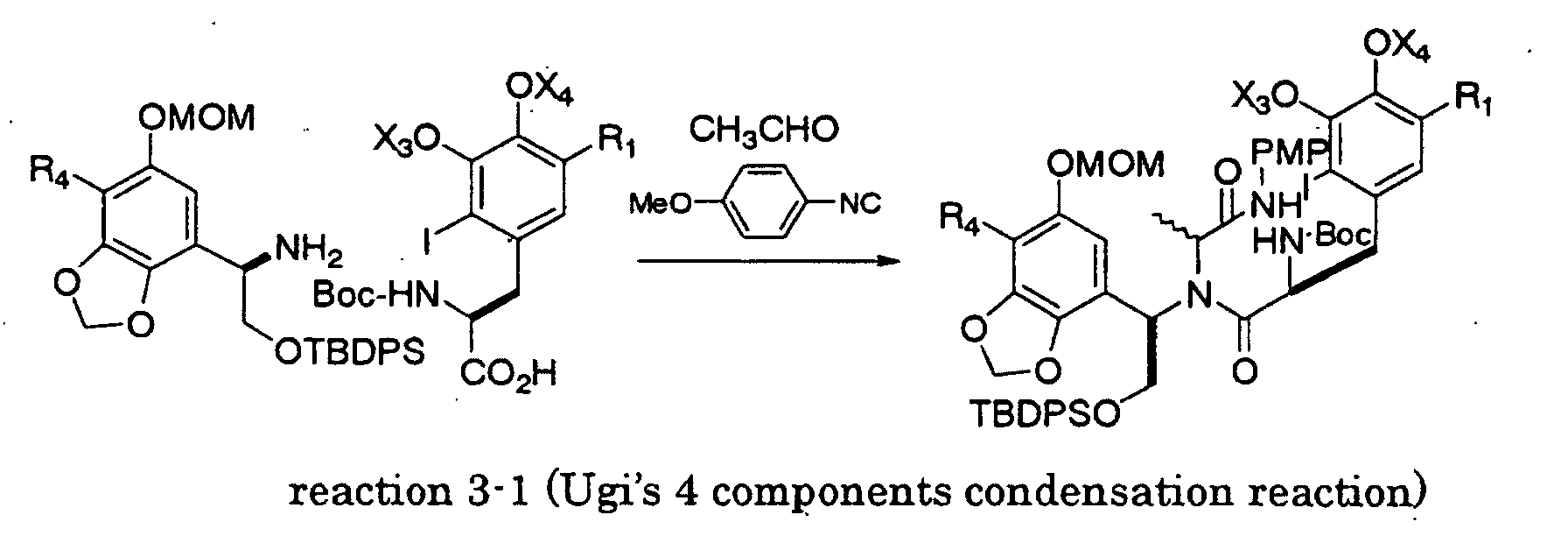
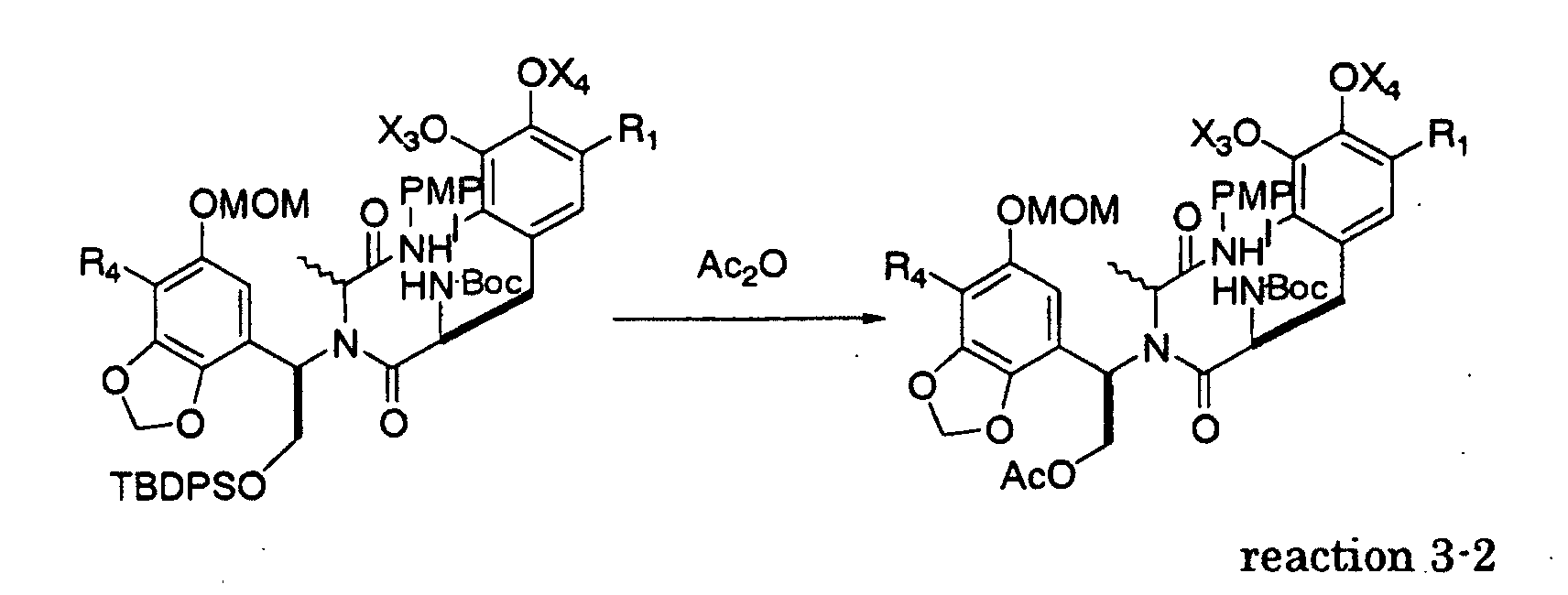


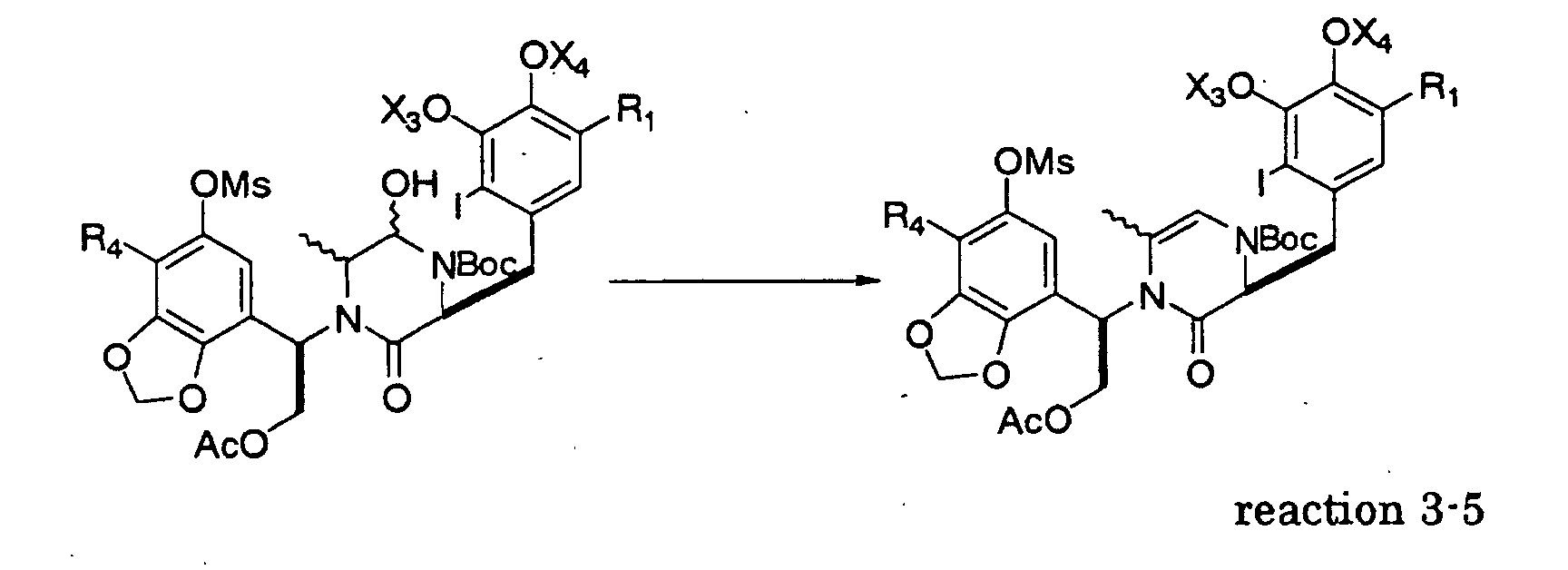 wherein, the reaction 3-1 is connecting reaction of 4 components, the reaction 3-2 is transforming reaction of C22 TBTPS group to acetyl group, the reaction 3-3 is ring forming reaction of C ring formation, the reaction 3-4 is transforming reaction of C5 hydroxyl group to Ms group, the reaction 3-5 is reducing reaction of C11 amide and dehydration reaction of C3-4 double bond and reaction 3-6 is ring forming reaction of D ring by Heck reaction,
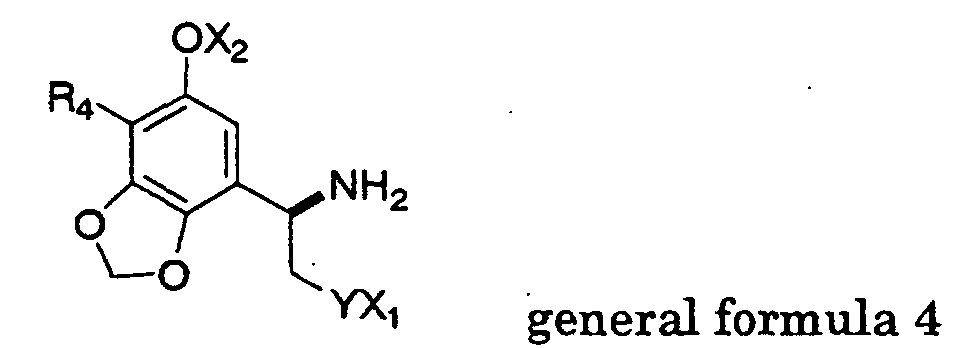

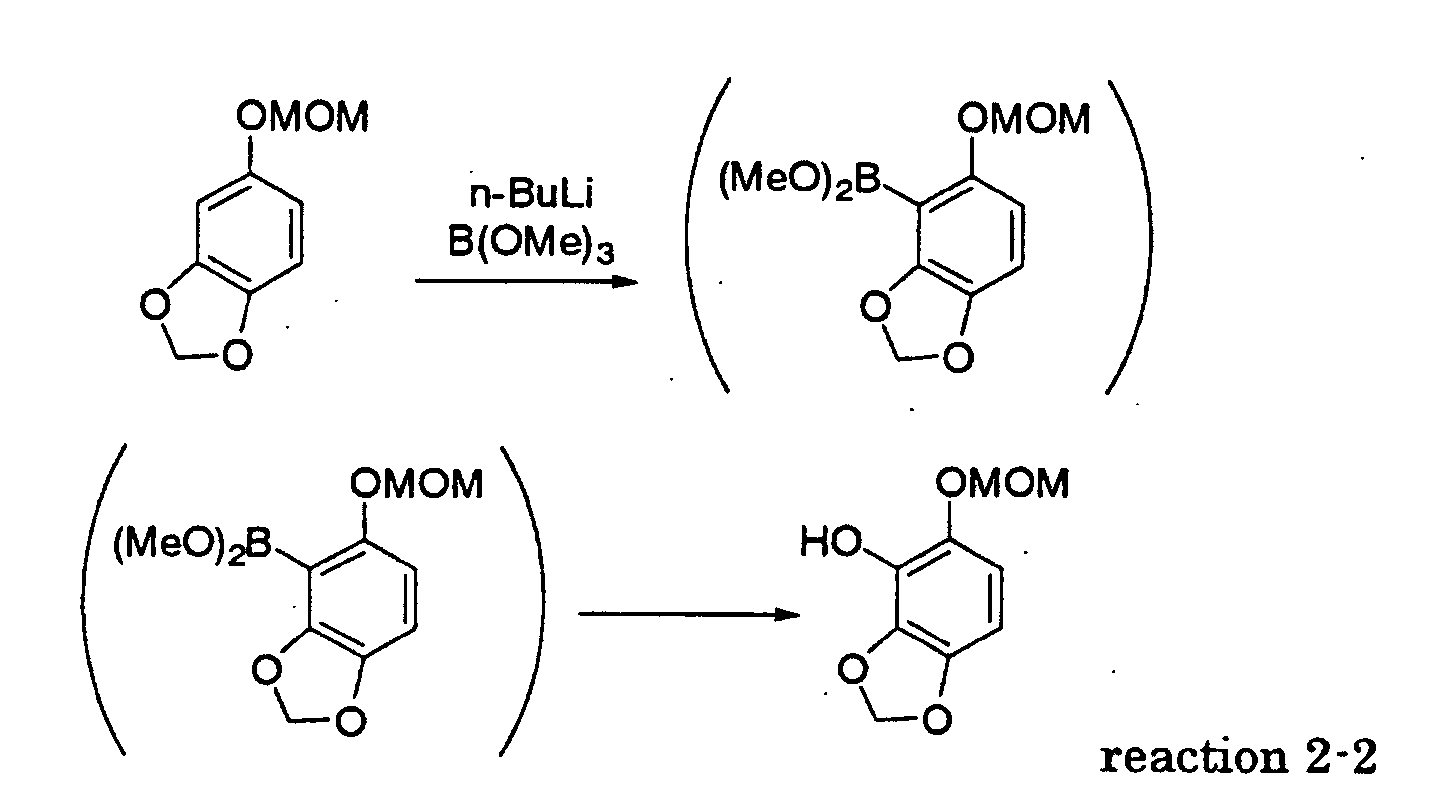


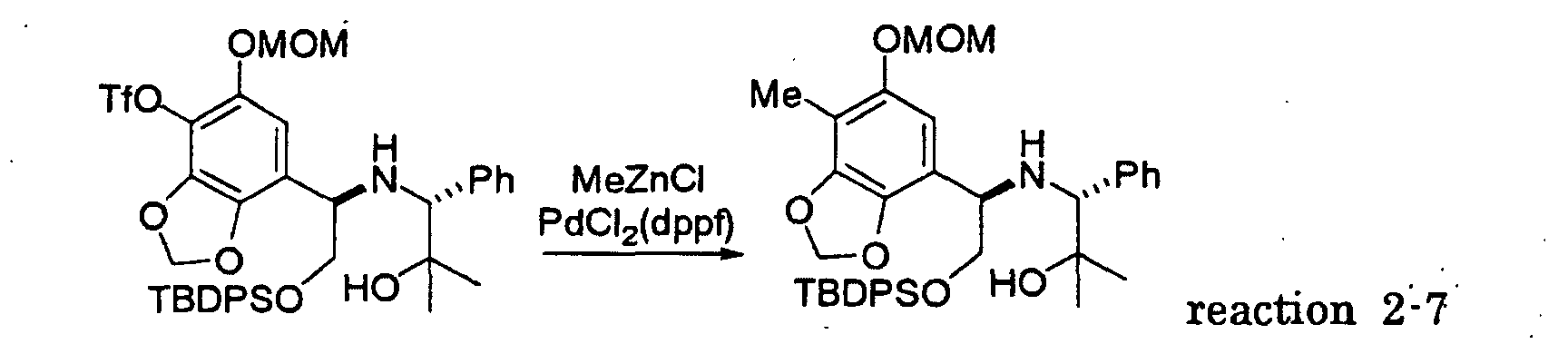 wherein the reaction 2-1 is transforming reaction from C5 hydroxyl group to methoxymethyl group, the reaction 2-2 is introducing reaction of hydroxyl group to C22, the reaction 2-3 is Mannich reaction, the reaction 2-4 is transforming reaction of C6 hydroxyl group to trifloromethanesulfonyl group, reaction 2-5 is the reducing reaction of lactone, reaction 2-6 is transforming reaction of C22 hydroxyl to TBDPS group, reaction 2-7 is methylation reaction of C6 TfO group and the reaction 2-8 is the transforming reaction to amine,
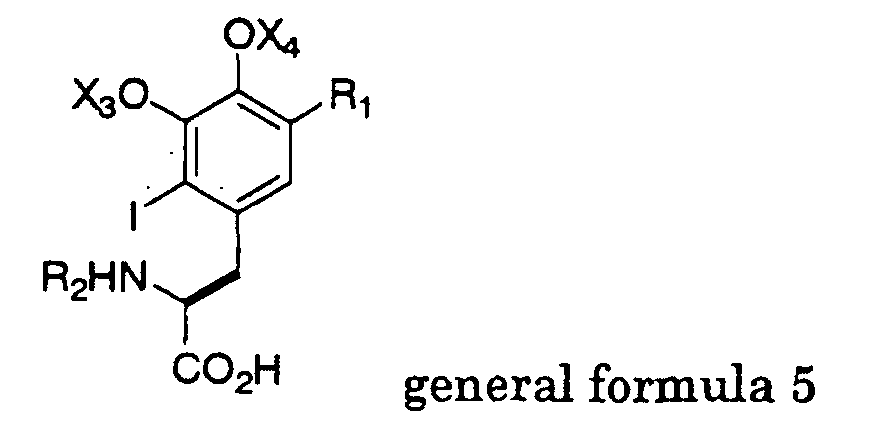


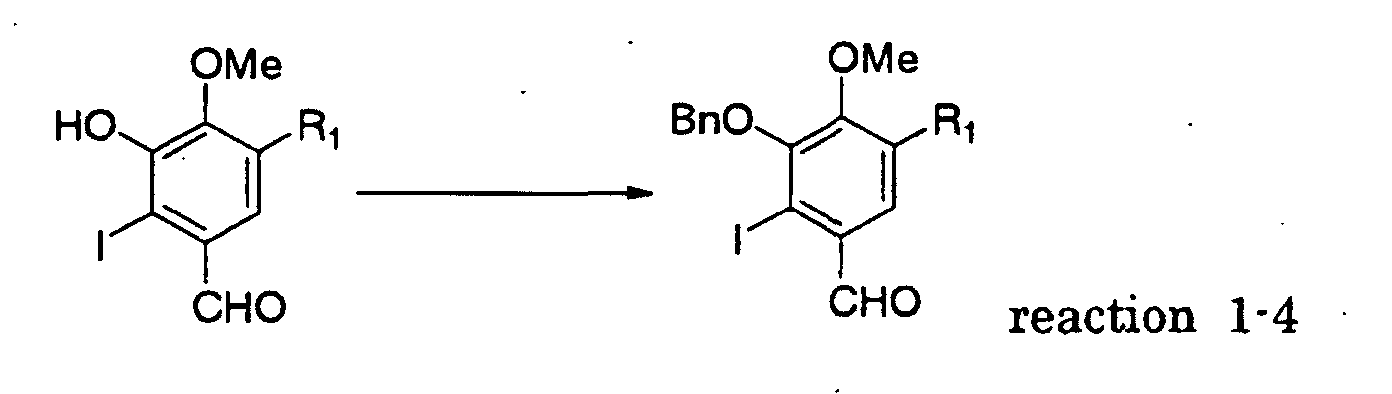

 wherein the reaction 1-1 is introducing reaction of formyl group to C20, the reaction 1-2 is transforming reaction of C20 formyl group to dimethylacetal, the reaction 1-3 is iodizing reaction of C19 and acidic dehydrolysing reaction, the reaction 1-4 is transforming reaction of C18 hydroxyl group to benzyl group, the reaction 1-6 is Honor Emons reaction, reaction 1-6 is asymmetric reducing reaction by Duphos-Rh synthetic catalyst and the reaction 1-7 is the dehydrolysing reaction of methylester,