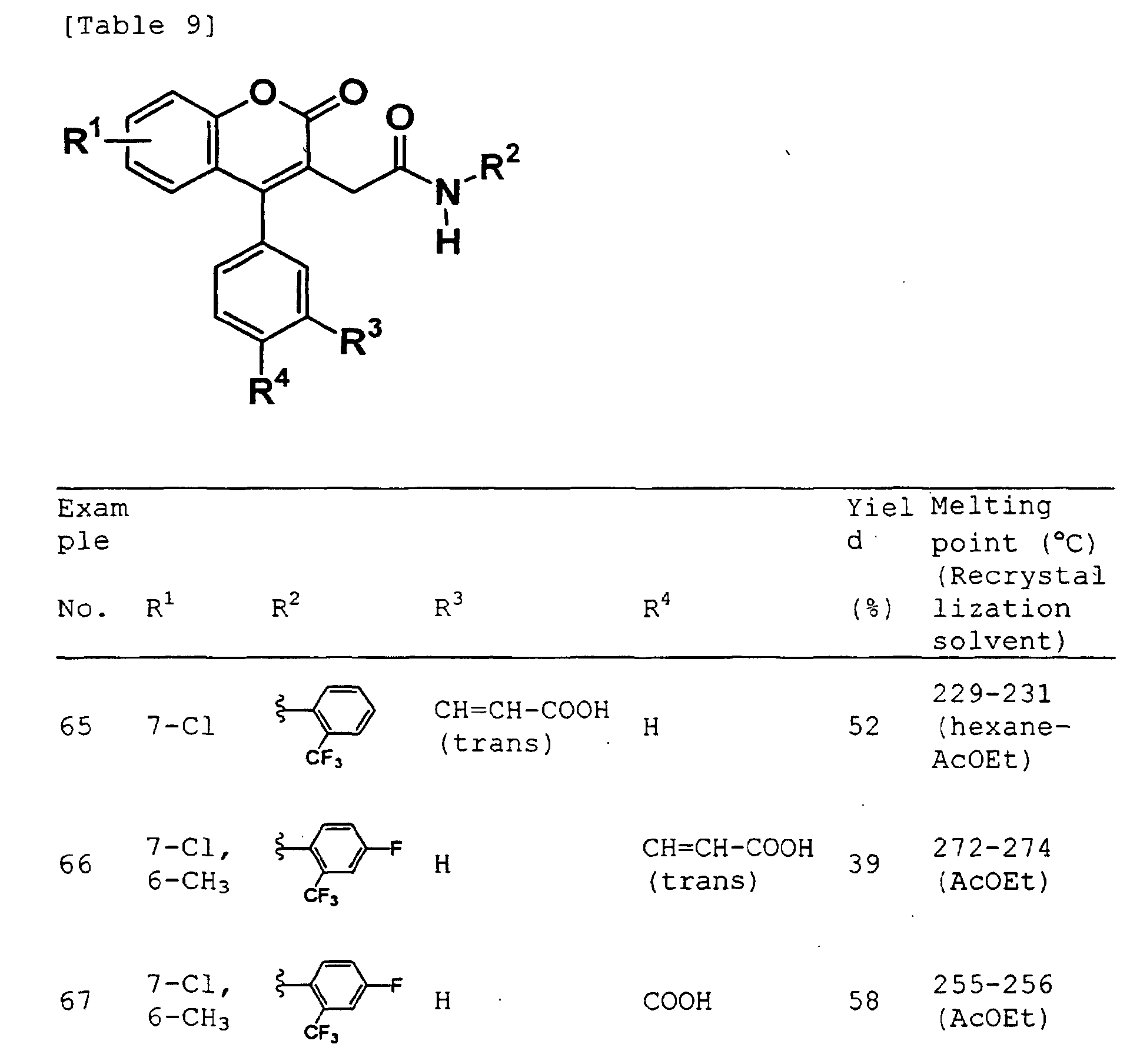
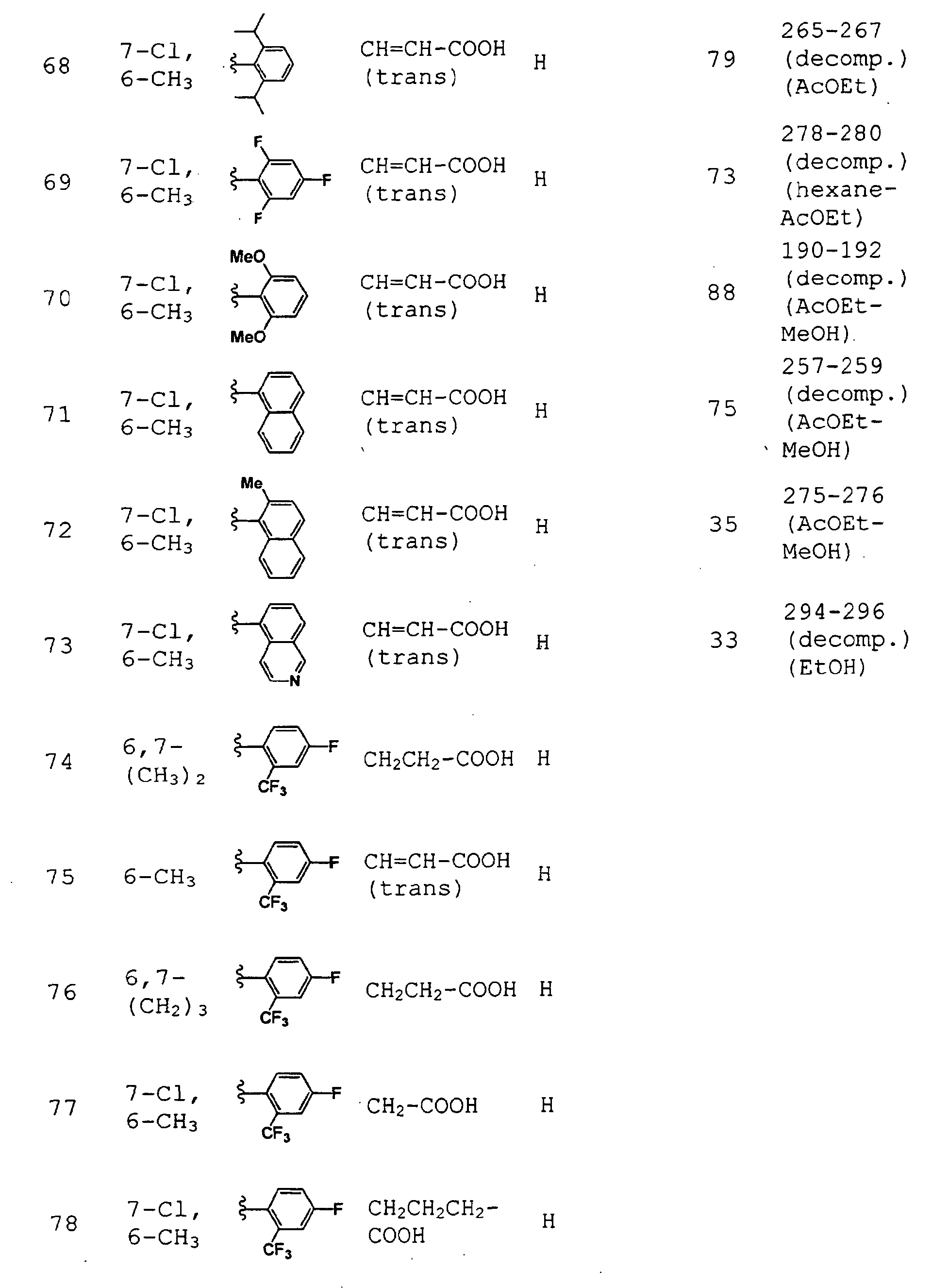
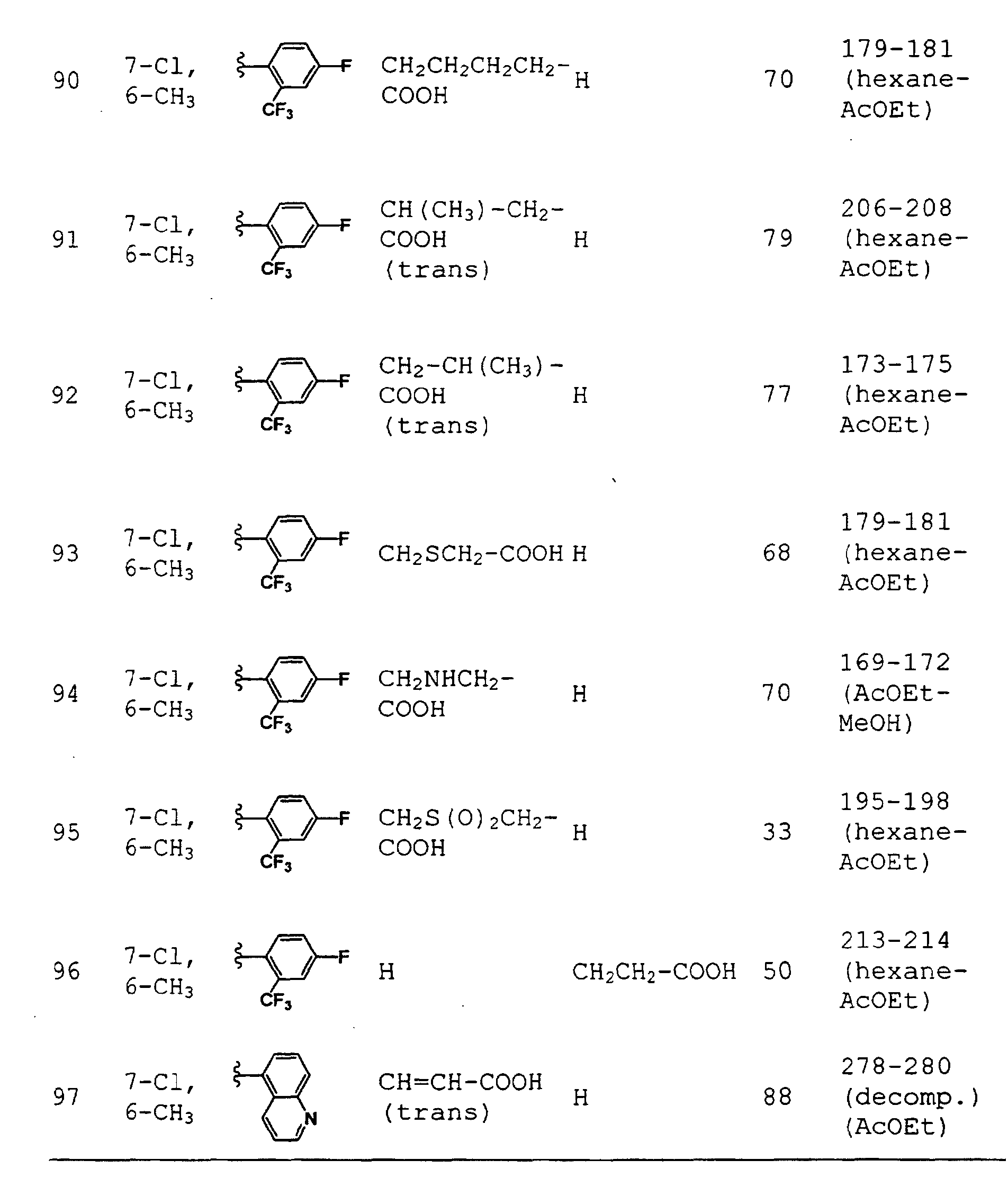
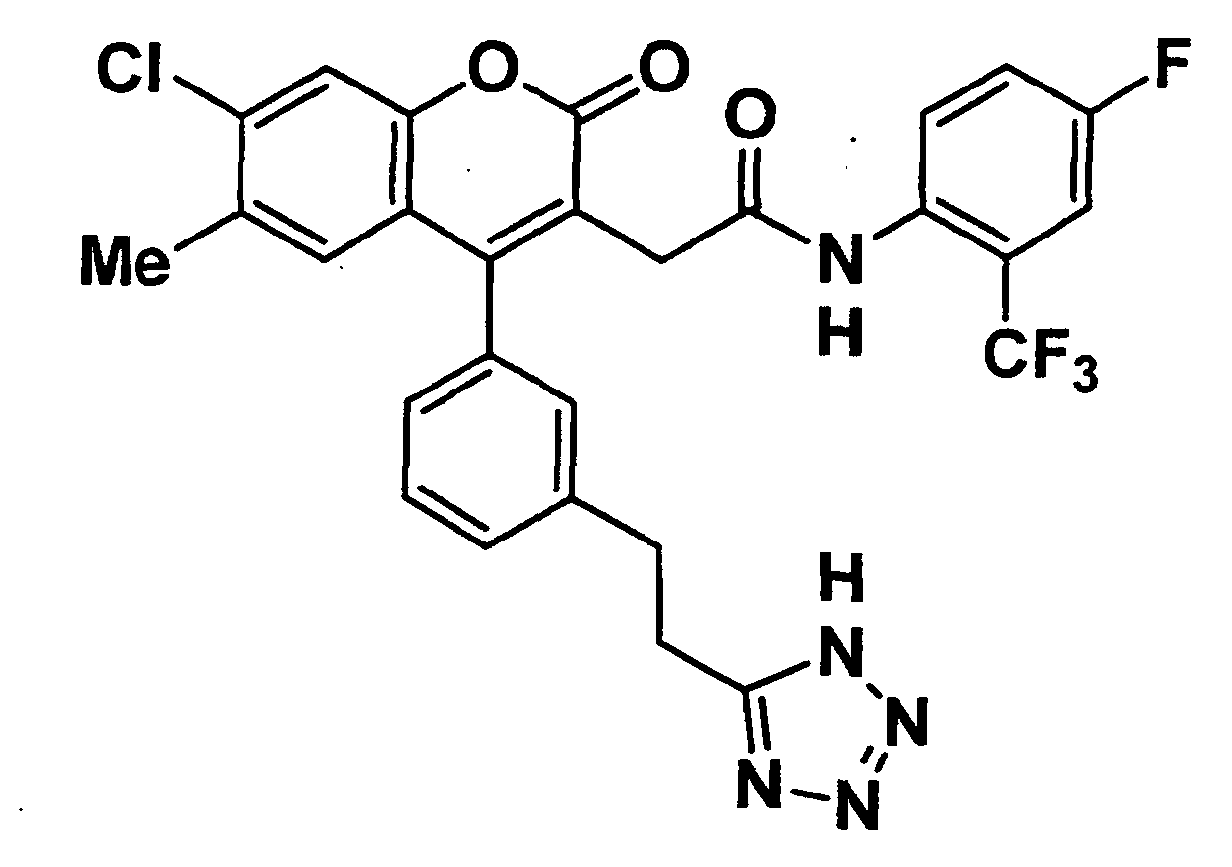
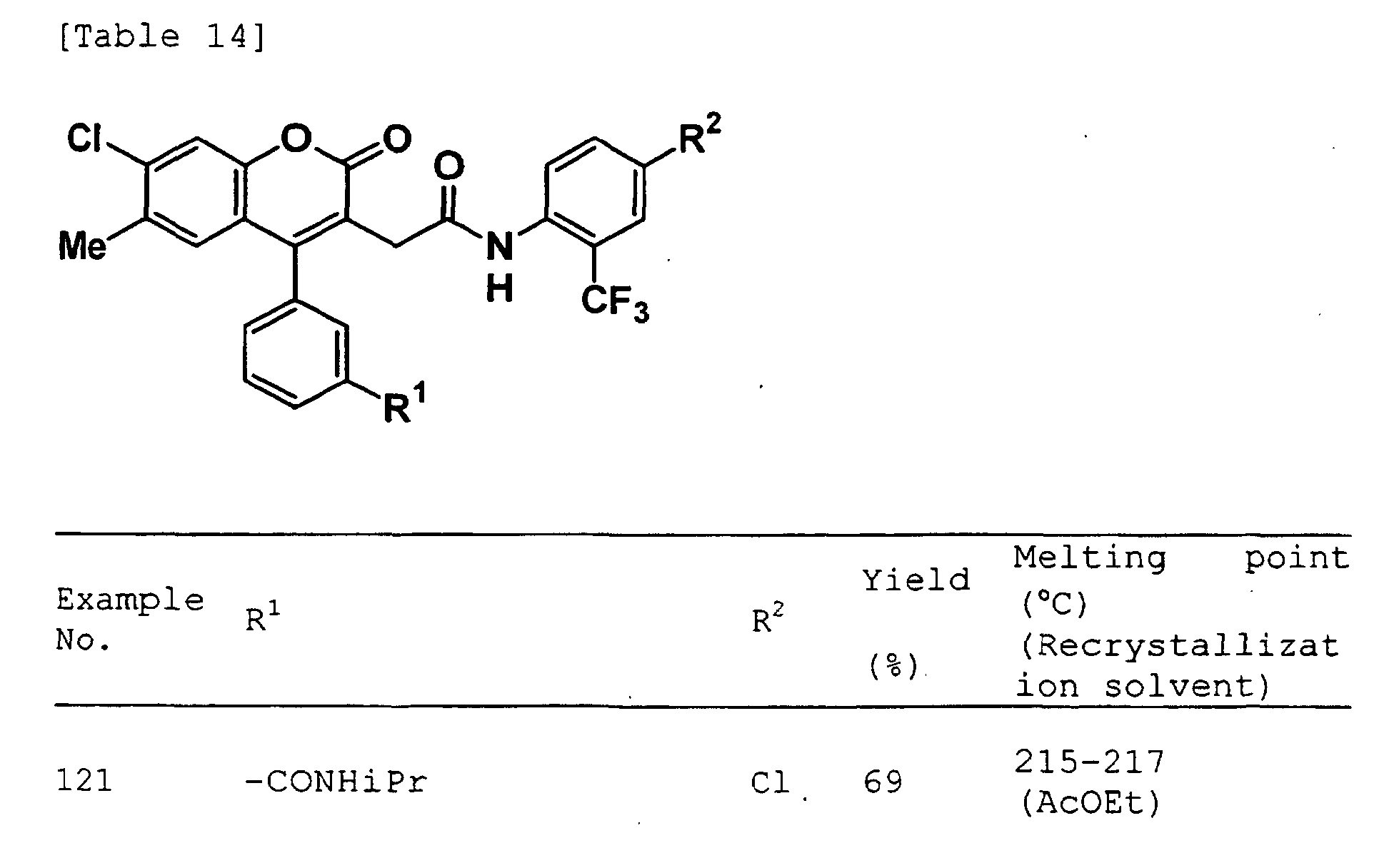
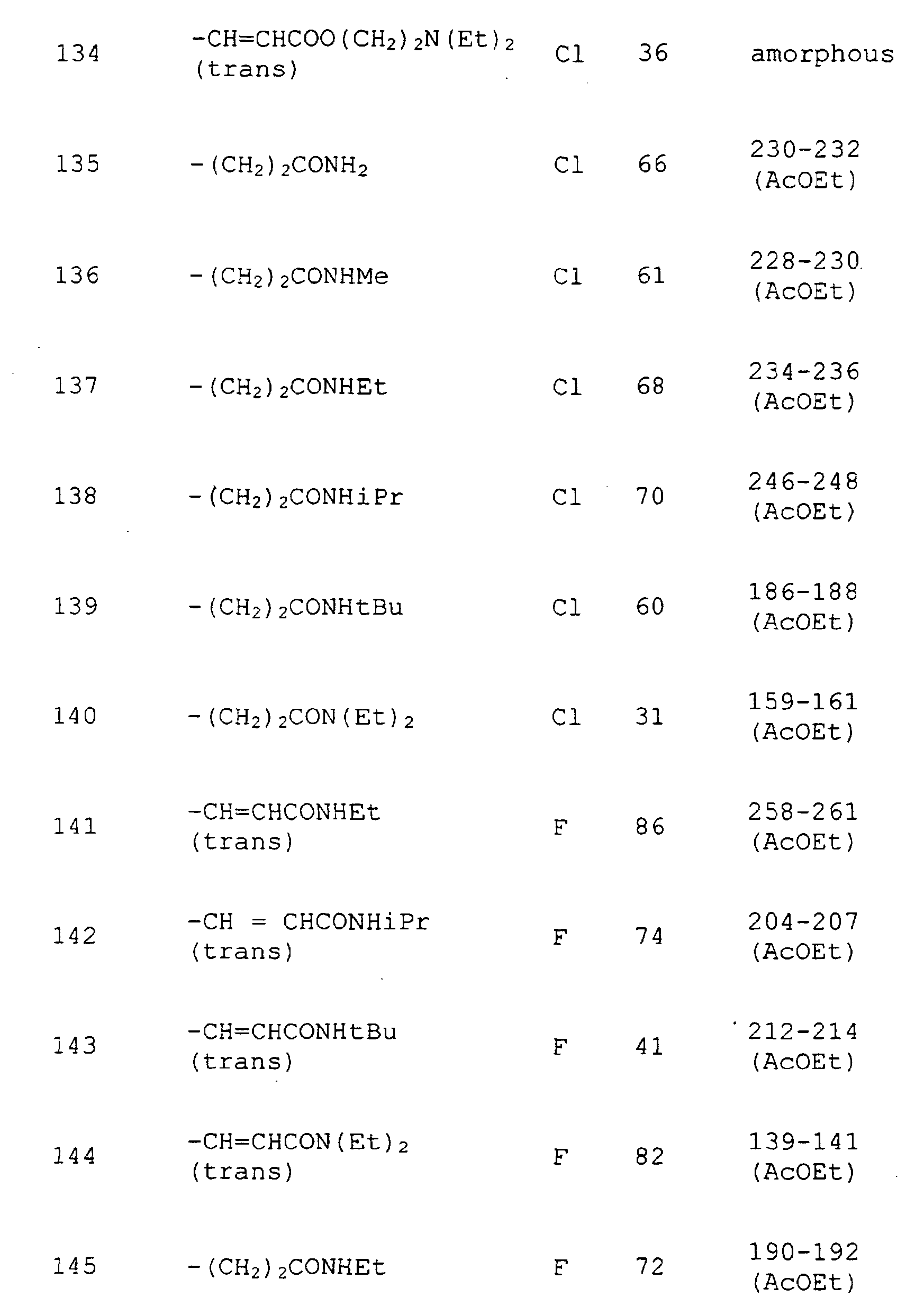
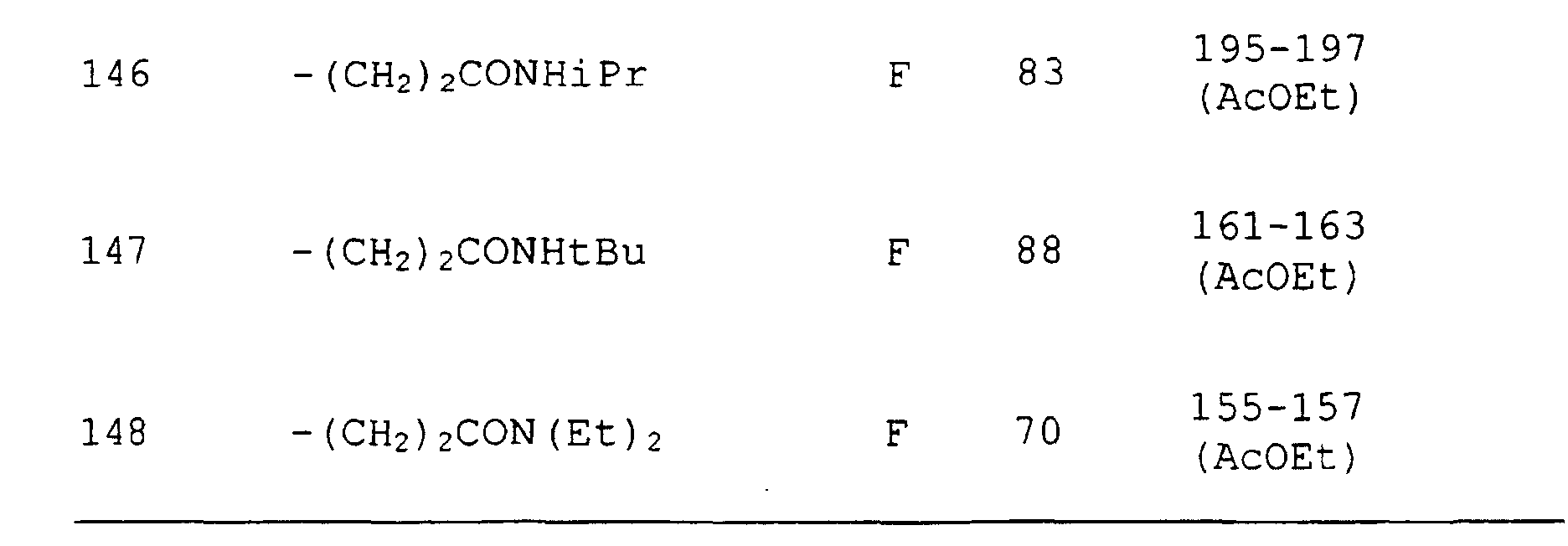
Technical Field
The present invention relates to coumarin derivatives
having lipid-rich plaque regressing activity and/or ACAT
inhibitory activity which are useful for preventing or
treating acute coronary syndrome such as acute myocardial
infarction and unstable angina, peripheral artery occlusion,
hyperlipemia, cerebral infarction, cerebral apoplexy,
arteriosclerosis, Alzheimer's disease, or the like, or
preventing or treating restenosis after PTCA or after stent
placement.
Background Art
As an agent for reducing the level of blood
cholesterol which causes arteriosclerosis, an agent which
inhibits absorption of bile acid by capturing it such as
cholestyramine and cholestipol (US Patent 4027009), an
agent which inhibits absorption of cholesterol via an
intestinal tract by inhibiting an acyl coenzyme A
cholesterol acyl transferase (ACAT) such as melinamide and
a cholesterol synthesis inhibitor, especially an agent
which inhibits 3-hydroxy-3-methylgultaryl coenzyme A (HMG-CoA)
reductase such as lovastatin (US Patent 4231938),
simvastatin (US Patent 4444784) and pravastatin (US Patent
4346227) are employed in pharmaceuticals.
However, an HMG-CoA reductase inhibitor may cause a
problem associated with side effects due to its inhibitory
effect not only on cholesterol biosynthesis but also on
synthesis of a biologically essential component such as
ubiquinone, dolichol and heme A.
Acute coronary syndrome (for example, unstable angina,
acute myocardial infarction and ischemic sudden death) is
caused by destruction of a coronary artery plaque
(atheroma) followed by formation of a thrombus and the
resultant plugging of the lumen of a coronary artery.
Peripheral artery occlusion is caused by destruction of an
artery plaque (atheroma) followed by formation of a
thrombus and the resultant plugging of the lumen of a
peripheral artery. These diseases are related closely to
the characteristics of a plaque, and a lipid-rich plaque
formed by deposition of a macrophage retaining lipids such
as cholesterol extensively onto the inner wall of a blood
vessel is believed to cause acute coronary syndrome and
peripheral artery occlusion. A lipid-rich plaque formed at
carotid artery or intracerebral vessel is believed to cause
cerebral apoplexy or cerebral infarction.
Accordingly, regression and removal of a lipid-rich
plaque are very important for preventing or treating acute
coronary syndrome such as acute myocardial infarction and
unstable angina as well as peripheral artery occlusion,
cerebral apoplexy, or cerebral infarction. Also since a
lipid-rich plaque is observed in a human whose blood
cholesterol level is not high and a lipid-rich plaque once
formed is difficult to be removed, an agent capable of
regressing such a lipid-rich plaque efficiently has been
desired. Since a lipid-rich plaque is observed in a human
whose blood cholesterol level is not high, inhibiting ACAT
to reduce intestinal absorption of cholesterol is not
considered to be sufficient for regressing and removing a
lipid-rich plaque.
In view of the aforementioned circumstances, the
present inventors studied intensively and, as a result,
found coumarin derivatives having lipid-rich plaque
regressing activity or ACAT inhibitory activity
(International Publication WO02/06264).
In addition, recently, possibility of prevention or
treatment of Alzheimer's disease with ACAT inhibition has
been suggested (L.Puglielli et al., Nature Cell Biology,
2001, vol.3, p.905-912).
Object of the Invention
The present invention provides coumarin derivatives
having lipid-rich plaque regressing activity or ACAT
inhibitory activity useful in preventing or treating acute
coronary syndrome such as acute myocardial infarction and
unstable angina as well as peripheral artery occlusion,
cerebral apoplexy, or cerebral infarction. The present
invention also provides coumarin derivatives which are
migrated readily into a blood vessel or tissue to act
directly on a macrophage in which lipids such as
cholesterol are retained extensively, whereby exerting a
direct regressing effect on an arteriosclerotic lesion.
In addition, since coumarin derivatives provided in
the present invention have ACAT inhibitory activity, it is
thought that they have activity of suppressing secretion of
very low-density lipoprotein from liver, activity of
suppressing absorption of cholesterol via small intestin
and suppressing secretion of chylomicron accompanied
therewith and, consequently, activity of reducing blood
cholesterol and triglyceride.
Further, it is considered that coumarin derivatives
provided in the present invention may be utilized for
preventing or treating Alzheimer's disease, multiple risk
syndrome and metabolic syndrome.
Summary of Invention
In order to find clinically more useful compounds, the
present inventors continued research intensively and, as a
result, found that novel coumarin derivatives having a
certain substituent on the phenyl group at the 3-position
of the coumarin skeleton unexpectedly have excellent ACAT
inhibitory activity and lipid-rich plaque regressing
activity and, moreover, have sufficient lipid-rich plaque
regressing activity even at such a lower concentration as
does not influence on a blood cholesterol level, which
resulted in completion of the present invention.
That is, the present invention relates to:
In the formula [I], R1 and R2 are each a hydrogen atom,
a halogen atom, an optionally substituted linear
hydrocarbon group or a hydroxyl group which may be
substituted with an optionally substituted linear
hydrocarbon group, or R1 and R2 may be taken together with
the adjacent carbon atoms to form an optionally substituted
cyclic hydrocarbon or a dihydrofuran ring which may be
substituted with an oxo group.
As the "linear hydrocarbon group" of the "optionally
substituted linear hydrocarbon group" and the "hydroxyl
which may be substituted with an optionally substituted
linear hydrocarbon group" represented by R1 and R2, for
example, an alkyl group, an alkenyl group, an alkynyl group
and the like are used. Alternatively, a group in which two
or three of carbon-carbon bonds of an alkyl group are
converted into double bonds, such as an alkadienyl group or
an alkatrienyl group may be used.
As the alkyl group, for example, a linear or branched
alkyl group having 1 to 7 carbon atoms is used and,
preferably, for example, a linear or branched alkyl group
having 1 to 4 carbon atoms such as methyl, ethyl, propyl,
isopropyl, butyl, isobutyl, sec-butyl or tert-butyl is used.
As the alkenyl group, for example, an alkenyl group
having 2 to 6 carbon atoms such as ethenyl, propenyl,
isopropenyl, butenyl, isobutenyl or sec-butenyl is used and,
preferably, for example, an alkenyl group having 2 to 4
carbon atoms such as ethenyl, propenyl, isopropenyl or
isobutenyl is used.
As the alkynyl group, an alkynyl group having 2 to 6
carbon atoms such as ethynyl, propynyl, isopropynyl,
butynyl, isobutynyl or sec-butynyl is used and, preferably,
an alkynyl group having 2 to 4 carbon atoms such as ethynyl,
propynyl, isopropynyl or isobutynyl is used.
Examples of the group in which two or three of carbon-carbon
bonds of an alkyl group are converted into double
bonds include a group in which two or three of carbon-carbon
bonds of a linear or branched C2-7 alkyl group
(preferably, linear alkyl group) are converted into double
bonds and, preferably, an alkadienyl group having 4 to 6
carbon atoms such as butadienyl, and an alkatrienyl group
such as 1,3,5-hexatrienyl are used.
As the linear hydrocarbon group, a linear or branched
alkyl group having 1 to 6 carbon atoms is preferable, and a
linear or branched C1-4 alkyl group such as methyl, ethyl,
propyl, isopropyl, butyl, isobutyl, sec-butyl or tert-butyl
is particularly preferable.
Examples of a substituent for the "optionally
substituted linear hydrocarbon group" and the "hydroxy
group which may be substituted with an optionally
substituted linear hydrocarbon group" represented by R1 and
R2 include an optionally substituted aryl group, an
optionally substituted cycloalkyl group, an optionally
substituted cycloalkenyl group, an optionally substituted
heterocyclic group, an optionally substituted amino group,
an optionally substituted hydroxyl group, an optionally
substituted thiol group, an acyl group, a halogen atom (e.g.
fluorine, chlorine, bromine, iodine), an oxo group, a
carboxyl group, a nitro group, a cyano group, an optionally
substituted alkyl group and the like. The "linear
hydrocarbon group" may be substituted with 1 to 5
(preferably, 1 to 3) of these optional substituents at
substitutable positions.
Examples of the "aryl group" of the "optionally
substituted aryl group" include a C6-16 aryl group such as
phenyl, naphthyl, anthryl, phenanthryl, acenaphthylenyl and
the like. Inter alia, a C6-10 aryl group such as phenyl, 1-naphthyl,
2-naphthyl and the like is preferable. Examples
of a substituent for the aryl group include (i) an
optionally halogenated C1-6 alkoxy group (e.g. methoxy,
ethoxy, propoxy, trifluoromethoxy etc.), (ii) a halogen
atom (e.g. fluorine, chlorine, bromine, iodine), (iii) an
optionally halogenated C1-6 alkyl group (e.g. methyl, ethyl,
propyl, trifluoromethyl etc.) and the like. The aryl group
may be substituted with 1 to 2 of these optional
substituents.
Examples of the "cycloalkyl group" of the "optionally
substituted cycloalkyl group" include a C3-7 cycloalkyl
group such as cyclopropyl, cyclobutyl, cyclopentyl,
cyclohexyl, cycloheptyl and the like. A substituent for
the cycloalkyl group and the number of the substituent are
similar to those for the aforementioned optionally
substituted aryl group.
Examples of the "cycloalkenyl gruop" of the
"optionally substituted cycloalkenyl group" include a C3-6
cycloalkenyl group such as cyclopropenyl, cyclobutenyl,
cyclopentenyl, cyclohexenyl and the like. A substituent
for the cycloalkenyl group and the number of the
substituent are similar to those for the aforementioned
optionally substituted aryl group.
Examples of the "heterocyclic group" of the
"optionally substituted heterocyclic group" include an
aromatic heterocyclic group and a saturated or unsaturated
non-aromatic heterocyclic group (aliphatic heterocyclic
group) which contain at least one, preferably 1 to 4
heteroatoms selected from oxygen, sulfur and nitrogen as an
atom constituting a ring system (ring atom). Non-aromatic
heterocyclic group is preferable.
Examples of the "aromatic heterocyclic group" include
a 5 to 6-membered aromatic monocyclic heterocyclic group
(e.g. furyl, thienyl, pyrrolyl, oxazolyl, isoxazolyl,
thiazolyl, isothiazolyl, imidazolyl, pyrazolyl, 1,2,3-oxadiazolyl,
1,2,4-oxadiazolyl, 1,3,4-oxadiazolyl, frazanyl,
1,2,3-thiadiazolyl, 1,2,4-thiadiazolyl, 1,3,4-thiadiazolyl;
1,2,3-triazolyl, 1,2,4-triazolyl, tetrazolyl, pyridyl,
pyridazinyl, pyrimidinyl, pyrazinyl, triazinyl etc.) and an
aromatic fused heterocyclic group in which 2 to 3 of 5- to
6-membered rings (the aforementioned 5 to 6-membered
aromatic monocyclic heterocyclic ring, benzene ring etc.)
are fused (e.g.: benzofuranyl, isobenzofuranyl,
benzo[b]thienyl, indolyl, isoindolyl, 1H-indazolyl,
benzimidazolyl, benzoxazolyl, 1,2-benzisoxazolyl,
benzothiazolyl, 1,2-benzoisothiazolyl, 1H-benzotriazolyl,
quinolyl, isoquinolyl, cinnolyl, quinazolyl, quinoxalinyl,
phthalazinyl, naphthyridinyl, purinyl, pteridinyl,
carbazolyl, α-carbolinyl, β-carbolinyl, γ-carbolinyl,
acridinyl, phenoxazinyl, phenothiazinyl, phenazinyl,
phenoxathiinyl, thiantrenyl, phenathrizinyl, phenathrolinyl,
indolizinyl, pyrrolo[1,2-b]pyridazinyl, pyrazolo[1,5-a]pyridyl,
imidazo[1,2-a]pyridyl, imidazo[1,5-a]pyridyl,
imidazo[1,2-b]pyridazinyl, imidazo[1,2-a]pyrimidinyl,
1,2,4-triazolo[4,3-a]pyridyl, 1,2,4-triazolo[4,3-b]pyridazinyl
etc.). Inter alia, a 5- to 6-membered
aromatic monocyclic heterocyclic group such as furyl,
thienyl, pyrazinyl, pyridyl and pyrimidinyl is preferable.
Examples of the "non-aromatic heterocyclic group"
include a 4- to 9-membered non-aromatic monocyclic
heterocyclic group such as oxiranyl, azetidinyl, oxetanyl,
thietanyl, pyrrolidinyl, tetrahydrofuryl, thiolanyl,
piperidinyl, tetrahydropyranyl, morpholinyl,
thiomorpholinyl, piperazinyl and the like (in particular,
5- to 9-membered cyclic amino group which may contain 1 to
3 heteroatoms such as an oxygen atom or a sulfur atom in
addition to a nitrogen atom, such as pyrrolidinyl,
piperidinyl, piperazinyl, morpholinyl and 3,6-dihydropyridine-1(2H)-yl),
a fused heterocyclic group of 1
to 2 (preferably 1) of the aforementioned non-aromatic
monocyclic heterocyclic groups and 1 to 2 (preferably 1) of
benzene rings, such as 2,3-dihydroindolyl, 1,3-dihydroisoindolyl
and the like, a fused heterocyclic group
of 1 to 2 (preferably 1) of the aforementioned non-aromatic
monocyclic heterocyclic groups and 1 to 2 (preferably 1) of
the aforementioned 5- to 6-membered aromatic monocyclic
heterocyclic group, and a non-aromatic heterocyclic group
in which a part or all of the double bonds of the
aforementioned aromatic monocyclic heterocyclic group or
aromatic fused heterocyclic group are saturated, such as
1,2,3,4-tetrahydroquinolyl, 1,2,3,4-tetrahydroisoquinolyl
and the like.
The heterocyclic group may be substituted with 1 to 4,
preferably 1 to 2 substituents. Examples of such a
substituent include an optionally halogenated C1-6 alkyl
group (e.g. methyl, ethyl, propyl, n-butyl, n-hexyl etc.),
an optionally halogenated C6-12 aryl group (e.g. phenyl), a
hydroxy-C6-12 aryl group (e.g. 4-hydroxyphenyl), an
optionally halogenated C1-4 alkylsulfonyl group (e.g.
methylsulfonyl), a C7-15 aralkyl group (e.g. benzyl), an
optionally halogenated C1-4 alkoxy-C1-4 alkyl group (e.g.
propoxyethyl etc.), a 5- to 9-membered heterocyclic group
which contains 1 to 3 heteroatoms such as a nitrogen atom,
an oxygen atom and a sulfur atom in addition to carbon
atoms (e.g. piperidyl, piperazinyl, morpholinyl, thienyl,
furyl, pyridinyl, pyrimidinyl, thiazolyl, benzothiazolyl,
benzoisothiazolyl, benzoxazolyl, benzisoxazolyl etc.), a
hydroxy group, an oxo group, a thioxo group and the like.
Examples of a substituent for the "optionally
substituted amino group" (including an amino group and a
mono- or di-substituted amino group) include an optionally
halogenated lower (C1-6) alkyl group (e.g. methyl, ethyl,
propyl etc.), an optionally halogenated C6-12 aryl group
(e.g. phenyl), a 5- to 9-membered heterocyclic group which
contains 1 to 3 heteroatoms such as a nitrogen atom, an
oxygen atom and a sulfur atom in addition to carbon atoms
(e.g. thienyl, furyl, pyridyl, pyrimidinyl, thiazolyl,
benzothiazolyl, benzisothiazolyl, benzoxazolyl,
benzisoxazolyl etc.), an optionally halogenated C1-4 alkylcarbonyl
group (e.g. methylcarbonyl, ethylcarbonyl etc.), a
C6-12 aryl-carbonyl group (e.g. benzoyl etc.), an optionally
halogenated C1-4 alkyl-sulfonyl group, and an optionally
halogenated C1-4 alkoxy-C1-4 alkyl group. In addition, the
two substituents of a di-substituted amino group may be
taken together with the nitrogen atom to form a "cyclic
amino group". The "cyclic amino group" includes a 3- to 8-membered
(preferably 5- to 6-membered) cyclic amino group
such as 1-azetidinyl, 1-pyrrolidinyl, piperidinyl,
morpholinyl, thiomorpholinyl (the sulfur atom may be
oxidized), and 1-piperazinyl which may be substituted at
the 4-position with optionally halogenated lower alkyl (e.g.
C1-6 alkyl such as methyl, ethyl, propyl, isopropyl, butyl,
tert-butyl, pentyl, hexyl etc.), optionally halogenated
aralkyl (e.g. C7-10 aralkyl such as benzyl, phenethyl etc.),
optionally halogenated aryl (e.g. C6-10 aryl such as phenyl,
1-naphthyl, 2-naphthyl etc.) or the like.
Examples of the "optionally substituted alkyl group"
include a C1-6 alkyl group (e.g. methyl, ethyl, propyl, n-butyl,
n-hexyl etc.) which may be substituted with a
halogen atom (e.g. fluorine, chlorine, bromine, iodine) or
the like.
Examples of the "optionally substituted hydroxyl
group" include a hydroxyl group, an optionally halogenated
C1-16 alkoxy group, preferably an optionally halogenated C1-4
alkoxy group, more preferably a C1-4 alkoxy group (e.g.
methoxy, ethoxy, propoxy, butoxy, t-butoxy etc.), a C1-6
alkyl-carbonyloxy group (e.g. methylcarbonyloxy,
ethylcarbonyloxy, butylcarbonyloxy etc.), an
aminocarbonyloxy group, and a mono- or di-C1-4
alkylaminocarbonyloxy group.
Examples of the "optionally substituted thiol group"
include a thiol group, an optionally halogenated C1-16
alkylthio group, preferably optionally halogenated C1-4
alkylthio group, more preferably C1-4 alkylthio group (e.g.
methylthio, ethylthio etc.) and a 5- to 9-membered
heterocycle, containing 1 to 3 heteroatoms such as a
nitrogen atom, an oxygen atom and a sulfur atom in addition
to carbon atoms (e.g. thienyl, furyl, pyridyl, pyrimidinyl,
thiazolyl, benzothiazolyl, benzisothiazolyl, benzoxazolyl,
benzisoxazolyl etc.),-thio group (e.g. 2-pyridylthio).
Examples of the "acyl group" include a formyl group, a
C1-6 alkyl-carbonyl group (preferably C1-4 alkyl-carbonyl
group (e.g. methylcarbonyl, ethylcarbonyl)), a C1-4 alkoxycarbonyl
group (e.g. methoxycarbonyl), an optionally
halogenated C1-6 alkyl-sulfonyl group (preferably C1-4 alkylsulfonyl
group (e.g. methylsulfonyl, ethylsulfonyl)), a C1-4
alkoxy-sulfonyl group (e.g. methoxysulfonyl), a
benzyloxycarbonyl group, a C3-6 cycloalkyl-carbonyl group, a
carbamoyl group, a mono- or di-C1-4 alkylcarbamoyl group and
the like.
More specifically, as a substituent for the linear
hydrocarbon group, 1 to 4 substituents selected from a
halogen atom; an amino group; a mono-or di-C1-4 alkylamino
group; a carboxyl group; a C1-4 alkoxycarbonyl group; a
hydroxy group; an optionally halogenated C1-4 alkoxy group;
a C3-6 cycloalkyl group; a nitro group; a cyano group; an
optionally halogenated C1-4 alkylthio group; a cyclic amino
group substituted with 1 to 2 substituents selected from
(i) a C1-4 alkyl group, (ii) a C1-4 alkylsulfonyl group,
(iii) a C6-12 aryl group which may be substituted with a
halogen atom or a hydroxy group, (iv) a C7-15 aralkyl group,
(v) a C1-4 alkoxy-C1-4 alkyl group, (vi) a 5- to 9-membered
heterocyclic group containing 1 to 3 heteroatoms such as a
nitrogen atom, an oxygen atom and a sulfur atom in addition
to carbon atoms and (vii) a hydroxy group (e.g. 5- to 9-membered
cyclic amino group which may contain 1 to 3
heteroatoms such as oxygen atom and sulfur atom in addition
to a nitrogen atom, more specifically, for example,
pyrrolidinyl, piperidinyl, piperazinyl, morpholinyl etc.);
a C1-4 alkyl-carbonylamino group; an aminocarbonyloxy group;
a mono- or di-C1-4 alkylaminocarbonyloxy group; a C1-4
alkylsulfonylamino group; a C1-4 alkoxy-carbonyl group; a
benzyloxycarbonyl group; a carboxyl group; a C1-6 alkylcarbonyl
group; a C3-6 cycloalkyl-carbonyl group; a
carbamoyl group; a mono- or di-C1-4 alkylcarbamoyl group; a
C1-6 alkylsulfonyl group; a C1-6 alkyl-carbonyloxy group; an
amino group substituted with C1-4 alkyl and a 5- to 9-membered
heterocyclic group containing 1 to 3 heteroatoms
such as a nitrogen atom, an oxygen atom and a sulfur atom
in addition to carbon atoms; an amino group substituted
with C1-4 alkyl and C1-4 alkyl-carbonyl; an amino group
substituted with C1-4 alkyl and C6-12 aryl-carbonyl; a C1-6
alkyl-carbonyloxy group; a mono or di-C1-4 alkoxy-C1-4 alkylamino
group; a 5- to 9-membered heterocycle, containing 1
to 3 heteroatoms such as a nitrogen atom, an oxygen atom
and a sulfur atom in addition to carbon atoms,-thio group;
and an oxo group are used.
As each of R1 and R2, a halogen atom (e.g. a fluorine
atom, a chlorine atom, a bromine atom), an optionally
substituted C1-7 alkyl group (preferably C1-4 alkyl group
such as methyl, ethyl and propyl, particularly preferably
methyl), an optionally substituted C2-6 alkenyl group
(preferably ethenyl) and a hydroxyl group which may be
substituted with an optionally substituted C1-7 alkyl group
(preferably, hydroxy group, C1-4 alkoxy group such as
methoxy) are preferable. Inter alia, a halogen atom and an
optionally substituted C1-7 alkyl group are preferable. The
"C1-7 alkyl group" of the "optionally substituted C1-7 alkyl
group" may have an oxo group as such a substituent. When
the C1-7 alkyl group is substituted with an oxo group at the
α-position, it may form a C1-7 alkanoyl group such as formyl
and acetyl.
As a substituent for the "optionally substituted C
1-7
alkyl group", preferred are, for example,
As a substituent for the C2-6 alkenyl group, for
example, C1-4 alkoxy-carbonyl (e.g. methoxycarbonyl) is
preferable.
In the formula [I], examples of the "cyclic
hydrocarbon", when R1 and R2 are taken together with the
adjacent carbon atoms to form an optionally substituted
cyclic hydrocarbon, include a saturated or unsaturated
cyclic aliphatic hydrocarbon (e.g. cycloalkane, cycloalkene,
cycloalkadiene etc.) and an aromatic hydrocarbon.
Examples of the "cycloalkane" include cyclopropane,
cyclobutane, cyclopentane, cyclohexane, cycloheptane,
cycloctane, cyclononane and the like and, inter alia, C3-7
cycloalkane such as cyclopropane, cyclobutane, cyclopentane,
and cyclohexane is preferable.
Examples of the "cycloalkene" include C5-6 cycloalkene
such as cyclopentene, cyclohexene, cyclobutene,
cyclopentene and the like.
Examples of the "cycloalkadiene" include C5-6
cycloalkadiene such as 2,4-cyclopentadiene, 2,4-cyclohexadiene,
2,5-cyclohexadiene and the like.
Examples of the "aromatic hydrocarbon" include a
monocyclic or fused polycyclic aromatic hydrocarbon having
6 to 16 carbon atoms such as a benzene ring, a naphthalene
ring, an anthracene ring, a phenanthrene ring, an
acenaphthalene ring and the like and, inter alia, C6-10 aryl
such as a benzene ring and a naphthalene ring is
particularly preferable.
Preferable examples of the cyclic hydrocarbon, when R1
and R2 are taken together with the adjacent carbon atoms to
form a cyclic hydrocarbon, include a C5-7 cyclic hydrocarbon.
More preferable examples of the cyclic hydrocarbon include
a saturated or unsaturated cyclic aliphatic hydrocarbon
(e.g. cycloalkane, cycloalkene, cycloalkadiene etc.).
Particularly preferable examples of the cyclic hydrocarbon
include cyclopropane, cyclobutane, cyclopentane,
cyclohexane, cycloheptane, cycloctane, cyclononane and the
like. Inter alia, C3-7 cycloalkane such as cyclopropane,
cyclobutane, cyclopentane and cyclohexane is particularly
preferable.
A substituent for the "optionally substituted cyclic
hydrocarbon" is the same as a substituent for the
aforementioned "optionally substituted linear hydrocarbon
group". As a substituent for the aforementioned
unsaturated cyclic aliphatic hydrocarbon, an oxo group, a
hydroxy group and the like are preferable.
Preferable examples of R1 and R2 include a hydrogen
atom, a halogen atom, and an optionally substituted linear
hydrocarbon group, or they may be taken together with the
adjacent carbon atoms to form an optionally substituted
cyclic hydrocarbon. Inter alia, as R1 and R2, a halogen
atom and an optionally substituted C1-7 alkyl group are
preferable. Inter alia, a halogen atom and methyl are
preferable.
In a preferable example of R1 and R2, R1 is a halogen
atom and R2 is a linear hydrocarbon group substituted with
an optionally substituted amino group (in particular, R2 is
a linear hydrocarbon group substituted with an optionally
substituted cyclic amino group).
In the formula [I], ring A represents an optionally
further substituted benzene ring.
In the formula [I], ring B represents an optionally
substituted aromatic ring.
Examples of the "aromatic ring" of the "optionally
substituted aromatic ring" represented by ring B include
aromatic hydrocarbon and an aromatic heterocyclic ring.
Examples of the "aromatic hydrocarbon" include a
monocyclic or fused polycyclic aromatic hydrocarbon having
6 to 16 carbon atoms, such as a benzene ring, a naphthalene
ring, an anthracene ring, a phenanthrene ring, an
acenaphthalene ring and the like. Inter alia, a benzene
ring is particularly preferable.
Examples of the "aromatic heterocyclic ring" include a
5- to 6-membered aromatic monocyclic heterocyclic ring (e.g.
furan, thiophene, pyrrole, oxazole, isoxazole, thiazole,
isothiazole, imidazole, pyrazole, 1,2,3-oxadiazole, 1,2,4-oxadiazole,
1,3,4-oxadiazole, furazane, 1,2,3-thiadiazole,
1,2,4-thiadiazole, 1,3,4-thiadiazole, 1,2,3-triazole,
1,2,4-triazole, tetrazole, pyridine, pyridazine, pyrimidine,
pyrazine, triazine etc.), and a 8- to 16-membered aromatic
fused heterocyclic ring in which 2 to 3 of 5- to 6-membered
rings (e.g. the aforementioned 5- to 6-membered aromatic
monocyclic heterocyclic rings or a benzene ring) are fused
(e.g. benzofuran, isobenzofuran, benzo[b]thiophene, indole,
isoindole, 1H-indazole, benzimidazole, benzoxazole, 1,2-benzisoxazole,
benzothiazole, 1,2-benzisothiazole, 1H-benzotriazole,
quinoline, isoquinoline, cinnoline,
quinazoline, quinoxaline, phthalazine, naphthyridine,
purine, pteridine, carbazole, α-carboline, β-carboline, γ-carboline,
acridine, phenoxazine, phenothiazine, phenazine,
thianthrene, phenanthridine, phenathroline, indolizine,
pyrrolo[1,2-b]pyridazine, pyrazolo[1,5-a]pyridine,
imidazo[1,2-a]pyridine, imidazo[1,2-b]pyrazole,
imidazo[1,5-a]pyridine, imidazo[4,5-c]pyridine,
pyrazolo[1,5-a]pyrimidine, pyrazolo[1,5-c]pyrimidine,
pyrazolo[3,4-d]pyrimidine, imidazo[1,2-b]pyridazine,
imidazo[1,5-b]pyridazine, pyrazolo[3,4-b]pyridine,
imidazo[1,2-a]pyrimidine, 1,2,4-triazolo[4,3-a]pyridine,
1,2,4-triazolo[4,3-b]pyridazine, [1,2,4]triazolo[1,2-a]pyridazine,
[1,2,3]triazolo[1,5-a]pyrimidine,
[1,2,4]triazolo[1,5-c]pyrimidine, [1,2,4]triazolo[1,5-a]pyridine,
[1,2,4]triazolo[4,3-a]pyridine,
benzo[1,2,5]thiadiazole, benzo[1,2,5]oxadiazole,
pyrazolo[5,1-b]thiazole, pyrrolo[2,1-f][1,2,4)triazine,
pyrrolo[1,2-b]pyridazine, pyrrolo[2,3-d]pyrimidine,
pyrrolo[2,3-b]pyridine, thieno[3,2-b]pyrimidine,
thieno[2,3-b]pyridine, thieno[2,3-c]pyridine, thieno[3,2-b]pyridine,
thieno[3,2-c]pyridine, pyrido[2,3-b]pyrazine,
pyrido[3,4-b]pyrazine, pyrido[2,3-d]pyrimidine, pyrido[3,2-d]pyrimidine,
pyrido[4,3-d]pyrimidine) etc. Inter alia, a
5- to 6-membered aromatic monocyclic heterocyclic ring such
as furan, thiophene, pyrazine, pyridine and pyrimidine is
preferable.
In the formula [I], a substituent for an optionally
further substituted benzene ring represented by ring A or
an optionally substituted aromatic ring represented by ring
B includes
Preferable examples of such a substituent include (i)
a halogen atom (e.g. fluorine, chlorine, bromine etc.),
(ii) an optionally halogenated C1-4 alkyl group (e.g. methyl,
chloromethyl, difluoromethyl, trifluoromethyl, ethyl,
propyl, isopropyl etc.), (iii) a C3-6 cycloalkyl group (e.g.
cyclopropyl, cyclobutyl etc.), (iv) a hydroxy group, (v) an
optionally halogenated C1-4 alkoxy group (e.g. methoxy,
difluoromethoxy, trifluoromethoxy, ethoxy etc.), (vi) an
optionally halogenated C1-4 alkylthio group (e.g. methylthio,
trifluoromethylthio, ethylthio, etc.), (vii) an amino group,
(viii) a mono- or di-C1-4 alkylamino group (e.g. methylamino,
ethylamino, dimethylamino, diethylamino etc.), (ix) a C1-4
alkoxy-carbonyl group (e.g. methoxycarbonyl, ethoxycarbonyl
etc.), (x) a C1-6 alkyl group substituted with a cyclic
amino group (e.g. 5- to 9-membered cyclic amino group which
may contain 1 to 3 heteroatoms such as an oxygen atom and a
sulfur atom in addition to the nitrogen atom, specifically,
pyrrolidinyl, piperidyl, morpholinyl etc.) which may be
substituted with C6-12 aryl group (e.g. phenyl, naphthyl
etc.) (e.g. morpholinomethyl, 4-phenyl-1-piperazinylmethyl,
2-morpholinoethyl, 3-piperazinylpropyl etc.) and (xi) a
carboxyl group. Particularly preferred are (i) a halogen
atom (e.g. fluoro, chloro etc.), (ii) C1-4 alkyl (e.g.
methyl, ethyl etc.) (iii) a C3-6 cycloalkyl group (e.g.
cyclopropyl, cyclobutyl, etc.), (iv) a hydroxy group, (v) a
C1-4 alkoxy group (e.g. methoxy, ethoxy etc.), (vi) a C1-6
alkyl group substituted with a cyclic amino group (e.g. 5-to
9-membered cyclic amino group which may contain 1 to 3
heteroatoms such as an oxygen atom and a sulfur atom in
addition to the nitrogen atom, specifically, pyrrolidinyl,
piperidyl, piperazinyl, 3,6-dihydropyridin-1(2H)-yl,
morpholinyl, etc.) which may be substituted with a C6-12
aryl group (e.g. phenyl, naphthyl etc.) (e.g.
morpholinomethyl, 4-phenyl-1-piperazinylmethyl, 2-morpholinoethyl,
(4-phenyl-3,6-dihydropyridin-1(2H)-ylmethyl),
3-piperazinylpropyl etc.) and (vii) a carboxyl
group.
As ring A, a benzene ring which may be further
substituted with an alkyl group, an optionally halogenated
alkyl group or a halogen atom in addition to the
substituent represented by the formula -X-Y is preferable,
and a benzene ring which may be further substituted with a
C1-6 alkyl group, a halogenated C1-4 alkyl group or a halogen
atom in addition to the substituent represented by the
formula -X-Y is particularly preferable.
As ring B, a benzene ring or a pyridine ring which
each may be substituted with a halogenated alkyl group
and/or a halogen atom is preferable (more preferably, a
benzene ring substituted with a halogenated alkyl group
and/or a halogen atom) and, inter alia, a benzene ring
which may be substituted with a halogenated C1-4 alkyl group
(preferably trifluoromethyl) and/or a halogen atom is
particularly preferable (more preferably, a benzene ring
substituted with a halogenated C1-4 alkyl group and/or a
halogen atom).
In the formula [I], X represents a bond or a spacer
whose main chain consists of 1 to 6 atoms.
As the "spacer whose main chain consists of 1 to 6
atoms" represented by X, divalent groups comprising 1 to 3
selected from -O-, -S-, -CO-, -SO-, -SO2-, -NR3- (R3
represents a hydrogen atom, optionally halogenated C1-6
alkyl, optionally halogenated C1-6 alkyl-carbonyl,
optionally halogenated C1-6 alkylsulfonyl) and an optionally
halogenated divalent C1-6 linear hydrocarbon group are used.
Preferable examples of the "spacer whose main chain
consists of 1 to 6 atoms" include:
wherein R
3 is as defined above; R
3b is as defined in R
3; w1
and w2 represent an integer of 0 to 5, and w1+w2 is 0 to 5;
w3 and w4 represent an integer of 0 to 4, and w3+w4 is 0 to
4; w5 and w6 represent an integer of 0 to 3, and w5+w6 is 0
to 3.
The "spacer whose main chain consist of 1 to 6 atoms"
represented by X is preferably an optionally halogenated
divalent C1-6 linear hydrocarbon group and, inter alia, C2-6
alkylene (e.g. a group represented by the formula -(CH2)n-,
wherein n represents an integer of 0 to 6; n is preferably
an integer of 1 to 4, more preferably 2), and C2-6
alkenylene (e.g. a group represented by the formula -CH=CH-(CH2)n'-,
wherein n' represents an integer of 0 to 4, a
group represented by the formula -(CH=CH)n"-, wherein n"
represents an integer of 1 to 3; n' is preferably an
integer of 0 to 2, more prefrably 0, and n" is preferably
an integer of 1 to 2, more preferably 1) are preferable.
In the formula [I], Y represents an optionally
esterified carboxyl group, an optionally substituted
carbamoyl group, a cyano group, or an optionally
substituted heterocyclic group having a hydrogen atom which
can be deprotonated.
Examples of the "optionally esterified carboxyl group"
represented by Y include, in addition to free carboxyl,
lower alkoxycarbonyl, aryloxycarbonyl, aralkyloxycarbonyl
and the like.
Examples of the "lower alkoxycarbonyl" include C1-6
alkoxycarbonyl such as methoxycarbonyl, ethoxycarbonyl,
propoxycarbonyl, isopropoxycarbonyl, butoxycarbonyl,
isobutoxycarbonyl, sec-butoxycarbonyl, tert-butoxycarbonyl,
pentyloxycarbonyl, isopentyloxycarbonyl,
neopentyloxycarbonyl and the like. Inter alia, C1-3
alkoxycarbonyl such as methoxycarbonyl, ethoxycarbonyl,
propoxycarbonyl and the like is preferable.
As the "aryloxycarbonyl", C7-12 aryloxycarbonyl such as
phenoxycarbonyl, 1-naphthoxycarbonyl, 2-naphthoxycarbonyl
and the like is preferable.
As the "aralkyloxycarbonyl", C7-10 aralkyloxycarbonyl
such as benzyloxycarbonyl, phenethyloxycarbonyl and the
like (preferably, C6-10 aryl-C1-4 alkoxy-carbonyl etc.) is
preferable.
The "aryloxycarbonyl" and the "aralkyloxycarbonyl" may
be substituted. The kind and number of such substituents
are the same as those of the above-mentioned aryl and
aralkyl groups which are exemplified as substituents for
the "optionally substituted linear hydrocarbon group"
represented by R1 and R2.
Examples of the "optionally substituted carbamoyl
group" represented by Y include, in addition to
unsubstituted carbamoyl, N-monosubstituted carbamoyl and
N,N-disubstituted carbamoyl.
Examples of a substituent for the "N-monosubstitued
carbamoyl" include lower alkyl (e.g. C1-6 alkyl such as
methyl, ethyl, propyl, isopropyl, butyl, isobutyl, tert-butyl,
pentyl, hexyl etc.), lower alkenyl (e.g. C2-6 alkenyl
such as vinyl, allyl, isopropenyl, propenyl, butenyl,
pentenyl, hexenyl etc.), cycloalkyl (e.g. C3-6 cycloalkyl
such as cyclopropyl, cyclobutyl, cyclopentyl, cyclohexyl
etc.), aryl (e.g. C6-10 aryl such as phenyl, 1-naphtyl, 2-naphtyl
etc.), aralkyl (e.g. C7-10 aralkyl such as benzyl,
phenethyl etc., preferably phenyl-C1-4 alkyl etc.),
arylalkenyl (e.g. C8-10 arylalkenyl such as cinnamyl etc.,
preferably phenyl-C2-4 alkenyl etc.), a heterocyclic group
(e.g. the same as the above-mentioned "heterocyclic group"
which are exemplified as substituents for the "optionally
substituted linear hydrocarbon group" represented by R1 and
R2), and amino which may be substituted with 1 to 2 C1-6
alkyl. The lower alkyl, the lower alkenyl, the cycloalky,
the aryl, the aralkyl, the arylalkenyl and the heterocyclic
group may be substituted, and examples of such a
substituent include a hydroxyl group, optionally
substituted amino (the amino may be substituted with 1 or 2
substituents such as lower alkyl (e.g. C1-6 alkyl such as
methyl, ethyl, propyl, isopropyl, butyl, isobutyl, tert-butyl,
pentyl, hexyl etc.), acyl (e.g. C1-6 alkanoyl such as
formyl, acetyl, propionyl and pivaloyl, benzoyl etc.),
carboxyl, C1-6-alkoxycarbonyl etc.), a halogen atom (e.g.
fluorine, chlorine, bromine, iodine etc.), a nitro group, a
cyano group, lower alkyl which may be substituted with 1 to
5 halogen atoms (e.g. fluorine, chlorine, bromine, iodine
etc.), lower alkoxy which may be substituted with 1 to 5
halogen atoms (e.g. fluorine, chlorine, bromine, iodine
etc.), and the like. Examples of the lower alkyl include
C1-6 alkyl such as methyl, ethyl, n-propyl, isopropyl, n-butyl,
isobutyl, sec-butyl, tert-butyl, pentyl, hexyl and
the like, and in particular, methyl, ethyl and the like are
preferable. Examples of the lower alkoxy include C1-6
alkoxy such as methoxy, ethoxy, n-propoxy, isopropoxy, n-butoxy,
isobutoxy, sec-butoxy, tert-butoxy and the like,
and in particular, methoxy, ethoxy and the like are
preferable. Preferably, the lower alkyl, the lower alkenyl,
the cycloalky, the aryl, the aralkyl, the arylalkenyl and
the heterocyclic group may be substituted with 1 or 2 or 3
(preferably 1 or 2) substituents, wherein the substituents
may be the same or different from each other.
The "N,N-disubstituted carbamoyl" means a carbamoyl
group having two substituents on the nitrogen atom.
Examples of one of such two substituents are the same as
those of the aforementioned "N-monosubstituted carbamoyl",
and examples of the other include lower alkyl (e.g. C1-6
alkyl such as methyl, ethyl, propyl, isopropyl, butyl,
tert-butyl, pentyl, hexyl etc.), C3-6 cycloalkyl (e.g.
cyclopropyl, cyclobutyl, cyclopentyl, cyclohexyl etc.), C7-10
aralkyl (e.g. benzyl, phenethyl etc., preferably phenyl-C1-4
alkyl etc.) and the like. Alternatively, the two
substituents may be taken together with the nitrogen atom
to form a cyclic amino. Examples of such a cyclic
aminocarbonyl group include a 3- to 8-membered (preferably
5- to 6-membered) cyclic aminocarbonyl group such as 1-azetidinylcarbonyl,
1-pyrrolidinylcarbonyl,
piperidinocarbonyl, morpholinocarbonyl,
thiomorpholinocarbonyl (wherein the sulfur atom may be
oxidized), 1-piperazinylcarbonyl, and 1-piperazinylcarbonyl
which may be substituted with lower alkyl (e.g. C1-6 alkyl
such as methyl, ethyl, propyl, isopropyl, butyl, tert-butyl,
pentyl, hexyl etc.), aralkyl (e.g. C7-10 aralkyl such as
benzyl, phenethyl etc.), aryl (e.g. C6-10 aryl such as
phenyl, 1-naphthyl, 2-naphthyl etc.), or the like at the 4-position,
and the like.
As the "heterocyclic group bearing a hydrogen atom
capable of being deprotonated" of the "optionally
substituted heterocyclic group bearing a hydrogen atom
capable of being deprotonated" represented by Y, a 5- to 7-membered
(preferably 5-membered) monocyclic heterocyclic
group containing at least one of a nitrogen atom, a sulfur
atom and an oxygen atom (preferably a nitrogen-containing
heterocyclic group) bearing a hydrogen atom capable of
being deprotonated (that is, capable of leaving to form a
proton) (that is, having an active proton) is used.
Examples of the "heterocyclic group bearing a hydrogen atom
capable of being deprotonated" include tetrazol-5-yl and a
group represented by the formula:
wherein i represents -O- or -S-, and j represents >C=O,
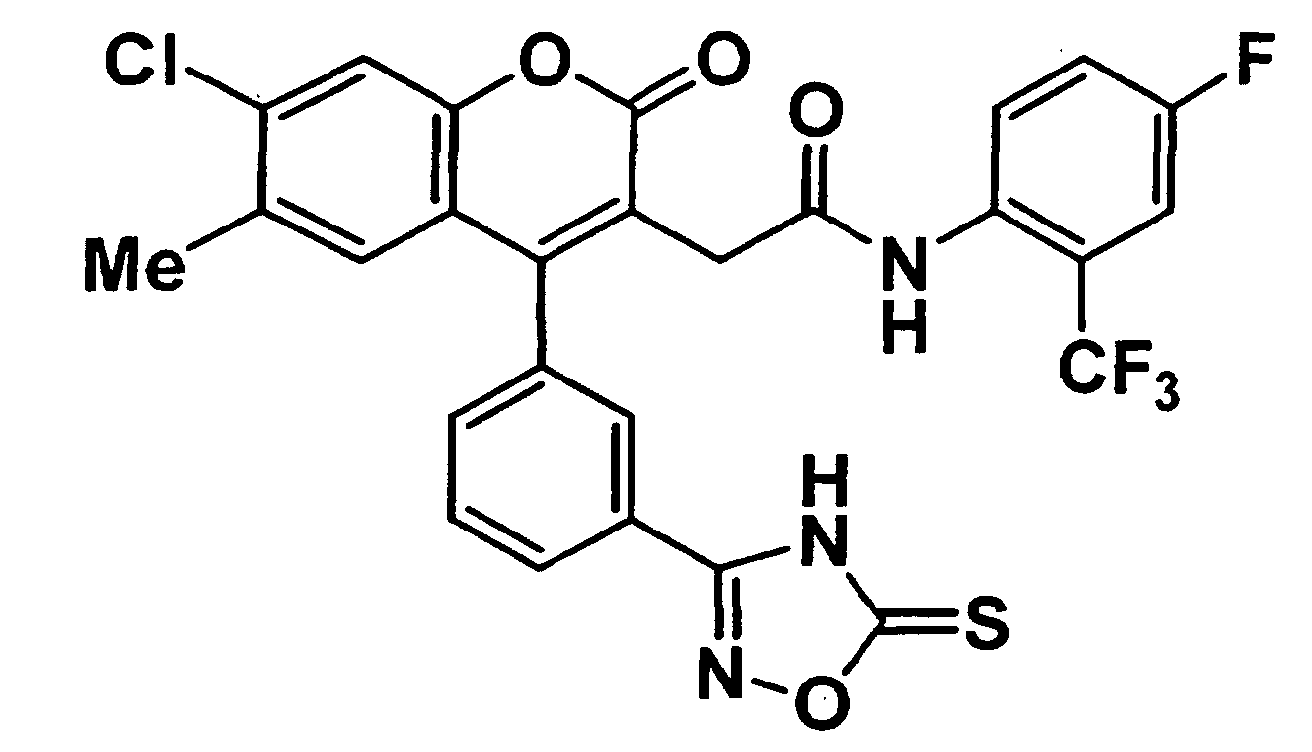
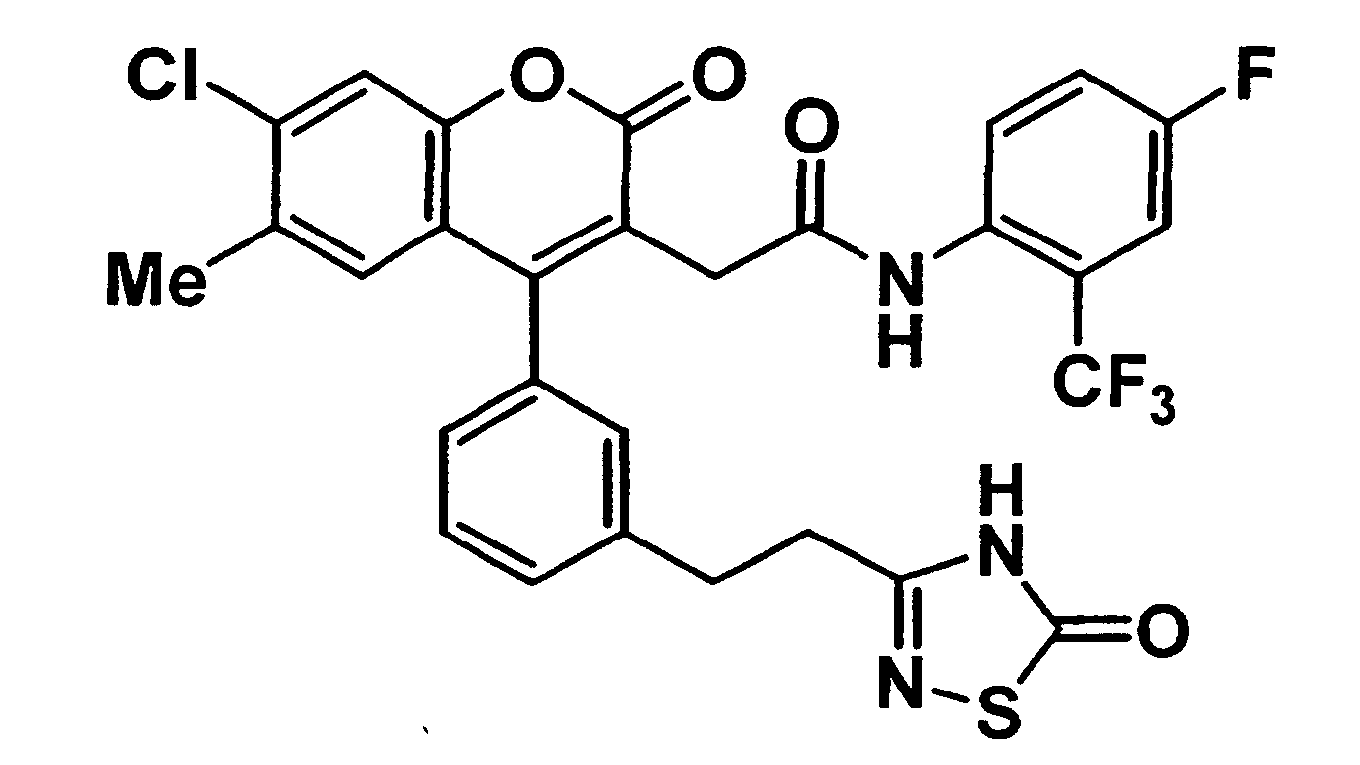
>C=S or >S(O)2, (inter alia, 2,5-dihydro-5-oxo-1,2,4-oxadiazol-3-yl,
2,5-dihydro-5-thioxo-1,2,4-oxadiazol-3-yl,
and 2,5-dihydro-5-oxo-1,2,4-thiadiazol-3-yl are preferable).
The "heterocyclic group bearing a hydrogen atom
capable of being deprotonated" may be protected with an
optionally substituted lower alkyl group (preferably C1-4
alkyl) or an acyl group. Examples of the optionally
substituted lower alkyl group include C1-4 alkyl which may
be substituted with phenyl optionally substituted with C1-3
alkyl, nitro, or C1-3 alkoxy, or C1-3 alkoxy (e.g. methyl,
triphenylmethyl, methoxymethyl, ethoxymethyl, p-methoxybenzyl,
p-nitrobenzyl). Examples of the acyl group
include lower (C2-5) alkanoyl and benzoyl.
Y is preferably an optionally esterified carboxyl
group, more preferably, carboxyl or lower alkoxycarboxyl,
and most preferably, carboxyl.
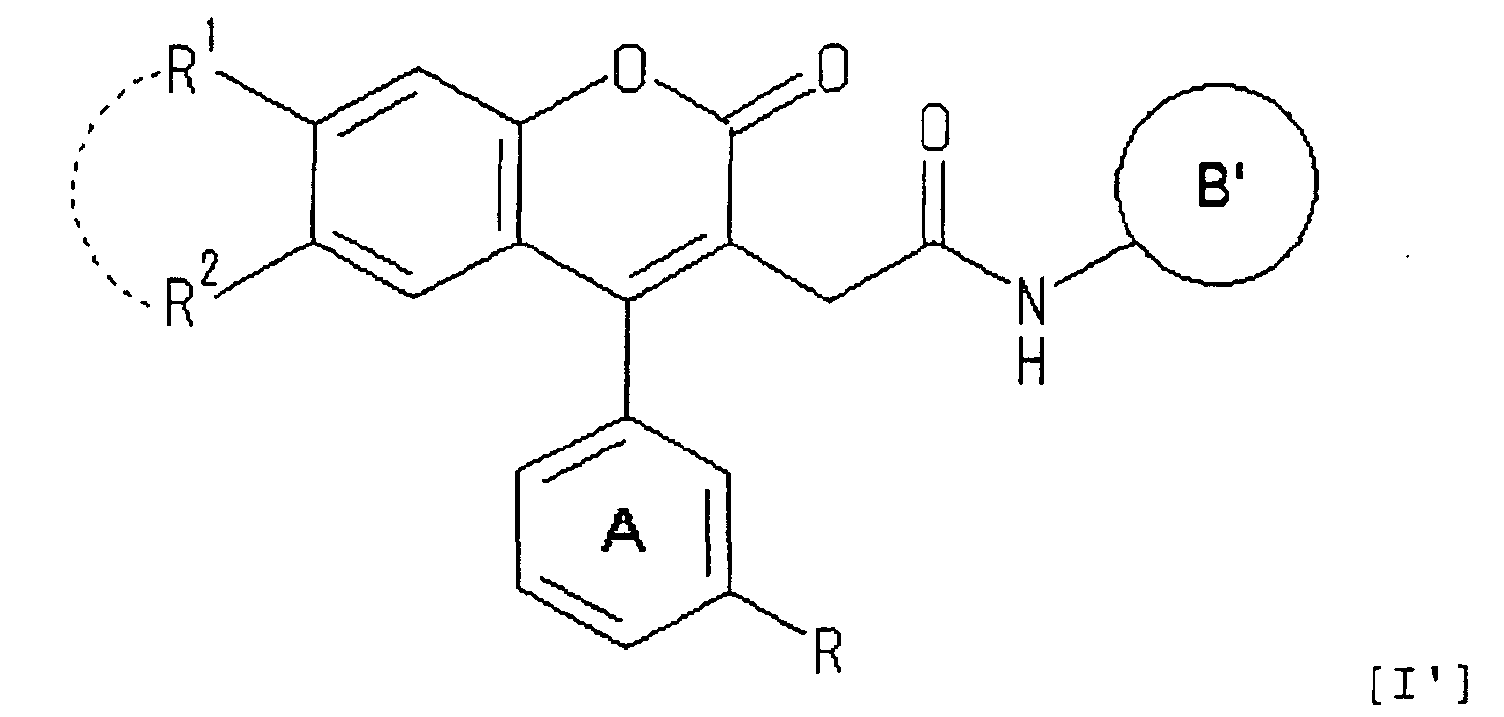
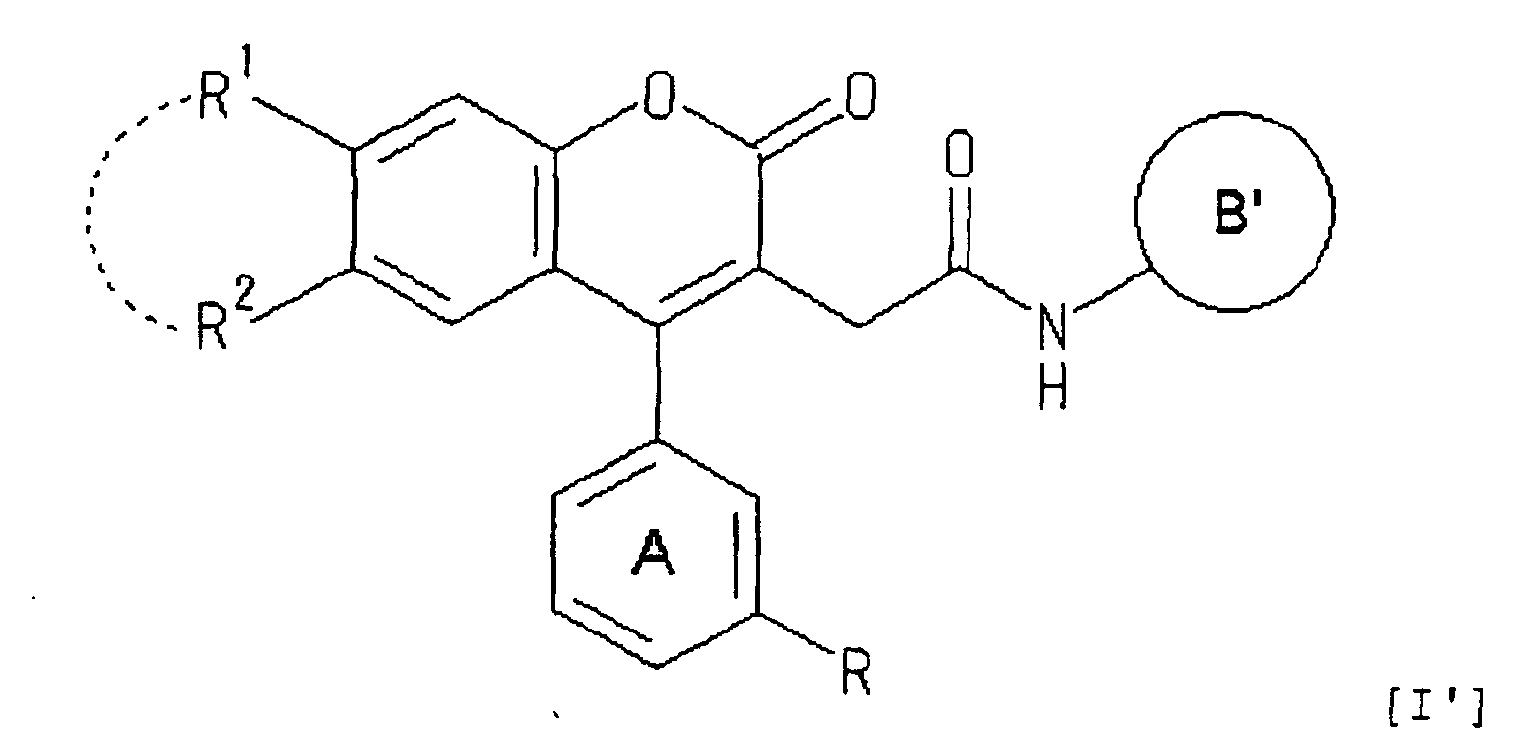
The formula [I] is preferably the formula [I']:
wherein ring B' represents an optionally substituted
benzene ring or an optionally substituted pyridine ring, R
represents an optionally esterified carboxyl group or a
linear hydrocarbon group which is substituted with an
optionally esterified carboxyl group, and the other symbols
are as defined in claim 1.
The "optionally esterified carboxyl group" represented
by R includes the same group as the "optionally esterified
carboxyl group" represented by Y.
The "optionally esterified carboxyl group" of the
"linear hydrocarbon group which is substituted with an
optionally esterified carboxyl group" represented by R
includes the same group as the "optionally esterified
carboxyl group" represented by Y.
The "linear hydrocarbon group" of the "linear
hydrocarbon group which is substituted with an optionally
esterified carboxyl group" represented by R includes the
same groups as C1-6 alkylene, C1-6 alkenylene and C1-6
alkynylene which are preferably exemplified as the "spacer
whose main chain consists of 1 to 6 atoms" represented by X.
In the formula [I'], R is preferably a group
represented by the formula -(CH2)n-R', wherein R'
represents an optionally esterified carboxyl group and n
represents an integer of 0 to 6; a group represented by the
formula -CH=CH- (CH2)n'-R' , wherein R' represents an
optionally esterified carboxyl group and n' represents an
integer of 0 to 4; or a group represented by the formula
-(CH=CH)n"-R', wherein R' represents an optionally
esterified carboxyl group and n" represents an integer of 1
to 3. In the above formulae, n is preferably an integer of
1 to 4 (more preferably 2), n' is preferably an integer of
0 to 2 (more preferably 0), and n" is preferably an integer
of 1 to 2 (more preferably 1).
The "optionally esterified carboxyl group" represented
by R' includes the same group as the "optionally esterified
carboxyl group" represented by Y, and, inter alia, carboxyl
is particularly preferable.
The present invention also includes the free form or
pharmaceutically acceptable salt of a compound represented
by the formula [I]. Examples of such a salt, when the
compound represented by the formula [I] has an acidic group
such as a carboxyl group, a heterocyclic group bearing a
hydrogen atom capable of being deprotonated and the like,
include salts with inorganic bases (e.g. alkali metal such
as sodium, potassium etc., alkaline earth metal such as
calcium, magnesium etc., transition metal such as zinc,
iron, copper etc.) or organic bases (e.g. organic amines
such as trimethylamine, triethylamine,
tris(hydroxymethyl)amine, pyridine, picoline, ethanolamine,
diethanolamine, triethanolamine, dicyclohexylamine, and
N,N'-dibenzylethylenediamine, and basic amino acids such as
arginine, lysine and ornithine).
When the compound represented by the formula [I] has a
basic group such as an amino group, examples of such a salt
include salts with inorganic acids, organic acids (e.g.
hydrochloric acid, nitric acid, sulfuric acid, phosphoric
acid, carbonic acid, bicarbonic acid, formic acid, acetic
acid, propionic acid, trifluoroacetic acid, fumaric acid,
oxalic acid, tartaric acid, maleic acid, citric acid,
succinic acid, malic acid, methanesulfonic acid,
benzenesulfonic acid, p-toluenesulfonic acid etc.), or
acidic amino acids such as aspartic acid and glutamic acid.
The compound represented by the formula [I] or a salt
thereof may be used as a prodrug. The prodrug refers to a
compound which is converted into the compound represented
by the formula [I] or a salt thereof as a result of a
reaction with an enzyme or gastric acid under the
physiological condition in a living body, that is, a
compound which undergoes enzymatic oxidation, reduction or
hydrolysis to form the compound represented by the formula
[I] or a salt thereof or a compound which is hydrolyzed
with gastric acid to form the compound represented by the
formula [I] or a salt thereof. Examples of a prodrug of
the compound represented by the formula [I] or a salt
thereof include, when the compound represented by the
formula [I] or a salt thereof has an amino group, the
compound in which the amino group is acylated, alkylated or
phosphorylated (e.g. a compound obtained by subjecting an
amino group in the compound represented by the formula [I]
or a salt thereof to eicosanoylation, alanylation,
pentylaminocarbonylation, (5-methyl-2-oxo-1,3-dioxolen-4-yl)methoxycarbonylation,
tetrahydrofuranylation,
pyrrolidylmethylation, pivaloyloxymethylation or tertbutylation);
when the compound represented by the formula
[I] or a salt thereof has a hydroxyl group, the compound in
which the hydroxy group is acylated, alkylated,
phosphorylated or borated (e.g. a compound obtained by
subjecting the hydroxy group to acetylation, palmitoylation,
propanoylation, pivaloylation, succinylation, fumarylation,
alanylation or dimethylaminomethylcarbonylation); when the
compound represented by the formula [I] or a salt thereof
has a carboxyl group, the compound in which the carboxyl
group is esterified or amidated (e.g. a compound obtained
by subjecting the carboxyl group to ethylesterification,
phenylesterification, carboxymethylesterification,
dimethylaminomethylesterification,
pivaloyloxymethylesterification,
ethoxycarbonyloxyethylesterification,
phthalizylesterification, (5-methyl-2-oxo-1,3-dioxolen-4-yl)methylesterification,
cyclohexyloxycarbonylethylesterification or
methylamidation); and the like. These prodrugs can be
prepared from the compound represented by the formula [I]
or a salt thereof by a method known per se.
In addition, a prodrug of the compound represented by
the formula [I] or a salt thereof may be changed into the
compound represented by the formula [I] or a salt thereof
under the physiological condition as described in
"Development of Medicaments", vol.7, Molecular Design,
p.163-198 published by Hirokawashoten in 1990.
In addition, the compound represented by the formula
[I] or a salt thereof may be hydrous or anhydrous.
In addition, the compound represented by the formula
[I] or a salt thereof may be labelled with an isotope
element (e.g. 3H, 14C, 35S, 125I etc.).
Among the compounds represented by the formula [I],
preferred are:
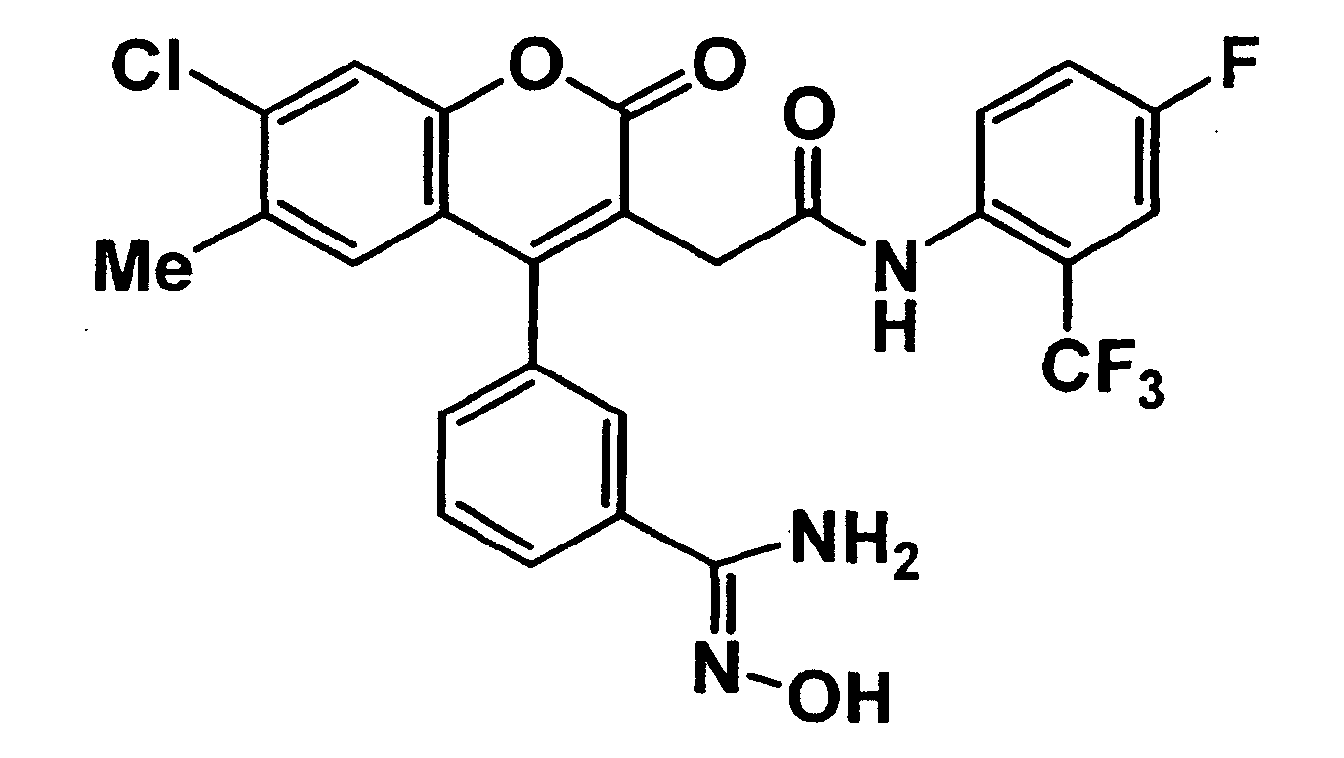
3-[3-[7-chloro-3-[2-[[4-fluoro-2-(trifluoromethyl)phenyl]amino]-2-oxoethyl]-6-methyl-2-oxo-2H-chromen-4-yl]phenyl]propionic
acid, (2E)-3-[3-[7-chloro-6-methyl-2-oxo-3-(2-oxo-2-[[2-(trifluoromethyl)phenyl]amino]ethyl)-2H-chromen-4-yl]phenyl]-2-propenoic
acid, 3-[3-[7-chloro-6-methyl-2-oxo-3-(2-oxo-2-[[2-(trifluoromethyl)phenyl]amino]ethyl)-2H-chromen-4-yl]phenyl]propionic
acid, (2E)-3-[3-[6-chloro-3-(2-[[4-fluoro-2-(trifluoromethyl)phenyl]amino]-2-oxoethyl)-7-methyl-2-oxo-2H-chromen-4-yl]phenyl]-2-propenoic
acid, 3-[3-[6-chloro-3-(2-[[4-fluoro-2-(trifluoromethyl)phenyl]amino]-2-oxoethyl)-7-methyl-2-oxo-2H-chromen-4-yl]phenyl]propionic
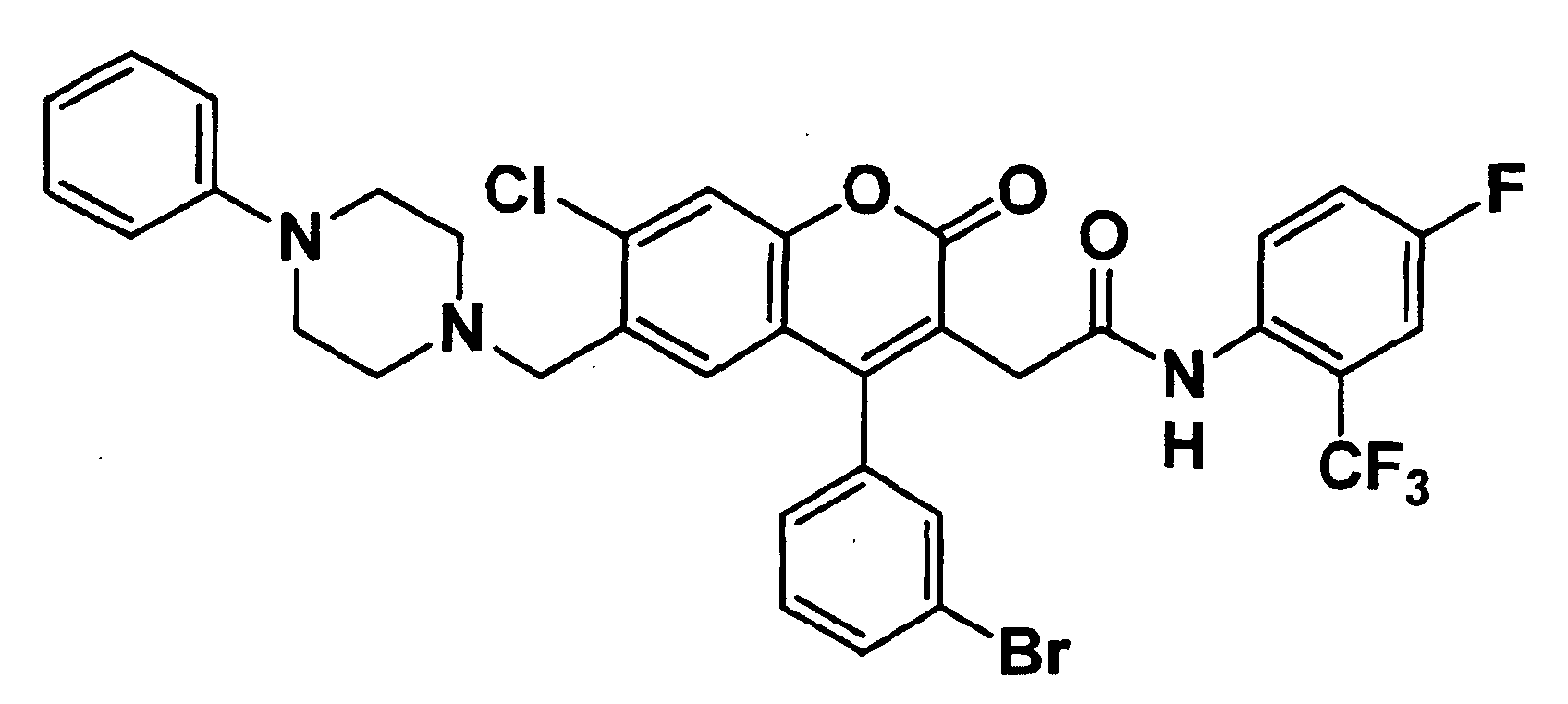
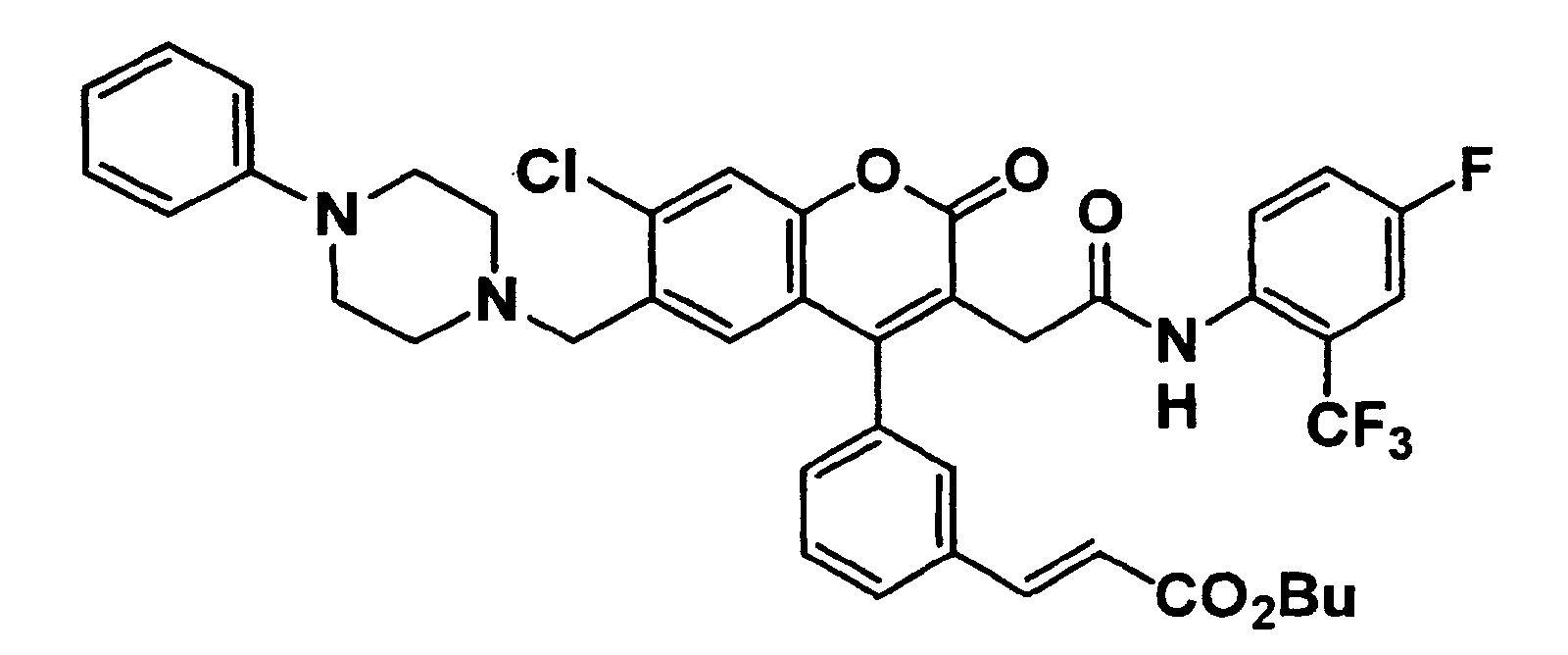
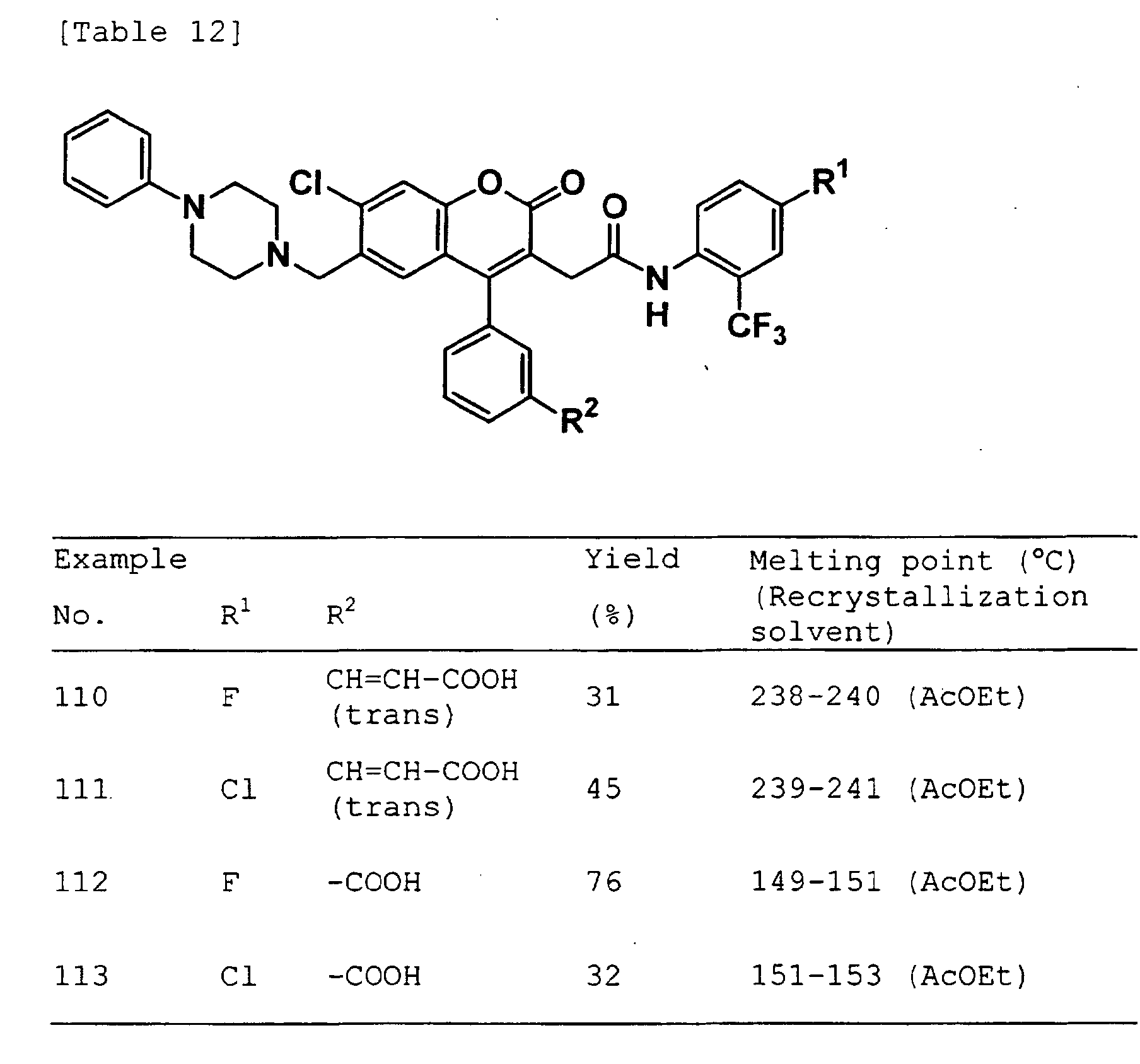
acid, (2E)-3-(3-{7-chloro-3-(2-{[4-fluoro-2-(trifluoromethyl)phenyl]amino}-2-oxoethyl)-2-oxo-6-[(4-phenylpiperazin-1-yl)methyl]-2H-chromen-4-yl}phenyl)acrylic
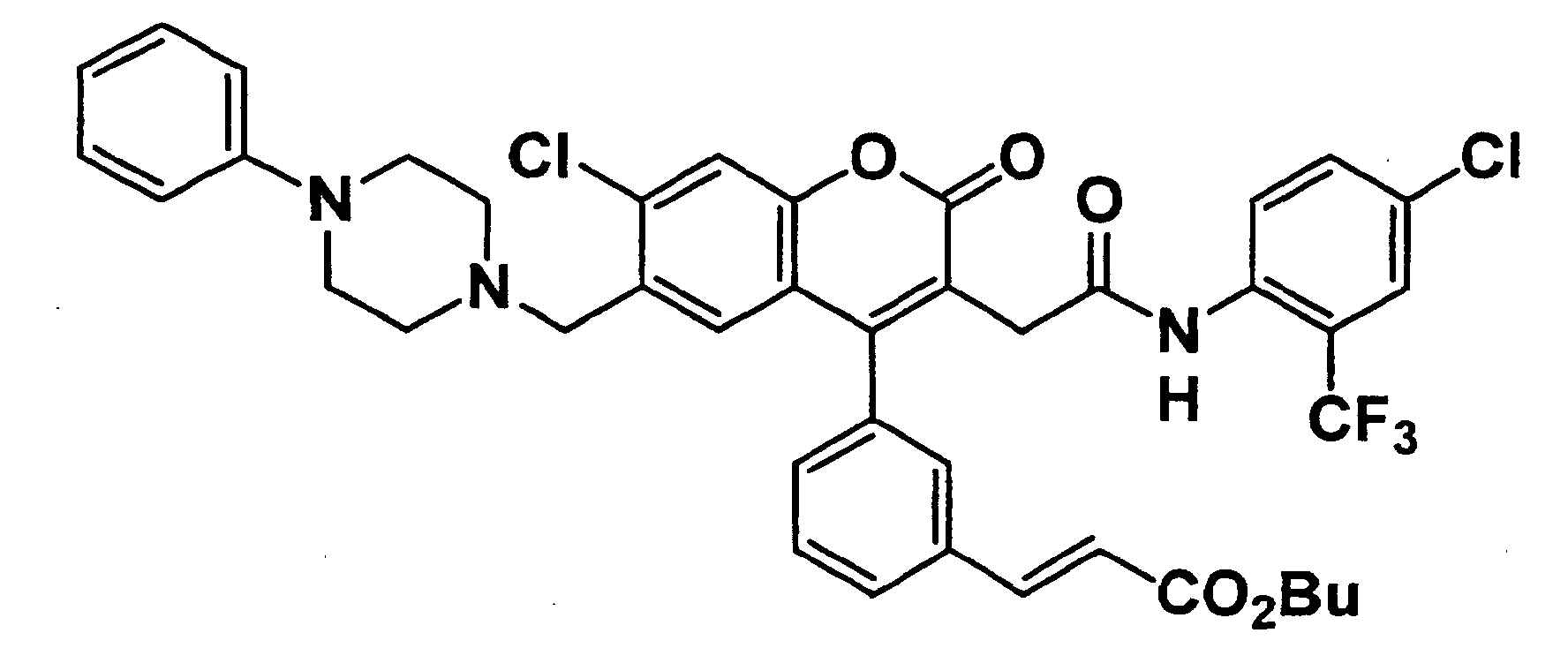
acid, (2E)-3-(3-{7-chloro-3-(2-{[4-chloro-2-(trifluoromethyl)phenyl]amino}-2-oxoethyl)-2-oxo-6-[(4-phenylpiperazin-1-yl)methyl]-2H-chromen-4-yl}phenyl)acrylic
acid, 3-{7-chloro-3-(2-{[4-fluoro-2-(trifluoromethyl)phenyl]amino}-2-oxoethyl)-2-oxo-6-[(4-phenylpiperazin-1-yl)methyl]-2H-chromeh-4-yl}benzoic
acid,
3-{7-chloro-3-(2-{[4-chloro-2-(trifluoromethyl)phenyl]amino}-2-oxoethyl)-2-oxo-6-[(4-phenylpiperazin-1-yl)methyl]-2H-chromen-4-yl}benzoic
acid;
and a salt thereof.
The compound represented by the formula [I] or a salt
thereof can be prepared according to the method disclosed,
for example, in European Patent Application Publication
No.585913, European Patent Application Publication
No.602598, JP-A 6-263736 or International Publication WO
02/06264, or by the following method.
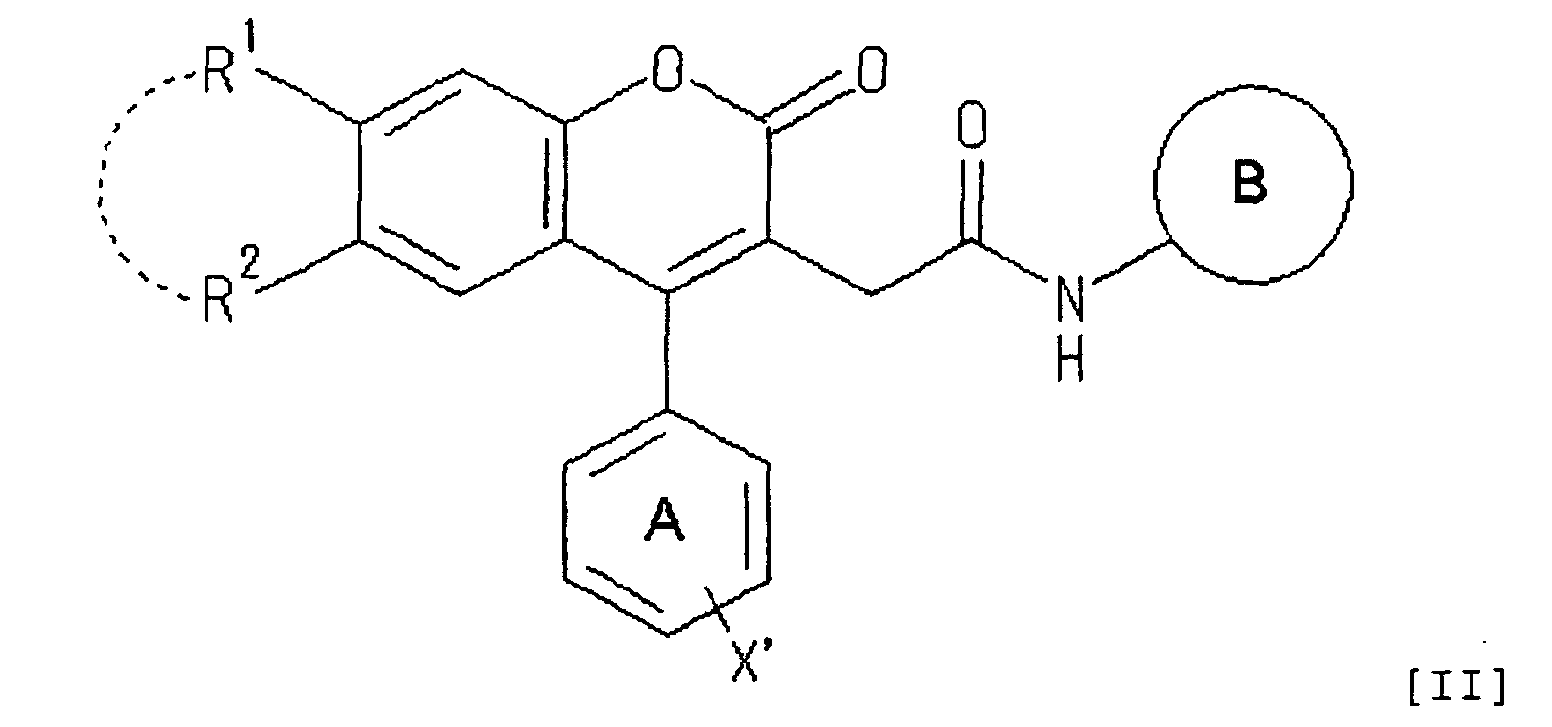
The compound [I] or a salt thereof can be prepared,
for example, by carbonylation or Heck reaction of a
compound represented by the formula [II]:
wherein X' represents halogen or a trifluoromethanesulfonyl
group and other symbols are as defined above, or a salt
thereof and then, if necessary, hydrogenation or hydrolysis,
or a combination of both reactions.
The carbonylation reaction can be performed according
to the method described, for example, in A.Schoenberg, et
al., J.Org.Chem., 39, 3318-3326 (1974), M.Hidai, et al.,
Bull. Chem. Soc.Jpn, 48, 2075-2077 (1975), D.Valentine, Jr.,
et.al., J.Org.Chem., 46, 4616-4617 (1981). That is, the
compound [II] is treated with a palladium catalyst and a
base under carbon monoxide atmosphere and then reacted with
a nucleophile to carbonylate the compound [II].
Carbon monoxide is used usually at 1 to 20 atm.,
preferably 1 to 10 atm.
The palladium catalyst includes palladium (II) acetate,
palladium (II) chloride,
dihalobis(triarylphosphine)palladium (II) (e.g.
dichlorobis(triphenylphosphine)palladium(II),
dibromobis(triphenylphosphine)palladium(II),
diiodobis(triphenylphosphine)palladium (II),
dichlorobis(tritolylphosphine)palladium(II) etc.), and
haloarylbis(triarylphosphine)palladium(II) (e.g.
chlorophenylbis(triphenylphosphine)palladium (II) etc.).
The amount of the catalyst used is usually 0.005 to 0.1 mol,
preferably 0.01 to 0.05 mol per 1 mol of the compound [II].
In addition, when 1 to 50 mol (preferably 2 to 20 mol) of
triarylphosphine (e.g. triphenylphosphine, tri(o-tolyl)phosphine
etc.) or bis(diarylphosphino)alkyl (e.g.
1,4-bis(diphenylphosphino)butane, 1,3-bis(diphenylphosphino)propane,
1,2-bis(diphenylphosphino)ethane
etc.) coexists with 1 mol of a
catalyst, the reaction may progress advantageously.
The base includes secondary amine (e.g. diethylamine,
dicyclohexylamine etc.), tertiary amine (e.g. triethylamine,
tributylamine, tetramethylethylenediamine etc.) and
carbonate (e.g. sodium carbonate, potassium carbonate,
sodium dicarbonate). The amount of the base used is
usually 1 to 10 mol, preferably 1 to 3 mol per 1 mol of the
compound [II].
The nucleophile includes water and lower alcohol (e.g.
methanol, ethanol, butanol). The amount of the nucleophile
used is usually 1 to 100 mol, preferably 1 to 10 mol per 1
mol of the compound [II].
The carbonylation reaction is performed in the
presence or the absence of a solvent. The solvent includes
amides (e.g. dimethylformamide, N-methylpyrrolidinone,
hexamethylphosphoric triamide) and nitriles (acetonitrile,
benzonitrile etc.). The amount of the solvent used is
usually about 1 to 100 ml, preferably about 10 to 50 ml per
1 g of the compound [II].
The reaction temperature is usually about 10°C to
200°C, preferably about 20°C to 150°C. The reaction time is
about 1 to 100 hours, preferably about 5 to 80 hours
depending on a carbon monoxide pressure, the amount and the
kind of a catalyst, a base or a reaction solvent, the
reaction temperature, and the like.
The Heck reaction can be performed according to the
method, for example, described in R.F.Heck, Org. Reactions,
27, 345-390(1982). That is, the compound [II] is reacted
with olefin in the presence of a palladium catalyst and a
base.
The olefin includes a compound represented by CH2=CH-(CH2)n,-R'
wherein R' represents an optionally esterified
carboxyl group and n' represents an integer of 0 to 4, and
a compound represented by CH2=CH-(CH=CH)n'''-R' wherein R'
represents an optionally esterified carboxyl group and n'''
represents an integer of 1 to 2, which are commercially
available or prepared by a method known per se (e.g. a
method described in R.S.Sandler and W.Karo, "Organic
Functional Group Preparations I", Academic Press, 1983,
Chapter 2 (p.39-81), Chapter 9 (p.236-288), Chapter 10
(p.289-315)). The amount of olefin used is usually 1 to 10
mol, preferably 1 to 3 mol per 1 mol of the compound [II].
The catalyst, the base and the reaction solvent are
the same as those for the carbonylation reaction. In
addition, when nickel [II] bromide or sodium iodide
coexists, the reaction may progress advantageously.
The reaction temperature is usually about 10°C to
200°C, preferably about 20°C to 150°C. The reaction time is
about 1 hour to 100 hours, preferably about 5 hours to 80
hours depending on the amount and the kind of a catalyst, a
base or a reaction solvent, the reaction temperature and
the like.
The hydrogenation reaction after the carbonylation
reaction or the Heck reaction can be performed by a method
known per se (e.g. a method described in P.Rylander,
"Catalytic Hydrogenation in Organic Syntheses), Academic
Press, 1979). The hydrolysis reaction follows, for example,
the method of the reaction step 3 described hereinbelow.
The starting compound [II] or a salt thereof used in
the aforementioned reaction can be prepared by the method
described, for example, in European Patent Application
Publication No.585913, JP-A 7-10844 gazette or
International Publication WO 02/06264, the similar method,
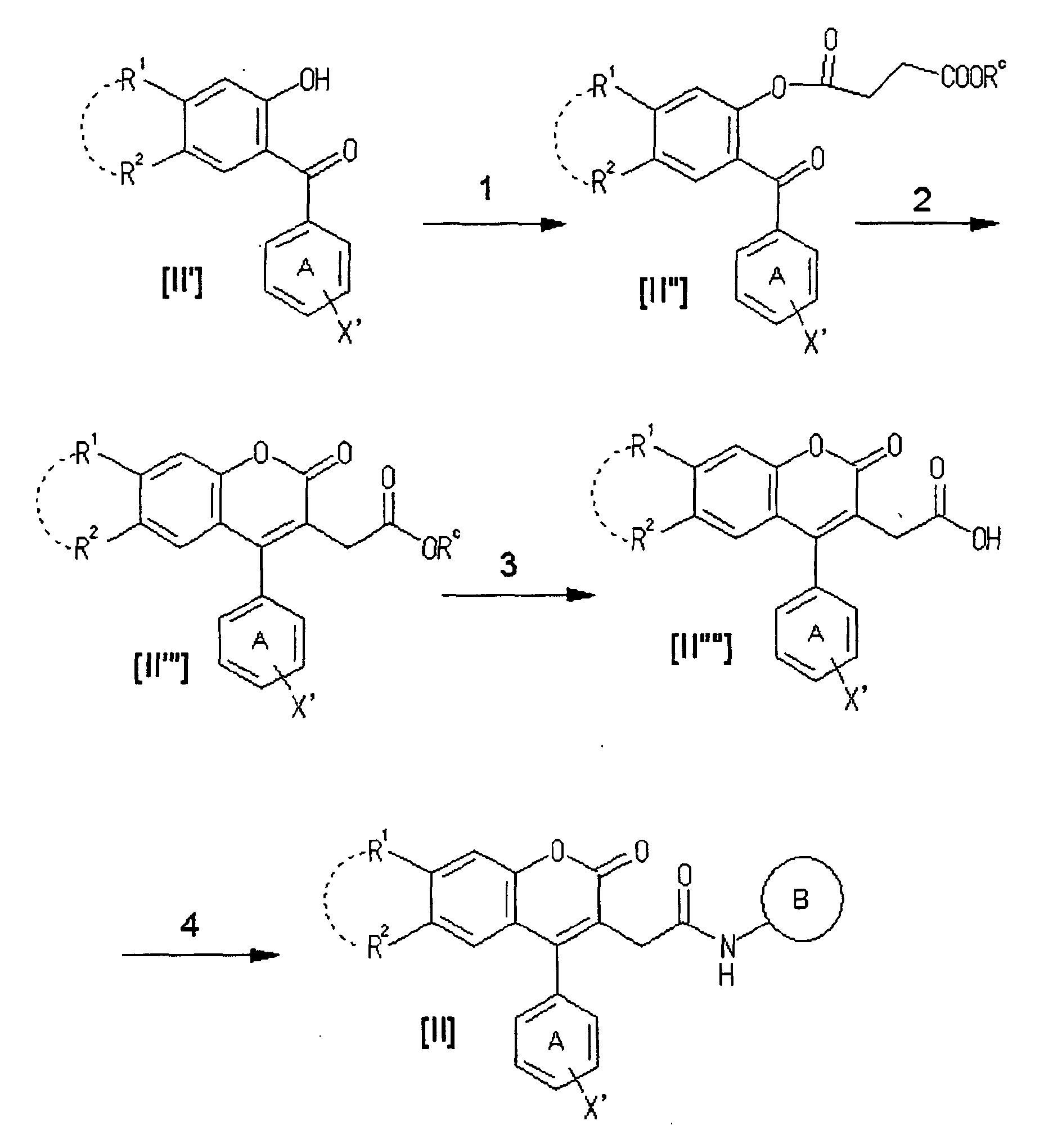
or the following method:
wherein R
c represents an alkyl group (e.g. methyl, ethyl,
propyl, t-butyl etc.) and other symbols are as defined
above.
The reaction step 1 is performed by condensing the
compound [II'] or a salt thereof and a reactive derivative
of succinic acid monoester.
As the reactive derivative of succinic acid monoester,
for example, acid halide (e.g. acid chloride etc.) of
succinic acid monoalkylester (e.g. methylester, ethylester,
propylester) is used. In particular, ethylsuccinic
chloride is preferable. The amount of a reactive
derivative of succinic acid monoester used is usually
equivalent to 10-fold molar amount, preferably equivalent
to 3-fold molar amount based on the amount of the compound
[II'] or a salt thereof.
The reaction is usually performed advantageously in
the presence of a base. As the base, an organic or
inorganic base is used. The organic base includes tertiary
amines (e.g. triethylamine, diisopropylethylamine,
diazabicycloundecene). The inorganic base includes alkali
metal hydroxide such as lithium hydroxide, sodium hydroxide,
potassium hydroxide and the like; alkali metal carbonate
such as sodium carbonate, potassium carbonate, cesium
carbonate and the like; alkali metal hydrogencarbonate such
as sodium hydrogencarbonate, potassium hydrogencarbonate
and the like; alkali metal hydride such as sodium hydride,
potassium hydride and the like. The amount of a base used
is usually equivalent to about 10-fold molar amount,
preferably equivalent to 3-fold molar amount based on the
amount of the compound [II'] or a salt thereof.
The reaction can be advantageously performed in a
solvent. As the solvent, a solvent having no adverse
influence on a reaction is used and includes hydrocarbons
(e.g. pentane, hexane, cyclohexane, benzene, toluene etc.),
halogenated hydrocarbons (e.g. dichloromethane, chloroform
etc.), ethers (e.g. diethyl ether, tetrahydrofuran, dioxane
etc.), amides (e.g. N,N-dimethylformamide,
hexamethylphosphoric triamide etc.), ureas (e.g. 1,3-dimethyl-3,4,5,6-tetrahydro-2(1H)-pyrimidine
etc.) and
nitriles (e.g. acetonitrile, propionitrile etc.). The
solvent may be a single or a mixture of two or more
solvents in an appropriate ratio. The amount of a solvent
used is usually about 1 to 100 ml, preferably about 10 to
50 ml per 1 g of the compound [II'] or a salt thereof. The
reaction temperature is usually about -20°C to the boiling
point of a solvent used in the reaction, preferably about
25°C to 100°C.
The reaction time is about 10 minutes to 24 hours,
preferably about 20 minutes to 12 hours depending on the
kind of a base or a reaction solvent used, the reaction
temperature and the like.
The reaction step 2 is performed by treating the
compound [II"] with a base. As the base, for example, the
same bases as those exemplified as a base for the reaction
step 1 can be used. The amount of a base used is usually
about 0.1-fold to about 10-fold molar amount, preferably
about 0.1-fold to 1-fold molar amount based on the amount
of the compound [II"] or a slat thereof.
The reaction can be performed advantageously in a
solvent. As the solvent, a solvent having no adverse
influence on the reaction is used and includes hydrocarbons
(e.g pentane, hexane, cyclohexane, benzene, toluene etc.),
halogenated hydrocarbons (e.g. dichloromethane, chloroform
etc.), ethers (e.g. diethyl ether, tetrahydrofuran, dioxane
etc.), amides (e.g. N,N-dimethylformamide,
hexamethylphosphoric triamide etc.), ureas (e.g. 1,3-dimethyl-3,4,5,6-tetrahydro-2(1H)-pyrimidine
etc.) and
nitriles (e.g. acetonitrile, propionitrile etc.). The
solvent may be a single or a mixture of two or more
solvents in an appropriate ratio. The amount of the
solvent used is usually about 1 to 100 ml, preferably about
10 to 50 ml per 1 g of the compound [II"]. The reaction
temperature is usually about 20°C to the boiling point of a
solvent used in the reaction, preferably about 25°C to
about 120°C.
The reaction time is about 30 minutes to 24 hours,
preferably about 1 hour to 12 hours depending on the kind
of a base or a reaction solvent, the reaction temperature
and the like.
The reaction may progress advantageously by removing
water produced during the reaction with the Dean-Stark
dehydration apparatus or the like.
Alternatively the reaction step 1 and reaction step 2
may be performed in one step. For example, the compound
[II'''] or a salt thereof can be prepared from the compound
[II"] or a salt thereof in one step by using acid halide
(e.g. acid chloride etc.) of succinic acid monoalkylester
(e.g. methylester, ethylester, propylester) as a reactive
derivative of succinic acid monoester and tertiary amines
(e.g. triethylamine, diisopropylethylamine,
diazabicycloundecene etc.) as a base in an excessive amount.
In this case, the amount of acid halide used is usually
about 1.5-fold to 10-fold molar amount, preferably about
1.5-fold to 3-fold molar amount based on the amount of the
compound [II"] or a salt thereof. The amount of a base
used is usually about 2-fold 10-fold molar amount,
preferably about 2-fold to 5-fold molar amount based on the
amount of the compound [II"] or a salt thereof.
The reaction can be performed advantageously in a
solvent. As the solvent, a solvent having no adverse
influence on a reaction is used. The kind and the amount
of a solvent used are the same as those for the reaction
step 1. The reaction temperature is usually about 20°C to
the boiling point of a solvent used in the reaction,
preferably about 25°C to 60°C. The reaction time is about
30 minutes to 24 hours, preferably about 30 minutes to 4
hours depending on the kind of acid halide or a base, the
kind of a reaction solvent, the reaction temperature and
the like.
The reaction step 3 can be performed by treating the
compound [II'''] with an acid or a base.
As the acid, organic acid (e.g. formic acid, acetic
acid, trichloroacetic acid, trifluoroacetic acid,
benzenesulfonic acid, p-toluenesulfonic acid etc.) or
inorganic acid (e.g. hydrochloric acid, hydrobromic acid,
sulfuric acid, nitric acid, phosphoric acid etc.) can be
used. The acid may be a mixture of two or more acids in an
appropriate ratio. As the base, for example, alkali metal
hydroxide (e.g. lithium hydroxide, sodium hydroxide,
potassium hydroxide etc.), alkali metal carbonate (e.g.
sodium carbonate, potassium carbonate, cesium carbonate
etc.) or alkali metal hydrogencarbonate (e.g. sodium
hydrogencarbonate, potassium hydrogencarbonate etc.) is
used. The amount of an acid or a base used is usually
about 1-fold to 100-fold molar amount, preferably about 1-fold
to 10-fold molar amount based on the amount of the
compound [II'''].
The reaction can be advantageously performed in a
solvent. As the solvent, a solvent having no adverse
influence on the reaction is used and includes hydrocarbons
(e.g. pentane, hexane, cyclohexane, benzene etc.), lower
alcohols (e.g. methanol, ethanol, propanol etc.), ethers
(e.g. diethyl ether, tetrahydrofuran, dioxane etc.), amides
(e.g. N,N-dimethylformamide, hexamethylphosphoric triamide
etc.) and ureas (e.g. 1,3-dimethyl-3,4,5,6-tetrahydro-2(1H)-pyrimidine
etc.). In the case of the reaction with
an acid, the aforementioned acid may be also used as a
solvent. The solvent may be a single, a mixture of two or
more solvents in an appropriate ratio, or a mixed solvent
with water. The amount of a solvent used is usually about
1 to 100 ml, preferably about 10 to 50 ml per 1 g of the
compound [II'']. The reaction temperature is usually about
-20°C to the boiling point of a solvent used in the
reaction, preferably about 15°C to 120°C. The reaction
time is about 10 minutes to 24 hours, preferably 30 minutes
to 12 hours depending on the kind of an acid or a reaction
solvent, the reaction temperature and the like.
The reaction step 4 can be performed by reacting the
compound [II''''], a salt thereof or a reactive derivative
of the carboxyl group thereof with a compound represented
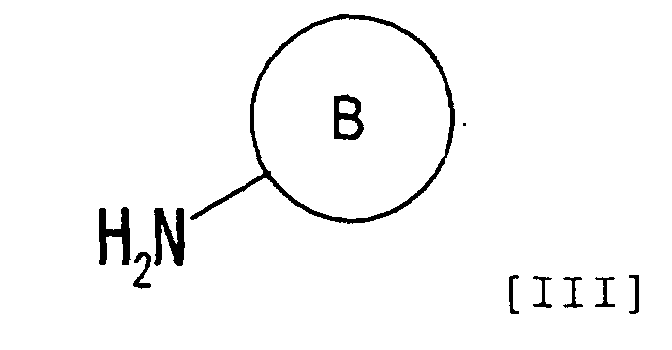
by the formula [III]:
wherein the symbol is as defined above, or a salt thereof.
As the reactive derivative of the carboxylic acid, for
example, acid halide (e.g. chloride, bromide, etc.), acid
anhydride, mixed acid anhydride (e.g. anhydride with
methylcarbonic acid, anhydride with ethylcarbonic acid,
anhydride with isobutylcarbonic acid), or active ester (e.g.
ester with hydroxysuccinic acid imide, ester with 1-hydroxybenzotriazole,
ester with N-hydroxy-5-norbornene-2,3-dicarboxyimide,
ester with p-nitrophenol, ester with 8-oxyquinoline)
is used. Inter alia, acid halide is
preferable.
Alternatively, the compound [II] or a salt thereof may
be prepared by reacting the compound [II''''] or a salt
thereof with a compound represented by the formula [III] or
a salt thereof in the presence of a coupling reagent. The
coupling reagent includes carbodiimides (e.g.
dicyclohexylcarbodiimide, N-[3-(dimethylamino)propyl]-N'-ethylcarobodiimide,
N-cyclohexyl-N'-(2-morpholin-4-ylethyl)carobodiimide,
N-cyclohexyl-N'-[4-(diehtylamino)cyclohexyl]carobodiimide
etc.),
carbonyldiimidazole, N-ethyl-5-phenylisoxazolium-3'-sulfonate,
N-ethyl-2'-hydroxybenzisoxazoliumtrifluoroborate,
2-ethoxy-1-ethoxycarbonyl-1,2-dihydroquinoline, 2-isobutyloxy-1-isobutyloxycarobonyl-1,2-dihydroquinoline,
(benzotriazolyl-N-hydroxytrisdiethylaminophosphoniumhexafluorophosphate
and
diphenylphosphorylazide. When carbodiimide is used
together with an additive, the reaction may progress
advantageously. As the additive, N-hydroxysuccinimide, 1-hydroxybenzotriazole,
3-hydroxy-4-oxo-3,4-dihydro-1,2,3-benzotriazine,
N-hydroxy-5-norbornene-2,3-dicarboxylic acid
imide, ethyl 2-hydroxyimino-2-cyanoacetate, 2-hydroxyimino-2-cyanoacetamide
or the like is used.
A salt of the compound [II''''] or [III] includes the
same salts as those of the compound [I] as described above.
The reaction is usually performed in a solvent having
no adverse influence on the reaction (e.g. halogenated
hydrocarbons such as chloroform, dichloromethane, ethyl
ether, tetrahydrofuran, dioxane, dimethoxyethane, ethyl
acetate, benzene, toluene, pyridine and N,N-dimethylformamide,
ethers, esters, hydrocarbons, aromatic
amines, amides etc.). The present reaction can be
performed in the presence or the absence of a base. The
reaction temperature is usually about -10°C to 120°C,
preferably about 0°C to 100°C. The reaction time is
usually about 5 minutes to 48 hours, preferably about 0.5
to 24 hours. The amount of the compound [III] or a salt
thereof used is about 1 to 5 mol equivalent, preferably
about 1 to 3 mol equivalent per 1 mol of the compound
[II''''] or a salt thereof or a reactive derivative thereof.
The base includes alkylamines such as triethylamine, cyclic
amines such as N-methylmorpholine and pyridine, aromatic
amines such as N,N-dimethylaniline and N,N-diethylaniline,
alkali metal carbonate such as sodium carbonate and
potassium carbonate, and alkali metal hydrogencarbonate
such as sodium hydrogencarbonate and potassium
hydrogencarbonate. The amount of a base used is about 1 to
5 mol equivalent, preferably about 1 to 3 mol equivalent
per 1 mol of the compound [II''''] or a salt thereof. When
a solvent immiscible with water is used in the present
reaction, water may be added to the reaction system at an
appropriate ratio to perform the reaction in a two-phase
system. When a coupling reagent is used, the reaction is
usually preferably performed under non-aqueous condition.
The amount of a coupling reagent used is about 1 to 10 mol
equivalent, preferably about 1 to 3 mol equivalent per 1
mol of the compound [II''''] or a salt thereof. When an
additive is further used, the amount to be used is about 1
to 5 mol equivalent, preferably about 1 to 2 mol equivalent
per 1 mol of a coupling regent.
Further, coumarinamide fused with cycloalkane having
an oxo group may be synthesized by subjecting coumarinamide
fused with cycloalkane to oxidation reaction in an
appropriate stage of the synthesis. The oxidation reaction
is performed using an oxidizing agent (e.g. permanganate,
chromate etc.) according to a method known per se (e.g.
A.B.Smith, III, et al. the Journal of Organic Chemistry,
vol.50, p.3239-3241, 1985).
When R1, R2, ring A, ring B or Y of the compound (I)
has a functional group capable of converting into the
desired substituent (e.g. a carboxyl group, an amino group,
a hydroxy group, a carbonyl group, a thiol group, an ester
group, a sulfo group, a halogen atom etc.), the functional
group can be converted by a method known per se or the
similar method to prepare the desired compound.
For example, a carboxyl group can be converted by
esterification, reduction, amidation, conversion into an
optionally protected amino group, or the like. An amino
group can be converted by amidation, sulfonylation,
nitrosation, allkylation, arylation, imidation, or the like.
A hydroxy group can be converted by esterification,
carbamoylation, sulfonylation, allkylation, arylation,
oxidation, halogenation, or the like. A carbonyl group can
be converted by reduction, oxidation, imination (including
oximation and hydrazonation), (thio) ketalization,
alkylidenation, thiocarbonylation, or the like. A thiol
group can be converted by alkylation, oxidation, or the
like. An ester group can be converted by reduction,
hydrolysis, or the like. A sulfo group can be converted by
sulfonamidation, reduction, or the like. A halogen atom
can be converted by various nucleophilic displacement
reactions, various coupling reactions, or the like.
As salts of the compounds [II'], [II"], [II'''] and
[II''''] used in the aforementioned reactions, the same
salts as those of the compound [I] are used.
In each reaction of the above-described process for
preparing the compound [I] or a salt thereof and each
reaction for synthesizing the starting compound, when the
starting compound has an amino group, a carboxyl group or a
hydroxy group as a substituent, a conventional protecting
group used in peptide chemistry may be introduced into the
substituent and after the reaction, the protecting group
may be removed as necessary to obtain the desired compound.
As a protecting group for an amino group, for example,
formyl, optionally substituted C1-6 alkylcarbonyl (e.g.
acetyl, ethyl carbonyl etc.), phenylcarbonyl, C1-6 alkyloxycarbonyl,
(e.g. methoxycarbonyl, ethoxycarbonyl etc.),
phenyloxycarbonyl, C7-10 aralkyl-carbonyl (e.g.
benzylcarbonyl etc.), trityl, phthaloyl or N,N-dimethylaminomethylene
is used. As a substituent for them,
a halogen atom (e.g. fluorine, chlorine, bromine, iodine
etc.), C1-6 alkyl-carbonyl (e.g. methylcarbonyl,
ethylcarbonyl, butylcarbonyl, etc.), a nitro group or the
like is used. The number of substituents is around 1 to 3.
As a protecting group for a carboxyl group, for
example, optionally substituted C1-6 alkyl (e.g. methyl,
ethyl, n-propyl, i-propyl, n-butyl, tert-butyl etc.),
phenyl, trityl or silyl is used. As a substituent for them,
a halogen atom (e.g. fluorine, chlorine, bromine, iodine,
etc.), formyl, C1-6 alkyl-carbonyl (e.g. acetyl,
ethylcarbonyl, butylcarbonyl, etc.), a nitro group or the
like is used. The number of substituents is around 1 to 3.
As a protecting group for a hydroxy group, for example,
optionally substituted C1-6 alkyl (e.g. methyl, ethyl, n-propyl,
i-propyl, n-butyl, tert-butyl, etc.), phenyl, C7-10
aralkyl (e.g. benzyl, etc.), formyl, C1-6 alkyl-carbonyl
(e.g. acetyl, ethylcarbonyl etc.), phenyloxycarbonyl,
benzoyl, C7-10 aralkyl-carbonyl (e.g. benzylcarbonyl etc.),
pyranyl, furanyl, silyl or the like is used. As a
substituent for them, a halogen atom (e.g. fluorine,
chlorine, bromine, iodine etc.), C1-6 alkyl (e.g. methyl,
ethyl, n-propyl etc.), phenyl, C7-10 aralkyl (e.g. benzyl
etc.), a nitro group or the like is used. The number of
substituents is around 1 to 4.
As a method of removing a protecting group, a method
known per se or the similar method is used. For example, a
method of treating a protecting group with acid, base,
reduction, ultraviolet-ray, hydrazine, phenylhydrazine,
sodium N-methyldithiocarbamate, tetrabutylammonium fluoride,
or palladium acetate is used.
The compound [I] or a salt thereof obtained by the
aforementioned method can be isolated and purified by, for
example, usual separation means such as recrystallization,
distillation and chromatography. When the present compound
[I] thus obtained is in free from, it can be converted into
a salt by a method known per se or the similar method (e.g.
neutralization) and, conversely, when the present compound
[I] is obtained as a salt form thereof, it can be converted
into the free form or another salt by a method known per
se or the similar method.
When there are optical isomers of the compound [I],
these individual optical isomers and a mixture thereof are
included in the scope of the present invention. If desired,
these isomers may be optically resolved according to a
known per se means, or may be prepared individually.
Since the compound [I], a salt thereof and a prodrug
thereof of the present invention (hereinafter, abbreviated
as the compound of the present invention in some cases) are
low toxic and safe and have lipid-rich plaque regressing
activity, the compound of the present invention is useful
for preventing or treating acute myocardial infarction,
acute coronary syndrome such as unstable angina, peripheral
artery occlusion, restenosis after percutaneous coronary
plasty (PTCA), restenosis after stent placement, myocardial
infarction, ischemic heart failure such as angina,
arteriosclerosis, intermittent claudication, cerebral
apoplexy (e.g. cerebral infarction, cerebral embolus,
cerebral hemorrhage), lacnar infarction, cerebral vascular
dementia, and the like of a mammal (e.g. mouse, rat, rabbit,
dog, cat, cow, pig, monkey, human, etc.), and are useful as
a defoaming agent.
Further, the compound of the present invention has
ACAT inhibitory activity (preferably, macrophage ACAT
inhibitory activity, subtype 1 ACAT inhibitory activity),
and can be used as a safe prophylactic or therapeutic agent
against hypercholesterolemia, hypertriglyceridemia,
hyperlipemia, atherosclerosis and diseases derived
therefrom (e.g. ischemic heart failure such as myocardial
infarction, and cerebral vascular disorder such as cerebral
infarction or cerebral apoplexy) in a mammal (e.g. mouse,
rat, rabbit, dog, cat, cow, pig, monkey, human etc.).
The present invention also provides an agent for
regressing, suppressing progression of or stabilizing an
arteriosclerotic lesion, which contains the present
compound. Such an agent for regressing, suppressing
progression of or stabilizing an arteriosclerotic lesion is
preferably used in combination with a HMG-CoA reductase
inhibitor.
The compound of the present invention can be also used
as a prophylactic or therapeutic agent against Alzheimer's
disease, multiple risk syndrome and metabolism syndrome.
In treatment of these diseases, the compound of the
present invention may be used alone or may be used in
combination with other pharmaceutical components including
other lipid lowering agents or cholesterol lowering agents,
myocardial protecting agents, coronary disease treating
agents, diabetes treating agents, thyroid dysfunction
treating agents, nephrotic syndrome treating agents,
osteoporosis treating agents and chronic renal failure
treating agents. In this case, each of these compounds is
preferably administered as an oral formulation or, if
necessary, may be administered in a form of a suppository
as a rectal formulation. In this case, examples of a
possible component to be combined include fibrates [e.g.
clofibrate, bezafibrate, gemfibrosil, fenofibrate, Wy-1463,
GW9578 etc.], nicotinic acid, derivatives and analogues
thereof [e.g. acipimox and probcol], bile acid-binding
resin [e.g. cholestyramine, cholestipol etc.], cholesterol
absorption suppressing compounds [e.g: sitosterol, neomycin
etc.], cholesterol biosynthesis inhibiting compounds [e.g.
HMG-CoA reductase inhibitor such as lovastatin, simvastatin,
pravastatin, fluvastatin, atrovastatin, pitavastatin,
rosuvastatin etc.], squalene epoxidase inhibitors [e.g. NB-598
and analogues etc.], and HDL increasing agents due to
inhibition of cholesterol ester transporting protein [JTT-705,
CP-529-414 etc.].
Still other possible components to be combined are
oxidosqualine-lanosterol cyclase, for example, a decalin
derivative, an azadecalin derivative and an indane
derivative.
In addition, when combining with:
In view of lipid-rich plaque regressing activity and
ACAT inhibitory activity, the compound of the present
invention is suitable for preventing and treating thrombus
formation. For this purpose, the compound of the present
invention is administered alone or in combination with the
following known treating agents, preferably via an oral
route:
The compound of the present invention may be also used,
against the above-mentioned diseases, in combination with a
biological preparation (e.g. antibody, vaccine preparation
etc.) or as combined therapy in combination with genetic
therapy or the like. Examples of the antibody and the
vaccine preparation include, in addition to a vaccine
preparation against angiotensin II, a vaccine preparation
CETP, a CETP antibody, a TNF α antibody, an antibody
against other cytokine, an amyloid β vaccine preparation,
and 1-type diabetes vaccine (DIAPEP-277 of Peptor, etc.),
an antibody or a vaccine preparation against cytokine,
renin or angiotensin enzyme and a product thereof, an
antibody or a vaccine preparation against an enzyme and a
protein involved in blood lipid metabolism, an antibody or
a vaccine against an enzyme and a protein involved in a
coagulation or fibrinolysis system in blood, and an
antibody or a vaccine preparation against a protein
involved in saccharide metabolism or insulin resistance.
Examples of genetic therapy include therapy using a gene
relating to cytokine, a renin or angiotensin enzyme and a
product thereof, therapy using DNA decoy such as NFκB decoy,
therapy using antisense, therapy using a gene relating to
an enzyme and a protein involved in blood lipid metabolism
(e.g. gene relating to metabolism, excretion and absorption
of cholesterol, triglyceride, HDL-cholesterol or blood
phospholipid), therapy using a gene relating to an enzyme
and a protein (e.g. growth factors such as HGF and VEGF)
involved in vascularization therapy directed to peripheral
vessel obstruction or the like, therapy using a gene
relating to a protein involved in saccharide metabolism or
insulin resistance, and antisense against cytokine such as
TNF. Alternatively, the compound of the present invention
can be also used in combination with vascularization
therapy utilizing various organs regeneration such as heart
regeneration, kidney regeneration, pancreas regeneration
and vessel regeneration or transplantation of marrow cells
(marrow mononuclear cell, marrow stem cell etc.).
The compound of the present invention can be used
orally or parenterally by injection, drip, inhalation
rectal administration or local administration and can be
used as it is, or as a pharmaceutical composition (e.g.
powders, granules, tablets, pills, capsules, injections,
syrups, emulsions, elixirs, suspensions, solutions etc.).
That is, at least one of the compounds of the present
invention can be used alone, or as a mixture with a
pharmaceutically acceptable carrier (adjuvant, excipient,
additive, and/or diluent).
A pharmaceutical composition can be formulated
according to a conventional method. Such a formulation can
be usually prepared by mixing/kneading an active component
with additives such as an excipient, a diluent, a carrier
and the like. Herein, a parenteral administration includes
subcutaneous injection, intravenous injection,
intramuscular injection, intraperitoneal injection and
dripping infusion. A formulation for injection, for
example, a sterile injection aqueous suspension or oily
suspension can be prepared using a suitable dispersing
agent or wetting agent and a suspending agent by a method
known in the art. The sterile formulation for injection
may be a sterile injectable solution or suspension in a
diluent or a solvent which is non-toxic and can be
administered parenterally, such as an aqueous solution.
Examples of an acceptable vehicle or solvent which can be
used include water, Ringer's solution and isotonic saline.
As a solvent or a suspending solvent, a aseptic non-volatile
oil can be also used usually. For such purpose,
any non-volatile oil or fatty acid can be used, including
natural or synthetic or semi-synthetic fatty oil and fatty
acid, as well as natural or synthetic or semi-synthetic
mono- or di- or triglycerides.
A suppository for rectal administration can be
prepared by mixing an active ingredient with a suitable
non-stimulating additive, for example, a substance which is
solid at a normal temperature but is liquid at the
temperature of intestinal tract to melt in a rectum whereby
releasing the active ingredient, such as cacao butter and
polyethylene glycols.
It is also effective to combine with a suitable base
(e.g. polymer of butyric acid, polymer of glycolic acid,
copolymer of butyric acid-glycolic acid, a mixture of a
polymer of butyric acid and a polymer of glycolic acid,
polyglycerol fatty acid ester etc.) to obtain a sustained-release
formulation.
Examples of a solid dosage form for oral
administration include the aforementioned powders, granules,
tablets, pills, and capsules. Formulation with such a
dosage form can be prepared by mixing and/or kneading an
active ingredient compound with at least one additive, for
example, sucrose, lactose, cellulose, mannitol (D-mannitol),
maltitol, dextran, starches (e.g. cornstarch),
microcrystalline cellulose, agar, alginates, chitins,
chitosans, pectins, tragacanth gums, gum arabic, gelatins,
collagens, casein, albumin, synthetic or semi-synthetic
polymers or glycerides. Such a dosage form can contain
further additives as usual, including inert diluents,
lubricants such as magnesium stearate, preservatives such
as parabens and sorbic acid, antioxidant such as ascorbic
acid, α-tocopherol and cysteine, disintegrants (e.g.
croscarmellose sodium), binders (e.g. hydroxypropyl
cellulose), thickening agents, buffering agents, sweeteners,
flavoring agents and perfumes. Tablets and pills may be
also enteric coated. Examples of oral liquid formulations
include pharmaceutically acceptable emulsions, syrups,
elixirs, suspensions and solutions, which may contain inert
diuents which are conventionally used in the art, for
example, water and, if necessary, additives. Such oral
liquid formulations can be prepared by the conventional
method, for example, by mixing an active ingredient, an
inert diluent and, if necessary, other additives. An oral
formulation usually contain about 0.01 to 99W%, preferably
about 0.1 to 90W%, normally about 0.5 to 50W% of the active
ingredient compound of the present invention, though the
amount may vary depending on the dosage form.
The dose for a certain patient is determined depending
on the age, body weight, general condition, sex, diet,
administration time, administration mode, excretion rate,
drug combination, and a degree of the disease treated
currently as well as other factors.
A lipid-rich plaque regressing agent containing the
compound of the present invention is low toxic, and can be
used safely. Its daily dose varies depending on the
condition and body weight of a patient, the type of the
compound, the administration route and the like and, for
example, when used as a prophylactic or therapeutic agent
against hyperlipemia, it may be about 1 to 500 mg,
preferably about 10 to 200 mg as an active ingredient [I]
in an oral formulation, and about 0.1 to 100 mg, preferably
about 1 to 500 mg, usually about 1 to 20 mg as an active
ingredient [I] in a parenteral formulation for an adult
(about 60 kg). No toxity is observed in these ranges.
The present invention also provides:
Examples of a concomitant drug which can be used with
the compound of the present invention include the
aforementioned pharmaceutical components other than the
compound of the present invention and other hyperlipemia
treating agent, a diuretic, a hypertension treating agent,
a cardiac failure treating agent, an arrhythmia treating
agent, an anti-coagulant, an anti-platelet agent, a
diabetes treating agent, a HDL increasing agent, an
unstable plaque stabilizing agent, a vasodilator, an
vasoconstrictor, a vasopressor, an antibacterial agent, an
antifungal agent, non-steroidal antiinflammatory agent, a
steroidal agent, an immunoregulator, an antiprotozoal agent,
an anti-ulcer agent, an antitussive or expectorant, a
sedative, an anesthetic, an antianxiety agent, an
antipsychotic agent, a muscle relaxant, an antiepilepsy
agent, an antidepressant, a narcotic antagonist, an antitumor
agent, an anti-allergic agent, a vitamin, a vitamin
derivative, a bone-calcium metabolizing agent, an
osteoporosis treating agent, an arthritis treating agent,
an anti-rheumatic agent, an anti-asthmatic agent, a
pollakiuria or urin incontinence treating agent, a renal
failure or nephropathy treating agent, an atopic dermatitis
treating agent, an allergic rhinitis treating agent, an
endotoxin antagonist or antibody, a signal transmission
inhibitor, an inflammatory mediating effect inhibitor, an
inflammatory mediating effect inhibiting antibody, an antiinflammatory
mediating effect inhibitor, and an antiinflammatory
mediating effect inhibiting agent. Inter alia,
a hyperlipemia treating agent, a diuretic, a hypertension
treating agent, a cardiac failure treating agent, an
arrhythmia treating agent, an anti-coagulant, an anti-platelet
agent, a diabetes treating agent, a HDL increasing
agent, and an unstable plaque stabilizing agent are
preferable. Examples of a concomitant drug other than the
aforementioned pharmaceutical components are specifically
listed below:
HMG-CoA reductase inhibitor (e.g. fluvastatin,
cerivastatin, atorvastatin etc.), fibrates (e.g. simfibrate,
clofibrate aluminium, clinofibrate, fenofibrate etc.),
anion exchange resin (e.g.cholestylramide etc.), nicotinic
acid formulation (e.g. nicomol, niceritrol, tocopherol
nicotinate etc.), polyvalent unsaturated fatty acid
derivative (e.g. ethyl icosapentate, polyene
phosphatidylcholine, melinamide etc.), vegetable sterol
(e.g. gamma-oryzanol, soysterol etc.), elastase, sodium
dextran sulfate, squalene synthetase inhibitor, CETP
inhibitor, ethyl 2-chloro-3-[4-(2-methyl-2-phenylpropoxy)phenyl]propionate
[Chem. Pharm. Bull], 38,
2792-2796(1990)]. (2) Diuretic
thiazide diuretic (benzylhydro-chorothiazide,
cyclopenthiazide, ethiazide, hydrochlorothiazide,
hydroflumethiazide, methyclothiazide, penfluthiazide,
polythiazide, trichloromethiazide etc.), loop diuretic
(chlortalidone, clofenamide, indapamide, mefruside,
meticrane, sotolazone, tripamide, quinethazone, metolazole,
furosemide, mefruside etc.), potassium retaining diuretic
(spironolacton, triamterene etc.). (3) Hypertension treating agent
[1] Sympathetic nerve suppressant
α2 stimulant (e.g. clonidine, guanabenz, guanfacine,
methyldopa etc.), ganglionic blocking agent (e.g.
hexamethonium, trimethaphan etc.), presynaptic blocker (e.g.
alseroxylon, dimethylaminoreserpinate, rescinamine,
reserpine, syrosingopine etc.), neuron blocker (e.g.
betanidine, guananethidine etc.), α1 blocker (e.g.
bunazosin, doxazocin, prazosin, terazosin, urapidil etc.),
β blocker (e.g. propranolol, nadolol, timolol, nipradilol,
bunitrolol, indenolol, penbutolol, carteolol, carvedilol,
pindolol, acebutolol, atenolol, bisoprolol, metoprolol,
labetalol, amosulalol, arotinolol etc.). [2] Vasodilator
calcium channel antagonist (e.g. manidipine,
nicardipine, nilvadipine, nisoldipine, nitrendipine,
benidipine, amlodipine, aranidipine etc.), phthalazine
derivative (e.g. budralazine, cadralazine, ecarazine,
hydralazine, todralazine etc.). [3] ACE inhibitor
alacepril, captopril, cilazapril, delapril, enalapril,
lisinopril, temocapril, trandolapril, quinapril, imidapril,
benazepril, perindopril etc. [4] Angiotensin II receptor antagonist
losartan, candesartan, valsartan, telmisartan,
irbesartan, forasartan etc. [5] Diuretic (e.g. the aforementioned diuretics) (4) Cardiac failure treating agent
cardiotonic agent (e.g. digitoxin, digoxin,
methyldigoxin, lanatoside C, proscillaridine), α,β-stimulant
(e.g. epinephrine, norepinephrine, isoproterenol,
dopamine, docarpamine, dobutamine, denopamine etc.),
phosphodiesterase inhibitor (e.g. amrinone, milrinone,
olprinone hydrochloride etc.), calcium channel sensitivity
promoter (e.g. pimobendan etc.), nitrate agent (e.g.
nitroglycerin, isosorbide nitrate etc.), ACE inhibitor (e.g.
the aforementioned ACE inhibitors etc.), diuretic (e.g. the
aforementioned diuretics etc.), carperitide, ubidecarenone,
vesnarinone, aminophylline etc.). (5) Arrhythmia treating agent
sodium channel blocker (e.g. quinidine, procainamide,
disopyramide, ajimaline, cibenzoline, lidocaine, diphenyl
hydantoin, mexiletine, propafenone, flecainide, pilsicanide,
phenytoin etc.), β-blocker (e.g. propranolol, alprenolol,
bufetolol, oxprenolol, atenolol, acebutolol, metoprolol,
bisoprolol, pindolol, carteolol, arotinolol etc.),
potassium channel blocker (e.g. amiodarone etc.), calcium
channel blocker (e.g. verapamil, diltiazem etc.) etc. (6) Anticoagulant and antiplatelet agent
sodium citrate, activated protein C, tissue factor
pathway inhibitor, anti-thrombin III, dalteparin sodium,
argatroban, gabexate, sodium ozagrel, ethyl icosapentate,
beraprost sodium, alprostadil, pentoxifylline, tisokinase,
streptokinase etc. (7) Diabetes treating agent
sulfonyl urea (e.g. tolbutamide, chlorpropamide,
glycopyramide, acetohexamid, tolazamide, glibenclamide,
glybuzole etc.), biguanide (e.g. metformin hydrochloride,
buformin hydrochloride etc.), α-glucosidase inhibitor (e.g.
voglibose, acarbose etc.), insulin sensitizer (e.g.
pioglitazone, troglitazone etc.), insulin, glucagon,
diabetic complication treating agent (e.g. epalrestat etc.)
etc. (8) HDL increasing agent
squalene synthetase inhibitor, CETP inhibitor, LPL
activator etc. (9) Unstable plaque stabilizing agent
MMP inhibitor, kinase inhibitor etc. (10) Vasodilator
oxyphedrine, diltiazem, tolazoline, hexobendine,
bamethan, clonidine, methyldopa, guanabenz etc. (11) Vasoconstrictor
dopamine, dobutamine, denopamine etc. (12) Hypertensive agent
dopamine, dobutamine, denopamine, digitoxin, digoxin,
methyldigoxin, lanatoside C, G-Strophantin etc. (13) Antibacterial agent
[1] Sufonamide
sulfamethizole, sulfisoxazole, sulfamonomethoxin,
sulfamethizole, salazosulfapyridine, silver sulfadiazine
etc. [2] Quinolone
nalidixic acid, pipemidic acid trihydrate, enoxacin,
norfloxacin, ofloxacin, tosufloxacin, tosilate,
ciprofloxacin hydrochloride, lomefloxacin hydrochloride,
sparfloxacin, fleroxacin etc. [3] Anti-tuberculous agent
isoniazid, ethambutol (ethambutol hydrochloride), p-aminosalicylic
acid (calcium p-aminosalicylate),
pyrazinamide, ethionamide, prothionamide, rifampicin,
streptomycin sulfate, kanamycin sulfate, cycloserine etc. [4] Anti acid-fast bacteria agent
diaphenylsulfone, rifampicin etc. [5] Anti-viral agent
idoxuridine, acyclovir, vidarabine, ganciclovir etc. [6] Anti-HIV agent
zidovudine, didanosine, zalcitabine, indinavir sulfate
ethanol adduct, ritonavir etc. [7] Anti-spirochete agent [8] Antibiotic
tetracyclin hydrochloride, ampicillin, piperacillin,
gentamycin, dibekacin, kanendomycin, lividomycin,
tobramycin, amikacin, fradiomycin, sisomicin, tetracyclin,
oxytetracyclin, rolitetracyclin, doxycyclin, ampicillin,
piperacillin, ticarcillin, cefalotin, cefapirin,
cefaloridine, cefaclor, cefalexin, cefroxadine, cefadroxil,
cefamandole, cefotoam, cefroxime, cefotiam, cefotiam
hexetil, cefuroxime axetil, cefdinir, cefditoren pivoxil,
ceftazidime, cefpiramide, cefsulodin, cefmenoxime,
cefpodoxime proxetil, cefpirome, cefozopran, cefepime,
cefsulodin, cefmenoxime, cefmetazole, cefminox, cefoxitin,
cefbuperazone, latamoxef, flomoxef, cefazolin, cefotaxime,
cefoperazon, ceftizoxime, moxalactam, thienamycin,
sulfazecin, azthreonam or a salt thereof, griseofulvin,
lankacidin [J. Antibiotics, 38, 877-885(1985)] etc. (14) Antifungal agent
[1] Polyethylene-based antibiotic (e.g. amphotericin B,
nystatin, trichomycin) [2] Griseofulvin, pyrrolnitrin etc. [3] Cytosine metabolism antagonist (e.g. flucytosine) [4] Imidazole derivative (e.g. econazole, clotrimazole,
miconazole nitrate, bifonazole, croconazole) [5] Triazole derivative (e.g. fluconazole, itraconazole,
azole-based compound [2-[(1R, 2R)-2-(2,4-difluorophenyl)-2-hydroxy-1-methyl-3-(1H-1,2,4-triazol-1-yl)propyl]-4-[4-(2,2,3,3-tetrafluoropropoxy)phenyl-3-(2H,
4H)-1,2,4-triazolone] [6] Thiocarbamic acid derivative (e.g. trinaphthol) [7] Echinocandin-based derivative (e.g. caspofamgine, FK-463,
V-Echinocadin) etc. (15) Non-steroidal antiinflammatory agent
acetaminophen, fenasetin, ethenzamide, sulpyrine,
antipyrine, migrenin, aspirin, mefenamic acid, flufenamic
acid, diclofenac sodium, loxoprofen sodium, phenylbutazone,
indomethacin, ibuprofen, ketoprofen, naproxen, oxaprodin,
flurbiprofen, fenbufen, pranoprofen, floctafenine, epirizol,
tiaramide hydrochloride, zaltoprofen, gabexate mesilate,
camostat mesilate, ulinastatin, colchicine, probenecid,
sulfinpyrazone, benzbromarone, allopurinol, sodium gold
thiomalate, sodium hyaluronate, sodium salicylate, morphine
hydrochloride, salicylic acid, atropine, scopolamine,
morphine, pethidine, levorphanol; ketoprofen, naproxen,
oxymorphone or a salt thereof. (16) Steroidal agent
dexamethasone, hexestrol, methimazole, betamethasone,
triamcinolone, triamcinolone acetonide, fluorocinonide,
fluorocinolone acetonide, prednisolone, methylprednisolone,
cortisone acetate, hydrocortisone, fluorometholone,
beclometasone dipropionate, estriol etc. (17) Immunoregulating agent
cyclosporin, tacrolimus, gusperimus, azathioprine,
anti-lymph serum, dried sulfonated-immunogloburin,
erythropoietin, colony stimulating factor, interleukin,
interferon etc. (18) Antiprotozoal agent
metronidazole, tinidazole, diethylcarbamadine citrate,
quinine hydrochloride, quinine sulfate etc. (19) Anti-ulcer agent
metoclopramide, histidine hydrochloride, lansoprazole,
metoclopramide, pirenzepine, cimetidine, ranitidine,
famotidine, urogastrine, oxethazaine, proglumide,
omeprazole, sucralfate, sulpiride, cetraxate, gefarnate,
aldioxa, teprenone, prostaglandin etc. (20) Bronchospasmolytic expectorant
ephedrine hydrochloride, noscapine hydrochloride,
codeine phosphate, dihydrocodeine phosphate, isoproterenol
hydrochloride, ephedrine hydrochloride,' methylephedrine
hydrochloride, noscapine hydrochloride, aroclamide,
chlorfesianol, picoperidamine, cloperastine, protokylol,
isoproterenol, sulbutamol, terbutaline, oxymetebanol,
morphine hydrochloride, dextromethorphan hydrobromide,
oxycodone hydrochloride, dimemorfan phosphate, tipepidine
hibenzate, pentoxyverine citrate, clofedanol hydrochloride,
benzonatate, guaifenesin, bromhexine hydrochloride,
ambroxol hydrochloride, acetylcysteine, ethylcysteine
hydrochloride, carbocysteine etc. (21) Sedative
chlorpromazine hydrochloride, atropine sulfate,
phenobarbital, barbital, amobarbital, pentobarbital,
thiopental sodium, thiamylal sodium, nitrazepam, estazolam,
flunitrazepam, haloxazolam, triazolam, flunitrazepam,
bromovalerylurea, chloral hydrate, triclofos sodium etc. (22) Anesthetic
(22-1) Local anesthetic
cocaine hydrochloride, procaine hydrochlodie,
lidocaine, dibucaine hydrochloride, tetracaine
hydrochloride, mepivacaine hydrochloride, bupivacaine
hydrochloride, oxybuprocaine hydrochloride, ethyl
aminobenzoate, oxethazaine etc. (22-2) Systemic anesthetic
[1] Inhalation anesthetic(e.g. ether, halothane, nitrous
oxide, enflurane, enflurane), [2] Intravenous anesthetic (e.g. ketamine, droperidol,
thiopental sodium, thiamylal sodium, pentobarbital) etc. (23) Anxiolytic agent
diazepam, lorazepam, oxazepam, clordiazepoxide,
medazepam, oxazolam, cloxazolam, clotiazepam, prazepam,
etizolam, fludiazepam, hydroxyzine etc. (24) Antipsychotic agent
chlorpromazine hydrochloride, prochlorperazine,
trifluoperazine, thioridazine hydrochloride, perphenazine
maleate, fluphenazine enanthate, prochlorperazine maleate,
levomepromazine maleate, promethazine hydrochloride,
haloperidol, bromperidol, spiperone, reserpine,
clomipramine hydrochloride, sulpiride, zotepine etc. (25) Muscle relaxant
pridinol, tubocurarine, pancuronium, tolperisone
hydrochloride, chlorphenesin carbamate, baclofen,
chlormezanone, mephenesin, chlozoxazone, eperisone,
tizanidine, etc. (26) Antietileptic agent
phenytoin, ethosuximide, acetazolamide,
chlordiazepoxide, trimethadione, carbamazepine,
phenobarbital, primidone, sulthiam, sodium valproate,
clonazepam, diazepam, nitrazepam etc. (27) Antidepressant
imipramine, clomipramine, noxiptiline, pheneridine,
amitriptyline hydrochloride, nortriptyline, amoxapine,
mianserin hydrochloride, maprotiline hydrochloride,
sulpiride, fluvoxamine maleate, trazodone hydrochloride etc. (28) Anesthetic antagonist
levallorphan, nalorphine, naloxone or a salt thereof
etc. (29) Antitumor agent
6-O-(N-Chloroacetylcarbamoyl), fumagilol, bleomycin,
methotrexate, actinomycin D, mitomycin C, daunorubicin,
adriamycin, neocarcinostatin, cytosine arabinoside,
fluorouracil, tetrahydrofuryl-5-fluorouracil, picibanil,
lentinan, levamisole, bestatin, azimexon, glycyrrhizin,
doxorubicin hydrochloride, aclarubicin hydrochloride,
bleomycin hydrochloride, peplomycin sulfate, vincristine
sulfate, vinblastine sulfate, irinotecan hydrochloride,
cyclophosphamide, melphalan, zisulphan, thiotepa,
procarbazine hydrochloride, cisplatin, azathioprine,
mercaptoprine, tegafur, carmofur, cytarabine,
methyltestosterone, testosterone propionate, testosterone
enanthate, mepitiostane, fosfestrol, clormadinone acetate,
leuproline acetate, buserelin acetate etc. (30) Anti-allergic agent
diphenhydramine, chlorphenyramine, tripelennamine,
methodiramine, clemizole, diphenylpyraline,
methoxyphenamine, sodium cromoglicate, tranilast,
repirinast, amlexanox, ibudilast, ketotifen, terfenadine,
mequitazine, azelastine, epinastine, ozagrel hydrochloride,
pranlukast hydrate, seratrodast, etc. (31) Lipid-soluble vitamin
[1] Vitamin A: vitamin A1, vitaminA2 and retinol palmitate [2] Vitamin D: vitamin D1, D2, D3, D4 and D5 [3] Vitamin E: α-tocopherol, β-tocopherol, γ-tocopherol, δ-tocopherol,
dl-α-tocopherol nicotinate [4] Vitamin K: vitamin K1, K2, K3 and K4 [5] Folic acid (vitamin M) etc. (32) Vitamin derivative
various vitamin derivatives, for example, vitamin D3
derivative including 5,6-trans-cholecalciferol, 2,5-hydroxycholecalciferol
and 1-α-hydroxycholecalciferol,
vitamin D2 derivative including 5,6-trans-ergocalciferol
etc. (33) Anti-asthmatic agent
isoprenaline hydrochloride, salbutamol sulfate,
procaterol hydrochloride, terbutaline sulfate,
trimetoquinol hydrochloride, tubobuterol hydrochloride,
orciprenaline sulfate, fenoterol hydrobromide, ephedrine
hydrochloride, ipratropium bromide, oxitropium bromide,
flutropium bromide, theophylline, aminophylline, sodium
cromoglicate, tranilast, repirinast, amlexanox, ibudilast,
ketotifen, terfenadine, mequitazine, azelastine, epinastine,
ozagrel hydrochloride, pranlukast hydrate, seratrodast,
dexamethasone, prednisolone, hydrocortisone, beclometaason
dipropionate etc. (34) Pollakiuria or urine incontinence treating agent
flavoxate hydrochloride etc. (35) Atopic dermatitis treating agent
sodium cromoglicate etc. (36) Allergic rhinitis treating agent
sodium cromoglicate, chlorphenyramine maleate,
alimemazine tartrate, clemastine fumarate,
homochlorcyclizine hydrochloride, terfenadine, mequitazine
etc. (37) Dementia treating agent
acetylcholine estrase inhibitor (e.g. donepezil,
tacrine, rivastigmine, galanthamine etc.) etc. (38) Others
hydroxycam, diaserine, megestrol acetate, nicergoline,
prostaglandins etc.
By means of a combination of the compound of the
present invention with a concomitant drug, for example, the
following effects are exerted.
When using the concomitant formulation of the present
invention, the timing of administering the compound of the
present invention and a concomitant drug are is limited,
and the compound of the present invention or its
pharmaceutical composition and a concomitant drug or its
pharmaceutical composition may be administered at the same
time, or may be administered at a certain time interval to
a subject. The dose of a concomitant drug may be in
accordance with to a clinically used dose, and can be
appropriately selected depending on an administration
subject, an administration route, disease, a combination
and the like.
The administration mode of the concomitant formulation
of the present invention is not particularly limited, and
it is enough that the compound of the present invention and
a concomitant drug are combined upon administration.
Examples of such administration mode include (1)
administration of a single formulation obtained by
formulating the compound of the present invention and a
concomitant drug simultaneously, (2) simultaneous
administration of two formulations obtained by formulating
the compound of the present invention and a concomitant
drug separately, via an identical route, (3) sequential and
intermittent administration of two formulations obtained by
formulating the compound of the present invention and a
concomitant drug separately, via an identical route, (4)
simultaneous administration of two formulations obtained by
formulating the compound of the present invention and a
concomitant drug separately, via different routes, (5)
sequential and intermittent administration of two for
mualtions obtained by formulating the compound of the
present invention and a concomitant drug separately, via
different routes (e.g. the compound of the present
invention or its pharmaceutical composition followed by a
concomitant drug or its pharmaceutical composition, or
inverse order) and the like.
The concomitant formulation of the present invention
is low toxic, and thus the compound of the present
invention and/or a concomitant drug describe above are
mixed with a pharmacologically acceptable carrier according
to a method known per se to form a pharmaceutical
composition such as tablets (including sugar-coated tablets
and film coating tablets), powders, granules, capsules
(including soft capsules), solutions, injections,
suppositories, sustained-release formulations and the like,
which can be safely given orally or parenterally (e.g.
topically, rectally, intravenously). Injections can be
administered intravenously, intramuscularly, subcutaneously,
into organs, or directly into lesions.
Examples of the pharmacological acceptable carrier
which may be used in preparing the concomitant formulation
of the present invention include various organic or
inorganic carrier materials which are conventionally used
as pharmaceutical materials, for example, excipients,
lubricants, binders and disintegrants in a solid
formulation, or solvents, dissolution aids, suspending
agents, isotonizing agents, buffering agents and soothing
agents in a liquid formulation. Further, if necessary,
usual additives such as preservatives, antioxidants,
coloring agents, sweeteners, adsorbents, wetting agents and
the like may be conveniently added in suitable amounts.
Examples of excipients include lactose, white sugar,
D-mannitol, starch, cornstarch, crystalline cellulose,
light anhydrous silicic acid and the like.
Examples of lubricants include magnesium stearate,
calcium stearate, talc, colloidal silica and the like.
Examples of binders include crystalline cellulose,
white sugar, D-mannitol, dextrin, hydroxypropyl cellulose,
hydroxypropylmethyl cellulose, polyvinylpyrrolidone, starch,
sucrose, gelatin, methyl cellulose, sodium carboxymethyl
cellulose and the like.
Examples of disintegrats include starch, carboxymethyl
cellulose, potassium carboxymethyl cellulose, sodium
carboxymethyl starch, L-hydroxypropyl cellulose and the
like.
Examples of solvents include water for injection,
alcohol, propylene glycol, macrogol, sesame oil, corn oil,
olive oil and the like.
Examples of dissolution aids include polyethylene
glycol, propylene glycol, D-mannitol, benzyl benzoate,
ethanol, trisaminomethane, cholesterol, triethanolamine,
sodium carbonate, sodium citrate and the like.
Examples of suspending agents include surfactants such
as stearyltriethanolamine, sodium laurylsulfate,
laurylaminopropionic acid, lecithin, benzalkonium chloride,
benzethonium chloride, glycerin monostearate and the like;
hydrophilic polymers such as polyvinyl alcohol,
polyvinylpyrrolidone, sodium carboxymethyl cellulose,
methyl cellulose, hydroxymethyl cellulose, hydroxyethyl
cellulose, hydroxypropyl cellulose and the like.
Examples of isotonizing agents include glucose, D-sorbitol,
sodium chloride, glycerin, D-mannitol and the
like.
Examples of buffering agents include buffer solutions
of phosphate, acetate, carbonate, citrate and the like.
Examples of soothing agents include benzyl alcohol and
the like.
Examples of preservatives include p-hydroxybenzoate,
chlorobutanol, benzyl alcohol, phenethyl alcohol,
dehydroacetic acid, sorbic acid and the like.
Examples of antioxidants include sulfite, ascorbic
acid, α-tocopherol and the like.
The ratio between the compound of the present
invention and a concomitant drug in the concomitant
formulation of the present invention may be selected
appropriately depending on an administration subject, an
administration route, disease and the like.
For example, the content of the compound of the
present invention in the concomitant formulation of the
present invention varies depending on the dosage form, and
is usually about 0.01 to 100% by weight, preferably about
0.1 to 50% by weight, more preferably about 0.5 to 20% by
weight of the entire formulation.
The content of a concomitant drug in the concomitant
formulation of the present invention varies depending on
the dosage form, and is usually about 0.01 to 100% by
weight, preferably about 0.1 to 50% by weight, more
preferably about 0.5 to 20% by weight of the entire
formulation.
The content of additives such as a carrier and the
like in the concomitant formulation of the present
invention varies depending on the dosage form, and is
usually about 1 to 99.99% by weight, preferably about 10 to
90% by weight of the entire formulation.
In addition, the same content may be used also when
the compound of the present invention and a concomitant
drug are formulated separately.
Such a formulation can be prepared,by a method known
per se which is used generally in a pharmaceutical process.
For example, the compound of the present invention or
a concomitant drug can be formulated with a dispersant (e.g.
Tween 80 (manufactured by Atlas Powder, USA), HCO60
(manufactured by Nikko Chemical), polyethylene glycol,
carboxymethyl cellulose, sodium alginate,
hydroxypropylmethyl cellulose, dextrin etc.), a stabilizer
(e.g. ascorbic acid, sodium pyrosulfite etc.), a surfactant
(e.g. Polysorbate 80, macrogol etc.), a solubilizing agent
(e.g. glycerin, ethanol etc.), a buffering agent (e.g.
phosphoric acid and alkali metal salt thereof, citric acid
and alkali metal salt thereof), an isotonizing agent (e.g.
sodium chloride, potassium chloride, mannitol, sorbitol,
glucose etc.), a pH modifier (e.g. hydrochloric acid,
sodium hydroxide etc.), a preservative (e.g. ethyl p-hydroxybenzoate,
benzoic acid, methylparaben, propylparaben,
benzyl alcohol etc.), a dissolving agent (e.g. concentrated
glycerin, meglumine etc.), a solubilizing aid (e.g.
propylene glycol, white sugar etc.), a soothing agent (e.g.
glucose, benzyl alcohol etc.) or the like into an aqueous
injection, or dissolved, suspended or emulsified in a
vegetable oil such as an olive oil, a sesame oil, a
cottonseed oil or a corn oil, or a solubilizing aid such as
propylene glycol to form oily injection, whereby producing
an injection formulation.
For an oral dosage form, the compound of the present
invention or a concomitant drug may be compression molded
together with an excipient (e.g. lactose, white sugar,
starch etc.), a disintegrant (e.g. starch, calcium
carbonate etc.), a binder (e.g. starch, gum arabic,
carboxymethyl cellulose, polyvinylpyrrolidone,
hydroxypropyl cellulose etc.) or a lubricant (e.g. talc,
magnesium stearate, polyethylene glycol 6000 etc.)
according to a method known per se into the desired shape,
which may be then, if necessary, coated for the purpose of
taste masking, enteric property or sustained release
performance according to a method known per se. As the
coating agent, for example, hydoroxypropylmethyl cellulose,
ethyl cellulose, hydroxymethyl cellulose, hydroxypropyl
cellulose, polyoxyethylene glycol, Tween 80, Pluronic F68,
cellulose acetate phthalate, hydroxypropylmethyl cellulose
phthalate, hydroxymethyl cellulose acetate succinate,
Eudragit (manufactured by Rohm, Germany, methacrylic acid-acrylic
acid copolymer) and a pigment (e.g. iron oxide red,
titanium dioxide etc.) are used. An oral dosage form may
be a rapid release formulation or a sustained release
formulation.
For a suppository, the compound of the present
invention or a concomitant drug may be formulated into an
oily or aqueous solid, semi-solid or liquid suppository
according to a method known per se. Examples of an oily
base used in the aforementioned composition include higher
fatty acid glycerides [e.g. cacao butter, witepsols
(manufactured by Dynamite Nobel, German) etc.], medium
fatty acids (e.g. migliols (manufactured by Dynamite Nobel,
German) etc.), and vegetable oils (e.g. sesame oil, soybean
oil, cottonseed oil). In addition, examples of the aqueous
base include polyethylene glycol and propylene glycol, and
examples of the aqueous gel base include natural gums,
cellulose derivatives, vinyl polymers and acrylic acid
polymers.
Examples of the sustained-release formulation include
a sustained-release microcapsule.
Although a sustained-release microcapsule can be
obtained by a method known per se, for example, a
sustained-release formulation shown in the following
Section [2] is formed and administered in a preferred case.
The compound of the present invention is preferably
formulated into an oral dosage form such as a solid
formulation (e.g. powder, granule, tablet, capsule) or into
a rectal formulation such as suppository. In particular,
an oral dosage form is preferable.
A concomitant drug may be formulated into the
aforementioned dosage form depending on the kind of a drug
and the like.
The followings are the descriptions with regard to [1]
injection formulation of the compound of the present
invention or a concomitant drug and preparation thereof,
[2] sustained-release formulation or rapid release
formulation of the compound of the present invention or a
concomitant drug and preparation thereof, [3] sublingual
tablet, buccal or intraoral instantaneous disintegrating
formulation of the compound of the present invention or a
concomitant drug and preparation thereof, and [4] solid
dispersion of the compound of the present invention or a
concomitant drug and preparation thereof.
[1] Injection formulation and preparation thereof
An injection formulation is preferably obtained by
dissolving the compound of the present invention or a
concomitant drug in water. Such an injection formulation
may contain benzoate or/and salicylate.
The injection formulation is obtained by dissolving
the compound of the present invention or a concomitant drug
and, optionally, benzoate or/and salicylate in water.
Examples of the benzoate or salicylate include alkali
metal salts such as sodium and potassium, alkaline earth
metal salts such as calcium and magnesium, an ammonium salt,
a meglumine salt, as well as a salt of an organic acid such
as tromethamol.
The concentration of the compound of the present
invention or a concomitant drug in an injection formulation
is 0.5 to 50 w/v%, preferably around 3 to 20 w/v%. The
concentration of benzoate or/and salicylate is 0.5 to 50
w/v%, preferably 3 to 20 w/v%.
The injection formulation may further contain
additives which are generally used in an injection
formulation, for example, a stabilizing agent (ascorbic
acid, sodium pyrosulfite etc.), a surfactant (Polysorbate
80, macrogol etc.), a solubilizing agent (glycerin, ethanol
etc.), a buffering agent (phosphoric acid and its alkali
metal salt, citric acid and its alkali metal salt etc.), an
isotonizing agent (sodium chloride, potassium chloride,
etc.), a dispersant (hydroxypropylmethyl cellulose,
dextrin), a pH modifier (hydrochloric acid, sodium
hydroxide etc.), a preservative (ethyl p-hydroxybenzoate,
benzoic acid etc.), a dissolving agent (concentrated
glycerin, meglumine etc.), a solubilizing aid (propylene
glycol, white sugar etc.) and a soothing agent (glucose,
benzyl alcohol etc.). Such additives are generally
incorporated at a ratio usually used in an injection
formulation.
The pH of an injection formulation is preferably
adjusted to 2 to 12, preferably 2.5 to 8.0 by addition of a
pH modifier.
An injection formulation is obtained by dissolving the
compound of the present invention or a concomitant drug and,
optionally, benzoate or/and salicylate and, if necessary,
the aforementioned additives in water. These components
may be dissolved in any order as appropriate similarly to a
conventional preparation for preparing an injection
formulation.
An aqueous solution for injection is preferably warmed,
and may be provided as an injection formulation after
sterilizing by filtration or autoclave similarly to a
conventional injection formulation.
An aqueous solution for injection is preferably
autoclaved at 100°C to 121°C for 5 to 30 minutes.
An injection formulation may be also a solution
imparted with antibacterial property, so that it can be
used as a formulation for multiple-divided doses.
[2] Sustained release or rapid release formulation and
preparation thereof
A sustained release formulation in which a core
comprising the compound of the present invention or a
concomitant drug is, optionally, coated with a coating
agent such as a water-insoluble substance or a swelling
polymer is preferable. For example, a sustained release
oral formulation for a single daily dose is preferable.
Examples of a water-insoluble substance used in a
coating agent include cellulose ethers such as ethyl
cellulose and butyl cellulose, cellulose esters such as
cellulose acetate and cellulose propionate, polyvinyl
esters such as polyvinyl acetate and polyvinyl butyrate,
acrylic acid-based polymer such as acrylic acid/methacrylic
acid copolymer, methyl methacrylate copolymer, ethoxyethyl
methacrylate/cinnamoethyl methacrylate/aminoalkyl
methacrylate copolymer, polyacrylic acid, polymethacrylic
acid, methacrylic acid alkylamide copolymer, poly(methyl
methacrylate), polymethacrylate, polymethacrylamide,
aminoalkyl methacrylate copolymer, poly(methacrylic acid
anhydride), glycidyl methacrylate copolymer, inter alia,
Eudragit series (Rohm Pharma) such as Eudragit RS-100, RL-100,
RS-30D, RL-30D, RL-PO, RS-PO (ethyl acrylate/methyl
methacrylate/chlorotrimethyl methacrylate/ethyl ammonium
copolymer) and Eudragit NE-30D (methyl methacrylate/ethyl
acrylate copolymer), hydrogenated oils such as hydrogenated
castor oil (e.g. Lovely Wax (Freund Sangyo) etc.), waxes
such as carnauba wax, fatty acid glycerin ester and
paraffin, polyglycerin fatty acid ester and the like.
As the swelling polymer, a polymer having an acidic
leaving group and exhibiting pH-dependent swelling is
preferable, and an acidic leaving group-bearing polymer
that swells little in an acidic region such as 'stomach and
swells extensively at a neutral region such as small
intestine or large intestine is preferable.
Examples of such a polymer having a acidic leaving
group and exhibiting pH-dependent swelling include
crosslinked-type polyacrylic acid polymers such as Carbomer
934P, 940, 941, 974P, 980, 1342 etc., polycarbophil,
calcium polycarbophil (all aforementioned polymers are
manufactured by BF Goodrich), HIBIS Wako 103, 104, 105, 304
(all manufactured by Wako Pure Chemical Co., Ltd.).
A coating agent used in a sustained-release
formulation may further contain a hydrophilic substance.
Examples of the hydrophilic substance include
polysaccharides optionally having a sulfate group such as
pullulan, dextrin and alkali metal alginate,
polysaccharides having a hydroxyalkyl group or a
carboxyalkyl group such as hydroxypropyl cellulose,
hydroxypropylmethyl cellulose and sodium carboxymethyl
cellulose, methyl cellulose, polyvinylpyrrolidone,
polyvinyl alcohol, and polyethylene glycol.
The content of a water-insoluble substance in the
coating agent for a sustained-release formulation is about
30 to about 90% (w/w), preferably about 35 to about 80%
(w/w), more preferably about 40 to 75% (w/w), and the
content of a swelling polymer is about 3 to about 30% (w/w),
preferably about 3 to about 15% (w/w). The coating agent
may further contain a hydrophilic substance and, in this
case, the content of a hydrophilic substance in the coating
agent is about 50% (w/w) or less, preferably about 5 to
about 40% (w/w), more preferably about 5 to about 35% (w/w).
Herein, the % (w/w) indicates a % by weight based on the
coating composition which is the remainder of the coating
solution after deleting any solvent (e.g. water, lower
alcohol such as methanol, ethanol etc.).
A sustained-release formulation is manufactured by
preparing a core containing a drug, and then coating the
resulting core with a coating solution that is obtained by
melting a water-insoluble substance with heating or a
wetting polymer or by dissolving or dispersing a water-insoluble
substance or a swelling polymer in a solvent, as
exemplified below.
I. Preparation of a core containing a drug
The form of a core containing a drug coated with a
coating agent (hereinafter, simply referred to as a core in
some cases) is not particularly limited, but preferably, it
is a particle such as a granule or a fine particle.
When the core is a granule or a fine particle, its
average particle diameter is preferably about 150 to 2,000
µm, more preferably about 500 to about 1,400 µm.
Preparation of the core can be performed by a standard
method. For example, a drug is mixed with an appropriate
excipient, binder, disintegrant, lubricant, stabilizer or
the like and then subjected to wet extrusion granulation or
fluidized bed granulation to prepare a core.
The content of a drug in a core is about 0.5 to about
95% (w/w), preferably about 5.0 to about 80% (w/w), more
preferably about 30 to 70% (w/w).
An excipient to be contained in a core includes
saccharides such as white sugar, lactose, mannitol and
glucose, starch, crystalline cellulose, potassium phosphate,
and cornstarch. Inter alia, crystalline cellulose and corn
starch are preferable.
A binder includes polyvinyl alcohol, hydroxypropyl
cellulose, polyethylene glycol, polyvinylpyrrolidone,
Pluronic F68, gum arabic, gelatin and starch. A
disintegrant includes calcium carboxymethyl cellulose
(ECG505), sodium coroscarmellose (Ac-Di-Sol), crosslinked-type
polyvinylpyrrolidone (crospovidone) and low-substituted
hydroxypropyl cellulose (L-HPC). Inter alia,
hydroxypropyl cellulose, polyvinylpyrrolidone, and low-substituted
hydroxypropyl cellulose are preferable. A
lubricant or a deflocculating agent includes talc,
magnesium stearate and an inorganic salt thereof. A
glidant includes polyethylene glycol. A stabilizer
includes acids such as tartaric acid, citric acid, succinic
acid, fumaric acid and maleic acid.
In addition to the aforementioned methods, the core
may be also prepared by agitating granulation wherein an
inert carrier particle as a seed for the core is sprayed
with a binder dissolved in a suitable solvent such as water
or a lower alcohol (e.g. methanol, ethanol etc.) with being
supplemented portionwise with a drug or a mixture thereof
with an excipient and a lubricant, as well as a pan coating
method, a fluidized bed coating method and a melting
granulation. An inert carrier particle includes particles
made of white sugar, lactose, starch, crystalline cellulose
or waxes, and an average particle diameter thereof is
preferably about 100 µm to about 1,500 µm.
In order to separate a drug contained in the core from
a coating agent, the surface of the core may be covered
with a protective material. As the protective material,
for example, the aforementioned hydrophilic substance or
water-insoluble substance is used. As the protective
material, preferably, polyethylene glycol or
polysaccharides having a hydroxyalkyl group or a
carboxyalkyl group, more preferably, hydroxypropylmethyl
cellulose or hydroxypropyl cellulose is used. The
protective material may contain an acid such as tartaric
acid, citric acid, succinic acid, fumaric acid, maleic acid
and the like as a stabilizer, or a lubricant such as talc.
When a protective material is used, it is coated at a rate
of about 1 to about 15% (w/w), preferably about 1 to about
10% (w/w), more preferably about 2 to about 8% (w/w) based
on a core.
A protective material can be coated by a standard
coating method, and specifically a core is spray-coated by
a fluidized bed coating method or a pan coating method.
II. Coating of core with coating agent
The core obtained in the above I is coated with a
coating solution in which a water-insoluble substance and a
pH-dependent swelling polymer as described above and a
hydrophilic substance are melted with heating or are
dissolved or dispersed in a solvent, to prepare a sustained
release formulation.
Examples of a method of coating a core with a coating
solution include a spray-coating method.
The ratio between a water-insoluble substance, a
swelling polymer and a hydrophilic substance in a coating
solution may be appropriately selected so that the content
of each ingredient in a coating becomes the aforementioned
content.
The rate of a coating agent is about 1 to about 90%
(w/w), preferably about 5 to about 50% (w/w), more
preferably about 5 to 35% (w/w) based on the core
(excluding a protective material coating).
As a solvent for a coating solution, water or an
organic solvent may be used alone, or a mixture of the both
may be used. Upon use of a mixed solvent, the ratio
between water and an organic solvent (water/organic
solvent: weight ratio) may vary in the range of 1 to 100%,
preferably 1 to about 30%. The organic solvent is not
particularly limited as far as it dissolves a water-insoluble
substance. For example, lower alcohols such as
methyl alcohol, ethyl alcohol, isopropyl alcohol, n-butyl
alcohol and the like, lower alkanones such as acetone,
acetonitrile, chloroform, methylene chloride, or the like
may be used as the organic solvent. Among them, lower
alcohols are preferable, and ethyl alcohol and isopropyl
alcohol are particularly preferable. Water and a mixture
of water and an organic solvent are preferably used as a
solvent for a coating agent. In such a case, if needed, an
acid such as tartaric acid, citric acid, succinic acid,
fumaric acid and maleic acid may be added to a coating
solution in order to stabilize the coating solution.
When the coating is performed by spray-coating, a
standard coating method can be used, and specifically, a
coating solution is spray-coated on a core by a fluidized
bed coating method, a pan coating method or the like. Upon
this, if needed, talc, titanium dioxide, magnesium stearate,
calcium stearate or light anhydrous silicic acid as a
lubricant, or glycerin fatty acid ester, hydrogenated
castor oil, triethyl citrate, cetyl alcohol or stearyl
alcohol as a plasticizer may be added.
After coating with a coating agent, an antistatic
agent such as talc may be also incorporated therein if
necessary.
An instantaneous release formulation may be liquid
(solution, suspension, emulsion etc.) or solid (particle,
pill, tablet etc.). An oral formulation and a parenteral
formulation such as an injection are used, and an oral
formulation is preferable.
An instantaneous release formulation may usually
contain carriers, additives or excipients (hereinafter,
abbreviated as an excipient in some cases) which are
conventionally used in pharmaceutical field in addition to
a drug which is an active ingredient. A pharmaceutical
excipient used is not particularly limited as far as it is
an excipient which is usually used as a pharmaceutical
excipient. Examples of an excipient for oral solid
formulation include lactose, starch, cornstarch,
crystalline cellulose (Avicel PH101 manufactured by Asahi
Kasei), powdery sugar, granulated sugar, mannitol, light
anhydrous silicic acid, magnesium carbonate, calcium
carbonate and L-cysteine. Preferable examples thereof
include cornstarch and mannitol. These excipients may be
used alone or in combination with each other. The content
of an excipient is, for example, about 4.5 to about 99.4
w/w%, preferably about 20 to about 98.5 w/w%, more
preferably about 30 to about 97w/w% based on the total
amount of an instantaneous release formulation.
The content of a drug in an instantaneous release
formulation can be appropriately selected from the range of
about 0.5 to about 95%, preferably about 1 to about 60%
based on the total amount of the instantaneous release
formulation.
When an instantaneous release formulation is an oral
solid formulation, it usually contains a disintegrant in
addition to the aforementioned ingredients. As such a
disintegrant, for example, calcium carboxymethyl cellulose
(ECG-505 manufactured by GOTOKU CHEMICAL COMPANY LTD.),
sodium coroscarmellose (Ac-Di-Sol manufactured by Asahi
Kasei), crospovidone (e.g. Coridone CL manufactured by
BASF), low-substituted hydroxypropyl cellulose
(manufactured by Shin-Etsu Chemical Co., Ltd.),
carboxymethyl starch (manufactured by Matsutani Chemical
Industry Co., Ltd.), sodium carboxymethyl starch (Exprotab
manufactured by Kimurasangyo) and partial α starch (PCS
manufactured by Asahi Kasei) are used. For example,
disintegrants which disintegrate a granule by contacting
with water to effect water absorption or swelling, or to
make a channel between a core-forming active ingredient and
an excipient, can be used. These disintegrants may be used
alone or in combination with each other. The amount of a
disintegrant to be incorporated is appropriately selected
depending on the kind and amount of a drug used and the
design of releasing performance and the like, and it is for
example about 0.05 to about 30 w/w%, preferably about 0.5
to about 15w/w% based on the total amount of an
instantaneous release formulation.
When an instantaneous release formulation is an oral
solid formulation, it may contain optionally further
additives which are conventionally used for a solid
formulation in addition to the aforementioned components.
As such an additive, for example, a binder (e.g. sucrose,
gelatin, gum arabic powder, methyl cellulose, hydroxypropyl
cellulose, hydroxypropylmethyl cellulose, carboxymethyl
cellulose, polyvinylpyrrolidone, plullan, dextrin etc.), a
lubricant (e.g. polyethylene glycol, magnesium stearate,
talc, light anhydrous silicic acid (e.g. Aerosil (Nippon
aerosil)), a surfactant (e.g. anionic surfactant such as
sodium alkylsulfate, nonionic surfactant such as
polyoxyethylene fatty acid ester, polyoxyethylene sorbitan
fatty acid ester, polyoxyethylene castor oil derivative
etc.), a coloring agent (e.g. tar pigment, caramel, red
ocher, titanium dioxide, riboflavin) and, if necessary, a
corrigent (e.g. sweetener, perfume etc.), an adsorbent, a
preservative, a wetting agent and an antistatic agent are
used. In addition, as a stabilizer, an organic acid such
as tartaric acid, citric acid, succinic acid and fumaric
acid may be added.
As a binder, hydroxypropyl cellulose, polyethylene
glycol and polyvinylpyrrolidone are preferably used.
An instantaneous release formulation can be prepared
based on a standard formulation technique by mixing the
aforementioned respective ingredients and, if necessary,
further kneading and molding. The mixing is performed by a
generally used method, for example, by mixing and kneading.
Specifically, for example, when an instantaneous release
formulation is formed into a particle, the particle can be
prepared by mixing ingredients using a vertical granulator,
a universal kneader (manufactured by HATA IRON WORKS Co.,
Ltd.), a fluidized bed granulator FD-5S (manufactured by
POWREX CORPORATION) or the like and, thereafter,
granulating a mixture by a wet extrusion granulation method
or a fluidized bed granulation method, according to the
same procedure as the process for preparing a core of the
aforementioned sustained release formulation.
The instantaneous release formulation and sustained
release formulation thus obtained may be formulated
respectively into separate dosage forms by a standard
method as they are or together with pharmaceutical
excipients as appropriate, and then may be administered in
combination with each other at the same time or at an
arbitrary administration interval. Alternatively, the
instantaneous release formulation and the sustained release
formulation, as they are or together with pharmaceutical
excipients, may be formulated into one oral dosage form
(e.g. granule, fine particle, tablet, capsule). The
instantaneous release formulation and the sustained release
formulation may be formulated into granules or fine
particles, which are then filled in a single capsule for
oral administration.
[3] Sublingual tablet, buccal or intraoral instantaneous
disintegrating formulation and preparation thereof
A sublingual table, a buccal formulation or an
intraoral instantaneous disintegrating formulation may be a
solid formulation such as a tablet or may be an oral
mucosal patch tablet (film).
As a sublingual tablet, a buccal or an intraoral
instantaneous disintegrating formulation, a formulation
containing the compound of the present invention or a
concomitant drug and an excipient is preferable. In
addition, a auxiliary agent such as a lubricant, an
isotonizing agent, a hydrophilic carrier, a water-dispersible
polymer and a stabilizer may be contained. In
addition, in order to make absorption easy and enhance
bioavailability, β-cyclodextrin or β-cyclodextrin
derivatives (e.g. hydroxypropyl-β-cyclodextrin) may be
contained.
Examples of the excipient include lactose, white sugar,
D-mannitol, starch, crystalline cellulose and light
anhydrous silicic acid. Examples of the lubricant include
magnesium stearate, calcium stearate, talc and colloidal
silica and in particular, magnesium stearate and colloidal
silica are preferable. Examples of the isotonizing agent
include sodium chloride, glucose, fructose, mannitol,
sorbitol, lactose, saccharose, glycerin and urea and, in
particular, mannitol is preferable. Examples of the
hydrophilic carrier include swelling hydrophilic carriers
such as crystalline cellulose, ethyl cellulose, crosslinked
polyvinylpyrrolidone, light anhydrous silicic acid, silicic
acid, dicalcium phosphate and calcium carbonate and in
particular, crystalline cellulose (e.g. microcrystalline
cellulose etc.) is preferable. Examples of the water-dispersible
polymer include gum (e.g. tragacanth gurn, gum
acacia, guar gum), alginate (e.g. sodium alginate),
cellulose derivatives (e.g. methyl cellulose, carboxymethyl
cellulose, hydroxymethyl cellulose, hydroxypropyl cellulose,
hydroxypropylmethyl cellulose), gelatin, water-soluble
starch, polyacrylic acid (e.g. Carbomer), polymethacrylic
acid, polyvinyl alcohol, polyethylene glycol,
polyvinylpyrrolidone, polycarbofil, and ascorbate palmitate
ester. Hydroxypropylmethyl cellulose, polyacrylic acid,
alginate, gelatin, carboxymethyl cellulose,
polyvinylpyrrolidone and polyethlylene glycol are
preferable. In particular, hydroxypropylmethyl cellulose
is preferable. Examples of the stabilizer include cysteine,
thiosorbitol, tartaric acid, citric acid, sodium carbonate,
ascorbic acid, glycine and sodium sulfite. In particular,
citric acid and ascorbic acid are preferable.
A sublingual tablet, a buccal or intraoral
instantaneous disintegrating formulation can be prepared by
mixing the compound of the present invention or a
concomitant drug and an excipient by a method known per se.
Further, optionally, the aforementioned auxiliary agent
such as a lubricant, an isotonizing agent, a hydrophilic
carrier, a water-dispersible polymer, a stabilizer, a
coloring agent, a sweetener and a preservative may be mixed
therein. The aforementioned ingredients are mixed at the
same time or at a certain time interval, and the mixture is
then compressed into a sublingual tablet, a buccal tablet
or an intraoral instantaneous disintegrating tablet. In
order to obtain an appropriate hardness, a solvent such as
water and alcohol may be used to wet the mixture before or
after the tableting with compression, and then dried
finally.
When molded into a mucosal patch tablet (film), the
compound of the present invention or a concomitant drug,
the aforementioned water-dispersible polymer (preferably,
hydroxypropyl cellulose, hydroxypropylmethyl cellulose),
and an excipient are dissolved in a solvent such as water,
and the resulting solution is cast into a film. Further,
additives such as a plasticizer, a stabilizer, an
antioxidant, a preservative, a coloring agent, a buffering
agent and a sweetener may be added. In order to impart an
appropriate elasticity to a film, glycols such as
poylethylene glycol and propylene glycol may be added, or
in order to enhance adhesion of a film to the mucosal
lining of an oral cavity, a bioadhesive polymer (e.g.
polycarbofil, carbopol) may be added. Casting is attained
by pouring a solution onto a non-adhesive surface,
spreading the solution to a uniform thickness (preferably,
around 10 to 1000 micron) with a coating equipment such as
a doctor blade, and then drying the solution to form a film.
The film thus formed is dried at room temperature or under
warming, and is cut into the desired surface area.
Preferable examples of an intraoral instantaneous
disintegrating formulation include a solid rapid-diffusing
formulation comprising a net of the compound of the present
invention or a concomitant drug, and a water-soluble or
water-diffusing carrier which is inert to the compound of
the present invention or a concomitant drug. The net is
obtained by sublimating a solvent from a solid composition
comprising a solution of the present composition or a
concomitant drug in an appropriate solvent.
The composition of an intraoral instantaneous
disintegrating formulation preferably contains a matrix-forming
agent and a secondary ingredient in addition to the
compound of the present invention or a concomitant drug.
Examples of the matrix-forming agent include gelatins,
dextrins, and animal proteins and vegetable proteins such
as soybean, wheat and psyllium seed proteins; gummy
substances such as gum arabic, guar gum, agar and xanthan;
polysaccharides; alginic acids; carboxymethyl celluloses;
carrageenans; dextrans; pectins; synthetic polymers such as
polyvinylpyrrolidone; and substances derived from gelatin-gum
arabic complex. Further, the examples include
saccharides such as mannitol, dextrose, lactose, galactose
and trehalose; cyclic saccharides such as cyclodextrin;
inorganic salts such as sodium phosphate, sodium chloride
and aluminum silicate; amino acids having 2 to 12 carbon
atoms such as glycine, L-alanine, L-aspartic acid, L-glutamic
acid, L-hydroxyproline, L-isoleucine, L-leucine
and L-phenylalanine.
One or more kinds of the matrix-forming agents can be
introduced into a solution or a suspension before
solidification. Such matrix-forming agent may be present
in addition to a surfactant, or may be present without a
surfactant. The matrix-forming agent can assist
maintenance of the diffused state of the compound of the
present invention or a concomitant drug in a solution or a
suspension, in addition to formation of a matrix.
The composition may contain secondary ingredients such
as a preservative, an antioxidant, a surfactant, a
thickener, a coloring agent, a pH modifier, a flavor, a
sweetener and a taste masking agent. Examples of the
suitable coloring agent include iron oxide red, black and
yellow, and FD&C dyes such as FD&C Blue No.2 and FD&C Red
No.40 of Ellis and Eberald. Examples of the suitable
flavor include mint, raspberry, licorice, orange, lemon,
grapefruit, caramel, vanilla, cherry and grape flavor and a
combination thereof. Examples of the suitable pH modifier
include citric acid, tartaric acid, phosphoric acid,
hydrochloric acid and maleic acid. Examples of the
suitable sweetener include aspartame, acesulfame K and
thaumatine. Examples of the suitable taste masking agent
include sodium bicarbonate, ion exchange resin,
cyclodextrin inclusion compound, adsorbent substance and
microcapsulated apomorphine.
The formulation contains the compound of the present
invention or a concomitant drug usually in an amount of 0.1
to about 50% by weight, preferably about 0.1 to 30% by
weight. The formulation is preferably a formulation (the
aforementioned sublingual tablet, buccal) which allows 90%
or more of the compound of the present invention or a
concomitant drug to be dissolved (in water) in about 1
minute to about 60 minutes, preferably about 1 minute to 15
minutes, more preferably about 2 minutes to about 5 minutes,
or an intraoral instantaneous disintegrating formulation
which is disintegrates in 1 to 60 seconds, preferably 1 to
30 seconds, more preferably 1 to 10 seconds after being
placed in an oral cavity.
The content of the excipient in the total formulation
is about 10 to about 99% by weight, preferably about 30 to
about 90% by weight. The content of β-cyclodextrin or a β-cyclodextrin
derivative in the total formulation is 0 to
about 30% by weight. The content of the lubricant in the
total formulation is about 0.01 to about 10% by weight,
preferably about 1 to about 5% by weight. The content of
the isotonizing agent in the total formulation is about 0.1
to about 90% by weight, preferably about 10 to about 70% by
weight. The content of the hydrophilic carrier in the
total formulation is about 0.1 to about 50% by weight,
preferably about 10 to about 30% by weight. The content of
the water-dispersible polymer in the total formulation is
about 0.1 to about 30% by weight, preferably about 10 to
about 25% by weight. The content of the stabilizer in the
total formulation is about 0.1 to about 10% by weight,
preferably about 1 to about 5% by weight. The
aforementioned formulation may further contain additives
such as a coloring agent, a sweetener and an preservative,
if necessary.
[4] Solid dispersion of the compound of the present
invention or a concomitant drug and preparation thereof
When the compound of the present invention
[hereinafter, referred to as a lipid-rich plaque regressing
substance in some cases] or a concomitant drug is hardly
soluble or insoluble in water, then it may be formulated
into a solid dispersion (e.g. solid dispersion containing a
hardly water-soluble or water-insoluble lipid-rich plaque
regressing substance and a hydrophilic polymer).
Herein, the "solid dispersion" refers to a dispersion
in which one or two or more active ingredients (preferably,
amorphous active ingredient) are dispersed in a carrier
inert in the solid state (e.g. hydrophilic polymer), which
can be prepared, for example, by a melting method, a
solvent method or a melting-solvent method (J.Pharm.Sci.,
Vol.60, 1281-1302, 1971).
The average particle diameter of a solid dispersion is
not particularly limited, but it is usually at least about.
0.05 µm, preferably about 0.1 µm, more preferably about 1
µm, further preferably 3 µm, and not more than about 30mm,
preferably about 100 µm, more preferably about 50 µm,
further preferably about 10 µm.
As a hydrophilic polymer used in the solid dispersion,
for example, a water-soluble polymer, an enteric polymer,
and a polymer soluble in stomach are used. Inter alia, an
enteric polymer is preferably used.
As the water-soluble polymer, for example, (1)
hydroxyalkyl cellulose such as hydroxypropyl cellulose,
hydroxypropylmethyl cellulose and the like; cellulose
derivatives such as alkyl cellulose such as methyl
cellulose or ethyl cellulose, and the like; (2)
polyalkenylpyrrolidone such as poylvinylpyrrolidone and the
like; (3) polyalkylene glycol such as polyethylene glycol
and the like are used.
As the enteric polymer, for example, hydroxyalkyl
cellulose phthalate such as hydroxypropylmethyl cellulose
phthalate; hydroxyalkyl cellulose acetate succinate such as
hydroxypropylmethyl cellulose acetate succinate;
carboxyalkyl cellulose such as carboxymethylethyl
cellulose; cellulose acetate phthalate; a copolymer of
ethyl acrylate and methacrylic acid such as methacrylic
acid copolymer L-100-55; a copolymer of methyl methacrylate
and methacrylic acid such as methacrylic acid copolymer L
or methacrylic acid copolymer S are used.
As the polymer soluble in stomach, for example,
aminoalkyl methacrylate copolymer E; and polyvinylacetal
diethylaminoacetate are used.
In addition, hydrophilic polymers which can disperse a
hardly water-soluble or insoluble lipid-rich plaque
regressing substance, including a copolymer of ethyl
acrylate and methyl methacrylate containing a small amount
of a quaternary ammonium group such as methacrylic acid
copolymer RL and methacrylic acid copolymer RS,
carboxymethyl cellulose, carboxyvinyl polymer, polyvinyl
alcohol, gum arabic, sodium aliginate, aliginic acid
propylene glycol ester, agar, gelatin and chitosan is used.
These hydrophilic polymers may be used bin combination with
each other.
Among those listed above, as the hydrophilic polymer,
hydroxyalkyl cellulose, alkyl cellulose,
polyalkenylpyrrolidone, polyalkylene glycol, methacrylic
acid copolymer, and carboxymethyl cellulose are preferable.
In particular, hydroxypropylmethyl cellulose phthalate,
polyvinylpyrrolidone, hydroxypropylmethyl cellulose,
carboxymethylethyl cellulose, and methacrylic acid
copolymer L are suitable.
The solid dispersion may contain additives which are
used in pharmaceutical field generally.
Such an additive includes pharmaceutically acceptable
carriers such as various organic or inorganic carrier
substances which are conventionally used as a
pharmaceutical material, and it is incorporated as an
excipient, a lubricant, a binder, a disintegrant or a
surfactant. In addition, if needed, pharmaceutical
additives such as a preservative, an antioxidant, a
coloring agent and a sweetener may be used.
Preferable examples of the excipient include lactose,
white sugar, D-mannitol, starch, crystalline cellulose,
sucrose, porous starch, mannitol, calcium silicate (trade
name: Fluorite RE), magnesium metasilicate aluminate (trade
name: Neusilin), light anhydrous silicic acid (trade name:
Cylicia), white sugar/starch spherical granule (trade name;
Nonpareil), crystalline cellulose/carboxymethyl cellulose
(trade name: Avicel RC), and hydroxypropyl starch.
Preferably examples of the lubricant include magnesium
stearate, calcium stearate, talc and colloidal silica.
Preferable examples of the binder include crystalline
cellulose, white sugar, D-mannitol, dextrin, hydroxypropyl
cellulose, hydroxypropylmethyl cellulose, and
polyvinylpyrrolidone.
Preferable examples of the disintegrant include starch,
carboxymethyl cellulose, calcium carboxymethyl cellulose,
sodium croscarmellose, sodium carboxymethyl starch, methyl
cellulose (trade name: Metholose SM), sodium croscarmellose,
carmellose calcium, low-substituted hydroxypropyl cellulose,
starch sodium glycolate, and partially alpha-derivatived
starch.
The lubricant includes talc, crystalline cellulose,
magnesium stearate, cornstarch, magnesium oxide.
The surfactant includes polyoxyethylene
polyoxypropylene glycol (trade name: Pluronic), glycerin
fatty acid ester, sucrose fatty acid ester, polyoxyethylene
hydrogenated castor oil, Polysorbate 80, and cetanol.
Preferable examples of the preservative include p-hydroxybenzoic
acid esters, chlorobutanol, benzyl alcohol,
phenethyl alcohol, dehydroacetic acid, and sorbic acid.
Suitable examples of the antioxidant include sulfite
and ascorbic acid.
These additives may be used alone or in combination
with each other.
The solid dispersion can be prepared using a method
known per se, and specifically, can be prepared by a
solvent method such as a spray-drying method and a rotary
evaporation method; a melting method such as a twin-screw
extruder method; a mixing grinding method; an
ultrasonication method using an ultrasonic molding machine.
More specifically, the solid dispersion can be
prepared by the following solvent method:
The organic solvent used in the step (1) is not
particularly limited as far as it can dissolve a hardly
water-soluble or insoluble lipid-rich plaque regressing
substance and a hydrophilic polymer. For example, alcohols
such as methanol, ethanol, propanol, isopropyl alcohol,
butanol, monomethoxyethanol, ethylene glycol monomethyl
ether and the like; ethers such as diethylether, dibutyl
ether, diisobutylether, dioxane, tetrahydrofuran, ethylene
glycol and the like; aliphatic hydrocarbons such as n-hexane,
cyclohexane, n-heptane; aromatic hydrocarbons such
as benzene, toluene and xylene; nitriles such as
acetonitrile and the like; organic acids such as acetic
acid, propionic acid and the like; esters such as ethyl
acetate and the like; aliphatic halogenated hydrocarbons
such as dichloromethane, dichloroethane, chloroform and the
like; ketones such as acetone, methylketone and the like;
amides such as dimethylformamide, dimethyacetamide and the
like; or a mixed solution of these at an appropriate ratio
can be used. Among them, solvents having a low boiling
point such as ketones and alcohols are preferable. Inter
alia, acetone and ethanol are preferable.
Although operating conditions such as the treating
temperature and the treating time vary depending on the
starting compound and an organic solvent to be used, the
treating temperature is usually 200°C or below.
In a melting method, a hardly water-soluble or
insoluble lipid-rich plaque regressing substance is warmed
to a temperature above the melting point to melt it, and a
hydrophilic polymer and, if needed, an additive such as an
excipient, a disintegrant, a lubricant and a surfactant are
dissolved therein and then cooled rapidly to accomplish the
production. For example, in a twin-screw extruder method,
a hardly water-soluble or insoluble lipid-rich plaque
regressing substance and a hydrophilic polymer and, if
necessary, an additive such as an excipient, a disintegrant,
a lubricant and a surfactant are mixed mechanically, warmed
under high pressure to melt the hardly water-soluble or
insoluble lipid-rich plaque regressing substance at a
temperature below the melting point, and then cooled
rapidly to accomplish the production.
In a mixing grinding method, a hardly water-soluble or
insoluble lipid-rich plaque regressing substance and a
hydrophilic polymer and, if necessary, an additive such as
an excipient, a disintegrant, a lubricant and a surfactant
are mixed mechanically and then ground with mixing to
accomplish the production.
In an ultrasonication method, a hardly water-soluble
or insoluble lipid-rich plaque regressing substance and a
hydrophilic polymer and, if necessary, an additive such as
an excipient, a disintegrant, a lubricant and a surfactant
are mixed mechanically, and the mixture is charged in a
mortar to pre-mold it, and then irradiated with an
ultrasonic wave for example by using an ultrasonic molding
machine to accomplish the production.
The amount of a hydrophilic polymer is not
particularly limited, and may be any amount as far as it is
such an amount that a hardly water-soluble or insoluble
lipid-rich plaque regressing substance can be dispersed.
For example, the preferable weight ratio between a
hydrophilic polymer and a hardly water-soluble or insoluble
lipid-rich plaque regressing substance is in the range of
0.01:1 to 100:1, preferably 0.02:1 to 50:1, more preferably
0.1:2 to 20:1, further preferably 0.3:1 to 10:1, more
preferably 1:1 to 10:1, particularly preferably 3 to 5 (in
particular 4):1.
The amount of an additive is not particularly limited,
but when an additive is used, the preferable weight ratio
between an additive such as an excipient, a disintegrant, a
lubricant and a surfactant and a hardly water-soluble or
insoluble lipid-rich plaque regressing substance is in the
range of usually 0.1:1 to 20:1, preferably 0.3:1 to 10:1,
more preferably 1:1 to 3:1.
An organic solvent used in the above step (5) is not
particularly limited and any solvent may be used as far as
it is a solvent which can dissolve a suspension in the step
(2), such as chloroform and dichloromethane.
The solid dispersion can be used as it is as a
pharmaceutical formulation for oral administration and may
be formulated into a pharmaceutical formulation such as a
particle, a fine particle, a granule, a tablet, a capsule
and an injection by a conventional method.
A pharmaceutical formulation containing the solid
dispersion describe above may contain the aforementioned
additives, specifically, a coloring agent, a sweetener, a
flavor, such as sucrose, lactose, starch, crystalline
cellulose, synthetic ammonium silicate, magnesium stearate,
talc and other diluents and lubricants in a pharmaceutical
formulation for oral administration. Alternatively, the
surface of a formulation may be coated to obtain a
sustained-release formulation.
Usually, since a lipid-rich plaque regressing
substance is hardly water-soluble or insoluble, when orally
administered, the ratio at which it is absorbed actually
into blood based on the dose give is low, resulting in a
problematically low bioavailability.
However, various formulations prepared by converting
the solid dispersion described above into the
aforementioned various dosage forms have remarkably
improved solubility, oral absorbability and/or
absorbability into blood as compared with a crystal of a
hardly water-soluble or insoluble lipid-rich plaque
regressing substance itself.
Thus, the solid dispersion described above enables the
solubilization of a hardly water-soluble or insoluble
lipid-rich plaque regressing substance, thereby the
bioavailability of a hardly water-soluble or insoluble
lipid-rich plaque regressing substance is dramatically
improved.
The content of a hardly water-soluble or insoluble
lipid-rich plaque regressing substance in the solid
dispersion varies depending on the dosage form, the
administration method, a carrier and the like, and is
usually 0.1 to 99% (w/w) of the total amount of the
formulation.
The content of a hydrophilic polymer in the solid
dispersion varies depending on the dosage form, the
administration method, a carrier and the like, and is
usually 1 to 99.9% (w/w) of the total amount of the
formulation.
The content of an additive in the solid dispersion
varies depending on the dosage form, the administration
method and the like, and is usually 0 to 99% (w/w) of the
total amount of the formulation.
The content of the solid dispersion in the
pharmaceutical formulation of the present invention varies
depending on the dosage form, the administration method, a
carrier and the like, and is usually 0.1 to 100% (w/w) of
the total amount of the formulation.
The content of an additive in the pharmaceutical
formulation of the present invention varies depending on
the dosage form, the administration method and the like,
and is usually 0 to 99.9% (w/w) of the total amount of the
formulation.
The dose of the concomitant formulation of the present
invention varies depending on the kind of the compound of
the present invention, age, body weight, symptom, dosage
form, administration method, administration period and the
like. For example, the daily dose for a hyperlipemia
patient (adult, about 60 kg) is usually about 0.01 to about
100 mg/kg, preferably about 0.01 to about 100 mg/kg, more
preferably about 0.1 to about 100 mg/kg, particularly about
0.1 to about 50 mg/kg, inter alia, about 1.5 to about 30
mg/kg of the compound of the present invention and
administered intravenously once or in several portions. Of
course, since a dose varies depending on various conditions
as described above, an amount smaller than the
aforementioned dose may be sufficient or a dose exceeding
the aforementioned range may be necessary.
The dose of a concomitant drug can be set in any range
as far as it does not cause problematic side effect. The
daily dose of a concomitant drug is not limited
particularly and varies depending on the severity of
symptom, age, sex, body weight and susceptibility of a
subject to be administered, timing and interval of
administration, nature, preparation and kind of a
pharmaceutical formulation, kind of an active ingredient,
and the like. The daily oral dose per kg body weight in a
mammal is usually about 0.001 to 2000 mg, preferably about
0.01 to 500 mg, further preferably about 0.1 to 100 mg of a
concomitant drug, which is given usually in 1 to 4 portions.
Upon administration of the concomitant formulation of
the present invention, the compound of the present
invention and a concomitant drug may be administered at the
same time, but after a concomitant drug is administered,
the compound of the present invention may be administered.
Alternatively, after the compound of the present invention
is administered, a concomitant drug may be administered.
When they are administered at a certain time interval, the
interval varies depending on an active ingredient to be
administered, a dosage form, an administration method and
the like. For example, when a concomitant drug is
administered in advance, the compound of the present
invention is administered in 1 minute to 3 days, preferably
10 minutes, to 1 day, more preferably 15 minute to 1 hour
after administration of a concomitant drug. For example,
when the compound of the present invention is administered
in advance, a concomitant drug is administered in 1 minute
to 1 day, preferably 10 minutes to 6 hours, more preferably
15 minutes to 1 hour after administration of the compound
of the present invention.
As a preferable administration method, for example,
about 0.001 to 200 mg/kg of a concomitant drug which has
been formulated into an oral formulation is orally
administered and, after about 15 minutes, about 0.005 to
100 mg/kg of the compound of the present invention which
has been formulated into an oral formulation is orally
administered as the daily dose.
The following Examples, Preparation Examples and
Experimental Examples further illustrate the present
invention, but the present invention is not limited by them.
A 1H-NMR spectrum was measured with a Varian Gemini
200 (200MHz) spectrometer using tetramethylsilane as an
internal standard, and total δ values are represented in
ppm. Unless otherwise is indicated, a numerical value
shown for a mixed solvent is a volume mixing ratio of each
solvent. Unless otherwise indicated, % means % by weight.
In addition, the ratio of an eluted solvent for silica gel
chromatography indicates a volume ratio, unless otherwise
indicated. Herein, room temperature (normal temperature)
represents a temperature of about 20°C to about 30°C.
Respective symbols in Examples represent the following
meanings.
AcOEt: ethyl acetate, Me: methyl, Et: ethyl, THF:
tetrahydrofuran, IPE: isopropyl ether, Et2O: diethyl ether,
decomp.: decomposition, s: singlet, d: doublet, t: triplet,
q: quartet, dd: double doublet, dt: double triplet, m:
multiplet, br: broad, J: coupling constant, Py: pyridyl,
DBU: diazabicycloundecene, DMF: dimethylformamide, DPPA:
diphenylphosphorylazide, NBS: N-bromosuccinimide, AIBM:
azobisisobutyronitrile, hex: hexane, Ac: acetyl, Ph:phenyl,
Ts:tosyl, mCPBA: m-chloroperbenzoic acid, tBu: tert-butyl
Referecne Example 1
Synthesis of ethyl (2E)-3-[5-[7-chloro-3-[2-[[4-fluoro-2-(trifluoromethyl)phenyl]amino]-2-oxoethyl]-6-methyl-2-oxo-2H-chromen-4-yl]phenyl]-2-propenoate
(a) Synthesis of (3-bromophenyl)(4-chloro-2-hydroxy-5-methylphenyl)methanone
Aluminium chloride (102 g) was added to a solution of
3-chloro-4-methylanisole (97 g) in chlorobenzene (300 ml)
under ice-cooling, and 3-bromobenzoyl chloride (136 g) was
further added dropwise over 1 hour. After completion of
addition, the mixture was stirred at room temperature for
30 minutes, and further heated at 120°C for 30 minutes.
The reaction solution was ice-cooled, ethyl acetate (600
ml), methanol (100 ml) and 4N hydrochloric acid (400 ml)
were added successively, and the mixture was stirred at
room temperature for 30 minutes. The organic layer was
washed successively with 1N hydrochloric acid and an
aqueous saturated sodium chloride solution, dried over
magnesium sulfate, and a solvent was distilled off under
reduced pressure. The residue was purified by
recrystallizing from ethyl acetate-hexane, to obtain the
title compound (186 g, yield 89%).
mp: 115-127°C.
(b) Synthesis of [4-(3-bromophenyl)-7-chloro-6-methyl-2-oxo-2H-chromen-3-yl]acetic
acid
DBU (230 ml) was added to a suspension of (3-bromophenyl)
(4-chloro-2-hydroxy-5-methylphenyl)methanone
(186 g) in acetonitrile (400 ml), a solution of ethyl
succinic chloride (157 g) in acetonitrile (250 ml) was
added dropwise over 1 hour while warming to 40°C, and the
mixture was stirred for 30 minutes. Water (450 ml) was
added to the reaction solution, and the mixture was stirred
for 30 minutes under ice-cooling. The resulting crystals
were filtered, and washed with ethanol. The resulting
crude crystals (182 g) of ethyl [4-(3-bromophenyl)-7-chloro-6-methyl-2-oxo-2H-chromen-3-yl]acetate
was dissolved
in acetic acid (1600 ml) and concentrated hydrochloric acid
(600 ml), and the mixture was heated to reflux for 1 hour.
The reaction solution was concentrated under reduced
pressure, the resulting residue was washed with water,
dried (diphosphorus pentaoxide), and purified by
recrystallization from ethyl acetate to obtain the title
compound (166 g, yield 71%).
mp: 270°C(decomp.).
(c) Synthesis of 2-[4-(3-bromophenyl)-7-chloro-6-methyl-2-oxo-2H-chromen-3-yl]-N-[4-fluoro-2-(trifluoromethyl)phenyl]acetamide
Dimethylformamide (5 drops) and oxalyl chloride (11
ml) were added to a solution of [4-(3-bromophenyl)-7-chloro-6-methyl-2-oxo-2H-chromen-3-yl]acetic
acid (42 g) in
THF (400 ml), and the mixture was stirred at room
temperature for 30 minutes. The reaction solution was
concentrated under reduced pressure to obtain a residue,
which was dissolved in THF (400 ml). 4-Fluoro-2-(trifluoromethyl)aniline
(14.7 ml) and sodium hydride (100
mg) were added, and the mixture was stirred at room
temperature overnight. Water was added to the reaction
solution, this was extracted with ethyl acetate, the
extract was washed successively with 1N hydrochloric acid,
an aqueous saturated sodium hydrogencarbonate solution and
an aqueous saturated sodium chloride solution, dried over
magnesium sulfate, and concentrated. The resulting residue
was purified by recrystallization from ethyl acetate-THF to
obtain the title compound (60 g, yield 77%).
mp: 222-223°C.
(d) Synthesis of ethyl (2E)-3-[5-[7-chloro-3-[2-[[4-fluoro-2-(trifluoromethyl)phenyl]amino]-2-oxoethyl]-6-methyl-2-oxo-2H-chromen-4-yl]phenyl]-2-propenoate
Ethyl acrylate (5.8 ml), triethylamine (7.9 ml),
palladium (II) acetate (0.6 g) and triphenylphosphine (1.3
g) were added to a solution of 2-[4-(3-bromophenyl)-7-chloro-6-methyl-2-oxo-2H-chromen-3-yl]-N-[4-fluoro-2-(trifluoromethyl)phenyl]acetamide
(30 g) in DMF (300 ml)
under nitrogen atmosphere, and the mixture was heated at
100°C for 5 hours. After completion of the reaction, water
was added, and this was extracted with ethyl acetate. The
extract was washed with water, dried over magnesium sulfate,
and concentrated. The resulting residue was purified by
silica gel column chromatography (developing solvent:
hexane-ethyl acetate=3:1), and recrystallized from ethyl
acetate to obtain the title compound as colorless crystals
(16.7 g, yield 55%).
mp: 193-196°C.
Referecne Example 2
Synthesis of (3-bromophenyl)(4-chloro-2-hydroxyphenyl)methanone
The title compound was prepared according to the
method described in Tetrahedoron. Lett., vol. 42, p.4841
(2001).
Under ice-cooling, 1-ethyl-3-(3-dimethylaminopropyl)carbodimide
hydrochloride (30.7 g) was
added in portions to a mixed suspension of 4-chloro-2-hydroxybenzoic
acid (13.8 g), N,O-dimethylhydroxylamine
hydrochloride (15.6 g), 1-hydroxybenzotriazole (24.5 g) and
triethylamine (22.3 ml) in N,N-dimethylformamide (20 ml)
and dichloromethane (300 ml), and the mixture was stirred
at room temperature for 6 hours. After completion of the
reaction, the reaction solvent was concentrated and
distilled off under reduced pressure, water was poured to
the residue, and an organic material was extracted with
ethyl acetate. The extract was washed with an aqueous
saturated sodium chloride solution, dried over anhydrous
magnesium sulfate, and the solvent was distilled off under
reduced pressure. The resulting residue was purified by
silica gel column chromatography (hexane:ethyl acetate=4:1)
to obtain 4-chloro-2-hydroxy-N-methoxy-N-methylbenzamide
(14.2 g, yield 82%).
Under dry nitrogen atmosphere, butyllithium (1.6M
hexane solution, 12.5 ml) was added dropwise to
butylmagnesium chloride (2M tetrahydrofuran solution, 5 ml)
at 0°C, and the mixture was stirred for 30 minutes. To
this was added dropwise a solution of 1,3-dibromobenzene
(5.90 g) in toluene (15 ml). After completion of addition,
the reaction solution was further stirred for 1.5 hours.
Under ice-cooling, the suspension was added gradually to a
solution of the aforementioned 4-chloro-2-hydroxy-N-methoxy-N-methylbenzamide
(1.73 g) in toluene (15 ml), and
the mixture was stirred for 1 hour. The reaction solution
was poured into a 10% aqueous citric acid solution, and an
organic material was extracted with ethyl acetate. The
extract was dried over magnesium sulfate, and the solvent
was distilled off under reduced pressure. The resulting
residue was purified by silica gel column chromatography
(hexane:ethyl acetate=19:1), and the resulting crystals
were recrystallized from methanol to obtain the title
compound (1.79 g, yield 71%).
mp: 105°C.
NMR (CDCl3) δ: 6.89 (1H,dd,J = 8.4,2.2Hz), 7.11 (1H,d,J =
2.2Hz), 7.40 (1H,t,J = 8.0Hz), 7.49 (1H,d,J = 8.4Hz), 7.57
(1H,ddd,J = 8.0,1.4,1.0Hz), 7.74 (1H,ddd,J = 8.0,1.8,1.0Hz),
7.79 (1H,dd,J = 1.8,1.4Hz), 12.00 (1H,s).
IR(KBr): 3067, 1626, 1329, 1235, 1215 cm-1.
Elemental analysis for C13H8BrClO2
Calculated(%): C: 50.12, H: 2.59.
Found(%): C: 50.07, H: 2.53.
Reference Examples 3 to 6
According to the same manner as that of Reference
Example 1(C), compounds shown in [Table 1] (Reference
Example 3: 2-[4-(3-bromophenyl)-7-chloro-6-methyl-2-oxo-2H-chromen-3-yl]-N-[2-(trifluoromethyl)phenyl]acetamide,
Reference Example 4: 2-[4-(3-bromophenyl)-6-chloro-7-methyl-2-oxo-2H-chromen-3-yl]-N-[4-fluoro-2-(trifluoromethyl)phenyl]acetamide,
Reference Example 5: 2-[4-(3-bromophenyl)-7-chloro-6-fluoro-2-oxo-2H-chromen-3-yl]-N-[4-fluoro-2-(trifluoromethyl)phenyl]acetamide,
Reference Example 6: 2-[4-(3-bromophenyl)-7-chloro-2-oxo-2H-chromen-3-yl]-N-[4-fluoro-2-(trifluoromethyl)phenyl]acetamide)
were obtained.
Under nitrogen atmosphere, butyllithium (1.6M hexane
solution, 85 ml) was added dropwise to a solution of 2-(3-bromophenyl)-1,3-dioxolane
(26.0 g) in THF (200 ml) at
-78°C, the mixture was stirred at -78°C for 1 hour, a
solution of 4-chloro-2-hydroxy-2N-methoxy-N,5-dimethylbenzamide
(10.0 g) in THF (100 ml) was added
dropwise, and the mixture was stirred at -78°C for 2 hours.
2N hydrochloric acid (200 ml) was added to the reaction
solution, and extracted with ethyl acetate. The extract
was concentrated under reduced pressure to obtain a residue,
which was dissolved in THF (100 ml). 2N hydrochloric acid
(150 ml) was added, and the mixture was stirred at room
temperature overnight. The reaction solution was extracted
with ethyl acetate, the extract was washed with water,
dried over magnesium sulfate and concentrated. To 3-(4-chloro-2-hydroxy-5-methylbenzoyl)benzaldehyde
(10 g)
obtained as an oil were added acetonitrile (40 ml) and DBU
(15 ml), a solution of ethyl succinate chloride (10.2 g) in
acetonitrile (20 ml) was added dropwise over 1 hour while
warming to 40°C, and the mixture was stirred for 30 minutes.
Water (40 ml) was added to the reaction solution, extracted
with ethyl acetate, the extract was washed successively
with 1N-hydrochloric acid and water, dried over magnesium
sulfate, and concentrated. The resulting residue was
purified by silica gel column chromatography (developing
solvent:hexane-ethyl acetate=3:1). The resulting crude
crystals (2.8 g) of ethyl [7-chloro-4-(3-formylphenyl)-6-methyl-2-oxo-2H-chromen-3-yl]acetate
were dissolved in
acetic acid (150 ml) and concentrated hydrochloric acid (75
ml), and the solution was heated to reflux for 1 hour. The
reaction solution was concentrated under reduced pressure,
the resulting residue was washed with water, dried and
recrystallized from ethyl acetate to obtain the title
compound (2.5 g, yield 15%).
mp: 230-232°C.
(b) Synthesis of 2-[7-chloro-4-(3-formylphenyl)-6-methyl-2-oxo-2H-chromen-3-yl]-N-[4-chloro-2-(trifluoromethyl)phenyl]acetamide
According to the same manner as that of Reference
Example 1(c), the title compound (yield 50%) was obtained.
mp: 232-233°C.
NMR (CDCl3) δ: 2.29 (3H, s), 3.37 (1H, d, J = 14.0 Hz),
3.51 (1H, d, 14.0 Hz), 6.79 (1H, s), 7.47 (2H, m), 7.58 (1H,
s), 7.66 (1H, d, J = 7.4 Hz), 7.78 (1H, t, J = 7.4 Hz),
7.87 (1H, s), 8.07 (2H, m), 8.28 (1H, brs), 10.11 (1H, s).
Elemental analysis for C26H16Cl2F3NO4
Calculated(%): C: 58.45, H: 3.02, N: 2.62.
Found(%): C: 58.41, H: 3.03, N: 2.39.
Reference Example 8
Synthesis of 2-[7-chloro-4-(3-formylphenyl)-6-methyl-2-oxo-2H-chromen-3-yl]-N-[4-fluoro-2-(trifluoromethyl)phenyl]acetamide
According to the same manner as that of Reference
Example 7, the title compound was obtained (yield 68%).
mp: 214-215°C.
NMR (CDCl3) δ: 2.29 (3H, s), 3.36 (1H, d, J = 14.0 Hz),
3.50 (1H, d, J = 14.0 Hz), 6,80 (1H, s), 7.31 (2H, m), 7.48
(1H, s), 7.68 (1H, m), 7.77 (1H, t, J = 7.7 7 Hz), 7.87 (1H,
s), 7.98 (1H, m), 8.09 (1H, d, J = 7.6 Hz), 8.19 (1H, brs),
10.11 (1H, s).
Elemental analysis for C26H16ClF4NO4·0.3 H2O
Calculated(%): C: 59.68, H: 3.20, N: 2.68.
Found(%): C: 59.45, H: 3.01, N: 2.63.
Example 1
Synthesis of 3-[7-chloro-3-[2-[[4-chloro-2-(trifluoromethyl)phenyl]amino]-2-oxoethyl]-6-methyl-2-oxo-2H-chromen-4-yl]benzoic
acid
Sodium dihydrogenphosphate (450 mg) and 2-methyl-2-butene
(1.8 ml) were added to a mixed suspension of 2-[7-chloro-4-(3-formylphenyl)-6-methyl-2-oxo-2H-chromen-3-yl]-N-[4-chloro-2-(trifluoromethyl)phenyl]acetamide
(2.0 g) in
t-butyl alcohol (30 ml), THF(10 ml) and water (8 ml), and
the mixture was stirred at room temperature. Sodium
chlorite (1.2 g) was gradually added to the reaction
solution, and mixture was stirred at room temperature for 1
hour. After completion of the reaction, 1N hydrochloric
acid was added, extracted with ethyl acetate, the extract
was washed with water, dried over magnesium sulfate, and
concentrated. The resulting residue was recrystallized
from acetic acid to obtain the title compound (2.0 g, yield
92%).
mp: 270-272°C.
NMR (CDCl3) δ: 2.28 (3H, s), 3.34 (1H, d, J = 14.8 Hz),
3.57 (1H, d, J = 14.8 Hz), 6.82 (1H, s), 7.4 - 7.7 (5H, m),
7.99 (2H, m), 8.23 (1H, d, J = 7.8 Hz), 8.38 (1H, brs).
Elemental analysis for C26H16Cl2F3NO5
Calculated(%): C: 56.75, H: 2.93, N: 2.55.
Found(%): C: 56.46, H: 3.02, N: 2.58.
Example 2
Synthesis of 3-[7-chloro-3-]2-[[4-fluoro-2-(trifluoromethyl)phenyl]amino]-2-oxoethyl]-6-methyl-2-oxo-2H-chromen-4-yl]benzoic
acid
According to the same manner as that of Example 1, the
title compound was obtained (yield 86%).
mp: 278-280°C
NMR (CDCl3) δ: 2.28 (3H, s), 3.35 (1H, d, J = 16.0 Hz),
3.59 (1H, d, J = 16.0 Hz), 6.82. (1H, s), 7.29 (2H, m), 7.45
(1H, d, J = 9.2 Hz), 7.55 (2H, m), 7.75 (1H, m), 7.98 (1H,
s), 8.22 (1H, d, J = 7.6 Hz), 8.77 (1H, brs).
Elemental analysis for C26H16ClF4NO5
Calculated(%): C: 58.49, H: 3.02, N: 2.62.
Found(%): C: 58.41, H: 3.25, N: 2.43.
Example 3
Synthesis of ethyl (2E)-3-[5-[7-chloro-3-[2-[[4-chloro-2-(trifluoromethyl)phenyl]amino]-2-oxoethyl]-6-methyl-2-oxo-2H-chromen-4-yl]-2-fluorophenyl]-2-propenoate
According to the same manner as that of Reference
Example 1-(d), the title compound (yield 28%) was obtained.
mp: 160-162°C.
NMR (CDCl3) 5: 1.33 (3H, t, J = 7.0Hz), 2.31 (3H, s), 3.45
(2H, s), 4.27 (2H, q, J = 7.0 Hz), 6.60 (1H, d, J = 16.4
Hz), 6.86 (1H, s), 7.3 - 7.4 (2H, m), 7.5 - 7.6 (4H, m),
7.74 (1H, d, J = 16.4 Hz), 8.07 (1H, d, J = 8.8 Hz), 8.30
(1H, brs).
Elemental analysis for C30H21Cl2F4NO5
Calculated(%) : C: 57.89, H: 3.40, N: 2.25.
Found(%) : C: 57.95, H: 3.61, N: 2.10.
Examples 4 to 7
According to the same manner as that of Example 1,
compounds shown in [Table 2] (Example 4: ethyl (2E)-3-[3-[7-chloro-6-methyl-3-]2-[[2-(trifluoromethyl)phenyl]amino]-2-oxoethyl]-2-oxo-2H-chromen-4-yl)phenyl]-2-propenoate,
Example 5: ethyl (2E)-3-[3-[6-chloro-3-[2-[[4-fluoro-2-(trifluoromethyl)phenyl]amino]-2-oxoethyl]-7-methyl-2-oxo-2H-chromen-4-yl]phenyl]-2-propenoate,
Example 6: ethyl
(2E)-3-[3-[7-chloro-5-fluoro-3-[2-[[4-fluoro-2-(trifluoromethyl)phenyl]amino]-2-oxoethyl]-2-oxo-2H-chromen-4-yl]phenyl]-2-propenoate,
Example 7: ethyl (2E)-3-[3-[7-chloro-3-[2-[[4-fluoro-2-(trifluoromethyl)phenyl]amino]-2-oxoethyl]-2-oxo-2H-chromen-4-yl]phenyl]-2-propenoate)
were obtained.
Raney nickel (about 1 g) was added to a mixed solution
of ethyl 3-[5-[7-chloro-3-[2-[[4-fluoro-2-(trifluoromethyl)phenyl]amino]-2-oxoethyl]-6-methyl-2-oxo-2H-chromen-4-yl]phenyl]-2-propenoate
(1.0 g) in THF (50 ml)
and ethanol (50 ml), and the mixture was stirred for 1 day
under hydrogen atmosphere. After completion of the
reaction, the catalyst was filtered with Celite, and the
filtrate was concentrated. The resulting residue was
recrystallized from ethyl acetate to obtain the title
compound (0.7 g, yield 69%).
mp: 121-123°C.
NMR (CDCl3) δ: 1.21 (3H, t, J = 7.0 Hz), 2.30 (3H, s), 2.67
(2H, t, J = 7.5 Hz), 3.03 (2H, t, J = 7.5 Hz), 3.45 (2H, s),
4.11 (2H, q, J = 7.0 Hz), 6.91 (1H, s), 7 .2 - 7.5 (7H, m),
7.99 (1H, m), 8.18 (1H, brs).
Elemental analysis for C30H24ClF4NO5
Calculated(%): C: 61.08, H: 4.10, N: 2.37.
Found(%): C: 61.03, H: 4.16, N: 2.41.
Examples 9 to 12
According to the same manner as that of Example 8,
compounds shown in [Table 3] (Example 9: ethyl 3-[3-[7-chloro-6-methyl-3-[2-[[2-(trifluoromethyl)phenyl]amino]-2-oxoethyl]-2-oxo-2H-chromen-4-yl]phenyl]propionate,
Example
10: ethyl 3-[3-[6-chloro-3-[2-[[4-fluoro-2-(trifluoromethyl)phenyl]amino]-2-oxoethyl]-7-methyl-2-oxo-2H-chromen-4-yl]phenyl]propionate,
Example 11: ethyl 3-[3-[7-chloro-6-fluoro-3-[2-[[4-fluoro-2-(trifluoromethyl)phenyl]amino]-2-oxoethyl]-2-oxo-2H-chromen-4-yl]phenyl]propionate,
Example 12: ethyl 3-[3-[7-chloro-3-[2-[[4-fluoro-2-(trifluoromethyl)phenyl]amino)-2-oxoethyl]-2-oxo-2H-chromen-4-yl]phenyl]propionate)
were
obtained.
10% Palladium carbon (50% hydrous product, 0.30 g) was
added to a mixed solution of ethyl (2E)-3-[3-[7-chloro-3-[2-[[4-fluoro-2-(trifluoromethyl)phenyl]amino]-2-oxoethyl]-2-oxo-2H-chromen-4-yl]phenyl]propenoate
(2.54 g) in ethanol
(50 ml) and N,N-dimethylformamide (20 ml), and the mixture
was stirred at room temperature for 4 hours under hydrogen
atmosphere. The reaction solution was filtered to remove
the catalyst, the filtrate was concentrated under reduced
pressure, and the resulting residue was purified by silica
gel column chromatography (hexane:ethyl
acetate:chloroform=4:1:2 to hexane:ethyl acetate=3:1) to
obtain the title compound (1:29 g, yield 54%).
mp: 163-164°C.
NMR (CDCl3) δ: 1.21 (3H, t, J = 7.2 Hz), 2.62-2.72 (2H, m) ,
3.03 (2H, t, J = 7.5 Hz), 3.46 (1H, d, J = 14.4 Hz), 3.52
(1H, d, J = 14.4 Hz), 4.11 (2H, q, J = 7.2 Hz), 7.10 (1H,
dd, J = 7.8, 1.5 Hz), 7.18-7.28 (4H, m), 7.32 (1H, dd, J =
8.4, 3.0 Hz), 7.35-7.38 (1H, m), 7.42-7.50 (2H, m), 7.52-7.58
(1H, m), 8.01 (1H, dd, J = 9.0, 5.1 Hz), 8.28 (1H, s).
IR(KBr): 3256, 1723, 1713, 1665, 1526, 1431, 1321, 1123
cm-1.
Elemental analysis for C29H23F4NO5
Calculated(%): C: 64.32, H: 4.28, N: 2.59.
Found(%): C: 64.32, H: 4.16, N: 2.30.
Example 14
Synthesis of 3-[5-[7-chloro-3-[2-[[4-fluoro-2-(trifluoromethyl)phenyl]amino]-2-oxoethyl]-6-methyl-2-oxo-2H-chromen-4-yl]phenyl]propionic
acid
1N aqueous sodium hydroxide solution (5 ml) was added
to a mixed solution of ethyl 3-[5-[3-[2-[[4-chloro-2-(trifluoromethyl)phenyl]amino]-2-oxoethyl]-6-methyl-2-oxo-2H-chromen-4-yl]phenyl]propionate.
(580 mg) in THF (10 ml)
and ethanol (5 ml), and the mixture was stirred overnight.
The reaction solution was neutralized with 1N hydrochloric
acid, extracted with ethyl acetate, washed with water,
dried over magnesium sulfate, and concentrated. The
resulting residue was recrystallized from ethyl acetate to
obtain the title compound (500 mg, yield 91%).
mp: 212-214°C.
NMR (CDCl3) δ: 2.29. (3H, s), 2.68 (2H, t, J = 7.2 Hz), 3.01
(2H, t, J = 7.2 Hz), 3.37 (1H, d, J = 13.5 Hz), 3.54 (1H, d,
J = 13.5 Hz), 6.89 (1H, s), 7.1 - 7.5 (7H, m), 7.90 (1H, m),
8.46 (1H, brs).
Elemental analysis for C28H20ClF4NO5
Calculated(%): C: 59.85, H: 3.59, N: 2.49.
Found(%): C: 59.88, H: 3.88, N: 2.52.
Examples 15 to 24
According to the same manner as that of Example 14,
compounds shown in [Table 4] (Example 15: (2E)-3-[3-[7-chloro-6-methyl-2-oxo-3-(2-oxo-2-[[2-(trifluoromethyl)phenyl]amino]ethyl)-2H-chromen-4-yl]phenyl]-2-propenoic
acid, Example 16: (2E)-3-[3-(6-chloro-3-(2-[[4-fluoro-2-(trifluoromethyl)phenyl]amino]-2-oxoethyl)-7-methyl-2-oxo-2H-chromen-4-yl]phenyl]-2-propenoic
acid, Example 17: (2E)-3-[3-[7-chloro-6-fluoro-3-[2-[[4-fluoro-2-(trifluoromethyl)phenyl]amino]-2-oxoethyl]-2-oxo-2H-chromen-4-yl]phenyl]-2-propenoic
acid, Example 18:
(2E)-3-[3-[7-chloro-3-[2-[[4-fluoro-2-(trifluoromethyl)phenyl]amino]-2-oxoethyl]-2-oxo-2H-chromen-4-yl]phenyl]-2-propenoic
acid, Example 19: (2E)-3-[5-[7-chloro-3-[2-[[4-chloro-2-(trifluoromethyl)phenyl]amino]-2-oxoethyl]-6-methyl-2-oxo-2H-chromen-4-yl]-2-fluorophenyl]-2-propenoic
acid, Example
20: 3-[3-[7-chloro-6-methyl-2-oxo-3-(2-oxo-2-[[2-(trifluoromethyl)phenyl]amino]ethyl)-2H-chromen-4-yl]phenyl]propionic
acid, Example 21: 3-[3-[6-chloro-3-(2-[[4-fluoro-2-(trifluoromethyl)phenyl]amino]-2-oxoethyl)-7-methyl-2-oxo-2H-chromen-4-yl]phenyl]propionic
acid, Example
22: 3-[3-[7-chloro-6-fluoro-3-[2-[[4-fluoro-2-(trifluoromethyl)phenyl]amino]-2-oxoethyl]-2-oxo-2H-chromen-4-yl]phenyl]propionic
acid, Example 23: 3-[3-[7-chloro-3-[2-[[4-fluoro-2-(trifluoromethyl)phenyl]amino]-2-oxoethyl]-2-oxo-2H-chromen-4-yl]phenyl]propionic
acid,
Example 24: 3-[3-[3-[2-[[4-fluoro-2-(trifluoromethyl)phenyl]amino]-2-oxoethyl]-2-oxo-2H-chromen-4-yl]phenyl]propionic
acid) were obtained.

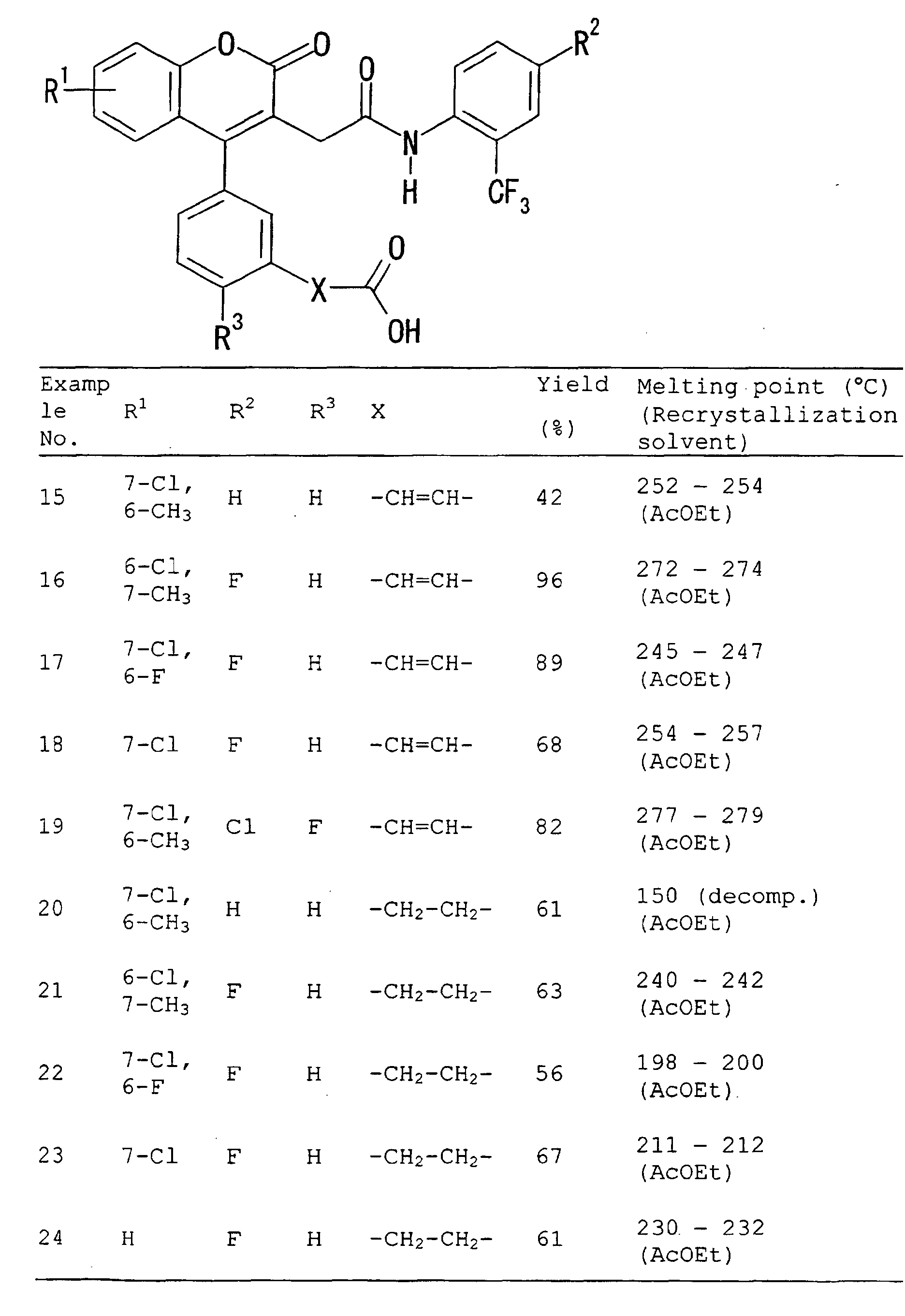
According to the same manner as that of Example 3,
compounds shown in [Table 5] were obtained.
2-(7-chloro-4-{3-[(E)-2-cyanoethenyl]phenyl}-6-methyl-2-oxo-2H-chromen-3-yl)-N-[4-fluoro-2-(trifluoromethyl)phenyl]acetamide
(1.24 g) and
triethylamine hydrochloride (0.95 g) were suspended in
toluene (10 ml), sodium azide (0.449 g) was added, and the
mixture was stirred at 100°C for 2 hours under nitrogen
atmosphere. Water was added to the reaction solution,
acidified with 1N hydrochloric acid, and extracted with a
mixed solvent of ethyl acetate-methanol. The extract was
washed with an aqueous saturated sodium chloride solution,
dried over magnesium sulfate, and the solvent was distilled
off under reduced pressure. The resulting residue was
purified by silica gel column chromatography (developing
solvent:chloroform ∼1% chloroform/methanol ∼2%∼5%), and the
resulting crystals were recrystallized from 2-propanol to
obtain the title compound (0.832 g, yield 62%) as colorless
crystals.
mp: 216-218°C
NMR (DMSO-d6) δ: 2.26 (3H, s), 3.36 (2H, br s), 6.95 (1H,
s), 7.35-7.76 (9H, m), 7.96 (1H, d, J = 8.0 Hz), 9.67 (1H,
s), hidden (1H).
IR (KBr): 3119, 3044, 1688, 1321.
Elemental analysis for C28H18N5O3ClF4
Calculated (%): C, 57.59; H, 3.11; N, 11.99.
Found (%): C, 57.33; H, 3.18; N, 11.92.
Examples 42 to 44
According to the same manner as that of Example 41,
compounds shown in [Table 6] were obtained.
According to the same manner as that of Reference
Example 1 (a), the title compound was obtained (yield:90%).
mp: 129-130°C (methanol).
NMR (CDCl3) δ: 2.88 (3H, s), 7.12 (1H, s), 7.37 (1H, s),
7.54 (2H, d, J = 8.4 Hz), 7.68 (2H, d, J = 8.4 Hz), 11.76
(1H, s).
IR (KBr): 3088, 1630, 1586, 1333, 1003.
Elemental analysis for C14H10O2BrCl
Calculated (%): C, 51.65; H, 3.10.
Found (%): C, 51.99; H, 2.95.
(b) [4-(4-bromophenyl)-7-chloro-6-methyl-2-oxo-2H-chromen-3-yl]acetic
acid
According to the same manner as that of Reference
Example 1(b), the title compound was obtained (yield:85%).
mp: 238-239°C (2-propanol).
NMR (CDCl3) δ: 2.29 (3H, s), 3.40 (2H, s), 6.83 (1H, s),
7.16 (2H, d, J = 8.4 Hz), 7.42 (1H, s), 7.72 (2H, d, J =
8.4 Hz), hidden (1H).
IR (KBr): 3011, 2959, 2930, 1721.
Elemental analysis for C18H12O4BrCl
Calculated (%): C, 53.03; H, 2.97.
Found (%): C, 53.23; H, 2.91.
(c) 2-[4-(4-bromophenyl)-7-chloro-6-methyl-2-oxo-2H-chromen-3-yl]-N-[4-fluoro-2-(trifluoromethyl)phenyl]acetamide
According to the same manner as that of Reference
Example 1(b), the title compound was obtained (yield: 88%).
mp: 262-264°C (ethyl acetate-THF).
NMR (CDCl3) δ: 2.29 (3H, s), 3.40 (2H, s), 6.83 (1H, s),
7.16 (2H, d, J = 8.4 Hz), 7.42 (1H, s), 7.72 (2H, d, J =
8.4 Hz), hidden (1H).
IR (KBr): 3241, 1717, 1659, 1535, 1186, 1127.
Elemental analysis for C25H15NO3BrClF4
Calculated (%): C, 52.80; H, 2.66; N, 2.46.
Found (%): C, 52.54; H, 2.62; N, 2.67.
Example 45
Methyl 4-(7-chloro-3-{2-[4-fluoro-2-(trifluoromethyl)anilino]-2-oxoethyl}-6-methyl-2-oxo-2H-chromen-4-yl)benzoate
Palladium acetate (89.8 mg), 1,3-bis(diphenylphosphino)propane
(206 mg) and triethylamine (1
ml) were added to a solution of 2-[4-(4-bromophenyl)-7-chloro-6-methyl-2-oxo-2H-chromen-3-yl]-N-[4-fluoro-2-(trifluoromethyl)phenyl]acetamide
(1.17 g) in methanol (10
ml) and DMF (20 ml), and the mixture was stirred at 80°C
for 2 days under carbon monoxide atmosphere (atmospheric
pressure). The reaction solvent was concentrated to
distill off under reduced pressure, water was added, and an
organic material was extracted with a mixed solvent of
chloroform and methanol. The extract was washed with an
aqueous saturated sodium chloride solution and dried over
magnesium sulfate, and the solvent was distilled off under
reduced pressure. The resulting residue was purified by
silica gel column chromatography (developing solvent:
hexane-ethyl acetate-chloroform = 5:1:3∼4:1:1) to obtain
the title compound (0.559 g, yield 49%).
mp: 202-204°C(hexane-ethyl acetate):
NMR (CDCl3) δ: 2.28 (3H, s), 3.43 (2H, s), 3.98 (3H, s),
6.81 (1H, s), 7.21-7.27 (1H, m), 7.32 (1H, dd, J = 8.4, 3.0
Hz), 7.43-7.46 (3H, m), 7.97 (1H, dd, J = 9.0, 4.8 Hz),
8.17 (1H, s), 8.24 (2H, d, J = 8.7 Hz).
IR (KBr): 3258, 1719.
Elemental analysis for C27H18NO5ClF4
Calculated (%): C, 59.19; H, 3.31; N, 2.56.
Found (%): C, 59.09; H, 3.40; N, 2.60.
Examples 46 to 48
According to the same manner as that of Example 45,
compounds shown in [Table 7] were obtained.
Oxalyl chloride (0.4 ml) was added to a mixed solution
of 3-[7-chloro-3-(2-{[4-fluoro-2-(trifluoromethyl)phenyl]amino}-2-oxoethyl)-6-methyl-2-oxo-2H-chromen-4-yl]benzoic
acid (2.0 g) in THF (100 ml) and
DMF (3 drops), and the mixture was stirred at room
temperature for 30 minutes. The reaction solution was
concentrated under reduced pressure, the resulting residue
was dissolved in THF (50 ml), and the solution was added
dropwise to a solution of diazomethane in diethyl ether (50
ml) prepared from N-methyl-N'-nitroso-N-nitroguanidine (3.0
g). The mixture was stirred at room temperature for 2
hours, and the reaction solution was concentrated under
reduced pressure. The resulting residue was dissolved in
methanol (100 ml), and silver oxide (1.2 g) was added
thereto. The mixture was then heated to reflux for 2 hours.
Insolubles were filtered with Celite, and the filtrate was
concentrated under reduced pressure. The resulting residue
was purified by silica gel column chromatography
(developing solvent: hexane-ethyl acetate = 3:1) to obtain
the title compound (1 g). The resulting crude crystals
were used in the next step without purification.
NMR (CDCl3) δ: 2.30 (3H, s), 3.42 (1H, d, J = 10 Hz) , 3.47
(1H, d, J = 10 Hz), 3.70 (3H, s), 3.72 (3H, s), 6.94 (1H,
s), 7.25-7.33 (4H, m), 7.43-7.52 (4H, m); 7.97 (1H, m),
8.16 (1H, brs).
Example 50
Methyl {3-[7-chloro-3-(2-{[4-fluoro-2-(trifluoromethyl)phenyl]amino}-2-oxoethyl)-6-methyl-2-oxo-2H-chromen-4-yl]phenyl}butanoate
According to the same manner as that of Example 49,
the title compound was obtained.
NMR (CDCl3) δ: 2.00 (2H, m), 2.30 (3H, s), 2.36 (2H, t, J =
7.6 Hz), 2.74 (2H, t, J = 7.7 Hz), 3.46 (2H, s), 3.64 (3H,
s), 6.92 (1H, s), 7.15-7.37 (5H, m), 7.48 (2H, m), 8.00 (1H,
m), 8.19 (1H, brs).
Reference Example 10
2-(7-chloro-6-methyl-2-oxo-4-{3-[(E)-3-oxo-1-propenyl]phenyl}-2H-chromen-3-yl)-N-[4-fluoro-2-(trifluoromethyl)phenyl]acetamide
Acrolein diethylacetal (3.12 g), palladium acetate
(0.225 g), tris (2-methylphenyl)phosphine (0.609 g) and
sodium acetate (1.97 g) were added to a solution of 2-[4-(3-bromophenyl)-7-chloro-6-methyl-2-oxo-2H-chromen-3-yl]-N-[4-fluoro-2-(trifluoromethyl)phenyl]acetamide.
(11.4. g) in
DMF (60 ml), and the mixture was stirred at 120°C for 4
hours under nitrogen atmosphere. The reaction solvent was
distilled off under reduced pressure, ethyl acetate and
water were added thereto, and insolubles were removed by
Celite filtration. The organic layer of the filtrate was
washed with an aqueous saturated sodium chloride solution,
dried over magnesium sulfate, and the solvent was distilled
off under reduced pressure. The resulting residue was
purified by silica gel column chromatography (developing
solvent: hexane/ethyl acetate/chloroform = 5:1:3∼4:1:2) to
obtain pale yellow crystals. The resulting crystals were
dissolved in THF (100 ml), 1N hydrochloric acid (20 ml) was
added, and the mixture was stirred at room temperature for
20 minutes. The reaction solvent was distilled off under
reduced pressure, water was added, and an organic material
was extracted with ethyl acetate. The extract was washed
with an aqueous saturated sodium chloride solution, dried
over magnesium sulfate, and the solvent was distilled off
under reduced pressure. The resulting residue was purified
by silica gel column chromatography (developing solvent:
hexane-ethyl acetate-chloroform = 4:1:3∼3:1:2∼2:1:2) to
obtain the title compound (2.70 g, yield 25%) as colorless
crystals.
mp: 232-235°C (ethyl acetate).
NMR (CDCl3) δ: 2.30 (3H, s), 3.42 (1H, d, J = 13.8 Hz),
3.47 (1H, d, J = 13. 8 Hz), 6.78 (1H, dd, J = 15. 9, 7. 5 Hz),
6.85 (1H, s), 7.21-7.27 (1H, m), 7.31 (1H, dd, J = 8. 7, 3.0
Hz), 7.42 (1H, d, J = 7.8 Hz), 7.46 (1H, s), 7.53 (1H, d, J
= 15.9 Hz), 7.58 (1H, s), 7.64 (1H, t, J = 7.8 Hz), 7.76
(1H, d, J = 7.8 Hz) , 7.95 (1H, dd, J = 8.7, 4.8 Hz) , 8.23
(1H, s), 9.72 (1H, d, J = 7.5 Hz).
IR (KBr): 3231, 1719, 1680, 1657, 1134.
Elemental analysis for C28H18NO4ClF4
Calculated (%): C, 61.83; H, 3.34; N, 2.58.
Found (%): C, 61.81; H, 3.35; N, 2.50.
Example 51
Ethyl (2E,4E)-5-[3-(7-chloro-3-{2-[4-fluoro-2-(trifluoromethyl)anilino]-2-oxoethyl}-6-methyl-2-oxo-2H-chromen-4-yl)phenyl]-2,4-pentadienoate
Under ice-cooling, sodium hydride (60%, oily)(0.132 g)
was added in portions to a solution of triethyl
phosphonoacetate (0.927 g) in THF (15 ml), and the mixture
was stirred for 20 minutes under nitrogen atmosphere. To
the reaction solution was added 2-(7-chloro-6-methyl-2-oxo-4-{3-[(E)-3-oxo-1-propenyl]phenyl)-2H-chromen-3-yl)-N-[4-fluoro-2-(trifluoromethyl)phenyl]acetamide
(1.50 g), and
the mixture was warmed to room temperature and stirred for
1 hour. Water was added to the reaction solution, and
extracted with a mixed solvent of ethyl acetate-THF. The
extract was washed with an aqueous saturated sodium
chloride solution, dried over magnesium sulfate, and the
solvent was distilled off under reduced pressure. The
resulting residue was purified by silica gel column
chromatography (developing solvent: hexane-ethyl acetate-chloroform
= 4:1:3) to obtain the title compound (1.59g,
yield 95%) as colorless crystals.
mp: 216-218°C (ethyl acetate).
NMR (CDCl3) δ: 1.32 (3H, t, J = 7.2 Hz), 2.30 (3H, s), 3.46
(2H, s), 4.23 (2H, q, J = 7.2 Hz), 5.98 (1H, d, J = 15.4
Hz), 6.90-6.95 (3H, m), 7.19-7.66 (8H, m), 7.99 (1H, dd, J
= 9.2, 5.0 Hz), 8.17 (1H, s).
IR (KBr): 3258, 2984, 1717, 1663, 1532, 1433, 1319, 1175,
1132.
Elemental analysis for C32H24NO5ClF4
Calculated (%): C, 62.60; H, 3.94; N, 2.28.
Found (%): C, 62.71; H, 3.90; N, 2.26.
Example 52
Ethyl (2E)-3-{3-[7-chloro-3-(2-{[9-fluoro-2-(trifluoromethyl)phenyl]amino}-2-oxoethyl-6-methyl-2-oxo-2H-chromen-4-yl]phenyl}-2-methylacrylate
According to the same manner as that or Example 51,
the title compound was obtained.
mp: 172-174°C (hexane-ethyl acetate).
NMR (CDCl3) δ: 1.34 (3H, t, J = 7.2 Hz), 2.11 (3H, d, J =
1.5 Hz), 2.29 (3H, s), 3.42 (1H, d, J = 13.8 Hz), 3.52 (1H,
d, J = 13.8 Hz), 4.27 (2H, q, J = 7.2 Hz), 6.87 (1H, s),
7.19-7.26 (1H, m), 7.29-7.32 (3H, m), 7.45 (1H, s), 7.55-7.62
(2H, m), 7.70 (1H, d, J = 1.5 Hz), 7.97 (1H, dd, J =
9.0, 5.2 Hz), 8.13 (1H, s).
Examples 53 to 61
According to the same manner as that of Example 13,
compounds shown in [Table 8] were obtained.
Glycine ethyl ester hydrochloride (0.307 g), molecular
sieves (4A, beads) and triethylamine (0.307 ml) were added
to a solution of 2-[7-chloro-4-(3-formylphenyl)-6-methyl-2-oxo-2H-chromen-3-yl]-N-[4-fluoro-2-(trifluoromethyl)phenyl]acetamide
(1.04 g) in
dichloromethane (30 ml), and the mixture was vigorously
stirred at room temperature for 24 hours. The reaction
solution was filtered with Celite, the filtrate was
concentrated, water was added to the residue, and this was
extracted with a mixed solvent of ethyl acetate-THF. The
extract was washed with an aqueous saturated sodium
chloride solution, dried over magnesium sulfate, and the
solvent was distilled off under reduced pressure. The
resulting residue was suspended in a mixed solvent of
ethanol (10 ml) and THF (30 ml), 10% palladium-carbon (50%
hydrous product) was added, and the mixture was stirred at
room temperature for 20 minutes under hydrogen atmosphere
(atmospheric pressure). After completion of the reaction,
the catalyst was filtered, and the filtrate was
concentrated under reduced pressure. Water was added to
the residue, and this was extracted with a mixed solvent of
ethyl acetate-THF. The extract was washed with an aqueous
saturated sodium chloride solution, dried over sodium
sulfate, and the solvent was distilled off under reduced
pressure. The resulting residue was purified by silica gel
column chromatography (developing solvent: hexane-ethyl
acetate-chloroform = 2:1:2∼2:2:1∼only ethyl acetate) and
reversed phase HPLC (mobile phase: water-acetonitrile
containing 0.1%TFA) to obtain the title compound (0.49g,
yield 41%) as colorless crystals.
mp: 153-155°C (hexane-ethyl acetate).
NMR (CDCl3) δ: 1.26 (3H, t, J = 7.2 Hz), 2.29 (3H, s), 3.44
(4H, s), 3.90 (2H, s), 4.17 (2H, q, J = 7.2 Hz), 6.91 (1H,
s), 7.19-7.32 (4H, m), 7.44 (1H, s), 7.48-7.54 (2H, m),
7.99 (1H, dd, J = 9.0, 4.8 Hz), 8.24 (1H, s), hidden (1H).
IR (KBr): 3252, 1717, 1663, 1528, 1433, 1319, 1173, 1128.
Elemental analysis for C30H25N2O5ClF4
Calculated (%): C, 59.56; H, 4.17; N, 4.63.
Found (%): C, 59.37; H, 4.16; N, 4.61.
Example 63
Ethyl ({3-[7-chloro-3-(2-{[4-fluoro-2-(trifluoromethyl)phenyl]amino}-2-oxoethyl)-6-methyl-2-oxo-2H-chromen-4-yl]benzyl}thio)
acetate
Under ice-cooling, sodium borohydride (0.145 g) was
added in portions to a solution of 2-[7-chloro-4-(3-formylphenyl)-6-methyl-2-oxo-2H-chromen-3-yl]-N-[4-fluoro-2-(trifluoromethyl)phenyl]acetamide
(3.96 g) in 1,2-dimethoxyethane
(35 ml) and THF (35 ml), and the mixture
was stirred for 30 minutes under nitrogen atmosphere. The
reaction solution was treated with 1N hydrochloric acid,
and extracted with ethyl acetate. The extract was washed
with an aqueous saturated sodium chloride solution, dried
over magnesium sulfate, and the solvent was distilled off
under reduced pressure. The resulting residue was purified
by silica gel column chromatography (developing solvent:
hexane/ethyl acetate/chloroform = 2:1:2∼1:1:1) to obtain
colorless crystals (3.61 g). The resulting crystals (1.56
g) were mixed with thionyl chloride (5 ml), and the mixture
was stirred at room temperature for 2 hours. Pyridine (5
drops) was added to the reaction solution, followed by
further stirring for 30 minutes. After completion of the
reaction, excessive thionyl chloride was distilled off by
concentration. The resulting residue was dissolved in DMF
(10 ml), ethyl thioglycolate (0.658 ml) and cesium fluoride
(0.775 g) were added, and the mixture was heated and
stirred at 80°C for 2 hours. Water was added to the
reaction solution, and extracted with ethyl acetate. The
extract was washed with an aqueous saturated sodium
chloride solution, dried over magnesium sulfate, and the
solvent was distilled off under reduced pressure. The
resulting residue was purified by silica gel column
chromatography (developing solvent: hexane-ethyl acetate-chloroform
= 5:1:3∼4:1:2) to obtain the title compound
(1.64 g, yield 80%) as pale yellow crystals.
mp: 106-108°C (hexane-ethyl acetate)
NMR (CDCl3) δ: 1.25 (3H, t, J = 7.2 Hz), 2.29 (3H, s), 3.09
(1H, d, J = 14.7 Hz), 3.15 (1H, d, J = 14.7 Hz), 3.43 (1H,
d, J = 14.1 Hz), 3.51 (1H, d, J = 14.1 Hz), 3.90 (2H, s),
4.13 (2H, q, J = 7.2 Hz), 6.91 (1H, s), 7.19-7.32 (4H, m),
7.44 (1H, s), 7.51-7.53 (2H, m), 7.97 (1H, dd, J = 8.7, 5.1
Hz), 8.20 (1H, s).
IR (KBr): 3265, 3029, 1721, 1607, 1522, 1433, 1321, 1171,
1134.
Elemental analysis for C30H24NO5ClF4S
Calculated (%): C, 57.93; H, 3.89; N, 2.25.
Found (%): C, 57.92; H, 3.97; N, 2.23.
Example 64
Ethyl ({3-[7-chloro-3-(2-{[4-fluoro-2-(trifluoromethyl)phenyl]amino}-2-oxoethyl)-6-methyl-2-oxo-2H-chromen-4-yl]benzyl}sulfonyl)acetate
Under ice-cooling, m-chloroperbenzoic acid (0.705 g)
was added in portions to a solution of ethyl {3-[7-chloro-3-(2-{[4-fluoro-2-(trifluoromethyl)phenyl]amino}-2-oxoethyl)-6-methyl-2-oxo-2H-chromen-4-yl]benzyl}thio)acetate
(0.732 g) in dichloromethane (35 ml).
The mixture was warmed to room temperature and then stirred
for 18 hours. The reaction solution was treated with an
aqueous sodium thiosulfate solution, and extracted with a
mixed solvent of ethyl acetate-THE. The extract was washed
successively with an aqueous saturated sodium bicarbonate
solution and an aqueous saturated sodium chloride solution,
dried over magnesium sulfate, and the solvent was distilled
off under reduced pressure to obtain the title compound
(0.66 g, yield 86%) as pale yellow crystals.
mp: 230-231°C(ethyl acetate)
NMR (CDCl3) δ: 1.29 (3H, t, J = 7.2 Hz), 2.29 (3H, s), 3.42
(1H, d, J = 13.5 Hz) , 3.51 (1H, d, J = 13.5 Hz), 3.82 (1H,
d, J = 15.0 Hz), 4.06 (1H, d, J = 15.0 Hz), 4.16-4.28 (2H,
m), 4.51 (1H, d, J = 14.1 Hz), 4.73 (1H, d, J = 14.1 Hz),
6.89 (1H, s), 7.18-7.24 (1H, m), 7.31 (1H, dd, J = 8.4, 3.0
Hz), 7.41 (1H, dt, J = 7.5, 1.5 Hz), 7.45 (1H, s), 7.48 (1H,.
t, J = 1.5 Hz), 7.63 (1H, t, J = 7.5 Hz), 7.68 (1H, dt, J =
7.5, 1.5 Hz), 7.89 (1H, dd, J = 9.0, 4.8 Hz), 8.31 (1H, s)
IR (KBr): 3264, 1732, 1663, 1532, 1433, 1319, 1177, 1127.
Elemental analysis for C30H24NO7ClF4S· 0.5H2O
Calculated (%): C, 54.34; H, 3.80; N, 2.11.
Found (%): C, 54.54; H, 3.75; N, 2.11.
Examples 65 to 97
According to the same manner as that of Example 14,
compound shown in [Table 9] were obtained.
According to the same manner as that of Example 41,
the title compound was obtained.
mp: 244-246°C (ethyl acetate).
NMR (CDCl3) δ: 2.30 (3H, s), 3.05 (1H, d, J = 13.5 Hz),
3.10-3.30 (3H, m), 3.42-3.52 (1H, m), 3.95 (1H, d, J = 13.5
Hz), 6.84 (1H, s), 6.93-7.01 (2H, m), 7.11 (1H, s), 7.23-7.31
(2H, m), 7.38 (1H, dd, J = 8.7, 3.0 Hz), 7.51 (1H, s),
7.72 (1H, dd, J = 8.7, 4.8 Hz), 9.20 (1H, s).
Elemental analysis for C28H20N5O3ClF4
Calculated (%): C, 57.40; H, 3.44; N, 11.95.
Found (%): C, 57.18; H, 3.48; N, 11.74.
Reference Example 11
2-(4-{3-[amino(hydroxyimino)methyl]phenyl}-7-chloro-6-methyl-2-oxo-2H-chromen-3-yl]-N-[4-fluoro-2-(trifluoromethyl)phenyl]acetamide
Tetrakis(triphenylphosphine)palladium (0) (1.16 g) and
zinc cyanate (2.47 g) were added to a solution of 2-[4-(3-bromophenyl)-7-chloro-6-methyl-2-oxo-2H-chromen-3-yl]-N-[4-fluoro-2-(trifluoromethyl)phenyl]acetamide
(11.4 g) in DMF
(50 ml), and the mixture was stirred at 80°C for 6 hours
under nitrogen atmosphere. The reaction solution was
treated with a 28% aqueous ammonia solution, and extracted
with a mixed solvent of toluene-THF. The extract was
washed with an aqueous saturated sodium chloride sodium,
dried over sodium sulfate, and the solvent was distilled
off under reduced pressure. The resulting residue was
purified by silica gel column chromatography (developing
solvent: hexane-ethyl acetate-chloroform=3:1:3∼3:1:2∼2:1:1)
to obtain colorless crystals (8.48 g). Hydroxylamine
hydrochloride (3.47 g) was suspended in DMSO (20 ml), and
triethylamine (6.97 ml) was added. Precipitated
triethylamine hydrochloride was filtered and washed with
THF. THF in the filtrate was distilled off under reduced
pressure, crystals (5.15 g) obtained in the above were
added, and the mixture was stirred at 75°C for 7 hours.
After completion of the reaction, water was added, and this
was extracted with ethyl acetate. The extract was washed
with an aqueous saturated sodium chloride solution, dried
over sodium sulfate, and the solvent was distilled off
under reduced pressure to obtain the title compound (5.08
g).
mp: 220-222°C(decomp)(ethyl acetate)
NMR (CDCl3) δ: 2.31 (3H, s), 3.17 (1H, d, J = 13.5 Hz),
3.69 (1H, d, J = 13.5 Hz), 5.41 (2H, s), 7.03 (1H, s),
7.21-7.27 (1H, m), 7.31-7.37 (2H, m), 7.47 (1H, s), 7.58
(1H, t, J = 7.8 Hz), 7.66 (1H, t, J = 1.8 Hz), 7.86-7.93
(2H, m), 8.79 (1H, s).
IR (KBr): 3272, 3050, 1779, 1746.
Example 99
2-{7-chloro-6-methyl-2-oxo-4-[3-(5-oxo-4,5-dihydro-1,2,4-oxadiazol-3-yl)phenyl]-2H-chromen-3-yl}-N-[4-fluoro-2-(trifluoromethyl)phenyl]acetamide
2-(4-{3-[amino(hydroxyimino)methyl)phenyl}-7-chloro-6-methyl-2-oxo-2H-chromen-3-yl)-N-[4-fluoro-2-(trifluoromethyl)phenyl]acetamide
(0.822 g) was suspended
in THF (10 ml), 1,1'-carbonyldiimidazole (0.36 g) and DBU
(0.897 ml) were added, and the mixture was stirred at room
temperature for 3 hours. After completion of the reaction,
water was added. The reaction mixture was adjusted to pH 2
with 1N hydrochloric acid and then extracted with ethyl
acetate. The extract was washed with an aqueous saturated
sodium chloride solution, dried over magnesium sulfate, and
the solvent was distilled off under reduced pressure. The
resulting residue was purified by silica gel column
chromatography (developing solvent: hexane-ethyl acetate-chloroform
= 1:2:1∼ethyl acetate-chloroform = 1:1) to
obtain the title compound (0.302 g, yield 350).
mp: 285-287°C (2-prpoanol-ethyl acetate).
NMR (DMSO-d6) δ: 2.26 (3H, s), 3.33-3.42 (2H, m), 6.91 (1H,
s), 7.39 (1H, dd, J = 8.7, 5.4 Hz), 7.48-7.62 (3H, m), 7.71
(1H, s), 7.78-7.83 (2H, m), 8.00 (1H, d, J = 7.8 Hz), 9.65
(1H, s), hidden (1H).
IR (KBr): 3272, 3050, 1779, 1746.
Elemental analysis for C27H16N3O5ClF4
Calculated (%): C, 56.51; H, 2.81; N, 7.32.
Found (%): C, 56.49; H, 2.95; N, 7.10.
Examples 100 to 101
According to the same manner as that of Example 99,
compounds shown in [Table 10] were obtained.
2-(4-{3-[Amino(hydroxyimino)methyl]phenyl}-7-chloro-6-methyl-2-oxo-2H-chromen-3-yl)-[4-fluoro-2-(trifluoromethyl)phenyl]acetamide
(0.822 g) was suspended
in THF (10 ml), 1,1'-thiocarbonyldiimidazole (0.365 g) and
DBU (0.897 ml) were added, and the mixture was stirred at
room temperature for 3 hours. After completion of the
reaction, water was added. The reaction mixture was
adjusted to pH 2 with 1N hydrochloric acid and then
extracted with a mixed solvent of ethyl acetate-THF. The
extract was washed with an aqueous saturated sodium
chloride solution, dried over magnesium sulfate, and the
solvent was distilled off under reduced pressure. The
resulting residue was purified by silica gel column
chromatography (developing solvent: ethyl
acetate/chloroform = 1:1) to obtain the title compound
(0.463 g, yield 52%).
mp: 178-180°C(hexane-ethyl acetate).
NMR (CDCl3) δ: 2.35 (3H, s), 3.06 (1H, d, J = 13.5 Hz),
3.89 (1H, d, J = 13.5 Hz), 7.11 (1H, s), 7.24-7.36 (2H, m),
7.50 (1H, s), 7.58 (1H, d, J = 7.8 Hz), 7.73-7.78 (2H, m),
7.97 (1H, dd, J = 9.0, 5.1 Hz), 8.09 (1H, t, J = 7.8 Hz),
9.18 (1H, s), hidden (1H).
IR (KBr): 3248, 1705, 1493, 1433, 1321.
Elemental analysis for C27H16N3O4ClF4S·0.5H2O
Calculated (%): C, 54.14; H, 2.86; N, 7.02.
Found (%): C, 54.35; H, 2.87; N, 6.68.
Example 103
2-{7-chloro-6-methyl-2-oxo-4-[3-(5-thioxo-4,5-dihydro-1,2,4-oxadiazol-3-yl)phenyl]-2H-chromen-3-yl}-N-[2-(trifluoromethyl)phenyl]acetamide
According to the same manner as that of Example 102,
the title compound (yield 33%) was obtained.
mp: 202°C(decomp.)(THF-ethyl acetate).
NMR (DMSO-d6) δ: 2.27 (3H, s), 3.38 (2H, br), 6.93 (1H, s),
7.38 (1H, d, J = 8.2 Hz), 7.45 (1H, d, J = 7.6 Hz), 7.58-7.75
(4H, m), 7.81 (1H, d, J = 7.6 Hz), 7.87 (1H, br d, J =
1.4 Hz), 8.10 (1H, d, J = 8.0 Hz), 9.62 (1H, s).
Example 104
2-{7-chloro-6-methyl-2-oxo-4-[3-(5-oxo-4,5-dihydro-1,2,4-thiadiazol-3-yl)phenyl]-2H-chromen-3-yl}-N-[4-fluoro-2-(trifluoromethyl)phenyl]acetamide
2-(4-{3-[Amino(hydroxyimino)methyl]phenyl}-7-choloro-6-methyl-2-oxo-2H-chromen-3-yl)-N-[4-fluoro-2-(trifluoromethyl)phenyl]acetamide
(0.822 g) was suspended
in THF (10 ml), 1,1'-thiocarbonyldiimidazole (0.365 g) was
added, and the mixture was stirred at room temperature for
3 hours. After completion of the reaction, water was added,
and extracted with a mixed solvent of ethyl acetate-THF.
The extract was washed with an aqueous saturated sodium
chloride solution, dried over magnesium sulfate, and the
solvent was distilled off under reduced pressure. The
resulting residue was suspended in THF (15 ml), boron
trifluoride diethyl ether complex (0.76 ml) was added, and
the mixture was stirred at room temperature for 12 hours.
After completion of the reaction, water was added,
acidified with 1N hydrochloric acid and extracted with a
mixed solvent of ethyl acetate-THF. The extract was washed
with an aqueous saturated sodium chloride solution, dried
over magnesium sulfate, and the solvent was distilled off
under reduced pressure. The resulting residue was
recrystallized from chloroform-methanol to obtain the title
compound (0.801 g, yield 68%)
mp: 269-271°C(decomp.).
NMR (DMSO-d6) δ: 2.26 (3H, s), 3.28-3.42 (2H,m), 6.91 (1H,
s), 7.38 (1H, dd, J = 9.0, 5.1 Hz), 7.48-7.55 (2H, m), 7.60
(1H, dd, J = 9.0, 3.0 Hz), 7.72 (1H, s), 7.76 (1H, t, J =
7.8 Hz), 7.92 (1H, s), 8.12 (1H, t, J = 7.8 Hz), 9.64 (1H,
s), hidden (1H).
IR (KBr): 3264, 1746, 1686, 1659, 1541, 1327, 1109.
Elemental analysis for C27H16N3O4ClF4S·0.5H2O
Calculated (%): C, 54.14; H, 2.86; N, 7.02.
Found (%) : C, 53.85; H, 2.81; N, 6.91.
Example 105
2-{7-chloro-6-methyl-2-oxo-4-[3-{2-(5-oxo-4,5-dihydro-1,2,4-thiadiazol-3-yl)ethyl}phenyl]-2H-chromen-3-yl}-N-[2-(trifluoromethyl)
phenyl] acetamide
According to the same manner as that of Example 104,
the title compound (yield 23%) was obtained.
mp: 181°C (decomp.)(hexane-ethyl acetate).
NMR (DMSO-d6) δ: 2.29 (3H, s), 2.76-3.13 (5H, m), 3.90 (1H,
d, J = 13.5 Hz), 6.86 (1H, s), 7.04-7.09 (2H, m), 7.17 (1H,
d, J = 7.8 Hz), 7.24-7.29 (1H, m), 7.35 (1H, dd, J = 8.4,
3.0 Hz), 7.42 (1H, t, J = 7.8 Hz), 7.49 (1H, s), 7.76 (1H,
dd, J = 9.0,. 5.1 Hz), 9.07 (1H, s), 10.96 (1H, s).
Reference Example 12
Ethyl [6-bromomethyl-4-(3-bromophenyl)-7-chloro-2-oxo-2H-chromen-3-yl]acetate
NBS (4.9 g) and AIBN (190 mg) were added to a
suspension of ethyl [4-(3-bromophenyl)-7-chloro-6-methyl-2-oxo-2H-chromen-3-yl]acetate
(10 g) in t-butyl acetate (70
ml), and the mixture was stirred at 80°C for 2 hours.
Ethyl acetate was added to the reaction solution, this was
washed successively with an aqueous saturated sodium
hydrogencarbonate solution and water, dried over magnesium
sulfate (MgSO4), and the solvent was distilled off under
reduced pressure. The resulting residue was washed with
isopropyl ether to obtain crude crystals (9.8 g:83%) of the
title compound. The resulting crude crystals were used in
the next step without further purification.
NMR (CDCl3) δ: 1.25 (3H, t, J = 7.4 Hz), 3.66 (2H, s), 4.16
(2H, q, J = 7.4 Hz), 4.49 (2H, m), 7.04 (1H, s), 7.27 (2H,
m), 7.44 (2H, m), 7.72 (1H, m).
Reference Example 13
[6-Bromomethyl-4-(3-bromophenyl)-7-chloro-2-oxo-2H-chromen-3-yl]acetic
acid
Acetic acid (150 ml) and concentrated hydrochloric
acid (75 ml) were added to ethyl [6-bromomethyl-4-(3-bromophenyl)-7-chloro-2-oxo-2H-chromen-3-yl]acetate,
and
the mixture was heated to reflux for 2 hours. The reaction
solution was concentrated under reduced pressure. The
resulting residue was washed with water and dried to obtain
crude crystals (8.5 g:92%) of the title compound. The
resulting crude crystals were used in the next step without
further purification.
NMR (CDCl3) δ: 3.42 (2H, m), 4.61 (2H, m), 7.07 (1H, s),
7.27 (2H, m), 7.49 (2H, m), 7.71 (1H, m).
Reference Example 14
2-{4-(3-bromophenyl)-7-chloro-2-oxo-6-[(4-phenylpiperazin-1-yl)methyl]-2H-chromen-3-yl}-N-[4-fluoro-2-(trifluoromethyl)phenyl]acetamide
Oxalyl chloride (1.2 ml) was added to a mixed solution
of [6-bromomethyl-4-(3-bromophenyl)-7-chloro-2-oxo-2H-chromen-3-yl]acetic
acid (5.5 g) in THF (100 ml) and DMF (3
drops), and the mixture was stirred at room temperature for
30 minutes. The reaction solution was concentrated under
reduced pressure, and the resulting residue was dissolved
in THF (100 ml). 2-Amino-5-fluorobenzotrifluoride (1.6 ml)
was added, and the mixture was stirred overnight. Water
was added to the reaction solution, and extracted with
ethyl acetate. The extract was washed with water, dried
over magnesium sulfate, and the solvent was distilled off
under reduced pressure. The resulting residue was
dissolved in THF (100 ml), phenylpiperazine (2.0 ml) was
added, and the mixture was heated to reflux overnight.
Water was added to the reaction solution, and extracted
with ethyl acetate. The extract was washed with water,
dried over magnesium sulfate; and the solvent was distilled
off under reduced pressure to obtain crude crystals (3.2 g,
yield 39%) of the title compound. The resulting crude
crystals were used in the next step without further
purification.
NMR (CDCl3) δ: 2.60 (4H, m), 3.09 (4H, m), 3.48 (2H, m),
3.60 (2H, s), 6.90 (4H, m), 7.2-7.5 (6H, m), 7.65 (1H, m),
7.97 (1H, m), 8.14 (1H, brs).
Example 106
Buthyl (2E)-3-(3-{7-chloro-3-(2-{[4-fluoro-2-(trifluoromethyl)phenyl]amino}-2-oxoethyl)-2-oxo-6-[(4-phenylpiperazin-1-yl)methyl]-2H-chromen-4-yl}phenyl)acrylate
Palladium acetate (1.2 g), triphenylphosphine (2.9 g),
triethylamine (3.8 ml) and butyl acrylate (2.9 ml) were
added to a solution of 2-{4-(3-bromophenyl)-7-chloro-2-oxo-6-[(4-phenylpiperazin-1-yl)methyl]-2H-chromen-3-yl}-N-[4-fluoro-2-(trifluoromethyl)phenyl]acetamide
(13.3 g) in DMF
(140 ml), and the mixture was stirred at 100°C for 8 hours.
Water was added to the reaction solution, and extracted
with ethyl acetate. The extract was dried over magnesium
sulfate, and the solvent was distilled off under reduced
pressure. The resulting residue was purified by silica gel
column chromatography (developing solvent: hexane-ethyl
acetate = 3:1) to obtain the title compound (5.7g, yield
40%).
NMR (CDCl3) δ: 0.94 (2H, t, J = 7.2 Hz) , 1.41 (2H, m), 1.66
(2H, m), 2.56 (4H, m), 3.01 (4H, m), 3.49 (2H, m), 3.58 (2H,
m), 4.49 (2H, t, J = 7.2 Hz), 6.48 (1H, d, J = 15.9 Hz),
6.86 (3H, m), 7.2-7.7 (11H, m), 7.97 (1H, m), 8.18 (1H,
brs).
Example 107
Buthyl (2E)-3-(3-{7-chloro-3-(2-{[4-chloro-2-(trifluoromethyl)phenyl]amino}-2-oxoethyl)-2-oxo-6-[(4-phenylpiperazin-1-yl)methyl]-2H-chromen-4-yl}phenyl)acrylate
According to the same manner as that of Example 106,
the title compound (yield 37%) was obtained.
NMR (CDCl3) δ: 0.95 (2H, t, J = 6.8 Hz), 1.43 (2H, m), 1.67
(2H, m), 2.55 (4H, m), 3.01 (4H, m), 3.49 (2H, m), 3.59 (2H,
m), 4.19 (2H, t, J = 6.6 Hz), 6.50 (1H, d, J = 16.0 Hz),
7.00 (3H, m), 7.2-7.7 (11H, m), 8.09 (1H, d, J = 8.8 Hz),
8.27 (1H, brs).
Example 108
Examples 108 to 109
According to the same manner as that of Example 45,
compounds shown in [Table 11] were obtained.
According to the same manner as that of Example 14,
compounds shown in [Table 12] were obtained.
According to the same manner as that of Example 13,
compounds shown in [Table 13] were obtained.
Oxalyl chloride (1.8 ml) was added to a mixed solution
of [6-bromomethyl-4-(3-bromophenyl)-7-chloro-2-oxo-2H-chromen-3-yl]acetic
acid (5.0 g) in THF (100 ml) and DMF (3
drops), and the mixture was stirred at room temperature for
30 minutes. The reaction solution was concentrated under
reduced pressure, and the resulting residue was dissolved
in THF (100 ml). 2-Amino-5-fluorobenzotrifluoride (2.2 ml)
was added, and the mixture was stirred overnight. Water
was added to the reaction solution, and extracted with
ethyl acetate. The extract was washed with water, dried
over magnesium sulfate, and the solvent was distilled off
under reduced pressure. The resulting residue was
dissolved in DMF (50 ml), sodium acetate (1.0 g) was added,
and the mixture was stirred at 60°C for 1 hour. Water was
added to the reaction solution, and extracted with ethyl
acetate. The extract was washed with an aqueous saturated
sodium chloride solution, dried over magnesium sulfate, and
the solvent was distilled off under reduced pressure. The
resulting residue was purified by silica gel column
chromatography (developing solvent:ethyl acetate-hexane =
1:4), and then recrystallized from ethyl acetate to obtain
the title compound (2.3 g).
NMR (CDCl3) δ: 2.04 (3H, s), 3.42 (1H, d, J = 21 Hz), 3.54
(1H, d, J = 21 Hz), 5.08 (1H, d, J = 20 Hz), 5.16 (1H, d, J
= 20 Hz), 7.07 (1H, s), 7.1-7.8 (7H, m), 7.9-8.1 (2H, m).
Example 116
Ethyl (2E)-3-{3-[6-[(acetyloxy)methyl]-7-chloro-3-(2-{[4-fluoro-2-(trifluoromethyl)phenyl]amino}-2-oxoethyl)-2-oxo-2H-chromen-4-yl]phenyl}acrylate
According to the same manner as that of Reference
Example 1-(d), the title compound was obtained.
NMR (CDCl3) δ: 1.33 (3H, t, J = 7 Hz), 1.98 (3H, s), 3.4-3.5
(2H, m), 4.26 (2H, q, J = 7 Hz), 5.09 (2H, s), 6.50 (1H,
d, J = 16 Hz), 7.06 (1H, s), 7.2-7.7 (8H, m), 7.9-8.0 (1H,
m), 8.11 (1H, brs).
Example 117
(2E)-3-{3-[7-chloro-3-(2-{[4-fluoro-2-(trifluoromethyl)phenyl]amino}-2-oxoethyl)-6-(hydroxymethyl)-2-oxo-2H-chromen-4-yl]phenyl}acrylic
acid
Ethyl (2E)-3-{3-[6-[(acetyloxy)methyl]-7-chloro-3-(2-{[4-fluoro-2-(trifluoromethyl)phenyl]amino}-2-oxoethyl)-2-oxo-2H-chromen-4-yl]phenyl}acrylate
(600 mg) was suspended
in methanol (18 ml) and DBU (0.21 ml) was added thereto
under ice-cooling. The mixture was stirred at room
temperature for 1 hour. 1N Hydrochloric acid was added to
the reaction solution, produced precipitates were collected,
and dissolved in a mixed solvent of ethyl acetate. This
solution was washed with an aqueous saturated sodium
chloride solution, dried over magnesium sulfate, and the
solvent was distilled off under reduced pressure. The
resulting residue was dissolved in THF (7.5 ml), methanol
and 1N aqueous sodium hydroxide solution (2.5 ml) were
added, and the mixture was stirred overnight. 1N
Hydrochloric acid was added to the reaction solution, and
extracted with ethyl acetate. The extract was washed with
an aqueous saturated sodium chloride solution, dried over
magnesium sulfate, and the solvent was distilled off under
reduced pressure. The resulting residue was purified by
silica gel column chromatography (developing solvent:
dichloromethane-methanol = 95:5), and treated with THF-diisopropyl
ether to obtain the title compound (85 mg) as
white powders.
NMR (CDCl3) δ: 3.44 (1H, d, J = 11 Hz), 3.50 (1H, d, J = 11
Hz), 4.65 (2H, s), 6.48 (1H, d, J = 7 Hz), 7.2-7.7 (9H, m),
7.8-8.0 (1H, m), 8.42 (1H, brs).
Example 118
(2E)-3-{3-[7-chloro-3-(2-{[4-fluoro-2-(trifluoromethyl)phenyl]amino}-2-oxoethyl)-6-methyl-2-oxo-2H-chromen-4-yl]phenyl)-N-
(methylsulfonyl) acrylamide
(2E)-3-{3-[7-Chloro-3-(2-{[4-fluoro-2-(trifluoromethyl)phenyl]amino}-2-oxoethyl)-6-methyl-2-oxo-2H-chromen-4-yl]phenyl}acrylic
acid (200 mg) was suspended
in DMF (2 ml) and carbonyldiimidazole (116 mg) was added
thereto. The mixture was stirred at room temperature for 1
hour. Methanesulfonamide (68 mg) and DBU (82 mg) were
added to the reaction solution, and the mixture was stirred
at 100°C for 3 hours. 1N Hydrochloric acid was added,
produced precipitates were collected, washed with water,
and dissolved in a mixed solvent of THF and ethyl acetate.
This solution was washed with an aqueous saturated sodium
chloride solution, dried over magnesium sulfate, and the
solvent was distilled off under reduced pressure. The
resulting residue was purified by silica gel column
chromatography (developing solvent:ethyl acetate-hexane =
2:1), and recrystallized from THF-hexane to obtain the
title compound (86 mg, yield 38%) as colorless crystals.
NMR (CDCl3) δ: 2.30 (3H, s), 3.30 (3H, s), 3.33 (1H, d, J =
14 Hz), 3.58 (1H, d, J = 14 Hz), 6.56 (1H, d, J = 16 Hz),
6.91 (1H, s), 7.2-7.4 (3H, m), 7.42 (1H, s), 7.5-7.8 (5H,
m), 7.80 (1H, d, J = 16 Hz), 8.44 (1H, brs).
Example 119
(2E)-N-(butylsulfonyl)-3-{3-[7-chloro-3-(2-{[4-fluoro-2-(trifluoromethyl)phenyl]amino}-2-oxoethyl)-6-methyl-2-oxo-2H-chromen-4-yl]phenyl}acrylamide
According to the same manner as that of Example 118,
the title compound (yield 44%) was obtained.
NMR (CDCl3) δ: 0.94 (3H, t, J = 7 Hz), 1.3-1.6 (2H, m),
1.7-1.9 (2H, m), 2.30 (3H, s), 3.37 (1H, d, J = 14 Hz),
3.4-3.5 (2H, m), 3.53 (1H, d, J = 14 Hz), 6.56 (1H, d, J =
16 Hz), 6.89 (1H, s), 7.2-7.9 (9H, m), 8.34 (1H, brs), 8.58
(1H, brs).
Example 120
3-[7-Chloro-3-(2-{[4-chloro-2-(trifluoromethyl)phenyl]amino}-2-oxoethyl)-6-methyl-2-oxo-2H-chromen-4-yl]-N-ethylbenzamide
Oxalyl chloride (35 µl) was added to a mixed solution
of 3-[7-chloro-3-(2-{[9-chloro-2-(trifluoromethyl)phenyl]amino}-2-oxoethyl)-6-methyl-2-oxo-2H-chromen-4-yl]benzoic
acid (150 mg) in THF (5 ml) and DMF
(1 drop), the mixture was stirred at room temperature for
30 minutes, and the solvent was then distilled off under
reduced pressure. The resulting residue was dissolved in
THF (10 ml), and the solution was added dropwise to a mixed
solution of a 70% aqueous ethylamine solution (1 ml) and
THF (5 ml). The mixture was stirred at room temperature
for 30 minutes. 1N Hydrochloric acid was added to the
reaction solution and the mixture was extracted with ethyl
acetate. The extract was washed with an aqueous saturated
sodium hydrogencarbonate solution and water, dried over
magnesium sulfate, and the solvent was distilled off under
reduced pressure. The resulting crude crystals were
recrystallized from ethyl acetate to obtain the title
compound (136 mg: yield 86%) as colorless crystals. mp:
220-222°C.
Examples 121 to 148
According to the same manner as that of Example 120,
compounds shown in [Table 14] were obtained.
In the following Formulation Examples and Experimental
Examples, Compounds A to E mean the following compounds.
Formulation Example
A lipid-rich plaque regressing agent or an ACAT
inhibitor containing the compound [I] or a salt thereof of
the present invention as an active ingredient can be
produced, for example, by the following formulations.
In the following formulations, as ingredients
(additives) other than an active ingredient, products
listed in Japanese Pharmacopoeia, Japanese Pharmaceutical
Codex or Japanese Pharmaceutical Excipients can be used.
1. Capsule
| (1) |
Compound A |
10 mg |
| (2) |
Lactose |
90 mg |
| (3) |
Microcrystalline Cellulose |
70 mg |
| (4) |
Magnesium stearate |
10 mg |
| |
One capsule |
180 mg |
(1), (2), (3) and 1/2 of (4) are mixed and then
granulated. To this is added the remainder of (4) and the
entire is encapsulated into a gelatin capsule.
2. Tablet
| (1) |
Compound A |
10 mg |
| (2) |
Lactose |
35 mg |
| (3) |
Cornstarch |
150 mg |
| (4) |
Microcrystalline Cellulose |
30 mg |
| (5) |
Magnesium stearate |
5 mg |
| |
One capsule |
230 mg |
(1), (2), (3) , 2/3 of (4) and 1/2 of (5) are mixed and
granulated. To this granule, the remainders of (4) and (5)
are added and compressed into a tablet.
3. Injection formulation
| (1) |
Compound A |
10 mg |
| (2) |
Inositol |
100 mg |
| (3) |
Benzyl alcohol |
20 mg |
| |
One ampoule |
130 mg |
(1), (2) and (3) are dissolved in distilled water for
injection to make the total volume 2 ml, and charged in an
ampoule. All steps are performed aseptically.
4. Tablet
According to the following composition, a mixture of
Compound A (175 g), D-mannitol (175 g), cornstarch (118.65
g) and sodium croscarmellose (105 g) is mixed sufficiently
with a vertical granulator (FM-VG-10 type manufactured by
POWREX CORPORATION) and then kneaded with a solution of
hydroxypropyl cellulose (19.25 g) in water (kneading
condition: 400rpm, 10 minutes). A white kneaded material
is dried in a fluidized drier (FD-3S manufactured by POWREX
CORPORATION) at a ventilating temperature of 60°C for 30
minutes, and then sieved through a 1.5 mm punching screen
using a power mill (P-3 type manufactured by Showa kagaku
kikai kousakusho) to obtain a granule. This granule
(525.14 g), sodium croscarmellose (31 g) and magnesium
stearate (1.86 g) are added and mixed for 5 minutes with a
mixing machine (TM-15 type manufactured by Showa kagaku
kikai kousakusho) to obtain a granule for tableting. This
granule is compressed in 180 mg aliquots with a tableting
machine (Correct 19K manufactured by Kikusui Seisakusho
Ltd.) using a 8.0 mm edged plain mallet under a pressure
of 0.7 ton/cm
2 to obtain 2,350 tablets.
| Compound A | 50 mg |
| D-mannitol | 50 mg |
| Cornstarch | 33.9 mg |
| Sodium croscarmellose | 40 mg |
| Hydroxypropyl cellulose | 5.5 mg |
| Magnesium stearate | 0.6 mg |
| Total | 180.0 mg (per tablet) |
| (1) |
Compound B |
10 mg |
| (2) |
Lactose |
90 mg |
| (3) |
Microcrystalline cellulose |
70 mg |
| (4) |
Magnesium stearate |
10 mg |
| |
One capsule |
180 mg |
(1), (2), (3) and 1/2 of (4) are mixed and then
granulated. To this is added the remainder of (4) and the
entire is encapsulated into a gelatin capsule.
2. Tablet
| (1) |
Compound B |
10 mg |
| (2) |
Lactose |
35 mg |
| (3) |
Cornstarch |
150 mg |
| (4) |
Microcrystalline cellulose |
30 mg |
| (5) |
Magnesium stearate |
5 mg |
| |
One tablet |
230 mg |
(1), (2), (3), 2/3 of (4) and 1/2 of (5) are mixed and
then granulated. To this granule, the Remainders of (4)
and (5) are added and compressed into a tablet.
3. Injection formulation
| (1) |
Compound B |
10 mg |
| (2) |
Inositol |
100 mg |
| (3) |
Benzyl alcohol |
20 mg |
| |
One ampoule |
130 mg |
(1), (2) and (3) are dissolved in distilled water for
injection to make the total volume 2 ml, and charged in an
ampoule. All steps are performed aseptically.
4. Tablet
According to the following composition, a mixture of
Compound B (175 g), D-mannitol (175 g), cornstarch (118.65
g) and sodium croscarmellose (105 g) is mixed sufficiently
with a vertical granulator (FM-VG-10 type manufactured by
POWREX CORPORATION) and then kneaded with a solution of
hydroxypropyl cellulose (19.25 g) in water (kneading
condition: 400rpm, 10 minutes). A white kneaded material
is dried in a fluidized drier (FD-3S manufactured by POWREX
CORPORATION) at a ventilating temperature of 60°C for 30
minutes, and then sieved through a 1.5 mm punching screen
using a power mill (P-3 type manufactured by Showa kagaku
kikai kousakusho) to obtain a granule. This granule
(525.14 g), sodium croscarmellose (31 g) and magnesium
stearate (1.86 g) are added and mixed for 5 minutes with a
mixing machine (TM-15 type manufactured by Showa kagaku
kikai kousakusho) to obtain a granule for tableting. This
granule is compressed in 180 mg aliquots with a tableting
machine (Correct 19K manufactured by Kikusui Seisakusho
Ltd.) using a 8.0 mm edged plain mallet under a pressure
of 0.7 ton/cm
2 to obtain 2,350 tablets.
| Compound B | 50 mg |
| D-mannitol | 50 mg |
| Cornstarch | 33.9 mg |
| Sodium croscarmellose | 40 mg |
| Hydroxypropyl cellulose | 5.5 mg |
| Magnesium stearate | 0.6 mg |
| Total | 180.0 mg (per tablet) |
| (1) |
Compound C |
10 mg |
| (2) |
Lactose |
90 mg |
| (3) |
Microcrystalline cellulose |
70 mg |
| (4) |
Magnesium stearate |
10 mg |
| |
One capsule |
180 mg |
(1), (2), (3) and 1/2 of (4) are mixed and then
granulated. To this is added the remainder of (4) and the
entire is encapsulated into a gelatin capsule.
2. Tablet
| (1) |
Compound C |
10 mg |
| (2) |
Lactose |
35 mg |
| (3) |
Cornstarch |
150 mg |
| (4) |
Microcrystalline cellulose |
30 mg |
| (5) |
Magnesium stearate |
5 mg |
| |
One tablet |
230 mg |
(1), (2), (3), 2/3 of (4) and 1/2 of (5) are mixed and
then granulated. To this granule, the Remainders of (4)
and (5) are added and compressed into a tablet.
3. Injection formulation
| (1) |
Compound C |
10 mg |
| (2) |
Inositol |
100 mg |
| (3) |
Benzyl alcohol |
20 mg |
| |
One ampoule |
130 mg |
(1), (2) and (3) are dissolved in distilled water for
injection to make the total volume 2 ml, and charged in an
ampoule. All steps are performed aseptically.
4. Tablet
According to the following composition, a mixture of
Compound C (175 g), D-mannitol (175 g), cornstarch (118.65
g) and sodium croscarmellose (105 g) is mixed sufficiently
with a vertical granulator (FM-VG-10 type manufactured by
POWREX CORPORATION) and then kneaded with a solution of
hydroxypropyl cellulose (19.25 g) in water (kneading
condition: 400rpm, 10 minutes). A white kneaded material
is dried in a fluidized drier (FD-3S manufactured by POWREX
CORPORATION) at a ventilating temperature of 60°C for 30
minutes, and then sieved through a 1.5 mm punching screen
using a power mill (P-3 type manufactured by Showa kagaku
kikai kousakusho) to obtain a granule. This granule
(525.14 g), sodium croscarmellose (31 g) and magnesium
stearate (1.86 g) are added and mixed for 5 minutes with a
mixing machine (TM-15 type manufactured by Showa kagaku
kikai kousakusho) to obtain a granule for tableting. This
granule is compressed in 180 mg aliquots with a tableting
machine (Correct 19K manufactured by Kikusui Seisakusho
Ltd.) using a 8.0 mm edged plain mallet under a pressure
of 0.7 ton/cm
2 to obtain 2,350 tablets.
| Compound C | 50 mg |
| D-mannitol | 50 mg |
| Cornstarch | 33.9 mg |
| Sodium croscarmellose | 40 mg |
| Hydroxypropyl cellulose | 5.5 mg |
| Magnesium stearate | 0.6 mg |
| Total | 180.0 mg (per tablet) |
| (1) |
Compound D |
10 mg |
| (2) |
Lactose |
90 mg |
| (3) |
Microcrystalline cellulose |
70 mg |
| (4) |
Magnesium stearate |
10 mg |
| |
One capsule |
180 mg |
(1), (2), (3) and 1/2 of (4) are mixed and then
granulated. To this is added the remainder of (4) and the
entire is encapsulated into a gelatin capsule.
2. Tablet
| (1) |
Compound D |
10 mg |
| (2) |
Lactose |
35 mg |
| (3) |
Cornstarch |
150 mg |
| (4) |
Microcrystalline cellulose |
30 mg |
| (5) |
Magnesium stearate |
5 mg |
| |
One tablet |
230 mg |
(1), (2), (3), 2/3 of (4) and 1/2 of (5) are mixed and
then granulated. To this granule, the Remainders of (4)
and (5) are added and compressed into a tablet.
3. Injection formulation
| (1) |
Compound D |
10 mg |
| (2) |
Inositol |
100 mg |
| (3) |
Benzyl alcohol |
20 mg |
| |
One ampoule |
130 mg |
(1), (2) and (3) are dissolved in distilled water for
injection to make the total volume 2 ml, and charged in an
ampoule. All steps are performed aseptically.
4. Tablet
According to the following composition, a mixture of
Compound D (175 g), D-mannitol (175 g), cornstarch (118.65
g) and sodium croscarmellose (105 g) is mixed sufficiently
with a vertical granulator (FM-VG-10 type manufactured by
POWREX CORPORATION) and then kneaded with a solution of
hydroxypropyl cellulose (19.25 g) in water (kneading
condition: 400rpm, 10 minutes). A white kneaded material
is dried in a fluidized drier (FD-3S manufactured by POWREX
CORPORATION) at a ventilating temperature of 60°C for 30
minutes, and then sieved through a 1.5 mm punching screen
using a power mill (P-3 type manufactured by Showa kagaku
kikai kousakusho) to obtain a granule. This granule
(525.14 g), sodium croscarmellose (31 g) and magnesium
stearate (1.86 g) are added and mixed for 5 minutes with a
mixing machine (TM-15 type manufactured by Showa kagaku
kikai kousakusho) to obtain a granule for tableting. This
granule is compressed in 180 mg aliquots with a tableting
machine (Correct 19K manufactured by Kikusui Seisakusho
Ltd.) using a 8.0 mm edged plain mallet under a pressure
of 0.7 ton/cm
2 to obtain 2,350 tablets.
| Compound D | 50 mg |
| D-mannitol | 50 mg |
| Cornstarch | 33.9 mg |
| Sodium croscarmellose | 40 mg |
| Hydroxypropyl cellulose | 5.5 mg |
| Magnesium stearate | 0.6 mg |
| Total | 180.0 mg (per tablet) |
| (1) |
Compound E |
10 mg |
| (2) |
Lactose |
90 mg |
| (3) |
Microcrystalline cellulose |
70 mg |
| (4) |
Magnesium stearate |
10 mg |
| |
One capsule |
180 mg |
(1), (2), (3) and 1/2 of (4) are mixed and then
granulated. To this is added the remainder of (4) and the
entire is encapsulated into a gelatin capsule.
2. Tablet
| (1) |
Compound E |
10 mg |
| (2) |
Lactose |
35 mg |
| (3) |
Cornstarch |
150 mg |
| (4) |
Microcrystalline cellulose |
30 mg |
| (5) |
Magnesium stearate |
5 mg |
| |
One tablet |
230 mg |
(1), (2), (3), 2/3 of (4) and 1/2 of (5) are mixed and
then granulated. To this granule, the Remainders of (4)
and (5) are added and compressed into a tablet.
3. Injection formulation
| (1) |
Compound E |
10 mg |
| (2) |
Inositol |
100 mg |
| (3) |
Benzyl alcohol |
20 mg |
| |
One ampoule |
130 mg |
(1), (2) and (3) are dissolved in distilled water for
injection to make the total volume 2 ml, and charged in an
ampoule. All steps are performed aseptically.
4. Tablet
According to the following composition, a mixture of
Compound E (175 g), D-mannitol (175 g), cornstarch (118.65
g) and sodium croscarmellose (105 g) is mixed sufficiently
with a vertical granulator (FM-VG-10 type manufactured by
POWREX CORPORATION) and then kneaded with a solution of
hydroxypropyl cellulose (19.25 g) in water (kneading
condition: 400rpm, 10 minutes). A white kneaded material
is dried in a fluidized drier (FD-3S manufactured by POWREX
CORPORATION) at a ventilating temperature of 60°C for 30
minutes, and then sieved through a 1.5 mm punching screen
using a power mill (P-3 type manufactured by Showa kagaku
kikai kousakusho) to obtain a granule. This granule
(525.14 g), sodium croscarmellose (31 g) and magnesium
stearate (1.86 g) are added and mixed for 5 minutes with a
mixing machine (TM-15 type manufactured by Showa kagaku
kikai kousakusho) to obtain a granule for tableting. This
granule is compressed in 180 mg aliquots with a tableting
machine (Correct 19K manufactured by Kikusui Seisakusho
Ltd.) using a 8.0 mm edged plain mallet under a pressure
of 0.7 ton/cm
2 to obtain 2,350 tablets.
| Compound E | 50 mg |
| D-mannitol | 50 mg |
| Cornstarch | 33.9 mg |
| Sodium croscarmellose | 40 mg |
| Hydroxypropyl cellulose | 5.5 mg |
| Magnesium stearate | 0.6 mg |
| Total | 180.0 mg (per tablet) |
The following Experimental Example will illustrate
ACAT inhibitory activity of the compound [I] of the present
invention or a salt thereof.
Experimental Example 1 (ACAT inhibitory activity)
[Preparation of mouse abdominal macrophage microsome ACAT]
According to the method of Hakamada et al.
(Experimental Medicine Suppliment vol.14, No.12,
Circulation Research Protocol, p, 49-52, 1996), an
abdominal macrophage was taken from a thioglycolate-stimulated
C57BL6J mouse and cultured for 24 hours in a
RPMI 1640-25mM HEPES (pH7.0) medium containing rabbit β-very
low density lipoprotein (β-VLDL, 150 µg
cholesterol/ml) which had been prepared by the method of
Ishii et al. (Ishii I et al., Arterioscler, Thromb., 12,
1139-1145, 1992). The abdominal macrophage was then
collected by centrifugation (4°C, 1.000rpm, 5 minutes) and
sonicated. The sonicated liquid was centrifuged (4°C,
5000rpm, 15 minutes) and then ultracentrifuged (4°C, 50,
000rpm, 90 minutes) to prepare a microsome. The microsome
thus obtained was used for measuring ACAT inhibitory
activity of a test compound as mouse abdominal macrophage
microsome ACAT.
[Method for measuring ACAT inhibitory activity]
A mixture of a test compound, cholesterol-albumin-containing-Tris-HCL
buffer (pH 7.5) and mouse abdominal
macrophage microsome ACAT was pre-incubated at 37°C for 10
minutes, and 3H-oleyl-CoA was added to react at 37°C for 20
minutes. A stopping solution composed of chloroform-methyl
alcohol-distilled water (2:2:1 v/v) was added, and produced
cholesteryl ester (CE) was extracted with shaking. The
extract was subjected to silica gel thin chromatography
(petroleum ether:diethyl ether:acetic acid = 9:1:0.1 v/v),
and the resulting 3H-CE fraction was measured with a
scintillation counter.
ACAT inhibiting rate was calculated from the
proportion based on ACAT activity without a test compound,
and an IC
50 value was calculated as the concentration (µM)
of a test compound showing ACAT inhibiting rate 50%. The
results are shown in [Table 15].
| Compound No. (Example No.) | Enzyme inhibition (IC50, µM) |
| 78 | 0.43 |
| 110 | 0.54 |
| 111 | 0.61 |
| 112 | 0.54 |
| 113 | 1.22 |
| 114 | 0.55 |
| 115 | 0.42 |
As apparent from the above results, the compound of
the present invention has excellent ACAT inhibitory
activity, and useful as a novel arteriosclerosis treating
agent that results in inhibiting formation of and
regressing an arteriosclerotic lesion. In addition, since
it is believed that the subtype of macrophage-derived ACAT
and that of liver-derived ACAT are the same in a human, the
compound of the present invention may be also useful as a
hyperlipemia treating agent.
Industrial applicability
Since the compound [I] of the present invention, a
salt thereof and a prodrug thereof have excellent lipid-rich
plaque regressing activity or/and ACAT inhibitory
activity, they are useful for preventing or treating acute
myocardial infarction, acute coronary syndrome such as
unstable angina, peripheral artery occlusion, hyperlipemia,
cerebral infarction, cerebral apoplexy, arteriosclerosis,
Alzheimer's disease, multiple risk syndrome and metabolism
syndrome, etc. in a mammal (e.g. mouse, rat, rabbit, dog,
cat, cow, pig, monkey, human etc.) or preventing or
treating restenosis after PTCA or after stent placement.