EP1470928A1 - Coating composition for ink-jet recording medium and ink-jet recording medium - Google Patents
Coating composition for ink-jet recording medium and ink-jet recording medium Download PDFInfo
- Publication number
- EP1470928A1 EP1470928A1 EP02792064A EP02792064A EP1470928A1 EP 1470928 A1 EP1470928 A1 EP 1470928A1 EP 02792064 A EP02792064 A EP 02792064A EP 02792064 A EP02792064 A EP 02792064A EP 1470928 A1 EP1470928 A1 EP 1470928A1
- Authority
- EP
- European Patent Office
- Prior art keywords
- recording medium
- jet recording
- weight
- ink jet
- coating composition
- Prior art date
- Legal status (The legal status is an assumption and is not a legal conclusion. Google has not performed a legal analysis and makes no representation as to the accuracy of the status listed.)
- Withdrawn
Links
Classifications
-
- B—PERFORMING OPERATIONS; TRANSPORTING
- B41—PRINTING; LINING MACHINES; TYPEWRITERS; STAMPS
- B41M—PRINTING, DUPLICATING, MARKING, OR COPYING PROCESSES; COLOUR PRINTING
- B41M5/00—Duplicating or marking methods; Sheet materials for use therein
-
- B—PERFORMING OPERATIONS; TRANSPORTING
- B41—PRINTING; LINING MACHINES; TYPEWRITERS; STAMPS
- B41M—PRINTING, DUPLICATING, MARKING, OR COPYING PROCESSES; COLOUR PRINTING
- B41M5/00—Duplicating or marking methods; Sheet materials for use therein
- B41M5/50—Recording sheets characterised by the coating used to improve ink, dye or pigment receptivity, e.g. for ink-jet or thermal dye transfer recording
- B41M5/52—Macromolecular coatings
-
- C—CHEMISTRY; METALLURGY
- C09—DYES; PAINTS; POLISHES; NATURAL RESINS; ADHESIVES; COMPOSITIONS NOT OTHERWISE PROVIDED FOR; APPLICATIONS OF MATERIALS NOT OTHERWISE PROVIDED FOR
- C09D—COATING COMPOSITIONS, e.g. PAINTS, VARNISHES OR LACQUERS; FILLING PASTES; CHEMICAL PAINT OR INK REMOVERS; INKS; CORRECTING FLUIDS; WOODSTAINS; PASTES OR SOLIDS FOR COLOURING OR PRINTING; USE OF MATERIALS THEREFOR
- C09D143/00—Coating compositions based on homopolymers or copolymers of compounds having one or more unsaturated aliphatic radicals, each having only one carbon-to-carbon double bond, and containing boron, silicon, phosphorus, selenium, tellurium, or a metal; Coating compositions based on derivatives of such polymers
- C09D143/04—Homopolymers or copolymers of monomers containing silicon
-
- B—PERFORMING OPERATIONS; TRANSPORTING
- B41—PRINTING; LINING MACHINES; TYPEWRITERS; STAMPS
- B41M—PRINTING, DUPLICATING, MARKING, OR COPYING PROCESSES; COLOUR PRINTING
- B41M5/00—Duplicating or marking methods; Sheet materials for use therein
- B41M5/50—Recording sheets characterised by the coating used to improve ink, dye or pigment receptivity, e.g. for ink-jet or thermal dye transfer recording
- B41M5/52—Macromolecular coatings
- B41M5/5218—Macromolecular coatings characterised by inorganic additives, e.g. pigments, clays
-
- B—PERFORMING OPERATIONS; TRANSPORTING
- B41—PRINTING; LINING MACHINES; TYPEWRITERS; STAMPS
- B41M—PRINTING, DUPLICATING, MARKING, OR COPYING PROCESSES; COLOUR PRINTING
- B41M5/00—Duplicating or marking methods; Sheet materials for use therein
- B41M5/50—Recording sheets characterised by the coating used to improve ink, dye or pigment receptivity, e.g. for ink-jet or thermal dye transfer recording
- B41M5/52—Macromolecular coatings
- B41M5/5227—Macromolecular coatings characterised by organic non-macromolecular additives, e.g. UV-absorbers, plasticisers, surfactants
-
- B—PERFORMING OPERATIONS; TRANSPORTING
- B41—PRINTING; LINING MACHINES; TYPEWRITERS; STAMPS
- B41M—PRINTING, DUPLICATING, MARKING, OR COPYING PROCESSES; COLOUR PRINTING
- B41M5/00—Duplicating or marking methods; Sheet materials for use therein
- B41M5/50—Recording sheets characterised by the coating used to improve ink, dye or pigment receptivity, e.g. for ink-jet or thermal dye transfer recording
- B41M5/52—Macromolecular coatings
- B41M5/5254—Macromolecular coatings characterised by the use of polymers obtained by reactions only involving carbon-to-carbon unsaturated bonds, e.g. vinyl polymers
-
- B—PERFORMING OPERATIONS; TRANSPORTING
- B41—PRINTING; LINING MACHINES; TYPEWRITERS; STAMPS
- B41M—PRINTING, DUPLICATING, MARKING, OR COPYING PROCESSES; COLOUR PRINTING
- B41M5/00—Duplicating or marking methods; Sheet materials for use therein
- B41M5/50—Recording sheets characterised by the coating used to improve ink, dye or pigment receptivity, e.g. for ink-jet or thermal dye transfer recording
- B41M5/52—Macromolecular coatings
- B41M5/529—Macromolecular coatings characterised by the use of fluorine- or silicon-containing organic compounds
-
- C—CHEMISTRY; METALLURGY
- C08—ORGANIC MACROMOLECULAR COMPOUNDS; THEIR PREPARATION OR CHEMICAL WORKING-UP; COMPOSITIONS BASED THEREON
- C08K—Use of inorganic or non-macromolecular organic substances as compounding ingredients
- C08K5/00—Use of organic ingredients
- C08K5/54—Silicon-containing compounds
- C08K5/541—Silicon-containing compounds containing oxygen
- C08K5/5415—Silicon-containing compounds containing oxygen containing at least one Si—O bond
Definitions
- the present invention relates to a coating composition for a recording medium which is used in ink jet printing, adopted for photo-quality images and has a high gloss and, in particular, to a coating composition used for providing a cast layer on the ink fixation layer to render a gloss. Furthermore, the present invention relates to an ink jet recording medium coated with such a coating composition.
- the ink jet recording medium coated with the composition according to the present invention has a high gloss, is excellent in ink permeability and, thus, produces no blurs of inks and provides excellent color development and, further, is also excellent in the transparency of the coating layer and therefore gives clear images without any cloud.
- a coating composition comprising a composite of a synthetic resin emulsion and colloidal silica, as the top coat on an ink jet printing medium such as paper, thereby giving glossy paper sheets for photo-quality image reproduction.
- JP Hei 07-149038 A discloses a high-glossy recording medium for ink jet printing, obtained by applying a coating composition, comprising a composite of a synthetic resin emulsion and colloidal silica, onto a substrate having an ink fixation layer, and then subjecting the substrate to a casting processing.
- the coating layer thus obtained is said to have a good ink permeability due to the porosity of the film and to produce less blurs of inks.
- JP2000-238419 A discloses a recording medium for a high-quality image, obtained by providing two coating layers and incorporating a synthetic resin emulsion having a mean particle diameter of 0.02 to 0.15 pm and also colloidal silica having a mean particle diameter of 0.01 to 5pm into, at least, the surface layer.
- said "hydrosol"-type emulsions also have a problem that desired water-resistance can be obtained only with difficulties.
- microgel types with a smaller particle diameter obtained through microsuspension polymerization
- the emulsion particles do not readily undergo fusion with each other and thus are not good in the film-forming property. So, consequently, no sufficient gloss can be achieved.
- high-speed printing required these days find a problem that an excessive content of silica reduces the fixing power of pigments and tends to cause falling of silica, which then spoils the paper-feeding rolls of printers and reducing the paper-feeding efficiency.
- compositions for the gloss layer coating of ink jet recording media comprising a synthetic resin emulsion having a particle diameter of 100 nm or less and colloidal silica, and being obtainable by emulsion-polymerizing, in the presence of (A) an emulsifier which contains a radically polymerizable emulsifier having an sulfonic acid group, (B) an unsaturated monomer having a silyl group and (C) an unsaturated monomer having a six-membered ring as a side chain and, optionally, another radically polymerizable monomer which is copolymerizable with (B) and (C).
- A an emulsifier which contains a radically polymerizable emulsifier having an sulfonic acid group
- B an unsaturated monomer having a silyl group
- C an unsaturated monomer having a six-membered ring as a side chain and, optionally, another radically polymerizable monomer which
- the present invention relates to a coating composition for ink jet recording media comprising a synthetic resin emulsion having a particle diameter of 100 nm or less and colloidal silica, said synthetic resin emulsion being obtainable by, in the presence of (A) an emulsifier which contains a radically polymerizable emulsifier having sulfonic acid groups, emulsion-polymerizing (B) an unsaturated monomer having silyl groups and (C) an unsaturated monomer having six-membered rings as side chains and, optionally, (D) another radically polymerizable unsaturated monomer which is copolymerizable with (C) and (D), and also a ink jet recording medium with such a coating composition applied thereon.
- A an emulsifier which contains a radically polymerizable emulsifier having sulfonic acid groups
- B an unsaturated monomer having silyl groups
- C an unsaturated monomer having six-membered rings
- the synthetic resin emulsion which is a constituent of the coating composition according to the present invention, can be obtained by, in the presence of (A) an emulsifier which contains a radically polymerizable emulsifier having a sulfonic acid group, emulsion-polymerizing (B) an unsaturated monomer having a silyl group and (C) an unsaturated monomer having a six-membered ring as a side chain and, optionally, (D) another radically polymerizable unsaturated monomer which is copolymerizable with (B) and (C).
- A an emulsifier which contains a radically polymerizable emulsifier having a sulfonic acid group
- B unsaturated monomer having a silyl group
- C an unsaturated monomer having a six-membered ring as a side chain
- D another radically polymerizable unsaturated monomer which is copolymerizable with (B) and (
- emulsifiers used according to the present invention mention can be specifically made of conventional anionic, cationic or nonionic emulsifiers, but, in particular, of emulsifiers which contain a radically polymerizable emulsifier having one or more radically polymerizable unsaturated groups and having sulfonic groups in their molecules.
- Such a radically polymerizable emulsifier owing to the existence of its polymerizable unsaturated bonds, chemically binds with polymer components and, thus, does not bleed out over the surface of film in the form of a liberated emulsifier when forming a film. Therefore, ink blurs do not occur during ink jet printing and the ink smoothly permeates into the fixation layer. Without said radically polymerizable emulsifier having sulfonic groups, a liberated emulsifier bleeds out and exists over the surface of film, causing ink blurring during printing.
- Said radically polymerizable emulsifier can be suitably selected from the known class of substances and, specifically, may be a styrene sulfonate, a vinyl sulfonate, a methacryl sulfonate, a sulfoethyl methacrylate, a 2-acrylamide-2-methylpropane sulfonate and compounds 1-10 as shown below:
- the use of said radically polymerizable emulsifier having a sulfonic acid group is necessary in terms of preparing synthetic resin emulsions having a very small particle diameter.
- radically polymerizable emulsifiers having sulfonic acid groups is the use of a styrene sulfonate in its own or a combination thereof with other radically polymerizable emulsifiers having sulfonic groups in terms of preparing more stable synthetic resin emulsions having a very small particle diameter.
- radically polymerizable emulsifiers without any sulfonic acid group and/or other emulsifiers of, e.g., anionic or nonionic nature without any radically polymerizable unsaturated bonds can also be used in combination.
- any suitable one can be selected from the known class of substances and may be, for example, of anionic or nonionic nature. Specific examples thereof may be compounds 11-16 as shown below:
- emulsifiers of anionic nature without any radically polymerizable unsaturated bond mention can be made of, for example, sodium alkylbenzenesulfonates, sodium alkylsulfonates, sodium polyoxyethylenealkylether sulfonates, or corresponding phosphates, and the like.
- nonionic emulsifiers without any radically polymerizable unsaturated bond
- emulsifiers can be introduced all at once at the initial polymerization stage; or, for part of the total amount, added dropwise during the polymerization or mixed with monomers to give emulsified monomers for use in the polymerization, or else used in a manner of any combination thereof. According to the present invention, it is preferred to mix these emulsifiers with monomers and use these in the form of emulsified monomers in the polymerization in terms of polymerization stability and particle size control.
- said emulsifier (A) which contains a radically polymerizable emulsifier having sulfonic acid groups, and the amount of (A) used is 0.5 to 5.0 % by weight based on the nonvolatile content.
- the total amount of the emulsifiers used is 1.0 to 5.0 % by weight based on the nonvolatile content.
- the amount of the radically polymerizable emulsifier having sulfonic acids is less than 0.5 % by weight, the reaction cannot be completed, the reaction system can be unstable and, further, the particles can agglomerate to each other, thereby not producing synthetic resin emulsions having a very small particle diameter. Meanwhile, if non-radically polymerizable emulsifiers are used more than necessary in order to prevent the above problem, the emulsifiers can liberate over the coating layer, causing inks blurring. In the contrary, if the amount exceeds 5.0 % by weight, the water resistance may decrease.
- the unsaturated monomer (B) having silyl groups used according to the present invention undergoes the hydrolysis of the silyl groups and, owing to its unsaturated bond, assumes a crosslinked structure. Therefore, not only the anti-scratching property of the surface of film can be improved, but also it is expected to obtain such an effect that inorganic components, such as silicon, are coupled with the polymer.
- the polymer chemically binds with the colloidal silica, which allows the utilization of the features of both inorganic and organic materials. Further, it is possible to form a film in which the silica does not easily fall from the coating layer. Specifically, flexible and stable films good in water resistance and temperature resistance are obtained.
- silyl group-containing polymerizable unsaturated monomers of the following general formula (1) in which R 1 , R 2 and R 3 may be identical to or different from each other and denote a halogen atom, an alkyl group, an aryl group, an aralkyl group, an alkoxy group, an aryloxy group, an acyloxy group, a hydroxyl group, an amino group, an aminooxy group or an alkylthio group.
- R 1 , R 2 and R 3 which are elements of said silyl group
- various chemical groups can be selected from those mentioned above, but, in general, it is preferable that at least one of R 1 , R 2 and R 3 is a halogen atom, an alkoxy group or a hydroxyl group.
- halogen atom includes fluorine, chlorine, bromine and iodine, but, in general, preference being given to a chlorine atom.
- alkyl group mention can be made of a C 1 -C 10 alkyl group, such as methyl, ethyl, propyl, butyl, pentyl or hexyl.
- aryl group mention can be made of a C 6 -C 10 aryl group, such as phenyl; and, for the aralkyl group, of a C 7 -C 10 -aralkyl group, such as benzyl.
- the alkoxy group As suitable examples of the alkoxy group, mention can be made of a C 1 -C 16 -alkoxy group, such as methoxy, ethoxy, propoxy, isopropoxy, butoxy, isobutoxy, t-butoxy, pentyloxy, hexyloxy, octyloxy, decyloxy or dodecyloxy, but preference being given to a C 1 -C 4 -alkoxy and particular preference being given to methoxy and ethoxy.
- the alkoxy group also includes an alkoxy-alkoxy group, such as methoxy-ethoxy.
- aryloxy group a C 6 -C 10 aryloxy group, such as phenoxy; and, for the acyloxy group, of a C 2 -C 6 acyloxy group, such as acetyloxy (acetoxy), propionyloxy, butyryloxy.
- the amino group also includes those which may have substituents, such as dimetylamino, and the aminooxy group also includes those which may have substituents, such as dimethylaminooxy, suitable examples thereof, which can be mentioned, being dimethylaminooxy and diethylaminooxy.
- substituents such as dimetylamino
- aminooxy group also includes those which may have substituents, such as dimethylaminooxy, suitable examples thereof, which can be mentioned, being dimethylaminooxy and diethylaminooxy.
- alkylthio group mention can be made of a C1-6 alkylthio group, such as methylthio, ethylthio.
- the unsaturated monomer (B) having silyl groups includes monomers as mentioned below, for example.
- the unsaturated monomer (b) having silyl groups may include divinyl group-containing monomer, such as divinyldimethoxysilane, divinyldiethoxysilane, divinyldi( ⁇ -methoxyethoxy)silane and the like, for example. It is preferable that such a silyl group-containing monomer (A1) contains a vinyl monomer which has, for example, alkoxysilyl groups, in terms of the handling, economy, control of side-reactions and others.
- divinyl group-containing monomer such as divinyldimethoxysilane, divinyldiethoxysilane, divinyldi( ⁇ -methoxyethoxy)silane and the like, for example.
- a silyl group-containing monomer (A1) contains a vinyl monomer which has, for example, alkoxysilyl groups, in terms of the handling, economy, control of side-reactions and others.
- these unsaturated monomers (B) can be used alone, respectively, or in a combination of two or more of these monomers.
- particularly preferred among these monomers is the use of vinyltriethoxysilane or 3-methacryloxylpropyl triethoxysilane in terms of their polymerizability.
- the amount of the radically polymerizable unsaturated monomer (B) having silyl groups used is suitably 0.1 to 15 parts by weight, preferably 0.5 to 10 parts by weight, based on the total nonvolatile content.
- the chemical binding with colloidal silica under the use of said radically polymerizable unsaturated monomer having silyl groups can effectively prevent the falling of silica from the coating layer, but the amount of said monomer is less than 0.1 % by weight, the composite-formation with colloidal silica becomes insufficient and the water resistance and adhesion may deteriorate. On the other hand, an amount of more than 15 % by weight may cause unstable polymerization, a large amount of agglomerates, increased viscosities and others.
- the present invention uses, as the main monomer, an unsaturated monomer having six-membered rings as side chains.
- said six-membered ring means, for example, phenyl, cyclohexyl or the like and specific examples thereof include styrene, ⁇ -methylstyrene, cyclohexylacrylate, cyclohexylmethacrylate and the like.
- the amount thereof used is 59 to 98 % by weight based on the total nonvolatile content of the synthetic resin emulsion.
- An amount of less than 59 % by weight not only adversely affects the water-resistance and anti-blocking property, but also does not produce any dense film excellent in the color-development.
- An amount of more than 98 % by weight leads to less amounts of the emulsifier and the silyl group-containing unsaturated monomer and, thereby, causes the polymerization to unstably proceed, or provides an insufficient composite-formation with colloidal silica and, thus, results in a tendency for silica to fall down from the coating layer, consequently not producing any good films.
- unsaturated monomers (D) copolymerizable with (B) and (C), which can be optionally used according to the present invention, may be, without any limitation, any ones used in conventional emulsion-polymerization.
- D-1 which forms the backbone of the synthetic resin
- D-2 a functional monomer which modifies the synthetic resin and provides further functions thereto.
- the monomer (D-1) which forms the backbone mention can be made of alkyl (meth)acrylates, olefins, vinyl ethers and the like, for example.
- alkyl (meth)acrylates having C 1 -C 12 -alkyl, such as methyl, ethyl, n-butyl, t-butyl, propyl, 2-ethylhexyl, octyl and the like.
- olefins As the olefins, mention can be made of ethylene, propylene and the like; and, for the vinyl esters, of vinyl acetate, a vinyl ester of branched carboxylic acid, vinyl laurate and the like.
- said functional monomer (D-2) which modifies the synthetic resin to impart functions such as storage stability, water resistance, chemical resistance, weather resistance, adhesion and the like
- ethylenically unsaturated carboxylic acids (D-2a) mention can be made of acrylic acid, methacrylic acid, crotonic acid, maleic acid and the like.
- divinyl compounds di(meth)acrylate compounds, tri(meth)acrylate compounds, tetra(meth)acrylate compounds, diallyl compounds, triallyl compounds, tetraallyl compounds and the like; and, more specifically, of divinylbenzenes, divinyl adipate, ethylene glycol di(meth)acrylate, diethylene glycol di(meth)acrylate, triethylene glycol di(meth)acrylate, polyethylene glycol di(meth)acrylate, polypropylene glycol di(meth)acrylate, neopentyl glycol di(meth)acrylate, 1,3-butylene glycol di(meth)acrylate, 1,3-butyl di(meth)acrylate, trimethylolethane tri(meth)acrylate, trimethylolpropane tri(meth)acrylate, dipentaerythrit tri(meth
- monomer (D-1) alkyl (meth)acrylates and vinyl esters of branched carboxylic acids. They may be used alone, respectively, but, more preferably, in a combination of two or more of these monomers in terms of the water resistance, weather resistance, polymerization stability and others.
- functional monomers (D-2) preference is given to the use of ethylenically unsaturated carboxylic acids. Ethylenically unsaturated carboxylic acids readily undergo orientation over the surfaces of the synthetic resin emulsion particles, neutralize part of the hydroxyl groups with the formation of an electric double layer and, thereby, contribute to the dispersion stability of emulsion particles.
- component (D) when using component (D), at least one component can be selected from those mentioned above, but it is preferable that at least one component selected from alkyl (meth)acrylates, vinyl esters of branched carboxylic acids and ethylenically unsaturated carboxylic acids is used.
- the amount of component (D) used is 0 to 39 % by weight based on the total nonvolatile content of the synthetic resin emulsion. Without such component (D), the polymerization stability and storage stability may deteriorate to some extent, but if it is used exceeding 39 % by weight, the proportion of component (C) correspondingly decreases and, due to this, films having a good color-developability cannot be obtained.
- the emulsion polymerization according to the present invention may be conducted in an aqueous medium with the addition of other known components.
- polymerization initiators are used.
- further other components such as protective colloid, chain transfer agents, pH regulators, ultraviolet absorbers, photooxidation inhibitors and others, may be used in suitable amounts, if desired.
- Polymerization initiators radically decompose under the action of heat or reducing substances and, thereby, cause the addition polymerization of monomers to proceed.
- They may be water-soluble or oil-soluble persulfates, peroxides, azobis compounds and the like, for example potassium persulfate, ammonium persulfate, t-butyl hydroperoxide, hydrogen peroxide, azobisisobutylnitrile (AIBN), rongalit, sodium metabisulfite and the like. They can be used alone, respectively, or in a combination of two or more of these compounds. If desired, these polymerization initiators can be combined with transition metal ions. For such transition metal ions, the use of Fe(II) sulfate, Cu(II) chloride, Fe(II) chloride and the like is preferable.
- the protective colloid may be, without any limitation, any known one conventionally used in emulsion-polymerization.
- any known one conventionally used in emulsion-polymerization mention can be made of polyvinyl alcohol and derivatives thereof, cellulose ethers and derivatives thereof, starch derivatives and the like, which are primarily used in the form of an aqueous solution.
- any suitable one can be, without any limitation, selected from known products.
- examples thereof include alcohols such as methanol, ethanol, propanol, butanol and the like; carboxylic acids having 2 to 8 carbon atoms such as acetone, methyl ethyl ketone, cyclohexane, acetophenone, acetaldehyde, propionaldehyde, n-butylaldehyde, furfural, benzaldehyde and the like; mercaptans such as dodecylmercaptan, laurylmercaptan, n-mercaptan, thioglycolic acid, octyl thioglycolate, thioglycerol and the like. They may be used either alone, respectively, or in a combination of two or more of these compounds.
- pH-controlling agent As the pH-controlling agent, mention can be made of known substances, such as ammonia, sodium hydroxide, potassium hydroxide and the like.
- the ultraviolet absorber is also not limited to any particular type, but benzophenone derivatives and benzotriazole derivatives are suitably used. It also includes those having radically polymerizable unsaturated bonds, which are preferable because they are compolymerized with synthetic resin components.
- hindered phenols and hindered piperidines are suitably used.
- said ultraviolet absorber it also includes those having radically polymerizable bonds, which are preferable also in this case because they are compolymerized with synthetic resin components.
- the synthetic resin emulsion according to the present invention can be obtained in known emulsion polymerization methods, such as a batch polymerization method wherein all the components are introduced into a reactor at once; a dropping polymerization method wherein an emulsifier, water as the medium and part of the monomers are first subjected to an initial polymerization and, then, the remaining emulsifiers and monomers are added dropwise; and, further, an emulsified-monomer dropping method wherein the components to be added dropwise are preliminarily emulsified and dispersed in water.
- it is preferable to use said emulsified-monomer dropping method in order to obtain a finely divided synthetic resin emulsion.
- the mean particle diameter of the synthetic resin emulsion according to the present invention is 100 nm or less, preferably 80 nm or less and, more preferably, 50 nm or less. Having such a particle diameter of 100 nm or less, films which are denser and have no cloud can be obtained, leading a print image with an excellent color developed.
- the determination of mean particle diameter can be carried out by means of known measurement instruments.
- Nicomp370/photon correlation spectroscopy Particle diameter distribution measuring instrument; PACIFIC SCIENTIFIC Company
- the like can be used.
- the present invention is featured by the use of said synthetic resin emulsion together with colloidal silica.
- Colloidal silica is a silica sol with ultrafine particles colloidally dispersed in water, and the diameter of its primary particle is 100nm or less, in particular 50 nm or less and, usually, in the range of 5 to 100 nm.
- any commercially available products can be used as colloidal silica, and the colloidal silica may be surface-treated with a metal ion such as a meta-aluminate ion and the like, or may be a mono-disperse system, or the particles thereof may be connected to each other in the form of a chain or of a branch by a special treatment.
- a metal ion such as a meta-aluminate ion and the like
- those surface-treated with a metal ion such as a meta-aluminate ion and the like are particularly preferable because they show an excellent stability during mixing and do not have tendencies to agglomerate.
- the amount of colloidal silica used is preferably 100 to 900 % by weight and, more preferably, 100 to 500 % by weight relative to the synthetic resin emulsion based on the nonvolatile content.
- various pigments, dyes, coloring pigment thickening agents, pH regulators, surfactants, dispersants, antifoaming agents, anti-freezing agents, releasing agents, ultraviolet absorbers, photooxidation inhibitors and the like which can be used in aqueous coating compositions, can be added, if necessary, for modifying or improving the whiteness, viscosity, flowability, miscibility, preservability, weather resistance, workability and the like.
- An ink jet recording medium is obtained by applying the coating composition according to the present invention as a gloss layer followed by drying it.
- the material and structure of the substrate and the ink fixation layer are not limited to particular types, and any substrates and ink-fixation layers generally used in ink jet printing media can be used without any limitation.
- a gloss layer according to the present invention is applied over a medium comprising a substrate with an ink-receiving capacity provided in itself, such as paper, films or cloth, in a known coating method (comma coater, blade coater, air-knife coater, and the like), dried and subjected to a treatment which imparts a gloss thereon.
- a composition comprising pigments, binders, cationic substances having an ink fixing ability and others is coated on a substrate to provide an ink fixation layer.
- pigments, binders, cationic surfactants capable of fixing inks, and others can be impregnated into such substrates or added during the paper making stage, so that at least part, or all, of these components can be included in the inside of such substrates.
- pigments such as zinc oxide, titanium oxide, calcium carbonate, silicic acid, silicates, clay, talc, mica, calcined clay, aluminum hydroxide, barium sulfate, lithopone, silica, colloidal silica and the like; plastic pigments processed into the form of a sphere, hollow body or other various shapes and structures, comprising polystyrene, polyethylene, polypropylene, epoxy resins, acrylic resins, acryl-styrene copolymers and the like.
- inorganic pigments such as zinc oxide, titanium oxide, calcium carbonate, silicic acid, silicates, clay, talc, mica, calcined clay, aluminum hydroxide, barium sulfate, lithopone, silica, colloidal silica and the like
- plastic pigments processed into the form of a sphere, hollow body or other various shapes and structures comprising polystyrene, polyethylene, polypropylene, epoxy resins, acrylic resins, acryl-st
- synthetic and natural polymers can be used, for example, polyvinyl alcohol, modified polyvinyl alcohols, starch and derivatives thereof, cellulose ethers and derivatives thereof, sodium polyacrylates, polyvinylpyrrolidones, acrylamide copolymers, (meth)acrylic acid copolymers, polyethylene glycols, polyvinyl acetates, polyurethanes, urethane-acryl copolymers, ethylene-vinyl acetate copolymers, vinyl chloride-vinyl acetate copolymers, styrene-butadiene copolymers, styrene-butadiene-acrylic copolymers, glue, casein, soybean protein, gelatin, sodium alginate and the like.
- the amount of the coating layer composition according to the present invention to be coated as a gloss layer is preferably 5 to 50 g/m 2 , more preferably 7 to 35 g/m 2 , based on the nonvolatile content.
- a drying and gloss-imparting method after coating may comprise drying with hot air, calendering, casting and the like. More specifically, it is preferable that casting is conducted with a temperature setting of the cast rolls of 60 to 100°C while the coating composition is still wet after being coated.
- the ink jet recording medium thus obtained has an extremely outstanding performance in the points that it possesses a high gloss, weather resistance and ability to follow the change in stress occurred by bending, and a combined high ink-receiving ability and clear color-development and, further, effectively prevents falling of silica from the coating layer which can be frequently observed particularly in the case of a high amount of silica incorporated.
- a polymerization vessel was charged with 380 parts by weight of water, 2.0 parts by weight of a sodium alkylallylsulfosuccinate and 1.0 part by weight of a styrene sulfonic acid, stirred to dissolve the components, and heated to 80 °C. Then, 15 parts by weight of 2% potassium persulfate were added as an initiator for the polymerization.
- the mean particle diameter of the resulting synthetic resin emulsion was about 35 nm as measured by Nicomp370/photon correlation spectroscopy (Particle diameter distribution measuring instrument; PACIFIC SCIENTIFIC Company).
- a polymerization vessel was charged with 200 parts by weight of water, 1.0 part by weight of a sodium alkylallylsulfosuccinate, 1.0 part by weight of a styrene sulfonic acid and 1.0 part by weight of sodium triisobutylphenolether sulfonate, stirred to dissolve the components and heated to 80 °C. Then, 15 parts by weight of 2% potassium persulfate were added as an initiator for the polymerization reaction. At the same time, a monomer composition as shown below previously prepared was added dropwise over the course of 2 hours to allow the polymerization reaction to proceed. After the completion of the addition, the reaction mixture was matured for 1 hour, giving a blue-white synthetic resin emulsion.
- the mean particle diameter of the resulting synthetic resin emulsion was about 60 nm as measured by Nicomp370/photon correlation spectroscopy (Particle diameter distribution measuring instrument, PACIFIC SCIENTIFIC Company).
- Example 6 These Examples were conducted as described in Example 6, except that the amounts and types of emulsifiers (component A) added to the reaction vessel, the amounts and types of emulsified monomers added dropwise, and the amounts and types of monomers were as shown in Table 1.
- a polymerization vessel was charged with 380 parts by weight of water, 2.0 parts by weight of a sodium alkylallylsulfosuccinate and 1.0 part by weight of a styrene sulfonic acid, stirred to dissolve the components and heated to 80 °C. Then, 15 parts by weight of 2% potassium persulfate were added as an initiator for the polymerization reaction.
- the mean particle diameter of the resulting synthetic resin emulsion was about 45 nm as measured by Nicomp370/photon correlation spectroscopy (Particle diameter distribution measuring instrument, PACIFIC SCIENTIFIC Company).
- a polymerization vessel was charged with 200 parts by weight of water, 1.0 part by weight of ⁇ -sulfo- ⁇ -(1-nonylphenoxy)methyl-2-(2-propenyloxy)ethoxy-poly(oxy-1,2-ethanediyl) ammonium salt and 1.0 part by weight of a polyoxyethylene nonylphenol ether, stirred to dissolve these components and heated to 80 °C. Then, 15 parts by weight of 2 % potassium persulfate were added as an initiator for the polymerization reaction. At the same time, an emulsified monomer composition as shown below previously prepared was added dropwise over the course of 2 hours to allow the polymerization to proceed. After the completion of the addition, the reaction mixture was matured for 1 hour, giving a blue-white synthetic resin emulsion.
- the mean particle diameter of the resulting synthetic resin emulsion was about 100 nm as measured by Nicomp370/photon correlation spectroscopy (Particle diameter distribution measuring instrument, PACIFIC SCIENTIFIC Company).
- This Example was conducted as described in Comparative Production Example 5, except that the amounts and types of emulsifiers (component A) added to the vessel, the amount and types of emulsified monomers added dropwise, and the amounts and types of monomers were as shown in Table 2.
- a fixation layer comprising a pigment, a binder and a cationic substance was provided on a paper substrate and, then, said coating liquid was applied over the surface of the fixation layer by means of a bar coater.
- the coated substrate was then directly brought into contact under pressure with a cast drum having a mirror surface at a surface temperature of 80°C, dried and released, giving an ink jet recording sheet having a gloss.
- the cast-coat amount in this case was 10 g/m 2 based on the nonvolatile content.
- Example 3 These Examples were conducted as described in Example 1, except that the types of synthetic resin emulsions and the amounts of colloidal silica were as shown in Table 3.
- a coating composition was prepared from 100 parts by weight, based on the nonvolatile content, of the synthetic resin emulsion from Production Example 1, 5 parts by weight of an thickener and 2 parts by weight of a polyethylene wax as a releasing agent.
- An ink fixation layer comprising a pigment, a binder and a cationic substance was provided on a paper substrate and, then, said coating liquid was applied over the surface of the fixation layer by means of a bar coater.
- the coated substrate was then directly brought into contact under pressure with a cast drum having a mirror surface at a surface temperature of 80°C, dried and released. The releasing from the cast drum was not good.
- An ink fixation layer comprising a pigment, a binder and a cationic substance was provided on a paper substrate and, then, said coating liquid was applied over the surface of the fixation layer by means of a bar coater.
- the coated substrate was then directly brought into contact under pressure with a cast drum having a mirror surface at a surface temperature of 80°C, dried and released, giving an ink jet recording sheet having a gloss.
- the cast-coat amount in this case was 12 g/m 2 based on the nonvolatile content.
- 100 parts by weight of the synthetic resin emulsion from Production Example 1 were combined with colloidal silica having a mean particle diameter of the primary particles of 300 nm, based on the respective nonvolatile contents in each case, to form a composite, from which a coating composition was prepared together with 5 parts by weight of a thickener and 2 parts by weight of a polyethylene wax as a releasing agent.
- An ink fixation layer comprising a pigment, a binder and a cationic substance was provided on a paper substrate and then said coating liquid was applied over the surface of the fixation layer by means of a bar coater.
- the coated substrate was then directly brought into contact under pressure with a cast drum having a mirror surface at a surface temperature of 80°C, dried and released, giving an ink jet printing sheet having a gloss.
- the cast-coat amount in this case was 12 g/m 2 based on the nonvolatile content.
Landscapes
- Chemical & Material Sciences (AREA)
- Life Sciences & Earth Sciences (AREA)
- Engineering & Computer Science (AREA)
- Materials Engineering (AREA)
- Wood Science & Technology (AREA)
- Organic Chemistry (AREA)
- Ink Jet Recording Methods And Recording Media Thereof (AREA)
- Paints Or Removers (AREA)
- Polymerisation Methods In General (AREA)
- Ink Jet (AREA)
- Inks, Pencil-Leads, Or Crayons (AREA)
Abstract
The present invention relates to a coating composition for an ink jet recording medium
comprising a synthetic resin emulsion having a particle diameter of 100 nm or less and
colloidal silica, said synthetic resin emulsion being obtained by, in the presence of (A)
an emulsifier containing a radical-polymerizable emulsifier having a sulfonic acid
group, emulsion-polymerizing (B) an unsaturated monomer having a silyl group and
(C) an unsaturated monomer having a six-membered ring as a side chain and,
optionally, (D) another radical-polymerizable unsaturated monomer which is
copolymerizable with (B) and (C).
Description
The present invention relates to a coating composition for a recording medium which is
used in ink jet printing, adopted for photo-quality images and has a high gloss and, in
particular, to a coating composition used for providing a cast layer on the ink fixation
layer to render a gloss. Furthermore, the present invention relates to an ink jet
recording medium coated with such a coating composition. The ink jet recording
medium coated with the composition according to the present invention has a high
gloss, is excellent in ink permeability and, thus, produces no blurs of inks and provides
excellent color development and, further, is also excellent in the transparency of the
coating layer and therefore gives clear images without any cloud.
It is known to use a coating composition, comprising a composite of a synthetic resin
emulsion and colloidal silica, as the top coat on an ink jet printing medium such as
paper, thereby giving glossy paper sheets for photo-quality image reproduction.
JP Hei 07-149038 A discloses a high-glossy recording medium for ink jet printing,
obtained by applying a coating composition, comprising a composite of a synthetic
resin emulsion and colloidal silica, onto a substrate having an ink fixation layer, and
then subjecting the substrate to a casting processing. The coating layer thus obtained
is said to have a good ink permeability due to the porosity of the film and to produce
less blurs of inks.
Recent years find greatly improved printing accuracy of ink jet printers and, in order to
keep up with such improvements, recording media for ink jet printing are required to
have physical properties, such as an even improved gloss, an improved ink
permeability to obtain images without ink-blurring, a color-developablility without any
cloud, and others.
For such physical properties required, various attempts have been made. As one of
such attempts, it is known that reduction in the particle diameter of synthetic resin
emulsions is useful for improving the color-development. Further, JP2000-238419 A
discloses a recording medium for a high-quality image, obtained by providing two
coating layers and incorporating a synthetic resin emulsion having a mean particle
diameter of 0.02 to 0.15 pm and also colloidal silica having a mean particle diameter of
0.01 to 5pm into, at least, the surface layer.
In general, reduction in the particle diameter by using a larger amount of an emulsifier
causes the emulsifier to bleed out on the surface of the coating layer, thereby
preventing the permeation of the aqueous ink and causing blurring of the ink on the
surface and, consequently, reducing the ink permeability. On the other hand, so called
"hydrosol"-type emulsions with a smaller particle diameter obtained through
neutralization by containing a large amount of carboxyl groups tend to, due to the high
content of hydrophilic monomers, cause swelling by aqueous inks and thus lead
image-blurring. In addition, said "hydrosol"-type emulsions also have a problem that
desired water-resistance can be obtained only with difficulties. Furthermore, in the
case of "microgel" types with a smaller particle diameter obtained through
microsuspension polymerization, there is a problem that the emulsion particles do not
readily undergo fusion with each other and thus are not good in the film-forming
property. So, consequently, no sufficient gloss can be achieved. Moreover, high-speed
printing required these days find a problem that an excessive content of silica reduces
the fixing power of pigments and tends to cause falling of silica, which then spoils the
paper-feeding rolls of printers and reducing the paper-feeding efficiency.
Therefore, there is a need for a coating composition which, while keeping the smooth
ink permeation into the ink-receiving layer as possessed by prior art coating
compositions for cast layers, can further improve the gloss which was conventionally
insufficient and, in particular, form stable coating films which provide an excellent color-development
and no cohesion of coating liquids, and also has a less tendency to
cause falling of silica from the coating layer.
It has been found that said problems can be achieved according to the present
invention by using a composition for the gloss layer coating of ink jet recording media,
said composition comprising a synthetic resin emulsion having a particle diameter of
100 nm or less and colloidal silica, and being obtainable by emulsion-polymerizing, in
the presence of (A) an emulsifier which contains a radically polymerizable emulsifier
having an sulfonic acid group, (B) an unsaturated monomer having a silyl group and
(C) an unsaturated monomer having a six-membered ring as a side chain and,
optionally, another radically polymerizable monomer which is copolymerizable with (B)
and (C).
Namely, it has been found that, according to the present invention, by conducting
emulsion polymerization in the presence of said emulsifier (A) which contains a
radically polymerizable emulsifier having sulfonic acid groups, the emulsifier is not bled
out on the surface of film, the ink permeability is not adversely affected, the anti-scratching
property of the surface of film is improved owing to the copolymerizability of
the unsaturated monomer (B) having silyl groups and, further, falling of silica from the
coating layer can also be improved. In addition, by copolymerization using, as the main
monomer, said unsaturated monomer (C) having six-membered rings as side chains,
emulsion particles having very small particle diameters can be obtained even with a
relatively small amount of the emulsifier, thereby giving a dense film of high
transparency. Further yet, owing to the coexistence of colloidal silica with such
copolymers, the ink-receiving capacity can be improved while keeping the
transparency of the gloss layer.
The present invention relates to a coating composition for ink jet recording media
comprising a synthetic resin emulsion having a particle diameter of 100 nm or less and
colloidal silica, said synthetic resin emulsion being obtainable by, in the presence of (A)
an emulsifier which contains a radically polymerizable emulsifier having sulfonic acid
groups, emulsion-polymerizing (B) an unsaturated monomer having silyl groups and
(C) an unsaturated monomer having six-membered rings as side chains and,
optionally, (D) another radically polymerizable unsaturated monomer which is
copolymerizable with (C) and (D), and also a ink jet recording medium with such a
coating composition applied thereon.
The synthetic resin emulsion, which is a constituent of the coating composition
according to the present invention, can be obtained by, in the presence of (A) an
emulsifier which contains a radically polymerizable emulsifier having a sulfonic acid
group, emulsion-polymerizing (B) an unsaturated monomer having a silyl group and
(C) an unsaturated monomer having a six-membered ring as a side chain and,
optionally, (D) another radically polymerizable unsaturated monomer which is
copolymerizable with (B) and (C). According to the present invention, in particular,
through copolymerizing, as the main monomer component, said unsaturated monomer
(C) having a six-membered ring as a side chain, synthetic resin emulsions having
desired physical properties can be obtained.
Components, from which the composition according to the present invention is
composed, will be then described.
As emulsifiers used according to the present invention, mention can be specifically
made of conventional anionic, cationic or nonionic emulsifiers, but, in particular, of
emulsifiers which contain a radically polymerizable emulsifier having one or more
radically polymerizable unsaturated groups and having sulfonic groups in their
molecules.
Such a radically polymerizable emulsifier, owing to the existence of its polymerizable
unsaturated bonds, chemically binds with polymer components and, thus, does not
bleed out over the surface of film in the form of a liberated emulsifier when forming a
film. Therefore, ink blurs do not occur during ink jet printing and the ink smoothly
permeates into the fixation layer. Without said radically polymerizable emulsifier having
sulfonic groups, a liberated emulsifier bleeds out and exists over the surface of film,
causing ink blurring during printing.
Said radically polymerizable emulsifier can be suitably selected from the known class
of substances and, specifically, may be a styrene sulfonate, a vinyl sulfonate, a
methacryl sulfonate, a sulfoethyl methacrylate, a 2-acrylamide-2-methylpropane
sulfonate and compounds 1-10 as shown below:


For the purpose of the present invention, the use of said radically polymerizable
emulsifier having a sulfonic acid group is necessary in terms of preparing synthetic
resin emulsions having a very small particle diameter.
According to the present invention, preferred among radically polymerizable emulsifiers
having sulfonic acid groups is the use of a styrene sulfonate in its own or a
combination thereof with other radically polymerizable emulsifiers having sulfonic
groups in terms of preparing more stable synthetic resin emulsions having a very small
particle diameter.
Furthermore, in addition to said radically polymerizable emulsifier, radically polymerizable emulsifiers without any sulfonic acid group and/or other emulsifiers of, e.g., anionic or nonionic nature without any radically polymerizable unsaturated bonds can also be used in combination.
Furthermore, in addition to said radically polymerizable emulsifier, radically polymerizable emulsifiers without any sulfonic acid group and/or other emulsifiers of, e.g., anionic or nonionic nature without any radically polymerizable unsaturated bonds can also be used in combination.
As the radically polymerizable emulsifiers without any sulfonic acid, any suitable one
can be selected from the known class of substances and may be, for example, of
anionic or nonionic nature. Specific examples thereof may be compounds 11-16 as
shown below:
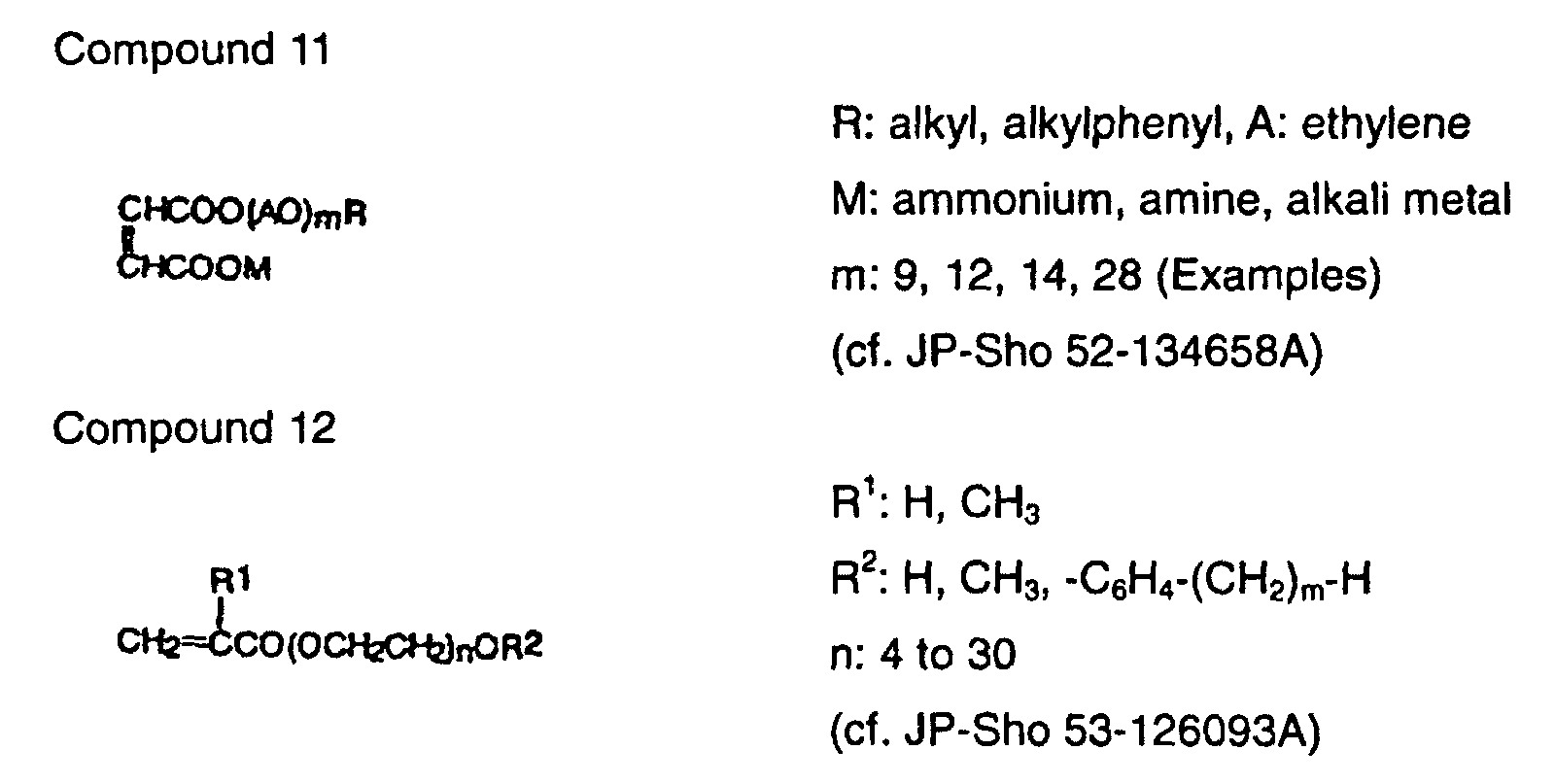
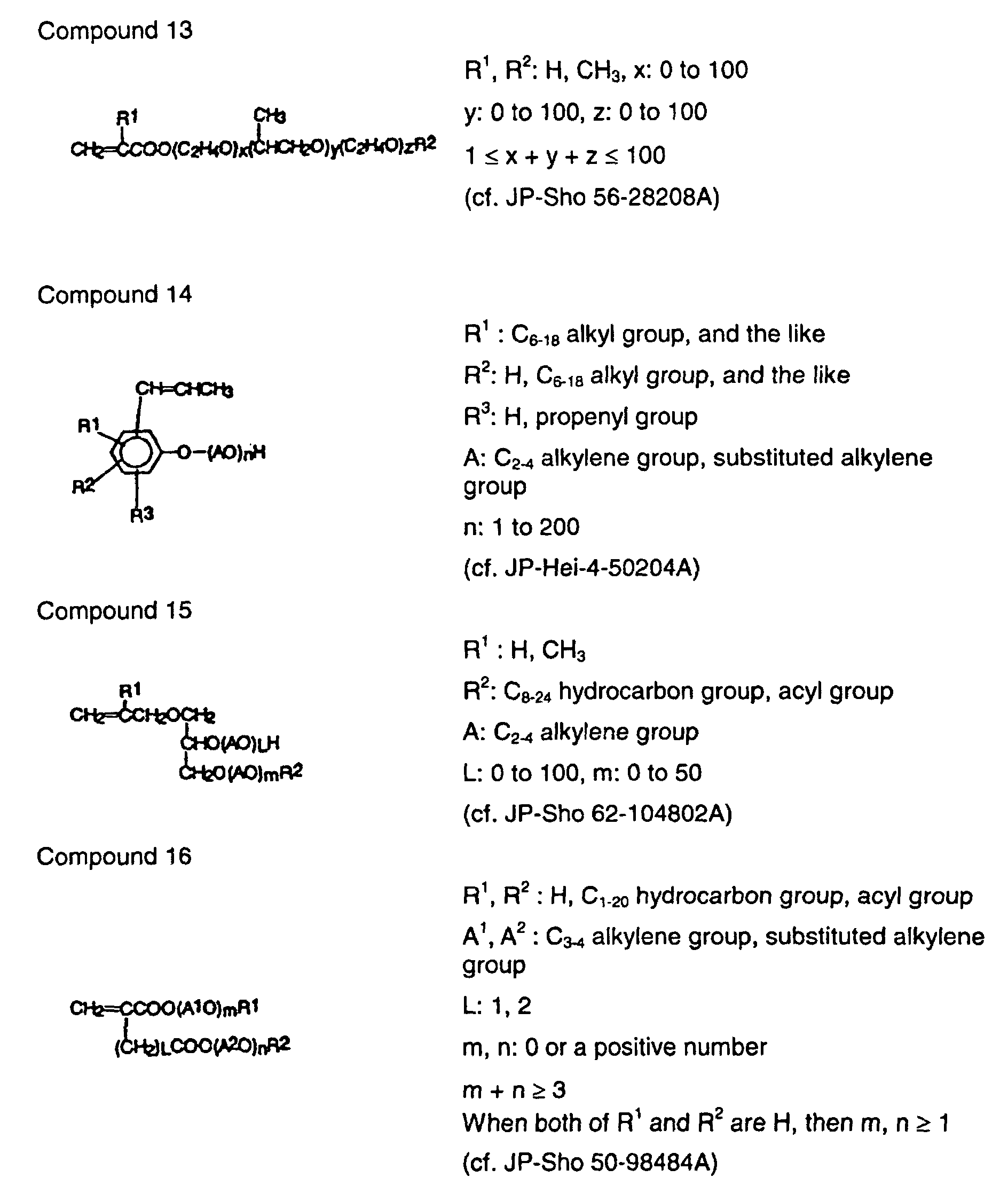
As said other emulsifiers of anionic nature without any radically polymerizable
unsaturated bond, mention can be made of, for example, sodium
alkylbenzenesulfonates, sodium alkylsulfonates, sodium polyoxyethylenealkylether
sulfonates, or corresponding phosphates, and the like.
As said nonionic emulsifiers without any radically polymerizable unsaturated bond,
mention can be made of, for example, polyoxyethylene alkyl ethers, polyoxyethylene
alkyl esters, polyoxyethylene- or polyoxypropylene glycols and the like.
These emulsifiers can be introduced all at once at the initial polymerization stage; or,
for part of the total amount, added dropwise during the polymerization or mixed with
monomers to give emulsified monomers for use in the polymerization, or else used in a
manner of any combination thereof. According to the present invention, it is preferred
to mix these emulsifiers with monomers and use these in the form of emulsified
monomers in the polymerization in terms of polymerization stability and particle size
control.
In particular, according to the present invention, it is a requisite to use said emulsifier
(A) which contains a radically polymerizable emulsifier having sulfonic acid groups, and
the amount of (A) used is 0.5 to 5.0 % by weight based on the nonvolatile content. The
total amount of the emulsifiers used is 1.0 to 5.0 % by weight based on the nonvolatile
content.
If the amount of the radically polymerizable emulsifier having sulfonic acids is less than
0.5 % by weight, the reaction cannot be completed, the reaction system can be
unstable and, further, the particles can agglomerate to each other, thereby not
producing synthetic resin emulsions having a very small particle diameter. Meanwhile,
if non-radically polymerizable emulsifiers are used more than necessary in order to
prevent the above problem, the emulsifiers can liberate over the coating layer, causing
inks blurring. In the contrary, if the amount exceeds 5.0 % by weight, the water
resistance may decrease.
The unsaturated monomer (B) having silyl groups used according to the present
invention undergoes the hydrolysis of the silyl groups and, owing to its unsaturated
bond, assumes a crosslinked structure. Therefore, not only the anti-scratching property
of the surface of film can be improved, but also it is expected to obtain such an effect
that inorganic components, such as silicon, are coupled with the polymer. In addition,
according to the present invention where colloidal silica is used, the polymer chemically
binds with the colloidal silica, which allows the utilization of the features of both
inorganic and organic materials. Further, it is possible to form a film in which the silica
does not easily fall from the coating layer. Specifically, flexible and stable films good in
water resistance and temperature resistance are obtained.
As the unsaturated monomer (B) having silyl groups, mention can be made of silyl
group-containing polymerizable unsaturated monomers of the following general
formula (1):
 in which R1, R2 and R3 may be identical to or different from each other and denote a
halogen atom, an alkyl group, an aryl group, an aralkyl group, an alkoxy group, an
aryloxy group, an acyloxy group, a hydroxyl group, an amino group, an aminooxy
group or an alkylthio group.
in which R1, R2 and R3 may be identical to or different from each other and denote a
halogen atom, an alkyl group, an aryl group, an aralkyl group, an alkoxy group, an
aryloxy group, an acyloxy group, a hydroxyl group, an amino group, an aminooxy
group or an alkylthio group.
As the radicals R1, R2 and R3 which are elements of said silyl group, various chemical
groups can be selected from those mentioned above, but, in general, it is preferable
that at least one of R1, R2 and R3 is a halogen atom, an alkoxy group or a hydroxyl
group.
As used herein, the term "halogen atom" includes fluorine, chlorine, bromine and
iodine, but, in general, preference being given to a chlorine atom. As suitable examples
of the alkyl group, mention can be made of a C1-C10 alkyl group, such as methyl, ethyl,
propyl, butyl, pentyl or hexyl. As suitable examples of the aryl group, mention can be
made of a C6-C10 aryl group, such as phenyl; and, for the aralkyl group, of a C7-C10-aralkyl
group, such as benzyl.
As suitable examples of the alkoxy group, mention can be made of a C1-C16-alkoxy
group, such as methoxy, ethoxy, propoxy, isopropoxy, butoxy, isobutoxy, t-butoxy,
pentyloxy, hexyloxy, octyloxy, decyloxy or dodecyloxy, but preference being given to a
C1-C4-alkoxy and particular preference being given to methoxy and ethoxy. In this
connection, the alkoxy group also includes an alkoxy-alkoxy group, such as methoxy-ethoxy.
Furthermore, as suitable examples of the aryloxy group, mention can be made
of a C6-C10 aryloxy group, such as phenoxy; and, for the acyloxy group, of a C2-C6
acyloxy group, such as acetyloxy (acetoxy), propionyloxy, butyryloxy.
The amino group also includes those which may have substituents, such as
dimetylamino, and the aminooxy group also includes those which may have
substituents, such as dimethylaminooxy, suitable examples thereof, which can be
mentioned, being dimethylaminooxy and diethylaminooxy. As suitable examples of the
alkylthio group, mention can be made of a C1-6 alkylthio group, such as methylthio,
ethylthio.
The unsaturated monomer (B) having silyl groups includes monomers as mentioned
below, for example.


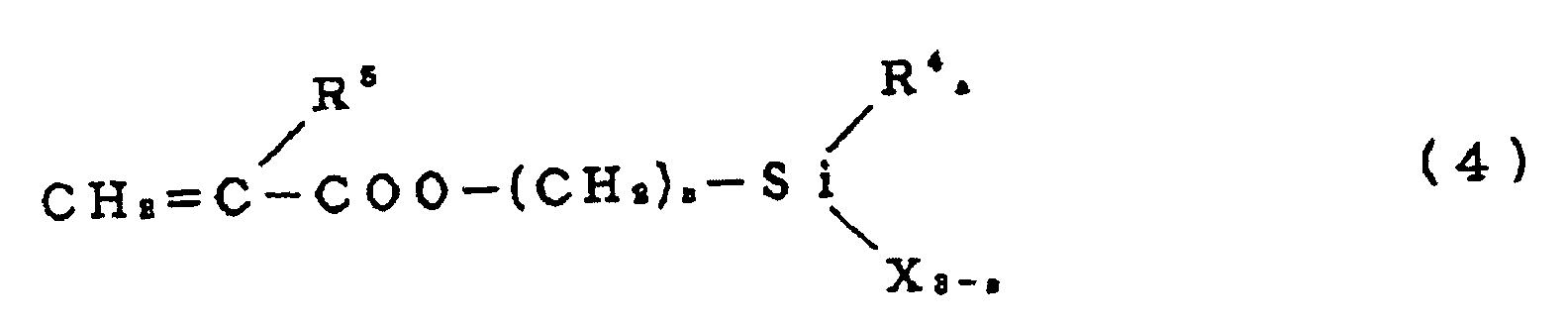
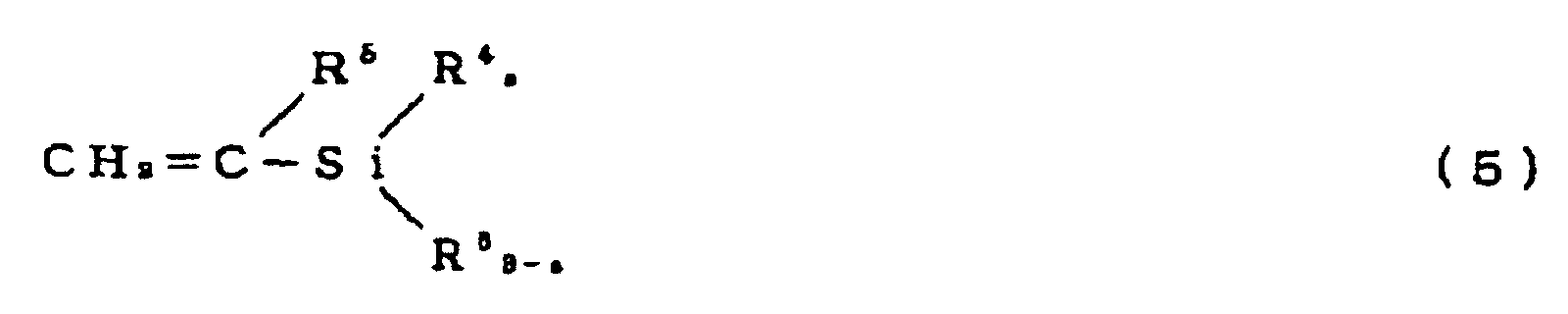





Furthermore, the unsaturated monomer (b) having silyl groups, in addition to those
mentioned above, may include divinyl group-containing monomer, such as
divinyldimethoxysilane, divinyldiethoxysilane, divinyldi(β-methoxyethoxy)silane and the
like, for example. It is preferable that such a silyl group-containing monomer (A1)
contains a vinyl monomer which has, for example, alkoxysilyl groups, in terms of the
handling, economy, control of side-reactions and others.
According to the present invention, these unsaturated monomers (B) can be used
alone, respectively, or in a combination of two or more of these monomers. According
to the present invention, particularly preferred among these monomers is the use of
vinyltriethoxysilane or 3-methacryloxylpropyl triethoxysilane in terms of their
polymerizability. The amount of the radically polymerizable unsaturated monomer (B)
having silyl groups used is suitably 0.1 to 15 parts by weight, preferably 0.5 to 10 parts
by weight, based on the total nonvolatile content.
The chemical binding with colloidal silica under the use of said radically polymerizable
unsaturated monomer having silyl groups can effectively prevent the falling of silica
from the coating layer, but the amount of said monomer is less than 0.1 % by weight,
the composite-formation with colloidal silica becomes insufficient and the water
resistance and adhesion may deteriorate. On the other hand, an amount of more than
15 % by weight may cause unstable polymerization, a large amount of agglomerates,
increased viscosities and others.
The present invention uses, as the main monomer, an unsaturated monomer having
six-membered rings as side chains. In this connection, said six-membered ring means,
for example, phenyl, cyclohexyl or the like and specific examples thereof include
styrene, α-methylstyrene, cyclohexylacrylate, cyclohexylmethacrylate and the like.
The amount thereof used is 59 to 98 % by weight based on the total nonvolatile
content of the synthetic resin emulsion. An amount of less than 59 % by weight not
only adversely affects the water-resistance and anti-blocking property, but also does
not produce any dense film excellent in the color-development. An amount of more
than 98 % by weight, in turn, leads to less amounts of the emulsifier and the silyl
group-containing unsaturated monomer and, thereby, causes the polymerization to
unstably proceed, or provides an insufficient composite-formation with colloidal silica
and, thus, results in a tendency for silica to fall down from the coating layer,
consequently not producing any good films.
Other unsaturated monomers (D) copolymerizable with (B) and (C), which can be
optionally used according to the present invention, may be, without any limitation, any
ones used in conventional emulsion-polymerization.
They comprise a monomer (D-1) which forms the backbone of the synthetic resin and
a functional monomer (D-2) which modifies the synthetic resin and provides further
functions thereto.
As the monomer (D-1) which forms the backbone, mention can be made of alkyl
(meth)acrylates, olefins, vinyl ethers and the like, for example.
More specifically, as said alkyl (meth)acrylates, mention can be made of alkyl
(meth)acrylates having C1-C12-alkyl, such as methyl, ethyl, n-butyl, t-butyl, propyl, 2-ethylhexyl,
octyl and the like.
As the olefins, mention can be made of ethylene, propylene and the like; and, for the
vinyl esters, of vinyl acetate, a vinyl ester of branched carboxylic acid, vinyl laurate and
the like.
Furthermore, as said functional monomer (D-2) which modifies the synthetic resin to
impart functions such as storage stability, water resistance, chemical resistance,
weather resistance, adhesion and the like, mention can be made of, for example, those
ethylenically unsaturated carboxylic acids (D-2a) which improve the storage stability
and adhesion; those monomers (D-2b) having two or more radically polymerizable
unsaturated bonds which improve the water-resistance, weather-resistance, chemical
resistance, adhesion and others; and those monomers (D-2-others) having, as a side
chain, an amide group, a nitrile group, a hydroxyl group, a glycidyl group, a methylol
group, a carbonyl group, a quaternary ammonium salt, an ethylene oxide chain or
chlorine.
As said ethylenically unsaturated carboxylic acids (D-2a), mention can be made of
acrylic acid, methacrylic acid, crotonic acid, maleic acid and the like.
As monomer (D-2b) having two or more radically polymerizable unsaturated bonds,
mention can be made of divinyl compounds, di(meth)acrylate compounds,
tri(meth)acrylate compounds, tetra(meth)acrylate compounds, diallyl compounds,
triallyl compounds, tetraallyl compounds and the like; and, more specifically, of
divinylbenzenes, divinyl adipate, ethylene glycol di(meth)acrylate, diethylene glycol
di(meth)acrylate, triethylene glycol di(meth)acrylate, polyethylene glycol
di(meth)acrylate, polypropylene glycol di(meth)acrylate, neopentyl glycol
di(meth)acrylate, 1,3-butylene glycol di(meth)acrylate, 1,3-butyl di(meth)acrylate,
trimethylolethane tri(meth)acrylate, trimethylolpropane tri(meth)acrylate, dipentaerythrit
tri(meth)acrylate, diallyl phthalate, triallyl dicyanurate, tetraallyloxyethane and the like.
For said other functional monomers (D-2-others), mention can be made of, as
monomers having hydroxyl groups, hydroxyethyl methacrylates, hydroxyethyl
acrylates, hydroxypropyl methacrylates, hydroxypropyl acrylates, hydroxybutyl
methacrylates, hydroxybutyl acrylates and the like; and of, as monomers having amide
groups, acrylamide, methacrylamide and the like; and of, as monomers having nitrile
groups, acrylonitrile and the like; and of, as monomers having chlorine as a side group,
vinyl chloride, vinylidene chloride and the like; and of, as monomers having glycidyl
groups, glycidyl methacrylate and glycidyl acrylate; and of, as monomers having
methylol groups, N-methylolacrylamide and the like; and of, as monomers having
carbonyl groups, acetacetoxyethyl methacrylate and the like.
According to the present invention, preferred as monomer (D-1) are alkyl
(meth)acrylates and vinyl esters of branched carboxylic acids. They may be used
alone, respectively, but, more preferably, in a combination of two or more of these
monomers in terms of the water resistance, weather resistance, polymerization stability
and others.
As functional monomers (D-2), preference is given to the use of ethylenically unsaturated carboxylic acids. Ethylenically unsaturated carboxylic acids readily undergo orientation over the surfaces of the synthetic resin emulsion particles, neutralize part of the hydroxyl groups with the formation of an electric double layer and, thereby, contribute to the dispersion stability of emulsion particles.
In this connection, when using component (D), at least one component can be selected from those mentioned above, but it is preferable that at least one component selected from alkyl (meth)acrylates, vinyl esters of branched carboxylic acids and ethylenically unsaturated carboxylic acids is used.
As functional monomers (D-2), preference is given to the use of ethylenically unsaturated carboxylic acids. Ethylenically unsaturated carboxylic acids readily undergo orientation over the surfaces of the synthetic resin emulsion particles, neutralize part of the hydroxyl groups with the formation of an electric double layer and, thereby, contribute to the dispersion stability of emulsion particles.
In this connection, when using component (D), at least one component can be selected from those mentioned above, but it is preferable that at least one component selected from alkyl (meth)acrylates, vinyl esters of branched carboxylic acids and ethylenically unsaturated carboxylic acids is used.
The amount of component (D) used is 0 to 39 % by weight based on the total
nonvolatile content of the synthetic resin emulsion. Without such component (D), the
polymerization stability and storage stability may deteriorate to some extent, but if it is
used exceeding 39 % by weight, the proportion of component (C) correspondingly
decreases and, due to this, films having a good color-developability cannot be
obtained.
The emulsion polymerization according to the present invention may be conducted in
an aqueous medium with the addition of other known components. In this case, among
others, polymerization initiators are used. In addition, if desired, further other
components, such as protective colloid, chain transfer agents, pH regulators, ultraviolet
absorbers, photooxidation inhibitors and others, may be used in suitable amounts, if
desired.
Polymerization initiators radically decompose under the action of heat or reducing
substances and, thereby, cause the addition polymerization of monomers to proceed.
They may be water-soluble or oil-soluble persulfates, peroxides, azobis compounds
and the like, for example potassium persulfate, ammonium persulfate, t-butyl
hydroperoxide, hydrogen peroxide, azobisisobutylnitrile (AIBN), rongalit, sodium
metabisulfite and the like. They can be used alone, respectively, or in a combination of
two or more of these compounds. If desired, these polymerization initiators can be
combined with transition metal ions. For such transition metal ions, the use of Fe(II)
sulfate, Cu(II) chloride, Fe(II) chloride and the like is preferable.
The protective colloid may be, without any limitation, any known one conventionally
used in emulsion-polymerization. For example, mention can be made of polyvinyl
alcohol and derivatives thereof, cellulose ethers and derivatives thereof, starch
derivatives and the like, which are primarily used in the form of an aqueous solution.
As the chain transfer agent, any suitable one can be, without any limitation, selected
from known products. Examples thereof include alcohols such as methanol, ethanol,
propanol, butanol and the like; carboxylic acids having 2 to 8 carbon atoms such as
acetone, methyl ethyl ketone, cyclohexane, acetophenone, acetaldehyde,
propionaldehyde, n-butylaldehyde, furfural, benzaldehyde and the like; mercaptans
such as dodecylmercaptan, laurylmercaptan, n-mercaptan, thioglycolic acid, octyl
thioglycolate, thioglycerol and the like. They may be used either alone, respectively, or
in a combination of two or more of these compounds.
As the pH-controlling agent, mention can be made of known substances, such as
ammonia, sodium hydroxide, potassium hydroxide and the like.
The ultraviolet absorber is also not limited to any particular type, but benzophenone
derivatives and benzotriazole derivatives are suitably used. It also includes those
having radically polymerizable unsaturated bonds, which are preferable because they
are compolymerized with synthetic resin components.
As the photooxidation inhibitor, hindered phenols and hindered piperidines are suitably
used. Like said ultraviolet absorber, it also includes those having radically
polymerizable bonds, which are preferable also in this case because they are
compolymerized with synthetic resin components.
The synthetic resin emulsion according to the present invention can be obtained in
known emulsion polymerization methods, such as a batch polymerization method
wherein all the components are introduced into a reactor at once; a dropping
polymerization method wherein an emulsifier, water as the medium and part of the
monomers are first subjected to an initial polymerization and, then, the remaining
emulsifiers and monomers are added dropwise; and, further, an emulsified-monomer
dropping method wherein the components to be added dropwise are preliminarily
emulsified and dispersed in water. According to the present invention, it is preferable to
use said emulsified-monomer dropping method in order to obtain a finely divided
synthetic resin emulsion.
Moreover, it is also possible to use a multi-stage polymerization method wherein the
monomer composition is changed step by step during the polymerization stage, or a
power-feed polymerization method wherein the monomer composition is continuously
changed, or a seeding polymerization, or the like, in any suitable combination.
It is necessary for the mean particle diameter of the synthetic resin emulsion according
to the present invention to be 100 nm or less, preferably 80 nm or less and, more
preferably, 50 nm or less. Having such a particle diameter of 100 nm or less, films
which are denser and have no cloud can be obtained, leading a print image with an
excellent color developed.
The determination of mean particle diameter can be carried out by means of known
measurement instruments. For example, Nicomp370/photon correlation spectroscopy
(Particle diameter distribution measuring instrument; PACIFIC SCIENTIFIC Company)
and the like can be used.
The present invention is featured by the use of said synthetic resin emulsion together
with colloidal silica.
Colloidal silica is a silica sol with ultrafine particles colloidally dispersed in water, and
the diameter of its primary particle is 100nm or less, in particular 50 nm or less and,
usually, in the range of 5 to 100 nm.
According to the present invention, any commercially available products can be used
as colloidal silica, and the colloidal silica may be surface-treated with a metal ion such
as a meta-aluminate ion and the like, or may be a mono-disperse system, or the
particles thereof may be connected to each other in the form of a chain or of a branch
by a special treatment. Among these, those surface-treated with a metal ion such as a
meta-aluminate ion and the like are particularly preferable because they show an
excellent stability during mixing and do not have tendencies to agglomerate.
The amount of colloidal silica used is preferably 100 to 900 % by weight and, more
preferably, 100 to 500 % by weight relative to the synthetic resin emulsion based on
the nonvolatile content.
In the coating composition according to the present invention, various pigments, dyes,
coloring pigment thickening agents, pH regulators, surfactants, dispersants, antifoaming
agents, anti-freezing agents, releasing agents, ultraviolet absorbers,
photooxidation inhibitors and the like, which can be used in aqueous coating
compositions, can be added, if necessary, for modifying or improving the whiteness,
viscosity, flowability, miscibility, preservability, weather resistance, workability and the
like.
An ink jet recording medium is obtained by applying the coating composition according
to the present invention as a gloss layer followed by drying it. In this operation, the
material and structure of the substrate and the ink fixation layer are not limited to
particular types, and any substrates and ink-fixation layers generally used in ink jet
printing media can be used without any limitation. For example, in order to impart a
gloss, a gloss layer according to the present invention is applied over a medium
comprising a substrate with an ink-receiving capacity provided in itself, such as paper,
films or cloth, in a known coating method (comma coater, blade coater, air-knife coater,
and the like), dried and subjected to a treatment which imparts a gloss thereon.
In order to impart an ink-receiving capacity to a substrate, a composition comprising
pigments, binders, cationic substances having an ink fixing ability and others is coated
on a substrate to provide an ink fixation layer. In the case of paper, cloth and the like,
pigments, binders, cationic surfactants capable of fixing inks, and others can be
impregnated into such substrates or added during the paper making stage, so that at
least part, or all, of these components can be included in the inside of such substrates.
As the pigment, mention can be made of, for example, inorganic pigments such as
zinc oxide, titanium oxide, calcium carbonate, silicic acid, silicates, clay, talc, mica,
calcined clay, aluminum hydroxide, barium sulfate, lithopone, silica, colloidal silica and
the like; plastic pigments processed into the form of a sphere, hollow body or other
various shapes and structures, comprising polystyrene, polyethylene, polypropylene,
epoxy resins, acrylic resins, acryl-styrene copolymers and the like.
As the binder, synthetic and natural polymers can be used, for example, polyvinyl
alcohol, modified polyvinyl alcohols, starch and derivatives thereof, cellulose ethers
and derivatives thereof, sodium polyacrylates, polyvinylpyrrolidones, acrylamide
copolymers, (meth)acrylic acid copolymers, polyethylene glycols, polyvinyl acetates,
polyurethanes, urethane-acryl copolymers, ethylene-vinyl acetate copolymers, vinyl
chloride-vinyl acetate copolymers, styrene-butadiene copolymers, styrene-butadiene-acrylic
copolymers, glue, casein, soybean protein, gelatin, sodium alginate and the
like.
The amount of the coating layer composition according to the present invention to be
coated as a gloss layer (cast-coat amount) is preferably 5 to 50 g/m2, more preferably
7 to 35 g/m2, based on the nonvolatile content.
A drying and gloss-imparting method after coating may comprise drying with hot air,
calendering, casting and the like. More specifically, it is preferable that casting is
conducted with a temperature setting of the cast rolls of 60 to 100°C while the coating
composition is still wet after being coated.
The ink jet recording medium thus obtained has an extremely outstanding performance
in the points that it possesses a high gloss, weather resistance and ability to follow the
change in stress occurred by bending, and a combined high ink-receiving ability and
clear color-development and, further, effectively prevents falling of silica from the
coating layer which can be frequently observed particularly in the case of a high
amount of silica incorporated.
A polymerization vessel was charged with 380 parts by weight of water, 2.0 parts by
weight of a sodium alkylallylsulfosuccinate and 1.0 part by weight of a styrene sulfonic
acid, stirred to dissolve the components, and heated to 80 °C. Then, 15 parts by weight
of 2% potassium persulfate were added as an initiator for the polymerization. At the
same time, 97 parts by weight of a monomer mixture previously prepared from 2.0
parts by weight of vinyltriethoxysilane, 79.0 parts by weight of styrene, 3.0 parts by
weight of methacrylic acid and 13.0 parts by weight of methyl methacrylate was divided
into four portions, these portions were added to the polymerization vessel sequentially
at an interval of 30 minutes and the polymerization reaction of the monomer mixture
was allowed to proceed over a total period of time of 2 hours. After the completion of
the addition, the reaction mixture was matured for 1 hour, giving a blue-white synthetic
resin emulsion.
To the synthetic resin emulsion were added 2.5 parts by weight of a 10% aqueous
ammonia solution, thereby adjusting the pH to about 9. The mean particle diameter of
the resulting synthetic resin emulsion was about 35 nm as measured by
Nicomp370/photon correlation spectroscopy (Particle diameter distribution measuring
instrument; PACIFIC SCIENTIFIC Company).
These Examples were conducted as described in Production Example 1, except that
the amounts and types of emulsifiers (component A) added to the reaction vessel and
also the types of monomer mixtures added were as shown in Table 1.
A polymerization vessel was charged with 200 parts by weight of water, 1.0 part by
weight of a sodium alkylallylsulfosuccinate, 1.0 part by weight of a styrene sulfonic acid
and 1.0 part by weight of sodium triisobutylphenolether sulfonate, stirred to dissolve
the components and heated to 80 °C. Then, 15 parts by weight of 2% potassium
persulfate were added as an initiator for the polymerization reaction. At the same time,
a monomer composition as shown below previously prepared was added dropwise
over the course of 2 hours to allow the polymerization reaction to proceed. After the
completion of the addition, the reaction mixture was matured for 1 hour, giving a blue-white
synthetic resin emulsion.
To the synthetic resin emulsion were added 2.5 parts by weight of a 10% aqueous
ammonia solution, thereby adjusting the pH to about 9. The mean particle diameter of
the resulting synthetic resin emulsion was about 60 nm as measured by
Nicomp370/photon correlation spectroscopy (Particle diameter distribution measuring
instrument, PACIFIC SCIENTIFIC Company).
| Water | 180 parts by weight |
| Polyoxyalkylene alkylpropenylphenyl ether sulfuric ester salt | 1.0 part by weight |
| Polyoxyethylene nonylphenylether | 1.0 part by weight |
| Methyl methacrylate | 10 parts by weight |
| Methacrylic acid | 5 parts by weight |
| Styrene | 45 parts by weight |
| α-Methylstyrene | 32 parts by weight |
| Vinyltriethoxysilane | 3 parts by weight |
These Examples were conducted as described in Example 6, except that the amounts
and types of emulsifiers (component A) added to the reaction vessel, the amounts and
types of emulsified monomers added dropwise, and the amounts and types of
monomers were as shown in Table 1.
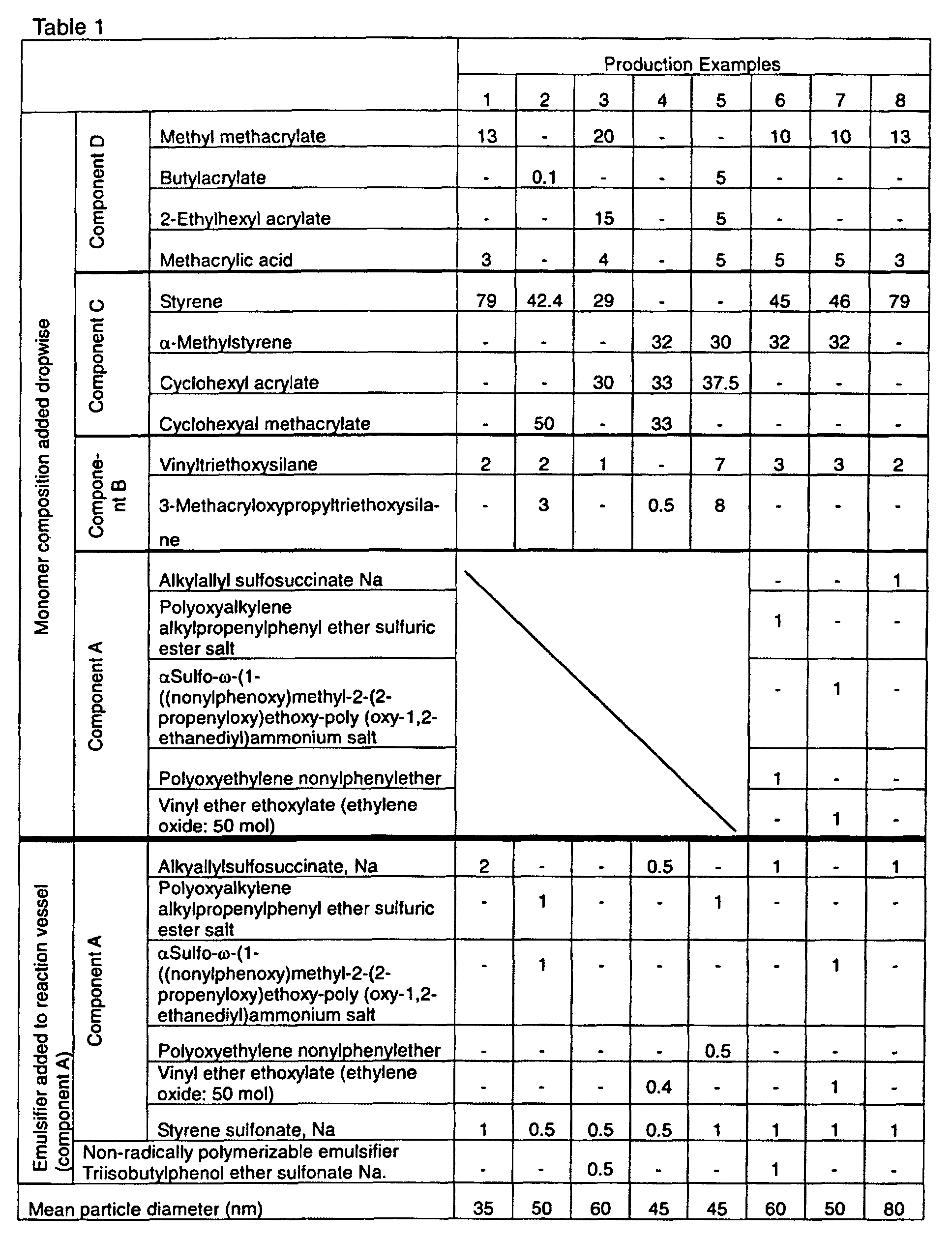
A polymerization vessel was charged with 380 parts by weight of water, 2.0 parts by
weight of a sodium alkylallylsulfosuccinate and 1.0 part by weight of a styrene sulfonic
acid, stirred to dissolve the components and heated to 80 °C. Then, 15 parts by weight
of 2% potassium persulfate were added as an initiator for the polymerization reaction.
At the same time, 97 parts by weight of a monomer mixture previously prepared from
2.0 parts by weight of vinyltriethoxysilane, 47.0 parts by weight of styrene, 3.0 parts by
weight of methacrylic acid and 45.0 parts by weight of methyl methacrylate was divided
into four portions, and these portions were sequentially added to the vessel at an
interval of 30 minutes, and the polymerization reaction of the monomer mixture was
allowed to proceed for a total period of time of 2 hours. After the completion of the
addition, the reaction mixture was matured for 1 hour, giving a blue-white synthetic
resin emulsion.
To the synthetic resin emulsion were added 2.5 parts by weight of a 10% aqueous
ammonia solution, thereby adjusting the pH to about 9. The mean particle diameter of
the resulting synthetic resin emulsion was about 45 nm as measured by
Nicomp370/photon correlation spectroscopy (Particle diameter distribution measuring
instrument, PACIFIC SCIENTIFIC Company).
These Examples were conducted as described in Comparative Production Example 1,
except that the amounts and types of emulsifiers (component A) added to the reaction
vessel, and also the types of monomer mixtures added were as shown in Table 2.
A polymerization vessel was charged with 200 parts by weight of water, 1.0 part by
weight of α-sulfo-ω-(1-nonylphenoxy)methyl-2-(2-propenyloxy)ethoxy-poly(oxy-1,2-ethanediyl)
ammonium salt and 1.0 part by weight of a polyoxyethylene nonylphenol
ether, stirred to dissolve these components and heated to 80 °C. Then, 15 parts by
weight of 2 % potassium persulfate were added as an initiator for the polymerization
reaction. At the same time, an emulsified monomer composition as shown below
previously prepared was added dropwise over the course of 2 hours to allow the
polymerization to proceed. After the completion of the addition, the reaction mixture
was matured for 1 hour, giving a blue-white synthetic resin emulsion.
To the synthetic resin emulsion were added 2.5 parts by weight of a 10 % aqueous
ammonia solution, thereby adjusting the pH to about 9. The mean particle diameter of
the resulting synthetic resin emulsion was about 100 nm as measured by
Nicomp370/photon correlation spectroscopy (Particle diameter distribution measuring
instrument, PACIFIC SCIENTIFIC Company).
| Water | 180 parts by weight |
| α-Sulfo-ω-(1-nonylphenoxy)methyl-2-(2-propenyloxy)ethoxypoly(oxy-1,2-ethanediyl) ammonium salt | 1.0 part by weight |
| Polyoxyethylene nonylphenyl ether | 1.0 parts by weight |
| Methyl methacrylate | 10 parts by weight |
| Methacrylic acid | 5 parts by weight |
| Styrene | 50 parts by weight |
| α-Methyl styrene | 32 parts by weight |
| Vinyltriethoxysilane | 3 parts by weight |
This Example was conducted as described in Comparative Production Example 5,
except that the amounts and types of emulsifiers (component A) added to the vessel,
the amount and types of emulsified monomers added dropwise, and the amounts and
types of monomers were as shown in Table 2.

100 parts of the synthetic resin emulsion obtained in Production Example 1 were
combined with 30 parts by weight of colloidal silica, in each case based on the
respective nonvolatile contents, to form a composite, from which a coating composition
was then prepared together with 5 parts by weight of a thickener and 2 parts by weight
of a polyethylene wax as a releasing agent.
A fixation layer comprising a pigment, a binder and a cationic substance was provided
on a paper substrate and, then, said coating liquid was applied over the surface of the
fixation layer by means of a bar coater. The coated substrate was then directly brought
into contact under pressure with a cast drum having a mirror surface at a surface
temperature of 80°C, dried and released, giving an ink jet recording sheet having a
gloss. The cast-coat amount in this case was 10 g/m2 based on the nonvolatile
content.
These Examples were conducted as described in Example 1, except that the types of
synthetic resin emulsions and the amounts of colloidal silica were as shown in Table 3.
For the ink jet recording sheets having a gloss thus obtained, the white paper
glossiness and printability were evaluated. The results are shown in Table 4. The
particulars of each test are as follows.
White paper glossiness: The gloss at 20°C was measured according to JIS-P8142,
and evaluated using the following scales.
The evaluation scales are as follows:
- □: Wholly excellently printed and clear image obtained.
- ○: Having no image with whitish black parts.
- □: Having an image with outstanding whitish black parts.
- ×, Having a wholly whitish image, and no longer suitable for practical use.
| Example No. | ||||||||
| 1 | 2 | 3 | 4 | 5 | 6 | 7 | 8 | |
| Synthetic resin emulsion used (100 parts by weight) | Pro.E. 1 | Pro.E.2 | Pro.E.3 | Pro.E.4 | Pro.E.5 | Pro.E.6 | Pro.E.7 | Pro.E.8 |
| Amount of colloidal silica | 300 | 300 | 500 | 10 | 100 | 500 | 300 | 900 |
| White paper glossiness | ○ | ○ | ○ | □ | □ | ○ | ○ | ○ |
| Printability | □ | □ | □ | ○ | ○ | □ | □ | □ |
| Pro.E = Production Example |
Without any composite formation with colloidal silica, a coating composition was
prepared from 100 parts by weight, based on the nonvolatile content, of the synthetic
resin emulsion from Production Example 1, 5 parts by weight of an thickener and 2
parts by weight of a polyethylene wax as a releasing agent.
An ink fixation layer comprising a pigment, a binder and a cationic substance was
provided on a paper substrate and, then, said coating liquid was applied over the
surface of the fixation layer by means of a bar coater. The coated substrate was then
directly brought into contact under pressure with a cast drum having a mirror surface at
a surface temperature of 80°C, dried and released. The releasing from the cast drum
was not good.
100 parts by weight of the synthetic resin emulsion from Production Example 1 were
combined with 1500 parts by weight of colloidal silica, based on the respective
nonvolatile contents in each case, to form a composite, from which a coating
composition was then prepared together with 5 parts by weight of a thickener and 2
parts by weight of a polyethylene wax as a releasing agent.
An ink fixation layer comprising a pigment, a binder and a cationic substance was
provided on a paper substrate and, then, said coating liquid was applied over the
surface of the fixation layer by means of a bar coater. The coated substrate was then
directly brought into contact under pressure with a cast drum having a mirror surface at
a surface temperature of 80°C, dried and released, giving an ink jet recording sheet
having a gloss. The cast-coat amount in this case was 12 g/m2 based on the
nonvolatile content.
100 parts by weight of the synthetic resin emulsion from Production Example 1 were
combined with colloidal silica having a mean particle diameter of the primary particles
of 300 nm, based on the respective nonvolatile contents in each case, to form a
composite, from which a coating composition was prepared together with 5 parts by
weight of a thickener and 2 parts by weight of a polyethylene wax as a releasing agent.
An ink fixation layer comprising a pigment, a binder and a cationic substance was
provided on a paper substrate and then said coating liquid was applied over the
surface of the fixation layer by means of a bar coater. The coated substrate was then
directly brought into contact under pressure with a cast drum having a mirror surface at
a surface temperature of 80°C, dried and released, giving an ink jet printing sheet
having a gloss. The cast-coat amount in this case was 12 g/m2 based on the
nonvolatile content.
These Examples were conducted as described in Comparative Example 1, except that
the types of synthetic resin emulsions and the amounts of colloidal silica were as
shown in Table 4.
| Comparative Examples | |||||||
| 1 | 2 | 3 | 4 | 5 | 6 | 7 | |
| Synthetic resin emulsion used (100 parts by weight) | pro.E.1 | Pro.E.1 | Pro.E.1 | C.1 | C.2 | C.5 | C.6 |
| Amount of colloidal silica | 0 | 1500 | 300 | 500 | 500 | 500 | 300 |
| White paper glossiness | Not releasab le from drum | × | × | × | Gelled during formulation | ○ | □ |
| Printability | × | □ | □ | × | □ | ||
| Pro.E = Production Example C. = Comparative Example |
The absence of any colloidal silica causes a problem in the productivity, such as
difficulties in the sheet-releasing from cast drums.
The excessive use of colloidal silica or the use of those having too large particle diameters decreases the gloss.
Without any vinyl silanes, it was difficult to prepare a coating composition.
The excessive use of colloidal silica or the use of those having too large particle diameters decreases the gloss.
Without any vinyl silanes, it was difficult to prepare a coating composition.
Claims (9)
- A coating composition for an ink jet recording medium comprising a synthetic resin emulsion having a particle diameter of 100 nm or less and colloidal silica, said synthetic resin emulsion being obtained by, in the presence of (A) an emulsifier containing a radically polymerizable emulsifier having sulfonic acid groups, emulsion-polymerizing (B) an unsaturated monomer having silyl groups and (C) an unsaturated monomer having six-membered rings as side chains and, optionally, (D) another radically polymerizable unsaturated monomer which is copolymerizable with (B) and (C).
- A coating composition for an ink jet recording medium as claimed in claim 1, which comprises a synthetic resin emulsion obtained through said emulsion-polymerization using, based on the nonvolatile content of the emulsion in each case, 0.5 to 5.0 % by weight of the radically polymerizable emulsifier having sulfonic acid groups contained in (A), 0.1 to 15 % by weight of (B), 59 to 98% by weight of (C) and 0 to 39 % by weight of (D).
- A coating composition for an ink jet recording medium as claimed in claim 1 or 2, wherein (C) is at least one monomer selected from styrene, α-methylstyrene, cyclohexylacrylate and cyclohexylmethacrylate.
- A coating composition for an ink jet recording medium as claimed in any one of claims 1 to 3, wherein (D) is an alkyl (meth)acrylate and an unsaturated carboxylic acid.
- A coating composition for an ink jet recording medium as claimed in any one of claims 1 to 4, wherein the particle diameter of the synthetic resin emulsion is 80 nm or less, preferably 50 nm or less.
- A coating composition for an ink jet recording medium as claimed in any one of claims 1 to 5, wherein the particle diameter of the colloidal silica is 100 nm or less, preferably 50 nm or less.
- A coating composition for an ink jet recording medium as claimed in any one of claims 1 to 6, wherein the amount of colloidal silica incorporated is 10 to 900 % by weight relative to the synthetic resin emulsion based on the nonvolatile content.
- An ink jet recording medium, wherein an ink fixation layer or layers comprising a pigment, a binder and a cationic ink fixation agent is or are provided on either or both sides of a recording medium substrate, and a coating composition for an ink jet recording medium as claimed in any one of claims 1 to 7 is then applied onto the ink fixation layers or onto either one of the layers.
- An ink jet recording medium, wherein a coating composition for an ink jet recording medium as claimed in any one of claims 1 to 7 is applied onto a substrate which, in the inside, contains a pigment and a cationic fixation agent.
Applications Claiming Priority (3)
| Application Number | Priority Date | Filing Date | Title |
|---|---|---|---|
| JP2001401067 | 2001-12-28 | ||
| JP2001401067A JP3730568B2 (en) | 2001-12-28 | 2001-12-28 | INKJET RECORDING MEDIUM COATING COMPOSITION AND INKJET RECORDING MEDIUM |
| PCT/JP2002/013848 WO2003057495A1 (en) | 2001-12-28 | 2002-12-27 | Coating composition for ink-jet recording medium and ink-jet recording medium |
Publications (2)
| Publication Number | Publication Date |
|---|---|
| EP1470928A1 true EP1470928A1 (en) | 2004-10-27 |
| EP1470928A4 EP1470928A4 (en) | 2005-03-09 |
Family
ID=19189717
Family Applications (1)
| Application Number | Title | Priority Date | Filing Date |
|---|---|---|---|
| EP02792064A Withdrawn EP1470928A4 (en) | 2001-12-28 | 2002-12-27 | COATING COMPOSITION FOR INKJET PRINTING MEDIUM AND INKJET PRINTING MEDIUM |
Country Status (9)
| Country | Link |
|---|---|
| US (1) | US20050124747A1 (en) |
| EP (1) | EP1470928A4 (en) |
| JP (1) | JP3730568B2 (en) |
| KR (1) | KR20040070280A (en) |
| CN (1) | CN100363177C (en) |
| BR (1) | BR0207729A (en) |
| CA (1) | CA2471751A1 (en) |
| TW (1) | TWI283700B (en) |
| WO (1) | WO2003057495A1 (en) |
Cited By (5)
| Publication number | Priority date | Publication date | Assignee | Title |
|---|---|---|---|---|
| EP1767376A4 (en) * | 2004-05-18 | 2007-08-08 | Mitsui Chemicals Inc | Organic particle for inkjet recording sheet and recording sheet |
| WO2008040464A1 (en) * | 2006-10-02 | 2008-04-10 | Celanese Emulsions Gmbh | Plasters and renders and paints, copolymer dispersions and their use |
| US7803852B2 (en) * | 2005-03-08 | 2010-09-28 | Kao Corporation | Water-based inks for ink-jet printing |
| EP3256325A4 (en) * | 2015-02-13 | 2018-03-28 | Hewlett-Packard Development Company, L.P. | Pre-treatment composition |
| EP3380534B1 (en) | 2015-11-24 | 2020-09-02 | Dow Global Technologies, LLC | Aqueous polymer dispersion and process of making the same |
Families Citing this family (4)
| Publication number | Priority date | Publication date | Assignee | Title |
|---|---|---|---|---|
| EP2285920B1 (en) * | 2008-04-18 | 2016-09-07 | Hewlett-Packard Development Company, L.P. | Ink-jet overcoat composition and related systems and methods |
| TWI460237B (en) * | 2010-07-05 | 2014-11-11 | Chi Mei Corp | A pattern forming ink composition, a light guide plate, a light emitting unit, and a liquid crystal display element having the light emitting unit |
| CN103130955B (en) * | 2013-03-07 | 2015-06-17 | 京东方科技集团股份有限公司 | Photosensitive oligomer for photoresist, preparation method and negative photoresist composition thereof |
| BR112017023974B1 (en) | 2015-05-08 | 2022-10-18 | Evonik Operations Gmbh | COLORED PIGMENT PARTICLES AND THEIR USE, PRODUCTION PROCESS AND COMPOSITION |
Family Cites Families (14)
| Publication number | Priority date | Publication date | Assignee | Title |
|---|---|---|---|---|
| JPS53126093A (en) * | 1977-04-12 | 1978-11-02 | Japan Exlan Co Ltd | Preparation of aqueous polymer emulsion having modified stability |
| JPS62278081A (en) * | 1986-05-26 | 1987-12-02 | Mitsubishi Paper Mills Ltd | inkjet recording medium |
| JPH0693122A (en) * | 1992-09-14 | 1994-04-05 | Toray Ind Inc | Transparent printing film |
| DE69406599T2 (en) * | 1993-06-15 | 1998-04-02 | Canon K.K., Tokio/Tokyo | Cast coated paper for ink jet recording, its manufacturing process and ink jet printing process therewith |
| JP3386906B2 (en) * | 1994-01-18 | 2003-03-17 | 大日本印刷株式会社 | Coating composition, manufacturing method thereof, coating film forming method and coating film |
| US6368707B1 (en) * | 1996-07-19 | 2002-04-09 | Toagosei Co., Ltd. | Heat-sensitive adhesive sheet |
| US6020435A (en) * | 1997-11-05 | 2000-02-01 | Rohm And Haas Company | Process for preparing polymer core shell type emulsions and polymers formed therefrom |
| JP2000119587A (en) * | 1998-10-20 | 2000-04-25 | Clariant Polymer Kk | Coating composition |
| JP3991489B2 (en) * | 1999-02-22 | 2007-10-17 | 王子製紙株式会社 | Inkjet recording paper |
| JP4051838B2 (en) * | 1999-04-26 | 2008-02-27 | 王子製紙株式会社 | RECORDED BODY AND MANUFACTURING METHOD THEREOF |
| WO2000074945A1 (en) * | 1999-06-04 | 2000-12-14 | Daicel Chemical Industries, Ltd. | Resin composition for ink-jet recording sheet and recording sheet made with the same |
| JP4092041B2 (en) * | 1999-06-04 | 2008-05-28 | 三菱製紙株式会社 | Inkjet recording sheet |
| JP2002144720A (en) * | 2000-08-28 | 2002-05-22 | Konica Corp | Ink jet recording paper |
| JP3599677B2 (en) * | 2001-03-19 | 2004-12-08 | クラリアントポリマー株式会社 | Coating composition for inkjet recording medium and inkjet recording medium |
-
2001
- 2001-12-28 JP JP2001401067A patent/JP3730568B2/en not_active Expired - Lifetime
-
2002
- 2002-12-26 TW TW091137498A patent/TWI283700B/en not_active IP Right Cessation
- 2002-12-27 BR BR0207729-9A patent/BR0207729A/en not_active Application Discontinuation
- 2002-12-27 CN CNB028262131A patent/CN100363177C/en not_active Expired - Fee Related
- 2002-12-27 US US10/500,271 patent/US20050124747A1/en not_active Abandoned
- 2002-12-27 WO PCT/JP2002/013848 patent/WO2003057495A1/en not_active Ceased
- 2002-12-27 KR KR10-2004-7010122A patent/KR20040070280A/en not_active Ceased
- 2002-12-27 CA CA002471751A patent/CA2471751A1/en not_active Abandoned
- 2002-12-27 EP EP02792064A patent/EP1470928A4/en not_active Withdrawn
Cited By (6)
| Publication number | Priority date | Publication date | Assignee | Title |
|---|---|---|---|---|
| EP1767376A4 (en) * | 2004-05-18 | 2007-08-08 | Mitsui Chemicals Inc | Organic particle for inkjet recording sheet and recording sheet |
| US7803852B2 (en) * | 2005-03-08 | 2010-09-28 | Kao Corporation | Water-based inks for ink-jet printing |
| WO2008040464A1 (en) * | 2006-10-02 | 2008-04-10 | Celanese Emulsions Gmbh | Plasters and renders and paints, copolymer dispersions and their use |
| US8436088B2 (en) | 2006-10-02 | 2013-05-07 | Celanese Emulsions Gmbh | Plasters and renders and paints, copolymer dispersions and their use |
| EP3256325A4 (en) * | 2015-02-13 | 2018-03-28 | Hewlett-Packard Development Company, L.P. | Pre-treatment composition |
| EP3380534B1 (en) | 2015-11-24 | 2020-09-02 | Dow Global Technologies, LLC | Aqueous polymer dispersion and process of making the same |
Also Published As
| Publication number | Publication date |
|---|---|
| CA2471751A1 (en) | 2003-07-17 |
| JP2003200651A (en) | 2003-07-15 |
| CN1697737A (en) | 2005-11-16 |
| WO2003057495A1 (en) | 2003-07-17 |
| EP1470928A4 (en) | 2005-03-09 |
| KR20040070280A (en) | 2004-08-06 |
| JP3730568B2 (en) | 2006-01-05 |
| TW200301291A (en) | 2003-07-01 |
| BR0207729A (en) | 2004-03-23 |
| TWI283700B (en) | 2007-07-11 |
| US20050124747A1 (en) | 2005-06-09 |
| CN100363177C (en) | 2008-01-23 |
Similar Documents
| Publication | Publication Date | Title |
|---|---|---|
| US10793740B2 (en) | Aqueous polymer dispersion for paper with a copolymer of vinyl acetate and an acrylate monomer prepared in the presence of a starch derivative | |
| US6852423B2 (en) | Paper coating slips containing binding agents with macromonomers | |
| US7144944B2 (en) | Coating composition for ink-jet recording medium and ink-jet recording medium | |
| EP1043372B1 (en) | Coating composition | |
| EP3129413B1 (en) | Aqueous polymer dispersion for paper with a copolymer of vinyl acetate and an acrylate monomer | |
| CN101432316A (en) | Aqueous silica-based nanocomposite polymer dispersions | |
| US20050124747A1 (en) | Coating composition for ink-jet recording medium and ink-jet recording medium | |
| WO2001083232A1 (en) | Recording sheet and process for producing the same | |
| CN104968695B (en) | Cationic emulsion having polymer core-shell structure, aqueous ink, and recording medium | |
| JP4418583B2 (en) | Resin composition for inkjet recording and recording sheet | |
| JP2002120452A (en) | Composition for inkjet recording material and recording medium or recording sheet using the same | |
| KR20140092367A (en) | Paper coating compositions comprising a polymer dispersion from room temperature liquid and gaseous monomers | |
| JP2630899B2 (en) | Corrugated cardboard anti-slip agent, method for producing cardboard box having anti-slip layer, and cardboard box having anti-slip layer | |
| JP4903304B2 (en) | Resin composition for coating and recording sheet | |
| JP4039956B2 (en) | Aqueous composition for inkjet recording medium | |
| JP3490290B2 (en) | Cationic emulsion composition and ink jet recording sheet using the same | |
| JP7057072B2 (en) | Copolymer latex for inkjet coated paper and the copolymer latex-containing composition | |
| WO2015080132A1 (en) | Pigment dispersant, composition for coated paper, and coated paper | |
| JP2002103794A (en) | Resin composition for inkjet recording and recording sheet | |
| JP2003048368A (en) | Ink-jet recording resin composition and recording sheet | |
| JP2006131654A (en) | Method for producing copolymer latex |
Legal Events
| Date | Code | Title | Description |
|---|---|---|---|
| PUAI | Public reference made under article 153(3) epc to a published international application that has entered the european phase |
Free format text: ORIGINAL CODE: 0009012 |
|
| 17P | Request for examination filed |
Effective date: 20040728 |
|
| AK | Designated contracting states |
Kind code of ref document: A1 Designated state(s): AT BE BG CH CY CZ DE DK EE ES FI FR GB GR IE IT LI LU MC NL PT SE SI SK TR |
|
| A4 | Supplementary search report drawn up and despatched |
Effective date: 20050121 |
|
| RAP1 | Party data changed (applicant data changed or rights of an application transferred) |
Owner name: CELANESE INTERNATIONAL CORPORATION |
|
| STAA | Information on the status of an ep patent application or granted ep patent |
Free format text: STATUS: THE APPLICATION HAS BEEN WITHDRAWN |
|
| 18W | Application withdrawn |
Effective date: 20080304 |