EP1470753A1 - Herbicide composition - Google Patents
Herbicide composition Download PDFInfo
- Publication number
- EP1470753A1 EP1470753A1 EP02722809A EP02722809A EP1470753A1 EP 1470753 A1 EP1470753 A1 EP 1470753A1 EP 02722809 A EP02722809 A EP 02722809A EP 02722809 A EP02722809 A EP 02722809A EP 1470753 A1 EP1470753 A1 EP 1470753A1
- Authority
- EP
- European Patent Office
- Prior art keywords
- weeds
- alkoxy
- chloro
- ylcarbamoylsulfamoyl
- methoxypyrimidin
- Prior art date
- Legal status (The legal status is an assumption and is not a legal conclusion. Google has not performed a legal analysis and makes no representation as to the accuracy of the status listed.)
- Granted
Links
Classifications
-
- A—HUMAN NECESSITIES
- A01—AGRICULTURE; FORESTRY; ANIMAL HUSBANDRY; HUNTING; TRAPPING; FISHING
- A01N—PRESERVATION OF BODIES OF HUMANS OR ANIMALS OR PLANTS OR PARTS THEREOF; BIOCIDES, e.g. AS DISINFECTANTS, AS PESTICIDES OR AS HERBICIDES; PEST REPELLANTS OR ATTRACTANTS; PLANT GROWTH REGULATORS
- A01N47/00—Biocides, pest repellants or attractants, or plant growth regulators containing organic compounds containing a carbon atom not being member of a ring and having no bond to a carbon or hydrogen atom, e.g. derivatives of carbonic acid
- A01N47/08—Biocides, pest repellants or attractants, or plant growth regulators containing organic compounds containing a carbon atom not being member of a ring and having no bond to a carbon or hydrogen atom, e.g. derivatives of carbonic acid the carbon atom having one or more single bonds to nitrogen atoms
- A01N47/28—Ureas or thioureas containing the groups >N—CO—N< or >N—CS—N<
- A01N47/36—Ureas or thioureas containing the groups >N—CO—N< or >N—CS—N< containing the group >N—CO—N< directly attached to at least one heterocyclic ring; Thio analogues thereof
Definitions
- the present invention relates to an herbicide composition, particularly to an herbicide composition suitable to control weeds in orchards and non-crop lands.
- the present inventor has found facts that a combined use of a uracil compound (hereinafter referred to as the present uracil compound) represented by the following formula (I): wherein Z represents a halogen atom or cyano; A represents an oxygen atom, sulfur atom or NH; R 1 represents hydroxyl, C1-C7 alkoxy, C3-C7 alkenyloxy, C3-C7 alkynyloxy, C5-C7 cycloalkoxy, ⁇ (C1-C7 alkoxy)carbonyl ⁇ C1-C3 alkoxy, (C1-C7 alkylamino)oxy, ⁇ di(C1-C7 alkyl)amino ⁇ oxy, (C3-C7 alkylideneamino)oxy, C1-C7 alkylamino, di(C1-C7 alkyl)amino, C3-C7 alkenylamino, C3
- composition comprising the present uracil compound and Chlorimuron compound
- the application can be carried out at a lowered dose, the herbicidal spectrum can be broadened, and particularly, a wide variety of weeds can be controlled in orchards and soybean fields.
- a halogen atom represented by Z in the formula (I) means a fluorine atom, chlorine atom, bromine atom or iodine atom
- C1-C7 alkoxy represented by R 1 includes methoxy, ethoxy, propoxy, isopropoxy, butoxy, 1-methylpropoxy, 2-methylpropoxy, pentyloxy, 1-methylbutoxy, 2-methylbutoxy, 3-methylbutoxy, 2,2-dimethylpropoxy, hexyloxy, 1-methylpentyloxy, 2-methylpentyloxy, 3-methylpentyloxy, 4-methylpentyloxy, 1,2-dimethylbutoxy, 1,3-dimethylbutoxy, 2,3-dimethylbutoxy, 3,3-dimethylbutoxy, heptyloxy and the like;
- C3-C7 alkenyloxy represented by R 1 includes 2-propynyloxy, 3-butenyloxy, 4-pentenyloxy, 3-methyl-3-butenyloxy, 3-methyl-2-but
- Chlorimuron compound is a compound described in FARM CHEMICALS HANDBOOK 2001 (published by MEISTER PUBLISHING COMPANY in 2001), pages C87, and can be prepared by known processes.
- the agriculturally acceptable salts of Chlorimuron means salts such as an ammonium salt, trimesium salt, isopropylamine salt, sodium salt, potassium salt, dimethylamine salt and the like, and the lower-alkyl ester of Chlorimuron means esters such as methyl ester, ethyl ester, propyl ester, isopropyl ester and the like.
- Ethyl ester of Chlorimuron namely ethyl 2-(4-chloro-6-methoxypyrimidin-2-ylcarbamoylsulfamoyl)benzoate (generic name: chlorimuron-ethyl; hereinafter, referred to as Chrorimuron-ethyl) or formulations thereof are commercially available.
- the present composition is excellent as an herbicide because it has an herbicide activity against a wide variety of weeds, and exhibits an excellent herbicide activity in ordinary crop lands such as plowing cultivation crop fields, non-tilled cropping fields, orchards and the like, and non-crop land such as sports grounds, vacant lands, forest lands, railroad sides and the like.
- the present composition is particularly effective in controlling a wide variety of weeds emerging in orchards, and does not cause troublesome phytotoxicity in fruit trees.
- the present composition is particularly effective in controlling a wide variety of weeds emerging in soybean fields from winter season to spring season before seeding of soybean, and does not cause troublesome phytotoxicity in seeded soybean after treatment.
- the present composition has especially an herbicide activity against various weeds, listed below, causing trouble in orchards, soybean fields, non-crop land and the like.
- Polygonaceae weeds wild buckwheat (Polygonum convolvulus), pale smartweed (Polygonum lapathifolium), Pensylvania smartweed (Polygonum pensylvanicum), ladysthumb (Polygonum persicaria), curly dock (Rumex crispus), bitter dock(Rumex obtusifolius), Japanese knotweed (Poligonum cuspidatum).
- Portulaceae weeds common purslane (Portulaca oleracea).
- Caryophyllaceae weeds common chickweed (Stellaria media).
- Chenopodiaceae weeds common lambsquarters (Chenopodium album), summer cypress (Kochia scoparia).
- Amaranthaceae weeds redroot pigweed (Amaranthus retroflexus), smooth pigweed (Amaranthus hybridus).
- Cruciferae weeds wild radish (Raphanus raphanistrum), wild mustard (Sinapis arvensis), shepherds purse (Capsella bursa-pastoris).
- Legminosae weeds hemp sesbania (Sesbania exaltata), sickle pod (Cassia obtusifolia), Florida beggarweed (Desmodium tortuosum), white clover (Trifolium repens).
- Malvaceae weeds velvetleaf (Abutilon theophrasti), pricky sida (Sida spinosa).
- Violaceae weeds field pansy (Viola arvensis), wildpansy (Viola tricolor).
- Rubiaceae weeds bedstraw (Galium aparine).
- Convolvulaceae weeds ivyleaf morningglory (Ipomoea hederacea), tall morningglory (Ipomoea purpurea), entireleaf morningglory (Ipomoea hederacea var integriuscula), whitestar (Ipomoea lacunosa), field bindweed (Convolvulus arvensis).
- Labiatae weeds purple deadnettle (Lamium purpureum), henbit (Lamium amplexicaule).
- Solanaceae weeds jimsonweed (Datura stramonium), black nightshade (Solanum nigrum).
- Scrophulariaceae weeds persian speedwell (Veronica persica), ivyleaf speedwell (Veronica hederaefolia).
- Compositae weeds common cocklebur (Xanthium pensylvanicum), wild sunflower (Helianthus annuus), scentless chamomile (Matricaria perforata or inodora), corn marigold (Chrysanthemum segetum), pineapple weed (Matricaria matricarioides), common ragweed (Ambrosia artemisiifolia), giant ragweed (Ambrosia trifida), horseweed (Erigeron canadensis), Japanese mugwort (Artemisia princeps), tall goldenrod (Solidago altissima).
- Asslepiadaceae weeds milkweed (Asclepias syriaca).
- Euphorbiaceae weeds sun spurge (Euphorbia helioscopia), spurge (Euphorbia maculata).
- Gramineae weeds barnyard grass (Echinochloa crus-galli), green foxtail (Setaria viridis), giant foxtail (Setaria faberi), southern crabgrass (Digitaria sanguinalis), goose grass (Eleusine indica), annual bluegrass (Poa annua), black grass (Alopecurus myosuroides), wild oats (Avena fatua), Johnson grass (Sorghum halepense), quack grass (Agropyron repens), downy brome (Bromus tectorum), Bermuda grass (Cynodone dactylon), fall panicum (Panicum dichotomiflorum), Texas panicum (Panicum texanum), shatter cane (Sorghum vulgare), broadleaf signalgrass (Brachiaria platyphylla).
- Equisetaceae weeds field horsetail (Equisetum arvense).
- Cryperaceae weeds rice flatsedge (Cyperus iria), purple nutsedge (Cyperus rotundus), yellow nutsedge (Cyperus esculentus).
- the mixing ratio of the uracil compound to Chlorimuron compound may vary depending on targeted kind of weeds, application locus, application conditions and the like, and usually it is a ratio showing a synergistic effect, specifically 1:0.05 to 1:500, preferably 1:0.1 to 1:100, and more preferably 1:0.5 to 1:10.
- the present composition may contain other ingredients in addition to the present uracil compound and Chlorimuron compound, and it is usually in the form of a formulation such as emulsion, wettable powder, suspension, granule and the like obtainable by mixing the present uracil compound and Chlorimuron compound as the active ingredients together with a solid carrier, liquid carrier or the like and, if necessary, adding a surfactant, other formulation auxiliaries and the like.
- These formulations contain usually 0.5 to 90% by weight, preferably 1 to 80% by weight in total of the present uracil compound and Chlorimuron compound.
- usable solid carriers include, for example, fine powders and granules such as clays (kaolinite, diatomaceous earth, synthetic hydrous silicon oxide, Fubasami clay, bentonite, acid clay and the like), talc, other inorganic minerals (sericite, quarts powder, sulfur powder, activated carbon, calcium carbonate and the like), chemical fertilizers (ammonium sulfate, ammonium phosphate, ammonium nitrate, ammonium chloride, urea and the like) and so on; and liquid carriers include, for example, water, alcohols (methanol, ethanol and the like), ketones (acetone, methyl ethyl ketone, cyclohexanone and the like), aromatic hydrocarbons (toluene, xylene, ethylbenzene, methylnaphthalene and the like), non-aromatic hydrocarbons (hexane, cyclohexane, kerosene and the like), esters,
- Surfactants include, for example, alkyl sulfate esters, alkyl sulfonate salts, alkyl aryl sulfonate salts, alkyl aryl ethers and their polyoxyethylene compounds, polyoxyethylene glycol ethers, polyhydric alcohol esters, sugar alcohol derivatives and the like.
- formulation auxiliaries include, for example, sticking agents and dispersing agents such as casein, gelatin, polysaccharides (starch, gum Arabic, cellulose derivatives, alginic acid and the like), lignin derivatives, bentonite, synthetic water-soluble high molecules (polyvinyl alcohol, polyvinyl pyrrolidone, polyacrylic acid and the like) and the like, stabilizing agents such as PAP (acidic isopropyl phosphate), BHT (2,6-tert-butyl-4-methylphenol), BHA (2-/3-tert-butyl-4-methoxyphenol), vegetable oils, mineral oils, fatty acids, fatty acid esters and the like.
- sticking agents and dispersing agents such as casein, gelatin, polysaccharides (starch, gum Arabic, cellulose derivatives, alginic acid and the like), lignin derivatives, bentonite, synthetic water-soluble high molecules (polyvinyl alcohol, polyvinyl pyrrolidone, poly
- the present composition can also be obtained by separately formulating the present uracil compound and Chlorimuron compound as the active ingredients according to the above described formulation process and then mixing both of the formulations.
- the present composition is applied as it is or, if necessary, after dilution onto leaves and stems of weeds. Sometimes, enhancement of herbicide activity can be expected by using the present composition with another herbicide. In addition, it may be concurrently used together with an insecticide, fungicide, plant growth regulator, phytotoxicity reducing agent (safener) and the like.
- Amount to be applied of the present composition may vary depending on the mixing ratio of the present uracil compound to Chlorimuron compound as the active ingredients, meteorological conditions, formulation forms, time of application, method of application, locus of application, a kind of weed to be controlled, a kind of crop to be protected and the like; the total amount of the present uracil compound and Chlorimuron compound per hectare is usually 1 g to 500 g, preferably 5 g to 200 g.
- Emulsions, wettable powders, suspensions and the like of the present composition are applied in a predetermined amount usually diluted with 100 to 1,000 liters of water per hectare. Enhancement of the effect to weeds can be expected by adding adjuvant to aqueous diluent.
- the present process is usually carried out by applying an effective amount of the present composition to weeds; it can also be carried out by applying effective amounts of the present uracil compound and Chlorimuron compound independently but at the same stage according to the above described amount, manner of use and the like.
- the present uracil compounds can be produced, for example, according to the process described in EP 1,106,607.
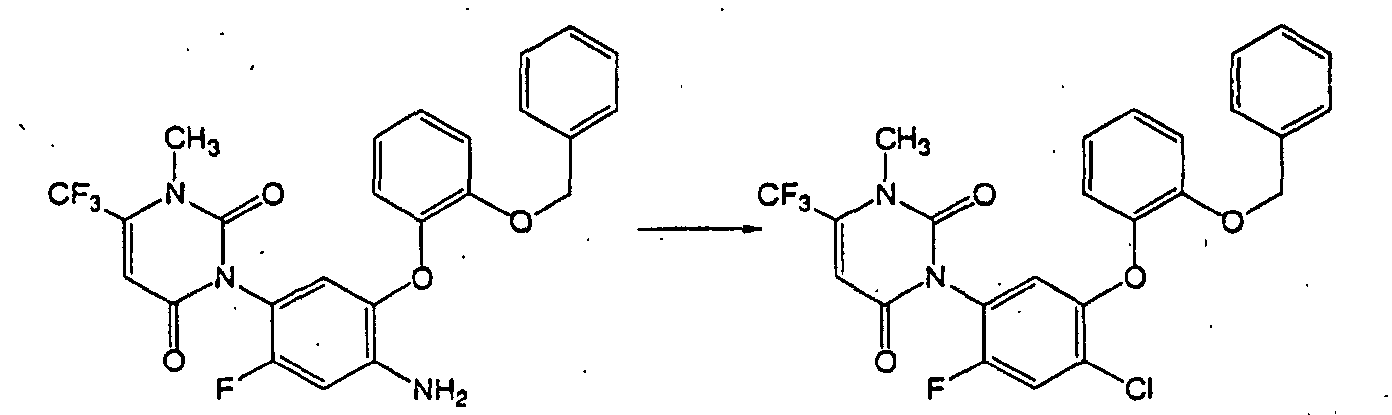
- Compound A-3 can be produced by the following process:
- Formulation examples are shown in the following.
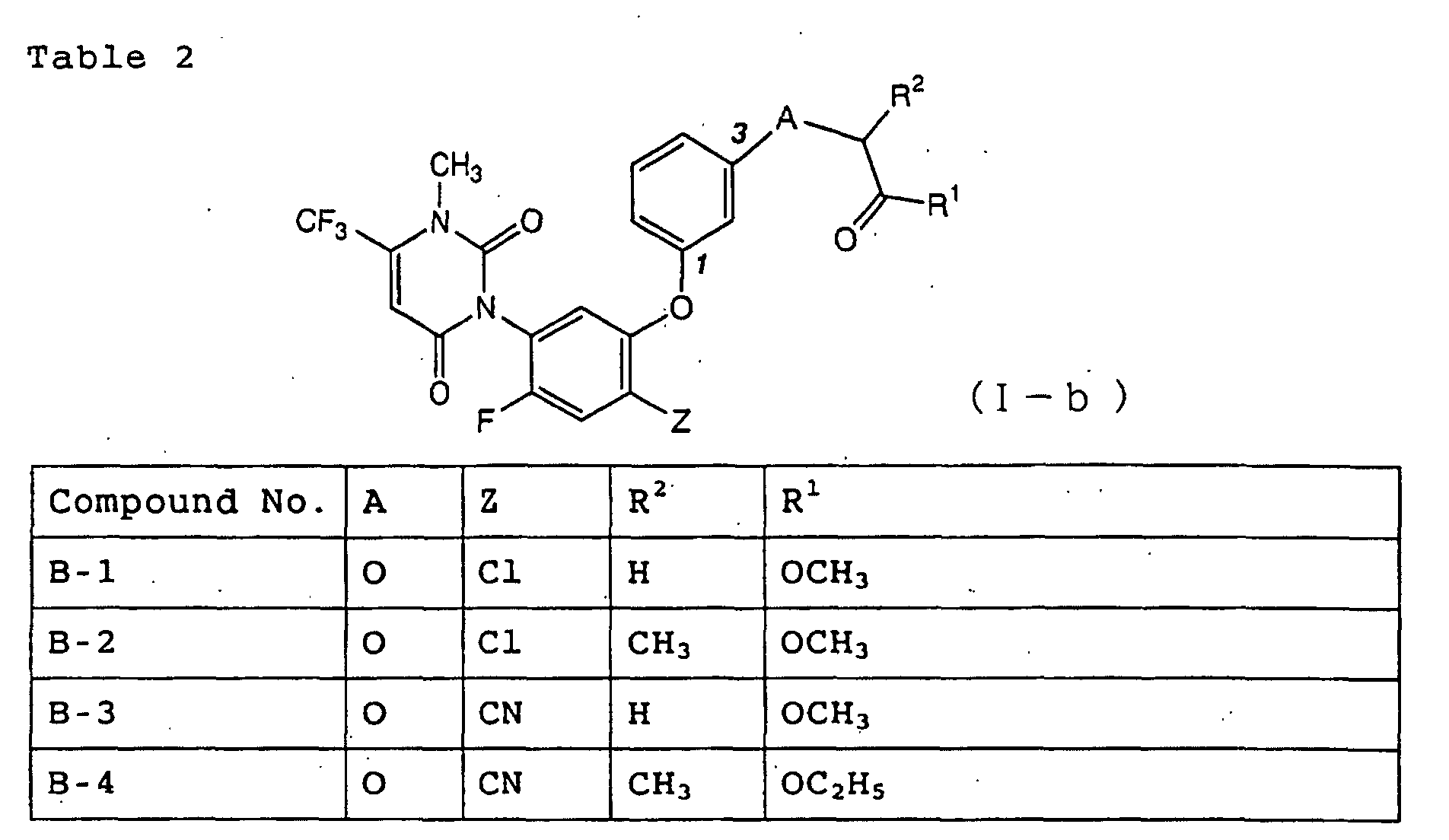
- compounds represented by compound numbers are the compounds in Table 1 to 3 and part means part by weight.
- Each of wettable powders is obtained by sufficiently pulverizing and mixing 42.5 parts of Compound A-1, A-2, A-3, A-4, A-5, A-6, A-7, B-1, B-2, B-3, B-4, C-1, C-2, C-3 or C-4, 42.5 parts of Chlorimuron-ethyl, 3 parts of calcium ligninsulfonate, 2 parts of sodium lauryl sulfate, and 10 parts of synthetic hydrous silicon oxide.
- Each of wettable powders is obtained by sufficiently pulverizing and mixing 0.8 part of Compound A-1, A-2, A-3, A-4, A-5, A-6, A-7, B-1, B-2, B-3, B-4, C-1, C-2, C-3 or C-4, 80 parts of Chlorimuron-ethyl, 3 parts of calcium ligninsulfonate, 2 parts of sodium lauryl sulfate, and 14.2 parts of synthetic hydrous silicon oxide.
- Each of wettable powders is obtained by sufficiently pulverizing and mixing 45 parts of Compound A-1, A-2, A-3, A-4, A-5, A-6, A-7, B-1, B-2, B-3, B-4, C-1, C-2, C-3 or C-4, 5 parts of Chlorimuron-ethyl, 3 parts of calcium ligninsulfonate, 2 parts of sodium lauryl sulfate, and 45 parts of synthetic hydrous silicon oxide.
- Each of suspensions is obtained by wet-grinding 24 parts of Compound A-1, A-2, A-3, A-4, A-5, A-6, A-7, B-1, B-2, B-3, B-4, C-1, C-2, C-3 or C-4, 24 parts of Chlorimuron-ethyl, 3 parts of polyoxyethylenesorbitan monooleate, 3 parts of CMC (carboxymethylcellulose), and 46 parts of water; and wet-grinding until the particle size was 5 micron or lower.
- Each of suspensions is obtained by wet-grinding 0.4 part of Compound A-1, A-2, A-3, A-4, A-5, A-6, A-7, B-1, B-2, B-3, B-4, C-1, C-2, C-3 or C-4, 40 parts of Chlorimuron-ethyl, 3 parts of polyoxyethylenesorbitan monooleate, 3 parts of CMC (carboxymethylcellulose), and 53.6 parts of water; and wet-grinding until the particle size was 5 micron or lower.
- Each of suspensions is obtained by wet-grinding 2 parts of Compound A-1, A-2, A-3, A-4, A-5, A-6, A-7, B-1, B-2, B-3, B-4, C-1, C-2, C-3 or C-4, 18 parts of Chlorimuron-ethyl, 3 parts of polyoxyethylenesorbitan monooleate, 3 parts of CMC (carboxymethylcellulose), and 74 parts of water; and wet-grinding until the particle size was 5 micron or lower.
- Evaluation of the herbicide activity is divided into 11 levels and shown by 0, 1, 2, 3, 4, 5, 6, 7, 8, 9 or 10, wherein a level was taken “0” when completely or almost no difference was observed between the growth behavior of a test weed at the time of observation and that of untreated weed and a level was taken "10" when a test weed completely died or the growth of that was completely inhibited.
- Evaluation of phytotoxicity against a crop was shown by "no” when almost no phytotoxicity was observed, “low” when a low level phytotoxicity was observed, “medium” when a medium level phytotoxicity was observed and “high” when a high level phytotoxicity was observed.
- a plastic pot of 11 cm in diameter and 8 cm in depth was filled with field soil.
- a tuber of yellow nutsedge (Cyperus esculentus) was planted and grown in a greenhouse for 21 days.
- An emulsion of Compound A-1 was prepared by sufficiently mixing 5 parts of Compound A-1, 6 parts of Sorpol 3005X (surfactant, produced by Toho Chemical) and 89 parts of xylene.
- weeds can be effectively controlled with a low dose.
- weeds can be selectively controlled.
Landscapes
- Life Sciences & Earth Sciences (AREA)
- Agronomy & Crop Science (AREA)
- Pest Control & Pesticides (AREA)
- Plant Pathology (AREA)
- Health & Medical Sciences (AREA)
- Engineering & Computer Science (AREA)
- Dentistry (AREA)
- General Health & Medical Sciences (AREA)
- Wood Science & Technology (AREA)
- Zoology (AREA)
- Environmental Sciences (AREA)
- Agricultural Chemicals And Associated Chemicals (AREA)
Abstract

Description

and one or more compounds (hereinafter, referred to as Chlorimuron compound) selected from the group consisting of 2-(4-chloro-6-methoxypyrimidin-2-ylcarbamoylsulfamoyl) benzoic acid (generic name: chlorimuron; hereinafter referred to as Chlorimuron), agriculturally acceptable salts of Chlorimuron and lower-alkyl esters of Chlorimuron can effective control various weeds and that the herbicidal effect with the combined use is synergistically increases when compared with single uses of them, and thus they completed the present invention. When a composition comprising the present uracil compound and Chlorimuron compound is used as an herbicide, the application can be carried out at a lowered dose, the herbicidal spectrum can be broadened, and particularly, a wide variety of weeds can be controlled in orchards and soybean fields.




Mp: 150°C.

1H-NMR (CDCl3/250MHz), δ (ppm): 3.52 (q,3H,J=1.1Hz), 5.01 (s,2H), 6.31 (s,1H), 6.81 (d,1H,J=6.0Hz), 6.9-7.1 (m,2H), 7.1-7.4 (m,7H), 7.78 (d,1H,J=8.7Hz).

1H-NMR (CDCl3/250MHz), δ (ppm): 3.50 (q, 3H, J=1.2Hz), 5.06 (s,2H), 6.29 (s,1H), 6.57 (dd, 1H, J=8.5, 1.6Hz), 6.9-7.0 (m, 1H), 7.0-7.1 (m,3H), 7.2-7.4 (m,6H).
Mp: 50.8°C.

Mp: 55.4°C.
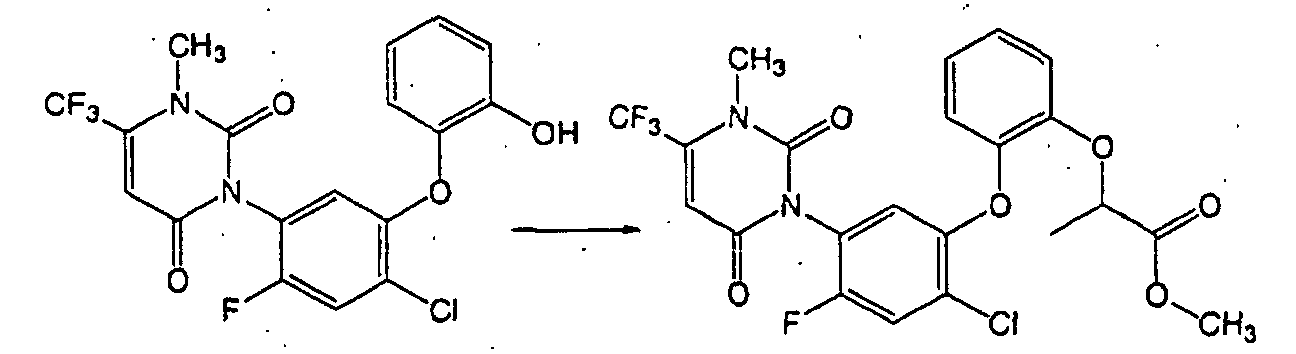
1H-NMR (CDCl3/250MHz) δ (ppm): 1.47 (d, 3H, J=6.8Hz ), 3.50 (q,3H,J=0.7Hz), 3.6-3.8 (m,3H), 4.6-4.8 (m, 1H), 6.28 (s,1H), 6.7-6.8 (m, 1H), 6.8-6.9 (m, 1H), 6.9-7.1 (m, 1H), 7.1-7.2 (m,2H), 7.3-7.4 (m,1H).
a mixed composition of an emulsion of Compound A-1 and an formulation of Chlorimuron-ethyl,
were diluted with water containing 1% Agri-dex (produced by Helena). Respective dilutions were uniformly sprayed from upper side onto foliages of yellow nutsedge grown as described above with a small sprayer such that the amounts of the active ingredients were the amounts shown in Table 4. Immediately after the treatment with the test compounds, seeds of soybean were sown.
| Test Compound | Amount of Active Ingredient (g/ha) | Herbicide Effect | Phytotoxicity |
| yellow nutsedge | soybean | ||
| Compound A-1 | 5 | 2 | no |
| Chlorimuron-ethyl | 5 | 1 | no |
| Chlorimuron-ethyl | 20 | 2 | no |
| Compound A-1 | 5 | no | |
| + | + | 10 | |
| Chlorimuron-ethyl | 5 | ||
| Compound A-1 | 5 | no | |
| + | + | 10 | |
| Chlorimuron-ethyl | 20 |
Claims (15)
- An herbicide composition comprising, as the active ingredients, a uracil compound represented by the following formula (I):wherein Z represents a halogen atom or cyano; A represents an oxygen atom, sulfur atom or NH; R1 represents hydroxyl, C1-C7 alkoxy, C3-C7 alkenyloxy, C3-C7 alkynyloxy, C5-C7 cycloalkoxy, {(C1-C7 alkoxy)carbonyl} C1-C3 alkoxy, (C1-C7 alkylamino)oxy, {di(C1-C7 alkyl)amino}oxy, (C3-C7 alkylideneamino)oxy, C1-C7 alkylamino, di(C1-C7 alkyl)amino, C3-C7 alkenylamino, C3-C7 alkynylamino, C5-C7 cycloalkylamino, {(C1-C7 alkoxy)carbonyl}C1-C3 alkylamino or (C1-C7 alkoxy)amino, and R2 represents a hydrogen atom or methyl,

and one or more compounds selected from the group consisting of 2-(4-chloro-6-methoxypyrimidin-2-ylcarbamoylsulfamoyl) benzoic acid, agriculturally acceptable salts of 2-(4-chloro-6-methoxypyrimidin-2-ylcarbamoylsulfamoyl) benzoic acid and lower-alkyl esters of lower-alkyl esters of 2-(4-chloro-6-methoxypyrimidin-2-ylcarbamoylsulfamoyl) benzoic acid. - The herbicide composition according to claim 1, wherein, in the uracil compound represented by the formula (I), A is an oxygen atom and R1 is C1-C7 alkoxy.
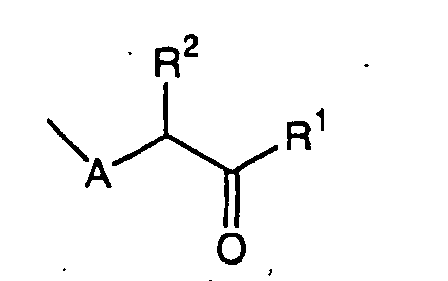
- The herbicide composition according to claim 1, wherein, in the present uracil compound represented by the formula (I), the substituent represented by the following formula:wherein R1, R2 and A represent the same meaning as above, is attached to the 2-position as defined in the formula (I).

- The herbicide composition according to claim 1, wherein, in the present uracil compound represented by the formula (I), the substituent represented by the following formula:wherein R1, R2 and A represent the same meaning as above, is attached to the 3- or 4-position as defined in the formula (I).

- The herbicide composition according to claim 1, wherein, in the present uracil compound represented by the formula (I), Z is a halogen atom and R2 is hydrogen.
- The herbicide composition according to claim 1, wherein, in the present uracil compound represented by the formula (I), Z is cyano.
- The herbicide composition according to claim 1, wherein the mixing ratio of the uracil compound represented by the formula (I) to one or more compounds selected from the group consisting of 2-(4-chloro-6-methoxypyrimidin-2-ylcarbamoylsulfamoyl) benzoic acid, agriculturally acceptable salts of 2-(4-chloro-6-methoxypyrimidin-2-ylcarbamoylsulfamoyl) benzoic acid and lower-alkyl esters of lower-alkyl esters of 2-(4-chloro-6-methoxypyrimidin-2-ylcarbamoylsulfamoyl) benzoic acid is 1:0.1 to 1:100 in weight ratio.
- A method for controlling weeds comprising applying effective amounts of a uracil compound represented by the following formula (I):wherein Z represents a halogen atom or cyano; A represents an oxygen atom, sulfur atom or NH; R1 represents hydroxyl, C1-C7 alkoxy, C3-C7 alkenyloxy, C3-C7 alkynyloxy, C5-C7 cycloalkoxy, {(C1-C7 alkoxy)carbonyl} C1-C3 alkoxy, (C1-C7 alkylamino)oxy, {di(C1-C7 alkyl)amino}oxy, (C3-C7 alkylideneamino)oxy, C1-C7 alkylamino; di(C1-C7 alkyl)amino, C3-C7 alkenylamino, C3-C7 alkynylamino, C5-C7 cycloalkylamino, {(C1-C7 alkoxy)carbonyl}C1-C3 alkylamino or (C1-C7 alkoxy)amino, and R2 represents a hydrogen atom or methyl,

and one or more compounds selected from the group consisting of 2-(4-chloro-6-methoxypyrimidin-2-ylcarbamoylsulfamoyl) benzoic acid, agriculturally acceptable salts of 2-(4-chloro-6-methoxypyrimidin-2-ylcarbamoylsulfamoyl) benzoic acid and lower-alkyl esters of lower-alkyl esters of 2-(4-chloro-6-methoxypyrimidin-2-ylcarbamoylsulfamoyl) benzoic acid to weeds. - The method for controlling weeds according to claim 8, wherein the weeds are weeds in an orchard.
- The method for controlling weeds according to claim 8, wherein the weeds are weeds in a soybean field.
- The method for controlling weeds according to claim 8, wherein the weeds are weeds in a non-crop land.
- A use of a composition comprising a uracil compound represented by the following formula (I):wherein Z represents a halogen atom or cyano; A represents an oxygen atom, sulfur atom or NH; R1 represents hydroxyl, C1-C7 alkoxy, C3-C7 alkenyloxy, C3-C7 alkynyloxy, C5-C7 cycloalkoxy, {(C1-C7 alkoxy)carbonyl}C1-C3 alkoxy, (C1-C7 alkylamino)oxy, {di(C1-C7 alkyl)amino}oxy, (C3-C7 alkylideneamino)oxy, C1-C7 alkylamino, di(C1-C7 alkyl)amino, C3-C7 alkenylamino, C3-C7 alkynylamino, C5-C7 cycloalkylamino, {(C1-C7 alkoxy)carbonyl}C1-C3 alkylamino or (C1-C7 alkoxy)amino, and R2 represents a hydrogen atom or methyl,

and one or more compounds selected from the group consisting of 2-(4-chloro-6-methoxypyrimidin-2-ylcarbamoylsulfamoyl) benzoic acid, agriculturally acceptable salts of 2-(4-chloro-6-methoxypyrimidin-2-ylcarbamoylsulfamoyl) benzoic acid and lower-alkyl esters of lower-alkyl esters of 2-(4-chloro-6-methoxypyrimidin-2-ylcarbamoylsulfamoyl) benzoic acid to weeds. - The use according to claim 12, wherein the herbicide is an herbicide for an orchard.
- The use according to claim 12, wherein the herbicide is an herbicide for a soybean field.
- The use according to claim 12, wherein the herbicide is an herbicide for a non-crop land.
Applications Claiming Priority (3)
| Application Number | Priority Date | Filing Date | Title |
|---|---|---|---|
| JP2001363955A JP2003160415A (en) | 2001-11-29 | 2001-11-29 | Herbicide composition |
| JP2001363955 | 2001-11-29 | ||
| PCT/JP2002/004196 WO2003045148A1 (en) | 2001-11-29 | 2002-04-26 | Herbicide composition |
Publications (3)
| Publication Number | Publication Date |
|---|---|
| EP1470753A1 true EP1470753A1 (en) | 2004-10-27 |
| EP1470753A4 EP1470753A4 (en) | 2005-01-05 |
| EP1470753B1 EP1470753B1 (en) | 2007-06-13 |
Family
ID=19174210
Family Applications (1)
| Application Number | Title | Priority Date | Filing Date |
|---|---|---|---|
| EP02722809A Expired - Lifetime EP1470753B1 (en) | 2001-11-29 | 2002-04-26 | Herbicide composition |
Country Status (7)
| Country | Link |
|---|---|
| US (1) | US7485601B2 (en) |
| EP (1) | EP1470753B1 (en) |
| JP (1) | JP2003160415A (en) |
| AU (1) | AU2002253604A1 (en) |
| CA (1) | CA2468325C (en) |
| ES (1) | ES2288188T3 (en) |
| WO (1) | WO2003045148A1 (en) |
Cited By (5)
| Publication number | Priority date | Publication date | Assignee | Title |
|---|---|---|---|---|
| WO2006061562A1 (en) * | 2004-12-06 | 2006-06-15 | Syngenta Participations Ag | Herbicidal composition |
| WO2018019842A1 (en) * | 2016-07-29 | 2018-02-01 | Basf Se | Method for controlling ppo resistant weeds |
| US20190150440A1 (en) * | 2016-07-29 | 2019-05-23 | Sumitomo Chemical Company, Limited | Method for controlling pests of farm crops |
| WO2022043205A1 (en) * | 2020-08-24 | 2022-03-03 | Bayer Aktiengesellschaft | Substituted n-phenyluracils and salts thereof, and use thereof as herbicidal active substances |
| WO2023030916A1 (en) | 2021-08-30 | 2023-03-09 | Basf Se | Crystalline forms of methyl 2-[2-[2-bromo-4-fluoro-5-[3-methyl-2,6-dioxo-4-(trifluoromethyl)pyrimidin-1-yl]phenoxy]phenoxy]-2-methoxy-acetate |
Families Citing this family (2)
| Publication number | Priority date | Publication date | Assignee | Title |
|---|---|---|---|---|
| US10863743B2 (en) | 2016-07-29 | 2020-12-15 | Basf Se | Method for controlling PPO resistant weeds |
| WO2024078906A1 (en) | 2022-10-10 | 2024-04-18 | Bayer Aktiengesellschaft | Substituted n-phenyluracils and salts thereof, and use thereof as herbicidal active substances |
Family Cites Families (10)
| Publication number | Priority date | Publication date | Assignee | Title |
|---|---|---|---|---|
| DE4431219A1 (en) * | 1994-09-02 | 1996-03-07 | Bayer Ag | Selective herbicides based on aryluracils |
| CN1255042A (en) | 1997-03-14 | 2000-05-31 | Isk美国有限公司 | Diaryl ethers and processes for their preparation and herbicidal and desiccant compositions containing them |
| AU750045B2 (en) | 1998-07-09 | 2002-07-11 | Bayer Aktiengesellschaft | Substituted phenyl uracils |
| IL139899A (en) * | 1999-12-07 | 2005-06-19 | Sumitomo Chemical Co | Uracil compounds and use thereof |
| JP2001072668A (en) * | 1999-07-07 | 2001-03-21 | Sumitomo Chem Co Ltd | Uracil compounds and their uses |
| JP2001064266A (en) * | 1999-08-24 | 2001-03-13 | Sumitomo Chem Co Ltd | Phenyluracil compounds and uses thereof |
| DE19958381A1 (en) | 1999-12-03 | 2001-06-07 | Bayer Ag | Herbicides based on N-aryl-uracils |
| JP4779199B2 (en) * | 1999-12-07 | 2011-09-28 | 住友化学株式会社 | Uracil compounds and uses thereof |
| JP2001354661A (en) * | 2000-06-16 | 2001-12-25 | Sumitomo Chem Co Ltd | Uracil compounds and herbicide applications |
| AU2001262676B2 (en) | 2001-05-31 | 2007-01-25 | Sumitomo Chemical Company, Limited | Plant growth regulators for cotton harvest |
-
2001
- 2001-11-29 JP JP2001363955A patent/JP2003160415A/en active Pending
-
2002
- 2002-04-26 AU AU2002253604A patent/AU2002253604A1/en not_active Abandoned
- 2002-04-26 EP EP02722809A patent/EP1470753B1/en not_active Expired - Lifetime
- 2002-04-26 WO PCT/JP2002/004196 patent/WO2003045148A1/en not_active Ceased
- 2002-04-26 ES ES02722809T patent/ES2288188T3/en not_active Expired - Lifetime
- 2002-04-26 US US10/496,637 patent/US7485601B2/en not_active Expired - Fee Related
- 2002-04-26 CA CA2468325A patent/CA2468325C/en not_active Expired - Lifetime
Cited By (8)
| Publication number | Priority date | Publication date | Assignee | Title |
|---|---|---|---|---|
| WO2006061562A1 (en) * | 2004-12-06 | 2006-06-15 | Syngenta Participations Ag | Herbicidal composition |
| WO2018019842A1 (en) * | 2016-07-29 | 2018-02-01 | Basf Se | Method for controlling ppo resistant weeds |
| US20190150440A1 (en) * | 2016-07-29 | 2019-05-23 | Sumitomo Chemical Company, Limited | Method for controlling pests of farm crops |
| US11369112B2 (en) | 2016-07-29 | 2022-06-28 | Sumitomo Chemical Company, Limited | Method for controlling pests of farm crops |
| US11819024B2 (en) | 2016-07-29 | 2023-11-21 | Sumitomo Chemical Company, Limited | Method for controlling pests of farm crops |
| US12458023B2 (en) | 2016-07-29 | 2025-11-04 | Sumitomo Chemical Company, Limited | Method for controlling pests of farm crops |
| WO2022043205A1 (en) * | 2020-08-24 | 2022-03-03 | Bayer Aktiengesellschaft | Substituted n-phenyluracils and salts thereof, and use thereof as herbicidal active substances |
| WO2023030916A1 (en) | 2021-08-30 | 2023-03-09 | Basf Se | Crystalline forms of methyl 2-[2-[2-bromo-4-fluoro-5-[3-methyl-2,6-dioxo-4-(trifluoromethyl)pyrimidin-1-yl]phenoxy]phenoxy]-2-methoxy-acetate |
Also Published As
| Publication number | Publication date |
|---|---|
| CA2468325C (en) | 2011-06-07 |
| EP1470753B1 (en) | 2007-06-13 |
| EP1470753A4 (en) | 2005-01-05 |
| ES2288188T3 (en) | 2008-01-01 |
| AU2002253604A1 (en) | 2003-06-10 |
| WO2003045148A1 (en) | 2003-06-05 |
| JP2003160415A (en) | 2003-06-03 |
| CA2468325A1 (en) | 2003-06-05 |
| US20050014648A1 (en) | 2005-01-20 |
| US7485601B2 (en) | 2009-02-03 |
Similar Documents
| Publication | Publication Date | Title |
|---|---|---|
| US7732602B2 (en) | Herbicide composition | |
| EP1470753B1 (en) | Herbicide composition | |
| CA2461548C (en) | Herbicide composition | |
| EP1430776B1 (en) | Herbicide composition | |
| EP1459628B1 (en) | Herbicide composition | |
| US6576592B1 (en) | Herbicide composition | |
| US6376427B1 (en) | Herbicidal compositions | |
| US6037310A (en) | Herbicidal composition | |
| US7598207B2 (en) | Herbicidal composition | |
| US6194351B1 (en) | Herbicidal composition | |
| US6180564B1 (en) | Herbicidal composition | |
| JP4513155B2 (en) | Herbicidal composition | |
| US6140269A (en) | Herbicidal composition | |
| JP4708053B2 (en) | Liquid mixture for weeding | |
| US6207616B1 (en) | Herbicidal composition |
Legal Events
| Date | Code | Title | Description |
|---|---|---|---|
| PUAI | Public reference made under article 153(3) epc to a published international application that has entered the european phase |
Free format text: ORIGINAL CODE: 0009012 |
|
| 17P | Request for examination filed |
Effective date: 20040625 |
|
| AK | Designated contracting states |
Kind code of ref document: A1 Designated state(s): AT BE CH CY DE DK ES FI FR GB GR IE IT LI LU MC NL PT SE TR |
|
| AX | Request for extension of the european patent |
Extension state: AL LT LV MK RO SI |
|
| RIN1 | Information on inventor provided before grant (corrected) |
Inventor name: NISHIO, SYOICHI |
|
| RAP1 | Party data changed (applicant data changed or rights of an application transferred) |
Owner name: SUMITOMO CHEMICAL COMPANY, LIMITED |
|
| A4 | Supplementary search report drawn up and despatched |
Effective date: 20041122 |
|
| GRAP | Despatch of communication of intention to grant a patent |
Free format text: ORIGINAL CODE: EPIDOSNIGR1 |
|
| RIC1 | Information provided on ipc code assigned before grant |
Ipc: A01N 43/54 20060101AFI20060921BHEP Ipc: A01N 47/36 20060101ALI20060921BHEP |
|
| REG | Reference to a national code |
Ref country code: DE Ref legal event code: 8566 |
|
| GRAS | Grant fee paid |
Free format text: ORIGINAL CODE: EPIDOSNIGR3 |
|
| GRAA | (expected) grant |
Free format text: ORIGINAL CODE: 0009210 |
|
| AK | Designated contracting states |
Kind code of ref document: B1 Designated state(s): ES FR IT |
|
| ET | Fr: translation filed | ||
| REG | Reference to a national code |
Ref country code: ES Ref legal event code: FG2A Ref document number: 2288188 Country of ref document: ES Kind code of ref document: T3 |
|
| PLBE | No opposition filed within time limit |
Free format text: ORIGINAL CODE: 0009261 |
|
| STAA | Information on the status of an ep patent application or granted ep patent |
Free format text: STATUS: NO OPPOSITION FILED WITHIN TIME LIMIT |
|
| 26N | No opposition filed |
Effective date: 20080314 |
|
| REG | Reference to a national code |
Ref country code: FR Ref legal event code: PLFP Year of fee payment: 14 |
|
| PGFP | Annual fee paid to national office [announced via postgrant information from national office to epo] |
Ref country code: ES Payment date: 20150310 Year of fee payment: 14 |
|
| PGFP | Annual fee paid to national office [announced via postgrant information from national office to epo] |
Ref country code: IT Payment date: 20150409 Year of fee payment: 14 Ref country code: FR Payment date: 20150408 Year of fee payment: 14 |
|
| REG | Reference to a national code |
Ref country code: FR Ref legal event code: ST Effective date: 20161230 |
|
| PG25 | Lapsed in a contracting state [announced via postgrant information from national office to epo] |
Ref country code: FR Free format text: LAPSE BECAUSE OF NON-PAYMENT OF DUE FEES Effective date: 20160502 |
|
| PG25 | Lapsed in a contracting state [announced via postgrant information from national office to epo] |
Ref country code: IT Free format text: LAPSE BECAUSE OF NON-PAYMENT OF DUE FEES Effective date: 20160426 |
|
| PG25 | Lapsed in a contracting state [announced via postgrant information from national office to epo] |
Ref country code: ES Free format text: LAPSE BECAUSE OF NON-PAYMENT OF DUE FEES Effective date: 20160427 |
|
| REG | Reference to a national code |
Ref country code: ES Ref legal event code: FD2A Effective date: 20181204 |