EP1470101B1 - New opioid derivative - Google Patents
New opioid derivative Download PDFInfo
- Publication number
- EP1470101B1 EP1470101B1 EP03703014A EP03703014A EP1470101B1 EP 1470101 B1 EP1470101 B1 EP 1470101B1 EP 03703014 A EP03703014 A EP 03703014A EP 03703014 A EP03703014 A EP 03703014A EP 1470101 B1 EP1470101 B1 EP 1470101B1
- Authority
- EP
- European Patent Office
- Prior art keywords
- mmol
- administration
- dmt
- amino
- boc
- Prior art date
- Legal status (The legal status is an assumption and is not a legal conclusion. Google has not performed a legal analysis and makes no representation as to the accuracy of the status listed.)
- Expired - Lifetime
Links
- 108090000765 processed proteins & peptides Proteins 0.000 claims abstract description 40
- 150000003839 salts Chemical class 0.000 claims abstract description 22
- 102000051367 mu Opioid Receptors Human genes 0.000 claims abstract description 16
- 108020001612 μ-opioid receptors Proteins 0.000 claims abstract description 16
- 125000004435 hydrogen atom Chemical group [H]* 0.000 claims abstract description 8
- 125000002496 methyl group Chemical group [H]C([H])([H])* 0.000 claims abstract description 8
- 125000002887 hydroxy group Chemical group [H]O* 0.000 claims abstract description 7
- 239000003814 drug Substances 0.000 claims description 6
- 208000037265 diseases, disorders, signs and symptoms Diseases 0.000 claims description 5
- 208000002193 Pain Diseases 0.000 claims description 4
- 230000004913 activation Effects 0.000 claims description 4
- 239000004480 active ingredient Substances 0.000 claims description 4
- 201000010099 disease Diseases 0.000 claims description 4
- 238000002360 preparation method Methods 0.000 claims description 4
- 230000007547 defect Effects 0.000 claims description 3
- 230000036407 pain Effects 0.000 claims description 3
- 201000001119 neuropathy Diseases 0.000 claims description 2
- 230000007823 neuropathy Effects 0.000 claims description 2
- 208000033808 peripheral neuropathy Diseases 0.000 claims description 2
- 239000008194 pharmaceutical composition Substances 0.000 claims description 2
- 230000027455 binding Effects 0.000 abstract description 11
- RTZKZFJDLAIYFH-UHFFFAOYSA-N Diethyl ether Chemical compound CCOCC RTZKZFJDLAIYFH-UHFFFAOYSA-N 0.000 description 56
- 150000001875 compounds Chemical class 0.000 description 47
- ZMXDDKWLCZADIW-UHFFFAOYSA-N N,N-Dimethylformamide Chemical compound CN(C)C=O ZMXDDKWLCZADIW-UHFFFAOYSA-N 0.000 description 35
- 239000000243 solution Substances 0.000 description 29
- ZMANZCXQSJIPKH-UHFFFAOYSA-N Triethylamine Chemical compound CCN(CC)CC ZMANZCXQSJIPKH-UHFFFAOYSA-N 0.000 description 26
- 230000000202 analgesic effect Effects 0.000 description 26
- 239000002244 precipitate Substances 0.000 description 26
- 238000001914 filtration Methods 0.000 description 25
- RDOXTESZEPMUJZ-UHFFFAOYSA-N anisole Chemical compound COC1=CC=CC=C1 RDOXTESZEPMUJZ-UHFFFAOYSA-N 0.000 description 24
- VLKZOEOYAKHREP-UHFFFAOYSA-N n-Hexane Chemical compound CCCCCC VLKZOEOYAKHREP-UHFFFAOYSA-N 0.000 description 24
- XLYOFNOQVPJJNP-UHFFFAOYSA-N water Substances O XLYOFNOQVPJJNP-UHFFFAOYSA-N 0.000 description 24
- CDBYLPFSWZWCQE-UHFFFAOYSA-L Sodium Carbonate Chemical compound [Na+].[Na+].[O-]C([O-])=O CDBYLPFSWZWCQE-UHFFFAOYSA-L 0.000 description 22
- BQJCRHHNABKAKU-KBQPJGBKSA-N morphine Chemical compound O([C@H]1[C@H](C=C[C@H]23)O)C4=C5[C@@]12CCN(C)[C@@H]3CC5=CC=C4O BQJCRHHNABKAKU-KBQPJGBKSA-N 0.000 description 22
- 239000002904 solvent Substances 0.000 description 22
- KRKNYBCHXYNGOX-UHFFFAOYSA-N citric acid Chemical compound OC(=O)CC(O)(C(O)=O)CC(O)=O KRKNYBCHXYNGOX-UHFFFAOYSA-N 0.000 description 21
- 230000000694 effects Effects 0.000 description 21
- DTQVDTLACAAQTR-UHFFFAOYSA-N trifluoroacetic acid Substances OC(=O)C(F)(F)F DTQVDTLACAAQTR-UHFFFAOYSA-N 0.000 description 20
- XEKOWRVHYACXOJ-UHFFFAOYSA-N Ethyl acetate Chemical compound CCOC(C)=O XEKOWRVHYACXOJ-UHFFFAOYSA-N 0.000 description 19
- HEDRZPFGACZZDS-UHFFFAOYSA-N Chloroform Chemical compound ClC(Cl)Cl HEDRZPFGACZZDS-UHFFFAOYSA-N 0.000 description 18
- 239000001273 butane Substances 0.000 description 15
- IJDNQMDRQITEOD-UHFFFAOYSA-N n-butane Chemical compound CCCC IJDNQMDRQITEOD-UHFFFAOYSA-N 0.000 description 15
- OFBQJSOFQDEBGM-UHFFFAOYSA-N n-pentane Natural products CCCCC OFBQJSOFQDEBGM-UHFFFAOYSA-N 0.000 description 15
- OUYCCCASQSFEME-QMMMGPOBSA-N L-tyrosine Chemical compound OC(=O)[C@@H](N)CC1=CC=C(O)C=C1 OUYCCCASQSFEME-QMMMGPOBSA-N 0.000 description 14
- 238000000034 method Methods 0.000 description 14
- 238000007920 subcutaneous administration Methods 0.000 description 13
- OKKJLVBELUTLKV-UHFFFAOYSA-N Methanol Chemical compound OC OKKJLVBELUTLKV-UHFFFAOYSA-N 0.000 description 12
- 102000003840 Opioid Receptors Human genes 0.000 description 12
- 108090000137 Opioid Receptors Proteins 0.000 description 12
- UZKWTJUDCOPSNM-UHFFFAOYSA-N methoxybenzene Substances CCCCOC=C UZKWTJUDCOPSNM-UHFFFAOYSA-N 0.000 description 12
- 239000011541 reaction mixture Substances 0.000 description 12
- VEXZGXHMUGYJMC-UHFFFAOYSA-N Hydrochloric acid Chemical compound Cl VEXZGXHMUGYJMC-UHFFFAOYSA-N 0.000 description 11
- COLNVLDHVKWLRT-QMMMGPOBSA-N L-phenylalanine Chemical compound OC(=O)[C@@H](N)CC1=CC=CC=C1 COLNVLDHVKWLRT-QMMMGPOBSA-N 0.000 description 11
- 241001465754 Metazoa Species 0.000 description 11
- PMZURENOXWZQFD-UHFFFAOYSA-L Sodium Sulfate Chemical compound [Na+].[Na+].[O-]S([O-])(=O)=O PMZURENOXWZQFD-UHFFFAOYSA-L 0.000 description 11
- 229960005181 morphine Drugs 0.000 description 11
- 239000003208 petroleum Substances 0.000 description 11
- 229910000029 sodium carbonate Inorganic materials 0.000 description 11
- 229910052938 sodium sulfate Inorganic materials 0.000 description 11
- QTBSBXVTEAMEQO-UHFFFAOYSA-N Acetic acid Chemical compound CC(O)=O QTBSBXVTEAMEQO-UHFFFAOYSA-N 0.000 description 10
- WEVYAHXRMPXWCK-UHFFFAOYSA-N Acetonitrile Chemical compound CC#N WEVYAHXRMPXWCK-UHFFFAOYSA-N 0.000 description 10
- LFQSCWFLJHTTHZ-UHFFFAOYSA-N Ethanol Chemical compound CCO LFQSCWFLJHTTHZ-UHFFFAOYSA-N 0.000 description 10
- 239000007832 Na2SO4 Substances 0.000 description 10
- 241000700159 Rattus Species 0.000 description 10
- 210000003405 ileum Anatomy 0.000 description 10
- 238000006243 chemical reaction Methods 0.000 description 9
- IAZDPXIOMUYVGZ-WFGJKAKNSA-N Dimethyl sulfoxide Chemical compound [2H]C([2H])([2H])S(=O)C([2H])([2H])[2H] IAZDPXIOMUYVGZ-WFGJKAKNSA-N 0.000 description 8
- 239000000730 antalgic agent Substances 0.000 description 8
- 239000003446 ligand Substances 0.000 description 8
- 229960005195 morphine hydrochloride Drugs 0.000 description 8
- XELXKCKNPPSFNN-BJWPBXOKSA-N morphine hydrochloride trihydrate Chemical compound O.O.O.Cl.O([C@H]1[C@H](C=C[C@H]23)O)C4=C5[C@@]12CCN(C)[C@@H]3CC5=CC=C4O XELXKCKNPPSFNN-BJWPBXOKSA-N 0.000 description 8
- 241000700199 Cavia porcellus Species 0.000 description 7
- JGFZNNIVVJXRND-UHFFFAOYSA-N N,N-Diisopropylethylamine (DIPEA) Chemical compound CCN(C(C)C)C(C)C JGFZNNIVVJXRND-UHFFFAOYSA-N 0.000 description 7
- 239000000556 agonist Substances 0.000 description 7
- 229940035676 analgesics Drugs 0.000 description 7
- 239000013078 crystal Substances 0.000 description 7
- 102000005962 receptors Human genes 0.000 description 7
- 108020003175 receptors Proteins 0.000 description 7
- -1 Benzotriazol-1-yl-oxy-tris(dimethylamino)phosphonium hexafluorophosphate Chemical compound 0.000 description 6
- 238000001061 Dunnett's test Methods 0.000 description 6
- OTMSDBZUPAUEDD-UHFFFAOYSA-N Ethane Chemical compound CC OTMSDBZUPAUEDD-UHFFFAOYSA-N 0.000 description 6
- 108010093625 Opioid Peptides Proteins 0.000 description 6
- 102000001490 Opioid Peptides Human genes 0.000 description 6
- 239000012043 crude product Substances 0.000 description 6
- NPZTUJOABDZTLV-UHFFFAOYSA-N hydroxybenzotriazole Substances O=C1C=CC=C2NNN=C12 NPZTUJOABDZTLV-UHFFFAOYSA-N 0.000 description 6
- TVMXDCGIABBOFY-UHFFFAOYSA-N octane Chemical compound CCCCCCCC TVMXDCGIABBOFY-UHFFFAOYSA-N 0.000 description 6
- 239000003399 opiate peptide Substances 0.000 description 6
- 239000002504 physiological saline solution Substances 0.000 description 6
- KIDHWZJUCRJVML-UHFFFAOYSA-N putrescine Chemical compound NCCCCN KIDHWZJUCRJVML-UHFFFAOYSA-N 0.000 description 6
- 210000002182 synaptic membrane Anatomy 0.000 description 6
- LSNDLIKCFHLFKO-JTQLQIEISA-N (2s)-2-azaniumyl-3-(4-hydroxy-2,6-dimethylphenyl)propanoate Chemical compound CC1=CC(O)=CC(C)=C1C[C@H](N)C(O)=O LSNDLIKCFHLFKO-JTQLQIEISA-N 0.000 description 5
- 101100244562 Pseudomonas aeruginosa (strain ATCC 15692 / DSM 22644 / CIP 104116 / JCM 14847 / LMG 12228 / 1C / PRS 101 / PAO1) oprD gene Proteins 0.000 description 5
- VYPSYNLAJGMNEJ-UHFFFAOYSA-N Silicium dioxide Chemical compound O=[Si]=O VYPSYNLAJGMNEJ-UHFFFAOYSA-N 0.000 description 5
- 239000005557 antagonist Substances 0.000 description 5
- 230000008859 change Effects 0.000 description 5
- 108700023159 delta Opioid Receptors Proteins 0.000 description 5
- 102000048124 delta Opioid Receptors Human genes 0.000 description 5
- JKMHFZQWWAIEOD-UHFFFAOYSA-N 2-[4-(2-hydroxyethyl)piperazin-1-yl]ethanesulfonic acid Chemical compound OCC[NH+]1CCN(CCS([O-])(=O)=O)CC1 JKMHFZQWWAIEOD-UHFFFAOYSA-N 0.000 description 4
- NQRYJNQNLNOLGT-UHFFFAOYSA-N Piperidine Chemical compound C1CCNCC1 NQRYJNQNLNOLGT-UHFFFAOYSA-N 0.000 description 4
- FAPWRFPIFSIZLT-UHFFFAOYSA-M Sodium chloride Chemical compound [Na+].[Cl-] FAPWRFPIFSIZLT-UHFFFAOYSA-M 0.000 description 4
- 238000000692 Student's t-test Methods 0.000 description 4
- 150000001413 amino acids Chemical group 0.000 description 4
- 125000003277 amino group Chemical group 0.000 description 4
- 238000003556 assay Methods 0.000 description 4
- 229940079593 drug Drugs 0.000 description 4
- 238000004128 high performance liquid chromatography Methods 0.000 description 4
- 230000005764 inhibitory process Effects 0.000 description 4
- 238000001990 intravenous administration Methods 0.000 description 4
- 230000001766 physiological effect Effects 0.000 description 4
- 239000000741 silica gel Substances 0.000 description 4
- 229910002027 silica gel Inorganic materials 0.000 description 4
- 230000000638 stimulation Effects 0.000 description 4
- 238000012360 testing method Methods 0.000 description 4
- HPZJMUBDEAMBFI-WTNAPCKOSA-N (D-Ala(2)-mephe(4)-gly-ol(5))enkephalin Chemical compound C([C@H](N)C(=O)N[C@H](C)C(=O)NCC(=O)N(C)[C@@H](CC=1C=CC=CC=1)C(=O)NCCO)C1=CC=C(O)C=C1 HPZJMUBDEAMBFI-WTNAPCKOSA-N 0.000 description 3
- 239000007995 HEPES buffer Substances 0.000 description 3
- 239000005700 Putrescine Substances 0.000 description 3
- 229940024606 amino acid Drugs 0.000 description 3
- 230000015572 biosynthetic process Effects 0.000 description 3
- 210000004556 brain Anatomy 0.000 description 3
- 230000000052 comparative effect Effects 0.000 description 3
- 238000001514 detection method Methods 0.000 description 3
- 238000002474 experimental method Methods 0.000 description 3
- QGWNDRXFNXRZMB-UHFFFAOYSA-N guanidine diphosphate Natural products C1=2NC(N)=NC(=O)C=2N=CN1C1OC(COP(O)(=O)OP(O)(O)=O)C(O)C1O QGWNDRXFNXRZMB-UHFFFAOYSA-N 0.000 description 3
- 238000005259 measurement Methods 0.000 description 3
- 239000002756 mu opiate receptor agonist Substances 0.000 description 3
- 229940126487 mu opioid receptor agonist Drugs 0.000 description 3
- 210000003205 muscle Anatomy 0.000 description 3
- 239000000843 powder Substances 0.000 description 3
- 102000004196 processed proteins & peptides Human genes 0.000 description 3
- 239000000047 product Substances 0.000 description 3
- 230000002285 radioactive effect Effects 0.000 description 3
- 239000011780 sodium chloride Substances 0.000 description 3
- 238000003786 synthesis reaction Methods 0.000 description 3
- ZFSXKSSWYSZPGQ-UHFFFAOYSA-N (2-hydroxycyclopentyl)azanium;chloride Chemical compound Cl.NC1CCCC1O ZFSXKSSWYSZPGQ-UHFFFAOYSA-N 0.000 description 2
- RYHBNJHYFVUHQT-UHFFFAOYSA-N 1,4-Dioxane Chemical compound C1COCCO1 RYHBNJHYFVUHQT-UHFFFAOYSA-N 0.000 description 2
- PWGJDPKCLMLPJW-UHFFFAOYSA-N 1,8-diaminooctane Chemical compound NCCCCCCCCN PWGJDPKCLMLPJW-UHFFFAOYSA-N 0.000 description 2
- HMUNWXXNJPVALC-UHFFFAOYSA-N 1-[4-[2-(2,3-dihydro-1H-inden-2-ylamino)pyrimidin-5-yl]piperazin-1-yl]-2-(2,4,6,7-tetrahydrotriazolo[4,5-c]pyridin-5-yl)ethanone Chemical compound C1C(CC2=CC=CC=C12)NC1=NC=C(C=N1)N1CCN(CC1)C(CN1CC2=C(CC1)NN=N2)=O HMUNWXXNJPVALC-UHFFFAOYSA-N 0.000 description 2
- 238000001644 13C nuclear magnetic resonance spectroscopy Methods 0.000 description 2
- 238000005160 1H NMR spectroscopy Methods 0.000 description 2
- HUTNOYOBQPAKIA-UHFFFAOYSA-N 1h-pyrazin-2-one Chemical group OC1=CN=CC=N1 HUTNOYOBQPAKIA-UHFFFAOYSA-N 0.000 description 2
- VZSRBBMJRBPUNF-UHFFFAOYSA-N 2-(2,3-dihydro-1H-inden-2-ylamino)-N-[3-oxo-3-(2,4,6,7-tetrahydrotriazolo[4,5-c]pyridin-5-yl)propyl]pyrimidine-5-carboxamide Chemical compound C1C(CC2=CC=CC=C12)NC1=NC=C(C=N1)C(=O)NCCC(N1CC2=C(CC1)NN=N2)=O VZSRBBMJRBPUNF-UHFFFAOYSA-N 0.000 description 2
- WZFUQSJFWNHZHM-UHFFFAOYSA-N 2-[4-[2-(2,3-dihydro-1H-inden-2-ylamino)pyrimidin-5-yl]piperazin-1-yl]-1-(2,4,6,7-tetrahydrotriazolo[4,5-c]pyridin-5-yl)ethanone Chemical compound C1C(CC2=CC=CC=C12)NC1=NC=C(C=N1)N1CCN(CC1)CC(=O)N1CC2=C(CC1)NN=N2 WZFUQSJFWNHZHM-UHFFFAOYSA-N 0.000 description 2
- CONKBQPVFMXDOV-QHCPKHFHSA-N 6-[(5S)-5-[[4-[2-(2,3-dihydro-1H-inden-2-ylamino)pyrimidin-5-yl]piperazin-1-yl]methyl]-2-oxo-1,3-oxazolidin-3-yl]-3H-1,3-benzoxazol-2-one Chemical compound C1C(CC2=CC=CC=C12)NC1=NC=C(C=N1)N1CCN(CC1)C[C@H]1CN(C(O1)=O)C1=CC2=C(NC(O2)=O)C=C1 CONKBQPVFMXDOV-QHCPKHFHSA-N 0.000 description 2
- 108700022183 Ala(2)-MePhe(4)-Gly(5)- Enkephalin Proteins 0.000 description 2
- 206010002091 Anaesthesia Diseases 0.000 description 2
- MCMMCRYPQBNCPH-WMIMKTLMSA-N DPDPE Chemical compound C([C@H](N)C(=O)N[C@@H]1C(C)(C)SSC([C@@H](NC(=O)[C@H](CC=2C=CC=CC=2)NC(=O)CNC1=O)C(O)=O)(C)C)C1=CC=C(O)C=C1 MCMMCRYPQBNCPH-WMIMKTLMSA-N 0.000 description 2
- PIICEJLVQHRZGT-UHFFFAOYSA-N Ethylenediamine Chemical compound NCCN PIICEJLVQHRZGT-UHFFFAOYSA-N 0.000 description 2
- QGWNDRXFNXRZMB-UUOKFMHZSA-N GDP Chemical compound C1=2NC(N)=NC(=O)C=2N=CN1[C@@H]1O[C@H](COP(O)(=O)OP(O)(O)=O)[C@@H](O)[C@H]1O QGWNDRXFNXRZMB-UUOKFMHZSA-N 0.000 description 2
- 235000010469 Glycine max Nutrition 0.000 description 2
- 244000068988 Glycine max Species 0.000 description 2
- 208000007514 Herpes zoster Diseases 0.000 description 2
- LRHPLDYGYMQRHN-UHFFFAOYSA-N N-Butanol Chemical compound CCCCO LRHPLDYGYMQRHN-UHFFFAOYSA-N 0.000 description 2
- JUJWROOIHBZHMG-UHFFFAOYSA-N Pyridine Chemical compound C1=CC=NC=C1 JUJWROOIHBZHMG-UHFFFAOYSA-N 0.000 description 2
- YZCKVEUIGOORGS-NJFSPNSNSA-N Tritium Chemical compound [3H] YZCKVEUIGOORGS-NJFSPNSNSA-N 0.000 description 2
- 229940122618 Trypsin inhibitor Drugs 0.000 description 2
- 101710162629 Trypsin inhibitor Proteins 0.000 description 2
- 241000947853 Vibrionales Species 0.000 description 2
- 150000001408 amides Chemical class 0.000 description 2
- 230000037005 anaesthesia Effects 0.000 description 2
- 125000003118 aryl group Chemical group 0.000 description 2
- 210000005013 brain tissue Anatomy 0.000 description 2
- 210000003169 central nervous system Anatomy 0.000 description 2
- 230000002860 competitive effect Effects 0.000 description 2
- 238000002518 distortionless enhancement with polarization transfer Methods 0.000 description 2
- OAYLNYINCPYISS-UHFFFAOYSA-N ethyl acetate;hexane Chemical compound CCCCCC.CCOC(C)=O OAYLNYINCPYISS-UHFFFAOYSA-N 0.000 description 2
- 210000001035 gastrointestinal tract Anatomy 0.000 description 2
- NAQMVNRVTILPCV-UHFFFAOYSA-N hexane-1,6-diamine Chemical compound NCCCCCCN NAQMVNRVTILPCV-UHFFFAOYSA-N 0.000 description 2
- 239000007924 injection Substances 0.000 description 2
- 238000002347 injection Methods 0.000 description 2
- 230000003993 interaction Effects 0.000 description 2
- 238000000185 intracerebroventricular administration Methods 0.000 description 2
- 210000003141 lower extremity Anatomy 0.000 description 2
- 238000002844 melting Methods 0.000 description 2
- 239000000203 mixture Substances 0.000 description 2
- 229960003086 naltrexone Drugs 0.000 description 2
- DQCKKXVULJGBQN-XFWGSAIBSA-N naltrexone Chemical compound N1([C@@H]2CC3=CC=C(C=4O[C@@H]5[C@](C3=4)([C@]2(CCC5=O)O)CC1)O)CC1CC1 DQCKKXVULJGBQN-XFWGSAIBSA-N 0.000 description 2
- 229960000858 naltrexone hydrochloride Drugs 0.000 description 2
- 239000012071 phase Substances 0.000 description 2
- COLNVLDHVKWLRT-UHFFFAOYSA-N phenylalanine Natural products OC(=O)C(N)CC1=CC=CC=C1 COLNVLDHVKWLRT-UHFFFAOYSA-N 0.000 description 2
- 239000000126 substance Substances 0.000 description 2
- 238000010998 test method Methods 0.000 description 2
- 229910052722 tritium Inorganic materials 0.000 description 2
- 239000002753 trypsin inhibitor Substances 0.000 description 2
- 229960004441 tyrosine Drugs 0.000 description 2
- OUYCCCASQSFEME-UHFFFAOYSA-N tyrosine Natural products OC(=O)C(N)CC1=CC=C(O)C=C1 OUYCCCASQSFEME-UHFFFAOYSA-N 0.000 description 2
- WJJGAKCAAJOICV-JTQLQIEISA-N (2s)-2-(dimethylamino)-3-(4-hydroxyphenyl)propanoic acid Chemical compound CN(C)[C@H](C(O)=O)CC1=CC=C(O)C=C1 WJJGAKCAAJOICV-JTQLQIEISA-N 0.000 description 1
- 125000003088 (fluoren-9-ylmethoxy)carbonyl group Chemical group 0.000 description 1
- YJLUBHOZZTYQIP-UHFFFAOYSA-N 2-[5-[2-(2,3-dihydro-1H-inden-2-ylamino)pyrimidin-5-yl]-1,3,4-oxadiazol-2-yl]-1-(2,4,6,7-tetrahydrotriazolo[4,5-c]pyridin-5-yl)ethanone Chemical compound C1C(CC2=CC=CC=C12)NC1=NC=C(C=N1)C1=NN=C(O1)CC(=O)N1CC2=C(CC1)NN=N2 YJLUBHOZZTYQIP-UHFFFAOYSA-N 0.000 description 1
- 238000012573 2D experiment Methods 0.000 description 1
- VYIBCOSBNVFEIW-UHFFFAOYSA-N 3-phenylpropanamide Chemical compound NC(=O)CCC1=CC=CC=C1 VYIBCOSBNVFEIW-UHFFFAOYSA-N 0.000 description 1
- 206010058019 Cancer Pain Diseases 0.000 description 1
- 241000700198 Cavia Species 0.000 description 1
- 108700022182 D-Penicillamine (2,5)- Enkephalin Proteins 0.000 description 1
- 206010012335 Dependence Diseases 0.000 description 1
- 108010092674 Enkephalins Proteins 0.000 description 1
- 206010015719 Exsanguination Diseases 0.000 description 1
- QGWNDRXFNXRZMB-UUOKFMHZSA-K GDP(3-) Chemical compound C1=NC=2C(=O)NC(N)=NC=2N1[C@@H]1O[C@H](COP([O-])(=O)OP([O-])([O-])=O)[C@@H](O)[C@H]1O QGWNDRXFNXRZMB-UUOKFMHZSA-K 0.000 description 1
- URLZCHNOLZSCCA-VABKMULXSA-N Leu-enkephalin Chemical compound C([C@@H](C(=O)N[C@@H](CC(C)C)C(O)=O)NC(=O)CNC(=O)CNC(=O)[C@@H](N)CC=1C=CC(O)=CC=1)C1=CC=CC=C1 URLZCHNOLZSCCA-VABKMULXSA-N 0.000 description 1
- AFVFQIVMOAPDHO-UHFFFAOYSA-N Methanesulfonic acid Chemical compound CS(O)(=O)=O AFVFQIVMOAPDHO-UHFFFAOYSA-N 0.000 description 1
- 101100025323 Mus musculus Mvd gene Proteins 0.000 description 1
- 238000005481 NMR spectroscopy Methods 0.000 description 1
- 206010028980 Neoplasm Diseases 0.000 description 1
- 229940122344 Peptidase inhibitor Drugs 0.000 description 1
- YNPNZTXNASCQKK-UHFFFAOYSA-N Phenanthrene Natural products C1=CC=C2C3=CC=CC=C3C=CC2=C1 YNPNZTXNASCQKK-UHFFFAOYSA-N 0.000 description 1
- 229920005654 Sephadex Polymers 0.000 description 1
- 239000012507 Sephadex™ Substances 0.000 description 1
- 229930006000 Sucrose Natural products 0.000 description 1
- CZMRCDWAGMRECN-UGDNZRGBSA-N Sucrose Chemical compound O[C@H]1[C@H](O)[C@@H](CO)O[C@@]1(CO)O[C@@H]1[C@H](O)[C@@H](O)[C@H](O)[C@@H](CO)O1 CZMRCDWAGMRECN-UGDNZRGBSA-N 0.000 description 1
- 239000007983 Tris buffer Substances 0.000 description 1
- DGEZNRSVGBDHLK-UHFFFAOYSA-N [1,10]phenanthroline Chemical compound C1=CN=C2C3=NC=CC=C3C=CC2=C1 DGEZNRSVGBDHLK-UHFFFAOYSA-N 0.000 description 1
- 238000010306 acid treatment Methods 0.000 description 1
- 230000009471 action Effects 0.000 description 1
- 230000003213 activating effect Effects 0.000 description 1
- 239000012190 activator Substances 0.000 description 1
- 208000005298 acute pain Diseases 0.000 description 1
- 125000000217 alkyl group Chemical group 0.000 description 1
- 230000031016 anaphase Effects 0.000 description 1
- 238000013096 assay test Methods 0.000 description 1
- QVGXLLKOCUKJST-UHFFFAOYSA-N atomic oxygen Chemical compound [O] QVGXLLKOCUKJST-UHFFFAOYSA-N 0.000 description 1
- 201000011510 cancer Diseases 0.000 description 1
- 230000022900 cardiac muscle contraction Effects 0.000 description 1
- 210000001638 cerebellum Anatomy 0.000 description 1
- 239000003153 chemical reaction reagent Substances 0.000 description 1
- BULLHNJGPPOUOX-UHFFFAOYSA-N chloroacetone Chemical compound CC(=O)CCl BULLHNJGPPOUOX-UHFFFAOYSA-N 0.000 description 1
- 238000012875 competitive assay Methods 0.000 description 1
- 238000007796 conventional method Methods 0.000 description 1
- 238000012937 correction Methods 0.000 description 1
- 230000008878 coupling Effects 0.000 description 1
- 238000010168 coupling process Methods 0.000 description 1
- 238000005859 coupling reaction Methods 0.000 description 1
- 230000003001 depressive effect Effects 0.000 description 1
- 238000003795 desorption Methods 0.000 description 1
- 230000029087 digestion Effects 0.000 description 1
- 239000012153 distilled water Substances 0.000 description 1
- 239000006274 endogenous ligand Substances 0.000 description 1
- 125000001495 ethyl group Chemical group [H]C([H])([H])C([H])([H])* 0.000 description 1
- 238000000605 extraction Methods 0.000 description 1
- 238000005227 gel permeation chromatography Methods 0.000 description 1
- 239000005556 hormone Substances 0.000 description 1
- 229940088597 hormone Drugs 0.000 description 1
- 229910052739 hydrogen Inorganic materials 0.000 description 1
- 239000001257 hydrogen Substances 0.000 description 1
- 239000004615 ingredient Substances 0.000 description 1
- 238000004255 ion exchange chromatography Methods 0.000 description 1
- 239000007791 liquid phase Substances 0.000 description 1
- 230000014759 maintenance of location Effects 0.000 description 1
- 239000011159 matrix material Substances 0.000 description 1
- 238000000816 matrix-assisted laser desorption--ionisation Methods 0.000 description 1
- 230000007246 mechanism Effects 0.000 description 1
- 230000001404 mediated effect Effects 0.000 description 1
- 230000008018 melting Effects 0.000 description 1
- 239000012528 membrane Substances 0.000 description 1
- 239000002207 metabolite Substances 0.000 description 1
- 150000007522 mineralic acids Chemical class 0.000 description 1
- UZHSEJADLWPNLE-GRGSLBFTSA-N naloxone Chemical compound O=C([C@@H]1O2)CC[C@@]3(O)[C@H]4CC5=CC=C(O)C2=C5[C@@]13CCN4CC=C UZHSEJADLWPNLE-GRGSLBFTSA-N 0.000 description 1
- 229960004127 naloxone Drugs 0.000 description 1
- 210000000653 nervous system Anatomy 0.000 description 1
- 238000000655 nuclear magnetic resonance spectrum Methods 0.000 description 1
- 239000003401 opiate antagonist Substances 0.000 description 1
- 230000003287 optical effect Effects 0.000 description 1
- 150000007524 organic acids Chemical class 0.000 description 1
- 239000012044 organic layer Substances 0.000 description 1
- 239000001301 oxygen Substances 0.000 description 1
- 229910052760 oxygen Inorganic materials 0.000 description 1
- 210000001428 peripheral nervous system Anatomy 0.000 description 1
- 230000000144 pharmacologic effect Effects 0.000 description 1
- 239000013641 positive control Substances 0.000 description 1
- 238000002953 preparative HPLC Methods 0.000 description 1
- 125000002924 primary amino group Chemical group [H]N([H])* 0.000 description 1
- 238000012545 processing Methods 0.000 description 1
- 230000002035 prolonged effect Effects 0.000 description 1
- 229940043274 prophylactic drug Drugs 0.000 description 1
- 239000012264 purified product Substances 0.000 description 1
- UMJSCPRVCHMLSP-UHFFFAOYSA-N pyridine Natural products COC1=CC=CN=C1 UMJSCPRVCHMLSP-UHFFFAOYSA-N 0.000 description 1
- 230000005855 radiation Effects 0.000 description 1
- 229940044601 receptor agonist Drugs 0.000 description 1
- 239000000018 receptor agonist Substances 0.000 description 1
- 238000001525 receptor binding assay Methods 0.000 description 1
- 238000001953 recrystallisation Methods 0.000 description 1
- 230000004044 response Effects 0.000 description 1
- 238000004366 reverse phase liquid chromatography Methods 0.000 description 1
- 238000004007 reversed phase HPLC Methods 0.000 description 1
- 235000011152 sodium sulphate Nutrition 0.000 description 1
- HPALAKNZSZLMCH-UHFFFAOYSA-M sodium;chloride;hydrate Chemical class O.[Na+].[Cl-] HPALAKNZSZLMCH-UHFFFAOYSA-M 0.000 description 1
- 230000009870 specific binding Effects 0.000 description 1
- 210000000278 spinal cord Anatomy 0.000 description 1
- 238000012453 sprague-dawley rat model Methods 0.000 description 1
- 239000007858 starting material Substances 0.000 description 1
- 125000001424 substituent group Chemical group 0.000 description 1
- 239000005720 sucrose Substances 0.000 description 1
- 239000000725 suspension Substances 0.000 description 1
- DYHSDKLCOJIUFX-UHFFFAOYSA-N tert-butoxycarbonyl anhydride Chemical compound CC(C)(C)OC(=O)OC(=O)OC(C)(C)C DYHSDKLCOJIUFX-UHFFFAOYSA-N 0.000 description 1
- KZDKDSWGCFVJCE-UHFFFAOYSA-N tert-butyl 2,5-diaminopentanoate Chemical compound CC(C)(C)OC(=O)C(N)CCCN KZDKDSWGCFVJCE-UHFFFAOYSA-N 0.000 description 1
- ZFQWJXFJJZUVPI-UHFFFAOYSA-N tert-butyl n-(4-aminobutyl)carbamate Chemical compound CC(C)(C)OC(=O)NCCCCN ZFQWJXFJJZUVPI-UHFFFAOYSA-N 0.000 description 1
- 125000005931 tert-butyloxycarbonyl group Chemical group [H]C([H])([H])C(OC(*)=O)(C([H])([H])[H])C([H])([H])[H] 0.000 description 1
- CZDYPVPMEAXLPK-UHFFFAOYSA-N tetramethylsilane Chemical compound C[Si](C)(C)C CZDYPVPMEAXLPK-UHFFFAOYSA-N 0.000 description 1
- 229940126585 therapeutic drug Drugs 0.000 description 1
- 230000001225 therapeutic effect Effects 0.000 description 1
- 238000001196 time-of-flight mass spectrum Methods 0.000 description 1
- 210000001519 tissue Anatomy 0.000 description 1
- 238000001521 two-tailed test Methods 0.000 description 1
- 210000003462 vein Anatomy 0.000 description 1
- 239000003643 water by type Substances 0.000 description 1
- 238000005303 weighing Methods 0.000 description 1
Classifications
-
- C—CHEMISTRY; METALLURGY
- C07—ORGANIC CHEMISTRY
- C07C—ACYCLIC OR CARBOCYCLIC COMPOUNDS
- C07C237/00—Carboxylic acid amides, the carbon skeleton of the acid part being further substituted by amino groups
- C07C237/02—Carboxylic acid amides, the carbon skeleton of the acid part being further substituted by amino groups having the carbon atoms of the carboxamide groups bound to acyclic carbon atoms of the carbon skeleton
- C07C237/20—Carboxylic acid amides, the carbon skeleton of the acid part being further substituted by amino groups having the carbon atoms of the carboxamide groups bound to acyclic carbon atoms of the carbon skeleton the carbon skeleton containing six-membered aromatic rings
-
- A—HUMAN NECESSITIES
- A61—MEDICAL OR VETERINARY SCIENCE; HYGIENE
- A61P—SPECIFIC THERAPEUTIC ACTIVITY OF CHEMICAL COMPOUNDS OR MEDICINAL PREPARATIONS
- A61P25/00—Drugs for disorders of the nervous system
- A61P25/04—Centrally acting analgesics, e.g. opioids
-
- A—HUMAN NECESSITIES
- A61—MEDICAL OR VETERINARY SCIENCE; HYGIENE
- A61P—SPECIFIC THERAPEUTIC ACTIVITY OF CHEMICAL COMPOUNDS OR MEDICINAL PREPARATIONS
- A61P43/00—Drugs for specific purposes, not provided for in groups A61P1/00-A61P41/00
Definitions
- the present invention relates to a new peptide derivative or its salt which has excellent physiological activity via the opioid receptor, especially shows binding affinity to the opioid receptor in lower concentration. Further the present invention relates to a medical composition containing said peptide as an active ingredient and its medical use.
- peptides show various physiological activities by changing their amino acid sequence.
- opioid peptides such as enkephalin, etc., which are present in brain and participate in analgesic activity etc., have been carried out, as well as with opioid mimetics, which are synthetic opioid peptides resembling naturally occurring compounds.
- Morphine has been known as an opioid-receptor activating substance, and opioid type analgesics, morphine homologues have been clinically used for inhibition of cancer pain, acute pain after skin-grafting or post varicella-zoster.
- analgesics show severe side effects such as central nervous system depressive activity, leiomyotention of digestive tract, addiction, toleration etc. and therefore, further improved analgesics, in many fields especially such as anaphase of cancer, pain after post varicella-zoster are strongly desired.
- US-A-5 272 175 discloses opioid receptor ligands which can be used as analgesic agents.
- Example 24 of this document relates to ⁇ S-amino-N-[2-[[2S-amino-3-(4-hydroxy-2,6-dimethylphenyl)-1-oxopropyl]amino]ethyl]benzene-propanamide, dihydrochloride.
- the present inventors have recently invented to form a pyrazinone ring from dipeptidyl chloromethyl ketone and have succeeded in preparing opioid mimetics therefrom ( Okada et al., Tetrahedron Lett. 55, 14391-14406 (1999 )). Some compounds among them were found to be weak in activity but to bind specifically with the ⁇ -opioid receptor.
- the present inventors have studied with expectation for preparing more selective opioid mimetic analgesics with higher activity using the simple alkyl chain instead of said pyrazinone ring. Namely, the present inventors planed to introduce tyrosine, phenylalanine or 2,6-dimethyltyrosine ( Salvadori et al., Molecular Medicine, 1, 678-689(1995 ) at the both amino groups of alkanediamine (NH 2 -alkyl-NH 2 ) for the purpose to enhance specific and high binding affinity toward the ⁇ -opioid receptor.
- peptide derivatives represented by the following formula (1) have specific and high binding affinity with the ⁇ -opioid receptor and show different analgesic activity from morphine, and the present invention has been completed.
- the present invention relates to a peptide derivative represented by the following formula (1) or a pharmaceutically acceptable salt thereof; wherein R 1 is hydrogen atom or methyl group, R 2 is hydroxy group and n is an integer of 1-8, which shows specific and high binding affinity with the ⁇ -opioid receptor.
- the present invention relates to a pharmaceutical composition containing at least one peptide derivative represented by the formula (1) or one pharmaceutically acceptable salt thereof as an active ingredient.
- the present invention relates to a ⁇ -opioid receptor agonist activator containing at least one peptide derivative represented by the formula (1) or one pharmaceutically acceptable salt thereof as an active ingredient.
- the present invention relates to the use of at least one peptide derivative represented by the formula (1) or one pharmaceutically acceptable salt thereof having ⁇ -opioid receptor agonist activation activity for the preparation of a medicament for the treatment of a patient having pain or suffering from nervous defect disease (neuropathy) related to ⁇ -opioid receptor activation.
- a peptide derivative represented by the formula (1) or one pharmaceutically acceptable salt thereof having ⁇ -opioid receptor agonist activation activity for the preparation of a medicament for the treatment of a patient having pain or suffering from nervous defect disease (neuropathy) related to ⁇ -opioid receptor activation.
- the peptide derivative in the present invention consists of binding 2,6-dimethyltyrosine (abbreviated as Dmt) at one amino group of diaminoalkane, and binding tyrosine, phenylalanine, or 2,6-dimethyltyrosine at the other amino group of the diaminoalkane, and all the amino acids are levorotary.
- Dmt 2,6-dimethyltyrosine
- the peptide derivative represented by the formula (1) is easily prepared by the liquid phase method.
- a peptide is prepared by coupling 1,4-dimethylalkane with Boc-Dmt-OH by BOP (benzotriazol-1-yl-oxy-tris(dimethylamino)phosphoniumhexafluorophosphate), and thus prepared peptide is subject to TFA-treatment and hydrochloric acid-treatment in dioxane to give a peptide derivative (1) wherein R 1 is methyl group and R 2 is hydroxy group.
- BOP benzotriazol-1-yl-oxy-tris(dimethylamino)phosphoniumhexafluorophosphate
- n is an integrer of 1-8.
- the objective peptide derivative and an intermediate thereof are isolated and purified by being appropriately combined with various methods such as ion chromatography, gel chromatography, reverse phase chromatography, recrystallization, extraction, etc.
- peptide derivative (1) of the present invention can be converted into a salt thereof using an organic or inorganic acid according to the conventional method.
- the preferable compound of the present invention is a peptide derivative (1) of the present invention wherein n is an integer of 4 to 6, and further preferably R 2 is hydroxy group and furthermore preferably R 1 is methyl group.
- the salt is a pharmaceutically acceptable salt, such as hydrochloride or methanesulfonate.
- dimethyltyrosine can be prepared in accordance with a method described in Dygos et al. (Synthesis, 741 (1991)).
- the peptide derivative (1) of the present invention or a salt thereof is not described in any publication, and has specific and high binding affinity with the ⁇ -opioid receptor and exhibits morphine like-physiological activity, such as analgesic activity.
- the peptide derivative (1) of the present invention or a salt thereof exhibits analgesic activity and the central nervous system or peripheral nervous system response which the opioid peptide expresses via its receptor, such as physiological activities, e.g., anesthesia, pulse, digestion mechanism, hormone releasing control, cardiac muscle contraction control.
- the peptide derivative (1) of the present invention or a salt thereof can be used as analgesics and as a therapeutic or prophylactic drug for diseases with the nervous system defect related to other opioid receptor activation.
- the peptide derivative (1) of the present invention or a salt thereof is orally, paraorally, intrarectally, sublingually or topically administered, or is administered by epidural injection in the spinal cord or by intraarachinoid injection.
- the peptide derivative (1) of the present invention or a salt thereof can be combined with other ingredients suitable for the purposed preparation (form) to be administered to the patient.
- Dosage of the peptide derivative (1) of the present invention or a salt thereof depends on age, degree of disease, etc., but is usually 0.01-500mg/kg/day and may thus be divided.
- Matrix assisted laser desorption time-of-flight mass spectra were obtained on a Kratos MALDI II mass spectrometer (Kratos Analytical).
- Retention time was shown as tR (C) or tR (Y), respectively.
- the column was eluted by using a linear gradient from 10% acetonitrile in water, containing 0.05% TFA by increasing 1% acetonitrile concentration in one min. at a flow rate of 1 ml/min; Detection was at 220 nm. On TLC (Kieselgel 60G.
- Rf 1 , Rf 2 , Rf 3 , Rf 4 and Rf 5 values refer to the systems of CHCl 3 , MeOH and AcOH (90:8:2); CHCl 3 , MeOH and H 2 O (89:10:1); CHCl 3 , MeOH and H 2 O (8:3:1, lower phase); n-BuOH, AcOH and H 2 O (4:1:5, upper phase); n-BuOH, AcOH, pyridine and H 2 O (4:1:1:2), respectively.
- N ⁇ -Boc-Dmt-OH (460 mg, 1.50 mmol), 1-amino-4-(N ⁇ -Fmoc-Phe-amino)butane ⁇ TFA [prepared from 1-Boc-amino-4-(N ⁇ -Fmoc-Phe-amino)butane (830 mg, 1.50 mmol), anisole (0.25 ml, 2.3 mmol) and TFA (2.2 ml, 30 mmol) as usual], PyBOP (930 mg, 1.8 mmol) and HOBt (270 mg, 1.8 mmol) were dissolved in DMF (10 ml) containing DIEA (0.50 ml, 3.80 mmol).
- N ⁇ -Boc-Dmt-OH 550 mg, 1.80 mmol
- 1-amono-4-[N ⁇ -Fmoc-Tyr(BrZ)]-aminobutane-TFA prepared from Boc-amino-4-[N ⁇ -Fmoc-Tyr(BrZ)]-aminobutane (1.2 g, 1.5 mmol), anisole (0.25 ml, 2.3 mmol) and TFA (2.2 ml, 30 mmol) as usual]
- PyBOP (1.12 g, 2.2 mmol) were dissolved in DMF (20 ml) containing DIEA (0.88 ml, 5.1 mmol).
- N ⁇ -Boc-Dmt-OH 500 mg, 1.6 mmol
- 1,6-diaminohexane 92 mg, 0.80 mmol
- PyBOP 1.0 g, 1.9 mmol
- DMF 15 ml
- Et 3 N 0.27 ml, 1.9 mmol
- the reaction mixture was stirred for 18 hr at room temperature. After removal of the solvent, the residue was extracted with AcOEt, which was washed with 10% citric acid, 5% Na 2 CO 3 and water, dried over Na 2 SO 4 and evaporated down. Petroleum ether was added to the residue to give a precipitate, which was collected by filtration.
- N ⁇ -Boc-Dmt-OH 500 mg, 1.6 mmol
- 1,2-diaminoethane 50 ⁇ l, 0.80 mmol
- BOP 840 mg, 1.9 mmol
- HOBt 260 mg, 1.9 mmol
- N ⁇ -Boc-Dmt-OH 500 mg, 1.6 mmol
- 1,8-diaminooctane 120 mg, 0.80 mmol
- BOP 840 mg, 1.9 mmol
- HOBt 260 mg, 1.9 mmol
- N ⁇ -Boc-Tyr-OH (5.6 g, 20 mmol), 1,4-diaminobutane (880 mg, 10 mmol), BOP (10.6 g, 24 mmol) and HOBt (3.0 g, 20 mmol) were dissolved in DMF (50 ml) containing Et 3 N (5.6 ml. 40 mmol). The reaction mixture was stirred for 15 hr at room temperature. After removal of the solvent, the residue was extracted with AcOEt, which was washed with 5% Na 2 CO 3 and water, dried over Na 2 SO 4 and evaporated down.
- N ⁇ -Boc-Tyr-OH (5.6 g, 20 mmol), 1,6-diaminohexane (1.9 g, 10 mmol), BOP (11g, 24 mmol), and HOBt (3.0 g, 20 mmol) were dissolved in DMF (50 ml) containing Et 3 N (5.6 ml, 40 mmol).
- DMF 50 ml
- Et 3 N 5.6 ml, 40 mmol
- the reaction mixture was stirred for 15 hr at room temperature. After removal of the solvent, the residue was extracted with AcOEt, which was washed with 5% Na 2 CO 3 and water, dried over Na 2 SO 4 and evaporated down.
- N ⁇ -Boc-Tyr-OH (4.1 g, 15 mmol), 1,2-diaminoethane (0.36 g, 6.0 mmol) and BOP (7.6 g, 17 mmol) were dissolved in DMF (40 ml) containing Et 3 N (2.4 ml, 17 mmol).
- DMF 40 ml
- Et 3 N 2.4 ml, 17 mmol
- the reaction mixture was stirred for 15 hr at room temperature. After removal of the solvent, the residue was extracted with AcOEt, which was washed with 5% Na 2 CO 3 and water, dried over Na 2 SO 4 and concentrated. Petroleum ether was added to the residue to form a precipitate.
- 2,6-Dimethyl-L-tyrosine mono hydrochloride (4.7g, 0.018mol) was dissolved in water and thereto was added triethylamine (4.9ml, 0.036mol).
- Di-t-butyldicarbonate (3.9g, 0.020mol) in dioxane (20ml) was added to the above solution. The solution was stirred overnight at room temperature. After the reaction, the solvent was removed and the residual oil was suspended in citric acid solution. The suspension was extracted with AcOEt. The organic layer was washed with saturated brine and water and then dried over sodium sulfate. The solvent was removed and to the residue was added hexane to form a precipitate.
- the opioid receptor affinity was measured by performing a receptor competitive assay using mouse brain-derived opioid receptors, whether the derivative is an agonist or an antagonist was tested by a guinea pig ileum (GPI) method and a mouse seminiferous tract (MVD) method, and finally the analgesic effect was measured by a Tail Pressure method and, whereby, the pharmacological effects of the present opioid peptide derivatives were confirmed.
- GPI guinea pig ileum
- MVD mouse seminiferous tract
- the ⁇ -and ⁇ -opioid receptor affinities were obtained by a competitive receptor assay using the synaptic membrane fraction obtained from the rat brain tissue according to the known methods.
- Sprague-Dawley rats having an average weight of 150-180g were killed by decapitation, the brain tissue from which cerebellum had been removed was homogenized in 0.32M sucrose and 1mM HEPES (pH 7.5) containing 50 ⁇ g/ml soybean trypsin inhibitor, fractionated and centrifuged to obtain the synaptic membrane fraction (P2 fraction), which was pre-incubated in 50mM HEPES (pH 7.5) containing 100mM NaCl, 0.1mM GDP and soybean trypsin inhibitor to remove endogenous ligands from the P2 fraction.
- a competitive receptor binding assay (Radiolabeled receptor assay: RRA) based on an exchange reaction between a radioactive ligand for the synaptic membrane fraction and a peptide derivative to be tested was performed by using tritium-labeled [ 3 H]DAGO which is a ⁇ -opioid receptor agonist and tritium-labeled [ 3 H]DPDPE which has the high ⁇ -opioid receptor selectivity, and incubating an aliquot of the synoptic membrane with the peptide derivative to be tested for a period of time.
- RRA Radiolabeled receptor assay
- guinea pig ileum GPI
- mouse seminiferous tract MDV
- male guinea pigs having the weight of around 300g were killed by exsanguination, an ileum section having a length of around 10 cm was isolated from an ileum close to an ileum-caecum region was held at 36°C.
- the ileum section was placed in a Magnus tube treated with an oxygen mixture (95%O 2 /5%CO 2 ) and filled with Krebs solution in the state where the rest tension of 1 g was applied with an isotonic transducer and, then, was performed. Then, the electrical stimulation was applied at 30V for 0.5 ms.
- a peptidase inhibitor was added via electrode previously installed in the Magnus tube to constrict guinea pig ileum longitudinal muscle and, after constriction was stabilized, a peptidase inhibitor was added. Then, the present peptide derivative to be tested was added, the constriction of guinea pig ileum longitudinal muscle was taken by GrassFTO 0.3 transducer and monitored by an amplifier and a recorder connected to the transducer. The opioid activity was determined by constriction inhibition after addition of the peptide derivative to be tested and constriction inhibition cancellation by addition of naloxone, a selective opioid antagonist. The concentration at which the constriction by electrical stimulation of guinea pig ileum longitudinal muscle is 50% inhibited was measured, which was used as IC 50 .
- mice MVD assay the similar procedures were carried out using mouse seminiferous tract in place of guinea pig ileum, and the concentration IC 50 at which the constriction by electrical stimulation of mouse seminiferous tract is 50% inhibited was determined.
- the analgesic effects were examined by a Randoll-Seritto method. That is, the pressure was applied to a hind limb of a rat using a pressure-stimulated analgesic effect measuring apparatus, and the threshold at which a rat exhibits an escape reaction was measured, which was used as an index for the analgesic effect.
- the threshold was expressed in mm Hg. During the measurement, the upper limit of the pressure applied to a hind limb was 100 mm Hg in order to avoid damage of the tissues.
- a Dunnet multiple comparative test method was used in order to perform a significant difference test between respective administration groups and control groups, and between values at respective times before administration and after administration.
- Student t-test was used in the statistical processing for performing a significant difference test between morphine hydrochloride administration groups and control groups.
- a Dunnet multiple comparative test method was used for performing a significant difference test between values at respective times before administration and after administration in morphine hydrochloride administration groups. A significant level was at 5 or lower % risk rate (two-tailed test).
- Results by intracerebroventricular administration are shown in following Table 3.
- Table 3 Effects in rats (intracerebroventricularly) Drugs Dose ( ⁇ g/animal, i.c.v.) Threshold (mmHg) Before Time after administration (hr) 0.5 1 2 3 4 5
- Control a) - 47 ⁇ 1 46 ⁇ 1 46 ⁇ . 1 48 ⁇ 1 45 ⁇ 1 46 ⁇ 1 46 ⁇ 2 Ex. 1 0.1 47 ⁇ 1 47 ⁇ 1 50 ⁇ 2 50 ⁇ 1 48 ⁇ 2 48 ⁇ 1 49 ⁇ 1 Ex.
- Table 4 Effects in rats (intraveneous). Drugs Dose (mg/kg, i.v.) Threshold (mmHg) Before Time after administration (hr). 0.25 0.5 1 2 Control a) - 48 ⁇ 2 48 ⁇ 2 50 ⁇ 2 51 ⁇ 2 49 ⁇ 2 Ex.1 1 48 ⁇ 2 50 ⁇ 2 54 ⁇ 2 53 ⁇ 3 56 ⁇ 2 $ Ex.1 3 48 ⁇ 2 55 ⁇ 2 56 ⁇ 3 52 ⁇ 4 49 ⁇ 2 Ex.1 10 48 ⁇ 2 60 ⁇ 2** .$$ 56 ⁇ 3 54 ⁇ 2 53 ⁇ 2 Ex.1 1 48 ⁇ 2 47 ⁇ 2 51 ⁇ 3 51 ⁇ 3 51 ⁇ 3 Ex.
- both compound of Ex.1 and compound of Ex.4 When subcutaneously administered, both compound of Ex.1 and compound of Ex.4 exhibited the analgesic effect. 10 mg/kg of compound of Ex.1 is weaker 2 hours after administration but exhibited the significant analgesic effect as compared with control groups. This analgesic effect was exhibited earlier, became stronger and has a longer duration time by increasing the dose.
- the analgesic effect by compound of Ex.1 100 mg/kg subcutaneous administration is approximately comparative to the effect by morphine 5 mg/kg subcutaneous administration, and an effect duration time was longer than in morphine.
- Compound of Ex.4 30 mg/kg subcutaneous administration exhibited the significant analgesic effect 2 hours after administration. At the 100 mg/kg administration, the significant analgesic effect was exhibited from 30 minutes after administration.
- the analgesic effect of compound of Ex.4 was weaker and has a shorter duration time than in compound of Ex.1. That it took a time before manifestation of the action and a duration time of the effect was prolonged with increasing doses shows a possibility that these compounds are absorbed comparatively slowly from a subcutaneous administration site or metabolites of these compound have the analgesic action.
- the peptide derivatives represented by the formula (1) and salts thereof in accordance with the present invention are novel compounds not described in the prior art, have the specific affinity for the opioid receptor, and manifest a variety of morphine-like physiological activities such as the analgesic effect.
- the peptide derivatives (1) of the present invention and salts thereof can be used as an analgesic drug or drugs for treating or preventing nervous diseases associated with other opioid receptor activities.
Landscapes
- Chemical & Material Sciences (AREA)
- Organic Chemistry (AREA)
- Health & Medical Sciences (AREA)
- General Health & Medical Sciences (AREA)
- Veterinary Medicine (AREA)
- General Chemical & Material Sciences (AREA)
- Medicinal Chemistry (AREA)
- Nuclear Medicine, Radiotherapy & Molecular Imaging (AREA)
- Bioinformatics & Cheminformatics (AREA)
- Pharmacology & Pharmacy (AREA)
- Life Sciences & Earth Sciences (AREA)
- Animal Behavior & Ethology (AREA)
- Engineering & Computer Science (AREA)
- Public Health (AREA)
- Chemical Kinetics & Catalysis (AREA)
- Pain & Pain Management (AREA)
- Biomedical Technology (AREA)
- Neurology (AREA)
- Neurosurgery (AREA)
- Peptides Or Proteins (AREA)
- Medicines That Contain Protein Lipid Enzymes And Other Medicines (AREA)
- Compositions Of Macromolecular Compounds (AREA)
- Acyclic And Carbocyclic Compounds In Medicinal Compositions (AREA)
- Organic Low-Molecular-Weight Compounds And Preparation Thereof (AREA)
Abstract
Description
- The present invention relates to a new peptide derivative or its salt which has excellent physiological activity via the opioid receptor, especially shows binding affinity to the opioid receptor in lower concentration. Further the present invention relates to a medical composition containing said peptide as an active ingredient and its medical use.
- It is known that peptides show various physiological activities by changing their amino acid sequence. A peptide mimetic prepared by changing a peptide-component, an amino acid with another amino acid or other substituent, tends to show another specific activity. Many studies on these peptides, generally called opioid peptides such as enkephalin, etc., which are present in brain and participate in analgesic activity etc., have been carried out, as well as with opioid mimetics, which are synthetic opioid peptides resembling naturally occurring compounds.
- It is reported that expression of analgesic activity occurs by interaction between ligand and receptor.
- Morphine has been known as an opioid-receptor activating substance, and opioid type analgesics, morphine homologues have been clinically used for inhibition of cancer pain, acute pain after skin-grafting or post varicella-zoster.
- However, these analgesics show severe side effects such as central nervous system depressive activity, leiomyotention of digestive tract, addiction, toleration etc. and therefore, further improved analgesics, in many fields especially such as anaphase of cancer, pain after post varicella-zoster are strongly desired.
-
US-A-5 272 175 discloses opioid receptor ligands which can be used as analgesic agents. Example 24 of this document relates to αS-amino-N-[2-[[2S-amino-3-(4-hydroxy-2,6-dimethylphenyl)-1-oxopropyl]amino]ethyl]benzene-propanamide, dihydrochloride. - The present inventors have recently invented to form a pyrazinone ring from dipeptidyl chloromethyl ketone and have succeeded in preparing opioid mimetics therefrom (Okada et al., Tetrahedron Lett. 55, 14391-14406 (1999)). Some compounds among them were found to be weak in activity but to bind specifically with the µ-opioid receptor.
- Furthermore, the present inventors have studied with expectation for preparing more selective opioid mimetic analgesics with higher activity using the simple alkyl chain instead of said pyrazinone ring. Namely, the present inventors planed to introduce tyrosine, phenylalanine or 2,6-dimethyltyrosine (Salvadori et al., Molecular Medicine, 1, 678-689(1995) at the both amino groups of alkanediamine (NH2-alkyl-NH2) for the purpose to enhance specific and high binding affinity toward the µ-opioid receptor.
- As a result, it has been found that peptide derivatives represented by the following formula (1) have specific and high binding affinity with the µ-opioid receptor and show different analgesic activity from morphine, and the present invention has been completed.
- The present invention relates to a peptide derivative represented by the following formula (1) or a pharmaceutically acceptable salt thereof;

- Further, the present invention relates to a pharmaceutical composition containing at least one peptide derivative represented by the formula (1) or one pharmaceutically acceptable salt thereof as an active ingredient.
- Further, the present invention relates to a µ-opioid receptor agonist activator containing at least one peptide derivative represented by the formula (1) or one pharmaceutically acceptable salt thereof as an active ingredient.
- Further, the present invention relates to the use of at least one peptide derivative represented by the formula (1) or one pharmaceutically acceptable salt thereof having µ-opioid receptor agonist activation activity for the preparation of a medicament for the treatment of
a patient having pain or suffering from nervous defect disease (neuropathy) related to µ-opioid receptor activation. - The peptide derivative in the present invention consists of binding 2,6-dimethyltyrosine (abbreviated as Dmt) at one amino group of diaminoalkane, and binding tyrosine, phenylalanine, or 2,6-dimethyltyrosine at the other amino group of the diaminoalkane, and all the amino acids are levorotary.
- The peptide derivative represented by the formula (1) is easily prepared by the liquid phase method.
- For example, a peptide is prepared by coupling 1,4-dimethylalkane with Boc-Dmt-OH by BOP (benzotriazol-1-yl-oxy-tris(dimethylamino)phosphoniumhexafluorophosphate), and thus prepared peptide is subject to TFA-treatment and hydrochloric acid-treatment in dioxane to give a peptide derivative (1) wherein R1 is methyl group and R2 is hydroxy group.
- The synthesis scheme of the above compound, e.g. the hydrochloride is shown below.

- The synthesis scheme of the opioid derivatives (1) of the present invention, wherein R1 is hydrogen atom and R2 is hydroxy group and n is an integrer of 4 is shown below.

- In the method for preparation of the peptide derivative (1) of the present invention, the objective peptide derivative and an intermediate thereof are isolated and purified by being appropriately combined with various methods such as ion chromatography, gel chromatography, reverse phase chromatography, recrystallization, extraction, etc.
- Thus obtained peptide derivative (1) of the present invention can be converted into a salt thereof using an organic or inorganic acid according to the conventional method.
- The preferable compound of the present invention is a peptide derivative (1) of the present invention wherein n is an integer of 4 to 6, and further preferably R2 is hydroxy group and furthermore preferably R1 is methyl group.
- The salt is a pharmaceutically acceptable salt, such as hydrochloride or methanesulfonate.
- The starting material, dimethyltyrosine can be prepared in accordance with a method described in Dygos et al. (Synthesis, 741 (1991)).
- The peptide derivative (1) of the present invention or a salt thereof is not described in any publication, and has specific and high binding affinity with the µ-opioid receptor and exhibits morphine like-physiological activity, such as analgesic activity.
- Therefore, the peptide derivative (1) of the present invention or a salt thereof exhibits analgesic activity and the central nervous system or peripheral nervous system response which the opioid peptide expresses via its receptor, such as physiological activities, e.g., anesthesia, pulse, digestion mechanism, hormone releasing control, cardiac muscle contraction control.
- The peptide derivative (1) of the present invention or a salt thereof can be used as analgesics and as a therapeutic or prophylactic drug for diseases with the nervous system defect related to other opioid receptor activation.
- The peptide derivative (1) of the present invention or a salt thereof is orally, paraorally, intrarectally, sublingually or topically administered, or is administered by epidural injection in the spinal cord or by intraarachinoid injection. The peptide derivative (1) of the present invention or a salt thereof can be combined with other ingredients suitable for the purposed preparation (form) to be administered to the patient.
- Dosage of the peptide derivative (1) of the present invention or a salt thereof depends on age, degree of disease, etc., but is usually 0.01-500mg/kg/day and may thus be divided.
- The following abbreviations used in the present specification mean as follows;
AcOEt: Ethyl acetate
Boc: tert-Butoxycarbonyl
BOP: Benzotriazol-1-yl-oxy-tris(dimethylamino)phosphonium hexafluorophosphate
BrZ: 2-Bromobenzyloxycarbonyl
DIEA: Diisopropylethylamine
DMF: Dimethylformamide
Dmt: 2,6-dimethyl-L-tyrosine
Fmoc: 9-Fluorenylmethoxycarbonyl
MeCN: Acetonitrile
PyBOP: Benzotriazol-1-yl-oxy-tris(pyrrolidino)phosphonium hexafluorophosphate
Et3N: Triethylamine
TFA: Trifluoroacetic acid
HEPES: N-2-Hydroxyethylpiperazine-N'-2-ethane sulfonic acid
GDP: Guanosine 5'-diphosphate
DAGO: H-Tyr-D-Ala-Gly-MePhe-Gly-ol
DPDPE: H-Tyr-cyclo(D-Pen-Gly-Phe-D-Pen) - The present invention is illustrated by the following examples, reference examples and experimental tests, but is not limited by them.
- Melting points were determined on a Yanagimoto micro-melting point apparatus without correction.
- Optical rotations were measured with an automatic polarimeter, model DIP-360 (Japan Spectroscopic Co.).
- Matrix assisted laser desorption time-of-flight mass spectra (MALDI-TOF-MS) were obtained on a Kratos MALDI II mass spectrometer (Kratos Analytical).
- NMR: 1H-(500MHz) and 13C-(125MHz)NMR spectra were recorded on a Bruker ARX500 spectrometer.
- Chemical shifts are expressed as ppm down field from tetramethylsilane, used as an internal standard (δ-value). The J values are given in Hz. The 13C signals were assigned with the aid of distortionless enhancement by polarization transfer (DEPT), and 2D experiments, and multiplicities are indicated by a p (primary), s (secondary), t (tertiary) or q (quaternary). Waters model 600E was used for analytical or preparative HPLC. Peptides were analyzed by reverse phase HPLC on a COSMOSIL C18 column (4,6 x 250 mm, Nakarai) or YMC R&D R-ODS-5-A (4.6 x 250 mm).
- Retention time was shown as tR (C) or tR (Y), respectively. The column was eluted by using a linear gradient from 10% acetonitrile in water, containing 0.05% TFA by increasing 1% acetonitrile concentration in one min. at a flow rate of 1 ml/min; Detection was at 220 nm. On TLC (Kieselgel 60G. Merck), Rf1, Rf2, Rf3, Rf4 and Rf5 values refer to the systems of CHCl3, MeOH and AcOH (90:8:2); CHCl3, MeOH and H2O (89:10:1); CHCl3, MeOH and H2O (8:3:1, lower phase); n-BuOH, AcOH and H2O (4:1:5, upper phase); n-BuOH, AcOH, pyridine and H2O (4:1:1:2), respectively.
- 0.1% Ninhydrin-Aceton Solution was used for detection of amino group. Hydrogen bromide-Ninhydrin Method was used for detection of Boc-protecting group.
- BOP reagent (700 mg, 1.6 mmol) was added to a solution of Nα-Boc-Dmt-OH (500 mg, 1.6 mmol), 1,4-diaminobutane (60 mg, 0.68 mmol) in DMF (15 ml) containing Et3N (0.66 ml, 4.7 mmol) at room temperature. The reaction was stirred for 18 hr at room temperature. After removal of the solvent, the residue was extracted with AcOEt, which was washed with 10% citric acid, 5% Na2CO3 and water, dried over Na2SO4 and evaporated down. Petroleum ether was added to the residue to obtain a precipitate, which was collected by filtration. The crude product in CHCl3 (5 ml) was applied to a silica gel column (BW-127ZH, 3 x 16 cm), which was equilibrated and eluted with CHCl3 (2100 ml). After removal of the solvent of the effluent (1,500 ml - 2,100 ml), petroleum ether was added to the residue to yield crystals, which were collected by filtration, yield 300 mg (58.4%), mp 214-217 °C, Rf1 0.46, Rf2 0.32.
Anal. Calcd for C36H54N4O8·0.5H2O: C, 63.6; H, 8.15; N, 8.24. Found: 63.8; H, 8.16; N, 8.04. - A solution of 1,4-bis-(Nα-Boc-Dmt-amino)butane (200 mg, 0.30 mmol) in TFA (1.0 ml, 13 mmol) containing anisole (0.10 ml, 0.90 mmol) was stirred for 1 hr at room temperature. Ether was added to a solution to form a precipitate, which was collected by filtration and dried in vacuo. The solution of the product in 1 mol/l HCl (0.6 ml) was lyophilized to yield a fluffy ponder, yield 110 mg (68%), Rf4 0.19, Rf5 0.32, tR (C) 14.97 min. TOF-MS m/z: 472.0 (M+1)+ (Calcd for C26H38N4O4: 470.6).
- 1-(Boc-amino)-4-aminobutane (2.0 g, 10 mmol), Nα-Fmoc-Phe-OH (4.6 g, 12 mmol), PyBOP (6.24 g, 10 mmol) and HOBt (1.6 g, 12 mmol) were dissolved in DMF (50 ml) containing DIEA (4.2 ml, 24 mmol). The reaction mixture was stirred for 15 hr at room temperature. After removal of the solvent, AcOEt was added to the residue to obtain a precipitate, which was collected by filtration and recrystallized from EtOH, yield 3.0 g (45%), mp 165-167°C, Rf1 0.66.
Anal. Calcd for C33H39N3O5·0.25H2O: C, 70.5; H, 7.08; N, 7.47. Found: C, 70.5; H, 7.06; N, 7.64. - Nα-Boc-Dmt-OH (460 mg, 1.50 mmol), 1-amino-4-(Nα-Fmoc-Phe-amino)butane·TFA [prepared from 1-Boc-amino-4-(Nα-Fmoc-Phe-amino)butane (830 mg, 1.50 mmol), anisole (0.25 ml, 2.3 mmol) and TFA (2.2 ml, 30 mmol) as usual], PyBOP (930 mg, 1.8 mmol) and HOBt (270 mg, 1.8 mmol) were dissolved in DMF (10 ml) containing DIEA (0.50 ml, 3.80 mmol). The reaction mixture was stirred for 15 hr at room temperature. After removal of the solvent, the residue was extracted with AcOEt, which was washed with 10% citric acid, 5% Na2CO3 and water, dried over Na2SO4 and evaporated down. Petroleum ether was added to the residue to yield a precipitate. The crude product in CHCl3 (5 ml) was applied to a silica gel column (YMC 70-230 mesh, 3 x 16 cm), which was equilibrated and eluted with CHCl3. After removal of the solvent of the effluent (210 ml), petroleum ether was added to the residue to give crystals, which were collected by filtration, yield 600 mg (63%), mp 201-203.5 °C, Rf1 0.52.
Anal. Calcd for C49H52N4O7·0.3H2O: C, 70.0; H, 7.03; N, 7.42. Found: C, 70.0; H, 7.44; N, 7.48. - 1-(Nα-Boc-Dmt-amino)-4-(Nα-Fmoc-Phe-amino)butane (500 mg, 0.78 mmol) was treated with 20% piperidine in DMF (11.5 ml) for 2 hr at room temperature. After removal of the solvent, ether was added to the residue to obtain a precipitate, which was collected by filtration (Rf1 0.16, Rf3 0.70). This product (300 mg, 0.57 mmol) was dissolved in TFA (1.0ml, 13 mmol) containing anisole (0.10 ml, 0.90 mmol) and the solution was stirred for 1 hr at room temperature. Ether was added to the solution to give a precipitate, which was collected by filtration. The crude product was purified with HPLC and lyophilized from 1 mol/l HCl to obtain fluffy amorphous powder, yield 220 mg (56%), Rf4 0.30, Rf5 0.46, tR(C) 17.07 min. TOF-MS m/z: 427.5 (M+1)+ (Calcd for C24H34N4O3: 426.6).
1H-NMR (free compound, DMSO-d6) δ: 8.648 (1H, t, J=5.5 HZ, NH of Phe amide), 7.997 (1H, t, J=5.5, NH of Dmt amide), 7.32-7.23 (5H, m, aromatic H of Phe), 6.441 (2H, s, aromatic H of Dmt), 4.043 (1H, t, J=7.0, α -H of Phe), 3.711 (1H, dd, J=9.3, 6.4, α -H of Dmt), 3.071 (2H, d, J=7.0, β-CH2 of Phe), 3.01-2.70 (6H, m, 1,4-CH2 + β-CH2 of Dmt), 2.187 (6H, s, diMe of Dmt), 1.16-1.01 (4H, m, 2,3-CH2), 13C-NMR (DMSO-d6) δ : 167.91 (q, >C=O of Dmt), 167.52 (q, >C=O of Tyr), 155.54 (q, >C=, 4 of Dmt), 138.14 (q, >C=, 2,6 of Dmt), 135.10 (t, >C=, 1 of Phe), 129.42 (t, H-C=, 2,6 of Phe), 128.25 (t, H-C=, 3,5 of Phe), 126.84 (t, H-C=, 4 of Phe), 122.08 (q, >C= , 1 of Dmt), 114.80 (t, H-C=, 3, 5 of Dmt), 53.39 (t, H-C<, α of Phe), 51.65 (t, H-C<, α of Dmt), 38.09 (s, -CH2-, 1 or 4 CH2), 38.05 (s, -CH2-, 4 or 1 CH2), 36.83 (s, β of Phe), 30.44 (s, β of Dmt), 25.52 (s, -CH2-, 2 or 3 CH2), 25.48 (s, -CH2-, 3 or 2 CH2), 19.90 (p, -CH3, diMe of Dmt). - 1-Boc-amino-4-aminobutane (0.94 g, 5 mmol), Nα-Fmoc-Tyr(BrZ)-OH (3.1 g, 12 mmol), and PyBOP (6.24 g, 12 mmol) were dissolved in DMF (30 ml) containing DIEA (1.7 ml, 10 mmol). The reaction mixture was stirred for 15 hr at room temperature. After removal of the solvent, AcOEt and 5% Na2CO3 were added to the residue to give crystals, which were collected by filtration and recrystallized from EtOH, yield 3.1 g (80%), mp 145-148°C , Rf1 0.80, Rf2 0.80.
Anal. Calcd for C41H44N3O8Br: C, 62.6; H, 5.63; N, 5.34. Found: C, 62.6; H, 5.65; N, 5.25. - Nα-Boc-Dmt-OH (550 mg, 1.80 mmol), 1-amono-4-[Nα-Fmoc-Tyr(BrZ)]-aminobutane-TFA [prepared from Boc-amino-4-[Nα-Fmoc-Tyr(BrZ)]-aminobutane (1.2 g, 1.5 mmol), anisole (0.25 ml, 2.3 mmol) and TFA (2.2 ml, 30 mmol) as usual], and PyBOP (1.12 g, 2.2 mmol) were dissolved in DMF (20 ml) containing DIEA (0.88 ml, 5.1 mmol). The reaction mixture was stirred for 15 hr at room temperature. After removal of the solvent, the residue was extracted with AcOEt, which was washed with 10% citric acid, 5% Na2CO3 and water, dried over Na2SO4 and evaporated down. Ether was added to the residue to yield crystals, which were collected by filtration and recrystallized from EtOH, yield 1.1 g (63%), mp 186-190 °C, Rf1 0.77.
Anal Calcd for C52H57N4O10Br: C, 63.9; H, 5.87; N, 5.72. Found: C, 63.6; N, 5.84; N, 5.50. - 1-Nα-Boc-Dmt-amino-4-Nα-Fmoc-Tyr(BrZ)-aminobutane (600 mg, 0.61 mmol) was treated with 20% piperidine in DMF (15 ml) for 2 hr at room temperature. After removal of the solvent, ether was added to the residue to obtain a precipitate, which was collected by filtration (Rf1 0.04, Rf3 0.57). A solution of the resulting product (220 mg, 0.41 mmol) in TFA (1.0 ml, 13 mmol) was stirred for 1 hr at room temperature. Ether was added to the solution to give a precipitate, which was collected by filtration, dried in vacuo and purified with HPLC. The purified product was lyophilized from 1 mol/l HCl to yield a white fluffy amorphous powder, yield 100 mg (32%), Rf4 0.20, RF5 0.36, tR (C) 15.78 min. TOF-MS m/z: 443.8 (M+1)+ (Calcd for C24H34N4O4: 442.5).
1H-NMR (free compound, DMSO-d6) δ : 8.541 (1H, t, J=5.4 HZ, NH of Tyr amide), 7.972 (1H, t, J=5.4, NH of Dmt amide), 7.046 (2H, d-like, J=8.5, 2,6 H of Tyr), 6.717 (2H, d-like, J=8.5, 3,5 H of Tyr), 6.434 (2H, s,3,5 H of Dmt), 3.923 (1H, t, J=7.0, α -H of Tyr), 3.701 (1H, dd, J=10.6, α -H of Dmt), 3.02-2.79 (8H, m, 1,4-CH2 + β -CH2 of Tyr and Dmt), 2.184 (6H, s, diMe of Dmt), 1.18-1.03 (4H, m, 2,3-CH2), 13C-NMR (DMSO-d6) δ : 167.91 (q, >C=O of Dmt), 167.63 (q, >C=O of Tyr), 156.40 (q, >C=, 4 of Tyr), 155.52 (q, >C=, 4 of Dmt), 138.16 (q, >C=, 2,6 of Dmt), 130.31 (t, H-C=, 2,6 of Tyr), 124.89 (q, >C=, 1 of Tyr), 122.08 (q, 1 of Dmt), 115.15 (t, H-C=, 3,5 of Tyr), 114.81 (t, H-C=, 3,5 of Dmt), 53.69 (t, H-C<, α of Tyr), 51.67 (t, H-C<, α of Dmt), 33.11 (s, - CH2-, 1 or 4 CH2), 38.05 (s, -CH2-, 4 or 1 CH2), 36.12 (s, β of Tyr), 30.45 (s, β of Dmt), 25.56 (s, -CH2-, 2 or 3 CH2), 25.52 (s, -CH2-, 3 or 2 CH2), 19.88 (p, -CH3, diMe of Dmt). - Nα-Boc-Dmt-OH (500 mg, 1.6 mmol), 1,6-diaminohexane (92 mg, 0.80 mmol) and PyBOP (1.0 g, 1.9 mmol) were dissolved in DMF (15 ml) containing Et3N (0.27 ml, 1.9 mmol). The reaction mixture was stirred for 18 hr at room temperature. After removal of the solvent, the residue was extracted with AcOEt, which was washed with 10% citric acid, 5% Na2CO3 and water, dried over Na2SO4 and evaporated down. Petroleum ether was added to the residue to give a precipitate, which was collected by filtration. The crude product in AcOEt-n-hexane (1:1, 5 ml) was applied to a silica gel column(BW-127ZH, 3 x 16 cm), equilibrated and eluted with AcOEt-n-hexane (1:1, 300 ml). After removal of the solvent of the effluent (1-200 ml), petroleum ether was added to the residue to form a precipitate, which was collected by filtration, yield 300 mg (53%), mp 183-186 °C, Rf1 0.52, Rf2 0.08.
Anal. Calcd for C38H58N4O8·0.25H2O: C, 64.9; H, 8.37; N, 7.96. Found: C, 65.0; H, 8.22; N, 7.78. - A solution of 1,6-bis(Nα-Boc-Dmt-amino)hexane (150 mg, 0.21 mmol) and anisole (0.10 ml, 0.90 mmol) in TFA (1.0 ml, 13 mmol) was stirred for 1 hr at room temperature. Ether was added to the solution to form a precipitate, which was collected by filtration, dried in vacuo and lyophilized from 1 mol/l HCl, yield 90 mg (75%), Rf4 0.21, Rf5 0.42, tR (C) 18.15 min. TOF-MS m/z: 499.2 (M+1)+ (Calcd for C28H42N4O4: 498.6).
- Nα-Boc-Dmt-OH (500 mg, 1.6 mmol), 1,2-diaminoethane (50 µl, 0.80 mmol), BOP (840 mg, 1.9 mmol) and HOBt (260 mg, 1.9 mmol) were dissolved in DMF (15 ml) containing Et3N (0.54 ml, 3.8 mmol). The reaction mixture was stirred for 18 hr at room temperature. After removal of the solvent, the residue was extracted with AcOEt, which was washed with 10% citric acid, 5% Na2CO3, and water, dried over Na2SO4 and evaporated down. Petroleum ether was added to the residue to yield crystals, which were collected by filtration and recrystallized from EtOH, yield 300mg (58%), mp 201-205 °C, Rf1 0.48.
Anal. Calcd for C34H50N4O8·0.5H2O: C, 62.7; H, 7.88; N, 8.59. Found: C, 62.5; H, 7.80; N, 8.30. - A solution of 1,2-bis(Nα-Boc-Dmt-amino)ethane (200 mg, 0.30 mmol) and anisole (0.1 ml, 0.90 mmol) in TFA (1.0 ml, 13 mmol) was stirred for 1 hr at room temperature. Ether was added to the solution to form a precipitate, which was collected by filtration, dried in vacuo and lyophilized from water, yield 120 mg (60%), Rf4 0.14, Rf5 0.58, tR (C) 13.8 min. TOF-MS m/z: 443.6 (M+1)+ (Calcd for C24H39N4O4: 442.5).
- Nα-Boc-Dmt-OH (500 mg, 1.6 mmol), 1,8-diaminooctane (120 mg, 0.80 mmol), BOP (840 mg, 1.9 mmol) and HOBt (260 mg, 1.9 mmol) were dissolved in DMF (15 ml) containing Et3N (0.54 ml, 3.8 mmol). The reaction mixture was stirred for 18 hr at room temperature. After removal of the solvent, the residue was extracted with AcOEt, which was washed with 10% citric acid, 5% Na2CO3 and water, dried over Na2SO4 and concentrated. Petroleum ether was added to the residue to give crystals, which were collected by filtration and recystallized from AcOEt, yield 310 mg (53%), mp 142-144 °C, Rf1 0.56.
Anal. Calcd for C40H62N4O8·0.5H2O: C, 65.3; 8.62; N, 7.61. Found: C, 65.2; H, 8.40; N, 7.68. - A solution of 1,8-bis(Nα-Boc-Dmt-amino)octane (260 mg, 1.6 mmol) and anisole (0.1 ml, 0.90 mmol) in TFA (1.0 ml, 13 mmol) was stirred for 1 hr at room temperature. Ether was added to the solution to form a precipitate, which was collected by filtration, dried in vacuo and lyophilized from water, yield 120 mg (60%), Rf4 0.56, Rf5 0.68, tR (C) 20.7 min. TOF-MS m/z: 527.7 (M+1)+ (Calcd for C24H34N4O4: 526.7).
- Nα-Boc-Phe-OH (1.1 g, 4.0 mmol), 1,4-diaminobutane (180 mg, 2.0 mmol) and PyBOP (2.5 g, 4.8 mmol) were dissolved in DMF (25 ml) containing Et3N (0.67 ml, 4.8 mmol). The reaction mixture was stirred for 15 hr at room temperature. After removal of the solvent, AcOEt and water were added to the residue to obtain crystals, which were collected by filtration and recrystallized from EtOH, yield 0.75 g (32%), mp 186-189 °C, Rf1 0.65, Rf2 0.45.
Anal. Calcd for C32H96N9O6: C, 66.0; H, 7.96; N, 9.62.
Found: C, 65.9; H, 7.75; N, 9.61. - A solution of 1,4-bis(Nα-Boc-Phe-amino)butane (580 mg, 1.0 mmol) and anisole (0.15 ml, 1.4 mmol) in TFA (1.5 ml, 20 mmol) was stirred for 1 her ant room temperature. Ether was added to the solution to form a precipitate, which was collected by filtration. The crude product in 3% AcOH (3 ml) was applied to a Sephadex G-15 column (2.5 x 43 cm), equilibrated and eluted with 3% AcOH. Fractions (8 g each) were collected and the solvent of the effluent (Nos. 8-11) was removed. The residue was lyophilized from 1 mol/l HCl to yield an amorphous powder, yield 340 mg (75 %), Rf4 0.27, Rf5 0.47, tR (C) 21.04 min. TOF-MS m/z: 383.3 (M+1)+ (Calcd for C22H30N4O2: 382.4).
- Nα-Boc-Tyr-OH (5.6 g, 20 mmol), 1,4-diaminobutane (880 mg, 10 mmol), BOP (10.6 g, 24 mmol) and HOBt (3.0 g, 20 mmol) were dissolved in DMF (50 ml) containing Et3N (5.6 ml. 40 mmol). The reaction mixture was stirred for 15 hr at room temperature. After removal of the solvent, the residue was extracted with AcOEt, which was washed with 5% Na2CO3 and water, dried over Na2SO4 and evaporated down. Ether was added to the residue to form a precipitate, which was collected by filtration, yield 4.2 g (68%), mp 123-126 °C, Rf1 0.40.
Anal. Calcd for C32H96N4O8·0.7H2O: C, 61.3; H, 7.56; N, 8.93. Found: C, 61.4. H, 7.81; N, 8.78. - A solution of 1,4-bis(Nα-Boc-Tyr-amino)butane (550 mg, 0.90 mmol) and anisole (0.28 ml, 2.6 mmol) in TFA (2.75 ml, 36 mmol) was stirred for 1 hr at room temperature. Ether was added to the solution to form a precipitate, which was collected by filtration and lyophilized from 1mol/l HCl, yield 340 mg (70%), Rf4 0.27, tR (C) 7.1 min. TOF-MS m/z: 414.1 M+ (Calcd for C22H30N4O4: 414.4).
- Nα-Boc-Tyr-OH (5.6 g, 20 mmol), 1,6-diaminohexane (1.9 g, 10 mmol), BOP (11g, 24 mmol), and HOBt (3.0 g, 20 mmol) were dissolved in DMF (50 ml) containing Et3N (5.6 ml, 40 mmol). The reaction mixture was stirred for 15 hr at room temperature. After removal of the solvent, the residue was extracted with AcOEt, which was washed with 5% Na2CO3 and water, dried over Na2SO4 and evaporated down. Ether was added to the residue to form a precipitate, which was collected by filtration, yield 5.0 g (79%), mp 146-151°C, Rf1 0.56.
Anal. Calcd for C39H50N4O8·2.5H2O: C, 59.4; H, 8.06; N, 8.15. Found: C, 59.2; H, 7.84; N, 8.11. - A solution of 1,6-bis(Nα-Boc-Tyr-amino)hexane (500 mg, 1.6 mmol) and anisole (0.12 ml, 1.1 mmol) in TFA (1.2 ml, 16 mmol) was stirred for 1 hr at room temperature. Ether was added to the solution to form a precipitate, which was collected by filtration, dried in vacuo and lyophilized from water, yield 250 mg (48%), Rf4 0.31, tR (Y) 20.1 min. TOF-MS m/z: 443.1 M+ (Calcd for C22H30N4O4:442.5).
- Nα -Boc-Tyr-OH (4.1 g, 15 mmol), 1,2-diaminoethane (0.36 g, 6.0 mmol) and BOP (7.6 g, 17 mmol) were dissolved in DMF (40 ml) containing Et3N (2.4 ml, 17 mmol). The reaction mixture was stirred for 15 hr at room temperature. After removal of the solvent, the residue was extracted with AcOEt, which was washed with 5% Na2CO3 and water, dried over Na2SO4 and concentrated. Petroleum ether was added to the residue to form a precipitate. The crude product in CHCl3 (5 ml) was applied to a silica gel column (BW-127ZH, 3 x 34 cm), equilibrated and eluted with CHCl3. After removal of the solvent of the effluent (300-2,300ml), petroleum ether was added to the residue to obtain a precipitate, yield 1.0g (30%), mp 203-206 °C , Rf1 0.49.
Anal. Calcd for C30H92N4O8·0.7H2O: C, 60.1; H, 7.29; N, 9.34. Found: C, 60.2; H, 6.96; N, 9.03. - A solution of 1,2-bis(Nα-Boc-Tyr-amino)ethane (500 mg, 0.90 mmol) and anisole (0.14 ml, 1.3 mmol) in TFA (1.4 ml, 18 mmol) was stirred for 1 hr at room temperature. Ether was added to the solution to form a precipitate. The precipitate was purified with HPLC and lyophilized from water, yield 350 mg (63%), Rf4 0.30, tR (C) 5.5 min. TOF-MS m/z: 387.0 (M+H)+ (Calcd for C20H26N4O4: 386.4).
- Nα-Boc-Tyr-OH (5.6 g, 20 mmol), 1,8-diaminooctane (1.4 g, 10 mmol) and BOP (11g, 24 mmol) were dissolved in DMF (50 ml) containing Et3N (3.4 ml, 24 mmol). The reaction mixture was stirred for 15 hr at room temperature. After removal of the solvent, the residue was extracted with AcOEt, which was washed with 5% Na2CO3 and water, dried over Na2SO4 and concentrated. Petroleum ether was added to the residue to form a precipitate, which was collected by filtration, yield 6.1 g (91%), mp 159-160 °C, Rf4 0.60. Anal. Calcd for C36H54N4O8·0.5H2O: C, 63.6; H, 8.09; N, 8.23. Found: C, 63.9; H, 8.23; N, 7.97.
- A solution of 1,8-bis(Nα-Boc-Tyr-amino)octane (1.0 g, 1.5 mmol) and anisole (0.45 ml, 4.2 mmol) in TFA 4.5 ml, 60 mmol) was stirred for 1 hr at room temperature. Ether was added to the solution to form a precipitate, which was purified with HPLC and lyophilized from water, yield 320 mg (30%), Rf4 0.30, tR (C) 18.3 min. TOF-MS m/z: 471.2 (M+1)+ (Calcd for C26H38N4O4: 470.4).
- 2,6-Dimethyl-L-tyrosine mono hydrochloride (4.7g, 0.018mol) was dissolved in water and thereto was added triethylamine (4.9ml, 0.036mol). Di-t-butyldicarbonate (3.9g, 0.020mol) in dioxane (20ml) was added to the above solution. The solution was stirred overnight at room temperature. After the reaction, the solvent was removed and the residual oil was suspended in citric acid solution.
The suspension was extracted with AcOEt. The organic layer was washed with saturated brine and water and then dried over sodium sulfate. The solvent was removed and to the residue was added hexane to form a precipitate. The precipitate was collected by suction to give Boc-Dmt-OH (yield 5.5g). mp 174-177 °C, Rf4 0.80, [α]25 D = -11.0 (C=1, MeOH)
Anal. Calcd for C16H23NO5·0.1H2O: C, 61.8; H, 7.51; N, 4.50. Found: C, 61.8; H, 7.54; N, 4.45. - Regarding the opioid peptide derivatives of the present invention, as shown in the following Experimental Examples, the opioid receptor affinity was measured by performing a receptor competitive assay using mouse brain-derived opioid receptors, whether the derivative is an agonist or an antagonist was tested by a guinea pig ileum (GPI) method and a mouse seminiferous tract (MVD) method, and finally the analgesic effect was measured by a Tail Pressure method and, whereby, the pharmacological effects of the present opioid peptide derivatives were confirmed.
- Regarding the opioid peptide derivatives synthesized in Examples and Reference Examples, the µ-and δ -opioid receptor affinities were obtained by a competitive receptor assay using the synaptic membrane fraction obtained from the rat brain tissue according to the known methods. That is, Sprague-Dawley rats having an average weight of 150-180g were killed by decapitation, the brain tissue from which cerebellum had been removed was homogenized in 0.32M sucrose and 1mM HEPES (pH 7.5) containing 50µg/ml soybean trypsin inhibitor, fractionated and centrifuged to obtain the synaptic membrane fraction (P2 fraction), which was pre-incubated in 50mM HEPES (pH 7.5) containing 100mM NaCl, 0.1mM GDP and soybean trypsin inhibitor to remove endogenous ligands from the P2 fraction.
- A competitive receptor binding assay (Radiolabeled receptor assay: RRA) based on an exchange reaction between a radioactive ligand for the synaptic membrane fraction and a peptide derivative to be tested was performed by using tritium-labeled [3H]DAGO which is a µ -opioid receptor agonist and tritium-labeled [3H]DPDPE which has the high δ -opioid receptor selectivity, and incubating an aliquot of the synoptic membrane with the peptide derivative to be tested for a period of time. Upon this, an exchange reaction between a ligand was performed under constant conditions, the radiation remaining in the synaptic membrane fraction was measured, and an amount of the ligand adsorbed onto the synaptic membrane fraction is calculated. By assuming that binding with a receptor occurs in competition between a radioactive ligand and an end ligand, the concentration (IC50) at which the maximum specific binding of the radioactive ligand is 50% inhibited was obtained, from which the affinity constant (Ki) was calculated by a method of Cheng et al. (Biochem. Pharmcol., 22, 3099(1973)).
- The results are shown in the following Table.
Table 1. Affinity and selectivity of compounds on µ - and δ-receptors Compound Affinity and selectivity of receptor (Ki, nM) δ µ δ/µ Ref.ex.2:TyrN H- (CH2)4-NHTyr 6,500±278 309±104 21 Ref.ex.1:PheN H- (CH2)4-NHPhe 46, 200±458 1, 530±122 30 Ex.2:DmtNH-(CH2)4-NHPhe 61.0±5.7 0.52±0.089 117 Ex.3:DmtNH-(CH2)4-NHTyr 133±18 0.38±0.02 349 Ex.1:DmtNH-(CH2)4-NHDmt 53.4±14.8 0.041±0.003 1300 Ref.ex.4:TyrN H- (CH2)2-NHTyr 8,290±43.3 648±95 13 Ex.5:DmtNH-(CH2)2-NHDmt 116±10. 6 1.43±0.01 81 Ref.ex.3:TyrN H- (CH2)6-NHTyr 21,900±4,020 410±85 53 Ex.4:DmtNH-(CH2)6-NHDmt 46.1±8.8 0.053±0.01 870 Ref.ex.5:TyrN H- (CH2)8-NHTyr 6,150±525 399±40.5 34 Ex.6: DmtNH-(CH2)8-NHDmt 14.8±3.0 0.19±0.024 78 - It was confirmed that compounds of the present invention have the affinity for a µ-receptor at the very low concentration.
- An assay test for agonist and antagonist activities of opioid compounds was performed using guinea pig ileum (GPI) and mouse seminiferous tract (MVD). That is, male guinea pigs having the weight of around 300g were killed by exsanguination, an ileum section having a length of around 10 cm was isolated from an ileum close to an ileum-caecum region was held at 36°C. The ileum section was placed in a Magnus tube treated with an oxygen mixture (95%O2/5%CO2) and filled with Krebs solution in the state where the rest tension of 1 g was applied with an isotonic transducer and, then, was performed. Then, the electrical stimulation was applied at 30V for 0.5 ms. via electrode previously installed in the Magnus tube to constrict guinea pig ileum longitudinal muscle and, after constriction was stabilized, a peptidase inhibitor was added. Then, the present peptide derivative to be tested was added, the constriction of guinea pig ileum longitudinal muscle was taken by GrassFTO 0.3 transducer and monitored by an amplifier and a recorder connected to the transducer. The opioid activity was determined by constriction inhibition after addition of the peptide derivative to be tested and constriction inhibition cancellation by addition of naloxone, a selective opioid antagonist. The concentration at which the constriction by electrical stimulation of guinea pig ileum longitudinal muscle is 50% inhibited was measured, which was used as IC50.
- In addition, in a mouse MVD assay, the similar procedures were carried out using mouse seminiferous tract in place of guinea pig ileum, and the concentration IC50 at which the constriction by electrical stimulation of mouse seminiferous tract is 50% inhibited was determined.
- Since it was made clear that the opioid activity is mediated mainly by µ -opioid receptor in a GPI assay, whereas inhibition of the electrical constriction is by the interaction with δ-opioid receptor, the concentration at which each constriction by electrical stimulation was 50% inhibited was regarded as the agonist effect.
- The results obtained on the present peptide derivatives are shown in following Table.
Table 2. Agonist and antagonist activities of compounds on µ- and δ-receptor Compound Agonist and antagonist activities (nM) GPI(IC50±S.E.) MVD(IC50±S.E.) Ex.2:DmtNH-(CH2)4-NHPhe 181±36 >10000 ant. (5.5) Ex.3:DmtNH-(CH2)4-NHTyr 225±11 >10000 ant. (5.3) Ex.1:DmtNH-(CH2)4-NHDmt 5.33±0.65 >10000 ant. (5.8) Ex.5:DmtNH-(CH2)2-NHDmt 2840±517 >10000 ant. (5.5) Ex.4:DmtNH-(CH2)6-NHDmt 3.08±0.53 >10000 ant. (6.1) Ex.6:DmtNH-(CH2)8-NHDmt 53.7±7 >10000 ant. (6.4) NT: Not tested - From these results, it can be seen that the present peptide derivatives are µ-receptor agonists.
The analgesic effects of 1,4-bis(2,6-dimethyl-L-tyrosylamino)butane (Ex. 1) and 1,6-bis(2,6-dimethyl-L-tyrosylamino)hexane (Ex. 4): - These compounds are novel compounds synthesized by the present inventors. These compounds have been shown to have the high µ receptor binding properties from a binding experiment to an opioid receptor of a synaptic membrane fraction. In addition, these compounds are recognized to have the agonist activity to guinea ileum in an experiment using a section of guinea pig gut tract. Therefore, it is presumed that these compounds have the analgesic effects. Then, these compounds were administered intracerebroventricularly (i.v.c.), intravenously or subcutaneonsly into a rat, and the analgesic effects were examined.
- SD Male rats, weighing 110 to 130g, were used. One group consisted of five rats. The analgesic effects were examined by a Randoll-Seritto method. That is, the pressure was applied to a hind limb of a rat using a pressure-stimulated analgesic effect measuring apparatus, and the threshold at which a rat exhibits an escape reaction was measured, which was used as an index for the analgesic effect. The threshold was expressed in mm Hg. During the measurement, the upper limit of the pressure applied to a hind limb was 100 mm Hg in order to avoid damage of the tissues.
- 1) When performing intracerebroventricular administration (i.c.v.), a rat was fixed to a brain stereotactic fixing apparatus under slight ether anesthesia, the skin at a head was dissected, and an administration cannula was inserted into a place at a transverse of 1.5 to 2.0 nm from a bregma position and a depth of 3.5 to 4.0 mm. The administration volume was 10 µl/animal. Observation of the analgesic action was performed before administration, and at 30 minutes, and 1, 2, 3, 4 and 5 hours after administration. Doses of both compounds were 0.1, 1 and 10 µg/animal. Separately, a group to which 5 mg/kg of naltrexone hydrochloride was administered subcutaneously immediately after compound of Ex.1 10 µg/animal i.c.v and a group to which 5 mg/kg of naltrexone hydrochloride was administered subcutaneously immediately after compound of Ex.4 10 µg/animal i.c.v. was made. In addition, as morphine hydrochloride at a dose of 3 µg/animal i.c.v. group was used as a positive control group and a physiological saline 10 µl/animal i.c.v. group as a control group was made, respectively.
- 2) When administered intravenously (i.v.), a volume of 2 ml/kg weight was administered to a tail vein and, when administered subcutaneously (s.c.), a volume of 2 ml/kg weight was subcutaneously administered to the back. In the case of intravenous administration, a 1 mg/kg, 3 mg/kg or 10 mg/kg compound of Ex.1 administration group, a 1 mg/kg, 3 mg/kg or 10 mg/kg compound of Ex.4 administration group, a 2 ml/kg physiological saline administration group and a 5 mg/kg morphine hydrochloride administration group were made, respectively. In the case of subcutaneous administration, a 10 mg/kg, 30 mg/kg or 100 mg/kg compound of Ex.1 administration group, a 10 mg/kg, 30 mg/kg or 100 mg/kg compound of Ex.4 administration group, a 2 ml/kg physiological saline administration group and a 5 mg/kg morphine hydrochloride administration group were made, respectively. Observation of the analgesic action was performed 15 minutes, 30 minutes, 1 hour and 2 hours after administration in the case of intravenous administration, 30 minutes, 1 hour, 2 hours and 3 hours after administration in the case of subcutaneous administration, respectively.
- In order to perform a significant difference test between respective administration groups and control groups, and between values at respective times before administration and after administration, a Dunnet multiple comparative test method was used. In the statistical processing for performing a significant difference test between morphine hydrochloride administration groups and control groups, Student t-test was used. For performing a significant difference test between values at respective times before administration and after administration in morphine hydrochloride administration groups, a Dunnet multiple comparative test method was used. A significant level was at 5 or lower % risk rate (two-tailed test).
- Results by intracerebroventricular administration are shown in following Table 3.
Table 3 Effects in rats (intracerebroventricularly) Drugs Dose
(µg/animal, i.c.v.)Threshold (mmHg) Before Time after administration (hr) 0.5 1 2 3 4 5 Controla) - 47 ± 1 46 ± 1 46 ±. 1 48 ± 1 45 ± 1 46 ± 1 46 ± 2 Ex. 1 0.1 47 ± 1 47 ± 1 50 ± 2 50 ± 1 48 ± 2 48 ± 1 49 ± 1 Ex. 1 47 ± 2 51 ± 3 54 ± 3 49 ± 1 49 ± 2 48 ± 2 47 ± 1 Ex.1 10 48 ± 2 61 ± 8*,$ 61 ± 5**,$ 54 ± 4 51 ± 3 52 ± 2 52 ± 1* Ex. 1 + Naltrexon 10 5 mg(kg, s.c. 47 ± 2 49 ± 1 53 ± 3 54 ± 2 52 ± 2 49 ± 1 50 ± 1 Ex.4 0.1 45 ± 2 47 ± 2 47 ± 1 50 ± 2 49 ± 2 49 ± 2 47 ± 1 Ex.4 1 46 ± 1 51 ± 2 51 ± 2 51 ± 3 50 ± 2 53 ± 2*,$ 52 ± 1*,$ Ex.4 10 46 ± 1 50 ± 2 47 ± 0 49 ± 2 48 ± 2 48 ± 2 49 ± 1 Ex.4 + Naltrexon 10 + 5 mg/kg, S.C. 46 ± 1 55 ± 2*,$ 52 ± 2*,$ 51 ± 2 51 ± 1 52 ±1*,$ 50 ± 1 Morphine 3 46 ± 1 59 ± 4# 59 ± 3## 52 ± 3 52 ± 3# 49 ± 2 51 ± 2 i.c.v: intracerebroventricularly
Each value represents the mean ± S.E. (n =5).
a) : distilled water (10 µL/ animal, i.c.v.).
* and ** : significant difference from control group at P<0.05 and P<0.01, respectively (Dunnett's test).
# and ## : significant difference from control group at P<0.05 and P<0.01, respectively (Student's t-test).
$ : significant difference from before group at P < 0.05 (Dunnett's test). - In the physiological saline administration group, a significant change was not seen in the escape reaction threshold at any time after administration. In the case where morphine hydrochloride 3 µg/animal was administered, a significant increase in the threshold was recognized 30 minutes, 1 hour and 3 hours after administration as compared with before administration.
- In compound of Ex.1 administration group, a significant increase in the threshold was seen in the 10 µ g/administration group 30 minutes and 1 hour after administration as compared with before administration. Increase in the threshold seen in compound of Ex.1 10 µg administration group was dissipated by naltrexone 5 mg/kg subcutaneous administration. On the other hand, regarding compound of Ex.4, a significant increase in the threshold was seen 4 hours and 5 hours after administration in the 1 µg/animal administration group. However, in the 10 µ g/animal administration group, a significant change in the threshold was not seen at any time after administration. In the group where 5 mg/kg of naltrexone was administered subcutaneouly immediately after administration of 10 µg of compound of Ex.4, a significant increase in the threshold was seen 30 minutes, 1 hour and 4 hours after administration.
- Results by intravenous administration are shown in following Table 4.
Table 4 Effects in rats (intraveneous). Drugs Dose
(mg/kg, i.v.)Threshold (mmHg) Before Time after administration (hr). 0.25 0.5 1 2 Control a) - 48 ± 2 48 ± 2 50 ± 2 51 ± 2 49 ± 2 Ex.1 1 48 ± 2 50 ± 2 54 ± 2 53 ± 3 56 ± 2$ Ex.1 3 48 ± 2 55 ± 2 56 ± 3 52 ± 4 49 ± 2 Ex.1 10 48 ± 2 60 ± 2**.$$ 56 ± 3 54 ± 2 53 ± 2 Ex.1 1 48 ± 2 47 ± 2 51 ± 3 51 ± 3 51 ± 3 Ex. 4 3 48 ± 2 57 ± 4 54 ± 3 54 ± 5 53 ± 3 Ex. 4 10 49 ± 2 54 ± 3 53 ± 3 57 ± 2 52 ± 2 Morphine 5 49 ± 2 83 ± 6##.$$ 79 ± 7##.$$ 78 ± 6##.$$ 65 ± 7 Each value represents the mean ± S.E. (n =5).
a) : saline (2mL/kg, i.v.).
* and ** : significant difference from control group at P<0.05 and P<0.01, respectively (Dunnett's test).
# and ## : significant difference from control group at P<0.05 and P<0.01, respectively (Student's t-test).
$ and $$ : significant difference from each before group at P<0.05 and P<0.01, respectively (Dunnett's test). - In the physiological saline administration group, a significant change in the escape reaction threshold was not seen at any time after administration. In morphine hydrochloride 5 mg/kg administration group, a significant increase in the escape reaction threshold was recognized 15 minutes, 30 minutes and 1 hour after administration as compared with before administration.
- In compound of Ex.1 administration group, a significant increase in the threshold was seen 15 minutes after administration in the 10 mg/kg administration group. In compound of Ex.4 administration group, a significant change in the threshold was not seen at any measuring time at any dose.
- Results by subcutaneous administration are shown in following Table 5.
Table 5 Effects in rats (subcutaneous). Drugs Dose
(mg/kg, s.c.)Threshold (mmHg) Before Time after administration (hr) 0.5 1 2 3 Control a) - 47 ± 2 49 ± 3 52 ± 2 48 ± 2 50 ± 3 Ex.1 10 47 ± 2 55 ± 5 62 ± 6 58 ± 3* 57 ± 2 Ex.1 30 47 ± 2 52 ± 4 65 ± 5$$ 68 ± 3**,$$ 59 ± 4 Ex.1 100 47 ± 2 86 ± 2**,$$ 77 ± 2**,$$ 77 ± 2**,$$ 70 ± 3**,$$ Ex. 4 10 47 ± 2 58 ± 3 58 ± 5 55 ± 5 53 ± 1 Ex. 4 30 47 ± 2 59 ± 3 56 ± 3 65 ± 5$$ 59 ± 4 Ex. 4 100 48 ± 2 69 6**,$$ 68 ± 3*,$ 75 ± 8**,$$ 58 ± 2 Morphine 5 48 ± 2 87 ± 2##,$$ 85 ± 6##,$$ 71 1 ± 7#,$ 61 ± 7 Each value represents the mean ± S.E. (n =5).
a): saline (2mL/kg, s.c.).
* and** : significant difference from control group at P<0.05 and P<0.01, respectively (Dunnett's test).
# and ## : significant difference from control group at P<0.05 and P<0.01, respectively (Student's t-test).
$ and $$ : significant difference from each before group at P<0.05 and P<0.01, respectively (Dunnett's test). - In the physiological saline administration group, a significant change in the escape reaction threshold was not seen at any time after administration. In morphine hydrochloride 5 mg/kg administration group, a rapid increase in the threshold was seen and a significant increase was recognized 30 minutes, 1 hour and 2 hours after administration as compared with before administration. However, 3 hours after administration, a significant increase in the threshold was not seen.
- In compound of Ex.1 10 mg/kg administration group, a tendency of an increase in the threshold was seen. However, 2 hours after administration, only a significant difference between control groups was seen 2 hours after administration. In the 30 mg/kg administration group, a significant increase in the threshold was seen 1 hour and 2 hours after administration as compared with before administration. In the 100 mg/kg administration group, the similar increase in the threshold to that in the case of morphine 5 mg/kg administration was seen, and a significant increase was seen at any measuring time after administration as compared with before administration.
- In compound of Ex.4 10 mg/kg administration group, although a tendency of a slight increase in the threshold was seen, a significant difference was not seen before administration and between control groups. In the 30 mg/kg administration group, the threshold was gradually increased, and a significant increase was seen 2 hours after administration as compared with the values before administration. In the 100 mg/kg administration group, the threshold was increased rapidly, and a significant difference was seen in the measured values 30 minutes, 1 hour and 2 hours after administration as compared with the values before administration. However, 3 hours after administration, a significant increase was not seen.
- Also in the case of intravenous administration, compound of Ex.1 10 mg/kg exhibited an analgesic effect but is weaker as compared with the case of morphine 10 mg/kg administration and its duration time was shorter. On the other hand, no analgesic effect was seen in compound of Ex.4 at all doses used in the experiment.
- When subcutaneously administered, both compound of Ex.1 and compound of Ex.4 exhibited the analgesic effect. 10 mg/kg of compound of Ex.1 is weaker 2 hours after administration but exhibited the significant analgesic effect as compared with control groups. This analgesic effect was exhibited earlier, became stronger and has a longer duration time by increasing the dose. The analgesic effect by compound of Ex.1 100 mg/kg subcutaneous administration is approximately comparative to the effect by morphine 5 mg/kg subcutaneous administration, and an effect duration time was longer than in morphine. Compound of Ex.4 30 mg/kg subcutaneous administration exhibited the significant analgesic effect 2 hours after administration. At the 100 mg/kg administration, the significant analgesic effect was exhibited from 30 minutes after administration. The analgesic effect of compound of Ex.4 was weaker and has a shorter duration time than in compound of Ex.1. That it took a time before manifestation of the action and a duration time of the effect was prolonged with increasing doses shows a possibility that these compounds are absorbed comparatively slowly from a subcutaneous administration site or metabolites of these compound have the analgesic action.
- From the above experimental results, it was made clear that compound of Ex.1 and compound of Ex.4 have the analgesic effect via the µ-opioid receptor.
- The peptide derivatives represented by the formula (1) and salts thereof in accordance with the present invention are novel compounds not described in the prior art, have the specific affinity for the opioid receptor, and manifest a variety of morphine-like physiological activities such as the analgesic effect.
- Accordingly, the peptide derivatives (1) of the present invention and salts thereof can be used as an analgesic drug or drugs for treating or preventing nervous diseases associated with other opioid receptor activities.
Claims (5)
- A peptide derivative represented by the following formula (1) or a pharmaceutically acceptable salt thereof;
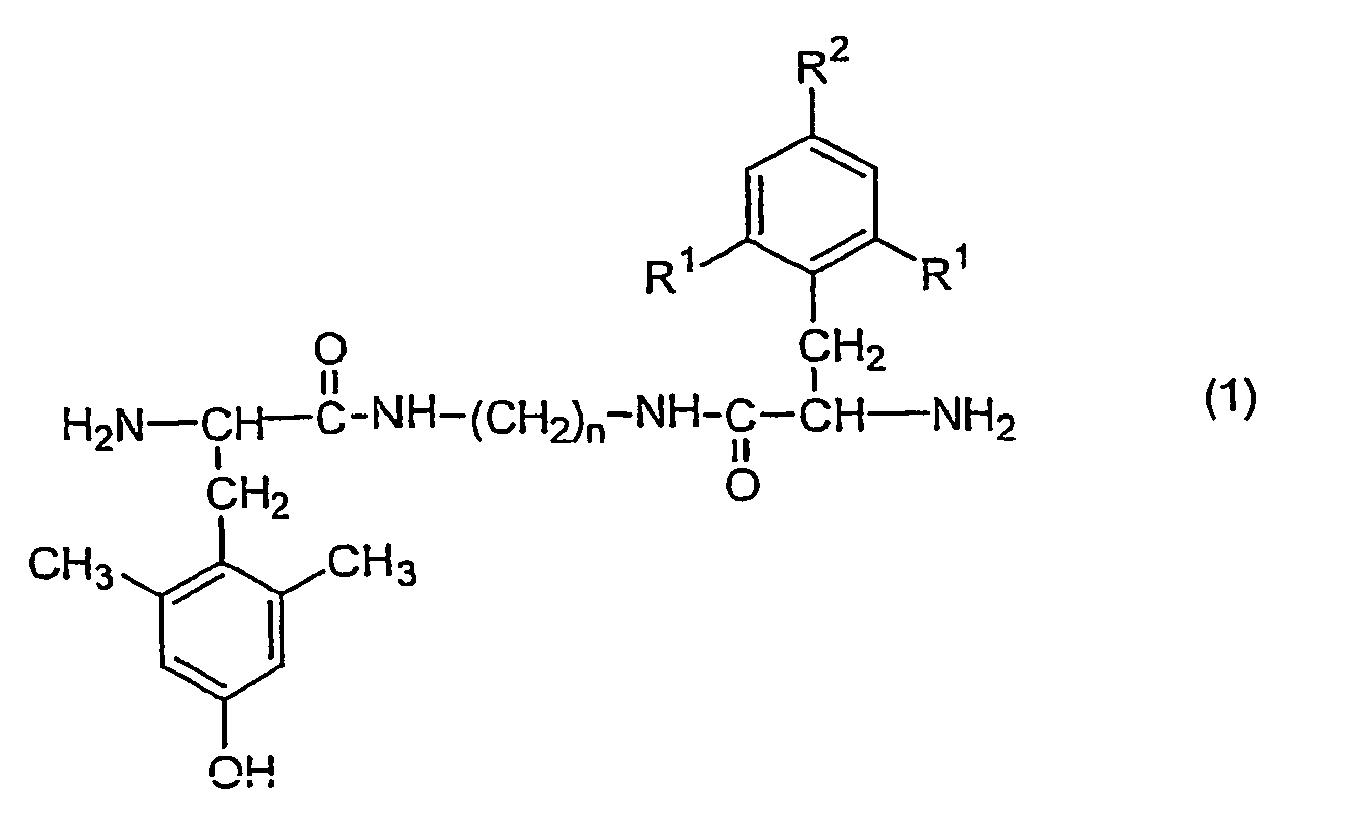
- The peptide derivative represented by the formula (1) or a pharmaceutically acceptable salt thereof claimed in claim 1 wherein R1 is methyl group.
- The peptide derivative represented by the formula (1) or a pharmaceutically acceptable salt thereof claimed in claim 1 wherein n is an integer of 4 to 6.
- A pharmaceutical composition containing a peptide derivative represented by the formula (1) or a pharmaceutically acceptable salt thereof claimed in claim 1 as an active ingredient.
- Use of a peptide derivative or a pharmaceutically acceptable salt thereof claimed in claims 1 to 3 for the preparation of a medicament for the treatment of a patient having pain or suffering from nervous defect disease, i.e. neuropathy, related to µ-opioid receptor activation.
Applications Claiming Priority (3)
| Application Number | Priority Date | Filing Date | Title |
|---|---|---|---|
| US58192 | 1993-05-04 | ||
| US10/058,192 US6838580B2 (en) | 2002-01-29 | 2002-01-29 | Opioid derivative |
| PCT/JP2003/000516 WO2003064375A1 (en) | 2002-01-29 | 2003-01-22 | New opioid derivative |
Publications (3)
| Publication Number | Publication Date |
|---|---|
| EP1470101A1 EP1470101A1 (en) | 2004-10-27 |
| EP1470101A4 EP1470101A4 (en) | 2006-08-16 |
| EP1470101B1 true EP1470101B1 (en) | 2010-09-29 |
Family
ID=27658228
Family Applications (1)
| Application Number | Title | Priority Date | Filing Date |
|---|---|---|---|
| EP03703014A Expired - Lifetime EP1470101B1 (en) | 2002-01-29 | 2003-01-22 | New opioid derivative |
Country Status (6)
| Country | Link |
|---|---|
| US (1) | US6838580B2 (en) |
| EP (1) | EP1470101B1 (en) |
| JP (1) | JP4467985B2 (en) |
| AT (1) | ATE482927T1 (en) |
| DE (1) | DE60334362D1 (en) |
| WO (1) | WO2003064375A1 (en) |
Families Citing this family (5)
| Publication number | Priority date | Publication date | Assignee | Title |
|---|---|---|---|---|
| US20080125403A1 (en) | 2004-04-02 | 2008-05-29 | Merck & Co., Inc. | Method of Treating Men with Metabolic and Anthropometric Disorders |
| CA2580694A1 (en) * | 2004-09-23 | 2006-03-30 | Alexander Michalow | Methods for regulating neurotransmitter systems by inducing counteradaptations |
| US20080045610A1 (en) * | 2004-09-23 | 2008-02-21 | Alexander Michalow | Methods for regulating neurotransmitter systems by inducing counteradaptations |
| US8030341B2 (en) | 2005-09-01 | 2011-10-04 | The United States Of America As Represented By The Secretary Of The Department Of Health And Human Services | Dmt-derivative compounds and related compositions and methods of use |
| US11104763B2 (en) | 2017-04-06 | 2021-08-31 | Alliance For Sustainable Energy, Llc | Renewable polymers and resins and methods of making the same |
Family Cites Families (5)
| Publication number | Priority date | Publication date | Assignee | Title |
|---|---|---|---|---|
| DE3585936D1 (en) * | 1984-09-20 | 1992-06-04 | Erba Carlo Spa | BIOLOGICALLY ACTIVE PEPTIDES, THEIR METHOD FOR THE PRODUCTION AND PHARMACEUTICAL COMPOSITIONS. |
| US5272175A (en) * | 1992-05-20 | 1993-12-21 | G. D. Searle & Co. | Substituted tyrosyl diamide compounds |
| DK1055665T3 (en) * | 1999-05-28 | 2004-03-01 | Pfizer Prod Inc | 3- (3-hydroxyphenyl) -3-aminopropionamidderivater |
| JP2001122895A (en) | 1999-10-20 | 2001-05-08 | Hamari Chemicals Ltd | Novel opioid peptide derivatives |
| JP2002069059A (en) * | 2000-08-28 | 2002-03-08 | Teikoku Seiyaku Co Ltd | New opioid peptide derivative containing piperazinone ring |
-
2002
- 2002-01-29 US US10/058,192 patent/US6838580B2/en not_active Expired - Fee Related
-
2003
- 2003-01-22 WO PCT/JP2003/000516 patent/WO2003064375A1/en not_active Ceased
- 2003-01-22 JP JP2003563999A patent/JP4467985B2/en not_active Expired - Fee Related
- 2003-01-22 EP EP03703014A patent/EP1470101B1/en not_active Expired - Lifetime
- 2003-01-22 DE DE60334362T patent/DE60334362D1/en not_active Expired - Lifetime
- 2003-01-22 AT AT03703014T patent/ATE482927T1/en not_active IP Right Cessation
Non-Patent Citations (1)
| Title |
|---|
| EUROPEAN JOURNAL OF PHARMACOLOGY, vol. 302, 1996, pages 37 - 42 * |
Also Published As
| Publication number | Publication date |
|---|---|
| DE60334362D1 (en) | 2010-11-11 |
| JP2005516060A (en) | 2005-06-02 |
| EP1470101A1 (en) | 2004-10-27 |
| WO2003064375A1 (en) | 2003-08-07 |
| US20030171302A1 (en) | 2003-09-11 |
| ATE482927T1 (en) | 2010-10-15 |
| EP1470101A4 (en) | 2006-08-16 |
| JP4467985B2 (en) | 2010-05-26 |
| US6838580B2 (en) | 2005-01-04 |
Similar Documents
| Publication | Publication Date | Title |
|---|---|---|
| CN110177581B (en) | Myeloperoxidase imaging agents | |
| DE68926269T2 (en) | Dermorphin analogs, their manufacturing process, pharmaceutical compositions and method of therapeutic treatment using the analogs | |
| JP6210993B2 (en) | NMDA receptor modulator and use thereof | |
| EP3838900B1 (en) | 3-aryloxy-3-aryl-propylamine compound and uses thereof | |
| FI70228B (en) | FRAMEWORK FOR FRAMSTAELLNING AV EN ENKEFALIN ANALOG PEPTID | |
| EP3440051B1 (en) | Neuropeptide s receptor (npsr) agonists | |
| EP3851099B1 (en) | Composition for the treatment of fibrotic diseases, with benzhydryl thioacetamide compound as active ingredient | |
| KR102348728B1 (en) | Pharmaceutical Composition for the Prevention or Treatment of Cancer | |
| DE60128587T2 (en) | lactam | |
| EP1272458A1 (en) | Arginine mimetics as factor xa inhibitors | |
| CN117440948A (en) | Amide compounds and their uses | |
| US6838580B2 (en) | Opioid derivative | |
| JPH04506525A (en) | Dynorphin analogs specific for kappa opioid receptors | |
| EP3978484A1 (en) | Heteroaromatic acetamide derivative, and preparation and use thereof | |
| WO2012085586A1 (en) | Mexiletine prodrugs | |
| JP2006502975A (en) | Compounds capable of inhibiting a response to chemicals or thermal stimuli or nociceptor inflammatory mediators, methods of obtaining the compounds, and compositions comprising the compounds | |
| WO2010149760A2 (en) | Mexiletine amino acid and peptide prodrugs and uses thereof | |
| KR102902210B1 (en) | Polypeptides and their applications as CCK receptor agonists/antagonists | |
| US20220213068A1 (en) | Selective small molecule peptidomimetic melanocortin ligands | |
| JP2001122895A (en) | Novel opioid peptide derivatives | |
| CA3018344C (en) | Neuropeptide s receptor (npsr) agonists | |
| JP2002069059A (en) | New opioid peptide derivative containing piperazinone ring | |
| KR20120060136A (en) | Novel tetraazacyclododecane-tetraone derivatives or pharmaceutically acceptable salt thereof, and pharmaceutical composition for the the prevention or treatment of cancer containing the same as an active ingredient | |
| WO2011090316A2 (en) | Novel pyrazinone derivatives having an apoptosis-inducing activity, and pharmaceutical compositions comprising same |
Legal Events
| Date | Code | Title | Description |
|---|---|---|---|
| PUAI | Public reference made under article 153(3) epc to a published international application that has entered the european phase |
Free format text: ORIGINAL CODE: 0009012 |
|
| 17P | Request for examination filed |
Effective date: 20040721 |
|
| AK | Designated contracting states |
Kind code of ref document: A1 Designated state(s): AT BE BG CH CY CZ DE DK EE ES FI FR GB GR HU IE IT LI LU MC NL PT SE SI SK TR |
|
| AX | Request for extension of the european patent |
Extension state: AL LT LV MK RO |
|
| REG | Reference to a national code |
Ref country code: HK Ref legal event code: DE Ref document number: 1066978 Country of ref document: HK |
|
| A4 | Supplementary search report drawn up and despatched |
Effective date: 20060718 |
|
| 17Q | First examination report despatched |
Effective date: 20071126 |
|
| GRAP | Despatch of communication of intention to grant a patent |
Free format text: ORIGINAL CODE: EPIDOSNIGR1 |
|
| GRAS | Grant fee paid |
Free format text: ORIGINAL CODE: EPIDOSNIGR3 |
|
| GRAA | (expected) grant |
Free format text: ORIGINAL CODE: 0009210 |
|
| AK | Designated contracting states |
Kind code of ref document: B1 Designated state(s): AT BE BG CH CY CZ DE DK EE ES FI FR GB GR HU IE IT LI LU MC NL PT SE SI SK TR |
|
| REG | Reference to a national code |
Ref country code: GB Ref legal event code: FG4D |
|
| REG | Reference to a national code |
Ref country code: CH Ref legal event code: EP |
|
| REG | Reference to a national code |
Ref country code: IE Ref legal event code: FG4D |
|
| REF | Corresponds to: |
Ref document number: 60334362 Country of ref document: DE Date of ref document: 20101111 Kind code of ref document: P |
|
| PG25 | Lapsed in a contracting state [announced via postgrant information from national office to epo] |
Ref country code: FI Free format text: LAPSE BECAUSE OF FAILURE TO SUBMIT A TRANSLATION OF THE DESCRIPTION OR TO PAY THE FEE WITHIN THE PRESCRIBED TIME-LIMIT Effective date: 20100929 Ref country code: AT Free format text: LAPSE BECAUSE OF FAILURE TO SUBMIT A TRANSLATION OF THE DESCRIPTION OR TO PAY THE FEE WITHIN THE PRESCRIBED TIME-LIMIT Effective date: 20100929 |
|
| REG | Reference to a national code |
Ref country code: NL Ref legal event code: VDEP Effective date: 20100929 |
|
| PG25 | Lapsed in a contracting state [announced via postgrant information from national office to epo] |
Ref country code: SI Free format text: LAPSE BECAUSE OF FAILURE TO SUBMIT A TRANSLATION OF THE DESCRIPTION OR TO PAY THE FEE WITHIN THE PRESCRIBED TIME-LIMIT Effective date: 20100929 |
|
| PG25 | Lapsed in a contracting state [announced via postgrant information from national office to epo] |
Ref country code: SE Free format text: LAPSE BECAUSE OF FAILURE TO SUBMIT A TRANSLATION OF THE DESCRIPTION OR TO PAY THE FEE WITHIN THE PRESCRIBED TIME-LIMIT Effective date: 20100929 Ref country code: GR Free format text: LAPSE BECAUSE OF FAILURE TO SUBMIT A TRANSLATION OF THE DESCRIPTION OR TO PAY THE FEE WITHIN THE PRESCRIBED TIME-LIMIT Effective date: 20101230 |
|
| PG25 | Lapsed in a contracting state [announced via postgrant information from national office to epo] |
Ref country code: NL Free format text: LAPSE BECAUSE OF FAILURE TO SUBMIT A TRANSLATION OF THE DESCRIPTION OR TO PAY THE FEE WITHIN THE PRESCRIBED TIME-LIMIT Effective date: 20100929 Ref country code: PT Free format text: LAPSE BECAUSE OF FAILURE TO SUBMIT A TRANSLATION OF THE DESCRIPTION OR TO PAY THE FEE WITHIN THE PRESCRIBED TIME-LIMIT Effective date: 20110131 Ref country code: CZ Free format text: LAPSE BECAUSE OF FAILURE TO SUBMIT A TRANSLATION OF THE DESCRIPTION OR TO PAY THE FEE WITHIN THE PRESCRIBED TIME-LIMIT Effective date: 20100929 Ref country code: EE Free format text: LAPSE BECAUSE OF FAILURE TO SUBMIT A TRANSLATION OF THE DESCRIPTION OR TO PAY THE FEE WITHIN THE PRESCRIBED TIME-LIMIT Effective date: 20100929 Ref country code: SK Free format text: LAPSE BECAUSE OF FAILURE TO SUBMIT A TRANSLATION OF THE DESCRIPTION OR TO PAY THE FEE WITHIN THE PRESCRIBED TIME-LIMIT Effective date: 20100929 |
|
| PG25 | Lapsed in a contracting state [announced via postgrant information from national office to epo] |
Ref country code: BE Free format text: LAPSE BECAUSE OF FAILURE TO SUBMIT A TRANSLATION OF THE DESCRIPTION OR TO PAY THE FEE WITHIN THE PRESCRIBED TIME-LIMIT Effective date: 20100929 |
|
| PG25 | Lapsed in a contracting state [announced via postgrant information from national office to epo] |
Ref country code: ES Free format text: LAPSE BECAUSE OF FAILURE TO SUBMIT A TRANSLATION OF THE DESCRIPTION OR TO PAY THE FEE WITHIN THE PRESCRIBED TIME-LIMIT Effective date: 20110109 |
|
| PLBE | No opposition filed within time limit |
Free format text: ORIGINAL CODE: 0009261 |
|
| STAA | Information on the status of an ep patent application or granted ep patent |
Free format text: STATUS: NO OPPOSITION FILED WITHIN TIME LIMIT |
|
| PG25 | Lapsed in a contracting state [announced via postgrant information from national office to epo] |
Ref country code: MC Free format text: LAPSE BECAUSE OF NON-PAYMENT OF DUE FEES Effective date: 20110131 Ref country code: DK Free format text: LAPSE BECAUSE OF FAILURE TO SUBMIT A TRANSLATION OF THE DESCRIPTION OR TO PAY THE FEE WITHIN THE PRESCRIBED TIME-LIMIT Effective date: 20100929 |
|
| REG | Reference to a national code |
Ref country code: CH Ref legal event code: PL |
|
| 26N | No opposition filed |
Effective date: 20110630 |
|
| REG | Reference to a national code |
Ref country code: IE Ref legal event code: MM4A |
|
| REG | Reference to a national code |
Ref country code: DE Ref legal event code: R097 Ref document number: 60334362 Country of ref document: DE Effective date: 20110630 |
|
| PG25 | Lapsed in a contracting state [announced via postgrant information from national office to epo] |
Ref country code: CH Free format text: LAPSE BECAUSE OF NON-PAYMENT OF DUE FEES Effective date: 20110131 Ref country code: LI Free format text: LAPSE BECAUSE OF NON-PAYMENT OF DUE FEES Effective date: 20110131 |
|
| PG25 | Lapsed in a contracting state [announced via postgrant information from national office to epo] |
Ref country code: IE Free format text: LAPSE BECAUSE OF NON-PAYMENT OF DUE FEES Effective date: 20110122 |
|
| PGFP | Annual fee paid to national office [announced via postgrant information from national office to epo] |
Ref country code: FR Payment date: 20111219 Year of fee payment: 10 |
|
| PGFP | Annual fee paid to national office [announced via postgrant information from national office to epo] |
Ref country code: DE Payment date: 20120125 Year of fee payment: 10 |
|
| PGFP | Annual fee paid to national office [announced via postgrant information from national office to epo] |
Ref country code: IT Payment date: 20120109 Year of fee payment: 10 Ref country code: GB Payment date: 20120120 Year of fee payment: 10 |
|
| REG | Reference to a national code |
Ref country code: HK Ref legal event code: WD Ref document number: 1066978 Country of ref document: HK |
|
| PG25 | Lapsed in a contracting state [announced via postgrant information from national office to epo] |
Ref country code: LU Free format text: LAPSE BECAUSE OF NON-PAYMENT OF DUE FEES Effective date: 20110122 Ref country code: CY Free format text: LAPSE BECAUSE OF FAILURE TO SUBMIT A TRANSLATION OF THE DESCRIPTION OR TO PAY THE FEE WITHIN THE PRESCRIBED TIME-LIMIT Effective date: 20100929 |
|
| GBPC | Gb: european patent ceased through non-payment of renewal fee |
Effective date: 20130122 |
|
| PG25 | Lapsed in a contracting state [announced via postgrant information from national office to epo] |
Ref country code: TR Free format text: LAPSE BECAUSE OF FAILURE TO SUBMIT A TRANSLATION OF THE DESCRIPTION OR TO PAY THE FEE WITHIN THE PRESCRIBED TIME-LIMIT Effective date: 20100929 Ref country code: BG Free format text: LAPSE BECAUSE OF FAILURE TO SUBMIT A TRANSLATION OF THE DESCRIPTION OR TO PAY THE FEE WITHIN THE PRESCRIBED TIME-LIMIT Effective date: 20101229 |
|
| REG | Reference to a national code |
Ref country code: FR Ref legal event code: ST Effective date: 20130930 |
|
| PG25 | Lapsed in a contracting state [announced via postgrant information from national office to epo] |
Ref country code: DE Free format text: LAPSE BECAUSE OF NON-PAYMENT OF DUE FEES Effective date: 20130801 Ref country code: HU Free format text: LAPSE BECAUSE OF FAILURE TO SUBMIT A TRANSLATION OF THE DESCRIPTION OR TO PAY THE FEE WITHIN THE PRESCRIBED TIME-LIMIT Effective date: 20100929 |
|
| REG | Reference to a national code |
Ref country code: DE Ref legal event code: R119 Ref document number: 60334362 Country of ref document: DE Effective date: 20130801 |
|
| PG25 | Lapsed in a contracting state [announced via postgrant information from national office to epo] |
Ref country code: GB Free format text: LAPSE BECAUSE OF NON-PAYMENT OF DUE FEES Effective date: 20130122 Ref country code: FR Free format text: LAPSE BECAUSE OF NON-PAYMENT OF DUE FEES Effective date: 20130131 |
|
| PG25 | Lapsed in a contracting state [announced via postgrant information from national office to epo] |
Ref country code: IT Free format text: LAPSE BECAUSE OF NON-PAYMENT OF DUE FEES Effective date: 20130122 |