EP1469414A2 - Method for distinguishing objects in a video image by using infrared reflective material - Google Patents
Method for distinguishing objects in a video image by using infrared reflective material Download PDFInfo
- Publication number
- EP1469414A2 EP1469414A2 EP04009095A EP04009095A EP1469414A2 EP 1469414 A2 EP1469414 A2 EP 1469414A2 EP 04009095 A EP04009095 A EP 04009095A EP 04009095 A EP04009095 A EP 04009095A EP 1469414 A2 EP1469414 A2 EP 1469414A2
- Authority
- EP
- European Patent Office
- Prior art keywords
- recited
- substance
- motor vehicle
- beads
- objects
- Prior art date
- Legal status (The legal status is an assumption and is not a legal conclusion. Google has not performed a legal analysis and makes no representation as to the accuracy of the status listed.)
- Withdrawn
Links
Images
Classifications
-
- G—PHYSICS
- G06—COMPUTING OR CALCULATING; COUNTING
- G06V—IMAGE OR VIDEO RECOGNITION OR UNDERSTANDING
- G06V40/00—Recognition of biometric, human-related or animal-related patterns in image or video data
- G06V40/10—Human or animal bodies, e.g. vehicle occupants or pedestrians; Body parts, e.g. hands
-
- G—PHYSICS
- G01—MEASURING; TESTING
- G01B—MEASURING LENGTH, THICKNESS OR SIMILAR LINEAR DIMENSIONS; MEASURING ANGLES; MEASURING AREAS; MEASURING IRREGULARITIES OF SURFACES OR CONTOURS
- G01B5/00—Measuring arrangements characterised by the use of mechanical techniques
- G01B5/30—Measuring arrangements characterised by the use of mechanical techniques for measuring the deformation in a solid, e.g. mechanical strain gauge
-
- B—PERFORMING OPERATIONS; TRANSPORTING
- B60—VEHICLES IN GENERAL
- B60N—SEATS SPECIALLY ADAPTED FOR VEHICLES; VEHICLE PASSENGER ACCOMMODATION NOT OTHERWISE PROVIDED FOR
- B60N2/00—Seats specially adapted for vehicles; Arrangement or mounting of seats in vehicles
- B60N2/002—Seats provided with an occupancy detection means mounted therein or thereon
- B60N2/0021—Seats provided with an occupancy detection means mounted therein or thereon characterised by the type of sensor or measurement
- B60N2/0024—Seats provided with an occupancy detection means mounted therein or thereon characterised by the type of sensor or measurement for identifying, categorising or investigation of the occupant or object on the seat
-
- B—PERFORMING OPERATIONS; TRANSPORTING
- B60—VEHICLES IN GENERAL
- B60R—VEHICLES, VEHICLE FITTINGS, OR VEHICLE PARTS, NOT OTHERWISE PROVIDED FOR
- B60R21/00—Arrangements or fittings on vehicles for protecting or preventing injuries to occupants or pedestrians in case of accidents or other traffic risks
- B60R21/01—Electrical circuits for triggering passive safety arrangements, e.g. airbags, safety belt tighteners, in case of vehicle accidents or impending vehicle accidents
- B60R21/015—Electrical circuits for triggering passive safety arrangements, e.g. airbags, safety belt tighteners, in case of vehicle accidents or impending vehicle accidents including means for detecting the presence or position of passengers, passenger seats or child seats, and the related safety parameters therefor, e.g. speed or timing of airbag inflation in relation to occupant position or seat belt use
- B60R21/01512—Passenger detection systems
- B60R21/0153—Passenger detection systems using field detection presence sensors
- B60R21/01534—Passenger detection systems using field detection presence sensors using electromagneticwaves, e.g. infrared
-
- E—FIXED CONSTRUCTIONS
- E01—CONSTRUCTION OF ROADS, RAILWAYS, OR BRIDGES
- E01D—CONSTRUCTION OF BRIDGES, ELEVATED ROADWAYS OR VIADUCTS; ASSEMBLY OF BRIDGES
- E01D19/00—Structural or constructional details of bridges
-
- B—PERFORMING OPERATIONS; TRANSPORTING
- B60—VEHICLES IN GENERAL
- B60N—SEATS SPECIALLY ADAPTED FOR VEHICLES; VEHICLE PASSENGER ACCOMMODATION NOT OTHERWISE PROVIDED FOR
- B60N2210/00—Sensor types, e.g. for passenger detection systems or for controlling seats
- B60N2210/10—Field detection presence sensors
- B60N2210/16—Electromagnetic waves
- B60N2210/18—Infrared
-
- B—PERFORMING OPERATIONS; TRANSPORTING
- B60—VEHICLES IN GENERAL
- B60N—SEATS SPECIALLY ADAPTED FOR VEHICLES; VEHICLE PASSENGER ACCOMMODATION NOT OTHERWISE PROVIDED FOR
- B60N2210/00—Sensor types, e.g. for passenger detection systems or for controlling seats
- B60N2210/10—Field detection presence sensors
- B60N2210/16—Electromagnetic waves
- B60N2210/22—Optical; Photoelectric; Lidar [Light Detection and Ranging]
- B60N2210/24—Cameras
Definitions
- the present invention relates generally to optical object detection systems which produce and analyze an electronic image, such as systems used to detect the presence of an occupant in a motor vehicle; and more particularly to techniques for distinguishing between different objects which have similar colors in the image.
- Modern motor vehicles incorporate an air bag inside the dashboard facing a passenger in the front seat. Additional air bags are being proposed for the doors to the sides of the front seat occupants. Rapid deceleration of the motor vehicle during an accident is detected and activates inflation of the air bags which then cushion the occupants. Although air bags have greatly decreased the severity of injuries from motor vehicle collisions, people are occasionally injured due to the rapid rate at which the air bag must deploy. In particular, the air bag may severely injure a small child or infant sitting in the front seat of the motor vehicle. Relatively small adults also are susceptible to injury.
- an optical system was developed that produced an electronic image of the seating area in the motor vehicle and analyzed that image to detect the presence and size of an occupant.
- U.S. Patent No. 6,493,620 describes such a motor vehicle occupant detection system. These systems often use a monochromatic, solid state imager which generates a black and white image of the seating area. In order for an image to be produced at night, artificial illumination must be provided which does not interfere with the driver's ability to observe the highway.
- One solution illuminates the vehicle interior with near infrared (NIR) light, while an image is being acquired. Near infrared light is invisible to the human eye, yet can be detected by a solid state imager.
- NIR near infrared
- one of the objects being imaged is coated with a substance that increases the object's reflectivity to infrared radiation.
- a substance that increases the object's reflectivity to infrared radiation Preferably that substance does not substantially alter reflectivity of the object to visible light, so that the object's appearance to a human eye will not be alerted significantly.
- One category of substances that can be applied to the objects to change the infrared radiation reflectivity comprise pigments in a carrier.
- a black pigment that is highly reflective to infrared light can be mixed with a carrier selected from the group consisting of vinyl printing ink, acrylic lacquer, polyurethane, and polyurethane lacquer to produce a solution for application to the object.
- This substance makes the object appear very shiny, thus having a gray appearance in an infrared image.
- a solution of glass beads in a carrier such as an acrylic lacquer and an acrylate dissolved in chloroform, can be applied to the object.
- the glass beads can be coated with a reflective metal. The glass beads similarly alter the reflectivity of the object to infrared radiation thus changing its appearance in the electronic image and distinguishing the object from other objects having a similar color in visible light.
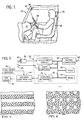
- FIGURE 1 is a side view of a motor vehicle incorporating an occupant detection system according to the present invention
- FIGURE 2 is a block schematic diagram of an exemplary system for classifying objects within a motor vehicle.
- FIGURES 3 and 4 illustrate sections of upholstery in a motor vehicle treated in two different patterns with a substance according to the present invention.
- the front portion of the passenger compartment of an automobile 10 includes a dashboard 12 from which a steering wheel 14 projects.
- a front seat 16 is spaced from the dashboard 12 and includes standard headrests 18 for the passenger and driver.
- the steering wheel 14 has a central compartment which houses an air bag 20 and the dashboard 12 has another compartment (not visible) which contains a second air bag located forward of the right portion of the front seat 16.
- CMOS image mounted above the windshield in the ceiling of the passenger compartment.
- the imager 25 is responsive to near infrared (NIR) light produced by one or more sources 26 mounted adjacent the camera to illuminate the front seat 16 of the motor vehicle.
- the sources 26 produce radiation in the 850-910 nm range which is invisible to the human eye.
- NIR near infrared
- Such illumination allows operation of the occupant detection system 10 at night without affecting an occupant's ability to see the highway.
- the illumination from source 26 fills in image shadows during daytime operation.
- the images produced by the video camera 24 are applied to a video input circuit 32 of an image processor 30.
- Each video image consists of a two-dimensional array of picture elements (pixels).
- the video input circuit 32 controls storage of the pixels in a random access memory (RAM) 34 with both devices being connected to a set of signal buses 36.
- the RAM 34 also stores variable values, intermediate data, and final results of the image analysis.
- Analysis of the acquired electronic images is controlled by a microcomputer 38 which executes a program stored in a read only memory (ROM) 40.
- ROM read only memory
- the microcomputer 38 also operates a light control circuit 45 which activates the near infrared (NIR) light source 26 while an image is being acquired from the video camera 24.
- NIR near infrared
- a control interface circuit 42 also is connected to the set of signal buses 36 and interfaces the image processor 30 to other components in the motor vehicle 10.
- the image analysis controls operation of the air bag 20 and the control interface circuit 42 is connected to the air bag controller 44 of the vehicle.
- the air bag controller 44 also receives a signal from a conventional collision sensor 46 when an accident occurs. The air bag controller 44 responds to these inputs by activating the driver and passenger air bags 20.
- the image processing to determine the presence of an person on the vehicle seat 16 and the size of that person requires the ability to distinguish between an empty black seat and a person dressed in black on that seat. That distinction can be accomplished by coating the seat with a substance that has different reflective properties to near infrared light than conventional vehicle upholstery without significantly affecting the appearance of the coated object to the human eye, i.e. the object's reflectivity of visible light.
- One approach is to apply pigment to the black seat which is highly reflective to near infrared radiation or at least more reflective that untreated seat material. Therefore the seat will appear lighter in color to the CMOS imager which is responsive to the near infrared radiation.
- Pigments suitable for this application include "Black 411" sold by The Shepherd Color Company of Cincinnati, Ohio and "Meteor Plus 9895 High IR Black" available from the Engelhard Corp. of Iselin, New Jersey.
- the pigments can be dispersed in numerous commercially available fast curing carriers, such as Nazdar GV 170 vinyl coating sold by Nazdar Company, Inc., Chicago, Illinois, USA; Duracryl DCA 468 Acrylic Lacquer sold by PPG Industries, Strongville, Ohio, USA; Minwax Ultra Fast Drying Polycrylic Protective Finish and Acrylic Lacquer or Minwax Fast Drying Polyurethane, a polyurethane lacquer, both sold by the Minwax Company, Upper Saddle River, New Jersey, USA. It appears that the relative brightness of the resultant seat treated with this reflective substance does not depend significantly on the concentration of the pigment within the carrier. Relatively small differences in resultant brightness of the seat were observed between a solution in which the pigment to carrier ratio was 25:100 as compared to another solution having a 50:100 ratio.
- Black vinyl upholstery treated with this pigment substance generated a relative brightness which was greater than a standard gray card reference available from the Eastman Kodak Company of Rochester, New York, USA.
- the treated sections of black vinyl material appear significantly different in an image produced by the CMOS imager than untreated sections and other untreated black objects, such as clothing worn by vehicle occupants. Therefore by treating the upholstery material for the front seat with one of these pigment substances, the seat appears significantly different in the electronic image than a person wearing black clothing.
- the pigment substance can be applied to the vehicle seat in a pattern so that the seat has areas of treated and untreated upholstery.
- a pattern of horizontal extending stripes provides one set of areas where the treated upholstery material distinguishes the seat from an person wearing black clothing, while another set of areas of untreated upholstery material distinguishes the seat from an person wearing gray clothing.
- a pattern of horizontal and vertical stripes as shown in Figure 4 or a checkerboard pattern provide such distinction in two dimensions.
- other patterns can be utilized within the context of the present invention.
- Another approach to provide distinction between different black objects in an electronic image is to coat some of the objects with a near infrared reflective coating containing microscopic glass spheres, instead of a pigment.
- Plain glass spheres such as "T-4" spheres available from Potters Industries of Valley Forge, Pennsylvania, USA, or glass spheres with one hemisphere coated with metal, such as "145 Type A Metalized Glass Spheres” manufactured by 3M Corporation of St. Paul, Minnesota, USA, can be used.
- These spheres may be disbursed in an acrylic matrix, such as "Minwax Ultrafast Drying Polyacrylic Protective Finish” which is an acrylic lacquer sold by the Minwax Company.
- Another matrix can be formed by dissolving 150 grams of "IR6" acrylic-based NIR transmitting filter material available from Fresnel Technologies, Inc., of Fort Worth, Texas, USA in 560 grams of chloroform.
- the resultant solution is applied to the vinyl or other upholstery material within the motor vehicle by a conventional process.
- the surfaces of the spheres are highly reflective to the near infrared light and provide an noticeably shinier and brighter appearance to the surfaces that have been treated than untreated surfaces.
- the interior of the motor vehicle may be coated in a pattern so as to be distinguishable from clothing worn by an occupant of the motor vehicle seat.
- the coatings utilizing glass spheres have exhibited a tendency to wear off due to abrasion from people sliding onto and off the motor vehicle seat.
- the glass bead substances can be applied to other surfaces in the motor vehicle, such as the door panels and the headliner, which are less subject to abrasion. Such coatings distinguish these surfaces from those of the seat, thereby enabling the image analysis to determine the position of a movable seat within the motor vehicle.
- the orientation of the camera 24 within the motor vehicle may change due to vibration and contact by the occupants.
- Such movement of the camera with respect to the motor vehicle alters the image produced by the camera and specifically the relative positions of otherwise fixed objects with in the image, such as the steering wheel and doors.
- If the image analysis is based on a comparison of the position of objects between two or more images acquired at different points in time, such movement of the camera undermines that analysis.
- markers in the motor vehicle that can easily be discerned in the electronic images, such as by coating specific components of the vehicle interior with one of the previously described NIR reflective substances, the shift of those components in the images due to camera movement can be easily ascertained.
- the pillar between the doors on each side of an automobile and the pillar between the rear door and the rear window can be marked with an NIR reflective substance to provide position references in the vehicle.
- the application of the infrared reflective coatings to objects of the interior of a motor vehicle provides a mechanism by which those objects can be distinguished from other objects in an electronic image without effecting the appearance of the vehicle interior to the human eye.
Landscapes
- Engineering & Computer Science (AREA)
- Physics & Mathematics (AREA)
- Mechanical Engineering (AREA)
- General Physics & Mathematics (AREA)
- Transportation (AREA)
- Aviation & Aerospace Engineering (AREA)
- Theoretical Computer Science (AREA)
- Human Computer Interaction (AREA)
- Multimedia (AREA)
- Electromagnetism (AREA)
- Structural Engineering (AREA)
- Civil Engineering (AREA)
- Architecture (AREA)
- Geophysics And Detection Of Objects (AREA)
- Air Bags (AREA)
- Paints Or Removers (AREA)
- Photometry And Measurement Of Optical Pulse Characteristics (AREA)
- Radiation Pyrometers (AREA)
Abstract
Description
Claims (16)
- A method for enabling an infrared video image processing system in a motor vehicle (10) to distinguish between objects, said method comprising coating an object (16) with a substance that increases reflectivity of the object to infrared radiation whereby the brightness of the object in an infrared image is changed.
- The method as recited in claim 1 wherein the substance does not substantially alter reflectivity of the object (16) to visible light
- The method as recited in claim 1 wherein the substance is applied in a predefined pattern (Fig. 3 or 4) to the object (16).
- The method as recited in claim 1 wherein the substance contains a pigment in a carrier selected from the group consisting of vinyl printing ink, acrylic lacquer, polyurethane, and polyurethane lacquer.
- The method as recited in claim 1 wherein the substance contains beads which are reflective to infrared radiation.
- The method as recited in claim 5 wherein the beads are made of glass.
- The method as recited in claim 5 wherein the beads are coated with a metal.
- The method as recited in claim 1 wherein the substance comprises beads dispersed in a solution selected from the group consisting of an acrylic lacquer and an acrylate dissolved in chloroform.
- A method by which an video image system in a motor vehicle (10) distinguishes between first and second objects having similar reflectivity to infrared radiation, said method comprising:applying a substance to the first object (16) in the motor vehicle (10) wherein the substance alters reflectivity of the first object to infrared radiation and is imperceptible to a human eye;producing an electronic image in response to infrared radiation reflected by the first and second objects; anddistinguishing between the first and second objects in the electronic image based on the relative brightness of parts of the electronic image.
- The method as recited in claim 9 wherein the substance is applied in a predefined pattern (Figs. 3 and 4) to the object.
- The method as recited in claim 9 wherein the substance contains a pigment which appears to the human eye as having substantially the same color as the first object (16) prior to application of the substance.
- The method as recited in claim 9 wherein the substance contains a pigment in a carrier selected from the group consisting of printing ink, acrylic lacquer, polyurethane, and polyurethane lacquer.
- The method as recited in claim 9 wherein the substance contains beads which are reflective to infrared radiation.
- The method as recited in claim 13 wherein the beads are made of glass.
- The method as recited in claim 13 wherein the beads are coated with a metal.
- The method as recited in claim 9 wherein the substance comprises beads dispersed in a solution selected from the group consisting of an acrylic lacquer and an acrylate dissolved in chloroform.
Applications Claiming Priority (2)
| Application Number | Priority Date | Filing Date | Title |
|---|---|---|---|
| US10/417,643 US7193209B2 (en) | 2003-04-17 | 2003-04-17 | Method for distinguishing objects in a video image by using infrared reflective material |
| US417643 | 2003-04-17 |
Publications (2)
| Publication Number | Publication Date |
|---|---|
| EP1469414A2 true EP1469414A2 (en) | 2004-10-20 |
| EP1469414A3 EP1469414A3 (en) | 2005-12-07 |
Family
ID=32908342
Family Applications (1)
| Application Number | Title | Priority Date | Filing Date |
|---|---|---|---|
| EP04009095A Withdrawn EP1469414A3 (en) | 2003-04-17 | 2004-04-16 | Method for distinguishing objects in a video image by using infrared reflective material |
Country Status (8)
| Country | Link |
|---|---|
| US (1) | US7193209B2 (en) |
| EP (1) | EP1469414A3 (en) |
| JP (1) | JP2004317514A (en) |
| KR (1) | KR20040090722A (en) |
| CN (1) | CN1537751A (en) |
| AU (1) | AU2004201526A1 (en) |
| BR (1) | BRPI0401589A (en) |
| MX (1) | MXPA04003561A (en) |
Cited By (2)
| Publication number | Priority date | Publication date | Assignee | Title |
|---|---|---|---|---|
| WO2009144687A3 (en) * | 2009-08-01 | 2010-01-14 | Idan Nachmani | Infant safety alert system and method |
| WO2019046361A1 (en) | 2017-09-01 | 2019-03-07 | Sun Chemical Corporation | Ir-reflective ink, film and tape |
Families Citing this family (9)
| Publication number | Priority date | Publication date | Assignee | Title |
|---|---|---|---|---|
| US7111869B2 (en) * | 2003-07-22 | 2006-09-26 | Trw Automotive U.S. Llc | Apparatus and method for controlling an occupant protection system in response to determined passenger compartment occupancy information |
| JP2009029347A (en) * | 2007-07-30 | 2009-02-12 | Honda Motor Co Ltd | Vehicle occupant detection device |
| US8360051B2 (en) * | 2007-11-12 | 2013-01-29 | Brightsource Industries (Israel) Ltd. | Solar receiver with energy flux measurement and control |
| US20140060726A1 (en) * | 2012-09-05 | 2014-03-06 | Bluestone Global Tech Limited | Methods for transferring graphene films and the like between substrates |
| EP4004596B1 (en) | 2019-10-17 | 2023-01-04 | Google LLC | Smart-device-based radar system for vehicle operations |
| DE102020124056A1 (en) * | 2020-09-15 | 2022-03-17 | Bayerische Motoren Werke Aktiengesellschaft | Method and control unit for protection against unauthorized installation of a pyrotechnic component |
| CN116788179A (en) * | 2022-03-15 | 2023-09-22 | 采埃孚汽车科技(张家港)有限公司 | Vehicle interior system, method, apparatus, and medium for adjusting interior components |
| US12479384B2 (en) * | 2023-11-10 | 2025-11-25 | GM Global Technology Operations LLC | Airbag and restraint system control using seat pressure data |
| CN119821246B (en) * | 2024-12-20 | 2025-10-17 | 浙江吉利控股集团有限公司 | Photoelectric type position self-calibration mechanism, electric seat and vehicle |
Family Cites Families (18)
| Publication number | Priority date | Publication date | Assignee | Title |
|---|---|---|---|---|
| BE622375A (en) * | 1961-09-13 | |||
| US3563771A (en) * | 1968-02-28 | 1971-02-16 | Minnesota Mining & Mfg | Novel black glass bead products |
| US4367919A (en) * | 1977-08-01 | 1983-01-11 | Minnesota Mining And Manufacturing Company | Durable glass elements |
| ES8502239A1 (en) * | 1981-03-30 | 1984-12-16 | Klier Shimon | Light transmissive insulation apparatus |
| US6442465B2 (en) * | 1992-05-05 | 2002-08-27 | Automotive Technologies International, Inc. | Vehicular component control systems and methods |
| US4605232A (en) * | 1984-04-24 | 1986-08-12 | Hundstad Richard L | Infrared radiation responsive target |
| US5089318A (en) * | 1989-10-31 | 1992-02-18 | The Mearl Corporation | Iridescent film with thermoplastic elastomeric components |
| US5550677A (en) * | 1993-02-26 | 1996-08-27 | Donnelly Corporation | Automatic rearview mirror system using a photosensor array |
| DE4421783C2 (en) * | 1994-06-22 | 1996-05-15 | Leica Ag | Optical device and method for determining the position of a reflective target |
| JPH08158268A (en) * | 1994-11-28 | 1996-06-18 | Unitika Ltd | Production of light-reflective coating fabric |
| US6194329B1 (en) * | 1998-01-21 | 2001-02-27 | Brookwood Companies, Incorporated | Reversible fabric for use in military environments and method of making same |
| US6174360B1 (en) * | 1998-10-26 | 2001-01-16 | Ferro Corporation | Infrared reflective color pigment |
| JP2001122066A (en) * | 1999-10-21 | 2001-05-08 | T S Tec Kk | Air bag module cover |
| US20010009725A1 (en) * | 1999-12-03 | 2001-07-26 | Makoto Moriyama | Heat-shielding method, coated product, and car upholstery |
| US6465787B1 (en) * | 2000-08-07 | 2002-10-15 | The Aerospace Corporation | Covert surveillance system for tracking light sensitive tagged moving vehicles |
| JP2002201222A (en) * | 2000-09-19 | 2002-07-19 | Merck Patent Gmbh | Polymer beads, usage of polymer beads, reflective films, security marks, securities, security devices |
| US6235106B1 (en) * | 2000-09-28 | 2001-05-22 | Engelhard Corporation | Blue shade Fe-Cr black |
| US6493620B2 (en) * | 2001-04-18 | 2002-12-10 | Eaton Corporation | Motor vehicle occupant detection system employing ellipse shape models and bayesian classification |
-
2003
- 2003-04-17 US US10/417,643 patent/US7193209B2/en not_active Expired - Fee Related
-
2004
- 2004-04-13 AU AU2004201526A patent/AU2004201526A1/en not_active Abandoned
- 2004-04-14 BR BR0401589-4A patent/BRPI0401589A/en not_active Application Discontinuation
- 2004-04-15 JP JP2004120424A patent/JP2004317514A/en active Pending
- 2004-04-16 EP EP04009095A patent/EP1469414A3/en not_active Withdrawn
- 2004-04-16 CN CNA200410032733XA patent/CN1537751A/en active Pending
- 2004-04-16 MX MXPA04003561A patent/MXPA04003561A/en unknown
- 2004-04-16 KR KR1020040026017A patent/KR20040090722A/en not_active Withdrawn
Cited By (3)
| Publication number | Priority date | Publication date | Assignee | Title |
|---|---|---|---|---|
| WO2009144687A3 (en) * | 2009-08-01 | 2010-01-14 | Idan Nachmani | Infant safety alert system and method |
| WO2019046361A1 (en) | 2017-09-01 | 2019-03-07 | Sun Chemical Corporation | Ir-reflective ink, film and tape |
| US11578239B2 (en) | 2017-09-01 | 2023-02-14 | Sun Chemical Corporation | IR-reflective ink, film, and tape |
Also Published As
| Publication number | Publication date |
|---|---|
| US20040206904A1 (en) | 2004-10-21 |
| BRPI0401589A (en) | 2005-01-18 |
| AU2004201526A1 (en) | 2004-11-04 |
| CN1537751A (en) | 2004-10-20 |
| US7193209B2 (en) | 2007-03-20 |
| KR20040090722A (en) | 2004-10-26 |
| MXPA04003561A (en) | 2004-12-02 |
| JP2004317514A (en) | 2004-11-11 |
| EP1469414A3 (en) | 2005-12-07 |
Similar Documents
| Publication | Publication Date | Title |
|---|---|---|
| AU784215B2 (en) | Motor vehicle occupant detection system employing ellipse shape models and bayesian classification | |
| US7472007B2 (en) | Method of classifying vehicle occupants | |
| US6608910B1 (en) | Computer vision method and apparatus for imaging sensors for recognizing and tracking occupants in fixed environments under variable illumination | |
| US7193209B2 (en) | Method for distinguishing objects in a video image by using infrared reflective material | |
| US20040220705A1 (en) | Visual classification and posture estimation of multiple vehicle occupants | |
| EP2937251B1 (en) | Seat belt position detecting system and method | |
| EP1842735A2 (en) | Object detecting system, actuating device control system, vehicle, and object detecting method | |
| JP2002513358A (en) | Passenger type and position detection system | |
| GB2363638A (en) | Methods for determining the identification and position of and monitoring objects in a vehicle | |
| JPH08290751A (en) | Car sensor and safety systems | |
| US7111869B2 (en) | Apparatus and method for controlling an occupant protection system in response to determined passenger compartment occupancy information | |
| US8560179B2 (en) | Adaptive visual occupant detection and classification system | |
| US10579867B2 (en) | Method and device for detecting an object in a vehicle | |
| CN115782804A (en) | Vehicle center console assembly including an airbag | |
| US8116528B2 (en) | Illumination source for an image based occupant classification system and vehicle using same | |
| JP2010203836A (en) | Vehicle interior state recognition device | |
| US20230264674A1 (en) | Passenger compartment mapping and control | |
| US20240378902A1 (en) | Method for identifying a seat occupancy in a vehicle | |
| JP2005271745A (en) | Vehicle occupant detection device | |
| GB2608131A (en) | Monitoring device for monitoring the interior of a vehicle | |
| JP2008166926A (en) | Backlight determination device and subject imaging method | |
| Freienstein et al. | 3-D Video Sensor for Dynamic Out-of-Position Sensing, Occupant Classification and Additional Sensor Functions | |
| Wetzel | New aspects on static passenger and child seat recognition and future dynamic out-of-position detection for airbag control systems |
Legal Events
| Date | Code | Title | Description |
|---|---|---|---|
| PUAI | Public reference made under article 153(3) epc to a published international application that has entered the european phase |
Free format text: ORIGINAL CODE: 0009012 |
|
| AK | Designated contracting states |
Kind code of ref document: A2 Designated state(s): AT BE BG CH CY CZ DE DK EE ES FI FR GB GR HU IE IT LI LU MC NL PL PT RO SE SI SK TR |
|
| AX | Request for extension of the european patent |
Extension state: AL HR LT LV MK |
|
| PUAL | Search report despatched |
Free format text: ORIGINAL CODE: 0009013 |
|
| AK | Designated contracting states |
Kind code of ref document: A3 Designated state(s): AT BE BG CH CY CZ DE DK EE ES FI FR GB GR HU IE IT LI LU MC NL PL PT RO SE SI SK TR |
|
| AX | Request for extension of the european patent |
Extension state: AL HR LT LV MK |
|
| RIC1 | Information provided on ipc code assigned before grant |
Ipc: 7B 60N 2/00 B Ipc: 7B 60R 21/01 B Ipc: 7G 06K 9/00 A |
|
| AKX | Designation fees paid | ||
| STAA | Information on the status of an ep patent application or granted ep patent |
Free format text: STATUS: THE APPLICATION IS DEEMED TO BE WITHDRAWN |
|
| 18D | Application deemed to be withdrawn |
Effective date: 20060608 |
|
| REG | Reference to a national code |
Ref country code: DE Ref legal event code: 8566 |