EP1469364A1 - Procédé de constitution d'un groupe d'éléments dans un réseau domotique - Google Patents
Procédé de constitution d'un groupe d'éléments dans un réseau domotique Download PDFInfo
- Publication number
- EP1469364A1 EP1469364A1 EP04008312A EP04008312A EP1469364A1 EP 1469364 A1 EP1469364 A1 EP 1469364A1 EP 04008312 A EP04008312 A EP 04008312A EP 04008312 A EP04008312 A EP 04008312A EP 1469364 A1 EP1469364 A1 EP 1469364A1
- Authority
- EP
- European Patent Office
- Prior art keywords
- group
- action
- elements
- state
- interpreted
- Prior art date
- Legal status (The legal status is an assumption and is not a legal conclusion. Google has not performed a legal analysis and makes no representation as to the accuracy of the status listed.)
- Granted
Links
Images
Classifications
-
- G—PHYSICS
- G05—CONTROLLING; REGULATING
- G05B—CONTROL OR REGULATING SYSTEMS IN GENERAL; FUNCTIONAL ELEMENTS OF SUCH SYSTEMS; MONITORING OR TESTING ARRANGEMENTS FOR SUCH SYSTEMS OR ELEMENTS
- G05B19/00—Program-control systems
- G05B19/02—Program-control systems electric
- G05B19/04—Program control other than numerical control, i.e. in sequence controllers or logic controllers
- G05B19/042—Program control other than numerical control, i.e. in sequence controllers or logic controllers using digital processors
- G05B19/0426—Programming the control sequence
Definitions
- the invention relates to a method of constituting a group of elements. networked and controlling equipment in a building. She also relates to an installation comprising equipment of a building controlled by elements connected in network, intended for implement such a method, each element comprising a means programming means, an information signal transmission means, a memory containing a bet command detection program in learning mode and a completion bet detection program in learning mode.
- This process can be implemented by a home automation installation having different elements or referenced boxes constituting a network and allowing to control building equipment such as as closing products, sun shading products, lighting, alarm or thermal regulation.
- the communication between these different elements is, for example, ensured by electromagnetic waves or by wire means according to a specific protocol.
- Each element of the home automation network includes an interface for communication and inputs and outputs not shown him allowing respectively to receive information delivered by sensors and control actuators linked to building equipment.
- Each element of the network also includes a means of programming allowing, from a direct action of the user, to switch the element into a learning mode as well as a means transmission of an information signal.
- Programming means and the means for transmitting information signals can be physically integrated into the elements or be deported to boxes auxiliaries connected to the elements by wired or wireless means. The connection between the auxiliary boxes and the elements can in particular be do through the communications network if there is a specific pairing between them.
- the means for generating information signals can generate for example a light signal for example by means of diodes electroluminescent or an audible signal.
- the means of emission of information signals may also consist of activation of controlled equipment, for example: lighting of a lamp electrical if the equipment is a lighting device or a movement if the equipment is a rolling shutter.
- the prior art describes a method for relating, under form of groups, several elements of a home automation network of this type, for example so that these elements can perform a task common to the reception of an order issued by one of them. Belonging to a group may consist, for example, in the knowledge of the same group name, in knowledge of the address of a master element or by sharing a common key or of a common germ.
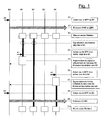
- step E1 the installer activates the means of programming of element B0 consisting of a BPP push button. This support constitutes the action referenced A0. This action triggers a step E2 in which a CMR command called linking is transmitted on the network, accompanied by the address @ B0 of the box B0.
- step E4 the installer presses the push button programming of element B1. This action is referenced A1.
- step E5 This action is interpreted in step E5, as a delete order the link between element B1 and elements B0, B1 and B2.
- this link is deleted, the transmission of the information signal is deactivated and a message can optionally be sent to element B0 to inform him of the removal of the link.
- step E6 the installer presses the push button on programming of element B4. This action is referenced A2.
- this action is interpreted as a creation order of a link between element B4 and elements B0, B2 and B3.
- an information signal of membership of element B4 to the group including the element B0 is activated and a message can possibly be sent to element B0 to inform it of the creation of the link.
- step E8 when all the desired modifications within the group have been carried out, the installer presses the button again programming button for element B0.
- This action referenced A3 is interpreted as the end of a group formation session. She triggers a step E9 during which an end of mode command CFMR learning is issued on the network.
- This method has drawbacks. First, it requires the broadcast a continuous information signal throughout the incorporation session group, which can be long especially when the installation is complex, the multi-storey building and the elements of the network that may be inaccessible. So in the case of elements supplied with energy independently, this prolonged consumption is embarrassing. Then the emission of a signal continuous is problematic when the signal is emitted by the activation of installation equipment. For example, when the signal is a back and forth movement of a motorized roller shutter, the emission prolonged signal may constitute visual and audible disturbance.
- the object of the invention is to provide a method for forming a group of elements in a home automation network overcoming the disadvantages previous and improving the known methods of the prior art.
- the invention proposes a method making it possible not to use energy unnecessarily to signal belonging or not belonging elements to a group and not to cause emission of annoying signals.
- the invention also provides a installation allowing the implementation of such a process.
- the emission of an information signal following an action on the element is a first means of limiting its duration insofar as, unlike the known method of the prior art, the transmission of the signal does not is not done when switching elements in mode learning.
- the element can emit this information signal during a delay. This is a second way to limit the duration resignation.
- the installation according to the invention is characterized in that the memory of each element includes an action detection program on the programming, timing and transmission management means information signal.
- At least one of the elements can present a programming means and / or a physically separate information signal transmission means of the element.
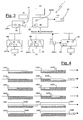
- the installation 1 shown in FIG. 3 mainly comprises elements referenced B0, B1, B2, B3 and B4 linked in a network and allowing to order equipment D0, D1, D2, D3 and D4 of a building.
- Each element includes a push button BPP0, BPP1, BPP2, BPP3 and BPP4 allowing it to go into learning mode and means for transmitting an information signal S0, S1, S2, S3 and S4.
- Each element also includes a memory M0, M1, M2, M3 and M4 presenting in particular a P2 program making it possible to detect actions performed on the push buttons, to manage time delays and transmission of information signals.
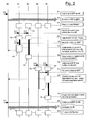
- the first three steps referenced E10 to E12 are identical to steps E1 to E3 described with reference to Figure 1 and allow to initiate a group creation session.
- the various network elements include a P1 subroutine or a functional block capable of recognizing a setting command in CMR learning mode and, once in this mode, to record at least temporarily the address @ B0 accompanying the order RMC. Unlike the known process of the prior art, tilting in the learning mode of each of the elements does not cause transmission of group membership or non-membership signal initial of elements.
- the installer causes actions A11 and A13 on the elements B1 and B2 belonging to the initial group. These actions do not will in principle not be carried out simultaneously.
- the installer normally takes care of one of the elements before taking care of the other.
- step B1 / E21 action A11 causes the activation of a subroutine P2.
- This subroutine tests the existence of a link between element B0 and element B1. After finding the existence of this link and therefore of the membership of element B1 in the group, element B1 activates then a time delay of duration T and emits a signal informing of its belonging to the group. The emission of this signal is represented by a thick black line.
- the installer exercises an A12 action on the BPP push button on the front B1 element the expiration of timer T.
- This action leads to a step B1 / E23, during which a P3 subroutine is activated and interpret this action as a delete link command existing between element B1 and the group.
- a link is deleted, i.e. once the element B1 has been excluded from the group, the transmission of the signal information is disabled.
- a message can possibly be addressed to element B0 to inform it of the removal of the link. This message can be used by all the elements of the group, or even even by all the elements of the network.
- Element B1 then does not change state until the end of the session. group formation.
- action A13 causes the activation of the subroutine P2.
- This subroutine tests, as seen previously, the existence of a link between element B0 and element B2. After finding the existence of this link and therefore of the belonging of element B2 to group, element B2 then activates a time delay T and sends a signal informing of its membership in the group. The issuance of this signal is represented by a thick black line.
- the timer expires without the installer having taken any action on the BPP push button of element B2. This causes activation a subroutine P4 which ends the transmission of the information signal. No action was detected during the time delay, element B2 is always included in the group. Element B2 does not change then no more status until the end of the group formation session.
- the installer causes actions A14 and A15 on elements B3 and B4 not belonging to the group. These actions do not will in principle not be carried out simultaneously.
- the installer normally takes care of one of the elements before taking care of the other.
- action A14 causes the activation of a subroutine P2.
- This subroutine tests the existence of a link between element B0 and element B3. After noticing the absence of this link and therefore of the non-membership of element B3 in the group, element B3 then activates a time delay T (represented by the rectangle hatched) and emits a signal or does not emit a signal to indicate that it does not belong to the group. No action was detected during the time delay, no change of state of element B3 is carried out. Element B3 remains excluded from the group and does not change state until the end of the group formation session.
- step B4 / E30 action A15 causes the activation of a subroutine P2.
- This subroutine tests the existence of a link between element B0 and element B4. After noticing the absence of this link and therefore of the non-membership of element B4 in the group, element B4 then activates a time delay T and emits a signal or does not emit no signal to indicate that he does not belong to the group.
- the installer exercises action A16 on the button BPP push-button of element B4 before the end of timer T.
- This action leads to a step B4 / E32, during which a subroutine P5 is activated and interprets this action as a command to create a link between element B4 and element B0.
- This action also triggers a timeout.
- Once the link is created that is to say once the element B4 included in the group, the emission of a information signal of the membership of element B4 in the group is activated.
- a message can optionally be sent to element B0 to inform him of the creation of the link. This message can be used by all the elements of the group, or even by all of the network elements.
- step E33 The end of the timer triggered by action A16, leads to the step E33, during which a subroutine finds that none action did come to question the creation of the previous link and which ends the transmission of the information signal.
- Element B4 remains included in the group and no longer changes state until the end of the session group formation.
- the advantage of the process is that it makes it possible to modify several times the statements (included / excluded) of the different elements of the network during a single grouping session, by succession random of the four cases which have just been seen.
- the installer decides to end the constitution session of group by an action A17, which, as in the prior art, gives rise to issuance of a CFMR end of learning mode command.
- element B1 was excluded of the group, element B4 has been integrated into it, element B2 remains in the group and element B3 remains outside the group.
- the implementation of the invention lends itself to numerous variants, in particular depending on whether a means of controlling programming in the form of a momentary push button or maintained, and according to the mode of transmission of information signals selected.
- FIG. 4 illustrates three alternative embodiments of the method, with actions taking place during a group formation session. The time runs on this figure horizontally from left to right.
- each impulse (push-release) button is treated as a single action.
- these actions are represented by narrow white rectangles referenced A101 to A106 and A201 to A206.
- pressing the button is assimilated to a first action (for example A301) while its relaxation is assimilated to a second action (for example A302).
- A301 a first action
- A302 a second action
- the duration of key press is indicated by a rectangle White.
- a first variant is shown on the first two lines of Figure 4.
- the programming means is a push button to fleeting impulses.
- the first line corresponds to the case of an element already belonging to the group when the action on the button takes place BPP pusher.
- An A101 action triggers a time delay T represented by a hatched rectangle and activation of the information signal is represented by a dark gray rectangle. The transmission of the information signal ceases if no new action is detected during time delay T. The element is then always part of the group.
- An action A102 "interrogates" the element again on its state. Of again, time delay T and transmission of the information signal are enabled. However, this time, a new action A103 takes place before the expiration of the timer. This action is then interpreted as a group exclusion command, and the information signal from item membership in the group is disabled. It is possible and at this stage it is also preferable to deactivate timer T. It is however represented here as taking place until its end to show that action A103 takes place before its expiration.
- the second line therefore corresponds to the case where the element does not belong to the group when the action on the BPP button takes place.
- An action A104 triggers a timer T but does not not cause signal transmission. No action taking place during the the element remains excluded from the group.
- Action A105 again triggers the time delay T. This time, action A106 takes place before the timer expires. This action is then interpreted as a command to attach the element to group.
- a link is created between the element and the group and a signal attesting to this creation or belonging to the group is activated.
- the timer T is then deactivated and a new timer T 'is activated. The element is thus found after action A106 in a state comparable to that appearing after the action A101.
- An A201 action is applied to an element already belonging to the group. There is therefore signaling, for a duration T 'and “listening" for a duration T here greater than T '. Since no action is taken applied during the listening time, the element remains in its state belonging to the group.
- the element During an A202 action, the element emits a signal again information for a period T '. This time, an A203 action takes place during the listening time T. This action is interpreted as a exclusion order and the communication link allowing attaching the item to the group is deleted.
- next action A206 takes place during the listening delay T and is therefore interpreted as a order of attachment of the element to the group. This action A206 provokes the learning of a communication link and a new time delay T 'during which an information signal is sent
- the previous timer T is then deactivated, and a new timer T is activated, so that the situation after action A206 becomes identical to that after action A201.
- a third variant is illustrated in the last two lines.
- a programming means such as a push button allowing sustained impulses, resuming the case of transmission of a "long" information signal, of course remaining very short compared to the prior art.
- An A301 action is applied to an element already belonging to the group. This action triggers a time delay T and activation of the signal testifying to the element's belonging to the group. If the push button is released during the time delay (action A302), this action is interpreted as a confirmation of belonging.
- the signal emission may be extended by activation of a time delay T "following this action.
- Action A305 is now applied to an element that does not part of the group. It causes a time delay T but not signal activation. Releasing the key (action A306) occurring before the end of the timer is interpreted as a confirmation of the item's exclusion status. Based on this situation exclusion, action A307 again causes a timeout "Listening" of duration T. Beyond this duration, an A308 action of release is interpreted as an attachment command.
- Relaxation during the delay could also be considered an order to change the state of the item and the relaxation beyond the time delay as an order to maintain item status.
- the change of state is also possible to provide for the change of state to be here caused by the timeout T being exceeded, in other words, that the group membership signal is activated at the end of this delay.
- T it is also preferred to start a new timer T as soon as the end of T '. If the key is kept pressed for a long time, we pass alternatively from a situation of attachment to a situation exclusion and vice versa. But ultimately, this is the time when the key is released which determines the final state of group membership, depending on whether the key is released during the transmission of a signal membership or exclusion. According to this variant, only the signal is modified after each delay as long as the key remains pressed, and the possible change of state is not recorded until the release of the button.
- the ergonomics of operation can be enhanced by the transmission of an information signal to indicate membership of the element to the group and another information signal allowing to indicate that the element does not belong to the group.
- a light emitting diode displays a green light to testify of group membership and displays an orange light during a timer, to indicate exclusion from the group.
- action is to be interpreted in a sense large.
- absence of action for the duration of the procrastination may constitute an “action” to be interpreted by the element as an order to modify its state of belonging to the group.
Landscapes
- Physics & Mathematics (AREA)
- General Physics & Mathematics (AREA)
- Engineering & Computer Science (AREA)
- Automation & Control Theory (AREA)
- Selective Calling Equipment (AREA)
- Re-Forming, After-Treatment, Cutting And Transporting Of Glass Products (AREA)
- Paper (AREA)
- Non-Silver Salt Photosensitive Materials And Non-Silver Salt Photography (AREA)
- Glass Compositions (AREA)
- Silicon Compounds (AREA)
- Air Conditioning Control Device (AREA)
- Small-Scale Networks (AREA)
Abstract
Description
- une première action exercée sur l'un des éléments est interprétée comme une interrogation concernant son état d'appartenance au groupe (inclus - exclu) et déclenche l'émission d'un signal d'information de son état, et
- une action suivante exercée sur cet élément est interprétable comme un ordre de modification de son état d'appartenance au groupe.
Claims (9)
- Procédé de constitution d'un groupe d'éléments (B0, B1, B2, B3, B4) reliés en réseau et commandant des équipements (D0, D1, D2, D3, D4) d'un bâtiment, caractérisé en ce que lorsque les éléments sont dans un mode d'apprentissage,une première action exercée sur l'un des éléments est interprétée comme une interrogation concernant son état d'appartenance au groupe (inclus - exclu) et déclenche l'émission d'un signal d'information de son état, etune action suivante exercée sur cet élément est interprétable comme un ordre de modification de son état d'appartenance au groupe.
- Procédé de constitution d'un groupe d'éléments selon la revendication 1, caractérisé en ce que l'élément émet ce signal d'information pendant une temporisation (T').
- Procédé de constitution d'un groupe d'éléments selon l'une quelconque des revendications 1 à 2, caractérisé en ce que la première action déclenche une temporisation (T) durant laquelle la ou les actions suivantes exercées sur l'élément sont interprétées par l'élément comme un ordre de modification de son état d'appartenance au groupe.
- Procédé de constitution d'un groupe d'éléments selon l'une quelconque des revendications 1 à 3, caractérisé en ce que la ou les actions suivantes, interprétées par l'élément comme un ordre de modification de son état d'appartenance au groupe, déclenchent une temporisation (T") durant laquelle l'élément émet un signal d'information de son état d'appartenance au groupe.
- Procédé de constitution d'un groupe d'éléments selon l'une quelconque des revendications 1 à 4, caractérisé en ce que la ou les actions suivantes, interprétées par l'élément comme un ordre de modification de son état d'appartenance au groupe, déclenchent une temporisation durant laquelle la ou les actions exercées sur l'élément sont interprétées par l'élément comme un ordre de modification de son état d'appartenance au groupe.
- Procédé de constitution d'un groupe d'éléments selon l'une quelconque des revendications 1 à 5, caractérisé en ce que la ou les actions suivantes exercées sur l'élément, non interprétées par l'élément comme un ordre de modification de son état d'appartenance au groupe, sont interprétées comme une première action exercée sur l'élément.
- Procédé selon l'une des revendications précédentes, caractérisé en ce que l'action exercée sur un élément consiste en une impulsion provoquée manuellement sur un moyen de programmation (BPP0, BPP1, BPP2, BPP3, BPP4) relatif à cet élément.
- Installation (1) comprenant des équipements (D0, D1, D2, D3, D4) d'un bâtiment commandés par des éléments (B0, B1, B2, B3, B4) reliés en réseau, destinée à mettre en oeuvre le procédé selon l'une des revendications précédentes, chaque élément comprenant un moyen de programmation (BPP0, BPP1, BPP2, BPP3, BPP4), un moyen d'émission de signal d'information (S0, S1, S2, S3, S4), une mémoire (M0, M1, M2, M3, M4) contenant un programme (P1) de détection de commande de mise en mode d'apprentissage et un programme (P7) de détection de fin de mise en mode d'apprentissage, caractérisée en ce que la mémoire de chaque élément comprend un programme (P2) de détection d'action sur le moyen de programmation, de gestion de temporisation et d'émission d'un signal d'information.
- Installation selon la revendication 6, caractérisée en ce qu'au moins un des éléments présente un moyen de programmation (BPP3) et/ou un moyen d'émission de signal d'information (S2) physiquement séparé de l'élément.
Applications Claiming Priority (2)
| Application Number | Priority Date | Filing Date | Title |
|---|---|---|---|
| FR0304638A FR2853736B1 (fr) | 2003-04-14 | 2003-04-14 | Procede de constitution d'un groupe d'elements dans un reseau domotique |
| FR0304638 | 2003-04-14 |
Publications (2)
| Publication Number | Publication Date |
|---|---|
| EP1469364A1 true EP1469364A1 (fr) | 2004-10-20 |
| EP1469364B1 EP1469364B1 (fr) | 2008-05-14 |
Family
ID=32893354
Family Applications (1)
| Application Number | Title | Priority Date | Filing Date |
|---|---|---|---|
| EP04008312A Expired - Lifetime EP1469364B1 (fr) | 2003-04-14 | 2004-04-06 | Procédé de constitution d'un groupe d'éléments dans un réseau domotique |
Country Status (7)
| Country | Link |
|---|---|
| US (1) | US20040230838A1 (fr) |
| EP (1) | EP1469364B1 (fr) |
| JP (1) | JP2004320773A (fr) |
| AT (1) | ATE395647T1 (fr) |
| DE (1) | DE602004013669D1 (fr) |
| ES (1) | ES2226607T1 (fr) |
| FR (1) | FR2853736B1 (fr) |
Families Citing this family (3)
| Publication number | Priority date | Publication date | Assignee | Title |
|---|---|---|---|---|
| US7274975B2 (en) | 2005-06-06 | 2007-09-25 | Gridpoint, Inc. | Optimized energy management system |
| US8103389B2 (en) | 2006-05-18 | 2012-01-24 | Gridpoint, Inc. | Modular energy control system |
| US7769842B2 (en) * | 2006-08-08 | 2010-08-03 | Endl Texas, Llc | Storage management unit to configure zoning, LUN masking, access controls, or other storage area network parameters |
Citations (3)
| Publication number | Priority date | Publication date | Assignee | Title |
|---|---|---|---|---|
| EP0495397A2 (fr) * | 1991-01-17 | 1992-07-22 | Moulinex | Procédé d'attribution d'adresses dans un réseau domotique |
| FR2755259A1 (fr) * | 1996-10-25 | 1998-04-30 | Somfy | Procede de mise en correspondance d'un boitier de commande de groupe avec un boitier de commande et/ou un boitier d'action et/ou un boitier de mesure |
| US5844888A (en) * | 1987-11-10 | 1998-12-01 | Echelon Corporation | Network and intelligent cell for providing sensing, bidirectional communications and control |
Family Cites Families (5)
| Publication number | Priority date | Publication date | Assignee | Title |
|---|---|---|---|---|
| US6061332A (en) * | 1996-06-25 | 2000-05-09 | Mci Communications Corporation | System and method for the automated configuration of network elements in a telecommunications network |
| US6574234B1 (en) * | 1997-09-05 | 2003-06-03 | Amx Corporation | Method and apparatus for controlling network devices |
| US6879806B2 (en) * | 2001-06-01 | 2005-04-12 | Zensys A/S | System and a method for building routing tables and for routing signals in an automation system |
| US6706828B2 (en) * | 2002-06-04 | 2004-03-16 | Crompton Corporation | Process for the oligomerization of α-olefins having low unsaturation |
| EP1420598B1 (fr) * | 2002-11-12 | 2007-08-08 | Alcatel Lucent | Reconfiguration rapide des éléments de réseau |
-
2003
- 2003-04-14 FR FR0304638A patent/FR2853736B1/fr not_active Expired - Fee Related
-
2004
- 2004-04-02 US US10/817,076 patent/US20040230838A1/en not_active Abandoned
- 2004-04-06 AT AT04008312T patent/ATE395647T1/de not_active IP Right Cessation
- 2004-04-06 ES ES04008312T patent/ES2226607T1/es active Pending
- 2004-04-06 DE DE602004013669T patent/DE602004013669D1/de not_active Expired - Lifetime
- 2004-04-06 EP EP04008312A patent/EP1469364B1/fr not_active Expired - Lifetime
- 2004-04-14 JP JP2004119131A patent/JP2004320773A/ja active Pending
Patent Citations (3)
| Publication number | Priority date | Publication date | Assignee | Title |
|---|---|---|---|---|
| US5844888A (en) * | 1987-11-10 | 1998-12-01 | Echelon Corporation | Network and intelligent cell for providing sensing, bidirectional communications and control |
| EP0495397A2 (fr) * | 1991-01-17 | 1992-07-22 | Moulinex | Procédé d'attribution d'adresses dans un réseau domotique |
| FR2755259A1 (fr) * | 1996-10-25 | 1998-04-30 | Somfy | Procede de mise en correspondance d'un boitier de commande de groupe avec un boitier de commande et/ou un boitier d'action et/ou un boitier de mesure |
Also Published As
| Publication number | Publication date |
|---|---|
| ES2226607T1 (es) | 2005-04-01 |
| JP2004320773A (ja) | 2004-11-11 |
| DE602004013669D1 (de) | 2008-06-26 |
| FR2853736B1 (fr) | 2005-06-03 |
| FR2853736A1 (fr) | 2004-10-15 |
| EP1469364B1 (fr) | 2008-05-14 |
| ATE395647T1 (de) | 2008-05-15 |
| US20040230838A1 (en) | 2004-11-18 |
Similar Documents
| Publication | Publication Date | Title |
|---|---|---|
| EP2009527B1 (fr) | Procédé de configuration d'un system d'entraînement d'un écran de fermeture, de protection solaire ou de projection | |
| EP2259242B1 (fr) | Procédé de communication par relais entre une télécommande nomade et des équipements domotiques. | |
| EP2083408B1 (fr) | Procédé de communication d'informations par rayons infrarouges entre un émetteur et un récepteur dans un réseau domotique | |
| FR3018110B1 (fr) | Table de cuisson a induction communicante et procede de recherche et de suivi d'un article culinaire communicant sur ladite table | |
| EP1410360B1 (fr) | Procede d'appariement d'emetteur et de recepteur | |
| FR2537366A1 (fr) | Procede et dispositif destines a eviter des interferences entre des installations voisines | |
| EP1469364B1 (fr) | Procédé de constitution d'un groupe d'éléments dans un réseau domotique | |
| EP1873972B1 (fr) | Procédé de communication dans une installation domotique | |
| FR2684785A1 (fr) | Dispositif de generation de signalisation sonore pour pietons. | |
| CA3021300A1 (fr) | Appareil de cuisson et procede d'utilisation de l'appareil de cuisson | |
| FR2604047A1 (fr) | Reseau pour la transmission de donnees et d'energie notamment pour des systemes de mesure, de commande et de regulation, et circuit utilisateur raccorde a un tel reseau | |
| JP2000228138A5 (fr) | ||
| EP0616451B1 (fr) | Procédé et installation d'attribution d'adresse de sous-réseau | |
| EP0570281A1 (fr) | Procédé et dispositif d'enregistrement et de reproduction d'états complexes dans un ensemble d'équipements, par exemple dans un local, et installation s'y rapportant | |
| EP1527377B1 (fr) | Procede d'appariement entre un emetteur d'ordres et un recepteur d'ordres | |
| FR2902916A1 (fr) | Procede de communication dans une installattion domotique. | |
| EP2767640B1 (fr) | Dispositif pour commander électroniquement le rinçage d'un urinoir. | |
| EP3423905B1 (fr) | Procédé de pilotage d'une installation domotique | |
| EP0524036B1 (fr) | Procédé pour désigner un objet fonctionnel distant dans un réseau et unités fonctionnelles | |
| FR2919097A1 (fr) | Procede de fonctionnement d'un emetteur d'ordres dans une installation domotique et emetteur d'ordres pour sa mise en oeuvre | |
| EP1499154A1 (fr) | Procédé de communication radiofréquence bidirectionnel entre plusieurs modules d'un système | |
| FR2689259A1 (fr) | Procédé d'attribution automatique d'adresses dans un réseau, procédé de mise en correspondance, appareil et installation s'y rapportant. | |
| FR2994311A1 (fr) | Affichage econome en energie de l'etat du module domotique | |
| FR3078413A1 (fr) | Procede de fonctionnement d’un module de commande d’une charge electrique | |
| FR2863402A1 (fr) | Procede et dispositif de surveillance et de securite d'une minuterie |
Legal Events
| Date | Code | Title | Description |
|---|---|---|---|
| PUAI | Public reference made under article 153(3) epc to a published international application that has entered the european phase |
Free format text: ORIGINAL CODE: 0009012 |
|
| AK | Designated contracting states |
Kind code of ref document: A1 Designated state(s): AT BE BG CH CY CZ DE DK EE ES FI FR GB GR HU IE IT LI LU MC NL PL PT RO SE SI SK TR |
|
| AX | Request for extension of the european patent |
Extension state: AL HR LT LV MK |
|
| RAP1 | Party data changed (applicant data changed or rights of an application transferred) |
Owner name: SOMFY SAS |
|
| 17P | Request for examination filed |
Effective date: 20050322 |
|
| AKX | Designation fees paid |
Designated state(s): AT BE BG CH CY CZ DE DK EE ES FI FR GB GR HU IE IT LI LU MC NL PL PT RO SE SI SK TR |
|
| RAP1 | Party data changed (applicant data changed or rights of an application transferred) |
Owner name: SIMU |
|
| GRAP | Despatch of communication of intention to grant a patent |
Free format text: ORIGINAL CODE: EPIDOSNIGR1 |
|
| GRAS | Grant fee paid |
Free format text: ORIGINAL CODE: EPIDOSNIGR3 |
|
| GRAA | (expected) grant |
Free format text: ORIGINAL CODE: 0009210 |
|
| AK | Designated contracting states |
Kind code of ref document: B1 Designated state(s): AT BE BG CH CY CZ DE DK EE ES FI FR GB GR HU IE IT LI LU MC NL PL PT RO SE SI SK TR |
|
| REG | Reference to a national code |
Ref country code: GB Ref legal event code: FG4D Free format text: NOT ENGLISH |
|
| REG | Reference to a national code |
Ref country code: CH Ref legal event code: EP |
|
| REG | Reference to a national code |
Ref country code: IE Ref legal event code: FG4D |
|
| REF | Corresponds to: |
Ref document number: 602004013669 Country of ref document: DE Date of ref document: 20080626 Kind code of ref document: P |
|
| PG25 | Lapsed in a contracting state [announced via postgrant information from national office to epo] |
Ref country code: SI Free format text: LAPSE BECAUSE OF FAILURE TO SUBMIT A TRANSLATION OF THE DESCRIPTION OR TO PAY THE FEE WITHIN THE PRESCRIBED TIME-LIMIT Effective date: 20080514 |
|
| PG25 | Lapsed in a contracting state [announced via postgrant information from national office to epo] |
Ref country code: FI Free format text: LAPSE BECAUSE OF FAILURE TO SUBMIT A TRANSLATION OF THE DESCRIPTION OR TO PAY THE FEE WITHIN THE PRESCRIBED TIME-LIMIT Effective date: 20080514 Ref country code: ES Free format text: LAPSE BECAUSE OF FAILURE TO SUBMIT A TRANSLATION OF THE DESCRIPTION OR TO PAY THE FEE WITHIN THE PRESCRIBED TIME-LIMIT Effective date: 20080825 |
|
| PG25 | Lapsed in a contracting state [announced via postgrant information from national office to epo] |
Ref country code: AT Free format text: LAPSE BECAUSE OF FAILURE TO SUBMIT A TRANSLATION OF THE DESCRIPTION OR TO PAY THE FEE WITHIN THE PRESCRIBED TIME-LIMIT Effective date: 20080514 Ref country code: PL Free format text: LAPSE BECAUSE OF FAILURE TO SUBMIT A TRANSLATION OF THE DESCRIPTION OR TO PAY THE FEE WITHIN THE PRESCRIBED TIME-LIMIT Effective date: 20080514 |
|
| REG | Reference to a national code |
Ref country code: IE Ref legal event code: FD4D |
|
| PG25 | Lapsed in a contracting state [announced via postgrant information from national office to epo] |
Ref country code: SE Free format text: LAPSE BECAUSE OF FAILURE TO SUBMIT A TRANSLATION OF THE DESCRIPTION OR TO PAY THE FEE WITHIN THE PRESCRIBED TIME-LIMIT Effective date: 20080814 Ref country code: IE Free format text: LAPSE BECAUSE OF FAILURE TO SUBMIT A TRANSLATION OF THE DESCRIPTION OR TO PAY THE FEE WITHIN THE PRESCRIBED TIME-LIMIT Effective date: 20080514 Ref country code: CZ Free format text: LAPSE BECAUSE OF FAILURE TO SUBMIT A TRANSLATION OF THE DESCRIPTION OR TO PAY THE FEE WITHIN THE PRESCRIBED TIME-LIMIT Effective date: 20080514 Ref country code: DK Free format text: LAPSE BECAUSE OF FAILURE TO SUBMIT A TRANSLATION OF THE DESCRIPTION OR TO PAY THE FEE WITHIN THE PRESCRIBED TIME-LIMIT Effective date: 20080514 Ref country code: PT Free format text: LAPSE BECAUSE OF FAILURE TO SUBMIT A TRANSLATION OF THE DESCRIPTION OR TO PAY THE FEE WITHIN THE PRESCRIBED TIME-LIMIT Effective date: 20081014 |
|
| PG25 | Lapsed in a contracting state [announced via postgrant information from national office to epo] |
Ref country code: SK Free format text: LAPSE BECAUSE OF FAILURE TO SUBMIT A TRANSLATION OF THE DESCRIPTION OR TO PAY THE FEE WITHIN THE PRESCRIBED TIME-LIMIT Effective date: 20080514 Ref country code: RO Free format text: LAPSE BECAUSE OF FAILURE TO SUBMIT A TRANSLATION OF THE DESCRIPTION OR TO PAY THE FEE WITHIN THE PRESCRIBED TIME-LIMIT Effective date: 20080514 |
|
| PLBE | No opposition filed within time limit |
Free format text: ORIGINAL CODE: 0009261 |
|
| STAA | Information on the status of an ep patent application or granted ep patent |
Free format text: STATUS: NO OPPOSITION FILED WITHIN TIME LIMIT |
|
| 26N | No opposition filed |
Effective date: 20090217 |
|
| PG25 | Lapsed in a contracting state [announced via postgrant information from national office to epo] |
Ref country code: EE Free format text: LAPSE BECAUSE OF FAILURE TO SUBMIT A TRANSLATION OF THE DESCRIPTION OR TO PAY THE FEE WITHIN THE PRESCRIBED TIME-LIMIT Effective date: 20080514 Ref country code: BG Free format text: LAPSE BECAUSE OF FAILURE TO SUBMIT A TRANSLATION OF THE DESCRIPTION OR TO PAY THE FEE WITHIN THE PRESCRIBED TIME-LIMIT Effective date: 20080814 |
|
| PG25 | Lapsed in a contracting state [announced via postgrant information from national office to epo] |
Ref country code: IT Free format text: LAPSE BECAUSE OF FAILURE TO SUBMIT A TRANSLATION OF THE DESCRIPTION OR TO PAY THE FEE WITHIN THE PRESCRIBED TIME-LIMIT Effective date: 20080514 |
|
| REG | Reference to a national code |
Ref country code: CH Ref legal event code: PL |
|
| GBPC | Gb: european patent ceased through non-payment of renewal fee |
Effective date: 20090406 |
|
| PG25 | Lapsed in a contracting state [announced via postgrant information from national office to epo] |
Ref country code: CH Free format text: LAPSE BECAUSE OF NON-PAYMENT OF DUE FEES Effective date: 20090430 Ref country code: LI Free format text: LAPSE BECAUSE OF NON-PAYMENT OF DUE FEES Effective date: 20090430 |
|
| PG25 | Lapsed in a contracting state [announced via postgrant information from national office to epo] |
Ref country code: GB Free format text: LAPSE BECAUSE OF NON-PAYMENT OF DUE FEES Effective date: 20090406 Ref country code: MC Free format text: LAPSE BECAUSE OF NON-PAYMENT OF DUE FEES Effective date: 20090430 |
|
| PGFP | Annual fee paid to national office [announced via postgrant information from national office to epo] |
Ref country code: NL Payment date: 20100318 Year of fee payment: 7 |
|
| PG25 | Lapsed in a contracting state [announced via postgrant information from national office to epo] |
Ref country code: GR Free format text: LAPSE BECAUSE OF FAILURE TO SUBMIT A TRANSLATION OF THE DESCRIPTION OR TO PAY THE FEE WITHIN THE PRESCRIBED TIME-LIMIT Effective date: 20080815 |
|
| PGFP | Annual fee paid to national office [announced via postgrant information from national office to epo] |
Ref country code: BE Payment date: 20100519 Year of fee payment: 7 |
|
| PG25 | Lapsed in a contracting state [announced via postgrant information from national office to epo] |
Ref country code: LU Free format text: LAPSE BECAUSE OF NON-PAYMENT OF DUE FEES Effective date: 20090406 |
|
| PG25 | Lapsed in a contracting state [announced via postgrant information from national office to epo] |
Ref country code: HU Free format text: LAPSE BECAUSE OF FAILURE TO SUBMIT A TRANSLATION OF THE DESCRIPTION OR TO PAY THE FEE WITHIN THE PRESCRIBED TIME-LIMIT Effective date: 20081115 |
|
| PG25 | Lapsed in a contracting state [announced via postgrant information from national office to epo] |
Ref country code: TR Free format text: LAPSE BECAUSE OF FAILURE TO SUBMIT A TRANSLATION OF THE DESCRIPTION OR TO PAY THE FEE WITHIN THE PRESCRIBED TIME-LIMIT Effective date: 20080514 |
|
| PG25 | Lapsed in a contracting state [announced via postgrant information from national office to epo] |
Ref country code: CY Free format text: LAPSE BECAUSE OF FAILURE TO SUBMIT A TRANSLATION OF THE DESCRIPTION OR TO PAY THE FEE WITHIN THE PRESCRIBED TIME-LIMIT Effective date: 20080514 |
|
| BERE | Be: lapsed |
Owner name: SIMU Effective date: 20110430 |
|
| REG | Reference to a national code |
Ref country code: NL Ref legal event code: V1 Effective date: 20111101 |
|
| PG25 | Lapsed in a contracting state [announced via postgrant information from national office to epo] |
Ref country code: NL Free format text: LAPSE BECAUSE OF NON-PAYMENT OF DUE FEES Effective date: 20111101 Ref country code: BE Free format text: LAPSE BECAUSE OF NON-PAYMENT OF DUE FEES Effective date: 20110430 |
|
| PGFP | Annual fee paid to national office [announced via postgrant information from national office to epo] |
Ref country code: FR Payment date: 20140415 Year of fee payment: 11 Ref country code: DE Payment date: 20140428 Year of fee payment: 11 |
|
| REG | Reference to a national code |
Ref country code: DE Ref legal event code: R119 Ref document number: 602004013669 Country of ref document: DE |
|
| PG25 | Lapsed in a contracting state [announced via postgrant information from national office to epo] |
Ref country code: DE Free format text: LAPSE BECAUSE OF NON-PAYMENT OF DUE FEES Effective date: 20151103 |
|
| REG | Reference to a national code |
Ref country code: FR Ref legal event code: ST Effective date: 20151231 |
|
| PG25 | Lapsed in a contracting state [announced via postgrant information from national office to epo] |
Ref country code: FR Free format text: LAPSE BECAUSE OF NON-PAYMENT OF DUE FEES Effective date: 20150430 |