EP1469103A2 - Gaskets for use with electrode structures - Google Patents
Gaskets for use with electrode structures Download PDFInfo
- Publication number
- EP1469103A2 EP1469103A2 EP03021287A EP03021287A EP1469103A2 EP 1469103 A2 EP1469103 A2 EP 1469103A2 EP 03021287 A EP03021287 A EP 03021287A EP 03021287 A EP03021287 A EP 03021287A EP 1469103 A2 EP1469103 A2 EP 1469103A2
- Authority
- EP
- European Patent Office
- Prior art keywords
- gasket
- anode
- cathode
- pan
- electrode
- Prior art date
- Legal status (The legal status is an assumption and is not a legal conclusion. Google has not performed a legal analysis and makes no representation as to the accuracy of the status listed.)
- Withdrawn
Links
Images



Classifications
-
- F—MECHANICAL ENGINEERING; LIGHTING; HEATING; WEAPONS; BLASTING
- F16—ENGINEERING ELEMENTS AND UNITS; GENERAL MEASURES FOR PRODUCING AND MAINTAINING EFFECTIVE FUNCTIONING OF MACHINES OR INSTALLATIONS; THERMAL INSULATION IN GENERAL
- F16J—PISTONS; CYLINDERS; SEALINGS
- F16J15/00—Sealings
- F16J15/02—Sealings between relatively-stationary surfaces
- F16J15/06—Sealings between relatively-stationary surfaces with solid packing compressed between sealing surfaces
- F16J15/10—Sealings between relatively-stationary surfaces with solid packing compressed between sealing surfaces with non-metallic packing
- F16J15/104—Sealings between relatively-stationary surfaces with solid packing compressed between sealing surfaces with non-metallic packing characterised by structure
-
- C—CHEMISTRY; METALLURGY
- C25—ELECTROLYTIC OR ELECTROPHORETIC PROCESSES; APPARATUS THEREFOR
- C25B—ELECTROLYTIC OR ELECTROPHORETIC PROCESSES FOR THE PRODUCTION OF COMPOUNDS OR NON-METALS; APPARATUS THEREFOR
- C25B11/00—Electrodes; Manufacture thereof not otherwise provided for
- C25B11/02—Electrodes; Manufacture thereof not otherwise provided for characterised by shape or form
- C25B11/036—Bipolar electrodes
-
- C—CHEMISTRY; METALLURGY
- C25—ELECTROLYTIC OR ELECTROPHORETIC PROCESSES; APPARATUS THEREFOR
- C25B—ELECTROLYTIC OR ELECTROPHORETIC PROCESSES FOR THE PRODUCTION OF COMPOUNDS OR NON-METALS; APPARATUS THEREFOR
- C25B9/00—Cells or assemblies of cells; Constructional parts of cells; Assemblies of constructional parts, e.g. electrode-diaphragm assemblies; Process-related cell features
- C25B9/70—Assemblies comprising two or more cells
- C25B9/73—Assemblies comprising two or more cells of the filter-press type
- C25B9/75—Assemblies comprising two or more cells of the filter-press type having bipolar electrodes
-
- C—CHEMISTRY; METALLURGY
- C25—ELECTROLYTIC OR ELECTROPHORETIC PROCESSES; APPARATUS THEREFOR
- C25B—ELECTROLYTIC OR ELECTROPHORETIC PROCESSES FOR THE PRODUCTION OF COMPOUNDS OR NON-METALS; APPARATUS THEREFOR
- C25B9/00—Cells or assemblies of cells; Constructional parts of cells; Assemblies of constructional parts, e.g. electrode-diaphragm assemblies; Process-related cell features
- C25B9/70—Assemblies comprising two or more cells
- C25B9/73—Assemblies comprising two or more cells of the filter-press type
- C25B9/77—Assemblies comprising two or more cells of the filter-press type having diaphragms
-
- H—ELECTRICITY
- H01—ELECTRIC ELEMENTS
- H01M—PROCESSES OR MEANS, e.g. BATTERIES, FOR THE DIRECT CONVERSION OF CHEMICAL ENERGY INTO ELECTRICAL ENERGY
- H01M8/00—Fuel cells; Manufacture thereof
- H01M8/02—Details
- H01M8/0271—Sealing or supporting means around electrodes, matrices or membranes
- H01M8/0273—Sealing or supporting means around electrodes, matrices or membranes with sealing or supporting means in the form of a frame
-
- Y—GENERAL TAGGING OF NEW TECHNOLOGICAL DEVELOPMENTS; GENERAL TAGGING OF CROSS-SECTIONAL TECHNOLOGIES SPANNING OVER SEVERAL SECTIONS OF THE IPC; TECHNICAL SUBJECTS COVERED BY FORMER USPC CROSS-REFERENCE ART COLLECTIONS [XRACs] AND DIGESTS
- Y02—TECHNOLOGIES OR APPLICATIONS FOR MITIGATION OR ADAPTATION AGAINST CLIMATE CHANGE
- Y02E—REDUCTION OF GREENHOUSE GAS [GHG] EMISSIONS, RELATED TO ENERGY GENERATION, TRANSMISSION OR DISTRIBUTION
- Y02E60/00—Enabling technologies; Technologies with a potential or indirect contribution to GHG emissions mitigation
- Y02E60/30—Hydrogen technology
- Y02E60/50—Fuel cells
-
- Y—GENERAL TAGGING OF NEW TECHNOLOGICAL DEVELOPMENTS; GENERAL TAGGING OF CROSS-SECTIONAL TECHNOLOGIES SPANNING OVER SEVERAL SECTIONS OF THE IPC; TECHNICAL SUBJECTS COVERED BY FORMER USPC CROSS-REFERENCE ART COLLECTIONS [XRACs] AND DIGESTS
- Y02—TECHNOLOGIES OR APPLICATIONS FOR MITIGATION OR ADAPTATION AGAINST CLIMATE CHANGE
- Y02P—CLIMATE CHANGE MITIGATION TECHNOLOGIES IN THE PRODUCTION OR PROCESSING OF GOODS
- Y02P70/00—Climate change mitigation technologies in the production process for final industrial or consumer products
- Y02P70/50—Manufacturing or production processes characterised by the final manufactured product
Definitions
- the present invention relates to electrode structures for use in, for example, bipolar electrolysers, particularly a modular bipolar electrolyser, and also in fuel cells.
- Monopolar filter-press type membrane electrolysers are well known, for example as described in our GB 1,595,183. Such electrolysers are readily made, inexpensive and easily assembled.
- Bipolar electrolysers are known in the art, for example as described in our GB 1,581,348.
- the bipolar unit comprises an anode which is suitably in the form of a plate of a film-forming metal, usually titanium, the plate carrying an electrocatalytically active coating, for example a platinum group metal oxide, and a cathode which is suitably in the form of a perforated, eg foraminous plate of metal, usually nickel or mild steel, the anode and cathode being electrically conductively bonded to each other to form a bipolar unit.
- anode which is suitably in the form of a plate of a film-forming metal, usually titanium
- the plate carrying an electrocatalytically active coating, for example a platinum group metal oxide
- a cathode which is suitably in the form of a perforated, eg foraminous plate of metal, usually nickel or mild steel, the anode and cathode being electrically conductively bonded to each other to form a bipolar unit.
- Separators are positioned between successive bipolar units arranged in series in the electrolyser so that the anode of one bipolar unit faces the cathode of the adjacent bipolar unit with a separator disposed therebetween.
- the electrolyser also comprises terminal anode and cathode units.
- the separators are generally adjacent or even in contact with the cathode and in order to achieve a small anode-cathode gap without at the same time damaging the separator it is necessary to exercise considerable care in order to manufacture electrodes having a suitable degree of flatness and it is also necessary to maintain this flatness during the heat treatment involved in coating the electrode with an electrocatalytically-active coating. Furthermore, great care must be exercised in assembling units in a bipolar electrolyser if damage to the separators is to be avoided.
- US 4,734,180 discloses a bipolar-type electrolyser comprising bipolar units which are arranged back to back with an explosion-bonded titanium-iron plate disposed therebetween and in which conductive ribs are welded to the electrode and to the pan-shaped body
- US 5,225,060 discloses that the formation of gas zones in the upper portions of anode and cathode structures of the bipolar electrolyser described therein may be prevented by the use of non-current-flowing space in the upper portion of the structures.
- EP 0,704,556 discloses that the provision of gas-liquid separators at the top of the anode and cathode structures of the bipolar electrolyser described therein minimises pressure fluctuations, membrane deterioration and voltage variation.
- WO 98/55670 discloses an element for a bipolar electrolyser the two sides of which are formed with flanges and opposed projections.
- the projections are preferably in form of truncated cones and are preferably arranged in the form of centred hexagons to improve lateral mixing of electrolyte.
- vertical mixing is achieved by downcomer ducts which decrease the active area of the electrode thus amplifying the current density variation across the electrode which is a particular problem when operating at high current density with a narrow or zero gap anode/membrane/cathode configuration with impurity-sensitive ion-exchange membranes.
- EP 0 521 386 discloses a bipolar electrolyser comprising electrolytic cell units which comprise electrode partitions with mating recesses and projections with electrode meshes joined directly, or through a spring, to the projections.
- electrolytic cell units which comprise electrode partitions with mating recesses and projections with electrode meshes joined directly, or through a spring, to the projections.
- a stack of such upright electrolytic cell units are joined in series with an ion exchange membrane between adjacent electrolytic cell units to form an electrolytic cell assembly.
- the recesses and projections ensure good lateral mixing of the electrolyte, vertical mixing is poor. Accordingly, to maintain concentration and temperature variation in the cell units within acceptable limits, energy-intensive pumped external recirculation is necessary with additional expensive pipework and tanks.
- an electrode structure for a bipolar electrolyser which allows very small or even zero anode/cathode gaps to be used in such electrolysers without damage to the separator, which minimises electrical resistance by using a short perpendicular current-carrying path length between electrodes and low resistance materials for almost the entire perpendicular current-carrying path length and which affords excellent current distribution throughout the electrode area .
- the electrode structure permits both horizontal and vertical flow of liquors therein aiding circulation and mixing thereof and has improved rigidity and strength which allows closer tolerance to be achieved in cell construction.
- the electrode structure is of simple construction and easy to fabricate.
- an electrode structure for use, for example, in a bipolar electrolyser comprising
- the electrically conductive plate is desirably a metal or alloy as is hereinafter more fully described. It will in general be of the same material as that of the pan.
- the electrically conductive plate may be made of a valve metal or an alloy thereof consisting principally of a valve metal.
- the electrically conductive plate may be, for example, stainless steel, mild steel, nickel or copper.
- the electrically conductive plate is an anode for use in brine electrolysis it will bear an electrocatalytically-active coating.
- the electrically conductive plate may have any suitable structure as is hereinafter more fully described.
- the precise structure is not critical.
- the electrically conductive plate is preferably flexible.
- each projection in the dished recess is electroconductively connected to an electrically conductive member such that the projections provide many current feed-points hence improving current distribution across the pan leading to lower voltage, lower power consumption and longer separator and electrode coating lives.
- the projections in the dished recess are preferably spaced apart from each other in a first direction and in a direction transverse to the first direction. More preferably the projections are symmetrically spaced apart. For example, they may be spaced apart by an equal distance in a first direction, and spaced apart by an equal distance, which may be the same, in a direction transverse, for example substantially at right angles, to the first direction. Preferably the spacing apart of the projections is the same in both directions.
- the projections in the dished recess may have a variety of shapes, for example dome, bowl, conical or preferably frusto-conical.
- methods of forming the projections may be mentioned inter alia vacuum forming, explosion forming, pressing or preferably by the application of a suitably shaped tool to the opposite surface of the recess.
- the height of the projections from the plane of the dished recess may for example be in the range 0.5-8 cms, preferably 1-4 cms, depending on the depth of the pan.
- the distance between adjacent projections on the recessed dish may for example be 1-30 cms centre to centre, preferably 5-20 cms.
- the dimensions of the electrode structure in the direction of current flow are preferably in the range 1-6 cm as measured from the electrically conductive plate to the base of the pan in order to provide short current paths which ensure low voltage drops in the electrode structure without the use of elaborate current carrying devices
- the electrically-conductive members to which the electrically conductive plate is electroconductively attached in the electrode structure preferably comprise posts.
- the electrically-conductive member to which the electrically-conductive plate is attached is in the form of a post and is electrically connected to an inwardly projecting projection in the dished recess of the pan the length of the current pathway between the electrically conductive plate and the pan may be minimised.
- the length of the electrically conductive pathway through the cathode-post is preferably greater than the length of the electrically conductive pathway through the anode post.
- the ratio of the length of the electrically conductive pathway through the cathode post to the length of the electrically conductive pathway through the anode post is at least 2: 1, preferably at least 4:1 and more preferably at least 7:1. Typically the ratio is at least 10:1.
- the length of the posts depends on the electrolyser design and whether the post is associated with an anode plate or a cathode plate. Typically the post length may be in the range of 0 to 10 cm, preferably 0 to 4 cm. Where the length is zero, it will be understood that the invention envisages a modified arrangement in which the electrically conductive plate, when intended to function as an anode plate , may be directly electrically connected to the associated pan or alternatively connected thereto through a current carrier as defined below.
- each post is preferably provided with a current-carrier, eg a ring, mesh, or wire-wool, adjacent the electrically conductive plate to make multi-point electrical contact therewith.
- a current-carrier eg a ring, mesh, or wire-wool
- the current-carrier is a multi-legged current-carrier, hereinafter referred to for convenience as a "spider".
- the electrical connections may be made without using a post; for instance, in the case of an anode structure, the apex of each inwardly directed projection may be electrically connected to the anode plate by means of a current carrier as aforesaid, e.g. a spider.
- spiders increases the number and distribution of current feed points to the electrically conductive plate, hence improving current distribution leading to lower voltage and power consumption and longer life of separators and electrode coatings.
- the length of the legs and the number thereof on the spider, where a spider is present, may vary within wide limits.
- the spider contains between 2 and 100 legs, preferably between 2 and 8 legs.
- each leg is between 1 mm and 200 mm long, preferably between 5 mm and 100 mm long. The skilled man by simple experiment will be able to determine suitable lengths and numbers of spider legs for any particular application.
- a spider may be flexible or rigid.
- the shape and mechanical properties of the spiders in the anode structure may be the same as or different from the shape and mechanical properties of the spiders in the cathode structure. For example, relatively non-springy spiders with short legs are often preferred in the anode structure and relatively springy spiders with long legs are preferred in the cathode structure.
- zero gap we mean that there is substantially no gap between the electroconductive plate of the each electrode structure and the adjacent separator, i.e. so that adjacent electroconductive plates are in use only separated by the thickness of the separator.
- spring-loaded spiders provide more uniform support for the membrane across a larger area hence reducing movement which could lead to damage of the membrane by, for example, folding, abrasion or the onset of wrinkles.
- a spider is preferably made from the same metal as the electrically conductive plate with which it is in electrical contact.
- a spider is welded to the electrically conductive plate with which it is in electrical contact.
- a spider may be attached to the post by methods known in the art, for example by welding, screw-fixing or push-fit connectors.
- each spider may radiate from a central portion for use in attaching the spider to a post or, in some circumstances, directly to an apex of the associated projection.
- the spider legs may be equiangularly spaced.
- a spider for use in an electrode structure which spider is electroconductively attached to an electrically-conductive member and to an electrically conductive plate such that current distribution to the electrically conductive plate is improved.
- an anode or cathode assembly comprising an electrically conductive plate having attached to one face thereof a plurality of current-distributing spiders each comprising a portion for attachment, in use, to a pan and a number of legs radiating from the attachment portion whereby electrical current supply to the plate takes place through the such legs.
- the post is provided with a current carrier, it may be further provided with an insulating cap on the end thereof adjacent the separator.
- the pan thereof may be bonded back to back to the pan of an electrode structure which is a cathode structure such that the inwardly projecting projections in the pan of the anode structure mate with the outwardly projecting projections on the pan of the cathode structure to form a bipolar unit.
- a bipolar unit wherein the pan of an electrode structure according to the present invention which is an anode structure is bonded to the pan of an electrode structure according to the present invention which is a cathode structure such that the inwardly projecting projections on the pan of the anode structure mate with the outwardly projecting projections on the pan of the cathode structure to form a bipolar unit.
- the electrode structures are pressed or bonded together, preferably by welding, more preferably by explosion bonding, such that electrical contact is made between the dished recesses in the pans thereof.
- a plurality of such bipolar units interspersed with appropriate separators, gaskets and pressing means may be assembled to form a filter-press bipolar electrolyser.
- a filter-press bipolar electrolyser which comprises
- current distributing means is meant systems, normally attached to the inside of the end frames of the electrolyser mounting frame, designed to carry current from a power source such as cellroom power feeder cables or busbars to the pans of the terminal electrodes of a filter press electrolyser or the outside pans of the end modules of the modular electrolyser, such that the current feed is evenly distributed over all the electrical contact points on these pans.
- current distributing means can be single plates or systems of plates cables or wires made from conductive metals.
- they may be fitted with conductivity enhancing coatings, attachments or devices to improve the electrical connection between the current distributing means and the end electrode.
- the terminal electrodes may be permanently attached to the current distributing means for example by welding.
- One preferred form of current distributing means which is particularly useful in the electrolyser of this invention involves a series of copper plates running vertically from the bottom to the top of the electrolyser end frame , the copper plates being electrically linked by all being connected at the bottom to a single horizontal copper bus bar.
- the copper plates At one end of the electrolyser frame, where the copper plates are intended to connect to a pan which is part of an anode structure, they may be fitted with conductive outwardly projecting projections or conductive posts which mate with the inwardly projecting projections of the anode.
- the copper plates are intended to connect to an pan which is part of a cathode structure, they may be flat or they may be fitted with inwardly projecting projections which mate with the outwardly projecting projections of the cathode.
- the copper plates of the current distributing means may be fitted with conductivity enhancing coatings or devices to improve electrical contact with the pan of the electrode structure.
- the terminal electrodes in the filter-press bipolar electrolyser according to the present invention preferably comprise electrode structures according to the present invention.
- the electrode structure according to the present invention provides the ends of a bipolar electrolyser it may be provided with means for feeding electric power thereto.
- this means may comprise a projection which is suitably shaped for attachment to a bus-bar when the electrode structure is assembled into an electrolyser.
- the filter-press bipolar electrolyser according to the present invention comprises up to 300 bipolar units.
- Means to provide a load to hermetically seal filter-press bipolar electrolysers according to the present invention are known to the skilled man.
- Modular bipolar electrolysers are known, for example as described in US 4,108,752 and US 4,664,770.
- Modular bipolar electrolysers have the advantages that a lower compressive load is applied thereto than to conventional bipolar electrolysers since the load is needed to produce only electrical contact between adjacent modules not the sealing of each cell in the electrolyser.
- Use of a lower compressive load eliminates the need for massive end-plates and associated compression systems.
- the use of modules facilitates both the fabrication/assembly and the maintenance of a bipolar electrolyser.
- US 4,108,752 describes a modular bipolar electrolyser comprising a plurality of removable modules.
- Each module comprises a pair of matching pans, each pan having a dished recess and a peripheral flange surrounding the recess, the pans being connected together peripherally at the flanges such that the recess of each pan faces that of the connected pan.
- a generally planar separator is positioned between the pans. The recess of one pan and the corresponding planar side of the separator define a first structure and the recess of the other pan and the opposite side of the separator define a second structure.
- a planar electrode is positioned within each structure parallel to the plane of the separator and electrically and structurally connected to the corresponding pan, for example by posts.
- the bipolar filter-press electrolyser is assembled by aligning a plurality of the modules such that the planar exterior surfaces of the pans are parallel. At least one multi-contact conductive strip is interposed between facing pan surfaces of adjacent modules such that the planar exterior surfaces of the pans are parallel and when the modules are compressed together the conductive strips are sandwiched therebetween to establish a positive electrical contact between adjoining cells at a plurality of points.
- US 4,664,770 describes a module for a modular bipolar electrolyser comprising a housing formed of two structures each having a bottom side extending in a plane parallel to planes including an anode and a cathode.
- the anode and cathode are separated by a membrane and both the anode and the cathode have a plurality of perforated and unperforated sections arranged in parallel.
- a metallic framework pattern reinforcement is positioned between the anode and an adjacent inner surface of the bottom side of one structure and between the cathode and an adjacent inner surface of the bottom side of the other structure.
- a contact strip is attached to an outer surface of each of the bottom sides, the contact strips of adjacent cells being electrically connected.
- a partition membrane extends between the anode and the cathode in each of the modules and gasket means seal the structures to the membrane.
- a module for a modular bipolar electrolyser can be prepared from such electrode structures.
- Such a module is easy to assemble and is particularly easy to mount and co-locate with other modules on an electrolyser frame. Good electrical connection between one module and the next is particularly easily achieved.
- the percentage of membrane area undergoing electrolysis is also significantly improved compared to known modular designs.
- a module for use in a modular bipolar electrolyser comprising
- hybrid module One benefit of the hybrid module is that reduced numbers of lifting operations are required within the operating environment of the cellroom leading to reduced safety risks and less electrolyser downtime for electrode structure or module replacement during maintenance or overhauls.
- the means to apply pressure to the gaskets to hermetically-seal the separator thereto in the module is preferably provided by bolts through holes in the flanges.
- each post is preferably provided with an insulating cap and more preferably a matching hole is formed in the electrically conductive plate, particularly where the electrically conductive plate is in the form of a mesh.
- the insulating cap is preferably in the form of a cushion.
- a modular bipolar electrolyser which comprises one or more modules assembled on a mounting frame in series both mechanically and electrically; and current distribution plates at each end of the electrolyser, characterised in that the modules are modules according to the preferred aspect of the present invention.
- Electrically-insulating, load-transferring cushions are preferably disposed at the ends of the electrically-conductive load-bearing posts adjacent the electrically conductive plate in the modular bipolar electrolyser according to the present invention and, where the posts are load-bearing, at the ends of the posts adjacent the electrically conductive plate in the filter-press bipolar electrolyser according to the present invention.
- Such insulating cushions prevent mechanical damage to the membrane and, since electrolysis does not occur at these points, the membrane does not suffer from any electrolysis damage.
- Such insulating cushions may be made from a non-conductive material which is resistant to the chemical environment within the cell, eg fluoropolymers such as PTFE, FEP, PFA, polypropylene, CPVC and fluoroelastomeric rubbers.
- the cushions may be provided on metal studs which are located between the posts and the electrically conductive plate with the cushion presented towards the separator or membrane.
- the recessed dish of the anode pan of a module and the recessed dish of the cathode pan of an adjacent module are electrically joined, preferably at the apices of the projections.
- Electrical conductivity between adjacent modules in the modular bipolar electrolyser may be achieved by the use of interconnectors or preferably by at least close contact between adjacent modules.
- Electrical conductivity between adjacent modules may be enhanced by the provision of conductivity-enhancing materials or conductivity-enhancing devices on the outer surface of the pans.
- conductivity-enhancing materials may be mentioned inter alia conductive carbon foams, conductive greases and coatings of a high-conductivity metal, eg silver or gold.
- electroconductivity-enhancing devices are used to improve electrical conductivity between adjacent modules.
- electroconductivity-enhancing devices may be mentioned inter alia electrically conductive bimetallic plates welded to the anode, explosion-bonded electrically conductive bimetallic plates, electroconductive metal devices, eg washers, or preferably electroconductive metal devices adapted to (a) abrade or pierce the surface of the pans by cutting or biting through any electrically-insulating coating thereon, eg an oxide layer, and (b) at least inhibit formation of an insulating layer between the device and the surface of the pan
- an electroconductive metal device adapted to (a) abrade or pierce the surface of the pans by cutting or biting through any electrically-insulating coating thereon, eg an oxide layer, and (b) at least inhibit formation of an insulating layer between the device and the surface of the pan (hereinafter referred to for convenience as "abrasion device").
- the abrasion device is provided with one or more projections.
- a star-washer eg provided with 18 projections.
- the abrasion device is provided with not more than six projections. It is often preferred, for mechanical stability during assembly of an electrolyser, that the abrasion device is provided with at least three projections. Preferably such projections are provided on both sides of the abrasion device.
- An abrasion device is preferably disposed in an inwardly projecting projection in the dished recess in the pan of an anode structure to provide electrical contact between the pan and the mating outwardly projecting projection in the dished recess on the pan of a cathode structure.
- Preferably abrasion devices are provided in each inwardly projecting projection in the anode.
- the abrasion device may be made of an electrically conductive material which is hard enough to cut into at least one of the pans of the electrodes structure, particularly a titanium anode, to pierce any oxide coating thereon.
- suitable metals from which such abrasion devices may be prepared may be mentioned inter alia carbon steel, nickel, nickel alloy or preferably a beryllium/copper alloy.
- the abrasion device may be attached to the anode, for example by screwing, welding, or pinning using a metallic, eg Ti, tab.
- a metallic eg Ti, tab.
- such a device is attached such that it is free to rotate at least to a limited extent.
- the abrasion device is preferably re-usable, ie it can be used to make repeated connections without replacement.
- modules and bipolar units in bipolar electrolysers will be chosen by the skilled man in the light of inter alia the required production volume, available power and voltage and certain constraints known to the skilled man.
- a modular bipolar electrolyser according to the present invention comprises 1-300 modules.
- the filter-press and the modular bipolar electrolysers according to the present invention may be operated at pressures between 50 and 600 kPa (0.5 and 6 bar), preferably between 50 and 150 kPa (500 and 1500 mbar).
- An inlet-tube is provided at the bottom of the electrode structure, preferably extending from one side thereof to the other, to allow liquor to be charged thereto.
- the modular bipolar electrolyser is to be used for brine electrolysis inlet-tubes allow caustic to be charged to the cathode structure and brine to be charged to the anode structure.
- liquor is fed to the inlet-tube from one end only.
- Ports are spaced along the inlet-tube, preferably equidistantly to improve liquor feed distribution across the electrode structure.
- the ports are formed such that where a baffle, as hereinafter more fully described, is provided in the electrode structure liquor discharged from the ports is directed into the recirculating stream generated by the baffle.
- the dimensions of the ports are such that pressure drop down the inlet-tube is minimised.
- the number of ports in the inlet-tube for any particular application may be readily calculated by the skilled man. Typically, there are about 2-10, preferably about 6, ports per metre of the inlet-tube. Typically each port is of about 1 - 3 mm diameter, preferably about 2 mm diameter.
- the supply-tube through which liquor is supplied to the inlet-tube is made of a non-conducting material and may be inserted into an inlet-tube to any depth, e.g. until it almost reaches the dead-end of the inlet-tube.
- the increased length of the non-conductive supply-tube increases the length of the liquor pathway between cells in the electrolyser hence reducing the chance of damage to the electrolyser by leakage-current corrosion.
- the inlet-tubes are conveniently made of the same material as the electrode structures they feed.
- the inlet-tube to the anode is preferably made of titanium or an alloy thereof
- the cathode is made of nickel or an alloy thereof
- the inlet-tube to the cathode is preferably made of nickel or an alloy thereof.
- suitable non-conducting materials from which the supply-tube may be prepared may be mentioned fluoropolymers such as PTFE, FEP and PFA.
- the presence of the electrically conductive plate(s) spaced apart from each other by the separator forms an electrolysis area in modular and filter-press bipolar electrodes.
- Spent liquor and product gas are discharged from the electrode structure through a gas/liquid exit system comprising an exit slot, an outlet header in which gas/liquid separation occurs and an exit port. Damage to the separator caused by formation of a gas space adjacent the separator in the upper region of the electrolysis area is at least reduced, and often eliminated, by the provision of the outlet header in the non-electrolysis area above the electrolysis area in the electrode structure.
- the gas/liquid mixture flows upwardly from the electrolysis area through an exit slot above the electrolyser compartments into the outlet header.
- the depth of the exit slot which runs along substantially the entire width of the electrode structure, will be chosen in the light of inter alia the current density, electrode area and temperature such that the gas phase is dispersed as bubbles in a continuous liquid phase.
- the depth of the exit slot is typically about 5 - 50%, preferably about 10 - 30%, the depth of the electrode structure, ie the distance between the dished recess and the electrode plate.
- the gas/liquid mixture separates out rapidly in the outlet header, which runs along substantially the entire width of the electrode structure.
- the cross-sectional area of the outlet header will be chosen in the light of inter alia the current density, electrode area and temperature such that stratified horizontal gas/liquid flow along the header, preferably with a smooth interface is maintained.
- the gas and liquid streams leave the outlet header through one or more exit ports, preferably one exit port, more preferably disposed at one end thereof.
- the cross-sectional area of the exit port will be chosen in the light of inter alia the current density, electrode area and temperature such that annular film gas/liquid downflow through the exit port with a liquid film on the wall and a central gas core is preferably obtained.
- the gas/liquid exit system described above has the advantage that the low pressure drop avoids depressing the gas/liquor interface into the electrolysis area of the electrode system consequently eliminating damage to the separator caused by the formation of a gas space adjacent the separator in the upper region of the electrolysis area.
- a further advantage of the gas/liquid exit system is the minimisation of pressure fluctuations which cause physical damage to the separator by abrasion from contact with the electrode plate.
- the liquid film on the wall of the exit tube provides a yet further advantage by increasing the resistance of the liquor pathway between cells in the electrolyser hence reducing the possibility of damage to the electrolyser by leakage-current corrosion.
- the gas/liquid exit header is in the form of a rectangular structure provided along substantially the entire width of the electrode structure.
- the back plate of the exit header is an upward extension of the back of the pan in the vertical direction of the electrode structure.
- the back plate is bent through 90 degrees perpendicular to the back of the pan in the direction of the electrode to form the top plate of the outlet header and through a further 90 degrees downward to form the front plate of the header such that the front of the header is substantially parallel to the back of the header.
- the plate may optionally be bent back through 90 degrees towards the back plate to form the bottom of the header and down through 90 degrees to form the front plate of the exit slot.
- the front plate of the exit slot may be a continuation of the front plate of the exit header.
- the front plate is bent through a further 90 degrees perpendicular to and away from the back plate to form the top plate of the pan.
- This top plate is then bent through a further 90 degrees upward to form the flange of the pan.
- the height of the flange effectively defines the vertical gas/liquid flow pathway through the exit slot and the rectangular box above the flange forms the exit header.
- the height of the flange is about 20-80% of the height of the exit header.
- the gaskets for sealing the separator between the flanges on the pans in bipolar electrolysers according to the present invention are made from a suitable material with appropriate chemical resistance and physical properties, eg a plasticised EPDM resin.
- a gasket made from a material having suitable physical properties may be provided with a chemically resistant liner , eg made of PTFE, on its inner edge.
- the gasket may be in the form of a frame, preferably continuous, such that when two gaskets are disposed either side of a separator and a load applied thereto via the pans hermetic sealing of the module is effected.
- a gasket is disposed between the anode and the separator and between the cathode and the separator.
- the frame may in plan be of any configuration capable of hermetically sealing the separator into the module or compartment.
- the frame is of square or rectangular configuration.
- the cross-section of the frame may be of any configuration capable of effecting sealing with the separator; for instance, it may have a circular, triangular or square cross-section but it is preferably of rectangular cross-section with the dimension perpendicular to the gasket plane being smaller than the dimension in the plane of the gasket.
- the gasket frame cross-section includes a protrusion or nose around substantially the entire perimetral length of the frame for engagement with the separator, the protrusion or nose usually being provided at the inner and/or outer periphery of the frame.
- the protrusion or nose may be of any suitable shape capable of effecting a pinch seal with the separator but is preferably of bulbous configuration, e.g. generally part-circular in cross-section.
- the separator In use, the separator will be engaged on each side thereof by a respective gasket so that the protrusions of the gaskets are in registry with each other and, when compressed, effect localised pinching of the gasket around the full perimeter of the gaskets to prevent seepage or "wicking" of cell liquors through or along the structure of the separator from inside the electrolysis compartment to locations external to the compartment.
- This design of gasket has been found to be particularly effective in preventing "wicking" of cell liquors especially when the separator is roughened or has an uneven surface (e.g. caused by the presence of a reinforcing mesh) or contains channels left by the dissolution of sacrificial components therein; or when the electrolysis compartment is running at a higher pressure than the outside atmosphere.
- each gasket may be provided with a nose or protrusion on the opposite side thereof for engagement with a respective flange of an electrode structure.
- the gasket or frame may contain holes to accommodate sealing bolts, especially where the gasket is used in a module.
- the liner may extend over the pinch-effecting protrusion or nose.
- Electrolysers according to the present invention may be operated at high current density, ie > 4.5 kA/m 2 .
- the separator is preferably a substantially electrolyte-impermeable ion-exchange membrane. However, we do not exclude the possibility that it may be a porous electrolyte-permeable diaphragm.
- separator is an ion-exchange membrane it may be formed from any suitable ion-exchange membrane material
- Ion permselective membranes for chlor/alkali production are well known in the art.
- the membrane is preferably a fluorine-containing polymeric material containing anionic groups.
- it is an anion group-containing polymer containing all C-F and no C-H bonds.
- suitable anion groups may be mentioned -PO 3 2- , -PO 2 2- , or preferably -SO 3 - or -COO-.
- the membrane may be present as a mono- or multi-layer film. It may be reinforced by being laminated with or coated onto a woven cloth or microporous sheet. Furthermore, it may be coated on one or both sides with a chemically resistant particulate coating to improve wetting and gas release.
- the surface coating is typically formed from a metal oxide inert to the chemical environment, eg Zirconia.
- Suitable membranes for chloralkali applications are sold, for example, under the tradenames "Nafion” by E I Du Pont de Nemeurs and Co. Inc., "Flemion” by the Asahi Glass Co. Ltd. and "Aciplex” by the Asahi Chemical Co. Ltd.
- the separator is positioned between adjacent anode plates and cathode plates and thereby separates the anode structure from the cathode structure.
- the anode/cathode gap is suitably in the range 3 mm to zero, preferably 1 mm to zero.
- the anode/cathode gap is zero the anodes and cathodes of the module are in contact with the separator.
- bipolar electrolysers equipped with a substantially impermeable ion-exchange membrane
- aqueous alkali metal chloride solution is charged to the anode structures of the bipolar electrolyser and chlorine and depleted aqueous alkali metal chloride solution are discharged from the anode structures of the bipolar electrolyser and hydrogen and alkali metal hydroxide are discharged from the cathode structures of the bipolar electrolyser.
- the anode plate in the electrode structure may be metallic and the nature of the metal will depend on the nature of the electrolyte to be electrolysed in the electrolyser.
- a preferred metal is a film-forming metal, particularly where an aqueous solution of an alkali metal chloride is to be electrolysed in the electrolyser.
- the film-forming metal may be one of metals titanium, zirconium, niobium, tantalum, or tungsten or an alloy consisting principally of one or more of these metals and having anodic polarisation properties comparable with those of titanium. It is preferred to use titanium alone or an alloy based on titanium and having anodic polarisation properties comparable with those of titanium.
- the anode plate has a coating of an electro-conducting electrocatalytically-active material.
- this coating may for example comprise one or more platinum group metals, that is platinum, rhodium, iridium, ruthenium, osmium and palladium.
- Electroconducting electrocatalytically-active materials for use as anode coatings in an electrolyser are well known in the art, for example as described in our EP 0,052,986, EP 0,107,934 and EP 0,129,374.
- the cathode plate is made of nickel or a nickel alloy or of another material having an outer face of nickel or nickel alloy.
- the cathode plate may comprise a core of another metal, e.g. steel or copper, and an outer face of nickel or nickel alloy.
- Nickel or nickel alloy is preferred on account of the corrosion resistance of such materials in an electrolytic cell in which an aqueous alkali chloride solution is electrolysed and on account of the long term low hydrogen over-voltage of nickel or nickel alloy.
- the cathode plate may be treated to increase its surface area, eg by grit-blasting.
- the cathode plate may be provided with an electroconducting electrocatalytically-active coating.
- Electroconducting electrocatalytically-active materials for use as cathode coatings in an electrolyser are well known in the art, for example as described in our EP 0,479,423, WO 95/05499, WO 95/05498, EP 0,546,714, WO 96/24705, EP 0,052,986 and EP 0,107,934.
- the electrode plate may have any desired structure.
- it may comprise a plurality of layers.
- each electrode plate is a foraminated plate, ie it may be perforated , or it may be in the form of an expanded metal, or it may be woven or non-woven, or a louvred or lantern blade.
- the anode and the cathode plates are in the form of meshes.
- the pan in an electrode structure will in general be of the same material as the electrically conductive plate.
- the material of the pan is typically of a thickness such that the pan is flexible and preferably resilient.
- One or more baffles are preferably provided in the anode and cathode structures to form a first channel between a first side of the baffle and the electrode plate and a second channel between the second side of the baffle and the recessed dish of the pan, the first and second channels being in communication with each other, preferably at least at or adjacent the top and bottom of the electrode structure.
- the first channel provides a riser for the gas-filled brine to ascend to the outlet header at the top of the electrode structure.
- the second channel provides a downcomer for the degassed brine to fall to the bottom of the electrode structure.
- the baffles are preferably disposed vertically. The baffles utilise the gas-lift effect of the generated gas to enhance liquor circulation and mixing which produces certain advantages.
- Improved mixing in the anode and cathode structures minimises concentration and temperature gradients within the structures thus increasing anode coating and membrane lifetime.
- the improved mixing allows the use of highly acidic brine to obtain low levels of oxygen in chlorine without the risk of damage to the membrane via protonation.
- the improvement in mixing in the cathode structure allows direct addition of de-ionised water to keep the concentration of caustic level constant after concentrated caustic is removed.
- an inclined baffle plate in the upper region of the electrode structure further increases gas/liquid separation by accelerating the upward flow of the gas/liquid mixture from the electrolysis area thus enhancing gas bubble coalescence.
- the baffles are made of material which is resistant to the chemical environment in the cell.
- the baffles in the anode structure may be made of a fluoropolymer or a suitable metal, for example titanium or an alloy thereof.
- the baffles in the cathode structure may be made of a fluoropolymer or a suitable metal, for example nickel.
- the baffles are preferably attached to the inwardly projecting projections in the anode pan.
- the baffles are preferably attached to the posts.
- a baffle may be a one-piece structure extending fully across the electrode structure in the horizontal direction or preferably comprises a plurality of pieces, eg two, each of which extends across the electrode structure with a horizontal gap between them. Where a two-piece baffle is used the lower piece promotes recirculation of the liquor and the upper piece assists in maintaining a region at the top of the structure for foam collapse when operating at high current densities.
- a plurality of bipolar electrolysers according to the present invention may be arranged such that they are electrically fed from the same rectifier.
- Liquor is preferably fed in parallel to all the modules in the modular bipolar electrolyser according to the present invention from the same brine and caustic headers.
- Exit brine and exit caustic liquors preferably leave in parallel from all the modules in the modular bipolar electrolyser according to the present invention to common brine and caustic headers.
- the modules in the modular bipolar electrolyser according to the present invention are mounted in a current-carrying frame and held together by any convenient means, for example screw, jack, hydraulic, pneumatic means.
- the modular and filter-press bipolar electrolysers according to the present invention are especially useful in the manufacture of chlorine by the electrolysis of aqueous alkali metal chloride solutions, especially sodium chloride
- the electrode structure according to the present invention may be used as a current distribution device in an electrolytic cell equipped with an ion exchange membrane which is a so-called solid polymer electrolyte.
- the present invention has been described with reference to an electrode structure suitable for use in an electrolyser for the electrolysis of aqueous alkali metal halide solution. It is to be understood, however, that the electrode structure may be used in electrolysers in which other solutions may be electrolysed, or in other types of electrolytic cells, for example in fuel cells.
- an electrode structure comprising
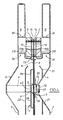
- a pan (1) is formed with a flange (2) and dished recess (3) in which are formed inwardly projecting frusto-conical projections (4) (in Figure 1) or outwardly projecting frusto-conical projections (5) (in Figure 2).
- An electrically conductive post (6) on which a spider (not shown) is mounted is electrically connected to each projection (4) or (5).
- the posts associated with the cathode structure are considerably longer than those associated with the anode structure.
- the posts may be omitted altogether in which case the anode plate may either be directly connected to the associated pan or it may be connected thereto directly through the spiders.
- An electrode plate (8) typically in the form of a mesh, is connected to the spiders.
- An electrically insulating cushion (9) is provided between the end of the post (6) and the electrode plate (8). At the location of each post, the plates (8) are apertured and the cushions (9) are received within such holes.
- the flanges (2) are provided with backing flanges (2B, see Figure 4) and holes (10, 10B) designed to accept bolts (not shown) for bolting an anode structure and a cathode structure with two gaskets and a membrane to form a module according to the present invention.
- (11) is an outlet header.
- Liquor flow into the header (11) takes place through an exit slot (35) at the upper end of each electrode structure, the exit slot (35) being formed located immediately above the electrode plate (8) and just below spaced apart cylindrical stub tubes (36) which register with holes in the pan base (3) and the flange (2) and span the main vertically extending walls of the header (11).
- liquor flow enters the exit slot and flows around the stub tubes (36) into the header (11).
- the electrode structures of the present invention may be used in filter press electrolysers, modular cells and fuel cells.
- Figure 3 illustrates a unit in which two electrode structures are coupled to form a bipolar electrode assembly for use in a filter press electrolyser or a fuel cell, the electrode structures in this case being assembled with the anode and cathode projections (4, 5) nested.
- Figure 4 illustrates a unit in which the electrode structures are coupled together with a separator therebetween for use in a modular electrolyser or in a fuel cell. In both cases, it will be understood that once a number of the units have been assembled, the net effect will be that adjacent anodes and cathodes, whether part of the same unit or parts of separate units, will have their projections (4) nested with each other.
- an anode structure as illustrated in Figure 1 and a cathode structure as illustrated in Figure 2 are electrically conductively joined back-to-back by an abrasion device (12) disposed between the inwardly projecting frusto-conical projection (4) on the anode structure and the outwardly projecting frusto-conical projection (5) on the cathode structure, the arrangement being such that when the two structures are urged together, the abrasion devices afford good electrical continuity between the peaks of the cathode projections (5) and the bases of the anode projections (4) and hence between the posts (6) extending to the electrode plates (8).
- an anode structure as illustrated in Figure 1 and a cathode structure as illustrated in Figure 2 are joined by bolts (not shown) through the holes (10) in flanges (2).
- a membrane (13) is sealed between two gaskets (14) disposed between flanges (2).
- Spiders (7) - not shown in Figures 1 to 3 - provide electroconductive pathways between the posts (6) and the electrode plates (8).
- the spiders comprise disc-shaped central sections (40) which are connected to the ends of the posts (6), e.g.by welding, screw-fixing or push-fit connectors, and a number of legs (38) which radiate from the central section (40) and are connected at their free ends, e.g. by welding to the associated electrode plate (8).
- the legs (38) are equiangularly spaced so that the current supply via the posts (6) is distributed to a number of equispaced points surrounding the post.
- the cathode spiders may be fabricated from materials such as stainless steel, nickel or copper while the anode spiders are fabricated from a valve metal or alloy thereof.
- the legs (38) of the spiders (7) associated with the anode structure are somewhat shorter than those associated with the cathode structure.
- the spiders (7) may be welded or otherwise connected to the plates (8) and the spiders may then be subsequently welded or otherwise secured to the posts (6). This arrangement facilitates replacement or repair of the anode/cathode plates or renewal/replacement of any electrocatalytically-active coating thereon.
- the anode structure As shown in Figure 5, the anode structure, with its inwardly projecting frusto-conical projections (4) in the pan (3), is provided with a supply tube (15) leading to the inlet tube (not shown) for brine and an outlet tube (16) for chlorine and depleted brine mixture.
- the cathode structure is provided with a supply tube (17) leading to the inlet tube (not shown) for caustic and an outlet tube for hydrogen and caustic mixture (18).
- the anode structure is provided with (a) an anode supply tube (15) concentric with the inlet tube (19) formed with ports (24) and (b) baffles (21) mounted on the inwardly projecting projections (4).
- the cathode structure is provided with (a) cathode supply tube (17) concentric with the inlet tube (20) formed with ports (23) and (b) baffles (22) mounted on the posts (6).
- the ports 24, 23 in inlet tubes (19) and (20) are formed such that liquor discharged therefrom is directed towards the back of the pans behind baffles (21) and (22) to aid mixing.
- Th e baffles 21, 22 serve to partition the anode and cathode compartments into two communicating zones to provide liquor recirculation as previously described.
- baffles 21, 22 extend vertically within the anode and cathode compartments from the lower end of the electrode structure to the upper ends thereof and form two channels within each electrode structure which communicate at least adjacent the top and bottom of the structure.
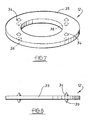
- an abrasion device (12) is provided with four sharp projections (34) on one face of the washer (35) and four sharp projections (36) on the other face of the washer (35) so that when adjacent cathode and anode structures are loaded in compression, the projections bite into the material of the cathode and anode pans.
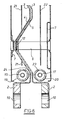
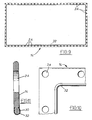
- each gasket (14) may be of generally rectangular configuration with holes (some of which are depicted by reference numeral 2A) for registry with the holes in the flanges (2) so that the gaskets are compressed as the electrode structures are drawn together to clamp the separator/membrane (13) therebetween.
- Each gasket is locally enlarged at its inner periphery to form a nose (30) which projects beyond the plane of the gasket on one side thereof.
- the gaskets are assembled to the electrode structures (8) with their noses (30) in contact with the adjacent face of the membrane (13). In the region of contact with the membrane (13), each nose (30) may be of generally part-circular configuration in cross-section.
- the membrane (13) is additionally pinched between the noses (30) thereby producing a pinch seal which is particularly effective in preventing seepage or "wicking" of cell liquors through or along the structure of the membrane (13).
- each gasket (14) is also provided at their inner peripheries with a liner (32) of chemically resistant material such as PTFE.
- each gasket may be provided with a nose or protrusion on the opposite side thereof for engagement with a respective flange (2).
- an anode or cathode plate of the electrode structure When an anode or cathode plate of the electrode structure is in need of refurbishment or replacement, it may be removed from the structure by removing the cushions (9) to expose the central sections (40) of the spiders (7) and thereby allow their detachment from the posts or, where no posts are present, from the the electrode pan or bipolar plate.
- detachment may be effected by trepanning through the spot weld using a drill or milling tool.
- the central spider portions are engaged with the posts (or pan) via a fixing screw or push fit connector, detachment is effected by removing the screw or other connector.
- the welding system employed to attach the central spider portions may be designed to give only weak welded joints so that the spiders may be detached from the posts, pan or bipolar plate simply by breaking the welded joints using physical force.
- the anode or cathode can then be removed for refurbishment or replacement with a fresh electrode assembly comprising an anode or cathode with an array of spiders arranged to correspond with the locations of the posts or projections (if no posts are present).
- the new or refurbished electrode assembly is then physically and electrically reattached, for example by spot welding, threaded fasteners or push-fit connectors.
- conduction enhancing means such as star washers, abrasion discs or conductive coatings, may be inserted between or applied to the central portion of the spider and/or the surface of the post, pan or bipolar plate.
- conduction enhancing means such as star washers, abrasion discs or conductive coatings
- the rough surfaces of the post, pan or bipolar plate exposed by removal of an electrode structure may be dressed using for example a linishing tool, sanding tool, file or the like.
Landscapes
- Chemical & Material Sciences (AREA)
- Engineering & Computer Science (AREA)
- Chemical Kinetics & Catalysis (AREA)
- Electrochemistry (AREA)
- Materials Engineering (AREA)
- Metallurgy (AREA)
- Organic Chemistry (AREA)
- General Engineering & Computer Science (AREA)
- Mechanical Engineering (AREA)
- Life Sciences & Earth Sciences (AREA)
- Manufacturing & Machinery (AREA)
- Sustainable Development (AREA)
- Sustainable Energy (AREA)
- General Chemical & Material Sciences (AREA)
- Electrolytic Production Of Non-Metals, Compounds, Apparatuses Therefor (AREA)
- Cell Electrode Carriers And Collectors (AREA)
- Electrodes For Compound Or Non-Metal Manufacture (AREA)
- Water Treatment By Electricity Or Magnetism (AREA)
- Hybrid Cells (AREA)
- Electrolytic Production Of Metals (AREA)
Abstract
Description
- The present invention relates to electrode structures for use in, for example, bipolar electrolysers, particularly a modular bipolar electrolyser, and also in fuel cells.
- Monopolar filter-press type membrane electrolysers are well known, for example as described in our GB 1,595,183. Such electrolysers are readily made, inexpensive and easily assembled.
- Bipolar electrolysers are known in the art, for example as described in our GB 1,581,348.
- In bipolar electrolysers of conventional design for use in the electrolysis of aqueous solutions of alkali metal chloride the bipolar unit comprises an anode which is suitably in the form of a plate of a film-forming metal, usually titanium, the plate carrying an electrocatalytically active coating, for example a platinum group metal oxide, and a cathode which is suitably in the form of a perforated, eg foraminous plate of metal, usually nickel or mild steel, the anode and cathode being electrically conductively bonded to each other to form a bipolar unit. Separators are positioned between successive bipolar units arranged in series in the electrolyser so that the anode of one bipolar unit faces the cathode of the adjacent bipolar unit with a separator disposed therebetween. The electrolyser also comprises terminal anode and cathode units.
- In operating an electrolytic cell of the bipolar type, it is advantageous to operate with as small a distance as possible between the anode and cathode (the anode/cathode gap) in order to keep ohmic losses, and hence the cell voltage to a minimum.
- The separators are generally adjacent or even in contact with the cathode and in order to achieve a small anode-cathode gap without at the same time damaging the separator it is necessary to exercise considerable care in order to manufacture electrodes having a suitable degree of flatness and it is also necessary to maintain this flatness during the heat treatment involved in coating the electrode with an electrocatalytically-active coating. Furthermore, great care must be exercised in assembling units in a bipolar electrolyser if damage to the separators is to be avoided.
- US 4,557,816 discloses that uniform concentration distribution of electrolyte across the electrodes in the bipolar electrolyser described therein may be improved by the provision of certain vertical ducts on the side of the electrode away from the separator for liquid downflow.
- US 4,643,818 discloses that the electrical resistance of the bipolar electrolyser described therein may be lowered and uniform current density obtained by the use of certain rigid multi-contact electrical conductive means between individual cells in a bipolar electrolyser.
- US 4,734,180 discloses a bipolar-type electrolyser comprising bipolar units which are arranged back to back with an explosion-bonded titanium-iron plate disposed therebetween and in which conductive ribs are welded to the electrode and to the pan-shaped body
- US 5,225,060 discloses that the formation of gas zones in the upper portions of anode and cathode structures of the bipolar electrolyser described therein may be prevented by the use of non-current-flowing space in the upper portion of the structures.
- EP 0,704,556 discloses that the provision of gas-liquid separators at the top of the anode and cathode structures of the bipolar electrolyser described therein minimises pressure fluctuations, membrane deterioration and voltage variation.
- WO 98/55670 discloses an element for a bipolar electrolyser the two sides of which are formed with flanges and opposed projections. The projections are preferably in form of truncated cones and are preferably arranged in the form of centred hexagons to improve lateral mixing of electrolyte. However, vertical mixing is achieved by downcomer ducts which decrease the active area of the electrode thus amplifying the current density variation across the electrode which is a particular problem when operating at high current density with a narrow or zero gap anode/membrane/cathode configuration with impurity-sensitive ion-exchange membranes.
- EP 0 521 386 discloses a bipolar electrolyser comprising electrolytic cell units which comprise electrode partitions with mating recesses and projections with electrode meshes joined directly, or through a spring, to the projections. A stack of such upright electrolytic cell units are joined in series with an ion exchange membrane between adjacent electrolytic cell units to form an electrolytic cell assembly. However, whereas the recesses and projections ensure good lateral mixing of the electrolyte, vertical mixing is poor. Accordingly, to maintain concentration and temperature variation in the cell units within acceptable limits, energy-intensive pumped external recirculation is necessary with additional expensive pipework and tanks.
- In electrolytic cells in which the anode-cathode gap is zero there is a tendency for pressure applied to the separator through the anode and cathode with which it is in contact to lead to deviations from uniformity, abrasion or even rupture, of the separator. This is particularly the case where the separator is an ion-exchange membrane where it is desirable to apply an even pressure to the membrane through the anode and cathode.
- We have now devised an electrode structure for a bipolar electrolyser which allows very small or even zero anode/cathode gaps to be used in such electrolysers without damage to the separator, which minimises electrical resistance by using a short perpendicular current-carrying path length between electrodes and low resistance materials for almost the entire perpendicular current-carrying path length and which affords excellent current distribution throughout the electrode area . The electrode structure permits both horizontal and vertical flow of liquors therein aiding circulation and mixing thereof and has improved rigidity and strength which allows closer tolerance to be achieved in cell construction. The electrode structure is of simple construction and easy to fabricate.
- According to the first aspect of the present invention there is provided an electrode structure for use, for example, in a bipolar electrolyser comprising
- (i) a pan with a dished recess and a flange around the periphery thereof for supporting gasket means for sealing a separator between the flanges in adjacent electrode structures, which separator is disposed between the surface of the anode of a first electrode structure and the surface of the cathode of a second electrode structure such that the anode surface is substantially parallel to and faces but is insulated and spaced apart from the cathode surface by the separator and is hermetically-sealed to the separator;
- (ii) an electrically conductive plate spaced from the pan;
- (iii) an inlet for liquor; and
- (iv) an outlet for fluids; wherein the plate is electrically connected to the pan by a plurality of electrically-conductive members to which the electrically conductive plate is electroconductively attached and which provide electrically-conductive pathways between the pan and the electrically conductive plate with the proviso that, where the plate is an anode plate, it may optionally be directly electrically connected to the pan; and wherein, where the electrode structure is an anode structure, the dished recess is provided with a plurality of inwardly projecting projections and, where the electrode structure is a cathode structure, the dished recess is provided with a plurality of outwardly projecting projections such that the inwardly projecting projections in the dished recess of the pan of the anode structure mate with the outwardly projecting projections in the dished recess of the pan of an adjacent cathode structure in an assembly comprising a plurality of the electrode structures.
-
- The electrically conductive plate is desirably a metal or alloy as is hereinafter more fully described. It will in general be of the same material as that of the pan. Thus where the electrode structure is to be used as an anode in the electrolysis of an alkali metal halide the electrically conductive plate may be made of a valve metal or an alloy thereof consisting principally of a valve metal. Where the electrode structure is to be used as a cathode in the electrolysis of an alkali metal halide the electrically conductive plate may be, for example, stainless steel, mild steel, nickel or copper.
- It will be appreciated that where the electrically conductive plate is an anode for use in brine electrolysis it will bear an electrocatalytically-active coating.
- The electrically conductive plate may have any suitable structure as is hereinafter more fully described. The precise structure is not critical.
- In order that the pressure applied to the separator positioned between the electrically conductive plates of adjacent electrode structures in a module according to the present invention is applied evenly the electrically conductive plate is preferably flexible.
- Preferably each projection in the dished recess is electroconductively connected to an electrically conductive member such that the projections provide many current feed-points hence improving current distribution across the pan leading to lower voltage, lower power consumption and longer separator and electrode coating lives.
- The projections in the dished recess are preferably spaced apart from each other in a first direction and in a direction transverse to the first direction. More preferably the projections are symmetrically spaced apart. For example, they may be spaced apart by an equal distance in a first direction, and spaced apart by an equal distance, which may be the same, in a direction transverse, for example substantially at right angles, to the first direction. Preferably the spacing apart of the projections is the same in both directions.
- The projections in the dished recess may have a variety of shapes, for example dome, bowl, conical or preferably frusto-conical. As examples of methods of forming the projections may be mentioned inter alia vacuum forming, explosion forming, pressing or preferably by the application of a suitably shaped tool to the opposite surface of the recess.
- There are typically about 20 - 200, preferably 40 - 100 projections/metre2 on the dished recess of the pan of the electrode structure.
- The height of the projections from the plane of the dished recess may for example be in the range 0.5-8 cms, preferably 1-4 cms, depending on the depth of the pan. The distance between adjacent projections on the recessed dish may for example be 1-30 cms centre to centre, preferably 5-20 cms.The dimensions of the electrode structure in the direction of current flow are preferably in the range 1-6 cm as measured from the electrically conductive plate to the base of the pan in order to provide short current paths which ensure low voltage drops in the electrode structure without the use of elaborate current carrying devices
- The electrically-conductive members to which the electrically conductive plate is electroconductively attached in the electrode structure preferably comprise posts.
- Where the electrically-conductive member to which the electrically-conductive plate is attached is in the form of a post and is electrically connected to an inwardly projecting projection in the dished recess of the pan the length of the current pathway between the electrically conductive plate and the pan may be minimised.
- Where the anode-post is made of titanium or an alloy thereof and the cathode-post is made of nickel or an alloy thereof the length of the electrically conductive pathway through the cathode-post is preferably greater than the length of the electrically conductive pathway through the anode post. Preferably the ratio of the length of the electrically conductive pathway through the cathode post to the length of the electrically conductive pathway through the anode post is at least 2: 1, preferably at least 4:1 and more preferably at least 7:1. Typically the ratio is at least 10:1.
- The length of the posts depends on the electrolyser design and whether the post is associated with an anode plate or a cathode plate. Typically the post length may be in the range of 0 to 10 cm, preferably 0 to 4 cm. Where the length is zero, it will be understood that the invention envisages a modified arrangement in which the electrically conductive plate, when intended to function as an anode plate , may be directly electrically connected to the associated pan or alternatively connected thereto through a current carrier as defined below.
- Where the eletrically-conductive members to which the electrically conductive plates are attached are in the form of posts, each post is preferably provided with a current-carrier, eg a ring, mesh, or wire-wool, adjacent the electrically conductive plate to make multi-point electrical contact therewith. Preferably the current-carrier is a multi-legged current-carrier, hereinafter referred to for convenience as a "spider". In some circumstances, it is envisaged that the electrical connections may be made without using a post; for instance, in the case of an anode structure, the apex of each inwardly directed projection may be electrically connected to the anode plate by means of a current carrier as aforesaid, e.g. a spider.
- The provision of spiders increases the number and distribution of current feed points to the electrically conductive plate, hence improving current distribution leading to lower voltage and power consumption and longer life of separators and electrode coatings.
- The length of the legs and the number thereof on the spider, where a spider is present, may vary within wide limits. Typically the spider contains between 2 and 100 legs, preferably between 2 and 8 legs. Typically each leg is between 1 mm and 200 mm long, preferably between 5 mm and 100 mm long. The skilled man by simple experiment will be able to determine suitable lengths and numbers of spider legs for any particular application.
- A spider may be flexible or rigid. The shape and mechanical properties of the spiders in the anode structure may be the same as or different from the shape and mechanical properties of the spiders in the cathode structure. For example, relatively non-springy spiders with short legs are often preferred in the anode structure and relatively springy spiders with long legs are preferred in the cathode structure.
- The use of spring-loaded spiders, at least at the cathode plate, enables the electrode structures to be spring-loaded to achieve zero gap operation with optimum pressure to minimise risk of separator/electrode damage. By "zero gap", we mean that there is substantially no gap between the electroconductive plate of the each electrode structure and the adjacent separator, i.e. so that adjacent electroconductive plates are in use only separated by the thickness of the separator.
- Where the separator is a membrane, spring-loaded spiders provide more uniform support for the membrane across a larger area hence reducing movement which could lead to damage of the membrane by, for example, folding, abrasion or the onset of wrinkles.
- A spider is preferably made from the same metal as the electrically conductive plate with which it is in electrical contact.
- Typically, a spider is welded to the electrically conductive plate with which it is in electrical contact.
- A spider may be attached to the post by methods known in the art, for example by welding, screw-fixing or push-fit connectors.
- The legs of each spider may radiate from a central portion for use in attaching the spider to a post or, in some circumstances, directly to an apex of the associated projection. The spider legs may be equiangularly spaced.
- According to a further aspect of the present invention there is provided a spider for use in an electrode structure which spider is electroconductively attached to an electrically-conductive member and to an electrically conductive plate such that current distribution to the electrically conductive plate is improved.
- According to yet another aspect of the invention there is provided an anode or cathode assembly comprising an electrically conductive plate having attached to one face thereof a plurality of current-distributing spiders each comprising a portion for attachment, in use, to a pan and a number of legs radiating from the attachment portion whereby electrical current supply to the plate takes place through the such legs. Such an arrangement enables the anode or cathode assembly to be readily welded or otherwise secured within a cell compartment or module and removed for example for repair of the electrically conductive plate or replacement of any electrocatalytic coating thereon.
- Where the post is provided with a current carrier, it may be further provided with an insulating cap on the end thereof adjacent the separator.
- Where the electrode structure is an anode structure the pan thereof may be bonded back to back to the pan of an electrode structure which is a cathode structure such that the inwardly projecting projections in the pan of the anode structure mate with the outwardly projecting projections on the pan of the cathode structure to form a bipolar unit.
- According to a further aspect of the present invention there is provided a bipolar unit wherein the pan of an electrode structure according to the present invention which is an anode structure is bonded to the pan of an electrode structure according to the present invention which is a cathode structure such that the inwardly projecting projections on the pan of the anode structure mate with the outwardly projecting projections on the pan of the cathode structure to form a bipolar unit.
- In the bipolar unit according to the present invention the electrode structures are pressed or bonded together, preferably by welding, more preferably by explosion bonding, such that electrical contact is made between the dished recesses in the pans thereof.
- A plurality of such bipolar units interspersed with appropriate separators, gaskets and pressing means may be assembled to form a filter-press bipolar electrolyser.
- According to a yet further aspect of the present invention there is provided a filter-press bipolar electrolyser which comprises
- a) current distributing means; and
- b) at least one bipolar unit mounted on a mounting frame and assembled in series both mechanically and electrically, characterised in that the bipolar units are bipolar units according to the further aspect of the present invention.
-
- By 'current distributing means' is meant systems, normally attached to the inside of the end frames of the electrolyser mounting frame, designed to carry current from a power source such as cellroom power feeder cables or busbars to the pans of the terminal electrodes of a filter press electrolyser or the outside pans of the end modules of the modular electrolyser, such that the current feed is evenly distributed over all the electrical contact points on these pans. Typically current distributing means can be single plates or systems of plates cables or wires made from conductive metals. Optionally, they may be fitted with conductivity enhancing coatings, attachments or devices to improve the electrical connection between the current distributing means and the end electrode. Alternatively, especially in a filter press electrolyser, the terminal electrodes may be permanently attached to the current distributing means for example by welding.
- One preferred form of current distributing means which is particularly useful in the electrolyser of this invention involves a series of copper plates running vertically from the bottom to the top of the electrolyser end frame , the copper plates being electrically linked by all being connected at the bottom to a single horizontal copper bus bar. At one end of the electrolyser frame, where the copper plates are intended to connect to a pan which is part of an anode structure, they may be fitted with conductive outwardly projecting projections or conductive posts which mate with the inwardly projecting projections of the anode. At the other end of the electrolyser , where the copper plates are intended to connect to an pan which is part of a cathode structure, they may be flat or they may be fitted with inwardly projecting projections which mate with the outwardly projecting projections of the cathode. Optionally the copper plates of the current distributing means may be fitted with conductivity enhancing coatings or devices to improve electrical contact with the pan of the electrode structure.
- The terminal electrodes in the filter-press bipolar electrolyser according to the present invention preferably comprise electrode structures according to the present invention.
- Where the electrode structure according to the present invention provides the ends of a bipolar electrolyser it may be provided with means for feeding electric power thereto. For example, this means may comprise a projection which is suitably shaped for attachment to a bus-bar when the electrode structure is assembled into an electrolyser.
- Typically, the filter-press bipolar electrolyser according to the present invention comprises up to 300 bipolar units.
- Means to provide a load to hermetically seal filter-press bipolar electrolysers according to the present invention are known to the skilled man.
- Modular bipolar electrolysers are known, for example as described in US 4,108,752 and US 4,664,770.
- Modular bipolar electrolysers have the advantages that a lower compressive load is applied thereto than to conventional bipolar electrolysers since the load is needed to produce only electrical contact between adjacent modules not the sealing of each cell in the electrolyser. Use of a lower compressive load eliminates the need for massive end-plates and associated compression systems. Furthermore, the use of modules facilitates both the fabrication/assembly and the maintenance of a bipolar electrolyser.
- US 4,108,752 describes a modular bipolar electrolyser comprising a plurality of removable modules. Each module comprises a pair of matching pans, each pan having a dished recess and a peripheral flange surrounding the recess, the pans being connected together peripherally at the flanges such that the recess of each pan faces that of the connected pan. A generally planar separator is positioned between the pans. The recess of one pan and the corresponding planar side of the separator define a first structure and the recess of the other pan and the opposite side of the separator define a second structure. A planar electrode is positioned within each structure parallel to the plane of the separator and electrically and structurally connected to the corresponding pan, for example by posts. The bipolar filter-press electrolyser is assembled by aligning a plurality of the modules such that the planar exterior surfaces of the pans are parallel. At least one multi-contact conductive strip is interposed between facing pan surfaces of adjacent modules such that the planar exterior surfaces of the pans are parallel and when the modules are compressed together the conductive strips are sandwiched therebetween to establish a positive electrical contact between adjoining cells at a plurality of points.
- US 4,664,770 describes a module for a modular bipolar electrolyser comprising a housing formed of two structures each having a bottom side extending in a plane parallel to planes including an anode and a cathode. The anode and cathode are separated by a membrane and both the anode and the cathode have a plurality of perforated and unperforated sections arranged in parallel. A metallic framework pattern reinforcement is positioned between the anode and an adjacent inner surface of the bottom side of one structure and between the cathode and an adjacent inner surface of the bottom side of the other structure. A contact strip is attached to an outer surface of each of the bottom sides, the contact strips of adjacent cells being electrically connected. Also provided are means for connecting each of the contact strips to the metallic reinforcement and the unperforated sections in the in the electrode in the attached structure. A partition membrane extends between the anode and the cathode in each of the modules and gasket means seal the structures to the membrane. Where an electrolyser is assembled by lining up a plurality of such modules with the aid of known tensioning devices electrical contact between adjacent modules is ensured by the electrically conducting contact strips.
- We have now found that where the electrically-conductive members on which the electrically conductive plates are mounted in the electrode structures according to the present invention are in the form of load-bearing posts a module for a modular bipolar electrolyser can be prepared from such electrode structures. Such a module is easy to assemble and is particularly easy to mount and co-locate with other modules on an electrolyser frame. Good electrical connection between one module and the next is particularly easily achieved. The percentage of membrane area undergoing electrolysis is also significantly improved compared to known modular designs.
- According to a preferred aspect of the present invention there is provided a module for use in a modular bipolar electrolyser comprising
- a) an anode structure comprising (i) a pan with a dished recess and a flange around the periphery thereof, (ii) an anode plate which, optionally has an electrocatalytically active surface, (iii) means, optionally comprising a plurality of electrically-conductive load-bearing members to which the anode is electroconductively attached, providing electrically-conductive pathways between the pan and the anode plate, (iv) an inlet for liquor and (v) an outlet for fluids;
- b) a cathode structure comprising (i) a pan with a dished recess and a flange around the periphery thereof, (ii) a cathode plate which, optionally has an electrocatalytically active surface, (iii) a plurality of electrically-conductive load-bearing members to which the cathode is electroconductively attached and which provide electrically-conductive pathways between the pan and the cathode plate, (iv) inlet for liquor and (v) outlet for fluids;
- c) a separator disposed between the anode plate and the cathode plate such that the anode surface is substantially parallel to and faces but is insulated and spaced apart from the cathode surface by the separator which thereby divides the module into separate anode and cathode compartments;
- d) gasket means sealing the separator between the flanges on the periphery of the pans; and
- e) means to apply pressure to the gasket means to hermetically-seal the separator thereto characterised in that
- i) the dished recess of the pan of the anode structure is provided with a plurality of inwardly projecting projections and the dished recess of the pan of the cathode structure is provided with a plurality of outwardly projecting projections such that the inwardly projecting projections of the anode structure of a module mate with the outwardly projecting projections of the cathode structure of an adjacent module in a modular bipolar electrolyser comprising a plurality of the modules; and
- ii) optionally one or more bipolar units according to the present invention, preferably with electrically-conductive load-bearing posts, and associated separators interspersed between the anode and cathode structures.
-
- It will be appreciated that by the inclusion of one or more bipolar units of this invention, together with associated gaskets and separators, between the anode structure and cathode structure of a module of this invention, and using similar means to apply pressure to hermetically seal the separators to the gaskets and the gaskets to the electrode structures, it is possible to create a 'hybrid module' which contains two or more anode structures and two or more cathode structures with two or more separators. It should be understood that the creation of hybrid modules is within the scope of our invention.
- One benefit of the hybrid module is that reduced numbers of lifting operations are required within the operating environment of the cellroom leading to reduced safety risks and less electrolyser downtime for electrode structure or module replacement during maintenance or overhauls.
- The means to apply pressure to the gaskets to hermetically-seal the separator thereto in the module is preferably provided by bolts through holes in the flanges. However, we do not exclude the possibility that alternative means to apply pressure may be used.
- Where the electrically-conductive load-bearing posts in the module are provided with current carriers, each post is preferably provided with an insulating cap and more preferably a matching hole is formed in the electrically conductive plate, particularly where the electrically conductive plate is in the form of a mesh. Where a matching hole is formed in the electrically conductive plate the insulating cap is preferably in the form of a cushion.
- According to a further preferred aspect of the present invention there is provided a modular bipolar electrolyser which comprises
one or more modules assembled on a mounting frame in series both mechanically and electrically; and
current distribution plates at each end of the electrolyser,
characterised in that the modules are modules according to the preferred aspect of the present invention. - Electrically-insulating, load-transferring cushions are preferably disposed at the ends of the electrically-conductive load-bearing posts adjacent the electrically conductive plate in the modular bipolar electrolyser according to the present invention and, where the posts are load-bearing, at the ends of the posts adjacent the electrically conductive plate in the filter-press bipolar electrolyser according to the present invention. Such insulating cushions prevent mechanical damage to the membrane and, since electrolysis does not occur at these points, the membrane does not suffer from any electrolysis damage.
- Such insulating cushions may be made from a non-conductive material which is resistant to the chemical environment within the cell, eg fluoropolymers such as PTFE, FEP, PFA, polypropylene, CPVC and fluoroelastomeric rubbers. The cushions may be provided on metal studs which are located between the posts and the electrically conductive plate with the cushion presented towards the separator or membrane.
- In the modular bipolar electrolyser according to the present invention comprising a plurality of modules, the recessed dish of the anode pan of a module and the recessed dish of the cathode pan of an adjacent module are electrically joined, preferably at the apices of the projections.
- Electrical conductivity between adjacent modules in the modular bipolar electrolyser may be achieved by the use of interconnectors or preferably by at least close contact between adjacent modules.
- Electrical conductivity between adjacent modules may be enhanced by the provision of conductivity-enhancing materials or conductivity-enhancing devices on the outer surface of the pans. As examples of conductivity-enhancing materials may be mentioned inter alia conductive carbon foams, conductive greases and coatings of a high-conductivity metal, eg silver or gold.
- Preferably electroconductivity-enhancing devices are used to improve electrical conductivity between adjacent modules. As examples of electroconductivity-enhancing devices may be mentioned inter alia electrically conductive bimetallic plates welded to the anode, explosion-bonded electrically conductive bimetallic plates, electroconductive metal devices, eg washers, or preferably electroconductive metal devices adapted to (a) abrade or pierce the surface of the pans by cutting or biting through any electrically-insulating coating thereon, eg an oxide layer, and (b) at least inhibit formation of an insulating layer between the device and the surface of the pan
- According to a further aspect of the present invention there is provided an electroconductive metal device adapted to (a) abrade or pierce the surface of the pans by cutting or biting through any electrically-insulating coating thereon, eg an oxide layer, and (b) at least inhibit formation of an insulating layer between the device and the surface of the pan (hereinafter referred to for convenience as "abrasion device").
- The abrasion device is provided with one or more projections. As an example of an abrasion device may be mentioned a star-washer, eg provided with 18 projections. Preferably, however, the abrasion device is provided with not more than six projections. It is often preferred, for mechanical stability during assembly of an electrolyser, that the abrasion device is provided with at least three projections. Preferably such projections are provided on both sides of the abrasion device.
- An abrasion device is preferably disposed in an inwardly projecting projection in the dished recess in the pan of an anode structure to provide electrical contact between the pan and the mating outwardly projecting projection in the dished recess on the pan of a cathode structure. Preferably abrasion devices are provided in each inwardly projecting projection in the anode.
- The abrasion device may be made of an electrically conductive material which is hard enough to cut into at least one of the pans of the electrodes structure, particularly a titanium anode, to pierce any oxide coating thereon. As examples of suitable metals from which such abrasion devices may be prepared may be mentioned inter alia carbon steel, nickel, nickel alloy or preferably a beryllium/copper alloy.
- The abrasion device may be attached to the anode, for example by screwing, welding, or pinning using a metallic, eg Ti, tab. Preferably such a device is attached such that it is free to rotate at least to a limited extent.
- The abrasion device is preferably re-usable, ie it can be used to make repeated connections without replacement.
- The present invention will hereinafter be more fully described by reference to the use of the various aspects thereof in chlor/alkali applications, eg brine electrolysis.
- The number of modules and bipolar units in bipolar electrolysers according to the present invention will be chosen by the skilled man in the light of inter alia the required production volume, available power and voltage and certain constraints known to the skilled man.
- Typically, a modular bipolar electrolyser according to the present invention comprises 1-300 modules.
- The filter-press and the modular bipolar electrolysers according to the present invention may be operated at pressures between 50 and 600 kPa (0.5 and 6 bar), preferably between 50 and 150 kPa (500 and 1500 mbar).
- An inlet-tube is provided at the bottom of the electrode structure, preferably extending from one side thereof to the other, to allow liquor to be charged thereto. For example, where the modular bipolar electrolyser is to be used for brine electrolysis inlet-tubes allow caustic to be charged to the cathode structure and brine to be charged to the anode structure. Preferably liquor is fed to the inlet-tube from one end only.
- Ports are spaced along the inlet-tube, preferably equidistantly to improve liquor feed distribution across the electrode structure. Preferably the ports are formed such that where a baffle, as hereinafter more fully described, is provided in the electrode structure liquor discharged from the ports is directed into the recirculating stream generated by the baffle. The dimensions of the ports are such that pressure drop down the inlet-tube is minimised.
- The number of ports in the inlet-tube for any particular application may be readily calculated by the skilled man. Typically, there are about 2-10, preferably about 6, ports per metre of the inlet-tube. Typically each port is of about 1 - 3 mm diameter, preferably about 2 mm diameter.
- The supply-tube through which liquor is supplied to the inlet-tube is made of a non-conducting material and may be inserted into an inlet-tube to any depth, e.g. until it almost reaches the dead-end of the inlet-tube. In bipolar electrolysers the increased length of the non-conductive supply-tube increases the length of the liquor pathway between cells in the electrolyser hence reducing the chance of damage to the electrolyser by leakage-current corrosion.
- The inlet-tubes are conveniently made of the same material as the electrode structures they feed. For example, where the anode is made of titanium or an alloy thereof the inlet-tube to the anode is preferably made of titanium or an alloy thereof and where the cathode is made of nickel or an alloy thereof the inlet-tube to the cathode is preferably made of nickel or an alloy thereof.
- As examples of suitable non-conducting materials from which the supply-tube may be prepared may be mentioned fluoropolymers such as PTFE, FEP and PFA.
- The presence of the electrically conductive plate(s) spaced apart from each other by the separator forms an electrolysis area in modular and filter-press bipolar electrodes.
- Spent liquor and product gas are discharged from the electrode structure through a gas/liquid exit system comprising an exit slot, an outlet header in which gas/liquid separation occurs and an exit port. Damage to the separator caused by formation of a gas space adjacent the separator in the upper region of the electrolysis area is at least reduced, and often eliminated, by the provision of the outlet header in the non-electrolysis area above the electrolysis area in the electrode structure.
- In the exit system, the gas/liquid mixture flows upwardly from the electrolysis area through an exit slot above the electrolyser compartments into the outlet header. The depth of the exit slot, which runs along substantially the entire width of the electrode structure, will be chosen in the light of inter alia the current density, electrode area and temperature such that the gas phase is dispersed as bubbles in a continuous liquid phase. The depth of the exit slot is typically about 5 - 50%, preferably about 10 - 30%, the depth of the electrode structure, ie the distance between the dished recess and the electrode plate.
- The gas/liquid mixture separates out rapidly in the outlet header, which runs along substantially the entire width of the electrode structure. The cross-sectional area of the outlet header will be chosen in the light of inter alia the current density, electrode area and temperature such that stratified horizontal gas/liquid flow along the header, preferably with a smooth interface is maintained.
- The gas and liquid streams leave the outlet header through one or more exit ports, preferably one exit port, more preferably disposed at one end thereof. The cross-sectional area of the exit port will be chosen in the light of inter alia the current density, electrode area and temperature such that annular film gas/liquid downflow through the exit port with a liquid film on the wall and a central gas core is preferably obtained.
- The gas/liquid exit system described above has the advantage that the low pressure drop avoids depressing the gas/liquor interface into the electrolysis area of the electrode system consequently eliminating damage to the separator caused by the formation of a gas space adjacent the separator in the upper region of the electrolysis area. A further advantage of the gas/liquid exit system is the minimisation of pressure fluctuations which cause physical damage to the separator by abrasion from contact with the electrode plate. The liquid film on the wall of the exit tube provides a yet further advantage by increasing the resistance of the liquor pathway between cells in the electrolyser hence reducing the possibility of damage to the electrolyser by leakage-current corrosion.
- In a preferred embodiment of the present invention, the gas/liquid exit header is in the form of a rectangular structure provided along substantially the entire width of the electrode structure. The back plate of the exit header is an upward extension of the back of the pan in the vertical direction of the electrode structure. The back plate is bent through 90 degrees perpendicular to the back of the pan in the direction of the electrode to form the top plate of the outlet header and through a further 90 degrees downward to form the front plate of the header such that the front of the header is substantially parallel to the back of the header. The plate may optionally be bent back through 90 degrees towards the back plate to form the bottom of the header and down through 90 degrees to form the front plate of the exit slot. Alternatively, the front plate of the exit slot may be a continuation of the front plate of the exit header.
- At the bottom of the exit slot the front plate is bent through a further 90 degrees perpendicular to and away from the back plate to form the top plate of the pan. This top plate is then bent through a further 90 degrees upward to form the flange of the pan.
- The height of the flange effectively defines the vertical gas/liquid flow pathway through the exit slot and the rectangular box above the flange forms the exit header. Typically, the height of the flange is about 20-80% of the height of the exit header.
- The gaskets for sealing the separator between the flanges on the pans in bipolar electrolysers according to the present invention, which may be different in the anode and cathode structures, are made from a suitable material with appropriate chemical resistance and physical properties, eg a plasticised EPDM resin. Where a material does not have a suitable combination of chemical resistance and physical properties a gasket made from a material having suitable physical properties may be provided with a chemically resistant liner , eg made of PTFE, on its inner edge.
- The gasket may be in the form of a frame, preferably continuous, such that when two gaskets are disposed either side of a separator and a load applied thereto via the pans hermetic sealing of the module is effected.
- A gasket is disposed between the anode and the separator and between the cathode and the separator.
- The frame may in plan be of any configuration capable of hermetically sealing the separator into the module or compartment. Typically the frame is of square or rectangular configuration. The cross-section of the frame may be of any configuration capable of effecting sealing with the separator; for instance, it may have a circular, triangular or square cross-section but it is preferably of rectangular cross-section with the dimension perpendicular to the gasket plane being smaller than the dimension in the plane of the gasket.
- Conveniently the gasket frame cross-section includes a protrusion or nose around substantially the entire perimetral length of the frame for engagement with the separator, the protrusion or nose usually being provided at the inner and/or outer periphery of the frame.
- The protrusion or nose may be of any suitable shape capable of effecting a pinch seal with the separator but is preferably of bulbous configuration, e.g. generally part-circular in cross-section.
- In use, the separator will be engaged on each side thereof by a respective gasket so that the protrusions of the gaskets are in registry with each other and, when compressed, effect localised pinching of the gasket around the full perimeter of the gaskets to prevent seepage or "wicking" of cell liquors through or along the structure of the separator from inside the electrolysis compartment to locations external to the compartment. This design of gasket has been found to be particularly effective in preventing "wicking" of cell liquors especially when the separator is roughened or has an uneven surface (e.g. caused by the presence of a reinforcing mesh) or contains channels left by the dissolution of sacrificial components therein; or when the electrolysis compartment is running at a higher pressure than the outside atmosphere.
- In a modification, each gasket may be provided with a nose or protrusion on the opposite side thereof for engagement with a respective flange of an electrode structure.
- The gasket or frame may contain holes to accommodate sealing bolts, especially where the gasket is used in a module.
- Where the gasket is provided with a chemical resistant liner as described above, the liner may extend over the pinch-effecting protrusion or nose.
- Electrolysers according to the present invention may be operated at high current density, ie > 4.5 kA/m2.
- The separator is preferably a substantially electrolyte-impermeable ion-exchange membrane. However, we do not exclude the possibility that it may be a porous electrolyte-permeable diaphragm.
- Where the separator is an ion-exchange membrane it may be formed from any suitable ion-exchange membrane material
- Ion permselective membranes for chlor/alkali production are well known in the art. The membrane is preferably a fluorine-containing polymeric material containing anionic groups. Preferably it is an anion group-containing polymer containing all C-F and no C-H bonds. As examples of suitable anion groups may be mentioned -PO3 2-, -PO2 2-, or preferably -SO3 - or -COO-.
- The membrane may be present as a mono- or multi-layer film. It may be reinforced by being laminated with or coated onto a woven cloth or microporous sheet. Furthermore, it may be coated on one or both sides with a chemically resistant particulate coating to improve wetting and gas release.
- Where a membrane bearing a surface coating is employed in chloralkali applications the surface coating is typically formed from a metal oxide inert to the chemical environment, eg Zirconia.
- Suitable membranes for chloralkali applications are sold, for example, under the tradenames "Nafion" by E I Du Pont de Nemeurs and Co. Inc., "Flemion" by the Asahi Glass Co. Ltd. and "Aciplex" by the Asahi Chemical Co. Ltd.
- The separator is positioned between adjacent anode plates and cathode plates and thereby separates the anode structure from the cathode structure.
- The anode/cathode gap is suitably in the
range 3 mm to zero, preferably 1 mm to zero. Thus where the anode/cathode gap is zero the anodes and cathodes of the module are in contact with the separator. - In bipolar electrolysers equipped with a substantially impermeable ion-exchange membrane, aqueous alkali metal chloride solution is charged to the anode structures of the bipolar electrolyser and chlorine and depleted aqueous alkali metal chloride solution are discharged from the anode structures of the bipolar electrolyser and hydrogen and alkali metal hydroxide are discharged from the cathode structures of the bipolar electrolyser.
- The anode plate in the electrode structure may be metallic and the nature of the metal will depend on the nature of the electrolyte to be electrolysed in the electrolyser. A preferred metal is a film-forming metal, particularly where an aqueous solution of an alkali metal chloride is to be electrolysed in the electrolyser. The film-forming metal may be one of metals titanium, zirconium, niobium, tantalum, or tungsten or an alloy consisting principally of one or more of these metals and having anodic polarisation properties comparable with those of titanium. It is preferred to use titanium alone or an alloy based on titanium and having anodic polarisation properties comparable with those of titanium.
- The anode plate has a coating of an electro-conducting electrocatalytically-active material. Particularly in the case where an aqueous solution of an alkali metal chloride is to be electrolysed this coating may for example comprise one or more platinum group metals, that is platinum, rhodium, iridium, ruthenium, osmium and palladium.
- Electroconducting electrocatalytically-active materials for use as anode coatings in an electrolyser are well known in the art, for example as described in our EP 0,052,986, EP 0,107,934 and EP 0,129,374.
- Any suitable metal which is different from the film-forming metal of the anode may be used for the cathode plate in the electrode structure provided, of course, that the metal used for the cathode plate is conductive and is resistant to the electrolyte used in the electrolytic cell. Preferably the cathode plate is made of nickel or a nickel alloy or of another material having an outer face of nickel or nickel alloy. For example , the cathode plate may comprise a core of another metal, e.g. steel or copper, and an outer face of nickel or nickel alloy. Nickel or nickel alloy is preferred on account of the corrosion resistance of such materials in an electrolytic cell in which an aqueous alkali chloride solution is electrolysed and on account of the long term low hydrogen over-voltage of nickel or nickel alloy.
- The cathode plate may be treated to increase its surface area, eg by grit-blasting.
- The cathode plate may be provided with an electroconducting electrocatalytically-active coating. Electroconducting electrocatalytically-active materials for use as cathode coatings in an electrolyser are well known in the art, for example as described in our EP 0,479,423, WO 95/05499, WO 95/05498, EP 0,546,714, WO 96/24705, EP 0,052,986 and EP 0,107,934.
- The disclosure in our aforementioned patent specifications are incorporated herein by way of reference.
- The electrode plate may have any desired structure. For example it may comprise a plurality of layers. Preferably, however, each electrode plate is a foraminated plate, ie it may be perforated , or it may be in the form of an expanded metal, or it may be woven or non-woven, or a louvred or lantern blade. More preferably the anode and the cathode plates are in the form of meshes.
- As mentioned hereinbefore, the pan in an electrode structure will in general be of the same material as the electrically conductive plate. The material of the pan is typically of a thickness such that the pan is flexible and preferably resilient.
- One or more baffles are preferably provided in the anode and cathode structures to form a first channel between a first side of the baffle and the electrode plate and a second channel between the second side of the baffle and the recessed dish of the pan, the first and second channels being in communication with each other, preferably at least at or adjacent the top and bottom of the electrode structure. The first channel provides a riser for the gas-filled brine to ascend to the outlet header at the top of the electrode structure. The second channel provides a downcomer for the degassed brine to fall to the bottom of the electrode structure. The baffles are preferably disposed vertically. The baffles utilise the gas-lift effect of the generated gas to enhance liquor circulation and mixing which produces certain advantages.
- Improved mixing in the anode and cathode structures minimises concentration and temperature gradients within the structures thus increasing anode coating and membrane lifetime. In particular, in the anode structure the improved mixing allows the use of highly acidic brine to obtain low levels of oxygen in chlorine without the risk of damage to the membrane via protonation. The improvement in mixing in the cathode structure allows direct addition of de-ionised water to keep the concentration of caustic level constant after concentrated caustic is removed.
- The provision of an inclined baffle plate in the upper region of the electrode structure further increases gas/liquid separation by accelerating the upward flow of the gas/liquid mixture from the electrolysis area thus enhancing gas bubble coalescence.
- The baffles are made of material which is resistant to the chemical environment in the cell. The baffles in the anode structure may be made of a fluoropolymer or a suitable metal, for example titanium or an alloy thereof. The baffles in the cathode structure may be made of a fluoropolymer or a suitable metal, for example nickel.
- In the anode structure the baffles, where present, are preferably attached to the inwardly projecting projections in the anode pan. In the cathode structure the baffles, where present, are preferably attached to the posts.
- A baffle may be a one-piece structure extending fully across the electrode structure in the horizontal direction or preferably comprises a plurality of pieces, eg two, each of which extends across the electrode structure with a horizontal gap between them. Where a two-piece baffle is used the lower piece promotes recirculation of the liquor and the upper piece assists in maintaining a region at the top of the structure for foam collapse when operating at high current densities.
- In operation a plurality of bipolar electrolysers according to the present invention may be arranged such that they are electrically fed from the same rectifier.
- Liquor is preferably fed in parallel to all the modules in the modular bipolar electrolyser according to the present invention from the same brine and caustic headers.
- Exit brine and exit caustic liquors preferably leave in parallel from all the modules in the modular bipolar electrolyser according to the present invention to common brine and caustic headers.
- The modules in the modular bipolar electrolyser according to the present invention are mounted in a current-carrying frame and held together by any convenient means, for example screw, jack, hydraulic, pneumatic means.
- The modular and filter-press bipolar electrolysers according to the present invention are especially useful in the manufacture of chlorine by the electrolysis of aqueous alkali metal chloride solutions, especially sodium chloride
- The electrode structure according to the present invention may be used as a current distribution device in an electrolytic cell equipped with an ion exchange membrane which is a so-called solid polymer electrolyte.
- The present invention has been described with reference to an electrode structure suitable for use in an electrolyser for the electrolysis of aqueous alkali metal halide solution. It is to be understood, however, that the electrode structure may be used in electrolysers in which other solutions may be electrolysed, or in other types of electrolytic cells, for example in fuel cells.
- According to a further aspect of the present invention there is provided an electrode structure comprising
- (i) a pan with a dished recess and a flange around the periphery thereof for supporting gasket means for sealing a separator between the flanges in adjacent electrode structures,
- (ii) an electrically conductive plate spaced from the pan;
- (iii) means, optionally comprising a plurality of electrically-conductive members to which the electrically conductive plate is electroconductively attached, providing electrically-conductive pathways between the pan and the electrically conductive plate; characterised in that
- (a) the electrically-conductive members, when present, are in the form of posts; and
- (b) where the electrode structure is an anode structure the dished recess is provided with a plurality of inwardly projecting projections and where the electrode structure is a cathode structure the dished recess is provided with a plurality of outwardly projecting projections.
-
- The present invention is further illustrated by reference to, but is in no way limited by, the following drawings, in which:
- Figure 1 is a cross-section of the top part of the electrode structure according to the present invention in the form of an anode structure;
- Figure 2 is a cross-section of the top part of the electrode structure according to the present invention in the form of a cathode structure;
- Figure 3 is a cross-section of the top part of the bipolar unit according to the present invention;
- Figure 4 is a cross-section of the top part of the module according to the present invention;
- Figure 5 is an isometric view looking at the anode structure of the module according to the present invention;
- Figure 6 is a cross-section of the bottom part of the module according to the present invention; and
- Figures 7 and 8 are respectively an isometric view and an end-view of an abrasion device.
- Figure 9 is a view of one embodiment of gasket for use with electrode structures of the invention;
- Figure 10 is an enlarged detail view of part of the gasket in Figure 9; and
- Figure 11 is a cross-sectional view of the gasket.
-
- In Figures 1 and 2, a pan (1) is formed with a flange (2) and dished recess (3) in which are formed inwardly projecting frusto-conical projections (4) (in Figure 1) or outwardly projecting frusto-conical projections (5) (in Figure 2). An electrically conductive post (6) on which a spider (not shown) is mounted is electrically connected to each projection (4) or (5). It will be observed that the posts associated with the cathode structure are considerably longer than those associated with the anode structure. In the case of the anode structure, the posts may be omitted altogether in which case the anode plate may either be directly connected to the associated pan or it may be connected thereto directly through the spiders. An electrode plate (8), typically in the form of a mesh, is connected to the spiders. An electrically insulating cushion (9) is provided between the end of the post (6) and the electrode plate (8). At the location of each post, the plates (8) are apertured and the cushions (9) are received within such holes. The flanges (2) are provided with backing flanges (2B, see Figure 4) and holes (10, 10B) designed to accept bolts (not shown) for bolting an anode structure and a cathode structure with two gaskets and a membrane to form a module according to the present invention. (11) is an outlet header. Liquor flow into the header (11) takes place through an exit slot (35) at the upper end of each electrode structure, the exit slot (35) being formed located immediately above the electrode plate (8) and just below spaced apart cylindrical stub tubes (36) which register with holes in the pan base (3) and the flange (2) and span the main vertically extending walls of the header (11). Thus liquor flow enters the exit slot and flows around the stub tubes (36) into the header (11).
- The electrode structures of the present invention may be used in filter press electrolysers, modular cells and fuel cells. Figure 3 illustrates a unit in which two electrode structures are coupled to form a bipolar electrode assembly for use in a filter press electrolyser or a fuel cell, the electrode structures in this case being assembled with the anode and cathode projections (4, 5) nested. Figure 4 illustrates a unit in which the electrode structures are coupled together with a separator therebetween for use in a modular electrolyser or in a fuel cell. In both cases, it will be understood that once a number of the units have been assembled, the net effect will be that adjacent anodes and cathodes, whether part of the same unit or parts of separate units, will have their projections (4) nested with each other.
- Referring to the bipolar electrode assembly of Figure 3, an anode structure as illustrated in Figure 1 and a cathode structure as illustrated in Figure 2 are electrically conductively joined back-to-back by an abrasion device (12) disposed between the inwardly projecting frusto-conical projection (4) on the anode structure and the outwardly projecting frusto-conical projection (5) on the cathode structure, the arrangement being such that when the two structures are urged together, the abrasion devices afford good electrical continuity between the peaks of the cathode projections (5) and the bases of the anode projections (4) and hence between the posts (6) extending to the electrode plates (8).
- Referring to the modular electrode assembly of Figure 4, an anode structure as illustrated in Figure 1 and a cathode structure as illustrated in Figure 2 are joined by bolts (not shown) through the holes (10) in flanges (2). A membrane (13) is sealed between two gaskets (14) disposed between flanges (2). Spiders (7) - not shown in Figures 1 to 3 - provide electroconductive pathways between the posts (6) and the electrode plates (8). The spiders comprise disc-shaped central sections (40) which are connected to the ends of the posts (6), e.g.by welding, screw-fixing or push-fit connectors, and a number of legs (38) which radiate from the central section (40) and are connected at their free ends, e.g. by welding to the associated electrode plate (8). Usually the legs (38) are equiangularly spaced so that the current supply via the posts (6) is distributed to a number of equispaced points surrounding the post. Especially when intended for use in the electrolysis of alkali metal halides, the cathode spiders may be fabricated from materials such as stainless steel, nickel or copper while the anode spiders are fabricated from a valve metal or alloy thereof. The legs (38) of the spiders (7) associated with the anode structure are somewhat shorter than those associated with the cathode structure.
- In practice, during the production of the electrode structures, the spiders (7) may be welded or otherwise connected to the plates (8) and the spiders may then be subsequently welded or otherwise secured to the posts (6). This arrangement facilitates replacement or repair of the anode/cathode plates or renewal/replacement of any electrocatalytically-active coating thereon.
- As shown in Figure 5, the anode structure, with its inwardly projecting frusto-conical projections (4) in the pan (3), is provided with a supply tube (15) leading to the inlet tube (not shown) for brine and an outlet tube (16) for chlorine and depleted brine mixture. The cathode structure is provided with a supply tube (17) leading to the inlet tube (not shown) for caustic and an outlet tube for hydrogen and caustic mixture (18).
- As shown in Figure 6, the anode structure is provided with (a) an anode supply tube (15) concentric with the inlet tube (19) formed with ports (24) and (b) baffles (21) mounted on the inwardly projecting projections (4). The cathode structure is provided with (a) cathode supply tube (17) concentric with the inlet tube (20) formed with ports (23) and (b) baffles (22) mounted on the posts (6). The
ports baffles 21, 22 (not shown in Figures 1 to 3) extend vertically within the anode and cathode compartments from the lower end of the electrode structure to the upper ends thereof and form two channels within each electrode structure which communicate at least adjacent the top and bottom of the structure. - As shown in Figures 7 and 8, an abrasion device (12) is provided with four sharp projections (34) on one face of the washer (35) and four sharp projections (36) on the other face of the washer (35) so that when adjacent cathode and anode structures are loaded in compression, the projections bite into the material of the cathode and anode pans.
- Referring now to Figures 9 to 11, each gasket (14) may be of generally rectangular configuration with holes (some of which are depicted by
reference numeral 2A) for registry with the holes in the flanges (2) so that the gaskets are compressed as the electrode structures are drawn together to clamp the separator/membrane (13) therebetween. Each gasket is locally enlarged at its inner periphery to form a nose (30) which projects beyond the plane of the gasket on one side thereof. The gaskets are assembled to the electrode structures (8) with their noses (30) in contact with the adjacent face of the membrane (13). In the region of contact with the membrane (13), each nose (30) may be of generally part-circular configuration in cross-section. By virtue of this localised enlargement of the gaskets, as well as being compressed between arid sealed by the adjacent planar faces of the gaskets, the membrane (13) is additionally pinched between the noses (30) thereby producing a pinch seal which is particularly effective in preventing seepage or "wicking" of cell liquors through or along the structure of the membrane (13). - The gaskets (14) are also provided at their inner peripheries with a liner (32) of chemically resistant material such as PTFE. In a modification, each gasket may be provided with a nose or protrusion on the opposite side thereof for engagement with a respective flange (2).
- When an anode or cathode plate of the electrode structure is in need of refurbishment or replacement, it may be removed from the structure by removing the cushions (9) to expose the central sections (40) of the spiders (7) and thereby allow their detachment from the posts or, where no posts are present, from the the electrode pan or bipolar plate. For example, where the central portions of the spiders are welded, e.g. spot welded, detachment may be effected by trepanning through the spot weld using a drill or milling tool. Where the central spider portions are engaged with the posts (or pan) via a fixing screw or push fit connector, detachment is effected by removing the screw or other connector. In some cases, the welding system employed to attach the central spider portions may be designed to give only weak welded joints so that the spiders may be detached from the posts, pan or bipolar plate simply by breaking the welded joints using physical force. Once the spiders have been detached, the anode or cathode can then be removed for refurbishment or replacement with a fresh electrode assembly comprising an anode or cathode with an array of spiders arranged to correspond with the locations of the posts or projections (if no posts are present). The new or refurbished electrode assembly is then physically and electrically reattached, for example by spot welding, threaded fasteners or push-fit connectors.
- Where the method of attachment does not involve welded joints, e.g. threaded fasteners or push fit connectors, conduction enhancing means such as star washers, abrasion discs or conductive coatings, may be inserted between or applied to the central portion of the spider and/or the surface of the post, pan or bipolar plate. Optionally where needed to secure a good physical and electrical join to the replacement anode or cathode, the rough surfaces of the post, pan or bipolar plate exposed by removal of an electrode structure may be dressed using for example a linishing tool, sanding tool, file or the like.
- As well the appended claims, this divisional application also discloses various aspects of the invention for which the right to file divisional applications is reserved, including the following:
-
ASPECT 1. An electrode structure comprising - (i) a pan with a dished recess and a flange around the periphery thereof for supporting gasket means for sealing a separator between the flanges in adjacent electrode structures, which separator is disposed between the surface of the anode of a first electrode structure and the cathode of a second electrode structure such that the anode surface is substantially parallel to and faces but is insulated and spaced apart from the cathode surface by the separator and is hermetically-sealed to the separator;
- (ii) an electrically conductive plate spaced from the pan;
- (iii) an inlet for liquor; and
- (iv) an outlet for fluids; wherein the plate is electrically connected to the pan by a plurality of electrically-conductive members to which the electrically conductive plate is electroconductively attached and which provide electrically-conductive pathways between the pan and the electrically conductive plate with the proviso that, where the plate is an anode plate, it may optionally be directly electrically connected to the pan; and wherein, where the electrode structure is an anode structure, the dished recess is provided with a plurality of inwardly projecting projections and, where the electrode structure is a cathode structure, the dished recess is provided with a plurality of outwardly projecting projections such that the inwardly projecting projections in the dished recess of the pan of the anode structure mate with the outwardly projecting projections in the dished recess of the pan of an adjacent cathode structure in an assembly comprising a plurality of the electrode structures.
-
ASPECT 2. An electrode structure as recited inAspect 1 wherein the electrically conductive plate is flexible. -
ASPECT 3. An electrode structure as recited inAspect -
ASPECT 4. An electrode structure as recited in any one ofAspects 1 to 3 wherein the projections are spaced apart from each other in a first direction and in a direction transverse to the first direction. -
ASPECT 5. An electrode structure as recited inAspect 4 wherein the projections are spaced apart by the same equal distance in the first direction and in the transverse direction. -
ASPECT 6. An electrode structure as recited in any one ofAspects 1 to 5 wherein the projections are frusto-conical. -
ASPECT 7. An electrode structure as recited in any one ofAspects 1 to 6 wherein the electrically conducting members comprise posts which are optionally load bearing. -
ASPECT 8. An electrode structure as recited in any one ofAspects 1 to 7 wherein the electrically conducting members each comprise a current carrier, preferably a multi-legged current-carrier, adjacent the electrically conductive plate to make multi-point electrical contact therewith. -
ASPECT 9. An electrode structure as recited inAspect 8 wherein where the electrode structure is an anode structure provided with relatively non-springy spiders with short legs. -
ASPECT 10. An electrode structure as recited inAspect 8 wherein where the electrode structure is a cathode structure provided with springy spiders with long legs. -
ASPECT 11. An electrode structure as recited in any one ofAspects 1 to 10 wherein an inlet tube is provided at the bottom of the electrode structure, preferably extending from one side thereof to the other. -
ASPECT 12. An electrode structure as recited inAspect 11 wherein ports are spaced equidistantly along the inlet-tube. -
ASPECT 13. An electrode structure as recited inAspect 12 wherein the dimensions of the ports are such that pressure gradient along the inlet-tube is minimised. -
ASPECT 14. An electrode structure as recited in any one ofAspects 11 to 13 wherein liquor is fed to the inlet tube at one end only. -
ASPECT 15. An electrode structure as recited in any one ofAspects 11 to 14 wherein the supply tube to the inlet-tube extends along the inlet-tube until it almost reaches the dead-end thereof. -
ASPECT 16. An electrode structure as recited in any one ofAspects 11 to 15 wherein the supply tube to the inlet-tube is made of a non-conducting material and preferably extends along the inlet-tube. -
ASPECT 17. An electrode structure as recited in any one ofAspects 1 to 16 wherein one or more baffles are provided therein to form a first channel between a first side of the baffle and the electrically conductive plate and a second channel between the second side of the baffle and the dished recess, wherein the first channel provides a riser for the gas-filled electrolyte to ascend to the outlet header at the top of the structure and the second channel provides a downcomer for degassed electrolyte to fall to the bottom of the structure. -
ASPECT 18. An electrode structure as recited inAspect 17 wherein the baffles are disposed vertically. -
ASPECT 19. An electrode structure as recited inAspect -
ASPECT 20. An electrode structure as recited in any one ofAspects 17 to 19 wherein where the electrode structure is an anode structure the baffles are mounted on the inwardly projecting projections in the anode pan and wherein where the electrode structure is a cathode structure the baffles are mounted on the posts. -
ASPECT 21. An electrode structure as recited in any one ofAspects 17 to 20 wherein the baffle comprises a plurality of pieces each of which extends across the structure with a horizontal gap between them. -
ASPECT 22. An electrode structure as recited inAspect 7 or any one ofAspects 8 to 22 when dependent onAspect 7 wherein the posts are load-bearing. -
ASPECT 23. An electrode structure as recited inAspect 22 wherein the ends of the load-bearing posts are aligned with holes in the electrically conductive plate -
ASPECT 24. A bipolar unit wherein the pan of an electrode structure as recited in any one ofAspects 1 to 23 which is an anode structure is bonded to the pan of an electrode structure as recited in any one ofAspects 1 to 23 which is a cathode structure such that the inwardly projecting projections of the anode structure mate with the outwardly projecting projections on the pan of the cathode structure to form a bipolar unit. - ASPECT 25. A filter-press bipolar electrolyser apparatus which comprises
- a) current distributing means; and
- b) at least one bipolar unit mounted on a mounting frame and assembled in series both mechanically and electrically, characterised in that the bipolar units are bipolar units as recited in
- ASPECT 26. A module for use in a modular bipolar electrolyser comprising
- a) an anode structure comprising (i) a pan with a dished recess and a flange around the periphery thereof, (ii) an anode plate, (iii) means, optionally comprising a plurality of electrically-conductive load-bearing members to which the anode is electroconductively attached, providing electrically-conductive pathways between the pan and the anode plate, (iv) inlet for liquor and (v) outlet for fluids;
- b) a cathode structure comprising (i) a pan with a dished recess and a flange around the periphery thereof, (ii) a cathode plate, (iii) a plurality of electrically-conductive load-bearing members to which the cathode is electroconductively attached and which provide electrically-conductive pathways between the pan and the cathode plate, (iv) an inlet for liquor and (v) an outlet for fluids;
- c) a separator disposed between the anode plate and the cathode plate such that the anode surface is substantially parallel to and faces but is insulated and spaced apart from the cathode surface by the separator which thereby divides the module into separate anode and cathode compartments;
- d) gasket means sealing the separator between the flanges on the periphery of the pans; and
- e) means to apply pressure to the gasket means to hermetically-seal the separator thereto;wherein
- i) the dished recess of the pan of the anode structure is provided with a plurality of inwardly projecting projections and the dished recess of the pan of the cathode structure is provided with a plurality of outwardly projecting projections such that the inwardly formed projections of the anode structure of a module mate with the outwardly projecting projections of the cathode structure of an adjacent module in a modular bipolar electrolyser comprising a plurality of the modules; and
- ii) optionally one or more bipolar units as recited in
Aspect 24, preferably with electrically-conductive load-bearing posts, and associated separators interspersed between the anode and cathode structures. - ASPECT 27. A modular bipolar electrolyser apparatus which comprises one or more modules
assembled on a mounting frame in series both mechanically and electrically; and
current distribution plates at each end of the electrolyser,
characterised in that the modules are modules as recited in Aspect 26. - ASPECT 28. Apparatus as recited in Aspect 25 or 27 wherein electrical conductivity between adjacent modules in the modular bipolar electrolyser or between electrode structures in the bipolar unit is achieved by direct contact between adjacent modules or adjacent electrode structures.
- ASPECT 29. Apparatus as recited in Aspect 25 or 27 wherein electrical conductivity between adjacent modules in the modular bipolar electrolyser or between electrode structures in the bipolar unit is is enhanced by use of a conductivity-enhancing material or device between adjacent modules or adjacent electrode structures.
-
ASPECT 30. Apparatus as recited in Aspect 29 wherein the conductivity-enhancing device is an electrically conductive metal washer adapted to cut into the pan. - ASPECT 31. Apparatus as recited in
Aspect 30 wherein a conductivity-enhancing device is disposed in each of the inwardly projecting projections in the pan of an anode structure to provide electrical contact between the inwardly projecting projections and the mating outwardly projecting projections in the pan of the cathode structure of an adjacent module. -
ASPECT 32. A module as recited in Aspect 26 or a filter-press bipolar electrolyser as recited in Aspect 25 wherein the electrically-conductive load-bearing members to which the electrode plates are attached comprise posts. - ASPECT 33. A module or a filter-press bipolar electrolyser as recited in
Aspect 32 wherein the ratio of the length of the electrically conductive pathway through the cathode post to the electrically conductive pathway through the anode post is at least 2:1, preferably at least 4:1 and more preferably at least 10:1. -
ASPECT 34. A module as recited in Aspect 26 in which each load bearing member is connected to the electrically conductive plate by a multi-legged spider. -
ASPECT 35. A module as recited in Aspect 26 or filter press bipolar electrolyser as recited in Aspect 25 wherein the means to apply pressure to the gaskets to hermetically-seal the separator thereto is provided by bolts through holes in the flanges. -
ASPECT 36. A module as recited inAspect 32 or filter press bipolar electrolyseras recited in Aspect 25 wherein electrically-insulating, load-transferring cushions are disposed at the ends of the posts adjacent the electrically conductive plate. - ASPECT 37. A module as recited in Aspect 26 or filter press bipolar electrolyser as recited in Aspect 25 wherein the separator is a substantially electrolyte-impermeable ion-exchange membrane.
-
ASPECT 38. A module as recited in Aspect 26 or a filter-press bipolar electrolyser as recited in Aspect 25 provided with an outlet header in which gas/liquid separation takes place, in use, in the non-electrolysis area in each structure above the electrolysis area where there is no membrane exposed to the liquor. - ASPECT 39. A module as recited in Aspect 26 or a filter-press bipolar electrolyser as recited in Aspect 25 wherein the gasket means are made from a plasticised EPDM resin
-
ASPECT 40. A module as recited in Aspect 26 or a filter-press bipolar electrolyser as recited in Aspect 25 wherein the gasket means is provided with a chemical-resistant nose on its inner edge. - ASPECT 41. A module or a filter-press bipolar electrolyser as recited in
Aspect 40 wherein the chemical-resistant nose is made from PTFE. - ASPECT 42. An electrode structure comprising
- (i) a pan with a dished recess and a flange around the periphery thereof for seating or supporting gasket means for sealing a separator between the flanges in adjacent electrode structures,
- (ii) an electrically conductive plate spaced from the pan;
- (iii) means, optionally comprising a plurality of electrically-conductive members to which the electrically conductive plate is electroconductively attached, providing electrically-conductive pathways between the pan and the electrically conductive plate; wherein (a) the electrically-conductive members are in the form of posts at least in the case where the electrode structure comprises a cathode structure and (b) where the electrode structure is an anode the dished recess is provided with a plurality of inwardly projecting projections and where the electrode structure is a cathode structure the dished recess is provided with a plurality of outwardly projecting projections.
- ASPECT 43. An electrode structure as recited in any one of
Aspects 1 to 23 and 42 provided with an outlet header in which, in use, gas/liquid separation takes place in the non-electrolysis area of the above the electrolysis area. - ASPECT 44. A process for the electrolysis of an alkali metal halide characterised in that it is carried out in a bipolar electrolyser as recited in Aspect 25 or 27.
- ASPECT 45. A method for producing a filter-press bipolar electrolyser as recited in Aspect 25
which comprises mounting current distributing means and at least one bipolar unit on a mounting
frame and assembling them in series both mechanically and electrically ,
characterised in that the bipolar units are bipolar units as recited inAspect 24. - ASPECT 46. A method for producing a modular bipolar electrolyser as recited in Aspect 27 which comprises assembling one or more modules on a mounting frame in series both mechanically and electrically and providing current distribution plates at each end of the electrolyser, characterised in that the modules are modules as recited in Aspect 26.
- ASPECT 47. A module for use in a modular bipolar electrolyser comprising
- a) an anode structure comprising (i) a pan with a dished recess and a flange around the periphery thereof, (ii) an anode plate which optionally has an electrocatalytically-active surface, (iii) means, optionally in the form of a plurality of electrically-conductive members to which the anode plate is electroconductively attached, providing electrically-conductive pathways between the pan and the anode plate;
- b) a cathode structure comprising (i) a pan with a dished recess and a flange around the periphery thereof, (ii) a cathode plate which optionally has an electrocatalytically-active surface, (iii) a plurality of electrically-conductive members to which the cathode is electroconductively attached and which provide electrically-conductive pathways between the pan and the cathode plate;
- c) a separator disposed between the anode plate and the cathode plate such that the anode surface is substantially parallel to and faces but is insulated and spaced apart from the cathode surface by the separator which thereby divides the module into separate anode and cathode compartments;
- d) gasket means sealing the separator between the flanges on the periphery of the pans; and
- e) means to apply pressure to the gasket means to hermetically-seal the separator thereto; wherein the length of the electrically conductive pathway between the anode pan and the anode plate is shorter than the length of the electrically conductive pathway between the cathode pan and the cathode plate.
- ASPECT 48. An electrode structure comprising:
- a pan having a base and side walls projecting from the base to form a fluid receiving recess;
- an electrode plate mounted in spaced confronting relation with the inner surface of the base;
- a plurality of hollow projections provided in the base of pan so as to extend in a direction away from the electrode plate;
- each hollow projection accommodating an electrically conductive element providing electrical continuity between the apex of the projection and the electrode plate.
- ASPECT 49. An electrode structure as recited in Aspect 48 in which each element comprises a post which is electrically connected to the electrode plate through a number of conducting legs which radiate from the post.
- ASPECT 50. An electrode structure comprising:
- a pan having a base and side walls projecting from the base to form a fluid receiving recess;
- an electrode plate mounted in spaced confronting relation with the inner surface of the base; and
- a plurality of hollow projections provided in the base of pan;
- each hollow projection having associated therewith a current carrier which provides electrical continuity between the apex of the projection and the electrode plate and is connected to the electrode plate through a number of electrically conductive legs which contact the electrode plate at different locations.
- ASPECT 51. An electrode structure as recited in any one of
Aspects 1 to 23, 42, and 48 to 50 in which the projections all project exclusively in the same direction. - ASPECT 52. An electrode structure as recited in any one of Aspects 48 to 51 including one or more baffle elements located between the base of the pan and the electrode plate so as to partition the space between the base and the electrode plate into two communicating fluid flow zones.
- ASPECT 53. An electrode structure as recited in Aspect 49 including one or more baffle elements located between the base of the pan and the electrode plate so as to partition the space between the base and the electrode plate into two communicating fluid flow zones, the baffle elements being mounted on said posts.
- ASPECT 54. An electrode structure as recited in Aspect 50 in the form of an anode structure in which said projections extend towards the anode plate, the structure including one or more baffle elements mounted by said projections between the base of the pan and the electrode plate so as to partition the space between the base and the electrode plate into two communicating fluid flow zones.
- ASPECT 55. An electrode assembly for use with an electrode structure as recited in any
one of
Aspects 1 to 23, 42, and 48 to 54, comprising an electrically conductive plate and an array of current carriers attached to one major face of the electrically conductive plate, each current carrier comprising a plurality of legs connected to the plate. - ASPECT 56. An assembly as recited in Aspect 55 in which the plate is provided with an electrocatalytically active coating on at least one major face thereof.
- ASPECT 57. An assembly as recited in Aspect 56 in which the current carriers are all attached to the plate on one side of the latter, e.g. an uncoated face of the plate.
- ASPECT 58. An assembly as recited in any one of Aspects 52 to 57 in which the current carriers each comprise a central attachment portion from which the legs radiate.
- ASPECT 59. An assembly as recited in any one of Aspects 55 to 58 in which the legs are resilient to allow flexing thereof.
- ASPECT 60. An assembly as recited in any one of Aspects 55 to 59 in which the current carriers are fabricated from the same material as the plate.
- ASPECT 61. An assembly as recited in any one of Aspects 55 to 60 in which the electrode plate is foraminous.
- ASPECT 62. A current carrier for use with an electrode structure as recited in any one of
Aspects 1 to 23, 42, and 48 to 54, comprising a central attachment portion from which a plurality of legs radiate, the outer extremities of the legs being in a different plane to the attachment portion. - ASPECT 63. An assembly or carrier as recited in Aspect 60, 61 or 62, the carrier(s) being fabricated from a metal selected from the group comprising titanium, zirconium, niobium, tantalum, tungsten, nickel or an alloy consisting principally of one or more of these metals.
- ASPECT 64. A gasket comprising a frame for compression together with the frame of a second gasket of similar configuration between a pair of flanges, the gasket having a resilient protrusion on one side thereof for effecting a pinch seal with a similar protrusion on a second gasket.
- ASPECT 65. A gasket as recited in Aspect 64 in which the resilient protrusion is located at or adjacent the inner periphery of the frame.
- ASPECT 66. A gasket as recited in Aspect 64 or 65 in which the inner periphery of the gasket is protected by a chemically resistant liner which extends over the protrusion.
- ASPECT 67. In or for an electrolysis cell or a fuel cell, an assembly comprising an anode compartment including an anode plate, a cathode compartment including a cathode plate and an ion exchange membrane located between the plates, the membrane being sealed at or adjacent its outer perimeter by a pair of gaskets, each as recited in any one of Aspects 64 to 66, located one on each side of the membrane with their protrusions in registry and engaging the membrane to form a pinch seal therebetween.
- ASPECT 68. A method of refurbishing an electrode structure as recited in
Aspect - ASPECT 69. A method as recited in Aspect 68 in which refurbishment of the electrode plate includes replacement of at least some of the current carriers.
- ASPECT 70. In or for an electrode structure, unit or module as recited in any one of the preceding claims, an electroconductive metal device adapted to (a) abrade or pierce the surface of the pan by cutting or biting through any electrically-insulating coating thereon, eg an oxide layer, and (b) at least inhibit formation of an insulating layer between the device and the surface of the pan.
-
Claims (14)
- A gasket in the form of a frame having an inner peripheral edge and an outer peripheral edge and including a protrusion or nose at its inner and/or outer peripheral edge.
- A gasket as claimed in Claim 1 in which the protrusion or nose extends around substantially the entire perimetral length of the frame.
- A gasket as claimed in Claim 1 or 2 in which the protrusion or nose is provided on the inner peripheral edge of the gasket frame.
- A gasket as claimed in Claim 3 in which the protrusion or nose is of curved configuration.
- A gasket as claimed in Claim 3 or 4 further including a liner of chemically resistant material provided on said inner peripheral edge and conforming to the configuration of the nose.
- A gasket as claimed in Claim 5 in which the liner is made of PTFE.
- A gasket as claimed in any one of the preceding claims in which the frame is of square or rectangular configuration.
- A gasket as claimed in any one of the preceding claims in which the cross-section of the frame is of rectangular cross section with the dimension perpendicular to the gasket plane being smaller than the dimension in the plane of the gasket.
- A gasket as claimed in any one of the preceding claims in which the protrusion or nose is of a shape capable of effecting a pinch seal when used with a second gasket in accordance with Claim 1.
- A gasket as claimed in any one of the preceding claims provided with holes to accommodate sealing bolts.
- A gasket as claimed in any one of the preceding claims in which the gasket is provided with a protrusion or nose on opposite sides thereof.
- A gasket as claimed in any one of the preceding claims in which the opposite faces of the gasket are planar.
- A gasket as claimed in any one of the preceding claims in which the frame is locally enlarged at its inner peripheral edge to form said nose which projects beyond the plane of the gasket on one side thereof to effect sealing contact.
- A gasket as claimed in Claim 1 comprising a frame for compression together with the frame of a second gasket of similar configuration between a pair of flanges, the protrusion being resilient for effecting a pinch seal with a similar protrusion on a second gasket.
Applications Claiming Priority (3)
| Application Number | Priority Date | Filing Date | Title |
|---|---|---|---|
| GB9910714 | 1999-05-10 | ||
| GBGB9910714.6A GB9910714D0 (en) | 1999-05-10 | 1999-05-10 | Bipolar electrolyser |
| EP00927468A EP1190115B1 (en) | 1999-05-10 | 2000-04-28 | Electrode structure |
Related Parent Applications (1)
| Application Number | Title | Priority Date | Filing Date |
|---|---|---|---|
| EP00927468A Division EP1190115B1 (en) | 1999-05-10 | 2000-04-28 | Electrode structure |
Publications (2)
| Publication Number | Publication Date |
|---|---|
| EP1469103A2 true EP1469103A2 (en) | 2004-10-20 |
| EP1469103A3 EP1469103A3 (en) | 2008-09-24 |
Family
ID=10853089
Family Applications (1)
| Application Number | Title | Priority Date | Filing Date |
|---|---|---|---|
| EP03021287A Withdrawn EP1469103A3 (en) | 1999-05-10 | 2000-04-28 | Gaskets for use with electrode structures |
Country Status (9)
| Country | Link |
|---|---|
| EP (1) | EP1469103A3 (en) |
| AR (1) | AR023875A1 (en) |
| CO (1) | CO5271754A1 (en) |
| GB (1) | GB9910714D0 (en) |
| MY (1) | MY125327A (en) |
| RU (1) | RU2223347C2 (en) |
| SA (1) | SA00210222B1 (en) |
| TW (1) | TW531568B (en) |
| ZA (1) | ZA200110076B (en) |
Cited By (4)
| Publication number | Priority date | Publication date | Assignee | Title |
|---|---|---|---|---|
| RU2342652C2 (en) * | 2006-12-28 | 2008-12-27 | Вениамин Владимирович Гребнев | Method of making ruthenium electrodes for electrochemical sensor with solid electrolyte |
| CN108604701A (en) * | 2016-01-26 | 2018-09-28 | 住友电气工业株式会社 | Battery and containment member |
| CN115852413A (en) * | 2022-12-26 | 2023-03-28 | 张家港氢云新能源研究院有限公司 | Non-uniform bipolar type nipple plate for electrolytic hydrogen production |
| IT202300013113A1 (en) * | 2023-06-26 | 2024-12-26 | Viering Jentschura & Partner Mbb Patent Und Rechtsanwaelte | CELL WITH ANISOTROPIC GASKETS |
Families Citing this family (8)
| Publication number | Priority date | Publication date | Assignee | Title |
|---|---|---|---|---|
| RU2267833C1 (en) * | 2004-07-28 | 2006-01-10 | Российский научный центр "Курчатовский институт" | Bipolar plate and method for manufacturing bipolar plates |
| ITMI20042248A1 (en) * | 2004-11-19 | 2005-02-19 | Uhdenora Technologies Srl | BIPOLAR PLATE FOR ELECTROLYZER INCLUDING A SINGLE WALL |
| DE102005003526A1 (en) * | 2005-01-25 | 2006-07-27 | Uhdenora S.P.A. | An electrolytic cell is formed in two half shells the walls of which are pressed from a single sheet of material which has no joints |
| DE102007005036A1 (en) * | 2007-02-01 | 2008-08-07 | Uhdenora S.P.A. | Process for the production of electrolytic cell contact strips |
| ITMI20071288A1 (en) * | 2007-06-28 | 2008-12-29 | Industrie De Nora Spa | CATODO FOR CELL OF ELECTROLYSIS |
| NZ564225A (en) * | 2007-12-10 | 2009-10-30 | Printer Ribbon Inkers Pri Ltd | A hydrogen generator utilising a series of spaced apart plates contained within an enclosure |
| RU2466215C1 (en) * | 2011-09-07 | 2012-11-10 | Открытое акционерное общество "Научное конструкторско-технологическое бюро "Феррит"(ОАО "НКТБ "Феррит") | Diaphragm of electrolysis unit |
| RU208186U1 (en) * | 2021-06-08 | 2021-12-07 | Евгений Николаевич Аракчеев | Electrolyzer of water disinfection station |
Citations (23)
| Publication number | Priority date | Publication date | Assignee | Title |
|---|---|---|---|---|
| US4026565A (en) * | 1975-03-10 | 1977-05-31 | Parker-Hannifin Corporation | Sealed static joint and gasket therefor |
| US4108752A (en) | 1977-05-31 | 1978-08-22 | Diamond Shamrock Corporation | Electrolytic cell bank having spring loaded intercell connectors |
| GB1581348A (en) | 1976-08-04 | 1980-12-10 | Ici Ltd | Bipolar unit for electrolytic cell |
| GB1595183A (en) | 1977-03-04 | 1981-08-12 | Ici Ltd | Diaphragm cell |
| EP0052986A1 (en) | 1980-11-26 | 1982-06-02 | Imi Kynoch Limited | Electrode, method of manufacturing an electrode and electrolytic cell using such an electrode |
| EP0107934A2 (en) | 1982-10-29 | 1984-05-09 | Imperial Chemical Industries Plc | Electrodes, methods of manufacturing such electrodes and use of such electrodes in electrolytic cells |
| FR2542913A1 (en) * | 1983-03-18 | 1984-09-21 | Alsthom Atlantique | Spacer for a gas-insulation electrical bushing insulator |
| EP0129374A1 (en) | 1983-06-21 | 1984-12-27 | Imperial Chemical Industries Plc | Cathode for use in electrolytic cell |
| US4557816A (en) | 1982-07-06 | 1985-12-10 | Asahi Kasei Kogyo Kabushiki Kaisha | Electrolytic cell with ion exchange membrane |
| JPS6156290A (en) * | 1984-08-28 | 1986-03-20 | Showa Denko Kk | Method for attaching ion exchange membrane |
| US4643818A (en) | 1984-08-07 | 1987-02-17 | Asahi Kasei Kogyo Kabushiki Kaisha | Multi-cell electrolyzer |
| US4664770A (en) | 1985-01-16 | 1987-05-12 | Uhde Gmbh | Electrolyzer |
| US4734180A (en) | 1985-10-23 | 1988-03-29 | Asahi Kasei Kogyo Kabushiki Kaisha | Bipolar electrolyzer and unit cell |
| EP0479423A1 (en) | 1990-08-31 | 1992-04-08 | Imperial Chemical Industries Plc | Electrode |
| EP0521386A2 (en) | 1991-06-26 | 1993-01-07 | CHLORINE ENGINEERS CORP., Ltd. | Electrolyzer and its production |
| EP0546714A1 (en) | 1991-12-13 | 1993-06-16 | Imperial Chemical Industries Plc | Cathode for use in electrolytic cell |
| US5225060A (en) | 1991-03-18 | 1993-07-06 | Asahi Kasei Kogyo Kabushiki Kaisha | Bipolar, filter press type electrolytic cell |
| WO1995005498A1 (en) | 1993-08-13 | 1995-02-23 | Imperial Chemical Industries Plc | Preparation of electrode |
| WO1995005499A1 (en) | 1993-08-13 | 1995-02-23 | Imperial Chemical Industries | Electrode and preparation thereof |
| EP0704556A1 (en) | 1994-09-30 | 1996-04-03 | Asahi Glass Company Ltd. | Bipolar type ion exchange membrane electrolytic cell |
| WO1996024705A1 (en) | 1995-02-11 | 1996-08-15 | Imperial Chemical Industries Plc | Cathode for use in electrolytic cell |
| DE29707063U1 (en) * | 1997-04-21 | 1997-06-05 | Kroll & Ziller KG, 40721 Hilden | Flange gasket |
| WO1998055670A1 (en) | 1997-06-03 | 1998-12-10 | De Nora S.P.A. | Ion exchange membrane bipolar electrolyzer |
Family Cites Families (14)
| Publication number | Priority date | Publication date | Assignee | Title |
|---|---|---|---|---|
| US2383570A (en) * | 1942-11-23 | 1945-08-28 | David M Sellew | Hydrocarbon resistant, light pressure sealing gasket structure |
| FR2102523A5 (en) * | 1970-08-06 | 1972-04-07 | Remy & Cie E P | |
| US3775832A (en) * | 1971-11-01 | 1973-12-04 | Ladish Co | Method of manufacturing shrouded gaskets |
| SE424906B (en) * | 1976-10-14 | 1982-08-16 | Hisaka Works Ltd | PACKAGING FOR PLASTIC EXCHANGERS |
| US4342460A (en) * | 1978-03-30 | 1982-08-03 | Hooker Chemicals & Plastics Corp. | Gasket means for electrolytic cell assembly |
| IT1200403B (en) * | 1985-03-07 | 1989-01-18 | Oronzio De Nora Impianti | SINGLE AND BIPOLAR ELECTROLYTIC CELLS AND RELATED ELECTRODIC STRUCTURES |
| US5035185A (en) * | 1990-03-27 | 1991-07-30 | Salco Products Inc. | Outlet gate pan gasket for hopper cars |
| DE4014778A1 (en) * | 1990-05-09 | 1991-11-14 | Metallgesellschaft Ag | ELECTROLYSIS |
| US5322604A (en) * | 1992-11-02 | 1994-06-21 | Olin Corporation | Electrolytic cell and electrodes therefor |
| JPH07235314A (en) * | 1994-02-21 | 1995-09-05 | Toyota Motor Corp | Solid polymer fuel cell unit cell and manufacturing method thereof |
| US5454925A (en) * | 1994-05-03 | 1995-10-03 | Eltech Systems Corporation | Repair of mesh electrode spaced from electrode pan |
| JP3660437B2 (en) * | 1996-08-30 | 2005-06-15 | アイシン高丘株式会社 | Fuel cell and fuel cell separator |
| DE69804829T2 (en) * | 1997-07-16 | 2002-11-07 | Ballard Power Systems Inc., Burnaby | ELASTIC GASKET FOR A MEMBRANE ELECTRODE ARRANGEMENT IN AN ELECTROCHEMICAL FUEL CELL, AND PRODUCTION METHOD THEREFOR |
| US6268020B1 (en) * | 1997-08-29 | 2001-07-31 | Interface Solutions, Inc. | Method of fabricating high sealing gaskets |
-
1999
- 1999-05-10 GB GBGB9910714.6A patent/GB9910714D0/en not_active Ceased
-
2000
- 2000-04-28 EP EP03021287A patent/EP1469103A3/en not_active Withdrawn
- 2000-04-28 RU RU2001133094/12A patent/RU2223347C2/en not_active IP Right Cessation
- 2000-05-05 AR ARP000102196A patent/AR023875A1/en not_active Application Discontinuation
- 2000-05-06 TW TW089108683A patent/TW531568B/en not_active IP Right Cessation
- 2000-05-08 MY MYPI20001977A patent/MY125327A/en unknown
- 2000-05-09 CO CO00033256A patent/CO5271754A1/en active IP Right Grant
- 2000-07-05 SA SA00210222A patent/SA00210222B1/en unknown
-
2001
- 2001-12-06 ZA ZA200110076A patent/ZA200110076B/en unknown
Patent Citations (23)
| Publication number | Priority date | Publication date | Assignee | Title |
|---|---|---|---|---|
| US4026565A (en) * | 1975-03-10 | 1977-05-31 | Parker-Hannifin Corporation | Sealed static joint and gasket therefor |
| GB1581348A (en) | 1976-08-04 | 1980-12-10 | Ici Ltd | Bipolar unit for electrolytic cell |
| GB1595183A (en) | 1977-03-04 | 1981-08-12 | Ici Ltd | Diaphragm cell |
| US4108752A (en) | 1977-05-31 | 1978-08-22 | Diamond Shamrock Corporation | Electrolytic cell bank having spring loaded intercell connectors |
| EP0052986A1 (en) | 1980-11-26 | 1982-06-02 | Imi Kynoch Limited | Electrode, method of manufacturing an electrode and electrolytic cell using such an electrode |
| US4557816A (en) | 1982-07-06 | 1985-12-10 | Asahi Kasei Kogyo Kabushiki Kaisha | Electrolytic cell with ion exchange membrane |
| EP0107934A2 (en) | 1982-10-29 | 1984-05-09 | Imperial Chemical Industries Plc | Electrodes, methods of manufacturing such electrodes and use of such electrodes in electrolytic cells |
| FR2542913A1 (en) * | 1983-03-18 | 1984-09-21 | Alsthom Atlantique | Spacer for a gas-insulation electrical bushing insulator |
| EP0129374A1 (en) | 1983-06-21 | 1984-12-27 | Imperial Chemical Industries Plc | Cathode for use in electrolytic cell |
| US4643818A (en) | 1984-08-07 | 1987-02-17 | Asahi Kasei Kogyo Kabushiki Kaisha | Multi-cell electrolyzer |
| JPS6156290A (en) * | 1984-08-28 | 1986-03-20 | Showa Denko Kk | Method for attaching ion exchange membrane |
| US4664770A (en) | 1985-01-16 | 1987-05-12 | Uhde Gmbh | Electrolyzer |
| US4734180A (en) | 1985-10-23 | 1988-03-29 | Asahi Kasei Kogyo Kabushiki Kaisha | Bipolar electrolyzer and unit cell |
| EP0479423A1 (en) | 1990-08-31 | 1992-04-08 | Imperial Chemical Industries Plc | Electrode |
| US5225060A (en) | 1991-03-18 | 1993-07-06 | Asahi Kasei Kogyo Kabushiki Kaisha | Bipolar, filter press type electrolytic cell |
| EP0521386A2 (en) | 1991-06-26 | 1993-01-07 | CHLORINE ENGINEERS CORP., Ltd. | Electrolyzer and its production |
| EP0546714A1 (en) | 1991-12-13 | 1993-06-16 | Imperial Chemical Industries Plc | Cathode for use in electrolytic cell |
| WO1995005498A1 (en) | 1993-08-13 | 1995-02-23 | Imperial Chemical Industries Plc | Preparation of electrode |
| WO1995005499A1 (en) | 1993-08-13 | 1995-02-23 | Imperial Chemical Industries | Electrode and preparation thereof |
| EP0704556A1 (en) | 1994-09-30 | 1996-04-03 | Asahi Glass Company Ltd. | Bipolar type ion exchange membrane electrolytic cell |
| WO1996024705A1 (en) | 1995-02-11 | 1996-08-15 | Imperial Chemical Industries Plc | Cathode for use in electrolytic cell |
| DE29707063U1 (en) * | 1997-04-21 | 1997-06-05 | Kroll & Ziller KG, 40721 Hilden | Flange gasket |
| WO1998055670A1 (en) | 1997-06-03 | 1998-12-10 | De Nora S.P.A. | Ion exchange membrane bipolar electrolyzer |
Cited By (6)
| Publication number | Priority date | Publication date | Assignee | Title |
|---|---|---|---|---|
| RU2342652C2 (en) * | 2006-12-28 | 2008-12-27 | Вениамин Владимирович Гребнев | Method of making ruthenium electrodes for electrochemical sensor with solid electrolyte |
| CN108604701A (en) * | 2016-01-26 | 2018-09-28 | 住友电气工业株式会社 | Battery and containment member |
| CN115852413A (en) * | 2022-12-26 | 2023-03-28 | 张家港氢云新能源研究院有限公司 | Non-uniform bipolar type nipple plate for electrolytic hydrogen production |
| CN115852413B (en) * | 2022-12-26 | 2023-12-08 | 张家港氢云新能源研究院有限公司 | Non-uniform bipolar mastoid plate for electrolytic hydrogen production |
| IT202300013113A1 (en) * | 2023-06-26 | 2024-12-26 | Viering Jentschura & Partner Mbb Patent Und Rechtsanwaelte | CELL WITH ANISOTROPIC GASKETS |
| WO2025002638A1 (en) * | 2023-06-26 | 2025-01-02 | Viering, Jentschura & Partner Mbb | Cell with anisotropic sealing gaskets |
Also Published As
| Publication number | Publication date |
|---|---|
| AR023875A1 (en) | 2002-09-04 |
| SA00210222B1 (en) | 2006-09-13 |
| CO5271754A1 (en) | 2003-04-30 |
| MY125327A (en) | 2006-07-31 |
| GB9910714D0 (en) | 1999-07-07 |
| RU2223347C2 (en) | 2004-02-10 |
| EP1469103A3 (en) | 2008-09-24 |
| ZA200110076B (en) | 2004-03-08 |
| TW531568B (en) | 2003-05-11 |
Similar Documents
| Publication | Publication Date | Title |
|---|---|---|
| EP1190115B1 (en) | Electrode structure | |
| CA2982399C (en) | Electrode assembly, electrode structures and electrolysers | |
| US7363110B2 (en) | Gasket with curved configuration at peripheral edge | |
| US6761808B1 (en) | Electrode structure | |
| EP1469103A2 (en) | Gaskets for use with electrode structures |
Legal Events
| Date | Code | Title | Description |
|---|---|---|---|
| PUAI | Public reference made under article 153(3) epc to a published international application that has entered the european phase |
Free format text: ORIGINAL CODE: 0009012 |
|
| AC | Divisional application: reference to earlier application |
Ref document number: 1190115 Country of ref document: EP Kind code of ref document: P |
|
| AK | Designated contracting states |
Kind code of ref document: A2 Designated state(s): AT BE CH CY DE DK ES FI FR GB GR IE IT LI LU MC NL PT SE |
|
| RAP3 | Party data changed (applicant data changed or rights of an application transferred) |
Owner name: INEOS CHLOR ENTERPRISES LIMITED |
|
| RAP1 | Party data changed (applicant data changed or rights of an application transferred) |
Owner name: INEOS ENTERPRISES LIMITED |
|
| PUAL | Search report despatched |
Free format text: ORIGINAL CODE: 0009013 |
|
| AK | Designated contracting states |
Kind code of ref document: A3 Designated state(s): AT BE CH CY DE DK ES FI FR GB GR IE IT LI LU MC NL PT SE |
|
| RIC1 | Information provided on ipc code assigned before grant |
Ipc: C25B 9/00 20060101ALI20080820BHEP Ipc: F16J 15/02 20060101ALI20080820BHEP Ipc: H01M 8/02 20060101ALI20080820BHEP Ipc: F16J 15/453 20060101ALI20080820BHEP Ipc: C25B 9/06 20060101AFI20040827BHEP Ipc: C25B 11/02 20060101ALI20080820BHEP Ipc: F16J 15/10 20060101ALI20080820BHEP |
|
| 17P | Request for examination filed |
Effective date: 20090320 |
|
| AKX | Designation fees paid |
Designated state(s): AT BE CH CY DE DK ES FI FR GB GR IE IT LI LU MC NL PT SE |
|
| 17Q | First examination report despatched |
Effective date: 20150304 |
|
| 17Q | First examination report despatched |
Effective date: 20150506 |
|
| GRAP | Despatch of communication of intention to grant a patent |
Free format text: ORIGINAL CODE: EPIDOSNIGR1 |
|
| RIC1 | Information provided on ipc code assigned before grant |
Ipc: C25B 9/18 20060101ALI20200313BHEP Ipc: H01M 8/0273 20160101ALI20200313BHEP Ipc: F16J 15/10 20060101ALI20200313BHEP Ipc: C25B 9/08 20060101AFI20200313BHEP Ipc: C25B 9/20 20060101ALI20200313BHEP |
|
| INTG | Intention to grant announced |
Effective date: 20200401 |
|
| RIN1 | Information on inventor provided before grant (corrected) |
Inventor name: NAYLOR, ALAN ROBERT Inventor name: STANLEY, KEITH ALBERT Inventor name: DUTTON, MICHAEL FREDERICK Inventor name: REVILL, BRIAN KENNETH |
|
| STAA | Information on the status of an ep patent application or granted ep patent |
Free format text: STATUS: THE APPLICATION IS DEEMED TO BE WITHDRAWN |
|
| 18D | Application deemed to be withdrawn |
Effective date: 20200812 |