EP1469083A1 - Method of calibration of reverse transcription using a synthetic messenger RNA (smRNA) as an internal control - Google Patents
Method of calibration of reverse transcription using a synthetic messenger RNA (smRNA) as an internal control Download PDFInfo
- Publication number
- EP1469083A1 EP1469083A1 EP03290958A EP03290958A EP1469083A1 EP 1469083 A1 EP1469083 A1 EP 1469083A1 EP 03290958 A EP03290958 A EP 03290958A EP 03290958 A EP03290958 A EP 03290958A EP 1469083 A1 EP1469083 A1 EP 1469083A1
- Authority
- EP
- European Patent Office
- Prior art keywords
- smrna
- seq
- reverse transcription
- pcr
- sequence
- Prior art date
- Legal status (The legal status is an assumption and is not a legal conclusion. Google has not performed a legal analysis and makes no representation as to the accuracy of the status listed.)
- Withdrawn
Links
- 108020004999 messenger RNA Proteins 0.000 title claims abstract description 66
- 238000010839 reverse transcription Methods 0.000 title claims abstract description 31
- 238000000034 method Methods 0.000 title claims abstract description 27
- 238000006243 chemical reaction Methods 0.000 claims abstract description 23
- 239000000523 sample Substances 0.000 claims abstract description 16
- 238000010606 normalization Methods 0.000 claims abstract description 12
- 239000012472 biological sample Substances 0.000 claims abstract description 8
- 239000002299 complementary DNA Substances 0.000 claims description 35
- 239000013598 vector Substances 0.000 claims description 21
- 230000003321 amplification Effects 0.000 claims description 18
- 238000003199 nucleic acid amplification method Methods 0.000 claims description 18
- 108020003215 DNA Probes Proteins 0.000 claims description 13
- 239000003298 DNA probe Substances 0.000 claims description 13
- 238000003757 reverse transcription PCR Methods 0.000 claims description 13
- 238000011002 quantification Methods 0.000 claims description 10
- 239000013612 plasmid Substances 0.000 claims description 9
- 238000006471 dimerization reaction Methods 0.000 claims description 8
- 239000002773 nucleotide Substances 0.000 claims description 8
- 125000003729 nucleotide group Chemical group 0.000 claims description 8
- 239000011541 reaction mixture Substances 0.000 claims description 8
- 238000010790 dilution Methods 0.000 claims description 7
- 239000012895 dilution Substances 0.000 claims description 7
- 230000000295 complement effect Effects 0.000 claims description 6
- 238000002493 microarray Methods 0.000 claims description 6
- 238000000018 DNA microarray Methods 0.000 claims description 4
- 102000004163 DNA-directed RNA polymerases Human genes 0.000 claims description 4
- 108090000626 DNA-directed RNA polymerases Proteins 0.000 claims description 4
- 238000000636 Northern blotting Methods 0.000 claims description 4
- 238000011529 RT qPCR Methods 0.000 claims description 4
- 238000004458 analytical method Methods 0.000 claims description 4
- 102100034343 Integrase Human genes 0.000 description 16
- 108010092799 RNA-directed DNA polymerase Proteins 0.000 description 15
- QCHFTSOMWOSFHM-WPRPVWTQSA-N (+)-Pilocarpine Chemical compound C1OC(=O)[C@@H](CC)[C@H]1CC1=CN=CN1C QCHFTSOMWOSFHM-WPRPVWTQSA-N 0.000 description 11
- QCHFTSOMWOSFHM-UHFFFAOYSA-N SJ000285536 Natural products C1OC(=O)C(CC)C1CC1=CN=CN1C QCHFTSOMWOSFHM-UHFFFAOYSA-N 0.000 description 11
- 229960001416 pilocarpine Drugs 0.000 description 11
- 102000004219 Brain-derived neurotrophic factor Human genes 0.000 description 10
- 108090000715 Brain-derived neurotrophic factor Proteins 0.000 description 10
- 108020004414 DNA Proteins 0.000 description 10
- 108090000623 proteins and genes Proteins 0.000 description 9
- 238000010200 validation analysis Methods 0.000 description 8
- 108091032973 (ribonucleotides)n+m Proteins 0.000 description 7
- CGNLCCVKSWNSDG-UHFFFAOYSA-N SYBR Green I Chemical compound CN(C)CCCN(CCC)C1=CC(C=C2N(C3=CC=CC=C3S2)C)=C2C=CC=CC2=[N+]1C1=CC=CC=C1 CGNLCCVKSWNSDG-UHFFFAOYSA-N 0.000 description 7
- 230000000875 corresponding effect Effects 0.000 description 7
- 241000700159 Rattus Species 0.000 description 6
- 238000003753 real-time PCR Methods 0.000 description 6
- 108020004635 Complementary DNA Proteins 0.000 description 5
- 102100031181 Glyceraldehyde-3-phosphate dehydrogenase Human genes 0.000 description 5
- 239000012634 fragment Substances 0.000 description 5
- 230000014509 gene expression Effects 0.000 description 5
- 108020004445 glyceraldehyde-3-phosphate dehydrogenase Proteins 0.000 description 5
- 238000000338 in vitro Methods 0.000 description 5
- 238000013518 transcription Methods 0.000 description 5
- 230000035897 transcription Effects 0.000 description 5
- 238000009004 PCR Kit Methods 0.000 description 4
- 238000013461 design Methods 0.000 description 4
- 238000002474 experimental method Methods 0.000 description 4
- 210000001320 hippocampus Anatomy 0.000 description 4
- 102000012410 DNA Ligases Human genes 0.000 description 3
- 108010061982 DNA Ligases Proteins 0.000 description 3
- 238000003780 insertion Methods 0.000 description 3
- 230000037431 insertion Effects 0.000 description 3
- 210000000956 olfactory bulb Anatomy 0.000 description 3
- 238000011160 research Methods 0.000 description 3
- 108091008146 restriction endonucleases Proteins 0.000 description 3
- 108010014303 DNA-directed DNA polymerase Proteins 0.000 description 2
- 102000016928 DNA-directed DNA polymerase Human genes 0.000 description 2
- 101710137500 T7 RNA polymerase Proteins 0.000 description 2
- 210000004556 brain Anatomy 0.000 description 2
- 210000004027 cell Anatomy 0.000 description 2
- 239000000539 dimer Substances 0.000 description 2
- 230000037452 priming Effects 0.000 description 2
- 210000001519 tissue Anatomy 0.000 description 2
- XLYOFNOQVPJJNP-UHFFFAOYSA-N water Substances O XLYOFNOQVPJJNP-UHFFFAOYSA-N 0.000 description 2
- 102000007469 Actins Human genes 0.000 description 1
- 108010085238 Actins Proteins 0.000 description 1
- 101150035467 BDNF gene Proteins 0.000 description 1
- 241000894006 Bacteria Species 0.000 description 1
- 102000053602 DNA Human genes 0.000 description 1
- 102100034127 Dual specificity protein phosphatase 26 Human genes 0.000 description 1
- 108700039887 Essential Genes Proteins 0.000 description 1
- 101001017415 Homo sapiens Dual specificity protein phosphatase 26 Proteins 0.000 description 1
- 108091028043 Nucleic acid sequence Proteins 0.000 description 1
- 238000012408 PCR amplification Methods 0.000 description 1
- 238000011531 Quantitect SYBR Green PCR kit Methods 0.000 description 1
- 241000700605 Viruses Species 0.000 description 1
- 230000004075 alteration Effects 0.000 description 1
- 238000013459 approach Methods 0.000 description 1
- 210000001106 artificial yeast chromosome Anatomy 0.000 description 1
- 238000003556 assay Methods 0.000 description 1
- 230000015572 biosynthetic process Effects 0.000 description 1
- 238000011088 calibration curve Methods 0.000 description 1
- 238000010276 construction Methods 0.000 description 1
- 230000001276 controlling effect Effects 0.000 description 1
- 230000002596 correlated effect Effects 0.000 description 1
- 238000011161 development Methods 0.000 description 1
- 230000029087 digestion Effects 0.000 description 1
- 239000003085 diluting agent Substances 0.000 description 1
- SDJLVPMBBFRBLL-UHFFFAOYSA-N dsp-4 Chemical compound ClCCN(CC)CC1=CC=CC=C1Br SDJLVPMBBFRBLL-UHFFFAOYSA-N 0.000 description 1
- 239000007850 fluorescent dye Substances 0.000 description 1
- 230000000971 hippocampal effect Effects 0.000 description 1
- 230000006698 induction Effects 0.000 description 1
- 238000002844 melting Methods 0.000 description 1
- 230000008018 melting Effects 0.000 description 1
- 239000000203 mixture Substances 0.000 description 1
- 238000003752 polymerase chain reaction Methods 0.000 description 1
- 238000013207 serial dilution Methods 0.000 description 1
- 239000000243 solution Substances 0.000 description 1
- 238000003786 synthesis reaction Methods 0.000 description 1
- 238000012360 testing method Methods 0.000 description 1
Images


Classifications
-
- C—CHEMISTRY; METALLURGY
- C12—BIOCHEMISTRY; BEER; SPIRITS; WINE; VINEGAR; MICROBIOLOGY; ENZYMOLOGY; MUTATION OR GENETIC ENGINEERING
- C12Q—MEASURING OR TESTING PROCESSES INVOLVING ENZYMES, NUCLEIC ACIDS OR MICROORGANISMS; COMPOSITIONS OR TEST PAPERS THEREFOR; PROCESSES OF PREPARING SUCH COMPOSITIONS; CONDITION-RESPONSIVE CONTROL IN MICROBIOLOGICAL OR ENZYMOLOGICAL PROCESSES
- C12Q1/00—Measuring or testing processes involving enzymes, nucleic acids or microorganisms; Compositions therefor; Processes of preparing such compositions
- C12Q1/68—Measuring or testing processes involving enzymes, nucleic acids or microorganisms; Compositions therefor; Processes of preparing such compositions involving nucleic acids
- C12Q1/6844—Nucleic acid amplification reactions
- C12Q1/6851—Quantitative amplification
Definitions
- the invention pertains to the field of reverse transcription reactions and relates to a new method of calibration with a synthetic messenger RNA (smRNA).
- smRNA synthetic messenger RNA
- Quantitative RT-PCR assays involve simultaneously amplifying control molecules and samples containing a target mRNA. Known amounts of a control molecule are thermally cycled with tubes, wells or slides, containing the unknown amount of target. In addition to the pair of PCR primers for the target, a pair of PCR primers is required for the control molecule. Following amplification, the amounts of amplified products are compared. However, inherent variation in amplification efficiency among primers results in poor quality of results.
- Kits comprising fluorescent dyes and quenchers are provided by Applied Biosystems and are available under the trademark TaqManTM. Improvements allowed the development of real-time quantitative PCR.
- smRNA messenger RNA
- smRNA synthetic messenger RNA
- the invention relates to a method for quantifying products of reverse transcription reaction of mRNA extracted from a biological sample, wherein said method comprises the steps consisting of adding a synthetic messenger RNA (smRNA) which do not interfere with the reverse transcription of endogenous mRNA of said sample to a reaction mixture comprising mRNA extracted from said sample, which smRNA display less than 95%, 97% or 99% or preferably less than 99,50 % identity with any biological sequence, to perform a reverse transcription reaction and to calibrate the quantity of each target mRNA obtained after amplification with the quantity of the cDNA amplified corresponding to said smRNA.
- smRNA synthetic messenger RNA
- said smRNA can be added in different reaction mixtures comprising one sample in different dilutions.
- Said smRNA may further comprise a polyA segment. This allows to perform the reverse transcriptase reaction using a polydT primer for both the target mRNAs and the smRNA.
- the smRNA may be about 80 to 150 nucleotide long or longer, preferably about 100 nucleotide long and comprise particular sequences so as to be specifically amplified with a pair of primers designed to avoid primer dimerization.
- the method depicted above may consist of quantitative RT-PCR, DD-RT-PCR, wherein quantification of target mRNAs is performed by means of normalization with said smRNA.
- the invention can be practiced on DNA microarrays.
- the cDNA corresponding to the smRNA is amplified and spotted onto said microarrays.
- This is an important advantage of the said mRNA, since a same mRNA sequence can be used first to help calibrating the RT reaction in microarrays, and second, to calibrate the RT reaction in real-time RT-PCR (which is a commonly used technique employed following microarrays to validate the results obtained).
- both techniques microarrays and real-time RT-PCR
- the method of the invention may consist of Northern blotting wherein said smRNA is pooled with samples.
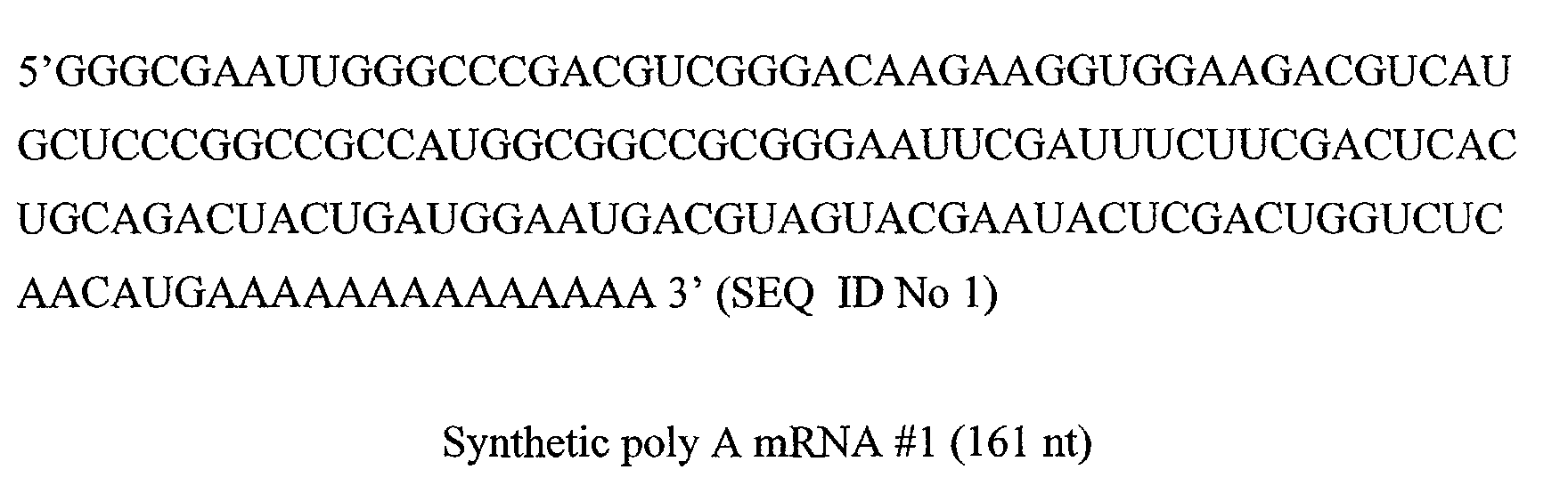
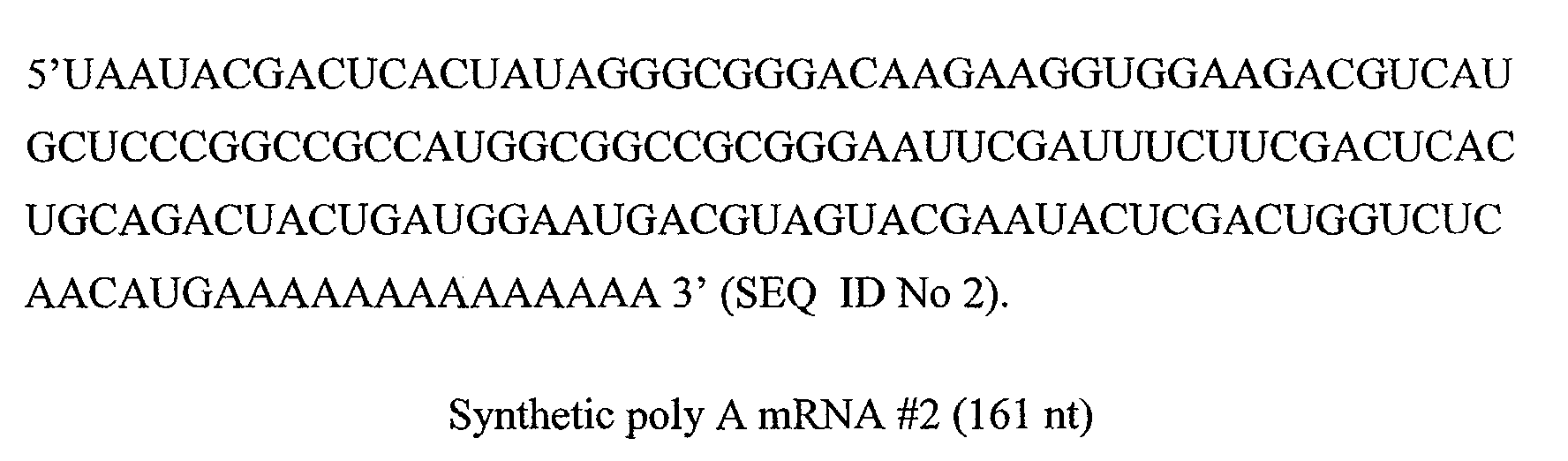
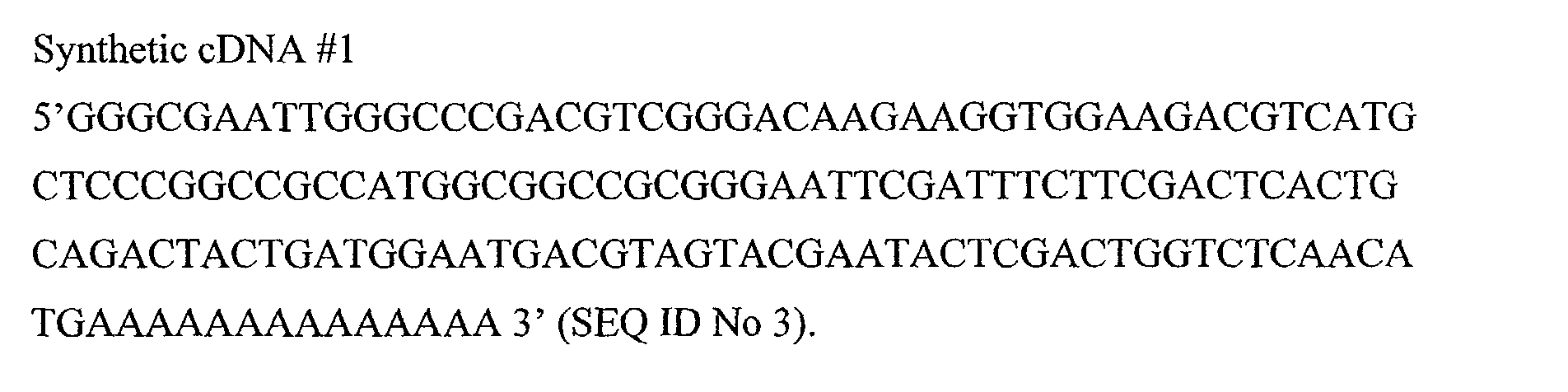
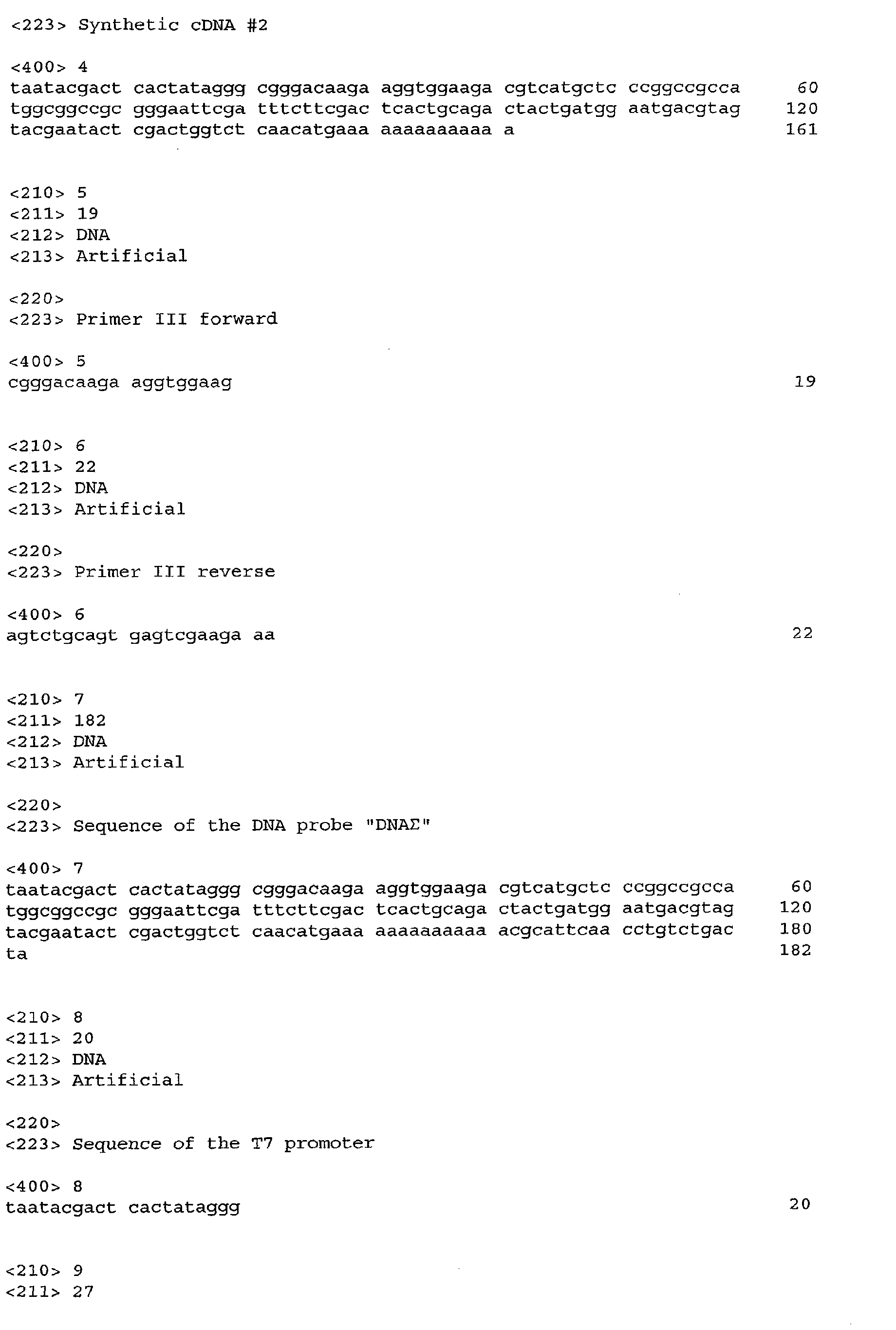
- the smRNA consists of a SEQ ID No 1, SEQ ID No 2, or sequences deriving thereof. It is reversed transcribed into cDNA of SEQ ID No 3 or SEQ ID No 4, preferably using a pair of primer consisting of SEQ ID No 5 and SEQ ID No 6. Such primers are optimized so as to avoid dimerization and are specific for the smRNA sequence.
- the invention relates to a synthetic messenger RNA (smRNA) designed for normalization of reverse transcription reaction of mRNAs of a biological sample, wherein said smRNA do not interfere with the reverse transcription of endogenous mRNA of said sample, which smRNA display less than 95% or 99% identity with any biological sequence, comprise a poly A segment and is about 80 nucleotide long or longer, preferably about 100 nucleotide long.
- smRNA synthetic messenger RNA
- This smRNA may further comprise at least two segments which are complementary to at least two primers that are designed to avoid primer dimerization.
- One preferred smRNA has the sequence shown in SEQ ID No 1 or SEQ ID No 2. Another feature of these particular smRNA is two segments which are complementary to two primers of SEQ ID No 5 and SEQ ID No 6. In this regards, the invention is also directed to a primer or probe selected from of SEQ ID No 5 and SEQ ID No 6.
- the invention also encompasses a cDNA obtained from a reverse transcription reaction of a smRNA as defined above.
- a cDNA obtained from a reverse transcription reaction of a smRNA as defined above.
- One particular cDNA consists of SEQ ID No 3 or SEQ ID No 4.
- the invention in another embodiment, concerns a vector comprising a sequence encoding the smRNA of the invention.
- vector refers to a DNA molecule originating from a virus, a bacteria, or the cell of a higher organism into which another DNA fragment of appropriate size can be integrated without loss of the vectors capacity for self-replication; a vector introduces foreign DNA into host cells, where it can be reproduced in large quantities. Examples are plasmids, cosmids, and yeast artificial chromosomes; vectors are often recombinant molecules containing DNA sequences from several sources.
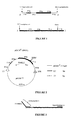
- Preferred vectors are plasmids, more specifically plasmids which comprise the construct as shown in figure 1, notably the sequence SED ID No 7 or SEQ ID No 9 and 11.
- the invention also relates to a vector as depicted in figure 2. More particularly, the invention is directed to a vector as mentioned above which further comprise any sequence corresponding to SEQ ID No 9, 10 and 11 preceded by a sequence corresponding to a RNA polymerase promoter, for example RNA polymerase T7 promoter (sequence ID No 8) and referred as to "DNA probe DNA ⁇ " (see figure 3).
- the invention is aimed at a kit for quantification of mRNAs of a biological sample comprising a smRNA, a vector or a DNA probe as defined above.
- kit may further comprise primers of SEQ ID No 5 and 6.
- the invention also relates to the use of a smRNA, a vector or a DNA probe as defined above for calibrating target mRNAs during quantification in RT-PCR reaction, more particularly in frame with Q-RT-PCR or DD-RT-PCR, which may optionally be practiced with DNA microarrays.
- the invention also relates to the use of a smRNA, a vector or a DNA probe as defined above for calibrating target mRNAs in Northern blot analysis.
- EXAMPLE 1 Calibration of the reverse transcription using a synthetic messenger RNA (smRNA) obtained from a synthetic DNA probe (DNA ⁇ )
- pGEM®-DNA ⁇ The resulting plasmid referred as pGEM®-DNA ⁇ is shown in Figure 2.
- Example 2 In vitro transcription of the synthetic mRNA using the plasmid pGEM®-DNA ⁇
- the amplified fragment from both synthetic cDNA #1 and cDNA #2 (82 pb) with primer pair III produces the following sequence:
- Example 5 Calibration of the RT reaction using smRNAs of the invention in real-time PCR.
- the addition of the synthetic mRNA to the reverse transcriptase (RT) reaction mix does not interfere with the reverse transcription of endogenous mRNA.
- the normalization of BDNF cDNA by the synthetic cDNA allows to recover the same induction profile in pilocarpine-treated rats than that observed without the addition of the synthetic mRNA to the RT reaction mix.
Landscapes
- Chemical & Material Sciences (AREA)
- Life Sciences & Earth Sciences (AREA)
- Organic Chemistry (AREA)
- Engineering & Computer Science (AREA)
- Zoology (AREA)
- Wood Science & Technology (AREA)
- Proteomics, Peptides & Aminoacids (AREA)
- Health & Medical Sciences (AREA)
- Biophysics (AREA)
- Chemical Kinetics & Catalysis (AREA)
- Immunology (AREA)
- Microbiology (AREA)
- Molecular Biology (AREA)
- Analytical Chemistry (AREA)
- Physics & Mathematics (AREA)
- Biotechnology (AREA)
- Biochemistry (AREA)
- Bioinformatics & Cheminformatics (AREA)
- General Engineering & Computer Science (AREA)
- General Health & Medical Sciences (AREA)
- Genetics & Genomics (AREA)
- Measuring Or Testing Involving Enzymes Or Micro-Organisms (AREA)
Abstract
Description
- The invention pertains to the field of reverse transcription reactions and relates to a new method of calibration with a synthetic messenger RNA (smRNA).
- Quantitative RT-PCR assays involve simultaneously amplifying control molecules and samples containing a target mRNA. Known amounts of a control molecule are thermally cycled with tubes, wells or slides, containing the unknown amount of target. In addition to the pair of PCR primers for the target, a pair of PCR primers is required for the control molecule. Following amplification, the amounts of amplified products are compared. However, inherent variation in amplification efficiency among primers results in poor quality of results.
- More recently, this method has been improved. Kits comprising fluorescent dyes and quenchers are provided by Applied Biosystems and are available under the trademark TaqMan™. Improvements allowed the development of real-time quantitative PCR.
- These methods have been reviewed for example in Heid et al, Real-time quantitative PCR. Genome Research. 1996; 6: 986-994, and in Gibson et al, Genome Research, A novel method for real time quantitative RT-PCR Genome research. 1996; 6 : 995-1001. Despite the use of different sets of tubes containing triplicate two-fold dilutions of a control molecule and a fixed amount of unknown target, variation in the quantification between samples still occurs.
- We found in connection with the invention that such drawback is due to the nature of the control molecule used. In Heid et al, the internal standard used for normalization is an endogenous gene such as β-actin. Endogenous genes are not appropriate since they may vary from one sample to the other and can interfere with amplification of related gene sequences. In Gibson et al, it is proposed to use a random sequence selected from the target sequence or a modified sequence deriving from the target sequence. In this case, variation between sample may also occurs and it would require the design of one control molecule for each target sequence, which makes it impossible when analyzing the expression of large number of genes. In Wang et al, Quantification of mRNA by the polymerase chain reaction, Proc. Acad. Sci. USA, 1989, 86 : 9717-9721, it is suggested to use a standard whose sequence comprise complementary sequence of the target gene so that one pair of primer is sufficient to amplify both products. Again, such approach is irrelevant with the analysis of a large number of genes. A similar method is described in WO 00/20629.
- Because quantitative PCR amplifications (real-time PCR) is now widely used for the quantification of the relative alteration in mRNA expression, controlling the RT reaction efficiency using real-time PCR has become an important factor before the further use of the RT products (microarrays, DD-RTPCR ...).
- We provide a solution to address the above mentioned problems based on the use of a synthetic messenger RNA (smRNA) designed for normalization of reverse transcription reaction of mRNAs of a biological sample, which smRNA do not interfere with the reverse transcription of endogenous mRNA of said sample. Such smRNA is particularly advantageous for the analysis of different genes from different samples for example using real-time quantitative RT-PCR.
- Therefore, in a first aspect, the invention relates to a method for quantifying products of reverse transcription reaction of mRNA extracted from a biological sample, wherein said method comprises the steps consisting of adding a synthetic messenger RNA (smRNA) which do not interfere with the reverse transcription of endogenous mRNA of said sample to a reaction mixture comprising mRNA extracted from said sample, which smRNA display less than 95%, 97% or 99% or preferably less than 99,50 % identity with any biological sequence, to perform a reverse transcription reaction and to calibrate the quantity of each target mRNA obtained after amplification with the quantity of the cDNA amplified corresponding to said smRNA.
- In this method, said smRNA can be added in different reaction mixtures comprising one sample in different dilutions.
- Said smRNA may further comprise a polyA segment. This allows to perform the reverse transcriptase reaction using a polydT primer for both the target mRNAs and the smRNA.
- The smRNA may be about 80 to 150 nucleotide long or longer, preferably about 100 nucleotide long and comprise particular sequences so as to be specifically amplified with a pair of primers designed to avoid primer dimerization.
- The method depicted above may consist of quantitative RT-PCR, DD-RT-PCR, wherein quantification of target mRNAs is performed by means of normalization with said smRNA. The invention can be practiced on DNA microarrays. In this case, the cDNA corresponding to the smRNA is amplified and spotted onto said microarrays. This is an important advantage of the said mRNA, since a same mRNA sequence can be used first to help calibrating the RT reaction in microarrays, and second, to calibrate the RT reaction in real-time RT-PCR (which is a commonly used technique employed following microarrays to validate the results obtained). In other words, both techniques (microarrays and real-time RT-PCR) can use a same standard to control the reaction's efficiency.
- Alternatively, the method of the invention may consist of Northern blotting wherein said smRNA is pooled with samples.
- In a particular embodiment, the smRNA consists of a
SEQ ID No 1,SEQ ID No 2, or sequences deriving thereof. It is reversed transcribed into cDNA ofSEQ ID No 3 orSEQ ID No 4, preferably using a pair of primer consisting ofSEQ ID No 5 and SEQ ID No 6. Such primers are optimized so as to avoid dimerization and are specific for the smRNA sequence. - In a second embodiment, the invention relates to a synthetic messenger RNA (smRNA) designed for normalization of reverse transcription reaction of mRNAs of a biological sample, wherein said smRNA do not interfere with the reverse transcription of endogenous mRNA of said sample, which smRNA display less than 95% or 99% identity with any biological sequence, comprise a poly A segment and is about 80 nucleotide long or longer, preferably about 100 nucleotide long.
- This smRNA may further comprise at least two segments which are complementary to at least two primers that are designed to avoid primer dimerization.
- One preferred smRNA has the sequence shown in
SEQ ID No 1 orSEQ ID No 2.
Another feature of these particular smRNA is two segments which are complementary to two primers ofSEQ ID No 5 and SEQ ID No 6.
In this regards, the invention is also directed to a primer or probe selected from ofSEQ ID No 5 and SEQ ID No 6. - The invention also encompasses a cDNA obtained from a reverse transcription reaction of a smRNA as defined above. One particular cDNA consists of
SEQ ID No 3 orSEQ ID No 4. - In another embodiment, the invention concerns a vector comprising a sequence encoding the smRNA of the invention. The term "vector" refers to a DNA molecule originating from a virus, a bacteria, or the cell of a higher organism into which another DNA fragment of appropriate size can be integrated without loss of the vectors capacity for self-replication; a vector introduces foreign DNA into host cells, where it can be reproduced in large quantities. Examples are plasmids, cosmids, and yeast artificial chromosomes; vectors are often recombinant molecules containing DNA sequences from several sources.
- Preferred vectors are plasmids, more specifically plasmids which comprise the construct as shown in figure 1, notably the sequence SED ID No 7 or
SEQ ID No 9 and 11. The invention also relates to a vector as depicted in figure 2. More particularly, the invention is directed to a vector as mentioned above which further comprise any sequence corresponding toSEQ ID No - In still another embodiment, the invention is aimed at a kit for quantification of mRNAs of a biological sample comprising a smRNA, a vector or a DNA probe as defined above. Such kit may further comprise primers of
SEQ ID No 5 and 6. - The invention also relates to the use of a smRNA, a vector or a DNA probe as defined above for calibrating target mRNAs during quantification in RT-PCR reaction, more particularly in frame with Q-RT-PCR or DD-RT-PCR, which may optionally be practiced with DNA microarrays.
- The invention also relates to the use of a smRNA, a vector or a DNA probe as defined above for calibrating target mRNAs in Northern blot analysis.
- The invention is further illustrated in the examples below.
-
- Name of the DNA probe : DNAΣ
- Total Length : 182 bp
- Insertion of a restriction site for BSM I allowing the linearization of the vector just after the poly A sequence
- Presence of the T7 promoter allowing the in vitro transcription of a synthetic messenger RNA (smRNA)
-
- Insertion of a 101 bp fragment (shown below) in the pGEM®-T Easy Vector with
a T4 DNA ligase (Promega).

- Linearization of the cloned plasmid with the Aat II and Sph I restriction enzymes (New England BioLabs®Inc).
- 3- Insertion of a 27 bp fragment (shown below) with a T4 DNA ligase (Promega).

- The resulting plasmid referred as pGEM®-DNA∑ is shown in Figure 2.
- PCR amplification of the plasmid pGEM®-DNA∑ using:
- a mix of HotStarTaq DNA polymerase (Qiagen) and ProofStar DNA polymerase (Qiagen).
- Forward primer A containing the T7 promoter:

- Reverse primer A:

- Sequence of the DNA probe "DNAΣ"


-
- Linearization of the plasmid pGEM® -DNAΣ with the BSM I restriction enzyme (New England BioLabs®Inc); see Figure 1.
- In vitro transcription with T7 RNA polymerase using T7-MEGAshortscriptTM
(Ambion ®).
-
- Digestion of the DNA probe « DNAΣ» with the BSM I restriction enzyme (New England BioLabs®Inc); see Figure 1.
- In vitro transcription with T7 RNA polymerase using T7-MEGAshortscript™
(Ambion ®).
-
- 4.1 Reverse transcription of synthetic poly A mRNAs #1 (SEQ ID No 1) and #2
(SEQ ID No 2) with oligo dT using M-MLV Reverse Transcriptase RNase H
Minus, point mutant (Promega) leading to :
and

- 4.2 Amplification of
synthetic cDNAs # 1 and #2 using PCR on the LightCycler® (Roche) using the QuantiTectTM SYBR® Green PCR kit (Qiagen) or the LC FastStart DNA Master SYBR Green I (Roche).

-
- The amplified fragment from both
synthetic cDNA # 1 and cDNA #2 (82 pb) with primer pair III produces the following sequence:
-
- 5.1 We tested several primers to optimize the sequence of the smRNA as depicted
above. The goal was to obtain segments within the sequence which are
complementary to pairs of primers which will not dimerize during the reaction
while being specific to the smRNA.
Among the sequences tested, we show here below three examples illustrating the importance of the presence of such segments within the smRNA of the invention.
 The left and right primers I, II and III were chosen to minimize as much as possible the PCR priming primer-dimers using the "
primer 3" software.Regarding primers I, control experiments without cDNA show the absence of any amplification, confirming the absence of primer dimerization (curve control, Figure 4). However, these primers did not provide satisfying specificity since (in absence of SmRNA during the RT), they recognized cDNAs obtained from hippocampal tissue (curve cDNA, Figure 4).
Based on these results, it was necessary to design different specific primers. Several specific software, including Primer3, did not allow us to design other primers matching the various cautious required such as the absence of self complementarity and melting temperatures. Therefore, we have inserted a 27 bp fragment in the pGEM®-T Easy Vector with a T4 DNA ligase (Promega) in order to design other primers.The left and right primers II were chosen to minimize as much as possible the PCR priming primer-dimers. Control experiments without cDNA show the absence of any amplification, which confirms the absence of primer dimerization (curve control, Figure 5). However, the profile of the amplification curve of the pGEM®-DNA∑, that the primer pair has a weak affinity for the sequence. Other specific primers have thus been designed.In case of the primers III, control experiments. without cDNA containing the sequence to amplify, show the absence of any amplification, which confirms the absence of primer dimerization (curve control, Figure 6). Furthermore, the amplification curve shows that primers III have a high affinity for the sequence of the pGEM®-DNA∑, which contains the sequence to amplify.Using such tests, one can routinely obtain variants of the smRNA ofSEQ ID No 1 and corresponding primers optimized for use as mentioned in the present invention. -
5.2 Calibration using primers III and the smRNA of
SEQ ID No 1. - 5.2.1 Calibration of the amplification of the synthetic cDNA using the
LightCycler® (Roche) and the QuantiTectTM SYBR® Green PCR kit (Qiagen).
Several dilutions of the purified synthetic cDNA were amplified with specific
primer pair III and the crossing point was determined.
We evidence that the starting concentration of synthetic cDNA before amplification
is linearly correlated with the value of the crossing point (
validation # 1, Figure 7). - 5.2.2 Increasing amounts of
synthetic mRNA # 1 were reverse transcribed and amplified with specific primer pair III using QuantiTectTM SYBR® Green PCR kit (Qiagen) on the LightCycler® We evidence that the amplification of the synthetic cDNA, following reverse transcription of the synthetic mRNA, is dependant of the concentration of thesynthetic mRNA # 1 reverse transcribed (validation # 2, Figure 8). - 5.2.3 Increasing amounts of
synthetic mRNA # 1 were reverse transcribed together with 500 ng of total hippocampus RNA of either control or pilocarpine-treated rats. Synthetic cDNA were amplified as above. We evidence that the dilution of thesynthetic mRNA # 1 either within total tissue RNA from control or pilocarpine-treated rats does not affect the PCR efficiency (1.68) for synthetic mRNA #1 (validation # 3, Figure 9). - 5.2.4 Calibration of the amplification of the synthetic cDNA using the
LightCycler® (Roche) and LC FastStart DNA Master SYBR Green I (Roche).
Several dilutions of the purified synthetic cDNA were amplified and the crossing
point was determined.
This calibration curve using the LC FastStart DNA Master SYBR Green I (Roche)
is very similar to that obtained with the QuantiTect SYBR Green PCR kit (Qiagen)
(see
validation # 1, Figure 7), demonstrating that the synthetic cDNA can be equally amplified with the LightCycler using both kits (validation # 4, Figure 10). - 5.2.5 Calibration of the amplification of the synthetic cDNA using the
LightCycler® (Roche) and LC FastStart DNA Master SYBR Green I (Roche).
Several dilutions of the purified synthetic cDNA were amplified and the crossing
point was determined. In this experiment, the serial dilutions have been performed
with a constant concentration of cDNAs obtained from reverse transcription of total
brain mRNAs, instead of water (
validations # validation # 4 = Figure 10 versus brain cDNAs invalidation # 5 = Figure 11). - 5.2.6 Illustration of the variability of the RT efficiency performed in 86 samples of
total RNA from mouse olfactory bulb (OB).
500 ng of total RNA from 86 OB have been reverse transcribed together with 80 pg ofsmRNA # 1. Reverse transcription has been performed in a PCR Express Thermocycler (Hybaid). cDNA corresponding to thesmRNA # 1 has then been quantitatively amplified with primer pair "III" using the LightCycler to control whether identical concentration of cDNA from smRNA was present in each sample after the reverse transcription step. Conclusion: The figure 12 shows a wide range of cDNA concentration after reverse transcription, indicating that the reverse transcription was not reproducible across the 86 samples. - 5.2.7 Demonstration that
smRNA # 1 is appropriate, instead of house-keeping gene GAPDH, to quantify specific mRNA following quantitative relative RT-PCR. 500 ng of total RNA from rats (control 2 month old;control 10 month old; DSP-4 treated 10 month old) have been reverse transcribed together with 80 pg ofsmRNA # 1. cDNAs corresponding to BDNF exon V, GAPDH and smRNA have been amplified using gene specific primers with the LightCycler. In each sample, BDNF was either corrected using either GAPDH value or smRNA value.Note that GAPDH cannot be used to normalize samples, since its expression is not constant among the three groups tested (Figure 13B). However, smRNA appears to highlight differences that could not been evidenced before normalization of the reverse transcription (Figure 13A vs. Figure 13D). Furthermore, note that normalization with GAPDH induces biased conclusions (Figure 13B vs. Figure 13D). - 5.2.8 Influence of the
smRNA # 1 addition to the RT reaction the relative variation in the expression of specific genes. Reverse transcription of 500 ng of total hippocampus RNA from either control or pilocarpine-treated rats. Piolcarpine treatment has been used to stimulate BDNF gene expression in the hippocampus.Exon 5 of the BDNF cDNA was amplified with specific primers and LC FastStart DNA Master SYBR Green I (Roche). BDNF mRNA concentration was quantified using PCR on the LightCycler and the standard curve equation: y = -3.7621 x + 31.648. -
-
- Control:
- 31.5±3.7A.U.
- Pilocarpine:
- 219.9 ± 36.9 A.U.
- Pilocarpine =
- 6.98 X control
- Reverse transcription of 500 ng of total hippocampus RNA from either control or pilocarpine-treated rats, together with 80 pg of
synthetic mRNA # 1 added to the RT reaction mix.Exon 5 of the BDNF cDNA was amplified with specific primers and LC FastStart DNA Master SYBR Green I (Roche). BDNF mRNA concentration was quantified using PCR on the LightCycler and the standard curve equation: y = - 3.7621 x + 31.648. - Synthetic cDNA was amplified with specific primers and QuantiTect SYBR Green I PCR kit (Qiagen).
Synthetic mRNA # 1 concentration was quantified using PCR on the LightCycler and the standard curve equation: y = -4.717 x + 33.569. -
- Control:
- 31.4 ± 1.1A.U.
- Pilocarpine:
- 245.5 ± 26.2 A.U.
-
- Control:
- 1.627 ± 0.062 A.U.
- Pilocarpine:
- 1.821 ± 0.053 A.U.
-
- Control:
- 19.3
- Pilocarpine:
- 134.8
- Pilocarpine =
- 6.98 X control
- The addition of the synthetic mRNA to the reverse transcriptase (RT) reaction mix does not interfere with the reverse transcription of endogenous mRNA.
The normalization of BDNF cDNA by the synthetic cDNA allows to recover the same induction profile in pilocarpine-treated rats than that observed without the addition of the synthetic mRNA to the RT reaction mix. - Therefore, we conclude that the addition of the smRNA of the invention into the RT reaction mix allows a reliable normalization of the RT reaction between samples.



Claims (29)
Priority Applications (2)
| Application Number | Priority Date | Filing Date | Title |
|---|---|---|---|
| EP03290958A EP1469083A1 (en) | 2003-04-17 | 2003-04-17 | Method of calibration of reverse transcription using a synthetic messenger RNA (smRNA) as an internal control |
| PCT/IB2004/001462 WO2004092414A1 (en) | 2003-04-17 | 2004-04-19 | Method of calibration of reverse transcription using a synthetic messenger rna (smrna) as an internal control |
Applications Claiming Priority (1)
| Application Number | Priority Date | Filing Date | Title |
|---|---|---|---|
| EP03290958A EP1469083A1 (en) | 2003-04-17 | 2003-04-17 | Method of calibration of reverse transcription using a synthetic messenger RNA (smRNA) as an internal control |
Publications (1)
| Publication Number | Publication Date |
|---|---|
| EP1469083A1 true EP1469083A1 (en) | 2004-10-20 |
Family
ID=32893002
Family Applications (1)
| Application Number | Title | Priority Date | Filing Date |
|---|---|---|---|
| EP03290958A Withdrawn EP1469083A1 (en) | 2003-04-17 | 2003-04-17 | Method of calibration of reverse transcription using a synthetic messenger RNA (smRNA) as an internal control |
Country Status (2)
| Country | Link |
|---|---|
| EP (1) | EP1469083A1 (en) |
| WO (1) | WO2004092414A1 (en) |
Families Citing this family (1)
| Publication number | Priority date | Publication date | Assignee | Title |
|---|---|---|---|---|
| AU2020225354B2 (en) | 2019-02-21 | 2025-03-06 | Centre National De La Recherche Scientifique | Structured molecular vectors for anti-inflammatory compounds and uses thereof |
Citations (2)
| Publication number | Priority date | Publication date | Assignee | Title |
|---|---|---|---|---|
| WO1991002817A1 (en) * | 1989-08-21 | 1991-03-07 | Cetus Corporation | Quantitation of nucleic acids using the polymerase chain reaction |
| WO2001016367A1 (en) * | 1998-03-26 | 2001-03-08 | The Perkin-Elmer Corporation | Methods for exogenous, internal controls during nucleic acid amplification |
Family Cites Families (3)
| Publication number | Priority date | Publication date | Assignee | Title |
|---|---|---|---|---|
| FR2740781B1 (en) * | 1995-11-06 | 1998-03-20 | Aremas Ass Pour La Rech L Etud | METHOD AND KIT FOR QUANTIFICATION AND DETECTION OF MICROORGANISMS |
| US6312929B1 (en) * | 2000-12-22 | 2001-11-06 | Cepheid | Compositions and methods enabling a totally internally controlled amplification reaction |
| EP1236804A1 (en) * | 2001-03-02 | 2002-09-04 | Boehringer Mannheim Gmbh | A method for determination of a nucleic acid using a control |
-
2003
- 2003-04-17 EP EP03290958A patent/EP1469083A1/en not_active Withdrawn
-
2004
- 2004-04-19 WO PCT/IB2004/001462 patent/WO2004092414A1/en not_active Ceased
Patent Citations (2)
| Publication number | Priority date | Publication date | Assignee | Title |
|---|---|---|---|---|
| WO1991002817A1 (en) * | 1989-08-21 | 1991-03-07 | Cetus Corporation | Quantitation of nucleic acids using the polymerase chain reaction |
| WO2001016367A1 (en) * | 1998-03-26 | 2001-03-08 | The Perkin-Elmer Corporation | Methods for exogenous, internal controls during nucleic acid amplification |
Non-Patent Citations (6)
| Title |
|---|
| GIBSON U E M ET AL: "A NOVEL METHOD FOR REAL TIME QUANTITATIVE RT-PCR", GENOME RESEARCH, COLD SPRING HARBOR LABORATORY PRESS, US, vol. 6, no. 10, 1 October 1996 (1996-10-01), pages 995 - 1001, XP000642796, ISSN: 1088-9051 * |
| JENSEN LISELOTTE E ET AL: "Competitive reverse transcription polymerase chain reaction for quantifying pre-MRNA and mRNA of major acute phase proteins.", JOURNAL OF IMMUNOLOGICAL METHODS, vol. 215, no. 1-2, 1 June 1998 (1998-06-01), pages 45 - 58, XP004146492, ISSN: 0022-1759 * |
| REISCHL U ET AL: "QUANTITATIVE PCR A SURVEY OF THE PRESENT TECHNOLOGY", MOLECULAR BIOTECHNOLOGY, TOTOWA, NJ, US, vol. 3, 1995, pages 55 - 71, XP000600241, ISSN: 1073-6085 * |
| SHEFLIN LOWELL G ET AL: "Thyroxine increases the levels of epidermal growth factor messenger ribonucleic acid (EGF mRNA) in the thyroid in vivo, as revealed by quantitative reverse transcription polymerase chain reaction with an internal control EGF mRNA.", ENDOCRINOLOGY, vol. 132, no. 6, 1993, pages 2319 - 2324, XP002253790, ISSN: 0013-7227 * |
| SIEBERT P D ET AL: "COMPETITIVE PCR", NATURE, MACMILLAN JOURNALS LTD. LONDON, GB, vol. 359, 8 October 1992 (1992-10-08), pages 557 - 558, XP002071876, ISSN: 0028-0836 * |
| ZAMORANO P L ET AL: "QUANTITATIVE RT-PCR FOR NEUROENDOCRINE STUDIES A MINIREVIEW", NEUROENDOCRINOLOGY, S.KARGER, BASEL, CH, vol. 63, 1996, pages 397 - 407, XP002941018, ISSN: 0028-3835 * |
Also Published As
| Publication number | Publication date |
|---|---|
| WO2004092414A1 (en) | 2004-10-28 |
Similar Documents
| Publication | Publication Date | Title |
|---|---|---|
| US11149297B2 (en) | Methods for depleting RNA from nucleic acid samples | |
| Jozefczuk et al. | Quantitative real-time PCR-based analysis of gene expression | |
| EP3394292B1 (en) | Methods of library construction for polynucleotide sequencing | |
| Andreasen et al. | Improved microRNA quantification in total RNA from clinical samples | |
| US10017761B2 (en) | Methods for preparing cDNA from low quantities of cells | |
| EP3759241B1 (en) | Generation of single-stranded circular dna templates for single molecule sequencing | |
| EP4219519A2 (en) | Competitive probes for engineering signal generation | |
| EP4570919A2 (en) | Amplification of single stranded dna | |
| US20210024920A1 (en) | Integrative DNA and RNA Library Preparations and Uses Thereof | |
| EP3353320B1 (en) | Improved detection of short homopolymeric repeats | |
| CA2617693A1 (en) | Composition and method for determination of ck19 expression | |
| CN107190091B (en) | Real-time quantitative PCR method suitable for gene expression quantification of FFPE sample | |
| EP1469083A1 (en) | Method of calibration of reverse transcription using a synthetic messenger RNA (smRNA) as an internal control | |
| EP2024508A2 (en) | Allele detection | |
| CN115896243A (en) | Ultrasensitive reverse transcription method based on mixed enzyme system and its application | |
| EP1978104A1 (en) | A method for the quantitative analysis of RNA molecules in a sample | |
| US20060149484A1 (en) | Absolute quantitation of nucleic acids by rt-pcr | |
| EP1594982A2 (en) | Methods and compositions for rna detection and quantitation | |
| CN110612355B (en) | Compositions for quantitative PCR amplification and applications thereof | |
| JPWO1999009213A1 (en) | DNA amplification method and kit | |
| EP4365304B1 (en) | A stem-loop primer and a method for short length rna detection | |
| EP1004676A1 (en) | Methods for dna amplification and kits therefor | |
| JP7007796B2 (en) | Primer for ABL gene amplification, nucleic acid amplification method and nucleic acid amplification kit | |
| WO2021058145A1 (en) | Phage t7 promoters for boosting in vitro transcription | |
| CN114585749B (en) | Determination of nucleic acid sequence concentration |
Legal Events
| Date | Code | Title | Description |
|---|---|---|---|
| PUAI | Public reference made under article 153(3) epc to a published international application that has entered the european phase |
Free format text: ORIGINAL CODE: 0009012 |
|
| AK | Designated contracting states |
Kind code of ref document: A1 Designated state(s): AT BE BG CH CY CZ DE DK EE ES FI FR GB GR HU IE IT LI LU MC NL PT RO SE SI SK TR |
|
| AX | Request for extension of the european patent |
Extension state: AL LT LV MK |
|
| 17P | Request for examination filed |
Effective date: 20050420 |
|
| AKX | Designation fees paid |
Designated state(s): AT BE BG CH CY CZ DE DK EE ES FI FR GB GR HU IE IT LI LU MC NL PT RO SE SI SK TR |
|
| 17Q | First examination report despatched |
Effective date: 20060130 |
|
| STAA | Information on the status of an ep patent application or granted ep patent |
Free format text: STATUS: THE APPLICATION HAS BEEN WITHDRAWN |
|
| 18W | Application withdrawn |
Effective date: 20090122 |