EP1469079A1 - Carbonly reductases, polynucleotides comprising DNA encoding the same, methods for producing the same,and methods for producing optically active alcohol utilizing the same - Google Patents
Carbonly reductases, polynucleotides comprising DNA encoding the same, methods for producing the same,and methods for producing optically active alcohol utilizing the same Download PDFInfo
- Publication number
- EP1469079A1 EP1469079A1 EP04009125A EP04009125A EP1469079A1 EP 1469079 A1 EP1469079 A1 EP 1469079A1 EP 04009125 A EP04009125 A EP 04009125A EP 04009125 A EP04009125 A EP 04009125A EP 1469079 A1 EP1469079 A1 EP 1469079A1
- Authority
- EP
- European Patent Office
- Prior art keywords
- amino acid
- protein
- polynucleotide
- seq
- enzyme
- Prior art date
- Legal status (The legal status is an assumption and is not a legal conclusion. Google has not performed a legal analysis and makes no representation as to the accuracy of the status listed.)
- Granted
Links
- 108091033319 polynucleotide Proteins 0.000 title claims description 89
- 102000040430 polynucleotide Human genes 0.000 title claims description 89
- 239000002157 polynucleotide Substances 0.000 title claims description 89
- LFQSCWFLJHTTHZ-UHFFFAOYSA-N Ethanol Chemical compound CCO LFQSCWFLJHTTHZ-UHFFFAOYSA-N 0.000 title claims description 30
- 238000000034 method Methods 0.000 title abstract description 51
- 102000004316 Oxidoreductases Human genes 0.000 title abstract description 4
- 108090000854 Oxidoreductases Proteins 0.000 title abstract description 4
- 108091007187 Reductases Proteins 0.000 title abstract 2
- 102000004190 Enzymes Human genes 0.000 claims abstract description 89
- 108090000790 Enzymes Proteins 0.000 claims abstract description 89
- 108010031132 Alcohol Oxidoreductases Proteins 0.000 claims abstract description 87
- UMYZWICEDUEWIM-UHFFFAOYSA-N 1-(3,4-dimethoxyphenyl)propan-2-one Chemical compound COC1=CC=C(CC(C)=O)C=C1OC UMYZWICEDUEWIM-UHFFFAOYSA-N 0.000 claims abstract description 80
- 102000005751 Alcohol Oxidoreductases Human genes 0.000 claims abstract description 76
- KWJDGWGMDAQESJ-QMMMGPOBSA-N (2s)-1-(3,4-dimethoxyphenyl)propan-2-ol Chemical compound COC1=CC=C(C[C@H](C)O)C=C1OC KWJDGWGMDAQESJ-QMMMGPOBSA-N 0.000 claims abstract description 41
- 235000018370 Saccharomyces delbrueckii Nutrition 0.000 claims abstract description 16
- 244000288561 Torulaspora delbrueckii Species 0.000 claims abstract description 16
- 235000014681 Torulaspora delbrueckii Nutrition 0.000 claims abstract description 16
- 239000005515 coenzyme Substances 0.000 claims abstract description 15
- 125000002915 carbonyl group Chemical group [*:2]C([*:1])=O 0.000 claims abstract description 12
- 238000006722 reduction reaction Methods 0.000 claims abstract description 12
- 108090000623 proteins and genes Proteins 0.000 claims description 128
- 102000004169 proteins and genes Human genes 0.000 claims description 85
- 125000003275 alpha amino acid group Chemical group 0.000 claims description 67
- 230000000694 effects Effects 0.000 claims description 52
- 239000013598 vector Substances 0.000 claims description 48
- 244000005700 microbiome Species 0.000 claims description 44
- 239000002773 nucleotide Substances 0.000 claims description 43
- 125000003729 nucleotide group Chemical group 0.000 claims description 43
- 150000001413 amino acids Chemical class 0.000 claims description 34
- FWMNVWWHGCHHJJ-SKKKGAJSSA-N 4-amino-1-[(2r)-6-amino-2-[[(2r)-2-[[(2r)-2-[[(2r)-2-amino-3-phenylpropanoyl]amino]-3-phenylpropanoyl]amino]-4-methylpentanoyl]amino]hexanoyl]piperidine-4-carboxylic acid Chemical compound C([C@H](C(=O)N[C@H](CC(C)C)C(=O)N[C@H](CCCCN)C(=O)N1CCC(N)(CC1)C(O)=O)NC(=O)[C@H](N)CC=1C=CC=CC=1)C1=CC=CC=C1 FWMNVWWHGCHHJJ-SKKKGAJSSA-N 0.000 claims description 22
- 238000004519 manufacturing process Methods 0.000 claims description 18
- 239000003638 chemical reducing agent Substances 0.000 claims description 14
- 230000001603 reducing effect Effects 0.000 claims description 14
- 150000002576 ketones Chemical class 0.000 claims description 12
- 241000235006 Torulaspora Species 0.000 claims description 11
- 238000002415 sodium dodecyl sulfate polyacrylamide gel electrophoresis Methods 0.000 claims description 10
- 239000000758 substrate Substances 0.000 claims description 10
- 230000001172 regenerating effect Effects 0.000 claims description 8
- 101710088194 Dehydrogenase Proteins 0.000 claims description 7
- 238000002523 gelfiltration Methods 0.000 claims description 5
- 230000009471 action Effects 0.000 claims description 3
- 230000001590 oxidative effect Effects 0.000 claims description 3
- XJLXINKUBYWONI-NNYOXOHSSA-N NADP zwitterion Chemical compound NC(=O)C1=CC=C[N+]([C@H]2[C@@H]([C@H](O)[C@@H](COP([O-])(=O)OP(O)(=O)OC[C@@H]3[C@H]([C@@H](OP(O)(O)=O)[C@@H](O3)N3C4=NC=NC(N)=C4N=C3)O)O2)O)=C1 XJLXINKUBYWONI-NNYOXOHSSA-N 0.000 claims 2
- 229930027945 nicotinamide-adenine dinucleotide Natural products 0.000 abstract description 52
- 230000003287 optical effect Effects 0.000 abstract description 15
- 241000894006 Bacteria Species 0.000 abstract description 5
- 150000001298 alcohols Chemical class 0.000 abstract description 3
- ACFIXJIJDZMPPO-NNYOXOHSSA-N NADPH Chemical compound C1=CCC(C(=O)N)=CN1[C@H]1[C@H](O)[C@H](O)[C@@H](COP(O)(=O)OP(O)(=O)OC[C@@H]2[C@H]([C@@H](OP(O)(O)=O)[C@@H](O2)N2C3=NC=NC(N)=C3N=C2)O)O1 ACFIXJIJDZMPPO-NNYOXOHSSA-N 0.000 abstract 1
- 239000013612 plasmid Substances 0.000 description 83
- 229940088598 enzyme Drugs 0.000 description 82
- 235000018102 proteins Nutrition 0.000 description 73
- 108020004414 DNA Proteins 0.000 description 53
- XJLXINKUBYWONI-DQQFMEOOSA-N [[(2r,3r,4r,5r)-5-(6-aminopurin-9-yl)-3-hydroxy-4-phosphonooxyoxolan-2-yl]methoxy-hydroxyphosphoryl] [(2s,3r,4s,5s)-5-(3-carbamoylpyridin-1-ium-1-yl)-3,4-dihydroxyoxolan-2-yl]methyl phosphate Chemical compound NC(=O)C1=CC=C[N+]([C@@H]2[C@H]([C@@H](O)[C@H](COP([O-])(=O)OP(O)(=O)OC[C@@H]3[C@H]([C@@H](OP(O)(O)=O)[C@@H](O3)N3C4=NC=NC(N)=C4N=C3)O)O2)O)=C1 XJLXINKUBYWONI-DQQFMEOOSA-N 0.000 description 43
- 238000006243 chemical reaction Methods 0.000 description 41
- 238000003752 polymerase chain reaction Methods 0.000 description 33
- 239000000243 solution Substances 0.000 description 32
- 108010050375 Glucose 1-Dehydrogenase Proteins 0.000 description 31
- 240000004808 Saccharomyces cerevisiae Species 0.000 description 26
- 235000014680 Saccharomyces cerevisiae Nutrition 0.000 description 26
- 210000004027 cell Anatomy 0.000 description 26
- 235000001014 amino acid Nutrition 0.000 description 22
- 241000588724 Escherichia coli Species 0.000 description 21
- AVKUERGKIZMTKX-NJBDSQKTSA-N ampicillin Chemical compound C1([C@@H](N)C(=O)N[C@H]2[C@H]3SC([C@@H](N3C2=O)C(O)=O)(C)C)=CC=CC=C1 AVKUERGKIZMTKX-NJBDSQKTSA-N 0.000 description 21
- 229960000723 ampicillin Drugs 0.000 description 21
- 108091008146 restriction endonucleases Proteins 0.000 description 21
- 229940024606 amino acid Drugs 0.000 description 20
- 239000012634 fragment Substances 0.000 description 20
- 238000010276 construction Methods 0.000 description 19
- 239000000872 buffer Substances 0.000 description 17
- 239000002609 medium Substances 0.000 description 17
- 244000063299 Bacillus subtilis Species 0.000 description 16
- 235000014469 Bacillus subtilis Nutrition 0.000 description 16
- ISWSIDIOOBJBQZ-UHFFFAOYSA-N Phenol Chemical compound OC1=CC=CC=C1 ISWSIDIOOBJBQZ-UHFFFAOYSA-N 0.000 description 16
- 239000000047 product Substances 0.000 description 16
- 239000000284 extract Substances 0.000 description 14
- XJLXINKUBYWONI-NNYOXOHSSA-O NADP(+) Chemical compound NC(=O)C1=CC=C[N+]([C@H]2[C@@H]([C@H](O)[C@@H](COP(O)(=O)OP(O)(=O)OC[C@@H]3[C@H]([C@@H](OP(O)(O)=O)[C@@H](O3)N3C4=NC=NC(N)=C4N=C3)O)O2)O)=C1 XJLXINKUBYWONI-NNYOXOHSSA-O 0.000 description 13
- 239000013611 chromosomal DNA Substances 0.000 description 13
- HEDRZPFGACZZDS-UHFFFAOYSA-N Chloroform Chemical compound ClC(Cl)Cl HEDRZPFGACZZDS-UHFFFAOYSA-N 0.000 description 12
- 230000010076 replication Effects 0.000 description 12
- DGVVWUTYPXICAM-UHFFFAOYSA-N β‐Mercaptoethanol Chemical compound OCCS DGVVWUTYPXICAM-UHFFFAOYSA-N 0.000 description 12
- PEDCQBHIVMGVHV-UHFFFAOYSA-N Glycerine Chemical compound OCC(O)CO PEDCQBHIVMGVHV-UHFFFAOYSA-N 0.000 description 11
- 238000010586 diagram Methods 0.000 description 11
- 102000039446 nucleic acids Human genes 0.000 description 11
- 108020004707 nucleic acids Proteins 0.000 description 11
- 150000007523 nucleic acids Chemical class 0.000 description 11
- 230000008569 process Effects 0.000 description 11
- KFZMGEQAYNKOFK-UHFFFAOYSA-N 2-propanol Substances CC(C)O KFZMGEQAYNKOFK-UHFFFAOYSA-N 0.000 description 10
- GUBGYTABKSRVRQ-QKKXKWKRSA-N Lactose Natural products OC[C@H]1O[C@@H](O[C@H]2[C@H](O)[C@@H](O)C(O)O[C@@H]2CO)[C@H](O)[C@@H](O)[C@H]1O GUBGYTABKSRVRQ-QKKXKWKRSA-N 0.000 description 10
- YXFVVABEGXRONW-UHFFFAOYSA-N Toluene Chemical compound CC1=CC=CC=C1 YXFVVABEGXRONW-UHFFFAOYSA-N 0.000 description 10
- 238000000605 extraction Methods 0.000 description 10
- YBYRMVIVWMBXKQ-UHFFFAOYSA-N phenylmethanesulfonyl fluoride Chemical compound FS(=O)(=O)CC1=CC=CC=C1 YBYRMVIVWMBXKQ-UHFFFAOYSA-N 0.000 description 10
- 239000008057 potassium phosphate buffer Substances 0.000 description 10
- XEKOWRVHYACXOJ-UHFFFAOYSA-N Ethyl acetate Chemical compound CCOC(C)=O XEKOWRVHYACXOJ-UHFFFAOYSA-N 0.000 description 9
- OKKJLVBELUTLKV-UHFFFAOYSA-N Methanol Chemical compound OC OKKJLVBELUTLKV-UHFFFAOYSA-N 0.000 description 9
- 108091028043 Nucleic acid sequence Proteins 0.000 description 9
- VLKZOEOYAKHREP-UHFFFAOYSA-N n-Hexane Chemical compound CCCCCC VLKZOEOYAKHREP-UHFFFAOYSA-N 0.000 description 9
- 239000013600 plasmid vector Substances 0.000 description 9
- 102000007698 Alcohol dehydrogenase Human genes 0.000 description 8
- 108010021809 Alcohol dehydrogenase Proteins 0.000 description 8
- WQZGKKKJIJFFOK-GASJEMHNSA-N Glucose Natural products OC[C@H]1OC(O)[C@H](O)[C@@H](O)[C@@H]1O WQZGKKKJIJFFOK-GASJEMHNSA-N 0.000 description 8
- 238000012258 culturing Methods 0.000 description 8
- 239000008103 glucose Substances 0.000 description 8
- 238000009396 hybridization Methods 0.000 description 8
- BOPGDPNILDQYTO-NNYOXOHSSA-N nicotinamide-adenine dinucleotide Chemical compound C1=CCC(C(=O)N)=CN1[C@H]1[C@H](O)[C@H](O)[C@@H](COP(O)(=O)OP(O)(=O)OC[C@@H]2[C@H]([C@@H](O)[C@@H](O2)N2C3=NC=NC(N)=C3N=C2)O)O1 BOPGDPNILDQYTO-NNYOXOHSSA-N 0.000 description 8
- 230000003321 amplification Effects 0.000 description 7
- 238000000137 annealing Methods 0.000 description 7
- 239000002299 complementary DNA Substances 0.000 description 7
- 238000004925 denaturation Methods 0.000 description 7
- 230000036425 denaturation Effects 0.000 description 7
- 239000008101 lactose Substances 0.000 description 7
- 238000003199 nucleic acid amplification method Methods 0.000 description 7
- WEVYAHXRMPXWCK-UHFFFAOYSA-N Acetonitrile Chemical compound CC#N WEVYAHXRMPXWCK-UHFFFAOYSA-N 0.000 description 6
- 108700026244 Open Reading Frames Proteins 0.000 description 6
- 108010002747 Pfu DNA polymerase Proteins 0.000 description 6
- FAPWRFPIFSIZLT-UHFFFAOYSA-M Sodium chloride Chemical compound [Na+].[Cl-] FAPWRFPIFSIZLT-UHFFFAOYSA-M 0.000 description 6
- 238000000246 agarose gel electrophoresis Methods 0.000 description 6
- 125000000539 amino acid group Chemical group 0.000 description 6
- 230000001747 exhibiting effect Effects 0.000 description 6
- 229940116108 lactase Drugs 0.000 description 6
- 238000000746 purification Methods 0.000 description 6
- 241000235033 Zygosaccharomyces rouxii Species 0.000 description 5
- 238000010367 cloning Methods 0.000 description 5
- 230000001419 dependent effect Effects 0.000 description 5
- 238000012869 ethanol precipitation Methods 0.000 description 5
- 239000013604 expression vector Substances 0.000 description 5
- 239000012528 membrane Substances 0.000 description 5
- 239000003960 organic solvent Substances 0.000 description 5
- 108090000765 processed proteins & peptides Proteins 0.000 description 5
- 238000011282 treatment Methods 0.000 description 5
- 102000034565 Carbonyl Reductase (NADPH) Human genes 0.000 description 4
- 108090000492 Carbonyl Reductase (NADPH) Proteins 0.000 description 4
- 108010014303 DNA-directed DNA polymerase Proteins 0.000 description 4
- 102000016928 DNA-directed DNA polymerase Human genes 0.000 description 4
- ZHNUHDYFZUAESO-UHFFFAOYSA-N Formamide Chemical compound NC=O ZHNUHDYFZUAESO-UHFFFAOYSA-N 0.000 description 4
- 108090000698 Formate Dehydrogenases Proteins 0.000 description 4
- DBMJMQXJHONAFJ-UHFFFAOYSA-M Sodium laurylsulphate Chemical compound [Na+].CCCCCCCCCCCCOS([O-])(=O)=O DBMJMQXJHONAFJ-UHFFFAOYSA-M 0.000 description 4
- BFNBIHQBYMNNAN-UHFFFAOYSA-N ammonium sulfate Chemical compound N.N.OS(O)(=O)=O BFNBIHQBYMNNAN-UHFFFAOYSA-N 0.000 description 4
- 229910052921 ammonium sulfate Inorganic materials 0.000 description 4
- 235000011130 ammonium sulphate Nutrition 0.000 description 4
- 238000004458 analytical method Methods 0.000 description 4
- 238000005119 centrifugation Methods 0.000 description 4
- 238000004587 chromatography analysis Methods 0.000 description 4
- 210000000349 chromosome Anatomy 0.000 description 4
- 239000000499 gel Substances 0.000 description 4
- 238000010353 genetic engineering Methods 0.000 description 4
- 235000011187 glycerol Nutrition 0.000 description 4
- 230000035772 mutation Effects 0.000 description 4
- 238000006467 substitution reaction Methods 0.000 description 4
- 239000006228 supernatant Substances 0.000 description 4
- 239000007218 ym medium Substances 0.000 description 4
- QKNYBSVHEMOAJP-UHFFFAOYSA-N 2-amino-2-(hydroxymethyl)propane-1,3-diol;hydron;chloride Chemical compound Cl.OCC(N)(CO)CO QKNYBSVHEMOAJP-UHFFFAOYSA-N 0.000 description 3
- CSCPPACGZOOCGX-UHFFFAOYSA-N Acetone Chemical compound CC(C)=O CSCPPACGZOOCGX-UHFFFAOYSA-N 0.000 description 3
- 108010025188 Alcohol oxidase Proteins 0.000 description 3
- 241000193830 Bacillus <bacterium> Species 0.000 description 3
- 241000186146 Brevibacterium Species 0.000 description 3
- 241000222128 Candida maltosa Species 0.000 description 3
- 241000235649 Kluyveromyces Species 0.000 description 3
- QIVBCDIJIAJPQS-VIFPVBQESA-N L-tryptophane Chemical compound C1=CC=C2C(C[C@H](N)C(O)=O)=CNC2=C1 QIVBCDIJIAJPQS-VIFPVBQESA-N 0.000 description 3
- 241000320412 Ogataea angusta Species 0.000 description 3
- 102000011755 Phosphoglycerate Kinase Human genes 0.000 description 3
- 241000235648 Pichia Species 0.000 description 3
- 241000194017 Streptococcus Species 0.000 description 3
- 241000187747 Streptomyces Species 0.000 description 3
- 101001099217 Thermotoga maritima (strain ATCC 43589 / DSM 3109 / JCM 10099 / NBRC 100826 / MSB8) Triosephosphate isomerase Proteins 0.000 description 3
- QIVBCDIJIAJPQS-UHFFFAOYSA-N Tryptophan Natural products C1=CC=C2C(CC(N)C(O)=O)=CNC2=C1 QIVBCDIJIAJPQS-UHFFFAOYSA-N 0.000 description 3
- 238000002835 absorbance Methods 0.000 description 3
- 108010005774 beta-Galactosidase Proteins 0.000 description 3
- 230000015572 biosynthetic process Effects 0.000 description 3
- YTRQFSDWAXHJCC-UHFFFAOYSA-N chloroform;phenol Chemical compound ClC(Cl)Cl.OC1=CC=CC=C1 YTRQFSDWAXHJCC-UHFFFAOYSA-N 0.000 description 3
- 230000029087 digestion Effects 0.000 description 3
- 238000001962 electrophoresis Methods 0.000 description 3
- 238000010828 elution Methods 0.000 description 3
- 230000002068 genetic effect Effects 0.000 description 3
- 108020004445 glyceraldehyde-3-phosphate dehydrogenase Proteins 0.000 description 3
- 230000002209 hydrophobic effect Effects 0.000 description 3
- 229910052588 hydroxylapatite Inorganic materials 0.000 description 3
- 238000010369 molecular cloning Methods 0.000 description 3
- XYJRXVWERLGGKC-UHFFFAOYSA-D pentacalcium;hydroxide;triphosphate Chemical compound [OH-].[Ca+2].[Ca+2].[Ca+2].[Ca+2].[Ca+2].[O-]P([O-])([O-])=O.[O-]P([O-])([O-])=O.[O-]P([O-])([O-])=O XYJRXVWERLGGKC-UHFFFAOYSA-D 0.000 description 3
- 229920001184 polypeptide Polymers 0.000 description 3
- 102000004196 processed proteins & peptides Human genes 0.000 description 3
- 230000009467 reduction Effects 0.000 description 3
- 150000003839 salts Chemical class 0.000 description 3
- 239000011780 sodium chloride Substances 0.000 description 3
- 239000000126 substance Substances 0.000 description 3
- KWJDGWGMDAQESJ-UHFFFAOYSA-N 1-(3,4-dimethoxyphenyl)propan-2-ol Chemical compound COC1=CC=C(CC(C)O)C=C1OC KWJDGWGMDAQESJ-UHFFFAOYSA-N 0.000 description 2
- AVUVSYIYUADCKE-UHFFFAOYSA-N 2-chloro-1-(3-chlorophenyl)ethanone Chemical compound ClCC(=O)C1=CC=CC(Cl)=C1 AVUVSYIYUADCKE-UHFFFAOYSA-N 0.000 description 2
- KWOLFJPFCHCOCG-UHFFFAOYSA-N Acetophenone Chemical compound CC(=O)C1=CC=CC=C1 KWOLFJPFCHCOCG-UHFFFAOYSA-N 0.000 description 2
- DBERHVIZRVGDFO-UHFFFAOYSA-N Acetoxyacetone Chemical compound CC(=O)COC(C)=O DBERHVIZRVGDFO-UHFFFAOYSA-N 0.000 description 2
- 229920000936 Agarose Polymers 0.000 description 2
- 102000002260 Alkaline Phosphatase Human genes 0.000 description 2
- 108020004774 Alkaline Phosphatase Proteins 0.000 description 2
- 241000228212 Aspergillus Species 0.000 description 2
- 102100026189 Beta-galactosidase Human genes 0.000 description 2
- DKPFZGUDAPQIHT-UHFFFAOYSA-N Butyl acetate Natural products CCCCOC(C)=O DKPFZGUDAPQIHT-UHFFFAOYSA-N 0.000 description 2
- 241000222120 Candida <Saccharomycetales> Species 0.000 description 2
- 241000186216 Corynebacterium Species 0.000 description 2
- 241000186226 Corynebacterium glutamicum Species 0.000 description 2
- 241000235646 Cyberlindnera jadinii Species 0.000 description 2
- QSJXEFYPDANLFS-UHFFFAOYSA-N Diacetyl Chemical compound CC(=O)C(C)=O QSJXEFYPDANLFS-UHFFFAOYSA-N 0.000 description 2
- IAZDPXIOMUYVGZ-UHFFFAOYSA-N Dimethylsulphoxide Chemical compound CS(C)=O IAZDPXIOMUYVGZ-UHFFFAOYSA-N 0.000 description 2
- 241000196324 Embryophyta Species 0.000 description 2
- 241000588722 Escherichia Species 0.000 description 2
- 241000233866 Fungi Species 0.000 description 2
- DHMQDGOQFOQNFH-UHFFFAOYSA-N Glycine Chemical compound NCC(O)=O DHMQDGOQFOQNFH-UHFFFAOYSA-N 0.000 description 2
- HNDVDQJCIGZPNO-YFKPBYRVSA-N L-histidine Chemical compound OC(=O)[C@@H](N)CC1=CN=CN1 HNDVDQJCIGZPNO-YFKPBYRVSA-N 0.000 description 2
- AGPKZVBTJJNPAG-WHFBIAKZSA-N L-isoleucine Chemical compound CC[C@H](C)[C@H](N)C(O)=O AGPKZVBTJJNPAG-WHFBIAKZSA-N 0.000 description 2
- COLNVLDHVKWLRT-QMMMGPOBSA-N L-phenylalanine Chemical compound OC(=O)[C@@H](N)CC1=CC=CC=C1 COLNVLDHVKWLRT-QMMMGPOBSA-N 0.000 description 2
- AYFVYJQAPQTCCC-GBXIJSLDSA-N L-threonine Chemical compound C[C@@H](O)[C@H](N)C(O)=O AYFVYJQAPQTCCC-GBXIJSLDSA-N 0.000 description 2
- OUYCCCASQSFEME-QMMMGPOBSA-N L-tyrosine Chemical compound OC(=O)[C@@H](N)CC1=CC=C(O)C=C1 OUYCCCASQSFEME-QMMMGPOBSA-N 0.000 description 2
- KZSNJWFQEVHDMF-BYPYZUCNSA-N L-valine Chemical compound CC(C)[C@H](N)C(O)=O KZSNJWFQEVHDMF-BYPYZUCNSA-N 0.000 description 2
- 241000186660 Lactobacillus Species 0.000 description 2
- 101001110310 Lentilactobacillus kefiri NADP-dependent (R)-specific alcohol dehydrogenase Proteins 0.000 description 2
- 102000013460 Malate Dehydrogenase Human genes 0.000 description 2
- 108010026217 Malate Dehydrogenase Proteins 0.000 description 2
- UIHCLUNTQKBZGK-UHFFFAOYSA-N Methyl isobutyl ketone Natural products CCC(C)C(C)=O UIHCLUNTQKBZGK-UHFFFAOYSA-N 0.000 description 2
- WRQNANDWMGAFTP-UHFFFAOYSA-N Methylacetoacetic acid Chemical compound COC(=O)CC(C)=O WRQNANDWMGAFTP-UHFFFAOYSA-N 0.000 description 2
- LRHPLDYGYMQRHN-UHFFFAOYSA-N N-Butanol Chemical compound CCCCO LRHPLDYGYMQRHN-UHFFFAOYSA-N 0.000 description 2
- 102000012288 Phosphopyruvate Hydratase Human genes 0.000 description 2
- 108010022181 Phosphopyruvate Hydratase Proteins 0.000 description 2
- 241000589516 Pseudomonas Species 0.000 description 2
- 241000316848 Rhodococcus <scale insect> Species 0.000 description 2
- 241000235070 Saccharomyces Species 0.000 description 2
- 241000235346 Schizosaccharomyces Species 0.000 description 2
- 241000235347 Schizosaccharomyces pombe Species 0.000 description 2
- AYFVYJQAPQTCCC-UHFFFAOYSA-N Threonine Natural products CC(O)C(N)C(O)=O AYFVYJQAPQTCCC-UHFFFAOYSA-N 0.000 description 2
- 239000004473 Threonine Substances 0.000 description 2
- 241000223259 Trichoderma Species 0.000 description 2
- DTQVDTLACAAQTR-UHFFFAOYSA-N Trifluoroacetic acid Chemical compound OC(=O)C(F)(F)F DTQVDTLACAAQTR-UHFFFAOYSA-N 0.000 description 2
- KZSNJWFQEVHDMF-UHFFFAOYSA-N Valine Natural products CC(C)C(N)C(O)=O KZSNJWFQEVHDMF-UHFFFAOYSA-N 0.000 description 2
- 241000235017 Zygosaccharomyces Species 0.000 description 2
- YRKCREAYFQTBPV-UHFFFAOYSA-N acetylacetone Chemical compound CC(=O)CC(C)=O YRKCREAYFQTBPV-UHFFFAOYSA-N 0.000 description 2
- 238000013459 approach Methods 0.000 description 2
- 230000001580 bacterial effect Effects 0.000 description 2
- 239000011324 bead Substances 0.000 description 2
- AKGGYBADQZYZPD-UHFFFAOYSA-N benzylacetone Chemical compound CC(=O)CCC1=CC=CC=C1 AKGGYBADQZYZPD-UHFFFAOYSA-N 0.000 description 2
- 230000004071 biological effect Effects 0.000 description 2
- 229940041514 candida albicans extract Drugs 0.000 description 2
- 238000012790 confirmation Methods 0.000 description 2
- 238000012217 deletion Methods 0.000 description 2
- 230000037430 deletion Effects 0.000 description 2
- 238000006911 enzymatic reaction Methods 0.000 description 2
- OHLRLMWUFVDREV-UHFFFAOYSA-N ethyl 4-chloro-3-oxobutanoate Chemical compound CCOC(=O)CC(=O)CCl OHLRLMWUFVDREV-UHFFFAOYSA-N 0.000 description 2
- XYIBRDXRRQCHLP-UHFFFAOYSA-N ethyl acetoacetate Chemical compound CCOC(=O)CC(C)=O XYIBRDXRRQCHLP-UHFFFAOYSA-N 0.000 description 2
- 102000006602 glyceraldehyde-3-phosphate dehydrogenase Human genes 0.000 description 2
- FUZZWVXGSFPDMH-UHFFFAOYSA-M hexanoate Chemical compound CCCCCC([O-])=O FUZZWVXGSFPDMH-UHFFFAOYSA-M 0.000 description 2
- HNDVDQJCIGZPNO-UHFFFAOYSA-N histidine Natural products OC(=O)C(N)CC1=CN=CN1 HNDVDQJCIGZPNO-UHFFFAOYSA-N 0.000 description 2
- 238000002744 homologous recombination Methods 0.000 description 2
- 230000006801 homologous recombination Effects 0.000 description 2
- 238000003780 insertion Methods 0.000 description 2
- 230000037431 insertion Effects 0.000 description 2
- 230000010354 integration Effects 0.000 description 2
- AGPKZVBTJJNPAG-UHFFFAOYSA-N isoleucine Natural products CCC(C)C(N)C(O)=O AGPKZVBTJJNPAG-UHFFFAOYSA-N 0.000 description 2
- 229960000310 isoleucine Drugs 0.000 description 2
- BPHPUYQFMNQIOC-NXRLNHOXSA-N isopropyl beta-D-thiogalactopyranoside Chemical compound CC(C)S[C@@H]1O[C@H](CO)[C@H](O)[C@H](O)[C@H]1O BPHPUYQFMNQIOC-NXRLNHOXSA-N 0.000 description 2
- 229940039696 lactobacillus Drugs 0.000 description 2
- 239000007788 liquid Substances 0.000 description 2
- 238000005259 measurement Methods 0.000 description 2
- MYWUZJCMWCOHBA-VIFPVBQESA-N methamphetamine Chemical compound CN[C@@H](C)CC1=CC=CC=C1 MYWUZJCMWCOHBA-VIFPVBQESA-N 0.000 description 2
- HFLMYYLFSNEOOT-UHFFFAOYSA-N methyl 4-chloro-3-oxobutanoate Chemical compound COC(=O)CC(=O)CCl HFLMYYLFSNEOOT-UHFFFAOYSA-N 0.000 description 2
- -1 methyl tertiary butyl Chemical group 0.000 description 2
- 239000000203 mixture Substances 0.000 description 2
- 150000007524 organic acids Chemical class 0.000 description 2
- TZMFJUDUGYTVRY-UHFFFAOYSA-N pentane-2,3-dione Chemical compound CCC(=O)C(C)=O TZMFJUDUGYTVRY-UHFFFAOYSA-N 0.000 description 2
- COLNVLDHVKWLRT-UHFFFAOYSA-N phenylalanine Natural products OC(=O)C(N)CC1=CC=CC=C1 COLNVLDHVKWLRT-UHFFFAOYSA-N 0.000 description 2
- 230000008929 regeneration Effects 0.000 description 2
- 238000011069 regeneration method Methods 0.000 description 2
- 239000000523 sample Substances 0.000 description 2
- 238000002741 site-directed mutagenesis Methods 0.000 description 2
- 239000007974 sodium acetate buffer Substances 0.000 description 2
- 238000000527 sonication Methods 0.000 description 2
- 238000003786 synthesis reaction Methods 0.000 description 2
- 230000001131 transforming effect Effects 0.000 description 2
- OUYCCCASQSFEME-UHFFFAOYSA-N tyrosine Natural products OC(=O)C(N)CC1=CC=C(O)C=C1 OUYCCCASQSFEME-UHFFFAOYSA-N 0.000 description 2
- 238000000108 ultra-filtration Methods 0.000 description 2
- 239000004474 valine Substances 0.000 description 2
- 238000005406 washing Methods 0.000 description 2
- 239000012138 yeast extract Substances 0.000 description 2
- LBSKQOSGSUKVDG-QMMMGPOBSA-N (1r)-2-chloro-1-(3-chlorophenyl)ethanol Chemical compound ClC[C@H](O)C1=CC=CC(Cl)=C1 LBSKQOSGSUKVDG-QMMMGPOBSA-N 0.000 description 1
- RBEIPUMJEQUKIW-UHFFFAOYSA-N (2-oxocyclopentyl) acetate Chemical compound CC(=O)OC1CCCC1=O RBEIPUMJEQUKIW-UHFFFAOYSA-N 0.000 description 1
- MTCFGRXMJLQNBG-REOHCLBHSA-N (2S)-2-Amino-3-hydroxypropansäure Chemical compound OC[C@H](N)C(O)=O MTCFGRXMJLQNBG-REOHCLBHSA-N 0.000 description 1
- KWJDGWGMDAQESJ-MRVPVSSYSA-N (2r)-1-(3,4-dimethoxyphenyl)propan-2-ol Chemical compound COC1=CC=C(C[C@@H](C)O)C=C1OC KWJDGWGMDAQESJ-MRVPVSSYSA-N 0.000 description 1
- VNQXSTWCDUXYEZ-UHFFFAOYSA-N 1,7,7-trimethylbicyclo[2.2.1]heptane-2,3-dione Chemical compound C1CC2(C)C(=O)C(=O)C1C2(C)C VNQXSTWCDUXYEZ-UHFFFAOYSA-N 0.000 description 1
- CUZLJOLBIRPEFB-UHFFFAOYSA-N 1-methoxypropan-2-one Chemical compound COCC(C)=O CUZLJOLBIRPEFB-UHFFFAOYSA-N 0.000 description 1
- QWAVNXZAQASOML-UHFFFAOYSA-N 1-phenoxypropan-2-one Chemical compound CC(=O)COC1=CC=CC=C1 QWAVNXZAQASOML-UHFFFAOYSA-N 0.000 description 1
- GZCWLCBFPRFLKL-UHFFFAOYSA-N 1-prop-2-ynoxypropan-2-ol Chemical compound CC(O)COCC#C GZCWLCBFPRFLKL-UHFFFAOYSA-N 0.000 description 1
- XIYKRJLTYKUWAM-UHFFFAOYSA-N 3,4-methylenedioxyphenylpropan-2-one Chemical compound CC(=O)CC1=CC=C2OCOC2=C1 XIYKRJLTYKUWAM-UHFFFAOYSA-N 0.000 description 1
- ZKPTYCJWRHHBOW-UHFFFAOYSA-N Acetoin acetate Chemical compound CC(=O)C(C)OC(C)=O ZKPTYCJWRHHBOW-UHFFFAOYSA-N 0.000 description 1
- 102000013563 Acid Phosphatase Human genes 0.000 description 1
- 108010051457 Acid Phosphatase Proteins 0.000 description 1
- 241000186361 Actinobacteria <class> Species 0.000 description 1
- 108010065511 Amylases Proteins 0.000 description 1
- 239000004475 Arginine Substances 0.000 description 1
- DCXYFEDJOCDNAF-UHFFFAOYSA-N Asparagine Natural products OC(=O)C(N)CC(N)=O DCXYFEDJOCDNAF-UHFFFAOYSA-N 0.000 description 1
- 241000228245 Aspergillus niger Species 0.000 description 1
- 240000006439 Aspergillus oryzae Species 0.000 description 1
- 235000002247 Aspergillus oryzae Nutrition 0.000 description 1
- 108090000145 Bacillolysin Proteins 0.000 description 1
- 108091005658 Basic proteases Proteins 0.000 description 1
- 241000255789 Bombyx mori Species 0.000 description 1
- 240000002791 Brassica napus Species 0.000 description 1
- 235000004977 Brassica sinapistrum Nutrition 0.000 description 1
- 239000006171 Britton–Robinson buffer Substances 0.000 description 1
- 241000589513 Burkholderia cepacia Species 0.000 description 1
- 241000222122 Candida albicans Species 0.000 description 1
- 241000222178 Candida tropicalis Species 0.000 description 1
- 108010059892 Cellulase Proteins 0.000 description 1
- 241001619326 Cephalosporium Species 0.000 description 1
- 108020004638 Circular DNA Proteins 0.000 description 1
- 102000053602 DNA Human genes 0.000 description 1
- KCXVZYZYPLLWCC-UHFFFAOYSA-N EDTA Chemical compound OC(=O)CN(CC(O)=O)CCN(CC(O)=O)CC(O)=O KCXVZYZYPLLWCC-UHFFFAOYSA-N 0.000 description 1
- 241000701959 Escherichia virus Lambda Species 0.000 description 1
- 241000206602 Eukaryota Species 0.000 description 1
- 101710089384 Extracellular protease Proteins 0.000 description 1
- WHUUTDBJXJRKMK-UHFFFAOYSA-N Glutamic acid Natural products OC(=O)C(N)CCC(O)=O WHUUTDBJXJRKMK-UHFFFAOYSA-N 0.000 description 1
- 102100031181 Glyceraldehyde-3-phosphate dehydrogenase Human genes 0.000 description 1
- 239000004471 Glycine Substances 0.000 description 1
- 241000238631 Hexapoda Species 0.000 description 1
- 102100031004 Histidine-tRNA ligase, cytoplasmic Human genes 0.000 description 1
- 102100029015 Histidine-tRNA ligase, mitochondrial Human genes 0.000 description 1
- 101000838688 Homo sapiens D-aminoacyl-tRNA deacylase 1 Proteins 0.000 description 1
- 101000843187 Homo sapiens Histidine-tRNA ligase, cytoplasmic Proteins 0.000 description 1
- 101000696493 Homo sapiens Histidine-tRNA ligase, mitochondrial Proteins 0.000 description 1
- 101000695548 Homo sapiens Probable proline-tRNA ligase, mitochondrial Proteins 0.000 description 1
- UFHFLCQGNIYNRP-UHFFFAOYSA-N Hydrogen Chemical compound [H][H] UFHFLCQGNIYNRP-UHFFFAOYSA-N 0.000 description 1
- 108010093096 Immobilized Enzymes Proteins 0.000 description 1
- 241001138401 Kluyveromyces lactis Species 0.000 description 1
- XUJNEKJLAYXESH-REOHCLBHSA-N L-Cysteine Chemical compound SC[C@H](N)C(O)=O XUJNEKJLAYXESH-REOHCLBHSA-N 0.000 description 1
- ONIBWKKTOPOVIA-BYPYZUCNSA-N L-Proline Chemical compound OC(=O)[C@@H]1CCCN1 ONIBWKKTOPOVIA-BYPYZUCNSA-N 0.000 description 1
- QNAYBMKLOCPYGJ-REOHCLBHSA-N L-alanine Chemical compound C[C@H](N)C(O)=O QNAYBMKLOCPYGJ-REOHCLBHSA-N 0.000 description 1
- ODKSFYDXXFIFQN-BYPYZUCNSA-P L-argininium(2+) Chemical compound NC(=[NH2+])NCCC[C@H]([NH3+])C(O)=O ODKSFYDXXFIFQN-BYPYZUCNSA-P 0.000 description 1
- DCXYFEDJOCDNAF-REOHCLBHSA-N L-asparagine Chemical compound OC(=O)[C@@H](N)CC(N)=O DCXYFEDJOCDNAF-REOHCLBHSA-N 0.000 description 1
- CKLJMWTZIZZHCS-REOHCLBHSA-N L-aspartic acid Chemical compound OC(=O)[C@@H](N)CC(O)=O CKLJMWTZIZZHCS-REOHCLBHSA-N 0.000 description 1
- WHUUTDBJXJRKMK-VKHMYHEASA-N L-glutamic acid Chemical compound OC(=O)[C@@H](N)CCC(O)=O WHUUTDBJXJRKMK-VKHMYHEASA-N 0.000 description 1
- ZDXPYRJPNDTMRX-VKHMYHEASA-N L-glutamine Chemical compound OC(=O)[C@@H](N)CCC(N)=O ZDXPYRJPNDTMRX-VKHMYHEASA-N 0.000 description 1
- ROHFNLRQFUQHCH-YFKPBYRVSA-N L-leucine Chemical compound CC(C)C[C@H](N)C(O)=O ROHFNLRQFUQHCH-YFKPBYRVSA-N 0.000 description 1
- KDXKERNSBIXSRK-YFKPBYRVSA-N L-lysine Chemical compound NCCCC[C@H](N)C(O)=O KDXKERNSBIXSRK-YFKPBYRVSA-N 0.000 description 1
- FFEARJCKVFRZRR-BYPYZUCNSA-N L-methionine Chemical compound CSCC[C@H](N)C(O)=O FFEARJCKVFRZRR-BYPYZUCNSA-N 0.000 description 1
- ROHFNLRQFUQHCH-UHFFFAOYSA-N Leucine Natural products CC(C)CC(N)C(O)=O ROHFNLRQFUQHCH-UHFFFAOYSA-N 0.000 description 1
- 102000003960 Ligases Human genes 0.000 description 1
- 108090000364 Ligases Proteins 0.000 description 1
- 108090001060 Lipase Proteins 0.000 description 1
- KDXKERNSBIXSRK-UHFFFAOYSA-N Lysine Natural products NCCCCC(N)C(O)=O KDXKERNSBIXSRK-UHFFFAOYSA-N 0.000 description 1
- 239000004472 Lysine Substances 0.000 description 1
- 108010053229 Lysyl endopeptidase Proteins 0.000 description 1
- 241001465754 Metazoa Species 0.000 description 1
- NTIZESTWPVYFNL-UHFFFAOYSA-N Methyl isobutyl ketone Chemical compound CC(C)CC(C)=O NTIZESTWPVYFNL-UHFFFAOYSA-N 0.000 description 1
- BZLVMXJERCGZMT-UHFFFAOYSA-N Methyl tert-butyl ether Chemical compound COC(C)(C)C BZLVMXJERCGZMT-UHFFFAOYSA-N 0.000 description 1
- 125000001429 N-terminal alpha-amino-acid group Chemical group 0.000 description 1
- BAWFJGJZGIEFAR-NNYOXOHSSA-O NAD(+) Chemical compound NC(=O)C1=CC=C[N+]([C@H]2[C@@H]([C@H](O)[C@@H](COP(O)(=O)OP(O)(=O)OC[C@@H]3[C@H]([C@@H](O)[C@@H](O3)N3C4=NC=NC(N)=C4N=C3)O)O2)O)=C1 BAWFJGJZGIEFAR-NNYOXOHSSA-O 0.000 description 1
- 241000221960 Neurospora Species 0.000 description 1
- 108091005507 Neutral proteases Proteins 0.000 description 1
- 102000035092 Neutral proteases Human genes 0.000 description 1
- 101150012394 PHO5 gene Proteins 0.000 description 1
- 239000001888 Peptone Substances 0.000 description 1
- 108010080698 Peptones Proteins 0.000 description 1
- 102000004160 Phosphoric Monoester Hydrolases Human genes 0.000 description 1
- 108090000608 Phosphoric Monoester Hydrolases Proteins 0.000 description 1
- 102100028531 Probable proline-tRNA ligase, mitochondrial Human genes 0.000 description 1
- ONIBWKKTOPOVIA-UHFFFAOYSA-N Proline Natural products OC(=O)C1CCCN1 ONIBWKKTOPOVIA-UHFFFAOYSA-N 0.000 description 1
- 102000007327 Protamines Human genes 0.000 description 1
- 108010007568 Protamines Proteins 0.000 description 1
- 229940124158 Protease/peptidase inhibitor Drugs 0.000 description 1
- 241000589776 Pseudomonas putida Species 0.000 description 1
- 108020004511 Recombinant DNA Proteins 0.000 description 1
- 241000187693 Rhodococcus rhodochrous Species 0.000 description 1
- 241000223252 Rhodotorula Species 0.000 description 1
- 108020001027 Ribosomal DNA Proteins 0.000 description 1
- MTCFGRXMJLQNBG-UHFFFAOYSA-N Serine Natural products OCC(N)C(O)=O MTCFGRXMJLQNBG-UHFFFAOYSA-N 0.000 description 1
- 241000607720 Serratia Species 0.000 description 1
- 244000061456 Solanum tuberosum Species 0.000 description 1
- 235000002595 Solanum tuberosum Nutrition 0.000 description 1
- 241000187398 Streptomyces lividans Species 0.000 description 1
- 241000187122 Streptomyces virginiae Species 0.000 description 1
- 239000012505 Superdex™ Substances 0.000 description 1
- 241000204673 Thermoplasma acidophilum Species 0.000 description 1
- 241000499912 Trichoderma reesei Species 0.000 description 1
- 241000223230 Trichosporon Species 0.000 description 1
- 241000235013 Yarrowia Species 0.000 description 1
- 240000008042 Zea mays Species 0.000 description 1
- 235000016383 Zea mays subsp huehuetenangensis Nutrition 0.000 description 1
- 235000002017 Zea mays subsp mays Nutrition 0.000 description 1
- PPPFYBPQAPISCT-BYPYZUCNSA-N [(2s)-2-hydroxypropyl] acetate Chemical compound C[C@H](O)COC(C)=O PPPFYBPQAPISCT-BYPYZUCNSA-N 0.000 description 1
- 230000002378 acidificating effect Effects 0.000 description 1
- 238000005377 adsorption chromatography Methods 0.000 description 1
- 238000001042 affinity chromatography Methods 0.000 description 1
- 235000004279 alanine Nutrition 0.000 description 1
- 102000004139 alpha-Amylases Human genes 0.000 description 1
- 108090000637 alpha-Amylases Proteins 0.000 description 1
- 229940024171 alpha-amylase Drugs 0.000 description 1
- 238000005349 anion exchange Methods 0.000 description 1
- 238000005571 anion exchange chromatography Methods 0.000 description 1
- 230000000692 anti-sense effect Effects 0.000 description 1
- 239000012736 aqueous medium Substances 0.000 description 1
- ODKSFYDXXFIFQN-UHFFFAOYSA-N arginine Natural products OC(=O)C(N)CCCNC(N)=N ODKSFYDXXFIFQN-UHFFFAOYSA-N 0.000 description 1
- 125000003118 aryl group Chemical group 0.000 description 1
- 235000009582 asparagine Nutrition 0.000 description 1
- 229960001230 asparagine Drugs 0.000 description 1
- 235000003704 aspartic acid Nutrition 0.000 description 1
- WQZGKKKJIJFFOK-VFUOTHLCSA-N beta-D-glucose Chemical compound OC[C@H]1O[C@@H](O)[C@H](O)[C@@H](O)[C@@H]1O WQZGKKKJIJFFOK-VFUOTHLCSA-N 0.000 description 1
- OQFSQFPPLPISGP-UHFFFAOYSA-N beta-carboxyaspartic acid Natural products OC(=O)C(N)C(C(O)=O)C(O)=O OQFSQFPPLPISGP-UHFFFAOYSA-N 0.000 description 1
- 230000033228 biological regulation Effects 0.000 description 1
- 229930006711 bornane-2,3-dione Natural products 0.000 description 1
- 229940095731 candida albicans Drugs 0.000 description 1
- 150000001728 carbonyl compounds Chemical class 0.000 description 1
- 238000005341 cation exchange Methods 0.000 description 1
- 230000006037 cell lysis Effects 0.000 description 1
- 210000000170 cell membrane Anatomy 0.000 description 1
- 239000013522 chelant Substances 0.000 description 1
- 239000007795 chemical reaction product Substances 0.000 description 1
- 230000002759 chromosomal effect Effects 0.000 description 1
- 150000001875 compounds Chemical class 0.000 description 1
- XUJNEKJLAYXESH-UHFFFAOYSA-N cysteine Natural products SCC(N)C(O)=O XUJNEKJLAYXESH-UHFFFAOYSA-N 0.000 description 1
- 235000018417 cysteine Nutrition 0.000 description 1
- 238000000354 decomposition reaction Methods 0.000 description 1
- 238000013461 design Methods 0.000 description 1
- 238000001514 detection method Methods 0.000 description 1
- 238000004821 distillation Methods 0.000 description 1
- 238000001976 enzyme digestion Methods 0.000 description 1
- ZAJNMXDBJKCCAT-RXMQYKEDSA-N ethyl (3r)-4-chloro-3-hydroxybutanoate Chemical compound CCOC(=O)C[C@@H](O)CCl ZAJNMXDBJKCCAT-RXMQYKEDSA-N 0.000 description 1
- OMSUIQOIVADKIM-YFKPBYRVSA-N ethyl (3s)-3-hydroxybutanoate Chemical compound CCOC(=O)C[C@H](C)O OMSUIQOIVADKIM-YFKPBYRVSA-N 0.000 description 1
- 238000005194 fractionation Methods 0.000 description 1
- 108020001507 fusion proteins Proteins 0.000 description 1
- 102000037865 fusion proteins Human genes 0.000 description 1
- 238000004817 gas chromatography Methods 0.000 description 1
- 239000011521 glass Substances 0.000 description 1
- 235000013922 glutamic acid Nutrition 0.000 description 1
- 239000004220 glutamic acid Substances 0.000 description 1
- ZDXPYRJPNDTMRX-UHFFFAOYSA-N glutamine Natural products OC(=O)C(N)CCC(N)=O ZDXPYRJPNDTMRX-UHFFFAOYSA-N 0.000 description 1
- 230000034659 glycolysis Effects 0.000 description 1
- 239000001257 hydrogen Substances 0.000 description 1
- 229910052739 hydrogen Inorganic materials 0.000 description 1
- 230000001939 inductive effect Effects 0.000 description 1
- 238000002372 labelling Methods 0.000 description 1
- 238000004811 liquid chromatography Methods 0.000 description 1
- 235000009973 maize Nutrition 0.000 description 1
- 239000003550 marker Substances 0.000 description 1
- 238000002844 melting Methods 0.000 description 1
- 230000008018 melting Effects 0.000 description 1
- 229930182817 methionine Natural products 0.000 description 1
- WMRINGSAVOPXTE-SCSAIBSYSA-N methyl (3r)-4-chloro-3-hydroxybutanoate Chemical compound COC(=O)C[C@@H](O)CCl WMRINGSAVOPXTE-SCSAIBSYSA-N 0.000 description 1
- LDLDJEAVRNAEBW-BYPYZUCNSA-N methyl (3s)-3-hydroxybutanoate Chemical compound COC(=O)C[C@H](C)O LDLDJEAVRNAEBW-BYPYZUCNSA-N 0.000 description 1
- CWKLZLBVOJRSOM-UHFFFAOYSA-N methyl pyruvate Chemical compound COC(=O)C(C)=O CWKLZLBVOJRSOM-UHFFFAOYSA-N 0.000 description 1
- 238000012986 modification Methods 0.000 description 1
- 230000004048 modification Effects 0.000 description 1
- 239000000178 monomer Substances 0.000 description 1
- 230000031942 natural killer cell mediated cytotoxicity Effects 0.000 description 1
- ZJVAWPKTWVFKHG-UHFFFAOYSA-N p-Methoxypropiophenone Chemical compound CCC(=O)C1=CC=C(OC)C=C1 ZJVAWPKTWVFKHG-UHFFFAOYSA-N 0.000 description 1
- 230000037361 pathway Effects 0.000 description 1
- 239000000137 peptide hydrolase inhibitor Substances 0.000 description 1
- 235000019319 peptone Nutrition 0.000 description 1
- 230000035699 permeability Effects 0.000 description 1
- 101150079312 pgk1 gene Proteins 0.000 description 1
- DTUQWGWMVIHBKE-UHFFFAOYSA-N phenylacetaldehyde Chemical compound O=CCC1=CC=CC=C1 DTUQWGWMVIHBKE-UHFFFAOYSA-N 0.000 description 1
- 239000000049 pigment Substances 0.000 description 1
- 238000001556 precipitation Methods 0.000 description 1
- 229950008679 protamine sulfate Drugs 0.000 description 1
- 230000001105 regulatory effect Effects 0.000 description 1
- 238000004007 reversed phase HPLC Methods 0.000 description 1
- 108020004418 ribosomal RNA Proteins 0.000 description 1
- 238000005185 salting out Methods 0.000 description 1
- 150000003333 secondary alcohols Chemical class 0.000 description 1
- 238000010187 selection method Methods 0.000 description 1
- 238000000926 separation method Methods 0.000 description 1
- 238000012163 sequencing technique Methods 0.000 description 1
- 238000010898 silica gel chromatography Methods 0.000 description 1
- BHZOKUMUHVTPBX-UHFFFAOYSA-M sodium acetic acid acetate Chemical compound [Na+].CC(O)=O.CC([O-])=O BHZOKUMUHVTPBX-UHFFFAOYSA-M 0.000 description 1
- 239000002904 solvent Substances 0.000 description 1
- 238000000638 solvent extraction Methods 0.000 description 1
- 238000010561 standard procedure Methods 0.000 description 1
- 239000007858 starting material Substances 0.000 description 1
- 239000004094 surface-active agent Substances 0.000 description 1
- 125000003944 tolyl group Chemical group 0.000 description 1
- 238000013518 transcription Methods 0.000 description 1
- 230000035897 transcription Effects 0.000 description 1
- 238000013519 translation Methods 0.000 description 1
- 229940055835 triptone Drugs 0.000 description 1
- 101150019416 trpA gene Proteins 0.000 description 1
- 238000011144 upstream manufacturing Methods 0.000 description 1
- 239000011534 wash buffer Substances 0.000 description 1
- XLYOFNOQVPJJNP-UHFFFAOYSA-N water Substances O XLYOFNOQVPJJNP-UHFFFAOYSA-N 0.000 description 1
Images







Classifications
-
- C—CHEMISTRY; METALLURGY
- C12—BIOCHEMISTRY; BEER; SPIRITS; WINE; VINEGAR; MICROBIOLOGY; ENZYMOLOGY; MUTATION OR GENETIC ENGINEERING
- C12N—MICROORGANISMS OR ENZYMES; COMPOSITIONS THEREOF; PROPAGATING, PRESERVING, OR MAINTAINING MICROORGANISMS; MUTATION OR GENETIC ENGINEERING; CULTURE MEDIA
- C12N9/00—Enzymes; Proenzymes; Compositions thereof; Processes for preparing, activating, inhibiting, separating or purifying enzymes
- C12N9/0004—Oxidoreductases (1.)
- C12N9/0006—Oxidoreductases (1.) acting on CH-OH groups as donors (1.1)
-
- C—CHEMISTRY; METALLURGY
- C12—BIOCHEMISTRY; BEER; SPIRITS; WINE; VINEGAR; MICROBIOLOGY; ENZYMOLOGY; MUTATION OR GENETIC ENGINEERING
- C12P—FERMENTATION OR ENZYME-USING PROCESSES TO SYNTHESISE A DESIRED CHEMICAL COMPOUND OR COMPOSITION OR TO SEPARATE OPTICAL ISOMERS FROM A RACEMIC MIXTURE
- C12P7/00—Preparation of oxygen-containing organic compounds
- C12P7/02—Preparation of oxygen-containing organic compounds containing a hydroxy group
- C12P7/22—Preparation of oxygen-containing organic compounds containing a hydroxy group aromatic
Definitions
- the present invention relates to novel carbonyl reductases that are dependent on reduced ⁇ -nicotinamide adenine dinucleotide phosphate (hereinafter, also referred to as NADPH).
- NADPH reduced ⁇ -nicotinamide adenine dinucleotide phosphate
- the present invention also relates to polynucleotides encoding these enzyme proteins, methods for producing the enzymes, and methods for producing (S)-1-(3,4-dimethoxyphenyl)-2-propanol using the enzymes.
- An objective of the present invention is to provide methods for efficiently producing (S)-1-(3,4-dimethoxyphenyl)-2-propanol with a high optical purity.
- Another objective of the present invention is to provide novel enzymes that reduce 3,4-dimethoxyphenylacetone by utilizing NADPH as a coenzyme to produce (S)-1-(3,4-dimethoxyphenyl)-2-propanol with a high optical purity.
- a further objective of the present invention is to isolate DNA that encode enzymes comprising the desired property, and to obtain the DNA as recombinant DNA.
- a further objective is to provide methods for producing (S)-1-(3,4-dimethoxyphenyl)-2-propanol using this recombinant.
- Torulaspora delbrueckii had a high reaction yield and high stereoselectivity. They then conducted studies on enzymes in this bacterial strain, which are involved in the reduction of 3,4-dimethoxyphenylacetone . Electrophoresis of a cell-free extract of this bacterial strain showed that an enzyme could be purified to a single electrophoretic band, thus clarifying some of the enzyme's basic properties. As a result, this enzyme was found to be a novel carbonyl reductase that reduces various carbonyls. In addition, the present enzyme reduced 3,4-dimethoxyphenylacetone to produce (S)-1-(3,4-dimethoxyphenyl)-2-propanol with a high optical purity and at a high yield.
- the present inventors isolated a DNA encoding the present enzyme, and produced a recombinant bacterium which overexpresses this enzyme, thus completing the present invention. That is, the present invention relates to carbonyl reductases, polynucleotides comprising DNA that encode these enzymes, methods for producing these enzymes, and the use of these enzymes, as set out below.
- the enzyme 'phenylacetoaldehyde reductase' reduces 3,4-dimethoxyphenylacetone (Eur. J. Biochem., 269, 2394-2402 (2002)).
- This enzyme reduces ketones in an NADH-dependent manner, and comprises the activity of dehydrogenating secondary alcohols also in an NADH-dependent manner.
- it has properties different from the carbonyl reductases of the present invention.
- ketoreductase (Eur. J. Biochem., 267, 5493-5501 (2000)), produced by Zygosaccharomyces rouxii, can reduce 3,4-methylenedioxyphenylacetone, which has a structure similar to Zygosaccharomyces rouxii 3,4-dimethoxyphenylacetone.
- ketoreductase (Eur. J. Biochem., 267, 5493-5501 (2000))
- Zygosaccharomyces rouxii can reduce 3,4-methylenedioxyphenylacetone, which has a structure similar to Zygosaccharomyces rouxii 3,4-dimethoxyphenylacetone.
- there are no reports of its stereoselectivity or activity towards 3,4-dimethoxyphenylacetone there are no reports of its stereoselectivity or activity towards 3,4-dimethoxyphenylacetone.
- this enzyme such as a molecular weight of 42,000 in SDS-PAGE, an optimal pH of 6.6 to 6.8, and an optimal temperature of 37 to 39°C, are different to those of the carbonyl reductases of the present invention.
- the present inventors performed a SWISS-PROT homology search using a BLAST program. They found proteins homologous to the carbonyl reductases of the present invention. Specifically, genome analysis of Saccharomyces cerevisiae resulted in four kinds of predicted ORFs, designated as YGL157w, YGL039w, YDR541c, and YOL151w, respectively. Of these, the functions of proteins encoded by YGL157w, YGL039w, and YDR541c were unknown. YOL151w's activity in reducing various carbonyl compounds had been measured in J. Am. Chem. Soc., 123(8), 1547-1555(2001), but there were no reports of its activity on 3,4-dimethoxyphenylacetone.
- the present invention relates to novel carbonyl reductases, polynucleotides encoding these enzymes, methods for producing these enzymes, methods for producing an optically active alcohol utilizing these enzymes, and uses thereof, as set out below. More specifically, the present invention provides:
- the carbonyl reductases of the present invention can utilize NADPH as a coenzyme, have no alcohol dehydrogenating activity, and reduce 3,4-dimethoxyphenylacetone by utilizing NADPH as a coenzyme to produce 90%ee or more (S)-1-(3,4-dimethoxyphenyl)-2-propanol.
- the activity of reducing 3,4-dimethoxyphenylacetone can be confirmed, for example, as follows:
- a reaction solution comprising 50 mM potassium phosphate buffer (pH 6.5), 0.2 mM NADPH, 5 mM 3, 4-dimethoxyphenylacetone, and an enzyme is reacted at 30°C. Any decrease in absorbance at 340 nm accompanying a decrease in NADPH is measured. 1U is defined as the amount of enzyme which catalyzes a 1 ⁇ mol decrease of NADPH in one minute.
- a carbonyl reductase comprising the aforementioned physiochemical properties can be purified, for example, from a culture of yeast of the genus Torulaspora.
- Torulaspora delbrueckii is excellent for producing a carbonyl reductase of the present invention.
- Examples of Torulaspora delbrueckii which can be utilized for obtaining a carbonyl reductase of the present invention include IFO 0381 and JCM 5921.
- Torulaspora delbrueckii can be cultured in a medium generally used for yeast culture, such as the YM medium.
- the microorganism is sufficiently grown, and the cells are collected. To obtain a cell-free extract, these cells are then disrupted in a buffer comprising a protease inhibitor and a reducing agent such as 2-mercaptoethanol and phenylmethanesulfonyl fluoride.
- the enzyme can be purified from the cell-free extract by appropriately combining fractionation utilizing the solubility of the protein (precipitation with an organic solvent and salting out with ammonium sulfate) ; cation exchange, anion exchange, gel filtration, or hydrophobic chromatography; or affinity chromatography using a chelate, pigment, or antibody, etc.
- the enzyme can be purified to an electrophoretically single band by hydrophobic chromatography using Phenyl-SepharoseTM, anion exchange chromatography using MonoQ, hydrophobic chromatography using Butyl-SepharoseTM, adsorption chromatography using hydroxyapatite, etc.
- Torulaspora delbrueckii -derived carbonyl reductases of the present invention are proteins comprising the following physiochemical properties of (1) and (2):
- polynucleotide refers to a polynucleotide removed from its original environment (e.g., the natural environment if naturally occurring) and thus, altered by the "hand of man” from its natural state.
- the term therefore covers, for example, (a) a DNA fragment of a naturally occurring genomic DNA molecule free of the coding sequences that naturally flank the nucleic acid (i.e., sequences located at the 5' and 3' ends of the nucleic acid) in the genomic DNA in the organism in which it naturally occurs; (b) a nucleic acid incorporated into a vector or into the genomic DNA of a prokaryote or eukaryote in a manner such that the resulting molecule is not identical to any naturally occurring vector or genomic DNA; (c) a separate molecule such as a cDNA, a genomic fragment, a fragment produced by polymerase chain reaction (PCR), or a restriction fragment; and (d) a recombinant nucleotide sequence that is part of a hybrid gene, i.e., a gene encoding a fusion protein.
- PCR polymerase chain reaction
- a DNA library such as a cDNA or genomic DNA library.
- the polynucleotides encoding the carbonyl reductases of the present invention comprise the nucleotide sequence of SEQ ID NO: 1.
- the nucleotide sequence of SEQ ID NO: 1 encodes a polypeptide comprising the amino acid sequence of SEQ ID NO: 2.
- the protein comprising this amino acid sequence constitutes preferred embodiments of the carbonyl reductases of the present invention.
- a homologue of a polynucleotide encoding a carbonyl reductase of the present invention comprises a polynucleotide encoding a protein comprising the above-mentioned physicochemical properties (1) and (2), and comprising the amino acid sequence of SEQ ID NO: 2 in which one or more amino acids are deleted, substituted, inserted, and/or added. Amino acid substitutions may be made at one or more predicted, preferably nonessential amino acid residues.
- a "nonessential" amino acid residue is a residue that can be altered from the wild-type sequence of a protein without altering the biological activity, whereas an "essential" amino acid residue is required for biological activity.
- amino acid is preferably substituted for a different amino acid (s) that allows the properties of the amino acid side-chain to be conserved. Accordingly, a "conservative amino acid substitution” is a replacement in which the amino acid residue is replaced with an amino acid residue having a chemically similar side chain. Groups of amino acid residues having similar side chains have been defined in the art.
- amino acids with basic side chains e.g., lysine, arginine, histidine
- acidic side chains e.g., aspartic acid, glutamic acid
- uncharged polar side chains e.g., glycine, asparagine, glutamine, serine, threonine, tyrosine, cysteine
- nonpolar side chains e.g., alanine, valine, leucine, isoleucine, proline, phenylalanine, methionine, tryptophan
- beta-branched side chains e.g., threonine, valine, isoleucine
- aromatic side chains e.g., tyrosine, phenylalanine, tryptophan, histidine
- One skilled in the art can obtain the homolog of the polynucleotide by introducing a substitution, deletion, insertion, and/or addition mutation into the polynucleotide of SEQ ID NO: 1 using standard methods such as site-directed mutagenesis (Nucleic Acid Res. 10, pp. 6487 (1982); Methods in Enzymol. 100, pp. 448 (1983); Molecular Cloning 2nd Ed., Cold Spring Harbor Laboratory Press (1989) ; and PCR: A Practical Approach, IRL Press, pp. 200 (1991) ) .
- homologs of the polynucleotide of the present invention include polynucleotides hybridizing under stringent conditions to a polynucleotide comprising the nucleotide sequence of SEQ ID NO: 1, and encoding a protein comprising the above-mentioned physicochemical properties (1) and (2).
- Hybridization may be performed with buffers that permit the formation of a hybridization complex between nucleic acid sequences that contain some mismatches.
- polynucleotide hybridizing under stringent conditions means a polynucleotide hybridizing to a probe DNA that comprises one or more segments of at least 20 consecutive nucleotides, preferably at least 30 consecutive nucleotides, for example, 40, 60, or 100 consecutive nucleotides, arbitrarily selected from the nucleotide sequence of SEQ ID NO: 1 using methods such as ECL Direct Nucleic Acid Labeling and Detection System (Amersham Biosciences) under conditions recommended in the attached manual (for example, washing with the primary wash buffer comprising 0.5xSSC at 42 °C) . Many factors determine the stringency of hybridization, including G+C content of the cDNA, salt concentration, and temperature.
- stringency may be increased by reducing the concentration of salt or by raising the hybridization temperature.
- Temperature conditions for hybridization and washing greatly influence stringency and can be adjusted using melting temperature (Tm).
- Tm varies with the ratio of constitutive nucleotides in the hybridizing base pairs, and with the composition of the hybridization solution (concentrations of salts, formamide and sodium dodecyl sulfate).
- concentration of salts, formamide and sodium dodecyl sulfate concentration of salts, formamide and sodium dodecyl sulfate
- addition of an organic solvent, such as formamide allows the reaction to occur at a lower temperature. Accordingly, on considering the relevant parameters, one skilled in the art can select appropriate conditions to achieve a suitable stringency based experience or experimentation.
- stringent conditions generally refers to 42°C, 2x SSC, and 0.1% SDS; preferably 50°C, 2x SSC, and 0.1% SDS; and more preferably to 65°C, 0.1x SSC, and 0.1% SDS (highly stringent conditions), but is not particularly limited thereto.
- Polynucleotides isolated under stringent condition as described above are expected to encode polypeptides with higher homology at the amino acid level to the amino acid sequence shown in SEQ ID NO: 2.
- the homologs of the polynucleotides of the present invention include a polynucleotide encoding a protein comprising at least 70% homology, preferably at least 80% homology, more preferably 90% or more, and most preferably 95% or more homology to the amino acid sequence of SEQ ID NO: 2.
- Protein homology searches can be performed, for example, on the Internet, in databases for protein amino acid sequences, such as SWISS-PROT, PIR, and DAD; DNA sequence databases, such as DDBJ, EMBL, and GenBank; databases for deduced amino acid sequences based on DNA sequences; by using the FASTA program, BLAST program, etc.
- a preferred embodiment of the present invention provides a polynucleotide according to any one of (c) to (e) , as shown below, that encodes a protein comprising the physiochemical properties (1) and (2), shown above, as well as a protein encoded by the polynucleotide of the present invention.
- ORFs open reading frames
- primers were synthesized based on DNA sequences registered in DDBJ, and predicted ORFs were cloned from the genomic DNA of Saccharomyces cerevisiae using PCR. Each ORF was introduced into an expression vector, Escherichia coli ( E. coli ) was transformed to obtain a transformant, and cells were cultured to express each protein. As expected, YGL157w, YGL039w, and YDR541c showed the carbonyl reducing activity. In addition, these homologs reduced 3,4-dimethoxyphenylacetone to produce (S)-1-(3,4-dimethoxyphenyl)-2-propanol with a high optical purity.
- proteins comprising the amino acid sequence of SEQ ID NO: 17, 21, or 25 represent preferred embodiments of homologs of the carbonyl reductases of the present invention.
- the ORFs of these proteins were known, but their functions were unknown.
- the present inventors were the first to suggest that these proteins are carbonyl reductases. These proteins are extremely useful, and can be utilized as carbonyl-reducing agents for producing, for example, optically active alcohols (e.g. (S)-1-(3,4-dimethoxyphenyl)-2-propanol).
- optically active alcohols e.g. (S)-1-(3,4-dimethoxyphenyl)-2-propanol.
- the present inventors were first to discover the utility of the above proteins as carbonyl-reducing agents.
- a preferred embodiment of the present invention is a carbonyl-reducing agent, which comprises a protein comprising the physicochemical properties shown in (1) and (2) above, and which is encoded by a polynucleotide of any one of (a) to (e):
- a further preferred embodiment of the present invention provides a carbonyl-reducing agent, which comprises a protein comprising the physiochemical properties shown in (1) and (2) above, and the function of producing at least 80%ee or more (S)-1-(3,4-dimethoxyphenyl)-2-propanol, wherein the protein is encoded by a polynucleotide of any one of (a) to (c):
- the present invention relates to a protein comprising the amino acid sequence of SEQ ID NO: 2.
- the present invention also comprises a homolog of a protein comprising the amino acid sequence of SEQ ID NO: 2.
- a homolog of the carbonyl reductase of the present invention means a protein comprising an amino acid sequence in which one or more amino acid(s) is substituted, deleted, inserted, and/or added to the amino acid sequence of SEQ ID NO: 2, where the protein is functionally equivalent to a protein comprising the amino acid sequence of SEQ ID NO: 2.
- “functionally equivalent to a protein comprising the amino acid sequence of SEQ ID NO: 2” means that the protein has the physiochemical properties shown in the aforementioned (1) to (2).
- a person skilled in the art can obtain a polynucleotide encoding a homolog of a carbonyl reductase by appropriately introducing a substitution, deletion, insertion, and/or addition mutation in to the DNA of SEQ ID NO: 1 using site-directed mutagenesis (Nucleic Acid Res.10, pp.6487 (1982), Methods in Enzymol.100, pp. 448 (1983), Molecular Cloning 2 nd Ed., Cold Spring Harbor Laboratory Press (1989), PCR: A practical Approach IRL Press pp.200 (1991)).
- the number of amino acids that may be substituted, deleted, inserted, and/or added is not particularly restricted, so long as the protein remains functionally equivalent to a protein comprising the amino acid sequence of SEQ ID NO: 2.
- up to about 50 amino acids may be changed, preferably up to about 30 amino acids, more preferably up to about 10 amino acids, and even more preferably up to about 3 amino acids.
- the site of mutation is not particularly restricted, so long as the mutation does not result in the disruption of the function of the protein.
- the carbonyl reductase homologs of the present invention include a protein which comprises at least 70% identity, preferably at least 80% identity, and more preferably 90% or more identity, even more preferably 95% or more homology to the amino acid sequence of SEQ ID NO: 2.
- Protein homology searches can be performed, for example, on the Internet, using databases for protein amino acid sequences such as SWISS-PROT, PIR, and DAD; DNA sequence databases such as DDBJ, EMBL, or GenBank; or databases for deduced amino acid sequences based on DNA sequences; by using the FASTA program, BLAST program, etc.
- a polynucleotide encoding the carbonyl reductase of the present invention may be isolated, for example, using the following procedure:
- the DNA of the present invention can be obtained using PCR by designing PCR primers based on the nucleotide sequence of SEQ ID NO: 1, and using chromosomal DNA or a cDNA library of an enzyme-producing strain as a template.
- a polynucleotide of the present invention can be obtained by colony or plaque hybridization using a cDNA library, or a library obtained by transforming E. coli with a phage or plasmid into which restriction enzyme digestion products of the chromosomal DNA of the enzyme-producing strain has been introduced.
- a polynucleotide of the present invention can also be obtained by analyzing the nucleotide sequence of the DNA fragment obtained by PCR, using this sequence to design PCR primers that will extend the known DNA outward, digesting the enzyme-producing strain's chromosomal DNA with appropriate restriction enzyme (s) , and then using self-ligated circular DNA as a template to perform reverse PCR (Genetics 120, 621-623 (1988)).
- s restriction enzyme
- self-ligated circular DNA Geneetics 120, 621-623 (1988)
- RACE Rapid Amplification of cDNA Ends
- a polynucleotide of the present invention comprises not only genomic DNA and cDNA cloned using the above-mentioned methods, but also chemically synthesized DNA.
- a carbonyl reductase expression vector By inserting a thus-isolated polynucleotide encoding a carbonyl reductase of the present invention into a known expression vector, a carbonyl reductase expression vector can be provided. That is, the present invention relates to a recombinant vector comprising a polynucleotide of the present invention.
- a preferred embodiment of the present invention provides a vector comprising a polynucleotide of the present invention.
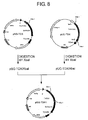
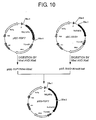
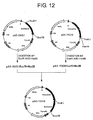
- the vector of the present invention include pSE-TDR1, pSE-YDR1, pSE-YGP7, and pSE-YGD9, in which a gene encoding a carbonyl reductase is introduced in an expressible state in to E. coli expression vector pSE420D.
- the recombinant vector of the present invention can comprise a coenzyme-regenerating dehydrogenase gene, described below.
- a carbonyl reductase of the present invention can be obtained from the transformant.
- a specific microorganism transformed to express a carbonyl reductase of the present invention may be any organism, as long as it is transformed with a recombinant vector comprising a polynucleotide encoding a polypeptide comprising a carbonyl reductase, and it can express carbonyl reductase activity.
- the present invention provides transformants transformed with a polynucleotide of the present invention, or a vector of the present invention.
- Non-limiting examples of microorganisms that can be transformed in the present invention are those for which host-vector systems are available, and include the following:
- Procedures for preparing a transformant and constructing a recombinant vector suitable for a host can be carried out by employing techniques commonly used in the fields of molecular biology, bioengineering, and genetic engineering (for example, see Sambrook et al., "Molecular Cloning” , Cold Spring Harbor Laboratories (2001)).
- a gene that encodes a carbonyl reductase of the present invention which utilizes NADPH as an electron donor, it is necessary to introduce the DNA into a plasmid vector or phage vector that is stable in that microorganism, and to transcribe and translate the genetic information.
- a promoter a unit for regulating transcription and translation, is placed upstream of the 5' end of the DNA of the present invention, and preferably, a terminator is placed downstream of the 3' end of the DNA.
- the promoter and terminator should be functional in the microorganism to be used as host. Available vectors, promoters, and terminators for the above-mentioned various microorganisms are described in detail in "Fundamental Course in Microbiology (8): Genetic Engineering", Kyoritsu Shuppan, specifically for yeasts, in "Adv. Biochem. Eng. 43, 75-102 (1990)” and "Yeast 8, 423-488 (1992)".
- available plasmids include the pBR series and pUC series plasmids; available promoters include promoters derived from lac (derived from ⁇ -galactosidase gene), trp (derived from the tryptophan operon), tac and trc (which are chimeras of lac and trp) , and PL and PR of ⁇ phage. Available terminators are derived from trpA, phages, rrnB ribosomal RNA, etc.
- vector pSE420D (described in JP-A 2000-189170), which is produced by modifying a part of multicloning site of commercially available pSE420 (Invitrogen) , can be suitably utilized.
- available vectors are pUB110 series and pC194 series plasmids, and can be integrated into a host chromosome.
- Available promoters and terminators are derived from apr (alkaline protease), npr (neutral protease), amy ( ⁇ -amylase), etc.
- Pseudomonas For the genus Pseudomonas, there are host-vector systems developed for Pseudomonas putida and Pseudomonas cepacia.
- a promoter and a terminator derived from the lipase gene JP-A Hei 5-284973 are also available.
- plasmid vectors include pAJ43 (Gene 39, 281-286 (1985)). Promoters and terminators used for Escherichia coli can be utilized for Brevibacterium without any modification.
- plasmid vectors such as pCS11 (JP-A Sho 57-183799) andpCB101 (Mol. Gen. Genet. 196, 175 (1984)) are available.
- plasmid vectors such as pHV1301 (FEMS Microbiol. Lett. 26, 239 (1985)) and pGK1 (Appl. Environ. Microbiol. 50, 94 (1985)) can be used.
- plasmid vectors such as pAM ⁇ 1 (J. Bacteriol. 137, 614 (1979)), which was developed for the genus Streptococcus, can be utilized. Promoters that are used for Escherichia coli can also be used.
- Rhodococcus For the genus Rhodococcus, plasmid vectors isolated from Rhodococcus rhodochrous are available (J. Gen. Microbiol. 138, 1003 (1992)).
- plasmids can be constructed in accordance with the method described in "Genetic Manipulation of Streptomyces: A Laboratory Manual” (Hopwood et al , Cold Spring Harbor Laboratories (1985)).
- pIJ486 Mol. Gen. Genet. 203, 468-478, 1986
- pKC1064 Gene 103, 97-99 (1991)
- pUWL-KS Gene 165, 149-150 (1995)
- the same plasmids can also be utilized for Streptomyces virginiae (Actinomycetol. 11, 46-53 (1997)).
- YRp series, YEp series, YCp series, and YIp series plasmids are available.
- integration vectors see EP 537456, and such), which are integrated into a chromosome via homologous recombination with multicopy-ribosomal genes, allow the introduction of a gene of interest in multicopy, and the gene incorporated can be stably maintained in the microorganism.
- this type of vector is highly useful.
- ADH alcohol dehydrogenase
- GPDH glyceraldehyde-3-phosphate dehydrogenase
- PHO acid phosphatase
- GAL ⁇ -galactosidase
- PGK phosphoglycerate kinase
- ENO enolase
- plasmids are those such as 2- ⁇ m plasmids derived from Saccharomyces cerevisiae, pKD1 series plasmids (J. Bacteriol. 145, 382-390 (1981)), plasmids derived from pGK11 and involved in killer activity, KARS ( Kluyveromyces autonomous replication sequence) series plasmids, and plasmids capable of being integrated into a chromosome via homologous recombination with ribosomal DNA (see, EP 537456, etc.). Promoters and terminators derived from ADH, PGK, and so on are also available.
- plasmid vectors comprising autonomous replication sequence (ARS) derived from Schizosaccharomyces pombe and auxotrophy-complementing selectable markers derived from Saccharomyces cerevisiae (Mol. Cell. Biol. 6, 80 (1986)). Promoters such as ADH promoter derived from Schizosaccharomyces pombe can also be used (EMBO J. 6, 729 (1987)).
- pAUR224 is commercially available from TaKaRa Shuzo Co., Ltd.
- plasmid vectors originating from those such as pSB3 (Nucleic Acids Res. 13, 4267 (1985)) derived from Zygosaccharomyces rouxii are available.
- promoters such as PHO5 promoter derived from Saccharomyces cerevisiae and GAP-Zr (Glyceraldehyde-3-phosphate dehydrogenase) promoter (Agri. Biol. Chem. 54, 2521 (1990)) derived from Zygosaccharomyces rouxii.
- Pichia angusta-derived autonomous replication sequences (HARS1 and HARS2) are available as vectors, they are rather unstable, and thus multicopy chromosomal integration is effective (Yeast 7, 431-443 (1991)).
- methanol-induced promotors of alcohol oxidase (AOX) and formate dehydrogenase (FDH) and the like are available.
- host-vector systems originating from Pichia-derived autonomous replication sequences PARS1, PARS2 have been developed (Mol. Cell. Biol. 5, 3376 (1985)).
- a highly efficient promoter, such as AOX promoter which is inducible by high-cell-density-culture and methanol can also be employed (Nucleic Acids Res. 15, 3859 (1987)).
- Candida maltosa In the genus Candida, host-vector systems have been developed for Candida maltosa, Candida albicans, Candida tropicalis, Candida utilis, etc.
- An ARS originating from Candida maltosa has been cloned (Agri. Biol. Chem. 51, 51, 1587 (1987)), and a vector using this sequence has been developed for Candida maltosa.
- a chromosome-integration vector with a highly efficient promoter has been developed for Candida utilis (JP-A Hei 08-173170).
- Trichoderma In the genus Trichoderma, host-vector systems have been developed for Trichoderma reesei, and promoters such as those derived from extracellular cellulase genes are available (Biotechnology 7, 596-603 (1989) ) .
- systems include those of insects such as silkworm (Nature 315, 592-594 (1985)), and plants such as rapeseed, maize, and potato. These systems are preferably used to express a large amount of foreign protein.
- microorganisms with the ability to produce carbonyl reductase used in this invention comprise all strains, mutants, and variants with the ability to produce carbonyl reductase, as well as transformants constructed by genetic engineering and with the ability to produce the enzyme of the present invention.
- the present invention relates to methods for producing an optically active alcohol, in particular, for producing (S)-1-(3,4-dimethoxyphenyl)-2-propanol by reducing ketones utilizing an aforementioned carbonyl reductase, and to uses of this alcohol.
- a preferred embodiment of the present invention provides a method for producing an enzyme of the present invention, where the method comprises the step of culturing a microorganism of the genus Torulaspora which produces a carbonyl reductase of the present invention.
- the present invention provides a method for producing a carbonyl reductase of the present invention, which comprises the step of culturing the aforementioned transformant of the present invention.
- An optically active alcohol can be produced using the desired enzyme reaction, performed by contacting a reaction solution with an enzyme molecule, a treated enzyme molecule, a culture comprising an enzyme molecule, or a transformant such as a microorganism that produces an enzyme.
- the specific mode by which an enzyme is contacted with a reaction solution is not limited to these particular examples.
- Examples of a microorganism used in the aforementioned methods preferably include Torulaspora delbrueckii.
- a preferred embodiment of a method for producing an optically active alcohol of the present invention provides a method for producing an optically active alcohol, which comprises reacting a ketone with a carbonyl reductase of the present invention, a protein of the present invention, a microorganism which produces the enzyme or the protein, the treated microorganism, a transformant of the present invention, or a carbonyl reducing agent of the present invention.
- one example of the methods of the present invention is a method for producing (S)-1-(3,4-dimethoxyphenyl)-2-propanol, which comprises reacting 3,4-dimethoxyphenylacetone with a carbonyl reductase of the present invention, a protein of the present invention, a microorganism which produces the enzyme or the protein, the treated microorganism, a transformant of the present invention, or a carbonyl reducing agent of the present invention.
- examples of the treated microorganism comprising carbonyl reductase in the present invention comprise a microorganism in which the permeability of a cell membrane has been changed by treatment with a surfactant or an organic solvent such as toluene, a cell-free extract obtained by disrupting cells by treatment with glass beads or an enzyme, and a partially purified extract.
- 1-acetoxy-2-propanone, ethyl acetoacetate, methyl acetoacetate, ethyl 4-chloroacetoacetate, methyl 4-chloroacetoacetate, 2-chloro-1-(3'-chlorophenyl)ethanone, or 3,4-dimethoxyphenylacetone can be preferably used, and (S)-1-acetoxy-2-propanol, ethyl (S)-3-hydroxybutanoate, methyl (S)-3-hydroxybutanoate, ethyl (R)-4-chloro-3-hydroxybutanoate, methyl (R)-4-chloro-3-hydroxybutanoate, (R)-2-chloro-1-(3'-chlorophenyl)ethanol, and (S)-1-(3,4-dimetoxyphenyl)-2-propanol can be produced.
- a preferred embodiment of the present invention provides a method for producing (S)-1-(3,4-dimethoxyphenyl)-2-propanol, which comprises reacting 3,4-dimethoxyphenylacetone with a carbonyl reductase of the present invention, a protein comprising the carbonyl-reducing activity, a microorganism which produces the enzyme or the protein, or the treated microorganism.
- NADPH regeneration using the NADP + produced from NADPH in the aforementioned reduction reaction can be performed using the NADP + -reducing ability of microorganisms (glycolysis system, C1 assimilation pathway of methylotrophs, etc.).
- NADP + -reducing ability can be enhanced by adding glucose or ethanol to a reaction system.
- reducing ability can also be enhanced by adding to the reaction system a microorganism with the ability to produce NADPH from NADP + , or that treated microorganism, or an enzyme.
- NADPH regeneration can be performed by using a microorganism comprising glucose dehydrogenase, alcohol dehydrogenase, formate dehydrogenase, amino acid dehydogenase, or organic acid dehydrogenase (such as malate dehydrogenase), the treated microorganism, or a partially purified or purified enzyme.
- a microorganism comprising glucose dehydrogenase, alcohol dehydrogenase, formate dehydrogenase, amino acid dehydogenase, or organic acid dehydrogenase (such as malate dehydrogenase), the treated microorganism, or a partially purified or purified enzyme.
- These components, which constitute a necessary reaction for regenerating NADPH can be contacted by addition to a reaction system for producing an optically active alcohol of the present invention, by adding immobilized components thereto, or by using a membrane that can exchange NADPH.
- the present invention also relates to methods for producing a protein comprising the carbonyl-reducing activity of the present invention, which include the step of culturing a transformant transformed with a recombinant vector comprising a polynucleotide of the present invention.
- a live cell of a microorganism, transformed with a recombinant vector comprising a polynucleotide of the present invention is utilized in a method for producing the aforementioned optically active alcohol, an additional reaction system for regenerating NADPH may be unnecessary.
- the reduction reaction using a transformant can be efficiently performed without the addition of an NADPH-regenerating enzyme.
- the host can be introduced both with a DNA encoding an NADPH-dependent carbonyl reductase of the present invention, and a gene useful in regenerating NADPH (a coenzyme regenerating dehydrogenase gene), for example that of a glucose dehydrogenase, alcohol dehydrogenase, formate dehydrogenase, amino acid dehydrogenase, or organic acid dehydrogenase (such as malate dehydrogenase).
- each gene can be ligated to a region involved in the regulation of expression, such as a promotor or terminater.
- Multiple genes can also be expressed as an operon comprising multiple cistrons, such as the lactose operon.
- a glucose dehydrogenase derived from Bacillus subtilis or Thermoplasma acidophilum can be utilized.
- recombinant vectors include pSG-TDR1, pSG-YDR1, pSG-YGP7, and pSG-YGD9 vectors into which a carbonyl reductase gene and a glucose dehydrogenase gene derived from Bacillus subtilis have been introduced.
- a reduction reaction using an enzyme of the present invention can be performed in water, in a water-insoluble organic solvent such as ethyl acetate, butyl acetate, toluene, chloroform, n-hexane, methyl isobutyl ketone, and methyl tertiary butyl ester; in a two-phase system with an aqueous medium, or in a mixture system with a water-soluble organic solvent such as methanol, ethanol, isopropyl alcohol, acetonitrile, acetone, and dimethyl sulfoxide.
- the reaction in the present invention may be performed by utilizing an immobilized enzyme or a membrane reactor.
- the reaction of the present invention can be performed at a temperature range of 4°C to 60°C, preferably at 15°C to 37°C; at a pH of 3 to 11, preferably pH 5 to 9; and at a substrate concentration of 0.01% to 50%, preferably 0.1% to 20%, more preferably 0.1% to 10%.
- coenzyme NADP + or NADPH may be added to the reaction system at 0.001 mM to 100 mM, more preferably at 0.01 mM to 10 mM.
- a substrate may be added at once at the beginning of the reaction, it is preferable to add it continuously or discontinuously, such that the substrate concentration in the reaction solution does not become too high.
- NADPH When regenerating NADPH, for example, glucose (when using glucose dehydrogenase) or ethanol/ isopropanol (when using alcohol dehydrogenase) is added to the reaction system. These compounds may be added at a molar ratio relative to a substrate ketone of 0.1- to 20-fold, preferably in excess at 1- to 5-fold.
- a NADPH-regenerating enzyme such as glucose dehydrogenase or alcohol dehydrogenase can be added at approximately 0.1- to 100-fold, and preferably at 0.5- to 20-fold of the enzyme activity compared with the NADPH-dependent carbonyl reductase of the present invention.
- Purification of an optically active alcohol producedby reduction of a ketone in the present invention can be performed by appropriately combining the centrifugation of cells and proteins, separation by membrane treatment, solvent extraction, distillation, etc.
- (S)-1-(3,4-dimethoxyphenyl)-2-propanol can be obtained as an optically active alcohol by centrifuging a reaction solution comprising microorganism cells to remove the cells, extracting with ethyl acetate, butyl acetate, toluene, hexane, benzene, methyl isobutyl ketone, methyl tertiary butyl ether, or butanol, and then performing vacuum concentration.
- the purity of the reaction product can be further increased by using silica gel column chromatography, etc.
- NADPH-dependent carbonyl reductases useful for producing an optically active alcohol has been provided.
- methods for efficiently producing high optical purity (S)-1-(3,4-dimethoxyphenyl)-2-propanol from 3,4-dimethoxyphenylacetone have been provided.
- Cells for enzyme purification were prepared by culturing Torulaspora delprueckii JCM 5921 strain in 1. 2 L of YM medium (glucose 20 g/L, yeast extract 3 g/l, malt extract 3 g/L, peptone 5 g/L, pH 6.0), followed by centrifugation. The resulting wet cells were suspended in a solution containing 50 mM Tris-HCl buffer (pH 8.5), 0.02% 2-mercaptoethanol, and 2 mM phenylmethanesulfonyl fluoride (PMSF) , and homogenized with a bead beater (Biospec). The cell residue was then removed by centrifugation to obtain a cell-free extract.
- YM medium glucose 20 g/L, yeast extract 3 g/l, malt extract 3 g/L, peptone 5 g/L, pH 6.0
- PMSF phenylmethanesulfonyl fluoride
- Protamine sulfate was added to the cell-free extract, which was then centrifuged to remove nucleic acids and obtain the supernatant. Ammonium sulfate was then added to the supernatant to 30% saturation, and this was added to Phenyl-SepharoseTM HP (2. 6cm x 10cm) equilibrated with a standard buffer (10 mM Tris-HCl buffer (pH 8.5), 0.01% 2-mercaptoethanol, and 10% glycerol) comprising 30% ammonium sulfate. The present enzyme was then eluted using ammonium sulfate over a concentration gradient of 30% to 0%. NADPH-dependent 3,4-dimethoxyphenylacetone-reducing activity was observed in the gradient eluted fractions, and the eluted peak part was collected and then concentrated by ultrafiltration.
- the concentrated enzyme solution was dialyzed against a standard buffer, added to MonoQ (0. 5cm x 5cm) equilibrated with the same buffer, and subjected to elution with sodium chloride over a gradient concentration of 0 M to 0.5 M.
- the eluted active fraction was collected, and subjected to ultrafiltration to obtain the concentrated enzyme solution.
- the concentrated enzyme solution was dialyzed against 5 mM potassium phosphate buffer (pH8.0) comprising 0.01% 2-mercaptoethanol and 10% glycerol, added to a hydroxyapatite column (0.5cm x 10cm) equilibrated with the same buffer, and then subjected to gradient elution with potassium phosphate buffer (pH 8.0) over 5 mM to 350 mM.
- the eluted active fraction comprising the highest specific activity was analyzed using SDS-PAGE. As a result, a single band consisting of only the present enzyme was obtained (Fig. 1).
- the specific activity of the purified enzyme was 196 mU/mg.
- a summary of the purification is shown in Table 1.
- Step Protein mg
- Enzyme activity U
- Specific activity mU/mg
- Cell-free extract 15,000 - - Nucleic acid removal 6,580 24.1 3.66 Butyl-Toyopearl 377 7.00 18.6 MonoQ 31.4 3.75 119 Hydroxyapatite 0.245 0.048 196
- the molecular weight of a subunit of the enzyme obtained in Example 1 was about 38, 000, as determined using SDS-PAGE.
- the molecular weight was also measured separately using a Superdex G200 gel filtration column, and was again found to be about 38, 000. Therefore, the present enzyme was presumed to be a monomer.
- Example 2 By changing the pH using potassium phosphate buffer, sodium acetate buffer, and Britton-Robinson buffer, the 3,4-dimethoxyphenylacetone-reducing activity of the enzyme obtained in Example 1 was investigated. Activity at each pH was expressed as a relative activity, where the maximum activity was regarded as 100 (Fig. 2). Optimal pH (showing 80% or more relative activity) was 5.5 to 6.5.
- Example 1 Of the standard reaction conditions, only the temperature was changed, and the 3, 4-dimethoxyphenylacetone-reducing activity of the enzyme obtained in Example 1 was then measured. Activity at each temperature was expressed as a relative activity, where the maximum activity was regarded as 100(Fig. 3). Optimal temperature (showing 80% or more relative activity) was 50°C to 55°C.
- Example 2 The enzyme obtained in Example 1 was reacted with various ketones, ketoesters, and so on.
- the activities of the reduction reactions were expressed as relative activities, where the reduction of 3,4-dimethoxyphenylacetone was regarded as 100 (Table 2) (substrate specificity of carbonyl reductase).
- the activity of dehydrogenating 1-(3,4-dimethoxyphenyl)-2-propanol was measured as follows: A reaction was performed at 30°C in a reaction solution comprising 50 mM Tris-HCl buffer (pH 8.5), 2.5 mM NADP + , 5 mM 1-(3,4-dimethoxyphenyl)-2-propanol, and the enzyme.
- a reaction was performed overnight at 25°C in 1 mL of a reaction solution comprising 200 mM potassium phosphate buffer (pH 6.5), 1 mM NADP + , 2U glucose dehydroganase (Wako Pure Chemical Industries, Ltd.), 250 mM glucose, 0.25U carbonyl reductase, and 50 mM 3,4-dimethoxyphenylacetone.
- the N-terminal amino acid sequence of the enzyme obtained in Example 1 was analyzed using a protein sequencer.
- the amino acid sequence is shown in SEQ ID NO: 3.
- a gel fragment comprising carbonyl reductase was excised from an SDS-PAGE gel, washed twice, and subjected to overnight in-gel digestion at 35°C, using a lysyl endopeptidase.
- the digested peptide was separated and collected by gradient elution of acetonitrile in 0.1% trifluoroacetic acid using reverse phase HPLC (TSK gel ODS-80-Ts, 2.0 mmx 250 mm; Tosoh Corporation).
- lep_41 The obtained peptide peak was named lep_41, and its amino acid sequence was analyzed using a protein sequencer (Hewlett Packard G1005A Protein Sequence System). The amino acid sequence of lep_41 is shown as SEQ ID NO: 4.
- the resulting DNA fragment was ligatedusing EcoRI-digestedpUCl8 (TAKARA SHUZO Co., Ltd.) and a Takara Ligation Kit, and then used to transform the Escherichia coli JM109 strain.
- LB medium 1% Bacto-triptone, 0.5% Bacto-yeast extract, and 1% sodium chloride; hereinafter, abbreviated as LB medium
- ampicillin 50 ⁇ g/mL
- a number of white colonies were selected by the Blue/White selection method, cultured in liquid LB medium comprising ampicillin, and a plasmid was purified by FlexiPrep (Amersham Biosciences) to obtain pTDR.
- nucleotide sequence of the inserted DNA was analyzed. PCR was performed using BigDyeTM Terminator Cycle Sequencing FS ready Reaction Kit (Applied Biosystems), and the PCR product was analyzed using a DNA sequencer ABI PRISMTM 310 Genetic Analyzer (Applied Biosystems). The determined nucleotide sequence of the core region is shown as SEQ ID NO: 7.
- Torulaspor delbruckii -derived chromosomal DNA was digested with restriction enzyme BamHI, and each fragment was cyclized at 16°C overnight by a self-ligation reaction using T4 ligase.
- T4 ligase a self-ligation reaction using T4 ligase.
- 50 L of a reaction solution comprising 100 pmol of each of the primers TdCR-59 (SEQ ID NO: 8) and TdCR-234 (SEQ ID NO: 9), as well as 25 ng of the cyclized DNA, Ex-Taq buffer (TAKARA SHUZO Co. Ltd.), and 2 U of Ex-Taq (TAKARA SHUZO Co.
- Plasmid pSE-TDX comprising a part of the carbonyl reductase gene TdCR1
- a reaction solution comprising 50 pmol of each of the primers Td-ATG1 and Td-XbaR, as well as 10 nmol of dNTP, 50 ng of a chromosomal DNA derived from Torulaspora delbruectii, Pfu Turbo DNA polymerase buffer (Stratagene), and 3.75 U of Pfu Turbo DNA polymerase (Stratagene), 30 cycles of denaturation (95°C, two minutes 30 seconds), annealing (55°C, oneminute), andelongation (72°C, one minute) were performed using a GeneAmp® PCR System 2400 (Applied Biosystems). The resulting PCR product was designated as Td-PCR1.
- the resulting PCR product was collected by extraction with phenol-chloroform and ethanol precipitation.
- the Td-PCR1 was digested with two restriction enzymes BspHI and XbaI, and subjected to agarose gel electrophoresis. The desired band was excised and then purified by Sephaglas BandPrep Kit (Amersham Biosciences).
- a Takara Ligation Kit was used to ligate the restriction enzyme-digested Td-PCR1 with the vector pSE420D (JP-A 2000-189170), which had been digested with two restriction enzymes, NcoI and XbaI.
- Escherichia coli JM109 strain was transformed with the ligated plasmid.
- the transformants were grown on LB medium comprising ampicillin, and the nucleotide sequence of the inserted fragment was analyzed.
- the obtained plasmid was designated as pSE-TDX.
- the process of constructing this plasmid is shown in Fig. 4.
- Td-XbaF SEQ ID NO: 12
- Td-TAA1 SEQ ID NO: 13
- Td-PCR2 Using 50 ⁇ L of a reaction solution comprising 50 pmol of each of the primers Td-XbaF and Td-TAA1, as well as 10 nmol of dNTP, 50 ng of Torulaspora delbruectii -derived chromosomal DNA, Pfu Turbo DNA polymerase buffer (Stratagene) , and 3.75 U of Pfu Turbo DNA polymerase (Stratagene), 30 cycles of denaturation (95°C, two minutes 30 seconds), annealing (55°C, one minute), and elongation (72°C, one minute) were performed using a GeneAmp® PCR System 2400 (Applied Biosystems). The resulting PCR product was designated as Td-PCR2.
- the resulting PCR product was collected by extraction using phenol-chloroform and ethanol precipitation.
- the Td-PCR2 was digested with XbaI, and subjected to agarose gel electrophoresis. The desired band was excised and then purified by Sephaglas BandPrep Kit (Amersham Biosciences).
- a Takara Ligation Kit was used to ligate the restriction enzyme-digested Td-PCR2 with the vector pUC18, which had been digested with XbaI.
- Escherichia coli JM109 strain was transformed with the ligated plasmid.
- the transformants were grown on LB medium comprising ampicillin, and the nucleotide sequence of the inserted fragment was analyzed.
- the obtained plasmid was designated as pUC-TDX.
- the process of constructing this plasmid is shown in Fig. 5.
- Td-PCR1 the PCR product obtained by the method of Example 11, was collected by extraction with phenol-chloroform and ethanol precipitation.
- the resulting DNA was digested with two restriction enzymes, BspHI and XbaI, and subjected to agarose gel electrophoresis.
- the desiredband was excised and then purified using a Sephaglas BandPrep Kit (Amersham Biosciences).
- a Takara Ligation Kit was used to ligate the restriction enzyme-digested Td-PCR1 with the vector pSE-BSG1 (JP-A 2000-189170), which comprises a Bacillus subtilis- derived glucose dehydrogenase gene and had been digested with restriction enzymes NcoI and XbaI.
- Escherichia coli JM109 strain was transformed with the ligated plasmid. The transformants were grown on LB medium comprising ampicillin, and the nucleotide sequence of the inserted fragment was analyzed. The obtained plasmid was designated as pSG-TDX. The process of constructing this plasmid is shown in Fig. 6.
- the plasmid pUC-TDX obtained in Example 12 was digested using restriction enzyme XbaI, ethanol-precipitated, and then subjected to agarose electrophoresis. A band of about 0.8 kb, comprising part of the TdCR1 gene, was excised. This band was purified by Sephaglas Band Prep (Amersham Biosciences) and collected. A TaKaRa Ligation Kit was used to ligate the resulting DNA fragment with a plasmid pSE-TDX, obtained by digestion with the same restriction enzyme, treatment with alkaline phosphatase, phenol extraction, phenol/chloroform extraction, chloroform extraction, and ethanol precipitation.
- Escherichia coli JM109 strain was transformed with the ligated DNA and cultured on LB medium comprising ampicillin (50 mg/L).
- a plasmid was purified from the resulting transformants using a Flexi Prep kit.
- the plasmid pSE-TDR1 which comprises the full length TdCR1 gene and can express TdCR1, was obtained.
- the process for constructing this plasmid is shown in Fig. 7.
- Plasmid pSG-TDR1 which coexpresses the carbonyl reductase gene TdCR1 and a Bacillus subtilis -derived glucose dehydrogenase gene
- the plasmid pUC-TDX obtained in Example 12 was digested with restriction enzyme XbaI, ethanol-precipitated, and then subjected to agarose electrophoresis. A band of about 0.8 kb comprising a part of the TdCR1 gene was excised. This band was purified by Sephaglas Band Prep (Amersham Biosciences) and collected. A TaKaRa Ligation Kit was used to ligate the resulting DNA fragment with plasmid pSG-TDX, obtained by digestion with the same restriction enzyme, treatment with alkaline phosphatase, phenol extraction, phenol/chloroform extraction, chloroform extraction, and ethanol precipitation.
- Escherichia coli JM109 strain was transformed with the ligated DNA and cultured on LB medium comprising ampicillin (50 mg/L).
- a plasmid was purified with Flexi Prep kit from the resulting transformants.
- plasmid pSG-TDR1 which can coexpress the glucose dehydrogenase gene and TdCR1, was obtained. The process for constructing this plasmid is shown in Fig. 8.
- Table 3 shows the results of measuring the 3,4-dimethoxyphenylacetone-reducing activity and glucose dehydrogenase activity using each cell-free extract. In all cases, 3,4-dimethoxyphenylacetone-reducing activity was confirmed. Plasmid 3,4-Dimethoxyphenylacetone reducing activity (mU/mg protein) Glucose dehydrogenase activity (U/mg protein) None 0 0 pSE-TDR1 61.6 0 pSG-TDR1 57.0 4.07
- Saccharomyces cerevisiae X2180-1B (Yeast Genetic Stock Center) was cultured on YM medium to prepare cells. Purificationofchromosomal DNA from these cells was performed by the method described in Meth. Cell Biol. 22, 39-44 (1975).
- PCR primers YGL1-ATG1 SEQ ID NO: 14
- YGL1-TAA1 SEQ ID NO: 15
- DDBJAccessionNo. Z48618 corresponding to predicted protein YGL157w (SWISS-PROT Accession No. P53111) registered in DDBJ.
- ATAKARALigation Kit was used to ligate the amplification product, which was treated with phenol and then doubly digested with restriction enzymes BspHI and XbaI, with vector pSE420D, which had been doubly digested with restriction enzymes NcoI and XbaI.
- Escherichia coli JM 109 strain was transformed with the ligated DNA, and cultured on the LB medium comprising ampicillin (50 mg/L). FlexiPrep was used to purify a plasmid from the resulting transformants.
- the nucleotide sequence of the inserted plasmid DNA was analyzed and SEQ ID NO: 19 shows the resulting sequence. This nucleotide sequence was completely consistent with that registered in DDBJ.
- the resulting plasmid was designated as pSE-YGP7.
- the amino acid sequence predicted from the nucleotide sequence of SEQ ID NO: 16 is shown in SEQ ID NO: 17.
- the process for constructing this plasmid is shown in Fig. 9.
- the plasmid pSE-BSG1 (JPA 2000-374593), which comprised a Bacillus subtilis-derived glucose dehydrogenase gene, was doubly digested with two restriction enzymes, NheI andXbaI. ATakaraLigation Kit was then used to ligate the plasmid with a DNA fragment comprising a YGL157w gene excised from pSE-YGP7 using the same enzymes.
- Escherichia coli JM109 strain was transformed with the ligated DNA, cultured on LB medium comprising ampicillin (50 mg/L), and FlexiPrep was used to purify from the resulting transformants the plasmid pSG-YGP7, which is capable of coexpressing glucose dehydrogenase and YGL157w.
- the process for constructing this plasmid is shown in Fig. 10.
- PCR primers YGL2-ATG2 (SEQ ID NO: 18) and YGL2-TAA2 (SEQ ID NO: 19) were synthesized based on the DNA sequence (DDBJ Accession No. Z72561) corresponding to the predicted protein YGL039w (SWISS-PROT Accession No. P53183), registered in DDBJ.
- the amplification product was treated with phenol, doubly digested with restriction enzymes BspHI and NheI, and ligated using a TAKARALigation Kit with vector pSE420D, which hadbeen doubly digested with restriction enzymes NcoI and XbaI.
- Escherichia coli JM 109 strain was transformed with the ligated DNA, and cultured on LB medium comprising ampicillin (50mg/L). FlexiPrepwasusedtopurifyaplasmid from the resulting transformants.
- the nucleotide sequence of the inserted plasmid DNA was analyzed, and the resulting sequence is shown in SEQ ID NO: 20. This nucleotide sequence was completely consistent with that registered in DDBJ.
- the resulting plasmid was designated as pSE-YGD9.
- the amino acid sequence predicted from the nucleotide sequence of SEQ ID NO: 20 is shown in SEQ ID NO: 21.
- the process for constructing this plasmid is shown in Fig. 11.
- pSE-YGD9 was doubly digested with two restriction enzymes, EcoRI and HindIII. A Takara Ligation Kit was then used to ligate the product with a DNA fragment comprising a glucose dehydrogenase gene, which was excised using the same enzymes from plasmid pSE-BSG1 (JP-A 2000-374593), which comprises the Bacillus subtilis -derived glucose dehydrogenase gene.
- Escherichia coli JM109 strain was transformed with the ligated DNA, cultured on LB medium comprising ampicillin (50 mg/L), and FlexiPrep was used to purify from the resulting transformants the plasmid pSG-YGP9, which is capable of coexpressing glucose dehydrogenase and YGL039w.
- the process for constructing this plasmid is shown in Fig. 12.
- PCR primers YDR-ATG1 SEQ ID NO: 18
- YDR -TAA1 SEQ ID NO: 23
- the amplification product was treated with phenol, doubly digested with restriction enzymes AflIII and XbaI, and ligated using a TAKARALigation Kit with vector pSE420D, which had been doubly digested with restriction enzymes NcoI and XbaI.
- Escherichia coli JM 109 strain was transformed with the ligated DNA, and cultured on LB medium comprising ampicillin (50mg/L). FlexiPrep was used to purify a plasmid from the resulting transformants.
- the nucleotide sequence of the inserted plasmid DNA was analyzed, and the resulting sequence is shown in SEQ ID NO: 27. This nucleotide sequence was completely consistent with that registered in DDBJ.
- the resulting plasmid was designated as pSE-YDR1.
- the amino acid sequence predicted from the nucleotide sequence of SEQ ID NO: 24 is shown in SEQ ID NO: 25.
- the process for constructing this plasmid is shown in Fig. 13.
- pSE-YDR1 was doubly digested with two restriction enzymes EcoRI and HindIII.
- a Takara Ligation Kit was then used to ligate the product with a DNA fragment that comprised a glucose dehydrogenase gene excised using the same enzymes fromplasmid pSE-BSG1 (JP-A 2000-374593), which comprised the Bacillus subtilis -derived glucose dehydrogenase gene.
- Escherichia coli JM109 strain was transformed with the ligated DNA, cultured on LB medium comprising ampicillin (50 mg/L), and FlexiPrep was used to purify from the resulting transformants the plasmid pSG-YDR1, which is capable of coexpressing glucose dehydrogenase and YDR541c.
- the process for constructing this plasmid is shown in Fig. 14.
- Escherichia coli JM109+ strains comprising pSE-YGP7, pSE-YGD9, pSE-YDR1, pSG-YGP7, pSG-YGD9, or pSG-YDR1 were cultured on LB medium comprising ampicillin, induced with 0.1 mM IPTG for four hours, and then centrifuged to collect the cells.
- Each of these cell samples was suspended in a cell lysis solution (50 mM KPB pH 8.0, 1 mM EDTA, 0.02% 2-mercaptoethanol, 2 mM PMSF, 10% Glycerol).
- the cells were ruptured by sonication and then centrifuged to obtain the supernatant, which was used as a cell-free extract.
- 3,4-dimethoxyphenylacetone-reducing activity was measured using each cell-free extract, and the results are shown in Table 4.
- YGL157w pSE-YGP7 and pSG-YGP7
- YGL039w pSE-YGD9 and pSG-YGD9
- YDR541c pSE-YDR1 and pSG-YDR1 were all confirmed to comprise 3,4-dimethoxyphenylacetone reductase activity.
- Plasmid 3,4-Dimethoxyphenylacetone reducing activity (mU/mg protein) Glucose dehydrogenating activity (mU/mg protein) None 0.0 0.0 pSE-YGP7 39.0 0.0 pSG-YGP7 6.85 2320 pSE-YGD9 19.1 0.0 pSG-YGD9 20.0 1340 pSE-YDR1 21.0 0.0 pSG-YDR1 30.0 30.0
- Example 18 To prepare crude enzyme solution for enzyme reaction, the crude enzyme solution prepared in Example 18 was concentrated ten-folds using a UF membrane. This solution was reacted overnight at 25°C in 1 mL of a reaction solution comprising 200 mM potassium phosphate buffer (pH 6.5), 1 mM NADP + , 2 U glucose dehydrogenase (Wako Pure Chemical Industries, Ltd.), 250 mM glucose, 0.2 U homolog enzyme, and 50 mM 3,4-dimethoxyphenylacetone. Optical purity was measured and the produced (S)-1-(3,4-dimethoxyphenyl)-2-propanol was quantified as in Example 6.
- a reaction solution comprising 200 mM potassium phosphate buffer (pH 6.5), 1 mM NADP + , 2 U glucose dehydrogenase (Wako Pure Chemical Industries, Ltd.), 250 mM glucose, 0.2 U homolog enzyme, and 50 mM 3,4-dimethoxyphenylacetone. Optical
- YGL157w (pSE-YGP7) produced 93.7%ee (S)-1-(3,4-dimethoxyphenyl)-2-propanol at a yield of 66%
- YGL039w (pSE-YGD9) produced 93.6%ee at a yield of 94%
- YDR541c (pSE-YDR1) produced 94.8%ee at a yield of 6%.
Landscapes
- Chemical & Material Sciences (AREA)
- Organic Chemistry (AREA)
- Life Sciences & Earth Sciences (AREA)
- Engineering & Computer Science (AREA)
- Health & Medical Sciences (AREA)
- Zoology (AREA)
- Wood Science & Technology (AREA)
- Genetics & Genomics (AREA)
- Bioinformatics & Cheminformatics (AREA)
- General Health & Medical Sciences (AREA)
- Biochemistry (AREA)
- General Engineering & Computer Science (AREA)
- Microbiology (AREA)
- Biotechnology (AREA)
- Chemical Kinetics & Catalysis (AREA)
- General Chemical & Material Sciences (AREA)
- Medicinal Chemistry (AREA)
- Molecular Biology (AREA)
- Biomedical Technology (AREA)
- Micro-Organisms Or Cultivation Processes Thereof (AREA)
- Enzymes And Modification Thereof (AREA)
- Preparation Of Compounds By Using Micro-Organisms (AREA)
Abstract
Description
- The present invention relates to novel carbonyl reductases that are dependent on reduced β-nicotinamide adenine dinucleotide phosphate (hereinafter, also referred to as NADPH). The present invention also relates to polynucleotides encoding these enzyme proteins, methods for producing the enzymes, and methods for producing (S)-1-(3,4-dimethoxyphenyl)-2-propanol using the enzymes.
- (S)-1-(3,4-dimethoxyphenyl)-2-propanol was conventionally produced by reducing 3, 4-dimethoxyphenylacetone using microorganisms (see Unexamined Published Japanese Patent Application No. (JP-A) Hei 8-325188 and JP-A Hei 8-89261). However, these methods are not very productive, and only yield the product in a concentration of 1% or less. For this reason, there was a need in the art to establish a simple and highly economical method of obtaining (S)-1-(3,4-dimethoxyphenyl)-2-propanol with a high optical purity and at a high reaction yield.
- An objective of the present invention is to provide methods for efficiently producing (S)-1-(3,4-dimethoxyphenyl)-2-propanol with a high optical purity.
- Another objective of the present invention is to provide novel enzymes that reduce 3,4-dimethoxyphenylacetone by utilizing NADPH as a coenzyme to produce (S)-1-(3,4-dimethoxyphenyl)-2-propanol with a high optical purity. A further objective of the present invention is to isolate DNA that encode enzymes comprising the desired property, and to obtain the DNA as recombinant DNA. In addition, a further objective is to provide methods for producing (S)-1-(3,4-dimethoxyphenyl)-2-propanol using this recombinant.
- In the search for a simple and highly economical method for producing (S) -1- (3, 4-dimethoxyphenyl) -2-propanol with a high optical purity, the present inventors focused on a method of overexpressing, in a heterologous microorganism, an enzyme that stereo-selectively reduces 3,4-dimethoxyphenylacetone to produce (S)-1-(3,4-dimethoxyphenyl)-2-propanol, and then using the resulting highly active genetically recombinant bacterium to efficiently produce (S)-1-(3,4-dimethoxyphenyl)-2-propanol from 3,4-dimethoxyphenylacetone. The present inventors found that Torulaspora delbrueckii had a high reaction yield and high stereoselectivity. They then conducted studies on enzymes in this bacterial strain, which are involved in the reduction of 3,4-dimethoxyphenylacetone . Electrophoresis of a cell-free extract of this bacterial strain showed that an enzyme could be purified to a single electrophoretic band, thus clarifying some of the enzyme's basic properties. As a result, this enzyme was found to be a novel carbonyl reductase that reduces various carbonyls. In addition, the present enzyme reduced 3,4-dimethoxyphenylacetone to produce (S)-1-(3,4-dimethoxyphenyl)-2-propanol with a high optical purity and at a high yield.
- Furthermore, the present inventors isolated a DNA encoding the present enzyme, and produced a recombinant bacterium which overexpresses this enzyme, thus completing the present invention. That is, the present invention relates to carbonyl reductases, polynucleotides comprising DNA that encode these enzymes, methods for producing these enzymes, and the use of these enzymes, as set out below.
- In the art it is well known that the enzyme 'phenylacetoaldehyde reductase' reduces 3,4-dimethoxyphenylacetone (Eur. J. Biochem., 269, 2394-2402 (2002)). This enzyme reduces ketones in an NADH-dependent manner, and comprises the activity of dehydrogenating secondary alcohols also in an NADH-dependent manner. Thus, it has properties different from the carbonyl reductases of the present invention.
- In addition, it is also well known in the art that the enzyme ketoreductase (Eur. J. Biochem., 267, 5493-5501 (2000)), produced by Zygosaccharomyces rouxii, can reduce 3,4-methylenedioxyphenylacetone, which has a structure similar to Zygosaccharomyces rouxii 3,4-dimethoxyphenylacetone. However, there are no reports of its stereoselectivity or activity towards 3,4-dimethoxyphenylacetone. Furthermore, the properties of this enzyme, such as a molecular weight of 42,000 in SDS-PAGE, an optimal pH of 6.6 to 6.8, and an optimal temperature of 37 to 39°C, are different to those of the carbonyl reductases of the present invention.
- Furthermore, using the amino acid sequence described in SEQ ID NO: 2, the present inventors performed a SWISS-PROT homology search using a BLAST program. They found proteins homologous to the carbonyl reductases of the present invention. Specifically, genome analysis of Saccharomyces cerevisiae resulted in four kinds of predicted ORFs, designated as YGL157w, YGL039w, YDR541c, and YOL151w, respectively. Of these, the functions of proteins encoded by YGL157w, YGL039w, and YDR541c were unknown. YOL151w's activity in reducing various carbonyl compounds had been measured in J. Am. Chem. Soc., 123(8), 1547-1555(2001), but there were no reports of its activity on 3,4-dimethoxyphenylacetone.
- Thus, the present invention relates to novel carbonyl reductases, polynucleotides encoding these enzymes, methods for producing these enzymes, methods for producing an optically active alcohol utilizing these enzymes, and uses thereof, as set out below. More specifically, the present invention provides:
- [1] a carbonyl reductase comprising the physicochemical
properties as shown in (1) and (2),
- (1) action
reduces ketones to produce an optically active alcohol, by utilizing reduced β-nicotinamide adenine dinucleotide phosphate as a coenzyme, - (2) substrate specificity
- (a) utilizes reduced β-nicotinamide adenine dinucleotide phosphate as a coenzyme in the reduction reaction,
- (b) reduces 3,4-dimethoxyphenylacetone to produce (S)-1-(3,4-dimethoxyphenyl)-2-propanol,
- (c) comprises the activity of reducing 3,4-dimethoxyphenylacetone, but lacks the activity of oxidizing (S)-1-(3,4-dimethoxyphenyl)-2-propanol;
- [2] the carbonyl reductase of [1], which additionally comprises
the physicochemical properties of (3) and (4),
- (3) optimal pH
pH 5.5 to 6.5, - (4) molecular weight
a molecular weight, determined via sodium dodecylsulfate-polyacrylamide gel electrophoresis (SDS-PAGE) and gel filtration, of about 38,000; - [3] the carbonyl reductase of [1], which is produced by a microorganism belonging to the genus Torulaspora;
- [4] the carbonyl reductase of [3], wherein the microorganism belonging to the genus Torulaspora is Torulaspora delbrueckii;
- [5] a polynucleotide of the following (a) or (b),
- (a) a polynucleotide comprising the nucleotide sequence of SEQ ID NO: 1
- (b) a polynucleotide encoding a protein comprising the amino acid sequence of SEQ ID NO: 2;
- [6] a polynucleotide encoding a protein comprising the
physicochemical properties of (1) and (2) in [1], wherein said
polynucleotide is any one of the following (c) to (e),
- (c) a polynucleotide encoding a protein comprising an amino acid sequence in which one or more amino acid(s) in the amino acid sequence of SEQ ID NO: 2 has been substituted, deleted, inserted, and/or added ,
- (d) a polynucleotide which hybridizes with a DNA comprising the nucleotide sequence of SEQ ID NO: 1 under stringent conditions,
- (e) a polynucleotide encoding an amino acid sequence comprising 70% or more homology to the amino acid sequence of SEQ ID NO: 2;
- [7] a protein encoded by the polynucleotide of [5] or [6];
- [8] a recombinant vector, which comprises the polynucleotide of [5] or [6];
- [9] the recombinant vector of [8], which further comprises a dehydrogenase gene for regenerating a coenzyme;
- [10] atransformant, whichistransformedwiththepolynucleotide of [5] or [6], or the recombinant vector of [8] or [9];
- [11] a carbonyl reducing agent comprising a protein comprising
the physiochemical properties of (1) and (2) in [1], and comprising
the function of producing at least 80%ee or more
(S)-1-(3,4-dimethoxyphenyl)-2-propanol, wherein said protein is
encoded by a polynucleotide according to any one of (a) to (c),
- (a) a polynucleotide encoding a protein comprising an amino acid sequence in which one or more amino acid(s) in the amino acid sequence of SEQ ID NO: 17, 21, or 25 has been substituted, deleted, inserted, and/or added,
- (b) a polynucleotide which hybridizes with a polynucleotide comprising a nucleotide sequence of SEQ ID NO: 16, 20, or 24 under stringent conditions,
- (c) a polynucleotide encoding an amino acid sequence comprising 70% or more homology to the amino acid sequence of SEQ ID NO: 17, 21, or 25;
- [12] a method for producing the enzyme of [1], which comprises the step of culturing a microorganism which belongs to genus Torulaspora and produces the enzyme of [1];
- [13] the method of [12], wherein the microorganism belonging to the genus Torulaspora is Torulaspora delbrueckii;
- [14] a method for producing the carbonyl reducing agent of [9],
which comprises the step of culturing a transformant which has been
transformed with a recombinant vector that comprises a polynucleotide
according to any one of (a) to (e)as follows,
- (a) a polynucleotide comprising the nucleotide sequence of SEQ ID NO: 16, 20, or 24,
- (b) a polynucleotide encoding a protein comprising the amino acid sequence of SEQ ID NO: 17, 21, or 25,
- (c) a polynucleotide encoding a protein comprising an amino acid in which one or more amino acid(s) is substituted, deleted, inserted, and/or added to the amino acid sequence of SEQ ID NO: 17, 21, or 25,
- (d) a polynucleotide which hybridizes with a polynucleotide comprising the nucleotide sequence of SEQ ID NO: 16, 20, or 24 under stringent conditions,
- (e) a polynucleotide encoding an amino acid sequence comprising 70% or more homology to the amino acid sequence of SEQ ID NO: 17, 21, or 25;
- [15] a method for producing an optically active alcohol, which comprises reacting a carbonyl reductase of any one of [1] to [4], the protein of [7], a microorganism producing the enzyme or the protein, the treated microorganism, the transformant of [10], or the carbonyl reducing agent of [11] with a ketone;
- [16] a method for producing (S)-1-(3,4-dimethoxyphenyl)-2-propanol, which comprises reacting a carbonyl reductase of any one of [1] to [4], the protein of [7], a microorganism producing the enzyme or the protein, the treated microorganism, the transformant of [10], or the carbonyl reducing agent of [11] with 3,4-dimethoxyphenylacetone.
-
-
- Fig. 1 shows an SDS-PAGE pattern.
Lane 1 indicates a molecular weight marker andlane 2 indicates the enzyme obtained in Example 1. - Fig. 2 is a graph showing the pH dependency of the 3,4-dimethoxyphenylacetone-reducing activity of the enzyme obtained in Example 1. An open circle represents a Britton and Robinson buffer, a triangle represents an acetic acid-sodium acetate buffer, and a filled circle represents a potassium phosphate buffer.
- Fig. 3 is a graph showing temperature dependency of the 3,4-dimethoxyphenylacetone-reducing activity of the enzyme obtained in Example 1.
- Fig. 4 is a diagram showing the construction of a plasmid (pSE-TDX) into which a part of Torulaspora delbrueckii-derived TdCR1 has been introduced.
- Fig. 5 is a diagram showing the construction of a plasmid (pUC-TDX) into which a part of Torulaspora delbrueckii-derived TdCR1 has been introduced.
- Fig. 6 is a diagram showing the construction of a plasmid (pSG-TDX) into which a part of Torulaspora delbrueckii-derived TdCR1 has been introduced.
- Fig. 7 is a diagram showing the construction of a plasmid (pSE-TDR1) which comprises the full-length TdCR1 gene and can express TdCR1.
- Fig. 8 is a diagram showing the construction of a plasmid (pSG-TDR1) which can coexpress glucose dehydrogenase and TdCR1.
- Fig. 9 is a diagram showing the construction of a plasmid (pSE-YGP7) into which a Saccharomyces cerevisiae-derived YGL157w gene is introduced. In the plasmidmap, P represents a trc promoter, T (rrnB) represents an rrnBT1T2 terminator, amp represents β-lactase gene exhibiting ampicillin resistance, ori represents an origin of replication, rop represents a ROP-protein gene, and laqIq represents a lactose represser.
- Fig. 10 is a diagram showing the construction of a plasmid (pSG-YGP7) into which a Saccharomyces cerevisiae-derived YGL157w gene and a Bacillus subtilis-derived glucose dehydrogenase gene have been introduced. In the plasmid map, P represents a trc promoter, T (rrnB) represents an rrnBT1T2 terminator, amp represents a β-lactase gene exhibiting ampicillin resistance, ori represents an origin of replication, rop represents a ROP-protein gene, laqIq represents a lactose represser, and BsGlcDH represents a Bacillus subtilis-derived glucose dehydrogenase gene.
- Fig. 11 is a diagram showing the construction of a plasmid (pSE-YGD9) into which a Saccharomyces cerevisiae-derived YGL039w gene has been introduced. In the plasmid map, P represents a trc promoter, T (rrnB) represents an rrnBT1T2 terminator, amp represents a β-lactase gene exhibiting ampicillin resistance, ori represents an origin of replication, rop represents a ROP-protein gene, and laqIq represents a lactose repressor.
- Fig. 12 is a diagram showing the construction of a plasmid (pSG-YGD9) into which a Saccharomyces cerevisiae-derived YGL039w gene and a Bacillus subtilis-derived glucose dehydrogenase gene have been introduced. In the plasmid map, P represents a trc promoter, T (rrnB) represents an rrnBT1T2 terminator, amp represents a β-lactase gene exhibiting ampicillin resistance, ori represents an origin of replication, rop represents a ROP-protein gene, laqIq represents a lactose repressor, and BsGlcDH represents a Bacillus subtilis-derived glucose dehydrogenase gene.
- Fig. 13 is a diagram showing the construction of a plasmid (pSE-YDR1) into which a Saccharomyces cerevisiae-derived YDR541c gene has been introduced. In the plasmid map, P represents a trc promoter, T(rrnB) represents an rrnBT1T2 terminator, amp represents a β-lactase gene exhibiting ampicillin resistance, ori represents an origin of replication, rop represents a ROP-protein gene, and laqIq represents a lactose repressor.
- Fig. 14 is a diagram showing the construction of a plasmid (pSG-YDR1) into which a Saccharomyces cerevisiae-derived YDR541c gene and a Bacillus subtilis-derived glucose dehydrogenase gene have been introduced. In the plasmid map, P represents a trc promoter, T (rrnB) represents an rrnBT1T2 terminator, amp represents a β-lactase gene exhibiting ampicillin resistance, ori represents an origin of replication, rop represents a ROP-protein gene, laqIq represents a lactose repressor, and BsClcDH represents a Bacillus subtilis-derived glucose dehydrogenase gene.
-
- The carbonyl reductases of the present invention can utilize NADPH as a coenzyme, have no alcohol dehydrogenating activity, and reduce 3,4-dimethoxyphenylacetone by utilizing NADPH as a coenzyme to produce 90%ee or more (S)-1-(3,4-dimethoxyphenyl)-2-propanol.
- In the present invention, the activity of reducing 3,4-dimethoxyphenylacetone can be confirmed, for example, as follows:
- A reaction solution comprising 50 mM potassium phosphate buffer (pH 6.5), 0.2 mM NADPH, 5
mM 3, 4-dimethoxyphenylacetone, and an enzyme is reacted at 30°C. Any decrease in absorbance at 340 nm accompanying a decrease in NADPH is measured. 1U is defined as the amount of enzyme which catalyzes a 1 µmol decrease of NADPH in one minute. - A carbonyl reductase comprising the aforementioned physiochemical properties can be purified, for example, from a culture of yeast of the genus Torulaspora. In particular, Torulaspora delbrueckii is excellent for producing a carbonyl reductase of the present invention. Examples of Torulaspora delbrueckii which can be utilized for obtaining a carbonyl reductase of the present invention include IFO 0381 and JCM 5921.
- Torulaspora delbrueckii can be cultured in a medium generally used for yeast culture, such as the YM medium. The microorganism is sufficiently grown, and the cells are collected. To obtain a cell-free extract, these cells are then disrupted in a buffer comprising a protease inhibitor and a reducing agent such as 2-mercaptoethanol and phenylmethanesulfonyl fluoride. The enzyme can be purified from the cell-free extract by appropriately combining fractionation utilizing the solubility of the protein (precipitation with an organic solvent and salting out with ammonium sulfate) ; cation exchange, anion exchange, gel filtration, or hydrophobic chromatography; or affinity chromatography using a chelate, pigment, or antibody, etc. For example, the enzyme can be purified to an electrophoretically single band by hydrophobic chromatography using Phenyl-Sepharose™, anion exchange chromatography using MonoQ, hydrophobic chromatography using Butyl-Sepharose™, adsorption chromatography using hydroxyapatite, etc.
- The Torulaspora delbrueckii-derived carbonyl reductases of the present invention are proteins comprising the following physiochemical properties of (1) and (2):
- (1) action
reduces ketones to produce an optically active alcohol by utilizing NADPH as a coenzyme; - (2) substrate specificity
- (a) utilizes NADPH as a coenzyme in the reduction reaction,
- (b) reduces 3,4-dimethoxyphenylacetone to produce (S)-1-(3,4-dimethoxyphenyl)-2-propanol,
- (c) comprises the activity of reducing 3,4-dimethoxyphenylacetone, but lacks the activity of oxidizing (S)-1-(3,4-dimethoxyphenyl)-2-propanol. In addition, the carbonyl reductases of the present invention preferably comprise the physicochemical properties of (3) and (4):
- (3) optimal pH
pH 5.5 to 6.5, - (4) molecular weight
a molecular weight, determined via SDS-PAGE and gel filtration, of about 38,000. -
- The present invention relates to polynucleotides that encode carbonyl reductases, and their homologs. In this invention, the term "polynucleotide" refers to a polynucleotide removed from its original environment (e.g., the natural environment if naturally occurring) and thus, altered by the "hand of man" from its natural state. The term therefore covers, for example, (a) a DNA fragment of a naturally occurring genomic DNA molecule free of the coding sequences that naturally flank the nucleic acid (i.e., sequences located at the 5' and 3' ends of the nucleic acid) in the genomic DNA in the organism in which it naturally occurs; (b) a nucleic acid incorporated into a vector or into the genomic DNA of a prokaryote or eukaryote in a manner such that the resulting molecule is not identical to any naturally occurring vector or genomic DNA; (c) a separate molecule such as a cDNA, a genomic fragment, a fragment produced by polymerase chain reaction (PCR), or a restriction fragment; and (d) a recombinant nucleotide sequence that is part of a hybrid gene, i.e., a gene encoding a fusion protein. Specifically excluded from this definition are nucleic acids present in random, uncharacterizedmixtures of different DNA molecules, transfected cells, or cell clones, e.g., as these occur in a DNA library such as a cDNA or genomic DNA library. There is no restriction on the length of the polynucleotide of the present invention, though it preferably comprises at least about 15 nucleotides, more preferably at least about 20, 30, 40, or 50 nucleotides, even more preferably at least about 100, 150, 200, 300, 400, 500, 1000, or 1500 nucleotides. The polynucleotides encoding the carbonyl reductases of the present invention comprise the nucleotide sequence of SEQ ID NO: 1. The nucleotide sequence of SEQ ID NO: 1 encodes a polypeptide comprising the amino acid sequence of SEQ ID NO: 2. The protein comprising this amino acid sequence constitutes preferred embodiments of the carbonyl reductases of the present invention.
- A homologue of a polynucleotide encoding a carbonyl reductase of the present invention comprises a polynucleotide encoding a protein comprising the above-mentioned physicochemical properties (1) and (2), and comprising the amino acid sequence of SEQ ID NO: 2 in which one or more amino acids are deleted, substituted, inserted, and/or added. Amino acid substitutions may be made at one or more predicted, preferably nonessential amino acid residues. A "nonessential" amino acid residue is a residue that can be altered from the wild-type sequence of a protein without altering the biological activity, whereas an "essential" amino acid residue is required for biological activity. An amino acid is preferably substituted for a different amino acid (s) that allows the properties of the amino acid side-chain to be conserved. Accordingly, a "conservative amino acid substitution" is a replacement in which the amino acid residue is replaced with an amino acid residue having a chemically similar side chain. Groups of amino acid residues having similar side chains have been defined in the art. These groups include amino acids with basic side chains (e.g., lysine, arginine, histidine), acidic side chains (e.g., aspartic acid, glutamic acid), uncharged polar side chains (e.g., glycine, asparagine, glutamine, serine, threonine, tyrosine, cysteine), nonpolar side chains (e.g., alanine, valine, leucine, isoleucine, proline, phenylalanine, methionine, tryptophan), beta-branched side chains (e.g., threonine, valine, isoleucine) and aromatic side chains (e.g., tyrosine, phenylalanine, tryptophan, histidine). One skilled in the art can obtain the homolog of the polynucleotide by introducing a substitution, deletion, insertion, and/or addition mutation into the polynucleotide of SEQ ID NO: 1 using standard methods such as site-directed mutagenesis (Nucleic Acid Res. 10, pp. 6487 (1982); Methods in Enzymol. 100, pp. 448 (1983); Molecular Cloning 2nd Ed., Cold Spring Harbor Laboratory Press (1989) ; and PCR: A Practical Approach, IRL Press, pp. 200 (1991) ) .
- In addition, homologs of the polynucleotide of the present invention include polynucleotides hybridizing under stringent conditions to a polynucleotide comprising the nucleotide sequence of SEQ ID NO: 1, and encoding a protein comprising the above-mentioned physicochemical properties (1) and (2). Hybridization may be performed with buffers that permit the formation of a hybridization complex between nucleic acid sequences that contain some mismatches. The phrase "polynucleotide hybridizing under stringent conditions" means a polynucleotide hybridizing to a probe DNA that comprises one or more segments of at least 20 consecutive nucleotides, preferably at least 30 consecutive nucleotides, for example, 40, 60, or 100 consecutive nucleotides, arbitrarily selected from the nucleotide sequence of SEQ ID NO: 1 using methods such as ECL Direct Nucleic Acid Labeling and Detection System (Amersham Biosciences) under conditions recommended in the attached manual (for example, washing with the primary wash buffer comprising 0.5xSSC at 42 °C) . Many factors determine the stringency of hybridization, including G+C content of the cDNA, salt concentration, and temperature. For example, stringency may be increased by reducing the concentration of salt or by raising the hybridization temperature. Temperature conditions for hybridization and washing greatly influence stringency and can be adjusted using melting temperature (Tm). Tm varies with the ratio of constitutive nucleotides in the hybridizing base pairs, and with the composition of the hybridization solution (concentrations of salts, formamide and sodium dodecyl sulfate). In solutions used for some membrane-based hybridization, addition of an organic solvent, such as formamide, allows the reaction to occur at a lower temperature. Accordingly, on considering the relevant parameters, one skilled in the art can select appropriate conditions to achieve a suitable stringency based experience or experimentation. More specifically, the expression "stringent conditions" generally refers to 42°C, 2x SSC, and 0.1% SDS; preferably 50°C, 2x SSC, and 0.1% SDS; and more preferably to 65°C, 0.1x SSC, and 0.1% SDS (highly stringent conditions), but is not particularly limited thereto. Polynucleotides isolated under stringent condition as described above are expected to encode polypeptides with higher homology at the amino acid level to the amino acid sequence shown in SEQ ID NO: 2.
- Furthermore, the homologs of the polynucleotides of the present invention include a polynucleotide encoding a protein comprising at least 70% homology, preferably at least 80% homology, more preferably 90% or more, and most preferably 95% or more homology to the amino acid sequence of SEQ ID NO: 2. Protein homology searches can be performed, for example, on the Internet, in databases for protein amino acid sequences, such as SWISS-PROT, PIR, and DAD; DNA sequence databases, such as DDBJ, EMBL, and GenBank; databases for deduced amino acid sequences based on DNA sequences; by using the FASTA program, BLAST program, etc.
- For the amino acid sequence of SEQ ID NO: 2, a homology search was performed on DAD using the BLAST program. As a result, among the known proteins, YOL151w (61%) produced by Saccharomyces cerevisiae, and ketoreductase (45%) produced by Zygosaccharomyces rouxii showed high homology. The expression " or more homology" in the present invention represents a value calculated using, for example, a program of the Lipman-Pearson method (Science, 227, 1435-1441(1985)).
- Specifically, a preferred embodiment of the present invention provides a polynucleotide according to any one of (c) to (e) , as shown below, that encodes a protein comprising the physiochemical properties (1) and (2), shown above, as well as a protein encoded by the polynucleotide of the present invention.
- (c) A polynucleotide encoding a protein comprising an amino acid sequence in which one or more amino acid(s) is substituted, deleted, inserted, and/or added to the amino acid sequence of SEQ ID NO: 2.
- (d) A polynucleotide which hybridizes with a DNA comprising the nucleotide sequence of SEQ ID NO: 1 under stringent conditions.
- (e) A polynucleotide encoding an amino acid sequence comprising 70% or more homology to the amino acid sequence of SEQ ID NO: 2.
-
- In addition, the BLAST search found predicted open reading frames (ORFs) homologous to the carbonyl reductase of the present invention. However, the functions of these ORFs are unknown. Specifically, genome analysis of Saccharomyces cerevisiae resulted in three kinds of predicted ORF, designated as YGL157w, YGL039w, and YDR541c respectively. These predicted amino acid sequences have 57%, 56%, and 61% homology to the carbonyl reductases of the present invention. In order to determine whether these predicted proteins comprise the carbonyl reductase activity of the present invention, primers were synthesized based on DNA sequences registered in DDBJ, and predicted ORFs were cloned from the genomic DNA of Saccharomyces cerevisiae using PCR. Each ORF was introduced into an expression vector, Escherichia coli (E. coli) was transformed to obtain a transformant, and cells were cultured to express each protein. As expected, YGL157w, YGL039w, and YDR541c showed the carbonyl reducing activity. In addition, these homologs reduced 3,4-dimethoxyphenylacetone to produce (S)-1-(3,4-dimethoxyphenyl)-2-propanol with a high optical purity.
- Specifically, proteins comprising the amino acid sequence of SEQ ID NO: 17, 21, or 25 represent preferred embodiments of homologs of the carbonyl reductases of the present invention. The ORFs of these proteins were known, but their functions were unknown. The present inventors were the first to suggest that these proteins are carbonyl reductases. These proteins are extremely useful, and can be utilized as carbonyl-reducing agents for producing, for example, optically active alcohols (e.g. (S)-1-(3,4-dimethoxyphenyl)-2-propanol). The present inventors were first to discover the utility of the above proteins as carbonyl-reducing agents.
- Therefore, a preferred embodiment of the present invention is a carbonyl-reducing agent, which comprises a protein comprising the physicochemical properties shown in (1) and (2) above, and which is encoded by a polynucleotide of any one of (a) to (e):
- (a) a polynucleotide comprising the nucleotide sequence of SEQ ID NO: 16, 20, or 24,
- (b) a polynucleotide encoding a protein comprising the amino acid sequence of SEQ ID NO: 17, 21, or 25,
- (c) a polynucleotide encoding a protein comprising an amino acid sequence in which one or more amino acid(s) is substituted, deleted, inserted, and/or added to the amino acid sequence of SEQ ID NO: 17, 21, or 25,
- (d) a polynucleotide which hybridizes with a polynucleotide comprising the nucleotide sequence of SEQ ID NO: 16, 20, or 24 under stringent conditions,
- (e) a polynucleotide encoding an amino acid sequence comprising 70% or more homology to the amino acid sequence of SEQ ID NO: 17, 21, or 25.
-
- A further preferred embodiment of the present invention provides a carbonyl-reducing agent, which comprises a protein comprising the physiochemical properties shown in (1) and (2) above, and the function of producing at least 80%ee or more (S)-1-(3,4-dimethoxyphenyl)-2-propanol, wherein the protein is encoded by a polynucleotide of any one of (a) to (c):
- (a) a polynucleotide encoding a protein comprising an amino acid sequence in which one or more amino acid(s) is substituted, deleted, inserted, and/or added to the amino acid sequence of SEQ ID NO: 17, 21, or 25,
- (b) a polynucleotide which hybridizes with a polynucleotide comprising the nucleotide sequence of SEQ ID NO: 16, 20, or 24 under stringent conditions,
- (c) a polynucleotide encoding an amino acid sequence comprising 70% or more homology to the amino acid sequence of SEQ ID NO: 17, 21, or 25.
-
- The present invention relates to a protein comprising the amino acid sequence of SEQ ID NO: 2. The present invention also comprises a homolog of a protein comprising the amino acid sequence of SEQ ID NO: 2.
- "A homolog of the carbonyl reductase" of the present invention means a protein comprising an amino acid sequence in which one or more amino acid(s) is substituted, deleted, inserted, and/or added to the amino acid sequence of SEQ ID NO: 2, where the protein is functionally equivalent to a protein comprising the amino acid sequence of SEQ ID NO: 2. In the present invention, "functionally equivalent to a protein comprising the amino acid sequence of SEQ ID NO: 2" means that the protein has the physiochemical properties shown in the aforementioned (1) to (2). A person skilled in the art can obtain a polynucleotide encoding a homolog of a carbonyl reductase by appropriately introducing a substitution, deletion, insertion, and/or addition mutation in to the DNA of SEQ ID NO: 1 using site-directed mutagenesis (Nucleic Acid Res.10, pp.6487 (1982), Methods in Enzymol.100, pp. 448 (1983),
Molecular Cloning 2nd Ed., Cold Spring Harbor Laboratory Press (1989), PCR: A practical Approach IRL Press pp.200 (1991)). By introducing a polynucleotide which encodes a carbonyl reductase homolog into a host, and then expressing it, a homolog of a carbonyl reductase of SEQ ID NO: 2 can be obtained. - The number of amino acids that may be substituted, deleted, inserted, and/or added is not particularly restricted, so long as the protein remains functionally equivalent to a protein comprising the amino acid sequence of SEQ ID NO: 2. Generally, up to about 50 amino acids may be changed, preferably up to about 30 amino acids, more preferably up to about 10 amino acids, and even more preferably up to about 3 amino acids. Likewise, the site of mutation is not particularly restricted, so long as the mutation does not result in the disruption of the function of the protein.
- The carbonyl reductase homologs of the present invention include a protein which comprises at least 70% identity, preferably at least 80% identity, and more preferably 90% or more identity, even more preferably 95% or more homology to the amino acid sequence of SEQ ID NO: 2. Protein homology searches can be performed, for example, on the Internet, using databases for protein amino acid sequences such as SWISS-PROT, PIR, and DAD; DNA sequence databases such as DDBJ, EMBL, or GenBank; or databases for deduced amino acid sequences based on DNA sequences; by using the FASTA program, BLAST program, etc.
- A polynucleotide encoding the carbonyl reductase of the present invention may be isolated, for example, using the following procedure:
- The DNA of the present invention can be obtained using PCR by designing PCR primers based on the nucleotide sequence of SEQ ID NO: 1, and using chromosomal DNA or a cDNA library of an enzyme-producing strain as a template.
- Furthermore, by using the obtained DNA fragment as a probe, a polynucleotide of the present invention can be obtained by colony or plaque hybridization using a cDNA library, or a library obtained by transforming E. coli with a phage or plasmid into which restriction enzyme digestion products of the chromosomal DNA of the enzyme-producing strain has been introduced.
- A polynucleotide of the present invention can also be obtained by analyzing the nucleotide sequence of the DNA fragment obtained by PCR, using this sequence to design PCR primers that will extend the known DNA outward, digesting the enzyme-producing strain's chromosomal DNA with appropriate restriction enzyme (s) , and then using self-ligated circular DNA as a template to perform reverse PCR (Genetics 120, 621-623 (1988)). Alternatively, the Rapid Amplification of cDNA Ends (RACE) method ("Experimentalmanual for PCR" pp. 25-33, HBJPress) can be used.
- A polynucleotide of the present invention comprises not only genomic DNA and cDNA cloned using the above-mentioned methods, but also chemically synthesized DNA.
- By inserting a thus-isolated polynucleotide encoding a carbonyl reductase of the present invention into a known expression vector, a carbonyl reductase expression vector can be provided. That is, the present invention relates to a recombinant vector comprising a polynucleotide of the present invention. A preferred embodiment of the present invention provides a vector comprising a polynucleotide of the present invention. Examples of the vector of the present invention include pSE-TDR1, pSE-YDR1, pSE-YGP7, and pSE-YGD9, in which a gene encoding a carbonyl reductase is introduced in an expressible state in to E. coli expression vector pSE420D. In addition, the recombinant vector of the present invention can comprise a coenzyme-regenerating dehydrogenase gene, described below.
- Furthermore, by culturing a transformant that has been transformed with this expression vector, a carbonyl reductase of the present invention can be obtained from the transformant.
- A specific microorganism transformed to express a carbonyl reductase of the present invention may be any organism, as long as it is transformed with a recombinant vector comprising a polynucleotide encoding a polypeptide comprising a carbonyl reductase, and it can express carbonyl reductase activity. The present invention provides transformants transformed with a polynucleotide of the present invention, or a vector of the present invention.
- Non-limiting examples of microorganisms that can be transformed in the present invention are those for which host-vector systems are available, and include the following:
- Bacteria such as:
- the genus Escherichia
- the genus Bacillus
- the genus Pseudomonas
- the genus Serratia
- the genus Brevibacterium
- the genus Corynebacterium
- the genus Streptococcus
- the genus Lactobacillus;
- Actinomycetes such as:
- the genus Rhodococcus
- the genus Streptomyces;
- Yeasts such as
- the genus Saccharomyces
- the genus Kluyveromyces
- the genus Schizosaccharomyces
- the genus Zygosaccharomyces
- the genus Yarrowia
- the genus Trichosporon
- the genus Rhodosporidium
- the genus Pichia
- the genus Candida; and
- Fungi such as
- the genus Neurospora
- the genus Aspergillus
- the genus Cephalosporium
- the genus Trichoderma.
-
- Procedures for preparing a transformant and constructing a recombinant vector suitable for a host can be carried out by employing techniques commonly used in the fields of molecular biology, bioengineering, and genetic engineering (for example, see Sambrook et al., "Molecular Cloning" , Cold Spring Harbor Laboratories (2001)). To express in a microorganism a gene that encodes a carbonyl reductase of the present invention, which utilizes NADPH as an electron donor, it is necessary to introduce the DNA into a plasmid vector or phage vector that is stable in that microorganism, and to transcribe and translate the genetic information.
- To achieve this, a promoter, a unit for regulating transcription and translation, is placed upstream of the 5' end of the DNA of the present invention, and preferably, a terminator is placed downstream of the 3' end of the DNA. The promoter and terminator should be functional in the microorganism to be used as host. Available vectors, promoters, and terminators for the above-mentioned various microorganisms are described in detail in "Fundamental Course in Microbiology (8): Genetic Engineering", Kyoritsu Shuppan, specifically for yeasts, in "Adv. Biochem. Eng. 43, 75-102 (1990)" and "
Yeast 8, 423-488 (1992)". - For example, for the genus Escherichia, and in particular for Escherichia coli, available plasmids include the pBR series and pUC series plasmids; available promoters include promoters derived from lac (derived from β-galactosidase gene), trp (derived from the tryptophan operon), tac and trc (which are chimeras of lac and trp) , and PL and PR of λ phage. Available terminators are derived from trpA, phages, rrnB ribosomal RNA, etc. Of these, vector pSE420D (described in JP-A 2000-189170), which is produced by modifying a part of multicloning site of commercially available pSE420 (Invitrogen) , can be suitably utilized.
- For the genus Bacillus, available vectors are pUB110 series and pC194 series plasmids, and can be integrated into a host chromosome. Available promoters and terminators are derived from apr (alkaline protease), npr (neutral protease), amy (α-amylase), etc.
- For the genus Pseudomonas, there are host-vector systems developed for Pseudomonas putida and Pseudomonas cepacia. A broad-host-range vector, pKT240, (comprising RSF1010-derived genes required for autonomous replication) based on TOL plasmid, which is involved in decomposition of toluene compounds, is available. A promoter and a terminator derived from the lipase gene (JP-A Hei 5-284973) are also available.
- For the genus Brevibacterium, and in particular for Brevibacterium lactofermentum, available plasmid vectors include pAJ43 (Gene 39, 281-286 (1985)). Promoters and terminators used for Escherichia coli can be utilized for Brevibacterium without any modification.
- For the genus Corynebacterium, and in particular for Corynebacterium glutamicum, plasmid vectors such as pCS11 (JP-A Sho 57-183799) andpCB101 (Mol. Gen. Genet. 196, 175 (1984)) are available.
- For the genus Streptococcus, plasmid vectors such as pHV1301 (FEMS Microbiol. Lett. 26, 239 (1985)) and pGK1 (Appl. Environ. Microbiol. 50, 94 (1985)) can be used.
- For the genus Lactobacillus, plasmid vectors such as pAMβ1 (J. Bacteriol. 137, 614 (1979)), which was developed for the genus Streptococcus, can be utilized. Promoters that are used for Escherichia coli can also be used.
- For the genus Rhodococcus, plasmid vectors isolated from Rhodococcus rhodochrous are available (J. Gen. Microbiol. 138, 1003 (1992)).
- For the genus Streptomyces, plasmids can be constructed in accordance with the method described in "Genetic Manipulation of Streptomyces: A Laboratory Manual" (Hopwood et al, Cold Spring Harbor Laboratories (1985)). In particular, for Streptomyces lividans, pIJ486 (Mol. Gen. Genet. 203, 468-478, 1986), pKC1064 (Gene 103, 97-99 (1991) ) , and pUWL-KS (Gene 165, 149-150 (1995)) can be used. The same plasmids can also be utilized for Streptomyces virginiae (Actinomycetol. 11, 46-53 (1997)).
- For the genus Saccharomyces, and in particular for Saccharomyces cerevisiae, YRp series, YEp series, YCp series, and YIp series plasmids are available. In addition, integration vectors (see EP 537456, and such), which are integrated into a chromosome via homologous recombination with multicopy-ribosomal genes, allow the introduction of a gene of interest in multicopy, and the gene incorporated can be stably maintained in the microorganism. Thus, this type of vector is highly useful. Available promoters and terminators are derived from genes encoding alcohol dehydrogenase (ADH), glyceraldehyde-3-phosphate dehydrogenase (GAPDH ), acid phosphatase (PHO), β-galactosidase (GAL), phosphoglycerate kinase (PGK), enolase (ENO), etc.
- For the genus Kluyveromyces, in particular, for Kluyveromyces lactis, available plasmids are those such as 2-µm plasmids derived from Saccharomyces cerevisiae, pKD1 series plasmids (J. Bacteriol. 145, 382-390 (1981)), plasmids derived from pGK11 and involved in killer activity, KARS (Kluyveromyces autonomous replication sequence) series plasmids, and plasmids capable of being integrated into a chromosome via homologous recombination with ribosomal DNA (see, EP 537456, etc.). Promoters and terminators derived from ADH, PGK, and so on are also available.
- For the genus Schizosaccharomyces, it is possible to use plasmid vectors comprising autonomous replication sequence (ARS) derived from Schizosaccharomyces pombe and auxotrophy-complementing selectable markers derived from Saccharomyces cerevisiae (Mol. Cell. Biol. 6, 80 (1986)). Promoters such as ADH promoter derived from Schizosaccharomyces pombe can also be used (EMBO J. 6, 729 (1987)). In particular, pAUR224 is commercially available from TaKaRa Shuzo Co., Ltd.
- For the genus Zygosaccharomyces, plasmid vectors originating from those such as pSB3 (Nucleic Acids Res. 13, 4267 (1985)) derived from Zygosaccharomyces rouxii are available. In addition, it is possible to use promoters such as PHO5 promoter derived from Saccharomyces cerevisiae and GAP-Zr (Glyceraldehyde-3-phosphate dehydrogenase) promoter (Agri. Biol. Chem. 54, 2521 (1990)) derived from Zygosaccharomyces rouxii.
- For the genus Pichia, a host vector system has been developed for Pichia angusta (previously called Hansenula polymorpha). Although Pichia angusta-derived autonomous replication sequences (HARS1 and HARS2) are available as vectors, they are rather unstable, and thus multicopy chromosomal integration is effective (
Yeast 7, 431-443 (1991)). In addition, methanol-induced promotors of alcohol oxidase (AOX) and formate dehydrogenase (FDH) and the like are available. Furthermore, host-vector systems originating from Pichia-derived autonomous replication sequences (PARS1, PARS2) have been developed (Mol. Cell. Biol. 5, 3376 (1985)). A highly efficient promoter, such as AOX promoter, which is inducible by high-cell-density-culture and methanol can also be employed (Nucleic Acids Res. 15, 3859 (1987)). - In the genus Candida, host-vector systems have been developed for Candida maltosa, Candida albicans, Candida tropicalis, Candida utilis, etc. An ARS originating from Candida maltosa has been cloned (Agri. Biol. Chem. 51, 51, 1587 (1987)), and a vector using this sequence has been developed for Candida maltosa. Furthermore, a chromosome-integration vector with a highly efficient promoter has been developed for Candida utilis (JP-A Hei 08-173170).
- Of fungi, Aspergillus niger and Aspergillus oryzae of the genus Aspergillus have been extensively studied, and thus plasmid vectors and chromosome-integration vectors are available, as well as promoters derived from an extracellular protease gene and amylase gene (Trends in
Biotechnology 7, 283-287 (1989)). - In the genus Trichoderma, host-vector systems have been developed for Trichoderma reesei, and promoters such as those derived from extracellular cellulase genes are available (
Biotechnology 7, 596-603 (1989) ) . - Various host-vector systems have also been developed for plants and animals. In particular, systems include those of insects such as silkworm (Nature 315, 592-594 (1985)), and plants such as rapeseed, maize, and potato. These systems are preferably used to express a large amount of foreign protein.
- The microorganisms with the ability to produce carbonyl reductase used in this invention comprise all strains, mutants, and variants with the ability to produce carbonyl reductase, as well as transformants constructed by genetic engineering and with the ability to produce the enzyme of the present invention.
- The present invention relates to methods for producing an optically active alcohol, in particular, for producing (S)-1-(3,4-dimethoxyphenyl)-2-propanol by reducing ketones utilizing an aforementioned carbonyl reductase, and to uses of this alcohol. A preferred embodiment of the present invention provides a method for producing an enzyme of the present invention, where the method comprises the step of culturing a microorganism of the genus Torulaspora which produces a carbonyl reductase of the present invention. Furthermore, the present invention provides a method for producing a carbonyl reductase of the present invention, which comprises the step of culturing the aforementioned transformant of the present invention. An optically active alcohol can be produced using the desired enzyme reaction, performed by contacting a reaction solution with an enzyme molecule, a treated enzyme molecule, a culture comprising an enzyme molecule, or a transformant such as a microorganism that produces an enzyme. The specific mode by which an enzyme is contacted with a reaction solution is not limited to these particular examples. Examples of a microorganism used in the aforementioned methods preferably include Torulaspora delbrueckii.
- A preferred embodiment of a method for producing an optically active alcohol of the present invention provides a method for producing an optically active alcohol, which comprises reacting a ketone with a carbonyl reductase of the present invention, a protein of the present invention, a microorganism which produces the enzyme or the protein, the treated microorganism, a transformant of the present invention, or a carbonyl reducing agent of the present invention. In addition, one example of the methods of the present invention is a method for producing (S)-1-(3,4-dimethoxyphenyl)-2-propanol, which comprises reacting 3,4-dimethoxyphenylacetone with a carbonyl reductase of the present invention, a protein of the present invention, a microorganism which produces the enzyme or the protein, the treated microorganism, a transformant of the present invention, or a carbonyl reducing agent of the present invention.
- More.specifically, examples of the treated microorganism comprising carbonyl reductase in the present invention comprise a microorganism in which the permeability of a cell membrane has been changed by treatment with a surfactant or an organic solvent such as toluene, a cell-free extract obtained by disrupting cells by treatment with glass beads or an enzyme, and a partially purified extract.
- As a ketone in a method for producing an optically active alcohol of the present invention, 1-acetoxy-2-propanone, ethyl acetoacetate, methyl acetoacetate, ethyl 4-chloroacetoacetate, methyl 4-chloroacetoacetate, 2-chloro-1-(3'-chlorophenyl)ethanone, or 3,4-dimethoxyphenylacetone can be preferably used, and (S)-1-acetoxy-2-propanol, ethyl (S)-3-hydroxybutanoate, methyl (S)-3-hydroxybutanoate, ethyl (R)-4-chloro-3-hydroxybutanoate, methyl (R)-4-chloro-3-hydroxybutanoate, (R)-2-chloro-1-(3'-chlorophenyl)ethanol, and (S)-1-(3,4-dimetoxyphenyl)-2-propanol can be produced.
- A preferred embodiment of the present invention provides a method for producing (S)-1-(3,4-dimethoxyphenyl)-2-propanol, which comprises reacting 3,4-dimethoxyphenylacetone with a carbonyl reductase of the present invention, a protein comprising the carbonyl-reducing activity, a microorganism which produces the enzyme or the protein, or the treated microorganism.
- NADPH regeneration using the NADP+ produced from NADPH in the aforementioned reduction reaction can be performed using the NADP+-reducing ability of microorganisms (glycolysis system, C1 assimilation pathway of methylotrophs, etc.). NADP+-reducing ability can be enhanced by adding glucose or ethanol to a reaction system. Alternatively, reducing ability can also be enhanced by adding to the reaction system a microorganism with the ability to produce NADPH from NADP+, or that treated microorganism, or an enzyme. For example, NADPH regeneration can be performed by using a microorganism comprising glucose dehydrogenase, alcohol dehydrogenase, formate dehydrogenase, amino acid dehydogenase, or organic acid dehydrogenase (such as malate dehydrogenase), the treated microorganism, or a partially purified or purified enzyme. These components, which constitute a necessary reaction for regenerating NADPH, can be contacted by addition to a reaction system for producing an optically active alcohol of the present invention, by adding immobilized components thereto, or by using a membrane that can exchange NADPH.
- The present invention also relates to methods for producing a protein comprising the carbonyl-reducing activity of the present invention, which include the step of culturing a transformant transformed with a recombinant vector comprising a polynucleotide of the present invention. In some cases in the present methods, when a live cell of a microorganism, transformed with a recombinant vector comprising a polynucleotide of the present invention, is utilized in a method for producing the aforementioned optically active alcohol, an additional reaction system for regenerating NADPH may be unnecessary. Specifically, by using a microorganism with a high NADPH regenerating activity, the reduction reaction using a transformant can be efficiently performed without the addition of an NADPH-regenerating enzyme. Furthermore, the host can be introduced both with a DNA encoding an NADPH-dependent carbonyl reductase of the present invention, and a gene useful in regenerating NADPH (a coenzyme regenerating dehydrogenase gene), for example that of a glucose dehydrogenase, alcohol dehydrogenase, formate dehydrogenase, amino acid dehydrogenase, or organic acid dehydrogenase (such as malate dehydrogenase). This will result in more efficient expression of the NADPH-regenerating enzyme and the NADPH-dependent carbonyl reductase, and a more efficient reduction reaction. When introducing two or more of these genes into a host, in order to avoid incompatibility, methods such as the following can be used: a method for transforming the host with multiple recombinant vectors into which genes have been separately introduced and where the vectors have different replication origins; a method in which the two or more genes are introduced into a single vector; or a method for introducing a number of or one of the genes into chromosomes.
- When multiple genes are introduced into a single vector, each gene can be ligated to a region involved in the regulation of expression, such as a promotor or terminater. Multiple genes can also be expressed as an operon comprising multiple cistrons, such as the lactose operon.
- As an NADPH-regenerating enzyme, for example, a glucose dehydrogenase derived from Bacillus subtilis or Thermoplasma acidophilum can be utilized. Specifically, preferably utilized recombinant vectors include pSG-TDR1, pSG-YDR1, pSG-YGP7, and pSG-YGD9 vectors into which a carbonyl reductase gene and a glucose dehydrogenase gene derived from Bacillus subtilis have been introduced.
- A reduction reaction using an enzyme of the present invention can be performed in water, in a water-insoluble organic solvent such as ethyl acetate, butyl acetate, toluene, chloroform, n-hexane, methyl isobutyl ketone, and methyl tertiary butyl ester; in a two-phase system with an aqueous medium, or in a mixture system with a water-soluble organic solvent such as methanol, ethanol, isopropyl alcohol, acetonitrile, acetone, and dimethyl sulfoxide. The reaction in the present invention may be performed by utilizing an immobilized enzyme or a membrane reactor.
- The reaction of the present invention can be performed at a temperature range of 4°C to 60°C, preferably at 15°C to 37°C; at a pH of 3 to 11, preferably
pH 5 to 9; and at a substrate concentration of 0.01% to 50%, preferably 0.1% to 20%, more preferably 0.1% to 10%. If necessary, coenzyme NADP+ or NADPH may be added to the reaction system at 0.001 mM to 100 mM, more preferably at 0.01 mM to 10 mM. Although a substrate may be added at once at the beginning of the reaction, it is preferable to add it continuously or discontinuously, such that the substrate concentration in the reaction solution does not become too high. - When regenerating NADPH, for example, glucose (when using glucose dehydrogenase) or ethanol/ isopropanol (when using alcohol dehydrogenase) is added to the reaction system. These compounds may be added at a molar ratio relative to a substrate ketone of 0.1- to 20-fold, preferably in excess at 1- to 5-fold. On the other hand, a NADPH-regenerating enzyme such as glucose dehydrogenase or alcohol dehydrogenase can be added at approximately 0.1- to 100-fold, and preferably at 0.5- to 20-fold of the enzyme activity compared with the NADPH-dependent carbonyl reductase of the present invention.
- Purification of an optically active alcohol producedby reduction of a ketone in the present invention can be performed by appropriately combining the centrifugation of cells and proteins, separation by membrane treatment, solvent extraction, distillation, etc.
- For example, (S)-1-(3,4-dimethoxyphenyl)-2-propanol can be obtained as an optically active alcohol by centrifuging a reaction solution comprising microorganism cells to remove the cells, extracting with ethyl acetate, butyl acetate, toluene, hexane, benzene, methyl isobutyl ketone, methyl tertiary butyl ether, or butanol, and then performing vacuum concentration. The purity of the reaction product can be further increased by using silica gel column chromatography, etc.
- NADPH-dependent carbonyl reductases useful for producing an optically active alcohol has been provided. By utilizing the present enzymes, methods for efficiently producing high optical purity (S)-1-(3,4-dimethoxyphenyl)-2-propanol from 3,4-dimethoxyphenylacetone have been provided.
- The words "a", "an", and "the" as used herein mean "at least one" unless otherwise specifically indicated. Furthermore, all patents, published patent applications, and publications cited herein are incorporated by reference in their entirety.
- Herein, the present invention will be specifically described below using Examples. However, it is not to be construed as being limited thereto.
- Cells for enzyme purification were prepared by culturing Torulaspora delprueckii JCM 5921 strain in 1. 2 L of YM medium (glucose 20 g/L, yeast extract 3 g/l, malt extract 3 g/L, peptone 5 g/L, pH 6.0), followed by centrifugation. The resulting wet cells were suspended in a solution containing 50 mM Tris-HCl buffer (pH 8.5), 0.02% 2-mercaptoethanol, and 2 mM phenylmethanesulfonyl fluoride (PMSF) , and homogenized with a bead beater (Biospec). The cell residue was then removed by centrifugation to obtain a cell-free extract. Protamine sulfate was added to the cell-free extract, which was then centrifuged to remove nucleic acids and obtain the supernatant. Ammonium sulfate was then added to the supernatant to 30% saturation, and this was added to Phenyl-Sepharose™ HP (2. 6cm x 10cm) equilibrated with a standard buffer (10 mM Tris-HCl buffer (pH 8.5), 0.01% 2-mercaptoethanol, and 10% glycerol) comprising 30% ammonium sulfate. The present enzyme was then eluted using ammonium sulfate over a concentration gradient of 30% to 0%. NADPH-dependent 3,4-dimethoxyphenylacetone-reducing activity was observed in the gradient eluted fractions, and the eluted peak part was collected and then concentrated by ultrafiltration.
- The concentrated enzyme solution was dialyzed against a standard buffer, added to MonoQ (0. 5cm x 5cm) equilibrated with the same buffer, and subjected to elution with sodium chloride over a gradient concentration of 0 M to 0.5 M. The eluted active fraction was collected, and subjected to ultrafiltration to obtain the concentrated enzyme solution.
- The concentrated enzyme solution was dialyzed against 5 mM potassium phosphate buffer (pH8.0) comprising 0.01% 2-mercaptoethanol and 10% glycerol, added to a hydroxyapatite column (0.5cm x 10cm) equilibrated with the same buffer, and then subjected to gradient elution with potassium phosphate buffer (pH 8.0) over 5 mM to 350 mM. The eluted active fraction comprising the highest specific activity was analyzed using SDS-PAGE. As a result, a single band consisting of only the present enzyme was obtained (Fig. 1).
- The specific activity of the purified enzyme was 196 mU/mg. A summary of the purification is shown in Table 1.
Step Protein (mg) Enzyme activity (U) Specific activity (mU/mg) Cell-free extract 15,000 - - Nucleic acid removal 6,580 24.1 3.66 Butyl-Toyopearl 377 7.00 18.6 MonoQ 31.4 3.75 119 Hydroxyapatite 0.245 0.048 196 - The molecular weight of a subunit of the enzyme obtained in Example 1 was about 38, 000, as determined using SDS-PAGE. The molecular weight was also measured separately using a Superdex G200 gel filtration column, and was again found to be about 38, 000. Therefore, the present enzyme was presumed to be a monomer.
- By changing the pH using potassium phosphate buffer, sodium acetate buffer, and Britton-Robinson buffer, the 3,4-dimethoxyphenylacetone-reducing activity of the enzyme obtained in Example 1 was investigated. Activity at each pH was expressed as a relative activity, where the maximum activity was regarded as 100 (Fig. 2). Optimal pH (showing 80% or more relative activity) was 5.5 to 6.5.
- Of the standard reaction conditions, only the temperature was changed, and the 3, 4-dimethoxyphenylacetone-reducing activity of the enzyme obtained in Example 1 was then measured. Activity at each temperature was expressed as a relative activity, where the maximum activity was regarded as 100(Fig. 3). Optimal temperature (showing 80% or more relative activity) was 50°C to 55°C.
- The enzyme obtained in Example 1 was reacted with various ketones, ketoesters, and so on. The activities of the reduction reactions were expressed as relative activities, where the reduction of 3,4-dimethoxyphenylacetone was regarded as 100 (Table 2) (substrate specificity of carbonyl reductase). The activity of dehydrogenating 1-(3,4-dimethoxyphenyl)-2-propanol was measured as follows: A reaction was performed at 30°C in a reaction solution comprising 50 mM Tris-HCl buffer (pH 8.5), 2.5 mM NADP+, 5 mM 1-(3,4-dimethoxyphenyl)-2-propanol, and the enzyme. An increase in absorbance at 340 nm, accompanying NADPH production, was measured. 1U was defined as the amount of enzyme catalyzing the production of 1 µmol NADPH per minute. In addition, the activity of reducing NADH-dependent 3,4-dimethoxyphenylacetone was measured as follows: A reaction was performed at 30°C in a reaction solution comprising 50 mM potassium phosphate buffer (pH 6.5), 0.2 mM NADH, 5
mM 3, 4-dimethoxyphenylacetone, and the enzyme, and decrease in absorbance at 340 nm, accompanying decrease in NADH, was measured. 1U was defined as the amount of enzyme catalyzing a decrease of 1 µmol NADH per minute.Substrate Concentration
(mM)Coenzyme Relative activity
(%)3,4- Dimethoxyphenylacetone 5 NADPH 100 3,4- Dimethoxyphenylacetone 5 NADH 0.0 (S)-1-(3,4-dimethoxyphenyl) - 2- propanol 5 NADP+ 0.0 (R)-1-(3,4-dimethoxyphenyl) - 2- propanol 5 NADP+ 0.0 Ethyl acetoacetate 20 NADPH 3170 Methyl acetoacetate 20 NADPH 3670 Ethyl 4- chloroacetoacetate 20 NADPH 6780 Methyl 4- chloroacetoacetate 20 NADPH 8040 2-Chloro-1-(3'-chlorophenyl)ethanone 2 NADPH 922 2,3- Butanedione 20 NADPH 1480 2,4- Pentanedione 20 NADPH 422 Acetophenone 20 NADPH 256 1-Acetoxy-2- propanone 20 NADPH 24700 2- Acetoxycyclopentanone 20 NADPH 567 4'- Methoxypropiophenone 20 NADPH 283 Benzylacetone 20 NADPH 739 Phenoxy-2- propanone 20 NADPH 939 2-Acetoxy-3- butanone 20 NADPH 589 Methyl pyruvate 20 NADPH 1320 Camphorquinone 1 NADPH 644 2,3- Pentanedione 20 NADPH 2590 Methoxyacetone 20 NADPH 117 - A reaction was performed overnight at 25°C in 1 mL of a reaction solution comprising 200 mM potassium phosphate buffer (pH 6.5), 1 mM NADP+, 2U glucose dehydroganase (Wako Pure Chemical Industries, Ltd.), 250 mM glucose, 0.25U carbonyl reductase, and 50
mM 3,4-dimethoxyphenylacetone. The optical purity of the produced (S) -1- (3, 4-dimethoxyphenyl) -2-propanol was measured as follows: One mL of ethyl acetate was added to 0.5 mL of the reaction solution to extract (S)-1-(3,4-dimethoxyphenyl)-2-propanol, and the extraction solvent was desolvated. 0.5 mL of a dissolving solution (n-hexane: isopropanol = 4:1) was then added to dissolve the extract, which was then analyzed by liquid chromatography using an optical resolution column. CHIRALCEL OF (4.6 mm x 25 cm; Daicel Chemical Industries, Ltd.) was used as the optical resolution column. Chromatography was performed with a wavelength of 220 nm, a flow rate of 1.0 mL/min, and at 40°C using an eluting solution of n-hexane: isopropanol = 4:1. The (S)-1-(3,4-dimethoxyphenyl)-2-propanol produced by the present invention had a purity of 99%ee or more. - In addition, the (S)-1-(3,4-dimethoxyphenyl)-2-propanol thus-produced was quantified using gas chromatography, and a yield relative to the raw starting material, 3,4-dimethoxyphenylacetone, was obtained. Specifically, the analysis was performed at a column temperature of 210°C, using Thermon 3000 (10%) -Chromosorb W (AW-DMCS, Mesh 60-80; 3.2 mmx 210 cm) with a hydrogen flame ionization detector (FID). The resulting reaction yield was about 95%.
- The N-terminal amino acid sequence of the enzyme obtained in Example 1 was analyzed using a protein sequencer. The amino acid sequence is shown in SEQ ID NO: 3. In addition, a gel fragment comprising carbonyl reductase was excised from an SDS-PAGE gel, washed twice, and subjected to overnight in-gel digestion at 35°C, using a lysyl endopeptidase. The digested peptide was separated and collected by gradient elution of acetonitrile in 0.1% trifluoroacetic acid using reverse phase HPLC (TSK gel ODS-80-Ts, 2.0 mmx 250 mm; Tosoh Corporation).
- The obtained peptide peak was named lep_41, and its amino acid sequence was analyzed using a protein sequencer (Hewlett Packard G1005A Protein Sequence System). The amino acid sequence of lep_41 is shown as SEQ ID NO: 4.
- Cells were prepared by culturing Torulaspora delbrueckii JCM 5921 strain on YM medium. Chromosomal DNA was purified from these cells using the method described in Meth. Cell Biol. 22, 39-44 (1975).
- Based on the amino acid sequences of the N-terminus and lep_41, sense and antisense primers were synthesized. Each nucleotide sequence is shown in SEQ ID NOs: 5 (TdCr-N1) and 6 (TdCR-41).
- Using 50 µL of a reaction solution comprising 50 pmol of both primers TdCR-N1 and TdCR-41, 10 nmol of dNTP, 50 ng of Torulaspora delbrueckii-derived chromosomal DNA, Ex-Taq buffer (TAKARA SHUZO CO., Ltd.), and 2U of Ex-Taq (TAKARA SHUZO CO., Ltd.), 30 cycles of denaturation (94°C, 30 seconds), annealing (51°C, 30 seconds), and elongation (70°C, 20 seconds) were performed using GeneAmp® PCR System 2400 (Applied Biosystems).
- A part of the PCR reaction solution was analyzed by agarose gel electrophoresis. As a result, a band that seemed specific could be detected at around 330 bp. The resulting DNA fragment was extracted using phenol/chloroform, precipitated with ethanol and then collected and digested with restriction enzyme EcoRI. The digested DNA was subjected to agarose gel electrophoresis, and the desired band was excised to be purified by Sephaglas Band Prep Kit (Amersham Biosciences).
- The resulting DNA fragment was ligatedusing EcoRI-digestedpUCl8 (TAKARA SHUZO Co., Ltd.) and a Takara Ligation Kit, and then used to transform the Escherichia coli JM109 strain.
- The transformants were grown on plates of LB medium (1% Bacto-triptone, 0.5% Bacto-yeast extract, and 1% sodium chloride; hereinafter, abbreviated as LB medium) comprising ampicillin (50 µg/mL). A number of white colonies were selected by the Blue/White selection method, cultured in liquid LB medium comprising ampicillin, and a plasmid was purified by FlexiPrep (Amersham Biosciences) to obtain pTDR.
- Using the purified plasmid, the nucleotide sequence of the inserted DNA was analyzed. PCR was performed using BigDye™ Terminator Cycle Sequencing FS ready Reaction Kit (Applied Biosystems), and the PCR product was analyzed using a DNA sequencer ABI PRISM™ 310 Genetic Analyzer (Applied Biosystems). The determined nucleotide sequence of the core region is shown as SEQ ID NO: 7.
- Torulaspor delbruckii-derived chromosomal DNA was digested with restriction enzyme BamHI, and each fragment was cyclized at 16°C overnight by a self-ligation reaction using T4 ligase. Next, using 50 L of a reaction solution comprising 100 pmol of each of the primers TdCR-59 (SEQ ID NO: 8) and TdCR-234 (SEQ ID NO: 9), as well as 25 ng of the cyclized DNA, Ex-Taq buffer (TAKARA SHUZO Co. Ltd.), and 2 U of Ex-Taq (TAKARA SHUZO Co. Ltd.), 30 cycles of denaturation (94°C, 30 seconds), annealing (55°C, 30 seconds), and elongation (72°C, seven minutes) were performed using GeneAmp® PCR System 2400 (Applied Biosystems). A part of the PCR reaction solution was analyzed by agarose gel electrophoresis, and a DNA fragment of about 2000 bp was detected. This DNA fragment was purified using a Sephaglas BandPrep Kit (Amersham Biosciences), and a nucleotide sequence was analyzed by the primer walkingmethod. As a result, the ORF sequence of a carbonyl reductase gene was determined. The DNA sequence thus-determined is shown in SEQ ID NO: 1, and the predicted amino acid sequence is shown inSEQIDNO: 2. The ORF search was performed using Genetyx-win software (Genetix Corporation).
- The primers Td-ATG1 (SEQ ID NO: 10) and Td-XbaR (SEQ ID NO: 11) were synthesized to clone from the 5'-terminus to an XbaI site of the ORF of the carbonyl reductase gene.
- Using 50 µL of a reaction solution comprising 50 pmol of each of the primers Td-ATG1 and Td-XbaR, as well as 10 nmol of dNTP, 50 ng of a chromosomal DNA derived from Torulaspora delbruectii, Pfu Turbo DNA polymerase buffer (Stratagene), and 3.75 U of Pfu Turbo DNA polymerase (Stratagene), 30 cycles of denaturation (95°C, two
minutes 30 seconds), annealing (55°C, oneminute), andelongation (72°C, one minute) were performed using a GeneAmp® PCR System 2400 (Applied Biosystems). The resulting PCR product was designated as Td-PCR1. - The resulting PCR product was collected by extraction with phenol-chloroform and ethanol precipitation. The Td-PCR1 was digested with two restriction enzymes BspHI and XbaI, and subjected to agarose gel electrophoresis. The desired band was excised and then purified by Sephaglas BandPrep Kit (Amersham Biosciences).
- A Takara Ligation Kit was used to ligate the restriction enzyme-digested Td-PCR1 with the vector pSE420D (JP-A 2000-189170), which had been digested with two restriction enzymes, NcoI and XbaI. Escherichia coli JM109 strain was transformed with the ligated plasmid. The transformants were grown on LB medium comprising ampicillin, and the nucleotide sequence of the inserted fragment was analyzed. The obtained plasmid was designated as pSE-TDX. The process of constructing this plasmid is shown in Fig. 4.
- Primers Td-XbaF (SEQ ID NO: 12) and Td-TAA1 (SEQ ID NO: 13) were synthesized for cloning from the XbaI site to the 3'-terminus of the ORF of the carbonyl reductase gene.
- Using 50 µL of a reaction solution comprising 50 pmol of each of the primers Td-XbaF and Td-TAA1, as well as 10 nmol of dNTP, 50 ng of Torulaspora delbruectii-derived chromosomal DNA, Pfu Turbo DNA polymerase buffer (Stratagene) , and 3.75 U of Pfu Turbo DNA polymerase (Stratagene), 30 cycles of denaturation (95°C, two
minutes 30 seconds), annealing (55°C, one minute), and elongation (72°C, one minute) were performed using a GeneAmp® PCR System 2400 (Applied Biosystems). The resulting PCR product was designated as Td-PCR2. - The resulting PCR product was collected by extraction using phenol-chloroform and ethanol precipitation. The Td-PCR2 was digested with XbaI, and subjected to agarose gel electrophoresis. The desired band was excised and then purified by Sephaglas BandPrep Kit (Amersham Biosciences).
- A Takara Ligation Kit was used to ligate the restriction enzyme-digested Td-PCR2 with the vector pUC18, which had been digested with XbaI. Escherichia coli JM109 strain was transformed with the ligated plasmid. The transformants were grown on LB medium comprising ampicillin, and the nucleotide sequence of the inserted fragment was analyzed. The obtained plasmid was designated as pUC-TDX. The process of constructing this plasmid is shown in Fig. 5.
- Td-PCR1, the PCR product obtained by the method of Example 11, was collected by extraction with phenol-chloroform and ethanol precipitation. The resulting DNA was digested with two restriction enzymes, BspHI and XbaI, and subjected to agarose gel electrophoresis. The desiredband was excised and then purified using a Sephaglas BandPrep Kit (Amersham Biosciences).
- A Takara Ligation Kit was used to ligate the restriction enzyme-digested Td-PCR1 with the vector pSE-BSG1 (JP-A 2000-189170), which comprises a Bacillus subtilis- derived glucose dehydrogenase gene and had been digested with restriction enzymes NcoI and XbaI. Escherichia coli JM109 strain was transformed with the ligated plasmid. The transformants were grown on LB medium comprising ampicillin, and the nucleotide sequence of the inserted fragment was analyzed. The obtained plasmid was designated as pSG-TDX. The process of constructing this plasmid is shown in Fig. 6.
- The plasmid pUC-TDX obtained in Example 12 was digested using restriction enzyme XbaI, ethanol-precipitated, and then subjected to agarose electrophoresis. A band of about 0.8 kb, comprising part of the TdCR1 gene, was excised. This band was purified by Sephaglas Band Prep (Amersham Biosciences) and collected. A TaKaRa Ligation Kit was used to ligate the resulting DNA fragment with a plasmid pSE-TDX, obtained by digestion with the same restriction enzyme, treatment with alkaline phosphatase, phenol extraction, phenol/chloroform extraction, chloroform extraction, and ethanol precipitation. Escherichia coli JM109 strain was transformed with the ligated DNA and cultured on LB medium comprising ampicillin (50 mg/L). A plasmid was purified from the resulting transformants using a Flexi Prep kit. As a result, the plasmid pSE-TDR1, which comprises the full length TdCR1 gene and can express TdCR1, was obtained. The process for constructing this plasmid is shown in Fig. 7.
- The plasmid pUC-TDX obtained in Example 12 was digested with restriction enzyme XbaI, ethanol-precipitated, and then subjected to agarose electrophoresis. A band of about 0.8 kb comprising a part of the TdCR1 gene was excised. This band was purified by Sephaglas Band Prep (Amersham Biosciences) and collected. A TaKaRa Ligation Kit was used to ligate the resulting DNA fragment with plasmid pSG-TDX, obtained by digestion with the same restriction enzyme, treatment with alkaline phosphatase, phenol extraction, phenol/chloroform extraction, chloroform extraction, and ethanol precipitation. Escherichia coli JM109 strain was transformed with the ligated DNA and cultured on LB medium comprising ampicillin (50 mg/L). A plasmid was purified with Flexi Prep kit from the resulting transformants. As a result, plasmid pSG-TDR1, which can coexpress the glucose dehydrogenase gene and TdCR1, was obtained. The process for constructing this plasmid is shown in Fig. 8.
- Escherichia coli JM109 strain transformed with plasmid pSE-TDR1, which expresses carbonyl reductase, and plasmid pSG-TDR1, which coexpresses carbonyl reductase and Bacillus subtilis-derived glucose dehydrogenase, was cultured overnight at 30°C in liquid LB medium containing ampicillin. 0.1 mM IPTG was added, and the strain was further cultured for four hours.
- Cells were collected by centrifugation, and then suspended in 50 mM potassium phosphate buffer (
pH 6. 5) comprising 0.5 M NaCl, 0.02% 2-mercaptoethanol, 2 mM PMSF, and 10% glycerin. Cells were then disrupted by sonication, and centrifuged. The obtained supernatant was used as a cell-free extract. The 3,4-dimethoxyphenylacetone-reducing activity and glucose-dehydrogenating activity of the cell-free extract were measured. The glucose-dehydrogenating activity was measured as follows: Measurements were performed at 30°C in a reaction solution comprising the enzyme and 100 mM potassium phosphate buffer (pH 6.5) , 2.5 mM NAD+, 100 mM glucose. 1 U was defined as the amount of enzyme to catalyze production of 1 mol of NADH per minute under the aforementioned reaction conditions. - Table 3 shows the results of measuring the 3,4-dimethoxyphenylacetone-reducing activity and glucose dehydrogenase activity using each cell-free extract. In all cases, 3,4-dimethoxyphenylacetone-reducing activity was confirmed.
Plasmid 3,4-Dimethoxyphenylacetone reducing activity
(mU/mg protein)Glucose dehydrogenase activity
(U/mg protein)None 0 0 pSE-TDR1 61.6 0 pSG-TDR1 57.0 4.07 - Saccharomyces cerevisiae X2180-1B (Yeast Genetic Stock Center) was cultured on YM medium to prepare cells. Purificationofchromosomal DNA from these cells was performed by the method described in Meth. Cell Biol. 22, 39-44 (1975).
- PCR primers YGL1-ATG1 (SEQ ID NO: 14) and YGL1-TAA1 (SEQ ID NO: 15) were synthesized based on a DNA sequence (DDBJAccessionNo. Z48618) corresponding to predicted protein YGL157w (SWISS-PROT Accession No. P53111) registered in DDBJ.
- Using 50 µL of a reaction solution comprising 25 pmol of each of the primers, as well as 10 nmol of dNTP, 50 ng of Saccharomyces cerevisiae-derived chromosomal DNA, Pfu DNA polymerase buffer (Stratagene), and 2 U of Pfu DNA polymerase (Stratagene), PCR of 30 cycles of denaturation (95°C, 45 seconds), annealing (55°C, 30 seconds), and elongation (72°C, one
minute 20 seconds) was performed with GeneAmp® PCR System 2400 (Applied Biosystems). As a result, a specific amplification product was obtained. - ATAKARALigation Kit was used to ligate the amplification product, which was treated with phenol and then doubly digested with restriction enzymes BspHI and XbaI, with vector pSE420D, which had been doubly digested with restriction enzymes NcoI and XbaI. Escherichia coli JM 109 strain was transformed with the ligated DNA, and cultured on the LB medium comprising ampicillin (50 mg/L). FlexiPrep was used to purify a plasmid from the resulting transformants.
- The nucleotide sequence of the inserted plasmid DNA was analyzed and SEQ ID NO: 19 shows the resulting sequence. This nucleotide sequence was completely consistent with that registered in DDBJ. The resulting plasmid was designated as pSE-YGP7. The amino acid sequence predicted from the nucleotide sequence of SEQ ID NO: 16 is shown in SEQ ID NO: 17. The process for constructing this plasmid is shown in Fig. 9.
- The plasmid pSE-BSG1 (JPA 2000-374593), which comprised a Bacillus subtilis-derived glucose dehydrogenase gene, was doubly digested with two restriction enzymes, NheI andXbaI. ATakaraLigation Kit was then used to ligate the plasmid with a DNA fragment comprising a YGL157w gene excised from pSE-YGP7 using the same enzymes. Escherichia coli JM109 strain was transformed with the ligated DNA, cultured on LB medium comprising ampicillin (50 mg/L), and FlexiPrep was used to purify from the resulting transformants the plasmid pSG-YGP7, which is capable of coexpressing glucose dehydrogenase and YGL157w. The process for constructing this plasmid is shown in Fig. 10.
- PCR primers YGL2-ATG2 (SEQ ID NO: 18) and YGL2-TAA2 (SEQ ID NO: 19) were synthesized based on the DNA sequence (DDBJ Accession No. Z72561) corresponding to the predicted protein YGL039w (SWISS-PROT Accession No. P53183), registered in DDBJ.
- Using 50 µL of a reaction solution comprising 25 pmol of each of the primers, as well as 10 nmol of dNTP, 50 ng of Saccharomyces cerevisiae-derived chromosomal DNA, Pfu DNA polymerase buffer (Stratagene), and 2 U of Pfu DNA polymerase (Stratagene), PCR of 30 cycles of denaturation (95°C, 45 seconds), annealing (50°C, 30 seconds), and elongation (72°C, one minute 15 seconds) was performed with GeneAmp® PCR System 2400 (Applied Biosystems). As a result, a specific amplification product was obtained.
- The amplification product was treated with phenol, doubly digested with restriction enzymes BspHI and NheI, and ligated using a TAKARALigation Kit with vector pSE420D, which hadbeen doubly digested with restriction enzymes NcoI and XbaI. Escherichia coli JM 109 strain was transformed with the ligated DNA, and cultured on LB medium comprising ampicillin (50mg/L). FlexiPrepwasusedtopurifyaplasmid from the resulting transformants. The nucleotide sequence of the inserted plasmid DNA was analyzed, and the resulting sequence is shown in SEQ ID NO: 20. This nucleotide sequence was completely consistent with that registered in DDBJ. The resulting plasmid was designated as pSE-YGD9. The amino acid sequence predicted from the nucleotide sequence of SEQ ID NO: 20 is shown in SEQ ID NO: 21. The process for constructing this plasmid is shown in Fig. 11.
- pSE-YGD9 was doubly digested with two restriction enzymes, EcoRI and HindIII. A Takara Ligation Kit was then used to ligate the product with a DNA fragment comprising a glucose dehydrogenase gene, which was excised using the same enzymes from plasmid pSE-BSG1 (JP-A 2000-374593), which comprises the Bacillus subtilis-derived glucose dehydrogenase gene.
- Escherichia coli JM109 strain was transformed with the ligated DNA, cultured on LB medium comprising ampicillin (50 mg/L), and FlexiPrep was used to purify from the resulting transformants the plasmid pSG-YGP9, which is capable of coexpressing glucose dehydrogenase and YGL039w. The process for constructing this plasmid is shown in Fig. 12.
- PCR primers YDR-ATG1 (SEQ ID NO: 18) and YDR -TAA1 (SEQ ID NO: 23) were synthesized based on the DNA sequence (DDBJ Accession No. Z48239) corresponding to the predicted protein YDR541c (SWISS-PROT Accession No. U43834-5), registered in DDBJ.
- Using 50 µL of a reaction solution comprising 25 pmol of each of the primers, as well as 10 nmol of dNTP, 50 ng of Saccharomyces cerevisiae-derived chromosomal DNA, Pfu DNA polymerase buffer (Stratagene), and 2 U of Pfu DNA polymerase (Stratagene), PCR of 30 cycles of denaturation (95°C, 45 seconds), annealing (52°C, 30 seconds), and elongation (72°C, one
minute 20 seconds) was performed with GeneAmp® PCR System 2400 (Applied Biosystems). As a result, a specific amplification product was obtained. - The amplification product was treated with phenol, doubly digested with restriction enzymes AflIII and XbaI, and ligated using a TAKARALigation Kit with vector pSE420D, which had been doubly digested with restriction enzymes NcoI and XbaI. Escherichia coli JM 109 strain was transformed with the ligated DNA, and cultured on LB medium comprising ampicillin (50mg/L). FlexiPrep was used to purify a plasmid from the resulting transformants. The nucleotide sequence of the inserted plasmid DNA was analyzed, and the resulting sequence is shown in SEQ ID NO: 27. This nucleotide sequence was completely consistent with that registered in DDBJ. The resulting plasmid was designated as pSE-YDR1. The amino acid sequence predicted from the nucleotide sequence of SEQ ID NO: 24 is shown in SEQ ID NO: 25. The process for constructing this plasmid is shown in Fig. 13.
- pSE-YDR1 was doubly digested with two restriction enzymes EcoRI and HindIII. A Takara Ligation Kit was then used to ligate the product with a DNA fragment that comprised a glucose dehydrogenase gene excised using the same enzymes fromplasmid pSE-BSG1 (JP-A 2000-374593), which comprised the Bacillus subtilis-derived glucose dehydrogenase gene.
- Escherichia coli JM109 strain was transformed with the ligated DNA, cultured on LB medium comprising ampicillin (50 mg/L), and FlexiPrep was used to purify from the resulting transformants the plasmid pSG-YDR1, which is capable of coexpressing glucose dehydrogenase and YDR541c. The process for constructing this plasmid is shown in Fig. 14.
- Escherichia coli JM109+ strains comprising pSE-YGP7, pSE-YGD9, pSE-YDR1, pSG-YGP7, pSG-YGD9, or pSG-YDR1 were cultured on LB medium comprising ampicillin, induced with 0.1 mM IPTG for four hours, and then centrifuged to collect the cells.
- Each of these cell samples was suspended in a cell lysis solution (50 mM KPB pH 8.0, 1 mM EDTA, 0.02% 2-mercaptoethanol, 2 mM PMSF, 10% Glycerol). The cells were ruptured by sonication and then centrifuged to obtain the supernatant, which was used as a cell-free extract.
- 3,4-dimethoxyphenylacetone-reducing activity was measured using each cell-free extract, and the results are shown in Table 4. YGL157w (pSE-YGP7 and pSG-YGP7), YGL039w (pSE-YGD9 and pSG-YGD9), and YDR541c (pSE-YDR1 and pSG-YDR1) were all confirmed to comprise 3,4-dimethoxyphenylacetone reductase activity.
Plasmid 3,4-Dimethoxyphenylacetone reducing activity
(mU/mg protein)Glucose dehydrogenating activity
(mU/mg protein)None 0.0 0.0 pSE-YGP7 39.0 0.0 pSG-YGP7 6.85 2320 pSE-YGD9 19.1 0.0 pSG-YGD9 20.0 1340 pSE-YDR1 21.0 0.0 pSG-YDR1 30.0 30.0 - To prepare crude enzyme solution for enzyme reaction, the crude enzyme solution prepared in Example 18 was concentrated ten-folds using a UF membrane. This solution was reacted overnight at 25°C in 1 mL of a reaction solution comprising 200 mM potassium phosphate buffer (pH 6.5), 1 mM NADP+, 2 U glucose dehydrogenase (Wako Pure Chemical Industries, Ltd.), 250 mM glucose, 0.2 U homolog enzyme, and 50
mM 3,4-dimethoxyphenylacetone. Optical purity was measured and the produced (S)-1-(3,4-dimethoxyphenyl)-2-propanol was quantified as in Example 6. As a result, YGL157w (pSE-YGP7) produced 93.7%ee (S)-1-(3,4-dimethoxyphenyl)-2-propanol at a yield of 66%, YGL039w (pSE-YGD9) produced 93.6%ee at a yield of 94%, and YDR541c (pSE-YDR1) produced 94.8%ee at a yield of 6%.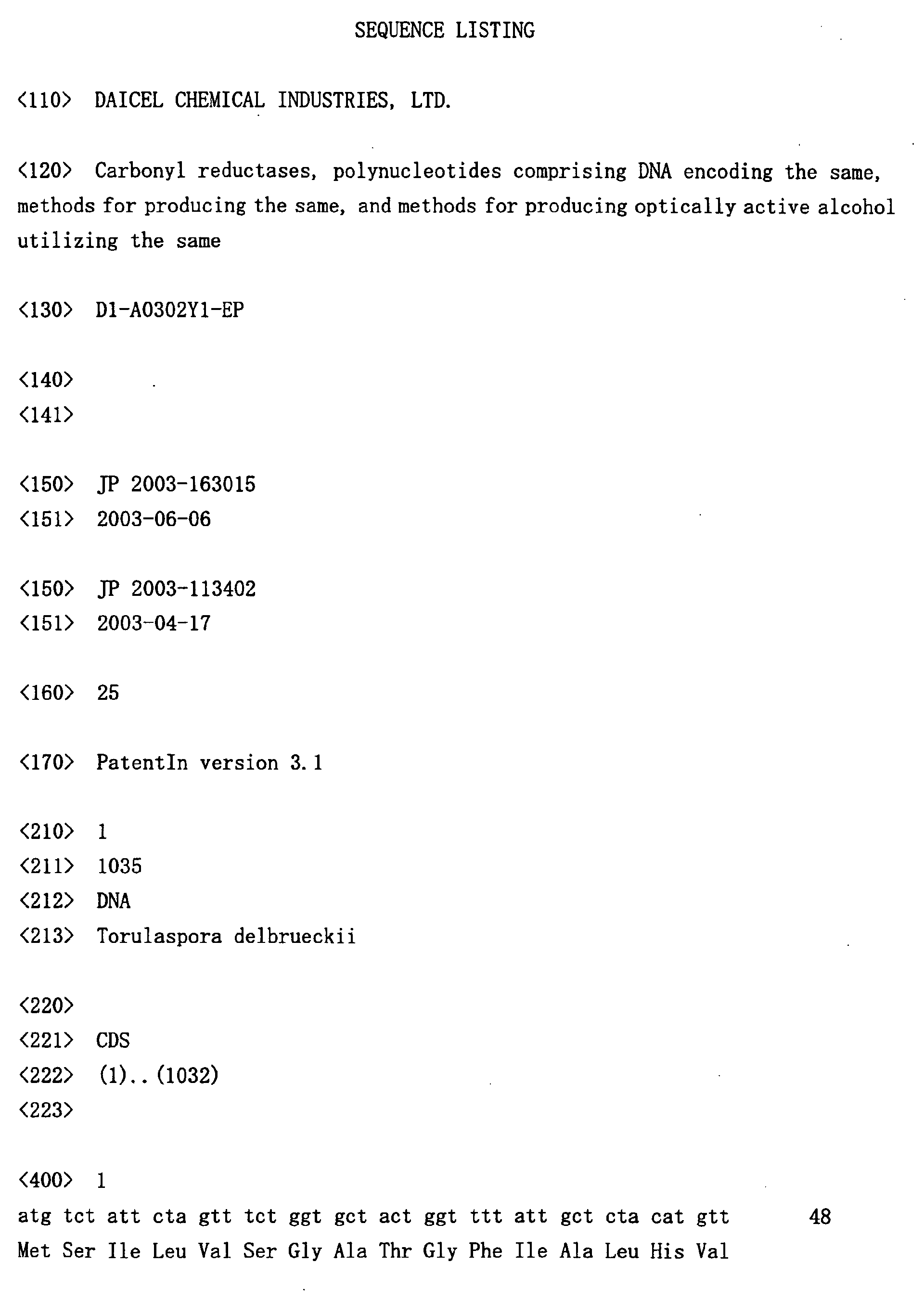
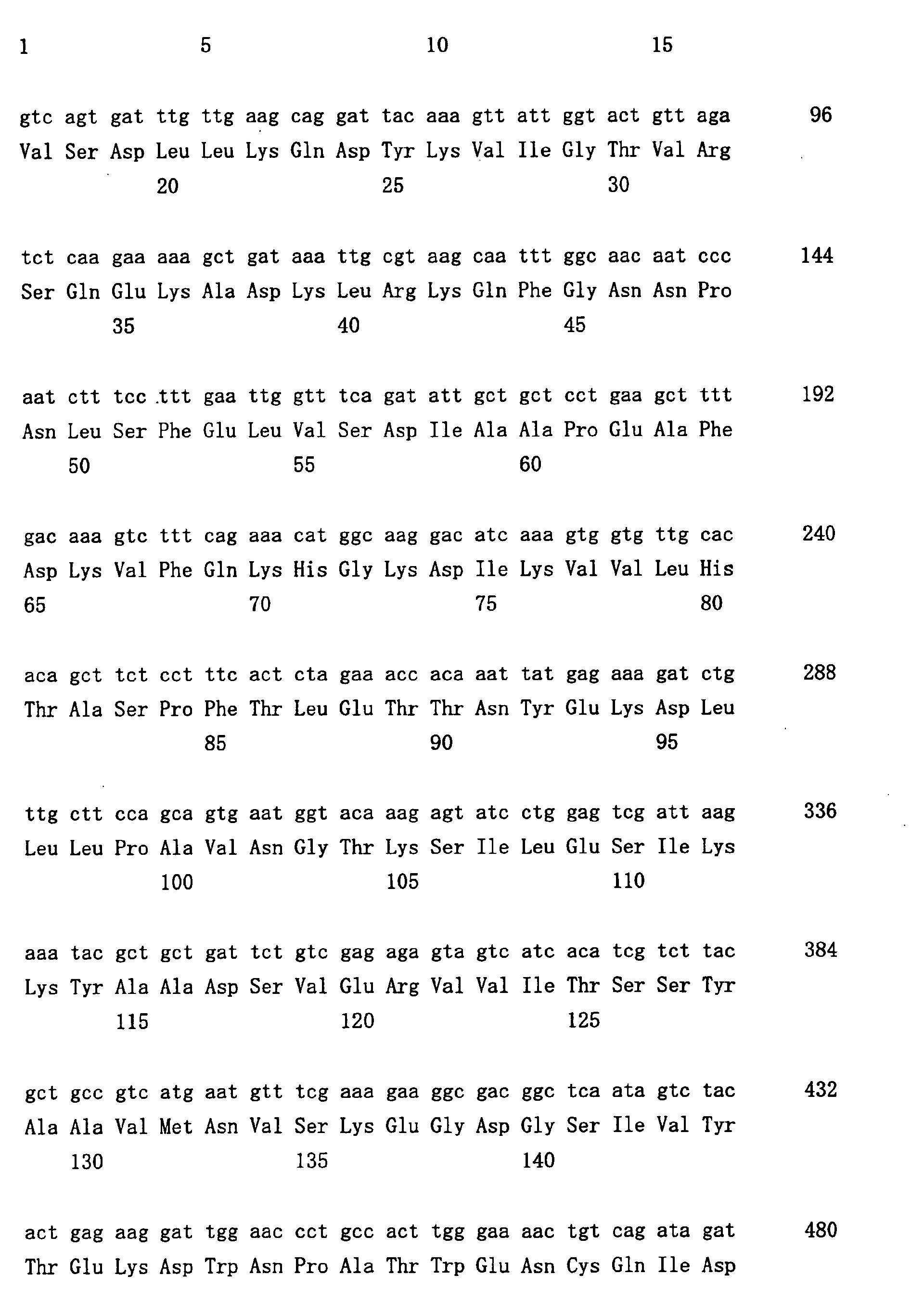

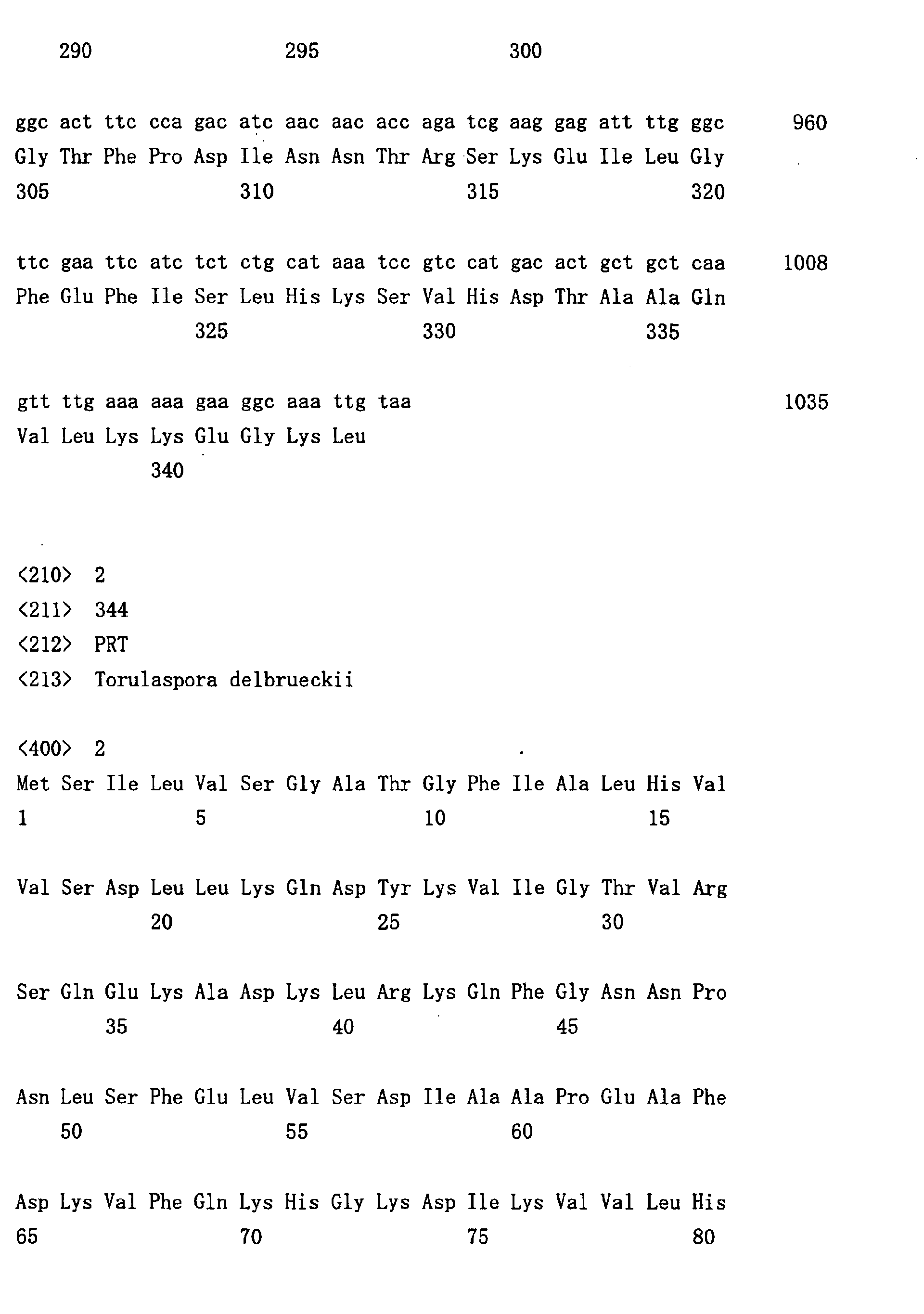


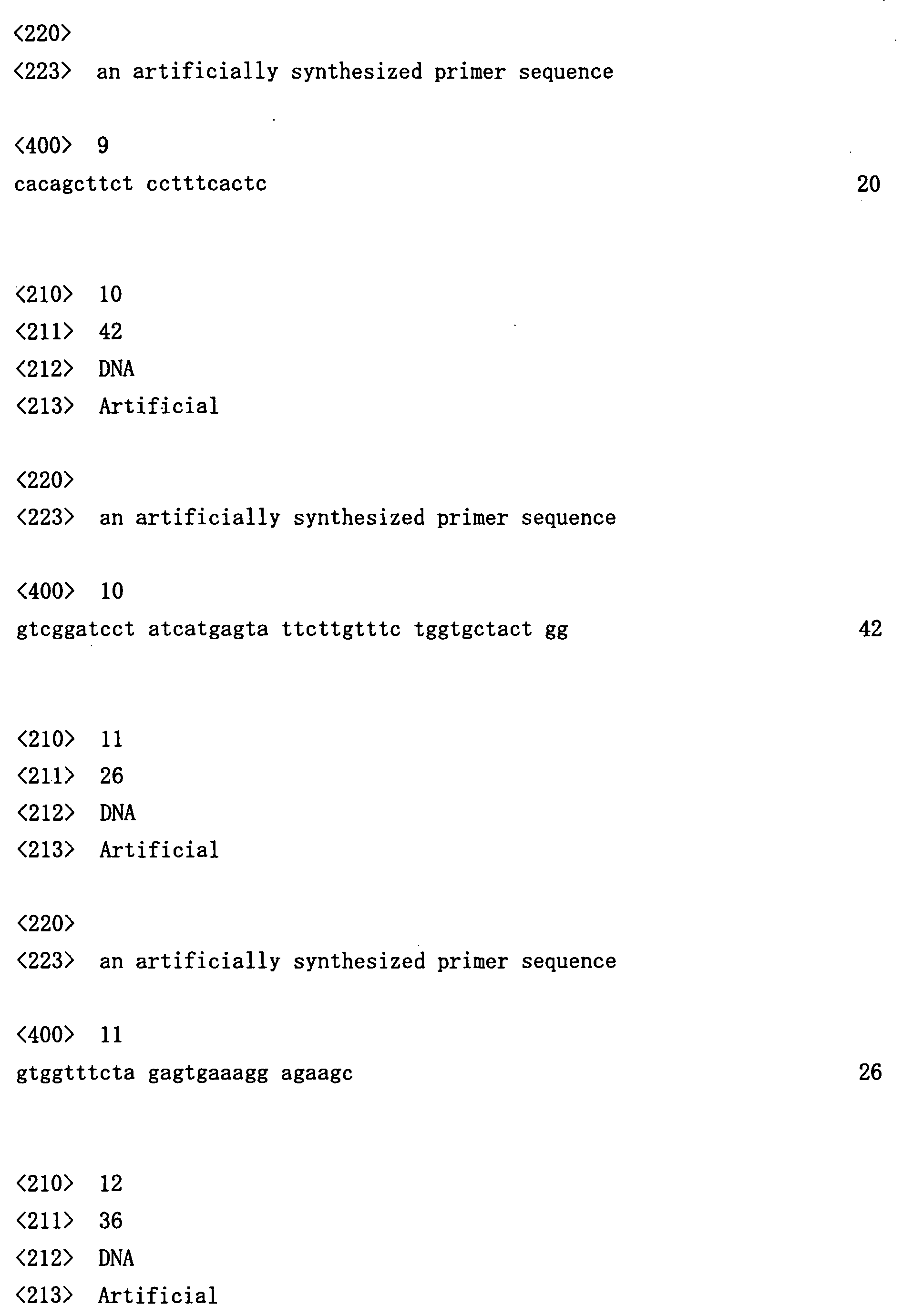
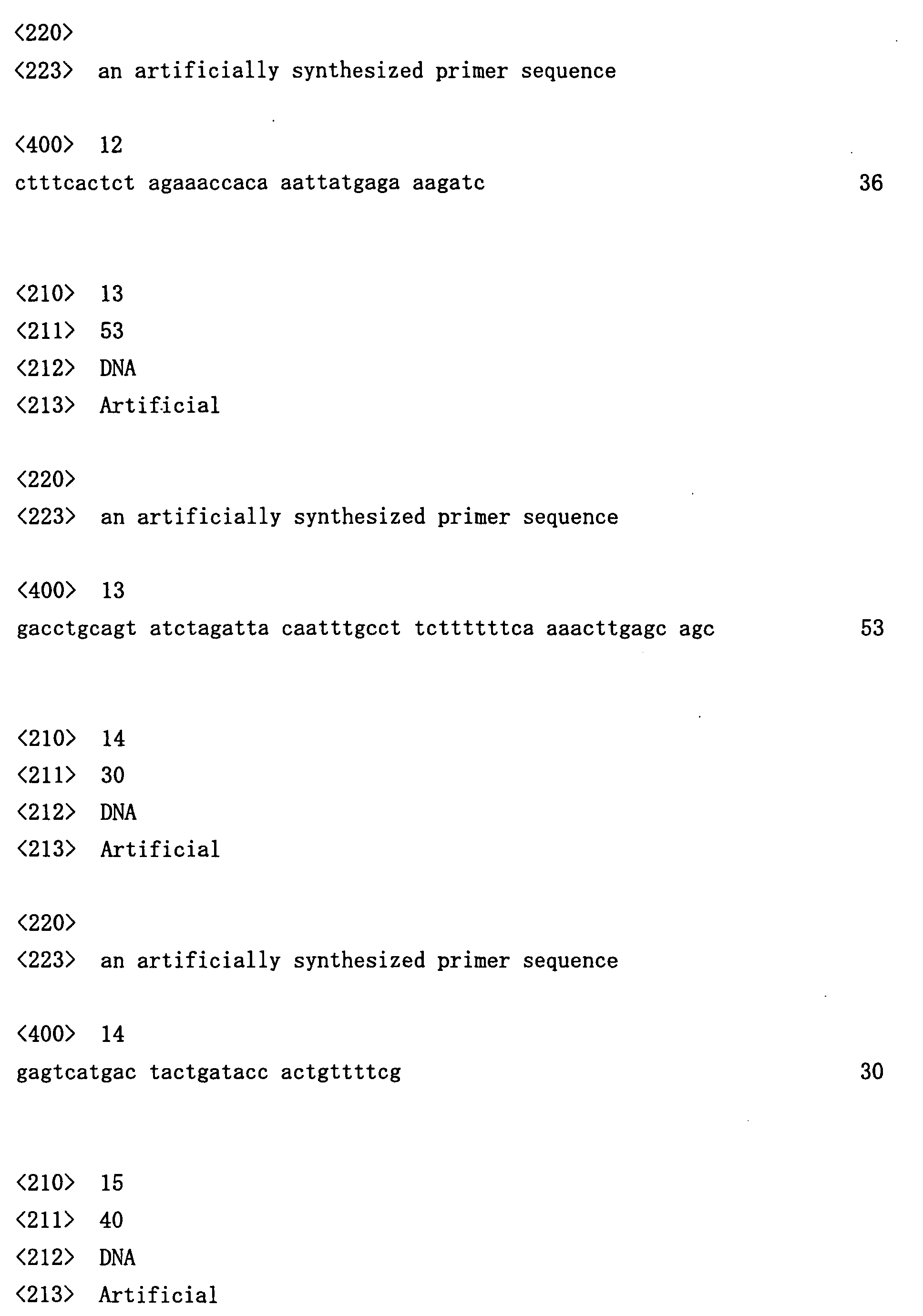


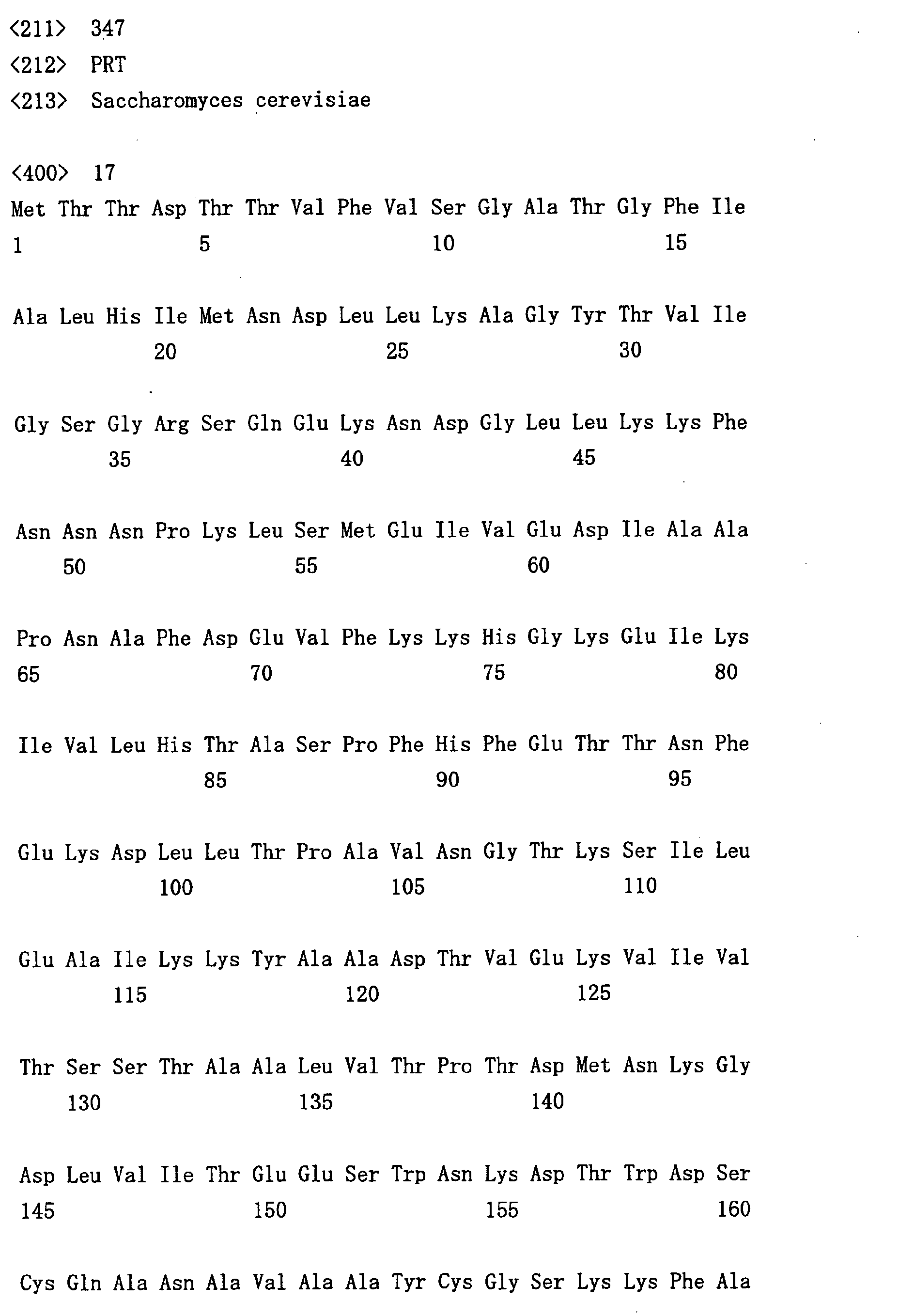


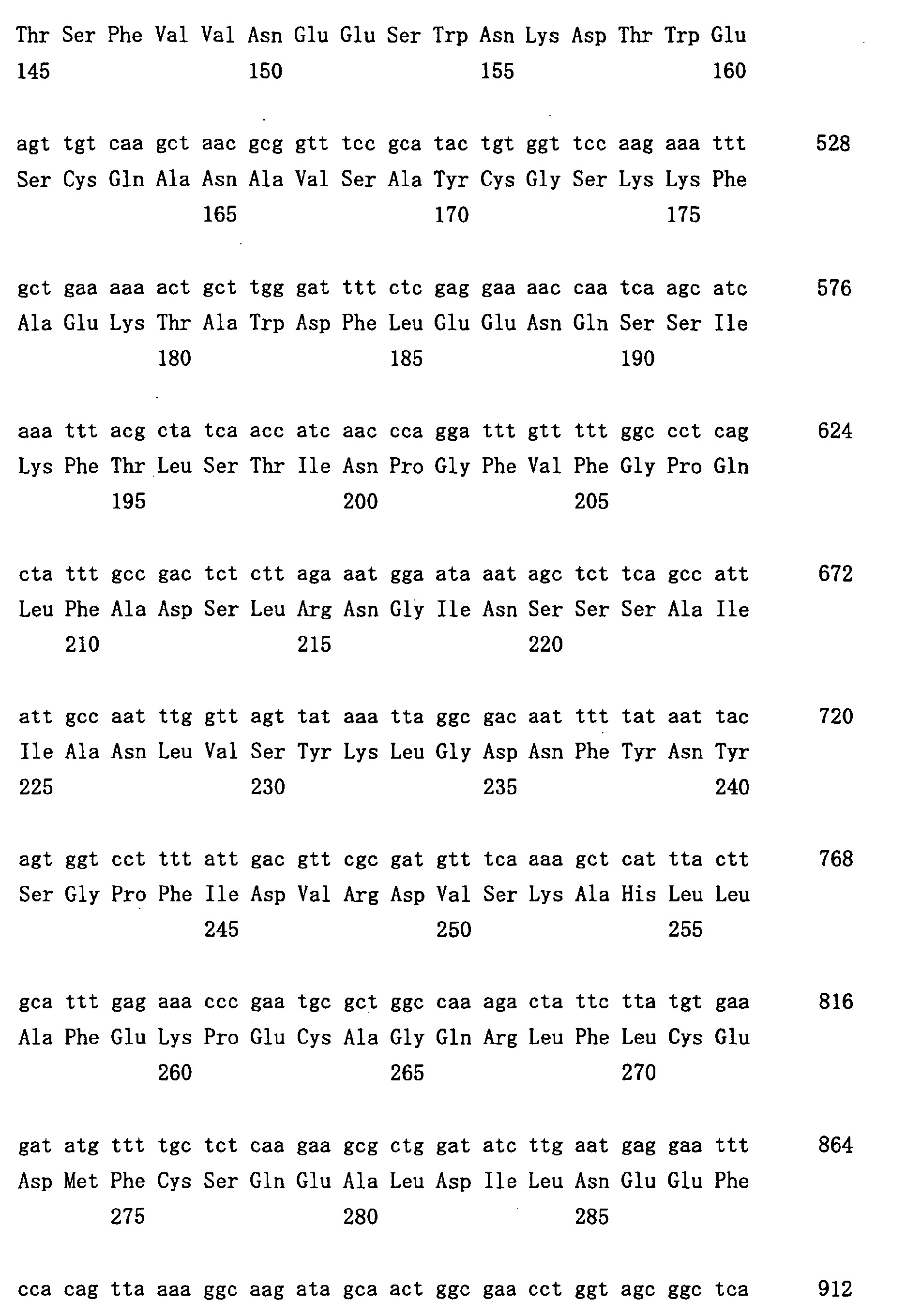
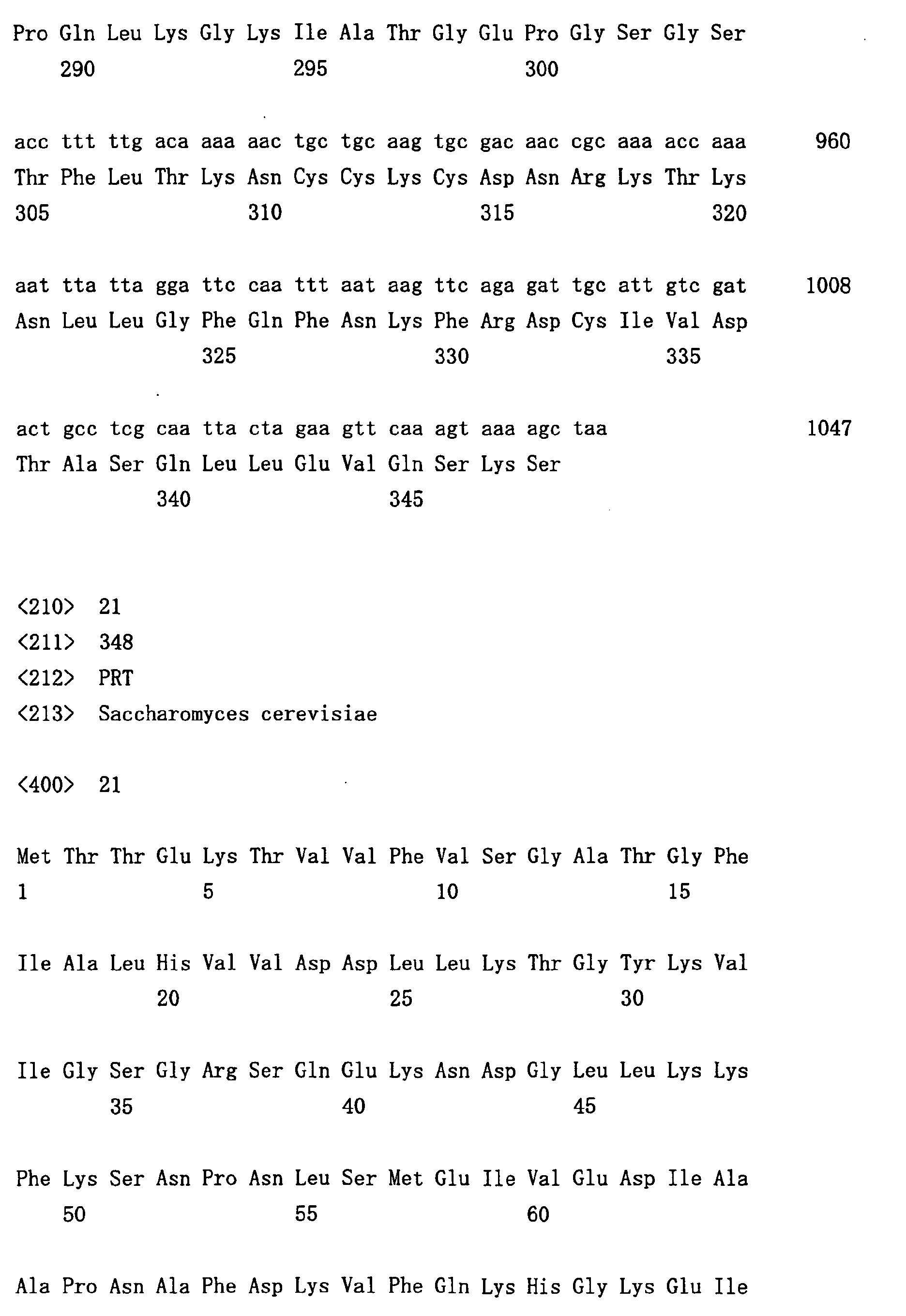
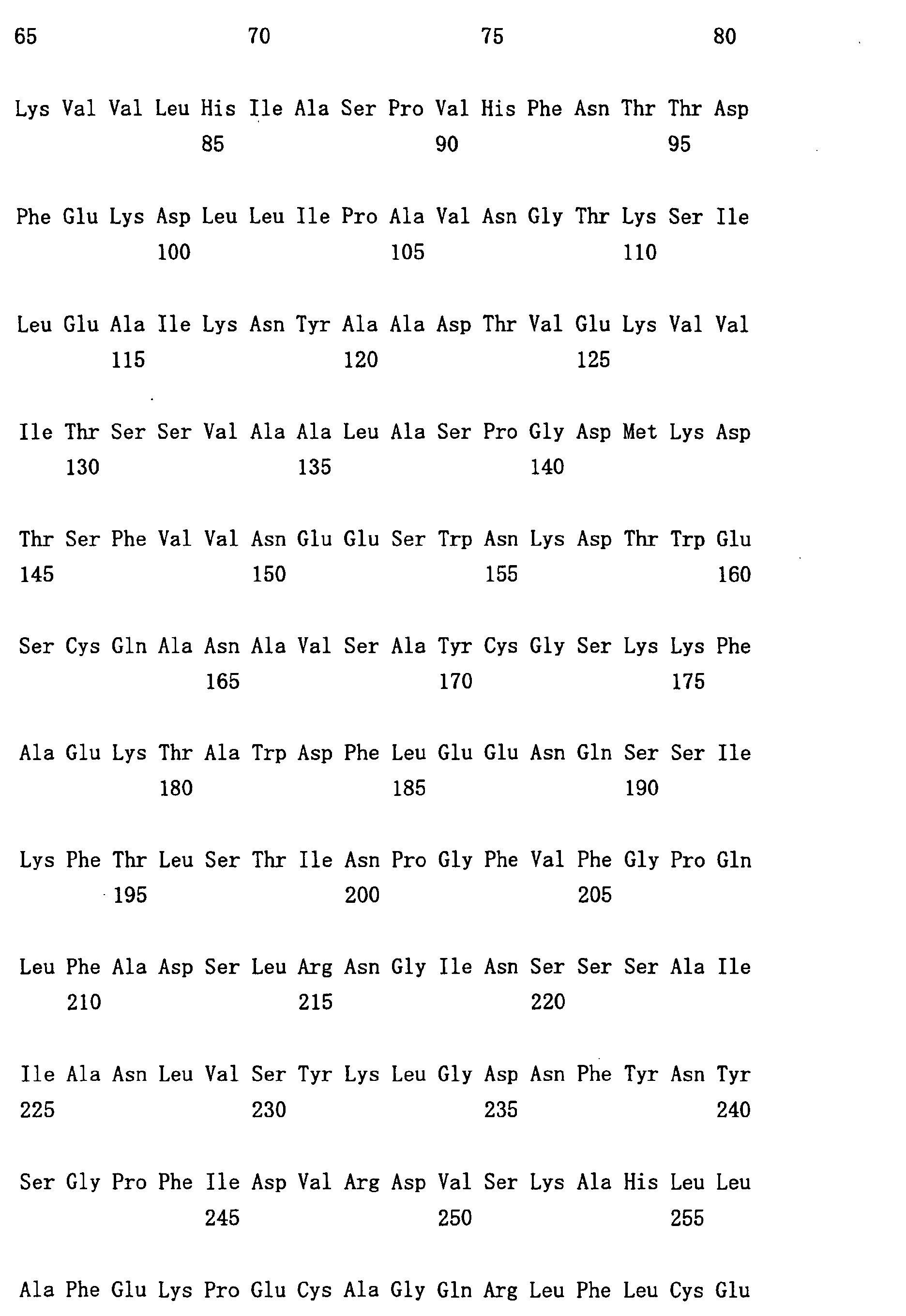


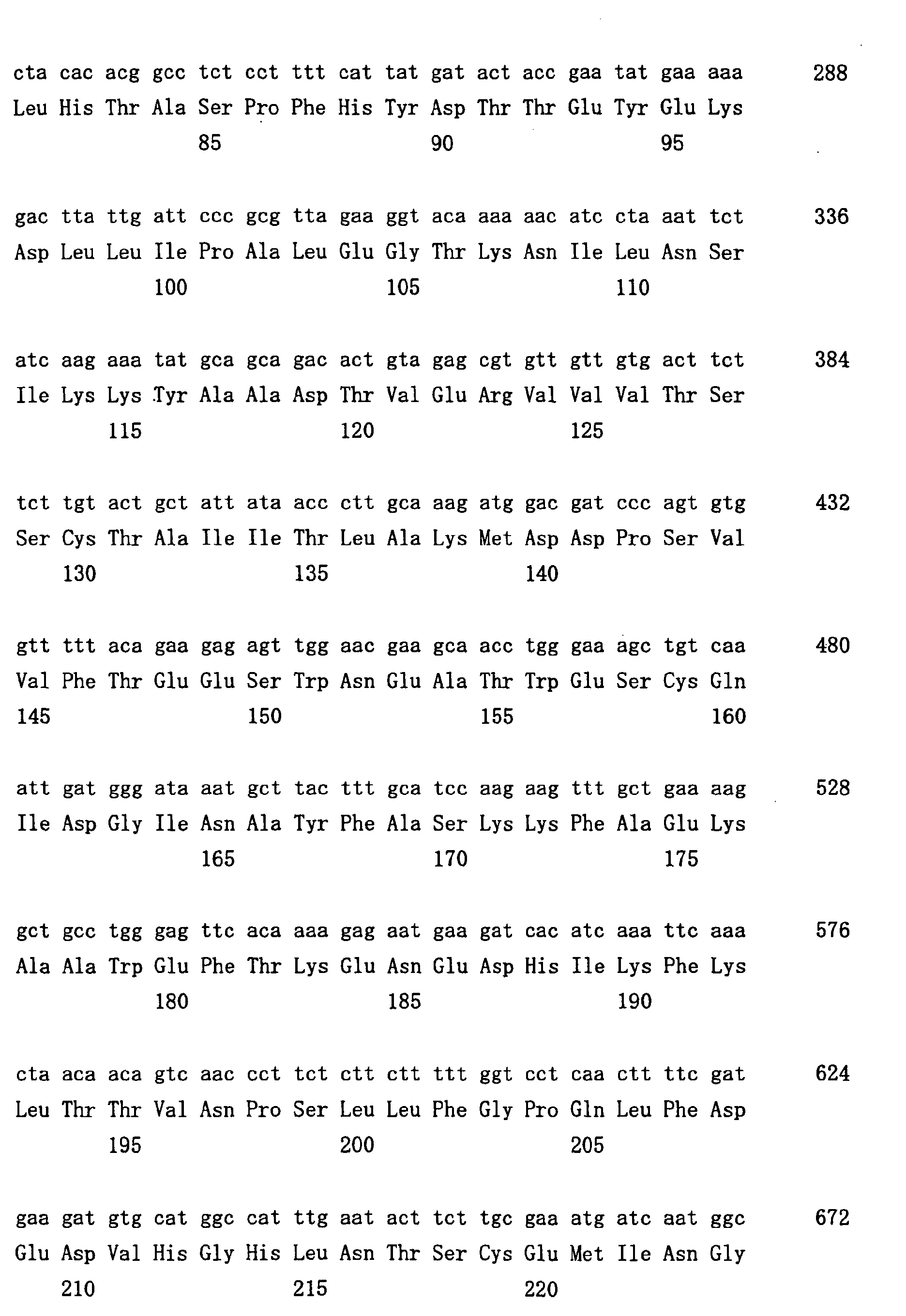

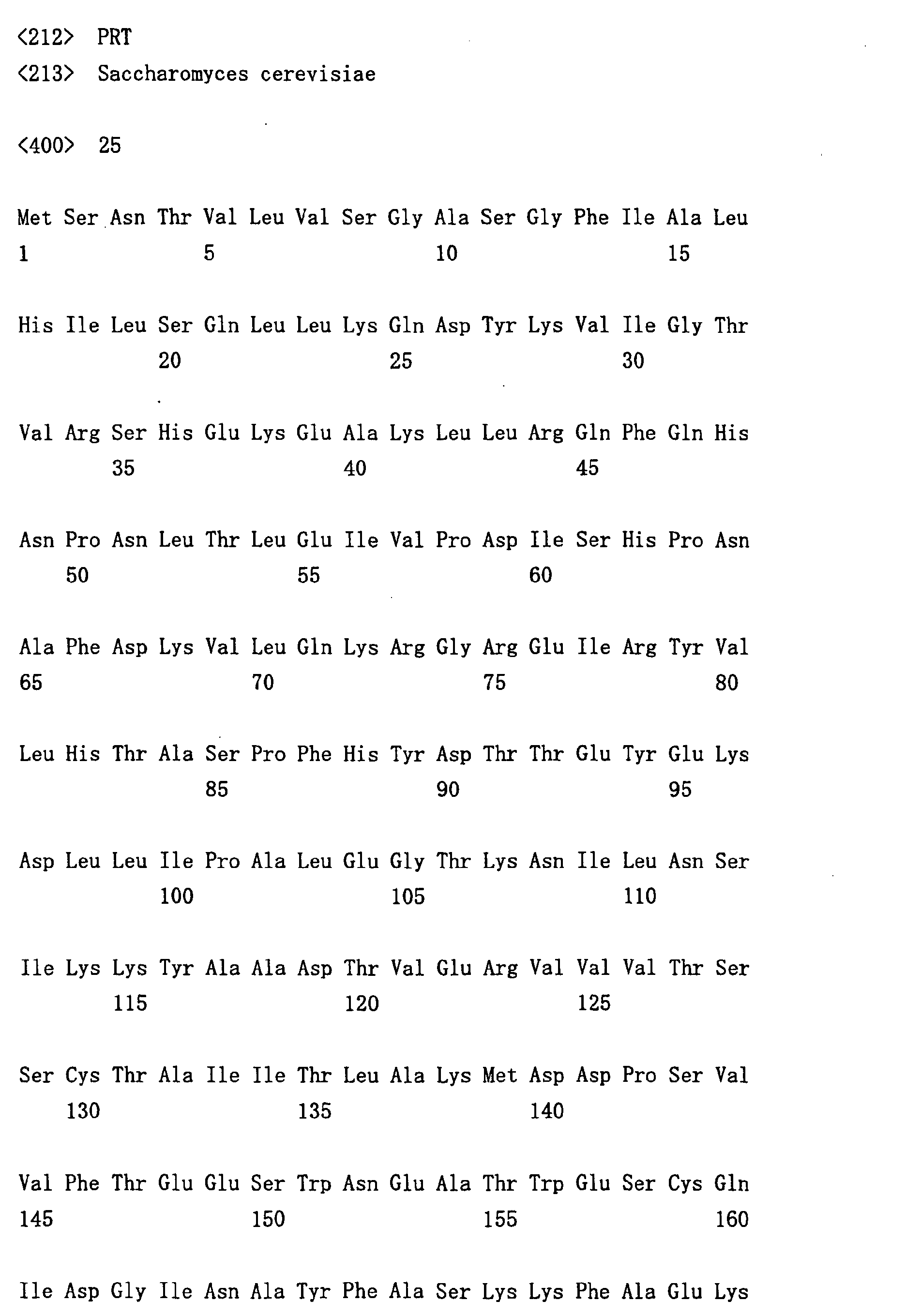

Claims (13)
- A carbonyl reductase comprising physicochemical properties as shown in (1) and (2),(1) action
reduces ketones to produce an optically active alcohol, by utilizing reduced β-nicotinamide adenine dinucleotide phosphate as a coenzyme,(2) substrate specificity(a) utilizes reduced β-nicotinamide adenine dinucleotide phosphate as a coenzyme in the reduction reaction,(b) reduces 3,4-dimethoxyphenylacetone to produce (S)-1-(3,4-dimethoxyphenyl)-2-propanol,(c) comprises the activity of reducing 3,4-dimethoxyphenylacetone, but lacks the activity of oxidizing (S)-1-(3,4-dimethoxyphenyl)-2-propanol. - The carbonyl reductase of claim 1, which additionally comprises physicochemical properties of (3) and (4),(3) optimal pH
pH 5.5 to 6.5,(4) molecular weight
a molecular weight, determined via sodium dodecylsulfate-polyacrylamide gel electrophoresis (SDS-PAGE) and gel filtration, of about 38,000. - The carbonyl reductase of claim 1, which is produced by a microorganism belonging to the genus Torulaspora.
- The carbonyl reductase of claim 3, wherein the microorganism belonging to the genus Torulaspora is Torulaspora delbrueckii.
- A polynucleotide of the following (a) or (b),(a) a polynucleotide comprising the nucleotide sequence of SEQ ID NO: 1(b) a polynucleotide encoding a protein comprising the amino acid sequence of SEQ ID NO: 2.
- A polynucleotide encoding a protein comprising the physicochemical properties of (1) and (2) in claim 1, wherein said polynucleotide is any one of the following (c) to (e),(c) a polynucleotide encoding a protein comprising an amino acid sequence in which one or more amino acid (s) in the amino acid sequence of SEQ ID NO: 2 has been substituted, deleted, inserted, and/or added,(d) a polynucleotide which hybridizes with a DNA comprising the nucleotide sequence of SEQ ID NO: 1 under stringent conditions,(e) a polynucleotide encoding an amino acid sequence comprising 70% or more homology to the amino acid sequence of SEQ ID NO: 2.
- A protein encoded by the polynucleotide of claim 5 or 6.
- A recombinant vector, which comprises the polynucleotide of claim 5 or 6.
- The recombinant vector of claim 8, which further comprises a dehydrogenase gene for regenerating a coenzyme.
- A transformant, which is transformed with the polynucleotide of claim 5 or 6, or the recombinant vector of claim 8 or 9.
- A carbonyl reducing agent comprising a protein comprising the physiochemical properties of (1) and (2) in claim 1, and comprising the function of producing at least 80%ee or more (S)-1-(3,4-dimethoxyphenyl)-2-propanol, wherein said protein is encoded by a polynucleotide according to any one of the following (a) to (c),(a) a polynucleotide encoding a protein comprising an amino acid sequence in which one or more amino acid(s) in the amino acid sequence of SEQ ID NO: 17, 21, or 25 has been substituted, deleted, inserted, and/or added,(b) a polynucleotide which hybridizes with a polynucleotide comprising a nucleotide sequence of SEQ ID NO: 16, 20, or 24 under stringent conditions,(c) a polynucleotide encoding an amino acid sequence comprising 70% or more homology to the amino acid sequence of SEQ ID NO: 17, 21, or 25.
- A method for producing an optically active alcohol, which comprises reacting a carbonyl reductase of any one of claims 1 to 4, the protein of claim 7, a microorganism producing the enzyme or the protein, the treated microorganism, the transformant of claim 10, or the carbonyl reducing agent of claim 11 with a ketone.
- A method for producing (S)-1-(3,4-dimethoxyphenyl)-2-propanol, which comprises reacting a carbonyl reductase of any one of claims 1 to 4, the protein of claim 7, a microorganism producing the enzyme or the protein, the treated microorganism, the transformant of claim 10, or the carbonyl reducing agent of claim 11 with 3,4-dimethoxyphenylacetone.
Applications Claiming Priority (4)
| Application Number | Priority Date | Filing Date | Title |
|---|---|---|---|
| JP2003113402 | 2003-04-17 | ||
| JP2003113402 | 2003-04-17 | ||
| JP2003163015A JP4213524B2 (en) | 2003-04-17 | 2003-06-06 | Novel carbonyl reductase, polynucleotide containing DNA encoding the enzyme, method for producing the same, and method for producing optically active alcohol using the same |
| JP2003163015 | 2003-06-06 |
Publications (3)
| Publication Number | Publication Date |
|---|---|
| EP1469079A1 true EP1469079A1 (en) | 2004-10-20 |
| EP1469079B1 EP1469079B1 (en) | 2008-04-09 |
| EP1469079B8 EP1469079B8 (en) | 2008-10-29 |
Family
ID=32911489
Family Applications (1)
| Application Number | Title | Priority Date | Filing Date |
|---|---|---|---|
| EP04009125A Expired - Lifetime EP1469079B8 (en) | 2003-04-17 | 2004-04-16 | Carbonyl reductases, polynucleotides comprising DNA encoding the same, methods for producing the same, and methods for producing optically active alcohol utilizing the same |
Country Status (5)
| Country | Link |
|---|---|
| US (1) | US7083962B2 (en) |
| EP (1) | EP1469079B8 (en) |
| JP (1) | JP4213524B2 (en) |
| AT (1) | ATE391792T1 (en) |
| DE (1) | DE602004012918T8 (en) |
Cited By (1)
| Publication number | Priority date | Publication date | Assignee | Title |
|---|---|---|---|---|
| DE102005038606A1 (en) * | 2005-08-16 | 2007-03-01 | Consortium für elektrochemische Industrie GmbH | Process for the enzymatic preparation of chiral 1-acylated 1,2-diols |
Families Citing this family (19)
| Publication number | Priority date | Publication date | Assignee | Title |
|---|---|---|---|---|
| KR20070013269A (en) * | 2004-02-04 | 2007-01-30 | 가부시키가이샤 에이피아이 코포레이션 | Method for preparing alcohol or carbonic acid having optical activity |
| JP2007274901A (en) * | 2004-05-12 | 2007-10-25 | Taisho Pharmaceut Co Ltd | Process for producing optically active propargyl alcohol |
| DE102005063191A1 (en) * | 2005-12-30 | 2007-07-05 | Basf Ag | Preparation of an optically active saturated aldehyde or alcohol comprises reduction of alpha, beta unsaturated aldehyde with a polypeptide sequence, in the presence of a enoate reductase |
| WO2008042876A2 (en) | 2006-10-02 | 2008-04-10 | Codexis, Inc. | Compositions and methods for producing stereoisomerically pure statins and synthetic intermediates therefor |
| CN101627116B (en) | 2007-02-08 | 2013-07-10 | 科德克希思公司 | Ketoreductases and uses thereof |
| JP2010536385A (en) * | 2007-08-24 | 2010-12-02 | コデクシス, インコーポレイテッド | Improved ketoreductase polypeptide for stereoselective production of (R) -3-hydroxythiolane |
| KR101586503B1 (en) | 2007-09-13 | 2016-01-18 | 코덱시스, 인코포레이티드 | Ketoreductase polypeptides for the reduction of acetophenones |
| CN101889081B (en) * | 2007-09-28 | 2014-06-18 | 科德克希思公司 | Ketoreductase polypeptides and uses thereof |
| HUE027683T2 (en) | 2007-10-01 | 2016-10-28 | Codexis Inc | Ketoreductase polypeptides for the production of azetidinone |
| WO2010025287A2 (en) * | 2008-08-27 | 2010-03-04 | Codexis, Inc. | Ketoreductase polypeptides for the production of 3-aryl-3-hydroxypropanamine from a 3-aryl-3-ketopropanamine |
| WO2010025238A2 (en) | 2008-08-27 | 2010-03-04 | Codexis, Inc. | Ketoreductase polypeptides for the production of a 3-aryl-3-hydroxypropanamine from a 3-aryl-3-ketopropanamine |
| SI2329014T1 (en) | 2008-08-29 | 2015-01-30 | Codexis, Inc. | Ketoreductase polypeptides for the stereoselective production of (4s)-3š(5s)-5(4-fluorophenyl)-5-hydroxypentanoylć-4-phenyl-1,3-oxazolidin-2-one |
| AU2009348523B2 (en) * | 2009-06-22 | 2015-02-26 | Sk Biopharmaceuticals Co., Ltd. | Method for preparation of carbamic acid (R)-1-aryl-2-tetrazolyl-ethyl ester |
| WO2011022548A2 (en) | 2009-08-19 | 2011-02-24 | Codexis, Inc. | Ketoreductase polypeptides for the preparation of phenylephrine |
| US8404461B2 (en) | 2009-10-15 | 2013-03-26 | SK Biopharmaceutical Co. Ltd. | Method for preparation of carbamic acid (R)-1-aryl-2-tetrazolyl-ethyl ester |
| HUE026367T2 (en) | 2010-05-04 | 2016-06-28 | Codexis Inc | Biocatalysts of ezetimibe synthesis |
| US10000782B2 (en) | 2013-07-16 | 2018-06-19 | International Flavors & Fragrances Inc. | Recombinant host cell for the biosynthesis of vanillin or vanillin beta-D-glucoside |
| CN115725524B (en) * | 2018-05-31 | 2024-12-31 | 中国科学院天津工业生物技术研究所 | Carbonyl reductase mutant and application thereof in reduction of cyclopentanedione compounds |
| CN113025506B (en) * | 2019-12-24 | 2022-12-09 | 中国科学院天津工业生物技术研究所 | Recombinant filamentous fungus for producing ethanol and construction and application thereof |
Citations (3)
| Publication number | Priority date | Publication date | Assignee | Title |
|---|---|---|---|---|
| EP0627397A1 (en) * | 1993-06-04 | 1994-12-07 | Daicel Chemical Industries, Ltd. | Optically active 1-phenyl-2-substituted propane derivatives and methods of producing the same |
| EP0654534A2 (en) * | 1993-11-18 | 1995-05-24 | Daicel Chemical Industries, Ltd. | Processes for producing optically active 2-amino-1-phenylethanol derivatives |
| WO1999023242A1 (en) * | 1997-11-04 | 1999-05-14 | Eli Lilly And Company | Ketoreductase gene and protein from yeast |
Family Cites Families (5)
| Publication number | Priority date | Publication date | Assignee | Title |
|---|---|---|---|---|
| JP3593362B2 (en) | 1993-06-04 | 2004-11-24 | ダイセル化学工業株式会社 | Optically active 1-phenyl-2-substituted propane derivative and method for producing the same |
| JP3696638B2 (en) | 1993-11-18 | 2005-09-21 | ダイセル化学工業株式会社 | Process for producing optically active 2-amino-1-phenylethanol derivative |
| JP3587569B2 (en) | 1994-09-30 | 2004-11-10 | 株式会社カネカ | Method for producing optically active 1- (3,4-dimethoxyphenyl) -2-propanol |
| US6531308B2 (en) | 1997-11-04 | 2003-03-11 | Eli Lilly And Company | Ketoreductase gene and protein from yeast |
| JP4154182B2 (en) | 2002-07-16 | 2008-09-24 | ダイセル化学工業株式会社 | α-Keto acid reductase, method for producing the same, and method for producing optically active α-hydroxy acid using the same |
-
2003
- 2003-06-06 JP JP2003163015A patent/JP4213524B2/en not_active Expired - Fee Related
-
2004
- 2004-04-15 US US10/826,081 patent/US7083962B2/en not_active Expired - Fee Related
- 2004-04-16 AT AT04009125T patent/ATE391792T1/en not_active IP Right Cessation
- 2004-04-16 EP EP04009125A patent/EP1469079B8/en not_active Expired - Lifetime
- 2004-04-16 DE DE602004012918T patent/DE602004012918T8/en active Active
Patent Citations (3)
| Publication number | Priority date | Publication date | Assignee | Title |
|---|---|---|---|---|
| EP0627397A1 (en) * | 1993-06-04 | 1994-12-07 | Daicel Chemical Industries, Ltd. | Optically active 1-phenyl-2-substituted propane derivatives and methods of producing the same |
| EP0654534A2 (en) * | 1993-11-18 | 1995-05-24 | Daicel Chemical Industries, Ltd. | Processes for producing optically active 2-amino-1-phenylethanol derivatives |
| WO1999023242A1 (en) * | 1997-11-04 | 1999-05-14 | Eli Lilly And Company | Ketoreductase gene and protein from yeast |
Non-Patent Citations (1)
| Title |
|---|
| WATANABE Y. ET AL.: "Cloning and sequencing of phospholipase B gene from the yeast Torulaspora delbrueckii", FEMS MICROBIOLOGY LETTERS, vol. 124, no. 1, 1994, pages 29 - 34, XP002285677 * |
Cited By (1)
| Publication number | Priority date | Publication date | Assignee | Title |
|---|---|---|---|---|
| DE102005038606A1 (en) * | 2005-08-16 | 2007-03-01 | Consortium für elektrochemische Industrie GmbH | Process for the enzymatic preparation of chiral 1-acylated 1,2-diols |
Also Published As
| Publication number | Publication date |
|---|---|
| US7083962B2 (en) | 2006-08-01 |
| JP4213524B2 (en) | 2009-01-21 |
| US20050148057A1 (en) | 2005-07-07 |
| DE602004012918T2 (en) | 2008-07-10 |
| ATE391792T1 (en) | 2008-04-15 |
| EP1469079B1 (en) | 2008-04-09 |
| DE602004012918D1 (en) | 2008-05-21 |
| DE602004012918T8 (en) | 2009-08-06 |
| JP2005000002A (en) | 2005-01-06 |
| EP1469079B8 (en) | 2008-10-29 |
Similar Documents
| Publication | Publication Date | Title |
|---|---|---|
| US7083962B2 (en) | Carbonyl reductases, polynucleotides comprising DNA encoding the same, methods for producing the same, and methods for producing optically active alcohol utilizing the same | |
| US6969600B2 (en) | Carbonyl reductase, method for producing said enzyme, DNA encoding said enzyme, and method for producing alcohol using said enzyme | |
| JP4630486B2 (en) | Novel (R) -2,3-butanediol dehydrogenase, method for producing the same, and method for producing optically active alcohol using the same | |
| JP4651896B2 (en) | (R) -2-Octanol dehydrogenase, method for producing the enzyme, DNA encoding the enzyme, and method for producing alcohol using the same | |
| US20120276606A1 (en) | Recombinant microorganisms with 1,3-butanediol-producing function and uses thereof | |
| US20090203096A1 (en) | Process for Production of Optically Active Alcohol | |
| JPWO2001061014A1 (en) | (R)-2-octanol dehydrogenase, method for producing said enzyme, DNA encoding said enzyme, and method for producing alcohol using said DNA | |
| JP4294382B2 (en) | (2S, 3S) -2,3-butanediol dehydrogenase | |
| US20080261286A1 (en) | Methods for producing optically active alpha-hydroxy amides | |
| EP1382674A2 (en) | Alpha-keto acid reductase, method for producing the same, and method for producing optically active alpha-hydroxy acids using the same | |
| EP1236796B1 (en) | Novel enone reductases isolated from Kluyveromyces lactis, methods for producing same, and methods for selectively reducing a carbon-carbon double bond of an Alpha, Beta-unsaturated ketone using the reductases | |
| US6818426B2 (en) | (R)-2,3-butanediol dehydrogenase | |
| JP2008109922A (en) | Novel (S) -N-benzyl-3-pyrrolidinol dehydrogenase, method for producing the same, and method for producing alcohol using the same |
Legal Events
| Date | Code | Title | Description |
|---|---|---|---|
| PUAI | Public reference made under article 153(3) epc to a published international application that has entered the european phase |
Free format text: ORIGINAL CODE: 0009012 |
|
| AK | Designated contracting states |
Kind code of ref document: A1 Designated state(s): AT BE BG CH CY CZ DE DK EE ES FI FR GB GR HU IE IT LI LU MC NL PL PT RO SE SI SK TR |
|
| AX | Request for extension of the european patent |
Extension state: AL HR LT LV MK |
|
| 17P | Request for examination filed |
Effective date: 20041112 |
|
| AKX | Designation fees paid |
Designated state(s): AT BE BG CH CY CZ DE DK EE ES FI FR GB GR HU IE IT LI LU MC NL PL PT RO SE SI SK TR |
|
| 17Q | First examination report despatched |
Effective date: 20060530 |
|
| RTI1 | Title (correction) |
Free format text: CARBONLY REDUCTASE, POLYNUCLEOTIDES COMPRISING DNA ENCODING THE SAME, METHODS FOR PRODUCING THE SAME,AND METHODS FOR PRODUCING OPTICALLY ACTIVE ALCOHOL UTILIZING THE SAME |
|
| GRAP | Despatch of communication of intention to grant a patent |
Free format text: ORIGINAL CODE: EPIDOSNIGR1 |
|
| RAP1 | Party data changed (applicant data changed or rights of an application transferred) |
Owner name: DAICEL CHEMICAL INDUSTRIES, LTD. |
|
| GRAS | Grant fee paid |
Free format text: ORIGINAL CODE: EPIDOSNIGR3 |
|
| GRAA | (expected) grant |
Free format text: ORIGINAL CODE: 0009210 |
|
| AK | Designated contracting states |
Kind code of ref document: B1 Designated state(s): AT BE BG CH CY CZ DE DK EE ES FI FR GB GR HU IE IT LI LU MC NL PL PT RO SE SI SK TR |
|
| REG | Reference to a national code |
Ref country code: GB Ref legal event code: FG4D |
|
| REG | Reference to a national code |
Ref country code: CH Ref legal event code: EP |
|
| REG | Reference to a national code |
Ref country code: IE Ref legal event code: FG4D |
|
| REF | Corresponds to: |
Ref document number: 602004012918 Country of ref document: DE Date of ref document: 20080521 Kind code of ref document: P |
|
| REG | Reference to a national code |
Ref country code: CH Ref legal event code: NV Representative=s name: BOVARD AG PATENTANWAELTE |
|
| RTI2 | Title (correction) |
Free format text: CARBONYL REDUCTASES, POLYNUCLEOTIDES COMPRISING DNA ENCODING THE SAME, METHODS FOR PRODUCING THE SAME, AND METHODS FOR PRODUCING OPTICALLY ACTIVE ALCOHOL UTILIZING THE SAME |
|
| PG25 | Lapsed in a contracting state [announced via postgrant information from national office to epo] |
Ref country code: SI Free format text: LAPSE BECAUSE OF FAILURE TO SUBMIT A TRANSLATION OF THE DESCRIPTION OR TO PAY THE FEE WITHIN THE PRESCRIBED TIME-LIMIT Effective date: 20080409 |
|
| PG25 | Lapsed in a contracting state [announced via postgrant information from national office to epo] |
Ref country code: ES Free format text: LAPSE BECAUSE OF FAILURE TO SUBMIT A TRANSLATION OF THE DESCRIPTION OR TO PAY THE FEE WITHIN THE PRESCRIBED TIME-LIMIT Effective date: 20080720 Ref country code: PT Free format text: LAPSE BECAUSE OF FAILURE TO SUBMIT A TRANSLATION OF THE DESCRIPTION OR TO PAY THE FEE WITHIN THE PRESCRIBED TIME-LIMIT Effective date: 20080909 Ref country code: FI Free format text: LAPSE BECAUSE OF FAILURE TO SUBMIT A TRANSLATION OF THE DESCRIPTION OR TO PAY THE FEE WITHIN THE PRESCRIBED TIME-LIMIT Effective date: 20080409 Ref country code: BG Free format text: LAPSE BECAUSE OF FAILURE TO SUBMIT A TRANSLATION OF THE DESCRIPTION OR TO PAY THE FEE WITHIN THE PRESCRIBED TIME-LIMIT Effective date: 20080709 |
|
| PG25 | Lapsed in a contracting state [announced via postgrant information from national office to epo] |
Ref country code: PL Free format text: LAPSE BECAUSE OF FAILURE TO SUBMIT A TRANSLATION OF THE DESCRIPTION OR TO PAY THE FEE WITHIN THE PRESCRIBED TIME-LIMIT Effective date: 20080409 Ref country code: MC Free format text: LAPSE BECAUSE OF NON-PAYMENT OF DUE FEES Effective date: 20080430 Ref country code: AT Free format text: LAPSE BECAUSE OF FAILURE TO SUBMIT A TRANSLATION OF THE DESCRIPTION OR TO PAY THE FEE WITHIN THE PRESCRIBED TIME-LIMIT Effective date: 20080409 |
|
| REG | Reference to a national code |
Ref country code: IE Ref legal event code: MM4A |
|
| ET | Fr: translation filed | ||
| PG25 | Lapsed in a contracting state [announced via postgrant information from national office to epo] |
Ref country code: SE Free format text: LAPSE BECAUSE OF FAILURE TO SUBMIT A TRANSLATION OF THE DESCRIPTION OR TO PAY THE FEE WITHIN THE PRESCRIBED TIME-LIMIT Effective date: 20080709 Ref country code: EE Free format text: LAPSE BECAUSE OF FAILURE TO SUBMIT A TRANSLATION OF THE DESCRIPTION OR TO PAY THE FEE WITHIN THE PRESCRIBED TIME-LIMIT Effective date: 20080409 Ref country code: DK Free format text: LAPSE BECAUSE OF FAILURE TO SUBMIT A TRANSLATION OF THE DESCRIPTION OR TO PAY THE FEE WITHIN THE PRESCRIBED TIME-LIMIT Effective date: 20080409 Ref country code: CZ Free format text: LAPSE BECAUSE OF FAILURE TO SUBMIT A TRANSLATION OF THE DESCRIPTION OR TO PAY THE FEE WITHIN THE PRESCRIBED TIME-LIMIT Effective date: 20080409 |
|
| PLBE | No opposition filed within time limit |
Free format text: ORIGINAL CODE: 0009261 |
|
| STAA | Information on the status of an ep patent application or granted ep patent |
Free format text: STATUS: NO OPPOSITION FILED WITHIN TIME LIMIT |
|
| PG25 | Lapsed in a contracting state [announced via postgrant information from national office to epo] |
Ref country code: RO Free format text: LAPSE BECAUSE OF FAILURE TO SUBMIT A TRANSLATION OF THE DESCRIPTION OR TO PAY THE FEE WITHIN THE PRESCRIBED TIME-LIMIT Effective date: 20080409 Ref country code: BE Free format text: LAPSE BECAUSE OF FAILURE TO SUBMIT A TRANSLATION OF THE DESCRIPTION OR TO PAY THE FEE WITHIN THE PRESCRIBED TIME-LIMIT Effective date: 20080409 Ref country code: SK Free format text: LAPSE BECAUSE OF FAILURE TO SUBMIT A TRANSLATION OF THE DESCRIPTION OR TO PAY THE FEE WITHIN THE PRESCRIBED TIME-LIMIT Effective date: 20080409 |
|
| 26N | No opposition filed |
Effective date: 20090112 |
|
| PG25 | Lapsed in a contracting state [announced via postgrant information from national office to epo] |
Ref country code: IE Free format text: LAPSE BECAUSE OF NON-PAYMENT OF DUE FEES Effective date: 20080416 |
|
| PG25 | Lapsed in a contracting state [announced via postgrant information from national office to epo] |
Ref country code: IT Free format text: LAPSE BECAUSE OF FAILURE TO SUBMIT A TRANSLATION OF THE DESCRIPTION OR TO PAY THE FEE WITHIN THE PRESCRIBED TIME-LIMIT Effective date: 20080409 |
|
| PG25 | Lapsed in a contracting state [announced via postgrant information from national office to epo] |
Ref country code: CY Free format text: LAPSE BECAUSE OF FAILURE TO SUBMIT A TRANSLATION OF THE DESCRIPTION OR TO PAY THE FEE WITHIN THE PRESCRIBED TIME-LIMIT Effective date: 20080409 |
|
| PG25 | Lapsed in a contracting state [announced via postgrant information from national office to epo] |
Ref country code: HU Free format text: LAPSE BECAUSE OF FAILURE TO SUBMIT A TRANSLATION OF THE DESCRIPTION OR TO PAY THE FEE WITHIN THE PRESCRIBED TIME-LIMIT Effective date: 20081010 Ref country code: LU Free format text: LAPSE BECAUSE OF NON-PAYMENT OF DUE FEES Effective date: 20080416 |
|
| PG25 | Lapsed in a contracting state [announced via postgrant information from national office to epo] |
Ref country code: TR Free format text: LAPSE BECAUSE OF FAILURE TO SUBMIT A TRANSLATION OF THE DESCRIPTION OR TO PAY THE FEE WITHIN THE PRESCRIBED TIME-LIMIT Effective date: 20080409 |
|
| PG25 | Lapsed in a contracting state [announced via postgrant information from national office to epo] |
Ref country code: GR Free format text: LAPSE BECAUSE OF FAILURE TO SUBMIT A TRANSLATION OF THE DESCRIPTION OR TO PAY THE FEE WITHIN THE PRESCRIBED TIME-LIMIT Effective date: 20080710 |
|
| REG | Reference to a national code |
Ref country code: CH Ref legal event code: PFA Owner name: DAICEL CHEMICAL INDUSTRIES, LTD. Free format text: DAICEL CHEMICAL INDUSTRIES, LTD.#MAINICHI INTECIO 3-4-5, UMEDA#KITA-KU, OSAKA-SHI OSAKA 530-0001 (JP) -TRANSFER TO- DAICEL CHEMICAL INDUSTRIES, LTD.#MAINICHI INTECIO 3-4-5, UMEDA#KITA-KU, OSAKA-SHI OSAKA 530-0001 (JP) |
|
| PGFP | Annual fee paid to national office [announced via postgrant information from national office to epo] |
Ref country code: DE Payment date: 20110413 Year of fee payment: 8 Ref country code: FR Payment date: 20110426 Year of fee payment: 8 Ref country code: CH Payment date: 20110412 Year of fee payment: 8 |
|
| PGFP | Annual fee paid to national office [announced via postgrant information from national office to epo] |
Ref country code: GB Payment date: 20110413 Year of fee payment: 8 Ref country code: NL Payment date: 20110426 Year of fee payment: 8 |
|
| REG | Reference to a national code |
Ref country code: NL Ref legal event code: V1 Effective date: 20121101 |
|
| REG | Reference to a national code |
Ref country code: CH Ref legal event code: PL |
|
| GBPC | Gb: european patent ceased through non-payment of renewal fee |
Effective date: 20120416 |
|
| REG | Reference to a national code |
Ref country code: FR Ref legal event code: ST Effective date: 20121228 |
|
| PG25 | Lapsed in a contracting state [announced via postgrant information from national office to epo] |
Ref country code: GB Free format text: LAPSE BECAUSE OF NON-PAYMENT OF DUE FEES Effective date: 20120416 Ref country code: LI Free format text: LAPSE BECAUSE OF NON-PAYMENT OF DUE FEES Effective date: 20120430 Ref country code: CH Free format text: LAPSE BECAUSE OF NON-PAYMENT OF DUE FEES Effective date: 20120430 |
|
| REG | Reference to a national code |
Ref country code: DE Ref legal event code: R119 Ref document number: 602004012918 Country of ref document: DE Effective date: 20121101 |
|
| PG25 | Lapsed in a contracting state [announced via postgrant information from national office to epo] |
Ref country code: FR Free format text: LAPSE BECAUSE OF NON-PAYMENT OF DUE FEES Effective date: 20120430 |
|
| PG25 | Lapsed in a contracting state [announced via postgrant information from national office to epo] |
Ref country code: NL Free format text: LAPSE BECAUSE OF NON-PAYMENT OF DUE FEES Effective date: 20121101 |
|
| PG25 | Lapsed in a contracting state [announced via postgrant information from national office to epo] |
Ref country code: DE Free format text: LAPSE BECAUSE OF NON-PAYMENT OF DUE FEES Effective date: 20121101 |