EP1468724A1 - Dithiolene functionalized polymer membrane for olefin/paraffin separation - Google Patents
Dithiolene functionalized polymer membrane for olefin/paraffin separation Download PDFInfo
- Publication number
- EP1468724A1 EP1468724A1 EP04008852A EP04008852A EP1468724A1 EP 1468724 A1 EP1468724 A1 EP 1468724A1 EP 04008852 A EP04008852 A EP 04008852A EP 04008852 A EP04008852 A EP 04008852A EP 1468724 A1 EP1468724 A1 EP 1468724A1
- Authority
- EP
- European Patent Office
- Prior art keywords
- separation membrane
- fluid separation
- fluid
- dithiolene
- polymer
- Prior art date
- Legal status (The legal status is an assumption and is not a legal conclusion. Google has not performed a legal analysis and makes no representation as to the accuracy of the status listed.)
- Withdrawn
Links
Images


Classifications
-
- B—PERFORMING OPERATIONS; TRANSPORTING
- B01—PHYSICAL OR CHEMICAL PROCESSES OR APPARATUS IN GENERAL
- B01D—SEPARATION
- B01D67/00—Processes specially adapted for manufacturing semi-permeable membranes for separation processes or apparatus
- B01D67/0002—Organic membrane manufacture
- B01D67/0009—Organic membrane manufacture by phase separation, sol-gel transition, evaporation or solvent quenching
- B01D67/0011—Casting solutions therefor
-
- B—PERFORMING OPERATIONS; TRANSPORTING
- B01—PHYSICAL OR CHEMICAL PROCESSES OR APPARATUS IN GENERAL
- B01D—SEPARATION
- B01D53/00—Separation of gases or vapours; Recovering vapours of volatile solvents from gases; Chemical or biological purification of waste gases, e.g. engine exhaust gases, smoke, fumes, flue gases, aerosols
- B01D53/22—Separation of gases or vapours; Recovering vapours of volatile solvents from gases; Chemical or biological purification of waste gases, e.g. engine exhaust gases, smoke, fumes, flue gases, aerosols by diffusion
- B01D53/228—Separation of gases or vapours; Recovering vapours of volatile solvents from gases; Chemical or biological purification of waste gases, e.g. engine exhaust gases, smoke, fumes, flue gases, aerosols by diffusion characterised by specific membranes
-
- B—PERFORMING OPERATIONS; TRANSPORTING
- B01—PHYSICAL OR CHEMICAL PROCESSES OR APPARATUS IN GENERAL
- B01D—SEPARATION
- B01D69/00—Semi-permeable membranes for separation processes or apparatus characterised by their form, structure or properties; Manufacturing processes specially adapted therefor
- B01D69/14—Dynamic membranes
- B01D69/141—Heterogeneous membranes, e.g. containing dispersed material; Mixed matrix membranes
- B01D69/142—Heterogeneous membranes, e.g. containing dispersed material; Mixed matrix membranes with "carriers"
-
- B—PERFORMING OPERATIONS; TRANSPORTING
- B01—PHYSICAL OR CHEMICAL PROCESSES OR APPARATUS IN GENERAL
- B01D—SEPARATION
- B01D71/00—Semi-permeable membranes for separation processes or apparatus characterised by the material; Manufacturing processes specially adapted therefor
- B01D71/06—Organic material
- B01D71/56—Polyamides, e.g. polyester-amides
-
- B—PERFORMING OPERATIONS; TRANSPORTING
- B01—PHYSICAL OR CHEMICAL PROCESSES OR APPARATUS IN GENERAL
- B01D—SEPARATION
- B01D71/00—Semi-permeable membranes for separation processes or apparatus characterised by the material; Manufacturing processes specially adapted therefor
- B01D71/06—Organic material
- B01D71/58—Other polymers having nitrogen in the main chain, with or without oxygen or carbon only
- B01D71/62—Polycondensates having nitrogen-containing heterocyclic rings in the main chain
-
- B—PERFORMING OPERATIONS; TRANSPORTING
- B01—PHYSICAL OR CHEMICAL PROCESSES OR APPARATUS IN GENERAL
- B01D—SEPARATION
- B01D71/00—Semi-permeable membranes for separation processes or apparatus characterised by the material; Manufacturing processes specially adapted therefor
- B01D71/06—Organic material
- B01D71/58—Other polymers having nitrogen in the main chain, with or without oxygen or carbon only
- B01D71/62—Polycondensates having nitrogen-containing heterocyclic rings in the main chain
- B01D71/64—Polyimides; Polyamide-imides; Polyester-imides; Polyamide acids or similar polyimide precursors
-
- C—CHEMISTRY; METALLURGY
- C07—ORGANIC CHEMISTRY
- C07C—ACYCLIC OR CARBOCYCLIC COMPOUNDS
- C07C7/00—Purification; Separation; Use of additives
- C07C7/144—Purification; Separation; Use of additives using membranes, e.g. selective permeation
-
- B—PERFORMING OPERATIONS; TRANSPORTING
- B01—PHYSICAL OR CHEMICAL PROCESSES OR APPARATUS IN GENERAL
- B01D—SEPARATION
- B01D2257/00—Components to be removed
- B01D2257/70—Organic compounds not provided for in groups B01D2257/00 - B01D2257/602
- B01D2257/702—Hydrocarbons
- B01D2257/7022—Aliphatic hydrocarbons
-
- B—PERFORMING OPERATIONS; TRANSPORTING
- B01—PHYSICAL OR CHEMICAL PROCESSES OR APPARATUS IN GENERAL
- B01D—SEPARATION
- B01D2325/00—Details relating to properties of membranes
- B01D2325/02—Details relating to pores or porosity of the membranes
- B01D2325/022—Asymmetric membranes
Definitions
- the present invention generally relates to polymeric membranes that exhibit gas selectivity. Specifically, rigid polymeric membranes that exhibit an olefin/paraffin selectivity are described.
- one side of the gas separation membrane is contacted with a multicomponent gas mixture. Certain of the gases of the mixture permeate through the membrane faster than the other gases. Gas separation membranes thereby allow some gases to permeate through them while serving as a relative barrier to other gases.
- the relative gas permeation rate through the membrane is a property of the membrane material composition and its morphology.
- the intrinsic permeability of a polymer membrane is a function of both gas diffusion through the membrane, controlled in part by the packing and molecular free volume of the material, and gas solubility within the material. Selectivity may be determined by the ratio of the permeabilities of two gases being separated by a material.
- the permeability coefficient (P A ) of a particular gas is the flux (N A ) normalized to the pressure difference across the membrane ( ⁇ p A ), and the membrane thickness ( l ).
- P A N A l ⁇ p A
- the permeability coefficient of a particular penetrant gas is also equal to the product of the diffusion coefficient (D A ) and the solubility coefficient (S A ).
- D A diffusion coefficient
- S A solubility coefficient
- the permselectivity ( ⁇ A/B ) of a membrane material is the ratio of the permeability coefficients of a penetrant pair for the case where the downstream pressure is negligible relative to the upstream feed pressure.
- the ideal permselectivity is also a product of the diffusivity selectivity and solubility selectivity of the particular gas pair.
- the temperature dependence of permeability for a given set of feed partial pressures is typically represented by an Arrhenius relationship: where P o is a pre-exponential factor, E p is the apparent activation energy for permeation, T is the temperature of permeation in Kelvin, and R is the universal gas constant.
- the permeability can further be broken up into temperature dependent diffusion and sorption coefficients from equation (2).
- the temperature dependence of the penetrant diffusion coefficient can also be represented by an Arrhenius relationship:
- D o is a pre-exponential factor
- E d is the activation energy for diffusion.
- the activation energy for diffusion represents the energy required for a penetrant to diffuse or "jump" from one equilibrium site within the matrix to another equilibrium site.
- the activation energy is related to the size of the penetrant, the rigidity of the polymer chain, as well as polymeric chain packing.
- the temperature dependence of sorption in polymers may be described using a thermodynamic van't Hoff expression: where S o is a pre-exponential factor, and H s is the apparent heat of sorption as it combines the temperature dependence of sorption in both the Henry's law and Langmuir regions.
- the diffusivity selectivity is determined by the ability of the polymer to discriminate between the penetrants on the basis of their sizes and shapes, and is governed primarily by intrasegmental motions and intersegmental packing.
- the diffusive selectivity will be based on both the difference in activation energy for both penetrants, ⁇ E d , as well as the difference in activation entropy for both penetrants, ⁇ S d .
- U.S. Pat. No. 5,074,891 to Kohn et al. discloses certain polyimides with the residuum of a diaryl fluorine-containing diamine moiety as useful in separation processes involving, for example, H 2 , N 2 , CH 4 , CO, CO 2 , He and O 2 .
- a more rigid repeat unit than a polyimide By utilizing a more rigid repeat unit than a polyimide, however, even greater permeability and permselectivity are realized.
- a rigid repeat unit is a polypyrrolone.
- Olefin gases particularly ethylene and propylene
- Various petrochemical streams contain olefins and other saturated hydrocarbons. These streams typically originate from a catalytic cracking unit.
- the separation of olefin and paraffin components is done using low temperature distillation. Distillation columns are normally around 300 feet tall and contain over 200 trays. This is extremely expensive and energy intensive due to the similar volatilities of the components.
- ⁇ A/B ( ⁇ A/B )/( P A ⁇ A/B )
- the parameter, ⁇ A/B can be shown to be proportional to the square of the size difference of the two gas molecules, (dA/dB) 2 . Consequently, this parameter is difficult to manipulate through materials engineering. Therefore, according to the theory, in order to "move" the upper bound limit, the strategy must be to increase the ⁇ parameter, which can be shown to be proportional to the value, S A (S A /S B ) ⁇ , as well as a parameter f, which relates to the interchain spacing.
- Group I-B metals such as silver
- polymer membranes in a salt form.
- silver salts conventionally used include AgBF 4 and AgNO 3 .
- the salt dissociates, and the silver cation is able to form a complex with an olefin due to the interaction of the ⁇ -orbital of the olefin with the ⁇ and ⁇ -orbital of the metal.
- the overall strategy is to maintain the high diffusivity selectivity (D A / D B ) already available with polyimides, and enhance this diffusivity selectivity by a factor of the improved solubility selectivity (S A / S B ).
- the fluid separation membrane may be formed from the reaction product of a tetraacid compound and a diamine.
- the initial resulting product is a polyamide.
- This polyamide may be used to form a fluid separation membrane.
- the polyamide may be thermally or chemically cyclized to form a polyimide.
- the polymer matrix of the fluid separation membrane may also include a dithiolene.
- dithiolenes are included within the polymer matrix
- rigid polymeric membranes that exhibit an olefin/paraffin solubility selectivity may result.
- Dithiolenes may be added to a polymer formed by reacting a tetraacid compound with a diamine, a tetraamine, or a mixture of diamines and tetraamines.
- Dithiolenes may be added to any polymer matrix such that the dithiolenes are substantially homogeneously dispersed within the polymer matrix.
- the fluid separation membrane may be formed by adding a tetraacid compound to an amine mixture.
- the amine mixture may include tetraamines and diamines.
- the tetraamine to diamine ratio may be between about 5:95 to about 100:0.
- the resulting polyamide may be filtered, washed and dried.
- the polyamide may be converted to a polyimide by heating the polyamide to a temperature above about 200 °C. Either the polyamide or the polyimide may be used in a fluid separation membrane.
- a dithiolene may be added to a polymer during a film casting process. The solvent may be removed from the resulting dithiolene polymer solution to provide a polymer film that has a dithiolene incorporated within the polymer.
- a fluid separation apparatus includes a body in which a fluid separation membrane is disposed.
- a fluid inlet may be positioned downstream from the fluid separation membrane.
- Two fluid outlets may be positioned upstream from the fluid inlet.
- a first fluid outlet may be positioned downstream from the fluid separation membrane.
- a second fluid separation membrane may be positioned upstream or downstream from the fluid separation membrane.
- a fluid stream that includes at least two components may be introduced into the fluid separation apparatus via the fluid separation inlet.
- the fluid will then contact the fluid separation membrane.
- the fluid separation membrane may have a differential selectivity such that one of the components in the gas stream may pass through the fluid separation membrane at a rate that is faster than the rate at which the other component passes through.
- the faster permeating component passes through the gas separation membrane and flow out of the fluid separation apparatus via a fluid outlet.
- the gas that does not permeate through the membrane may exit the fluid separation apparatus via another fluid outlet.
- the fluid stream passing out of the fluid outlet upstream from the membrane may be recycled back into the fluid separation apparatus to improve the separation of the components and to maximize the yield of purified components.
- Polyimide and poly (pyrrolone-imide) polymers are polymers derived from the condensation reaction of a tetraacid compound, a diamine and possibly a tetraamine. The resulting product is a polyamide. The remaining functional groups are then reacted during a thermal curing step to form the polyimide or poly (pyrrolone-imide).
- the polymerization may be conducted in an aprotic polar solvent capable of dissolving the monomers.
- Tetraacid compounds include compounds that include at least four carboxylic acid groups and compounds that are derivatives of such compounds.
- examples of tetraacid compounds include tetraacids, dianhydrides, and bis-ortho-ester-acid halides.
- the tetraacid compound is an aromatic tetraacid or an aromatic tetraacid derivative. Aromatic tetraacid compounds tend to produce a rigid, thermally stable, productive and selective membrane material.
- Tetraacids may be used to form the polyamide precursor polymer.
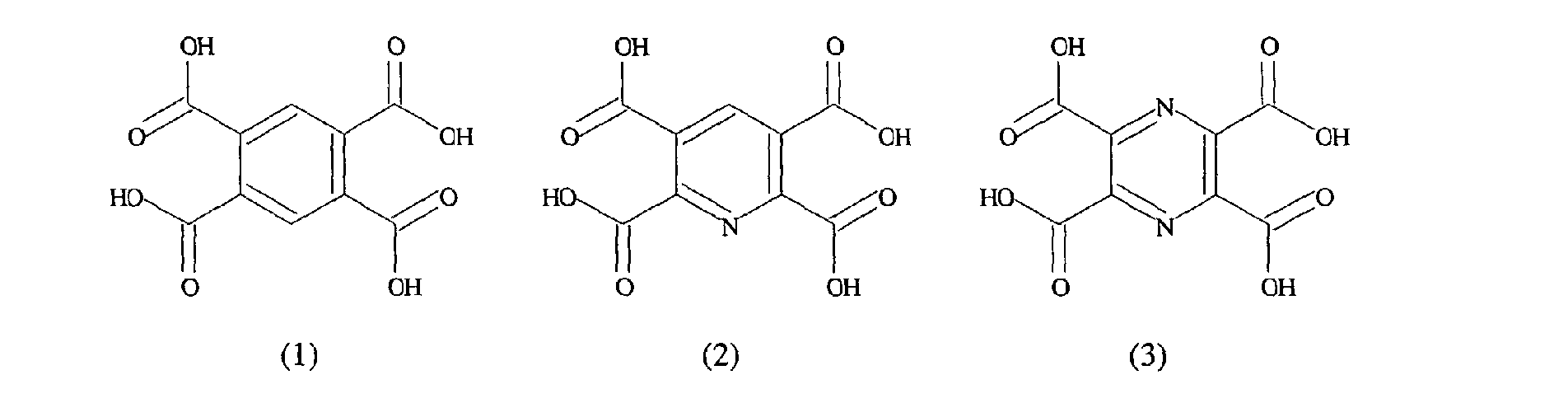
- the acid groups in some embodiments, may be paired into ortho pairs that are separated by at least three atoms as shown in structures (1-3) below.
- the simplest compound to meet these requirements would be 1,2,4,5-benzene tetracarboxylic acid, shown as (1).
- the two ortho pairs are the 1,2 pair and the 4,5 pair, and three atoms lie between the carbons of the acid groups of non-ortho pairs.
- Other compounds include pyridine tetraacids (e.g., structure (2)) and pyrazine tetraacids (e.g., structure (3)).
- Tetraacids may lack the reactivity to produce high molecular weight polymer.
- One way to increase the reactivity of the tetraacid compound is to convert the tetraacid into a dianhydride.
- Dianhydrides may be prepared from the corresponding tetraacids by heating to 230 °C in a vacuum or by refluxing the tetraacid with acetic anhydride. Examples of dianhydrides are shown as structures (4)-(6). The dianhydrides shown (4)-(6) are the dianhydrides that would be derived from the tetraacids (1) - (3) respectively.
- Naphthalene tetraacid derivatives may also be used.
- Naphthalene derivatives include carboxylic acid groups that may be either ortho-paired or para-paired.
- Naphthalene tetraacid derivatives include compounds having the general structure (7).
- Ortho-paired and para-paired derivatives include compounds in which at least one of the pairs: R 1 and R 2 ; R 2 and R 3 ; R 3 and R 4 ; R 1 and R 8 ; and R 1 and R 4 is a pair of carboxylic acid groups; and at least one of the pairs: R 5 and R 6 ; R 6 and R 7 ; R 7 and R 8 ; R 4 and R 5 ; and R 5 and R 8 is a pair of carboxylic acid groups.
- An example of a para-paired naphthalene type monomer would be 1,4,5,8-naphthalene tetracarboxylic acid.
- Ortho-paired naphthalene tetraacid derivatives include 1,2,5,6-naphthalene tetracarboxylic acid (8) and 2,3,6,7-naphthalene tetracarboxylic acid (9).
- Naphthalene dianhydrides may also be used.
- Naphthalene dianhydrides may be prepared from the corresponding tetraacids by heating to 230 °C in a vacuum or by refluxing the tetraacid with acetic anhydride. Examples of naphthalene dianhydrides are shown as structures (10) and (11) which correspond to the dianhydrides that would be derived from the naphthalene tetracarboxylic acids (8) and (9) respectively.
- tetraacids may include aromatic bis-(ortho-dicarboxylic acids) and aromatic bis-(ortho-di-acid anhydrides).
- these compounds include a bis aromatic structure to which carboxylic acids and/or anhydrides are attached.
- X is a suitable linking group.
- linking groups include elemental linkages such as NH, O, or S.
- linking groups include CH 2 , C(O), CH(CH 3 ), C(CH 3 ) 2 , C(CF 3 ) 2 , C(CH 3 )Ph, C(Ph) 2 , cyclohexyl, sulfoxide, sulfonate.
- X is C(CF 3 ) 2
- 6FDA 4'-(hexafluoroisopropylidene) diphthalic anhydride
- Other linking groups may include compounds having the structures (14) - (17). where Y is any of the other linking groups X.
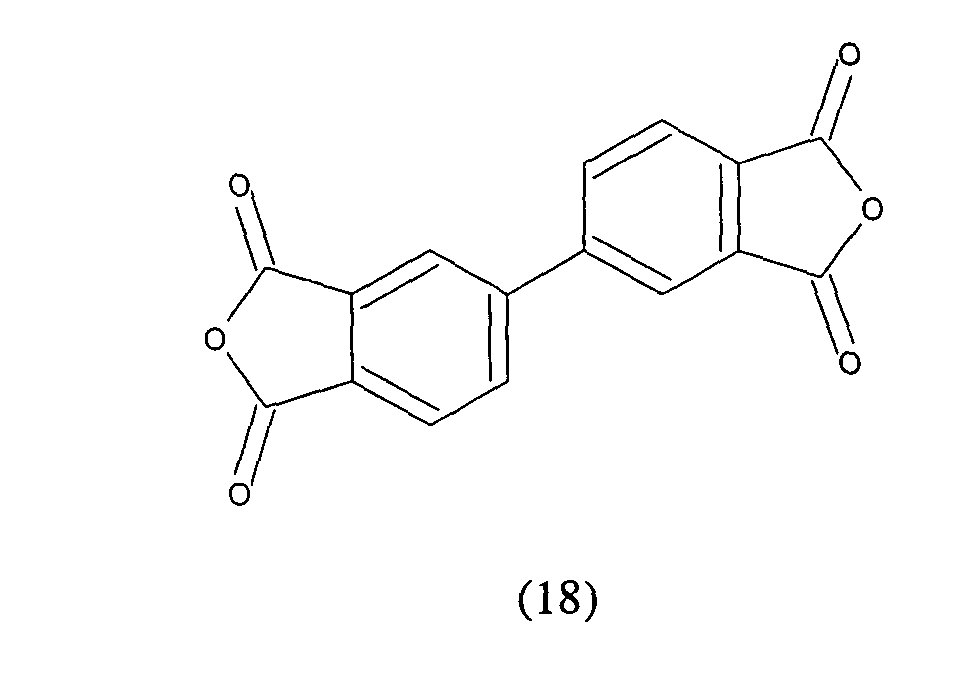
- the linking group, X may represent a direct connection between the two aromatic groups such as depicted for the dianhydride (18).
- Another reactive tetraacid derivative is an acid chloride derivative.
- This type of compound may be prepared from any of the above described dianhydrides by reaction with an alcohol to form a bis-(ortho-acid-ester) followed by reaction to convert acid groups to acid halides. This method prepares a very reactive monomer, but this reactivity makes the monomer more water sensitive. Additionally, larger, more slowly diffusive side product alcohol groups are given off during the final cure of the polyamide to the polypyrrolone.
- the dianhydride or bis-ortho-ester-acid halide, preferably chloride the functionality of the monomer is two, leading to linear polymer formation.
- Tetraamines include compounds that include at least four amine groups.
- the tetraamine is an aromatic tetraamine.
- Aromatic tetraamine compounds tend to produce a rigid, thermally stable, productive and selective membrane material.
- Tetraamines may be used to form the polyamide precursor polymer.
- the amine groups in some embodiments, may be paired into ortho pairs that are separated by at least three atoms as shown in structures (18-20) below.
- the simplest compound to meet these requirements would be 1,2,4,5-tetraminobenzene (TAB), shown as (18).
- TAB 1,2,4,5-tetraminobenzene
- the two ortho pairs are the 1,2 pair and the 4,5 pair, and three atoms lie between the carbons of the acid groups of non-ortho pairs.
- Other compounds include pyridine tetraacids (e.g., structure (19)) and pyrazine tetraacids (e.g., structure (20)).
- Naphthalene tetraamines may also be used.
- Naphthalene tetraamines include amine groups that may be either ortho-paired or para-paired.
- Naphthalene tetraamine derivatives include compounds having the general structure (21).
- Ortho-paired and para-paired derivatives include compounds in which at least one of the pairs: R 1 and R 2 ; R 2 and R 3 ; R 3 and R 4 ; R 1 and R 8 ; and R 1 and R 4 is a pair of amine groups; and at least one of the pairs: R 5 and R 6 ; R 6 and R 7 ; R 7 and R 8 ; R 4 and R 5 ; and R 5 and R 8 is a pair of amine groups.
- An example of a para-paired naphthalene type monomer would be 1,4,5,8-tetraminonaphthalene (22).
- Ortho-paired naphthalene tetraamines include 1,2,5,6-tetraminonaphthalene (23) and 2,3,6,7- tetraaminonaphthalene (24).
- tetraacids may include aromatic bis-(ortho-diamines) (25). Generally, these compounds include a bis aromatic structure with amines attached to the aromatic groups.
- the linking group, X may be the same as described above for the tetraacid derivatives.
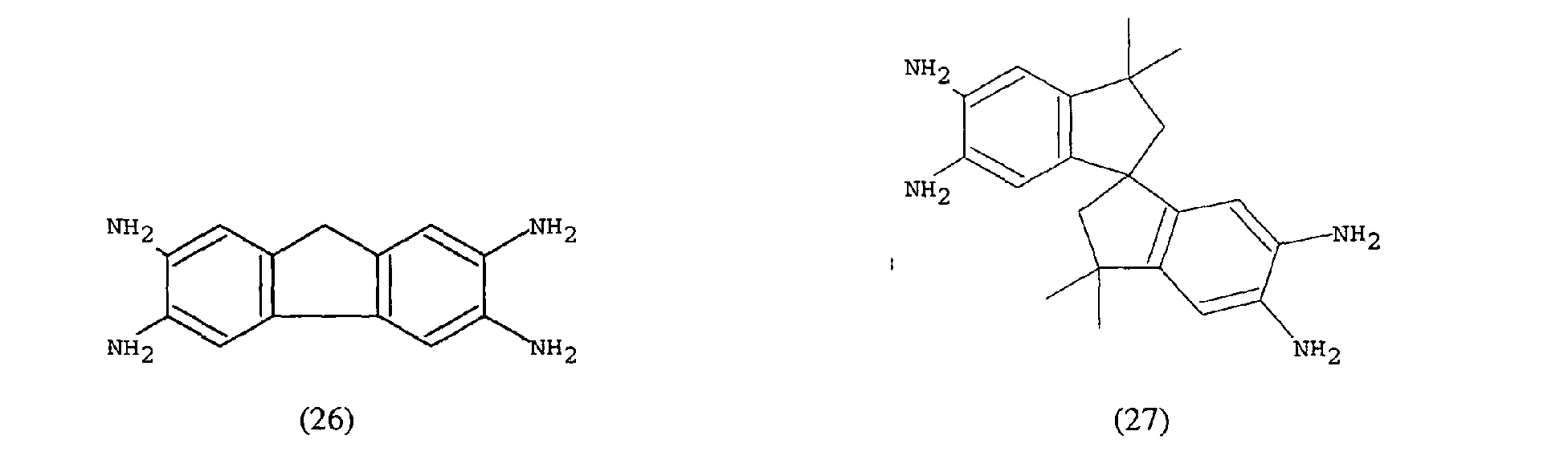
- fused ring systems such as fluorene (26) and tetramethyl-spiro-biindane (27) may also serve as substrates for tetraamines (as depicted) or tetracarboxylic acid derivatives.
- fluorene (26) and tetramethyl-spiro-biindane (27) may also serve as substrates for tetraamines (as depicted) or tetracarboxylic acid derivatives.
- tetraamines as depicted
- tetracarboxylic acid derivatives tetraamines
- the tetraamines may be obtained either commercially, or by the reduction of a nitro compound, or may be synthesized in three steps from a bisphenol.
- the method for synthesis of tetraamine from bisphenol involves the nitration of the bisphenol, the nucleophilic exchange of the hydroxyl groups for amino groups, and reduction of the amino groups.
- the exchange of the hydroxyl groups for amino groups is similar to the procedure described in U.S. Pat. No. 2,894,988 for the conversion of nitro-cresols to nitro-toluidines.
- Spirobiindane-bisphenol which serves as a basis for useful gas separating polycarbonates, can thus be converted to a tetraamine (12) for polypyrrolone synthesis of fluid separation materials.
- the synthesis of other tetraamines and tetraacids is described in U.S. Patent No. 5,262,056 to Koros et al.
- Diamines are, generally, molecules that include at least two amine groups.
- aromatic diamines may be used.
- Aromatic diamines may be benzene based (28) or naphthalene based (29). where, for benzene derivatives, meta or parasubstituted diamines may be used.
- R 1 and either R 3 or R 4 may be NH 2 , where the remaining pendant groups are H or a C 1 to C 12 hydrocarbon.
- R 1 , R 2 , R 3 , R 4 , R 5 , R 6 , R 7 , and R 8 are NH 2 with the NH 2 groups being in an meta- or para orientation, the remaining pendant groups are H or a C 1 to C 12 hydrocarbon.
- aromatic diamines include 2,4,6-trimethyl-1,3-phenylenediamine (DAM).
- diamines may include bis-aromatic amines (41). Generally, these compounds include a bis aromatic structure with amines attached to the aromatic groups.
- the linking group, X may be the same as described above for the tetraacid derivatives.
- bis-aromatic amines include, but are not limited to, 4,4' (hexafluoroisopropylidene) dianiline (6FpDA) and 3,3'-dimethyl-4,4'-diaminophenyl (3,3'DMDB).
- a fluid separation membrane may be synthesized by the reaction of a tetraacid compound with an amine mixture that includes tetraamines and diamines.
- Polyimides are condensation polymers obtained from the reaction of aromatic dianhydrides with diamines followed by complete cyclization.
- Polypyrrolones are condensation polymers obtained from the reaction of aromatic dianhydrides and aromatic tetraamines followed by complete cyclization.
- the polymer obtained by the initial reaction of the monomers in an aprotic solvent is a soluble poly(amide amino acid), which can be thermally cyclized to form a polypyrrolone.
- a poly (pyrrolone-imide) may be synthesized in a similar manner.
- a tetraacid compound is reacted with an amine mixture that includes tetraamines and diamines.
- the ratio of tetraamine to diamine in the amine mixture may be between about 5:95 to about 100:0.
- a small excess of the tetraacid compound may be used.
- Both the tetraamines and diamines condense with the tetraacid compound to form a polyamide.
- the polyamide may be thermally cyclized to form the poly (pyrrolone-imide).
- Thermal cyclization of an amide formed between the tetraacid compound and the tetraamine will lead to a pyrrolone linkage, while thermal cyclization of an amide formed between the tetraacid compound and the diamine will lead to imide linkages.
- the reaction of the tetraacid compound and the amine mixture may be performed in a polar aprotic solvent.
- Aprotic solvents generally, are solvents that neither donate or accept protons.
- Examples of polar aprotic solvents include, but are not limited to dimethylformamide, n-methyl pyrrolidinone, dimethylacetamide, and dimethyl sulfoxide.
- One or all of the components may be dissolved in a polar aprotic solvent prior to reacting the components.
- a base may be added to catalyze the formation of the polyamide.
- a tertiary amine may be added to the amine mixture prior to the addition of the tetraacid compound.
- Suitable tertiary bases include, but are not limited to pyridine, pyrazine, triethylamine, diisopropyl ethyl amine, 1,5-diazabicyclo[4.3.0]non-5-ene (“DBN”), 1,4-diazabicyclo[2.2.2]octane, 1,8-diazabicyclo[5.4.0]undec-7-ene.
- the amine mixture may be dissolved in a polar aprotic solvent and placed in a reaction vessel.
- the tetraacid derivative may also be dissolved in a polar aprotic solvent and added to the amine mixture.
- the reaction may be conducted under an oxygen free atmosphere.
- An oxygen free atmosphere may be obtained by replacement of the ambient air in the reaction vessels with an inert gas such as helium, nitrogen, or a nobel gas (e.g., argon).
- an inert gas such as helium, nitrogen, or a nobel gas (e.g., argon).
- the addition of the tetraacid compound to the amine mixture may cause an exothermic condensation reaction to occur.
- the rate of addition of the tetraacid derivative may be adjusted to control the temperature of the reaction.
- the resulting polyamide may be collected, filtered and dried to remove unreacted monomers and any base that may be present.
- the polyamide may be heated to cause further condensation of the amides. Condensation of the resulting amide may lead to either pyrrolone or imide linking groups. Thermal cyclocondensation may occur at temperatures above about 200 °C.
- the polyamide may be placed in a mold prior to thermal cyclocondensation such that the resulting poly (pyrrolone-imide) polymer has a shape that is complementary to the shape of the mold.
- the polyamide may be heated under an inert atmosphere or at a pressure below about 1.0 mmHg. Performing a thermal cyclocondensation under a vacuum may help to remove water formed during the condensation reaction and help accelerate the reaction rate.
- Thermal cyclocondensation is performed for a period of at least about one day, preferably two to three days.
- the polypyrrolone resulting from cyclization possesses a repeat unit with two benzene rings joined by two fused five membered rings, imparting a great degree of thermal and chemical resistance, strength and rigidity.
- Either a polyimide, a polyamide or the poly (pyrrolone-imide) may be used as fluid separation membranes. Methods for forming and testing fluid separation membranes are described in detail in U.S. Patent Nos. 5,262,056 and 6,602,415, both to Koros which are both incorporated herein by reference.
- the membranes of the present invention may be either composite or asymmetric membranes.
- a fluid separation apparatus 200 includes a body 202 in which a fluid separation membrane 204 is disposed.
- the fluid separation membrane 202 may be composed of any of the polymers described herein and formed by the methods described herein.
- a fluid inlet may be positioned downstream from the fluid separation membrane 204.
- Two fluid outlets may be positioned upstream from the fluid inlet.
- a first fluid outlet 206 may be positioned upstream from the fluid separation membrane.
- a second fluid separation membrane may be positioned upstream from the fluid separation membrane.
- a fluid stream that includes at least two components may be introduced into the fluid separation apparatus 200 via the fluid separation inlet.
- the fluid will then contact the fluid separation membrane 204.
- the fluid separation membrane may have a differential selectivity such that one of the components in the gas stream may pass through the fluid separation membrane at a rate that is faster than the rate at which the other component passes through.
- the faster permeating component will pass through the gas separation membrane and flow out of the fluid separation apparatus via an outlet.
- the gas that does not permeate through the membrane may exit the fluid separation apparatus via the outlet 206.
- the fluid stream passing out of the outlet 206 may be recycled back into the fluid separation apparatus to improve the separation of the components and to maximize the yield of purified components.
- dithiolenes may be added to a polymer mixture.
- the polymer may be formed as described herein.
- the polymer may be formed by reacting a tetraacid and a diamine; a tetraacid and a tetraamine, or a tetraacid with a mixture of a tetraamine and a diamine.
- the polymer may be any polymer suitable to allow a particular dithiolene to be homogeneously dispersed. It may be necessary to use different polymers for different dithiolenes.
- the dithiolenes may be homogeneously dispersed within the polymer matrix.
- the resulting polymer dithiolene product may be used to form a fluid separation membrane as described herein.
- Addition of the dithiolene may increase the solubility selectivity of a fluid separation membrane.
- a fluid separation membrane including dithiolenes may exhibit an olefin/paraffin solubility selectivity.
- a fluid separation membrane including dithiolenes may exhibit olefin/paraffin solubility selectivity of between about 1.1 to about 2.0. It is believed that the solubility selectivity of the membranes that incorporate dithiolene may be due to the ability of dithiolenes to reversibly complex with an olefin.
- the dithiolene may be resistant to poisoning by impurities. Poisoning within the context herein refers to decreasing the effectiveness of a compound or material as regards its intended purpose. Impurities may include any common impurities found in fluid streams that come into contact with a fluid separation membrane containing a dithiolene additive.
- the dithiolene may have the general structure (30): where M is a metal. Metals may include, but are not limited to nickel, platinum, and palladium.
- R 1 , R 2 , R 3 , and R 4 may be each independently alkyl, H, CH 3 , CF 3 , C 6 H 4 OCH 3 , CN, or aryl.
- R 1 and R 2 and/or R 3 and R 4 may combine to form at least one ring.
- the ring may be aromatic or nonaromatic.
- the ring may be substituted or nonsubstituted.
- Dithiolene (30) may be symmetric or asymmetric. In a particular example, R 1 and R 2 and R 3 and R 4 may combine to form substituted aromatic rings forming an overall asymmetric dithiolene (30).
- An asymmetric dithiolene may be a mixture of stereoisomers.
- dithiolene (30) may include a valence charge.
- the valence charge may be, for example, -1, or -2.
- Dithiolene (30) may include a counter ion.
- a counter ion may include any suitable counter ion known to one skilled in the art.
- a counter ion may be chosen for a number of different reasons based on what properties may be needed. For example, a counter ion may be chosen to increase the solubility of the entire complex.
- the counter ion may have the structure (31): where each R is independently an alkyl or aromatic compound. In one embodiment, each R may be independently C 2 H 5 or C 4 H 9 .
- dithiolene may have structure (32): which is similar to structure (30), where R 1 , R 2 , R 3 , and R 4 are CF 3 .
- M is a metal such as nickel, platinum, or palladium.
- dithiolene may have structure (33): which is similar to structure (30), where R 1 , R 2 , R 3 , and R 4 are CF 3 .
- M is a metal such as nickel, platinum, or palladium.
- R 1 , R 2 , R 3 , and R 4 are C 6 H 4 OCH 3 .
- Each OCH 3 substituent separately may be positioned anywhere on the aromatic ring.
- dithiolene may have structure (34): which is similar to structure (30), where R 1 , R 2 , R 3 , and R 4 are C 6 H 4 OCH 3 , with the methoxy substituent in the para position as depicted.
- M is a metal such as nickel, platinum, or palladium.
- dithiolene may have structure 35: which is similar to structure 30, where R 1 and R 2 , and R 3 and R 4 may combine to form a substituted aromatic ring.
- M is a metal such as nickel, platinum, or palladium.
- dithiolene has the structure 36: where R 1 and R 2 combine to form C 6 H 4 S 4 , and R 3 and R 4 are CF 3 .
- M is a metal such as nickel, platinum, or palladium.
- a dithiolene may be dispersed in a polymer matrix as described herein.
- a dithiolene may be dispersed in a polymer resulting from at least the reaction of a tretraacid and a diamine.
- the tetraacid may be dianhydrides such as (37) and/or (38):
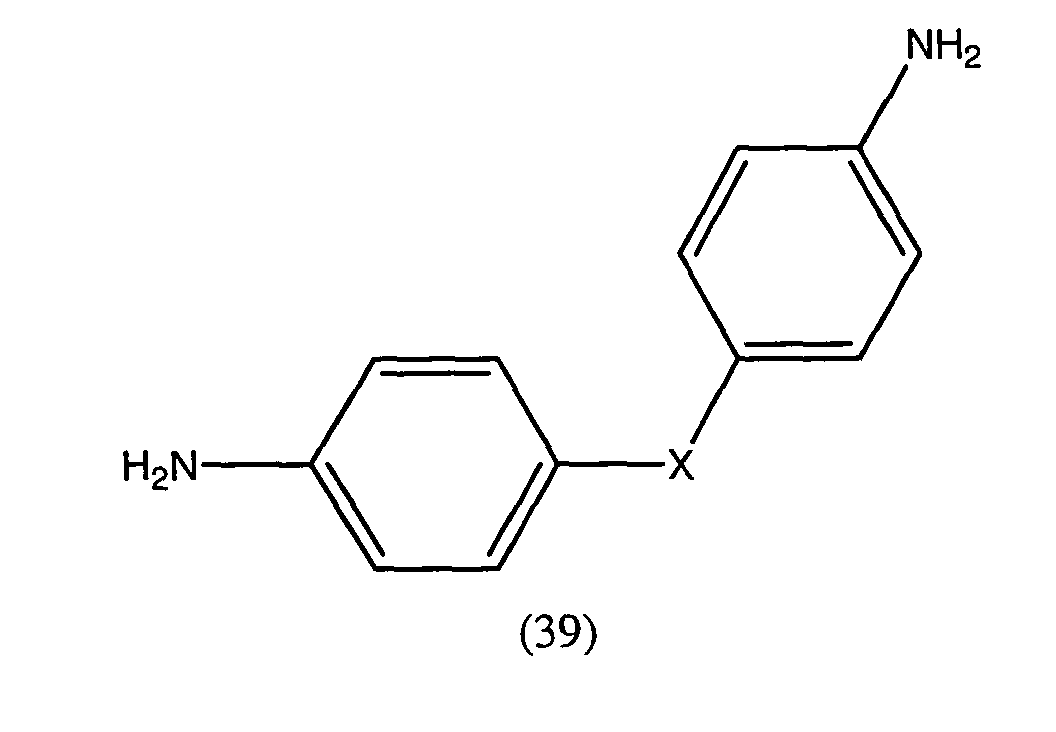
- the diamine may have the structure (39):
- X may be, but is not limited to, a linking group such as CH 2 , C(O), CH(CH 3 ), C(CH 3 ) 2 , C(CF 3 ) 2 , C(CH 3 )Ph, C(Ph) 2 , or cyclohexyl.
- a polymer matrix may be a polyimide polymer, a polyamide polymer, a polypyrrolone polymer, and/or a poly (pyrrolone - imide) polymer.
- a polyimide polymer may include recurring units having the structure (40):
- X may be a linking group.
- Y may be another recurring unit. Recurring unit Y may be coupled to the aromatic ring in an ortho, meta, or para relation to the imide group.
- the imidization was performed by the dehydration of the polyamic acids by adding a large excess of triethylamine and acetic anhydride to the reaction mixture and stirring 2-3 h at 323 K and 10-20 min at 373-383 K. After cooling to room temperature, the highly viscous reaction solution was slowly poured into methanol. The precipitated polyimide was homogenized in a blender; filtered and washed several times with fresh methanol. The obtained polyimide was dried 12 h under vacuum at room temperature and at least 24 h under vacuum at 523 K.
- Films of the polymer materials were cast in a conventional manner in a fume hood.
- the appropriate amount of polymer was dissolved in a suitable solvent to form a 1 - 2 wt % solution.
- This solution was stirred for at least 20 minutes before filtering the solution with a 0.2 micron TEFLON syringe filter or alternatively filter paper from Fischer Scientific with medium porosity.
- the filtered solution was dispensed on a clean, level TEFLON dish or glass plate.
- the film was covered with a casting funnel to control the rate of solvent removal, and film formation generally occurred in under 8 hours.
- the films were then removed and placed in the vacuum oven at 100 °C for at least 24 hours to ensure complete solvent removal.
- a film was prepared using 6FDA-6FpDA polyimide as the polymer matrix.
- the polyimide 6FDA-6FpDA was synthesized from a mixture of 6FDA and 6FpDA using the general methods described herein. It is believed that the presence of CF 3 groups in both the polymer and the dithiolene complex, Ni[S 2 C 2 (CF 3 ) 2 ] 2 should aid in miscibility of the polymer and the dithiolene.
- Films were cast from a mixture of 6FDA-6FpDA polymer and dithiolene on Teflon plates using techniques described herein with dicloromethane as the casting solvent. The films were then dried at 120°C for at least 8 hours under vacuum.
- FIG. 5 illustrates the difference in C 3 H 6 /C 3 H 8 concentration due to the dithiolene additive.
- Concentration difference 502 increases with increased pressure, which is believed to indicate that the olefin is able to "access" more dithiolene molecules as the concentration increases in the polymer.
- Upper limit 500 represents the calculated maximum enhancement based on a mole balance assuming all dithiolene molecules form a complex. The experimental measurements approach this value as the pressure is increased.
Landscapes
- Chemical & Material Sciences (AREA)
- Chemical Kinetics & Catalysis (AREA)
- Engineering & Computer Science (AREA)
- Organic Chemistry (AREA)
- Dispersion Chemistry (AREA)
- Analytical Chemistry (AREA)
- Oil, Petroleum & Natural Gas (AREA)
- Manufacturing & Machinery (AREA)
- Water Supply & Treatment (AREA)
- General Chemical & Material Sciences (AREA)
- Separation Using Semi-Permeable Membranes (AREA)
Abstract
A polymeric composite may be used for forming fluid separation membranes. The membranes may be formed from polyimide, polyamide or poly (pyrrolone-imide) materials. Polyamides may be formed by the condensation of a tetraamine, a tetraacid, and a diamine. Polyimides and poly (pyrrolone-imides) may be formed by the cyclization of a polymer precursor. A polymeric composite may include a dithiolene or a mixture of dithiolenes. A polymer matrix incorporating dithiolenes may exhibit an olefin/paraffin solubility selectivity. A solubility selectivity may be between about 1.1 and about 2.0.
Description
The present invention generally relates to polymeric membranes that exhibit gas
selectivity. Specifically, rigid polymeric membranes that exhibit an olefin/paraffin selectivity
are described.
The separation of one or more gases from a multicomponent mixture of gases is
necessary in a large number of industries. Such separations currently are undertaken
commercially by processes such as cryogenics, pressure swing adsorption, and membrane
separations. In certain types of gas separations, membrane separations have been found to be
economically more viable than other processes.
In a pressure-driven gas membrane separation process, one side of the gas separation
membrane is contacted with a multicomponent gas mixture. Certain of the gases of the mixture
permeate through the membrane faster than the other gases. Gas separation membranes thereby
allow some gases to permeate through them while serving as a relative barrier to other gases.
The relative gas permeation rate through the membrane is a property of the membrane material
composition and its morphology.
It has been suggested in the prior art that the intrinsic permeability of a polymer
membrane is a function of both gas diffusion through the membrane, controlled in part by the
packing and molecular free volume of the material, and gas solubility within the material.
Selectivity may be determined by the ratio of the permeabilities of two gases being separated by
a material.
Transport of gases in polymers and molecular sieve materials occurs via a well known
sorption-diffusion mechanism. The permeability coefficient (PA) of a particular gas is the flux
(NA) normalized to the pressure difference across the membrane (ΔpA), and the membrane
thickness (l).
PA = NA l Δp A
The permeability coefficient of a particular penetrant gas is also equal to the product of
the diffusion coefficient (DA) and the solubility coefficient (SA).
PA = DA SA
The permselectivity (αA/B) of a membrane material (also ideal selectivity) is the ratio of
the permeability coefficients of a penetrant pair for the case where the downstream pressure is
negligible relative to the upstream feed pressure. Substituting equation (2), the ideal
permselectivity is also a product of the diffusivity selectivity and solubility selectivity of the
particular gas pair.
α A/B = PA PB = DA DB • SA SB
The variation of gas permeability with pressure in glassy polymers is often represented
by the dual mode model. Petropulos (1970); Vieth, et al. (1976); Koros, et al. (1977). The
model accounts for the differences in gas transport properties in an idealized Henry's law and
Langmuir domains of a glassy polymer,
P = kD DD + C'H DH b 1+bp
where kD is the Henry's law constant, C'H is the Langmuir capacity constant, p is pressure, and b
is the Langmuir affinity constant. This model can be further extended to mixed gas permeability:
P A = kDA DDA + C'HA bA DHA 1 + bA pA + bB pB
where pA and pB are the partial pressures of gasses A and B respectively. This model is valid for
a binary gas mixture of components A and B, and it only accounts for competitive sorption.
The temperature dependence of permeability for a given set of feed partial pressures is
typically represented by an Arrhenius relationship:
 where Po is a pre-exponential factor, Ep is the apparent activation energy for permeation, T is the
temperature of permeation in Kelvin, and R is the universal gas constant. The permeability can
further be broken up into temperature dependent diffusion and sorption coefficients from
equation (2). The temperature dependence of the penetrant diffusion coefficient can also be
represented by an Arrhenius relationship:
where Po is a pre-exponential factor, Ep is the apparent activation energy for permeation, T is the
temperature of permeation in Kelvin, and R is the universal gas constant. The permeability can
further be broken up into temperature dependent diffusion and sorption coefficients from
equation (2). The temperature dependence of the penetrant diffusion coefficient can also be
represented by an Arrhenius relationship:

Again Do is a pre-exponential factor, and Ed is the activation energy for diffusion. The
activation energy for diffusion represents the energy required for a penetrant to diffuse or "jump"
from one equilibrium site within the matrix to another equilibrium site. The activation energy is
related to the size of the penetrant, the rigidity of the polymer chain, as well as polymeric chain
packing. The temperature dependence of sorption in polymers may be described using a
thermodynamic van't Hoff expression:
 where So is a pre-exponential factor, and Hs is the apparent heat of sorption as it combines the
temperature dependence of sorption in both the Henry's law and Langmuir regions.
where So is a pre-exponential factor, and Hs is the apparent heat of sorption as it combines the
temperature dependence of sorption in both the Henry's law and Langmuir regions.
From transition state theory the pre-exponential for diffusion can be represented by

Here, Sd is the activation entropy, λ is the diffusive jump length, k is Boltzmann's
constant, and h is Planck's constant. Substituting (9) into (3) (neglecting small differences in the
jump length of similarly sized penetrants) results in the diffusive selectivity as the product of
energetic and entropic terms:

The diffusivity selectivity is determined by the ability of the polymer to discriminate
between the penetrants on the basis of their sizes and shapes, and is governed primarily by
intrasegmental motions and intersegmental packing. The diffusive selectivity will be based on
both the difference in activation energy for both penetrants, ΔEd, as well as the difference in
activation entropy for both penetrants, ΔSd.
Much of the work in the field has been directed to developing membranes that optimize
the separation factor and total flux of a given system. It is disclosed in U.S. Pat. No. 4,717,394
to Hayes that aromatic polyimides containing the residue of alkylated aromatic diamines are
useful in separating a variety of gases. Moreover, it has been reported in the literature that other
polyimides, polycarbonates, polyurethanes, polysulfones and polyphenyleneoxides are useful for
like purposes. U.S. Pat. No. 5,599,380 to Koros discloses a polymeric membrane with a high
entropic effect. U.S. Pat. No. 5,262,056 to Koros et al., discloses polyamide and polypyrrolone
membranes for fluid separation.
U.S. Pat. No. 5,074,891 to Kohn et al. discloses certain polyimides with the residuum of
a diaryl fluorine-containing diamine moiety as useful in separation processes involving, for
example, H2, N2, CH4, CO, CO2, He and O2. By utilizing a more rigid repeat unit than a
polyimide, however, even greater permeability and permselectivity are realized. One example of
such a rigid repeat unit is a polypyrrolone.
Polypyrrolones as membrane materials were proposed and studied originally for the
reverse osmosis purification of water by Scott et al. (1970). The syntheses, permeabilities,
solubilities and diffusivities of polypyrrolones and polyimides have been described in (Walker
and Koros (1991); Koros and Walker (1991); Kim et al. (1988a, b); Kim (1988c); Coleman
(1992)). Membranes that are composed of the polyamide and polypyrrolone forms of
hexafluoroisopropylidene-bisphthalic anhydride are disclosed in U.S. Pat. No. 5,262,056.
In the petrochemical industry, one of the most important processes is the separation of
olefin and paraffin gases. Olefin gases, particularly ethylene and propylene, are important
chemical feed stocks. Various petrochemical streams contain olefins and other saturated
hydrocarbons. These streams typically originate from a catalytic cracking unit. Currently, the
separation of olefin and paraffin components is done using low temperature distillation.
Distillation columns are normally around 300 feet tall and contain over 200 trays. This is
extremely expensive and energy intensive due to the similar volatilities of the components.
It is estimated that 1.2 X 10¹⁴ BTU per year are used for olefin/paraffin separations. This
large capital expense and exorbitant energy cost have created incentive for extensive research in
this area of separations. Membrane separations have been considered as an attractive alternative.
Some examples of membranes that exhibit attractive selectivity under mild conditions have been
reported. (Tanaka et al. (1996); Staudt-Bickel and Koros (2000); Ilinitch et al. (1993); Lee et al.
(1992); Ito et al. (1989)). In practice, high propylene/propane temperatures and pressures are
preferred for economical processing. Thus, a polymer membrane that showed enhanced
propylene/propane selectivity under increasingly demanding processing conditions would be of
particular value. Recent gas transport studies aimed at improving current membrane
performance have examined glassy polymers focusing mainly on polyimides. Tanaka et al.
(1996) have reported one of the highest performance polyimides to date. This data along with
other literature data has been used to construct a preliminary propane/propylene "upper bound"
trade off curve between gas permeability and selectivity, as shown in FIG. 1 (Tanaka et al.
(1996); Staudt-Bickel and Koros (2000); Ilinitch et al. (1993); Lee et al. (1992); Ito et al. (1989);
Steel (2000)). The conditions chosen for the upper bound curve are 2 - 4 atm feed pressure and
35-55° C. The propane/propylene trade off curve is less defined at this point in comparison to
O2/N2 and CO2/CH4 "upper bound" curves defined previously (Robeson (1991)).
According to Freeman's analysis, the "upper bound" for conventional polymers used for
gas separations can be shown to follow equation 11:
αA/B = (βA/B )/(P A λA/B )
The parameter, λA/B can be shown to be proportional to the square of the size difference of the two
gas molecules, (dA/dB)2. Consequently, this parameter is difficult to manipulate through
materials engineering. Therefore, according to the theory, in order to "move" the upper bound
limit, the strategy must be to increase the β parameter, which can be shown to be proportional to
the value, SA (SA/SB)λ, as well as a parameter f, which relates to the interchain spacing. Previous
work has attempted to increase the diffusivity selectivity through an increase in the chain rigidity
by using polypyrrolone materials. However, another approach to "elevating" the upper bound is
to improve the solubility of the "fast gas" (i.e., C3H6 in this case), thereby increasing the
solubility selectivity, and increasing β. The solubility of an olefin in a polymeric material is a
parameter that can be engineered through the use of π-bonding interactions.
Previous researchers have examined the viability of fixed site facilitated membranes for
the separation of olefins from paraffins. Typically, Group I-B metals, such as silver, are
dissolved in polymer membranes in a salt form. Examples of silver salts conventionally used
include AgBF4 and AgNO3. Once dissolved in the polymer, the salt dissociates, and the silver
cation is able to form a complex with an olefin due to the interaction of the π-orbital of the olefin
with the σ and π-orbital of the metal.
These fixed site facilitated membranes still have a major practical problem, however, due
to the poor chemical stability of the metal-olefin complex. This metal-olefin complex is easily
poisoned by small amounts of hydrogen gas, carbon monoxide, acetylene, or hydrogen sulfide in
the feed stream. Silver ions also have the potential to react with acetylene to form an explosive
silver acetylide salt.
A search has been ongoing to find a material which can form a π-bond complex with
olefins, while still maintaining stability in the presence of the aforementioned impurity gases.
An additional constraint is that the material should be able to dissolve in state-of-the-art
polyimide membranes. The overall strategy is to maintain the high diffusivity selectivity (DA /
DB) already available with polyimides, and enhance this diffusivity selectivity by a factor of the
improved solubility selectivity (SA / SB). For a conventional polyimide with a C3H6/C3H8
selectivity of 15, a small increase in the solubility selectivity from 1.0 to 2.0 would double the
overall C3H6/C3H8 selectivity to a value of 30, as well as doubling the C3H6 flux.
Described herein is a polymeric fluid separation membrane. In one embodiment, the
fluid separation membrane may be formed from the reaction product of a tetraacid compound
and a diamine. The initial resulting product is a polyamide. This polyamide may be used to
form a fluid separation membrane. The polyamide may be thermally or chemically cyclized to
form a polyimide. The polymer matrix of the fluid separation membrane may also include a
dithiolene.
In an embodiment where dithiolenes are included within the polymer matrix, rigid
polymeric membranes that exhibit an olefin/paraffin solubility selectivity may result.
Dithiolenes may be added to a polymer formed by reacting a tetraacid compound with a diamine,
a tetraamine, or a mixture of diamines and tetraamines. Dithiolenes may be added to any
polymer matrix such that the dithiolenes are substantially homogeneously dispersed within the
polymer matrix.
The fluid separation membrane may be formed by adding a tetraacid compound to an
amine mixture. The amine mixture may include tetraamines and diamines. The tetraamine to
diamine ratio may be between about 5:95 to about 100:0. After the tetraacid compound and the
amines are reacted, the resulting polyamide may be filtered, washed and dried. The polyamide
may be converted to a polyimide by heating the polyamide to a temperature above about 200 °C.
Either the polyamide or the polyimide may be used in a fluid separation membrane. In an
embodiment, a dithiolene may be added to a polymer during a film casting process. The solvent
may be removed from the resulting dithiolene polymer solution to provide a polymer film that
has a dithiolene incorporated within the polymer.
The above-described fluid separation membranes may be used in any fluid separation
apparatus known in the art. Generally, a fluid separation apparatus includes a body in which a
fluid separation membrane is disposed. A fluid inlet may be positioned downstream from the
fluid separation membrane. Two fluid outlets may be positioned upstream from the fluid inlet.
A first fluid outlet may be positioned downstream from the fluid separation membrane. A
second fluid separation membrane may be positioned upstream or downstream from the fluid
separation membrane.
During use, a fluid stream that includes at least two components (e.g., a gas stream) may
be introduced into the fluid separation apparatus via the fluid separation inlet. The fluid will
then contact the fluid separation membrane. The fluid separation membrane may have a
differential selectivity such that one of the components in the gas stream may pass through the
fluid separation membrane at a rate that is faster than the rate at which the other component
passes through. The faster permeating component passes through the gas separation membrane
and flow out of the fluid separation apparatus via a fluid outlet. The gas that does not permeate
through the membrane may exit the fluid separation apparatus via another fluid outlet. The fluid
stream passing out of the fluid outlet upstream from the membrane may be recycled back into the
fluid separation apparatus to improve the separation of the components and to maximize the
yield of purified components.
Advantages of the present invention may become apparent to those skilled in the art with
the benefit of the following detailed description of the preferred embodiments and upon
reference to the accompanying drawings in which:
While the invention is susceptible to various modifications and alternative forms, specific
embodiments thereof are shown by way of example in the drawings and may herein be described
in detail. The drawings may not be to scale. It should be understood, however, that the drawings
and detailed description thereto are not intended to limit the invention to the particular form
disclosed, but on the contrary, the intention is to cover all modifications, equivalents and
alternatives falling within the spirit and scope of the present invention as defined by the
appended claims.
Polyimide and poly (pyrrolone-imide) polymers are polymers derived from the
condensation reaction of a tetraacid compound, a diamine and possibly a tetraamine. The
resulting product is a polyamide. The remaining functional groups are then reacted during a
thermal curing step to form the polyimide or poly (pyrrolone-imide). The polymerization may
be conducted in an aprotic polar solvent capable of dissolving the monomers.
Tetraacid compounds, as used herein, include compounds that include at least four
carboxylic acid groups and compounds that are derivatives of such compounds. Examples of
tetraacid compounds include tetraacids, dianhydrides, and bis-ortho-ester-acid halides.
Preferably, the tetraacid compound is an aromatic tetraacid or an aromatic tetraacid derivative.
Aromatic tetraacid compounds tend to produce a rigid, thermally stable, productive and selective
membrane material.
Tetraacids may be used to form the polyamide precursor polymer. The acid groups, in
some embodiments, may be paired into ortho pairs that are separated by at least three atoms as
shown in structures (1-3) below. The simplest compound to meet these requirements would be
1,2,4,5-benzene tetracarboxylic acid, shown as (1). The two ortho pairs are the 1,2 pair and the
4,5 pair, and three atoms lie between the carbons of the acid groups of non-ortho pairs. Other
compounds include pyridine tetraacids (e.g., structure (2)) and pyrazine tetraacids (e.g., structure
(3)).
Tetraacids, however, may lack the reactivity to produce high molecular weight polymer.
One way to increase the reactivity of the tetraacid compound is to convert the tetraacid into a
dianhydride. Dianhydrides may be prepared from the corresponding tetraacids by heating to 230
°C in a vacuum or by refluxing the tetraacid with acetic anhydride. Examples of dianhydrides
are shown as structures (4)-(6). The dianhydrides shown (4)-(6) are the dianhydrides that would
be derived from the tetraacids (1) - (3) respectively.

Naphthalene tetraacid derivatives may also be used. Naphthalene derivatives include
carboxylic acid groups that may be either ortho-paired or para-paired. Naphthalene tetraacid
derivatives include compounds having the general structure (7).

Ortho-paired and para-paired derivatives include compounds in which at least one of the
pairs: R1 and R2; R2 and R3; R3 and R4; R1 and R8; and R1 and R4 is a pair of carboxylic acid
groups; and at least one of the pairs: R5 and R6; R6 and R7; R7 and R8; R4 and R5; and R5 and R8
is a pair of carboxylic acid groups. An example of a para-paired naphthalene type monomer
would be 1,4,5,8-naphthalene tetracarboxylic acid. Ortho-paired naphthalene tetraacid
derivatives include 1,2,5,6-naphthalene tetracarboxylic acid (8) and 2,3,6,7-naphthalene
tetracarboxylic acid (9).

Naphthalene dianhydrides may also be used. Naphthalene dianhydrides may be prepared
from the corresponding tetraacids by heating to 230 °C in a vacuum or by refluxing the tetraacid
with acetic anhydride. Examples of naphthalene dianhydrides are shown as structures (10) and
(11) which correspond to the dianhydrides that would be derived from the naphthalene
tetracarboxylic acids (8) and (9) respectively.

Other tetraacids may include aromatic bis-(ortho-dicarboxylic acids) and aromatic bis-(ortho-di-acid
anhydrides). Generally, these compounds include a bis aromatic structure to
which carboxylic acids and/or anhydrides are attached. Examples of these compounds include
aromatic bis-(ortho-dicarboxylic acids) (12) and aromatic bis-(ortho-di-acid anhydrides) (13).
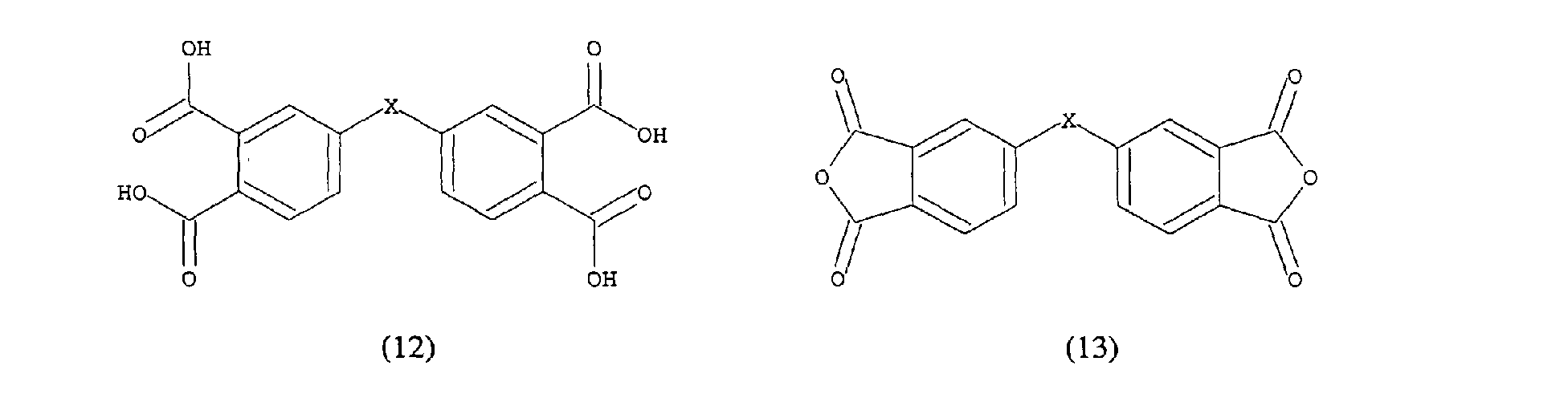 where X is a suitable linking group. Examples of linking groups include elemental linkages such
as NH, O, or S. Other groups include CH2, C(O), CH(CH3), C(CH3)2, C(CF3)2, C(CH3)Ph,
C(Ph)2, cyclohexyl, sulfoxide, sulfonate. A specific example of a compound having general
structure (13), where X is C(CF3)2, is 4, 4'-(hexafluoroisopropylidene) diphthalic anhydride
(6FDA). Other linking groups may include compounds having the structures (14) - (17).
where X is a suitable linking group. Examples of linking groups include elemental linkages such
as NH, O, or S. Other groups include CH2, C(O), CH(CH3), C(CH3)2, C(CF3)2, C(CH3)Ph,
C(Ph)2, cyclohexyl, sulfoxide, sulfonate. A specific example of a compound having general
structure (13), where X is C(CF3)2, is 4, 4'-(hexafluoroisopropylidene) diphthalic anhydride
(6FDA). Other linking groups may include compounds having the structures (14) - (17).

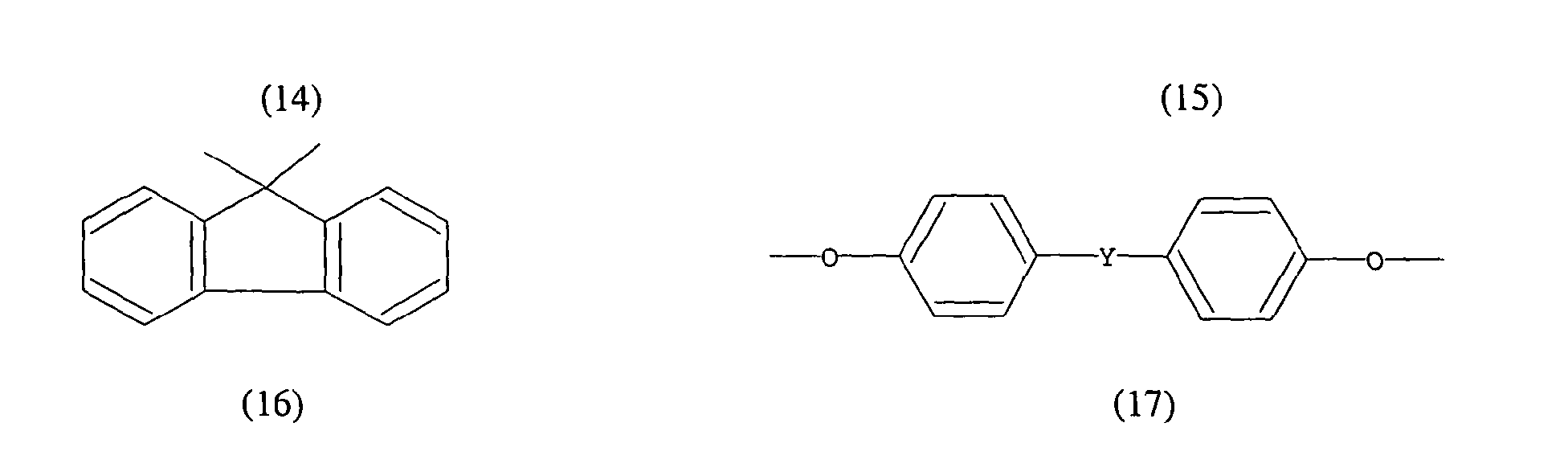 where Y is any of the other linking groups X. Alternatively, the linking group, X may represent
a direct connection between the two aromatic groups such as depicted for the dianhydride (18).
where Y is any of the other linking groups X. Alternatively, the linking group, X may represent
a direct connection between the two aromatic groups such as depicted for the dianhydride (18).
Another reactive tetraacid derivative is an acid chloride derivative. This type of
compound may be prepared from any of the above described dianhydrides by reaction with an
alcohol to form a bis-(ortho-acid-ester) followed by reaction to convert acid groups to acid
halides. This method prepares a very reactive monomer, but this reactivity makes the monomer
more water sensitive. Additionally, larger, more slowly diffusive side product alcohol groups are
given off during the final cure of the polyamide to the polypyrrolone. With either the
dianhydride or bis-ortho-ester-acid halide, preferably chloride, the functionality of the monomer
is two, leading to linear polymer formation.
Tetraamines, as used herein, include compounds that include at least four amine groups.
Preferably the tetraamine is an aromatic tetraamine. Aromatic tetraamine compounds tend to
produce a rigid, thermally stable, productive and selective membrane material.
Tetraamines may be used to form the polyamide precursor polymer. The amine groups,
in some embodiments, may be paired into ortho pairs that are separated by at least three atoms as
shown in structures (18-20) below. The simplest compound to meet these requirements would
be 1,2,4,5-tetraminobenzene (TAB), shown as (18). The two ortho pairs are the 1,2 pair and the
4,5 pair, and three atoms lie between the carbons of the acid groups of non-ortho pairs. Other
compounds include pyridine tetraacids (e.g., structure (19)) and pyrazine tetraacids (e.g.,
structure (20)).

Naphthalene tetraamines may also be used. Naphthalene tetraamines include amine
groups that may be either ortho-paired or para-paired. Naphthalene tetraamine derivatives
include compounds having the general structure (21).
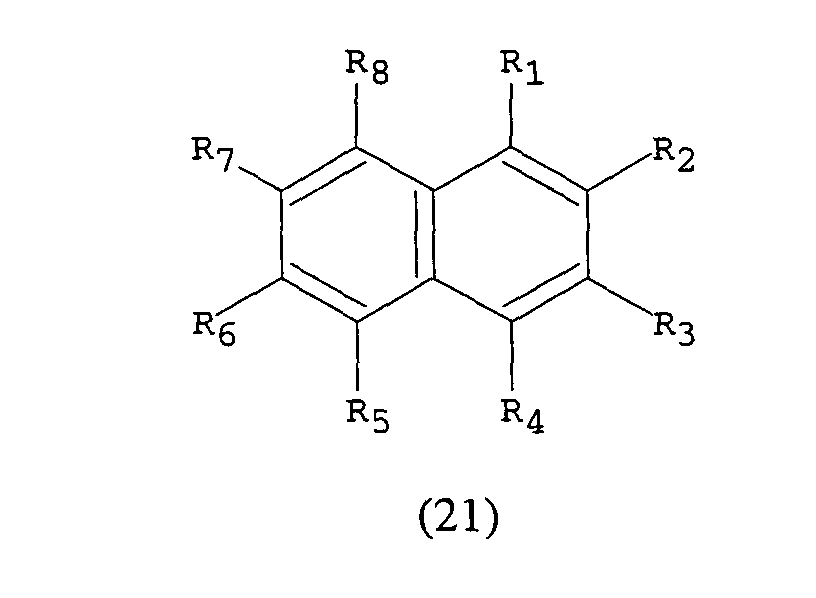
Ortho-paired and para-paired derivatives include compounds in which at least one of the
pairs: R1 and R2; R2 and R3; R3 and R4; R1 and R8; and R1 and R4 is a pair of amine groups; and
at least one of the pairs: R5 and R6; R6 and R7; R7 and R8; R4 and R5; and R5 and R8 is a pair of
amine groups. An example of a para-paired naphthalene type monomer would be 1,4,5,8-tetraminonaphthalene
(22). Ortho-paired naphthalene tetraamines include 1,2,5,6-tetraminonaphthalene
(23) and 2,3,6,7- tetraaminonaphthalene (24).

Other tetraacids may include aromatic bis-(ortho-diamines) (25). Generally, these
compounds include a bis aromatic structure with amines attached to the aromatic groups. The
linking group, X, may be the same as described above for the tetraacid derivatives.
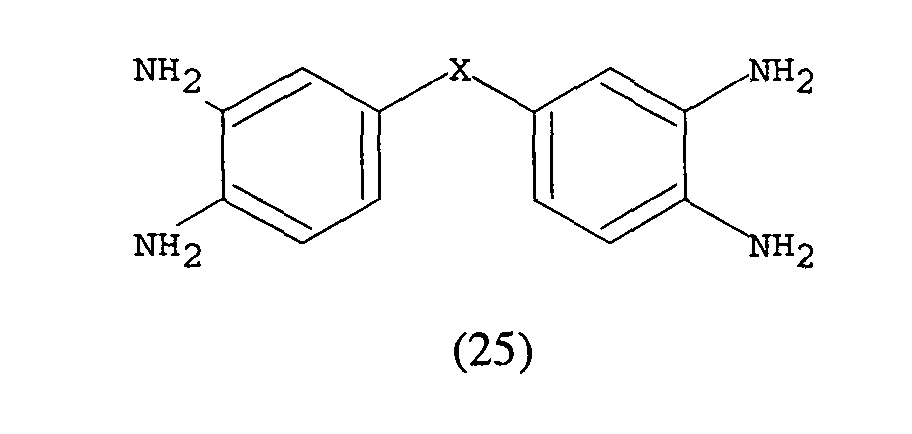
Other fused ring systems such as fluorene (26) and tetramethyl-spiro-biindane (27) may
also serve as substrates for tetraamines (as depicted) or tetracarboxylic acid derivatives.
However, all four of the acid or amino groups need not be attached to different ring, provided the
four are split into ortho-pairs or para-pairs.
The tetraamines may be obtained either commercially, or by the reduction of a nitro
compound, or may be synthesized in three steps from a bisphenol. The method for synthesis of
tetraamine from bisphenol involves the nitration of the bisphenol, the nucleophilic exchange of
the hydroxyl groups for amino groups, and reduction of the amino groups. The exchange of the
hydroxyl groups for amino groups is similar to the procedure described in U.S. Pat. No.
2,894,988 for the conversion of nitro-cresols to nitro-toluidines. Spirobiindane-bisphenol, which
serves as a basis for useful gas separating polycarbonates, can thus be converted to a tetraamine
(12) for polypyrrolone synthesis of fluid separation materials. The synthesis of other tetraamines
and tetraacids is described in U.S. Patent No. 5,262,056 to Koros et al.
Diamines are, generally, molecules that include at least two amine groups. In one
embodiment, aromatic diamines may be used. Aromatic diamines may be benzene based (28) or
naphthalene based (29).
 where, for benzene derivatives, meta or parasubstituted diamines may be used. As depicted in
structure (28) R1 and either R3 or R4 may be NH2, where the remaining pendant groups are H or a
C1 to C12 hydrocarbon. For naphthalene derivatives, at least two of R1, R2, R3, R4, R5, R6, R7,
and R8 are NH2 with the NH2 groups being in an meta- or para orientation, the remaining pendant
groups are H or a C1 to C12 hydrocarbon. Specific examples of aromatic diamines include 2,4,6-trimethyl-1,3-phenylenediamine
(DAM).
where, for benzene derivatives, meta or parasubstituted diamines may be used. As depicted in
structure (28) R1 and either R3 or R4 may be NH2, where the remaining pendant groups are H or a
C1 to C12 hydrocarbon. For naphthalene derivatives, at least two of R1, R2, R3, R4, R5, R6, R7,
and R8 are NH2 with the NH2 groups being in an meta- or para orientation, the remaining pendant
groups are H or a C1 to C12 hydrocarbon. Specific examples of aromatic diamines include 2,4,6-trimethyl-1,3-phenylenediamine
(DAM).
Other diamines may include bis-aromatic amines (41). Generally, these compounds
include a bis aromatic structure with amines attached to the aromatic groups. The linking group,
X, may be the same as described above for the tetraacid derivatives.

Specific examples of bis-aromatic amines include, but are not limited to, 4,4'
(hexafluoroisopropylidene) dianiline (6FpDA) and 3,3'-dimethyl-4,4'-diaminophenyl
(3,3'DMDB).
In one embodiment, a fluid separation membrane may be synthesized by the reaction of a
tetraacid compound with an amine mixture that includes tetraamines and diamines. Polyimides
are condensation polymers obtained from the reaction of aromatic dianhydrides with diamines
followed by complete cyclization. Polypyrrolones are condensation polymers obtained from the
reaction of aromatic dianhydrides and aromatic tetraamines followed by complete cyclization.
The polymer obtained by the initial reaction of the monomers in an aprotic solvent is a soluble
poly(amide amino acid), which can be thermally cyclized to form a polypyrrolone. A poly
(pyrrolone-imide) may be synthesized in a similar manner. Initially a tetraacid compound is
reacted with an amine mixture that includes tetraamines and diamines. In one embodiment the
ratio of tetraamine to diamine in the amine mixture may be between about 5:95 to about 100:0.
A small excess of the tetraacid compound may be used. Both the tetraamines and diamines
condense with the tetraacid compound to form a polyamide. The polyamide may be thermally
cyclized to form the poly (pyrrolone-imide). Thermal cyclization of an amide formed between
the tetraacid compound and the tetraamine will lead to a pyrrolone linkage, while thermal
cyclization of an amide formed between the tetraacid compound and the diamine will lead to
imide linkages. The reaction of the tetraacid compound and the amine mixture may be
performed in a polar aprotic solvent. Aprotic solvents, generally, are solvents that neither donate
or accept protons. Examples of polar aprotic solvents include, but are not limited to
dimethylformamide, n-methyl pyrrolidinone, dimethylacetamide, and dimethyl sulfoxide. One
or all of the components may be dissolved in a polar aprotic solvent prior to reacting the
components.
A base may be added to catalyze the formation of the polyamide. In an embodiment, a
tertiary amine may be added to the amine mixture prior to the addition of the tetraacid
compound. Suitable tertiary bases include, but are not limited to pyridine, pyrazine,
triethylamine, diisopropyl ethyl amine, 1,5-diazabicyclo[4.3.0]non-5-ene ("DBN"), 1,4-diazabicyclo[2.2.2]octane,
1,8-diazabicyclo[5.4.0]undec-7-ene.
In one embodiment, the amine mixture may be dissolved in a polar aprotic solvent and
placed in a reaction vessel. The tetraacid derivative may also be dissolved in a polar aprotic
solvent and added to the amine mixture. The reaction may be conducted under an oxygen free
atmosphere. An oxygen free atmosphere may be obtained by replacement of the ambient air in
the reaction vessels with an inert gas such as helium, nitrogen, or a nobel gas (e.g., argon).
Generally, the addition of the tetraacid compound to the amine mixture may cause an exothermic
condensation reaction to occur. The rate of addition of the tetraacid derivative may be adjusted
to control the temperature of the reaction. The resulting polyamide may be collected, filtered
and dried to remove unreacted monomers and any base that may be present.
To convert the polyamide to a poly (pyrrolone-imide) the polyamide may be heated to
cause further condensation of the amides. Condensation of the resulting amide may lead to
either pyrrolone or imide linking groups. Thermal cyclocondensation may occur at temperatures
above about 200 °C. In one embodiment, the polyamide may be placed in a mold prior to
thermal cyclocondensation such that the resulting poly (pyrrolone-imide) polymer has a shape
that is complementary to the shape of the mold. The polyamide may be heated under an inert
atmosphere or at a pressure below about 1.0 mmHg. Performing a thermal cyclocondensation
under a vacuum may help to remove water formed during the condensation reaction and help
accelerate the reaction rate. Thermal cyclocondensation is performed for a period of at least
about one day, preferably two to three days. The polypyrrolone resulting from cyclization
possesses a repeat unit with two benzene rings joined by two fused five membered rings,
imparting a great degree of thermal and chemical resistance, strength and rigidity.
Either a polyimide, a polyamide or the poly (pyrrolone-imide) may be used as fluid
separation membranes. Methods for forming and testing fluid separation membranes are
described in detail in U.S. Patent Nos. 5,262,056 and 6,602,415, both to Koros which are both
incorporated herein by reference. The membranes of the present invention may be either
composite or asymmetric membranes.
The above-described fluid separation membranes may be used in any fluid separation
apparatus known in the art. A schematic of a fluid separation membrane is depicted in Fig. 2.
Generally, a fluid separation apparatus 200 includes a body 202 in which a fluid separation
membrane 204 is disposed. The fluid separation membrane 202 may be composed of any of the
polymers described herein and formed by the methods described herein. A fluid inlet may be
positioned downstream from the fluid separation membrane 204. Two fluid outlets may be
positioned upstream from the fluid inlet. A first fluid outlet 206 may be positioned upstream
from the fluid separation membrane. A second fluid separation membrane may be positioned
upstream from the fluid separation membrane.
During use, a fluid stream that includes at least two components (e.g., a gas stream) may
be introduced into the fluid separation apparatus 200 via the fluid separation inlet. The fluid will
then contact the fluid separation membrane 204. The fluid separation membrane may have a
differential selectivity such that one of the components in the gas stream may pass through the
fluid separation membrane at a rate that is faster than the rate at which the other component
passes through. Thus the faster permeating component will pass through the gas separation
membrane and flow out of the fluid separation apparatus via an outlet. The gas that does not
permeate through the membrane may exit the fluid separation apparatus via the outlet 206. The
fluid stream passing out of the outlet 206 may be recycled back into the fluid separation
apparatus to improve the separation of the components and to maximize the yield of purified
components.
In an embodiment, dithiolenes may be added to a polymer mixture. The polymer may be
formed as described herein. In an embodiment, the polymer may be formed by reacting a
tetraacid and a diamine; a tetraacid and a tetraamine, or a tetraacid with a mixture of a tetraamine
and a diamine. The polymer may be any polymer suitable to allow a particular dithiolene to be
homogeneously dispersed. It may be necessary to use different polymers for different
dithiolenes. The dithiolenes may be homogeneously dispersed within the polymer matrix. The
resulting polymer dithiolene product may be used to form a fluid separation membrane as
described herein. Addition of the dithiolene may increase the solubility selectivity of a fluid
separation membrane. In an embodiment, a fluid separation membrane including dithiolenes
may exhibit an olefin/paraffin solubility selectivity. A fluid separation membrane including
dithiolenes may exhibit olefin/paraffin solubility selectivity of between about 1.1 to about 2.0. It
is believed that the solubility selectivity of the membranes that incorporate dithiolene may be due
to the ability of dithiolenes to reversibly complex with an olefin. The dithiolene may be resistant
to poisoning by impurities. Poisoning within the context herein refers to decreasing the
effectiveness of a compound or material as regards its intended purpose. Impurities may include
any common impurities found in fluid streams that come into contact with a fluid separation
membrane containing a dithiolene additive.
In an embodiment, the dithiolene may have the general structure (30):
 where M is a metal. Metals may include, but are not limited to nickel, platinum, and palladium.
R1, R2, R3, and R4 may be each independently alkyl, H, CH3, CF3, C6H4OCH3, CN, or aryl. R1
and R2 and/or R3 and R4 may combine to form at least one ring. The ring may be aromatic or
nonaromatic. The ring may be substituted or nonsubstituted. Dithiolene (30) may be symmetric
or asymmetric. In a particular example, R1 and R2 and R3 and R4 may combine to form
substituted aromatic rings forming an overall asymmetric dithiolene (30). An asymmetric
dithiolene may be a mixture of stereoisomers.
where M is a metal. Metals may include, but are not limited to nickel, platinum, and palladium.
R1, R2, R3, and R4 may be each independently alkyl, H, CH3, CF3, C6H4OCH3, CN, or aryl. R1
and R2 and/or R3 and R4 may combine to form at least one ring. The ring may be aromatic or
nonaromatic. The ring may be substituted or nonsubstituted. Dithiolene (30) may be symmetric
or asymmetric. In a particular example, R1 and R2 and R3 and R4 may combine to form
substituted aromatic rings forming an overall asymmetric dithiolene (30). An asymmetric
dithiolene may be a mixture of stereoisomers.
In an embodiment, dithiolene (30) may include a valence charge. The valence charge
may be, for example, -1, or -2. Dithiolene (30) may include a counter ion. A counter ion may
include any suitable counter ion known to one skilled in the art. A counter ion may be chosen
for a number of different reasons based on what properties may be needed. For example, a
counter ion may be chosen to increase the solubility of the entire complex. In one embodiment,
the counter ion may have the structure (31):
 where each R is independently an alkyl or aromatic compound. In one embodiment, each R may
be independently C2H5 or C4H9.
where each R is independently an alkyl or aromatic compound. In one embodiment, each R may
be independently C2H5 or C4H9.
In an embodiment, dithiolene may have structure (32):
 which is similar to structure (30), where R1, R2, R3, and R4 are CF3. M is a metal such as nickel,
platinum, or palladium.
which is similar to structure (30), where R1, R2, R3, and R4 are CF3. M is a metal such as nickel,
platinum, or palladium.
In an embodiment, dithiolene may have structure (33):
 which is similar to structure (30), where R1, R2, R3, and R4 are CF3. M is a metal such as nickel,
platinum, or palladium.
which is similar to structure (30), where R1, R2, R3, and R4 are CF3. M is a metal such as nickel,
platinum, or palladium.
In an embodiment, R1, R2, R3, and R4 are C6H4OCH3. Each OCH3 substituent separately
may be positioned anywhere on the aromatic ring. In one embodiment, dithiolene may have
structure (34):
 which is similar to structure (30), where R1, R2, R3, and R4 are C6H4OCH3, with the methoxy
substituent in the para position as depicted. M is a metal such as nickel, platinum, or palladium.
which is similar to structure (30), where R1, R2, R3, and R4 are C6H4OCH3, with the methoxy
substituent in the para position as depicted. M is a metal such as nickel, platinum, or palladium.
In an embodiment, dithiolene may have structure 35:
 which is similar to structure 30, where R1 and R2, and R3 and R4 may combine to form a
substituted aromatic ring. M is a metal such as nickel, platinum, or palladium.
which is similar to structure 30, where R1 and R2, and R3 and R4 may combine to form a
substituted aromatic ring. M is a metal such as nickel, platinum, or palladium.
In an embodiment, dithiolene has the structure 36:
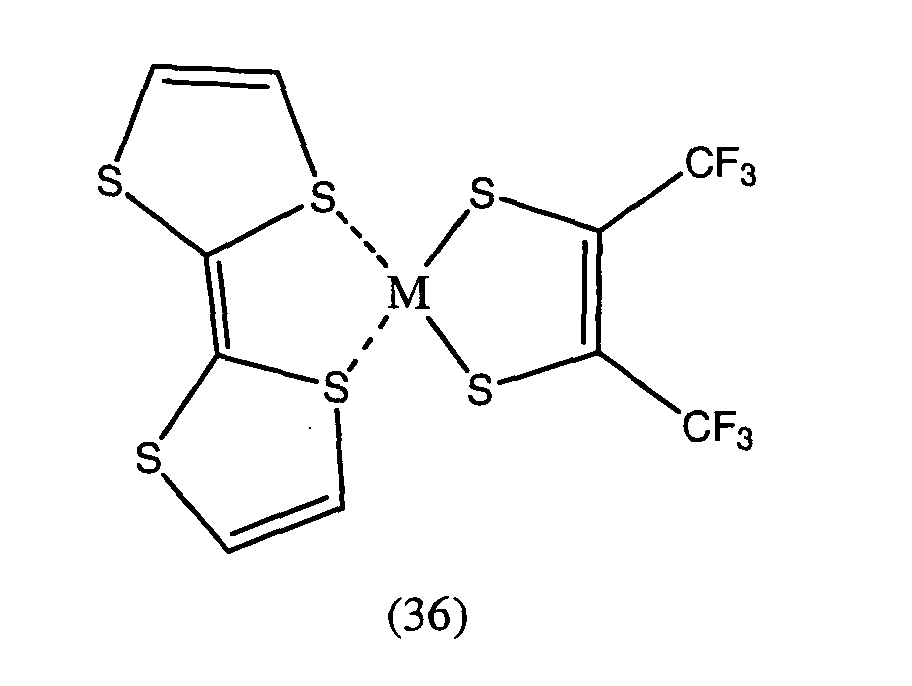 where R1 and R2 combine to form C6H4S4, and R3 and R4 are CF3. M is a metal such as nickel,
platinum, or palladium.
where R1 and R2 combine to form C6H4S4, and R3 and R4 are CF3. M is a metal such as nickel,
platinum, or palladium.
A dithiolene may be dispersed in a polymer matrix as described herein. In an
embodiment, a dithiolene may be dispersed in a polymer resulting from at least the reaction of a
tretraacid and a diamine. The tetraacid may be dianhydrides such as (37) and/or (38):

The diamine may have the structure (39):
 X may be, but is not limited to, a linking group such as CH2, C(O), CH(CH3), C(CH3)2, C(CF3)2,
C(CH3)Ph, C(Ph)2, or cyclohexyl. A polymer matrix may be a polyimide polymer, a polyamide
polymer, a polypyrrolone polymer, and/or a poly (pyrrolone - imide) polymer. A polyimide
polymer may include recurring units having the structure (40):
X may be, but is not limited to, a linking group such as CH2, C(O), CH(CH3), C(CH3)2, C(CF3)2,
C(CH3)Ph, C(Ph)2, or cyclohexyl. A polymer matrix may be a polyimide polymer, a polyamide
polymer, a polypyrrolone polymer, and/or a poly (pyrrolone - imide) polymer. A polyimide
polymer may include recurring units having the structure (40):
 X may be a linking group. Y may be another recurring unit. Recurring unit Y may be coupled to
the aromatic ring in an ortho, meta, or para relation to the imide group.
X may be a linking group. Y may be another recurring unit. Recurring unit Y may be coupled to
the aromatic ring in an ortho, meta, or para relation to the imide group.
All monomer materials were purified before the polymerization reaction. The 6FDA
dianhydride and the 6FpDA diamine were each sublimed twice. The monomers were stored
separately under high vacuum. For the synthesis of the polyimides in this study, chemical
imidization was performed. In a moisture free flask with nitrogen inlet and magnetic stirrer, the
diamine monomer was dissolved in N,N-dimethyl acetamide (DMAc) and the 6FDA dianhydride
dissolved in DMAc was added dropwise at room temperature. The 20-25 wt% solution was
stirred 6-8 h. Thereby high molecular polyamic acids were formed. The imidization was
performed by the dehydration of the polyamic acids by adding a large excess of triethylamine
and acetic anhydride to the reaction mixture and stirring 2-3 h at 323 K and 10-20 min at 373-383
K. After cooling to room temperature, the highly viscous reaction solution was slowly
poured into methanol. The precipitated polyimide was homogenized in a blender; filtered and
washed several times with fresh methanol. The obtained polyimide was dried 12 h under
vacuum at room temperature and at least 24 h under vacuum at 523 K.
Films of the polymer materials were cast in a conventional manner in a fume hood. The
appropriate amount of polymer was dissolved in a suitable solvent to form a 1 - 2 wt % solution.
This solution was stirred for at least 20 minutes before filtering the solution with a 0.2 micron
TEFLON syringe filter or alternatively filter paper from Fischer Scientific with medium
porosity. The filtered solution was dispensed on a clean, level TEFLON dish or glass plate. The
film was covered with a casting funnel to control the rate of solvent removal, and film formation
generally occurred in under 8 hours. The films were then removed and placed in the vacuum
oven at 100 °C for at least 24 hours to ensure complete solvent removal.
A list of dithiolenes and their structures are presented in Table 1. In one experiment, the
nine dithiolene complexes listed in Table 1, were evaluated for their reaction with C3H6.
Experiments were conducted that included bubbling low pressure (e.g., atmospheric) C3H6
through a solution of the dithiolene complex in question. The results of these experiments are
shown in Table 2. Some of the complexes were not soluble in toluene, but were soluble in
dimethylacetamide. The goal of the experiment was to observe a color change over time, which
would signal a chemical complexation with propylene. The only dithiolene material that
underwent a significant change was complex #2, Ni[S2C2(CF3)2]2, and this occurred in under 30
minutes. All other dithiolenes showed no color change under C3H6 bubbling, with the exception
of dithiolene #5. This complex underwent a slight color change from yellow to light orange.
The assumption from this would be that the olefin binding is very weak, as it appears the energy
(reflected in the color) is not changed appreciably.

| Chemical Formula of dithiolene materials tested. | |
| # | Chemical Formula |
| 1 | Ni[S2C2(CH3)2]2 |
| 2 | Ni[S2C2(CF3)2]2 |
| 3 | Ni[S2C2(C6H4OCH3)2]2 |
| 4 | [C6H4S4]{Ni[S2C2(CF3)2]}- |
| 5 | [N(n-C4H9)4]{Ni[S2C2(CN)2]2}- |
| 6 | [N(n-C4H9)4]{Ni[S2(C6H3CH3)]2}- |
| 7 | [N(n-C4H9)4]{Pt[S2(C6H3CH3)]2}- |
| 8 | [N(n-C4H9)4]{Fe[S2(C6H3CH3)]2}- |
| 9 | [N(C2H5)4]{Co[S2(C2(CN)2]2}- |
| Results of C3H6 bubbling experiments for the 9 dithiolene samples examined. | ||||
| Dithiolene Complex | Solvent | Color | Time of C3H6 bubbling | Color change |
| #1 | Toluene | deep purple | 3 hrs | No change |
| #2 | Toluene | dark with purple tint | 30 minutes | yellowish - green |
| #3 | Toluene | dark forest green | 3 hrs | No change |
| #4 | Toluene | light yellow | 3 hrs | No change |
| #5 | DMAc | yellow | 3 hrs | light orange (very slight change) |
| #6 | Toluene | green with blue tint | 3 hrs | No change |
| #7 | Toluene | light blue | 3 hrs | No change |
| #8 | DMAc | light red | 3 hrs | No change |
| #9 | DMAc | yellow | 3 hrs | No change |
Depicted above is the proposed method of complexation of propylene with a dithiolene.
The observation that Ni[S2C2(CF3)2]2 undergoes complexation with C3H6 is consistent with
previous experiments in the literature.
In one embodiment, a film was prepared using 6FDA-6FpDA polyimide as the polymer
matrix. The polyimide 6FDA-6FpDA was synthesized from a mixture of 6FDA and 6FpDA
using the general methods described herein. It is believed that the presence of CF3 groups in
both the polymer and the dithiolene complex, Ni[S2C2(CF3)2]2 should aid in miscibility of the
polymer and the dithiolene. Films were cast from a mixture of 6FDA-6FpDA polymer and
dithiolene on Teflon plates using techniques described herein with dicloromethane as the casting
solvent. The films were then dried at 120°C for at least 8 hours under vacuum. Homogenous
films were formed that were also transparent dark green in epoxy on aluminum tape, compared
to the pure 6FDA-6FpDA film, which is clear. After successfully achieving a polyimide /
dithiolene homogenous blend, C3H6/C3H8 pure gas permeation and sorption experiments were
conducted using the material 6FDA-6FpDA / Ni[S2C2(CF3)2]2 (11 wt %).
Initially pure gas C3H6/C3H8 sorption experiments were conducted for both the pure
polymer, 6FDA-6FpDA, and the 6FDA-6FpDA / Ni[S2C2(CF3)2]2 (11 wt %) blend, both
processed using the same protocol. The results are shown in FIG. 3 on a plot of gas
concentration versus equilibrium feed pressure. FIG. 3 depicts penetrant sorption in polymer
films at 35°C for C3H6 in 6FDA-6FpDA / Ni[S2C2(CF3)2]2 302, C3H6 in 6FDA-6FpDA 300,
C3H8 in 6FDA-6FpDA 304, C3H6 in 6FDA-6FpDA / Ni[S2C2(CF3)2]2 306. These results were fit
to the dual mode model describing gas sorption in both a Langmuir environment and a Henry's
law environment:
S = (c/p) = kD + [(C'H b)/(1+bp)]
where kD is the Henry's law constant, C'H is the Langmuir capacity constant, and b is the
Langmuir affinity constant. The sorption isotherms are shown in FIG. 3. The results of the fitted
parameters are shown in Table 3.
As shown in Table 3 there is a significant increase in b, the affinity constant, for C3H6 in
the dithiolene containing material. Furthermore, there is also an increase in the Henry's law
constant, kD, for C3H6 within the material 6FDA-6FpDA / Ni[S2C2(CF3)2]2, compared to the pure
polyimide.
It would be expected that the C'H parameter would increase for C3H6 in the dithiolene-containing
blend, and that C'H for C3H8 would remain relatively constant. Surprisingly, this is
not what is observed. In both cases, (C3H6 and C3H8) the C'H parameter is depressed. This
suggests that the dithiolene works to decrease the available defect free volume within the matrix.
One possibility is that the dithiolene acts somewhat as a plasticizer, depressing the Tg of the
matrix. Previous studies have shown correlations between the matrix Tg, and the C'H parameter.
Using the dual mode data, it is possible to plot the pure gas C3H6/C3H8 solubility
selectivity as a function of feed pressure for each of the materials studied (FIG. 4). As shown in
FIG. 4, the solubility selectivity is improved at all pressures over the range studied. Line 400
depicts the solubility selectivity for 6FDA-6FpDA / dithiolene #2 (11%) in FIG. 4. Line 402
depicts the solubility selectivity for 6FDA-6FpDA in FIG. 4. The increase in the C3H6 affinity
constant, b, provides a large increase in the overall solubility selectivity at low pressures. The
increase in the C3H6 Henry's law constant maintains an increase in the solubility selectivity at
higher pressures.
| Dual mode parameters for C3H6/C3H8 in 6FDA-6FpDA and 6FDA-6FpDA / Ni[S2C2(CF3)2]2. | ||||
| Membrane Material | Gas | kD cc (STP) / cc polymer - psia | C'H cc (STP) / cc polymer | b psia-1 |
| 6FDA-6FpDA | C3H6 | 0.32 | 26.4 | 0.14 |
| 6FDA-6FpDA / Ni[S2C2(CF3)2]2 | C3H6 | 0.40 | 17.2 | 0.70 |
| 6FDA-6FpDA | C3H8 | 0.36 | 14.6 | - |
| 6FDA-6FpDA / Ni[S2C2(CF3)2]2 | C3H8 | 0.34 | 9.9 | 0.37 |
FIG. 5 illustrates the difference in C3H6/C3H8 concentration due to the dithiolene
additive. Concentration difference 502 increases with increased pressure, which is believed to
indicate that the olefin is able to "access" more dithiolene molecules as the concentration
increases in the polymer. Upper limit 500 represents the calculated maximum enhancement
based on a mole balance assuming all dithiolene molecules form a complex. The experimental
measurements approach this value as the pressure is increased.
Further modifications and alternative embodiments of various aspects of the invention
will be apparent to those skilled in the art in view of this description. Accordingly, this
description is to be construed as illustrative only and is for the purpose of teaching those skilled
in the art the general manner of carrying out the invention. It is to be understood that the forms
of the invention shown and described herein are to be taken as the presently preferred
embodiments. Elements and materials may be substituted for those illustrated and described
herein, parts and processes may be reversed, and certain features of the invention may be utilized
independently, all as would be apparent to one skilled in the art after having the benefit of this
description of the invention. Changes may be made in the elements described herein without
departing from the spirit and scope of the invention as described in the following claims.
Claims (24)
- A fluid separation membrane for separating one or more components from a fluid, the fluid comprising two or more components wherein the fluid separation membrane comprises at least one polymer and at least one dithiolene having the structure:where M is a metal, wherein R1, R2, R3, and R4 are each independently alkyl, CH3, CF3, C6H4OCH3, CN, or where R1 and R2 and/or R3 and R4 combine to form at least one ring.

- The fluid separation membrane of claim 1, wherein the membrane exhibits an olefin/paraffin solubility selectivity.
- The fluid separation membrane of claim 1, wherein the membrane exhibits an olefin/paraffin solubility selectivity of 1.1 to 2.0.
- The fluid separation membrane of one or more of claims 1-3, wherein the metal is Ni, Pd, or Pt.
- The fluid separation membrane of one or more of claims 1-4, wherein at least one dithiolene further comprises a valence charge, and wherein the valence charge is 0, -1, or -2.
- The fluid separation membrane of one or more of claims 1-4, wherein at least one dithiolene further comprises a valence charge, wherein the valence charge is -1 or -2, and wherein the dithiolene comprises a counter ion.
- The fluid separation membrane of one or more of claims 1-4, wherein at least one dithiolene further comprises a valence charge, wherein the valence charge is -1 or -2, and wherein the dithiolene comprises at least one counter ion having the structure:where each R is independently an alkyl or aromatic compound.
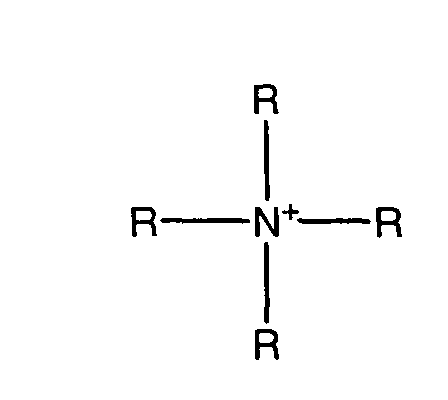
- The fluid separation membrane of one or more of claims 1-4, wherein at least one dithiolene further comprises a valence charge, wherein the valence charge is -1 or -2, and wherein the dithiolene comprises at least one counter ion having the structure:where each R is independently C2H5 or C4H9.

- The fluid separation membrane of one or more of claims 1-8, wherein at least one dithiolene is capable of complexing with an olefin.
- The fluid separation membrane of one or more of claims 1-9, wherein the fluid comprises a liquid.
- The fluid separation membrane of one or more of claims 1-9, wherein the fluid comprises a gas stream.
- The fluid separation membrane of one or more of claims 1-9, wherein the fluid comprises a gas stream, and wherein the gas stream comprises a hydrocarbon.
- The fluid separation membrane of one or more of claims 1-12, wherein R1, R2, R3, and R4 are CH3, at least one dithiolene having the structure:

- The fluid separation membrane of one or more of claims 1-12, wherein R1, R2, R3, and R4 are CF3, at least one dithiolene having the structure:
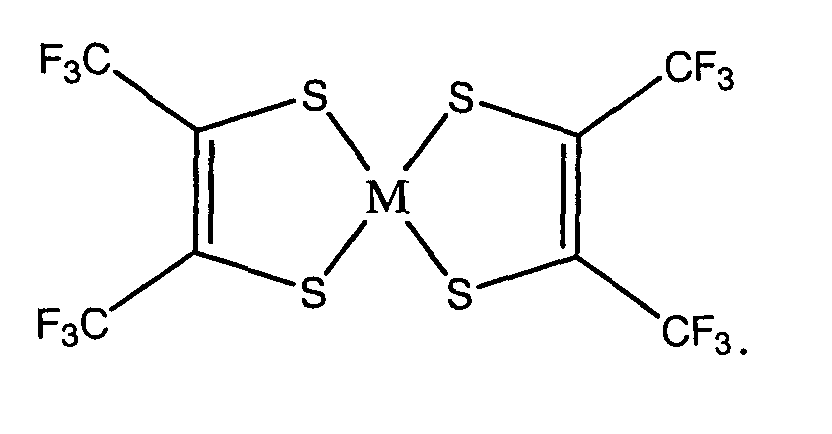
- The fluid separation membrane of one or more of claims 1-12, wherein R1, R2, R3, and R4 are C6H4OCH3, at least one dithiolene having the structure:

- The fluid separation membrane of one or more of claims 1-12, wherein R1 and R2 combine to form C6H3CH3, and wherein R3 and R4 combine to form C6H3CH3, at least one dithiolene having the structure:where each R is independently H, CH3, alky, or aryl.

- The fluid separation membrane of one or more of claims 1-12, wherein R1 and R2 combine to form C6H4S4, and wherein R3 and R4 are CF3, at least one dithiolene having the structure:

- The fluid separation membrane of one or more of claims 1-17, wherein at least one polymer comprises the reaction product of a tetraacid compound and a diamine.
- The fluid separation membrane of one or more of claims 1-17, wherein at least one polymer comprises the reaction product of a tetraacid compound and a diamine, wherein the tetraacid compound comprises an aromatic dianhydride having the structure:wherein the diamine having the structure:
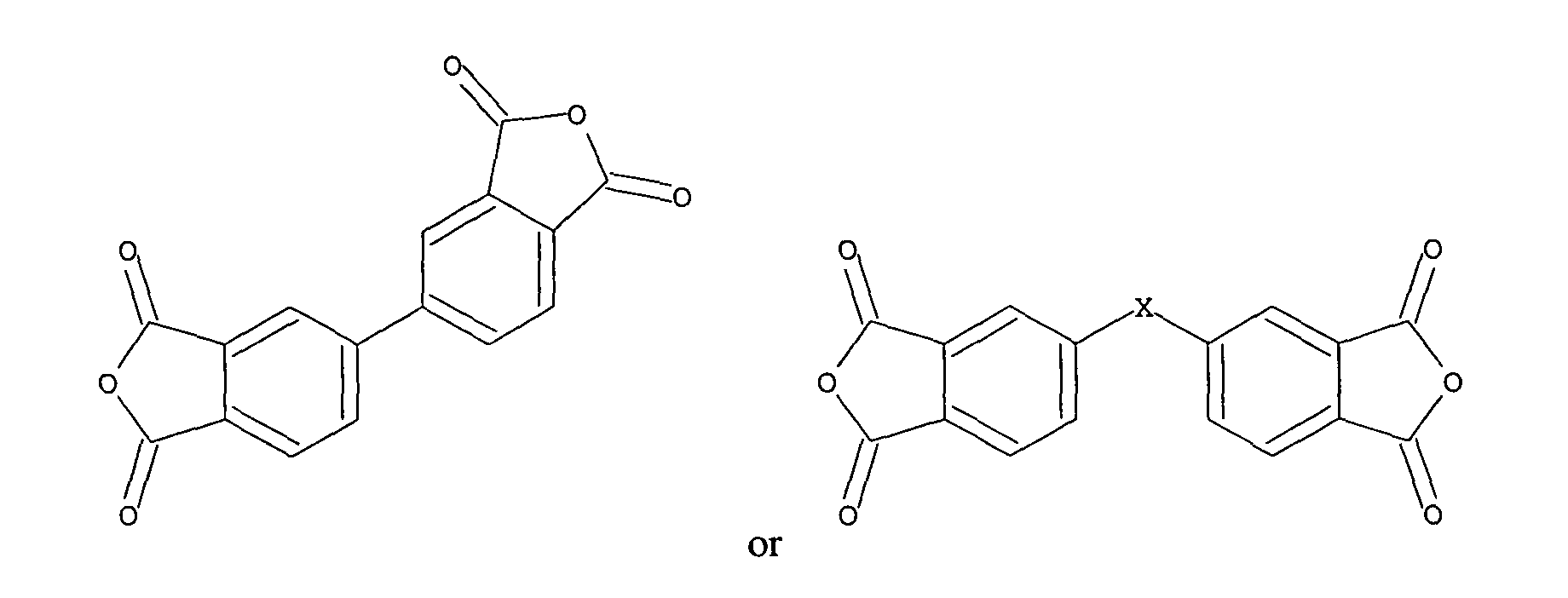 and wherein each X is independently CH2, C(O), CH(CH3), C(CH3)2, C(CF3)2, C(CH3)Ph, C(Ph)2, or cyclohexyl.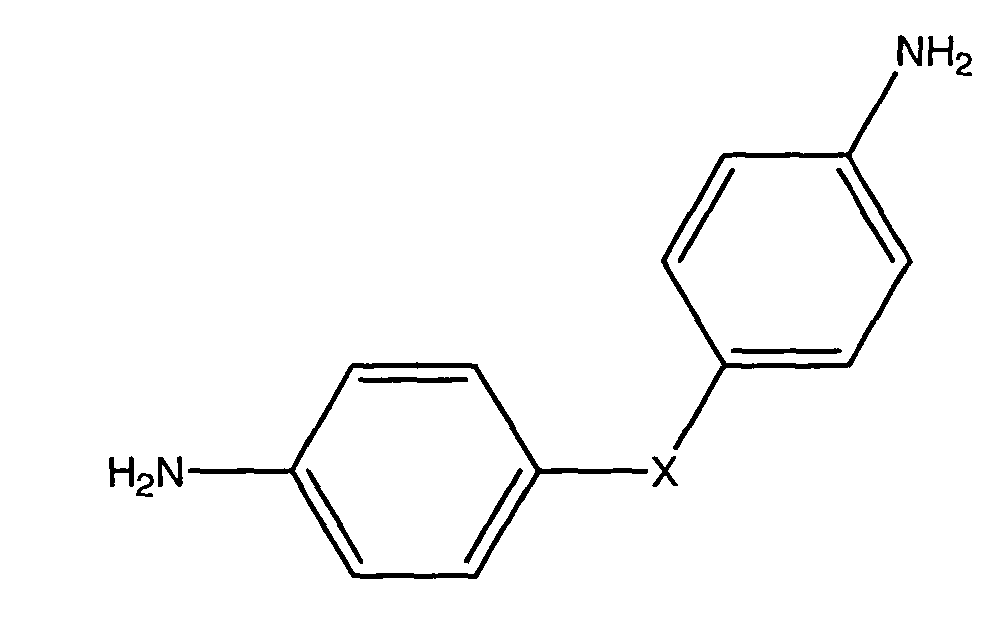
- The fluid separation membrane of one or more of claims 1-17, wherein at least one polymer comprises a polyimide polymer, a polyamide polymer, a polypyrrolone polymer, or a poly (pyrrolone - imide) polymer.
- The fluid separation membrane of one or more of claims 1-17, wherein at least one polymer comprises a polyimide polymer, wherein the polyimide polymer comprises recurring units, a portion of the recurring units having the structure:where X is a linking group, and Y is another recurring unit, where recurring unit Y is coupled to the aromatic ring in an ortho, meta, or para relation to the imide group.

- The fluid separation membrane of one or more of claims 1 - 21, wherein at least one dithiolene is resistant to poisoning by impurities.
- A method of separating one or more components from the fluid, comprising bringing a fluid stream into contact with a face of the fluid separation membrane as described in one or more of claims 1 - 22.
- An apparatus for separating one or more components from the fluid, comprising:a body;the fluid separation membrane disposed within the body, the fluid separation membrane as described in one or more of claims 1 - 22;a fluid stream inlet coupled to the body downstream from the fluid separation membrane;a first fluid stream outlet positioned upstream from the fluid stream inlet and down stream from the fluid separation membrane; anda second fluid stream outlet positioned downstream from the fluid separation membrane.
Applications Claiming Priority (2)
| Application Number | Priority Date | Filing Date | Title |
|---|---|---|---|
| US46300803P | 2003-04-15 | 2003-04-15 | |
| US463008P | 2003-04-15 |
Publications (1)
| Publication Number | Publication Date |
|---|---|
| EP1468724A1 true EP1468724A1 (en) | 2004-10-20 |
Family
ID=32908750
Family Applications (1)
| Application Number | Title | Priority Date | Filing Date |
|---|---|---|---|
| EP04008852A Withdrawn EP1468724A1 (en) | 2003-04-15 | 2004-04-14 | Dithiolene functionalized polymer membrane for olefin/paraffin separation |
Country Status (4)
| Country | Link |
|---|---|
| US (1) | US7160356B2 (en) |
| EP (1) | EP1468724A1 (en) |
| AU (1) | AU2004201546B2 (en) |
| CA (1) | CA2464541A1 (en) |
Cited By (2)
| Publication number | Priority date | Publication date | Assignee | Title |
|---|---|---|---|---|
| JP2006163376A (en) * | 2004-11-09 | 2006-06-22 | Mitsubishi Chemicals Corp | Near infrared absorption filter |
| US8147735B2 (en) | 2008-07-09 | 2012-04-03 | Eltron Research & Development, Inc. | Semipermeable polymers and method for producing same |
Families Citing this family (47)
| Publication number | Priority date | Publication date | Assignee | Title |
|---|---|---|---|---|
| CN105837690A (en) | 2006-06-12 | 2016-08-10 | 新兴产品开发西雅图有限公司 | Single-chain multivalent binding proteins with effector function |
| MY154251A (en) | 2007-11-12 | 2015-05-29 | Exxonmobil Upstream Res Co | Methods of generating and utility gas |
| US20090143632A1 (en) * | 2007-12-04 | 2009-06-04 | Asaro Marianna F | Sorbents and processes for separation of olefins from paraffins |
| CA2721724C (en) | 2008-04-30 | 2016-06-28 | Exxonmobil Upstream Research Company | Method and apparatus for removal of oil from utility gas stream |
| US8642722B2 (en) * | 2009-05-15 | 2014-02-04 | Iucf-Hyu (Industry-University Cooperation Foundation Hanyang University) | Preparation method of polybenzimidazole |
| WO2011149640A1 (en) | 2010-05-28 | 2011-12-01 | Exxonmobil Upstream Research Company | Integrated adsorber head and valve design and swing adsorption methods related thereto |
| GB201012083D0 (en) | 2010-07-19 | 2010-09-01 | Imp Innovations Ltd | Thin film composite membranes for separation |
| TWI495501B (en) | 2010-11-15 | 2015-08-11 | Exxonmobil Upstream Res Co | Kinetic fractionators, and cycling processes for fractionation of gas mixtures |
| WO2012118758A1 (en) | 2011-03-01 | 2012-09-07 | Exxonmobil Upstream Research Company | Methods of removing contaminants from a hydrocarbon stream by swing adsorption and related apparatus and systems |
| US9162175B2 (en) | 2011-03-01 | 2015-10-20 | Exxonmobil Upstream Research Company | Apparatus and systems having compact configuration multiple swing adsorption beds and methods related thereto |
| US9017457B2 (en) | 2011-03-01 | 2015-04-28 | Exxonmobil Upstream Research Company | Apparatus and systems having a reciprocating valve head assembly and swing adsorption processes related thereto |
| CN103429339B (en) | 2011-03-01 | 2015-06-10 | 埃克森美孚上游研究公司 | Apparatus and system with closed adsorbent contactor and swing adsorption process associated therewith |
| EP2680948A4 (en) | 2011-03-01 | 2015-05-06 | Exxonmobil Upstream Res Co | Apparatus and systems having a rotary valve assembly and swing adsorption processes related thereto |
| CA2842928A1 (en) | 2011-03-01 | 2012-11-29 | Exxonmobil Upstream Research Company | Apparatus and systems having a rotary valve assembly and swing adsorption processes related thereto |
| EP2680954B1 (en) | 2011-03-01 | 2018-09-12 | Exxonmobil Upstream Research Company | Methods of removing contaminants from a hydrocarbon stream by pressure swing adsorption and related apparatus and systems |
| WO2012167114A2 (en) * | 2011-06-01 | 2012-12-06 | Board Of Regents, The University Of Texas System | Polymer synthesis and thermally rearranged polymers as gas separation membranes |
| US9034078B2 (en) | 2012-09-05 | 2015-05-19 | Exxonmobil Upstream Research Company | Apparatus and systems having an adsorbent contactor and swing adsorption processes related thereto |
| KR101411464B1 (en) * | 2013-02-12 | 2014-06-27 | 한국과학기술연구원 | Cardo Copolybenzimidazoles, Gas Separation Membranes and preparation method thereof |
| US20140255636A1 (en) * | 2013-03-06 | 2014-09-11 | Saudi Basic Industries Corporation | Polymeric Membranes |
| JP6203393B2 (en) | 2013-12-16 | 2017-09-27 | サビック グローバル テクノロジーズ ビー.ブイ. | Treated mixed matrix polymer membrane |
| WO2016014232A1 (en) | 2014-07-25 | 2016-01-28 | Exxonmobil Upstream Research Company | Apparatus and system having a valve assembly and swing adsorption processes related thereto |
| AU2015347232B2 (en) | 2014-11-11 | 2018-02-01 | Exxonmobil Upstream Research Company | High capacity structures and monoliths via paste imprinting |
| AU2015361102B2 (en) | 2014-12-10 | 2018-09-13 | Exxonmobil Research And Engineering Company | Adsorbent-incorporated polymer fibers in packed bed and fabric contactors, and methods and devices using same |
| AU2015370106B2 (en) | 2014-12-23 | 2019-01-03 | Exxonmobil Upstream Research Company | Structured adsorbent beds, methods of producing the same and uses thereof |
| WO2016186726A1 (en) | 2015-05-15 | 2016-11-24 | Exxonmobil Upstream Research Company | Apparatus and system for swing adsorption processes related thereto |
| CA2979869C (en) | 2015-05-15 | 2019-12-03 | Exxonmobil Upstream Research Company | Apparatus and system for swing adsorption processes related thereto comprising mid-bed purge systems |
| CA2996139C (en) | 2015-09-02 | 2021-06-15 | Exxonmobil Upstream Research Company | Process and system for swing adsorption using an overhead stream of a demethanizer as purge gas |
| US10124286B2 (en) | 2015-09-02 | 2018-11-13 | Exxonmobil Upstream Research Company | Apparatus and system for swing adsorption processes related thereto |
| JP6615373B2 (en) | 2015-10-27 | 2019-12-04 | エクソンモービル アップストリーム リサーチ カンパニー | Apparatus and system for swing adsorption process with active controlled feed poppet valve and passively controlled product valve |
| EA201891041A1 (en) | 2015-10-27 | 2018-09-28 | Эксонмобил Апстрим Рисерч Компани | DEVICE AND SYSTEM FOR PROCESSES OF SHORT-CYCLE ADSORPTION HAVING A VARIETY VARIETY |
| CA3002648A1 (en) | 2015-10-27 | 2017-05-04 | Exxonmobil Upstream Research Company | Apparatus and system for swing adsorption processes related thereto having a plurality of valves |
| US10744449B2 (en) | 2015-11-16 | 2020-08-18 | Exxonmobil Upstream Research Company | Adsorbent materials and methods of adsorbing carbon dioxide |
| JP2019508245A (en) | 2016-03-18 | 2019-03-28 | エクソンモービル アップストリーム リサーチ カンパニー | Apparatus and system for swing adsorption process |
| WO2017209860A1 (en) | 2016-05-31 | 2017-12-07 | Exxonmobil Upstream Research Company | Apparatus and system for swing adsorption processes |
| EP3463620A1 (en) | 2016-05-31 | 2019-04-10 | ExxonMobil Upstream Research Company | Apparatus and system for swing adsorption processes |
| US10434458B2 (en) | 2016-08-31 | 2019-10-08 | Exxonmobil Upstream Research Company | Apparatus and system for swing adsorption processes related thereto |
| US10603626B2 (en) | 2016-09-01 | 2020-03-31 | Exxonmobil Upstream Research Company | Swing adsorption processes using zeolite structures |
| US10328382B2 (en) | 2016-09-29 | 2019-06-25 | Exxonmobil Upstream Research Company | Apparatus and system for testing swing adsorption processes |
| JP7021227B2 (en) | 2016-12-21 | 2022-02-16 | エクソンモービル アップストリーム リサーチ カンパニー | Self-supporting structure with active material |
| JP7021226B2 (en) | 2016-12-21 | 2022-02-16 | エクソンモービル アップストリーム リサーチ カンパニー | Self-supporting structure with foamed geometry and active material |
| EP3659996A4 (en) * | 2017-07-28 | 2020-07-29 | Mitsubishi Gas Chemical Company, Inc. | Novel (poly)amine compound, resin, and cured product |
| US11331620B2 (en) | 2018-01-24 | 2022-05-17 | Exxonmobil Upstream Research Company | Apparatus and system for swing adsorption processes |
| US11413567B2 (en) | 2018-02-28 | 2022-08-16 | Exxonmobil Upstream Research Company | Apparatus and system for swing adsorption processes |
| US11318410B2 (en) | 2018-12-21 | 2022-05-03 | Exxonmobil Upstream Research Company | Flow modulation systems, apparatus, and methods for cyclical swing adsorption |
| US11376545B2 (en) | 2019-04-30 | 2022-07-05 | Exxonmobil Upstream Research Company | Rapid cycle adsorbent bed |
| WO2021071755A1 (en) | 2019-10-07 | 2021-04-15 | Exxonmobil Upstream Research Company | Adsorption processes and systems utilizing step lift control of hydraulically actuated poppet valves |
| WO2021076594A1 (en) | 2019-10-16 | 2021-04-22 | Exxonmobil Upstream Research Company | Dehydration processes utilizing cationic zeolite rho |
Citations (2)
| Publication number | Priority date | Publication date | Assignee | Title |
|---|---|---|---|---|
| US20020153315A1 (en) * | 2001-02-09 | 2002-10-24 | Koros William J. | Polymeric membrane for separation of fluids under elevated temperature and/or pressure conditions |
| US20030225296A1 (en) * | 2002-05-02 | 2003-12-04 | Mueller-Westerhoff Ulrich T. | Functionalized metal complexes |
Family Cites Families (29)
| Publication number | Priority date | Publication date | Assignee | Title |
|---|---|---|---|---|
| US2894988A (en) | 1956-05-21 | 1959-07-14 | Sherwin Williams Co | Ammonolysis of meta nitro para cresol |
| US3518232A (en) | 1965-11-23 | 1970-06-30 | Vernon L Bell Jr | Process for interfacial polymerization of pyromellitic dianhydride and 1,2,4,5-tetraamino-benzene |
| US3657190A (en) | 1969-11-17 | 1972-04-18 | Avco Corp | Method for forming pyrrone molding powders and products of said method |
| US3817386A (en) | 1972-05-03 | 1974-06-18 | Westinghouse Electric Corp | Reverse osmosis membranes from pyrrone polymer precursors |
| US3792024A (en) | 1972-07-27 | 1974-02-12 | Celanese Corp | Polymerization of benzimidazobenzophenanthroline-ladder polymer |
| JPS5223346B2 (en) | 1972-08-30 | 1977-06-23 | ||
| US4113683A (en) | 1977-01-17 | 1978-09-12 | Celanese Corporation | Production of high temperature resistant polymer compositions capable of forming superior fiber reinforced composite articles |
| US4717394A (en) | 1986-10-27 | 1988-01-05 | E. I. Du Pont De Nemours And Company | Polyimide gas separation membranes |
| US4755192A (en) | 1987-04-15 | 1988-07-05 | Board Of Regents, The University Of Texas System | Processes to condition gas permeable membranes |
| US4902422A (en) | 1988-12-06 | 1990-02-20 | Board Regents The University Of Texas System | Defect-free ultrahigh flux asymmetric membranes |
| US5074891A (en) | 1989-07-27 | 1991-12-24 | Hoechst Celanese Corp. | Method of gas separation and membranes therefor |
| US4944880A (en) | 1989-10-16 | 1990-07-31 | Exxon Research And Engineering Company | Polyimide/aliphatic polyester copolymers |
| US4946594A (en) | 1989-10-16 | 1990-08-07 | Exxon Research And Engineering Company | Crosslinked copolymers of aliphatic polyester diols and dianhydrides |
| US4990275A (en) | 1989-10-16 | 1991-02-05 | Exxon Research And Engineering Company | Polyimide aliphatic polyester copolymers (C-2356) |
| US4997906A (en) | 1989-10-16 | 1991-03-05 | Exxon Research & Engineering Company | Crosslinked copolymers of aliphatic polyester diols and dianhydrides |
| JPH07121343B2 (en) | 1990-03-15 | 1995-12-25 | 宇部興産株式会社 | Gas separation hollow fiber membrane and method for producing the same |
| US5075419A (en) | 1990-04-06 | 1991-12-24 | Hoechst Celanese Corp. | Novel polybenzimidazolone polymers based hexafluoro aromatic tetraamines |
| US5120825A (en) | 1990-12-21 | 1992-06-09 | Hoechst Celanese Corp. | Polymers containing both imidazole and imidazolone structural units |
| US5262056A (en) | 1992-11-30 | 1993-11-16 | Board Of Regents, The University Of Texas System | Polyamides and polypyrrolones for fluid separation membranes |
| US5288304A (en) | 1993-03-30 | 1994-02-22 | The University Of Texas System | Composite carbon fluid separation membranes |
| US5430218A (en) | 1993-08-27 | 1995-07-04 | Chevron U.S.A. Inc. | Dehydrogenation using dehydrogenation catalyst and polymer-porous solid composite membrane |
| US5425801A (en) | 1993-12-21 | 1995-06-20 | Praxair Technology, Inc. | Membrane nitrogen with temperature tracking |
| CA2149806A1 (en) | 1994-05-20 | 1995-11-21 | William John Koros | Polymeric membrane |
| US5593157A (en) | 1995-05-10 | 1997-01-14 | Gencorp Inc. | Long life, low air permeable pressurized articles such as play balls |
| JPH1085571A (en) | 1996-07-26 | 1998-04-07 | Dainippon Ink & Chem Inc | Separation membrane |
| US6296755B1 (en) | 1999-04-13 | 2001-10-02 | Exxon Research And Engineering Co. | Electrochemical process for olefin recovery using transition metal dithiolene complexes |
| US6299669B1 (en) | 1999-11-10 | 2001-10-09 | The University Of Texas System | Process for CO2/natural gas separation |
| US6503295B1 (en) | 2000-09-20 | 2003-01-07 | Chevron U.S.A. Inc. | Gas separations using mixed matrix membranes |
| US20030131731A1 (en) | 2001-12-20 | 2003-07-17 | Koros William J. | Crosslinked and crosslinkable hollow fiber mixed matrix membrane and method of making same |
-
2004
- 2004-04-14 EP EP04008852A patent/EP1468724A1/en not_active Withdrawn
- 2004-04-14 AU AU2004201546A patent/AU2004201546B2/en not_active Ceased
- 2004-04-15 US US10/824,772 patent/US7160356B2/en not_active Expired - Fee Related
- 2004-04-15 CA CA002464541A patent/CA2464541A1/en not_active Abandoned
Patent Citations (3)
| Publication number | Priority date | Publication date | Assignee | Title |
|---|---|---|---|---|
| US20020153315A1 (en) * | 2001-02-09 | 2002-10-24 | Koros William J. | Polymeric membrane for separation of fluids under elevated temperature and/or pressure conditions |
| US6602415B2 (en) * | 2001-02-09 | 2003-08-05 | Board Of Regents, The University Of Texas | Polymeric membrane for separation of fluids under elevated temperature and/or pressure conditions |
| US20030225296A1 (en) * | 2002-05-02 | 2003-12-04 | Mueller-Westerhoff Ulrich T. | Functionalized metal complexes |
Non-Patent Citations (9)
| Title |
|---|
| BAI S ET AL: "Metal-ion mediated separation of propylene from propane using PPO membranes", JOURNAL OF MEMBRANE SCIENCE, ELSEVIER SCIENCE, AMSTERDAM, NL, vol. 147, no. 1, 19 August 1998 (1998-08-19), pages 131 - 139, XP004147077, ISSN: 0376-7388 * |
| BURNS R L ET AL: "Defining the challenges for C3H6/C3H8 separation using polymeric membranes", JOURNAL OF MEMBRANE SCIENCE, ELSEVIER SCIENTIFIC PUBL.COMPANY. AMSTERDAM, NL, vol. 211, no. 2, 31 January 2003 (2003-01-31), pages 299 - 309, XP004399795, ISSN: 0376-7388 * |
| DATABASE CHEMABS [online] CHEMICAL ABSTRACTS SERVICE, COLUMBUS, OHIO, US; HASHIMOTO, HISAKO: "Selective separation of olefins using dithiolene complexes. Electrochemical control", XP002287738, retrieved from STN Database accession no. 136:296472 * |
| JOHN J. GRIMALDI: "Multicarrier Transport: Coupled Transport of Electrons and Metal Cations Mediated by an Electron Carrier and a Selective Cation Carrier", JOURNAL OF THE AMERICAN CHEMICAL SOCIETY, vol. 101, no. 5, 28 February 1979 (1979-02-28), pages 1333 - 1334, XP002287736 * |
| KAGAKU TO KOGYO (TOKYO, JAPAN) , 54(10), 1191 CODEN: KAKTAF; ISSN: 0022-7684, 2001 * |
| KUN WANG: "Toward Separation and Purification of Olefins Using Dithiolene Complexes: An Electrochemical Approach", SCIENCE, vol. 291, 5 January 2001 (2001-01-05), pages 106 - 109, XP002287734 * |
| STAUDT-BICKEL C ET AL: "Olefin/paraffin gas separations with 6FDA-based polyimide membranes", JOURNAL OF MEMBRANE SCIENCE, ELSEVIER SCIENCE, AMSTERDAM, NL, vol. 170, no. 2, May 2000 (2000-05-01), pages 205 - 214, XP004193114, ISSN: 0376-7388 * |
| YONG SOON PARK: "Facilitated transport of olefin through solid PAAm and PAAm-graft compsite membranes with silver ions", JOURNAL OF MEMBRANE SCIENCE, vol. 183, 2001, AMSTERDAM, NL, pages 163 - 170, XP002287737 * |
| YUBO FAN: "How Electron Flow Controls the Thermochemistry of the Addition of Olefins to Nickel Dithiolenes", JOURNAL OF THE AMERICAN CHEMICAL SOCIETY, vol. 124, no. 41, 2002, pages 12076 - 12077, XP002287735 * |
Cited By (2)
| Publication number | Priority date | Publication date | Assignee | Title |
|---|---|---|---|---|
| JP2006163376A (en) * | 2004-11-09 | 2006-06-22 | Mitsubishi Chemicals Corp | Near infrared absorption filter |
| US8147735B2 (en) | 2008-07-09 | 2012-04-03 | Eltron Research & Development, Inc. | Semipermeable polymers and method for producing same |
Also Published As
| Publication number | Publication date |
|---|---|
| US7160356B2 (en) | 2007-01-09 |
| CA2464541A1 (en) | 2004-10-15 |
| AU2004201546B2 (en) | 2009-06-18 |
| US20050000899A1 (en) | 2005-01-06 |
| AU2004201546A1 (en) | 2004-11-04 |
Similar Documents
| Publication | Publication Date | Title |
|---|---|---|
| US7160356B2 (en) | Dithiolene functionalized polymer membrane for olefin/paraffin separation | |
| Sridhar et al. | Matrimid polyimide membranes for the separation of carbon dioxide from methane | |
| EP0241937B1 (en) | Polyimide gas separation membranes | |
| AU2010229241B2 (en) | High performance cross-linked polybenzoxazole and polybenzothiazole polymer membranes | |
| Nafisi et al. | Gas separation properties of ZIF-8/6FDA-durene diamine mixed matrix membrane | |
| CA2836127C (en) | Polyimide gas separation membranes | |
| JP4249138B2 (en) | Polyimide blends for gas separation membranes | |
| US8241501B2 (en) | Polymer membranes prepared from aromatic polyimide membranes by thermal treating and UV crosslinking | |
| Tena et al. | Claisen thermally rearranged (CTR) polymers | |
| Islam et al. | Preparation and gas separation performance of flexible pyrolytic membranes by low-temperature pyrolysis of sulfonated polyimides | |
| US20100243567A1 (en) | Polymer Membranes Derived from Aromatic Polyimide Membranes | |
| US20120323059A1 (en) | Process of separating gases using polyimide membranes | |
| US20100133186A1 (en) | High Performance Cross-Linked Polybenzoxazole and Polybenzothiazole Polymer Membranes | |
| US6602415B2 (en) | Polymeric membrane for separation of fluids under elevated temperature and/or pressure conditions | |
| Xiao et al. | Synthetic 6FDA–ODA copolyimide membranes for gas separation and pervaporation: Functional groups and separation properties | |
| US8710173B2 (en) | Blend polymer gas separation membrane | |
| EP0265899A2 (en) | Crosslinked polyimide gas separation membranes | |
| CN105636671A (en) | Mixed matrix polymeric membranes | |
| AU2008358898A1 (en) | Mixed matrix membranes incorporating microporous polymers as fillers | |
| CN105008028A (en) | polymer film | |
| Schleiffelder et al. | Crosslinkable copolyimides for the membrane-based separation of p-/o-xylene mixtures | |
| AU2002243942A1 (en) | Polymeric membrane for separation of fluids under elevated temperature and/or pressure conditions | |
| EP0627258A1 (en) | Novel polyimides and gas separation membranes prepared therefrom | |
| Yang et al. | Synthesis of crown ether-containing copolyimides and their pervaporation properties to benzene/cyclohexane mixtures | |
| JPS63166415A (en) | Polyimide gas separation membrane |
Legal Events
| Date | Code | Title | Description |
|---|---|---|---|
| PUAI | Public reference made under article 153(3) epc to a published international application that has entered the european phase |
Free format text: ORIGINAL CODE: 0009012 |
|
| AK | Designated contracting states |
Kind code of ref document: A1 Designated state(s): AT BE BG CH CY CZ DE DK EE ES FI FR GB GR HU IE IT LI LU MC NL PL PT RO SE SI SK TR |
|
| AX | Request for extension of the european patent |
Extension state: AL HR LT LV MK |
|
| AKX | Designation fees paid | ||
| REG | Reference to a national code |
Ref country code: DE Ref legal event code: 8566 |
|
| STAA | Information on the status of an ep patent application or granted ep patent |
Free format text: STATUS: THE APPLICATION IS DEEMED TO BE WITHDRAWN |
|
| 18D | Application deemed to be withdrawn |
Effective date: 20050421 |