EP1468692B1 - Use of 2,6-di-alkyl-4-silyl-phenols for treating xanthoma - Google Patents
Use of 2,6-di-alkyl-4-silyl-phenols for treating xanthoma Download PDFInfo
- Publication number
- EP1468692B1 EP1468692B1 EP04016883A EP04016883A EP1468692B1 EP 1468692 B1 EP1468692 B1 EP 1468692B1 EP 04016883 A EP04016883 A EP 04016883A EP 04016883 A EP04016883 A EP 04016883A EP 1468692 B1 EP1468692 B1 EP 1468692B1
- Authority
- EP
- European Patent Office
- Prior art keywords
- methyl
- phenol
- cholesterol
- butyl
- compound
- Prior art date
- Legal status (The legal status is an assumption and is not a legal conclusion. Google has not performed a legal analysis and makes no representation as to the accuracy of the status listed.)
- Expired - Lifetime
Links
- 206010048214 Xanthoma Diseases 0.000 title claims description 4
- 206010048215 Xanthomatosis Diseases 0.000 title claims description 4
- 150000001875 compounds Chemical class 0.000 claims abstract description 48
- -1 hydroxy, methoxy, ethoxy Chemical group 0.000 claims abstract description 26
- 125000004169 (C1-C6) alkyl group Chemical group 0.000 claims abstract description 14
- 125000001424 substituent group Chemical group 0.000 claims abstract description 11
- 125000001570 methylene group Chemical group [H]C([H])([*:1])[*:2] 0.000 claims abstract description 9
- 125000001997 phenyl group Chemical group [H]C1=C([H])C([H])=C(*)C([H])=C1[H] 0.000 claims abstract description 9
- 125000001309 chloro group Chemical group Cl* 0.000 claims abstract description 8
- 125000002947 alkylene group Chemical group 0.000 claims abstract description 7
- 125000001153 fluoro group Chemical group F* 0.000 claims abstract description 7
- 125000001820 oxy group Chemical group [*:1]O[*:2] 0.000 claims abstract description 3
- 125000000446 sulfanediyl group Chemical group *S* 0.000 claims abstract description 3
- 125000000217 alkyl group Chemical group 0.000 claims description 6
- SOOARYARZPXNAL-UHFFFAOYSA-N methyl-thiophenol Natural products CSC1=CC=CC=C1O SOOARYARZPXNAL-UHFFFAOYSA-N 0.000 claims 1
- 125000004149 thio group Chemical group *S* 0.000 claims 1
- 206010012601 diabetes mellitus Diseases 0.000 abstract 1
- HVYWMOMLDIMFJA-DPAQBDIFSA-N cholesterol Chemical compound C1C=C2C[C@@H](O)CC[C@]2(C)[C@@H]2[C@@H]1[C@@H]1CC[C@H]([C@H](C)CCCC(C)C)[C@@]1(C)CC2 HVYWMOMLDIMFJA-DPAQBDIFSA-N 0.000 description 70
- RTZKZFJDLAIYFH-UHFFFAOYSA-N Diethyl ether Chemical compound CCOCC RTZKZFJDLAIYFH-UHFFFAOYSA-N 0.000 description 28
- ISWSIDIOOBJBQZ-UHFFFAOYSA-N Phenol Chemical compound OC1=CC=CC=C1 ISWSIDIOOBJBQZ-UHFFFAOYSA-N 0.000 description 22
- 235000012000 cholesterol Nutrition 0.000 description 22
- 238000000034 method Methods 0.000 description 17
- 239000000203 mixture Substances 0.000 description 17
- ZMXDDKWLCZADIW-UHFFFAOYSA-N N,N-Dimethylformamide Chemical compound CN(C)C=O ZMXDDKWLCZADIW-UHFFFAOYSA-N 0.000 description 12
- 241000283973 Oryctolagus cuniculus Species 0.000 description 12
- 108010007622 LDL Lipoproteins Proteins 0.000 description 10
- 102000007330 LDL Lipoproteins Human genes 0.000 description 10
- BWHMMNNQKKPAPP-UHFFFAOYSA-L potassium carbonate Chemical compound [K+].[K+].[O-]C([O-])=O BWHMMNNQKKPAPP-UHFFFAOYSA-L 0.000 description 10
- 239000000243 solution Substances 0.000 description 10
- XLYOFNOQVPJJNP-UHFFFAOYSA-N water Substances O XLYOFNOQVPJJNP-UHFFFAOYSA-N 0.000 description 10
- 239000003814 drug Substances 0.000 description 9
- 208000029078 coronary artery disease Diseases 0.000 description 8
- 230000009467 reduction Effects 0.000 description 8
- 238000006722 reduction reaction Methods 0.000 description 8
- 238000003756 stirring Methods 0.000 description 8
- 201000010099 disease Diseases 0.000 description 7
- 208000037265 diseases, disorders, signs and symptoms Diseases 0.000 description 7
- FYYHWMGAXLPEAU-UHFFFAOYSA-N Magnesium Chemical compound [Mg] FYYHWMGAXLPEAU-UHFFFAOYSA-N 0.000 description 6
- CSNNHWWHGAXBCP-UHFFFAOYSA-L Magnesium sulfate Chemical compound [Mg+2].[O-][S+2]([O-])([O-])[O-] CSNNHWWHGAXBCP-UHFFFAOYSA-L 0.000 description 6
- 238000006243 chemical reaction Methods 0.000 description 6
- 238000011587 new zealand white rabbit Methods 0.000 description 6
- 239000007858 starting material Substances 0.000 description 6
- LFQSCWFLJHTTHZ-UHFFFAOYSA-N Ethanol Chemical compound CCO LFQSCWFLJHTTHZ-UHFFFAOYSA-N 0.000 description 5
- 208000035150 Hypercholesterolemia Diseases 0.000 description 5
- 239000004480 active ingredient Substances 0.000 description 5
- 239000003795 chemical substances by application Substances 0.000 description 5
- 125000001495 ethyl group Chemical group [H]C([H])([H])C([H])([H])* 0.000 description 5
- 239000000546 pharmaceutical excipient Substances 0.000 description 5
- 229910000027 potassium carbonate Inorganic materials 0.000 description 5
- 238000002360 preparation method Methods 0.000 description 5
- 238000010898 silica gel chromatography Methods 0.000 description 5
- 239000003826 tablet Substances 0.000 description 5
- NFVMNXZFSKGLDR-UHFFFAOYSA-N 2,6-ditert-butyl-4-sulfanylphenol Chemical compound CC(C)(C)C1=CC(S)=CC(C(C)(C)C)=C1O NFVMNXZFSKGLDR-UHFFFAOYSA-N 0.000 description 4
- 201000001320 Atherosclerosis Diseases 0.000 description 4
- WVDDGKGOMKODPV-UHFFFAOYSA-N Benzyl alcohol Chemical compound OCC1=CC=CC=C1 WVDDGKGOMKODPV-UHFFFAOYSA-N 0.000 description 4
- VEXZGXHMUGYJMC-UHFFFAOYSA-N Hydrochloric acid Chemical compound Cl VEXZGXHMUGYJMC-UHFFFAOYSA-N 0.000 description 4
- 239000002775 capsule Substances 0.000 description 4
- OOCUOKHIVGWCTJ-UHFFFAOYSA-N chloromethyl(trimethyl)silane Chemical compound C[Si](C)(C)CCl OOCUOKHIVGWCTJ-UHFFFAOYSA-N 0.000 description 4
- 235000005911 diet Nutrition 0.000 description 4
- 235000019441 ethanol Nutrition 0.000 description 4
- 239000011777 magnesium Substances 0.000 description 4
- 229910052749 magnesium Inorganic materials 0.000 description 4
- WEXRUCMBJFQVBZ-UHFFFAOYSA-N pentobarbital Chemical compound CCCC(C)C1(CC)C(=O)NC(=O)NC1=O WEXRUCMBJFQVBZ-UHFFFAOYSA-N 0.000 description 4
- 239000008194 pharmaceutical composition Substances 0.000 description 4
- FYPMFJGVHOHGLL-UHFFFAOYSA-N probucol Chemical compound C=1C(C(C)(C)C)=C(O)C(C(C)(C)C)=CC=1SC(C)(C)SC1=CC(C(C)(C)C)=C(O)C(C(C)(C)C)=C1 FYPMFJGVHOHGLL-UHFFFAOYSA-N 0.000 description 4
- 229960003912 probucol Drugs 0.000 description 4
- 210000002966 serum Anatomy 0.000 description 4
- 238000010561 standard procedure Methods 0.000 description 4
- 239000000725 suspension Substances 0.000 description 4
- 238000003786 synthesis reaction Methods 0.000 description 4
- VZGDMQKNWNREIO-UHFFFAOYSA-N tetrachloromethane Chemical compound ClC(Cl)(Cl)Cl VZGDMQKNWNREIO-UHFFFAOYSA-N 0.000 description 4
- 210000001519 tissue Anatomy 0.000 description 4
- 108010010234 HDL Lipoproteins Proteins 0.000 description 3
- 102000015779 HDL Lipoproteins Human genes 0.000 description 3
- 239000007832 Na2SO4 Substances 0.000 description 3
- DNIAPMSPPWPWGF-UHFFFAOYSA-N Propylene glycol Chemical compound CC(O)CO DNIAPMSPPWPWGF-UHFFFAOYSA-N 0.000 description 3
- FAPWRFPIFSIZLT-UHFFFAOYSA-M Sodium chloride Chemical compound [Na+].[Cl-] FAPWRFPIFSIZLT-UHFFFAOYSA-M 0.000 description 3
- 108010062497 VLDL Lipoproteins Proteins 0.000 description 3
- 239000000010 aprotic solvent Substances 0.000 description 3
- 239000012300 argon atmosphere Substances 0.000 description 3
- 239000012298 atmosphere Substances 0.000 description 3
- 239000002981 blocking agent Substances 0.000 description 3
- 230000000903 blocking effect Effects 0.000 description 3
- 239000012267 brine Substances 0.000 description 3
- 230000037213 diet Effects 0.000 description 3
- 229940079593 drug Drugs 0.000 description 3
- 239000005457 ice water Substances 0.000 description 3
- 150000002632 lipids Chemical group 0.000 description 3
- 210000004185 liver Anatomy 0.000 description 3
- 229910052943 magnesium sulfate Inorganic materials 0.000 description 3
- 238000004519 manufacturing process Methods 0.000 description 3
- 239000000463 material Substances 0.000 description 3
- 150000003254 radicals Chemical class 0.000 description 3
- 229910052938 sodium sulfate Inorganic materials 0.000 description 3
- HPALAKNZSZLMCH-UHFFFAOYSA-M sodium;chloride;hydrate Chemical compound O.[Na+].[Cl-] HPALAKNZSZLMCH-UHFFFAOYSA-M 0.000 description 3
- 239000007787 solid Substances 0.000 description 3
- 238000005303 weighing Methods 0.000 description 3
- CUJPFPXNDSIBPG-UHFFFAOYSA-N 1,3-propanediyl Chemical group [CH2]C[CH2] CUJPFPXNDSIBPG-UHFFFAOYSA-N 0.000 description 2
- SGWZVZZVXOJRAQ-UHFFFAOYSA-N 2,6-Dimethyl-1,4-benzenediol Chemical compound CC1=CC(O)=CC(C)=C1O SGWZVZZVXOJRAQ-UHFFFAOYSA-N 0.000 description 2
- FOUIEJKGMNUGFB-UHFFFAOYSA-N 2,6-dimethyl-4-(2-trimethylsilylethyl)phenol Chemical compound CC1=CC(CC[Si](C)(C)C)=CC(C)=C1O FOUIEJKGMNUGFB-UHFFFAOYSA-N 0.000 description 2
- IUBHEDXJIKRDEP-UHFFFAOYSA-N 2,6-dimethyl-4-(trimethylsilylmethoxy)phenol Chemical compound CC1=CC(OC[Si](C)(C)C)=CC(C)=C1O IUBHEDXJIKRDEP-UHFFFAOYSA-N 0.000 description 2
- RSQWMMKMGWHSKF-UHFFFAOYSA-N 2,6-ditert-butyl-4-[[dimethyl(phenyl)silyl]methyl]benzenethiol Chemical compound CC(C)(C)C1=C(S)C(C(C)(C)C)=CC(C[Si](C)(C)C=2C=CC=CC=2)=C1 RSQWMMKMGWHSKF-UHFFFAOYSA-N 0.000 description 2
- UYGBSRJODQHNLQ-UHFFFAOYSA-N 4-hydroxy-3,5-dimethylbenzaldehyde Chemical compound CC1=CC(C=O)=CC(C)=C1O UYGBSRJODQHNLQ-UHFFFAOYSA-N 0.000 description 2
- QGZKDVFQNNGYKY-UHFFFAOYSA-N Ammonia Chemical compound N QGZKDVFQNNGYKY-UHFFFAOYSA-N 0.000 description 2
- 206010002383 Angina Pectoris Diseases 0.000 description 2
- CIWBSHSKHKDKBQ-JLAZNSOCSA-N Ascorbic acid Chemical compound OC[C@H](O)[C@H]1OC(=O)C(O)=C1O CIWBSHSKHKDKBQ-JLAZNSOCSA-N 0.000 description 2
- 206010065559 Cerebral arteriosclerosis Diseases 0.000 description 2
- HEDRZPFGACZZDS-UHFFFAOYSA-N Chloroform Chemical compound ClC(Cl)Cl HEDRZPFGACZZDS-UHFFFAOYSA-N 0.000 description 2
- 108010004103 Chylomicrons Proteins 0.000 description 2
- 206010014476 Elevated cholesterol Diseases 0.000 description 2
- PEDCQBHIVMGVHV-UHFFFAOYSA-N Glycerine Chemical compound OCC(O)CO PEDCQBHIVMGVHV-UHFFFAOYSA-N 0.000 description 2
- 238000003747 Grignard reaction Methods 0.000 description 2
- 239000007818 Grignard reagent Substances 0.000 description 2
- 238000008214 LDL Cholesterol Methods 0.000 description 2
- 102000004895 Lipoproteins Human genes 0.000 description 2
- 108090001030 Lipoproteins Proteins 0.000 description 2
- FXHOOIRPVKKKFG-UHFFFAOYSA-N N,N-Dimethylacetamide Chemical compound CN(C)C(C)=O FXHOOIRPVKKKFG-UHFFFAOYSA-N 0.000 description 2
- VYPSYNLAJGMNEJ-UHFFFAOYSA-N Silicium dioxide Chemical compound O=[Si]=O VYPSYNLAJGMNEJ-UHFFFAOYSA-N 0.000 description 2
- KEAYESYHFKHZAL-UHFFFAOYSA-N Sodium Chemical compound [Na] KEAYESYHFKHZAL-UHFFFAOYSA-N 0.000 description 2
- 229930006000 Sucrose Natural products 0.000 description 2
- CZMRCDWAGMRECN-UGDNZRGBSA-N Sucrose Chemical compound O[C@H]1[C@H](O)[C@@H](CO)O[C@@]1(CO)O[C@@H]1[C@H](O)[C@@H](O)[C@H](O)[C@@H](CO)O1 CZMRCDWAGMRECN-UGDNZRGBSA-N 0.000 description 2
- NINIDFKCEFEMDL-UHFFFAOYSA-N Sulfur Chemical compound [S] NINIDFKCEFEMDL-UHFFFAOYSA-N 0.000 description 2
- JARMUKWSAYQPKJ-UHFFFAOYSA-N [4-(bromomethyl)-2,6-dimethylphenyl] acetate Chemical compound CC(=O)OC1=C(C)C=C(CBr)C=C1C JARMUKWSAYQPKJ-UHFFFAOYSA-N 0.000 description 2
- 239000002671 adjuvant Substances 0.000 description 2
- 230000000879 anti-atherosclerotic effect Effects 0.000 description 2
- 239000003963 antioxidant agent Substances 0.000 description 2
- 235000006708 antioxidants Nutrition 0.000 description 2
- 229960004217 benzyl alcohol Drugs 0.000 description 2
- 125000001797 benzyl group Chemical group [H]C1=C([H])C([H])=C(C([H])=C1[H])C([H])([H])* 0.000 description 2
- 230000015572 biosynthetic process Effects 0.000 description 2
- 230000037396 body weight Effects 0.000 description 2
- 125000004432 carbon atom Chemical group C* 0.000 description 2
- 239000000969 carrier Substances 0.000 description 2
- 235000020940 control diet Nutrition 0.000 description 2
- 230000034994 death Effects 0.000 description 2
- 231100000517 death Toxicity 0.000 description 2
- 230000008021 deposition Effects 0.000 description 2
- 238000011161 development Methods 0.000 description 2
- 238000006911 enzymatic reaction Methods 0.000 description 2
- 239000000796 flavoring agent Substances 0.000 description 2
- 235000003599 food sweetener Nutrition 0.000 description 2
- 150000004795 grignard reagents Chemical class 0.000 description 2
- 230000036541 health Effects 0.000 description 2
- 239000003112 inhibitor Substances 0.000 description 2
- 230000002401 inhibitory effect Effects 0.000 description 2
- 201000005851 intracranial arteriosclerosis Diseases 0.000 description 2
- 238000010253 intravenous injection Methods 0.000 description 2
- 230000003859 lipid peroxidation Effects 0.000 description 2
- HQKMJHAJHXVSDF-UHFFFAOYSA-L magnesium stearate Chemical compound [Mg+2].CCCCCCCCCCCCCCCCCC([O-])=O.CCCCCCCCCCCCCCCCCC([O-])=O HQKMJHAJHXVSDF-UHFFFAOYSA-L 0.000 description 2
- 125000002496 methyl group Chemical group [H]C([H])([H])* 0.000 description 2
- OSWPMRLSEDHDFF-UHFFFAOYSA-N methyl salicylate Chemical compound COC(=O)C1=CC=CC=C1O OSWPMRLSEDHDFF-UHFFFAOYSA-N 0.000 description 2
- LXCFILQKKLGQFO-UHFFFAOYSA-N methylparaben Chemical compound COC(=O)C1=CC=C(O)C=C1 LXCFILQKKLGQFO-UHFFFAOYSA-N 0.000 description 2
- 230000004048 modification Effects 0.000 description 2
- 238000012986 modification Methods 0.000 description 2
- 125000001624 naphthyl group Chemical group 0.000 description 2
- 235000021590 normal diet Nutrition 0.000 description 2
- 230000001590 oxidative effect Effects 0.000 description 2
- 229960001412 pentobarbital Drugs 0.000 description 2
- 230000002093 peripheral effect Effects 0.000 description 2
- 239000006187 pill Substances 0.000 description 2
- 229920001223 polyethylene glycol Polymers 0.000 description 2
- 230000008569 process Effects 0.000 description 2
- 208000037803 restenosis Diseases 0.000 description 2
- 229920006395 saturated elastomer Polymers 0.000 description 2
- 238000007086 side reaction Methods 0.000 description 2
- 239000002904 solvent Substances 0.000 description 2
- 239000005720 sucrose Substances 0.000 description 2
- 229910052717 sulfur Inorganic materials 0.000 description 2
- 239000011593 sulfur Substances 0.000 description 2
- 239000003765 sweetening agent Substances 0.000 description 2
- 239000006188 syrup Substances 0.000 description 2
- 235000020357 syrup Nutrition 0.000 description 2
- 125000000999 tert-butyl group Chemical group [H]C([H])([H])C(*)(C([H])([H])[H])C([H])([H])[H] 0.000 description 2
- 230000032258 transport Effects 0.000 description 2
- 150000003626 triacylglycerols Chemical class 0.000 description 2
- 125000000026 trimethylsilyl group Chemical group [H]C([H])([H])[Si]([*])(C([H])([H])[H])C([H])([H])[H] 0.000 description 2
- OMIVCRYZSXDGAB-UHFFFAOYSA-N 1,4-butanediyl Chemical group [CH2]CC[CH2] OMIVCRYZSXDGAB-UHFFFAOYSA-N 0.000 description 1
- NVYLFDUUMDONLK-UHFFFAOYSA-N 1-chloropropyl(trimethyl)silane Chemical compound CCC(Cl)[Si](C)(C)C NVYLFDUUMDONLK-UHFFFAOYSA-N 0.000 description 1
- RLAXXUYOBAJSCQ-UHFFFAOYSA-N 2,6-bis(2-methylpropyl)-4-(2-trimethylsilylethyl)phenol Chemical compound CC(C)CC1=CC(CC[Si](C)(C)C)=CC(CC(C)C)=C1O RLAXXUYOBAJSCQ-UHFFFAOYSA-N 0.000 description 1
- DLTJTWDQSTYQKQ-UHFFFAOYSA-N 2,6-di(propan-2-yl)-4-(2-trimethylsilylethyl)phenol Chemical compound CC(C)C1=CC(CC[Si](C)(C)C)=CC(C(C)C)=C1O DLTJTWDQSTYQKQ-UHFFFAOYSA-N 0.000 description 1
- HKZVYFMKIJOMEK-UHFFFAOYSA-N 2,6-di(propan-2-yl)-4-(trimethylsilylmethyl)benzenethiol Chemical compound CC(C)C1=CC(C[Si](C)(C)C)=CC(C(C)C)=C1S HKZVYFMKIJOMEK-UHFFFAOYSA-N 0.000 description 1
- YRUOFDHEZWOFTQ-UHFFFAOYSA-N 2,6-dibutyl-4-(triethylsilylmethoxy)phenol Chemical compound CCCCC1=CC(OC[Si](CC)(CC)CC)=CC(CCCC)=C1O YRUOFDHEZWOFTQ-UHFFFAOYSA-N 0.000 description 1
- JHMGJLXVDPNQIF-UHFFFAOYSA-N 2,6-dibutyl-4-(trimethylsilylmethyl)benzenethiol Chemical compound CCCCC1=CC(C[Si](C)(C)C)=CC(CCCC)=C1S JHMGJLXVDPNQIF-UHFFFAOYSA-N 0.000 description 1
- RIYQWRBYHFWKIZ-UHFFFAOYSA-N 2,6-dibutyl-4-[2-[dimethyl(phenyl)silyl]ethyl]phenol Chemical compound CCCCC1=C(O)C(CCCC)=CC(CC[Si](C)(C)C=2C=CC=CC=2)=C1 RIYQWRBYHFWKIZ-UHFFFAOYSA-N 0.000 description 1
- RTYISZVUQRRBQE-UHFFFAOYSA-N 2,6-dibutyl-4-[[diethyl(phenyl)silyl]methoxy]phenol Chemical compound CCCCC1=C(O)C(CCCC)=CC(OC[Si](CC)(CC)C=2C=CC=CC=2)=C1 RTYISZVUQRRBQE-UHFFFAOYSA-N 0.000 description 1
- IGUBNTRPJFEIPW-UHFFFAOYSA-N 2,6-dibutyl-4-[[dimethyl(phenyl)silyl]methyl]benzenethiol Chemical compound CCCCC1=C(S)C(CCCC)=CC(C[Si](C)(C)C=2C=CC=CC=2)=C1 IGUBNTRPJFEIPW-UHFFFAOYSA-N 0.000 description 1
- DNPZHPJIWPFTJR-UHFFFAOYSA-N 2,6-diethyl-4-(2-trimethylsilylethyl)phenol Chemical compound CCC1=CC(CC[Si](C)(C)C)=CC(CC)=C1O DNPZHPJIWPFTJR-UHFFFAOYSA-N 0.000 description 1
- OFOMKIHUDHBDOR-UHFFFAOYSA-N 2,6-diethyl-4-(trimethylsilylmethyl)benzenethiol Chemical compound CCC1=CC(C[Si](C)(C)C)=CC(CC)=C1S OFOMKIHUDHBDOR-UHFFFAOYSA-N 0.000 description 1
- YEITYAOXPOMHIG-UHFFFAOYSA-N 2,6-diethyl-4-(tritert-butylsilylmethyl)benzenethiol Chemical compound CCC1=CC(C[Si](C(C)(C)C)(C(C)(C)C)C(C)(C)C)=CC(CC)=C1S YEITYAOXPOMHIG-UHFFFAOYSA-N 0.000 description 1
- PGGYJZPLBHTJHD-UHFFFAOYSA-N 2,6-dimethyl-4-(trimethylsilylmethyl)benzenethiol Chemical compound CC1=CC(C[Si](C)(C)C)=CC(C)=C1S PGGYJZPLBHTJHD-UHFFFAOYSA-N 0.000 description 1
- MALWIYFIQSKVPK-UHFFFAOYSA-N 2,6-dimethyl-4-(tritert-butylsilylmethyl)benzenethiol Chemical compound CC1=CC(C[Si](C(C)(C)C)(C(C)(C)C)C(C)(C)C)=CC(C)=C1S MALWIYFIQSKVPK-UHFFFAOYSA-N 0.000 description 1
- IDHQHVMYHKTIJQ-UHFFFAOYSA-N 2,6-dipropyl-4-(trimethylsilylmethyl)benzenethiol Chemical compound CCCC1=CC(C[Si](C)(C)C)=CC(CCC)=C1S IDHQHVMYHKTIJQ-UHFFFAOYSA-N 0.000 description 1
- STXPJYKXZCXXOQ-UHFFFAOYSA-N 2,6-ditert-butyl-3-[[dodecyl(dimethyl)silyl]methyl]benzenethiol Chemical compound CCCCCCCCCCCC[Si](C)(C)CC1=CC=C(C(C)(C)C)C(S)=C1C(C)(C)C STXPJYKXZCXXOQ-UHFFFAOYSA-N 0.000 description 1
- UXXJHTKDAHKIBC-UHFFFAOYSA-N 2,6-ditert-butyl-4-(2-trimethylsilylethyl)phenol Chemical compound CC(C)(C)C1=CC(CC[Si](C)(C)C)=CC(C(C)(C)C)=C1O UXXJHTKDAHKIBC-UHFFFAOYSA-N 0.000 description 1
- GBNFGUPCQGJIFJ-UHFFFAOYSA-N 2,6-ditert-butyl-4-(tributylsilylmethyl)benzenethiol Chemical compound CCCC[Si](CCCC)(CCCC)CC1=CC(C(C)(C)C)=C(S)C(C(C)(C)C)=C1 GBNFGUPCQGJIFJ-UHFFFAOYSA-N 0.000 description 1
- UOCURYNPYZDSSG-UHFFFAOYSA-N 2,6-ditert-butyl-4-(triethylsilylmethyl)benzenethiol Chemical compound CC[Si](CC)(CC)CC1=CC(C(C)(C)C)=C(S)C(C(C)(C)C)=C1 UOCURYNPYZDSSG-UHFFFAOYSA-N 0.000 description 1
- ZBDSOURJJPKWAC-UHFFFAOYSA-N 2,6-ditert-butyl-4-(trimethylsilylmethoxy)phenol Chemical compound CC(C)(C)C1=CC(OC[Si](C)(C)C)=CC(C(C)(C)C)=C1O ZBDSOURJJPKWAC-UHFFFAOYSA-N 0.000 description 1
- NGTZZNPNEVFWQS-UHFFFAOYSA-N 2,6-ditert-butyl-4-(trimethylsilylmethyl)benzenethiol Chemical compound CC(C)(C)C1=CC(C[Si](C)(C)C)=CC(C(C)(C)C)=C1S NGTZZNPNEVFWQS-UHFFFAOYSA-N 0.000 description 1
- LRWUZPUEZADABJ-UHFFFAOYSA-N 2,6-ditert-butyl-4-(tripropylsilylmethyl)benzenethiol Chemical compound CCC[Si](CCC)(CCC)CC1=CC(C(C)(C)C)=C(S)C(C(C)(C)C)=C1 LRWUZPUEZADABJ-UHFFFAOYSA-N 0.000 description 1
- JZFONLRJZFHCJB-UHFFFAOYSA-N 2,6-ditert-butyl-4-(tritert-butylsilylmethyl)benzenethiol Chemical compound CC(C)(C)C1=CC(C[Si](C(C)(C)C)(C(C)(C)C)C(C)(C)C)=CC(C(C)(C)C)=C1S JZFONLRJZFHCJB-UHFFFAOYSA-N 0.000 description 1
- GAABJUNZYPATIQ-UHFFFAOYSA-N 2,6-ditert-butyl-4-[(3,5-ditert-butyl-4-hydroxyphenyl)sulfanylmethylsulfanyl]phenol Chemical compound CC(C)(C)C1=C(O)C(C(C)(C)C)=CC(SCSC=2C=C(C(O)=C(C=2)C(C)(C)C)C(C)(C)C)=C1 GAABJUNZYPATIQ-UHFFFAOYSA-N 0.000 description 1
- DHAVLVUECZIBHK-UHFFFAOYSA-N 2,6-ditert-butyl-4-[2-[ditert-butyl(phenyl)silyl]ethyl]phenol Chemical compound CC(C)(C)C1=C(O)C(C(C)(C)C)=CC(CC[Si](C=2C=CC=CC=2)(C(C)(C)C)C(C)(C)C)=C1 DHAVLVUECZIBHK-UHFFFAOYSA-N 0.000 description 1
- MLZBCHCJZWFVJH-UHFFFAOYSA-N 2,6-ditert-butyl-4-[[dibutyl(phenyl)silyl]methyl]benzenethiol Chemical compound C=1C=CC=CC=1[Si](CCCC)(CCCC)CC1=CC(C(C)(C)C)=C(S)C(C(C)(C)C)=C1 MLZBCHCJZWFVJH-UHFFFAOYSA-N 0.000 description 1
- LUCGFHZTHXRHHH-UHFFFAOYSA-N 2,6-ditert-butyl-4-[[diethyl(phenyl)silyl]methyl]benzenethiol Chemical compound C=1C=CC=CC=1[Si](CC)(CC)CC1=CC(C(C)(C)C)=C(S)C(C(C)(C)C)=C1 LUCGFHZTHXRHHH-UHFFFAOYSA-N 0.000 description 1
- FHTHVIWOFOPDJZ-UHFFFAOYSA-N 2,6-ditert-butyl-4-[[dimethyl(phenyl)silyl]methoxy]phenol Chemical compound CC(C)(C)C1=C(O)C(C(C)(C)C)=CC(OC[Si](C)(C)C=2C=CC=CC=2)=C1 FHTHVIWOFOPDJZ-UHFFFAOYSA-N 0.000 description 1
- ANQVUTDBOWGHJZ-UHFFFAOYSA-N 2,6-ditert-butyl-4-[[ditert-butyl(phenyl)silyl]methyl]benzenethiol Chemical compound CC(C)(C)C1=C(S)C(C(C)(C)C)=CC(C[Si](C=2C=CC=CC=2)(C(C)(C)C)C(C)(C)C)=C1 ANQVUTDBOWGHJZ-UHFFFAOYSA-N 0.000 description 1
- LXGDXEKSQCASCC-UHFFFAOYSA-N 2,6-ditert-butyl-4-[[phenyl(dipropyl)silyl]methyl]benzenethiol Chemical compound C=1C=CC=CC=1[Si](CCC)(CCC)CC1=CC(C(C)(C)C)=C(S)C(C(C)(C)C)=C1 LXGDXEKSQCASCC-UHFFFAOYSA-N 0.000 description 1
- LBPVYTJDAYTZLB-UHFFFAOYSA-N 2,6-ditert-butyl-4-[[phenyl-di(propan-2-yl)silyl]methyl]benzenethiol Chemical compound C=1C=CC=CC=1[Si](C(C)C)(C(C)C)CC1=CC(C(C)(C)C)=C(S)C(C(C)(C)C)=C1 LBPVYTJDAYTZLB-UHFFFAOYSA-N 0.000 description 1
- ZAHFXFDXQFCCEM-UHFFFAOYSA-N 2,6-ditert-butyl-4-[tri(propan-2-yl)silylmethyl]benzenethiol Chemical compound CC(C)[Si](C(C)C)(C(C)C)CC1=CC(C(C)(C)C)=C(S)C(C(C)(C)C)=C1 ZAHFXFDXQFCCEM-UHFFFAOYSA-N 0.000 description 1
- MEAYVKBWYWJOQD-UHFFFAOYSA-N 2,6-ditert-butyl-4-[tris(2-methylpropyl)silylmethyl]benzenethiol Chemical compound CC(C)C[Si](CC(C)C)(CC(C)C)CC1=CC(C(C)(C)C)=C(S)C(C(C)(C)C)=C1 MEAYVKBWYWJOQD-UHFFFAOYSA-N 0.000 description 1
- ZWEHNKRNPOVVGH-UHFFFAOYSA-N 2-Butanone Chemical compound CCC(C)=O ZWEHNKRNPOVVGH-UHFFFAOYSA-N 0.000 description 1
- LBLYYCQCTBFVLH-UHFFFAOYSA-M 2-methylbenzenesulfonate Chemical compound CC1=CC=CC=C1S([O-])(=O)=O LBLYYCQCTBFVLH-UHFFFAOYSA-M 0.000 description 1
- 125000005809 3,4,5-trimethoxyphenyl group Chemical group [H]C1=C(OC([H])([H])[H])C(OC([H])([H])[H])=C(OC([H])([H])[H])C([H])=C1* 0.000 description 1
- PBCHYYJMLVLZTJ-UHFFFAOYSA-N 4-(1-hydroxy-2-trimethylsilylethyl)-2,6-dimethylphenol Chemical compound CC1=CC(C(O)C[Si](C)(C)C)=CC(C)=C1O PBCHYYJMLVLZTJ-UHFFFAOYSA-N 0.000 description 1
- PVQUEBMXSXCSSZ-UHFFFAOYSA-N 4-(bromomethyl)-2,6-diethylphenol Chemical compound CCC1=CC(CBr)=CC(CC)=C1O PVQUEBMXSXCSSZ-UHFFFAOYSA-N 0.000 description 1
- YEJQLOQNWRWJHR-UHFFFAOYSA-N 4-[2-[dimethyl(phenyl)silyl]ethyl]-2,6-bis(2-methylpropyl)phenol Chemical compound CC(C)CC1=C(O)C(CC(C)C)=CC(CC[Si](C)(C)C=2C=CC=CC=2)=C1 YEJQLOQNWRWJHR-UHFFFAOYSA-N 0.000 description 1
- XGWGWAUDNCGQRK-UHFFFAOYSA-N 4-[2-[dimethyl(phenyl)silyl]ethyl]-2,6-di(propan-2-yl)phenol Chemical compound CC(C)C1=C(O)C(C(C)C)=CC(CC[Si](C)(C)C=2C=CC=CC=2)=C1 XGWGWAUDNCGQRK-UHFFFAOYSA-N 0.000 description 1
- RTWVQIUQUOCXKB-UHFFFAOYSA-N 4-[2-[dimethyl(phenyl)silyl]ethyl]-2,6-dimethylphenol Chemical compound CC1=C(O)C(C)=CC(CC[Si](C)(C)C=2C=CC=CC=2)=C1 RTWVQIUQUOCXKB-UHFFFAOYSA-N 0.000 description 1
- PCPWGXDRJBLFQN-UHFFFAOYSA-N 4-[2-[dimethyl(phenyl)silyl]ethyl]-2,6-dipropylphenol Chemical compound CCCC1=C(O)C(CCC)=CC(CC[Si](C)(C)C=2C=CC=CC=2)=C1 PCPWGXDRJBLFQN-UHFFFAOYSA-N 0.000 description 1
- IPSLOAHZEOPLMU-UHFFFAOYSA-N 4-[[bis(2-methylpropyl)-phenylsilyl]methyl]-2,6-ditert-butylbenzenethiol Chemical compound C=1C=CC=CC=1[Si](CC(C)C)(CC(C)C)CC1=CC(C(C)(C)C)=C(S)C(C(C)(C)C)=C1 IPSLOAHZEOPLMU-UHFFFAOYSA-N 0.000 description 1
- MCUIWNAYKYJOHV-UHFFFAOYSA-N 4-[[dibutyl(phenyl)silyl]methyl]-2,6-dimethylbenzenethiol Chemical compound C=1C=CC=CC=1[Si](CCCC)(CCCC)CC1=CC(C)=C(S)C(C)=C1 MCUIWNAYKYJOHV-UHFFFAOYSA-N 0.000 description 1
- LGBPOPFQSZHFHH-UHFFFAOYSA-N 4-[[dimethyl(phenyl)silyl]methoxy]-2,6-dimethylphenol Chemical compound CC1=C(O)C(C)=CC(OC[Si](C)(C)C=2C=CC=CC=2)=C1 LGBPOPFQSZHFHH-UHFFFAOYSA-N 0.000 description 1
- RRMNAGCIDMMNGB-UHFFFAOYSA-N 4-[[dimethyl(phenyl)silyl]methyl]-2,6-di(propan-2-yl)benzenethiol Chemical compound CC(C)C1=C(S)C(C(C)C)=CC(C[Si](C)(C)C=2C=CC=CC=2)=C1 RRMNAGCIDMMNGB-UHFFFAOYSA-N 0.000 description 1
- DFSQIRUKOGOCQG-UHFFFAOYSA-N 4-[[dimethyl(phenyl)silyl]methyl]-2,6-diethylbenzenethiol Chemical compound CCC1=C(S)C(CC)=CC(C[Si](C)(C)C=2C=CC=CC=2)=C1 DFSQIRUKOGOCQG-UHFFFAOYSA-N 0.000 description 1
- YSMXKVBJGCHGDY-UHFFFAOYSA-N 4-[[dimethyl(phenyl)silyl]methyl]-2,6-dimethylbenzenethiol Chemical compound CC1=C(S)C(C)=CC(C[Si](C)(C)C=2C=CC=CC=2)=C1 YSMXKVBJGCHGDY-UHFFFAOYSA-N 0.000 description 1
- ZEEFFSKQIHBFGJ-UHFFFAOYSA-N 4-[[dimethyl(phenyl)silyl]methyl]-2,6-dipropylbenzenethiol Chemical compound CCCC1=C(S)C(CCC)=CC(C[Si](C)(C)C=2C=CC=CC=2)=C1 ZEEFFSKQIHBFGJ-UHFFFAOYSA-N 0.000 description 1
- BIDYSZGUCAEPLU-UHFFFAOYSA-N 4-[[ditert-butyl(phenyl)silyl]methyl]-2,6-diethylbenzenethiol Chemical compound CCC1=C(S)C(CC)=CC(C[Si](C=2C=CC=CC=2)(C(C)(C)C)C(C)(C)C)=C1 BIDYSZGUCAEPLU-UHFFFAOYSA-N 0.000 description 1
- NFGAGMMRUUPKHF-UHFFFAOYSA-N 4-[[ditert-butyl(phenyl)silyl]methyl]-2,6-dimethylbenzenethiol Chemical compound CC1=C(S)C(C)=CC(C[Si](C=2C=CC=CC=2)(C(C)(C)C)C(C)(C)C)=C1 NFGAGMMRUUPKHF-UHFFFAOYSA-N 0.000 description 1
- 125000001255 4-fluorophenyl group Chemical group [H]C1=C([H])C(*)=C([H])C([H])=C1F 0.000 description 1
- 125000000590 4-methylphenyl group Chemical group [H]C1=C([H])C(=C([H])C([H])=C1*)C([H])([H])[H] 0.000 description 1
- ZCYVEMRRCGMTRW-UHFFFAOYSA-N 7553-56-2 Chemical group [I] ZCYVEMRRCGMTRW-UHFFFAOYSA-N 0.000 description 1
- QTBSBXVTEAMEQO-UHFFFAOYSA-M Acetate Chemical compound CC([O-])=O QTBSBXVTEAMEQO-UHFFFAOYSA-M 0.000 description 1
- WEVYAHXRMPXWCK-UHFFFAOYSA-N Acetonitrile Chemical compound CC#N WEVYAHXRMPXWCK-UHFFFAOYSA-N 0.000 description 1
- NLXLAEXVIDQMFP-UHFFFAOYSA-N Ammonia chloride Chemical class [NH4+].[Cl-] NLXLAEXVIDQMFP-UHFFFAOYSA-N 0.000 description 1
- 241000416162 Astragalus gummifer Species 0.000 description 1
- 208000037260 Atherosclerotic Plaque Diseases 0.000 description 1
- 238000006027 Birch reduction reaction Methods 0.000 description 1
- WKBOTKDWSSQWDR-UHFFFAOYSA-N Bromine atom Chemical group [Br] WKBOTKDWSSQWDR-UHFFFAOYSA-N 0.000 description 1
- 229920002261 Corn starch Polymers 0.000 description 1
- KCXVZYZYPLLWCC-UHFFFAOYSA-N EDTA Chemical compound OC(=O)CN(CC(O)=O)CCN(CC(O)=O)CC(O)=O KCXVZYZYPLLWCC-UHFFFAOYSA-N 0.000 description 1
- 108010010803 Gelatin Proteins 0.000 description 1
- WQZGKKKJIJFFOK-GASJEMHNSA-N Glucose Natural products OC[C@H]1OC(O)[C@H](O)[C@@H](O)[C@@H]1O WQZGKKKJIJFFOK-GASJEMHNSA-N 0.000 description 1
- 208000000563 Hyperlipoproteinemia Type II Diseases 0.000 description 1
- DGAQECJNVWCQMB-PUAWFVPOSA-M Ilexoside XXIX Chemical compound C[C@@H]1CC[C@@]2(CC[C@@]3(C(=CC[C@H]4[C@]3(CC[C@@H]5[C@@]4(CC[C@@H](C5(C)C)OS(=O)(=O)[O-])C)C)[C@@H]2[C@]1(C)O)C)C(=O)O[C@H]6[C@@H]([C@H]([C@@H]([C@H](O6)CO)O)O)O.[Na+] DGAQECJNVWCQMB-PUAWFVPOSA-M 0.000 description 1
- 206010061216 Infarction Diseases 0.000 description 1
- 108010028554 LDL Cholesterol Proteins 0.000 description 1
- GUBGYTABKSRVRQ-QKKXKWKRSA-N Lactose Natural products OC[C@H]1O[C@@H](O[C@H]2[C@H](O)[C@@H](O)C(O)O[C@@H]2CO)[C@H](O)[C@@H](O)[C@H]1O GUBGYTABKSRVRQ-QKKXKWKRSA-N 0.000 description 1
- 102100024640 Low-density lipoprotein receptor Human genes 0.000 description 1
- 241000124008 Mammalia Species 0.000 description 1
- 244000246386 Mentha pulegium Species 0.000 description 1
- 235000016257 Mentha pulegium Nutrition 0.000 description 1
- 235000004357 Mentha x piperita Nutrition 0.000 description 1
- 241001465754 Metazoa Species 0.000 description 1
- AFVFQIVMOAPDHO-UHFFFAOYSA-N Methanesulfonic acid Chemical compound CS(O)(=O)=O AFVFQIVMOAPDHO-UHFFFAOYSA-N 0.000 description 1
- 229920000168 Microcrystalline cellulose Polymers 0.000 description 1
- 235000019502 Orange oil Nutrition 0.000 description 1
- 241000283977 Oryctolagus Species 0.000 description 1
- 229910019142 PO4 Inorganic materials 0.000 description 1
- 239000002202 Polyethylene glycol Substances 0.000 description 1
- 229920001800 Shellac Polymers 0.000 description 1
- DWAQJAXMDSEUJJ-UHFFFAOYSA-M Sodium bisulfite Chemical compound [Na+].OS([O-])=O DWAQJAXMDSEUJJ-UHFFFAOYSA-M 0.000 description 1
- 229920002472 Starch Polymers 0.000 description 1
- 229920001615 Tragacanth Polymers 0.000 description 1
- 206010045261 Type IIa hyperlipidaemia Diseases 0.000 description 1
- 208000027418 Wounds and injury Diseases 0.000 description 1
- 238000009825 accumulation Methods 0.000 description 1
- 150000001242 acetic acid derivatives Chemical class 0.000 description 1
- 230000023445 activated T cell autonomous cell death Effects 0.000 description 1
- 210000000577 adipose tissue Anatomy 0.000 description 1
- 239000000783 alginic acid Substances 0.000 description 1
- 235000010443 alginic acid Nutrition 0.000 description 1
- 229920000615 alginic acid Polymers 0.000 description 1
- 229960001126 alginic acid Drugs 0.000 description 1
- 150000004781 alginic acids Chemical class 0.000 description 1
- 239000003708 ampul Substances 0.000 description 1
- 239000003242 anti bacterial agent Substances 0.000 description 1
- 230000000489 anti-atherogenic effect Effects 0.000 description 1
- 230000003078 antioxidant effect Effects 0.000 description 1
- 239000003125 aqueous solvent Substances 0.000 description 1
- 150000005840 aryl radicals Chemical class 0.000 description 1
- 239000011668 ascorbic acid Substances 0.000 description 1
- 235000010323 ascorbic acid Nutrition 0.000 description 1
- 229960005070 ascorbic acid Drugs 0.000 description 1
- 230000000923 atherogenic effect Effects 0.000 description 1
- QVGXLLKOCUKJST-UHFFFAOYSA-N atomic oxygen Chemical compound [O] QVGXLLKOCUKJST-UHFFFAOYSA-N 0.000 description 1
- WPYMKLBDIGXBTP-UHFFFAOYSA-N benzoic acid Chemical compound OC(=O)C1=CC=CC=C1 WPYMKLBDIGXBTP-UHFFFAOYSA-N 0.000 description 1
- 235000019445 benzyl alcohol Nutrition 0.000 description 1
- WQZGKKKJIJFFOK-VFUOTHLCSA-N beta-D-glucose Chemical compound OC[C@H]1O[C@@H](O)[C@H](O)[C@@H](O)[C@@H]1O WQZGKKKJIJFFOK-VFUOTHLCSA-N 0.000 description 1
- 239000011230 binding agent Substances 0.000 description 1
- 230000036765 blood level Effects 0.000 description 1
- 210000004204 blood vessel Anatomy 0.000 description 1
- 238000009835 boiling Methods 0.000 description 1
- GDTBXPJZTBHREO-UHFFFAOYSA-N bromine Chemical group BrBr GDTBXPJZTBHREO-UHFFFAOYSA-N 0.000 description 1
- 229910052794 bromium Inorganic materials 0.000 description 1
- ACAUYCZBWABOLI-UHFFFAOYSA-N bromomethyl(trimethyl)silane Chemical compound C[Si](C)(C)CBr ACAUYCZBWABOLI-UHFFFAOYSA-N 0.000 description 1
- 239000000872 buffer Substances 0.000 description 1
- 150000004649 carbonic acid derivatives Chemical class 0.000 description 1
- 230000015556 catabolic process Effects 0.000 description 1
- 239000002738 chelating agent Substances 0.000 description 1
- 235000015218 chewing gum Nutrition 0.000 description 1
- 239000000460 chlorine Substances 0.000 description 1
- 229910052801 chlorine Inorganic materials 0.000 description 1
- RJCTVFQQNCNBHG-UHFFFAOYSA-N chloromethyl-dimethyl-phenylsilane Chemical compound ClC[Si](C)(C)C1=CC=CC=C1 RJCTVFQQNCNBHG-UHFFFAOYSA-N 0.000 description 1
- YUWMHVAIAHCLSE-UHFFFAOYSA-N chloromethyl-dodecyl-dimethylsilane Chemical compound CCCCCCCCCCCC[Si](C)(C)CCl YUWMHVAIAHCLSE-UHFFFAOYSA-N 0.000 description 1
- 150000001860 citric acid derivatives Chemical class 0.000 description 1
- 238000000576 coating method Methods 0.000 description 1
- 229940075614 colloidal silicon dioxide Drugs 0.000 description 1
- 238000004040 coloring Methods 0.000 description 1
- 239000012230 colorless oil Substances 0.000 description 1
- 229940124301 concurrent medication Drugs 0.000 description 1
- 238000007796 conventional method Methods 0.000 description 1
- 239000008120 corn starch Substances 0.000 description 1
- 125000004122 cyclic group Chemical group 0.000 description 1
- 125000000113 cyclohexyl group Chemical group [H]C1([H])C([H])([H])C([H])([H])C([H])(*)C([H])([H])C1([H])[H] 0.000 description 1
- 230000006378 damage Effects 0.000 description 1
- 238000006731 degradation reaction Methods 0.000 description 1
- 239000008121 dextrose Substances 0.000 description 1
- PIZLBWGMERQCOC-UHFFFAOYSA-N dibenzyl carbonate Chemical compound C=1C=CC=CC=1COC(=O)OCC1=CC=CC=C1 PIZLBWGMERQCOC-UHFFFAOYSA-N 0.000 description 1
- 230000000378 dietary effect Effects 0.000 description 1
- 239000003085 diluting agent Substances 0.000 description 1
- KPUWHANPEXNPJT-UHFFFAOYSA-N disiloxane Chemical class [SiH3]O[SiH3] KPUWHANPEXNPJT-UHFFFAOYSA-N 0.000 description 1
- 239000002552 dosage form Substances 0.000 description 1
- 239000003937 drug carrier Substances 0.000 description 1
- 239000000975 dye Substances 0.000 description 1
- 229960001484 edetic acid Drugs 0.000 description 1
- 230000000694 effects Effects 0.000 description 1
- 210000003038 endothelium Anatomy 0.000 description 1
- 239000002702 enteric coating Substances 0.000 description 1
- 238000009505 enteric coating Methods 0.000 description 1
- 150000002148 esters Chemical class 0.000 description 1
- 150000002170 ethers Chemical class 0.000 description 1
- 201000001386 familial hypercholesterolemia Diseases 0.000 description 1
- 239000010685 fatty oil Substances 0.000 description 1
- 235000019634 flavors Nutrition 0.000 description 1
- 210000000497 foam cell Anatomy 0.000 description 1
- 235000013355 food flavoring agent Nutrition 0.000 description 1
- 238000009472 formulation Methods 0.000 description 1
- 239000008273 gelatin Substances 0.000 description 1
- 229920000159 gelatin Polymers 0.000 description 1
- 239000007903 gelatin capsule Substances 0.000 description 1
- 235000019322 gelatine Nutrition 0.000 description 1
- 235000011852 gelatine desserts Nutrition 0.000 description 1
- 239000011521 glass Substances 0.000 description 1
- 235000011187 glycerol Nutrition 0.000 description 1
- 235000001050 hortel pimenta Nutrition 0.000 description 1
- 125000004435 hydrogen atom Chemical group [H]* 0.000 description 1
- 230000003301 hydrolyzing effect Effects 0.000 description 1
- 230000000871 hypocholesterolemic effect Effects 0.000 description 1
- 238000000338 in vitro Methods 0.000 description 1
- 239000003701 inert diluent Substances 0.000 description 1
- 230000007574 infarction Effects 0.000 description 1
- 208000014674 injury Diseases 0.000 description 1
- 210000000936 intestine Anatomy 0.000 description 1
- 239000011630 iodine Chemical group 0.000 description 1
- 229910052740 iodine Chemical group 0.000 description 1
- VZNYXGQMDSRJAL-UHFFFAOYSA-N iodomethyl(trimethyl)silane Chemical compound C[Si](C)(C)CI VZNYXGQMDSRJAL-UHFFFAOYSA-N 0.000 description 1
- 208000028867 ischemia Diseases 0.000 description 1
- 125000000959 isobutyl group Chemical group [H]C([H])([H])C([H])(C([H])([H])[H])C([H])([H])* 0.000 description 1
- 125000001449 isopropyl group Chemical group [H]C([H])([H])C([H])(*)C([H])([H])[H] 0.000 description 1
- 239000008101 lactose Substances 0.000 description 1
- 230000003902 lesion Effects 0.000 description 1
- 230000029226 lipidation Effects 0.000 description 1
- 239000007788 liquid Substances 0.000 description 1
- 239000011344 liquid material Substances 0.000 description 1
- 239000000314 lubricant Substances 0.000 description 1
- 235000019359 magnesium stearate Nutrition 0.000 description 1
- 230000008018 melting Effects 0.000 description 1
- 238000002844 melting Methods 0.000 description 1
- QSHDDOUJBYECFT-UHFFFAOYSA-N mercury Chemical compound [Hg] QSHDDOUJBYECFT-UHFFFAOYSA-N 0.000 description 1
- 229910052753 mercury Inorganic materials 0.000 description 1
- 125000004184 methoxymethyl group Chemical group [H]C([H])([H])OC([H])([H])* 0.000 description 1
- CXHHBNMLPJOKQD-UHFFFAOYSA-M methyl carbonate Chemical compound COC([O-])=O CXHHBNMLPJOKQD-UHFFFAOYSA-M 0.000 description 1
- STZCRXQWRGQSJD-GEEYTBSJSA-M methyl orange Chemical compound [Na+].C1=CC(N(C)C)=CC=C1\N=N\C1=CC=C(S([O-])(=O)=O)C=C1 STZCRXQWRGQSJD-GEEYTBSJSA-M 0.000 description 1
- 229940012189 methyl orange Drugs 0.000 description 1
- 239000004292 methyl p-hydroxybenzoate Substances 0.000 description 1
- 235000010270 methyl p-hydroxybenzoate Nutrition 0.000 description 1
- 229960001047 methyl salicylate Drugs 0.000 description 1
- 229960002216 methylparaben Drugs 0.000 description 1
- 229940016286 microcrystalline cellulose Drugs 0.000 description 1
- 235000019813 microcrystalline cellulose Nutrition 0.000 description 1
- 239000008108 microcrystalline cellulose Substances 0.000 description 1
- 208000010125 myocardial infarction Diseases 0.000 description 1
- 208000031225 myocardial ischemia Diseases 0.000 description 1
- 125000004108 n-butyl group Chemical group [H]C([H])([H])C([H])([H])C([H])([H])C([H])([H])* 0.000 description 1
- 125000001280 n-hexyl group Chemical group C(CCCCC)* 0.000 description 1
- 125000004123 n-propyl group Chemical group [H]C([H])([H])C([H])([H])C([H])([H])* 0.000 description 1
- 231100000252 nontoxic Toxicity 0.000 description 1
- 230000003000 nontoxic effect Effects 0.000 description 1
- 239000000346 nonvolatile oil Substances 0.000 description 1
- 230000000444 normolipidemic effect Effects 0.000 description 1
- 230000000269 nucleophilic effect Effects 0.000 description 1
- 239000003921 oil Substances 0.000 description 1
- 235000019198 oils Nutrition 0.000 description 1
- 239000010502 orange oil Substances 0.000 description 1
- 125000001181 organosilyl group Chemical group [SiH3]* 0.000 description 1
- 239000001301 oxygen Substances 0.000 description 1
- 229910052760 oxygen Inorganic materials 0.000 description 1
- 125000003854 p-chlorophenyl group Chemical group [H]C1=C([H])C(*)=C([H])C([H])=C1Cl 0.000 description 1
- 238000007911 parenteral administration Methods 0.000 description 1
- 238000005502 peroxidation Methods 0.000 description 1
- 125000000286 phenylethyl group Chemical group [H]C1=C([H])C([H])=C(C([H])=C1[H])C([H])([H])C([H])([H])* 0.000 description 1
- 235000021317 phosphate Nutrition 0.000 description 1
- 150000003013 phosphoric acid derivatives Chemical class 0.000 description 1
- 239000004033 plastic Substances 0.000 description 1
- 229920003023 plastic Polymers 0.000 description 1
- 239000003755 preservative agent Substances 0.000 description 1
- 230000035755 proliferation Effects 0.000 description 1
- 238000010992 reflux Methods 0.000 description 1
- 230000004044 response Effects 0.000 description 1
- CVHZOJJKTDOEJC-UHFFFAOYSA-N saccharin Chemical compound C1=CC=C2C(=O)NS(=O)(=O)C2=C1 CVHZOJJKTDOEJC-UHFFFAOYSA-N 0.000 description 1
- 229940081974 saccharin Drugs 0.000 description 1
- 235000019204 saccharin Nutrition 0.000 description 1
- 239000000901 saccharin and its Na,K and Ca salt Substances 0.000 description 1
- 125000002914 sec-butyl group Chemical group [H]C([H])([H])C([H])([H])C([H])(*)C([H])([H])[H] 0.000 description 1
- 239000012056 semi-solid material Substances 0.000 description 1
- 239000004208 shellac Substances 0.000 description 1
- 229940113147 shellac Drugs 0.000 description 1
- ZLGIYFNHBLSMPS-ATJNOEHPSA-N shellac Chemical compound OCCCCCC(O)C(O)CCCCCCCC(O)=O.C1C23[C@H](C(O)=O)CCC2[C@](C)(CO)[C@@H]1C(C(O)=O)=C[C@@H]3O ZLGIYFNHBLSMPS-ATJNOEHPSA-N 0.000 description 1
- 235000013874 shellac Nutrition 0.000 description 1
- 239000000741 silica gel Substances 0.000 description 1
- 229910002027 silica gel Inorganic materials 0.000 description 1
- 210000000329 smooth muscle myocyte Anatomy 0.000 description 1
- 239000011734 sodium Substances 0.000 description 1
- 229910052708 sodium Inorganic materials 0.000 description 1
- 239000011780 sodium chloride Substances 0.000 description 1
- 239000012312 sodium hydride Substances 0.000 description 1
- 229910000104 sodium hydride Inorganic materials 0.000 description 1
- 235000010267 sodium hydrogen sulphite Nutrition 0.000 description 1
- 239000011343 solid material Substances 0.000 description 1
- 241000894007 species Species 0.000 description 1
- 239000008107 starch Substances 0.000 description 1
- 235000019698 starch Nutrition 0.000 description 1
- 125000003107 substituted aryl group Chemical group 0.000 description 1
- 150000003871 sulfonates Chemical class 0.000 description 1
- 239000000829 suppository Substances 0.000 description 1
- ILMRJRBKQSSXGY-UHFFFAOYSA-N tert-butyl(dimethyl)silicon Chemical group C[Si](C)C(C)(C)C ILMRJRBKQSSXGY-UHFFFAOYSA-N 0.000 description 1
- 125000001412 tetrahydropyranyl group Chemical group 0.000 description 1
- 230000001225 therapeutic effect Effects 0.000 description 1
- 231100000419 toxicity Toxicity 0.000 description 1
- 230000001988 toxicity Effects 0.000 description 1
- 230000002792 vascular Effects 0.000 description 1
- 239000003981 vehicle Substances 0.000 description 1
- 235000012431 wafers Nutrition 0.000 description 1
- 239000008215 water for injection Substances 0.000 description 1
Classifications
-
- A—HUMAN NECESSITIES
- A61—MEDICAL OR VETERINARY SCIENCE; HYGIENE
- A61K—PREPARATIONS FOR MEDICAL, DENTAL OR TOILETRY PURPOSES
- A61K31/00—Medicinal preparations containing organic active ingredients
- A61K31/695—Silicon compounds
-
- A—HUMAN NECESSITIES
- A61—MEDICAL OR VETERINARY SCIENCE; HYGIENE
- A61P—SPECIFIC THERAPEUTIC ACTIVITY OF CHEMICAL COMPOUNDS OR MEDICINAL PREPARATIONS
- A61P17/00—Drugs for dermatological disorders
-
- A—HUMAN NECESSITIES
- A61—MEDICAL OR VETERINARY SCIENCE; HYGIENE
- A61P—SPECIFIC THERAPEUTIC ACTIVITY OF CHEMICAL COMPOUNDS OR MEDICINAL PREPARATIONS
- A61P3/00—Drugs for disorders of the metabolism
-
- A—HUMAN NECESSITIES
- A61—MEDICAL OR VETERINARY SCIENCE; HYGIENE
- A61P—SPECIFIC THERAPEUTIC ACTIVITY OF CHEMICAL COMPOUNDS OR MEDICINAL PREPARATIONS
- A61P3/00—Drugs for disorders of the metabolism
- A61P3/06—Antihyperlipidemics
-
- A—HUMAN NECESSITIES
- A61—MEDICAL OR VETERINARY SCIENCE; HYGIENE
- A61P—SPECIFIC THERAPEUTIC ACTIVITY OF CHEMICAL COMPOUNDS OR MEDICINAL PREPARATIONS
- A61P3/00—Drugs for disorders of the metabolism
- A61P3/08—Drugs for disorders of the metabolism for glucose homeostasis
- A61P3/10—Drugs for disorders of the metabolism for glucose homeostasis for hyperglycaemia, e.g. antidiabetics
-
- A—HUMAN NECESSITIES
- A61—MEDICAL OR VETERINARY SCIENCE; HYGIENE
- A61P—SPECIFIC THERAPEUTIC ACTIVITY OF CHEMICAL COMPOUNDS OR MEDICINAL PREPARATIONS
- A61P7/00—Drugs for disorders of the blood or the extracellular fluid
-
- A—HUMAN NECESSITIES
- A61—MEDICAL OR VETERINARY SCIENCE; HYGIENE
- A61P—SPECIFIC THERAPEUTIC ACTIVITY OF CHEMICAL COMPOUNDS OR MEDICINAL PREPARATIONS
- A61P9/00—Drugs for disorders of the cardiovascular system
- A61P9/10—Drugs for disorders of the cardiovascular system for treating ischaemic or atherosclerotic diseases, e.g. antianginal drugs, coronary vasodilators, drugs for myocardial infarction, retinopathy, cerebrovascula insufficiency, renal arteriosclerosis
Definitions
- Coronary heart disease remains the leading cause of death in the industrialized countries. Despite recent declines in CHD mortality, CHD is still responsible for more than 500,000 deaths in the U.S. annually. It is estimated 15 that CHD, directly and indirectly, costs the U.S. more than $100 billon a year.
- the primary cause of CHD is atherosclerosis, a disease characterized by the deposition of lipids in the arterial vessel wall, resulting in a narrowing of the vessel passages and ultimately hardening the vascular system.
- Serum lipoproteins are the carriers for lipids in the circulation. They are classified according to their density: chylomicrons, very low-density lipoproteins (VLDL), low density lipoproteins (LDL) and high-density lipoproteins (HDL). Chylomicrons mainly participate in transporting dietary triglycerides and cholesterol from the intestine to adipose tissue and liver.
- VLDL deliver endogenously sythesized triglycerides from liver to adipose and other tissues.
- LDL transport cholesterol to peripheral tissues and regulate endogenous cholesterol levels in those tissues.
- HDL transports cholesterol from peripheral tissues to the liver.
- Arterial wall cholesterol is derived almost exclusively from LDL (Brown and Goldstein, Ann. Rev. Biochem. 52, 223 (1983) ; Miller, Ann. Rev. Med. 31, 97 (1980)). In patients with low levels of LDL, the development of atheroscherosis is rare. Accordingly, it is desirable to provide a method for reducing plasma cholesterol in patients with hypercholesterolemia or at risk of developing hypercholesterolemia.
- Elevated cholesterol levels are also associated with a number of disease states, including restenosis, angina, cerebral arteriosclerosis, and xanthoma. It is desirable to provide a method for reducing plasma cholesterol in patients with, or at risk of developing, restenosis, angina, cerebral arteriosclerosis, xanthoma, and other disease states associated with elevated cholesterol levels.
- EP 0 464 852 discloses the use of 2,6-DI-Alkyl-4-Silyl-Phenols in the manufacture of a medicament as inhibitors of LDL lipid peroxidation and as antiatherosclerotic agents.
- EP 0 464 844 discloses the use of bis(3,5-di-tertiarybutyl-4-hydroxyphenylthio)methane in the manufacture of a medicament as inhibitors of LDL lipid peroxidation and as antiatherosclerotic agents.
- EP 0 372 542 discloses probucol - for use as a medicament for lowering total serum cholesterol or LDL cholesterol in a patient in need thereof and also for treating atherosclerosis and for inhibiting the peroxidation of LDL cholesterol.
- probucol is an effective antioxidant transported in lipoproteins, including LDL, and blocks the oxidative modification of LDL in vitro and that the oxidative modification of LDL could contribute to the atherogenic process.
- the present invention relates to the use of certain 2,6dialkyl-4-silyl-phenols to lower cholesterol levels in patients with xanthama.
- the present invention relates to the use of a compound of the formula (1) wherein:
- C 1 -C 6 alkyl refers to a saturated hydrocarbyl radical of straight, branched or cyclic configuration made up of from one to six carbon atoms. Included within the scope of this term are methyl, ethyl, n-propyl, isopropyl, n-butyl, isobutyl, sec-butyl, tertiarybutyl, n-phenyl, n-hexyl and cyclohexyl.
- C 1 -C 4 alkylene refers to a saturated hydrocarbyldiyl radical of straight or branched configuration made up of from one to four carbon atoms. Included within the scope of this term are methylene, 1,2-ethane-diyl, 1,1-ethanediyl, 1,3-propane-diyl, 1,2-propane-diyl, 1,3,-butane-diyl and 1,4-butane-diyl.
- R 5 is a -(CH 2 ) n -(Ar) radical
- the "-(CH 2 ) n -" moiety represents a saturated hydrocarbyldiyl radical of straight chain configuration.
- the term "n” is defined as an integer 0, 1, 2 or 3.
- the moiety "-(CH 2 ) n -" II thus represents a bond, methylene, 1,2-ethanediyl or 1 ,3propanediyl.
- the "-(Ar)” moiety represents an aryl radical defined as a substituted or unsubstituted phenyl or napthyl group.
- the phenyl or naphthyl can bear from 1 to 3 substituents in any position otherwise occupied by a hydrogen atom.
- Substituents are selected from the group consisting of hydroxy, methoxy, ethoxy, chloro, fluoro and C1-C6 alkyl group.
- (CH 2 ) n - (Ar) are phenyl ; naphthyl ; phenylmethyl ; phenylethyl; 3,4,5-trihydroxyphenyl; 3,4,5-trimethoxyphenyl; 3,4,5triethoxyphenyl; 4-chlorophenyl ; 4-methylphenyl; 3,5-ditertiarybutyl-4-hydroxyphenyl; 4-fluorophenyl; 4-chlorolnaphthyl; 2-methyl-1-naphthylmethyl; 2-naphthylmethyl; 4chlorophenylmethyl; 4-tertiarybutylphenyl;' 4tertiarybutylphenylmethyl.
- the compounds of formula (1) can be prepared by utilizing procedures and techniques well known and appreciated by one of ordinary skill in the art .
- a general synthetic scheme for preparing compounds of formula (1) wherein Z is sulfur or oxygen is set forth in Scheme A, wherein all substituents, unless otherwise indicated, are previously defined.
- a phenol of structure 1a can be prepared by reacting the appropriate 2,6-dialkyl-4-mercaptophenol or 2,6dialkylhydroquinone of structure 2 (or suitably protected derivatives) with a non-nucleophilic base, such as sodium hydride or potassium carbonate, and the appropriate haloalkylenesilane of structure 3,-such as the appropriate chloroalkylenesilane, in a suitable aprotic solvent, such as dimethylformamide or dimethylacetamide, or in an aqueous solvent, such as water/2-butanone.
- a non-nucleophilic base such as sodium hydride or potassium carbonate
- the appropriate haloalkylenesilane of structure 3 such as the appropriate chloroalkylenesilane
- silyl starting materials for various compounds of formula (1) such as (trimethylsilyl)methyl iodide, (trimethylsilyl)methyl bromide, (trimethylsilyl)methyl chloride, (1-chloropropyl)trimethylsilane, are described in Synthesis 4 , 318-19 (1988) and J. Am . Chem . Soc. 105 , 5665-75 (1983).
- the 1-phenol functionality of a compound of structure 2 may react with the compounds of structure 3 under the conditions of the reaction
- the 1-phenol functionality of compound of structure 2 may be blocked with standard phenol blocking agents which are well known and appreciated in the art.
- standard phenol blocking agents which are well known and appreciated in the art.
- blocking groups are well known to one of ordinary skill in the art. In general, blocking groups should be selected which adequately protect the phenol in question during subsequent synthetic steps and which are readily removable under conditions which will not cause degradation of the desired product.
- Suitable phenol protecting groups are ethers, such as methoxymethyl, 2-methoxyethoxymethyl, tetrahydropyranyl, t-butyl and benzyl; silyl ethers, such as trimethylsilyl and t-butyldimethylsilyl; esters, such as acetate and benzoate; carbonates, such as methylcarbonate and benzylcarbonate; as well as sulfonates, such as methanesulfonate and toluenesulfonate.
- a phenol of structure 1b can be prepared according to Scheme B in a two-step process.
- step a the appropriate haloalkylenesilane of structure 3 is reacted with magnesium metal in a suitable aprotic solvent, such as ethyl ether, in order to form the magnesium halide salt.
- the magnesium halide salt (Grignard reagent) is then reacted with the appropriate 3,5-dialkyl-4-hydroxy-benzaldehyde of structure 4 (or a suitably protected derivative) to give the alcohol of structure 5.
- step b the alcohol of structure 5 can be reduced to the desired phenol of structure 1b by a variety of reduction techniques and procedures as are well known and appreciated in the art.
- the alcohol of structure 5 can be reduced by means of a Birch reduction by reacting it with sodium in liquid ammonia.
- Step a Mix magnesium turnings (240mg, 10mmol) and anhydrous ethyl ether under an inert atmosphere. Add a solution of chloromethyltrimethylsilane (1.9g, 10mmol) in anhydrous ethyl ether. Stir until the magnesium metal dissolves. Add a solution of 3,5-dimethyl-4-hydroxybenzaldehyde (1.5g, 10mmol) in anhydrous ethyl ether. Stir until reaction is complete. Cool the reaction, mixture to 0°C and add saturated ammonium chloride solution. Separate the ether layer; wash with water and dry (MgSO 4 ). Evaporate to give 4-hydroxy-3,5-dimethyl- ⁇ -[(trimethylsilyl)-methyl]benzenemethanol and purify by silica gel chromatrography.
- Step b Mix sodium metal (520mg, 22.6mmol) and liquid ammonia (13mL). To this solution add, by dropwise addition, a solution of 4-hydroxy-3,5-dimethyl-a-[(trimethylsilyl)methyl]benzenemethanol (2.228, 10mmol) in ethyl alcohol (0.5g) and ethyl ether (5ml). After the blue color disappears, cautiously add water (13ml), extract with ethyl ether, dry (MgSO 4 ), and evaporate the solvent. Purify the residue by silica gel chromatography to yield the title compound.
- a phenol of structure 1b can be prepared by first reacting the appropriate haloalkylenesilane of structure 3 with magnesium metal in an suitable aprotic solvent, such as ethyl ether, in order to form the magnesium halide salt.
- the magnesium halide salt (Grignard Reagent) is then reacted with the appropriate 3,5-dialkyl-4-hydroxybenzylhalide of structure 6 (or a suitably protected derivative) to give the desired phenol of structure 1b .
- the 1-phenol functionality of the 3,5-dialkyl-4-hydroxybenzylhalide of structure 6 in Scheme C may be blocked prior to the Grignard reaction with a standard phenol blocking agent as described previously in Scheme A.
- patient refers to warm-blooded animals or mammals, including rabbits and humans.
- An effective amount of a compound of formula (1) is an amount which is effective in treating xanthama in a patient in need thereof.
- an effective amount of a compound of formula (1) can be readily determined by the use of conventional techniques and by observing results obtained under analogous circumstances.
- determining the effective dose a number of factors are considered including, but not limited to: the species of patient; its size, age, and general health; the specific disease involved; the degree of or involvement or the severity of the disease; the response of the individual patient; the particular compound administered; the mode of administration; the bioavailability characteristics of the preparation administered; the dose regimen selected; and the use of concomitant medication.
- An effective amount of a compound of formula (1) will generally vary from 1 milligram per kilogram of body weight per day (mg/kg/day) to 5 grams per kilogram of body weight per day (gm/kg/day). A daily dose of from 1 mg/kg to 500 mg/kg is preferred.
- a compound of formula (1) can be administered in any form or mode which makes the compound bioavailable in effective amounts, including oral and parenteral, routes.
- the compound can be administered orally, subcutaneously, intramuscularly, intravenously, transdermally, intranasally, rectally, and the like.
- Oral administration is generally preferred.
- One skilled in the art of preparing formulations can readily select the proper form and mode of administration depending upon the disease state to be treated, the stage of the disease, and other relevant circumstances.
- a compound of formula (1) can be administered in the form of pharmaceutical compositions or medicaments which are made by combining a compound of formula (1) with pharmaceutically acceptable carriers or excipients, the proportion and nature of which are determined by the chosen route of administration, and standard pharmaceutical practice.
- the pharmaceutical compositions or medicaments are prepared in a manner well known in the pharmaceutical art.
- the carrier or excipient may be a solid, semi-solid, or liquid material which can serve as a vehicle or medium for the active ingredient. Suitable carriers or excipients are well known in the art.
- the pharmaceutical composition may be adapted for oral or parenteral use and may be administered to the patient in the form of tablets, capsules, suppositories, solution or suspensions.
- compositions may be administered orally, for example, with an inert diluent or with an edible carrier. They may be enclosed in gelatin capsules or compressed into tablets.
- a compound of formula (1) may be incorporated with excipients and used in the form of tablets, troches, capsules, elixirs, suspensions, syrups, wafers, chewing gums and the like. These preparations should contain at least 4% of a compound of formula (1), the active ingredient, but may be varied depending upon the particular form and may conveniently be between 4% to 70% of the weight of the unit.
- the amount of the active ingredient present in compositions is such that a unit dosage form suitable for administration will be obtained.
- the tablets, pills, capsules, troches and the like may also contain one or more of the following adjuvants: binders, such as microcrystalline cellulose, gum tragacanth or gelatin; excipients, such as starch or lactose, disintegrating agents such as alginic acid, Primogel, corn starch and the like; lubricants, such as magnesium stearate or Sterotex; glidants, such as colloidal silicon dioxide; and sweetening agents, such as sucrose or saccharin may be added or flavoring agents, such as peppermint, methyl salicylate or orange flavoring.
- a liquid carrier such as polyethylene glycol or a fatty oil.
- dosage unit forms may contain other various materials, which modify the physical form of the dosage unit, for example, as coatings.
- tablets or pills may be coated with sugar, shellac, or other enteric coating agents.
- a syrup may contain, in addition to the active ingredient, sucrose as a sweetening agent and certain preservatives, dyes and colorings and flavors. Materials used in preparing these various compositions should be pharmaceutically pure and nontoxic in the amounts used.
- a compound of formula (1) may be incorporated into a solution or suspension.
- These preparations should contain at least 0.1% of a compound of the invention, but may be varied to be between 0.1 and 50% of the weight thereof.
- the amount of the active ingredient present in such compositions is such that a suitable dosage will be obtained.
- the solutions or suspensions may also include one or more of the following adjuvants depending on the solubility and other properties of a compound of formula (1): sterile diluents such as water for injection, saline solution, fixed oils, polyethylene glycols, glycerine, propylene glycol or other synthetic solvents; antibacterial agents such as benzyl alcohol or methyl paraben; antioxidants such as ascorbic acid or sodium bisulfite; chelating agents such as ethylene diaminetetraacetic acid; buffers such as acetates, citrates or phosphates and agents for the adjustment of toxicity such as sodium chloride or dextrose.
- the parenteral preparation can be enclosed in ampules, disposable syringes or multiple dose vials made of glass or plastic.
- New Zealand White (NZW) rabbits female, aged 3-4 months, weighing less than 3 kg
- a control diet of 1% cholesterol (100g rabbit chow daily containing 1g cholesterol).or a diet of 1% cholesterol/0.5% drug (100g rabbit chow daily containing 1g cholesterol and 0.5 g MDL 29,353).
- the rabbits were sacrificed by intravenous injection of pentobarbital. Plasma or serum was collected and cholesterol levels were determined using the enzymatic method of Mao, et al., Clin. Chem. (1983) 29:18901897. The results obtained are summarized in Table 1, below:
- NZW rabbits female, aged 3-4 months, weighing less than 3 Kg, six in each group, were fed a control diet of 0.2% cholesterol (100 g rabbit chow daily containing 0.2 g cholesterol) or a diet of 0.2% cholesterol/0.4% drug (100 g rabbit chow daily containing 0.2 g cholesterol and 0.4 g MDL 29,353). After 56 days, the rabbits were sacrificed by intravenous injection of pentobarbital. Plasma or serum was collected and cholesterol levels were determined using the enzymatic method of Mao, et al., Clin. Chem. (1983) 29:18901897. The results obtained are summarized in Table 2 below: iau ⁇ .
- New Zealand White rabbits female, aged 3-4 months, weighing less than 3 kg, four in each group, were fed a normal diet (100 g rabbit chow daily) or a diet of 0.5% drug (100 g rabbit chow daily containing-0.5 g MDL 29,353). Serum was collected and cholesterol levels were determined according to the method of Mao, et al., Clin. Chem. (1983) 29:1890-1897. The results are summarized in Table 3 below:
Landscapes
- Health & Medical Sciences (AREA)
- Pharmacology & Pharmacy (AREA)
- Engineering & Computer Science (AREA)
- Bioinformatics & Cheminformatics (AREA)
- Veterinary Medicine (AREA)
- Public Health (AREA)
- General Health & Medical Sciences (AREA)
- Animal Behavior & Ethology (AREA)
- Chemical & Material Sciences (AREA)
- Life Sciences & Earth Sciences (AREA)
- Medicinal Chemistry (AREA)
- Chemical Kinetics & Catalysis (AREA)
- Diabetes (AREA)
- Nuclear Medicine, Radiotherapy & Molecular Imaging (AREA)
- General Chemical & Material Sciences (AREA)
- Organic Chemistry (AREA)
- Hematology (AREA)
- Obesity (AREA)
- Emergency Medicine (AREA)
- Epidemiology (AREA)
- Vascular Medicine (AREA)
- Cardiology (AREA)
- Heart & Thoracic Surgery (AREA)
- Endocrinology (AREA)
- Dermatology (AREA)
- Urology & Nephrology (AREA)
- Pharmaceuticals Containing Other Organic And Inorganic Compounds (AREA)
- Pyrane Compounds (AREA)
- Coloring Foods And Improving Nutritive Qualities (AREA)
- Organic Low-Molecular-Weight Compounds And Preparation Thereof (AREA)
- Steroid Compounds (AREA)
- Acyclic And Carbocyclic Compounds In Medicinal Compositions (AREA)
- Investigating Or Analysing Biological Materials (AREA)
- Saccharide Compounds (AREA)
Abstract
Description
- Coronary heart disease (CHD) remains the leading cause of death in the industrialized countries. Despite recent declines in CHD mortality, CHD is still responsible for more than 500,000 deaths in the U.S. annually. It is estimated 15 that CHD, directly and indirectly, costs the U.S. more than $100 billon a year. The primary cause of CHD is atherosclerosis, a disease characterized by the deposition of lipids in the arterial vessel wall, resulting in a narrowing of the vessel passages and ultimately hardening the vascular system.
- Atherosclerosis as manifested in its major clinical complication, ischaemic heart disease, is thought to begin with local injury to the arterial endothelium followed by proliferation of arterial smooth muscle cells from the medial layer to the intimal layer along with deposition of lipid and accumulation of foam cells in the lesion. As the atherosclerotic plaque develops, it progressively occludes more and more blood vessel and can eventually lead to ischaemia or infarction. Therefore, it is desireable to provide a method of inhibiting the progression of atherosclerosis in patients in need thereof.
- Hypercholesterolemia is an important risk factor associated with CHD. For example, in December 1984, a National Institute of Health Consensus Development Conference Panel concluded that lowering plasma cholesterol levels (specifically blood levels of low-density lipoprotein cholesterol) will definitely reduce the risk of heart attacks due to CHD. Serum lipoproteins are the carriers for lipids in the circulation. They are classified according to their density: chylomicrons, very low-density lipoproteins (VLDL), low density lipoproteins (LDL) and high-density lipoproteins (HDL). Chylomicrons mainly participate in transporting dietary triglycerides and cholesterol from the intestine to adipose tissue and liver. VLDL deliver endogenously sythesized triglycerides from liver to adipose and other tissues. LDL transport cholesterol to peripheral tissues and regulate endogenous cholesterol levels in those tissues. HDL transports cholesterol from peripheral tissues to the liver. Arterial wall cholesterol is derived almost exclusively from LDL (Brown and Goldstein, Ann. Rev. Biochem. 52, 223 (1983) ; Miller, Ann. Rev. Med. 31, 97 (1980)). In patients with low levels of LDL, the development of atheroscherosis is rare. Accordingly, it is desirable to provide a method for reducing plasma cholesterol in patients with hypercholesterolemia or at risk of developing hypercholesterolemia.
- Elevated cholesterol levels are also associated with a number of disease states, including restenosis, angina, cerebral arteriosclerosis, and xanthoma. It is desirable to provide a method for reducing plasma cholesterol in patients with, or at risk of developing, restenosis, angina, cerebral arteriosclerosis, xanthoma, and other disease states associated with elevated cholesterol levels.
- EP 0 464 852 discloses the use of 2,6-DI-Alkyl-4-Silyl-Phenols in the manufacture of a medicament as inhibitors of LDL lipid peroxidation and as antiatherosclerotic agents.
- EP 0 464 844 discloses the use of bis(3,5-di-tertiarybutyl-4-hydroxyphenylthio)methane in the manufacture of a medicament as inhibitors of LDL lipid peroxidation and as antiatherosclerotic agents.
- EP 0 372 542 discloses probucol - for use as a medicament for lowering total serum cholesterol or LDL cholesterol in a patient in need thereof and also for treating atherosclerosis and for inhibiting the peroxidation of LDL cholesterol.
- PROC. NATL. ACAD. SCI.; vol. 84, no. 21, 1987, pages 7725-7729, T.E. Carew et al.: "Antiatherogenic effect of probucol unrelated to its hypocholesterolemic effect", teaches that probucol is an effective antioxidant transported in lipoproteins, including LDL, and blocks the oxidative modification of LDL in vitro and that the oxidative modification of LDL could contribute to the atherogenic process.
- Am. J. Cardiol.; vol. 57.1986 : pages 29H-35H describes the effects of Probucol an Xanthama regression in familial hypercholesterolemia.
- The present invention relates to the use of certain 2,6dialkyl-4-silyl-phenols to lower cholesterol levels in patients with xanthama.
- The present invention relates to the use of a compound of the formula (1)

- R1, R2, R3 and R4 are each independently a C1-C6 alkyl group; Z is a thio, oxy or methylene group;
- A is a C1-C4 alkylene group; and
- R5 is a C1-C6 alkyl or (CH2)n- (Ar).
- As used herein, the term "C1-C6 alkyl" refers to a saturated hydrocarbyl radical of straight, branched or cyclic configuration made up of from one to six carbon atoms. Included within the scope of this term are methyl, ethyl, n-propyl, isopropyl, n-butyl, isobutyl, sec-butyl, tertiarybutyl, n-phenyl, n-hexyl and cyclohexyl.
- Likewise, the term "C1-C4 alkylene" refers to a saturated hydrocarbyldiyl radical of straight or branched configuration made up of from one to four carbon atoms. Included within the scope of this term are methylene, 1,2-ethane-diyl, 1,1-ethanediyl, 1,3-propane-diyl, 1,2-propane-diyl, 1,3,-butane-diyl and 1,4-butane-diyl.
- In those instances wherein R5 is a -(CH2)n-(Ar) radical, the "-(CH2)n-" moiety represents a saturated hydrocarbyldiyl radical of straight chain configuration. The term "n" is defined as an integer 0, 1, 2 or 3. The moiety "-(CH2)n-" II thus represents a bond, methylene, 1,2-ethanediyl or 1 ,3propanediyl. The "-(Ar)" moiety represents an aryl radical defined as a substituted or unsubstituted phenyl or napthyl group. In those instances wherein the -(Ar) moiety is a substituted aryl, the phenyl or naphthyl can bear from 1 to 3 substituents in any position otherwise occupied by a hydrogen atom. Substituents are selected from the group consisting of hydroxy, methoxy, ethoxy, chloro, fluoro and C1-C6 alkyl group. Specifically included within the scope of the term "(CH2)n- (Ar) " are phenyl ; naphthyl ; phenylmethyl ; phenylethyl; 3,4,5-trihydroxyphenyl; 3,4,5-trimethoxyphenyl; 3,4,5triethoxyphenyl; 4-chlorophenyl ; 4-methylphenyl; 3,5-ditertiarybutyl-4-hydroxyphenyl; 4-fluorophenyl; 4-chlorolnaphthyl; 2-methyl-1-naphthylmethyl; 2-naphthylmethyl; 4chlorophenylmethyl; 4-tertiarybutylphenyl;' 4tertiarybutylphenylmethyl.
- The compounds of formula (1) can be prepared by utilizing procedures and techniques well known and appreciated by one of ordinary skill in the art . A general synthetic scheme for preparing compounds of formula (1) wherein Z is sulfur or oxygen is set forth in Scheme A, wherein all substituents, unless otherwise indicated, are previously defined.

X = chlorine, bromine, or iodine - In general, a phenol of structure 1a can be prepared by reacting the appropriate 2,6-dialkyl-4-mercaptophenol or 2,6dialkylhydroquinone of structure 2 (or suitably protected derivatives) with a non-nucleophilic base, such as sodium hydride or potassium carbonate, and the appropriate haloalkylenesilane of structure 3,-such as the appropriate chloroalkylenesilane, in a suitable aprotic solvent, such as dimethylformamide or dimethylacetamide, or in an aqueous solvent, such as water/2-butanone.
- Starting materials for use in the general synthetic procedure outlined in Scheme A are readily available to one of ordinary skill in the art. For example, certain phenol starting materials for various compounds of formula (1) wherein Z is sulfur, such as 2,6-di-tertiarybutyl-4-mercaptophenol, are described in U.S. Patent 3,576,883, U.S. Patent 3,952,064, U.S. Patent 3,479,407 and in Japanese Patent Application 73-28425. Also, silyl starting materials for various compounds of formula (1), such as (trimethylsilyl)methyl iodide, (trimethylsilyl)methyl bromide, (trimethylsilyl)methyl chloride, (1-chloropropyl)trimethylsilane, are described in Synthesis 4, 318-19 (1988) and J. Am. Chem. Soc. 105, 5665-75 (1983).
- In those instances where the 1-phenol functionality of a compound of structure 2 may react with the compounds of structure 3 under the conditions of the reaction, the 1-phenol functionality of compound of structure 2 may be blocked with standard phenol blocking agents which are well known and appreciated in the art. The selection and utilization of particular blocking groups are well known to one of ordinary skill in the art. In general, blocking groups should be selected which adequately protect the phenol in question during subsequent synthetic steps and which are readily removable under conditions which will not cause degradation of the desired product.
- Examples of suitable phenol protecting groups are ethers, such as methoxymethyl, 2-methoxyethoxymethyl, tetrahydropyranyl, t-butyl and benzyl; silyl ethers, such as trimethylsilyl and t-butyldimethylsilyl; esters, such as acetate and benzoate; carbonates, such as methylcarbonate and benzylcarbonate; as well as sulfonates, such as methanesulfonate and toluenesulfonate.
- In those instances where R1 and R2 are each t-butyl, the reaction of Scheme A may-be conveniently carried out without blocking of the 1-phenol functionality.
- The following examples present typical syntheses as described in Scheme A. As used herein, the following terms have the indicated meanings: "g" refers to grams; "mmol" refers to millimoles; "mL" refers to milliliters; "bp" refers to boiling point; "°C" refers to degrees Celsius; "mm Hg" refers to millimeters of mercury; "mp" refers to melting point; "mg" refers to milligrams; "µM" refers to micromolar; "µg" refers to micrograms.
- Mix 2,6-di-t-butyl-4-mercaptophenol (2.4g, 10mmol), potassium carbonate (1.4g, 10mmol), chloromethyldimethylphenylsilane (1.9g, 10mmol) and dimethylformamide (50mL) and stir overnight at room temperature under argon atmosphere. Dilute the mixture with ice-water and extract with ethyl ether. Wash the ethereal layer with water, then brine, filter through flourosil-Na2SO4, and evaporate to an orange oil (3.5g). Purify the product by first distilling (bp 160-170°C @ 0.1 mm Hg), then subjecting to silica gel chromatography (CCl4:CHCl3/1:1) to obtain the title compound as a light yellow oil which slowly crystallizes to a white waxy solid (2.3g, 59%).
Anal. Calcd for C23H34OSSi: C, 71.44; H, 8.86; S, 8.29;
Found: C, 71.14; H, 8.86; S, 7.98. - Mix 2,6-di-t-butyl-4-mercaptophenol (2.4g, 10mmol), potassium carbonate (1.7g, 12.3mmol), chloromethyldodecyldimethylsilane (2.8g, 10mmole) and dimethylformamide (50mL) and stir overnight at room temperature under argon atmosphere. Dilute the mixture with ice-water,- acidify with aqueous hydrochloric acid and extract with ethyl ether. Wash the ethereal layer with water, then brine, filter through fluorosil-Na2SO4 and evaporate to an orange semi-solid (4.0g). Purify the product by first distilling (180-200°C @ 0.1 mm Hg) then subjecting to silica gel chromatography (CCl4) to obtain the title compound as a colorless oil which slowly crystallizes.
Anal. Calcd for C29H54OSSi: C, 72.73; H, 11.37; S, 6.70;
Found: C, 71.26; H, 11.34; S, 6.93. - Mix 2,6-di-t-butyl-4-mercaptophenol (2.4g, 10mmol), potassium carbonate (1.4g, 10mmol), and dimethylacetamide (50mL) and stir at room temperature under argon atmosphere. Add- chloromethyltrimethylsilane -(1.3g, 10mmol) and stir overnight. Warm on a steam bath for 2 hours, cool, and dilute with water. Extract with ethyl ether, dry, evaporate to a light yellow solid (2.8g) and recrystallize (CH3CN) to give 1.1g (34%) of the title compound; mp 100-101°C.
Anal. Calcd for C18H320SSi: C, 66.60; H, 9.88; S, 9.88;
Found: C, 66.83; H, 10.05; S. 9.91. - Mix 2,6-dimethylhydroquinone (1.4g, 10mmol), potassium carbonate (1.4g, 10mmol), chloromethyltrimethylsilane (1.9g, 10mmol) and dimethylformamide (50mL). Stir at room temperature under inert atmosphere until the reaction is complete. Dilute the mixture with ice-water and extract with ethyl ether. Wash the ethereal layer with water, then brine and filter through fluorosil-Na2SO4. Evaporate to give the title compound and purify by silica gel chromatography.
- The following compounds can be prepared by procedures analogous to those described above in Examples 1-4:
- 2,6-di-t-butyl-4[(triethylsilyl)methyl]thiophenol
- 2,6-di-t-butyl-4[(diethylphenylsilyl)methyl]thiophenol
- 2,6-di-t-butyl-4 [(tripropylsilyl)methyl] thiophenol
- 2,6-di-t-butyl-4[(dipropylphenylsilyl)methyl]thiophenol
- 2,6-di-t-butyl-4[(triisopropylsilyl)methyl]thiophenol
- 2,6-di-t-butyl-4[(diisopropylphenylsilyl)methyl]thiophenol
- 2,6-di-t-butyl-4[(tributylsilyl)methyl]thiophenol
- 2,6-di-t-butyl-4[(dibutylphenylsilyl)methyl]thiophenol
- 2,6-di-t-butyl-4[(triisobutylsilyl)methyl]thiophenol
- 2,6-di-t-butyl-4[(diisobutylphenylsilyl)methyl]thiophenol
- 2,6-di-t-butyl-4[(tri-t-butylsilyl)methyl]thiophenol
- 2,6-di-t-butyl-4[(di-t-butylphenylsilyl)methyl]thiophenol
- 2,6-di-methyl-4[(trimethylsilyl)methyl]thiophenol
- 2,6-di-methyl-4[(dimethylphenylsilyl)methyl]thiophenol
- 2,6-di-methyl-4[(dibutylphenylsilyl)methyl]thiophenol
- 2,6-di-methyl-4[(tri-t-butylsilyl)methyl]thiophenol
- 2,6-di-methyl-4[(di-t-butylphenylsilyl)methyl]thiophenol
- 2,6-di-ethyl-4[(trimethylsilyl)methyl]thiophenol
- 2,6-di-ethyl-4[(dimethylphenylsilyl)methyl]thiophenol
- 2,6-di-ethyl-4[(tri-t-butylsilyl)methyl]thiophenol
- 2,6-di-ethyl-4[(di-t-butylphenylsilyl)methyl]thiophenol
- 2,6-di-propyl-4[(trimethylsilyl)methyl]thiophenol
- 2,6-di-propyl-4[(dimethylphenylsilyl)methyl]thiophenol
- 2,6-di-isopropyl-4[(trimethylsilyl)methyl]thiophenol
- 2,6-di-isopropyl-4[(dimethylphenylsilyl)methyl]thiophenol
- 2,6-di-butyl-4[(trimethylsilyl)methyl]thiophenol
- 2,6-di-butyl-4[(dimethylphenylsilyl)methyl]thiophenol
- 2,6-dimethyl-4[(trimethylsilyl)methoxy]phenol
- 2,6-dimethyl-4[(dimethylphenylsilyl)methoxy]phenol
- 2,6-dibutyl-4[(triethylsilyl)methoxy]phenol
- 2,6-dibutyl-4[(diethylphenylsilyl)methoxy]phenol
- 2,6-di-t-butyl-4[(trimethylsilyl)methoxy]phenol
- 2,6-di-t-butyl-4[(dimethylphenylsilyl)methoxy]phenol.
- A general synthetic scheme for preparing compounds of formula 1 wherein Z is methylene is set forth in Scheme B, wherein all substituents, unless otherwise indicated, are previously defined.
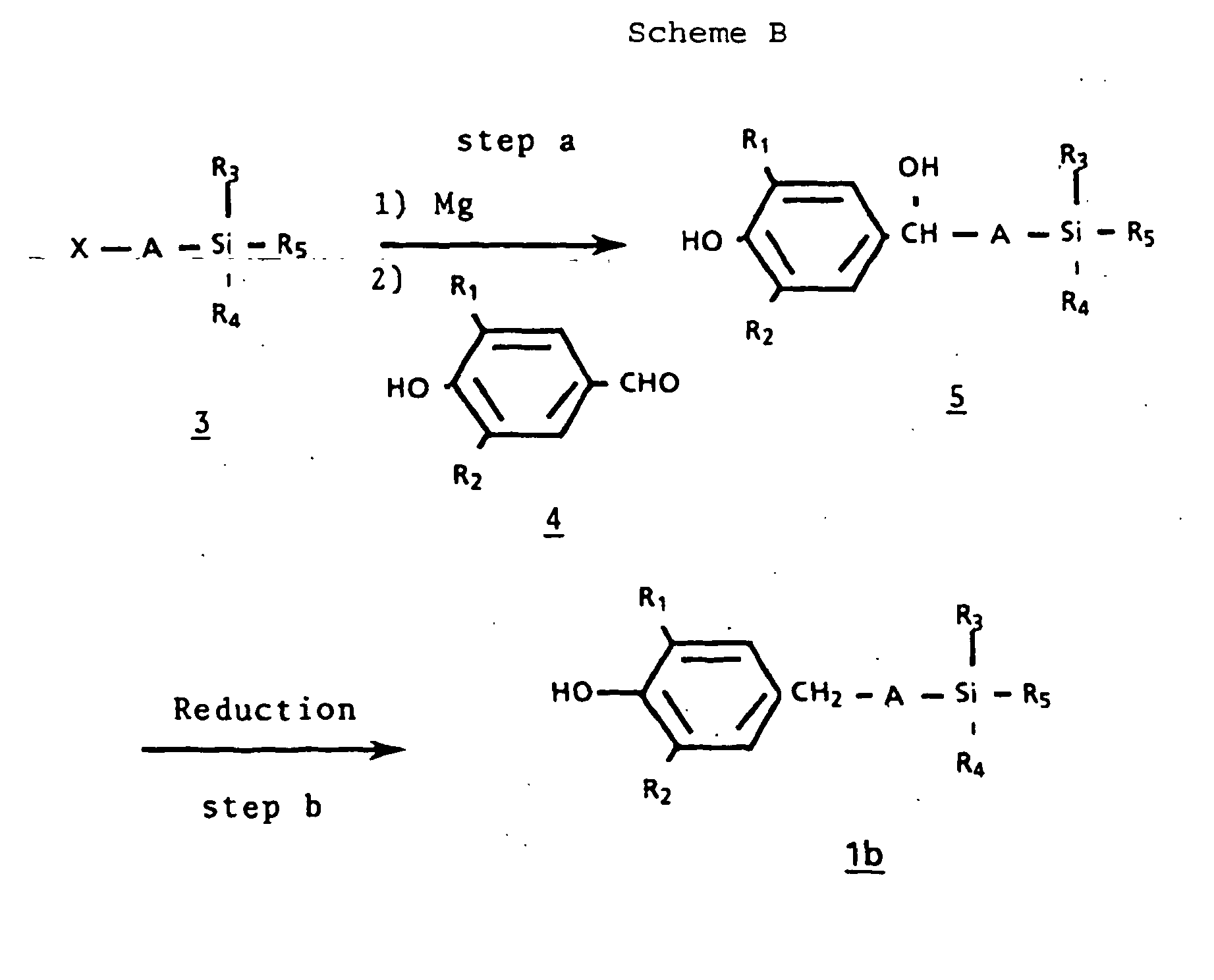
- In general, a phenol of structure 1b can be prepared according to Scheme B in a two-step process. In step a, the appropriate haloalkylenesilane of structure 3 is reacted with magnesium metal in a suitable aprotic solvent, such as ethyl ether, in order to form the magnesium halide salt. The magnesium halide salt (Grignard reagent) is then reacted with the appropriate 3,5-dialkyl-4-hydroxy-benzaldehyde of structure 4 (or a suitably protected derivative) to give the alcohol of structure 5. In step b, the alcohol of structure 5 can be reduced to the desired phenol of structure 1b by a variety of reduction techniques and procedures as are well known and appreciated in the art. For example, the alcohol of structure 5 can be reduced by means of a Birch reduction by reacting it with sodium in liquid ammonia.
- Starting materials for use in the general synthetic procedures outlined in Scheme B are readily available or can readily be prepared according to standard techniques and procedures. Where necessary to prevent undesired side reactions, the 1-phenol functionality of the 3,5-dialkyl-4hydroxy-benzaldehyde of structure 4 in Scheme B may be blocked prior to the Grignard reaction with a standard phenol blocking agent as described previously in Scheme A.
- The following example presents a typical synthesis as described in Scheme B.
- Step a: Mix magnesium turnings (240mg, 10mmol) and anhydrous ethyl ether under an inert atmosphere. Add a solution of chloromethyltrimethylsilane (1.9g, 10mmol) in anhydrous ethyl ether. Stir until the magnesium metal dissolves. Add a solution of 3,5-dimethyl-4-hydroxybenzaldehyde (1.5g, 10mmol) in anhydrous ethyl ether. Stir until reaction is complete. Cool the reaction, mixture to 0°C and add saturated ammonium chloride solution. Separate the ether layer; wash with water and dry (MgSO4). Evaporate to give 4-hydroxy-3,5-dimethyl-α-[(trimethylsilyl)-methyl]benzenemethanol and purify by silica gel chromatrography.
- Step b: Mix sodium metal (520mg, 22.6mmol) and liquid ammonia (13mL). To this solution add, by dropwise addition, a solution of 4-hydroxy-3,5-dimethyl-a-[(trimethylsilyl)methyl]benzenemethanol (2.228, 10mmol) in ethyl alcohol (0.5g) and ethyl ether (5ml). After the blue color disappears, cautiously add water (13ml), extract with ethyl ether, dry (MgSO4), and evaporate the solvent. Purify the residue by silica gel chromatography to yield the title compound.
- Alternatively, compounds of formula (1) wherein Z is methylene can be prepared according to the procedure set forth in Scheme C, wherein all substituents, unless otherwise indicated, are previously described.

- In general, a phenol of structure 1b can be prepared by first reacting the appropriate haloalkylenesilane of structure 3 with magnesium metal in an suitable aprotic solvent, such as ethyl ether, in order to form the magnesium halide salt. The magnesium halide salt (Grignard Reagent) is then reacted with the appropriate 3,5-dialkyl-4-hydroxybenzylhalide of structure 6 (or a suitably protected derivative) to give the desired phenol of structure 1b.
- Starting materials for use in the general synthetic procedures outlined in Scheme C are readily available or can readily be prepared according to standard techniques and procedures. For example, the preparation of 3,5-dimethyl-4acetoxy-benzylbromide is described in Tetrahedron 33, 3097-103 (1977). 3,5-Dimethyl-4-acetoxy-benzylbromide can be converted to the corresponding phenolic starting material by standard hydrolytic procedures.
- Where necessary to prevent undesired side reactions, the 1-phenol functionality of the 3,5-dialkyl-4-hydroxybenzylhalide of structure 6 in Scheme C may be blocked prior to the Grignard reaction with a standard phenol blocking agent as described previously in Scheme A.
- The following example presents a typical syntheses as described in Scheme C.
- Mix magnesium turnings (240mg, 10mmol) and anhydrous ethyl ether under an inert atmosphere. Add a solution of chloromethyltrimethylsilane (1.9g, lommol) in anhydrous ethyl ether. Stir until the magnesium metal dissolves. Add a solution of 4-bromomethyl-2,6-diethylphenol (2.43g, 10mmol) in anhydrous-ethyl ether and reflux the mixture until the reaction is complete. Pour onto a mixture of ice/hydrochloric acid and separate the layers. Wash the ethereal layer with water, dry (MgSO4) and evaporate to give the title compound which is purified by silica gel chromatography.
- The following compounds can be prepared by procedures analogous to those described above in Examples 5 and 6:
- 2,6-dipropyl-4-(2-(trimethylsilyl)ethyl]-phenol
- 2,6-dipropyl-4-[2-(dimethylphenylsilyl) ethyl]-phenol
- 2,6-diisopropyl-4-[2-(trimethylsilyl)ethyl]-phenol
- 2,6-diisopropyl-4-[2-(dimethylphenylsilyl)ethyl]-phenol
- 2,6-diisobutyl-4-[2-(trimethylsilyl)ethyl]-phenol
- 2,6-diisobutyl-4-[2-(dimethylphenylsilyl)ethyl]-phenol
- 2,6-dibutyl-4-(2-(trimethylsilyl)ethyl]-phenol
- 2,6-dibutyl-4-[2-(dimethylphenylsilyl)ethyl]-phenol
- 2,6-di-t-butyl-4-[2-(trimethylsilyl)ethyl]-phenol
- 2,6-di-t-butyl-4-(2-(dimethylphenylsilyl)ethyl]-phenol
- 2,6-di-t-butyl-4-(2-(tri-t-butylsilyl)ethyl]-phenol
- 2,6-di-t-butyl-4-[2-(di-t-butylphenylsilyl)ethyl]-phenol
- 2,6-dimethyl-4-[2-(trimethylsilyl)ethyl]-phenol
- 2,6-dimethyl-4- [2- (dimethylphenylsilyl) ethyl] -phenol.
- It is understood that compounds of formula (1) may exist in various stereoisomeric forms. All stereoisomeric forms which are consistent with the above structural formulas, as interpreted according to standard conventions for expressing stereoisomeric structure, are intended to be included within the scope of the present invention.
- Compounds,of formula (1), e.g. 2,6-di-alkyl-4-silylphenols, are known in the art. Specifically, compounds of formula (1) are described in U.S.P. 5,155,250. Preferred compounds of formula (1) are those in which R1 and R2 are C4 alkyl group, R3 and R4 are a C1 alkyl group; A is a C1 alkylene group, and R5 is - (CH2)n-(Ar) where n is 0 and Ar is phenyl unsubstituted or substituted with one to three substituents selected from the group consisting of hydroxy, methoxy, ethoxy, chloro, fluoro or C1-C6 alkyl. More preferred is the compound 2,6-di-t-butyl-4 [(dimethylphenylsilyl)methyl] -thio-phenol.
- As used herein, the term "patient" refers to warm-blooded animals or mammals, including rabbits and humans.
- An effective amount of a compound of formula (1) is an amount which is effective in treating xanthama in a patient in need thereof.
- An effective amount of a compound of formula (1) can be readily determined by the use of conventional techniques and by observing results obtained under analogous circumstances. In determining the effective dose, a number of factors are considered including, but not limited to: the species of patient; its size, age, and general health; the specific disease involved; the degree of or involvement or the severity of the disease; the response of the individual patient; the particular compound administered; the mode of administration; the bioavailability characteristics of the preparation administered; the dose regimen selected; and the use of concomitant medication.
- An effective amount of a compound of formula (1) will generally vary from 1 milligram per kilogram of body weight per day (mg/kg/day) to 5 grams per kilogram of body weight per day (gm/kg/day). A daily dose of from 1 mg/kg to 500 mg/kg is preferred.
- In effecting treatment of a patient, a compound of formula (1) can be administered in any form or mode which makes the compound bioavailable in effective amounts, including oral and parenteral, routes. For example, the compound can be administered orally, subcutaneously, intramuscularly, intravenously, transdermally, intranasally, rectally, and the like. Oral administration is generally preferred. One skilled in the art of preparing formulations can readily select the proper form and mode of administration depending upon the disease state to be treated, the stage of the disease, and other relevant circumstances.
- A compound of formula (1) can be administered in the form of pharmaceutical compositions or medicaments which are made by combining a compound of formula (1) with pharmaceutically acceptable carriers or excipients, the proportion and nature of which are determined by the chosen route of administration, and standard pharmaceutical practice.
- The pharmaceutical compositions or medicaments are prepared in a manner well known in the pharmaceutical art. The carrier or excipient may be a solid, semi-solid, or liquid material which can serve as a vehicle or medium for the active ingredient. Suitable carriers or excipients are well known in the art. The pharmaceutical composition may be adapted for oral or parenteral use and may be administered to the patient in the form of tablets, capsules, suppositories, solution or suspensions.
- The pharmaceutical compositions may be administered orally, for example, with an inert diluent or with an edible carrier. They may be enclosed in gelatin capsules or compressed into tablets. For the purpose of oral therapeutic administration, a compound of formula (1) may be incorporated with excipients and used in the form of tablets, troches, capsules, elixirs, suspensions, syrups, wafers, chewing gums and the like. These preparations should contain at least 4% of a compound of formula (1), the active ingredient, but may be varied depending upon the particular form and may conveniently be between 4% to 70% of the weight of the unit. The amount of the active ingredient present in compositions is such that a unit dosage form suitable for administration will be obtained.
- The tablets, pills, capsules, troches and the like may also contain one or more of the following adjuvants: binders, such as microcrystalline cellulose, gum tragacanth or gelatin; excipients, such as starch or lactose, disintegrating agents such as alginic acid, Primogel, corn starch and the like; lubricants, such as magnesium stearate or Sterotex; glidants, such as colloidal silicon dioxide; and sweetening agents, such as sucrose or saccharin may be added or flavoring agents, such as peppermint, methyl salicylate or orange flavoring. When the dosage unit form is a capsule, it may contain, in addition to materials of the above type, a liquid carrier such as polyethylene glycol or a fatty oil. Other dosage unit forms may contain other various materials, which modify the physical form of the dosage unit, for example, as coatings. Thus, tablets or pills may be coated with sugar, shellac, or other enteric coating agents. A syrup may contain, in addition to the active ingredient, sucrose as a sweetening agent and certain preservatives, dyes and colorings and flavors. Materials used in preparing these various compositions should be pharmaceutically pure and nontoxic in the amounts used.
- For the purpose of parenteral administration, a compound of formula (1) may be incorporated into a solution or suspension. These preparations should contain at least 0.1% of a compound of the invention, but may be varied to be between 0.1 and 50% of the weight thereof. The amount of the active ingredient present in such compositions is such that a suitable dosage will be obtained.
- The solutions or suspensions may also include one or more of the following adjuvants depending on the solubility and other properties of a compound of formula (1): sterile diluents such as water for injection, saline solution, fixed oils, polyethylene glycols, glycerine, propylene glycol or other synthetic solvents; antibacterial agents such as benzyl alcohol or methyl paraben; antioxidants such as ascorbic acid or sodium bisulfite; chelating agents such as ethylene diaminetetraacetic acid; buffers such as acetates, citrates or phosphates and agents for the adjustment of toxicity such as sodium chloride or dextrose. The parenteral preparation can be enclosed in ampules, disposable syringes or multiple dose vials made of glass or plastic.
- The following examples illustrate the use of compounds of formula (1) according to the present invention.
- New Zealand White (NZW) rabbits (female, aged 3-4 months, weighing less than 3 kg) six in each group, were fed a control diet of 1% cholesterol (100g rabbit chow daily containing 1g cholesterol).or a diet of 1% cholesterol/0.5% drug (100g rabbit chow daily containing 1g cholesterol and 0.5 g MDL 29,353). After 56 days, the rabbits were sacrificed by intravenous injection of pentobarbital. Plasma or serum was collected and cholesterol levels were determined using the enzymatic method of Mao, et al., Clin. Chem. (1983) 29:18901897. The results obtained are summarized in Table 1, below:
-
Day Control (n = 6)Cholesterol (mg/dl) MDL 29,353 (n=6) Cholesterol (mg/dl) 0 61 ± 9 59 ± 8 14 1138 ± 134 684 ± 99 28 1908 ± 256 954 ± 126- 42 2175 ± 376 1118 ± 164 56 2432 ± 475 1035 ± 152 - NZW rabbits (female, aged 3-4 months, weighing less than 3 Kg), six in each group, were fed a control diet of 0.2% cholesterol (100 g rabbit chow daily containing 0.2 g cholesterol) or a diet of 0.2% cholesterol/0.4% drug (100 g rabbit chow daily containing 0.2 g cholesterol and 0.4 g MDL 29,353). After 56 days, the rabbits were sacrificed by intravenous injection of pentobarbital. Plasma or serum was collected and cholesterol levels were determined using the enzymatic method of Mao, et al., Clin. Chem. (1983) 29:18901897. The results obtained are summarized in Table 2 below:
iau~. c a Day Control (n = 6)Cholesterol(mg/dl) M DL 29,353 (n = 6)Cholesterol(mg/dl) 0 73± 10 66±8 7 325 ± 43 154 ± 17 14 587 ± 71 223 ± 32 28 898 ± 126 291 ± 59 42 988 ± 147 357 ± 89 56 941 ± 163 337 ± 100 - The results obtained demonstrate that administration of MDL 29,353 for 56 days produced significant cholesterol lowering in 0.2% cholesterol-fed rabbits. The reduction of cholesterol was 64%.
- New Zealand White rabbits (female, aged 3-4 months, weighing less than 3 kg), four in each group, were fed a normal diet (100 g rabbit chow daily) or a diet of 0.5% drug (100 g rabbit chow daily containing-0.5 g MDL 29,353). Serum was collected and cholesterol levels were determined according to the method of Mao, et al., Clin. Chem. (1983) 29:1890-1897. The results are summarized in Table 3 below:
-
Day Control (n=4)Cholesterol(mg/dl) MDL29,353 (n=4) Cholesterol 0mg/dl 0 47.0 ± 11 45.3 ± 4 8 90.0 ± 13 69.7 ± 6 14 87.3 ± 7 54.8 ± 8 23 81.5 ± 68 58.3 ± 6 - As compared to control rabbits at day 23, the level of cholesterol was significantly reduced by about 29%.
Claims (8)
- The use of a compound of formula (1)
wherein:
- The use of a compound according to claim 1, wherein R1 and R2 are C4 alkyl group.
- The use of a compound according to claim 1, wherein R3 and R4 are C1 alkyl group.
- The use of a compound according to claim 1, wherein A is a C1 alkylene group.
- The use of a compound according to claim 1, wherein Z is thio.
- The use of a compound according to claim 1, wherein R5 is (CH2)n-(Ar) where n is 0 and Ar is phenyl unsubstituted or substituted with one to three substituents selected from hydroxy, methoxy, ethoxy, chloro, fluoro or C1-C6 alkyl group.
- The use of a compound according to claim 1, wherein R1 and R2 are C4 alkyl group, R3 and R4 are C1 alkyl group, A is C1 alkylene group, and R5 is -(CH2)n-(Ar) where n is 0 and Ar is phenyl unsubstituted or substituted with one to three substituents selected from hydroxy, methoxy, ethoxy, chloro, fluoro or C1-C6 alkyl group.
- The use of a compound according to claims 1 to 8, wherein the compound is 2,6-di-t-butyl-[(dimethylphenylsilyl)methyl-thio-phenol.
Applications Claiming Priority (3)
| Application Number | Priority Date | Filing Date | Title |
|---|---|---|---|
| US16528193A | 1993-12-10 | 1993-12-10 | |
| US165281 | 1993-12-10 | ||
| EP95901141A EP0732928B1 (en) | 1993-12-10 | 1994-11-03 | Method of lowering serum cholesterol levels with 2,6-di-alkyl-4-silyl-phenols |
Related Parent Applications (1)
| Application Number | Title | Priority Date | Filing Date |
|---|---|---|---|
| EP95901141A Division EP0732928B1 (en) | 1993-12-10 | 1994-11-03 | Method of lowering serum cholesterol levels with 2,6-di-alkyl-4-silyl-phenols |
Publications (3)
| Publication Number | Publication Date |
|---|---|
| EP1468692A2 EP1468692A2 (en) | 2004-10-20 |
| EP1468692A3 EP1468692A3 (en) | 2004-11-03 |
| EP1468692B1 true EP1468692B1 (en) | 2006-04-26 |
Family
ID=22598245
Family Applications (3)
| Application Number | Title | Priority Date | Filing Date |
|---|---|---|---|
| EP04016884A Withdrawn EP1468693A3 (en) | 1993-12-10 | 1994-11-03 | Use of 2,6-di -alkyl-4-silyl-phenols for treating diabetes mellitus |
| EP04016883A Expired - Lifetime EP1468692B1 (en) | 1993-12-10 | 1994-11-03 | Use of 2,6-di-alkyl-4-silyl-phenols for treating xanthoma |
| EP95901141A Expired - Lifetime EP0732928B1 (en) | 1993-12-10 | 1994-11-03 | Method of lowering serum cholesterol levels with 2,6-di-alkyl-4-silyl-phenols |
Family Applications Before (1)
| Application Number | Title | Priority Date | Filing Date |
|---|---|---|---|
| EP04016884A Withdrawn EP1468693A3 (en) | 1993-12-10 | 1994-11-03 | Use of 2,6-di -alkyl-4-silyl-phenols for treating diabetes mellitus |
Family Applications After (1)
| Application Number | Title | Priority Date | Filing Date |
|---|---|---|---|
| EP95901141A Expired - Lifetime EP0732928B1 (en) | 1993-12-10 | 1994-11-03 | Method of lowering serum cholesterol levels with 2,6-di-alkyl-4-silyl-phenols |
Country Status (16)
| Country | Link |
|---|---|
| EP (3) | EP1468693A3 (en) |
| JP (1) | JPH09511222A (en) |
| CN (1) | CN1092517C (en) |
| AT (2) | ATE324113T1 (en) |
| AU (1) | AU681731B2 (en) |
| CA (1) | CA2177968C (en) |
| DE (2) | DE69434720T2 (en) |
| DK (2) | DK1468692T3 (en) |
| ES (2) | ES2233937T3 (en) |
| HU (1) | HU220761B1 (en) |
| IL (1) | IL111905A (en) |
| NO (1) | NO311868B1 (en) |
| NZ (1) | NZ276285A (en) |
| PT (2) | PT732928E (en) |
| WO (1) | WO1995015760A1 (en) |
| ZA (1) | ZA949663B (en) |
Families Citing this family (16)
| Publication number | Priority date | Publication date | Assignee | Title |
|---|---|---|---|---|
| US6670398B2 (en) | 1997-05-14 | 2003-12-30 | Atherogenics, Inc. | Compounds and methods for treating transplant rejection |
| ATE356113T1 (en) | 1997-05-14 | 2007-03-15 | Atherogenics Inc | PROBUCOLSUMRIC ACID ESTERS TO INHIBIT THE EXPRESSION OF VCAM-1 |
| ES2190592T3 (en) * | 1997-06-24 | 2003-08-01 | Aventis Pharma Inc | PHENOLS AND THIOPHENOLS RENT-4-SILILHETEROCICLIC AS ANTIOXIDANT AGENTS. |
| US6133467A (en) * | 1997-06-25 | 2000-10-17 | Hoechst Marion Roussel, Inc. | 2,6-di-t-butyl-4-[(dimethyl-4-methoxyphenylsilyl)-methyl-oxy]phenol and 2,6-di-t-butyl-4-[(dimethyl-2-methoxy-phenylsilyl)methyloxy]phenol |
| AU7588498A (en) * | 1997-06-25 | 1999-01-04 | Hoechst Marion Roussel, Inc. | 2,6-di-t-butyl-4-{ (dimethyl-4-methoxyphenylsilyl) -methyloxy}phenol and 2,6-di-t-butyl-4-{ (dimethyl-2-methoxy-phenylsilyl) -methyloxy}phenol |
| AU8282798A (en) | 1997-07-01 | 1999-01-25 | Atherogenics, Inc. | Antioxidant enhancement of therapy for hyperproliferative conditions |
| AU1911200A (en) * | 1998-11-09 | 2000-05-29 | Atherogenics, Inc. | Methods and compositions to lower plasma cholesterol levels |
| US6887712B1 (en) | 1998-11-09 | 2005-05-03 | Atherogenics, Inc. | Methods and compositions to lower plasma cholesterol levels |
| US6821738B2 (en) | 1999-01-20 | 2004-11-23 | The Board Of Regents For Oklahoma State University | Broad spectrum bio-detection of nerve agents, organophosphates, and other chemical warfare agents |
| CA2428753C (en) | 2000-11-17 | 2013-05-21 | Universita Degli Studi Di Cagliari | Methods for inhibiting the transmission of hiv using topically applied substituted 6-benzyl-4-oxopyrimidines |
| IL162533A0 (en) | 2001-12-19 | 2005-11-20 | Atherogenics Inc | Chalcone derivatives and their use to treat diseases |
| US6960683B2 (en) | 2002-07-12 | 2005-11-01 | Atherogenics, Inc. | Salt forms of poorly soluble probucol esters and ethers |
| US7173129B2 (en) | 2003-06-06 | 2007-02-06 | Athero Genics, Inc. | Sulfonamide-substituted chalcone derivatives and their use to treat diseases |
| JP2007509054A (en) * | 2003-10-17 | 2007-04-12 | アミリン・ファーマシューティカルズ,インコーポレイテッド | Silylphenol promotes vascular health |
| WO2005112914A2 (en) | 2004-04-20 | 2005-12-01 | Atherogenics, Inc. | Phenolic antioxidants for the treatment of disorders including arthritis, asthma and coronary artery disease |
| EP2139320A4 (en) | 2007-03-26 | 2010-09-08 | Salutria Pharmaceuticals Llc | Methods and compositions of derivatives of probucol for the treatment of diabetes |
Family Cites Families (7)
| Publication number | Priority date | Publication date | Assignee | Title |
|---|---|---|---|---|
| SE349046B (en) * | 1966-12-23 | 1972-09-18 | C Guevne | |
| FR2230376A1 (en) * | 1973-05-24 | 1974-12-20 | Gueyne Jean | Stable solutions of siloxanic polysilanols - prepd. by hydrolysis of a silane and having pharmaceutical activity |
| FR2308372A2 (en) * | 1975-04-21 | 1976-11-19 | Cortial | Medicaments for treatment of cardio-vascular troubles, atheroscleoris - hyperlipemia and hypercholesterolemia contain para-trimethylsilyl-phenoxy-isobutyric acid or para-trimethylsilyl-phenyl-alkanoic acids |
| US4670421A (en) * | 1982-07-12 | 1987-06-02 | American Cyanamid Company | Antiatherosclerotic silanes |
| US4900757A (en) * | 1988-12-08 | 1990-02-13 | Merrell Dow Pharmaceuticals Inc. | Hypocholesterolemic and antiatherosclerotic uses of bix(3,5-di-tertiary-butyl-4-hydroxyphenylthio)methane |
| US5155250A (en) * | 1990-07-05 | 1992-10-13 | Merrell Dow Pharmaceuticals Inc. | 2,6-di-alkyl-4-silyl-phenols as antiatheroscerotic agents |
| NZ238807A (en) * | 1990-07-05 | 1994-03-25 | Merrell Dow Pharma | Bis[4-(2,6-dialkyl)phenol]silane derivatives and antiatherosclerotic compositions |
-
1994
- 1994-11-03 ES ES95901141T patent/ES2233937T3/en not_active Expired - Lifetime
- 1994-11-03 CN CN94194438A patent/CN1092517C/en not_active Expired - Fee Related
- 1994-11-03 PT PT95901141T patent/PT732928E/en unknown
- 1994-11-03 EP EP04016884A patent/EP1468693A3/en not_active Withdrawn
- 1994-11-03 WO PCT/US1994/012702 patent/WO1995015760A1/en not_active Ceased
- 1994-11-03 DE DE69434720T patent/DE69434720T2/en not_active Expired - Lifetime
- 1994-11-03 DE DE69434198T patent/DE69434198T2/en not_active Expired - Fee Related
- 1994-11-03 AT AT04016883T patent/ATE324113T1/en not_active IP Right Cessation
- 1994-11-03 CA CA002177968A patent/CA2177968C/en not_active Expired - Fee Related
- 1994-11-03 DK DK04016883T patent/DK1468692T3/en active
- 1994-11-03 JP JP7516186A patent/JPH09511222A/en not_active Ceased
- 1994-11-03 ES ES04016883T patent/ES2263094T3/en not_active Expired - Lifetime
- 1994-11-03 PT PT04016883T patent/PT1468692E/en unknown
- 1994-11-03 HU HU9601590A patent/HU220761B1/en not_active IP Right Cessation
- 1994-11-03 AT AT95901141T patent/ATE285238T1/en not_active IP Right Cessation
- 1994-11-03 EP EP04016883A patent/EP1468692B1/en not_active Expired - Lifetime
- 1994-11-03 NZ NZ276285A patent/NZ276285A/en not_active IP Right Cessation
- 1994-11-03 DK DK95901141T patent/DK0732928T3/en active
- 1994-11-03 EP EP95901141A patent/EP0732928B1/en not_active Expired - Lifetime
- 1994-11-03 AU AU10499/95A patent/AU681731B2/en not_active Ceased
- 1994-12-05 ZA ZA949663A patent/ZA949663B/en unknown
- 1994-12-07 IL IL11190594A patent/IL111905A/en not_active IP Right Cessation
-
1996
- 1996-06-07 NO NO19962415A patent/NO311868B1/en not_active IP Right Cessation
Also Published As
Similar Documents
| Publication | Publication Date | Title |
|---|---|---|
| EP0464852B1 (en) | Novel 2,6-di-alkyl-4-silyl-phenols as antiatherosclerotic agents and as antioxidants | |
| US5677291A (en) | Method of lowering serum cholesterol levels with 2,6-di-alkyl-4-silyl-phenols | |
| EP0732928B1 (en) | Method of lowering serum cholesterol levels with 2,6-di-alkyl-4-silyl-phenols | |
| EP0464844B1 (en) | Novel bis (4-(2,6-di-alkyl)phenol)silane derivatives as antiatherosclerotic agents and as antioxidants | |
| US5304668A (en) | Bis-[4-(2,6-di-alkyl)phenolisilane derivatives as antiatherosclerotic agents |
Legal Events
| Date | Code | Title | Description |
|---|---|---|---|
| PUAI | Public reference made under article 153(3) epc to a published international application that has entered the european phase |
Free format text: ORIGINAL CODE: 0009012 |
|
| PUAL | Search report despatched |
Free format text: ORIGINAL CODE: 0009013 |
|
| AC | Divisional application: reference to earlier application |
Ref document number: 0732928 Country of ref document: EP Kind code of ref document: P |
|
| AK | Designated contracting states |
Kind code of ref document: A2 Designated state(s): AT BE CH DE DK ES FR GB GR IE IT LI LU MC NL PT SE |
|
| AK | Designated contracting states |
Kind code of ref document: A3 Designated state(s): AT BE CH DE DK ES FR GB GR IE IT LI LU MC NL PT SE |
|
| 17P | Request for examination filed |
Effective date: 20050503 |
|
| AKX | Designation fees paid |
Designated state(s): AT BE CH DE DK ES FR GB GR IE IT LI LU MC NL PT SE |
|
| GRAP | Despatch of communication of intention to grant a patent |
Free format text: ORIGINAL CODE: EPIDOSNIGR1 |
|
| GRAS | Grant fee paid |
Free format text: ORIGINAL CODE: EPIDOSNIGR3 |
|
| GRAA | (expected) grant |
Free format text: ORIGINAL CODE: 0009210 |
|
| AC | Divisional application: reference to earlier application |
Ref document number: 0732928 Country of ref document: EP Kind code of ref document: P |
|
| AK | Designated contracting states |
Kind code of ref document: B1 Designated state(s): AT BE CH DE DK ES FR GB GR IE IT LI LU MC NL PT SE |
|
| PG25 | Lapsed in a contracting state [announced via postgrant information from national office to epo] |
Ref country code: IT Free format text: LAPSE BECAUSE OF FAILURE TO SUBMIT A TRANSLATION OF THE DESCRIPTION OR TO PAY THE FEE WITHIN THE PRESCRIBED TIME-LIMIT;WARNING: LAPSES OF ITALIAN PATENTS WITH EFFECTIVE DATE BEFORE 2007 MAY HAVE OCCURRED AT ANY TIME BEFORE 2007. THE CORRECT EFFECTIVE DATE MAY BE DIFFERENT FROM THE ONE RECORDED. Effective date: 20060426 |
|
| REG | Reference to a national code |
Ref country code: GB Ref legal event code: FG4D |
|
| RIN1 | Information on inventor provided before grant (corrected) |
Inventor name: YATES, MARK THIRSTON Inventor name: PARKER, ROGER ALAN Inventor name: MAO, SIMON JEN TAN |
|
| RAP2 | Party data changed (patent owner data changed or rights of a patent transferred) |
Owner name: AVENTIS INC. |
|
| REG | Reference to a national code |
Ref country code: IE Ref legal event code: FG4D |
|
| REF | Corresponds to: |
Ref document number: 69434720 Country of ref document: DE Date of ref document: 20060601 Kind code of ref document: P |
|
| NLT2 | Nl: modifications (of names), taken from the european patent patent bulletin |
Owner name: AVENTIS INC. Effective date: 20060524 |
|
| REG | Reference to a national code |
Ref country code: SE Ref legal event code: TRGR Ref country code: CH Ref legal event code: NV Representative=s name: SUSI PRYDE-HAENI BSC |
|
| REG | Reference to a national code |
Ref country code: DK Ref legal event code: T3 |
|
| REG | Reference to a national code |
Ref country code: GR Ref legal event code: EP Ref document number: 20060402512 Country of ref document: GR |
|
| REG | Reference to a national code |
Ref country code: PT Ref legal event code: SC4A Effective date: 20060719 |
|
| PG25 | Lapsed in a contracting state [announced via postgrant information from national office to epo] |
Ref country code: MC Free format text: LAPSE BECAUSE OF NON-PAYMENT OF DUE FEES Effective date: 20061130 |
|
| REG | Reference to a national code |
Ref country code: ES Ref legal event code: FG2A Ref document number: 2263094 Country of ref document: ES Kind code of ref document: T3 |
|
| ET | Fr: translation filed | ||
| PLBE | No opposition filed within time limit |
Free format text: ORIGINAL CODE: 0009261 |
|
| STAA | Information on the status of an ep patent application or granted ep patent |
Free format text: STATUS: NO OPPOSITION FILED WITHIN TIME LIMIT |
|
| 26N | No opposition filed |
Effective date: 20070129 |
|
| PGFP | Annual fee paid to national office [announced via postgrant information from national office to epo] |
Ref country code: IE Payment date: 20081114 Year of fee payment: 15 Ref country code: NL Payment date: 20081103 Year of fee payment: 15 Ref country code: DK Payment date: 20081114 Year of fee payment: 15 Ref country code: LU Payment date: 20081119 Year of fee payment: 15 Ref country code: CH Payment date: 20081117 Year of fee payment: 15 |
|
| PGFP | Annual fee paid to national office [announced via postgrant information from national office to epo] |
Ref country code: ES Payment date: 20081216 Year of fee payment: 15 Ref country code: PT Payment date: 20081014 Year of fee payment: 15 Ref country code: AT Payment date: 20081112 Year of fee payment: 15 |
|
| PGFP | Annual fee paid to national office [announced via postgrant information from national office to epo] |
Ref country code: BE Payment date: 20081110 Year of fee payment: 15 Ref country code: SE Payment date: 20081107 Year of fee payment: 15 Ref country code: IT Payment date: 20081126 Year of fee payment: 15 |
|
| PGFP | Annual fee paid to national office [announced via postgrant information from national office to epo] |
Ref country code: FR Payment date: 20081112 Year of fee payment: 15 |
|
| PGFP | Annual fee paid to national office [announced via postgrant information from national office to epo] |
Ref country code: GB Payment date: 20081029 Year of fee payment: 15 Ref country code: GR Payment date: 20081016 Year of fee payment: 15 |
|
| REG | Reference to a national code |
Ref country code: PT Ref legal event code: MM4A Free format text: LAPSE DUE TO NON-PAYMENT OF FEES Effective date: 20100503 |
|
| BERE | Be: lapsed |
Owner name: *AVENTIS INC. Effective date: 20091130 |
|
| REG | Reference to a national code |
Ref country code: NL Ref legal event code: V1 Effective date: 20100601 |
|
| EUG | Se: european patent has lapsed | ||
| PGFP | Annual fee paid to national office [announced via postgrant information from national office to epo] |
Ref country code: DE Payment date: 20091130 Year of fee payment: 16 |
|
| REG | Reference to a national code |
Ref country code: CH Ref legal event code: PL |
|
| REG | Reference to a national code |
Ref country code: DK Ref legal event code: EBP |
|
| GBPC | Gb: european patent ceased through non-payment of renewal fee |
Effective date: 20091103 |
|
| PG25 | Lapsed in a contracting state [announced via postgrant information from national office to epo] |
Ref country code: PT Free format text: LAPSE BECAUSE OF NON-PAYMENT OF DUE FEES Effective date: 20100503 |
|
| REG | Reference to a national code |
Ref country code: FR Ref legal event code: ST Effective date: 20100730 |
|
| PG25 | Lapsed in a contracting state [announced via postgrant information from national office to epo] |
Ref country code: AT Free format text: LAPSE BECAUSE OF NON-PAYMENT OF DUE FEES Effective date: 20091103 |
|
| PG25 | Lapsed in a contracting state [announced via postgrant information from national office to epo] |
Ref country code: NL Free format text: LAPSE BECAUSE OF NON-PAYMENT OF DUE FEES Effective date: 20100601 Ref country code: IE Free format text: LAPSE BECAUSE OF NON-PAYMENT OF DUE FEES Effective date: 20091103 Ref country code: GR Free format text: LAPSE BECAUSE OF NON-PAYMENT OF DUE FEES Effective date: 20100602 Ref country code: FR Free format text: LAPSE BECAUSE OF NON-PAYMENT OF DUE FEES Effective date: 20091130 Ref country code: CH Free format text: LAPSE BECAUSE OF NON-PAYMENT OF DUE FEES Effective date: 20091130 Ref country code: BE Free format text: LAPSE BECAUSE OF NON-PAYMENT OF DUE FEES Effective date: 20091130 Ref country code: LI Free format text: LAPSE BECAUSE OF NON-PAYMENT OF DUE FEES Effective date: 20091130 |
|
| PG25 | Lapsed in a contracting state [announced via postgrant information from national office to epo] |
Ref country code: GB Free format text: LAPSE BECAUSE OF NON-PAYMENT OF DUE FEES Effective date: 20091103 |
|
| PG25 | Lapsed in a contracting state [announced via postgrant information from national office to epo] |
Ref country code: DK Free format text: LAPSE BECAUSE OF NON-PAYMENT OF DUE FEES Effective date: 20091130 |
|
| REG | Reference to a national code |
Ref country code: ES Ref legal event code: FD2A Effective date: 20110310 |
|
| PG25 | Lapsed in a contracting state [announced via postgrant information from national office to epo] |
Ref country code: IT Free format text: LAPSE BECAUSE OF NON-PAYMENT OF DUE FEES Effective date: 20091103 |
|
| PG25 | Lapsed in a contracting state [announced via postgrant information from national office to epo] |
Ref country code: LU Free format text: LAPSE BECAUSE OF NON-PAYMENT OF DUE FEES Effective date: 20091103 |
|
| PG25 | Lapsed in a contracting state [announced via postgrant information from national office to epo] |
Ref country code: SE Free format text: LAPSE BECAUSE OF NON-PAYMENT OF DUE FEES Effective date: 20091104 |
|
| PG25 | Lapsed in a contracting state [announced via postgrant information from national office to epo] |
Ref country code: ES Free format text: LAPSE BECAUSE OF NON-PAYMENT OF DUE FEES Effective date: 20110309 |
|
| REG | Reference to a national code |
Ref country code: DE Ref legal event code: R119 Ref document number: 69434720 Country of ref document: DE Effective date: 20110601 Ref country code: DE Ref legal event code: R119 Ref document number: 69434720 Country of ref document: DE Effective date: 20110531 |
|
| PG25 | Lapsed in a contracting state [announced via postgrant information from national office to epo] |
Ref country code: ES Free format text: LAPSE BECAUSE OF NON-PAYMENT OF DUE FEES Effective date: 20091104 |
|
| PG25 | Lapsed in a contracting state [announced via postgrant information from national office to epo] |
Ref country code: DE Free format text: LAPSE BECAUSE OF NON-PAYMENT OF DUE FEES Effective date: 20110531 |