EP1468608A2 - Microbicidal composition - Google Patents
Microbicidal composition Download PDFInfo
- Publication number
- EP1468608A2 EP1468608A2 EP04251954A EP04251954A EP1468608A2 EP 1468608 A2 EP1468608 A2 EP 1468608A2 EP 04251954 A EP04251954 A EP 04251954A EP 04251954 A EP04251954 A EP 04251954A EP 1468608 A2 EP1468608 A2 EP 1468608A2
- Authority
- EP
- European Patent Office
- Prior art keywords
- alkyl
- triazine
- isothiazolin
- carbamate
- composition
- Prior art date
- Legal status (The legal status is an assumption and is not a legal conclusion. Google has not performed a legal analysis and makes no representation as to the accuracy of the status listed.)
- Withdrawn
Links
Classifications
-
- A—HUMAN NECESSITIES
- A01—AGRICULTURE; FORESTRY; ANIMAL HUSBANDRY; HUNTING; TRAPPING; FISHING
- A01N—PRESERVATION OF BODIES OF HUMANS OR ANIMALS OR PLANTS OR PARTS THEREOF; BIOCIDES, e.g. AS DISINFECTANTS, AS PESTICIDES OR AS HERBICIDES; PEST REPELLANTS OR ATTRACTANTS; PLANT GROWTH REGULATORS
- A01N43/00—Biocides, pest repellants or attractants, or plant growth regulators containing heterocyclic compounds
- A01N43/72—Biocides, pest repellants or attractants, or plant growth regulators containing heterocyclic compounds having rings with nitrogen atoms and oxygen or sulfur atoms as ring hetero atoms
- A01N43/80—Biocides, pest repellants or attractants, or plant growth regulators containing heterocyclic compounds having rings with nitrogen atoms and oxygen or sulfur atoms as ring hetero atoms five-membered rings with one nitrogen atom and either one oxygen atom or one sulfur atom in positions 1,2
-
- A—HUMAN NECESSITIES
- A01—AGRICULTURE; FORESTRY; ANIMAL HUSBANDRY; HUNTING; TRAPPING; FISHING
- A01N—PRESERVATION OF BODIES OF HUMANS OR ANIMALS OR PLANTS OR PARTS THEREOF; BIOCIDES, e.g. AS DISINFECTANTS, AS PESTICIDES OR AS HERBICIDES; PEST REPELLANTS OR ATTRACTANTS; PLANT GROWTH REGULATORS
- A01N47/00—Biocides, pest repellants or attractants, or plant growth regulators containing organic compounds containing a carbon atom not being member of a ring and having no bond to a carbon or hydrogen atom, e.g. derivatives of carbonic acid
- A01N47/08—Biocides, pest repellants or attractants, or plant growth regulators containing organic compounds containing a carbon atom not being member of a ring and having no bond to a carbon or hydrogen atom, e.g. derivatives of carbonic acid the carbon atom having one or more single bonds to nitrogen atoms
- A01N47/10—Carbamic acid derivatives, i.e. containing the group —O—CO—N<; Thio analogues thereof
- A01N47/12—Carbamic acid derivatives, i.e. containing the group —O—CO—N<; Thio analogues thereof containing a —O—CO—N< group, or a thio analogue thereof, neither directly attached to a ring nor the nitrogen atom being a member of a heterocyclic ring
Definitions
- This invention relates to a combination of selected microbicides.
- microbicides cannot provide effective control of microorganisms, even at high use concentrations, due to weak activity against certain types of microorganisms, e.g., those resistant to some microbicides.
- Combinations of different microbicides are sometimes used to provide overall control of microorganisms in a particular end use environment. For example, a combination of 3-iodo-2-propynyl butyl carbamate and a sulfur-containing s-triazine is disclosed in U.S. Pat. No. 5,707,929.
- One problem addressed by this invention is to provide such additional combinations of microbicides.
- Another problem addressed by this invention is to provide additional combinations of microbicides that contain at most low levels of microbicides that are undesirable for toxicological reasons.
- combination biocides including methyl-N-benzimidazol-2-yl carbamate are known.
- the toxicity of this compound to non-target organisms makes combinations including it in substantial amounts less desirable.
- combinations containing halogenated 3-isothiazolones at high levels are undesirable.
- the present invention is directed to a microbicidal composition
- a microbicidal composition comprising: (a) at least one 2-alkyl-4-isothiazolin-3-one; (b) at least one halopropynyl carbamate; and (c) at least one sulfur-containing s-triazine.
- microbicide refers to a compound capable of inhibiting the growth of or controlling the growth of microorganisms at a locus; microbicides include bactericides, fungicides and algaecides.
- microorganism includes, for example, fungi (such as yeast and mold), bacteria and algae.
- alkyl is a hydrocarbyl group having from one to twenty carbon atoms in a linear, branched or cyclic arrangement.
- An "aryl” group is a substituent derived from an aromatic hydrocarbon compound.
- An aryl group has a total of from six to twenty ring atoms, and has one or more rings which are separate or fused.
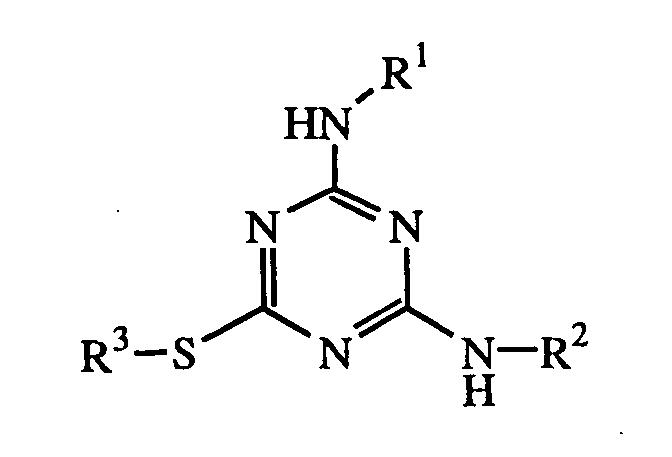
- the at least one sulfur-containing s-triazine is at least one 2-N-alkyl-4-N-alkyl-6-alkylthio-1,3,5-triazine-2,4-diylamine, i.e., a compound of formula wherein R 1 , R 2 and R 3 are alkyl groups.
- R 1 , R 2 and R 3 are C 1 -C 6 alkyl groups, more preferably C 1 -C 4 alkyl groups.
- R 3 is methyl.
- R 1 and R 2 are C 2 -C 4 alkyl groups.
- the at least one sulfur-containing s-triazine is selected from the group consisting of 2-N-cyclopropyl-4-N-tert-butyl-6-methylthio-1,3,5-triazine-2,4-diylamine (also known as Cybutryn, available from CIBA Spezialitaeten Chemie AG as IrgarolTM 1071) and 2-N-ethyl-4-N-tert-butyl-6-methylthio-1,3,5-triazine-2,4-diylamine (also known as Terbutryn).
- 2-N-cyclopropyl-4-N-tert-butyl-6-methylthio-1,3,5-triazine-2,4-diylamine also known as Cybutryn
- the microbicidal composition contains at least 1% of the sulfur-containing s-triazine(s), more preferably at least 1.5%, and most preferably at least 2%.
- the microbicidal composition contains no more than 15% of the sulfur-containing s-triazine(s), more preferably no more than 10%.
- the at least one sulfur-containing s-triazine is 2-N-cyclopropyl-4-N-tert-butyl-6-methylthio-1,3,5-triazine-2,4-diylamine
- the composition contains no more than 7% of this compound, and most preferably no more than 4%.
- the at least one halopropynyl carbamate is at least one 3-iodo-2-propynyl carbamate, more preferably a 3-iodo-2-propynyl alkyl carbamate or 3-iodo-2-propynyl aryl carbamate, and most preferably a 3-iodo-2-propynyl C 3 -C 6 alkyl carbamate.
- the at least one halopropynyl carbamate is 3-iodo-2-propynyl n-butyl carbamate ("IPBC").
- the microbicidal composition contains at least 0.5% of the halopropynyl carbamate(s), more preferably at least 1.5%, more preferably at least 3%, more preferably at least 5% and most preferably at least 8%.
- the microbicidal composition contains no more than 20% of the halopropynyl carbamate(s), more preferably no more than 15%, and most preferably no more than 12%.
- microbicidal compositions of the present invention preferably contain no more than 5% of halogenated 3-isothiazolones; that is, zero or up to 5%, preferably zero or up to 3%, more preferably zero or up to 2%, and most preferably zero or up to 1% of halogenated 3-isothiazolones may be present.
- Microbicidal compositions dependent on the presence of halogenated 3-isothiazolone are susceptible to chemical degradation and may require additional stabilizer components, such as metal salt stabilizers; salt stabilizers sometimes create unacceptable properties in finished formulations.
- microbicidal compositions of the present invention are substantially free of methyl-N-benzimidazol-2-yl carbamate, i.e., they contain less than 0.5%, more preferably less than 0.3%, and most preferably less than 0.1%.
- the at least one 2-alkyl-4-isothiazolin-3-one is at least one substituted or unsubstituted 2-(C 4 -C 10 ) alkyl-4-isothiazolin-3-one.
- Substituted 2-(C 4 -C 10 ) alkyl-4-isothiazolin-3-ones may contain (C 1 -C 4 alkyl groups or chloro substituents at one or both of the 4- and 5-positions of the isothiazolone ring.
- the C 4 -C 10 alkyl group is an octyl group, most preferably an n-octyl group.
- the at least one 2-(C 4 -C 10 ) alkyl-4-isothiazolin-3-one is selected from the group consisting of 2-n-octyl-4-isothiazolin-3-one ("OIT") and 4,5-dichloro-2-n-octyl-4-isothiazolin-3-one ("DCOIT").
- OIT 2-n-octyl-4-isothiazolin-3-one
- DCOIT 4,5-dichloro-2-n-octyl-4-isothiazolin-3-one
- the microbicidal composition contains at least 0.2% of the 2-alkyl-4-isothiazolin-3-one(s), more preferably at least 0.3%, and most preferably at least 0.4%.
- the microbicidal composition contains no more than 10% of the 2-alkyl-4-isothiazolin-3-one(s), more preferably no more than 5%, more preferably no more than 3%, and most preferably no more than 2%.
- microbicidal composition of this invention optionally contains other biocidal active ingredients in addition to the ones described specifically in this application.
- the component microbicides may be used in the mixtures of the present invention "as is" or may first be formulated with a solvent or a solid carrier.
- suitable solvents include, for example, water; glycols, such as ethylene glycol, propylene glycol, diethylene glycol, dipropylene glycol, polyethylene glycol, and polypropylene glycol; glycol ethers; alcohols, such as methanol, ethanol, propanol, phenethyl alcohol and phenoxypropanol; ketones, such as acetone and methyl ethyl ketone; esters, such as ethyl acetate, butyl acetate, triacetyl citrate, and glycerol triacetate; carbonates, such as propylene carbonate and dimethyl carbonate; and mixtures thereof.
- the solvent is selected from water, glycols, glycol ethers, esters and mixtures thereof.
- Suitable solid carriers include, for example, cyclodextrin, silicas, diatomaceous earth, waxes, cellulosic materials and charcoal. It is preferred that the microbicides are formulated in water.
- the formulation may optionally contain surfactants.
- surfactants they are generally in the form of emulsifiable concentrates, emulsions, microemulsifiable concentrates, or microemulsions.
- Emulsifiable concentrates form emulsions upon the addition of a sufficient amount of water.
- Microemulsifiable concentrates form microemulsions upon the addition of a sufficient amount of water.
- Such emulsifiable and microemulsifiable concentrates are generally well known in the art; it is preferred that such formulations are free of surfactants.
- U.S. Patent No. 5,444,078 may be consulted for further general and specific details on the preparation of various microemulsions and microemulsifiable concentrates.
- a microbicide component having low water solubility also can be formulated in the form of a dispersion.
- the solvent component of the dispersion can be an organic solvent or water, preferably water.
- Such dispersions can contain adjuvants, for example, co-solvents, thickeners, anti-freeze agents, dispersants, fillers, pigments, surfactants, stabilizers, scale inhibitors and anti-corrosion additives.
- any formulation of any component microbicide may be used with any formulation of another component microbicide in the mixtures of the present invention.
- the solvent used for each microbicide may be the same as or different from the solvent used to formulate the other commercial microbicides. It is preferred that the solvents are miscible.
- the microbicides may be combined directly and then a solvent added to the mixture.
- microbicide components of the present invention may be added to a locus sequentially, simultaneously, or may be combined before being added to the locus. It is preferred that the microbicide components be added to a locus simultaneously or combined prior to being added to the locus.
- adjuvants such as, for example, solvent, thickeners, anti-freeze agents, colorants, sequestrants (such as ethylenediamine-tetraacetic acid, ethylenediaminedisuccinic acid, iminodisuccinic acid and salts thereof), dispersants, surfactants, stabilizers, scale inhibitors and anti-corrosion additives.
- microbicidal compositions of the present invention can be used to inhibit the growth of microorganisms by introducing a microbicidally effective amount of the compositions onto, into, or at a locus subject to microbial attack.
- Suitable loci include, for example: cooling towers; air washers; boilers; mineral slurries; wastewater treatment; ornamental fountains; reverse osmosis filtration; ultrafiltration; ballast water; evaporative condensers; heat exchangers; pulp and paper processing fluids; plastics; emulsions; dispersions; paints; latexes; coatings, such as varnishes; construction products, such as mastics, caulks, and sealants; construction adhesives, such as ceramic adhesives, carpet backing adhesives, and laminating adhesives; industrial or consumer adhesives; photographic chemicals; printing fluids; household products, such as bathroom and kitchen cleaners; cosmetics; toiletries; shampoos; soaps; detergents; industrial cleaners; floor polishes; laundry rinse water; metal
- the microbicidal compositions of the present invention are used to inhibit the growth of microorganisms at a locus selected from one or more of emulsions, dispersions, paints, latexes, household products, detergents and industrial cleaners.
- the microbicidal compositions are useful in emulsions, dispersions, paints and latexes.
- the specific amount of the combinations necessary to inhibit or control the growth of microorganisms in a locus depends upon the particular compounds in the combination and particular locus to be protected. Typically, the amount of the combinations of the present invention to control the growth of microorganisms in a locus is sufficient if it provides 50 to 20,000 ppm active ingredient of the combinations in the locus. It is preferred that the combination be present in the locus in an amount of at least 100 ppm, more preferably at least 200 ppm, more preferably at least 300 ppm and most preferably at least 500 ppm. It is preferred that the combinations be present in the locus in an amount of no more than 10,000 ppm, more preferably no more than 7,000 ppm, and most preferably no more than 5,000 ppm.
- the microbicidal composition contains 2% 2-n-octyl-4-isothiazolin-3-one, 10% 3-iodo-2-propynyl n-butyl carbamate and 3% 2-N-cyclopropyl-4-N-tert-butyl-6-methylthio-1,3,5-triazine-2,4-diylamine.
- the microbicidal composition contains 2% 2-n-octyl-4-isothiazolin-3-one, 0.4% 4,5-dichloro-2-n-octyl-4-isothiazolin-3-one, 10% 3-iodo-2-propynyl n-butyl carbamate and 3% 2-N-cyclopropyl-4-N-tert-butyl-6-methylthio-1,3,5-triazine-2,4-diylamine.
Landscapes
- Life Sciences & Earth Sciences (AREA)
- Agronomy & Crop Science (AREA)
- Pest Control & Pesticides (AREA)
- Plant Pathology (AREA)
- Health & Medical Sciences (AREA)
- Engineering & Computer Science (AREA)
- Dentistry (AREA)
- General Health & Medical Sciences (AREA)
- Wood Science & Technology (AREA)
- Zoology (AREA)
- Environmental Sciences (AREA)
- Agricultural Chemicals And Associated Chemicals (AREA)
- Cosmetics (AREA)
- Detergent Compositions (AREA)
Abstract
Description
Claims (8)
- A microbicidal composition comprising:(a) at least one 2-alkyl-4-isothiazolin-3-one;(b) at least one halopropynyl carbamate; and(c) at least one sulfur-containing s-triazine.
- The composition of claim 1 in which said at least one 2-alkyl-4-isothiazolin-3-one is at least one substituted or unsubstituted 2-(C4-C10) alkyl-4-isothiazolin-3-one.
- The composition of claim 2 in which said at least one halopropynyl carbamate is at least one 3-iodo-2-propynyl carbamate.
- The composition of claim 3 in which said at least one sulfur-containing s-triazine is at least one 2-N-alkyl-4-N-alkyl-6-alkylthio-1,3,5-triazine-2,4-diylamine.
- The composition of claim 4 in which said at least one substituted or unsubstituted 2-(C4-C10) alkyl-4-isothiazolin-3-one is present in a total amount from 0.2% to 5%.
- The composition of claim 5 in which said at least one 3-iodo-2-propynyl carbamate is present in a total amount from 5% to 15%.
- The composition of claim 6 in which said at least one 2-N-alkyl-4-N-alkyl-6-alkylthio-1,3,5-triazine-2,4-diylamine is present in a total amount from 1.5% to 15%.
- The composition of claim 7 in which said at least one 3-iodo-2-propynyl carbamate is 3-iodo-2-propynyl n-butyl carbamate, said at least one 2-N-alkyl-4-N-alkyl-6-alkylthio-1,3,5-triazine-2,4-diylamine is selected from the group consisting of 2-N-cyclopropyl-4-N-tert-butyl-6-methylthio-1,3,5-triazine-2,4-diylamine and 2-N-ethyl-4-N-tert-butyl-6-methylthio-1,3,5-triazine-2,4-diylamine, and said at least one substituted or unsubstituted 2-(C4-C10) alkyl-4-isothiazolin-3-one is selected from the group consisting of 2-n-octyl-4-isothiazolin-3-one and 4,5-dichloro-2-n-octyl-4-isothiazolin-3-one.
Applications Claiming Priority (2)
| Application Number | Priority Date | Filing Date | Title |
|---|---|---|---|
| US46094803P | 2003-04-07 | 2003-04-07 | |
| US460948P | 2003-04-07 |
Publications (2)
| Publication Number | Publication Date |
|---|---|
| EP1468608A2 true EP1468608A2 (en) | 2004-10-20 |
| EP1468608A3 EP1468608A3 (en) | 2004-12-08 |
Family
ID=32908742
Family Applications (1)
| Application Number | Title | Priority Date | Filing Date |
|---|---|---|---|
| EP04251954A Withdrawn EP1468608A3 (en) | 2003-04-07 | 2004-04-01 | Microbicidal composition |
Country Status (5)
| Country | Link |
|---|---|
| US (1) | US20040198729A1 (en) |
| EP (1) | EP1468608A3 (en) |
| JP (1) | JP2004307482A (en) |
| CN (1) | CN1535582A (en) |
| BR (1) | BRPI0400788A (en) |
Cited By (4)
| Publication number | Priority date | Publication date | Assignee | Title |
|---|---|---|---|---|
| US8487098B2 (en) | 2010-11-04 | 2013-07-16 | Dow Global Technologies Llc | Synergistic combination of flumetsulam or diclosulam with isothiazolones |
| US8501725B2 (en) | 2010-11-09 | 2013-08-06 | Dow Global Technologies Llc | Synergistic combination of flumetsulam or diclosulam with zinc pyrithione |
| US8609590B2 (en) | 2010-11-09 | 2013-12-17 | Dow Global Technologies Llc | Synergistic combination of flumetsulam with thiabendazole |
| US8722689B2 (en) | 2010-11-09 | 2014-05-13 | Dow Global Technologies Llc | Synergistic combination of flumetsulam or diclosulam with diiodomethyl-P-tolylsulfone |
Family Cites Families (5)
| Publication number | Priority date | Publication date | Assignee | Title |
|---|---|---|---|---|
| US3523121A (en) * | 1967-03-09 | 1970-08-04 | Rohm & Haas | Certain 2-carbamoyl-3-isothiazolenes |
| US5939203A (en) * | 1995-02-03 | 1999-08-17 | Arch Chemicals, Inc. | Discoloration prevention in pyrithione-containing coating compositions |
| US5707929A (en) * | 1995-05-08 | 1998-01-13 | Troy Chemical Corporation | Biocidal compositions comprising mixtures of haloproynyl compounds and sulfur containing triazines |
| DE19705085C2 (en) * | 1997-01-30 | 2002-03-14 | Schuelke & Mayr Gmbh | Algicidal and fungicidal preservative with Alternaria efficacy |
| JP4832684B2 (en) * | 2001-02-15 | 2011-12-07 | 日本エンバイロケミカルズ株式会社 | Algae |
-
2004
- 2004-03-22 JP JP2004082174A patent/JP2004307482A/en active Pending
- 2004-03-26 BR BR0400788-3A patent/BRPI0400788A/en not_active IP Right Cessation
- 2004-03-29 US US10/812,040 patent/US20040198729A1/en not_active Abandoned
- 2004-04-01 EP EP04251954A patent/EP1468608A3/en not_active Withdrawn
- 2004-04-02 CN CNA2004100333487A patent/CN1535582A/en active Pending
Cited By (4)
| Publication number | Priority date | Publication date | Assignee | Title |
|---|---|---|---|---|
| US8487098B2 (en) | 2010-11-04 | 2013-07-16 | Dow Global Technologies Llc | Synergistic combination of flumetsulam or diclosulam with isothiazolones |
| US8501725B2 (en) | 2010-11-09 | 2013-08-06 | Dow Global Technologies Llc | Synergistic combination of flumetsulam or diclosulam with zinc pyrithione |
| US8609590B2 (en) | 2010-11-09 | 2013-12-17 | Dow Global Technologies Llc | Synergistic combination of flumetsulam with thiabendazole |
| US8722689B2 (en) | 2010-11-09 | 2014-05-13 | Dow Global Technologies Llc | Synergistic combination of flumetsulam or diclosulam with diiodomethyl-P-tolylsulfone |
Also Published As
| Publication number | Publication date |
|---|---|
| CN1535582A (en) | 2004-10-13 |
| US20040198729A1 (en) | 2004-10-07 |
| EP1468608A3 (en) | 2004-12-08 |
| JP2004307482A (en) | 2004-11-04 |
| BRPI0400788A (en) | 2005-06-28 |
Similar Documents
| Publication | Publication Date | Title |
|---|---|---|
| US7208511B2 (en) | Microbicidal composition | |
| EP2289332B1 (en) | Microbicidal composition | |
| CA2722123C (en) | An n-methyl-1,2 benzisothiazolin-3-one microbicidal composition | |
| ZA200805180B (en) | Microbicidal composition | |
| ZA200806097B (en) | Microbicidal composition | |
| US20040198714A1 (en) | Microbicidal composition | |
| US20040198713A1 (en) | Microbicidal composition | |
| US7560476B2 (en) | Microbicidal composition | |
| US20040198729A1 (en) | Microbicidal composition | |
| AU2013270581B2 (en) | Microbicidal composition |
Legal Events
| Date | Code | Title | Description |
|---|---|---|---|
| PUAI | Public reference made under article 153(3) epc to a published international application that has entered the european phase |
Free format text: ORIGINAL CODE: 0009012 |
|
| 17P | Request for examination filed |
Effective date: 20040413 |
|
| AK | Designated contracting states |
Kind code of ref document: A2 Designated state(s): AT BE BG CH CY CZ DE DK EE ES FI FR GB GR HU IE IT LI LU MC NL PL PT RO SE SI SK TR |
|
| AX | Request for extension of the european patent |
Extension state: AL HR LT LV MK |
|
| PUAL | Search report despatched |
Free format text: ORIGINAL CODE: 0009013 |
|
| AK | Designated contracting states |
Kind code of ref document: A3 Designated state(s): AT BE BG CH CY CZ DE DK EE ES FI FR GB GR HU IE IT LI LU MC NL PL PT RO SE SI SK TR |
|
| AX | Request for extension of the european patent |
Extension state: AL HR LT LV MK |
|
| 17Q | First examination report despatched |
Effective date: 20050218 |
|
| RBV | Designated contracting states (corrected) |
Designated state(s): DE FR GB IT |
|
| AKX | Designation fees paid |
Designated state(s): DE FR GB IT |
|
| STAA | Information on the status of an ep patent application or granted ep patent |
Free format text: STATUS: THE APPLICATION IS DEEMED TO BE WITHDRAWN |
|
| 18D | Application deemed to be withdrawn |
Effective date: 20050629 |