EP1467498A1 - A method of transmitting data according to load in a wireless cellular telecommunication network - Google Patents
A method of transmitting data according to load in a wireless cellular telecommunication network Download PDFInfo
- Publication number
- EP1467498A1 EP1467498A1 EP03290854A EP03290854A EP1467498A1 EP 1467498 A1 EP1467498 A1 EP 1467498A1 EP 03290854 A EP03290854 A EP 03290854A EP 03290854 A EP03290854 A EP 03290854A EP 1467498 A1 EP1467498 A1 EP 1467498A1
- Authority
- EP
- European Patent Office
- Prior art keywords
- channels
- load
- determining
- share
- service
- Prior art date
- Legal status (The legal status is an assumption and is not a legal conclusion. Google has not performed a legal analysis and makes no representation as to the accuracy of the status listed.)
- Granted
Links
- 238000000034 method Methods 0.000 title claims abstract description 15
- 230000001413 cellular effect Effects 0.000 title claims description 4
- 230000005540 biological transmission Effects 0.000 claims abstract description 38
- 238000004590 computer program Methods 0.000 claims 1
- 238000004891 communication Methods 0.000 description 22
- 238000012545 processing Methods 0.000 description 7
- 230000007246 mechanism Effects 0.000 description 3
- 238000010586 diagram Methods 0.000 description 2
- 238000005516 engineering process Methods 0.000 description 2
- 230000003321 amplification Effects 0.000 description 1
- 238000013459 approach Methods 0.000 description 1
- 239000000969 carrier Substances 0.000 description 1
- 230000000694 effects Effects 0.000 description 1
- 238000005562 fading Methods 0.000 description 1
- 238000005259 measurement Methods 0.000 description 1
- 238000010295 mobile communication Methods 0.000 description 1
- 238000003199 nucleic acid amplification method Methods 0.000 description 1
- 230000003595 spectral effect Effects 0.000 description 1
- 238000001228 spectrum Methods 0.000 description 1
- 230000002459 sustained effect Effects 0.000 description 1
- 238000012546 transfer Methods 0.000 description 1
- 239000002699 waste material Substances 0.000 description 1
Images

Classifications
-
- H—ELECTRICITY
- H04—ELECTRIC COMMUNICATION TECHNIQUE
- H04W—WIRELESS COMMUNICATION NETWORKS
- H04W52/00—Power management, e.g. Transmission Power Control [TPC] or power classes
- H04W52/04—Transmission power control [TPC]
- H04W52/30—Transmission power control [TPC] using constraints in the total amount of available transmission power
- H04W52/34—TPC management, i.e. sharing limited amount of power among users or channels or data types, e.g. cell loading
- H04W52/343—TPC management, i.e. sharing limited amount of power among users or channels or data types, e.g. cell loading taking into account loading or congestion level
-
- H—ELECTRICITY
- H04—ELECTRIC COMMUNICATION TECHNIQUE
- H04W—WIRELESS COMMUNICATION NETWORKS
- H04W52/00—Power management, e.g. Transmission Power Control [TPC] or power classes
- H04W52/04—Transmission power control [TPC]
- H04W52/30—Transmission power control [TPC] using constraints in the total amount of available transmission power
- H04W52/34—TPC management, i.e. sharing limited amount of power among users or channels or data types, e.g. cell loading
- H04W52/346—TPC management, i.e. sharing limited amount of power among users or channels or data types, e.g. cell loading distributing total power among users or channels
-
- H—ELECTRICITY
- H04—ELECTRIC COMMUNICATION TECHNIQUE
- H04W—WIRELESS COMMUNICATION NETWORKS
- H04W52/00—Power management, e.g. Transmission Power Control [TPC] or power classes
- H04W52/04—Transmission power control [TPC]
- H04W52/18—TPC being performed according to specific parameters
- H04W52/26—TPC being performed according to specific parameters using transmission rate or quality of service QoS [Quality of Service]
-
- H—ELECTRICITY
- H04—ELECTRIC COMMUNICATION TECHNIQUE
- H04W—WIRELESS COMMUNICATION NETWORKS
- H04W52/00—Power management, e.g. Transmission Power Control [TPC] or power classes
- H04W52/04—Transmission power control [TPC]
- H04W52/18—TPC being performed according to specific parameters
- H04W52/28—TPC being performed according to specific parameters using user profile, e.g. mobile speed, priority or network state, e.g. standby, idle or non-transmission
- H04W52/286—TPC being performed according to specific parameters using user profile, e.g. mobile speed, priority or network state, e.g. standby, idle or non-transmission during data packet transmission, e.g. high speed packet access [HSPA]
-
- H—ELECTRICITY
- H04—ELECTRIC COMMUNICATION TECHNIQUE
- H04W—WIRELESS COMMUNICATION NETWORKS
- H04W52/00—Power management, e.g. Transmission Power Control [TPC] or power classes
- H04W52/04—Transmission power control [TPC]
- H04W52/30—Transmission power control [TPC] using constraints in the total amount of available transmission power
- H04W52/32—TPC of broadcast or control channels
-
- H—ELECTRICITY
- H04—ELECTRIC COMMUNICATION TECHNIQUE
- H04W—WIRELESS COMMUNICATION NETWORKS
- H04W52/00—Power management, e.g. Transmission Power Control [TPC] or power classes
- H04W52/04—Transmission power control [TPC]
- H04W52/52—Transmission power control [TPC] using AGC [Automatic Gain Control] circuits or amplifiers
Definitions
- the present invention generally relates to telecommunications, and more particularly to the control of data transmission in a wireless cellular telecommunication network.
- Wireless networks were initially designed to service the well-defined requirements of voice communications.
- voice communications require a sustained bandwidth with minimum signal-to-noise ratio (SNR) and continuity requirements.
- SNR signal-to-noise ratio
- Data communications have very different performance requirements. Data communications are typically bursty, discontinuous, and may require a relatively high bandwidth during their active portions.
- the wireless network infrastructure must support both low bit rate voice communications and the varying rate data communications. More particularly, the network infrastructure must transmit low bit rate, delay sensitive voice communications together with high data rate, delay tolerant rate data communications.
- UTMS Universal Mobile Telecommunications System
- UTRAN Terrestrial Radio Access Network
- GSM Global System for Mobile communications
- UTRAN is a wideband code division multiple access (W-CDMA) system.
- a goal of the Third Generation Partnership Project (3GPP) is to evolve further the UTRAN and GSM-based radio access network technologies.
- 3GPP Third Generation Partnership Project
- the radio access network must carefully allocate resources to individual user equipment (UE) connections based on quality of service requirements, such as variable rate services, and on the availability of radio resources.
- UE user equipment
- one bearer may carry a speech connection
- another bearer carries a video connection
- a third bearer may carry a packet data connection. Connections are mapped by the UTRAN onto physical transport channels.
- a connection may be mapped to one or more dedicated transport channels (DCHs) or to a common transport channel such as a random access common channel (RACH), a forward access common channel (FACH), a common packet channel (CPCH), a downlink shared channel (DSCH), and a high speed-downlink shared channel (HS-DSCH).
- DCHs dedicated transport channels
- RACH random access common channel
- FACH forward access common channel
- CPCH common packet channel
- DSCH downlink shared channel
- HS-DSCH high speed-downlink shared channel
- Real time connections are mapped to dedicated channels.
- resources may be guaranteed to provide a particular service, such as a minimum transmission rate for voice communications.
- transport channels For more information on transport channels, reference should be made to the UMTS 3GPP Specs as follows: 3G TS 25.211, V3.5.0; 3G TS 25.221,V3.5.0; and 3G TS 25.331, V3.5.0, 3G TR 25.848, V0.6.0, 3GPP TR 25.858 V1.0.4, 3GPP TR 25.950 V4.0.0 the disclosures of which are incorporated herein by reference.
- High-Speed Downlink Packet Access (HSDPA) scheme is being developed which facilitates transfer of packet data to a mobile station at up to e.g. 4 Mbps.
- HSDPA high-speed downlink shared channel
- HS-DSCH For the basic structure of HS-DSCH two architectures have been considered i.e. an RNC-based architecture consistent with R99 architecture and a node B-based architecture for scheduling. Moving the scheduling to the nodes B enables a more efficient implementation of scheduling by allowing the scheduler to work with the most recent channel information.
- the scheduler can adapt the modulation to better match the current channel conditions and fading environment.
- the scheduler can exploit the multi-user diversity by scheduling only those users in constructive fades.
- the transmit power amplifiers In CDMA systems, different signals are transmitted simultaneously within the same frequency band, i.e. the transmit power amplifiers (TPA) have to cope with an input signal obtained by adding a large number of transmit signals for different users and traffic classes.
- this input signal is given by the sum of the input signals for several frequency bands.
- the range of this multi-carrier sum signal must be within the linear range of the TPA input.
- the average power of the multi-carrier sum signal must be a certain amount below a maximum allowed power threshold, to allow for short peak power values to be in the linear range.
- the load put on the TPA has to be monitored and overload situations (i.e. situations where the above conditions are not met) have to be controlled, such that the stability of the network and QoS for user of the network is maintained.
- the present invention provides for a method of transmitting data over first and second channels.
- the first channels have a predefined grade of service which is also referred to as quality of service (QoS). This predefined grade of service is required for real time connections, such as voice communications.
- the second channels have a variable grade of service such as for the transmission of bursty data traffic. Such a variable grade of service is also referred to a 'best effort' traffic'.
- the data signals of the first and second channels are added and determine the load of the transmit power amplifier which is used for sending of the data. A share of this total load is due to the transmission of data over the first channels.
- the difference between this load and the maximum total load of the transmit power amplifier can be used for the data transmission on the second channels. As the grade of service can vary on the second channels the data transmission over the second channels is controlled on the basis of this difference in order to make maximum usage of the available total power without surpassing the allowable power limit.
- the first channels are dedicated transport channels and the second channels are high speed-downlink shared channels of a CDMA system, such as wide band CDMA, in particular UMTS.
- a CDMA system such as wide band CDMA, in particular UMTS.
- control is performed by a scheduler for the second channels which operates independently from a scheduler for the first channels.
- the scheduler for the second channels is implemented in the MAC-hs of the node-B, whereas the scheduler for the first channels is implemented in the MAC-d of the radio network controller (RNC).
- RNC radio network controller
- One of the advantages of the present invention is that all the carriers of multiple cells of a multi-carrier transmit power amplifier (TPA) are processed jointly.
- TPA transmit power amplifier
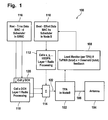
- Figure 1 shows a telecommunication system 100.
- telecommunication system 100 is a CDMA system, such as a wide band CDMA system e.g. a UMTS-type system.
- Each node-B of telecommunication system 100 has a transmit power amplifier (TPA) 102.
- TPA 102 is coupled to one or more antennas 104 for the transmission of a multi-carrier CDMA data signal 106.
- the actual load of the TPA 102 is determined by load monitor 108.
- the node-B has a scheduler 110 which is implemented in the MAC-hs layer.
- MAC-hs layer provides the data packets to be transmitted to radio processing module 112 and scheduler 110 provides control information for the transmission of the data packets, such as data rates and modulation and/or coding schemes, to HSDPA layer 1 radio processing module 112.
- Radio processing module 112 provides the data to be transmitted via a high speed-downlink shared channel (HS-DSCH) to adder 114.
- HS-DSCH high speed-downlink shared channel
- Further telecommunication system 100 has a radio network controller (RNC) for the node-B.
- the RNC has scheduler 116 for data to be transmitted via dedicated transport channels (DCHs). This is done for multiple cells x, y, ... which are covered by the same TPA 102.
- Scheduler 116 outputs control information for the layer 1 radio processing modules 118, 120, ... of the respective cells x, y, ...
- the resulting data to be transmitted over the DCHs is also inputted into adder 114 which provides the combined signal 122; this combined signal 122 is inputted into TPA 102 for power amplification and transmission over the one or more antennas 104.
- TPA 102 has a power limit which should not be exceeded in order to ensure that TPA 102 operates within its linear range and further to prevent damage from TPA 102.
- the power limit is not determined by the TPA 102 but e.g. is a result of the cell planning.
- load monitor 108 determines the actual loading condition of TPA 102. This can be done by measuring the output power of TPA 102 or by analysing signal 122 in order to determine the transmit power which is required for transmission of the signal.
- Tx exceeds an allowed threshold level for the total transmission power load monitor 108 provides a feedback signal to scheduler 110.
- scheduler 110 reduces the data transmission over HS-DSCH until the feedback signal of load monitor 108 disappears. This way the grade of service provided by the HS-DSCH is temporarily degraded while the predefined grade of service on the DCHs is still maintained.
- load monitor 108 permanently reports the actual load of TPA 102 to scheduler 110.
- scheduler 110 is aware of the previously scheduled data transmission over HS-DSCH it can determine the share of the total actual load which is due to the DCHs.
- dedicated measurement means are provided for measuring the loads of the DCHs and/or HS-DSCHs. The difference between the share of the load which is due to the transmission over DCHs and the allowed maximum power of TPA 102 provides the power which is available for the HS-DSCH type transmission.
- Scheduler 110 performs the scheduling of the data transmission over HS-DSCH on the basis of this difference in order to make maximum utilisation of the transmission power resources which are not required for the DCHs communication.
- FIG. 2 shows the actual power of TPA 102 over time.
- Solid line 124 in the diagram illustrates the multi-carrier real-time data mean amplitude due to the data transmission over the DCHs.
- line 124 shows the total power which is required of the total available power (maximum mean power) for the transmission of data over the DCHs with a predefined grade of service.
- TPA 102 constantly operates at about its allowed maximum mean power level with a safety margin to its maximum peak power 128.
- radio overload control can be performed without reducing the link quality for real-time traffic. Instead - the volume of best-effort traffic controlled i.e. by reducing the throughput of the best-effort traffic in case of an overload situation.
- radio overload control of the invention can be combined with such prior art power control mechanisms.
- Such prior art power or radio overload control mechanism can be additionally used by the Node B for the cells x, y,...
- Another advantage is that the scheduling instance for the non-real-time traffic is located in the MAC-hs of the node-B. This proximity to the TPA 102 enables to perform fast radio overload control, e.g. slot-by-slot or subframe-by-subframe.
- HSDPA coverage radius can be extended due to the improved usage of the available system resources. This is particularly advantageous for providing coverage for so called hot spots.
Landscapes
- Engineering & Computer Science (AREA)
- Computer Networks & Wireless Communication (AREA)
- Signal Processing (AREA)
- Mobile Radio Communication Systems (AREA)
- Transmitters (AREA)
- Radio Relay Systems (AREA)
- Signal Processing For Digital Recording And Reproducing (AREA)
Abstract
Description
- Figure 1
- is a block diagram of a preferred embodiment of a telecommunication system of the invention,
- Figure 2
- is illustrative of controlling the data transmission over channels having a variable grade of service.
- 100
- telecommunication system
- 102
- transmit power amplifier (TPA)
- 104
- antenna
- 106
- signal
- 108
- load monitor
- 110
- scheduler
- 112
- radio processing module
- 114
- adder
- 116
- scheduler
- 118
- radio processing module
- 120
- radio processing module
- 122
- signal
- 124
- line
- 126
- line
- 128
- maximum peak power
Claims (10)
- A method of transmitting data over first and second channels, the first channels having a predefined grade of service and the second channels having a variable grade of service, the method comprising:determining a load of a transmit power amplifier,determining a share of the load which is due to the transmission over the first channels,determining a difference between a maximum load and the share,controlling the transmission over the second channels on the basis of the difference.
- The method of claim 1, whereby the first channels are dedicated channels and the second channels are shared channels.
- The method of claim 1, whereby the load is determined by means of a moving average of the load being required to transmit the data over the first and second channels by means of the transmit power amplifier.
- The method of claim 1, the maximum load being a mean power amplitude, whereby the mean power amplitude is a safety margin below a maximum peak power amplitude.
- The method of claim 1, further comprising determining a share of the load which is due to the transmission over the second channels, whereby the share of the load which is due to the transmission over the first channels is determined by subtracting the share of the load which is due to the transmission over the second channels from the load.
- The method of claim 1, whereby the control is performed by a scheduler for the second channels.
- The method of claim 1, the transmission of data over the first channels being scheduled by a scheduler for the first channels independently from the scheduler for the second channels.
- A computer program product, in particular digital storage medium, for controlling the transmission of data over second channels of a telecommunication system having first and second channels, the first channels having a pre-defined grade of service and the second channels having a variable grade of service, comprising program means for performing the steps of:entering of data being indicative of a load of a transmit power amplifier,determining a share of the load which is due to the transmission over the first channels,determining a difference between a maximum load and the share,controlling the transmission over the second channels on the basis of the difference.
- A base station for transmitting of data over first and second channels, the first channels having a predefined grade of service and the second channels having a variable grade of service, the base station comprising:means (108) for determining a load of a transmit power amplifier (102),means (110) for determining a share of the load which is due to the transmission over the first channels,means (110) for determining a difference between a maximum load and the share,means (110, 112) for controlling the transmission over the second channels on the basis of the difference.
- A wireless cellular telecommunication network for transmitting of data over first and second channels, the first channels having a predefined grade of service and the second channels having a variable grade of service, the telecommunication network comprising:means (108) for determining a load of a transmit power amplifier (102),means (110) for determining a share of the load which is due to the transmission over the first channels,means (110) for determining a difference between a maximum load and the share,means (110, 112) for controlling the transmission over the second channels on the basis of the difference.
Priority Applications (5)
| Application Number | Priority Date | Filing Date | Title |
|---|---|---|---|
| DE60304448T DE60304448T2 (en) | 2003-04-07 | 2003-04-07 | Method for data transmission as a function of the load in a cellular mobile radio network |
| AT03290854T ATE322770T1 (en) | 2003-04-07 | 2003-04-07 | METHOD FOR DATA TRANSMISSION DEPENDENT ON THE LOAD IN A CELLULAR MOBILE NETWORK |
| EP03290854A EP1467498B1 (en) | 2003-04-07 | 2003-04-07 | A method of transmitting data according to load in a wireless cellular telecommunication network |
| US10/781,627 US7447514B2 (en) | 2003-04-07 | 2004-02-20 | Method of transmitting data in a wireless cellular telecommunication network |
| US10/552,059 US20060181975A1 (en) | 2003-04-07 | 2004-03-23 | Cross-talk cancellation scheme for rll-based storage systems |
Applications Claiming Priority (1)
| Application Number | Priority Date | Filing Date | Title |
|---|---|---|---|
| EP03290854A EP1467498B1 (en) | 2003-04-07 | 2003-04-07 | A method of transmitting data according to load in a wireless cellular telecommunication network |
Publications (2)
| Publication Number | Publication Date |
|---|---|
| EP1467498A1 true EP1467498A1 (en) | 2004-10-13 |
| EP1467498B1 EP1467498B1 (en) | 2006-04-05 |
Family
ID=32865078
Family Applications (1)
| Application Number | Title | Priority Date | Filing Date |
|---|---|---|---|
| EP03290854A Expired - Lifetime EP1467498B1 (en) | 2003-04-07 | 2003-04-07 | A method of transmitting data according to load in a wireless cellular telecommunication network |
Country Status (4)
| Country | Link |
|---|---|
| US (2) | US7447514B2 (en) |
| EP (1) | EP1467498B1 (en) |
| AT (1) | ATE322770T1 (en) |
| DE (1) | DE60304448T2 (en) |
Cited By (6)
| Publication number | Priority date | Publication date | Assignee | Title |
|---|---|---|---|---|
| WO2007024931A2 (en) | 2005-08-22 | 2007-03-01 | Qualcomm Incorporated | Reverse link power control for an ofdma system |
| EP1793509A1 (en) * | 2005-12-01 | 2007-06-06 | Alcatel Lucent | Transmit power control for a communication system |
| EP1806940A4 (en) * | 2004-10-25 | 2012-04-11 | Nec Corp | WIRELESS NETWORK CONTROL METHOD, WIRELESS COMMUNICATION SYSTEM, AND BASE STATION CONTROLLER |
| US8339929B2 (en) | 2008-01-10 | 2012-12-25 | Realtek Semiconductor Corp. | Network apparatus for eliminating interference between transport ports and method thereof |
| EP2075923A4 (en) * | 2007-05-18 | 2014-01-08 | Huawei Tech Co Ltd | A distributing method for carrier power in the same power amplifier and a power amplifier |
| WO2018177115A1 (en) * | 2017-03-29 | 2018-10-04 | 大唐移动通信设备有限公司 | Scheduling-free transmission method and apparatus |
Families Citing this family (10)
| Publication number | Priority date | Publication date | Assignee | Title |
|---|---|---|---|---|
| FI20040865A0 (en) * | 2004-06-21 | 2004-06-21 | Nokia Corp | Communication in a telecommunication system |
| GB0500416D0 (en) * | 2005-01-10 | 2005-02-16 | Nokia Corp | Transmitting information using multiple carriers |
| GB0500415D0 (en) * | 2005-01-10 | 2005-02-16 | Nokia Corp | Transmitting information using multiple carriers |
| US20060252446A1 (en) * | 2005-05-06 | 2006-11-09 | Interdigital Technology Corporation | Method and apparatus for setting a power limit for high speed downlink packet access services |
| US7610017B2 (en) * | 2005-06-09 | 2009-10-27 | Vixs Systems, Inc. | Increased data rate transmissions of a wireless communication |
| US8103284B2 (en) * | 2006-03-24 | 2012-01-24 | Alcatel Lucent | Method for reporting uplink load measurements |
| US8804260B2 (en) | 2010-09-13 | 2014-08-12 | Lsi Corporation | Systems and methods for inter-track interference compensation |
| US8830613B2 (en) | 2011-07-19 | 2014-09-09 | Lsi Corporation | Storage media inter-track interference cancellation |
| US8879182B2 (en) | 2011-07-19 | 2014-11-04 | Lsi Corporation | Storage media inter-track interference cancellation |
| WO2014044415A1 (en) * | 2012-09-24 | 2014-03-27 | Nec Europe Ltd. | Method and system for operating stations in a cooperative station network |
Citations (4)
| Publication number | Priority date | Publication date | Assignee | Title |
|---|---|---|---|---|
| EP1061680A1 (en) * | 1999-06-16 | 2000-12-20 | Alcatel | A method for sharing capacity in a CDMA mobile radiocommunication system |
| WO2001048929A2 (en) * | 1999-12-24 | 2001-07-05 | Nokia Corporation | Control of a multi-carrier power amplifier |
| WO2002056498A2 (en) * | 2001-01-12 | 2002-07-18 | Telefonaktiebolaget Lm Ericsson (Publ) | Downlink power control of a common transport channel |
| EP1237296A2 (en) * | 2001-02-28 | 2002-09-04 | Nec Corporation | Mobile communication system, transmission power control method therefore, and base station used therefore |
Family Cites Families (5)
| Publication number | Priority date | Publication date | Assignee | Title |
|---|---|---|---|---|
| FR2727589B1 (en) * | 1994-11-25 | 1997-01-03 | Thomson Csf | READING DEVICE AND SYSTEM |
| JP3800653B2 (en) * | 1995-12-26 | 2006-07-26 | ソニー株式会社 | Crosstalk removal device |
| US6111710A (en) * | 1997-06-25 | 2000-08-29 | Cirrus Logic, Inc. | Asynchronous/synchronous gain control for interpolated timing recovery in a sampled amplitude read channel |
| JP3526185B2 (en) * | 1997-10-07 | 2004-05-10 | パイオニア株式会社 | Crosstalk removing device in recorded information reproducing device |
| JP4184585B2 (en) * | 2000-09-19 | 2008-11-19 | パイオニア株式会社 | Signal delay device, leak signal removal device, and information processing device |
-
2003
- 2003-04-07 EP EP03290854A patent/EP1467498B1/en not_active Expired - Lifetime
- 2003-04-07 DE DE60304448T patent/DE60304448T2/en not_active Expired - Lifetime
- 2003-04-07 AT AT03290854T patent/ATE322770T1/en not_active IP Right Cessation
-
2004
- 2004-02-20 US US10/781,627 patent/US7447514B2/en not_active Expired - Lifetime
- 2004-03-23 US US10/552,059 patent/US20060181975A1/en not_active Abandoned
Patent Citations (4)
| Publication number | Priority date | Publication date | Assignee | Title |
|---|---|---|---|---|
| EP1061680A1 (en) * | 1999-06-16 | 2000-12-20 | Alcatel | A method for sharing capacity in a CDMA mobile radiocommunication system |
| WO2001048929A2 (en) * | 1999-12-24 | 2001-07-05 | Nokia Corporation | Control of a multi-carrier power amplifier |
| WO2002056498A2 (en) * | 2001-01-12 | 2002-07-18 | Telefonaktiebolaget Lm Ericsson (Publ) | Downlink power control of a common transport channel |
| EP1237296A2 (en) * | 2001-02-28 | 2002-09-04 | Nec Corporation | Mobile communication system, transmission power control method therefore, and base station used therefore |
Non-Patent Citations (2)
| Title |
|---|
| NAOR Z ET AL: "Announced dynamic access probability protocol for next generation wireless networks", COMPUTER NETWORKS, ELSEVIER SCIENCE PUBLISHERS B.V., AMSTERDAM, NL, vol. 41, no. 4, 15 March 2003 (2003-03-15), pages 527 - 544, XP004404985, ISSN: 1389-1286 * |
| QIU X ET AL: "Some performance results for the downlink shared channel in WCDMA", ICC 2002. 2002 IEEE INTERNATIONAL CONFERENCE ON COMMUNICATIONS. CONFERENCE PROCEEDINGS. NEW YORK, NY, APRIL 28 - MAY 2, 2002, IEEE INTERNATIONAL CONFERENCE ON COMMUNICATIONS, NEW YORK, NY: IEEE, US, vol. 1 OF 5, 28 April 2002 (2002-04-28), pages 376 - 380, XP010589520, ISBN: 0-7803-7400-2 * |
Cited By (16)
| Publication number | Priority date | Publication date | Assignee | Title |
|---|---|---|---|---|
| EP1806940A4 (en) * | 2004-10-25 | 2012-04-11 | Nec Corp | WIRELESS NETWORK CONTROL METHOD, WIRELESS COMMUNICATION SYSTEM, AND BASE STATION CONTROLLER |
| US8305969B2 (en) | 2004-10-25 | 2012-11-06 | Nec Corporation | Radio network controlling method, radio communication system and radio network controller |
| WO2007024931A2 (en) | 2005-08-22 | 2007-03-01 | Qualcomm Incorporated | Reverse link power control for an ofdma system |
| WO2007024931A3 (en) * | 2005-08-22 | 2007-04-12 | Qualcomm Inc | Reverse link power control for an ofdma system |
| CN101305528A (en) * | 2005-08-22 | 2008-11-12 | 高通股份有限公司 | Reverse link power control for Orthogonal Frequency Division Multiple Access (OFDMA) systems |
| US7965789B2 (en) | 2005-08-22 | 2011-06-21 | Qualcomm Incorporated | Reverse link power control for an OFDMA system |
| EP2521280A1 (en) * | 2005-08-22 | 2012-11-07 | Qualcomm Incorporated | Reverse Link Power Control For An OFDMA System |
| US8718181B2 (en) | 2005-08-22 | 2014-05-06 | Qualcomm Incorporated | Reverse link power control for an OFDMA system |
| CN101305528B (en) * | 2005-08-22 | 2013-08-14 | 高通股份有限公司 | Method and apparatus for controlling power in a wireless communication system |
| US8520745B2 (en) | 2005-08-22 | 2013-08-27 | Qualcomm Incorporated | Reverse link power control for an OFDMA system |
| EP1793509A1 (en) * | 2005-12-01 | 2007-06-06 | Alcatel Lucent | Transmit power control for a communication system |
| EP2075923A4 (en) * | 2007-05-18 | 2014-01-08 | Huawei Tech Co Ltd | A distributing method for carrier power in the same power amplifier and a power amplifier |
| TWI411241B (en) * | 2008-01-10 | 2013-10-01 | Realtek Semiconductor Corp | Network apparatus for eliminating interference between transport ports and method thereof |
| US8339929B2 (en) | 2008-01-10 | 2012-12-25 | Realtek Semiconductor Corp. | Network apparatus for eliminating interference between transport ports and method thereof |
| WO2018177115A1 (en) * | 2017-03-29 | 2018-10-04 | 大唐移动通信设备有限公司 | Scheduling-free transmission method and apparatus |
| US10939459B2 (en) | 2017-03-29 | 2021-03-02 | Datang Mobile Communications Equipment Co., Ltd | Scheduling-free transmission method and apparatus |
Also Published As
| Publication number | Publication date |
|---|---|
| US7447514B2 (en) | 2008-11-04 |
| US20040198370A1 (en) | 2004-10-07 |
| EP1467498B1 (en) | 2006-04-05 |
| DE60304448T2 (en) | 2006-09-21 |
| ATE322770T1 (en) | 2006-04-15 |
| DE60304448D1 (en) | 2006-05-18 |
| US20060181975A1 (en) | 2006-08-17 |
Similar Documents
| Publication | Publication Date | Title |
|---|---|---|
| US7890114B2 (en) | Telecommunication system with transmit and multi-user diversity | |
| EP1467498B1 (en) | A method of transmitting data according to load in a wireless cellular telecommunication network | |
| JP4295206B2 (en) | Radio resource management for high-speed shared channels | |
| EP1313244B1 (en) | Communication device and method for communicating over a digital mobile network | |
| US8971950B2 (en) | Method and device for transmission power control | |
| EP2276300A2 (en) | Selecting transmission technology for communications in wide area mobile networks | |
| KR101197525B1 (en) | Scheduling calls in downlink transmissions | |
| KR20020070149A (en) | Mobile communication system, transmission power control method therefor, and base station used therefor | |
| US6928268B1 (en) | Method for allocating a transmission capacity to connections in a radio communication system | |
| US20060246938A1 (en) | Power control in a communication network | |
| US7680052B2 (en) | Closed loop resource allocation | |
| US20050105492A1 (en) | Method and arrangement for allocation the quantity of a channel to a mobile station as a function of the measured quality | |
| EP1804534B1 (en) | Base station using an enhanced dedicated channel | |
| US11252637B1 (en) | Limiting dual connectivity based on pairing efficiency | |
| US20070049317A1 (en) | Controlling transmission power in a reverse link of a feedback-based spread spectrum wireless network | |
| CN105794281A (en) | A network node and method for determining downlink transmission power for a downlink shared channel | |
| EP1404065B1 (en) | Telecommunication system with transmit diversity and multi-user diversity | |
| US12052669B2 (en) | Minimizing uplink interference in wireless networks | |
| US20070091786A1 (en) | Transmitting data from a mobile station on an uplink in a spread spectrum cellular system | |
| US11310714B1 (en) | Load balancing based on pairing efficiency | |
| JP4903218B2 (en) | Suppression of deleted and idle frames in wireless communication systems | |
| US20080132266A1 (en) | Maximum Allowable Transmission Rate Deciding Method, Mobile Station And Wireless Base Station | |
| WO2007089707A1 (en) | Detecting signal carriers of multiple types of signals in radio frequency input for amplification | |
| CN114466376A (en) | Data transmission method, device, equipment and storage medium | |
| US11252770B1 (en) | Massive MIMO pairing criteria adjustments |
Legal Events
| Date | Code | Title | Description |
|---|---|---|---|
| PUAI | Public reference made under article 153(3) epc to a published international application that has entered the european phase |
Free format text: ORIGINAL CODE: 0009012 |
|
| 17P | Request for examination filed |
Effective date: 20040325 |
|
| AK | Designated contracting states |
Kind code of ref document: A1 Designated state(s): AT BE BG CH CY CZ DE DK EE ES FI FR GB GR HU IE IT LI LU MC NL PT RO SE SI SK TR |
|
| AX | Request for extension of the european patent |
Extension state: AL LT LV MK |
|
| 17Q | First examination report despatched |
Effective date: 20041020 |
|
| AKX | Designation fees paid |
Designated state(s): AT BE BG CH CY CZ DE DK EE ES FI FR GB GR HU IE IT LI LU MC NL PT RO SE SI SK TR |
|
| GRAP | Despatch of communication of intention to grant a patent |
Free format text: ORIGINAL CODE: EPIDOSNIGR1 |
|
| GRAS | Grant fee paid |
Free format text: ORIGINAL CODE: EPIDOSNIGR3 |
|
| GRAA | (expected) grant |
Free format text: ORIGINAL CODE: 0009210 |
|
| AK | Designated contracting states |
Kind code of ref document: B1 Designated state(s): AT BE BG CH CY CZ DE DK EE ES FI FR GB GR HU IE IT LI LU MC NL PT RO SE SI SK TR |
|
| PG25 | Lapsed in a contracting state [announced via postgrant information from national office to epo] |
Ref country code: SI Free format text: LAPSE BECAUSE OF FAILURE TO SUBMIT A TRANSLATION OF THE DESCRIPTION OR TO PAY THE FEE WITHIN THE PRESCRIBED TIME-LIMIT Effective date: 20060405 Ref country code: RO Free format text: LAPSE BECAUSE OF FAILURE TO SUBMIT A TRANSLATION OF THE DESCRIPTION OR TO PAY THE FEE WITHIN THE PRESCRIBED TIME-LIMIT Effective date: 20060405 Ref country code: CZ Free format text: LAPSE BECAUSE OF FAILURE TO SUBMIT A TRANSLATION OF THE DESCRIPTION OR TO PAY THE FEE WITHIN THE PRESCRIBED TIME-LIMIT Effective date: 20060405 Ref country code: BE Free format text: LAPSE BECAUSE OF FAILURE TO SUBMIT A TRANSLATION OF THE DESCRIPTION OR TO PAY THE FEE WITHIN THE PRESCRIBED TIME-LIMIT Effective date: 20060405 Ref country code: CH Free format text: LAPSE BECAUSE OF FAILURE TO SUBMIT A TRANSLATION OF THE DESCRIPTION OR TO PAY THE FEE WITHIN THE PRESCRIBED TIME-LIMIT Effective date: 20060405 Ref country code: FI Free format text: LAPSE BECAUSE OF FAILURE TO SUBMIT A TRANSLATION OF THE DESCRIPTION OR TO PAY THE FEE WITHIN THE PRESCRIBED TIME-LIMIT Effective date: 20060405 Ref country code: SK Free format text: LAPSE BECAUSE OF FAILURE TO SUBMIT A TRANSLATION OF THE DESCRIPTION OR TO PAY THE FEE WITHIN THE PRESCRIBED TIME-LIMIT Effective date: 20060405 Ref country code: NL Free format text: LAPSE BECAUSE OF FAILURE TO SUBMIT A TRANSLATION OF THE DESCRIPTION OR TO PAY THE FEE WITHIN THE PRESCRIBED TIME-LIMIT Effective date: 20060405 Ref country code: LI Free format text: LAPSE BECAUSE OF FAILURE TO SUBMIT A TRANSLATION OF THE DESCRIPTION OR TO PAY THE FEE WITHIN THE PRESCRIBED TIME-LIMIT Effective date: 20060405 Ref country code: AT Free format text: LAPSE BECAUSE OF FAILURE TO SUBMIT A TRANSLATION OF THE DESCRIPTION OR TO PAY THE FEE WITHIN THE PRESCRIBED TIME-LIMIT Effective date: 20060405 |
|
| REG | Reference to a national code |
Ref country code: GB Ref legal event code: FG4D |
|
| PG25 | Lapsed in a contracting state [announced via postgrant information from national office to epo] |
Ref country code: IE Free format text: LAPSE BECAUSE OF NON-PAYMENT OF DUE FEES Effective date: 20060407 |
|
| REG | Reference to a national code |
Ref country code: CH Ref legal event code: EP |
|
| PG25 | Lapsed in a contracting state [announced via postgrant information from national office to epo] |
Ref country code: MC Free format text: LAPSE BECAUSE OF NON-PAYMENT OF DUE FEES Effective date: 20060430 |
|
| REG | Reference to a national code |
Ref country code: IE Ref legal event code: FG4D |
|
| REF | Corresponds to: |
Ref document number: 60304448 Country of ref document: DE Date of ref document: 20060518 Kind code of ref document: P |
|
| PG25 | Lapsed in a contracting state [announced via postgrant information from national office to epo] |
Ref country code: SE Free format text: LAPSE BECAUSE OF FAILURE TO SUBMIT A TRANSLATION OF THE DESCRIPTION OR TO PAY THE FEE WITHIN THE PRESCRIBED TIME-LIMIT Effective date: 20060705 Ref country code: DK Free format text: LAPSE BECAUSE OF FAILURE TO SUBMIT A TRANSLATION OF THE DESCRIPTION OR TO PAY THE FEE WITHIN THE PRESCRIBED TIME-LIMIT Effective date: 20060705 |
|
| PG25 | Lapsed in a contracting state [announced via postgrant information from national office to epo] |
Ref country code: ES Free format text: LAPSE BECAUSE OF FAILURE TO SUBMIT A TRANSLATION OF THE DESCRIPTION OR TO PAY THE FEE WITHIN THE PRESCRIBED TIME-LIMIT Effective date: 20060716 |
|
| PG25 | Lapsed in a contracting state [announced via postgrant information from national office to epo] |
Ref country code: PT Free format text: LAPSE BECAUSE OF FAILURE TO SUBMIT A TRANSLATION OF THE DESCRIPTION OR TO PAY THE FEE WITHIN THE PRESCRIBED TIME-LIMIT Effective date: 20060905 |
|
| NLV1 | Nl: lapsed or annulled due to failure to fulfill the requirements of art. 29p and 29m of the patents act | ||
| ET | Fr: translation filed | ||
| REG | Reference to a national code |
Ref country code: CH Ref legal event code: PL |
|
| PLBE | No opposition filed within time limit |
Free format text: ORIGINAL CODE: 0009261 |
|
| STAA | Information on the status of an ep patent application or granted ep patent |
Free format text: STATUS: NO OPPOSITION FILED WITHIN TIME LIMIT |
|
| 26N | No opposition filed |
Effective date: 20070108 |
|
| PG25 | Lapsed in a contracting state [announced via postgrant information from national office to epo] |
Ref country code: GR Free format text: LAPSE BECAUSE OF FAILURE TO SUBMIT A TRANSLATION OF THE DESCRIPTION OR TO PAY THE FEE WITHIN THE PRESCRIBED TIME-LIMIT Effective date: 20060706 |
|
| PG25 | Lapsed in a contracting state [announced via postgrant information from national office to epo] |
Ref country code: EE Free format text: LAPSE BECAUSE OF FAILURE TO SUBMIT A TRANSLATION OF THE DESCRIPTION OR TO PAY THE FEE WITHIN THE PRESCRIBED TIME-LIMIT Effective date: 20060405 Ref country code: BG Free format text: LAPSE BECAUSE OF FAILURE TO SUBMIT A TRANSLATION OF THE DESCRIPTION OR TO PAY THE FEE WITHIN THE PRESCRIBED TIME-LIMIT Effective date: 20060705 |
|
| PG25 | Lapsed in a contracting state [announced via postgrant information from national office to epo] |
Ref country code: TR Free format text: LAPSE BECAUSE OF FAILURE TO SUBMIT A TRANSLATION OF THE DESCRIPTION OR TO PAY THE FEE WITHIN THE PRESCRIBED TIME-LIMIT Effective date: 20060405 Ref country code: LU Free format text: LAPSE BECAUSE OF NON-PAYMENT OF DUE FEES Effective date: 20060407 Ref country code: HU Free format text: LAPSE BECAUSE OF FAILURE TO SUBMIT A TRANSLATION OF THE DESCRIPTION OR TO PAY THE FEE WITHIN THE PRESCRIBED TIME-LIMIT Effective date: 20061006 |
|
| PG25 | Lapsed in a contracting state [announced via postgrant information from national office to epo] |
Ref country code: CY Free format text: LAPSE BECAUSE OF FAILURE TO SUBMIT A TRANSLATION OF THE DESCRIPTION OR TO PAY THE FEE WITHIN THE PRESCRIBED TIME-LIMIT Effective date: 20060405 |
|
| PGFP | Annual fee paid to national office [announced via postgrant information from national office to epo] |
Ref country code: IT Payment date: 20110420 Year of fee payment: 9 |
|
| PG25 | Lapsed in a contracting state [announced via postgrant information from national office to epo] |
Ref country code: IT Free format text: LAPSE BECAUSE OF NON-PAYMENT OF DUE FEES Effective date: 20120407 |
|
| REG | Reference to a national code |
Ref country code: FR Ref legal event code: GC Effective date: 20140717 |
|
| REG | Reference to a national code |
Ref country code: FR Ref legal event code: RG Effective date: 20141016 |
|
| REG | Reference to a national code |
Ref country code: FR Ref legal event code: PLFP Year of fee payment: 13 |
|
| REG | Reference to a national code |
Ref country code: FR Ref legal event code: PLFP Year of fee payment: 14 |
|
| REG | Reference to a national code |
Ref country code: FR Ref legal event code: PLFP Year of fee payment: 15 |
|
| REG | Reference to a national code |
Ref country code: DE Ref legal event code: R082 Ref document number: 60304448 Country of ref document: DE Representative=s name: PATENTANWAELTE U. KNECHT UND KOLLEGEN, DE Ref country code: DE Ref legal event code: R081 Ref document number: 60304448 Country of ref document: DE Owner name: ALCATEL LUCENT, FR Free format text: FORMER OWNER: ALCATEL LUCENT, PARIS, FR Ref country code: DE Ref legal event code: R082 Ref document number: 60304448 Country of ref document: DE Representative=s name: MENZIETTI WETZEL, DE Ref country code: DE Ref legal event code: R081 Ref document number: 60304448 Country of ref document: DE Owner name: BEIJING XIAOMI MOBILE SOFTWARE CO., LTD., CN Free format text: FORMER OWNER: ALCATEL LUCENT, PARIS, FR Ref country code: DE Ref legal event code: R082 Ref document number: 60304448 Country of ref document: DE Representative=s name: DOMPATENT VON KREISLER SELTING WERNER - PARTNE, DE |
|
| PGFP | Annual fee paid to national office [announced via postgrant information from national office to epo] |
Ref country code: FR Payment date: 20170419 Year of fee payment: 15 Ref country code: GB Payment date: 20170419 Year of fee payment: 15 |
|
| REG | Reference to a national code |
Ref country code: FR Ref legal event code: CA Effective date: 20170628 Ref country code: FR Ref legal event code: CD Owner name: ALCATEL LUCENT, FR Effective date: 20170628 |
|
| REG | Reference to a national code |
Ref country code: DE Ref legal event code: R082 Ref document number: 60304448 Country of ref document: DE Representative=s name: DOMPATENT VON KREISLER SELTING WERNER - PARTNE, DE Ref country code: DE Ref legal event code: R081 Ref document number: 60304448 Country of ref document: DE Owner name: BEIJING XIAOMI MOBILE SOFTWARE CO., LTD., CN Free format text: FORMER OWNER: ALCATEL LUCENT, BOULOGNE-BILLANCOURT, FR |
|
| GBPC | Gb: european patent ceased through non-payment of renewal fee |
Effective date: 20180407 |
|
| PG25 | Lapsed in a contracting state [announced via postgrant information from national office to epo] |
Ref country code: GB Free format text: LAPSE BECAUSE OF NON-PAYMENT OF DUE FEES Effective date: 20180407 |
|
| PG25 | Lapsed in a contracting state [announced via postgrant information from national office to epo] |
Ref country code: FR Free format text: LAPSE BECAUSE OF NON-PAYMENT OF DUE FEES Effective date: 20180430 |
|
| PGFP | Annual fee paid to national office [announced via postgrant information from national office to epo] |
Ref country code: DE Payment date: 20220420 Year of fee payment: 20 |
|
| REG | Reference to a national code |
Ref country code: DE Ref legal event code: R071 Ref document number: 60304448 Country of ref document: DE |