EP1466969A1 - Sulfated fucan - Google Patents
Sulfated fucan Download PDFInfo
- Publication number
- EP1466969A1 EP1466969A1 EP03701755A EP03701755A EP1466969A1 EP 1466969 A1 EP1466969 A1 EP 1466969A1 EP 03701755 A EP03701755 A EP 03701755A EP 03701755 A EP03701755 A EP 03701755A EP 1466969 A1 EP1466969 A1 EP 1466969A1
- Authority
- EP
- European Patent Office
- Prior art keywords
- sulfated fucan
- sulfated
- enzyme
- oligosaccharide
- fucan
- Prior art date
- Legal status (The legal status is an assumption and is not a legal conclusion. Google has not performed a legal analysis and makes no representation as to the accuracy of the status listed.)
- Withdrawn
Links
- 102000004190 Enzymes Human genes 0.000 claims abstract description 170
- 108090000790 Enzymes Proteins 0.000 claims abstract description 170
- 229920001542 oligosaccharide Polymers 0.000 claims abstract description 118
- 150000002482 oligosaccharides Chemical class 0.000 claims abstract description 118
- 238000000034 method Methods 0.000 claims abstract description 26
- 238000004519 manufacturing process Methods 0.000 claims abstract description 17
- 241000195522 Fucales Species 0.000 claims abstract description 12
- 239000000126 substance Substances 0.000 claims description 47
- 241000227647 Fucus vesiculosus Species 0.000 claims description 43
- 229920001282 polysaccharide Polymers 0.000 claims description 42
- 239000005017 polysaccharide Substances 0.000 claims description 42
- 229910006069 SO3H Inorganic materials 0.000 claims description 21
- 125000000020 sulfo group Chemical group O=S(=O)([*])O[H] 0.000 claims description 21
- 150000001720 carbohydrates Chemical class 0.000 claims description 20
- 150000003839 salts Chemical class 0.000 claims description 18
- 241000894006 Bacteria Species 0.000 claims description 16
- TUCNEACPLKLKNU-UHFFFAOYSA-N acetyl Chemical compound C[C]=O TUCNEACPLKLKNU-UHFFFAOYSA-N 0.000 claims description 16
- 241000512259 Ascophyllum nodosum Species 0.000 claims description 15
- 241000764746 Fucophilus Species 0.000 claims description 6
- 238000012258 culturing Methods 0.000 claims description 5
- 150000004676 glycans Chemical class 0.000 claims 3
- 235000000346 sugar Nutrition 0.000 abstract description 7
- 230000000593 degrading effect Effects 0.000 abstract description 2
- FAPWRFPIFSIZLT-UHFFFAOYSA-M Sodium chloride Chemical compound [Na+].[Cl-] FAPWRFPIFSIZLT-UHFFFAOYSA-M 0.000 description 118
- 239000000243 solution Substances 0.000 description 61
- 239000011780 sodium chloride Substances 0.000 description 59
- 230000000694 effects Effects 0.000 description 57
- 239000000872 buffer Substances 0.000 description 50
- 150000004804 polysaccharides Chemical class 0.000 description 39
- LFQSCWFLJHTTHZ-UHFFFAOYSA-N Ethanol Chemical compound CCO LFQSCWFLJHTTHZ-UHFFFAOYSA-N 0.000 description 36
- JDIIGWSSTNUWGK-UHFFFAOYSA-N 1h-imidazol-3-ium;chloride Chemical compound [Cl-].[NH2+]1C=CN=C1 JDIIGWSSTNUWGK-UHFFFAOYSA-N 0.000 description 30
- 238000006243 chemical reaction Methods 0.000 description 30
- PXIPVTKHYLBLMZ-UHFFFAOYSA-N Sodium azide Chemical compound [Na+].[N-]=[N+]=[N-] PXIPVTKHYLBLMZ-UHFFFAOYSA-N 0.000 description 28
- 238000001644 13C nuclear magnetic resonance spectroscopy Methods 0.000 description 24
- 238000005160 1H NMR spectroscopy Methods 0.000 description 24
- QTBSBXVTEAMEQO-UHFFFAOYSA-N Acetic acid Chemical compound CC(O)=O QTBSBXVTEAMEQO-UHFFFAOYSA-N 0.000 description 24
- 239000000203 mixture Substances 0.000 description 23
- 239000006228 supernatant Substances 0.000 description 22
- 239000011541 reaction mixture Substances 0.000 description 21
- UXVMQQNJUSDDNG-UHFFFAOYSA-L Calcium chloride Chemical compound [Cl-].[Cl-].[Ca+2] UXVMQQNJUSDDNG-UHFFFAOYSA-L 0.000 description 18
- 239000001110 calcium chloride Substances 0.000 description 18
- 229910001628 calcium chloride Inorganic materials 0.000 description 18
- 238000010828 elution Methods 0.000 description 17
- 238000005406 washing Methods 0.000 description 17
- 238000002360 preparation method Methods 0.000 description 16
- ICSNLGPSRYBMBD-UHFFFAOYSA-N 2-aminopyridine Chemical compound NC1=CC=CC=N1 ICSNLGPSRYBMBD-UHFFFAOYSA-N 0.000 description 14
- QAOWNCQODCNURD-UHFFFAOYSA-N Sulfuric acid Chemical compound OS(O)(=O)=O QAOWNCQODCNURD-UHFFFAOYSA-N 0.000 description 14
- 238000004458 analytical method Methods 0.000 description 14
- 210000004027 cell Anatomy 0.000 description 14
- SHZGCJCMOBCMKK-UHFFFAOYSA-N D-mannomethylose Natural products CC1OC(O)C(O)C(O)C1O SHZGCJCMOBCMKK-UHFFFAOYSA-N 0.000 description 13
- 241000764738 Fucophilus fucoidanolyticus Species 0.000 description 13
- SHZGCJCMOBCMKK-DHVFOXMCSA-N L-fucopyranose Chemical compound C[C@@H]1OC(O)[C@@H](O)[C@H](O)[C@@H]1O SHZGCJCMOBCMKK-DHVFOXMCSA-N 0.000 description 13
- 230000008878 coupling Effects 0.000 description 13
- 238000010168 coupling process Methods 0.000 description 13
- 238000005859 coupling reaction Methods 0.000 description 13
- 238000000746 purification Methods 0.000 description 13
- 239000000758 substrate Substances 0.000 description 13
- 238000004128 high performance liquid chromatography Methods 0.000 description 11
- 102000004169 proteins and genes Human genes 0.000 description 11
- 108090000623 proteins and genes Proteins 0.000 description 11
- 238000000108 ultra-filtration Methods 0.000 description 11
- XLYOFNOQVPJJNP-UHFFFAOYSA-N water Substances O XLYOFNOQVPJJNP-UHFFFAOYSA-N 0.000 description 11
- 238000001460 carbon-13 nuclear magnetic resonance spectrum Methods 0.000 description 10
- 238000005119 centrifugation Methods 0.000 description 10
- 238000001819 mass spectrum Methods 0.000 description 10
- 238000000425 proton nuclear magnetic resonance spectrum Methods 0.000 description 10
- 238000005481 NMR spectroscopy Methods 0.000 description 9
- 239000002904 solvent Substances 0.000 description 9
- 238000002835 absorbance Methods 0.000 description 8
- 239000000284 extract Substances 0.000 description 8
- 241000894007 species Species 0.000 description 8
- DGVVWUTYPXICAM-UHFFFAOYSA-N β‐Mercaptoethanol Chemical compound OCCS DGVVWUTYPXICAM-UHFFFAOYSA-N 0.000 description 8
- SHZGCJCMOBCMKK-PQMKYFCFSA-N L-Fucose Natural products C[C@H]1O[C@H](O)[C@@H](O)[C@@H](O)[C@@H]1O SHZGCJCMOBCMKK-PQMKYFCFSA-N 0.000 description 7
- PNNNRSAQSRJVSB-UHFFFAOYSA-N L-rhamnose Natural products CC(O)C(O)C(O)C(O)C=O PNNNRSAQSRJVSB-UHFFFAOYSA-N 0.000 description 7
- PNNNRSAQSRJVSB-SLPGGIOYSA-N Fucose Natural products C[C@H](O)[C@@H](O)[C@H](O)[C@H](O)C=O PNNNRSAQSRJVSB-SLPGGIOYSA-N 0.000 description 6
- HEMHJVSKTPXQMS-UHFFFAOYSA-M Sodium hydroxide Chemical compound [OH-].[Na+] HEMHJVSKTPXQMS-UHFFFAOYSA-M 0.000 description 6
- 230000000704 physical effect Effects 0.000 description 6
- 239000013535 sea water Substances 0.000 description 6
- 102000005262 Sulfatase Human genes 0.000 description 5
- 239000012228 culture supernatant Substances 0.000 description 5
- 238000001514 detection method Methods 0.000 description 5
- 239000003480 eluent Substances 0.000 description 5
- 230000007717 exclusion Effects 0.000 description 5
- 238000004949 mass spectrometry Methods 0.000 description 5
- OQUKIQWCVTZJAF-UHFFFAOYSA-N phenol;sulfuric acid Chemical compound OS(O)(=O)=O.OC1=CC=CC=C1 OQUKIQWCVTZJAF-UHFFFAOYSA-N 0.000 description 5
- 239000002244 precipitate Substances 0.000 description 5
- 230000035484 reaction time Effects 0.000 description 5
- 108060007951 sulfatase Proteins 0.000 description 5
- QAOWNCQODCNURD-UHFFFAOYSA-L sulfate group Chemical group S(=O)(=O)([O-])[O-] QAOWNCQODCNURD-UHFFFAOYSA-L 0.000 description 5
- XDKKOTSXAKYMSU-NQZVPSPJSA-N sulfuric acid;(2s,3r,4r,5s)-2,3,4,5-tetrahydroxyhexanal Chemical group OS(O)(=O)=O.C[C@H](O)[C@@H](O)[C@@H](O)[C@H](O)C=O XDKKOTSXAKYMSU-NQZVPSPJSA-N 0.000 description 5
- OKTJSMMVPCPJKN-UHFFFAOYSA-N Carbon Chemical compound [C] OKTJSMMVPCPJKN-UHFFFAOYSA-N 0.000 description 4
- 241001017629 Saccharina sculpera Species 0.000 description 4
- 238000004364 calculation method Methods 0.000 description 4
- 229910052799 carbon Inorganic materials 0.000 description 4
- 239000003153 chemical reaction reagent Substances 0.000 description 4
- 238000011033 desalting Methods 0.000 description 4
- 238000006911 enzymatic reaction Methods 0.000 description 4
- 238000002523 gelfiltration Methods 0.000 description 4
- RAXXELZNTBOGNW-UHFFFAOYSA-N imidazole Natural products C1=CNC=N1 RAXXELZNTBOGNW-UHFFFAOYSA-N 0.000 description 4
- 239000000463 material Substances 0.000 description 4
- 244000005700 microbiome Species 0.000 description 4
- 230000001737 promoting effect Effects 0.000 description 4
- 239000000725 suspension Substances 0.000 description 4
- WEVYAHXRMPXWCK-UHFFFAOYSA-N Acetonitrile Chemical compound CC#N WEVYAHXRMPXWCK-UHFFFAOYSA-N 0.000 description 3
- PEDCQBHIVMGVHV-UHFFFAOYSA-N Glycerine Chemical compound OCC(O)CO PEDCQBHIVMGVHV-UHFFFAOYSA-N 0.000 description 3
- 239000001888 Peptone Substances 0.000 description 3
- 108010080698 Peptones Proteins 0.000 description 3
- ZLMJMSJWJFRBEC-UHFFFAOYSA-N Potassium Chemical compound [K] ZLMJMSJWJFRBEC-UHFFFAOYSA-N 0.000 description 3
- 239000002253 acid Substances 0.000 description 3
- PNNNRSAQSRJVSB-KCDKBNATSA-N aldehydo-L-fucose Chemical group C[C@H](O)[C@@H](O)[C@@H](O)[C@H](O)C=O PNNNRSAQSRJVSB-KCDKBNATSA-N 0.000 description 3
- 102000012086 alpha-L-Fucosidase Human genes 0.000 description 3
- 108010061314 alpha-L-Fucosidase Proteins 0.000 description 3
- 238000005349 anion exchange Methods 0.000 description 3
- 230000004071 biological effect Effects 0.000 description 3
- 230000015556 catabolic process Effects 0.000 description 3
- 238000003776 cleavage reaction Methods 0.000 description 3
- 238000004440 column chromatography Methods 0.000 description 3
- 238000007796 conventional method Methods 0.000 description 3
- 238000006731 degradation reaction Methods 0.000 description 3
- 238000000502 dialysis Methods 0.000 description 3
- 230000002255 enzymatic effect Effects 0.000 description 3
- 239000006167 equilibration buffer Substances 0.000 description 3
- 238000002474 experimental method Methods 0.000 description 3
- 238000005194 fractionation Methods 0.000 description 3
- 239000012510 hollow fiber Substances 0.000 description 3
- 238000005259 measurement Methods 0.000 description 3
- 235000019319 peptone Nutrition 0.000 description 3
- 239000011591 potassium Substances 0.000 description 3
- 229910052700 potassium Inorganic materials 0.000 description 3
- 239000002994 raw material Substances 0.000 description 3
- 230000007017 scission Effects 0.000 description 3
- 239000011734 sodium Substances 0.000 description 3
- NWUYHJFMYQTDRP-UHFFFAOYSA-N 1,2-bis(ethenyl)benzene;1-ethenyl-2-ethylbenzene;styrene Chemical compound C=CC1=CC=CC=C1.CCC1=CC=CC=C1C=C.C=CC1=CC=CC=C1C=C NWUYHJFMYQTDRP-UHFFFAOYSA-N 0.000 description 2
- NLXLAEXVIDQMFP-UHFFFAOYSA-N Ammonia chloride Chemical compound [NH4+].[Cl-] NLXLAEXVIDQMFP-UHFFFAOYSA-N 0.000 description 2
- IJGRMHOSHXDMSA-UHFFFAOYSA-N Atomic nitrogen Chemical compound N#N IJGRMHOSHXDMSA-UHFFFAOYSA-N 0.000 description 2
- OYPRJOBELJOOCE-UHFFFAOYSA-N Calcium Chemical compound [Ca] OYPRJOBELJOOCE-UHFFFAOYSA-N 0.000 description 2
- 241000195493 Cryptophyta Species 0.000 description 2
- XLYOFNOQVPJJNP-ZSJDYOACSA-N Heavy water Chemical compound [2H]O[2H] XLYOFNOQVPJJNP-ZSJDYOACSA-N 0.000 description 2
- VEXZGXHMUGYJMC-UHFFFAOYSA-N Hydrochloric acid Chemical compound Cl VEXZGXHMUGYJMC-UHFFFAOYSA-N 0.000 description 2
- DGAQECJNVWCQMB-PUAWFVPOSA-M Ilexoside XXIX Chemical compound C[C@@H]1CC[C@@]2(CC[C@@]3(C(=CC[C@H]4[C@]3(CC[C@@H]5[C@@]4(CC[C@@H](C5(C)C)OS(=O)(=O)[O-])C)C)[C@@H]2[C@]1(C)O)C)C(=O)O[C@H]6[C@@H]([C@H]([C@@H]([C@H](O6)CO)O)O)O.[Na+] DGAQECJNVWCQMB-PUAWFVPOSA-M 0.000 description 2
- FYYHWMGAXLPEAU-UHFFFAOYSA-N Magnesium Chemical compound [Mg] FYYHWMGAXLPEAU-UHFFFAOYSA-N 0.000 description 2
- 241000199919 Phaeophyceae Species 0.000 description 2
- 239000012506 Sephacryl® Substances 0.000 description 2
- XSQUKJJJFZCRTK-UHFFFAOYSA-N Urea Chemical compound NC(N)=O XSQUKJJJFZCRTK-UHFFFAOYSA-N 0.000 description 2
- 241001261005 Verrucomicrobia Species 0.000 description 2
- PFRQBZFETXBLTP-UHFFFAOYSA-N Vitamin K2 Natural products C1=CC=C2C(=O)C(CC=C(C)CCC=C(C)CCC=C(C)CCC=C(C)CCC=C(C)CCC=C(C)C)=C(C)C(=O)C2=C1 PFRQBZFETXBLTP-UHFFFAOYSA-N 0.000 description 2
- HCHKCACWOHOZIP-UHFFFAOYSA-N Zinc Chemical compound [Zn] HCHKCACWOHOZIP-UHFFFAOYSA-N 0.000 description 2
- 239000003125 aqueous solvent Substances 0.000 description 2
- 230000000721 bacterilogical effect Effects 0.000 description 2
- 229910052791 calcium Inorganic materials 0.000 description 2
- 239000011575 calcium Substances 0.000 description 2
- 239000007795 chemical reaction product Substances 0.000 description 2
- 238000005516 engineering process Methods 0.000 description 2
- 229940118127 fucus vesiculosus extract Drugs 0.000 description 2
- 230000002209 hydrophobic effect Effects 0.000 description 2
- 229910052588 hydroxylapatite Inorganic materials 0.000 description 2
- 230000003834 intracellular effect Effects 0.000 description 2
- 229920002521 macromolecule Polymers 0.000 description 2
- 229910052749 magnesium Inorganic materials 0.000 description 2
- 239000011777 magnesium Substances 0.000 description 2
- 235000009464 menaquinone-7 Nutrition 0.000 description 2
- 239000011700 menaquinone-7 Substances 0.000 description 2
- RAKQPZMEYJZGPI-LJWNYQGCSA-N menaquinone-7 Chemical compound C1=CC=C2C(=O)C(C/C=C(C)/CC/C=C(C)/CC/C=C(C)/CC/C=C(C)/CC/C=C(C)/CC/C=C(C)/CCC=C(C)C)=C(C)C(=O)C2=C1 RAKQPZMEYJZGPI-LJWNYQGCSA-N 0.000 description 2
- 229910000402 monopotassium phosphate Inorganic materials 0.000 description 2
- 235000019796 monopotassium phosphate Nutrition 0.000 description 2
- 230000014508 negative regulation of coagulation Effects 0.000 description 2
- 230000007935 neutral effect Effects 0.000 description 2
- 239000002773 nucleotide Substances 0.000 description 2
- 125000003729 nucleotide group Chemical group 0.000 description 2
- 235000015097 nutrients Nutrition 0.000 description 2
- XYJRXVWERLGGKC-UHFFFAOYSA-D pentacalcium;hydroxide;triphosphate Chemical compound [OH-].[Ca+2].[Ca+2].[Ca+2].[Ca+2].[Ca+2].[O-]P([O-])([O-])=O.[O-]P([O-])([O-])=O.[O-]P([O-])([O-])=O XYJRXVWERLGGKC-UHFFFAOYSA-D 0.000 description 2
- PJNZPQUBCPKICU-UHFFFAOYSA-N phosphoric acid;potassium Chemical compound [K].OP(O)(O)=O PJNZPQUBCPKICU-UHFFFAOYSA-N 0.000 description 2
- 238000011218 seed culture Methods 0.000 description 2
- 229910052708 sodium Inorganic materials 0.000 description 2
- 235000011152 sodium sulphate Nutrition 0.000 description 2
- 238000003756 stirring Methods 0.000 description 2
- 238000012916 structural analysis Methods 0.000 description 2
- 229910052725 zinc Inorganic materials 0.000 description 2
- 239000011701 zinc Substances 0.000 description 2
- OWEGMIWEEQEYGQ-UHFFFAOYSA-N 100676-05-9 Natural products OC1C(O)C(O)C(CO)OC1OCC1C(O)C(O)C(O)C(OC2C(OC(O)C(O)C2O)CO)O1 OWEGMIWEEQEYGQ-UHFFFAOYSA-N 0.000 description 1
- BFSVOASYOCHEOV-UHFFFAOYSA-N 2-diethylaminoethanol Chemical compound CCN(CC)CCO BFSVOASYOCHEOV-UHFFFAOYSA-N 0.000 description 1
- FNEHAOQZWPHONV-UHFFFAOYSA-N 9h-carbazole;sulfuric acid Chemical compound OS(O)(=O)=O.C1=CC=C2C3=CC=CC=C3NC2=C1 FNEHAOQZWPHONV-UHFFFAOYSA-N 0.000 description 1
- 108091003079 Bovine Serum Albumin Proteins 0.000 description 1
- 0 CC([C@@](C1O*)O*)O[C@@](C)C1O* Chemical compound CC([C@@](C1O*)O*)O[C@@](C)C1O* 0.000 description 1
- 102000016938 Catalase Human genes 0.000 description 1
- 108010053835 Catalase Proteins 0.000 description 1
- 241000606161 Chlamydia Species 0.000 description 1
- VEXZGXHMUGYJMC-UHFFFAOYSA-M Chloride anion Chemical compound [Cl-] VEXZGXHMUGYJMC-UHFFFAOYSA-M 0.000 description 1
- 241000980780 Cladosiphon okamuranus Species 0.000 description 1
- 241001478240 Coccus Species 0.000 description 1
- FBPFZTCFMRRESA-KVTDHHQDSA-N D-Mannitol Chemical compound OC[C@@H](O)[C@@H](O)[C@H](O)[C@H](O)CO FBPFZTCFMRRESA-KVTDHHQDSA-N 0.000 description 1
- 229920000855 Fucoidan Polymers 0.000 description 1
- WQZGKKKJIJFFOK-GASJEMHNSA-N Glucose Natural products OC[C@H]1OC(O)[C@H](O)[C@@H](O)[C@@H]1O WQZGKKKJIJFFOK-GASJEMHNSA-N 0.000 description 1
- 244000068988 Glycine max Species 0.000 description 1
- 235000010469 Glycine max Nutrition 0.000 description 1
- 238000003794 Gram staining Methods 0.000 description 1
- 241000251511 Holothuroidea Species 0.000 description 1
- 206010020751 Hypersensitivity Diseases 0.000 description 1
- 241000199900 Laminariales Species 0.000 description 1
- 229920001543 Laminarin Polymers 0.000 description 1
- GUBGYTABKSRVRQ-PICCSMPSSA-N Maltose Natural products O[C@@H]1[C@@H](O)[C@H](O)[C@@H](CO)O[C@@H]1O[C@@H]1[C@@H](CO)OC(O)[C@H](O)[C@H]1O GUBGYTABKSRVRQ-PICCSMPSSA-N 0.000 description 1
- 229930195725 Mannitol Natural products 0.000 description 1
- 102000004316 Oxidoreductases Human genes 0.000 description 1
- 108090000854 Oxidoreductases Proteins 0.000 description 1
- 229910019142 PO4 Inorganic materials 0.000 description 1
- 241000015177 Saccharina japonica Species 0.000 description 1
- PMZURENOXWZQFD-UHFFFAOYSA-L Sodium Sulfate Chemical compound [Na+].[Na+].[O-]S([O-])(=O)=O PMZURENOXWZQFD-UHFFFAOYSA-L 0.000 description 1
- 229920002472 Starch Polymers 0.000 description 1
- 229930006000 Sucrose Natural products 0.000 description 1
- CZMRCDWAGMRECN-UGDNZRGBSA-N Sucrose Chemical compound O[C@H]1[C@H](O)[C@@H](CO)O[C@@]1(CO)O[C@@H]1[C@H](O)[C@@H](O)[C@H](O)[C@@H](CO)O1 CZMRCDWAGMRECN-UGDNZRGBSA-N 0.000 description 1
- 241001261506 Undaria pinnatifida Species 0.000 description 1
- LEHOTFFKMJEONL-UHFFFAOYSA-N Uric Acid Chemical compound N1C(=O)NC(=O)C2=C1NC(=O)N2 LEHOTFFKMJEONL-UHFFFAOYSA-N 0.000 description 1
- TVWHNULVHGKJHS-UHFFFAOYSA-N Uric acid Natural products N1C(=O)NC(=O)C2NC(=O)NC21 TVWHNULVHGKJHS-UHFFFAOYSA-N 0.000 description 1
- 241000186514 Warburgia ugandensis Species 0.000 description 1
- 240000008042 Zea mays Species 0.000 description 1
- 235000005824 Zea mays ssp. parviglumis Nutrition 0.000 description 1
- 235000002017 Zea mays subsp mays Nutrition 0.000 description 1
- 239000008351 acetate buffer Substances 0.000 description 1
- 125000002777 acetyl group Chemical group [H]C([H])([H])C(*)=O 0.000 description 1
- 238000005903 acid hydrolysis reaction Methods 0.000 description 1
- 238000005273 aeration Methods 0.000 description 1
- 239000000783 alginic acid Substances 0.000 description 1
- 229920000615 alginic acid Polymers 0.000 description 1
- 235000010443 alginic acid Nutrition 0.000 description 1
- 229960001126 alginic acid Drugs 0.000 description 1
- 150000004781 alginic acids Chemical class 0.000 description 1
- 229910052784 alkaline earth metal Inorganic materials 0.000 description 1
- 150000001342 alkaline earth metals Chemical class 0.000 description 1
- 208000030961 allergic reaction Diseases 0.000 description 1
- 238000005576 amination reaction Methods 0.000 description 1
- 150000001413 amino acids Chemical class 0.000 description 1
- 235000019270 ammonium chloride Nutrition 0.000 description 1
- 150000003863 ammonium salts Chemical class 0.000 description 1
- BFNBIHQBYMNNAN-UHFFFAOYSA-N ammonium sulfate Chemical compound N.N.OS(O)(=O)=O BFNBIHQBYMNNAN-UHFFFAOYSA-N 0.000 description 1
- 229910052921 ammonium sulfate Inorganic materials 0.000 description 1
- 235000011130 ammonium sulphate Nutrition 0.000 description 1
- 239000002518 antifoaming agent Substances 0.000 description 1
- 239000000427 antigen Substances 0.000 description 1
- 108091007433 antigens Proteins 0.000 description 1
- 102000036639 antigens Human genes 0.000 description 1
- 230000006907 apoptotic process Effects 0.000 description 1
- QVGXLLKOCUKJST-UHFFFAOYSA-N atomic oxygen Chemical compound [O] QVGXLLKOCUKJST-UHFFFAOYSA-N 0.000 description 1
- 230000001580 bacterial effect Effects 0.000 description 1
- WDIHJSXYQDMJHN-UHFFFAOYSA-L barium chloride Chemical compound [Cl-].[Cl-].[Ba+2] WDIHJSXYQDMJHN-UHFFFAOYSA-L 0.000 description 1
- 229910001626 barium chloride Inorganic materials 0.000 description 1
- WQZGKKKJIJFFOK-VFUOTHLCSA-N beta-D-glucose Chemical compound OC[C@H]1O[C@@H](O)[C@H](O)[C@@H](O)[C@@H]1O WQZGKKKJIJFFOK-VFUOTHLCSA-N 0.000 description 1
- GUBGYTABKSRVRQ-QUYVBRFLSA-N beta-maltose Chemical compound OC[C@H]1O[C@H](O[C@H]2[C@H](O)[C@@H](O)[C@H](O)O[C@@H]2CO)[C@H](O)[C@@H](O)[C@@H]1O GUBGYTABKSRVRQ-QUYVBRFLSA-N 0.000 description 1
- 230000005540 biological transmission Effects 0.000 description 1
- 229940098773 bovine serum albumin Drugs 0.000 description 1
- 159000000007 calcium salts Chemical class 0.000 description 1
- 229940041514 candida albicans extract Drugs 0.000 description 1
- 239000004202 carbamide Substances 0.000 description 1
- 235000013877 carbamide Nutrition 0.000 description 1
- 235000014633 carbohydrates Nutrition 0.000 description 1
- 239000003729 cation exchange resin Substances 0.000 description 1
- 235000005822 corn Nutrition 0.000 description 1
- 230000006196 deacetylation Effects 0.000 description 1
- 238000003381 deacetylation reaction Methods 0.000 description 1
- 235000013681 dietary sucrose Nutrition 0.000 description 1
- 150000002016 disaccharides Chemical class 0.000 description 1
- 238000009826 distribution Methods 0.000 description 1
- 238000012581 double quantum filtered COSY Methods 0.000 description 1
- 239000003814 drug Substances 0.000 description 1
- 230000027721 electron transport chain Effects 0.000 description 1
- 210000001339 epidermal cell Anatomy 0.000 description 1
- 230000005284 excitation Effects 0.000 description 1
- 239000011536 extraction buffer Substances 0.000 description 1
- 210000003495 flagella Anatomy 0.000 description 1
- 125000002446 fucosyl group Chemical group C1([C@@H](O)[C@H](O)[C@H](O)[C@@H](O1)C)* 0.000 description 1
- 230000002068 genetic effect Effects 0.000 description 1
- 239000008103 glucose Substances 0.000 description 1
- 235000001727 glucose Nutrition 0.000 description 1
- 235000011187 glycerol Nutrition 0.000 description 1
- 238000003919 heteronuclear multiple bond coherence Methods 0.000 description 1
- 238000005570 heteronuclear single quantum coherence Methods 0.000 description 1
- 125000002887 hydroxy group Chemical group [H]O* 0.000 description 1
- 230000001939 inductive effect Effects 0.000 description 1
- 230000002401 inhibitory effect Effects 0.000 description 1
- 210000000936 intestine Anatomy 0.000 description 1
- 238000005342 ion exchange Methods 0.000 description 1
- 239000003456 ion exchange resin Substances 0.000 description 1
- 229920003303 ion-exchange polymer Polymers 0.000 description 1
- 238000002372 labelling Methods 0.000 description 1
- DBTMGCOVALSLOR-VPNXCSTESA-N laminarin Chemical compound O[C@@H]1[C@@H](O)[C@H](O)[C@@H](CO)OC1O[C@@H]1[C@@H](O)C(O[C@H]2[C@@H]([C@@H](CO)OC(O)[C@@H]2O)O)O[C@H](CO)[C@H]1O DBTMGCOVALSLOR-VPNXCSTESA-N 0.000 description 1
- 238000011068 loading method Methods 0.000 description 1
- 239000000594 mannitol Substances 0.000 description 1
- 235000010355 mannitol Nutrition 0.000 description 1
- 235000013372 meat Nutrition 0.000 description 1
- 239000012528 membrane Substances 0.000 description 1
- 229910052751 metal Inorganic materials 0.000 description 1
- 239000002184 metal Substances 0.000 description 1
- 150000002739 metals Chemical class 0.000 description 1
- 230000000877 morphologic effect Effects 0.000 description 1
- 230000004899 motility Effects 0.000 description 1
- 229910052757 nitrogen Inorganic materials 0.000 description 1
- 210000000056 organ Anatomy 0.000 description 1
- 239000001301 oxygen Substances 0.000 description 1
- 229910052760 oxygen Inorganic materials 0.000 description 1
- NBIIXXVUZAFLBC-UHFFFAOYSA-K phosphate Chemical compound [O-]P([O-])([O-])=O NBIIXXVUZAFLBC-UHFFFAOYSA-K 0.000 description 1
- 239000010452 phosphate Substances 0.000 description 1
- 239000008363 phosphate buffer Substances 0.000 description 1
- 230000001766 physiological effect Effects 0.000 description 1
- 239000000049 pigment Substances 0.000 description 1
- 108010004131 poly(beta-D-mannuronate) lyase Proteins 0.000 description 1
- 229920001467 poly(styrenesulfonates) Polymers 0.000 description 1
- 239000000843 powder Substances 0.000 description 1
- 239000000047 product Substances 0.000 description 1
- 150000004053 quinones Chemical class 0.000 description 1
- 238000011160 research Methods 0.000 description 1
- 238000005185 salting out Methods 0.000 description 1
- 238000012216 screening Methods 0.000 description 1
- 150000003384 small molecules Chemical class 0.000 description 1
- 239000012064 sodium phosphate buffer Substances 0.000 description 1
- 229910052938 sodium sulfate Inorganic materials 0.000 description 1
- 238000000527 sonication Methods 0.000 description 1
- 235000019698 starch Nutrition 0.000 description 1
- 239000008107 starch Substances 0.000 description 1
- 229960004793 sucrose Drugs 0.000 description 1
- 238000012360 testing method Methods 0.000 description 1
- 238000001551 total correlation spectroscopy Methods 0.000 description 1
- AVBGNFCMKJOFIN-UHFFFAOYSA-N triethylammonium acetate Chemical compound CC(O)=O.CCN(CC)CC AVBGNFCMKJOFIN-UHFFFAOYSA-N 0.000 description 1
- 210000004881 tumor cell Anatomy 0.000 description 1
- 229940116269 uric acid Drugs 0.000 description 1
- 239000012138 yeast extract Substances 0.000 description 1
Images


Classifications
-
- C—CHEMISTRY; METALLURGY
- C12—BIOCHEMISTRY; BEER; SPIRITS; WINE; VINEGAR; MICROBIOLOGY; ENZYMOLOGY; MUTATION OR GENETIC ENGINEERING
- C12N—MICROORGANISMS OR ENZYMES; COMPOSITIONS THEREOF; PROPAGATING, PRESERVING, OR MAINTAINING MICROORGANISMS; MUTATION OR GENETIC ENGINEERING; CULTURE MEDIA
- C12N9/00—Enzymes; Proenzymes; Compositions thereof; Processes for preparing, activating, inhibiting, separating or purifying enzymes
- C12N9/14—Hydrolases (3)
- C12N9/24—Hydrolases (3) acting on glycosyl compounds (3.2)
- C12N9/2402—Hydrolases (3) acting on glycosyl compounds (3.2) hydrolysing O- and S- glycosyl compounds (3.2.1)
- C12N9/2405—Glucanases
- C12N9/2408—Glucanases acting on alpha -1,4-glucosidic bonds
-
- C—CHEMISTRY; METALLURGY
- C07—ORGANIC CHEMISTRY
- C07H—SUGARS; DERIVATIVES THEREOF; NUCLEOSIDES; NUCLEOTIDES; NUCLEIC ACIDS
- C07H11/00—Compounds containing saccharide radicals esterified by inorganic acids; Metal salts thereof
-
- C—CHEMISTRY; METALLURGY
- C08—ORGANIC MACROMOLECULAR COMPOUNDS; THEIR PREPARATION OR CHEMICAL WORKING-UP; COMPOSITIONS BASED THEREON
- C08B—POLYSACCHARIDES; DERIVATIVES THEREOF
- C08B37/00—Preparation of polysaccharides not provided for in groups C08B1/00 - C08B35/00; Derivatives thereof
- C08B37/0006—Homoglycans, i.e. polysaccharides having a main chain consisting of one single sugar, e.g. colominic acid
-
- C—CHEMISTRY; METALLURGY
- C12—BIOCHEMISTRY; BEER; SPIRITS; WINE; VINEGAR; MICROBIOLOGY; ENZYMOLOGY; MUTATION OR GENETIC ENGINEERING
- C12N—MICROORGANISMS OR ENZYMES; COMPOSITIONS THEREOF; PROPAGATING, PRESERVING, OR MAINTAINING MICROORGANISMS; MUTATION OR GENETIC ENGINEERING; CULTURE MEDIA
- C12N9/00—Enzymes; Proenzymes; Compositions thereof; Processes for preparing, activating, inhibiting, separating or purifying enzymes
- C12N9/14—Hydrolases (3)
- C12N9/16—Hydrolases (3) acting on ester bonds (3.1)
- C12N9/18—Carboxylic ester hydrolases (3.1.1)
-
- C—CHEMISTRY; METALLURGY
- C12—BIOCHEMISTRY; BEER; SPIRITS; WINE; VINEGAR; MICROBIOLOGY; ENZYMOLOGY; MUTATION OR GENETIC ENGINEERING
- C12N—MICROORGANISMS OR ENZYMES; COMPOSITIONS THEREOF; PROPAGATING, PRESERVING, OR MAINTAINING MICROORGANISMS; MUTATION OR GENETIC ENGINEERING; CULTURE MEDIA
- C12N9/00—Enzymes; Proenzymes; Compositions thereof; Processes for preparing, activating, inhibiting, separating or purifying enzymes
- C12N9/14—Hydrolases (3)
- C12N9/24—Hydrolases (3) acting on glycosyl compounds (3.2)
- C12N9/2402—Hydrolases (3) acting on glycosyl compounds (3.2) hydrolysing O- and S- glycosyl compounds (3.2.1)
-
- C—CHEMISTRY; METALLURGY
- C12—BIOCHEMISTRY; BEER; SPIRITS; WINE; VINEGAR; MICROBIOLOGY; ENZYMOLOGY; MUTATION OR GENETIC ENGINEERING
- C12P—FERMENTATION OR ENZYME-USING PROCESSES TO SYNTHESISE A DESIRED CHEMICAL COMPOUND OR COMPOSITION OR TO SEPARATE OPTICAL ISOMERS FROM A RACEMIC MIXTURE
- C12P19/00—Preparation of compounds containing saccharide radicals
- C12P19/04—Polysaccharides, i.e. compounds containing more than five saccharide radicals attached to each other by glycosidic bonds
-
- C—CHEMISTRY; METALLURGY
- C12—BIOCHEMISTRY; BEER; SPIRITS; WINE; VINEGAR; MICROBIOLOGY; ENZYMOLOGY; MUTATION OR GENETIC ENGINEERING
- C12P—FERMENTATION OR ENZYME-USING PROCESSES TO SYNTHESISE A DESIRED CHEMICAL COMPOUND OR COMPOSITION OR TO SEPARATE OPTICAL ISOMERS FROM A RACEMIC MIXTURE
- C12P19/00—Preparation of compounds containing saccharide radicals
- C12P19/14—Preparation of compounds containing saccharide radicals produced by the action of a carbohydrase (EC 3.2.x), e.g. by alpha-amylase, e.g. by cellulase, hemicellulase
-
- C—CHEMISTRY; METALLURGY
- C12—BIOCHEMISTRY; BEER; SPIRITS; WINE; VINEGAR; MICROBIOLOGY; ENZYMOLOGY; MUTATION OR GENETIC ENGINEERING
- C12P—FERMENTATION OR ENZYME-USING PROCESSES TO SYNTHESISE A DESIRED CHEMICAL COMPOUND OR COMPOSITION OR TO SEPARATE OPTICAL ISOMERS FROM A RACEMIC MIXTURE
- C12P19/00—Preparation of compounds containing saccharide radicals
- C12P19/20—Preparation of compounds containing saccharide radicals produced by the action of an exo-1,4 alpha-glucosidase, e.g. dextrose
-
- C—CHEMISTRY; METALLURGY
- C12—BIOCHEMISTRY; BEER; SPIRITS; WINE; VINEGAR; MICROBIOLOGY; ENZYMOLOGY; MUTATION OR GENETIC ENGINEERING
- C12Y—ENZYMES
- C12Y302/00—Hydrolases acting on glycosyl compounds, i.e. glycosylases (3.2)
- C12Y302/01—Glycosidases, i.e. enzymes hydrolysing O- and S-glycosyl compounds (3.2.1)
- C12Y302/01051—Alpha-L-fucosidase (3.2.1.51)
Definitions
- the present invention relates to an enzyme that degrades a sulfated fucan which is useful in a field of glycotechnology and a method for producing the enzyme, as well as a sulfated fucan oligosaccharide which is useful as a reagent for glycotechnology and a method for producing the same.
- Brown algae contain a variety of sulfated polysaccharides. These sulfated polysaccharides are often generically called sulfated fucans or fucoidins. Their structures may vary depending on the algae from which they derive. For example, sulfated polysaccharides extracted from Fucus vesiculosus, Kjellmaniella crassifolia, Laminaria japonica , Cladosiphon okamuranus, Nemacystus decipiens and sporophyll of Undaria pinnatifida have structures different from each other (see, for example, T. Sakai et al., Bioscience To Industry, June, 2002, 60(6):377-380). In general, a sulfated polysaccharide fraction prepared from a single alga contains a mixture of several molecular species of sulfated polysaccharides.
- sulfated polysaccharides of which the structures have been determined includes sulfated fucans (see, for example, WO 99/41288), sulfated fucoglucuronomannans (see, for example, WO 96/34004, WO 02/086116) and sulfated fucogalactans (see, for example, WO 00/50464) and sulfated glucuronofucans (see, for example, WO 01/81560).
- Sulfated polysaccharides generally have some biological activities in many cases.
- a sulfated fucan fraction has been reported to have a strong anticoagulant activity (see, for example, WO 99/41288), and a sulfated fucoglucuronomannan fraction has been reported to have an apoptosis-inducing activity against tumor cells (see, for example, WO 97/26896).
- WO 99/41288 a sulfated fucoglucuronomannan fraction
- apoptosis-inducing activity against tumor cells see, for example, WO 97/26896.
- a sulfated polysaccharide is to be developed as a pharmaceutical, it is necessary to determine its structure. It would be very advantageous if an enzyme that degrades the sulfated polysaccharide is used to determine the structure. However, no enzyme that degrades a sulfated polysaccharide from a brown alga is commercially available. In addition, an enzyme that specifically degrades the sulfated polysaccharide of which the structure is to be determined is required. This is because sulfated polysaccharides from brown algae may vary depending on the species of the algae.
- a sulfated fucan derived from Fucus vesiculosus has been reported to have an anticoagulant activity, an activity of inhibiting a chlamydia from colonizing on uterine epidermal cells, an activity of suppressing an allergic reaction, an activity of suppressing rejection of a transplanted organ and the like (see, for example, Japanese Patent No. 3042543).
- the structures of sulfated fucans derived from Fucus vesiculosus and Ascophyllum nodosum have been studied in order to elucidate the relationship between the activities and the structures.
- oligosaccharides prepared by acid hydrolysis
- a structural formula of a sulfated fucan in which sulfate groups are attached to carbons at 2-position and 3-position of the saccharide at the non-reducing end is disclosed in the literature.
- the oligosaccharide fraction subjected to the structural determination corresponds to about 2% of the entire structure.
- the oligosaccharide fraction is a mixture of oligosaccharides having various molecular weights.
- the saccharides at the reducing ends and the non-reducing ends are not uniform. Thus, it has not been proven if the proposed structure is the structure of the main chain of the entire fucoidan. In addition, it is difficult to separate a structurally homogeneous oligosaccharide because the production efficiency is low.
- a sulfated fucan fraction prepared from Fucus vesiculosus or Ascophyllum nodosum contains a mixture of several molecular species of sulfated polysaccharides.
- sulfated polysaccharides other than the molecular species responsible for the biological activity of interest are unnecessary. In some cases, such unnecessary molecular species may just elicit a side effect.
- Capability of reproducible preparation of a structurally homogeneous sulfated fucan oligosaccharide derived from Fucus vesiculosus or Ascophyllum nodosum is very useful for elucidation of the relationship between the biological activity and the structure.
- an enzyme that degrades a sulfated fucan contained in a sulfated polysaccharide fraction derived from a brown alga to generate oligosaccharides is known (see, for example, WO 99/41288). This enzyme acts well on a sulfated fucan derived from a brown alga of the order Laminariales to generate sulfated fucan oligosaccharides.
- sulfated fucan derived from a brown alga of the order Fucales e.g., Fucus vesiculosus or Ascophyllum nodosum .
- the sulfated fucoglucuronomannan-degrading enzymes as described in WO 96/34004 and WO 02/086116, and the sulfated fucogalactan-degrading enzyme as described in WO 00/50464 do not act on a sulfated fucan derived from a brown alga of the order Fucales (e.g., Fucus vesiculosus or Ascophyllum nodosum ).
- an enzyme that specifically degrades each molecular species contained in a sulfated polysaccharide fraction derived from a brown alga of the order Fucales, an enzymatically produced and structurally homogeneous oligosaccharide, and their production methods have been desired.
- the main object of the present invention is to provide an enzyme that degrades a sulfated fucan derived from a brown alga of the order Fucales which is useful for glycotechnology, a method for producing the enzyme, an oligosaccharide that is obtainable by allowing the enzyme to act on a sulfated fucan, and a method for producing the oligosaccharide.
- the present inventors have found that a bacterial strain belonging to the genus Fucophilus, Fucophilus fucoidanolyticus SI-1234, produces a novel sulfated fucan-degrading enzyme, and found a method for producing the enzyme.
- the present inventors have also found that a novel structurally homogeneous sulfated fucan oligosaccharide from a sulfated polysaccharide fraction derived from a brown alga of the order Fucales can be produced utilizing the enzyme.
- the present invention has been completed.
- the first aspect of the present invention relates to a sulfated fucan-degrading enzyme which is obtainable from a culture of a bacterium of the genus Fucophilus.
- the enzyme can be collected from a culture of a bacterium of the genus Fucophilus capable of producing a sulfated fucan-degrading enzyme.
- examples of the sulfated fucan-degrading enzymes include, but are not limited to, an endo-type ⁇ -(1-4)L-fucosidase, an exo-type L-fucosidase, an enzyme A that converts a sulfated fucan into smaller molecules, a sulfated fucan deacetylase and any combinations thereof.
- the endo-type ⁇ -(1-4)L-fucosidase is exemplified by one having the following physical and chemical properties:
- the exo-type L-fucosidase has the following physical and chemical properties:
- the second aspect of the present invention relates to a sulfated fucan oligosaccharide which is obtainable by allowing the sulfated fucan-degrading enzyme of the first aspect to act on a sulfated polysaccharide derived from a brown alga.
- the sulfated fucan oligosaccharide of the second aspect can be prepared according to a method for producing a sulfated fucan oligosaccharide, the method comprising allowing the sulfated fucan-degrading enzyme of the first aspect to act on a sulfated polysaccharide derived from a brown alga, and collecting a sulfated fucan oligosaccharide.
- the third aspect of the present invention relates to a saccharide of general formula (I) or a salt thereof: wherein R is H, SO 3 H, CH 3 CO or general formula (VII); R 1 is H, SO 3 H or CH 3 CO; at least one of Rs and R 1 is SO 3 H; n is an integer of 1 or more: wherein R is H, SO 3 H or CH 3 CO.
- the fourth aspect of the present invention relates to a sulfated fucan oligosaccharide of general formula (I) or a salt thereof: wherein R is H, SO 3 H, CH 3 CO or general formula (VII); R 1 is H, SO 3 H or CH 3 CO; at least one of Rs and R 1 is SO 3 H; n is an integer of 1 to 4: wherein R is H, SO 3 H or CH 3 CO.
- the fifth aspect of the present invention relates to a production method, the method comprising allowing the sulfated fucan-degrading enzyme of the first aspect to act on a sulfated polysaccharide derived from a brown alga of the order Fucales to produce a sulfated fucan oligosaccharide of general formula (VIII): wherein R is H, SO 3 H, CH 3 CO or general formula (VII); at least one of Rs is SO 3 H; n is an integer of 1 or more: wherein R is H, SO 3 H or CH 3 CO.
- a sulfated fucan derived from a brown alga of the order Fucales e.g., Fucus vesiculosus or Ascophyllum nodosum
- a sulfated fucan derived from a brown alga of the order Fucales can be used as a raw material for obtaining the saccharide of the present invention.
- the brown alga of the order Fucales is preferable as a raw material because a high efficiency of producing the saccharide of the present invention can be achieved with it.
- the sulfated fucan-degrading enzyme of the present invention is an enzyme that acts on a sulfated fucan derived from a brown alga to produce an oligosaccharide having fucose at the reducing end.
- the sulfated fucan oligosaccharide of the present invention is an oligosacchairde which is obtainable by allowing the sulfated fucan-degrading enzyme of the present invention to act on a sulfated fucan and which has fucose at the reducing end.
- a sulfated polysaccharide fraction is first obtained by extracting a brown alga with an aqueous solvent in order to produce the sulfated fucan used according to the present invention.
- the fraction at pH 4-9 at a temperature of 100°C or below in order to prevent the conversion of the sulfated fucan into smaller molecules.
- amino acids, small molecule pigments or the like in the sulfated polysaccharide fraction can be efficiently removed by ultrafiltration. Active carbon treatment or the like is effective for the removal of hydrophobic substances.
- a sulfated polysaccharide fraction from a brown alga can be obtained as described above. Any one selected from such a sulfated polysaccharide fraction, a sulfated fucan fraction (a sulfated fucan-containing fraction), and a sulfated fucan can be used as a substrate for the sulfated fucan-degrading enzyme of the present invention.
- a more highly pure sulfated fucan can be obtained by separating the fraction using an anion exchange column. Both the sulfated polysaccharide fraction and the sulfated. fucan purified using an anion exchange column can be used as substrates for activity measurements upon purification of the sulfated fucan-degrading enzyme of the present invention and as raw materials for production of sulfated fucan oligosaccharides.
- bacterium used for producing the sulfated fucan-degrading enzyme of the present invention is a bacterium that produces the sulfated fucan-degrading enzyme.
- Fucophilus fucoidanolyticus SI-1234 may be used.
- Fucophilus fucoidanolyticus SI-1234 is a bacterium newly obtained by the present inventors by screening from a sea cucumber intestine. Its bacteriological properties are as follows.
- This strain is classified into Group 4 (Gram-negative aerobic rods and cocci) according to the basic classification as described in Bergey's Manual of Determinative Bacteriology, 9th ed. (1994). However, this strain is significantly different from bacteria belonging to Group 4 in that it has menaquinone 7 in its electron transport chain and the GC content is 52%.
- the nucleotide sequence of the 16S rRNA-encoding DNA of the strain was determined. Comparison of homologies with sequences of known bacteria revealed that there was no known strain that exhibited a high homology over the entire region (about 1500 nucleotides) of the 16S rRNA-encoding DNA. If the homology between entire sequences of 16S rRNA-encoding DNAs from two bacteria is 90% or less, they do not belong to the same genus. A phylogenetic tree prepared based on sequences of 16S rRNA-encoding DNAs registered in a DNA database revealed that all the bacteria related to this strain belonged to Verrucomicrobia. Thus, the present inventors concluded based on the genetic classification that this strain is a bacterium belonging to a new genus of Verrucomicrobia, and designated it as Fucophilus fucoidanolyticus SI-1234.
- This strain was indicated as Fucophilus fucoidanolyticus SI-1234 and deposited at International Patent Organism Depositary, National Institute of Advanced Science and Technology (AIST Tsukuba Central 6, 1-1, Higashi 1-Chome, Tsukuba, Ibaraki 305-8566, Japan) under accession number FERM P-17517 on August 18, 1999 (date of original deposit), and deposited at International Patent Organism Depositary, National Institute of Advanced Science and Technology under Budapest Treaty under accession number FERM BP-7495 on March 7, 2001 (date of request for transmission to international depositary authority).
- the sequence of 16S rRNA-encoding DNA of this strain is shown in SEQ ID NO:1.
- the sulfated fucan-degrading enzymes of the present invention include a sulfated fucan-degrading enzyme obtained from a bacterium that is determined to belong to the genus to which Fucophilus fucoidanolyticus SI-1234 belongs based on the sequence of 16S rRNA-encoding DNA. Bacteria determined to belong to the genus to which Fucophilus fucoidanolyticus SI-1234 belongs based on the bacteriological classification or based on the sequences of 16S rRNA-encoding DNAs are determined as bacteria belonging to the genus Fucophilus .
- Any nutrient source can be added to a medium for culturing a bacterium that produces the sulfated fucan-degrading enzyme of the present invention as long as it is utilized by the microorganism to produce the enzyme in the presence of the nutrient source.
- a sulfated fucan an alga (e.g., Fucus vesiculosus or Ascophyllum nodosum ), alginic acid, laminaran, fucose, glucose, mannitol, glycerol, saccharose, maltose, starch or the like can be utilized as a carbon source.
- Yeast extract peptone, casamino acid, corn steep liquor, meat extract, defatted soybean, ammonium sulfate, ammonium chloride, urea, uric acid or the like is suitable as a nitrogen source.
- a chloride, a phosphate or a sulfate of sodium, potassium, magnesium, calcium, zinc or the like may be added.
- a microorganism obtained from seawater can be very readily grown in seawater or commercially available artificial seawater.
- the culture conditions are determined such that the productivities of the sulfated fucan-degrading enzyme of the present invention become maximal depending on the microorganism to be used, the composition of the medium and the like.
- the maximal productivity of the sulfated fucan-degrading enzyme of the present invention is achieved by culturing with aeration and stirring at a culture temperature of 15 to 30°C at medium pH of 5 to 9 for 5 to 72 hours.
- the sulfated fucan-degrading enzyme of the present invention can be obtained from cells and a culture supernatant separated from each other by centrifugation after culturing.
- a cell-free extract is obtained by culturing Fucophilus fucoidanolyticus SI-1234 in an appropriate medium, collecting the cells, and disrupting the cells using a conventional means of cell disruption (e.g., sonication).
- the sulfated fucan-degrading enzyme can be purified from the extract using a conventional means of purification.
- the sulfated fucan-degrading enzyme of the present invention can be obtained in a purified form using, for example, salting out, ion exchange column chromatography, hydrophobic column chromatography, gel filtration or the like.
- a means of purification similar to that used for the purification of the intracellular enzyme can be used to purify the sulfated fucan-degrading enzyme of the present invention from the culture supernatant which also contains the enzyme.
- the sulfated fucan-degrading enzymes of the present invention include at least the following four enzymes: an endo-type ⁇ -(1-4)L-fucosidase, an exo-type L-fucosidase, an enzyme A that converts a sulfated fucan into smaller molecules and a sulfated fucan deacetylase.
- the physical and chemical properties of the sulfated fucan-degrading enzyme of the present invention are as follows:
- the physical and chemical properties of the enzyme A that converts a sulfated fucan into smaller molecules as an example of the sulfated fucan-degrading enzyme of the present invention are as follows:
- the physical and chemical properties of the sulfated fucan deacetylase as an example of the sulfated fucan-degrading enzyme of the present invention are as follows:
- the sulfated fucan-degrading enzyme of the present invention can be identified by measuring an activity of degrading a sulfated fucan.
- a cell-free extract from a producer strain or an enzyme solution obtained after purification using various column chromatographies may be used for the identification.
- Fucophilus fucoidanolyticus SI-1234 is a microorganism that utilizes a sulfated fucan, and produces the sulfated fucan-degrading enzyme of the present invention inside or outside the cell to degrade the sulfated fucan.
- the sulfated fucan oligosaccharide of the present invention can be prepared by allowing the sulfated fucan-degrading enzyme of the present invention to act on a sulfated fucan or a sulfated fucan-containing material.
- a partially purified preparation of sulfated fucan, a sulfated polysaccharide fraction derived from a brown alga, a product obtained by extracting a brown alga with an aqueous solvent, or a brown alga itself can be preferably used as a sulfated fucan-containing material.
- a sulfated fucan or a sulfated fucan-containing material may be dissolved according to a conventional method.
- the sulfated fucan or the sulfated fucan-containing material may be dissolved in the solution at the maximal concentration.
- the concentration is usually selected taking its operationality, the amount of the sulfated fucan-degrading enzyme of the present invention to be used in a reaction and the like into consideration.
- the solvent for the sulfated fucan may be selected from water, buffers and the like depending on the objects. Usually, the pH of the solution is nearly neutral.
- the enzymatic reaction is usually carried out at about 30°C.
- the molecular weight of the sulfated fucan oligosaccharide can be controlled by adjusting the amount of the sulfated fucan-degrading enzyme of the present invention used in the reaction, the composition of the reaction mixture, the reaction time and the like.
- the sulfated fucan oligosaccharide of the present invention having more homogeneous molecular weight distribution can be prepared by subjecting the sulfated fucan oligosaccharide of the present invention obtained as described above to molecular weight fractionation or fractionation using an anion exchange column.
- a conventional method of molecular weight fractionation e.g., gel filtration or ultrafiltration may be used.
- the smaller molecules may be further purified using ion exchange resin treatment, active carbon treatment or the like, or they may be desalted, sterilized or lyophilized.
- the sulfated fucan oligosaccharide of the present invention having a structure so homogeneous that one can determine the structure by NMR analysis as described below can be obtained.
- the sulfated fucan oligosaccharides of the present invention have sulfate groups within the molecules, which groups react with various bases to form salts.
- the sulfated fucan oligosaccharide of the present invention is stable when it is in a form of salt. It is usually provided in a form of sodium and/or potassium and/or calcium salt.
- the sulfated fucan oligosaccharide of the present invention in a free form can be derived from a salt thereof by utilizing cation exchange resin such as Dowex 50W. Optionally, it can be subjected to conventional salt-exchange to convert it into any one of various desirable salts.
- salts of the sulfated fucan oligosaccharide of the present invention can be used as the salts of the sulfated fucan oligosaccharide of the present invention.
- the salts include salts with alkaline metals (e.g., sodium and potassium) and alkaline earth metals (e.g., calcium, magnesium and zinc) as well as ammonium salts.
- the saccharide or the sulfated fucan oligosaccharide of the present invention is characterized by the structure in which hydroxyl groups are attached to carbons at 2-position and 3-position of the saccharide at the non-reducing end.
- an acetyl group or a fucosyl group may be attached to the saccharide or the sulfated fucan oligosaccharide of the present invention.
- the sulfated fucan-degrading enzyme of the present invention can be used for structural analysis of a sulfated fucan because it converts a sulfated fucan into smaller molecules. Additionally, the sulfated fucan oligosaccharide of the present invention can be used as a reagent for glycotechnology.
- a substance that is very useful as a reagent for glycotechnology can be provided by subjecting the oligosaccharide to amination with 2-aminopyridine (PA-labeling) according to the method as described in JP-B 5-65108 to prepare a PA-labeled oligosaccharide as described below.
- PA-labeling 2-aminopyridine
- the sulfated fucan oligosaccharide of the present invention can be used as an antigen to produce an antibody.
- Such an antibody can be used to identify the structure of a sulfated polysaccharide.
- the supernatant was concentrated to 4 L using an ultrafiltration device equipped with hollow fibers with exclusion molecular weight of 100,000 and subjected to solvent exchange for 100 mM sodium chloride.
- the solution was cooled to 4°C, and the pH was adjusted to 2.0 with 0.5 N hydrochloric acid.
- the formed precipitate was removed by centrifugation to obtain a supernatant.
- the pH of the supernatant was adjusted to 8.0 with 1 N sodium hydroxide.
- the supernatant was concentrated to 2 L using the above-mentioned ultrafiltration device and subjected to solvent exchange for 20 mM sodium chloride. Insoluble substances were removed by centrifugation.
- the supernatant was then lyophilized to obtain 80 g of a sulfated polysaccharide fraction from Fucus vesiculosus .
- the total sugar content and the total uronic acid content of each fraction were measured according to the phenol-sulfuric acid method and the carbazole-sulfuric acid method, respectively.
- a fraction eluted with 700 to 800 mM sodium chloride was concentrated and desalted by ultrafiltration (exclusion molecular weight of 100,000), and lyophilized to obtain 1.0 g of a sulfated fucan fraction from Fucus vesiculosus .
- the sulfated fucan-degrading enzyme of the present invention acts on a sulfated fucan to convert the sulfated fucan into smaller molecules.
- the activity of the sulfated fucan-degrading enzyme was measured as follows utilizing this action.
- the sulfated fucan-degrading enzyme of the present invention acts on sulfated fucans derived from Fucus vesiculosus and Ascophyllum nodosum . Among these, the sulfated fucan derived from Fucus vesiculosus was used as a substrate for the activity measurements.
- One unit of a sulfated fucan-degrading enzyme activity is defined as an amount of an enzyme that cleaves 1 ⁇ mole of fucosyl bond in 1 minute in the above-mentioned reaction system.
- the amount of protein was determined by measuring the absorbance of the enzyme solution at 280 nm. The calculation was carried out assuming the absorbance of a solution containing.a protein at a concentration of 1 mg/ml as 1.0.
- Example 1 Preparation of sulfated fucan-degrading enzyme
- Fucophilus fucoidanolyticus SI-1234 was inoculated into 600 ml of a medium consisting of artificial seawater (Jamarine Laboratory) containing the sulfated polysaccharide fraction from Fucus vesiculosus as described in Referential Example 1 and peptone at concentrations of 0.2% and 1%, respectively, (pH 8.0) which had been autoclaved at 120°C for 20 minutes, and cultured at 24°C for 72 hours to prepare a seed culture.
- 20 L of a medium consisting of artificial seawater (Jamarine Laboratory) containing the sulfated polysaccharide fraction from Fucus vesiculosus as described in Referential Example 1 and peptone at concentrations of 0.2% and 1%, respectively, and antifoaming agent (KM70, Shin-Etsu Chemical) (pH 8.0) was placed in a 30-L jar fermentor and autoclaved at 120°C for 20 minutes.
- the seed culture was inoculated into the medium and cultured at 24°C for 48 hours with stirring at 125 rpm. After cultivation, the culture was centrifuged to obtain cells and a culture supernatant.
- the cells were suspended in 700 ml of 10 mM imidazole-hydrochloride buffer (pH 7.0) containing 250 mM sodium chloride and 10 mM calcium chloride, sonicated and centrifuged to obtain a supernatant.
- the supernatant was adequately dialyzed against the same buffer and centrifuged to obtain a supernatant as a crude enzyme solution of the sulfated fucan-degrading enzyme.
- the sulfated fucan-degrading enzyme activities contained in the culture supernatant and the crude enzyme solution were measured according to the method as described in Referential Example 6. As a result, 0.05 mU and 0.05 mU of the activities were detected for the culture supernatant corresponding to 1 ml of the culture and the cell extract corresponding to 1 ml of the culture, respectively.
- the crude enzyme solution of the sulfated fucan-degrading enzyme was subjected to solvent exchange by ultrafiltration for 10 mM imidazole-hydrochloride buffer (pH 7.0) containing 10 mM calcium chloride, 30 mM sodium chloride and 5 mM sodium azide, and loaded onto a 500-ml DEAE-Cellulofine A-800 column equilibrated with the same buffer. After adding the enzyme solution and adequately washing with the same buffer, elution was carried out with a gradient of 30 to 350 mM sodium chloride to collect fractions each containing 51 ml of the eluate.
- 10 mM imidazole-hydrochloride buffer pH 7.0
- elution was carried out with a gradient of 30 to 350 mM sodium chloride to collect fractions each containing 51 ml of the eluate.
- the sulfated fucan-degrading enzyme activities were measured for the respective fractions.
- active fractions a fraction eluted with 60 to 140 mM. sodium chloride was designated as a DEAE-1 fraction, and a fraction eluted with 140 to 230 mM sodium chloride was designated as a DEAE-2 fraction
- the DEAE-1 fraction was loaded onto a 200-ml Sulfate-Cellulofine (Seikagaku Corporation) equilibrated with 10 mM imidazole-hydrochloride buffer (pH 7.0) containing 10 mM calcium chloride, 100 mM sodium chloride and 5 mM sodium azide. After adding the enzyme solution and adequately washing with the same buffer, elution carried out with a gradient of 100 to 600 mM sodium chloride to collect fractions each containing 20 ml of the eluate.
- 10 mM imidazole-hydrochloride buffer pH 7.0
- elution carried out with a gradient of 100 to 600 mM sodium chloride to collect fractions each containing 20 ml of the eluate.
- the sulfated fucan-degrading enzyme activities were measured for the respective fractions.
- active fractions a fraction eluted with 290 to 370 mM sodium chloride was designated as a DEAE-1S fraction.
- the DEAE-2 fraction was loaded onto a 200-ml Sulfate-Cellulofine (Seikagaku Corporation) equilibrated with 10 mM imidazole-hydrochloride buffer (pH 7.0) containing 10 mM calcium chloride, 200 mM sodium chloride and 5 mM sodium azide. After adding the enzyme solution and adequately washing with the same buffer, elution was carried out with a gradient of 200 to 1500 mM sodium chloride to collect fractions each containing 20 ml of the eluate.
- 10 mM imidazole-hydrochloride buffer pH 7.0
- elution was carried out with a gradient of 200 to 1500 mM sodium chloride to collect fractions each containing 20 ml of the eluate.
- the sulfated fucan-degrading enzyme activities were measured for the respective fractions.
- active fractions a fraction eluted with 240 to 350 mM sodium chloride was designated as a DEAE-2S fraction.
- Example 2 Preparation of sulfated fucan oligosaccharide using crude enzyme solution of sulfated fucan-degrading enzyme, and purification and structural analysis thereof
- the Fucus vesiculosus extract was subjected to ultrafiltration using an ultrafiltration device equipped with hollow fibers with exclusion molecular weight of 100,000 while adding the extraction buffer to remove low molecular weight substances.
- the final volume was 320 ml. Precipitates were removed by centrifugation. Thus, a Fucus vesiculosus macromolecule fraction was obtained.
- the whole Fucus vesiculosus macromolecule fraction as described in Example 2-(1) was mixed with the DEAE-1S fraction (corresponding to 1.78 mU of the sulfated fucan-degrading enzyme activity) and the DEAE-2S fraction (corresponding to 1.97 mU of the sulfated fucan-degrading enzyme activity) as described in Example 1.
- the mixture was reacted at 25°C for 5 days.
- the mixture was mixed with the DEAE-1S fraction (corresponding to 1.54 mU of the sulfated fucan-degrading enzyme activity) and the DEAE-2S fraction (corresponding to 1.70 mU of the sulfated fucan-degrading enzyme activity) as described in Example 1.
- the mixture was reacted at 25°C for 13 days.
- the reaction mixture was loaded onto an ultrafiltration device equipped with hollow fibers with exclusion molecular weight of 10,000, a fraction of oligosaccharides of molecular weights of 10,000 or less was collected and designated as a sulfated fucan oligosaccharide mixture 1.
- Example 2-(2) Water was added to the sulfated fucan oligosaccharide mixture 1 obtained in Example 2-(2). Imidazole and sodium chloride were added thereto at final concentrations of 10 mM and 10 mM, respectively.
- the resulting mixture was loaded onto a 500-ml DEAE-Cellulofine A-800 column equilibrated with 10 mM imidazole-hydrochloride buffer (pH 6.0) containing 10 mM sodium chloride. After washing with 1 L of the same buffer, elution was carried out with a gradient of 10 to 1200 mM sodium chloride to collect fractions each containing 50 ml of the eluate. The total sugar content of each fraction was measured according to the phenol-sulfuric acid method. As a result, the eluted fractions formed five peaks. The fractions in the respective peaks were collected to obtain oligosaccharide fractions 1-(1) to 1-(5).
- the oligosaccharide fractions 1-(1) to 1-(3) were concentrated using an evaporator to 40 ml, loaded onto a Cellulofine GCL-25 column (4.1 x 90.5 cm) equilibrated with 10% ethanol and eluted with 10% ethanol for desalting.
- the desalted oligosaccharide fractions 1-(1) and 1-(2) were lyophilized.
- 15 mg of the sulfated fucan oligosaccharide 1-(1) and 75 mg of the sulfated fucan oligosaccharide 1-(2) were obtained.
- the desalted oligosaccharide fraction 1-(3) was collected. Imidazole and sodium chloride were added thereto at final concentrations of 10 mM and 200 mM, respectively. The pH was adjusted to 6. The thus obtained oligosaccharide solution was loaded onto a 100-ml DEAE-Cellulofine A-800 column equilibrated with 10 mM imidazole-hydrochloride buffer (pH 6.0) containing 200 mM sodium chloride. After washing with 300 ml of the same buffer, elution was carried out with a gradient of 200 to 700 mM sodium chloride to collect fractions each containing 10 ml of the eluate. The total sugar content of each fraction was measured according to the phenol-sulfuric acid method.
- the conductivity of the oligosaccharide fraction 1-(4) was adjusted by adding water to the same conductivity of 10 mM imidazole-hydrochloride buffer (pH 6) containing 300 mM sodium chloride.
- the oligosaccharide solution was loaded onto a 50-ml DEAE-Cellulofine A-800 column equilibrated with 10 mM imidazole-hydrochloride buffer (pH 6.0) containing 300 mM sodium chloride. After washing with 100 ml of the same buffer, elution was carried out with a gradient of 300 to 800 mM sodium chloride to collect fractions each containing 4.9 ml of the eluate.
- the total sugar content of each fraction was measured according to the phenol-sulfuric acid method. As a result, a fraction eluted with salt concentrations of 450 to 630 mM which contained an oligosaccharide having a homogeneous molecular weight was collected. The fraction was concentrated using an evaporator to 40 ml, loaded onto a Cellulofine GCL-25 column (4.1 x 90.5 cm) equilibrated with 10% ethanol and eluted with 10% ethanol for desalting. The desalted oligosaccharide solution was lyophilized. Thus, 112 mg of the sulfated fucan oligosaccharides 1-(4) was obtained.
- the conductivity of the oligosaccharide fraction 1-(5) was adjusted by adding water to the same conductivity of 10 mM imidazole-hydrochloride buffer (pH 6) containing 400 mM sodium chloride.
- the oligosaccharide solution was loaded onto a 100-ml DEAE-Cellulofine A-800 column equilibrated with 10 mM imidazole-hydrochloride buffer (pH 6.0) containing 400 mM sodium chloride. After washing with 200 ml of the same buffer, elution was carried out with a gradient of 400 to 900 mM sodium chloride to collect fractions each containing 10 ml of the eluate.
- the total sugar content of each fraction was measured according to the phenol-sulfuric acid method. As a result, a fraction eluted with salt concentrations of 640 to 700 mM which contained an oligosaccharide having a homogeneous molecular weight was collected. The fraction was concentrated using an evaporator to 40 ml, loaded onto a Cellulofine GCL-25 column (4.1 x 90.5 cm) equilibrated with 10% ethanol and eluted with 10% ethanol for desalting. The desalted oligosaccharide solution was lyophilized. Thus, 44 mg of the sulfated fucan oligosaccharides 1-(5) was obtained.
- the sulfated fucan oligosaccharides 1-(1) to 1-(5) obtained in Example 2-(3) were fluorescently labeled with 2-aminopyridine, and subjected to analyses of saccharides at the reducing ends and saccharide compositions. As a result, the saccharide at the reducing end was determined to be fucose for each of the sulfated fucan oligosaccharides 1-(1) to 1-(5). Regarding the neutral sugar composition, each oligosaccharide consisted of fucose.
- Enzyme species included in the sulfated fucan-degrading enzyme of the present invention are enzyme species included in the sulfated fucan-degrading enzyme of the present invention.
- oligosaccharides 1-(1) to (5) as described above in Example 2 can be represented by general formula (I). Thus, it is considered that they were generated from polysaccharides having the same backbone.
- the fact that the oligosaccharides have structures in which disaccharides are repeated revealed that the endo-type ⁇ -(1-4)L-fucosidase is an enzyme that cleaves ⁇ -(1-4)L-fucosyl bonds.
- the fact that sulfuric acid, L-fucose and acetic acid were detected in the reaction mixtures for obtaining the oligosaccharides suggested that the sulfated fucan-degrading enzyme preparation obtained in Example 1 contained a sulfatase activity, a fucosidase activity and a deacetylase activity.
- the sulfated fucan oligosaccharide 1-(4) as described in Example 2 was used to establish a system for measuring an endo-type ⁇ -(1-4)L-fucosidase activity.
- the sulfated fucan oligosaccharide 1-(4) was fluorescently labeled at the reducing end with 2-aminopyridine according to the method as described in Example 2-(4).
- the endo-type ⁇ -(1-4)L-fucosidase activity was measured as follows.
- One unit of an endo-type ⁇ -(1-4)L-fucosidase activity is defined as an amount of an enzyme that cleaves 1 ⁇ mole of fucosyl bond in 1 minute in the above-mentioned reaction system.
- the amount of protein was determined by measuring the absorbance of the enzyme solution at 280 nm. The calculation was carried out assuming the absorbance of a solution containing a protein at a concentration of 1 mg/ml as 1.0.
- Fucophilus fucoidanolyticus SI-1234 was cultured as described in Example 1 and cells were collected by centrifugation from 60 L of the culture.
- the cells were suspended in 2360 ml of 10 mM imidazole-hydrochloride buffer (pH 7.0) containing 10 mM calcium chloride, 400 mM sodium chloride and 5 mM sodium azide, sonicated and centrifuged to obtain a supernatant.
- the supernatant was adequately dialyzed against 10 mM imidazole-hydrochloride buffer (pH 7.0) containing 50 mM sodium chloride and 5 mM sodium azide.
- the formed precipitate was removed by centrifugation to obtain a supernatant as a crude enzyme solution of the endo-type ⁇ -(1-4)L-fucosidase.
- the crude enzyme solution of the endo-type ⁇ -(1-4)L-fucosidase was loaded onto a 3000-ml DEAE-Cellulofine A-800 column equilibrated with the same buffer. After adding the crude enzyme solution of the endo-type ⁇ -(1-4)L-fucosidase and adequately washing with the same buffer, elution was carried out with a gradient of 50 to 600 mM sodium chloride to collect fractions each containing 60 ml of the eluate.
- the endo-type ⁇ -(1-4)L-fucosidase activities were measured for the respective fractions.
- the active fraction was loaded onto a 150-ml hydroxyapatite column equilibrated with 10 mM imidazole-hydrochloride buffer (pH 7.0) containing 200 mM sodium chloride and 20 mM potassium dihydrogenphosphate. After adding the enzyme solution and adequately washing with the equilibration buffer, elution was carried out with a gradient of 20 to 400 mM potassium dihydrogenphosphate to collect fractions each containing 10 ml of the eluate.
- the endo-type ⁇ -(1-4)L-fucosidase activities were measured for the respective fractions.
- the active fraction was concentrated using an ultrafiltration device equipped with an ultrafiltration membrane with exclusion molecular weight of 10,000, and loaded onto a Sephacryl S-200 column (4.4 x 100 cm) equilibrated with 10 mM imidazole-hydrochloride buffer (pH 7.5) containing 100 mM sodium chloride and 5 mM sodium azide. After adding the enzyme solution, elution was carried out using the same buffer to collect fractions each containing 13 ml of the eluate.
- the purification procedure is summarized in Table 14.
- Step Protein (mg) Total activity (mU) Specific activity (mU/mg) Yield (%) Extract 29,430 3,070 0.104 100 Dialysis 21,900 3,330 0.152 108 DEAE-Cellulofine 478 685 1.43 22.3 Hydroxyapatite 20.7 219 10.6 7.13 Sephacryl S-200 2.66 32.7 12.3 1.07
- the endo-type ⁇ -(1-4)L-fucosidase was allowed to act on the sulfated fucan oligosaccharide 1-(4) fluorescently labeled at the reducing end with 2-aminopyridine.
- An aliquot of the reaction mixture was dried and oligosaccharides in the dried aliquot were fluorescently labeled with 2-aminopyridine and analyzed using HPLC.
- the sulfated fucan oligosaccharide 1-(2) fluorescently labeled with 2-aminopyridine was used as a standard.
- the endo-type ⁇ -(1-4)L-fucosidase is an enzyme that cleaves ⁇ -(1-4)L-fucosyl bonds in a sulfated fucan derived from Fucus vesiculosus in an endo-type manner.
- the optimal pH and the optimal temperature of the endo-type ⁇ -(1-4)L-fucosidase are shown in Figures 18 and 19.
- One unit of an enzymatic activity of the enzyme A that converts a sulfated fucan into smaller molecules is defined as an amount of an enzyme that increases cleavage of 1 ⁇ mol of fucosyl bond by the endo-type ⁇ -(1-4)L-fucosidase in 1 minute in the above-mentioned reaction system.
- the amount of protein was determined by measuring the absorbance of the enzyme solution at 280 nm. The calculation was carried out assuming the absorbance of a solution containing a protein at a concentration of 1 mg/ml as 1.0.
- Example 4 Enzyme A that converts a sulfated fucan into smaller molecules
- Fucophilus fucoidanolyticus SI-1234 was cultured as described in Example 1 and cells were collected by centrifugation from 60 L of the culture.
- the cells were suspended in 2780 ml of 10 mM imidazole-hydrochloride buffer (pH 7.0) containing 10 mM calcium chloride, 400 mM sodium chloride, 5 mM sodium azide and 5 mM ⁇ -mercaptoethanol, sonicated and centrifuged to obtain a supernatant.
- the supernatant was adequately dialyzed against 10 mM imidazole-hydrochloride buffer (pH 7.0) containing 10 mM calcium chloride, 10 mM sodium chloride, 5 mM ⁇ -mercaptoethanol and 5 mM sodium azide.
- the formed precipitate was removed by centrifugation to obtain a supernatant.
- the supernatant was loaded onto a 3000-ml DEAE-Cellulofine A-800 column equilibrated with the same buffer. After adding the supernatant and adequately washing with the same buffer, elution was carried out with a gradient of 10 to 600 mM sodium chloride to collect fractions each containing 60 ml of the eluate.
- the active fraction (fraction eluted with 60-110 mM sodium chloride) was loaded onto a 200-ml DEAE-Cellulofine A-800 column equilibrated with 10 mM imidazole-hydrochloride buffer (pH 7.0) containing 10 mM calcium chloride, 80 mM sodium chloride and 5 mM ⁇ -mercaptoethanol. After adding the enzyme solution and adequately washing with the equilibration buffer, elution was carried out with a gradient of 80 to 240 mM sodium chloride to collect fractions each containing 20 ml of the eluate.
- Step Protein (mg) Total activity (mU) Specific activity (mU/mg) Yield (%) Extract 33,600 731 0.0218 100 Dialysis 30,900 736 0.0238 101 DEAE-Cellulofine 567 97.2 0.171 13.3 DEAE Cellulofine 102 43.6 4.27 5.96 Sulfate-Cellulofine 9.66 8.40 0.870 1.14
- the enzyme A that converts a sulfated fucan into smaller molecules was allowed to act on the sulfated fucan from Fucus vesiculosus .
- the amount of free sulfuric acid contained in an aliquot of the reaction mixture was analyzed using HPLC. Sodium sulfate was used as a standard.
- the enzyme A that converts a sulfated fucan into smaller molecules is an enzyme that acts on the sulfated fucan from Fucus vesiculosus to cleave sulfate groups, and has a sulfated fucan sulfatase activity.
- One unit of an exo-type L-fucosidase activity is defined as an amount of an enzyme that increases cleavage of 1 ⁇ mole of fucosyl bond in 1 minute in the above-mentioned reaction system.
- the amount of protein was determined by measuring the absorbance of the enzyme solution at 280 nm. The calculation was carried out assuming the absorbance of a solution containing a protein at a concentration of 1 mg/ml as 1.0.
- Fucophilus fucoidanolyticus SI-1234 was cultured as described in Example 2 and cells were collected by centrifugation from 60 L of the culture.
- the cells were suspended in 2780 ml of 10 mM imidazole-hydrochloride buffer (pH 7.0) containing 10 mM calcium chloride, 400 mM sodium chloride, 5 mM sodium azide and 5 mM ⁇ -mercaptoethanol, sonicated and centrifuged to obtain a supernatant.
- the supernatant was adequately dialyzed against 10 mM imidazole-hydrochloride buffer (pH 7.0) containing 10 mM calcium chloride, 10 mM sodium chloride, 5 mM ⁇ -mercaptoethanol and 5 mM sodium azide.
- the formed precipitate was removed by centrifugation to obtain a supernatant.
- the supernatant was loaded onto a 3000-ml DEAE-Cellulofine A-800 column equilibrated with the same buffer. After adding the supernatant and adequately washing with the same buffer, elution was carried out with a gradient of 10 to 600 mM sodium chloride to collect fractions each containing 60 ml of the eluate.
- the exo-type L-fucosidase activities were measured for the respective fractions.
- the active fraction (fraction eluted with 170-205 mM sodium chloride) was adequately dialyzed against 10 mM imidazole-hydrochloride buffer (pH 7.0) containing 10 mM calcium chloride, 50 mM sodium chloride and 5 mM ⁇ -mercaptoethanol, and loaded onto a 50-ml Sulfate-Cellulofine column equilibrated with the same buffer. After adding the enzyme solution and adequately washing with the equilibration buffer, elution was carried out with a gradient of 50 mM to 1 M sodium chloride to collect fractions each containing 5 ml of the eluate.
- the exo-type L-fucosidase activities were measured for the respective fractions.
- the active fraction was loaded onto a 20-ml Sulfate-Cellulofine column equilibrated with 10 mM imidazole-hydrochloride buffer (pH 7.5) containing 100 mM sodium chloride, 10 mM calcium chloride, 5 mM ⁇ -mercaptoethanol and 5 mM sodium azide. After adding the enzyme solution and adequately washing with the same buffer, elution was carried out with a gradient of 100 to 700 mM sodium chloride to collect fractions each containing 2.3 ml of the eluate.
- the purification procedure is summarized in Table 16.
- Step Protein (mg) Total activity (mU) Specific activity (mU/mg) Yield (%) Extract 33,600 12,400 0.369 100 Dialysis 30,900 11,900 0.385 96.0 DEAE-Cellulofine 231 778 3.37 6.27 Sulfate-Cellulofine 42.7 1,180 27.6 9.52 Sulfate-Cellulofine 8.32 1, 090 131 8.79
- the exo-type L-fucosidase was allowed to act on the sulfated fucan from Fucus vesiculosus .
- the amount of free L-fucose contained in an aliquot of the reaction mixture was determined using a kit for quantifying free L-fucose.
- the exo-type L-fucosidase is an enzyme that acts on the sulfated fucan from Fucus vesiculosus to cleave L-fucose residues, and is an exo-type L-fucosidase.
- the enzyme A that converts a sulfated fucan into smaller molecules and the exo-type L-fucosidase were allowed to act on the sulfated fucan fraction from Fucus vesiculosus, the sulfated fucan was converted into smaller molecules to generate oligosaccharides having molecular weights almost equivalent to those as described in Example 2.
- acetic acid was also generated in the reaction mixture upon preparation of a sulfated fucan oligosaccharide using the sulfated fucan-degrading enzyme.
- the endo-type ⁇ -(1-4)L-fucosidase and the enzyme A that converts a sulfated fucan into smaller molecules were allowed to act on a substrate, i.e., the sulfated fucan from Fucus vesiculosus which had been or had not been treated with 1 N sodium hydroxide to hydrolyze O-acetyl groups.
- the sulfated fucan from Fucus vesiculosus which had been or had not been treated with 1 N sodium hydroxide to hydrolyze O-acetyl groups.
- the deacetylation of the sulfated fucan is necessary for enzymatic conversion of the sulfated fucan from Fucus vesiculosus into smaller molecules.
- the present invention provides a novel sulfated fucan-degrading enzyme which can be used for structural analyses of sulfated fucans and reproducible production of sulfated fucan oligosaccharides, and a method for producing the enzyme.
- the present invention also provides a sulfated fucan oligosaccharide which can be produced using the enzyme and which is useful as a reagent for glycotechnology, and a method for producing the same.
Landscapes
- Chemical & Material Sciences (AREA)
- Organic Chemistry (AREA)
- Life Sciences & Earth Sciences (AREA)
- Health & Medical Sciences (AREA)
- Engineering & Computer Science (AREA)
- Zoology (AREA)
- Wood Science & Technology (AREA)
- Genetics & Genomics (AREA)
- Bioinformatics & Cheminformatics (AREA)
- General Health & Medical Sciences (AREA)
- Biochemistry (AREA)
- General Engineering & Computer Science (AREA)
- Biotechnology (AREA)
- Microbiology (AREA)
- Molecular Biology (AREA)
- Chemical Kinetics & Catalysis (AREA)
- Medicinal Chemistry (AREA)
- General Chemical & Material Sciences (AREA)
- Biomedical Technology (AREA)
- Materials Engineering (AREA)
- Polymers & Plastics (AREA)
- Enzymes And Modification Thereof (AREA)
- Preparation Of Compounds By Using Micro-Organisms (AREA)
- Polysaccharides And Polysaccharide Derivatives (AREA)
- Saccharide Compounds (AREA)
Abstract
Description
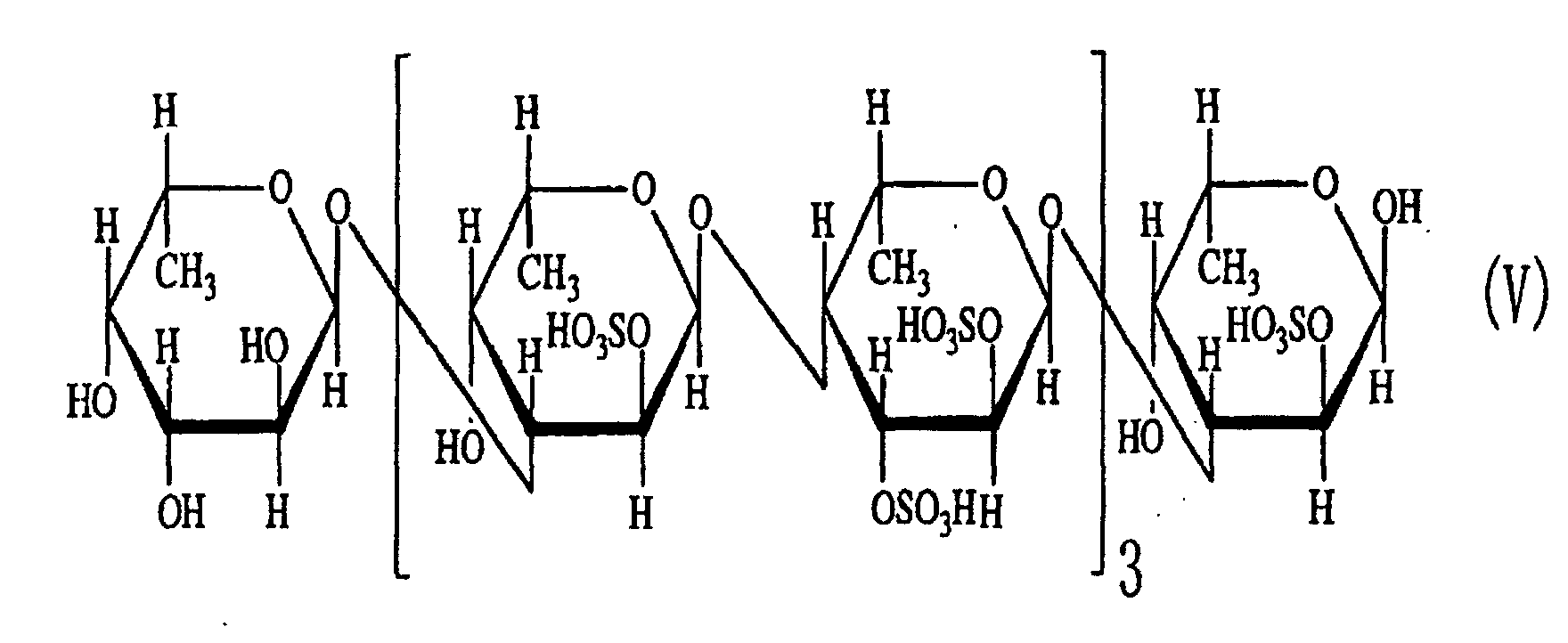

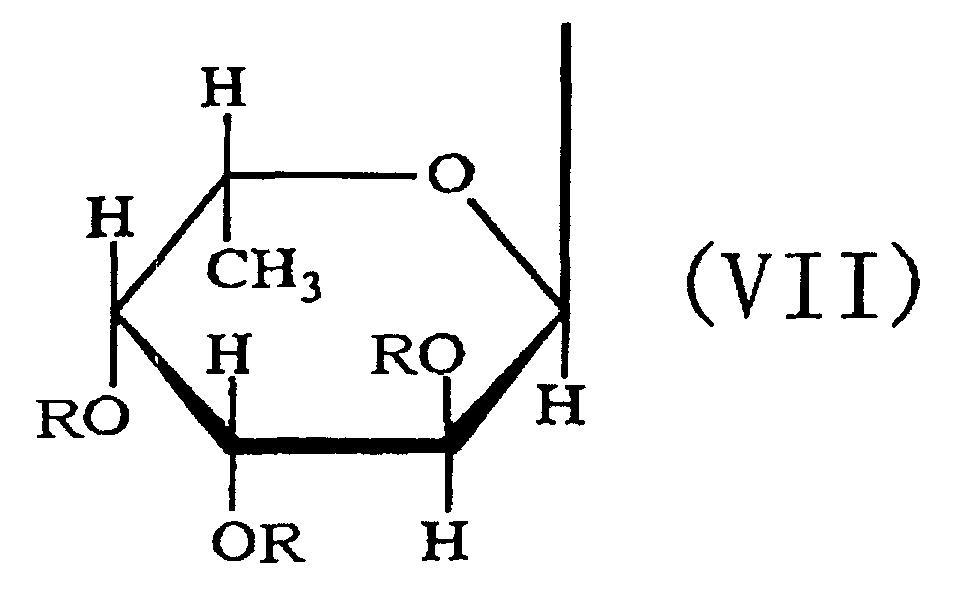
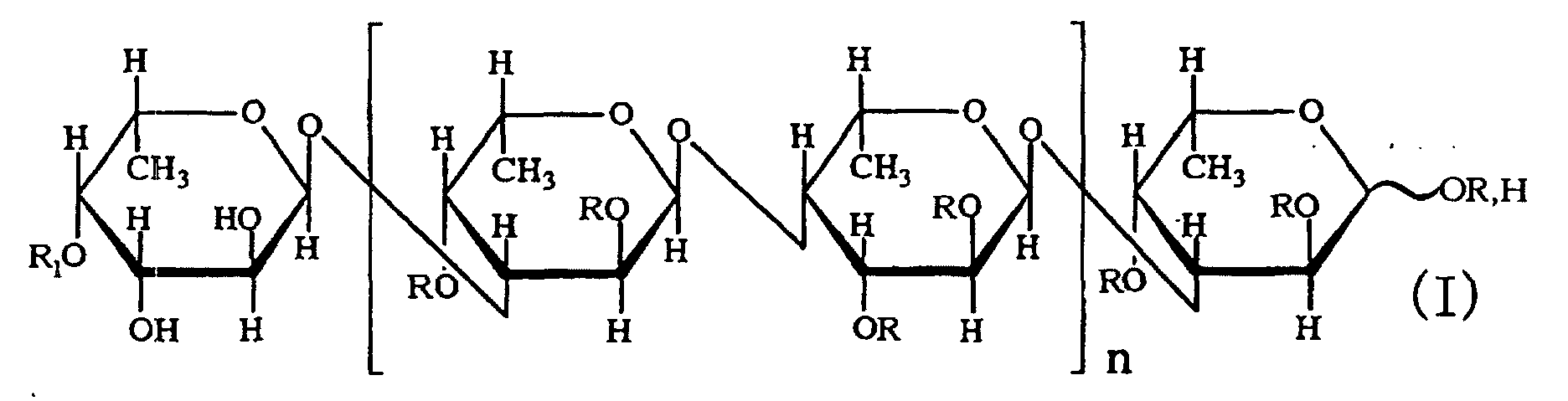
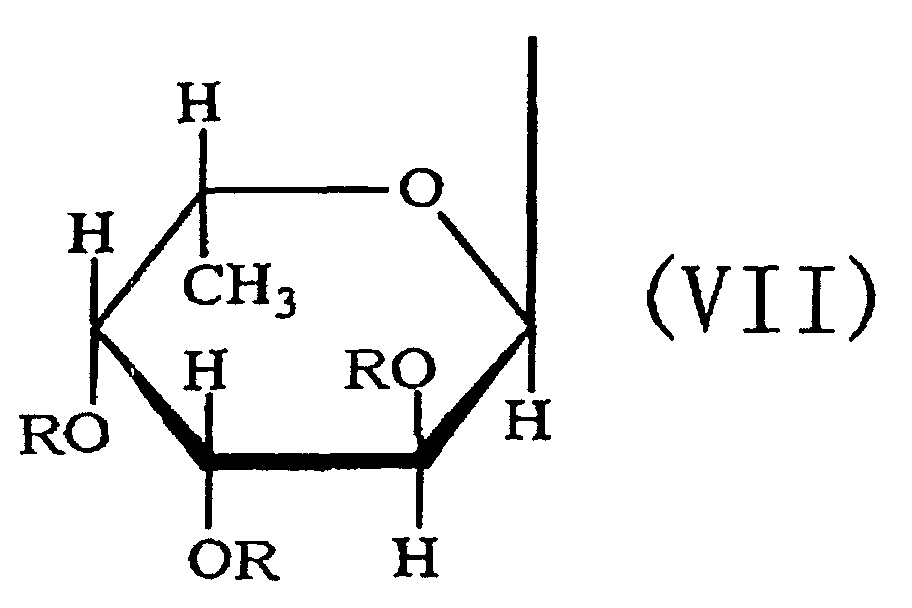

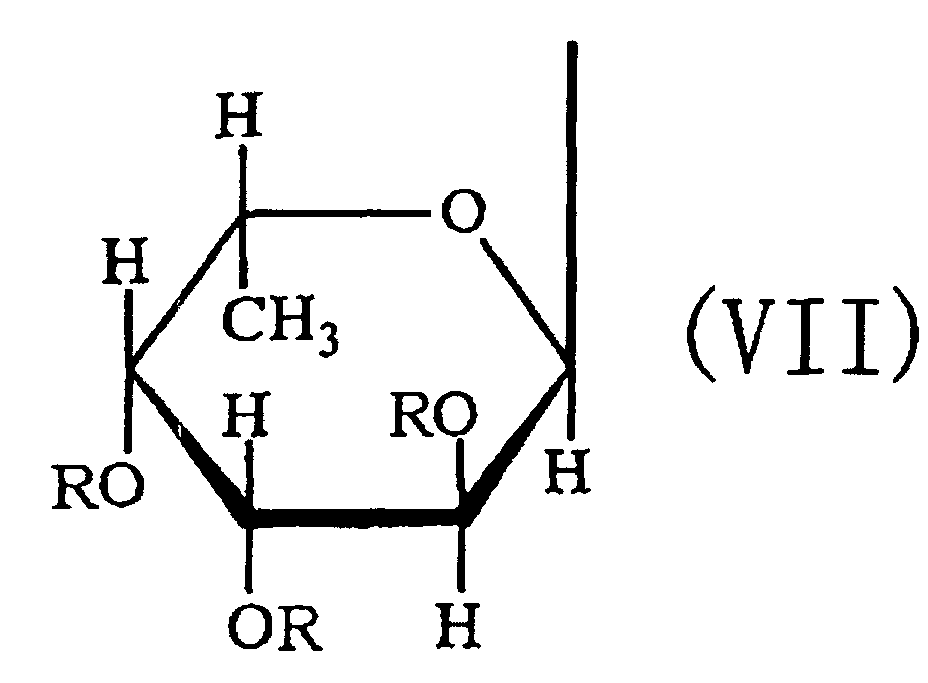
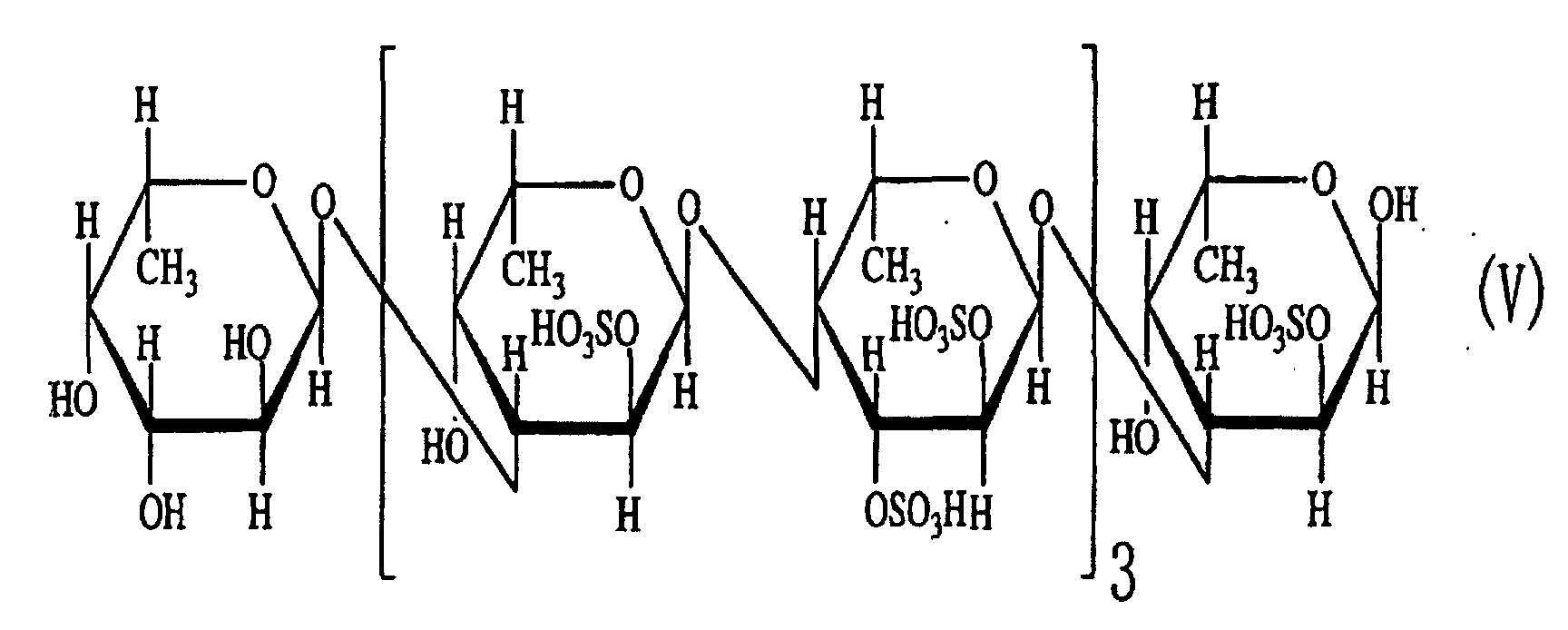
Molecular weight: 842
MS m/z; 431.1, [M+Na+-2H+]2-; 885.2, [M+2Na+-3H+]-
| Chemical shift value (ppm) | ||
| 1H-NMR Chemical shift value, multiplicity, coupling constant | 13C-NMR | |
| F1-1 | 5.43, d, 4.0 | 91.3 |
| F1-2 | 4.45, m | 74.3 |
| F1-3 | 3.99, dd, 3.5, 10.0 | 73.5 |
| F1-4 | 4.02, d, 3.5 | 69.5 |
| F1-5 | 4.16, q, 6.5 | 66.8 |
| F1-6 | 1.18, d, 6.5 | 16.3 |
| F2-1 | 5.29, d, 3.0 | 95.0 |
| F2-2 | 4.44, m | 76.2 |
| F2-3 | 4.11, m | 68.2 |
| F2-4 | 3.93, d, 3.0 | 83.3 |
| F2-5 | 4.46, m | 68.5 |
| F2-6 | 1.32, d, 6.5 | 16.4 |
| Chemical shift value (ppm) | ||
| 1H-NMR Chemical shift value, multiplicity, coupling constant | 13C-NMR | |
| F3-1 | 5.21, d, 3.5 | 99.9 |
| F3-2 | 4.51, dd, 3.5, 10.5 | 74.3 |
| F3-3 | 4.13, m | 72.6 |
| F3-4 | 4.04, d, 3.0 | 69.8 |
| F3-5 | 4.38, m | 68.2 |
| F3-6 | 1.18, d, 6.5 | 16.2 |
| F4-1 | 5.00, d, 4.0 | 96.5 |
| F4-2 | 3.73, dd, 4.0, 10.5 | 68.9 |
| F4-3 | 3.90, dd, 3.5, 10.5 | 70.3 |
| F4-4 | 3.77, d, 3.5 | 72.9 |
| F4-5 | 4.41, m | 67.8 |
| F4-6 | 1.15, d, 6.5 | 16.2 |
| Saccharide composition: 4 molecules of L-fucose Sulfate group: 3 molecules |

Molecular weight: 922
MS m/z; 482.1, [M+2Na+-4H+]2-; 987.1, [M+3Na+-4H+]-
| Chemical shift value (ppm) | ||
| 1H-NMR Chemical shift value, multiplicity, coupling constant | 13C-NMR | |
| F1-1 | 5.43, d, 3.5 | 91.4 |
| F1-2 | 4.46, dd, 3.9, 10.4 | 74.2 |
| F1-3 | 3.99, dd, 3.1, 10.4 | 74.64 or 74.68 |
| F1-4 | 4.02, d, 2.5 | 69.99 or 70.02 |
| F1-5 | 4.16, m | 66.8 |
| F1-6 | 1.17, d, 6.5 | 16.3 |
| F2-1 | 5.30, d, 3.8 | 96.0 |
| F2-2 | 4.58, dd, 3.6, 11.0 | 73.3 |
| F2-3 | 4.78, dd, 2.7, 10.9 | 74.64 or 74.68 |
| F2-4 | 4.21, d, 2.9 | 80.0 |
| F2-5 | 4.49, m | 68.7 |
| F2-6 | 1.32, d, 6.5 | 16.4 |
| Chemical shift value (ppm) | ||
| 1H-NMR Chemical shift value, multiplicity, coupling constant | 13C-NMR | |
| F3-1 | 5.21, d, 3.4 | 99.5 |
| F3-2 | 4.49, m | 74.2 |
| F3-3 | 4.14, m | 72.5 |
| F3-4 | 4.02, d, 2.5 | 69.99 or 70.02 |
| F3-5 | 4.39, m | 68.0 |
| F3-6 | 1.22, d, 6.0 | 16.18 |
| F4-1 | 5.00, d, 4.0 | 96.4 |
| F4-2 | 3.72, dd, 4.0, 10.0 | 69.0 |
| F4-3 | 3.90, dd, 3.0, 10.0 | 70.3 |
| F4-4 | 3.75, d, 3.0 | 72.9 |
| F4-5 | 4.41, m | 67.7 |
| F4-6 | 1.14, d, 6.5 | 16.17 |
| Saccharide composition: 4 molecules of L-fucose Sulfate group: 4 molecules |
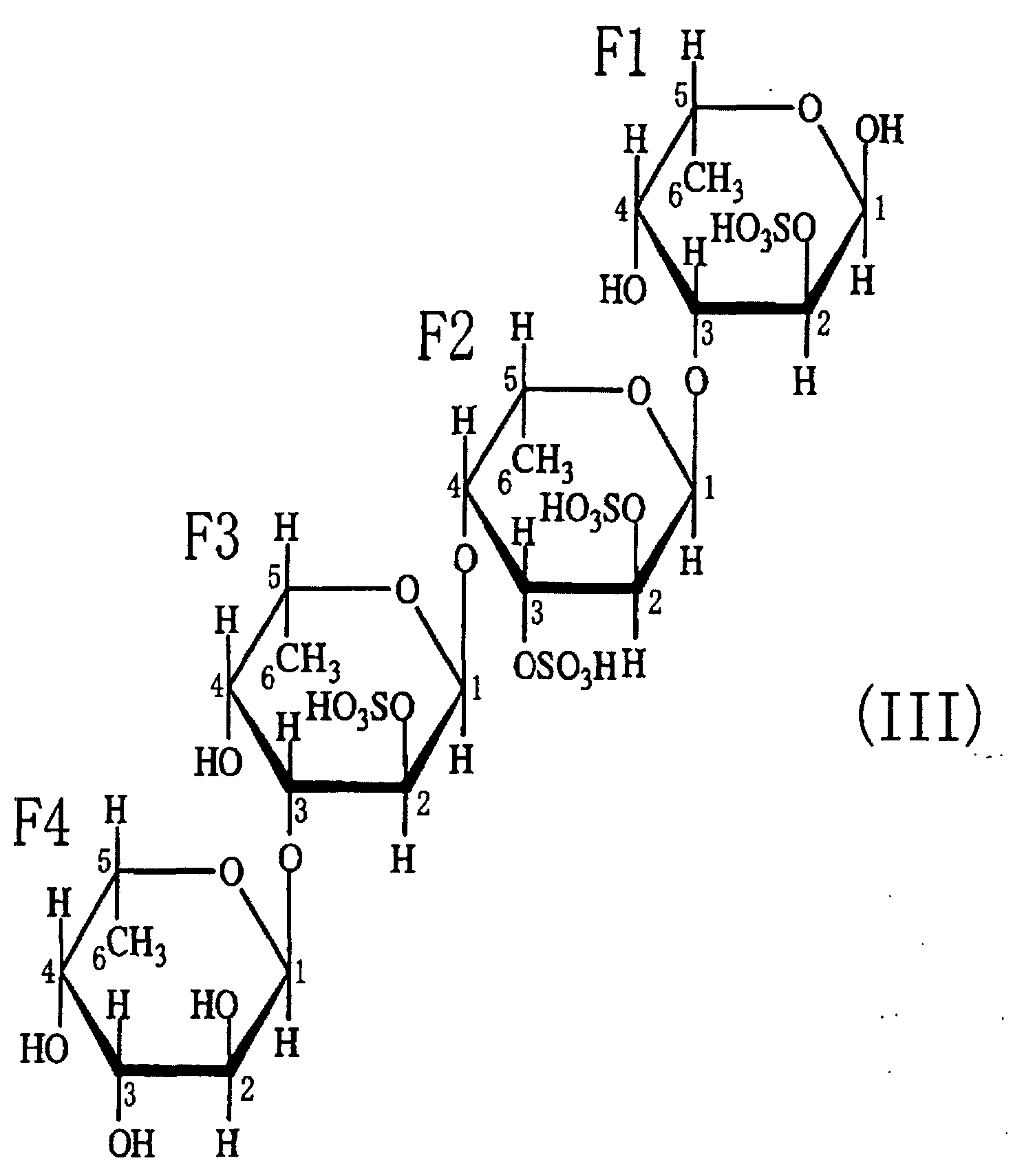
Molecular weight: 1454
MS m/z; 379.1, [M+3Na+-7H+]4-; 513.2, [M+4Na+-7H+]3-; 781.1, [M+5Na+-7H+]2-
| Chemical shift value (ppm) | ||
| 1H-NMR Chemical shift value, multiplicity, coupling constant | 13C-NMR | |
| F1-1 | 5.43, d, 3.5 | 91.4 |
| F1-2 | 4.47, m | 74.25 or 74.3 or 74.4 |
| F1-3 | 4.01, dd, 3.5, 10.0 | 74.25 or 74.3 or 74.4 |
| F1-4 | 4.04, m | 69.9 |
| F1-5 | 4.17, m | 66.8 |
| F1-6 | 1.18, d, 6.5 | 16.3 |
| F2-1 | 5.33, m | 95.67 or 95.71 |
| F2-2 | 4.58, dd, 3.5, 11.0 | 73.3 or 73.4 |
| F2-3 | 4.70, dd, 2.5, 11.0 | 74.8 or 74.9 |
| F2-4 | 4.22, m | 80.5 |
| F2-5 | 4.49, m | 68.7 |
| F2-6 | 1.34, d, 6.5 | 16.5 |
| F3-1 | 5.24, d, 3.5 | 99.7 |
| F3-2 | 4.52, m | 74.25 or 74.3 or 74.4 |
| F3-3 | 4.16, dd, 3.5, 10.0 | 74.25 or 74.3 or 74.4 |
| F3-4 | 4.06, d, 3.0 | 70.3 |
| F3-5 | 4.35, m | 67.9 |
| F3-6 | 1.24, d, 6.5 | 16.19 |
| Chemical shift value (ppm) | ||
| 1H-NMR Chemical shift value, multiplicity, coupling constant | 13C-NMR | |
| F4-1 | 5.33, m | 95.67 or 95.71 |
| F4-2 | 4.59, dd, 3.5, 11.0 | 73.3 or 73.4 |
| F4-3 | 4.73, dd, 2.5, 11.0 | 74.8 or 74.9 |
| F4-4 | 4.22, m | 80.3 |
| F4-5 | 4.56, m | 68.7 |
| F4-6 | 1.33, d, 6.5 | 16.5 |
| F5-1 | 5.24, d, 3.5 | 99.5 |
| F5-2 | 4.49, m | 74.25 or 74.3 or 74.4 |
| F5-3 | 4.16, dd, 3.5, 10.0 | 72.3 |
| F5-4 | 4.04, m | 69.9 |
| F5-5 | 4.38, m | 68.0 |
| F5-6 | 1.23, d, 6.5 | 16.19 |
| F6-1 | 5.01, d, 4.0 | 96.2 |
| F6-2 | 3.72, dd, 4.0, 10.5 | 69.0 |
| F6-3 | 3.91, dd, 3.5, 10.5 | 70.3 |
| F6-4 | 3.77, d, 3.5 | 72.9 |
| F6-5 | 4.41, m | 67.8 |
| F6-6 | 1.16, d, 6.5 | 16.16 |
| Saccharide composition: 6 molecules of L-fucose Sulfate group: 7 molecules |
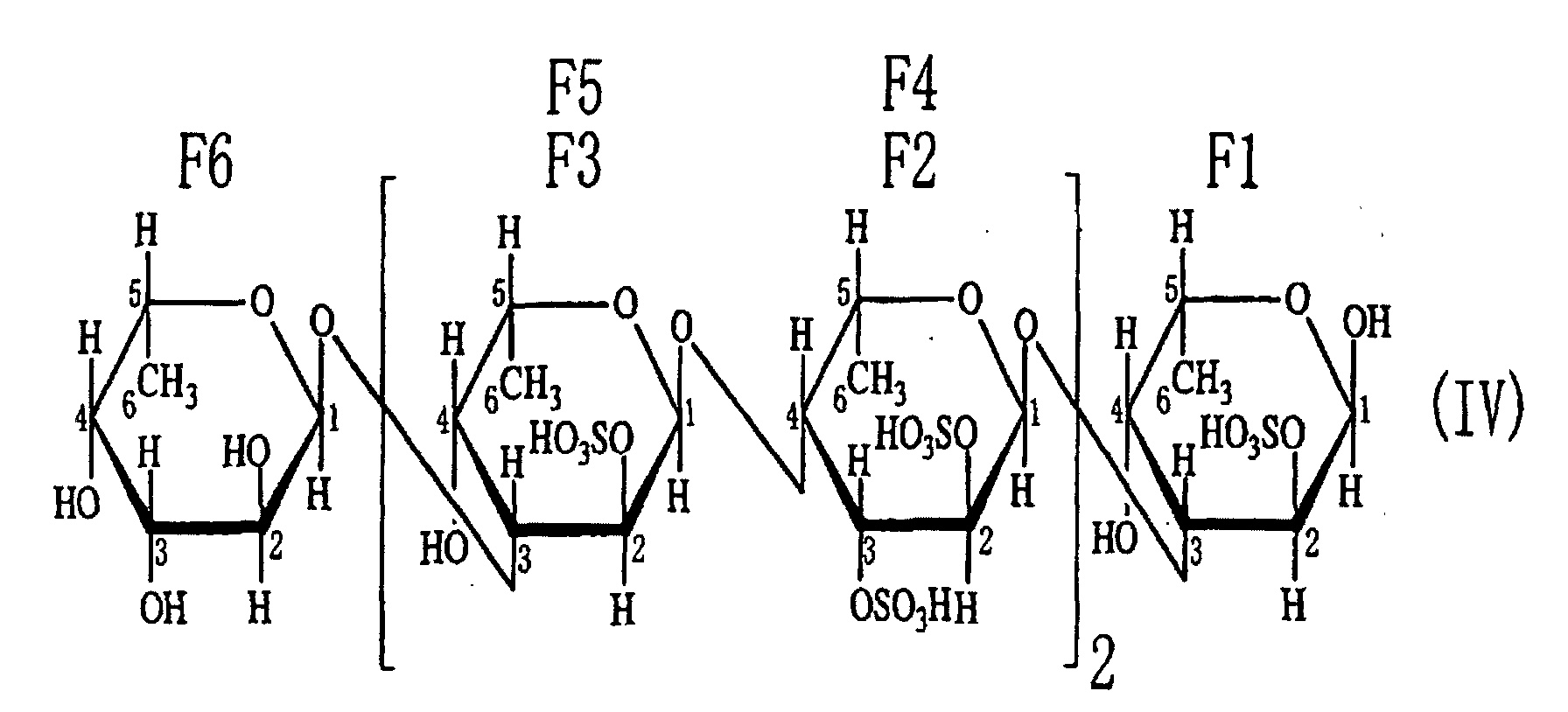
Molecular weight: 1986
MS m/z; 418.3, [M+5Na+-10H+]5-; 528.5, [M+6Na+-10H+]4-; 712.4, [M+7Na+-10H+]3-; 1080.6, [M+8Na+-10H+]2-
| Chemical shift value (ppm) | ||
| 1H-NMR Chemical shift value, multiplicity, coupling constant | 13C-NMR | |
| F1-1 | 5.43, d, 3.5 | 91.4 |
| F1-2 | 4.47, dd, 4.0, 10.0 | 74.2 or 74.3 or 74.4 |
| F1-3 | 4.01, dd, 3.5, 10.5 | 74.2 or 74.3 or 74.4 |
| F1-4 | 4.04, d, 3.5 | 69.8 or 69.9 |
| F1-5 | 4.18, m | 66.8 |
| F1-6 | 1.17, d, 7.0 | 16.3 |
| F2-1 | 5.33, m | 95.5 or 95.6 or 95.7 |
| F2-2 | 4.58, dd, 3.5, 10.5 | 73.3 or 73.4 |
| F2-3 | 4.70, dd, 2.5, 11.0 | 74.8 or 74.9 |
| F2-4 | 4.23, m | 80.6 |
| F2-5 | 4.49, m | 68.7 |
| F2-6 | 1.33, m | 16.5 |
| F3-1 | 5.24, m | 99.5 or 99.6 or 99.7 |
| F3-2 | 4.52, m | 74.2 or 74.3 or 74.4 |
| F3-3 | 4.16, dd, 3.0, 10.5 | 74.2 or 74.3 or 74.4 |
| F3-4 | 4.06, m | 70.2 or 70.27 or 70.32 |
| F3-5 | 4.33, m | 67.8 |
| F3-6 | 1.23, m | 16.2 |
| Chemical shift value (ppm) | ||
| 1H-NMR Chemical shift value, multiplicity, coupling constant | 13C-NMR | |
| F4-1 | 5.33, m | 95.5 or 95.6 or 95.7 |
| F4-2 | 4.58, dd, 3.5, 10.5 | 73.3 or 73.4 |
| F4-3 | 4.73, dd, 2.5, 11.0 | 74.8 or 74.9 |
| F4-4 | 4.23, m | 80.2 or 80.3 |
| F4-5 | 4.56, m | 68.7 |
| F4-6 | 1.33, m | 16.5 |
| F5-1 | 5.24, m | 99.5 or 99.6 or 99.7 |
| F5-2 | 4.52, m | 74.2 or 74.3 or 74.4 |
| F5-3 | 4.16, dd, 3.0, 10.5 | 74.2 or 74.3 or 74.4 |
| F5-4 | 4.06, m | 70.2 or 70.27 or 70.32 |
| F5-5 | 4.38, m | 67.8 |
| F5-6 | 1.23, m | 16.2 |
| F6-1 | 5.33, m | 95.5 or 95.6 or 95.7 |
| F6-2 | 4.58, dd, 3.5, 10.5 | 73.3 or 73.4 |
| F6-3 | 4.73, dd, 2.5, 11.0 | 74.8 or 74.9 |
| F6-4 | 4.23, m | 80.2 or 80.3 |
| F6-5 | 4.56, m | 68.7 |
| F6-6 | 1.33, m | 16.5 |
| Chemical shift value (ppm) | ||
| 1H-NMR Chemical shift value, multiplicity, coupling constant | 13C-NMR | |
| F7-1 | 5.24, m | 99.5 or 99.6 or 99.7 |
| F7-2 | 4.49, m | 74.2 or 74.3 or 74.4 |
| F7-3 | 4.16, dd, 3.0, 10.5 | 72.3 |
| F7-4 | 4.04, d, 3.5 | 69.8 or 69.9 |
| F7-5 | 4.38, m | 68.0 |
| F7-6 | 1.23, m | 16.2 |
| F8-1 | 5.01, d, 3.5 | 96.2 |
| F8-2 | 3.72, dd, 4.0, 10.0 | 69.0 |
| F8-3 | 3.91, dd, 3.5, 10.5 | 70.2 or 70.27 or 70.32 |
| F8-4 | 3.77, d, 4.0 | 72.9 |
| F8-5 | 4.40, m | 67.8 |
| F8-6 | 1.16, d, 7.0 | 16.2 |
| Saccharide composition: 8 molecules of L-fucose Sulfate group: 10 molecules |
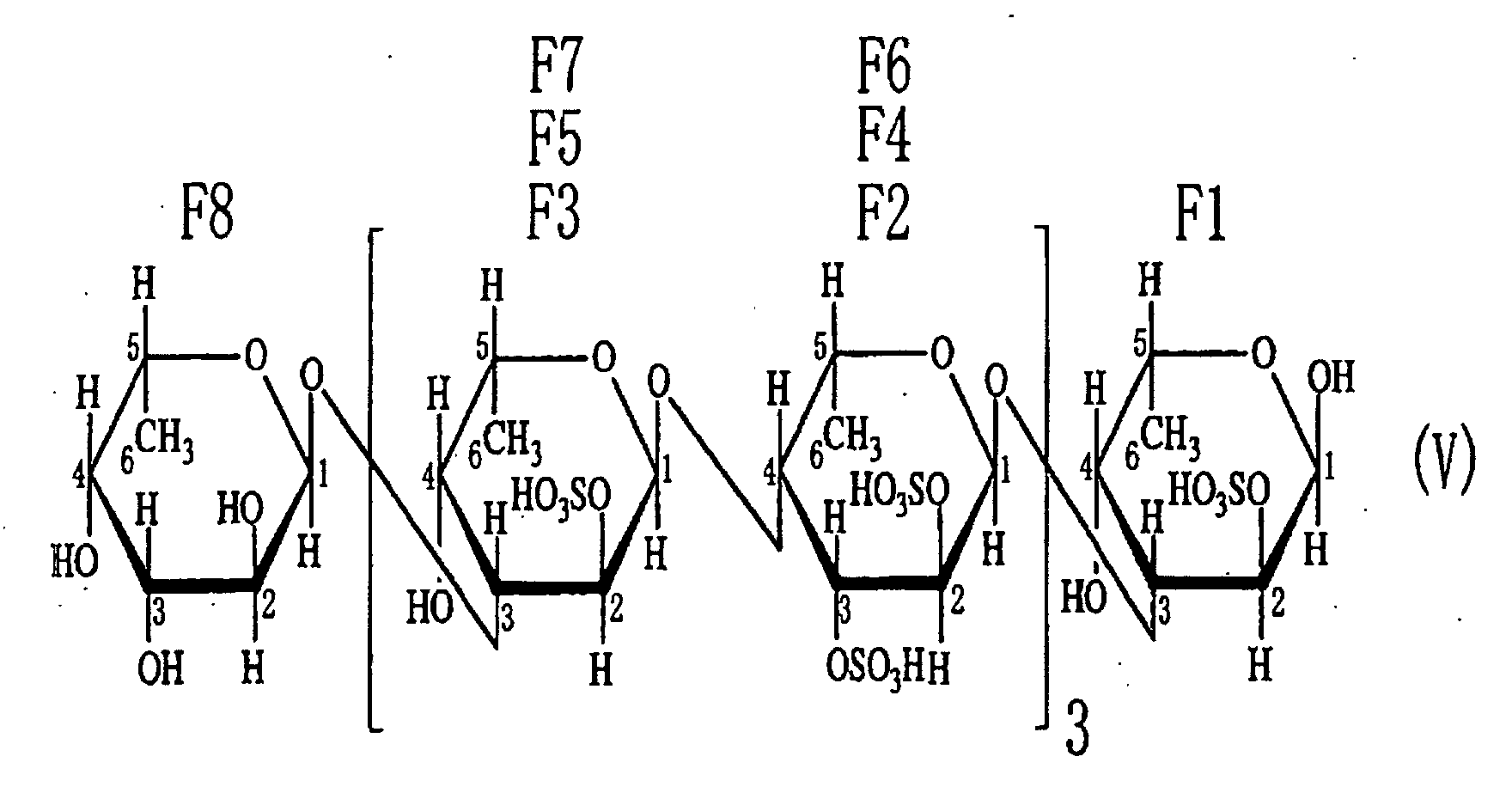
Molecular weight: 2518
MS m/z; 327.6, [M+5Na+-13H+]8-; 377.8, [M+6Na+-13H+]7-; 444.5, [M+7Na+-13H+]6-; 538.0, [M+8Na+-13H+]5-; 678.1, [M+9Na+-13H+]4-; 912.4, [M+10Na+-13+]3-
| Chemical shift value (ppm) | ||
| 1H-NMR Chemical shift value, multiplicity, coupling constant | 13C-NMR | |
| F1-1 | 5:43, d, 4.0 | 91.4 |
| F1-2 | 4.47, dd, 4.0, 10.0 | 74.1 or 74.3 or 74.4 |
| F1-3 | 4.01, dd, 3.5, 10.5 | 74.1 or 74.3 or 74.4 |
| F1-4 | 4.04, d, 2.5 | 69.8 or 69.9 |
| F1-5 | 4.17, m | 66.8 |
| F1-6 | 1.17, d, 6.5 | 16.3 |
| F2-1 | 5.35, m | 95.3 or 95.6 or 95.7 |
| F2-2 | 4.60, m | 73.3 or 73.4 |
| F2-3 | 4.70, dd, 2.5, 11.0 | 74.8 or 75.0 |
| F2-4 | 4.22, m | 80.6 |
| F2-5 | 4.50, m | 68.6 or 68.7 or 68.75 or 68.81 |
| F2-6 | 1.33, m | 16.45 or 16.54 |
| F3-1 | 5.23, m | 99.3 or 99.5 or 99.7 |
| F3-2 | 4.52, m | 74.1 or 74.3 or 74.4 |
| F3-3 | 4.16, dd, 3.0, 10.5 | 74.1 or 74.3 or 74.4 |
| F3-4 | 4.06, m | 70.3 |
| F3-5 | 4.32, q, 7.0 | 67.8 |
| F3-6 | 1.23, m | 16.2 |
| Chemical shift value (ppm) | ||
| 1H-NMR Chemical shift value, multiplicity, coupling constant | 13C-NMR | |
| F4-1 | 5.35, m | 95.3 or 95.6 or 95.7 |
| F4-2 | 4.60, m | 73.3 or 73.4 |
| F4-3 | 4.75, m | 74.8 or 75.0 |
| F4-4 | 4.22, m | 79.8 or 80.1 or 80.2 |
| F4-5 | 4.55, m | 68.6 or 68.7 or 68.75 or 68.81 |
| F4-6 | 1.33, m | 16.45 or 16.54 |
| F5-1 | 5.23, m | 99.3 or 99.5 or 99.7 |
| F5-2 | 4.52, m | 74.1 or 74.3 or 74.4 |
| F5-3 | 4.16, dd, 3.0, 10.5 | 74.1 or 74.3 or 74.4 |
| F5-4 | 4.06, m | 70.3 |
| F5-5 | 4.39, m | 67.8 |
| F5-6 | 1.23, m | 16.2 |
| F6-1 | 5.35, m | 95.3 or 95.6 or 95.7 |
| F6-2 | 4.60, m | 73.3 or 73.4 |
| F6-3 | 4.75, m | 74.8 or 75.0 |
| F6-4 | 4.22, m | 79.8 or 80.1 or 80.2 |
| F6-5 | 4.55, m | 68.6 or 68.7 or 68.75 or 68.81 |
| F6-6 | 1.33, m | 16.45 or 16.54 |
| Chemical shift value (ppm) | ||
| 1H-NMR Chemical shift value, multiplicity, coupling constant | 13C-NMR | |
| F7-1 | 5.23, m | 99.3 or 99.5 or 99.7 |
| F7-2 | 4.52, m | 74.1 or 74.3 or 74.4 |
| F7-3 | 4.16, dd, 3.0, 10.5 | 74.1 or 74.3 or 74.4 |
| F7-4 | 4.06, m | 70.3 |
| F7-5 | 4.39, m | 67.8 |
| F7-6 | 1.23, m | 16.2 |
| F8-1 | 5.35, m | 95.3 or 95.6 or 95.7 |
| F8-2 | 4.60, m | 73.3 or 73.4 |
| F8-3 | 4.75, m | 74.8 or 75.0 |
| F8-4 | 4.22, m | 79.8 or 80.1 or 80.2 |
| F8-5 | 68.6 or 68.7 or 68.75 or 68.81 | |
| F8-6 | 1.33, m | 16.45 or 16.54 |
| F9-1 | 5.23, m | 99.3 or 99.6 or 99.7 |
| F9-2 | 4.49, m | 74.1 or 74.3 or 74.4 |
| F9-3 | 4.16, dd, 3.0, 10.5 | 72.2 |
| F9-4 | 4.04, d, 2.5 | 69.8 or 69.9 |
| F9-5 | 4.39, m | 68.0 |
| F9-6 | 1.23, m | 16.2 |
| Chemical shift value (ppm) | ||
| 1H-NMR Chemical shift value, multiplicity, coupling constant | 13C-NMR | |
| F10-1 | 5.01, d, 4.0 | 96.1 |
| F10-2 | 3.72, dd, 4.0, 10.0 | 69.0 |
| F10-3 | 3.91, dd, 3.5, 10.5 | 70.3 |
| F10-4 | 3.77, d, 3.0 | 72.9 |
| F10-5 | 4.40, m | 67.8 |
| F10-6 | 1.16, d, 7.0 | 16.2 |
| Saccharide composition: 10 molecules of L-fucose Sulfate group: 13 molecules |
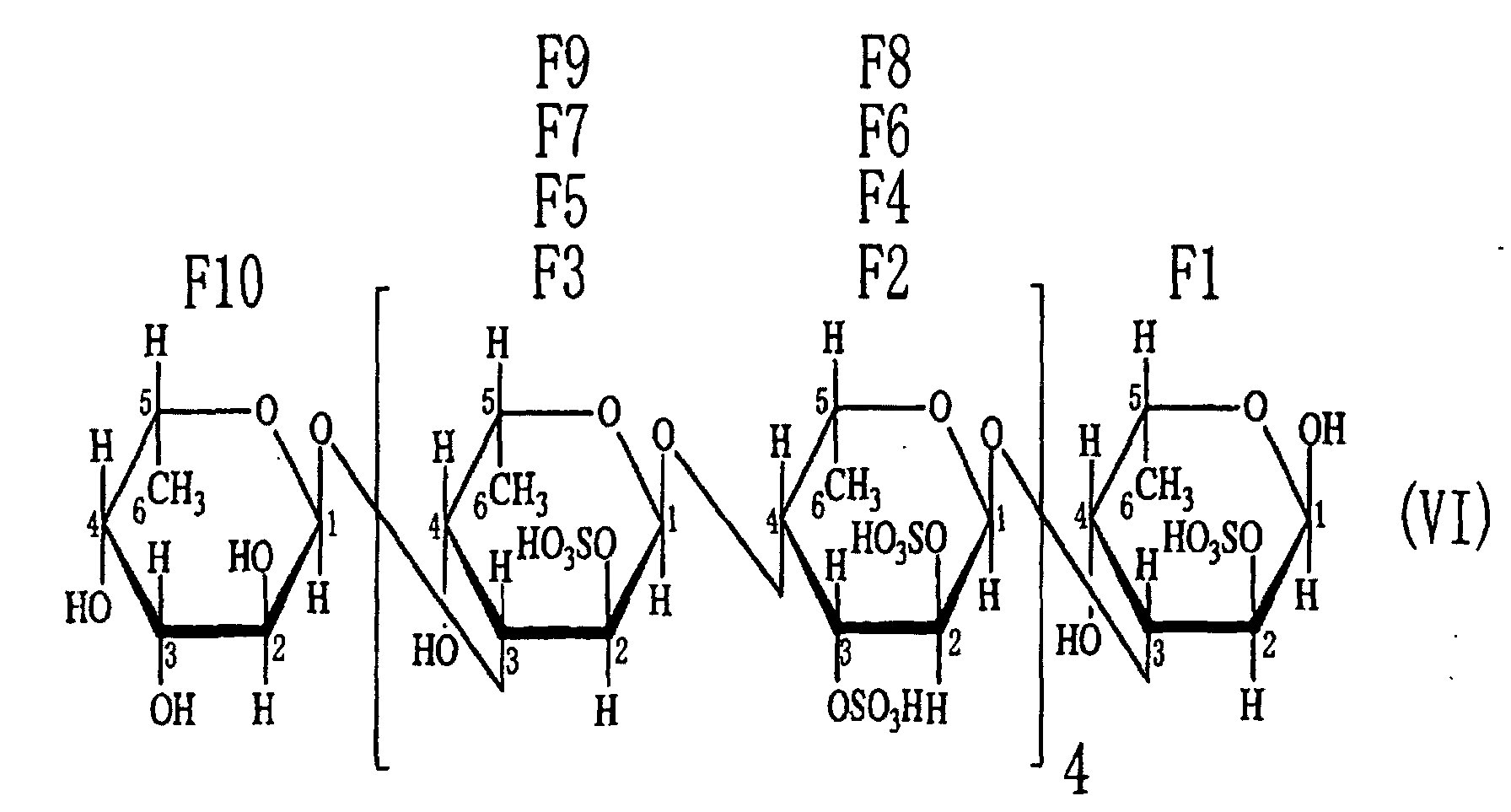
| Step | Protein (mg) | Total activity (mU) | Specific activity (mU/mg) | Yield (%) |
| Extract | 29,430 | 3,070 | 0.104 | 100 |
| Dialysis | 21,900 | 3,330 | 0.152 | 108 |
| DEAE-Cellulofine | 478 | 685 | 1.43 | 22.3 |
| Hydroxyapatite | 20.7 | 219 | 10.6 | 7.13 |
| Sephacryl S-200 | 2.66 | 32.7 | 12.3 | 1.07 |
| Step | Protein (mg) | Total activity (mU) | Specific activity (mU/mg) | Yield (%) |
| Extract | 33,600 | 731 | 0.0218 | 100 |
| Dialysis | 30,900 | 736 | 0.0238 | 101 |
| DEAE-Cellulofine | 567 | 97.2 | 0.171 | 13.3 |
| DEAE Cellulofine | 102 | 43.6 | 4.27 | 5.96 |
| Sulfate-Cellulofine | 9.66 | 8.40 | 0.870 | 1.14 |
| Step | Protein (mg) | Total activity (mU) | Specific activity (mU/mg) | Yield (%) |
| Extract | 33,600 | 12,400 | 0.369 | 100 |
| Dialysis | 30,900 | 11,900 | 0.385 | 96.0 |
| DEAE-Cellulofine | 231 | 778 | 3.37 | 6.27 |
| Sulfate-Cellulofine | 42.7 | 1,180 | 27.6 | 9.52 |
| Sulfate-Cellulofine | 8.32 | 1, 090 | 131 | 8.79 |

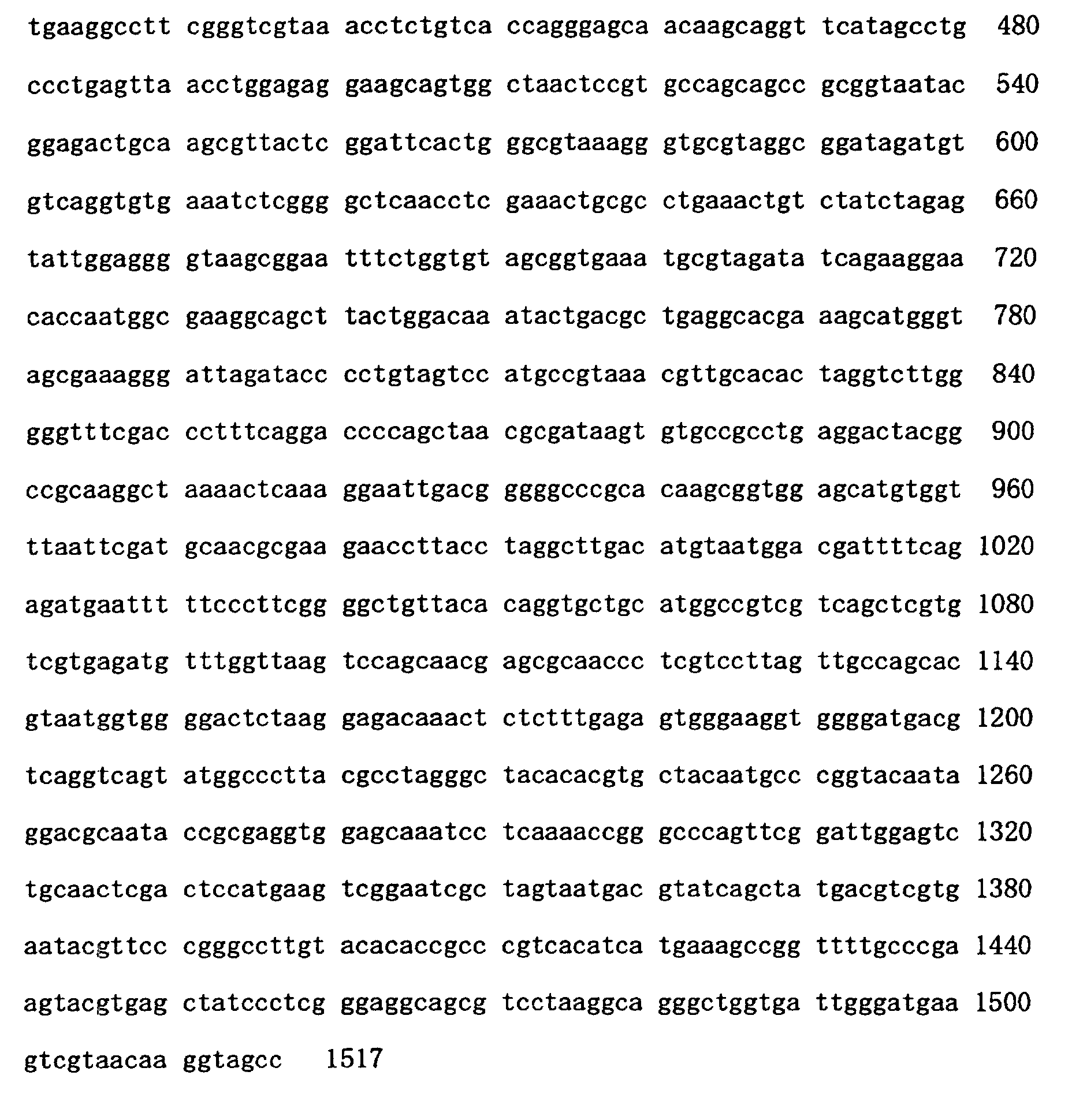
Claims (9)
- A sulfated fucan-degrading enzyme that degrades a sulfated fucan derived from a brown alga of the order Fucales, which is obtainable from a culture of a bacterium of the genus Fucophilus.
- The sulfated fucan-degrading enzyme according to claim 1, which is an endo-type α-(1-4)L-fucosidase having the following physical and chemical properties:(I) acting on a sulfated fucan oligosaccharide of formula (V) to cleave an α-(1-4)L-fucosyl bond in an endo-type manner:
 (II) having an optimal pH of about 6 to 8; and(III) having an optimal temperature of about 10 to 40°C.
 - A method for producing the sulfated fucan-degrading enzyme defined by claim 1, the method comprising culturing a bacterium of the genus Fucophilus, and collecting the enzyme from the culture.
- A sulfated fucan oligosaccharide which is obtainable by allowing the sulfated fucan-degrading enzyme defined by claim 1 to act on a sulfated polysaccharide derived from a brown alga.
- A method for producing a sulfated fucan oligosaccharide, the method comprising allowing the sulfated fucan-degrading enzyme defined by claim 1 to act on a sulfated polysaccharide derived from a brown alga, and collecting a sulfated fucan oligosaccharide.
- A saccharide of general formula (I) or a salt thereof:wherein R is H, SO3H, CH3CO or general formula (VII); R1 is H, SO3H or CH3CO; at least one of Rs and R1 is SO3H; n is an integer of 1 or more:
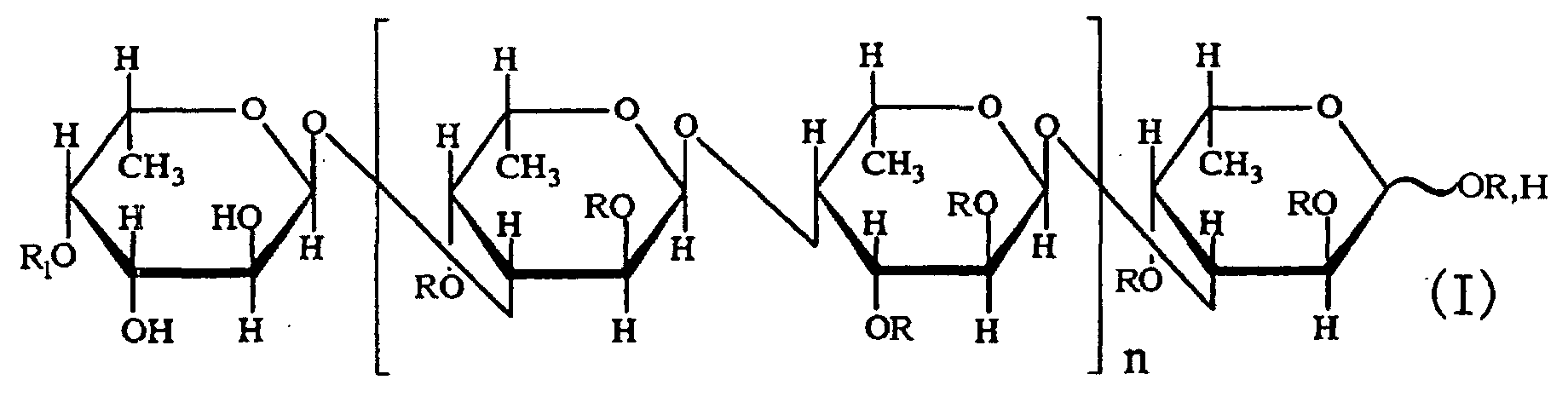 wherein R is H, SO3H or CH3CO.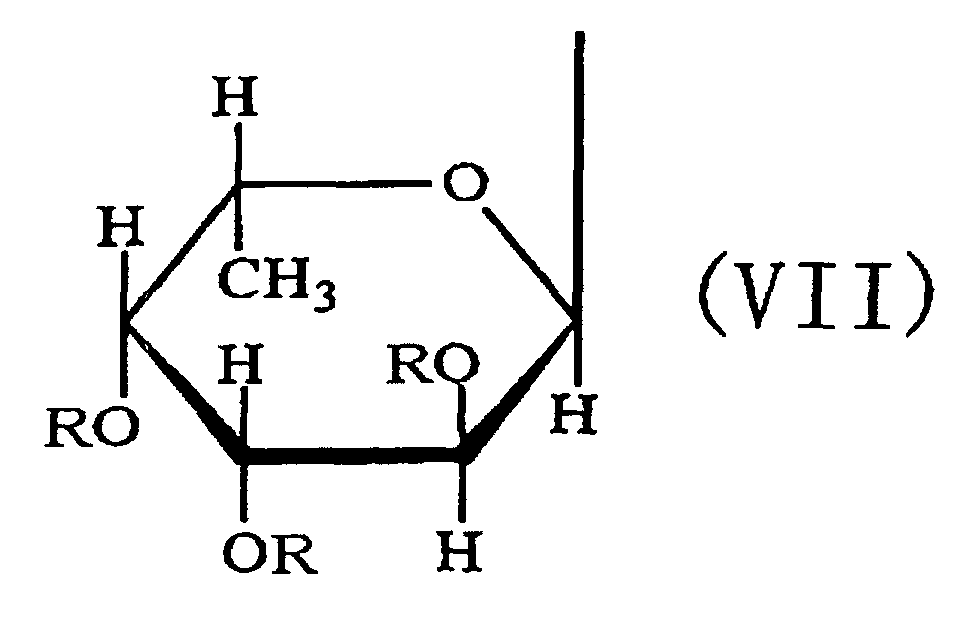
- A sulfated fucan oligosaccharide of general formula (I) or a salt thereof:wherein R is H, SO3H, CH3CO or general formula (VII); R1 is H, SO3H or CH3CO; at least one of Rs and R1 is SO3 H; n is an integer of 1 to 4:
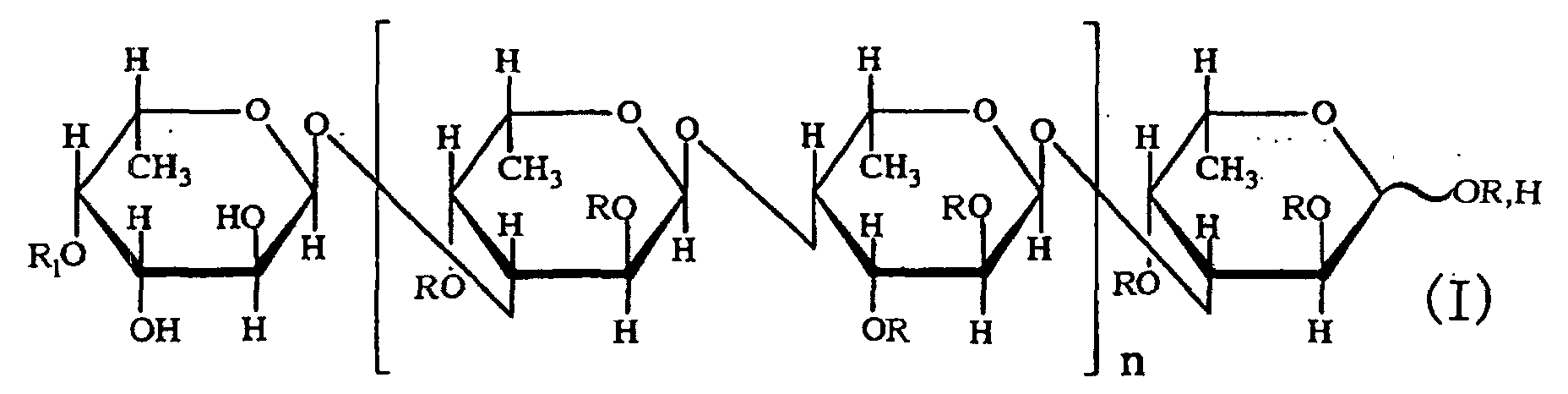 wherein R is H, SO3H or CH3CO.
- A method for producing a sulfated fucan oligosaccharide of general formula (VIII), the method comprising allowing the sulfated fucan-degrading enzyme defined by claim 1 to act on a sulfated polysaccharide derived from a brown alga of the order Fucales to produce a sulfated fucan oligosaccharide of general formula (VIII):wherein R is H, SO3H, CH3CO or general formula (VII); at least one of Rs is SO3H; n is an integer of 1 or more:
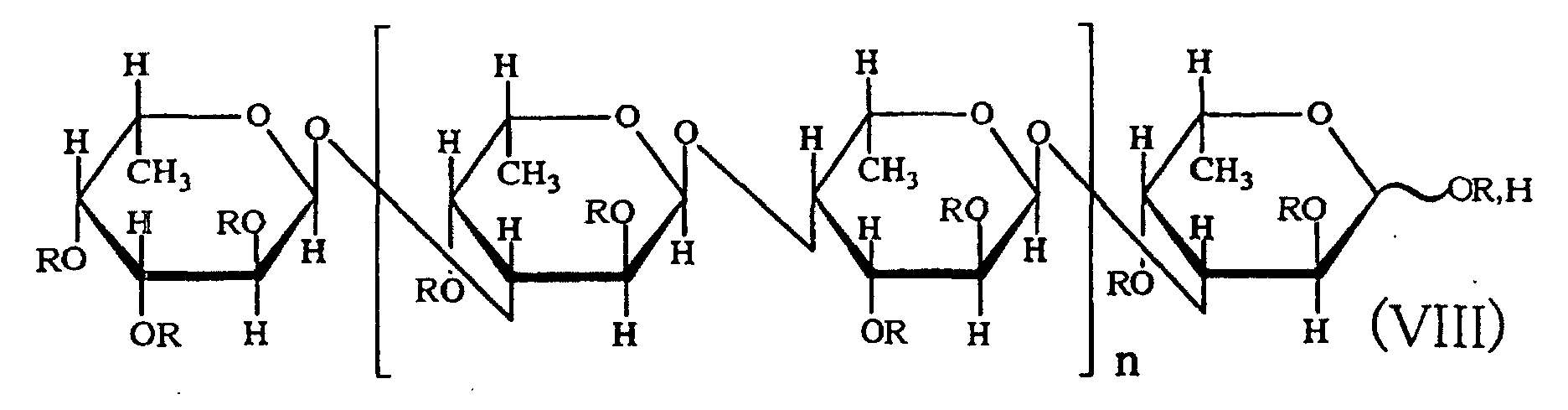 wherein R is H, SO3H or CH3CO.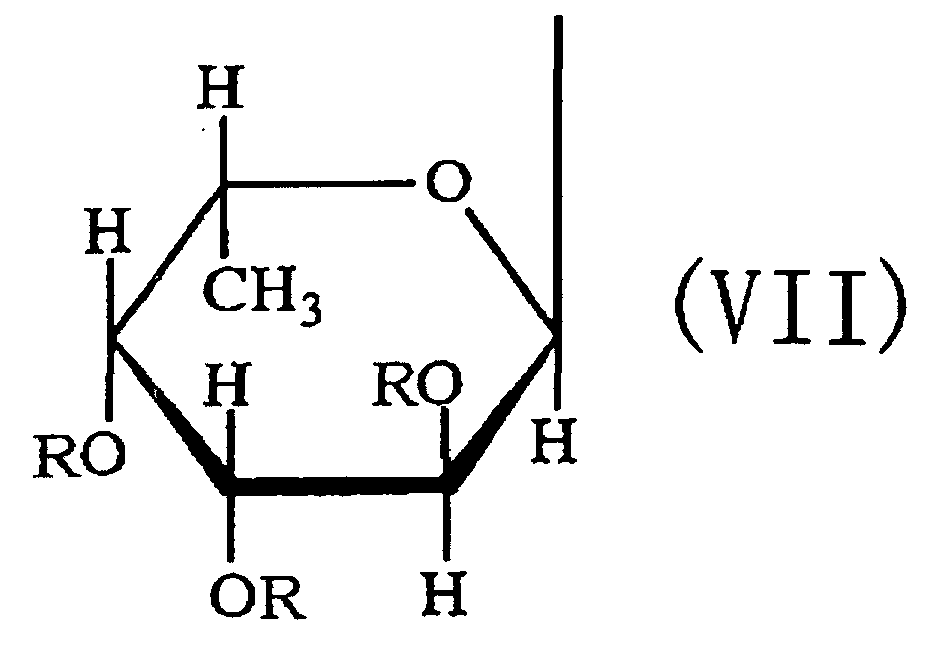
- The method according to claim 8, wherein the brown alga of the order Fucales is Fucus vesiculosus or Ascophyllum nodosum.
Applications Claiming Priority (5)
| Application Number | Priority Date | Filing Date | Title |
|---|---|---|---|
| JP2002010844 | 2002-01-18 | ||
| JP2002010844 | 2002-01-18 | ||
| JP2002149874 | 2002-05-23 | ||
| JP2002149874 | 2002-05-23 | ||
| PCT/JP2003/000334 WO2003062412A1 (en) | 2002-01-18 | 2003-01-17 | Sulfated fucan |
Publications (2)
| Publication Number | Publication Date |
|---|---|
| EP1466969A1 true EP1466969A1 (en) | 2004-10-13 |
| EP1466969A4 EP1466969A4 (en) | 2006-02-01 |
Family
ID=27615668
Family Applications (1)
| Application Number | Title | Priority Date | Filing Date |
|---|---|---|---|
| EP03701755A Withdrawn EP1466969A4 (en) | 2002-01-18 | 2003-01-17 | Sulfated fucan |
Country Status (4)
| Country | Link |
|---|---|
| US (1) | US20050255564A1 (en) |
| EP (1) | EP1466969A4 (en) |
| JP (1) | JP4262601B2 (en) |
| WO (1) | WO2003062412A1 (en) |
Cited By (1)
| Publication number | Priority date | Publication date | Assignee | Title |
|---|---|---|---|---|
| WO2015082356A1 (en) * | 2013-12-03 | 2015-06-11 | Gerolymatos International S.A. | Ionic aqueous compositions |
Families Citing this family (11)
| Publication number | Priority date | Publication date | Assignee | Title |
|---|---|---|---|---|
| EP1765454B1 (en) | 2004-07-02 | 2016-04-13 | Mati Therapeutics Inc. | Treatment medium delivery device for the eye |
| EP2004172B1 (en) | 2006-03-31 | 2019-03-13 | Mati Therapeutics Inc. | Drug delivery structures and compositions for nasolacrimal system |
| US9011361B2 (en) | 2007-09-07 | 2015-04-21 | Mati Therapeutics Inc. | Lacrimal implant detection |
| CA2750381C (en) * | 2009-01-23 | 2021-03-16 | Qlt Inc. | Sustained released delivery of one or more agents |
| DE102010007836A1 (en) * | 2010-02-11 | 2011-08-11 | Maier, Ursula, 78462 | Oil extraction substance |
| US9974685B2 (en) | 2011-08-29 | 2018-05-22 | Mati Therapeutics | Drug delivery system and methods of treating open angle glaucoma and ocular hypertension |
| ES2727203T3 (en) | 2011-08-29 | 2019-10-14 | Mati Therapeutics Inc | Administration for sustained release of active agents to treat glaucoma and ocular hypertension |
| RS20171030A1 (en) | 2017-10-12 | 2019-04-30 | Pavlovic Bojan | F-fucoidan, desulfated f-fucoidan, and its processed derivatives in terms of desulfated oligo-fucose as inhibitors of gastrointestinal infection |
| FR3079831B1 (en) | 2018-04-05 | 2020-11-20 | Jymsea | OLIGOFUCANE EXTRACTION PROCESS AND ITS APPLICATIONS |
| FR3158017A1 (en) * | 2024-01-09 | 2025-07-11 | Jymsea | Fucan and Polyphenol Complex Formed from a Brown Algae and Use of this Complex in the Control of Methane Metabolism in a Ruminant |
| CN119913226B (en) * | 2025-04-03 | 2025-08-08 | 中国海洋大学 | Application of fucoidin degrading enzyme OUC-MgFucD1 in preparation of fucoidin |
Family Cites Families (7)
| Publication number | Priority date | Publication date | Assignee | Title |
|---|---|---|---|---|
| FR2648463B1 (en) * | 1989-06-14 | 1993-01-22 | Inst Fs Rech Expl Mer | SULPHATE POLYSACCHARIDES, ANTICOAGULATING AGENT AND ANTI-COMPLEMENTARY AGENT OBTAINED FROM BROWN ALGAE FUCANES AND PROCESS FOR OBTAINING SAME |
| EP0870771B1 (en) * | 1995-04-28 | 2008-11-12 | Takara Bio Inc. | Sugar compounds |
| KR100555845B1 (en) * | 1996-01-26 | 2006-11-23 | 다카라 홀딩스 인크. | Anticancer agent |
| WO1999041288A1 (en) * | 1998-02-17 | 1999-08-19 | Takara Shuzo Co., Ltd. | Sulfated saccharides |
| KR100601330B1 (en) * | 1999-02-23 | 2006-07-14 | 다카라 바이오 가부시키가이샤 | Sulfated Fucogalactan |
| AU2001248788A1 (en) * | 2000-04-21 | 2001-11-07 | Takara Bio Inc. | Glucuronofucan sulfate |
| ES2236420T3 (en) * | 2001-10-24 | 2005-07-16 | Takara Bio Inc. | OLIGOSACARIDO OF SULFATED FUCANO. |
-
2003
- 2003-01-17 JP JP2003562280A patent/JP4262601B2/en not_active Expired - Fee Related
- 2003-01-17 WO PCT/JP2003/000334 patent/WO2003062412A1/en not_active Ceased
- 2003-01-17 EP EP03701755A patent/EP1466969A4/en not_active Withdrawn
- 2003-01-17 US US10/500,834 patent/US20050255564A1/en not_active Abandoned
Cited By (5)
| Publication number | Priority date | Publication date | Assignee | Title |
|---|---|---|---|---|
| WO2015082356A1 (en) * | 2013-12-03 | 2015-06-11 | Gerolymatos International S.A. | Ionic aqueous compositions |
| EA031541B1 (en) * | 2013-12-03 | 2019-01-31 | Геролиматос Интернэшнл С.А. | Ionic aqueous compositions |
| US10485819B2 (en) | 2013-12-03 | 2019-11-26 | Gerolymatos International S.A. | Ionic aqueous polysaccharide compositions |
| AU2014359488B2 (en) * | 2013-12-03 | 2020-01-23 | Gerolymatos International S.A. | Ionic aqueous compositions |
| US11672821B2 (en) | 2013-12-03 | 2023-06-13 | Gerolymatos International S.A. | Methods for treating respiratory conditions using ionic aqueous polysaccharide compositions |
Also Published As
| Publication number | Publication date |
|---|---|
| US20050255564A1 (en) | 2005-11-17 |
| JPWO2003062412A1 (en) | 2005-05-19 |
| JP4262601B2 (en) | 2009-05-13 |
| WO2003062412A1 (en) | 2003-07-31 |
| EP1466969A4 (en) | 2006-02-01 |
Similar Documents
| Publication | Publication Date | Title |
|---|---|---|
| US6379947B2 (en) | Biologically pure culture of Fucoidanobacter marinus SI-0098 (FERM BP-5403) | |
| JP2009050271A (en) | Glucuronofucan sulfate | |
| JPWO1996034004A1 (en) | sugar compound | |
| US20050255564A1 (en) | Sulfated fucan | |
| EP1176153B1 (en) | Sulfated fucogalactan | |
| JPWO2001081560A1 (en) | Sulfated glucuronofucan | |
| US7041656B2 (en) | Sulfated fucoglucuronomannan | |
| EP1306389B1 (en) | Sulfated fucan oligosaccharide | |
| EP1514923A1 (en) | Enzyme for decomposition of sulfated fucan derived from sea cucumber | |
| TWI243853B (en) | Glucuronofucan sulfate | |
| JP3991043B2 (en) | Sugar compounds | |
| KR20050016565A (en) | Enzyme for decomposition of sulfated fucan derived from sea cucumber |
Legal Events
| Date | Code | Title | Description |
|---|---|---|---|
| PUAI | Public reference made under article 153(3) epc to a published international application that has entered the european phase |
Free format text: ORIGINAL CODE: 0009012 |
|
| 17P | Request for examination filed |
Effective date: 20040716 |
|
| AK | Designated contracting states |
Kind code of ref document: A1 Designated state(s): AT BE BG CH CY CZ DE DK EE ES FI FR GB GR IE IT LI LU MC NL PT SE SI SK TR |
|
| AX | Request for extension of the european patent |
Extension state: AL LT LV MK RO |
|
| A4 | Supplementary search report drawn up and despatched |
Effective date: 20051220 |
|
| RIC1 | Information provided on ipc code assigned before grant |
Ipc: C08B 37/00 20060101ALI20051214BHEP Ipc: C07H 11/00 20060101ALI20051214BHEP Ipc: C12P 19/14 20060101ALI20051214BHEP Ipc: C12P 19/04 20060101ALI20051214BHEP Ipc: C12N 9/42 20060101ALI20051214BHEP Ipc: C12N 9/24 20060101AFI20051214BHEP |
|
| 17Q | First examination report despatched |
Effective date: 20060626 |
|
| STAA | Information on the status of an ep patent application or granted ep patent |
Free format text: STATUS: THE APPLICATION IS DEEMED TO BE WITHDRAWN |
|
| 18D | Application deemed to be withdrawn |
Effective date: 20061107 |