EP1466663A1 - Quality control method for manufacturing nucleic acid arrays - Google Patents
Quality control method for manufacturing nucleic acid arrays Download PDFInfo
- Publication number
- EP1466663A1 EP1466663A1 EP04006597A EP04006597A EP1466663A1 EP 1466663 A1 EP1466663 A1 EP 1466663A1 EP 04006597 A EP04006597 A EP 04006597A EP 04006597 A EP04006597 A EP 04006597A EP 1466663 A1 EP1466663 A1 EP 1466663A1
- Authority
- EP
- European Patent Office
- Prior art keywords
- groups
- detectable
- protecting groups
- group
- moieties
- Prior art date
- Legal status (The legal status is an assumption and is not a legal conclusion. Google has not performed a legal analysis and makes no representation as to the accuracy of the status listed.)
- Withdrawn
Links
Images


Classifications
-
- B—PERFORMING OPERATIONS; TRANSPORTING
- B01—PHYSICAL OR CHEMICAL PROCESSES OR APPARATUS IN GENERAL
- B01J—CHEMICAL OR PHYSICAL PROCESSES, e.g. CATALYSIS OR COLLOID CHEMISTRY; THEIR RELEVANT APPARATUS
- B01J19/00—Chemical, physical or physico-chemical processes in general; Their relevant apparatus
- B01J19/0046—Sequential or parallel reactions, e.g. for the synthesis of polypeptides or polynucleotides; Apparatus and devices for combinatorial chemistry or for making molecular arrays
-
- B—PERFORMING OPERATIONS; TRANSPORTING
- B82—NANOTECHNOLOGY
- B82Y—SPECIFIC USES OR APPLICATIONS OF NANOSTRUCTURES; MEASUREMENT OR ANALYSIS OF NANOSTRUCTURES; MANUFACTURE OR TREATMENT OF NANOSTRUCTURES
- B82Y30/00—Nanotechnology for materials or surface science, e.g. nanocomposites
-
- C—CHEMISTRY; METALLURGY
- C07—ORGANIC CHEMISTRY
- C07H—SUGARS; DERIVATIVES THEREOF; NUCLEOSIDES; NUCLEOTIDES; NUCLEIC ACIDS
- C07H19/00—Compounds containing a hetero ring sharing one ring hetero atom with a saccharide radical; Nucleosides; Mononucleotides; Anhydro-derivatives thereof
- C07H19/02—Compounds containing a hetero ring sharing one ring hetero atom with a saccharide radical; Nucleosides; Mononucleotides; Anhydro-derivatives thereof sharing nitrogen
- C07H19/04—Heterocyclic radicals containing only nitrogen atoms as ring hetero atom
- C07H19/06—Pyrimidine radicals
-
- C—CHEMISTRY; METALLURGY
- C07—ORGANIC CHEMISTRY
- C07H—SUGARS; DERIVATIVES THEREOF; NUCLEOSIDES; NUCLEOTIDES; NUCLEIC ACIDS
- C07H19/00—Compounds containing a hetero ring sharing one ring hetero atom with a saccharide radical; Nucleosides; Mononucleotides; Anhydro-derivatives thereof
- C07H19/02—Compounds containing a hetero ring sharing one ring hetero atom with a saccharide radical; Nucleosides; Mononucleotides; Anhydro-derivatives thereof sharing nitrogen
- C07H19/04—Heterocyclic radicals containing only nitrogen atoms as ring hetero atom
- C07H19/06—Pyrimidine radicals
- C07H19/10—Pyrimidine radicals with the saccharide radical esterified by phosphoric or polyphosphoric acids
-
- C—CHEMISTRY; METALLURGY
- C07—ORGANIC CHEMISTRY
- C07H—SUGARS; DERIVATIVES THEREOF; NUCLEOSIDES; NUCLEOTIDES; NUCLEIC ACIDS
- C07H19/00—Compounds containing a hetero ring sharing one ring hetero atom with a saccharide radical; Nucleosides; Mononucleotides; Anhydro-derivatives thereof
- C07H19/02—Compounds containing a hetero ring sharing one ring hetero atom with a saccharide radical; Nucleosides; Mononucleotides; Anhydro-derivatives thereof sharing nitrogen
- C07H19/04—Heterocyclic radicals containing only nitrogen atoms as ring hetero atom
- C07H19/16—Purine radicals
-
- C—CHEMISTRY; METALLURGY
- C07—ORGANIC CHEMISTRY
- C07H—SUGARS; DERIVATIVES THEREOF; NUCLEOSIDES; NUCLEOTIDES; NUCLEIC ACIDS
- C07H19/00—Compounds containing a hetero ring sharing one ring hetero atom with a saccharide radical; Nucleosides; Mononucleotides; Anhydro-derivatives thereof
- C07H19/02—Compounds containing a hetero ring sharing one ring hetero atom with a saccharide radical; Nucleosides; Mononucleotides; Anhydro-derivatives thereof sharing nitrogen
- C07H19/04—Heterocyclic radicals containing only nitrogen atoms as ring hetero atom
- C07H19/16—Purine radicals
- C07H19/20—Purine radicals with the saccharide radical esterified by phosphoric or polyphosphoric acids
-
- C—CHEMISTRY; METALLURGY
- C07—ORGANIC CHEMISTRY
- C07H—SUGARS; DERIVATIVES THEREOF; NUCLEOSIDES; NUCLEOTIDES; NUCLEIC ACIDS
- C07H21/00—Compounds containing two or more mononucleotide units having separate phosphate or polyphosphate groups linked by saccharide radicals of nucleoside groups, e.g. nucleic acids
-
- C—CHEMISTRY; METALLURGY
- C12—BIOCHEMISTRY; BEER; SPIRITS; WINE; VINEGAR; MICROBIOLOGY; ENZYMOLOGY; MUTATION OR GENETIC ENGINEERING
- C12Q—MEASURING OR TESTING PROCESSES INVOLVING ENZYMES, NUCLEIC ACIDS OR MICROORGANISMS; COMPOSITIONS OR TEST PAPERS THEREFOR; PROCESSES OF PREPARING SUCH COMPOSITIONS; CONDITION-RESPONSIVE CONTROL IN MICROBIOLOGICAL OR ENZYMOLOGICAL PROCESSES
- C12Q1/00—Measuring or testing processes involving enzymes, nucleic acids or microorganisms; Compositions therefor; Processes of preparing such compositions
- C12Q1/68—Measuring or testing processes involving enzymes, nucleic acids or microorganisms; Compositions therefor; Processes of preparing such compositions involving nucleic acids
- C12Q1/6813—Hybridisation assays
- C12Q1/6834—Enzymatic or biochemical coupling of nucleic acids to a solid phase
- C12Q1/6837—Enzymatic or biochemical coupling of nucleic acids to a solid phase using probe arrays or probe chips
-
- B—PERFORMING OPERATIONS; TRANSPORTING
- B01—PHYSICAL OR CHEMICAL PROCESSES OR APPARATUS IN GENERAL
- B01J—CHEMICAL OR PHYSICAL PROCESSES, e.g. CATALYSIS OR COLLOID CHEMISTRY; THEIR RELEVANT APPARATUS
- B01J2219/00—Chemical, physical or physico-chemical processes in general; Their relevant apparatus
- B01J2219/00274—Sequential or parallel reactions; Apparatus and devices for combinatorial chemistry or for making arrays; Chemical library technology
- B01J2219/00277—Apparatus
- B01J2219/00351—Means for dispensing and evacuation of reagents
- B01J2219/00378—Piezoelectric or ink jet dispensers
-
- B—PERFORMING OPERATIONS; TRANSPORTING
- B01—PHYSICAL OR CHEMICAL PROCESSES OR APPARATUS IN GENERAL
- B01J—CHEMICAL OR PHYSICAL PROCESSES, e.g. CATALYSIS OR COLLOID CHEMISTRY; THEIR RELEVANT APPARATUS
- B01J2219/00—Chemical, physical or physico-chemical processes in general; Their relevant apparatus
- B01J2219/00274—Sequential or parallel reactions; Apparatus and devices for combinatorial chemistry or for making arrays; Chemical library technology
- B01J2219/00277—Apparatus
- B01J2219/00351—Means for dispensing and evacuation of reagents
- B01J2219/00387—Applications using probes
-
- B—PERFORMING OPERATIONS; TRANSPORTING
- B01—PHYSICAL OR CHEMICAL PROCESSES OR APPARATUS IN GENERAL
- B01J—CHEMICAL OR PHYSICAL PROCESSES, e.g. CATALYSIS OR COLLOID CHEMISTRY; THEIR RELEVANT APPARATUS
- B01J2219/00—Chemical, physical or physico-chemical processes in general; Their relevant apparatus
- B01J2219/00274—Sequential or parallel reactions; Apparatus and devices for combinatorial chemistry or for making arrays; Chemical library technology
- B01J2219/00277—Apparatus
- B01J2219/00497—Features relating to the solid phase supports
- B01J2219/00527—Sheets
-
- B—PERFORMING OPERATIONS; TRANSPORTING
- B01—PHYSICAL OR CHEMICAL PROCESSES OR APPARATUS IN GENERAL
- B01J—CHEMICAL OR PHYSICAL PROCESSES, e.g. CATALYSIS OR COLLOID CHEMISTRY; THEIR RELEVANT APPARATUS
- B01J2219/00—Chemical, physical or physico-chemical processes in general; Their relevant apparatus
- B01J2219/00274—Sequential or parallel reactions; Apparatus and devices for combinatorial chemistry or for making arrays; Chemical library technology
- B01J2219/00277—Apparatus
- B01J2219/0054—Means for coding or tagging the apparatus or the reagents
- B01J2219/00572—Chemical means
- B01J2219/00574—Chemical means radioactive
-
- B—PERFORMING OPERATIONS; TRANSPORTING
- B01—PHYSICAL OR CHEMICAL PROCESSES OR APPARATUS IN GENERAL
- B01J—CHEMICAL OR PHYSICAL PROCESSES, e.g. CATALYSIS OR COLLOID CHEMISTRY; THEIR RELEVANT APPARATUS
- B01J2219/00—Chemical, physical or physico-chemical processes in general; Their relevant apparatus
- B01J2219/00274—Sequential or parallel reactions; Apparatus and devices for combinatorial chemistry or for making arrays; Chemical library technology
- B01J2219/00277—Apparatus
- B01J2219/0054—Means for coding or tagging the apparatus or the reagents
- B01J2219/00572—Chemical means
- B01J2219/00576—Chemical means fluorophore
-
- B—PERFORMING OPERATIONS; TRANSPORTING
- B01—PHYSICAL OR CHEMICAL PROCESSES OR APPARATUS IN GENERAL
- B01J—CHEMICAL OR PHYSICAL PROCESSES, e.g. CATALYSIS OR COLLOID CHEMISTRY; THEIR RELEVANT APPARATUS
- B01J2219/00—Chemical, physical or physico-chemical processes in general; Their relevant apparatus
- B01J2219/00274—Sequential or parallel reactions; Apparatus and devices for combinatorial chemistry or for making arrays; Chemical library technology
- B01J2219/00583—Features relative to the processes being carried out
- B01J2219/00585—Parallel processes
-
- B—PERFORMING OPERATIONS; TRANSPORTING
- B01—PHYSICAL OR CHEMICAL PROCESSES OR APPARATUS IN GENERAL
- B01J—CHEMICAL OR PHYSICAL PROCESSES, e.g. CATALYSIS OR COLLOID CHEMISTRY; THEIR RELEVANT APPARATUS
- B01J2219/00—Chemical, physical or physico-chemical processes in general; Their relevant apparatus
- B01J2219/00274—Sequential or parallel reactions; Apparatus and devices for combinatorial chemistry or for making arrays; Chemical library technology
- B01J2219/00583—Features relative to the processes being carried out
- B01J2219/00596—Solid-phase processes
-
- B—PERFORMING OPERATIONS; TRANSPORTING
- B01—PHYSICAL OR CHEMICAL PROCESSES OR APPARATUS IN GENERAL
- B01J—CHEMICAL OR PHYSICAL PROCESSES, e.g. CATALYSIS OR COLLOID CHEMISTRY; THEIR RELEVANT APPARATUS
- B01J2219/00—Chemical, physical or physico-chemical processes in general; Their relevant apparatus
- B01J2219/00274—Sequential or parallel reactions; Apparatus and devices for combinatorial chemistry or for making arrays; Chemical library technology
- B01J2219/00583—Features relative to the processes being carried out
- B01J2219/00603—Making arrays on substantially continuous surfaces
- B01J2219/00605—Making arrays on substantially continuous surfaces the compounds being directly bound or immobilised to solid supports
-
- B—PERFORMING OPERATIONS; TRANSPORTING
- B01—PHYSICAL OR CHEMICAL PROCESSES OR APPARATUS IN GENERAL
- B01J—CHEMICAL OR PHYSICAL PROCESSES, e.g. CATALYSIS OR COLLOID CHEMISTRY; THEIR RELEVANT APPARATUS
- B01J2219/00—Chemical, physical or physico-chemical processes in general; Their relevant apparatus
- B01J2219/00274—Sequential or parallel reactions; Apparatus and devices for combinatorial chemistry or for making arrays; Chemical library technology
- B01J2219/00583—Features relative to the processes being carried out
- B01J2219/00603—Making arrays on substantially continuous surfaces
- B01J2219/00605—Making arrays on substantially continuous surfaces the compounds being directly bound or immobilised to solid supports
- B01J2219/0061—The surface being organic
-
- B—PERFORMING OPERATIONS; TRANSPORTING
- B01—PHYSICAL OR CHEMICAL PROCESSES OR APPARATUS IN GENERAL
- B01J—CHEMICAL OR PHYSICAL PROCESSES, e.g. CATALYSIS OR COLLOID CHEMISTRY; THEIR RELEVANT APPARATUS
- B01J2219/00—Chemical, physical or physico-chemical processes in general; Their relevant apparatus
- B01J2219/00274—Sequential or parallel reactions; Apparatus and devices for combinatorial chemistry or for making arrays; Chemical library technology
- B01J2219/00583—Features relative to the processes being carried out
- B01J2219/00603—Making arrays on substantially continuous surfaces
- B01J2219/00605—Making arrays on substantially continuous surfaces the compounds being directly bound or immobilised to solid supports
- B01J2219/00612—Making arrays on substantially continuous surfaces the compounds being directly bound or immobilised to solid supports the surface being inorganic
-
- B—PERFORMING OPERATIONS; TRANSPORTING
- B01—PHYSICAL OR CHEMICAL PROCESSES OR APPARATUS IN GENERAL
- B01J—CHEMICAL OR PHYSICAL PROCESSES, e.g. CATALYSIS OR COLLOID CHEMISTRY; THEIR RELEVANT APPARATUS
- B01J2219/00—Chemical, physical or physico-chemical processes in general; Their relevant apparatus
- B01J2219/00274—Sequential or parallel reactions; Apparatus and devices for combinatorial chemistry or for making arrays; Chemical library technology
- B01J2219/00583—Features relative to the processes being carried out
- B01J2219/00603—Making arrays on substantially continuous surfaces
- B01J2219/00659—Two-dimensional arrays
-
- B—PERFORMING OPERATIONS; TRANSPORTING
- B01—PHYSICAL OR CHEMICAL PROCESSES OR APPARATUS IN GENERAL
- B01J—CHEMICAL OR PHYSICAL PROCESSES, e.g. CATALYSIS OR COLLOID CHEMISTRY; THEIR RELEVANT APPARATUS
- B01J2219/00—Chemical, physical or physico-chemical processes in general; Their relevant apparatus
- B01J2219/00274—Sequential or parallel reactions; Apparatus and devices for combinatorial chemistry or for making arrays; Chemical library technology
- B01J2219/00583—Features relative to the processes being carried out
- B01J2219/00603—Making arrays on substantially continuous surfaces
- B01J2219/00675—In-situ synthesis on the substrate
-
- B—PERFORMING OPERATIONS; TRANSPORTING
- B01—PHYSICAL OR CHEMICAL PROCESSES OR APPARATUS IN GENERAL
- B01J—CHEMICAL OR PHYSICAL PROCESSES, e.g. CATALYSIS OR COLLOID CHEMISTRY; THEIR RELEVANT APPARATUS
- B01J2219/00—Chemical, physical or physico-chemical processes in general; Their relevant apparatus
- B01J2219/00274—Sequential or parallel reactions; Apparatus and devices for combinatorial chemistry or for making arrays; Chemical library technology
- B01J2219/0068—Means for controlling the apparatus of the process
- B01J2219/00693—Means for quality control
-
- B—PERFORMING OPERATIONS; TRANSPORTING
- B01—PHYSICAL OR CHEMICAL PROCESSES OR APPARATUS IN GENERAL
- B01J—CHEMICAL OR PHYSICAL PROCESSES, e.g. CATALYSIS OR COLLOID CHEMISTRY; THEIR RELEVANT APPARATUS
- B01J2219/00—Chemical, physical or physico-chemical processes in general; Their relevant apparatus
- B01J2219/00274—Sequential or parallel reactions; Apparatus and devices for combinatorial chemistry or for making arrays; Chemical library technology
- B01J2219/00709—Type of synthesis
- B01J2219/00711—Light-directed synthesis
-
- B—PERFORMING OPERATIONS; TRANSPORTING
- B01—PHYSICAL OR CHEMICAL PROCESSES OR APPARATUS IN GENERAL
- B01J—CHEMICAL OR PHYSICAL PROCESSES, e.g. CATALYSIS OR COLLOID CHEMISTRY; THEIR RELEVANT APPARATUS
- B01J2219/00—Chemical, physical or physico-chemical processes in general; Their relevant apparatus
- B01J2219/00274—Sequential or parallel reactions; Apparatus and devices for combinatorial chemistry or for making arrays; Chemical library technology
- B01J2219/00718—Type of compounds synthesised
- B01J2219/0072—Organic compounds
- B01J2219/00722—Nucleotides
-
- B—PERFORMING OPERATIONS; TRANSPORTING
- B01—PHYSICAL OR CHEMICAL PROCESSES OR APPARATUS IN GENERAL
- B01J—CHEMICAL OR PHYSICAL PROCESSES, e.g. CATALYSIS OR COLLOID CHEMISTRY; THEIR RELEVANT APPARATUS
- B01J2219/00—Chemical, physical or physico-chemical processes in general; Their relevant apparatus
- B01J2219/00274—Sequential or parallel reactions; Apparatus and devices for combinatorial chemistry or for making arrays; Chemical library technology
- B01J2219/00718—Type of compounds synthesised
- B01J2219/0072—Organic compounds
- B01J2219/00725—Peptides
-
- B—PERFORMING OPERATIONS; TRANSPORTING
- B01—PHYSICAL OR CHEMICAL PROCESSES OR APPARATUS IN GENERAL
- B01J—CHEMICAL OR PHYSICAL PROCESSES, e.g. CATALYSIS OR COLLOID CHEMISTRY; THEIR RELEVANT APPARATUS
- B01J2219/00—Chemical, physical or physico-chemical processes in general; Their relevant apparatus
- B01J2219/00274—Sequential or parallel reactions; Apparatus and devices for combinatorial chemistry or for making arrays; Chemical library technology
- B01J2219/00718—Type of compounds synthesised
- B01J2219/0072—Organic compounds
- B01J2219/00729—Peptide nucleic acids [PNA]
-
- C—CHEMISTRY; METALLURGY
- C40—COMBINATORIAL TECHNOLOGY
- C40B—COMBINATORIAL CHEMISTRY; LIBRARIES, e.g. CHEMICAL LIBRARIES
- C40B40/00—Libraries per se, e.g. arrays, mixtures
- C40B40/04—Libraries containing only organic compounds
- C40B40/06—Libraries containing nucleotides or polynucleotides, or derivatives thereof
-
- C—CHEMISTRY; METALLURGY
- C40—COMBINATORIAL TECHNOLOGY
- C40B—COMBINATORIAL CHEMISTRY; LIBRARIES, e.g. CHEMICAL LIBRARIES
- C40B40/00—Libraries per se, e.g. arrays, mixtures
- C40B40/04—Libraries containing only organic compounds
- C40B40/10—Libraries containing peptides or polypeptides, or derivatives thereof
-
- C—CHEMISTRY; METALLURGY
- C40—COMBINATORIAL TECHNOLOGY
- C40B—COMBINATORIAL CHEMISTRY; LIBRARIES, e.g. CHEMICAL LIBRARIES
- C40B50/00—Methods of creating libraries, e.g. combinatorial synthesis
- C40B50/14—Solid phase synthesis, i.e. wherein one or more library building blocks are bound to a solid support during library creation; Particular methods of cleavage from the solid support
-
- C—CHEMISTRY; METALLURGY
- C40—COMBINATORIAL TECHNOLOGY
- C40B—COMBINATORIAL CHEMISTRY; LIBRARIES, e.g. CHEMICAL LIBRARIES
- C40B60/00—Apparatus specially adapted for use in combinatorial chemistry or with libraries
- C40B60/14—Apparatus specially adapted for use in combinatorial chemistry or with libraries for creating libraries
-
- Y—GENERAL TAGGING OF NEW TECHNOLOGICAL DEVELOPMENTS; GENERAL TAGGING OF CROSS-SECTIONAL TECHNOLOGIES SPANNING OVER SEVERAL SECTIONS OF THE IPC; TECHNICAL SUBJECTS COVERED BY FORMER USPC CROSS-REFERENCE ART COLLECTIONS [XRACs] AND DIGESTS
- Y02—TECHNOLOGIES OR APPLICATIONS FOR MITIGATION OR ADAPTATION AGAINST CLIMATE CHANGE
- Y02P—CLIMATE CHANGE MITIGATION TECHNOLOGIES IN THE PRODUCTION OR PROCESSING OF GOODS
- Y02P20/00—Technologies relating to chemical industry
- Y02P20/50—Improvements relating to the production of bulk chemicals
- Y02P20/55—Design of synthesis routes, e.g. reducing the use of auxiliary or protecting groups
Definitions
- the invention relates to a quality control method for manufacturing biopolymer arrays comprising the use of detectable protecting groups.
- nucleic acid synthesis The synthesis of nucleic acids and peptides on a solid phase has been an established process for the last 20 years.
- the most prevalent method of nucleic acid synthesis is the phosphoramidite method of Beaucage and Caruthers, Tetrahedron Lett. 22 (1981), 1859-1862, where the oligonucleotide chain is built up by the repetitive condensation of individual nucleotide building blocks in the 3' or 5' direction.
- orthogonal protecting groups are used to protect three reactive nucleotide groups: the ribose sugar 5' hydroxyl group, the amino protecting group of the nucleobases adenine, guanine and cytosine (thymine does not need a protecting group), as well as the phosphate protecting group of the nucleotide 3' phosphate residue. These protecting groups are then cleaved off under varying conditions, either during or after the synthesis.
- the 4,4'-dimethoxytriphenylmethyl (DMT) group has become the standard for 5' hydroxyl, the 2-cyanoethyl group the standard for phosphate residue and various acyl groups the standard for the amino functions of the nucleobases according to Büchi and Khorana (J. Mol. Biol. 72 (1972), 251-258) and Souveaux (in: "Methods in Molecular Biology” Vol. 26, Chap. 1 Protocol for Oligonucleoside Conjugates, Ed. S. Agrawal, Humana Press Inc., Totowa, N.J. 1994).
- the DMT group is cleaved off during synthesis in order to generate an hydroxyl group to which the next phosphoramidite can bind.
- off-chip synthesis the oligonucleotide is produced on a commercially available synthesizer using the above-mentioned standard reagents and then immobilized on the chip.
- on-chip synthesis the oligonucleotide is produced directly on the chip using the above-mentioned standard reagents.
- the quality of the oligonucleotide can be analysed by means of analytical processes such as HPLC or mass spectrometry and, where necessary, improved via purification.
- the later case of on-chip synthesis allows for only limited quality control and purification is not possible. Quality control is normally only possible by means of the covalent binding of a (mainly fluorescent) colouring material at the terminus of the oligonucleotide, which can then be detected and quantified.
- a first method comprises the detection of nucleobases and 5'-hydroxyl protecting groups on oligonucleotides with monoclonal antibodies, Fu et al., Analytical Biochemistry (2002), 306( 1 ), 135-143).
- Other references describe the use of cleavable, fluorescent protecting groups. These refer, however, to protecting groups for the 5'-hydroxyl group or the phosphate residue, but not for the nucleobase amino groups.
- US Patent 6,238,862 B1 describes a fluorescent, photo labile protecting group for the 5'-hydroxyl group used for determining the synthesis efficiency of the DNA synthesis array.
- Wagner and Pfleiderer describe a nucleobase protecting group which basically has fluorescent properties.
- this group has been developed for other purposes, especially for improved deprotection properties by using a ⁇ -elimination reaction process.
- the invention relates to a quality control method for manufacturing biopolymer arrays comprising:
- the invention relates to the use of detectable protecting groups in the manufacture of biopolymer arrays.
- biopolymer as used in the present application particularly relates to nucleic acids such as DNA or RNA or nucleic acid analogues such as peptide nucleic acids (PNA) or locked nucleic acids (LNA) or combinations thereof.
- PNA peptide nucleic acids
- LNA locked nucleic acids
- the term also relates to peptides and peptide analogues as well as to other biopolymers such as carbohydrates or any combinations thereof.
- the biopolymer species are selected from nucleic acids and nucleic acid analogues wherein the detectable protecting groups are coupled to nucleobases, particularly to amino groups of nucleobases.
- array as used in the present application relates to a solid support e.g. a planar or non-planar solid support.
- the solid support may have a surface selected from materials such as silicon, metal, metal oxides such as silica, glass or plastic or any combination thereof.
- the array is a chip.
- the method of the present invention comprises synthesizing a plurality of different biopolymer species on the array from monomeric or oligomeric building blocks.
- nucleic acids may be synthesized from phosphoamidite or phosphonate building blocks as known in the art.
- the synthesis is a spatially directed synthesis, e.g. a synthesis of different biopolymer species on different locations on the carrier.
- Methods for spatially directed biopolymer synthesis include, without limitation, light-directed synthesis, microlithography, application by inkjet, pin printing, microchannel deposition to specific locations and sequestration with physical barriers. In general, these methods involve generating active sites on the carrier, usually by removing protecting groups and coupling to the active site a monomeric or oligomeric building block which, itself, optionally has a protected active site if further coupling of building blocks is desired.
- the synthesis of the biopolymer species is carried out in a manner that the detectable protecting groups remain on the biopolymer species until the synthesis has been terminated. It should be noted, that the synthesis can be carried out using standard protocols.
- the first determination step is preferably a spatially resolved determination step wherein a qualitative and/or quantitative determination of detectable protecting groups is carried out separately on different locations of the array.
- Techniques for spatially directed detection procedures may comprise the use of spatially resolved detectors e.g. microscopes or detector matrices such as CCD imaging systems allowing a parallel determination on a plurality of locations on the array.
- the detectable protecting groups are cleaved off.
- the cleavage may be carried out by known protocols according to the nature of the respective detection groups e.g. by photochemical methods such as irradiation, or by chemical methods such as acid or base treatment.
- the detectable protecting groups are preferably selected such that they are not cleaved off during the biopolymer synthesis procedure.
- a determination of the detectable protecting groups is carried out on the array in order to determine the efficacy of the protection. This determination may be qualitative and/or quantitative. If a first determination is carried out, the difference between the amount of protecting groups before and after cleavage is an indication of the amount of deprotected biopolymer and thus an indication of the deprotection rate. When no more protecting groups are detected after deprotection the deprotection has been quantitative, otherwise a repetition of deprotection may be necessary.
- the detectable protecting groups are selected from fluorescent groups, e.g. groups comprising pyrene, dansyl, stilbene, rhodamine and/or coumarine moieties.
- fluorescent groups e.g. groups comprising pyrene, dansyl, stilbene, rhodamine and/or coumarine moieties.
- An important feature of the fluorescent groups is that they are stable during oligonucleotide synthesis.
- the fluorescent moiety may be combined with an acyl, e.g. a tert-butylphenoxyacetyl protecting group or another amino protecting group.
- the detectable protecting groups may be selected from radioactively detectable protecting groups.
- radioactively detectable groups are selected from groups comprising 14 C, 32 P and 3 H doped moieties which may be combined with a suitable protecting group, e.g. an amino protecting group.
- the detectable protecting groups may be selected from electrochemically detectable protecting groups, e.g. groups comprising ferrocene and/or phenothiazine moieties. These moieties may be combined with suitable protecting groups, e.g. amino protecting groups. The determination of such protecting groups may be carried out by electrochemical methods, e.g. voltammetry.
- the detectable protecting groups may be selected from UV or IR detectable protecting groups, e.g. from groups comprising aromatic nitro moieties, hydroxyl moieties, thiole, thioether or thiophenole moieties, nitrile moieties, isocyanate moieties and/or halo moieties.
- UV and IR detectable protecting groups are preferably detectable independently from the biopolymer species which has been synthesised on the array.
- the detectable protecting groups are selected from bioaffine detectable protecting groups.
- Bioaffine detectable protecting groups comprise moieties selected from partners of a bioaffine binding pair which can be detected by their specific interaction with the respective other partner of the binding pair.
- Specific examples of bioaffine detectable protecting groups are protecting groups comprising biotin, digoxin or digoxigenin moieties.
- Biotin may be detected by its bioaffine interaction with streptavidin or avidin or with anti-biotin-antibodies.
- Digoxin or digoxigenin may be detected by their specific interaction with respective antibodies.
- the building blocks for the biopolymer synthesis are nucleotide building blocks having the general structural formulae I or II: wherein R 1 is an hydroxy protecting group, R 2 is -H, -(C 1 -C 10 )-alkoxy, -(C 2 -C 10 )-alkenyloxy, -(C 2 -C 10 )-alkynyloxy, -halogen, -azido, -NHR7, -SR7 or -OR7, wherein R7 is a protecting group or a reporter group, R 3 is a phosphate, an H-phosphonate or other phosphate analogue group which may contain a protecting group, B is a nucleobase or a nucleobase analogue, n is 0 or 1, and L is a detectable protecting group, e.g.
- R is the residue of the reporter group and R 8 is selected from the group consisting of -(C 1 -C 3 )-alkyl.
- the 5' or 3' hydroxy protecting group R 1 is preferably selected from optionally substituted triphenylmethyl groups, e.g. 4,4'-dimethoxy triphenylmethyl or 4-monomethoxy triphenylmethyl, pixyl groups, photocleavable groups, e.g. p-nitrophenylpropoxy carbonyl (NPPOC) or ( ⁇ -methyl)-6-nitropiperonyloxy carbonyl (MeNPOC), and substituted silyl protecting groups, e.g. tert-butyldimethyl silyl (TBDMS) or tert-butyldiphenyl silyl (TBDPS).
- optionally substituted triphenylmethyl groups e.g. 4,4'-dimethoxy triphenylmethyl or 4-monomethoxy triphenylmethyl, pixyl groups, photocleavable groups, e.g. p-nitrophenylpropoxy carbonyl (NPPOC) or ( ⁇ -methyl)-6-
- the group R 3 is a phosphate or phosphate analogue group which may contain a protecting group, preferably a phosphitamide group, more preferably a group -P(R 6 )NR4R5, wherein R 4 and R 5 are independently selected from the group consisting of -H, -(C 1 -C 10 )-alkyl, -(C 2 -C 10 )-alkenyl, -(C 6 -C 22 )-aryl, or wherein NR4R5 can form together with N a 5-6-membered heterocyclic ring, R 6 is selected from the group consisting of -(C 2 -C 6 )-alkenyloxy, -(C 2 -C 6 ) alkenyl, -(C 1 -C 6 )-alkyl, or -(C 1 -C 6 )-alkoxy, wherein each group may contain one or several substituents selected from -halo, p-nitroaryloxy
- B is a nucleobase or nucleobase analogue having at least one amino group, e.g. adenine, guanine, cytosine, or a corresponding nucleobase analogue.
- the nucleobase or nucleobase analogue is preferably capable of hydrogen bridge formation with a complementary nucleobase after incorporation into a nucleic acid molecule.
- Suitable nucleobase analogues are mono- and bicyclic heterocycles comprising at least one amino group wherein the heterocycle is different from natural nucleobases as described by Simons, (Advanced 2001 Chemistry Texts, Nucleoside Mimetics, Gordon and Breach Science Publishers, Amsterdam 2001, Chapter 4), for example aza analogues of naturally occurring nucleobases, wherein a CH-moiety of a purine or a pyrimidine ring is replaced by nitrogen (such as 8-aza-adenosine) or deaza analogues of naturally occurring nucleobases wherein an N atom in the ring is substituted by a CH group (such as 7-deaza-guanosine) or combinations of aza and deaza substitutions (such as 8-aza-7-deaza-guanosine).
- nucleobase analogues are C-nucleosides, e.g. deaza nucleobases wherein the N9 atom of a purine base or the N1 atom of a pyrimidine base respectively is substituted by a carbon atom (in the sp 2 configuration) such as formycine and pseudoisocytidine.
- suitable nucleobase analogues may carry additional amino groups, e.g. 2-aminoadenosine.
- the nucleobase or nucleobase analogue may be substituted, wherein the substitutent, e.g.
- a C 1 -C 3 alkyl or alkoxy a C 2 -C 3 alkenyl or alkenyloxy, a C 2 -C 3 alkynyl or alkynyloxy and/or a halo substituent, is preferably compatible with the formation of hydrogen bridges to a complementary base.
- Preferred positions for substituents are C5 in pyrimidine bases, C8 in purine bases and C7 in deaza purine bases.
- the present invention relates to a nucleic acid synthesis building block having the general structural formulae I or II as described above.
- the building blocks are suitable for the production of nucleic acid arrays.
- the invention relates to a reagent kit for the synthesis of nucleic acid arrays comprising at least one nucleic acid synthesis building block as described above.
- the reagent kit may comprise at least two different nucleic acid synthesis building blocks each carrying different detectable protecting groups.
- the different detectable protecting groups are preferably detectable independent from each other.
- the reagent kit may comprise at least two different independently detectable fluorescent protecting groups, or combinations of different embodiments of detectable protecting groups, e.g. fluorescent and bioaffine detectable protecting groups or other combinations of different protecting groups.
Landscapes
- Chemical & Material Sciences (AREA)
- Organic Chemistry (AREA)
- Engineering & Computer Science (AREA)
- Life Sciences & Earth Sciences (AREA)
- Health & Medical Sciences (AREA)
- Biochemistry (AREA)
- Molecular Biology (AREA)
- Biotechnology (AREA)
- General Health & Medical Sciences (AREA)
- Genetics & Genomics (AREA)
- Proteomics, Peptides & Aminoacids (AREA)
- Wood Science & Technology (AREA)
- Nanotechnology (AREA)
- Physics & Mathematics (AREA)
- Zoology (AREA)
- Bioinformatics & Cheminformatics (AREA)
- Microbiology (AREA)
- Immunology (AREA)
- Chemical Kinetics & Catalysis (AREA)
- Biophysics (AREA)
- General Engineering & Computer Science (AREA)
- Composite Materials (AREA)
- Condensed Matter Physics & Semiconductors (AREA)
- General Physics & Mathematics (AREA)
- Materials Engineering (AREA)
- Crystallography & Structural Chemistry (AREA)
- Analytical Chemistry (AREA)
- Saccharide Compounds (AREA)
Abstract
Description
- The invention relates to a quality control method for manufacturing biopolymer arrays comprising the use of detectable protecting groups.
- The synthesis of nucleic acids and peptides on a solid phase has been an established process for the last 20 years. The most prevalent method of nucleic acid synthesis is the phosphoramidite method of Beaucage and Caruthers, Tetrahedron Lett. 22 (1981), 1859-1862, where the oligonucleotide chain is built up by the repetitive condensation of individual nucleotide building blocks in the 3' or 5' direction. A variety of orthogonal protecting groups are used to protect three reactive nucleotide groups: the ribose sugar 5' hydroxyl group, the amino protecting group of the nucleobases adenine, guanine and cytosine (thymine does not need a protecting group), as well as the phosphate protecting group of the nucleotide 3' phosphate residue. These protecting groups are then cleaved off under varying conditions, either during or after the synthesis. The 4,4'-dimethoxytriphenylmethyl (DMT) group has become the standard for 5' hydroxyl, the 2-cyanoethyl group the standard for phosphate residue and various acyl groups the standard for the amino functions of the nucleobases according to Büchi and Khorana (J. Mol. Biol. 72 (1972), 251-258) and Souveaux (in: "Methods in Molecular Biology" Vol. 26, Chap. 1 Protocol for Oligonucleoside Conjugates, Ed. S. Agrawal, Humana Press Inc., Totowa, N.J. 1994). The DMT group is cleaved off during synthesis in order to generate an hydroxyl group to which the next phosphoramidite can bind. The other named protecting groups remain until the end of the synthesis in order to prevent any side-reactions or by-products. At the end of the synthesis the complete oligonucleotide is completely deprotected largely by means of a base, whereby 2-cyanoethyl and acyl protecting groups are cleaved off.
- There are essentially two means of producing biochips: off-chip and on-chip synthesis of oligonucleotide probes. In off-chip synthesis, the oligonucleotide is produced on a commercially available synthesizer using the above-mentioned standard reagents and then immobilized on the chip. In on-chip synthesis, the oligonucleotide is produced directly on the chip using the above-mentioned standard reagents. In the former case, the quality of the oligonucleotide can be analysed by means of analytical processes such as HPLC or mass spectrometry and, where necessary, improved via purification. The later case of on-chip synthesis allows for only limited quality control and purification is not possible. Quality control is normally only possible by means of the covalent binding of a (mainly fluorescent) colouring material at the terminus of the oligonucleotide, which can then be detected and quantified.
- There is scarcely any mention in the literature of processes for determining the deprotection degree of oligonucletides. A first method comprises the detection of nucleobases and 5'-hydroxyl protecting groups on oligonucleotides with monoclonal antibodies, Fu et al., Analytical Biochemistry (2002), 306( 1 ), 135-143). Other references describe the use of cleavable, fluorescent protecting groups. These refer, however, to protecting groups for the 5'-hydroxyl group or the phosphate residue, but not for the nucleobase amino groups. In this context, it should be noted that US Patent 6,238,862 B1 describes a fluorescent, photo labile protecting group for the 5'-hydroxyl group used for determining the synthesis efficiency of the DNA synthesis array. Wagner and Pfleiderer (Helv. Chim. Act. 80 (1990), 200-212) describe a nucleobase protecting group which basically has fluorescent properties. However, this group has been developed for other purposes, especially for improved deprotection properties by using a β-elimination reaction process.
- As a rule, exact quality controls cannot be carried out with on-chip synthesis. Presently, only the binding of dyes to the terminus of the oligonucleotide gives an indirect indication of the quantity of solid phase oligonucleotide and of the quality of the synthesis. This does not, however, provide any indication of the rate of the deprotection at the end of the synthesis, i.e. whether all 2-cyanoethyl and acyl protecting groups were cleaved off. It is known that, under standard conditions, the nucleobase acyl protecting groups cannot always be quantitatively cleaved off and part of the amino groups therefore remain protected. Complete deprotection of the amino groups is however essential for the optimal application of the chip. Should not all of the amino function protecting groups be cleaved off, a subsequent hybridisation can be decisively impaired, since the formation of Watson-Crick or Hoogsteen base pairs will be inhibited.
- Thus, the invention relates to a quality control method for manufacturing biopolymer arrays comprising:
- (a) synthesizing a plurality of different biopolymer species on an array from monomeric or oligomeric building blocks comprising detectable protecting groups;
- (b) optionally carrying out a determination of the detectable protecting groups on the array after synthesis;
- (c) cleaving off the detectable protecting groups, and
- (d) carrying out a determination of the detectable protecting groups on the array after cleavage; in order to determine the efficacy of deprotection.
-
- These simple steps would enable the quality control of the synthesised biopolymers. The main focus is quality control of the completeness of the biopolymer deprotection. The key advantage is that the methodology is non-destructive and requires no further steps once the final deprotection or detection has been carried out. The outcome is an evaluation of the rate of deprotection as well as of the quality of freely accessible biopolymers for later use.
- Generally, the invention relates to the use of detectable protecting groups in the manufacture of biopolymer arrays. The term "biopolymer" as used in the present application particularly relates to nucleic acids such as DNA or RNA or nucleic acid analogues such as peptide nucleic acids (PNA) or locked nucleic acids (LNA) or combinations thereof. The term, however, also relates to peptides and peptide analogues as well as to other biopolymers such as carbohydrates or any combinations thereof. Preferably the biopolymer species are selected from nucleic acids and nucleic acid analogues wherein the detectable protecting groups are coupled to nucleobases, particularly to amino groups of nucleobases.
- The term "array" as used in the present application relates to a solid support e.g. a planar or non-planar solid support. The solid support may have a surface selected from materials such as silicon, metal, metal oxides such as silica, glass or plastic or any combination thereof. Preferably the array is a chip.
- The method of the present invention comprises synthesizing a plurality of different biopolymer species on the array from monomeric or oligomeric building blocks. For example, nucleic acids may be synthesized from phosphoamidite or phosphonate building blocks as known in the art. The synthesis is a spatially directed synthesis, e.g. a synthesis of different biopolymer species on different locations on the carrier. Methods for spatially directed biopolymer synthesis include, without limitation, light-directed synthesis, microlithography, application by inkjet, pin printing, microchannel deposition to specific locations and sequestration with physical barriers. In general, these methods involve generating active sites on the carrier, usually by removing protecting groups and coupling to the active site a monomeric or oligomeric building block which, itself, optionally has a protected active site if further coupling of building blocks is desired.
- In a preferred embodiment, the synthesis of the biopolymer species is carried out in a manner that the detectable protecting groups remain on the biopolymer species until the synthesis has been terminated. It should be noted, that the synthesis can be carried out using standard protocols.
- After synthesis has been terminated a first determination of the detectable protecting groups on the array may be carried out. By this means, qualitative and/or quantitative determination of the biopolymer species on the array is possible. The first determination step is preferably a spatially resolved determination step wherein a qualitative and/or quantitative determination of detectable protecting groups is carried out separately on different locations of the array. Techniques for spatially directed detection procedures may comprise the use of spatially resolved detectors e.g. microscopes or detector matrices such as CCD imaging systems allowing a parallel determination on a plurality of locations on the array.
- After the optional first determination the detectable protecting groups are cleaved off. The cleavage may be carried out by known protocols according to the nature of the respective detection groups e.g. by photochemical methods such as irradiation, or by chemical methods such as acid or base treatment. In this context it should be noted that the detectable protecting groups are preferably selected such that they are not cleaved off during the biopolymer synthesis procedure.
- After the cleavage of the detectable protecting groups a determination of the detectable protecting groups is carried out on the array in order to determine the efficacy of the protection. This determination may be qualitative and/or quantitative. If a first determination is carried out, the difference between the amount of protecting groups before and after cleavage is an indication of the amount of deprotected biopolymer and thus an indication of the deprotection rate. When no more protecting groups are detected after deprotection the deprotection has been quantitative, otherwise a repetition of deprotection may be necessary.
- In a first embodiment of the invention the detectable protecting groups are selected from fluorescent groups, e.g. groups comprising pyrene, dansyl, stilbene, rhodamine and/or coumarine moieties. An important feature of the fluorescent groups is that they are stable during oligonucleotide synthesis. For example, the fluorescent moiety may be combined with an acyl, e.g. a tert-butylphenoxyacetyl protecting group or another amino protecting group.
- In a further embodiment the detectable protecting groups may be selected from radioactively detectable protecting groups. For example, radioactively detectable groups are selected from groups comprising 14C, 32P and 3H doped moieties which may be combined with a suitable protecting group, e.g. an amino protecting group.
- In a still further embodiment the detectable protecting groups may be selected from electrochemically detectable protecting groups, e.g. groups comprising ferrocene and/or phenothiazine moieties. These moieties may be combined with suitable protecting groups, e.g. amino protecting groups. The determination of such protecting groups may be carried out by electrochemical methods, e.g. voltammetry.
- In a still further embodiment of the present invention the detectable protecting groups may be selected from UV or IR detectable protecting groups, e.g. from groups comprising aromatic nitro moieties, hydroxyl moieties, thiole, thioether or thiophenole moieties, nitrile moieties, isocyanate moieties and/or halo moieties. UV and IR detectable protecting groups are preferably detectable independently from the biopolymer species which has been synthesised on the array.
- In a still further embodiment the detectable protecting groups are selected from bioaffine detectable protecting groups. Bioaffine detectable protecting groups comprise moieties selected from partners of a bioaffine binding pair which can be detected by their specific interaction with the respective other partner of the binding pair. Specific examples of bioaffine detectable protecting groups are protecting groups comprising biotin, digoxin or digoxigenin moieties. Biotin may be detected by its bioaffine interaction with streptavidin or avidin or with anti-biotin-antibodies. Digoxin or digoxigenin may be detected by their specific interaction with respective antibodies.
- In an especially preferred embodiment of the present invention the building blocks for the biopolymer synthesis are nucleotide building blocks having the general structural formulae I or II:wherein R1 is an hydroxy protecting group,
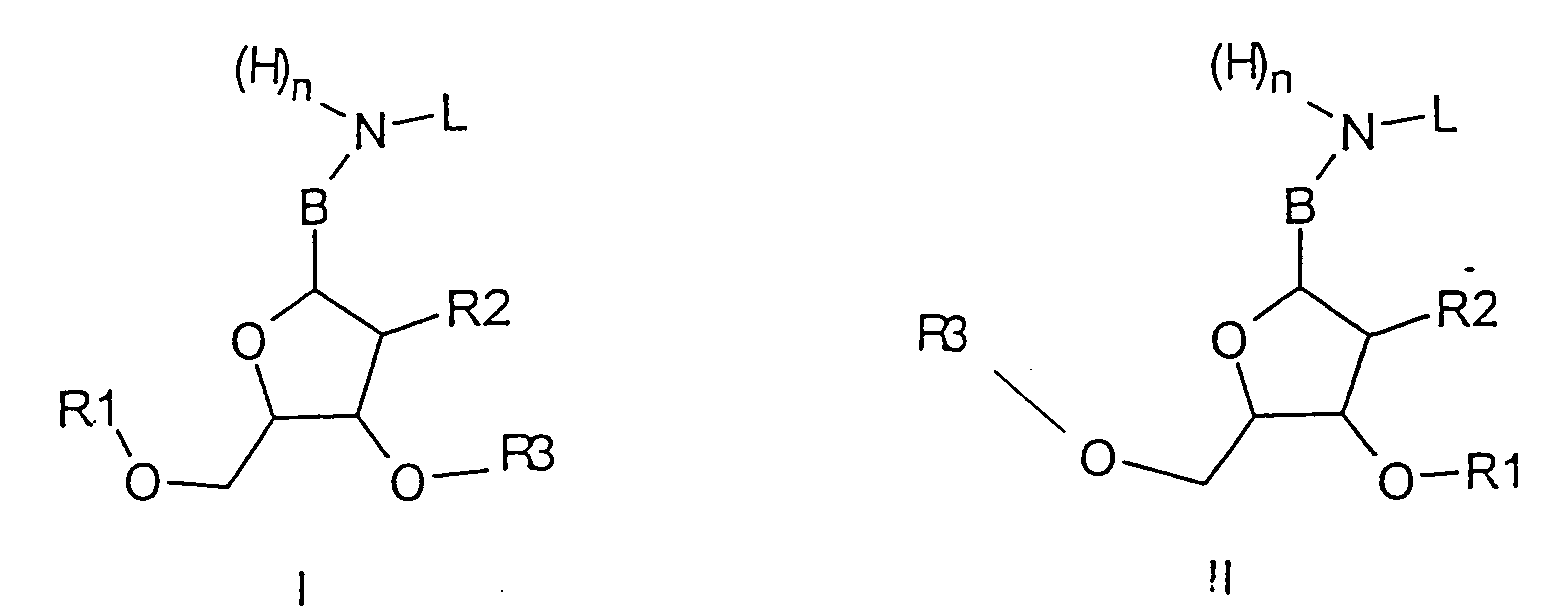
R2 is -H, -(C1-C10)-alkoxy, -(C2-C10)-alkenyloxy, -(C2-C10)-alkynyloxy, -halogen, -azido, -NHR7, -SR7 or -OR7, wherein R7 is a protecting group or a reporter group,
R3 is a phosphate, an H-phosphonate or other phosphate analogue group which may contain a protecting group,
B is a nucleobase or a nucleobase analogue,
n is 0 or 1, and
L is a detectable protecting group, e.g. of the structure -C(O)-R, when n = 1, or = CH-NR8R, when n = 0, wherein R is the residue of the reporter group and R8 is selected from the group consisting of -(C1-C3)-alkyl. - In the compounds (I) or (II) the 5' or 3' hydroxy protecting group R1 is preferably selected from optionally substituted triphenylmethyl groups, e.g. 4,4'-dimethoxy triphenylmethyl or 4-monomethoxy triphenylmethyl, pixyl groups, photocleavable groups, e.g. p-nitrophenylpropoxy carbonyl (NPPOC) or (α-methyl)-6-nitropiperonyloxy carbonyl (MeNPOC), and substituted silyl protecting groups, e.g. tert-butyldimethyl silyl (TBDMS) or tert-butyldiphenyl silyl (TBDPS).
- The group R3 is a phosphate or phosphate analogue group which may contain a protecting group, preferably a phosphitamide group, more preferably a group -P(R6)NR4R5, wherein R4 and R5 are independently selected from the group consisting of -H, -(C1-C10)-alkyl, -(C2-C10)-alkenyl, -(C6-C22)-aryl, or wherein NR4R5 can form together with N a 5-6-membered heterocyclic ring,
R6 is selected from the group consisting of -(C2-C6)-alkenyloxy, -(C2-C6) alkenyl, -(C1-C6)-alkyl, or -(C1-C6)-alkoxy,
wherein each group may contain one or several substituents selected from -halo, p-nitroaryloxy and -cyano or wherein R6 is -H.
R6 is most preferably a 2-cyanoethyloxy group. - B is a nucleobase or nucleobase analogue having at least one amino group, e.g. adenine, guanine, cytosine, or a corresponding nucleobase analogue. The nucleobase or nucleobase analogue is preferably capable of hydrogen bridge formation with a complementary nucleobase after incorporation into a nucleic acid molecule. Suitable nucleobase analogues are mono- and bicyclic heterocycles comprising at least one amino group wherein the heterocycle is different from natural nucleobases as described by Simons, (Advanced 2001 Chemistry Texts, Nucleoside Mimetics, Gordon and Breach Science Publishers, Amsterdam 2001, Chapter 4), for example aza analogues of naturally occurring nucleobases, wherein a CH-moiety of a purine or a pyrimidine ring is replaced by nitrogen (such as 8-aza-adenosine) or deaza analogues of naturally occurring nucleobases wherein an N atom in the ring is substituted by a CH group (such as 7-deaza-guanosine) or combinations of aza and deaza substitutions (such as 8-aza-7-deaza-guanosine). Further preferred nucleobase analogues are C-nucleosides, e.g. deaza nucleobases wherein the N9 atom of a purine base or the N1 atom of a pyrimidine base respectively is substituted by a carbon atom (in the sp2 configuration) such as formycine and pseudoisocytidine. Further, suitable nucleobase analogues may carry additional amino groups, e.g. 2-aminoadenosine. Further, the nucleobase or nucleobase analogue may be substituted, wherein the substitutent, e.g. a C1-C3 alkyl or alkoxy, a C2-C3 alkenyl or alkenyloxy, a C2-C3 alkynyl or alkynyloxy and/or a halo substituent, is preferably compatible with the formation of hydrogen bridges to a complementary base. Preferred positions for substituents are C5 in pyrimidine bases, C8 in purine bases and C7 in deaza purine bases.
- Furthermore, the present invention relates to a nucleic acid synthesis building block having the general structural formulae I or II as described above.
- The building blocks are suitable for the production of nucleic acid arrays.
- Furthermore, the invention relates to a reagent kit for the synthesis of nucleic acid arrays comprising at least one nucleic acid synthesis building block as described above. For example, the reagent kit may comprise at least two different nucleic acid synthesis building blocks each carrying different detectable protecting groups. The different detectable protecting groups are preferably detectable independent from each other. For example, the reagent kit may comprise at least two different independently detectable fluorescent protecting groups, or combinations of different embodiments of detectable protecting groups, e.g. fluorescent and bioaffine detectable protecting groups or other combinations of different protecting groups.
- Further, the invention shall be explained in more detail by the following Figures and Example.
- Fig. 1.
- Fluorescent, pyrene-labelled cytidine building block. The
pyrene-containing nucleobase protecting group exhibits
fluorescent properties and can therefore be detected by
means of optical analysis procedures.
If the nucleobase aminofunctions are protected with a cleavable acyl group carrying a biotin or digoxigenin labelled system, then detection can be carried out using streptavidin or anti-digoxigenin. - Fig. 2.
- A cytidine building block with an IR detectable nitro aromatic moiety.
- Fig. 3.
- A cytidine building block with an electrochemically detectable ferrocene moiety.
- Fig. 4.
- An adenine building block with a fluorescent detectable stilbene moiety.
- Fig. 5.
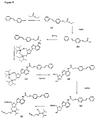
- Scheme of the synthesis of an adenine building block of Figure 4.
- Starting from 4-hydroxystilbene the desired stilbene-labelled building block was synthesized in the following steps A) to F) according to the scheme in Figure 5:
- 550 mg sodium hydrid (60% suspension in paraffin oil) were added to a solution of 2 g trans 4 hydroxystilbene in 70 ml dry dioxane. After stirring for 1 h at room temperature 1.2 ml of iodacetic acid ethylester were added. The mixture was refluxed for 1 h and then cooled to room temperature. After filtration the solvent was removed by using a rotary evaporator and the remainder was purified by column chromatography on silica gel with hexane/acetic acid ethyl ester 2:1 as eluent.
Yield: 1,0g. - 20 ml 10 Mol NaOH were added within 20 min to a solution of 1 g (4-styryl-phenoxy) acetic acid ethyl ester (a) in 60 ml dioxane. After stirring for 5 h the pH was adjusted to pH 2 with 10 Mol HCl. The mixture was extracted with acetic acid ethyl ester. The organic layer was separated, washed with water and dried over sodium sulfate. The solvent was evaporated by using a rotary evaporator. The remainder was dried in vacuum for 5 days with calcium chloride as dessicant.
Yield: 0.81 g. - 0.81 g (4-styryl-phenoxy)-acetic acid (b) was dissolved in a mixture from 15 ml dioxane and 3 ml methylene chloride. After adding 2.6 ml oxalyl chloride at 4-8°C the mixture was stirred at room temperature for 4 h. The solvents were removed by using a rotary evaporator. The remainder was dissolved in 10 ml methylene chloride. This solution was dropped at room temperature to a solution of 1.35 g 4.2 (-)-3',5'-O-(1,1,3,3-tetraisopropyl-1,3-disiloxanediyl) adenosine in 30 ml methylene chloride and 3 ml pyridine. The mixture was then stirred overnight. The solvent was removed by using a rotary evaporator and the remainder was purified by column chromatography on silica gel with toluene/acetic acid ethyl ester/methanol 4:1:1.
Yield: 1.5 g. - 1.5 g of N6(4-styryl-phenoxy)-acetyl- 4.2 (-)-3',5'-O-(1.1.3.3-tetraisopropyl-1,3-disiloxanediyl) adenosine (c) were dissolved in 90 ml 1 M tetrabutylammoniumfluoride THF solution and stirred overnight. The solvent was removed by using a rotary evaporator and the remainder was purified by column chromatography on silica gel with acetic acid ethyl ester/methanol 2:1.
Yield: 0.56 g. - Within 1 h a solution of 0.46 g dimethoxytritylchloride in 10 ml dry pyridine was dropped at room temperature to a solution of 0.56 g of N6 (4-styryl-phenoxy)-acetyl adenosine (d) in 10 ml dry pyridine. After stirring overnight the solvent was evaporated using a rotary evaporator. The residue was dissolved in 300 ml acetic acid ethyl ester and was washed with 100 ml water. The organic phase was separated and dried with sodium sulfate. After filtration the solvent was removed by using a rotary evaporator.
Purification was performed by column chromatography on silica gel. Therefore the crude product was dissolved in a methylene chloride/methanol 10:1 mixture containing 0.1% triethylamine. The solution was applied on an I = 40 cm/d = 6.9 cm column filled with silica gel 60 (0.063-0.200 mm). The product was eluated with a methylene chloride/methanol 10:1 mixture containing 0.1% triethylamine. TLC (Silicagel): methylene chloride/methanol 10:1 mixture containing 0.1% triethylamine: Rf: 0.56.
Yield: 200 mg. - At room temperature under argon 0.56 µl of N ethyldiisopropylamine and then 73 µl chloro-2 cyanoethoxy diisopropylaminophosphane were added to a solution of 200 mg of 5'-(p,p'-dimethoxytrityl)- N6 (4-styryl-phenoxy)-acetyl adenosine (e) in 5 ml methylene chloride. The solvent was removed by using a rotary evaporator. The residue was dissolved in 50 ml acetic acid ethyl ester and washed two times with 10 ml 5% aqueous sodium hydrogen carbonate solution. The organic phase was separated and dried with sodium sulfate. After filtration the solvent was removed by using a rotary evaporator.
- Purification was performed by column chromatography on silica gel. Therefore the crude product was dissolved in a methylene chloride/acetone/triethylamine 45:5:0.5 mixture. The solution was applied on a I = 32 cm/d = 4.5 cm column filled with silica gel 60 (0.063-0.200 mm). The product was eluated with an acetic acid ethyl ester/hexane 1:1 mixture containing 0.1% triethylamine. TLC (Silica gel, methylene chloride/acetone/triethylamine 45:5:0.5): Rf: 0.70.
- NMR(d6-DMSO) 1H(300 MHz): 10.97 s[1H], 8.64 s[1H], 8.56s [1H], 6.78-7.5 m [24H], 6.50 s, broad [1H], 5.20 s[2H], 4.82 s, broad [1H], 4.16 s, broad [1H], 3.64 s [6H], 3.55 s, broad [2H], 3.64 s, broad [2H], 3.23 s, broad [2H], 3.11 m, broad [1H], 2.73 dt[2H], 2.55 m, broad [1H] 1.22 dd [12H] 31P(300 MHz): 148.89 d.
Yield: 120 mg.
Claims (25)
- A quality control method for manufacturing biopolymer arrays comprising(a) synthesizing a plurality of different biopolymer species on an array from monomeric or oligomeric building blocks comprising detectable protecting groups;(b) optionally carrying out a determination of the detectable protecting groups on the array after synthesis;(c) cleaving off the detectable protecting groups, and(d) carrying out a determination of the detectable protecting groups on the array after cleavage; in order to determine the efficacy of deprotection.
- The method of claim 1, wherein the detectable protecting groups are selected from fluorescent detectable protecting groups.
- The method of claim 2, wherein the fluorescent detectable protecting groups are selected from groups comprising pyrene, dansyl, stilbene, rhodamine or coumarine moieties.
- The method of claim 1, wherein the detectable protecting groups are selected from radioactively detectable protecting groups.
- The method of claim 4, wherein the radioactively detectable groups are selected from groups comprising 14C, 32P or 3H doped moieties.
- The method of claim 1, wherein the detectable protecting groups are selected from electrochemically detectable protecting groups.
- The method of claim 6, wherein the electrochemically detectable groups are selected from groups comprising ferrocene or phenothiazine moieties.
- The method of claim 1, wherein the detectable protecting groups are selected from UV- or IR-detectable protecting groups.
- The method of claim 8, wherein the UV- or IR-detectable protecting groups are selected from groups comprising aromatic nitro moieties, hydroxyl moieties, thiol, thioether or thiophenol moieties, nitrile moieties, isocyanate or halo moieties.
- The method of claim 1, wherein the detectable protecting groups are selected from bioaffine detectable protecting groups.
- The method of claim 10, wherein the bioaffine detectable protecting groups are selected from groups comprising biotin, digoxin or digoxigenin moieties.
- The method of any one of claims 1-11, wherein the biopolymer species are selected from nucleic acids, nucleic acid analogues, peptides and peptide analogues.
- The method of claim 12, wherein the biopolymer species are selected from nucleic acids and nucleic acid analogues and wherein the detectable protecting groups are coupled to nucleobases.
- The method of claim 13 wherein the detectable protecting groups are coupled to amino groups of nucleobases.
- The method of any one of claims 12-14, wherein the building blocks for the biopolymer synthesis are nucleotide building blocks having the general structural formulae (I) or (II):wherein R1 is an hydroxy protecting group,

R2 is -H, -(C1-C10)-alkoxy, -(C2-C10)-alkenyloxy, -(C2-C10)-alkynyloxy, -halogen, -azido, -NHR7, -SR7 or -OR7, wherein R7 is a protecting group or a reporter group,
R3 is a phosphate, an H-phosphonate or other phosphate analogue group which may contain a protecting group,
B is a nucleobase or a nucleobase analogue,
n is 0 or 1, and
L is a detectable protecting group. - The method of claim 15, wherein R1 is selected from optionally substituted triphenylmethyl groups, e.g. 4,4'-dimethoxy triphenylmethyl or 4-monomethoxy triphenylmethyl, pixyl groups, photocleavable groups, e.g. p-nitrophenylpropoxy carbonyl (NPPOC) or (α-methyl)- 6-nitropiperonyloxy carbonyl (MeNPOC), and substituted silyl protecting groups, e.g. tert-butyldimethyl silyl (TBDMS) or tert-butyldiphenyl silyl (TBDPS).
- The method of claims 15 or 16, wherein R3 is a phosphite amide group.
- The method of claim 12 wherein R3 is the group -P(R6)-NR4R5 wherein R4 and R5 are independently selected from the group consisting of -H, -(C1-C10)-alkyl, -(C2-C10)-alkenyl, -(C6-C22)-aryl, or wherein NR4R5 can form together with N a 5-6-membered heterocyclic ring, and R6 is selected from the group consisting of -(C2-C6)-alkenyloxy, -(C2-C6)-alkenyl, -(C1-C6)-alkyl, -(C1-C6)-alkoxy, wherein each group may contain one or several substituents selected from -halo, p-nitroaryloxy and -cyano or wherein R6 is -H.
- The method of claim 18, wherein R6 is a 2-cyanoethyloxy group.
- The method of any one of claims 15-19 wherein L has the structure -C(O)-R, when n = 1, or = CH-NR8R when n = 0, wherein R is the residue of the protecting group and R8 is selected from H and -(C1-C3)-alkyl.
- The method of any one of claims 15-20, wherein B is selected from adenine, guanine, cytosine, aza and/or deaza analogues thereof, and analogues containing additional amino groups.
- A nucleic acid synthesis building block having the general structural formulae (I) or (II):wherein R1 is an hydroxy protecting group,

R2 is -H, -(C1-C10)-alkoxy, -(C2-C10)-alkenyloxy, -(C2-C10)-alkynyloxy, -halogen, -azido, -NHR7, -SR7 or -OR7, wherein R7 is a protecting group or a reporter group,
R3 is a phosphate, an H-phosphonate or other phosphate analogue group which may contain a protecting group,
B is a nucleobase or a nucleobase analogue,
n is 0 or 1, and
L is a detectable protecting group. - Use of a building block of claim 22 for the production of nucleic acid arrays.
- A reagent kit for the synthesis of nucleic acid arrays comprising at least one nucleic acid synthesis building block of claim 22.
- The reagent kit of claim 24 comprising at least 2 nucleic acid synthesis building blocks of claim 22 each carrying different detectable protecting groups.
Priority Applications (1)
| Application Number | Priority Date | Filing Date | Title |
|---|---|---|---|
| EP04006597A EP1466663A1 (en) | 2003-03-19 | 2004-03-18 | Quality control method for manufacturing nucleic acid arrays |
Applications Claiming Priority (3)
| Application Number | Priority Date | Filing Date | Title |
|---|---|---|---|
| EP03006098 | 2003-03-19 | ||
| EP03006098 | 2003-03-19 | ||
| EP04006597A EP1466663A1 (en) | 2003-03-19 | 2004-03-18 | Quality control method for manufacturing nucleic acid arrays |
Publications (1)
| Publication Number | Publication Date |
|---|---|
| EP1466663A1 true EP1466663A1 (en) | 2004-10-13 |
Family
ID=32870764
Family Applications (1)
| Application Number | Title | Priority Date | Filing Date |
|---|---|---|---|
| EP04006597A Withdrawn EP1466663A1 (en) | 2003-03-19 | 2004-03-18 | Quality control method for manufacturing nucleic acid arrays |
Country Status (1)
| Country | Link |
|---|---|
| EP (1) | EP1466663A1 (en) |
Cited By (1)
| Publication number | Priority date | Publication date | Assignee | Title |
|---|---|---|---|---|
| EP1736779A3 (en) * | 2005-06-15 | 2009-05-13 | febit holding GmbH | Method for quality control of functionalised surfaces |
Citations (6)
| Publication number | Priority date | Publication date | Assignee | Title |
|---|---|---|---|---|
| US5093232A (en) * | 1985-12-11 | 1992-03-03 | Chiron Corporation | Nucleic acid probes |
| WO1998003532A1 (en) * | 1996-07-24 | 1998-01-29 | Hanna Michelle M | Base-protected nucleotide analogs with protected thiol groups |
| WO1998039348A1 (en) * | 1997-03-05 | 1998-09-11 | Affymetrix, Inc. | Photocleavable protecting groups and methods for their use |
| WO1999057317A1 (en) * | 1998-05-06 | 1999-11-11 | Clinical Micro Sensors, Inc. | Electronic methods for the detection of analytes utilizing monolayers |
| WO2000015837A2 (en) * | 1998-09-15 | 2000-03-23 | Deutsches Krebsforschungszentrum Stiftung des öffentlichen Rechts | Method for controlling quality in the construction of oligomer grids |
| WO2002062815A1 (en) * | 2001-02-05 | 2002-08-15 | Febit Ag | Hybrid protecting groups |
-
2004
- 2004-03-18 EP EP04006597A patent/EP1466663A1/en not_active Withdrawn
Patent Citations (6)
| Publication number | Priority date | Publication date | Assignee | Title |
|---|---|---|---|---|
| US5093232A (en) * | 1985-12-11 | 1992-03-03 | Chiron Corporation | Nucleic acid probes |
| WO1998003532A1 (en) * | 1996-07-24 | 1998-01-29 | Hanna Michelle M | Base-protected nucleotide analogs with protected thiol groups |
| WO1998039348A1 (en) * | 1997-03-05 | 1998-09-11 | Affymetrix, Inc. | Photocleavable protecting groups and methods for their use |
| WO1999057317A1 (en) * | 1998-05-06 | 1999-11-11 | Clinical Micro Sensors, Inc. | Electronic methods for the detection of analytes utilizing monolayers |
| WO2000015837A2 (en) * | 1998-09-15 | 2000-03-23 | Deutsches Krebsforschungszentrum Stiftung des öffentlichen Rechts | Method for controlling quality in the construction of oligomer grids |
| WO2002062815A1 (en) * | 2001-02-05 | 2002-08-15 | Febit Ag | Hybrid protecting groups |
Non-Patent Citations (10)
| Title |
|---|
| CAMPAS M ET AL: "DNA biochip arraying, detection and amplification strategies", TRAC, TRENDS IN ANALYTICAL CHEMISTRY, ANALYTICAL CHEMISTRY. CAMBRIDGE, GB, vol. 23, no. 1, January 2004 (2004-01-01), pages 49 - 62, XP004484688, ISSN: 0165-9936 * |
| FODOR S P A ET AL: "LIGHT-DIRECTED, SPATIALLY ADDRESSABLE PARALLEL CHEMICAL SYNTHESIS", SCIENCE, AMERICAN ASSOCIATION FOR THE ADVANCEMENT OF SCIENCE,, US, vol. 251, no. 4995, 15 February 1991 (1991-02-15), pages 767 - 773, XP000486899, ISSN: 0036-8075 * |
| FU ET AL.: "Identification and quantification of protecting groups remaining in commercial oligonucleotide products using monoclonal antibodies", ANALYTICAL BIOCHEMISTRY, vol. 306, 2002, pages 135 - 143, XP002289306 * |
| HASAN A ET AL: "Photolabile protecting groups for nucleosides: Synthesis and photodeprotection rates", TETRAHEDRON, ELSEVIER SCIENCE PUBLISHERS, AMSTERDAM, NL, vol. 53, no. 12, 24 March 1997 (1997-03-24), pages 4247 - 4264, XP004477215, ISSN: 0040-4020 * |
| MAIER T ET AL: "SYNTHESIS AND PROPERTIES OF NEW FLUORESCEIN - LABELED OLIGONUCLEOTIDES", NUCLEOSIDES & NUCLEOTIDES, MARCEL DEKKER, INC, US, vol. 14, no. 3-5, 1995, pages 961 - 965, XP001121349, ISSN: 0732-8311 * |
| MANGANO M F ET AL: "Composition dependent separation of oligonucleotides by capillary electrophoresis in acidic buffers with application to the quality control of synthetic oligonucleotides", JOURNAL OF CHROMATOGRAPHY, ELSEVIER SCIENCE PUBLISHERS B.V. AMSTERDAM, NL, vol. 848, no. 1-2, 2 July 1999 (1999-07-02), pages 435 - 442, XP004184232, ISSN: 0021-9673 * |
| ROGET ET AL.: "Synthesis and use of labelled nucleoside phosphoramidite building blocks bearing a reporter group: biotinyl, dinitrophenyl, pyrenyl and dansyl", NUCLEIC ACIDS RESEARCH, vol. 17, no. 19, 1989, pages 7643 - 7651, XP002289304 * |
| SARFATI ET AL.: "Synthesis of fluorescent or biotinylated nucleoside compounds", TETRAHEDRON, vol. 43, no. 15, 1987 - 3491, pages 3497, XP002289305 * |
| WAGNER AND PFLEIDERER: "Aglycone protection by the dnseoc group - A new variation in oligodeoxyribonucleotide synthesis", HELVETICA CHIMICA ACTA, vol. 80, 1997, pages 200 - 212, XP009033807 * |
| WEILER J ET AL: "COMBINING THE PREPARATION OF LIGONUCLEOTIDE ARRAYS AND SYNTHESIS OF HIGH-QUALITY PRIMERS", ANALYTICAL BIOCHEMISTRY, ACADEMIC PRESS, SAN DIEGO, CA, US, vol. 243, no. 2, 15 December 1996 (1996-12-15), pages 218 - 227, XP000684351, ISSN: 0003-2697 * |
Cited By (1)
| Publication number | Priority date | Publication date | Assignee | Title |
|---|---|---|---|---|
| EP1736779A3 (en) * | 2005-06-15 | 2009-05-13 | febit holding GmbH | Method for quality control of functionalised surfaces |
Similar Documents
| Publication | Publication Date | Title |
|---|---|---|
| US9303055B2 (en) | Linkers and co-coupling agents for optimization of oligonucleotide synthesis and purification on solid supports | |
| US5770367A (en) | Tag reagent and assay method | |
| US5817786A (en) | Single-stranded labelled oligonucleotides of preselected sequences | |
| JP3379064B2 (en) | Oligonucleotide synthesis carrier | |
| EP0786468B1 (en) | Solid support reagents for the direct synthesis of 3'-labeled polynucleotides | |
| KR101032008B1 (en) | Polynucleotide labeling reagents | |
| US5591843A (en) | 5-modified pyrimidines from palladium catalyzed carbon-carbon coupling | |
| JP2001512131A (en) | Base analog | |
| EP0466773A4 (en) | Coumarin derivatives for use as nucleotide crosslinking reagents | |
| JPH0812697A (en) | New polynucleotide | |
| WO1998039348A9 (en) | Photocleavable protecting groups and methods for their use | |
| WO1998039348A1 (en) | Photocleavable protecting groups and methods for their use | |
| JPH07233188A (en) | Novel nucleoside phosphoramidite and method for producing the same | |
| JPH11501936A (en) | Nucleic acid synthesis using photoremovable protecting groups | |
| JP2002536381A (en) | Methods for deprotecting oligonucleotides | |
| JP2002525288A (en) | Purification of oligomers using double end selection | |
| US20040235022A1 (en) | Quality control method for manufacturing biopolymer arrays | |
| US6673544B1 (en) | Method for the light-controlled synthesis of biochips | |
| EP0898575B1 (en) | A combinatorial protecting group strategy for multifunctional molecules | |
| EP1589024B1 (en) | Photolabile protecting groups | |
| Sinyakov et al. | Linkers for oligonucleotide microarray synthesis | |
| US6153742A (en) | General process for the preparation of cyclic oligonucleotides | |
| CN116171308B (en) | Fluorescent dyes | |
| Zhou et al. | Combinatorial synthesis using nucleic acid-based (NAB™) scaffold: parallel solid-phase synthesis of nucleotide libraries | |
| JP4015136B2 (en) | Deoxyribose derivatives having a phenol skeleton and photoresponsive nucleotides |
Legal Events
| Date | Code | Title | Description |
|---|---|---|---|
| PUAI | Public reference made under article 153(3) epc to a published international application that has entered the european phase |
Free format text: ORIGINAL CODE: 0009012 |
|
| AK | Designated contracting states |
Kind code of ref document: A1 Designated state(s): AT BE BG CH CY CZ DE DK EE ES FI FR GB GR HU IE IT LI LU MC NL PL PT RO SE SI SK TR |
|
| AX | Request for extension of the european patent |
Extension state: AL LT LV MK |
|
| 17P | Request for examination filed |
Effective date: 20050412 |
|
| AKX | Designation fees paid |
Designated state(s): AT BE BG CH CY CZ DE DK EE ES FI FR GB GR HU IE IT LI LU MC NL PL PT RO SE SI SK TR |
|
| 17Q | First examination report despatched |
Effective date: 20111228 |
|
| STAA | Information on the status of an ep patent application or granted ep patent |
Free format text: STATUS: THE APPLICATION IS DEEMED TO BE WITHDRAWN |
|
| 18D | Application deemed to be withdrawn |
Effective date: 20141001 |