EP1465376A2 - Prohibit or avoid route mechanims for path setup - Google Patents
Prohibit or avoid route mechanims for path setup Download PDFInfo
- Publication number
- EP1465376A2 EP1465376A2 EP04300091A EP04300091A EP1465376A2 EP 1465376 A2 EP1465376 A2 EP 1465376A2 EP 04300091 A EP04300091 A EP 04300091A EP 04300091 A EP04300091 A EP 04300091A EP 1465376 A2 EP1465376 A2 EP 1465376A2
- Authority
- EP
- European Patent Office
- Prior art keywords
- node
- path
- network
- route
- excluded
- Prior art date
- Legal status (The legal status is an assumption and is not a legal conclusion. Google has not performed a legal analysis and makes no representation as to the accuracy of the status listed.)
- Withdrawn
Links
Images



Classifications
-
- H—ELECTRICITY
- H04—ELECTRIC COMMUNICATION TECHNIQUE
- H04L—TRANSMISSION OF DIGITAL INFORMATION, e.g. TELEGRAPHIC COMMUNICATION
- H04L47/00—Traffic control in data switching networks
- H04L47/70—Admission control; Resource allocation
- H04L47/82—Miscellaneous aspects
- H04L47/825—Involving tunnels, e.g. MPLS
-
- H—ELECTRICITY
- H04—ELECTRIC COMMUNICATION TECHNIQUE
- H04L—TRANSMISSION OF DIGITAL INFORMATION, e.g. TELEGRAPHIC COMMUNICATION
- H04L45/00—Routing or path finding of packets in data switching networks
-
- H—ELECTRICITY
- H04—ELECTRIC COMMUNICATION TECHNIQUE
- H04L—TRANSMISSION OF DIGITAL INFORMATION, e.g. TELEGRAPHIC COMMUNICATION
- H04L45/00—Routing or path finding of packets in data switching networks
- H04L45/34—Source routing
-
- H—ELECTRICITY
- H04—ELECTRIC COMMUNICATION TECHNIQUE
- H04L—TRANSMISSION OF DIGITAL INFORMATION, e.g. TELEGRAPHIC COMMUNICATION
- H04L47/00—Traffic control in data switching networks
- H04L47/70—Admission control; Resource allocation
-
- H—ELECTRICITY
- H04—ELECTRIC COMMUNICATION TECHNIQUE
- H04L—TRANSMISSION OF DIGITAL INFORMATION, e.g. TELEGRAPHIC COMMUNICATION
- H04L47/00—Traffic control in data switching networks
- H04L47/70—Admission control; Resource allocation
- H04L47/72—Admission control; Resource allocation using reservation actions during connection setup
- H04L47/724—Admission control; Resource allocation using reservation actions during connection setup at intermediate nodes, e.g. resource reservation protocol [RSVP]
-
- H—ELECTRICITY
- H04—ELECTRIC COMMUNICATION TECHNIQUE
- H04L—TRANSMISSION OF DIGITAL INFORMATION, e.g. TELEGRAPHIC COMMUNICATION
- H04L47/00—Traffic control in data switching networks
- H04L47/70—Admission control; Resource allocation
- H04L47/78—Architectures of resource allocation
- H04L47/783—Distributed allocation of resources, e.g. bandwidth brokers
- H04L47/785—Distributed allocation of resources, e.g. bandwidth brokers among multiple network domains, e.g. multilateral agreements
Definitions
- the invention relates to setting up paths in an MPLS network, particularly setting up disjoint LSP paths between areas and domains of a network.
- the invention relates to the RSVP-TE specification with MPLS/GMPLS extensions for inter-area and inter-domain path setup.
- RSVP-TE RSVP-TE
- GMPLS-RSVP-TE GMPLS extensions
- exclusions can be specified during centralized path computation, and an explicit route which exclude the resources specified is generated as a result. This method is referred to as the Route Server Approach.
- Other systems rely on the use of loose routes or partially specified abstract nodes. These loose routes are resolved within the network as the hops of the explicit route are evaluated. In these cases exclusions cannot currently be communicated to the nodes that evaluate the routes.
- the Route Server Approach suffers from a number of other limitations. It may need to perform many simultaneous path computations across more than one area. This reduces the rapidity of the routing system and causes it to be vulnerable to network loading. For e.g., the route server would need to acquire the link state database of all the areas or Autonomous Systems where the path traverses in order to be able to compute a diverse path.
- the present invention addresses the inability of RSVP-TE and CR-LDP to allow nodes to signal routes or links to exclude in a path setup request.
- RSVP-TE RSVP-TE
- GMPLS extensions GMPLS extensions
- the present invention discloses a solution which delivers routing systems with less path setup latency and causes them to be less susceptible to network loading, by providing them the ability to setup diverse paths as a result of specifying network resources to exclude as part of a path setup.
- the present invention addresses the inability of RSVP-TE and CR-LDP to allow nodes to signal routes or links to exclude in a path setup request.
- the invention proposes an extension to RSVP-TE in the form of a new RSVP-TE object, known as an Exclude Route Object, which will allow, in a path setup request, the specification of a set of abstract nodes and resources to be explicitly excluded from the path.
- the invention introduces a second type of exclusion which is achieved through a modification to the existing Explicit Route Object (ERO) by allowing a node to specify, in a path setup request, the exclusion of certain abstract nodes and resources between a specific pair of abstract nodes within an Explicit Route Object.
- ERO Explicit Route Object
- node node
- abtract node node
- network resource may refer to a single node, a group of nodes, a route, a link, or an Autonomous System.
- excludede and “avoid” as used in this document are interchangeable.
- the present invention provides an improved routing system which overcomes the shortcomings of the conventional RSVP-TE and CR-LDP.
- the present invention addresses the inability of RSVP-TE and CR-LDP to allow nodes to signal routes or links to exclude in a path setup request.
- the current RSVP-TE specification (RSVP-TE) and GMPLS extensions (GMPLS-RSVP-TE) allow abstract nodes and resources to be explicitly included in a path setup, using the Explicit Route Object (hereinafter referred to as ERO), but not to be explicitly excluded.
- ERO Explicit Route Object
- the invention proposes an extension to RSVP-TE in the form of a new RSVP-TE object, known as an Exclude Route Object (hereinafter referred to as XRO).
- XRO will allow, in a path setup request, the specification of a set of abstract nodes and resources to be explicitly excluded from the path ⁇ e.g., exclude(A, B, C, D) ⁇ .
- the set of abstract nodes, which are not to be included in a given set anywhere on the path is referred to as the Exclude Route List.
- Figure 1 is used to illustrate this method.
- a single node N1 in abstract node 'A' requests a path setup to another single node N2 in abstract node 'H', specifying that abstract nodes 'B' and 'G' are to be excluded ⁇ exclude(B, G) ⁇ .
- the resultant path 101 is from N1 in abstract node 'A', through abstract nodes 'E', 'F', 'C', and 'D' to N2 in abstract node 'H'.
- the invention introduces a second type of exclusion which is achieved through a modification to the existing ERO by allowing a node to specify, in a path setup request, the exclusion of certain abstract nodes and resources between a specific pair of abstract nodes within an ERO ⁇ e.g., (W, excludeX, excludeY, Z) ⁇ .
- a new subobject type, the Exclude Object Subobject is introduced to indicate an exclusion between a pair of included abstract nodes. Such specific exclusions are referred to as Explicit Route Exclusions.
- Figure 2 is used to illustrate this method.
- a single node N1 in abstract node 'A' requests a second path setup to another single node N2 in abstract node 'H', specifying to exclude intermediate abstract node 'C' from between a pair of abstract nodes 203, which are a part of the ERO path 201.
- the resultant second path 202 is from N1 in abstract node 'A', through abstract nodes 'B', 'F', and 'G' to N2 in abstract node 'H'.
- the Exclude Route List identifies a list of abstract nodes that must not be traversed along the path. Abstract nodes to be excluded from a path are specified via the XRO.
- the XRO is encoded as a series of subobjects (variable-bit-length data items). Each subobject identifies an abstract node in the Exclude Route List.
- Each subobject includes a "resource type” field to indicate the type of the resource; an “action” field to indicate the action to be taken with respect to the resource; a “transparence flag”, which when set, allows messages with unknown “resource types” or “actions” to be ignored and forwarded transparently; a "reserved” field that is set to zero on transmission and ignored on receipt; a "length” field to indicate the length of the "resource” field in bytes; a “resource” field to identify the resource; and a “padding” field, which is of variable length and is used to align the length of the subobject to a four-octet boundary.
- a node may be an abstract node, which is made up of a group of nodes as in an Autonomous System (AS).
- AS Autonomous System
- a node N1 in AS 'A' requests a path setup to another node N2 in AS 'F', specifying that AS 'C' is to be excluded.
- the resultant path 301 is from N1 in AS 'A', through AS 'B' and AS'E', to N2 in AS'F'.
- a node When a node receives, and is present in, a path message, it must check if it is on the Exclude Route List or a part of any SRLG. If either proves to be true, the node should return a message indicating a routing problem, which calls for the re-routing of the LSP.
- a node When selecting the next network resource to expand an explicit route, a node must not nominate an explicit node or an abstract node that is specified by the XRO or in the SRLG subobjects. If that prevents further expansions of the path message, the node should return a message indicating a routing problem, which calls for the re-routing of the LSP. Furthermore, if a node is required to process an Exclude Object Subobject and does not support the handling of exclusions it will return an error message as well.
- Explicit Route Exclusions allow a node to specify, in a path setup request, the exclusion of certain abstract nodes and resources that should not be utilized between two inclusive abstract nodes or resources in the explicit route.
- the Explicit Route Object specifies the abstract nodes and resources to be excluded from the path by defining new subobject values. The most significant bit of the subobject value would indicate whether the subobject is to be excluded or not.
- EXRS Explicit Exclusion Route Subobjects
- ABR Area Border Routers
- the ingress node may compute the explicit route up to the ABR and then send a setup message to the ABR specifying the route to exclude.
- the path is setup according to the setup message, which goes through every route specified in the explicit route, until it reaches an ABR. At that point the ABR computes the route for the next area, excluding resources specified in the XRO. The ABR then inserts into the setup message the computed explicit route. The path is then setup until the setup message reaches the next ABR. The next ABR then computes the path to the destination applying any XRO in the setup message.
- an ingress node can not compute the explicit route for the whole path ⁇ e.g., A-B-C-D-E-F-G ⁇ it specifies a loose route ⁇ e.g., A-B,F-G ⁇ in a setup message that it sends to ⁇ B ⁇ .
- ⁇ B ⁇ receives the setup message it would compute the route to ⁇ G ⁇ ⁇ e.g., GD-E ⁇ , avoiding any resources that have been specified as XRO in the setup message.
- ⁇ B ⁇ would insert ⁇ C,D,E ⁇ into the explicit route and forward the setup message to ⁇ F ⁇ .
- ⁇ B ⁇ would also remove ⁇ A-B ⁇ from the explicit route in the setup message since these nodes have already been traversed.
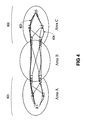
- router R1 in area A 401 requests a first path setup (and record route) to router R6 in area C 402.
- the first path route 403 is R1, R2, ABR1, ABR3, R4, and R6.
- the router R1 requests a second path setup to router R6 specifying to exclude the route of the first path (i.e., R2, ABR1, ABR3, and R4).
- the resultant diverse route 404 for the second path is R1, R3, ABR2, ABR4, R5, and R6.
- a node N1 in AS-A requests a first path setup (and record AS's traversed, which requires a new AS subobject in Request Route Object RRO) to another node N2 is AS-F.
- the first path 501 is AS-A, AS-B, AS-C, and AS-F.
- node N1 requests a second path setup to node N2, specifying to exclude intermediate AS's 503 of the first path.
- the resultant second path 502 is AS-A, AS-D, AS-E, and AS-F.
Landscapes
- Engineering & Computer Science (AREA)
- Computer Networks & Wireless Communication (AREA)
- Signal Processing (AREA)
- Data Exchanges In Wide-Area Networks (AREA)
Abstract
Description
Claims (18)
- A method for establishing a path between a first node and a second node in a network in which said first node and said second node are in separate portions of said network, comprising the steps of:(a) determining, by said first node, a loose route for said path to said second node;(b) sending, by said first node to a third node, which is in a separate portion of said network than said first node and said second node, and is a part of said loose route, a path setup message that specifies said loose route and also specifies any network resources to exclude from said path;(c) determining, by said third node, a route from said third node to said second node wherein the determined route excludes said network resources to be excluded from said path;(d) modifying, by said third node, said path setup message by inserting said determined route therein; and(e) sending, by said third node, the modified path setup message to said second node, for completing establishment of said path.
- The method of claim 1, wherein said determined route of step (c) includes at least one other node, which:(i) is in a separate portion of said network than said first node, said second node, and said third node;(ii) is a part of said determined path and is located between said third node and said second node; and(iii) functions in the same manner as said third node wherein modified path setup message would be treated as said path setup message.
- The method of claim 1, wherein step (c) further comprises said third node checking if said third node is a member of said network resources to be excluded from said path.
- The method as set forth in claim 3, further including sending by said third node an error message to said first node, if said third node was found to be a member of said network resources to be excluded from said path.
- The method of claim 2, further comprising said other node checking if said other node is a member of said network resources to be excluded from said path.
- The method as set forth in claim 5, further including sending by said other node an error message to the node preceding said other node, if said other node was found to be a member of said network resources to be excluded from said path.
- The method of claim 1, wherein:(i) said network is comprised of diverse areas;(ii) said first node and said second node are located in two different said diverse areas of said network; and(iii) said third node is comprised of an area border router (ABR).
- The method of claim 1, wherein:(i) said network comprises diverse domains; and(ii) said first node, said second node, and said third node are located in different said diverse domains of said network.
- The method of claim 1, wherein said network resources of steps (b) and (c) are specified in an Exclude Route Object as part of the path setup message.
- A system for establishing a path between a first node and a second node in a network in which said first node and said second node are in separate portions of said network, comprising of:(a) means to determine, by said first node, a loose route for said path to said second node;(b) means to send, by said first node to a third node, which is in a separate portion of said network than said first node and said second node, and is a part of said loose route, a path setup message that specifies said loose route and also specifies any network resources to exclude from said path;(c) means to determine, by said third node, a route from said third node to said second node wherein the determined route excludes said network resources to be excluded from said path;(d) means to modify, by said third node, said path setup message by inserting said determined route therein; and(e) means to send, by said third node, the modified path setup message to said second node, for completing establishment of said path.
- The system of claim 10, wherein said determined route of step (c) includes at least one other node, which:(i) is in a separate portion of said network than said first node, said second node, and said third node;(ii) is a part of said determined path and is located between said third node and said second node; and(iii) functions in the same manner as said third node wherein modified path setup message would be treated as said path setup message.
- The system of claim 10, wherein step (c) further comprises means for said third node to check if said third node is a member of said network resources to be excluded from said path.
- The system as set forth in claim 12, further including means to send by said third node an error message to said first node, if said third node was found to be a member of said network resources to be excluded from said path.
- The system of claim 11, further comprising means for said other node to check if said other node is a member of said network resources to be excluded from said path.
- The method as set forth in claim 14, further including means to send by said other node an error message to the node preceding said other node, if said other node was found to be a member of said network resources to be excluded from said path.
- The system of claim 10, wherein:(i) said network is comprised of diverse areas;(ii) said first node and said second node are located in two different said diverse areas of said network; and(iii) said third node is comprised of an area border router (ABR).
- The system of claim 10, wherein:(i) said network comprises diverse domains; and(ii) said first node, said second node, and said third node are located in different said diverse domains of said network.
- The system of claim 10, wherein said network resources of steps (b) and (c) are specified in an Exclude Route Object as part of the path setup message.
Applications Claiming Priority (2)
| Application Number | Priority Date | Filing Date | Title |
|---|---|---|---|
| US369567 | 2003-02-21 | ||
| US10/369,567 US7436855B2 (en) | 2003-02-21 | 2003-02-21 | Prohibit or avoid route mechanism for path setup |
Publications (2)
| Publication Number | Publication Date |
|---|---|
| EP1465376A2 true EP1465376A2 (en) | 2004-10-06 |
| EP1465376A3 EP1465376A3 (en) | 2007-02-28 |
Family
ID=32850341
Family Applications (1)
| Application Number | Title | Priority Date | Filing Date |
|---|---|---|---|
| EP04300091A Withdrawn EP1465376A3 (en) | 2003-02-21 | 2004-02-20 | Prohibit or avoid route mechanims for path setup |
Country Status (2)
| Country | Link |
|---|---|
| US (1) | US7436855B2 (en) |
| EP (1) | EP1465376A3 (en) |
Cited By (2)
| Publication number | Priority date | Publication date | Assignee | Title |
|---|---|---|---|---|
| EP1675326A1 (en) * | 2004-12-23 | 2006-06-28 | Alcatel | Method and apparatus for configuring a communication path |
| EP2878100B1 (en) * | 2012-07-27 | 2019-04-10 | Alcatel Lucent | System, method and apparatus for signaling and responding to ero expansion failure in inter domain te lsp |
Families Citing this family (18)
| Publication number | Priority date | Publication date | Assignee | Title |
|---|---|---|---|---|
| US7436855B2 (en) * | 2003-02-21 | 2008-10-14 | Alcatel Lucent | Prohibit or avoid route mechanism for path setup |
| US7734176B2 (en) * | 2003-12-22 | 2010-06-08 | Intel Corporation | Hybrid optical burst switching with fixed time slot architecture |
| CN100372337C (en) * | 2004-05-31 | 2008-02-27 | 华为技术有限公司 | A Routing Method for Implementing Cross-Domain Constrained Routing |
| US7616581B2 (en) * | 2004-10-04 | 2009-11-10 | Nec Corporation | Path setup unit, path setup system and path setup method therefor |
| US20060133265A1 (en) * | 2004-12-22 | 2006-06-22 | Alcatel | Virtual private networking methods and systems |
| CN100414942C (en) * | 2005-09-27 | 2008-08-27 | 华为技术有限公司 | Restoration method of service forwarding route |
| US9686183B2 (en) * | 2005-12-06 | 2017-06-20 | Zarbaña Digital Fund Llc | Digital object routing based on a service request |
| JP2008060755A (en) * | 2006-08-30 | 2008-03-13 | Fujitsu Ltd | Backup route control method |
| US8179905B1 (en) * | 2006-09-27 | 2012-05-15 | At&T Intellectual Property Ii, L.P. | Method and apparatus for providing communication for virtual private networks |
| CN101420335B (en) * | 2007-10-26 | 2011-09-14 | 华为技术有限公司 | Failure detection/processing method and apparatus for peer-to-peer network node |
| US7948885B1 (en) * | 2008-02-28 | 2011-05-24 | Nortel Networks Limited | Link bundle co-routed VCAT via RSVP message bundling |
| US9112959B2 (en) * | 2008-09-08 | 2015-08-18 | Telefonaktiebolaget L M Ericsson (Publ) | System and method for media gateway negotiation |
| CN103217621B (en) * | 2012-01-20 | 2015-06-03 | 北京特域科技有限公司 | Power quality monitoring method and power quality monitoring system |
| US9385945B2 (en) * | 2012-10-05 | 2016-07-05 | Cisco Technology, Inc. | Identifying, translating and filtering shared risk groups in communications networks |
| US9537718B2 (en) | 2013-03-15 | 2017-01-03 | Cisco Technology, Inc. | Segment routing over label distribution protocol |
| US10812369B2 (en) * | 2017-04-27 | 2020-10-20 | Futurewei Technologies, Inc. | Label switched path (LSP) stitching without session crossing domains |
| US11140074B2 (en) | 2019-09-24 | 2021-10-05 | Cisco Technology, Inc. | Communicating packets across multi-domain networks using compact forwarding instructions |
| CN111641556B (en) * | 2020-04-27 | 2021-11-16 | 北京邮电大学 | Routing resource allocation method and device of optical network |
Family Cites Families (14)
| Publication number | Priority date | Publication date | Assignee | Title |
|---|---|---|---|---|
| US6006264A (en) * | 1997-08-01 | 1999-12-21 | Arrowpoint Communications, Inc. | Method and system for directing a flow between a client and a server |
| JP4091723B2 (en) * | 2000-02-04 | 2008-05-28 | 富士通株式会社 | Data transfer method and apparatus |
| EP1126678A1 (en) * | 2000-02-16 | 2001-08-22 | Lucent Technologies Inc. | Privacy for mobile terminal in telecommunications network |
| US7080161B2 (en) * | 2000-10-17 | 2006-07-18 | Avaya Technology Corp. | Routing information exchange |
| US20030026268A1 (en) * | 2000-11-28 | 2003-02-06 | Siemens Technology-To-Business Center, Llc | Characteristic routing |
| US6882627B2 (en) | 2001-06-14 | 2005-04-19 | Tropic Networks | Methods and apparatus for selecting multiple paths taking into account shared risk |
| US7831733B2 (en) | 2001-07-06 | 2010-11-09 | Avaya Holdings Limited | Policy-based forwarding in open shortest path first (OSPF) networks |
| US20040039839A1 (en) * | 2002-02-11 | 2004-02-26 | Shivkumar Kalyanaraman | Connectionless internet traffic engineering framework |
| US7095738B1 (en) * | 2002-05-07 | 2006-08-22 | Cisco Technology, Inc. | System and method for deriving IPv6 scope identifiers and for mapping the identifiers into IPv6 addresses |
| US7483399B2 (en) * | 2002-06-05 | 2009-01-27 | David Zelig | Signaling MPLS over RPR rings |
| US7219120B2 (en) * | 2002-07-09 | 2007-05-15 | Savvis Communications Corporation | Systems, methods and protocols for securing data in transit over networks |
| US7436855B2 (en) * | 2003-02-21 | 2008-10-14 | Alcatel Lucent | Prohibit or avoid route mechanism for path setup |
| US6865184B2 (en) * | 2003-03-10 | 2005-03-08 | Cisco Technology, Inc. | Arrangement for traversing an IPv4 network by IPv6 mobile nodes |
| CN100477628C (en) * | 2003-05-16 | 2009-04-08 | 富士通株式会社 | Method for setting up path in communication network communicating through layers, and communication device thereof |
-
2003
- 2003-02-21 US US10/369,567 patent/US7436855B2/en not_active Expired - Lifetime
-
2004
- 2004-02-20 EP EP04300091A patent/EP1465376A3/en not_active Withdrawn
Cited By (2)
| Publication number | Priority date | Publication date | Assignee | Title |
|---|---|---|---|---|
| EP1675326A1 (en) * | 2004-12-23 | 2006-06-28 | Alcatel | Method and apparatus for configuring a communication path |
| EP2878100B1 (en) * | 2012-07-27 | 2019-04-10 | Alcatel Lucent | System, method and apparatus for signaling and responding to ero expansion failure in inter domain te lsp |
Also Published As
| Publication number | Publication date |
|---|---|
| US20040165537A1 (en) | 2004-08-26 |
| US7436855B2 (en) | 2008-10-14 |
| EP1465376A3 (en) | 2007-02-28 |
Similar Documents
| Publication | Publication Date | Title |
|---|---|---|
| US7436855B2 (en) | Prohibit or avoid route mechanism for path setup | |
| EP1675326B1 (en) | Method and apparatus for configuring a communication path | |
| US11943136B2 (en) | Advanced preferred path route graph features in a network | |
| EP1395003B1 (en) | Constraint-based shortest path first method for dynamically switched optical transport networks | |
| US7212526B2 (en) | Method and apparatus for composing virtual links in a label switched network | |
| US9007956B2 (en) | Communicating constraint information for determining a path subject to such constraints | |
| KR100450407B1 (en) | A Multi QoS Path Computation Method | |
| US9357278B2 (en) | In-skin wavelength division multiplex (WDM) path computation | |
| US8488963B2 (en) | Link diversity and load balancing across digital and optical express-thru nodes | |
| US9559944B2 (en) | Method and related apparatus for establishing link-diverse traffic paths in a telecommunications network | |
| US7995569B2 (en) | Virtual routers for GMPLS networks | |
| CN106254152B (en) | A kind of flow control policy treating method and apparatus | |
| EP3573296B1 (en) | Detecting egresses of a point-to-multipoint label switched path in a ring network | |
| CN101420384A (en) | Method for realizing self-curing protection in ECMP region | |
| US20100104281A1 (en) | Selecting Regeneration Nodes During Path Computation | |
| US7664029B2 (en) | Method of determining a spectral route for a given connection in an optical telecommunications network | |
| US7639631B2 (en) | Parallel constraint based path computation using path vector | |
| KR100467327B1 (en) | Method for delivering network path information using path establishing message | |
| EP3425859B1 (en) | Multi-layer lsp control method and apparatus | |
| US9628367B2 (en) | Method for traffic engineering on networks made of asymmetrical network switches | |
| WO2005039109B1 (en) | Method and apparatus for generating routing information in a data communications network | |
| Cho et al. | Minimizing protection switching time in transport networks with shared mesh protection | |
| Kavitha et al. | A Modified Efficient Traffic Scheduling Algorithm for Routing in Optical WDM Mesh Networks. | |
| Koizumi et al. | On the integration of IP routing and wavelength routing in IP over WDM networks | |
| JP2003060689A (en) | Route selection device, program, recording medium, and route selection method |
Legal Events
| Date | Code | Title | Description |
|---|---|---|---|
| PUAI | Public reference made under article 153(3) epc to a published international application that has entered the european phase |
Free format text: ORIGINAL CODE: 0009012 |
|
| AK | Designated contracting states |
Kind code of ref document: A2 Designated state(s): AT BE BG CH CY CZ DE DK EE ES FI FR GB GR HU IE IT LI LU MC NL PT RO SE SI SK TR |
|
| AX | Request for extension of the european patent |
Extension state: AL LT LV MK |
|
| PUAL | Search report despatched |
Free format text: ORIGINAL CODE: 0009013 |
|
| AK | Designated contracting states |
Kind code of ref document: A3 Designated state(s): AT BE BG CH CY CZ DE DK EE ES FI FR GB GR HU IE IT LI LU MC NL PT RO SE SI SK TR |
|
| AX | Request for extension of the european patent |
Extension state: AL LT LV MK |
|
| RAP1 | Party data changed (applicant data changed or rights of an application transferred) |
Owner name: ALCATEL LUCENT |
|
| 17P | Request for examination filed |
Effective date: 20070828 |
|
| AKX | Designation fees paid |
Designated state(s): DE ES FR GB IT |
|
| 17Q | First examination report despatched |
Effective date: 20071105 |
|
| STAA | Information on the status of an ep patent application or granted ep patent |
Free format text: STATUS: THE APPLICATION IS DEEMED TO BE WITHDRAWN |
|
| 18D | Application deemed to be withdrawn |
Effective date: 20080516 |