EP1465198A2 - Media-processing device using an external storage device - Google Patents
Media-processing device using an external storage device Download PDFInfo
- Publication number
- EP1465198A2 EP1465198A2 EP04002468A EP04002468A EP1465198A2 EP 1465198 A2 EP1465198 A2 EP 1465198A2 EP 04002468 A EP04002468 A EP 04002468A EP 04002468 A EP04002468 A EP 04002468A EP 1465198 A2 EP1465198 A2 EP 1465198A2
- Authority
- EP
- European Patent Office
- Prior art keywords
- module
- media
- external storage
- storage device
- mode
- Prior art date
- Legal status (The legal status is an assumption and is not a legal conclusion. Google has not performed a legal analysis and makes no representation as to the accuracy of the status listed.)
- Ceased
Links
- 230000015654 memory Effects 0.000 claims abstract description 92
- 238000012358 sourcing Methods 0.000 claims abstract description 10
- 230000005540 biological transmission Effects 0.000 claims description 30
- 238000003672 processing method Methods 0.000 claims description 26
- 239000003999 initiator Substances 0.000 claims description 2
- 238000010586 diagram Methods 0.000 description 12
- 238000010276 construction Methods 0.000 description 11
- 230000006870 function Effects 0.000 description 7
- 238000000034 method Methods 0.000 description 5
- 238000005516 engineering process Methods 0.000 description 4
- 230000008569 process Effects 0.000 description 3
- 238000007726 management method Methods 0.000 description 2
- 238000007792 addition Methods 0.000 description 1
- 230000000694 effects Effects 0.000 description 1
- 238000004519 manufacturing process Methods 0.000 description 1
- 238000012986 modification Methods 0.000 description 1
- 230000004048 modification Effects 0.000 description 1
- 230000009467 reduction Effects 0.000 description 1
- 230000003068 static effect Effects 0.000 description 1
- 238000006467 substitution reaction Methods 0.000 description 1
Images


Classifications
-
- G—PHYSICS
- G11—INFORMATION STORAGE
- G11B—INFORMATION STORAGE BASED ON RELATIVE MOVEMENT BETWEEN RECORD CARRIER AND TRANSDUCER
- G11B20/00—Signal processing not specific to the method of recording or reproducing; Circuits therefor
- G11B20/10—Digital recording or reproducing
-
- G—PHYSICS
- G11—INFORMATION STORAGE
- G11C—STATIC STORES
- G11C7/00—Arrangements for writing information into, or reading information out from, a digital store
- G11C7/16—Storage of analogue signals in digital stores using an arrangement comprising analogue/digital [A/D] converters, digital memories and digital/analogue [D/A] converters
-
- G—PHYSICS
- G11—INFORMATION STORAGE
- G11C—STATIC STORES
- G11C2207/00—Indexing scheme relating to arrangements for writing information into, or reading information out from, a digital store
- G11C2207/16—Solid state audio
Definitions
- the present invention relates to a media-processing device, which accesses an external storage device, reads and reproduces media files stored in the external storage device, and stores media files produced by itself through an encoding process in the external storage device, thus enabling the reproduction and storage of the media files without being provided therein with a storage module for storing the media files.
- the conventional media-processing device 100 reads a media file from the storage device 140 and transmits the data of the media file to a signal-processing module 150 so that the data of the media file are encoded according to a certain signal processing method, such as an MP3 encoding method.
- a certain signal processing method such as an MP3 encoding method.
- An Institute of Electrical and Electronics Engineers (IEEE) 1394 transmission medium and a wireless Local Area Network (LAN) can be used as the transmission medium for that purpose, besides the USB transmission medium.
- the devices may be connected to each other through a cable, may be provided with connection ports for the connection therebetween, or may be wirelessly connected to each other through a wireless medium.
- IEEE 1394 technology or wireless LAN a different scheme other than the above-described host-device scheme can be employed.
- an object of the present invention is to provide a media-processing device, which accesses an external storage device, reads and reproduces media files stored in the external storage device, and stores media files produced by itself through an encoding process in the external storage device, thus enabling the reproduction and storage of the media files without being provided therein with a storage module for the media files.
- the present invention provides a media-processing device using an external storage device, including a storage access module for providing an access to the external storage device through certain transmission medium; an information-sourcing module for sourcing an input signal; a program memory module for storing a system program for the media-processing device; a system memory module for providing memory space for operation of the media-processing device; a signal-processing module for decoding media data according to a first signal processing method and encoding the input signal into media data according to a second signal processing method; a user interface module for providing an interface to a user of the media-processing device; and a control module for controlling the storage access module, the signal-processing module, and the user interface module according to the system program; wherein the control module accesses the external storage device through the storage access module, reads file information of one or more media files which media files are stored in the external storage device, stores the file information in the system memory module, and constructs contents to be displayed on the user interface module based upon the file information which file
- FIG. 2 is a diagram conceptually illustrating the construction in which a media-processing device 200 is used to reproduce media files in accordance with an embodiment of the present invention.
- the media-processing device 200 is mainly constructed to reproduce media files, and operates to obtain media files from an external storage device 280 and reproduce the media files.
- a USB interface is used as a transmission medium for connecting the media-processing device 200 and the external storage device 280.
- the media-processing device 200 functions as a USB host, and is provided therein with a USB host module 230 for this purpose.
- the external storage device 280 functions as a USB device, and is provided therein with a USB device module 290.
- the media-processing device 200 includes a User Interface (U/I) module 220 for providing a user interface, and a signal-processing module 250 for performing a signal processing operation according to a certain signal processing method, which is basically the same as the conventional media-processing device 100.
- the media-processing device 200 of the present is not provided therein with the conventional storage device 140, but rather with a program memory module 260.
- the conventional storage device 140 has a capacity of more than tens of MB, basically contains a system program of the media-processing device 100, and is provided with space capable of storing media files.
- the program memory module 260 has a capacity of hundreds of KB, and is very different from the conventional storage device 140 in that the program memory module 260 contains only a system program of the media-processing device 200 but is not provided with space for storing media files.
- the media-processing device 200 is different from the conventional media-processing device 100 in that media files are obtained through the USB transmission medium and directly input to the signal-processing module 250. That is, the media-processing device 200 uses the storage medium of the external storage device 280 like an internal storage medium.
- the media-processing device 200 of the present invention can be sufficiently operated using the smaller capacity, lower cost program memory module 260, through which the implementation of the lower cost, miniaturization and lower weight of the media-processing device 200 is enabled. Further, by being constructed as described above, the media-processing device 200 of the present invention can make use of the external storage device 280 through the provision of a transmission medium 230 and, therefore, can implement the extension of capacity.
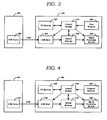
- FIG. 3 is a diagram conceptually illustrating the construction in which a media-processing device 300 is used to reproduce media files in accordance with another embodiment of the present invention.
- the media-processing device 300 of this embodiment is mainly constructed to reproduce media files, and is identical with the media-processing device 300 of the above-described embodiment in that the media-processing device 300 operates to obtain media files from an external storage device 380 and reproduce the media files.
- the media-processing device 300 of this embodiment is different from the media-processing device 300 of the above-described embodiment in that the media-processing device 300 includes not only a system memory module 370 formed of Dynamic Random Access Memory (DRAM) or Static Random Access Memory (SRAM), but also a boot code memory module 360 for storing system boot code instead of the program memory module 260 for storing a system program.
- DRAM Dynamic Random Access Memory
- SRAM Static Random Access Memory
- the boot code memory module 360 is a module for storing boot code for the system booting of the media-processing device 300, and has a capacity of tens of KB.
- the boot code memory module 360 may be implemented together with a control module 310 in a signal controller chipset.
- the system program of the media-processing device 200 is stored in the external storage device 380 preferably in a file form.
- the manufacturer of the media-processing device 300 may preferably distribute this system program via internet, and a user may download the system program and store the system program in the external storage device 380 in a file form.
- the media-processing device 300 when the media-processing device 300 is booted at an initial stage, the media-processing device 300 operates according to the boot code stored in the boot code memory module 360. Thereafter, when the connection of the media-processing device 300 to the external storage device 380 is detected through a USB host module 330, the media-processing device 300 searches the storage space of the external storage device 380, copies a system program compatible with a model of the media-processing device 300 to the system memory module 370 and, thereafter, operates according to the copied system program.
- the system program copied as described above preferably remains without being deleted while power is supplied. In this state, when the external storage device 380 without a system program file for the media-processing device 300 is connected to the media-processing device 300, the copied system program file is preferably copied from the system memory module 370 to the external storage device 380.
- the media-processing device 300 When the media-processing device 300 receives a command to select a specific media file from a user through a user interface module 320, the media-processing device 300 accesses the external storage device 380, searches the external storage device 380 for the media file, copies the data of the media file to the system memory module 370, reads the data of the media file from the system memory module 370 and provides the data of the media file to a signal-processing module 350. By doing this, the number of times the external storage device 380 is accessed can be reduced, through which the operational speed of the media-processing device 300 can be increased and power consumption can be reduced as described later.
- one or more media files to be reproduced after a media file being currently reproduced can be previously perceived through various information, such as a meta information file, a user selection input or file order information.
- the priority of the operation of copying the next media file is preferably set to be lower than that of the operation of signal processing the current media file.
- the operational mode of a USB host module 330 may be set to an activated mode or an inactivated mode according to the control of a control module 310.
- the inactivated mode is preferably constructed that the above-described power supply is not performed.
- the implementation of such an activated mode is easily enabled using well-known transistor technology.
- the activated mode can be easily implemented using the tri-state mode of a transistor.
- FIG. 4 is a diagram conceptually illustrating the construction in which a media-processing device 400 is used to reproduce media files in accordance with still another embodiment of the present invention.
- a media-processing device 400 of FIG. 4 does not have the boot code memory module 360 but has a program memory module 460. That is, since a system program for performing the system c ontrol of the media-processing device 400 is embedded in the program memory module 460, it is not necessary to copy the system program from an external storage device 480 as described with reference to FIG. 3.
- the other details are substantially the same as those of the embodiment of the media-processing device 300.
- FIG. 5 is a diagram conceptually illustrating the construction in which a media-processing device 500 is used to store media in accordance with an embodiment of the present invention.
- a signal-processing module 550 performs an encoding operation according to a certain signal processing method, such as a MP3 signal processing method. That is, the media-processing device 500 encodes an input signal received from a certain information source according to the certain signal processing method, outputs media data, and arranges the encoded media data in a certain file format to construct a media file.
- a certain signal processing method such as a MP3 signal processing method
- the media-processing device 200 not equipped with the system memory module, or media-processing device 300 or 400 equipped with the system memory module having insufficient capacity performs the encoding of the media data only if the external storage device is accessible, and may be operated to construct a media file in the external storage device 580 without the intervention of the system memory module.
- the information source may be a module that receives signals from the outside and provides the signals as they are or processed signals to the inside.
- the information source may be a module that generates signals from an external environment and provides the signals, like a microphone.
- the information source may be modeled on an operation in which a signal is generated in the media-processing device 500 by performing a function, such as contents reproduction, in the media-processing device 500.
- the information source is understood to be a module that provides signals in an analog format or digital format to the inside of the media-processing device 500.
- FIG. 6 is a diagram showing an embodiment of a timing relationship between an operation of copying media data to the system memory module and an operation of reproducing a media file in the media-processing device of the present invention.
- the media-processing device 300 or 400 accesses the external storage device 380 or 480, searches for the corresponding media file, copies the data of searched media file to the system memory 370 or 470, and transmits the data of the searched media files from the system memory 370 or 470 to the signal-processing module 350 or 450.
- FIG. 6 illustrates the case where the user selects a specific media file k.
- the media-processing device 300 or 400 copies the media file k to the system memory 370 or 470 at step ST 610 and, thereafter, reproduces the copied media file k at step ST 620.
- FIG. 6 illustrates the case where the operation of reproducing the media file k starts at step ST 620 before the operation of copying the media file k is not completed after the copying operation of the media file k has started at step ST 610. In this case, the operation of copying the media data is performed as a background operation while the reproducing operation is continuously performed.
- adjacent media files expected to be reproduced next are copied to the system memories 370 and 470 in advance during the operation of reproducing media files. If the operation of copying the media files is faster than the operation of reproducing the media. files, a memory limitation in which media data cannot be further copied to the system memory 370 or 470 may be reached at step ST 630. In this case, the media-processing device 400 temporarily stops the operation of copying the media file or reduces the speed of the copying operation. In this sense, a media file k+2 is indicated by dotted lines.
Landscapes
- Engineering & Computer Science (AREA)
- Signal Processing (AREA)
- Information Retrieval, Db Structures And Fs Structures Therefor (AREA)
- Signal Processing For Digital Recording And Reproducing (AREA)
- Stored Programmes (AREA)
Abstract
Description
- The present invention relates to a media-processing device, which accesses an external storage device, reads and reproduces media files stored in the external storage device, and stores media files produced by itself through an encoding process in the external storage device, thus enabling the reproduction and storage of the media files without being provided therein with a storage module for storing the media files.
- Currently, media-processing devices for reproducing and storing media files, such as an MPEG-1 Audio Layer-3 (MP3) player and a voice recorder, have been widely used. FIG. 1 is a diagram schematically showing the construction of a conventional media-
processing device 100. The conventional media-processing device 100 is equipped therein with anon-volatile storage module 140, such as flash memory, and, accordingly, is capable of storing media files received from ahost device 180 therein. Additionally, when a command to reproduce a media file is input from a user to the conventional media-processing device 100 through auser interface module 120, the conventional media-processing device 100 reads a media file from thestorage device 140 and transmits the data of the media file to a signal-processing module 150 so that the data of the media file are encoded according to a certain signal processing method, such as an MP3 encoding method. - For the purpose of the above-described transmission and reception of the media file, the
host device 180 and the media-processing device 100 are each provided with a transmission medium access function. FIG. 1 illustrates the case where a Universal Serial Bus (USB) transmission medium is used, as an example. In USB technology, when two devices are connected to each other through a USB transmission medium, one device performing a master function is referred to as a USB host while the other device performing a slave function is referred to as a USB device. In the case where the media-processing device 100 receives a media file from thehost device 180 as shown in FIG. 1, thehost device 180 corresponds to the USB host and the media-processing device 100 corresponds to the USB device. For this purpose, thehost device 180 includes aUSB host module 190 and the media-processing device 190 includes aUSB device module 130. - An Institute of Electrical and Electronics Engineers (IEEE) 1394 transmission medium and a wireless Local Area Network (LAN) can be used as the transmission medium for that purpose, besides the USB transmission medium. As for the connection between the two devices, the devices may be connected to each other through a cable, may be provided with connection ports for the connection therebetween, or may be wirelessly connected to each other through a wireless medium. In the case where IEEE 1394 technology or wireless LAN is used, a different scheme other than the above-described host-device scheme can be employed. For example, in the case of IEEE 1394 technology, a peer-to-peer scheme other than the master-slave scheme is used, and the
host device 180 corresponds to a Serial Bus Protocol 2 (SBP2) initiator and the media-processing device 100 corresponds to a SBP2 target according to SBP2 that is a higher-rank management protocol. For example, i-Pod of Apple Computer, Inc. is a typical MP3 player utilizing an IEEE 1394 transmission medium. Meanwhile, in general digital transmission media including a USB transmission medium and an IEEE 1394 transmission media, thehost device 180 may be generally modeled on a controller and the media-processing device 100 may be generally modeled on a target. - Three issues regarding the conventional media-
processing device 100 are cost reduction and the miniaturization and weight of a product. Thestorage device 140 would be a great hindrance to address these issues. Further, with respect to the storage capacity of thestorage device 140, there is another problem in which user demand for upgrading storage capacity is raised because storage capacity becomes relatively insufficient when one or two years elapse after the products of thestorage device 140 have been marketed. In the meantime, external storage media for supporting high performance digital transmission media, such as a USB transmission medium or an IEEE 1394 transmission medium, are popularized, but are problematic in that they are of questionable utility. - Accordingly, the present invention has been made keeping in mind the above problems occurring in the prior art, and an object of the present invention is to provide a media-processing device, which accesses an external storage device, reads and reproduces media files stored in the external storage device, and stores media files produced by itself through an encoding process in the external storage device, thus enabling the reproduction and storage of the media files without being provided therein with a storage module for the media files.
- In order to accomplish the above object, the present invention provides a media-processing device using an external storage device, including a storage access module for providing an access to the external storage device through certain transmission medium; an information-sourcing module for sourcing an input signal; a program memory module for storing a system program for the media-processing device; a system memory module for providing memory space for operation of the media-processing device; a signal-processing module for decoding media data according to a first signal processing method and encoding the input signal into media data according to a second signal processing method; a user interface module for providing an interface to a user of the media-processing device; and a control module for controlling the storage access module, the signal-processing module, and the user interface module according to the system program; wherein the control module accesses the external storage device through the storage access module, reads file information of one or more media files which media files are stored in the external storage device, stores the file information in the system memory module, and constructs contents to be displayed on the user interface module based upon the file information which file information is stored in the system memory module; wherein, when receiving a commend through the user interface module to select one out of the one or more media files, the control module accesses the external storage device through the storage access module, searches for the selected media file, reads data of the searched media file, copies the read data to the system memory module, and provides the copied data to the signal-processing module so that the provided data are decoded according to the first signal processing method; and wherein, when receiving a commend to encode a signal through the user interface module, the control module transmits the input signal provided from the information-sourcing module to the signal-processing module so that the transmitted input signal is encoded to media data according to the second signal processing method, constructs a media file from the encoded media data, positions the media file on the system memory module, copies the constructed media file to the external storage device if the external storage device is currently accessible through the storage access module, and waits until the external storage device becomes accessible and, then, copies the constructed media file to the external storage device if the external storage device is not currently accessible.
- The above and other objects, features and other advantages of the present invention will be more clearly understood from the following detailed description taken in conjunction with the accompanying drawings, in which:
- FIG. 1 is a diagram schematically showing the construction of a conventional media-processing device;
- FIG. 2 is a diagram conceptually illustrating the construction in which a media-processing device is used to reproduce media files in accordance with an embodiment of the present invention;
- FIG. 3 is a diagram conceptually illustrating the construction in which a media-processing device is used to reproduce media files in accordance with another embodiment of the present invention;
- FIG. 4 is a diagram conceptually illustrating the construction in which a media-processing device is used to reproduce media files in accordance with still another embodiment of the present invention;
- FIG. 5 is a diagram conceptually illustrating the construction in which a media-processing device is used to store media in accordance with an embodiment of the present invention; and
- FIG. 6 is a diagram showing an embodiment of a timing relationship between an operation of copying media data to the system memory module and an operation of reproducing a media file in the media-processing device of the present invention.
-
- Reference now should be made to the drawings, in which the same reference numerals are used throughout the different drawings to designate the same or similar components.
- FIG. 2 is a diagram conceptually illustrating the construction in which a media-
processing device 200 is used to reproduce media files in accordance with an embodiment of the present invention. The media-processing device 200 is mainly constructed to reproduce media files, and operates to obtain media files from an external storage device 280 and reproduce the media files. In this embodiment, a USB interface is used as a transmission medium for connecting the media-processing device 200 and the external storage device 280. In the present invention, the media-processing device 200 functions as a USB host, and is provided therein with aUSB host module 230 for this purpose. In contrast, the external storage device 280 functions as a USB device, and is provided therein with aUSB device module 290. - In this embodiment, the media-
processing device 200 includes a User Interface (U/I)module 220 for providing a user interface, and a signal-processing module 250 for performing a signal processing operation according to a certain signal processing method, which is basically the same as the conventional media-processing device 100. Meanwhile, the media-processing device 200 of the present is not provided therein with theconventional storage device 140, but rather with aprogram memory module 260. Theconventional storage device 140 has a capacity of more than tens of MB, basically contains a system program of the media-processing device 100, and is provided with space capable of storing media files. In contrast, theprogram memory module 260 has a capacity of hundreds of KB, and is very different from theconventional storage device 140 in that theprogram memory module 260 contains only a system program of the media-processing device 200 but is not provided with space for storing media files. - Further, in this embodiment, the media-
processing device 200 is different from the conventional media-processing device 100 in that media files are obtained through the USB transmission medium and directly input to the signal-processing module 250. That is, the media-processing device 200 uses the storage medium of the external storage device 280 like an internal storage medium. By being constructed as described above, the media-processing device 200 of the present invention can be sufficiently operated using the smaller capacity, lower costprogram memory module 260, through which the implementation of the lower cost, miniaturization and lower weight of the media-processing device 200 is enabled. Further, by being constructed as described above, the media-processing device 200 of the present invention can make use of the external storage device 280 through the provision of atransmission medium 230 and, therefore, can implement the extension of capacity. - FIG. 3 is a diagram conceptually illustrating the construction in which a media-
processing device 300 is used to reproduce media files in accordance with another embodiment of the present invention. In the embodiment of FIG. 3, the media-processing device 300 of this embodiment is mainly constructed to reproduce media files, and is identical with the media-processing device 300 of the above-described embodiment in that the media-processing device 300 operates to obtain media files from anexternal storage device 380 and reproduce the media files. However, the media-processing device 300 of this embodiment is different from the media-processing device 300 of the above-described embodiment in that the media-processing device 300 includes not only asystem memory module 370 formed of Dynamic Random Access Memory (DRAM) or Static Random Access Memory (SRAM), but also a bootcode memory module 360 for storing system boot code instead of theprogram memory module 260 for storing a system program. - The boot
code memory module 360 is a module for storing boot code for the system booting of the media-processing device 300, and has a capacity of tens of KB. The bootcode memory module 360 may be implemented together with acontrol module 310 in a signal controller chipset. In this embodiment, it is assumed that the system program of the media-processing device 200 is stored in theexternal storage device 380 preferably in a file form. The manufacturer of the media-processing device 300 may preferably distribute this system program via internet, and a user may download the system program and store the system program in theexternal storage device 380 in a file form. - Accordingly, when the media-
processing device 300 is booted at an initial stage, the media-processing device 300 operates according to the boot code stored in the bootcode memory module 360. Thereafter, when the connection of the media-processing device 300 to theexternal storage device 380 is detected through aUSB host module 330, the media-processing device 300 searches the storage space of theexternal storage device 380, copies a system program compatible with a model of the media-processing device 300 to thesystem memory module 370 and, thereafter, operates according to the copied system program. The system program copied as described above preferably remains without being deleted while power is supplied. In this state, when theexternal storage device 380 without a system program file for the media-processing device 300 is connected to the media-processing device 300, the copied system program file is preferably copied from thesystem memory module 370 to theexternal storage device 380. - When the
external storage device 380 is connected to the media-processing device 300, the media-processing device 300 preferably copies all or part of the file information of media files, such as a file allocation table, various pieces of directory structure information or various pieces of descriptor information, stored in theexternal storage device 380 to thesystem memory module 370 in advance. By doing this, the number of times theexternal storage device 380 is accessed can be reduced, through which the operational speed of the media-processing device 300 can be increased and power consumption can be reduced as described later. In the case where the file information has been copied to thesystem memory module 370 as described above, the file information is preferably referred to from thesystem memory module 370 thereafter. In this case, when the file of theexternal storage medium 380 is varied in the operation thereof, a kind of version management is performed either by recopying file information from theexternal storage device 380 or changing the file information in thesystem memory module 370. - When the media-
processing device 300 receives a command to select a specific media file from a user through auser interface module 320, the media-processing device 300 accesses theexternal storage device 380, searches theexternal storage device 380 for the media file, copies the data of the media file to thesystem memory module 370, reads the data of the media file from thesystem memory module 370 and provides the data of the media file to a signal-processing module 350. By doing this, the number of times theexternal storage device 380 is accessed can be reduced, through which the operational speed of the media-processing device 300 can be increased and power consumption can be reduced as described later. Further, there is a case where one or more media files to be reproduced after a media file being currently reproduced can be previously perceived through various information, such as a meta information file, a user selection input or file order information. In this case, it is possible to implement an operation, in which one or more media files to be produced next are previously copied from t heexternal storage device 380 to the system memory module 810 in the process of signal processing a media file being c urrently reproduced, as a kind of background operation, through w hich the operational speed of the media-processing device 300 can be improved. However, in this case, the priority of the operation of copying the next media file is preferably set to be lower than that of the operation of signal processing the current media file. - In the meantime, in the case of the utilization of the
external storage device 380, power consumption may be a problem. In particular, in the case where the media-processing device 300 of the present invention is a portable device, such as a MP3 player, the power consumption may be a serious problem. For example, if theexternal storage device 380 is not equipped with a separate power source in the case where a USB interface is used, the media-processing device 300 should provide a voltage of about 5 V and a current of about 40 mA. This power consumption may impose a great burden on the media-processing device 300. Accordingly, the operational mode of aUSB host module 330 may be set to an activated mode or an inactivated mode according to the control of acontrol module 310. The inactivated mode is preferably constructed that the above-described power supply is not performed. The implementation of such an activated mode is easily enabled using well-known transistor technology. For example, the activated mode can be easily implemented using the tri-state mode of a transistor. - After the
USB host module 330 has been constructed as described above, the power consumption of the media-processing device 300 can be reduced by setting the operational mode of theUSB host module 330 to the inactivated mode while the media-processing device 300 does not access theexternal storage device 380. In this case, if the number of times the media-processing device 300 accesses theexternal storage medium 380 is reduced by the above-described various methods, the power consumption of the media-processing device 300 can be reduced. - FIG. 4 is a diagram conceptually illustrating the construction in which a media-
processing device 400 is used to reproduce media files in accordance with still another embodiment of the present invention. Compared to the media-processing device 300 of FIG. 3, a media-processing device 400 of FIG. 4 does not have the bootcode memory module 360 but has aprogram memory module 460. That is, since a system program for performing the system c ontrol of the media-processing device 400 is embedded in theprogram memory module 460, it is not necessary to copy the system program from anexternal storage device 480 as described with reference to FIG. 3. The other details are substantially the same as those of the embodiment of the media-processing device 300. - FIG. 5 is a diagram conceptually illustrating the construction in which a media-
processing device 500 is used to store media in accordance with an embodiment of the present invention. In the media-processing device 500 of FIG. 5, a signal-processing module 550 performs an encoding operation according to a certain signal processing method, such as a MP3 signal processing method. That is, the media-processing device 500 encodes an input signal received from a certain information source according to the certain signal processing method, outputs media data, and arranges the encoded media data in a certain file format to construct a media file. - In this embodiment, the media-
processing device 500 positions the media file constructed as described above on asystem memory module 570. Thereafter, if anexternal storage device 580 becomes accessible, the media file is copied to theexternal storage device 580 through aUSB host module 530. In contrast, if theexternal storage device 580 is accessible at the time when the media file is constructed, the media file is immediately copied from thesystem memory module 570 to theexternal storage device 580. However, this operation is only an embodiment of the present invention, so that the present invention is not limited to this embodiment. That is, the media-processing device 200 not equipped with the system memory module, or media-processing device external storage device 580 without the intervention of the system memory module. - The above-described information source may exist in various forms. For example, the information source may be a module that receives signals from the outside and provides the signals as they are or processed signals to the inside. Further, the information source may be a module that generates signals from an external environment and provides the signals, like a microphone. In particular, the information source may be modeled on an operation in which a signal is generated in the media-
processing device 500 by performing a function, such as contents reproduction, in the media-processing device 500. In general, the information source is understood to be a module that provides signals in an analog format or digital format to the inside of the media-processing device 500. - FIG. 6 is a diagram showing an embodiment of a timing relationship between an operation of copying media data to the system memory module and an operation of reproducing a media file in the media-processing device of the present invention. Referring to FIGS. 3 and 4, in the above-described media-processing
devices processing device external storage device system memory system memory processing module processing device system memory step ST 610 and, thereafter, reproduces the copied media file k atstep ST 620. - In this case, it is possible to start the reproducing operation after copying all the selected media file k to the
system memory processing module system memory processing module step ST 620 before the operation of copying the media file k is not completed after the copying operation of the media file k has started atstep ST 610. In this case, the operation of copying the media data is performed as a background operation while the reproducing operation is continuously performed. - In a preferred embodiment of the present invention, adjacent media files expected to be reproduced next are copied to the
system memories system memory step ST 630. In this case, the media-processing device 400 temporarily stops the operation of copying the media file or reduces the speed of the copying operation. In this sense, a media file k+2 is indicated by dotted lines. - In accordance with the present invention, the media-processing device is advantageous in that the internal construction of the media-processing device is simplified, thus maximizing the production costs of a product and optimizing the size and weight of the product.
- In the present specification, the elements shown in FIGS. 1 to 5 have been distinguished from each other to represent their functions. Accordingly, a plurality of elements may be implemented in a single module, for example, a single controller chipset, or each element may be implemented to be divided into two or more modules.
- Further, in the present specification, the above-described embodiments, in which non-volatile storage devices do not exist, are only examples that have been cited to clearly represent the objects and effects of the present invention. Accordingly, according to the implementation of the present invention, there may be a so-called hybrid type, in which the conventional media-processing device is combined with the media-processing device of the present invention, a non-volatile storage device is provided therein, and the above-described operations are performed.
- Although the preferred embodiments of the present invention have been disclosed for illustrative purposes, those skilled in the art will appreciate that various modifications, additions and substitutions are possible, without departing from the scope and spirit of the invention as disclosed in the accompanying claims.
Claims (12)
- A media-processing device using an external storage device, comprising:wherein the control module accesses the external storage device through the storage access module, reads file information of one or more media files which media files are stored in the external storage device, stores the file information in the system memory module, and constructs contents to be displayed on the user interface module based upon the file information which file information is stored in the system memory module;a storage access module for providing access to the external storage device through a certain transmission medium;an information-sourcing module for sourcing an input signal;a program memory module for storing a system program for the media-processing device;a system memory module for providing memory space for operation of the media-processing device;a signal-processing module for decoding media data according to a first signal processing method and encoding the input signal into media data according to a second signal processing method;a user interface module for providing an interface to a user of the media-processing device; anda control module for controlling the storage access module, the signal-processing module, and the user interface module according to the system program;
wherein, when receiving a commend through the user interface module to select one out of the one or more media files, the control module accesses the external storage device through the storage access module, searches for the selected media file, reads data of the searched media file, copies the read data to the system memory module, and provides the copied data to the signal-processing module so that the provided data are decoded according to the first signal processing method; and
wherein, when receiving a commend to encode a signal through the user interface module, the control module transmits the input signal provided from the information-sourcing module to the signal-processing module so that the transmitted input signal is encoded to media data according to the second signal processing method, constructs a media file from the encoded media data, positions the media file on the system memory module, copies the constructed media file to the external storage device when the external storage device is currently accessible t hrough the storage access module, and waits until the external storage device becomes accessible and, then, copies the constructed media file to the external storage device when the external storage device is not currently accessible. - The media-processing device as set forth in claim 1, wherein:the storage access module is constructed so that an access mode thereof is set into an activated mode or into an inactivated mode having lower power consumption under the control of the control module;the control module accesses the external storage device, reads the file information and then sets the access mode into the inactivated mode;when receiving a command to select one out of one or more media files through the user interface module, the control module sets the access mode into the activated mode, accesses the external storage device, copies data of the selected specific media file to the system memory module, and sets the access mode into the inactivated mode; andwhen receiving a commend to encode a signal through the user interface module, the control module constructs the media file, positions the constructed media file on the system m emory m odule, and sets the access mode into the activated mode, copies the constructed media file to the external storage device and sets the access mode into the inactivated mode, when the external storage device is accessible through the storage access module.
- A media-processing device using an external storage device, comprising:wherein the control module, in an early operation mode in which the media-processing device operates according to the boot code, accesses the external storage device through the storage access module, searches for a system program suitable for the media-processing device in the external storage device, and loads the system program to the system memory module, and thereafter, the control module operates according to the loaded system program;a storage access module for providing access to the external storage device through a certain transmission medium;a boot code memory module for storing a boot code for system booting of the media-processing device;a system memory module for providing memory space for operation of the media-processing device;a signal-processing module for decoding media data according to a first signal processing method and decoding the input signal into the media data according to a second signal processing method;a user interface module for providing an interface to a user of the media-processing device; anda control module for controlling the storage access module, the signal-processing module and the user interface module;
wherein the control module, after loading the system program, accesses the external storage device through the storage access module, and copies file information of one or more media files into the system memory module, which media files are stored in the external storage device;
wherein, when receiving a commend through the user interface module to select one out of the one or more media files, the control module searches for the selected media file based upon the copied file information, reads data of the searched media file, copies the read data to the system memory module, and provides the copied data to the signal-processing module so that the provided data are decoded according to the first signal processing method;
wherein the storage access module is constructed so that an access mode thereof is set into an activated mode or into an inactivated mode having lower power consumption under the control of the control module, so that the control module sets the access mode into the inactivated mode after copying the file information from the external storage into the system memory module, sets the access mode into the activated mode, when receiving a command through the user interface module to select one out of one or more media files, before searching the external storage device for the selected media file based upon the copied file information and copying data of the searched media file into the system memory module, and thereafter sets the access mode into the inactivated mode. - The media-processing device as set forth in claim 3, wherein, when receiving a report on connection of a second external storage device from the storage access module after loading the system program for performing the system control of the media-processing device to the system memory module, the control module accesses the second external storage device, examines whether the system program exists in the second external storage device, and copies the system program from the system memory module to the second external storage device when the system program does not exist in the second external storage device.
- A media-processing device using an external storage device, comprising:wherein the control module, in an early operation mode in which the media-processing device operates according to the boot code, accesses the external storage device through the storage access module and loads a system program for controlling the media-processing device onto the system memory module, and thereafter, the control module operates according to the loaded system program;a storage access module for providing access to the external storage device through a certain transmission medium;a boot code memory module for storing a boot code for system booting of the media-processing device;a system memory module for providing memory space for operation of the media-processing device;a signal-processing module for decoding media data according to a first signal processing method and decoding the input signal into the media data according to a second signal processing method;a user interface module for providing an interface to a user of the media-processing device; anda control module for controlling the storage access module, the signal-processing module and the user interface module;
wherein the control module accesses the external storage device through the storage access module, reads file information of one or more media files which media files are stored in the external storage device, stores the file information in the system memory module, and constructs contents to be displayed on the user interface module based upon the file information which file information is stored in the system memory module;
wherein, when receiving a commend through the user interface module to select one out of the one or more media files, the control module accesses the external storage device through the storage access module, copies data of the selected media file to the system memory module, and provides the copied data to the signal-processing module so that the provided data are decoded according to the first signal processing method; and
wherein the storage access module is constructed so that an access mode thereof is set into an activated mode or into an inactivated mode having lower power consumption under the control of the control module, so that the control module sets the access mode into the inactivated mode after copying the file information from the external storage into the system memory module, sets the access mode into the activated mode, when receiving a command through the user interface module to select one out of one or more media files, before accessing the external storage device and copying the data of the selected media file into the system memory module, and thereafter sets the access mode into the inactivated mode. - A media-processing device using an external storage device, comprising:wherein the control module accesses the external storage device through the storage access module, and copies file information of one or more media files into the system memory module, which media files are stored in the external storage device;a storage access module for providing access to the external storage device through a certain transmission medium;a program memory module for storing a system program for the media-processing device;a system memory module for providing memory space for operation of the media-processing device;a signal-processing module for decoding media data according to a first signal processing method;a user interface module for providing an interface to a user of the media-processing device; anda control module for controlling the storage access module, the signal-processing module and the user interface module;
wherein, when receiving a commend through the user interface module to select one out of the one or more media files, the control module searches for the selected media file based upon the copied file information, reads data of the searched media file, copies the read data to the system memory module, and provides the copied data to the signal-processing module so that the provided data are decoded according to the first signal processing method;
wherein the storage access module is constructed so that an access mode thereof is set into an activated mode or into an inactivated mode having lower power consumption under the control of the control module, so that the control module sets the access mode into the inactivated mode after copying the file information from the external storage into the system memory module, sets the access mode into the activated mode, when receiving a command through the user interface module to select one out of one or more media files, before searching the external storage device for the selected media file based upon the copied file information and copying data of the searched media file into the system memory module, and thereafter sets the access mode into the inactivated mode. - A media-processing device using an external storage device, comprising:wherein the control module accesses the external storage device through the storage access module, reads file information of one or more media files which media files are stored in the external storage device, stores the file information in the system memory module, and constructs contents to be displayed on the user interface module based upon the file information which file information is stored in the system memory module;a storage access module for providing access to the external storage device through a certain transmission medium;a program memory module for storing a system program for the media-processing device;a system memory module for providing memory space for operation of the media-processing device;a signal-processing module for decoding media data according to a first signal processing method;a user interface module for providing an interface to a user of the media-processing device; anda control module for controlling the storage access module, the signal-processing module and the user interface module;
wherein, when receiving a commend through the user interface module to select one out of the one or more media files, the control module accesses the external storage device through the storage access module, copies data of the selected media file to the system memory module, and provides the copied data from the system memory module to the signal-processing module so that the provided data are decoded according to the first signal processing method;
wherein the storage access module is constructed so that an access mode thereof is set into an activated mode or into an inactivated mode having lower power consumption under the control of the control module, so that the control module sets the access mode into the inactivated mode after copying the file information from the external storage into the system memory module, sets the access mode into the activated mode, when receiving a command through the user interface module to select one out of one or more media files, before accessing the external storage device and copying data of the selected media file from the external storage device into the system memory module, and thereafter sets the access mode into the inactivated mode. - The media-processing device as set forth in claim 3, 5, 6 or 7, wherein the control module copies another media data from the external storage device to the system memory module while causing the copied media data to be decoded according to the first signal processing method by providing the copied media data to the signal-processing module, a priority of the copying operation being lower than that of the decoding operation.
- The media-processing device as set forth in claim 3, 5, 6 or 7, further comprising an information-sourcing module for sourcing a signal;
wherein the signal-processing module further performs an operation of encoding an input signal to media data according to a second signal processing method;
wherein, when receiving a command to encode media data from a user through the user interface module, the control module transmits the signal provided from the information-sourcing module to the signal-processing module so that the signal is encoded to media data according to a second signal processing method, constructs a media file from the encoded media data, positions the media file on the system memory module, and copies the constructed media file to the external storage device through the storage access module when the external storage device is currently accessible through the storage access module, and copies the constructed media file to the external storage device through the storage access module after the external storage device becomes accessible, when the external storage device is not currently accessible through the storage access module. - The media-processing device as set forth in claim 1, 3, 5, 6 or 7, wherein the transmission medium is a well-known Universal Serial Bus (USB) transmission medium, and the storage access module accesses the external storage medium through the USB transmission medium and operates in a host mode.
- The media-processing device as set forth in claim 1, 3, 5, 6 or 7, wherein the transmission medium is a well-known Institute of Electrical and Electronics Engineers (IEEE) 1394 transmission medium, and the storage access module accesses the external storage medium through the IEEE 1394 transmission medium and operates in a Serial Bus Protocol 2 (SBP2) initiator mode.
- The media-processing device as set forth in claim 1, 3, 5, 6 or 7, wherein the transmission medium is a well-known wireless communications medium, and the storage access module accesses the external storage medium through the well-known communications medium and operates in a controller mode.
Applications Claiming Priority (2)
| Application Number | Priority Date | Filing Date | Title |
|---|---|---|---|
| KR2003021307 | 2003-04-04 | ||
| KR1020030021307A KR100403376B1 (en) | 2003-04-04 | 2003-04-04 | Device for processing media using external storage |
Publications (2)
| Publication Number | Publication Date |
|---|---|
| EP1465198A2 true EP1465198A2 (en) | 2004-10-06 |
| EP1465198A3 EP1465198A3 (en) | 2005-11-23 |
Family
ID=32844910
Family Applications (1)
| Application Number | Title | Priority Date | Filing Date |
|---|---|---|---|
| EP04002468A Ceased EP1465198A3 (en) | 2003-04-04 | 2004-02-04 | Media-processing device using an external storage device |
Country Status (7)
| Country | Link |
|---|---|
| US (1) | US7213112B2 (en) |
| EP (1) | EP1465198A3 (en) |
| JP (2) | JP4295638B2 (en) |
| KR (1) | KR100403376B1 (en) |
| CN (1) | CN1308854C (en) |
| SG (1) | SG137663A1 (en) |
| TW (1) | TWI261179B (en) |
Families Citing this family (8)
| Publication number | Priority date | Publication date | Assignee | Title |
|---|---|---|---|---|
| TWI252628B (en) * | 2004-08-04 | 2006-04-01 | Apacer Technology Inc | Multimedia device having wireless transmission function |
| CN100530148C (en) * | 2005-12-30 | 2009-08-19 | 鸿富锦精密工业(深圳)有限公司 | Audio playing system and notebook computer applied |
| TWI337710B (en) | 2006-01-05 | 2011-02-21 | Telechips Inc | Audio system |
| JP5145227B2 (en) * | 2006-07-26 | 2013-02-13 | パナソニック株式会社 | Nonvolatile storage device, nonvolatile storage system, and host device |
| KR101299683B1 (en) * | 2006-10-20 | 2013-08-26 | 삼성전자주식회사 | Display apparatus, display system and control method thereof |
| US20080167738A1 (en) * | 2007-01-05 | 2008-07-10 | Telechips, Inc. | Media connect device, and system using the same |
| CN103838588A (en) * | 2012-11-20 | 2014-06-04 | 广州市暨华医疗器械有限公司 | Method for conducting online program updating on AT90 single-chip microcomputer through CAN interface |
| CN104882155B (en) * | 2015-04-30 | 2018-02-09 | 厦门睿联创信息科技有限公司 | The anti-lost safe USB disk of low-power consumption |
Citations (1)
| Publication number | Priority date | Publication date | Assignee | Title |
|---|---|---|---|---|
| EP1383127A2 (en) | 2002-07-16 | 2004-01-21 | Nextway Co., Ltd. | Host processing device using external storage medium |
Family Cites Families (32)
| Publication number | Priority date | Publication date | Assignee | Title |
|---|---|---|---|---|
| US28690A (en) * | 1860-06-12 | Apparatus for measuring liquids | ||
| US5867712A (en) * | 1993-04-05 | 1999-02-02 | Shaw; Venson M. | Single chip integrated circuit system architecture for document instruction set computing |
| US6553410B2 (en) * | 1996-02-27 | 2003-04-22 | Inpro Licensing Sarl | Tailoring data and transmission protocol for efficient interactive data transactions over wide-area networks |
| US6490235B1 (en) | 1997-08-07 | 2002-12-03 | Sony Corporation | Storage and reproduction apparatus with rotary control element for controlling operations |
| KR100287366B1 (en) | 1997-11-24 | 2001-04-16 | 윤순조 | Portable device for reproducing sound by mpeg and method thereof |
| KR100293158B1 (en) | 1998-08-24 | 2001-06-15 | 윤순조 | Portable mp3 player having various functions |
| US6151262A (en) | 1998-10-28 | 2000-11-21 | Texas Instruments Incorporated | Apparatus, system and method for control of speed of operation and power consumption of a memory |
| JP2000222078A (en) * | 1999-02-04 | 2000-08-11 | Olympus Optical Co Ltd | Voice processor |
| US6332175B1 (en) | 1999-02-12 | 2001-12-18 | Compaq Computer Corporation | Low power system and method for playing compressed audio data |
| US6601140B1 (en) | 1999-04-07 | 2003-07-29 | Sony Corporation | Memory unit, data processing unit, and data processing method using memory unit type |
| US6618789B1 (en) * | 1999-04-07 | 2003-09-09 | Sony Corporation | Security memory card compatible with secure and non-secure data processing systems |
| MXPA01010909A (en) | 1999-04-30 | 2002-05-06 | Thomson Licensing Sa | Multi-format personal digital audio player. |
| KR100591369B1 (en) * | 1999-08-27 | 2006-06-19 | 노키아 코포레이션 | Mobile multimedia terminal for DV-T and large scale and small cell communication |
| JP4727780B2 (en) | 1999-09-03 | 2011-07-20 | ソニー株式会社 | Playback device, recording device |
| KR20010036156A (en) * | 1999-10-06 | 2001-05-07 | 윤종용 | Moving picture expert group layer3 changer |
| JP2001169380A (en) * | 1999-12-14 | 2001-06-22 | Casio Comput Co Ltd | Ear-mounted music playback device and music playback system |
| JP2001177889A (en) * | 1999-12-21 | 2001-06-29 | Casio Comput Co Ltd | Body-mounted music playback device and music playback system |
| US6647499B1 (en) * | 2000-01-26 | 2003-11-11 | International Business Machines Corporation | System for powering down a disk storage device to an idle state upon trnsfer to an intermediate storage location accessible by system processor |
| DE10004284A1 (en) * | 2000-02-01 | 2001-08-16 | Micronas Munich Gmbh | Portable data acquisition and / or data playback device |
| AU2027201A (en) | 2000-02-23 | 2001-11-20 | Havin Co., Ltd. | Apparatus and method for recording digital audio data file |
| KR100408128B1 (en) | 2000-02-23 | 2003-12-01 | 주식회사 하빈 | Apparatus and method for searching digital audio data file from media where digital audio data files are recorded |
| US20030028690A1 (en) * | 2000-07-20 | 2003-02-06 | John Appleby-Alis | System, method and article of manufacture for a reconfigurable hardware-based multimedia device |
| US7236688B2 (en) * | 2000-07-26 | 2007-06-26 | Matsushita Electric Industrial Co., Ltd. | Signal processing method and signal processing apparatus |
| JP4123327B2 (en) * | 2000-11-28 | 2008-07-23 | 富士フイルム株式会社 | Camera with audio playback function |
| JP2002184159A (en) | 2000-12-14 | 2002-06-28 | Tdk Corp | Digital recording and playback device |
| US7170828B2 (en) * | 2000-12-15 | 2007-01-30 | Texas Instruments Incorporated | Removable face plate compressed digital music player |
| US20020105861A1 (en) | 2000-12-29 | 2002-08-08 | Gateway, Inc. | Standalone MP3 recording station |
| JP2002318598A (en) | 2001-04-20 | 2002-10-31 | Toshiba Corp | Information reproducing apparatus, information reproducing method, information recording medium, information recording apparatus, information recording method, and information recording program |
| US20020177362A1 (en) | 2001-05-23 | 2002-11-28 | Chang Ting Chen | Portable memory storage-retrieval device |
| US20030019942A1 (en) * | 2001-07-24 | 2003-01-30 | Blossom George W. | System and method for electronically readable card having power source |
| US7106541B2 (en) | 2001-09-14 | 2006-09-12 | Convergent Systems Solutions, Llc | Digital device configuration and method |
| JP2003109315A (en) * | 2001-09-27 | 2003-04-11 | Mitsumi Electric Co Ltd | Interface device |
-
2003
- 2003-04-04 KR KR1020030021307A patent/KR100403376B1/en not_active Expired - Lifetime
- 2003-07-30 US US10/629,565 patent/US7213112B2/en not_active Expired - Fee Related
-
2004
- 2004-02-04 EP EP04002468A patent/EP1465198A3/en not_active Ceased
- 2004-02-10 SG SG200400578-1A patent/SG137663A1/en unknown
- 2004-02-16 TW TW093103615A patent/TWI261179B/en not_active IP Right Cessation
- 2004-02-16 CN CNB2004100042725A patent/CN1308854C/en not_active Expired - Lifetime
- 2004-02-20 JP JP2004044310A patent/JP4295638B2/en not_active Expired - Lifetime
-
2008
- 2008-11-25 JP JP2008299439A patent/JP2009151763A/en active Pending
Patent Citations (1)
| Publication number | Priority date | Publication date | Assignee | Title |
|---|---|---|---|---|
| EP1383127A2 (en) | 2002-07-16 | 2004-01-21 | Nextway Co., Ltd. | Host processing device using external storage medium |
Also Published As
| Publication number | Publication date |
|---|---|
| EP1465198A3 (en) | 2005-11-23 |
| KR100403376B1 (en) | 2003-10-30 |
| JP2004310058A (en) | 2004-11-04 |
| CN1308854C (en) | 2007-04-04 |
| HK1069654A1 (en) | 2005-05-27 |
| JP4295638B2 (en) | 2009-07-15 |
| US7213112B2 (en) | 2007-05-01 |
| TW200426605A (en) | 2004-12-01 |
| CN1536500A (en) | 2004-10-13 |
| US20050038965A1 (en) | 2005-02-17 |
| SG137663A1 (en) | 2007-12-28 |
| TWI261179B (en) | 2006-09-01 |
| JP2009151763A (en) | 2009-07-09 |
Similar Documents
| Publication | Publication Date | Title |
|---|---|---|
| US8401534B2 (en) | Mobile communication terminal and method for controlling the same | |
| JP6142081B2 (en) | Volatile memory architecture and related controllers in non-volatile memory devices | |
| US20040039575A1 (en) | Host processing device using external storage medium | |
| JP2009151763A (en) | Media processing device | |
| US20090187720A1 (en) | Automatic backup method and computer system with automatic backup function | |
| WO2006112794A1 (en) | Interface for non-volatile memories | |
| JP2005258804A (en) | Memory card device and memory card control method | |
| TW202046326A (en) | Memory addressing methods and associated controller | |
| JP2011210235A (en) | Nonvolatile storage device, access device, and nonvolatile storage system | |
| JP5037734B2 (en) | Data protection method and system, storage device, and storage device controller | |
| TW200540690A (en) | Memory card that supports file system interoperability | |
| CN108351789B (en) | Electronic device and starting method thereof | |
| CN110874333B (en) | Storage device and storage method | |
| KR101416322B1 (en) | Authentication method of Contents-protected Title and Device adopting the method | |
| JP2007102168A (en) | Method of dubbing music data | |
| CN114237514A (en) | Block management method, memory controller and memory storage device | |
| HK1069654B (en) | Media-processing device using an external storage device | |
| KR100746364B1 (en) | Memory sharing method and device | |
| JP2007249155A (en) | Method of managing media file and media playback apparatus | |
| KR100537171B1 (en) | Apparatus and method for saving battery using a flash memory in portable digital audio device | |
| KR100863599B1 (en) | Data playback method and device | |
| US8028124B2 (en) | Fast processing memory array | |
| JP4753554B2 (en) | Signal reproduction device | |
| CN110738299A (en) | WIFI flash memory disk and data processing method applied to WIFI flash memory disk | |
| JP2007102995A (en) | A method of dubbing music on a music CD to an MP3 player |
Legal Events
| Date | Code | Title | Description |
|---|---|---|---|
| PUAI | Public reference made under article 153(3) epc to a published international application that has entered the european phase |
Free format text: ORIGINAL CODE: 0009012 |
|
| AK | Designated contracting states |
Kind code of ref document: A2 Designated state(s): AT BE BG CH CY CZ DE DK EE ES FI FR GB GR HU IE IT LI LU MC NL PT RO SE SI SK TR |
|
| AX | Request for extension of the european patent |
Extension state: AL LT LV MK |
|
| PUAL | Search report despatched |
Free format text: ORIGINAL CODE: 0009013 |
|
| AK | Designated contracting states |
Kind code of ref document: A3 Designated state(s): AT BE BG CH CY CZ DE DK EE ES FI FR GB GR HU IE IT LI LU MC NL PT RO SE SI SK TR |
|
| AX | Request for extension of the european patent |
Extension state: AL LT LV MK |
|
| 17P | Request for examination filed |
Effective date: 20051215 |
|
| AKX | Designation fees paid |
Designated state(s): AT BE BG CH CY CZ DE DK EE ES FI FR GB GR HU IE IT LI LU MC NL PT RO SE SI SK TR |
|
| 17Q | First examination report despatched |
Effective date: 20090713 |
|
| STAA | Information on the status of an ep patent application or granted ep patent |
Free format text: STATUS: THE APPLICATION HAS BEEN REFUSED |
|
| 18R | Application refused |
Effective date: 20141016 |