EP1465035A2 - Constrained system identification for incorporation of a priori knowledge - Google Patents
Constrained system identification for incorporation of a priori knowledge Download PDFInfo
- Publication number
- EP1465035A2 EP1465035A2 EP04251266A EP04251266A EP1465035A2 EP 1465035 A2 EP1465035 A2 EP 1465035A2 EP 04251266 A EP04251266 A EP 04251266A EP 04251266 A EP04251266 A EP 04251266A EP 1465035 A2 EP1465035 A2 EP 1465035A2
- Authority
- EP
- European Patent Office
- Prior art keywords
- model
- constraints
- parametric
- initial
- optimization
- Prior art date
- Legal status (The legal status is an assumption and is not a legal conclusion. Google has not performed a legal analysis and makes no representation as to the accuracy of the status listed.)
- Withdrawn
Links
Images


Classifications
-
- G—PHYSICS
- G05—CONTROLLING; REGULATING
- G05B—CONTROL OR REGULATING SYSTEMS IN GENERAL; FUNCTIONAL ELEMENTS OF SUCH SYSTEMS; MONITORING OR TESTING ARRANGEMENTS FOR SUCH SYSTEMS OR ELEMENTS
- G05B13/00—Adaptive control systems, i.e. systems automatically adjusting themselves to have a performance which is optimum according to some preassigned criterion
- G05B13/02—Adaptive control systems, i.e. systems automatically adjusting themselves to have a performance which is optimum according to some preassigned criterion electric
- G05B13/04—Adaptive control systems, i.e. systems automatically adjusting themselves to have a performance which is optimum according to some preassigned criterion electric involving the use of models or simulators
- G05B13/042—Adaptive control systems, i.e. systems automatically adjusting themselves to have a performance which is optimum according to some preassigned criterion electric involving the use of models or simulators in which a parameter or coefficient is automatically adjusted to optimise the performance
-
- G—PHYSICS
- G05—CONTROLLING; REGULATING
- G05B—CONTROL OR REGULATING SYSTEMS IN GENERAL; FUNCTIONAL ELEMENTS OF SUCH SYSTEMS; MONITORING OR TESTING ARRANGEMENTS FOR SUCH SYSTEMS OR ELEMENTS
- G05B17/00—Systems involving the use of models or simulators of said systems
- G05B17/02—Systems involving the use of models or simulators of said systems electric
Definitions
- the present invention relates to a method of improving an initial parametric model of a system and a method of system identification based analysis of a plurality of input signals and a plurality of output signals.
- this invention relates to system identification wherein a priori knowledge of the system is used during model parameter estimation and, more particularly, to system identification of chemical processes using a priori knowledge of the processes.
- First-principles knowledge may be obtained from a number of first-principles analyses of the system, such as mass and energy balances based on fluid dynamics and thermodynamic and kinetic information of the system. Analysis of empirical data is an alternative way of modeling the process and is generically known as system identification.
- One approach is to create a model based on first-principles knowledge and then fit certain parameters (such as kinetic or thermodynamic parameters) to closely match empirical data collected from the system.
- This approach starts with the creation of a first-principles based model (also known as white box model) and, through a stochastic framework, testing data is used for estimation of the unknown parameters and/or structures of the model (such as, e.g., chemical reaction rates or coefficients, stoichiometry of reactions, reaction mechanisms, etc).
- This approach creates a so-called hybrid model or semi-physical model. Proposed methods to implement this approach have been described in detail in articles such as Identification of Physical Parameters in Structured Systems by S. Dasgupta et al.
- Empirical models based on empirical data from the system may be used when it is difficult to obtain sufficient first-principles knowledge of the process or when rigorous models may not be required (such as in the case of using the models for robust model-based controllers).
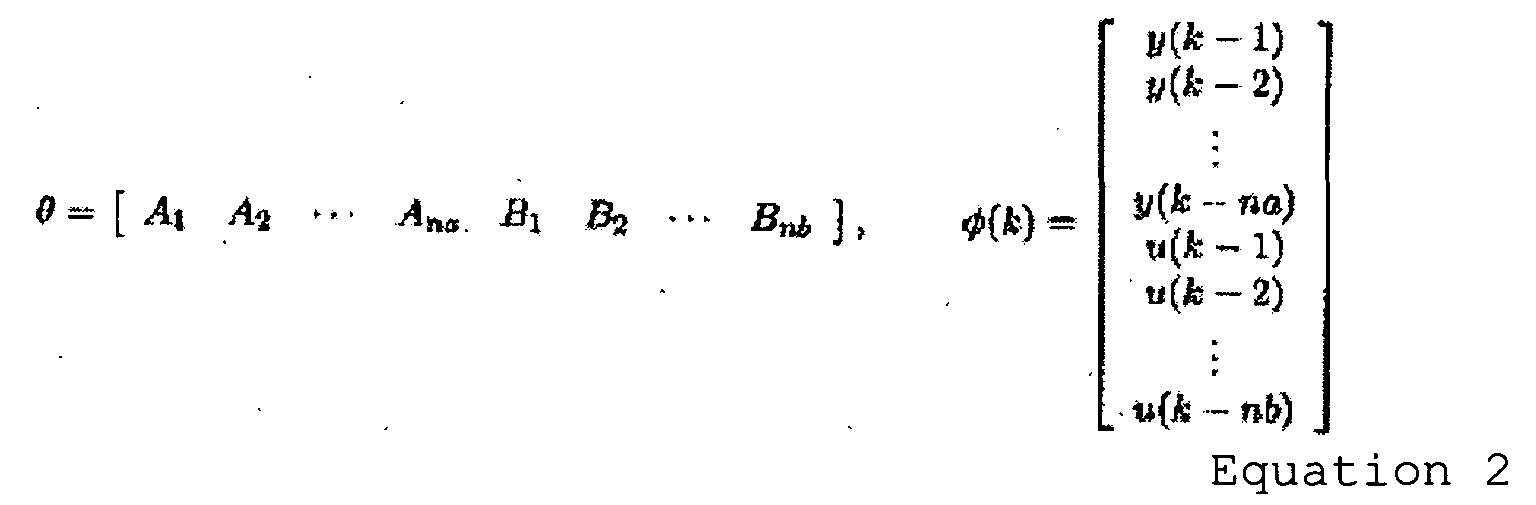
- a compact form of representation of an ARX model is y ( k
- ⁇ ) ⁇ ( k ) + v ( k ) with where u, y, v are the input, output and noise vectors, respectively; na, nb are output and input horizons that represent the effect of past input/output data on the output at the current time step k and the matrix ⁇ contains the model parameters.
- H. Tulleken discusses how utilization of a priori knowledge in system identification has become an increasingly important research area because such knowledge can improve the model quality and potentially eliminate the need for collection of additional data during plant testing. Improvements in model quality may not only enhance controller design but process monitoring, fault detection and process optimization as well.
- Grey-box modeling traditionally solves a statistical optimization where plant test data is fit subject to constraints (a priori knowledge).
- the main research issues exploited in the literature are centered on what type of a priori knowledge should be considered, how to judge the quality of the a priori knowledge and how to incorporate the knowledge as constraints on the parameters of the empirical models during the data fitting process.
- T ss for a second order SISO system is enforced in the following way T ss a 1 + a 2 ⁇ T 3 ss - T ss a 1 + a 2 ⁇ T 2 ss - a 2 ⁇ T 0 ss
- Esmaili deals with small to medium size problems for which constrained least squares and sequential quadratic programming are adequate optimization methods for obtaining the model parameters.
- the methods described by Esmaili may not be practical for developing a parameter estimation method suitable for large-scale MIMO problems due to the resulting computational complexity.
- constrained optimization involves analysis of the original test data.
- the solution of a constrained statistical optimization is performed, wherein the test data fitting process is subject to a priori knowledge, either in the form of constraints and/or as additional terms in the objective function.
- an exemplary method of improving an initial parametric model of a system by the incorporation of a priori knowledge of the system is a model including a plurality of parameters based on analysis of a plurality of input signals and a plurality of output signals.
- the method includes the steps of determining a set of constraints corresponding to a set of the plurality of parameters and based on the a priori knowledge and then performing a constrained parametric optimization of the system based on the initial parametric model and the set of determined constraints to produce an improved parametric model of the system.
- the constrained parametric optimization of the initial parametric model does not include the plurality of input signals and the plurality of output signals.
- an exemplary method of system identification based analysis of a plurality of input signals and a plurality of output signals with the incorporation of a priori knowledge of a system for developing a physically meaningful model of the system includes the step of solving a first parametric model optimization based on the plurality of input signals and the plurality of output signals to create an initial parametric model of the system.
- the initial parametric model of the system includes a plurality of parameters.
- a set of constraints is determined, which correspond to a set of the plurality of parameters from the initial parametric model based on the a priori knowledge of the system.
- a constrained parametric optimization of the system is performed based on the initial parametric model and the set of determined constraints to produce a physically meaningful model of the system.
- the constrained parametric optimization does not include the plurality of input signals and the plurality of output signals.
- an alternative exemplary method of system identification based analysis of a plurality of input signals and a plurality of output signals with the incorporation of a priori knowledge of a system for developing a physically meaningful model of the system includes the step of solving a first non-parametric model optimization based on the plurality of input signals and the plurality of output signals to create a non-parametric model of the system.
- the non-parametric model is then approximated as an initial parametric model of the system, which includes a plurality of parameters.
- a set of constraints is determined, which correspond to a set of the plurality of parameters from the initial parametric model based on the a priori knowledge of the system.
- a constrained parametric optimization of the system is performed based on the initial parametric model and the set of determined constraints to produce a physically meaningful model of the system.
- the constrained parametric optimization does not include the plurality of input signals and the plurality of output signals.
- a fourth aspect of the present invention there is provided another exemplary method of system identification based analysis of a plurality of input signals and a plurality of output signals with the incorporation of a priori knowledge of a system for developing a physically meaningful model of the system.
- the method includes the step of solving a first non-parametric model optimization based on the plurality of input signals and the plurality of output signals to create an initial non-parametric model of the system.
- the non-parametric model includes a plurality of model parameters.
- a set of constraints is determined, which correspond to a set of the plurality of model parameters from the initial non-parametric model based on the a priori knowledge of the system.
- a constrained non-parametric optimization of the system is performed based on the initial non-parametric model and the set of determined constraints to produce a physically meaningful model of the system.
- the constrained non-parametric optimization does not include the plurality of input signals and the plurality of output signals.
- Examples of embodiments of the present invention include an exemplary system identification method for construction of a model that represents a system.
- Such models may be used to design a model-based controller (such as an MPC), a monitoring system, a fault detection system, reverse engineering of a system or process, and/or a process optimization tool.
- the present invention consists of a method of system identification, which incorporates both empirical data and a priori knowledge of the system wherein at least two model parameter optimizations are solved.
- the first unconstrained optimization generates an initial model based entirely on system test data information.
- This initial model may then be optimized in the presence of a priori knowledge constraints.
- the final model is, therefore, obtained in at least two model parameter optimization steps.
- This model is desirably an optimal compromise between system test data information and a priori knowledge of the processes within the system.
- the execution of the system identification in at least two optimization steps allows for handling of any size system and data set in a computationally efficient manner. Additionally, in an example of an embodiment the present invention focuses on a system identification approach in which an empirical model is modified not only to match first-principles knowledge, but any kind of a priori knowledge of the process which may be available (from process operation, for example).
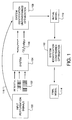
- FIG. 1 illustrates an exemplary layout of a system test and analysis procedure.
- system 104 is described generally in terms of a chemical plant. This choice is for illustrative purposes only.
- One skilled in the art may appreciate that the exemplary optimization methods described below need not be limited to system identification of a chemical plant, but may be utilized to generate models for other complex systems from input/output data, such as electronic circuitry, communications networks, and financial structures.
- the exemplary system test involves driving a number of input channels of system 104 with input perturbation signals 102.
- the amplitudes and waveforms of input signals 102 are desirably determined to provide sufficient excitation of the system in the desired portions of the parameter space so that the resulting model may reproduce the desired responses of the system.
- Much work has been done on the problem of how to design these input signals.
- a number of types of signals have been utilized, such as step signals, pseudo-random binary and multi-level signals, and binary multi-frequency signals.
- European patent application having publication number EP-A-1391990 entitled “Method and Apparatus for Producing Perturbation Signals" (based on US Patent Application 10/225,675,) describes several exemplary methods of designing input perturbation signals, and is herein incorporated by reference.
- Data representing the amplitudes of input perturbation signals 102 and data representing the signal shapes, such as the time delays between the binary levels for binary signals, is supplied to signal generators 100.
- input signals 102 provide data regarding deviations from the values of the input variable from these normal operating conditions.
- Output signals 106 from the output channels of system 104 are measured by sensors and transferred along with data representing input signals 102, which is supplied to system identification unconstrained optimization procedure 108 from signal generators 100 on data channel 116 to determine initial model 110.
- Data transfer in Figure 1 is characterized as transmission over a data channel for ease of illustration, but it is contemplated that the data transfer may alternatively be accomplished via a computer download or the physical transfer of memory devices such as tape, disk, or IC recording media. The data transfer may also involve entering settings on the signal generators manually from printed or electronically transmitted information. It is also noted that, although Figure 1 illustrates three input signals 102 and two output signals 106, the choice of these numbers is only for ease of representation. The reduced computational complexity of the exemplary methods of the present invention allow systems having much greater numbers of both input and output signals to be efficiently identified.
- the output channels may be separated into sets of highly interacting output channels.
- the sets of highly interacting output channels contain output signals of the system that exhibit a significant degree of interdependence.
- Data from these channels are preferably analyzed together using a MIMO state-space identification method or an ARX algorithm.
- Data from output channels exhibiting less interaction with other output channels may be analyzed separately using simpler multiple input/single output (MISO) linear parametric models (state-space, ARX, ARMAX, output-error, Box-Jenkins, Output-error, etc.).
- MISO multiple input/single output
- Initial model 110 desirably provides an accurate characterization of the system test data. As shown in Figure 1, initial model 110, but not data directly representing input signals 102 or output signals 106, is used as the input data to system identification constrained optimization 112. System identification constrained optimization 112 adjusts initial model 110 based on a priori knowledge of the system in order to produce final model 114. This constrained optimization seeks to achieve a desirably optimal compromise between empirical test data information and a priori knowledge of system 104.
- Such computer-readable media include; integrated circuits, magnetic and optical storage media, as well as audio-frequency, radio frequency, and optical carrier waves.
- special purpose computing circuitry may be employed as a computer to perform these functions.
- One exemplary embodiment of the present invention is a method of system identification utilizing a priori knowledge. This exemplary method determines a parametric model of the system that represents a compromise between empirical test data and a priori knowledge of the system.
- input and output test data from a plant test are received, step 200.
- the plant test may be executed with any input perturbation signals that provide enough excitation to the system to produce the desired responses.
- the input/output data may be pre-treated prior to system identification by methods such as filtering, detrending, outlier elimination, interpolation, slicing, etc. Exemplary methods of data pre-treating that may be used are disclosed in US Patent Application 10/225,675.
- An unconstrained optimization using the input and output data is performed to determine an initial parametric model of the system, step 202.
- the input and output test data may be analyzed using either a parametric, as described below with reference to Figure 3, or a non-parametric model which may then be converted into a parametric model, as described below with reference to Figure 5, to obtain the initial parametric model.
- This modeling may be performed using standard modeling tools commercially available for unconstrained system identification, such as MATLAB® as described by L. Ljung in System Identification Toolbox, for Use with MATLAB® , version 5 ed. (2000) herein incorporated by reference.
- a special purpose program may be written to perform unconstrained system identification based on a standard model structure.
- the resulting initial model may be judged to ensure that it is a good quality model within usual model quality criteria for model validation and cross-validation. See System Identification -Theory for the User by L. Ljung for exemplary methods.
- the initial model is then used as an input to a constrained parametric optimization, step 204. In this optimization, described in detail below with reference to Figure 4, a new parametric model of the same type and number of parameters or coefficients as the initial parametric model is identified subject to constraints that represent a priori knowledge of the process.
- the constrained parametric optimization does not utilize the input/output data directly, but only indirectly via the initial parametric model.
- the model identification is performed via solution of at least two sequential optimization processes, represented in steps 202 and 204.
- the first optimization, step 202 may be a standard system identification procedure for unconstrained parametric model estimation.
- the second optimization, step 204 seeks to adjust the model in order to achieve the desired optimal compromise between test data information and a priori knowledge. This two-step approach involves two relatively computationally simple optimization steps. This is one of the key differences with respect to the prior art wherein the model is identified during the data fitting process, in the presence of constraints, in one computationally expensive step.
- the model calculated by the constrained parametric optimization, step 204 may be judged to determine whether it represents an acceptable compromise between the test data and a priori knowledge of the system, step 206. If this model is not an acceptable compromise, the optimization parameters in the constrained parametric optimization may be changed to achieve more desirable results, step 208, and then the constrained parametric optimization, step 204, may be performed again. If the model is accepted, it becomes the final model, step 212.
- step 204 If the model calculated by constrained parametric optimization, step 204 is judged not to be acceptable in step 206, it is also possible to change the model order of the initial model, step 210 (shown in phantom), and repeat the unconstrained system identification, step 202. This may produce a new initial model representing a system characterized by a different number of parameters or coefficients, for example.
- Figure 3 is a flowchart of an exemplary constrained parametric optimization that may be used as the first step, step 202, of the exemplary two-step system identification approach described above with respect to Figure 2.
- an unconstrained parametric optimization technique such as a state-space model
- first input and output test data from a plant test are received, step 200. It is desirable for pre-treated input/output data to be used in this unconstrained system identification procedure.
- a standard system identification method for a chosen model structure may be used.
- Figure 3 utilizes a state-space model for system identification. As described above, one of the reasons for adopting a state-space model structure in this discussion is the fact that this is the most general linear parametric model structure that encompasses all others (ARX, ARMAX, Box-Jenkins, Output-error, etc) and may be used to represent any linear system. It may be understood, however, that the use of state-space models in the discussion of Figure 3 is not a limitation of the present invention and modifications for use of other parametric model structures are within the level of ordinary skill in the art.
- the input data and the output data may be analyzed to determine an initial state-space model, step 300, using a standard commercially available software package.
- the subspace identification routine N4SID in MATLAB® may be used for this purpose as described in System Identification Toolbox, for Use with MATLAB® .
- Special purpose software programs may also be written to perform this unconstrained parametric optimization. Exemplary subspace identification methods are discussed in detail in System Identification -Theory for the User by L. Ljung and Subspace Identification For Linear Systems: Theory - Implementation - Applications by P. Van Overschee et al. (1996).
- the matrices [ A 0 , B 0 , C 0 , D 0 ] characterize the model dynamics and, in this exemplary system identification of a state-space model, their elements are the unknown parameters to be estimated via knowledge of data of output variables y and input variables u.
- the exemplary state-space model of Equation 16 may be represented compactly as: as shown in step 300 in Figure 3.
- Standard techniques for identification of a subspace model may warn the user if the resulting model is open-loop unstable. If a priori knowledge of the system indicates that the process is open-loop stable, it may be desirable for the user to exercise caution in selecting an initial model which is open-loop stable, i.e. it is preferable to select initial models for which the eigenvalues of matrix A 0 lie inside the unit circle.
- Step responses 304 corresponding to the initial state-space model determined in step 300 may then be obtained via simulation of the model subject to unit step inputs, step 302.
- the step responses 304 display the dynamic and steady-state characteristics of the initial state-space model.
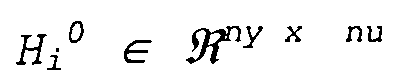
- the sub-index 0 indicates that these step responses correspond to the initial state-space model determined in step 300.
- the step responses 304 may be visually inspected against a priori knowledge of the process, step 306. If the initial state-space model is in agreement with a priori knowledge of the process, the system identification exercise is concluded and the initial state-space model is determined to be the final model, step 308. If the a priori knowledge is not corroborated by the collected input/output data, the system identification procedure continues, step 310, with the second, constrained optimization, step 204 of Figure 2.
- Figure 4 is flowchart illustrating an exemplary method of performing a constrained parametric optimization of an initial state-space model produced by an unconstrained parametric optimization procedure, such as the procedure described above with reference to Figure 3.
- An initial state-space model that has been judged to be unsatisfactory given the a priori knowledge of the process is used as the input, step 400.
- the initial state-space model is used in a constrained optimization procedure, step 204.
- a priori knowledge is incorporated in the form of constraints on the model parameters.
- step 402 the decision variables are the new state-space model parameters, namely, the elements of the matrices A , B, C , D .
- the decision variables are the new state-space model parameters, namely, the elements of the matrices A , B, C , D .
- the matrix D is set to 0 is considered, i.e., the formulation of the constrained optimization in 301 is shown for causal systems. It may be understood to one skilled in the art that the method described may be used for non-causal systems as well, with minor changed in problem formulation and a small increase in computational complexity.
- the objective function in constrained parametric optimization 402 may assume, for example, the following form: where the positive semi-definite matrices Q A , Q B , Q C are weights that define the matrix norms in the objective function and represent the degree of change that the matrices A, B, C are allowed to display with respect to matrices A 0 , B 0 , C 0 , which contain the input/output data information.
- the notation ⁇ A - A 0 ⁇ QA is equivalent to [( A-A 0 ) T Q A (A - A 0 )] 1 / 2 .
- the other weighted norms shown are calculated similarly.
- variable ⁇ ⁇ 0 represents an additional decision variable that introduces relaxation or softening of constraints within a penalty function approach.
- ⁇ represents the extent of violation of the constraints representing a priori knowledge of the system allowed for the final model. This is the reason why the weighted norm of ⁇ is minimized in the objective function. Therefore, Q ⁇ is the weight that controls violation of constraints in this exemplary optimization procedure.
- step 402 in Figure 4 may be solved for a given set of parameters Q A , Q B , Q C , Q ⁇ ⁇ 0 and exemplary constrained model 404 may be obtained.
- the resulting constrained model is simulated with unit step inputs, step 406. If the step responses 408 obtained from simulating the model in step 406 are judged to be an acceptable compromise between a priori knowledge and data information, step 206, this is the final model 410.
- one possible method of improving the final model to provide a better compromise between the input/output test data information and a priori knowledge of the system may be to adjust the elements of Q ⁇ , step 208, thereby softening or hardening the constraints imposed on the parameters in the constrained parametric optimization.
- the constrained parametric optimization, step 204 may then be reevaluated to produce a new final model.
- matrices Q A , Q B , Q C are adjustable parameters in the optimization and may be changed if the resulting model 404 is not judged to be an acceptable compromise between input/output data information (represented by matrices A 0 , B 0 , and C 0 ) and a priori knowledge of the system in step 206.
- the parameters Q A , Q B , Q C determine how much the newly estimated model parameters are allowed to deviate from the initial model parameters in lieu of the imposed constraints. Therefore, the user may choose different set of optimization parameters Q A , Q B , Q C , Q ⁇ in step 208 and re-solve optimization problem 402. As described with regard to Figure 2 above, the user may alternatively choose a different model order, for example, and re-estimate an initial model.
- the objective function may utilize different differentiable or non-differentiable matrix norms such as the 2 -norm or the 1 -norm or ⁇ -norm.
- the objective function may also be modified to account for less degrees of freedom.
- constraints to which the minimization of exemplary objective function may be subject to in step 402 include: constraints on open-loop stability; constraints on steady-state gains; and constraints on the dynamic characteristics of the model. Each of these exemplary categories of constraints is described below in detail.
- a constraint on open-loop stability may be desirable.
- This stability constraint imposes the constraint that the real parts of the eigenvalues of matrix A are within the unit circle.
- Matrix A 0 satisfies this constraint if the initial model was desirably chosen to be open-loop stable. Therefore, eig(A) ⁇ 1 for stable open-loop systems and eig ( A ) ⁇ 1 for asymptotically stable open-loop stable systems.
- Equation 20 Any linear equality or inequality constraints on the steady-state gains in Equation 20 may be handled in this formulation of the constrained optimization problem. For example, one may impose bounds on the range of the gains, K min ⁇ C(I-A) - 1 B ⁇ K max and/or on the signs of the gains, and/or linear combinations of the gains of the various input/output pairs.
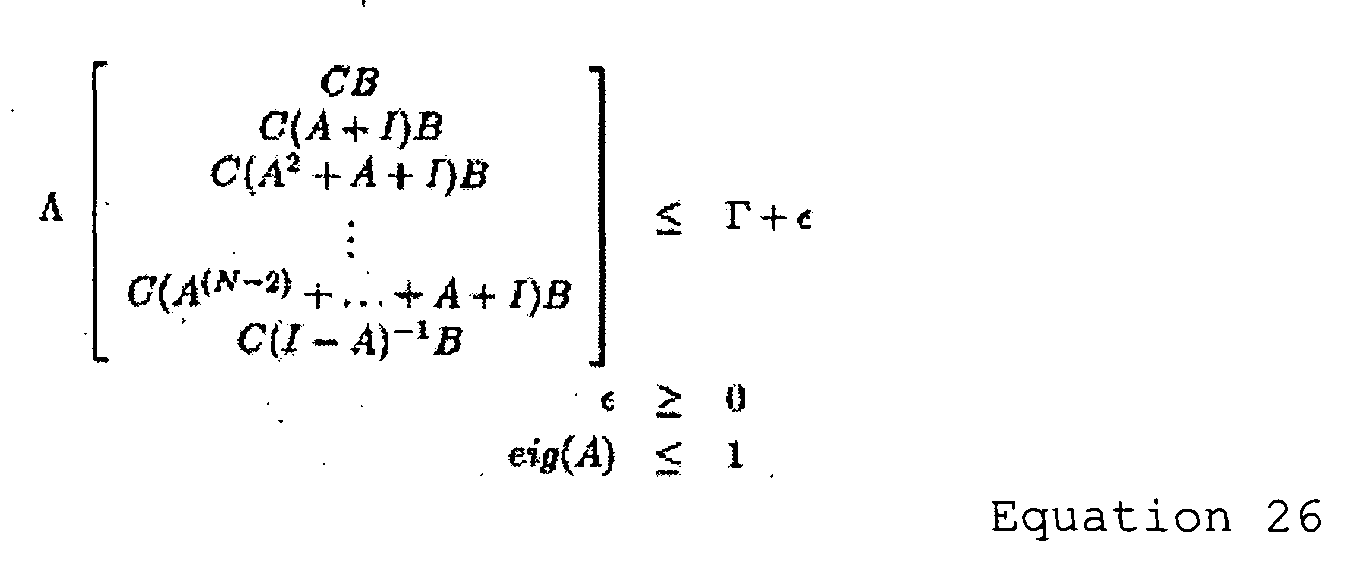
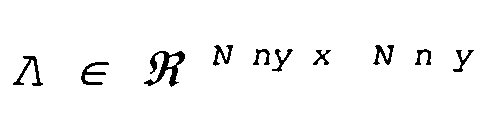
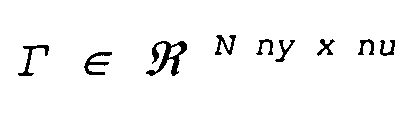
- the a priori knowledge constraints may assume the following exemplary form: where matrices and are chosen to represent linear combinations of the step responses and enforce dynamic and steady-state constraints. represents the constraint softening parameters.
- Matrix Q ⁇ in the objective function of Equation 17 may be selected to enforce some constraints more strongly than others. Some constraints may be made into hard constraints (by choosing correspondingly large elements in Q ⁇ ), others may be softened to allow for a compromise between data information and a priori knowledge and/or satisfaction of higher priority constraints (i.e. constraint ranking).
- Equation 17 The maximum size of the exemplary optimization with the objective function of Equation 17 and the constraints of Equation 26 is: n 2 + n(n y + n u )+ Nn y n u
- n c is the number of constraints imposed on the model step responses
- the size of the optimization is, therefore, given by: n 2 + ( n y + n u ) + n C n y n u which may be significantly smaller than the maximum optimization size represented in Equation 27.
- N n y n u constraints in Equation 26 are shown to be linear matrix inequalities of the model parameters, it is noted that nonlinear matrix inequalities may also be used. Nonlinear matrix inequalities may be the way in which certain a priori knowledge translates into model parameters. It is also noted that, if these constraints are nonlinear functions of the matrices A, B, C, then the optimization may become considerably more complex.
- Figure 5 is a flowchart that illustrates an alternate exemplary method of calculating an initial parametric model as part of the exemplary system identification method of Figure 2. As in the exemplary method of Figure 3, first the input and output test data information is received for analysis.
- the data is initially used for identification of a non-parametric model, such as an FIR model, a step response (SR) model, or a frequency response model, step 500.
- a non-parametric model such as an FIR model, a step response (SR) model, or a frequency response model, step 500.
- the resulting unconstrained non-parametric model is validated according to standard model validation and cross-validation criteria. Assuming that a desirably high quality non-parametric model according to these criteria may be identified in step 500, the model is judged against a priori knowledge, step 502, to determine whether this first model is consistent with the a priori knowledge. If the unconstrained non-parametric model is judged to be satisfactory in step 502, then this initial model may be used as the final. Alternatively, the input/output relationships determined in this model are approximated by a parsimonious parametric model such as, for example, a state-space model, if a parametric model is desired as the final model.
- a parsimonious parametric model such as, for example, a state-space model
- this initial non-parametric model is approximated by a parsimonious parametric model, step 506.
- the result of this step is the initial parametric model 508.
- This exemplary approximation is shown as resulting in initial state-space model 508 in Figure 5, but it is contemplated that other types of parametric models may be adopted as well.
- the initial parametric model may then be used in a constrained parametric system identification process as described above in detail with reference to Figure 4.
- Approximating the initial non-parametric model by a parametric model reduces the number of model parameters to be estimated as part of the constrained parametric system identification process. This simplifies the model optimization subject to a priori knowledge, which is generally more computationally complex than the initial unconstrained system identification.
- the initial parametric model determined by the exemplary method of Figure 5 (or the exemplary method of Figure 3) is used in the exemplary constrained parametric system identification process of the present invention as part of the formulation of the model optimization and not only as an initial guess.
- the exemplary constrained parametric system identification process described above with reference to Figure 4 does not involve the use of plant test data. Data is represented in this constrained parametric optimization by its characterization through the initial parametric model produce by the exemplary method of Figure 5 (or Figure 3).
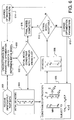
- FIG. 6 illustrates an alternative exemplary embodiment of the present invention in which a constrained non-parametric model of the system may be identified.
- Input/output plant test data are received as in the exemplary parametric embodiments described above, step 200.
- This plant test data is used for identification of an initial non-parametric model such as, for example, a step response model, step 600, using standard algorithms for non-parametric modeling.
- N is the number of samples that characterize the process settling time.
- This parameter is selected by the user and may be adjusted to provide a desirably high model quality.
- the initial model is represented in compact form 604.
- the initial non-parametric model has been validated and cross-validated against plant data using standard validation and cross-validation criteria, to ensure a desirably high quality initial model.
- it is judged against a priori knowledge of the system to determine if the initial model is consistent with this a priori knowledge, step 602. If the initial non-parametric model is consistent with the a priori knowledge of the system, then the system identification exercise is terminated and the final model is determined to be the initial model identified from plant data in step 600.
- step 606 If the initial non-parametric model identified in step 600 is not consistent with the a priori knowledge of the system, then a constrained non-parametric model optimization is performed, step 606. A priori knowledge is enforced as part of this constrained non-parametric model optimization procedure in the form of constraints on the model parameters.
- the initial model 604 represents the test data information in the constrained optimization 606. Therefore, no test data is directly input into this constrained model optimization step. This is a key difference between examples of embodiments of the present invention and the prior art on the subject of system identification with incorporation of a priori knowledge for both parametric and non-parametric modeling techniques.
- An exemplary objective function for the constrained non-parametric model optimization procedure of step 606 is given by: where the positive semi-definite matrices Q H and Q ⁇ * are adjustable parameters that indicate how much the new step response coefficients may differ from those of the initial model (confidence in the data) and how tightly the a priori knowledge constraints are to be enforced (confidence in the a priori knowledge), respectively.
- the role of the added decision variables ⁇ * is to soften the constraints while Q ⁇ * may be chosen to establish the degree of softening that is desired for the various constraints.
- the maximum problem size is therefore given by: 2 n y n u N
- n y n u ( N + n c ) which may be significantly smaller than the maximum problem size given in Equation 33.
- Equation 32 While the first N n y n u constraints in Equation 32 are shown to be linear matrix inequalities on the model parameters, it is noted that nonlinear matrix inequalities may also be used if this is the way in which a priori knowledge translates into model coefficients. If these constraints are nonlinear functions of the step response coefficients the optimization may become considerably more complex.
- step 606 the constrained optimization of step 606 has been solved.
- the resulting constrained non-parametric model 608 is judged to determine if it represents a desirable compromise between test data information and a priori knowledge, step 610. If this model is judged to be a desirable compromise in step 610, then constrained non-parametric model 608 is determined to be the final model, step 616, and the system identification procedure is concluded.
- model 608 is judged not to be a desirable compromise in step 610, then the user may change the optimization parameters, such as some or all of the elements of Q H ⁇ 0 and Q ⁇ * ⁇ 0 , step 612 and return to constrained non-parametric optimization, step 606. This loop may be repeated until the objective function weights are selected in such a way that the final model is satisfactory with respect to the judging in step 610.
- the user may choose to change the optimization parameters of the initial unconstrained model optimization, such as, for example, adjusting the estimated settling time N , step 614 (shown in phantom) and then return to the identification of the initial unconstrained model, step 600.
Landscapes
- Engineering & Computer Science (AREA)
- Physics & Mathematics (AREA)
- General Physics & Mathematics (AREA)
- Automation & Control Theory (AREA)
- Health & Medical Sciences (AREA)
- Artificial Intelligence (AREA)
- Computer Vision & Pattern Recognition (AREA)
- Evolutionary Computation (AREA)
- Medical Informatics (AREA)
- Software Systems (AREA)
- Testing And Monitoring For Control Systems (AREA)
- Feedback Control In General (AREA)
Abstract
Description







Claims (13)
- A method of improving an initial parametric model of a system by the incorporation of a priori knowledge of the system, where the initial parametric model of the system is a model including a plurality of parameters based on analysis of a plurality of input signals and a plurality of output signals, the method comprising the steps of:a) determining a set of constraints corresponding to a set of the plurality of parameters and based on the a priori knowledge; andb) performing a constrained parametric optimization of the system based on the initial parametric model and the set of constraints determined in step (a) to produce an improved parametric model of the system;
wherein the constrained parametric optimization in step (b) does not include the plurality of input signals and the plurality of output signals. - A method according to claim 1, wherein step (a) further includes the step of selecting a set of weighting factors corresponding to at least one of the initial parametric model and the set of constraints based on the a priori knowledge.
- A method according to claim 1 or 2, further comprising the steps of:c) comparing the modified parametric model created in step (b) to the initial parametric model and the set of constraints to determine whether the modified parametric model is a good compromise between the initial parametric model and the set of constraints; andd) changing the set of weighting factors corresponding to at least one of the initial parametric model and the set of constraints, and repeating steps (b), (c), and (d) when the modified parametric model is determined in step (c) not to be a good compromise.
- A method according to any preceding claim, wherein the set of constraints includes a subset of hard constraints and a subset of soft constraints.
- A method according to any preceding claim, wherein the constrained parametric optimization of step (b) includes a penalty function approach to constraint softening.
- A method according to any preceding claim, wherein the a priori knowledge of the system includes at least one of:knowledge determined from first-principles analysis of the system;knowledge determined from operation of the system; andknowledge determined from operation of other existing systems having a similar nature.
- A method according to any preceding claim, wherein the set of constraints includes at least one of;
constraints on an open-loop stability of the system;
constraints on a dynamic behavior of the system; and constraints on a steady-state behavior of the system. - A method according to any preceding claim, wherein the initial parametric model is a state-space model.
- A method of system identification based analysis of a plurality of input signals and a plurality of output signals with the incorporation of a priori knowledge of a system for developing a physically meaningful model of the system, the method comprising the steps of:wherein the constrained parametric optimization in step (c) does not include the plurality of input signals and the plurality of output signals.a) solving a first parametric model optimization based on the plurality of input signals and the plurality of output signals to create an initial parametric model of the system including a plurality of parameters;b) determining a set of constraints corresponding to a set of the plurality of parameters based on the a priori knowledge; andc) performing a constrained parametric optimization of the system based on the initial parametric model and the set of constraints determined in step (b) to produce the physically meaningful model of the system;
- A method according to claim 9, wherein step (c) includes the steps of:c1) comparing the initial parametric model created in step (a) and the set of constraints determined in step (b) to determine whether the initial parametric model is consistent with the set of constraints;c2) determining the initial parametric model to be the physically meaningful model of the system when the initial parametric model is determined in step (c1) to be consistent with the set of constraints; andc3) performing a constrained parametric optimization of the system based on only the initial parametric model and the set of constraints to create the physically meaningful model of the system when the initial parametric model is determined in step (c1) not to be consistent with the set of constraints.
- A method of system identification based analysis of a plurality of input signals and a plurality of output signals with the incorporation of a priori knowledge of a system for developing a physically meaningful model of the system, the method comprising the steps of:wherein the constrained parametric optimization in step (d) does not include the plurality of input signals and the plurality of output signals.a) solving a first non-parametric model optimization based on the plurality of input signals and the plurality of output signals to create a non-parametric model of the system;b) approximating the non-parametric model by an initial parametric model of the system including a plurality of parameters;c) determining a set of constraints corresponding to a set of the plurality of parameters based on the a priori knowledge; andd) performing a constrained parametric optimization of the system based on the initial parametric model and the set of constraints determined in step (c) to produce the physically meaningful model of the system;
- A method according to claim 11, wherein the initial non-parametric model is approximated in step (b) by a state-space model of suitable order to create the initial parametric model of the system.
- A method of system identification based analysis of a plurality of input signals and a plurality of output signals with the incorporation of a priori knowledge of a system for developing a physically meaningful model of the system, the method comprising the steps of:wherein the constrained non-parametric optimization in step (c) does not include the plurality of input signals and the plurality of output signals.a) solving a first non-parametric model optimization based on the plurality of input signals and the plurality of output signals to create an initial non-parametric model of the system including a plurality of model parameters;b) determining a set of constraints corresponding to a set of the plurality of model parameters based on the a priori knowledge; andc) performing a constrained non-parametric optimization of the system based on the initial non-parametric model and the set of constraints determined in step (b) to produce the physically meaningful model of the system;
Applications Claiming Priority (2)
| Application Number | Priority Date | Filing Date | Title |
|---|---|---|---|
| US10/385,915 US20040181498A1 (en) | 2003-03-11 | 2003-03-11 | Constrained system identification for incorporation of a priori knowledge |
| US385915 | 2003-03-11 |
Publications (2)
| Publication Number | Publication Date |
|---|---|
| EP1465035A2 true EP1465035A2 (en) | 2004-10-06 |
| EP1465035A3 EP1465035A3 (en) | 2005-04-13 |
Family
ID=32850505
Family Applications (1)
| Application Number | Title | Priority Date | Filing Date |
|---|---|---|---|
| EP04251266A Withdrawn EP1465035A3 (en) | 2003-03-11 | 2004-03-04 | Constrained system identification for incorporation of a priori knowledge |
Country Status (3)
| Country | Link |
|---|---|
| US (1) | US20040181498A1 (en) |
| EP (1) | EP1465035A3 (en) |
| JP (1) | JP2004272916A (en) |
Cited By (6)
| Publication number | Priority date | Publication date | Assignee | Title |
|---|---|---|---|---|
| EP1852757A4 (en) * | 2005-02-18 | 2010-09-01 | Omron Tateisi Electronics Co | Model structure parameter decision method, parameter decision device, control device, and temperature adjustment device |
| WO2013088184A1 (en) * | 2011-12-15 | 2013-06-20 | Abb Research Ltd | A method for assessment of benefit of advanced control solutions |
| CN105814499A (en) * | 2013-06-14 | 2016-07-27 | 华莱士·E·拉里莫尔 | Dynamic model verification method and system for monitoring and controlling dynamic machines with variable configuration or variable operating conditions |
| CN108914201A (en) * | 2018-08-29 | 2018-11-30 | 西安理工大学 | A kind of Modelling of Crystal Growth in CZ-Si Pulling process parameter optimization method |
| CN109358602A (en) * | 2018-10-23 | 2019-02-19 | 山东中创软件商用中间件股份有限公司 | A kind of failure analysis methods, device and relevant device |
| US11156668B2 (en) | 2017-09-13 | 2021-10-26 | Shandong University | Method for iteratively identifying parameters of equivalent circuit model of battery |
Families Citing this family (22)
| Publication number | Priority date | Publication date | Assignee | Title |
|---|---|---|---|---|
| US8024207B2 (en) * | 2004-06-04 | 2011-09-20 | Sap Ag | Attribute modeler |
| RU2306592C1 (en) * | 2006-01-10 | 2007-09-20 | Институт проблем управления им. В.А. Трапезникова РАН РФ | Method for active identification of linear control objects |
| US8069122B2 (en) * | 2007-03-20 | 2011-11-29 | Accenture Global Services Limited | Predictive cost reduction based on a thermodynamic model |
| JP2008287343A (en) * | 2007-05-15 | 2008-11-27 | Kobe Steel Ltd | Model parameter estimating arithmetic unit and method, model parameter estimating arithmetic processing program, and recording medium recording the same |
| US8180020B2 (en) | 2008-10-23 | 2012-05-15 | Accuray Incorporated | Sequential optimizations for treatment planning |
| US20110161059A1 (en) * | 2009-12-30 | 2011-06-30 | Ankur Jain | Method for Constructing a Gray-Box Model of a System Using Subspace System Identification |
| US20110213715A1 (en) * | 2010-03-01 | 2011-09-01 | Accenture Global Services Gmbh | Lean Analytics |
| DE102011002678A1 (en) * | 2011-01-14 | 2012-07-19 | Robert Bosch Gmbh | Method and apparatus for the automatic generation of characteristic map-characteristic structures for a regulation and / or control of a system, in particular of an internal combustion engine |
| CN102540890B (en) * | 2012-01-17 | 2015-05-20 | 中冶南方工程技术有限公司 | Crystallizer auto regression with extra inputs (ARX) model identification method based on least squares algorithm |
| US10161269B2 (en) * | 2015-07-17 | 2018-12-25 | Nec Corporation | Output efficiency optimization in production systems |
| CN105373094B (en) * | 2015-10-22 | 2018-04-03 | 杭州泰极豫才软件有限公司 | The industrial process Dynamic Model Identification device sampled soon based on data |
| CN109886061B (en) * | 2017-12-06 | 2022-05-31 | 阿里巴巴集团控股有限公司 | Signal identification method, signal identification device, identifier and storage medium |
| CN108897217B (en) * | 2018-07-04 | 2020-07-14 | 西北工业大学 | A Model Predictive Control-Based Trajectory Tracking Control Method for Underactuated Surface Vessels |
| US11366457B1 (en) | 2018-11-16 | 2022-06-21 | On-Time.Ai, Inc. | Controling operation of machine tools using artificial intelligence |
| US12265381B1 (en) | 2018-11-16 | 2025-04-01 | Ai Technologies | Controlling operation of machine tools using combinatorial optimization problem solvers |
| US20200402077A1 (en) * | 2019-06-20 | 2020-12-24 | Saudi Arabian Oil Company | Model predictive control using semidefinite programming |
| US12039238B1 (en) * | 2019-12-20 | 2024-07-16 | Ansys, Inc. | Blackbox reduced order models of thermal systems |
| US12175380B2 (en) | 2020-12-15 | 2024-12-24 | Saudi Arabian Oil Company | Gas-oil separation plant virtual water cut predictor based on supervised learning framework on time series data |
| CN113093525A (en) * | 2021-04-02 | 2021-07-09 | 北京世纪隆博科技有限责任公司 | IPC intelligent control system and method |
| US11740598B2 (en) * | 2021-04-30 | 2023-08-29 | Aspentech Corporation | Apparatus and methods to build a reliable deep learning controller by imposing model constraints |
| CN116257980A (en) * | 2022-12-15 | 2023-06-13 | 中国航空工业集团公司西安航空计算技术研究所 | Parameterized modeling method for Scoop air inlet channel of air source system |
| CN116027664B (en) * | 2022-12-27 | 2026-04-28 | 中控技术股份有限公司 | A system identification method based on subspace constraints |
Family Cites Families (24)
| Publication number | Priority date | Publication date | Assignee | Title |
|---|---|---|---|---|
| US6983227B1 (en) * | 1995-01-17 | 2006-01-03 | Intertech Ventures, Ltd. | Virtual models of complex systems |
| JP3956057B2 (en) * | 1996-01-31 | 2007-08-08 | エイエスエム アメリカ インコーポレイテッド | Model reference predictive control of heat treatment |
| US6381504B1 (en) * | 1996-05-06 | 2002-04-30 | Pavilion Technologies, Inc. | Method for optimizing a plant with multiple inputs |
| US6356600B1 (en) * | 1998-04-21 | 2002-03-12 | The United States Of America As Represented By The Secretary Of The Navy | Non-parametric adaptive power law detector |
| US6725208B1 (en) * | 1998-10-06 | 2004-04-20 | Pavilion Technologies, Inc. | Bayesian neural networks for optimization and control |
| US6507774B1 (en) * | 1999-08-24 | 2003-01-14 | The University Of Chicago | Intelligent emissions controller for substance injection in the post-primary combustion zone of fossil-fired boilers |
| US6487696B1 (en) * | 2000-03-03 | 2002-11-26 | Voyan Technology | Compensator design optimization through efficient utilization of subcompensators |
| US6608631B1 (en) * | 2000-05-02 | 2003-08-19 | Pixar Amination Studios | Method, apparatus, and computer program product for geometric warps and deformations |
| WO2001098844A2 (en) * | 2000-06-20 | 2001-12-27 | Liu D | Methods of designing optimal pid controllers |
| US6516313B1 (en) * | 2000-06-27 | 2003-02-04 | Mitsubishi Electric Research Laboratories, Inc. | Method for dynamic constraint handling in vertex based optimization of a continuous complex system |
| CA2414707C (en) * | 2000-06-29 | 2011-08-16 | Aspen Technology, Inc. | Computer method and apparatus for constraining a non-linear approximator of an empirical process |
| US6647342B2 (en) * | 2000-08-07 | 2003-11-11 | Novodynamics, Inc. | Knowledge-based process for the development of materials |
| GB0117157D0 (en) * | 2001-07-16 | 2001-09-05 | Imec Inter Uni Micro Electr | Extraction, hierarchical representation and flexible compression of surface meshes derived from 3D data |
| US6388592B1 (en) * | 2001-01-18 | 2002-05-14 | International Business Machines Corporation | Using simulated pseudo data to speed up statistical predictive modeling from massive data sets |
| EP1362296A2 (en) * | 2001-02-20 | 2003-11-19 | Icagen, Inc. | Method for screening compounds |
| US7424409B2 (en) * | 2001-02-20 | 2008-09-09 | Context-Based 4 Casting (C-B4) Ltd. | Stochastic modeling of time distributed sequences |
| AU2002252645A1 (en) * | 2001-04-11 | 2002-10-28 | Fair Isaac And Company, Inc. | Model-based and data-driven analytic support for strategy development |
| US7031523B2 (en) * | 2001-05-16 | 2006-04-18 | Siemens Corporate Research, Inc. | Systems and methods for automatic scale selection in real-time imaging |
| US20030161258A1 (en) * | 2002-02-22 | 2003-08-28 | Jianzhong Zhang | Apparatus, and associated method, for a multiple-input, multiple-output communications system |
| US6741955B2 (en) * | 2002-03-05 | 2004-05-25 | Uson, L.P. | System and method for leak rate testing during adiabatic cooling |
| US20040117043A1 (en) * | 2002-09-07 | 2004-06-17 | Igor Touzov | Optimized calibration data based methods for parallel digital feedback, and digital automation controls |
| US7020593B2 (en) * | 2002-12-04 | 2006-03-28 | International Business Machines Corporation | Method for ensemble predictive modeling by multiplicative adjustment of class probability: APM (adjusted probability model) |
| US20050187643A1 (en) * | 2004-02-19 | 2005-08-25 | Pavilion Technologies, Inc. | Parametric universal nonlinear dynamics approximator and use |
| US20040162712A1 (en) * | 2003-01-24 | 2004-08-19 | Icagen, Inc. | Method for screening compounds using consensus selection |
-
2003
- 2003-03-11 US US10/385,915 patent/US20040181498A1/en not_active Abandoned
-
2004
- 2004-03-04 EP EP04251266A patent/EP1465035A3/en not_active Withdrawn
- 2004-03-10 JP JP2004067864A patent/JP2004272916A/en active Pending
Cited By (7)
| Publication number | Priority date | Publication date | Assignee | Title |
|---|---|---|---|---|
| EP1852757A4 (en) * | 2005-02-18 | 2010-09-01 | Omron Tateisi Electronics Co | Model structure parameter decision method, parameter decision device, control device, and temperature adjustment device |
| WO2013088184A1 (en) * | 2011-12-15 | 2013-06-20 | Abb Research Ltd | A method for assessment of benefit of advanced control solutions |
| CN105814499A (en) * | 2013-06-14 | 2016-07-27 | 华莱士·E·拉里莫尔 | Dynamic model verification method and system for monitoring and controlling dynamic machines with variable configuration or variable operating conditions |
| CN105814499B (en) * | 2013-06-14 | 2021-04-02 | 华莱士·E·拉里莫尔 | Dynamic model authentication method and system for monitoring and controlling dynamic machines with variable structure or variable operating conditions |
| US11156668B2 (en) | 2017-09-13 | 2021-10-26 | Shandong University | Method for iteratively identifying parameters of equivalent circuit model of battery |
| CN108914201A (en) * | 2018-08-29 | 2018-11-30 | 西安理工大学 | A kind of Modelling of Crystal Growth in CZ-Si Pulling process parameter optimization method |
| CN109358602A (en) * | 2018-10-23 | 2019-02-19 | 山东中创软件商用中间件股份有限公司 | A kind of failure analysis methods, device and relevant device |
Also Published As
| Publication number | Publication date |
|---|---|
| US20040181498A1 (en) | 2004-09-16 |
| EP1465035A3 (en) | 2005-04-13 |
| JP2004272916A (en) | 2004-09-30 |
Similar Documents
| Publication | Publication Date | Title |
|---|---|---|
| US20040181498A1 (en) | Constrained system identification for incorporation of a priori knowledge | |
| US11169494B2 (en) | Parametric universal nonlinear dynamics approximator and use | |
| CN100487617C (en) | Fast plant test for model-based control | |
| CN101322083A (en) | Multi-objective predictive process optimization with parallel process simulation | |
| CN102193500B (en) | Rapid process model identification and generation | |
| US20160018795A1 (en) | Empirical modeling with globally enforced general constraints | |
| Harris et al. | Recent developments in controller performance monitoring and assessment techniques | |
| JP4908433B2 (en) | Control parameter adjustment method and control parameter adjustment program | |
| Laddach et al. | An automatic selection of optimal recurrent neural network architecture for processes dynamics modelling purposes | |
| Zhu | System identification for process control: recent experience and outlook | |
| Airikka | Advanced control methods for industrial process control | |
| EP1190279A1 (en) | Model error bounds for identification of stochastic models for control design | |
| Kergus | Data-driven control of infinite dimensional systems: Application to a continuous crystallizer | |
| Chen et al. | Neural network-based predictive control for multivariable processes | |
| Szabó et al. | A novel control-oriented multi-affine qLPV modeling framework | |
| Horváthová et al. | Supervised learning for robust predictive control: Safe and tunable approach | |
| Wigren | MATLAB software for recursive identification of systems with output quantization: Revision 1 | |
| Pinnamaraju et al. | Challenges in the discrete-time identification of LTI multiscale systems: A critical overview | |
| Balbis et al. | Graphical based predictive control design | |
| Ailunka | Implementing a model predictive controller in an operator training simulator | |
| Wigren | MATLAB software for recursive identification of Wiener systems: Revision 2 | |
| Fekri et al. | A two-input two-output robust multiple model adaptive control (RMMAC) case study | |
| US20210142801A1 (en) | Determining a controller for a controlled system | |
| Svancara et al. | The issue of quantization effect in direct implementation of adaptive LQ controller with NN identification into PLC. | |
| Zavari et al. | Interpolated gain-scheduled controllers for an over-head crane |
Legal Events
| Date | Code | Title | Description |
|---|---|---|---|
| PUAI | Public reference made under article 153(3) epc to a published international application that has entered the european phase |
Free format text: ORIGINAL CODE: 0009012 |
|
| AK | Designated contracting states |
Kind code of ref document: A2 Designated state(s): AT BE BG CH CY CZ DE DK EE ES FI FR GB GR HU IE IT LI LU MC NL PL PT RO SE SI SK TR |
|
| AX | Request for extension of the european patent |
Extension state: AL HR LT LV MK |
|
| PUAL | Search report despatched |
Free format text: ORIGINAL CODE: 0009013 |
|
| AK | Designated contracting states |
Kind code of ref document: A3 Designated state(s): AT BE BG CH CY CZ DE DK EE ES FI FR GB GR HU IE IT LI LU MC NL PL PT RO SE SI SK TR |
|
| AX | Request for extension of the european patent |
Extension state: AL HR LT LV MK |
|
| 17P | Request for examination filed |
Effective date: 20050513 |
|
| AKX | Designation fees paid |
Designated state(s): AT BE BG CH CY CZ DE DK EE ES FI FR GB GR HU IE IT LI LU MC NL PL PT RO SE SI SK TR |
|
| GRAP | Despatch of communication of intention to grant a patent |
Free format text: ORIGINAL CODE: EPIDOSNIGR1 |
|
| STAA | Information on the status of an ep patent application or granted ep patent |
Free format text: STATUS: THE APPLICATION IS DEEMED TO BE WITHDRAWN |
|
| 18D | Application deemed to be withdrawn |
Effective date: 20080401 |