EP1464394A1 - Supported nanopalladium catalyst for C-C coupling reactions of haloarenes - Google Patents
Supported nanopalladium catalyst for C-C coupling reactions of haloarenes Download PDFInfo
- Publication number
- EP1464394A1 EP1464394A1 EP03007285A EP03007285A EP1464394A1 EP 1464394 A1 EP1464394 A1 EP 1464394A1 EP 03007285 A EP03007285 A EP 03007285A EP 03007285 A EP03007285 A EP 03007285A EP 1464394 A1 EP1464394 A1 EP 1464394A1
- Authority
- EP
- European Patent Office
- Prior art keywords
- group
- catalyst
- ldh
- iii
- nanopalladium
- Prior art date
- Legal status (The legal status is an assumption and is not a legal conclusion. Google has not performed a legal analysis and makes no representation as to the accuracy of the status listed.)
- Granted
Links
- NAZUYXOIDCMQAA-UHFFFAOYSA-N CCC1C2C1CCC2 Chemical compound CCC1C2C1CCC2 NAZUYXOIDCMQAA-UHFFFAOYSA-N 0.000 description 1
Classifications
-
- B—PERFORMING OPERATIONS; TRANSPORTING
- B01—PHYSICAL OR CHEMICAL PROCESSES OR APPARATUS IN GENERAL
- B01J—CHEMICAL OR PHYSICAL PROCESSES, e.g. CATALYSIS OR COLLOID CHEMISTRY; THEIR RELEVANT APPARATUS
- B01J37/00—Processes, in general, for preparing catalysts; Processes, in general, for activation of catalysts
- B01J37/02—Impregnation, coating or precipitation
- B01J37/0201—Impregnation
- B01J37/0207—Pretreatment of the support
-
- B—PERFORMING OPERATIONS; TRANSPORTING
- B01—PHYSICAL OR CHEMICAL PROCESSES OR APPARATUS IN GENERAL
- B01J—CHEMICAL OR PHYSICAL PROCESSES, e.g. CATALYSIS OR COLLOID CHEMISTRY; THEIR RELEVANT APPARATUS
- B01J23/00—Catalysts comprising metals or metal oxides or hydroxides, not provided for in group B01J21/00
- B01J23/38—Catalysts comprising metals or metal oxides or hydroxides, not provided for in group B01J21/00 of noble metals
- B01J23/40—Catalysts comprising metals or metal oxides or hydroxides, not provided for in group B01J21/00 of noble metals of the platinum group metals
- B01J23/44—Palladium
-
- B—PERFORMING OPERATIONS; TRANSPORTING
- B01—PHYSICAL OR CHEMICAL PROCESSES OR APPARATUS IN GENERAL
- B01J—CHEMICAL OR PHYSICAL PROCESSES, e.g. CATALYSIS OR COLLOID CHEMISTRY; THEIR RELEVANT APPARATUS
- B01J37/00—Processes, in general, for preparing catalysts; Processes, in general, for activation of catalysts
- B01J37/02—Impregnation, coating or precipitation
- B01J37/0201—Impregnation
- B01J37/0209—Impregnation involving a reaction between the support and a fluid
-
- B—PERFORMING OPERATIONS; TRANSPORTING
- B01—PHYSICAL OR CHEMICAL PROCESSES OR APPARATUS IN GENERAL
- B01J—CHEMICAL OR PHYSICAL PROCESSES, e.g. CATALYSIS OR COLLOID CHEMISTRY; THEIR RELEVANT APPARATUS
- B01J37/00—Processes, in general, for preparing catalysts; Processes, in general, for activation of catalysts
- B01J37/16—Reducing
-
- B—PERFORMING OPERATIONS; TRANSPORTING
- B01—PHYSICAL OR CHEMICAL PROCESSES OR APPARATUS IN GENERAL
- B01J—CHEMICAL OR PHYSICAL PROCESSES, e.g. CATALYSIS OR COLLOID CHEMISTRY; THEIR RELEVANT APPARATUS
- B01J37/00—Processes, in general, for preparing catalysts; Processes, in general, for activation of catalysts
- B01J37/30—Ion-exchange
-
- C—CHEMISTRY; METALLURGY
- C07—ORGANIC CHEMISTRY
- C07B—GENERAL METHODS OF ORGANIC CHEMISTRY; APPARATUS THEREFOR
- C07B37/00—Reactions without formation or introduction of functional groups containing hetero atoms, involving either the formation of a carbon-to-carbon bond between two carbon atoms not directly linked already or the disconnection of two directly linked carbon atoms
- C07B37/04—Substitution
-
- C—CHEMISTRY; METALLURGY
- C07—ORGANIC CHEMISTRY
- C07C—ACYCLIC OR CARBOCYCLIC COMPOUNDS
- C07C17/00—Preparation of halogenated hydrocarbons
- C07C17/26—Preparation of halogenated hydrocarbons by reactions involving an increase in the number of carbon atoms in the skeleton
- C07C17/263—Preparation of halogenated hydrocarbons by reactions involving an increase in the number of carbon atoms in the skeleton by condensation reactions
-
- C—CHEMISTRY; METALLURGY
- C07—ORGANIC CHEMISTRY
- C07C—ACYCLIC OR CARBOCYCLIC COMPOUNDS
- C07C201/00—Preparation of esters of nitric or nitrous acid or of compounds containing nitro or nitroso groups bound to a carbon skeleton
- C07C201/06—Preparation of nitro compounds
- C07C201/12—Preparation of nitro compounds by reactions not involving the formation of nitro groups
-
- C—CHEMISTRY; METALLURGY
- C07—ORGANIC CHEMISTRY
- C07C—ACYCLIC OR CARBOCYCLIC COMPOUNDS
- C07C29/00—Preparation of compounds having hydroxy or O-metal groups bound to a carbon atom not belonging to a six-membered aromatic ring
- C07C29/32—Preparation of compounds having hydroxy or O-metal groups bound to a carbon atom not belonging to a six-membered aromatic ring increasing the number of carbon atoms by reactions without formation of -OH groups
-
- C—CHEMISTRY; METALLURGY
- C07—ORGANIC CHEMISTRY
- C07C—ACYCLIC OR CARBOCYCLIC COMPOUNDS
- C07C41/00—Preparation of ethers; Preparation of compounds having groups, groups or groups
- C07C41/01—Preparation of ethers
- C07C41/18—Preparation of ethers by reactions not forming ether-oxygen bonds
- C07C41/30—Preparation of ethers by reactions not forming ether-oxygen bonds by increasing the number of carbon atoms, e.g. by oligomerisation
-
- C—CHEMISTRY; METALLURGY
- C07—ORGANIC CHEMISTRY
- C07C—ACYCLIC OR CARBOCYCLIC COMPOUNDS
- C07C45/00—Preparation of compounds having >C = O groups bound only to carbon or hydrogen atoms; Preparation of chelates of such compounds
- C07C45/61—Preparation of compounds having >C = O groups bound only to carbon or hydrogen atoms; Preparation of chelates of such compounds by reactions not involving the formation of >C = O groups
- C07C45/67—Preparation of compounds having >C = O groups bound only to carbon or hydrogen atoms; Preparation of chelates of such compounds by reactions not involving the formation of >C = O groups by isomerisation; by change of size of the carbon skeleton
- C07C45/68—Preparation of compounds having >C = O groups bound only to carbon or hydrogen atoms; Preparation of chelates of such compounds by reactions not involving the formation of >C = O groups by isomerisation; by change of size of the carbon skeleton by increase in the number of carbon atoms
-
- C—CHEMISTRY; METALLURGY
- C07—ORGANIC CHEMISTRY
- C07C—ACYCLIC OR CARBOCYCLIC COMPOUNDS
- C07C67/00—Preparation of carboxylic acid esters
- C07C67/30—Preparation of carboxylic acid esters by modifying the acid moiety of the ester, such modification not being an introduction of an ester group
- C07C67/333—Preparation of carboxylic acid esters by modifying the acid moiety of the ester, such modification not being an introduction of an ester group by isomerisation; by change of size of the carbon skeleton
- C07C67/343—Preparation of carboxylic acid esters by modifying the acid moiety of the ester, such modification not being an introduction of an ester group by isomerisation; by change of size of the carbon skeleton by increase in the number of carbon atoms
Definitions
- the present invention relates to a process for the preparation of a reusable heterogeneous nanopalladium(0) catalysts on the solid support to perform C-C bond formation reactions such as Heck, Suzuki, Sonagashira, and Stille type reactions of haloarenes that include unreactive chloroarenes.
- C-C bond formation reactions such as Heck, Suzuki, Sonagashira, and Stille type reactions of haloarenes that include unreactive chloroarenes.
- Layered double hydroxides and Merrifield resin supported nanopalladium catalysts are prepared by an exchange of PdCl 4 2- followed by reduction and well characterized for the first time.
- This invention particularly relates to an eco-friendly process employing re-usable heterogeneous catalyst in place of soluble palladium catalysts for preparing coupling products by C-C bond formation reaction of haloarenes that include unreactive chloroarenes in the presence of base.
- the ligand free heterogeneous layered double hydroxides supported nanopalladium (LDH-Pd 0 ) catalyst using the basic LDH in place of basic ligands indeed exhibits higher activity and selectivity in the C-C coupling reactions of haloarenes that include electron poor and electron rich chloroarenes in nonaqueous ionic liquids (NAIL) over the homogeneous PdCl 2 system.
- NAIL nonaqueous ionic liquids
- diarylacetylenes arc prepared using heterogeneous polymer anchored bis(pyrimidine)-based palladium catalyst with chlorobenzene with impressive turnover frequency.
- the drawback is that it was not tried for electron rich chloroarenes.
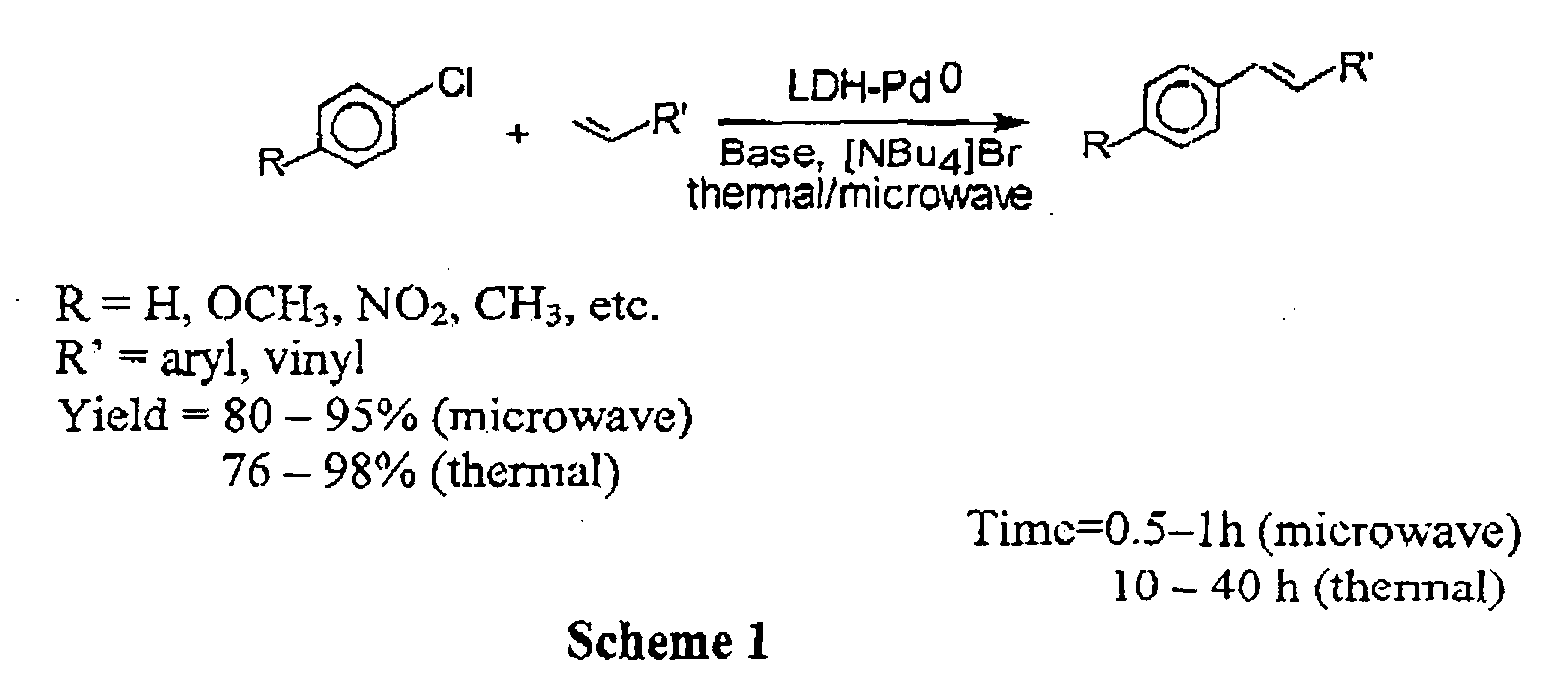
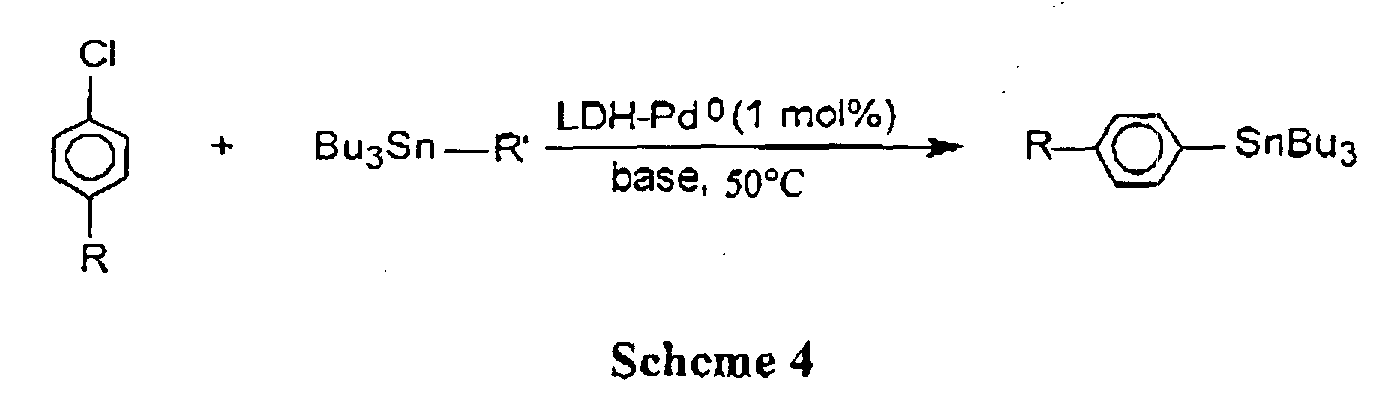
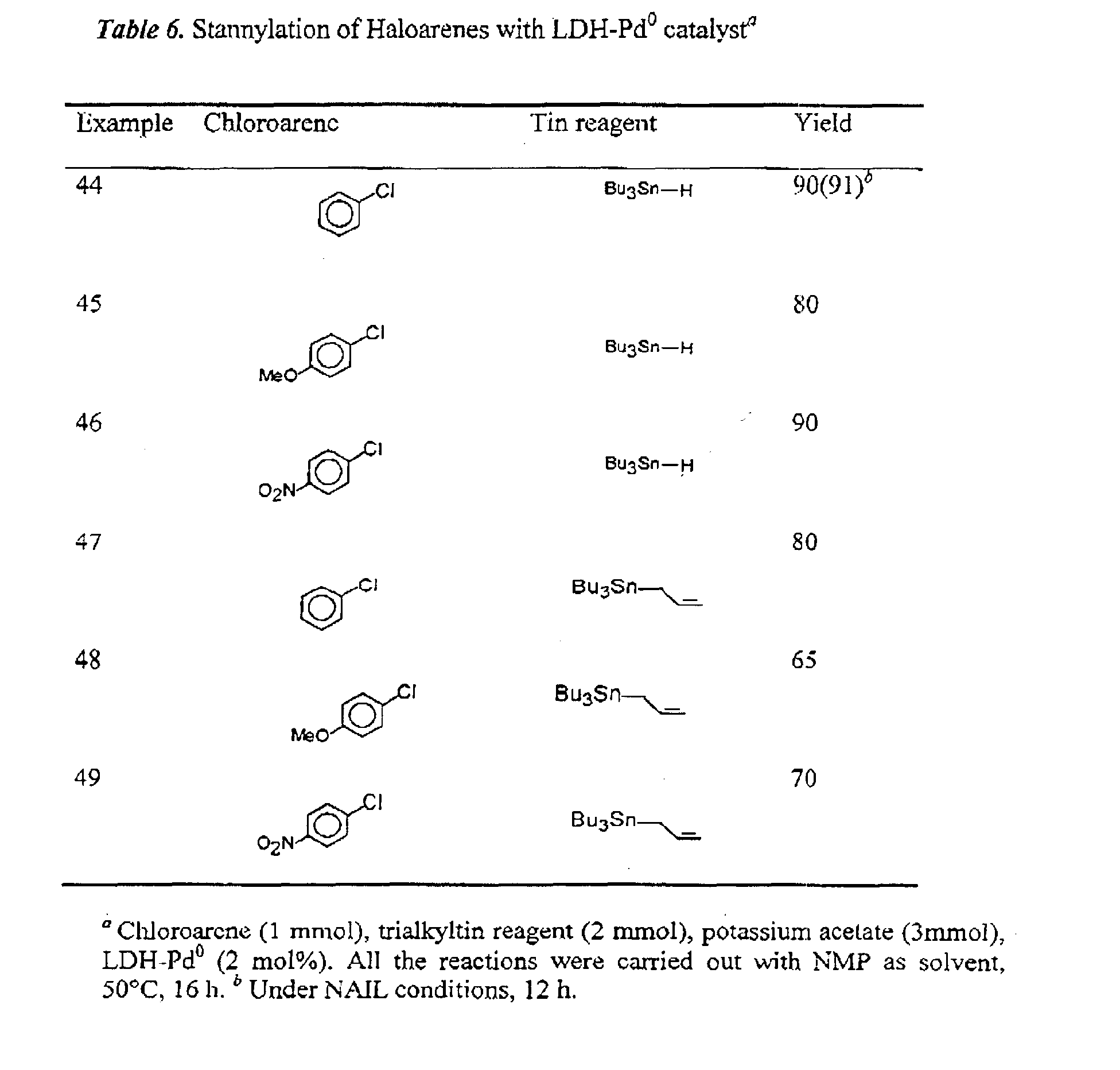
- the main object of the present invention is a process for the preparation of a ligand free reusable heterogeneous nanopalladium(0) catalysts by an exchange of PdCl 4 2- followed by reduction on the support selected from LDH and S'-NR 3 X wherein S' is a unmodified surface support selected from resin and silica, R is an alkyl group selected from the group consisting of methyl, ethyl, propyl, butyl , X is selected from the group consisting of Cl, Br, I, F, OH and OAc to perform C-C bond coupling reactions such as Heck, Suzuki, Sonagashira, and Stille type reactions with haloarenes that include unrcactive chloroarenes under standard thermal and microwave conditions using solvents selected from nonaqueous ionic liquid, THF, dioxane, water, NMP at temperature ranging between 20 to 150 °C for a period ranging from 0.5 to 48 h under nitrogen atmosphere and obtaining the desired product by conventional method which obvia
- Another object of the present invention is LDH as synthesised having interstitial anions such as chloride, nitrate, carbonate, sulfate or calcination of LDH having the said interstitial anions at temperatures in the range of 350 to 550C arc used as precursors for the preparation of LDH- Pd(0) catalysts.
- interstitial anions such as chloride, nitrate, carbonate, sulfate or calcination of LDH having the said interstitial anions at temperatures in the range of 350 to 550C arc used as precursors for the preparation of LDH- Pd(0) catalysts.
- Another object of the present invention is to reduce the reaction time by employing microwave irradiation.
- microwave irradiation the rate of C-C coupling reaction is accelerated manifold with the highest turnover frequency ever recorded both in the case of electron poor and electron rich chloroarenes.
- Still another object of the present invention is the quantity of nanopalladium catalyst used in the reaction is 0.1 to 3 mol% of palladium with respect to the substrate.
- Yet another object of the present invention is to recover the heterogeneous palladium catalyst used in the C-C coupling reactions such as Heck, Suzuki, Sonagashira, and Stille type reactions by simple filtration and reuse for number of cycles with consistent activity.
- the novelty of the present invention is a process for the preparation of a ligand free reusable heterogeneous nanopalladium(0) catalysts by an exchange of PdCl 4 2 - followed by reduction on the support selected from LDH and S'-NR 3 X wherein S' is a unmodified surface support selected from resin and silica, R is an alkyl group selected from the group consisting of methyl, ethyl, propyl, butyl , X is selected from the group consisting of Cl, Br, I, F, OH and OAc to perform C-C bond coupling reactions such as Heck, Suzuki, Sonagashira, and Stille type reactions with haloarenes that include unreactive chloroarenes under standard thermal and microwave conditions using solvents selected from nonaqucous ionic liquid, THF, dioxane, water, NMP at temperature ranging between 20 to 150 °C for a period ranging from 0.5 to 48 h under nitrogen atmosphere and obtaining the desired product by conventional method.
- the quantity of nanopalladium(0) catalyst used in the reaction is 0.1 to 3 mol% of palladium with respect to the substrate.
- nanopalladium (0) catalysts are recovered by simple filtration and reused for several cycles with consistent activity.
- the solvents selected for the C-C bond formation reactions are nonaqueous liquid, water, 1,4-dioxane, THF, NMP.
- the base used is selected from the known group consisting of triethylamine, tributylamine, potassium fluoride, potassium acetate.
- the reactions are preferably, effected at a known temperature in the range of 20 to 150 °C for a period 0.5 to 48 h.
- a phosphine free new recyclable heterogeneous catalytic system was developed to dispense the use of expensive and air sensitive basic phosphines for palladium catalyzed coupling reactioms of chloroarenes.
- the basic support, Mg-Al layered double hydroxides (LDH) selected not only stabilizes the nanopalladium particles but also provides the adequate electron density to the anchored Pd 0 species to facilitate oxidative addition of even the deactivated electron rich chloroarenes.
- Heterogeneous nanopalladium(0) catalysts are prepared by an exchange of PdCl 4 2- on the support selected from LDH and S'-NR 3 X wherein S' is a unmodified surface support selected from resin and silica, R is an alkyl group selected from the group consisting of methyl, ethyl, propyl, butyl , X is selected from the group consisting of Cl, Br, I, F, OH and OAc in an aqueous solvent at a temperature ranging between 20 to 30 °C for a period ranging from 5 to 24 h under nitrogen atmosphere followed by filtration and reduction with hydrazine hydrate in ethanol at room temperature. Filtration gave the desired nanopalladium(0) catalysts.
- C-C bond coupling products are prepared by using the recyclable nanopalladium(0) catalysts by Heck, Suzuki, Sonagashira, and Stille type reactions of haloarenes that include unreactive chloroarenes in a under standard thermal and microwave conditions using solvents selected from nonaqueous ionic liquid , water, THF, dioxan, and NMP at a temperature ranging between 20 to 150 °C for a period 0.5 to 48 h under nitrogen atmosphere, and obtaining the pure C-C coupling products by a conventional method.
- the palladium content in the catalyst ranges between 0.1 to 3 mol% with respect to the substrate.
- Nanopalladium (0) catalysts are recovered by simple filtration and reused for several cycles with consistent activity.
- the solvents selected for the C-C bond formation reaction is selected from the group consisting of nonaqueous ionic liquid, water, 1,4-dioxane, TFIF, NMP or any mixture thereof.
- the base used is selected from the group consisting of triethylamine, tributylamine, potassium fluoride, potassium acetate.
- Heterogeneous nanopalladium(0) catalysts are prepared by an exchange of PdCl 4 2- followed by reduction on silica or resin or LDH.
- the nanopalladium (0) on supports is responsible for the activity of catalyst in C-C coupling reactions.
- the activity of heterogeneous nanopalladium catalysts is similar or higher than the homogeneous counter parts.
- the basic support, Mg-Al layered double hydroxides (LDH) is selected as the material of choice, which not only stabilizes the nanopalladium particles but also provides the adequate electron density to the anchored Pd 0 species to facilitate oxidative addition of even the deactivated electron rich chloroarenes.
- the coupling products find good applications as intermediates in the preparation of materials, natural products, and bioactive compounds.
- this invention offers there best techno-economic route for the synthesis of coupling products. Therefore, nanopalladium catalysts are better option for the C-C bond formation reaction of haloarenes that include chloroarenes.
- Nanopalladium catalysts are prepared as exemplified and used in catalytic amounts for preparing coupling products by C-C bond formation reaction in presence of base in a heterogeneous way as described in the examples.
- the following examples arc given by way of illustration of the present invention and therefore should not be construed to limit the scope of the invention.
- Na 2 PdCl 4 was prepared by refluxing PdCl 2 (1.77 g, 10 mmol) and sodium chloride (0.58 g, 10 mmol) in 50 mL for 4 h. The solution was filtered in hot condition to avoid NaCl contamination. Evaporation of the filtrate gave dark brown flakes (2.88 g, 98%).
- Resin was obtained by quaternization of triethylamine (2.1 mL, 21 mmol) with one gram of chloromethylated styrene-divinylbenzene copolymer (Merrifield resin, capacity ⁇ 2.1 mequiv/g) in chloroform (20 mL) under reflux for 24 h.
- Quaternary ammonium resin (1 g) was suspended in 100 mL, of (0.294 g, 1 mmol) aqueous Na 2 PdCl 4 solution and stirred at 25°C for 12 h under nitrogen atmosphere. The solid catalyst was filtered, washed thoroughly with water (300 mL) and vacuum-dried to obtain resin-PdCl 4 (0.8 mmol of Pd per gram).
- Resin-PdCl 4 (1 g) was reduced with hydrazine hydrate (1 g, 20 mmol) in ethanol (10 mL) for 3 h at room temperature, filtered and washed with ethanol to give an air stable black beads (0.87 mmol of Pd per gram).
- Modified silica was obtained by quaternization of triethylamine (0.7 mL, 7 mmol) with bromopropylsilica (capacity 0.7 mequiv/g) in chloroform (20 mL) under reflux for 24 h. 1 g of quaternary ammonium silica was suspended in 100 mL of 0.33 mmol aqueous Na 2 PdCl 4 solution and stirred at 25°C for 12 h under nitrogen atmosphere. The solid catalyst was filtered, washed thoroughly with 300 mL of water and vacuum dried to obtain SiO 2 - PdCl 4 .
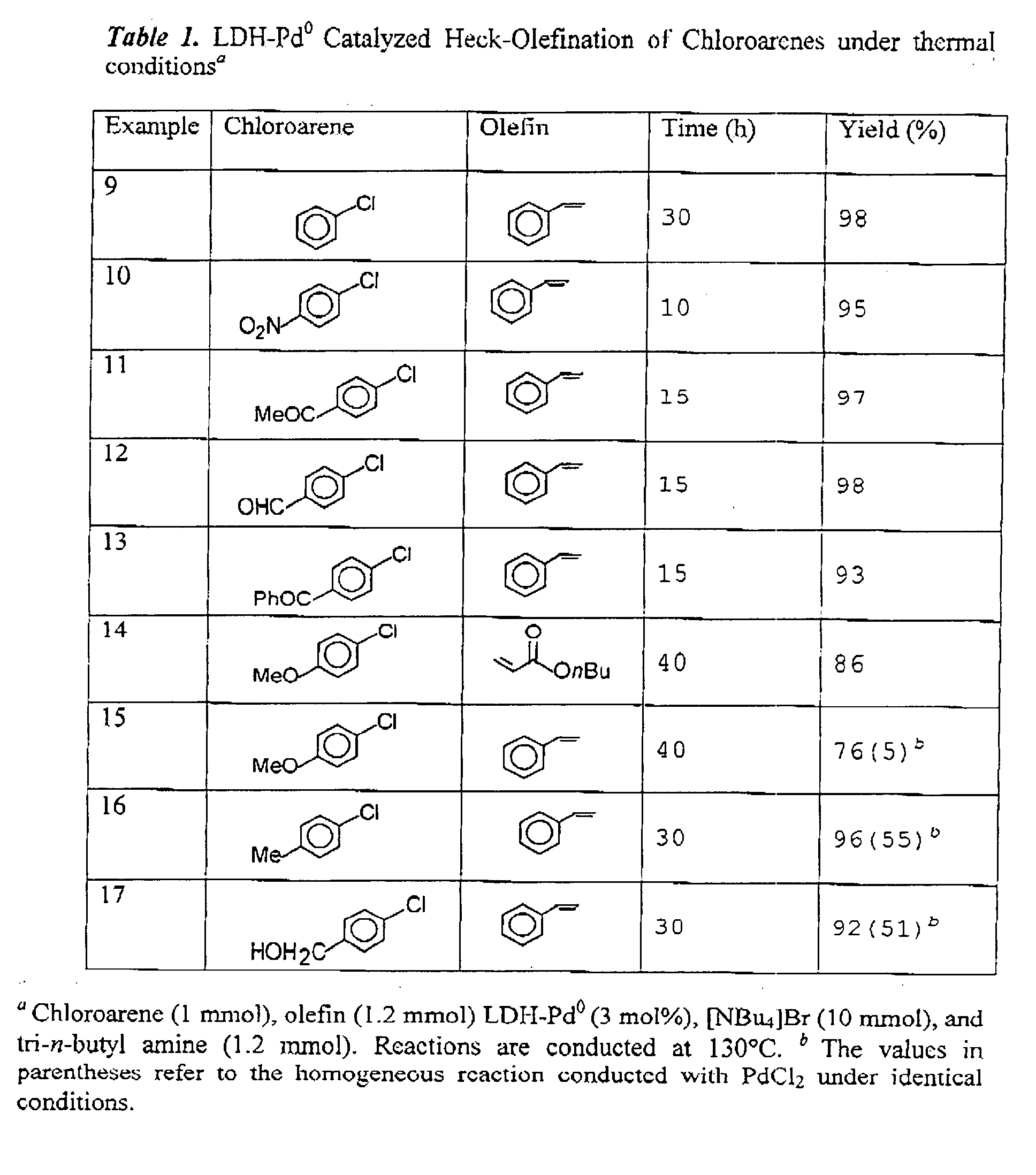
- the C-C bond forming reactions were performed using LDH-Pd 0 catalysts to evaluate nanopalladium catalysts of the present invention.
- the NAIL (3.23 g, 10 mmol)( NBu 4 Br) was heated to melt (130°C) and degassed with nitrogen and vacuum prior to the addition of other reagents.
- LDH-Pd 0 (3 mol%), tri-n-butyl amine (222mg, 1.2 mmol) were added.
- the styrene (1.2 mmol) and chlorobenzene (1 mmol) were then added and the reaction was heated to 130°C and stirred for 10-40 h under nitrogen atmosphere.
- the LDH-Pd 0 catalyst was filtered and washed with water and dichloromcthane. After removing the solvent, the crude material was chromatographed on silica gel or recrystallized from ethanol to afford the trans -stilbene.
Landscapes
- Chemical & Material Sciences (AREA)
- Organic Chemistry (AREA)
- Chemical Kinetics & Catalysis (AREA)
- Engineering & Computer Science (AREA)
- Materials Engineering (AREA)
- Low-Molecular Organic Synthesis Reactions Using Catalysts (AREA)
- Organic Low-Molecular-Weight Compounds And Preparation Thereof (AREA)
Abstract
Description

| Heck-Olefination of 4-Chloroanisole with Styrene Using Various Palladium Catalysts | ||
| Example | Catalyst | Yield (%) |
| 27 | LDH-Pd0 | 76 |
| 28 | resin-Pd0 | 29 |
| 29 | Pd/C | 28 |
| 30 | Pd/Al2O3 | 22 |
| 31 | Pd/SiO2 | 15 |
| 32 | PdCl2 | 5 |


Claims (8)
- A process for the preparation of a ligand free reusable heterogeneous nanopalladium(0) catalyst obtained by an exchange of PdCl4 2- followed by reduction on the support selected from LDII and S'-NR3X wherein S' is a unmodified surface support selected from resin and silica, R is an alkyl group selected from the group consisting of methyl, ethyl, propyl, butyl , X is selected from the group consisting of Cl, Br, I, F, OH and OAc to perform C-C bond coupling reactions such as Heck, Suzuki, Sonagashira, and Stille type reactions with haloarenes that include unreactive chloroarenes under standard thermal and microwave conditions using solvents selected from nonaqueous ionic liquid, THF, dioxane, water, NMP at temperature ranging between 20 to 150 °C for a period ranging from 0.5 to 48 h under nitrogen atmosphere and obtaining the desired product by conventional method.
- A process as claimed in claim I, wherein the LDH-Pd0 useful as a catalyst, of the formula [M(II)1-xM(III)x (OH)2] [Pd(0)] wherein LDH is a class of layered material consisting of alternating cationic M(II)1-xM(III)x (OH)2 x+ and anionic An-·zH2O layers, MII is a divalent cation selected from the group consisting of Mg2+, Mn2+, Fe2+, Co2+, Ni2+, Cu2+, Zn2+ and Ca2+ and MIII is a trivalent ion selected from the group consisting of Al3+, Cr3+, Mn3+, Fe3+ and Co3+, An- is an interstitial anion selected from nitrate, carbonate and chloride, x is the mole fraction having integral value ranging from 0.2 to 0.33, and z is the number of water molecules and ranges from 1 to 4.
- A process as claimed in claims 1-2, wherein the said process for the preparation of the catalyst LDH-Pd0 of the formula [M(II)1-xM(III)x (OH)2] [Pd(0)] comprises reacting sodium palladate of formula Na2PdCl4 with a LDH of formula [M(II)1-xM(III)x (OH)2 x+] [An-] wherein MII is a divalent cation selected from the group consisting Mg2+, Mn2+, Fc2+, Co2+, Ni2+, Cu2+, Zn2+ and Ca2+ and MIII is a trivalent ion selected from the group consisting Al3+, Cr3+, Mn3+, Fe3+ and Co3+, and An- is an interstitial anion selected from nitrate, carbonate and chloride, x is the mole fraction having integral value ranging from 0.2 to 0.33, and z is the number of water molecules and ranges from 1 to 4 in an aqueous solvent at a temperature ranging between 20 to 30° C for a period of 5 to 24 h under the nitrogen atmosphere followed by reduction, filtration and washing to obtain the desired catalyst.
- A process as claimed in claims 1-3, wherein the palladium content in the catalyst ranges between 0.1 to 3 mol% with respect to the substrate.
- A process as claimed in claims 1-4, wherein nanopalladium (0) catalysts arc recovered by simple filtration and reused for several cycles with consistent activity.
- A process as claimed in claims 1-5, wherein the solvents for the C-C bond formation reaction are selected from the group consisting of nonaqueous ionic liquid, water, dioxane, THF, NMP or any mixture thereof.
- A process as claimed in claims 1-6, wherein the base used is selected from the group consisting of triethylamine, tributylamine, potassium fluoride, potassium acetate and obtaining the desired product by conventional method.
- A process as claimed in claims 1-7, wherein a phosphine free new recyclable heterogeneous catalytic system was developed to dispense the use of expensive and air sensitive basic phosphines for palladium catalyzed coupling reactions of chloroarenes.
Priority Applications (2)
| Application Number | Priority Date | Filing Date | Title |
|---|---|---|---|
| EP03007285A EP1464394B1 (en) | 2003-03-31 | 2003-03-31 | Supported nanopalladium catalyst for C-C coupling reactions of haloarenes |
| DE2003616108 DE60316108T2 (en) | 2003-03-31 | 2003-03-31 | Supported nanopalladium catalyst for C-C coupling reactions of haloarenes |
Applications Claiming Priority (1)
| Application Number | Priority Date | Filing Date | Title |
|---|---|---|---|
| EP03007285A EP1464394B1 (en) | 2003-03-31 | 2003-03-31 | Supported nanopalladium catalyst for C-C coupling reactions of haloarenes |
Publications (2)
| Publication Number | Publication Date |
|---|---|
| EP1464394A1 true EP1464394A1 (en) | 2004-10-06 |
| EP1464394B1 EP1464394B1 (en) | 2007-09-05 |
Family
ID=32842716
Family Applications (1)
| Application Number | Title | Priority Date | Filing Date |
|---|---|---|---|
| EP03007285A Expired - Lifetime EP1464394B1 (en) | 2003-03-31 | 2003-03-31 | Supported nanopalladium catalyst for C-C coupling reactions of haloarenes |
Country Status (2)
| Country | Link |
|---|---|
| EP (1) | EP1464394B1 (en) |
| DE (1) | DE60316108T2 (en) |
Cited By (7)
| Publication number | Priority date | Publication date | Assignee | Title |
|---|---|---|---|---|
| WO2005123662A1 (en) * | 2004-06-18 | 2005-12-29 | Janssen Pharmaceutica N.V. | Modified heck reaction |
| WO2009101201A3 (en) * | 2008-02-15 | 2009-10-29 | Chemetall Gmbh | Mixtures of metal hydrides and ionic liquids and uses of such mixtures |
| JP2013226547A (en) * | 2012-03-28 | 2013-11-07 | Hokko Chem Ind Co Ltd | Method for preparing palladium nanoparticle and suzuki-miyaura coupling reaction using palladium nanoparticle as catalyst |
| CN105424757A (en) * | 2016-01-11 | 2016-03-23 | 济南大学 | High-gas-sensitivity multi-element-compounding metal oxide, preparing method and application |
| CN110433797A (en) * | 2019-07-30 | 2019-11-12 | 北京氦舶科技有限责任公司 | A kind of monatomic Pd base catalyst and its preparation method and application |
| CN113956231A (en) * | 2021-09-27 | 2022-01-21 | 哈尔滨工业大学(深圳) | Preparation method of biaryl compound based on continuous flow reactor |
| CN114345370A (en) * | 2021-12-03 | 2022-04-15 | 陕西师范大学 | Method for reducing and cross-coupling aromatic olefin and halogenated hydrocarbon through photocatalysis |
Citations (5)
| Publication number | Priority date | Publication date | Assignee | Title |
|---|---|---|---|---|
| US4482752A (en) * | 1974-02-19 | 1984-11-13 | Mobil Oil Corporation | Organic compound conversion |
| EP0141528A2 (en) * | 1983-09-28 | 1985-05-15 | Rohm And Haas Company | Conducting or catalysing a chemical reation on a surface especially electroless metal deposition and catalyst systems used therein |
| US5976486A (en) * | 1998-03-27 | 1999-11-02 | University Of Southern California | Method for catalytic production of hydrogen peroxide and catalyst therefor |
| US6489258B1 (en) * | 1997-04-15 | 2002-12-03 | Massachusetts Institute Of Technology | Synthesis and application of vapor grafted porous materials |
| WO2003009936A2 (en) * | 2001-07-23 | 2003-02-06 | Andrew Bruce Holmes | Palladium-catalysed carbon-carbon bond forming reactions in compressed carbon dioxide |
-
2003
- 2003-03-31 EP EP03007285A patent/EP1464394B1/en not_active Expired - Lifetime
- 2003-03-31 DE DE2003616108 patent/DE60316108T2/en not_active Expired - Lifetime
Patent Citations (5)
| Publication number | Priority date | Publication date | Assignee | Title |
|---|---|---|---|---|
| US4482752A (en) * | 1974-02-19 | 1984-11-13 | Mobil Oil Corporation | Organic compound conversion |
| EP0141528A2 (en) * | 1983-09-28 | 1985-05-15 | Rohm And Haas Company | Conducting or catalysing a chemical reation on a surface especially electroless metal deposition and catalyst systems used therein |
| US6489258B1 (en) * | 1997-04-15 | 2002-12-03 | Massachusetts Institute Of Technology | Synthesis and application of vapor grafted porous materials |
| US5976486A (en) * | 1998-03-27 | 1999-11-02 | University Of Southern California | Method for catalytic production of hydrogen peroxide and catalyst therefor |
| WO2003009936A2 (en) * | 2001-07-23 | 2003-02-06 | Andrew Bruce Holmes | Palladium-catalysed carbon-carbon bond forming reactions in compressed carbon dioxide |
Non-Patent Citations (1)
| Title |
|---|
| NARAYANAN S ET AL: "Hydrotalcite-supported palladium catalysts - Part I: Preparation, characterization of hydrotalcites and palladium on uncalcined hydrotalcites for CO chemisorption and phenol hydrogenation", APPLIED CATALYSIS A: GENERAL, ELSEVIER SCIENCE, AMSTERDAM, NL, vol. 174, no. 1-2, 16 November 1998 (1998-11-16), pages 221 - 229, XP004271554, ISSN: 0926-860X * |
Cited By (7)
| Publication number | Priority date | Publication date | Assignee | Title |
|---|---|---|---|---|
| WO2005123662A1 (en) * | 2004-06-18 | 2005-12-29 | Janssen Pharmaceutica N.V. | Modified heck reaction |
| WO2009101201A3 (en) * | 2008-02-15 | 2009-10-29 | Chemetall Gmbh | Mixtures of metal hydrides and ionic liquids and uses of such mixtures |
| JP2013226547A (en) * | 2012-03-28 | 2013-11-07 | Hokko Chem Ind Co Ltd | Method for preparing palladium nanoparticle and suzuki-miyaura coupling reaction using palladium nanoparticle as catalyst |
| CN105424757A (en) * | 2016-01-11 | 2016-03-23 | 济南大学 | High-gas-sensitivity multi-element-compounding metal oxide, preparing method and application |
| CN110433797A (en) * | 2019-07-30 | 2019-11-12 | 北京氦舶科技有限责任公司 | A kind of monatomic Pd base catalyst and its preparation method and application |
| CN113956231A (en) * | 2021-09-27 | 2022-01-21 | 哈尔滨工业大学(深圳) | Preparation method of biaryl compound based on continuous flow reactor |
| CN114345370A (en) * | 2021-12-03 | 2022-04-15 | 陕西师范大学 | Method for reducing and cross-coupling aromatic olefin and halogenated hydrocarbon through photocatalysis |
Also Published As
| Publication number | Publication date |
|---|---|
| DE60316108D1 (en) | 2007-10-18 |
| DE60316108T2 (en) | 2008-06-05 |
| EP1464394B1 (en) | 2007-09-05 |
Similar Documents
| Publication | Publication Date | Title |
|---|---|---|
| US7049266B2 (en) | Layered double hydroxides supported nanopalladium catalysts for Heck-, Suzuki, Sonogashira-, and Stille type coupling reactions of haloarenes | |
| US7026266B2 (en) | Catalytic formulation and its preparation | |
| Ranganath et al. | Recent progress of N-heterocyclic carbenes in heterogeneous catalysis | |
| Liu et al. | Chelating Bis (N‐Heterocyclic Carbene) Palladium‐Catalyzed Reactions | |
| González‐Arellano et al. | Pd (II)‐Schiff base complexes heterogenised on MCM‐41 and delaminated zeolites as efficient and recyclable catalysts for the Heck reaction | |
| CA2419023C (en) | Catalyst for aromatic c-o, c-n, and c-c bond formation | |
| Keller et al. | An efficient and recyclable dendritic catalyst able to dramatically decrease palladium leaching in Suzuki couplings | |
| Terasawa et al. | A coordinatively unsaturated, polymer-bound palladium (0) complex. Synthesis and catalytic activities | |
| JP2005502446A (en) | Novel catalyst formulations and their preparation | |
| JP2004505091A (en) | Phosphane ligands having an adamantyl group, their preparation and their use in catalytic reactions | |
| WO2000008032A1 (en) | Catalyst ligands useful for cross-coupling reactions | |
| CN110483223B (en) | Method for preparing diaryl ketone compound by high-efficiency catalysis of palladium pyridine | |
| AU2001258725A1 (en) | A novel catalytic formulation and its preparation | |
| Salahshournia et al. | Designing a bifunctional metal-organic framework by tandem post-synthetic modifications; an efficient and recyclable catalyst for Suzuki-Miyaura cross-coupling reaction | |
| JP7569618B2 (en) | Ring-supported catalyst | |
| Kwong et al. | Application of palladium-catalyzed Pd–aryl/P–aryl exchanges: preparation of functionalized aryl phosphines by phosphination of aryl bromides using triarylphosphines | |
| CN101195641A (en) | Novel phosphine ligand, production and uses in catalytic reaction thereof | |
| EP1464394B1 (en) | Supported nanopalladium catalyst for C-C coupling reactions of haloarenes | |
| Anwander | Lanthanides: chemistry and use in organic synthesis | |
| JP5377309B2 (en) | Novel cyclopentadienyl, indenyl or fluorenyl substituted phosphine compounds and their use in catalytic reactions | |
| Choudary et al. | Layered-double-hydroxide-supported Pd (TPPTS) 2Cl2: A new heterogeneous catalyst for Heck arylation of olefins | |
| Sonogashira | Palladium‐catalyzed alkynylation: Sonogashira alkyne synthesis | |
| Türkmen et al. | Aqueous-phase Suzuki–Miyaura cross-coupling reactions catalyzed by Pd-NHC complexes | |
| WO2011020900A2 (en) | A process for preparing biaryl compounds in a suzuki type reaction allowing product isolation and catalyst recycling in one step | |
| WO2017193288A1 (en) | Synthesis of phosphine ligands bearing tunable linkage: methods of their use in catalysis |
Legal Events
| Date | Code | Title | Description |
|---|---|---|---|
| PUAI | Public reference made under article 153(3) epc to a published international application that has entered the european phase |
Free format text: ORIGINAL CODE: 0009012 |
|
| AK | Designated contracting states |
Kind code of ref document: A1 Designated state(s): AT BE BG CH CY CZ DE DK EE ES FI FR GB GR HU IE IT LI LU MC NL PT RO SE SI SK TR |
|
| AX | Request for extension of the european patent |
Extension state: AL LT LV MK |
|
| RIN1 | Information on inventor provided before grant (corrected) |
Inventor name: CHOWDARI, SREENIVASATHE SCRIPPS RESEARCH INST. Inventor name: NAIDU, MADHI, SATEESH Inventor name: CHOUDARY, BOYAPATI, MANORANJAN Inventor name: KANTAM, MANNEPALLI, LAKSHMI Inventor name: SREEDHAR, BOJJA |
|
| 17P | Request for examination filed |
Effective date: 20050211 |
|
| AKX | Designation fees paid |
Designated state(s): CH DE FR GB IT LI |
|
| 17Q | First examination report despatched |
Effective date: 20050722 |
|
| 17Q | First examination report despatched |
Effective date: 20050722 |
|
| GRAP | Despatch of communication of intention to grant a patent |
Free format text: ORIGINAL CODE: EPIDOSNIGR1 |
|
| GRAS | Grant fee paid |
Free format text: ORIGINAL CODE: EPIDOSNIGR3 |
|
| GRAA | (expected) grant |
Free format text: ORIGINAL CODE: 0009210 |
|
| AK | Designated contracting states |
Kind code of ref document: B1 Designated state(s): CH DE FR GB IT LI |
|
| REG | Reference to a national code |
Ref country code: GB Ref legal event code: FG4D |
|
| REG | Reference to a national code |
Ref country code: CH Ref legal event code: EP |
|
| REF | Corresponds to: |
Ref document number: 60316108 Country of ref document: DE Date of ref document: 20071018 Kind code of ref document: P |
|
| REG | Reference to a national code |
Ref country code: CH Ref legal event code: NV Representative=s name: E. BLUM & CO. AG PATENT- UND MARKENANWAELTE VSP |
|
| ET | Fr: translation filed | ||
| PLBE | No opposition filed within time limit |
Free format text: ORIGINAL CODE: 0009261 |
|
| STAA | Information on the status of an ep patent application or granted ep patent |
Free format text: STATUS: NO OPPOSITION FILED WITHIN TIME LIMIT |
|
| 26N | No opposition filed |
Effective date: 20080606 |
|
| PGFP | Annual fee paid to national office [announced via postgrant information from national office to epo] |
Ref country code: CH Payment date: 20110328 Year of fee payment: 9 |
|
| PGFP | Annual fee paid to national office [announced via postgrant information from national office to epo] |
Ref country code: GB Payment date: 20110324 Year of fee payment: 9 |
|
| PGFP | Annual fee paid to national office [announced via postgrant information from national office to epo] |
Ref country code: DE Payment date: 20110531 Year of fee payment: 9 Ref country code: IT Payment date: 20110331 Year of fee payment: 9 |
|
| PGFP | Annual fee paid to national office [announced via postgrant information from national office to epo] |
Ref country code: FR Payment date: 20120416 Year of fee payment: 10 |
|
| REG | Reference to a national code |
Ref country code: CH Ref legal event code: PL |
|
| GBPC | Gb: european patent ceased through non-payment of renewal fee |
Effective date: 20120331 |
|
| PG25 | Lapsed in a contracting state [announced via postgrant information from national office to epo] |
Ref country code: LI Free format text: LAPSE BECAUSE OF NON-PAYMENT OF DUE FEES Effective date: 20120331 Ref country code: GB Free format text: LAPSE BECAUSE OF NON-PAYMENT OF DUE FEES Effective date: 20120331 Ref country code: CH Free format text: LAPSE BECAUSE OF NON-PAYMENT OF DUE FEES Effective date: 20120331 |
|
| REG | Reference to a national code |
Ref country code: DE Ref legal event code: R119 Ref document number: 60316108 Country of ref document: DE Effective date: 20121002 |
|
| PG25 | Lapsed in a contracting state [announced via postgrant information from national office to epo] |
Ref country code: IT Free format text: LAPSE BECAUSE OF NON-PAYMENT OF DUE FEES Effective date: 20120331 |
|
| REG | Reference to a national code |
Ref country code: FR Ref legal event code: ST Effective date: 20131129 |
|
| PG25 | Lapsed in a contracting state [announced via postgrant information from national office to epo] |
Ref country code: FR Free format text: LAPSE BECAUSE OF NON-PAYMENT OF DUE FEES Effective date: 20130402 |
|
| PG25 | Lapsed in a contracting state [announced via postgrant information from national office to epo] |
Ref country code: DE Free format text: LAPSE BECAUSE OF NON-PAYMENT OF DUE FEES Effective date: 20121002 |