EP1463255A1 - Interleaver for mapping symbols on the carriers of an OFDM system - Google Patents
Interleaver for mapping symbols on the carriers of an OFDM system Download PDFInfo
- Publication number
- EP1463255A1 EP1463255A1 EP03290754A EP03290754A EP1463255A1 EP 1463255 A1 EP1463255 A1 EP 1463255A1 EP 03290754 A EP03290754 A EP 03290754A EP 03290754 A EP03290754 A EP 03290754A EP 1463255 A1 EP1463255 A1 EP 1463255A1
- Authority
- EP
- European Patent Office
- Prior art keywords
- address
- ofdm
- symbols
- data
- carrier signals
- Prior art date
- Legal status (The legal status is an assumption and is not a legal conclusion. Google has not performed a legal analysis and makes no representation as to the accuracy of the status listed.)
- Withdrawn
Links
- 238000013507 mapping Methods 0.000 title claims abstract description 33
- 239000000969 carrier Substances 0.000 title claims abstract description 25
- 230000000694 effects Effects 0.000 claims abstract description 24
- 238000012545 processing Methods 0.000 claims abstract description 23
- 238000000034 method Methods 0.000 claims description 13
- 230000005540 biological transmission Effects 0.000 claims description 5
- 238000004458 analytical method Methods 0.000 abstract description 4
- 238000004891 communication Methods 0.000 abstract description 4
- 238000004088 simulation Methods 0.000 abstract description 3
- 238000010586 diagram Methods 0.000 description 11
- 239000013598 vector Substances 0.000 description 7
- 238000012937 correction Methods 0.000 description 5
- 230000000875 corresponding effect Effects 0.000 description 4
- 230000006978 adaptation Effects 0.000 description 3
- 238000005562 fading Methods 0.000 description 2
- 230000011664 signaling Effects 0.000 description 2
- 230000006399 behavior Effects 0.000 description 1
- 230000015556 catabolic process Effects 0.000 description 1
- 230000002596 correlated effect Effects 0.000 description 1
- 238000006731 degradation reaction Methods 0.000 description 1
- 230000001934 delay Effects 0.000 description 1
- 238000000605 extraction Methods 0.000 description 1
- 238000009432 framing Methods 0.000 description 1
- 230000006870 function Effects 0.000 description 1
- 238000003780 insertion Methods 0.000 description 1
- 230000037431 insertion Effects 0.000 description 1
- 238000011835 investigation Methods 0.000 description 1
- 238000012986 modification Methods 0.000 description 1
- 230000004048 modification Effects 0.000 description 1
- 230000001151 other effect Effects 0.000 description 1
- 230000005236 sound signal Effects 0.000 description 1
- 238000012360 testing method Methods 0.000 description 1
Images


Classifications
-
- H—ELECTRICITY
- H04—ELECTRIC COMMUNICATION TECHNIQUE
- H04L—TRANSMISSION OF DIGITAL INFORMATION, e.g. TELEGRAPHIC COMMUNICATION
- H04L1/00—Arrangements for detecting or preventing errors in the information received
- H04L1/004—Arrangements for detecting or preventing errors in the information received by using forward error control
- H04L1/0056—Systems characterized by the type of code used
- H04L1/0071—Use of interleaving
-
- E—FIXED CONSTRUCTIONS
- E04—BUILDING
- E04H—BUILDINGS OR LIKE STRUCTURES FOR PARTICULAR PURPOSES; SWIMMING OR SPLASH BATHS OR POOLS; MASTS; FENCING; TENTS OR CANOPIES, IN GENERAL
- E04H13/00—Monuments; Tombs; Burial vaults; Columbaria
- E04H13/006—Columbaria, mausoleum with frontal access to vaults
-
- E—FIXED CONSTRUCTIONS
- E04—BUILDING
- E04H—BUILDINGS OR LIKE STRUCTURES FOR PARTICULAR PURPOSES; SWIMMING OR SPLASH BATHS OR POOLS; MASTS; FENCING; TENTS OR CANOPIES, IN GENERAL
- E04H13/00—Monuments; Tombs; Burial vaults; Columbaria
- E04H13/005—Ventilation systems therefor
-
- H—ELECTRICITY
- H03—ELECTRONIC CIRCUITRY
- H03M—CODING; DECODING; CODE CONVERSION IN GENERAL
- H03M13/00—Coding, decoding or code conversion, for error detection or error correction; Coding theory basic assumptions; Coding bounds; Error probability evaluation methods; Channel models; Simulation or testing of codes
- H03M13/27—Coding, decoding or code conversion, for error detection or error correction; Coding theory basic assumptions; Coding bounds; Error probability evaluation methods; Channel models; Simulation or testing of codes using interleaving techniques
- H03M13/2757—Interleaver with an interleaving rule not provided for in the subgroups H03M13/2703 - H03M13/2753
-
- H—ELECTRICITY
- H03—ELECTRONIC CIRCUITRY
- H03M—CODING; DECODING; CODE CONVERSION IN GENERAL
- H03M13/00—Coding, decoding or code conversion, for error detection or error correction; Coding theory basic assumptions; Coding bounds; Error probability evaluation methods; Channel models; Simulation or testing of codes
- H03M13/27—Coding, decoding or code conversion, for error detection or error correction; Coding theory basic assumptions; Coding bounds; Error probability evaluation methods; Channel models; Simulation or testing of codes using interleaving techniques
- H03M13/2792—Interleaver wherein interleaving is performed jointly with another technique such as puncturing, multiplexing or routing
-
- H—ELECTRICITY
- H04—ELECTRIC COMMUNICATION TECHNIQUE
- H04L—TRANSMISSION OF DIGITAL INFORMATION, e.g. TELEGRAPHIC COMMUNICATION
- H04L27/00—Modulated-carrier systems
- H04L27/26—Systems using multi-frequency codes
- H04L27/2601—Multicarrier modulation systems
- H04L27/2647—Arrangements specific to the receiver only
-
- H—ELECTRICITY
- H04—ELECTRIC COMMUNICATION TECHNIQUE
- H04N—PICTORIAL COMMUNICATION, e.g. TELEVISION
- H04N21/00—Selective content distribution, e.g. interactive television or video on demand [VOD]
- H04N21/40—Client devices specifically adapted for the reception of or interaction with content, e.g. set-top-box [STB]; Operations thereof
- H04N21/41—Structure of client; Structure of client peripherals
- H04N21/426—Internal components of the client ; Characteristics thereof
-
- H—ELECTRICITY
- H04—ELECTRIC COMMUNICATION TECHNIQUE
- H04N—PICTORIAL COMMUNICATION, e.g. TELEVISION
- H04N21/00—Selective content distribution, e.g. interactive television or video on demand [VOD]
- H04N21/60—Network structure or processes for video distribution between server and client or between remote clients; Control signalling between clients, server and network components; Transmission of management data between server and client, e.g. sending from server to client commands for recording incoming content stream; Communication details between server and client
- H04N21/61—Network physical structure; Signal processing
- H04N21/6106—Network physical structure; Signal processing specially adapted to the downstream path of the transmission network
- H04N21/6112—Network physical structure; Signal processing specially adapted to the downstream path of the transmission network involving terrestrial transmission, e.g. DVB-T
-
- H—ELECTRICITY
- H03—ELECTRONIC CIRCUITRY
- H03M—CODING; DECODING; CODE CONVERSION IN GENERAL
- H03M13/00—Coding, decoding or code conversion, for error detection or error correction; Coding theory basic assumptions; Coding bounds; Error probability evaluation methods; Channel models; Simulation or testing of codes
- H03M13/29—Coding, decoding or code conversion, for error detection or error correction; Coding theory basic assumptions; Coding bounds; Error probability evaluation methods; Channel models; Simulation or testing of codes combining two or more codes or code structures, e.g. product codes, generalised product codes, concatenated codes, inner and outer codes
- H03M13/2933—Coding, decoding or code conversion, for error detection or error correction; Coding theory basic assumptions; Coding bounds; Error probability evaluation methods; Channel models; Simulation or testing of codes combining two or more codes or code structures, e.g. product codes, generalised product codes, concatenated codes, inner and outer codes using a block and a convolutional code
- H03M13/2936—Coding, decoding or code conversion, for error detection or error correction; Coding theory basic assumptions; Coding bounds; Error probability evaluation methods; Channel models; Simulation or testing of codes combining two or more codes or code structures, e.g. product codes, generalised product codes, concatenated codes, inner and outer codes using a block and a convolutional code comprising an outer Reed-Solomon code and an inner convolutional code
Definitions
- the present invention relates to data processing apparatus operable to map input symbols onto carrier signals of an Orthogonal Frequency Division Multiplexed (OFDM) symbol.
- OFDM Orthogonal Frequency Division Multiplexed
- the present invention also relates to data processing apparatus operable to de-map symbols received from a predetermined number of carrier signals of an OFDM symbol into an output symbol stream.
- the Digital Video Broadcasting-Terrestrial standard (DVB-T) utilises Orthogonal Frequency Division Multiplexing (OFDM) to communicate data representing video images and sound to receivers via a broadcast radio communications signal.
- OFDM Orthogonal Frequency Division Multiplexing
- the 2k mode provides 2048 sub-carriers whereas the 8k mode provides 8192 sub-carriers.
- a symbol interleaver in order to interleave input data symbols as these symbols are mapped onto the carrier signals of an OFDM symbol.
- Such a symbol interleaver comprises an interleaver memory in combination with an address generator.
- the address generator generates an address for each of the input symbols, each address indicating one of the carrier signals of the OFDM symbol onto which the data symbol is to be mapped.
- the address generator is known to comprise a linear feed back shift register which is operable to generate a pseudo random bit sequence and a permutation circuit.
- the permutation circuit permutes the order of the content of the linear feed back shift register in order to generate an address.
- the address provides an indication of one of the OFDM carriers for carrying an input data symbol stored in the interleaver memory, in order to map the input symbols onto the carrier signals of the OFDM symbol.
- the 4k mode has been used in the Japanese standard for digital broadcast television, which is the Integrated Service Digital Broadcasting (ISDB) system.
- ISDB Integrated Service Digital Broadcasting
- a data processing apparatus operable to map input symbols to be communicated onto a predetermined number of carrier signals of an Orthogonal Frequency Division Multiplexed (OFDM) symbol.
- the data processing apparatus comprises an interleaver memory operable to read-in the predetermined number of data symbols for mapping onto the OFDM carrier signals, and to read-out the data symbols for the OFDM carriers to effect the mapping.
- the read-out is in a different order than the read-in, the order being determined from a set of addresses, with the effect that the data symbols are interleaved on the carrier signals.
- the set of addresses is determined by an address generator, an address being generated for each of the input symbols to indicate one of the carrier signals onto which the data symbol is to be mapped.
- the address generator comprises a linear feedback shift register including a predetermined number of register stages and is operable to generate a pseudo-random bit sequence in accordance with a generator polynomial, and a permutation circuit and a control unit.
- the permutation circuit is operable to receive the content of the shift register stages and to permute the bits present in the register stages in accordance with a permutation order to form an address of one of the OFDM carriers.
- the control unit is operable in combination with an address check circuit to re-generate an address when a generated address exceeds the maximum number of carriers.
- the 2k mode provides an arrangement for establishing a single frequency network with sufficient guard periods to accommodate larger propagation delays between DVB transmitters
- the 2k mode is known to provide an advantage in mobile applications. This is because the 2k symbol period is only one quarter of the 8k symbol period, allowing the channel estimation (based on scattered pilots embedded in each symbol) to be more frequently updated allowing the receiver to track the time variation of the channel due to doppler and other effects more accurately.
- the 2k mode is therefore advantageous for mobile applications.
- the 2k mode requires a multiple frequency network thereby complicating an arrangement of transmitters to provide a broadcast system.
- a 4k mode provides an advantage of a reasonable good reception for mobile users even at high driving speeds which thereby cause increased doppler shift, without a need for an expensive inter-carrier interference cancellation scheme.
- a reasonably cost effective implementation of a broadcast network can also be implemented.
- a symbol interleaver in order to provide the 4k mode a symbol interleaver must be provided for mapping the input data symbols onto the carrier signals of the OFDM symbol.
- Embodiments of the present invention can provide a data processing apparatus operable as a symbol interleaver for mapping data symbols to be communicated on an OFDM symbol, having substantially four thousand carrier signals.
- the number of carrier signals is three thousand and twenty four.
- a 4k mode can be provided for example for DVB-T.
- mapping data symbols to be transmitted onto the carrier signals of an OFDM symbol, where the number of carrier signals is substantially four thousand, represents a substantial technical problem requiring simulation analysis and testing to establish an appropriate generator polynomial for the linear feedback shift register and the permutation order. This is because the mapping requires that the symbols are interleaved onto the carrier signals with the effect that successive symbols from the input data stream are separated in frequency by a greatest possible amount in order to optimise the performance of error correction coding schemes.
- Error correction coding schemes such as Reed-Solomon coding and convolutional coding perform better when noise and degradation of the symbol values resulting from communication is un-correlated.
- Some radio channels such as those used for DVB-T may suffer from correlated fading in both the time and the frequency domains. As such by separating encoded symbols on to different carrier signals of the OFDM symbol by as much as possible, the performance of error correction coding schemes can be increased.
- the generator polynomial for the linear feed back shift register in combination with the permutation circuit order indicated above provides a good performance in the presence of typical channel noise and fading conditions. Furthermore, by providing an arrangement which can implement address generating for both the 2k mode and the 8k mode as well as the 4k mode by changing the taps of the generator polynomial for the linear feed back shift register and the permutation order, a cost effective implementation of the symbol interleaver for the 4k mode is provided. Furthermore, a transmitter and a receiver can be changed between the 2k mode, 4k mode and the 8k mode by changing the generator polynomial and the permutation orders. This can be effected in software (or by the embedded transmission parameter signalling (TPS) channel in the receiver) whereby a flexible implementation is provided.
- TPS embedded transmission parameter signalling
- aspects and features of the present invention are defined in the appended claims. Further aspects of the present invention include a data processing apparatus operable to de-map symbols received from a predetermined number of carrier signals of an Orthogonal Frequency Division Multiplexed (OFDM) symbol into an output symbol stream, as well as a transmitter and a receiver.
- OFDM Orthogonal Frequency Division Multiplexed
- the existing OFDM-based DVB-T standard is composed of a 2K and an 8K mode, which means that the bandwidth used to transmit the signal is divided into either 2048 sub-carriers (2K mode) or 8192 (8K mode).
- the 2K mode presents some interesting features with respect to mobility. In effect, the short symbol time of this mode allows good doppler performance in mobile environments.
- the 8K mode gives the possibility to network planners to build a sparse, hence cheap, SFNs (Single Frequency Network). The investigations carried out on the subject showed that the introduction of a 4K mode would be a good trade-off between these two modes.
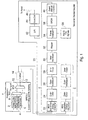
- Figure 1 provides an example block diagram of a Coded OFDM transmitter which may be used for example to transmit video images and audio signals in accordance with the DVB-T standard.
- a program source generates data to be transmitted by the COFDM transmitter.
- a video coder 2, and audio coder 4 and a data coder 6 generate video, audio and other data to be transmitted which are fed to a program multiplexer 8.
- An output of the program multiplexer 8 is fed to a transport multiplexer 10 which forms a multiplexed transport stream with other information required to communicate the video, audio and other data.
- the transport multiplexer 10 provides a transport stream on a connecting channel 12 to a splitter 14.
- the splitter divides the transport stream into different branches A and B which provide different forward error correction encoding and interleaving. For simplicity, only branch A will be described.
- a COFDM transmitter 20 receives the transport data stream at a multiplexer adaptation and energy dispersal block 22.
- the multiplexer adaptation and energy dispersal block 22 randomises the transport stream data and feeds the appropriate data to an outer encoder 24 which performs a first outer coding of the transport data.
- An outer interleaver 26 is provided to interleave the encoded data symbols which for the example of DVB-T is the Reed-Solomon (RS) code so that the outer interleaver interleaves RS symbols.
- An inner encoder 28 is arranged to convolutionally encode the data from the outer interleaver using a convolutional encoder the encoded data being fed to an inner interleaver 30.
- the inner interleaver 30 may also receive coded data from the second encoding arm B.
- An output of the inner interleaver is a set of data symbols which are then mapped onto constellation points of a modulation scheme.
- the modulation scheme is QPSK (DVB-T can have 4 bits/carrier 16QAM or 6 bits/carrier 64QAM as well as QPSK).
- Each data symbol from the inner interleaver 30 is then mapped onto one of the COFDM carrier signals by a mapping processor 32.
- the COFDM symbol is then generated by a frame adaptation processor 34 which introduces pilot and synchronising signals fed from a signal former 36.
- An OFDM generator 38 then forms the OFDM symbol in the time domain which is fed to a guard insertion processor 40 for generating a guard interval between symbols, and then to a digital to analogue convertor 42 and finally to an RF amplifier within an RF front 44 for eventual broadcast by the COFDM transmitter from an antenna 46.
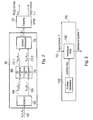
- the inner interleaver itself is composed of a bit interleaver and a symbol interleaver as shown in Figure 2.
- the present invention provides a facility for providing a quasi-optimal mapping of the input data symbols onto the OFDM carrier signals.
- the inner interleaver is provided to effect the optimal mapping of input data symbols onto COFDM carrier signals.
- the inner interleaver 30 and the mapping processor 32 are shown in Figure 2 in more detail.
- the inner interleaver 30 comprises a de-multiplexing processor 60 which receives convolutionally encoded bits from an input channel 62. The de-multiplexer then divides the bits into two streams of input bits which are fed via connecting channels 64 and 66 to bit interleavers 68 and 70.
- the bit interleavers interleave the bits which are then formed on two connecting channels 72.1, 72.2 for connecting the bits from each of the bit interleavers 68 and 70 to a symbol interleaver 76.
- the symbol interleaver forms the input symbols from the connecting channels 72.1, 72.2 into symbols for mapping onto the COFDM carrier signals.
- the interleaved symbols from the symbol interleaver 76 are mapped onto constellation points of a QPSK carrier signal for each of the signals in the COFDM symbol.
- the existing DVB-T specification already defines a symbol interleaver for the 2K and 8K modes.
- the purpose of the symbol interleaver is to map v bit words (v depending on the modulation scheme chosen) onto the 1 512 (2K mode) or 6 048 (8K mode) active carriers per OFDM symbol.
- the symbol interleaver acts on blocks of 1 512 (2K mode) or 6 048 (8K mode) data symbols.
- Example embodiments of the present invention utilise the symbol interleaver 76 to provide an optimised mapping of the input data symbols fed from the connecting channels 72.1, 72.2 onto the COFDM carrier signals.
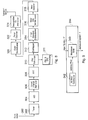
- An example of the symbol interleaver 76 for effecting mapping of the input data symbols onto the COFDM carrier signals is shown in Figure 3.
- the input data symbols from the connecting channel 72 are fed to an interleaver memory 100.
- the interleaver memory 100 maps the input data symbols onto the COFDM carrier signals in accordance with mapping addresses provided by address generator 102.
- An example implementation of the interleaver memory 100 is shown in Figure 4.
- the interleaver memory shown in Figure 4 comprises an upper part 100 illustrating the operation of an interleaver in the transmitter and a lower part 340 which illustrates the operation of a de-interleaver in the receiver.
- the interleaver 100 and the de-interleaver 340 are shown together in Figure 4 in order to facilitate understanding of their operation.
- a representation of the communication between the interleaver 100 and the de-interleaver 340 via other devices and via a transmission channel has been simplified and represented as a section 140 between the interleaver 100 and the de-interleaver 340.
- the operation of the interleaver 100 is described in the following paragraphs:
- Figure 4 provides an illustration of only four input data symbols onto an example of four carrier signals of a COFDM symbol, it will be appreciated that the technique illustrated in Figure 4 can be extended to a larger number of carriers such as 1512 for the 2k mode, 3024 for the 4k mode and 6048 for the 8k mode.
- the input and output addressing of the interleaver memory 100 shown in Figure 4 is shown for odd and even symbols.
- the data symbols are read from the input channel 72 in accordance with a sequence of addresses 120 generated for each COFDM symbol by the address generator 102 into an interleaver RAM 124.1.
- the data symbols read into the interleaver RAM 124 are then read out in sequential order 126.
- the same interleaver RAM 124.2 is used for odd symbols. However, as shown in Figure 4 for the odd symbol the read in order 132 is in the same sequential address sequence used to read out the previous even symbol 126. This feature allows the transmitter and receiver implementations to only use 1 RAM provided the read-out operation for a given address is performed before the read-in operation.
- the data symbols read into the interleaver RAM 124 are then read out in a sequence 134 generated in accordance with the addresses generated by the address generator for each COFDM symbol by address generator 102
- the de-interleaver 340 operates to reverse the interleaving applied by the interleaver 100, by applying the same set of addresses as generated by an equivalent address generator, but applying the read-in and read-out addresses in reverse.
- the read in addresses 342 are in sequential order, whereas the read out address 344 are provided by the address generator.
- the read in order 346 is determined from the set of addresses generated by the address generator, whereas read out 348 is in sequential order.
- a schematic block diagram of the algorithm used to generate the permutation function H(q) is represented in Figure 5 for the 2K mode and in Figure 6 for the 8K mode.
- FIG. 5 An implementation of the address generator 102.1 for the 2k mode is shown in Figure 5.
- a linear feed back shift register is formed by ten register stages 200.1 and a xor-gate 202.1 which is connected to the stages of the shift register 200.1 in accordance with a generator polynomial. Therefore, in accordance with the content of the shift register 200.1 a next bit of the shift register is provided from the output of the xor-gate 202.1 by xoring the content of shift register R[0] and register stage R[3].
- the generator polynomial a pseudo random bit sequence is generated from the content of the shift register 200.1.
- a permutation circuit 210.1 which effectively permutes the order of the bits within the shift register 200.1 from an order R' i [n] to an order R i [n] at the output of the permutation circuit 210.1.
- Ten bits from the output of the permutation circuit 210.1 are then fed on a connecting channel 212.1 to which is added a most significant bit via a channel 214.1 which is provided by a toggle circuit 218.1.
- An eleven bit address is therefore generated on channel 212.1.
- an address check circuit 216.1 analyses the generated address to determine whether it exceeds the maximum number of carrier signals. If it does then a control signal is generated and fed via a connecting channel 220.1 to a control unit 224.1. If the generated address exceeds the maximum number of carrier signals then this address is rejected and a new address regenerated for the particular symbol.
- FIG. 6 An address generator 102 for the 8k mode is shown in Figure 6.
- the parts of the address generator for the 8k mode shown in Figure 6 correspond to those shown for the 2k mode and so to avoid repetition only essential differences between Figure 6 and Figure 5 will be described.
- the difference between Figure 6 and Figure 5 is that the linear feed back shift register 200.2 has twelve shift register stages in order to generate an address between 0 and 8191.
- the shift register is formed from xoring the shift register stages selected in accordance with the generator polynomial.
- the address is then formed by permuting the order of the bits within the shift register 200.2 which is determined in accordance with a predetermined order. Again, the generator polynomial and the permutation order is provided for the 8k mode which differs from the 2k mode.
- LFSR Linear Feedback Shift Register
- R i is derived from R' i by the bit permutations given in tables 1 and 2.
- the role of the toggle block is to make sure that we do not generate an address exceeding N max twice in a row. In effect, if an exceeding value was generated, this means that the MSB (i.e. the toggle bit) of the address H(q) was one. So the next value generated will have a MSB set to zero, insuring to produce a valid address.
- an address generator 102.3 for the 4k mode is shown in Figure 7.
- the address generator of Figure 7 corresponds to the address generator shown in Figures 5 and 6 and so the only differences between these Figures will be discussed and explained.
- the linear feed back shift register 200.3 has eleven shift register stages.
- an xor-gate 202.3 is provided to generate the pseudo random bit sequence.
- the permutation of the contents of the shift register in order to form the address of an input data symbol for mapping onto one of the COFDM carrier signals is provided by the permutation circuit 210.3.
- R' i [10] R' i -1 [0] ⁇ R' i -1 [2]
- a vector R i is derived from the vector R' i by the bit permutation given in Table 4: Bit permutation for the 4K mode R' i bit positions 10 9 8 7 6 5 4 3 2 1 0 R i bit positions 7 10 5 8 1 2 4 9 0 3 6
- FIG 8 provides an example illustration of a receiver which may be used with the present technique.
- a COFDM signal is received by an antenna 300 and detected by a tuner 302 and converted into a digital form by an analogue-to-digital converter 304.
- a guard interval removal processor 306 removes the guard interval from a received COFDM symbol, before the data is recovered from the COFDM symbol using a Fast Fourier Transform (FFT) processor 308 in combination with a pilot extraction processor 310 in co-operation with a pilot and Transmission Parameter Signalling (TPS) channel processing unit 311, in accordance with known techniques.
- FFT Fast Fourier Transform
- TPS Transmission Parameter Signalling
- the demodulated data is recovered from a de-mapper 312 and fed to an inner symbol de-interleaver 314, which operates to effect the reverse mapping of the received data symbol to re-generate an output data stream with the data de-interleaved.
- the symbol de-interleaver 314 is formed from a data processing apparatus as shown in Figure 9 with an interleaver memory 340 and an address generator 342.
- the interleaver memory is as shown in Figure 4 and operates as already explained above to effect de-interleaving by utilising sets of addresses generated by the address generator 342.
- the address generator 342 is formed as shown in Figure 7 and is arranged to generate corresponding addresses to map the data symbols recovered from each COFDM sub-carrier signals into an output data stream.
- an inner-code de-interleaver 316 and an inner-decoder 318 operate to effect decoding of the inner convolutional code introduced by the inner interleaver 30 and the inner coder 28 of the receiver shown in Figure 1.
- An outer de-interleaver 320 and an outer decoder 322 operate to effect decoding of the Reed-Solomon code to recover an estimate of the data from the source 1, after being descrambled by a descrambler 324.
- a symbol interleaver and a symbol de-interleaver operating in the receivers and transmitters can be switched between the 2k, 8k and the 4k mode by changing the generator polynomials and the permutation order.
- a flexible implementation is thereby provided because a symbol interleaver and de-interleaver can be formed as shown in Figures 4 and 9, with an address generator as illustrated in either of Figures 5, 6 or 7.
- the address generator can therefore be adapted to the different modes by changing to the generator polynomials and the permutation orders indicated for each of the 2k, 4k, and 8k modes. For example this can be effected using a software change.
- an embedded TPS signal indicating the mode of the DVB-T transmission can be detected in the receiver in the TPS channel processing unit 311 and used to configure automatically the symbol de-interleaver in accordance with the detected mode.
- the transmitter and receiver shown in Figures 1 and 8 respectively are provided as illustrations only and are not intended to be limiting.
- the position of the symbol interleaver and the de-interleaver with respect for example to the bit interleaver and the mapper and de-mapper.
- the effect of the interleaver and de-interleaver is unchanged by its relative position, although the interleaver may be interleaving I/Q symbols instead of v-bit vectors.
- a corresponding change may be made in the receiver.
- the interleaver and de-interleaver may be operating on different data types, and may be positioned differently to the postion described in the example embodiments.
- EN 300 744 "Framing structure, channel coding and modulation for digital terrestrial television", ETSI.
Landscapes
- Engineering & Computer Science (AREA)
- Signal Processing (AREA)
- Computer Networks & Wireless Communication (AREA)
- Architecture (AREA)
- Physics & Mathematics (AREA)
- Probability & Statistics with Applications (AREA)
- Theoretical Computer Science (AREA)
- Multimedia (AREA)
- Civil Engineering (AREA)
- Structural Engineering (AREA)
- Error Detection And Correction (AREA)
- Detection And Prevention Of Errors In Transmission (AREA)
- Measuring Pulse, Heart Rate, Blood Pressure Or Blood Flow (AREA)
- Optical Communication System (AREA)
- Complex Calculations (AREA)
- Transmitters (AREA)
- Circuits Of Receivers In General (AREA)
- Radio Transmission System (AREA)
- Mobile Radio Communication Systems (AREA)
- Television Systems (AREA)
Abstract
A data processing apparatus maps input symbols to be communicated onto a
predetermined number of carrier signals of an Orthogonal Frequency Division
Multiplexed (OFDM) symbol. The data processor includes an interleaver memory
which reads-in the predetermined number of data symbols for mapping onto the
OFDM carrier signals. The interleaver memory reads-out the data symbols on to the
OFDM carriers to effect the mapping, the read-out being in a different order than the
read-in, the order being determined from a set of addresses, with the effect that the
data symbols are interleaved on the carrier signals. The set of addresses are generated
from an address generator which comprises a linear feedback shift register and a
permutation circuit. In order to provide a 4k mode for an OFDM modulated system
such as the Digital Video Broadcasting-Terrestrial (DVB-T) standard, a generator
polynomial for the linear feedback shift register of R' i [10] = R' i -1[0] ⊕ R' i -1[2] is provided
with a permutation order which has been established by simulation analysis to
optimise communication performance via typical radio channels.
Description
The present invention relates to data processing apparatus operable to map
input symbols onto carrier signals of an Orthogonal Frequency Division Multiplexed
(OFDM) symbol.
The present invention also relates to data processing apparatus operable to de-map
symbols received from a predetermined number of carrier signals of an OFDM
symbol into an output symbol stream.
The Digital Video Broadcasting-Terrestrial standard (DVB-T) utilises
Orthogonal Frequency Division Multiplexing (OFDM) to communicate data
representing video images and sound to receivers via a broadcast radio
communications signal. There are known to be two modes for the DVB-T standard
which are known as the 2k and the 8k mode. The 2k mode provides 2048 sub-carriers
whereas the 8k mode provides 8192 sub-carriers.
In order to improve the integrity of data communicated by either the 2k mode
or the 8k mode a symbol interleaver is provided in order to interleave input data
symbols as these symbols are mapped onto the carrier signals of an OFDM symbol.
Such a symbol interleaver comprises an interleaver memory in combination with an
address generator. The address generator generates an address for each of the input
symbols, each address indicating one of the carrier signals of the OFDM symbol onto
which the data symbol is to be mapped. For the 2k mode and the 8k mode an
arrangement has been disclosed in the DVB-T standard for generating the addresses
for the mapping. The address generator is known to comprise a linear feed back shift
register which is operable to generate a pseudo random bit sequence and a permutation
circuit. The permutation circuit permutes the order of the content of the linear feed
back shift register in order to generate an address. The address provides an indication
of one of the OFDM carriers for carrying an input data symbol stored in the interleaver
memory, in order to map the input symbols onto the carrier signals of the OFDM
symbol.
As well as the 2k mode and the 8k mode it has also been proposed to provide a
4k mode. The 4k mode has been used in the Japanese standard for digital broadcast
television, which is the Integrated Service Digital Broadcasting (ISDB) system.
According to an aspect of the present invention there is provided a data
processing apparatus operable to map input symbols to be communicated onto a
predetermined number of carrier signals of an Orthogonal Frequency Division
Multiplexed (OFDM) symbol. The data processing apparatus comprises an interleaver
memory operable to read-in the predetermined number of data symbols for mapping
onto the OFDM carrier signals, and to read-out the data symbols for the OFDM
carriers to effect the mapping. The read-out is in a different order than the read-in, the
order being determined from a set of addresses, with the effect that the data symbols
are interleaved on the carrier signals. The set of addresses is determined by an address
generator, an address being generated for each of the input symbols to indicate one of
the carrier signals onto which the data symbol is to be mapped.
The address generator comprises a linear feedback shift register including a
predetermined number of register stages and is operable to generate a pseudo-random
bit sequence in accordance with a generator polynomial, and a permutation circuit and
a control unit. The permutation circuit is operable to receive the content of the shift
register stages and to permute the bits present in the register stages in accordance with
a permutation order to form an address of one of the OFDM carriers. The control unit
is operable in combination with an address check circuit to re-generate an address
when a generated address exceeds the maximum number of carriers. The data
processing apparatus is characterised in that the predetermined number of OFDM
carrier signals is substantially four thousand, and the linear feedback shift register has
eleven register stages with a generator polynomial for the linear feedback shift register
of R'i [10]=R'i -1[0]⊕R'i -1[2]. The permutation order forms an eleven bit address Ri [n]
for the i-th data symbol from the bit present in the n-th register stage R'i [n] in
accordance with the table:
| R'i [n] for n = | 10 | 9 | 8 | 7 | 6 | 5 | 4 | 3 | 2 | 1 | 0 |
| Ri [n] for n = | 7 | 10 | 5 | 8 | 1 | 2 | 4 | 9 | 0 | 3 | 6 |
Although it is known within the DVB-T standard to provide the 2k mode and
the 8k mode, there are advantages in providing a 4k mode. Whilst the 8k mode
provides an arrangement for establishing a single frequency network with sufficient
guard periods to accommodate larger propagation delays between DVB transmitters,
the 2k mode is known to provide an advantage in mobile applications. This is because
the 2k symbol period is only one quarter of the 8k symbol period, allowing the channel
estimation (based on scattered pilots embedded in each symbol) to be more frequently
updated allowing the receiver to track the time variation of the channel due to doppler
and other effects more accurately. The 2k mode is therefore advantageous for mobile
applications. However, the 2k mode requires a multiple frequency network thereby
complicating an arrangement of transmitters to provide a broadcast system. A 4k
mode provides an advantage of a reasonable good reception for mobile users even at
high driving speeds which thereby cause increased doppler shift, without a need for an
expensive inter-carrier interference cancellation scheme. A reasonably cost effective
implementation of a broadcast network can also be implemented. However, in order to
provide the 4k mode a symbol interleaver must be provided for mapping the input data
symbols onto the carrier signals of the OFDM symbol.
Embodiments of the present invention can provide a data processing apparatus
operable as a symbol interleaver for mapping data symbols to be communicated on an
OFDM symbol, having substantially four thousand carrier signals. In one embodiment
the number of carrier signals is three thousand and twenty four. As such a 4k mode
can be provided for example for DVB-T.
Mapping data symbols to be transmitted onto the carrier signals of an OFDM
symbol, where the number of carrier signals is substantially four thousand, represents a
substantial technical problem requiring simulation analysis and testing to establish an
appropriate generator polynomial for the linear feedback shift register and the
permutation order. This is because the mapping requires that the symbols are
interleaved onto the carrier signals with the effect that successive symbols from the
input data stream are separated in frequency by a greatest possible amount in order to
optimise the performance of error correction coding schemes.
Error correction coding schemes such as Reed-Solomon coding and
convolutional coding perform better when noise and degradation of the symbol values
resulting from communication is un-correlated. Some radio channels such as those
used for DVB-T may suffer from correlated fading in both the time and the frequency
domains. As such by separating encoded symbols on to different carrier signals of the
OFDM symbol by as much as possible, the performance of error correction coding
schemes can be increased.
It has been discovered from simulation performance analysis that the generator
polynomial for the linear feed back shift register in combination with the permutation
circuit order indicated above, provides a good performance in the presence of typical
channel noise and fading conditions. Furthermore, by providing an arrangement which
can implement address generating for both the 2k mode and the 8k mode as well as the
4k mode by changing the taps of the generator polynomial for the linear feed back shift
register and the permutation order, a cost effective implementation of the symbol
interleaver for the 4k mode is provided. Furthermore, a transmitter and a receiver can
be changed between the 2k mode, 4k mode and the 8k mode by changing the generator
polynomial and the permutation orders. This can be effected in software (or by the
embedded transmission parameter signalling (TPS) channel in the receiver) whereby a
flexible implementation is provided.
Various aspects and features of the present invention are defined in the
appended claims. Further aspects of the present invention include a data processing
apparatus operable to de-map symbols received from a predetermined number of
carrier signals of an Orthogonal Frequency Division Multiplexed (OFDM) symbol into
an output symbol stream, as well as a transmitter and a receiver.
Embodiments of the present invention will now be described by way of
example only with reference to the accompanying drawings, wherein like parts are
provided with corresponding reference numerals, and in which:
The existing OFDM-based DVB-T standard is composed of a 2K and an 8K
mode, which means that the bandwidth used to transmit the signal is divided into either
2048 sub-carriers (2K mode) or 8192 (8K mode). The 2K mode presents some
interesting features with respect to mobility. In effect, the short symbol time of this
mode allows good doppler performance in mobile environments. On the other hand,
the 8K mode gives the possibility to network planners to build a sparse, hence cheap,
SFNs (Single Frequency Network). The investigations carried out on the subject
showed that the introduction of a 4K mode would be a good trade-off between these
two modes. It would give reasonably good reception for mobile users even at high
driving speeds, without the need for a complicated and costly ICI (Inter Carrier
Interference) cancellation scheme. It would also help to keep the cost of the network to
a reasonable level. This document describes a new symbol interleaver for this 4K
mode.
Figure 1 provides an example block diagram of a Coded OFDM transmitter
which may be used for example to transmit video images and audio signals in
accordance with the DVB-T standard. In Figure 1 a program source generates data to
be transmitted by the COFDM transmitter. A video coder 2, and audio coder 4 and a
data coder 6 generate video, audio and other data to be transmitted which are fed to a
program multiplexer 8. An output of the program multiplexer 8 is fed to a transport
multiplexer 10 which forms a multiplexed transport stream with other information
required to communicate the video, audio and other data. The transport multiplexer 10
provides a transport stream on a connecting channel 12 to a splitter 14. The splitter
divides the transport stream into different branches A and B which provide different
forward error correction encoding and interleaving. For simplicity, only branch A will
be described.
As shown in Figure 1 a COFDM transmitter 20 receives the transport data
stream at a multiplexer adaptation and energy dispersal block 22. The multiplexer
adaptation and energy dispersal block 22 randomises the transport stream data and
feeds the appropriate data to an outer encoder 24 which performs a first outer coding
of the transport data. An outer interleaver 26 is provided to interleave the encoded
data symbols which for the example of DVB-T is the Reed-Solomon (RS) code so that
the outer interleaver interleaves RS symbols. An inner encoder 28 is arranged to
convolutionally encode the data from the outer interleaver using a convolutional
encoder the encoded data being fed to an inner interleaver 30. The inner interleaver 30
may also receive coded data from the second encoding arm B.
An output of the inner interleaver is a set of data symbols which are then
mapped onto constellation points of a modulation scheme. For the example of the
DVB-T shown, the modulation scheme is QPSK (DVB-T can have 4 bits/carrier
16QAM or 6 bits/carrier 64QAM as well as QPSK). Each data symbol from the inner
interleaver 30 is then mapped onto one of the COFDM carrier signals by a mapping
processor 32. The COFDM symbol is then generated by a frame adaptation processor
34 which introduces pilot and synchronising signals fed from a signal former 36. An
OFDM generator 38 then forms the OFDM symbol in the time domain which is fed to
a guard insertion processor 40 for generating a guard interval between symbols, and
then to a digital to analogue convertor 42 and finally to an RF amplifier within an RF
front 44 for eventual broadcast by the COFDM transmitter from an antenna 46.
To create a new 4K mode, several elements are to be defined, but the main one
is the 4K symbol interleaver, which is part of the inner interleaver shown in Figure 1.
The inner interleaver itself is composed of a bit interleaver and a symbol
interleaver as shown in Figure 2.
As explained above, the present invention provides a facility for providing a
quasi-optimal mapping of the input data symbols onto the OFDM carrier signals.
According to the example technique the inner interleaver is provided to effect the
optimal mapping of input data symbols onto COFDM carrier signals. The inner
interleaver 30 and the mapping processor 32 are shown in Figure 2 in more detail. In
Figure 2 the inner interleaver 30 comprises a de-multiplexing processor 60 which
receives convolutionally encoded bits from an input channel 62. The de-multiplexer
then divides the bits into two streams of input bits which are fed via connecting
channels 64 and 66 to bit interleavers 68 and 70. The bit interleavers interleave the
bits which are then formed on two connecting channels 72.1, 72.2 for connecting the
bits from each of the bit interleavers 68 and 70 to a symbol interleaver 76. The symbol
interleaver forms the input symbols from the connecting channels 72.1, 72.2 into
symbols for mapping onto the COFDM carrier signals. For the example technique
shown in Figure 2 the interleaved symbols from the symbol interleaver 76 are mapped
onto constellation points of a QPSK carrier signal for each of the signals in the
COFDM symbol.
The existing DVB-T specification already defines a symbol interleaver for the
2K and 8K modes. The purpose of the symbol interleaver is to map v bit words (v
depending on the modulation scheme chosen) onto the 1 512 (2K mode) or 6 048
(8K mode) active carriers per OFDM symbol. The symbol interleaver acts on blocks of
1 512 (2K mode) or 6 048 (8K mode) data symbols. Example embodiments of the
present invention utilise the symbol interleaver 76 to provide an optimised mapping of
the input data symbols fed from the connecting channels 72.1, 72.2 onto the COFDM
carrier signals. An example of the symbol interleaver 76 for effecting mapping of the
input data symbols onto the COFDM carrier signals is shown in Figure 3.
In Figure 3 the input data symbols from the connecting channel 72 are fed to an
interleaver memory 100. The interleaver memory 100 maps the input data symbols
onto the COFDM carrier signals in accordance with mapping addresses provided by
address generator 102. An example implementation of the interleaver memory 100 is
shown in Figure 4.
The interleaver memory shown in Figure 4 comprises an upper part 100
illustrating the operation of an interleaver in the transmitter and a lower part 340 which
illustrates the operation of a de-interleaver in the receiver. The interleaver 100 and the
de-interleaver 340 are shown together in Figure 4 in order to facilitate understanding
of their operation. As shown in Figure 4 a representation of the communication
between the interleaver 100 and the de-interleaver 340 via other devices and via a
transmission channel has been simplified and represented as a section 140 between the
interleaver 100 and the de-interleaver 340. The operation of the interleaver 100 is
described in the following paragraphs:
Although Figure 4 provides an illustration of only four input data symbols onto
an example of four carrier signals of a COFDM symbol, it will be appreciated that the
technique illustrated in Figure 4 can be extended to a larger number of carriers such as
1512 for the 2k mode, 3024 for the 4k mode and 6048 for the 8k mode.
The input and output addressing of the interleaver memory 100 shown in
Figure 4 is shown for odd and even symbols. For an even COFDM symbol the data
symbols are read from the input channel 72 in accordance with a sequence of
addresses 120 generated for each COFDM symbol by the address generator 102 into
an interleaver RAM 124.1. The data symbols read into the interleaver RAM 124 are
then read out in sequential order 126. The addresses are applied to the read in order for
the even symbol so that as illustrated an interleaving is effected by the read in
addresses. Therefore, for each interleaved symbol y(h(q)) = y'(q).
For odd symbols the same interleaver RAM 124.2 is used. However, as shown
in Figure 4 for the odd symbol the read in order 132 is in the same sequential address
sequence used to read out the previous even symbol 126. This feature allows the
transmitter and receiver implementations to only use 1 RAM provided the read-out
operation for a given address is performed before the read-in operation. The data
symbols read into the interleaver RAM 124 are then read out in a sequence 134
generated in accordance with the addresses generated by the address generator for each
COFDM symbol by address generator 102
In summary, as represented in Figure 4, once the set of addresses H(q) has been
calculated for all active carriers, the input vector Y' = (y0', y1', y2',...yNmax-1') is
processed to produce the interleaved vector Y = (y0, y1, y2,...yNmax-1) defined by:
yH(q) = y'q for even symbols for q = 0,...,Nmax -1
yq = y'H(q) for odd symbols for q = 0,...,Nmax -1
In other words, for even OFDM symbols the input words are written in a
permutated way into a memory and read back in a straight way, whereas for odd
symbols, they are written straight and read back permutated. In the above case, the
permutation H(q) is defined by the following table:
| permutation for simple case where Nmax =4 | ||||
| | 1 | 2 | 3 | 4 |
| H(q) | 1 | 3 | 0 | 2 |
As shown in Figure 4, the de-interleaver 340 operates to reverse the
interleaving applied by the interleaver 100, by applying the same set of addresses as
generated by an equivalent address generator, but applying the read-in and read-out
addresses in reverse. As such, for even symbols, the read in addresses 342 are in
sequential order, whereas the read out address 344 are provided by the address
generator. Correspondingly, for the odd symbols, the read in order 346 is determined
from the set of addresses generated by the address generator, whereas read out 348 is
in sequential order.
A schematic block diagram of the algorithm used to generate the permutation
function H(q) is represented in Figure 5 for the 2K mode and in Figure 6 for the 8K
mode.
An implementation of the address generator 102.1 for the 2k mode is shown in
Figure 5. In Figure 5 a linear feed back shift register is formed by ten register stages
200.1 and a xor-gate 202.1 which is connected to the stages of the shift register 200.1
in accordance with a generator polynomial. Therefore, in accordance with the content
of the shift register 200.1 a next bit of the shift register is provided from the output of
the xor-gate 202.1 by xoring the content of shift register R[0] and register stage R[3].
According to the generator polynomial a pseudo random bit sequence is generated
from the content of the shift register 200.1. However, in order to generate an address
for the 2k mode as illustrated, a permutation circuit 210.1 is provided which
effectively permutes the order of the bits within the shift register 200.1 from an order
R'i[n] to an order Ri[n] at the output of the permutation circuit 210.1. Ten bits from
the output of the permutation circuit 210.1 are then fed on a connecting channel 212.1
to which is added a most significant bit via a channel 214.1 which is provided by a
toggle circuit 218.1. An eleven bit address is therefore generated on channel 212.1.
However, in order to ensure the authenticity of an address, an address check circuit
216.1 analyses the generated address to determine whether it exceeds the maximum
number of carrier signals. If it does then a control signal is generated and fed via a
connecting channel 220.1 to a control unit 224.1. If the generated address exceeds the
maximum number of carrier signals then this address is rejected and a new address
regenerated for the particular symbol.
An address generator 102 for the 8k mode is shown in Figure 6. The parts of
the address generator for the 8k mode shown in Figure 6 correspond to those shown
for the 2k mode and so to avoid repetition only essential differences between Figure 6
and Figure 5 will be described. Essentially, the difference between Figure 6 and
Figure 5 is that the linear feed back shift register 200.2 has twelve shift register stages
in order to generate an address between 0 and 8191. Again, the shift register is formed
from xoring the shift register stages selected in accordance with the generator
polynomial. The address is then formed by permuting the order of the bits within the
shift register 200.2 which is determined in accordance with a predetermined order.
Again, the generator polynomial and the permutation order is provided for the 8k
mode which differs from the 2k mode.
In summary for the 2k and 8k modes an (Nr - 1) bit word R'i is defined, with
Nr = log2 Mmax, where M max = 2 048 in the 2K mode and Mmax = 8 192 in the 8K
mode, using a LFSR (Linear Feedback Shift Register).
The polynomials used to generate this sequence are as follows:
Once one R'i, word has been generated, it goes through a permutation to
produce another (Nr - 1) bit word called Ri. Ri is derived from R'i by the bit
permutations given in tables 1 and 2.
| Bit permutation for the 2K mode | ||||||||||
| R'i | 9 | 8 | 7 | 6 | 5 | 4 | 3 | 2 | 1 | 0 |
| Ri bit positions | 0 | 7 | 5 | 1 | 8 | 2 | 6 | 9 | 3 | 4 |
| Bit permutation for the 8K mode | ||||||||||||
| R'i bit positions | 11 | 10 | 9 | 8 | 7 | 6 | 5 | 4 | 3 | 2 | 1 | 0 |
| Ri bit positions | 5 | 11 | 3 | 0 | 10 | 8 | 6 | 9 | 2 | 4 | 1 | 7 |
As an example, this means that for mode 2K, the bit number 9 of R'i is sent in
bit position number 0 of Ri.
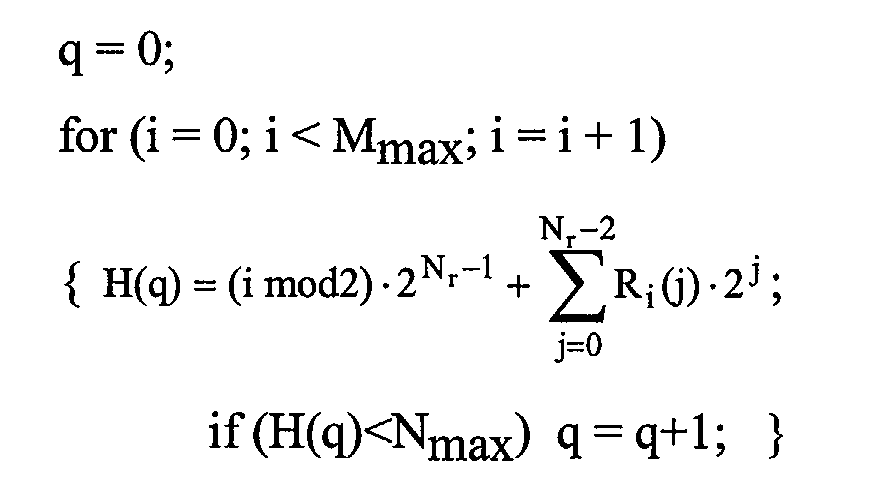
The address H(q) is then derived from Ri through the following equation:

The (i mod2) · 2Nr-1 part of the above equation is represented in Figure 5 and in
Figure 6 by the toggle block T 218.
An address check is then performed on H(q) to verify that the generated
address is within the range of acceptable addresses: if (H(q)<Nmax), where Nmax
=1512 in the 2K mode and 6048 in the 8K mode, then the address is valid. If the
address is not valid, the control unit is informed and it will try to generate a new H(q)
by incrementing the index i.
The role of the toggle block is to make sure that we do not generate an address
exceeding Nmax twice in a row. In effect, if an exceeding value was generated, this
means that the MSB (i.e. the toggle bit) of the address H(q) was one. So the next value
generated will have a MSB set to zero, insuring to produce a valid address.
The following equations sum up the overall behaviour and help to understand
the loop structure of this algorithm:
According to the present technique an address generator 102.3 for the 4k mode
is shown in Figure 7. Again, the address generator of Figure 7 corresponds to the
address generator shown in Figures 5 and 6 and so the only differences between these
Figures will be discussed and explained. As shown in Figure 7 the linear feed back
shift register 200.3 has eleven shift register stages. Again, an xor-gate 202.3 is
provided to generate the pseudo random bit sequence. The permutation of the contents
of the shift register in order to form the address of an input data symbol for mapping
onto one of the COFDM carrier signals is provided by the permutation circuit 210.3.
The symbol interleaver acts on blocks of Nmax = 3024 data symbols. (Mmax =
4096).
The polynomial used to generate the R'i sequence is:
R'i [10] = R'i -1 [0] ⊕ R'i -1 [2]
A vector Ri is derived from the vector R'i by the bit permutation given in Table
4:
| Bit permutation for the 4K mode | |||||||||||
| R'i bit positions | 10 | 9 | 8 | 7 | 6 | 5 | 4 | 3 | 2 | 1 | 0 |
| Ri bit positions | 7 | 10 | 5 | 8 | 1 | 2 | 4 | 9 | 0 | 3 | 6 |
The input of the interleaver is defined as the vector Y' = (y0', y1',
y2',...yNmax-1').
The interleaved vector Y = (y0, y1, y2,...yNmax-1) is defined by:
yH(q) = y'q for even symbols for q = 0,...,Nmax -1
yq = y'H(q) for odd symbols for q = 0,...,Nmax -1
Figure 8 provides an example illustration of a receiver which may be used with
the present technique. As shown in Figure 8, a COFDM signal is received by an
antenna 300 and detected by a tuner 302 and converted into a digital form by an
analogue-to-digital converter 304. A guard interval removal processor 306 removes
the guard interval from a received COFDM symbol, before the data is recovered from
the COFDM symbol using a Fast Fourier Transform (FFT) processor 308 in
combination with a pilot extraction processor 310 in co-operation with a pilot and
Transmission Parameter Signalling (TPS) channel processing unit 311, in accordance
with known techniques. The demodulated data is recovered from a de-mapper 312 and
fed to an inner symbol de-interleaver 314, which operates to effect the reverse
mapping of the received data symbol to re-generate an output data stream with the data
de-interleaved.
The symbol de-interleaver 314 is formed from a data processing apparatus as
shown in Figure 9 with an interleaver memory 340 and an address generator 342. The
interleaver memory is as shown in Figure 4 and operates as already explained above to
effect de-interleaving by utilising sets of addresses generated by the address generator
342. The address generator 342 is formed as shown in Figure 7 and is arranged to
generate corresponding addresses to map the data symbols recovered from each
COFDM sub-carrier signals into an output data stream.
The remaining parts of the COFDM receiver shown in Figure 8 are provided to
effect error correction decoding and de-interleaving to correct errors and recover an
estimate of the source data. In particular, an inner-code de-interleaver 316 and an
inner-decoder 318 operate to effect decoding of the inner convolutional code
introduced by the inner interleaver 30 and the inner coder 28 of the receiver shown in
Figure 1. An outer de-interleaver 320 and an outer decoder 322 operate to effect
decoding of the Reed-Solomon code to recover an estimate of the data from the source
1, after being descrambled by a descrambler 324.
One advantage provided by the present technique for both the receiver and the
transmitter is that a symbol interleaver and a symbol de-interleaver operating in the
receivers and transmitters can be switched between the 2k, 8k and the 4k mode by
changing the generator polynomials and the permutation order. A flexible
implementation is thereby provided because a symbol interleaver and de-interleaver
can be formed as shown in Figures 4 and 9, with an address generator as illustrated in
either of Figures 5, 6 or 7. The address generator can therefore be adapted to the
different modes by changing to the generator polynomials and the permutation orders
indicated for each of the 2k, 4k, and 8k modes. For example this can be effected using
a software change. Alternatively, in other embodiments, an embedded TPS signal
indicating the mode of the DVB-T transmission can be detected in the receiver in the
TPS channel processing unit 311 and used to configure automatically the symbol de-interleaver
in accordance with the detected mode.
Various modifications may be made to the embodiments described above
without departing from the scope of the present invention. In particular, the example
representation of the generator polynomial and the permutation order which have been
used to represent aspects of the invention are not intended to be limiting and extend to
equivalent forms of the generator polynomial and the permutation order.
As will be appreciated the transmitter and receiver shown in Figures 1 and 8
respectively are provided as illustrations only and are not intended to be limiting. For
example, it will be appreciated that the position of the symbol interleaver and the de-interleaver
with respect, for example to the bit interleaver and the mapper and de-mapper.
As will be appreciated the effect of the interleaver and de-interleaver is unchanged
by its relative position, although the interleaver may be interleaving I/Q
symbols instead of v-bit vectors. A corresponding change may be made in the
receiver. Accordingly the interleaver and de-interleaver may be operating on different
data types, and may be positioned differently to the postion described in the example
embodiments.
[1] EN 300 744, "Framing structure, channel coding and modulation for digital
terrestrial television", ETSI.
Claims (15)
- A data processing apparatus operable to map input symbols to be communicated onto a predetermined number of carrier signals of an Orthogonal Frequency Division Multiplexed (OFDM) symbol, the data processing apparatus comprising
an interleaver memory operable to read-in the predetermined number of data symbols for mapping onto the OFDM carrier signals, and to read-out the data symbols for the OFDM carriers to effect the mapping, the read-out being in a different order than the read-in, the order being determined from a set of addresses, with the effect that the data symbols are interleaved on the carrier signals,
an address generator operable to generate the set of addresses, an address being generated for each of the input symbols to indicate one of the carrier signals onto which the data symbol is to be mapped, the address generator comprising
a linear feedback shift register including a predetermined number of register stages and being operable to generate a pseudo-random bit sequence in accordance with a generator polynomial,
a permutation circuit operable to receive the content of the shift register stages and to permute the bits present in the register stages in accordance with a permutation order to form an address of one of the of OFDM carriers, and
a control unit operable in combination with an address check circuit to re-generate an address when a generated address exceeds the predetermined number of carriers, characterised in that
the predetermined number of OFDM carrier signals is substantially four thousand,
the linear feedback shift register has eleven register stages with a generator polynomial for the linear feedback shift register of R'i [10] = R'i -1[0] ⊕ R'i -1[2], and the permutation order forms an eleven bit address Ri [n] for the i-th data symbol from the bit present in the n-th register stage R' i [n] in accordance with the table:R'i [n] for n = 10 9 8 7 6 5 4 3 2 1 0 Ri [n] for n = 7 10 5 8 1 2 4 9 0 3 6 - A data processing apparatus as claimed in Claim 1, wherein the predetermined number of carrier signals is three thousand and twenty four.
- A data processing apparatus as claimed in Claim 1 or 2, wherein the interleaver memory is operable to effect the mapping of the input data symbols onto the carrier signals for even OFDM symbols by reading in the data symbols according to the set of addresses generated by the address generator and reading out in a sequential order, and for odd OFDM symbols by reading in the symbols into the memory in a sequential order and reading out the data symbols from the memory in accordance with the set of addresses generated by the address generator.
- A transmitter for transmitting data using Orthogonal Frequency Division Multiplexing (OFDM), the transmitter including a data processing apparatus according to any preceding Claim.
- A transmitter as claimed in Claim 4, wherein the transmitter is operable to transmit data in accordance with the Digital Video Broadcasting-Terrestrial standard.
- A data processing apparatus operable to de-map symbols received from a predetermined number of carrier signals of an Orthogonal Frequency Division Multiplexed (OFDM) symbol into an output symbol stream, the data processing apparatus comprising
a de-interleaver memory operable to read-in the predetermined number of data symbols from the OFDM carrier signals, and to read-out the data symbols into the output symbol stream to effect the de-mapping, the read-out being in a different order than the read-in, the order being determined from a set of addresses, with the effect that the data symbols are de-interleaved from the OFDM carrier signals,
an address generator operable to generate the set of addresses, an address being generated for each of the received data symbols to indicate the OFDM carrier signal from which the received data symbol is to be de-mapped into the output symbol stream, the address generator comprising
a linear feedback shift register including a predetermined number of register stages and being operable to generate a pseudo-random bit sequence in accordance with a generator polynomial,
a permutation circuit operable to receive the content of the shift register stages and to permute the bits present in the register stages in accordance with a permutation order to form an address of one of the OFDM carriers, and
a control unit operable in combination with an address check circuit to re-generate an address when a generated address exceeds the predetermined number of carriers, characterised in that
the predetermined number of OFDM carrier signals is substantially four thousand,
the linear feedback shift register has eleven register stages with a generator polynomial for the linear feedback shift register of R'i [10]=R' i-1[0]⊕R' i-1[2], and the permutation order forms an eleven bit address Ri [n] for the i-th data symbol from the bit present in the n-th register stage R'i [n] in accordance with the table:R'i [n] for n = 10 9 8 7 6 5 4 3 2 1 0 Ri [n] for n = 7 10 5 8 1 2 4 9 0 3 6 - A data processing apparatus as claimed in Claim 6, wherein the predetermined number of carrier signals is three thousand and twenty four.
- A data processing apparatus as claimed in Claim 6 or 7, wherein the de-interleaver memory is arranged to effect the de-mapping of the received data symbols from the carrier signals onto the output data stream for even OFDM symbols by reading in the data symbols according to a sequential order and reading out the data symbols from memory according to the set of addresses generated by the address generator, and for odd OFDM symbols by reading in the symbols into the memory in accordance with the set of addresses generated by the address generator and reading out the data symbols from the memory in accordance with a sequential order.
- A receiver for receiving data from Orthogonal Frequency Division Multiplexing (OFDM) modulated signal, the receiver including a data processing apparatus according to any of Claims 6, 7 or 8.
- A receiver as claimed in Claim 9, wherein the receiver is operable to receive data which has been modulated in accordance with the Digital Video Broadcasting-Terrestrial standard.
- A method of mapping input symbols to be communicated onto a predetermined number of carrier signals of an Orthogonal Frequency Division Multiplexed (OFDM) symbol, the method comprising
reading-in the predetermined number of data symbols for mapping onto the OFDM carrier signals,
reading-out the data symbols for the OFDM carriers to effect the mapping, the read-out being in a different order than the read-in, the order being determined from a set of addresses, with the effect that the data symbols are interleaved on the carrier signals,
generating the set of addresses, an address being generated for each of the input symbols to indicate one of the carrier signals onto which the data symbol is to be mapped, the generating the set of addresses comprising
using a linear feedback shift register including a predetermined number of register stages to generate a pseudo-random bit sequence in accordance with a generator polynomial,
using a permutation circuit operable to receive the content of the shift register stages to permute the bits present in the register stages in accordance with a permutation order to form an address of one of the of OFDM carriers, and
re-generating an address when a generated address exceeds the predetermined number of carriers, characterised in that
the predetermined number of OFDM carrier signals is substantially four thousand,
the linear feedback shift register has eleven register stages with a generator polynomial for the linear feedback shift register of R'i [10] = R'i -1[0] ⊕ R'i -1[2], and the permutation order forms an eleven bit address Ri [n] for the i-th data symbol from the bit present in the n-th register stage R'i [n] in accordance with the table:R'i [n] for n = 10 9 8 7 6 5 4 3 2 1 0 Ri [n] for n = 7 10 5 8 1 2 4 9 0 3 6 - A method of de-mapping symbols received from a predetermined number of carrier signals of an Orthogonal Frequency Division Multiplexed (OFDM) symbol into an output symbol stream, the method comprising
reading-in the predetermined number of data symbols from the OFDM carrier signals,
reading-out the data symbols into the output symbol stream to effect the de-mapping, the read-out being in a different order than the read-in, the order being determined from a set of addresses, with the effect that the data symbols are de-interleaved from the OFDM carrier signals,
generating the set of addresses, an address being generated for each of the received symbols to indicate the OFDM carrier signal from which the received data symbol is to be de-mapped into the output symbol stream, the generating the set of addresses comprising
using a linear feedback shift register including a predetermined number of register stages to generate a pseudo-random bit sequence in accordance with a generator polynomial,
using a permutation circuit to receive the content of the shift register stages and to permute the bits present in the register stages in accordance with a permutation order to form an address of one of the OFDM carriers, and
re-generating an address when a generated address exceeds the predetermined number of carriers, characterised in that
the predetermined number of OFDM carrier signals is substantially four thousand,
the linear feedback shift register has eleven register stages with a generator polynomial for the linear feedback shift register of R'i [10] = R'i -1[0]⊕ R'i -1[2], and the permutation order forms an eleven bit address Ri [n] for the i-th data symbol from the bit present in the n-th register stage R'i [n] in accordance with the table:R'i[n] for n = 10 9 8 7 6 5 4 3 2 1 0 Ri [n] for n = 7 10 5 8 1 2 4 9 0 3 6 - An address generator for use with transmission or reception of data symbols interleaved onto substantially four thousand carriers of an Orthogonal Frequency Division Multiplexed symbol, the address generator being operable to generate a set of addresses, each address being generated for each of the data symbols to indicate one of the carrier signals onto which the data symbol is to be mapped or de-mapped, the address generator comprising
a linear feedback shift register including a predetermined number of register stages and being operable to generate a pseudo-random bit sequence in accordance with a generator polynomial,
a permutation circuit operable to receive the content of the shift register stages and to permute the bits present in the register stages in accordance with a permutation order to form an address of one of the OFDM carriers, and
a control unit operable in combination with an address check circuit to re-generate an address when a generated address exceeds the predetermined number of carriers, characterised in that
the linear feedback shift register has eleven register stages with a generator polynomial for the linear feedback shift register of R'i [10] = R' i-1[0] ⊕ R' i-1[2], and the permutation order forms an eleven bit address Ri [n] for the i-th data symbol from the bit present in the n-th register stage Ri '[n] in accordance with the table:R'i [n] for n = 10 9 8 7 6 5 4 3 2 1 0 Ri [n] for n = 7 10 5 8 1 2 4 9 0 3 6 - A data processing apparatus operable to map data symbols according to Figure 4, a data processing apparatus according to Figure 9 operable to de-map symbols received, an address generator according to Figure 7, a transmitter according to Figure 1, or a receiver according to Figure 8 substantially as herein before described with reference to these accompanying drawings.
- A method of mapping input symbols to be communicated onto a predetermined number of carrier signals of an Orthogonal Frequency Division Multiplexed (OFDM) symbol, and a method of de-mapping symbols received from a predetermined number of carrier signals of an Orthogonal Frequency Division Multiplexed (OFDM) symbol into an output symbol stream, substantially as herein before described with reference to Figures 1 to 4 and 7 to 9.
Priority Applications (49)
| Application Number | Priority Date | Filing Date | Title |
|---|---|---|---|
| EP03290754A EP1463255A1 (en) | 2003-03-25 | 2003-03-25 | Interleaver for mapping symbols on the carriers of an OFDM system |
| ES06075518T ES2304757T3 (en) | 2003-03-25 | 2004-03-23 | INTERCALATOR TO CORRELATE SYMBOLS IN THE CARRIERS OF AN OFDM SYSTEM. |
| DK09010707.9T DK2117195T3 (en) | 2003-03-25 | 2004-03-23 | Interface for depicting symbols on carriers in an OFDM system |
| PT09010707T PT2117195E (en) | 2003-03-25 | 2004-03-23 | Interleaver for mapping symbols on the carriers of an ofdm system |
| PT08005969T PT1931097E (en) | 2003-03-25 | 2004-03-23 | Interleaver for mapping symbols on the carriers of an ofdm system |
| ES09010707T ES2348580T3 (en) | 2003-03-25 | 2004-03-23 | INTERCALATOR FOR ESTABLISHMENT OF SYMBOL CORRESPONDENCES ON THE CARRIERS OF AN OFDM SYSTEM. |
| EP09010707A EP2117195B1 (en) | 2003-03-25 | 2004-03-23 | Interleaver for mapping symbols on the carriers of an OFDM system |
| EP06075505A EP1662739B9 (en) | 2003-03-25 | 2004-03-23 | Interleaver for mapping symbols on the carriers of an OFDM system |
| PT10171645T PT2247055E (en) | 2003-03-25 | 2004-03-23 | Interleaver for mapping symbols on the carriers of an ofdm system |
| AT08005969T ATE445281T1 (en) | 2003-03-25 | 2004-03-23 | NESTING FOR SYMBOL REPRESENTATION ON THE CARRIERS OF AN OFDM (ORTHOGONAL FREQUENCY MULTIPLEXATION) SYSTEM |
| AT10171645T ATE549836T1 (en) | 2003-03-25 | 2004-03-23 | NESTING FOR SYMBOL REPRESENTATION ON THE CARRIER OF AN OFDM SYSTEM |
| AT04251667T ATE326105T1 (en) | 2003-03-25 | 2004-03-23 | NESTING FOR SYMBOL REPRESENTATION ON THE CARRIERS OF AN OFDM (ORTHOGONAL FREQUENCY MULTIPLEXATION) SYSTEM |
| DE602004000824T DE602004000824T2 (en) | 2003-03-25 | 2004-03-23 | Interleaver for symbol mapping on the supports of an OFDM (Orthogonal Frequency Division Multiplexing) system |
| US10/806,524 US7426240B2 (en) | 2003-03-25 | 2004-03-23 | Data processing apparatus and method operable to map and de-map symbols and carrier signals of an Orthogonal Frequency Division Multiplexed (OFDM) symbol |
| AT09010707T ATE476817T1 (en) | 2003-03-25 | 2004-03-23 | NESTING FOR SYMBOL REPRESENTATION ON THE CARRIER OF AN OFDM SYSTEM |
| DE602004013451T DE602004013451T2 (en) | 2003-03-25 | 2004-03-23 | Interleaver for symbol mapping on the supports of an OFDM (Orthogonal Frequency Division Multiplexing) system |
| DE602004016756T DE602004016756D1 (en) | 2003-03-25 | 2004-03-23 | Interleaver for symbol mapping on the supports of an OFDM (Orthogonal Frequency Division Multiplexing) system |
| EP10171645A EP2247055B1 (en) | 2003-03-25 | 2004-03-23 | Interleaver for mapping symbols on the carriers of an OFDM system |
| ES10171645T ES2381648T3 (en) | 2003-03-25 | 2004-03-23 | Interleaver to establish correspondence of symbols on the carriers of an OFDM system |
| DK06075505T DK1662739T3 (en) | 2003-03-25 | 2004-03-23 | Interleaver for symbol imaging in the carrier in an orthogonal frequency distributed multiplexing system |
| AT06075505T ATE409383T1 (en) | 2003-03-25 | 2004-03-23 | NESTING FOR SYMBOL REPRESENTATION ON THE CARRIERS OF AN OFDM (ORTHOGONAL FREQUENCY MULTIPLEXATION) SYSTEM |
| PL08005969T PL1931097T3 (en) | 2003-03-25 | 2004-03-23 | Interleaver for mapping symbols on the carriers of an OFDM system |
| PL09010707T PL2117195T3 (en) | 2003-03-25 | 2004-03-23 | Interleaver for mapping symbols on the carriers of an OFDM system |
| PT06075505T PT1662739E (en) | 2003-03-25 | 2004-03-23 | Interleaver for mapping symbols on the carriers of an ofdm system |
| ES08005969T ES2332158T3 (en) | 2003-03-25 | 2004-03-23 | INTERCALATOR TO CORRELATE SYMBOLS IN THE CARRIERS OF AN OFDM SYSTEM. |
| PL06075505T PL1662739T3 (en) | 2003-03-25 | 2004-03-23 | Interleaver for mapping symbols on the carriers of an OFDM system |
| DE602004028535T DE602004028535D1 (en) | 2003-03-25 | 2004-03-23 | Interleaver for symbol mapping on the supports of an OFDM system |
| DE602004023550T DE602004023550D1 (en) | 2003-03-25 | 2004-03-23 | Interleaver for symbol mapping on the supports of an OFDM (Orthogonal Frequency Division Multiplexing) system |
| DK04251667T DK1463256T3 (en) | 2003-03-25 | 2004-03-23 | Interleaver for symbol imaging in the carrier in an orthogonal frequency distributed multiplexing system |
| PT04251667T PT1463256E (en) | 2003-03-25 | 2004-03-23 | INTERCHLER TO CORRELATE SYMBOLS IN THE CARRIERS OF AN OFDM SYSTEM |
| EP08005969A EP1931097B1 (en) | 2003-03-25 | 2004-03-23 | Interleaver for mapping symbols on the carriers of an OFDM system |
| AT06075518T ATE394003T1 (en) | 2003-03-25 | 2004-03-23 | NESTING FOR SYMBOL REPRESENTATION ON THE CARRIERS OF AN OFDM (ORTHOGONAL FREQUENCY MULTIPLEXATION) SYSTEM |
| DK08005969T DK1931097T3 (en) | 2003-03-25 | 2004-03-23 | Interleaver to map symbols on the carriers of an OFDM system |
| PL04251667T PL1463256T3 (en) | 2003-03-25 | 2004-03-23 | Interleaver for mapping symbols on the carriers of an OFDM system |
| EP06075518A EP1662740B1 (en) | 2003-03-25 | 2004-03-23 | Interleaver for mapping symbols on the carriers of an OFDM system |
| EP04251667A EP1463256B1 (en) | 2003-03-25 | 2004-03-23 | Interleaver for mapping symbols on the carriers of an OFDM system |
| ES06075505T ES2310883T3 (en) | 2003-03-25 | 2004-03-23 | INTERCALATOR TO CORRELATE SYMBOLS IN THE CARRIERS OF AN OFDM SYSTEM. |
| DK10171645.4T DK2247055T3 (en) | 2003-03-25 | 2004-03-23 | Interface device for mapping symbols on the carriers of an OFDM system |
| PL10171645T PL2247055T3 (en) | 2003-03-25 | 2004-03-23 | Interleaver for mapping symbols on the carriers of an OFDM system |
| ES04251667T ES2260728T3 (en) | 2003-03-25 | 2004-03-23 | INTERCALATE ADAPTATION SYMBOLS IN THE CARRIERS OF AN OFDM SYSTEM. |
| KR1020040020263A KR100642539B1 (en) | 2003-03-25 | 2004-03-25 | Data processing apparatus and method |
| US12/051,541 US8130894B2 (en) | 2003-03-25 | 2008-03-19 | Data processing apparatus and method for use with a 4K interleaver in a digital video broadcasting (DVB) standard |
| US13/235,128 US8155228B2 (en) | 2003-03-25 | 2011-09-16 | Data processing apparatus and method |
| US13/442,659 US8885761B2 (en) | 2003-03-25 | 2012-04-09 | Data processing apparatus and method |
| US14/487,963 US9106494B2 (en) | 2003-03-25 | 2014-09-16 | Data processing apparatus and method |
| US14/788,176 US9300515B2 (en) | 2003-03-25 | 2015-06-30 | Data processing apparatus and method |
| US15/080,733 US9722836B2 (en) | 2003-03-25 | 2016-03-25 | Data processing apparatus and method |
| US15/664,918 US10044540B2 (en) | 2003-03-25 | 2017-07-31 | Data processing apparatus and method |
| US16/049,267 US10333753B2 (en) | 2003-03-25 | 2018-07-30 | Data processing apparatus and method |
Applications Claiming Priority (1)
| Application Number | Priority Date | Filing Date | Title |
|---|---|---|---|
| EP03290754A EP1463255A1 (en) | 2003-03-25 | 2003-03-25 | Interleaver for mapping symbols on the carriers of an OFDM system |
Publications (1)
| Publication Number | Publication Date |
|---|---|
| EP1463255A1 true EP1463255A1 (en) | 2004-09-29 |
Family
ID=32799145
Family Applications (7)
| Application Number | Title | Priority Date | Filing Date |
|---|---|---|---|
| EP03290754A Withdrawn EP1463255A1 (en) | 2003-03-25 | 2003-03-25 | Interleaver for mapping symbols on the carriers of an OFDM system |
| EP04251667A Expired - Lifetime EP1463256B1 (en) | 2003-03-25 | 2004-03-23 | Interleaver for mapping symbols on the carriers of an OFDM system |
| EP08005969A Expired - Lifetime EP1931097B1 (en) | 2003-03-25 | 2004-03-23 | Interleaver for mapping symbols on the carriers of an OFDM system |
| EP09010707A Expired - Lifetime EP2117195B1 (en) | 2003-03-25 | 2004-03-23 | Interleaver for mapping symbols on the carriers of an OFDM system |
| EP06075505A Expired - Lifetime EP1662739B9 (en) | 2003-03-25 | 2004-03-23 | Interleaver for mapping symbols on the carriers of an OFDM system |
| EP10171645A Expired - Lifetime EP2247055B1 (en) | 2003-03-25 | 2004-03-23 | Interleaver for mapping symbols on the carriers of an OFDM system |
| EP06075518A Expired - Lifetime EP1662740B1 (en) | 2003-03-25 | 2004-03-23 | Interleaver for mapping symbols on the carriers of an OFDM system |
Family Applications After (6)
| Application Number | Title | Priority Date | Filing Date |
|---|---|---|---|
| EP04251667A Expired - Lifetime EP1463256B1 (en) | 2003-03-25 | 2004-03-23 | Interleaver for mapping symbols on the carriers of an OFDM system |
| EP08005969A Expired - Lifetime EP1931097B1 (en) | 2003-03-25 | 2004-03-23 | Interleaver for mapping symbols on the carriers of an OFDM system |
| EP09010707A Expired - Lifetime EP2117195B1 (en) | 2003-03-25 | 2004-03-23 | Interleaver for mapping symbols on the carriers of an OFDM system |
| EP06075505A Expired - Lifetime EP1662739B9 (en) | 2003-03-25 | 2004-03-23 | Interleaver for mapping symbols on the carriers of an OFDM system |
| EP10171645A Expired - Lifetime EP2247055B1 (en) | 2003-03-25 | 2004-03-23 | Interleaver for mapping symbols on the carriers of an OFDM system |
| EP06075518A Expired - Lifetime EP1662740B1 (en) | 2003-03-25 | 2004-03-23 | Interleaver for mapping symbols on the carriers of an OFDM system |
Country Status (9)
| Country | Link |
|---|---|
| US (3) | US7426240B2 (en) |
| EP (7) | EP1463255A1 (en) |
| KR (1) | KR100642539B1 (en) |
| AT (6) | ATE394003T1 (en) |
| DE (5) | DE602004028535D1 (en) |
| DK (5) | DK2247055T3 (en) |
| ES (6) | ES2348580T3 (en) |
| PL (5) | PL2247055T3 (en) |
| PT (5) | PT1931097E (en) |
Cited By (30)
| Publication number | Priority date | Publication date | Assignee | Title |
|---|---|---|---|---|
| WO2005052798A1 (en) * | 2003-11-26 | 2005-06-09 | Cygnus Communications Canada Co. | Interleaving memory |
| WO2008023253A3 (en) * | 2006-08-22 | 2008-05-08 | Nokia Corp | Fft-based signal processing with reduced latency |
| US7395461B2 (en) * | 2005-05-18 | 2008-07-01 | Seagate Technology Llc | Low complexity pseudo-random interleaver |
| US7415584B2 (en) | 2003-11-26 | 2008-08-19 | Cygnus Communications Canada Co. | Interleaving input sequences to memory |
| US7502982B2 (en) | 2005-05-18 | 2009-03-10 | Seagate Technology Llc | Iterative detector with ECC in channel domain |
| EP2056474A1 (en) * | 2007-10-30 | 2009-05-06 | Sony Corporation | Data processing apparatus and method |
| EP2056471A1 (en) * | 2007-10-30 | 2009-05-06 | Sony Corporation | Data processing apparatus and method |
| EP2056467A1 (en) | 2007-10-30 | 2009-05-06 | Sony Corporation | Data processing apparatus and method |
| EP2056470A1 (en) | 2007-10-30 | 2009-05-06 | Sony Corporation | Data processing apparatus and method |
| WO2009056801A1 (en) * | 2007-10-30 | 2009-05-07 | Sony Corporation | Data processing apparatus and method |
| EP2056549A3 (en) * | 2007-10-30 | 2009-09-16 | Sony Corporation | Data processing apparatus and method |
| EP1979885A4 (en) * | 2006-01-19 | 2009-10-21 | Lg Electronics Inc | Method for transmitting and receiving traffic information and apparatus thereof |
| GB2462750A (en) * | 2007-10-30 | 2010-02-24 | Sony Corp | Symbol to sub-carrier interleaver for DVB-T2 using odd interleaving |
| GB2462749A (en) * | 2007-10-30 | 2010-02-24 | Sony Corp | Symbol to sub-carrier interleaver for DVB-T2 using odd interleaving |
| EP1947789A3 (en) * | 2007-01-22 | 2012-04-04 | Samsung Electronics Co., Ltd. | Digital broadcasting receiver and channel tuning method thereof |
| US8335964B2 (en) | 2007-11-26 | 2012-12-18 | Sony Corporation | Data processing apparatus and data processing method as well as encoding apparatus and encoding method |
| US8489956B2 (en) | 2007-11-26 | 2013-07-16 | Sony Corporation | Data processing apparatus and data processing method |
| US8489955B2 (en) | 2007-11-26 | 2013-07-16 | Sony Corporation | Data processing apparatus, data processing method and program |
| US8499214B2 (en) | 2007-11-26 | 2013-07-30 | Sony Corporation | Data processing apparatus and data processing method |
| US8516335B2 (en) | 2007-11-26 | 2013-08-20 | Sony Corporation | Data processing apparatus and data processing method |
| US8578237B2 (en) | 2007-11-26 | 2013-11-05 | Sony Corporation | Data processing apparatus and data processing method |
| US8885761B2 (en) | 2003-03-25 | 2014-11-11 | Sony Corporation | Data processing apparatus and method |
| CN104917587A (en) * | 2014-03-13 | 2015-09-16 | 钜泉光电科技(上海)股份有限公司 | Data block interleaving and de-interleaving method in communication equipment and device thereof |
| CN105680992A (en) * | 2016-01-26 | 2016-06-15 | 华中科技大学 | Construction method of coset partition (n, n(n-1), n-1) permutation group code and code set generator thereof |
| CN105721929A (en) * | 2014-12-02 | 2016-06-29 | 晨星半导体股份有限公司 | Frequency de-interleaving and time de-interleaving circuit and method and receiving circuit of digital television |
| EP2510516A4 (en) * | 2009-12-10 | 2017-09-06 | Samsung Electronics Co., Ltd. | Method for encoding information object and encoder using the same |
| CN107395545A (en) * | 2017-08-09 | 2017-11-24 | 南京邮电大学 | A kind of implementation method of ROBO interleaving technologies |
| CN107707332A (en) * | 2011-05-18 | 2018-02-16 | 松下电器产业株式会社 | Parallel bit interleaver |
| CN109728826A (en) * | 2017-10-27 | 2019-05-07 | 深圳市中兴微电子技术有限公司 | A kind of data interleaving and deinterleaving method and device |
| CN110336657A (en) * | 2019-07-03 | 2019-10-15 | 上海大学 | A Dynamic Key Generation Method for Optical OFDM Based on Channel Characteristics |
Families Citing this family (70)
| Publication number | Priority date | Publication date | Assignee | Title |
|---|---|---|---|---|
| GB2454195A (en) * | 2007-10-30 | 2009-05-06 | Sony Corp | Address generation polynomial and permutation matrix for DVB-T2 16k OFDM sub-carrier mode interleaver |
| GB2454194A (en) * | 2007-10-30 | 2009-05-06 | Sony Corp | Address generation polynomial and permutation matrix for DVB-T2 1k OFDM sub-carrier mode interleaver |
| US7991056B2 (en) * | 2004-02-13 | 2011-08-02 | Broadcom Corporation | Method and system for encoding a signal for wireless communications |
| KR100713528B1 (en) * | 2004-03-12 | 2007-05-02 | 삼성전자주식회사 | Apparatus and method for transmitting sub-channel signal in a communication system using orthogonal frequency division multiple access scheme |
| US7626960B2 (en) * | 2004-04-20 | 2009-12-01 | Nokia Corporation | Use of signaling for auto-configuration of modulators and repeaters |
| JP2006014321A (en) * | 2004-06-21 | 2006-01-12 | Samsung Electronics Co Ltd | Method for transmitting / receiving operation mode information in a broadband wireless access communication system |
| US20050289592A1 (en) * | 2004-06-29 | 2005-12-29 | Larri Vermola | System and method for service listings |
| US7123669B2 (en) * | 2004-10-25 | 2006-10-17 | Sandbridge Technologies, Inc. | TPS decoder in an orthogonal frequency division multiplexing receiver |
| WO2006071050A1 (en) * | 2004-12-27 | 2006-07-06 | Lg Electronics Inc. | Communicating non-coherent detectable signal in broadband wireless access system |
| WO2006117665A1 (en) * | 2005-05-04 | 2006-11-09 | Nortel Networks Limited | Wireless feedback system and method |
| KR20060119743A (en) | 2005-05-18 | 2006-11-24 | 엘지전자 주식회사 | Method and apparatus for providing prediction information about interval speed and using same |
| KR20060119741A (en) * | 2005-05-18 | 2006-11-24 | 엘지전자 주식회사 | Method and apparatus for providing trend information of communication status and using it |
| KR101061460B1 (en) * | 2005-05-18 | 2011-09-02 | 엘지전자 주식회사 | Method and apparatus for providing prediction information about communication status and using it |
| KR20060119742A (en) * | 2005-05-18 | 2006-11-24 | 엘지전자 주식회사 | Method and apparatus for providing road information and using it |
| KR20060119739A (en) * | 2005-05-18 | 2006-11-24 | 엘지전자 주식회사 | Method and apparatus for providing prediction information about interval passing time |
| KR20060119746A (en) * | 2005-05-18 | 2006-11-24 | 엘지전자 주식회사 | Method and apparatus for providing information on traffic conditions and using it |
| KR20060122668A (en) * | 2005-05-27 | 2006-11-30 | 엘지전자 주식회사 | Traffic information provision method and receiving device |
| KR101066320B1 (en) * | 2005-06-07 | 2011-09-20 | 삼성전자주식회사 | Symbol transmission and reception apparatus and method in mobile communication system |
| US7590674B2 (en) * | 2005-06-30 | 2009-09-15 | Conexant Systems, Inc. | Method and apparatus for generating a random bit stream |
| US8711850B2 (en) * | 2005-07-08 | 2014-04-29 | Lg Electronics Inc. | Format for providing traffic information and a method and apparatus for using the format |
| KR101254219B1 (en) * | 2006-01-19 | 2013-04-23 | 엘지전자 주식회사 | method and apparatus for identifying a link |
| US20070115960A1 (en) * | 2005-11-04 | 2007-05-24 | Mediatek Inc. | De-interleaver for data decoding |
| WO2007083941A1 (en) | 2006-01-19 | 2007-07-26 | Lg Electronics Inc. | Method for transmitting and receiving tranffic information and apparatus thereof |
| KR101236543B1 (en) * | 2006-10-13 | 2013-02-22 | 엘지전자 주식회사 | method for transmitting/receiving traffic information and apparatus for transmitting/receiving traffic information |
| EP1993312B1 (en) * | 2006-03-20 | 2016-01-27 | Optis Wireless Technology, LLC | Radio communication mobile station device and radio communication method |
| US7599441B2 (en) * | 2006-06-20 | 2009-10-06 | Newport Media, Inc. | Low complexity soft-input Viterbi decoding for digital communication systems |
| US7801020B2 (en) * | 2007-08-29 | 2010-09-21 | Intel Corporation | Mobile channel estimation algorithm for DVB-H COFDM demodulator |
| US8027394B2 (en) * | 2007-09-25 | 2011-09-27 | Silicon Laboratories Inc. | Reducing data stream jitter during deinterleaving |
| GB2454722B (en) * | 2007-11-16 | 2012-10-24 | Sony Corp | Data processing apparatus and method |
| KR101469977B1 (en) * | 2008-01-29 | 2014-12-10 | 삼성전자주식회사 | And apparatus for transmitting and receiving preamble in digital video broadcasting system |
| EP3487134B1 (en) | 2008-01-29 | 2021-12-22 | Samsung Electronics Co., Ltd. | Method for transmitting and receiving preambles in a digital video broadcasting system |
| GB2460459B (en) * | 2008-05-30 | 2012-07-11 | Sony Corp | Data processing apparatus and method |
| US8311222B2 (en) * | 2008-08-26 | 2012-11-13 | GlobalFoundries, Inc. | Hardware based multi-dimensional encryption |
| US8127105B2 (en) * | 2008-11-04 | 2012-02-28 | Qualcomm Incorporated | Parallel pruned bit-reversal interleaver |
| US8165164B1 (en) * | 2009-06-30 | 2012-04-24 | Lattice Semiconductor Corporation | In-system reconfigurable circuit for mapping data words of different lengths |
| TW201141198A (en) * | 2009-10-20 | 2011-11-16 | Sony Corp | Frame mapping apparatus and method |
| US8433970B2 (en) | 2010-03-31 | 2013-04-30 | Silicon Laboratories Inc. | Techniques to control power consumption in an iterative decoder by control of node configurations |
| US8341486B2 (en) | 2010-03-31 | 2012-12-25 | Silicon Laboratories Inc. | Reducing power consumption in an iterative decoder |
| US8555131B2 (en) | 2010-03-31 | 2013-10-08 | Silicon Laboratories Inc. | Techniques to control power consumption in an iterative decoder by control of node configurations |
| US8237869B2 (en) | 2010-03-31 | 2012-08-07 | Silicon Laboratories Inc. | Multi-standard digital demodulator for TV signals broadcast over cable, satellite and terrestrial networks |
| US9240808B2 (en) * | 2010-09-10 | 2016-01-19 | Trellis Phase Communications, Lp | Methods, apparatus, and systems for coding with constrained interleaving |
| US8537919B2 (en) * | 2010-09-10 | 2013-09-17 | Trellis Phase Communications, Lp | Encoding and decoding using constrained interleaving |
| US9118350B2 (en) | 2010-09-10 | 2015-08-25 | Trellis Phase Communications, Lp | Methods, apparatus, and systems for coding with constrained interleaving |
| US9116826B2 (en) | 2010-09-10 | 2015-08-25 | Trellis Phase Communications, Lp | Encoding and decoding using constrained interleaving |
| US8532209B2 (en) * | 2010-11-24 | 2013-09-10 | Trellis Phase Communications, Lp | Methods, apparatus, and systems for coding with constrained interleaving |
| US9112534B2 (en) | 2010-09-10 | 2015-08-18 | Trellis Phase Communications, Lp | Methods, apparatus, and systems for coding with constrained interleaving |
| US9362955B2 (en) | 2010-09-10 | 2016-06-07 | Trellis Phase Communications, Lp | Encoding and decoding using constrained interleaving |
| US8837611B2 (en) | 2011-02-09 | 2014-09-16 | Silicon Laboratories Inc. | Memory-aided synchronization in a receiver |
| EP2525497A1 (en) | 2011-05-18 | 2012-11-21 | Panasonic Corporation | Bit-interleaved coding and modulation (BICM) with quasi-cyclic LDPC codes |
| EP2536054A1 (en) * | 2011-06-16 | 2012-12-19 | Fraunhofer-Gesellschaft zur Förderung der angewandten Forschung e.V. | Transmitter and receiver using non-adjacent component interleaving |
| CN103166735B (en) * | 2011-12-15 | 2015-11-25 | 无锡中星微电子有限公司 | A kind of reading/writing method of interleaver |
| US10133156B2 (en) * | 2012-01-10 | 2018-11-20 | Apple Inc. | Fused opaque and clear glass for camera or display window |
| US8644370B2 (en) | 2012-01-25 | 2014-02-04 | Silicon Laboratories | Providing slope values for a demapper |
| US8959274B2 (en) | 2012-09-06 | 2015-02-17 | Silicon Laboratories Inc. | Providing a serial download path to devices |
| US20150365204A1 (en) * | 2013-03-17 | 2015-12-17 | Lg Electronics Inc. | Broadcast signal transmitting method, broadcast signal receiving method, broadcast signal transmitting apparatus, and broadcast signal receiving apparatus |
| AU2014307164B2 (en) | 2013-08-14 | 2017-06-15 | Lg Electronics Inc. | Apparatus for transmitting broadcast signals, apparatus for receiving broadcast signals, method for transmitting broadcast signals and method for receiving broadcast signals |
| KR101809966B1 (en) | 2013-08-14 | 2017-12-18 | 엘지전자 주식회사 | Apparatus for transmitting broadcast signals, apparatus for receiving broadcast signals, method for transmitting broadcast signals and method for receiving broadcast signals |
| KR102113942B1 (en) | 2013-09-20 | 2020-06-02 | 새턴 라이센싱 엘엘씨 | Data processing device and data processing method |
| JP2015170912A (en) | 2014-03-05 | 2015-09-28 | ソニー株式会社 | Data processing apparatus and data processing method |
| WO2015163597A1 (en) * | 2014-04-21 | 2015-10-29 | 엘지전자 주식회사 | Broadcasting signal transmission apparatus, broadcasting signal reception apparatus, broadcasting signal transmission method, and broadcasting reception method |
| CN104270247B (en) * | 2014-05-23 | 2018-05-01 | 中国人民解放军信息工程大学 | Suitable for the efficient general Hash functions authentication method of quantum cryptography system |
| TWI551079B (en) * | 2014-11-28 | 2016-09-21 | 晨星半導體股份有限公司 | Circuit and method for processing data in de-interleaving process of dvb-t2 |
| WO2016111430A1 (en) | 2015-01-05 | 2016-07-14 | 엘지전자(주) | Broadcast signal transmission apparatus, broadcast signal reception apparatus, broadcast signal transmission method, and broadcast signal reception method |
| JP6487054B2 (en) | 2015-02-06 | 2019-03-20 | エルジー エレクトロニクス インコーポレイティド | Broadcast signal transmitting apparatus, broadcast signal receiving apparatus, broadcast signal transmitting method, and broadcast signal receiving method |
| US9564927B2 (en) | 2015-05-27 | 2017-02-07 | John P Fonseka | Constrained interleaving for 5G wireless and optical transport networks |
| CA3003703C (en) * | 2015-11-10 | 2024-04-16 | Sony Corporation | Data processing apparatus, and data processing method |
| TWI593240B (en) * | 2016-05-27 | 2017-07-21 | 晨星半導體股份有限公司 | Decoding apparatus and decoding method including error correction process |
| CA3168904A1 (en) | 2020-01-27 | 2021-08-05 | Geniphys, Inc. | Biologic filler for restoring and regenerating tissue |
| US11816228B2 (en) | 2020-09-25 | 2023-11-14 | Advanced Micro Devices, Inc. | Metadata tweak for channel encryption differentiation |
| EP4425793B1 (en) * | 2021-11-18 | 2025-11-26 | Mitsubishi Electric Corporation | Transmission device and encoding method |
Citations (1)
| Publication number | Priority date | Publication date | Assignee | Title |
|---|---|---|---|---|
| US6353900B1 (en) * | 1998-09-22 | 2002-03-05 | Qualcomm Incorporated | Coding system having state machine based interleaver |
Family Cites Families (2)
| Publication number | Priority date | Publication date | Assignee | Title |
|---|---|---|---|---|
| DK2302810T3 (en) * | 1995-02-01 | 2013-07-22 | Sony Corp | Multichannel transmission with interleaving when addressing on-site RAM |
| US7620111B2 (en) * | 2002-08-13 | 2009-11-17 | Nokia Corporation | Symbol interleaving |
-
2003
- 2003-03-25 EP EP03290754A patent/EP1463255A1/en not_active Withdrawn
-
2004
- 2004-03-23 PT PT08005969T patent/PT1931097E/en unknown
- 2004-03-23 EP EP04251667A patent/EP1463256B1/en not_active Expired - Lifetime
- 2004-03-23 DK DK10171645.4T patent/DK2247055T3/en active
- 2004-03-23 AT AT06075518T patent/ATE394003T1/en not_active IP Right Cessation
- 2004-03-23 PL PL10171645T patent/PL2247055T3/en unknown
- 2004-03-23 DE DE602004028535T patent/DE602004028535D1/en not_active Expired - Lifetime
- 2004-03-23 AT AT04251667T patent/ATE326105T1/en active
- 2004-03-23 PL PL04251667T patent/PL1463256T3/en unknown
- 2004-03-23 EP EP08005969A patent/EP1931097B1/en not_active Expired - Lifetime
- 2004-03-23 DE DE602004016756T patent/DE602004016756D1/en not_active Expired - Lifetime
- 2004-03-23 AT AT09010707T patent/ATE476817T1/en active
- 2004-03-23 EP EP09010707A patent/EP2117195B1/en not_active Expired - Lifetime
- 2004-03-23 EP EP06075505A patent/EP1662739B9/en not_active Expired - Lifetime
- 2004-03-23 AT AT08005969T patent/ATE445281T1/en active
- 2004-03-23 PT PT04251667T patent/PT1463256E/en unknown
- 2004-03-23 DE DE602004023550T patent/DE602004023550D1/en not_active Expired - Lifetime
- 2004-03-23 DK DK09010707.9T patent/DK2117195T3/en active
- 2004-03-23 AT AT06075505T patent/ATE409383T1/en active
- 2004-03-23 EP EP10171645A patent/EP2247055B1/en not_active Expired - Lifetime
- 2004-03-23 AT AT10171645T patent/ATE549836T1/en active
- 2004-03-23 ES ES09010707T patent/ES2348580T3/en not_active Expired - Lifetime
- 2004-03-23 PT PT06075505T patent/PT1662739E/en unknown
- 2004-03-23 US US10/806,524 patent/US7426240B2/en active Active
- 2004-03-23 PT PT10171645T patent/PT2247055E/en unknown
- 2004-03-23 PL PL09010707T patent/PL2117195T3/en unknown
- 2004-03-23 PT PT09010707T patent/PT2117195E/en unknown
- 2004-03-23 DK DK08005969T patent/DK1931097T3/en active
- 2004-03-23 DE DE602004013451T patent/DE602004013451T2/en not_active Expired - Lifetime
- 2004-03-23 PL PL08005969T patent/PL1931097T3/en unknown
- 2004-03-23 ES ES08005969T patent/ES2332158T3/en not_active Expired - Lifetime
- 2004-03-23 ES ES06075505T patent/ES2310883T3/en not_active Expired - Lifetime
- 2004-03-23 PL PL06075505T patent/PL1662739T3/en unknown
- 2004-03-23 ES ES10171645T patent/ES2381648T3/en not_active Expired - Lifetime
- 2004-03-23 DE DE602004000824T patent/DE602004000824T2/en not_active Expired - Lifetime
- 2004-03-23 DK DK04251667T patent/DK1463256T3/en active
- 2004-03-23 DK DK06075505T patent/DK1662739T3/en active
- 2004-03-23 ES ES04251667T patent/ES2260728T3/en not_active Expired - Lifetime
- 2004-03-23 ES ES06075518T patent/ES2304757T3/en not_active Expired - Lifetime
- 2004-03-23 EP EP06075518A patent/EP1662740B1/en not_active Expired - Lifetime
- 2004-03-25 KR KR1020040020263A patent/KR100642539B1/en not_active Expired - Fee Related
-
2008
- 2008-03-19 US US12/051,541 patent/US8130894B2/en not_active Expired - Fee Related
-
2011
- 2011-09-16 US US13/235,128 patent/US8155228B2/en not_active Expired - Fee Related
Patent Citations (1)
| Publication number | Priority date | Publication date | Assignee | Title |
|---|---|---|---|---|
| US6353900B1 (en) * | 1998-09-22 | 2002-03-05 | Qualcomm Incorporated | Coding system having state machine based interleaver |
Non-Patent Citations (2)
| Title |
|---|
| ANONYMOUS: "Features of ISDB-T", DIGITAL BROADCASTING EXPERTS GROUP (DIBEG), 28 July 2000 (2000-07-28), XP002249911, Retrieved from the Internet <URL:http://www.dibeg.org/PressR/Brazil/comments730b.PDF> [retrieved on 20030801] * |
| EUROPEAN TELECOMMUNICATIONS STANDARDS INSTITUTE: "Digital Video Broadcasting (DVB);Framing structure, channel coding and modulation for digital terrestrial television", ETSI EN 300 744 V1.4.1, January 2001 (2001-01-01), XP002207124 * |
Cited By (156)
| Publication number | Priority date | Publication date | Assignee | Title |
|---|---|---|---|---|
| US9106494B2 (en) | 2003-03-25 | 2015-08-11 | Sony Corporation | Data processing apparatus and method |
| US9722836B2 (en) | 2003-03-25 | 2017-08-01 | Saturn Licensing Llc | Data processing apparatus and method |
| US9300515B2 (en) | 2003-03-25 | 2016-03-29 | Sony Corporation | Data processing apparatus and method |
| US10044540B2 (en) | 2003-03-25 | 2018-08-07 | Saturn Licensing Llc | Data processing apparatus and method |
| US8885761B2 (en) | 2003-03-25 | 2014-11-11 | Sony Corporation | Data processing apparatus and method |
| US10333753B2 (en) | 2003-03-25 | 2019-06-25 | Saturn Licensing Llc | Data processing apparatus and method |
| US7415584B2 (en) | 2003-11-26 | 2008-08-19 | Cygnus Communications Canada Co. | Interleaving input sequences to memory |
| WO2005052798A1 (en) * | 2003-11-26 | 2005-06-09 | Cygnus Communications Canada Co. | Interleaving memory |
| US7502982B2 (en) | 2005-05-18 | 2009-03-10 | Seagate Technology Llc | Iterative detector with ECC in channel domain |
| US7395461B2 (en) * | 2005-05-18 | 2008-07-01 | Seagate Technology Llc | Low complexity pseudo-random interleaver |
| US7788560B2 (en) | 2005-05-18 | 2010-08-31 | Seagate Technology Llc | Interleaver with linear feedback shift register |
| EP1979885A4 (en) * | 2006-01-19 | 2009-10-21 | Lg Electronics Inc | Method for transmitting and receiving traffic information and apparatus thereof |
| US8112195B2 (en) | 2006-01-19 | 2012-02-07 | Lg Electronics Inc. | Method of providing and utilizing information for vehicle travel |
| WO2008023253A3 (en) * | 2006-08-22 | 2008-05-08 | Nokia Corp | Fft-based signal processing with reduced latency |
| EP1947789A3 (en) * | 2007-01-22 | 2012-04-04 | Samsung Electronics Co., Ltd. | Digital broadcasting receiver and channel tuning method thereof |
| EP2456077A3 (en) * | 2007-10-30 | 2012-05-30 | Sony Corporation | Data processing apparatus and method |
| US9054927B2 (en) | 2007-10-30 | 2015-06-09 | Sony Corporation | Data processing apparatus and method for use in an interleaver suitable for multiple operating modes |
| EP2405584A3 (en) * | 2007-10-30 | 2012-08-08 | Sony Corporation | Data processing apparatus and method |
| EP2056469A1 (en) | 2007-10-30 | 2009-05-06 | Sony Corporation | Data processing apparatus and method |
| GB2454323A (en) * | 2007-10-30 | 2009-05-06 | Sony Corp | Symbol to sub-carrier interleaver for DVB-T2 wherein the permutation matrix applied to the LFSR bits is varied from OFDM symbol to OFDM symbol |
| GB2454319A (en) * | 2007-10-30 | 2009-05-06 | Sony Corp | Symbol to sub-carrier interleaver for DVB-T2 wherein the permutation matrix applied to the LFSR bits is varied from OFDM symbol to OFDM symbol |
| WO2009056801A1 (en) * | 2007-10-30 | 2009-05-07 | Sony Corporation | Data processing apparatus and method |
| EP2056475A3 (en) * | 2007-10-30 | 2009-05-13 | Sony Corporation | Data processing apparatus and method |
| EP2056476A3 (en) * | 2007-10-30 | 2009-05-13 | Sony Corporation | Data processing apparatus and method |
| JP2009112010A (en) * | 2007-10-30 | 2009-05-21 | Sony United Kingdom Ltd | Data processing apparatus and method |
| JP2009112011A (en) * | 2007-10-30 | 2009-05-21 | Sony United Kingdom Ltd | Data processing apparatus and method |
| JP2009112012A (en) * | 2007-10-30 | 2009-05-21 | Sony United Kingdom Ltd | Data processing apparatus and method |
| JP2009112008A (en) * | 2007-10-30 | 2009-05-21 | Sony United Kingdom Ltd | Data processing apparatus and method |
| JP2009112009A (en) * | 2007-10-30 | 2009-05-21 | Sony United Kingdom Ltd | Data processing apparatus and method |
| JP2009112013A (en) * | 2007-10-30 | 2009-05-21 | Sony United Kingdom Ltd | Data processing apparatus and method |
| EP2056468A3 (en) * | 2007-10-30 | 2009-08-26 | Sony Corporation | Data processing apparatus and method |
| EP2056463A3 (en) * | 2007-10-30 | 2009-08-26 | Sony Corporation | Data processing apparatus and method |
| EP2056549A3 (en) * | 2007-10-30 | 2009-09-16 | Sony Corporation | Data processing apparatus and method |
| EP2056464A3 (en) * | 2007-10-30 | 2009-09-16 | Sony Corporation | Data processing apparatus and method |
| EP2056510A3 (en) * | 2007-10-30 | 2009-09-16 | Sony Corporation | Data processing apparatus and method |
| EP2056550A3 (en) * | 2007-10-30 | 2009-09-16 | Sony Corporation | Data processing apparatus and method |
| JP2009239886A (en) * | 2007-10-30 | 2009-10-15 | Sony United Kingdom Ltd | Data processing apparatus and method |
| EP2056470A1 (en) | 2007-10-30 | 2009-05-06 | Sony Corporation | Data processing apparatus and method |
| GB2454319B (en) * | 2007-10-30 | 2010-01-20 | Sony Corp | Data processing apparatus and method |
| GB2454323B (en) * | 2007-10-30 | 2010-01-20 | Sony Corp | Data processing apparatus and method |
| GB2454321B (en) * | 2007-10-30 | 2010-01-20 | Sony Corp | Data processing apparatus and method |
| GB2454316B (en) * | 2007-10-30 | 2010-01-20 | Sony Corp | Data processing apparatus and method |
| GB2462042A (en) * | 2007-10-30 | 2010-01-27 | Sony Corp | Sub-carrier to symbol de-interleaver for DVB-T2 using odd interleaving |
| GB2462040A (en) * | 2007-10-30 | 2010-01-27 | Sony Corp | Sub-carrier to symbol de-interleaver for DVB-T2 using odd interleaving |
| GB2462041A (en) * | 2007-10-30 | 2010-01-27 | Sony Corp | Sub-carrier to symbol de-interleaver for DVB-T2 using odd interleaving |
| GB2462039A (en) * | 2007-10-30 | 2010-01-27 | Sony Corp | Symbol to sub-carrier interleaver for DVB-T2 using odd interleaving |
| GB2454324B (en) * | 2007-10-30 | 2010-01-27 | Sony Corp | Data processing apparatus and method |
| GB2454322B (en) * | 2007-10-30 | 2010-01-27 | Sony Corp | Data processing apparatus and method |
| GB2462750A (en) * | 2007-10-30 | 2010-02-24 | Sony Corp | Symbol to sub-carrier interleaver for DVB-T2 using odd interleaving |
| GB2462749A (en) * | 2007-10-30 | 2010-02-24 | Sony Corp | Symbol to sub-carrier interleaver for DVB-T2 using odd interleaving |
| EP2056473A1 (en) * | 2007-10-30 | 2009-05-06 | Sony Corporation | Data processing apparatus and method |
| CN101843023A (en) * | 2007-10-30 | 2010-09-22 | 索尼公司 | Data processing device and method |
| GB2462039B (en) * | 2007-10-30 | 2010-12-29 | Sony Corp | Data processing apparatus and method |
| GB2462750B (en) * | 2007-10-30 | 2010-12-29 | Sony Corp | Data processing apparatus and method |
| GB2462042B (en) * | 2007-10-30 | 2010-12-29 | Sony Corp | Data processing apparatus and method |
| GB2462040B (en) * | 2007-10-30 | 2010-12-29 | Sony Corp | Data processing apparatus and method |
| GB2462749B (en) * | 2007-10-30 | 2010-12-29 | Sony Corp | Data processing apparatus and method |
| GB2462041B (en) * | 2007-10-30 | 2010-12-29 | Sony Corp | Data processing apparatus and method |
| EP2056478A1 (en) * | 2007-10-30 | 2009-05-06 | Sony Corporation | Data processing apparatus and method |
| EP2421166A3 (en) * | 2007-10-30 | 2012-02-29 | Sony Corporation | Data processing apparatus and method |
| EP2421163A3 (en) * | 2007-10-30 | 2012-02-29 | Sony Corporation | Data processing apparatus and method |
| EP2333967A3 (en) * | 2007-10-30 | 2012-03-28 | Sony Corporation | Data Processing Apparatus and Method |
| EP2421164A3 (en) * | 2007-10-30 | 2012-03-28 | Sony Corporation | Data processing apparatus and method |
| EP2333963A3 (en) * | 2007-10-30 | 2012-03-28 | Sony Corporation | Data processing apparatus and method |
| EP2421161A3 (en) * | 2007-10-30 | 2012-03-28 | Sony Corporation | Data processing apparatus and method |
| EP2421165A3 (en) * | 2007-10-30 | 2012-03-28 | Sony Corporation | Data processing apparatus and method |
| EP2421162A3 (en) * | 2007-10-30 | 2012-03-28 | Sony Corporation | Data processing apparatus and method |
| AU2008237590B2 (en) * | 2007-10-30 | 2012-03-29 | Sony Corporation | Data processing apparatus and method |
| GB2454322A (en) * | 2007-10-30 | 2009-05-06 | Sony Corp | Symbol to sub-carrier interleaver for DVB-T2 wherein the permutation matrix applied to the LFSR bits is varied from OFDM symbol to OFDM symbol |
| AU2008237593B2 (en) * | 2007-10-30 | 2012-04-05 | Sony Corporation | Data processing apparatus and method |
| US8155178B2 (en) | 2007-10-30 | 2012-04-10 | Sony Corporation | 16k mode interleaver in a digital video broadcasting (DVB) standard |
| AU2008230049B2 (en) * | 2007-10-30 | 2012-04-12 | Sony Corporation | Data processing apparatus and method |
| US8170090B2 (en) | 2007-10-30 | 2012-05-01 | Sony Corporation | Data processing apparatus and method using a 32K mode interleaver in a digital video broadcasting (DVB) standard including the DVB-Terrestrial2 (DVB-T2) standard |
| US8170091B2 (en) | 2007-10-30 | 2012-05-01 | Sony Corporation | 1K mode interleaver in a digital video broadcasting (DVB) standard |
| US8179955B2 (en) | 2007-10-30 | 2012-05-15 | Sony Corporation | Low density parity check (LDPC) coding for a 32K mode interleaver in a digital video broadcasting (DVB) standard |
| US8179954B2 (en) | 2007-10-30 | 2012-05-15 | Sony Corporation | Odd interleaving only of an odd-even interleaver when half or less data subcarriers are active in a digital video broadcasting (DVB) standard |
| EP2333965A3 (en) * | 2007-10-30 | 2012-05-30 | Sony Corporation | Data processing apparatus and method |
| EP2426823A3 (en) * | 2007-10-30 | 2012-05-30 | Sony Corporation | Data processing apparatus and method |
| EP2056477A1 (en) * | 2007-10-30 | 2009-05-06 | Sony Corporation | Data procesing apparatus and method |
| EP2341629A3 (en) * | 2007-10-30 | 2012-05-30 | Sony Corporation | Data processing apparatus and method |
| US8199802B2 (en) | 2007-10-30 | 2012-06-12 | Sony Corporation | 8K mode interleaver with odd interleaving only and per OFDM symbol permutation code change in a digital video broadcasting (DVB) standard |
| US8208524B2 (en) | 2007-10-30 | 2012-06-26 | Sony Corporation | 4K mode interleaver with odd interleaving only and per OFDM symbol permutation code change in a digital video broadcasting (DVB) standard |
| US8208525B2 (en) | 2007-10-30 | 2012-06-26 | Sony Corporation | 2K mode interleaver with odd interleaving only and per OFDM symbol permutation code change in a digital video broadcasting (DVB) standard |
| EP2403147A3 (en) * | 2007-10-30 | 2012-08-08 | Sony Corporation | Data processing apparatus and method |
| EP2333964A3 (en) * | 2007-10-30 | 2012-08-08 | Sony Corporation | Data processing apparatus and method |
| EP2056466A1 (en) | 2007-10-30 | 2009-05-06 | Sony Corporation | Data processing apparatus and method |
| EP2333966A3 (en) * | 2007-10-30 | 2012-08-08 | Sony Corporation | Data processing apparatus and method |
| US10965506B2 (en) | 2007-10-30 | 2021-03-30 | Sony Corporation | Data processing apparatus and method for use in an interleaver suitable for multiple operating modes |
| EP2421159A3 (en) * | 2007-10-30 | 2012-08-15 | Sony Corporation | Data processing apparatus and method |
| EP2421167A3 (en) * | 2007-10-30 | 2012-10-03 | Sony Corporation | Data processing apparatus and method |
| EP2421158A3 (en) * | 2007-10-30 | 2012-10-03 | Sony Corporation | Data processing apparatus and method |
| EP2421160A3 (en) * | 2007-10-30 | 2012-10-03 | Sony Corporation | Data processing apparatus and method |
| EP2421168A3 (en) * | 2007-10-30 | 2012-10-03 | Sony Corporation | Data processing apparatus and method |
| US8306137B2 (en) | 2007-10-30 | 2012-11-06 | Sony Corporation | Data processing apparatus and method for use in a 0.5K mode interleaver in a digital video broadcasting standard including DVB-Terrestrial2 |
| US8320484B2 (en) | 2007-10-30 | 2012-11-27 | Sony Corporation | 1K mode interleaver in a digital video broadcasting (DVB) standard |
| USRE48147E1 (en) | 2007-10-30 | 2020-08-04 | Saturn Licensing Llc | 16K mode interleaver in a digital video broadcasting (DVB) standard |
| US8351541B2 (en) | 2007-10-30 | 2013-01-08 | Sony Corporation | Low density parity check (LDPC) coding for a 32k mode interleaver in a digital video broadcasting (DVB) standard |
| US8351528B2 (en) | 2007-10-30 | 2013-01-08 | Sony Corporation | 8K mode interleaver with odd interleaving only and per OFDM symbol permutation code change in a digital video broadcasting (DVB) standard |
| US8369434B2 (en) | 2007-10-30 | 2013-02-05 | Sony Corporation | 16k mode interleaver in a digital video broadcasting (DVB) standard |
| US8374269B2 (en) | 2007-10-30 | 2013-02-12 | Sony Corporation | Odd interleaving only of an odd-even interleaver when half or less data subcarriers are active in a digital video broadcasting (DVB) system |
| US8396104B2 (en) | 2007-10-30 | 2013-03-12 | Sony Corporation | 4K mode interleaver with odd interleaving only and per OFDM symbol permutation code change in a digital video broadcasting (DVB) standard |
| US10541844B2 (en) | 2007-10-30 | 2020-01-21 | Sony Corporation | Data processing apparatus and method for use in an interleaver suitable for multiple operating modes |
| US8406339B2 (en) | 2007-10-30 | 2013-03-26 | Sony Corporation | 2K mode interleaver with odd interleaving only and per OFDM symbol permutation code change in a digital video broadcasting (DVB) standard |
| CN101843023B (en) * | 2007-10-30 | 2013-04-17 | 索尼公司 | Data processing apparatus and method |
| EP3582401A1 (en) * | 2007-10-30 | 2019-12-18 | Saturn Licensing LLC | Data processing apparatus and method |
| EP2421169A3 (en) * | 2007-10-30 | 2012-08-15 | Sony Corporation | Data processing apparatus and method |
| EP3582400A1 (en) * | 2007-10-30 | 2019-12-18 | Saturn Licensing LLC | Data processing apparatus and method |
| EP3582399A1 (en) * | 2007-10-30 | 2019-12-18 | Saturn Licensing LLC | Date processing apparatus and method |
| EP2056474A1 (en) * | 2007-10-30 | 2009-05-06 | Sony Corporation | Data processing apparatus and method |
| US8619890B2 (en) | 2007-10-30 | 2013-12-31 | Sony Corporation | Data processing apparatus and method for use in a 0.5K mode interleaver in a digital video broadcasting standard including DVB-Terrestrial2 |
| CN103560993A (en) * | 2007-10-30 | 2014-02-05 | 索尼株式会社 | Data processing apparatus and method |
| US8737522B2 (en) | 2007-10-30 | 2014-05-27 | Sony Corporation | Data processing apparatus and method for interleaving and deinterleaving data |
| TWI448087B (en) * | 2007-10-30 | 2014-08-01 | Sony Corp | Data processing apparatus and method |
| TWI458299B (en) * | 2007-10-30 | 2014-10-21 | Sony Corp | Data processing apparatus and method |
| EP2469785A3 (en) * | 2007-10-30 | 2014-10-22 | Sony Corporation | Data processing apparatus and method |
| EP2469715A3 (en) * | 2007-10-30 | 2014-10-22 | Sony Corporation | Data processing apparatus and method |
| TWI461004B (en) * | 2007-10-30 | 2014-11-11 | Sony Corp | Data processing apparatus and method |
| EP2056472A1 (en) * | 2007-10-30 | 2009-05-06 | Sony Corporation | Data processing apparatus and method |
| US8891691B2 (en) | 2007-10-30 | 2014-11-18 | Sony Corporation | Data processing apparatus and method for use in an interleaver suitable for multiple operating modes |
| US8891692B2 (en) | 2007-10-30 | 2014-11-18 | Sony Corporation | Data processing apparatus and method for interleaving and deinterleaving data |
| TWI474692B (en) * | 2007-10-30 | 2015-02-21 | Sony Corp | Data processing apparatus and method |
| GB2454324A (en) * | 2007-10-30 | 2009-05-06 | Sony Corp | Symbol to sub-carrier interleaver for DVB-T2 wherein the permutation matrix applied to the LFSR bits is varied from OFDM symbol to OFDM symbol |
| US9100251B2 (en) | 2007-10-30 | 2015-08-04 | Sony Corporation | Data processing apparatus and method for interleaving and deinterleaving data |
| EP2056467A1 (en) | 2007-10-30 | 2009-05-06 | Sony Corporation | Data processing apparatus and method |
| US10164743B2 (en) | 2007-10-30 | 2018-12-25 | Sony Corporation | Data processing apparatus and method for use in an interleaver suitable for multiple operating modes |
| GB2454316A (en) * | 2007-10-30 | 2009-05-06 | Sony Corp | Symbol to sub-carrier interleaver for DVB-T2 wherein the permutation matrix applied to the LFSR bits is varied from OFDM symbol to OFDM symbol |
| US9338043B2 (en) | 2007-10-30 | 2016-05-10 | Sony Corporation | Data processing apparatus and method for use in an interleaver suitable for multiple operating modes |
| GB2454321A (en) * | 2007-10-30 | 2009-05-06 | Sony Corp | Symbol to sub-carrier interleaver for DVB-T2 wherein the permutation matrix applied to the LFSR bits is varied from OFDM symbol to OFDM symbol |
| US10020970B2 (en) | 2007-10-30 | 2018-07-10 | Saturn Licensing Llc | Data processing apparatus and method for interleaving and deinterleaving data |
| CN103560993B (en) * | 2007-10-30 | 2017-06-06 | 索尼株式会社 | Data processing equipment and method |
| EP2056471A1 (en) * | 2007-10-30 | 2009-05-06 | Sony Corporation | Data processing apparatus and method |
| US9722835B2 (en) | 2007-10-30 | 2017-08-01 | Saturn Licensing Llc | Data processing apparatus and method for interleaving and deinterleaving data |
| USRE46550E1 (en) | 2007-10-30 | 2017-09-12 | Saturn Licensing Llc | 16k mode interleaver in a digital video broadcasting (DVB) standard |
| US8516335B2 (en) | 2007-11-26 | 2013-08-20 | Sony Corporation | Data processing apparatus and data processing method |
| US8489955B2 (en) | 2007-11-26 | 2013-07-16 | Sony Corporation | Data processing apparatus, data processing method and program |
| US8578237B2 (en) | 2007-11-26 | 2013-11-05 | Sony Corporation | Data processing apparatus and data processing method |
| US8335964B2 (en) | 2007-11-26 | 2012-12-18 | Sony Corporation | Data processing apparatus and data processing method as well as encoding apparatus and encoding method |
| US8402337B2 (en) | 2007-11-26 | 2013-03-19 | Sony Corporation | Data processing apparatus and data processing method as well as encoding apparatus and encoding method |
| US8499214B2 (en) | 2007-11-26 | 2013-07-30 | Sony Corporation | Data processing apparatus and data processing method |
| US8489956B2 (en) | 2007-11-26 | 2013-07-16 | Sony Corporation | Data processing apparatus and data processing method |
| EP2510516A4 (en) * | 2009-12-10 | 2017-09-06 | Samsung Electronics Co., Ltd. | Method for encoding information object and encoder using the same |
| US11362680B2 (en) | 2011-05-18 | 2022-06-14 | Panasonic Holdings Corporation | Parallel bit interleaver |
| CN107707332A (en) * | 2011-05-18 | 2018-02-16 | 松下电器产业株式会社 | Parallel bit interleaver |
| US10886946B2 (en) | 2011-05-18 | 2021-01-05 | Panasonic Corporation | Parallel bit interleaver |
| CN107707332B (en) * | 2011-05-18 | 2020-09-01 | 松下电器产业株式会社 | Parallel bit interleaver |
| CN104917587B (en) * | 2014-03-13 | 2018-08-14 | 钜泉光电科技(上海)股份有限公司 | Data block interleaving and de-interweaving method in communication equipment and its device |
| CN104917587A (en) * | 2014-03-13 | 2015-09-16 | 钜泉光电科技(上海)股份有限公司 | Data block interleaving and de-interleaving method in communication equipment and device thereof |
| CN105721929B (en) * | 2014-12-02 | 2018-08-21 | 晨星半导体股份有限公司 | Frequency de-interleaving and time de-interleaving circuit and method and receiving circuit of digital television |
| CN105721929A (en) * | 2014-12-02 | 2016-06-29 | 晨星半导体股份有限公司 | Frequency de-interleaving and time de-interleaving circuit and method and receiving circuit of digital television |
| CN105680992B (en) * | 2016-01-26 | 2019-05-03 | 华中科技大学 | A communication channel coding method and permutation code set generator |
| CN105680992A (en) * | 2016-01-26 | 2016-06-15 | 华中科技大学 | Construction method of coset partition (n, n(n-1), n-1) permutation group code and code set generator thereof |
| CN107395545B (en) * | 2017-08-09 | 2019-12-06 | 南京邮电大学 | A Realization Method of ROBO Interweaving Technology |
| CN107395545A (en) * | 2017-08-09 | 2017-11-24 | 南京邮电大学 | A kind of implementation method of ROBO interleaving technologies |
| CN109728826A (en) * | 2017-10-27 | 2019-05-07 | 深圳市中兴微电子技术有限公司 | A kind of data interleaving and deinterleaving method and device |
| CN110336657A (en) * | 2019-07-03 | 2019-10-15 | 上海大学 | A Dynamic Key Generation Method for Optical OFDM Based on Channel Characteristics |
| CN110336657B (en) * | 2019-07-03 | 2022-02-08 | 上海大学 | Optical OFDM dynamic key generation method based on channel characteristics |
Also Published As
Similar Documents
| Publication | Publication Date | Title |
|---|---|---|
| US7426240B2 (en) | Data processing apparatus and method operable to map and de-map symbols and carrier signals of an Orthogonal Frequency Division Multiplexed (OFDM) symbol | |
| EP3582400B1 (en) | Data processing apparatus and method | |
| EP2469785B1 (en) | Data processing apparatus and method | |
| EP2204002B1 (en) | Data processing apparatus and method | |
| EP2056466B1 (en) | Data processing apparatus and method | |
| EP2056471B1 (en) | Data processing apparatus and method |
Legal Events
| Date | Code | Title | Description |
|---|---|---|---|
| PUAI | Public reference made under article 153(3) epc to a published international application that has entered the european phase |
Free format text: ORIGINAL CODE: 0009012 |
|
| AK | Designated contracting states |
Kind code of ref document: A1 Designated state(s): AT BE BG CH CY CZ DE DK EE ES FI FR GB GR HU IE IT LI LU MC NL PT RO SE SI SK TR |
|
| AX | Request for extension of the european patent |
Extension state: AL LT LV MK |
|
| AKX | Designation fees paid | ||
| REG | Reference to a national code |
Ref country code: DE Ref legal event code: 8566 |
|
| STAA | Information on the status of an ep patent application or granted ep patent |
Free format text: STATUS: THE APPLICATION IS DEEMED TO BE WITHDRAWN |
|
| 18D | Application deemed to be withdrawn |
Effective date: 20050330 |