EP1460824A2 - Tone information generation in a telecommunication system - Google Patents
Tone information generation in a telecommunication system Download PDFInfo
- Publication number
- EP1460824A2 EP1460824A2 EP04006270A EP04006270A EP1460824A2 EP 1460824 A2 EP1460824 A2 EP 1460824A2 EP 04006270 A EP04006270 A EP 04006270A EP 04006270 A EP04006270 A EP 04006270A EP 1460824 A2 EP1460824 A2 EP 1460824A2
- Authority
- EP
- European Patent Office
- Prior art keywords
- information
- tone
- tone information
- calling
- past
- Prior art date
- Legal status (The legal status is an assumption and is not a legal conclusion. Google has not performed a legal analysis and makes no representation as to the accuracy of the status listed.)
- Granted
Links
Images

Classifications
-
- H—ELECTRICITY
- H04—ELECTRIC COMMUNICATION TECHNIQUE
- H04M—TELEPHONIC COMMUNICATION
- H04M3/00—Automatic or semi-automatic exchanges
- H04M3/42—Systems providing special services or facilities to subscribers
- H04M3/42017—Customized ring-back tones
-
- A—HUMAN NECESSITIES
- A44—HABERDASHERY; JEWELLERY
- A44B—BUTTONS, PINS, BUCKLES, SLIDE FASTENERS, OR THE LIKE
- A44B11/00—Buckles; Similar fasteners for interconnecting straps or the like, e.g. for safety belts
- A44B11/02—Buckles; Similar fasteners for interconnecting straps or the like, e.g. for safety belts frictionally engaging surface of straps
- A44B11/06—Buckles; Similar fasteners for interconnecting straps or the like, e.g. for safety belts frictionally engaging surface of straps with clamping devices
- A44B11/12—Buckles; Similar fasteners for interconnecting straps or the like, e.g. for safety belts frictionally engaging surface of straps with clamping devices turnable clamp
-
- A—HUMAN NECESSITIES
- A44—HABERDASHERY; JEWELLERY
- A44B—BUTTONS, PINS, BUCKLES, SLIDE FASTENERS, OR THE LIKE
- A44B11/00—Buckles; Similar fasteners for interconnecting straps or the like, e.g. for safety belts
- A44B11/02—Buckles; Similar fasteners for interconnecting straps or the like, e.g. for safety belts frictionally engaging surface of straps
- A44B11/16—Strap held by spring action
Definitions
- the present invention relates to a tone information providing system.
- a tone such as a dial tone (DT), ring back tone (RBT), or busy tone (BT) is output from the receiving section of a communication terminal of a calling source in accordance with the phase of the calling operation.
- DT dial tone
- RBT ring back tone
- BT busy tone
- Each of these tones is output by converting an electrical signal sent from a switchboard through a communication network into a tone. Therefore, these tones have been previously decided.
- Japanese Patent Laid-Open No. 2002-33801 Japanese Patent Laid-Open No. 2002-33801
- Japanese Patent Laid-Open No. 2002-33801 Japanese Patent Laid-Open No. 2002-33801
- a tone information providing system of the present invention comprises receiving means for receiving calling information being transmitted from a communication terminal used by a user and capable of generating a predetermined tone in accordance with the tone information sent through a communication network, and including calling-terminal specifying information for specifying the communication terminal and called-terminal specifying information for specifying a communication terminal of a calling destination; tone information selecting means for selecting tone information corresponding to the called-terminal specifying information out of tone information stored in tone information storing means in which called-terminal specifying information and tone information are related each other and stored; transmitting means for transmitting the selected tone information to the communication terminal used by the user; and tone information recording means for relating the calling-terminal specifying information, the called-terminal specifying information and the tone information each other and storing these pieces of information in past-record information storing means.
- tone information is selected in accordance with called-terminal specifying information included in calling information out of called-terminal specifying information and tone information related each other and stored in tone information storing means. Therefore, it is possible to provide the tone information set by a user of a communication terminal of a calling destination to a communication terminal used by a user. Moreover, because the calling-terminal specifying information, called-terminal specifying information and tone information are related each other and stored in past-record information storing means, it is possible to hold the information, for example, showing which tone information was used when having called which calling destination.
- a tone information providing system of the invention further comprises request receiving means for receiving a disclosure request being transmitted from an information communication terminal used by a user and including at least the calling-terminal specifying information; past-record selecting means for selecting the information corresponding to the calling-terminal specifying information and being stored in the past-record information storing means in accordance with the received disclosure request; and past-record transmitting means for transmitting the selected information to the information communication terminal. Because relevant information such as the tone information stored in the past-record information storing means is transmitted in accordance with the disclosure request transmitted from the information communication terminal used by the user, it is possible to know the tone information, for example, which was used when having called a specific calling destination.
- time information relating to the time when transmitting means has transmitted tone information is related to the calling-terminal specifying information, the called-terminal specifying information and the tone information, and that these pieces of information are stored in past-record information storing means. Because the time information is related to the information stored in the past-record information means, information retrieval can be made in accordance with the time when the transmitting means transmitted the tone information.
- the time information relating to the time when the transmitting means has transmitted tone information is included in disclosure request. Because the time information is included in the disclosure request, information retrieval can be made in accordance with the time when the transmitting means transmitted the tone information.
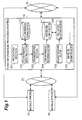
- FIG. 1 is an illustration for explaining a tone information providing system 10.
- the tone information providing system 10 is constituted so that it can communicate with a mobile phone 30 (information communication terminal or communication terminal) and mobile phone 35 (information communication terminal or communication terminal) through a voice communication network 20 (communication network) and data communication network 25 each other.
- the mobile phone 30 is a mobile phone used by a user who utilizes the tone information providing system 10, which is constituted so that voice communication and data communication can be made.
- the mobile phone 35 is a mobile phone of other party who is called by the user of the mobile phone 30, which is constituted so that voice communication and data communication can be made.
- the tone information providing system 10 is further described below.
- the tone information providing system 10 is physically constituted as a computer system (or an aggregate of computer systems) provided with a CPU (central processing unit), a memory, input units such as a mouse and keyboard, a display device such as a display, a storage unit such as a hard disk, and a communication device such as a modem.
- the tone information providing system 10 includes, as functional components, a receiving section 101 (receiving means), a tone information selecting section 102 (tone information selecting means), a transmitting section 103 (transmitting means), a tone information recording section 104 (tone information recording means), a request receiving section 105 (request receiving means), a past-record selecting section 106 (past-record selecting means), a past-record transmitting section 107 (past-record transmitting means), a tone information storing section 110 (tone information storing means), and a past-record information storing section 111 (past-record information storing means). Moreover, these components are described below in detail.
- the receiving section 101 is a section for receiving the calling information transmitted from the mobile phone 30 and outputting the information to the tone information selecting section 102. More specifically, the calling information includes an addresser number (calling-terminal specifying information) which is the telephone number of the mobile phone 30 and an addressee number (called-terminal specifying information) which is the telephone number of the mobile phone 35.
- the calling information is information transmitted from the mobile phone 30 to the voice communication network 20 upon calling, which is then transmitted to the tone information providing system 10 by the voice communication network 20.
- the tone information selecting section 102 is a section for selecting the tone information corresponding to the calling information output from the receiving section 101 out of the tone information stored in the tone information storing section 110 and outputting the selected information to the transmitting section 104.
- examples of the information stored in the tone information storing section 110 are described below by referring to FIGs. 2A and 2B.
- an "addressee number (called-terminal specifying information)" and a "tone source ID” are related each other and stored.
- the "addressee number” is the information serving as a key for specifying the "tone source ID" corresponding to the "addressee number” when a telephone number corresponding to the "addressee number” is called.
- the “tone source ID” is the information for specifying the tone information to be supplied to the mobile phone 30.
- the "tone source ID" and “tone information” are related each other and stored in the tone information storing section 110.
- a number "090-XXXX-XXX” stored as an addressee number is the telephone number of the mobile phone 30 and a number "090-XXXX-YYYY” is the telephone number of the mobile phone 35. Therefore, when a user of the mobile phone 30 calls the number "090-XXXX-YYYY" (that is, calls the mobile phone 35), the tone source ID of "music 01" is specified in accordance with the information table shown in FIG. 2A and the tone information of "music.wav" is specified in accordance with the information table shown in FIG. 2B.
- the information selecting section 102 selects the tone information of "music.wav” and outputs the tone information to the transmitting section 103 together with the tone source ID "music 01" of the tone information, addresser number "090-XXXX-XXX", and addressee number "090-XXXX-YYYY.”
- the transmitting section 103 is a section for transmitting the tone information selected by the tone information selecting section 102 to the mobile phone 30. Moreover, the transmitting section 103 outputs the tone source ID of "music 01", addresser number "090-XXXX-XXX", and addressee number "090-XXXX-YYYY" to the tone information recording section 104.
- the transmitting section 104 transmits the tone information of "music.wav” to the voice communication network 20 together with the telephone number "090-XXXX-XXXX” and the tone information "music.wav” is transmitted to the mobile phone 30 specified by the telephone number "090-XXXX-XXXX” from the tone communication network 20.
- the voice communication network 20 continuously transmits the tone information "music.wav” until the mobile phone 30 establishes a call connection and stops the transmission when the call connection is established.
- the mobile phone 30 generates a predetermined tone as a RBT (ring back tone, call output tone).
- the tone information recording section 104 relates the tone source ID of "music 01", the addresser number "090-XXXX-XXX” and addressee number "090-XXXX-YYYY” to store them in the past-record information storing section 111.
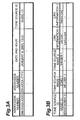
- FIGS. 3A and 3B show examples of the information stored in the past-record information storing section 111.
- an "addresser number”, “addressee number”, “date and hour” and “tone source ID” are related each other to be stored.
- the "addresser number”, “addressee number” and “tone source ID” are pieces of information output from the transmitting section 103.
- the date and hour corresponding to the call is specified by the tone recording section 104 to be stored.
- the "date and hour” corresponds to the date and hour when the tone information providing system 10 received the calling information transmitted from the mobile phone 30.
- a "tone source ID”, "tone source name 1", “tone source name 2", "link information 1” and “link information 2” are related each other and stored.
- the "tone source name 1" and “tone source name 2” are name information relating to the "tone source ID.” For example, when the "tone source ID" is the "music 01”, a "song 1" as a melody name has been stored in the “tone source name 1", and a “singer 1” as a singer name has been stored in the "tone source name 2.”
- the "link information 1” and “link information 2” are pieces of information for respectively specifying a link destination on the web relating to the "tone source ID.”
- the request receiving section 105 receives a disclosure request transmitted from the mobile phone 30 used by a user and including at least the telephone number of the mobile phone 30.
- the disclosure request may include the information (time information) for specifying the date and hour talked by a user through the mobile phone 30.
- the request receiving section 105 outputs the disclosure request to the past-record selecting section 106.
- the past-record selecting section 106 selects the information corresponding to the telephone number of the mobile phone 30 and stored in the past-record storing section in accordance with a disclosure request received and output by the request receiving section 105.
- the past-record selecting section 106 outputs the selected information to the past-record transmitting section 107. More specifically, when the telephone number included in the disclosure request is "090-XXXX-XXX", the section 106 selects "090-XXXX-YYYY" as a "addressee number" and "January 8, 2003, 13:00" as "date and hour” respectively in accordance with the information table exemplified in FIG.
- the past-record selecting section 106 may select one tone source ID out of a plurality of tone source IDs serving as prospects in accordance with the time information included in the disclosure request.
- the past-record transmitting section 107 transmits the information selected and output by the past-record selecting section 106 to the mobile phone 30. According to the previously described example, the past-record transmitting section 107 transmits "090-XXXX-YYYY" as the "addressee number", "January 8, 2003, 13:00" as the "date and hour”, “song 1” as the "tone source name 1", “singer 1” as the “tone source name 2”, “uta.com” as the "link information” and “kasyu.com” as the "link information 2" respectively to the mobile phone 30.
- the mobile phone 30 displays these received pieces of information on a display, and a user can confirm these pieces of information.
- the tone information shown in FIG. 2B may be stored in a server system such as a tone source server.
- a plurality of tone source servers may be set or a plurality of pieces of tone information may be managed by classifying them and introducing management numbers such as tone source box numbers.
- the link information between a tone source ID and tone information may be used.
- a server system such as a portal server for storing link information to tone information may be introduced.
- a tone source ID and link information are related each other and stored in the portal server.
- entry information and reference information are transmitted from the mobile phone 30.
- entry information and reference information may be transmitted from another information communication terminal (such as a personal computer).
- the tone information selecting section 102 selects tone information in accordance with an addressee number included in calling information out of the addressee numbers and tone information related each other and stored in the tone information storing section 110. Therefore, it is possible to provide the tone information set by the user of the mobile phone 35 serving as a communication terminal of a calling destination to the mobile phone 30 used by another user. Moreover, because an addresser number, addressee number, and tone information are related each other and stored in the past-record storing section 111, it is possible to hold the information showing the tone information used when calling the mobile phone 35.
- the information relating to a disclosure request such as a tone source name and link information stored in the past-record storing section 111 are transmitted in accordance with the disclosure request transmitted from the mobile phone 30 used by a user. Therefore it is possible to know the tone source name and link information used when calling the mobile phone 35.
Landscapes
- Engineering & Computer Science (AREA)
- Signal Processing (AREA)
- Telephonic Communication Services (AREA)
- Mobile Radio Communication Systems (AREA)
Abstract
Description
- The present invention relates to a tone information providing system.
- When calling a party from a communication terminal (such as landline phone, mobile phone, facsimile communication unit and so forth, hereinafter same) capable of generating a tone in accordance with the information sent through a communication network to another communication terminal, a tone such as a dial tone (DT), ring back tone (RBT), or busy tone (BT) is output from the receiving section of a communication terminal of a calling source in accordance with the phase of the calling operation. Each of these tones is output by converting an electrical signal sent from a switchboard through a communication network into a tone. Therefore, these tones have been previously decided. However, the art disclosed in the patent document (Japanese Patent Laid-Open No. 2002-33801) is known as an art capable of setting a DT, RBT, or BT to an optional tone.
- In the case of the conventional art disclosed in the above patent document, an electrical signal is converted into a tone set by a calling party in the communication terminal of the calling party. Therefore, it is impossible that a called party sets his (or her) favorite music and sends the music to a calling party as an RBT.
- Therefore, it is a problem of the present invention to provide a system allowing a called party to set the RBT of a calling party.
- To solve the above problem, a tone information providing system of the present invention comprises receiving means for receiving calling information being transmitted from a communication terminal used by a user and capable of generating a predetermined tone in accordance with the tone information sent through a communication network, and including calling-terminal specifying information for specifying the communication terminal and called-terminal specifying information for specifying a communication terminal of a calling destination; tone information selecting means for selecting tone information corresponding to the called-terminal specifying information out of tone information stored in tone information storing means in which called-terminal specifying information and tone information are related each other and stored; transmitting means for transmitting the selected tone information to the communication terminal used by the user; and tone information recording means for relating the calling-terminal specifying information, the called-terminal specifying information and the tone information each other and storing these pieces of information in past-record information storing means.
- According to a tone information providing system of the invention, tone information is selected in accordance with called-terminal specifying information included in calling information out of called-terminal specifying information and tone information related each other and stored in tone information storing means. Therefore, it is possible to provide the tone information set by a user of a communication terminal of a calling destination to a communication terminal used by a user. Moreover, because the calling-terminal specifying information, called-terminal specifying information and tone information are related each other and stored in past-record information storing means, it is possible to hold the information, for example, showing which tone information was used when having called which calling destination.
- Moreover, it is preferable that a tone information providing system of the invention further comprises request receiving means for receiving a disclosure request being transmitted from an information communication terminal used by a user and including at least the calling-terminal specifying information; past-record selecting means for selecting the information corresponding to the calling-terminal specifying information and being stored in the past-record information storing means in accordance with the received disclosure request; and past-record transmitting means for transmitting the selected information to the information communication terminal. Because relevant information such as the tone information stored in the past-record information storing means is transmitted in accordance with the disclosure request transmitted from the information communication terminal used by the user, it is possible to know the tone information, for example, which was used when having called a specific calling destination.
- Furthermore, in the case of a tone information providing system of the invention, it is also preferable that time information relating to the time when transmitting means has transmitted tone information is related to the calling-terminal specifying information, the called-terminal specifying information and the tone information, and that these pieces of information are stored in past-record information storing means. Because the time information is related to the information stored in the past-record information means, information retrieval can be made in accordance with the time when the transmitting means transmitted the tone information.
- Furthermore, in the case of a tone information providing system of the invention, it is also preferable that the time information relating to the time when the transmitting means has transmitted tone information is included in disclosure request. Because the time information is included in the disclosure request, information retrieval can be made in accordance with the time when the transmitting means transmitted the tone information.
-
- FIG. 1 is an illustration for explaining a tone information providing system which is an embodiment of the invention;
- FIG. 2A is an illustration showing an example of the information stored in the tone information storing section in FIG. 1;
- FIG. 2B is an illustration showing an example of the information stored in the tone information storing section in FIG. 1;
- FIG. 3A is an illustration showing an example of the information stored in the past-record information storing section in FIG. 1; and
- FIG. 3B is an illustration showing an example of the information stored in the past-record information storing section in FIG. 1.
- It is possible to easily understand the knowledge of the invention by referring to the accompanying drawings shown for only illustration and considering the following detailed description. Moreover, embodiments of the invention are described by referring to the accompanying drawings. When possible, the same portion will be provided with the same symbol to omit overlapping description.
- A tone information providing system which is an embodiment of the invention is described below by referring to FIG. 1. FIG. 1 is an illustration for explaining a tone
information providing system 10. The toneinformation providing system 10 is constituted so that it can communicate with a mobile phone 30 (information communication terminal or communication terminal) and mobile phone 35 (information communication terminal or communication terminal) through a voice communication network 20 (communication network) anddata communication network 25 each other. Themobile phone 30 is a mobile phone used by a user who utilizes the toneinformation providing system 10, which is constituted so that voice communication and data communication can be made. Themobile phone 35 is a mobile phone of other party who is called by the user of themobile phone 30, which is constituted so that voice communication and data communication can be made. - The tone
information providing system 10 is further described below. The toneinformation providing system 10 is physically constituted as a computer system (or an aggregate of computer systems) provided with a CPU (central processing unit), a memory, input units such as a mouse and keyboard, a display device such as a display, a storage unit such as a hard disk, and a communication device such as a modem. - The tone
information providing system 10 includes, as functional components, a receiving section 101 (receiving means), a tone information selecting section 102 (tone information selecting means), a transmitting section 103 (transmitting means), a tone information recording section 104 (tone information recording means), a request receiving section 105 (request receiving means), a past-record selecting section 106 (past-record selecting means), a past-record transmitting section 107 (past-record transmitting means), a tone information storing section 110 (tone information storing means), and a past-record information storing section 111 (past-record information storing means). Moreover, these components are described below in detail. - The receiving
section 101 is a section for receiving the calling information transmitted from themobile phone 30 and outputting the information to the toneinformation selecting section 102. More specifically, the calling information includes an addresser number (calling-terminal specifying information) which is the telephone number of themobile phone 30 and an addressee number (called-terminal specifying information) which is the telephone number of themobile phone 35. The calling information is information transmitted from themobile phone 30 to thevoice communication network 20 upon calling, which is then transmitted to the toneinformation providing system 10 by thevoice communication network 20. - The tone
information selecting section 102 is a section for selecting the tone information corresponding to the calling information output from the receivingsection 101 out of the tone information stored in the toneinformation storing section 110 and outputting the selected information to the transmittingsection 104. In this case, examples of the information stored in the toneinformation storing section 110 are described below by referring to FIGs. 2A and 2B. According to the example shown in FIG. 2A, an "addressee number (called-terminal specifying information)" and a "tone source ID" are related each other and stored. The "addressee number" is the information serving as a key for specifying the "tone source ID" corresponding to the "addressee number" when a telephone number corresponding to the "addressee number" is called. The "tone source ID" is the information for specifying the tone information to be supplied to themobile phone 30. As shown in FIG. 2B, the "tone source ID" and "tone information" are related each other and stored in the toneinformation storing section 110. - In FIG. 2A, a number "090-XXXX-XXXX" stored as an addressee number is the telephone number of the
mobile phone 30 and a number "090-XXXX-YYYY" is the telephone number of themobile phone 35. Therefore, when a user of themobile phone 30 calls the number "090-XXXX-YYYY" (that is, calls the mobile phone 35), the tone source ID of "music 01" is specified in accordance with the information table shown in FIG. 2A and the tone information of "music.wav" is specified in accordance with the information table shown in FIG. 2B. Theinformation selecting section 102 selects the tone information of "music.wav" and outputs the tone information to the transmittingsection 103 together with the tone source ID "music 01" of the tone information, addresser number "090-XXXX-XXXX", and addressee number "090-XXXX-YYYY." - The transmitting
section 103 is a section for transmitting the tone information selected by the toneinformation selecting section 102 to themobile phone 30. Moreover, the transmittingsection 103 outputs the tone source ID of "music 01", addresser number "090-XXXX-XXXX", and addressee number "090-XXXX-YYYY" to the toneinformation recording section 104. More specifically, when "music.wav" is output as tone information and "090-XXXX-XXXX" is output as a telephone number, the transmittingsection 104 transmits the tone information of "music.wav" to thevoice communication network 20 together with the telephone number "090-XXXX-XXXX" and the tone information "music.wav" is transmitted to themobile phone 30 specified by the telephone number "090-XXXX-XXXX" from thetone communication network 20. Thevoice communication network 20 continuously transmits the tone information "music.wav" until themobile phone 30 establishes a call connection and stops the transmission when the call connection is established. Themobile phone 30 generates a predetermined tone as a RBT (ring back tone, call output tone). - The tone
information recording section 104 relates the tone source ID of "music 01", the addresser number "090-XXXX-XXXX" and addressee number "090-XXXX-YYYY" to store them in the past-recordinformation storing section 111. FIGS. 3A and 3B show examples of the information stored in the past-recordinformation storing section 111. According to the example in FIG. 3A, an "addresser number", "addressee number", "date and hour" and "tone source ID" are related each other to be stored. In this case, the "addresser number", "addressee number" and "tone source ID" are pieces of information output from the transmittingsection 103. As to "date and hour", the date and hour corresponding to the call is specified by thetone recording section 104 to be stored. The "date and hour" corresponds to the date and hour when the toneinformation providing system 10 received the calling information transmitted from themobile phone 30. - In FIG. 3B, a "tone source ID", "tone
source name 1", "tonesource name 2", "linkinformation 1" and "linkinformation 2" are related each other and stored. The "tone source name 1" and "tonesource name 2" are name information relating to the "tone source ID." For example, when the "tone source ID" is the "music 01", a "song 1" as a melody name has been stored in the "tonesource name 1", and a "singer 1" as a singer name has been stored in the "tonesource name 2." The "link information 1" and "linkinformation 2" are pieces of information for respectively specifying a link destination on the web relating to the "tone source ID." - The
request receiving section 105 receives a disclosure request transmitted from themobile phone 30 used by a user and including at least the telephone number of themobile phone 30. The disclosure request may include the information (time information) for specifying the date and hour talked by a user through themobile phone 30. Therequest receiving section 105 outputs the disclosure request to the past-record selecting section 106. - The past-
record selecting section 106 selects the information corresponding to the telephone number of themobile phone 30 and stored in the past-record storing section in accordance with a disclosure request received and output by therequest receiving section 105. The past-record selecting section 106 outputs the selected information to the past-record transmitting section 107. More specifically, when the telephone number included in the disclosure request is "090-XXXX-XXXX", thesection 106 selects "090-XXXX-YYYY" as a "addressee number" and "January 8, 2003, 13:00" as "date and hour" respectively in accordance with the information table exemplified in FIG. 3A, and selects the "song 1" as the "tonesource 1", "singer 1" as the "tonesource name 2", "uta.com" as the "link information 1" and "kasyu.com" as the "line information 2" respectively in accordance with the information table exemplified in FIG. 3B and outputs these data values to the past-recordinformation transmitting section 107. Moreover, the past-record selecting section 106 may select one tone source ID out of a plurality of tone source IDs serving as prospects in accordance with the time information included in the disclosure request. - The past-
record transmitting section 107 transmits the information selected and output by the past-record selecting section 106 to themobile phone 30. According to the previously described example, the past-record transmitting section 107 transmits "090-XXXX-YYYY" as the "addressee number", "January 8, 2003, 13:00" as the "date and hour", "song 1" as the "tonesource name 1", "singer 1" as the "tonesource name 2", "uta.com" as the "link information" and "kasyu.com" as the "link information 2" respectively to themobile phone 30. Themobile phone 30 displays these received pieces of information on a display, and a user can confirm these pieces of information. - Though this embodiment is constituted as the tone
information providing system 10 as described above, it is also possible to disperse respective functional sections and stored pieces of information. For example, the tone information shown in FIG. 2B may be stored in a server system such as a tone source server. In this case, a plurality of tone source servers may be set or a plurality of pieces of tone information may be managed by classifying them and introducing management numbers such as tone source box numbers. Moreover, when storing tone information in a tone source server, the link information between a tone source ID and tone information may be used. In this case, a server system such as a portal server for storing link information to tone information may be introduced. A tone source ID and link information are related each other and stored in the portal server. When a tone source ID is specified, tone information is specified in accordance with the link information corresponding to the specified tone source ID. - In this embodiment, entry information and reference information are transmitted from the
mobile phone 30. However, entry information and reference information may be transmitted from another information communication terminal (such as a personal computer). - According to this embodiment, the tone
information selecting section 102 selects tone information in accordance with an addressee number included in calling information out of the addressee numbers and tone information related each other and stored in the toneinformation storing section 110. Therefore, it is possible to provide the tone information set by the user of themobile phone 35 serving as a communication terminal of a calling destination to themobile phone 30 used by another user. Moreover, because an addresser number, addressee number, and tone information are related each other and stored in the past-record storing section 111, it is possible to hold the information showing the tone information used when calling themobile phone 35. - Moreover, in this embodiment, the information relating to a disclosure request such as a tone source name and link information stored in the past-
record storing section 111 are transmitted in accordance with the disclosure request transmitted from themobile phone 30 used by a user. Therefore it is possible to know the tone source name and link information used when calling themobile phone 35.
Claims (4)
- A tone information providing system comprising:receiving means for receiving calling information being transmitted from a communication terminal used by a user and capable of generating a predetermined tone in accordance with the tone information sent through a communication network, and including calling-terminal specifying information for specifying the communication terminal and called-terminal specifying information for specifying a communication terminal of a calling destination;tone information selecting means for selecting tone information corresponding to the called-terminal specifying information out of tone information stored in tone information storing means in which called-terminal specifying information and tone information are related each other and stored;transmitting means for transmitting said selected tone information to the communication terminal used by the user; andtone information recording means for relating the calling-terminal specifying information, the called-terminal specifying information and the tone information each other and storing these pieces of information in past-record information storing means.
- The tone information providing system according to claim 1, further comprising:request receiving means for receiving a disclosure request being transmitted from the information communication terminal used by the user and including at least the calling-terminal specifying information;past-record selecting means for selecting information corresponding to the calling-terminal specifying information and being stored in the past-record storing means in accordance with said received disclosure request; andpast-record transmitting means for transmitting said selected information to the information communication terminal.
- The tone information providing system according to claim 1, wherein time information relating to the time when the transmitting means has transmitted the tone information is related to the calling-terminal specifying information, the called-terminal specifying information and the tone information, and these pieces of information are stored in the past-record information storing means.
- The tone information providing system according to claim 2, wherein the disclosure request includes time information relating to the time when the transmitting means has transmitted the tone information.
Applications Claiming Priority (2)
| Application Number | Priority Date | Filing Date | Title |
|---|---|---|---|
| JP2003074169 | 2003-03-18 | ||
| JP2003074169A JP2004282609A (en) | 2003-03-18 | 2003-03-18 | Sound information providing system |
Publications (3)
| Publication Number | Publication Date |
|---|---|
| EP1460824A2 true EP1460824A2 (en) | 2004-09-22 |
| EP1460824A3 EP1460824A3 (en) | 2009-06-17 |
| EP1460824B1 EP1460824B1 (en) | 2010-06-02 |
Family
ID=32821319
Family Applications (1)
| Application Number | Title | Priority Date | Filing Date |
|---|---|---|---|
| EP04006270A Expired - Lifetime EP1460824B1 (en) | 2003-03-18 | 2004-03-16 | Tone information generation in a telecommunication system |
Country Status (6)
| Country | Link |
|---|---|
| US (1) | US20040184595A1 (en) |
| EP (1) | EP1460824B1 (en) |
| JP (1) | JP2004282609A (en) |
| KR (1) | KR100684065B1 (en) |
| CN (1) | CN100454923C (en) |
| DE (1) | DE602004027431D1 (en) |
Cited By (2)
| Publication number | Priority date | Publication date | Assignee | Title |
|---|---|---|---|---|
| WO2008003834A1 (en) * | 2006-07-07 | 2008-01-10 | Nokia Corporation | Method and system for enhancing the discontinuous transmission functionality |
| JP2023531501A (en) * | 2020-06-22 | 2023-07-24 | 中興通訊股▲ふん▼有限公司 | Multimedia file distribution method, multimedia control method, multimedia management platform, ringtone platform and computer readable storage medium |
Families Citing this family (9)
| Publication number | Priority date | Publication date | Assignee | Title |
|---|---|---|---|---|
| CN100479477C (en) * | 2004-11-03 | 2009-04-15 | 全观友 | Telephone communication network capable of replacing ring-back tone for telephone calls |
| KR100669948B1 (en) * | 2004-11-25 | 2007-01-16 | 와이더댄 주식회사 | Ring Back Tone Substitution Copying System and Method |
| CN100550940C (en) * | 2005-12-20 | 2009-10-14 | 华为技术有限公司 | System and method for setting personalized ring back message |
| US8477912B2 (en) * | 2006-03-13 | 2013-07-02 | Alcatel Lucent | Content sharing through multimedia ringback tones |
| CN101043550B (en) * | 2006-03-23 | 2010-12-29 | 中兴通讯股份有限公司 | A CRBT service system and method for realizing random CRBT tone |
| CN101132443A (en) * | 2006-08-25 | 2008-02-27 | 摩托罗拉公司 | Method for obtaining data from electronic communication equipment |
| US8081751B1 (en) * | 2006-10-04 | 2011-12-20 | Sprint Spectrum L.P. | Method for triggering content download during call setup |
| US8059800B1 (en) | 2006-10-17 | 2011-11-15 | Sprint Spectrum L.P. | Method for viral distribution of ringback media |
| JP2010251884A (en) * | 2009-04-13 | 2010-11-04 | Fumiichiro Noma | Server device and program |
Citations (2)
| Publication number | Priority date | Publication date | Assignee | Title |
|---|---|---|---|---|
| WO2000049793A1 (en) | 1999-02-18 | 2000-08-24 | Kangsuk Kim | Advertising method by using ring-back tone |
| JP2002033801A (en) | 2000-07-14 | 2002-01-31 | Nec Infrontia Corp | Communication terminal |
Family Cites Families (9)
| Publication number | Priority date | Publication date | Assignee | Title |
|---|---|---|---|---|
| US6385308B1 (en) * | 1997-12-01 | 2002-05-07 | At&T Corp. | Telephone system and method for personalized announcements |
| US6778653B1 (en) * | 1999-11-09 | 2004-08-17 | Nortel Networks Limited | Storing information about a telephony session |
| JP2003051864A (en) * | 2001-08-06 | 2003-02-21 | Nec Corp | Wireless mobile terminal |
| JP4004760B2 (en) * | 2001-09-28 | 2007-11-07 | 富士通株式会社 | Telephone service method |
| JP2003163715A (en) * | 2001-11-29 | 2003-06-06 | Oki Electric Ind Co Ltd | Called party calling method and communication terminal device |
| KR100392766B1 (en) * | 2002-02-25 | 2003-07-31 | 에스케이 텔레콤주식회사 | Method and Apparatus for Subscriber-based Providing Ring-Back-Tone Service |
| JP3676312B2 (en) * | 2002-03-12 | 2005-07-27 | 株式会社エヌ・ティ・ティ・ドコモ | Transmission-side mobile device, reception-side mobile device, information communication system, information communication method, and server device |
| KR100393552B1 (en) * | 2002-10-01 | 2003-08-02 | 에스케이 텔레콤주식회사 | Subscriber-based Ring-Back-Tone Service Method by using Switch's announcement device |
| US20040174983A1 (en) * | 2003-03-07 | 2004-09-09 | Comverse Ltd. | Configurable call progress tones |
-
2003
- 2003-03-18 JP JP2003074169A patent/JP2004282609A/en active Pending
-
2004
- 2004-03-02 US US10/790,114 patent/US20040184595A1/en not_active Abandoned
- 2004-03-16 DE DE602004027431T patent/DE602004027431D1/en not_active Expired - Lifetime
- 2004-03-16 EP EP04006270A patent/EP1460824B1/en not_active Expired - Lifetime
- 2004-03-18 CN CNB200410028778XA patent/CN100454923C/en not_active Expired - Fee Related
- 2004-03-18 KR KR1020040018540A patent/KR100684065B1/en not_active Expired - Fee Related
Patent Citations (2)
| Publication number | Priority date | Publication date | Assignee | Title |
|---|---|---|---|---|
| WO2000049793A1 (en) | 1999-02-18 | 2000-08-24 | Kangsuk Kim | Advertising method by using ring-back tone |
| JP2002033801A (en) | 2000-07-14 | 2002-01-31 | Nec Infrontia Corp | Communication terminal |
Cited By (4)
| Publication number | Priority date | Publication date | Assignee | Title |
|---|---|---|---|---|
| WO2008003834A1 (en) * | 2006-07-07 | 2008-01-10 | Nokia Corporation | Method and system for enhancing the discontinuous transmission functionality |
| US8472900B2 (en) | 2006-07-07 | 2013-06-25 | Nokia Corporation | Method and system for enhancing the discontinuous transmission functionality |
| JP2023531501A (en) * | 2020-06-22 | 2023-07-24 | 中興通訊股▲ふん▼有限公司 | Multimedia file distribution method, multimedia control method, multimedia management platform, ringtone platform and computer readable storage medium |
| US12506831B2 (en) | 2020-06-22 | 2025-12-23 | Zte Corporation | Multimedia file distribution method, multimedia control method, multimedia management platform, caller ring back tone platform and computer-readable storage medium |
Also Published As
| Publication number | Publication date |
|---|---|
| EP1460824B1 (en) | 2010-06-02 |
| CN100454923C (en) | 2009-01-21 |
| CN1533119A (en) | 2004-09-29 |
| JP2004282609A (en) | 2004-10-07 |
| KR100684065B1 (en) | 2007-02-16 |
| DE602004027431D1 (en) | 2010-07-15 |
| KR20040082341A (en) | 2004-09-24 |
| US20040184595A1 (en) | 2004-09-23 |
| EP1460824A3 (en) | 2009-06-17 |
Similar Documents
| Publication | Publication Date | Title |
|---|---|---|
| US6212550B1 (en) | Method and system in a client-server for automatically converting messages from a first format to a second format compatible with a message retrieving device | |
| US7058429B2 (en) | System and method for distributing ring tone data used for generating ring tone of mobile phones | |
| US5999594A (en) | Control of transmission of electronic mail in voice message form | |
| US10554808B2 (en) | Methods, systems, and products for social alerts | |
| US20020019225A1 (en) | Communication control system using telephone directory management system of mobile phone | |
| KR20040011521A (en) | Contact lookup by partial string entry in a communication device | |
| EP1460824B1 (en) | Tone information generation in a telecommunication system | |
| JP2006524962A (en) | Method and apparatus for a dynamically customizable smart phone book | |
| US6295552B1 (en) | Gateway apparatus for transferring voice mail to an electronic mail server or transferring electronic mail to a voice mail apparatus | |
| US20050037793A1 (en) | Sound information providing system | |
| US6912274B2 (en) | System allowing telephone customers to send and retrieve electronic mail messages using only conventional telephonic devices | |
| KR19990079660A (en) | Telephone terminal system with download function | |
| EP1077563A2 (en) | Telecommunications apparatus and method of processing telecommunicating calls | |
| EP1723634A1 (en) | A semiconductor chip having a text-to-speech system and a communication enabled device | |
| US7751554B2 (en) | Sound information providing system | |
| JP2004282607A (en) | Sound information providing system | |
| KR100953631B1 (en) | Mobile communication terminal and receiving sound setting method thereof | |
| US20030103622A1 (en) | Method of calling up target call receiver and communications terminal equipment used for implementing same | |
| JP4119390B2 (en) | Sound information provision system | |
| KR100663740B1 (en) | System for providing call insertion sound and method thereof | |
| JP2002094668A (en) | Communication service network and communication method thereof | |
| CN109792463A (en) | Content distribution system and method | |
| KR20060039713A (en) | Device for managing ring back tone and method thereof, and wireless communication terminal and method using same | |
| KR20080076590A (en) | How to provide selective communication service that allows the receiver and the sender to listen to the same sound source | |
| WO2007097560A1 (en) | Method for providing selective communication services enabling both caller and receiver to listen the same musical sound |
Legal Events
| Date | Code | Title | Description |
|---|---|---|---|
| PUAI | Public reference made under article 153(3) epc to a published international application that has entered the european phase |
Free format text: ORIGINAL CODE: 0009012 |
|
| 17P | Request for examination filed |
Effective date: 20040316 |
|
| AK | Designated contracting states |
Kind code of ref document: A2 Designated state(s): AT BE BG CH CY CZ DE DK EE ES FI FR GB GR HU IE IT LI LU MC NL PL PT RO SE SI SK TR |
|
| AX | Request for extension of the european patent |
Extension state: AL LT LV MK |
|
| PUAL | Search report despatched |
Free format text: ORIGINAL CODE: 0009013 |
|
| AK | Designated contracting states |
Kind code of ref document: A3 Designated state(s): AT BE BG CH CY CZ DE DK EE ES FI FR GB GR HU IE IT LI LU MC NL PL PT RO SE SI SK TR |
|
| AX | Request for extension of the european patent |
Extension state: AL LT LV MK |
|
| RIC1 | Information provided on ipc code assigned before grant |
Ipc: H04M 3/42 20060101ALI20090513BHEP Ipc: H04M 1/725 20060101AFI20040628BHEP |
|
| 17Q | First examination report despatched |
Effective date: 20090811 |
|
| GRAP | Despatch of communication of intention to grant a patent |
Free format text: ORIGINAL CODE: EPIDOSNIGR1 |
|
| AKX | Designation fees paid |
Designated state(s): DE GB |
|
| GRAS | Grant fee paid |
Free format text: ORIGINAL CODE: EPIDOSNIGR3 |
|
| GRAA | (expected) grant |
Free format text: ORIGINAL CODE: 0009210 |
|
| AK | Designated contracting states |
Kind code of ref document: B1 Designated state(s): DE GB |
|
| REG | Reference to a national code |
Ref country code: GB Ref legal event code: FG4D |
|
| REF | Corresponds to: |
Ref document number: 602004027431 Country of ref document: DE Date of ref document: 20100715 Kind code of ref document: P |
|
| PLBE | No opposition filed within time limit |
Free format text: ORIGINAL CODE: 0009261 |
|
| STAA | Information on the status of an ep patent application or granted ep patent |
Free format text: STATUS: NO OPPOSITION FILED WITHIN TIME LIMIT |
|
| 26N | No opposition filed |
Effective date: 20110303 |
|
| REG | Reference to a national code |
Ref country code: DE Ref legal event code: R097 Ref document number: 602004027431 Country of ref document: DE Effective date: 20110302 |
|
| PGFP | Annual fee paid to national office [announced via postgrant information from national office to epo] |
Ref country code: DE Payment date: 20130314 Year of fee payment: 10 Ref country code: GB Payment date: 20130313 Year of fee payment: 10 |
|
| REG | Reference to a national code |
Ref country code: DE Ref legal event code: R119 Ref document number: 602004027431 Country of ref document: DE |
|
| GBPC | Gb: european patent ceased through non-payment of renewal fee |
Effective date: 20140316 |
|
| REG | Reference to a national code |
Ref country code: DE Ref legal event code: R119 Ref document number: 602004027431 Country of ref document: DE Effective date: 20141001 |
|
| PG25 | Lapsed in a contracting state [announced via postgrant information from national office to epo] |
Ref country code: DE Free format text: LAPSE BECAUSE OF NON-PAYMENT OF DUE FEES Effective date: 20141001 Ref country code: GB Free format text: LAPSE BECAUSE OF NON-PAYMENT OF DUE FEES Effective date: 20140316 |