EP1460790A2 - System and method for link adaptation - Google Patents
System and method for link adaptation Download PDFInfo
- Publication number
- EP1460790A2 EP1460790A2 EP04396008A EP04396008A EP1460790A2 EP 1460790 A2 EP1460790 A2 EP 1460790A2 EP 04396008 A EP04396008 A EP 04396008A EP 04396008 A EP04396008 A EP 04396008A EP 1460790 A2 EP1460790 A2 EP 1460790A2
- Authority
- EP
- European Patent Office
- Prior art keywords
- channel quality
- data packets
- packet
- base station
- telecommunication network
- Prior art date
- Legal status (The legal status is an assumption and is not a legal conclusion. Google has not performed a legal analysis and makes no representation as to the accuracy of the status listed.)
- Granted
Links
Images


Classifications
-
- H—ELECTRICITY
- H04—ELECTRIC COMMUNICATION TECHNIQUE
- H04L—TRANSMISSION OF DIGITAL INFORMATION, e.g. TELEGRAPHIC COMMUNICATION
- H04L1/00—Arrangements for detecting or preventing errors in the information received
- H04L1/0001—Systems modifying transmission characteristics according to link quality, e.g. power backoff
- H04L1/0009—Systems modifying transmission characteristics according to link quality, e.g. power backoff by adapting the channel coding
-
- H—ELECTRICITY
- H04—ELECTRIC COMMUNICATION TECHNIQUE
- H04L—TRANSMISSION OF DIGITAL INFORMATION, e.g. TELEGRAPHIC COMMUNICATION
- H04L1/00—Arrangements for detecting or preventing errors in the information received
- H04L1/12—Arrangements for detecting or preventing errors in the information received by using return channel
- H04L1/16—Arrangements for detecting or preventing errors in the information received by using return channel in which the return channel carries supervisory signals, e.g. repetition request signals
- H04L1/1607—Details of the supervisory signal
- H04L1/1614—Details of the supervisory signal using bitmaps
Definitions
- the present invention relates to telecommunications.
- the present invention relates to a novel and improved adaptive link adaptation method and system for a packet data enabled mobile telecommunication network.
- a circuit switched service refers to a type of service for which a physical path is dedicated to a single connection between two end-points in the network for the duration of the connection.
- ordinary voice phone service is circuit-switched.
- Packet switched data service refers to a type of service in which relatively small units of data called packets are routed through a network based on the destination address contained within each packet. In the following the terms packet switched data and packet data are used interchangeably unless otherwise noted.
- GPRS General Packet Radio Service
- GSM Global System for Mobile Communications
- GPRS is not restricted to only GSM networks but may support for example 3GPP (Third Generation Partnership Project) system based digital mobile telecommunication networks
- EGPRS EDGE General Packet Radio Service, where EDEGE stands in for Enhanced Data rates for GSM Evolution.
- a GPRS enabled mobile telecommunication network comprises two additional network elements or nodes. These are a Serving GPRS Support Node (SGSN) and a Gateway GPRS Support Node (GGSN). Additionally GPRS requires some modifications to existing network elements.
- a Packet Control Unit (PCU) is typically implemented in connection with a base station or base station controller. The Packet Control Unit controls functionalities associated with packet switched data transfer. Further, mobile terminals need to support packet switched data transfer.
- Radio links connecting a PCU to mobile terminals are one of the most critical parts of GPRS and EGPRS enabled mobile telecommunication networks.
- E.g. radio signal disturbance due to fast-fading, shadowing, noise and co-channel interference may result in data packets being lost and thus needing to be retransmitted.
- various coding schemes are used to avoid transmission errors.
- Error correction can be improved by increasing the amount of redundant information in a data packet but at the same time net bit rate is reduced. Hence it would be advantageous to use a robust coding scheme for poor radio conditions, and a coding scheme with high net bit rate when radio conditions are good.
- GPRS provides four different coding schemes, whereas EGPRS provides nine different coding schemes.
- LA link adaptation
- a receiver typically a mobile terminal, measures channel quality of the used radio link in terms of signal strength, bit error rate, packet error rate or some other measure appropriate for this purpose.
- a channel quality estimate is then fed into the link adaptation algorithm which makes the decision to change or not to change the current coding scheme by comparing the estimated channel quality with certain threshold values.
- TU3idealFH refers to a commonly used type of channel simulation.
- TU in TU3idealFH refers to Typical Urban.
- radio channel characteristics differ in a city center, in suburban area and in countryside.
- 3 in TU3idealFH refers to a mobile terminal assumed to move with speed of 3 km/h in average. Yet, if the base station is located e.g. along a motorway, the assumption again results in inaccuracies.
- idealFH in TU3idealFH refers to idealistic frequency hopping, idealistic meaning that there is one interfering mobile terminal on all the timeslots that belong to the hopping sequence. Yet, if traffic load in the network is low, this assumption again results in inaccuracies.
- Empirical measurements on the other hand give results that are specific to the time and place in which the measurements took place. Further, in practice it is difficult to measure the performance of different coding schemes under all the possible various radio conditions.
- the present invention concerns an adaptive link adaptation method and system for a packet data enabled mobile telecommunication network.
- the packet data enabled mobile telecommunication network comprises a cell comprising a base station and one or more mobile terminals.
- the mobile terminals are linked to the base station by radio links.
- the system comprises a transmitter for transmitting data packets over one or more radio links.
- One or more of the radio links have a variable channel quality, i.e. their channel quality varies over time due to radio conditions.
- Each packet is coded using a given coding scheme out of a group of predetermined coding schemes.
- the system further comprises storage means for accumulating over a given period of time statistical data.
- the statistical data comprises periodically provided channel quality estimates.
- the statistical data further comprises periodically provided information about which data packets were received successfully and which data packets were received unsuccessfully.
- the statistical data further comprises periodically provided information about the used coding schemes.
- the system further comprises a link adapter for determining block error rates for one or more coding schemes based on the accumulated statistical data. Each block error rate is determined as a function of coding scheme and channel quality estimate.
- the link adapter is further arranged to select a coding scheme with best performance for a current data packet to be transmitted over a given radio link with current channel quality based on the determined block error rates.
- the storage means further comprise a first table comprising entries indicating the amounts of successfully received data packets and indexed according to the coding schemes and channel quality estimates.
- the storage means further comprise a second table comprising entries indicating the amounts of unsuccessfully received data packets and indexed according to the coding schemes and channel quality estimates.
- the storage means further comprise resetting means for resetting a table when one or more entries exceed a given threshold value.
- the system further comprises measuring means for measuring channel quality of the radio links during the transferring of data packets over one or more radio links in order to obtain the channel quality estimates to be provided.
- Channel quality is a well known term used to describe the quality of the radio links.
- Channel quality may be estimated e.g. in terms of signal strength, bit error rate, packet error rate or some other appropriate measure.
- the transmitter is arranged in connection with the base station. In another embodiment of the invention one or more transmitters are arranged in connection with one or more mobile terminals.
- one or more measuring means are arranged in connection with one or more mobile terminals. In another embodiment of the invention the measuring means are arranged in connection with the base station
- the link adapter is arranged in connection with the base station. In another embodiment of the invention one or more link adapters are arranged in connection with one or more mobile terminals.
- the storage means are arranged in connection with the base station. In another embodiment of the invention one or more storage means are arranged in connection with one or more mobile terminals.
- the packet data enabled mobile telecommunication network is a GPRS enabled mobile telecommunication network. In another embodiment of the invention the packet data enabled mobile telecommunication network is an EGPRS enabled mobile telecommunication network.
- the data packets are RLC blocks (Radio Link Control -protocol, RLC).
- system further comprises a Packet Control Unit arranged in connection with the base station.
- the storage means and link adapter are arranged in connection with the Packet Control Unit.
- the data packets are arranged to be transmitted in unacknowledged data transmission mode. In another embodiment of the invention the data packets are arranged to be transmitted in acknowledged data transmission mode.
- RLC acknowledgement messages are arranged to provide the obtained channel quality estimates to the storage means.
- bitmaps comprised in RLC acknowledgement messages are arranged to provide the information about the successfully/unsuccessfully received data packets to the storage means, the bitmaps specifying which RLC blocks have been received successfully/unsuccessfully.
- the present invention makes it possible to select a coding scheme without any pre-determined input information. Yet, at the same time the invention makes it possible to select a coding scheme that is on the average the most suitable for current radio conditions. Further, the invention makes it possible to adapt to the radio channel characteristics of a given cell without any input information about network topology, cell topology, mobile speed, traffic characteristics or coding scheme performance. Further, the invention is also applicable in a case in which the channel quality estimate depends on the used coding scheme, as is the case e.g. with EGPRS. Further, the invention is applicable in both acknowledged and unacknowledged data transmission modes. Further, the invention is extremely simple to implement.
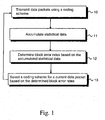
- Figure 1 illustrates an adaptive link adaptation method for a packet data enabled mobile telecommunication network comprising a cell comprising a base station and one or more mobile terminals, the mobile terminals are linked to the base station by radio links of variable channel quality according to one embodiment of the present invention.
- data packets are transmitted over one or more radio links, each packet coded using a given coding scheme out of group of predetermined coding schemes, phase 10.
- Statistical data is accumulated over a given period of time, phase 11.
- the statistical data comprises periodically provided channel quality estimates, periodically provided information about successfully/unsuccessfully received data packets, and periodically provided information about the used coding schemes.
- the channel quality estimates to be provided are obtained by measuring channel quality of said radio links during said transferring of data packets over one or more radio links.
- two tables are arranged for accumulating the statistical data.
- a first table comprises entries indicating the amounts of successfully received data packets and indexed according to the coding schemes and channel quality estimates.
- a second table comprises entries indicating the amounts of unsuccessfully received data packets and indexed according to the coding schemes and channel quality estimates.
- block error rates are determined for one or more coding schemes based on the accumulated statistical data, phase 12. Each block error rate is determined as a function of coding scheme and channel quality estimate. A coding scheme with best performance for a current data packet to be transmitted over a given radio link with current channel quality is selected based on the determined block error rates, phase 13. Finally, the current data packet is coded using the selected coding scheme and dispatched, i.e. the embodiment of method according to the present invention illustrated in Figure 1 loops back to phase 10.
- FIG. 2 illustrates an adaptive link adaptation system for a packet data enabled mobile telecommunication network according to one embodiment of the present invention.
- the packet data enabled mobile telecommunication network is a GPRS enabled mobile telecommunication network and the data packets are RLC blocks in the embodiment of the present invention illustrated in Figure 2.
- the packet data enabled mobile telecommunication network comprises a GPRS cell comprising a base station BS and two mobile terminals MT1 and MT 2.
- the system further comprises a Packet Control Unit PCU arranged in connection with the base station in the embodiment of the present invention illustrated in Figure 2.
- the mobile terminals are linked to the base station by radio links RL1, RL2 of variable channel quality.
- the system further comprises a transmitter TR for transmitting data packets over one or more radio links.
- Each packet is coded using a given coding scheme out of the four coding schemes provided by GPRS.
- the transmitter is arranged in connection with the base station.
- the transmitters may be arranged in connection with one or more mobile terminals.
- the system further comprises storage means STR for accumulating statistical data.
- the statistical data comprises periodically provided channel quality estimates, periodically provided information about successfully/unsuccessfully received data packets, and periodically provided information about the used coding schemes.
- the storage means are arranged in connection with the base station. However, in another embodiment of the present invention the storage means may be arranged in connection with one or more mobile terminals.
- the storage means comprise a first table TB1 comprising entries indicating the amounts of successfully received data packets and indexed according to the coding schemes and channel quality estimates.
- the storage means comprise a second table TB2 comprising entries indicating the amounts of unsuccessfully received data packets and indexed according to the coding schemes and channel quality estimates.
- the storage means comprise resetting means RST for resetting a table when one or more entries exceed a given threshold value.
- the system further comprises a link adapter LA for determining block error rates for one or more coding schemes based on the accumulated statistical data, each block error rate a function of coding scheme and channel quality estimate, and for selecting a coding scheme with best performance for a current data packet to be transmitted over a given radio link with current channel quality based on the determined block error rates.
- the link adapter is arranged in connection with the base station.
- the link adapter may be arranged in connection with one or more mobile terminals.
- the storage means and the link adapter are arranged in connection with the Packet Control Unit.
- the system further comprises measuring means MSR for measuring channel quality of the radio links during the transferring of data packets over one or more radio links in order to obtain the channel quality estimates to be provided.
- the measuring means are arranged in connection with the mobile terminals.
- the measuring means may be arranged in connection with the base station.
- Figure 3 illustrates the tables used to store the statistical data according to one embodiment of the present invention.
- Table 1 is used to store entries indicating the amounts of successfully received data packets and indexed according to the coding schemes and channel quality estimates.
- the columns represent e.g. the four different coding schemes used by GPRS, i.e. CS1, CS2, CS3 and CS4.
- the rows represent channel quality estimates.
- channel quality estimate is presented with three bits, thus there are eight different values for the channel quality estimate, i.e. CQ1, CQ2, CQ3, CQ4, CQ5, CQ6, CQ7 and CQ8. Initially each entry is initialized to e.g. the value of 1 or 0.
- Table 2 of Figure 3 is used to store entries indicating the amounts of unsuccessfully received data packets and indexed according to the coding schemes and channel quality estimates.
- the columns represent e.g. the four different coding schemes used by GPRS, i.e. CS1, CS2, CS3 and CS4.
- the rows represent channel quality estimates.
- channel quality estimate is presented with three bits, thus there are eight different values for the channel quality estimate, i.e. CQ1, CQ2, CQ3, CQ4, CQ5, CQ6, CQ7 and CQ8.
- each entry is initialized to e.g. the value of 1 or 0.
- Each time the base station is provided with statistical data indicating that, e.g.
Landscapes
- Engineering & Computer Science (AREA)
- Quality & Reliability (AREA)
- Computer Networks & Wireless Communication (AREA)
- Signal Processing (AREA)
- Mobile Radio Communication Systems (AREA)
- Two-Way Televisions, Distribution Of Moving Picture Or The Like (AREA)
Abstract
Description
- The present invention relates to telecommunications. In particular, the present invention relates to a novel and improved adaptive link adaptation method and system for a packet data enabled mobile telecommunication network.
- Recently mobile telecommunication networks have started to provide packet data services for subscribers in addition to traditional circuit switched services. A circuit switched service refers to a type of service for which a physical path is dedicated to a single connection between two end-points in the network for the duration of the connection. For example ordinary voice phone service is circuit-switched. Packet switched data service refers to a type of service in which relatively small units of data called packets are routed through a network based on the destination address contained within each packet. In the following the terms packet switched data and packet data are used interchangeably unless otherwise noted.
- An example of packet data service for mobile telecommunication networks is General Packet Radio Service (GPRS). GPRS is designed to support especially digital mobile telecommunication networks based on the GSM (Global System for Mobile Communications) standard. However, GPRS is not restricted to only GSM networks but may support for example 3GPP (Third Generation Partnership Project) system based digital mobile telecommunication networks A recent enhanced version of GPRS is referred to as EGPRS (EDGE General Packet Radio Service, where EDEGE stands in for Enhanced Data rates for GSM Evolution).
- A GPRS enabled mobile telecommunication network comprises two additional network elements or nodes. These are a Serving GPRS Support Node (SGSN) and a Gateway GPRS Support Node (GGSN). Additionally GPRS requires some modifications to existing network elements. A Packet Control Unit (PCU) is typically implemented in connection with a base station or base station controller. The Packet Control Unit controls functionalities associated with packet switched data transfer. Further, mobile terminals need to support packet switched data transfer.
- Radio links connecting a PCU to mobile terminals are one of the most critical parts of GPRS and EGPRS enabled mobile telecommunication networks. E.g. radio signal disturbance due to fast-fading, shadowing, noise and co-channel interference may result in data packets being lost and thus needing to be retransmitted. Thus, various coding schemes are used to avoid transmission errors.
- When a data packet is coded, some redundant information is added to the source data. When the same packet is later decoded, this redundant information is used to correct and/or detect bit errors that occurred during transmission.
- Error correction can be improved by increasing the amount of redundant information in a data packet but at the same time net bit rate is reduced. Hence it would be advantageous to use a robust coding scheme for poor radio conditions, and a coding scheme with high net bit rate when radio conditions are good. GPRS provides four different coding schemes, whereas EGPRS provides nine different coding schemes.
- Various link adaptation (LA) algorithms are used to select an optimum coding scheme for a particular radio link. In a typical link adaptation method a receiver, typically a mobile terminal, measures channel quality of the used radio link in terms of signal strength, bit error rate, packet error rate or some other measure appropriate for this purpose. A channel quality estimate is then fed into the link adaptation algorithm which makes the decision to change or not to change the current coding scheme by comparing the estimated channel quality with certain threshold values.
- Prior art link adaptation techniques are disclosed e.g. in US 5,359,607; US 5,701,294; US 5,862,171; US 6,072,990; US 6,134,220; US 6,385,462; US 6,308,082; US 6,122,293 and WO 023700.
- However, there are significant drawbacks with the prior art link adaptation techniques. They all require pre-determined threshold values to compare the estimated channel quality with. Typically these predetermined threshold values are obtained by measuring the performance of each coding scheme beforehand at various radio conditions. This can be done either by computer simulations or by empirical measurements. In this context computer simulations and empirical measurements are far from idea solutions, however.
- Computer simulations contain assumptions e.g. about the radio channel type. By their very nature these assumptions cannot cover all real world situations, thus errors result. For example, in the context of computer simulations TU3idealFH refers to a commonly used type of channel simulation. TU in TU3idealFH refers to Typical Urban. In real world situations radio channel characteristics differ in a city center, in suburban area and in countryside. Yet the same TU3idealFH channel simulation is typically used for all these cases, thus resulting in inaccuracies. Further, 3 in TU3idealFH refers to a mobile terminal assumed to move with speed of 3 km/h in average. Yet, if the base station is located e.g. along a motorway, the assumption again results in inaccuracies. Further, idealFH in TU3idealFH refers to idealistic frequency hopping, idealistic meaning that there is one interfering mobile terminal on all the timeslots that belong to the hopping sequence. Yet, if traffic load in the network is low, this assumption again results in inaccuracies.
- Empirical measurements on the other hand give results that are specific to the time and place in which the measurements took place. Further, in practice it is difficult to measure the performance of different coding schemes under all the possible various radio conditions.
- Thus there is an obvious need for link adaptation which does not require pre-determined threshold values and which can dynamically adapt to current radio conditions.
- The present invention concerns an adaptive link adaptation method and system for a packet data enabled mobile telecommunication network. The packet data enabled mobile telecommunication network comprises a cell comprising a base station and one or more mobile terminals. The mobile terminals are linked to the base station by radio links.
- The system comprises a transmitter for transmitting data packets over one or more radio links. One or more of the radio links have a variable channel quality, i.e. their channel quality varies over time due to radio conditions. Each packet is coded using a given coding scheme out of a group of predetermined coding schemes.
- The system further comprises storage means for accumulating over a given period of time statistical data. The statistical data comprises periodically provided channel quality estimates. The statistical data further comprises periodically provided information about which data packets were received successfully and which data packets were received unsuccessfully. The statistical data further comprises periodically provided information about the used coding schemes.
- The system further comprises a link adapter for determining block error rates for one or more coding schemes based on the accumulated statistical data. Each block error rate is determined as a function of coding scheme and channel quality estimate. The link adapter is further arranged to select a coding scheme with best performance for a current data packet to be transmitted over a given radio link with current channel quality based on the determined block error rates.
- In an embodiment of the invention the storage means further comprise a first table comprising entries indicating the amounts of successfully received data packets and indexed according to the coding schemes and channel quality estimates. In said embodiment of the invention the storage means further comprise a second table comprising entries indicating the amounts of unsuccessfully received data packets and indexed according to the coding schemes and channel quality estimates.
- In an embodiment of the invention the storage means further comprise resetting means for resetting a table when one or more entries exceed a given threshold value.
- In an embodiment of the invention the system further comprises measuring means for measuring channel quality of the radio links during the transferring of data packets over one or more radio links in order to obtain the channel quality estimates to be provided. Channel quality is a well known term used to describe the quality of the radio links. Channel quality may be estimated e.g. in terms of signal strength, bit error rate, packet error rate or some other appropriate measure.
- In an embodiment of the invention the transmitter is arranged in connection with the base station. In another embodiment of the invention one or more transmitters are arranged in connection with one or more mobile terminals.
- In an embodiment of the invention one or more measuring means are arranged in connection with one or more mobile terminals. In another embodiment of the invention the measuring means are arranged in connection with the base station
- In an embodiment of the invention the link adapter is arranged in connection with the base station. In another embodiment of the invention one or more link adapters are arranged in connection with one or more mobile terminals.
- In an embodiment of the invention the storage means are arranged in connection with the base station. In another embodiment of the invention one or more storage means are arranged in connection with one or more mobile terminals.
- In an embodiment of the invention the packet data enabled mobile telecommunication network is a GPRS enabled mobile telecommunication network. In another embodiment of the invention the packet data enabled mobile telecommunication network is an EGPRS enabled mobile telecommunication network.
- In an embodiment of the invention the data packets are RLC blocks (Radio Link Control -protocol, RLC).
- In an embodiment of the invention the system further comprises a Packet Control Unit arranged in connection with the base station. The storage means and link adapter are arranged in connection with the Packet Control Unit.
- In an embodiment of the invention the data packets are arranged to be transmitted in unacknowledged data transmission mode. In another embodiment of the invention the data packets are arranged to be transmitted in acknowledged data transmission mode.
- In an embodiment of the invention RLC acknowledgement messages are arranged to provide the obtained channel quality estimates to the storage means.
- In an embodiment of the invention given bitmaps comprised in RLC acknowledgement messages are arranged to provide the information about the successfully/unsuccessfully received data packets to the storage means, the bitmaps specifying which RLC blocks have been received successfully/unsuccessfully.
- The present invention makes it possible to select a coding scheme without any pre-determined input information. Yet, at the same time the invention makes it possible to select a coding scheme that is on the average the most suitable for current radio conditions. Further, the invention makes it possible to adapt to the radio channel characteristics of a given cell without any input information about network topology, cell topology, mobile speed, traffic characteristics or coding scheme performance. Further, the invention is also applicable in a case in which the channel quality estimate depends on the used coding scheme, as is the case e.g. with EGPRS. Further, the invention is applicable in both acknowledged and unacknowledged data transmission modes. Further, the invention is extremely simple to implement.
- The accompanying drawings, which are included to provide a further understanding of the invention and constitute a part of this specification, illustrate embodiments of the invention and together with the description help to explain the principles of the invention. In the drawings:
- Fig 1 is a flow chart illustrating an adaptive link adaptation method for a packet data enabled mobile telecommunication network according to one embodiment of the present invention,
- Fig 2 is a block diagram illustrating an adaptive link adaptation system for a packet data enabled mobile telecommunication network according to one embodiment of the present invention, and
- Fig 3 illustrates the tables used to store the accumulated statistical data according to one embodiment of the present invention.
- Reference will now be made in detail to the embodiments of the present invention, examples of which are illustrated in the accompanying drawings.
- Figure 1 illustrates an adaptive link adaptation method for a packet data enabled mobile telecommunication network comprising a cell comprising a base station and one or more mobile terminals, the mobile terminals are linked to the base station by radio links of variable channel quality according to one embodiment of the present invention.
- In the embodiment of the present invention illustrated in Figure 1 data packets are transmitted over one or more radio links, each packet coded using a given coding scheme out of group of predetermined coding schemes,
phase 10. Statistical data is accumulated over a given period of time,phase 11. The statistical data comprises periodically provided channel quality estimates, periodically provided information about successfully/unsuccessfully received data packets, and periodically provided information about the used coding schemes. In the embodiment of the present invention illustrated in Figure 1 the channel quality estimates to be provided are obtained by measuring channel quality of said radio links during said transferring of data packets over one or more radio links. Further in the embodiment of the present invention illustrated in Figure 1 two tables are arranged for accumulating the statistical data. A first table comprises entries indicating the amounts of successfully received data packets and indexed according to the coding schemes and channel quality estimates. A second table comprises entries indicating the amounts of unsuccessfully received data packets and indexed according to the coding schemes and channel quality estimates. - In the embodiment of the present invention illustrated in Figure 1 block error rates are determined for one or more coding schemes based on the accumulated statistical data,
phase 12. Each block error rate is determined as a function of coding scheme and channel quality estimate. A coding scheme with best performance for a current data packet to be transmitted over a given radio link with current channel quality is selected based on the determined block error rates,phase 13. Finally, the current data packet is coded using the selected coding scheme and dispatched, i.e. the embodiment of method according to the present invention illustrated in Figure 1 loops back tophase 10. - Figure 2 illustrates an adaptive link adaptation system for a packet data enabled mobile telecommunication network according to one embodiment of the present invention. The packet data enabled mobile telecommunication network is a GPRS enabled mobile telecommunication network and the data packets are RLC blocks in the embodiment of the present invention illustrated in Figure 2. The packet data enabled mobile telecommunication network comprises a GPRS cell comprising a base station BS and two mobile terminals MT1 and
MT 2. The system further comprises a Packet Control Unit PCU arranged in connection with the base station in the embodiment of the present invention illustrated in Figure 2. The mobile terminals are linked to the base station by radio links RL1, RL2 of variable channel quality. - In the embodiment of the present invention illustrated in Figure 2 the system further comprises a transmitter TR for transmitting data packets over one or more radio links. Each packet is coded using a given coding scheme out of the four coding schemes provided by GPRS. In the embodiment of the present invention illustrated in Figure 2 the transmitter is arranged in connection with the base station. However, in another embodiment of the present invention the transmitters may be arranged in connection with one or more mobile terminals.
- In the embodiment of the present invention illustrated in Figure 2 the system further comprises storage means STR for accumulating statistical data. The statistical data comprises periodically provided channel quality estimates, periodically provided information about successfully/unsuccessfully received data packets, and periodically provided information about the used coding schemes. In the embodiment of the present invention illustrated in Figure 2 the storage means are arranged in connection with the base station. However, in another embodiment of the present invention the storage means may be arranged in connection with one or more mobile terminals.
- Further in the embodiment of the present invention illustrated in Figure 2 the storage means comprise a first table TB1 comprising entries indicating the amounts of successfully received data packets and indexed according to the coding schemes and channel quality estimates.
- Further in the embodiment of the present invention illustrated in Figure 2 the storage means comprise a second table TB2 comprising entries indicating the amounts of unsuccessfully received data packets and indexed according to the coding schemes and channel quality estimates.
- Further in the embodiment of the present invention illustrated in Figure 2 the storage means comprise resetting means RST for resetting a table when one or more entries exceed a given threshold value.
- In the embodiment of the present invention illustrated in Figure 2 the system further comprises a link adapter LA for determining block error rates for one or more coding schemes based on the accumulated statistical data, each block error rate a function of coding scheme and channel quality estimate, and for selecting a coding scheme with best performance for a current data packet to be transmitted over a given radio link with current channel quality based on the determined block error rates. In the embodiment of the present invention illustrated in Figure 2 the link adapter is arranged in connection with the base station. However, in another embodiment of the present invention the link adapter may be arranged in connection with one or more mobile terminals. Further in the embodiment of the present invention illustrated in Figure 2 the storage means and the link adapter are arranged in connection with the Packet Control Unit.
- In the embodiment of the present invention illustrated in Figure 2 the system further comprises measuring means MSR for measuring channel quality of the radio links during the transferring of data packets over one or more radio links in order to obtain the channel quality estimates to be provided. In the embodiment of the present invention illustrated in Figure 2 the measuring means are arranged in connection with the mobile terminals. However, in another embodiment of the present invention the measuring means may be arranged in connection with the base station.
- Figure 3 illustrates the tables used to store the statistical data according to one embodiment of the present invention. Table 1 is used to store entries indicating the amounts of successfully received data packets and indexed according to the coding schemes and channel quality estimates. The columns represent e.g. the four different coding schemes used by GPRS, i.e. CS1, CS2, CS3 and CS4. The rows represent channel quality estimates. In the embodiment of the present invention illustrated in Figure 3 channel quality estimate is presented with three bits, thus there are eight different values for the channel quality estimate, i.e. CQ1, CQ2, CQ3, CQ4, CQ5, CQ6, CQ7 and CQ8. Initially each entry is initialized to e.g. the value of 1 or 0. Each time the base station is provided with statistical data indicating that, e.g. a packet was received successfully using coding scheme CS2 with a corresponding channel quality estimate CQ3, the value of the corresponding entry in Table 1 is increased by 1. In the example of Figure 3 said value has reached 21.
- Correspondingly Table 2 of Figure 3 is used to store entries indicating the amounts of unsuccessfully received data packets and indexed according to the coding schemes and channel quality estimates. The columns represent e.g. the four different coding schemes used by GPRS, i.e. CS1, CS2, CS3 and CS4. The rows represent channel quality estimates. In the embodiment of the present invention illustrated in Figure 3 channel quality estimate is presented with three bits, thus there are eight different values for the channel quality estimate, i.e. CQ1, CQ2, CQ3, CQ4, CQ5, CQ6, CQ7 and CQ8. Initially each entry is initialized to e.g. the value of 1 or 0. Each time the base station is provided with statistical data indicating that, e.g. a packet was received unsuccessfully using coding scheme CS2 with a corresponding channel quality estimate CQ3, the value of the corresponding entry in Table 1 is increased by 1. In the example of Figure 3 said value has reached 2. Using the Tables 1 and 2 of Figure 3 it can be determined which coding scheme gives the best performance for current channel quality.
- It is obvious to a person skilled in the art that with the advancement of technology, the basic idea of the invention may be implemented in various ways. The invention and its embodiments are thus not limited to the examples described above, instead they may vary within the scope of the claims.
Claims (31)
- An adaptive link adaptation method for a packet data enabled mobile telecommunication network comprising a cell comprising a base station and one or more mobile terminals, the mobile terminals linked to the base station by radio links, one or more radio links having variable channel quality, wherein the method comprises the steps of:transmitting data packets over one or more radio links, each packet coded using a given coding scheme out of a group of predetermined coding schemes,accumulating statistical data comprising periodically provided channel quality estimates, periodically provided information about successfully/unsuccessfully received data packets, and periodically provided information about the used coding schemes,determining block error rates for one or more coding schemes based on the accumulated statistical data, each block error rate a function of coding scheme and channel quality estimate, andselecting a coding scheme with best performance for a current data packet to be transmitted over a given radio link with current channel quality based on the determined block error rates.
- The method according to claim 1, wherein two tables are arranged for said accumulating; a first table comprising entries indicating the amounts of successfully received data packets and indexed according to the coding schemes and channel quality estimates; and a second table comprising entries indicating the amounts of unsuccessfully received data packets and indexed according to the coding schemes and channel quality estimates.
- The method according to claim 2, wherein a table is reset when one or more entries exceed a given threshold value.
- The method according to claim 1, wherein the channel quality estimates to be provided are obtained by measuring channel quality of said radio links during said transferring of data packets over one or more radio links.
- The method according to claim 1, wherein the packet data enabled mobile telecommunication network is a GPRS enabled mobile telecommunication network.
- The method according to claim 1, wherein the packet data enabled mobile telecommunication network is an EGPRS enabled mobile telecommunication network.
- The method according to claim 5 or 6, wherein the data packets are RLC blocks.
- The method according to claim 7, wherein the data packets are transmitted in unacknowledged mode.
- The method according to claim 7, wherein the data packets are transmitted in acknowledged mode.
- The method according to claim 9, wherein the information about the successfully/unsuccessfully received data packets is provided by using given bitmaps comprised in RLC acknowledgement messages, said bitmaps specifying which RLC blocks have been received successfully/unsuccessfully.
- The method according to claim 9, wherein the channel quality estimates are provided by using RLC acknowledgement messages.
- An adaptive link adaptation system for a packet data enabled mobile telecommunication network comprising a cell comprising a base station and one or more mobile terminals, the mobile terminals linked to the base station by radio links, one or more radio links having variable channel quality, wherein the system comprises:a transmitter for transmitting data packets over one or more radio links, each packet coded using a given coding scheme out of a group of predetermined coding schemes,storage means for accumulating statistical data comprising periodically provided channel quality estimates, periodically provided information about successfully/unsuccessfully received data packets, and periodically provided information about the used coding schemes, anda link adapter for determining block error rates for one or more coding schemes based on the accumulated statistical data, each block error rate a function of coding scheme and channel quality estimate, and for selecting a coding scheme with best performance for a current data packet to be transmitted over a given radio link with current channel quality based on the determined block error rates.
- The system according to claim 12, wherein the storage means comprise:a first table comprising entries indicating the amounts of successfully received data packets and indexed according to the coding schemes and channel quality estimates, anda second table comprising entries indicating the amounts of unsuccessfully received data packets and indexed according to the coding schemes and channel quality estimates.
- The system according to claim 13, wherein the storage means further comprise:resetting means for resetting a table when one or more entries exceed a given threshold value.
- The system according to claim 12, wherein the system further comprises:measuring means for measuring channel quality of said radio links during said transferring of data packets over one or more radio links in order to obtain the channel quality estimates to be provided.
- The system according to claim 12, wherein the transmitter is arranged in connection with the base station.
- The system according to claim 12, wherein one or more transmitters are arranged in connection with one or more mobile terminals.
- The system according to claim 15, wherein one or more measuring means are arranged in connection with one or more mobile terminals.
- The system according to claim 15, wherein the measuring means are arranged in connection with the base station.
- The system according to claim 12, wherein the link adapter is arranged in connection with the base station.
- The system according to claim 12, wherein one or more link adapters are arranged in connection with one or more mobile terminals.
- The system according to claim 12, wherein the storage means are arranged in connection with the base station.
- The system according to claim 12, wherein one or more storage means are arranged in connection with one or more mobile terminals.
- The system according to claim 12, wherein the packet data enabled mobile telecommunication network is a GPRS enabled mobile telecommunication network.
- The system according to claim 12, wherein the packet data enabled mobile telecommunication network is an EGPRS enabled mobile telecommunication network.
- The system according to claim 24 or 25, wherein the data packets are RLC blocks.
- The system according to claim 26, wherein the system further comprises:a Packet Control Unit arranged in connection with the base station, said storage means and link adapter arranged in connection with said Packet Control Unit.
- The system according to claim 26, wherein the data packets are arranged to be transmitted in unacknowledged mode.
- The system according to claim 26, wherein the data packets are arranged to be transmitted in acknowledged mode.
- The system according to claim 29, wherein RLC acknowledgement messages are arranged to provide the obtained channel quality estimates to the storage means.
- The system according to claim 29, wherein given bitmaps comprised in RLC acknowledgement messages are arranged to provide the information about the successfully/unsuccessfully received data packets to the storage means, said bitmaps specifying which RLC blocks have been received successfully/unsuccessfully.
Applications Claiming Priority (2)
| Application Number | Priority Date | Filing Date | Title |
|---|---|---|---|
| US45558103P | 2003-03-19 | 2003-03-19 | |
| US455581P | 2003-03-19 |
Publications (3)
| Publication Number | Publication Date |
|---|---|
| EP1460790A2 true EP1460790A2 (en) | 2004-09-22 |
| EP1460790A3 EP1460790A3 (en) | 2006-09-20 |
| EP1460790B1 EP1460790B1 (en) | 2008-04-16 |
Family
ID=32825456
Family Applications (1)
| Application Number | Title | Priority Date | Filing Date |
|---|---|---|---|
| EP04396008A Expired - Lifetime EP1460790B1 (en) | 2003-03-19 | 2004-02-06 | System and method for link adaptation |
Country Status (5)
| Country | Link |
|---|---|
| US (1) | US7313737B2 (en) |
| EP (1) | EP1460790B1 (en) |
| CN (1) | CN1275483C (en) |
| AT (1) | ATE392752T1 (en) |
| DE (1) | DE602004013067D1 (en) |
Cited By (2)
| Publication number | Priority date | Publication date | Assignee | Title |
|---|---|---|---|---|
| EP2359500A4 (en) * | 2008-11-19 | 2017-04-19 | T-Mobile USA, Inc. | System and method for link for link adaptation for variable link conditions |
| EP3128781A4 (en) * | 2014-04-01 | 2017-10-25 | ZTE Corporation | Network anomaly detection and processing method and device and computer storage medium |
Families Citing this family (13)
| Publication number | Priority date | Publication date | Assignee | Title |
|---|---|---|---|---|
| US7515939B2 (en) * | 2003-10-01 | 2009-04-07 | Broadcom Corporation | System and method for channel-adaptive antenna selection |
| US8185075B2 (en) | 2003-03-17 | 2012-05-22 | Broadcom Corporation | System and method for channel bonding in multiple antenna communication systems |
| CN1860701B (en) * | 2003-10-01 | 2011-08-03 | 美国博通公司 | System and method for antenna selection |
| CN101273644B (en) * | 2005-08-16 | 2012-08-15 | 艾利森电话股份有限公司 | Single codec route damage indicator device used in communication system |
| TW200731707A (en) * | 2006-02-14 | 2007-08-16 | Benq Corp | Method for detecting transmitting quality |
| KR100746903B1 (en) * | 2006-07-25 | 2007-08-07 | 삼성전자주식회사 | Method and apparatus for determining channel quality information in wireless communication system |
| US8509081B2 (en) * | 2008-05-01 | 2013-08-13 | Saudi Arabian Oil Company | Adaptive hybrid wireless and wired process control system and method |
| US8451726B2 (en) * | 2008-12-31 | 2013-05-28 | Stmicroelectronics S.R.L. | Link adaptation in wireless networks |
| US8452301B2 (en) * | 2010-03-08 | 2013-05-28 | Nokia Corporation | Method and apparatus for selecting a coding format |
| WO2011112125A1 (en) * | 2010-03-09 | 2011-09-15 | Telefonaktiebolaget Lm Ericsson (Publ) | Method and arrangement for link adaptation in a communication system adjustment of link adaption parameter based on data and control channel load |
| US9559751B2 (en) * | 2012-03-27 | 2017-01-31 | Nec Corporation | Communication system, transmission apparatus, line control apparatus, line state monitoring method and non-transitory computer readable medium storing program |
| CN107888335B (en) * | 2017-10-13 | 2020-10-09 | 西安电子科技大学 | Adaptive Coding and Decoding Method under Plasma Sheath Based on Channel Feedback |
| KR102499794B1 (en) | 2018-05-21 | 2023-02-15 | 삼성전자주식회사 | Storage device and operating method of storage device |
Family Cites Families (10)
| Publication number | Priority date | Publication date | Assignee | Title |
|---|---|---|---|---|
| US6122293A (en) * | 1998-02-13 | 2000-09-19 | Telefonaktiebolaget Lm Ericsson | Method and system for link adaptation having a variable update interval |
| US6532562B1 (en) * | 1999-05-21 | 2003-03-11 | Microsoft Corp | Receiver-driven layered error correction multicast over heterogeneous packet networks |
| US6728259B1 (en) | 1999-12-14 | 2004-04-27 | Nokia Corporation | Link adaptation algorithm for packet based radio system |
| US6853627B1 (en) * | 2000-04-19 | 2005-02-08 | Telefonaktiebolaget Lm Ericsson (Publ) | Method, system and radio base station for paging a mobile station in a third generation general packet radio service (GPRS) network |
| US6557135B1 (en) * | 2000-05-17 | 2003-04-29 | Lucent Technologies Inc. | Cycling through entirety of error-indicating acknowledgment information |
| US6529525B1 (en) * | 2000-05-19 | 2003-03-04 | Motorola, Inc. | Method for supporting acknowledged transport layer protocols in GPRS/edge host application |
| US6816464B1 (en) * | 2000-09-13 | 2004-11-09 | Array Telecom Corporation | Method, system, and computer program product for route quality checking and management |
| JP4187940B2 (en) * | 2001-03-06 | 2008-11-26 | 株式会社エヌ・ティ・ティ・ドコモ | Packet transmission method and system, packet transmission device, reception device, and transmission / reception device |
| EP1255368A1 (en) | 2001-04-30 | 2002-11-06 | Siemens Information and Communication Networks S.p.A. | Method to perform link adaptation in enhanced cellular communication systems with several modulation and coding schemes |
| US6952591B2 (en) * | 2001-11-20 | 2005-10-04 | Lucent Technologies Inc. | Uplink power control algorithm |
-
2003
- 2003-05-09 US US10/434,476 patent/US7313737B2/en not_active Expired - Lifetime
-
2004
- 2004-02-06 EP EP04396008A patent/EP1460790B1/en not_active Expired - Lifetime
- 2004-02-06 DE DE602004013067T patent/DE602004013067D1/en not_active Expired - Lifetime
- 2004-02-06 AT AT04396008T patent/ATE392752T1/en not_active IP Right Cessation
- 2004-03-18 CN CNB200410030084XA patent/CN1275483C/en not_active Expired - Lifetime
Cited By (3)
| Publication number | Priority date | Publication date | Assignee | Title |
|---|---|---|---|---|
| EP2359500A4 (en) * | 2008-11-19 | 2017-04-19 | T-Mobile USA, Inc. | System and method for link for link adaptation for variable link conditions |
| US9692552B2 (en) | 2008-11-19 | 2017-06-27 | T-Mobile Usa, Inc. | Systems and method for link adaptation for variable link conditions |
| EP3128781A4 (en) * | 2014-04-01 | 2017-10-25 | ZTE Corporation | Network anomaly detection and processing method and device and computer storage medium |
Also Published As
| Publication number | Publication date |
|---|---|
| US7313737B2 (en) | 2007-12-25 |
| EP1460790B1 (en) | 2008-04-16 |
| US20040184482A1 (en) | 2004-09-23 |
| EP1460790A3 (en) | 2006-09-20 |
| DE602004013067D1 (en) | 2008-05-29 |
| CN1536908A (en) | 2004-10-13 |
| CN1275483C (en) | 2006-09-13 |
| ATE392752T1 (en) | 2008-05-15 |
Similar Documents
| Publication | Publication Date | Title |
|---|---|---|
| EP1460790B1 (en) | System and method for link adaptation | |
| US6865233B1 (en) | Method and system for control signalling enabling flexible link adaptation in a radiocommunication system | |
| US6236647B1 (en) | Dynamic frame size adjustment and selective reject on a multi-link channel to improve effective throughput and bit error rate | |
| US6654384B1 (en) | Integrated self-optimizing multi-parameter and multi-variable point to multipoint communication system | |
| US7450522B2 (en) | Power control system using acknowledgments | |
| EP1494385B1 (en) | Method and apparatus for improving scheduler performance in wireless packet data systems | |
| EP1024622B1 (en) | Method and system for selecting a coding scheme | |
| US7345999B2 (en) | Methods and devices for the retransmission of data packets | |
| AU1305500A (en) | Data communication method and system using an adaptive hybrid-arq scheme | |
| JP4180503B2 (en) | Method and apparatus for reducing the effect of cell reselection on GPRS / EDGE data rate | |
| KR20010086228A (en) | Method and system for link adaptation having a variable update interval | |
| EP1020052A1 (en) | Methods and arrangement in a digital telecommunications system | |
| KR20060092811A (en) | System and method for link quality routing using weighted cumulative estimated transfer time metrics | |
| US20030092392A1 (en) | Weighted wireless early detection | |
| US20130039270A1 (en) | Data packet transmission process in a link adaptation telecommunication system based on a harq protocol for optimising transmission power | |
| US20040014444A1 (en) | Radio link adaptation method and control unit implementing the method | |
| JP2007502555A (en) | Adaptive coding for shared data communication channels. | |
| WO2002080438A2 (en) | Improving link quality control by using time dispersion information | |
| JP2001292096A (en) | Multicast transmission downlink transmission power control method and base station | |
| CN104052569A (en) | MCS switching method and device | |
| CN100559747C (en) | Method and apparatus for transmission mechanism selection based on channel conditions and message length | |
| JP4077801B2 (en) | Radio access system and subscriber station | |
| JP2002218004A (en) | Method for reducing delay time when distributing data and device therefor | |
| EP1119996A1 (en) | A method and system for managing a bearer properties at retransmission | |
| US20040088639A1 (en) | Method or communications system using a robust diversity combination |
Legal Events
| Date | Code | Title | Description |
|---|---|---|---|
| PUAI | Public reference made under article 153(3) epc to a published international application that has entered the european phase |
Free format text: ORIGINAL CODE: 0009012 |
|
| AK | Designated contracting states |
Kind code of ref document: A2 Designated state(s): AT BE BG CH CY CZ DE DK EE ES FI FR GB GR HU IE IT LI LU MC NL PT RO SE SI SK TR |
|
| AX | Request for extension of the european patent |
Extension state: AL LT LV MK |
|
| PUAL | Search report despatched |
Free format text: ORIGINAL CODE: 0009013 |
|
| AK | Designated contracting states |
Kind code of ref document: A3 Designated state(s): AT BE BG CH CY CZ DE DK EE ES FI FR GB GR HU IE IT LI LU MC NL PT RO SE SI SK TR |
|
| AX | Request for extension of the european patent |
Extension state: AL LT LV MK |
|
| 17P | Request for examination filed |
Effective date: 20070117 |
|
| 17Q | First examination report despatched |
Effective date: 20070302 |
|
| AKX | Designation fees paid |
Designated state(s): AT BE BG CH CY CZ DE DK EE ES FI FR GB GR HU IE IT LI LU MC NL PT RO SE SI SK TR |
|
| GRAP | Despatch of communication of intention to grant a patent |
Free format text: ORIGINAL CODE: EPIDOSNIGR1 |
|
| RAP1 | Party data changed (applicant data changed or rights of an application transferred) |
Owner name: NOKIA SIEMENS NETWORKS OY |
|
| GRAS | Grant fee paid |
Free format text: ORIGINAL CODE: EPIDOSNIGR3 |
|
| GRAL | Information related to payment of fee for publishing/printing deleted |
Free format text: ORIGINAL CODE: EPIDOSDIGR3 |
|
| GRAS | Grant fee paid |
Free format text: ORIGINAL CODE: EPIDOSNIGR3 |
|
| GRAA | (expected) grant |
Free format text: ORIGINAL CODE: 0009210 |
|
| AK | Designated contracting states |
Kind code of ref document: B1 Designated state(s): AT BE BG CH CY CZ DE DK EE ES FI FR GB GR HU IE IT LI LU MC NL PT RO SE SI SK TR |
|
| REG | Reference to a national code |
Ref country code: CH Ref legal event code: EP |
|
| REG | Reference to a national code |
Ref country code: IE Ref legal event code: FG4D |
|
| REF | Corresponds to: |
Ref document number: 602004013067 Country of ref document: DE Date of ref document: 20080529 Kind code of ref document: P |
|
| PG25 | Lapsed in a contracting state [announced via postgrant information from national office to epo] |
Ref country code: SI Free format text: LAPSE BECAUSE OF FAILURE TO SUBMIT A TRANSLATION OF THE DESCRIPTION OR TO PAY THE FEE WITHIN THE PRESCRIBED TIME-LIMIT Effective date: 20080416 |
|
| NLV1 | Nl: lapsed or annulled due to failure to fulfill the requirements of art. 29p and 29m of the patents act | ||
| PG25 | Lapsed in a contracting state [announced via postgrant information from national office to epo] |
Ref country code: ES Free format text: LAPSE BECAUSE OF FAILURE TO SUBMIT A TRANSLATION OF THE DESCRIPTION OR TO PAY THE FEE WITHIN THE PRESCRIBED TIME-LIMIT Effective date: 20080727 Ref country code: PT Free format text: LAPSE BECAUSE OF FAILURE TO SUBMIT A TRANSLATION OF THE DESCRIPTION OR TO PAY THE FEE WITHIN THE PRESCRIBED TIME-LIMIT Effective date: 20080916 Ref country code: FI Free format text: LAPSE BECAUSE OF FAILURE TO SUBMIT A TRANSLATION OF THE DESCRIPTION OR TO PAY THE FEE WITHIN THE PRESCRIBED TIME-LIMIT Effective date: 20080416 Ref country code: NL Free format text: LAPSE BECAUSE OF FAILURE TO SUBMIT A TRANSLATION OF THE DESCRIPTION OR TO PAY THE FEE WITHIN THE PRESCRIBED TIME-LIMIT Effective date: 20080416 Ref country code: BG Free format text: LAPSE BECAUSE OF FAILURE TO SUBMIT A TRANSLATION OF THE DESCRIPTION OR TO PAY THE FEE WITHIN THE PRESCRIBED TIME-LIMIT Effective date: 20080716 |
|
| PG25 | Lapsed in a contracting state [announced via postgrant information from national office to epo] |
Ref country code: AT Free format text: LAPSE BECAUSE OF FAILURE TO SUBMIT A TRANSLATION OF THE DESCRIPTION OR TO PAY THE FEE WITHIN THE PRESCRIBED TIME-LIMIT Effective date: 20080416 |
|
| PG25 | Lapsed in a contracting state [announced via postgrant information from national office to epo] |
Ref country code: SE Free format text: LAPSE BECAUSE OF FAILURE TO SUBMIT A TRANSLATION OF THE DESCRIPTION OR TO PAY THE FEE WITHIN THE PRESCRIBED TIME-LIMIT Effective date: 20080716 Ref country code: CZ Free format text: LAPSE BECAUSE OF FAILURE TO SUBMIT A TRANSLATION OF THE DESCRIPTION OR TO PAY THE FEE WITHIN THE PRESCRIBED TIME-LIMIT Effective date: 20080416 Ref country code: DK Free format text: LAPSE BECAUSE OF FAILURE TO SUBMIT A TRANSLATION OF THE DESCRIPTION OR TO PAY THE FEE WITHIN THE PRESCRIBED TIME-LIMIT Effective date: 20080416 |
|
| PLBE | No opposition filed within time limit |
Free format text: ORIGINAL CODE: 0009261 |
|
| STAA | Information on the status of an ep patent application or granted ep patent |
Free format text: STATUS: NO OPPOSITION FILED WITHIN TIME LIMIT |
|
| EN | Fr: translation not filed | ||
| PG25 | Lapsed in a contracting state [announced via postgrant information from national office to epo] |
Ref country code: SK Free format text: LAPSE BECAUSE OF FAILURE TO SUBMIT A TRANSLATION OF THE DESCRIPTION OR TO PAY THE FEE WITHIN THE PRESCRIBED TIME-LIMIT Effective date: 20080416 Ref country code: RO Free format text: LAPSE BECAUSE OF FAILURE TO SUBMIT A TRANSLATION OF THE DESCRIPTION OR TO PAY THE FEE WITHIN THE PRESCRIBED TIME-LIMIT Effective date: 20080416 Ref country code: BE Free format text: LAPSE BECAUSE OF FAILURE TO SUBMIT A TRANSLATION OF THE DESCRIPTION OR TO PAY THE FEE WITHIN THE PRESCRIBED TIME-LIMIT Effective date: 20080416 |
|
| 26N | No opposition filed |
Effective date: 20090119 |
|
| PG25 | Lapsed in a contracting state [announced via postgrant information from national office to epo] |
Ref country code: EE Free format text: LAPSE BECAUSE OF FAILURE TO SUBMIT A TRANSLATION OF THE DESCRIPTION OR TO PAY THE FEE WITHIN THE PRESCRIBED TIME-LIMIT Effective date: 20080416 Ref country code: DE Free format text: LAPSE BECAUSE OF FAILURE TO SUBMIT A TRANSLATION OF THE DESCRIPTION OR TO PAY THE FEE WITHIN THE PRESCRIBED TIME-LIMIT Effective date: 20080717 |
|
| PG25 | Lapsed in a contracting state [announced via postgrant information from national office to epo] |
Ref country code: IT Free format text: LAPSE BECAUSE OF FAILURE TO SUBMIT A TRANSLATION OF THE DESCRIPTION OR TO PAY THE FEE WITHIN THE PRESCRIBED TIME-LIMIT Effective date: 20080416 |
|
| PG25 | Lapsed in a contracting state [announced via postgrant information from national office to epo] |
Ref country code: MC Free format text: LAPSE BECAUSE OF NON-PAYMENT OF DUE FEES Effective date: 20090228 Ref country code: CY Free format text: LAPSE BECAUSE OF FAILURE TO SUBMIT A TRANSLATION OF THE DESCRIPTION OR TO PAY THE FEE WITHIN THE PRESCRIBED TIME-LIMIT Effective date: 20080416 |
|
| REG | Reference to a national code |
Ref country code: CH Ref legal event code: PL |
|
| GBPC | Gb: european patent ceased through non-payment of renewal fee |
Effective date: 20090206 |
|
| PG25 | Lapsed in a contracting state [announced via postgrant information from national office to epo] |
Ref country code: LI Free format text: LAPSE BECAUSE OF NON-PAYMENT OF DUE FEES Effective date: 20090228 Ref country code: CH Free format text: LAPSE BECAUSE OF NON-PAYMENT OF DUE FEES Effective date: 20090228 |
|
| PG25 | Lapsed in a contracting state [announced via postgrant information from national office to epo] |
Ref country code: IE Free format text: LAPSE BECAUSE OF NON-PAYMENT OF DUE FEES Effective date: 20090206 |
|
| PG25 | Lapsed in a contracting state [announced via postgrant information from national office to epo] |
Ref country code: GB Free format text: LAPSE BECAUSE OF NON-PAYMENT OF DUE FEES Effective date: 20090206 |
|
| PG25 | Lapsed in a contracting state [announced via postgrant information from national office to epo] |
Ref country code: GR Free format text: LAPSE BECAUSE OF FAILURE TO SUBMIT A TRANSLATION OF THE DESCRIPTION OR TO PAY THE FEE WITHIN THE PRESCRIBED TIME-LIMIT Effective date: 20080717 |
|
| PG25 | Lapsed in a contracting state [announced via postgrant information from national office to epo] |
Ref country code: LU Free format text: LAPSE BECAUSE OF NON-PAYMENT OF DUE FEES Effective date: 20090206 |
|
| PG25 | Lapsed in a contracting state [announced via postgrant information from national office to epo] |
Ref country code: HU Free format text: LAPSE BECAUSE OF FAILURE TO SUBMIT A TRANSLATION OF THE DESCRIPTION OR TO PAY THE FEE WITHIN THE PRESCRIBED TIME-LIMIT Effective date: 20081017 |
|
| PG25 | Lapsed in a contracting state [announced via postgrant information from national office to epo] |
Ref country code: TR Free format text: LAPSE BECAUSE OF FAILURE TO SUBMIT A TRANSLATION OF THE DESCRIPTION OR TO PAY THE FEE WITHIN THE PRESCRIBED TIME-LIMIT Effective date: 20080416 |
|
| PG25 | Lapsed in a contracting state [announced via postgrant information from national office to epo] |
Ref country code: FR Free format text: LAPSE BECAUSE OF FAILURE TO SUBMIT A TRANSLATION OF THE DESCRIPTION OR TO PAY THE FEE WITHIN THE PRESCRIBED TIME-LIMIT Effective date: 20090227 |