EP1459164B1 - Method and data processing system for compiling and displaying a pruned information set - Google Patents
Method and data processing system for compiling and displaying a pruned information set Download PDFInfo
- Publication number
- EP1459164B1 EP1459164B1 EP02786900A EP02786900A EP1459164B1 EP 1459164 B1 EP1459164 B1 EP 1459164B1 EP 02786900 A EP02786900 A EP 02786900A EP 02786900 A EP02786900 A EP 02786900A EP 1459164 B1 EP1459164 B1 EP 1459164B1
- Authority
- EP
- European Patent Office
- Prior art keywords
- display
- data
- user
- directory
- elements
- Prior art date
- Legal status (The legal status is an assumption and is not a legal conclusion. Google has not performed a legal analysis and makes no representation as to the accuracy of the status listed.)
- Expired - Lifetime
Links
Images

Classifications
-
- G—PHYSICS
- G06—COMPUTING OR CALCULATING; COUNTING
- G06F—ELECTRIC DIGITAL DATA PROCESSING
- G06F16/00—Information retrieval; Database structures therefor; File system structures therefor
- G06F16/10—File systems; File servers
-
- Y—GENERAL TAGGING OF NEW TECHNOLOGICAL DEVELOPMENTS; GENERAL TAGGING OF CROSS-SECTIONAL TECHNOLOGIES SPANNING OVER SEVERAL SECTIONS OF THE IPC; TECHNICAL SUBJECTS COVERED BY FORMER USPC CROSS-REFERENCE ART COLLECTIONS [XRACs] AND DIGESTS
- Y10—TECHNICAL SUBJECTS COVERED BY FORMER USPC
- Y10S—TECHNICAL SUBJECTS COVERED BY FORMER USPC CROSS-REFERENCE ART COLLECTIONS [XRACs] AND DIGESTS
- Y10S707/00—Data processing: database and file management or data structures
- Y10S707/99931—Database or file accessing
- Y10S707/99933—Query processing, i.e. searching
-
- Y—GENERAL TAGGING OF NEW TECHNOLOGICAL DEVELOPMENTS; GENERAL TAGGING OF CROSS-SECTIONAL TECHNOLOGIES SPANNING OVER SEVERAL SECTIONS OF THE IPC; TECHNICAL SUBJECTS COVERED BY FORMER USPC CROSS-REFERENCE ART COLLECTIONS [XRACs] AND DIGESTS
- Y10—TECHNICAL SUBJECTS COVERED BY FORMER USPC
- Y10S—TECHNICAL SUBJECTS COVERED BY FORMER USPC CROSS-REFERENCE ART COLLECTIONS [XRACs] AND DIGESTS
- Y10S707/00—Data processing: database and file management or data structures
- Y10S707/99941—Database schema or data structure
- Y10S707/99942—Manipulating data structure, e.g. compression, compaction, compilation
-
- Y—GENERAL TAGGING OF NEW TECHNOLOGICAL DEVELOPMENTS; GENERAL TAGGING OF CROSS-SECTIONAL TECHNOLOGIES SPANNING OVER SEVERAL SECTIONS OF THE IPC; TECHNICAL SUBJECTS COVERED BY FORMER USPC CROSS-REFERENCE ART COLLECTIONS [XRACs] AND DIGESTS
- Y10—TECHNICAL SUBJECTS COVERED BY FORMER USPC
- Y10S—TECHNICAL SUBJECTS COVERED BY FORMER USPC CROSS-REFERENCE ART COLLECTIONS [XRACs] AND DIGESTS
- Y10S707/00—Data processing: database and file management or data structures
- Y10S707/99941—Database schema or data structure
- Y10S707/99943—Generating database or data structure, e.g. via user interface
-
- Y—GENERAL TAGGING OF NEW TECHNOLOGICAL DEVELOPMENTS; GENERAL TAGGING OF CROSS-SECTIONAL TECHNOLOGIES SPANNING OVER SEVERAL SECTIONS OF THE IPC; TECHNICAL SUBJECTS COVERED BY FORMER USPC CROSS-REFERENCE ART COLLECTIONS [XRACs] AND DIGESTS
- Y10—TECHNICAL SUBJECTS COVERED BY FORMER USPC
- Y10S—TECHNICAL SUBJECTS COVERED BY FORMER USPC CROSS-REFERENCE ART COLLECTIONS [XRACs] AND DIGESTS
- Y10S707/00—Data processing: database and file management or data structures
- Y10S707/99941—Database schema or data structure
- Y10S707/99944—Object-oriented database structure
- Y10S707/99945—Object-oriented database structure processing
Definitions
- This invention relates generally to the field of data processing systems and more particularly to an improved system and method for compiling and displaying a pruned information set.
- Databases of information are commonly organized as nested directories where information that is related is grouped together in a nested fashion. These nested directories can sometimes contain many levels so that an individual piece of information may be categorized by a multiplicity of levels of directory organization.
- CAD computer aided design
- Engineering data management systems, CAD systems and other file systems typically allow a user to perform searches through the data components organized in the file structure.
- the results of these searches can return a simple list of the components to the user.
- the display of these results is very difficult. For example, if two components are identified by a particular search, but these components are not within the same subassembly, it is difficult to display the entire hierarchy associated with the two components because of the need to display the multiplicity of directory layers associated with each component.
- Kaugars, K., "OTREE: A Tree Visualisation using Scaling and Omission”, Human-Computer Interaction - Interact '99, Proc. of the IFIF Working Conference, 1, 30 August 1999, p. 491-496 relates to tree visualisation using scaling and omission. It uses three views of trees, selected depending on the available display space. Very large trees use a combination of scaling and omission to render focus areas of the tree. Each selected node is displayed at full size, and all non-selected nodes are scaled to a user-defined minimum size. Layout proceeds by successively removing the lowest priority nodes in the tree until a display is generated which fits the available area.
- All selected nodes (those with priority 0) along with all nodes of priority -1 are always visible on the display. If a node is visible, all of the ancestors of the node are visible. This maintains the connection between a selected node and the root of the tree, Hidden sub-trees are indicated on the display by small triangles drawn immediately below the last visible ancestor. The author's current implementation supports node selection and de-selection using mouse clicks. When a node is selected, it automatically selects all ancestors, which allows the user easily to read the path from the selected node to the root.
- US 5,973,695 discloses a method for graphically displaying a UNIX directory structure. Each UNIX directory and subdirectory displayed in a directory structure pane can be shown graphically with contents fully displayed (expanded) or hidden (collapsed), the state of which is indicated with proper leading symbols. A cookie is set to reflect the current expanded or collapsed state of the current element.
- a method of displaying a subset of a data set which comprises the step of displaying a data element in the context of a subset of the data hierarchy.
- a pruned elements indicator is also displayed to indicate to the user that portions of the data hierarchy have been pruned.
- a pruned sibling indicator can be displayed to the user concurrently with the selected data element to indicate that the data element is associated with sibling data elements that have been pruned from the data display to the user.
- An important technical advantage of the system and method of the present invention inheres in the fact that the selective pruning of data elements from the displayed data hierarchy allows for the data elements that are displayed to be shown in the context of the data hierarchy but without the clutter of the entirety of the multiplicity of levels of the data hierarchy.
- FIGURE 1 is a schematic block diagram of a data processing system indicated generally at 10 which comprises a user interface 12.
- User interface 12 is operable to display data and receive commands from a user which is interfacing with system 10.
- User interface 12 may comprise a software application or a portion of a data processing system that may include a computer screen, computer keyboard, and a pointing device such as a mouse or a track ball. Using these systems, a graphical display can be presented to a user and the user can type in commands or terms and use the pointing device to select active portions of the screen to institute actions or select items on the screen.
- system 10 may comprise a portion of a computer aided design (CAD) system or an engineering data management system.
- CAD computer aided design
- CAD systems are ordinarily associated with the design of an assembly
- engineering data management systems are ordinarily associated with the management of design data and related parameters after design, during, for example, manufacture or testing of the assembly. Both such types of system commonly use large, hierarchically organized data sets that would benefit from the teachings, of the present invention.
- the user interface is operable to present graphical images of components of assemblies which are designed, modeled, or managed using the system 10.
- This information is represented by data set 14 which is shown in FIGURE 1 .
- the user interface 12 can access the data within data set 14 using a search and control engine 16 also shown in FIGURE 1 .
- the portions of the data set to be displayed through interface 12 are controlled by a display engine 18 which stores the information to be displayed in a tree table 20.
- a user interacting with user interface 12 might input a set of search terms, conditions, or commands which would be used to identify portions of the data within data set 14. For example, the user might input various descriptive terms such as "fastener”, “aluminum”, and “less than 2 inches in length.”
- the search and control engine 16 may then apply the search terms and parameters to the data stored within data set 14 and identify a subset of the data set 14 that is responsive to the search limitations.
- the display engine 18 may then identify the portions of the data set 14 within the data hierarchy that are associated with the identified elements and organize the results in an organized directory tree as represented by tree table 20.
- the resulting display presented to the user through user interface 12 may comprise a "pruned" bill of materials display.
- conventional CAD systems and engineering data management systems typically will identify the elements within the data structure which are identified by the search in the context of the complete remaining directory tree. This can result in a very confusing display because the identified elements may be located extremely deep in the directory structure.
- directory is used herein in its broadest possible sense to mean any grouping of information. In some systems and data sets, these groupings may be referenced to as assemblies, subassemblies, directories, subdirectories, file groups, file sections, folders, subfolders or any other of a number f terms used to identify groups of information.
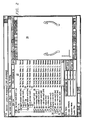
- FIGURE 2 illustrates a pruned bill of materials display indicated generally at 22 which may be used in conjunction with the method and system of the present invention.
- Display 22 shows a directory structure associated with a bill of materials for an exemplary snow mobile.
- the highest level of organization shown in display 22 is the directory or assembly titled "top review" indicated at 24 in FIGURE 2 .
- the next level within the bill of materials includes directories for the seat, steering, left and right skis, a skid frame, mud guard, chassis, several springs, lower arms, and the front body of the snowmobile.
- an expansion indicator such as indicator 26, is placed to the left of the associated directory.
- the display 22 shown in FIGURE 2 also includes the capability to display images of the components of the system associated with the bill of materials in a component display window 28. If the user desires to see images of the components, the user can place a check in a element display box, such as element display box 30 indicated in FIGURE 2 .
- Display 22 shown in FIGURE 2 illustrates the display presented according to the teachings of the present invention if the user has asked the system to present all "brace" elements within the bill of materials.
- the system has identified a ski brace indicated at 30 and a ski brace indicated at 32 which are responsive to the requested search.
- Ski brace 30 is shown to be a component of a directory titled "Ski Weldment.”
- Ski brace 32 is also shown to be a component of another directory titled “Ski Weldment.”
- the identified components, ski brace 30 and ski brace 32 are, therefore, shown within their immediate parent directory so that the user can see the immediate context of the identified elements.
- Pruning indicator 34 indicates to the user that intermediate directories, between the "top review” directory and the "Ski Weldment” directory, have been omitted from the display for purposes of clarity.
- the identified element ski brace 30 is shown as the only displayed element of the parent directory "Ski Weldment.” All other components within "Ski Weldment” are omitted and replaced by a sibling pruning indicator 36 shown in FIGURE 2 .
- Sibling pruning indicator 36 indicates to the user that other elements exist within the "Ski Weldment” directory that are not illustrated in the display 22. These elements are omitted for purposes of clarity so that more of the identified elements may be shown in the single display 22.
- ski brace 30 and ski brace 32 are shown in display 22 within the context of their immediate parent directory. However, these elements are actually stored within the tree table 20 within a directory that is a direct child of the "top review" directory which is also illustrated in display 22.
- ski brace 30 may be a component of the left ski directory indicated at 38 in FIGURE 2 or a component of a subdirectory within the left ski directory. Accordingly, if a user clicks on the expansion indicator associated with the left ski directory 38 and continues to expand the subdirectories until the user reaches the Ski Weldment subdirectory associated with ski brace 30, the system illustrated will reformat the display so that the ski brace 30 is shown within the appropriate left ski directory 38 or appropriate subdirectory.
- the display will move the identified element into the appropriate subdirectory so that the user can see the expanded subdirectory relationships.
- the Ski Weldment directory and ski brace element 30 would be removed from the top of the display 22 and placed in the appropriate place within the expanded left ski directory 38.
- FIGURE 3 is a flow diagram which illustrates one embodiment of a method of operation of a system constructed according to the teachings of the present invention.
- the method begins at step 40 where a user will select a context assembly. For example, in the exemplary bill of materials in FIGURE 2 , the user has selected the "top review" context assembly for the snowmobile.
- the method then proceeds to step 42 where the user specifies the search criteria to identify specific elements within the selected assembly. Elements can be searched by product name or by the characteristics of a product.
- searches can be performed by identifying all elements within a particular relationship to a specific identified element. For example, a search could be performed for all elements within the bill of materials that are within five inches in the assembled system from a particular identified element.
- step 44 the identified search is performed by the search and control engine 16 by applying the search terms and search criteria to the data set 14.
- the search and control engine 16 then assembles the identified components and communicates the resulting list of identified components to the display engine 18.
- step 46 the display engine 18 modifies the tree table 20 so that the identified components and their immediate parent directories are placed at the top of the tree table 20 as was discussed with reference to display 22 in FIGURE 2 .
- step 48 the display engine 18, through the user interface 12, displays the resulting directory tree, including the associated prune indicators and sibling prune indicators such as prune indicator 34 and sibling prune indicator 36 discussed with reference to FIGURE 2 .
- the method then enters a loop associated with a decision block 50 where the display engine 18 in user interface 12 determines whether or not the user has expanded directory structures within the display to a level associated with an identified object. The method continues to test for this condition until the user opens a directory associated with an identified object at which point the method proceeds to step 52 where the display engine 18 once again modifies the tree table 20 to move the identified object to the correct parent directory structure. The method then proceeds to step 54 where the modified tree table 20 is used to construct a modified display with the identified element moved to the correct parent directory structure and with the pruning indicators associated with the identified element removed. The method then returns to the conditional block 50 to wait for further interaction with the user.
- the present invention has been described in the context of an exemplary computer aided design system, the scope of the present invention should not be limited to this or any exemplary embodiment.
- teachings of the present invention are equally applicable to other directory structures that are faced with the challenge of presenting to a user identified elements within the directory structure that are difficult to present in context because of the multiplicity of identified elements or the depth of the directory structure or both.
- a search of specific data elements or files within a file system organized through a hierarchical directory could receive substantial benefit from the techniques described herein through the use of pruning indicators or sibling pruning indicators to simplify the display of the identified elements in a truncated context.
Landscapes
- Engineering & Computer Science (AREA)
- Theoretical Computer Science (AREA)
- Data Mining & Analysis (AREA)
- Databases & Information Systems (AREA)
- Physics & Mathematics (AREA)
- General Engineering & Computer Science (AREA)
- General Physics & Mathematics (AREA)
- Information Retrieval, Db Structures And Fs Structures Therefor (AREA)
- User Interface Of Digital Computer (AREA)
- Debugging And Monitoring (AREA)
- Machine Translation (AREA)
- Control Of Indicators Other Than Cathode Ray Tubes (AREA)
Abstract
Description
- This invention relates generally to the field of data processing systems and more particularly to an improved system and method for compiling and displaying a pruned information set.
- Databases of information are commonly organized as nested directories where information that is related is grouped together in a nested fashion. These nested directories can sometimes contain many levels so that an individual piece of information may be categorized by a multiplicity of levels of directory organization.
- These organizational structures are commonly used in file systems in data processing environments. For example, in an engineering date management or a computer aided design (CAD) system the components of an assembly can be organized in a nested bill of materials. For example, a particular fastener may be associated with a particular bracket, which may be associated with a particular assembly on a particular portion of a larger machine. Each of these levels of abstraction may be associated with a directory level within the organized bill of materials.
- Engineering data management systems, CAD systems and other file systems typically allow a user to perform searches through the data components organized in the file structure. The results of these searches can return a simple list of the components to the user. However, it is sometimes advantageous to show the user where in the data hierarchy the components reside. Unfortunately, due to the many levels of organization, the display of these results is very difficult. For example, if two components are identified by a particular search, but these components are not within the same subassembly, it is difficult to display the entire hierarchy associated with the two components because of the need to display the multiplicity of directory layers associated with each component.
- Kaugars, K., "OTREE: A Tree Visualisation using Scaling and Omission", Human-Computer Interaction - Interact '99, Proc. of the IFIF Working Conference, 1, 30 August 1999, p. 491-496 relates to tree visualisation using scaling and omission. It uses three views of trees, selected depending on the available display space. Very large trees use a combination of scaling and omission to render focus areas of the tree. Each selected node is displayed at full size, and all non-selected nodes are scaled to a user-defined minimum size. Layout proceeds by successively removing the lowest priority nodes in the tree until a display is generated which fits the available area. All selected nodes (those with priority 0) along with all nodes of priority -1 are always visible on the display. If a node is visible, all of the ancestors of the node are visible. This maintains the connection between a selected node and the root of the tree, Hidden sub-trees are indicated on the display by small triangles drawn immediately below the last visible ancestor. The author's current implementation supports node selection and de-selection using mouse clicks. When a node is selected, it automatically selects all ancestors, which allows the user easily to read the path from the selected node to the root.
-
US 5,973,695 discloses a method for graphically displaying a UNIX directory structure. Each UNIX directory and subdirectory displayed in a directory structure pane can be shown graphically with contents fully displayed (expanded) or hidden (collapsed), the state of which is indicated with proper leading symbols. A cookie is set to reflect the current expanded or collapsed state of the current element. - Desclefs, B. and Soto, M. "Navigation in Huge Information Hierarchies", retrieved from the Internet at http://www-rp.lip6.fr/publications.production.html on 19 March 2001, addresses the problem that huge information hierarchies are very difficult to represent and that users often find it difficult to retrieve relevant information from such a mesh of nodes. Enhanced techniques for information aggregation are proposed. The approach allows a significant reduction of the number of nodes to display. After an introduction to the structure, the user may wish to define his own criteria of interest; in this case, the tree is aggregated according to these criteria. They can be semantic (keywords about content). Relevant nodes - called "primary nodes" - are selected: they will automatically belong to the aggregated tree. Some nodes need be displayed even if they were not selected at the beginning, because some of their children are primary nodes. Nodes like this are called "secondary nodes". Aggregated trees are thus composed of primary and secondary nodes. The other nodes are not displayed.
- Accordingly, a need has arisen for a system and method for displaying and compiling pruned directory listings that addresses problems associated with prior techniques.
- In accordance with one embodiment of the present invention, a method of displaying a subset of a data set is disclosed which comprises the step of displaying a data element in the context of a subset of the data hierarchy. A pruned elements indicator is also displayed to indicate to the user that portions of the data hierarchy have been pruned.
- According to another embodiment of the present invention, a pruned sibling indicator can be displayed to the user concurrently with the selected data element to indicate that the data element is associated with sibling data elements that have been pruned from the data display to the user.
- An important technical advantage of the system and method of the present invention inheres in the fact that the selective pruning of data elements from the displayed data hierarchy allows for the data elements that are displayed to be shown in the context of the data hierarchy but without the clutter of the entirety of the multiplicity of levels of the data hierarchy.
- For a more complete understanding of the present invention may be acquired by referring to the accompanied figures in which like reference numbers indicate like features and wherein:
-
FIGURE 1 is a schematic block diagram of one embodiment of a system constructed according to the teachings of the present invention; -
FIGURE 2 is a diagram of one embodiment of a user interface that may be used in conjunction with the teachings of the present invention; and -
FIGURE 3 is a flow diagram illustrating a user interface method which may be used in conjunction with the teachings of the present invention. -
FIGURE 1 is a schematic block diagram of a data processing system indicated generally at 10 which comprises auser interface 12.User interface 12 is operable to display data and receive commands from a user which is interfacing withsystem 10.User interface 12 may comprise a software application or a portion of a data processing system that may include a computer screen, computer keyboard, and a pointing device such as a mouse or a track ball. Using these systems, a graphical display can be presented to a user and the user can type in commands or terms and use the pointing device to select active portions of the screen to institute actions or select items on the screen. According to one embodiment of the present invention,system 10 may comprise a portion of a computer aided design (CAD) system or an engineering data management system. CAD systems are ordinarily associated with the design of an assembly whereas engineering data management systems are ordinarily associated with the management of design data and related parameters after design, during, for example, manufacture or testing of the assembly. Both such types of system commonly use large, hierarchically organized data sets that would benefit from the teachings, of the present invention.. In these embodiments, the user interface is operable to present graphical images of components of assemblies which are designed, modeled, or managed using thesystem 10. - It is sometimes useful in the context of a computer aided design system to compile and store a complete list of the components of a system being designed in a bill of materials data set. This information is represented by
data set 14 which is shown inFIGURE 1 . Theuser interface 12 can access the data withindata set 14 using a search andcontrol engine 16 also shown inFIGURE 1 . The portions of the data set to be displayed throughinterface 12 are controlled by adisplay engine 18 which stores the information to be displayed in a tree table 20. - In operation, a user interacting with
user interface 12 might input a set of search terms, conditions, or commands which would be used to identify portions of the data withindata set 14. For example, the user might input various descriptive terms such as "fastener", "aluminum", and "less than 2 inches in length." The search andcontrol engine 16 may then apply the search terms and parameters to the data stored withindata set 14 and identify a subset of thedata set 14 that is responsive to the search limitations. - The
display engine 18 may then identify the portions of the data set 14 within the data hierarchy that are associated with the identified elements and organize the results in an organized directory tree as represented by tree table 20. According to the teachings of the present invention, the resulting display presented to the user throughuser interface 12 may comprise a "pruned" bill of materials display. In contrast, in order to compile and present conventional displays of a bill of materials, conventional CAD systems and engineering data management systems typically will identify the elements within the data structure which are identified by the search in the context of the complete remaining directory tree. This can result in a very confusing display because the identified elements may be located extremely deep in the directory structure. As such, the illustration of where these elements lie in the directory tree can take up a great deal of space on the display and make it difficult to display more than one or two identified elements. It should be understood that the term "directory" is used herein in its broadest possible sense to mean any grouping of information. In some systems and data sets, these groupings may be referenced to as assemblies, subassemblies, directories, subdirectories, file groups, file sections, folders, subfolders or any other of a number f terms used to identify groups of information. -
FIGURE 2 illustrates a pruned bill of materials display indicated generally at 22 which may be used in conjunction with the method and system of the present invention.Display 22 shows a directory structure associated with a bill of materials for an exemplary snow mobile. The highest level of organization shown indisplay 22 is the directory or assembly titled "top review" indicated at 24 inFIGURE 2 . The next level within the bill of materials includes directories for the seat, steering, left and right skis, a skid frame, mud guard, chassis, several springs, lower arms, and the front body of the snowmobile. As is common in directory structures, if a level of a directory has further elements within it that are not being displayed, an expansion indicator, such asindicator 26, is placed to the left of the associated directory. By selecting and clicking on theexpansion indicator 26 the subdirectories within the higher level directory can be displayed. Thedisplay 22 shown inFIGURE 2 also includes the capability to display images of the components of the system associated with the bill of materials in acomponent display window 28. If the user desires to see images of the components, the user can place a check in a element display box, such aselement display box 30 indicated inFIGURE 2 . -
Display 22 shown inFIGURE 2 illustrates the display presented according to the teachings of the present invention if the user has asked the system to present all "brace" elements within the bill of materials. As shown indisplay 22, the system has identified a ski brace indicated at 30 and a ski brace indicated at 32 which are responsive to the requested search.Ski brace 30 is shown to be a component of a directory titled "Ski Weldment." Ski brace 32 is also shown to be a component of another directory titled "Ski Weldment." The identified components,ski brace 30 and ski brace 32, are, therefore, shown within their immediate parent directory so that the user can see the immediate context of the identified elements. However, all the interceding directories between the parent directory "top review" and the directory "Ski Weldment" are omitted from the display and replaced by a pruning indicator 34. Pruning indicator 34 indicates to the user that intermediate directories, between the "top review" directory and the "Ski Weldment" directory, have been omitted from the display for purposes of clarity. - In order to further simplify the display in order to highlight the identified elements, the identified
element ski brace 30 is shown as the only displayed element of the parent directory "Ski Weldment." All other components within "Ski Weldment" are omitted and replaced by asibling pruning indicator 36 shown inFIGURE 2 .Sibling pruning indicator 36 indicates to the user that other elements exist within the "Ski Weldment" directory that are not illustrated in thedisplay 22. These elements are omitted for purposes of clarity so that more of the identified elements may be shown in thesingle display 22. - The identified elements,
ski brace 30 and ski brace 32, are shown indisplay 22 within the context of their immediate parent directory. However, these elements are actually stored within the tree table 20 within a directory that is a direct child of the "top review" directory which is also illustrated indisplay 22. For example,ski brace 30 may be a component of the left ski directory indicated at 38 inFIGURE 2 or a component of a subdirectory within the left ski directory. Accordingly, if a user clicks on the expansion indicator associated with the left ski directory 38 and continues to expand the subdirectories until the user reaches the Ski Weldment subdirectory associated withski brace 30, the system illustrated will reformat the display so that theski brace 30 is shown within the appropriate left ski directory 38 or appropriate subdirectory. In this manner, if a user desires to see the complete expanded directory structure associated with an identified element and configures the display using the expansion indictors to locate that subdirectory, the display will move the identified element into the appropriate subdirectory so that the user can see the expanded subdirectory relationships. In the identified example, if the user expanded all the directories underneath the left ski directory 38, the Ski Weldment directory andski brace element 30 would be removed from the top of thedisplay 22 and placed in the appropriate place within the expanded left ski directory 38. -
FIGURE 3 is a flow diagram which illustrates one embodiment of a method of operation of a system constructed according to the teachings of the present invention. The method begins atstep 40 where a user will select a context assembly. For example, in the exemplary bill of materials inFIGURE 2 , the user has selected the "top review" context assembly for the snowmobile. The method then proceeds to step 42 where the user specifies the search criteria to identify specific elements within the selected assembly. Elements can be searched by product name or by the characteristics of a product. In addition, searches can be performed by identifying all elements within a particular relationship to a specific identified element. For example, a search could be performed for all elements within the bill of materials that are within five inches in the assembled system from a particular identified element. - The method then proceeds to step 44 where the identified search is performed by the search and
control engine 16 by applying the search terms and search criteria to thedata set 14. The search andcontrol engine 16 then assembles the identified components and communicates the resulting list of identified components to thedisplay engine 18. The method then proceeds to step 46 where thedisplay engine 18 modifies the tree table 20 so that the identified components and their immediate parent directories are placed at the top of the tree table 20 as was discussed with reference to display 22 inFIGURE 2 . The method then proceeds to step 48 where thedisplay engine 18, through theuser interface 12, displays the resulting directory tree, including the associated prune indicators and sibling prune indicators such as prune indicator 34 and sibling pruneindicator 36 discussed with reference toFIGURE 2 . The method then enters a loop associated with adecision block 50 where thedisplay engine 18 inuser interface 12 determines whether or not the user has expanded directory structures within the display to a level associated with an identified object. The method continues to test for this condition until the user opens a directory associated with an identified object at which point the method proceeds to step 52 where thedisplay engine 18 once again modifies the tree table 20 to move the identified object to the correct parent directory structure. The method then proceeds to step 54 where the modified tree table 20 is used to construct a modified display with the identified element moved to the correct parent directory structure and with the pruning indicators associated with the identified element removed. The method then returns to theconditional block 50 to wait for further interaction with the user. - Although the present invention has been described in the context of an exemplary computer aided design system, the scope of the present invention should not be limited to this or any exemplary embodiment. For example, the teachings of the present invention are equally applicable to other directory structures that are faced with the challenge of presenting to a user identified elements within the directory structure that are difficult to present in context because of the multiplicity of identified elements or the depth of the directory structure or both. For example, a search of specific data elements or files within a file system organized through a hierarchical directory could receive substantial benefit from the techniques described herein through the use of pruning indicators or sibling pruning indicators to simplify the display of the identified elements in a truncated context.
- Although the present invention has been described in detail, it should be understood that various changes, alterations, substitutions and modifications may be made to the teachings described herein without departing from or scope of the present invention which is solely defined by the appending claims. To aid patent examining authorities and any readers of any patent issued on this application in interpreting the scope of the claims appended hereto, applicants wish to note that they do no intend any of the terms used in the claims to have a special meaning, but instead should all be construed to have their ordinary meaning to one of ordinary skill in the art, and do not intend by any statement in the specification to limit the invention in anyway that is not otherwise reflected in the claims.
Claims (10)
- A method for processing data elements stored in a data set (14) comprising:organizing the data elements in a directory structure including identifying particular elements with particular directories;identifying particular element (30, 32) within the data set in response to search criteria; andformatting a tree table (20) associated with the data set (14) and associated with a display (22) where information associated with the identified data elements is displayed in the context of information associated with an immediate parent directory of the identified data elements and where a pruning indicator display element (34) is included as a portion of the display characterised by using the pruning indicator display element (34) to indicate to a user that at least one directory structure associated with the immediate parent directoy and comprising interceding directories between a parent directory and the immediate parent directory exists within the directory structure but has been omitted from the display (22).
- The method of Claim 1 whereby the display further comprises a sibling pruning indicator display element (36) which is included in the display (22) indicate to a user of the display (22) that data elements which are siblings of an identified data element (30, 32) within the immediate parent directory exist within the data set (14) but have been omitted from the display (22) and replaced by the sibling pruning indicator display element (36).
- The method of Claim 1 or 2, further comprising:receiving inputs from a user of the display indicating the user's desire to view particular subdirectory structures within the directory structure associated with the data set (14).identifying a subdirectory (38) to be displayed in response to input received by the user that includes an identified data element (30) that is displayed in conjunction with a pruning indicator display element (34); andreformatting the display to move the identified data element into the expanded subdirectory display group without the pruning indicator display element (34) such that the identified data element is shown in the correct directory context associated with the directory structure associated with the data set (14).
- The method of Claim 1 or 3, wherein the display system comprises a component of a computer aided design system and wherein the data elements are digital data sets associated with physical components of a system having a graphical representation associated with the computer aided design system.
- The method of Claim 1 or 3, wherein the display system is associated with a file storage system and wherein the data elements are data files organized in a hierarchical directory structure.
- A data processing system, comprising:a user interface (12) operable to receive commands from a user and display information to the user;a display engine (18) in communication with the user interface (12) and operable to organize a data set (14) into a tree table (20) so that the data set (14) can be displayed as a hierarchical directory tree with data elements organized in subdirectories within the tree;a search and control engine (16) in communication with the user interface (12) and operable to perform searches on the data set (14) to identify particular data elements responsive to information received from the user via the user interface (12), andthe display engine (18) operable to format the tree table (20) such that the particular identified data elements are displayed through the user interface (12) with a respective parent subdirectory to which each particular identified data element is a member, and such that a pruning indicator display element (34) is displayed associated with each particular identified data element which is displayed in a fashion that omits at least one parent directory associated with the particular element and replaces interceding directories between a parent directory and the immediate parent directory.
- The system of Claim 6 wherein the user interface (12) is operable to receive commands from the user to display at least one hidden subdirectory and wherein the display engine (18) is operable to reformat the tree table (20) to remove the pruning indicator display element (34) if a user commands the display of the parent directory (38) associated with a particular identified data element (30) and to display the particular identified data element (30) in the expanded data tree, including any exposed hidden directories.
- The system of Claim 6 wherein the display engine (18) is operable to substitute a sibling pruning indicator display element (36) data elements which are siblings of the particular identified data element (30, 32) within the parent subdirectory.
- The system of Claim 6 wherein the data set (14) comprises data files within a hierarchically organized file system.
- The system of Claim 6 wherein the data set (14) comprises data elements comprising digital data sets representative of structural components of an assembly renderable by a computer aided design system.
Applications Claiming Priority (3)
| Application Number | Priority Date | Filing Date | Title |
|---|---|---|---|
| US10/034,231 US6877009B2 (en) | 2001-12-27 | 2001-12-27 | System and method for compiling and displaying a pruned information set |
| US34231 | 2001-12-27 | ||
| PCT/US2002/038939 WO2003058513A2 (en) | 2001-12-27 | 2002-12-06 | System and method for compiling and displaying a pruned information set |
Publications (2)
| Publication Number | Publication Date |
|---|---|
| EP1459164A2 EP1459164A2 (en) | 2004-09-22 |
| EP1459164B1 true EP1459164B1 (en) | 2011-09-28 |
Family
ID=21875100
Family Applications (1)
| Application Number | Title | Priority Date | Filing Date |
|---|---|---|---|
| EP02786900A Expired - Lifetime EP1459164B1 (en) | 2001-12-27 | 2002-12-06 | Method and data processing system for compiling and displaying a pruned information set |
Country Status (9)
| Country | Link |
|---|---|
| US (2) | US6877009B2 (en) |
| EP (1) | EP1459164B1 (en) |
| JP (1) | JP4975954B2 (en) |
| KR (1) | KR100918719B1 (en) |
| AT (1) | ATE526625T1 (en) |
| AU (1) | AU2002351252A1 (en) |
| CA (1) | CA2471278A1 (en) |
| MX (1) | MXPA04006311A (en) |
| WO (1) | WO2003058513A2 (en) |
Families Citing this family (19)
| Publication number | Priority date | Publication date | Assignee | Title |
|---|---|---|---|---|
| WO2004008348A1 (en) | 2002-07-16 | 2004-01-22 | Horn Bruce L | Computer system for automatic organization, indexing and viewing of information from multiple sources |
| US8935298B2 (en) | 2002-12-30 | 2015-01-13 | Fisher-Rosemount Systems, Inc. | Integrated navigational tree importation and generation in a process plant |
| US7493310B2 (en) * | 2002-12-30 | 2009-02-17 | Fisher-Rosemount Systems, Inc. | Data visualization within an integrated asset data system for a process plant |
| US20040230328A1 (en) * | 2003-03-21 | 2004-11-18 | Steve Armstrong | Remote data visualization within an asset data system for a process plant |
| US20060174216A1 (en) * | 2005-01-28 | 2006-08-03 | Trenten Peterson | Providing additional hierarchical information for an object displayed in a tree view in a hierarchical relationship with other objects |
| USD553626S1 (en) * | 2005-10-13 | 2007-10-23 | Arg Soft Intellectual Property Holdings, Limited | Computer network monitoring web interface for a computer screen |
| US7533112B2 (en) * | 2006-03-27 | 2009-05-12 | Microsoft Corporation | Context hierarchies for address searching |
| WO2009157933A1 (en) * | 2008-06-26 | 2009-12-30 | Hewlett-Packard Development Company, L.P. | Self-management of local resources allocated remotely |
| US8327256B2 (en) * | 2008-11-19 | 2012-12-04 | Oracle International Corporation | Matrix tree presentation structures |
| US8671363B2 (en) * | 2008-11-19 | 2014-03-11 | Oracle International Corporation | Nested dimensions presentation structures |
| JP2013054364A (en) * | 2012-10-15 | 2013-03-21 | Nikon Corp | Display processing device, display system, display method and program |
| US9547303B2 (en) * | 2013-10-18 | 2017-01-17 | The Boeing Company | Managing the manufacturing lifecycle of fasteners of a product |
| US9933917B2 (en) * | 2014-08-13 | 2018-04-03 | Bank Of America Corporation | System and method for generating and navigating a bonsai tree hierarchical data structure |
| US20160110387A1 (en) * | 2014-10-20 | 2016-04-21 | Solar Turbines Incorporated | Product lifecycle management system |
| US10366369B2 (en) * | 2016-08-01 | 2019-07-30 | Blackberry Limited | Calendar and email application |
| JP6620730B2 (en) * | 2016-11-18 | 2019-12-18 | 京セラドキュメントソリューションズ株式会社 | Information processing apparatus and image forming apparatus |
| US10540064B1 (en) * | 2016-12-21 | 2020-01-21 | Juniper Networks, Inc. | Framework for creating hierarchical navigation trees using user interface plugins |
| KR102400987B1 (en) * | 2020-09-08 | 2022-05-20 | 연세대학교 산학협력단 | Memory Management Apparatus and Method |
| US12561301B2 (en) | 2021-12-03 | 2026-02-24 | Siemens Industry Software Inc. | Filtered product structure |
Citations (3)
| Publication number | Priority date | Publication date | Assignee | Title |
|---|---|---|---|---|
| US5973695A (en) * | 1997-07-02 | 1999-10-26 | Electronic Data Systems Corporation | Method for graphically displaying a UNIX directory structure |
| US6105062A (en) * | 1998-02-26 | 2000-08-15 | Novell, Inc. | Method and system for pruning and grafting trees in a directory service |
| US6304790B1 (en) * | 1997-10-23 | 2001-10-16 | Fujitsu Limited | System design/evaluation CAD system and program storage medium |
Family Cites Families (10)
| Publication number | Priority date | Publication date | Assignee | Title |
|---|---|---|---|---|
| JPH04186447A (en) * | 1990-11-21 | 1992-07-03 | Canon Inc | information processing equipment |
| US5557786A (en) | 1994-01-24 | 1996-09-17 | Advanced Computer Applications, Inc. | Threaded, height-balanced binary tree data structure |
| US6055515A (en) | 1996-07-30 | 2000-04-25 | International Business Machines Corporation | Enhanced tree control system for navigating lattices data structures and displaying configurable lattice-node labels |
| US6189019B1 (en) * | 1996-08-14 | 2001-02-13 | Microsoft Corporation | Computer system and computer-implemented process for presenting document connectivity |
| US6144962A (en) * | 1996-10-15 | 2000-11-07 | Mercury Interactive Corporation | Visualization of web sites and hierarchical data structures |
| US6128016A (en) * | 1996-12-20 | 2000-10-03 | Nec Corporation | Graphic user interface for managing a server system |
| US6108698A (en) * | 1998-07-29 | 2000-08-22 | Xerox Corporation | Node-link data defining a graph and a tree within the graph |
| US6374253B1 (en) * | 1998-12-30 | 2002-04-16 | Microsoft Corporation | System and method for generating hierarchical forward knowledge |
| EP1164752A1 (en) | 2000-06-13 | 2001-12-19 | Motorola, Inc. | Method for performing hierarchical address translation |
| US20030001894A1 (en) | 2001-06-29 | 2003-01-02 | International Business Machines Corporation | Method and apparatus for dynamically determining actions to perform for an object |
-
2001
- 2001-12-27 US US10/034,231 patent/US6877009B2/en not_active Expired - Fee Related
-
2002
- 2002-12-06 KR KR1020047010227A patent/KR100918719B1/en not_active Expired - Fee Related
- 2002-12-06 AU AU2002351252A patent/AU2002351252A1/en not_active Abandoned
- 2002-12-06 WO PCT/US2002/038939 patent/WO2003058513A2/en not_active Ceased
- 2002-12-06 EP EP02786900A patent/EP1459164B1/en not_active Expired - Lifetime
- 2002-12-06 CA CA002471278A patent/CA2471278A1/en not_active Abandoned
- 2002-12-06 AT AT02786900T patent/ATE526625T1/en not_active IP Right Cessation
- 2002-12-06 MX MXPA04006311A patent/MXPA04006311A/en not_active Application Discontinuation
- 2002-12-06 JP JP2003558753A patent/JP4975954B2/en not_active Expired - Fee Related
-
2005
- 2005-03-21 US US11/086,009 patent/US7451154B2/en not_active Expired - Fee Related
Patent Citations (3)
| Publication number | Priority date | Publication date | Assignee | Title |
|---|---|---|---|---|
| US5973695A (en) * | 1997-07-02 | 1999-10-26 | Electronic Data Systems Corporation | Method for graphically displaying a UNIX directory structure |
| US6304790B1 (en) * | 1997-10-23 | 2001-10-16 | Fujitsu Limited | System design/evaluation CAD system and program storage medium |
| US6105062A (en) * | 1998-02-26 | 2000-08-15 | Novell, Inc. | Method and system for pruning and grafting trees in a directory service |
Also Published As
| Publication number | Publication date |
|---|---|
| MXPA04006311A (en) | 2005-03-31 |
| ATE526625T1 (en) | 2011-10-15 |
| WO2003058513A3 (en) | 2004-04-08 |
| JP4975954B2 (en) | 2012-07-11 |
| KR100918719B1 (en) | 2009-09-24 |
| US7451154B2 (en) | 2008-11-11 |
| AU2002351252A1 (en) | 2003-07-24 |
| KR20050005403A (en) | 2005-01-13 |
| US20030126115A1 (en) | 2003-07-03 |
| US20050165831A1 (en) | 2005-07-28 |
| EP1459164A2 (en) | 2004-09-22 |
| WO2003058513A2 (en) | 2003-07-17 |
| CA2471278A1 (en) | 2003-07-17 |
| JP2005529381A (en) | 2005-09-29 |
| US6877009B2 (en) | 2005-04-05 |
Similar Documents
| Publication | Publication Date | Title |
|---|---|---|
| US6816175B1 (en) | Orthogonal browsing in object hierarchies | |
| US7451154B2 (en) | System and method for compiling and displaying a pruned information set | |
| US7428705B2 (en) | Web map tool | |
| US5515488A (en) | Method and apparatus for concurrent graphical visualization of a database search and its search history | |
| Katifori et al. | Ontology visualization methods—a survey | |
| KR0143357B1 (en) | Database Search System with Enhanced User Interface | |
| JP3113859B2 (en) | How to represent records graphically | |
| CA2595139C (en) | Method and system for navigating in a database of a computer system | |
| US6112201A (en) | Virtual bookshelf | |
| US7631255B2 (en) | Interface and method for exploring a collection of data | |
| US6418429B1 (en) | Portable browsing interface for information retrieval | |
| US8065339B2 (en) | Hierarchy modification | |
| JP2005515557A (en) | Dynamic legal database providing historical and current versions of the code | |
| Masui | LensBar-visualization for browsing and filtering large lists of data | |
| WO1998004982A1 (en) | Browse by prompted keyword phrases with an improved user interface | |
| Nadamoto et al. | A comparative web browser (CWB) for browsing and comparing web pages | |
| Allen | Navigating and searching in hierarchical digital library catalogs | |
| Hemmje | A 3D based user interface for information retrieval systems | |
| Kunz et al. | Visual Representation and Contextualization of Search Results–List and Matrix Browser | |
| US7565374B2 (en) | Database visualization and searching | |
| WO2000007125A1 (en) | Resource and project management system | |
| JP2715980B2 (en) | Information processing device | |
| Parikh | Visualization of search engine query result using region-based document model on XML documents | |
| Robert et al. | Digital Annotation and Exploration Techniques for Handling Image-Based Hypermedia. | |
| Veit et al. | Visual Representation and Contextualization of Search Results-List and Matrix Browser |
Legal Events
| Date | Code | Title | Description |
|---|---|---|---|
| PUAI | Public reference made under article 153(3) epc to a published international application that has entered the european phase |
Free format text: ORIGINAL CODE: 0009012 |
|
| 17P | Request for examination filed |
Effective date: 20040714 |
|
| AK | Designated contracting states |
Kind code of ref document: A2 Designated state(s): AT BE BG CH CY CZ DE DK EE ES FI FR GB GR IE IT LI LU MC NL PT SE SI SK TR |
|
| AX | Request for extension of the european patent |
Extension state: AL LT LV MK RO |
|
| 17Q | First examination report despatched |
Effective date: 20070601 |
|
| RAP1 | Party data changed (applicant data changed or rights of an application transferred) |
Owner name: SIEMENS PRODUCT LIFECYCLE MANAGEMENT SOFTWARE INC. |
|
| GRAP | Despatch of communication of intention to grant a patent |
Free format text: ORIGINAL CODE: EPIDOSNIGR1 |
|
| GRAS | Grant fee paid |
Free format text: ORIGINAL CODE: EPIDOSNIGR3 |
|
| GRAA | (expected) grant |
Free format text: ORIGINAL CODE: 0009210 |
|
| RTI1 | Title (correction) |
Free format text: METHOD AND DATA PROCESSING SYSTEM FOR COMPILING AND DISPLAYING A PRUNED INFORMATION SET |
|
| AK | Designated contracting states |
Kind code of ref document: B1 Designated state(s): AT BE BG CH CY CZ DE DK EE ES FI FR GB GR IE IT LI LU MC NL PT SE SI SK TR |
|
| REG | Reference to a national code |
Ref country code: GB Ref legal event code: FG4D |
|
| REG | Reference to a national code |
Ref country code: CH Ref legal event code: EP |
|
| REG | Reference to a national code |
Ref country code: IE Ref legal event code: FG4D |
|
| REG | Reference to a national code |
Ref country code: DE Ref legal event code: R096 Ref document number: 60241171 Country of ref document: DE Effective date: 20111208 |
|
| REG | Reference to a national code |
Ref country code: NL Ref legal event code: VDEP Effective date: 20110928 |
|
| PG25 | Lapsed in a contracting state [announced via postgrant information from national office to epo] |
Ref country code: SE Free format text: LAPSE BECAUSE OF FAILURE TO SUBMIT A TRANSLATION OF THE DESCRIPTION OR TO PAY THE FEE WITHIN THE PRESCRIBED TIME-LIMIT Effective date: 20110928 Ref country code: FI Free format text: LAPSE BECAUSE OF FAILURE TO SUBMIT A TRANSLATION OF THE DESCRIPTION OR TO PAY THE FEE WITHIN THE PRESCRIBED TIME-LIMIT Effective date: 20110928 |
|
| PG25 | Lapsed in a contracting state [announced via postgrant information from national office to epo] |
Ref country code: GR Free format text: LAPSE BECAUSE OF FAILURE TO SUBMIT A TRANSLATION OF THE DESCRIPTION OR TO PAY THE FEE WITHIN THE PRESCRIBED TIME-LIMIT Effective date: 20111229 Ref country code: CY Free format text: LAPSE BECAUSE OF FAILURE TO SUBMIT A TRANSLATION OF THE DESCRIPTION OR TO PAY THE FEE WITHIN THE PRESCRIBED TIME-LIMIT Effective date: 20110928 Ref country code: AT Free format text: LAPSE BECAUSE OF FAILURE TO SUBMIT A TRANSLATION OF THE DESCRIPTION OR TO PAY THE FEE WITHIN THE PRESCRIBED TIME-LIMIT Effective date: 20110928 Ref country code: SI Free format text: LAPSE BECAUSE OF FAILURE TO SUBMIT A TRANSLATION OF THE DESCRIPTION OR TO PAY THE FEE WITHIN THE PRESCRIBED TIME-LIMIT Effective date: 20110928 |
|
| REG | Reference to a national code |
Ref country code: AT Ref legal event code: MK05 Ref document number: 526625 Country of ref document: AT Kind code of ref document: T Effective date: 20110928 |
|
| PG25 | Lapsed in a contracting state [announced via postgrant information from national office to epo] |
Ref country code: BE Free format text: LAPSE BECAUSE OF FAILURE TO SUBMIT A TRANSLATION OF THE DESCRIPTION OR TO PAY THE FEE WITHIN THE PRESCRIBED TIME-LIMIT Effective date: 20110928 |
|
| PG25 | Lapsed in a contracting state [announced via postgrant information from national office to epo] |
Ref country code: CZ Free format text: LAPSE BECAUSE OF FAILURE TO SUBMIT A TRANSLATION OF THE DESCRIPTION OR TO PAY THE FEE WITHIN THE PRESCRIBED TIME-LIMIT Effective date: 20110928 Ref country code: SK Free format text: LAPSE BECAUSE OF FAILURE TO SUBMIT A TRANSLATION OF THE DESCRIPTION OR TO PAY THE FEE WITHIN THE PRESCRIBED TIME-LIMIT Effective date: 20110928 |
|
| PG25 | Lapsed in a contracting state [announced via postgrant information from national office to epo] |
Ref country code: NL Free format text: LAPSE BECAUSE OF FAILURE TO SUBMIT A TRANSLATION OF THE DESCRIPTION OR TO PAY THE FEE WITHIN THE PRESCRIBED TIME-LIMIT Effective date: 20110928 Ref country code: IT Free format text: LAPSE BECAUSE OF FAILURE TO SUBMIT A TRANSLATION OF THE DESCRIPTION OR TO PAY THE FEE WITHIN THE PRESCRIBED TIME-LIMIT Effective date: 20110928 Ref country code: PT Free format text: LAPSE BECAUSE OF FAILURE TO SUBMIT A TRANSLATION OF THE DESCRIPTION OR TO PAY THE FEE WITHIN THE PRESCRIBED TIME-LIMIT Effective date: 20120130 Ref country code: EE Free format text: LAPSE BECAUSE OF FAILURE TO SUBMIT A TRANSLATION OF THE DESCRIPTION OR TO PAY THE FEE WITHIN THE PRESCRIBED TIME-LIMIT Effective date: 20110928 |
|
| PG25 | Lapsed in a contracting state [announced via postgrant information from national office to epo] |
Ref country code: DK Free format text: LAPSE BECAUSE OF FAILURE TO SUBMIT A TRANSLATION OF THE DESCRIPTION OR TO PAY THE FEE WITHIN THE PRESCRIBED TIME-LIMIT Effective date: 20110928 Ref country code: MC Free format text: LAPSE BECAUSE OF NON-PAYMENT OF DUE FEES Effective date: 20111231 |
|
| REG | Reference to a national code |
Ref country code: CH Ref legal event code: PL |
|
| PLBE | No opposition filed within time limit |
Free format text: ORIGINAL CODE: 0009261 |
|
| STAA | Information on the status of an ep patent application or granted ep patent |
Free format text: STATUS: NO OPPOSITION FILED WITHIN TIME LIMIT |
|
| 26N | No opposition filed |
Effective date: 20120629 |
|
| REG | Reference to a national code |
Ref country code: IE Ref legal event code: MM4A |
|
| REG | Reference to a national code |
Ref country code: DE Ref legal event code: R097 Ref document number: 60241171 Country of ref document: DE Effective date: 20120629 |
|
| PG25 | Lapsed in a contracting state [announced via postgrant information from national office to epo] |
Ref country code: LI Free format text: LAPSE BECAUSE OF NON-PAYMENT OF DUE FEES Effective date: 20111231 Ref country code: CH Free format text: LAPSE BECAUSE OF NON-PAYMENT OF DUE FEES Effective date: 20111231 Ref country code: IE Free format text: LAPSE BECAUSE OF NON-PAYMENT OF DUE FEES Effective date: 20111206 |
|
| PG25 | Lapsed in a contracting state [announced via postgrant information from national office to epo] |
Ref country code: ES Free format text: LAPSE BECAUSE OF FAILURE TO SUBMIT A TRANSLATION OF THE DESCRIPTION OR TO PAY THE FEE WITHIN THE PRESCRIBED TIME-LIMIT Effective date: 20120108 |
|
| PG25 | Lapsed in a contracting state [announced via postgrant information from national office to epo] |
Ref country code: LU Free format text: LAPSE BECAUSE OF NON-PAYMENT OF DUE FEES Effective date: 20111206 |
|
| PG25 | Lapsed in a contracting state [announced via postgrant information from national office to epo] |
Ref country code: BG Free format text: LAPSE BECAUSE OF FAILURE TO SUBMIT A TRANSLATION OF THE DESCRIPTION OR TO PAY THE FEE WITHIN THE PRESCRIBED TIME-LIMIT Effective date: 20111228 |
|
| PG25 | Lapsed in a contracting state [announced via postgrant information from national office to epo] |
Ref country code: TR Free format text: LAPSE BECAUSE OF FAILURE TO SUBMIT A TRANSLATION OF THE DESCRIPTION OR TO PAY THE FEE WITHIN THE PRESCRIBED TIME-LIMIT Effective date: 20110928 |
|
| PGFP | Annual fee paid to national office [announced via postgrant information from national office to epo] |
Ref country code: DE Payment date: 20150220 Year of fee payment: 13 |
|
| REG | Reference to a national code |
Ref country code: FR Ref legal event code: PLFP Year of fee payment: 14 |
|
| PGFP | Annual fee paid to national office [announced via postgrant information from national office to epo] |
Ref country code: GB Payment date: 20151209 Year of fee payment: 14 |
|
| PGFP | Annual fee paid to national office [announced via postgrant information from national office to epo] |
Ref country code: FR Payment date: 20151214 Year of fee payment: 14 |
|
| REG | Reference to a national code |
Ref country code: DE Ref legal event code: R119 Ref document number: 60241171 Country of ref document: DE |
|
| PG25 | Lapsed in a contracting state [announced via postgrant information from national office to epo] |
Ref country code: DE Free format text: LAPSE BECAUSE OF NON-PAYMENT OF DUE FEES Effective date: 20160701 |
|
| GBPC | Gb: european patent ceased through non-payment of renewal fee |
Effective date: 20161206 |
|
| REG | Reference to a national code |
Ref country code: FR Ref legal event code: ST Effective date: 20170831 |
|
| PG25 | Lapsed in a contracting state [announced via postgrant information from national office to epo] |
Ref country code: FR Free format text: LAPSE BECAUSE OF NON-PAYMENT OF DUE FEES Effective date: 20170102 |
|
| PG25 | Lapsed in a contracting state [announced via postgrant information from national office to epo] |
Ref country code: GB Free format text: LAPSE BECAUSE OF NON-PAYMENT OF DUE FEES Effective date: 20161206 |