EP1458742B1 - Solvates of 3.beta.,28-diacetoxy-18-oxo-19,20,21,29,30-pentanorlupan-22-oic acid, processes for their preparation and pharmaceutical compositions thereof - Google Patents
Solvates of 3.beta.,28-diacetoxy-18-oxo-19,20,21,29,30-pentanorlupan-22-oic acid, processes for their preparation and pharmaceutical compositions thereof Download PDFInfo
- Publication number
- EP1458742B1 EP1458742B1 EP02777576A EP02777576A EP1458742B1 EP 1458742 B1 EP1458742 B1 EP 1458742B1 EP 02777576 A EP02777576 A EP 02777576A EP 02777576 A EP02777576 A EP 02777576A EP 1458742 B1 EP1458742 B1 EP 1458742B1
- Authority
- EP
- European Patent Office
- Prior art keywords
- diacetoxy
- oxo
- pentanorlupan
- ene
- oic acid
- Prior art date
- Legal status (The legal status is an assumption and is not a legal conclusion. Google has not performed a legal analysis and makes no representation as to the accuracy of the status listed.)
- Expired - Lifetime
Links
Images


Classifications
-
- C—CHEMISTRY; METALLURGY
- C07—ORGANIC CHEMISTRY
- C07J—STEROIDS
- C07J63/00—Steroids in which the cyclopenta(a)hydrophenanthrene skeleton has been modified by expansion of only one ring by one or two atoms
- C07J63/008—Expansion of ring D by one atom, e.g. D homo steroids
-
- A—HUMAN NECESSITIES
- A61—MEDICAL OR VETERINARY SCIENCE; HYGIENE
- A61P—SPECIFIC THERAPEUTIC ACTIVITY OF CHEMICAL COMPOUNDS OR MEDICINAL PREPARATIONS
- A61P35/00—Antineoplastic agents
-
- C—CHEMISTRY; METALLURGY
- C07—ORGANIC CHEMISTRY
- C07J—STEROIDS
- C07J71/00—Steroids in which the cyclopenta(a)hydrophenanthrene skeleton is condensed with a heterocyclic ring
- C07J71/0005—Oxygen-containing hetero ring
Definitions
- the present invention relates to 3 ⁇ ,28-diacetoxy-18-oxo-19,20,21,29,30-pentanorlupan-22-oic acid methanol solvate, its use in medicine and processes for its preparation.
- This compound has recently shown promise in the treatment of proliferative disorders such as cancers and leukaemias.
- the present invention provides 3 ⁇ ,28-diacetoxy-18-oxo-19,20,21,29,30-pentanorlupan-22-oic acid methanol solvate.
- the present invention provides 3 ⁇ ,28-diacetoxy-18-oxo-19,20,21,29,30-pentanorlupan-22-oic acid ⁇ 1.5MeOH.
- 3 ⁇ ,28-diacetoxy-18-oxo-19,20,21,29,30-pentanorlupan-22-oic acid ⁇ 1.5MeOH may possess one or more of the following advantages as compared to the non-solvated precursor: improved aqueous solubility, uniform size distribution, filtration and drying characteristics, stability (thermal or long term storage), flowability, handling characteristics, isolation and purification characteristics, and physical properties advantageous to formulatory requirements e.g. compressibility.
- the present invention provides 3 ⁇ ,28-diacetoxy-18-oxo-19,20,21,29,30-pentanorlupan-22-oic acid methanol solvate having at least X-ray diffraction peaks at 14.7 and 16.0.
- the powder X-ray diffraction pattern will have peaks at 14.7, 16.0, 16.7, 18.8, 8.3, 20.4, 22.7. More preferably, the powder X-ray diffraction pattern will have peaks at 14.7, 16.0, 16.7, 14.4, 18.8, 8.3, 20.4, 15.7, 22.7.
- the X-ray diffraction pattern will be substantially as described in Figure 2 .
- the unit cell dimension for 3 ⁇ ,28-diacetoxy-18-oxo-19,20,21,29,30-pentanorlupan-22-oic acid ⁇ 1.5MeOH were determined as described in the examples.
- the present invention provides 3 ⁇ ,28-diacetoay-18-oxo-19,20,21,29,30-pentanorlupan-22-oic acid methanol solvate having atomic coordinates substantially as set down in Table 2.
- the present invention provides crystalline 3 ⁇ ,28-diacetoxy-18-oxo-19,20,21,29,30-pentanorlupan-22-oic acid methanol solvate wherein the crystalline form is monoclinic.
- 3 ⁇ ,28-diacetoxy-18-oxo-19,20,21,29,30-pentanorlupan-22-oic acid methanol solvate may be presented as salts in particular pharmaceutically acceptable salts.
- compositions of 3 ⁇ ,28-diacetoxy-18-oxo-19,20,21,29,30-pentanorlupan-22-oic acid methanol solvate include suitable acid addition or base salts thereof.
- suitable pharmaceutical salts may be found in Berge et al, J Pharm Sci, 66, 1-19 (1977 ).
- Suitable salts according to the invention include those formed with both organic and inorganic acids and bases.
- Pharmaceutically acceptable acid addition salts include those formed from hydrochloric, hydrobromic, sulphuric, citric, tartaric, phosphoric, lactic, pyruvic, acetic, trifluoroacetic, succinic, oxalic, fumaric, maleic, oxaloacetic, methanesulphonic, ethanesulphonic, p-toluenesulphonic, benzenesulphonic and isethionic acids.
- Pharmaceutically acceptable base salts include ammonium salts, alkali metal salts such as those of sodium and potassium, alkaline earth metal salts such as those of calcium and magnesium and salts with organic bases such as dicyclohexyl amine and N-methyl-D-glucamine.
- the invention furthermore relates to 3 ⁇ ,28-diacetoxy-18-oxo-19,20,21,29,30-pentanorlupan-22-oic acid methanol solvate in its various crystalline and polymorphic and (an)hydrous forms.
- the present invention further provides a pharmaceutical composition
- a pharmaceutical composition comprising 3 ⁇ ,28-diacetoxy-18-oxo-19,20,21,29,30-pentanorlupan-22-oic acid methanol solvate or pharmaceutically acceptable salt thereof, together with at least one pharmaceutically acceptable excipient, diluent or carrier.
- 3 ⁇ ,28-diacetoxy-18-oxo-19,20,21,29,30-pentanorlupan-22-oic acid methanol solvate may be admixed with any suitable binder(s), lubricant(s), suspending agent(s), coating agent(s), and/or solubilising agent(s).
- suitable excipients for the various different forms of pharmaceutical compositions described herein may be found in the " Handbook of Pharmaceutical Excipients, 2nd Edition, (1994), Edited by A Wade and PJ Weller .
- the present invention provides 3 ⁇ ,28-diacetoxy-18-oxo-19,20,21,29,30-pentanorlupan-22-oic acid methanol solvate for use in therapy, in particular for use in the manufacture of a medicament for the treatment of proliferative disorders such as cancers and leukaemias.
- the present invention also encompasses pharmaceutical compositions comprising 3 ⁇ ,28-diacetoxy-18-oxo-19,20,21,29,30-pentanorlupan-22-oic acid methanol solvate.
- pharmaceutical compositions comprising 3 ⁇ ,28-diacetoxy-18-oxo-19,20,21,29,30-pentanorlupan-22-oic acid methanol solvate.
- 3 ⁇ ,28-diacetoxy-18-oxo-19,20,21,29,30-pentanorlupan-22-oic acid methanol solvate including its pharmaceutically acceptable salts and pharmaceutically acceptable solvates
- a pharmaceutical carrier excipient or diluent selected with regard to the intended route of administration and standard pharmaceutical practice.
- compositions of the present invention may be adapted for oral, rectal, vaginal, parenteral, intramuscular, intraperitoneal, intraarterial, intrathecal, intrabronchial, subcutaneous, intradermal, intravenous, nasal, buccal or sublingual routes of administration.
- compositions For oral administration, particular use is made of compressed tablets, pills, tablets, gellules, drops, and capsules. Preferably, these compositions contain from 1 to 250 mg and more preferably from 10-100 mg, of active ingredient per dose.
- compositions of the present invention may also be in form of suppositories, pessaries, suspensions, emulsions, lotions, ointments, creams, gels, sprays, solutions or dusting powders.
- the active ingredient can be incorporated into a cream consisting of an aqueous emulsion of polyethylene glycols or liquid paraffin.
- the active ingredient can also be incorporated, at a concentration of between 1 and 10% by weight, into an ointment consisting of a white wax or white soft paraffin base together with such stabilisers and preservatives as may be required.
- Injectable forms may contain between 10 - 1000 mg, preferably between 10 - 250 mg, of active ingredient per dose.
- compositions may be formulated in unit dosage form, i.e., in the form of discrete portions containing a unit dose, or a multiple or sub-unit of a unit dose.
- a person of ordinary skill in the art can easily determine an appropriate dose of one of the instant compositions to administer to a subject without undue experimentation.
- a physician will determine the actual dosage which will be most suitable for an individual patient and it will vary with the age, weight and response of the particular patient.
- the dosages disclosed herein are exemplary of the average case. There can of course be individual instances where higher or lower dosage ranges are merited, and such are within the scope of this invention.
- one or more doses of 10 to 150 mg/day will be administered to the patient for the treatment of an antiproliferative disorder.
- the one or more compounds of the invention are administered in combination with one or more other anticancer agents, for example, existing anticancer drugs available on the market.
- the compounds of the invention may be administered consecutively, simultaneously or sequentially with the one or more other anticancer agents.
- Anticancer drugs in general are more effective when used in combination.
- combination therapy is desirable in order to avoid an overlap of major toxicities, mechanism of action and resistance mechanism(s).
- the major advantages of combining chemotherapeutic drugs are that it may promote additive or possible synergistic effects through biochemical interactions and also may decrease the emergence of resistance in early tumor cells which would have been otherwise responsive to initial chemotherapy with a single agent.
- An example of the use of biochemical interactions in selecting drug combinations is demonstrated by the administration of leucovorin to increase the binding of an active intracellular metabolite of 5-fluorouracil to its target, thymidylate synthase, thus increasing its cytotoxic effects.
- Beneficial combinations may be suggested by studying the growth inhibitory activity of the test compounds with agents known or suspected of being valuable in the treatment of a particular cancer initially or cell lines derived from that cancer. This procedure can also be used to determine the order of administration of the agents, i.e. before, simultaneously, or after delivery. Such scheduling may be a feature of all the cycle acting agents identified herein.
- 3 ⁇ ,28-diacetoxy-18-oxo-19,20,21,29,30-pentanorlupan-22-oic acid methanol solvate may be prepared by crystallising 3 ⁇ ,28-diacetoxy-18-oxo-19,20,21,29,30-pentanorlupan-22-oic acid from a CHCl 3 / EtOAc / MeOH solvent system.
- the present invention provides a process for preparing 3 ⁇ ,28-diacetoxy-18-oxo-19,20,21,29,30-pentanorlupan-22-oic acid methanol solvate which comprises crystallising 3 ⁇ ,28-diacetoxy-18-oxo-19,20,21,29,30-pentanorlupan-22-oic acid from a CHCl 3 / EtOAc / MeOH solvent system.
- 3 ⁇ ,28-diacetoxy-18-oxo-19,20,21,29,30-pentanorlupan-22-oic acid (7) may be prepared from betulin (1) according to Scheme 1 set out below.
- the present invention provides a process for the preparation of 3 ⁇ ,28-diacetoxy-18-oxo-19,20,21,29,30-pentanorlupan-22-oic acid (7) which comprises reacting the anhydride of 3 ⁇ ,28-diacetoxy-21,22-secolup-18-ene-21,22-dioic acid (6) with ruthenium (III) chloride and NaIO 4 in a MeCN /EtOAc / H 2 O solvent system and optionally converting the resultant 3 ⁇ ,28-diacetoxy-18-oxo-19,20,21,29,30-pentanorlupan-22-oic acid to 3 ⁇ ,28-diacetoxy-18-oxo-19,20,21,29,30-pentanorlupan-22-oic acid methanol solvate as described above.
- a new purification regimen for the material obtained from the above process comprising: chromatographic separation (SiO 2 / CH 2 Cl 2 MeCN); washing with MeCN; and/or treatment with acetone has resulted in 3 ⁇ ,28-diacetoxy-18-oxo-19,20,21,29,30-pentanorlupan-22-oic acid (7) of > 90 % purity.
- material isolated from the new purification regimen may provide 3 ⁇ ,28-diacetoxy-18-oxo-19,20,21,29,30-pentanorlupan-22-oic acid acetonitrile solvate or 33,28-diacetoxy-18-oxo-19,20,21,29,30-pentanorlupan-22-oic acid acetone solvate or a combination of solvates.
- the present invention provides 3 ⁇ ,28-diacetoxy-18-oxo-19,20,21,29,30-pentanorlupan-22-oic acid acetonitrile solvate or 3 ⁇ ,28-diacetoxy-18-oxo-19,20,21,29,30-pentanorlupan-22-oic acid acetone solvate or a mixture thereof.
- solvent used in the preparation of 3 ⁇ ,28-diacetoxy-18-oxo-19,20,21,29,30-pentanorlupan-22-oic acid is ethanol or iso-propanol or the like the corresponding solvates may be formed.
- New solvates of 3 ⁇ ,28-diacetoxy-18-oxo-19,20,21,29,30-pentanorlupan-22-oic acid disclosed herein may possess one or more of the following advantages as compared to the non-solvated precursor: improved aqueous solubility, uniform size distribution, filtration and drying characteristics, stability (thermal or long term storage), flowability, handling characteristics, isolation and purification characteristics, physical properties advantageous to formulatory requirements e.g. compressibility.
- the process of the invention further comprises the preparation of 21-oxo-lup-18-ene-3 ⁇ ,28-diyl diacetate (4) by reacting lup-18-ene-3 ⁇ ,28-diyl diacetate (3) with sodium dichromate (Na 2 Cr 2 O 7 ) and sodium acetate wherein the sodium dichromate (Na 2 Cr 2 O 7 ) is present in a slight molar excess.
- the reaction is carried out in a toluene/acetic acid/acetic anhydride solvent system.
- the reaction is carried out at elevated temperature, more preferably at about 60°C.
- the present invention also provides a process for the preparation of 3 ⁇ ,28-diacetoxy-18-oxo-19,20,21,29,30-pentanorlupan-22-oic acid (7) which comprises oxidising lup-18-ene-3 ⁇ ,28-diyl diacetate (3) with a slight molar excess of sodium dichromate (Na 2 Cr 2 O 7 ) as described above and converting the resultant 21-oxo-lup-18-ene-3 ⁇ ,28-diyl diacetate (4) to 3 ⁇ ,28-diacetoxy-18-oxo-19,20,21,29,30-pentanorlupan-22-oic acid (7) as described above and optionally converting the 3 ⁇ ,28-diacetoxy-18-oxo-19,20,21,29,30-pentanorlupan-22-oic acid to 3 ⁇ ,28-diacetoxy-18-oxo-19,20,21,29,30-pentanorlupan-22
- the process of the invention further comprises the preparation of lup-18-ene-3 ⁇ ,28-diyl diacetate (3) by isomerizing lup-20(29)-ene-3 ⁇ ,28-diyl diacetate (2) in a benzene / acetic acid / acetic anhydride solvent system at elevated temperature wherein the concentration of HBr is between about 0.8 and about 1.0M, preferably between about 0.85 and about 0.95M, most preferably about 0.9M.
- the reaction is carried out at about 90°C.
- the process comprises isolating and/or purifying lup-18-ene-3 ⁇ ,28-diyl diacetate (3) by crystallising or recrystallising crude lup-18-ene-3 ⁇ ,28-diyl diacetate (3) from ethyl acetate.
- Betulin (1) is a pentacyclic triterpene isolated from birch bark (for review, see, e.g ., Hayek, E. W. H.; Jordis, U.; Moche, W.; Sauter, F. Phytochem. 1989, 28, 2229-2242 ). It can be acetylated to afford the diacetate (2) as described (see, e.g. , Tietze, L. F.; Heinzen, H.; Moyna, P.; Rischer, M.; Neunaber, H. Liebigs Ann. Chem. 1991, 1245-1249 ). We have found that the reaction yield of (2) is highly dependent on the quality of betulin (1) employed.
- Betulin (1) can be purified chromatographically or by recrystallisation from various solvent systems (see, e.g ., Eckerman, C.; Ekman, R. Paperi ja Puu 1985, 67(3), 100-106 ).
- diacetate (2) can be isolated by precipitation from methanol after evaporation of the acetylation reaction mixture. Material thus isolated is suitable for direct application in the next reaction step.
- the process of the invention further comprises the preparation of lup-20(29)-ene-3 ⁇ ,28-diyl diacetate (2) by reacting betulin of >95% purity with acetic anhydride and a base, preferably pyridine, and isolating the crude product by precipitation from methanol.
- the belutin is of > 97 %, more preferably of > 99 % purity i.e. betulin having respectively less than 5%, preferably less than 3%, more preferably less than 1% of non-betulin material present.
- Mass spectra for lup-20(29)-ene-3 ⁇ ,28-diyl diacetate and lup-18-ene-3 ⁇ ,28-diyl diacetate were recorded on a Micromass Trio 2000 spectrometer fitted with a quadrupole detector (Dept. Chemistry, University of Manchester, England).
- 1 H-NMR spectra were obtained using a Varian Unity INOVA 400 FT spectrometer.
- 13 C-NMR spectra were recorded using a Bruker AC-250 FT-NMR spectrometer (62.5 MHz). Chemical shifts are reported in p.p.m. ( ⁇ ) relative to SiMe 4 .
- FT-IR spectra were obtained from solid samples (using a 'golden gate' sample presentation unit) on a Bruker Vector 22 spectrophotometer. Optical rotations were measured on a POLAAR 2001 polarimeter. TLC was carried out using aluminium plates coated with silica gel 60 F 254 (Merck) using molybdate stain for all products and UV (254 nm) visualisation where appropriate.
- stain (NH 4 ) 2 MoO 4 (50 g), Ce 2 (SO 4 ) 3 (3 g), H 2 O (950ml), conc. H 2 SO 4 (50 mL). Plates were dipped and heated with a hot air gun to develop. All products stained dark blue.
- Ketone (4) (20 g, 37 mmol) was dissolved in dioxane (100 mL) and SeO 2 (Aldrich 21,336-5, 99.8%; 5 g, 45 mmol) was added. The mixture was heated to reflux for 2 h. After cooling, it was filtered through a pad of Celite. The filtrate was poured slowly into stirred H 2 O (0.3 L) and the pink solid precipitate was filtered and washed with H 2 O (100 mL). The product was dried to afford (5) (19.2 g, 94 %) as a peach-coloured crystalline solid. A sample was purified for analysis by crystallisation from EtOH.
- Diketone (5) (110 g, 199 mmol) was dissolved in CHCl 3 (350 mL) and peracetic acid (36-40 wt. % in AcOH; 500 mL) was added. The mixture was stirred rapidly overnight to afford a colourless mixture. This was diluted with CHCl 3 (0.5 L) and H 2 O (1 L); the organic layer was separated and was washed with saturated aq NaHCO 3 solution (2 ⁇ 0.7 L), H 2 O (0.5 L) and brine (0.5 L). It was dried over MgSO 4 , filtered, and evaporated until formation of solids started. MeOH (1 L) was added and the resulting white solid was collected by filtration.
- a set of crystal data is shown in Table 1.
- the structure was solved by direct methods and refined by full-matrix least-squares against F 2 (SHELXTL), to reveal an asymmetric unit consisting of two molecules of (7) and three molecules of methanol of solvation.
- One carboxylic acid group is disordered via a two-fold rotation about the C-C bond.
- H-atoms were placed in ideal positions ⁇ and allowed to ride on their parent atoms. All non-H atoms were refined with anisotropic displacement parameters to yield a final conventional R-factor of 3.63 %.
- Refinement with statistical weights [w 1/ ⁇ 2 (F 2 )] gave a final Flack parameter of -0.05(9).
- Atomic coordinates ( ⁇ 10 4 ), equivalent isotropic displacement parameters ( ⁇ 2 ⁇ 10 3 ) and site occupancies.
- U(eq) is defined as one third of the trace of the orthogonalized Uij tensor.
- Atom x y z U(eq) Occ O11 5250(2) 1190(2) -1514(1) 48(1) 1 C11 6696(3) 1412(2) -1356(1) 33(1) 1 C211 8952(3) 2392(2) -1719(1) 46(1) 1 O221 10561(2) 2195(2) -1913(1) 48(1) 1 O231 10804(3) 4195(2) -1991(1) 58(1) 1 C231 11371(3) 3183(2) -2038(1) 42(1) 1 C241 13009(3) 2848(3) -2231(1) 53(1) 1 C21 8442(3) 1186(2) -1553(1) 35(1) 1 C251 8000(5) 66(7) -1820(2) 36(1) 0.67(2) O261 7639(5) 431(7) -2162(1) 52(2) 0.67(2) O271 7952(5)
- Anisotropic displacement parameters ( ⁇ 2 ⁇ 10 3 ).
- the anisotropic displacement factor exponent takes the form: -2 ⁇ 2 [h 2 a* 2 U11 + ... + 2 h k a* b* U12] Atom U11 U22 U33 U23 U13 U12 O11 28(1) 78(1) 38(1) -10(1) -3(1) 3(1) C11 29(1) 40(1) 30(1) 3(1) 2(1) 2(1) C211 40(1) 64(1) 37(1) 19(1) 18(1) 17(1) O221 49(1) 50(1) 46(1) 16(1) 25(1) 11(1) O231 81(1) 50(1) 46(1) 5(1) 23(1) 2(1) C231 51(1) 53(1) 24(1) 7(1) 8(1) 0(1) C241 48(1) 73(2) 40(1) 10(1) 14(1) -1(1) C21 31(1) 44(1) 29(1) -4(1) 6(1) 0(1) C251 30(2) 43(4) 34(3) 3(3) 2(2) 0(2) O261 71(2) 53(4) 33(2) -8(2) -1(1) -1(2) O271 71(2) 38(2) 53(3) -3(2) -9(2) -7(2) C
Landscapes
- Organic Chemistry (AREA)
- Chemical & Material Sciences (AREA)
- Health & Medical Sciences (AREA)
- General Health & Medical Sciences (AREA)
- Life Sciences & Earth Sciences (AREA)
- Nuclear Medicine, Radiotherapy & Molecular Imaging (AREA)
- Medicinal Chemistry (AREA)
- Pharmacology & Pharmacy (AREA)
- General Chemical & Material Sciences (AREA)
- Animal Behavior & Ethology (AREA)
- Chemical Kinetics & Catalysis (AREA)
- Public Health (AREA)
- Veterinary Medicine (AREA)
- Organic Low-Molecular-Weight Compounds And Preparation Thereof (AREA)
- Pharmaceuticals Containing Other Organic And Inorganic Compounds (AREA)
- Steroid Compounds (AREA)
- Medicinal Preparation (AREA)
Abstract
Description
- The present invention relates to 3β,28-diacetoxy-18-oxo-19,20,21,29,30-pentanorlupan-22-oic acid methanol solvate, its use in medicine and processes for its preparation.
- The compound 3β,28-diacetoxy-18-oxo-19,20,21,29 ,30-pentanorlupan-22-oic acid was first described in Chem. Listy 91, 1005 (1997),arek J. et al. Its molecular formula may be represented as:


- This compound has recently shown promise in the treatment of proliferative disorders such as cancers and leukaemias.
- Accordingly there is a need for improved forms of this compound having improved properties as well as new processes for its manufacture and the manufacture of its process intermediates.
- We have now surprisingly found that crystals of 3β,28-diacetoxy-18-oxo-19,20,21,29,30-pentanorlupan-22-oic acid grown from a CHCl3 / EtOAc / MeOH solvent system affords a new and improved form of 3β,28-diacetoxy-18-oxo-19,20,21,29,30-pentanorlupan-22-oic acid identified as 3β,28-diacetoxy-18-oxo-19,20,21,29,30-pentanorlupan-22-oic acid methanol solvate.
- Thus, in a first aspect the present invention provides 3β,28-diacetoxy-18-oxo-19,20,21,29,30-pentanorlupan-22-oic acid methanol solvate. In particular, the present invention provides 3β,28-diacetoxy-18-oxo-19,20,21,29,30-pentanorlupan-22-oic acid·1.5MeOH.
- 3β,28-diacetoxy-18-oxo-19,20,21,29,30-pentanorlupan-22-oic acid·1.5MeOH may possess one or more of the following advantages as compared to the non-solvated precursor: improved aqueous solubility, uniform size distribution, filtration and drying characteristics, stability (thermal or long term storage), flowability, handling characteristics, isolation and purification characteristics, and physical properties advantageous to formulatory requirements e.g. compressibility.
-
Figure 1 illustrates the molecular structure of the two independent molecules of 3β,28-diacetoxy-18-oxo-19,20,21,29,30-pentanorlupan-22-oic acid·1.5MeOH present in the unit cell. -
Figure 2 shows the powder X-ray diffraction pattern of 3β,28-diacetoxy-18-oxo-19,20,21,29,30-pentanorlupan-22-oic acid·1.5MeOH calculated assuming low and high resolution conditions. - Thus in a further aspect the present invention provides 3β,28-diacetoxy-18-oxo-19,20,21,29,30-pentanorlupan-22-oic acid methanol solvate having at least X-ray diffraction peaks at 14.7 and 16.0. Preferably the powder X-ray diffraction pattern will have peaks at 14.7, 16.0, 16.7, 18.8, 8.3, 20.4, 22.7. More preferably, the powder X-ray diffraction pattern will have peaks at 14.7, 16.0, 16.7, 14.4, 18.8, 8.3, 20.4, 15.7, 22.7. Most preferably, the X-ray diffraction pattern will be substantially as described in
Figure 2 . - The unit cell dimension for 3β,28-diacetoxy-18-oxo-19,20,21,29,30-pentanorlupan-22-oic acid ·1.5MeOH were determined as described in the examples.
- Thus in a further aspect the present invention provides 3β,28-diacetoxy-18-oxo-19,20,21,29,30-pentanorlupan-22-oic acid methanol solvate having unit cell dimensions a = (7).4459(9) Å, α = 90°, b = 11.0454(9) Å, β = 94.002(11)°, c = 36.178(4) Å, γ = 90°.
- The atomic co-ordinates for 3β,28-diacetoxy-18-oxo-19,20,21,29,30-pentanorlupan-22-oic acid ·1.5MeOH were determined as described in the examples.
- Thus in a further aspect the present invention provides 3β,28-diacetoay-18-oxo-19,20,21,29,30-pentanorlupan-22-oic acid methanol solvate having atomic coordinates substantially as set down in Table 2.
- Analysis of the 3β,28-diacetoxy-18-oxo-19,20,21,29,30-pentanorlupan-22-oic acid ·1.5MeOH revealed it to be a monoclinic crystalline form.
- Thus, in a further aspect the present invention provides crystalline 3β,28-diacetoxy-18-oxo-19,20,21,29,30-pentanorlupan-22-oic acid methanol solvate wherein the crystalline form is monoclinic.
- 3β,28-diacetoxy-18-oxo-19,20,21,29,30-pentanorlupan-22-oic acid methanol solvate may be presented as salts in particular pharmaceutically acceptable salts.
- Pharmaceutically acceptable salts of 3β,28-diacetoxy-18-oxo-19,20,21,29,30-pentanorlupan-22-oic acid methanol solvate include suitable acid addition or base salts thereof. A review of suitable pharmaceutical salts may be found in Berge et al, J Pharm Sci, 66, 1-19 (1977). Suitable salts according to the invention include those formed with both organic and inorganic acids and bases. Pharmaceutically acceptable acid addition salts include those formed from hydrochloric, hydrobromic, sulphuric, citric, tartaric, phosphoric, lactic, pyruvic, acetic, trifluoroacetic, succinic, oxalic, fumaric, maleic, oxaloacetic, methanesulphonic, ethanesulphonic, p-toluenesulphonic, benzenesulphonic and isethionic acids. Pharmaceutically acceptable base salts include ammonium salts, alkali metal salts such as those of sodium and potassium, alkaline earth metal salts such as those of calcium and magnesium and salts with organic bases such as dicyclohexyl amine and N-methyl-D-glucamine.
- The invention furthermore relates to 3β,28-diacetoxy-18-oxo-19,20,21,29,30-pentanorlupan-22-oic acid methanol solvate in its various crystalline and polymorphic and (an)hydrous forms.
- Thus, the present invention further provides a pharmaceutical composition comprising 3β,28-diacetoxy-18-oxo-19,20,21,29,30-pentanorlupan-22-oic acid methanol solvate or pharmaceutically acceptable salt thereof, together with at least one pharmaceutically acceptable excipient, diluent or carrier.
- By way of example, in the pharmaceutical compositions of the present invention, 3β,28-diacetoxy-18-oxo-19,20,21,29,30-pentanorlupan-22-oic acid methanol solvate may be admixed with any suitable binder(s), lubricant(s), suspending agent(s), coating agent(s), and/or solubilising agent(s). Examples of such suitable excipients for the various different forms of pharmaceutical compositions described herein may be found in the "Handbook of Pharmaceutical Excipients, 2nd Edition, (1994), Edited by A Wade and PJ Weller.
- As mentioned previously, 3β,28-diacetoxy-18-oxo-19,20,21,29,30-pentanorlupan-22-oic acid has recently shown promise in the treatment of proliferative disorders such as cancers and leukaemias. Accordingly, in another aspect the present invention provides 3β,28-diacetoxy-18-oxo-19,20,21,29,30-pentanorlupan-22-oic acid methanol solvate for use in therapy, in particular for use in the manufacture of a medicament for the treatment of proliferative disorders such as cancers and leukaemias.
- The present invention also encompasses pharmaceutical compositions comprising 3β,28-diacetoxy-18-oxo-19,20,21,29,30-pentanorlupan-22-oic acid methanol solvate. In this regard, and in particular for human therapy, even though 3β,28-diacetoxy-18-oxo-19,20,21,29,30-pentanorlupan-22-oic acid methanol solvate (including its pharmaceutically acceptable salts and pharmaceutically acceptable solvates) may be administered alone, it will generally be administered in admixture with a pharmaceutical carrier, excipient or diluent selected with regard to the intended route of administration and standard pharmaceutical practice.
- The pharmaceutical compositions of the present invention may be adapted for oral, rectal, vaginal, parenteral, intramuscular, intraperitoneal, intraarterial, intrathecal, intrabronchial, subcutaneous, intradermal, intravenous, nasal, buccal or sublingual routes of administration.
- For oral administration, particular use is made of compressed tablets, pills, tablets, gellules, drops, and capsules. Preferably, these compositions contain from 1 to 250 mg and more preferably from 10-100 mg, of active ingredient per dose.
- Other forms of administration comprise solutions or emulsions which may be injected intravenously, intraarterially, intrathecally, subcutaneously, intradermally, intraperitoneally or intramuscularly, and which are prepared from sterile or sterilisable solutions. The pharmaceutical compositions of the present invention may also be in form of suppositories, pessaries, suspensions, emulsions, lotions, ointments, creams, gels, sprays, solutions or dusting powders.
- An alternative means of transdermal administration is by use of a skin patch. For example, the active ingredient can be incorporated into a cream consisting of an aqueous emulsion of polyethylene glycols or liquid paraffin. The active ingredient can also be incorporated, at a concentration of between 1 and 10% by weight, into an ointment consisting of a white wax or white soft paraffin base together with such stabilisers and preservatives as may be required.
- Injectable forms may contain between 10 - 1000 mg, preferably between 10 - 250 mg, of active ingredient per dose.
- Compositions may be formulated in unit dosage form, i.e., in the form of discrete portions containing a unit dose, or a multiple or sub-unit of a unit dose.
- A person of ordinary skill in the art can easily determine an appropriate dose of one of the instant compositions to administer to a subject without undue experimentation. Typically, a physician will determine the actual dosage which will be most suitable for an individual patient and it will vary with the age, weight and response of the particular patient. The dosages disclosed herein are exemplary of the average case. There can of course be individual instances where higher or lower dosage ranges are merited, and such are within the scope of this invention.
- In an exemplary embodiment, one or more doses of 10 to 150 mg/day will be administered to the patient for the treatment of an antiproliferative disorder.
- In a particularly preferred embodiment, the one or more compounds of the invention are administered in combination with one or more other anticancer agents, for example, existing anticancer drugs available on the market. In such cases, the compounds of the invention may be administered consecutively, simultaneously or sequentially with the one or more other anticancer agents.
- Anticancer drugs in general are more effective when used in combination. In particular, combination therapy is desirable in order to avoid an overlap of major toxicities, mechanism of action and resistance mechanism(s). Furthermore, it is also desirable to administer most drugs at their maximum tolerated doses with minimum time intervals between such doses. The major advantages of combining chemotherapeutic drugs are that it may promote additive or possible synergistic effects through biochemical interactions and also may decrease the emergence of resistance in early tumor cells which would have been otherwise responsive to initial chemotherapy with a single agent. An example of the use of biochemical interactions in selecting drug combinations is demonstrated by the administration of leucovorin to increase the binding of an active intracellular metabolite of 5-fluorouracil to its target, thymidylate synthase, thus increasing its cytotoxic effects.
- Numerous combinations are used in current treatments of cancer and leukemia. A more extensive review of medical practices may be found in "Oncologic Therapies" edited by E. E. Vokes and H. M. Golomb, published by Springer.
- Beneficial combinations may be suggested by studying the growth inhibitory activity of the test compounds with agents known or suspected of being valuable in the treatment of a particular cancer initially or cell lines derived from that cancer. This procedure can also be used to determine the order of administration of the agents, i.e. before, simultaneously, or after delivery. Such scheduling may be a feature of all the cycle acting agents identified herein.
- 3β,28-diacetoxy-18-oxo-19,20,21,29,30-pentanorlupan-22-oic acid methanol solvate may be prepared by crystallising 3β,28-diacetoxy-18-oxo-19,20,21,29,30-pentanorlupan-22-oic acid from a CHCl3 / EtOAc / MeOH solvent system.
- Thus in a further aspect the present invention provides a process for preparing 3β,28-diacetoxy-18-oxo-19,20,21,29,30-pentanorlupan-22-oic acid methanol solvate which comprises crystallising 3β,28-diacetoxy-18-oxo-19,20,21,29,30-pentanorlupan-22-oic acid from a CHCl3 / EtOAc / MeOH solvent system.
- 3β,28-diacetoxy-18-oxo-19,20,21,29,30-pentanorlupan-22-oic acid (7) may be prepared from betulin (1) according to
Scheme 1 set out below.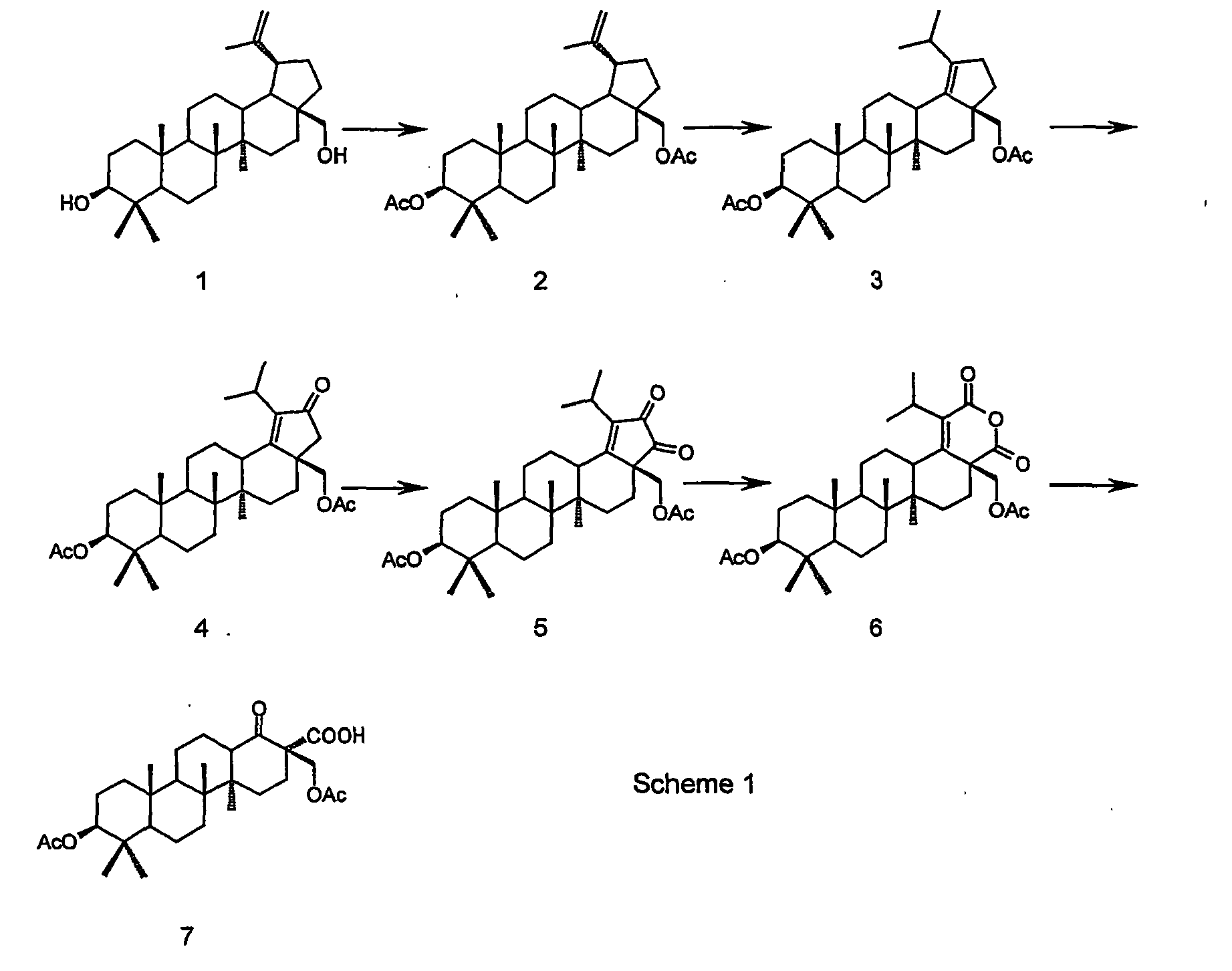
- Essentially the process entails oxidative degradation of the lupane cyclopentane ring is such a way as to install the requisite β-ketoacid group in (7). After acetylation of the betulin hydroxyl groups, the olefin function of diacetate (2) is shifted to the thermodynamically more favourable position in (3) by rearrangement of carbocation intermediates. Subsequent oxidations then yield mono- and di-ketones (4) and (5). Finally, Baeyer-Villiger oxy-insertion of diketone (5) furnishes anhydride (6), whose olefin function is cleaved oxidatively with concomitant hydrolysis of the anhydride group to afford ketoacid (7). The chemical yields of the isolated products (2)-(7) were 96, 64, 100, 94, 95, and 51 %, respectively. The cumulative yield for the overall transformation from (1) to (7) was thus ca. 28 %. Only a single chromatographic step is required during the reaction sequence, i.e. purification of the final product (7).
- The oxidative cleavage of anhydride (6) to ketoacid (7) has been reported, although no details were provided (Sarek, J.; Klinot, J.; Klinotova, E.; Sejbal, J. Chemicke Listy 1997, 11, 1005-1006): apparently, an ethyl acetate/water two-phase system with ruthenium (VIII) tetroxide (RuO4), generated in situ from ruthenium(IV) oxide (RuO2) with sodium periodate (NaIO4), was adopted. Oxidative olefin cleavage with the aid of RuO4 has been known for some time (Lee, D. G.; van den Engh, M. In Oxidation in Organic Chemistry. Trahanovsky, W. S., Ed. Academic Press: New York, 1973. Part B, Chapter 4). These reactions are usually carried out using a catalytic amount of Ru2O, which is oxidised in the aqueous phase by IO4 - to RuO4. The latter species is soluble in organic solvents and thus passes into the organic phase, where it oxidises the substrate and itself is reduced back to Ru2O. Providing excess IO4 - in the aqueous phase thus ensures continuous regeneration of the reactive ruthenium species. However, we have observed this catalyst re-cycling reaction with (6) failing using various different commercial preparations of anhydrous RuO2 or hydrates (RuO2·xH2O) and adopting aqueous two-phase systems with halogenated solvents or ethyl acetate. Exploratory experiments using homogeneous reaction in carbon tetrachloride with freshly prepared solutions of RuO4 (preparation as described in: Fieser, L. F.; Fieser, M. Reagents for Organic Synthesis. John Wiley & Sons: New York, 1967. Vol. 1, p 986) have demonstrated that the oxidative olefin cleavage is feasible in principle but is difficult to drive to completion and various by-products were formed. Catalyst inactivation is frequently encountered in this reaction and incorporation of the water-miscible organic solvent acetonitrile into the standard carbon tetrachloride/water system in the ratio 2:2:3 MeCN/CCl4/H2O) has been shown to alleviate this problem in many cases (Carlsen, P. H. J.; Katsuki, T.; Martin, V. S.; Sharpless, K. B. J. Org. Chem. 1981, 46, 3936-8). Using this system we have now observed the desired reaction on substrate (6) but conversion was still very sluggish and complex reaction mixtures were obtained. Substituting ethyl acetate for carbon tetrachloride and ruthenium (III) chloride (RuCl3) for RuO2 has resulted in both a more rapid and cleaner reaction; in particular, fewer polar impurities were formed under these conditions.
- Accordingly, in a further aspect the present invention provides a process for the preparation of 3β,28-diacetoxy-18-oxo-19,20,21,29,30-pentanorlupan-22-oic acid (7) which comprises reacting the anhydride of 3β,28-diacetoxy-21,22-secolup-18-ene-21,22-dioic acid (6) with ruthenium (III) chloride and NaIO4 in a MeCN /EtOAc / H2O solvent system and optionally converting the resultant 3β,28-diacetoxy-18-oxo-19,20,21,29,30-pentanorlupan-22-oic acid to 3β,28-diacetoxy-18-oxo-19,20,21,29,30-pentanorlupan-22-oic acid methanol solvate as described above.
- Furthermore, a new purification regimen for the material obtained from the above process comprising: chromatographic separation (SiO2 / CH2Cl2 MeCN); washing with MeCN; and/or treatment with acetone has resulted in 3β,28-diacetoxy-18-oxo-19,20,21,29,30-pentanorlupan-22-oic acid (7) of > 90 % purity.
- Furthermore, material isolated from the new purification regimen may provide 3β,28-diacetoxy-18-oxo-19,20,21,29,30-pentanorlupan-22-oic acid acetonitrile solvate or 33,28-diacetoxy-18-oxo-19,20,21,29,30-pentanorlupan-22-oic acid acetone solvate or a combination of solvates.
- Accordingly, in a further aspect the present invention provides 3β,28-diacetoxy-18-oxo-19,20,21,29,30-pentanorlupan-22-oic acid acetonitrile solvate or 3β,28-diacetoxy-18-oxo-19,20,21,29,30-pentanorlupan-22-oic acid acetone solvate or a mixture thereof.
- Furthermore, where the solvent used in the preparation of 3β,28-diacetoxy-18-oxo-19,20,21,29,30-pentanorlupan-22-oic acid is ethanol or iso-propanol or the like the corresponding solvates may be formed.
- New solvates of 3β,28-diacetoxy-18-oxo-19,20,21,29,30-pentanorlupan-22-oic acid disclosed herein may possess one or more of the following advantages as compared to the non-solvated precursor: improved aqueous solubility, uniform size distribution, filtration and drying characteristics, stability (thermal or long term storage), flowability, handling characteristics, isolation and purification characteristics, physical properties advantageous to formulatory requirements e.g. compressibility.
- Oxidation of (3) with chromium (VI) oxide (chromic anhydride, CrO3) in aqueous acetic acid at room temperature for 12 h was reported (Sejbal, J.; Klinot, J.; Budesinsky, M.; Protiva, J. Collect. Czech Chem. Commun. 1991, 56, 2936-2949). A mixture of products was obtained from which ketone (4) was isolated in 30 % yield after chromatography. We have found that superior results are obtained if the oxidation is carried out with a slight molar excess of sodium dichromate (Na2Cr2O7) in a toluene/acetic acid/acetic anhydride solvent system containing sodium acetate at 60°C. Under these conditions crude ketone (4), suitable for further transformation, is obtained in quantitative yield after partitioning of the reaction mixture between water and ethyl acetate, followed by further washing of the organic fraction, drying, and evaporating. Furthermore, pure (4) could readily be obtained without recourse to chromatography simply by crystallisation from methanol. This procedure yields (4) of higher purity than previously reported (m.p. 207-208 versus 198-201 °C in Seijbal et al. cited above).
- Thus, in a preferred aspect the process of the invention further comprises the preparation of 21-oxo-lup-18-ene-3β,28-diyl diacetate (4) by reacting lup-18-ene-3β,28-diyl diacetate (3) with sodium dichromate (Na2Cr2O7) and sodium acetate wherein the sodium dichromate (Na2Cr2O7) is present in a slight molar excess. Preferably the reaction is carried out in a toluene/acetic acid/acetic anhydride solvent system. Preferably the reaction is carried out at elevated temperature, more preferably at about 60°C.
- The present invention also provides a process for the preparation of 3β,28-diacetoxy-18-oxo-19,20,21,29,30-pentanorlupan-22-oic acid (7) which comprises oxidising lup-18-ene-3β,28-diyl diacetate (3) with a slight molar excess of sodium dichromate (Na2Cr2O7) as described above and converting the resultant 21-oxo-lup-18-ene-3β,28-diyl diacetate (4) to 3β,28-diacetoxy-18-oxo-19,20,21,29,30-pentanorlupan-22-oic acid (7) as described above and optionally converting the 3β,28-diacetoxy-18-oxo-19,20,21,29,30-pentanorlupan-22-oic acid to 3β,28-diacetoxy-18-oxo-19,20,21,29,30-pentanorlupan-22-oic acid methanol solvate.
- Acid-catalysed isomerisation of (2) to (3) has been described (Suokas, E.; Hase, T. Acta Chem. Scand. B 1975, 29, 139-140). A system consisting of hydrobromic acid, acetic acid, and acetic anhydride in benzene was employed and a correlation in terms of formation of (3) between reaction time and HBr concentration was noted. Performing the reactions at ambient temperature, optimal yields (70 - 87 %) of (3) were reported with reaction times of 18 h to (2) weeks, depending on acid strength (1.1 - 1.6 M HBr). Similar results were reported elsewhere (Sejbal, J.; Klinot, J.; Vystrcil, A. Collect. Czech Chem. Commun. 1987, 52, 487-492). We have found that elevated reaction temperatures permit shortening of the reaction time. Thus at 90 °C, the optimal temperature found, reaction times of 2 - 4 h are sufficient to achieve complete conversion of (2) with > 70 % content of (3) in the product (by NMR analysis of crude reaction product after evaporation of solvents). At this temperature, an HBr concentration of 0.9 M was found optimal (using 2.6 M Ac2O and ca. 4 M AcOH in toluene); small deviations in HBr concentration in either direction led to significantly lower yields. In this system a substrate (2) concentration of ca. 0.24 M can be achieved while maintaining a homogeneous reaction. The most effective solvent for the crystallisation from evaporation residues and recrystallisation of (3) was found to be ethyl acetate; employment of this isolation solvent obviates chromatographic purification.
- Thus, in a preferred aspect the process of the invention further comprises the preparation of lup-18-ene-3β,28-diyl diacetate (3) by isomerizing lup-20(29)-ene-3β,28-diyl diacetate (2) in a benzene / acetic acid / acetic anhydride solvent system at elevated temperature wherein the concentration of HBr is between about 0.8 and about 1.0M, preferably between about 0.85 and about 0.95M, most preferably about 0.9M. Preferably the reaction is carried out at about 90°C.
- In a further preferred aspect the process comprises isolating and/or purifying lup-18-ene-3β,28-diyl diacetate (3) by crystallising or recrystallising crude lup-18-ene-3β,28-diyl diacetate (3) from ethyl acetate.
- Betulin (1) is a pentacyclic triterpene isolated from birch bark (for review, see, e.g., Hayek, E. W. H.; Jordis, U.; Moche, W.; Sauter, F. Phytochem. 1989, 28, 2229-2242). It can be acetylated to afford the diacetate (2) as described (see, e.g., Tietze, L. F.; Heinzen, H.; Moyna, P.; Rischer, M.; Neunaber, H. Liebigs Ann. Chem. 1991, 1245-1249). We have found that the reaction yield of (2) is highly dependent on the quality of betulin (1) employed. Thus material of > 97 % purity permits practically quantitative yields of (2), while application of lower grade (1), e.g. commercial materials with purity of < 95 %, results in < 75 % yields of (2). Betulin (1) can be purified chromatographically or by recrystallisation from various solvent systems (see, e.g., Eckerman, C.; Ekman, R. Paperi ja Puu 1985, 67(3), 100-106). We have found that diacetate (2) can be isolated by precipitation from methanol after evaporation of the acetylation reaction mixture. Material thus isolated is suitable for direct application in the next reaction step.
- Thus in a preferred aspect the process of the invention further comprises the preparation of lup-20(29)-ene-3β,28-diyl diacetate (2) by reacting betulin of >95% purity with acetic anhydride and a base, preferably pyridine, and isolating the crude product by precipitation from methanol.
- Preferably, the belutin is of > 97 %, more preferably of > 99 % purity i.e. betulin having respectively less than 5%, preferably less than 3%, more preferably less than 1% of non-betulin material present.
- The present invention is further described by way of example.
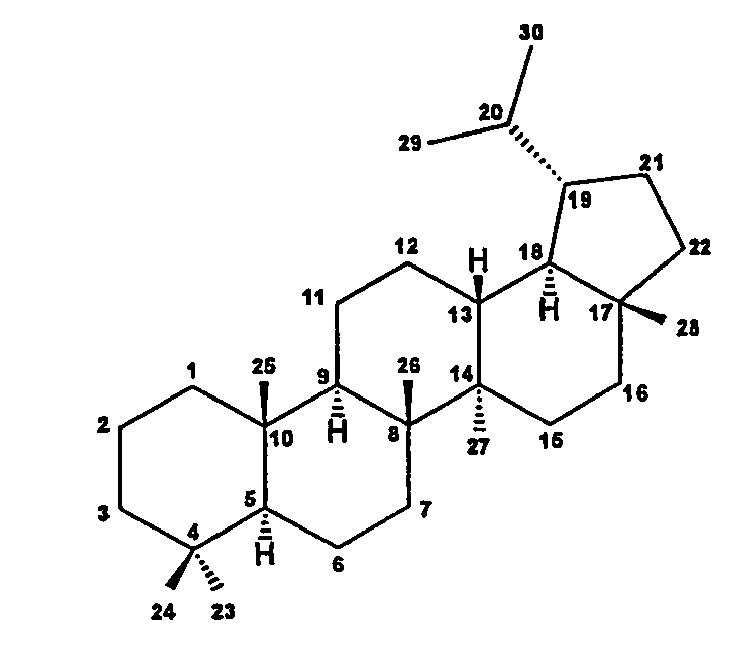
- The compounds are named as derivatives of the natural product lupane and the numbering convention for the C atoms is as follows:
- M.p. were determined using a Reichert (model 7905) hot stage apparatus and are uncorrected. HPLC-MS was performed using a Waters 2695 HPLC system fitted with a Waters 996 PDA (photodiode array) detector and a Micromass ZMD mass spectrometer (HPLC conditions: column: Jupiter 250 × 4.6 mm, C4 stationary phase, (5) µm particles, 300 Å pores; T = 30°C (column) and 10°C (sample compartment); flow rate: (1) mL/min, injection volume: 20 µL; detectors: λ = 191 - 300 nm, mass range m/z = 100 - 1000; mobile phase A: 0.1 % CF3CCOH in H2O, B: 0.1 % CF3COOH in MeCN; elution with linear gradient from 0 to 100 % B in A over 10 min, followed by isocratic elution with 100 % B). GLC was carried out on an Agilent 6850A series gas chromatogram (GLC conditions: column: HP-5 (5 % phenyl methyl siloxane) length 30 m, diameter 250 µm, 0.25 µm film thickness; inlet T = 350°C; split ratio = 50:1; split flow = 52 mL/min; total flow = 56 mL/min; He carrier gas; oven T (isocratic) = 300 °C; run time = 30 min; detector: FID, T =350 °C; H flow = 30 mL/min, air flow = 400 mL/min; make-up gas/flow = He, 45 mL/min). Mass spectra for lup-20(29)-ene-3β,28-diyl diacetate and lup-18-ene-3 β,28-diyl diacetate were recorded on a Micromass Trio 2000 spectrometer fitted with a quadrupole detector (Dept. Chemistry, University of Manchester, England). 1H-NMR spectra were obtained using a Varian Unity INOVA 400 FT spectrometer. 13C-NMR spectra were recorded using a Bruker AC-250 FT-NMR spectrometer (62.5 MHz). Chemical shifts are reported in p.p.m. (δ) relative to SiMe4. FT-IR spectra were obtained from solid samples (using a 'golden gate' sample presentation unit) on a
Bruker Vector 22 spectrophotometer. Optical rotations were measured on a POLAAR 2001 polarimeter. TLC was carried out using aluminium plates coated with silica gel 60 F254 (Merck) using molybdate stain for all products and UV (254 nm) visualisation where appropriate. For the stain: (NH4)2MoO4 (50 g), Ce2(SO4)3 (3 g), H2O (950ml), conc. H2SO4 (50 mL). Plates were dipped and heated with a hot air gun to develop. All products stained dark blue. Purification of 3ß,28-diacetoxy-18-oxo-19,20,21,29,30-pentanorlupan-22-oic acid was carried out using Matrex Silica 60 (code S/0683/60, supplied by Fisher Scientific). Elemental microanalyses (C, H) were carried out by Butterworth Laboratories Ltd., Teddington, Middlesex, England. - A solution of pyridine (150 mL, 1.86 mol) and Ac2O (150 mL, 1.59 mol) was heated and stirred at 80 °C (oil bath). Betulin (1) (98 %; 280.9 g, 0.634 mol) was added in portions (20-30 g/portion), allowing complete dissolution between additions. About 15 min after complete addition the reaction mixture solidified (bath temperature 95 °C). Upon further heating the solid had almost dissolved. More pyridine and Ac2O (20 mL each) were added and the reaction mixture was heated under reflux for 1 h. The mixture was cooled for 5 min (once again solidification was observed), the solvents were evaporated and MeOH (0.5 L) was added. The solid was divided by sonication and manual crushing, then filtered, washed with MeOH (2 L), and dried on the sinter. The filter cake was dried in vaccuo to afford (2) (320 g, 96 %) as a white amorphous solid, containing only trace amounts of impurities by TLC and 1H-NMR analysis. An analytical sample was prepared by dry flash chromatography (10-20 % EtOAc/isohexane), followed by recrystallising twice from EtOH. TLC (Et2O): RF = 0.7 (homogeneous). GLC: tR = 17.4 min (92.6 %). EI-MS: m/z = 466 (75 %), 526 (M+; ∼ (5) %); C34H54O4 = 526. Found C 77.54 (77.52), H 10.30 (10.33). M.p. 223-225 °C. [α]D = +21° (c 5.233, CHCl3). 1H-NMR (CDCl3) δ inter alii: 0.85 (s, 3H CH3), 0.85 (s, 6H, CH3), 0.98 (s, 3H, CH3), 1.05 (s, 6H, CH3), 1.70 (s, 3H CH3), 2.45 (ddd, 1H, C19H), 3.87 (d, 1H, J = 11 Hz, C28Hα), 4.26 (dd, 1H, J = 11 Hz, C28Hβ), 4.48 (m, 1H, C3Hα), 4.61 (m, 1H, C21HE), 4.70 (m, 1H, C21HZ). 13C-NMR (CDCl3) δ inter alii: 171.5, 170.9, 150.0, 149.7, 109.9, 80.9 (C3). FT-IR: 1729 cm-1 (ROCOMe).
- A solution of HBr in AcOH (Aldrich, 24,863-0; 30 wt. %; 90 mL) was added to a solution of (2) (45.03 g, 85.48 mmol) in PhMe (90 mL), Ac2O (90 mL), and AcOH (90 mL) at 90°C. The mixture was stirred and heated at this temperature for 4 h. After cooling, NaOAc (45 g) was added and the mixture was evaporated to dryness. The residue was re-evaporated from MeOH (40 mL), the residue was triturated with MeOH, filtered, and washed copiously with more MeOH. The resulting solid was dissolved in hot EtOAc (- 0.7 L), cooled on ice for 1.25 h, filtered, washed (MeOH then isohexane), and dried. A further recrystallisation from hot EtOAc (∼ 0.7 L) afforded pure title compound (3) (28.9 g, 64 %) as colourless needles. GLC: tR = 15.8 min (99.4 %). EI-MS: mlz = 453 (100 %), 526 (M+; ∼ 27 %); C34H54O4 = 526. Found C 77.11 (77.52), H 10.20 (10.33). M.p. 214-215 °C. [α]D = +17° (c 4.582, CHCl3). 1H-NMR (CDCl3) δ inter alii: 0.85 (s, 3H CH3 ), 0.86 (s, 3H, CH3 ), 0.90 (s, 3H, CH3 ), 0.91 (s, 3H, CH3 ), 0.92 (d, 3H, CH3 ), 1.00 (d, 3H, CH3 ), 1.07 (s, 3H, CH3 ), 2.05 (s, 3H, OCOCH3 ), 2.06 (s, 3H, OCOCH3 ), 2.25 (m, 2H), 2.44 (m, 1H), 3.15, (sept, 1H, C20 H), 4.01 (m, 2H, C28 H 2), 4.50 (m, 1H, C3 Hα ). 13C-NMR (CDCl3) δ inter alii: 171.5, 171.0, 143.6, 134.0, 80.9 (C3). FT-IR: 1736 cm-1 (2 stretches, ROCOMe).
- A mixture of (3) (63.4 g, 121 mmol), NaOAc (56.8 g, 693 mmol), PhMe (0.8 L), AcOH (1 L), Ac2O (220 mL), and Na2Cr2O7·2H2O (Aldrich 39,806-3, 99.5+ %; 42.6 g, 143 mmol) was stirred and heated at 60 °C overnight. After cooling, H2O (1.4 L) and EtOAc (1 L) were added and the phases were separated. The organic phase was washed successively with H2O (1 L), saturated aq Na2CO3 (3 × 0.8 L), H2O (1 L), and brine (3 × 0.7 L). It was dried over MgSO4, filtered, and evaporated to afford crude (4) (68 g, ∼ quant.). TLC (EtOAc/isohexane, 1:4): Rf = 0.25 (homogeneous). A sample was purified for analysis by crystallisation from hot MeOH with 65 % recovery. GLC: tR = 23.8 min (97.9 %). HPLC-MS: m/z = 541 (M+1); C34H52O5 = 540. Found C 75.21 (75.51), H 9.57 (9.69). M.p. 207-208°C. [α]D = -35° (c 4.755, CHCl3). 1H-NMR (CDCl3) δ inter alii: 0.85 (s, 3H, CH 3) 0.86 (s, 3H, CH 3), 0.93 (s, 3H, CH 3), 0.94 (s, 3H, CH 3), 1.16 (s, 3H, CH 3), 1.17 (d, 3H, J = (7).1 Hz, CH 3), 1.95 (d, 1H, J = 18 Hz, C22 H α), 2.00 (s, 3H, OCOCH 3), 2.05 (s, 3H, OCOCH 3), 2.39 (d, 1H, J= 18 Hz, C22 H β), 2.87 (dd, 1H, J' = 11.9 Hz, J" = 4.1 Hz, C13 H β), 3.18 (sept., 1H, J= (6).6, C20 H); 4.06 (d, 1H, J= 10.9 Hz, C28 H α); 4.34 (d, 1H, J= 10.9 Hz, C28 H β), 4.49 (m, 1H, J = (7) Hz, C3 H α). 13C-NMR (CDCl3) δ inter alii: 207.9 (C 21), 171.8, 171.0, 170.9, 146.8, 80.7. (C 3). FT-IR: 1734 cm-1 (ROCOMe), 1694cm-1 (α,β-unsaturated ketone).
- Ketone (4) (20 g, 37 mmol) was dissolved in dioxane (100 mL) and SeO2 (Aldrich 21,336-5, 99.8%; 5 g, 45 mmol) was added. The mixture was heated to reflux for 2 h. After cooling, it was filtered through a pad of Celite. The filtrate was poured slowly into stirred H2O (0.3 L) and the pink solid precipitate was filtered and washed with H2O (100 mL). The product was dried to afford (5) (19.2 g, 94 %) as a peach-coloured crystalline solid. A sample was purified for analysis by crystallisation from EtOH. HPLC-MS: tR = 14.00 min; m/z = 555 (M+1); C34H50O6 = 554. Found C 73.30 (73.61), H 9.03 (9.08). M.p. 271-275 °C. [α]D = -128° (c 5.040, CHCl3). 1H-NMR (CDCl3) δ inter alii: 0.85 (s, 3H, CH3 ), 0.86 (s, 3H, CH3 ), 0.94 (s, 3H, CH3 ), 0.97 (s, 3H, CH3 ), 1.18 (s, 3H, CH3 ), 1.24 (d, 3H, J = (7).2 Hz, CH3 ), 1.26 (d, 3H, J= (7).2 Hz, CH3 ), 1.93 (s, 3H, OCOCH3 ), 2.06 (s, 3H, OCOCH3 ), 3.12 (dd, 1H, J' = 12.5 Hz, J" = 3.8 Hz, C13 H β), 3.36 (sept., 1H, J = (7) Hz, C20 H); 4.02 (d, 1H, J = 11.1 Hz, C28 H α), 4.49 (dd, 1H, J' = 10.2 Hz, J" = (6).0 Hz, C3 H α), 4.86 (d, 1H, J = 11.1, C28 H β). 13C-NMR (CDCl3) δ inter alii: 200.9, 189.4, 171.1, 170.9, 170.1, 152.3, 80.6 (C 3). FT-IR: 1763, 1745, 1733, 1702 cm-1 (diketone, (2) ROCOMe, α,β-unsaturated ketone).
- Diketone (5) (110 g, 199 mmol) was dissolved in CHCl3 (350 mL) and peracetic acid (36-40 wt. % in AcOH; 500 mL) was added. The mixture was stirred rapidly overnight to afford a colourless mixture. This was diluted with CHCl3 (0.5 L) and H2O (1 L); the organic layer was separated and was washed with saturated aq NaHCO3 solution (2 × 0.7 L), H2O (0.5 L) and brine (0.5 L). It was dried over MgSO4, filtered, and evaporated until formation of solids started. MeOH (1 L) was added and the resulting white solid was collected by filtration. The filter cake was washed with MeOH (0.2 L) and dried to afford (6) (107.6 g, 95 %) as a white crystalline solid. An analytical sample was prepared by crystallising 1.5 g of this material twice from CHCl3 (recovery 530 mg). HPLC-MS: tR = 10.90 min; m/z = 571 (M+1, ∼ 10 %), 529 (100 %), 588 (M+18, ∼ 30 %); C34H50O7 = 570. Found C 70.86 (71.55), H 8.55 (8.83). M.p. 269-273°C. [α]D = +97° (c 4.911, CHCl3). 1H-NMR (CDCl3) δ inter alii: 0.85 (s, 3H, CH3 ), 0.85 (s, 3H, CH3 ), 0.90 (s, 3H, CH3 ), 0.91 (s, 3H, CH 3), 1.11 (s, 3H, CH3 ), 1.14 (d, 3H, J= (7) Hz, CH3 ), 1.31 (d, 3H, J= (7) Hz, CH3 ), 2.01 (s, 3H, OCOCH3 ), 2.05 (s, 3H, OCOCH3 ), 2.53 (dt, 1H, J' = 14.4 Hz, J" = 3.5 Hz), 2.72 (dd, 1H, J' = 3.1 Hz, J" = 12.3 Hz), 3.26 (sept., 1H, J = (7) Hz, C20 H), 3.90 (d, 1H, J= 11.0 Hz, C28 H2 ), 4.54 (d, 1H, J = 11.0 Hz, C28 H2 ), 4.47 (m, 1H, C3 H α), 13C-NMR (CDCl3) δ inter alii: 170.9, 170.1, 169.8, 159.3, 151.6, 135.4, 80.5 (C 3). FT-IR: 1783, 1739, 1717, ∼ 1620 cm-1 (anhydride, (2) ROCOMe, α,β-unsaturated anhydride).
- Anhydride (6) (100 g, 175 mmol), RuCl3·H2O (Lancaster, 0421, Ru content ∼ 40 %; 25 g, ∼ 99 mmol), MeCN (4.2 L), EtOAc (4.2 L), and H2O (6 L) were combined and the resulting solution was stirred mechanically. NaIO4 (Aldrich, 21,004-8, 99%; 0.5 kg, 2.34 mol) was added and the mixture was stirred vigorously overnight. More NaIO4 (150 g 0.7 mol) was added the following morning when the reaction had quenched (ruthenium catalyst had precipitated as insoluble RuO2, the organic layer was colourless and no O3 odour could be detected) and another portion (150 g) before being again stirred overnight. A final portion of NaIO4 (150 g) was added the following morning and stirring was continued for a further 24 h. TLC analysis of the organic layer (plate predipped/evaporated in eluent (CH2Cl2/MeCN/ACOH, 80:20:1) at this point indicated mostly the desired product (RF ∼ 0.35) with a small amount of starting material (RF ∼ 0.85) and some impurities (RF ∼ 0.25). The mixture was filtered and the filter cake was washed with EtOAc/MeCN (1 L) and H2O (0.5 L). The filtrate and washings were combined and the organic phase was separated. This was washed successively with H2O (4 L) and brine (4 L), dried (MgSO4), and evaporated. The residue was evaporated from PhMe (3 × 0.5 L) and was finally dried under high vacuum to afford the crude title compound (7) (91 g). This material was chromatographed (1.1 kg SiO2; 10.5 cm diameter column) by gravity elution with CH2Cl2 followed by MeCN/CH2Cl2 (5-20 %, 1-L fractions). The fractions containing pure product were combined and evaporated to the on-set of crystallisation. The white crystals were filtered, washed with MeCN (∼ 50 mL), air-dried on the sinter, and high-vacuum dried for 2 h. This material (49 g, 55 %) was treated with Me2CO (0.8 L), filtered, and dried to afford pure (7) as a white powder (45 g, 51 %). HPLC-MS: tR = 13.13 min; m/z = 505 (M+1), 522 (M+18); C29H44O7 = 504. Found C 68.37 (69.02), H 8.84 (8.79). M.p. 142-144°C. [α]D = +45° (c 3.73 CHCl3). 1H-NMR (CDCl3, 400 MHz) δ inter alii: 0.85 (s, 3H, CH3 ), 0.86 (s, 3H, CH3 ), 0.90 (s, 3H, CH3 ), 0.91 (s, 3H, CH3 ), 1.14 (s, 3H, CH3 ), 2.04 (s, 3H, OCOCH3 ), 2.05 (s, 3H, OCOCH3 ), 2.19-2.25 (m, 2H), 2.85 (dd, 1H, J' = 3.5 Hz, J" = 11.8 Hz, C13 H); 4.43 (d, 1H, J= 11.1 Hz, C28 H2 ), 4.46-4.50 (m, 1H, C3Hα), 4.71 (d, 1H, J = 11.1 Hz, C28 H2 ). 13C-NMR (CDCl3, 100.5 MHz) δ: 214.9 (COOH); 173.6, 171.0, 170.5 (CO); 58.1, 47.0, 41.1, 37.8, 37.1 (quat. C); 80.6, 55.5, 50.6, 49.9 (CH); 66.0, 38.5, 34.0, 28.9, 26.9, 23.5, 21.7, 19.6, 18.1 (CH2); 27.9, 21.3, 20.6, 16.7, 16.5, 16.3, 16.1 (CH3). FT-IR: 1748, 1716 cm-1 (ROCOMe and saturated ketone).
- 3β,28-diacetoxy-18-oxo-19,20,21,29,30-pentanorlupan-22-oic acid (7) (ca. 20 mg) was dissolved in 2 mL of CHCl3/EtOAc (1:1, v/v). The solution was filtered and the filtrate was concentrated to half the original volume. An open-top vial containing this solution was then placed into a larger container charged with a mixture of petroleum spirit (40-60°C fraction) and methanol (ca. 5:1, v/v). The outer container was sealed and allowed to stand at ambient temperature (ca. 23°C). After 3 days crystals had formed as colourless needles of 3β,28-diacetoxy-18-oxo-19,20,21,29,30-pentanorlupan-22-oic acid·1.5 MeOH. These were used for X-ray crystal structure analysis.
- Single crystals of 3β,28-diacetoxy-18-oxo-19,20,21,29,30-pentanorlupan-22-oic acid ·1.5MeOH were prepared as described above. Diffraction data were collected on a Stoe Stadi-4 diffractometer equipped with an Oxford Cryosystems low-temperature device operating at 150 K. An absorption correction was applied by Gaussian integration following optimisation of the crystal shape and dimensions against ψ-scan data. The six most enantiosensitive reflections were 120; 146; 22,10; 14,15; 150 and 224. These, their Laue equivalents and their Friedel opposites were re-measured at opposing values of 2θ extremely carefully and included in the data set used for refinement. A set of crystal data is shown in Table 1. The structure was solved by direct methods and refined by full-matrix least-squares against F2 (SHELXTL), to reveal an asymmetric unit consisting of two molecules of (7) and three molecules of methanol of solvation. One carboxylic acid group is disordered via a two-fold rotation about the C-C bond. H-atoms were placed in ideal positions · and
allowed to ride on their parent atoms. All non-H atoms were refined with anisotropic displacement parameters to yield a final conventional R-factor of 3.63 %. Refinement with statistical weights [w = 1/σ2(F2)] gave a final Flack parameter of -0.05(9). The signs of the observed and calculated Bijvoet differences were the same for all six sensitive reflections. Taken with the known chiral purity of the sample (refer chromatographic and spectroscopic data above), these data confirm the absolute structure of (7) as shown. The chemical connectivity of (7) was clearly established to be as proposed. The structures of the two independent molecules (Fig. 1 ) do not differ, except for the disorder in one of the carboxyl groups. In addition to (7) there are three crystallographically independent molecules of methanol of solvation; packing is dominated by H-bond formation between these and the carboxyl groups of the (7) molecules. Bond lengths and angles adopt normal values Table 3; H-bond parameters are listed in Table 6; atomic coordinates are given in Table 2; anisotropic displacement parameters are listed in Table 4; and hydrogen coordinates (× 104) and isotropic displacement parameters are set out in Table 5. The powder diffraction pattern for (7) was calculated from the cell parameters and intensity data collected during this single crystal study. A plot of this is shown inFigure 2 .Table 1. Crystal data and structure refinement for 3β,28-diacetoxy-18-oxo-19,20,21,29,30-pentanorlupan-22-oic acid (7). A. CRYSTAL DATA Empirical formula C30.50H50O8.50 (C29H44O7·1.5MeOH) Formula weight 552.70 Wavelength 1.54178 Å Temperature 150(2) K Crystal system Monoclinic Space group P21 Unit cell dimensions a = 7.4459(9) Å, α = 90 ° b = 11.0454(9) Å, β = 94.002(11)° c=36.178(4) Å, γ=90° Volume 2968.2(5) Å3 Number of reflections for cell 86 (20 < θ < 22 °) Z 4 Density (calculated) 1.237 Mg/m3 Absorption coefficient 0.722 mm-1 F(000) 1204 B. DATA COLLECTION Crystal description Colourless block Crystal size 0.64 × 0.32 × 0.27 mm Instrument Stoe Stadi-4 θ range for data collection 3.67 to 69.75° Index ranges -8 ≤ h ≤ 8, -13 ≤ k ≤ 13, 0 ≤ l ≤ 43, Reflections collected 10322 Independent reflections 10322 [R(int) = 0.0000] Scan type ω-2θ' Absorption correction Optimised numerical (Tmin = 0.719, Tmax = 0.890) C. SOLUTION AND REFINEMENT Solution direct (SHELXS-97 (Sheldrick, 1990)) Refinement type Full-matrix least-squares on F2 Program used for refinement SHELXL-97 Hydrogen atom placement geom. Hydrogen atom treatment riding Data / restraints / parameters 10322/7/751 Goodness-of-fit on F2 1.054 Conventional R [F > 4σ(F)] R1 = 0.0363 [9821 data] Weighted R (F2 and all data) wR2 = 0.1009 Absolute structure parameter -0.05(9) Extinction coefficient 0.00226(12) Final maximum δ/σ 0.008 Weighting scheme calc w = 1 / [s2 (F0 2) + (0.0557 P)2 + 0.7729 P] where P = (F0 2 + 2 Fc 2) / 3 Largest diff. peak and hole 0.247 and -0.191 e.Å-3 Table 2. Atomic coordinates (× 104), equivalent isotropic displacement parameters (Å2 × 10³) and site occupancies. U(eq) is defined as one third of the trace of the orthogonalized Uij tensor. Atom x y z U(eq) Occ O11 5250(2) 1190(2) -1514(1) 48(1) 1 C11 6696(3) 1412(2) -1356(1) 33(1) 1 C211 8952(3) 2392(2) -1719(1) 46(1) 1 O221 10561(2) 2195(2) -1913(1) 48(1) 1 O231 10804(3) 4195(2) -1991(1) 58(1) 1 C231 11371(3) 3183(2) -2038(1) 42(1) 1 C241 13009(3) 2848(3) -2231(1) 53(1) 1 C21 8442(3) 1186(2) -1553(1) 35(1) 1 C251 8000(5) 66(7) -1820(2) 36(1) 0.67(2) O261 7639(5) 431(7) -2162(1) 52(2) 0.67(2) O271 7952(5) -967(5) -1718(2) 55(1) 0.67(2) C25'1 7869(11) 585(11) -1923(3) 29(2) 0.33(2) O26'1 7977(9) -590(10) -1874(4) 39(2) 0.33(2) O27'1 7362(11) 1098(12) -2210(2) 58(2) 0.33(2) C31 9967(2) 696(2) -1283(1) 30(1) 1 C41 10054(2) 1313(2) -905(1) 26(1) 1 C51 8259(2) 1248(2) -718(1) 21(1) 1 C511 7677(2) -96(2) -705(1) 28(1) 1 C61 8406(2) 1846(1) -318(1) 21(1) 1 C611 9263(2) 3110(2) -340(1) 29(1) 1 C71 9628(2) 1064(2) -55(1) 25(1) 1 C81 9595(2) 1417(2) 353(1) 26(1) 1 C91 7677(2) 1318(2) 477(1) 21(1) 1 C101 7582(2) 1263(2) 907(1) 25(1) 1 C1011 8596(3) 137(2) 1057(1) 35(1) 1 C1021 8394(2) 2366(2) 1115(1) 32(1) 1 C111 5587(2) 1076(2) 978(1) 26(1) 1 O1111 5393(2) 1160(1) 1374(1) 30(1) 1 O1121 3315(3) -310(2) 1339(1) 63(1) 1 C1121 4163(3) 449(2) 1516(1) 37(1) 1 C1131 3923(4) 752(3) 1913(1) 57(1) 1 C121 4322(2) 1989(2) 788(1) 28(1) 1 C131 4472(2) 1974(2) 368(1) 26(1) 1 C141 6407(2) 2224(1) 257(1) 21(1) 1 C1411 6825(2) 3569(2) 344(1) 29(1) 1 C151 6488(2) 1907(1) -164(1) 21(1) 1 C161 5208(2) 2649(2) -427(1) 30(1) 1 C171 5024(2) 2085(2) -812(1) 31(1) 1 C181 6858(2) 1966(2) -973(1) 26(1) 1 O12 4532(2) 622(2) 6504(1) 52(1) 1 C12 3111(2) 895(2) 6342(1) 32(1) 1 C22 1326(2) 684(2) 6528(1) 30(1) 1 C212 829(3) 1916(2) 6689(1) 36(1) 1 O222 -916(2) 1790(1) 6831(1) 47(1) 1 O232 -485(3) 3521(2) 7128(1) 91(1) 1 C232 -1458(3) 2697(2) 7037(1) 46(1) 1 C242 -3338(4) 2521(3) 7142(1) 72(1) 1 C252 1718(3) -292(2) 6828(1) 37(1) 1 O262 2044(2) 156(2) 7163(1) 52(1) 1 O272 1751(2) -1350(1) 6758(1) 52(1) 1 C32 -164(2) 202(2) 6248(1) 28(1) 1 C42 -191(2) 835(2) 5872(1) 25(1) 1 C52 1637(2) 765(1) 5697(1) 21(1) 1 C512 2207(2) -580(2) 5684(1) 25(1) 1 C62 1551(2) 1371(2) 5298(1) 21(1) 1 C612 699(2) 2633(2) 5317(1) 30(1) 1 C72 355(2) 598(2) 5028(1) 25(1) 1 C82 433(2) 948(2) 4622(1) 25(1) 1 C92 2369(2) 852(2) 4506(1) 22(1) 1 C102 2510(2) 804(2) 4078(1) 26(1) 1 C1012 1518(3) -322(2) 3922(1) 37(1) 1 C1022 1733(2) 1921(2) 3869(1) 32(1) 1 C112 4515(2) 622(2) 4018(1) 26(1) 1 O1112 4748(2) 713(1) 3623(1) 32(1) 1 O1122 6863(2) -741(2) 3667(1) 61(1) 1 C1122 6029(3) 23(2) 3487(1) 40(1) 1 C1132 6317(4) 362(3) 3096(1) 61(1) 1 C122 5755(2) 1531(2) 4215(1) 27(1) 1 C132 5569(2) 1502(2) 4633(1) 25(1) 1 C142 3624(2) 1758(1) 4735(1) 22(1) 1 C1412 3214(2) 3107(2) 4650(1) 28(1) 1 C152 3491(2) 1423(1) 5155(1) 21(1) 1 C162 4753(2) 2152(2) 5427(1) 28(1) 1 C172 4871(2) 1579(2) 5812(1) 30(1) 1 C182 3011(2) 1465(2) 5962(1) 25(1) 1 O(1S) 3045(2) -1552(2) 7659(1) 49(1) 1 C(1S) 3003(4) -1056(2) 8022(1) 53(1) 1 O(2S) 11395(3) 6318(2) -2383(1) 65(1) 1 C(2S) 9812(4) 6433(3) -2616(1) 75(1) 1 O(3S) 6530(3) -1480(2) -2551(1) 81(1) 1 C(3S) 6678(4) -1336(4) -2937(1) 85(1) 1 Table 3. Bond lengths and angles Bond Length (Å) Bonds Angle (Degrees) O11-C11 1.209(2) O11-C11-C181 121.88(17) C11-C181 1.511(2) O11-C11-C21 119.88(17) C11-C21 1.547(2) C181-C11-C21 118.17(16) C211-0221 1.447(2) O221-C211-C2 107.30(17) C211-C21 1.521(3) C231-O221-C211 116.63(18) O221-C231 1.340(3) O231-C231-O221 122.33(19) O231-C231 1.211(3) O231-C231-C241 126.7(2) C231-C241 1.493(3) O221-C231-C241 110.9(2) C21-C25'1 1.528(8) C211-C21-C25'1 95.6(5) C21-C31 1.543(3) C211-C21-C31 111.31(17) C21-C251 1.590(6) C25'1-C21-C31 123.4(4) C251-O271 1.199(7) C211-C21-C11 106.35(16) C251-O261 1.309(6) C25'1-C21-C11 106.4(3) C25'1-O27'1 1.217(9) C31-C21-C11 111.72(15) C25'1-O26'1 1.312(8) C211-C21-C251 119.3(3) C31-C41 1.525(2) C25'1-C21-C251 25.4(3) C41-C51 1.542(2) C31-C21-C251 102.9(3) C51-C511 1.547(2) C11-C21-C251 105.14(19) C51-C181 1.561(2) O271-C251-O261 125.0(5) C51-C61 1.587(2) O271-C251-C21 124.3(4) C61-C71 1.536(2) O261-C251-C21 110.7(5) C61-C611 1.540(2) O27'1-C25'1-O26'1 126.1(7) C61-C151 1.570(2) O27'1-C25'1-C21 126.5(7) C71-C81 1.527(2) O26'1-C25'1-C2 107.4(6) C81-C91 1.530(2) C41-C31-C21 113.20(14) C91-C141 1.557(2) C31-C41-C51 112.95(14) C91-C101 1.562(2) C41-C51-C511 108.12(13) C101-C1021 1.533(2) C41-C51-C181 106.23(13) C101-C1011 1.535(3) C511-C51-C181 109.14(14) C101-C111 1.539(2) C41-C51-C61 112.03(13) C111-O1111 1.4533(19) C511-C51-C61 111.97(13) C111-C121 1.511(2) C181-C51-C61 109.17(13) O1111-C1121 1.336(2) C71-C61-C611 108.15(14) O1121-C1121 1.207(3) C71-C61-C151 108.56(12) C1121-C1131 1.498(3) C611-C61-C151 111.67(13) C121-C131 1.533(2) C71-C61-C51 109.32(13) C131-C141 1.547(2) C611-C61-C51 109.50(13) C141-C1411 1.547(2) C151-C61-C51 109.59(12) C141-C151 1.567(2) C81-C71-C61 113.96(13) C151-C161 1.537(2) C71-C81-C91 110.15(13) C161-C171 1.523(3) C81-C91-C141 110.46(13) C171-C181 1.527(2) C81-C91-C101 113.82(13) O12-C12 1.210(2) C141-C91-C101 117.76(13) C12-C182 1.512(3) C1021-C101-C1011 107.62(15) C12-C22 1.547(2) C1021-C101-C111 112.15(14) C22-C212 1.535(3) C1011-C101-C111 106.79(14) C22-C252 1.543(3) C1021-C101-C91 114.36(14) C22-C32 1.544(3) C1011-C101-C91 109.21(13) C212-O222 1.437(2) C111-C101-C91 106.44(13) O222-C232 1.330(3) O1111-C11 107.67(13) O232-C232 1.195(3) O1111-C111-C101 108.65(13) C232-C242 1.488(4) C121-C111-C101 114.37(14) C252-0272 1.196(3) C1121-01111-C111 1117.37(14) C252-0262 1.315(3) O1121-C1121-01111 123.44(18) C32-C42 1.527(2) O1121-C1121-C1131 124.91(18) C42-C52 1.544(2) O1111-C1121-C1131 111.60(18) C52-C512 1.546(2) C111-C121-C131 110.94(14) C52-C182 1.559(2) C121-C131-C141 112.89(14) C52-C62 1.587(2) C1411-C141-C131 107.22(13) C62-C612 1.535(2) C1411-C141-C91 113.99(14) C62-C72 1.536(2) C131-C141-C91 107.26(13) C62-C152 1.570(2) C1411-C141-C151 113.05(13) C72-C82 1.523(2) C131-C141-C151 108.16(13) C82-C92 1.532(2) C91-C141-C151 106.89(12) C92-C102 1.561(2) C161-C151-C141 114.80(13) C92-C142 1.567(2) C161-C151-C61 110.02(13) C102-C1012 1.535(3) C141-C151-C61 116.89(13) C102-C112 1.537(2) C171-C161-C151 111.17(14) C102-C1022 1.540(2) C161-C171-C181 110.97(15) C112-O1112 1.452(2) C11-C181-C171 111.57(15) C112-C122 1.509(2) C11-C181-C51 110.09(14) O1112-C1122 1.341(2) C171-C181-C51 113.34(13) O1122-C1122 1.210(3) O12-C12-C182 121.90(16) C1122-C1132 1.494(3) O12-C12-C22 120.15(17) C122-C132 1.529(2) C182-C12-C22 117.94(15) C132-C142 1.546(2) C212-C22-C252 113.04(16) C142-C1412 1.547(2) C212-C22-C32 111.88(16) C142-C152 1.572(2) C252-C22-C32 108.22(15) C152-C162 1.539(2) C212-C22-C12 105.53(15) C162-C172 1.527(2) C252-C22-C12 106.52(15) C172-C182 1.527(2) C32-C22-C12 111.55(14) O(1S)-C(1S) 1.425(3) O222-C212-C22 107.34(15) O(2S)-C(2S) 1.407(4) C232-O222-C212 116.50(17) O(3S)-C(3S) 1.417(4) O232-C232-O222 121.8(2) O232-C232-C242 126.4(2) O222-C232-C242 111.8(2) O272-C252-0262 123.8(2) O272-C252-C22 122.67(19) O262-C252-C22 113.50( 18) C42-C32-C22 112.98(14) C32-C42-C52 112.72(14) C42-C52-C512 108.17(13) C42-C52-C182 106.38(13) C512-C52-C182 108.96(14) C42-C52-C62 111.83(13) C512-C52-C62 111.91(13) C182-C52-C62 109.41(13) C612-C62-C72 108.09(14) C612-C62-C152 111.98(13) C72-C62-C152 108.40(13) C612-C62-C52 109.49(13) C72-C62-C52 109.19(13) C152-C62-C52 109.62(12) C82-C72-C62 114.41(13) C72-C82-C92 110.23(13) C82-C92-C102 113.82(13) C82-C92-C142 110.41(13) C102-C92-C142 117.87(13) C1012-C102-C112 106.78(15) C1012-C102-C1022 108.25(15) C112-C102-C1022 111.77(14) C1012-C102-C92 109.24(14) C112-C102-C92 106.21(13) C1022-C102-C92 114.32(14) O1112-C112-C122 107.86(13) O1112-C112-C102 108.32(14) C122-C112-C102 114.44(14) C122-O1112-C112 117.25(15) O1122-C1122-O1112 123.40(18) O1122-C1122-C1132 125.5(2) O1112-C1122-C1132 111.02(19) C112-C122-C132 111.08(14) C122-C132-C142 112.59(14) C132-C142-C1412 107.66(13) C132-C142-C92 106.91(13) C1412-C142-C92 114.07(14) C132-C142-C152 108.14(13) C1412-C142-C152 113.20(13) C92-C142-C152 106.55(12) C162-C152-C62 110.03(13) C162-C152-C142 114.66(13) C62-C152-C142 116.68(13) C172-C162-C152 111.09(14) C182-C172-C162 111.24(14) C12-C182-C172 111.70(14) C12-C182-C52 110.00(14) C172-C182-C52 113.29(13) Table 4. Anisotropic displacement parameters (Å2 × 10³). The anisotropic displacement factor exponent takes the form: -2π2 [h2 a*2 U11 + ... + 2 h k a* b* U12] Atom U11 U22 U33 U23 U13 U12 O11 28(1) 78(1) 38(1) -10(1) -3(1) 3(1) C11 29(1) 40(1) 30(1) 3(1) 2(1) 2(1) C211 40(1) 64(1) 37(1) 19(1) 18(1) 17(1) O221 49(1) 50(1) 46(1) 16(1) 25(1) 11(1) O231 81(1) 50(1) 46(1) 5(1) 23(1) 2(1) C231 51(1) 53(1) 24(1) 7(1) 8(1) 0(1) C241 48(1) 73(2) 40(1) 10(1) 14(1) -1(1) C21 31(1) 44(1) 29(1) -4(1) 6(1) 0(1) C251 30(2) 43(4) 34(3) 3(3) 2(2) 0(2) O261 71(2) 53(4) 33(2) -8(2) -1(1) -1(2) O271 71(2) 38(2) 53(3) -3(2) -9(2) -7(2) C25'1 35(4) 32(5) 20(5) 6(3) 1(3) 1(3) O26'1 50(3) 27(5) 39(5) 3(4) -7(3) -3(3) O27'1 104(5) 37(6) 31(3) -1(3) -11(3) 10(4) C31 29(1) 28(1) 33(1) 1(1) 11(1) 2(1) C41 20(1) 28(1) 32(1) 4(1) 7(1) 1(1) C51 17(1) 21(1) 27(1) 3(1) 4(1) 1(1) C511 31(1) 23(1) 30(1) -1(1) 6(1) -4(1) C61 16(1) 19(1) 28(1) 0(1) 5(1) -1(1) C611 28(1) 24(1) 38(1) -2(1) 10(1) -8(1) C71 17(1) 29(1) 30(1) 1(1) 3(1) 5(1) C81 17(1) 29(1) 31(1) 1(1) 2(1) 3(1) C91 19(1) 19(1) 26(1) -2(1) 2(1) 0(1) C101 22(1) 26(1) 27(1) -3(1) 4(1) 1(1) C1011 39(1) 39(1) 28(1) 5(1) 4(1) 12(1) C1021 25(1) 39(1) 33(1) -10(1) 3(1) -5(1) C111 26(1) 25(1) 26(1) -3(1) 7(1) -3(1) O1111 32(1) 32(1) 27(1) -2(1) 8(1) -5(1) O1121 78(1) 58(1) 58(1) -19(1) 35(1) -38(1) C1121 42(1) 33(1) 39(1) -3(1) 17(1) -6(1) C1131 66(2) 67(2) 41(1) -5(1) 26(1) -17(1) C121 18(1) 31(1) 34(1) -1(1) 7(1) O(1) C131 18(1) 29(1) 32(1) 0(1) 5(1) 2(1) C141 16(1) 18(1) 30(1) 1(1) 4(1) 2(1) C1411 28(1) 20(1) 38(1) -3(1) 8(1) 2(1) C151 16(1) 18(1) 29(1) 1(1) 3(1) 0(1) C161 23(1) 34(1) 33(1) 5(1) 5(1) 9(1) C171 19(1) 43(1) 31(1) 4(1) 2(1) 6(1) C181 20(1) 31(1) 27(1) 4(1) 4(1) 3(1) O12 27(1) 88(1) 39(1) 15(1) -3(1) -5(1) C12 26(1) 37(1) 32(1) -5(1) 2(1) -7(1) C22 30(1) 31(1) 30(1) -2(1) 6(1) -4(1) C212 37(1) 36(1) 36(1) -7(1) 12(1) -5(1) O222 44(1) 46(1) 53(1) -18(1) 21(1) -5(1) O232 88(2) 70(1) 117(2) -52(1) 31(1) -6(1) C232 58(1) 46(1) 33(1) -7(1) 5(1) 10(1) C242 59(2) 95(2) 65(2) -16(2) 22(1) 23(2) C252 30(1) 46(1) 35(1) 1(1) 6(1) -4(1) O262 72(1) 50(1) 34(1) 3(1) 3(1) -3(1) O272 68(1) 34(1) 51(1) 4(1) -2(1) 3(1) C32 25(1) 28(1) 34(1) -1(1) 8(1) -4(1) C42 18(1) 25(1) 34(1) -3(1) 6(1) -1(1) C52 16(1) 18(1) 29(1) -2(1) 3(1) -1(1) C512 25(1) 19(1) 32(1) 2(1) 4(1) 2(1) C62 15(1) 19(1) 30(1) 2(1) 4(1) 2(1) C612 28(1) 22(1) 41(1) 5(1) 10(1) 8(1) C72 17(1) 27(1) 33(1) 2(1) 2(1) -3(1) C82 15(1) 28(1) 32(1) 2(1) 0(1) -2(1) C92 17(1) 22(1) 28(1) 2(1) 0(1) 0(1) C102 22(1) 26(1) 30(1) 2(1) 3(1) -2(1) C1012 40(1) 40(1) 31(1) -4(1) 3(1) -12(1) C1022 26(1) 38(1) 33(1) 8(1) 0(1) 4(1) C112 28(1) 24(1) 27(1) 3(1) 5(1) 1(1) O1112 33(1) 33(1) 31(1) 2(1) 7(1) 3(1) O1122 71(1) 50(1) 68(1) 13(1) 35(1) 28(1) C1122 43(1) 34(1) 44(1) -3(1) 19(1) -1(1) C1132 80(2) 60(2) 49(1) -3(1) 33(1) 7(1) C122 17(1) 31(1) 35(1) 3(1) 5(1) 1(1) C132 16(1) 29(1) 31(1) 2(1) 4(1) -2(1) C142 16(1) 19(1) 31(1) 1(1) 4(1) -1(1) C1412 25(1) 20(1) 38(1) 2(1) 6(1) -1(1) C152 16(1) 17(1) 29(1) -1(1) 2(1) -1(1) C162 21(1) 32(1) 33(1) -4(1) 2(1) -10(1) C172 19(1) 37(1) 33(1) -4(1) 1(1) -7(1) C182 20(1) 27(1) 29(1) -3(1) 3(1) -4(1) O(1S) 60(1) 44(1) 42(1) 7(1) 7(1) -9(1) C(1S) 67(2) 55(1) 39(1) 2(1) 10(1) -2(1) O(2S) 73(1) 48(1) 77(1) 11(1) 11(1) -6(1) C(2S) 56(2) 53(2) 116(2) 23(2) 14(2) 4(1) O(3S) 54(1) 96(2) 96(2) -54(1) 18(1) -10(1) C(3S) 68(2) 87(2) 103(3) 37(2) 28(2) 19(2) Table 5. Hydrogen coordinates (× 104) and isotropic displacement parameters (Å2 × 10³) Atom x y z U(eq) H21A1 7963 2690 -1892 56 H21B1 9183 3002 -1520 56 H24A1 13417 3550 -2368 80 H24B1 12720 2181 -2403 80 H24C1 13966 2595 -2047 80 H261 7408 -171 -2299 78 H26'1 7667 -945 -2073 59 H3A1 9790 -184 -1249 36 H3B1 11132 811 -1395 36 H4A1 10388 2173 -936 31 H4B1 11009 925 -742 31 H51A1 7227 -356 -954 42 H51B1 6722 -186 -534 42 H51C1 8712 -595 -620 42 H61A1 9226 3517 -99 44 H61B1 8591 3590 -531 44 H61C1 10516 3029 -402 44 H7A1 9253 208 -84 30 H7B1 10881 1128 -129 30 H8A1 10035 2258 388 31 H8B 10404 876 506 31 H91 7255 502 389 25 H10A1 9893 255 1041 53 H10B1 8201 -572 911 53 H10C1 8343 9 1317 53 H10D1 8486 2202 1381 48 H10E1 7620 3073 1063 48 H10F1 9596 2529 1032 48 H111 5215 247 892 31 H11A1 3205 119 2023 85 H11B1 3301 1531 1927 85 H11C1 5104 804 2050 85 H12A1 4616 2808 886 33 H12B1 3069 1799 844 33 H13A1 3652 2594 252 31 H13B1 4075 1174 269 31 H14A1 6244 3808 568 43 H14B1 6366 4072 135 43 H14C1 8130 3680 385 43 H151 6020 1060 -186 25 H16A1 4009 2692 -326 36 H16B1 5675 3485 -445 36 H17A1 4225 2594 -978 37 H17B1 4466 1274 -798 37 H181 7343 2804 -999 31 H21A2 1729 2155 6890 43 H21B2 798 2545 6493 43 H24A2 -3763 3263 7255 108 H24B2 -3373 1851 7319 108 H24C2 -4117 2331 6920 108 H262 2339 -407 7311 77 H3A2 18 -677 6212 34 H3B2 -1348 313 6352 34 H4A2 -519 1695 5903 30 H4B2 -1129 458 5702 30 H51A2 2645 -844 5933 37 H51B2 3166 -674 5514 37 H51C2 1169 -1075 5597 37 H61A2 730 3032 5076 45 H61B2 1375 3118 5506 45 H61C2 -553 2554 5381 45 H7A2 722 -260 5058 30 H7B2 -907 663 5095 30 H8A2 -6 1788 4585 30 H8B2 -358 406 4466 30 H92 2781 34 4595 27 H10A2 217 -209 3932 55 H10B2 1902 -1033 4069 55 H10C2 1800 -445 3664 55 H10D2 1657 1761 3602 48 H10E2 2519 2620 3923 48 H10F2 527 2095 3948 48 H112 4878 -209 4103 32 H11A2 7145 -217 2993 92 H11B2 6832 1177 3090 92 H11C2 5162 347 2948 92 H12A2 5464 2352 4119 33 H12B2 7015 1347 4164 33 H13A2 6386 2114 4753 30 H13B2 5947 697 4730 30 H14A2 3632 3602 4864 41 H14B2 1914 3215 4600 41 H14C2 3838 3357 4433 41 H152 3945 572 5177 25 H16A2 5970 2185 5333 34 H16B2 4300 2992 5443 34 H17A2 5424 766 5799 36 H17B2 5652 2082 5983 36 H182 2533 2304 5988 30 H(1S) 2554 -2237 7653 73 H(1S1) 3830 -1509 8193 80 H(1S2) 1779 -1113 8103 80 H(1S3) 3372 -205 8019 80 H(2S) 11242 5791 -2220 98 H(2S1) 8881 6832 -2481 112 H(2S2) 9391 5628 -2696 112 H(2S3) 10061 6919 -2833 112 H(3S) 5455 -1499 -2486 121 H(3S1) 5781 -748 -3035 127 H(3S2) 6468 -2116 -3061 127 H(3S3) 7887 -1044 -2981 127 Table 6: Hydrogen bonds with H..A < r(A) + 2.000 Å and DHA > 110 D-H d(D-H) d(H..A) DHA d(D..A) A O26-H26_1a 0.84 1.807 169.46 2.638 O3S O26'-H26'_1b 0.84 1.961 166.92 2.786 O3S O26-H26_2 0.84 1.836 175.85 2.674 O1S O1S-H1S 0.84 1.815 176.48 2.654 O2S [x-1, y-1, z+1] O2S-H2S 0.84 1.986 160.28 2.791 O23_1 O3S-H3S 0.85 1.905 179.68 2.755 O1S [x, y, z-1]
Claims (18)
- 3β,28-diacetoxy-18-oxo-19,20,21,29,30-pentanorlupan-22-oic acid methanol solvate or pharmaceutically acceptable salt thereof.
- 3β,28-diacetoxy-18-oxo-19,20,21,29,30-pentanorlupan-22-oic acid·1.5MeOH or pharmaceutically acceptable salt thereof.
- The compound of claim 1 or claim 2 having at least X-ray diffraction peaks at 14.7 and 16.0.
- The compound of claim 3 having a powder X-ray diffraction pattern with peaks at 14.7, 16.0, 16.7, 18.8, 8.3, 20.4, 22.7.
- The compound of any of claims 1 to 4 having unit cell dimensions a = (7).4459(9) Å, α = 90°, b = 11.0454(9) Å, β = 94.002(11)°, c = 36.178(4) Å, γ = 90°.
- The compound of any of claims 1 to 5 having a monoclinic crystalline form.
- 3β,28-diacetoxy-18-oxo-19,20,21,29,30-pentanorlupan-22-oic acid acetonitrile solvate.
- 3β,28-diacetoxy-18-oxo-19,20,21,29,30-pentanorlupan-22-oic acid acetone solvate.
- A compound according to any of claims 1 to 8 for use in therapy.
- Use of a compound according to any of claims 1 to 8 in the manufacture of a medicament for the treatment of a proliferative disorder.
- Use according to claim 10 wherein the proliferative disorder is cancer or leukemia.
- A pharmaceutical composition comprising a compound according to any one of claims 1 to 8 admixed with a pharmaceutically acceptable diliuent, excipient or carrier.
- A process for preparing a compound according to any of claims 1 to 6 which comprises crystallising 3β,28-diacetoxy-18-oxo-19,20,21,29,30-pentanorlupan-22-oic acid from a CHCl3 / EtOAc / MeOH solvent system.
- A process for the preparation of 3β,28-diacetoxy-18-oxo-19,20,21,29,30-pentanorlupan-22-oic acid (7) which comprises reacting the anhydride of 3β,28-diacetoxy-21,22-secolup-18-ene-21,22-dioic acid (6) with ruthenium (III) chloride and NaIO4 in a MeCN / EtOAc / H2O solvent system and optionally converting the resultant 3β,28-diacetoxy-18-oxo-19,20,21,29,30-pentanorlupan-22-oic acid to a compound of any of claims 1 to 6.
- A process for the preparation of 3β,28-diacetoxy-18-oxo-19,20,21,29,30-pentanorlupan-22-oic acid (7) which comprises:(i) oxidising lup-18-ene-3β,28-diyl diacetate (3) with sodium acetate and a slight molar excess of sodium dichromate (Na2Cr2O7);(ii) oxidising the resultant 21-oxo-lup-18-ene-3β,28-diyl diacetate (4) with selenium dioxide to give to 21,22-Dioxo-lup-18-ene-33,28-diyl diacetate (5);(iii) Baeyer-Villiger oxy-insertion of 21,22-Dioxo-lup-18-ene-3β,28-diyl diacetate (5) to afford the anhydride of 3β,28-diacetoxy-21,22-secolup-18-ene-21,22-dioic acid (6); and(iv) reacting the anhydride of 3β,28-diacetoxy-21,22-secolup-18-ene-21,22-dioic acid (6) with ruthenium (III) chloride according to claim 14; and optionally(v) converting the 3β,28-diacetoxy-18-oxo-19,20,21,29,30-pentanorlupan-22-oic acid to a compound of any of claims 1 to 6 according to claim 13.
- A process according to claim 15 which further comprises preparing lup-18-ene-3β,28-diyl diacetate (3) by isomerizing lup-20(29)-ene-3β,28-diyl diacetate (2) in a benzene / acetic acid / acetic anhydride solvent system at elevated temperature wherein the concentration of HBr is between about 0.8 and about 1.0M.
- A process according to claim 16 which further comprises isolating and/or purifying lup-18-ene-3β,28-diyl diacetate (3) by crystallising or recrystallising crude lup-18-ene-3β,28-diyl diacetate (3) from ethyl acetate.
- A process according to claim 16 which comprises preparing lup-20(29)-ene-3β,28-diyl diacetate (2) by reacting betulin of > 95% purity with acetic anhydride and a base, preferably pyridine, and isolating the crude product by precipitation from methanol.
Applications Claiming Priority (3)
| Application Number | Priority Date | Filing Date | Title |
|---|---|---|---|
| GBGB0128071.8A GB0128071D0 (en) | 2001-11-22 | 2001-11-22 | Medicament |
| GB0128071 | 2001-11-22 | ||
| PCT/GB2002/005231 WO2003045971A2 (en) | 2001-11-22 | 2002-11-21 | Solvates of 3.beta., 28-diacetoxy-18-oxo-19, 20, 21, 29, 30-pentanorlupan-22-oic acid, processes for their preparation and pharmaceutical compositions thereof |
Publications (2)
| Publication Number | Publication Date |
|---|---|
| EP1458742A2 EP1458742A2 (en) | 2004-09-22 |
| EP1458742B1 true EP1458742B1 (en) | 2010-10-13 |
Family
ID=9926302
Family Applications (1)
| Application Number | Title | Priority Date | Filing Date |
|---|---|---|---|
| EP02777576A Expired - Lifetime EP1458742B1 (en) | 2001-11-22 | 2002-11-21 | Solvates of 3.beta.,28-diacetoxy-18-oxo-19,20,21,29,30-pentanorlupan-22-oic acid, processes for their preparation and pharmaceutical compositions thereof |
Country Status (7)
| Country | Link |
|---|---|
| US (1) | US7312356B2 (en) |
| EP (1) | EP1458742B1 (en) |
| AT (1) | ATE484516T1 (en) |
| AU (1) | AU2002339199A1 (en) |
| DE (1) | DE60237994D1 (en) |
| GB (1) | GB0128071D0 (en) |
| WO (1) | WO2003045971A2 (en) |
Families Citing this family (3)
| Publication number | Priority date | Publication date | Assignee | Title |
|---|---|---|---|---|
| GB0012528D0 (en) * | 2000-05-23 | 2000-07-12 | Univ Palackeho | Triterpenoid derivatives |
| CZ300722B6 (en) * | 2006-09-27 | 2009-07-22 | Univerzita Karlova v Praze, Prírodovedecká fakulta | Process for preparing inclusion complex of pentacyclic and tetracyclic terpenoids, process for preparing pharmaceutical composition containing this inclusion complex, inclusion complex of pentacyclic or tetracyclic terpenoid and pharmaceutical compos |
| WO2011092127A1 (en) | 2010-01-26 | 2011-08-04 | Bayer Schering Pharma Aktiengesellschaft | 14,17-bridged estratriene derivatives comprising heterocyclic bioisosteres for the phenolic a-ring |
Family Cites Families (4)
| Publication number | Priority date | Publication date | Assignee | Title |
|---|---|---|---|---|
| FR2683531B1 (en) * | 1991-11-13 | 1993-12-31 | Rhone Poulenc Rorer Sa | NEW LUPANE DERIVATIVES, THEIR PREPARATION AND THE PHARMACEUTICAL COMPOSITIONS CONTAINING THEM. |
| US5527890A (en) * | 1993-04-16 | 1996-06-18 | Glycomed Incorporated | Derivatives of triterpenoid acids and uses thereof |
| AU2753095A (en) * | 1994-06-24 | 1996-01-19 | Nippon Shinyaku Co. Ltd. | Triterpene derivative and medicinal composition |
| GB2362648A (en) * | 2000-05-23 | 2001-11-28 | Univerzita Palackeho V Olomouc | Triterpenoid derivatives |
-
2001
- 2001-11-22 GB GBGB0128071.8A patent/GB0128071D0/en not_active Ceased
-
2002
- 2002-11-21 WO PCT/GB2002/005231 patent/WO2003045971A2/en not_active Ceased
- 2002-11-21 AT AT02777576T patent/ATE484516T1/en not_active IP Right Cessation
- 2002-11-21 DE DE60237994T patent/DE60237994D1/en not_active Expired - Lifetime
- 2002-11-21 EP EP02777576A patent/EP1458742B1/en not_active Expired - Lifetime
- 2002-11-21 AU AU2002339199A patent/AU2002339199A1/en not_active Abandoned
-
2004
- 2004-05-14 US US10/846,217 patent/US7312356B2/en not_active Expired - Fee Related
Also Published As
| Publication number | Publication date |
|---|---|
| AU2002339199A1 (en) | 2003-06-10 |
| GB0128071D0 (en) | 2002-01-16 |
| US7312356B2 (en) | 2007-12-25 |
| US20050159484A1 (en) | 2005-07-21 |
| EP1458742A2 (en) | 2004-09-22 |
| WO2003045971A3 (en) | 2003-07-31 |
| DE60237994D1 (en) | 2010-11-25 |
| WO2003045971A2 (en) | 2003-06-05 |
| AU2002339199A8 (en) | 2003-06-10 |
| ATE484516T1 (en) | 2010-10-15 |
Similar Documents
| Publication | Publication Date | Title |
|---|---|---|
| Clerici et al. | Reduction of aromatic carbonyl compounds promoted by titanium trichloride in basic media. Stereochemistry studies | |
| JPS6069096A (en) | Novel steroid | |
| CN115252624B (en) | Betulonic acid derivative and preparation method and application thereof | |
| CN116693593A (en) | Ursolic acid derivative, microbial transformation preparation method and application | |
| WO1991018003A1 (en) | Antitumor be-13793c derivative | |
| JP2643943B2 (en) | Novel 6- or 7-methyleneandrosta-1,4-diene-3,17-dione derivative and method for producing the same | |
| Arai et al. | Palladium-catalyzed reactions of glycals with (1, 3-dimethyl-2, 4 (1H, 3H)-pyrimidinedion-5-yl) mercuric acetate. Facile regio-and stereospecific C-nucleoside syntheses | |
| US7312356B2 (en) | Medicament | |
| AU2006334359A1 (en) | Triterpenequinone and triterpenephenol derivatives and their application for the treatment of tumors and parasitic diseases | |
| Laube et al. | Total synthesis of two 12-nordrimanes and the pharmacological active sesquiterpene hydroquinone yahazunol | |
| Farooq et al. | Microbial transformation of mestanolone by Macrophomina phaseolina and Cunninghamella blakesleeana and anticancer activities of the transformed products | |
| GOTO et al. | Synthesis and antiandrogenic activity of 16β-substituted-17β-hydroxysteroids | |
| Sato et al. | Degradation of solasodine | |
| Cotterrell et al. | The chemistry of triterpenes and related compounds. Part XLVII. Clarification of the nature of the tetracyclic triterpene acids of elemi resin | |
| Faraj et al. | Synthesis of new steroidal 11β-substituted spirolactones | |
| Uomori et al. | Synthesis of (25 R)-[26-2 H 1] cholesterol and 1 H nmr and hplc resolution of (25 R)-and (25 S)-26-hydroxycholesterol | |
| EP1322660B1 (en) | 17alpha-fluoroalkyl steroids, method for producing the same and pharmaceutical compositions containing said compounds | |
| Stamos et al. | Synthesis and structures of dilactones related to anemonin | |
| US5708164A (en) | Cephalostatin analogues | |
| CN114380880A (en) | Fmoc-amino acid modified 20(S) -protopanoxadiol derivative, preparation method and application thereof | |
| Zheng et al. | A convenient and efficient one-pot conversion of peimisine into cyclopamine | |
| CN116082429B (en) | Preparation method of natural product 5,6-Deoxywithaferin A | |
| Corona-Díaz et al. | TiCl4 catalyzed cleavage of (25R)-22-oxo-23-spiroketals. Synthesis of sapogenins with furostanol and pyranone E rings on the side chain | |
| Kutney et al. | The chemistry of thujone. XIII. Synthetic studies in the digitoxigenin series | |
| Li et al. | Expansinine, a novel indole alkaloid–ergosteroid conjugate from the endophytic fungus Penicillium expansum of Aconitum carmichaelii |
Legal Events
| Date | Code | Title | Description |
|---|---|---|---|
| PUAI | Public reference made under article 153(3) epc to a published international application that has entered the european phase |
Free format text: ORIGINAL CODE: 0009012 |
|
| 17P | Request for examination filed |
Effective date: 20040611 |
|
| AK | Designated contracting states |
Kind code of ref document: A2 Designated state(s): AT BE BG CH CY CZ DE DK EE ES FI FR GB GR IE IT LI LU MC NL PT SE SK TR |
|
| AX | Request for extension of the european patent |
Extension state: AL LT LV MK RO SI |
|
| RAP1 | Party data changed (applicant data changed or rights of an application transferred) |
Owner name: CYCLACEL LIMITED Owner name: UNIVERZITA PALACKEHO V OLOMOUCI Owner name: UNIVERZITA KARLOVA PRAHA |
|
| 17Q | First examination report despatched |
Effective date: 20080215 |
|
| GRAP | Despatch of communication of intention to grant a patent |
Free format text: ORIGINAL CODE: EPIDOSNIGR1 |
|
| GRAS | Grant fee paid |
Free format text: ORIGINAL CODE: EPIDOSNIGR3 |
|
| GRAA | (expected) grant |
Free format text: ORIGINAL CODE: 0009210 |
|
| AK | Designated contracting states |
Kind code of ref document: B1 Designated state(s): AT BE BG CH CY CZ DE DK EE ES FI FR GB GR IE IT LI LU MC NL PT SE SK TR |
|
| REG | Reference to a national code |
Ref country code: GB Ref legal event code: FG4D |
|
| REG | Reference to a national code |
Ref country code: CH Ref legal event code: EP |
|
| REG | Reference to a national code |
Ref country code: IE Ref legal event code: FG4D |
|
| REF | Corresponds to: |
Ref document number: 60237994 Country of ref document: DE Date of ref document: 20101125 Kind code of ref document: P |
|
| REG | Reference to a national code |
Ref country code: NL Ref legal event code: VDEP Effective date: 20101013 |
|
| PG25 | Lapsed in a contracting state [announced via postgrant information from national office to epo] |
Ref country code: BG Free format text: LAPSE BECAUSE OF FAILURE TO SUBMIT A TRANSLATION OF THE DESCRIPTION OR TO PAY THE FEE WITHIN THE PRESCRIBED TIME-LIMIT Effective date: 20110113 Ref country code: SE Free format text: LAPSE BECAUSE OF FAILURE TO SUBMIT A TRANSLATION OF THE DESCRIPTION OR TO PAY THE FEE WITHIN THE PRESCRIBED TIME-LIMIT Effective date: 20101013 Ref country code: NL Free format text: LAPSE BECAUSE OF FAILURE TO SUBMIT A TRANSLATION OF THE DESCRIPTION OR TO PAY THE FEE WITHIN THE PRESCRIBED TIME-LIMIT Effective date: 20101013 Ref country code: AT Free format text: LAPSE BECAUSE OF FAILURE TO SUBMIT A TRANSLATION OF THE DESCRIPTION OR TO PAY THE FEE WITHIN THE PRESCRIBED TIME-LIMIT Effective date: 20101013 Ref country code: FI Free format text: LAPSE BECAUSE OF FAILURE TO SUBMIT A TRANSLATION OF THE DESCRIPTION OR TO PAY THE FEE WITHIN THE PRESCRIBED TIME-LIMIT Effective date: 20101013 Ref country code: PT Free format text: LAPSE BECAUSE OF FAILURE TO SUBMIT A TRANSLATION OF THE DESCRIPTION OR TO PAY THE FEE WITHIN THE PRESCRIBED TIME-LIMIT Effective date: 20110214 |
|
| PG25 | Lapsed in a contracting state [announced via postgrant information from national office to epo] |
Ref country code: GR Free format text: LAPSE BECAUSE OF FAILURE TO SUBMIT A TRANSLATION OF THE DESCRIPTION OR TO PAY THE FEE WITHIN THE PRESCRIBED TIME-LIMIT Effective date: 20110114 Ref country code: BE Free format text: LAPSE BECAUSE OF FAILURE TO SUBMIT A TRANSLATION OF THE DESCRIPTION OR TO PAY THE FEE WITHIN THE PRESCRIBED TIME-LIMIT Effective date: 20101013 Ref country code: MC Free format text: LAPSE BECAUSE OF NON-PAYMENT OF DUE FEES Effective date: 20101130 |
|
| REG | Reference to a national code |
Ref country code: CH Ref legal event code: PL |
|
| PG25 | Lapsed in a contracting state [announced via postgrant information from national office to epo] |
Ref country code: EE Free format text: LAPSE BECAUSE OF FAILURE TO SUBMIT A TRANSLATION OF THE DESCRIPTION OR TO PAY THE FEE WITHIN THE PRESCRIBED TIME-LIMIT Effective date: 20101013 Ref country code: ES Free format text: LAPSE BECAUSE OF FAILURE TO SUBMIT A TRANSLATION OF THE DESCRIPTION OR TO PAY THE FEE WITHIN THE PRESCRIBED TIME-LIMIT Effective date: 20110124 Ref country code: CZ Free format text: LAPSE BECAUSE OF FAILURE TO SUBMIT A TRANSLATION OF THE DESCRIPTION OR TO PAY THE FEE WITHIN THE PRESCRIBED TIME-LIMIT Effective date: 20101013 Ref country code: LI Free format text: LAPSE BECAUSE OF NON-PAYMENT OF DUE FEES Effective date: 20101130 Ref country code: CH Free format text: LAPSE BECAUSE OF NON-PAYMENT OF DUE FEES Effective date: 20101130 |
|
| PLBE | No opposition filed within time limit |
Free format text: ORIGINAL CODE: 0009261 |
|
| REG | Reference to a national code |
Ref country code: FR Ref legal event code: ST Effective date: 20110801 |
|
| STAA | Information on the status of an ep patent application or granted ep patent |
Free format text: STATUS: NO OPPOSITION FILED WITHIN TIME LIMIT |
|
| PG25 | Lapsed in a contracting state [announced via postgrant information from national office to epo] |
Ref country code: SK Free format text: LAPSE BECAUSE OF FAILURE TO SUBMIT A TRANSLATION OF THE DESCRIPTION OR TO PAY THE FEE WITHIN THE PRESCRIBED TIME-LIMIT Effective date: 20101013 Ref country code: DK Free format text: LAPSE BECAUSE OF FAILURE TO SUBMIT A TRANSLATION OF THE DESCRIPTION OR TO PAY THE FEE WITHIN THE PRESCRIBED TIME-LIMIT Effective date: 20101013 |
|
| REG | Reference to a national code |
Ref country code: DE Ref legal event code: R119 Ref document number: 60237994 Country of ref document: DE Effective date: 20110601 Ref country code: DE Ref legal event code: R119 Ref document number: 60237994 Country of ref document: DE Effective date: 20110531 |
|
| 26N | No opposition filed |
Effective date: 20110714 |
|
| GBPC | Gb: european patent ceased through non-payment of renewal fee |
Effective date: 20110113 |
|
| PG25 | Lapsed in a contracting state [announced via postgrant information from national office to epo] |
Ref country code: IE Free format text: LAPSE BECAUSE OF NON-PAYMENT OF DUE FEES Effective date: 20101121 Ref country code: FR Free format text: LAPSE BECAUSE OF NON-PAYMENT OF DUE FEES Effective date: 20101213 |
|
| PG25 | Lapsed in a contracting state [announced via postgrant information from national office to epo] |
Ref country code: GB Free format text: LAPSE BECAUSE OF NON-PAYMENT OF DUE FEES Effective date: 20110113 |
|
| PG25 | Lapsed in a contracting state [announced via postgrant information from national office to epo] |
Ref country code: IT Free format text: LAPSE BECAUSE OF FAILURE TO SUBMIT A TRANSLATION OF THE DESCRIPTION OR TO PAY THE FEE WITHIN THE PRESCRIBED TIME-LIMIT Effective date: 20101013 |
|
| PG25 | Lapsed in a contracting state [announced via postgrant information from national office to epo] |
Ref country code: CY Free format text: LAPSE BECAUSE OF FAILURE TO SUBMIT A TRANSLATION OF THE DESCRIPTION OR TO PAY THE FEE WITHIN THE PRESCRIBED TIME-LIMIT Effective date: 20101013 |
|
| PG25 | Lapsed in a contracting state [announced via postgrant information from national office to epo] |
Ref country code: LU Free format text: LAPSE BECAUSE OF NON-PAYMENT OF DUE FEES Effective date: 20101121 |
|
| PG25 | Lapsed in a contracting state [announced via postgrant information from national office to epo] |
Ref country code: TR Free format text: LAPSE BECAUSE OF FAILURE TO SUBMIT A TRANSLATION OF THE DESCRIPTION OR TO PAY THE FEE WITHIN THE PRESCRIBED TIME-LIMIT Effective date: 20101013 |
|
| PG25 | Lapsed in a contracting state [announced via postgrant information from national office to epo] |
Ref country code: DE Free format text: LAPSE BECAUSE OF NON-PAYMENT OF DUE FEES Effective date: 20110531 |