EP1458154A2 - Improvement in random early packet discard (red) - Google Patents
Improvement in random early packet discard (red) Download PDFInfo
- Publication number
- EP1458154A2 EP1458154A2 EP04300139A EP04300139A EP1458154A2 EP 1458154 A2 EP1458154 A2 EP 1458154A2 EP 04300139 A EP04300139 A EP 04300139A EP 04300139 A EP04300139 A EP 04300139A EP 1458154 A2 EP1458154 A2 EP 1458154A2
- Authority
- EP
- European Patent Office
- Prior art keywords
- queue
- packet
- avg
- discard
- discard probability
- Prior art date
- Legal status (The legal status is an assumption and is not a legal conclusion. Google has not performed a legal analysis and makes no representation as to the accuracy of the status listed.)
- Granted
Links
Images



Classifications
-
- H—ELECTRICITY
- H04—ELECTRIC COMMUNICATION TECHNIQUE
- H04L—TRANSMISSION OF DIGITAL INFORMATION, e.g. TELEGRAPHIC COMMUNICATION
- H04L47/00—Traffic control in data switching networks
- H04L47/10—Flow control; Congestion control
-
- H—ELECTRICITY
- H04—ELECTRIC COMMUNICATION TECHNIQUE
- H04L—TRANSMISSION OF DIGITAL INFORMATION, e.g. TELEGRAPHIC COMMUNICATION
- H04L47/00—Traffic control in data switching networks
- H04L47/10—Flow control; Congestion control
- H04L47/30—Flow control; Congestion control in combination with information about buffer occupancy at either end or at transit nodes
-
- H—ELECTRICITY
- H04—ELECTRIC COMMUNICATION TECHNIQUE
- H04L—TRANSMISSION OF DIGITAL INFORMATION, e.g. TELEGRAPHIC COMMUNICATION
- H04L47/00—Traffic control in data switching networks
- H04L47/10—Flow control; Congestion control
- H04L47/32—Flow control; Congestion control by discarding or delaying data units, e.g. packets or frames
- H04L47/326—Flow control; Congestion control by discarding or delaying data units, e.g. packets or frames with random discard, e.g. random early discard [RED]
Definitions
- the invention resides in the field of congestion control in a communications switch or router. More particularly, the invention is directed to the problem of alleviating traffic congest ion by selectively discarding packets of telecommunications traffic, based on the condition of a queue.
- FIG. 1 shows a simplified architecture of a communications switch 10 or a router.
- Packets 12 of traffic arrive at ingress q ueues and are switched by a switching fabric to egress queues before departing from an output port 14 of the switch.
- Dt discard threshold
- packets arriving at that queue may be dropped in accordance with a tail drop procedure. That is, packets at the end of the queue are dropped until the queue depth (also called the queue occupancy) recedes below the discard threshold.
- Dt discard threshold
- a problem with this procedure in the case of TCP connections, is that packets can be dropped from a single TCP connection because of the nature of the protocol.
- RED random early packet discard
- queue depth queue occupancy
- a discard probability which is dependent on the average depth of the queue (also called average queue depth or average queue occ upancy), and comparing the discard probability to a random number. If the discard probability is greater than the random number the packet is discarded.
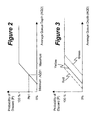
- Figure 2 shows a graph of an example discard probability function versus average queue depth. According to this function, the discard probability is zero until a minimum threshold is reached, thereafter the discard probability increases linearly until a maximum threshold is reached. For average queue depths greater than the maximum threshold the discard probability is 100%.
- Figure 3 shows graphs of discard probability functions for a variation of RED, known as, weighted RED.
- RED weighted RED
- the particular discard probability function that is used for a packet depends on the drop precedence (colour) of the packet.
- the drop precedence (DP) is determined by examining the DiffServ Code Point (DSCP) field in the IP header of the packet. Packets that exceed agreements on their connections have their drop precedence (colour) changed by an IP policing procedure.
- DSCP DiffServ Code Point
- the determination to keep or discard a packet is made by comparing the discard probability of the packet to a random number, discarding the packet when the probability exceeds the number. Variations of this procedure include having more discard probability functions, and having different probability cu rves in accordance with a class of service (CoS) to which the packet belongs.
- the CoS of a packet is also determined by examining the DSCP field in the IP header.
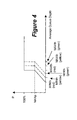
- Figure 4 shows another example of weighted RED with the discard probability functions havin g shapes that are generally accepted to work well.
- the figure includes three graphs for three colours. For each colour, its function provides the discard probability that increases linearly from 0% to MAXp, as the average queue depth increases from its m inimum threshold (MlNth) to its maximum threshold (MAXth). Above MAXth, the discard probability is 100%.
- MAXp drop precedence
- MAXp which is less than 100%, is same for all the colours. Discard probability functions having different shapes and curves are possible.
- the determination of whether to discard or keep a packet is made by comparing the discard probability of the packet to a random number (RN).
- RN random number
- Figures 5 and 6 show a comparison of the results of the GRV and URV methods with a constant average queue depth.
- Figure 5 is the GRV method and Figure 6 is the URV method.
- the horizontal lines depict time and the small vertical lines depict packet discards.
- GRV geometric random variable
- a new random number is selected for each packet arriving at a queue. If the discard probability for the packet exceeds the random number then the pack et is discarded. As Figure 5 shows, the resulting discards are randomly distributed in time.
- the URV method selects a new random number only after a packet has been discarded. The URV method, therefore, counts the number of packets ( count) since the last discard and multiplies the count by the discard probability. If the resulting product is greater than the random number then the packet is discarded, the count set to zero, and a new random number is generated. Otherwise the packet is accepted and the count is incremented.
- the URV method provides the desirable result of uniformly distributing packet discards in time, it requires an additional multiply operation over the GRV method. This extra multiplication takes a significant amount of processing time. As an example, assume that a typical network processor has 56 cycles to process a 40-byte packet at 9.14Gb/s (equivalent to OC -192) rate. Each multiplication operation takes 6 cycles to complete. This yields a total of 12 cycles for the multiplication part of the discard calculations. A problem with this approach is that, in the case of packets arriving at OC-192 rate, the URV discard procedure leaves only 44 cycles for the remainder of the discard processing, such as threshold checking. At these rates, every cycle is precious and saving them is important.
- the present invention provi des novel ways to perform RED more efficiently, requiring less processing power and/or time, making it more suitable for high -speed applications.
- discard probability, P(colour), which depends on average queue dep th, N avg must be calculated by using formulae (1) and (2).
- formulae (1) and (2) There are several ways of calculating formulae (1) and (2). Two common variations are described here, i.e., "background method” and "arrival method".
- a background process i s invoked every T seconds. This process calculates average queue depth and discard probability using formulae (1) and (2) respectively. The obtained values are then used to determine a fate of every packet that arrives to the system during the next T sec onds. After that time, the background process is called again, the current queue depth is fetched, and new average queue depth and discard probability are computed.
- a further improvement in accuracy of calculat ing the average queue depth is also required for better performance of the random early packet discard operation.
- the invention relates to the problem of alleviating traffic congestion in a communications switch or router. More part icularly, the invention relates to a technique which requires less processing power and/or time.
- the invention is directed to an improved technique of selectively discarding packets of traffic depending on the fill level, or depth, of queues in the communications switch.
- the invention provides a method of obtaining discards uniformly distributed in time like the URV procedure but with less processing cycles, making it more suitable for OC -192 applications.
- the invention uses the summed discard probabilities, instead of counting the number of packets (count) and multiplying that by the current discard probability, as in the prior art.
- the resulting sum is co mpared to the random number for discard operation.
- the invention provides a more accurate way of calculating average depth of a queue, especially when the queue encounters periods of idleness.
- a further aspect of th e invention therefore calls for a novel RED technique based on a more accurate average queue depth calculation, which results in improved packet discard operation with less processing power than required in the known techniques.
- the invention relates to a method of controlling a queue of a communications system.
- the method includes steps of deciding an accept/discard operation on a packet arriving at the queue, based on comparison between a discard probability sum for the packet and a random variable, calculating a discard probability for the packet, using an average depth of the queue, and generating a new discard probability sum for a next packet arriving at the queue, by summing the discard probability sum and the calcu lated discard probability.
- the invention resides in the field of a random early packet discard procedure in a telecommunications system.
- the invention is directed to a method of calculating an average depth of a queue when a packet arrives at the queue.
- the method includes steps of measuring a current queue depth, N cur , retaining a previous average queue depth, Previous N avg , and monitoring whether or not the queue is empty.
- the method further includes a step of updati ng the average queue depth, New N avg , by the following formulae; where W is a running weight between 0 and 1, and the function is a function that returns values based on the idle time of the queue and W.
- the invention is directed to a mechanism for controlling a queue of a communications system.
- the mechanism comprises a receiver for receiving and sending a packet to a queue for storage, and discard probability calculation module for calculating the discard probability sum which is the summation of discard probabilities of all packets that have arrived at the queue since a packet was last discarded from the queue.
- the mechanism further includes a random number generator for generating a random number when instructed, and discard module for discarding the just arrived packet from the queue if the discard probability sum is greater than the random number, and instructing the discard probability calculation module to set the discard probability sum to zero an d to generate another random number to replace the aforementioned random number.
- the discard probabilities are summed for each colour, instead of counting the number of packets (count) and multiplying that by the current discard probability P(colour), as in the prior art.
- the result is packet discards for each colour that are uniformly distributed in time similar to the prior art URV method, but requires 50% less processing cycles to implement. This improvement in efficiency allows uniformly distributed packet discards to be achieved on OC-192 rate connections.
- a new discard algorithm in accordance with one embodiment is therefore as follows:
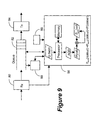
- FIG. 9 is a schematic illustration of a discard mechanism according to the above-described embodiment of the invention.
- the figure only shows one queue associated with a variety of modules. It should be noted that a plurality of queues are in a switch or a router and they may share some or all modules.
- a receiver 80 receives a packet and sends over to the queue 82 for storage from which a transmitter 84 transports a stored packet downstream. The receiver checks the drop precedence (colour) of the packet, if there are more than one level of precedence.
- a discard probability calculation module 86 continuously monitors the queue depth. It also calculates average queue depth and determines discard probability for the just arrived packet and the discard probability sum.
- the discard probability calculation module further makes a decision of accept/discard the packet in response to comparison between the discard probability sum for the colour of the packet and a random number obtained from random number generator 88.
- Discard module 90 drops off the packet from the tail of the que ue when instructed by the discard probability calculation module.
- the invention provides a further im provement in the "arrival method", resulting in a better accuracy of calculating the average queue depth (N avg ) of a queue when the queue encounters short idle periods.
- the prior art "arrival" method of ma king such calculations can lead to an incorrectly calculated average queue depth when an increasing queue depth is followed by short periods of queue emptiness. This will result in unnecessary discards in RED.
- the invention provides new ways of calculati ng average queue depth when the queue is empty to ensure a better performance of RED.
- a formula for calculating average queue depth for a non-empty queue depth will be used.
- the average queue depth N avg when the queue is empty is calculated using two separate formulae.
- the invention uses the following logic:
- weight W can take a form of 1 ⁇ 2 M , where M is between 0 and 15.
- the invention provides a more efficient technique of performing weighted random early discard (RED) of packets, thereby enabling such actions to be performed on OC192 rate connections.
- the improved technique provides a distribution of packet discards that is uniformly distributed over time. This type is desirable because it is less likely to effect any one connection, especially so in the case of TCP connections.
- the invention also provides a more accurate technique of calculating the average queue depth for periods of idle time, thereby preventing unnecessary discards that could otherwise result, as in the case of the prior art method.
- the capability of allevi ating traffic congestion in a switch is necessary in order to guarantee service quality to customers of a network. It is desirable to alleviate the congestion by discarding packets of traffic in a manner such that any particular connection on a congested port of the switch is not unduly affected.
- the invention provides this capability in a manner that is more processing efficient than prior art methods (e.g., weighted RED). This efficiency enables the invention to be performed on OC192 rate connections, which is not possible with prior art methods executed with currently available processors. Therefore, the invention has immediate commercial value for OC192 applications because it provides a capability that is not currently available. Furthermore, due to its higher processing efficiency, the invention should continue to be valuable to our competitors as data rates increase.
Landscapes
- Engineering & Computer Science (AREA)
- Computer Networks & Wireless Communication (AREA)
- Signal Processing (AREA)
- Data Exchanges In Wide-Area Networks (AREA)
Abstract
Description


Claims (20)
- A method of controlling a queue of a communications system, comprising steps of:(a) deciding an accept/discard operation on a packet arriving at the queue, based on comparison between a discard probability sum for the packet and a random variable;(b) calculating a discard probability for the packet, using an average depth of the queue, and(c) generating a new discard probability sum for a next packet arriving at the queue, by summing the discard probability sum and the calculated discard probability.
- The method according to claim 1, further comprising a step of:(d) accepting a packet arriving at the queue if a discard probability sum for the packet is smaller than or equal to a random variable.
- The method according to claim 1, further comprising steps of:(e) discarding the packet arriving at the queue if the discard probability sum for the packet is larger than the random variable;(f) setting the discard probability sum to zero, and(g) generating another random variable to replace the aforementioned random variable.
- The method according to claim 2, further comprising step s of:repeating steps (a) to (d) for each packet arriving at the queue;discarding a packet arriving at the queue the most recently, if the discard probability sum for the most recent packet is larger than the random variable;setting the discard probability sum to zero;generating another random variable to replace the aforementioned random variable, andrepeating steps (a) to (d) for further packets arriving at the queue.
- The method according to claim 4, further comprising steps of:calculating the average depth of the queue every time a new packet arrives at the queue, andcalculating the discard probability for the newly arrived packet based on the calculated average depth of the queue.
- The method according to claim 5 wherein the step of calculating the average depth of the queue comprises further steps of:where W is a running weight between 0 and 1.measuring a current queue depth, Ncur;retaining a previous average queue depth, Previous Navg;monitoring whether or not the queue is empty, andupdating the average queue depth, Ne w Navg, by the following formulae;if the queue is not empty,if the queue is empty,if the queue is empty and also New Navg=Previous Navg,
- The method according to claim 2 wherein the packet has a drop precedence of a plurality of levels expressed in colours and each colour has its discard probabil ity and discard probability sum, the method further comprising steps of:checking the colour of the packet arriving at the queue, andaccepting or discarding the packet based on discard probability sum for the colour.
- The method according to claim 3 wherein the packet has a drop precedence of a plurality of levels expressed in colours and each colour has its discard probability and discard probability sum, the method further comprising steps of:checking the colour of the packet arriving at the queue , andaccepting or discarding the packet based on discard probability sum for the colour.
- The method according to claim 4, further comprising steps of:calculating a discard probability for the colour, using an average depth of the queue, andgenerating a new discard probability sum for a next packet of the colour arriving at the queue, by summing the discard probability sum and the calculated discard probability for the colour.
- The method according to claim 5, further comprising steps of:calculating a discard probability for the colour, using an average depth of the queue, andgenerating a new discard probability sum for a next packet of the colour arriving at the queue, by summing the discard probability sum and the calculated discard probab ility for the colour.
- The method according to claim 6, further comprising steps of:calculating a discard probability for the colour, using an average depth of the queue, andgenerating a new discard probability sum for a next packet of the colour arriving at the queue, by summing the discard probability sum and the calculated discard probability for the colour.
- In performing a random early packet discard procedure in a telecommunications system, a method of calculating an average depth of a queue when a packet arrives thereat, comprising steps of:measuring a current queue depth, Ncur;retaining a previous average queue depth, Previous Navg;monitoring whether or not the queue is empty, andupdating the average queue depth, New Navg, by the following formulae;if the queue is not empty,if the queue is empty,if the queue is empty and also New Navg=Previous Navg,
- The method according to claim 12, wherein W is ½M and M is an integer between 0 and 15.
- The method of claim 12, further comprising steps of:deciding an accept/discard operation on a packet arriving at the queue, based on comparison between a discard probability sum for the packet and a random variable;calculating a discard probability for the packet, using an average depth of the queue, andgenerating a new discard probability sum for a next packet arriving at the queue, by summing the discard probability sum and the calculated discard probability.
- The method accordin g to claim 14, further comprising steps of:accepting each packet arriving at the queue if a discard probability sum for the packet is smaller than or equal to a random variable.discarding a packet arriving at the queue the most recently, if the discard probability sum for the most recent packet is larger than the random variable;setting the discard probability sum to zero;generating another random variable to replace the aforementioned random variable, anddeciding an accept/discard operation on fu rther packets arriving at the queue.
- The method according to claim 15 wherein packets arriving at the queue have a drop precedence of a plurality of levels expressed in colours and each colour has its discard probability and discard probability sum, t he method further comprising steps of:checking the colour of each packet arriving at the queue, andaccepting or discarding the packet based on discard probability sum for the colour.
- A mechanism for controlling a queue of a communications system, comprising:a receiver for receiving and sending a packet to a queue for storage;discard probability calculation module for calculating the discard probability sum which is the summation of discard probabilities of all packets that have arrived at the q ueue since a packet was last discarded from the queue;a random number generator for generating a random number when instructed, anddiscard module for discarding the just arrived packet from the queue if the discard probability sum is greater than the r andom number, and instructing the discard probability calculation module to set the discard probability sum to zero and to generate another random number to replace the aforementioned random number.
- The mechanism according to claim 17, further compris ing:a sum operator for producing a new discard probability sum by a summation of a newly calculated discard probability for the just arrived packet and a previous discard probability sum.
- The mechanism according to claim 18, further comprising:where Ncur is a current queue depth, Previous Navg is a previous average queue depth, New Navg is the average queue depth, W is a running weight between 0 and 1 , and the function is a function that returns values based on the idle time of the queue and W.a processor for obtaining an average depth of the queue by using following equations,if the queue is not empty,if the queue is empty,if the queue is empty and also New Navg=Previous Navg,
- The mechanism according to claim 18, wherein the receiver further comprises means for checking drop precedence of the just arrived packet.
Priority Applications (1)
| Application Number | Priority Date | Filing Date | Title |
|---|---|---|---|
| EP05110609A EP1626544B1 (en) | 2003-03-13 | 2004-03-12 | Improvement in average queue depth calculation for use in random early packet discard (red) algorithms |
Applications Claiming Priority (2)
| Application Number | Priority Date | Filing Date | Title |
|---|---|---|---|
| US386651 | 2003-03-13 | ||
| US10/386,651 US7636307B2 (en) | 2003-03-13 | 2003-03-13 | Random early packet discard (RED) |
Related Child Applications (1)
| Application Number | Title | Priority Date | Filing Date |
|---|---|---|---|
| EP05110609A Division EP1626544B1 (en) | 2003-03-13 | 2004-03-12 | Improvement in average queue depth calculation for use in random early packet discard (red) algorithms |
Publications (3)
| Publication Number | Publication Date |
|---|---|
| EP1458154A2 true EP1458154A2 (en) | 2004-09-15 |
| EP1458154A3 EP1458154A3 (en) | 2004-10-27 |
| EP1458154B1 EP1458154B1 (en) | 2006-07-26 |
Family
ID=32771595
Family Applications (2)
| Application Number | Title | Priority Date | Filing Date |
|---|---|---|---|
| EP04300139A Expired - Lifetime EP1458154B1 (en) | 2003-03-13 | 2004-03-12 | Improvement in random early packet discard (red) |
| EP05110609A Expired - Lifetime EP1626544B1 (en) | 2003-03-13 | 2004-03-12 | Improvement in average queue depth calculation for use in random early packet discard (red) algorithms |
Family Applications After (1)
| Application Number | Title | Priority Date | Filing Date |
|---|---|---|---|
| EP05110609A Expired - Lifetime EP1626544B1 (en) | 2003-03-13 | 2004-03-12 | Improvement in average queue depth calculation for use in random early packet discard (red) algorithms |
Country Status (3)
| Country | Link |
|---|---|
| US (1) | US7636307B2 (en) |
| EP (2) | EP1458154B1 (en) |
| DE (2) | DE602004021798D1 (en) |
Families Citing this family (11)
| Publication number | Priority date | Publication date | Assignee | Title |
|---|---|---|---|---|
| US7274666B2 (en) * | 2003-04-01 | 2007-09-25 | International Business Machines Corporation | Method and system for managing traffic within a data communication network |
| US7623452B2 (en) * | 2003-08-01 | 2009-11-24 | Hewlett-Packard Development Company, L.P. | User configurable functions for adjusting service differentiation meters |
| US7567508B2 (en) * | 2005-05-23 | 2009-07-28 | Cisco Technology, Inc. | Method and system for providing delay bound and priortized packet dropping |
| WO2009016692A1 (en) * | 2007-07-27 | 2009-02-05 | Fujitsu Limited | Packet processing device |
| CN103299675B (en) * | 2011-01-12 | 2019-03-01 | 瑞典爱立信有限公司 | Adaptive relative bitrate manager for TCP-dependent flow control |
| US9030931B2 (en) * | 2011-03-14 | 2015-05-12 | Arista Networks, Inc. | Latency analysis of traffic passing through an ethernet switch |
| US8867360B2 (en) * | 2012-03-22 | 2014-10-21 | Avaya Inc. | Method and apparatus for lossless behavior for multiple ports sharing a buffer pool |
| CN104184794B (en) | 2013-05-27 | 2019-01-08 | 韩国电子通信研究院 | Data package size method of randomization |
| US10069744B2 (en) * | 2015-07-14 | 2018-09-04 | Alcatel Lucent | Method and apparatus for managing network congestion |
| US11054884B2 (en) * | 2016-12-12 | 2021-07-06 | Intel Corporation | Using network interface controller (NIC) queue depth for power state management |
| US10805223B1 (en) * | 2019-04-10 | 2020-10-13 | Dell Products L.P. | Systems and methods for handling data congestion for shared buffer switches with dynamic thresholding |
Family Cites Families (15)
| Publication number | Priority date | Publication date | Assignee | Title |
|---|---|---|---|---|
| US6560198B1 (en) * | 1997-11-07 | 2003-05-06 | Telcordia Technologies, Inc. | Method and system for stabilized random early detection using packet sampling |
| US6463068B1 (en) * | 1997-12-31 | 2002-10-08 | Cisco Technologies, Inc. | Router with class of service mapping |
| US6829224B1 (en) * | 1999-02-04 | 2004-12-07 | Cisco Technology, Inc. | Method and apparatus for smoothing the rate of packet discards for random early detection in an ATM switch |
| US7142507B1 (en) * | 1999-02-25 | 2006-11-28 | Nippon Telegraph And Telephone Corporation | Traffic monitoring equipment and system and method for datagram transfer |
| US6252848B1 (en) | 1999-03-22 | 2001-06-26 | Pluris, Inc. | System performance in a data network through queue management based on ingress rate monitoring |
| WO2001005107A1 (en) * | 1999-07-13 | 2001-01-18 | Alteon Web Systems, Inc. | Apparatus and method to minimize congestion in an output queuing switch |
| CA2290265A1 (en) * | 1999-11-24 | 2001-05-24 | Alberto Leon-Garcia | High-speed programmable packet scheduler and buffer manager |
| US6690645B1 (en) * | 1999-12-06 | 2004-02-10 | Nortel Networks Limited | Method and apparatus for active queue management based on desired queue occupancy |
| DE60028533T2 (en) * | 2000-03-29 | 2007-01-04 | Alcatel | Method for generating an acceptance decision in a telecommunication system |
| US6856596B2 (en) | 2000-12-01 | 2005-02-15 | Marconi Communications, Inc. | Approximation of the weighted random early detection buffer admittance algorithm |
| US6987732B2 (en) * | 2000-12-15 | 2006-01-17 | Tellabs San Jose, Inc. | Apparatus and methods for scheduling packets in a broadband data stream |
| JP2002330165A (en) | 2001-04-27 | 2002-11-15 | Fujitsu Ltd | Congestion control device |
| US7203170B2 (en) * | 2001-05-01 | 2007-04-10 | Integrated Device Technology, Inc. | Network switch port with weighted random early discard |
| US7280477B2 (en) * | 2002-09-27 | 2007-10-09 | International Business Machines Corporation | Token-based active queue management |
| US7206284B2 (en) * | 2002-11-27 | 2007-04-17 | International Business Machines Corporation | Method and apparatus for automatic congestion avoidance for differentiated service flows |
-
2003
- 2003-03-13 US US10/386,651 patent/US7636307B2/en not_active Expired - Fee Related
-
2004
- 2004-03-12 EP EP04300139A patent/EP1458154B1/en not_active Expired - Lifetime
- 2004-03-12 EP EP05110609A patent/EP1626544B1/en not_active Expired - Lifetime
- 2004-03-12 DE DE602004021798T patent/DE602004021798D1/en not_active Expired - Lifetime
- 2004-03-12 DE DE602004001605T patent/DE602004001605T2/en not_active Expired - Lifetime
Also Published As
| Publication number | Publication date |
|---|---|
| DE602004001605T2 (en) | 2007-07-26 |
| EP1458154B1 (en) | 2006-07-26 |
| EP1626544B1 (en) | 2009-07-01 |
| DE602004021798D1 (en) | 2009-08-13 |
| EP1626544A1 (en) | 2006-02-15 |
| US20040179473A1 (en) | 2004-09-16 |
| US7636307B2 (en) | 2009-12-22 |
| DE602004001605D1 (en) | 2006-09-07 |
| EP1458154A3 (en) | 2004-10-27 |
Similar Documents
| Publication | Publication Date | Title |
|---|---|---|
| EP3714579B1 (en) | Layer 3 fair rate congestion control notification | |
| JP3833739B2 (en) | Communication management and congestion control for packet-based networks | |
| US7158480B1 (en) | Feedback output queuing system, apparatus, and method | |
| KR100656509B1 (en) | Packet Congestion Control Method for Guaranteeing Video Service Bandwidth | |
| US20030223368A1 (en) | Retro flow control for arriving traffic in computer networks | |
| US20090010165A1 (en) | Apparatus and method for limiting packet transmission rate in communication system | |
| US6980516B1 (en) | Soft, prioritized early packet discard system | |
| EP1458154B1 (en) | Improvement in random early packet discard (red) | |
| CN104618258B (en) | A kind of control method of message transmission rate | |
| US20030231648A1 (en) | Guaranteed service in a data network | |
| US7218608B1 (en) | Random early detection algorithm using an indicator bit to detect congestion in a computer network | |
| US20040179479A1 (en) | Determination of average queue depth for RED (random early packet discard) | |
| De Cnodder et al. | A rate based RED mechanism | |
| Chitra et al. | Adaptive CHOKe: An algorithm to increase the fairness in Internet Routers | |
| Akar et al. | A reordering-free multipath traffic engineering architecture for Diffserv-MPLS networks | |
| Zargar et al. | Fuzzy proactive queue management technique | |
| Grochla | Simulation comparison of active queue management algorithms in TCP/IP networks | |
| Sundararajan et al. | A modification to RED AQM for CIOQ switches. | |
| Yelbasi et al. | A new approach to estimate red parameters using global congestion notification | |
| Pauwels et al. | A multi-color marking scheme to achieve fair bandwidth allocation | |
| Firoiu et al. | Feedback output queuing: a novel architecture for efficient switching systems | |
| Orman et al. | Increasing Quality of Services with Priority Active Package Management | |
| AL-Raddady et al. | A new active congestion control mechanism for the Internet | |
| KR20040018785A (en) | Method for Queue Management Using Queuing Threshold | |
| Ghazali et al. | Smooth loss event rate estimation for layered multicast protocol |
Legal Events
| Date | Code | Title | Description |
|---|---|---|---|
| PUAI | Public reference made under article 153(3) epc to a published international application that has entered the european phase |
Free format text: ORIGINAL CODE: 0009012 |
|
| PUAL | Search report despatched |
Free format text: ORIGINAL CODE: 0009013 |
|
| AK | Designated contracting states |
Kind code of ref document: A2 Designated state(s): AT BE BG CH CY CZ DE DK EE ES FI FR GB GR HU IE IT LI LU MC NL PL PT RO SE SI SK TR |
|
| AX | Request for extension of the european patent |
Extension state: AL HR LT LV MK |
|
| AK | Designated contracting states |
Kind code of ref document: A3 Designated state(s): AT BE BG CH CY CZ DE DK EE ES FI FR GB GR HU IE IT LI LU MC NL PL PT RO SE SI SK TR |
|
| AX | Request for extension of the european patent |
Extension state: AL HR LT LV MK |
|
| 17P | Request for examination filed |
Effective date: 20050427 |
|
| 17Q | First examination report despatched |
Effective date: 20050530 |
|
| AKX | Designation fees paid |
Designated state(s): DE ES FR GB IT |
|
| GRAP | Despatch of communication of intention to grant a patent |
Free format text: ORIGINAL CODE: EPIDOSNIGR1 |
|
| GRAS | Grant fee paid |
Free format text: ORIGINAL CODE: EPIDOSNIGR3 |
|
| GRAA | (expected) grant |
Free format text: ORIGINAL CODE: 0009210 |
|
| AK | Designated contracting states |
Kind code of ref document: B1 Designated state(s): DE ES FR GB IT |
|
| PG25 | Lapsed in a contracting state [announced via postgrant information from national office to epo] |
Ref country code: IT Free format text: LAPSE BECAUSE OF FAILURE TO SUBMIT A TRANSLATION OF THE DESCRIPTION OR TO PAY THE FEE WITHIN THE PRESCRIBED TIME-LIMIT;WARNING: LAPSES OF ITALIAN PATENTS WITH EFFECTIVE DATE BEFORE 2007 MAY HAVE OCCURRED AT ANY TIME BEFORE 2007. THE CORRECT EFFECTIVE DATE MAY BE DIFFERENT FROM THE ONE RECORDED. Effective date: 20060726 |
|
| REG | Reference to a national code |
Ref country code: GB Ref legal event code: FG4D |
|
| REF | Corresponds to: |
Ref document number: 602004001605 Country of ref document: DE Date of ref document: 20060907 Kind code of ref document: P |
|
| PG25 | Lapsed in a contracting state [announced via postgrant information from national office to epo] |
Ref country code: ES Free format text: LAPSE BECAUSE OF FAILURE TO SUBMIT A TRANSLATION OF THE DESCRIPTION OR TO PAY THE FEE WITHIN THE PRESCRIBED TIME-LIMIT Effective date: 20061106 |
|
| ET | Fr: translation filed | ||
| RAP2 | Party data changed (patent owner data changed or rights of a patent transferred) |
Owner name: ALCATEL LUCENT |
|
| PLBE | No opposition filed within time limit |
Free format text: ORIGINAL CODE: 0009261 |
|
| STAA | Information on the status of an ep patent application or granted ep patent |
Free format text: STATUS: NO OPPOSITION FILED WITHIN TIME LIMIT |
|
| 26N | No opposition filed |
Effective date: 20070427 |
|
| REG | Reference to a national code |
Ref country code: FR Ref legal event code: GC Effective date: 20140717 |
|
| REG | Reference to a national code |
Ref country code: FR Ref legal event code: PLFP Year of fee payment: 12 |
|
| REG | Reference to a national code |
Ref country code: FR Ref legal event code: PLFP Year of fee payment: 13 |
|
| PGFP | Annual fee paid to national office [announced via postgrant information from national office to epo] |
Ref country code: FR Payment date: 20160321 Year of fee payment: 13 Ref country code: GB Payment date: 20160321 Year of fee payment: 13 |
|
| PGFP | Annual fee paid to national office [announced via postgrant information from national office to epo] |
Ref country code: DE Payment date: 20160330 Year of fee payment: 13 |
|
| PGFP | Annual fee paid to national office [announced via postgrant information from national office to epo] |
Ref country code: IT Payment date: 20160324 Year of fee payment: 13 |
|
| REG | Reference to a national code |
Ref country code: DE Ref legal event code: R119 Ref document number: 602004001605 Country of ref document: DE |
|
| GBPC | Gb: european patent ceased through non-payment of renewal fee |
Effective date: 20170312 |
|
| REG | Reference to a national code |
Ref country code: FR Ref legal event code: ST Effective date: 20171130 |
|
| PG25 | Lapsed in a contracting state [announced via postgrant information from national office to epo] |
Ref country code: FR Free format text: LAPSE BECAUSE OF NON-PAYMENT OF DUE FEES Effective date: 20170331 Ref country code: DE Free format text: LAPSE BECAUSE OF NON-PAYMENT OF DUE FEES Effective date: 20171003 |
|
| PG25 | Lapsed in a contracting state [announced via postgrant information from national office to epo] |
Ref country code: IT Free format text: LAPSE BECAUSE OF NON-PAYMENT OF DUE FEES Effective date: 20170312 Ref country code: GB Free format text: LAPSE BECAUSE OF NON-PAYMENT OF DUE FEES Effective date: 20170312 |