EP1457923A2 - Method and apparatus for generating an image - Google Patents
Method and apparatus for generating an image Download PDFInfo
- Publication number
- EP1457923A2 EP1457923A2 EP04003560A EP04003560A EP1457923A2 EP 1457923 A2 EP1457923 A2 EP 1457923A2 EP 04003560 A EP04003560 A EP 04003560A EP 04003560 A EP04003560 A EP 04003560A EP 1457923 A2 EP1457923 A2 EP 1457923A2
- Authority
- EP
- European Patent Office
- Prior art keywords
- image
- cameras
- images
- technique
- acquired
- Prior art date
- Legal status (The legal status is an assumption and is not a legal conclusion. Google has not performed a legal analysis and makes no representation as to the accuracy of the status listed.)
- Withdrawn
Links
Images


Classifications
-
- G—PHYSICS
- G06—COMPUTING OR CALCULATING; COUNTING
- G06T—IMAGE DATA PROCESSING OR GENERATION, IN GENERAL
- G06T3/00—Geometric image transformations in the plane of the image
- G06T3/40—Scaling of whole images or parts thereof, e.g. expanding or contracting
- G06T3/4038—Image mosaicing, e.g. composing plane images from plane sub-images
-
- G—PHYSICS
- G01—MEASURING; TESTING
- G01C—MEASURING DISTANCES, LEVELS OR BEARINGS; SURVEYING; NAVIGATION; GYROSCOPIC INSTRUMENTS; PHOTOGRAMMETRY OR VIDEOGRAMMETRY
- G01C11/00—Photogrammetry or videogrammetry, e.g. stereogrammetry; Photographic surveying
- G01C11/02—Picture taking arrangements specially adapted for photogrammetry or photographic surveying, e.g. controlling overlapping of pictures
-
- G—PHYSICS
- G06—COMPUTING OR CALCULATING; COUNTING
- G06T—IMAGE DATA PROCESSING OR GENERATION, IN GENERAL
- G06T7/00—Image analysis
- G06T7/30—Determination of transform parameters for the alignment of images, i.e. image registration
- G06T7/33—Determination of transform parameters for the alignment of images, i.e. image registration using feature-based methods
Definitions
- the present invention relates to an apparatus and a method for generating an image, which apparatus and method are utilized in an ITS (Intelligent Transport System) field such as a car navigation system, a virtual reality (VR) field such as a virtual city, a three-dimensional computer graphic (3DCG) field such as a three-dimensional modeling, and so on.
- ITS Intelligent Transport System
- VR virtual reality
- DCG three-dimensional computer graphic
- the image'' a texture image of a large-scale environment such as an urban area into a computer by using a camera or a range sensor and utilizing the image fetched as such in an ITS field or a VR field are actively carried out as disclosed in M Hirose and E. Takaaki. Building a virtual world from the real world. In proceedings of International Symposium on Mixed reality, pages 183-197, Mar. 1999, for example.
- EPI Epipolar Plane Image
- Epipolar plane image analysis an approach to determining structure from motion. Int. J. of Computer Vision, 1: 7-55, 1987. for example.
- the technique using a combination of a plurality of cameras does not have the limits in the technique based on the aerial photographs and the technique using the omni-directional camera, however, it is difficult to generate one image by integrating a plurality of images, and it is also difficult to acquire an image in a large-scale environment substantially free from distortions without information (correction) of shapes such as depth information.
- an apparatus for generating an image comprising:
- an image comprising steps of:
- the vehicle moves at the predetermined direction, which vehicle having a plurality of cameras arranged along a linear line parallel to the predetermined direction and at different angles from each other with respect to the predetermined direction so as to include all areas of the images to be acquired.
- the images at the same point acquired by the camera, respectively, are integrated and formed into one image. Therefore, it is possible to match the optical centers of the cameras with each other easily even if the ordinary cameras arc used, the optical centers of the ordinary cameras each being arranged inside of the camera.
- Each of the cameras may acquire the image while synchronizing with the predetermined data, and the predetermined data arc acquired by using at least one of a GPS, a gyro sensor and a speed sensor, for example.
- the vehicle may perform the linear uniform motion and the matching of patterns with characteristics between the images acquired by the cameras ,and thus it is possible to estimate the predetermined data.
- a technique based on IBR or a technique forming an EPI it is possible to construct a system capable of moving in a virtual space freely.
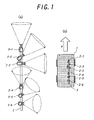
- FIGS. 1 (a) and 1 (b) are diagrams showing the embodiment of the apparatus according to the present invention and a part thereof.
- This apparatus includes a vehicle 1, video cameras 2-1 to 2-6, an installation base 3 for the video cameras 2-1 to 2-6, and a personal computer (not shown) provided in the vehicle 1.
- the vehicle 1 moves in a direction indicated by an arrow a on a rail through wheels by steering of a driver in the vehicle 1.
- the video cameras 2-1 to 2-6 are arranged on the installation base 3 along a linear line parallel to the direction indicated by the arrow a and at different angles from each other with respect to the direction of the arrow so as to cover all areas of images to be acquired, the installation base 3 being provided in the vehicle 1 (see FIG. 1(b)).
- the video cameras 2-1 to 2-6 all have the same performance (e.g., a model number) and acquire data with very high density.
- the personal computer integrates images at the same point acquired by the video cameras 2-1 to 2-6, respectively and forms one image therefrom.
- FIGS. 2 a technique of integrating images acquired by the video cameras in order to form one image is described with reference to FIGS. 2. It is to be noted that a description is given as to an example that three video cameras 12-1 to 12-3 are arranged on a vehicle 11 in FIG. 2 for ease of the explanation.
- the head video camera 12-1 in the vehicle 11 exists at a predetermined point at a time T1, and acquires an image. Since the vehicle 11 is moving, the vehicle 11 proceeds to a position as shown in FIG. 2(b) at a time T2. At this instant, the central video camera 12-2 on the vehicle 11 exists at the same point as that where the head video camera 12-1 existed at the time T1, and acquires an image. Similarly, at a time T3, the vehicle 11 moves to a position as shown in FIG. 2(c). At this time, the end video camera 12-3 on the vehicle 11 exists at the same point as that where the head video camera 12-1 existed at the time T1, and acquires an image.
- Each of the video cameras 12-1 to 12-3 acquires the image while synchronizing with the times T1 to T3 as the predetermined data.
- An image called as an EPI can be formed from the images obtained at a direction vertical to a moving direction with the video cameras performing the linear uniform motion.
- a characteristic point is detected as a linear pattern on the EPI. Therefore, the time Tn can be acquired by generating the EPI from each of a plurality of video cameras and matching the linear patterns between the EPIs with each other.
- a technique of generating the EPIs from a plurality of video cameras and matching the linear patterns between the EPIs with each other is now described in detail with reference to FIG.S 3 (a) to 3 (d).
- a front video camera 21-1 acquires the image at a position x2, and a rear video camcra 21-2 acquires the image at a position x1.
- the front video camera 21-1 acquires the image at a position x3, and the rear video camera 21-2 acquires the image at a position x2.
- an object 23 like a building exists at a position separated by a distance do with respect to a moving direction x of a vehicle 22, and an image plane 24 is formed at a position separated by a distance di.
- EPIs acquired by the video cameras 21-1 and 21-2 are as shown in FIG. 3(b) on the same image plane 24.
- the EPI on the right side is moved in the lateral direction by a distance u1 in such a manner that the respective EPIs smoothly overlap, the EPIs are as shown in FIG. 3(c).
- the optical centers of the video cameras 21-1 and 21-2 do not match with each other, all the patterns on the EPIs cannot be smoothly superposed if buildings or the like having different depths exist. Therefore, as shown in FIG.
- the optical centers of the video cameras 21-1 and 21-2 can be correctly matched with each other by moving the EPIs in the vertical and lateral directions by distanecs z and u2, thereby smoothly superposing the EPIs into each other. It is to be noted that the video cameras 21-1 and 21-2 need not be synchronized with each other in advance in this case.
- a speed of the vehicle 22 can be estimated with relative stability by processing the image.
- FIGS. 4(a) to 4(f) The images acquired by making the vehicle move in a town freely and using the technique explained in conjunction with FIGS. 3 are as shown in FIGS. 4(a) to 4(f). By integrating these images, it is possible to form such an image in a large-scale environment as shown in FIG. 4(g) with ease and substantially without distortions.
- FIGS. 5 (a) to 5 (f) are diagrams explaining the case of applying the technique based on the IBR to the apparatus and the method according to the present invention.
- FIGS. 5(a) to (c) show images generated from virtual view points A to C
- FIG. 5(d) is a diagram showing a positional relationship between a path where the image was acquired and the virtual view points A to C
- FIG. 5(e) shows an actually taken image
- FIG. 5(f) shows an image taken by three video cameras.
- FIGS. 5(a) to 5(d) As shown in FIGS. 5(a) to 5(d), as the view point becomes closer to C from A, a window 31 is hidden behind a building 32, or a positional relationship between the building 32 and a roadside tree 33 is changed. Thereby, it can be confirmed that a parallax is drawn accurately. Moreover, if the image integration according to the present invention is not applied to the IBR, a part which is not drawn is produced as shown in FIG. 5(f). On the other hand, the image integration according to the present invention is applied to the IBR, a part which is not drawn such as shown in FIG. 5(f) is not generated.
- the present invention is not limited to the embodiment as described and many changes and modifications may be carried out without changing the scope of the present invention.
- a vehicle of any type e.g., one which moves on a monorail by using a linear motor, one which moves on a road by using wheels, and so on.
- Such vehicles can be driven by any driving method such as wireless steering.
- the number of video cameras can be arbitrary so that all areas of the images to be acquired can be included, and the video cameras may have performances different from each other.
- the video cameras are used, however, cameras acquiring a still images may be used.
- the cameras may be directly provided on the vehicle.
- the personal computer may be provided outside the vehicle, the matching of the linear patterns between images may be applied to images other than the EPIs, and patterns with predetermined characteristics such as a corner may be matched with each other between images.
Landscapes
- Engineering & Computer Science (AREA)
- Physics & Mathematics (AREA)
- General Physics & Mathematics (AREA)
- Theoretical Computer Science (AREA)
- Radar, Positioning & Navigation (AREA)
- Multimedia (AREA)
- Computer Vision & Pattern Recognition (AREA)
- Remote Sensing (AREA)
- Image Processing (AREA)
- Studio Devices (AREA)
- Closed-Circuit Television Systems (AREA)
- Image Analysis (AREA)
- Editing Of Facsimile Originals (AREA)
- Length Measuring Devices By Optical Means (AREA)
Abstract
Description
- The present invention relates to an apparatus and a method for generating an image, which apparatus and method are utilized in an ITS (Intelligent Transport System) field such as a car navigation system, a virtual reality (VR) field such as a virtual city, a three-dimensional computer graphic (3DCG) field such as a three-dimensional modeling, and so on.
- Recently, techniques of fetching a texture image (hereinafter, called as "the image'') of a large-scale environment such as an urban area into a computer by using a camera or a range sensor and utilizing the image fetched as such in an ITS field or a VR field are actively carried out as disclosed in M Hirose and E. Takaaki. Building a virtual world from the real world. In proceedings of International Symposium on Mixed reality, pages 183-197, Mar. 1999, for example.
- In this case, a technique of efficient fetching and acquiring images into a computer is tried. Although acquisition of images is relied on the manpower until now, there is a limit for labor reason when acquiring images by using the manpower. Therefore, as a technique of automatic acquisition of images, there are proposal such as a technique based on acrial photographs, a technique using an omni-directional camera as disclosed in Y. Onoue, K. Yamasawa, H. Takemura, and N. Yokoya. Telepresence by real-time view-dependent image generation from omni-directional video streams. Computer Vision and Image Understanding, 71 (2): 154-165, Aug. 1998. , for example, a technique using a combination of a plurality of cameras, and so on.
- Further, in relation to the technique of automating acquisition of images, there are proposal such as a technique called as an IBR (Image-Based Rendering) as disclosed in Shenchang Eric Chen. QuickTime® VR -An Image-Based Approach to Virtual Environment Navigation. COMPUTER GRAPHICS Proceedings, Annual Conference Series, pages 29-38, 1995A. Lippman Movie-maps. An application of the optical videodiscs to computer graphics. In Proceedings of ACM SIGGRAPH '80. pages 32-43, 1990. and T. Takahashi, H. Kawasaki, K Ikeuchi, and M. Sakauchi. Arbitrary view position and direction rendering for large-scale scenes. In Computer Vision and Pattern Recognition, volume 2, pages 296-303, June 2000. , for example or a formation of an image called as an EPI (Epipolar Plane Image) as disclosed in R. Bolles, H. Baker, and D. Marimont. Epipolar plane image analysis: an approach to determining structure from motion. Int. J. of Computer Vision, 1: 7-55, 1987. for example.
- However, in case of the technique based on the aerial photographs and the technique using the omni-directional camera, there are limits resulting from resolutions of images, directions of textures to be imaged and so on. On the other hand, the technique using a combination of a plurality of cameras does not have the limits in the technique based on the aerial photographs and the technique using the omni-directional camera, however, it is difficult to generate one image by integrating a plurality of images, and it is also difficult to acquire an image in a large-scale environment substantially free from distortions without information (correction) of shapes such as depth information.
- It is an object of the present invention to provide an apparatus and a method for generating an image, which are capable of acquiring an image in a large-scale environment substantially free from distortions with ease.
- To this end, according to one aspect of the present invention, there is provided an apparatus for generating an image, comprising:
- a vehicle moving at a predetermined direction;
- a plurality of cameras arranged on the vehicle along a linear line parallel to the predetermined direction and at different angles from each other with respect to the predetermined direction so as to include all areas of images to be acquired; and
- means for forming one image by integrating images at the same point acquired by the cameras, respectively
-
- According to another aspect of the present invention, there is provided an method of generating an image, comprising steps of:
- moving a vehicle at a predetermined direction, the vehicle having a plurality of cameras arranged thereon along a linear line parallel to the predetermined direction and at different angles from each other with respect to the predetermined direction so as to include all areas of images to be acquired; and
- forming one image by integrating images at the same point acquired by the cameras, respectively.
-
- In case of the conventional technique using the combination of a plurality of cameras, since an optical center of an ordinary camera is arranged inside of the camera, it is difficult to match the optical centers of these cameras with each other. As a result, it is difficult to generate one image free from distortions by integrating a plurality of images unless special cameras are used, optical centers of which special camera each being outside of the camera, and it is difficult to acquire the image in a large-scale environment substantially free from distortions without correcting depth information or the like.
- According to the apparatus and the method of the present invention, the vehicle moves at the predetermined direction, which vehicle having a plurality of cameras arranged along a linear line parallel to the predetermined direction and at different angles from each other with respect to the predetermined direction so as to include all areas of the images to be acquired. The images at the same point acquired by the camera, respectively, are integrated and formed into one image. Therefore, it is possible to match the optical centers of the cameras with each other easily even if the ordinary cameras arc used, the optical centers of the ordinary cameras each being arranged inside of the camera. As a result, it is possible to generate one image resulting from integration of a plurality of images easily, and it is also possible to acquire the image in a large-scale environment substantially free from distortions easily without correcting depth information or the like. Also, according to the present invention, it is not necessary to be synchronized the cameras with each other and use any external sensor.
- Each of the cameras may acquire the image while synchronizing with the predetermined data, and the predetermined data arc acquired by using at least one of a GPS, a gyro sensor and a speed sensor, for example. Furthermore, the vehicle may perform the linear uniform motion and the matching of patterns with characteristics between the images acquired by the cameras ,and thus it is possible to estimate the predetermined data. Moreover, by applying one of a technique based on IBR or a technique forming an EPI to the apparatus and the method according to the present invention, it is possible to construct a system capable of moving in a virtual space freely.
-
- FIGS. 1 (a) and 1 (b) are diagrams showing the embodiment of the apparatus according to the present invention and a part thereof;
- FIGS. 2 (a) to 2 (c) are diagrams illustrating the embodiment of the apparatus according to the present invention;
- FIGS. 3 (a) to 3 (d) are diagrams illustrating a technique of generating EPIs from a plurality of video cameras and matching linear patterns between the EPIs with each other;
- FIGS. 4 (a) to 4 (g) are diagrams showing images obtained by the technique depicted in FIGS. 3 (a) to 3 (d) and an image obtained by integrating these images; and
- FIGS. 5 (a) to 5 (f) arc diagrams explaining the case of applying the technique based on the IBR to the apparatus and the method according to the present invention.
-
- A preferred embodiment of the apparatus and the method for generating the image according to the present invention is now described in detail hereinafter with reference to the accompanying drawings.
FIGS. 1 (a) and 1 (b) are diagrams showing the embodiment of the apparatus according to the present invention and a part thereof. This apparatus includes avehicle 1, video cameras 2-1 to 2-6, aninstallation base 3 for the video cameras 2-1 to 2-6, and a personal computer (not shown) provided in thevehicle 1. - The
vehicle 1 moves in a direction indicated by an arrow a on a rail through wheels by steering of a driver in thevehicle 1. The video cameras 2-1 to 2-6 are arranged on theinstallation base 3 along a linear line parallel to the direction indicated by the arrow a and at different angles from each other with respect to the direction of the arrow so as to cover all areas of images to be acquired, theinstallation base 3 being provided in the vehicle 1 (see FIG. 1(b)). The video cameras 2-1 to 2-6 all have the same performance (e.g., a model number) and acquire data with very high density. The personal computer integrates images at the same point acquired by the video cameras 2-1 to 2-6, respectively and forms one image therefrom. - At first, a technique of integrating images acquired by the video cameras in order to form one image is described with reference to FIGS. 2. It is to be noted that a description is given as to an example that three video cameras 12-1 to 12-3 are arranged on a
vehicle 11 in FIG. 2 for ease of the explanation. - As shown in FIG. 2(a), the head video camera 12-1 in the
vehicle 11 exists at a predetermined point at a time T1, and acquires an image. Since thevehicle 11 is moving, thevehicle 11 proceeds to a position as shown in FIG. 2(b) at a time T2. At this instant, the central video camera 12-2 on thevehicle 11 exists at the same point as that where the head video camera 12-1 existed at the time T1, and acquires an image. Similarly, at a time T3, thevehicle 11 moves to a position as shown in FIG. 2(c). At this time, the end video camera 12-3 on thevehicle 11 exists at the same point as that where the head video camera 12-1 existed at the time T1, and acquires an image. - In this way, by shifting the times of acquiring the image by the video cameras 12-1 to 12-3 between the times T1 to T3, it is possible to obtain the images acquired at the same position in the environment even if a plurality of video cameras 12-1 to 12-3 exist. Also, since the images obtained as such are acquired at the same position, the optical centers match with each other irrespective of directions of the video cameras 12-1 to 12-3. Therefore, by using these images, even if a plurality of video cameras 12-1 to 12-3 arc utilized, the optical centers of the cameras match with each other. As a result, it is possible to obtain one image in a large-scale environment substantially free from distortions without information of shapes (correction) such as depth information even if the images acquired by these video cameras 12-1 to 12-3 are integrated together.
- Each of the video cameras 12-1 to 12-3 acquires the image while synchronizing with the times T1 to T3 as the predetermined data. Although these times Tn (n = 1, 2, 3) may be acquired by using at least one of a GPS (global positioning system), a gyro sensor and a speed sensor, the time Tn may be acquired without using these members.
- An image called as an EPI can be formed from the images obtained at a direction vertical to a moving direction with the video cameras performing the linear uniform motion. A characteristic point is detected as a linear pattern on the EPI. Therefore, the time Tn can be acquired by generating the EPI from each of a plurality of video cameras and matching the linear patterns between the EPIs with each other. A technique of generating the EPIs from a plurality of video cameras and matching the linear patterns between the EPIs with each other is now described in detail with reference to FIG.S 3 (a) to 3 (d).
- In this case, as shown in FIG. 3(a), at a time T11, a front video camera 21-1 acquires the image at a position x2, and a rear video camcra 21-2 acquires the image at a position x1. At a time T12, the front video camera 21-1 acquires the image at a position x3, and the rear video camera 21-2 acquires the image at a position x2. It is to be noted that an
object 23 like a building exists at a position separated by a distance do with respect to a moving direction x of avehicle 22, and animage plane 24 is formed at a position separated by a distance di. - For simplicity, assuming that the images taken by the video cameras 21-1 and 21-2 are synchronized with each other, EPIs acquired by the video cameras 21-1 and 21-2 are as shown in FIG. 3(b) on the
same image plane 24. When the EPI on the right side is moved in the lateral direction by a distance u1 in such a manner that the respective EPIs smoothly overlap, the EPIs are as shown in FIG. 3(c). In this case, however, since the optical centers of the video cameras 21-1 and 21-2 do not match with each other, all the patterns on the EPIs cannot be smoothly superposed if buildings or the like having different depths exist. Therefore, as shown in FIG. 3(d), the optical centers of the video cameras 21-1 and 21-2 can be correctly matched with each other by moving the EPIs in the vertical and lateral directions by distanecs z and u2, thereby smoothly superposing the EPIs into each other. It is to be noted that the video cameras 21-1 and 21-2 need not be synchronized with each other in advance in this case. - In the technique described with reference to FIG. 3, it is assumed that the case where the
vehicle 22 performs the linear uniform motion, however, it is possible to perform the correction using a simple speed sensor, a GPS or a gyro sensor even if thevehicle 22 does not perform the linear uniform motion since a change in speed or a moving direction of thevehicle 22 is moderate. Furthermore, a speed of thevehicle 22 can be estimated with relative stability by processing the image. - The images acquired by making the vehicle move in a town freely and using the technique explained in conjunction with FIGS. 3 are as shown in FIGS. 4(a) to 4(f). By integrating these images, it is possible to form such an image in a large-scale environment as shown in FIG. 4(g) with ease and substantially without distortions.
- Moreover, the apparatus and the method according to the present invention may apply a technique based on the IBR to the image. Thereby, it is possible to construct a system in which the vehicle moves freely in a large-scale virtual environment. FIGS. 5 (a) to 5 (f) are diagrams explaining the case of applying the technique based on the IBR to the apparatus and the method according to the present invention. FIGS. 5(a) to (c) show images generated from virtual view points A to C, FIG. 5(d) is a diagram showing a positional relationship between a path where the image was acquired and the virtual view points A to C, FIG. 5(e) shows an actually taken image, and FIG. 5(f) shows an image taken by three video cameras.
- As shown in FIGS. 5(a) to 5(d), as the view point becomes closer to C from A, a
window 31 is hidden behind abuilding 32, or a positional relationship between thebuilding 32 and aroadside tree 33 is changed. Thereby, it can be confirmed that a parallax is drawn accurately. Moreover, if the image integration according to the present invention is not applied to the IBR, a part which is not drawn is produced as shown in FIG. 5(f). On the other hand, the image integration according to the present invention is applied to the IBR, a part which is not drawn such as shown in FIG. 5(f) is not generated. - The present invention is not limited to the embodiment as described and many changes and modifications may be carried out without changing the scope of the present invention.
For example, although the description has been given as to the vehicle which moves on the rail by using wheels in the above embodiment, it is possible to adopt a vehicle of any type, e.g., one which moves on a monorail by using a linear motor, one which moves on a road by using wheels, and so on. Such vehicles can be driven by any driving method such as wireless steering. - Also, the number of video cameras can be arbitrary so that all areas of the images to be acquired can be included, and the video cameras may have performances different from each other. In the above embodiment, the video cameras are used, however, cameras acquiring a still images may be used.
- In the above embodiment, the example that the installation base of the cameras is provided has been described, however, the cameras may be directly provided on the vehicle. Further, the personal computer may be provided outside the vehicle, the matching of the linear patterns between images may be applied to images other than the EPIs, and patterns with predetermined characteristics such as a corner may be matched with each other between images.
Claims (16)
- An apparatus for generating an image, comprising:a vehicle moving at a predetermined direction;a plurality of cameras arranged on said vehicle along a linear line parallel to said predetermined direction and at different angles from each other with respect to said predetermined direction so as to include all areas of images to be acquired; andmeans for forming one image by integrating images at the same point acquired by said cameras, respectively.
- The apparatus according to claim 1, wherein said apparatus applies one of a technique based on IBR or a technique forming an EPI to said image.
- The apparatus according to claim 1, wherein each of said cameras acquires the image while synchronizing with predetermined data.
- The apparatus according to claim 3, wherein said apparatus applies one of a technique based on IBR or a technique forming an EPI to said image.
- The apparatus according to claim 3, wherein said predetermined data are acquired by using at least one of a GPS, a gyro sensor and a speed sensor.
- The apparatus according to claim 5, wherein said apparatus applies one of a technique based on IBR or a technique forming an EPI to said image.
- The apparatus according to claim 1, wherein said vehicle performs the linear uniform motion and the matching of patterns with characteristics between the images acquired by said cameras.
- The apparatus according to claim 7, wherein said apparatus applies one of a technique based on IBR or a technique forming an EPI to said image.
- An method of generating an image, comprising steps of:moving a vehicle at a predetermined direction, said vehicle having a plurality of cameras arranged thereon along a linear line parallel to said predetermined direction and at different angles from each other with respect to said predetermined direction so as to include all areas of images to be acquired; andforming one image by integrating images at the same point acquired by said cameras, respectively.
- The method according to claims 9, wherein said method applies one of a technique based on IBR or a technique forming an EPI to said image.
- The method according to claim 9, wherein each of said cameras acquires the image while synchronizing with predetermined data.
- The method according to claim 11, wherein said method applies one of a technique based on IBR or a technique forming an EPI to said image.
- The method according to claim 11, wherein said predetermined data arc acquired by using at least one of a GPS, a gyro sensor and a speed sensor.
- The method according to claim 13, wherein said method applies one of a technique based on IBR or a technique forming an EPI to said image.
- The method according to claim 9, wherein said vehicle performs the linear uniform motion and the matching of patterns with characteristics between the images acquired by said cameras.
- The method according to claim 15, wherein said method applies one of a technique based on IBR or a technique forming an EPI to said image.
Applications Claiming Priority (2)
| Application Number | Priority Date | Filing Date | Title |
|---|---|---|---|
| JP2003038507 | 2003-02-17 | ||
| JP2003038507A JP3728508B2 (en) | 2003-02-17 | 2003-02-17 | Image generating apparatus and method |
Publications (2)
| Publication Number | Publication Date |
|---|---|
| EP1457923A2 true EP1457923A2 (en) | 2004-09-15 |
| EP1457923A3 EP1457923A3 (en) | 2004-11-03 |
Family
ID=32767684
Family Applications (1)
| Application Number | Title | Priority Date | Filing Date |
|---|---|---|---|
| EP04003560A Withdrawn EP1457923A3 (en) | 2003-02-17 | 2004-02-17 | Method and apparatus for generating an image |
Country Status (3)
| Country | Link |
|---|---|
| US (1) | US7400343B2 (en) |
| EP (1) | EP1457923A3 (en) |
| JP (1) | JP3728508B2 (en) |
Families Citing this family (1)
| Publication number | Priority date | Publication date | Assignee | Title |
|---|---|---|---|---|
| US8379968B2 (en) * | 2007-12-10 | 2013-02-19 | International Business Machines Corporation | Conversion of two dimensional image data into three dimensional spatial data for use in a virtual universe |
Family Cites Families (6)
| Publication number | Priority date | Publication date | Assignee | Title |
|---|---|---|---|---|
| US6643413B1 (en) * | 2000-03-27 | 2003-11-04 | Microsoft Corporation | Manifold mosaic hopping for image-based rendering |
| JP3599639B2 (en) * | 2000-05-26 | 2004-12-08 | 松下電器産業株式会社 | Image processing device |
| US7092014B1 (en) * | 2000-06-28 | 2006-08-15 | Microsoft Corporation | Scene capturing and view rendering based on a longitudinally aligned camera array |
| JP3269056B2 (en) * | 2000-07-04 | 2002-03-25 | 松下電器産業株式会社 | Monitoring system |
| US7085409B2 (en) * | 2000-10-18 | 2006-08-01 | Sarnoff Corporation | Method and apparatus for synthesizing new video and/or still imagery from a collection of real video and/or still imagery |
| US6831643B2 (en) * | 2001-04-16 | 2004-12-14 | Lucent Technologies Inc. | Method and system for reconstructing 3D interactive walkthroughs of real-world environments |
-
2003
- 2003-02-17 JP JP2003038507A patent/JP3728508B2/en not_active Expired - Lifetime
-
2004
- 2004-02-17 US US10/778,308 patent/US7400343B2/en not_active Expired - Fee Related
- 2004-02-17 EP EP04003560A patent/EP1457923A3/en not_active Withdrawn
Non-Patent Citations (3)
| Title |
|---|
| HIRAHARA K. ET AL.: "Detection of Street-Parking Vehicles Using Line Scan Camera" PROC. OF THE 9TH WORLD CONGRESS ON INTELLIGENT TRANSPORT SYSTEMS 2002, January 2002 (2002-01), pages 1-12, XP002293920 * |
| HIROSE M ET AL: "BUILDING A VIRTUAL WORLD FROM THE REAL WORLD" MIXED REALITY. MERGING REAL AND VIRTUAL WORLDS. PROCEEDINGS OF INTERNATIONAL SYMPOSIUM ON MIX REALITY. MERGING REAL AND VIRTUAL WORLDS, XX, XX, 1993, pages 183-197, XP001119507 * |
| ONO S., KAWASAKI H., IKEUCHI K., SAKAUCHI M.: "image mosaicing of multiple video cameras using epi analysis" IPSJ SIGNOTES COMPUTER VISION AND IMAGE MEDIA ABSTRACTS, vol. 137, no. 6, 27 March 2003 (2003-03-27), pages 45-52, XP008034510 * |
Also Published As
| Publication number | Publication date |
|---|---|
| US20040223055A1 (en) | 2004-11-11 |
| US7400343B2 (en) | 2008-07-15 |
| JP2004248204A (en) | 2004-09-02 |
| JP3728508B2 (en) | 2005-12-21 |
| EP1457923A3 (en) | 2004-11-03 |
Similar Documents
| Publication | Publication Date | Title |
|---|---|---|
| US10848732B2 (en) | Free viewpoint movement display device | |
| CN110120072B (en) | Method and system for tracking mobile devices | |
| WO2005038402A1 (en) | Navigation device | |
| US12405365B2 (en) | Environment model using cross-sensor feature point referencing | |
| JP2012118666A (en) | Three-dimensional map automatic generation device | |
| WO2004008744A9 (en) | Road and other flat object video plan-view developing image processing method, reverse developing image conversion processing method, plan-view developing image processing device, and reverse developing image conversion processing device | |
| JP2020008664A (en) | Driving simulator | |
| JP4272966B2 (en) | 3DCG synthesizer | |
| JP6910454B2 (en) | Methods and systems for generating composite top-view images of roads | |
| JP2004265396A (en) | Image forming system and image forming method | |
| WO2020118619A1 (en) | Method for detecting and modeling of object on surface of road | |
| KR100550430B1 (en) | Driving guidance device and method of moving object using three-dimensional information | |
| US7400343B2 (en) | Apparatus and method for generating image | |
| Wendel et al. | Automatic alignment of 3D reconstructions using a digital surface model | |
| Schön et al. | Integrated navigation of cameras for augmented reality | |
| Barazzetti et al. | 3D Modeling and Rendering with a Tesla Model 3 Highland | |
| US20230394749A1 (en) | Lighting model | |
| De Cubber et al. | Intelligent robots need intelligent vision: visual 3D perception | |
| Choi et al. | Realtime image matching for vision based car navigation with built-in sensory data | |
| Ikeuchi et al. | Constructing virtual cities with real activities | |
| JP2002259952A (en) | Method and apparatus for automatically acquiring and restoring the surface of a photographing object | |
| Matsuhisa et al. | Image-based ego-motion estimation using on-vehicle omnidirectional camera | |
| Ikeuchi et al. | Enhanced navigation system with real images and real-time information | |
| CN118864778A (en) | A virtual-reality fusion method, device, equipment and storage medium | |
| Martínez et al. | Mixed Reality in Traffic Scenes: A View Synthesis Approach |
Legal Events
| Date | Code | Title | Description |
|---|---|---|---|
| PUAI | Public reference made under article 153(3) epc to a published international application that has entered the european phase |
Free format text: ORIGINAL CODE: 0009012 |
|
| 17P | Request for examination filed |
Effective date: 20040217 |
|
| AK | Designated contracting states |
Kind code of ref document: A2 Designated state(s): AT BE BG CH CY CZ DE DK EE ES FI FR GB GR HU IE IT LI LU MC NL PT RO SE SI SK TR |
|
| AX | Request for extension of the european patent |
Extension state: AL LT LV MK |
|
| PUAL | Search report despatched |
Free format text: ORIGINAL CODE: 0009013 |
|
| AK | Designated contracting states |
Kind code of ref document: A3 Designated state(s): AT BE BG CH CY CZ DE DK EE ES FI FR GB GR HU IE IT LI LU MC NL PT RO SE SI SK TR |
|
| AX | Request for extension of the european patent |
Extension state: AL LT LV MK |
|
| AKX | Designation fees paid |
Designated state(s): DE FR GB |
|
| 17Q | First examination report despatched |
Effective date: 20070129 |
|
| STAA | Information on the status of an ep patent application or granted ep patent |
Free format text: STATUS: THE APPLICATION IS DEEMED TO BE WITHDRAWN |
|
| 18D | Application deemed to be withdrawn |
Effective date: 20120901 |