EP1457772A2 - Gas sensor comprising a resistance dependent organic-inorganic intercalated hybrid material and manufacturing method of said sensor - Google Patents
Gas sensor comprising a resistance dependent organic-inorganic intercalated hybrid material and manufacturing method of said sensor Download PDFInfo
- Publication number
- EP1457772A2 EP1457772A2 EP04075840A EP04075840A EP1457772A2 EP 1457772 A2 EP1457772 A2 EP 1457772A2 EP 04075840 A EP04075840 A EP 04075840A EP 04075840 A EP04075840 A EP 04075840A EP 1457772 A2 EP1457772 A2 EP 1457772A2
- Authority
- EP
- European Patent Office
- Prior art keywords
- sensor
- inorganic
- gas sensor
- organic
- layers
- Prior art date
- Legal status (The legal status is an assumption and is not a legal conclusion. Google has not performed a legal analysis and makes no representation as to the accuracy of the status listed.)
- Granted
Links
Images


Classifications
-
- G—PHYSICS
- G01—MEASURING; TESTING
- G01N—INVESTIGATING OR ANALYSING MATERIALS BY DETERMINING THEIR CHEMICAL OR PHYSICAL PROPERTIES
- G01N27/00—Investigating or analysing materials by the use of electric, electrochemical, or magnetic means
- G01N27/02—Investigating or analysing materials by the use of electric, electrochemical, or magnetic means by investigating impedance
- G01N27/04—Investigating or analysing materials by the use of electric, electrochemical, or magnetic means by investigating impedance by investigating resistance
- G01N27/12—Investigating or analysing materials by the use of electric, electrochemical, or magnetic means by investigating impedance by investigating resistance of a solid body in dependence upon absorption of a fluid; of a solid body in dependence upon reaction with a fluid, for detecting components in the fluid
- G01N27/125—Composition of the body, e.g. the composition of its sensitive layer
-
- G—PHYSICS
- G01—MEASURING; TESTING
- G01N—INVESTIGATING OR ANALYSING MATERIALS BY DETERMINING THEIR CHEMICAL OR PHYSICAL PROPERTIES
- G01N33/00—Investigating or analysing materials by specific methods not covered by groups G01N1/00 - G01N31/00
- G01N33/0004—Gaseous mixtures, e.g. polluted air
- G01N33/0009—General constructional details of gas analysers, e.g. portable test equipment
- G01N33/0027—General constructional details of gas analysers, e.g. portable test equipment concerning the detector
- G01N33/0036—General constructional details of gas analysers, e.g. portable test equipment concerning the detector specially adapted to detect a particular component
- G01N33/0047—Organic compounds
Definitions
- the present invention is concerned with a gas sensor. More specifically, it relates to a novel gas sensor having superior long term stability and superior gas selectivity to a volatile organic compound (VOC) at a temperature of 100°C or less using a particular organic-inorganic hybrid material as a sensor element.
- VOC volatile organic compound
- Such a gas sensor for example, does not respond to a flammable gas such as hydrogen and responds selectively to a VOC gas.
- the invention is also concerned with methods of producing a gas sensor and to structures suitable for use in gas sensors for volatile organic compounds.
- VOC sensors are required to monitor indoor environments.
- Gas sensors using an n-type semiconductor oxide such as tin oxide, for example, have superior long term stability. Further, they can be miniaturized and do not require any expensive devices for the production and complicated circuits for sensing the change in resistance. Therefore, these sensors have been widely used in practice as household gas leak alarms and the like.
- semiconductor gas sensors for detecting various gases in addition to household gases. Specifically, gas sensors for sensing VOC are being studied. Gas sensors that selectively sense only one gas are required.
- VOC sensors using a semiconductor oxide known in the related are sensors that sense the total volume of some ten types of VOC.
- a method for providing a catalytic layer on a surface of a semiconductor oxide is described in JP 2000-298108 and JP 2000-292397.
- a method for coating a surface of a semiconductor oxide with a silica film used as a filer layer is described in JP 10-170464 and JP 2000-275201.
- a method for adding a noble metal or an oxide to tin oxide is discussed in IEEJ Transactions E, 119, 383-389 (1999) and IEEJ Transactions E, 121, 395-401 (2001).
- VOC sensors Although examples of VOC sensors exist, further improvement is required. High performance gas sensors having superior gas selectivity are required.
- a gas sensor comprising a sensor element including an organic-inorganic hybrid material.
- the hybrid materials have a layered structure in which an organic compound is intercalated into layers of an inorganic compound.
- the inorganic compound comprises a transition metal oxide, for example molybdenum oxide.
- the organic compound comprises a conductive polymer.
- the gas sensor responds to a volatile organic compound at a temperature in the range of from room temperature (about 20°C) to 80°C.
- the inorganic and organic individual layers have thickness less than 1 nanometer and they are alternately laminated to each other.
- Another aspect of the disclosed teachings is a method for manufacturing a gas sensor comprising providing layers of an inorganic compound.
- An organic compound is intercalated between the layers of the inorganic compound to form a organic-inorganic hybrid material.
- the hybrid material is used as a sensor element in the gas sensor.
- Still another aspect of the disclosed teachings is a method of manufacturing a hybrid organic-inorganic material comprising suspending an inorganic material in distilled water in an argon atmosphere.
- a reducing agent especially a reducing alkali metal compound such as sodium dithionite or sodium dithionate
- an alkali metal salt especially a sodium salt
- the inorganic material with hydrated alkali metal ions intercalated between layers of the oxide product is separated, washed and dried.
- the product is suspended in distilled water.
- a monomer is added and stirred, e.g. using an ultrasonic homogenizer.
- a polymerizing agent usually an oxidizing agent, is added and stirred. The product is separated.
- the oxidizing agent is selected from iron chloride, ammonium peroxodisulfate and iron nitrate.
- an amount of the monomer is 50 to 200 equivalents to one equivalent of the hydrated sodium ions intercalated material.
- the amount of conductive polymer is 100 to 150 equivalents to one equivalent of the hydrated sodium ions intercalated material.
- the inorganic material is selected from molybdenum oxide, tungsten oxide, vanadium oxide, niobium oxide, ruthenium chloride, iron oxychloride and molybdenum sulfide.
- the conductive polymer is selected from a group consisting of polypyrrole, polyaniline, polythiophene and polyethylene oxide.
- Fig. 1 is a schematic view showing one example of a crystal structure of a gas sensor material according to the disclosed teachings.
- Fig. 2 is a graph showing x-ray diffraction patterns of [Na(H 2 O) 5 ] x MoO 3 and PPy y MoO 3 described in Example 1.
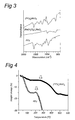
- Fig. 3 is a graph showing infrared spectra of [Na(H 2 O) 5 ] x MoO 3 , PPy y MoO 3 , and simple polypyrrole (PPy) prepared by a chemical polymerization method described in Example 1.
- Fig. 4 is a graph showing the results of thermogravimetric analysis of PPy y MoO 3 and simple polypyrrole (PPy) formed by a chemical polymerization method described in Example 1.
- Fig. 5 is a graph showing sensor sensitivity of a sensor described in Example 1 to a methanol gas.
- Fig. 6 is a graph showing an x-ray diffraction pattern of PPy y MoO 3 described in Example 2.
- a new sensing principle which does not depend on the sensing principle of the semiconductor oxide sensor described above is disclosed herein.
- a novel sensor using a hybrid material obtained by nanometer-level integration of an organic material and an inorganic material is provided.
- the organic material is used to recognize the target gas molecules.
- the inorganic material is used to convert chemical information (representing whether a gas to be sensed is present or not) to an electrical signal. This information is output.
- a sensor When an organic compound and an inorganic compound are allowed to perform different functions and are integrated together on a nano-scale, a sensor can be made which has both high sensitivity of the organic compound and high stability of the inorganic compound and which can easily output a signal outside.
- a hybrid sensor which is formed by a combination of an appropriate metal oxide and a conductive polymer, responds selectively to a VOC gas as the resistance is changed. It is also stable as compared to a sensor composed of only a conductive polymer.
- a metal oxide having a layered structure is used as the inorganic compound.
- An organic polymer is intercalated between these layers.
- the organic-inorganic hybrid sensor is formed by nanometer-level integration. The combination between the organic compound and the inorganic compound needs to be appropriately selected. For example, when a combination of an organic compound and an inorganic compound, which have different types of carriers responsible for conductivity, is selected, charge transfer occurs between these two compounds. As a result, conductivity is imparted to the hybrid sensor.
- the charge transfer is influenced. This changes the electrical resistance of the sensor.
- a hybrid material obtained by the combination of an inorganic compound having conductivity and an organic compound having insulating properties exhibits conductivity.
- the sensing function based on the principle described above cannot be expected. The sensing can be achieved only when the inorganic compound (which forms the disclosed hybrid sensor) has a layered structure and is provided with conductivity by the charge transfer from the organic compound.
- An interlayer compound used for a gas sensor comprises an inorganic compound having a layered structure and an organic compound intercalated between the inorganic layers.
- Fig. 1 shows a schematic view of a crystal structure of an interlayer compound.
- molybdenum oxide shown in the figure as layer 1
- polypyrrole shown in the figure as layer 2) (PPy) is the organic compound.
- a layered structure (hereinafter, this material will be described as PPy y MoO 3 ) is formed in which polypyrrole is intercalated between layers of molybdenum oxide.
- molybdenum oxide itself is an insulating material, it is turned into an n-type semiconductor when electrons are supplied thereinto.
- polypyrrole is turned into a p-type semiconductor when emitting electrons. Accordingly, conductivity is generated in PPy y MoO 3 by the charge transfer from polypyrrole to molybdenum oxide.
- PPy y MoO 3 is synthesized in the form of a powder, it can be easily molded by press molding. Hence, a sensor element can be formed by providing electrodes on the press-molded body thus formed.
- PPy y MoO 3 can be prepared by a two-stage reaction.
- [Na(H 2 O) 5 ] x MoO 3 is synthesized in which hydrated sodium ions are intercalated between layers of molybdenum oxide.
- molybdenum oxide is suspended in distilled water in an argon atmosphere, and sodium dithionite and sodium molybdate are added thereto, followed by stirring.
- the reaction time is generally 5 minutes to one hour, and preferably 10 to 30 minutes.
- a reaction product is separated, washed, and dried, thereby obtaining [Na(H 2 O) 5 ] x MoO 3 .
- the amount of pyrrole added is generally 50 to 200 equivalents and preferably 100 to 150 equivalents with respect to one equivalent of [Na(H 2 O) 5 ] x MoO 3 .
- the amount of the oxidizing agent added is generally 1 to 3 equivalents and preferably 1.5 to 2 equivalents with respect to one equivalent of [Na(H 2 O) 5 ] x MoO 3 .
- an electrical resistance change type sensor composed of an n-type semiconductor oxide responds to a VOC gas as that the resistance is decreased.
- the gas sensor disclosed herein responds to a VOC gas such that a sensor resistance is increased.
- the sensor responds selectively to polar molecules such as aldehydes and alcohols.
- polar molecules such as aldehydes and alcohols.
- a polar molecule generates a strong interaction with polypyrrole having positive charge, and hence it is believed that a polar molecule infiltrates a polypyrrole layer having the crystal structure shown in Fig. 1.
- the interlayer distance is increased, and the charge transfer is suppressed, resulting in increase in resistance of the sensor. That is, such a gas sensor exhibits a selective and particular response to a gas having polarity among VOC gases.
- the disclosed sensor exhibits a response at room temperature, a heating mechanism and the like are not particularly necessary.
- polarization is not generated unlike a simple conductive polymer, resistance measurement can be performed using a direct current. Therefore, a complicated measuring circuit using an alternating current is not necessary. Accordingly, the sensor unit can be miniaturized.
- the decomposition temperature of polypyrrole is increased by approximately 50°C as compared to pure polypyrrole which is formed separately.
- the thermal stability is improved by hybridization.
- a wearable VOC monitoring device cane be made using the sensor disclosed herein.
- molybdenum oxide and polypyrrole may also be applied to a layered inorganic compound and a conductive polymer other than molybdenum oxide and polypyrrole.
- the layered inorganic compound capable of forming a gas sensor of the organic-inorganic hybrid material include, but not limited to, oxides, sulfides and halides of metals of groups 5-8 of rows 4-6 of the Periodic Table such as tungsten oxide, vanadium oxide, niobium oxide, ruthenium chloride, iron oxychloride, or molybdenum sulfide.
- Examples of the conductive polymer that can be used include polypyrroles, polyanilines, polythiophenes, polyacetylenes and their substituted analogs. However, they are not limited to those mentioned above. Materials that produce the same effect as that of the above compounds may also be used.
- Molybdenum oxide MoO 3 powder (1g, 6.9 mmol) was added to 50 ml of distilled water and was stirred for 30 minutes at room temperature while an argon gas was being bubbled.
- sodium dithionite Na 2 S 2 O 4 (0.35 g, 2.0 mmol
- stirring was performed for 10 minutes at room temperature while an argon gas was being bubbled.
- the color of the molybdenum oxide powder quickly changed from white into deep blue upon adding sodium dithionite and sodium molybdate, and hence it was confirmed that molybdenum oxide was reduced.
- thermogravimetric analysis of PPy y MoO 3 is shown together with that of the polypyrrole formed by a chemical polymerization method for comparison. Temperatures indicated by individual arrows are decomposition temperatures of polypyrroles.
- the decomposition temperature of the layered compound PPy y MoO 3 was higher than that of pure polypyrrole by approximately 60°C, and this shows that the hybridization with an inorganic compound is effective to improve the thermal stability of an organic polymer.
- the decrease in weight up to approximately 100°C was caused by adsorbed water.
- a sample obtained by performing press molding for PPy y MoO 3 powder thus formed was provided with electrodes using a silver paste, thereby forming a sensor element.
- the electrical resistivity of the press-molded body measured by a DC four-probe method was 9.6 ⁇ •cm at room temperature.
- the electrical resistivity of a press-molded body of powdered [Na(H 2 O) 5 ] x MoO 3 measured in the same manner as that described above was 3,200 ⁇ •cm, and hence by intercalating polypyrrole between the layers, the electrical resistivity was decreased by two orders of magnitude or more. This shows that the polypyrrole layer has conductivity as is the molybdenum oxide layer, and that the charge transfer is realized between the molybdenum oxide layer and the polypyrrole layer.
- the PPy y MoO 3 sensor did not respond to these gases.
- the measurement result of the sensor properties to methanol is shown in Fig. 5.
- the sensor was placed in an airtight type chamber, and after a liquid methanol was supplied to a heater provided in the chamber for evaporation to obtain a predetermined concentration, the change in resistance of the sensor was measured.
- the vertical axis in the figure indicates resistance normalized by the initial resistance.
- a response to methanol was shown, in which the resistance of the sensor was increased.
- the sensor sensitivity (R gas /R 0 : R 0 indicates the initial resistance, and R gas indicates the resistance in a gas atmosphere) to various VOC gases at a concentration of 1,000 ppm at room temperature is shown in Table 1.
- the sensor hardly responded to toluene and benzene but selectively responded to aldehydes, alcohols, and a chlorinated gas. Among those mentioned above, particularly high sensitivity was shown to formaldehyde. This fact shows that the disclosed sensor hardly responds to flammable gases such as hydrogen and has high selectivity to VOC gasses.
- a PPy y MoO 3 sensor was formed in a manner similar to that described in Example 1 except that the oxidizing agent used for intercalation reaction of polypyrrole into [Na(H 2 O) 5 ] x MoO 3 was ammonium peroxodisulfate (NH 4 ) 2 S 2 O 8 .
- the x-ray diffraction pattern of a formed powder is shown in Fig. 6. As was the case of Example 1, it was confirmed that an interlayer compound of molybdenum oxide and polypyrrole intercalated between the layers thereof was formed. When the sensor properties were measured, the similar results as those in Example 1 were obtained.
- [Na(H 2 O) 5 ] x MoO 3 was formed in a manner similar to that described in Example 1 except that the reaction time for forming [Na(H 2 O) 5 ] x MoO 3 was set to three hours. According to the x-ray diffraction measurement for the [Na(H 2 O) 5 ] x MoO 3 thus formed, the generation of impurities was observed as the reaction time was increased. From the results thus obtained, it was found that the reaction time for forming [Na(H 2 O) 5 ] x MoO 3 is preferably set to 30 minutes or less.
Landscapes
- Chemical & Material Sciences (AREA)
- Chemical Kinetics & Catalysis (AREA)
- Electrochemistry (AREA)
- Physics & Mathematics (AREA)
- Health & Medical Sciences (AREA)
- Life Sciences & Earth Sciences (AREA)
- Analytical Chemistry (AREA)
- Biochemistry (AREA)
- General Health & Medical Sciences (AREA)
- General Physics & Mathematics (AREA)
- Immunology (AREA)
- Pathology (AREA)
- Investigating Or Analyzing Materials By The Use Of Fluid Adsorption Or Reactions (AREA)
Abstract
Description
| Sensor Sensitivity of PPyyMoO3 Sensor at Room Temperature to Various VOC Gases at a Concentration of 1,000 ppm | |
| Gas | Sensor Sensitivity (Rgas/R0), % |
| Formaldehyde | 6.0 |
| Methanol | 0.8 |
| Ethanol | 0.7 |
| Chloroform | 2.0 |
| Acetone | 0.2 |
| Toluene | <0.1 |
| Benzene | <0.1 |
Claims (13)
- A gas sensor comprising a sensor element including an organic-inorganic hybrid material, said sensor element having layers of an inorganic compound and an organic compound intercalated between the layers of an inorganic compound.
- The gas sensor of claim 1, wherein presence of a gas is detected by a change in resistance.
- The gas sensor of claim 1 or 2, wherein the inorganic compound comprises molybdenum oxide.
- The gas sensor of any one of claims 1-3, wherein the organic compound comprises a conductive polymer.
- The gas sensor of claim 4, wherein the organic compound comprises a polypyrrole.
- The gas sensor of any one of claims 1-5, wherein the gas sensor responds to a volatile organic compound at a temperature in the range of from room temperature to 80°C.
- The gas sensor of any one of claims 1-6, wherein the inorganic and organic individual layers have thickness less than 1 nanometer and they are alternately laminated to each other.
- A method for manufacturing a gas sensor comprising:providing layers of an inorganic compound;intercalating an organic compound between the layers of the inorganic compound to form a organic-inorganic hybrid material; andusing the hybrid material as a sensor element in a gas sensor.
- A method of manufacturing a hybrid organic-inorganic material comprising:a) suspending an inorganic material in distilled water in an inert atmosphere;b) if necessary, adding a reducing agent and an alkali metal salt and stirring;c) separating, washing and drying the inorganic material with hydrated alkali metal ions intercalated between layers of the inorganic material;d) suspending a product of step c in distilled water;e) adding an organic monomer and homogenizing;f) adding an oxidizing agent and stirring; andg) separating the product of step f.
- The method of claim 9, wherein the oxidizing agent is selected from the group consisting of iron chloride, ammonium peroxodisulfate and iron nitrate.
- The method of claim 9 or 10, wherein an amount of the conductive polymer is 50 to 200 equivalents, preferably 100 to 150 equivalents to one equivalent of the inorganic material is added.
- The method of claim 11, wherein the conductive polymer is selected from the group consisting of polypyrrole, polyaniline, polythiophene and polyethylene oxide.
- A layered structure comprising at least two layers of an inorganic material comprising an oxide, sulfide and/or halide of molybdenum, tungsten, vanadium, niobium, ruthenium, or iron, and an alkali metal salt, and a layer of a conductive organic polymer between the at least two layers of inorganic material.
Applications Claiming Priority (2)
| Application Number | Priority Date | Filing Date | Title |
|---|---|---|---|
| JP2003066108 | 2003-03-12 | ||
| JP2003066108A JP3890413B2 (en) | 2003-03-12 | 2003-03-12 | Gas sensor and manufacturing method thereof |
Publications (3)
| Publication Number | Publication Date |
|---|---|
| EP1457772A2 true EP1457772A2 (en) | 2004-09-15 |
| EP1457772A3 EP1457772A3 (en) | 2004-11-10 |
| EP1457772B1 EP1457772B1 (en) | 2010-12-01 |
Family
ID=32767928
Family Applications (1)
| Application Number | Title | Priority Date | Filing Date |
|---|---|---|---|
| EP04075840A Expired - Lifetime EP1457772B1 (en) | 2003-03-12 | 2004-03-12 | Gas sensor comprising a resistance dependent organic-inorganic intercalated hybrid material and manufacturing method of said sensor |
Country Status (4)
| Country | Link |
|---|---|
| US (1) | US20040179970A1 (en) |
| EP (1) | EP1457772B1 (en) |
| JP (1) | JP3890413B2 (en) |
| DE (1) | DE602004030296D1 (en) |
Cited By (3)
| Publication number | Priority date | Publication date | Assignee | Title |
|---|---|---|---|---|
| EP1923697A1 (en) * | 2006-11-18 | 2008-05-21 | National Institute of Advanced Industrial Science and Technology | High sensitive resistive-type gas sensor and its manufacturing process comprising an organic-inorganic intercalated hydbrid sensing material |
| CN102818880A (en) * | 2012-07-30 | 2012-12-12 | 中国科学院微电子研究所 | A method of preparing a sensitive material for a sensor |
| US10422771B2 (en) | 2014-08-29 | 2019-09-24 | Kabushikigaisha Aroma Bit, Inc. | Odor detection system, odor identification device, and odor identification method |
Families Citing this family (27)
| Publication number | Priority date | Publication date | Assignee | Title |
|---|---|---|---|---|
| EP1293769A3 (en) * | 2001-09-07 | 2004-11-03 | National Institute of Advanced Industrial Science and Technology | Flammable gas sensor and gas concentration measurement method and apparatus |
| JP4691687B2 (en) * | 2004-05-11 | 2011-06-01 | 独立行政法人産業技術総合研究所 | Organic-inorganic hybrid gas sensor material and manufacturing method thereof |
| JP4831561B2 (en) * | 2005-05-16 | 2011-12-07 | 独立行政法人産業技術総合研究所 | Organic-inorganic hybrid thin film and manufacturing method thereof |
| JP4883612B2 (en) * | 2006-03-10 | 2012-02-22 | 独立行政法人産業技術総合研究所 | Gas sensor and manufacturing method thereof |
| DE602006006897D1 (en) * | 2006-03-31 | 2009-07-02 | Sony Deutschland Gmbh | System for detecting a leak in a battery |
| JP4899230B2 (en) * | 2007-07-10 | 2012-03-21 | 独立行政法人産業技術総合研究所 | Gas sensor material, manufacturing method thereof, and gas sensor |
| JP4944707B2 (en) * | 2007-08-27 | 2012-06-06 | パナソニック株式会社 | Manufacturing method of gas sensor |
| TWI391656B (en) * | 2008-05-16 | 2013-04-01 | Nat Univ Chung Hsing | Gas sensor structure |
| JP5027771B2 (en) * | 2008-09-24 | 2012-09-19 | パナソニック株式会社 | Method for producing molybdenum oxide thin film and chemical sensor |
| JP5817108B2 (en) * | 2010-12-07 | 2015-11-18 | 株式会社デンソー | Gas sensor |
| JP6893668B2 (en) * | 2014-08-29 | 2021-06-23 | 株式会社アロマビット | Smell system, odor identification method, odor identification device, portable device, wearable device, air conditioner, and odor information identification program |
| CN104316573B (en) * | 2014-10-24 | 2018-04-20 | 浙江大学 | Polypyrrole/titanium dioxide composite impedance type thin film gas sensor and preparation method |
| TWI642925B (en) * | 2017-05-17 | 2018-12-01 | 台達電子工業股份有限公司 | Testing system and method for air sensing device |
| US12377711B2 (en) | 2020-08-20 | 2025-08-05 | Denso International America, Inc. | Vehicle feature control systems and methods based on smoking |
| US11813926B2 (en) | 2020-08-20 | 2023-11-14 | Denso International America, Inc. | Binding agent and olfaction sensor |
| US11932080B2 (en) | 2020-08-20 | 2024-03-19 | Denso International America, Inc. | Diagnostic and recirculation control systems and methods |
| US11636870B2 (en) | 2020-08-20 | 2023-04-25 | Denso International America, Inc. | Smoking cessation systems and methods |
| US11881093B2 (en) | 2020-08-20 | 2024-01-23 | Denso International America, Inc. | Systems and methods for identifying smoking in vehicles |
| US11828210B2 (en) | 2020-08-20 | 2023-11-28 | Denso International America, Inc. | Diagnostic systems and methods of vehicles using olfaction |
| US11760170B2 (en) | 2020-08-20 | 2023-09-19 | Denso International America, Inc. | Olfaction sensor preservation systems and methods |
| US12269315B2 (en) | 2020-08-20 | 2025-04-08 | Denso International America, Inc. | Systems and methods for measuring and managing odor brought into rental vehicles |
| US12017506B2 (en) | 2020-08-20 | 2024-06-25 | Denso International America, Inc. | Passenger cabin air control systems and methods |
| US12251991B2 (en) | 2020-08-20 | 2025-03-18 | Denso International America, Inc. | Humidity control for olfaction sensors |
| US11760169B2 (en) | 2020-08-20 | 2023-09-19 | Denso International America, Inc. | Particulate control systems and methods for olfaction sensors |
| WO2022087187A1 (en) * | 2020-10-20 | 2022-04-28 | Richard Postrel | Instant diagnostics for battlefield, emergency, and continuous care |
| WO2022125414A1 (en) | 2020-12-08 | 2022-06-16 | The University Of Toledo | Nanocomposite of molybdenum oxide and conductive carbon for formaldehyde gas detection at room temperature |
| CN114609197B (en) * | 2022-03-25 | 2023-11-21 | 电子科技大学 | Gas-sensitive materials and preparation methods and their application in NH3 gas-sensitive sensors |
Family Cites Families (12)
| Publication number | Priority date | Publication date | Assignee | Title |
|---|---|---|---|---|
| JPS62110143A (en) * | 1985-11-08 | 1987-05-21 | Res Dev Corp Of Japan | Responsive medium |
| JPH0786489B2 (en) * | 1987-12-15 | 1995-09-20 | 三菱化学株式会社 | Condensation sensor |
| JPH04216450A (en) * | 1990-12-14 | 1992-08-06 | Asahi Chem Ind Co Ltd | Thin film gas sensor |
| US20010011109A1 (en) * | 1997-09-05 | 2001-08-02 | Donald A. Tomalia | Nanocomposites of dendritic polymers |
| EP0993605B1 (en) * | 1997-06-30 | 2008-05-21 | California Institute Of Technology | Compositionally different polymer-based sensor elements and methods for preparing same |
| JP3767113B2 (en) * | 1997-08-28 | 2006-04-19 | 株式会社島津製作所 | Gas sensor |
| TW505927B (en) * | 1999-05-20 | 2002-10-11 | Ind Tech Res Inst | Method for producing conductive polymeric nanocomposite |
| JP2001021850A (en) * | 1999-07-06 | 2001-01-26 | Sony Corp | Solid displacement element, optical element and interference filter |
| TW477743B (en) * | 1999-12-17 | 2002-03-01 | Ind Tech Res Inst | Modified clay materials and polymer composites comprising the same |
| US6617377B2 (en) * | 2001-10-25 | 2003-09-09 | Cts Corporation | Resistive nanocomposite compositions |
| EP1456634A1 (en) * | 2001-11-26 | 2004-09-15 | Sony International (Europe) GmbH | The use of 1d semiconductor materials as chemical sensing materials, produced and operated close to room temperature |
| AU2003279708A1 (en) * | 2002-09-05 | 2004-03-29 | Nanosys, Inc. | Nanostructure and nanocomposite based compositions and photovoltaic devices |
-
2003
- 2003-03-12 JP JP2003066108A patent/JP3890413B2/en not_active Expired - Lifetime
-
2004
- 2004-03-10 US US10/796,124 patent/US20040179970A1/en not_active Abandoned
- 2004-03-12 DE DE602004030296T patent/DE602004030296D1/en not_active Expired - Lifetime
- 2004-03-12 EP EP04075840A patent/EP1457772B1/en not_active Expired - Lifetime
Cited By (5)
| Publication number | Priority date | Publication date | Assignee | Title |
|---|---|---|---|---|
| EP1923697A1 (en) * | 2006-11-18 | 2008-05-21 | National Institute of Advanced Industrial Science and Technology | High sensitive resistive-type gas sensor and its manufacturing process comprising an organic-inorganic intercalated hydbrid sensing material |
| CN102818880A (en) * | 2012-07-30 | 2012-12-12 | 中国科学院微电子研究所 | A method of preparing a sensitive material for a sensor |
| US10422771B2 (en) | 2014-08-29 | 2019-09-24 | Kabushikigaisha Aroma Bit, Inc. | Odor detection system, odor identification device, and odor identification method |
| US11112383B2 (en) | 2014-08-29 | 2021-09-07 | Kabushikigaisha Aroma Bit, Inc. | Odor detection system, odor identification device, and odor identification method |
| US11946904B2 (en) | 2014-08-29 | 2024-04-02 | Kabushikigaisha Aroma Bit, Inc. | Sample information acquisition unit, information processing unit, odor identification device |
Also Published As
| Publication number | Publication date |
|---|---|
| DE602004030296D1 (en) | 2011-01-13 |
| JP2004271482A (en) | 2004-09-30 |
| US20040179970A1 (en) | 2004-09-16 |
| EP1457772B1 (en) | 2010-12-01 |
| JP3890413B2 (en) | 2007-03-07 |
| EP1457772A3 (en) | 2004-11-10 |
Similar Documents
| Publication | Publication Date | Title |
|---|---|---|
| EP1457772B1 (en) | Gas sensor comprising a resistance dependent organic-inorganic intercalated hybrid material and manufacturing method of said sensor | |
| Khuspe et al. | SnO2nanoparticles-modified polyaniline films as highly selective, sensitive, reproducible and stable ammonia sensors | |
| Wang et al. | Enhanced sensitivity and stability of room-temperature NH3 sensors using core–shell CeO2 nanoparticles@ cross-linked PANI with p–n heterojunctions | |
| Parvatikar et al. | Spectroscopic and electrical properties of polyaniline/CeO2 composites and their application as humidity sensor | |
| Joshi et al. | One-step approach for preparing ozone gas sensors based on hierarchical NiCo 2 O 4 structures | |
| Do et al. | On the sensitivity of conductimetric acetone gas sensor based on polypyrrole and polyaniline conducting polymers | |
| Lee et al. | Urchin-like polypyrrole nanoparticles for highly sensitive and selective chemiresistive sensor application | |
| Kundu et al. | Superior positive relative humidity sensing properties of porous nanostructured Al: ZnO thin films deposited by jet-atomizer spray pyrolysis technique | |
| Guo et al. | Humidity sensing properties of poly-vanadium-titanium acid combined with polyaniline grown in situ by electrochemical polymerization | |
| Yakubu et al. | Humidity sensing study of polyaniline/copper oxide nanocomposites | |
| Rahim et al. | Highly efficient humidity sensor based on sulfuric acid doped polyaniline-copper oxide composites | |
| JP4691687B2 (en) | Organic-inorganic hybrid gas sensor material and manufacturing method thereof | |
| ur Rahman et al. | Electrical and hysteric properties of organic compound-based humidity sensor and its dualistic interactive approach to H2O molecules | |
| JP4883624B2 (en) | High sensitivity gas sensor and manufacturing method thereof | |
| KR101577210B1 (en) | A gas-sensitive material, and a method of manufacturing a gas sensor | |
| Li et al. | Multilayer-structured poly-vanadium acid/polyaniline composite: synthesis and properties for humidity sensing | |
| JP4899230B2 (en) | Gas sensor material, manufacturing method thereof, and gas sensor | |
| Lv et al. | Conductive polymers in gas sensors | |
| KR102545323B1 (en) | HIGHLY SENSITIVE NITROGEN DIOXIDE (NO2) GAS SENSOR USING GRAPHENE DOPED WITH ZINC OXIDE (ZnO) NANOSHEET, AND A METHOD FOR MANUFACTURING THE SAME | |
| Ammam et al. | Advanced NO x gas sensing based on novel hybrid organic–inorganic semiconducting nanomaterial formed between pyrrole and Dawson type polyoxoanion [P 2 Mo 18 O 62] 6− | |
| Panawala et al. | Polyaniline Film-Based Interdigitated Capacitive Sensor for Ammonia Gas Detection | |
| Machappa et al. | Sodium metavanadate dispersed in Polyaniline composite matrix film for sensing application | |
| KR101721119B1 (en) | Gas Sensor for Benzene | |
| JP4831561B2 (en) | Organic-inorganic hybrid thin film and manufacturing method thereof | |
| JP4883612B2 (en) | Gas sensor and manufacturing method thereof |
Legal Events
| Date | Code | Title | Description |
|---|---|---|---|
| PUAI | Public reference made under article 153(3) epc to a published international application that has entered the european phase |
Free format text: ORIGINAL CODE: 0009012 |
|
| AK | Designated contracting states |
Kind code of ref document: A2 Designated state(s): AT BE BG CH CY CZ DE DK EE ES FI FR GB GR HU IE IT LI LU MC NL PL PT RO SE SI SK TR |
|
| AX | Request for extension of the european patent |
Extension state: AL LT LV MK |
|
| PUAL | Search report despatched |
Free format text: ORIGINAL CODE: 0009013 |
|
| AK | Designated contracting states |
Kind code of ref document: A3 Designated state(s): AT BE BG CH CY CZ DE DK EE ES FI FR GB GR HU IE IT LI LU MC NL PL PT RO SE SI SK TR |
|
| AX | Request for extension of the european patent |
Extension state: AL LT LV MK |
|
| 17P | Request for examination filed |
Effective date: 20050504 |
|
| AKX | Designation fees paid |
Designated state(s): DE GB |
|
| 17Q | First examination report despatched |
Effective date: 20081215 |
|
| GRAP | Despatch of communication of intention to grant a patent |
Free format text: ORIGINAL CODE: EPIDOSNIGR1 |
|
| GRAS | Grant fee paid |
Free format text: ORIGINAL CODE: EPIDOSNIGR3 |
|
| GRAA | (expected) grant |
Free format text: ORIGINAL CODE: 0009210 |
|
| AK | Designated contracting states |
Kind code of ref document: B1 Designated state(s): DE GB |
|
| REG | Reference to a national code |
Ref country code: GB Ref legal event code: FG4D |
|
| REF | Corresponds to: |
Ref document number: 602004030296 Country of ref document: DE Date of ref document: 20110113 Kind code of ref document: P |
|
| PLBE | No opposition filed within time limit |
Free format text: ORIGINAL CODE: 0009261 |
|
| STAA | Information on the status of an ep patent application or granted ep patent |
Free format text: STATUS: NO OPPOSITION FILED WITHIN TIME LIMIT |
|
| 26N | No opposition filed |
Effective date: 20110902 |
|
| REG | Reference to a national code |
Ref country code: DE Ref legal event code: R097 Ref document number: 602004030296 Country of ref document: DE Effective date: 20110902 |
|
| PGFP | Annual fee paid to national office [announced via postgrant information from national office to epo] |
Ref country code: DE Payment date: 20140328 Year of fee payment: 11 |
|
| PGFP | Annual fee paid to national office [announced via postgrant information from national office to epo] |
Ref country code: GB Payment date: 20140319 Year of fee payment: 11 |
|
| REG | Reference to a national code |
Ref country code: DE Ref legal event code: R119 Ref document number: 602004030296 Country of ref document: DE |
|
| GBPC | Gb: european patent ceased through non-payment of renewal fee |
Effective date: 20150312 |
|
| PG25 | Lapsed in a contracting state [announced via postgrant information from national office to epo] |
Ref country code: DE Free format text: LAPSE BECAUSE OF NON-PAYMENT OF DUE FEES Effective date: 20151001 Ref country code: GB Free format text: LAPSE BECAUSE OF NON-PAYMENT OF DUE FEES Effective date: 20150312 |