Background of the Invention:
<Field of the Invention>
-
The present invention relates to a mixture supply device in an
automobile internal-combustion engine, and more particularly to a mixture
supply device equipped with a mechanism for improving the combustion
state within the engine and reducing harmful exhaust gas emission levels.
<Prior Art>
-
In order to protect the global environment, automobile engines are
required to reduce the emission levels of the harmful exhaust gases which
are air pollutants represented by the substances included in the exhaust
gases, such as an unburnt fuel, carbon monoxide, hydrocarbon, and nitrogen
oxides, and to reduce fuel consumption. To respond to these requirements,
it is effective to realize a better combustion state at all times in a wide range
of engine operating conditions and engine speeds by forming a higher-quality
mixture and supplying it to the cylinder interior that becomes a
combustion chamber.
-
To improve a combustion state, it is required that a highly combustible
mixture be formed by appropriately mixing air and the exhaust recirculated,
and that fluidity be given to this mixture to create a state under which
combustion easily propagates inside the cylinder. It is possible, by rapidly
changing the state of such a mixture to an appropriate state according to the
output request issued by the accelerator (i.e. throttle pedal) operations of the
driver, and incorporating that state into the control of engine output, to
stabilize the combustion state under both the steady operating state of the
engine and the transient operating state thereof, and hereby to give
contributions to the reduction of harmful exhaust gas emission levels and
reduction in fuel consumption. A mixture supply device with these functions
is required for reduced in dimensions and price so as to be mountable in a
general automobile, so that a more significant global environment protection
effect can be obtained by mounting such a device in a larger number of
automobiles.
-
The structures, called modules or units, that are integrated by
combining a plurality of functions and devices such as a fuel supply device
and a throttle device for controlling the quantity of air taken in, are used
primarily for minimizing dimensions and engine manufacturing expenses by
saving assembly workloads. Examples of such conventional module
structures include a multiple-throttle body for controlling the flow rate of the
air taken into the cylinders, inclusive of air inlet passageways and throttle
valves, of the engine, a fuel injection device, a fuel pump, a fuel filter, a fuel
pressure regulator type of fuel injection device for automotive motorcycles,
and the like. (See, for example, Patent reference 1: Japanese Application
Patent Laid-Open Publication No. Hei 10-122101). Also, an injector for
supplying a fuel, a fuel pump, a fuel filter, a fuel pressure regulator, and an
electronic control device are assembled with a throttle device to form a unit
(see, for example, Patent reference 2: Japanese Application Patent Laid-Open
Publication No. 2001-263128). In these conventional structures, the
devices required for the construction of an air inlet system on the engine are
integrated. Compared with independent mounting of each device, the
method of integrating all necessary devices makes it possible to improve
their productivity and their mountability on the engine and save engine
manufacturing expenses, and also to compensate for any changes in the
quantity of fuel injection for each unit according to the particular
characteristics of the throttle and of the injector and hereby reduce the
performance variations occurring during mounting on the engine.
Summary of the Invention:
<Problems to be Solved by the Invention>
-
In such modules and units, however, even when the quantity of air taken
into the cylinder and the quantity of fuel injection are controlled by the throttle
device and the fuel injection device, respectively, the controllability of air flow
lacks, which makes it difficult to achieve fuel injection improvement such as
improving fuel-atomizing characteristics using the flow of air or of the exhaust
recirculated, and to generate and control a swirl flow, and the like, in the mixture.
Accordingly, compared with the construction not having devices integrated into a
unit, module or unit construction has posed difficulties in obtaining a significant
combustion state improvement effect. During low-speed operation of a general
engine, in particular, since the quantity of air taken in by the engine within a fixed
time is small and thus the velocity and flow rate of the air introduced into the
engine are low, the activation of flow, the atomization of fuel, spatial distribution
control of the fuel droplet size, and other active measures for accelerating
combustion are required for reduced harmful exhaust gas emission levels. For
these reasons, in such related art, it has been necessary to provide measures
such as, in addition to installing the above-mentioned throttle device, separately
installing the air flow control valve, called the swirl control valve or the tumble
control valve, that is intended to accelerate air flow. Also, to supply the
recirculated exhaust (EGR: Exhaust Gas Recirculation) considered to be valid
for reducing nitrogen oxides, since it is necessary to install a special introduction
port and a special control device at remote independent locations and since the
installation locations themselves differ according to engine, control timing and
dynamic characteristics have needed to be modified according to the particular
construction of the engine.
-
The present invention was made with the above-described problems in
view, and an object of the invention is to provide a mixture supply device that
can improve the combustion state within an engine and reduce harmful exhaust
gas emission levels by rapidly and appropriately controlling the air, fuel, and
recirculated-exhaust quantities in the mixture supplied to cylinders, a sprayed
fuel state, a mixture state, and a flow state, according to the particular
accelerator operations of the driver and the particular operating conditions of
the engine. Another object of the invention is to provide a mixture supply
device that can reduce the quantities of harmful exhaust gases emitted during
cold starting of an engine when the atomization of its fuel is insufficient, or
when the fuel, even if fully atomized, heavily sticks to the inner wall of an air
inlet pipe, or when the quantity of fuel to be supplied is increased to
compensate for its shortage due to sticking to the inner wall of the air inlet pipe.
<Means for Solving the Problems>
-
The mixture supply device according to the present invention comprises a
multiple throttle mechanism into which a fuel spraying mechanism, an exhaust
recirculating mechanism, and/or an integrated controller can be formed integrally.
The multiple throttle mechanism, in particular, can have a built-in air flow control
valve that makes it possible not only to form one or more restrictions for each
cylinder of the engine and/or to control the flow rate of air by changing the size of
the restrictions formed in a plurality of inlet passageways, but also, at the same
time, to form different shapes of restrictions for each inlet passageway, and
hereby to control the swirl and deflecting air streams in the inlet passageways
and in the cylinders. This air flow control valve can also control the flow of a
mixture in the inlet passageways and the cylinders by generating different flow
rates and/or velocities for each inlet passageway and, when air flows through the
valve, deflecting the traveling direction of the air flow taken in. It thus becomes
possible to obtain an effect equivalent to that achievable in the conventional
structures having, in addition to a throttle device, a valve device for controlling
the flow of air. In addition, this air flow control valve can accelerate the swirl
flow of air that occurs at low flow rate, and/or can also accelerate combustion
more efficiently by concentratedly supplying an air stream in its deflected
condition towards the vicinity of the fuel spraying mechanism and/or improve the
atomization characteristics of fuel by the action of collision between the fuel
droplets and the high-speed air stream. For application to an engine having a
plurality of inlet routes for one cylinder, the air velocity can be increased by
passing a larger quantity of air stream through a specific inlet route at low flow
rate, and the quantity of air taken into the cylinder per cycle can be increased by
increasing the inertial force of the air. Further, the engine output obtained at the
same engine speed can be increased, which, in turn, contributes to reduced fuel
consumption.
-
Furthermore, the air flow control valve in the multiple-throttle mechanism
can simultaneously control the flow rates of air and its flow in a plurality of inlet
passageways and has a sealed structure that reduces the leakage of the air
which continuously flows between adjacent inlet passageways and through the
upstream and downstream regions of the valve. For an increased sealing effect,
a guide groove machined in the valve is provided with a movable sealing
member which is movable in the guide groove, and the clearances of the flow
passageways are reduced or sealed by controlling the movement of the movable
sealing member according to factors such as electromagnetic force and the
pressure difference occurring between the upstream and downstream of the
valve when its opening state is not too significant. Contact between the
movable sealing member and its mating surface under the sealed state of the
flow passageways significantly occurs in part of the valve rotation range as in the
case of a fully closed or slightly opened state under which particularly high
sealing performance is required, and thereby enhances the contact sealing
effect. In most of the valve rotation range, however, no contact occurs or there
only occurs very slight contact. Thus, it becomes possible to accurately control
flow rates down to a low flow rate, while at the same time suppressing increases
in the torque required for rotational driving of the valve. The adoption of such
sealed structure improves the controllability of the air flow in the air flow control
valve, the controllability of the flow rates, and the air velocity increasing effect,
and contributes to further improved combustion and reduced fuel consumption.
-
This mixture supply device is installed halfway on an air inlet route
leading to the cylinder interior in an automobile engine, more particularly,
downstream from its surge tank at which the air inlet pipe routed from an air
cleaner is diverged towards each cylinder, halfway on an independent air
inlet pipe directly connecting the surge tank and each cylinder.
Consequently, air, fuel, and recirculated exhaust are all controlled at a
position close to the cylinder, the responsiveness of mixture formation thus
improves, and variations in response between the three fluids are reduced.
This mixture supply device is electrically connected to the accelerator (i.e.
the throttle pedal), and the fuel spraying mechanism, the exhaust
recirculating mechanism, and the multiple-throttle mechanism are driven by
respective motors and controlled in accordance with the commands sent
from the integrated controller. While considering the operating state of the
accelerator, the operating conditions of the engine, and the state of exhaust,
the integrated controller changes engine output according to the particular
accelerating/decelerating operations of the driver, and in order to minimize
harmful exhaust gas emissions and fuel consumption, synthetically
determines the fuel injection rate, the recirculated-exhaust mixing rate, the
air supply rate, the flow of the air, and the like, in the corresponding mixing
and forming device, and transmits control commands to each mechanism.
-
In the inlet passageways communicating with the openings in the
restrictions of the air flow control valve which constitutes the mixture supply
device, the fuel spraying port of the fuel spraying mechanism is disposed
downstream from the opening in each restriction, and during the starting
operation of the engine, a high-speed air stream created at each restriction
in the air flow control valve is routed from the outer periphery of the fuel
spraying mechanism to the fuel spraying port, and thus the fuel particles
injected are further atomized and are then carried by the high-speed air
stream.
-
The air flow control valve can, by its rotary motion, change the cross-sectional
shape of the openings in the restrictions. During the air inlet
stroke period of the internal-combustion engine, when the engine is started,
the small area of the opening in each restriction in the air flow control valve is
controlled to change to a large area. The air stream, after being speeded
up at the restriction, is then inducted from the outer periphery of the fuel
spraying mechanism into the fuel spraying port, and further atomizes the fuel
particles injected, thus extending the opening area of the restriction, and
carrying the fuel particles by means of the quantitatively increased air stream.
-
Furthermore, the openings in the above-mentioned air flow control
valve have a convex shape and during the rotary motion of the valve, the
openings with a small area are located close to the fuel spraying port of the
fuel spraying mechanism, in the inlet passageways, and the openings with a
large area are disposed so as to be remote from the fuel spraying port of the
fuel spraying mechanism, in the inlet passageways. When the engine is
started, control is provided so that the small opening area changes to the
large opening area during the starting operation of the engine, with the
consequence that as described above, the fuel particles injected are further
atomized and then carried by a quantitatively increased air stream.
-
By using such a mixture supply device, a mixture created by mixing air,
fuel, and recirculated exhaust to obtain a moderate rate and moderate
quality and fluidity, can be supplied in a high-response controlled condition,
the formation of a favorable combustion state in each cylinder can be
accelerated, and harmful exhaust and fuel consumption can be reduced.
Brief Description of the Drawings:
-
- Fig. 1 is a schematic external view of a mixture supply device
pertaining to the present invention when it is applied to an in-line four-cylinder
type of automobile engine having two inlets per cylinder;
- Fig. 2 is an X-directional plan view of the mixture supply device of the
present invention, shown in Fig. 1;
- Fig. 3 is a cross-sectional view of the A-A' section in the mixture supply
device of the present invention, shown in Figs. 1 and 2;
- Fig. 4 is a cross-sectional view of the section B-B' section in the
mixture supply device of the present invention, shown in Figs. 1 and 2;
- Fig. 5 is a schematic view explaining the configuration of the air inlet
system used in a conventional general engine;
- Fig. 6 is a flowchart showing the flow of supply of a mixture to a
cylinder in the air inlet system configuration of the conventional general
engine shown in Fig. 5;
- Fig. 7 is a schematic view showing an air inlet system configuration
with the mixture supply device of the prevent invention being applied to the
engine shown in Fig. 5;
- Fig. 8 is a schematic diagram showing the flow of supply of a mixture
to a cylinder in the air inlet system configuration of the engine to which the
mixture supply device of the prevent invention, shown in Fig. 7, is applied;
- Fig. 9 is a schematic external view of an air flow control valve used in
the mixture supply device shown in Figs. 1 to 4;
- Fig. 10 is a set of partial cross-sectional views showing the shapes of
the restrictions in two inlet passageways that change in state with the
rotation of the air flow control valve of Fig. 9 in the multiple-throttle
mechanism of the mixture supply device of the present invention;
- Fig. 11 is a schematic cross-sectional view showing the flow of the air
existing when the restriction in a low-flow inlet passageway is opened by the
air flow control valve of Fig. 9;
- Fig. 12 is a schematic cross-sectional view showing the flow of the air
existing when the restrictions in both low-flow and high-flow inlet
passageways are opened by the air flow control valve of Fig. 9;
- Fig. 13 is a graph showing the relationship between the opening state
of the air flow control valve of Fig. 9 and the relative opening cross-sectional
area of a restriction formed in the inlet passageway;
- Fig. 14 is a graph showing the relationships between engine speed and
cylinder air inlet efficiency, established with the air flow control valve of Fig. 9
being fixed to a fully opening position and a half-opening position;
- Fig. 15 is a graph showing, in the engine where the mixture supply
device with the air flow control valve of Fig. 9 was mounted under the air inlet
system of Fig. 7, changes in cylinder air inlet efficiency due to changes in the
relative opening area of the valve during 1,500-rpm rotation of the engine;
- Fig. 16 is a schematic external view of an air flow control valve having
openings different from those of Fig. 9 in terms of shape;
- Fig. 17 is a set of partial cross-sectional views showing the vicinity of
inlet passageways from the outlet side relative to the corresponding cylinder
when the air flow control valve shown in Fig. 16 was mounted in the multiple-throttle
mechanism and then the opening state of the valve was changed;
- Fig. 18 is another set of partial cross-sectional views showing the
vicinity of inlet passageways from the outlet side relative to the
corresponding cylinder when the air flow control valve shown in Fig. 16 was
mounted in the multiple-throttle mechanism and then the opening state of
the valve was changed;
- Fig. 19 is a cross-sectional view equivalent to Fig. 4, showing the
mixture supply device using an air flow control valve of the type formed with
one restriction in each inlet passageway;
- Fig. 20 is a schematic view of the sealed structure in an air flow control
valve of the type formed with a restriction at both inlet and outlet sides in one
passageway;
- Fig. 21 is a set of partial cross-sectional views explaining the formed
state and sealed state of the restrictions in two inlet passageways that
change in state with the rotation of the air flow control valve of Fig. 20 in the
multiple-throttle mechanism of the mixture supply device of the present
invention;
- Fig. 22 is a set of partial cross-sectional views explaining the operation
of a movable seal due to the presence/absence of a differential pressure
between the upstream and downstream of the air flow control valve shown in
Fig. 20;
- Fig. 23 is a schematic view explaining the sealed structure in an air
flow control valve of the type formed with one restriction in one passageway;
- Fig. 24 is a set of cross-sectional views showing the multiple-throttle
mechanism in the mixture supply device of the present invention where a
sealed structure having a guide groove and a movable sealing member is
constructed at the air flow control valve side and the casing side;
- Fig. 25 is a cross-sectional view of the multiple-throttle mechanism in
that mixture supply device of the present invention which has a sealed
structure of the type where a sealing effect is made variable by operating an
electromagnet containing a magnetic movable sealing member in the seal
reinforcement portion at the casing side;
- Fig. 26 is a set of partial cross-sectional views explaining how the
movable sealing member shown in Fig. 25 operates by the action of the
electromagnet in the multiple-throttle mechanism used in the mixture supply
device of the present invention;
- Fig. 27 is a set of cross-sectional views showing the multiple-throttle
mechanism in that mixture supply device of the present invention which is
constructed so that by reducing the curvature of a valve insertion hole in the
casing section for achieving a greater sealing effect, the sealing effect is
increased particularly when the movable sealing member moves past the
curvature reducer;
- Fig. 28 is a cross-sectional view of the multiple-throttle mechanism in
that mixture supply device of the present invention which is constructed so
that the diameter of the bearing installation section in the air flow control
valve is reduced and during the occurrence of the resulting differential
pressure between the upstream and downstream of the valve, the sealing
effect of the movable sealing member is increased by the deformation of the
bearing installation section;
- Fig. 29 is a set of partial cross-sectional views explaining how, in the
multiple-throttle mechanism in that mixture supply device of the present
invention, the movable sealing member shown in Fig. 28 increases in sealing
effect by the deforming action of the bearing installation section;
- Fig. 30 is a cross-sectional view equivalent to Fig. 4, showing the
mixture supply device having an inlet passageway and an air-assist-type
mount connected by an assist air supply passageway;
- Fig. 31 is a cross-sectional view equivalent to Fig. 4, showing the
mixture supply device in which an inlet passageway and an air-assist-type
mount are connected by an assist air supply passageway and an air stream
is supplied to the air-assist-type fuel spraying mechanism through the assist
air supply passageway;
- Fig. 32 is a partial cross-sectional view of the mixture supply device in
which the assist air supply passageway for supplying an air stream to the
fuel spraying mechanism is opened to a high-flow inlet passageway;
- Fig. 33 is a schematic external view of a mixture supply device of the
type that contains two motors, two drives, and two air flow control valves
inside, each of these elements controlling four inlet passageways of air flow;
- Fig. 34 is a schematic external view of a mixture supply device of the
type that contains four motors, four drives, and four air flow control valves
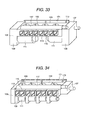
inside, each of these elements controlling four inlet passageways of air flow;
- Fig. 35 is a diagram showing an air velocity pattern of the air flow
control valve according to the present invention;
- Fig. 36 is a set of partial cross-sectional views of the mixture supply
device, showing the operating state of the air flow control valve;
- Fig. 37 is a set of views showing the shapes of the opening in the air
flow control valve under different states;
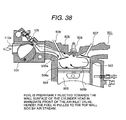
- Fig. 38 is a view showing the mixture supply device of the present
invention, mounted in an in-line multi-cylinder internal-combustion engine;
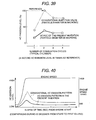
- Fig. 39 is a diagram in which the HC emission levels detected during
combustion in a typical cylinder of a multi-cylinder internal-combustion
engine are compared with those of a conventional fuel injection valve; and
- Fig. 40 is a diagram in which the HC emission pattern during the time
from engine start to first idling is compared with a pattern obtained using a
conventional fuel injection valve.
-
Description of the Invention:
-
Fig. 1 is a schematic external view of a mixture supply device 101
pertaining to the present invention when it is applied to an in-line four-cylinder
automobile engine having two inlets per cylinder. This mixture
supply device is constructed mainly of a multiple-throttle mechanism 103, a
fuel spraying mechanism 105, an exhaust recirculating mechanism 107, and
an integrated controller 109. The multiple-throttle mechanism 103 is
provided with a built-in air flow control valve capable of controlling the flow
rate of air and the flow of the air integrally for each inlet passageway, and
has, at bottom, a motor 111 for driving the foregoing valve. On a front
lateral side of the corresponding page, eight openings are provided as air
inlets, and every two adjacent ports at the end take in air for one cylinder of
the engine. One of the two paired inlets is a low-flow inlet 113, and the
other is a high-flow inlet 115. Although not shown in the figure, openings to
function as mixture outlets corresponding to the respective inlets are
provided on a rear lateral side of the page, with the inlets and the outlets
being connected by an inlet passageway section, i.e., passageways, inside
the multiple-throttle mechanism 103. The fuel spraying mechanism 105
has one end connected to a fuel feeder 117 present at a top of the multiple-throttle
mechanism 103 and has a body fixed thereto. A fuel pipe extended
from a fuel tank of an automobile to a fuel pump thereof is connected to a
fuel supply port 119, and a fuel is introduced into the fuel feeder 117 through
the fuel pipe and sprayed into the inlet passageways by the fuel spraying
mechanism 105. The exhaust recirculating mechanism 107 has a
recirculated-exhaust control valve built thereinto, controls the quantity of
recirculated exhaust introduced from a recirculated-exhaust introduction port
121, and distributes the exhaust to each inlet passageway.
-
Fig. 2 is a plan view from an X-axial direction of the mixture supply
device 101 shown in Fig. 1. Referring to Fig. 2, a front lateral side of the
page is an outlet side to the cylinders. The multiple-throttle mechanism 103
has an air flow control valve 123 (shown in Fig. 3) constructed therein, and
both ends of the air flow control valve 123 are rotatably supported by
bearings 125. At both ends of the air flow control valve 123, sealing
members 127 are also provided and hereby, the air, fuel, and recirculated
exhaust flowing inside the multiple-throttle mechanism 103 are prevented
from leaking to the exhaust recirculating mechanism 107. Torque of the
motor 111 installed at a bottom of the multiple-throttle mechanism 103 is
transmitted to the air flow control valve 123 through a drive 129 included in a
casing of the integrated controller 109, thereby inciting a rotary motion of the
air flow control valve 123. One end of the air flow control valve 123 is
connected to a throttle position sensor 131, from which rotational angle
information on the rotary motion of the air flow control valve 123 is output as
electrical signals, and these signals are then transmitted to an integrated
control circuit 133. The air flow control valve 123 also has a default spring
section 135, and when electric power to the motor 111 is cut off, a rotational
angle of the air flow control valve 123 (this angle is also a rotational angle of
a rotary body described later in this Specification), namely, the opening state
of the valve, is reset to a previously set value by an action of spring force of
the default spring section 135. Inside the exhaust recirculating mechanism
107, a recirculated-exhaust control valve 137 is provided so that when the
recirculated exhaust introduced from the recirculated-exhaust introduction
port 121 enters the mixture, the quantity of entry is controlled. Recirculated
exhaust is distributed, and enters, from a recirculated-exhaust entry port 141
smaller than a recirculated-exhaust distribution pipe 139 in terms of diameter,
to an inside of each inlet passageway through the recirculated-exhaust
distribution pipe 139 provided at the bottom of the multiple-throttle
mechanism 103.
-
Fig. 3 is a cross-sectional view of section A-A' shown in Fig. 2. The
lower side and upper side in Fig. 3 are an air inlet side and a cylinder side of
the engine, respectively. In the multiple-throttle mechanism 103, eight
inlets are provided on a lower lateral side of the figure, and every two
adjacently disposed inlets, one a low-flow inlet 113 and one a high-flow inlet
115, take in air for one cylinder of the engine. These inlets communicate
with respective low-flow inlet passageways 143 and high-flow inlet
passageways 145, and are further connected to respective low-flow mixture
outlets 147 and high-flow mixture outlets 149, both provided on an upper
lateral side of the figure. The low-flow mixture outlets 147 and the high-flow
mixture outlets 149 are further connected to the respective passageways
leading to the mixture inlet ports in the cylinders of the engine. The air flow
control valve 123 is a rotary body, which coordinates with its peripheral
enclosure to form a restricting portion (shield and restriction), is installed so
that the rotary body intersects halfway with the low-flow inlet passageways
143 and the high-flow inlet passageways 145, and has a previously
machined opening of a shape (opening shape) corresponding to each inlet
passageway. The shape of the opening formed in each inlet passageway is
determined by the relationship between a wall surface of the inlet
passageway and an opening machined in the air flow control valve, and by
the rotary motion of the air flow control valve, driven by driving the motor 111,
the shape of the restricting portion is determined in accordance with the
relationship between a predetermined rotational angle (phase) and the shape
of the restricting portion in the air flow control valve. Thereby, the quantity
of air supplied to the cylinder through each inlet passageway, and the flow of
the air are controlled. The fuel spraying mechanism 105 is installed
between the low-flow inlet passageways 143 and the high-flow inlet
passageways 145, and a fuel spraying port is present downstream from the
air flow control valve 123, near the cylinder. And fuel is spray-supplied from
the spraying port to both inlet passageways. The recirculated-exhaust entry
port 141 is also present downstream from the air flow control valve 123, near
the cylinder. This recirculated-exhaust entry port 141 is provided either at
the opposite side to the fuel spraying port, across the inlet passageway, or in
a circumferential direction of at least the inlet passageway, at a position
different from that of the fuel spraying port, and thus, by utilizing the flow and
heat of recirculated exhaust near the wall surface of the inlet passageway,
the fuel sprayed into the inlet passageway is prevented from sticking to the
wall surface thereof. The structure as described above ensures that a
mixture obtained by mixing air, fuel, and recirculated exhaust, is discharged
from the low-flow mixture outlets 147 and the high-flow mixture outlets 149
and supplied to the cylinder interior functioning as the combustion chamber
of the engine.
-
Fig. 4 is a cross-sectional view of section B-B' shown in Fig. 2. A left
side and a right side in Fig. 4 are the inlet side and the cylinder side of the
engine, respectively. Air is taken in from the inlet 113 and passed into the
inlet passageway 143, from which the air, after having its flow rate and flow
controlled by the air flow control valve 123 installed halfway in the inlet
passageway, is then discharged towards the corresponding cylinder of the
engine. The air flow control valve 123 can be rotated both clockwise and
counterclockwise when viewed on the page, has a restriction formed
between an opening 155 and an inlet passageway formed in a casing 157 of
the multiple-throttle mechanism, and controls the flow rate and flow of the air
passed through the restriction. The flow of the air is controlled either by, for
example, providing differences in air velocity and air flow rate between inlet
passageways and then activating the swirl flow within the cylinder by use of
an imbalance created after discharge, by varying the spatial distributions of
the velocity and flow rate in an inlet passageway and hereby generating a
rotating flow, a swirl flow, or the like, by, at low flow rate, deflecting the air
flow in the direction of the fuel spraying port and thus accelerating the
atomization of sprayed fuel by use of the air flow. Also, when the air flow
control valve 123 is rotated clockwise and the restriction is opened, this
restriction is opened from the fuel spraying mechanism 105 to facilitate
further concentration of the air stream in the spraying port and hereby to
allow easy atomization by making a high-speed air stream collide with the
fuel particles. Conversely, when the air flow control valve 123 is rotated
counterclockwise and the restriction is opened, this restriction is opened from
the side opposite to that of the fuel spraying mechanism 105, thus making it
easy to guide a high-speed air flow to a wall surface and hereby to obtain a
suppression effect against the sticking of sprayed fuel to the wall surface.
The fuel spraying mechanism 105 has one end connected to the fuel feeder
117 in order to receive fuel, and is fixed to a mount 159 which communicates
with an inlet passageway machined in the multiple-throttle mechanism 103.
A fuel injection port 161 of the fuel spraying mechanism 105 is opened
downstream from the air flow control valve 123, near the cylinder, and injects
fuel towards a low-flow inlet passageway and a high-flow inlet passageway.
At a bottom of each inlet passageway, the recirculated-exhaust distribution
pipe 139 is disposed and recirculated exhaust is introduced from the
recirculated-exhaust entry port 141 into the inlet passageway. The
recirculated-exhaust entry port 141 is provided either at the opposite position
to the fuel injection port 161, in the inlet passageway, or at a different
position in a circumferential direction, and is used to supply recirculated
exhaust to a section at which fuel is expected to collide with a wall surface
and then to prevent, by use of heat and flow, sprayed fuel from sticking to
the wall surface. The air, fuel, and recirculated exhaust thus introduced into
each inlet passageway form a mixture, and after fluidity has been given, the
mixture is discharged from the mixture outlets 147, towards the cylinders of
the engine.
-
Fig. 5 shows the device configuration of the air inlet system in a
conventional type of general engine. After being passed through an air
cleaner and taken from the atmosphere into an air inlet pipe 201, air has its
flow rate controlled by a restriction formed in a throttle device 203 present
halfway on the air inlet pipe, and is then sent to a surge tank 205. From the
surge tank 205, an independent air inlet pipe 211 diverges towards each
cylinder 209 of an engine body 207 and is connected to each cylinder air
inlet 213. Although one to three cylinder inlets 213, each having an air inlet
valve which opens and closes in relationship with a rotational phase of a
crankshaft in the engine, are provided for each cylinder, the independent air
inlet pipe 211 is provided in one place or diverges according to the particular
number of air inlets in the cylinder. Halfway on the independent air inlet
pipe, an air flow control valve for controlling air flow is installed and also a
fuel spraying device 215 is installed at a downstream side thereof to supply
fuel in sprayed form into the independent air inlet pipe. An exhaust pipe
217 and the surge tank 205 or the air inlet pipe are connected by an exhaust
recirculating route 219, and part of the exhaust gases taken out from the
exhaust pipe is quantitatively controlled by a recirculated-exhaust control
device 221 present halfway on the route and is then returned to the air inlet
side. Each device mentioned above is a separate component and requires
its own piping and wiring. During engine assembly, therefore, each such
device needs to be piped and wired.
-
A flowchart of mixture formation in such an air inlet system is shown in
Fig. 6. During the formation of the mixture to be supplied to each cylinder
209, the quantities of air, fuel, and exhaust recirculated are controlled by
controlling three different devices, namely, the throttle device 203 existing
halfway on the air inlet pipe 201, the fuel spraying device 215 existing
halfway on the independent air inlet pipe 211, and the recirculated-exhaust
control device 221 present halfway on the exhaust recirculating route 219.
The response time for controlling the mixture state according to the particular
engine output request and combustion state is determined as a result of
considering, in addition to a respective own operating response time of the
throttle device 203, fuel spraying device 215, and recirculated-exhaust
control device 221, the time from the passage of air, fuel, and recirculated
exhaust through each control device to respective arrivals at the cylinder.
-
Fig. 7 shows the device configuration of the air inlet system in an
engine which uses the mixture supply device in the present embodiment.
As shown in this figure, the mixture supply device is installed halfway on the
independent air inlet pipe 211. The exhaust recirculating route 219
extending from the exhaust pipe 217 and the fuel piping extending from the
fuel pump are connected directly to the mixture supply device. Air, fuel, and
recirculated exhaust are controlled at a position proximate to the cylinder,
and since a delay in transport to the cylinder is reduced, rapid response can
be achieved with respect to the accelerator operations of the driver. Since
the multiple-throttle mechanism, fuel spraying mechanism, and exhaust
recirculating mechanism in this mixture supply device are connected to the
integrated controller through the internal wiring of the mixture supply device
in order to obtain control signals and receive electric power, it is possible to
reduce and adjust the quantity of wiring leading to an outside of the mixture
supply device. Hereby, the engine assembly workload required can be
reduced, in other words, manufacturing expenses can be reduced. A
flowchart of mixture formation in such an air inlet system is shown in Fig. 8.
Since the quantities of entry of air, fuel, and recirculated exhaust into the
mixture are all controlled inside the mixture supply device 101, it also
becomes possible to reduce variations in response to each quantity of entry.
There is no need to separately install such throttle device 203 or
recirculated-exhaust control device 221 as used in conventional structure.
There is no problem, however, even if such devices are installed as
countermeasures against trouble with the mixture supply device 101. In the
conventional air inlet system configuration as shown in Fig. 5, since a
downstream section of the cylinder is depressurized below atmospheric
pressure by the throttle device 203, the air inlet pipe 201 and surge tank 205
at the downstream side are required to have a function that maintains
pressure. When the mixture supply device in Fig. 7 is used, however, since
an upstream side of the mixture supply device 101, i.e., a large portion at the
air cleaner side is maintained at atmospheric pressure, there is no need to
take a special measure for maintaining pressure at that section. For this
reason, it becomes possible to manufacture the air inlet pipe and the surge
tank at lower costs and thus to reduce engine manufacturing expenses.
-
An external view of the air flow control valve 123 is shown in Fig. 9.
This valve is constructed of a rotary body 300, air flow controllers 301 formed
in the rotary body 300, bearing-mounting sections 303, and an opening state
sensor connector 305. In the air flow controllers 301, eight openings each
corresponding to an inlet passageway, namely, inlet passageways 307 and
309 (hereinafter, described as openings), are formed for a cylindrical
member of the rotary body 300. The low-flow opening 307 and the high-flow
opening 309 control the quantity of inlet air for one cylinder. Both
openings may be freely machined so as to exhibit different opening
characteristics against circumferential rotations of the air flow controllers 301.
In this example, however, the low-flow opening 307 is opened in an angle
range twice that of the high-flow opening 309. The bearing-mounting
sections 303 correspond to the bearings mentioned earlier in this
Specification, and are built so as to be rotatable either in the direction of F or
R inside the multiple-throttle mechanism 103. In other words, they are
adapted to be rotatable in a reversibly bi-directional manner. The position
sensor connector 305 connects with the throttle position sensor 131 and
transmits rotational angle information of the air flow control valve 123 to the
sensor.
-
The operational characteristics of the air flow control valve 123 shown
in Fig. 9 are described below using Fig. 10. The cross-sectional views of
section B-B' in Fig. 10 show cross-sectional views of the section B-B' in Fig.
2, particularly of a section near an inlet passageway, and explain the
characteristics of the air flow control valve 123 operating when air flows
through the low-flow inlet passageway 143. Similarly, the cross-sectional
views of section C-C' in Fig. 10 show cross-sectional views of the section C-C'
in Fig. 2, particularly of a section near an inlet passageway, and explain
the characteristics of the air flow control valve 123 operating when air flows
through the high-flow inlet passageway 145. When the state in Fig. 10(1) is
taken as an initial fully closed state and the air flow control valve 123 shown
in Fig. 9 is rotated in the direction of F, the restriction gradually opens from
the low-flow side with the high-flow side remaining in a fully closed state, and
the low-flow side fully closes with the state of Fig. 10(3) being maintained.
When, from this state, the rotary body 300 is further rotated in the direction
of F, the restriction at the high-flow side starts to open with the low-flow side
maintaining its restriction fully open, and soon, as shown in Fig. 10(5), the
restrictions in both inlet passageways 310 and 311 fully open. When the
rotary body 300 is further rotated in the direction of F, both the low-flow and
high-flow sides reduce the sizes of the respective restrictions almost similarly
and, as shown in Fig. 10(7), fully close the restrictions once again.
Conversely, When the rotary body 300 is rotated in the direction of R, both
the low-flow and high-flow sides, as shown in Fig. 10(6), increase the sizes
of the respective restrictions similarly from the fully closed state in Fig. 10(7),
and then as shown in Fig. 10(5), fully open the restrictions. When the rotary
body 300 is further rotated in the direction of R, the restriction at the high-flow
side, as shown in Fig. 10(4), decreases in size with the low-flow side
maintaining its restriction fully open, and as shown in Fig. 10(3), only the
restriction at the high-flow side fully closes. When, from this state, the
rotary body 300 is further rotated in the direction of R, only the restriction at
the low-flow side decreases in size with the high-flow side maintaining its
restriction fully closed, and finally, fully closes as shown in Fig. 10(1). In
this way, the air flow control valve 123 shown in Fig. 9 can be used in such a
manner that depending on the rotational angle of the rotary body 300, the
opening states of the restrictions are increased or reduced to provide the
quantity of air passage with a difference between the low-flow and high-flow
sides in the region from Fig. 10(1) to Fig. 10(5), or that the quantities of air
passage at both the low-flow and high-flow sides in the region from Fig.
10(5) to Fig. 10(7) are increased or reduced to become equal. Also,
whether the restriction opens from the fuel spraying mechanism within the
inlet passageway or from the opposite side changes according to the
particular direction of rotation. When the atomization of the fuel is to be
accelerated in cases such as at low flow rate, the rotary body 300 is rotated
in the direction of F, i.e., clockwise in Fig. 10. This starts opening of the
restrictions from the one closer to the fuel spraying mechanism, thus
concentrating a high-speed air stream at the fuel spraying mechanism or its
fuel spraying port, and consequently inciting a collision between the air
stream and fuel particles to atomize the fuel. Conversely, when the
prevention of sticking to the wall surface of the inlet passageway is required
more than the above, the rotary body 300 is rotated in the direction of R, i.e.,
counterclockwise in Fig. 10. This starts opening of the restrictions with the
one more distant from the fuel spraying mechanism, thus concentratedly
inducting an air stream to the vicinity of a location at which sprayed fuel
collides with the wall surface of the inlet passageway, and consequently
suppressing fuel sticking to the wall surface and removal of sticking fuel.
-
As described earlier in this Specification, recirculated exhaust is
distributed, and enters, from the recirculated-exhaust entry port 141 smaller
than the recirculated-exhaust distribution pipe 139 in terms of diameter, to
the inside of each inlet passageway through the recirculated-exhaust
distribution pipe 139 provided at the bottom of the multiple-throttle
mechanism 103. As shown in the figure, a restriction is disposed adjacently
not only to the fuel spraying port, but also to the recirculated-exhaust entry
port 141, such that fuel, inlet air, and recirculated exhaust are efficiently
mixed near an exit of the air flow control valve 123.
-
Even if the same quantity of air is to be supplied as the total, when
control is used that provides a difference between the quantities of air
passage through the inlet passageways at the low-flow and high-flow sides, it
becomes possible to increase inertia by concentrating a greater quantity of
air stream in the inlet passageway at the low-flow side and increasing
velocity, and thus to more efficiently supply a larger quantity of mixture to the
cylinder by utilizing the resulting inertial effect. Such an increase in the
efficiency of air intake to this cylinder allows greater torque output to be
obtained, even at the same engine speed, and as a result, fuel consumption
in the entire automobile can be reduced. Also, as shown in Fig. 11, by
providing a difference in the flow rate of the mixture flowing into two flow
routes connected to one cylinder, a swirl flow inside the cylinder and,
although not shown in the figure, vertical and other rotating flows can be
activated. Control of these flows can not only increase the flame
propagation rate during combustion and hereby yield greater engine output,
but also improve the mixture state and the combustion state and reduce the
occurrence of harmful exhaust. Conversely, even when air flow control
valves of the same type are used, since the sizes of the restrictions in both
the low-flow and high-flow inlet passageways can be equally
increased/reduced by utilizing the region from Fig. 10(5) to Fig. 10(7), a
mixture can also be supplied to the inside of the combustion chamber more
smoothly by, as shown in Fig. 12, equally inducting air into both inlet
passageways. Even when the same flow rate of air is required, in the case
that, judging from the operating state of the engine and the accelerator
operations of the driver, a larger quantity of air flow is necessary, the state as
shown in Fig. 11 can be generated, or in the case that an even more equal
flow is necessary, the state as shown in Fig. 12 can be generated.
-
As described above, in a mixture supply device for use in a multi-cylinder
type of internal-combustion engine, installed so that inlet
passageway sections connected to respective cylinders are diverged and
then re-converge; the mixture supply device comprises: a first construction
block in which a rotary body 300, a passageway section 310 formed inside
the rotary body 300, and an opening 307 formed on part of an outer
periphery of the rotary body 300 are constructed, and a second construction
block in which a rotary body 300, a passageway section 311 formed inside
the rotary body 300, and an opening 309 formed on part of the outer
periphery of the rotary body 300 are constructed; and wherein: there is
formed an air flow control valve 123 provided with a rotating device for
rotating the rotary body 300 in a reversibly bi-directional manner, the air flow
control valve 123 being further formed with a restricting portion at which
restrictions in the above two construction blocks each change in shape
according to a particular rotary motion of the rotary body; there is
constructed a multiple-throttle mechanism 103 that contains the air flow
control valve 123 inside; and there is provided a fuel spraying mechanism
105 having a fuel spraying port disposed in proximity to the restricting portion
in the air flow control valve 123.
-
Also, in a mixture supply device for use in a multi-cylinder type of
internal-combustion engine, installed on an air inlet pipe adapted so as to
diverge and then re-converge inlet passageway sections connected to
respective cylinders; the mixture supply device comprises: a first
construction block in which a rotary body 300, a passageway section 310
formed inside the rotary body 300, and an opening formed on part of an
outer periphery of the rotary body 300 are constructed, and a second
construction block in which a passageway section 311 formed inside the
rotary body 300 and an opening 309 formed on part of the outer periphery of
the rotary body 300 are constructed; and wherein: there is formed an air flow
control valve 123 provided with a restricting portion at which restrictions in
the above two construction blocks change in shape so as to differ from each
other according to a particular rotary motion of the rotary body 300; there is
constructed a multiple-throttle mechanism 103 that contains the air flow
control valve 123 inside; and there is provided a fuel spraying mechanism
105 having a fuel spraying port disposed in proximity to the restricting portion
in the air flow control valve 123.
-
In addition, a mixture supply device for use in a multi-cylinder type of
internal-combustion engine, installed on an air inlet pipe adapted to diverge
and then re-converge air inlet passageway sections connected to respective
cylinders; the mixture supply device comprises: a first construction block in
which a rotary body 300, a passageway section 310 formed inside the rotary
body 300, and an opening 307 formed on part of an outer periphery of the
rotary body 300 are constructed, and a second construction block in which a
passageway section 311 formed inside the rotary body 300 and an opening
309 formed on part of the outer periphery of the rotary body 300 are
constructed; and wherein: there is formed an air flow control valve 123
provided with a restricting portion at which restrictions in the above two
construction blocks change in shape so as to differ from each other when the
rotary body 300 rotationally moves; there is constructed a multiple-throttle
mechanism 103 that contains the air flow control valve 123 inside; there is
provided a fuel spraying mechanism 105 having a fuel spraying port
disposed in proximity to the restricting portion in the air flow control valve
123; and a recirculated-exhaust entry port 141 is disposed in proximity to the
restricting portion in the air flow control valve 123, and an exhaust
recirculating mechanism 107 is provided, so that controlled inlet air, sprayed
fuel particles, and recirculated exhaust are mixed near a downstream side of
the restricting portion.
-
Furthermore, in any one of the above-mentioned mixture supply
devices for use in an internal-combustion engine, two restrictions are
constructed in a rotational direction of each air flow control valve 123.
-
Besides, in any one of the above-mentioned mixture supply devices for
use in an internal-combustion engine, a rotational angle of said rotary body is
set for one restriction in the air flow control valve 123 to ensure that an outlet
direction of inlet air faces the vicinity of the fuel spraying port 105 and that a
high-speed air stream is supplied to the vicinity of the fuel spraying port 105
and then made to collide with a fuel injection stream sprayed therefrom.
-
Besides, in any one of the above-mentioned mixture supply devices for
use in an internal-combustion engine, the opening 307 in the first
construction block and the opening 309 in the second construction block are
formed with different sizes, both openings being disposed so as to differ in a
direction of opening.
-
The change characteristics of the opening area with respect to the
opening state existing when the air flow control valve shown in Fig. 9 is
rotated in the direction of F and then changed from the fully closed state in
Fig. 10(1) to the fully open state in Fig. 10(5), are shown in Fig. 13. The
opening cross-sectional area within the inlet passageway, per cylinder with
respect to the opening state, is determined by, at values up to the first 50%,
the opening of the low-flow opening 307, and at greater values, the opening
of the high-flow opening 309. Changes in the efficiency of cylinder air inlet
with respect to engine speeds, measured when the mixture supply device
using this valve in the multiple-throttle mechanism is applied to an in-line
four-cylinder automobile engine having two inlets per cylinder, are shown in
Fig. 14. The dashed line on the graph represents the relationship existing
when the air flow control valve is fully opened as in Fig. 10(5), and the
maximum value under this condition is taken as 100% on the Y-axis of the
graph. The dashed line indicates that the efficiency of cylinder air inlet
tends to become a maximum under the operating conditions existing when
this engine revolves at 4,500 rpm, and to decrease at other speeds. The
solid line on the graph represents the relationship existing when the air flow
control valve is 50% opened and, as shown in Fig. 10(3), only the low-flow
inlet passageway is fully opened. The solid line indicates that under the
low-speed operating conditions of 2,500 rpm in engine speed, the efficiency
of air inlet exceeds that obtained under the fully open states of both inlet
passageways as denoted by the dashed line. These results indicate that
when flow is concentrated in one inlet passageway, it is possible for a
greater inertial effect to be created and, depending on operating conditions,
for the efficiency of cylinder air inlet to be improved over that obtained in the
case of full opening. In general, with higher efficiency of cylinder air inlet,
greater torque can be generated at the engine speed. Such control of the
air flow control valve, therefore, makes it possible to increase torque output
under low-speed operating conditions of the engine and to reduce fuel
consumption in the automobile by further balancing with respect to its
transmission. The efficiency of cylinder air inlet, obtained when the opening
cross-sectional area of the air flow control valve is changed during operation
at an engine speed of 1,500 rpm, in particular, is shown in Fig. 15. The
dashed line on the graph represents the relationship established when the air
flow control valve of Fig. 9 is rotated from the fully closed state in Fig. 10(7),
in the direction of R and changed to the fully open state in Fig. 10(5). As
the opening cross-sectional area, i.e., the size of the opening in the
restriction increases, the efficiency of cylinder air inlet increases and
becomes a maximum under a fully open state. The solid line represents
the relationship established when the air flow control valve of Fig. 9 is rotated
from the fully closed state in Fig. 10(1), in the direction of F and changed to
the fully open state in Fig. 10(5). In the region that the opening cross-sectional
area becomes nearly 50%, i.e., that only the inlet passageway at
the low-flow side is opened, the efficiency of cylinder air inlet increases to
surpass the relationship represented by the dashed line when the restrictions
at both sides are equally opened, and the corresponding maximum value
exceeds about 5%. In the region where the opening cross-sectional area
exceeds 50% and both restrictions open, a relationship almost equal to that
represented by the dashed line is obtained. As described above, in the
mixture supply device using such air flow control valve as shown in Fig. 9,
since the torque output of the engine tends to differ according to the
particular opening states of both inlet passageways, not only the sizes of the
respective restrictions, even if the opening of the restrictions is increased
with the accelerator operations of the driver, torque output does not always
increase in proportion to that increase. Accordingly, the integrated
controller considers the accelerator operations of the driver, the operating
state of the engine, and the opening state of the air flow control valve, and
efficiently controls the output of the engine by controlling the air flow control
valve so as to provide the engine output requested by the driver. For
example, when torque output can be increased by only half-opening the
valve rather than by fully opening it, even if the driver fully steps on the
accelerator, a command is issued that only half-opens the restricting portion.
-
Alternatively to the shapes shown in Fig. 9, the shapes of the low-flow
opening 307 and high-flow opening 309 machined in the air flow control
valve 123 are determined so as to fit the particular purpose of control and
the characteristics of the engine applied, and both openings are freely
machined in the air flow controllers 301. For example, the air flow control
valve of Fig. 16, when rotated in the direction of F to open the restrictions,
has the characteristic that the low-flow opening 307 gradually opens from a
corner close to the fuel spraying port. Fig. 17 is a set of partial cross-sectional
views showing, from the outlet side, the inlet passageway for one
cylinder, in the multiple-throttle mechanism using this valve. When, from its
fully open state in Fig. 17(1), the air flow control valve shown in Fig. 16 is
rotated in the direction of F, opening of the restriction is, as shown in Fig.
17(2), started from the side close to the top of the fuel spraying section 105
of the low-flow inlet passageway 145, thereby, as shown in Fig. 17(3),
increasing the opening of the restriction at the low-flow side. When the
restriction at the low-flow side completely opens, the restriction at the high-flow
side starts opening as in Fig. 17(4) and soon fully opens. The states
hereafter are the same as those of the valve shown in Fig. 19. Under the
states (2) and (3) of Fig. 17, since, inside the low-flow inlet passageway 145,
the restriction opens in offset form towards an upper left portion of the view,
the air stream, after passing there, activates the flow state within the inlet
passageway by, for example, generating a swirl motion of the air therein as
shown in Fig. 18, or generating some other rotary motion, although not
shown in the figure, depending on the particular opening shape of the
restriction. The occurrence of this swirl flow or the activation of the flow
status improves the mixed states of air, fuel, and recirculated exhaust, in the
mixture, and also contributes to activated air flow inside the cylinder,
improved flame propagation rate during combustion, and improved
combustion state, with the result that the occurrence of harmful exhaust can
be suppressed.
-
Although the air flow control valve shown in Fig. 9 is formed with a
restriction at both inlet and outlet sides of the valve, a restriction may
likewise be formed only at one side, as shown in Fig. 19. There is no need
to allow for variations in the opening of both restrictions, and the quantity of
air inlet can be stably controlled.
-
In the air flow control valve according to the present invention, the inlet
air and mixture leakage that occurs between the inlet and outlet sides or
between adjacent inlet passageways, even when the valve is fully closed, is
shut off or reduced by the following sealed structure. That is, the above-mentioned
leakage is reduced by reducing, to a radial clearance of 0.2 mm
or less, a clearance present between an outer surface of the air flow control
valve 123 which is a rotary body, and a holed inner surface of the casing 157
in which the valve is enclosed, and providing a sealing portion that
excessively increases a pressure loss in comparison with the surrounding
inlet passageways. Or the structure may be adopted that assigns an
integrated sealing function to a sealing mechanism 165 becoming convex
relative to other sections, by providing the air flow control valve 123 with the
sealing mechanism 165 and bringing this section and the casing 157 into
contact or reducing a clearance present between both to 0.2 mm or less.
By employing such structure, a high sealing effect can be maintained without
the necessity for not too significant improvement of machining accuracy
during extensive machining of the air flow control valve. The sealing portion
may be formed by machining a recess in the air flow control valve itself or by
building other sealing members into the air flow control valve.
-
The sealed structure in an air flow control valve of the type formed with
a restriction at both inlet and outlet sides in the passageway section of the
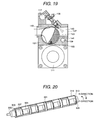
valve is shown in Fig. 20. In this air flow control valve 123, guide grooves
for accommodating each sealing member are machined. Arc-like inter-cylinder
sealing members 313 are installed in guide grooves each machined
so as to be axially across a low-flow opening 307 or a high-flow opening 309,
and a movable sealing member 315 is installed in a guide groove machined
longitudinally in an axial direction of the valve. The inter-cylinder sealing
members 313 come into contact with surfaces of the guide grooves in the air
flow control valve 123, and with an inner wall surface of a valve insertion hole
317 which contains the air flow control valve 123 in a casing 157, and reduce
leakage by blocking flow routes disposed between adjacent air inlet
passageways.
-
How the sealed structure works during the operation of the air flow
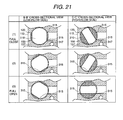
control valve shown in Fig. 20 is illustrated in Fig. 21. As with that of Fig. 10,
Fig. 21 is organized so that its left side is an upstream side, and its right side,
a downstream side. The movable sealing member 315 is installed at two
circumferential angles on the outer periphery of the air flow control valve.
From the fully closed state shown in Fig. 21(1), the air flow control valve 123
rotates clockwise in the figure. Under the fully closed state shown in Fig.
21(1), the inlet passageways are dimensionally minimized by the valve, and
the leakage flow route where air flows from the upstream side to the
downstream side becomes a clearance occurring between the air flow
control valve 123 and the valve insertion hole 317. In the structure
according to the present invention, this clearance is sealed as a result of the
movable sealing member 315 coming into contact with the surface of the
corresponding guide groove and the inner surface of the valve insertion hole,
or even if no such contact occurs, is sealed as a result of the movable
sealing member 315 moving close since it is in an extremely narrowed
condition, and leakage of the air flowing through the clearance is suppressed
significantly. Under the fully closed or slightly closed state of the air flow
control valve, since the cross-sectional areas of the air inlet passageways
are reduced significantly, a pressure difference occurs between the
upstream and downstream of the air flow control valve. Under the rotated
and opened state of the valve as in Fig. 21(2) or (3), however, the above-mentioned
pressure difference is small or becomes almost equal to zero.
-
An enlarged partial cross-sectional view of the vicinity of the movable
sealing member 315 in Fig. 21 is shown in Fig. 22. A guide groove 319 is
machined in the air flow control valve 123, and this guide groove
accommodates the movable sealing member 315 and has a holding air
passageway 321. The movable sealing member 315 is movable in the
range of a clearance, so-called the range of play, relative to the guide groove
319. As the rotational phase of the air flow control valve 123 approaches a
full closing position thereof, a significant increase in flow route resistance
increases the pressure difference between the upstream and downstream of
the air flow control valve, consequently allowing a strong air stream to flow
from the high-pressure upstream side into the holding air passageway 321.
The above-mentioned air stream applies thrust to the movable sealing
member 315, which then slides in an outward direction of the air flow control
valve, along the guide groove 319, and further reduces the clearance with
respect to the inner surface of the valve insertion hole 317 in the casing 157.
Eventually, the air stream is pressed against the inner surface of the valve
insertion hole 317, hereby creating a contact sealing effect. Conversely, as
the air flow control valve rotates to its opening side and thus the pressure
difference decreases, since holding force applied to the movable sealing
member 315 is reduced significantly, this sealing member does not come
into contact with the inner surface of the valve insertion hole 317, or even if
the sealing member comes into contact, the contact force is very weak.
The resulting sealing effect is primarily a non-contact type of gas sealing
effect so-called the labyrinth effect that enlarges or reduces the cross-sectional
area in the flow route communicating with the clearance, or more
effectively, generates a pressure loss by repeating the enlarging and
reducing cycles several times.
-
Fig. 23 shows the sealed structure in an air flow control valve of the
type formed with a restriction in one place at a passageway section of the
valve. This air flow control valve, as with the valve shown in Fig. 20, is
applied to an in-line four-cylinder engine having two inlets per cylinder, and
four cylinders of air inlet is controlled by one such valve. Construction
blocks functioning as two types of valve bodies for each air inlet passageway
corresponding to one cylinder are provided, with one construction block
forming a low-flow opening 307 and the other construction block forming a
high-flow opening 309. Rotation of the air flow control valve 123 is able to
provide control to ensure that opening is started only from a left half of the air
inlet passageway in the figure and that after the left half fully opens, a right
half opens. It is thus possible to form a uniform flow horizontally in the air
inlet passageway and to control the flow motion therein, and furthermore, a
flow motion in the cylinder interior functioning as the combustion chamber of
the engine. In this air flow control valve, guide grooves for accommodating
sealing members are also machined, inter-cylinder sealing members 313 are
installed circumferentially in an axial direction of the valve, and a movable
sealing member 315 is installed in a longitudinally in the axial direction of the
valve.
-
A cross section of the vicinity of the low-flow opening in the mixture
supply device 101 within which the corresponding air flow control valve is
stored is shown in Fig. 24. A left side in this figure is the upstream side in
the direction of the air cleaner, and a right side is the downstream side in the
direction of the cylinder. The movable sealing member 315 is installed at
the side of the air flow control valve 123 and at the side of the valve insertion
hole 317 in the casing 157. At the side of the air flow control valve 123, as
described earlier, a movable sealing member 315 is accommodated in a
guide groove 319. At the side of the casing 157, a holding air passageway
321 and a guide groove 319 are also machined and a movable sealing
member 315, although its shape differs from that of the one installed at the
air flow control valve side, is accommodated. The movable sealing member
315 shown here is of the type having a beam-like end fixed to the side of the
casing 157, and in the event that a pressure difference occurs, the beam-like
portion deforms, hereby acting to press a sealing material of the sealing
member against the outer surface of the air flow control valve 123. A
similar effect is also obtainable in a structure not having a fixed portion of the
beam-like portion. Under the above scheme, however, when there exists
no pressure difference, the pressing force of the sealing material against the
air flow control valve is reliably reduced, which yields a great suppression
effect against increases in the torque required for rotational driving of the
valve.
-
Although, in these examples, the movable sealing member is installed
in two places in a circumferential direction of the rotary valve, in the event
that the minimum leakage flow rate is permitted to a certain extent and more
importance is to be attached to reduction in the torque required for the
driving of the rotary valve, the movable sealing member is installed in one
place to obtain the balance between the sealing effect and the suppression
of increases in torque. Also, although the inter-cylinder sealing members
313 and the movable sealing member 315 are formed separately in the
foregoing embodiment, both types of sealing members may be connected
and integrally formed. Under such a scheme, although the workload
required for mounting in the air flow control valve is reduced by a decrease in
the number of parts required, it is advisable in that case to make the
connections easily deform so that the deformation of the movable sealing
member in the vicinity of the connections moves a great majority of movable
seals to make the sealing effect variable.
-
In the sealed structure cross-sectional shown in Fig. 25, the sealing
effect is made variable using magnetic force. Referring to this figure, the
movable sealing member 315 is formed of a resin material in which magnetic
particles are contained. An electromagnet 323 is inserted into a seal
reinforcement portion at the valve insertion hole 317 of the casing 157. The
movable sealing member 315 usually has its movement gently regulated
with a backlash by a guide groove 319. The operation of the movable
sealing member 315 in the neighborhood of the seal reinforcement portion in
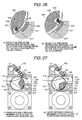
Fig. 25 is shown in Fig. 26. When the movable sealing member 315 moves
close to the seal reinforcement portion and a sealing effect is required, a
strong magnetic field is generated by energizing the electromagnet 323, and
thereby the movable sealing member 315 is attracted towards the inner
surface of the valve insertion hole 317 and eventually brought into contact.
The movable sealing member 315, if controllable by means of the
electromagnet, is capable of exhibiting a similar effect, and the magnetic
material itself may be used as a sealing material, or the magnetic material
may be built into a sealing material made of resin or the like. In either case,
differences in machinability and weight occur, but a similar effect is
obtainable. Also, the seal reinforcement portion may have an installed
permanent magnet, instead of the electromagnet. In this case, there is the
advantage that no electric circuitry becomes necessary.
-
Fig. 27 shows a structure in which, in the valve insertion hole 317 of
the casing 157, a curvature reducer 325 whose section equivalent to the low-flow
inlet passageway 143 or the high-flow inlet passageway 145 is smaller
than other sections in terms of the curvature of a curved face is provided and
at the corresponding section, the distance between the air flow control valve
123 and the inner surface of the valve insertion hole 317 becomes narrower
than at other sections. When rotation of the air flow control valve 123
causes the movable sealing member 315 to reach the curvature reducer 325,
since the movable sealing member 315 comes into contact with the inner
surface of the valve insertion hole 317 and is hereby pushed in a central
direction of the air flow control valve 123 along the guide groove 319, the
clearance decreases for increased sealing effect. Eventually, the movable
sealing member 315 comes to be completely sandwiched between the air
flow control valve 123 and the casing 157, thus increasing the contact force
by means of elastic spring force, and enhancing the effectiveness of contact
sealing. Since, except at the curvature reducer 325, a movable sealing
member 127 does not come into contact or, even if contact occurs, the
contact force is very weak, increases in the torque that rotates the air flow
control valve 109(?) are suppressed.
-
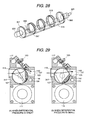
Structure in which a sealing effect of a movable sealing member 315 is
made variable by utilizing a force generated when an air flow control valve
123 is deformed by the occurrence of a pressure difference between the
upstream and downstream of the valve, is shown in Fig. 28. In this air flow
control valve 123, the diameters of sections equivalent to bearing installation
sections 303 at both ends are particularly small and locally deformed.
When a pressure difference occurs between the upstream and downstream
of the air flow control valve 123, bending deformation occurs mainly at those
sections. Resultingly, as shown in Fig. 29(1), a valve body of the air flow
control valve 123 becomes proximate to an inner surface of the valve
insertion hole 317 to narrow a clearance existing therebetween. In the air
flow control valve 123, guide grooves 319 that accommodate sealing
members are formed. Arc-like inter-cylinder sealing members 313 are
inserted circumferentially in an axial direction of the valve, and a movable
sealing member 315 is inserted longitudinally in the axial direction of the
valve. When there is no pressure difference as shown in Fig. 29(2), the
movable sealing member 315 creates a non-contact sealing effect that
narrows the cross-sectional area of the flow route. As a pressure difference
occurs and increases, however, the movable sealing member 315 is, as
shown in Fig. 29(1), pushed towards the valve insertion hole 317 by a
displacement of the air flow control valve 123, and eventually comes into
contact to physically block the flow route and thus to generate a contact
sealing effect.
-
In these embodiments, the sealed structure may likewise be formed at
the casing side on the basis of a similar concept. By doing so, a stable
sealing effect is obtainable, even if the rotating range of the air flow control
valve is extended.
-
It is also possible to prevent the entire valve from clogging with any
entrapped foreign substances by making the sealed structure easily
deformable and movable as described in these embodiment.
-
The materials of the inter-cylinder sealing members 313 and movable
sealing member 315 in these embodiments are selected from the group
consisting of metals, resin, rubber, ceramics, or the like. To reduce load
torque, it is effective to use resin materials excellent in lubrication
characteristics, such as fluorinated resin, polyether-ether-ketone (PEEK)
resin, polyimide resin, polyamide resin, or polyphenylene sulfide (PPS) resin.
-
Inside the mixture supply device, fuel particles are atomized by, as
shown in Fig. 4, inducting an air stream into the main body or fuel spraying
port of the fuel spraying mechanism 105 by means of an air flow control
valve 123 installed in proximity to the fuel spraying mechanism, and then
bringing the air stream and the fuel particles into a collision. In particular,
the atomizing effect of fuel particles can be enhanced by, as shown in Figs.
17 (2) and 18, supplying an air stream in deflected form to the fuel spraying
port and making a high-speed air stream collide concentratedly with a fuel
immediately after it is emitted from the spraying port. Or as shown in Fig.
30, an air-assist-type mount 163 is formed in the casing 157 of the multiple-throttle
mechanism and an air stream is inducted into the mount through an
assist air supply passageway 167. The air-assist-type mount 163 is formed
so that a clearance created between a fuel spraying port 161 of the fuel
spraying mechanism 105 at which the mount is to be installed, and a bottom
of the mount, is narrowed below 2 mm to allow an air stream to collide,
almost perpendicularly to a fuel spraying direction, with a fuel immediately
after it is emitted from the spraying port, and the collision further atomizes
the fuel. The use of this method makes it possible to obtain fine-droplet fuel
particles effectively, even if the fuel spraying mechanism 105 itself does not
have a special atomizing structure, and to construct the fuel spraying
mechanism less expensively. Accordingly, even when the fuel spraying
mechanism requires replacement associated with an extended period of use,
replacement expenses can be reduced. Or as shown in Fig. 31, in a mount
159 machined in the casing 157 of the multiple-throttle mechanism, an air-assist-type
fuel spraying device 169 in which is contained a mechanism
capable of being supplied with air from outside and of atomizing fuel
particles emitted from the air-assist-type fuel spraying device itself is
installed and an air stream is supplied thereto through the assist air supply
passageway 167. The use of this method also allows an atomizing effect to
be obtained. In this method, accuracy in the machining of the casing and in
the assembly of the mixture supply device is not affected significantly and
this allows stable atomization of fuel. The position in which the assist air
supply passageway 167 in the structure shown in Fig. 30 or Fig. 31
communicates with an inlet passageway to take in an air stream is provided
either at the same position as that of the air flow control valve or at an
upstream side thereof, and the air stream is taken in by utilizing the pressure
difference with respect to a downstream side of the air flow control valve. In
Fig. 30 or Fig. 31, an inlet of the assist air supply passageway 167 is
provided at where the air stream concentrates along the profile of the valve
under its slightly open state in order for pressure to increase above an
ambient pressure. In such structure, a greater atomizing effect can be
obtained by supplying a higher-speed air stream under a slightly open state,
in particular. Also, in the event that as in Figs. 10(1) to 10(3), a mixture is
usually to be formed by opening only the restriction in the low-flow inlet
passageway, the inlet port of the assist air supply passageway 167 is
provided in a high-flow inlet passageway as shown in Fig. 32. Although the
pressure at the low-flow side is reduced by the opening of its restriction, a
more stable fuel-atomizing effect can be obtained under a slightly open state
by supplying an air stream at high pressure from the high-flow side whose
restriction does not open.
-
Under the embodiment shown in Fig. 1, in the multiple-throttle
mechanism 103 of the mixture supply device 101 directed for an in-line four-cylinder
automobile engine having two inlets per cylinder, the air flow control
valve 123 that integrally controls four cylinders of inlet air is driven by one
motor 111. This scheme has the characteristic that since the number of
motors to be used for air flow control is one, inexpensive manufacturing is
possible. Or as shown in Fig. 33, it may be possible to adopt a type in
which are built two sets comprising air flow control valves, motors, and drives
corresponding to two cylinders of air inlet. In this case, since, compared
with the structure shown in Fig. 1, the air flow control valve dimensions per
motor can be reduced, it is possible to obtain such features as allowing the
driving force required of the driving motors to be minimized, valve driving to
be increased in responsiveness, any effects of thermal deformation in an
axial direction of the valve to be minimized, and control accuracy of air
streams to be improved. Furthermore, any air inlet variations per cylinder
that occur for reasons such as the possible nonuniformity of valve machining
accuracy or deposition of foreign substances, are easily corrective by
providing correspondingly the number of throttle position sensors required.
Variations in air inlet per cylinder are derived by measuring the pressures at
the upstream and downstream sides of the air flow control valve by use of
pressure sensors or measuring the differential pressure between both sides
and then calculating, at the integrated controller, the flow rate of air from the
relationship with the opening size of the restriction according to the valve
position, or by taking into the integrated controller the output from either a
sensor for detecting the oxygen concentration in after-combustion exhaust,
or an air-fuel ratio sensor for measuring the ratio between air and fuel, and
then estimating actual variations in air inlet for each cylinder. Or such a
type as shown in Fig. 34 may be usable that has four built-in sets each
comprising an air flow control valve, motor, drive, and throttle position sensor
corresponding to one cylinder. It is possible under this scheme to
determine the quantity of mixture inlet for each cylinder and to control a fine-droplet
mixture flow rate reduced in fluctuations. Furthermore, it may be
possible to connect four units on each of which a fuel spraying mechanism, a
throttle mechanism casing, an air flow control valve, a throttle position
sensor, and a motor are constructed for one cylinder, and finally, to construct
one mixture supply device. This construction method makes it possible to
assemble the mixture supply device in response to different inter-cylinder
distances and hereby to apply the mixture supply device easily to a number
of types of engines.
-
As set forth above, according to the preferred embodiments of the
present invention, the following mixture supply device is constructed:
-
A mixture supply device used in a multi-cylinder internal-combustion
engine for automobiles, of the type in which, in a multiple-throttle mechanism
having an air flow control valve able to be formed with one or more
restrictions halfway in each of inlet passageways connected to respective
cylinders, and varying the shapes of the restrictions by rotating the air flow
control valve by means a motor, are assembled: motor-driven fuel spraying
mechanisms each corresponding to one cylinder; a motor-driven exhaust
recirculating mechanism for collecting part of the exhaust generated by
combustion of a mixture in the above-mentioned internal-combustion engine
and then remixing the exhaust into the above-mentioned mixture; and an
integrated controller for simultaneously exchanging control signals with the
above-mentioned three types of mechanisms.
-
The foregoing mixture supply device, wherein the air flow control valve
contained in the multiple-throttle mechanism is capable of being
independently formed with a restriction in a plurality of inlet passageways, of
being formed with restrictions of different shapes for each inlet passageway,
even at the same rotational angle, and thereby controlling the quantity and
velocity of mixture discharged into the inlet passageway, and of changing the
direction of an air stream after its passage through a restriction, to the
original inlet direction, and thus controlling the swirl motion and other flow
motions of the air in the mixture flowing inside the inlet passageway.
-
The foregoing mixture supply device, wherein the fuel spraying
mechanisms are disposed so as to correspond to respective cylinders, with
spraying ports of these fuel spraying mechanisms being positioned
downstream with respect to the air flow control valve, closer to the cylinders,
in the inlet passageways, and spraying a fuel towards the inside of each inlet
passageway.
-
The foregoing mixture supply device, wherein, by use of the air flow
control valve contained in the multiple-throttle mechanism, an air stream
faster than an average air velocity in the inlet passageway can be supplied to
the inside of the fuel spraying mechanism or to the vicinity of its spraying
port and the fast air stream can be made to collide with a fuel immediately
after its exit from the internal spraying port of the fuel spraying mechanism.
-
The foregoing mixture supply device, wherein a recirculated-exhaust
distribution passageway for distributing to each inlet passageway the
exhaust previously controlled by the above-mentioned exhaust recirculating
mechanism is built into the multiple-throttle mechanism, and wherein a
recirculated-exhaust entry port communicating with each inlet passageway,
from the recirculated-exhaust distribution passageway, is opened both at a
downstream side facing the cylinder, with respect to the air flow control valve,
in the inlet passageway, and at a location other than a position in a
circumferential direction of the inlet passageway where exists the fuel
spraying port of the fuel spraying mechanism.
-
Figs. 35 to 40 show embodiments pertaining to the formation of a
mixture during engine start using the mixture supply device. The rotating
state of the air flow control valve 123 and a method of setting the injection
timing of the fuel spraying mechanism 105 are described below using Figs.
35 and 36.
-
Piston strokes, a fuel injection duration T, and an inlet air velocity
pattern V are shown in Fig. 35. Fuel injection (pulse width: Ti) is set with a
delay time of ΔT1 assigned initially during the air inlet stroke interval of the
engine. The inlet air velocity is controlled so that in response to the thus-set
injection timing, the velocity reaches a maximum velocity of Vmax (region A)
during the injection pulse width of Ti and then after the end of the injection
pulse, is changed to a desired velocity of V (region B) with a delay time of
ΔT2.
-
Fig. 36 shows the operating state of the air flow control valve 123 that
correspond to the above velocity pattern. Fig. 36(1) shows velocity region A,
wherein an air stream 113a flows through an assist air supply passageway
167 communicating with the opening in the air flow control valve 123, then
passes around a nozzle injection hole in the fuel spraying mechanism 105,
and discharges from an opening 167a in the above supply passageway. In
this opening 167a, the air stream collides with fuel particles, hereby
atomization being accelerated. Also, downstream from the opening 167a,
an air stream 141 a flows in such a manner that it encompasses the
atomized fuel particles to suppress their sticking to a wall surface of the
passageway. Fig. 36(2) shows velocity region B, wherein the air flow
control valve 123 has its opening 123a further spread, an air stream 113b
flowing in from the opening 123a flows to the downstream of the opening
167a in the assist air supply passageway 167, and an air stream 141 b
pushes injected fuel particles from rear and carries the particles in
encompassing form.
-
Although a rotary valve is used as the air flow control valve 123, in
comparison with two inlet passageways limited to the use of a butterfly valve,
there are a number of advantages such as local obtainability of high-speed
air streams and high flexibility of openings in shape. Also, since the fuel
spraying port of the fuel spraying mechanism 105 is provided downstream
from the air flow control valve 123, it is possible to avoid the sticking of a
sprayed fuel to a sliding surface and other sections of the air flow control
valve 123. Hereby, it is possible to prevent the air flow control valve 123
from malfunctioning due to the presence of solid deposits.
-
Although the inlet air velocity pattern shown in Fig. 35 is controlled in
step-by-step fashion, in the case of one fuel injection cycle for two air inlet
cycles, sprayed fuel particles may likewise be carried by, during the first inlet
cycle, atomizing the fuel particles under a slightly open status (fixed) and
then during the next inlet cycle, injecting no fuel under a significantly open
state (fixed).
-
Fig. 37 shows the relationship in position between the opening shape
of the inlet passageway and the fuel spraying mechanism 105. Fig. 37(1)
shows an opening state 328 under which the velocity around the fuel
spraying mechanism 105 is increased by restricting the opening area of the
inlet passageway, whereas Fig. 37(2) shows a convex-shaped opening state
331 under which, from the above state, the quantity of air stream is
increased by spreading the opening area in step-like fashion. Such velocity
pattern as shown in Fig. 35 is obtained by controlling the thus-machined
opening in the air flow control valve 123.
-
Figs. 38 to 40 show engine-test-based confirmation results on usage
effectiveness of the mixture supply device in connection with the formation of
a mixture during engine start.
-
Fig. 38 shows one of cylinders 501 used in a multi-cylinder internal-combustion
engine, wherein the mixture supply device 101 of the present
invention is provided near an air inlet valve 506. Numerals 502, 503, 504, 505,
and 506 denote a combustion chamber, a piston, a cylinder, a cylinder head, an
air inlet valve for opening and closing an air inlet, respectively. Similarly,
numerals 507 and 508 denote an exhaust valve and an ignition plug, respectively.
-
Tests were conducted to monitor the quantity of hydrocarbon (HC)
emitted during a change from the 200-rpm operating state of the engine, called
"cranking", immediately after the engine of the automobile was started by
turning the key to its ON position, to 1,400-rpm operation called "first idling".
Attention was paid particularly to a time of about 20 seconds from the start.
The engine coolant temperature at this time was 25°C. Also, the injection
pulse width Ti of the fuel spraying mechanism 105 was about 7 milliseconds.
-
An air stream 113a flowing in from the mixture supply device 101 is carried
so that the fuel particles injected from the fuel spraying mechanism 105 during
an air inlet stroke of the internal-combustion engine do not stick to a wall surface
505a of the cylinder head 505. The air stream is thus carried because an
injection direction of the fuel spraying mechanism 105 is set to the direction of
the wall surface 505a of the cylinder head and because air streams 509a and
509b flow along an inner wall surface of the cylinder 504. Provided that during
the start of the internal-combustion engine, the flow of a fuel can be prevented
from stopping and staying inside the inlet passageway for reasons such s
sticking to a wall surface, it is possible to rapidly induct injected fuel into the
combustion chamber and thus to shorten the time required for the ratio between
the air and fuel (air-fuel ratio) within the combustion chamber to reach a
combustible level. It is therefore possible to reduce the time required for engine
start (in other words, to improve startability) and also to reduce the quantity of
fuel discharged during the period from the complete explosion stroke of the
engine to the start thereof. Furthermore, if the stoppage of the fuel is cleared,
this is also effective for accelerating a transient response during which the
engine changes in output. If the quantity of air inlet changes according to the
particular load of the engine, the quantity of fuel injection also needs to be
changed to maintain the internal air-fuel ratio of the combustion chamber at the
required value. At this time, if the fuel is staying in the air inlet pipe, the
possible inflow of the staying fuel into the combustion may cause a mixture
denser than the required value in terms of air-fuel ratio to flow into the
combustion chamber, or since, during the air inlet stroke of the engine, injected
fuel does not flow into the combustion chamber and all the fuel stays therein, a
fuel denser or thinner than the required value in terms of air-fuel ratio may flow
into the combustion chamber. Therefore, if a fuel denser or thinner than the
required value in terms of air-fuel ratio flows into the combustion chamber, the
engine may not exhibit its required performance. If such staying state of fuel is
cleared, the response time up to the arrival of the air-fuel ratio within the
combustion chamber at the required value is reduced, even in the event of a
change in engine output, and consequently, the above problem is avoidable.
-
Fig. 39 shows HC emission levels against the combustion within a
typical cylinder. When a conventional fuel injection device (95 microns in fuel
particle size) was used in such conventional air inlet system as shown in Fig. 5,
the greatest quantity of HC was emitted during the second combustion from
engine start. This is caused mainly by the fact that as described above,
since the large particle size of fuel during its first injection cycle at the start of
the engine makes the fuel prone to stick to the wall surfaces of the inlet
passageway or of the combustion chamber, the fuel left as a wall stream after
not being used during the first combustion cycle is added during the second
combustion cycle. In the figure, the HC emission level measured after the
second combustion cycle from engine start occurred is taken as a reference
level, and the values measured after the first, third, and fourth combustion
cycles occurred are reduced and arranged for comparison. After the third
and fourth combustion cycles, since the air velocity gradually increases, the
combustion progressively progresses (the wall stream is suppressed) and this
slightly reduces the respective HC emission levels.
-
In the mixture supply device 101, however, since the particle size of
sprayed fuel is sufficiently small (30 microns or less), the acceleration of its
gasification rapidly progresses combustion and the air velocity is also increased
during the second combustion cycle onward, with the result that the combustion
is further accelerated and there occur no increases in HC emission level.
-
In Fig. 40, an HC emission pattern obtained during about 20 seconds from
engine start to first idling is shown for comparison with the pattern in the case of
an engine which uses a fuel injection device of 95 microns in particle size in the
configuration of Fig. 5. HC emission levels are reduced to almost half of
conventional levels.
-
This is due to the fact that accelerated atomization of the fuel accelerated
its gasification and improved the gasification rate of the fuel flowing into the
combustion chamber. These results indicate that a decrease in the quantity of
liquid fuel flowing into the combustion chamber reduced the quantity of unburnt
fuel components within the exhaust and also improved startability.
-
Another favorable effect is that since there is required no equipment by
which the air for atomization is to be supplied to the fuel spraying mechanism
separately, the atomization of fuel can be accelerated without inciting any
increases in costs. In addition, since the mixture supply device is provided for
each cylinder, the quantity of mixture flowing into each cylinder is adjustable and
the quantity of fuel is also adjustable for each cylinder. Accordingly, it is
possible to suppress variations in the air-fuel ratio for each cylinder and
variations in the inflow rate of the mixture and thus to operate the internal-combustion
engine stably and suppress the occurrence of vibration and other
unusual events due to abnormal combustion or the like.
<Effects of the Invention>
-
As described above, according to the mixture supply device of the
present invention, a mixture of the air, fuel, and recirculated exhaust that
have their flow rates and fluidity controlled near the cylinders of an engine,
can be supplied with high responsiveness relative to the output request sent
from a driver to the engine. In particular, during the start of the engine,
during low-speed operation thereof, and at low flow rates of air, by increasing
the velocity of the air and improving the air inlet efficiency of the cylinders, or
by atomizing the fuel and supplying a mixture high in air fluidity, the
combustion state of the mixture can be improved for reduced harmful
exhaust gas emissions from the engine and for reduced fuel consumption.
-
It is also possible to provide a mixture supply device that supplies a
mixture desirable for the startability and responsiveness of an internal-combustion
engine.