EP1457548A1 - Oxazines as such and as dispersants in lubricating compositions - Google Patents
Oxazines as such and as dispersants in lubricating compositions Download PDFInfo
- Publication number
- EP1457548A1 EP1457548A1 EP03254549A EP03254549A EP1457548A1 EP 1457548 A1 EP1457548 A1 EP 1457548A1 EP 03254549 A EP03254549 A EP 03254549A EP 03254549 A EP03254549 A EP 03254549A EP 1457548 A1 EP1457548 A1 EP 1457548A1
- Authority
- EP
- European Patent Office
- Prior art keywords
- compound
- amine
- molecular weight
- acid
- mono
- Prior art date
- Legal status (The legal status is an assumption and is not a legal conclusion. Google has not performed a legal analysis and makes no representation as to the accuracy of the status listed.)
- Withdrawn
Links
Classifications
-
- C—CHEMISTRY; METALLURGY
- C07—ORGANIC CHEMISTRY
- C07D—HETEROCYCLIC COMPOUNDS
- C07D265/00—Heterocyclic compounds containing six-membered rings having one nitrogen atom and one oxygen atom as the only ring hetero atoms
- C07D265/04—1,3-Oxazines; Hydrogenated 1,3-oxazines
- C07D265/12—1,3-Oxazines; Hydrogenated 1,3-oxazines condensed with carbocyclic rings or ring systems
-
- C—CHEMISTRY; METALLURGY
- C10—PETROLEUM, GAS OR COKE INDUSTRIES; TECHNICAL GASES CONTAINING CARBON MONOXIDE; FUELS; LUBRICANTS; PEAT
- C10M—LUBRICATING COMPOSITIONS; USE OF CHEMICAL SUBSTANCES EITHER ALONE OR AS LUBRICATING INGREDIENTS IN A LUBRICATING COMPOSITION
- C10M133/00—Lubricating compositions characterised by the additive being an organic non-macromolecular compound containing nitrogen
- C10M133/02—Lubricating compositions characterised by the additive being an organic non-macromolecular compound containing nitrogen having a carbon chain of less than 30 atoms
- C10M133/04—Amines, e.g. polyalkylene polyamines; Quaternary amines
- C10M133/06—Amines, e.g. polyalkylene polyamines; Quaternary amines having amino groups bound to acyclic or cycloaliphatic carbon atoms
- C10M133/08—Amines, e.g. polyalkylene polyamines; Quaternary amines having amino groups bound to acyclic or cycloaliphatic carbon atoms containing hydroxy groups
-
- C—CHEMISTRY; METALLURGY
- C10—PETROLEUM, GAS OR COKE INDUSTRIES; TECHNICAL GASES CONTAINING CARBON MONOXIDE; FUELS; LUBRICANTS; PEAT
- C10M—LUBRICATING COMPOSITIONS; USE OF CHEMICAL SUBSTANCES EITHER ALONE OR AS LUBRICATING INGREDIENTS IN A LUBRICATING COMPOSITION
- C10M133/00—Lubricating compositions characterised by the additive being an organic non-macromolecular compound containing nitrogen
- C10M133/02—Lubricating compositions characterised by the additive being an organic non-macromolecular compound containing nitrogen having a carbon chain of less than 30 atoms
- C10M133/38—Heterocyclic nitrogen compounds
- C10M133/48—Heterocyclic nitrogen compounds the ring containing both nitrogen and oxygen
-
- C—CHEMISTRY; METALLURGY
- C10—PETROLEUM, GAS OR COKE INDUSTRIES; TECHNICAL GASES CONTAINING CARBON MONOXIDE; FUELS; LUBRICANTS; PEAT
- C10M—LUBRICATING COMPOSITIONS; USE OF CHEMICAL SUBSTANCES EITHER ALONE OR AS LUBRICATING INGREDIENTS IN A LUBRICATING COMPOSITION
- C10M135/00—Lubricating compositions characterised by the additive being an organic non-macromolecular compound containing sulfur, selenium or tellurium
- C10M135/32—Heterocyclic sulfur, selenium or tellurium compounds
-
- C—CHEMISTRY; METALLURGY
- C10—PETROLEUM, GAS OR COKE INDUSTRIES; TECHNICAL GASES CONTAINING CARBON MONOXIDE; FUELS; LUBRICANTS; PEAT
- C10M—LUBRICATING COMPOSITIONS; USE OF CHEMICAL SUBSTANCES EITHER ALONE OR AS LUBRICATING INGREDIENTS IN A LUBRICATING COMPOSITION
- C10M169/00—Lubricating compositions characterised by containing as components a mixture of at least two types of ingredient selected from base-materials, thickeners or additives, covered by the preceding groups, each of these compounds being essential
- C10M169/04—Mixtures of base-materials and additives
-
- C—CHEMISTRY; METALLURGY
- C10—PETROLEUM, GAS OR COKE INDUSTRIES; TECHNICAL GASES CONTAINING CARBON MONOXIDE; FUELS; LUBRICANTS; PEAT
- C10M—LUBRICATING COMPOSITIONS; USE OF CHEMICAL SUBSTANCES EITHER ALONE OR AS LUBRICATING INGREDIENTS IN A LUBRICATING COMPOSITION
- C10M2215/00—Organic non-macromolecular compounds containing nitrogen as ingredients in lubricant Compositions
- C10M2215/02—Amines, e.g. polyalkylene polyamines; Quaternary amines
- C10M2215/04—Amines, e.g. polyalkylene polyamines; Quaternary amines having amino groups bound to acyclic or cycloaliphatic carbon atoms
- C10M2215/042—Amines, e.g. polyalkylene polyamines; Quaternary amines having amino groups bound to acyclic or cycloaliphatic carbon atoms containing hydroxy groups; Alkoxylated derivatives thereof
-
- C—CHEMISTRY; METALLURGY
- C10—PETROLEUM, GAS OR COKE INDUSTRIES; TECHNICAL GASES CONTAINING CARBON MONOXIDE; FUELS; LUBRICANTS; PEAT
- C10M—LUBRICATING COMPOSITIONS; USE OF CHEMICAL SUBSTANCES EITHER ALONE OR AS LUBRICATING INGREDIENTS IN A LUBRICATING COMPOSITION
- C10M2215/00—Organic non-macromolecular compounds containing nitrogen as ingredients in lubricant Compositions
- C10M2215/22—Heterocyclic nitrogen compounds
- C10M2215/225—Heterocyclic nitrogen compounds the rings containing both nitrogen and oxygen
-
- C—CHEMISTRY; METALLURGY
- C10—PETROLEUM, GAS OR COKE INDUSTRIES; TECHNICAL GASES CONTAINING CARBON MONOXIDE; FUELS; LUBRICANTS; PEAT
- C10M—LUBRICATING COMPOSITIONS; USE OF CHEMICAL SUBSTANCES EITHER ALONE OR AS LUBRICATING INGREDIENTS IN A LUBRICATING COMPOSITION
- C10M2215/00—Organic non-macromolecular compounds containing nitrogen as ingredients in lubricant Compositions
- C10M2215/24—Organic non-macromolecular compounds containing nitrogen as ingredients in lubricant Compositions having hydrocarbon substituents containing thirty or more carbon atoms, e.g. nitrogen derivatives of substituted succinic acid
- C10M2215/28—Amides; Imides
-
- C—CHEMISTRY; METALLURGY
- C10—PETROLEUM, GAS OR COKE INDUSTRIES; TECHNICAL GASES CONTAINING CARBON MONOXIDE; FUELS; LUBRICANTS; PEAT
- C10M—LUBRICATING COMPOSITIONS; USE OF CHEMICAL SUBSTANCES EITHER ALONE OR AS LUBRICATING INGREDIENTS IN A LUBRICATING COMPOSITION
- C10M2217/00—Organic macromolecular compounds containing nitrogen as ingredients in lubricant compositions
- C10M2217/04—Macromolecular compounds from nitrogen-containing monomers obtained otherwise than by reactions only involving carbon-to-carbon unsaturated bonds
- C10M2217/043—Mannich bases
-
- C—CHEMISTRY; METALLURGY
- C10—PETROLEUM, GAS OR COKE INDUSTRIES; TECHNICAL GASES CONTAINING CARBON MONOXIDE; FUELS; LUBRICANTS; PEAT
- C10M—LUBRICATING COMPOSITIONS; USE OF CHEMICAL SUBSTANCES EITHER ALONE OR AS LUBRICATING INGREDIENTS IN A LUBRICATING COMPOSITION
- C10M2219/00—Organic non-macromolecular compounds containing sulfur, selenium or tellurium as ingredients in lubricant compositions
- C10M2219/09—Heterocyclic compounds containing no sulfur, selenium or tellurium compounds in the ring
-
- C—CHEMISTRY; METALLURGY
- C10—PETROLEUM, GAS OR COKE INDUSTRIES; TECHNICAL GASES CONTAINING CARBON MONOXIDE; FUELS; LUBRICANTS; PEAT
- C10N—INDEXING SCHEME ASSOCIATED WITH SUBCLASS C10M RELATING TO LUBRICATING COMPOSITIONS
- C10N2030/00—Specified physical or chemical properties which is improved by the additive characterising the lubricating composition, e.g. multifunctional additives
- C10N2030/04—Detergent property or dispersant property
Definitions
- This invention relates to a novel class of Mannich base condensation products that act as potent soot dispersants in lubricating oil compositions.
- the invention is further directed to lubricating oil compositions containing said soot dispersants.
- Lubricating oil compositions comprise a major amount of base oil and additives that improve the performance and increase the useful life of the lubricant.
- Nitrogen-containing dispersants are commonly used lubricant additives.
- the function of a dispersant is to maintain in suspension within the oil, insoluble materials formed by oxidation and other mechanisms during use of the oil, to prevent sludge flocculation and precipitation of the insoluble materials.
- Another function of the dispersant is to reduce the agglomeration of soot particles, thus reducing increases in the viscosity of the lubricating oil upon use.
- Crankcase lubricants providing improved performance, including improved soot dispersancy, have been continuously demanded.
- U.S. Patent No. 3,442,808 relates to lubricating oil additives prepared by reacting alkenyl succinic anhydride with a Mannich base condensation product prepared by condensing alkyl substituted phenol, formaldehyde and polyalkylene polyamine.
- U.S. Patent No. 3,458,495 relates to oxidation inhibitors and dispersant-detergent oil additives comprising the reaction product of one equivalent of a phosphosulfurized hydrocarbon and about 0.5 to 4 equivalents of an alkylene amino phenol.
- the phosphosulfurized hydrocarbons are prepared by reacting a terpene, a petroleum fraction or a 500 to 200,000 molecular weight C 2 to C 6 olefin polymer (including polymers of ethylene, propylene, butylene, isobutylene or isoamylene) and from 5 to 40 wt% of a sulfide of phosphorous.
- the alkylene amino phenol is prepared by a Mannich base condensation of aldehyde, alkylene polyamine and alkyl phenol.
- U.S. Patent No. 4,354,950 discloses a method of preparing Mannich base derivatives of hydroxyaryl succinimides of the formula: wherein R is hydrocarbyl of 25 to 200 carbon atoms, R' is H, alkyl or halogen, "n” is 2 or 3, "m” has a value of 1 to 5, Y is H or a methylene hydroxyaryl succinimide radical, "x” has a value of 1 to 2 when Y is H and a value of 1 when Y is a methylene hydroxyaryl succinimide radical.
- the above succinimides are formed in a stepwise reaction, e.g., by reacting a polyalkenyl succinic anhydride with an aminophenol to produce an intermediate N-(hydroxyaryl) hydrocarbyl succinimide, which is then reacted with an alkylene diamine and an aldehyde (e.g., formaldehyde) in a Mannich base reaction to produce the desired product.
- the resulting succinimides may be added to base oil of lubricating viscosity to form lubricant concentrates and lubricating oil formulations.
- U.S. Patent Nos. 5,017,299; 5,186,851 and 5,345,002 describe Mannich base condensates of alkyl substituted hydroxy aromatic compounds with formaldehyde and an amine, wherein the alkyl-moiety of the aromatic compound is derived from ethylene alpha-olefin copolymer having a number average molecular weight of 300 to 10,000, and wherein at least 30% of the polymer's chains contain a terminal ethenylidene unsaturation.
- U.S. Patent No. 5,580,484 describes a succinimide Mannich base condensate of an alkyl substituted hydroxy aromatic compound, an aldehyde and a "heavy polyamine" defined as a mixture of polyalkylenepolyamines comprising small amounts of lower polyamine oligomers, such as tetraethylene pentamine and pentahexamine, and a large majority of oligomers with 7 or more nitrogens and 2 or more primary amines per molecule, and a greater degree of branching compared to conventional polyamine mixtures.
- the alkyl-moiety of the aromatic compound is described as being derived from a polymer backbone having a number average molecular weight of greater than 300.
- WO 02/0529240 describes low molecular weight Mannich base condensates of hydroxyl aromatic compounds, aldehyde and amine.
- a lubricating oil composition which comprises a base oil of lubricating viscosity and an effective amount of a soot dispersant which are certain Mannich base condensates of hydroxy aromatic compounds, optionally substituted with one or more hydrocarbyl moieties; an aldehyde; and an amine.
- a lubricating oil composition or concentrate which comprises a base oil of lubricating viscosity and an effective amount of (1) certain Mannich base condensate of a hydroxy aromatic compound, optionally substituted with one or more hydrocarbyl moieties; an aldehyde; and a primary or secondary amine, and (2) a high molecular weight nitrogen-containing dispersant.
- the materials of the invention provide lubricating oils with superior soot dispersing characteristics and, when used in combination with conventional high molecular weight nitrogen-containing dispersant, synergistically enhance the inherent soot dispersing properties of the high molecular weight dispersant.
- the addition of the Mannich base materials of the present invention to a lubricating oil composition provides an antioxidancy credit.
- the compounds of the present invention are the condensation products of mono- or polynuclear aromatic compounds optionally substituted with hydrocarbyl; a C 1 -C 10 aldehyde; and an amine containing from 1 to 60 carbon atoms and from 1 to about 12 nitrogens per molecule.
- Such compounds can be represented by formula (I): wherein:
- R 3 is a C 1 -C 20 hydrocarbyl group, such as C 9 to C 19 .
- R 1 represents hydrogen.
- the combined number of carbon atoms in R 1 , R 2 , R 3 and R 4 is less than 80.
- Hydroxy aromatic compounds useful in the preparation of the materials of this invention include those compounds of formula (II): H-Ar-(OH) y wherein Ar represents a mono- or polynuclear aromatic moiety and y is from 1 to 2 times the number of aromatic rings in Ar.
- Polynuclear moieties may comprise two or more fused rings, each ring having 4 to 10 carbon atoms (e.g., naphthalene). Suitable polynuclear moieties may also be linked mononuclear aromatic moieties, such as biphenyl, or may comprise linked, fused rings (e.g., binaphthyl).
- polynuclear aromatic moieties examples include phenylene, bi-phenyl, tetralin, naphthalene, binaphthyl, anthracene, phenanthrene, fluorene, indene, cyclopentenophenanthrene, benzanthracene, dibenzanthracene, chrysene, pyrene, benzpyrene and coronene.
- Preferred aromatic moieties include phenylene and naphthalene with naphthalene being particularly preferred.
- the hydroxy aromatic compounds useful in the present invention are optionally substituted with one or more hydrocarbyl moieties.
- the selected hydrocarbyl moiety (a straight or branched chain hydrocarbyl group) and hydroxy aromatic compound can be contacted in the presence of a catalytically effective amount of at least one acidic alkylation catalyst under conditions effective to alkylate the aromatic group of the hydroxy aromatic compound.
- the alkylation catalyst is conventional and can comprise inorganic acids such as H 3 PO 4 , H 2 SO 4 , HF, BF 3 , HF-BF 3 and the like.
- the acid catalyst can also comprise an acidic ion exchange resin having acidic groups adsorbed or absorbed thereon, such as Amberlyst 15 resin (Rohm & Haas Co.), and the like. Also useful as catalysts are preformed complexes (or complexes formed in situ) of the foregoing with C 2 to C 10 ethers, C 1 to C 10 alcohols, C 2 to C 10 ketones, phenols and the like, such as BF 3 complexed with dimethyl ether, diethyl ether, phenol, and the like.
- an acidic ion exchange resin having acidic groups adsorbed or absorbed thereon such as Amberlyst 15 resin (Rohm & Haas Co.), and the like.
- Amberlyst 15 resin Amberlyst 15 resin
- catalysts are preformed complexes (or complexes formed in situ) of the foregoing with C 2 to C 10 ethers, C 1 to C 10 alcohols, C 2 to C 10 ketones, phenols and the
- alkylation catalysts include clay catalysts, such as Filterols F20X, F22, F105SF and the like (Englehard Chemical Corp.), and heteropoly acids catalysts, as described for example, in U.S. Patent No. 5,334,775.
- the hydroxy aromatic compound and hydrocarbyl moiety will generally be contacted in a ratio of from about 0.1 to 10, preferably from about 1 to 7, more preferably from about 2 to 5, moles of the aromatic compound per mole of hydrocarbyl moiety.
- the selected acid catalyst can be employed in widely varying concentrations. Generally, when the acid catalyst comprises an inorganic catalyst, the acid catalyst will be charged to provide at least about 0.001, preferably from about 0.01 to 0.5, more preferably from about 0.1 to 0.3 moles of catalyst per mole of hydroxy aromatic compound charged to the alkylation reaction zone. The use of greater than 1 mole of the inorganic catalyst per mole of hydroxy aromatic compound is not generally required.
- the reactants can be contacted with the ion exchange resin employing any conventional solid-liquid contacting techniques, such as by passing the reactants through the resin (e.g., in a catalyst bed or through a membrane impregnated or otherwise containing the resin catalyst) and the upper limit on the moles of catalyst employed per mole of hydroxy aromatic compound is not critical.
- the temperature for alkylation can also vary widely, and will usually range from about 20 to about 250°C, preferably from about 30 to about 150°C, more preferably from about 50 to about 80°C.
- the alkylation reaction time can vary and will generally be from about 1 to 5 hours, although longer or shorter times can also be employed.
- the alkylation process can be practiced in a batchwise, continuous or semi-continuous manner.
- the acid catalyst is neutralized and/or removed prior to contacting the alkylation product mixture with the amine reagent (e.g., polyamine) and aldehyde reactant.
- the neutralization can be accomplished by contacting the crude alkylation product with gaseous ammonia or other basically reacting compound (e.g., aqueous NaOH, KOH and the like), followed by filtration to remove any precipitated neutralized catalyst solids.
- the hydrocarbyl moiety may be a single linear or branched chain hydrocarbyl group, or may comprise a mixture of such hydrocarbyl groups.
- Alkylation processes of the above types are known and are described for example, in U.S. Patent Nos. 3,539,633 and 3,649,229.
- Alkylated hydroxy aromatic compounds useful in the practice of the present invention may alternatively be provided by first alkylating an aromatic compound (e.g. naphthalene), using, for example, the alkylation methods described above, and subsequently oxidising the alkylated aromatic compound. Methods for forming such compounds are well known and described for example, in U.S. Patent Nos. 2,407,044; 2,407,055; 2,451,996 and 3,033,903.
- aromatic compound e.g. naphthalene
- the aldehyde reactant useful in the formation of the Mannich Base condensation products of the present invention will generally comprise formaldehyde or paraformaldehyde, although it will be understood that other aldehyde-group containing compounds, such as C 2 to C 10 hydrocarbyl aldehydes (e.g., butyraldehyde, acetaldehyde, propionaldehyde, and the like) can also be employed.
- a preferred group of aldehyde materials are compounds of the formula R"CHO, wherein R" is H or aliphatic hydrocarbon radical having from 1 to 4 carbon atoms.
- Amine compounds useful for reaction with the selected hydroxyaromatic compound and aldehyde materials are primary amines of aliphatic or aromatic moieties.
- Suitable amines include mono- and polyamines, of about 2 to 60, preferably 2 to 40 (e.g. 3 to 20), total carbon atoms and about 1 to 12, preferably 1 to 5, and most preferably 1 to 3 nitrogen atoms in the molecule. When more than 12 nitrogen atoms are present in the molecule, gelation of the reaction mixture may occur.
- These amines may be hydrocarbyl amines or may be hydrocarbyl amines including other groups, e.g., hydroxy groups, alkoxy groups, amide groups, nitriles, imidazoline groups, and the like.
- Hydroxy amines with 1 to 6 hydroxy groups, preferably 1 to 3 hydroxy groups are particularly useful.
- Preferred amines are aliphatic saturated amines, including those of the general formulas: wherein R, R', R" and R"' are independently selected from the group consisting of hydrogen; C 1 to C 25 straight or branched chain alkyl radicals; C 1 to C 12 alkoxy, C 2 to C 6 alkylene radicals; C 2 to C 12 hydroxy amino alkylene radicals; and C 1 to C 12 alkylamino C 2 to C 6 alkylene radicals; and wherein R"' can additionally comprise a moiety of the formula: wherein R' is as defined above, and wherein r and r' can be the same or a different number of from about 2 to about 6, preferably about 2 to about 4; and t and t' can be the same or different and are numbers of from 0 to about 10, preferably 0 to about 3, and most preferably about 0 to about 2, with the proviso that the sum
- R, R', R", R"', r, r', t and t' be selected in a manner sufficient to provide the compounds of Formulas III and IV with typically at least one primary amine group, preferably at least two primary groups.
- Amines represented by Formula III, when R represents hydrogen and R" represents a C 1 to C 25 straight or branched chain alkyl group are preferred.
- Non-limiting examples of suitable amine compounds include: 1,2-diaminoethane; 1,3-diaminopropane; 1,4-diaminobutane; 1,6-diaminohexane; polyethylene amines such as diethylene triamine; triethylene tetramine; tetraethylene pentamine; polypropylene amines such as 1,2-propylene diamine; di-(1,2-propylene)triamine; di-(1,3-propylene) triamine; N,N-dimethyl-1,3-diaminopropane; N,N-di-(2-aminoethyl) ethylene diamine; N,N-di(2-hydroxyethyl)-1,3-propylene diamine; 3-dodecyloxypropylamine; N-dodecyl-1,3-propane diamine; diisopropanol amine; diethanol amine; mono-tallow amine, mono-coco
- amine compounds include: alicyclic diamines such as 1,4-di(aminomethyl) cyclohexane, and heterocyclic nitrogen compounds such as imidazolines, and N-aminoalkyl piperazines of the general formula (VI): wherein p 1 and p 2 are the same or different and are each integers of from about 1 to about 4, and n 1 , n 2 and n 3 are the same or different and are each integers of from 0 to about 3 with the proviso that the amine has no more than about 12 nitrogen atoms per molecule.
- Non-limiting examples of such amines include 2-pentadecyl imidazoline; N-(2-aminoethyl) piperazine; etc.
- alkylene amines Commercial mixtures of amine compounds may advantageously be used.
- one process for preparing alkylene amines involves the reaction of an alkylene dihalide (such as ethylene dichloride or propylene dichloride) with ammonia, which results in a complex mixture of alkylene amines wherein pairs of nitrogens are joined by alkylene groups, forming such compounds as diethylene triamine, triethylenetetramine, tetraethylene pentamine and isomeric piperazines.
- alkylene dihalide such as ethylene dichloride or propylene dichloride
- ammonia such as ethylene triamine, triethylenetetramine, tetraethylene pentamine and isomeric piperazines.
- Low cost poly(ethyleneamines) compounds averaging about 5 to 7 nitrogen atoms per molecule are available commercially under trade names such as "Polyamine H", “Polyamine 400", “Dow Polyamine E-100", etc.
- "Heavy polyamine" mixtures as defined in U.
- Useful amines also include polyoxyalkylene polyamines such as those of the formula (VII) and (VIII): where R"" is H or C 1 -C 22 alkyl, preferably C 1 -C 5 alkyl, and n4 is 1 to 3.
- the Mannich base condensation products of this invention are prepared by condensing at least one of the above-described hydroxy aromatic compounds with an amine in the presence of an aldehyde.
- the reactants are contacted for a time and under conditions sufficient to form the desired dispersant product.
- the process employed in the condensation reaction can be any of those disclosed in U.S. Patents 3,634,515; 3,649,229; 3,442,808; 3,798,165; 3,798,247 and 3,539,633.
- the amount of the reactants employed is such that the amount of the aldehyde reactant is in excess of the amount of the amine reactant.
- the molar ratio of the aldehyde reactant to the amine reactant is at least 1.3:1, such as in the range of 1.3 to 4:1, such as at least 2: 1.
- the reactions are exothermic, but it is desirable to heat the reaction to a temperature of above about 150°C, preferably in the range of form about 150-200°C. This additional heating drives the reaction to completion and removes water from the resulting condensation reaction product.
- the oxazine ring-containing condensation products of this invention are obtainable by condensing at least one of the above-described hydroxy aromatic compounds with an amine in the presence of an aldehyde, wherein the molar ratio of hydroxy aromatic compound to aldehyde to amine is 1: at least 1.3: 1, such as in the range of 1: 1.8 to 4:1, such as at 1: 2 to 2.5: 1.
- the Mannich base condensation reaction of the invention is represented by the following reaction schemes: wherein R 2 is as previously defined.
- a preferred group of Mannich base condensation products are those formed by condensing naphthol, optionally substituted with hydrocarbyl, with formaldehyde and an aliphatic or aromatic substituted primary amine, e.g., fatty amines such as hydrogenated mono-tallow amine, mono-coco amine; amines substituted with shorter alkyl moieties, such as mono-nonyl amine, mono-octyl amine, mono-hexyl amine, mono-pentyl amine, mono-butyl amine, mono-propyl amine, mono-methyl amine; or mono- phenyl or mono-benzyl amine.
- fatty amines such as hydrogenated mono-tallow amine, mono-coco amine
- amines substituted with shorter alkyl moieties such as mono-nonyl amine, mono-octyl amine, mono-hexyl amine, mono-pentyl amine, mono-buty
- a particularly preferred product of the present invention comprises the condensation product obtainable by reaction of (A) naphthol; (B) formaldehyde; and (C) a mono-alkyl amine derived from a natural fatty acid; using about 1.3 to 2 moles of (B) per mole of each (A) and (C).
- the naphthol is substituted with hydrocarbyl containing C 1 to C 20 group.
- the hydrocarbyl can comprise a low molecular alkyl moiety, such as methyl or ethyl.
- the desired Mannich Base condensation product formed by the process of this invention will generally be present in the condensation reaction product mixture in a concentration of at least about 60 wt.% (e.g., from 65 to 95 wt.%), more preferably at least about 70 wt.%, and most preferably from about 75 to about 90 wt.%.
- the Mannich base condensation products of the present invention provide soot dispersing properties to lubricating oils when blended therewith.
- Oils of lubricating viscosity useful in the context of the present invention may be selected from natural lubricating oils, synthetic lubricating oils and mixtures thereof.
- the lubricating oil may range in viscosity from light distillate mineral oils to heavy lubricating oils such as gasoline engine oils, mineral lubricating oils and heavy duty diesel oils.
- the viscosity of the oil ranges from about 2 centistokes to about 40 centistokes, especially from about 4 centistokes to about 20 centistokes, as measured at 100°C.
- Natural oils include animal oils and vegetable oils (e.g., castor oil, lard oil); liquid petroleum oils and hydrorefined, solvent-treated or acid-treated mineral oils of the paraffinic, naphthenic and mixed paraffinic-naphthenic types. Oils of lubricating viscosity derived from coal or shale also serve as useful base oils.
- Synthetic lubricating oils include hydrocarbon oils and halo-substituted hydrocarbon oils such as polymerized and interpolymerized olefins (e.g., polybutylenes, polypropylenes, propylene-isobutylene copolymers, chlorinated polybutylenes, poly(1-hexenes), poly( 1 -octenes), poly(1-decenes)); alkylbenzenes (e.g., dodecylbenzenes, tetradecylbenzenes, dinonylbenzenes, di(2-ethylhexyl)benzenes); polyphenyls (e.g., biphenyls, terphenyls, alkylated polyphenols); and alkylated diphenyl ethers and alkylated diphenyl sulfides and derivative, analogs and homologs thereof.
- Alkylene oxide polymers and interpolymers and derivatives thereof where the terminal hydroxyl groups have been modified by esterification, etherification, etc. constitute another class of known synthetic lubricating oils. These are exemplified by polyoxyalkylene polymers prepared by polymerization of ethylene oxide or propylene oxide, and the alkyl and aryl ethers of polyoxyalkylene polymers (e.g., methyl-polyiso-propylene glycol ether having a molecular weight of 1000 or diphenyl ether of poly-ethylene glycol having a molecular weight of 1000 to 1500); and mono- and polycarboxylic esters thereof, for example, the acetic acid esters, mixed C 3 -C 8 fatty acid esters and C 13 Oxo acid diester of tetraethylene glycol.
- polyoxyalkylene polymers prepared by polymerization of ethylene oxide or propylene oxide
- alkyl and aryl ethers of polyoxyalkylene polymers e.g.
- Another suitable class of synthetic lubricating oils comprises the esters of dicarboxylic acids (e.g., phthalic acid, succinic acid, alkyl succinic acids and alkenyl succinic acids, maleic acid, azelaic acid, suberic acid, sebasic acid, fumaric acid, adipic acid, linoleic acid dimer, malonic acid, alkylmalonic acids, alkenyl malonic acids) with a variety of alcohols (e.g., butyl alcohol, hexyl alcohol, dodecyl alcohol, 2-ethylhexyl alcohol, ethylene glycol, diethylene glycol monoether, propylene glycol).
- dicarboxylic acids e.g., phthalic acid, succinic acid, alkyl succinic acids and alkenyl succinic acids, maleic acid, azelaic acid, suberic acid, sebasic acid, fumaric acid, adipic acid, linole
- esters includes dibutyl adipate, di(2-ethylhexyl) sebacate, di-n-hexyl fumarate, dioctyl sebacate, diisooctyl azelate, diisodecyl azelate, dioctyl phthalate, didecyl phthalate, dieicosyl sebacate, the 2-ethylhexyl diester of linoleic acid dimer, and the complex ester formed by reacting one mole of sebacic acid with two moles of tetraethylene glycol and two moles of 2-ethylhexanoic acid.
- Esters useful as synthetic oils also include those made from C 5 to C 12 monocarboxylic acids and polyols and polyol esters such as neopentyl glycol, trimethylolpropane, pentaerythritol, dipentaerythritol and tripentaerythritol.
- Silicon-based oils such as the polyalkyl-, polyaryl-, polyalkoxy- or polyaryloxysilicone oils and silicate oils comprise another useful class of synthetic lubricants; such oils include tetraethyl silicate, tetraisopropyl silicate, tetra-(2-ethylhexyl)silicate, tetra-(4-methyl-2-ethylhexyl)silicate, tetra-(p-tert-butyl-phenyl) silicate, hexa-(4-methyl-2-ethylhexyl)disiloxane, poly(methyl)siloxanes and poly(methylphenyl)siloxanes.
- oils include tetraethyl silicate, tetraisopropyl silicate, tetra-(2-ethylhexyl)silicate, tetra-(4-methyl-2-ethylhexy
- Other synthetic lubricating oils include liquid esters of phosphorous-containing acids (e.g., tricresyl phosphate, trioctyl phosphate, diethyl ester of decylphosphonic acid) and polymeric tetrahydrofurans.
- Unrefined, refined and re-refined oils can be used in lubricants of the present invention.
- Unrefined oils are those obtained directly from a natural or synthetic source without further purification treatment. For example, a shale oil obtained directly from retorting operations; petroleum oil obtained directly from distillation; or ester oil obtained directly from an esterification and used without further treatment would be unrefined oil.
- Refined oils are similar to unrefined oils except that the oil is further treated in one or more purification steps to improve one or more properties. Many such purification techniques, such as distillation, solvent extraction, acid or base extraction, filtration and percolation are known to those skilled in the art.
- Re-refined oils are obtained by processes similar to those used to provide refined oils but begin with oil that has already been used in service. Such re-refined oils are also known as reclaimed or reprocessed oils and are often subjected to additionally processing using techniques for removing spent additives and oil breakdown products.
- the Mannich base condensation products of the present invention can be incorporated into lubricating oil in any convenient way.
- the compounds of the invention can be added directly to the oil by dispersing or dissolving the same in the oil at the desired level of concentrations. Such blending into the lube oil can occur at room temperature or elevated temperatures.
- the compounds of the invention can be blended with a suitable oil-soluble solvent and base oil to form a concentrate, which concentrate can then be blended with a lubricating oil basestock to obtain the final formulation.
- Such concentrates will typically contain (on an active ingredient (A.I.)) basis from about 20 to about 60 wt. %, and preferably from about 40 to about 50 wt.
- the fully formulated lubricating oil composition should contain from about 0.01 to about 10 wt. %, preferably from about 0.1 to about 5 wt. %, most preferably from about 0.1 to about 1 wt. % of one or more compounds of the present invention.
- lubricating oil compositions containing the Mannich base condensation products of the present invention may also contain a conventional high molecular weight dispersant.
- the high molecular weight dispersants useful in the context of the present invention include the range of ashless (metal-free) dispersants known to be effective to reduce formation of deposits upon use in gasoline and diesel engines, when added to lubricating oils.
- the ashless, high molecular weight dispersant useful in the compositions of the present invention comprises an oil soluble polymeric long chain backbone having functional groups capable of associating with particles to be dispersed.
- such dispersants comprise amine, alcohol, amide or ester polar moieties attached to the polymer backbone, often via a bridging group.
- the ashless, high molecular weight dispersant may be, for example, selected from oil soluble salts, esters, amino-esters, amides, imides and oxazolines of long chain hydrocarbon-substituted mono- and polycarboxylic acids or anhydrides thereof; thiocarboxylate derivatives of long chain hydrocarbons; long chain aliphatic hydrocarbons having polyamine moieties attached directly thereto; and Mannich condensation products formed by condensing a long chain substituted phenol with formaldehyde and polyalkylene polyamine.
- a "high molecular weight” dispersant is one having a number average molecular weight greater than or equal to 450, such as between 450 and 20,000.
- the precise molecular weight ranges will depend on the type of polymer used to form the dispersant, the number of functional groups, and the type of polar functional group employed.
- a high molecular weight dispersant may be one formed with a polymer backbone having a number average molecular weight of from about 1700 to about 5600.
- Polymer molecular weight can be determined by various known techniques.
- One convenient method is gel permeation chromatography (GPC), which additionally provides molecular weight distribution information (see W. W. Yau, J. J. Kirkland and D. D. Bly, "Modern Size Exclusion Liquid Chromatography", John Wiley and Sons, New York, 1979).
- GPC gel permeation chromatography
- PIBSA-polyamine e.g., PIBSA-polyamine
- the presence of the amine may cause the dispersant to be adsorbed by the column, leading to an inaccurate molecular weight determination.
- a mixed solvent system such as tetrahydrofuran (THF) mixed with a minor amount of pyridine, as opposed to pure THF.
- THF tetrahydrofuran
- the problem may also be addressed by capping the amine with acetic anhydride and correcting the molecular weight based on the amount of capping groups.
- Another useful method for determining molecular weight, particularly for lower molecular weight polymers, is vapor pressure osmometry (see, e.g., ASTM D3592).
- Suitable hydrocarbons or polymers employed in the formation of conventional high molecular weight dispersants include homopolymers, interpolymers or lower molecular weight hydrocarbons.
- such polymers comprise interpolymers of ethylene and at least one alpha-olefin of the above formula, wherein R 1 is alkyl of from 1 to 18 carbon atoms, and more preferably is alkyl of from 1 to 8 carbon atoms, and more preferably still of from 1 to 2 carbon atoms.
- useful alpha-olefin monomers and comonomers include, for example, propylene, butene-1, hexene-1, octene-1, 4-methylpentene- 1, decene-1, dodecene-1, tridecene- 1, tetradecene-1, pentadecene-1, hexadecene-1, heptadecene-1, octadecene-1, nonadecene-1, and mixtures thereof (e.g., mixtures of propylene and butene-1, and the like).
- Exemplary of such polymers are propylene homopolymers, butene-1 homopolymers, ethylene-propylene copolymers, ethylene-butene-1 copolymers, propylene-butene copolymers and the like, wherein the polymer contains at least some terminal and/or internal unsaturation.
- Preferred polymers are unsaturated copolymers of ethylene and propylene and ethylene and butene-1.
- the interpolymers of this invention may contain a minor amount, e.g. 0.5 to 5 mole % of a C 4 to C 18 nonconjugated diolefin comonomer.
- the polymers of this invention comprise only alpha-olefin homopolymers, interpolymers of alpha-olefin comonomers and interpolymers of ethylene and alpha-olefin comonomers.
- the molar ethylene content of the polymers employed in this invention is preferably in the range of 20 to 80 %, and more preferably 30 to 70 %.
- the ethylene content of such copolymers is most preferably between 45 and 65 %, although higher or lower ethylene contents may be present.
- These polymers may be prepared by polymerizing alpha-olefin monomer, or mixtures of alpha-olefin monomers, or mixtures comprising ethylene and at least one C 3 to C 28 alpha-olefin monomer, in the presence of a catalyst system comprising at least one metallocene (e.g., a cyclopentadienyl-transition metal compound) and an alumoxane compound.
- a catalyst system comprising at least one metallocene (e.g., a cyclopentadienyl-transition metal compound) and an alumoxane compound.
- the percentage of polymer chains exhibiting terminal ethenylidene unsaturation may be determined by FTIR spectroscopic analysis, titration, or C 13 NMR.
- the chain length of the R 1 alkyl group will vary depending on the comonomer(s) selected for use in the polymerization.
- terminally unsaturated interpolymers may be prepared by known metallocene chemistry and may also be prepared as described in U.S. Patent Nos. 5,498,809; 5,663,130; 5,705,577; 5,814,715; 6,022,929 and 6,030,930.
- polymers prepared by cationic polymerization of isobutene, styrene, and the like are polymers prepared by cationic polymerization of isobutene, styrene, and the like.
- Common polymers from this class include polyisobutenes obtained by polymerization of a C 4 refinery stream having a butene content of about 35 to about 75% by wt., and an isobutene content of about 30 to about 60% by wt., in the presence of a Lewis acid catalyst, such as aluminum trichloride or boron trifluoride.
- a preferred source of monomer for making poly-n-butenes is petroleum feedstreams such as Raffinate II. These feedstocks are disclosed in the art such as in U.S. Patent No. 4,952,739.
- Polyisobutylene is a most preferred backbone of the present invention because it is readily available by cationic polymerization from butene streams (e.g., using AlCl 3 or BF 3 catalysts). Such polyisobutylenes generally contain residual unsaturation in amounts of about one ethylenic double bond per polymer chain, positioned along the chain.
- polyisobutylene polymers employed are generally based on a hydrocarbon chain of from about 900 to 2,300.
- Methods for making polyisobutylene are known.
- Polyisobutylene can be functionalized by halogenation (e.g. chlorination), the thermal "ene” reaction, or by free radical grafting using a catalyst (e.g. peroxide), as described below.
- the polymer or hydrocarbon may be functionalized, for example, with carboxylic acid producing moieties (preferably acid or anhydride) by reacting the polymer or hydrocarbon under conditions that result in the addition of functional moieties or agents, i.e., acid, anhydride, ester moieties, etc., onto the polymer or hydrocarbon chains primarily at sites of carbon-to-carbon unsaturation (also referred to as ethylenic or olefinic unsaturation) using the halogen assisted functionalization (e.g. chlorination) process or the thermal "ene" reaction.
- carboxylic acid producing moieties preferably acid or anhydride
- the functionalization is randomly effected along the polymer chain.
- Selective functionalization can be accomplished by halogenating, e.g., chlorinating or brominating the unsaturated ⁇ -olefin polymer to about 1 to 8 wt. %, preferably 3 to 7 wt. % chlorine, or bromine, based on the weight of polymer or hydrocarbon, by passing the chlorine or bromine through the polymer at a temperature of 60 to 250°C, preferably 110 to 160°C, e.g., 120 to 140°C, for about 0.5 to 10, preferably 1 to 7 hours.
- the halogenated polymer or hydrocarbon (hereinafter backbone) is then reacted with sufficient monounsaturated reactant capable of adding functional moieties to the backbone, e.g., monounsaturated carboxylic reactant, at 100 to 250°C, usually about 180°C to 235°C, for about 0.5 to 10, e.g., 3 to 8 hours, such that the product obtained will contain the desired number of moles of the monounsaturated carboxylic reactant per mole of the halogenated backbones.
- the backbone and the monounsaturated carboxylic reactant are mixed and heated while adding chlorine to the hot material.
- the hydrocarbon or polymer backbone can be functionalized, e.g., with carboxylic acid producing moieties (preferably acid or anhydride moieties) selectively at sites of carbon-to-carbon unsaturation on the polymer or hydrocarbon chains, or randomly along chains using the three processes mentioned above or combinations thereof in any sequence.
- carboxylic acid producing moieties preferably acid or anhydride moieties
- the preferred monounsaturated reactants that are used to functionalize the backbone comprise mono- and dicarboxylic acid material, i.e., acid, anhydride, or acid ester material, including (i) monounsaturated C 4 to C 10 dicarboxylic acid wherein
- chlorination normally helps increase the reactivity of starting olefin polymers with monounsaturated functionalizing reactant, it is not necessary with the polymers or hydrocarbons contemplated for use in the present invention, particularly those preferred polymers or hydrocarbons which possess a high terminal bond content and reactivity.
- the backbone and the monounsaturated functionality reactant e.g., carboxylic reactant, are contacted at elevated temperature to cause an initial thermal "ene" reaction to take place. Ene reactions are known.
- the hydrocarbon or polymer backbone can be functionalized by random attachment of functional moieties along the polymer chains by a variety of methods.
- the polymer in solution or in solid form, may be grafted with the monounsaturated carboxylic reactant, as described above, in the presence of a free-radical initiator.
- the grafting takes place at an elevated temperature in the range of about 100 to 260°C, preferably 120 to 240°C.
- free-radical initiated grafting would be accomplished in a mineral lubricating oil solution containing, e.g., 1 to 50 wt.%, preferably 5 to 30 wt. % polymer based on the initial total oil solution.
- the free-radical initiators that may be used are peroxides, hydroperoxides, and azo compounds, preferably those that have a boiling point greater than about 100°C and decompose thermally within the grafting temperature range to provide free-radicals.
- Representative of these free-radical initiators are azobutyronitrile, 2,5-dimethylhex-3-ene-2,5-bis-tertiary-butyl peroxide and dicumene peroxide.
- the initiator when used, typically is used in an amount of between 0.005% and 1% by weight based on the weight of the reaction mixture solution.
- the aforesaid monounsaturated carboxylic reactant material and free-radical initiator are used in a weight ratio range of from about 1.0:1 to 30:1, preferably 3:1 to 6:1.
- the grafting is preferably carried out in an inert atmosphere, such as under nitrogen blanketing.
- the resulting grafted polymer is characterized by having carboxylic acid (or ester or anhydride) moieties randomly attached along the polymer chains: it being understood, of course, that some of the polymer chains remain ungrafted.
- the free radical grafting described above can be used for the other polymers and hydrocarbons of the present invention.
- the functionalized oil-soluble polymeric hydrocarbon backbone may then be further derivatized with a nucleophilic reactant, such as an amine, amino-alcohol, alcohol, metal compound, or mixture thereof, to form a corresponding derivative.
- a nucleophilic reactant such as an amine, amino-alcohol, alcohol, metal compound, or mixture thereof.
- Useful amine compounds for derivatizing functionalized polymers comprise at least one amine and can comprise one or more additional amine or other reactive or polar groups. These amines may be hydrocarbyl amines or may be predominantly hydrocarbyl amines in which the hydrocarbyl group includes other groups, e.g., hydroxy groups, alkoxy groups, amide groups, nitriles, imidazoline groups, and the like.
- Particularly useful amine compounds include mono- and polyamines, e.g., polyalkene and polyoxyalkylene polyamines of about 2 to 60, such as 2 to 40 (e.g., 3 to 20) total carbon atoms having about 1 to 12, such as 3 to 12, and preferably 3 to 9 nitrogen atoms per molecule.
- Mixtures of amine compounds may advantageously be used, such as those prepared by reaction of alkylene dihalide with ammonia.
- Preferred amines are aliphatic saturated amines, including, for example, 1,2-diaminoethane; 1,3-diaminopropane; 1,4-diaminobutane; 1,6-diaminohexane; polyethylene amines such as diethylene triamine; triethylene tetramine; tetraethylene pentamine; and polypropyleneamines such as 1,2-propylene diamine; and di-(1,2-propylene)triamine.
- 1,2-diaminoethane 1,3-diaminopropane
- 1,4-diaminobutane 1,6-diaminohexane
- polyethylene amines such as diethylene triamine; triethylene tetramine; tetraethylene pentamine
- polypropyleneamines such as 1,2-propylene diamine; and di-(1,2-propylene)triamine.
- amine compounds include: alicyclic diamines such as 1,4-di(aminomethyl) cyclohexane and heterocyclic nitrogen compounds such as imidazolines.
- Another useful class of amines is the polyamido and related amido-amines as disclosed in U.S. Patent Nos. 4,857,217; 4,956,107; 4,963,275; and 5,229,022.
- TAM tris(hydroxymethyl)amino methane
- Dendrimers, star-like amines, and comb-structured amines may also be used.
- the functionalized, oil-soluble polymeric hydrocarbon backbones may also be derivatized with hydroxy compounds such as monohydric and polyhydric alcohols, or with aromatic compounds such as phenols and naphthols.
- Preferred polyhydric alcohols include alkylene glycols in which the alkylene radical contains from 2 to 8 carbon atoms.
- Other useful polyhydric alcohols include glycerol, mono-oleate of glycerol, monostearate of glycerol, monomethyl ether of glycerol, pentaerythritol, dipentaerythritol, and mixtures thereof.
- An ester dispersant may also be derived from unsaturated alcohols, such as allyl alcohol, cinnamyl alcohol, propargyl alcohol, 1-cyclohexane-3-ol, and oleyl alcohol.
- unsaturated alcohols such as allyl alcohol, cinnamyl alcohol, propargyl alcohol, 1-cyclohexane-3-ol, and oleyl alcohol.
- Still other classes of alcohols capable of yielding ashless dispersants comprise ether-alcohols, including oxy-alkylene and oxy-arylene.
- Such ether-alcohols are exemplified by ether-alcohols having up to 150 oxy-alkylene radicals in which the alkylene radical contains from 1 to 8 carbon atoms.
- the ester dispersants may be di-esters of succinic acids or acid-esters, i.e., partially esterified succinic acids, as well as partially esterified polyhydric alcohols or phenols, i.e., esters having free alcohols or phenolic hydroxy radicals.
- An ester dispersant may be prepared by any one of several known methods as described, for example, in U.S. Patent No. 3,381,022.
- Preferred groups of dispersant include polyamine-derivatized poly ⁇ -olefin, dispersants, particularly ethylene/butene alpha-olefin and polyisobutylene-based dispersants.
- Particularly preferred are ashless dispersants derived from polyisobutylene substituted with succinic anhydride groups and reacted with polyethylene amines, e.g., polyethylene diamine, tetraethylene pentamine; or a polyoxyalkylene polyamine, e.g., polyoxypropylene diamine, trimethylolaminomethane; a hydroxy compound, e.g., pentaerythritol; and combinations thereof.
- One particularly preferred dispersant combination is a combination of (A) polyisobutylene substituted with succinic anhydride groups and reacted with (B) a hydroxy compound, e.g., pentaerythritol; (C) a polyoxyalkylene polyamine, e.g., polyoxypropylene diamine, or (D) a polyalkylene diamine, e.g., polyethylene diamine and tetraethylene pentamine using about 0.3 to about 2 moles of (B), (C) and/or (D) per mole of (A).
- Another preferred dispersant combination comprises a combination of (A) polyisobutenyl succinic anhydride with (B) a polyalkylene polyamine, e.g., tetraethylene pentamine, and (C) a polyhydric alcohol or polyhydroxy-substituted aliphatic primary amine, e.g., pentaerythritol or trismethylolaminomethane, as described in U.S. Patent No. 3,632,511.
- Mannich base condensation products Another class of high molecular weight ashless dispersants comprises Mannich base condensation products. Generally, these products are prepared by condensing about one mole of a long chain alkyl-substituted mono- or polyhydroxy benzene with about 1 to 2.5 moles of carbonyl compound(s) (e.g., formaldehyde and paraformaldehyde) and about 0.5 to 2 moles of polyalkylene polyamine, as disclosed, for example, in U.S. Patent No. 3,442,808.
- carbonyl compound(s) e.g., formaldehyde and paraformaldehyde
- Such Mannich base condensation products may include a polymer product of a metallocene catalyzed polymerization as a substituent on the benzene group, or may be reacted with a compound containing such a polymer substituted on a succinic anhydride in a manner similar to that described in U.S. Patent No. 3,442,808.
- Examples of functionalized and/or derivatized olefin polymers synthesized using metallocene catalyst systems are described in the publications identified supra.
- the high molecular weight dispersant can be further post treated by a variety of conventional post treatments such as boration, as generally taught in U.S. Patent Nos. 3,087,936 and 3,254,025. Boration of the dispersant is readily accomplished by treating an acyl nitrogen-containing dispersant with a boron compound such as boron oxide, boron halide boron acids, and esters of boron acids, in an amount sufficient to provide from about 0.1 to about 20 atomic proportions of boron for each mole of acylated nitrogen composition.
- Useful dispersants contain from about 0.05 to about 2.0 wt.%, e.g., from about 0.05 to about 0.7 wt.% boron.
- the boron which appears in the product as dehydrated boric acid polymers (primarily (HBO 2 ) 3 ), is believed to attach to the dispersant imides and diimides as amine salts, e.g., the metaborate salt of the diimide.
- Boration can be carried out by adding from about 0.5 to 4 wt.%, e.g., from about 1 to about 3 wt.% (based on the weight of acyl nitrogen compound) of a boron compound, preferably boric acid, usually as a slurry, to the acyl nitrogen compound and heating with stirring at from about 135°C to about 190°C, e.g., 140°C to 170°C, for from about 1 to about 5 hours, followed by nitrogen stripping.
- the boron treatment can be conducted by adding boric acid to a hot reaction mixture of the dicarboxylic acid material and amine, while removing water. Other post reaction processes known in the art can also be applied.
- a conventional lubricating oil composition will employ a high molecular weight dispersant in an amount of up to about 20 wt. %, more usually up to about 8 wt. %, based on the total mass of the finished lubricant.
- a lubricating oil composition containing about 0.01 to about 5 wt. %, preferably from about 0.05 to about 2 wt. %, more preferably from about 0.1 to about 1 wt. %, of a Mannich Base condensation product of the present invention a comparable level of sludge and soot dispersancy can be achieved with about 1 to about 12 wt.
- each 0.5 wt.% increase in the amount of the Mannich base condensation product of the present invention may allow for up to a 5 wt. % reduction in the amount of needed high molecular weight dispersant.
- additives may be incorporated in the compositions of the invention to enable them to meet particular requirements.
- additives which may be included in the lubricating oil compositions of the present invention are detergents, metal rust inhibitors, viscosity index improvers, corrosion inhibitors, oxidation inhibitors, friction modifiers, anti-foaming agents, anti-wear agents and pour point depressants. Some are discussed in further detail below.
- Metal-containing or ash-forming detergents function both as detergents to reduce or remove deposits and as acid neutralizers or rust inhibitors, thereby reducing wear and corrosion and extending engine life.
- Detergents generally comprise a polar head with a long hydrophobic tail, with the polar head comprising a metal salt of an acidic organic compound.
- the salts may contain a substantially stoichiometric amount of the metal in which case they are usually described as normal or neutral salts, and would typically have a total base number or TBN (as can be measured by ASTM D2896) of from 0 to 80.
- a large amount of a metal base may be incorporated by reacting excess metal compound (e.g., an oxide or hydroxide) with an acidic gas (e.g., carbon dioxide).
- the resulting overbased detergent comprises neutralized detergent as the outer layer of a metal base (e.g. carbonate) micelle.
- Such overbased detergents may have a TBN of 150 or greater, and typically will have a TBN of from 250 to 450 or more.
- Detergents that may be used include oil-soluble neutral and overbased sulfonates, phenates, sulfurized phenates, thiophosphonates, salicylates, and naphthenates and other oil-soluble carboxylates of a metal, particularly the alkali or alkaline earth metals, e.g., sodium, potassium, lithium, calcium, and magnesium.
- a metal particularly the alkali or alkaline earth metals, e.g., sodium, potassium, lithium, calcium, and magnesium.
- the most commonly used metals are calcium and magnesium, which may both be present in detergents used in a lubricant, and mixtures of calcium and/or magnesium with sodium.
- Particularly convenient metal detergents are neutral and overbased calcium sulfonates having TBN of from 20 to 450 TBN, and neutral and overbased calcium phenates and sulfurized phenates having TBN of from 50 to 450. Combinations of detergents, whether overbased or neutral or both, may be used.
- Sulfonates may be prepared from sulfonic acids which are typically obtained by the sulfonation of alkyl substituted aromatic hydrocarbons such as those obtained from the fractionation of petroleum or by the alkylation of aromatic hydrocarbons. Examples included those obtained by alkylating benzene, toluene, xylene, naphthalene, diphenyl or their halogen derivatives such as chlorobenzene, chlorotoluene and chloronaphthalene.
- the alkylation may be carried out in the presence of a catalyst with alkylating agents having from about 3 to more than 70 carbon atoms.
- the alkylaryl sulfonates usually contain from about 9 to about 80 or more carbon atoms, preferably from about 16 to about 60 carbon atoms per alkyl substituted aromatic moiety.
- the oil soluble sulfonates or alkaryl sulfonic acids may be neutralized with oxides, hydroxides, alkoxides, carbonates, carboxylate, sulfides, hydrosulfides, nitrates, borates and ethers of the metal.
- the amount of metal compound is chosen having regard to the desired TBN of the final product but typically ranges from about 100 to 220 wt. % (preferably at least 125 wt. %) of that stoichiometrically required.
- Metal salts of phenols and sulfurized phenols are prepared by reaction with an appropriate metal compound such as an oxide or hydroxide and neutral or overbased products may be obtained by methods well known in the art.
- Sulfurized phenols may be prepared by reacting a phenol with sulfur or a sulfur containing compound such as hydrogen sulfide, sulfur monohalide or sulfur dihalide, to form products which are generally mixtures of compounds in which 2 or more phenols are bridged by sulfur containing bridges.
- Dihydrocarbyl dithiophosphate metal salts are frequently used as antiwear and antioxidant agents.
- the metal may be an alkali or alkaline earth metal, or aluminum, lead, tin, molybdenum, manganese, nickel or copper.
- the zinc salts are most commonly used in lubricating oil in amounts of 0.1 to 10, preferably 0.2 to 2 wt. %, based upon the total weight of the lubricating oil composition. They may be prepared in accordance with known techniques by first forming a dihydrocarbyl dithiophosphoric acid (DDPA), usually by reaction of one or more alcohol or a phenol with P 2 S 5 and then neutralizing the formed DDPA with a zinc compound.
- DDPA dihydrocarbyl dithiophosphoric acid
- a dithiophosphoric acid may be made by reacting mixtures of primary and secondary alcohols.
- multiple dithiophosphoric acids can be prepared where the hydrocarbyl groups on one are entirely secondary in character and the hydrocarbyl groups on the others are entirely primary in character.
- any basic or neutral zinc compound could be used but the oxides, hydroxides and carbonates are most generally employed.
- Commercial additives frequently contain an excess of zinc due to the use of an excess of the basic zinc compound in the neutralization reaction.
- the preferred zinc dihydrocarbyl dithiophosphates are oil soluble salts of dihydrocarbyl dithiophosphoric acids and may be represented by the following formula: wherein R and R' may be the same or different hydrocarbyl radicals containing from 1 to 18, preferably 2 to 12, carbon atoms and including radicals such as alkyl, alkenyl, aryl, arylalkyl, alkaryl and cycloaliphatic radicals. Particularly preferred as R and R' groups are alkyl groups of 2 to 8 carbon atoms.
- the radicals may, for example, be ethyl, n-propyl, i-propyl, n-butyl, i-butyl, sec-butyl, amyl, n-hexyl, i-hexyl, n-octyl, decyl, dodecyl, octadecyl, 2-ethylhexyl, phenyl, butylphenyl, cyclohexyl, methylcyclopentyl, propenyl, butenyl.
- the total number of carbon atoms (i.e. R and R') in the dithiophosphoric acid will generally be about 5 or greater.
- the zinc dihydrocarbyl dithiophosphate can therefore comprise zinc dialkyl dithiophosphates.
- the present invention may be particularly useful when used with lubricant compositions containing phosphorus levels of from about 0.02 to about 0.12 wt. %, preferably from about 0.03 to about 0.10 wt. %, more preferably from about 0.05 to about 0.08 wt. %,
- Oxidation inhibitors or antioxidants reduce the tendency of mineral oils to deteriorate in service. Oxidative deterioration can be evidenced by sludge in the lubricant, varnish-like deposits on the metal surfaces, and by viscosity growth.
- Oxidative deterioration can be evidenced by sludge in the lubricant, varnish-like deposits on the metal surfaces, and by viscosity growth.
- Such oxidation inhibitors include hindered phenols, alkaline earth metal salts of alkylphenolthioesters having preferably C 5 to C 12 alkyl side chains, calcium nonylphenol sulfide, oil soluble phenates and sulfurized phenates, phosphosulfurized or sulfurized hydrocarbons or esters, phosphorous esters, metal thiocarbamates, oil soluble copper compounds as described in U.S. Patent No. 4,867,890, and molybdenum-containing compounds.
- Aromatic amines having at least two aromatic groups attached directly to the nitrogen constitute another class of compounds that is frequently used for antioxidancy. While these materials may be used in small amounts, preferred embodiments of the present invention are free of these compounds. They are preferably used in only small amounts, i.e., up to 0.4 wt. %, or more preferably avoided altogether other than such amount as may result as an impurity from another component of the composition.
- Typical oil soluble aromatic amines having at least two aromatic groups attached directly to one amine nitrogen contain from 6 to 16 carbon atoms.
- the amines may contain more than two aromatic groups.
- Compounds having a total of at least three aromatic groups in which two aromatic groups are linked by a covalent bond or by an atom or group (e.g., an oxygen or sulfur atom, or a -CO-, -SO 2 - or alkylene group) and two are directly attached to one amine nitrogen also considered aromatic amines having at least two aromatic groups attached directly to the nitrogen.
- the aromatic rings are typically substituted by one or more substituents selected from alkyl, cycloalkyl, alkoxy, aryloxy, acyl, acylamino, hydroxy, and nitro groups.
- the amount of any such oil soluble aromatic amines having at least two aromatic groups attached directly to one amine nitrogen should preferably not exceed 0.4 wt. % active ingredient.
- suitable viscosity modifiers are polyisobutylene, copolymers of ethylene and propylene, polymethacrylates, methacrylate copolymers, copolymers of an unsaturated dicarboxylic acid and a vinyl compound, interpolymers of styrene and acrylic esters, and partially hydrogenated copolymers of styrene/isoprene, styrene/butadiene, and isoprene/butadiene, as well as the partially hydrogenated homopolymers of butadiene and isoprene.
- Friction modifiers and fuel economy agents that are compatible with the other ingredients of the final oil may also be included.
- examples of such materials include glyceryl monoesters of higher fatty acids, for example, glyceryl mono-oleate; esters of long chain polycarboxylic acids with diols, for example, the butane diol ester of a dimerized unsaturated fatty acid; oxazoline compounds; and alkoxylated alkyl-substituted mono-amines, diamines and alkyl ether amines, for example, ethoxylated tallow amine and ethoxylated tallow ether amine.
- a viscosity index improver dispersant functions both as a viscosity index improver and as a dispersant.
- examples of viscosity index improver dispersants include reaction products of amines, for example polyamines, with a hydrocarbyl-substituted mono -or dicarboxylic acid in which the hydrocarbyl substituent comprises a chain of sufficient length to impart viscosity index improving properties to the compounds.
- the viscosity index improver dispersant may be, for example, a polymer of a C 4 to C 24 unsaturated ester of vinyl alcohol or a C 3 to C 10 unsaturated mono-carboxylic acid or a C 4 to C 10 di-carboxylic acid with an unsaturated nitrogen-containing monomer having 4 to 20 carbon atoms; a polymer of a C 2 to C 20 olefin with an unsaturated C 3 to C 10 mono- or di-carboxylic acid neutralized with an amine, hydroxyamine or an alcohol; or a polymer of ethylene with a C 3 to C 20 olefin further reacted either by grafting a C 4 to C 20 unsaturated nitrogen-containing monomer thereon or by grafting an unsaturated acid onto the polymer backbone and then reacting carboxylic acid groups of the grafted acid with an amine, hydroxy amine or alcohol.
- Pour point depressants otherwise known as lube oil flow improvers (LOFI)
- LOFI lube oil flow improvers
- Such additives are well known. Typical of those additives that improve the low temperature fluidity of the fluid are C 8 to C 18 dialkyl fumarate/vinyl acetate copolymers, and polymethacrylates.
- Foam control can be provided by an antifoamant of the polysiloxane type, for example, silicone oil or polydimethyl siloxane.
- additives can provide a multiplicity of effects; thus for example, a single additive may act as a dispersant-oxidation inhibitor. This approach is well known and need not be further elaborated herein.
- additives which maintains the stability of the viscosity of the blend may be necessary to include an additive which maintains the stability of the viscosity of the blend.
- polar group-containing additives achieve a suitably low viscosity in the pre-blending stage it has been observed that some compositions increase in viscosity when stored for prolonged periods.
- Additives which are effective in controlling this viscosity increase include the long chain hydrocarbons functionalized by reaction with mono- or dicarboxylic acids or anhydrides which are used in the preparation of the ashless dispersants as hereinbefore disclosed.
- each additive is typically blended into the base oil in an amount that enables the additive to provide its desired function.
- additive concentrates comprising additives (concentrates sometimes being referred to as additive packages) whereby several additives can be added simultaneously to the oil to form the lubricating oil composition.
- the final composition may employ from 5 to 25 mass %, preferably 5 to 18 mass %, typically 10 to 15 mass % of the concentrate, the remainder being oil of lubricating viscosity.
- each additive is typically blended into the base oil in an amount that enables the additive to provide its desired function.
- Representative effect amounts of such additives, when used in crankcase lubricant, are listed below. All the values listed are stated as mass percent active ingredient.
- the reaction is exothermic and the reaction temperature was maintained below 25-30°C by cooling the reactor with an outside ice water bath and by controlling the formalin addition. Once the formalin was added and the exothermal reaction ceased, the reaction mixture was allowed to warm to room temperature. The temperature of the reaction mixture was slowly increased up to 90°C while the methanol and water distilled out. Nitrogen flow was increased to strip the remaining water in the product at about 100°C until all the water is removed. Vacuum could have been applied instead of nitrogen stripping. The naphthoxazine analyzed for 3.23 % N (3.22 theory).
- the reaction is exothermic and the reaction temperature was maintained below 25-30°C by cooling the reactor with an outside ice water bath and by controlling the formalin addition. Once the formalin was added and the exothermal reaction ceased, the reaction mixture was allowed to warm to room temperature. The temperature of the reaction mixture was slowly increased up to 90°C while the methanol and water distilled out. Nitrogen flow was increased to strip the remaining water in the product at about 100°C until all the water is removed. Vacuum could have been applied instead of nitrogen stripping. The naphthoxazine analyzed for 3.23 % N (3.22 theory).
- the Haake Carbon Black Test involves blending the dispersant into a formulated oil.
- the tested formulation contains a high molecular weight dispersant and a compound of the present invention together with detergent, viscosity modifier, antioxidant and antiwear agent.
- the components of the oil formulation are subjected to an initial blending.
- Carbon black powder is then added to a final concentration and the sample is blended overnight.
- the viscosity of the carbon black dispersion is then measured in a Haake rheometer over a range of shear rates from 0.1sec -1 to 30sec -1 . Typically, the viscosity at shear rates 0.26sec -1 and 0.45sec -1 are used for comparison.
- Lubricating oil formulations were formed by blending into a base oil (Mobil 700N) for 1 hour at 100°C, constant amounts of detergent, antioxidant and antiwear agent and variable amounts of a high molecular weight dispersant (a PIBSA-PAM product derived from PIBSA having a number average molecular weight of about 2200 and having a succination ratio of about 1.1), and naphthoxazine compounds of the present invention. 4.76 wt. % of carbon black was blended into each of the formulations overnight at 90°C.
- a base oil Mobil 700N
- constant amounts of detergent, antioxidant and antiwear agent and variable amounts of a high molecular weight dispersant derived from PIBSA having a number average molecular weight of about 2200 and having a succination ratio of about 1.1
- naphthoxazine compounds of the present invention 4.76 wt. % of carbon black was blended into each of the formulations overnight at 90°C.
- the kinematic viscosity of each of the resulting carbon black dispersions was then measured in a Haake rheometer over a range of shear rates from 0.1 sec -1 to 0.45 sec -1 . As is typical, the viscosity at shear rates of 0.26 sec -1 and 0.45 sec -1 were used for comparison.
Landscapes
- Chemical & Material Sciences (AREA)
- Organic Chemistry (AREA)
- Chemical Kinetics & Catalysis (AREA)
- General Chemical & Material Sciences (AREA)
- Oil, Petroleum & Natural Gas (AREA)
- Lubricants (AREA)
- Organic Low-Molecular-Weight Compounds And Preparation Thereof (AREA)
Abstract
Description
- This invention relates to a novel class of Mannich base condensation products that act as potent soot dispersants in lubricating oil compositions. The invention is further directed to lubricating oil compositions containing said soot dispersants.
- Lubricating oil compositions comprise a major amount of base oil and additives that improve the performance and increase the useful life of the lubricant. Nitrogen-containing dispersants are commonly used lubricant additives. The function of a dispersant is to maintain in suspension within the oil, insoluble materials formed by oxidation and other mechanisms during use of the oil, to prevent sludge flocculation and precipitation of the insoluble materials. Another function of the dispersant is to reduce the agglomeration of soot particles, thus reducing increases in the viscosity of the lubricating oil upon use. Crankcase lubricants providing improved performance, including improved soot dispersancy, have been continuously demanded.
- To improve the sludge dispersing characteristic of lubricating oils, industry has moved to the use higher molecular weight materials, which have superior sludge dispersing properties compared to lower molecular weight materials, and have used such high molecular weight dispersants in ever increasing amounts. However, dispersants are expensive, may contain residual levels of chlorine, which leads to problems with the disposal of used lubricants, do not blend well in lubricants also containing overbased detergents and contain a high level of basic amine, which causes the deterioration of seals within the engine during service. In addition, high molecular weight dispersants, even when used in greater amounts, do not provide sufficient soot dispersing properties, particularly in high soot environments as are encountered with lubricating oils for heavy duty diesel engines. Therefore, it would be advantageous to be able to provide a lubricant with adequate soot dispersancy properties, and preferably, to do so using reduced amounts of high molecular weight dispersant.
- U.S. Patent No. 3,442,808 relates to lubricating oil additives prepared by reacting alkenyl succinic anhydride with a Mannich base condensation product prepared by condensing alkyl substituted phenol, formaldehyde and polyalkylene polyamine.
- U.S. Patent No. 3,458,495 relates to oxidation inhibitors and dispersant-detergent oil additives comprising the reaction product of one equivalent of a phosphosulfurized hydrocarbon and about 0.5 to 4 equivalents of an alkylene amino phenol. The phosphosulfurized hydrocarbons are prepared by reacting a terpene, a petroleum fraction or a 500 to 200,000 molecular weight C2 to C6 olefin polymer (including polymers of ethylene, propylene, butylene, isobutylene or isoamylene) and from 5 to 40 wt% of a sulfide of phosphorous. The alkylene amino phenol is prepared by a Mannich base condensation of aldehyde, alkylene polyamine and alkyl phenol.
- U.S. Patent No. 4,354,950 discloses a method of preparing Mannich base derivatives of hydroxyaryl succinimides of the formula:wherein R is hydrocarbyl of 25 to 200 carbon atoms, R' is H, alkyl or halogen, "n" is 2 or 3, "m" has a value of 1 to 5, Y is H or a methylene hydroxyaryl succinimide radical, "x" has a value of 1 to 2 when Y is H and a value of 1 when Y is a methylene hydroxyaryl succinimide radical. The above succinimides are formed in a stepwise reaction, e.g., by reacting a polyalkenyl succinic anhydride with an aminophenol to produce an intermediate N-(hydroxyaryl) hydrocarbyl succinimide, which is then reacted with an alkylene diamine and an aldehyde (e.g., formaldehyde) in a Mannich base reaction to produce the desired product. The resulting succinimides may be added to base oil of lubricating viscosity to form lubricant concentrates and lubricating oil formulations.

- U.S. Patent Nos. 5,017,299; 5,186,851 and 5,345,002 describe Mannich base condensates of alkyl substituted hydroxy aromatic compounds with formaldehyde and an amine, wherein the alkyl-moiety of the aromatic compound is derived from ethylene alpha-olefin copolymer having a number average molecular weight of 300 to 10,000, and wherein at least 30% of the polymer's chains contain a terminal ethenylidene unsaturation.
- U.S. Patent No. 5,580,484 describes a succinimide Mannich base condensate of an alkyl substituted hydroxy aromatic compound, an aldehyde and a "heavy polyamine" defined as a mixture of polyalkylenepolyamines comprising small amounts of lower polyamine oligomers, such as tetraethylene pentamine and pentahexamine, and a large majority of oligomers with 7 or more nitrogens and 2 or more primary amines per molecule, and a greater degree of branching compared to conventional polyamine mixtures. Again, the alkyl-moiety of the aromatic compound is described as being derived from a polymer backbone having a number average molecular weight of greater than 300.
- WO 02/0529240 describes low molecular weight Mannich base condensates of hydroxyl aromatic compounds, aldehyde and amine.
- In accordance with one aspect of the present invention, there are provided certain novel Mannich base condensates of hydroxy aromatic compounds, optionally substituted with one or more hydrocarbyl moieties; an aldehyde; and an amine.
- In accordance with another aspect of the present invention, a lubricating oil composition is provided which comprises a base oil of lubricating viscosity and an effective amount of a soot dispersant which are certain Mannich base condensates of hydroxy aromatic compounds, optionally substituted with one or more hydrocarbyl moieties; an aldehyde; and an amine.
- In accordance with still another aspect of the present invention, there is provided a lubricating oil composition or concentrate which comprises a base oil of lubricating viscosity and an effective amount of (1) certain Mannich base condensate of a hydroxy aromatic compound, optionally substituted with one or more hydrocarbyl moieties; an aldehyde; and a primary or secondary amine, and (2) a high molecular weight nitrogen-containing dispersant.
- The materials of the invention provide lubricating oils with superior soot dispersing characteristics and, when used in combination with conventional high molecular weight nitrogen-containing dispersant, synergistically enhance the inherent soot dispersing properties of the high molecular weight dispersant. As an added benefit, the addition of the Mannich base materials of the present invention to a lubricating oil composition provides an antioxidancy credit. In accordance with further aspects of the present invention, there are provided uses of the above-described materials to achieve the above-stated technical effects.
- The compounds of the present invention are the condensation products of mono- or polynuclear aromatic compounds optionally substituted with hydrocarbyl; a C1-C10 aldehyde; and an amine containing from 1 to 60 carbon atoms and from 1 to about 12 nitrogens per molecule. Such compounds can be represented by formula (I):wherein:

- Ar is a mono- or polynuclear aromatic moiety;
- R1 and R2 are independently selected from H and C1-C30 straight or branched chain hydrocarbyl groups optionally containing one or more hetero atoms selected from N, O and S;
- R3 is a straight or branched chain hydrocarbyl group;
- R4 is H or a C1 to C9 straight or branched chain hydrocarbyl group;
- q is 1 or 2;
- x is 1 to 3;
- y is from 1 to 2 times the number of aromatic rings in Ar; and
- z is zero to a number equal to the number of remaining substitutable hydrogens on aromatic moiety Ar; with the proviso that a hydroxyl group attached to Ar combines with N-R1 to form a substituted or unsubstituted 6 membered oxazine ring, provided that, when a hydroxyl group attached to Ar combines with N-R1 to form a substituted or unsubstituted 6 membered oxazine ring, and z is 0, R2 is not H.
-
- Preferably, R3 is a C1-C20 hydrocarbyl group, such as C9 to C19. Advantageously, R1 represents hydrogen.
- In another embodiment, the combined number of carbon atoms in R1, R2, R3 and R4 is less than 80.
- Hydroxy aromatic compounds useful in the preparation of the materials of this invention include those compounds of formula (II):
- The hydroxy aromatic compounds useful in the present invention are optionally substituted with one or more hydrocarbyl moieties. To alkylate the hydroxy aromatic compound, the selected hydrocarbyl moiety (a straight or branched chain hydrocarbyl group) and hydroxy aromatic compound can be contacted in the presence of a catalytically effective amount of at least one acidic alkylation catalyst under conditions effective to alkylate the aromatic group of the hydroxy aromatic compound. The alkylation catalyst is conventional and can comprise inorganic acids such as H3PO4, H2SO4, HF, BF3, HF-BF3 and the like. The acid catalyst can also comprise an acidic ion exchange resin having acidic groups adsorbed or absorbed thereon, such as Amberlyst 15 resin (Rohm & Haas Co.), and the like. Also useful as catalysts are preformed complexes (or complexes formed in situ) of the foregoing with C2 to C10 ethers, C1 to C10 alcohols, C2 to C10 ketones, phenols and the like, such as BF3 complexed with dimethyl ether, diethyl ether, phenol, and the like. Other useful alkylation catalysts include clay catalysts, such as Filterols F20X, F22, F105SF and the like (Englehard Chemical Corp.), and heteropoly acids catalysts, as described for example, in U.S. Patent No. 5,334,775.
- The hydroxy aromatic compound and hydrocarbyl moiety will generally be contacted in a ratio of from about 0.1 to 10, preferably from about 1 to 7, more preferably from about 2 to 5, moles of the aromatic compound per mole of hydrocarbyl moiety. The selected acid catalyst can be employed in widely varying concentrations. Generally, when the acid catalyst comprises an inorganic catalyst, the acid catalyst will be charged to provide at least about 0.001, preferably from about 0.01 to 0.5, more preferably from about 0.1 to 0.3 moles of catalyst per mole of hydroxy aromatic compound charged to the alkylation reaction zone. The use of greater than 1 mole of the inorganic catalyst per mole of hydroxy aromatic compound is not generally required. When the acid catalyst comprises a supported catalyst, such as an acidic ion exchange resin, the reactants can be contacted with the ion exchange resin employing any conventional solid-liquid contacting techniques, such as by passing the reactants through the resin (e.g., in a catalyst bed or through a membrane impregnated or otherwise containing the resin catalyst) and the upper limit on the moles of catalyst employed per mole of hydroxy aromatic compound is not critical.
- The temperature for alkylation can also vary widely, and will usually range from about 20 to about 250°C, preferably from about 30 to about 150°C, more preferably from about 50 to about 80°C.
- The alkylation reaction time can vary and will generally be from about 1 to 5 hours, although longer or shorter times can also be employed. The alkylation process can be practiced in a batchwise, continuous or semi-continuous manner. Preferably, the acid catalyst is neutralized and/or removed prior to contacting the alkylation product mixture with the amine reagent (e.g., polyamine) and aldehyde reactant. The neutralization can be accomplished by contacting the crude alkylation product with gaseous ammonia or other basically reacting compound (e.g., aqueous NaOH, KOH and the like), followed by filtration to remove any precipitated neutralized catalyst solids. The hydrocarbyl moiety may be a single linear or branched chain hydrocarbyl group, or may comprise a mixture of such hydrocarbyl groups. Alkylation processes of the above types are known and are described for example, in U.S. Patent Nos. 3,539,633 and 3,649,229.
- Alkylated hydroxy aromatic compounds useful in the practice of the present invention may alternatively be provided by first alkylating an aromatic compound (e.g. naphthalene), using, for example, the alkylation methods described above, and subsequently oxidising the alkylated aromatic compound. Methods for forming such compounds are well known and described for example, in U.S. Patent Nos. 2,407,044; 2,407,055; 2,451,996 and 3,033,903.
- The aldehyde reactant useful in the formation of the Mannich Base condensation products of the present invention will generally comprise formaldehyde or paraformaldehyde, although it will be understood that other aldehyde-group containing compounds, such as C2 to C10 hydrocarbyl aldehydes (e.g., butyraldehyde, acetaldehyde, propionaldehyde, and the like) can also be employed. A preferred group of aldehyde materials are compounds of the formula R"CHO, wherein R" is H or aliphatic hydrocarbon radical having from 1 to 4 carbon atoms.
- Amine compounds useful for reaction with the selected hydroxyaromatic compound and aldehyde materials are primary amines of aliphatic or aromatic moieties. Suitable amines include mono- and polyamines, of about 2 to 60, preferably 2 to 40 (e.g. 3 to 20), total carbon atoms and about 1 to 12, preferably 1 to 5, and most preferably 1 to 3 nitrogen atoms in the molecule. When more than 12 nitrogen atoms are present in the molecule, gelation of the reaction mixture may occur. These amines may be hydrocarbyl amines or may be hydrocarbyl amines including other groups, e.g., hydroxy groups, alkoxy groups, amide groups, nitriles, imidazoline groups, and the like. Hydroxy amines with 1 to 6 hydroxy groups, preferably 1 to 3 hydroxy groups are particularly useful. Preferred amines are aliphatic saturated amines, including those of the general formulas:wherein R, R', R" and R"' are independently selected from the group consisting of hydrogen; C1 to C25 straight or branched chain alkyl radicals; C1 to C12 alkoxy, C2 to C6 alkylene radicals; C2 to C12 hydroxy amino alkylene radicals; and C1 to C12 alkylamino C2 to C6 alkylene radicals; and wherein R"' can additionally comprise a moiety of the formula:
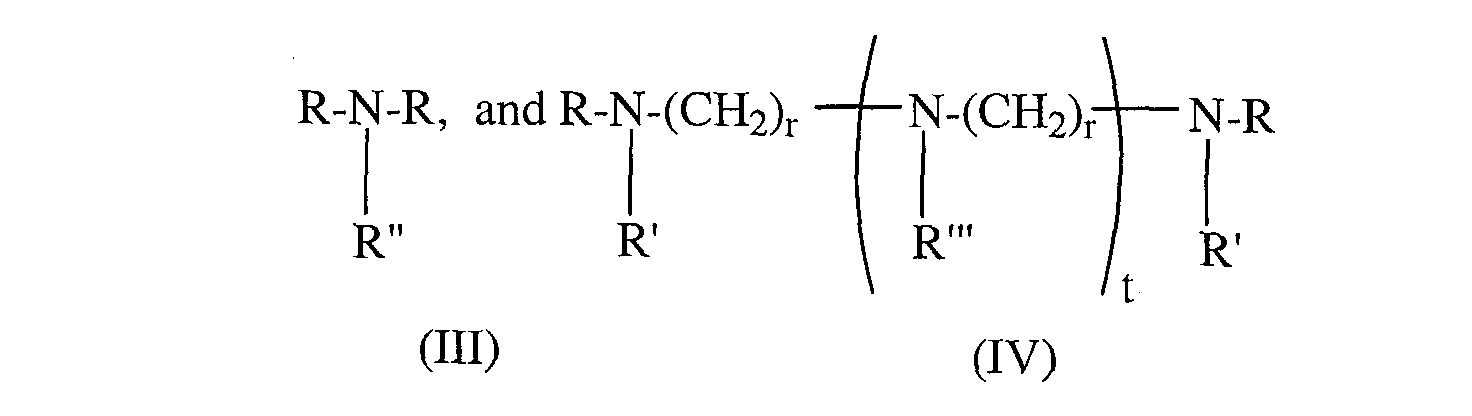 wherein R' is as defined above, and wherein r and r' can be the same or a different number of from about 2 to about 6, preferably about 2 to about 4; and t and t' can be the same or different and are numbers of from 0 to about 10, preferably 0 to about 3, and most preferably about 0 to about 2, with the proviso that the sum of t and t' is not greater than about 10. To assure a facile reaction, it is preferred that R, R', R", R"', r, r', t and t' be selected in a manner sufficient to provide the compounds of Formulas III and IV with typically at least one primary amine group, preferably at least two primary groups. Amines represented by Formula III, when R represents hydrogen and R" represents a C1 to C25 straight or branched chain alkyl group are preferred.
- Non-limiting examples of suitable amine compounds include: 1,2-diaminoethane; 1,3-diaminopropane; 1,4-diaminobutane; 1,6-diaminohexane; polyethylene amines such as diethylene triamine; triethylene tetramine; tetraethylene pentamine; polypropylene amines such as 1,2-propylene diamine; di-(1,2-propylene)triamine; di-(1,3-propylene) triamine; N,N-dimethyl-1,3-diaminopropane; N,N-di-(2-aminoethyl) ethylene diamine; N,N-di(2-hydroxyethyl)-1,3-propylene diamine; 3-dodecyloxypropylamine; N-dodecyl-1,3-propane diamine; diisopropanol amine; diethanol amine; mono-tallow amine, mono-coco amines, mono-palmitic amines; mono-phenyl amine, mono-benzyl amine; morpholines such as N-(3-aminopropyl)morpholine; and mixtures thereof.
- Other useful amine compounds include: alicyclic diamines such as 1,4-di(aminomethyl) cyclohexane, and heterocyclic nitrogen compounds such as imidazolines, and N-aminoalkyl piperazines of the general formula (VI):wherein p1 and p2 are the same or different and are each integers of from about 1 to about 4, and n1, n2 and n3 are the same or different and are each integers of from 0 to about 3 with the proviso that the amine has no more than about 12 nitrogen atoms per molecule. Non-limiting examples of such amines include 2-pentadecyl imidazoline; N-(2-aminoethyl) piperazine; etc.

- Commercial mixtures of amine compounds may advantageously be used. For example, one process for preparing alkylene amines involves the reaction of an alkylene dihalide (such as ethylene dichloride or propylene dichloride) with ammonia, which results in a complex mixture of alkylene amines wherein pairs of nitrogens are joined by alkylene groups, forming such compounds as diethylene triamine, triethylenetetramine, tetraethylene pentamine and isomeric piperazines. Low cost poly(ethyleneamines) compounds averaging about 5 to 7 nitrogen atoms per molecule are available commercially under trade names such as "Polyamine H", "Polyamine 400", "Dow Polyamine E-100", etc. "Heavy polyamine" mixtures, as defined in U.S. Patent No. 5,580,484 described supra, may also be employed.
- Useful amines also include polyoxyalkylene polyamines such as those of the formula (VII) and (VIII):
 where R"" is H or C1-C22 alkyl, preferably C1-C5alkyl, and n4 is 1 to 3.
- The Mannich base condensation products of this invention are prepared by condensing at least one of the above-described hydroxy aromatic compounds with an amine in the presence of an aldehyde. The reactants are contacted for a time and under conditions sufficient to form the desired dispersant product. The process employed in the condensation reaction can be any of those disclosed in U.S. Patents 3,634,515; 3,649,229; 3,442,808; 3,798,165; 3,798,247 and 3,539,633.
- The amount of the reactants employed is such that the amount of the aldehyde reactant is in excess of the amount of the amine reactant. Preferably, the molar ratio of the aldehyde reactant to the amine reactant is at least 1.3:1, such as in the range of 1.3 to 4:1, such as at least 2: 1. The reactions are exothermic, but it is desirable to heat the reaction to a temperature of above about 150°C, preferably in the range of form about 150-200°C. This additional heating drives the reaction to completion and removes water from the resulting condensation reaction product.
- Thus, the oxazine ring-containing condensation products of this invention are obtainable by condensing at least one of the above-described hydroxy aromatic compounds with an amine in the presence of an aldehyde, wherein the molar ratio of hydroxy aromatic compound to aldehyde to amine is 1: at least 1.3: 1, such as in the range of 1: 1.8 to 4:1, such as at 1: 2 to 2.5: 1.
- The Mannich base condensation reaction of the invention is represented by the following reaction schemes:
 wherein R2 is as previously defined.
- A preferred group of Mannich base condensation products are those formed by condensing naphthol, optionally substituted with hydrocarbyl, with formaldehyde and an aliphatic or aromatic substituted primary amine, e.g., fatty amines such as hydrogenated mono-tallow amine, mono-coco amine; amines substituted with shorter alkyl moieties, such as mono-nonyl amine, mono-octyl amine, mono-hexyl amine, mono-pentyl amine, mono-butyl amine, mono-propyl amine, mono-methyl amine; or mono- phenyl or mono-benzyl amine. A particularly preferred product of the present invention comprises the condensation product obtainable by reaction of (A) naphthol; (B) formaldehyde; and (C) a mono-alkyl amine derived from a natural fatty acid; using about 1.3 to 2 moles of (B) per mole of each (A) and (C). Preferably, the naphthol is substituted with hydrocarbyl containing C1 to C20 group. The hydrocarbyl can comprise a low molecular alkyl moiety, such as methyl or ethyl. The desired Mannich Base condensation product formed by the process of this invention will generally be present in the condensation reaction product mixture in a concentration of at least about 60 wt.% (e.g., from 65 to 95 wt.%), more preferably at least about 70 wt.%, and most preferably from about 75 to about 90 wt.%.
- The Mannich base condensation products of the present invention provide soot dispersing properties to lubricating oils when blended therewith. Oils of lubricating viscosity useful in the context of the present invention may be selected from natural lubricating oils, synthetic lubricating oils and mixtures thereof. The lubricating oil may range in viscosity from light distillate mineral oils to heavy lubricating oils such as gasoline engine oils, mineral lubricating oils and heavy duty diesel oils. Generally, the viscosity of the oil ranges from about 2 centistokes to about 40 centistokes, especially from about 4 centistokes to about 20 centistokes, as measured at 100°C.
- Natural oils include animal oils and vegetable oils (e.g., castor oil, lard oil); liquid petroleum oils and hydrorefined, solvent-treated or acid-treated mineral oils of the paraffinic, naphthenic and mixed paraffinic-naphthenic types. Oils of lubricating viscosity derived from coal or shale also serve as useful base oils.
- Synthetic lubricating oils include hydrocarbon oils and halo-substituted hydrocarbon oils such as polymerized and interpolymerized olefins (e.g., polybutylenes, polypropylenes, propylene-isobutylene copolymers, chlorinated polybutylenes, poly(1-hexenes), poly( 1 -octenes), poly(1-decenes)); alkylbenzenes (e.g., dodecylbenzenes, tetradecylbenzenes, dinonylbenzenes, di(2-ethylhexyl)benzenes); polyphenyls (e.g., biphenyls, terphenyls, alkylated polyphenols); and alkylated diphenyl ethers and alkylated diphenyl sulfides and derivative, analogs and homologs thereof.
- Alkylene oxide polymers and interpolymers and derivatives thereof where the terminal hydroxyl groups have been modified by esterification, etherification, etc., constitute another class of known synthetic lubricating oils. These are exemplified by polyoxyalkylene polymers prepared by polymerization of ethylene oxide or propylene oxide, and the alkyl and aryl ethers of polyoxyalkylene polymers (e.g., methyl-polyiso-propylene glycol ether having a molecular weight of 1000 or diphenyl ether of poly-ethylene glycol having a molecular weight of 1000 to 1500); and mono- and polycarboxylic esters thereof, for example, the acetic acid esters, mixed C3-C8 fatty acid esters and C13 Oxo acid diester of tetraethylene glycol.
- Another suitable class of synthetic lubricating oils comprises the esters of dicarboxylic acids (e.g., phthalic acid, succinic acid, alkyl succinic acids and alkenyl succinic acids, maleic acid, azelaic acid, suberic acid, sebasic acid, fumaric acid, adipic acid, linoleic acid dimer, malonic acid, alkylmalonic acids, alkenyl malonic acids) with a variety of alcohols (e.g., butyl alcohol, hexyl alcohol, dodecyl alcohol, 2-ethylhexyl alcohol, ethylene glycol, diethylene glycol monoether, propylene glycol). Specific examples of such esters includes dibutyl adipate, di(2-ethylhexyl) sebacate, di-n-hexyl fumarate, dioctyl sebacate, diisooctyl azelate, diisodecyl azelate, dioctyl phthalate, didecyl phthalate, dieicosyl sebacate, the 2-ethylhexyl diester of linoleic acid dimer, and the complex ester formed by reacting one mole of sebacic acid with two moles of tetraethylene glycol and two moles of 2-ethylhexanoic acid.
- Esters useful as synthetic oils also include those made from C5 to C12 monocarboxylic acids and polyols and polyol esters such as neopentyl glycol, trimethylolpropane, pentaerythritol, dipentaerythritol and tripentaerythritol.
- Silicon-based oils such as the polyalkyl-, polyaryl-, polyalkoxy- or polyaryloxysilicone oils and silicate oils comprise another useful class of synthetic lubricants; such oils include tetraethyl silicate, tetraisopropyl silicate, tetra-(2-ethylhexyl)silicate, tetra-(4-methyl-2-ethylhexyl)silicate, tetra-(p-tert-butyl-phenyl) silicate, hexa-(4-methyl-2-ethylhexyl)disiloxane, poly(methyl)siloxanes and poly(methylphenyl)siloxanes. Other synthetic lubricating oils include liquid esters of phosphorous-containing acids (e.g., tricresyl phosphate, trioctyl phosphate, diethyl ester of decylphosphonic acid) and polymeric tetrahydrofurans.
- Unrefined, refined and re-refined oils can be used in lubricants of the present invention. Unrefined oils are those obtained directly from a natural or synthetic source without further purification treatment. For example, a shale oil obtained directly from retorting operations; petroleum oil obtained directly from distillation; or ester oil obtained directly from an esterification and used without further treatment would be unrefined oil. Refined oils are similar to unrefined oils except that the oil is further treated in one or more purification steps to improve one or more properties. Many such purification techniques, such as distillation, solvent extraction, acid or base extraction, filtration and percolation are known to those skilled in the art. Re-refined oils are obtained by processes similar to those used to provide refined oils but begin with oil that has already been used in service. Such re-refined oils are also known as reclaimed or reprocessed oils and are often subjected to additionally processing using techniques for removing spent additives and oil breakdown products.
- The Mannich base condensation products of the present invention can be incorporated into lubricating oil in any convenient way. Thus, the compounds of the invention can be added directly to the oil by dispersing or dissolving the same in the oil at the desired level of concentrations. Such blending into the lube oil can occur at room temperature or elevated temperatures. Alternatively, the compounds of the invention can be blended with a suitable oil-soluble solvent and base oil to form a concentrate, which concentrate can then be blended with a lubricating oil basestock to obtain the final formulation. Such concentrates will typically contain (on an active ingredient (A.I.)) basis from about 20 to about 60 wt. %, and preferably from about 40 to about 50 wt. %, of the inventive compound, and typically from about 40 to 80 wt.%, preferably from about 40 to 60 wt. %, base oil, based on the concentrate weight. To provide sufficient soot dispersing characteristics, the fully formulated lubricating oil composition should contain from about 0.01 to about 10 wt. %, preferably from about 0.1 to about 5 wt. %, most preferably from about 0.1 to about 1 wt. % of one or more compounds of the present invention.
- Because the Mannich base condensation products of the present invention do not alone provide a lubricating oil composition with sufficient sludge dispersing properties, lubricating oil compositions containing the Mannich base condensation products of the present invention may also contain a conventional high molecular weight dispersant.
- The high molecular weight dispersants useful in the context of the present invention include the range of ashless (metal-free) dispersants known to be effective to reduce formation of deposits upon use in gasoline and diesel engines, when added to lubricating oils. The ashless, high molecular weight dispersant useful in the compositions of the present invention comprises an oil soluble polymeric long chain backbone having functional groups capable of associating with particles to be dispersed. Typically, such dispersants comprise amine, alcohol, amide or ester polar moieties attached to the polymer backbone, often via a bridging group. The ashless, high molecular weight dispersant may be, for example, selected from oil soluble salts, esters, amino-esters, amides, imides and oxazolines of long chain hydrocarbon-substituted mono- and polycarboxylic acids or anhydrides thereof; thiocarboxylate derivatives of long chain hydrocarbons; long chain aliphatic hydrocarbons having polyamine moieties attached directly thereto; and Mannich condensation products formed by condensing a long chain substituted phenol with formaldehyde and polyalkylene polyamine.
- A "high molecular weight" dispersant is one having a number average molecular weight greater than or equal to 450, such as between 450 and 20,000. The precise molecular weight ranges will depend on the type of polymer used to form the dispersant, the number of functional groups, and the type of polar functional group employed. For example, for a polyisobutylene derivatized dispersant, a high molecular weight dispersant may be one formed with a polymer backbone having a number average molecular weight of from about 1700 to about 5600. Typical commercially available polyisobutylene-based dispersants contain polyisobutylene polymers having a number average molecular weight ranging from about 900 to about 2300, functionalized by maleic anhydride (MW = 98), and derivatized with polyamines having a molecular weight of from about 100 to about 350. Polymers of low molecular weight could also be used to form a high molecular weight dispersant by incorporating multiple polymer chains into the dispersant using methods known in the art.
- Polymer molecular weight, specifically
M n, can be determined by various known techniques. One convenient method is gel permeation chromatography (GPC), which additionally provides molecular weight distribution information (see W. W. Yau, J. J. Kirkland and D. D. Bly, "Modern Size Exclusion Liquid Chromatography", John Wiley and Sons, New York, 1979). If the molecular weight of an amine-containing dispersant (e.g., PIBSA-polyamine) is being determined, the presence of the amine may cause the dispersant to be adsorbed by the column, leading to an inaccurate molecular weight determination. Persons familiar with the operation of GPC equipment understand that this problem may be eliminated by using a mixed solvent system, such as tetrahydrofuran (THF) mixed with a minor amount of pyridine, as opposed to pure THF. The problem may also be addressed by capping the amine with acetic anhydride and correcting the molecular weight based on the amount of capping groups. Another useful method for determining molecular weight, particularly for lower molecular weight polymers, is vapor pressure osmometry (see, e.g., ASTM D3592). - Suitable hydrocarbons or polymers employed in the formation of conventional high molecular weight dispersants include homopolymers, interpolymers or lower molecular weight hydrocarbons. One family of such polymers comprise polymers of ethylene and/or at least one C3 to C28 alpha-olefin having the formula H2C=CHR1 wherein R1 is straight or branched chain alkyl radical comprising 1 to 26 carbon atoms and wherein the polymer contains carbon-to-carbon unsaturation, preferably a high degree of terminal ethenylidene unsaturation. Preferably, such polymers comprise interpolymers of ethylene and at least one alpha-olefin of the above formula, wherein R1 is alkyl of from 1 to 18 carbon atoms, and more preferably is alkyl of from 1 to 8 carbon atoms, and more preferably still of from 1 to 2 carbon atoms. Therefore, useful alpha-olefin monomers and comonomers include, for example, propylene, butene-1, hexene-1, octene-1, 4-methylpentene- 1, decene-1, dodecene-1, tridecene- 1, tetradecene-1, pentadecene-1, hexadecene-1, heptadecene-1, octadecene-1, nonadecene-1, and mixtures thereof (e.g., mixtures of propylene and butene-1, and the like). Exemplary of such polymers are propylene homopolymers, butene-1 homopolymers, ethylene-propylene copolymers, ethylene-butene-1 copolymers, propylene-butene copolymers and the like, wherein the polymer contains at least some terminal and/or internal unsaturation. Preferred polymers are unsaturated copolymers of ethylene and propylene and ethylene and butene-1. The interpolymers of this invention may contain a minor amount, e.g. 0.5 to 5 mole % of a C4 to C18 nonconjugated diolefin comonomer. However, it is preferred that the polymers of this invention comprise only alpha-olefin homopolymers, interpolymers of alpha-olefin comonomers and interpolymers of ethylene and alpha-olefin comonomers. The molar ethylene content of the polymers employed in this invention is preferably in the range of 20 to 80 %, and more preferably 30 to 70 %. When propylene and/or butene-1 are employed as comonomer(s) with ethylene, the ethylene content of such copolymers is most preferably between 45 and 65 %, although higher or lower ethylene contents may be present.
- These polymers may be prepared by polymerizing alpha-olefin monomer, or mixtures of alpha-olefin monomers, or mixtures comprising ethylene and at least one C3 to C28 alpha-olefin monomer, in the presence of a catalyst system comprising at least one metallocene (e.g., a cyclopentadienyl-transition metal compound) and an alumoxane compound. Using this process, a polymer in which 95 % or more of the polymer chains possess terminal ethenylidene-type unsaturation can be provided. The percentage of polymer chains exhibiting terminal ethenylidene unsaturation may be determined by FTIR spectroscopic analysis, titration, or C13 NMR. Interpolymers of this latter type may be characterized by the formula POLY-C(R1)=CH2 wherein R1 is C1 to C26 alkyl, preferably C1 to C18 alkyl, more preferably C1 to C8 alkyl, and most preferably C1 to C2 alkyl, (e.g., methyl or ethyl) and wherein POLY represents the polymer chain. The chain length of the R1 alkyl group will vary depending on the comonomer(s) selected for use in the polymerization. A minor amount of the polymer chains can contain terminal ethenyl, i.e., vinyl, unsaturation, i.e. POLY-CH=CH2, and a portion of the polymers can contain internal monounsaturation, e.g. POLY-CH=CH(R1), wherein R1 is as defined above. These terminally unsaturated interpolymers may be prepared by known metallocene chemistry and may also be prepared as described in U.S. Patent Nos. 5,498,809; 5,663,130; 5,705,577; 5,814,715; 6,022,929 and 6,030,930.
- Another useful class of polymers is polymers prepared by cationic polymerization of isobutene, styrene, and the like. Common polymers from this class include polyisobutenes obtained by polymerization of a C4 refinery stream having a butene content of about 35 to about 75% by wt., and an isobutene content of about 30 to about 60% by wt., in the presence of a Lewis acid catalyst, such as aluminum trichloride or boron trifluoride. A preferred source of monomer for making poly-n-butenes is petroleum feedstreams such as Raffinate II. These feedstocks are disclosed in the art such as in U.S. Patent No. 4,952,739. Polyisobutylene is a most preferred backbone of the present invention because it is readily available by cationic polymerization from butene streams (e.g., using AlCl3 or BF3 catalysts). Such polyisobutylenes generally contain residual unsaturation in amounts of about one ethylenic double bond per polymer chain, positioned along the chain.
- As noted above, the polyisobutylene polymers employed are generally based on a hydrocarbon chain of from about 900 to 2,300. Methods for making polyisobutylene are known. Polyisobutylene can be functionalized by halogenation (e.g. chlorination), the thermal "ene" reaction, or by free radical grafting using a catalyst (e.g. peroxide), as described below.
- Processes for reacting polymeric hydrocarbons with unsaturated carboxylic acids, anhydrides or esters and the preparation of derivatives from such compounds are disclosed in U.S. Patent Nos. 3,087,936; 3,172,892; 3,215,707; 3,231,587; 3,272,746; 3,275,554; 3,381,022; 3,442,808; 3,565,804; 3,912,764; 4,110,349; 4,234,435; and GB-A-1,440,219. The polymer or hydrocarbon may be functionalized, for example, with carboxylic acid producing moieties (preferably acid or anhydride) by reacting the polymer or hydrocarbon under conditions that result in the addition of functional moieties or agents, i.e., acid, anhydride, ester moieties, etc., onto the polymer or hydrocarbon chains primarily at sites of carbon-to-carbon unsaturation (also referred to as ethylenic or olefinic unsaturation) using the halogen assisted functionalization (e.g. chlorination) process or the thermal "ene" reaction.
- When using the free radical grafting process using a catalyst (e.g. peroxide), the functionalization is randomly effected along the polymer chain. Selective functionalization can be accomplished by halogenating, e.g., chlorinating or brominating the unsaturated α-olefin polymer to about 1 to 8 wt. %, preferably 3 to 7 wt. % chlorine, or bromine, based on the weight of polymer or hydrocarbon, by passing the chlorine or bromine through the polymer at a temperature of 60 to 250°C, preferably 110 to 160°C, e.g., 120 to 140°C, for about 0.5 to 10, preferably 1 to 7 hours. The halogenated polymer or hydrocarbon (hereinafter backbone) is then reacted with sufficient monounsaturated reactant capable of adding functional moieties to the backbone, e.g., monounsaturated carboxylic reactant, at 100 to 250°C, usually about 180°C to 235°C, for about 0.5 to 10, e.g., 3 to 8 hours, such that the product obtained will contain the desired number of moles of the monounsaturated carboxylic reactant per mole of the halogenated backbones. Alternatively, the backbone and the monounsaturated carboxylic reactant are mixed and heated while adding chlorine to the hot material.
- The hydrocarbon or polymer backbone can be functionalized, e.g., with carboxylic acid producing moieties (preferably acid or anhydride moieties) selectively at sites of carbon-to-carbon unsaturation on the polymer or hydrocarbon chains, or randomly along chains using the three processes mentioned above or combinations thereof in any sequence.
- The preferred monounsaturated reactants that are used to functionalize the backbone comprise mono- and dicarboxylic acid material, i.e., acid, anhydride, or acid ester material, including (i) monounsaturated C4 to C10 dicarboxylic acid wherein
- (a) the carboxyl groups are vicinyl, (i.e., located on adjacent carbon atoms) and (b) at least one, preferably both, of said adjacent carbon atoms are part of said mono unsaturation; (ii) derivatives of (i) such as anhydrides or C1 to C5 alcohol derived mono- or diesters of (i); (iii) monounsaturated C3 to C10 monocarboxylic acid wherein the carbon-carbon double bond is conjugated with the carboxy group, i.e., of the structure -C=C-CO-; and (iv) derivatives of (iii) such as C1 to C5 alcohol derived mono- or diesters of (iii). Mixtures of monounsaturated carboxylic materials (i) - (iv) also may be used. Upon reaction with the backbone, the monounsaturation of the monounsaturated carboxylic reactant becomes saturated. Thus, for example, maleic anhydride becomes backbone-substituted succinic anhydride, and acrylic acid becomes backbone-substituted propionic acid. Exemplary of such monounsaturated carboxylic reactants are fumaric acid, itaconic acid, maleic acid, maleic anhydride, chloromaleic acid, chloromaleic anhydride, acrylic acid, methacrylic acid, crotonic acid, cinnamic acid, and lower alkyl (e.g., C1 to C4 alkyl) acid esters of the foregoing, e.g., methyl maleate, ethyl fumarate, and methyl fumarate. The monounsaturated carboxylic reactant, preferably maleic anhydride, typically will be used in an amount ranging from about 0.01 to about 20 wt. %, preferably 0.5 to 10 wt. %, based on the weight of the polymer or hydrocarbon.
-
- While chlorination normally helps increase the reactivity of starting olefin polymers with monounsaturated functionalizing reactant, it is not necessary with the polymers or hydrocarbons contemplated for use in the present invention, particularly those preferred polymers or hydrocarbons which possess a high terminal bond content and reactivity. Preferably, therefore, the backbone and the monounsaturated functionality reactant, e.g., carboxylic reactant, are contacted at elevated temperature to cause an initial thermal "ene" reaction to take place. Ene reactions are known.
- The hydrocarbon or polymer backbone can be functionalized by random attachment of functional moieties along the polymer chains by a variety of methods. For example, the polymer, in solution or in solid form, may be grafted with the monounsaturated carboxylic reactant, as described above, in the presence of a free-radical initiator. When performed in solution, the grafting takes place at an elevated temperature in the range of about 100 to 260°C, preferably 120 to 240°C. Preferably, free-radical initiated grafting would be accomplished in a mineral lubricating oil solution containing, e.g., 1 to 50 wt.%, preferably 5 to 30 wt. % polymer based on the initial total oil solution.
- The free-radical initiators that may be used are peroxides, hydroperoxides, and azo compounds, preferably those that have a boiling point greater than about 100°C and decompose thermally within the grafting temperature range to provide free-radicals. Representative of these free-radical initiators are azobutyronitrile, 2,5-dimethylhex-3-ene-2,5-bis-tertiary-butyl peroxide and dicumene peroxide. The initiator, when used, typically is used in an amount of between 0.005% and 1% by weight based on the weight of the reaction mixture solution. Typically, the aforesaid monounsaturated carboxylic reactant material and free-radical initiator are used in a weight ratio range of from about 1.0:1 to 30:1, preferably 3:1 to 6:1. The grafting is preferably carried out in an inert atmosphere, such as under nitrogen blanketing. The resulting grafted polymer is characterized by having carboxylic acid (or ester or anhydride) moieties randomly attached along the polymer chains: it being understood, of course, that some of the polymer chains remain ungrafted. The free radical grafting described above can be used for the other polymers and hydrocarbons of the present invention.
- The functionalized oil-soluble polymeric hydrocarbon backbone may then be further derivatized with a nucleophilic reactant, such as an amine, amino-alcohol, alcohol, metal compound, or mixture thereof, to form a corresponding derivative. Useful amine compounds for derivatizing functionalized polymers comprise at least one amine and can comprise one or more additional amine or other reactive or polar groups. These amines may be hydrocarbyl amines or may be predominantly hydrocarbyl amines in which the hydrocarbyl group includes other groups, e.g., hydroxy groups, alkoxy groups, amide groups, nitriles, imidazoline groups, and the like. Particularly useful amine compounds include mono- and polyamines, e.g., polyalkene and polyoxyalkylene polyamines of about 2 to 60, such as 2 to 40 (e.g., 3 to 20) total carbon atoms having about 1 to 12, such as 3 to 12, and preferably 3 to 9 nitrogen atoms per molecule. Mixtures of amine compounds may advantageously be used, such as those prepared by reaction of alkylene dihalide with ammonia. Preferred amines are aliphatic saturated amines, including, for example, 1,2-diaminoethane; 1,3-diaminopropane; 1,4-diaminobutane; 1,6-diaminohexane; polyethylene amines such as diethylene triamine; triethylene tetramine; tetraethylene pentamine; and polypropyleneamines such as 1,2-propylene diamine; and di-(1,2-propylene)triamine.
- Other useful amine compounds include: alicyclic diamines such as 1,4-di(aminomethyl) cyclohexane and heterocyclic nitrogen compounds such as imidazolines. Another useful class of amines is the polyamido and related amido-amines as disclosed in U.S. Patent Nos. 4,857,217; 4,956,107; 4,963,275; and 5,229,022. Also usable is tris(hydroxymethyl)amino methane (TAM) as described in U.S. Patent Nos. 4,102,798; 4,113,639; 4,116,876; and UK 989,409. Dendrimers, star-like amines, and comb-structured amines may also be used. Similarly, one may use condensed amines, as described in U.S. Patent No. 5,053,152. The functionalized polymer is reacted with the amine compound using conventional techniques as described, for example, in U.S. Patent Nos. 4,234,435 and 5,229,022, as well as in EP-A-208,560.
- The functionalized, oil-soluble polymeric hydrocarbon backbones may also be derivatized with hydroxy compounds such as monohydric and polyhydric alcohols, or with aromatic compounds such as phenols and naphthols. Preferred polyhydric alcohols include alkylene glycols in which the alkylene radical contains from 2 to 8 carbon atoms. Other useful polyhydric alcohols include glycerol, mono-oleate of glycerol, monostearate of glycerol, monomethyl ether of glycerol, pentaerythritol, dipentaerythritol, and mixtures thereof. An ester dispersant may also be derived from unsaturated alcohols, such as allyl alcohol, cinnamyl alcohol, propargyl alcohol, 1-cyclohexane-3-ol, and oleyl alcohol. Still other classes of alcohols capable of yielding ashless dispersants comprise ether-alcohols, including oxy-alkylene and oxy-arylene. Such ether-alcohols are exemplified by ether-alcohols having up to 150 oxy-alkylene radicals in which the alkylene radical contains from 1 to 8 carbon atoms. The ester dispersants may be di-esters of succinic acids or acid-esters, i.e., partially esterified succinic acids, as well as partially esterified polyhydric alcohols or phenols, i.e., esters having free alcohols or phenolic hydroxy radicals. An ester dispersant may be prepared by any one of several known methods as described, for example, in U.S. Patent No. 3,381,022.
- Preferred groups of dispersant include polyamine-derivatized poly α-olefin, dispersants, particularly ethylene/butene alpha-olefin and polyisobutylene-based dispersants. Particularly preferred are ashless dispersants derived from polyisobutylene substituted with succinic anhydride groups and reacted with polyethylene amines, e.g., polyethylene diamine, tetraethylene pentamine; or a polyoxyalkylene polyamine, e.g., polyoxypropylene diamine, trimethylolaminomethane; a hydroxy compound, e.g., pentaerythritol; and combinations thereof. One particularly preferred dispersant combination is a combination of (A) polyisobutylene substituted with succinic anhydride groups and reacted with (B) a hydroxy compound, e.g., pentaerythritol; (C) a polyoxyalkylene polyamine, e.g., polyoxypropylene diamine, or (D) a polyalkylene diamine, e.g., polyethylene diamine and tetraethylene pentamine using about 0.3 to about 2 moles of (B), (C) and/or (D) per mole of (A). Another preferred dispersant combination comprises a combination of (A) polyisobutenyl succinic anhydride with (B) a polyalkylene polyamine, e.g., tetraethylene pentamine, and (C) a polyhydric alcohol or polyhydroxy-substituted aliphatic primary amine, e.g., pentaerythritol or trismethylolaminomethane, as described in U.S. Patent No. 3,632,511.
- Another class of high molecular weight ashless dispersants comprises Mannich base condensation products. Generally, these products are prepared by condensing about one mole of a long chain alkyl-substituted mono- or polyhydroxy benzene with about 1 to 2.5 moles of carbonyl compound(s) (e.g., formaldehyde and paraformaldehyde) and about 0.5 to 2 moles of polyalkylene polyamine, as disclosed, for example, in U.S. Patent No. 3,442,808. Such Mannich base condensation products may include a polymer product of a metallocene catalyzed polymerization as a substituent on the benzene group, or may be reacted with a compound containing such a polymer substituted on a succinic anhydride in a manner similar to that described in U.S. Patent No. 3,442,808. Examples of functionalized and/or derivatized olefin polymers synthesized using metallocene catalyst systems are described in the publications identified supra.
- The high molecular weight dispersant can be further post treated by a variety of conventional post treatments such as boration, as generally taught in U.S. Patent Nos. 3,087,936 and 3,254,025. Boration of the dispersant is readily accomplished by treating an acyl nitrogen-containing dispersant with a boron compound such as boron oxide, boron halide boron acids, and esters of boron acids, in an amount sufficient to provide from about 0.1 to about 20 atomic proportions of boron for each mole of acylated nitrogen composition. Useful dispersants contain from about 0.05 to about 2.0 wt.%, e.g., from about 0.05 to about 0.7 wt.% boron. The boron, which appears in the product as dehydrated boric acid polymers (primarily (HBO2)3), is believed to attach to the dispersant imides and diimides as amine salts, e.g., the metaborate salt of the diimide. Boration can be carried out by adding from about 0.5 to 4 wt.%, e.g., from about 1 to about 3 wt.% (based on the weight of acyl nitrogen compound) of a boron compound, preferably boric acid, usually as a slurry, to the acyl nitrogen compound and heating with stirring at from about 135°C to about 190°C, e.g., 140°C to 170°C, for from about 1 to about 5 hours, followed by nitrogen stripping. Alternatively, the boron treatment can be conducted by adding boric acid to a hot reaction mixture of the dicarboxylic acid material and amine, while removing water. Other post reaction processes known in the art can also be applied.
- Conventional high molecular weight dispersants, in addition to providing sludge dispersing properties, also imbue lubricating oils with soot dispersancy characteristics. Surprisingly, it has been found that the Mannich Base condensation products of the present invention synergistically boost the soot dispersancy properties of high molecular weight dispersants. Thus, the use of a small amount of the Mannich Base condensation products of the present invention allows one to reduce the amount of the relatively expensive high molecular weight dispersant used in the lubricating oil composition while maintaining, or actually increasing, the soot dispersant properties of the composition. To provide sufficient control of soot induced viscosity increase, a conventional lubricating oil composition will employ a high molecular weight dispersant in an amount of up to about 20 wt. %, more usually up to about 8 wt. %, based on the total mass of the finished lubricant. In contrast, in a lubricating oil composition containing about 0.01 to about 5 wt. %, preferably from about 0.05 to about 2 wt. %, more preferably from about 0.1 to about 1 wt. %, of a Mannich Base condensation product of the present invention, a comparable level of sludge and soot dispersancy can be achieved with about 1 to about 12 wt. %, preferably from about 1 to about 7 wt. %, more preferably from about 2 to about 5 wt. %, of the high molecular weight dispersant. In general, each 0.5 wt.% increase in the amount of the Mannich base condensation product of the present invention may allow for up to a 5 wt. % reduction in the amount of needed high molecular weight dispersant.
- Additional additives may be incorporated in the compositions of the invention to enable them to meet particular requirements. Examples of additives which may be included in the lubricating oil compositions of the present invention are detergents, metal rust inhibitors, viscosity index improvers, corrosion inhibitors, oxidation inhibitors, friction modifiers, anti-foaming agents, anti-wear agents and pour point depressants. Some are discussed in further detail below.
- Metal-containing or ash-forming detergents function both as detergents to reduce or remove deposits and as acid neutralizers or rust inhibitors, thereby reducing wear and corrosion and extending engine life. Detergents generally comprise a polar head with a long hydrophobic tail, with the polar head comprising a metal salt of an acidic organic compound. The salts may contain a substantially stoichiometric amount of the metal in which case they are usually described as normal or neutral salts, and would typically have a total base number or TBN (as can be measured by ASTM D2896) of from 0 to 80. A large amount of a metal base may be incorporated by reacting excess metal compound (e.g., an oxide or hydroxide) with an acidic gas (e.g., carbon dioxide). The resulting overbased detergent comprises neutralized detergent as the outer layer of a metal base (e.g. carbonate) micelle. Such overbased detergents may have a TBN of 150 or greater, and typically will have a TBN of from 250 to 450 or more.
- Detergents that may be used include oil-soluble neutral and overbased sulfonates, phenates, sulfurized phenates, thiophosphonates, salicylates, and naphthenates and other oil-soluble carboxylates of a metal, particularly the alkali or alkaline earth metals, e.g., sodium, potassium, lithium, calcium, and magnesium. The most commonly used metals are calcium and magnesium, which may both be present in detergents used in a lubricant, and mixtures of calcium and/or magnesium with sodium. Particularly convenient metal detergents are neutral and overbased calcium sulfonates having TBN of from 20 to 450 TBN, and neutral and overbased calcium phenates and sulfurized phenates having TBN of from 50 to 450. Combinations of detergents, whether overbased or neutral or both, may be used.
- Sulfonates may be prepared from sulfonic acids which are typically obtained by the sulfonation of alkyl substituted aromatic hydrocarbons such as those obtained from the fractionation of petroleum or by the alkylation of aromatic hydrocarbons. Examples included those obtained by alkylating benzene, toluene, xylene, naphthalene, diphenyl or their halogen derivatives such as chlorobenzene, chlorotoluene and chloronaphthalene. The alkylation may be carried out in the presence of a catalyst with alkylating agents having from about 3 to more than 70 carbon atoms. The alkylaryl sulfonates usually contain from about 9 to about 80 or more carbon atoms, preferably from about 16 to about 60 carbon atoms per alkyl substituted aromatic moiety.
- The oil soluble sulfonates or alkaryl sulfonic acids may be neutralized with oxides, hydroxides, alkoxides, carbonates, carboxylate, sulfides, hydrosulfides, nitrates, borates and ethers of the metal. The amount of metal compound is chosen having regard to the desired TBN of the final product but typically ranges from about 100 to 220 wt. % (preferably at least 125 wt. %) of that stoichiometrically required.
- Metal salts of phenols and sulfurized phenols are prepared by reaction with an appropriate metal compound such as an oxide or hydroxide and neutral or overbased products may be obtained by methods well known in the art. Sulfurized phenols may be prepared by reacting a phenol with sulfur or a sulfur containing compound such as hydrogen sulfide, sulfur monohalide or sulfur dihalide, to form products which are generally mixtures of compounds in which 2 or more phenols are bridged by sulfur containing bridges.
- Dihydrocarbyl dithiophosphate metal salts are frequently used as antiwear and antioxidant agents. The metal may be an alkali or alkaline earth metal, or aluminum, lead, tin, molybdenum, manganese, nickel or copper. The zinc salts are most commonly used in lubricating oil in amounts of 0.1 to 10, preferably 0.2 to 2 wt. %, based upon the total weight of the lubricating oil composition. They may be prepared in accordance with known techniques by first forming a dihydrocarbyl dithiophosphoric acid (DDPA), usually by reaction of one or more alcohol or a phenol with P2S5 and then neutralizing the formed DDPA with a zinc compound. For example, a dithiophosphoric acid may be made by reacting mixtures of primary and secondary alcohols. Alternatively, multiple dithiophosphoric acids can be prepared where the hydrocarbyl groups on one are entirely secondary in character and the hydrocarbyl groups on the others are entirely primary in character. To make the zinc salt, any basic or neutral zinc compound could be used but the oxides, hydroxides and carbonates are most generally employed. Commercial additives frequently contain an excess of zinc due to the use of an excess of the basic zinc compound in the neutralization reaction.
- The preferred zinc dihydrocarbyl dithiophosphates are oil soluble salts of dihydrocarbyl dithiophosphoric acids and may be represented by the following formula:wherein R and R' may be the same or different hydrocarbyl radicals containing from 1 to 18, preferably 2 to 12, carbon atoms and including radicals such as alkyl, alkenyl, aryl, arylalkyl, alkaryl and cycloaliphatic radicals. Particularly preferred as R and R' groups are alkyl groups of 2 to 8 carbon atoms. Thus, the radicals may, for example, be ethyl, n-propyl, i-propyl, n-butyl, i-butyl, sec-butyl, amyl, n-hexyl, i-hexyl, n-octyl, decyl, dodecyl, octadecyl, 2-ethylhexyl, phenyl, butylphenyl, cyclohexyl, methylcyclopentyl, propenyl, butenyl. In order to obtain oil solubility, the total number of carbon atoms (i.e. R and R') in the dithiophosphoric acid will generally be about 5 or greater. The zinc dihydrocarbyl dithiophosphate can therefore comprise zinc dialkyl dithiophosphates. The present invention may be particularly useful when used with lubricant compositions containing phosphorus levels of from about 0.02 to about 0.12 wt. %, preferably from about 0.03 to about 0.10 wt. %, more preferably from about 0.05 to about 0.08 wt. %,
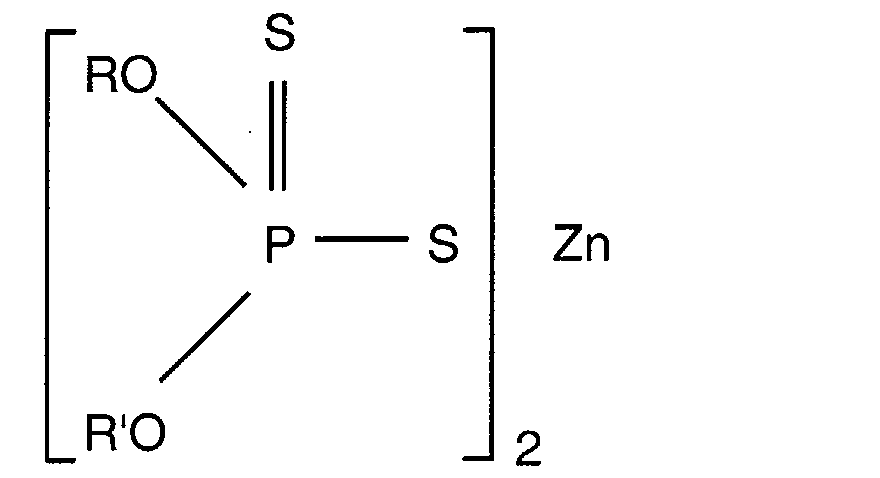
- Oxidation inhibitors or antioxidants reduce the tendency of mineral oils to deteriorate in service. Oxidative deterioration can be evidenced by sludge in the lubricant, varnish-like deposits on the metal surfaces, and by viscosity growth. Such oxidation inhibitors include hindered phenols, alkaline earth metal salts of alkylphenolthioesters having preferably C5 to C12 alkyl side chains, calcium nonylphenol sulfide, oil soluble phenates and sulfurized phenates, phosphosulfurized or sulfurized hydrocarbons or esters, phosphorous esters, metal thiocarbamates, oil soluble copper compounds as described in U.S. Patent No. 4,867,890, and molybdenum-containing compounds.
- Aromatic amines having at least two aromatic groups attached directly to the nitrogen constitute another class of compounds that is frequently used for antioxidancy. While these materials may be used in small amounts, preferred embodiments of the present invention are free of these compounds. They are preferably used in only small amounts, i.e., up to 0.4 wt. %, or more preferably avoided altogether other than such amount as may result as an impurity from another component of the composition.
- Typical oil soluble aromatic amines having at least two aromatic groups attached directly to one amine nitrogen contain from 6 to 16 carbon atoms. The amines may contain more than two aromatic groups. Compounds having a total of at least three aromatic groups in which two aromatic groups are linked by a covalent bond or by an atom or group (e.g., an oxygen or sulfur atom, or a -CO-, -SO2- or alkylene group) and two are directly attached to one amine nitrogen also considered aromatic amines having at least two aromatic groups attached directly to the nitrogen. The aromatic rings are typically substituted by one or more substituents selected from alkyl, cycloalkyl, alkoxy, aryloxy, acyl, acylamino, hydroxy, and nitro groups. The amount of any such oil soluble aromatic amines having at least two aromatic groups attached directly to one amine nitrogen should preferably not exceed 0.4 wt. % active ingredient.
- Representative examples of suitable viscosity modifiers are polyisobutylene, copolymers of ethylene and propylene, polymethacrylates, methacrylate copolymers, copolymers of an unsaturated dicarboxylic acid and a vinyl compound, interpolymers of styrene and acrylic esters, and partially hydrogenated copolymers of styrene/isoprene, styrene/butadiene, and isoprene/butadiene, as well as the partially hydrogenated homopolymers of butadiene and isoprene.
- Friction modifiers and fuel economy agents that are compatible with the other ingredients of the final oil may also be included. Examples of such materials include glyceryl monoesters of higher fatty acids, for example, glyceryl mono-oleate; esters of long chain polycarboxylic acids with diols, for example, the butane diol ester of a dimerized unsaturated fatty acid; oxazoline compounds; and alkoxylated alkyl-substituted mono-amines, diamines and alkyl ether amines, for example, ethoxylated tallow amine and ethoxylated tallow ether amine.
- A viscosity index improver dispersant functions both as a viscosity index improver and as a dispersant. Examples of viscosity index improver dispersants include reaction products of amines, for example polyamines, with a hydrocarbyl-substituted mono -or dicarboxylic acid in which the hydrocarbyl substituent comprises a chain of sufficient length to impart viscosity index improving properties to the compounds. In general, the viscosity index improver dispersant may be, for example, a polymer of a C4 to C24 unsaturated ester of vinyl alcohol or a C3 to C10 unsaturated mono-carboxylic acid or a C4 to C10 di-carboxylic acid with an unsaturated nitrogen-containing monomer having 4 to 20 carbon atoms; a polymer of a C2 to C20 olefin with an unsaturated C3 to C10 mono- or di-carboxylic acid neutralized with an amine, hydroxyamine or an alcohol; or a polymer of ethylene with a C3 to C20 olefin further reacted either by grafting a C4 to C20 unsaturated nitrogen-containing monomer thereon or by grafting an unsaturated acid onto the polymer backbone and then reacting carboxylic acid groups of the grafted acid with an amine, hydroxy amine or alcohol.
- Pour point depressants, otherwise known as lube oil flow improvers (LOFI), lower the minimum temperature at which the fluid will flow or can be poured. Such additives are well known. Typical of those additives that improve the low temperature fluidity of the fluid are C8 to C18 dialkyl fumarate/vinyl acetate copolymers, and polymethacrylates. Foam control can be provided by an antifoamant of the polysiloxane type, for example, silicone oil or polydimethyl siloxane.
- Some of the above-mentioned additives can provide a multiplicity of effects; thus for example, a single additive may act as a dispersant-oxidation inhibitor. This approach is well known and need not be further elaborated herein.
- In the present invention it may be necessary to include an additive which maintains the stability of the viscosity of the blend. Thus, although polar group-containing additives achieve a suitably low viscosity in the pre-blending stage it has been observed that some compositions increase in viscosity when stored for prolonged periods. Additives which are effective in controlling this viscosity increase include the long chain hydrocarbons functionalized by reaction with mono- or dicarboxylic acids or anhydrides which are used in the preparation of the ashless dispersants as hereinbefore disclosed.
- When lubricating compositions contain one or more of the above-mentioned additives, each additive is typically blended into the base oil in an amount that enables the additive to provide its desired function.
- It may be desirable, although not essential, to prepare one or more additive concentrates comprising additives (concentrates sometimes being referred to as additive packages) whereby several additives can be added simultaneously to the oil to form the lubricating oil composition.
- The final composition may employ from 5 to 25 mass %, preferably 5 to 18 mass %, typically 10 to 15 mass % of the concentrate, the remainder being oil of lubricating viscosity.
- When lubricating compositions contain one or more of the above-mentioned additives, each additive is typically blended into the base oil in an amount that enables the additive to provide its desired function. Representative effect amounts of such additives, when used in crankcase lubricant, are listed below. All the values listed are stated as mass percent active ingredient.
ADDITIVE MASS % (Broad) MASS % (Preferred) Metal Detergents 0.1 - 15 0.2 - 9 Corrosion Inhibitor 0 - 5 0 - 1.5 Metal Dihydrocarbyl Dithiophosphate 0.1 - 6 0.1 - 4 Antioxidant 0 - 5 0.01 - 2 Pour Point Depressant 0.01 - 5 0.01 - 1.5 Antifoaming Agent 0 - 5 0.001 - 0.15 Supplemental Antiwear Agents 0 - 1.0 0 - 0.5 Friction Modifier 0 - 5 0 - 1.5 Viscosity Modifier 0.01 - 10 0.25 - 3 Basestock Balance Balance - All weight percents expressed herein (unless otherwise indicated) are based on active ingredient (A.I.) content of the additive, and/or upon the total weight of any additive-package, or formulation which will be the sum of the A.I. weight of each additive plus the weight of total oil or diluent.
- This invention will be further understood by reference to the following examples, wherein all parts are parts by weight, unless otherwise noted and which include preferred embodiments of the invention.
- 144g (1 mol) of solid alpha-naphthol was charged into a four-neck reaction flask equipped with mechanical stirrer, thermometer, Dean Stark trap with a water condenser, and nitrogen blanket. 200 ml of methanol was added to dissolve the α-naphthol at room temperature. Slowly, 276g (1 mol) of oleyl amine (Armeen OL; Akzo Nobel) were added while stirring under nitrogen blanket. No exothermal observed during the addition of the amine to the alpha-naphthol-methanol solution. While stirring at about 20°C, 162.2g (2 mol) of formalin (37wt% solution of formaldehyde in water) were slowly added. The reaction is exothermic and the reaction temperature was maintained below 25-30°C by cooling the reactor with an outside ice water bath and by controlling the formalin addition. Once the formalin was added and the exothermal reaction ceased, the reaction mixture was allowed to warm to room temperature. The temperature of the reaction mixture was slowly increased up to 90°C while the methanol and water distilled out. Nitrogen flow was increased to strip the remaining water in the product at about 100°C until all the water is removed. Vacuum could have been applied instead of nitrogen stripping. The naphthoxazine analyzed for 3.23 % N (3.22 theory).
- 144g (1 mol) of solid beta-naphthol was charged into a four-neck reaction flask equipped with mechanical stirrer, thermometer, Dean Stark trap with a water condenser, and nitrogen blanket. 200 ml of methanol was added to dissolve the β-naphthol at room temperature. Slowly, 276g (1 mol) of oleyl amine (Armeen OL; Akzo Nobel) were added while stirring under nitrogen blanket. No exothermal observed during the addition of the amine to the beta-naphthol-methanol solution. While stirring at about 20°C, 162.2g (2 mol) of formalin (37wt% solution of formaldehyde in water) were slowly added. The reaction is exothermic and the reaction temperature was maintained below 25-30°C by cooling the reactor with an outside ice water bath and by controlling the formalin addition. Once the formalin was added and the exothermal reaction ceased, the reaction mixture was allowed to warm to room temperature. The temperature of the reaction mixture was slowly increased up to 90°C while the methanol and water distilled out. Nitrogen flow was increased to strip the remaining water in the product at about 100°C until all the water is removed. Vacuum could have been applied instead of nitrogen stripping. The naphthoxazine analyzed for 3.23 % N (3.22 theory).
- The ability of a composition to control soot-induced viscosity increase, and thus, the ability of a composition to maintain soot in suspension, can be measured using bench tests including the Haake Carbon Black Test. The procedure for performing this test is an industry standard and well known, but is summarized below:
- The Haake Carbon Black Test involves blending the dispersant into a formulated oil. In the tests conducted in association herewith, the tested formulation contains a high molecular weight dispersant and a compound of the present invention together with detergent, viscosity modifier, antioxidant and antiwear agent. The components of the oil formulation are subjected to an initial blending. Carbon black powder is then added to a final concentration and the sample is blended overnight. The viscosity of the carbon black dispersion is then measured in a Haake rheometer over a range of shear rates from 0.1sec-1 to 30sec-1. Typically, the viscosity at shear rates 0.26sec-1 and 0.45sec-1 are used for comparison.
- Lubricating oil formulations were formed by blending into a base oil (Mobil 700N) for 1 hour at 100°C, constant amounts of detergent, antioxidant and antiwear agent and variable amounts of a high molecular weight dispersant (a PIBSA-PAM product derived from PIBSA having a number average molecular weight of about 2200 and having a succination ratio of about 1.1), and naphthoxazine compounds of the present invention. 4.76 wt. % of carbon black was blended into each of the formulations overnight at 90°C. The kinematic viscosity of each of the resulting carbon black dispersions was then measured in a Haake rheometer over a range of shear rates from 0.1 sec-1 to 0.45 sec-1. As is typical, the viscosity at shear rates of 0.26 sec-1 and 0.45 sec-1 were used for comparison.
- The comparative results of the Haake carbon black test are shown below in Table 1. As shown by the data of Table 1, in formulations containing both 4% and 2% (AI) of high molecular weight dispersant, soot-induced viscosity increases are substantially eliminated when the oil formulation further contains from 0.5 to 1 wt.% of the naphthoxazine Mannich base condensation products of the present invention.
Disp. Concentration Naphthoxazine Concentration η (Vis, Pa-s) at 0.45 1/s η (Vis, Pa-s) at 1.25 1/s Dispersant 4 wt% 0 4.17 1.54 2wt% 0 6.95 3.13 β-Naphthoxazine 2 wt% 0.25 wt% 7.08 3.19 2wt% 0.50 wt% 3.24 1.19 2wt% 1.00 wt% 2.98 1.10 α-naphthoxazine 2wt% 0.25 wt% 0.042 0.035 2 wt% 0.50 wt% 0.083 0.048 2 wt% 1.0 wt% 0.064 0.049 - As shown by the data of Table 1, in formulations containing both 4% and 2% (AI) of high molecular weight dispersant, soot-induced viscosity increases are substantially eliminated when the oil formulation further contains from 0.5 to 1 wt.% of the naphthoxazine Mannich base condensation products of the present invention.
Claims (10)
- A compound of the general formula (I):wherein:
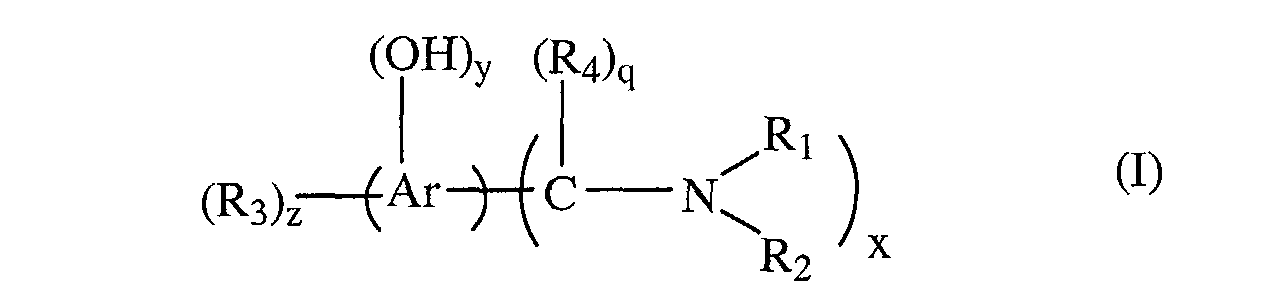 a hydroxyl group attached to Ar combines with N-R1 to form a substituted or unsubstituted 6 membered oxazine ring, provided that, when z is 0, R2 is not H.Ar is a mono- or polynuclear aromatic moiety;R1 and R2 are independently selected from H and C1 to C30 straight or branched chain hydrocarbyl groups optionally containing one or more hetero atoms selected from N, O and S;R3 is a straight or branched chain hydrocarbyl group;R4 is H or a C1 to C9 straight or branched chain hydrocarbyl group;q is 1 or 2;x is 1 to 3;y is from 1 to 2 times the number of aromatic rings in Ar; andz is zero to a number equal to the number of remaining substitutable hydrogens on aromatic moiety Ar; wherein
 - A compound of claim 1, wherein Ar is a polynuclear aromatic moiety.
- A compound of claim 2, wherein Ar is selected from bi-phenyl, naphthyl, bi-naphthyl, pyrene, chrysene, anthracene, phenanthrene, fluorene and indene, and is preferably naphthyl.
- An oxazine ring-containing condensation product of (a) a mono- or polynuclear hydroxyaromatic compound optionally substituted with hydrocarbyl; (b) a C1-C10 aldehyde; and (c) an amine containing from 1 to 60 carbon atoms and from 1 to 12 nitrogen atoms per molecule.
- A product of claim 4, wherein said hydroxyaromatic compound comprises a polynuclear aromatic moiety.
- A product of claim 5, wherein said polynuclear aromatic moiety is selected from wherein Ar is selected from bi-phenyl, naphthyl, bi-naphthyl, pyrene, chrysene, anthracene, phenanthrene, fluorene and indene, and is preferably naphthyl.
- A lubricating oil composition comprising, or obtainable by admixing, a major amount of oil of lubricating viscosity and a minor amount of at least one compound of any of claims 1 to 3.
- A lubricating oil composition of claim 7 wherein from 0.01 to 10, such as from 0.1 to 1, wt. % of said compound, based on the total weight of said composition, is employed.
- A lubricating oil composition comprising, or obtainable by admixing, a major amount of an oil of lubricating viscosity and minor amounts of at least one compound of any of claims 1 to 3, and at least one high molecular weight dispersant.
- A lubricating oil composition of claim 9 wherein from 0.01 to 5, such as from 0.1 to 2, wt %, based on the total weight of said composition, of said compound, and from 1 to 12, such as from 2 to 5, wt. %, based on the total weight of said composition, of said high molecular weight dispersant, are employed.
Applications Claiming Priority (4)
| Application Number | Priority Date | Filing Date | Title |
|---|---|---|---|
| US209522 | 2002-07-30 | ||
| US10/209,522 US6715473B2 (en) | 2002-07-30 | 2002-07-30 | EGR equipped diesel engines and lubricating oil compositions |
| US10/265,948 US6855674B2 (en) | 2000-12-22 | 2002-12-02 | Hydroxy aromatic Mannich base condensation products and the use thereof as soot dispersants in lubricating oil compositions |
| US265948 | 2005-11-03 |
Publications (1)
| Publication Number | Publication Date |
|---|---|
| EP1457548A1 true EP1457548A1 (en) | 2004-09-15 |
Family
ID=30448018
Family Applications (1)
| Application Number | Title | Priority Date | Filing Date |
|---|---|---|---|
| EP03254549A Withdrawn EP1457548A1 (en) | 2002-07-30 | 2003-07-21 | Oxazines as such and as dispersants in lubricating compositions |
Country Status (6)
| Country | Link |
|---|---|
| US (1) | US6855674B2 (en) |
| EP (1) | EP1457548A1 (en) |
| JP (1) | JP2004059593A (en) |
| CN (1) | CN1472204A (en) |
| CA (1) | CA2436347A1 (en) |
| SG (1) | SG111136A1 (en) |
Families Citing this family (12)
| Publication number | Priority date | Publication date | Assignee | Title |
|---|---|---|---|---|
| US6842459B1 (en) * | 2000-04-19 | 2005-01-11 | Serconet Ltd. | Network combining wired and non-wired segments |
| US20050124509A1 (en) * | 2003-12-04 | 2005-06-09 | Antonio Gutierrez | Lubricating oil compositions |
| EP2036910B1 (en) | 2007-09-11 | 2012-06-27 | Samsung Electronics Co., Ltd. | Benzoxazine-based monomer, polymer thereof, electrode for fuel cell including the same, electrolyte membrane for fuel cell includind the same, and fuel cell using the same |
| EP2433947B1 (en) * | 2007-09-11 | 2014-05-07 | Samsung Electronics Co., Ltd. | Phosphorous containing benzoxazine-based monomer |
| KR101366808B1 (en) * | 2007-10-11 | 2014-02-25 | 삼성전자주식회사 | Polybenzimidazole-base complex, crosslinked material of polybenzoxazines formed thereof, and fuel cell using the same |
| EP2357185B1 (en) | 2007-11-02 | 2014-04-23 | Samsung Electronics Co., Ltd. | Naphthoxazine Benzoxazine-Based Monomer and Polymer Thereof |
| KR101537311B1 (en) * | 2007-11-02 | 2015-07-17 | 삼성전자주식회사 | Electrolyte Membrane for fuel cell and fuel cell using the same |
| US8227138B2 (en) * | 2007-11-02 | 2012-07-24 | Samsung Electronics Co., Ltd. | Phosphorus containing benzoxazine-based monomer, polymer thereof, electrode for fuel cell including the polymer, electrolyte membrane for fuel cell including the polymer, and fuel cell using the electrode |
| EP2062891B1 (en) * | 2007-11-06 | 2012-08-08 | Samsung Electronics Co., Ltd. | Benzoxazine-based monomer, polymer thereof, electrode for fuel cell including the polymer, electrolyte membrane for fuel cell including the polymer, and fuel cell using the electrode |
| US20100160192A1 (en) * | 2008-12-22 | 2010-06-24 | Chevron Oronite LLC | lubricating oil additive composition and method of making the same |
| CN102336779A (en) * | 2011-10-17 | 2012-02-01 | 上海大学 | Dihydronaphtho or dihydroanthra-1,3-oxazine derivatives and synthesis method thereof |
| JP2016117788A (en) * | 2014-12-18 | 2016-06-30 | Jxエネルギー株式会社 | Lubricant additive, and lubricant composition |
Citations (3)
| Publication number | Priority date | Publication date | Assignee | Title |
|---|---|---|---|---|
| GB790202A (en) * | 1955-06-22 | 1958-02-05 | Wellcome Found | Improvements in and relating to naphthalene derivatives and the manufacture thereof |
| GB1065744A (en) * | 1964-12-21 | 1967-04-19 | Grodziskie Zaklady Farmaceutyc | Method for producing new bactericides and bacteriostats and the products thereof |
| US3368972A (en) * | 1965-01-06 | 1968-02-13 | Mobil Oil Corp | High molecular weight mannich bases as engine oil additives |
Family Cites Families (55)
| Publication number | Priority date | Publication date | Assignee | Title |
|---|---|---|---|---|
| US2407044A (en) * | 1942-03-31 | 1946-09-03 | Tyrer Daniel | Manufacture of phenols |
| US2451996A (en) * | 1942-08-13 | 1948-10-19 | Tyrer Daniel | Manufacture of phenols or salts thereof |
| US2407055A (en) * | 1943-11-06 | 1946-09-03 | Clarence E Threedy | File drawer follower |
| US2459112A (en) * | 1945-07-06 | 1949-01-11 | Socony Vacuum Oil Co Inc | Mineral oil composition |
| US2806031A (en) * | 1956-04-30 | 1957-09-10 | Dow Chemical Co | 3, 4-dihydro-2h-1, 3-benzoxazines |
| US2861991A (en) * | 1957-09-03 | 1958-11-25 | Dow Chemical Co | Substituted benzoxazines |
| US3033903A (en) * | 1958-08-07 | 1962-05-08 | Union Carbide Corp | Oxidation of aromatic hydrocarbons |
| DE1248643B (en) * | 1959-03-30 | 1967-08-31 | The Lubrizol Corporation, Cleveland, Ohio (V. St. A.) | Process for the preparation of oil-soluble aylated amines |
| US3215707A (en) * | 1960-06-07 | 1965-11-02 | Lubrizol Corp | Lubricant |
| US3231587A (en) * | 1960-06-07 | 1966-01-25 | Lubrizol Corp | Process for the preparation of substituted succinic acid compounds |
| US3082112A (en) * | 1961-05-03 | 1963-03-19 | Dow Chemical Co | Method for improving physical properties of clays and clay-containing soils and compositions resulting therefrom |
| US3087936A (en) * | 1961-08-18 | 1963-04-30 | Lubrizol Corp | Reaction product of an aliphatic olefinpolymer-succinic acid producing compound with an amine and reacting the resulting product with a boron compound |
| GB989409A (en) | 1962-08-24 | 1965-04-14 | Gen Electric | Organopolysiloxane compositions |
| US3381022A (en) * | 1963-04-23 | 1968-04-30 | Lubrizol Corp | Polymerized olefin substituted succinic acid esters |
| NL137371C (en) * | 1963-08-02 | |||
| US3574576A (en) * | 1965-08-23 | 1971-04-13 | Chevron Res | Distillate fuel compositions having a hydrocarbon substituted alkylene polyamine |
| US3458495A (en) * | 1965-09-16 | 1969-07-29 | Exxon Research Engineering Co | Reaction product of a phosphosulfurized hydrocarbon and an alkylene amino phenol and method for preparing |
| US3798165A (en) * | 1965-10-22 | 1974-03-19 | Standard Oil Co | Lubricating oils containing high molecular weight mannich condensation products |
| US3539633A (en) * | 1965-10-22 | 1970-11-10 | Standard Oil Co | Di-hydroxybenzyl polyamines |
| US3272746A (en) * | 1965-11-22 | 1966-09-13 | Lubrizol Corp | Lubricating composition containing an acylated nitrogen compound |
| US3442808A (en) * | 1966-11-01 | 1969-05-06 | Standard Oil Co | Lubricating oil additives |
| US3726882A (en) * | 1968-11-08 | 1973-04-10 | Standard Oil Co | Ashless oil additives |
| US3634515A (en) * | 1968-11-08 | 1972-01-11 | Standard Oil Co | Alkylene polyamide formaldehyde |
| US3632511A (en) * | 1969-11-10 | 1972-01-04 | Lubrizol Corp | Acylated nitrogen-containing compositions processes for their preparationand lubricants and fuels containing the same |
| US3649229A (en) * | 1969-12-17 | 1972-03-14 | Mobil Oil Corp | Liquid hydrocarbon fuels containing high molecular weight mannich bases |
| US3798247A (en) * | 1970-07-13 | 1974-03-19 | Standard Oil Co | Oil soluble aliphatic acid derivatives of molecular weight mannich condensation products |
| US3912764A (en) * | 1972-09-29 | 1975-10-14 | Cooper Edwin Inc | Preparation of alkenyl succinic anhydrides |
| US3980569A (en) * | 1974-03-15 | 1976-09-14 | The Lubrizol Corporation | Dispersants and process for their preparation |
| CA1048507A (en) * | 1974-03-27 | 1979-02-13 | Jack Ryer | Additive useful in oleaginous compositions |
| US4110349A (en) * | 1976-06-11 | 1978-08-29 | The Lubrizol Corporation | Two-step method for the alkenylation of maleic anhydride and related compounds |
| US4113639A (en) * | 1976-11-11 | 1978-09-12 | Exxon Research & Engineering Co. | Lubricating oil composition containing a dispersing-varnish inhibiting combination of an oxazoline compound and an acyl nitrogen compound |
| US4116876A (en) * | 1977-01-28 | 1978-09-26 | Exxon Research & Engineering Co. | Borated oxazolines as varnish inhibiting dispersants in lubricating oils |
| US4234435A (en) * | 1979-02-23 | 1980-11-18 | The Lubrizol Corporation | Novel carboxylic acid acylating agents, derivatives thereof, concentrate and lubricant compositions containing the same, and processes for their preparation |
| GB2056482A (en) * | 1979-08-13 | 1981-03-18 | Exxon Research Engineering Co | Lubricating oil compositions |
| US4313738A (en) * | 1980-04-14 | 1982-02-02 | Phillips Petroleum Co. | Substituted dihydro oxazines as hydrocarbon antioxidants |
| US4354950A (en) * | 1980-12-29 | 1982-10-19 | Texaco Inc. | Mannich base derivative of hydroxyaryl succinimide and hydrocarbon oil composition containing same |
| US4396517A (en) * | 1981-08-10 | 1983-08-02 | Mobil Oil Corporation | Phenolic-containing mannich bases and lubricants containing same |
| EP0608962A1 (en) * | 1985-03-14 | 1994-08-03 | The Lubrizol Corporation | High molecular weight nitrogen-containing condensates and fuels and lubricants containing same |
| CA1262721A (en) | 1985-07-11 | 1989-11-07 | Jacob Emert | Oil soluble dispersant additives useful in oleaginous compositions |
| US4963275A (en) * | 1986-10-07 | 1990-10-16 | Exxon Chemical Patents Inc. | Dispersant additives derived from lactone modified amido-amine adducts |
| US4956107A (en) * | 1987-11-30 | 1990-09-11 | Exxon Chemical Patents Inc. | Amide dispersant additives derived from amino-amines |
| US4857217A (en) * | 1987-11-30 | 1989-08-15 | Exxon Chemical Patents Inc. | Dispersant additives derived from amido-amines |
| US5017299A (en) * | 1988-08-01 | 1991-05-21 | Exxon Chemical Patents, Inc. | Novel ethylene alpha-olefin copolymer substituted Mannich base lubricant dispersant additives |
| US5229022A (en) * | 1988-08-01 | 1993-07-20 | Exxon Chemical Patents Inc. | Ethylene alpha-olefin polymer substituted mono- and dicarboxylic acid dispersant additives (PT-920) |
| US5345002A (en) * | 1988-08-01 | 1994-09-06 | Exxon Chemical Patents Inc. | Ethylene alpha-olefin copolymer substituted hydroxy aromatic compounds |
| US5186851A (en) * | 1988-08-01 | 1993-02-16 | Exxon Chemical Patents Inc. | Ethylene alpha-olefin copolymer substituted mannich base lubricant dispersant additives |
| US4952739A (en) * | 1988-10-26 | 1990-08-28 | Exxon Chemical Patents Inc. | Organo-Al-chloride catalyzed poly-n-butenes process |
| GB9220876D0 (en) | 1992-10-05 | 1992-11-18 | Exxon Chemical Patetns Inc | Compounds useful in oleaginous compositions |
| US5279627A (en) | 1992-11-06 | 1994-01-18 | The Lubrizol Corporation | Copper-containing aromatic mannich complexes and concentrates and diesel fuels containing same |
| TW291486B (en) * | 1992-12-17 | 1996-11-21 | Exxon Chemical Patents Inc | |
| CA2110654C (en) * | 1992-12-17 | 2006-03-21 | Albert Rossi | Dilute process for the polymerization of ethylene/alpha-olefin copolymer using metallocene catalyst systems |
| IL107927A0 (en) * | 1992-12-17 | 1994-04-12 | Exxon Chemical Patents Inc | Oil soluble ethylene/1-butene copolymers and lubricating oils containing the same |
| US5334775A (en) * | 1993-06-02 | 1994-08-02 | Exxon Chemical Patents Inc. | Polymer Alkylation of hydroxyaromatic compounds |
| US5580484A (en) * | 1994-12-30 | 1996-12-03 | Exxon Chemical Patents Inc. | Lubricating oil dispersants derived from hydroxy aromatic succinimide Mannich base condensates of heavy polyamine |
| US6495496B2 (en) * | 2000-12-22 | 2002-12-17 | Infineum International Ltd. | Hydroxy aromatic mannich base condensation products and the use thereof as soot dispersants in lubricating oil compositions |
-
2002
- 2002-12-02 US US10/265,948 patent/US6855674B2/en not_active Expired - Fee Related
-
2003
- 2003-07-21 EP EP03254549A patent/EP1457548A1/en not_active Withdrawn
- 2003-07-29 SG SG200304361A patent/SG111136A1/en unknown
- 2003-07-29 CN CNA031523382A patent/CN1472204A/en active Pending
- 2003-07-30 CA CA002436347A patent/CA2436347A1/en not_active Abandoned
- 2003-07-30 JP JP2003203762A patent/JP2004059593A/en active Pending
Patent Citations (3)
| Publication number | Priority date | Publication date | Assignee | Title |
|---|---|---|---|---|
| GB790202A (en) * | 1955-06-22 | 1958-02-05 | Wellcome Found | Improvements in and relating to naphthalene derivatives and the manufacture thereof |
| GB1065744A (en) * | 1964-12-21 | 1967-04-19 | Grodziskie Zaklady Farmaceutyc | Method for producing new bactericides and bacteriostats and the products thereof |
| US3368972A (en) * | 1965-01-06 | 1968-02-13 | Mobil Oil Corp | High molecular weight mannich bases as engine oil additives |
Also Published As
| Publication number | Publication date |
|---|---|
| US6855674B2 (en) | 2005-02-15 |
| JP2004059593A (en) | 2004-02-26 |
| CN1472204A (en) | 2004-02-04 |
| US20030173251A1 (en) | 2003-09-18 |
| CA2436347A1 (en) | 2004-01-30 |
| SG111136A1 (en) | 2005-05-30 |
Similar Documents
| Publication | Publication Date | Title |
|---|---|---|
| EP1693434B1 (en) | Soot dispersants and lubricating oil compositions containing same | |
| US7786057B2 (en) | Soot dispersants and lubricating oil compositions containing same | |
| EP2090642B1 (en) | Engine lubrication | |
| EP2155657B1 (en) | Additives and lubricating oil compositions containing same | |
| US6495496B2 (en) | Hydroxy aromatic mannich base condensation products and the use thereof as soot dispersants in lubricating oil compositions | |
| JP4860035B2 (en) | Lubricating oil composition | |
| US6750183B2 (en) | Lubricating oil composition | |
| EP1318189A1 (en) | Dispersants and lubricating oil compositions containing same | |
| US6855674B2 (en) | Hydroxy aromatic Mannich base condensation products and the use thereof as soot dispersants in lubricating oil compositions | |
| US4839070A (en) | Polyolefinic succinimide polyamine alkyl acetoacetate adduct dispersants |
Legal Events
| Date | Code | Title | Description |
|---|---|---|---|
| PUAI | Public reference made under article 153(3) epc to a published international application that has entered the european phase |
Free format text: ORIGINAL CODE: 0009012 |
|
| 17P | Request for examination filed |
Effective date: 20030721 |
|
| AK | Designated contracting states |
Kind code of ref document: A1 Designated state(s): AT BE BG CH CY CZ DE DK EE ES FI FR GB GR HU IE IT LI LU MC NL PT RO SE SI SK TR |
|
| AX | Request for extension of the european patent |
Extension state: AL LT LV MK |
|
| 17Q | First examination report despatched |
Effective date: 20041014 |
|
| AKX | Designation fees paid |
Designated state(s): AT BE BG CH CY CZ DE DK EE ES FI FR GB GR HU IE IT LI LU MC NL PT RO SE SI SK TR |
|
| STAA | Information on the status of an ep patent application or granted ep patent |
Free format text: STATUS: THE APPLICATION HAS BEEN WITHDRAWN |
|
| 18W | Application withdrawn |
Effective date: 20060712 |