EP1457492A1 - Crystals of taxane derivative and process for their production - Google Patents
Crystals of taxane derivative and process for their production Download PDFInfo
- Publication number
- EP1457492A1 EP1457492A1 EP02785977A EP02785977A EP1457492A1 EP 1457492 A1 EP1457492 A1 EP 1457492A1 EP 02785977 A EP02785977 A EP 02785977A EP 02785977 A EP02785977 A EP 02785977A EP 1457492 A1 EP1457492 A1 EP 1457492A1
- Authority
- EP
- European Patent Office
- Prior art keywords
- mixture
- crystals
- water
- crystal
- present
- Prior art date
- Legal status (The legal status is an assumption and is not a legal conclusion. Google has not performed a legal analysis and makes no representation as to the accuracy of the status listed.)
- Granted
Links
Images



Classifications
-
- A—HUMAN NECESSITIES
- A61—MEDICAL OR VETERINARY SCIENCE; HYGIENE
- A61P—SPECIFIC THERAPEUTIC ACTIVITY OF CHEMICAL COMPOUNDS OR MEDICINAL PREPARATIONS
- A61P35/00—Antineoplastic agents
-
- A—HUMAN NECESSITIES
- A61—MEDICAL OR VETERINARY SCIENCE; HYGIENE
- A61K—PREPARATIONS FOR MEDICAL, DENTAL OR TOILETRY PURPOSES
- A61K31/00—Medicinal preparations containing organic active ingredients
- A61K31/33—Heterocyclic compounds
- A61K31/395—Heterocyclic compounds having nitrogen as a ring hetero atom, e.g. guanethidine or rifamycins
- A61K31/435—Heterocyclic compounds having nitrogen as a ring hetero atom, e.g. guanethidine or rifamycins having six-membered rings with one nitrogen as the only ring hetero atom
- A61K31/44—Non condensed pyridines; Hydrogenated derivatives thereof
- A61K31/4427—Non condensed pyridines; Hydrogenated derivatives thereof containing further heterocyclic ring systems
- A61K31/443—Non condensed pyridines; Hydrogenated derivatives thereof containing further heterocyclic ring systems containing a five-membered ring with oxygen as a ring hetero atom
-
- C—CHEMISTRY; METALLURGY
- C07—ORGANIC CHEMISTRY
- C07D—HETEROCYCLIC COMPOUNDS
- C07D493/00—Heterocyclic compounds containing oxygen atoms as the only ring hetero atoms in the condensed system
- C07D493/02—Heterocyclic compounds containing oxygen atoms as the only ring hetero atoms in the condensed system in which the condensed system contains two hetero rings
- C07D493/04—Ortho-condensed systems
Definitions
- the present invention relates to a novel crystal of a taxane derivative having an antitumor activity and a method for preparing the same.
- Taxol a compound exhibiting an antitumor activity on the basis of an inhibitory action against depolymerization of microtubules during cell division, is expected to be effective in clinical application as an antitumor agent having a mode of action different from that of conventional antitumor agents.
- Various kinds of taxol derivatives have so far been disclosed in publications. For example, compounds are disclosed in which a substituent is introduced on the pyridine ring of the side chain at the 13-position to suppress the modification of the compounds by metabolism (International Publication WO 01/27115).
- Example 7 of the aforementioned international publication [(1S,2S,3R,4S,5R,8R, 9S,10R,13S)-4-acetoxy-2-benzoyloxy-9,10-[(1S)-2-(dimethylamino)ethylidenedioxy]-5,2-0-epoxy-1-hydroxytax-11-en-13-yl (2R,3S)-3-(tert-butoxycarbonylamino)-3-(3-fluoro-2-pyridyl)-2-hydroxypropionate] is hardly metabolized by human liver microsomes and expected as an antitumor agent that can be orally administered.
- Example 9 describes that the target compound was obtained by "performing an operation similar to that of Step 4 of Example 8". According to that explanation, it is considered that the solvent in the extract of the reaction mixture containing the target compound was evaporated, and the residue was purified by using silica gel chromatography and recrystallized from a mixture of water and ethanol to obtain a solid deduced to be crystals of the target compound.
- no physicochemical value is given in Examples 7 and 9 of the aforementioned international publication that evidences the isolation of the aforementioned compound in the form of a crystal.
- the inventors of the present invention repeated numerous experiments according to the method of Example 9 of the aforementioned international publication. As a result, they finally concluded that it was absolutely impossible to obtain a crystalline substance through precipitation even by using a mixture of water and ethanol as a solvent, and that the target substance was unexceptionally obtained as an oil or an amorphous substance. Under the circumstances, the inventors of the present invention conducted various researches to provide the aforementioned compound as a crystalline substance, and they first succeeded in obtaining the crystals of the aforementioned compound by using an organic solvent other than a mixture of water and ethanol. They also found that at least two kinds of polymorphisms of the crystals of the aforementioned compound existed, and a mixture of the two kinds of the crystal forms was obtained depending on conditions such as a type of a solvent for crystallization of the crystals.
- the inventors of the present invention conducted various researches to obtain a single kind of crystals of the aforementioned compound, and as a result, they found that a crystalline substance of the aforementioned compound consisting of a single kind of crystals was obtainable by using an organic solvent such as acetone, a mixture of acetone and water, or a mixture of acetonitrile and water for crystallization of the aforementioned compound.
- the present invention was achieved on the basis of these findings.
- the present invention thus provides a crystal of (1S,2S,3R,4S,5R,8R, 9S,10R,13S)-4-acetoxy-2-benzoyloxy-9,10-[(1S)-2-(dimethylamino)ethylidenedioxy]-5,2-0-epoxy-1-hydroxytax-11-en-13-yl (2R,3S)-3-(tert-butoxycarbonylamino)-3-(3-fluoro-2-pyridyl)-2-hydroxypropionate, which has characteristic peaks at diffraction angles (2 ⁇ ) of 6.2°, 10.3°, 10.7°, 11.4° and 12.0° in a powder X-ray diffraction pattern.
- the present invention also provides a method for preparing the aforementioned crystal, which comprises the step of performing crystallization by using an organic solvent selected from the group consisting of a ketone type solvent, a nitrile type solvent, and a mixture thereof, or a mixture of said organic solvent and water.
- Acetone or acetonitrile can be preferably used as the organic solvent selected from the group consisting of a ketone type solvent, a nitrile type solvent, and a mixture thereof, and a mixture of acetone and water or a mixture of acetonitrile and water can be used as a preferred crystallization solvent.
- a water content of the aforementioned mixture is preferably 60% by weight or lower, more preferably in the range of 40 to 50% by weight.
- the aforementioned method is provided wherein a mixture of acetone and water that contains water at a ratio of 40 to 50% by weight, or a mixture of acetonitrile and water that contains water at a ratio of 40 to 50% by weight is used as the crystallization solvent in an amount of 20 to 25 parts by weight of the weight of the compound, and the compound is crystallized at a temperature in the range of from 0 to 45°C and resulting crystals are dried under reduced pressure with stirring at a temperature in the range of from 30 to 60°C.
- the present invention further provides an antitumor agent containing the aforementioned crystal as an active ingredient; an antitumor agent in the form of a pharmaceutical composition which contains the aforementioned crystal as an active ingredient and one or more kinds of pharmaceutical additives; use of the aforementioned crystal for the manufacture of the aforementioned antitumor agent; and a method for therapeutic treatment of a tumor, which comprises the step of administering a therapeutically effective amount of the aforementioned crystal to a patient.
- the present invention also provides the aforementioned crystal to be used for the manufacture of a medicament containing (1S,2S,3R,4S,5R,8R,9S,10R,13S)-4-acetoxy-2-benzoyloxy-9,10-[(1S)-2-(dimethylamino)ethylidenedioxy]-5,20-epoxy-1-hydroxytax-11-en-13-yl (2R,3S)-3-(tert-butoxycarbonylamino)-3-(3-fluoro-2-pyridyl)-2-hydroxypropionate as an active ingredient.
- the crystal of the present invention is a crystal of (1S,2S,3R,4S,5R,8R,9S,10R,13S)-4-acetoxy-2-benzoyloxy-9,10-[(1S)-2-(dimethylamino)ethylidenedioxy]-5,20-epoxy-1-hydroxytax-11-en-13-yl-(2R,3S)-3-(tert-butoxycarbonylamino)-3-(3-fluoro-2-pyridyl)-2-hydroxypropionate which is characterized to have characteristic peaks at diffraction angles (2 ⁇ ) of 6.2°, 10.3°, 10.7°, 11.4° and 12.0° in a powder X-ray diffraction pattern (this crystal is also referred to as " ⁇ crystal" in the specification).
- the crystal of the present invention can be produced by subjected the compound prepared according to the method described in Example 7 of the international publication WO 01/27115 to crystallization from a solvent, wherein an organic solvent selected from the group consisting of a ketone type solvent, a nitrile type solvent, and a mixture thereof, or a mixture of the aforementioned organic solvent and water is used.
- a solvent wherein an organic solvent selected from the group consisting of a ketone type solvent, a nitrile type solvent, and a mixture thereof, or a mixture of the aforementioned organic solvent and water is used.
- the ketone type solvent acetone, methyl ethyl ketone and the like can be used, and acetonitrile and the like can be used as the nitrile type solvent. Among them, acetone and acetonitrile are preferred.
- a water content of the aforementioned mixture is preferably 60% by weight or lower, more preferably in the range of 40 to 50% by weight.
- a mixture of acetone and water and a mixture of acetonitrile and water are preferred.
- a particularly preferred solvent for crystallization is a mixture of acetone and water that contains water at a ratio of 40 to 50% by weight or a mixture of acetonitrile and water that contains water at a ratio of 40 to 50% by weight.
- the aforementioned compound may be directly dissolved in a mixture of acetone and water, a mixture of acetonitrile and water or the like.
- the compound may be dissolved in a solvent such as acetone or acetonitrile and then the solution may be added with an appropriate amount of water to perform crystallization.
- An amount of the solvent used in the crystallization is not particularly limited.
- the amount is generally about 5 to 50 parts by weight, preferably about 20 to 25 parts by weight, based on the weight of the aforementioned compound.
- a temperature for crystallization is not particularly limited. The temperature is preferably, for example, in the range of from 0 to 45°C.
- a period for crystallization is generally from approximately 3 hours to 1 day. Crystals after the crystallization can be collected by filtration and then dried in a conventional manner to obtain the crystals of the present invention. When the crystals are dried, it is desirable that a temperature of the crystals is not rapidly lowered. The drying is preferably performed by air-drying or under reduced pressure with stirring at a temperature in the range of from room temperature to around 60°C.
- the drying is preferably performed at a temperature in the range of from 30 to 60°C. If the drying temperature is low, the crystals may be contaminated with crystals of other crystalline forms ( ⁇ crystals). Whether the crystals of the present invention is obtained by the crystallization and drying steps is readily judged on the basis of information whether or not each diffraction angles of peaks of the resulting crystal in powder X-ray diffraction is identical to each of the aforementioned diffraction angles.
- Fig. 1 shows the X-ray diffraction patterns of the crystals of the present invention ( ⁇ crystals) and
- Fig. 2 shows that of a mixture of ⁇ crystals and ⁇ crystals.
- the crystalline substance of the present invention has higher stability than that of an amorphous substance.
- hygroscopicity of the crystalline substance of the present invention is lower than that of an amorphous substance as shown in the examples, which reveals excellent stability of the crystalline substance.
- superior stability of the crystalline substance of the present invention can also be confirmed by other techniques such as a light irradiation experiment.
- the entire disclosure of the international publication WO 01/27115 is incorporated herein by reference.
- those skilled in the art can use a medicament containing the crystal of the present invention as an active ingredient as an antitumor agent.
- the crystal of the present invention may also be used for the manufacture of the medicament containing the aforementioned compound as an active ingredient.
- the crystal of the present invention may be used for the manufacture of injections or solutions provided in the form of a solution.
- the medicament containing the crystal of the present invention as an active ingredient is preferably provided in the form of a pharmaceutical composition containing the crystal of the present invention as an active ingredient and one or more kinds of pharmaceutical additives.
- the administration route of the medicament of the present invention is not particularly limited, and the medicament can be administered orally or parenterally.
- Examples of pharmacologically and pharmaceutically acceptable additives used for manufacture of the aforementioned pharmaceutical composition include, but not limited to, excipients, disintegrating agents or disintegrating aids, binders, lubricants, coating agents, dyes, diluents, base materials, dissolving agents or dissolving aids, isotonic agents, pH modifiers, stabilizers, propellants, tackifier and the like.
- preparation suitable for oral administration examples include, for example, tablets, powders, granules, capsules and the like.
- preparation suitable for parenteral administration examples include, for example, injections, fusion drips, suppositories, inhalants, patches and the like. Among them, capsules and tablets are preferred.
- excipients such as glucose, lactose, D-mannitol, starch and crystalline cellulose
- disintegrating agents or disintegrating aids such as carboxymetylcellulose, starch and carboxymetylcellulose calcium
- binders such as hydroxypropylcellulose, hydroxypropylmethylcellulose, polyvinylpyrrolidone and gelatin
- lubricants such as magnesium stearate and talc
- coating agents such as hydroxypropylmethylcellulose, saccharose, polyethylene glycol and titanium oxide
- bases such as vaseline, liquid paraffin, polyethylene glycol, gelatin, kaolin, glycerin, purified water and hard fat can be used as the pharmacologically and pharmaceutically acceptable additives.
- a dose of the medicament of the present invention is not particularly limited, and the dose can be suitably selected depending on various kinds of conditions such as the type of a tumor, the age, weight, symptom and the like of a patient and the like.
- the medicament is typically administered in an amount in the range of from about 0.5 mg to 50 mg, preferably about 1 mg to 20 mg, per 1 m 2 of body surface area.
- the solution was added dropwise with water (30 mL) of about 45°C with stirring, and after completion of the addition, stirred for about 2 hours. Then, the water bath was cooled to about 23°C, and the solution was stirred overnight.
- the deposited crystals were collected by filtration and washed with a mixture of acetone and water (30 mL) having a water content of 60%.
- the crystals were dried under reduced pressure of about 600 mmHg at about 60°C for 3 hours with stirring. Then, the crystals were dried under reduced pressure of about 150 mmHg for 1.5 hours and 30 mmHg for 1 hour to obtain 27 g (90%) of white crystals.
- the resulting crystals were subjected to powder X-ray diffraction analysis. As a result, characteristic peaks were observed at diffraction angles (2 ⁇ ) of 6.18°, 10.30°, 10.68°, 11.38°, and 11.96°.
- the result of powder X-ray diffraction is shown in Fig. 1.
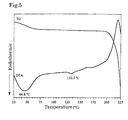
- the results of thermogravimetric analysis and differential thermal analysis (TG/DTA) of the crystals are shown in Fig. 3.
- the solution was added dropwise with water (30 mL) of about 45°C with stirring, and after completion of the addition, stirring was continued for about 2 hours. Then, the water bath was cooled to about 23°C, and the solution was stirred overnight.
- the deposited crystals were collected by filtration and washed with a mixture of acetone and water (30.0 mL) having a water content of 60%.
- the crystals were dried under reduced pressure of 60 mmHg at a temperature of 60°C to obtain 27 g (90%) of white crystals.
- the resulting crystals were subjected to powder X-ray diffraction analysis. As a result, characteristic peaks similar to those of the crystals obtained in Example 1 were observed.
- the solution was added dropwise with water (25 mL) of about 45°C with stirring, and after completion of the addition, stirring was continued for about 2 hours. Then, the water bath was cooled to about 23°C, and the solution was stirred overnight.
- the deposited crystals were collected by filtration and washed with a mixture of acetone and water (25 mL) having a water content of 60%. The crystals were air-dried at room temperature (about 19°C) to obtain 2.3 g (92%) of white crystals.
- the resulting crystals were subjected to powder X-ray diffraction analysis. As a result, characteristic peaks similar to those of the crystals obtained in Example 1 were observed.
- the mixture was then added with water (3 mL) of about 45°C and left stand at room temperature for 1 hour. The solution was further left stand at about 5°C for 22 hours.
- the deposited crystals were collected by filtration and washed with cold acetonitrile : water (1:2, 5 mL ). The crystals were dried under reduced pressure at 40°C for 22 hours to obtain 0.37 g (74%) of white needle-like crystals.
- the resulting crystals were subjected to powder X-ray diffraction analysis. As a result, characteristic peaks similar to those of the crystals obtained in Example 1 were observed.
- Moisture absorption behaviors of the crystals of the present invention ( ⁇ crystals) and an amorphous substance were measured under relative humidity of from 30 to 90%. Each sample of about 20 mg was used and the relative humidity was changed from 30% with 10% pitch by using a microbalance (automatic moisture adsorption apparatus). The measurement temperature was 25°C. An amount of the change was determined when the sample gave the change of 0.03% or less for 30 minutes (maximum retention time: 180 minutes). The results are shown in Fig. 6. The amorphous substance absorbed more moisture under high humidity by about 1% as compared to the crystals of the present invention.
- a crystalline substance consisting of a single kind of crystal of the compound useful as an antitumor agent is provided by the present invention.
- a medicament having constant quality can be stably supplied.
Landscapes
- Chemical & Material Sciences (AREA)
- Organic Chemistry (AREA)
- Health & Medical Sciences (AREA)
- Life Sciences & Earth Sciences (AREA)
- Pharmacology & Pharmacy (AREA)
- Animal Behavior & Ethology (AREA)
- General Health & Medical Sciences (AREA)
- Public Health (AREA)
- Veterinary Medicine (AREA)
- Medicinal Chemistry (AREA)
- Epidemiology (AREA)
- General Chemical & Material Sciences (AREA)
- Chemical Kinetics & Catalysis (AREA)
- Nuclear Medicine, Radiotherapy & Molecular Imaging (AREA)
- Pharmaceuticals Containing Other Organic And Inorganic Compounds (AREA)
- Plural Heterocyclic Compounds (AREA)
- Epoxy Compounds (AREA)
- Heterocyclic Carbon Compounds Containing A Hetero Ring Having Oxygen Or Sulfur (AREA)
- Preparation Of Compounds By Using Micro-Organisms (AREA)
- Pyridine Compounds (AREA)
Abstract
Description

Claims (8)
- A crystal of (1S,2S,3R,4S,5R,8R,9S,10R,13S)-4-acetoxy-2-benzoyloxy-9,10-[(1S)-2-(dimethylamino)ethylidenedioxy]-5,20-epoxy-1-hydroxytax-11-en-13-yl (2R,3S)-3-(tert-butoxycarbonylamino)-3-(3-fluoro-2-pyridyl)-2-hydroxypropionate, which has characteristic peaks at diffraction angles (2 ) of 6.2°, 10.3°, 10.7°, 11.4°, and 12.0° in a powder X-ray diffraction pattern.
- A method for preparing the crystal according to claim 1, which comprises the step of performing crystallization by using an organic solvent selected from the group consisting of a ketone type solvent, a nitrile type solvent, and a mixture thereof, or a mixture of said organic solvent and water.
- The method according to claim 2, wherein the organic solvent selected from the group consisting of a ketone type solvent, a nitrile type solvent, and a mixture thereof is an organic solvent selected from the group consisting of acetone, acetonitrile, and a mixture thereof.
- The method according to claim 2, wherein the crystallization is performed by using a mixture of acetone and water or a mixture of acetonitrile and water.
- The method according to claim 4, wherein the mixture of acetone and water or the mixture of acetonitrile and water has a water content of 40 to 50% by weight.
- The method according to any one of claims 2 to 5, which further comprises the step of drying the crystals obtained by the crystallization at a temperature of from 30 to 60°C.
- An antitumor agent comprising the crystal according to claim 1 as an active ingredient.
- The crystal according to claim 1, which is used for manufacture of a medicament containing (1S,2S,3R,4S,5R,8R,9S,10R,13S)-4-acetoxy-2-benzoyloxy-9,10-[(1S)-2-(dimethylamino)ethylidenedioxy]-5,20-epoxy-1-hydroxytax-11-en-13-yl-(2R,3S)-3-(tert-butoxycarbonylamino)-3-(3-fluoro-2-pyridyl)-2-hydroxypropionate as an active ingredient.
Applications Claiming Priority (3)
| Application Number | Priority Date | Filing Date | Title |
|---|---|---|---|
| JP2001363681 | 2001-11-29 | ||
| JP2001363681 | 2001-11-29 | ||
| PCT/JP2002/012506 WO2003045953A1 (en) | 2001-11-29 | 2002-11-29 | Crystals of taxane derivative and process for their production |
Publications (3)
| Publication Number | Publication Date |
|---|---|
| EP1457492A1 true EP1457492A1 (en) | 2004-09-15 |
| EP1457492A4 EP1457492A4 (en) | 2005-03-23 |
| EP1457492B1 EP1457492B1 (en) | 2008-01-02 |
Family
ID=19173983
Family Applications (1)
| Application Number | Title | Priority Date | Filing Date |
|---|---|---|---|
| EP02785977A Expired - Lifetime EP1457492B1 (en) | 2001-11-29 | 2002-11-29 | Crystals of taxane derivative and process for their production |
Country Status (17)
| Country | Link |
|---|---|
| US (1) | US7410980B2 (en) |
| EP (1) | EP1457492B1 (en) |
| JP (1) | JP4310191B2 (en) |
| KR (1) | KR100886805B1 (en) |
| CN (1) | CN1295229C (en) |
| AT (1) | ATE382624T1 (en) |
| AU (1) | AU2002354126A1 (en) |
| CA (1) | CA2468953C (en) |
| DE (1) | DE60224440T2 (en) |
| DK (1) | DK1457492T3 (en) |
| ES (1) | ES2299612T3 (en) |
| MX (1) | MXPA04005192A (en) |
| NO (1) | NO328559B1 (en) |
| PT (1) | PT1457492E (en) |
| RU (1) | RU2284328C2 (en) |
| TW (1) | TWI333856B (en) |
| WO (1) | WO2003045953A1 (en) |
Families Citing this family (7)
| Publication number | Priority date | Publication date | Assignee | Title |
|---|---|---|---|---|
| FR2859996B1 (en) * | 2003-09-19 | 2006-02-03 | Aventis Pharma Sa | ACETONIC SOLVAT OF DIMETHOXY DOCETAXEL AND PROCESS FOR PREPARING THE SAME |
| JP4800205B2 (en) * | 2004-04-30 | 2011-10-26 | 第一三共株式会社 | Method for producing pentacyclic taxane |
| WO2007005829A2 (en) * | 2005-07-01 | 2007-01-11 | Nec Laboratories America, Inc. | Operating system-based memory compression for embedded systems |
| US8785669B2 (en) | 2010-06-30 | 2014-07-22 | Gfv, Llc | Taxane compounds, compositions and methods |
| US8697892B2 (en) | 2010-06-30 | 2014-04-15 | Gfv, Llc | Taxane compounds, compositions and methods |
| EP2447268A1 (en) | 2010-10-29 | 2012-05-02 | INDENA S.p.A. | Crystalline form of 13-[(N-tert-butoxycarbonyl)-2'-O-hexanoyl-3-phenylisoserinyl]-10-deacetylbaccatin III |
| JP5909089B2 (en) * | 2011-02-01 | 2016-04-26 | アークレイ株式会社 | Optical crystal, terahertz wave generating apparatus and method |
Family Cites Families (8)
| Publication number | Priority date | Publication date | Assignee | Title |
|---|---|---|---|---|
| IT1254515B (en) * | 1992-03-06 | 1995-09-25 | Indena Spa | TASSANI OF ONCOLOGICAL INTEREST, THEIR METHOD OF PREPARATION AND USE |
| US5475011A (en) * | 1993-03-26 | 1995-12-12 | The Research Foundation Of State University Of New York | Anti-tumor compounds, pharmaceutical compositions, methods for preparation thereof and for treatment |
| US6075140A (en) * | 1995-04-28 | 2000-06-13 | Daiichi Pharmaceutical Co., Ltd. | Pentacyclic compound |
| JP2000159757A (en) | 1998-12-01 | 2000-06-13 | Dai Ichi Seiyaku Co Ltd | Method for producing 7-deoxytaxol derivative |
| ATE256117T1 (en) * | 1999-05-17 | 2003-12-15 | Bristol Myers Squibb Co | NEW IMPLEMENTATION CONDITIONS FOR THE CLEAVAGE OF SILYL ETHERS IN THE PRODUCTION OF PACLITAXEL (TAXOL(R)) AND PACLITAXEL ANALOGUES |
| US6677456B2 (en) * | 1999-10-15 | 2004-01-13 | Daiichi Pharmaceutical Co., Ltd. | Pentacyclic taxan compound |
| RU2257387C2 (en) * | 1999-10-15 | 2005-07-27 | Дайити Фармасьютикал Ко., Лтд. | Taxane pentacyclic compound and antitumor agents based on thereof |
| US7126003B2 (en) | 2001-03-07 | 2006-10-24 | Daiichi Pharmaceutical Co., Ltd. | Method for producing 2-azetidinone derivative |
-
2002
- 2002-11-29 AT AT02785977T patent/ATE382624T1/en active
- 2002-11-29 AU AU2002354126A patent/AU2002354126A1/en not_active Abandoned
- 2002-11-29 RU RU2004119547/04A patent/RU2284328C2/en active IP Right Revival
- 2002-11-29 DE DE60224440T patent/DE60224440T2/en not_active Expired - Lifetime
- 2002-11-29 PT PT02785977T patent/PT1457492E/en unknown
- 2002-11-29 DK DK02785977T patent/DK1457492T3/en active
- 2002-11-29 US US10/495,437 patent/US7410980B2/en not_active Expired - Lifetime
- 2002-11-29 EP EP02785977A patent/EP1457492B1/en not_active Expired - Lifetime
- 2002-11-29 MX MXPA04005192A patent/MXPA04005192A/en active IP Right Grant
- 2002-11-29 CA CA2468953A patent/CA2468953C/en not_active Expired - Lifetime
- 2002-11-29 CN CNB02823815XA patent/CN1295229C/en not_active Expired - Fee Related
- 2002-11-29 JP JP2003547403A patent/JP4310191B2/en not_active Expired - Fee Related
- 2002-11-29 WO PCT/JP2002/012506 patent/WO2003045953A1/en not_active Ceased
- 2002-11-29 TW TW091134817A patent/TWI333856B/en not_active IP Right Cessation
- 2002-11-29 ES ES02785977T patent/ES2299612T3/en not_active Expired - Lifetime
- 2002-11-29 KR KR1020047008200A patent/KR100886805B1/en not_active Expired - Fee Related
-
2004
- 2004-06-28 NO NO20042723A patent/NO328559B1/en not_active IP Right Cessation
Also Published As
| Publication number | Publication date |
|---|---|
| EP1457492A4 (en) | 2005-03-23 |
| RU2284328C2 (en) | 2006-09-27 |
| CA2468953A1 (en) | 2003-06-05 |
| NO20042723L (en) | 2004-06-28 |
| DE60224440T2 (en) | 2009-01-02 |
| CN1295229C (en) | 2007-01-17 |
| MXPA04005192A (en) | 2005-02-22 |
| CA2468953C (en) | 2010-05-11 |
| DE60224440D1 (en) | 2008-02-14 |
| TW200301114A (en) | 2003-07-01 |
| KR20040081426A (en) | 2004-09-21 |
| JP4310191B2 (en) | 2009-08-05 |
| PT1457492E (en) | 2008-02-28 |
| TWI333856B (en) | 2010-12-01 |
| US7410980B2 (en) | 2008-08-12 |
| EP1457492B1 (en) | 2008-01-02 |
| DK1457492T3 (en) | 2008-05-13 |
| HK1065547A1 (en) | 2005-02-25 |
| WO2003045953A1 (en) | 2003-06-05 |
| NO328559B1 (en) | 2010-03-22 |
| AU2002354126A1 (en) | 2003-06-10 |
| ES2299612T3 (en) | 2008-06-01 |
| RU2004119547A (en) | 2005-03-27 |
| CN1596259A (en) | 2005-03-16 |
| US20050070579A1 (en) | 2005-03-31 |
| KR100886805B1 (en) | 2009-03-05 |
| ATE382624T1 (en) | 2008-01-15 |
| JPWO2003045953A1 (en) | 2005-04-07 |
Similar Documents
| Publication | Publication Date | Title |
|---|---|---|
| US6355269B1 (en) | Oral compositions of levosimendan | |
| EP3594214A1 (en) | Polymorph of compound, preparation method therefor and use thereof | |
| EP0579681B1 (en) | Crystalline tiagabine hydrochloride monohydrate, its preparation and use | |
| JP2003522166A (en) | Compound having antitumor activity: method for producing the same and pharmaceutical composition containing the same | |
| US7410980B2 (en) | Crystals of taxane derivative and process for their production | |
| CN104341434A (en) | Substituted rapamycin triazole derivative and application | |
| JP3093419B2 (en) | 1,4-benzothiazepine derivatives | |
| JPS6126996B2 (en) | ||
| JP3776799B2 (en) | Pentacyclic taxane compound | |
| HK1065547B (en) | Crystals of taxane derivative and process for their production | |
| CN114502550B (en) | Tegafur co-crystal | |
| JPH0211592A (en) | Optically active dihydropyridinephosphonic ester | |
| CN116120327B (en) | 13,14-symmetrical disubstituted derivatives of β-elemene and preparation method and application thereof | |
| JPH0366690A (en) | Asymmetric synthesis of derivative of flo(3,4-c) pyridine | |
| CN121735942A (en) | Crystal forms of HIF-117 salt, preparation method and application thereof | |
| KR20080006012A (en) | (2E, 4S) -4-[(N-{[(2R) -1-isopropylpiperidin-2-yl] -carbonyl} -3-methyl-L-valyl) (methyl) amino] -2 Unsolvated and host-guest solvated crystalline forms of, 5-dimethylhex-2-enoic acid, and pharmaceutical uses thereof | |
| CS209950B2 (en) | Method of making the new 4- amino-6,7-dialcoxy-2-piperazinochinazoline derivatives |
Legal Events
| Date | Code | Title | Description |
|---|---|---|---|
| PUAI | Public reference made under article 153(3) epc to a published international application that has entered the european phase |
Free format text: ORIGINAL CODE: 0009012 |
|
| 17P | Request for examination filed |
Effective date: 20040605 |
|
| AK | Designated contracting states |
Kind code of ref document: A1 Designated state(s): AT BE BG CH CY CZ DE DK EE ES FI FR GB GR IE IT LI LU MC NL PT SE SK TR |
|
| AX | Request for extension of the european patent |
Extension state: AL LT LV MK RO SI |
|
| REG | Reference to a national code |
Ref country code: HK Ref legal event code: DE Ref document number: 1065547 Country of ref document: HK |
|
| A4 | Supplementary search report drawn up and despatched |
Effective date: 20050203 |
|
| RIC1 | Information provided on ipc code assigned before grant |
Ipc: 7C 07D 493/08 B Ipc: 7A 61K 31/443 B Ipc: 7A 61P 35/00 B Ipc: 7C 07D 493/04 A |
|
| GRAP | Despatch of communication of intention to grant a patent |
Free format text: ORIGINAL CODE: EPIDOSNIGR1 |
|
| GRAS | Grant fee paid |
Free format text: ORIGINAL CODE: EPIDOSNIGR3 |
|
| GRAL | Information related to payment of fee for publishing/printing deleted |
Free format text: ORIGINAL CODE: EPIDOSDIGR3 |
|
| RAP1 | Party data changed (applicant data changed or rights of an application transferred) |
Owner name: DAIICHI SANKYO COMPANY, LIMITED |
|
| GRAS | Grant fee paid |
Free format text: ORIGINAL CODE: EPIDOSNIGR3 |
|
| GRAA | (expected) grant |
Free format text: ORIGINAL CODE: 0009210 |
|
| AK | Designated contracting states |
Kind code of ref document: B1 Designated state(s): AT BE BG CH CY CZ DE DK EE ES FI FR GB GR IE IT LI LU MC NL PT SE SK TR |
|
| REG | Reference to a national code |
Ref country code: GB Ref legal event code: FG4D |
|
| REG | Reference to a national code |
Ref country code: IE Ref legal event code: FG4D |
|
| REG | Reference to a national code |
Ref country code: CH Ref legal event code: NV Representative=s name: ISLER & PEDRAZZINI AG Ref country code: CH Ref legal event code: EP |
|
| REF | Corresponds to: |
Ref document number: 60224440 Country of ref document: DE Date of ref document: 20080214 Kind code of ref document: P |
|
| REG | Reference to a national code |
Ref country code: PT Ref legal event code: SC4A Free format text: AVAILABILITY OF NATIONAL TRANSLATION Effective date: 20080218 |
|
| REG | Reference to a national code |
Ref country code: GR Ref legal event code: EP Ref document number: 20080400408 Country of ref document: GR |
|
| REG | Reference to a national code |
Ref country code: SE Ref legal event code: TRGR |
|
| REG | Reference to a national code |
Ref country code: DK Ref legal event code: T3 |
|
| REG | Reference to a national code |
Ref country code: ES Ref legal event code: FG2A Ref document number: 2299612 Country of ref document: ES Kind code of ref document: T3 |
|
| REG | Reference to a national code |
Ref country code: HK Ref legal event code: GR Ref document number: 1065547 Country of ref document: HK |
|
| PG25 | Lapsed in a contracting state [announced via postgrant information from national office to epo] |
Ref country code: BG Free format text: LAPSE BECAUSE OF FAILURE TO SUBMIT A TRANSLATION OF THE DESCRIPTION OR TO PAY THE FEE WITHIN THE PRESCRIBED TIME-LIMIT Effective date: 20080402 |
|
| ET | Fr: translation filed | ||
| PG25 | Lapsed in a contracting state [announced via postgrant information from national office to epo] |
Ref country code: SK Free format text: LAPSE BECAUSE OF FAILURE TO SUBMIT A TRANSLATION OF THE DESCRIPTION OR TO PAY THE FEE WITHIN THE PRESCRIBED TIME-LIMIT Effective date: 20080102 Ref country code: CZ Free format text: LAPSE BECAUSE OF FAILURE TO SUBMIT A TRANSLATION OF THE DESCRIPTION OR TO PAY THE FEE WITHIN THE PRESCRIBED TIME-LIMIT Effective date: 20080102 |
|
| PLBE | No opposition filed within time limit |
Free format text: ORIGINAL CODE: 0009261 |
|
| STAA | Information on the status of an ep patent application or granted ep patent |
Free format text: STATUS: NO OPPOSITION FILED WITHIN TIME LIMIT |
|
| 26N | No opposition filed |
Effective date: 20081003 |
|
| PG25 | Lapsed in a contracting state [announced via postgrant information from national office to epo] |
Ref country code: EE Free format text: LAPSE BECAUSE OF FAILURE TO SUBMIT A TRANSLATION OF THE DESCRIPTION OR TO PAY THE FEE WITHIN THE PRESCRIBED TIME-LIMIT Effective date: 20080102 |
|
| PG25 | Lapsed in a contracting state [announced via postgrant information from national office to epo] |
Ref country code: MC Free format text: LAPSE BECAUSE OF NON-PAYMENT OF DUE FEES Effective date: 20081130 |
|
| PG25 | Lapsed in a contracting state [announced via postgrant information from national office to epo] |
Ref country code: CY Free format text: LAPSE BECAUSE OF FAILURE TO SUBMIT A TRANSLATION OF THE DESCRIPTION OR TO PAY THE FEE WITHIN THE PRESCRIBED TIME-LIMIT Effective date: 20080102 |
|
| PG25 | Lapsed in a contracting state [announced via postgrant information from national office to epo] |
Ref country code: TR Free format text: LAPSE BECAUSE OF FAILURE TO SUBMIT A TRANSLATION OF THE DESCRIPTION OR TO PAY THE FEE WITHIN THE PRESCRIBED TIME-LIMIT Effective date: 20080102 |
|
| REG | Reference to a national code |
Ref country code: DE Ref legal event code: R082 Ref document number: 60224440 Country of ref document: DE Representative=s name: GODEMEYER BLUM LENZE PARTNERSCHAFT, PATENTANWA, DE Ref country code: DE Ref legal event code: R082 Ref document number: 60224440 Country of ref document: DE Representative=s name: GODEMEYER BLUM LENZE PATENTANWAELTE, PARTNERSC, DE |
|
| REG | Reference to a national code |
Ref country code: FR Ref legal event code: PLFP Year of fee payment: 14 |
|
| REG | Reference to a national code |
Ref country code: FR Ref legal event code: PLFP Year of fee payment: 15 |
|
| REG | Reference to a national code |
Ref country code: FR Ref legal event code: PLFP Year of fee payment: 16 |
|
| REG | Reference to a national code |
Ref country code: FR Ref legal event code: PLFP Year of fee payment: 17 |
|
| PGFP | Annual fee paid to national office [announced via postgrant information from national office to epo] |
Ref country code: LU Payment date: 20211110 Year of fee payment: 20 Ref country code: NL Payment date: 20211014 Year of fee payment: 20 |
|
| PGFP | Annual fee paid to national office [announced via postgrant information from national office to epo] |
Ref country code: SE Payment date: 20211110 Year of fee payment: 20 Ref country code: PT Payment date: 20211129 Year of fee payment: 20 Ref country code: DE Payment date: 20211005 Year of fee payment: 20 Ref country code: AT Payment date: 20211025 Year of fee payment: 20 Ref country code: FR Payment date: 20211109 Year of fee payment: 20 Ref country code: FI Payment date: 20211109 Year of fee payment: 20 Ref country code: DK Payment date: 20211109 Year of fee payment: 20 Ref country code: ES Payment date: 20211207 Year of fee payment: 20 Ref country code: IE Payment date: 20211109 Year of fee payment: 20 Ref country code: GB Payment date: 20211007 Year of fee payment: 20 |
|
| PGFP | Annual fee paid to national office [announced via postgrant information from national office to epo] |
Ref country code: IT Payment date: 20211012 Year of fee payment: 20 Ref country code: GR Payment date: 20211014 Year of fee payment: 20 Ref country code: CH Payment date: 20211116 Year of fee payment: 20 Ref country code: BE Payment date: 20211018 Year of fee payment: 20 |
|
| REG | Reference to a national code |
Ref country code: DE Ref legal event code: R071 Ref document number: 60224440 Country of ref document: DE |
|
| REG | Reference to a national code |
Ref country code: CH Ref legal event code: PL Ref country code: NL Ref legal event code: MK Effective date: 20221128 |
|
| REG | Reference to a national code |
Ref country code: DK Ref legal event code: EUP Expiry date: 20221129 |
|
| REG | Reference to a national code |
Ref country code: BE Ref legal event code: MK Effective date: 20221129 |
|
| REG | Reference to a national code |
Ref country code: GB Ref legal event code: PE20 Expiry date: 20221128 |
|
| REG | Reference to a national code |
Ref country code: SE Ref legal event code: EUG |
|
| REG | Reference to a national code |
Ref country code: IE Ref legal event code: MK9A |
|
| REG | Reference to a national code |
Ref country code: AT Ref legal event code: MK07 Ref document number: 382624 Country of ref document: AT Kind code of ref document: T Effective date: 20221129 |
|
| PG25 | Lapsed in a contracting state [announced via postgrant information from national office to epo] |
Ref country code: PT Free format text: LAPSE BECAUSE OF EXPIRATION OF PROTECTION Effective date: 20221212 Ref country code: IE Free format text: LAPSE BECAUSE OF EXPIRATION OF PROTECTION Effective date: 20221129 Ref country code: GB Free format text: LAPSE BECAUSE OF EXPIRATION OF PROTECTION Effective date: 20221128 |
|
| REG | Reference to a national code |
Ref country code: ES Ref legal event code: FD2A Effective date: 20230426 |
|
| PG25 | Lapsed in a contracting state [announced via postgrant information from national office to epo] |
Ref country code: ES Free format text: LAPSE BECAUSE OF EXPIRATION OF PROTECTION Effective date: 20221130 |