EP1456272B1 - Extrudable highly crystalline thermoplastic polyurethanes - Google Patents
Extrudable highly crystalline thermoplastic polyurethanes Download PDFInfo
- Publication number
- EP1456272B1 EP1456272B1 EP02780674A EP02780674A EP1456272B1 EP 1456272 B1 EP1456272 B1 EP 1456272B1 EP 02780674 A EP02780674 A EP 02780674A EP 02780674 A EP02780674 A EP 02780674A EP 1456272 B1 EP1456272 B1 EP 1456272B1
- Authority
- EP
- European Patent Office
- Prior art keywords
- component
- composition
- crystallization
- equivalents
- total
- Prior art date
- Legal status (The legal status is an assumption and is not a legal conclusion. Google has not performed a legal analysis and makes no representation as to the accuracy of the status listed.)
- Expired - Lifetime
Links
- 229920002803 thermoplastic polyurethane Polymers 0.000 title claims abstract description 53
- 239000004433 Thermoplastic polyurethane Substances 0.000 title claims abstract description 50
- 239000000203 mixture Substances 0.000 claims abstract description 94
- 238000002425 crystallisation Methods 0.000 claims abstract description 82
- 230000008025 crystallization Effects 0.000 claims abstract description 82
- 230000000979 retarding effect Effects 0.000 claims abstract description 59
- 125000005842 heteroatom Chemical group 0.000 claims abstract description 6
- 229920005862 polyol Polymers 0.000 claims description 60
- 125000002887 hydroxy group Chemical group [H]O* 0.000 claims description 58
- 150000003077 polyols Chemical class 0.000 claims description 51
- SZXQTJUDPRGNJN-UHFFFAOYSA-N dipropylene glycol Chemical compound OCCCOCCCO SZXQTJUDPRGNJN-UHFFFAOYSA-N 0.000 claims description 44
- 239000004970 Chain extender Substances 0.000 claims description 41
- 229920002635 polyurethane Polymers 0.000 claims description 33
- 239000004814 polyurethane Substances 0.000 claims description 33
- UPMLOUAZCHDJJD-UHFFFAOYSA-N 4,4'-Diphenylmethane Diisocyanate Chemical compound C1=CC(N=C=O)=CC=C1CC1=CC=C(N=C=O)C=C1 UPMLOUAZCHDJJD-UHFFFAOYSA-N 0.000 claims description 27
- -1 alkane diol Chemical class 0.000 claims description 27
- LYCAIKOWRPUZTN-UHFFFAOYSA-N Ethylene glycol Chemical compound OCCO LYCAIKOWRPUZTN-UHFFFAOYSA-N 0.000 claims description 25
- 239000003054 catalyst Substances 0.000 claims description 22
- WERYXYBDKMZEQL-UHFFFAOYSA-N butane-1,4-diol Chemical group OCCCCO WERYXYBDKMZEQL-UHFFFAOYSA-N 0.000 claims description 18
- 238000000034 method Methods 0.000 claims description 15
- 229920000570 polyether Polymers 0.000 claims description 15
- 229920000728 polyester Polymers 0.000 claims description 14
- KSBAEPSJVUENNK-UHFFFAOYSA-L tin(ii) 2-ethylhexanoate Chemical compound [Sn+2].CCCCC(CC)C([O-])=O.CCCCC(CC)C([O-])=O KSBAEPSJVUENNK-UHFFFAOYSA-L 0.000 claims description 11
- 125000004432 carbon atom Chemical group C* 0.000 claims description 10
- 239000004417 polycarbonate Substances 0.000 claims description 8
- 229920000515 polycarbonate Polymers 0.000 claims description 8
- SVTBMSDMJJWYQN-UHFFFAOYSA-N 2-methylpentane-2,4-diol Chemical compound CC(O)CC(C)(C)O SVTBMSDMJJWYQN-UHFFFAOYSA-N 0.000 claims description 6
- 239000007795 chemical reaction product Substances 0.000 claims description 6
- XXMIOPMDWAUFGU-UHFFFAOYSA-N hexane-1,6-diol Chemical compound OCCCCCCO XXMIOPMDWAUFGU-UHFFFAOYSA-N 0.000 claims description 6
- DNIAPMSPPWPWGF-VKHMYHEASA-N (+)-propylene glycol Chemical compound C[C@H](O)CO DNIAPMSPPWPWGF-VKHMYHEASA-N 0.000 claims description 5
- YPFDHNVEDLHUCE-UHFFFAOYSA-N 1,3-propanediol Substances OCCCO YPFDHNVEDLHUCE-UHFFFAOYSA-N 0.000 claims description 5
- ALQSHHUCVQOPAS-UHFFFAOYSA-N Pentane-1,5-diol Chemical compound OCCCCCO ALQSHHUCVQOPAS-UHFFFAOYSA-N 0.000 claims description 5
- 239000000835 fiber Substances 0.000 claims description 5
- SLCVBVWXLSEKPL-UHFFFAOYSA-N neopentyl glycol Chemical compound OCC(C)(C)CO SLCVBVWXLSEKPL-UHFFFAOYSA-N 0.000 claims description 5
- 229920000098 polyolefin Polymers 0.000 claims description 5
- 229920000166 polytrimethylene carbonate Polymers 0.000 claims description 5
- 125000005442 diisocyanate group Chemical group 0.000 claims description 4
- 125000000524 functional group Chemical group 0.000 claims description 4
- 239000012528 membrane Substances 0.000 claims description 4
- NBJODVYWAQLZOC-UHFFFAOYSA-L [dibutyl(octanoyloxy)stannyl] octanoate Chemical compound CCCCCCCC(=O)O[Sn](CCCC)(CCCC)OC(=O)CCCCCCC NBJODVYWAQLZOC-UHFFFAOYSA-L 0.000 claims description 3
- 229910052797 bismuth Inorganic materials 0.000 claims description 3
- AYOHIQLKSOJJQH-UHFFFAOYSA-N dibutyltin Chemical compound CCCC[Sn]CCCC AYOHIQLKSOJJQH-UHFFFAOYSA-N 0.000 claims description 3
- 238000004519 manufacturing process Methods 0.000 claims description 3
- 229920000058 polyacrylate Polymers 0.000 claims description 2
- 229920002292 Nylon 6 Polymers 0.000 claims 1
- 238000001125 extrusion Methods 0.000 abstract description 20
- 150000002009 diols Chemical class 0.000 abstract description 7
- 230000001934 delay Effects 0.000 abstract description 2
- 239000005056 polyisocyanate Substances 0.000 description 25
- 229920001228 polyisocyanate Polymers 0.000 description 25
- 238000009472 formulation Methods 0.000 description 20
- CDQSJQSWAWPGKG-UHFFFAOYSA-N butane-1,1-diol Chemical compound CCCC(O)O CDQSJQSWAWPGKG-UHFFFAOYSA-N 0.000 description 17
- BGYHLZZASRKEJE-UHFFFAOYSA-N [3-[3-(3,5-ditert-butyl-4-hydroxyphenyl)propanoyloxy]-2,2-bis[3-(3,5-ditert-butyl-4-hydroxyphenyl)propanoyloxymethyl]propyl] 3-(3,5-ditert-butyl-4-hydroxyphenyl)propanoate Chemical compound CC(C)(C)C1=C(O)C(C(C)(C)C)=CC(CCC(=O)OCC(COC(=O)CCC=2C=C(C(O)=C(C=2)C(C)(C)C)C(C)(C)C)(COC(=O)CCC=2C=C(C(O)=C(C=2)C(C)(C)C)C(C)(C)C)COC(=O)CCC=2C=C(C(O)=C(C=2)C(C)(C)C)C(C)(C)C)=C1 BGYHLZZASRKEJE-UHFFFAOYSA-N 0.000 description 16
- 239000000047 product Substances 0.000 description 15
- 239000000654 additive Substances 0.000 description 13
- WYURNTSHIVDZCO-UHFFFAOYSA-N Tetrahydrofuran Chemical compound C1CCOC1 WYURNTSHIVDZCO-UHFFFAOYSA-N 0.000 description 12
- 229920000909 polytetrahydrofuran Polymers 0.000 description 11
- 239000004721 Polyphenylene oxide Substances 0.000 description 8
- 150000001991 dicarboxylic acids Chemical class 0.000 description 8
- 150000002148 esters Chemical class 0.000 description 8
- DNIAPMSPPWPWGF-UHFFFAOYSA-N monopropylene glycol Natural products CC(O)CO DNIAPMSPPWPWGF-UHFFFAOYSA-N 0.000 description 8
- 230000015572 biosynthetic process Effects 0.000 description 7
- 150000002334 glycols Chemical class 0.000 description 7
- 239000012948 isocyanate Substances 0.000 description 7
- 239000000155 melt Substances 0.000 description 7
- RTZKZFJDLAIYFH-UHFFFAOYSA-N Diethyl ether Chemical compound CCOCC RTZKZFJDLAIYFH-UHFFFAOYSA-N 0.000 description 6
- GOOHAUXETOMSMM-UHFFFAOYSA-N Propylene oxide Chemical compound CC1CO1 GOOHAUXETOMSMM-UHFFFAOYSA-N 0.000 description 6
- MTHSVFCYNBDYFN-UHFFFAOYSA-N diethylene glycol Chemical compound OCCOCCO MTHSVFCYNBDYFN-UHFFFAOYSA-N 0.000 description 6
- 150000002513 isocyanates Chemical class 0.000 description 6
- 229920000642 polymer Polymers 0.000 description 6
- YLQBMQCUIZJEEH-UHFFFAOYSA-N tetrahydrofuran Natural products C=1C=COC=1 YLQBMQCUIZJEEH-UHFFFAOYSA-N 0.000 description 6
- 229920001610 polycaprolactone Polymers 0.000 description 5
- 239000007787 solid Substances 0.000 description 5
- PUPZLCDOIYMWBV-UHFFFAOYSA-N (+/-)-1,3-Butanediol Chemical compound CC(O)CCO PUPZLCDOIYMWBV-UHFFFAOYSA-N 0.000 description 4
- 229940035437 1,3-propanediol Drugs 0.000 description 4
- 229940043375 1,5-pentanediol Drugs 0.000 description 4
- IAYPIBMASNFSPL-UHFFFAOYSA-N Ethylene oxide Chemical compound C1CO1 IAYPIBMASNFSPL-UHFFFAOYSA-N 0.000 description 4
- 239000002253 acid Substances 0.000 description 4
- 125000003118 aryl group Chemical group 0.000 description 4
- 238000006243 chemical reaction Methods 0.000 description 4
- 230000000052 comparative effect Effects 0.000 description 4
- WGCNASOHLSPBMP-UHFFFAOYSA-N hydroxyacetaldehyde Natural products OCC=O WGCNASOHLSPBMP-UHFFFAOYSA-N 0.000 description 4
- 239000000543 intermediate Substances 0.000 description 4
- 235000013772 propylene glycol Nutrition 0.000 description 4
- 239000000126 substance Substances 0.000 description 4
- OKTJSMMVPCPJKN-UHFFFAOYSA-N Carbon Chemical compound [C] OKTJSMMVPCPJKN-UHFFFAOYSA-N 0.000 description 3
- SJRJJKPEHAURKC-UHFFFAOYSA-N N-Methylmorpholine Chemical compound CN1CCOCC1 SJRJJKPEHAURKC-UHFFFAOYSA-N 0.000 description 3
- KWYUFKZDYYNOTN-UHFFFAOYSA-M Potassium hydroxide Chemical compound [OH-].[K+] KWYUFKZDYYNOTN-UHFFFAOYSA-M 0.000 description 3
- VYPSYNLAJGMNEJ-UHFFFAOYSA-N Silicium dioxide Chemical compound O=[Si]=O VYPSYNLAJGMNEJ-UHFFFAOYSA-N 0.000 description 3
- ZMANZCXQSJIPKH-UHFFFAOYSA-N Triethylamine Chemical compound CCN(CC)CC ZMANZCXQSJIPKH-UHFFFAOYSA-N 0.000 description 3
- 125000001931 aliphatic group Chemical group 0.000 description 3
- 125000002947 alkylene group Chemical group 0.000 description 3
- 150000008064 anhydrides Chemical class 0.000 description 3
- 239000000975 dye Substances 0.000 description 3
- 239000012467 final product Substances 0.000 description 3
- 239000000463 material Substances 0.000 description 3
- 239000000049 pigment Substances 0.000 description 3
- DVKJHBMWWAPEIU-UHFFFAOYSA-N toluene 2,4-diisocyanate Chemical compound CC1=CC=C(N=C=O)C=C1N=C=O DVKJHBMWWAPEIU-UHFFFAOYSA-N 0.000 description 3
- 239000001993 wax Substances 0.000 description 3
- DNIAPMSPPWPWGF-GSVOUGTGSA-N (R)-(-)-Propylene glycol Chemical compound C[C@@H](O)CO DNIAPMSPPWPWGF-GSVOUGTGSA-N 0.000 description 2
- RTTZISZSHSCFRH-UHFFFAOYSA-N 1,3-bis(isocyanatomethyl)benzene Chemical compound O=C=NCC1=CC=CC(CN=C=O)=C1 RTTZISZSHSCFRH-UHFFFAOYSA-N 0.000 description 2
- 239000005059 1,4-Cyclohexyldiisocyanate Substances 0.000 description 2
- SBJCUZQNHOLYMD-UHFFFAOYSA-N 1,5-Naphthalene diisocyanate Chemical compound C1=CC=C2C(N=C=O)=CC=CC2=C1N=C=O SBJCUZQNHOLYMD-UHFFFAOYSA-N 0.000 description 2
- KAKZBPTYRLMSJV-UHFFFAOYSA-N Butadiene Chemical compound C=CC=C KAKZBPTYRLMSJV-UHFFFAOYSA-N 0.000 description 2
- VTYYLEPIZMXCLO-UHFFFAOYSA-L Calcium carbonate Chemical compound [Ca+2].[O-]C([O-])=O VTYYLEPIZMXCLO-UHFFFAOYSA-L 0.000 description 2
- RPNUMPOLZDHAAY-UHFFFAOYSA-N Diethylenetriamine Chemical compound NCCNCCN RPNUMPOLZDHAAY-UHFFFAOYSA-N 0.000 description 2
- PIICEJLVQHRZGT-UHFFFAOYSA-N Ethylenediamine Chemical compound NCCN PIICEJLVQHRZGT-UHFFFAOYSA-N 0.000 description 2
- UFHFLCQGNIYNRP-UHFFFAOYSA-N Hydrogen Chemical compound [H][H] UFHFLCQGNIYNRP-UHFFFAOYSA-N 0.000 description 2
- XEEYBQQBJWHFJM-UHFFFAOYSA-N Iron Chemical compound [Fe] XEEYBQQBJWHFJM-UHFFFAOYSA-N 0.000 description 2
- UQSXHKLRYXJYBZ-UHFFFAOYSA-N Iron oxide Chemical compound [Fe]=O UQSXHKLRYXJYBZ-UHFFFAOYSA-N 0.000 description 2
- 239000005058 Isophorone diisocyanate Substances 0.000 description 2
- OFOBLEOULBTSOW-UHFFFAOYSA-N Malonic acid Chemical compound OC(=O)CC(O)=O OFOBLEOULBTSOW-UHFFFAOYSA-N 0.000 description 2
- KWYHDKDOAIKMQN-UHFFFAOYSA-N N,N,N',N'-tetramethylethylenediamine Chemical compound CN(C)CCN(C)C KWYHDKDOAIKMQN-UHFFFAOYSA-N 0.000 description 2
- PXHVJJICTQNCMI-UHFFFAOYSA-N Nickel Chemical compound [Ni] PXHVJJICTQNCMI-UHFFFAOYSA-N 0.000 description 2
- 239000004952 Polyamide Substances 0.000 description 2
- GWEVSGVZZGPLCZ-UHFFFAOYSA-N Titan oxide Chemical compound O=[Ti]=O GWEVSGVZZGPLCZ-UHFFFAOYSA-N 0.000 description 2
- HCHKCACWOHOZIP-UHFFFAOYSA-N Zinc Chemical compound [Zn] HCHKCACWOHOZIP-UHFFFAOYSA-N 0.000 description 2
- YIMQCDZDWXUDCA-UHFFFAOYSA-N [4-(hydroxymethyl)cyclohexyl]methanol Chemical compound OCC1CCC(CO)CC1 YIMQCDZDWXUDCA-UHFFFAOYSA-N 0.000 description 2
- WNLRTRBMVRJNCN-UHFFFAOYSA-N adipic acid Chemical compound OC(=O)CCCCC(O)=O WNLRTRBMVRJNCN-UHFFFAOYSA-N 0.000 description 2
- 229910052782 aluminium Inorganic materials 0.000 description 2
- XAGFODPZIPBFFR-UHFFFAOYSA-N aluminium Chemical compound [Al] XAGFODPZIPBFFR-UHFFFAOYSA-N 0.000 description 2
- 150000001412 amines Chemical class 0.000 description 2
- 238000003556 assay Methods 0.000 description 2
- 229910052799 carbon Inorganic materials 0.000 description 2
- 239000013078 crystal Substances 0.000 description 2
- KQWGXHWJMSMDJJ-UHFFFAOYSA-N cyclohexyl isocyanate Chemical compound O=C=NC1CCCCC1 KQWGXHWJMSMDJJ-UHFFFAOYSA-N 0.000 description 2
- FOTKYAAJKYLFFN-UHFFFAOYSA-N decane-1,10-diol Chemical compound OCCCCCCCCCCO FOTKYAAJKYLFFN-UHFFFAOYSA-N 0.000 description 2
- 230000003111 delayed effect Effects 0.000 description 2
- GHLKSLMMWAKNBM-UHFFFAOYSA-N dodecane-1,12-diol Chemical compound OCCCCCCCCCCCCO GHLKSLMMWAKNBM-UHFFFAOYSA-N 0.000 description 2
- 230000000694 effects Effects 0.000 description 2
- 239000000945 filler Substances 0.000 description 2
- 239000011521 glass Substances 0.000 description 2
- RRAMGCGOFNQTLD-UHFFFAOYSA-N hexamethylene diisocyanate Chemical compound O=C=NCCCCCCN=C=O RRAMGCGOFNQTLD-UHFFFAOYSA-N 0.000 description 2
- 229910052739 hydrogen Inorganic materials 0.000 description 2
- 239000001257 hydrogen Substances 0.000 description 2
- NIMLQBUJDJZYEJ-UHFFFAOYSA-N isophorone diisocyanate Chemical compound CC1(C)CC(N=C=O)CC(C)(CN=C=O)C1 NIMLQBUJDJZYEJ-UHFFFAOYSA-N 0.000 description 2
- 239000011572 manganese Substances 0.000 description 2
- 238000005259 measurement Methods 0.000 description 2
- 229920002647 polyamide Polymers 0.000 description 2
- 238000002360 preparation method Methods 0.000 description 2
- 239000000376 reactant Substances 0.000 description 2
- 238000006467 substitution reaction Methods 0.000 description 2
- 238000005809 transesterification reaction Methods 0.000 description 2
- 229910052725 zinc Inorganic materials 0.000 description 2
- 239000011701 zinc Substances 0.000 description 2
- PAPBSGBWRJIAAV-UHFFFAOYSA-N ε-Caprolactone Chemical compound O=C1CCCCCO1 PAPBSGBWRJIAAV-UHFFFAOYSA-N 0.000 description 2
- KMOUUZVZFBCRAM-OLQVQODUSA-N (3as,7ar)-3a,4,7,7a-tetrahydro-2-benzofuran-1,3-dione Chemical compound C1C=CC[C@@H]2C(=O)OC(=O)[C@@H]21 KMOUUZVZFBCRAM-OLQVQODUSA-N 0.000 description 1
- KYVBNYUBXIEUFW-UHFFFAOYSA-N 1,1,3,3-tetramethylguanidine Chemical compound CN(C)C(=N)N(C)C KYVBNYUBXIEUFW-UHFFFAOYSA-N 0.000 description 1
- ALQLPWJFHRMHIU-UHFFFAOYSA-N 1,4-diisocyanatobenzene Chemical compound O=C=NC1=CC=C(N=C=O)C=C1 ALQLPWJFHRMHIU-UHFFFAOYSA-N 0.000 description 1
- AXFVIWBTKYFOCY-UHFFFAOYSA-N 1-n,1-n,3-n,3-n-tetramethylbutane-1,3-diamine Chemical compound CN(C)C(C)CCN(C)C AXFVIWBTKYFOCY-UHFFFAOYSA-N 0.000 description 1
- KGRVJHAUYBGFFP-UHFFFAOYSA-N 2,2'-Methylenebis(4-methyl-6-tert-butylphenol) Chemical compound CC(C)(C)C1=CC(C)=CC(CC=2C(=C(C=C(C)C=2)C(C)(C)C)O)=C1O KGRVJHAUYBGFFP-UHFFFAOYSA-N 0.000 description 1
- BFSVOASYOCHEOV-UHFFFAOYSA-N 2-diethylaminoethanol Chemical compound CCN(CC)CCO BFSVOASYOCHEOV-UHFFFAOYSA-N 0.000 description 1
- ZSLUVFAKFWKJRC-IGMARMGPSA-N 232Th Chemical compound [232Th] ZSLUVFAKFWKJRC-IGMARMGPSA-N 0.000 description 1
- JRQLZCFSWYQHPI-UHFFFAOYSA-N 4,5-dichloro-2-cyclohexyl-1,2-thiazol-3-one Chemical compound O=C1C(Cl)=C(Cl)SN1C1CCCCC1 JRQLZCFSWYQHPI-UHFFFAOYSA-N 0.000 description 1
- HVCNXQOWACZAFN-UHFFFAOYSA-N 4-ethylmorpholine Chemical compound CCN1CCOCC1 HVCNXQOWACZAFN-UHFFFAOYSA-N 0.000 description 1
- 239000005995 Aluminium silicate Substances 0.000 description 1
- 229910000906 Bronze Inorganic materials 0.000 description 1
- BVKZGUZCCUSVTD-UHFFFAOYSA-L Carbonate Chemical compound [O-]C([O-])=O BVKZGUZCCUSVTD-UHFFFAOYSA-L 0.000 description 1
- 229910052684 Cerium Inorganic materials 0.000 description 1
- RYGMFSIKBFXOCR-UHFFFAOYSA-N Copper Chemical compound [Cu] RYGMFSIKBFXOCR-UHFFFAOYSA-N 0.000 description 1
- JOYRKODLDBILNP-UHFFFAOYSA-N Ethyl urethane Chemical compound CCOC(N)=O JOYRKODLDBILNP-UHFFFAOYSA-N 0.000 description 1
- 229920002633 Kraton (polymer) Polymers 0.000 description 1
- PWHULOQIROXLJO-UHFFFAOYSA-N Manganese Chemical compound [Mn] PWHULOQIROXLJO-UHFFFAOYSA-N 0.000 description 1
- 239000004594 Masterbatch (MB) Substances 0.000 description 1
- ZOKXTWBITQBERF-UHFFFAOYSA-N Molybdenum Chemical compound [Mo] ZOKXTWBITQBERF-UHFFFAOYSA-N 0.000 description 1
- UEEJHVSXFDXPFK-UHFFFAOYSA-N N-dimethylaminoethanol Chemical compound CN(C)CCO UEEJHVSXFDXPFK-UHFFFAOYSA-N 0.000 description 1
- LGRFSURHDFAFJT-UHFFFAOYSA-N Phthalic anhydride Natural products C1=CC=C2C(=O)OC(=O)C2=C1 LGRFSURHDFAFJT-UHFFFAOYSA-N 0.000 description 1
- 229920000538 Poly[(phenyl isocyanate)-co-formaldehyde] Polymers 0.000 description 1
- 239000004793 Polystyrene Substances 0.000 description 1
- 229910052776 Thorium Inorganic materials 0.000 description 1
- ATJFFYVFTNAWJD-UHFFFAOYSA-N Tin Chemical compound [Sn] ATJFFYVFTNAWJD-UHFFFAOYSA-N 0.000 description 1
- QCWXUUIWCKQGHC-UHFFFAOYSA-N Zirconium Chemical compound [Zr] QCWXUUIWCKQGHC-UHFFFAOYSA-N 0.000 description 1
- 230000002378 acidificating effect Effects 0.000 description 1
- 239000001361 adipic acid Substances 0.000 description 1
- 235000011037 adipic acid Nutrition 0.000 description 1
- 150000001336 alkenes Chemical class 0.000 description 1
- 125000000217 alkyl group Chemical group 0.000 description 1
- 235000012211 aluminium silicate Nutrition 0.000 description 1
- 150000001408 amides Chemical class 0.000 description 1
- 238000004458 analytical method Methods 0.000 description 1
- 229910052787 antimony Inorganic materials 0.000 description 1
- WATWJIUSRGPENY-UHFFFAOYSA-N antimony atom Chemical compound [Sb] WATWJIUSRGPENY-UHFFFAOYSA-N 0.000 description 1
- 239000003963 antioxidant agent Substances 0.000 description 1
- 125000004429 atom Chemical group 0.000 description 1
- JCXGWMGPZLAOME-UHFFFAOYSA-N bismuth atom Chemical compound [Bi] JCXGWMGPZLAOME-UHFFFAOYSA-N 0.000 description 1
- 229920001400 block copolymer Polymers 0.000 description 1
- 239000010974 bronze Substances 0.000 description 1
- JHIWVOJDXOSYLW-UHFFFAOYSA-N butyl 2,2-difluorocyclopropane-1-carboxylate Chemical compound CCCCOC(=O)C1CC1(F)F JHIWVOJDXOSYLW-UHFFFAOYSA-N 0.000 description 1
- 229910000019 calcium carbonate Inorganic materials 0.000 description 1
- GBAOBIBJACZTNA-UHFFFAOYSA-L calcium sulfite Chemical compound [Ca+2].[O-]S([O-])=O GBAOBIBJACZTNA-UHFFFAOYSA-L 0.000 description 1
- 235000010261 calcium sulphite Nutrition 0.000 description 1
- 239000006229 carbon black Substances 0.000 description 1
- ZMIGMASIKSOYAM-UHFFFAOYSA-N cerium Chemical compound [Ce][Ce][Ce][Ce][Ce][Ce][Ce][Ce][Ce][Ce][Ce][Ce][Ce][Ce][Ce][Ce][Ce][Ce][Ce][Ce][Ce][Ce][Ce][Ce][Ce][Ce][Ce][Ce][Ce][Ce][Ce][Ce][Ce][Ce][Ce][Ce][Ce][Ce] ZMIGMASIKSOYAM-UHFFFAOYSA-N 0.000 description 1
- 239000003153 chemical reaction reagent Substances 0.000 description 1
- 239000003795 chemical substances by application Substances 0.000 description 1
- 239000004927 clay Substances 0.000 description 1
- 229910052570 clay Inorganic materials 0.000 description 1
- 229910017052 cobalt Inorganic materials 0.000 description 1
- 239000010941 cobalt Substances 0.000 description 1
- GUTLYIVDDKVIGB-UHFFFAOYSA-N cobalt atom Chemical compound [Co] GUTLYIVDDKVIGB-UHFFFAOYSA-N 0.000 description 1
- 239000008119 colloidal silica Substances 0.000 description 1
- 150000001875 compounds Chemical class 0.000 description 1
- 229910052802 copper Inorganic materials 0.000 description 1
- 239000010949 copper Substances 0.000 description 1
- KUNSUQLRTQLHQQ-UHFFFAOYSA-N copper tin Chemical compound [Cu].[Sn] KUNSUQLRTQLHQQ-UHFFFAOYSA-N 0.000 description 1
- QYQADNCHXSEGJT-UHFFFAOYSA-N cyclohexane-1,1-dicarboxylate;hydron Chemical class OC(=O)C1(C(O)=O)CCCCC1 QYQADNCHXSEGJT-UHFFFAOYSA-N 0.000 description 1
- 230000001419 dependent effect Effects 0.000 description 1
- 238000001938 differential scanning calorimetry curve Methods 0.000 description 1
- 238000009826 distribution Methods 0.000 description 1
- 229920001971 elastomer Polymers 0.000 description 1
- 239000000806 elastomer Substances 0.000 description 1
- 238000005886 esterification reaction Methods 0.000 description 1
- 229910021485 fumed silica Inorganic materials 0.000 description 1
- 238000005227 gel permeation chromatography Methods 0.000 description 1
- 229910002804 graphite Inorganic materials 0.000 description 1
- 239000010439 graphite Substances 0.000 description 1
- 238000011065 in-situ storage Methods 0.000 description 1
- 239000003112 inhibitor Substances 0.000 description 1
- 229910052742 iron Inorganic materials 0.000 description 1
- NLYAJNPCOHFWQQ-UHFFFAOYSA-N kaolin Chemical compound O.O.O=[Al]O[Si](=O)O[Si](=O)O[Al]=O NLYAJNPCOHFWQQ-UHFFFAOYSA-N 0.000 description 1
- 238000003475 lamination Methods 0.000 description 1
- 239000007788 liquid Substances 0.000 description 1
- 229910052748 manganese Inorganic materials 0.000 description 1
- 230000008018 melting Effects 0.000 description 1
- 238000002844 melting Methods 0.000 description 1
- 229910044991 metal oxide Inorganic materials 0.000 description 1
- 239000010445 mica Substances 0.000 description 1
- 229910052618 mica group Inorganic materials 0.000 description 1
- 239000004005 microsphere Substances 0.000 description 1
- 239000012764 mineral filler Substances 0.000 description 1
- 239000003607 modifier Substances 0.000 description 1
- 229910052750 molybdenum Inorganic materials 0.000 description 1
- 239000011733 molybdenum Substances 0.000 description 1
- 239000000178 monomer Substances 0.000 description 1
- 229910052759 nickel Inorganic materials 0.000 description 1
- BDJRBEYXGGNYIS-UHFFFAOYSA-N nonanedioic acid Chemical compound OC(=O)CCCCCCCC(O)=O BDJRBEYXGGNYIS-UHFFFAOYSA-N 0.000 description 1
- JRZJOMJEPLMPRA-UHFFFAOYSA-N olefin Natural products CCCCCCCC=C JRZJOMJEPLMPRA-UHFFFAOYSA-N 0.000 description 1
- 150000007524 organic acids Chemical class 0.000 description 1
- 125000002524 organometallic group Chemical group 0.000 description 1
- 150000003003 phosphines Chemical class 0.000 description 1
- 239000004632 polycaprolactone Substances 0.000 description 1
- 229920001223 polyethylene glycol Polymers 0.000 description 1
- 229920001451 polypropylene glycol Polymers 0.000 description 1
- 229920002223 polystyrene Polymers 0.000 description 1
- 229920003225 polyurethane elastomer Polymers 0.000 description 1
- 239000000843 powder Substances 0.000 description 1
- 230000002028 premature Effects 0.000 description 1
- 239000010453 quartz Substances 0.000 description 1
- 229920005604 random copolymer Polymers 0.000 description 1
- 239000011541 reaction mixture Substances 0.000 description 1
- 230000000717 retained effect Effects 0.000 description 1
- 238000007493 shaping process Methods 0.000 description 1
- 238000007086 side reaction Methods 0.000 description 1
- 150000004760 silicates Chemical class 0.000 description 1
- 238000007711 solidification Methods 0.000 description 1
- 230000008023 solidification Effects 0.000 description 1
- 239000002904 solvent Substances 0.000 description 1
- 238000003860 storage Methods 0.000 description 1
- 238000003786 synthesis reaction Methods 0.000 description 1
- 239000000454 talc Substances 0.000 description 1
- 229910052623 talc Inorganic materials 0.000 description 1
- 239000002562 thickening agent Substances 0.000 description 1
- 229910052718 tin Inorganic materials 0.000 description 1
- 239000004408 titanium dioxide Substances 0.000 description 1
- PMTRSEDNJGMXLN-UHFFFAOYSA-N titanium zirconium Chemical compound [Ti].[Zr] PMTRSEDNJGMXLN-UHFFFAOYSA-N 0.000 description 1
- RUELTTOHQODFPA-UHFFFAOYSA-N toluene 2,6-diisocyanate Chemical compound CC1=C(N=C=O)C=CC=C1N=C=O RUELTTOHQODFPA-UHFFFAOYSA-N 0.000 description 1
- 229910052720 vanadium Inorganic materials 0.000 description 1
- GPPXJZIENCGNKB-UHFFFAOYSA-N vanadium Chemical compound [V]#[V] GPPXJZIENCGNKB-UHFFFAOYSA-N 0.000 description 1
- XLYOFNOQVPJJNP-UHFFFAOYSA-N water Substances O XLYOFNOQVPJJNP-UHFFFAOYSA-N 0.000 description 1
- 229910052882 wollastonite Inorganic materials 0.000 description 1
- 239000010456 wollastonite Substances 0.000 description 1
- 229910052726 zirconium Inorganic materials 0.000 description 1
Images







Classifications
-
- C—CHEMISTRY; METALLURGY
- C08—ORGANIC MACROMOLECULAR COMPOUNDS; THEIR PREPARATION OR CHEMICAL WORKING-UP; COMPOSITIONS BASED THEREON
- C08G—MACROMOLECULAR COMPOUNDS OBTAINED OTHERWISE THAN BY REACTIONS ONLY INVOLVING UNSATURATED CARBON-TO-CARBON BONDS
- C08G18/00—Polymeric products of isocyanates or isothiocyanates
- C08G18/06—Polymeric products of isocyanates or isothiocyanates with compounds having active hydrogen
- C08G18/28—Polymeric products of isocyanates or isothiocyanates with compounds having active hydrogen characterised by the compounds used containing active hydrogen
- C08G18/65—Low-molecular-weight compounds having active hydrogen with high-molecular-weight compounds having active hydrogen
-
- C—CHEMISTRY; METALLURGY
- C08—ORGANIC MACROMOLECULAR COMPOUNDS; THEIR PREPARATION OR CHEMICAL WORKING-UP; COMPOSITIONS BASED THEREON
- C08G—MACROMOLECULAR COMPOUNDS OBTAINED OTHERWISE THAN BY REACTIONS ONLY INVOLVING UNSATURATED CARBON-TO-CARBON BONDS
- C08G18/00—Polymeric products of isocyanates or isothiocyanates
- C08G18/06—Polymeric products of isocyanates or isothiocyanates with compounds having active hydrogen
- C08G18/08—Processes
- C08G18/0895—Manufacture of polymers by continuous processes
-
- C—CHEMISTRY; METALLURGY
- C08—ORGANIC MACROMOLECULAR COMPOUNDS; THEIR PREPARATION OR CHEMICAL WORKING-UP; COMPOSITIONS BASED THEREON
- C08G—MACROMOLECULAR COMPOUNDS OBTAINED OTHERWISE THAN BY REACTIONS ONLY INVOLVING UNSATURATED CARBON-TO-CARBON BONDS
- C08G18/00—Polymeric products of isocyanates or isothiocyanates
- C08G18/06—Polymeric products of isocyanates or isothiocyanates with compounds having active hydrogen
- C08G18/08—Processes
- C08G18/16—Catalysts
-
- C—CHEMISTRY; METALLURGY
- C08—ORGANIC MACROMOLECULAR COMPOUNDS; THEIR PREPARATION OR CHEMICAL WORKING-UP; COMPOSITIONS BASED THEREON
- C08G—MACROMOLECULAR COMPOUNDS OBTAINED OTHERWISE THAN BY REACTIONS ONLY INVOLVING UNSATURATED CARBON-TO-CARBON BONDS
- C08G18/00—Polymeric products of isocyanates or isothiocyanates
- C08G18/06—Polymeric products of isocyanates or isothiocyanates with compounds having active hydrogen
- C08G18/28—Polymeric products of isocyanates or isothiocyanates with compounds having active hydrogen characterised by the compounds used containing active hydrogen
- C08G18/30—Low-molecular-weight compounds
- C08G18/32—Polyhydroxy compounds; Polyamines; Hydroxyamines
-
- C—CHEMISTRY; METALLURGY
- C08—ORGANIC MACROMOLECULAR COMPOUNDS; THEIR PREPARATION OR CHEMICAL WORKING-UP; COMPOSITIONS BASED THEREON
- C08G—MACROMOLECULAR COMPOUNDS OBTAINED OTHERWISE THAN BY REACTIONS ONLY INVOLVING UNSATURATED CARBON-TO-CARBON BONDS
- C08G18/00—Polymeric products of isocyanates or isothiocyanates
- C08G18/06—Polymeric products of isocyanates or isothiocyanates with compounds having active hydrogen
- C08G18/28—Polymeric products of isocyanates or isothiocyanates with compounds having active hydrogen characterised by the compounds used containing active hydrogen
- C08G18/40—High-molecular-weight compounds
- C08G18/48—Polyethers
- C08G18/4854—Polyethers containing oxyalkylene groups having four carbon atoms in the alkylene group
-
- C—CHEMISTRY; METALLURGY
- C08—ORGANIC MACROMOLECULAR COMPOUNDS; THEIR PREPARATION OR CHEMICAL WORKING-UP; COMPOSITIONS BASED THEREON
- C08G—MACROMOLECULAR COMPOUNDS OBTAINED OTHERWISE THAN BY REACTIONS ONLY INVOLVING UNSATURATED CARBON-TO-CARBON BONDS
- C08G18/00—Polymeric products of isocyanates or isothiocyanates
- C08G18/06—Polymeric products of isocyanates or isothiocyanates with compounds having active hydrogen
- C08G18/28—Polymeric products of isocyanates or isothiocyanates with compounds having active hydrogen characterised by the compounds used containing active hydrogen
- C08G18/65—Low-molecular-weight compounds having active hydrogen with high-molecular-weight compounds having active hydrogen
- C08G18/66—Compounds of groups C08G18/42, C08G18/48, or C08G18/52
- C08G18/6633—Compounds of group C08G18/42
- C08G18/6637—Compounds of group C08G18/42 with compounds of group C08G18/32 or polyamines of C08G18/38
- C08G18/664—Compounds of group C08G18/42 with compounds of group C08G18/32 or polyamines of C08G18/38 with compounds of group C08G18/3203
-
- C—CHEMISTRY; METALLURGY
- C08—ORGANIC MACROMOLECULAR COMPOUNDS; THEIR PREPARATION OR CHEMICAL WORKING-UP; COMPOSITIONS BASED THEREON
- C08G—MACROMOLECULAR COMPOUNDS OBTAINED OTHERWISE THAN BY REACTIONS ONLY INVOLVING UNSATURATED CARBON-TO-CARBON BONDS
- C08G18/00—Polymeric products of isocyanates or isothiocyanates
- C08G18/06—Polymeric products of isocyanates or isothiocyanates with compounds having active hydrogen
- C08G18/28—Polymeric products of isocyanates or isothiocyanates with compounds having active hydrogen characterised by the compounds used containing active hydrogen
- C08G18/65—Low-molecular-weight compounds having active hydrogen with high-molecular-weight compounds having active hydrogen
- C08G18/66—Compounds of groups C08G18/42, C08G18/48, or C08G18/52
- C08G18/6666—Compounds of group C08G18/48 or C08G18/52
- C08G18/667—Compounds of group C08G18/48 or C08G18/52 with compounds of group C08G18/32 or polyamines of C08G18/38
- C08G18/6674—Compounds of group C08G18/48 or C08G18/52 with compounds of group C08G18/32 or polyamines of C08G18/38 with compounds of group C08G18/3203
-
- C—CHEMISTRY; METALLURGY
- C08—ORGANIC MACROMOLECULAR COMPOUNDS; THEIR PREPARATION OR CHEMICAL WORKING-UP; COMPOSITIONS BASED THEREON
- C08G—MACROMOLECULAR COMPOUNDS OBTAINED OTHERWISE THAN BY REACTIONS ONLY INVOLVING UNSATURATED CARBON-TO-CARBON BONDS
- C08G18/00—Polymeric products of isocyanates or isothiocyanates
- C08G18/06—Polymeric products of isocyanates or isothiocyanates with compounds having active hydrogen
- C08G18/70—Polymeric products of isocyanates or isothiocyanates with compounds having active hydrogen characterised by the isocyanates or isothiocyanates used
- C08G18/72—Polyisocyanates or polyisothiocyanates
- C08G18/74—Polyisocyanates or polyisothiocyanates cyclic
- C08G18/76—Polyisocyanates or polyisothiocyanates cyclic aromatic
-
- C—CHEMISTRY; METALLURGY
- C08—ORGANIC MACROMOLECULAR COMPOUNDS; THEIR PREPARATION OR CHEMICAL WORKING-UP; COMPOSITIONS BASED THEREON
- C08G—MACROMOLECULAR COMPOUNDS OBTAINED OTHERWISE THAN BY REACTIONS ONLY INVOLVING UNSATURATED CARBON-TO-CARBON BONDS
- C08G2250/00—Compositions for preparing crystalline polymers
-
- Y—GENERAL TAGGING OF NEW TECHNOLOGICAL DEVELOPMENTS; GENERAL TAGGING OF CROSS-SECTIONAL TECHNOLOGIES SPANNING OVER SEVERAL SECTIONS OF THE IPC; TECHNICAL SUBJECTS COVERED BY FORMER USPC CROSS-REFERENCE ART COLLECTIONS [XRACs] AND DIGESTS
- Y10—TECHNICAL SUBJECTS COVERED BY FORMER USPC
- Y10T—TECHNICAL SUBJECTS COVERED BY FORMER US CLASSIFICATION
- Y10T428/00—Stock material or miscellaneous articles
- Y10T428/31504—Composite [nonstructural laminate]
- Y10T428/31551—Of polyamidoester [polyurethane, polyisocyanate, polycarbamate, etc.]
Definitions
- the present invention relates to thermoplastic polyurethane (TPU) compositions including a crystallization retarding component which advantageously improves processing behavior and allows highly crystalline compositions to be processed in an extruder.
- the crystallization retarding component is generally present in the polyurethane composition in amounts sufficient to reduce crystal formation during the extrusion process and essentially delay crystallization onset until the composition has exited an extruder die or outlet, without altering the desirable properties of the final product.
- the crystallization retarding components comprise short chain or monomeric diols which are branched, substituted, or contain heteroatoms.
- thermoplastic polyurethanes typically have not been utilized in extrusion applications as the compositions are generally difficult to process or even unprocessable as they crystallize and form conglomerates or chunks of solid matter in the extrusion process equipment. Furthermore, attempts to prevent crystallization by increasing the processing temperatures of the extrusion equipment have been unsuccessful and result in heat-decomposed products.
- thermoplastic polyurethane (TPU) products with desirable properties for extrusion have heretofore generally been unavailable.
- Thermoplastic polyurethanes with high crystallinity have stronger wear resistance and solvent resistance than their relatively low crystalline counterparts.
- thermoplastic polyurethanes also set up faster during extrusion process making the extruded shapes such as hose, tube, sheets, films, fibers and profiles easier to handle after the polymer melt exits the shaping die. This is desirable because it leads to increased productivity and better final product quality.
- WO-A-94/15985 discloses extruded thermoplastic polyurethane compositions obtained from a polyisocyanate, a polyetherpolyol and diethylene glycol.
- EP-A-0347794 discloses a thermoplastic polyurethane prepared by extrusion from polybutylene adipate diol, MDI, 1,4-butane diol and dipropylene glycol.
- the present invention relates to extruded thermoplastic polyurethane compositions having high crystallinity.
- the thermoplastic polyurethane includes a crystallization delaying or retarding component that allows the compositions to be easily extruded without causing appreciable solid or crystallization buildup in an extruder.
- the crystallization retarding component shifts or lowers the crystallization temperature of a composition when compared to the same composition without the crystallization retarding component.
- thermoplastic polyurethanes contain a relatively high amount of hard segments. Crystallinity is desired because it enhances the mechanical properties, chemical resistance and heat resistance of the final product.
- the low levels of crystallization retarding component still allow crystallization of hard blocks to proceed but at a much slower rate than without the same. Thus desirable polymer properties are still retained.
- the slower crystallization rate in turn does not permit the formation of crystalline solid matter or chunks to build up in the extruder.
- High quality extruded crystalline products such as films, sheets, or tubing can be obtained.
- the present invention relates to an extruded thermoplastic polyurethane composition having a high crystalline content
- an extruded thermoplastic polyurethane composition having a high crystalline content
- a polyol component wherein said polyol component has a number average molecular weight of 500 to 10,000 per polyol and wherein said polyol component is utilized in an amount so that the hydroxyl group content is from 2 to 70 equivalents per 100 equivalents of the total hydroxyl groups present in the composition
- a diisocyanate component a chain extender component, wherein said chain extender component is an unbranched, unsubstituted, straight chain alkane diol free of heteroatoms and having from 2 to 6 carbon atoms
- a crystallization retarding component selected from dipropylene glycol, neopentyl glycol, 2-methyl-2,4-pentane diol, or a combination thereof, and wherein the crystallization retarding component is utilized in an amount so that the hydroxyl group content is
- the present invention further relates to a process for preparing a process for preparing a thermoplastic polyurethane having a high crystalline content, comprising the step of extruding in an extruder the thermoplastic polyurethane composition as defined above.
- Thermoplastic polyurethanes of the present invention have a high crystalline content and include a crystallization retarding component, such as dipropylene glycol, which allows the compositions to be extruded and processed into useful products.
- a crystallization retarding component such as dipropylene glycol
- the crystallization temperature of the composition can typically be determined by differential scanning calorimetery. Generally, crystallized compositions can be melted, solvated, or otherwise amorphized and then recrystallized.
- crystallizable refers to compositions that are a) crystallized or b) uncrystallized, but capable of crystallization by a reduction in temperature of the composition.
- Highly crystalline or high crystalline content refers to thermoplastic polyurethane compositions which contain at least 30 or 40% of hard segment content up to 70%.
- Hard segment content can be defined as equal to the total of the weight percent of the isocyanate component, chain extenders, and crystallization retarding component divided by the total weight percent of the thermoplastic polyurethane composition (weight percent of isocyanate component, chain extender, crystallization retarding component, and polyol component). It is known that not all highly crystalline polymers fall within the above-defined range of hard segments, but the same are to be included within the scope of the invention.
- Highly crystalline thermoplastic urethanes are those which readily crystallize during the extrusion process in an extruder.
- compositions that show greater than generally 4, desirably 4.5, and preferably 5 or 5.5 up to 20, 25, 30 or 40 J/g heat of crystallization exotherm, as calculated by ASTM test D3417-99, (third curve of each DSC graph) during cool down from melt can be described as highly crystalline.
- Thermoplastic polyurethane composition refers to a composition containing polyurethane, reagents used to form the polyurethane, or a combination thereof and can refer to the composition prior to' extrusion, within the extruder, or after extrusion.
- thermoplastic polyurethanes of the present invention are generally prepared by combining and reacting a) a polyol component of at least one hydroxyl terminated intermediate such as hydroxyl terminated polyester, polyether, polycarbonate, or polycaprolactone with b) at least one polyisocyanate component, c) a crystallization retarding component, d) at least one primary chain extender and optionally, a catalyst. These reactants generate a thermoplastic polyurethane in, for example, an extruder or other reaction vessel.
- the components of the high crystalline content polyurethane composition can be combined to form the polyurethane composition prior to introduction into the extruder or they can be combined in situ within the extruder.
- the crystallization retarding component is typically provided in an amount sufficient to produce less build-up of crystallized polyurethane or solid matter in the extruder than would be found using the same polyurethane composition without the crystallization retarding component.
- the amount of build-up for a given amount of material that has been extruded can be determined in a variety of ways including, for example, comparing the thickness of the build-up, the surface area of the extruder covered by the build-up, and/or the weight of the build-up for a given amount of polyurethane composition extruded at the same conditions.
- the addition of a crystallization retarding component can reduce the build-up by at least 90%.
- Extrusion conditions and amounts of crystallization retarding component can be chosen so that build-up can be reduced generally by at least 95%, and even by at least 98%, 99%, or more.
- the addition of a crystallization retarding component can prevent, i.e. reduce by about 100%, what would otherwise be significant, build-up for a given set of conditions and period of time.
- the specified percentage of reduction in build-up is achieved if there is the appropriate reduction in build-up according to at least one measurement criterion, even if that reduction percentage is not met when using another measurement criteria.
- thermoplastic polyurethanes of the present invention include a polyol component, which include but are not limited to hydroxyl terminated polyesters, hydroxyl terminated polyethers, hydroxyl terminated polycarbonates, hydroxyl terminated polycaprolactones, hydroxyterminated polyacrylates and hydroxyl terminated polyolefins.
- a polyol component which include but are not limited to hydroxyl terminated polyesters, hydroxyl terminated polyethers, hydroxyl terminated polycarbonates, hydroxyl terminated polycaprolactones, hydroxyterminated polyacrylates and hydroxyl terminated polyolefins.
- the class of hydroxyl terminated polyesters are polyesters, often linear polyesters, having a number average molecular weight, M n , of at least 500 and typically no more than 10.000 to provide the polyurethane with a distribution of hard and soft segments.
- M n number average molecular weight
- the number average molecular weight of the hydroxyl terminated polyester is typically in the range of 700 to 5,000, and often is in the range of 700 to 4,000.
- the number average molecular weight can be determined, for example, by assay of the number of terminal functional groups for a given weight of polymer, Suitable hydroxyl terminated polyesters generally have an acid number of 1.3 or less and typically 0.8 or less.
- the acid number refers to the number of milligrams of potassium hydroxide needed to neutralize one gram of the hydroxyl terminated polyester.
- Suitable hydroxyl terminated polyesters are commercially available from companies such as, for example, Witco Corp. of Perth Amboy, NJ as Fomrez, Inolex Chemical Co. of Philadelphia, PA as Lexorez, and Ruco Polymer Corp. of Hicksville, NY as Rucofeld.
- the hydroxyl terminated polyester polymers can be produced by, for example, (1) an esterification reaction of one or more dicarboxylic acids or anhydrides using one or more glycols or (2) a transesterification reaction of one of more esters of dicarboxylic acids using one or more glycols.
- Mole ratios generally in excess of more than one mole of glycol to acid, anhydride, or ester are preferred so as to obtain linear chains having a preponderance of terminal hydroxyl groups.
- Suitable dicarboxylic acids for preparing a hydroxyl terminated polyester intermediate include aliphatic, cycloaliphatic, and aromatic dicarboxylic acids.
- a single dicarboxylic acid or a combination of dicarboxylic acids can be used.
- the dicarboxylic acids have a total of from 4 to 15 carbon atoms.
- suitable dicarboxylic acids include succinic, glutaric, adipic, pimelic, suberic, azelaic, sebacic, dodecanedioic, isophthalic, terephthalic, and cyclohexane dicarboxylic acids.
- Anhydrides of the above dicarboxylic acids such as phthalic anhydride, tetrahydrophthalic anhydride, can also be used.
- Adipic acid is a commonly used dicarboxylic acid.
- esters of the dicarboxylic acids described above can be used. These esters typically include an alkyl group, usually having 1 to 6 carbon atoms, in place of the acidic hydrogen of the corresponding acid functionalities.
- the glycols which are reacted to form the hydroxyl terminated polyester intermediate can be aliphatic, aromatic, or combinations thereof.
- the glycols typically have a total of from 2 to 12 carbon atoms.
- Suitable glycols include, for example, ethylene glycol, 1,2-propanediol, 1,3-propanediol, 1,3-butanediol, 1,4-butanediol, 1,5-pentanediol, 1,6-hexanediol, 2,2-dimethyl-1,3-propanediol, 1,4-cyclohexanedimethanol, decamethylene glycol, and dodecamethylene glycol.
- Commonly used glycols are 1,4-butanediol and 1,6-hexanediol.
- the class of hydroxyl terminated polyether polyols are derived from a diol or polyol having a total of from 2 to 15 carbon atoms.
- an alkyl diol or glycol can be reacted with an ether, such as an alkylene oxide having from 2 to 6 carbon atoms.
- Suitable alkylene oxides include, for example, ethylene oxide, propylene oxide, or mixtures thereof.
- Suitable hydroxyl terminated polyethers are commercially available from companies such as, for example, E. I. DuPont de Nemours Co., Inc. of Wilmington, DE as Terathane, BASF Corp. of Parsippany, NJ as poly THF and Penn Specialties of Philadelphia, PA as Polymeg.
- Suitable polyether polyols include, for example, poly(ethylene glycol) which can be formed by reacting ethylene oxide with ethylene glycol, poly(propylene glycol) which can be formed by reacting propylene oxide with propylene glycol, poly(propylene-ethylene glycol) which can be formed by reacting propylene oxide and ethylene oxide with propylene glycol, poly(tetramethylene glycol) (PTMG) which can be formed by reacting water with tetrahydrofuran (THF).
- poly(ethylene glycol) which can be formed by reacting ethylene oxide with ethylene glycol
- poly(propylene glycol) which can be formed by reacting propylene oxide with propylene glycol
- poly(propylene-ethylene glycol) which can be formed by reacting propylene oxide and ethylene oxide with propylene glycol
- PTMG poly(tetramethylene glycol)
- polyether polyols include polyamide adducts of an alkylene oxide including, for example, ethylenediamine adduct which is the reaction product of ethylenediamine and propylene oxide, diethylenetriamine adduct which is the reaction product of diethylenetriamine with propylene oxide, and similar polyamide type polyether polyols.
- Co-polyethers can also be utilized in the current invention. Typical co-polyethers include the reaction product of THF and ethylene oxide or THF and propylene oxide. Suitable co-polyethers are available from BASF Corp. of Parsippany, N. J. as Poly THF B, a block copolymer, and poly THF R, a random copolymer.
- Suitable hydroxyl terminated polyether intermediates have a number average molecular weight as determined by assay of the terminal functional groups, of at least 500 and typically no more than 10,000 to produce a desired ratio of soft and hard segments of the polyurethane.
- the number average molecular weight of the hydroxyl terminated polyether ranges from 500 to 5,000.
- the number average molecular weight of the hydroxyl terminated polyether ranges from 700 to 3,000.
- hydroxyl terminated polycarbonates are commercially available from Stahl USA of Peabody, MA. Suitable hydroxyl terminated polycarbonates can be prepared by reacting a glycol with a carbonate. U.S. -A- 4,131,731 , describes hydroxyl terminated polycarbonates, their preparation and how they can be utilized. Such polycarbonates are typically linear. The number average molecular weight of the hydroxyl terminated polycarbonates is generally at least 500 and typically not more than 3,000.
- hydroxyl terminated polycaprolactones are commercially available from companies such as, for example, Union Carbide Corp. of Danbury, CT. Hydroxyl terminated polycaprolactones can be formed by reaction of a caprolactone with a glycol. Suitable caprolactones include ⁇ -caprolactone and methyl ⁇ -caprolactone.
- Suitable glycols include, for example, ethylene glycol, 1,2-propanediol, 1,3-propanediol, 1,3-butanediol, 1,4-butanediol, 1,5-pentanediol, 1,6-hexanediol, 2,2-dimethyl-1,3-propanediol, 1,4-cyclohexanedimethanol, decamethylene glycol, and dodecamethylene glycol.
- Methods for the preparation of hydroxyl terminated polycaprolactones are generally known to those of ordinary skill in the art.
- the hydroxyl terminated polyolefins are prepared from olefin monomers having from 4 to 10 or 12 carbon atoms such as butadiene.
- the number average molecular weight of the hydroxyl terminated polyolefins range from 500 to 6,000 or 10,000.
- the hydroxyl terminated polyolefins are available from Shell as Kraton Liquid L and Mitsubishi Chemical as Polytail H.
- the polyol component such as the polyethers polyols of the present invention have an unsaturation content of generally less than 0.10 or 0.05 meq/gram, desirably less than 0.02 or 0.03 meq/gram and preferably less than 0.015 meq/gram, (milliequivalents per gram) per polyol, as can be determined by methods well known to those skilled in the art.
- the number average molecular weight of the polyol component of the present invention, which can comprise different polyols as defined above, is generally from 500 or 600 to 10,000, desirably from about 700 to 5,000, and preferably from 1,000 to 4,000 per polyol.
- the average hydroxyl functionality of the polyol component is generally from 1.8 to 2.2, desirably from 1.90 to 2.10, and preferably from 1.95 to 2.00 or 2.05.
- the polyol component is utilized in the thermoplastic polyurethane composition of the present invention in amounts so that the hydroxyl group content is from 2 to 70 equivalents, desirably from 3 to 65 equivalents, and preferably from 5 5 or 10 to 50 or 60 equivalents per 100 equivalents of the total hydroxyl groups present in the thermoplastic polyurethane composition.
- the polyurethanes of the present invention are derived from an isocyanate compound.
- di-functional isocyanates are utilized.
- Suitable polyisocyanates are commercially available from companies such as, but not limited to, Bayer AG of Leverkusen, Germany as Mondur, The BASF Corporation of Parsippany, New Jersey as Luprinate, The Dow Chemical Company of Midland, Michigan as Isonate, and Huntsman Chemical of Utah as Rubinate.
- the polylsocyanates of the present invention generally have a formula R(NCO) n , where n is an integer of 2.
- R can be an aromatic, cycloaliphatic, an aliphatic, or combinations thereof having from 2 to 20 carbon atoms
- polyisocyanates include, but are not limited to diphenylmethane-4,4'- diisocyanate (MDI); toluene-2,4-diisocyanate (TDI); toluene-2,6-diisocyanate (TDI); methylene bis (4-cyclohexylisocyanate (H 12 MDI); 3-isocyanatomethyl-3,5,5-trimethyl.cyclohexyl isocyanate (IPDI); 1,6-hexane diisocyanate (HDI); naphthalene-1,5-diisocyanate (NDI); 1,3-and 1,4-phenylenediisocyanate; polyphenylpolymethylenepolyisocyanate (PMDI); m-xylene diisocyanate (XDI); 1,4-cyclohexyl di
- a crystallization retarding component is added to the high crystalline content thermoplastic polyurethanes of the present invention in sufficient amounts to allow the composition to be extruded. That is, while not being bound by theory, it is thought that the crystallization retarding component delays the formation of the crystalline structures for a sufficient amount of time to allow the composition to be processed by extrusion. The onset of crystallization is delayed so that preferably 100% of crystallization occurs after processing of the thermoplastic polyurethane in the extruder, i.e. after the composition leaves or exits the extruder die or orifice.
- the crystallization retarding component advantageously lowers or shifts the crystallization temperature of a thermoplastic polyurethane composition when compared to the same compositions without the crystallization retarding component, advantageously allowing the previously unextrudable highly crystallization compositions to be processed in an extruder.
- the crystallization retarding components are generally sterically hindered so that crystalline formation is interrupted or delayed allowing the thermoplastic polyurethane to be processed.
- the crystallization retarding components are short chain or monomeric diols which are branched, substituted and/or contain heteroatoms (atoms other than carbon). If the crystallization retarding component is an aromatic containing diol, the substitution must be other than trans substitution, i.e. there can be substantially no trans-isomers, preferably so that at least some steric hindrance exists in the diol.
- Crystallization retarding components are selected from dipropylene glycol, diethylene glycol, neopentyl glycol and 2-methyl-2,4-pentane diol, with dipropylene glycol being preferred.
- the crystallization retarding component is utilized in the thermoplastic polyurethane composition of the present invention in amounts so that the hydroxyl group content is from 1 to 15 or 20 equivalents, desirably from 2 or 3 to 15 equivalents, and preferably from 5 to 11 or 12 equivalents, per 100 equivalents of the total hydroxyl groups, i.e. from the polyol component, crystallization retarding component, and the chain extending component present in the polyurethane composition.
- the crystallization retarding components should preferably react at a similar rate as the primary or main chain extenders such as 1,4-butane diol.
- the molecular weight range for the crystallization retarding component is less than 450 or 500 number average.
- Chain extenders are desirably employed in the polyurethane formulations of the present invention generally to increase the molecular weight thereof, and are well known to the art and to the literature. They are also responsible for formation of crystalline hard blocks leading to thermoplastic polyurethanes with desirable mechanical properties.
- Suitable chain extenders are unbranched, unsubstituted, straight chain alkane diols free of heteroatoms which have a total from 2 to 6 carbon atoms. Examples include ethanediol, 1,6-hexanediol, 1,3-propanediol, 1,5-pentanediol and preferably 1,4-butanediol. Mixtures of the above noted chain extenders can also be utilized.
- the preferred chain extenders of the present invention include 1,4-butanediol, ethylene glycol, 1,6-hexane diol, 1,3-propane diol, and 1,5-pentane diol.
- the amount of the one or more chain extenders utilized is based upon the total equivalents of the hydroxyl groups of the reactive components of the thermoplastic polyurethane composition.
- the amount of chain extender utilized generally is wherein the hydroxyl group content is from 5 or 10 to 97 or 99 equivalents, desirably from 20 to 95 equivalents, and preferably from 30 or 40 to 90 equivalents based on the 100 equivalents of the total hydroxyl groups present in the polyurethane composition.
- the equivalent weight ratio of polyisocyanate functional groups to total hydroxyl functional groups of the polyol component, crystallization retarding component, and chain extender is generally from 0.90 to 1.10, desirably from 0.95 to 1.05, and preferably from 0.98 to 1.03.
- Catalysts are optionally, but preferably used in the polyurethane reaction mixtures of the present invention. Any of the catalysts conventionally employed or known in the art and to the literature to catalyze the reaction of an isocyanate with a reactive hydrogen containing compound can be employed for this purpose.
- Such catalysts include organic and inorganic acid salts of, and organometallic derivatives of, bismuth, tin, iron, antimony, cobalt, thorium, aluminum, zinc, nickel, cerium, molybdenum, vanadium, copper, manganese and zirconium, as well as phosphines and tertiary organic amines.
- Representative organotin catalysts include stannous octoate, dibutyltin dioctoate, dibutyltin diluarate, and the like.
- Representative tertiary organic amine catalysts include triethylamine, triethyleneaiamine, N,N,N'N'-tetramethylethylenediamine, N,N,N'N'-tetraethylethylenediamine, N-methylmorpholine, N-ethylmorpholine, N,N,N',N'-tetramethylguanidine, N,N,N',N'-tetramethyl-1,3-butanediamine, N,N-dimethylethanolamine, and N,N-diethylethanolamine.
- the amount of catalyst employed is generally within the range of 20 to 500 parts by weight million parts by weight of the total weight of the polyisocyanate(s), polyol component, and chain extender(s). Mixtures of the above noted catalysts can likewise ba utilized. It is desirable to use minimal amounts of the catalyst in order to minimize side reactions.
- Preferred catalysts include stannous octoate, dibutyltin dioctoate, and dibutyltin diluarate and bismuth octoate.
- the polyurethane compositions of the present invention can also contain various additives, pigments, dyes, and fillers utilized in conventional amounts which are well known to the art and to the literature.
- thermoplastic polyurethanes such as various antioxidants, various ultraviolet light inhibitors, waxes such as amide waxes and ester waxes, and thickening agents.
- the fillers when utilized, are generally mineral fillers, that is inorganic, and include ground mica, talc, kaolin clay, calcium carbonate, calcium sulfite, colloidal silica, fumed silica, wollastonite, hollow glass microspheres, glass, carbon and graphite fibers, various metallic oxides such as zinc, titanium zirconium, ground quartz, various metallic silicates, metallic powders such as lead, aluminum, and bronze.
- any conventional pigment or dye can be utilized in conventional amounts.
- any pigment known to the art and to the literature can be utilized as for example titanium dioxide, iron oxide, carbon black, as well as various dyes provided that they do not interfere with the various urethane reactions.
- thermoplastic polyurethane elastomers of the invention can be prepared by processes which are conventional in the art for the synthesis of polyurethane elastomers such as but not limited to a two-step prepolymer process or preferably, a one-shot (master batch) technique.
- the prepolymer is formed by reacting the polyol component with the polyisocyanate component to form an isocyanate terminated prepolymer which is subsequently chain extended.
- all of the reactants are brought together and simultaneously or substantially simultaneously reacted.
- the one-shot procedure is preferably performed in an extruder, e.g. single screw, twin screw (desired), wherein the formative components, i.e.
- the polyol(s), the polyisocyanate(s), and the chain extender(s), the catalyst(s), and any other additives, etc. are introduced individually or as a mixture into the extruder, and reacted at a temperature generally from 100°C to 300°C, desirably from 150°C to 250°C, and preferably from 150°C to 240°C.
- the resulting polyurethanes of the present invention have a weight average molecular weight generally from 50,000 to 500,000, desirably from 75,000 to 250,000, and preferably from 100,000 to 150,000, measured by gel permeation chromatography against polystyrene standards.
- the polyurethanes generally have a hardness which ranges from 65 Shore A to 80 D or even harder.
- thermoplastic polyurethane can be extruded into any desired end product or form, or can be cooled and granulated for storage or bulk shipping.
- the extrudate can also be immediately further processed to give a desired final end-use product.
- thermoplastic polyurethanes of the present invention advantageously are suitable for many applications, including, but not limited to, membranes, breathable films or sheets which can be utilized for house wrap, roofing materials or membranes, tubing, wire and cable jacketing, molded parts, shoe soles, hoses, films for lamination, waistbands, and elastic structures such as fibers.
- compositions listed hereinbelow were tested under dynamic conditions (100 radian/second frequency) with a parallel plate melt viscometer according to ASTM D4440-95a over a period of two hours.
- Example 1 (not according to the invention): No crystallization retarding component; 31.2% hard segment content.
- FIG. 9 illustrates a graph of viscosity data calculated from the Examples polyurethane formulation.
- This composition is a TPU of hardness 75 A.
- the complex melt viscosity, ETA*(Pa-sec) gradually increased over the test period of 2 hrs due to the flow restrictions imposed by the crystallization of the hard blocks.
- the product of this nature is expected to gradually freeze in dead spots of an extruder into solid crystalline structure parts of which will then be release into the melt stream from time to time during the course of the extrusion, spoiling the quality of the extrudate like films, tubing etc.
- G' is the elastic component of the viscosity
- G" is the viscous component of the viscosity.
- Example 2 10 Equivalents of Crystallization Retarding Component, Hard Segment Content 31.6%.
- FIG. 10 illustrates a graph of viscosity data calculated from the Example 2 polyurethane formulation.
- the same test of the same hardness TPU made by replacing 10 % of equivalent weight of main chain extender 1,4 butane diol (BDO) with dipropylene glycol (DPG).
- BDO main chain extender 1,4 butane diol
- DPG dipropylene glycol
- the test clearly shows that the complex melt viscosity is flatter and does not rise significantly during the course of the test. This indicates good extrusion processibility.
- the TPU formulation was scaled up on a pilot reactor (40 mm twin screw Werner Pfleidere extruder) and extruded into excellent quality blown film on a 6.35 cm (2 1 ⁇ 2 ”) single screw Killion extruder.
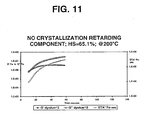
- Example 3 (Comparative Example): 0 Equivalents of Crystallization Retarding Component, Hard Segment Content 65.1%.
- FIG. 11 illustrates a graph of viscosity data calculated from the Example 3 polyurethane formulation.
- FIG. 11 shows the melt stability of a highly crystalline 65 Shore D hard ether. Rapid increase in complex melt viscosity indicates this product is not suitable for extrusion process. Attempts to extrude this product resulted in significant solidification in die and flight channels of the extruder screw.
- Example 4 15 Equivalents of Crystallization Retarding Component, Hard Segment Content 66.6%.
- FIG. 12 illustrates a graph of viscosity data calculated from the Example 4 polyurethane formulation.
- FIG. 12 shows the melt stability of the similar ether product of Example 3 modified with 15 equivalents of dipropylene glycol (DPG). The increase in melt viscosity is mild and gradual. This material was extruded successfully into tubing and sheets on a 6.35 cm (2 1 ⁇ 2 ”) Killion extruder.
- DPG dipropylene glycol
- Example 5 (Comparative Example) : 0 Equivalents of Crystallization Retarding Component, Hard Segment Content 58.9%.
- FIG. 13 illustrates a graph of viscosity data calculated from the Example 5 polyurethanes formulation.
- FIG. 13 shows the melt curves of a highly crystalline 55 D ester polyol based TPU. The rapid increase in viscosity due to crystallization exceeds the capacity of the viscometer machine to complete the test after 25 minutes. This product could not be extruded in an extruder.
- Example 6 10 Equivalents of Crystallization Retarding Component, Hard Segment Content 59.7%.
- FIG. 14 illustrates a graph of viscosity data calculated from the Example 6 polyurethane formulation.
- the melt curves shown in FIG. 14 the ester product of Example 5 modified with 10 equivalents of dipropylene glycol (DPG). This product was successfully extruded into tubing on a 6.35cm (2 1 ⁇ 2")Killion extruder.
- DPG dipropylene glycol
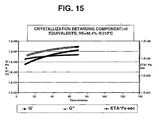
- FIG. 15 illustrates a graph of viscosity data calculated from the Example 7 polyurethane formulation.
- FIG. 15 shows the melt viscosity curve of an unmodified highly crystalline ester of 50 D hardness. As in earlier comparisons the product in FIG. 15 was not extrudable whereas the modified product in FIG. 16 generated from the polyurethane formulation of Example 8 extrudes easily.
- Example 8 10 Equivalents of Crystallization Retarding Component, Hard Segment Content 54.6%.
- compositions were analyzed by DSC to illustrate the effect of the crystallization composition of the present invention.
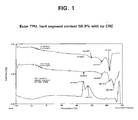
- Figure 1 shows the DSC scan of an ester TPU without DPG modifier.
- Relative rate of crystallization is indicated by the peak of crystallization temperature Tc at 121.6 °C and 136.2°C. the higher the peak temperature, the faster the crystallization rate is. The more perfect the crystal the higher the peak.
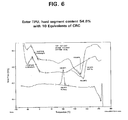
- this peak is reduced to 108.7°C by replacing 10% of total OH with DPG as chain extender.
- the relative intensity of the highest melting peak of the rescan shown by the middle curve
- Figure 1 shows this peak at 222.4°C and more intense than the same peak in Figure 2 at 217.8°C. Analyzing the DSC curves of Figure 1 and Figure 2 we can therefore say that TPU in Figure 2 will be easier to extrude than TPU in Figure 1 .
Landscapes
- Chemical & Material Sciences (AREA)
- Health & Medical Sciences (AREA)
- Chemical Kinetics & Catalysis (AREA)
- Medicinal Chemistry (AREA)
- Polymers & Plastics (AREA)
- Organic Chemistry (AREA)
- Engineering & Computer Science (AREA)
- Manufacturing & Machinery (AREA)
- Polyurethanes Or Polyureas (AREA)
- Compositions Of Macromolecular Compounds (AREA)
- Processes Of Treating Macromolecular Substances (AREA)
- Processing And Handling Of Plastics And Other Materials For Molding In General (AREA)
Abstract
Description
- The present invention relates to thermoplastic polyurethane (TPU) compositions including a crystallization retarding component which advantageously improves processing behavior and allows highly crystalline compositions to be processed in an extruder. The crystallization retarding component is generally present in the polyurethane composition in amounts sufficient to reduce crystal formation during the extrusion process and essentially delay crystallization onset until the composition has exited an extruder die or outlet, without altering the desirable properties of the final product. The crystallization retarding components comprise short chain or monomeric diols which are branched, substituted, or contain heteroatoms.
- Typically, highly crystalline, phase separated thermoplastic polyurethanes have not been utilized in extrusion applications as the compositions are generally difficult to process or even unprocessable as they crystallize and form conglomerates or chunks of solid matter in the extrusion process equipment. Furthermore, attempts to prevent crystallization by increasing the processing temperatures of the extrusion equipment have been unsuccessful and result in heat-decomposed products.
- Highly crystalline thermoplastic polyurethane (TPU) products with desirable properties for extrusion have heretofore generally been unavailable. Thermoplastic polyurethanes with high crystallinity have stronger wear resistance and solvent resistance than their relatively low crystalline counterparts.
- Highly crystalline thermoplastic polyurethanes also set up faster during extrusion process making the extruded shapes such as hose, tube, sheets, films, fibers and profiles easier to handle after the polymer melt exits the shaping die. This is desirable because it leads to increased productivity and better final product quality.
-
WO-A-94/15985 -
EP-A-0347794 discloses a thermoplastic polyurethane prepared by extrusion from polybutylene adipate diol, MDI, 1,4-butane diol and dipropylene glycol. - The present invention relates to extruded thermoplastic polyurethane compositions having high crystallinity. Advantageously, the thermoplastic polyurethane includes a crystallization delaying or retarding component that allows the compositions to be easily extruded without causing appreciable solid or crystallization buildup in an extruder. Advantageously, the crystallization retarding component shifts or lowers the crystallization temperature of a composition when compared to the same composition without the crystallization retarding component.
- Generally, highly crystalline thermoplastic polyurethanes contain a relatively high amount of hard segments. Crystallinity is desired because it enhances the mechanical properties, chemical resistance and heat resistance of the final product. The low levels of crystallization retarding component still allow crystallization of hard blocks to proceed but at a much slower rate than without the same. Thus desirable polymer properties are still retained. The slower crystallization rate in turn does not permit the formation of crystalline solid matter or chunks to build up in the extruder. High quality extruded crystalline products such as films, sheets, or tubing can be obtained.
- In particular, the present invention relates to an
extruded thermoplastic polyurethane composition having a high crystalline content comprising the reaction product of a combination of:
a polyol component, wherein said polyol component has a number average molecular weight of 500 to 10,000 per polyol and wherein said polyol component is utilized in an amount so that the hydroxyl group content is from 2 to 70 equivalents per 100 equivalents of the total hydroxyl groups present in the composition;
a diisocyanate component;
a chain extender component, wherein said chain extender component is an unbranched, unsubstituted, straight chain alkane diol free of heteroatoms and having from 2 to 6 carbon atoms;
a crystallization retarding component selected from dipropylene glycol, neopentyl glycol, 2-methyl-2,4-pentane diol, or a combination thereof, and wherein the crystallization retarding component is utilized in an amount so that the hydroxyl group content is from 1 to 15 equivalents per 100 equivalents of the total hydroxyl groups of the polyol component, the chain extender component and the crystallization retarding component; and
optionally, a polyurethane catalyst;
wherein said composition has been extruded, and wherein said composition has a hard segment content of from 30 to 70%. - The present invention further relates to a process for preparing a
process for preparing a thermoplastic polyurethane having a high crystalline content, comprising the step of extruding in an extruder the thermoplastic polyurethane composition
as defined above. - Preferred embodiments of the invention are apparent from the dependent claims.
-
-
FIGS. 1 through 8 illustrate graphs produced by a differential scanning calorimeter (DSC) for various polyurethane formulations as set forth in the Example section. -
FIGS. 9 through 16 illustrate melt viscosity curves for various polyurethane formulations as set forth in the Example section. - In
FIGS. 11 to 14 and16 1 dyn/cm2 corresponds into 0.1 Pa. - The Thermoplastic polyurethanes of the present invention have a high crystalline content and include a crystallization retarding component, such as dipropylene glycol, which allows the compositions to be extruded and processed into useful products.
- The crystallization temperature of the composition can typically be determined by differential scanning calorimetery. Generally, crystallized compositions can be melted, solvated, or otherwise amorphized and then recrystallized. The term crystallizable refers to compositions that are a) crystallized or b) uncrystallized, but capable of crystallization by a reduction in temperature of the composition.
- Highly crystalline or high crystalline content refers to thermoplastic polyurethane compositions which contain at least 30 or 40% of hard segment content up to 70%. Hard segment content can be defined as equal to the total of the weight percent of the isocyanate component, chain extenders, and crystallization retarding component divided by the total weight percent of the thermoplastic polyurethane composition (weight percent of isocyanate component, chain extender, crystallization retarding component, and polyol component). It is known that not all highly crystalline polymers fall within the above-defined range of hard segments, but the same are to be included within the scope of the invention. Highly crystalline thermoplastic urethanes are those which readily crystallize during the extrusion process in an extruder. Their crystallinity can also be quantified by those of ordinary skill in the art by typical DSC scans, for example as shown in
Figure 1 through Figure 8 hereinbelow. Compositions that show greater than generally 4, desirably 4.5, and preferably 5 or 5.5 up to 20, 25, 30 or 40 J/g heat of crystallization exotherm, as calculated by ASTM test D3417-99, (third curve of each DSC graph) during cool down from melt can be described as highly crystalline. Thermoplastic polyurethane composition refers to a composition containing polyurethane, reagents used to form the polyurethane, or a combination thereof and can refer to the composition prior to' extrusion, within the extruder, or after extrusion. - The thermoplastic polyurethanes of the present invention are generally prepared by combining and reacting a) a polyol component of at least one hydroxyl terminated intermediate such as hydroxyl terminated polyester, polyether, polycarbonate, or polycaprolactone with b) at least one polyisocyanate component, c) a crystallization retarding component, d) at least one primary chain extender and optionally, a catalyst. These reactants generate a thermoplastic polyurethane in, for example, an extruder or other reaction vessel.
- The components of the high crystalline content polyurethane composition can be combined to form the polyurethane composition prior to introduction into the extruder or they can be combined in situ within the extruder. The crystallization retarding component is typically provided in an amount sufficient to produce less build-up of crystallized polyurethane or solid matter in the extruder than would be found using the same polyurethane composition without the crystallization retarding component. For purposes of this comparison, the amount of build-up for a given amount of material that has been extruded can be determined in a variety of ways including, for example, comparing the thickness of the build-up, the surface area of the extruder covered by the build-up, and/or the weight of the build-up for a given amount of polyurethane composition extruded at the same conditions. For example, for a given extruder, extruder configuration, extrusion conditions (e.g., extrusion temperature(s), pressure(s), and speed(s), and period of time, the addition of a crystallization retarding component can reduce the build-up by at least 90%. Extrusion conditions and amounts of crystallization retarding component can be chosen so that build-up can be reduced generally by at least 95%, and even by at least 98%, 99%, or more. In at least some instances, the addition of a crystallization retarding component can prevent, i.e. reduce by about 100%, what would otherwise be significant, build-up for a given set of conditions and period of time. The specified percentage of reduction in build-up is achieved if there is the appropriate reduction in build-up according to at least one measurement criterion, even if that reduction percentage is not met when using another measurement criteria.
- The thermoplastic polyurethanes of the present invention include a polyol component, which include but are not limited to hydroxyl terminated polyesters, hydroxyl terminated polyethers, hydroxyl terminated polycarbonates, hydroxyl terminated polycaprolactones, hydroxyterminated polyacrylates and hydroxyl terminated polyolefins.
- The class of hydroxyl terminated polyesters are polyesters, often linear polyesters, having a number average molecular weight, Mn, of at least 500 and typically no more than 10.000 to provide the polyurethane with a distribution of hard and soft segments. The number average molecular weight of the hydroxyl terminated polyester is typically in the range of 700 to 5,000, and often is in the range of 700 to 4,000. The number average molecular weight can be determined, for example, by assay of the number of terminal functional groups for a given weight of polymer, Suitable hydroxyl terminated polyesters generally have an acid number of 1.3 or less and typically 0.8 or less. The acid number refers to the number of milligrams of potassium hydroxide needed to neutralize one gram of the hydroxyl terminated polyester. Suitable hydroxyl terminated polyesters are commercially available from companies such as, for example, Witco Corp. of Perth Amboy, NJ as Fomrez, Inolex Chemical Co. of Philadelphia, PA as Lexorez, and Ruco Polymer Corp. of Hicksville, NY as Rucofeld.
- The hydroxyl terminated polyester polymers can be produced by, for example, (1) an esterification reaction of one or more dicarboxylic acids or anhydrides using one or more glycols or (2) a transesterification reaction of one of more esters of dicarboxylic acids using one or more glycols. Mole ratios generally in excess of more than one mole of glycol to acid, anhydride, or ester are preferred so as to obtain linear chains having a preponderance of terminal hydroxyl groups.
- Suitable dicarboxylic acids for preparing a hydroxyl terminated polyester intermediate include aliphatic, cycloaliphatic, and aromatic dicarboxylic acids. A single dicarboxylic acid or a combination of dicarboxylic acids can be used. Typically, the dicarboxylic acids have a total of from 4 to 15 carbon atoms. Examples of suitable dicarboxylic acids include succinic, glutaric, adipic, pimelic, suberic, azelaic, sebacic, dodecanedioic, isophthalic, terephthalic, and cyclohexane dicarboxylic acids. Anhydrides of the above dicarboxylic acids, such as phthalic anhydride, tetrahydrophthalic anhydride, can also be used. Adipic acid is a commonly used dicarboxylic acid.
- If the transesterification route for formation of the hydroxyl terminated polyester is utilized, esters of the dicarboxylic acids described above can be used. These esters typically include an alkyl group, usually having 1 to 6 carbon atoms, in place of the acidic hydrogen of the corresponding acid functionalities.
- The glycols which are reacted to form the hydroxyl terminated polyester intermediate can be aliphatic, aromatic, or combinations thereof. The glycols typically have a total of from 2 to 12 carbon atoms. Suitable glycols include, for example, ethylene glycol, 1,2-propanediol, 1,3-propanediol, 1,3-butanediol, 1,4-butanediol, 1,5-pentanediol, 1,6-hexanediol, 2,2-dimethyl-1,3-propanediol, 1,4-cyclohexanedimethanol, decamethylene glycol, and dodecamethylene glycol. Commonly used glycols are 1,4-butanediol and 1,6-hexanediol.
- The class of hydroxyl terminated polyether polyols are derived from a diol or polyol having a total of from 2 to 15 carbon atoms. For example, an alkyl diol or glycol can be reacted with an ether, such as an alkylene oxide having from 2 to 6 carbon atoms. Suitable alkylene oxides include, for example, ethylene oxide, propylene oxide, or mixtures thereof. Suitable hydroxyl terminated polyethers are commercially available from companies such as, for example, E. I. DuPont de Nemours Co., Inc. of Wilmington, DE as Terathane, BASF Corp. of Parsippany, NJ as poly THF and Penn Specialties of Philadelphia, PA as Polymeg.
- Suitable polyether polyols include, for example, poly(ethylene glycol) which can be formed by reacting ethylene oxide with ethylene glycol, poly(propylene glycol) which can be formed by reacting propylene oxide with propylene glycol, poly(propylene-ethylene glycol) which can be formed by reacting propylene oxide and ethylene oxide with propylene glycol, poly(tetramethylene glycol) (PTMG) which can be formed by reacting water with tetrahydrofuran (THF). Other suitable polyether polyols include polyamide adducts of an alkylene oxide including, for example, ethylenediamine adduct which is the reaction product of ethylenediamine and propylene oxide, diethylenetriamine adduct which is the reaction product of diethylenetriamine with propylene oxide, and similar polyamide type polyether polyols. Co-polyethers can also be utilized in the current invention. Typical co-polyethers include the reaction product of THF and ethylene oxide or THF and propylene oxide. Suitable co-polyethers are available from BASF Corp. of Parsippany, N. J. as Poly THF B, a block copolymer, and poly THF R, a random copolymer.
- Suitable hydroxyl terminated polyether intermediates have a number average molecular weight as determined by assay of the terminal functional groups, of at least 500 and typically no more than 10,000 to produce a desired ratio of soft and hard segments of the polyurethane. Typically, the number average molecular weight of the hydroxyl terminated polyether ranges from 500 to 5,000. Often the number average molecular weight of the hydroxyl terminated polyether ranges from 700 to 3,000.
- The class of hydroxyl terminated polycarbonates are commercially available from Stahl USA of Peabody, MA. Suitable hydroxyl terminated polycarbonates can be prepared by reacting a glycol with a carbonate.
U.S. -A- 4,131,731 , describes hydroxyl terminated polycarbonates, their preparation and how they can be utilized. Such polycarbonates are typically linear. The number average molecular weight of the hydroxyl terminated polycarbonates is generally at least 500 and typically not more than 3,000. - The class of hydroxyl terminated polycaprolactones are commercially available from companies such as, for example, Union Carbide Corp. of Danbury, CT. Hydroxyl terminated polycaprolactones can be formed by reaction of a caprolactone with a glycol. Suitable caprolactones include ε-caprolactone and methyl ε-caprolactone. Suitable glycols include, for example, ethylene glycol, 1,2-propanediol, 1,3-propanediol, 1,3-butanediol, 1,4-butanediol, 1,5-pentanediol, 1,6-hexanediol, 2,2-dimethyl-1,3-propanediol, 1,4-cyclohexanedimethanol, decamethylene glycol, and dodecamethylene glycol. Methods for the preparation of hydroxyl terminated polycaprolactones are generally known to those of ordinary skill in the art.
- The hydroxyl terminated polyolefins are prepared from olefin monomers having from 4 to 10 or 12 carbon atoms such as butadiene. The number average molecular weight of the hydroxyl terminated polyolefins range from 500 to 6,000 or 10,000. The hydroxyl terminated polyolefins are available from Shell as Kraton Liquid L and Mitsubishi Chemical as Polytail H.
- The polyol component such as the polyethers polyols of the present invention have an unsaturation content of generally less than 0.10 or 0.05 meq/gram, desirably less than 0.02 or 0.03 meq/gram and preferably less than 0.015 meq/gram, (milliequivalents per gram) per polyol, as can be determined by methods well known to those skilled in the art. The number average molecular weight of the polyol component of the present invention, which can comprise different polyols as defined above, is generally from 500 or 600 to 10,000, desirably from about 700 to 5,000, and preferably from 1,000 to 4,000 per polyol. The average hydroxyl functionality of the polyol component is generally from 1.8 to 2.2, desirably from 1.90 to 2.10, and preferably from 1.95 to 2.00 or 2.05. The polyol component is utilized in the thermoplastic polyurethane composition of the present invention in amounts so that the hydroxyl group content is from 2 to 70 equivalents, desirably from 3 to 65 equivalents, and preferably from 5 5 or 10 to 50 or 60 equivalents per 100 equivalents of the total hydroxyl groups present in the thermoplastic polyurethane composition.
- The polyurethanes of the present invention are derived from an isocyanate compound. In order to form large linear polyurethane chains, di-functional isocyanates are utilized. Suitable polyisocyanates are commercially available from companies such as, but not limited to, Bayer AG of Leverkusen, Germany as Mondur, The BASF Corporation of Parsippany, New Jersey as Luprinate, The Dow Chemical Company of Midland, Michigan as Isonate, and Huntsman Chemical of Utah as Rubinate. The polylsocyanates of the present invention generally have a formula R(NCO)n, where n is an integer of 2. R can be an aromatic, cycloaliphatic, an aliphatic, or combinations thereof having from 2 to 20 carbon atoms, Examples of polyisocyanates include, but are not limited to diphenylmethane-4,4'- diisocyanate (MDI); toluene-2,4-diisocyanate (TDI); toluene-2,6-diisocyanate (TDI); methylene bis (4-cyclohexylisocyanate (H12 MDI); 3-isocyanatomethyl-3,5,5-trimethyl.cyclohexyl isocyanate (IPDI); 1,6-hexane diisocyanate (HDI); naphthalene-1,5-diisocyanate (NDI); 1,3-and 1,4-phenylenediisocyanate; polyphenylpolymethylenepolyisocyanate (PMDI); m-xylene diisocyanate (XDI); 1,4-cyclohexyl diisocyanate (CHDI); isophorone diisocyanate; isomers and mixtures or combinations thereof. The preferred isocyanates are aromatic, and include diphenylmethane-4,4'-diisocyanate (MDI), including polymeric MDI, and also H12 MDI which produces polyurethanes with low yellow color.
- A crystallization retarding component is added to the high crystalline content thermoplastic polyurethanes of the present invention in sufficient amounts to allow the composition to be extruded. That is, while not being bound by theory, it is thought that the crystallization retarding component delays the formation of the crystalline structures for a sufficient amount of time to allow the composition to be processed by extrusion. The onset of crystallization is delayed so that preferably 100% of crystallization occurs after processing of the thermoplastic polyurethane in the extruder, i.e. after the composition leaves or exits the extruder die or orifice.
- The crystallization retarding component advantageously lowers or shifts the crystallization temperature of a thermoplastic polyurethane composition when compared to the same compositions without the crystallization retarding component, advantageously allowing the previously unextrudable highly crystallization compositions to be processed in an extruder. The crystallization retarding components are generally sterically hindered so that crystalline formation is interrupted or delayed allowing the thermoplastic polyurethane to be processed. The crystallization retarding components are short chain or monomeric diols which are branched, substituted and/or contain heteroatoms (atoms other than carbon). If the crystallization retarding component is an aromatic containing diol, the substitution must be other than trans substitution, i.e. there can be substantially no trans-isomers, preferably so that at least some steric hindrance exists in the diol.
- Crystallization retarding components are selected from dipropylene glycol, diethylene glycol, neopentyl glycol and 2-methyl-2,4-pentane diol, with dipropylene glycol being preferred.
- The crystallization retarding component is utilized in the thermoplastic polyurethane composition of the present invention in amounts so that the hydroxyl group content is from 1 to 15 or 20 equivalents, desirably from 2 or 3 to 15 equivalents, and preferably from 5 to 11 or 12 equivalents, per 100 equivalents of the total hydroxyl groups, i.e. from the polyol component, crystallization retarding component, and the chain extending component present in the polyurethane composition. The crystallization retarding components should preferably react at a similar rate as the primary or main chain extenders such as 1,4-butane diol. The molecular weight range for the crystallization retarding component is less than 450 or 500 number average.
- Chain extenders are desirably employed in the polyurethane formulations of the present invention generally to increase the molecular weight thereof, and are well known to the art and to the literature. They are also responsible for formation of crystalline hard blocks leading to thermoplastic polyurethanes with desirable mechanical properties. Suitable chain extenders are unbranched, unsubstituted, straight chain alkane diols free of heteroatoms which have a total from 2 to 6 carbon atoms. Examples include ethanediol, 1,6-hexanediol, 1,3-propanediol, 1,5-pentanediol and preferably 1,4-butanediol. Mixtures of the above noted chain extenders can also be utilized.
- The preferred chain extenders of the present invention include 1,4-butanediol, ethylene glycol, 1,6-hexane diol, 1,3-propane diol, and 1,5-pentane diol. The amount of the one or more chain extenders utilized is based upon the total equivalents of the hydroxyl groups of the reactive components of the thermoplastic polyurethane composition. The amount of chain extender utilized generally is wherein the hydroxyl group content is from 5 or 10 to 97 or 99 equivalents, desirably from 20 to 95 equivalents, and preferably from 30 or 40 to 90 equivalents based on the 100 equivalents of the total hydroxyl groups present in the polyurethane composition.
- The equivalent weight ratio of polyisocyanate functional groups to total hydroxyl functional groups of the polyol component, crystallization retarding component, and chain extender is generally from 0.90 to 1.10, desirably from 0.95 to 1.05, and preferably from 0.98 to 1.03.
- Catalysts are optionally, but preferably used in the polyurethane reaction mixtures of the present invention. Any of the catalysts conventionally employed or known in the art and to the literature to catalyze the reaction of an isocyanate with a reactive hydrogen containing compound can be employed for this purpose. Such catalysts include organic and inorganic acid salts of, and organometallic derivatives of, bismuth, tin, iron, antimony, cobalt, thorium, aluminum, zinc, nickel, cerium, molybdenum, vanadium, copper, manganese and zirconium, as well as phosphines and tertiary organic amines. Representative organotin catalysts include stannous octoate, dibutyltin dioctoate, dibutyltin diluarate, and the like. Representative tertiary organic amine catalysts include triethylamine, triethyleneaiamine, N,N,N'N'-tetramethylethylenediamine, N,N,N'N'-tetraethylethylenediamine, N-methylmorpholine, N-ethylmorpholine, N,N,N',N'-tetramethylguanidine, N,N,N',N'-tetramethyl-1,3-butanediamine, N,N-dimethylethanolamine, and N,N-diethylethanolamine.
- The amount of catalyst employed is generally within the range of 20 to 500 parts by weight million parts by weight of the total weight of the polyisocyanate(s), polyol component, and chain extender(s). Mixtures of the above noted catalysts can likewise ba utilized. It is desirable to use minimal amounts of the catalyst in order to minimize side reactions. Preferred catalysts include stannous octoate, dibutyltin dioctoate, and dibutyltin diluarate and bismuth octoate.
- In addition to the above-identified components, the polyurethane compositions of the present invention can also contain various additives, pigments, dyes, and fillers utilized in conventional amounts which are well known to the art and to the literature.
- Generally additives are utilized which impart desired properties to the thermoplastic polyurethanes such as various antioxidants, various ultraviolet light inhibitors, waxes such as amide waxes and ester waxes, and thickening agents. The fillers, when utilized, are generally mineral fillers, that is inorganic, and include ground mica, talc, kaolin clay, calcium carbonate, calcium sulfite, colloidal silica, fumed silica, wollastonite, hollow glass microspheres, glass, carbon and graphite fibers, various metallic oxides such as zinc, titanium zirconium, ground quartz, various metallic silicates, metallic powders such as lead, aluminum, and bronze.
- If it is desired that the polyurethane composition of the present invention have a color or hue, any conventional pigment or dye can be utilized in conventional amounts. Hence, any pigment known to the art and to the literature can be utilized as for example titanium dioxide, iron oxide, carbon black, as well as various dyes provided that they do not interfere with the various urethane reactions.
- The thermoplastic polyurethane elastomers of the invention can be prepared by processes which are conventional in the art for the synthesis of polyurethane elastomers such as but not limited to a two-step prepolymer process or preferably, a one-shot (master batch) technique. In the two-step process, the prepolymer is formed by reacting the polyol component with the polyisocyanate component to form an isocyanate terminated prepolymer which is subsequently chain extended. In the preferred one-shot procedure, all of the reactants are brought together and simultaneously or substantially simultaneously reacted. The one-shot procedure is preferably performed in an extruder, e.g. single screw, twin screw (desired), wherein the formative components, i.e. the polyol(s), the polyisocyanate(s), and the chain extender(s), the catalyst(s), and any other additives, etc., if desired, are introduced individually or as a mixture into the extruder, and reacted at a temperature generally from 100°C to 300°C, desirably from 150°C to 250°C, and preferably from 150°C to 240°C.
- The resulting polyurethanes of the present invention have a weight average molecular weight generally from 50,000 to 500,000, desirably from 75,000 to 250,000, and preferably from 100,000 to 150,000, measured by gel permeation chromatography against polystyrene standards. The polyurethanes generally have a hardness which ranges from 65 Shore A to 80 D or even harder.
- The resulting high crystalline content thermoplastic polyurethane can be extruded into any desired end product or form, or can be cooled and granulated for storage or bulk shipping. The extrudate can also be immediately further processed to give a desired final end-use product.
- The high crystalline content thermoplastic polyurethanes of the present invention advantageously are suitable for many applications, including, but not limited to, membranes, breathable films or sheets which can be utilized for house wrap, roofing materials or membranes, tubing, wire and cable jacketing, molded parts, shoe soles, hoses, films for lamination, waistbands, and elastic structures such as fibers.
- The present invention will be better understood by reference to the following examples which serve to illustrate the invention.
- The following examples confirm the dramatic effect of the crystallization retarding components on the melt stability of the TPUs. The compositions listed hereinbelow were tested under dynamic conditions (100 radian/second frequency) with a parallel plate melt viscometer according to ASTM D4440-95a over a period of two hours.
-
COMPONENT-REACTIVE EQ. Wt. Equivalents EqWt*EQ WT % MDI (polyisocyanate) 125.20 2.93 366.64 25.08 Butane diol (chain extender) 45.06 1.92 86.56 5.92 DPG Dipropylene Glycol (crc) 67.09 0.00 0.00 0.00 PTMEG 2000 (polyol) 1000.00 1.00 1000.00 68.40 TOTAL OH 2.92 1086.56 74.32 TOTAL OH & NCO 1453.20 99.40 COMPONENT-NONREACT CAL WT WT % Stannous Octoate (catalyst) 0.07 0.01 IRGANOX 1010 4.39 0.30 Tinuvin 328 4.39 0.30 TOTAL ADDITIVES 8.85 0.61 TOTAL FOR THE RUN 1462.04 100.00 -
FIG. 9 illustrates a graph of viscosity data calculated from the Examples polyurethane formulation. This composition is a TPU of hardness 75 A. With no crystallization retarding component, the complex melt viscosity, ETA*(Pa-sec), gradually increased over the test period of 2 hrs due to the flow restrictions imposed by the crystallization of the hard blocks. The product of this nature is expected to gradually freeze in dead spots of an extruder into solid crystalline structure parts of which will then be release into the melt stream from time to time during the course of the extrusion, spoiling the quality of the extrudate like films, tubing etc. G' is the elastic component of the viscosity and G" is the viscous component of the viscosity. -
COMPONENT-REACTIVE EQ. Wt. Equivalents EqWt*EQ WT % MDI (polyisocyanate) 125.20 2.9410 368.21 24.967 Butane diol (chain extender) 45.06 1.6469 174.21 5.032 DPG Dipropylene Glycol (crc) 67.09 0.2941 19.73 1.338 PTMEG 2000 (polyol) 1000.00 1.0000 1000.00 67.808 TOTAL OH 2.9410 1093.94 74.178 TOTAL OH & NCO 1462.15 99.1445 COMPONENT-NONREACT CAL WT WT % Stannous Octoate (catalyst) 0.07 0.005 Acrawax C 3.69 0.250 IRGANOX 1010 4.42 0.300 Tinuvin 328 4.42 0.300 TOTAL ADDITIVES 12.61 0.856 TOTAL FOR THE RUN 1474.76 100.00 -
FIG. 10 illustrates a graph of viscosity data calculated from the Example 2 polyurethane formulation. The same test of the same hardness TPU made by replacing 10 % of equivalent weight ofmain chain extender 1,4 butane diol (BDO) with dipropylene glycol (DPG). The test clearly shows that the complex melt viscosity is flatter and does not rise significantly during the course of the test. This indicates good extrusion processibility. To confirm the indicated extrudability, the TPU formulation was scaled up on a pilot reactor (40 mm twin screw Werner Pfleidere extruder) and extruded into excellent quality blown film on a 6.35 cm (2 ½ ") single screw Killion extruder. -
COMPONENT-REACTIVE EQ. Wt. Equivalents EqWt*EQ WT % MDI (polyisocyanate) 125.20 6.9321 867.89 50.040 Butane diol (chain extender) 45.06 5.6321 253.78 14.632 PTMEG 1000 (polyol) 500.00 1.0000 500.00 28.828 PTMEG 650 (polyol) 335.00 0.3000 100.50 5.794 DPG Dipropylene Glycol (crc) 67.09 0.0000 0.00 0.000 TOTAL OH 6.9321 854.28 49.255 TOTAL OH & NCO 1722.18 99.295 COMPONENT-NONREACT CAL WT WT % Stannous Octoate (catalyst) 0.09 0.005 IRGANOX 1010 6.94 0.400 Tinuvin 328 5.20 0.300 TOTAL ADDITIVES 12.23 0.705 TOTAL FOR THE RUN 1734.40 100.00 -
FIG. 11 illustrates a graph of viscosity data calculated from the Example 3 polyurethane formulation.FIG. 11 shows the melt stability of a highly crystalline 65 Shore D hard ether. Rapid increase in complex melt viscosity indicates this product is not suitable for extrusion process. Attempts to extrude this product resulted in significant solidification in die and flight channels of the extruder screw. -
COMPONENT-REACTIVE EQ. Wt. Equivalents EqWt*EQ WT% MDI (polyisocyanate) 125.20 7.2115 902.88 50.040 Butane diol (chain extender) 45.06 4.8298 217.63 12.062 PTMEG 1000 (polyol) 498.00 1.0000, 498.00 27.601 PTMEG 650 (polyol) 335.00 0.3000 100.50 5.570 DPG Dipropylene Glycol (crc) 67.09 1.0817 72.57 4.022 TOTAL OH 7.2115 888.70 49.255 TOTAL OH & NCO 1791.59 99.295 COMPONENT-NONREACT CAL WT WT % Stannous Octoate (catalyst) 0.09 0.005 IRGANOX 1010 7.22 0.400 Tinuvin 328 5.41 0.300 TOTAL ADDITIVES 12.72 0.705 TOTAL FOR THE RUN 1804.31 100.00 -
FIG. 12 illustrates a graph of viscosity data calculated from the Example 4 polyurethane formulation.FIG. 12 shows the melt stability of the similar ether product of Example 3 modified with 15 equivalents of dipropylene glycol (DPG). The increase in melt viscosity is mild and gradual. This material was extruded successfully into tubing and sheets on a 6.35 cm (2 ½ ") Killion extruder. -
COMPONENT-REACTIVE EQ. Wt. Equivalents EqWt*EQ WT% MDI (polyisocyanate) 125.20 13.1205 11642.69 43.789 BDO (chain extender) 45.06 12.1205 1546.15 14.559 Ester Polyol (polyol) 1525.00 1.0000 1525.00 40.652 TOTAL OH 13.1205 12071.15 55.211 TOTAL OH & NCO 13713.84 99.000 COMPONENT-NONREACT CAL WT WT% ACRAWAX C 9.38 0.250 IRGANOX 1010 19.38 0.250 Stabaxol P-200 18.76 0.500 TOTAL ADDITIVES 37.51 1.000 TOTALS FOR THE RUN 3751.36 100.000 -
FIG. 13 illustrates a graph of viscosity data calculated from the Example 5 polyurethanes formulation.FIG. 13 shows the melt curves of a highly crystalline 55 D ester polyol based TPU. The rapid increase in viscosity due to crystallization exceeds the capacity of the viscometer machine to complete the test after 25 minutes. This product could not be extruded in an extruder. -
COMPONENT-REACTIVE EQ.Wt. Equivalents EQWt*EQ WT % MDI (polyisocyanate) 125.20 13.382 1675.40 43.811 BDO (chain extender) 45.06 11.044 497.62 13.013 Ester Polyol (polyol) 1525.00 1.000 1525.00 39.878 Dipropylene Glycol DPG(crc). 67.09 1.338 89.78 2.348 TOTAL OH 13.382 2112.40 55.239 TOTAL OH & NCO 3787.80 99.050 COMPONENT-NONREACT CAL WT WT % ACRAWAX C 7.65 0.200 IRGANOX 1010 9.56 0.250 Stabaxol P-200 19.12 0.500 TOTAL ADDITIVES 36.33 0.950 TOTALS FOR THE RUN 3824.13 100.000 -
FIG. 14 illustrates a graph of viscosity data calculated from the Example 6 polyurethane formulation. The melt curves shown inFIG. 14 the ester product of Example 5 modified with 10 equivalents of dipropylene glycol (DPG). This product was successfully extruded into tubing on a 6.35cm (2 ½")Killion extruder. - Example 7( 0 Comparative Example): Equivalents of Crystallization Retarding Component, Hard Segment Content 48.4%.
-
COMPONENT-REACTIVE EQ. Wt. Equivalents . EqWt*EQ WT % MDI (polyisocyanate) 125.20 13.1225 1642.94 39.938 BDO (chain extender) 27.19 12.1225 329.62 8.013 Ester Polyol (polyol) 2100.00 1.0000 2100.00 51.049 Dipropylene Glycol DPG (crc) 67.09 0.0000 0.00 0.000 TOTAL OH 13.1225 2429.62 59.062 TOTAL OH & NCO 4072.55 99.000 COMPONENT-NONREACT CAL WT WT % ACRAWAX C 10.28 0.250 IRGANOX 1010 10.28 0.250 Stabaxol P-200 20.57 0.500 TOTAL ADDITIVES 41.14 1.000 TOTALS FOR THE RUN 4113.69 100.000 -
FIG. 15 illustrates a graph of viscosity data calculated from the Example 7 polyurethane formulation.FIG. 15 shows the melt viscosity curve of an unmodified highly crystalline ester of 50 D hardness. As in earlier comparisons the product inFIG. 15 was not extrudable whereas the modified product inFIG. 16 generated from the polyurethane formulation of Example 8 extrudes easily. -
COMPONENT-REACTIVE EQ. Wt. Equivalents EqWt*EQ WT % MDI (polyisocyanate) 125.20 14.9032 1865.88 39.938 BDO (chain extender) 45.06 12.4129 559.32 11.972 Ester Polyol (polyol) 2100.00 1.0000 2100.00 44.950 Dipropylene Glycol DPG (crc) 67.09 1.4903 99.99 2.140 TOTAL OH 14.9032 2759.31 59.062 TOTAL OH & NCO 4625.19 99.000 COMPONENT-NONREACT CAL WT WT% ACRAWAX C 11.68 0.250 IRGANOX 1010 11.68 0.250 Stabaxol P-200 23.36 0.500 TOTAL ADDITIVES 46.72 1.000 TOTALS FOR THE RUN 14671.91 100.000 - The following compositions were analyzed by DSC to illustrate the effect of the crystallization composition of the present invention.
-
COMPONENT-REACTIVE EQ. Wt. Equivalents EqWt*EQ WT% MDI (polyisocyanate) 125.20 13.1205 1642.69 43.789 BDO (chain extender) 45.06 12.1205 546.15 14.559 Ester Polyol (polyof) 1525.00 1.0000 1525.00 40.652 Dipropylene Glycol DPG (crc) 0.00 0.0000 0.00 0.000 TOTAL OH 13.1205 2071.15 55.211 TOTAL OH & NCO 3713.84 99.000 COMPONENT-NONREACT CAL WT WT % ACRAWAX C - 9.38 0.250 IRGANOX 1010 9.38 0.250 Stabaxol P-200 - 18.76 0.500 TOTAL ADDITIVES 37.51 1.000 TOTALS FOR THE RUN 3751.36 100.000 -
COMPONENT-REACTIVE EQ. Wt. Equivalents EqW2*EQ WT% MDI (polyisocyanate) 125.20 13.382 1675.40 43.811 BDO (chain extender) 45.06 11.044 497.62 13.013 Ester Polyol (polyol) 1525.00 1.0000 1525.00 39.878 Dipropylene Glycol DPG (crc) 67.09 9.338 89.78 2.348 TOTAL OH 13382 2112.40 55.239 TOTAL OH & NCO 3787.80 99.050 COMPONENT-NONREACT CAL WT WT % ACRAWAX C 7.65 0.200 IRGANOX 1010 9.56 0.250 Stabaxol P-200 19.12 0.500 TOTAL ADDITIVES 36.33 0.950 TOTALS FOR THE RUN 3824.13 100.000 -
COMPONENT-REACTIVE EQ. Wt. Equivalent EqWt*EQ WT% MDI (polyisocyanate) 125.20 3.4965 437.77 41.430 BDO (chain extender) 45.06 2.4965 112.49 10.646 PTMEG 1000 500.00 1.0000 500.00 47.319 Dipropylene Glycol DPG (crc) 67.09 0.0000 0.00 0.000 TOTAL OH 3.4965 612.49 57.965 TOTAL OH & NCO 1050.26 99.395 COMPONENT-NONREACT CAL WT WT % Stannous Octoate 0.05 0.005 IRGANOX 1010 3.17 0.300 Tinuvin 328 3.17 0.300 TOTALS FOR THE RUN 1056.65 100.000 -
COMPONENT-REACTIVE EQ. Wt. Equivalents . EqWt*EQ WT% MDI (polyisocyanate) 125.20 3.6856 467.44 42.187 Butane diol (chain extender) 45.06 2.3529 106.02 9.693 PTMEG 1000 (polyol) 498-00 1.0000 498.00 45.530 Dipropylene Glycol DPG (crc) 67.09 0.3235 21-7 1.984 TOTAL OH 3.6764 625.73 57.208 TOTAL OH & NCO 1087.17 99.395 COMPONENT-NONREACT CAL WT WT % Stannous Octoate (catalyst) 0.05 0.005 IRGANOX 1010 3.28 0.300 Tinuvin 328 3.28 0.30 Total Nonreactants 6.62 0.605 TOTAL FOR RUN 1093.78 100.000 -
COMPONENT-REACTIVE EQ. Wt. Equivalents Eqwt*EQ WT % MDI (polyisocyanate) 125.20 13.1225 1642.94 39.938 BDO (chain extender) 27.19 12.1225 329.62 8.013 Ester polyol (polyol) 2100.00 1.0000 2100.00 51.049 Dipropylene Glycol DPG (crc) 67.09 0.0000 0.00 0.000 TOTAL OH 13.1225 13.1225 2429.62 59.062 TOTAL OH & NCO 4072.55 99.000 COMPONENT-NONRFACT CAL WT WT % ACRAWAX C 10.28 0.250 IRGANOX 1010 10.28 0.250 Stabaxol P-200 20.57 0.500 41.14 1.000 Totals for Run 4113.69 100.000 -
COMPONENT-REACTIVE EQ. Wt. Equivalents EQWt*EQ WT % MDI (polyisocyanate) 125.20 14.9032 1865.88 39.938 BDO (chain extender) 45.06 12.4129 559.32 11.972 Ester Polyol (polyol) 2100.00 1.0000 2100.00 44.950 Dipropylene Glycol DPG 1(crc) 67.09 1.4903 99.99 2.140 TOTAL OH 14.9032 2759.31 59.062 TOTAL OH & NCO 4625.19 99.000 GOMPONENT-NONREACT CAL WT WT % ACRAWAX C 11.68 0.250 IRGANOX 1010 11.68 0.250 Stabaxol P-200 23.36 0.500 46.72 1.000 Totals for the Run 4671.91 100.000 -
COMPONENT-REACTIVE EQ. Wt. Equivalents EgWt*EQ WT % MDI (polyisocyanate) 125.20 2.93 366.64 25.08 Butane diol (chain extender) 45.06 1.92 86.56 5.92 DPG Dipropylene Glycol (crc) 67.09 0.00 0.00 0.00 PTMEG 2000 (polyol) 1000.00 1.00 1000.00 68.40 TOTAL OH 2.92 1086.56 74.32 TOTAL OH & NCO 1453.20 99.40 COMPONENT-NONREACT CAL WT WT % Stannous Octoate (catalyst) 0.07 0.01 Acrawax C 0.00 0.00 IRGANOX 1010 4.39 0.30 Tinuvin 328 4.39 0.30 8.85 0.61 TOTAL FOR RUN 1462.04 100.00 -
COMPONENT-REACTIVE EQ. Wt. Equivalents EqWt*EQ WT % MDI (polyisocyanate) 125.20 2.9410 368.21 24.967 Butane diol (chain extender) 145.06 1.6469 74.21 5.032 DPG Dipropylene Glycol (crc) 67.09 0.2941 19.73 1.338 PTMEG 2000 (polyol) 1000.00 1.0000 1000.00 67.808 TOTAL OH 2.9410 1093.94 74.178 TOTAL OH & NCO 1462.15 99.145 COMPONENT-NONREACT CAL WT WT % Stannous Octoate (catalyst) 0.07 0.005 Acrawax C 3.69 0.250 IRGANOX 1010 4.42 0.300 Tinuvin 328 4.42 0.300 12.61 0.855 TOTAL FOR RUN 1474.76 1474.76 100.00 -
Figure 1 shows the DSC scan of an ester TPU without DPG modifier. Relative rate of crystallization is indicated by the peak of crystallization temperature Tc at 121.6 °C and 136.2°C. the higher the peak temperature, the faster the crystallization rate is. The more perfect the crystal the higher the peak. Infigure 2 this peak is reduced to 108.7°C by replacing 10% of total OH with DPG as chain extender. Also the relative intensity of the highest melting peak of the rescan (shown by the middle curve) can be used to anticipate potential extrusion problems. The larger and more intense this peak is, the more difficult will be the extrusion processability of TPU because of premature crystallization of the product inside the extruder.Figure 1 shows this peak at 222.4°C and more intense than the same peak inFigure 2 at 217.8°C. Analyzing the DSC curves ofFigure 1 andFigure 2 we can therefore say that TPU inFigure 2 will be easier to extrude than TPU inFigure 1 . - Applying the same analysis to the TPUs shown in
Figure 3 through 8 , we can surmise CRC modified TPU inFigures 4 ,6 , and8 will extrude easier than unmodified TPU shown inFigures 3 ,5 , and7 respectively.
Claims (13)
- An extruded thermoplastic polyurethane composition having a high crystalline content comprising the reaction product of a combination of:a polyol component, wherein said polyol component has a number average molecular weight of 500 to 10,000 per polyol and wherein said polyol component is utilized in an amount so that the hydroxyl group content is from 2 to 70 equivalents per 100 equivalents of the total hydroxyl groups present in the composition;a diisocyanate component;a chain extender component, wherein said chain extender component is an unbranched, unsubstituted, straight chain alkane diol free of heteroatoms and having from 2 to 6 carbon atoms;a crystallization retarding component selected from dipropylene glycol, neopentyl glycol, 2-methyl-2,4-pentane diol, or a combination thereof, and wherein the crystallization retarding component is utilized in an amount so that the hydroxyl group content is from 1 to 15 equivalents per 100 equivalents of the total hydroxyl groups of the polyol component, the chain extender component and the crystallization retarding component; andoptionally, a polyurethane catalyst;wherein said composition has been extruded, and wherein said composition has a hard segment content of from 30 to 70%.
- A composition according to claim 1, wherein said polyol component comprises hydroxyl terminated polyesters, hydroxyl terminated polyethers, hydroxyl terminated polycarbonates, hydroxyl terminated polycaprolactams, hydroxyl terminated polyolefins, hydroxyl terminated polyacrylates, or a combination thereof.
- A composition according to claim 1, wherein said diisocyanate component comprises diphenylmethane-4,4'-diisocyanate.
- A composition according to claim 1, wherein the equivalent weight ratio of diisocyanate functional groups to total hydroxyl functional groups of the polyol component, crystallization retarding component and the chain extender component is from 0.90 to 1.10.
- A composition according to claim 1, wherein said composition has a hard segment content of 40% to 70%.
- A composition according to claim 1, wherein the crystallization retarding component is utilized in an amount so that the hydroxyl group content is from 2 to 12 equivalents per 100 equivalents of the total hydroxyl groups of the polyol component, the chain extender component and the crystallization retarding component.
- A composition according to claim 1, wherein said chain extender component is 1,4-butanediol, ethylene glycol, 1,6-hexanediol, 1,3-propanediol, and 1,5-pentanediol, or combinations thereof.
- A composition according to claim 1, wherein said catalyst is present and comprises stannous octoate, dibutyltin dioctoate, dibutyltin diluarate, bismuth octoate, or a combination thereof.
- A composition according to claim 1, wherein said composition has been extruded into a membrane, breathable film, sheet, tubing, wire, cable jacketing, shoe sole, hose, or a fiber.
- A composition of anyone of claims 1 to 9 having a greater than 4 J/g heat of crystallization exotherm during cool down from melt.
- A composition according to claim 10, wherein said composition has 5 to 40 J/g heat of crystallization exotherm during cool down from melt.
- A process for preparing a thermoplastic polyurethane having a high crystalline content, comprising the step of extruding in an extruder the thermoplastic polyurethane composition as defined in anyone of claims 1 to 11.
- A membrane, breathable film, sheet, tubing, wire, cable jacketing, shoe sole, hose, or a fiber obtainable by the process of claim 12.
Applications Claiming Priority (3)
| Application Number | Priority Date | Filing Date | Title |
|---|---|---|---|
| US36567 | 2001-12-21 | ||
| US10/036,567 US6995231B2 (en) | 2001-12-21 | 2001-12-21 | Extrudable highly crystalline thermoplastic polyurethanes |
| PCT/US2002/036611 WO2003057752A1 (en) | 2001-12-21 | 2002-11-14 | Extrudable highly crystalline thermoplastic polyurethanes |
Publications (2)
| Publication Number | Publication Date |
|---|---|
| EP1456272A1 EP1456272A1 (en) | 2004-09-15 |
| EP1456272B1 true EP1456272B1 (en) | 2012-08-08 |
Family
ID=21889313
Family Applications (1)
| Application Number | Title | Priority Date | Filing Date |
|---|---|---|---|
| EP02780674A Expired - Lifetime EP1456272B1 (en) | 2001-12-21 | 2002-11-14 | Extrudable highly crystalline thermoplastic polyurethanes |
Country Status (11)
| Country | Link |
|---|---|
| US (1) | US6995231B2 (en) |
| EP (1) | EP1456272B1 (en) |
| JP (1) | JP4169698B2 (en) |
| KR (2) | KR20110048558A (en) |
| CN (1) | CN1271108C (en) |
| AU (1) | AU2002343713A1 (en) |
| BR (1) | BR0215210B1 (en) |
| CA (1) | CA2470439A1 (en) |
| ES (1) | ES2389369T3 (en) |
| TW (1) | TWI262198B (en) |
| WO (1) | WO2003057752A1 (en) |
Cited By (1)
| Publication number | Priority date | Publication date | Assignee | Title |
|---|---|---|---|---|
| WO2021110922A1 (en) * | 2019-12-05 | 2021-06-10 | Basf Se | Ultra-light skiing boots |
Families Citing this family (28)
| Publication number | Priority date | Publication date | Assignee | Title |
|---|---|---|---|---|
| TW574744B (en) | 2002-12-27 | 2004-02-01 | Nanya Technology Corp | Misalignment test structure and method thereof |
| US20040198944A1 (en) * | 2003-03-04 | 2004-10-07 | Meltzer Donald A. | Thermoplastic polyurethanes |
| US7477444B2 (en) * | 2006-09-22 | 2009-01-13 | E Ink Corporation & Air Products And Chemical, Inc. | Electro-optic display and materials for use therein |
| KR20120039523A (en) * | 2009-06-18 | 2012-04-25 | 제이에스알 가부시끼가이샤 | Polyurethane, composition for formation of polishing layers that contains same, pad for chemical mechanical polishing, and chemical mechanical polishing method using same |
| BRPI1015425B1 (en) * | 2009-06-25 | 2020-10-27 | Lubrizol Advanced Materials, Inc. | melt-spun elastic fiber made from cross-linked thermoplastic polyurethane, fabric, garment, and process to produce an elastic fiber |
| US20130269976A1 (en) * | 2011-08-10 | 2013-10-17 | General Cable Technologies Corporation | Lead-free cable containing bismuth compound |
| CN104619738A (en) * | 2012-08-06 | 2015-05-13 | 株式会社可乐丽 | Thermoplastic polyurethane and its composition |
| US10640702B2 (en) * | 2013-08-01 | 2020-05-05 | Covestro Llc | Coated particles and methods for their manufacture and use |
| WO2015048155A1 (en) * | 2013-09-24 | 2015-04-02 | Fenner U.S., Inc. | Improved filament for fused deposit modeling |
| TWI667285B (en) * | 2013-10-18 | 2019-08-01 | 德商巴斯夫歐洲公司 | Production of expanded thermoplastic elastomer |
| CN114773559A (en) * | 2014-03-25 | 2022-07-22 | 巴斯夫欧洲公司 | TPU pneumatic hose |
| CN104017160A (en) * | 2014-06-17 | 2014-09-03 | 安庆市索隆新材料有限公司 | Ink-grade thermoplastic polyurethane formula and preparation method thereof |
| CN104387561A (en) * | 2014-12-16 | 2015-03-04 | 山东一诺威聚氨酯股份有限公司 | High-hardness low-melting-point TPU (thermoplastic polyurethane) and preparation method thereof |
| WO2017050738A1 (en) * | 2015-09-24 | 2017-03-30 | Basf Se | Thermoplastic polyurethanes |
| CN108431069A (en) * | 2015-11-04 | 2018-08-21 | 巴斯夫欧洲公司 | Process for preparing thermoplastic polyurethane |
| WO2017079101A1 (en) * | 2015-11-06 | 2017-05-11 | Lubrizol Advanced Materials, Inc. | Crystalline high modulus thermoplastic polyurethane |
| CN105778032B (en) * | 2016-04-11 | 2018-09-14 | 传化智联股份有限公司 | It is a kind of for crystallizing/the crystallization promoter and its preparation method and application of semicrystalline polyurethane |
| BR112019018451B1 (en) * | 2017-03-06 | 2023-12-19 | Lubrizol Advanced Materials, Inc | FILAMENT, FABRIC, AND METHOD FOR PRODUCING A FILAMENT |
| WO2018197632A1 (en) * | 2017-04-26 | 2018-11-01 | Basf Se | Process for preparing a polyurethane using a polyester polyol comprising polycyclic aromatic moieties |
| EP3498746A1 (en) | 2017-12-13 | 2019-06-19 | Covestro Deutschland AG | Method for the production of polyurethane polymers |
| ES2998891T3 (en) * | 2018-07-12 | 2025-02-24 | Basf Se | Glass fibre reinforced tpu |
| CN109322596A (en) * | 2018-09-21 | 2019-02-12 | 浙江东厦建设工程有限公司 | A kind of solar temperature rising glass and the method for preparing lead element polyurethane film |
| SE542934C2 (en) * | 2018-11-15 | 2020-09-15 | Ingevity Uk Ltd | A novel polyurethane or polyurethane-urea composition with reduced cold hardening |
| TWI895284B (en) * | 2019-09-10 | 2025-09-01 | 美商盧伯利索先進材料有限公司 | Article made from thermoplastic polyurethane composition and method of making the same |
| EP4232498A1 (en) * | 2020-10-26 | 2023-08-30 | Lord Corporation | Semi-crystalline two-part polyurethane adhesives from amorphous components |
| TWI788086B (en) * | 2021-11-04 | 2022-12-21 | 南亞塑膠工業股份有限公司 | Thermoplastic polyurethane resin suitable for laminating process and manufacturing method thereof |
| WO2025128433A1 (en) | 2023-12-14 | 2025-06-19 | Lubrizol Advanced Materials, Inc. | Melt-spun thermoplastic polyurethane fiber and fabric made therefrom |
| CN119661804A (en) * | 2024-12-13 | 2025-03-21 | 广东技塑新材料股份有限公司 | A high melting point and high hardness polycarbonate material and preparation method thereof |
Citations (5)
| Publication number | Priority date | Publication date | Assignee | Title |
|---|---|---|---|---|
| GB1577222A (en) * | 1977-02-17 | 1980-10-22 | Ici Ltd | Thermoplastic polyurethane elastomers |
| EP0303234A2 (en) * | 1987-08-10 | 1989-02-15 | The Dow Chemical Company | Poly(alkylene terephthalate)compositions having improved crystallization rate and properties |
| US5013811A (en) * | 1989-03-20 | 1991-05-07 | Reeves Brothers, Inc. | Use of modified diisocyanates for preparing linear thermoplastic polyurethane elastomers having improved properties |
| US5908690A (en) * | 1993-11-19 | 1999-06-01 | Wolff Walsrode Ag | Non-crackling, antistatic polyurethane film with high breathability and its use |
| US6458880B1 (en) * | 1999-10-18 | 2002-10-01 | Noveon Ip Holdings Corp. | Polyurethanes with talc crystallization promoter |
Family Cites Families (7)
| Publication number | Priority date | Publication date | Assignee | Title |
|---|---|---|---|---|
| DE2817457A1 (en) * | 1978-04-21 | 1979-10-31 | Bayer Ag | THERMOPLASTIC POLYURETHANE FOR PROCESSING IN EXTRUDERS AND / AND ON CALENDARS |
| US4376834A (en) * | 1981-10-14 | 1983-03-15 | The Upjohn Company | Polyurethane prepared by reaction of an organic polyisocyanate, a chain extender and an isocyanate-reactive material of m.w. 500-20,000 characterized by the use of only 2-25 percent by weight of the latter material |
| US4883837A (en) | 1988-06-24 | 1989-11-28 | The Dow Chemical Company | Compatible blends of polyolefins with thermoplastic polyurethanes |
| JP2992984B2 (en) | 1992-06-03 | 1999-12-20 | 日本ポリウレタン工業株式会社 | Method for producing thermoplastic polyurethane resin for extrusion molding |
| WO1994015985A1 (en) | 1992-12-31 | 1994-07-21 | The Dow Chemical Company | Thermoplastic polyurethanes and a process for their preparation |
| US6022939A (en) * | 1994-12-23 | 2000-02-08 | Bayer Aktiengesellschaft | Thermoplastic polyurethanes with improved melt flow |
| US6613867B2 (en) | 2000-12-19 | 2003-09-02 | Dow Global Technologies Inc. | Thermoplastic polyurethane containing structural units of ethylene oxide polyol or ethylene oxide capped propylene oxide polyol |
-
2001
- 2001-12-21 US US10/036,567 patent/US6995231B2/en not_active Expired - Lifetime
-
2002
- 2002-11-14 EP EP02780674A patent/EP1456272B1/en not_active Expired - Lifetime
- 2002-11-14 JP JP2003558063A patent/JP4169698B2/en not_active Expired - Lifetime
- 2002-11-14 ES ES02780674T patent/ES2389369T3/en not_active Expired - Lifetime
- 2002-11-14 KR KR1020117006371A patent/KR20110048558A/en not_active Ceased
- 2002-11-14 WO PCT/US2002/036611 patent/WO2003057752A1/en not_active Ceased
- 2002-11-14 BR BR0215210A patent/BR0215210B1/en active IP Right Grant
- 2002-11-14 CN CNB028258789A patent/CN1271108C/en not_active Expired - Lifetime
- 2002-11-14 CA CA 2470439 patent/CA2470439A1/en not_active Abandoned
- 2002-11-14 AU AU2002343713A patent/AU2002343713A1/en not_active Abandoned
- 2002-11-14 KR KR1020047009790A patent/KR101224495B1/en not_active Expired - Lifetime
- 2002-12-09 TW TW91135542A patent/TWI262198B/en not_active IP Right Cessation
Patent Citations (5)
| Publication number | Priority date | Publication date | Assignee | Title |
|---|---|---|---|---|
| GB1577222A (en) * | 1977-02-17 | 1980-10-22 | Ici Ltd | Thermoplastic polyurethane elastomers |
| EP0303234A2 (en) * | 1987-08-10 | 1989-02-15 | The Dow Chemical Company | Poly(alkylene terephthalate)compositions having improved crystallization rate and properties |
| US5013811A (en) * | 1989-03-20 | 1991-05-07 | Reeves Brothers, Inc. | Use of modified diisocyanates for preparing linear thermoplastic polyurethane elastomers having improved properties |
| US5908690A (en) * | 1993-11-19 | 1999-06-01 | Wolff Walsrode Ag | Non-crackling, antistatic polyurethane film with high breathability and its use |
| US6458880B1 (en) * | 1999-10-18 | 2002-10-01 | Noveon Ip Holdings Corp. | Polyurethanes with talc crystallization promoter |
Non-Patent Citations (1)
| Title |
|---|
| SCHWARZ, EBELING, FURTH: "Kunststoffverarbeitung", 2002, VOGEL BUCHVERLAG, pages: 81 - 90 * |
Cited By (1)
| Publication number | Priority date | Publication date | Assignee | Title |
|---|---|---|---|---|
| WO2021110922A1 (en) * | 2019-12-05 | 2021-06-10 | Basf Se | Ultra-light skiing boots |
Also Published As
| Publication number | Publication date |
|---|---|
| BR0215210A (en) | 2004-12-07 |
| BR0215210B1 (en) | 2012-07-24 |
| WO2003057752A1 (en) | 2003-07-17 |
| US6995231B2 (en) | 2006-02-07 |
| ES2389369T3 (en) | 2012-10-25 |
| JP4169698B2 (en) | 2008-10-22 |
| KR101224495B1 (en) | 2013-01-22 |
| KR20040069189A (en) | 2004-08-04 |
| TW200301269A (en) | 2003-07-01 |
| CN1608091A (en) | 2005-04-20 |
| EP1456272A1 (en) | 2004-09-15 |
| KR20110048558A (en) | 2011-05-11 |
| CN1271108C (en) | 2006-08-23 |
| TWI262198B (en) | 2006-09-21 |
| US20030139509A1 (en) | 2003-07-24 |
| JP2005514480A (en) | 2005-05-19 |
| AU2002343713A1 (en) | 2003-07-24 |
| CA2470439A1 (en) | 2003-07-17 |
Similar Documents
| Publication | Publication Date | Title |
|---|---|---|
| US6995231B2 (en) | Extrudable highly crystalline thermoplastic polyurethanes | |
| EP1366100B1 (en) | High molecular weight thermoplastic polyurethanes made from polyols having high secondary hydroxyl content | |
| KR100909410B1 (en) | Thermoplastic polyurethane | |
| EP1599522B1 (en) | Thermoplastic polyurethanes | |
| EP2408831B2 (en) | Thermoplastic polyurethane with reduced tendency to bloom | |
| EP0617066B1 (en) | Thermosetting urethane elastomer | |
| EP2235086B1 (en) | Low melting polyurethane elastomers | |
| WO2001042363A1 (en) | Extrudable polyurethane compositions and methods of making them | |
| CA2267629A1 (en) | Preparation of thermoplastic polyurethanes | |
| TW201802183A (en) | Melt processable thermoplastic polyurethane-urea elastomers | |
| US20060258831A1 (en) | High molecular weight thermoplastic polyurethanes made from polyols having high secondary hydroxyl content | |
| CN1756782A (en) | thermoplastic polyurethane | |
| JP3980068B2 (en) | Polyurethane |
Legal Events
| Date | Code | Title | Description |
|---|---|---|---|
| PUAI | Public reference made under article 153(3) epc to a published international application that has entered the european phase |
Free format text: ORIGINAL CODE: 0009012 |
|
| 17P | Request for examination filed |
Effective date: 20040616 |
|
| AK | Designated contracting states |
Kind code of ref document: A1 Designated state(s): AT BE BG CH CY CZ DE DK EE ES FI FR GB GR IE IT LI LU MC NL PT SE SK TR |
|
| AX | Request for extension of the european patent |
Extension state: AL LT LV MK RO SI |
|
| RAP1 | Party data changed (applicant data changed or rights of an application transferred) |
Owner name: NOVEON, INC. |
|
| 17Q | First examination report despatched |
Effective date: 20061128 |
|
| RAP1 | Party data changed (applicant data changed or rights of an application transferred) |
Owner name: LUBRIZOL ADVANCED MATERIALS, INC. |
|
| TPAC | Observations filed by third parties |
Free format text: ORIGINAL CODE: EPIDOSNTIPA |
|
| GRAP | Despatch of communication of intention to grant a patent |
Free format text: ORIGINAL CODE: EPIDOSNIGR1 |
|
| GRAS | Grant fee paid |
Free format text: ORIGINAL CODE: EPIDOSNIGR3 |
|
| GRAA | (expected) grant |
Free format text: ORIGINAL CODE: 0009210 |
|
| AK | Designated contracting states |
Kind code of ref document: B1 Designated state(s): AT BE BG CH CY CZ DE DK EE ES FI FR GB GR IE IT LI LU MC NL PT SE SK TR |
|
| REG | Reference to a national code |
Ref country code: GB Ref legal event code: FG4D |
|
| REG | Reference to a national code |
Ref country code: CH Ref legal event code: EP Ref country code: AT Ref legal event code: REF Ref document number: 569759 Country of ref document: AT Kind code of ref document: T Effective date: 20120815 |
|
| REG | Reference to a national code |
Ref country code: IE Ref legal event code: FG4D |
|
| REG | Reference to a national code |
Ref country code: DE Ref legal event code: R096 Ref document number: 60243482 Country of ref document: DE Effective date: 20121011 |
|
| REG | Reference to a national code |
Ref country code: ES Ref legal event code: FG2A Ref document number: 2389369 Country of ref document: ES Kind code of ref document: T3 Effective date: 20121025 |
|
| REG | Reference to a national code |
Ref country code: NL Ref legal event code: VDEP Effective date: 20120808 |
|
| REG | Reference to a national code |
Ref country code: AT Ref legal event code: MK05 Ref document number: 569759 Country of ref document: AT Kind code of ref document: T Effective date: 20120808 |
|
| PG25 | Lapsed in a contracting state [announced via postgrant information from national office to epo] |
Ref country code: FI Free format text: LAPSE BECAUSE OF FAILURE TO SUBMIT A TRANSLATION OF THE DESCRIPTION OR TO PAY THE FEE WITHIN THE PRESCRIBED TIME-LIMIT Effective date: 20120808 Ref country code: AT Free format text: LAPSE BECAUSE OF FAILURE TO SUBMIT A TRANSLATION OF THE DESCRIPTION OR TO PAY THE FEE WITHIN THE PRESCRIBED TIME-LIMIT Effective date: 20120808 Ref country code: CY Free format text: LAPSE BECAUSE OF FAILURE TO SUBMIT A TRANSLATION OF THE DESCRIPTION OR TO PAY THE FEE WITHIN THE PRESCRIBED TIME-LIMIT Effective date: 20120808 |
|
| PG25 | Lapsed in a contracting state [announced via postgrant information from national office to epo] |
Ref country code: GR Free format text: LAPSE BECAUSE OF FAILURE TO SUBMIT A TRANSLATION OF THE DESCRIPTION OR TO PAY THE FEE WITHIN THE PRESCRIBED TIME-LIMIT Effective date: 20121109 Ref country code: SE Free format text: LAPSE BECAUSE OF FAILURE TO SUBMIT A TRANSLATION OF THE DESCRIPTION OR TO PAY THE FEE WITHIN THE PRESCRIBED TIME-LIMIT Effective date: 20120808 Ref country code: PT Free format text: LAPSE BECAUSE OF FAILURE TO SUBMIT A TRANSLATION OF THE DESCRIPTION OR TO PAY THE FEE WITHIN THE PRESCRIBED TIME-LIMIT Effective date: 20121210 |
|
| PG25 | Lapsed in a contracting state [announced via postgrant information from national office to epo] |
Ref country code: NL Free format text: LAPSE BECAUSE OF FAILURE TO SUBMIT A TRANSLATION OF THE DESCRIPTION OR TO PAY THE FEE WITHIN THE PRESCRIBED TIME-LIMIT Effective date: 20120808 |
|
| PG25 | Lapsed in a contracting state [announced via postgrant information from national office to epo] |
Ref country code: EE Free format text: LAPSE BECAUSE OF FAILURE TO SUBMIT A TRANSLATION OF THE DESCRIPTION OR TO PAY THE FEE WITHIN THE PRESCRIBED TIME-LIMIT Effective date: 20120808 Ref country code: CZ Free format text: LAPSE BECAUSE OF FAILURE TO SUBMIT A TRANSLATION OF THE DESCRIPTION OR TO PAY THE FEE WITHIN THE PRESCRIBED TIME-LIMIT Effective date: 20120808 Ref country code: DK Free format text: LAPSE BECAUSE OF FAILURE TO SUBMIT A TRANSLATION OF THE DESCRIPTION OR TO PAY THE FEE WITHIN THE PRESCRIBED TIME-LIMIT Effective date: 20120808 |
|
| PG25 | Lapsed in a contracting state [announced via postgrant information from national office to epo] |
Ref country code: SK Free format text: LAPSE BECAUSE OF FAILURE TO SUBMIT A TRANSLATION OF THE DESCRIPTION OR TO PAY THE FEE WITHIN THE PRESCRIBED TIME-LIMIT Effective date: 20120808 |
|
| PLBE | No opposition filed within time limit |
Free format text: ORIGINAL CODE: 0009261 |
|
| STAA | Information on the status of an ep patent application or granted ep patent |
Free format text: STATUS: NO OPPOSITION FILED WITHIN TIME LIMIT |
|
| REG | Reference to a national code |
Ref country code: CH Ref legal event code: PL |
|
| 26N | No opposition filed |
Effective date: 20130510 |
|
| PG25 | Lapsed in a contracting state [announced via postgrant information from national office to epo] |
Ref country code: LI Free format text: LAPSE BECAUSE OF NON-PAYMENT OF DUE FEES Effective date: 20121130 Ref country code: BG Free format text: LAPSE BECAUSE OF FAILURE TO SUBMIT A TRANSLATION OF THE DESCRIPTION OR TO PAY THE FEE WITHIN THE PRESCRIBED TIME-LIMIT Effective date: 20121108 Ref country code: CH Free format text: LAPSE BECAUSE OF NON-PAYMENT OF DUE FEES Effective date: 20121130 |
|
| REG | Reference to a national code |
Ref country code: IE Ref legal event code: MM4A |
|
| REG | Reference to a national code |
Ref country code: DE Ref legal event code: R097 Ref document number: 60243482 Country of ref document: DE Effective date: 20130510 |
|
| PG25 | Lapsed in a contracting state [announced via postgrant information from national office to epo] |
Ref country code: IE Free format text: LAPSE BECAUSE OF NON-PAYMENT OF DUE FEES Effective date: 20121114 |
|
| REG | Reference to a national code |
Ref country code: ES Ref legal event code: FD2A Effective date: 20140305 |
|
| PG25 | Lapsed in a contracting state [announced via postgrant information from national office to epo] |
Ref country code: MC Free format text: LAPSE BECAUSE OF NON-PAYMENT OF DUE FEES Effective date: 20121130 |
|
| PG25 | Lapsed in a contracting state [announced via postgrant information from national office to epo] |
Ref country code: LU Free format text: LAPSE BECAUSE OF NON-PAYMENT OF DUE FEES Effective date: 20121114 Ref country code: ES Free format text: LAPSE BECAUSE OF NON-PAYMENT OF DUE FEES Effective date: 20121115 |
|
| REG | Reference to a national code |
Ref country code: FR Ref legal event code: PLFP Year of fee payment: 14 |
|
| REG | Reference to a national code |
Ref country code: FR Ref legal event code: PLFP Year of fee payment: 15 |
|
| REG | Reference to a national code |
Ref country code: FR Ref legal event code: PLFP Year of fee payment: 16 |
|
| PGFP | Annual fee paid to national office [announced via postgrant information from national office to epo] |
Ref country code: FR Payment date: 20211124 Year of fee payment: 20 Ref country code: GB Payment date: 20211129 Year of fee payment: 20 Ref country code: TR Payment date: 20211028 Year of fee payment: 20 Ref country code: DE Payment date: 20211126 Year of fee payment: 20 |
|
| PGFP | Annual fee paid to national office [announced via postgrant information from national office to epo] |
Ref country code: IT Payment date: 20211122 Year of fee payment: 20 Ref country code: BE Payment date: 20211129 Year of fee payment: 20 |
|
| REG | Reference to a national code |
Ref country code: DE Ref legal event code: R071 Ref document number: 60243482 Country of ref document: DE |
|
| REG | Reference to a national code |
Ref country code: BE Ref legal event code: MK Effective date: 20221114 Ref country code: GB Ref legal event code: PE20 Expiry date: 20221113 |
|
| PG25 | Lapsed in a contracting state [announced via postgrant information from national office to epo] |
Ref country code: GB Free format text: LAPSE BECAUSE OF EXPIRATION OF PROTECTION Effective date: 20221113 |