EP1455506A1 - Cellular telephone - Google Patents
Cellular telephone Download PDFInfo
- Publication number
- EP1455506A1 EP1455506A1 EP02783740A EP02783740A EP1455506A1 EP 1455506 A1 EP1455506 A1 EP 1455506A1 EP 02783740 A EP02783740 A EP 02783740A EP 02783740 A EP02783740 A EP 02783740A EP 1455506 A1 EP1455506 A1 EP 1455506A1
- Authority
- EP
- European Patent Office
- Prior art keywords
- functions
- memory
- displayed
- function
- display
- Prior art date
- Legal status (The legal status is an assumption and is not a legal conclusion. Google has not performed a legal analysis and makes no representation as to the accuracy of the status listed.)
- Withdrawn
Links
Images



Classifications
-
- H—ELECTRICITY
- H04—ELECTRIC COMMUNICATION TECHNIQUE
- H04M—TELEPHONIC COMMUNICATION
- H04M1/00—Substation equipment, e.g. for use by subscribers
- H04M1/72—Mobile telephones; Cordless telephones, i.e. devices for establishing wireless links to base stations without route selection
- H04M1/724—User interfaces specially adapted for cordless or mobile telephones
- H04M1/72469—User interfaces specially adapted for cordless or mobile telephones for operating the device by selecting functions from two or more displayed items, e.g. menus or icons
-
- H—ELECTRICITY
- H04—ELECTRIC COMMUNICATION TECHNIQUE
- H04M—TELEPHONIC COMMUNICATION
- H04M1/00—Substation equipment, e.g. for use by subscribers
- H04M1/72—Mobile telephones; Cordless telephones, i.e. devices for establishing wireless links to base stations without route selection
- H04M1/724—User interfaces specially adapted for cordless or mobile telephones
Definitions
- the present invention is related to a portable telephone capable of setting displays as to a plurality of functions.
- portable telephones may have not only telephone communications, but also a large number of functions such as the Internet, electronic mails, games, electronic calculators, schedule notebooks, and the like. Then, in order to realize these functions, assuming now that telephone communications are employed as an example, a large number of functions should be selected/adjusted, namely, telephone ringing sounds are selected; telephone ringing volume is adjusted; telephone calling notifications by vibrations are selected; telephone receiving volume is adjusted; telephone talking volume is adjusted, and so on. These portable telephones are also equipped with a very large number of functions capable of selecting/adjusting these items.
- Such portable telephones have been proposed in which a plurality of functions have been categorized in hierarchical groups.
- a plurality of functions belonging to an upper-grade hierarchical group are firstly displayed under initial condition.
- functions of the next hierarchical group related to the selected one function are displayed.
- functions of the second next hierarchical group related to the above-described first next hierarchical group are displayed.
- a target function may be selected.
- the present invention has been made to solve the above-explained conventional problems, and therefore, has an object to provide such a portable telephone having a superior characteristic and a simple construction, capable of selecting/setting a plurality of functions which can be arbitrarily displayed on a display device by a user under initial condition.
- a portable telephone of the present invention is comprised of a memory in which a plurality of functions displayed on a display device under initial condition are arbitrarily selected by manipulating an operation unit to store the arbitrarily-selected functions into this memory. Under the initial condition, the above-described plural functions stored in the memory are displayed on the respective display portions of the display device, one function is selected from the plural functions displayed on the display device by operating the operation unit, and then, this selected one function is carried out.
- a portable telephone of the present invention is comprised of: a first memory in which a plurality of functions displayed on a display device under initial condition are arbitrarily selected by manipulating an operation unit to store the arbitrarily-selected functions into this memory; a second memory in which a plurality of functions displayed on the display device under the initial condition are automatically and sequentially selected in this order of such a function whose use frequency is high, and then the selected functions are stored in the second memory. While any one of the first memory and the second memory is selected, the plurality of functions stored in the selected memory are displayed on the respective display portions of the display device. One function is selected from the plural functions displayed on the display device by manipulating the operation unit, and then, this selected one function is executed.
- the function whose use frequency is high may be used with a top priority, so that this portable telephone can become very useful to the user.
- the portable telephone is preferably arranged in such a manner that a display screen which is displayed on the display device under initial condition is constituted by "m” X “n” pieces of display portions, which is subdivided into “m” columns and “n” rows; and icons indicative of the respective functions are displayed on these display portions.
- the above-described functions can be displayed in an easy manner by employing the icons, and further, the subdivided display portion can be selected at once by using the navigation key, and thus, the function related to this selected display portion can be executed.
- the portable telephone may be preferably arranged in that the large number of the above-described functions are categorized in the hierarchical groups; the numbers for specifying these functions are applied to the respective functions; and these numbers are stored in the above-explained memory in correspondence with the numbers of the display portions formed on the display device. Then, the content stored in the memory is read out under the initial condition; and the function stored in connection with the function number is displayed on the display portion having the corresponding display number of the display device.
- the function displayed on the display device under the initial condition can be arbitrarily selected/set by merely defining the number of the display portion formed on the display device in correspondence with the number of the function which is wanted to be displayed. Therefore, the portable telephone can have such an effect that the desirable function can be selected/set in a very easy manner.
- Fig. 1 is a front view for schematically indicating a portable telephone according to one embodiment mode of the present invention.
- Fig. 2 is an electric schematic block diagram of this portable telephone.
- Fig. 3 is an explanatory diagram for explaining a large number of functions of this portable telephone.
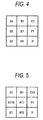
- Fig. 4 and Fig. 5 are diagrams for showing one example of displays made on a display device of the portable telephone.
- reference numeral 1 shows a housing
- reference numeral 2 indicates a display device
- reference numeral 3 represents a navigation key which can be manipulated along upper/lower/right/left/oblique directions
- Reference numeral 4 shows function keys used to execute an ON/OFF function, an on-hook function, an off-hook function, and other functions.
- reference numeral 5 indicates a ten-numeral entry key for entering telephone numbers, characters, symbols and the like.
- reference numeral 6 indicates an antenna
- reference numeral 7 represents a wireless unit
- reference numeral 8 shows a control unit
- reference numeral 9 indicates a audio circuit unit
- reference numeral 10 represents an operation unit equipped with the navigation key 3, the function key 4, the ten-numeral entry key 5, and the like.
- reference numeral 11 shows a storage unit.
- the portable telephone according to this embodiment mode may execute a large number of functions in addition to the normal telephone function, for example, the Internet, electronic mails, games, schedule notebooks, and so on. These functions are categorized in accordance with hierarchical groups as shown in Fig. 3, while reference numerals for specifying various functions are applied to the respective functions. In this case, when reference numerals applied to functions are registered in a memory, or the like employed in the storage unit 11, address numbers thereof may be used.
- a large number of functions are categorized based upon the hierarchical groups.
- an initial condition namely, telephone-call waiting condition after power supply has been turned ON, or under such a condition that selection of function is commenced from beginning
- displays made in the display device 2 are given as follows: A plurality of functions of the uppermost hierarchy, which have been previously determined by a manufacturer, are displayed.
- the function for covering the desirable function is selected to be determined among the uppermost hierarchical functions displayed under the initial condition, and then, the displayed function is sequentially advanced to the lower hierarchical functions, so that the desirable function may be displayed, and since the displayed desirable function is selected/determined, the desirable function may be carried out.
- the portable telephone of this embodiment mode is further equipped with the below-mentioned function in addition to the above-explained function.
- the portable telephone since a predetermined key in the operation unit 10 is manipulated, the portable telephone is brought into such a condition that the display made on the display device 2 under initial condition can be changed.
- a function displayed on the display device 2 under initial condition can be arbitrarily selected and set by manipulating the operation unit 10.
- the function selected/set in this case is registered in a user memory employed in the storage unit 11 independent from the functions which have been previously set by the manufacturer, and is arbitrarily read to be used.
- selecting/setting operations of the functions displayed under the initial condition will now be explained more in detail with reference to a flow chart shown in Fig. 6.
- a step 601 of this flow chart when the predetermined key in the operation unit 10 is manipulated, this key operation is sensed by the control unit 8. Then, in a next step 602, the portable telephone is brought into such a condition that the display of the display device 2 under initial condition may be changed (namely, user memory rewrite mode). Under this condition, as indicated in a step 603, the functions are sequentially displayed in accordance with such a hierarchy which has been previously set/registered into the memory by the manufacturer, so that a desirable function is selected. In a step 604, when this desirable function is determined, this determined desirable function is rewritten into the user memory as a function which should be displayed under initial condition so as to be registered thereinto.
- these determined functions may be set/registered into the user memory which is separately provided with the memory for the functions which have been previously set/registered by the manufacturer and stored in the storage unit 11, while these determined functions are set/registered as functions displayed under the initial condition, respectively.
- the selected function may be deleted from the display made under initial condition.
- nine pieces of functions which are wanted to be displayed under the initial condition may be selected/set at maximum by utilizing this deleted display portion.
- a display position of a selected/set function may be arbitrarily moved to a desirable display portion by using the navigation key 3.
- the desirable function may be arbitrarily displayed on the display device 2 under the initial condition, and the desirable function may be directly selected from this display, so that this selected function may be executed.
- the numbers for specifying the respective functions are applied to these functions.
- a predetermined key is manipulated.
- the functions which are allocated/registered with respect to the respective display portions of the display of the display device 2 under the initial condition may be registered in the storage unit 11 in correspondence with the numbers for specifying these functions as well as the numbers for specifying the display portions.
- a predetermined key is manipulated ("YES" of step 601).
- the respective functions may be read from either the user memory or the memory of the functions which have been previously registered by the manufacturer, may be arbitrarily selected/determined in such a manner that the display under the initial condition registered in the user memory is set to which function.
- this arbitrarily selected/determined function may be rewritten so as to be registered in the user memory.
- the rewritten user memory is stored into the storage unit 11 as a memory which has been just before used in the next step 606.
- the portable telephone according to this embodiment mode may be equipped with a frequent-degree information memory, while frequent-degrees of executed functions are measured.
- This frequent-degree information memory automatically stores thereinto information as to the frequent-degrees of the functions in order that a plurality of functions are displayed on the display device 2 in this order from such a function which has been executed and owns a higher frequent-degree. Since the frequent-degree information memory is read out, a predetermined number of functions may be displayed on the display device 2 based upon the execution frequent-degrees of the functions.
- a read mode is set up in a step 607.
- a memory which was stored in the step 606 and has been just before used is read out from the storage unit 11, namely, any one of the user memory, the frequent-degree information memory, and the memory which has directly stored thereinto the functions defined during the manufacturing operation is read out from the storage unit 11.
- the respective operations may be commenced, executed, interrupted, and accomplished based upon the displays of this read memory.
- the process operation is advanced to a further step 610.
- a memory to be used is switched to any one of the user memory, the frequent-degree information memory, and the memory which has directly stored thereinto the functions defined during the manufacturing operation.
- the selected memory is stored into the storage unit 11 as the memory which has been just before used.
- step 606 the above-explained memory which has been used may be directly stored as the memory which has been just before used in the storage unit 11.
- step 608 the same memory is called, and the function display is not changed.
- the functions to be displayed under the initial condition in response to the desires of the user can be freely set/registered in the user memory. These functions can be properly used in combination with the previously-registered functions by the manufacturer, which is very convenient with respect to the user.
- the user memory and the frequent-degree information memory need not be newly and separately provided.
- these memories may be arranged by employing a portion of such a memory to which the functions have been previously registered by the manufacturer.
- the functions of all (namely, 9 in this embodiment) of the display portions are registered respectively in the user memory and the frequent-degree information memory, which can be displayed on the display device, these functions are separately displayed.
- such functions may be registered, the total number of which is equal to a total number of all of display portions which may be displayed one time on the display device in such a way that a total number of functions related to one of the user memory and the frequent-degree information memory is decreased smaller than the above-explained number, and also, a total number of functions related to the other of these memories is determined to compensate for this decreased number.
- a total number of functions which can be set/registered in the user memory is selected to be 6 and a total number of functions which can be automatically registered in the frequent-degree information memory is selected to be 3, 9 pieces of functions in total may be registered in the user memory.
- the present invention discloses such a portable telephone. That is, such a memory is employed, i.e., a plurality of functions which are displayed on the display device under the initial condition are arbitrarily selected from a large number of functions by operating the operation unit, and then the selected functions are stored into the memory. Under initial condition, the above-described plural functions stored in the memory are displayed on the respective display portions of the display device, one function is selected from the plural functions displayed on the display device by operating the operation unit, and then, this selected one function is carried out.
- the user can arbitrarily select/set a plurality of functions which are displayed on the display device under initial condition. Since such functions which are usually used many times are selected/set as the functions to be displayed under initial condition, there is such an effect that the functions which are usually used many times can be quickly carried out in a simple manner with better operability.
Landscapes
- Engineering & Computer Science (AREA)
- Human Computer Interaction (AREA)
- Computer Networks & Wireless Communication (AREA)
- Signal Processing (AREA)
- Telephone Function (AREA)
- Mobile Radio Communication Systems (AREA)
Abstract
A portable telephone of the present invention is
provided with a memory (11) for storing thereinto such a
plurality of functions which are arbitrarily selected from
a large number of functions by manipulating an operation
unit (10) as a plurality of functions displayed on a
display device (2) under initial condition. In this
portable telephone, a plurality of functions stored in the
memory (11) are displayed on the display device (2) under
initial condition, one function is selected from a
plurality of displayed functions, and then, the selected
function can be operated.
Description
The present invention is related to a portable
telephone capable of setting displays as to a plurality of
functions.
Very recently, portable telephones may have not
only telephone communications, but also a large number of
functions such as the Internet, electronic mails, games,
electronic calculators, schedule notebooks, and the like.
Then, in order to realize these functions, assuming now
that telephone communications are employed as an example, a
large number of functions should be selected/adjusted,
namely, telephone ringing sounds are selected; telephone
ringing volume is adjusted; telephone calling notifications
by vibrations are selected; telephone receiving volume is
adjusted; telephone talking volume is adjusted, and so on.
These portable telephones are also equipped with a very
large number of functions capable of selecting/adjusting
these items.
As a result, it is required to easily select/adjust
one function from a large number of functions in the
portable telephones. To this end, such portable telephones
have been proposed in which a plurality of functions have
been categorized in hierarchical groups. In this portable
telephone, a plurality of functions belonging to an upper-grade
hierarchical group are firstly displayed under
initial condition. Next, when one of the plural displayed
functions is selected, functions of the next hierarchical
group related to the selected one function are displayed.
Furthermore, when one of these displayed functions is
selected, functions of the second next hierarchical group
related to the above-described first next hierarchical
group are displayed. As explained above, since the
functions of the lower-grade hierarchical groups are
sequentially displayed in the conventional portable
telephones, a target function may be selected.
However, in the conventional telephones, either
manufacturers or marketing dealers determine/fix that these
functions are categorized in the hierarchical groups, or
how the categorized functions are displayed in which
sequential manner. As a result, users of these
conventional portable telephones cannot change setting of
the functions to be displayed.
As a consequence, in such a case that a function
which is usually used many times is not contained in the
upper-grade hierarchical group, the users of the
conventional portable telephones must repeatedly display
and select the functions from the upper-grade hierarchical
group up to such a lower-grade hierarchical group where
this usually-used function is contained every time the
usually-used function is not contained. Furthermore, in
the case that since the users do not use the portable
telephones for a certain time, the users forget the method
of selecting the target function, these users must
repeatedly carry out the various operations, or must retry
the various operations in order that even such a usually-used
function is displayed, which may cause very difficult
operations of these conventional portable telephones.
The present invention has been made to solve the
above-explained conventional problems, and therefore, has
an object to provide such a portable telephone having a
superior characteristic and a simple construction, capable
of selecting/setting a plurality of functions which can be
arbitrarily displayed on a display device by a user under
initial condition.
A portable telephone of the present invention is
comprised of a memory in which a plurality of functions
displayed on a display device under initial condition are
arbitrarily selected by manipulating an operation unit to
store the arbitrarily-selected functions into this memory.
Under the initial condition, the above-described plural
functions stored in the memory are displayed on the
respective display portions of the display device, one
function is selected from the plural functions displayed on
the display device by operating the operation unit, and
then, this selected one function is carried out.
With employment of this structure, a user can
arbitrarily select/set a plurality of functions which are
displayed on the display device under initial condition.
Since such functions which are usually used many times are
selected/set as the functions to be displayed under initial
condition, there is such an effect that the functions which
are usually used many times can be quickly carried out in a
simple manner with better operability.
Also, a portable telephone of the present invention
is comprised of: a first memory in which a plurality of
functions displayed on a display device under initial
condition are arbitrarily selected by manipulating an
operation unit to store the arbitrarily-selected functions
into this memory; a second memory in which a plurality of
functions displayed on the display device under the initial
condition are automatically and sequentially selected in
this order of such a function whose use frequency is high,
and then the selected functions are stored in the second
memory. While any one of the first memory and the second
memory is selected, the plurality of functions stored in
the selected memory are displayed on the respective display
portions of the display device. One function is selected
from the plural functions displayed on the display device
by manipulating the operation unit, and then, this selected
one function is executed.
With employment of this structure, the function
whose use frequency is high may be used with a top
priority, so that this portable telephone can become very
useful to the user.
Also, the portable telephone, according to the
present invention, is preferably arranged in such a manner
that a display screen which is displayed on the display
device under initial condition is constituted by "m" X "n"
pieces of display portions, which is subdivided into "m"
columns and "n" rows; and icons indicative of the
respective functions are displayed on these display
portions.
With employment of this construction, the above-described
functions can be displayed in an easy manner by
employing the icons, and further, the subdivided display
portion can be selected at once by using the navigation
key, and thus, the function related to this selected
display portion can be executed.
Also, the portable telephone, according to the
present invention, may be preferably arranged in that the
large number of the above-described functions are
categorized in the hierarchical groups; the numbers for
specifying these functions are applied to the respective
functions; and these numbers are stored in the above-explained
memory in correspondence with the numbers of the
display portions formed on the display device. Then, the
content stored in the memory is read out under the initial
condition; and the function stored in connection with the
function number is displayed on the display portion having
the corresponding display number of the display device.
With employment of this structure, the function
displayed on the display device under the initial condition
can be arbitrarily selected/set by merely defining the
number of the display portion formed on the display device
in correspondence with the number of the function which is
wanted to be displayed. Therefore, the portable telephone
can have such an effect that the desirable function can be
selected/set in a very easy manner.
Referring now to drawings, embodiment modes of the
present invention will be described in detail.
Fig. 1 is a front view for schematically indicating
a portable telephone according to one embodiment mode of
the present invention. Fig. 2 is an electric schematic
block diagram of this portable telephone. Fig. 3 is an
explanatory diagram for explaining a large number of
functions of this portable telephone. Fig. 4 and Fig. 5
are diagrams for showing one example of displays made on a
display device of the portable telephone.
In Fig. 1 and Fig. 2, reference numeral 1 shows a
housing, reference numeral 2 indicates a display device,
and reference numeral 3 represents a navigation key which
can be manipulated along upper/lower/right/left/oblique
directions. Reference numeral 4 shows function keys used
to execute an ON/OFF function, an on-hook function, an off-hook function, and other functions. Also, reference
numeral 5 indicates a ten-numeral entry key for entering
telephone numbers, characters, symbols and the like.
Furthermore, reference numeral 6 indicates an antenna,
reference numeral 7 represents a wireless unit, reference
numeral 8 shows a control unit, reference numeral 9
indicates a audio circuit unit, and reference numeral 10
represents an operation unit equipped with the navigation
key 3, the function key 4, the ten-numeral entry key 5, and
the like. Moreover, reference numeral 11 shows a storage
unit.
The portable telephone according to this embodiment
mode may execute a large number of functions in addition to
the normal telephone function, for example, the Internet,
electronic mails, games, schedule notebooks, and so on.
These functions are categorized in accordance with
hierarchical groups as shown in Fig. 3, while reference
numerals for specifying various functions are applied to
the respective functions. In this case, when reference
numerals applied to functions are registered in a memory,
or the like employed in the storage unit 11, address
numbers thereof may be used.
As previously explained, in accordance with this
embodiment mode, a large number of functions are
categorized based upon the hierarchical groups. Under an
initial condition (namely, telephone-call waiting condition
after power supply has been turned ON, or under such a
condition that selection of function is commenced from
beginning), as represented in Fig. 4, displays made in the
display device 2 are given as follows: A plurality of
functions of the uppermost hierarchy, which have been
previously determined by a manufacturer, are displayed.
In other words, as shown in Fig. 4, under the
initial condition, while the display screen of the display
device is subdivided into 3 columns X 4 columns, 9 (3 x 3 =
9) pieces of display portions are formed in total. Then,
icons which indicate the uppermost hierarchical functions
are displayed on these 9-divided display portions,
respectively. As a result, in such a case that a lower
hierarchical function is executed, such functions are
sequentially selected and displayed from the uppermost
hierarchical function which may cover this lower
hierarchical function up to this lower hierarchical
function. Thereafter, at a stage where the desirable
function is displayed, this desirable function is selected
to be determined, so that this desirable function may be
carried out.
For instance, a description will now be made of
such a case that a function "A112" (see Fig. 3) is
executed. Under the initial condition, since the uppermost
hierarchical function "A1" which covers this function
"A112" is being displayed on the display device 2 (see Fig.
4), a user operates the navigation key 3 so as to
select/determine the function "A1." As a consequence, the
display shown in Fig. 4 is switched to displays of
functions "A11", "A12", ---, of the next hierarchy. Next,
the user operates the navigation key 3 so as to
select/determine the function "A11." As a result, since
functions A111, A112, A113, ---, are subsequently
displayed, when the function of "A112" is
selected/determined, the function of "A112" corresponding
to the target function may be executed.
As previously explained, the function for covering
the desirable function is selected to be determined among
the uppermost hierarchical functions displayed under the
initial condition, and then, the displayed function is
sequentially advanced to the lower hierarchical functions,
so that the desirable function may be displayed, and since
the displayed desirable function is selected/determined,
the desirable function may be carried out.
On the other hand, the portable telephone of this
embodiment mode is further equipped with the below-mentioned
function in addition to the above-explained
function. In other words, since a predetermined key in the
operation unit 10 is manipulated, the portable telephone is
brought into such a condition that the display made on the
display device 2 under initial condition can be changed.
As a consequence, a function displayed on the display
device 2 under initial condition can be arbitrarily
selected and set by manipulating the operation unit 10.
Then, the function selected/set in this case is registered
in a user memory employed in the storage unit 11
independent from the functions which have been previously
set by the manufacturer, and is arbitrarily read to be
used.
Next, selecting/setting operations of the functions displayed under the initial condition will now be explained more in detail with reference to a flow chart shown in Fig. 6.
Next, selecting/setting operations of the functions displayed under the initial condition will now be explained more in detail with reference to a flow chart shown in Fig. 6.
First, in a step 601 of this flow chart, when the
predetermined key in the operation unit 10 is manipulated,
this key operation is sensed by the control unit 8. Then,
in a next step 602, the portable telephone is brought into
such a condition that the display of the display device 2
under initial condition may be changed (namely, user memory
rewrite mode). Under this condition, as indicated in a
step 603, the functions are sequentially displayed in
accordance with such a hierarchy which has been previously
set/registered into the memory by the manufacturer, so that
a desirable function is selected. In a step 604, when this
desirable function is determined, this determined desirable
function is rewritten into the user memory as a function
which should be displayed under initial condition so as to
be registered thereinto.
As a consequence, since the desirable functions are
sequentially displayed in accordance with the above-explained
hierarchy and are selected to be determined,
these determined functions may be set/registered into the
user memory which is separately provided with the memory
for the functions which have been previously set/registered
by the manufacturer and stored in the storage unit 11,
while these determined functions are set/registered as
functions displayed under the initial condition,
respectively.
Although not shown in the drawing, in the user
memory rewrite mode, since the functions under display are
selected and a predetermined key is manipulated, the
selected function may be deleted from the display made
under initial condition.
As a consequence, nine pieces of functions which
are wanted to be displayed under the initial condition may
be selected/set at maximum by utilizing this deleted
display portion. A display position of a selected/set
function may be arbitrarily moved to a desirable display
portion by using the navigation key 3. As a consequence,
as shown in Fig. 5, in this embodiment mode, the desirable
function may be arbitrarily displayed on the display device
2 under the initial condition, and the desirable function
may be directly selected from this display, so that this
selected function may be executed. Also, as indicated in
Fig. 3, in this embodiment mode, while the respective
functions are categorized in the hierarchical manner, the
numbers for specifying the respective functions are applied
to these functions. As a result, in the user memory
rewrite mode capable of changing the display of the display
device 2 under the initial condition, a predetermined key
is manipulated. In response to such a key operation
subsequent to the above-described key operation, the
functions which are allocated/registered with respect to
the respective display portions of the display of the
display device 2 under the initial condition may be
registered in the storage unit 11 in correspondence with
the numbers for specifying these functions as well as the
numbers for specifying the display portions.
As a consequence, in accordance with this
embodiment mode, such a condition that the display under
the initial condition is set to which function may be
registered in the storage unit 11 in such a manner that the
number of this function is registered in correspondence
with the number of the display portion of the display
device 2, while an instruction manual and the like are
employed.
As previously explained, in accordance with this
embodiment mode, in the step 601 shown in Fig. 6, a
predetermined key is manipulated ("YES" of step 601). In
the step 602, when the user memory rewrite mode is set, in
the operation made after this step 602, the respective
functions may be read from either the user memory or the
memory of the functions which have been previously
registered by the manufacturer, may be arbitrarily
selected/determined in such a manner that the display under
the initial condition registered in the user memory is set
to which function. In the next step 605, this arbitrarily
selected/determined function may be rewritten so as to be
registered in the user memory. In the step 605, when the
rewriting/registering operations of the user memory are
accomplished, the rewritten user memory is stored into the
storage unit 11 as a memory which has been just before used
in the next step 606.
Furthermore, although not shown in the drawings,
the portable telephone according to this embodiment mode
may be equipped with a frequent-degree information memory,
while frequent-degrees of executed functions are measured.
This frequent-degree information memory automatically
stores thereinto information as to the frequent-degrees of
the functions in order that a plurality of functions are
displayed on the display device 2 in this order from such a
function which has been executed and owns a higher
frequent-degree. Since the frequent-degree information
memory is read out, a predetermined number of functions may
be displayed on the display device 2 based upon the
execution frequent-degrees of the functions.
As the memory which has been just before used in
the step 606, such a memory which has directly stored the
functions defined during manufacturing operation is being
stored in the storage unit 11 during the manufacturing
operation. However, in the case that the storage content
of the user memory is rewritten/registered in the step 605,
as previously explained, such a condition that this user
memory is used is stored in this storage unit 11.
Next, a description will now be made of such a case
that memories to be used are switched/changed. As will be
explained in the below-mentioned description, in a step
610, in such a case that memories to be used are
switched/changed, these memories which have been
switched/changed are stored as the memories which have been
just before used in the step 606 into the storage unit 11.
First of all, in the step 601, in such a case that
a predetermined key is not manipulated (namely, "NO" of
step 601), a read mode is set up in a step 607. In the
next step 608, such a memory which was stored in the step
606 and has been just before used is read out from the
storage unit 11, namely, any one of the user memory, the
frequent-degree information memory, and the memory which
has directly stored thereinto the functions defined during
the manufacturing operation is read out from the storage
unit 11. Then, the respective operations may be commenced,
executed, interrupted, and accomplished based upon the
displays of this read memory. Then, when the previously-determined keys are manipulated in a step 609 (namely,
"YES" of step 609), the process operation is advanced to a
further step 610. In this step, in response to this key
manipulation, a memory to be used is switched to any one of
the user memory, the frequent-degree information memory,
and the memory which has directly stored thereinto the
functions defined during the manufacturing operation. In
the next step 606, the selected memory is stored into the
storage unit 11 as the memory which has been just before
used.
In such a case that the function display is not
wanted to be changed, while the above-described
predetermined key is not manipulated in the step 609, the
function display is kept remained, or another key other
than the predetermined key is manipulated ("NO" in step
609), so that the process operation is directly advanced to
the step 606. In this step 606, the above-explained memory
which has been used may be directly stored as the memory
which has been just before used in the storage unit 11. In
the step 608, the same memory is called, and the function
display is not changed.
As previously described, in accordance with this
embodiment mode, the functions to be displayed under the
initial condition in response to the desires of the user
can be freely set/registered in the user memory. These
functions can be properly used in combination with the
previously-registered functions by the manufacturer, which
is very convenient with respect to the user.
As apparent from the above-described explanation,
it should be understood that the user memory and the
frequent-degree information memory need not be newly and
separately provided. Alternatively, these memories may be
arranged by employing a portion of such a memory to which
the functions have been previously registered by the
manufacturer. Also, in the embodiment mode, while the
functions of all (namely, 9 in this embodiment) of the
display portions are registered respectively in the user
memory and the frequent-degree information memory, which
can be displayed on the display device, these functions are
separately displayed. Alternatively, such functions may be
registered, the total number of which is equal to a total
number of all of display portions which may be displayed
one time on the display device in such a way that a total
number of functions related to one of the user memory and
the frequent-degree information memory is decreased smaller
than the above-explained number, and also, a total number
of functions related to the other of these memories is
determined to compensate for this decreased number. In
this alternative case, for instance, assuming now that a
total number of functions which can be set/registered in
the user memory is selected to be 6 and a total number of
functions which can be automatically registered in the
frequent-degree information memory is selected to be 3, 9
pieces of functions in total may be registered in the user
memory.
Also, in this embodiment mode, nine pieces of the
display portions constructed of 3 rows X 3 columns are
formed. However, forming positions of these display
portions and a total number of these display portions to be
formed are not limited only to those of this embodiment
mode.
While the present invention has been described in
detail, or with reference to the specific embodiment modes,
however, the present invention may be apparently modified,
changed, and substituted without departing from the
technical scope and spirit of the present invention by
those skilled in the art.
The present invention has been made based upon
Japanese Patent Application (Patent Application NO.2001-380035)
filed on December 13, 2001, by incorporating the
contents thereof as a reference.
As previously explained, the present invention
discloses such a portable telephone. That is, such a
memory is employed, i.e., a plurality of functions which
are displayed on the display device under the initial
condition are arbitrarily selected from a large number of
functions by operating the operation unit, and then the
selected functions are stored into the memory. Under
initial condition, the above-described plural functions
stored in the memory are displayed on the respective
display portions of the display device, one function is
selected from the plural functions displayed on the display
device by operating the operation unit, and then, this
selected one function is carried out. The user can
arbitrarily select/set a plurality of functions which are
displayed on the display device under initial condition.
Since such functions which are usually used many times are
selected/set as the functions to be displayed under initial
condition, there is such an effect that the functions which
are usually used many times can be quickly carried out in a
simple manner with better operability.
Claims (5)
- A portable telephone comprising:wherein said display device displays the functions stored in said first memory under initial condition.an operation unit for selecting a plurality of functions;a display device for displaying a plurality of functions under initial condition; anda first memory for storing thereinto the functions selected by the operation unit as a plurality of functions which are displayed on the display device under the initial condition,
- The portable telephone according to Claim 1, further comprising:wherein, while any one of said first memory and said second memory is selected, said plurality of functions stored in said selected memory are displayed on the respective display portions of said display device.a second memory for sequentially storing thereinto the functions in this order of such functions whose use-frequencies are high,
- The portable telephone according to Claim 1, further comprising:wherein said display device displays thereon both a predetermined number of the functions stored in said first memory and a predetermined number of the functions stored in said second memory.a second memory for sequentially storing thereinto the functions in this order of such functions whose use-frequencies are high,
- The portable telephone according to Claim 1,
wherein a display screen which is displayed on the display device under initial condition is constituted by "m" X "n" pieces of display portions, which is subdivided into "m" columns and "n" rows; and icons indicative of the respective functions are displayed on these display portions. - The portable telephone according to Claim 1,
wherein said plurality of functions are categorized in hierarchical groups,
wherein said plurality of functions own function numbers for specifying the respective functions,
wherein said display device owns a plurality of display portions,
wherein said plurality of display portions own display numbers, respectively,
wherein said first memory stores thereinto said function numbers and said display numbers in correspondence with each other,
wherein the content stored in said first memory is read out under the initial condition, and
wherein the function stored in connection with the function number is displayed on said display portion having the corresponding display number of said display device.
Applications Claiming Priority (3)
| Application Number | Priority Date | Filing Date | Title |
|---|---|---|---|
| JP2001380035 | 2001-12-13 | ||
| JP2001380035A JP2006024970A (en) | 2001-12-13 | 2001-12-13 | Mobile phone |
| PCT/JP2002/012598 WO2003051023A1 (en) | 2001-12-13 | 2002-12-02 | Cellular telephone |
Publications (2)
| Publication Number | Publication Date |
|---|---|
| EP1455506A1 true EP1455506A1 (en) | 2004-09-08 |
| EP1455506A4 EP1455506A4 (en) | 2007-05-16 |
Family
ID=19187058
Family Applications (1)
| Application Number | Title | Priority Date | Filing Date |
|---|---|---|---|
| EP02783740A Withdrawn EP1455506A4 (en) | 2001-12-13 | 2002-12-02 | CELL PHONE |
Country Status (6)
| Country | Link |
|---|---|
| US (1) | US20050009570A1 (en) |
| EP (1) | EP1455506A4 (en) |
| JP (1) | JP2006024970A (en) |
| CN (1) | CN1605184A (en) |
| AU (1) | AU2002349684A1 (en) |
| WO (1) | WO2003051023A1 (en) |
Families Citing this family (2)
| Publication number | Priority date | Publication date | Assignee | Title |
|---|---|---|---|---|
| USD571762S1 (en) * | 2007-05-09 | 2008-06-24 | Samsung Electronics Co., Ltd. | Cellular phone |
| EP3154799B1 (en) | 2014-06-14 | 2022-08-03 | Compagnie Générale des Etablissements Michelin | High rigidity rubber composition |
Family Cites Families (18)
| Publication number | Priority date | Publication date | Assignee | Title |
|---|---|---|---|---|
| JPH0612217A (en) * | 1992-06-26 | 1994-01-21 | Toshiba Corp | Personal computer and menu screen display method |
| JP3268467B2 (en) * | 1992-09-08 | 2002-03-25 | 株式会社日立製作所 | Telephone |
| JP2882220B2 (en) * | 1992-12-08 | 1999-04-12 | 株式会社東京精密 | Icon arrangement change device |
| JPH09138746A (en) * | 1995-11-14 | 1997-05-27 | Canon Inc | Display control device and method |
| JPH09261759A (en) * | 1996-03-19 | 1997-10-03 | Sony Corp | Communication terminal device |
| JPH10214171A (en) * | 1997-01-29 | 1998-08-11 | Mitsubishi Electric Corp | Information processing device |
| FI972908A7 (en) * | 1997-07-09 | 1999-01-10 | Nokia Mobile Phones Ltd | Customizable menu-driven user interface |
| DE19821235A1 (en) * | 1998-05-12 | 1999-11-18 | Siemens Ag | Data reception and communication terminal |
| JP3123990B2 (en) * | 1998-10-05 | 2001-01-15 | 埼玉日本電気株式会社 | Portable wireless terminal |
| SE521472C2 (en) * | 1999-03-16 | 2003-11-04 | Ericsson Telefon Ab L M | Portable communication device with dynamic menu |
| KR20010026690A (en) * | 1999-09-08 | 2001-04-06 | 서평원 | Method for backup of user data in mobile terminal |
| KR100334806B1 (en) * | 1999-12-07 | 2002-05-02 | 윤종용 | Method of hot key user assignment in mobile communication terminal |
| DE10003306A1 (en) * | 2000-01-20 | 2001-07-26 | Deutsche Telekom Ag | Simplifying menu guide with selection of performance characteristics for communication terminal, involves inputting ordered performance characteristics in menu form in communication terminal |
| GB2365684A (en) * | 2000-05-26 | 2002-02-20 | Nokia Mobile Phones Ltd | Displaying a table |
| JP4757984B2 (en) * | 2000-08-31 | 2011-08-24 | 任天堂株式会社 | Image display device |
| JP2002132412A (en) * | 2000-10-26 | 2002-05-10 | Denso Corp | How to display mobile phone icons |
| US6873861B2 (en) * | 2001-04-12 | 2005-03-29 | International Business Machines Corporation | Business card presentation via mobile phone |
| JP3630129B2 (en) * | 2001-09-28 | 2005-03-16 | ソニー株式会社 | Liquid crystal display |
-
2001
- 2001-12-13 JP JP2001380035A patent/JP2006024970A/en active Pending
-
2002
- 2002-12-02 US US10/496,941 patent/US20050009570A1/en not_active Abandoned
- 2002-12-02 EP EP02783740A patent/EP1455506A4/en not_active Withdrawn
- 2002-12-02 WO PCT/JP2002/012598 patent/WO2003051023A1/en not_active Ceased
- 2002-12-02 CN CNA028249631A patent/CN1605184A/en active Pending
- 2002-12-02 AU AU2002349684A patent/AU2002349684A1/en not_active Abandoned
Also Published As
| Publication number | Publication date |
|---|---|
| CN1605184A (en) | 2005-04-06 |
| WO2003051023A1 (en) | 2003-06-19 |
| EP1455506A4 (en) | 2007-05-16 |
| US20050009570A1 (en) | 2005-01-13 |
| JP2006024970A (en) | 2006-01-26 |
| AU2002349684A1 (en) | 2003-06-23 |
Similar Documents
| Publication | Publication Date | Title |
|---|---|---|
| US6195569B1 (en) | Phone displaying alternative functionality menu | |
| KR100354780B1 (en) | Menu embodiment method for mobile phone | |
| EP1780994A2 (en) | Mobile terminal with a plurality of input units | |
| EP0860970A2 (en) | Telephone number directory | |
| CN1344392A (en) | Portable communication appts. having hierarchical menu system and dynamic menu | |
| US8224388B2 (en) | Mobile communication terminal displaying background screen and display method thereof | |
| US20060139328A1 (en) | Mobile communications terminal and a method therefor | |
| US20050130614A1 (en) | Function calling apparatus and computer program for executing a function calling process | |
| EP2230587B1 (en) | Information processing device and program | |
| KR20010049844A (en) | Method and apparatus for heuristically configuring softkey functions for a reduced number of softkeys | |
| EP1455506A1 (en) | Cellular telephone | |
| KR20050082874A (en) | Method for setting hot key of mibile communication terminal | |
| JP3318927B2 (en) | Operating method of mobile phone and operating device thereof | |
| KR100605951B1 (en) | Mobile terminal with searchable country code and its method | |
| WO2001061444A2 (en) | Mobile telephone with improved man machine interface | |
| JP2004312320A (en) | Telephone | |
| EP1424855A1 (en) | Cellular telephone set, operation control method thereof and program therefor | |
| KR100549922B1 (en) | How to Implement Phone Book Features for Mobile Phones | |
| JP4161561B2 (en) | Mobile terminal, pointer control method thereof, and program thereof | |
| JP2003324513A (en) | Electronic terminal device and menu registration method | |
| JP4485650B2 (en) | Electronics | |
| JP2011175443A (en) | Portable electronic equipment | |
| JPH11196158A (en) | Mobile radio equipment | |
| KR100701946B1 (en) | Mobile communication terminal having a user-configurable telephone number input function and its setting method | |
| KR20000045792A (en) | Search information providing method for mobile communication terminal |
Legal Events
| Date | Code | Title | Description |
|---|---|---|---|
| PUAI | Public reference made under article 153(3) epc to a published international application that has entered the european phase |
Free format text: ORIGINAL CODE: 0009012 |
|
| 17P | Request for examination filed |
Effective date: 20040611 |
|
| AK | Designated contracting states |
Kind code of ref document: A1 Designated state(s): AT BE BG CH CY CZ DE DK EE ES FI FR GB GR IE IT LI LU MC NL PT SE SI SK TR |
|
| AX | Request for extension of the european patent |
Extension state: AL LT LV MK RO |
|
| A4 | Supplementary search report drawn up and despatched |
Effective date: 20070417 |
|
| STAA | Information on the status of an ep patent application or granted ep patent |
Free format text: STATUS: THE APPLICATION HAS BEEN WITHDRAWN |
|
| 18W | Application withdrawn |
Effective date: 20070716 |