EP1455401A2 - Lithium secondary battery - Google Patents
Lithium secondary battery Download PDFInfo
- Publication number
- EP1455401A2 EP1455401A2 EP04004869A EP04004869A EP1455401A2 EP 1455401 A2 EP1455401 A2 EP 1455401A2 EP 04004869 A EP04004869 A EP 04004869A EP 04004869 A EP04004869 A EP 04004869A EP 1455401 A2 EP1455401 A2 EP 1455401A2
- Authority
- EP
- European Patent Office
- Prior art keywords
- aluminum
- active material
- lithium
- positive active
- secondary battery
- Prior art date
- Legal status (The legal status is an assumption and is not a legal conclusion. Google has not performed a legal analysis and makes no representation as to the accuracy of the status listed.)
- Withdrawn
Links
Images
Classifications
-
- H—ELECTRICITY
- H01—ELECTRIC ELEMENTS
- H01M—PROCESSES OR MEANS, e.g. BATTERIES, FOR THE DIRECT CONVERSION OF CHEMICAL ENERGY INTO ELECTRICAL ENERGY
- H01M4/00—Electrodes
- H01M4/02—Electrodes composed of, or comprising, active material
- H01M4/36—Selection of substances as active materials, active masses, active liquids
- H01M4/48—Selection of substances as active materials, active masses, active liquids of inorganic oxides or hydroxides
- H01M4/50—Selection of substances as active materials, active masses, active liquids of inorganic oxides or hydroxides of manganese
- H01M4/505—Selection of substances as active materials, active masses, active liquids of inorganic oxides or hydroxides of manganese of mixed oxides or hydroxides containing manganese for inserting or intercalating light metals, e.g. LiMn2O4 or LiMn2OxFy
-
- H—ELECTRICITY
- H01—ELECTRIC ELEMENTS
- H01M—PROCESSES OR MEANS, e.g. BATTERIES, FOR THE DIRECT CONVERSION OF CHEMICAL ENERGY INTO ELECTRICAL ENERGY
- H01M4/00—Electrodes
- H01M4/02—Electrodes composed of, or comprising, active material
- H01M4/13—Electrodes for accumulators with non-aqueous electrolyte, e.g. for lithium-accumulators; Processes of manufacture thereof
- H01M4/131—Electrodes based on mixed oxides or hydroxides, or on mixtures of oxides or hydroxides, e.g. LiCoOx
-
- H—ELECTRICITY
- H01—ELECTRIC ELEMENTS
- H01M—PROCESSES OR MEANS, e.g. BATTERIES, FOR THE DIRECT CONVERSION OF CHEMICAL ENERGY INTO ELECTRICAL ENERGY
- H01M10/00—Secondary cells; Manufacture thereof
- H01M10/05—Accumulators with non-aqueous electrolyte
- H01M10/052—Li-accumulators
- H01M10/0525—Rocking-chair batteries, i.e. batteries with lithium insertion or intercalation in both electrodes; Lithium-ion batteries
-
- Y—GENERAL TAGGING OF NEW TECHNOLOGICAL DEVELOPMENTS; GENERAL TAGGING OF CROSS-SECTIONAL TECHNOLOGIES SPANNING OVER SEVERAL SECTIONS OF THE IPC; TECHNICAL SUBJECTS COVERED BY FORMER USPC CROSS-REFERENCE ART COLLECTIONS [XRACs] AND DIGESTS
- Y02—TECHNOLOGIES OR APPLICATIONS FOR MITIGATION OR ADAPTATION AGAINST CLIMATE CHANGE
- Y02E—REDUCTION OF GREENHOUSE GAS [GHG] EMISSIONS, RELATED TO ENERGY GENERATION, TRANSMISSION OR DISTRIBUTION
- Y02E60/00—Enabling technologies; Technologies with a potential or indirect contribution to GHG emissions mitigation
- Y02E60/10—Energy storage using batteries
Definitions
- the present invention relates to a lithium secondary battery, more particularly to a lithium secondary battery which is superior in the suppression of increasing internal resistance ratio and discharge capacity maintenance ratio and which is simple in structure and which is inexpensive.
- a secondary battery has been used in which a lithium transition element composite oxide is used in a positive active material, a carbon material is used in a negative active material, and an organic electrolytic solution obtained by dissolving a lithium ion electrolyte in an organic solvent is used in an electrolytic solution.
- This battery has generally been referred to as a lithium secondary battery or a lithium ion battery, and has characteristics that an energy density is large and a single battery voltage is also high as about 4 V. Therefore, the battery has drawn people's attentions not only as the portable electronic appliances but also as a power for driving a motor of an electric vehicle (hereinafter referred to as "EV”) or a hybrid electric vehicle (hereinafter referred to as "HEV”) which has positively and generally spread as a low pollution car in the background of recent environmental problems.
- EV electric vehicle
- HEV hybrid electric vehicle
- lithium transition metal oxides such as lithium cobalt oxide (LiCoO 2 ), lithium nickel oxide (LiNiO 2 ) and lithium manganese oxide (LiMn 2 O 4 ) have been used as the lithium composite oxide for use as the positive active material (see Documents 1 to 5 listed below, for example).
- lithium aluminum manganese oxide which is superior in the charge/discharge property of the lithium secondary battery at the high temperature and which is represented by a general formula Li 1+x Al y M z Mn 2-x-y-z O 4 wherein M denotes at least one element other than lithium and aluminum, x, y, and z denote constituting ratios of the elements in one molecule, and x ⁇ 0, y ⁇ 0.01, z ⁇ 0).
- the above-described lithium aluminum manganese oxide is superior in charge/discharge property, but a raw material containing an aluminum source needs to be sufficiently mixed and dispersed with respect to another raw material in synthesizing a compound as the raw material. Therefore, the manufacturing requires much labor and cost.
- lithium aluminum manganese oxides represented by the general formula Li 1+x Al y M z Mn 2-x-y-z O 4 have not been suitable as the positive active material of the lithium secondary battery.
- the present invention has been developed in consideration of the problems of the related arts, and an object thereof is to provide a lithium secondary battery which is superior in suppression of increasing internal resistance ratio and discharge capacity maintenance ratio and which is simple in structure and inexpensive.
- a lithium secondary battery of the present invention is a lithium secondary battery comprising: a positive active material comprising lithium aluminum manganese oxide having a spinel structure and an aluminum compound other than lithium aluminum manganese oxide, wherein a ratio of an amount of aluminum contained in the aluminum compound to a total amount of aluminum contained in the positive active material is within a range of from 1% by weight or more to 50% by weight or less, and lithium aluminum manganese oxide is represented by a general formula Li 1+x Al y Mn 2-x-y O 4 wherein x and y denote constituting ratios of the elements in one molecule, and x ⁇ 0, and y ⁇ 0.01, and has a lattice constant of 8.245 ⁇ or less. (sometimes hereinafter referred to as "first invention").
- a positive active material containing a lithium aluminum manganese oxide being represented by a general formula Li 1+x Al y Mn 2-x-y O 4 wherein x, y have the same meanings mentioned above, and a part of Mn therein is replaced with at least one metal element (sometimes hereinafter referred to as "second invention").
- the ratio of the aluminum amount contained in the aluminum compound to a total amount of aluminum contained in the positive active material is preferably within a range of from 1% by weight or more to 30% by weight or less, and the lattice constant of lithium aluminum manganese oxide is preferably 8.225 ⁇ or less.
- the positive active material for use in the present invention preferably contains boron and vanadium or either one.
- a molar ratio of boron and/or vanadium to manganese contained in the positive active material is preferably within a range of from 0.001 to 0.05.
- the positive active material is a product obtained by firing starting materials for a lithium aluminum manganese oxide under an oxidation atmosphere at 650 to 1000°C in 5 to 30 hours.
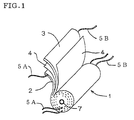
- a positive electrode 2 prepared by coating opposite surfaces of a current collector substrate for positive electrode with a positive active material
- a negative electrode 3 prepared by coating the opposite surfaces of a current collector substrate for negative electrode with a negative active material are wound centering on a winding core 7 via a separator 4 interposed between both the electrodes to form an internal electrode body (wound type internal electrode body) 1.
- the body is inserted in a battery case 11 together with an electrolytic solution containing a lithium compound as an electrolyte.
- a plurality of positive electrode collection tabs 5A disposed in portions of the positive electrode 2 which are not coated with the positive active material are connected to a positive electrode lid 24, and a plurality of negative electrode collection tabs 5B disposed in portions of the negative electrode 3 which are not coated with the negative active material are connected to a negative electrode lid 25 to constitute each electrode.
- the positive active material for use in the present embodiment contains lithium aluminum manganese oxide having a spinel structure, and an aluminum compound other than lithium aluminum manganese oxide.
- a ratio of an aluminum amount contained in the aluminum compound to a total amount of aluminum contained in the positive active material is within a range of from 1% by weight or more to 50% by weight or less.
- the lithium aluminum manganese oxide is preferably represented by the above-mentioned general formula represented by Li 1+x Al y Mn 2-x-y O 4 wherein x and y denote constituting ratios of elements in one molecule, x ⁇ 0, y ⁇ 0.01, and has a lattice constant of 8.245 ⁇ or less.
- the ratio of the amount of aluminum contained in the aluminum compound to the total amount of aluminum contained in the positive active material is set to within a range of from 1% by weight or more to 50% by weight or less, an dissolution ratio of manganese into the electrolytic solution is reduced.
- life is prolonged, and an increase in internal resistance ratio is also suppressed.
- the ratio of the aluminum amount contained in the aluminum compound to the total amount of aluminum contained in the positive active material is less than 1% by weight, the dissolution ratio of manganese into the electrolytic solution rises, and an eluted manganese ion deteriorates the carbon material used as a negative active material. Moreover, the life of the lithium secondary battery 10 is shortened.
- the positive active material represented by the formula by Li 1+x Al y Mn 2-x-y O 4 wherein x, and y have the same meanings mentioned above and containing no aluminum compound in a substantially amount
- the expression containing no aluminum compound in a substantially amount means a lithium aluminum manganese oxide containing only a negligible amount the aluminum compound as an unavoidable impurity.
- the ratio of the aluminum amount contained in the aluminum compound to the total amount of aluminum contained in the positive active material is within a range of from 1% by weight or more to 50% by weight or less, but the ratio is further preferably within a range of from 1% by weight or more to 30% by weight or less.
- the lithium aluminum manganese oxide represented by the general formula Li 1+x Al y Mn 2-x-y O 4 wherein x and y denote the constituting ratios of the respective elements in one molecule and has the lattice constant of 8.245 ⁇ or less may be preferably used.
- the lithium secondary battery can be obtained in which the reduction in a discharge capacity during repeated charge/discharge cycle is little.
- the lattice constant of the lithium aluminum manganese oxide exceeds 8.245 ⁇ , a discharge capacity maintenance ratio of the lithium secondary battery is reduced. Therefore, a charged state cannot be maintained for a long period of time.
- the lattice constant of the lithium aluminum manganese oxide needs to be 8.245 ⁇ or less. Further preferably, the lattice constant of the lithium aluminum manganese oxide is 8.225 ⁇ or less.
- the positive active material preferably contains boron (B) and vanadium (V) or either one, and a molar ratio of boron and/or vanadium contained in the lithium aluminum manganese oxide to manganese contained therein as a positive active material is preferably in a range of 0.001 to 0.05. It has been confirmed that by this constitution, various properties of the lithium secondary battery such as reduction of the manganese dissolution ratio, the reduction of increasing internal resistance ratio, and discharge capacity maintenance ratio are enhanced by experiments.
- a state in which boron and vanadium or either one is contained in the lithium aluminum manganese oxide as a positive active material may be a single element state or a compound state.
- the present positive active material containing a lithium aluminum manganese oxide having specified lattice constant and represented by the above-mentioned general formula, and an aluminum compound in the specified amount (hereinafter sometimes referred to as the present positive active material) is preferably obtained by firing starting materials for lithium aluminum manganese oxide at 650 to 1000°C under an oxidation atmosphere in 5 to 30 hours.
- the oxidation atmosphere means an atmosphere having an oxygen partial pressure at which an in-furnace sample causes an oxidation reaction in general, and concretely means the atmosphere, an oxygen atmosphere or the like.
- the present positive active material can be manufactured in the following method.
- the starting materials Li 2 CO 3 , MnO 2 , and Al 2 O 3 are used, and weighed at a predetermined ratio. After appropriately mixing the respective starting materials, an electric furnace or the like is used to fire the mixture of the starting materials under an oxidization atmosphere at 650 to 1000°C for 5 to 30 hours. Accordingly, thus produced positive active material contains a lithium aluminum manganese oxide (Li 1+x Al y Mn 2-x-y O 4 ) which is a target, and partially non-reacted aluminum compound such as Al 2 O 3 . When the firing temperature is less than 650°C, and/or the firing time is less than five hours, the reaction among the starting material does not proceed, and the lithium aluminum manganese oxide cannot be produced.
- a lithium aluminum manganese oxide Li 1+x Al y Mn 2-x-y O 4
- the firing temperature exceeds 1000°C, and/or the firing time exceeds 30 hours, a substance having a high-temperature phase unfavorable as a positive active material is generated in addition to the lithium aluminum manganese oxide.
- a product is inferior in various properties such as the manganese dissolution ratio, internal resistance ratio, and discharge capacity maintenance ratio if it is used as a positive active material for the lithium secondary battery.
- the present positive active material can be prepared simply at a low cost as compared with the conventional manufacturing method, because the starting materials do not have to be mixed sufficiently to ensure the complete reaction among them. The presence of non-reacted aluminum compound in the present positive active material may be confirmed by x-ray diffraction analysis.
- a material of the current collector substrate for the positive electrode a material satisfactory in corrosion resistance to a positive electrode electrochemical reaction is preferably used, and preferable examples include a metal foil, punching metal and mesh of aluminum or titanium.
- the positive electrode can be prepared, with a roll coater method or the like, by coating a slurry or paste prepared by adding a solvent and/or a binder to a powder of the present positive active material on the opposite surfaces of the current collector substrate for the positive electrode, and then drying the resultant. Thereafter, a press treatment or the like may also be performed if necessary.
- a material having good corrosion resistance to the electrochemical reaction of the negative electrode is preferably used, such as a copper foil, nickel foil and the like.
- amorphous carbon materials such as soft carbon and hard carbon or highly graphitized carbon materials such as artificial graphite and natural graphite are preferably used.
- the negative electrode can be prepared by coating the opposite surfaces of the current collector substrate for the negative electrode with the negative active material in the same manner as that of the method for preparing the positive electrode.
- the separator 4 for preferable use in the lithium secondary battery of the present invention will be described.
- the separator 4 shown in FIG. 1 either of the separator 4 having a large number of micropores and being provided with a shutdown function and the separator 4 without being provided with the shutdown function may be used.
- a three layer structure obtained by sandwiching a lithium ion-transmittable polyethylene film (PE film) having large number of micropores between two sheets of lithium ion-transmittable polypropylene films (PP films) is preferably usable.
- PE film lithium ion-transmittable polyethylene film
- PP films lithium ion-transmittable polypropylene films
- the PP films retain shapes even in a case where the PE film softens. This prevents contact and short-circuiting between the positive electrode 2 and the negative electrode 3, and it is possible to reliably secure the battery reaction and to secure safety.
- the film formed of the material having the lithium ion transmittance is preferably usable.
- Concrete examples include a film formed of lithium ion-transmittable polyolefin (polypropylene, polyethylene, etc.), paper formed substantially of cellulose or cellulose derivative or a mixture of these, nonwoven cloth formed of fibrous polyolefin and the like.
- foils formed of the same materials as those of the current collector substrates for these electrodes are preferably usable.
- the positive electrode collection tabs 5A and negative electrode collection tabs 5B may be attached to the respective electrodes using ultrasonic welding, spot welding or the like.
- the internal electrode body for use in the present embodiment is not limited to the wound type internal electrode body 1 shown in FIG. 1.
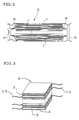
- a lamination type internal electrode body 6 may also be used having a structure in which positive electrode 2 and negative electrode 3 having certain areas and predetermined shapes are alternately laminated via the separator 4. Materials, preparing method and the like for constituting the positive electrode 2 and negative electrode 3 of the lamination type internal electrode body 6 are similar to those of the positive electrode 2 and negative electrode 3 in the wound type internal electrode body 1 shown in FIG. 1.
- a non-aqueous electrolytic solution there are preferably used: carbonic acid esters such as ethylene carbonate (EC), diethyl carbonate (DEC), dimethyl carbonate (DMC), and propylene carbonate (PC), ⁇ -butyrolacton, tetrahydrofuran, acetonitrile and the like. These can be used singly or in admixture of two or more kinds.
- a mixed solvent of annular carbonate with chain carbonate at an optional ratio is preferably usable.
- the electrolyte include: lithium complex fluoride compounds such as lithium hexafluorophosphate (LiPF 6 ) and lithium borofluoride (LiBF 4 ); lithium halides such as lithium perchlorate (LiClO 4 ) and the like.
- LiPF 6 lithium hexafluorophosphate
- LiBF 4 lithium borofluoride
- LiClO 4 lithium perchlorate
- One or two or more of these are dissolved in the above organic solvent (mixed solvent) and used as the electrolytic solution.
- LiPF 6 as the electrolyte is particularly preferable because it hardly causes oxidative decomposition and has a high conductivity in the non-aqueous electrolytic solution.
- the lithium secondary battery 10 (see FIG. 2) of the present embodiment is usable as a power supply in any application, but when characteristics such as a large capacity, low cost, and high reliability are used, the battery is preferable as a battery to be mounted on a vehicle, and further as a power supply for driving a motor of an electric car or a hybrid electric car. Furthermore, the battery can especially preferably be used in activating an engine requiring a high voltage.
- the lithium secondary battery of the present embodiment is a lithium secondary battery comprising: a positive active material comprising an lithium aluminum manganese oxide having a spinel structure and an aluminum compound other than the lithium aluminum manganese oxide.
- the ratio of an aluminum amount contained in the aluminum compound to that contained in the whole positive active material is within a range of from 1% by weight or more to 50% by weight or less.
- the lithium secondary battery may have the same constitution as that of the lithium secondary battery 10 shown in FIG. 10.
- the lithium secondary battery of the present embodiment can produce a function and effect similar to those of the lithium secondary battery 10 shown in FIG. 2.
- Said at least one metal element other than Li may be one member selected from the group consisting of Fe, Ni, Mg, Zn, B, Co, Cr, Si, Ti, Sn, P, V, Sb, Nb, Ta, Mo, W and any combination among those metal element.
- first and second inventions The respective embodiments of the lithium secondary battery of the present invention (first and second inventions) have been described, but in the lithium secondary battery of the present invention (first and second inventions), the other constitution and shape are not limited to those of the embodiments as long as the battery comprises the positive active material constituted as described above.
- lithium carbonate (Li 2 CO 3 ), manganese dioxide (MnO 2 ), and aluminum oxide (Al 2 O 3 ) (commercial reagents) were used, weighed at a predetermined ratio, thereafter mixed, and fired under an oxidation atmosphere at 850°C for 24 hours to form the present positive active material.
- the obtained positive active material is only lithium aluminum manganese oxide (LiAl x Mn 2-x O 4 (where x denotes the constituting ratio of Al in one molecule, x ⁇ 0.01)), and aluminum compound (Al 2 O 3 ) does not remain.
- the respective starting materials were fired in an insufficiently mixed state, that is, in a state in which a part of the staring materials remains non-reacted, and the ratio of the aluminum amount contained in the aluminum compound to that contained in the positive active material was adjusted to form the positive active materials (Examples 1 to 4 and Comparative Examples 2 to 4).
- a predetermined amount of boron oxide (B 2 O 3 ) was mixed with the starting material, and the positive active materials for Examples 5 and 6 were produced under the same firing conditions as described above.
- the starting materials were mixed using an automatic mortar mixer for ten hours, fired under an oxidation atmosphere at 650°C for ten hours, thereafter crushed/mixed for ten hours, and further fired under an oxidation atmosphere at 850°C for 100 hours to produce the positive active materials for Comparative Examples 1 and 5.
- a powder X-ray diffraction device manufactured by Rigaku Denki Kabushiki Kaisha: trade name RINT
- a powder X-ray diffraction device was used to measure the positive active materials (Examples 1 to 6 and Comparative Examples 1 to 5).
- CuK ⁇ wire was used as an X-ray source
- tube voltage was set to 50 kV
- tube current was set to 300 mA
- diffusion slit was set to 0.5 deg
- scattering slit was set to 0.5 deg
- light receiving slit was set to 0.15 mm
- scanning range was set to 10° to 120°
- step width was set to 0.02°
- counting time was set to 0.5 sec
- ZnO was used as an internal standard.
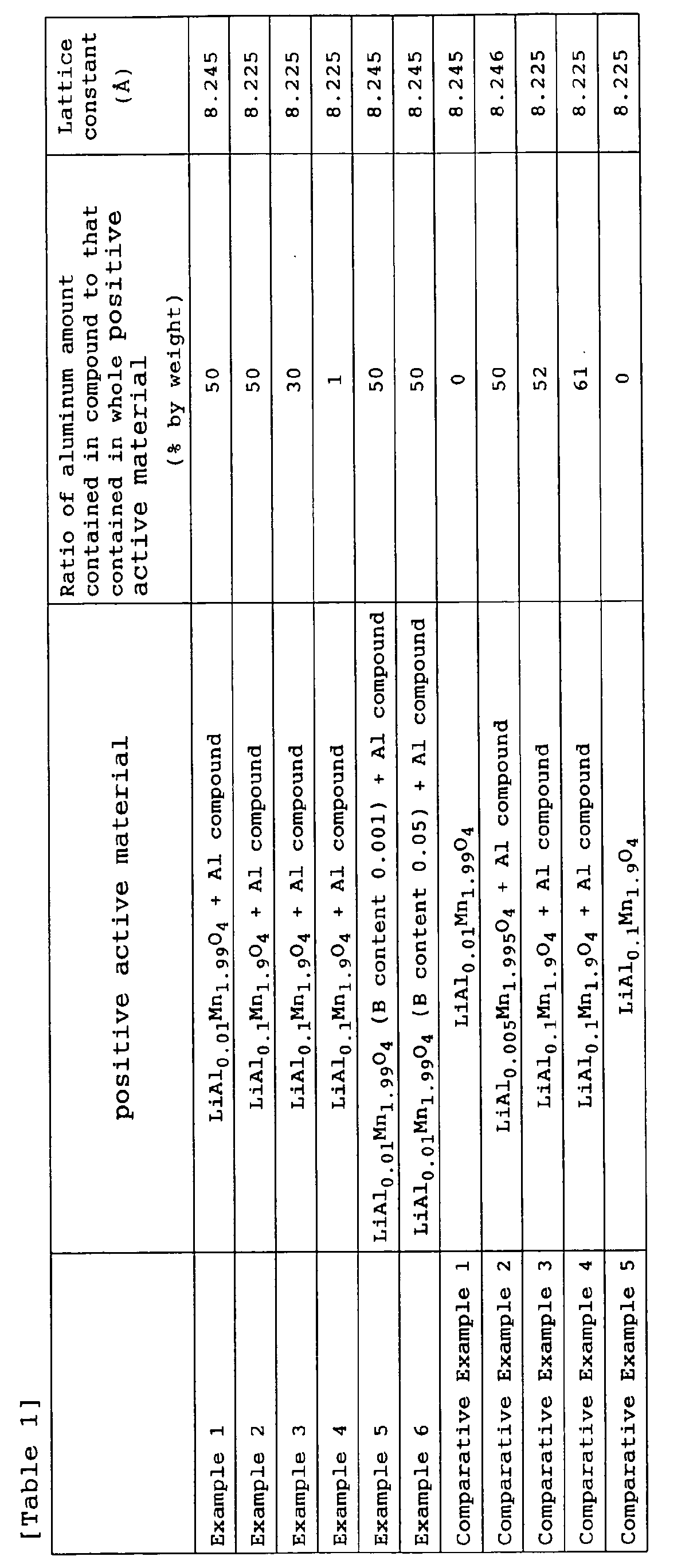
- the lattice constant of the lithium aluminum manganese oxide contained in each positive active material was calculated by an X-ray diffraction program (manufactured by Rigaku Denki Kabushiki Kaisha: trade name RINT 2000 series application software WPPF program). Calculation results are shown in Table 1.
- the lattice constants of Examples 1, 5, 6 and Comparative Example 1 were all 8.245 ( ⁇ ), those of Examples 2 to 4 and Comparative Examples 3 to 5 were all 8.225 ( ⁇ ), and that of Comparative Example 2 was 8.246 ( ⁇ ).
- the ratio of the aluminum amount contained in the aluminum compound to that contained in the whole positive active material was calculated by the following method.
- lithium aluminum manganese oxide represented by the formula LiAl x Mn 2-x O 4 wherein x is 0.1, 0.2, or 0.3 were mixed using the above-described respective starting materials and using the automatic mortar mixer, which would raise the cost in an actual manufacturing process, for ten hours, fired in the oxidation atmosphere at 650°C for ten hours, thereafter crushed/mixed for ten hours, and further fired and produced under an oxidation atmosphere at 850°C for 100 hours. It was confirmed by the X-ray diffraction measurement that the obtained sample had a single phase, and the sample thus produced was treated as a lithium aluminum manganese oxide with a purity of 100%.
- a value of the lattice constant of the lithium aluminum manganese oxide contained in each positive active material (Examples 1 to 6 and Comparative Examples 1 to 5) shown in Table 1 was assigned to the above equation (1) to calculate the aluminum substitution amount (x) of the lithium aluminum manganese oxide contained in each positive active material (Examples 1 to 6 and Comparative Examples 1 to 5).
- a total aluminum amount of each positive active material was measured by plasma induction emission analysis (ICP), the aluminum substitution amount was subtracted from the total aluminum amount in the substance represented by the above-mentioned formula to obtain the aluminum amount contained in the aluminum compound, and the ratio of the aluminum amount contained in the aluminum compound to the total amount of aluminum contained in the positive active material was calculated using thus obtained results. Results are shown in Table 1.
- Examples 1, 2, 5, and 6 and Comparative Example 2 resulted in 50%
- Example 2 resulted in 30%
- Example 4 resulted in 1%
- Comparative Examples 1 and 5 resulted in 0%
- Comparative Example 3 resulted in 52%
- Comparative Example 4 resulted in 61%.
- Each produced positive active material (Examples 1 to 6 and Comparative Examples 1 to 5) was immersed by 5 g in 20 ml of a LiPF 6 /EC+DEC electrolytic solution similar to that for use in manufacturing the battery at 80°C for 40 hours. Thereafter, each positive active material was separated from the electrolytic solution with a paper filter, and cleaned with an EC+DEC mixed organic solvent and EC organic solvent. The separated electrolytic solution was quantized by the plasma induction emission analysis (ICP), and an Mn amount eluted in the electrolytic solution was measured. Measurement results are shown as "manganese dissolution ratio (%)" in Table 2.
- ICP plasma induction emission analysis
- manganese dissolution ratio (%) means a relative value calculated assuming that a manganese elution amount eluted in the electrolytic solution in which the positive active material of Comparative Example 1 is immersed as 100%.
- the manganese dissolution ratio of Example 1 was 97%, that of Example 2 was 34%, that of Example 3 was 31%, that of Example 4 was 38%, that of Example 5 was 88%, that of Example 6 was 27%, that of Comparative Example 2 was 113%, that of Comparative Example 3 was 36%, that of Comparative Example 4 was 33%, and that of Comparative Example 5 was 39%.
- Each positive active material manufactured in the above-described method and acetylene black which was a conduction auxiliary agent and vinylidene polyfluoride which was a binder were mixed at a weight ratio of 50:2:3, and 0.02 g of the mixed sample was press-molded in a disc shape having a diameter of 20 mm by a pressure of 300 kg/cm 2 to form the positive electrode.
- the positive electrode (sample electrode), the non-aqueous electrolytic solution prepared by dissolving LiPF 6 which was the electrolyte in an organic solvent of ethylene carbonate (EC) mixed with a diethyl carbonate (DEC) at an equal volume ratio (1:1) to have a concentration of 1 mol/l, the separator for partitioning the positive electrode from the negative electrode, and carbon as a negative electrode were used to prepare a coin cell.
- EC ethylene carbonate
- DEC diethyl carbonate
- Example 1 the internal resistance ratio of Example 1 was 98%, that of Example 2 was 58%, that of Example 3 was 46%, that of Example 4 was 57%, that of Example 5 was 92%, that of Example 6 was 45%, that of Comparative Example 2 was 102%, that of Comparative Example 3 was 108%, that of Comparative Example 4 was 132%, and that of Comparative Example 5 was 59%.
- Comparative Examples 3 and 4 in which the ratio of the aluminum amount contained in the compound to that contained in the whole positive active material exceeded 50% by weight, the internal resistance ratio increased.
- the coin cell manufactured in this manner was charged at the constant current of 1C rate and constant voltage up to 4.1 V in accordance with the capacity of the positive active material in a constant temperature bath at 60°C, the charge/discharge test was similarly performed to discharge 2.5 V similarly at the constant current of 1C rate, and this cycle was regarded as one cycle. This was carried out 100 cycles, and the value of the discharge capacity after the elapse of 100 cycles was divided by the value of the initial discharge capacity to calculate the discharge capacity maintenance ratio (%). The results are shown in Table 2.
- Example 1 the discharge capacity maintenance ratio of Example 1 was 75%, that of Example 2 was 87%, that of Example 3 was 93%, that of Example 4 was 91%, that of Example 5 was 81%, that of Example 6 was 94%, that of Comparative Example 1 was 76%, that of Comparative Example 2 was 64%, that of Comparative Example 3 was 79%, that of Comparative Example 4 was 82%, and that of Comparative Example 5 was 91%.
- Example 1 and Comparative Example 1 Since the lithium aluminum manganese oxides of Example 1 and Comparative Example 1, and Examples 2 to 4 and Comparative Example 5 have the identical compositions and lattice constants, as shown in Table 2, it is seen that the present positive active material containing the aluminum compound (Examples 1 to 4) is superior to the positive active material containing substantially no aluminum compound (Comparative Examples 1 and 5) in manganese dissolution ratio and suppression in increasing internal resistance ratio. Reasons for this are supposedly that with the use of a simple manufacturing method, the aluminum compound remaining in the positive active material causes manganese elution, and, for example, an influence onto the positive active material is reduced with respect to HF generated from the electrolytic solution.
- the internal resistance ratio is high.
- the ratio of the aluminum amount contained in the aluminum compound to the total amount of aluminum contained in the positive active material exceeded 50% and increased, the internal resistance ratio tended to rise.
- the aluminum compound supposedly hindered, for example, electron conduction of the positive active material.
- various properties of the lithium secondary battery such as the manganese dissolution ratio, the suppression in increasing internal resistance ratio, and discharge capacity maintenance ratio are enhanced in a case where the positive active material contains boron and vanadium or either one. The reasons for this are supposedly that the crystallinity of the positive active material itself is enhanced, this further suppresses the elution of manganese from the positive active material, and this enhances various properties of the lithium secondary battery.
- the manganese dissolution ratio is high, and the discharge capacity maintenance ratio indicates a minimum value among the present examples and comparative examples.
- a lithium secondary battery which is superior in the suppression of increasing internal resistance ratio and discharge capacity maintenance ratio and which can be manufactured simply at low cost. Since a positive active material for use in the present invention is low in dissolution ratio of manganese into an electrolytic solution, the lithium secondary battery of the present invention has a long life.
- a lithium secondary battery superior in the suppression of increasing internal resistance ratio and discharge capacity maintenance ratio and being simple in structure and inexpensive.
- a lithium secondary battery comprises a positive active material comprising a lithium aluminum manganese oxide having a spinel structure and an aluminum compound other than the lithium aluminum manganese oxide.
- a ratio of an amount of aluminum contained in the aluminum compound to a total amount of aluminum contained in the positive active material is within a range of 1% by weight or more to 50% by weight or less.
- the lithium aluminum manganese oxide is represented by a general formula Li 1+x Al y Mn 2-x-y O 4 wherein x and y denote constituting ratios of elements in one molecule, x ⁇ 0, y ⁇ 0.01, and has a lattice constant of 8.245 ⁇ or less.
- a part of Mn may be replaced with an element other than Li and Al.
Landscapes
- Chemical & Material Sciences (AREA)
- Chemical Kinetics & Catalysis (AREA)
- Electrochemistry (AREA)
- General Chemical & Material Sciences (AREA)
- Inorganic Chemistry (AREA)
- Engineering & Computer Science (AREA)
- Materials Engineering (AREA)
- Battery Electrode And Active Subsutance (AREA)
- Secondary Cells (AREA)
Abstract
Description
Therefore, the battery has drawn people's attentions not only as the portable electronic appliances but also as a power for driving a motor of an electric vehicle (hereinafter referred to as "EV") or a hybrid electric vehicle (hereinafter referred to as "HEV") which has positively and generally spread as a low pollution car in the background of recent environmental problems.
| Document No. | Identification of |
| 1 | JP-A-2001-180939 |
| 2 | JP-A-7-272765 |
| 3 | JP-A-2000-231921 |
| 4 | JP-A-11-171551 |
| 5 | JP-A-2001-48547 |
| Manganese dissolution ratio | Internal resistance ratio | Discharge capacity maintenance ratio | |
| (%) | (%) | (%) | |
| Example 1 | 97 | 98 | 75 |
| Example 2 | 34 | 58 | 87 |
| Example 3 | 31 | 46 | 93 |
| Example 4 | 38 | 57 | 91 |
| Example 5 | 88 | 92 | 81 |
| Example 6 | 27 | 45 | 94 |
| Comparative Example 1 | 100 | 100 | 76 |
| Comparative Example 2 | 113 | 102 | 64 |
| Comparative Example 3 | 36 | 108 | 79 |
| Comparative Example 4 | 33 | 132 | 82 |
| Comparative Example 5 | 39 | 59 | 91 |
Claims (7)
- A lithium secondary battery comprising:wherein a ratio of an aluminum amount contained in the aluminum compound to that contained in the whole positive active material is 1% by weight or more and 50% by weight or less, and the lithium aluminum manganese oxide is represented by a general formula Li1+xAlyMn2-x-yO4 wherein x and y denote constituting ratios of the elements in one molecule, and x ≥ 0, and y ≥ 0.01, and has a lattice constant of 8.245 Å or less.positive active material comprising an lithium aluminum manganese oxide having a spinel structure and an aluminum compound other than the lithium aluminum manganese oxide,
- The lithium secondary battery according to claim 1, wherein a part of an element Mn in the lithium aluminum manganese oxide is further replaced with at least one metal element other than Li and Al.
- The lithium secondary battery according to claim 1 or 2, wherein the ratio of the aluminum amount contained in the aluminum compound to the total amount of aluminum contained in the positive active material is within a range of from 1% by weight or more to 30% by weight or less.
- The lithium secondary battery according to any of claims 1 to 3, wherein the lattice constant is 8.225 Å or less.
- The lithium secondary battery according to any of claims 1 to 4, wherein the lithium aluminum manganese oxide further contains at least one member selected form the group consisting of boron and vanadium.
- The lithium secondary battery according to claim 5, wherein a molar ratio of boron and/or vanadium to manganese contained in the positive active material is within a range of from 0.001 to 0.05.
- The lithium secondary battery according to any of claims 1 to 6, wherein the positive active material is a product obtained by firing a starting material for a lithium aluminum manganese oxide under an oxidation atmosphere at 650 to 1000°C in 5 to 30 hours.
Applications Claiming Priority (2)
| Application Number | Priority Date | Filing Date | Title |
|---|---|---|---|
| JP2003055387 | 2003-03-03 | ||
| JP2003055387A JP2004265749A (en) | 2003-03-03 | 2003-03-03 | Lithium secondary battery |
Publications (2)
| Publication Number | Publication Date |
|---|---|
| EP1455401A2 true EP1455401A2 (en) | 2004-09-08 |
| EP1455401A3 EP1455401A3 (en) | 2008-07-30 |
Family
ID=32821141
Family Applications (1)
| Application Number | Title | Priority Date | Filing Date |
|---|---|---|---|
| EP04004869A Withdrawn EP1455401A3 (en) | 2003-03-03 | 2004-03-02 | Lithium secondary battery |
Country Status (4)
| Country | Link |
|---|---|
| US (1) | US20040191627A1 (en) |
| EP (1) | EP1455401A3 (en) |
| JP (1) | JP2004265749A (en) |
| CA (1) | CA2459225A1 (en) |
Cited By (1)
| Publication number | Priority date | Publication date | Assignee | Title |
|---|---|---|---|---|
| CN103986208A (en) * | 2014-05-23 | 2014-08-13 | 维尔斯电子(昆山)有限公司 | Vehicle-mounted charger |
Families Citing this family (16)
| Publication number | Priority date | Publication date | Assignee | Title |
|---|---|---|---|---|
| JP5294225B2 (en) * | 2006-04-21 | 2013-09-18 | 独立行政法人産業技術総合研究所 | Single crystal particles of oxide for lithium secondary battery electrode, method for producing the same, and lithium secondary battery using the same |
| JP4221448B1 (en) | 2007-07-19 | 2009-02-12 | 日鉱金属株式会社 | Lithium manganese composite oxide for lithium ion battery and method for producing the same |
| CA2720600C (en) | 2008-04-07 | 2017-09-12 | Jay Whitacre | Sodium ion based aqueous electrolyte electrochemical secondary energy storage device |
| KR101687040B1 (en) * | 2009-01-20 | 2016-12-15 | 도다 고교 가부시끼가이샤 | Positive electrode active material for secondary batteries with nonaqueous electrolytic solution, process for the production of the active material, and secondary batteries with nonaqueous electrolytic solution |
| JP2011140430A (en) * | 2010-01-08 | 2011-07-21 | Sharp Corp | Multiple inorganic compound system and utilization thereof and method for producing the multiple inorganic compound system |
| JP5115891B2 (en) * | 2010-01-08 | 2013-01-09 | シャープ株式会社 | Non-aqueous secondary battery comprising a positive electrode active material and a positive electrode including the same |
| JP2012089441A (en) * | 2010-10-22 | 2012-05-10 | Sharp Corp | Positive electrode active material, and nonaqueous secondary battery with positive electrode containing the same |
| WO2012148569A2 (en) | 2011-03-01 | 2012-11-01 | Aquion Energy Inc. | Profile responsive electrode ensemble |
| US8298701B2 (en) | 2011-03-09 | 2012-10-30 | Aquion Energy Inc. | Aqueous electrolyte energy storage device |
| JP2013018661A (en) * | 2011-07-07 | 2013-01-31 | Sharp Corp | Multiple inorganic compound system and use thereof, and method for producing the multiple inorganic compound system |
| US8137830B2 (en) | 2011-07-19 | 2012-03-20 | Aquion Energy, Inc. | High voltage battery composed of anode limited electrochemical cells |
| US8945751B2 (en) | 2011-07-19 | 2015-02-03 | Aquion Energy, Inc. | High voltage battery composed of anode limited electrochemical cells |
| US8652672B2 (en) | 2012-03-15 | 2014-02-18 | Aquion Energy, Inc. | Large format electrochemical energy storage device housing and module |
| US8945756B2 (en) | 2012-12-12 | 2015-02-03 | Aquion Energy Inc. | Composite anode structure for aqueous electrolyte energy storage and device containing same |
| JPWO2024106037A1 (en) * | 2022-11-15 | 2024-05-23 | ||
| CN117239140A (en) * | 2023-09-19 | 2023-12-15 | 李文琦 | Porous reticular polymer film carrier copper foil and preparation method thereof |
Family Cites Families (5)
| Publication number | Priority date | Publication date | Assignee | Title |
|---|---|---|---|---|
| TW434187B (en) * | 1997-05-07 | 2001-05-16 | Fuji Chem Ind Co Ltd | A process for preparing a spinel type of lithium manganese complex oxide |
| JP3595734B2 (en) * | 1999-02-15 | 2004-12-02 | 株式会社デンソー | Positive active material for non-aqueous electrolyte secondary battery, method for producing the positive active material, and secondary battery using the positive active material |
| US6248477B1 (en) * | 1999-09-29 | 2001-06-19 | Kerr-Mcgee Chemical Llc | Cathode intercalation compositions, production methods and rechargeable lithium batteries containing the same |
| US6641953B2 (en) * | 2000-01-12 | 2003-11-04 | Wilson Greatbatch Ltd. | Secondary cell with high rate pulse capability |
| JP2002008654A (en) * | 2000-06-20 | 2002-01-11 | Sony Corp | Positive electrode active material and method for producing the same, and nonaqueous electrolyte battery and method for producing the same |
-
2003
- 2003-03-03 JP JP2003055387A patent/JP2004265749A/en active Pending
-
2004
- 2004-02-26 US US10/787,858 patent/US20040191627A1/en not_active Abandoned
- 2004-03-01 CA CA002459225A patent/CA2459225A1/en not_active Abandoned
- 2004-03-02 EP EP04004869A patent/EP1455401A3/en not_active Withdrawn
Cited By (2)
| Publication number | Priority date | Publication date | Assignee | Title |
|---|---|---|---|---|
| CN103986208A (en) * | 2014-05-23 | 2014-08-13 | 维尔斯电子(昆山)有限公司 | Vehicle-mounted charger |
| CN103986208B (en) * | 2014-05-23 | 2015-12-30 | 维尔斯电子(昆山)有限公司 | A kind of onboard charger |
Also Published As
| Publication number | Publication date |
|---|---|
| CA2459225A1 (en) | 2004-09-03 |
| EP1455401A3 (en) | 2008-07-30 |
| JP2004265749A (en) | 2004-09-24 |
| US20040191627A1 (en) | 2004-09-30 |
Similar Documents
| Publication | Publication Date | Title |
|---|---|---|
| JP5095179B2 (en) | Nonaqueous electrolyte battery, lithium titanium composite oxide and battery pack | |
| JP4950980B2 (en) | Lithium titanium composite oxide for nonaqueous electrolyte battery and negative electrode active material for nonaqueous electrolyte battery | |
| JP5300502B2 (en) | Battery active material, non-aqueous electrolyte battery and battery pack | |
| JP4249727B2 (en) | Nonaqueous electrolyte battery and lithium titanium composite oxide | |
| JP4245532B2 (en) | Nonaqueous electrolyte secondary battery | |
| JP5448005B2 (en) | Positive electrode active material for lithium secondary battery and use thereof | |
| CN110880586B (en) | Positive electrode active material and battery having the same | |
| EP1455401A2 (en) | Lithium secondary battery | |
| KR20120099375A (en) | Metal oxide coated positive electrode materials for lithium-based batteries | |
| KR20200018852A (en) | Cathode active material for lithium secondary battery, method of preparing the same and lithium secondary battery including the same | |
| KR20130098372A (en) | Metal halide coatings on lithium ion battery positive electrode materials and corresponding batteries | |
| JP2010027377A (en) | Active material for battery, nonaqueous electrolyte battery, and battery pack | |
| JP2019125574A (en) | Positive electrode active material and battery | |
| JP2019029344A (en) | Cathode active material, and battery | |
| KR20160081111A (en) | Composite positive active material, preparing method thereof, positive electrode including the same, and lithium secondary battery including the positive electrode | |
| US8715539B2 (en) | Positive electrode material for lithium secondary battery and method for manufacturing the same | |
| US20180097227A1 (en) | Positive-electrode active material and battery | |
| JP4954481B2 (en) | Lithium secondary battery | |
| JP2006236830A (en) | Lithium secondary battery | |
| US20250132327A1 (en) | Positive electrode material for secondary batteries | |
| KR101668929B1 (en) | Secondary battery and method for producing same | |
| JP4156199B2 (en) | Positive electrode active material for lithium secondary battery and method for producing the same | |
| JP2003297338A (en) | Positive electrode for non-aqueous electrolyte secondary battery and non-aqueous electrolyte secondary battery using the same | |
| JP2002025539A (en) | Lithium secondary battery | |
| JP2003297340A (en) | Positive electrode for non-aqueous electrolyte secondary battery and non-aqueous electrolyte secondary battery using the same |
Legal Events
| Date | Code | Title | Description |
|---|---|---|---|
| PUAI | Public reference made under article 153(3) epc to a published international application that has entered the european phase |
Free format text: ORIGINAL CODE: 0009012 |
|
| AK | Designated contracting states |
Kind code of ref document: A2 Designated state(s): AT BE BG CH CY CZ DE DK EE ES FI FR GB GR HU IE IT LI LU MC NL PL PT RO SE SI SK TR |
|
| AX | Request for extension of the european patent |
Extension state: AL LT LV MK |
|
| PUAL | Search report despatched |
Free format text: ORIGINAL CODE: 0009013 |
|
| AK | Designated contracting states |
Kind code of ref document: A3 Designated state(s): AT BE BG CH CY CZ DE DK EE ES FI FR GB GR HU IE IT LI LU MC NL PL PT RO SE SI SK TR |
|
| AX | Request for extension of the european patent |
Extension state: AL LT LV MK |
|
| 17P | Request for examination filed |
Effective date: 20080905 |
|
| 17Q | First examination report despatched |
Effective date: 20081117 |
|
| AKX | Designation fees paid |
Designated state(s): AT BE BG CH CY CZ DE DK EE ES FI FR GB GR HU IE IT LI LU MC NL PL PT RO SE SI SK TR |
|
| STAA | Information on the status of an ep patent application or granted ep patent |
Free format text: STATUS: THE APPLICATION IS DEEMED TO BE WITHDRAWN |
|
| 18D | Application deemed to be withdrawn |
Effective date: 20090328 |