EP1455300A2 - Clustering apparatus, clustering method, and clustering program - Google Patents
Clustering apparatus, clustering method, and clustering program Download PDFInfo
- Publication number
- EP1455300A2 EP1455300A2 EP04005131A EP04005131A EP1455300A2 EP 1455300 A2 EP1455300 A2 EP 1455300A2 EP 04005131 A EP04005131 A EP 04005131A EP 04005131 A EP04005131 A EP 04005131A EP 1455300 A2 EP1455300 A2 EP 1455300A2
- Authority
- EP
- European Patent Office
- Prior art keywords
- sample
- clustering
- unidentifiable
- parameter
- outlier
- Prior art date
- Legal status (The legal status is an assumption and is not a legal conclusion. Google has not performed a legal analysis and makes no representation as to the accuracy of the status listed.)
- Withdrawn
Links
Images






Classifications
-
- G—PHYSICS
- G06—COMPUTING OR CALCULATING; COUNTING
- G06F—ELECTRIC DIGITAL DATA PROCESSING
- G06F18/00—Pattern recognition
- G06F18/20—Analysing
- G06F18/23—Clustering techniques
- G06F18/232—Non-hierarchical techniques
- G06F18/2321—Non-hierarchical techniques using statistics or function optimisation, e.g. modelling of probability density functions
- G06F18/23213—Non-hierarchical techniques using statistics or function optimisation, e.g. modelling of probability density functions with fixed number of clusters, e.g. K-means clustering
Definitions
- This invention relates to a clustering apparatus, a clustering method, and a clustering program and, in particular, to a clustering apparatus, a clustering method, and a clustering program each of which is based on normal mixture distribution.
- K-means clustering is known.
- a clustering method based on normal mixture distribution is also known.
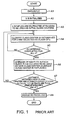
- a dataset including a plurality of samples is given (step A1).
- the number k of classes or clusters is determined (step A2).
- k samples are extracted at random and used as initial class centers for k classes, respectively (step A3).
- the distance from each of the class centers, k in number is calculated and each sample is classified into a particular class having the class center closest from the sample (steps A4 and A5). From those samples classified in each class, a new class center is calculated as an average value (step A6).
- step A7 the steps of calculating the distance from the class center and classifying the sample into a new class are repeated for all of the samples. After completion of the classification, the result is produced (step A8).
- parameter estimation is generally carried out by the use of the maximum likelihood method.
- each sample is clustered according to the Bayes rule.
- posterior probabilities are calculated by a probability density function given by Equation (1) to determine the class into which the sample is to be classified.
- the maximum likelihood method is well known as a classical method for parameter estimation and is often used in parameter estimation by the clustering method based on normal mixture distribution.
- the maximum likelihood method is a method of estimating the clustering parameter ⁇ which maximizes a logarithmic likelihood function L( ⁇ ) as a function of the clustering parameter ⁇ .
- the logarithmic likelihood function L( ⁇ ) is given by Equation (2).
- n the number of samples.
- posterior probabilities p j in the respective classes are calculated by the use of the estimated clustering parameter ⁇ according to Equation (3) and the class to which the sample is to be classified is determined with reference to the posterior probabilities p j .
- p j ⁇ j ⁇ (x; ⁇ j , ⁇ 2 j ) f(x; ⁇ )
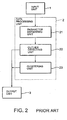
- the clustering apparatus comprises an input unit 1 such as a keyboard, a data processing unit 2 operable under control of a program, and an output unit 3 such as a display or a printer.
- the data processing unit 2 comprises a parameter estimating section 21, an outlier detecting section 22, and a clustering section 23.
- the input unit 1 is supplied with a dataset including a plurality of samples (step B1).
- Various parameters are initialized (step B2).
- the parameter estimating section 21 estimates the clustering parameter ⁇ in accordance with Equation (2) (step B3).
- the parameter estimating section 21 calculates the probability density function given by Equation (1) (step B4).
- the outlier detecting section 22 judges whether or not each sample is present within a predetermined confidence interval of the probability density function to thereby judge an outlier (step B5). If the sample is not present in the confidence interval, the outlier detecting section 22 detects the sample as the outlier (step B8).
- the clustering section 23 For each sample which has not been detected as the outlier in the outlier detecting section 22, the clustering section 23 calculates the posterior probabilities p j in Equation (3) (step B6). The clustering section 23 determines a class j which, according to Equation (3), gives the maximum posterior probability p j for the sample and classifies the sample into the class j (step B7). These steps B5 to B8 in Fig. 3 are repeated for all the samples (step B9). After completion of clustering, the result is produced (step B10).
- clustering is difficult in case where the number of classes is unknown for the dataset to be subjected to clustering. This is because, in the K-means clustering and the clustering method based on normal mixture distribution using the maximum likelihood method, stable and reliable clustering is difficult unless the number of classes is known.
- the K-means clustering can not detect, as an unidentifiable or unclusterable sample, a sample whose class is ambiguous and indefinite. This is because the K-means clustering has no more than a function of unexceptionally classifying every sample to any one of the classes.
- improper clustering may be carried out due to the presence of an outlier. This is because both of the K-means clustering and the clustering method based on normal mixture distribution using the maximum likelihood method are not robust against the outlier but is seriously affected by the outlier.
- classification into a proper class is difficult in the clustering method based on normal mixture distribution using the maximum likelihood method in case where only one sample belongs to a particular class. This is because, in the clustering method based on normal mixture distribution using the maximum likelihood method, an estimated value of the clustering parameter ⁇ can not be obtained if only one sample belongs to a particular class.
- the K-means clustering may carry out improper clustering in case where respective classes are different in data spread or variation. This is because the K-means clustering does not have a function of coping with the difference in data spread or variation.
- a clustering apparatus comprising an input unit supplied with a dataset including a plurality of samples, a data processing unit for processing the samples supplied from the input unit to classify each sample into a class, and an output unit for producing a processing result representative of classification carried out in the data processing unit, the clustering apparatus further comprising a parameter memory for memorizing a target parameter obtained from past experiments, the data processing unit comprising a parameter estimating section for estimating a clustering parameter by the use of the target parameter memorized in the parameter memory.
- the parameter estimating section estimates the clustering parameter by the use of a modified likelihood function which is robust against an outlier.
- the parameter memory in this invention memorizes the target parameter obtained from past experiments.
- past parameters are utilized in clustering.
- the number of classes can be determined to be an appropriate value.
- the parameter estimating section adopts the modified likelihood function as a technique robust against an outlier.
- the data processing unit further comprises an unidentifiable sample detecting section for detecting a particular sample as an unidentifiable sample if posterior probabilities calculated for the particular sample by a probability density function produced by the clustering parameter estimated by the parameter estimating section are smaller than a predetermined value.
- the unidentifiable sample detecting section in this invention detects the particular sample as the unidentifiable sample if the posterior probabilities to be used in clustering are smaller than the predetermined value.
- the data processing unit further comprises:
- the data processing unit further comprises:
- the clustering section uses normal mixture distribution having a variance parameter selected per each class.
- the variance parameter of the normal mixture distribution used in the clustering section of this invention is freely selected per each class. Therefore, the difference in variation among the respective classes can be accommodated. It is thus possible to achieve the fifth object of this invention.
- the clustering method further comprises the step of detecting, by an unidentifiable sample detecting section of the data processing unit, a particular sample as an unidentifiable sample if posterior probabilities calculated for the particular sample by a probability density function produced by the clustering parameter estimated by the parameter estimating section are smaller than a predetermined value.
- the clustering method according to the second aspect further comprises the steps of
- the clustering method according to the second aspect further comprises the steps of
- a clustering program for making a computer execute a function of supplying a dataset including a plurality of samples, a function of processing the samples supplied by the supplying function to classify each sample into a class, and a function of producing a processing result representative of classification carried out by the classifying function, the clustering program further including a function of memorizing, in a memory unit, a target parameter obtained from past experiments, the classifying function including a function of estimating a clustering parameter by the use of the target parameter memorized in the memory unit.
- the classifying function further includes a function of detecting a particular sample as an unidentifiable sample if posterior probabilities calculated for the particular sample by a probability density function produced by the clustering parameter estimated by the estimating function are smaller than a predetermined value.
- the classifying function further includes the functions of
- the classifying function further includes the functions of
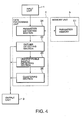
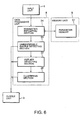
- a clustering apparatus comprises an input unit 1 such as a keyboard, a data processing unit 4 operable under control of a program, a memory unit 5 for memorizing information, and an output unit 3 such as a display or a printer.
- the memory unit 5 comprises a parameter memory 51.
- the parameter memory 51 preliminarily memorizes a target parameter ⁇ obtained from past experiments and parameters ⁇ and ⁇ for tuning a parameter estimated value as a resultant value.
- the data processing unit 4 comprises a parameter estimating section 24, an outlier detecting section 22, an unidentifiable sample detecting section 25, and a clustering section 26.
- the parameter estimating section 24 estimates a clustering parameter ⁇ by the use of a dataset including a plurality of samples supplied from the input unit 1 and the parameters ⁇ , ⁇ , and ⁇ memorized in the parameter memory 51.
- the outlier detecting section 22 detects a particular sample as an outlier if the particular sample is deviated from a predetermined confidence interval.
- the unidentifiable sample detecting section 25 detects, from those samples which have not been detected as the outlier in the outlier detecting section 22, a specific sample as an unidentifiable sample if posterior probabilities calculated for the specific sample by the probability density function similar to that mentioned above are smaller than a predetermined probability value ⁇ .
- the clustering section 26 classifies each sample, which has not been detected as the outlier or the unidentifiable sample in the outlier detecting section 22 or the unidentifiable sample detecting section 25, into each class by the use of the posterior probabilities similar to that mentioned above.
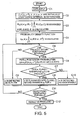
- the input unit 1 is supplied with the dataset including a plurality of samples x (step C1 in Fig. 5).
- various parameters are initialized (step C2).
- the parameter estimating section 24 obtains the clustering parameter ⁇ by maximizing a modified likelihood function PL( ⁇ ) given by Equation (4) with respect to the clustering parameter ⁇ (step C3).
- n represents the number of samples, ⁇ , a tuning parameter, k, the number of classes.
- the modified likelihood function PL( ⁇ ) is a function robust against the outlier.
- l ⁇ ( ⁇ ) and KL( ⁇ j0 , ⁇ j ) are given by Equations (5) and (6), respectively.
- KL( ⁇ j0, ⁇ j ) ⁇ (z; ⁇ j0 )log ⁇ (z; ⁇ j0 ) ⁇ (z; ⁇ j ) dz.
- ⁇ (z; ⁇ j ) represents a probability density function of normal distribution having an average ⁇ j and a variance ⁇ 2 j .
- the parameter estimating section 24 calculates the probability density function given by Equation (1) by the use of the clustering parameter ⁇ obtained as mentioned above (step C4).
- the outlier detecting section 22 judges whether or not each sample supplied in the step C1 is present within a predetermined confidence interval of the probability density function (step C5). If the sample is not present within the confidence interval, the sample is detected as an outlier (step C9).
- Fig. 5 it is assumed that the sample is judged to be present within the confidence interval in the step C5.
- the sample is supplied to the unidentifiable sample detecting section 25.
- the unidentifiable sample detecting section 25 calculates the posterior probabilities for the respective classes according to Equation (3) (step C6).
- the unidentifiable sample detecting section 25 judges whether or not the posterior probabilities exceed the value of ⁇ (step C7). If the posterior probabilities are smaller than ⁇ , the sample is detected as an unidentifiable sample (step C10).
- any of the posterior probabilities for the sample is not smaller than ⁇ in the step C7.
- the sample is supplied to the clustering section 26.
- the clustering section 26 selects, as a class of the sample, a class j giving the maximum value of p j (step C8).
- the data processing unit 4 repeatedly carries out the above-mentioned steps for all the samples (step C11). After completion of clustering for all the samples, the result is supplied to the output unit 3 (step C12).
- the modified likelihood function given by Equation (4) is established and maximized so that the clustering complying with the objects of this invention can be carried out.
- the variance parameter ⁇ 2 j of normal mixture distribution used in the clustering section 26 is freely selected per each class.
- the clustering apparatus in this embodiment is different from the clustering apparatus illustrated in Fig. 4 in that the outlier detecting section 22 and the unidentifiable detecting section 25 are different or reversed in the order of arrangement.
- the parameter estimating section 24, the clustering section 26, and the parameter memory 51 involved in steps D1 to D4 and D8 to D12 in Fig. 7 in this embodiment are same in function as those in the first embodiment. Therefore, description thereof will be omitted.
- the outlier is first detected in the steps C5 to C7 in Fig. 5 and the unidentifiable sample is detected from remaining samples.
- the unidentifiable sample is first detected in steps D5 to D7 in Fig. 7 and the outlier is detected from remaining samples.
- the clustering apparatus in this embodiment comprises the input unit 1, a data processing unit 8, the memory unit 5, and the output unit 3, like the first and the second embodiments, and further comprises a recording medium 7 memorizing a clustering program.
- the recording medium 7 may be a magnetic disk, a semiconductor memory, a CD-ROM, a DVD-ROM, and any other appropriate recording medium.
- the clustering program is loaded from the recording medium 7 into the data processing unit 8 to control the operation of the data processing unit 8 and to create a parameter memory 51 in the memory unit 5.
- the data processing unit 8 executes an operation similar to those executed by the data processing units 4 and 6 in the first and the second embodiments.
- the first example corresponds to the first embodiment.
- the genotype is analyzed, for example, by the invader assay.
- the invader assay is a genome analysis technique developed by Third Wave Technologies, INC in USA. In the invader assay, allele-specific oligo with fluorescent labeling and a template are hybridized with a DNA to be analyzed. The result of hybridization is obtained as the strength of fluorescence so as to analyze the genotype.
- the result of a particular genotype analyzed by the invader assay is plotted on a two-dimensional plane as shown in Fig. 9.
- the X axis and the Y axis represent the strengths of fluorescence of agents for detecting two alleles (allelic genes), respectively. If the value of X is greater and if the value of Y is greater, it is judged that the individual has an allele 1 and an allele 2, respectively.
- a sample close to the X axis, a sample close to the Y axis, and a sample close to an inclination of about 45 degrees are judged to have a genotype 1/1, a genotype 2/2, and a genotype 1/2, respectively.
- a sample near an origin is intended to check the experiment and is not directed to a human sequence.
- this invention is applied in order to cluster the above-mentioned data according to the three genotypes 1/1, 2/2, and 1/2.
- FIG. 9 A dataset to be analyzed is shown in Fig. 9.
- the dataset Gene3335 in Fig. 9 already cleared the examination by the ethics panel with respect to "Guideline for Ethics Related to Research for Human Genome/Gene Analysis" in the Japanese Foundation for Cancer Research to which Mr. Miki, one of the inventors, belongs.
- the dataset shown in Fig. 9 includes an unidentifiable sample and an outlier between classes. Those samples near the origin need not be judged. It is well known that appropriate one-dimensional angular data are effective in clustering. Therefore, the clustering which will hereinafter be described was carried out based on the one-dimensional angular data without including those samples near the origin.
- Fig. 10 shows the result when the K-means clustering was applied to the one-dimensional angular data in Fig. 9.
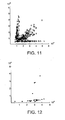
- Fig. 11 shows the result when the clustering of this invention is applied to the one-dimensional angular data in Fig. 9.
- the numerals 1 to 3 represent class numbers, 7, an outlier, 0, an unidentifiable sample.
- a dataset to be analyzed is simulation data shown in Fig. 12.
- the dataset in Fig. 12 includes a plurality of samples to be classified into two classes and have one outlier.
- clustering was carried out based on one-dimensional angular data without including those samples near the origin.
- Fig. 13 shows the result when the dataset in Fig. 12 was subjected to clustering according to the normal mixture distribution using the maximum likelihood method.
- Fig. 14 shows the result when the dataset in Fig. 12 was subjected to clustering according to this invention.
- the samples are classified into two classes since the number of classes in the maximum likelihood method is preliminarily selected to be equal to two. However, the sample as the outlier is also classified into the class 2. On the other hand, in Fig. 14, even if the number of classes is selected to be equal to three, the samples are correctly classified into two classes and the outlier is detected.
- the clustering method based on normal mixture distribution using the maximum likelihood method herein used for comparison incorporates the unidentifiable sample detecting section which is a part of this invention.
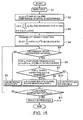
- the clustering is carried out through steps shown in Fig. 15.
- the steps in Fig. 15 are different from those in Fig. 3 in that steps E7 and E10 are added. Specifically, the steps E1 to E6 in Fig. 15 correspond to the steps B1 to B6 in Fig. 3, respectively. The steps E8 and E9 in Fig. 15 correspond to the steps B7 and B8 in Fig. 3, respectively. The steps E11 and E12 in Fig. 15 correspond to the steps B9 and B10 in Fig. 3, respectively.
- the dataset to be analyzed is shown in Fig. 16.
- the dataset Gene10530 in Fig. 16 already cleared the examination by the ethics panel with respect to "Guideline for Ethics Related to Research for Human Genome/Gene Analysis" in the Japanese Foundation for Cancer Research to which Mr. Miki, one of the inventors, belongs.
- the dataset shown in Fig. 16 include a plurality of samples to be classified into two classes except those samples near the origin. An outlier is present also.
- Fig. 17 shows the result when the dataset Gene10530 in Fig. 16 was subjected clustering according to the normal mixture distribution using the maximum likelihood method.
- Fig. 18 shows the result when the dataset Gene10530 in Fig. 16 was subjected to clustering according to this invention.
- Fig. 17 the samples which should be classified into two classes are classified into three classes since the number of classes in the maximum likelihood method is selected to be equal to 3. Those samples to belong to the class 2 are unreasonably classified into two different classes and intermediate samples are judged unidentifiable. On the other hand, in Fig. 18, even if the number of classes is selected to be equal to three, the samples are properly classified into two classes. In addition, an outlier is detected.
- clustering is stably and properly carried out even if the number of classes of data is unknown. This is because the parameter obtained from past experiments is preliminarily memorized and used for estimation of a new parameter.
- the sample can be classified into a proper class. This is because, in this invention, a proper estimated value is obtained, even if only one sample belongs to a particular class, so that the sample is not judged as an outlier.
Landscapes
- Engineering & Computer Science (AREA)
- Data Mining & Analysis (AREA)
- Physics & Mathematics (AREA)
- Theoretical Computer Science (AREA)
- Computer Vision & Pattern Recognition (AREA)
- Artificial Intelligence (AREA)
- Bioinformatics & Cheminformatics (AREA)
- Bioinformatics & Computational Biology (AREA)
- Life Sciences & Earth Sciences (AREA)
- Evolutionary Biology (AREA)
- Evolutionary Computation (AREA)
- General Engineering & Computer Science (AREA)
- General Physics & Mathematics (AREA)
- Probability & Statistics with Applications (AREA)
- Complex Calculations (AREA)
- Image Analysis (AREA)
Abstract
Description




Claims (14)
- A clustering apparatus comprising an input unit supplied with a dataset including a plurality of samples, a data processing unit for processing the samples supplied from the input unit to classify each sample into a class, and an output unit for producing a processing result representative of classification carried out in the data processing unit, the clustering apparatus further comprising a parameter memory for memorizing a target parameter obtained from past experiments, the data processing unit comprising a parameter estimating section for estimating a clustering parameter by the use of the target parameter memorized in the parameter memory.
- A clustering apparatus as claimed in Claim 1, wherein the parameter estimating section estimates the clustering parameter by the use of a modified likelihood function which is robust against an outlier.
- A clustering apparatus as claimed in Claim 1 or 2, wherein the data processing unit further comprises an unidentifiable sample detecting section for detecting a particular sample as an unidentifiable sample if posterior probabilities calculated for the particular sample by a probability density function produced by the clustering parameter estimated by the parameter estimating section are smaller than a predetermined value.
- A clustering apparatus as claimed in Claim 1, 2 or 3, wherein the data processing unit further comprises:an outlier detecting section for detecting, by the use of a probability density function produced by an estimated parameter estimated by the parameter estimating section, a particular sample as an outlier if the particular sample is deviated from a predetermined confidence interval,an unidentifiable sample detecting section for detecting, from those samples which have not been detected as the outlier in the outlier detecting section, a specific sample as an unidentifiable or unclusterable sample if posterior probabilities calculated by the probability density function for the specific sample are smaller than a predetermined probability value, anda clustering section for classifying each sample which has not been detected as the outlier or the unidentifiable sample in the outlier detecting section or the unidentifiable sample detecting section into each class by the use of the posterior probabilities.
- An apparatus as claimed in any one of Claims 1 to 4, wherein the data processing unit further comprises:an unidentifiable sample detecting section for detecting a particular sample as an unidentifiable sample if posterior probabilities calculated for the particular sample by a probability density function produced by an estimated parameter estimated by the parameter estimating section are smaller than a predetermined probability value,an outlier detecting section for detecting, from those samples which have not been detected as the unidentifiable sample in the unidentifiable sample detecting section, a specific sample as an outlier by the use of the probability density function if the specific sample is deviated from a predetermined confidence interval, anda clustering section for classifying each sample which has not been detected as the unidentifiable sample or the outlier in the unidentifiable sample detecting section or the outlier detecting section into each class by the use of the posterior probabilities.
- A clustering apparatus as claimed in Claim 4 or 5, wherein the clustering section uses normal mixture distribution having a variance parameter selected per each class.
- A clustering method comprising the steps ofsupplying an input unit with a dataset including a plurality of samples,processing, in a data processing unit, the samples supplied from the input unit to classify each sample into a class, andproducing, by an output unit, a processing result representative of classification carried out in the data processing unit,the clustering method further comprising the steps ofmemorizing, in a parameter memory of a memory unit, a target parameter obtained from past experiments, andestimating, in a parameter estimating section of the data processing unit, a clustering parameter by the use of the target parameter memorized in the parameter memory.
- A clustering method as claimed in Claim 7, further comprising the step of detecting, by an unidentifiable sample detecting section of the data processing unit, a particular sample as an unidentifiable sample if posterior probabilities calculated for the particular sample by a probability density function produced by the clustering parameter estimated by the parameter estimating section are smaller than a predetermined value.
- A clustering method as claimed in Claim 7 or 8, further comprising the steps ofdetecting, by an outlier detecting section of the data processing unit, a particular sample as an outlier by the use of a probability density function produced by an estimated clustering parameter estimated by the parameter estimating section if the particular sample is deviated from a predetermined confidence interval,detecting, by an unidentifiable sample detecting section of the data processing unit, a specific sample as an unidentifiable sample from those samples which have not been detected as the outlier in the outlier detecting section, if posterior probabilities calculated by the probability density function for the specific sample are smaller than a predetermined probability value, andclassifying, by a clustering section of the data processing unit, each sample which has not been detected as the outlier or the unidentifiable sample in the outlier detecting section or the unidentifiable sample detecting section into each class by the use of the posterior probabilities.
- A clustering method as claimed in Claim 7, 8 or 9, further comprising the steps ofdetecting, by an unidentifiable sample detecting section of the data processing unit, a particular sample as an unidentifiable sample if posterior probabilities calculated for the particular sample by a probability density function produced by an estimated clustering parameter estimated by the parameter estimating section are smaller than a predetermined probability value,detecting, by an outlier detecting section of the data processing unit, a specific sample as an outlier by the use of the probability density function from those samples which have not been detected as the unidentifiable sample in the unidentifiable sample detecting section, if the specific sample is deviated from a predetermined confidence interval, andclassifying, by a clustering section of the data processing unit, each sample which has not been detected as the unidentifiable sample or the outlier in the unidentifiable sample detecting section or the outlier detecting section into each class by the use of the posterior probabilities.
- A clustering program for making a computer execute a function of supplying a dataset including a plurality of samples, a function of processing the samples supplied by the supplying function to classify each sample into a class, and a function of producing a processing result representative of classification carried out by the classifying function, the clustering program further comprising a function of memorizing, in a memory unit, a target parameter obtained from past experiments, the classifying function including a function of estimating a clustering parameter by the use of the target parameter memorized in the memory unit.
- A clustering program as claimed in Claim 11, wherein the classifying function further comprises a function of detecting a particular sample as an unidentifiable sample if posterior probabilities calculated for the particular sample by a probability density function produced by the clustering parameter estimated by the estimating function are smaller than a predetermined value.
- A clustering program as claimed in Claim 11 or 12, wherein the classifying function further comprises the functions ofdetecting, by the use of a probability density function produced by an estimated clustering parameter estimated by the parameter estimating function, a particular sample as an outlier if the particular sample is deviated from a predetermined confidence interval,detecting, from those samples which have not been detected as the outlier in the outlier detecting function, a specific sample as an unidentifiable or unclusterable sample if posterior probabilities calculated by the probability density function for the specific sample are smaller than a predetermined probability value, andclassifying each sample which has not been detected as the outlier or the unidentifiable sample in the outlier detecting function or the unidentifiable sample detecting function into each class by the use of the posterior probabilities.
- A clustering program as claimed in Claim 11, 12 or 13, wherein the classifying function further includes the functions ofdetecting a particular sample as an unidentifiable sample if posterior probabilities calculated for the particular sample by a probability density function produced by an estimated clustering parameter estimated by the parameter estimating function are smaller than a predetermined probability value,detecting, from those samples which have not been detected as the unidentifiable sample in the unidentifiable sample detecting function, a specific sample as an outlier by the use of the probability density function if the specific sample is deviated from a predetermined confidence interval, andclassifying each sample which has not been detected as the unidentifiable sample or the outlier in the unidentifiable sample detecting function or the outlier detecting function into each class by the use of the posterior probabilities.
Applications Claiming Priority (2)
| Application Number | Priority Date | Filing Date | Title |
|---|---|---|---|
| JP2003058511 | 2003-03-05 | ||
| JP2003058511A JP2004272350A (en) | 2003-03-05 | 2003-03-05 | Clustering device, clustering method, clustering program |
Publications (2)
| Publication Number | Publication Date |
|---|---|
| EP1455300A2 true EP1455300A2 (en) | 2004-09-08 |
| EP1455300A3 EP1455300A3 (en) | 2006-05-17 |
Family
ID=32821202
Family Applications (1)
| Application Number | Title | Priority Date | Filing Date |
|---|---|---|---|
| EP04005131A Withdrawn EP1455300A3 (en) | 2003-03-05 | 2004-03-04 | Clustering apparatus, clustering method, and clustering program |
Country Status (3)
| Country | Link |
|---|---|
| US (1) | US20040236742A1 (en) |
| EP (1) | EP1455300A3 (en) |
| JP (1) | JP2004272350A (en) |
Cited By (3)
| Publication number | Priority date | Publication date | Assignee | Title |
|---|---|---|---|---|
| CN102693331A (en) * | 2011-03-25 | 2012-09-26 | 鸿富锦精密工业(深圳)有限公司 | Non-linear object experiment design system and method |
| CN104462802A (en) * | 2014-11-26 | 2015-03-25 | 浪潮电子信息产业股份有限公司 | Method for analyzing outlier data in large-scale data |
| CN106156791A (en) * | 2016-06-15 | 2016-11-23 | 北京京东尚科信息技术有限公司 | Business datum sorting technique and device |
Families Citing this family (6)
| Publication number | Priority date | Publication date | Assignee | Title |
|---|---|---|---|---|
| JP5419004B2 (en) * | 2008-12-11 | 2014-02-19 | 株式会社アイピーコーポレーション | Beauty determination method, beauty determination program, beauty determination program storage medium, and beauty determination apparatus |
| US9098945B2 (en) * | 2009-05-01 | 2015-08-04 | Microsoft Technology Licensing, Llc | Modeling anisotropic surface reflectance with microfacet synthesis |
| JP6029683B2 (en) * | 2012-11-20 | 2016-11-24 | 株式会社日立製作所 | Data analysis device, data analysis program |
| JP6131723B2 (en) | 2012-11-26 | 2017-05-24 | 株式会社リコー | Information processing apparatus, information processing method, program, and recording medium |
| CN107609709A (en) * | 2017-09-26 | 2018-01-19 | 上海爱优威软件开发有限公司 | Paths planning method and system based on scene classification |
| JP7601236B2 (en) * | 2021-01-21 | 2024-12-17 | 日本電気株式会社 | Information processing device and information processing method |
Family Cites Families (2)
| Publication number | Priority date | Publication date | Assignee | Title |
|---|---|---|---|---|
| JPH0638276B2 (en) * | 1983-12-14 | 1994-05-18 | 株式会社日立製作所 | Pattern identification device |
| US7392199B2 (en) * | 2001-05-01 | 2008-06-24 | Quest Diagnostics Investments Incorporated | Diagnosing inapparent diseases from common clinical tests using Bayesian analysis |
-
2003
- 2003-03-05 JP JP2003058511A patent/JP2004272350A/en active Pending
-
2004
- 2004-03-04 EP EP04005131A patent/EP1455300A3/en not_active Withdrawn
- 2004-03-05 US US10/792,787 patent/US20040236742A1/en not_active Abandoned
Cited By (6)
| Publication number | Priority date | Publication date | Assignee | Title |
|---|---|---|---|---|
| CN102693331A (en) * | 2011-03-25 | 2012-09-26 | 鸿富锦精密工业(深圳)有限公司 | Non-linear object experiment design system and method |
| CN104462802A (en) * | 2014-11-26 | 2015-03-25 | 浪潮电子信息产业股份有限公司 | Method for analyzing outlier data in large-scale data |
| CN106156791A (en) * | 2016-06-15 | 2016-11-23 | 北京京东尚科信息技术有限公司 | Business datum sorting technique and device |
| WO2017215346A1 (en) * | 2016-06-15 | 2017-12-21 | 北京京东尚科信息技术有限公司 | Service data classification method and apparatus |
| CN106156791B (en) * | 2016-06-15 | 2021-03-30 | 北京京东尚科信息技术有限公司 | Business data classification method and device |
| US11023534B2 (en) | 2016-06-15 | 2021-06-01 | Beijing Jingdong Shangke Information Technology Co, Ltd. | Classification method and a classification device for service data |
Also Published As
| Publication number | Publication date |
|---|---|
| JP2004272350A (en) | 2004-09-30 |
| EP1455300A3 (en) | 2006-05-17 |
| US20040236742A1 (en) | 2004-11-25 |
Similar Documents
| Publication | Publication Date | Title |
|---|---|---|
| Ohler et al. | Interpolated markov chains for eukaryotic promoter recognition. | |
| US7729864B2 (en) | Computer systems and methods for identifying surrogate markers | |
| US20190316209A1 (en) | Multi-Assay Prediction Model for Cancer Detection | |
| EP2864919B1 (en) | Systems and methods for generating biomarker signatures with integrated dual ensemble and generalized simulated annealing techniques | |
| US20060111849A1 (en) | Computer systems and methods that use clinical and expression quantitative trait loci to associate genes with traits | |
| US20060122816A1 (en) | Computer systems and methods for subdividing a complex disease into component diseases | |
| US20040126782A1 (en) | System and method for SNP genotype clustering | |
| US20060088831A1 (en) | Methods for identifying large subsets of differentially expressed genes based on multivariate microarray data analysis | |
| KR101828052B1 (en) | Method and apparatus for analyzing copy-number variation (cnv) of gene | |
| US20210358568A1 (en) | Nucleic acid sample analysis | |
| WO2003048372A2 (en) | Methods and apparatus for complex genetics classification based on correspondence analysis and linear/quadratic analysis | |
| EP1455300A2 (en) | Clustering apparatus, clustering method, and clustering program | |
| JPWO2012091093A1 (en) | Glaucoma integrated judgment method by glaucoma diagnostic chip and deformed proteomics cluster analysis | |
| Baladandayuthapani et al. | Bayesian random segmentation models to identify shared copy number aberrations for array CGH data | |
| Simon | Using DNA microarrays for diagnostic and prognostic prediction | |
| US20150094223A1 (en) | Methods and apparatuses for diagnosing cancer by using genetic information | |
| US7593816B2 (en) | Methods and apparatus for use in genetics classification including classification tree analysis | |
| US20050095629A1 (en) | Representative SNP selection method | |
| Xu et al. | A Bayes factor approach with informative prior for rare genetic variant analysis from next generation sequencing data | |
| Aljouie et al. | Machine learning based prediction of gliomas with germline mutations obtained from whole exome sequences from TCGA and 1000 Genomes Project | |
| Ekstrøm et al. | Linkage analysis of quantitative trait loci in the presence of heterogeneity | |
| Yan | Linear clustering with application to single nucleotide polymorphism genotyping | |
| Dunson | Nonparametric Bayesian Bioinformatics | |
| Soler | MULTIVARIATE POLYGENIC MIXED MODEL IN ADMIXED POPULATION (pp. 200-209) | |
| YU et al. | GENETIC CORRELATION ANALYSIS IN HUMAN LEUKEMIA DISEASE USING BAYESIAN FACTOR |
Legal Events
| Date | Code | Title | Description |
|---|---|---|---|
| PUAI | Public reference made under article 153(3) epc to a published international application that has entered the european phase |
Free format text: ORIGINAL CODE: 0009012 |
|
| AK | Designated contracting states |
Kind code of ref document: A2 Designated state(s): AT BE BG CH CY CZ DE DK EE ES FI FR GB GR HU IE IT LI LU MC NL PL PT RO SE SI SK TR |
|
| AX | Request for extension of the european patent |
Extension state: AL LT LV MK |
|
| PUAL | Search report despatched |
Free format text: ORIGINAL CODE: 0009013 |
|
| AK | Designated contracting states |
Kind code of ref document: A3 Designated state(s): AT BE BG CH CY CZ DE DK EE ES FI FR GB GR HU IE IT LI LU MC NL PL PT RO SE SI SK TR |
|
| AX | Request for extension of the european patent |
Extension state: AL LT LV MK |
|
| 17P | Request for examination filed |
Effective date: 20060412 |
|
| 17Q | First examination report despatched |
Effective date: 20060720 |
|
| AKX | Designation fees paid |
Designated state(s): DE GB |
|
| 17Q | First examination report despatched |
Effective date: 20060720 |
|
| GRAP | Despatch of communication of intention to grant a patent |
Free format text: ORIGINAL CODE: EPIDOSNIGR1 |
|
| STAA | Information on the status of an ep patent application or granted ep patent |
Free format text: STATUS: THE APPLICATION IS DEEMED TO BE WITHDRAWN |
|
| 18D | Application deemed to be withdrawn |
Effective date: 20080611 |